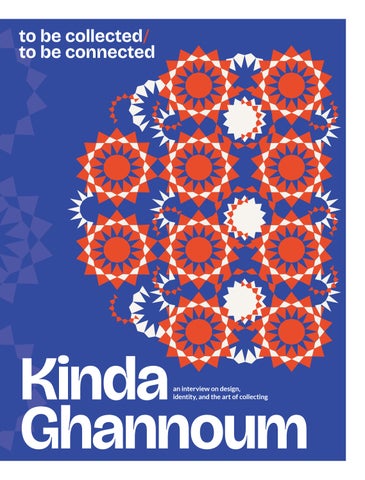
to be collected/ to be connected
Kinda Ghannoum an interview on design, identity, and the art of collecting
1. design with purpose Throughout your career, what was your favorite project?
DAMASCUS / ANTWERP SYRIAN / POLISH ARCHITECT / DESIGNER Trained as an architect in Syria, Kinda Ghannoum turned to graphic design to find new ways of preserving and reshaping identity. From her collaborations with Netflix to co-founding the Syrian Design Archive, she uses design as a language of connection. In our conversation, we talked about transition, cultural responsibility, and what it means to design with purpose.
I don’t have a favorite project. Within every project I had different experiences, I learned something different. I could say the project closest to my heart is the one that I did with Netflix for the film The Swimmers. It was about two Syrian girls, that’s why I felt connected to that. They were refugees and this film tells their story. So, Netflix reached out to me with an organization called Choose Love. They wanted to collect money and also bring awareness to the refugee situation in Syria with the premiere of the film. We did a lettering we called Choose Love, but in Arabic. That was a project I enjoyed working on because I knew the purpose of it, and it was about Syria. Another project that I started with my friends is called Syrian Design Archive. It began in my master’s when I started researching Arabic identity, but the scope felt too big. I decided to go a bit smaller where I felt more connected. That was the starting point for it. So, I started collecting materials and I found out that I had access to so many things that other people didn’t have. I felt the responsibility of highlighting those materials. I contacted my friends, Sally and Hala, knowing that both of them share similar interests. The idea started growing, growing, growing, and we ended up with what we have today.
I found out that I had access to many things that other people didn’t have. I felt the responsibility of highlighting those materials.
Collaborations with:
Is there an item from Syrian Design Archives that has blown your mind or was unusual to discover?
Obama Foundation Goethe-Institut UNDP EXPO Dubai 2020 Netflix Choose Love Techstars Startup TEDx KAICIID
My personal collection of stamps is something close to my heart. I’ve loved stamps since I was a kid. I still don’t have the full collection, but I’m trying to get as many as possible. But the thing that I’m remembering now, which we were super surprised that someone sent us, was Layla Magazine. It was one of the first women’s magazines in Syria. And it was so, so, so beautiful and interesting. And the beautiful part of it, the team behind the magazine, were women. We felt connected to that magazine because we were three women working on this project.
and many more...
2
Stamps / Kinda Ghannoum’s personal collection
2. language as design Many projects are connected to your Arab identity, do any draw on your Polish roots? Yes, definitely. I didn’t realize this until lately. I have the complexity from the Islamic and Arabic part, but also minimalism and abstraction from the Polish and European side. So, I think there’s a mix between both of them. Recently, I’ve been trying to explore my Polish part more extensively, because I’ve been busy with my Syrian.
A series of risograph prints / The Damascus Edition | RisoClub
Are there people, designers or artists, who were a big influence on you and your design practice? I think in every phase in my career, I was influenced by different people. In the beginning, I couldn’t find any resources about the Arab world. You always feel that when it’s in Latin script, it’s more cool or people are going to be more interested in it. Also all the good books, all the information, are about Latin designers. At that period, I had specific people who influenced me. For example, I was really inspired by Paula Scher: the way she did things, her posters, her graphics. I loved the way she solved things and thought. When I started searching, learning slowly and discovering different names, I was fascinated by Abdel Adel Arnaud: the way he translated the lettering or the ornament, everything was minimal. He’s a Syrian designer, but it’s not only about big names. Sometimes students, sometimes other people, even if they are not in the design field, can be an inspiration for you or they can give you something different.
Netflix Collaboration / The Swimmers X Choose Love
In your 10 years of design work, have you faced limitations working with non-Latin scripts? The only problem when it comes to research—information about the language or the designers is a bit difficult to find when it is in Arabic. But once you start getting into this by asking people or designers in the circle, you start discovering your own way to find what you want. When it comes to tools, I’ve never faced any problems. Today, the resources are getting better. Now you see more books about Arabic and these designers. It’s getting better and better. Redesign project for REcover initiative by Sharjah / Gate of the Sun
3
part of the interview series
24/7 DESIGN
3. design as voice Recently you campaigned for Free Palestine. How do you think art and design are connected to the political scene? In the beginning, I felt like I hated politics. But there’s a reason for that. Being in Syria, you’re afraid to speak or highlight anything. Even after I left, I didn’t want to be involved in anything because I was afraid for my family—you always have to think about that. And for me, even though what’s happening in Palestine has been going on for so long, not just since the 7th of October, when things escalated on the 7th, I felt a responsibility, and I wanted to translate what I was feeling. I felt if I didn’t speak, it’s going to be a problem. We have to speak. Being a designer, you have a really powerful tool to talk, to highlight, to help, and that’s what also made me rethink. As a graphic designer, you can speak on your own, but as an architect, you need to have a team. You can do stuff on your own, and that made me think that I want to shift from designing corporate things to something more cultural, something that has meaning. I also worked on several things for Syria, but I’ve never shared them, because I was afraid, but when things happened, I started resharing what I did previously.
We have to speak. Being a designer, you have a really powerful tool to talk, to highlight, to help.
4. advice for designers What is your advice for a design student today? Let’s start with this: don’t be afraid of sharing your work, no matter what it is. That’s what I learned. I think there’s beauty in imperfect things. And that also creates you: your story, your work, your style.
MINSK / SEATTLE SYRIAN / BELARUSIAN ARTIST / DESIGNER Diana Issa is a UW Design Master’s student. She is a multilingual designer who specializes in typeface design, print, and editorial composition. Her work explores the relationship between language and form as means of visual storytelling.
Also I would say share whatever you are creating. Don’t put a lot of pressure or judgment on yourself that it has to be perfect, because there will be someone whose attention is going to be caught. And maybe this person is going to bring you your dream project. This happened to me a lot with work that I was ashamed of. This led to a very interesting project that I’m super proud of now. I would also say, don’t be afraid of reaching out to people, because you never know what answer or help or feedback you will get. The worst case scenario is that you don’t get an answer. So count it as if it didn’t happen, it’s fine. And this is really important: don’t compare yourself to anyone else. Everyone has their own journey. And I know it’s hard. Even when I’m telling these pieces of advice to a student, I’m also reminding myself of this. Especially with social media, the amount of questions every day can be overwhelming.