CHANGES THAT CAME WITH THE HIGHEST COST Alexander’s death leads to safer race tracks
20 CENTRAL PA TRACKS
A directory, listing some of the best places in Pennsylvania, to satisfy your need for speed!
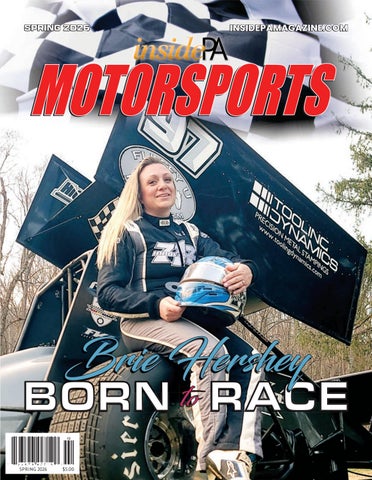
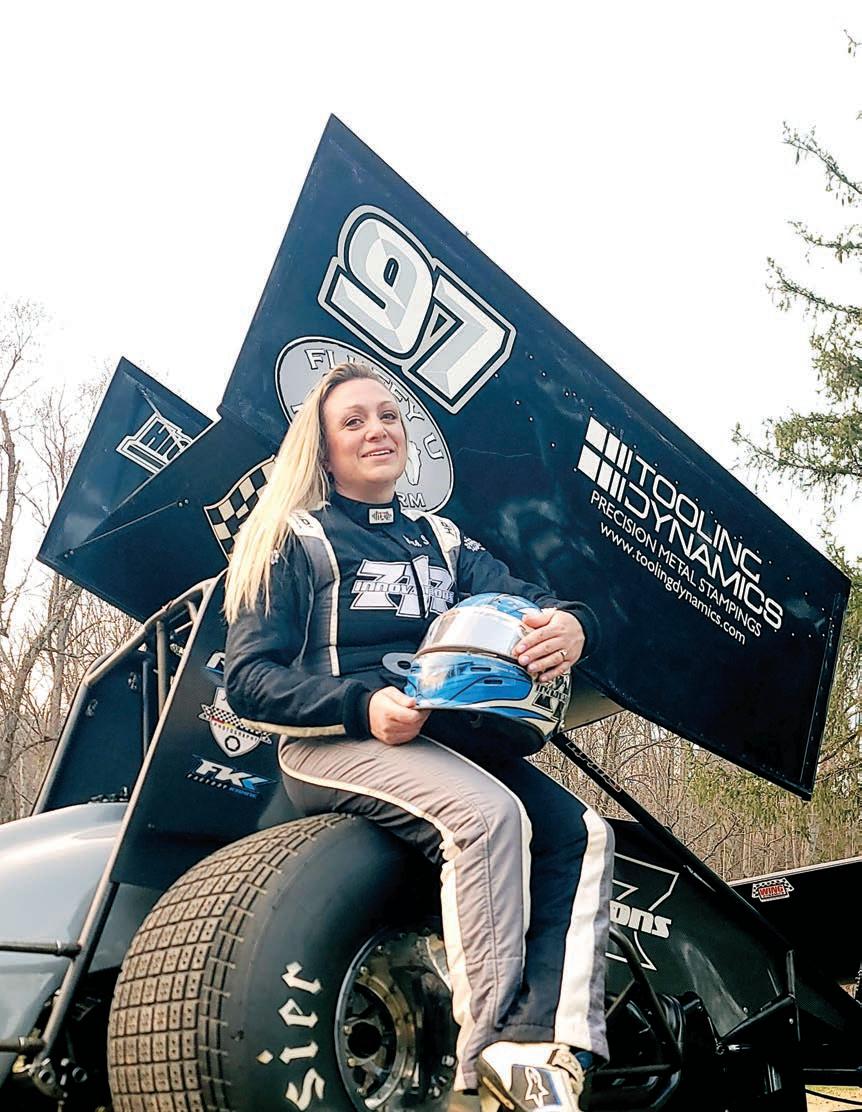
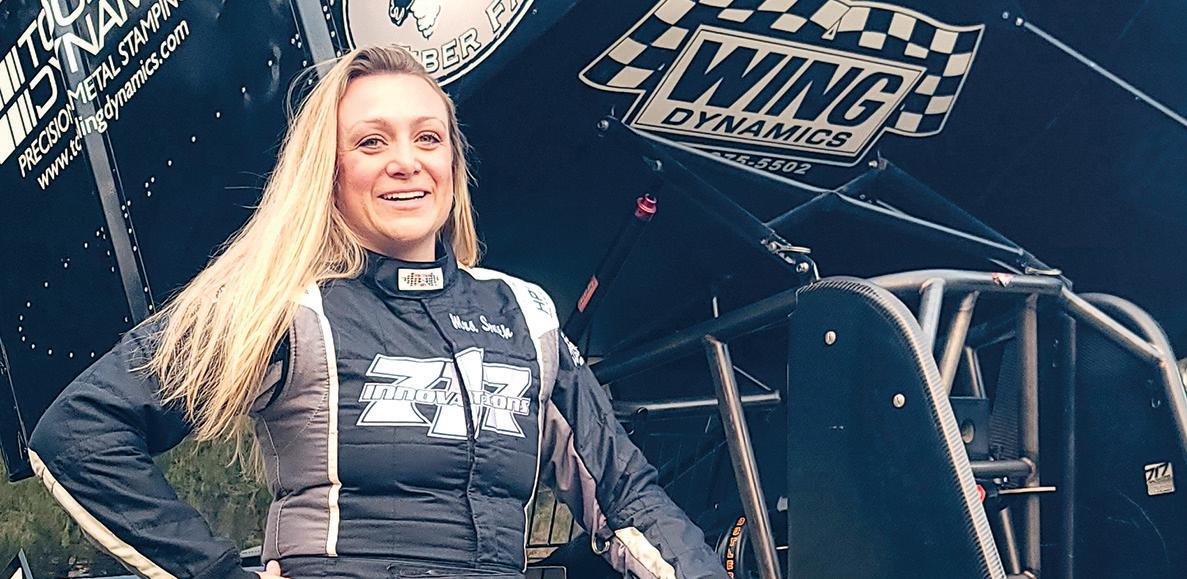
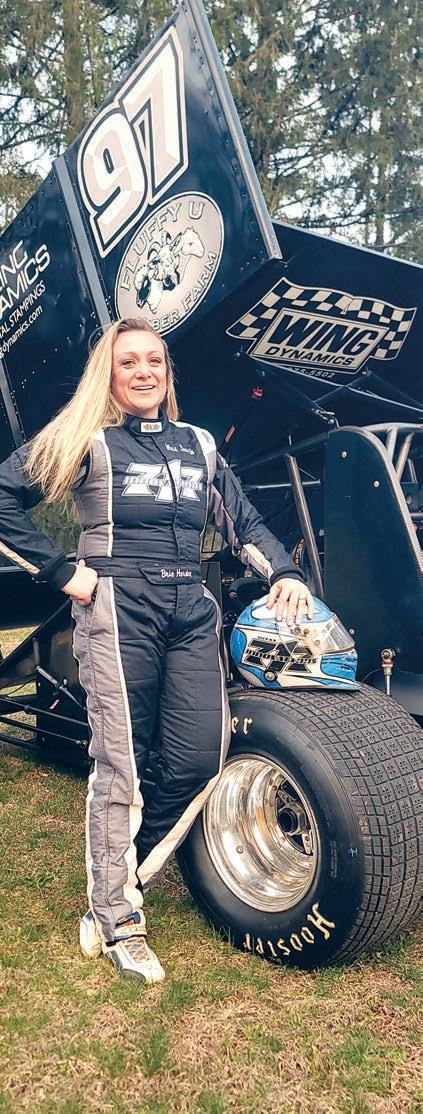
COVER: BRIE HERSHEY WITH HER #97 CAR
PHOTO BY: SHAWN WOOD
ABOVE: BRIE HERSHEY
22 REV ʻEM UP! Grenoble’s engines power racers to victory lane
26 ALL IN THE FAMILY
Following legendary father, Freddie Rahmer showing his mettle
30 BUILDING FOR THE FUTURE Racers Kissinger and friends paying it forward 34 HOOKED AFTER ONE RACE Writer’s passion for dirt tracks runs deep
AN ORIGINAL OUTLAW Remembering Scruffy
PHOTO ABOVE BY: SHAWN WOOD Magazine Editor Lori Seebold
Design/Layout Amber Hawke
Publisher Chip Minemyer
Advertising Director Lori Seebold
HERSHEY
Driver eager to return to sprint car racing
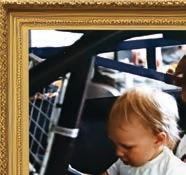
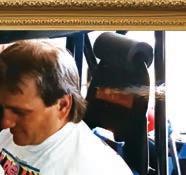
A father feeds his little girl, not in her high chair, but the seat of a race car, baby food running down her chin.
A framed photograph hanging on a wall of Tim and Tamie Hershey’s Dillsburg home preserves the nearly 30-year memory.
Twenty years later, a second photo was added. This one shows a proud Tim Hershey standing with his baby
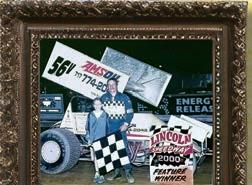
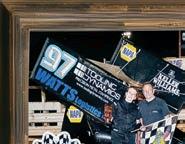
girl, Brie, after she won her first career sprint car race at Lincoln Speedway in Adamstown
The Hersheys became the first father and daughter combination to win a race at Lincoln.
Sometime next month, 34-year-old Brieanna Smith (or Brie Hershey as she is known in racing circles) will strap into her family-owned 410 sprint car at Port Royal Speedway and race again after a nearly two-year hiatus.
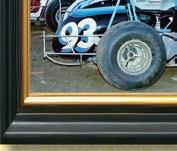
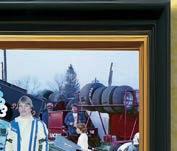
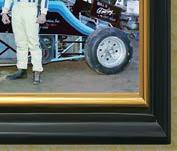
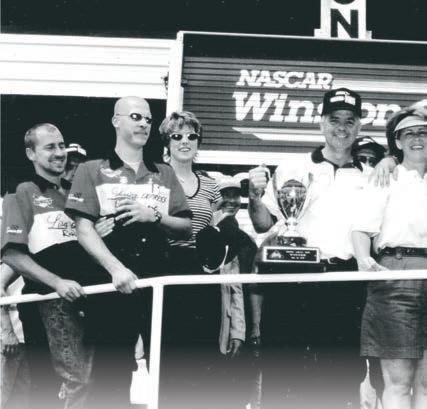
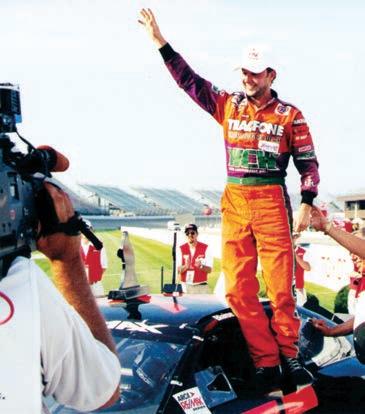
( FRAMED PHOTOS, OPPOSITE PAGE ) ( TOP LEFT ) BRIE CELEBRATES AT LINCOLN SPEEDWAY WITH HER DAD, TIM HERSHEY, AFTER HER FIRST VICTORY.
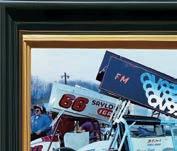
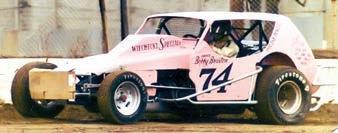
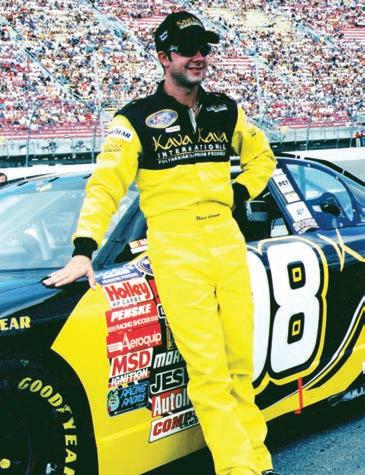
( TOP RIGHT ) A YOUNGER TIM STANDS NEXT TO HIS RACE CAR AT PORT ROYAL SPEEDWAY.
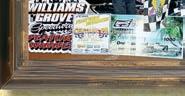
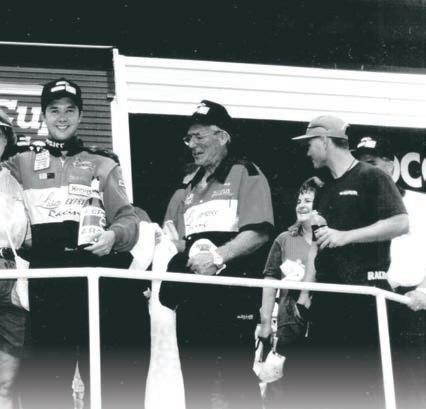
( BOTTOM LEFT ) BRIE AND TIM IN VICTORY LANE AT WILLIAMS GROVE SPEEDWAY.
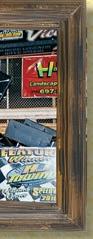
( BOTTOM RIGHT ) BRIE , AS A TODDLER, WITH TIM , IN HIS SPRINT CAR IN HIS GARAGE.
PHOTOS PROVIDED
She took all of the 2024 and all but one race of the 2025 seasons off for the birth of her and her husband Bill’s son, Weldon, who celebrated his first birthday in late January.
Nevertheless, as evidence of her extreme passion for racing sprint cars, Hershey did race once in 2025.
“I ran one race at the end of the year, the last race (in November), because I didn’t want to go a whole year without racing,” she said. “I couldn’t wait for next season.’’
She qualified for the feature, but didn’t finish.
Four months later her son Weldon arrived.
Brie decided to take more time off than she had planned, but is ready to go again in 2026.
“ I
starting to race micros.
He didn’t push his only child toward racing nor did he discourage her, even when she talked about extremely lofty goals.
“She wanted to race with the World of Outlaws (the top level of 410 sprint racing) and I won’t stop dreams,” Tim said.
His own introduction to the sport came when he went to a race with some friends and saw kids racing go-karts. Previously he thought that only adults raced karts.
“I saw kids racing go-karts and I said, ‘I’m doing that.’
“The first time I went to watch, I was hooked, and I’m not stopping anybody’s dream.’’
WAS LITERALLY ALMOST BORN AT
WILLIAMS
GROVE
. My mom went into labor while we were at the races.”
“The goal was to race more last year, but I took a little extra time to focus on getting back, getting my strength back to get behind the wheel,’’ she said, adding, “the 410 takes a little more out of you than the 358.”
- BRIE HERSHEY
Her goal upon her return, she said, is to “get consistency and get back into the routine.’’
She added, “The more you race, the more it becomes automatic (and) the more you’re out of the seat, you get in your head about it. I have to get back into the racing mind-frame, not stressing about it and thinking about it too much.’’
After starting to race quarter midgets at age 5, Brie progressed through the 270s and later the 600s, driving at numerous tracks including Linda’s, Hagerstown (Md.), Selinsgrove Raceway Park and Bluebird (Del.).
After graduating from the Lyn St. James Driver Development School, she got into a full-size (358) sprint car and before turning 18, she moved up to a 410, where she has remained.
She and her dad weren’t sure about the date of her first race this year, but May 2 at Port Royal has been mentioned.
So how long does she plan to wheel a sprint car around the competitive dirt tracks of Central Pennsylvania?
“Probably until my son kicks me out of the seat,” she said with a laugh.
“That’s what happened to me,” her father later joked.
Tim Hershey started racing go-karts at age 11 and finished up his sprint car racing about the time Brie was
More than that, Hershey ended his racing career and went full bore into helping his daughter with hers.
“He’s helped me my whole life,’’ Brie said. “I’ve never been at a race without him.”
Brie had made her mind up to race when she went to a track to watch one of her dad’s friend’s kids race when she was 3 or 4.
She added, “I never gave him an indication that (racing) was not what I wanted to do. It was just a natural path, I guess.”
She said the biggest thing she learned from her dad was his focus on details.
“He always paid attention to details. He’s a quiet person but he’s always thinking, watching the track, watching the people around him, always (thinking) a little bit ahead.’’
The team consists of Brie, her husband, her parents, and her uncle Brian Hershey. Family friends help when available.
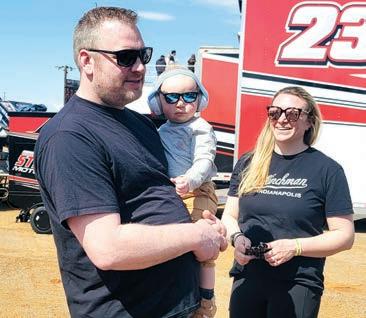
THE SMITH FAMILY AT WILLIAMS GROVE SPEEDWAY: BILL ( HOLDING WELDON ) AND BRIE.
PHOTO BY: SHAWN WOOD
“I just love it. I don’t want to give this up now. Once we got into sprint car racing, I was like ‘YEAH, CENTRAL PENNSYLVANIA IS WHERE IT’S AT.’”
- BRIE HERSHEY
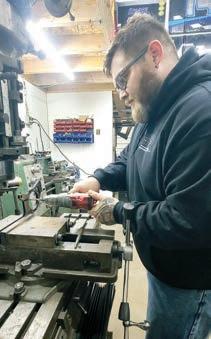
Brie has an engineering degree and works for a small engineering firm. Bill owns 717 Innovations, a carbon fiber deposit business, which is also the primary sponsor on the race car.
Bill raced go-karts when he was a teenager, but has never driven a sprint car.
Nevertheless, Tim said, “Her husband is an all-around talent. He’s a great machinist. Our equipment is good enough to win races.’’
Growing up, Brie said she never had NASCAR in mind, although she said if she would try anything in the big world of racing, it would be Indy cars.
Nevertheless, her plans are to continue doing what she is doing.
“I just love it. I don’t want to give this up now,” she said, adding, “Once we got into sprint car racing, I was like ‘yeah, Central Pennsylvania is where it’s at.’’’
Her father agrees and said he never doubted that Brie could compete.
“She impressed me in every division but I was nervous when she got into the 358,” her father admitted. “I was like ‘wow!’ ’’
But not for long.
“The first night out (at Trail-Ways) to hear her throttle control, that was a big relief off me. I knew she could handle it.”
Brie won three features that first season and was named the Most Improved 358 Sprint Car Driver in Central Pennsylvania. She has eight career wins, all in 358s.
It also eased her father’s mind that other female drivers have had success in sprints.
He cited the late Judi Bates, a legend at Port Royal; Erin Crockett; Becca Anderson; Cheryl Burgard, the first female winner at Lincoln Speedway; and Sara Fisher, who later ran in the Indianapolis 500.
Tim said that racing is addictive “when it gets in your blood.’’
He added, “I always say she got bit by the racing bug twice.’’
BRIE HERSHEY IS IN HER EIGHTH SEASON OF RACING 410 SPRINT CARS IN CENTRAL PENNSYLVANIA.
PHOTO BY: SHAWN WOOD
Perhaps what happened 34 years ago at Williams Grove was a harbinger for the Hershey family.
As Brie tells it, “I was literally almost born at Williams Grove (Speedway). My mom went into labor while we were at the races (on a Friday night).
“She was like ‘we better go to the hospital’ and I was born Saturday morning.”
Had it not been for her inherited passion for racing, that little girl may have gone in a different direction athletically.
Brie competed in track and field (pole vault, long and high jumps), tennis, field hockey and basketball at Northern High School in Dillsburg. She was offered a college scholarship for the high jump.
Her love of racing and desire to get a mechanical engineering degree were enough to steer her in the other direction.
“The school that offered the scholarship didn’t have an engineering degree and that was my main factor in the decision,” said Brie, who then chose Pennsylvania State University.
These days, it seems like life may be coming full circle for the former Brieanna Hershey.
Her son, she said, “He loves (racing). Every time he is in the garage, he wants to sit in the race car.”
So, maybe some day there will be another framed photo hanging on the Smiths’ wall.
For information, visit: briehershey.com
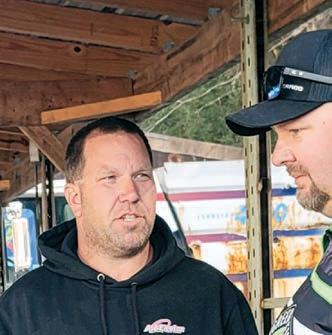
JASON MAKAREWICZ ( CENTER ), SPEAKS WITH RACE DIRECTOR, PAUL FRENCH ( RIGHT ) AT THE KING OF GREEN WEEKEND AT EVERGREEN RACEWAY. IN THE BACKGROUND, IS JOHN BENNETT, FATHER OF A RACE DRIVER.
PHOTO BY SHAWN WOOD
THE CAPTAIN OF EVERGREEN
Makarewicz enters milestone season with impressive slate
Nestled in the valley just outside Hazleton, minutes from the Pocono mountains, Evergreen Raceway has been providing entertainment for motorsports fans since the early 1950s.
Promoted by Hazleton native Jason Makarewicz, the 1/3-mile asphalt oval hosts a variety of events, from stock car and go-karts to drifting.
With opening day for this season just around the corner, Makarewicz is set to start his 10th season at the helm of the speedway.
For folks in the area who aren’t familiar with the facility, many notable drivers had turned laps around the track on a regular basis throughout the years. Former NASCAR Cup star Jimmy Spencer was a
regular at the speedway several decades ago and current NASCAR Cup star Ryan Preece, cut his teeth there in the modified division when he was in his early teens.
A variety of former and current Whelen NASCAR Modified Tour racers such as Justin Bonsignore and Austin Beers still compete at the facility from time to time, as does Matt Hirschman. Both Matt and his father, Tony, have won Modified championships at the speedway.
Like many locals near the track, Makarewicz frequented the speedway as a child and then from 2000-2010 as a Late Model competitor. It was a family affair for he and his team and, although he didn’t visit
victory lane during his career, he got a feel for the basic ins and outs of running a racetrack.
Following a brief change in management at the end of the 2013 season, the track opened for the 2014 season but shut down midway through the year. Upset about the closure, Makarewicz decided to take a risky leap and spent a large portion of 2015 devising a plan to take over the track and improve it not only for the racers and fans, but also for the upcoming generation of competitors.
focused on running a fair, efficient, affordable and entertaining racing program. He and his team continued that focus through the years by making continuous improvements both on and around the speedway. He said that currently, it’s particularly a challenge to make things as affordable as they were 10 years ago.
“One of the biggest differences over the last 10 years is the way the world has changed and prices of everything have really increased,’’ he said.
His dream came true and the 2016 season kicked off at Evergreen Raceway with an Enduro event in January. The driver and fan participation was incredible, as they were thrilled to see the track come back from the possibility of extinction.
nearly 140 cars on the
Several more Enduro events took place prior to the regular season and the car counts continued to grow into the early spring months, sometimes with nearly 140 cars on the third-mile track at the same time.
The fans loved it!
However, the car counts were a bit light when the regular season kicked off and Makarewicz did whatever he could to entice drivers to try their hand at Evergreen. The Asphalt Modifieds, Late Models, Street Stocks and Four Cylinders were hosted often, and other classes were worked into the schedule when time permitted.
During his interview, specifically about the early years of promoting the speedway, Makarewicz admitted that he and his team of officials had quite a bit of learning to do then.
“The experience is much different from then until now,” noted Makarewicz.
“The prices of pretty much everything has gone up, but we have kept our prices basically the same for the past 10 years, which means profit margins are much less.”
“It’s our team that makes the successful.track What we built helped to make everything a success.“
However, the car the speedway, Makarewicz well drivers’ purses.
The cost extends well beyond paying employees and the drivers’ purses.
“In 2016 I basically went into it blind. The experience I had was just being a former racer, not knowing much behind the scenes. We made a lot of mistakes, but that’s not always a bad thing, as long as we learned from them,’’ he said.
“Even to this day we still make mistakes, but we’re only human.”
Early on, Makarewicz
“The cost of insurance is
- JASON MAKAREWICZ
insane and just keeps going up. This year my insurance has gone up 23 percent for no reason at all,” he said.
“It’s hard to run a business when you can’t increase anything at the facility to cover the operating costs and that’s why we are always looking for new advertising partners. We also host different functions at the track like the ‘everything yard sale’ we just had.’’
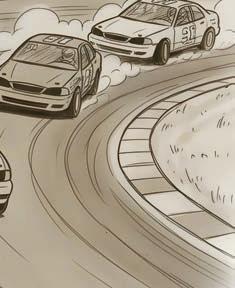
In 2017, the track began drifting events, which have become even more popular since. Drifting is a driving technique where the driver intentionally causes the rear wheels to lose traction, allowing the car to slide sideways through corners while maintaining control.
The drifting events draw cars and drivers from along the East Coast, which really adds to the local economy on drifting weekends.
Makarewicz said, “The first drifting event had maybe 30 cars. As the drifting continued to grow, I added more things for them on the track but had no idea it would grow into what it has today.
“Some of our events have over 200 cars. The atmosphere with the drifting is incredible. No fighting, no arguing. Everyone is there just to have a good time. It is a great atmosphere to be around.”
Makarewicz attributes many of the track improvements to the drifting events.
“Honestly, it’s the drifting that has kept me able to keep improving the facility. I also think it helps with giving the racers a weekend off throughout the month. It gives them time to take a breath and not spend every single weekend at the track.”
The improvements that Makarewicz made were substantial, including the repaving of 75 percent of the race track in 2021. He has since added additional asphalt to the track infield, including a karting track, which is slated to open this spring for the next generation of “big track” racers. He gives much credit to his friends from Wanick Construction and Franzosa Trucking for taking on the track paving projects.
Ten years is a very long run and it’s certainly an accomplishment. After all of that time Makarewicz attributes that success to his team of officials.
“It’s our team that makes the track successful. What we built helped to make everything a success. Kim Fisher, Haley Fisher and Kamryn Knittle, they’ve been there for 10 years and helped make the track grow to what it is today.
MATT HIRSCHMAN MATT HIRSCHMAN, OF NORTHAMPTON, A SECOND - GENERATION DRIVER, GOES OVER HIS SET- UP NOTES FOR HIS TOUR-TYPE MODIFIED AT THE KING OF GREEN WEEKEND AT THE TRACK.
PHOTO BY SHAWN WOOD
ROGER TURNBUSH ( NO. 88), AND MARK STEWART ( NO. 81) AWAIT TO ROLL OUT FOR THE TOUR-TYPE MODIFIEDS PRACTICE AT THE KING OF GREEN WEEKEND .
PHOTO BY SHAWN WOOD
“Paul French as race director I feel has been a great part of the team the last four years and Joe Wielgosz is very fair in tech. The infield staff have been on top of their game with quick clean-ups. Some of them have been with me for the 10 years,” he said.
He also credits the entire kitchen and ticket-booth staff for their hard work, along with track announcer and public relations correspondent Dino Oberto and Scott Adams of Himmer Graphics for all the graphics work.
Jason’s daughter, Caitlyn, also helps him with the track as does his brother, Kevin Makarewicz. That is, when they’re not racing themselves.
Good marketing partners are hard to come across for nearly any racetrack or race team and Makarewicz is excited about the partnerships that Evergreen has with Arc Electric, Fairway Motors and Harry’s U Pull It.
“Now that my daughter, Caitlyn, is older and thinks I’m crazy but she also stands behind me 100 percent. She races herself, in the Four Cylinder and will compete in the Rookie 602 Modified class this year. My brother Kevin races as well, and has plans on getting back in the 602 Modified and Street Stock.”
Over the past three decades, countless short tracks have closed and disappeared because of the lack of funding, land disputes and neighbor complaints, among other reasons. However, heading into his 10th season as Evergreen’s promoter, Makarewicz is optimistic about the growing support from many in the local community.
“We have had our fair share of issues with the community in the past. I have spent many countless hours on the phone with the zoning officer and attended zoning board meetings, but at the end of the day we usually come up with an agreement,” the promoter said.
He added, “The local community has been building more and more, and coming to the facility. The more we get locals to build cars and come race, the more local community support we get.”
Last season, Makarewicz also promoted Shangri-La Speedway in Tioga County, N.Y. The track had been dormant since the end of the 2014 season. He and a team of volunteers cleaned up the grounds and fixed up the facility. The reopening was a success, but he chose not to renew the lease again this season because of the cost.
Following a month of practice dates in April, Evergreen’s opening day is tabbed for Sunday, May 3 with the running of the Tour-Type Modifieds, Street Stocks, Four Cylinders Rotten/Forgotten Series, Rookie 602 Crate Modifieds, East Coast Legends and the Juicebox Division.
A variety of other divisions such as Late Models, Novice Four Cylinder, Slingshots, Enduros and Legends are only several of the classes that are listed on the track schedule for the 2026 season.
For information, visit: www.evergreenracewaypa.com
BUILDER | DRIVER | SUPERFAN
BOBBY BRAXTON LOOKS ON AS THE TEAM PREPARES THE FREDDIE RAHMER 410 SPRINT CAR AT WILLIAMS GROVE SPEEDWAY.
PHOTO BY SHAWN WOOD
Construction, racing fuel driver’s zest for life
In his 83 years, Bobby Braxton, of Wayne, has known just two things: construction and racing.
Since he was 14, Braxton has worked in construction, operating heavy equipment, performing carpentry or driving trucks.
He made his name in racing at the famed Reading Fairgrounds, commonly known as the “Home of Champions.”
“I tell everybody that Kenny Brightbill and I have a combined 136 wins at Reading,” Braxton said with a laugh. “Kenny has 135 wins, and I have one.”
Winning at Reading was no easy task back in the day, as the track operated from Sept. 24, 1924, to June 29, 1979. The half-mile clay and dirt oval featured modified racing and hosted sprint cars, both winged and nonwing.
Future sprint-car drivers Johnny Mackison Sr., Gary Wolford, Glenn Fitzcharles, Dick “Toby” Tobias, Bobby Allen, to name a few, raced modifieds at the track.
Braxton’s lone win came on June 22, 1975.
“I used to hang around a gas station as a kid, and one of the guys who worked there drove a race car, and he kept talking about the race car, and I asked him if I could go with him one time,” Braxton said of how he got started in racing.
His first-ever race was at Wilmington Speedway (Del.).
“The guy crashed pretty bad,” he said of his first race. “But it kind of got me interested.”
When Braxton was old enough to drive, he went to the shop in Germantown one night a week to help them.
“I was always a gear head,” Braxton said. “When Hatfield Speedway opened, that was the end of going to asphalt races. I figured that asphalt was how you got to a dirt track.”
One of his early breaks in the sport came in 1963, when Paul Deasey called him to work on the famed No. 707 modified that was being driven by the legendary Al Tasnady.
“I worked on that car for a number of years, and I always wanted to drive, so I started building my own car,” he said. “Tas was a good chassis guy, very smart and an excellent driver. He was very good for the sport. He was ahead of his time.”
Braxton went on to say that it was the basic chassis setup that Tasnady showed him that was essential to his career.
Braxton would begin his racing career near the end of the 1967 season.
“I went right to Reading,” he said. “I figured if you were going to race, you might as well race with the best.”
He would become friends with a lot of his heroes, including another modified legend, Frankie Schneider.
“Frankie helped me a lot with my own car,” Braxton said of Schneider, who was known as “The Old Master.”
“I got the body and the engine from Frankie for my first car. I also got help from Toby and Budd Olsen. It was so much different back then; it was so much fun.”
The first feature that he competed in was at the defunct Nazareth Speedway in the 707 car.
“I kept bugging Paul to let me take the car out,”
Braxton said.
He was also fortunate to drive the Frank Cozze coach and the famed Statewide car at Syracuse.
“I was a little intimidated when I first got onto the track at Syracuse,” he said. “You are going pretty quick there, but once you got a few laps in, and we were doing about 140 miles per hour on the straightaways.
“It was kind of like an overgrown Reading, as the track was flat and it was wide coming out of Turn 4 and into Turn 1, and then it narrowed coming off Turn 2, that’s exactly how Reading was.”
Flemington’s all-time winningest driver. “He was Kyle Larson 25 years ago. Billy was so versatile, and his old man, Roy, was a nice guy and cool.”
Braxton still works in construction as a consultant for the International Management Group in Malvern while helping Freddie Rahmer on his 410 sprint car. His last full-time ride came in 1985, and he raced against Fred Rahmer Sr., at the defunct Penn National Speedway.
In his later stages of racing, he would score three wins at the then 5/8th-mile configuration of Bridgeport Speedway (N.J.) including one of the Tobias Memorial races. He described the years of racing at Reading in one word: ‘wonderful.’
“The competition was so intense there that even qualifying, there were 50 cars there on a Friday night, and guys like Brightbill, Toby, and (Gerald) Chamberlain they started 18th every week, and they started in the back of a 16-car heat with six cars to qualify,” he said.
Braxton also raced at tracks such as East Windsor Speedway and Flemington Speedway (N.J.)
“Billy Pauch is an amazing guy,” he said of
“I remember that Fred drove the z51 car, but I really didn’t know him,” he said. “I knew Debbie (Rio, Fred’s wife) since she was 3, as her dad raced at Hatfield.”
It was a visit to the Rahmer shop one day that would lead to Braxton helping the team.
“I had never been there, and someone told me how to get there, and Fred said that anytime I want to come back, to stop by, and I just started hanging out there,” Braxton said. “I pretty much help Freddie out with everything on the car.”
At 83 years young, Bobby Braxton got to do what most people in the stands only dream of: racing against his heroes.
His love for helping others, life, and dirt-track racing is what keeps him going.
Changes THAT CAME with THE Highest Cost
Alexander’s death leads to safer race tracks
The world in which we lived 25 years ago changed for many people on three different occasions in 2001.
On Feb. 18, 2001, on the final lap of the Daytona 500, Dale Earnhardt died following a crash in Turn 4.
Seven months later, the attacks of 9-11 occurred.
For the people of Montoursville, their lives changed on Oct. 4, 2001, as they were shaken by the death of one of their own, Blaise Robert (BR) Alexander Jr., during an Automobile Racing Club of America event at the Charlotte Motor Speedway.
The crash occurred with four laps to go when Blaise’s and Kerry Earnhardt’s cars collided trying to avoid a lapped car that had lost control in front of them.
He was 25 at the time of the accident, the oldest of the four children of Blaise Sr., and his wife, Anne.
“I got a call from Humpy (H.A. Wheeler, then general manager of Charlotte Motor Speedway, who passed away in August 2025), as at the time, there were a lot of guys not wearing the head and neck restraints,” Blaise said.
Wheeler asked Blaise if he was going to take action against the track.
“I said, ‘Humpy, I won’t, I’m not considering it, but I do want you to do two things for me.’‘’
He said the No. 1 thing was to make the head and neck restraint (HANS) devices mandatory throughout NASCAR.
Blaise told him that he was watching television and they were talking about how, because of Dale Earnhardt, the head restraints were going to be made mandatory.
( LEFT ) BLAISE ALEXANDER , FOURTH FROM RIGHT, CELEBRATES HIS ARCA WIN AT POCONO RACEWAY WITH HIS MOM ANNE , DAD BLAISE SR. BLAISE SR., TO HER RIGHT, ALONG WITH CREW MEMBERS DWAYNE BIGGER DWAYNE BIGGER, SECOND FROM LEFT, DAVE CALEHUFF , THIRD FROM RIGHT, AND SPONSOR LISA STOKES , SECOND FROM RIGHT, IN 1999.
PROVIDED
“I said ‘That’s not true. And you know it, and I know it. Had they made them mandatory in February when Dale died, Blaise may have survived that accident.’‘’
Wheeler agreed.
Blaise Sr. told him, “I want you to go into that media center, and the next time that you are in front of those boys, (tell them) that’s not Dale’s legacy. He was probably the greatest driver ever in NASCAR. Blaise’s legacy will always be that because of his death (the sixth in two years to a basilar skull fracture), they made the head restraints mandatory, and that’s a fact.”
NASCAR announced at Talladega that it would not let you run unless you had a head restraint.
Wheeler asked what the second thing was.
against that track.’’
Wheeler said, “Blaise, I will see what I can do, and consider it done. And for two years, he did exactly what he said he was going to do.”
Blaise Sr.’s dad, Blaise J. Alexander, started the Blaise Alexander Family Dealership in Lavelle, a small town in the Coal Region near Mount Carmel, where Blaise Sr. excelled in football, track and wrestling at Mount Carmel High School.
“I responded, the only track that I know of that has SAFER (Steel And Foam Energy Reduction) barriers is Indianapolis. I am going to give the France family two years to install SAFER Barriers on every track. If I see that it is done and completed on every single track, you’ll never hear another word out of me or action
Blaise Jr.’s other siblings include Adam, 48; Maureen, 45; and Aubrey, 40.
The path to motorsports for Blaise began with Sonny Bussey, of Sunbury, who owned go-karts, took Blaise, who was 12 at the time, and Adam, and raced on an asphalt road course that no longer exists in Hughesville.
“Blaise just fell in love with racing,” Adam said of his brothers’ soon-to-be discovered talent.
Blaise won the coveted World Karting Association East Regional championship in 1992.
The family was friends with Ricky Tanner, of Watsontown, who raced micro sprints. Through that connection, Blaise made the move from go-karts to micro sprints. The two were teammates for quite some time.
It was another family associate, Selinsgrove Speedway sprint-car driver Lenny Krautheim III, of Penns Creek, who helped lead the family to go stockcar racing.
It was the fall of 1994, and the family was debating
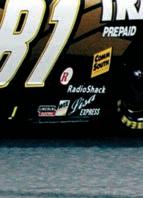
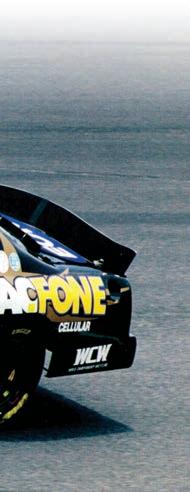
BLAISE ALEXANDER RACES THROUGH TURN 4 AT CHARLOTTE MOTOR SPEEDWAY DURING A BUSCH SERIES RACE FOR TEAM OWNER, FELIX SABATES .
PROVIDED
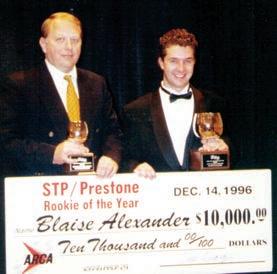
BLAISE ALEXANDER CELEBRATES HIS 1996 ROOKIE OF THE YEAR AWARD WITH HIS UNCLE JIM KUZO AT THE ARCA BANQUET. PHOTO PROVIDED
PHOTO
PHOTO
whether to head to sprint cars or go to stock cars.
Lenny was selling his ARCA team, and the Alexanders bought the car and trailer from him. Blaise and three other guys, Dave Woodhead, Doug Easton, and Dwayne Bigger moved to Mooresville, N.C., and they drove down in a 1978 Southwind Deluxe Motorhome.
They lived in it for six months before Blaise Sr., bought them a house.
“I thought that Blaise had the potential to move up,” said Randy Christ, the former gas man on the ARCA team, who is the Fleet and Commercial sales manager for the Blaise Alexander family dealership today. “He gave a lot of people an opportunity, including Steven Lane, our crew chief, who was a truck driver for Dillard’s Department stores.
his family, especially his mom, she meant the world to him.”
Unfortunately his mother, a nurse at UPMC, died several months after the accident, at age 49 after a battle with cancer.
Blaise won the ARCA Rookie of the Year honors in 1996 with 11 top 10s, and six top fives. His third and final ARCA win came while driving for Bob Schacht Motorsports in 2001 at Michigan.
He won his first ARCA race at Toledo Speedway in 1999. That same year, he won the ARCA event at Pocono Raceway. He also competed in the Busch Series for Felix Sabates and in the Craftsman Truck Series.
His best Busch Series finish came for SABCO Racing in 2000 with a seventh-place run at Atlanta. He finished ninth in the Truck Series race at Watkins Glenn, a race Adam said that Blaise nearly won.
Blaise attempted to qualify for two NASCAR races in 2000 with LJ Racing at Talladega and Atlanta. He failed to qualify for both races.
Over the course of time, Blaise would befriend drivers including the late Kenny Irwin, a United States Auto Club openwheel standout; Kerry Earnhardt; and eventual seven-time NASCAR champion Jimmy Johnson.
“In NASCAR, Blaise’s legacy will always be that because of his death, they made the head restraints mandatory, and that’s a fact.‘’
- BLAISE ALEXANDER, SR.
“He raced on the weekends at Bowman-Grey Stadium. Blaise realized that this guy was sharp, and Steve went on to be a crew chief for a couple of Cup drivers.”
They rented a shop next to L.W. Miller, of Dushore, in Mooresville, N.C.
Blaise’s first ARCA race was the 1995 season opener at Daytona, where he finished 12th.
Lisa Stokes, whose husband, Bobby, raced late models in the area, was a sponsor of Blaise’s ARCA car through her trucking company Lisa Express, of Milton.
“Blaise was just down-to-earth,” Stokes said of her best friend. “We’re from the small town of Montoursville, and he never let the big scene of NASCAR or ARCA change who he was. And he loved
Like Dale Earnhardt and Alexander, Irwin lost his life to a basilar skull fracture in a racing accident. This occurred at New Hampshire Motor Speedway in 2000.
The spirit of the Coal Region is one of faith, family, love and the mantra that it is better to give than receive. The kid from Montoursville truly gave more than he received.
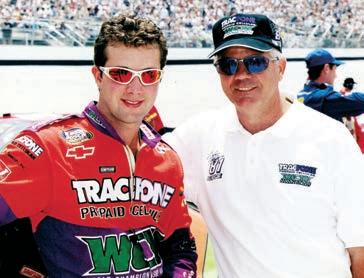
BLAISE ALEXANDER AND HIS DAD, BLAISE, SR. , ARE PICTURED BEFORE A RACE AT DOVER ( DEL.) MOTOR SPEEDWAY DURING HIS BUSCH SERIES DAYS. PHOTO PROVIDED
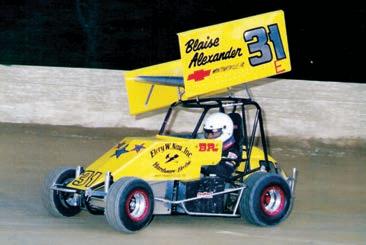
BLAISE ALEXANDER RACES HIS MICRO SPRINT AROUND GREENWOOD VALLEY ACTION TRACK. PHOTO PROVIDED
BLAISE ALEXANDER AWAITS THE START OF THE 2001 BUSCH SERIES RACE AT THE MICHIGAN INTERNATIONAL SPEEDWAY WHEN HE WAS DRIVING FOR CARROLL RACING. HE WOULD FINISH 11 TH IN THE RACE.
PHOTO PROVIDED
THE LATE BLAISE ALEXANDER CELEBRATES HIS ARCA WIN AT MICHIGAN INTERNATIONAL SPEEDWAY IN 2001. THE CREW CAME THROUGH ON THE FINAL PIT STOP TO HELP BLAISE GET THE WIN.
PHOTO PROVIDED
Central Pa
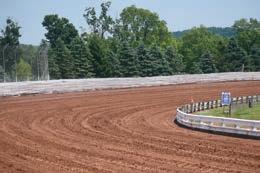
BAPS MOTOR SPEEDWAY CLINTON COUNTY SPEEDWAY
Layout: 4/10th-mile Semi-Banked Oval
Location: 690 York Road, York Haven, Pa.
Layout: 3/8th-mile Semi-Banked Dirt Oval
Racing Divisions: Super Sportsman (Winged), Limited Late Models, Street Stocks, Extreme Stocks, 602 Modifieds, 410 Sprint Cars, 358 Sprint Cars
Track Phone: 717-938-9170
Location: 98 Racetrack Road, Mill Hall, Pa., a half-mile off Exit 178 on I-80
Email: kgouse@bapsmotorspeedway.com
Website: www.bapsmotorspeedway.com
X: @bapsrace
Racing Divisions: 305 Sprint Cars, Limited Late Models, Pro Stocks, 270 and 600 Micro Sprints, 4-Cylinders, 410 Sprint Cars
Track Phone: 570-726-7223
Email: info@clintoncountyspeedway.com
Website: www.clintoncountyspeedway.com
X: @ClintonCoSpdwy
BEAVER SPRINGS DRAGWAYEVERGREEN RACEWAY
Layout: 1/8th and 1/4th-mile Drag Strip
Location: 109 Race Track Lane, Beaver Springs, Pa.
Racing Divisions: Multiple Drag Racing Divisions
Track Phone: 570-658-9601
Email: mike@beaversprings.com
Website: www.beaversprings.com
Layout: 1/3rd-mile Asphalt Oval
Location: 183 Mill Mountain Road, St. Johns, Pa.
Racing Divisions: Tour-Type Modifieds, 602 Crate Modifieds, Late Models, Factory Stock, Hobby Stock, 4-Cylinders
Racing Divisions: 410 Sprint Cars, Super Late Models, Limited Late Models,305 Sprint Cars
Track Phone: 717-527-2303
Email: info@portroyalspeedway.com
Website: www.portroyalspeedway.com
X: @PortRoyalSpdway
Layout: 1/2-mile, Semi-Banked Oval
Track Phone: 717-697-5000
Email: williamsgrove@verizon.net
Location: 1 Speedway Drive, Mechanicsburg, Pa.
Racing Divisions: 410 Sprint Cars, 358 Sprint Cars
Website: www.williamsgrove.com
X: @WilliamsGrove
Rev ‘em Up!
Grenoble’s engines power racers to victory lane
STORY BY: HAROLD RAKER
As a 16-year-old student at the former West Snyder High School in Beaver Springs, Seth Grenoble started tearing motors apart and putting them back together in the garage at his house.
Although his father, Fred, was a mechanic on some of Central Pennsylvania’s most successful race teams, Seth had no interest in driving the cars.
His father implored him not to pursue a career in motorsports.
“I remember when I graduated from high school he said to me ‘whatever you do don’t get mixed up in racing’ and I said, ‘really? You’re a good one to tell me that.’”
But Fred really meant it.
Seth was helping driver Bob Landis at Port Royal Speedway when his father, who was helping another driver, walked past Landis’ pit and spotted his son.
“He was really mad. He wanted to know what I was doing there,” Seth recalled.
Now 30 years into operating his business, Seth’s Racing Engines, in Beaver Springs, he and the many racers who have worked with him are glad he didn’t follow that fatherly advice.
“My dad was big into racing,’’ Seth said. “He helped (Bob) Weikert when Kenny Jacobs drove for him, (Al) Hamilton, (Randy) Wolf, (Doug) Wolfgang, and Jess Thomas when he drove 410s.”
The only interest Seth had in those big-name racers was their engines.
“My grandfather (the late Clair Goss) had a garage where I’m at now, and he worked on cars, but I always loved motors for some reason.
“I loved engines and I just got into it. I worked for Beaver Springs Auto Parts. They started a machine shop and I ran that for six and a half years and I’ve always been building stuff in my garage,’’ he said.
As he and his friends started building engines when Seth lived at home, they relied on kits that he
ordered from California.
“When I think back on that now, I just shake my head,” he said.
Equipment then was not what it is today, he said.
After starting the business in his grandfather Clair Goss’ garage just off Route 522 in Beaver Springs in 2015, he gradually added more equipment but admits he was a little nervous at the amount of money he was spending.
It turns out that, to paraphrase the James Earl Jones character, Terence Mann, in the film “Field of Dreams,” if Seth built it, the race drivers would come.
“We slowly started the machine shop and over the years it kept growing and growing.
“We also used to work on cars and we rebuilt a lot of stock motors back then but now all we do is racing (motors) and street rods, performance stuff mainly.’’
As more race teams came to him, he continued to add more equipment.
His customers have included the late Jim Nace, the late Craig “Cricket’’ Keel, Blane Heimbach and 305 drivers Ken Duke Jr., Drew Young, Kruz Kepner and Kenny Heffner.
Despite his garage location, about a track length from Beaver Springs Dragway, Seth was not interested in working with dragsters.
“I was more of a fuel injection guy,” he said.
That doesn’t mean his is not a diversified operation.
In addition to building engines for 410, 358 and 305 sprint cars, as well as 600, 270 and 125 micro sprints, he also works on and builds engines for the popular tractor pulls such as those held in Penn Township, Snyder County, near Selinsgrove.
Despite the volume of engines he puts out and the large number of drivers who have come to depend on him, Seth’s Racing Engines is a two-person operation: Seth and his wife, Brenda.
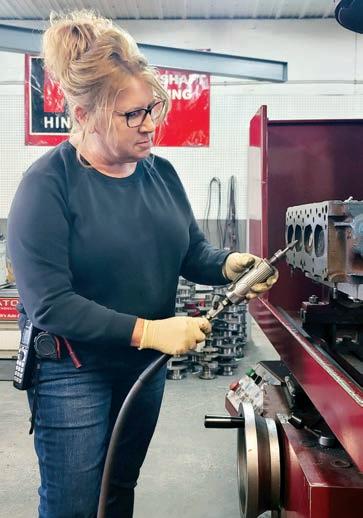
While her husband is building and repairing engines, Brenda is busy honing cylinders, disassembling motors, pressure testing, checking for cracks, plus all the paperwork, he said.
“I like doing the work myself so that way, if anything happens, it’s nobody else’s fault,” Seth said. “We try to do a good job for everybody. Mistakes happen but we try to make it right.
“We’ve been fortunate over the years that we’ve got good customers,” he said.
He and Brenda are certainly busy, but he said, “I’m very fortunate that I never had to scramble for work.’’
Things began quietly enough, with local racers asking him to build engines for them.
“I did stuff for people I know and for some racers,’’ he said.
“It just grew from there over the years.’’
But it got crazy.
Today, Seth’s race cars are competing at tracks in New York, California and North Carolina, and some have taken laps in Australia.
Paul Colagiovani, a race team owner in New York, bought some engines to race in the Empire State and is trying to grow the sprint car racing in an area more known for its modifieds.
One of his drivers, Zach Sabotka, with a Seth Grenoble engine, ran in a World of Outlaws race in Weedsport, N.Y., and finished ninth in the feature. His was the only 358 among the 410s.
“That’s impressive. That’s a testament to how good of a driver he is. He had the car good and it all has to work together, not just the motor,” Seth said.
Seth said Cologiavanni is selling some of his engines in New York and would also like to bring some of his drivers to compete in Selinsgrove.
He also has a driver, Greg Smyre, with two of his engines racing 305s in North Carolina.
Another, Ryan Robinson, won the championship in a 360 with one of Seth’s engines in the Sprint Car Challenge Series
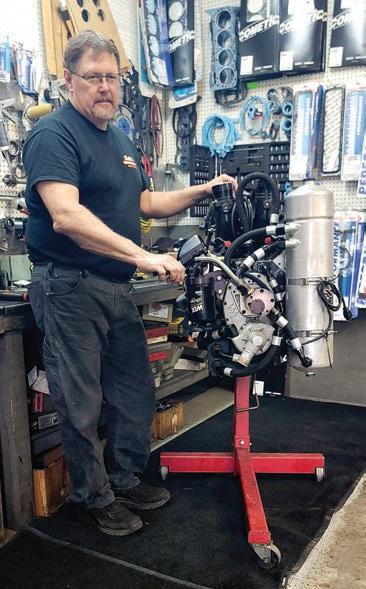
SETH’S RACING ENGINE OWNER SETH GRENOBLE TIGHTENS A LINE ON A 410 SPRINT CAR ENGINE FOR A CUSTOMER IN HIS SHOP IN BEAVER SPRINGS.
PHOTO BY SHAWN WOOD
in California.
Selinsgrove’s Blane Heimbach won championships at Selinsgrove and Port Royal and Kyle Reinhart, driving for John Westbrook, won the Selinsgrove championship a few years ago.
“I’ve been very fortunate to have good guys and we’ve done some good work together,” Seth said.
“It’s always been a passion of mine. I love it. My dad didn’t realize this end of it because he was a mechanic and it took him away from his family. He traveled all the time.’’
That was his father’s reasoning when he pleaded with Seth to avoid racing.
Seth’s handiwork is not just relegated to oval tracks. He has also been building engines for the sport of truck and tractor pulling for about 15 years.
Some have won championships locally at Snyder County Truck and Tractor Pullers and some with the Interstate Truck and Tractor series.
Verne Zerby, of Shamokin, has won championships throughout the eastern U.S., Kim Freed, of Selinsgrove, has titles in the pro street gas trucks class at Selinsgrove and Mike Barr, of Port Matilda, has won titles at many national events as well.
One year, Seth said, drivers with his engines finished first, second and third in the points. Seth and Brenda continue to handle everything, but for eight years, he had an employee, Ryan Romig.
The latter, now living in the Sunbury area, went out on his own, even with Seth’s encouragement.
But these days Seth is thinking about the day he can retire and do some of the things he longs to do, such as traveling to see family, including some of Brenda’s relatives in Wisconsin.
“I’m getting there. I am going to be 58 this year. I have cut back some,’’ he said, noting that he is down to about 60 hours a week.
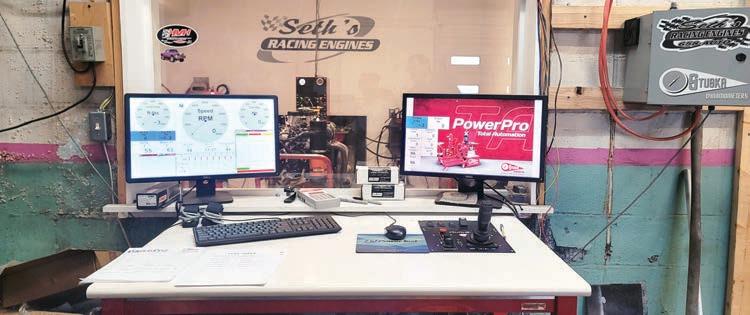
THE DYNO AREA OF SETH GRENOBLE’S BUSINESS IS WHERE ENGINES ARE TESTED AND TUNED FOR CUSTOMERS. MULTIPLE SENSORS HELP TO MEASURE AND ADJUST THE PERFORMANCE OF THE ENGINE.
PHOTO BY SHAWN WOOD
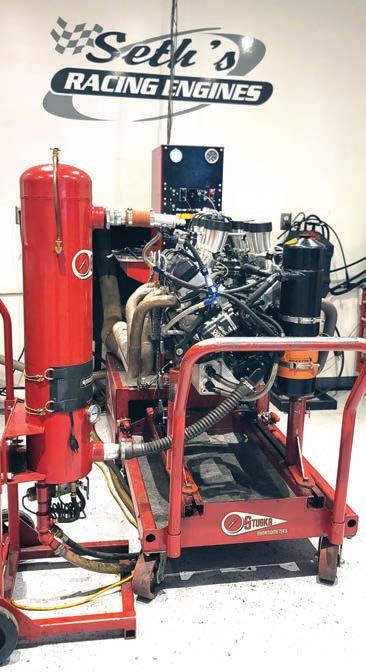
A 410 SPRINT CAR ENGINE IS ALL SET TO BEGIN ITS TESTING AT SETH’S RACING ENGINES DYNO SHOP.
PHOTO BY SHAWN WOOD
“Before, I would work at least 12 to 14 hours a day during the week, until 3 on Saturdays and then sometimes I would go in some on Sundays.’’ Was he successful?
The proof is in the checkered flags. For more information,
PHOTO BY SHAWN WOOD
FOUR-TIME WILLIAMS GROVE SPEEDWAY
410 SPRINT CAR TRACK CHAMPION
FREDDIE RAHMER RACES THRU TURNS
1 AND 2 AT WILLIAMS GROVE SPEEDWAY DURING A SEASON OPENER IN THIS UNDATED PHOTO.
ALL IN THE
Following legendary father, Freddie Rahmer showing his mettle
STORY BY: HAROLD RAKER
Although most of his peers started their racing careers at much younger ages, Freddie Rahmer didn’t strap into a 410 sprint car full time until 2017. But his early career is off to the kind of start that lives up to his father’s nickname.
The son of Hall of Fame driver “Fast” Fred Rahmer, who put the small town of Salfordville on the racing
map, Freddie certainly has a long way to go to catch his dad on wins.
Fred amassed more than 500 checkered flags before retiring after the 2013 season. He won 99 in the modified division before switching to sprint cars.
Freddie had 72 as the calendar turned to April.
“With our dad racing for a living, we never really had
PHOTO BY SHAWN WOOD
time to run go-karts. We didn’t have time to focus on it the right way,” Freddie said.
While many kids were racing karts before entering kindergarten, Freddie and his triplet siblings, brother Brandon and sister Francesca, and their mother, Deb, were on the road.
But he is not obsessing over the win total and his father’s remarkable achievements.
He does think about it, but, he said, “I just want to do my own thing. I think I can do pretty good, but the only (win) that matters is the next one.’’
The 30-year-old added, “Dad didn’t have a lot of wins early, but then he had a lot of 20- and 30-win seasons in a row.’’’
Fred Rahmer’s accomplishments can not be overstated.
His son said that, while reaching his dad’s win total is “something I would like to do,” he doesn’t believe it’s possible
“Plus, he was outstanding to achieve all the things he did,” Freddie said. “I just want to do my own thing.
“I want to win as many as I can, obviously.
“Some people by the time they’re 14, they have hundreds of starts, maybe thousands,” Freddie said.
“We didn’t have that much experience in anything, really before we started running 410s,” Freddie said.
But his on-the-job training has served him well.
and competed in an 18-track series that included Selinsgrove, Williams Grove, Lincoln, Bedford and others, all within a 150-mile radius.
Then the Kutztown Action Track started weekly races on Wednesday nights and the Rahmers began to compete there.
That’s apparently when the light bulb came on for Freddie.
“Before Kutztown, I really didn’t win as much. My brother was a lot better than me,’’ Freddie said. “He won three or four before I won the first one.’’
After about three years of racing SpeedSTRs, and Freddie winning the points championship at Kutztown, the Rahmers climbed into 305 and then 358 sprint cars before moving up to the powerful 410s.
Freddie is running all of the tracks, and has won nine titles, five at Lincoln and four at Williams Grove, including his rookie season.
Brandon has confined his racing to the shorter tracks, mostly Lincoln Speedway in Abbottstown, where his family name is legendary, thanks to his father’s incredible career at the York County track, and he has four wins.
Freddie didn’t wait too long to show his interest in his dad’s chosen vocation.
“I have been helping my dad in the garage since I was 8 or 9 as much as I could and then as I got older and more advanced, I started racing when I was 13 or 14,” he said.
He said Brandon came a bit later to the party, not initially having the keen desire of his brother to work on race cars or race them.
But Brandon did join in the family business and now races 410s weekly at Lincoln.
Freddie’s first racing experience, and eventually his brother’s, came after an invitation by Hall of Fame sprint driver Richie Tobias, to race SpeedSTRs, a self-starting race car, built by Tobias. They are powered by a fourcylinder Mopar motor.
The Rahmers began racing SpeedSTRs in 2013,
Meanwhile, mom and dad have seen their days at the race tracks continue as their sons try to build on the legacy that actually began a generation earlier.
Fred raced modifieds for several years for his late father-in-law, Frank Rio, who died last year at age 99. Rio and his brothers were renowned engine and car builders and their race team won numerous races in stock cars, including the modifieds wheeled by Fred.
Starting with her father, Deb’s life revolved around racing and it appears things will not change.
Deb and Fred are proud of their children, who now all have children of their own, but they could just as well do without seeing their sons race sprint cars.
Deb spent her life around racing, starting with her father, and then her husband.
“It’s totally different. I would get nervous watching my husband, but it’s not like watching my kids,” she said. “I can barely breathe.
“I guess it was because my husband was experienced but I guess it’s a mother’s instinct to be nervous when it’s your kids,’’ she said.
She added that for the past five years, her parents
FREDDIE RAHMER FREDDIE RAHMER, CENTER, LISTENS DURING A DRIVERS MEETING AT WILLIAMS GROVE SPEEDWAY. THE FOUR-TIME TRACK CHAMPION IS FLANKED TO HIS LEFT BY THE TRACK’S ALL-TIME WINNINGEST DRIVER LANCE DEWEASE WITH DANNY DIETRICH DIETRICHTO HIS LEFT AND LUCAS WOLFE IN THE BACKGROUND.
PHOTO BY SHAWN WOOD
being elderly, she has not gone to the races as often.
Before that, “I went every weekend from the time I was a kid. My father owned a race car since 1951.’’
Now, because she is too nervous to watch, she usually stays home and follows it on the computer.
“When I’m home I can run into the other room and run back,’’ she said. “I don’t watch it steady.’’
After Fred retired, he hired veteran Stevie Smith to race his car for three years until Freddie was ready.
Deb says that she is “100 percent’’ pleased that Fred is with the boys at the track.
“I just want to do my own thing.
I THINK I CAN DO PRETTY GOOD, BUT THE ONLY WIN THAT MATTERS IS THE NEXT ONE.”
- FREDDIE RAHMER
“He’s the type of guy that’s not going to sugarcoat it, he’s going to be there, he’s going to know, he can tell how they’re racing and he can oversee and check everything. I am thankful that he’s there.’’
On the few occasions when the boys are racing apart, Fred’s longtime crew chief, Moon Byers, works with Brandon.
But Fred is totally concentrated on both cars, she said.
Fred has said that he would have been happy if his boys had not followed in his footsteps but he is proud of all three children.
He is most proud that all three are college graduates.
Freddie graduated from Penn State University with a mechanical engineering degree and is employed by Jacob Schmidt and Son Inc., Harleysville; Brandon has Chop Designs in Salfordville; and Francesca “Chessie’’ Rahmer Subrano, a high school and college lacrosse standout, graduated from East Stroudsburg University and is an orthopedic physicians assistant.
Each has a young child: Freddie’s daughter, Leighton, is seven months old; Brandon’s daughter, Charli Jay, is 5 months; and Chessie’s son, Jackson, is nearly 2 years.
As the 2026 season takes the green flag, Freddie said he continues to set goals at the start of every season. This year, he wants to get 15 victories and win another
World of Outlaws race for the Pennsylvania Posse.
His lone victory against the national touring series came in 2018 at Lincoln.
He also wants to get as many wins as he can in the new Central Pennsylvania Sprint Car Series, which takes in 11 tracks within a 150-mile radius.
What he doesn’t intend to do is chase his legendary father, but he is glad to have him with him at the races.
“He’s my best friend,” Freddie said, adding that last month’s Williams Grove opener was his dad’s 34th in a row. “We’re lucky to have him.’’
He said he is thankful that both of his parents provided he and his siblings with good educations and “they steered us in the right direction.’’
Building for the Future
Racers Kissinger and friends paying it forward
STORY BY: HAROLD RAKER
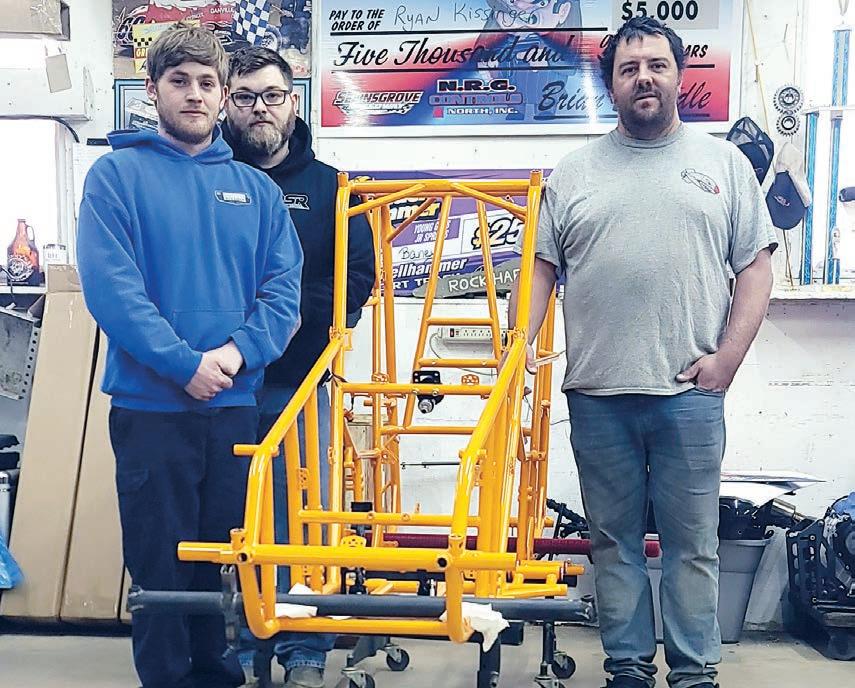
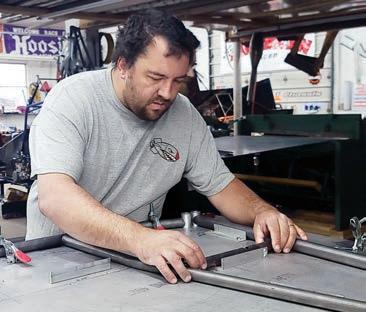
THE KISSINGER PUTERBAUGH MOTORSPORTS TEAM , TYLER ( LEFT ) AND BROCK PUTERBAUGH ( BACK ) AND RYAN KISSINGER ( RIGHT ) STAND BESIDE ONE OF THEIR COMPLETED KPM CHASSIS AT THE SHOP IN BLOOMSBURG.
PHOTO BY SHAWN WOOD
Whether a NASCAR or an IndyCar driver or a weekly dirt-track racer, most will tell you about the people who helped them along the way.
Bloomsburg’s Ryan Kissinger, a former regular 358 sprint-car driver at Selinsgrove Speedway, is no exception.
Kissinger and two of his racing buddies, Tyler and Brock Puterbaugh, of Benton, decided they should do more than just offer thank-yous.
Now business partners with KPM Motorsports building micro sprint chassis, as well as owners of a multi-car race team, the Columbia County trio also show their appreciation by providing micro sprints to help drivers get started in racing, or help low-budget teams step up their game.
“I had some guys that helped me out quite a bit,” Kissinger said, “and one of them drives one of our cars,’’ he said, speaking of Johnny Roberts, of Millville.
”He’s a guy that got me into racing and he’d do anything for anybody,” Kissinger said. “He never had the nicest stuff and one day we all got together and said, ‘Why don’t we build him a car?’
“We build him a car, all he has to do is show up and drive it,” Kissinger said, “and take care of it.’’
Kissinger added that his brother, Noah, also helps them when he is available and occasionally drives a 600 micro sprint.
Kissinger said the Puterbaughs learned much of what they know about building race cars growing up with their father, the late Bill Puterbaugh, a well-known car builder, who died in 2016 at age 50.
Kissinger’s grandfather, Wally Winn, an uncle to Roberts, raced stock cars a few times at Selinsgrove Speedway.
Now, Kissinger said, they are continuing to build cars and race as a tribute to him.
“Ever since I was a kid, I wanted to build my own race cars,” Kissinger said.
“I’ve known Brock and Tyler for a long time. We raced together at Greenwood (Valley Action Track) when we were kids,” he said, adding, “They are contractors and they put the siding on my house.”
Kissinger raced go-karts for four years, starting in 2001, then ran 270 micro sprints for two years before moving up to 358s at Clinton County and Selinsgrove speedways.
He raced 305s in his final year.
But he has not raced for three years, after he was involved in two serious crashes in which he injured his shoulder. The first time occurred at the Bloomsburg Fairgrounds Speedway. He returned for the first race of the next season at Greenwood, and crashed again.
He did more damage to his shoulder and needed surgery.
“That really opened my eyes,” he said, adding that he realized that the wreck could have been much worse.
While at Selinsgrove, although he was usually competitive in the sprint car, that first checkered flag continued to elude him.
“I should have had five or six wins before I got the first one,” he said.
He notched his first sprint car win in 2011 at Selinsgrove, and it didn’t come without a fight.
On the winning run it might have looked like that snake would bite him again.
“We led most of the race then the yellow came out and Eric Tomacek passed me on the backstretch with one to go. On the restart, I got him back between three and four,” Kissinger recalled.
At that point it was Kissinger who was leading over Tomacek (Abbottstown), Blane Heimbach (Selinsgrove) and Logan Schuchart (Hanover).
“They were three wide. It was pretty cool,’’ he said.
Those drivers are no slouches, but Kissinger held them off and won by less than two car lengths.
In one of the near wins that got away, Kissinger recalled, “I was pulling away from (multi-time 358 champion) Pat Cannon (of Etters) when a lapped car’s motor broke right in front of me. Stuff like that happens.
“It definitely wasn’t easy,’’’ he said of racing with the likes of Dave Calaman (Carlisle), Phil and Mikey Walter (McClure and Middleburg) and others.
On the bright side, Kissinger said, “I got to race with the last group of real racers.”
Another key contributor to Kissinger’s success was Ryan Linder, of Bloomsburg, a racer and car builder who owns X1 Race Cars.
“He taught me everything from square one but that was before I had kids and I could be out there when I wanted,’’ he said.
Kissinger, now 36, and his wife, Caitlinn, are the parents of daughters Olivia, 7, and Aria 2.
Kissinger rewarded Linder by winning the United
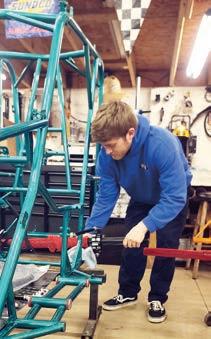
( ABOVE LEFT ) TYLER PUTERBAUGH INSTALLS A REAR AXEL ON A MICRO SPRINT WHILE HIS BROTHER BROCK ( RIGHT ) WORKS ON A BIRD CAGE COMPONENT.
PHOTOS BY SHAWN WOOD
Racing Club’s 360 National Open at Selinsgrove Speedway in July 2020.
Early on, when Kissinger was still racing go-karts at Greenwood, he learned from veteran Bloomsburg racer Randy Mausteller, whose garage and race shop was about a five-minute bike ride from his home.
“I would go out and mow lawns in the morning then ride my bike to Randy’s and go with them to the races,”
At about the same time, Kissinger got his first taste at being an entrepreneur.
“While I was racing go-karts I made up this sponsorship letter and gave it to Randy. He said he couldn’t give me money but I could mow his lawn,” Kissinger said.
That was right up the young Kissinger’s alley and so began a relationship that not only helped the race team, but led to a lot of instruction and valuable advice from
“Ever since I was a kid,I wanted to build my own race cars,”
- RYAN KISSINGER
someone who had been a racer all his life.
The Puterbaughs and Kissinger have a fleet of cars with as many as eight drivers racing for them.
That includes the two brothers (Tyler in a 270 and Brock in a 600), Roberts in a 270, J.T. Ferry, of Drums in a 600 when he is not racing his sprint car; former sprint driver Jeff Furlong, Sunbury, in a 270; Cannon Crossley, of Bloomsburg, in a 125; and Chason Hauck,
of York, another young driver helped by KPM.
They gave Hauck a 125 and coached him and he eventually moved up to a 270.
“We try to help kids when we can,” Kissinger said. Ashlynne Roberts, Millville; Parker Bowe, Bloomsburg; TJ Baney, Williamsport; Chase Totton, Middleburg; and several others.
Last year, the team had five feature wins (three by Tyler Puterbaugh in the 270) and 20 top-fives, with eight cars running in various races.
KPM also has enjoyed a relationship with Denny Rinehimer, of Bloomsburg, who builds their engines.
“Denny is another guy who helped me when I was younger,” Kissinger said.
This story would have been vastly different, had it not been for a decision by Kissinger as a junior high student at Central Columbia.
Kissinger was a football player and a wrestler who decided in eighth grade that he no longer wanted to compete in high school sports, but rather pursue racing.
“The wrestling coach was angry that I didn’t want to wrestle any more,’’ Kissinger said. “He told me that ‘racing is not going to get you anywhere.’
“But I liked racing more than I liked other sports and at that time it was going to get serious with sports,’’ he said.
“And now we’re building chassis and making money.’’
FORMER SELINSGROVE SPEEDWAY COMPETITOR RYAN KISSINGER WORKS ON PUTTING A MICRO SPRINT CAR TOGETHER ON THE JIG TABLE.
PHOTO BY SHAWN WOOD
HOOKED After ONE RACE
Writer’s passion for dirt tracks runs deep
BY: SHAWN WOOD
The date of July 20, 1947, is forever etched in the annals of history in Snyder County.
It was on that day that race cars first ripped around Selinsgrove Speedway with the activities of the day culminating in a 20-lap sprint-car feature, that was won by Bill Holland of Philadelphia.
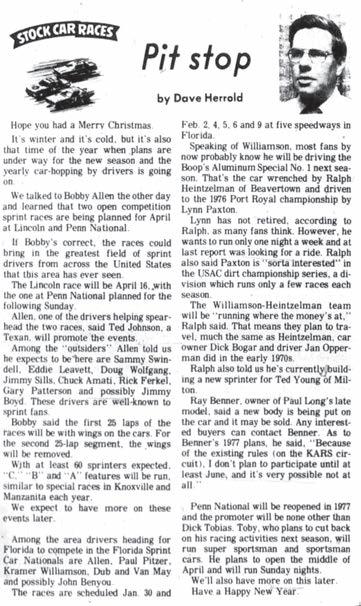
Two years later, in 1949, the same year that Holland would win the Indianapolis 500, longtime Daily Item reporter and motorsports columnist Dave Herrold attended his first race at the track.
“The first promoter at Selinsgrove was George ‘Buster’ Keller, who roomed in the house directly next to ours,” Herrold said. “He gave my dad complimentary passes to our family. Buster would let my brother, Dick, and me sit in his Big Car. Buster would park his Big Car in the alley between our two houses. What a thrill it was!”
The family would attend church every Sunday, and then after lunch, they would go to Selinsgrove Speedway.
It was the sound of the engines that got Herrold hooked early on.
Speedway for Area Auto Racing News, a motorsports publication based in Trenton, N.J., since 1963.
Herrold worked for The Daily Item from 1963 until his retirement in the 1990s. He would meet his future wife, Linda (Herbster), at the Sunbury Textile Mill. Their first date was to Port Royal Speedway on Aug. 1, 1961.
“No one inspired me to become a journalist,” he said. “I was in the Army at Fort Knox, Ky., and achieved the rank of Sergeant. When I got out of the Army in 1963, my fiancée, Linda, and I were getting married in two months. I needed to get a job. Somehow or someway, my brain told me to try newspapers.”
“I’m sure racing hurt my ears because I never used earplugs to blunt out the noise, BUT I HAVE NO REGRETS.”
“My very first ‘favorite’ driver may have been Vic Nauman Sr.,” he said. “His son, Vic Jr., also raced, as did another Nauman, Sterling, but I’m not sure if he was also a son.”
- DAVE HERROLD
In the early 1950s, Herrold’s favorite drivers were Hal Lord, from the Pottsville area, and Larue Ulshaffer, of Bloomsburg. He would also go on to root for Mike Valenchick, of Numidia, and Johnny Crawford from Bloomsburg.
“Larue was just 21 years old when he was fatally injured in a crash at Selinsgrove. It shook me greatly,” he said. “I vowed after his death never to go to another race! I guess that changed.”
Although he never developed a passion for racing himself, Herrold did compete in go-karts in the early 1960s.
“I never really had the feeling that I wanted to race,” he said.
With the closure of Selinsgrove in the early 1960s, before Williams Grove promoter Bob Richwine took over in 1963, Dave would then make the weekly trip to Port Royal Speedway, where his favorite drivers included Pete Swarmer, Dick Tobias and Mitch Smith.
He spent more than 20 years covering Selinsgrove
His dad was friends with Harry Haddon, who was the owner and editor of The Daily Item at the time.
The rest is history.
“Those first couple of months were not easy as it was a new experience for me,” he said. “I got a break as I was going to replace Dick Schuck, who had just been elected prothonotary and clerk of courts in Snyder County.
“Dick wouldn’t be leaving for a couple of months, so he taught me a lot during that time. He was a tremendous help.”
He began writing his racing column, “Dave Herrold’s Pit Stop” in the middle of the 1960s. He would eventually become assistant to Bill Toland, the longtime sports editor.
Before long, according to Herrold, The Daily Item started a “copy desk,” and he was one of the first to become a copy editor, which would be his job until he retired from the paper.
“I never interviewed a race driver by using a (tape) recorder,” he said. “I had my questions ready ahead of time and just tried to write their answers as fast as I could. However, I often used a typewriter when interviewing.”
The couple have two children, Kelly and Mike.
Kelly is married to Don Grabey, a longtime and well-respected official who has worked for both the World of Outlaws Sprint Car Series and the All Star Circuit of Champions when it was owned by Tony Stewart. Don is employed with the Outlaws today. Their son Ben manages the merchandise trailer for two-time WoO champion David Gravel.
Mike retired after working at the federal prison in Allenwood for 25 years.
Both children have a passion for dirt-track racing, and both are big-time sprint-car fans.
“Kelly had a friend in school who asked her to go to Selinsgrove one time — and she was hooked,”
PHOTO BY SHAWN WOOD
Herrold said. “Mike is four years younger than Kelly, so a year or two later, he started asking if he could go to the track, too. I finally ended up taking him to the track on Saturdays. He and his cousin, Chip Moll, were in their early teens, and they used to sneak into the pits as they would become friends with Ty Scott, who raced in NASCAR before switching to sprints. Security would see these two little kids in the pits and throw them out. Back they went again, out they came again. This continued until they were 16 and of legal age.”
Linda is also a dirt-track fan. She truly enjoyed going to Williams Grove Speedway on Friday nights. She would stay home on Saturdays when Dave was at Selinsgrove in his capacity for The Daily Item.
One overlooked area of racing is the effects that it has on hearing. Herrold said he has lost the majority of his hearing.
“I’m sure racing hurt my ears because I never
used earplugs to blunt out the noise,” he said. “But I have no regrets.”
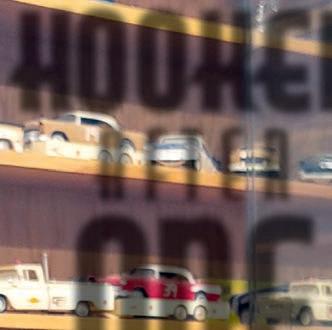
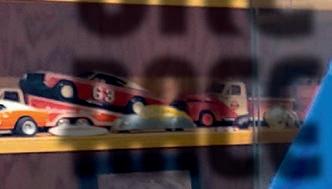
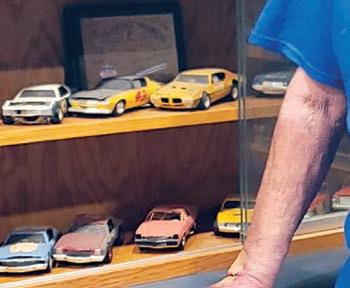
Dave’s other passion is building model cars, an activity that he started in the 1950s. His entire collection of models — sprint cars, late models, NASCAR, and dirt and asphalt modifieds — is housed in display cases in the family room.
The sounds of racing engines are the most likely answer from many as to what got them hooked on motorsports. Eight decades later, Dave Herrold’s passion for the sport still burns bright.
THE ORIGINAL OUTLAW
Remembering Scruffy
STORY BY: SHAWN WOOD
There are few sprint-car drivers who captured the true meaning of being an Outlaw like Bobby Allen.
The Florida-born driver, who moved to the Hanover, Pa., area in the mid-1960s, raced with a passion and grit that brought him respect and admiration over the years.
Earning the nickname “Scruffy,’’ he was one of the original drivers in the 1978 season with the World of Outlaws. He finished third in the point standings that year while winning the second-ever feature event in the history of the series at Eldora Speedway in Ohio.
Sadly, the 1988 National Sprint Car Hall of Fame inductee and the upset winner of the 1990 Knoxville Nationals passed away on Oct. 5 last year. He was 81.
A day before his passing, Allen was at Williams Grove Speedway for the National Open. He won the event in 1975 when it was a distance of 150 laps.
He scored 36 wins at the Grove, his first coming on May 23, 1969.
After retiring from racing, he fielded a car for his grandson, Logan Schuchart, in the 358 sprint-car division in Central Pennsylvania. The pair then move up to the 410s rank before going full time 12 years ago with the World of Outlaws.
“He was the definition of an Outlaw racer,” said longtime Central Pennsylvania promoter and former racer Alan Kreitzer. “Bobby had a Hall-of-Fame career and then built one of the best sprint-car teams in the country in Shark Racing with Logan and (his son) Jacob. He’s one of the alltime greats in the history of sprintcar racing.”
His father, Joe, raced stock cars, and Bobby started racing half midgets at age 12.
He continued his winning ways as a teen-ager in gokarts, winning the 1960 and 1961 battles for the Sir Victor Sassoon Trophy. The trophy is awarded to the winner of the 100-lap Grand Prix during the annual Bahamas Speed Weeks in Nassau. The following year, he won the Karting World Championship in Milan, Italy.
His first sprint-car win came on April 29, 1967, at Lincoln Speedway, where he is third on the all-time win list with 75.
It is estimated that Allen won more than 275 sprint car features in his career, with 30 of them coming with the Outlaws. He won 46 features and was the 1980 series champion with the All Star Circuit of Champions.
He was the de facto leader of “The Hanover Gang” for decades. It was a group of sprint-car drivers, including Allen, the late Steve Smith, Steve Siegel, Van May, Cris and Darren Eash, and others.
“I knew Bobby from my 28 years at the National Sprint Car Hall of Fame, and I was there for the incredibly electric 1990 Nationals win,” said Thomas Schmeh, the former director of the Hall of Fame.
“He even competed in our Knoxville Masters Classic, but what is so unusual about him as a sprint-car driver, a builder, and an owner, is that he was universally beloved by the fans and respected by his competitors. No one had a bad word to say about Bobby Allen after all of these decades. No one.”
Allen scored a pair of Tuscarora 50 wins at Port Royal Speedway in 1982 and 1989.
“Bobby Allen was the first guy that I met when I came from Texas to Pennsylvania in 1971,” Van May said. “I drove from Texas, and I came in on Route 94 as my brother Dub (Walter) had his car at Bobby’s shop, which also housed Bobby’s teammate Lynn Paxton’s car.
“The other car in the shop was Jan Opperman’s Black No. 6x car, which had won Knoxville. Bobby and Lynn
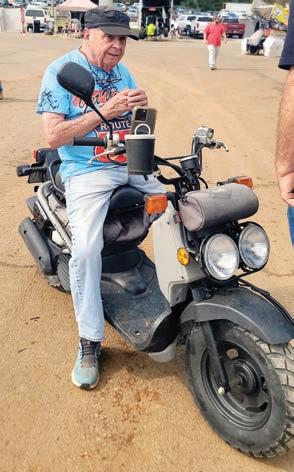
BOBBY ALLEN , OF HANOVER, STOPS HIS SCOOTER TO HAVE A CHAT WITH SOME FANS OUT OF VIEW IN 2025 AT PORT ROYAL SPEEDWAY. ALLEN SCORED TWO TUSCARORA 50 WINS AT THE TRACK. HE PASSED AWAY IN OCTOBER LAST YEAR. HE WAS 81.
PHOTO BY SHAWN WOOD
were in the front bays, and my brother and Jan were in the back bays. I stayed out at the back of Bobby’s garage, and I had access to equipment.
“Bobby was the type of person who was fast enough, and he knew he was fast enough, that he could go to different places like Ohio and make money,” May continued. “He built the car, he was well versed in the mechanics of the car, and he was well known from coast to coast. He was well-connected to the racing world from the time that he was a kid.
“He was friendly with people, and he shared his knowledge with them. That’s what led him to have such a vast knowledge of making engines work.”
Allen’s grandson, Schuchart, scored his first win with the World of Outlaws at Cedar Lake Speedway (Wisc.) in 2016. He has 44 career WoO wins; 20th on the all-time win list.
His son Jacob’s first series win came in 2020.
“Bobby Allen embodied what it meant to be a World of Outlaws racer,” said World Racing Group CEO Brian Carter. “The same way he ultimately raced to a Knoxville Nationals victory is the way he built his Shark Racing team with his family in the forefront.”
Carter added, “Whether it was on or off the track, Bobby meant so much to us as an organization. His experience and passion was valued by all of us, and he will be sorely missed.”
Shark Racing continues today, with ‘’Old Scruffy’’ looking down.