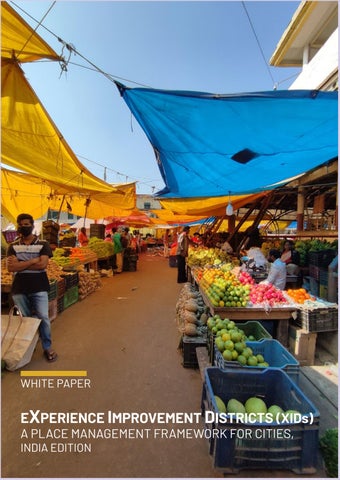
A PLACE MANAGEMENT FRAMEWORK FOR CITIES, INDIA EDITION
PROJECT INITIATED
COLLABORATION WITH
Landscape and Urbanism Studio Pvt. Ltd.
Mirabilis Advisory Pvt Ltd
ACKNOWLEDGEMENT
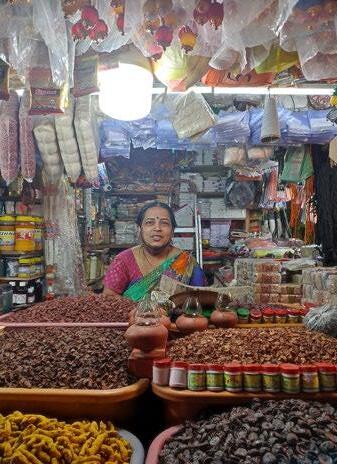
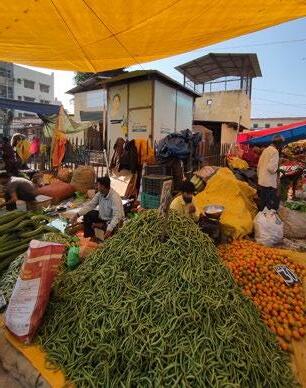
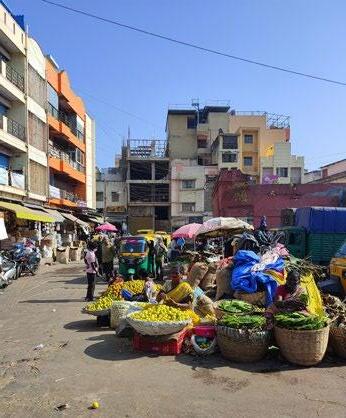
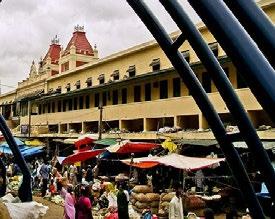
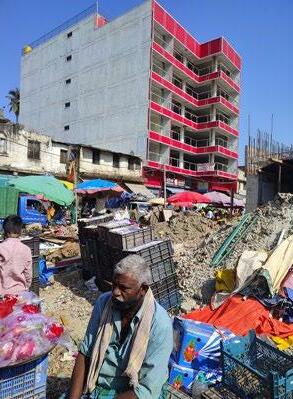
We wish to thank the following people for their timely inputs and contributions with the data collection, ideas and survey- Anshuman Gupta, Ari Daman, Nidhi Bhatnagar, Vendors at KR market, Bengaluru, and Sheetal Ramesh for being part of this vision.
Published in 2022
Co-Authors
Anupam Yog | Email : anupam@mirabilisadvisory.com Mirabilis Advisory Dhanya Rajagopal Email : dhanya@plus-spaces.com | Landscape and Urbanism Studio
Harshitha Pemmasani | Email: harshitha.pui20239@cept.ac.in | Landscape and Urbanism Studio
PROJECT OVERVIEW
To explore the possibilities of creating Experience Improvement districts or XID’s in cities as a Tactical Urban Governance framework, highlighting the various possibilities of creating/sustaining the identity and vitality of places that are livable, economically competitive & sustainable. Adapting the existing BIDs model of urban management, this paper focuses on Indian cities particularly, but is applicable anywhere globally as a framework for reviving socio-economic hubs in cities.
The white paper examines how to build value of place by leveraging the experience of socio-cultural, economic, natural and technological assets of a neighbourhood. In doing so the study examines the following themes
• Examines the context of Indian cities public realm experience and identity
• Provides strategies for Tactical Urban Governance for Indian cities to tackle urban sprawl and resilience through Incremental Improvements.
• Provides a set of criteria for choosing Strategic Opportunity sites that can be managed and designed as XID’s.
PUBLIC REALM CHARACTERISTICS AND IDENTITY
FRAMEWORK FOR CREATING BIDS THROUGH XID MODEL
TACTICAL URBAN GOVERNANCE FOR MAXIMISING VALUE OF PLACE
Provide diverse practitioners, cities, local organizations, residents and vendors association with tools that help tap into the intangible and tangible place assets, values, identities through a Tactical Urban governance frameworks called XID.
It enables local rejuvenation of Experience of Place and their use values over time, through Incremental Improvement, over an area (District) where the characteristics of the site and use values are identified and defined.
Tool 1: Urban Thinking Matrix
Tool 2: Checklist for Assessing a Potential XID
Tool 3: Qualitative and Quantitative Data for chosen site
The project is focused on Indian Cities and Case Studies, and also centres the ideas and principles of BIDs and Placemaking for Healthy Cities in Indian Public Realm and neighbourhood typologies. This research also suggests a framework for Tactical Urban Governance for sustaining future XIDs.
RESEARCH QUESTIONS
1. How do we capture value of place, and neighbourhood identity to become active contributors to local economy?
2. How can XIDs framework of place-governance model be introduced to sustain the present, and future economic changes and innovations, while understanding the historic context?
Documenting the Qualitative and Quantitative Aspects of Place
METHODOLOGY
Literature Review
A literature review was conducted on the themes of BIDS and Urban governance, Placemaking for Healthy Cities, the Neighbourhood Unit of Planning, and public spaces and social-economic hubs in Indian cities and existing policies and planning frameworks.
Experience audit, could be an inventory of experiences that shape the quality of life and economic competitiveness of a district.
Visual Study of KR Market as an Experience Improvement Districts in Indian Cities. Criteria for selection.
Applying recommendations from XID principles on the Case Study site. Applying recommendations from XID framework on the Case Study site. Case study of KR Market in Indian Cities. Criteria for selection.
1. VALUING EXPERIENCE OF PLACE
“Place is an archive of fond memories and splendid achievements that inspire the present.”
‘Space & Place’, Yi Fu Tuan
Geographer Yi Fu Tuan, writes about the intrinsic ‘sense of place’ that people demonstrate when “they apply their moral and/or aesthetic discernment to sites and locations. (…) These senses, unlike the visual, require close contact and long association with the environment.1 One could argue that sense of place and place attachment, determines the identity and experiences of public places & therefore require a critical rethinking of governance, social and physical infrastructure as integrated concepts instead of Silos.
Approaching urban redevelopment initiatives through the lens of experience of place, captures existing assets of a place (what to retain) such as people networks, ecological value, heritage values & local economic drivers as cornerstones for identity building.
Focusing on the scale of “place” gives a micro perspective to the intrinsic value that people can recognize and therefore help safeguard. As cities seek to recover more equitably and leverage their budgets to benefit more people, it is critical to understand how place-based investments—such as physical improvements to the public realm, district-based revitalization strategies, and events and public space activations—can bring about a more equitable economic recovery, and the role place-based nonprofits and other stakeholders play in the governance of these critical investments.2
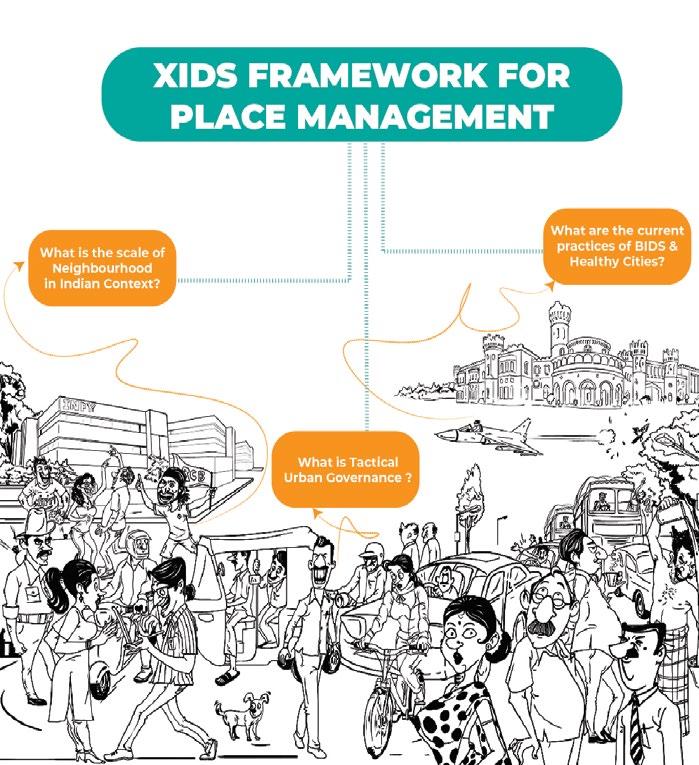
Why do we even need a place governance model for Indian Cities? What could such a model of local governance look like when applied to the public realm in the Indian Context.
The following chapters talk about this often overlooked aspect of place governance and adapting a model that suits the challenges and assets of Indian Cities.
1.1. TACTICAL URBAN GOVERNANCE FOR THE 21st CENTURY CITIES
India is one of the youngest and fastest growing global economies with over 64% of the population under the age of 35. It is estimated that by 2050, 50% of the country will be urban.3
Indian public spaces are a hub for traditional livelihoods, rituals, art forms, history, architecture and literature. There needs to be a re-evaluation of current mechanisms and governance structures looking at well-being and health as crucial for places to thrive, by focusing on the vitality and vibrancy of such productive public spaces. Tactical urbanism, a now a widely adopted approach for instigating place-based improvements through pilot projects, are often a precursor to creating formalised ‘Neighbourhood Development’ and pedestrian plazas such as the Business Improvement Districts. During the pandemic, these tactical interventions gained popularity in Indian cities, owing to their ease of implementation and testing, Their success has been limited however, due to lack of operational support and governance, or failure to integrate with the larger vision and future needs of the city.
‘Tactical Urban Governance’ as a term and concept has not been explored in urban planning literature, despite the popularity of tactical and placemaking projects. The XID framework can be a starting point for cooperative cultural produc-
“ RAUNAQ - An atmosphere of ExcitemenT”
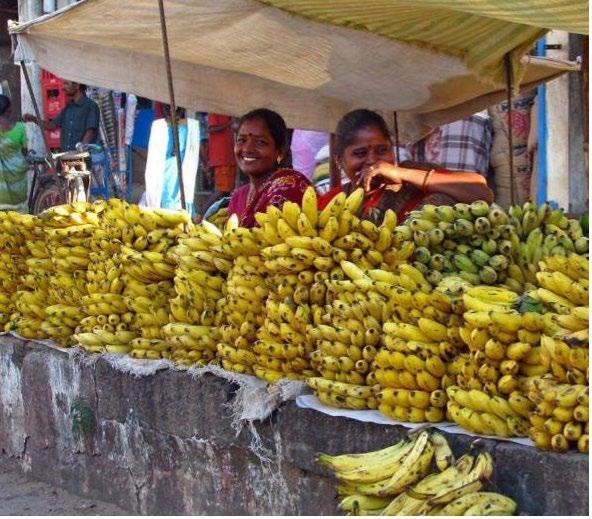
In the book Celebrating Public Spaces of India, the authors write about the intangible experiences and “an atmosphere of excitement” present organically in Indian Public Realm. The word ‘Raunaq’ refers to this experience of being in an active environment buzzing with life.
Many of our social spaces are created by and for multi-functional activities where religious, livelihood, cultural and recreational activities often seamlessly blend and dissipate. This experience of place is an often ignored aspect of urban redevelopment and conservation plans, that are primarily focused on physical improvements.
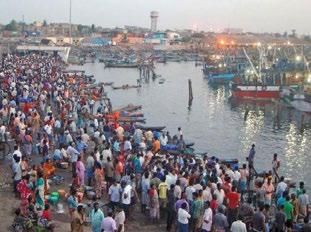
Source: Wikimedia Commons Fruit Sellers in the Temple Market, Chennai, India
tion through tactical urban governance.
Unlike Traditional governance models Tactical Urban Governance would allow for flexibility, adaptability and temporal responses. Research has also found that when place governance entities meaningfully involve community members in the planning of public spaces, such engagement helps generate a sense of community and ownership, which in turn contributes to greater use of public spaces. 4
Governance and Management have widely different connotations. Governance requires more systemic transformations based on current management. BIDs are slowly evolving their functions from purely place management to Place governance.
Place Management, refers to the day-to-day operations of public spaces, consisting of activities ranging from maintenance, events, marketing, beautification to “higher-order” goals such as business retention and recruitment, development projects, and advocacy efforts.
Place Governance, on the other hand, refers to the “who” in who is making decisions and how they relate to the people they govern. Often involves a shift from public sector exerting control of places to a hybrid structure in which governmental and non-governmental actors collaborate and share control and influence. (Brookings Institute)
The incremental nature of the XID Framework, is attributed to its tactical urban improvements and placemaking activities. To fund & sustain these improvements, partnerships need to be forged among multiple stakeholders through a Tactical Urban Governance model.
1.2. EXISTING PLANNING POLICIES AND FUTURE URBAN DEVELOPMENT
Since economic development is closely linked to urbanization, the future trajectory of energy use (and that of other resources) will be closely linked to the types of urban centers we build.5
For example, in the recent past, the achievements of India’s Smart City initiatives have been marred by criticisms on initiatives being focused largely on beautification & mobility alone, without considering the equity aspect of other
users. Immensely productive small businesses whose livelihoods depend on these pavements and streets are often resettled or displaced into less productive spaces leading to insufficient physical & social infrastructure that often puts a stress on low income households, increasing urban poverty. Infrastructure investment should be based on understanding of the local context and economic drivers of places. (Shawn Day)
More importantly such urban infrastructure initiatives, have further decreased the trust among citizens who consider urban development a threat to their livelihood uses of public space.
A one size fits all approach, or superficial improvements without stakeholder consultation or governance mechanisms, fail to deliver equitable results as well.
The paper also explores opportunities within existing policies and urban development programs that can integrate such a model of XIDs. Since the passing of The 74th Constitution Amendment Act of 1992 that makes provision for the creation of self-governing institutions called Urban Local Bodies, without specifying any organizational structure for municipal administration in India.” Many states do not have sufficient capacity to sustain and manage such an entity. (Alternative Urban Futures, WWF Report 2009)
Despite urban planning, being listed in Schedule 12 as a municipal function, indicating that the ULB should be the primary ‘Planning Authority at the local level’, most States have not started the process to amend the Town and Country Planning Acts. This limits the potential of neighbourhood residents and small business owners to strategise policies and initiatives for the future sustenance of their communities and livelihoods. Therefore the XID creation suggests the presence of ULB and Community Associations as a criteria for selection of the opportunity site.
Smart City Mission’s Area Based Development (ABD) Model offers an Avenue under the ‘Special Purpose Vehicle’ to create specific criteria for assessing the vulnerability, assets and needs of the proposed area of improvement. According to a report by UNDP, “A potentially successful ABD approach must be comprehensive, inclusive, participatory, bottom-up and above-all flexible in order to be able to respond to changes in the area during the course of the intervention.”
From a spatial perspective, Area Based Development could therefore be explored as an entry point through which an XID model can be adopted in the chosen site.
According to a recent report by NITI Aayog, “several growth targets of India reflect the need for concerted action for fulfilling the full potential of the urban economy.”
• 2024 Economic growth target: USD 5 trillion
• 2030 Employment target: 0.26 billion to be employed in urban areas. (Source: Ministry of Housing and Urban Affairs, 2021)
By strengthening and reclaiming local neighbourhood resilience and use values, our public realm can become an important contributor towards these development goals.
KEY TAKEAWAY
In Urban areas specifically, the role of hyper-local governance and place-based economic improvements, have an impact in the overall urban employment goals and economic vitality of cities.
1.3. NEIGHBOURHOODS AND DISTRICTS
Neighbourhood Livability Standards for Indian cities suggest that a benchmark for neighbourhood density as 250 people per hectare and the open space per capita as 10-12 sqm per capita (URDPFI). These benchmarks should be incorporated within the planning framework for future and current developments. However the density of neighbourhoods vary based on the proxemics of different cultural contexts. For instance, residents of the United States like to keep more open space between themselves and their conversation partners (roughly 4 feet
(1.2 m) compared to 2 to 3 feet (0.6–0.9 m) in Europe).6
On the other hand, those living in densely populated places likely have lower expectations of personal space.
“The term neighbourhood is an epistemologically open and flexible entity and not as given by Western societies. The local dynamics of Indian neighbourhoods come into play and thus, the fixity of categories does not work.” (Dr Dev Nath Pathak)
Urban Neighbourhoods have a crucial role to play in establishing resilient futures for their communities where land is confronted with competing uses due to market forces, social necessities, as well as environmental concerns.
An integral focus of this white paper, is tapping into the potential of the often ignored socio-spatial values of neighbourhoods, rather than just a mere administrative unit, but as a neighbourhood development framework
The Chawl in Mumbai, Vada in Pune and Pete in South India are comparable to what we call neighbourhoods. They are integral in connecting individuals and communities through shared social, geographical or occupational characteristics. This unit is more fluid in nature and more often of mixed use occupancy in Indian cities. Their planning and governance needs to acknowledge the context, variety, identity and vulnerability of human and spatial networks. Moreover, “interventions in strategic neighbourhoods are likely to have city-scale implications — improving well-being, resilience, sustainability and economic prosperity that go beyond the neighbourhood itself. For example, improving access to hubs of employment can change the labour market geography for the entire city.” 7
“NEIGHBOURHOODS ARE A SOCIO-SPATIAL ENTITY WITHIN WHICH CULTURE EXISTS.”
- Neighbourhoods in Urban India: In Between Home and the City, Dr Dev Nath pathak
In the Indian experience of public spaces, standards for Density, personal space and crowding vary quite a lot from the western counterparts. Unfortunately this crowding can aslo lead to wear and tear of infrastructure and inhibit comfortable use over time. Therefore embracing the way of life of a particular context, integrating it with purpose & strategy can help strike a balance between the demand & supply of services.
1.4. INFORMAL ECONOMY AND URBAN DEVELOPMENT
The informal economy refers to all economic activities by workers and economic units that are – in law or in practice – not covered or insufficiently covered by formal arrangements.8 The Indian economy contributes over 8% to the global gross domestic product (GDP), making India the fifth largest economy in the world. However, the formal and informal sectors do not contribute equally to the national GDP, with over 80% of this total originating from the informal sector.9 India is one of very few countries to have developed a National Policy on Urban Street Vendors, since 2004, to promote a supportive environment for street vendors to earn their livelihoods, while reducing congestion and maintaining sanitary conditions in public spaces.10 Despite their crucial role in urban economy, the lack of investment into sustaining and improving these places, have led to decaying infrastructure, value and productivity over time. During the pandemic, nearly half the permanent salaried workers with secure jobs were forced to switch to the informal sector, increasing the competition and demand on services.11Informality occurs in specific places such as land without ownership titles, spaces below elevated expressways, unused land near railway tracks. etc (Roy, 2011).
Despite its eroding physical infrastructure, these spaces function and sustain local economy, playing a key role in alleviating poverty. The Public Realm should be able to support the spirit of entrepreneurship of communities, instead of excluding them from using public spaces. In Indian markets, shop spillover and hawking on streets are common phenomena. These vendors offer a wide range of goods and services in convenient and accessible locations, and
contribute an essential service to the poor by offering low-cost goods in small quantities.12
In the perspective of developing countries, the untapped value of its informal sector requires attention from governments, practitioners, developers, and citizens. Through incremental and sustained efforts, starting from partnership building and defining goals, an effective place governance strategy, can provide a safety net and service related support for business to sustain in the future. For instance, there was an opportunity to create e-vending as an option due to closure of meat and vegetable markets during the pandemic. With the presence of a dedicated team, these informal activities can become more secure without losing its intrinsic characters.
Well organized informal workers have successfully negotiated services and housing rights (water, sewage, electricity) for their members. For example, The city of Bhubaneshwar, India developed a Public Private and Community partnership model for street vending- a result of years of conflict between street traders and local authorities. The inclusive process and policy, entailed dedicated, legally sanctioned vending zones in public space, fixed kiosks, and improvements partially funded by formal businesses in the locality (Kumar, 2012). Such strategies can better inform inclusive urban investments for the future of Indian cities. The paper acknowledges the importance of informal economies with respect to achieving transformational results enshrined in the recent SDG focus area of “Localized Solutions .
KEY TAKEAWAY
In contrast to most urban development proposals, XIDs embrace informality as a characteristic of our public realm With the right strategies, the value of our public realm can make room for the informal economy to thrive & contribute to place identity of future cities.
Summary of Neighbourhood Standards for Livability and Environmental Benchmarks, Indian
The XID framework applies a set of 9 components of a succesful XID as summarized below. This tool can be used as a basis for Recommendations and improvements, using the indicators of Economic Competitiveness, Liveability, Environmental Impact. Use the prompts below to fill this matrix.
ANALYTICAL TOOL FOR URBAN THINKING
• How would you describe existing livability, economic competitiveness and environmental Impact standards in the neighbourhood?
• Identify what factors of urban management is missing and present in the area of study.
• Do the existing meet the planning standards set nationally or internationally?
• How does the current local and place governance function? What associations or institutions and networks can benefit the XID?
1.5. PLACEMAKING FOR HEALTHY COMMUNITIES
Urban Development usually focuses on the physical parameters and economic benefits while sidelining sustainable futures and socio-cultural assets of a place and its people. During the pandemic, well-equipped and established social networks were key to delivering services at the local level. Businesses that were severely hit during the pandemic, were able to sustain and find support through their local BIDs and in accessing community grants.
highlights India’s most pressing urban challenges that were further exacerbated by the pandemic.14 As Cities in India aspire to achieve the “Healthy City For All” goal by 2030 (NITI Aayog), it would need a convergence of multi-sectoral efforts of spatial planning, public health, and socio-economic development.”15
INDICATORS
AREAS OF “ IMPROVEMENT”
Good Quality Housing & amenities like parks, hospitals and schools.
Social Networks & Interaction. Clustering amenities to create “urban buzz”, a sense of places & history
ENVIRONMENTAL IMPACT
Transport and Communication links. Quality of office/ commercial space.
Public Transport , Density, Green Spaces, Waste Management.
Source: MAPL Research
Clustering of human capital & ability to attract talent, social cultural openness.
Safety & enforcement of law. Simple & well enforced system of municipal regulation. Reasonable Tax rates. Efficient governance structures.
Air and water quality, sustainable practices with regard to water supply and usage.
An alternate way of thinking about healthy and equitable future cities, would be one that can help assess development through the lens of Livability, Economic Competitiveness and Environmental Impact. The matrix, developed by Mirabilis Advisory, provides areas of Improvement (Physical, Social Infrastructure and Governance) across 3 indicators (Economic Vitality, Environmental Impact and Liveability) for creation of successful XIDs and gives multiple perspectives of the potential site’s challenges and strengths.
Applying the analytical framework against the 3 domains of urban management, namely, Governance, Social Infrastructure and Physical Infrastructure, In many cases in Indian cities, thriving social life (soft infrastructure) and economic life are not sufficiently supported by the physical infrastructure (hard infrastructure) & current model of management. Another finding by Brookings Institute suggests that the “often hidden dynamics of place governance can influence the civic uses of and responses to public spaces. Aside from the programming offered within each public space, the political, funding, and management dynamics associated with various place governance structures also seemed to influence the civic uses of the spaces themselves.” 13 Liveability and Health” indicators are therefore not just dependant on physical improvements alone.
The World Economic Forum’s white paper entitled Indian Cities in the Post- Pandemic World,
Global movements such as The Healthy Cities by WHO and UN’s 2010 Compassionate Cities, focused on strategies for local governance, grassroots leadership and community participation as vital markers of growth, while involving municipal leaders working with NGOs to establish the necessary goals required to create a healthy city.16
The indicators of health metrics are also directly related to the nature of software, hardware and governance of public amenities.
“increased public life” (measured through hourly and weekly visits to a particular public space); “stewardship of place” (measured by “acts of support” for a particular site); “community trust” (measured by the percentage of people who trust others, local institutions, and local government after investment is made).
- Re-imagining the Civic Commons
There is also evidence of an association between social capital (including factors like volunteerism community trust) and health.17
Neighbourhoods and places that have encountered neglect, disinvestment and trauma, can greatly benefit by looking at urban growth and development through the lens of compassion and empathy.
In the background of the global pandemic, assessing public infrastructure that can improve quality of life and livelihood opportunities while sustaining the identity and value of place is vital for local resilience. Small businesses and local shops were one of the worst hit during the lock down, in the absence effective planning and management of public spaces & informality.
2.OVERVIEW OF BIDS
A Business Improvement District is a legally and geographically defined partnership for area improvement and service delivery, funded by the levy-paying businesses within an agreed boundary. It is managed and operated by a BID Company – usually a non-profit company run by and for its members.- London BIDs Handbook
The concept of BIDs as a place management strategy was initiated first in Toronto in the 70’s by local private businesses to revive decaying infrastructure. Since then the concept of BIDs have been adopted in several European and North American Countries. New York City has around 75 functioning BIDs across its boroughs which played a major role in supporting local businesses during the pandemic. These self-assessment districts are authorized by local governments, and approved by property owners, who pay a levy with the purpose of delivering supplemental public services to the districts and improve its overall neighbourhood economic conditions.18
They are formed based on a majority vote on a “BID Proposal” or outlining the strategic opportunity areas to be tackled by the BID. Businesses usually contribute to a shared budget through a levy for a 5 year team.19
A successful BID requires 3 main components:
1. Buy-in from a majority of residents/ local businesses in the defined area.
2. Substantial economic presence of retail & commercial owners to engage in action.
3. Well-defined institutional structures, representation and procedures, functioning with the utmost transparency.20
They have been effective instruments in delivering localized solutions for macro problems. BIDs’ regular revenue source makes them attractive partners for local authorities, especially where premium services are expensive to maintain 21
2.1. ROLE OF BIDs IN PLACE GOVERNANCE
Transcending from a purely management entity to an advocate for their neighbourhoods and communities, BIDs have evolved to help build place visions and strategic roles for cities in the present and future. This would require partnership with ever more complex systems of partners22 Another advantage is that BID members share highly localized goals and priorities of the BID area, without disturbing the larger municipal planning and delivery framework.
Their key responsibilities include:
1. Partnership with other entities operating in the area, such as CBOs & local authority to determine what services & projects the BID can add to.23
2. BIDs—and their directors have become powerful actors in urban governance, help mediate with local authorities on relevant policies and projects pertaining their area.24
3. Engage with social integration programs and community-based initiatives.
4. Generate financing for capital improvements or for infrastructure alterations.
5. Commission research and marketing services.
2.2. BIDs OPERATION AND FUNDING
Each BID is operated by a non-profit entity, that collectively determines how the assessment fee should be used in their boundary.25 Members pay a special tax or levy, which provides flexible funding for an annual program of services managed by the BID and its partners.26
For instance, the City of Long Beach BID program brings in approximately $17 million in annual assessment fees. There are 3 different types of BIDs based on mode of assessment.
• Property & Business Improvement Areas (PBIA) are funded by business owners that pay assessment fee along with their business license tax.
• Property and Business Improvement Districts (PBID) are funded by property owners who pay assessment fees along with their property tax.
• Tourism Business Improvement Areas (TBIA) are specifically funded by hotel businesses which pay assessment fees along with hotel occupancy tax.
BID ASSESSMENT is a fee that each property owner pays to support the operations of the BID. Different properties pay different assessment.
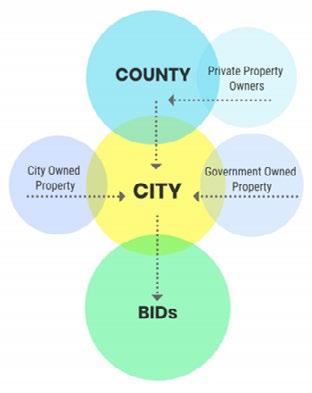
The figure illustrates how assessment revenue is collected and disbursed in the Long Island BID. Source: ALGA, Jessica Tims
The types of properties include:
1. Occupied Commercial or Industrial
2. Not for profit occupied
3. City, State occupied
4. Residential Properties
5. Vacant Properties
2.3. GAPS IN THE BID MODEL
• While mostly addressing physical infrastructure upgrades, the Software and Governance upgrades in many countries in the Global South still remain a challenge for the BIDs model.
• The focus on purely “business”, limits the possibilities Does not adequately incorporate informal sector within its focus.
• Resources are not equally accessible to all BIDs and could further drive disparities.
• BIDs have been criticized for exclusionary design to prevent homeless, & street vendors.
• In a study based on NYC BIDs, it was identified that property values increased during the process of BID formation, which may be the result of the residents’ optimistic anticipation of the BID activity, but fall once the BIDs are actually formed. This can be a result of lack of marketing and programing due to low funds.27
Context x Purpose x Strategy = Successful XID
The Experience Improvement District places this inherent Sense of Excitement in Indian Public Realm as an identity and asset.
3. WHAT ARE EXPERIENCE IMPROVEMENT DISTRICTS?
Definition: The XID model of governance and strategic planning is a framework for place governance to enable Incremental Improvements that create and preserve unique experiences of places, through a defined strategic boundary for engagement and partnership.
CONTEXT STRATEGY
PURPOSE
X = Experience
(Refers to the unique experience and typology X = Business, Nature, Innovation, Arts & Culture, etc..)
I = ‘Incremental’ Improvement
(refers to Physical, Social & Governance mechanisms.
D = District
(refers to any neighbourhood or place of social, ecological, cultural or economic importance wherein the experience improvement governance framework will be applied. It does not refer to the administrative District boundary)
“X” can be viewed as an “inventory of Experiences” that shape the quality of life, economic vitality and Environmental Impact of the place.
The model of Experience Improvement Districts or “XID”, a concept proposed by Urban Strategist Anupam Yog, takes inspiration from the successful model of Business Improvement Districts (BIDS), modifies and applies it to the Indian Context. The term refers to neighbourhood scale places (referred to as District) that can become governed under an XID framework based on their social and spatial characteristics.
For sustaining and creating successful XID’s, a strategic model of local governance needs to be implemented, there needs to be local buy-in and investment. Therefore, the XID adopts a Tactical urban governance strategy to strengthen local decision making and participation. By combining Context, Strategy and Purpose the XID model could provide the flexibility and stability needed for thriving neighbourhoods.
Traditionally Indian public spaces have been able to cater to resident’s diverse needs through streets, temple courtyards, bazaars, chowks, maidaans and Sacred Trees etc. It is not uncommon to see multiple uses, including remnants of historic activities coinciding with current livelihood and recreational uses. The dynamic nature of use, is hard to curate and capture purely from the perspective of its physical conditions alone. Despite the deteriorating conditions and fading memory of such hubs, the place attachment and atmosphere of excitement is well and present in many of our suggested XID places. See: Map Repository of Potential XID Sites in Indian Cities
The diversity in use and temporal quality of Indian shared spaces is not adequately captured in the concept of BIDs. In Indian cities, the informal nature of many commercial hubs and the multi functional spatial characteristics of public spaces requires an approach to urban governance as well as development rooted in well being, adding to the place identity and economic competitiveness of these improvement districts.
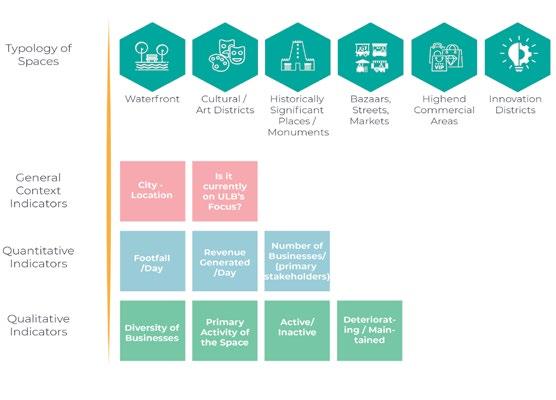
The report uses the categories of reference for urban public spaces (see below) to come up with a framework for identifying and documenting the experiences and assessing the vulnerabilities, and opportunities in the proposed Improvement district.
Building on the typology of public spaces in Indian Cities listed below, the neighbourhood characteristics and uses were defined and identified as part of the framework. Some of the possible typologies include:
• Public Buildings and Monument Plazas
• City Squares and Cultural Spaces
• City-Level Urban Parks
• Bazaars, Streets and Market Places
• Waterfront Spaces
• Religious Spaces
• Ancient Heritage Monument Spaces28
• Nature Improvement
• Innovation
Depending on the typology of District mentioned in the tools, the Strategic Opportunity Area and Stakeholders can differ. For example the typology will be business, as in the case of BIDs, however, there might be other anchors for other typology, which can unify and motivate the community to impose a levy to generate resources for setting up and sustaining a tactical urban governance system.
“There is an increasing need for local communities to step to the fore and give a sense of meaning, good management and direction.”
As mentioned previously, the Goal of creating an XID framework is to enable local businesses and city agencies to collectively identify what to sustain and what to improve in their neighbourhoods. The XID framework recognizes the value of the informal sector which forms a large part of the Indian commerce and trade.
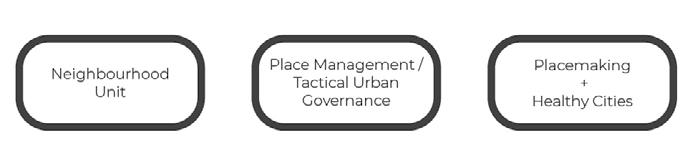
The research looks at the framework of XID as a concept of bottom-up governance suited to the multi functional nature of traditional public spaces. ‘Experience’, ‘Improvement ’and ‘District’ as defined above is derived from the following areas of focus:
1. Demystifying the Neighbourhood Unit
2. Place Management : Tactical Urban Governance
3. Placemaking for Healthy Cities
4. Time as a dimension of Experience
Combining Takeaways from these major themes pertaining governance and urban development, XIDs could be explored as an alternative model for hyper local governance to create and sustain vibrant public places.
There is plenty of room to reconsider productivity, health and resilience as cornerstones of neighbourhood redevelopment, without threatening the right to access of public spaces.
3.1. STRATEGIC FUNCTIONS OF XID
The XID model of governance can be applied strategically to address critical urban management needs, linking place making, place keeping and place management from a local to city level.
1. It gives room for the informal nature of public spaces in the global south to be integrated within a governing body that strategically supports the neighbourhood economy.
2. Captures multiple use values and identity of place overt time and changing identity of place.
3. Provides an integrated place governance framework that looks at past, present and future strategy, purpose and context.
4. Focuses on health, social and economical resilience of neighbourhoods.
5. Centers improvements and networks that strengthen existing assets and use values.
6. Drive local economy and engage communities.
7. Enhancing access and connectivity.
8. Improving livability, user experience and repositioning the place identity.
9. The XID alliance enables Programming and Fundraising opportunities by forming partnerships with local design, art, environmental and social groups, as well as city agencies.
3.2. ADDRESSING LIMITATIONS OF BIDs
Urban mechanisms like BIDs are well placed to act as incubators and catalysts for a range of pilot projects which, if successful, can be replicated or scaled up in partnership with other organizations. However, The limitations of BIDs lies in its inability to encompass multiple use values and focus primarily on “Businesses” as entry points for place governance and urban improvements.
Similar to BIDs, the XID would function as a Non-Profit entity, and headed by a “Place Manager” or Executive Director. Supported by a the local corporation or urban local body (in the case of India). Unlike the BID model, the XID will represent not just the property owners interests, but also the user experience of various visitors. It focuses on the domains of Physical, social and Governance.
As part of the formation of an Experience Improvement District, flexible options of partnership structure can be explored with the informal commercial hubs. For efficient functioning of the XID, teams cans be created to address Social, Physical and Governance infrastructure areas of improvements.
“The past represents, memory (Collective and Individual)
The present represents, our experienced reality
The future represents, our Visions for sustenance, Identity.”
- Yi Fu Tuan, Space and Place
The dimension of time, alters place and experience. As spatial characters are ever changing, it will be critical to find a path towards resilience and adaptability while planning our urban areas. The different experiences of Place over Time has contributed to the variety and richness of many neighbourhood districts such as the pilot study Site at KR Market, Bengaluru. An ideal neighborhood redevelopment therefore needs a combination of Placemaking, Place Management and Governance to fully capture the tangible and intangible assets of the neighbourhood district.
As represented in the diagram below, Placemaking has been an organically evolved aspect of Indian public realm in the past, while the present and the future need to shift focus towards building place management and governance, in order to sustain incremental improvements.
Innovations in the Future of place governance needs to adapt with technological evolution, which is drastically changing the way people engage with places.30 This also includes extending the benefits of e-vending to the informal sector that solely depends on footfall and pedestrian movement for the sale of their goods.
“XID is a tool to assess the present to build for the future, by considering the past”
TIME
EXPERIENCE PLACE
Source: Authors
Defining X What is the character of the place? Does the City Governance, policies align with the goals of XID? What quantitative data supports its potential and challenges?
What qualitative data can identify intangible features and potential to improve Experience? SWOT?
STEP 1: IDENTIFY THE POTENTIAL SITE, AND DEFINE ITS BOUNDARIES
STEP 2: DETERMINE THE TYPOLOGY OF XID AND ITS SECONDARY USES
STEP 3: DETERMINE EXISTING GOVERNANCE OR MANAGEMENT IN THE PLACE
STEP 4: QUALITATIVE AND QUANTITATIVE ANALYSIS OF THE “DISTRICT”
STEP 5: IDENTIFYING PARTNERS & NETWORKS THAT CAN SUPPORT PROGRAMS
Arts & Cultural Districts
Heritage
Bazaars / Street Market Districts
Luxury Commercial Districts / Business Improvement Districts Khan Market, Delhi
Waterfront Districts
Kasimedu Fishing Harbour, Chennai
Improvement Districts Madurai Meenakshi Temple
Lodhi Colony
Innovation Districts Hazrat Ganj, Lucknow
Pondy Bazaar, Chennai
Creative Commons CC by SA
Source: Wikimedia Commons, Arunsarv
Source: Wikimedia Commons
Source: Wikimedia Commons
Source: Wikimedia Commons
Source: Wikimedia Commons
USE THIS TO IDENTIFY VIABILITY OF A POTENTIAL XID SITE
If there are more crosses than ticks, the chosen XID area needs to work on building partnerships, encouraging investment. Incase there are no existing organized neighbourhood or merchants association, the first step in forming an XID would be to create such an entity. Alternatively, another location can be chosen which satisfies more of these criteria. An example of Assessment filled for The KR Market pilot study site.
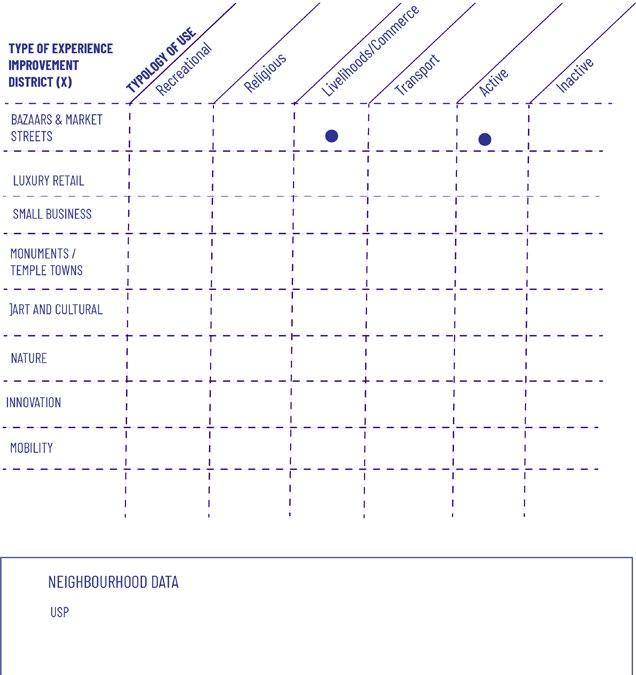
MATRIX TO IDENTIFY SITE USE VALUES TOOL # 3
Once the site is chosen, the characteristics of the site can be identified by plotting the different typology of uses. An example of KR market site is filled below - it is predominantly livelihood based but also includes transit hubs.
Source: Authors
Is it an existing Economic or Social Hub with a unique socio-economic or cultural value?
Is it an inactive or disinvested area?
Is it an active but poorly maintained/poor services area in the neighbourhood?
Does it have the potential for economic investment?
Is the predominant landuse Commercial or Mixed Use than residential?
Is it Publicly accessible and owned?
Is it a privately owned, but publicly accessible site?
Does the site extent have a low commercial vacancy rate (>20%) ? (For Street markets this criteria will be modified as low vendor density)
Are there any recent proposal or redevelopment plans in the selected area?
Is it currently under ULB focus?
Source: Authors
PILOT XID STUDY AREA
KRISHNA RAJENDRA MARKET, BENGALURU INDIA
TYPOLOGY
Historic Market / Bazaar Improvement District
LOCATION
Central Business District, in the heart of Historic Pete (market Area) Built in 1928
AREA
47,000 square meter
USP & IDENTITY
• Asia’s Biggest Flower Market
• 100 year old Market Building located in a
• 400 year old Neighbourhood Economic Hub
• First public building in India to receive electricity
• Bengaluru’s oldest & largest wholesale market
Harshitha Pemmasani
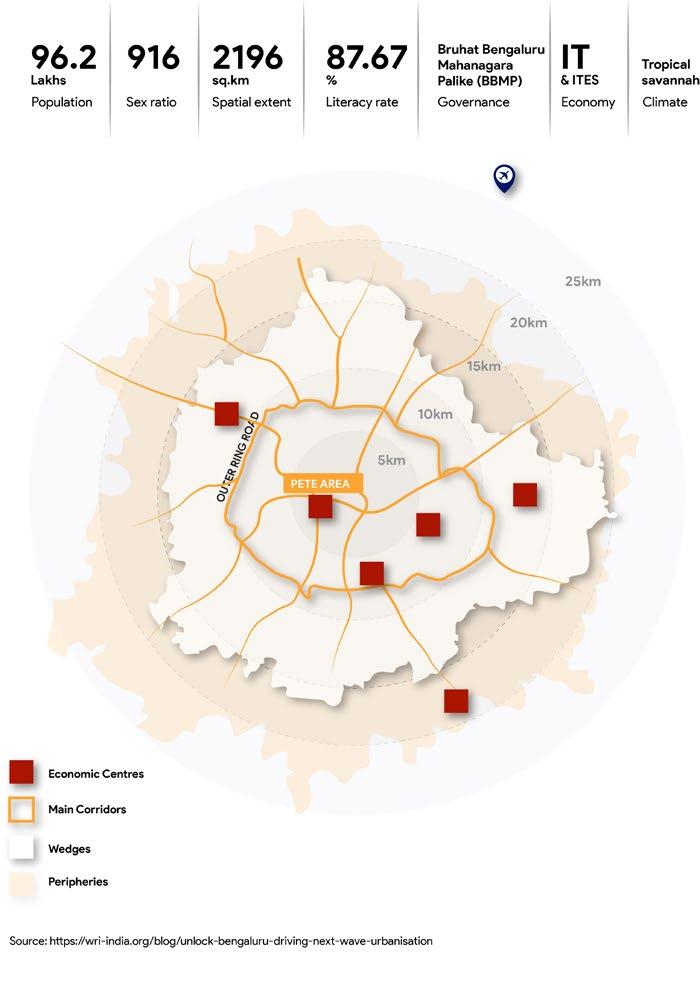
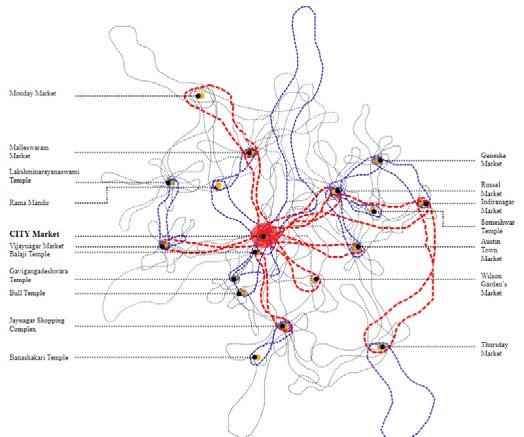
Map developed by WRI showing Bengaluru’s ‘Centers’ characterized by intense economic activity, usually incorporating traditional markets. Informal economies dominate these markets, typically characterized by street vendors traveling from neighboring villages and agricultural areas to trade their products, and return back once their products are sold out. Pete area is one such Center in which K. R. Market is an important hub for informal activities. Source: WRI, India
4. A FLOWER MARKET IN THE HEART OF THE GARDEN CITY
“Market places are not just trading grounds, but also custodians of history.”
- Project for Public Spaces
One of the more ubiquitous urban public spaces in Indian cities are its varied informal markets and bazaars. These markets are social institutions which often form the identity of the neighbourhood and serve as integral node of the city fabric. Traditionally located next to religious places and palaces, Indian Market places are more than just places of commerce, they have alway supported multiple uses including religious, cultural and recreational activities. “The earliest example of a market in Bengaluru dates back to the 12th century, when peanut-growing farmers of Basavanagudi came together to offer their crop produce to the Big Bull Temple. Centuries down the line, Today, it is a major commercial opportunity for more than 250 farmers from Karnataka and neighbouring states.”31 Typically traditional bazaars were strategically located in close proximity to ruling palaces or places of religious importance, to provide traders protection, as well as generate substantial demand for goods and services.
Some of the critical role of markets include,
• Acting as a vehicle of Upward Mobility for Low-Income Communities.
• Alleviating poverty particularly in developing countries through creation of seasonal job networks.
• Promotes social integration through various programs, activities and encounters.32
• Connecting the urban core and its services, goods to communities on the periphery.
• Historically Bazaars were connecting points along the regional, national, and international trade routes through which cities were connected and goods, culture, people, and information could be exchanged.33
How can cities better support their public markets and similar places of informal commerce in
the 21st century? The pilot study was done based on the Experience Improvement District tools on the KR Market, Bengaluru site to understand the feasibility of a tactical urban governance framework on a real site. By rebranding KR Market’s Flower vendors as the heart of the Garden City, the experience can be built around strengthening the market identity with its current needs and historic significance.
4.1. EVOLUTION OF KR MARKET AS A PLACE OF CULTURE & COMMERCE
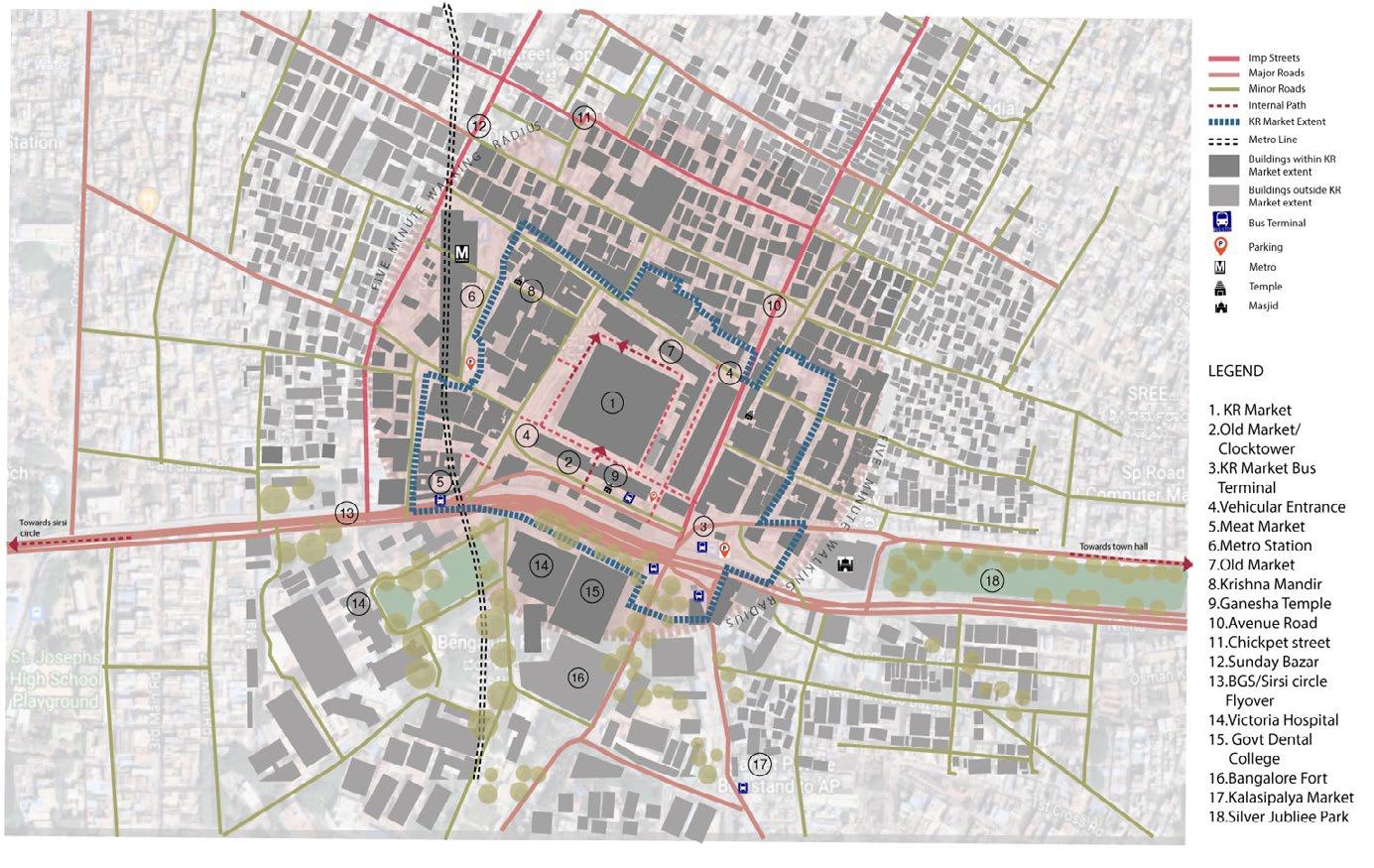
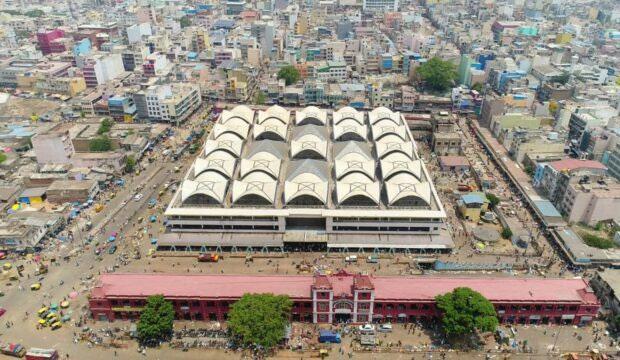
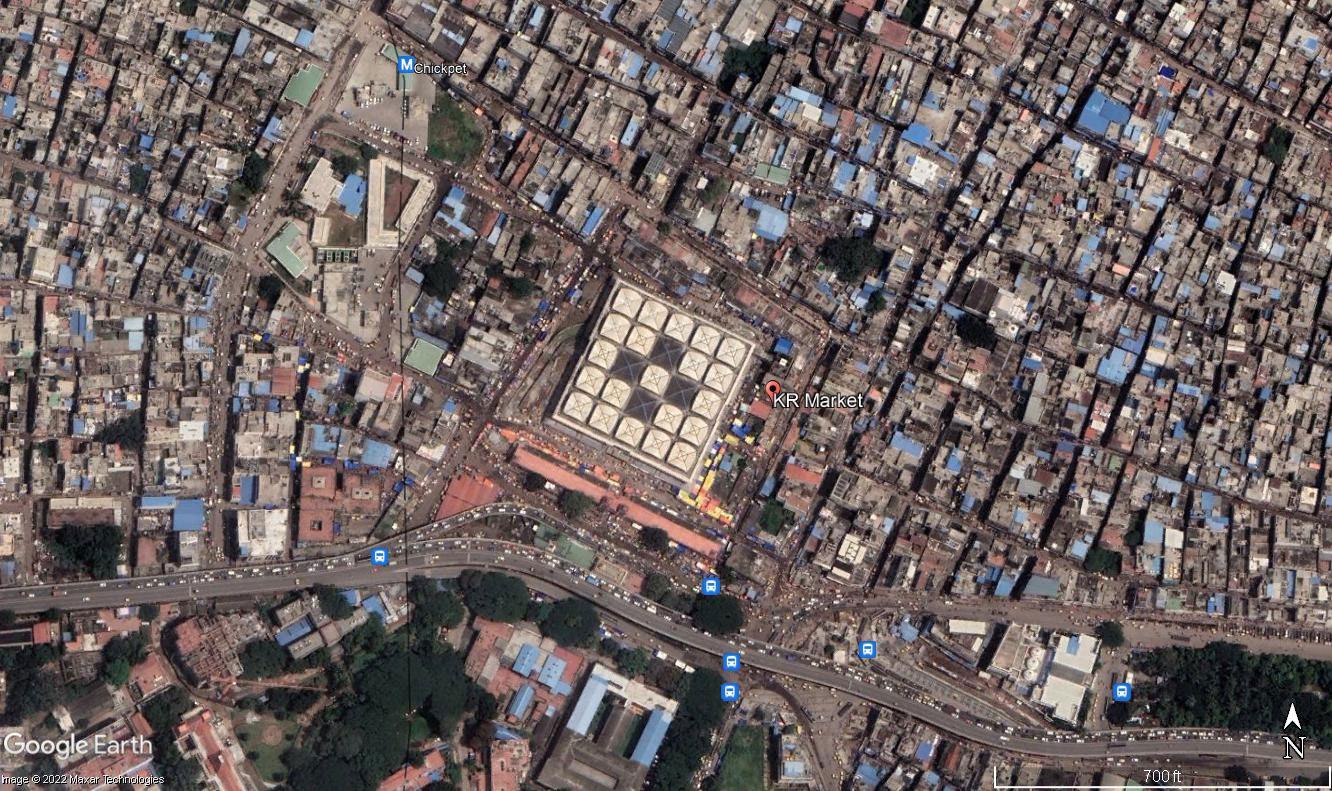
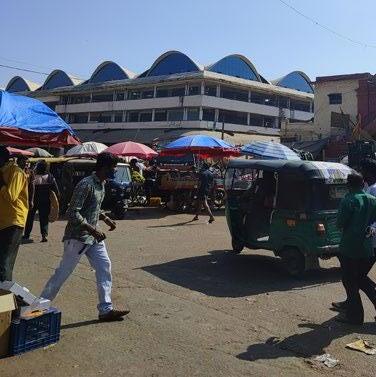
Krishna Rajendra Market or City Market, located in Bangalore’s historic and dense commercial ‘Pete’ neighbourhood is an integral part of the the city’s Central Business District. As shown in the map developed by WRI, KR Market is characterized as a “Center” of economic agglomeration characterized by informal vending. Known as one of Asia’s largest flower market, the precinct covers an area of 47,000 sqm in the commercial district– Chickpete ( approximate population of 5,03,416 covering an area of 21.46 sq km). Today KR Market is a beloved historic bazaar, a sight of intense economic activity, waiting to be rediscovered but struggling to keep up with outdated infrastructure, increased demand and a volatile post-covid scenario.
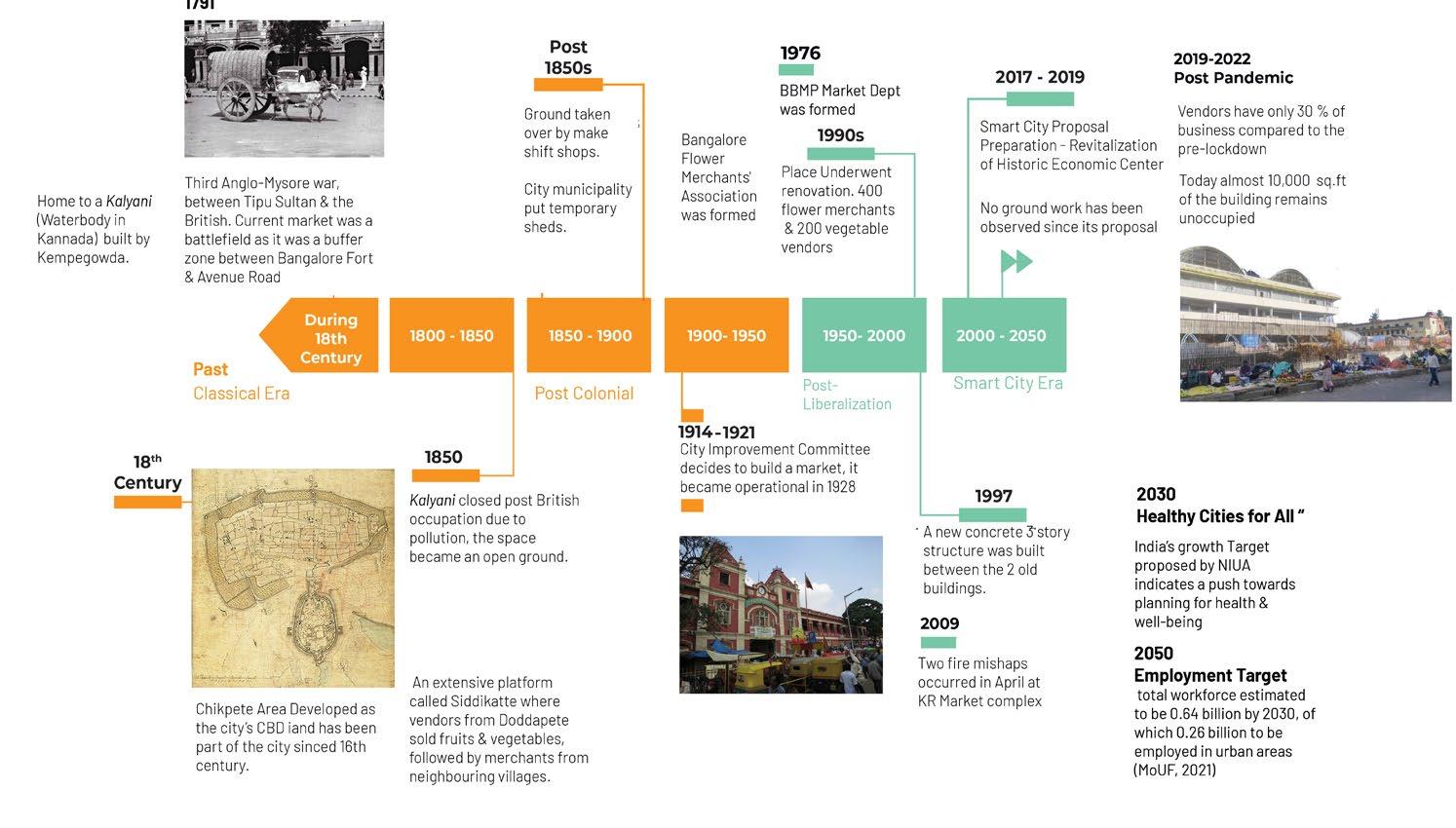
The Bangalore City Improvement Committee acquired three low -lying, unsanitary streets of Siddikatte (meaning Public Platform in Kannada) number of private shops adjoining the market to build the current market,which has been operational since 1928, built in 1921. Commissioned by Krishna Rajendra Wadiyar IV in the Chickpete neighbourhood, it turned 100 in October 2021, making it a structure of heritage value.34 Earlier Market shows and cultural programming were organized by the Bangalore Municipal Council such as the “Charka Competition”, wrestling matches, orchestra and nadaswaram concerts.35 Today, there are no traces of these non-commercial uses that add to the unique experience of KR Market.
KR Market
The current market is built on a kalyani (waterbody), a landmark spot since its beginning,with bustling yearly and weekly santhe (market), held around the water body. It was later a site of the Anglo-Mysore Wars in the 18th century and post British occupation of the Bangalore fort, the battlefield was a buffer zone between the native town and the fort area, it turned into an ideal place for merchants and vegetable vendors from neighbouring villages to sell their produce. The city built temporary sheds and later in 1921 the market named after Krishna Rajendra Maharaja of Mysore was built.
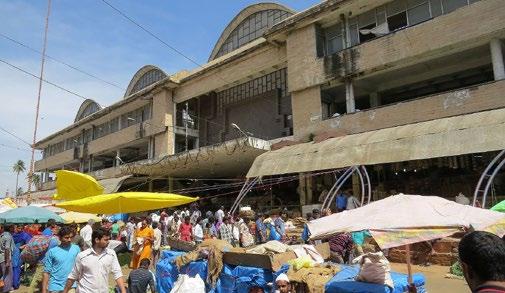
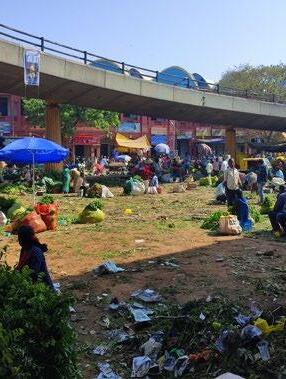
During the 1990s, a new concrete 3-story structure was built between the two older buildings, “destroying most of the heritage structure except the front and rear portions. Owing to poor footfall, vendors eventually leased out their shops to make extra income through rent and went back into the streets for vending.36 In 1999 the BGS flyover, (the city’s first flyover), was built in front of the KR Market entrance, where earlier an open space used to exist. Today the space below the elevated structure is used by vendors as an extended open market. As part of the Bengaluru Smart City Vision, the KR Market Redevelopment was proposed in 2019, created by a Bengaluru based Urban Design firm in tandem with Bengaluru Smart City Limited (BSCL).37 The proposal for the main market included Solid Waste Management, creation of kiosks, loading & unloading bay, vending plazas, internal pathways and a pedestrian ramp, preserving the historic market buildings, demolition of the existing meat market and post office buildings, a pedestrian walkway connecting Chickpete Metro station, meat market and the bus terminus.38 The tender for this redevelopment is yet to be taken up by bidders as they fear resistance from builders for such a large scale proposal. Moreover, public consultation for such a scale of redevelopment was not conducted prior to the announcement.39 Only a concerted effort with the inclusion of all stakeholders can successfully bring about a vision for the future of KR Market as a socio-economic destination and an anchor for the city.
4.2. MARKET ECONOMICS POST & PRE-COVID
With an average daily turnover of Rupees 20 crores (20 million USD), KR Market is an important eco-
nomic hub supporting roughly 4000 vendors. It receives an average footfall of 20,000 people daily.40
• During the pandemic for most flower sellers and decorators, their business fell by almost 65 to 70 % compared to the previous years as perishable commodities depend on festivities and large gatherings like marriages, religious and political functions. | New Indian Express, June 2020
• Due to the 5 month lock down farmers who used to grow flowers opting for other crops. As a result, the quantity of flowers reaching the market has fallen to 40 % compared to last year.
• Flower vendors used to sell a minimum of Rs 3000 to Rs 4500 worth of garlands but now it has reduced to Rs 1000-1500 per day 41
• Shopkeepers continued to pay rent during the lock down with very little social safety nets to continue their businesses safely.42
• E-shopping and groceries seemed to have an effect on the consumer nature after the Pandemic as crowded areas were avoided even after reopening of shops and public markets.
With the changing nature of shopping in dense neighbourhoods, Creating room for the right mix of experiences beyond vending in KR Market, will add to the footfall.
4.3. HISTORIC ‘PETE’ AREA: SCALING THE XID MODEL
During the British period, Bangalore was divided into the ‘Old town’ or ‘native town’, and the ‘Cantonment’. The ‘native town’, was originally called Pete, refers to an urban or commercial settlement.43 It evolved as a pedestrian precinct with the public squares growing into bazaar streets, temple squares and open grounds. The two main streets, are the Chickpete street running east-west and the Doddapete street running north-south, this was earlier the Doddapete Square (now Avenue road). The Pete layout was functionally organized to cater to a certain trade or profession. For example, Doddapete (Dodda means big) was for big business establishments ,Chikkapete (Chikka means small) was for small business establishments, and Akkipete (Akki meaning Grains). (Cite) The
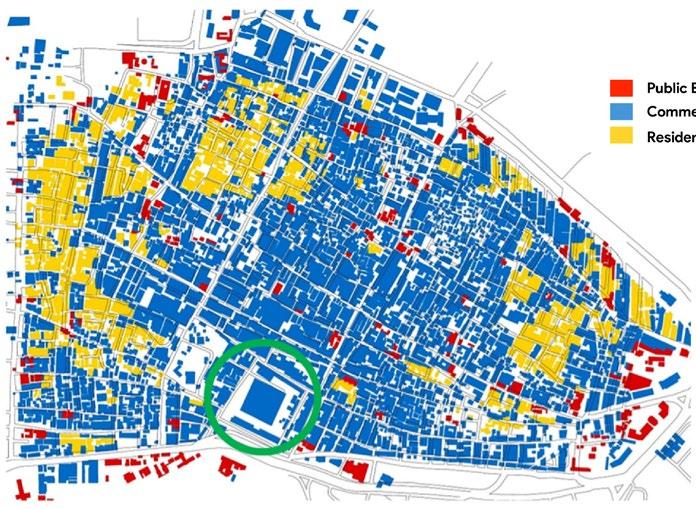
Almost 80% of the Pete’s land use today is commercial and with low to medium
Public Buildings Commercial Residential
Land use in Pete Area superimposed with types of commercial activity concentration beyond KR Market study area. Source: Shikha Patel, Raffaello Furlan, Michael
present Avenue Road or Doddapete Square was the nucleus of the Pete Area. “The Dodda pete had a temple inscription dating back to 1628 mentioning that certain merchants gave grants for the maintenance of the temple reflecting the long standing relationship between businesses and the operation of public amenities.”
KEY TAKEAWAY
The critical components of Social infrastructure & Governance, management and partnership building aspects for KR Market needs to be addressed before carrying out large scale redevelopment plans. The future of KR Market should be tied to the future vision of the city at large
The Pete area’s importance as an historic place of commerce and its current land use makes it a potential candidate for expanding the improvement districts beyond KR Market. Moreover, the ‘incremental’ nature of XID Improvements allows scalability and linking of scattered hubs in a neighbourhood to become part of a larger layer of XID as shown in the KR market study area. Documenting such relationships, helps make hidden values visible.
Grosvald, 2021 44
AKKIPETE
CUBBONPETE
CHICKPETE
SULTANPETE
KR MARKET PAST, PRESENT & FUTURE
“Asia’s Largest Flower Market at the Heart of Garden
City, Bengaluru.”
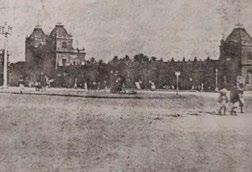
Prior to 1920, the existing K.R.Market was a collection of low- roofed; narrow zinc-sheet sheds, exposed to sun and rain
1999
BGS : City’s first Flyover constructed in 1999 in front of KR Market
Times of India
Source: Google Earth March 2022, Open Data
Location:
Located in Chickpete neighbourhood adjacent to the Tipu Sultan’s Summer Palace, on Mysore Road. Avenue Road to the north of KR Market is an historic and dense commercial street.
Transit and Connectivity:
Almost 34% of market vendors commute by Public Bus Transit. The 0.9km BGS flyover (or Sirsi flyover) is known to be the city’s first, built in 1999. It is a major connector of the city center to Mysore road, diverting traffic congestion at KR Market. It starts from Town hall junction to Sirsi Circle, with an intermediate diversion towards Chamrajpet. It is surrounded by the central market area, with Cottonpet on the North, Chamrajpet on the south, from where most of the city evolved.
Avenue Road: A Historic Bazaar called Doddapete
Portal
CONNECTING PEOPLE AND PLACE
Snapshots from KR Market
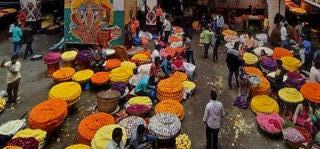
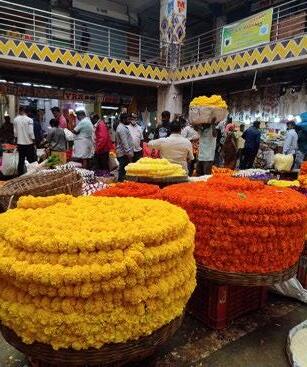
The KR market is the epicenter of the flower trading route of Bengaluru, receiving as much as 50,000 tonnes of flowers and a footfall of 20,000 people daily. On the eve of a festival, however, the number grows to 1 lakh a day.
“The market reflects the spirit of KempeGowda’s Bengaluru” - Vinay Sreenivasan, Citizen Activist
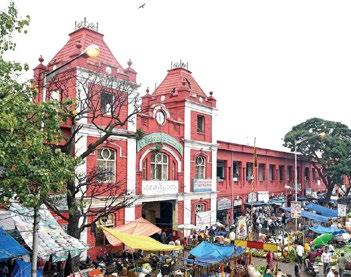
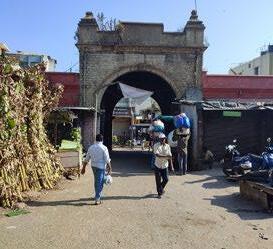
The clock tower and Market Main entrance is one of the heritage structures in this precinct protected under the smart city proposal.
FRUITS & VEGETABLES AROUND
MAIN MARKET
Fruits and vegetables sellers in the peripheral streets of K. R. Market serve almost 40% of the total fresh produce needs of the whole of Bangalore (Government of Karnataka, 2016).
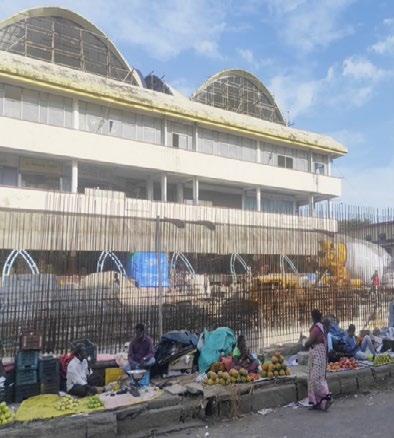
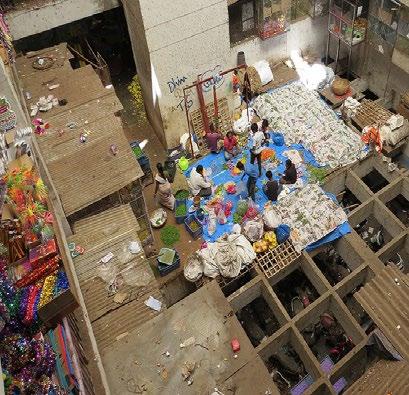
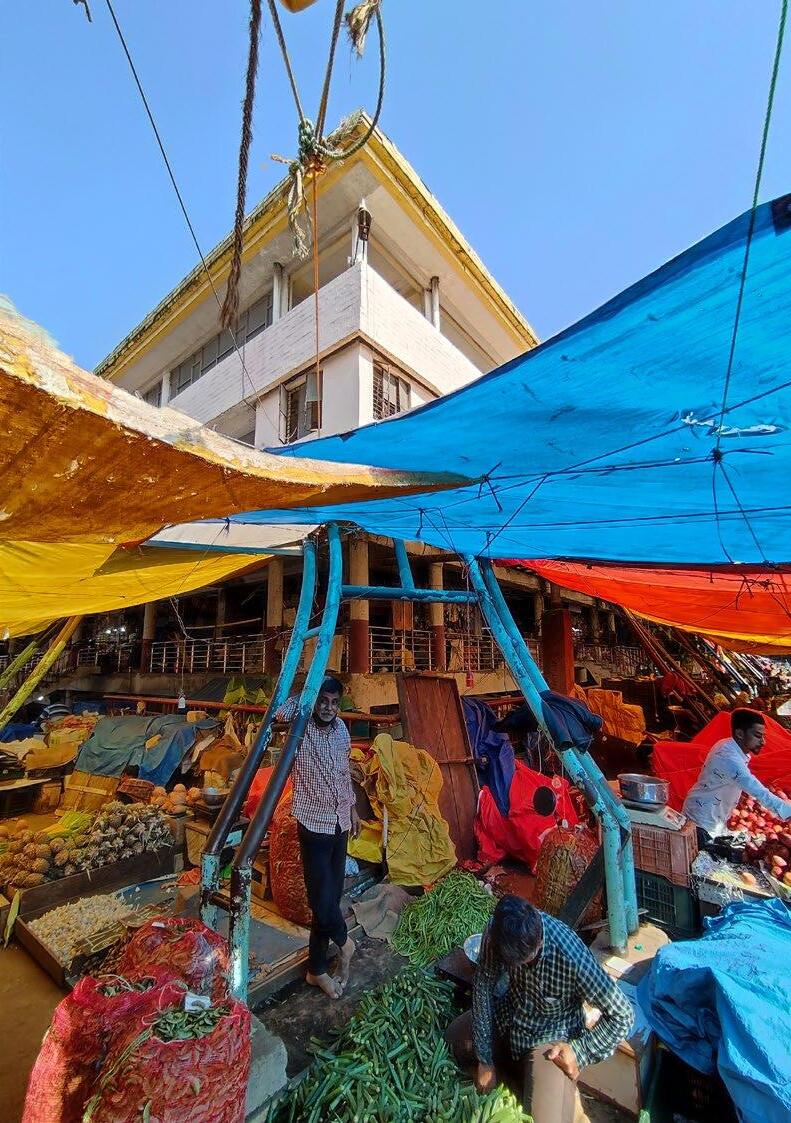
The 100 year old heritage building’s decaying exterior edges are used as areas to set up outdoor markets by vendors. This has left around 100,000 square meter of interior space unoccupied.
Most of the vendors here are 2nd or 3rd generational businesses. Customer patronage and retention was always constant until the pandemic hit. Spices and Religious Items are popular goods sold here apart from the perishables.
The surrounding streets are currently not under regulation, meaning no streets are dedicated specifically to either hawkers or vehicles. As a result, streets can be accessed by anyone at any time, making it difficult for authorities to maintain the place. Even vendors whose family members have been vending for 100 years or more have no claim on the land, as any market area belongs to the public per the Indian constitution. (Patel et al, 2021)
GENERATIONAL BUSINESSES
HERITAGE VALUE OF KR MARKET
THE FLOWER MARKET EPICENTER
Harshitha Pemmasani
Harshitha Pemmasani
Harshitha Pemmasani Harshitha Pemmasani
LIVELIHOOD INSECURITY AMONG STREET VENDORS GATHER
Harshitha Pemmasani
New Indian Express
Harshitha Pemmasani
PROMINENT USERS: The customers include restaurants, other, sometimes photographers and tours, Wholesale and retail Vendors, Commercial & Residential Customers, Govt. Appointed Cleaners, Logistics operators (auto drivers, truck drivers), Police staff, Porters for loading & unloading.
WOMEN VENDORS FIND THE MARKET SPACE CONVENIENT
“The market has accessible toilets, however, when they don’t function properly we are allowed to use the toilets in the post office nearby.”
CLEANLINESS, STENCH AND POOR ACCESS
“I have to carry many things during the day and the roads are unsafe and dirty to use for both buyers and sellers. There are often stench of rotting vegetables and abandoned vehicles in the basement and near the flyover.”
PHOTOGRAPHER’S PARADISE
“As a visitor who comes here just to take photographs there is so much heritage value that is hidden in all this hustle and bustle. There is overcrowding and fear of theft in some parts.”
POOR WAY-FINDING AND FEEL LOST
“It is hard to recognize which shop is where, there is no map or signage to direct, despite visiting KR Market several times, it feels confusing to navigate through the market.
• Rich history and Heritage Value since 17th century
• Variety, Mix of goods & vendor types and spaces.
• Largest flower market of Asia
• Proximity to transit routes
• Central Business District &
• Highly Active during morning/ evening
• City’s Oldest Wholesale market
• Decaying heritage structures
• Congested and poor usability
• No signage or way finding
• Inadequate transit hubs
• No designated vending/parking zones or livelihood security for street vendors.
• Weak waste handling services
• Reduction in footfall during COVID. Low recovery rate and customer retention.
STRENGTH WEAKNESS OPPORTUNITIES
• Existing vendors association
• ULB Focus and Smart City focus of KR Market
• Heritage structures
• Identity and rebranding of the market complex as the heart of the Garden City.
• Visually captivating, Photographers paradise.
• Quality products available at the best wholesale rate in Bengaluru.
• The market needs a longterm yet, incremental approach for socio-economic Post-Covid
THREATS
• Waste Management: The market generates 80 tonnes of waste daily Traffic and congestion
• Most of the vendors earnings go towards paying fees and to rent mafia.
• 100,000 metre sq of interior space is vacant.
• Very Low Investment into maintenance
• Fire Hazard Prone (according to standards 8 meters of approach roads around the market need to be free of encroachments or obstructions. )
MAPPING MARKET
ACTIVITIES
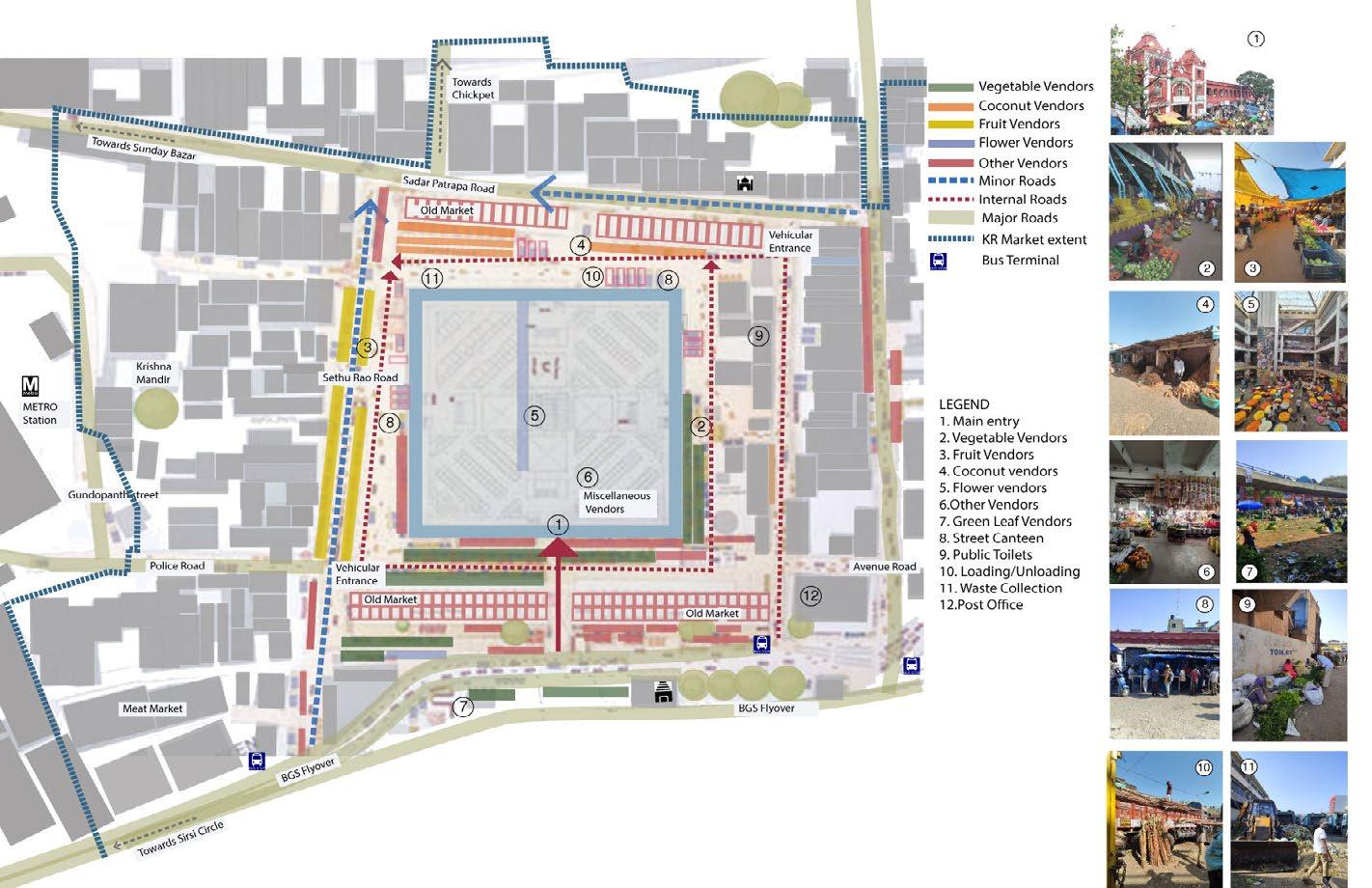
Vendor Types and Location
Flower Vendors
Vegetables and Greens
Miscellaneous Goods
Fruits Vendors
Metal/Hardware
Meat Market
Eateries
Spices
Leaf Source: Jana Urban Space
Currently around 3000 vendors are occupying the streets.
Map depicting the predominant vendor presence and the common activities found in KR Market. Source: Adapted by Authors from Patel et. al, 2021
14. Greens vendors
Highly Active
CATALOGING MARKET ACTIVITIES
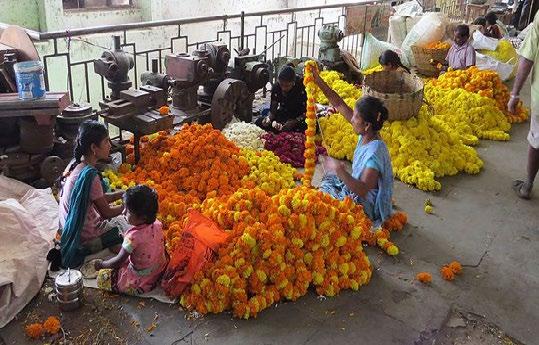
Women form a large portion of the market users. Wherever the building has natural light, most vendors gather there, especially the flower vendors.
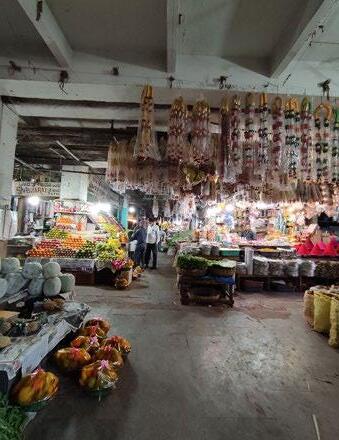
Interior Parking Spaces used by variety of vendors. These areas however need artificial light at all times. Not much footfall is experienced here compared to the market exterior.
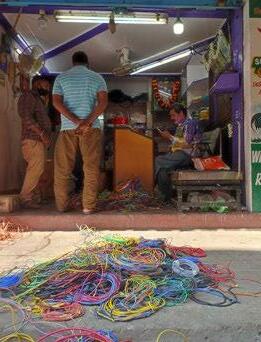
Electronics and hardware and repair shops also see high footfall.
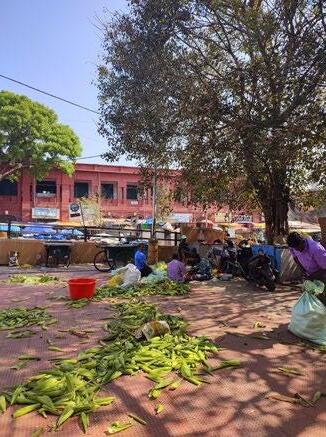
Shaded areas, trees and platforms become extended spaces of vending,. However the waste left behind impacts the pedestrian movement
The market operates from 2:30 AM onwards with the flower vendors arriving first.
4% of the market exterior consists of variety of eateries. Temporary vendors selling beverages in cycles or carts are also prominent at all times.
Loading and Unloading areas and truck parking.
Most shops extend out of their stipulated rentable space. Vendors without license occupy the sidewalks around the building during the day.
Harshitha Pemmasani Harshitha Pemmasani
Harshitha Pemmasani
Harshitha Pemmasani
Harshitha Pemmasani
Harshitha Pemmasani
Wikimedia Commons
MARKET ECOSYSTEM & NETWORKS
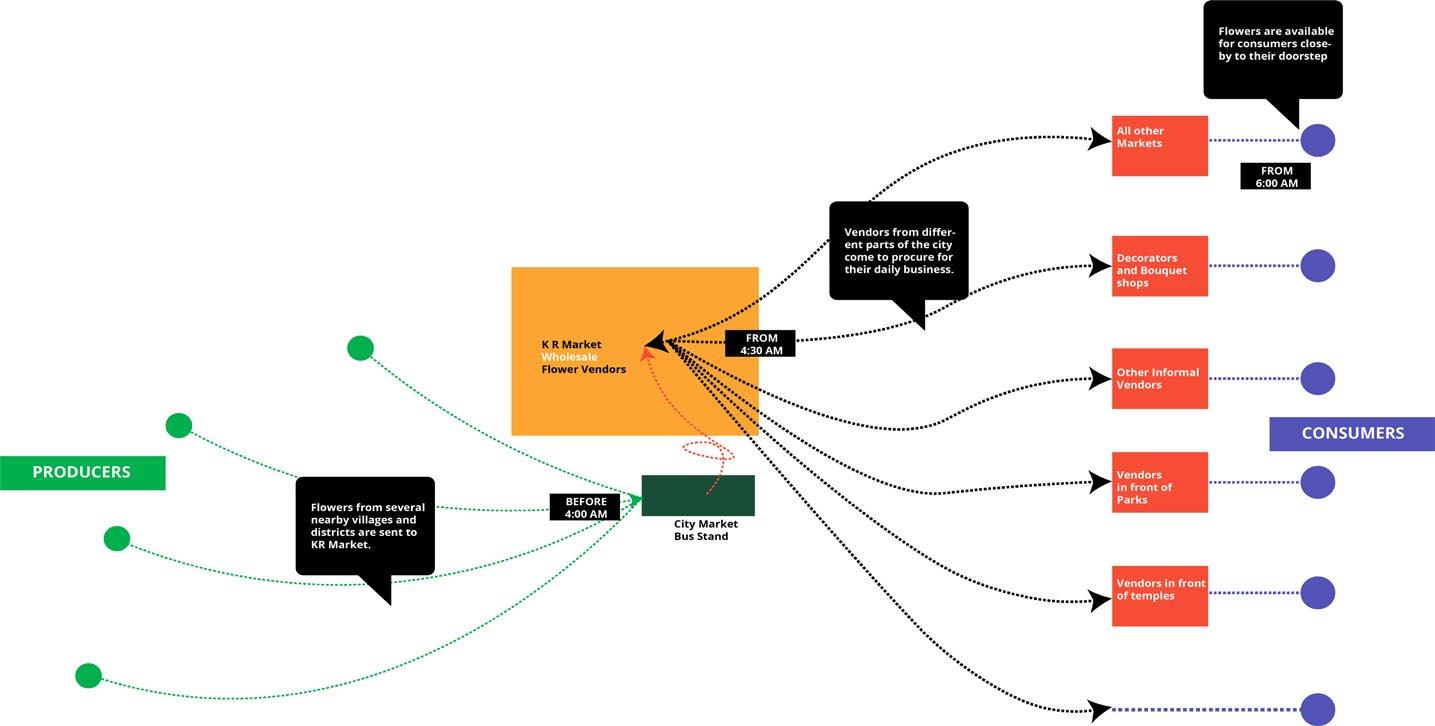
Operating 24x7, this market extends beyond the original structure of 1 acre area, and into the adjacent streets. The market supports daily wage employment of coolies for loading & unloading, packaging and transportation of goods and services. Farmers and producers make it to the market early by public transit or trucks.
• By 12:30 am farmers and sellers start and reach at 2:30. Flowers and vegetables are the first foods to arrive.
• From 4:30 am onwards, the goods are sold to external businesses, restaurants, weddings or other informal market vendors. Most vendors close shop by 8pm.
• Around 6:30 am consumers are able to access the fresh produce, flowers and assorted food products directly from their street corner.45
Source: PLUS
PORTERS & DRIVERS
Source: CEPT University Thesis 2017 Trading route of flowers on a daily basis
Well connected to public transit, however walkability is very poor.
VACANCY RATES
Store Front & Stall improvements in Ground floor, Re-purpose floors for programs/events.
VISIBILITY
Place has plenty of variety but poor visibility.
PUBLIC TRANSIT, GREEN SPACES
Connecting public spaces with mulit-modal transit.
WASTE MANAGEMENT
Focus areas of the Smart City proposal is to address the waste management.
SOCIAL NETWORKS
Year Round program-
ming & Santhe’s SENSE OF PLACE
Visual Identity & Signage as HISTORIC IDENTITY
Walking Trails Place
Branding post-covid.
GOVERNANCE
SAFETY & SOCIAL NET
Formation of KR market
Alliance- a mulitstakeholder organization.
MUNICIPAL REGULATION
Partnering with Health, waste, water & planning departments for adhering to market standards.
DESIGN SERVICES
Creating a design team for store upgrades.
SOCIAL SERVICES & SAFETY NETS
Working Women financial assistance.
Social services & risk assessment of informal economy.
TECHNOLOGY
Capacity building with Technology & e-shopping Health/ Emergency plans
POLICIES
Designated vending zones and amenities.
PARKING FEE
Designating Parking areas & fines for violating parking zones.
TOURISM & EVENTS
Positioning KR as a City & Local Tourism economy development & funding.
ENVIRONMENTAL CONSCIOUSNESS, Plastic Free Market
Campaign Organic Waste
Disposal
Circular Economy
CULTURAL PRACTICES
Behavioral Change campaigns.
Incentives for waste management
AIR/WATER QUALITY, SUSTAINABLE WATER PRACTICES
Partnering with local NGOs for programing and assistance.
SDG GOALS
Push for sustainable Business Practices.
Citywide benchmarks for market Resilience.
EXPERIENCE THE GARDEN CITY AT THE KR MARKET
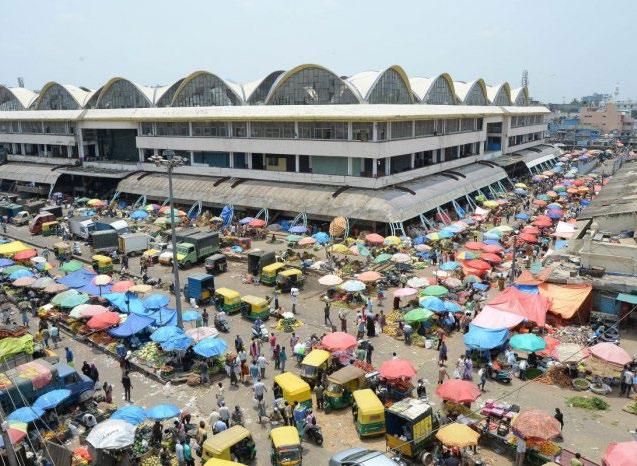
A view of KR Market exterior streets aerial view during the Pandemic in June 2020
The Bengaluru Live, 2020
Namma Bengaluru ---- Namma Pete
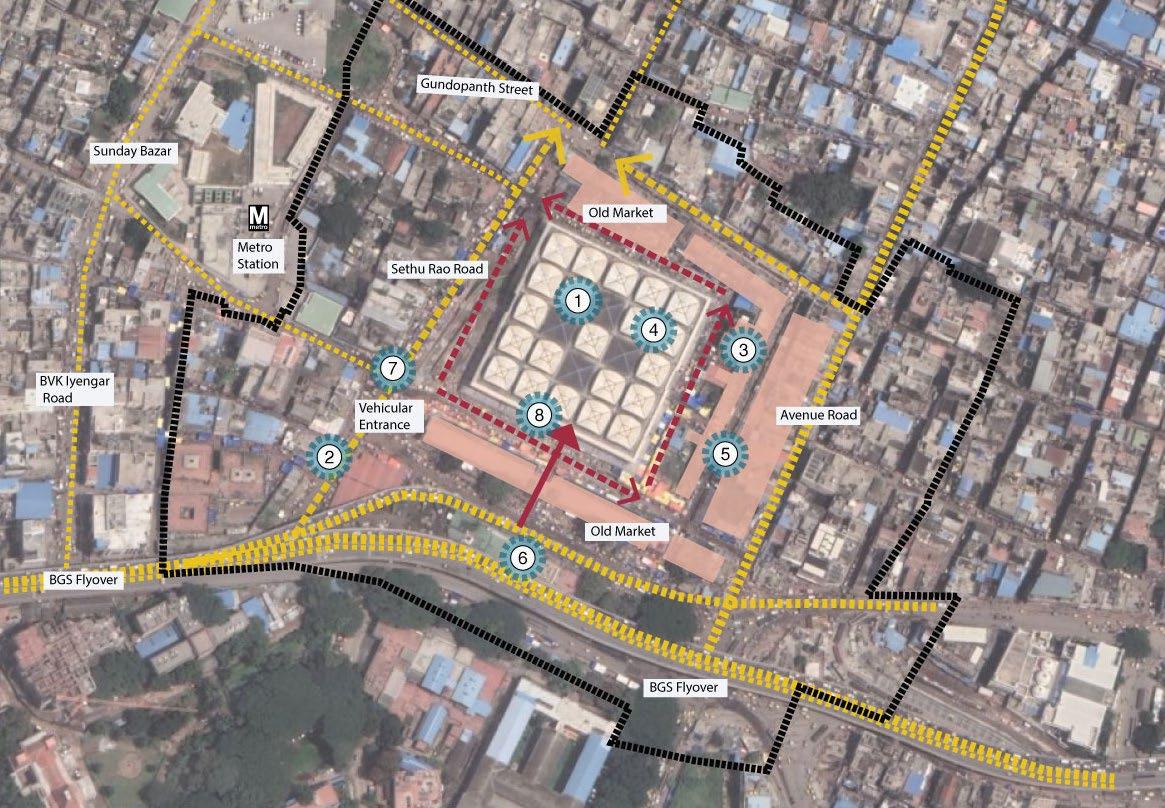
MAPPING ISSUES & OPPORTUNITY AREAS
Source: Google Earth, March 2022
SILVER JUBILEE PARK
MAPPING ISSUES & OPPORTUNITY AREAS
Most of the interior building floor has the flower vendors, however around 10,000 sft of interior building is vacant due to poor lighting, fire hazard and unsanitary conditions. Except for the Ground floor other floors are mostly empty.
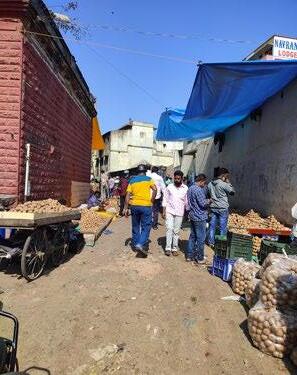
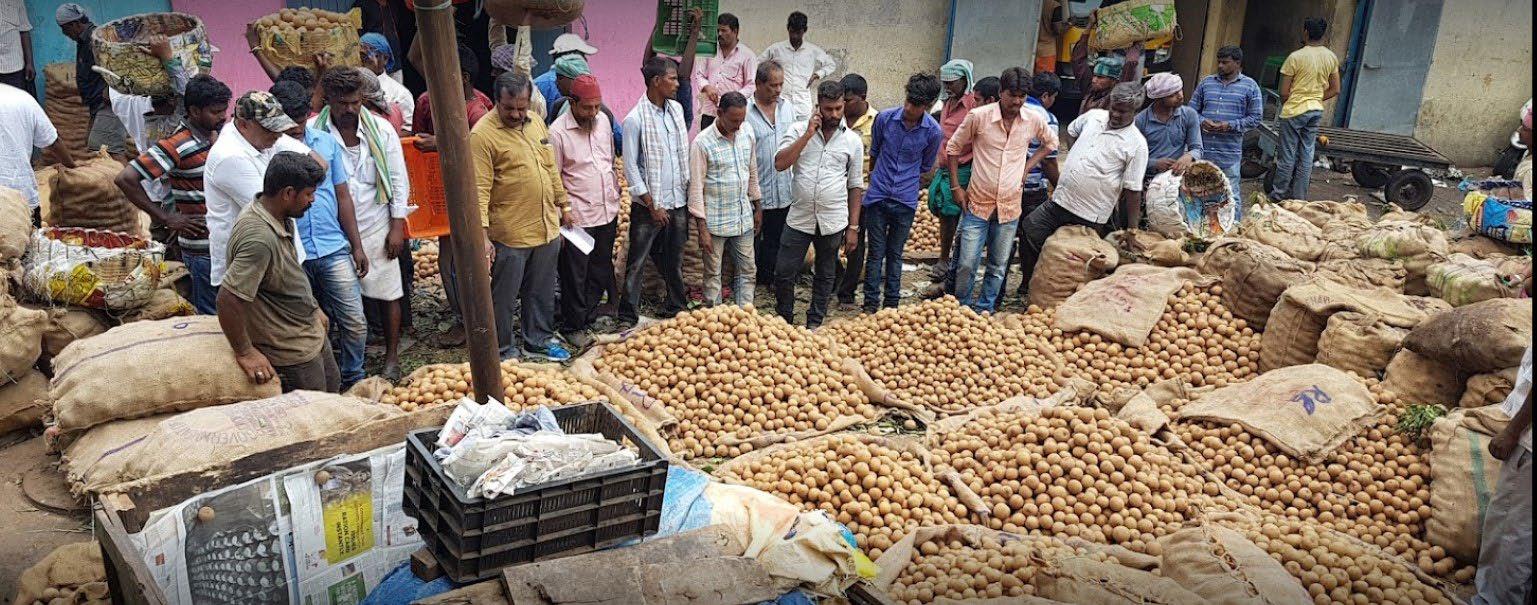
Lane exclusively for Potatoes wholesale. Lack of signage, hard to navigate through the market unless you are a regular.
Roads surrounding the market, Sethu Rao Road, Avenue Road, Gundopanth street, often experience congestion & traffic issues.
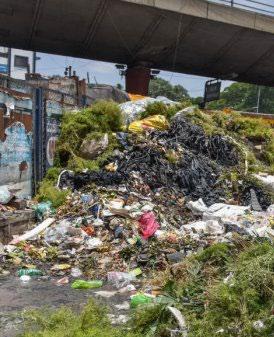
High points of congestion and waste are observed in the Market bus stop, the “green market” node below the Mysore Road flyover & the bus stop.
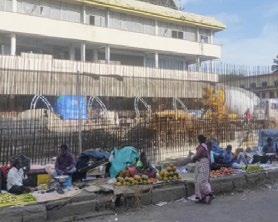
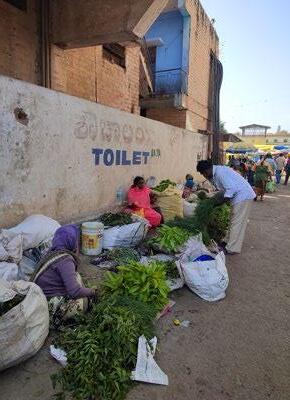
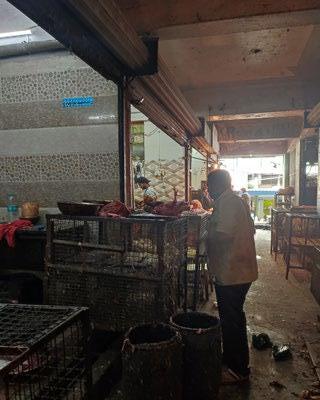
Vendors occupy shaded areas near the toilet block with less crowds despite hygiene concerns.
Parking obstructs circulation surrounding the market buildings. The vendors who are not allocated specific spaces are concerned about their visibility as trucks & vehicles often obstruct their visibility.
Inadequate lighting during the day. Wherever the building has natural light, vendors and users are crowded there, especially the flower vendors.
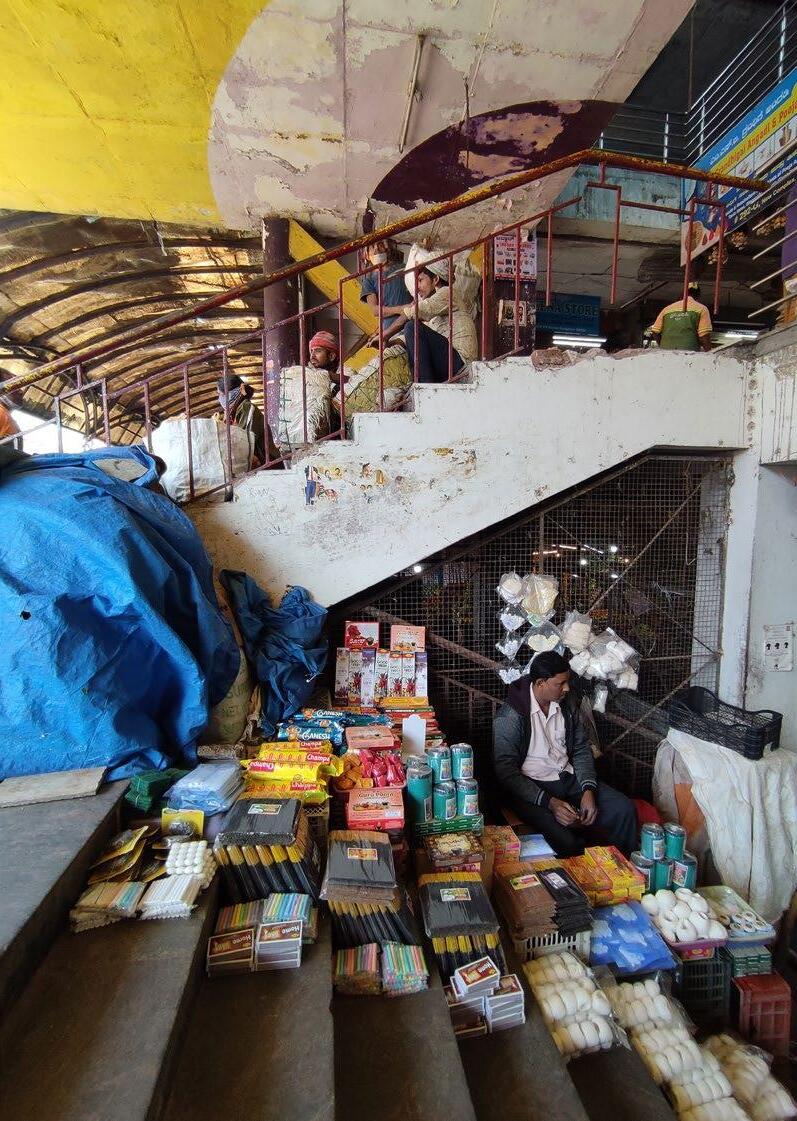
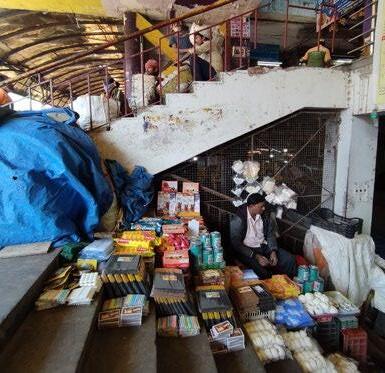
The market staircase is taken up by expertly arranged shops, that become display shelves. However this also poses a fire hazard. There is a need to create more such usable & visible spaces that are also safe.
Source: Creative Commmons
Source: Harshitha Pemmasani
Source: Harshitha Pemmasani
Source: Harshitha Pemmasani
Source: Harshitha Pemmasani
Source: Harshitha Pemmasani
Source: Harshitha Pemmasani
Source: Harshitha Pemmasani
MARKET GOVERNANCE RECOMMENDATIONS
EXISTING PARTNERSHIPS FOR MANAGING KR MARKET
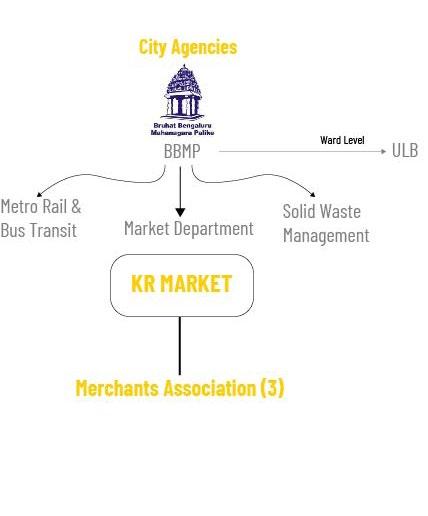
The KMC Act 1976, established the BBMP Market Department which empowers the Commissioner to have control over the public markets and to collect the license fee. They are also responsible for resumption of the market shops/premises or committing default in payment of the fees levied as provided under the provisions of the Act. The BBMP Market department collects taxes and rent of 150 INR per square feet approximately for the stalls inside the market building. The market department also regulates the movement of vehicles outside the markets
KR Market has 3 separate vendors association for Flowers, Fruits and vegetables and other goods. These Merchants Association form the primary stakeholder of this XID.
Flower Vendors Association
PROPOSED PARTNERSHIP FOR MANAGING AN XID
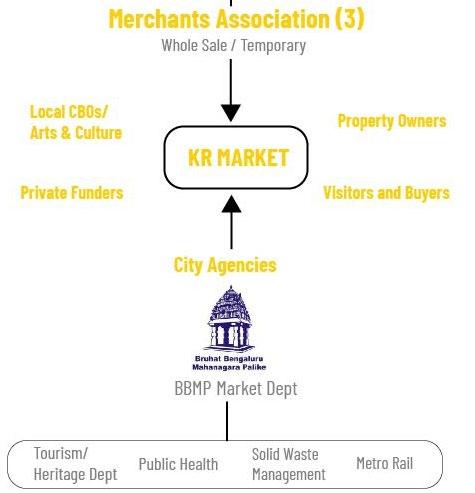
The white paper recommends the formation of a non-profit entity for the KR Market Experience Improvement District, headed by a Place Manager. KR Market Alliance composed of multi agency partnerships to support programming, funding and bottom up governance and community groups such as the Horticulture Producers’ Cooperative Marketing and Processing Society. 46 The alliance would act as the Advisory team with representatives from the municipal corporation departments of Tourism, Health, Waste Management and Metro Rail. The BBMP should also include the vendors without license a part of the future redevelopment plan of the external streets. In the long term, the KR market XID can be scaled to encompass a larger Improvement District of the Pete area. Bengaluru Smart City
KR MARKET XID
Place Manager / Executive Director
Local CBOs, Artists & Neighbourhood Associations
Visitors & Buyers
Property Owners
Non-Property Owners
Fruits & Vegetables Vendors Association Dry Goods Vendors
Existing city agencies and Vendors Association involved in the KR Market Functioning.
Source: Authors
Funding
BBMP Market Tax
& rent collection from vendors
Management & Maintenance
BBMP Market Department /
BBMP SWM
Programming
Currently non-existent. Earlier BMC used to host santhes and traditional wrestling & music. Design
Bengaluru Smart City
Bengaluru Smart City Limited (BSCL)
Proposed Market Governance with the Merchant’s association, local businesses and the City Agencies interacting with the external institutions and community groups around KR Market
Source: Authors
7. CONCLUSION & WAY FORWARD
The XID model of governance and strategic planning is a tool to enable Incremental Improvements that create and preserve unique experiences of places, through a defined strategic boundary for engagement and partnership. The framework is built on the combined domains of Hardware (Physical Infrastructure), Software (Social Infrastructure) and, Governance. A successful Experience Improvement District needs to satisfy indicators of Livability, Economic Competitiveness and Environmental Impacts to determine nature of improvements, and if needed rebranding of important destinations or hubs that are losing its value, into Experiential Improvement Districts. The Urban Thinking Matrix provides a set of indicators across these three domains and ‘Areas of Improvement’. Together these 9 components offer a direction for cities, neighbourhood associations, and local resident groups or businesses to define the Strategic opportunities Areas for the creation of an XID. KR Market, with its layers of complexity is one such ambitious example of a potential XID among many other places across India and Asia that holds potential to become a unique destination for commerce, recreation, celebration and art, paying homage to its past and acknowledging the needs of the present and future positioning of such public spaces in the country. This edition is an experimental approach for the Indian context of neighbourhood and place management, with enormous potential for global approaches of ‘Experience”.
“The key to fixing our broken patterns of urban development does not lie in grand plans or giant projects, rather it lies in the collective initiative & energy of people.”
- MASSIVE SMALL
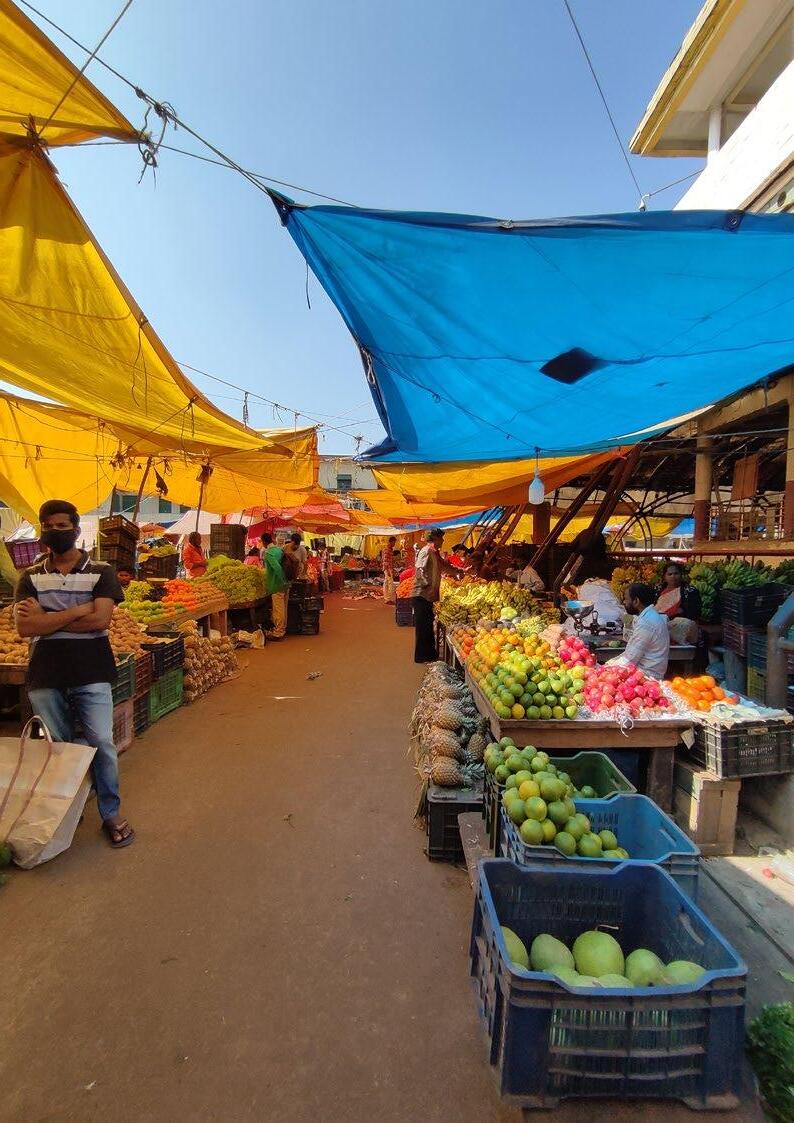
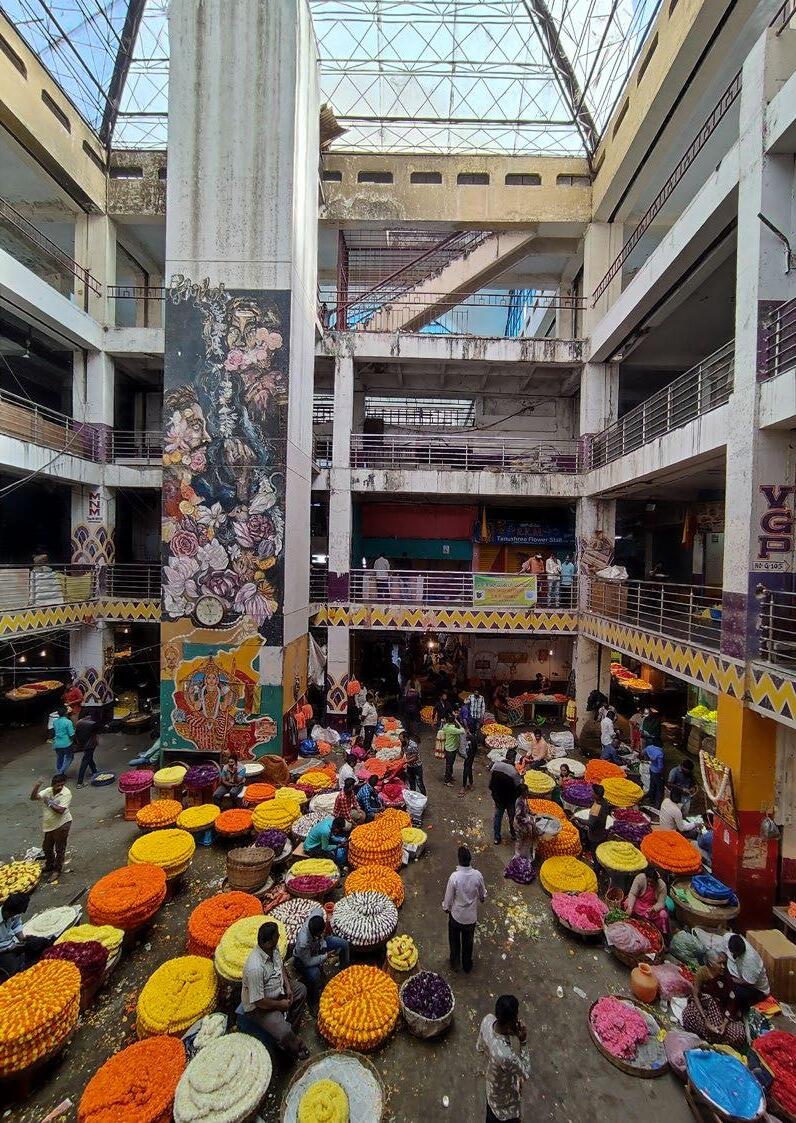
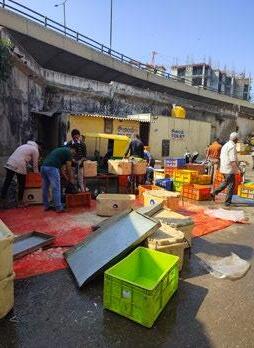
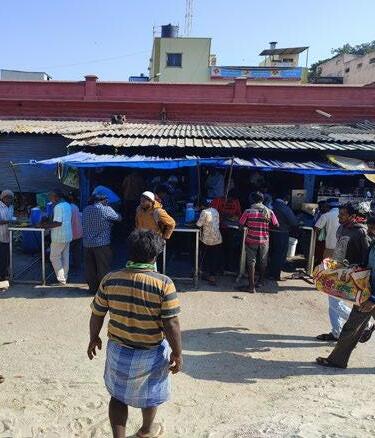
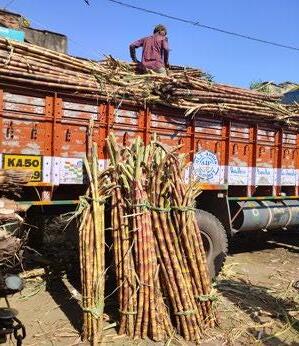
View of the “Soppu” or Groundnut sales area
REFERENCES
1 Space and Place, Yi Fu Tuan, 1977
2 UN Habitat, 2017
3 How Place Governance Impacts-the-Civic Potential of public places, Brookings Institute, 2021
4 How Place Governance Impacts-the-Civic Potential of public places, Brookings Institute, 2021
5 Sanyal, Sanjeev Kumar et al. “THE ALTERNATIVE URBAN FUTURES REPORT.”, 2009
6 https://en.wikipedia.org
7 “Neighbourhoods in Urban India: In between Home & the City” , Dr Dev Nath Pathak (https://www.impriindia.com/event-report/neighbourhoods-in-urban-india/)
8 International Labour Organization (www.ilo.org)
9 “Significance of Informal Economies in India: Case of KR Market Bangalore”, Patel et. al, Sage Open, June 2021
25 Lee, Wonhyung. “Critical Perspectives on Local Governance: The Formation of Business Improvement Districts (BIDs) in Low-Income Immigrant Neighborhoods of Los Angeles.” (2014).