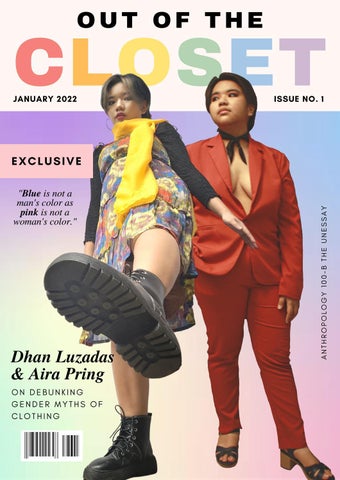
OUT OF THE
CLOSET JANUARY 2022
ISSUE NO. 1
EXCLUSIVE
YASSENU
"Blue is not a man's color as pink is not a woman's color."
EHT B-001
ON
DEBUNKING
GENDER
MYTHS
CLOTHING
OF
YGOLOPORHTNA
Dhan Luzadas & Aira Pring
Introduction Fashion wasn’t always about gender. In fact, gender-specific clothing is rather a new concept in history.
Most of the time, people tend to forget or refuse to acknowledge that masculinity and femininity associated with clothing are but a social construct developed through years of evolving fashion trends and styles. Because of this, men and women are restricted to wear specific attires deemed socially appropriate with one’s biological body. For a heteronormative society, there are simply no in-betweens when it comes to fashion. But that was of the past, and we are now looking towards a present of a modern generation that embraces all kinds of clothing regardless of the gender dichotomy.
“What difference does it make to begin with an understanding of humans as androgynous dividuals, rather than as autonomous individuals divided into two “natural” kinds by a universal gender binary?”
Upon reading this thought-provoking quote from the book “Anthropology: What Does It Mean to Be Human?,” we have come into a realization to look at the world not in the mere perspective of black and white—that is within the boundaries of the gender binary, but beyond using the lenses of androgyny which emanate the colors of the rainbow.
In Melanesian cultures, the term androgynous signifies being not exclusively male or female. This perspective is derived from their unique concept of individuality that is entirely distinct from the Western world’s “universal” definition of a unique individual self. For Melanesians, self is internally plural–a social microcosm wherein a singular person is made up of parts from their male and female parents who are responsible for their upbringing and this special connection continues to persist throughout the course of their lifetime. Therefore, the notion of “dividual” instead of “individual” makes sense for it signifies masculine and feminine counterparts in a person’s understanding of oneself (Schultz and Lavenda 2018, p. 397).
And thus, as colorful dividuals who are part of the LGBTQ+ community, we have made a bold decision to step forward and come out of the closet by debunking the history of clothing articles and its gender stereotypes through a creative illustration and presentation of our fashion magazine entitled, OUT OF THE CLOSET. From conventionally “feminine” to “masculine” pieces, we have carefully crafted and styled a lookbook consisting of a collection of outfits exhibiting each color of the rainbow to signify the fluidity and diversity of one’s sexual orientation, gender identity, and gender expression (SOGIE).
Through this, we hope that, in the littlest way that we can, be the ripple in the stagnant water of this world by redefining the imposed gender roles and stereotypes of the previous generations, showcasing the colorful identity of each dividual to recognize the importance of legislating the SOGIE Equality bill as well as forwarding the rights of the LGBTQ+ community. With this in mind, may we inspire the younger generation and those to come in expressing themselves through fashion as an extension of their bodies by revealing their true colors.
00
Introduction
202100 "Dividuals"
01
Make-up
202101 "Red Velvet"
Just when society has started embracing the idea of women using makeup, men using it too became taboo. Even though men’s usage of cosmetics has been present throughout history from Egyptian pharaohs to portraits of royalties, some have not yet grasped the idea. Since makeup has been made popular by women, it has been associated with femininity and leads to the assumption that men who wear makeup are automatically gay. Thankfully, there have been men today who find comfort in themselves when wearing makeup and have veered away from society’s stereotype.
On that note, the LGBTQ+ community has always been connected with colors, rainbows, and glitters. It has been their expression of their identity which sets them apart from the rest. Through the use of cosmetics, the community has continually brought color to this world. Though there have been a lot of setbacks, makeup has helped the community to be always seen. They have used their colors to provide a safer place for the rest of the community.
01
MAKE UP
Art has been known as the expression of one’s self. Many individuals have used different mediums to convey their messages; from walls, canvasses, clothes, and even faces. Thus, makeup exists. People from different centuries have applied cosmetics on their faces for various purposes, but mainly, for beauty.
The use of makeup can be traced back to 4000 BCE when men and women have worn the infamous eyeliner in Egypt as a way to please their gods. The use of kohl, powder and eye shadows were also seen in their faces back in the day.
Though cosmetics were encouraged in Egypt for worship, in some religious denominations, it is forbidden. In the writings of Jeremiah from the Old Testament, it was stated how cosmetics were a symbol of prioritizing vanity.
The same goes for Romans as they also frown upon the use of makeup which was associated back then with sex workers. Personal hygiene was highly encouraged and women’s removal of body hair was popularized but the use of personal effects were signs of insolence. They treat it as a tool that does not recognize the natural beauty that has been bestowed upon the people who use them.
Stoicism was the main cause of this view of the Romans for Stoics believed how true “beauty” was based upon the conduct of each individual. The use of makeup, just like with the Jews, implies vanity and narcissism which was loathed.
Throughout history, makeup has received a love-hate relationship from different eras. This impression of using makeup, then, led to the shaming of women and those who wanted to feel good about themselves. This went on until the 20th century came. There were still people who used cosmetics despite the remarks of certain personalities which led to the industry to rise up. Personal effects became a symbol of status in society and only those who could afford them were considered “beautiful” and fit the “standard”. So, from being frowned upon the industry had a 180-degree turn and makeup became an essential part of everyday living.
A
02
SUIT
Formal events often require men to wear suits. The term suit originated from the French word suivre which meant “to follow.” And thus, the coat follows the pants and forms a combination of a three-piece attire which consists of a coat, a vest, and trousers–all usually in matching colors and fabric. Nowadays, people settle with using only two pieces of said garment to be weather-appropriate. Just like any other formal article of clothing, suits are required for the wearer to appear more sophisticated and professional, although wearing them may limit one’s range of movement. Nevertheless, any extreme activities are not expected to happen in formal settings so suits are deemed just appropriate on occasions or in the offices.
Surprisingly, the origin of suits can be traced back to Charles II of England and King Louis XIV of France (again) during the 1660s. Collars were not existing in the vests and suits back then and this style has been carried on up until the 18th century. The modern-day suits with which people are more familiar were introduced by Beau Brummell, a typical gentleman of the English court life in the 1800s. Brummell rejected the popular menswear of the French revolution which consisted of frock coats, knee-breeches, and powdered wigs in favor of less ornamental jackets and long trousers with boots.
02
Suit
202102 "Tangerine Twists"
During the Victorian era (1837-1901), men wore frock coats– a type of black jacket that was either single or double-breasted with a single vent and reached down the knee, resembling modern overcoats. Later on, the frock coat was separated into two elements: the morning coat which had the tail, and the lounge suit without. Known as dittoes, the lounge suit was made out of heavier fabric and considered a casual attire, especially in the British countryside. In terms of trousers, men wore in darker colors and different fabrics instead of matching with the top. The 1930s was dubbed as the “Golden Age of Classic Menswear” with the heavy drape cut as the defining feature of suits. By the 20th century, the suit developed into different styles with varying lengths, colors, fabrics, patterns, and shapes were more defined (Lee and Laursen 2020).
B
Suits had been gatekept by men for so many centuries now. However, before the 20th century, women started wearing suits too, though the main purpose was mostly for leisure and travel since they mostly stayed at home. The first instance of women wearing suits began with Parisian actress Sarah Bernhardt as she wore a custommade pantsuit. In 1910, the suffrage suit rose to prominence through the American Ladies Tailor Association as it allowed females more movement, while the 1940s came with the zoo suit which was considered as a power outfit to rebel against the female domestic image. By the 1960s, around 40% of women participated in the workforce due to the several acts protecting them against wage gap and discrimination in the hiring process. This then led to the popularity of working women wearing suits in the workplace (Do Good Co. 2020).
Nonetheless, the start of women wearing suits was also the start of the spark of their importance in society because this meant that women were no longer servants inside their homes. The practice of pairing suits with skirts and vests was no longer a requirement, and after a century most women no longer wore traditional skirts. By not restricting a woman’s movement, such freedom, equality, and empowerment through fashion were brought by suits.
In ancient Greece, however
garment–a type of one or tw
girded and pinned on one o
white clothing had varying l
knee-length and seamed up
women of ankle-length. On
ancient Rome wore togas–a
shape measuring about 18 b
heavy wool. The basic garm
which colors indicated soci
the upper classes and brow
Roman women were dresse
version of chiton (Marly et a
During the medieval period
intricate with heavy decora
signifying the wealth of elit
were often characterized b
to high waisted silhouettes,
adorned with much jewelry.
fashion began playing lace
details but with conservativ
necks as the defining featu
1800s, children up to ages s
white dresses regardless of and full-skirted coats were
early 20th century (Jgln 202
03
DRESS
As outer apparel, the dress consists of a single-piece bodice and skirt. Despite the conventional notion of dresses being a woman’s clothing, it is actually gender-neutral. Men and women of the ancient civilizations wore dresses daily not much for aesthetic reasons but mainly for protection.
This is evident through Egypt’s drape style of dress wrapped around the body by knots tied in the fabric or by a belt, collar, or sash. These garments were made with linen as the chief textile for Egyptians believed that gods were clothed with such prior to their arrival on earth. Over the years, this dress was influenced by its conquerors and evolved into a robe or gown worn by important persons of both sexes. Its pleated fabric gathered at the front of the waist and measured 5 by 4 feet which created wide elbow-length sleeves.
The Sumerians, Babylonians, and Assyrians of Mesopotamia also had a draping system of dresses wherein the cloth was arranged full at the rear which left the right arm free. It consisted of a knee or anklelength tunic and fringed or tasseled shawl for both men and women. The dress was usually woven using wool of bright colors and embroidered with patterns and motifs that were primarily geometric.
03
r, chiton was the chief
Dress
202103 "Sunset at Montmajour"
wo-piece tunic that was
or both shoulders. The
lengths with men usually of
p on one or both sides and
n the other hand, men in
a larger material of circular
by 5 feet and made from
ment was the tunica of al stratification: white for
wn for the rest. Meanwhile,
ed in stola, the feminine
al. 2019).
, dresses became more
ative fabrics and full-skirts
es. Such outer garments
by long draped sleeves, low
, and a square neckline
. And by the Victorian era,
C
, ruffles, and feather
ve silhouettes and high re (Chilton 2021). In the
six and seven wore dainty
f gender, and long gowns worn by men up until the
21).
D
Dress in the Philippines existed as early as the precolonial times wherein renderings of male dresses became apparent but its history not so much compared to female clothing of baru, saya, and tapis which were reconfigured upon the arrival of Spaniards. The baru acquired longer sleeves to become baro, and a fichu or pañelo was made to conceal the breasts. Furthermore, above the saya skirt was the pre-existing tapis–all of which established the foundation of today’s national dress.
The baro’t saya eventually evolved into traje de mestiza or the Maria Clara which described the epitome of a Filipina at the time and was commonly worn by all women in all social classes. In the 1930s, the Commonwealth period was the peak of terno (to match in Spanish) fashion which consisted of a more complex tapis called sobrefalda, a saya de cola skirt with train, enaguas or petticoat, an ornate chemis of corpiño, camisa or baro, and a pañuelo or kerchief (Ganal 2018).
Nowadays, dresses are mostly worn during formal occasions by women due to the notion of men wearing such garments being associated with femininity. However, its long past since the beginning time immemorial reveals its gender-neutral truth and breaks the stereotypes when it comes to clothing.
04
PANTS
04
Pants
202104 "Hey Barbara!"
Although pants and trousers are often used interchangeably, there lies a distinction between the two. While trousers are tailored clothing of fitted waistline, pockets, and a zipper, pants generally refer to a broad term for undergarments such as slacks, jeans, and shorts.
Oftentimes, the expression “who wears the pants” describes the head of the family, usually of men depicting power and masculinity. Nevertheless, the wearing of pants is not exclusive to the male wardrobe as history reveals women in trousers as early as the mid-19th century and the Dress Reform movement that came along with it.
The existence of pants in the Western culture goes back to the equestrian culture of Asia minor wherein Scythian warriors wore loose-fitting pants tucked into boots. This was adopted by the Persians during the 5th century BCE which then spread in Europe. In fact, ancient Greeks and Romans saw the wearing of pants as “barbaric” but later on eventually wore braccae, a type of pants similar to a pair of tight capris and is appropriate for the cold weather.
In the 1800s, Victorian societies deemed female pants as inappropriate. Thus, the Dress Reform movement was born wherein women clamored for the concept of a “rational dress”–of freedom to wear pants to allow for a wider range of motion. Around 1851, Elizabeth Smith Miller designed the controversial bloomers consisting of a knee-length skirt and loose Turkish trousers gathered at the ankles, and popularized by Amelia Bloomer. Moreover, pants took a practical role for women during World War I and II as they were part of the workforce. And by the late 20th century, both men and women wore different styles of pants in public (Monet 2021).
The advent of pants in the Philippine context began and evolved during the Spanish and American colonial periods. From the casual camisa de chino and drawstring pants and formal barong tagalog woven from piña fiber and pantalon de fina lana decorated with native embroidery to americana suits consisting of a close-necked collared long-sleeved shirt along with a tie, a coat and matching slim-fit white trousers called baston (Castro 2019).
At the present, pants continue to serve its social and functional purpose as it reflects the history and culture embedded within the styles that emerged throughout times.
E
F
05
HEELS
G Heels are typically worn to show off the beauty of the feet. It is like the tophat but for the lowest part of the body. In its essence, everything about it is good–well except for the fact that it causes so much pain when worn for too long. Tiis-ganda.
Aside from beauty, heels also exemplify class. This is the reason why most offices require women to wear heels for professionalism.
Back in the day, heels actually came from wooden soles which are attached to shoes and are usually removed when going indoors. When outside, they are latched on to keep the shoes away from any dirt or mud that may ruin them.
In the Philippine context, the closest we have to heels were the bakya. These were made from wood and actually came from Paete, Laguna. Various designs can be seen on the strap of each bakya. These can be usually seen to have an opentoe design and with an exposed heel.
It is known to all that heels were actually popularized by men–rich men, specifically. King Louis XIV of France was probably the most wellknown wearer of them since it signified his nobility and hid his normal height. Even during his time, heels were a pain in the ankles and needed servants when wearing and walking in them.
05
Heels
202105 "Sapphire Heat"
06
SKIRT
06
Skirt
202106 "Gilmore Girls"
Perhaps one of the first pieces of clothing ever created was a skirt–after all, it was the simplest way to cover the lower portion of one’s body. As an ancient garment, a skirt is a free-hanging fabric that drapes around the waist and extends downwards.
Skirts have been conventionally associated with the female wardrobe that people tend to forget the social and political purpose it served during prehistoric times. In fact, skirts were the standard attire for both men and women across almost all ancient cultures.
The history of the skirt dates back to Mesopotamia
H
during the peak of the Sumerian civilization between 2700 and 2350 BCE. Men and women alike wore kaunakes–a woven woolen (formerly sheepskin) wraparound skirt adorned with decorative tufts which extended from the waist down to the knees or, for more esteemed individuals, to the ankles.
In Egypt, men wore schenti--a hip or ankle-length skirt intricately pleated, belted at the waist, and gathered at the front, while women dressed in a sheath-like gown. They also hung an ornamental colored pendant from the waist belt to distinguish important people. In Medieval Europe, a knight’s armor had a short metal skirt under the breastplate for proof of virility and swiftness in combat.
It was not until the 19th century that the skirt experienced major transformations with its silhouette and hemline going narrower and shorter as time passed by.
Starting from the crinoline skirt of the 1830s to 1860s which signified the height of large hoop skirts for women through the extravagant layering of petticoats. Despite the long length being a symbol of femininity and elegance, it restricted certain movements and activities of women, even as trivial as crossing damp and dirty places.
Hence in the Gay Nineties (1890-1900), the rainy daisy skirt rose to popularity with its shorter hemline as it became easier for women to not get soaked in rainy weather. Furthermore, World War II also contributed to the reinvention of skirts for aesthetic and practicality by remodeling men’s uniforms.
This gradual yet dramatic change in length influenced the emergence of “above-the-knee” skirts in the 20th century. From Coco Chanel’s innovative shorten skirts to Mary Quant’s miniskirt in the 1960s which ultimately signaled fashion freedom through the emancipation of female bodies against the conservative prim and proper look of the 1950s.
In the Philippines, during the Spanish colonial period, the clothing of its inhabitants reflected their sociocultural realities and standing in society. Taga-bayan women of the upper class often wore a full-length baro't saya of quality silk except with layers of petticoats underneath, and tapis (overskirt) tied at the back instead of the side. Meanwhile, women of the lower class had simple attire made of cotton and no working trains, but with shorter mid-calf lengths to allow flexibility during chores (Cano et al. 2020).
For indigenous peoples, men wore bahag while women were bare-breasted and had wraparound skirts or patadyong (Coo 2014). Essentially, these garments contained patterns and embroideries on them which signified hierarchical status and preserved the cultural heritage of their groups.
Today, the skirt remains as a timeless piece of clothing worn not only by women but also men with the growing social support and acceptance of androgynous fashion devoid of the gender binary.
I
07
CORSET
Costumes of different characters are commonly seen to require corsets. It’s the only reason people wear it nowadays. Corsets are worn to enhance the curve of the body and the chest.
We usually assume that women are the usual users of corsets. However, that was not entirely true because men and even children, back then, were also seen using these. Little kids were asked to wear corsets because it was known to improve the backbone and the entire posture. It was used to straighten them.
On the other hand, men were seen to have worn these for pure aesthetic and attraction. It was a part of their usual get-up.
Surprisingly, corsets were primarily used as supports for the spine, examination of a 19th century skeleton showed how corsets actually led to the lessening the deformity of the spine. This was during a time when Tuberculosis was huge and deformity was rampant.
Just like any other type of clothing, corsets also signified the status of a person during their time. Royals and aristocrats were known to have worn corsets made from fine materials while others were made from cheaper clothing. This was the reason why it became available to the masses since variations of corsets were more affordable.
Nowadays, the corsetry is not limited to people of the binary but is also worn as a symbol of breaking from the stereotype surrounding it.
J
07
Corset
202107 "Periwinkle Dust"
K
08
PINK
Gender-reveal parties have been seen all over the internet for quite some time now. The equation has always been simple for many, blue = boy and pink = girl. But here’s the thing, these parties should never have been called “genderreveal” because who determines a child’s gender even though they have not set foot into the world yet? Moreover, who woke up and one day realized that pink is a feminine color?
Back in the 18th century, men used to wear suits made from silk and were filled with embroideries depicting flowers. Since pink is a close relative of red, it was used as a masculine color that depicts war.
White dresses have been used to dress children up until they were old enough to attend school. This was because white was an easier color to launder and children’s diapers were more accessible with dresses. Then, light variation of colors has always been used for babies’ accessories and clothing. However, pink was not limited to little girls up until the 20th century. The industry has marketed sky blue and baby pink to both little boys and little girls. There was no restriction.
08
Pink
202109 "Pretty in Pink"
Pink has always been a masculine color because of its stronger image. The color blue signified grace which made it suitable for young girls. Earnshaw’s Infant’s Department issued a rule back in 1918 that pink is for the boys and blue for the girls. Color segregation happened when the industry decided that there is a great need for children’s toys. Production of pink dolls became rampant and, therefore, associated pink with femininity. Bathrooms were even designated, aside from the symbols, by color. Therefore, establishing the binary.
Men using a pink piece of clothing signified weakness because it’s taboo for them to use this color. Just like with makeup, the usage of pink for men equates to gayness. Thus, the simple harmless color became exclusive.
L
Fortunately, people of today have been veering away from this stereotype. A simple color is never a determinant of a person’s identity. If girls can play basketball and boys can do ballet, then pink can be used by everyone. If pink has been long associated with vulnerability, this makes boys allowed to be vulnerable too. Colors are genderless.
Conclusion Fashion is not merely the practice of wearing clothes but it exists as an art form–a creative extension of the human body and in expressing one’s colorful dividuality and way of life. From the “masculine” pants and suits to the “feminine” make-up, skirts, dresses, and heels, OUT OF THE CLOSET has altogether debunked the gender myths of clothing through examining the anthropological and sociopolitical aspects of each clothing article embedded within their vast history across different cultures.
Indeed, the past reveals that there is no gender when it comes to clothing–it never had and it never will. And as the disregard for the binary when it comes to fashion continues to proliferate at the present, this serves as the absolute fashion statement that we hope to see at most in the future.
Sources Britannica, T. Editors of Encyclopaedia. 2009. “suit | clothing.” Britannica. https://www.britannica.com/topic/suit-clothing.
Britannica, T. Editors of Encyclopaedia. 2016. “corset | clothing.” Britannica. https://www.britannica.com/topic/corset.
Cano, Marie, Jeremy Scott, and Pierre Cardin. 2020. “History of the Skirt and how it became short - INPI treasures.” RUNWAY MAGAZINE. https://runwaymagazines.com/history-of-the-skirt-and-how-it-became-short-inpi-treasures/.
Castro, Alex. 2019. “Filipino Men's Fashion: A History.” Esquire Philippines. https://www.esquiremag.ph/style/fashion/filipino-mens-fashion-a228920190401-lfrm6.
Chilton, Charlotte. 2021. “Dresses Throughout History - The Evolution of Dresses.” Harper's Bazaar. https://www.harpersbazaar.com/fashion/g30715740/dress-evolution-through-years.
Coo, Stephanie Marie R. 2014. “Clothing and the colonial culture of appearances in nineteenth century Spanish Philippines (1820-1896).” Université Nice Sophia Antipolis. NNT: 2014NICE2028.
Do Good Co. 2020. “the feminist history of the power suit – Do Good Co.” Do Good Co. https://dogoodkc.org/blogs/blog/the-feminist-history-of-thepower-suit.
Encyclopedia.com. n.d. “High Heel.” How Products are Made. Encyclopedia.com. https://www.encyclopedia.com/manufacturing/news-wires-white-papersand-books/high-heel.
Ganal, FM. 2018. “The evolution of Filipino fashion: the rich history of our national dress.” Pep.ph. https://www.pep.ph/lifestyle/fashion/37633/theevolution-of-filipino-fashion-the-rich-history-of-our-national-dress.
Grannan, Cydney, and Kara Rogers. n.d. “Has Pink Always Been a “Girly” Color?” Britannica. https://www.britannica.com/story/has-pink-always-been-agirly-color.
Jgln, Katie. 2021. “Yes, Men Used to Wear Dresses, High Heels and Colour Pink.” History of Yesterday. https://historyofyesterday.com/yes-men-used-towear-dresses-high-heels-and-colour-pink-280dd5fa03bc.
Lee, Christopher, and James I. Laursen. 2020. “History of the Suit: The Evolution of Menswear from 1800 to Today.” Gentleman's Gazette. https://www.gentlemansgazette.com/evolution-of-menswear-suits/.
Marly, Diana Julia Alexandra de, James Laver, Doreen Yarwood, Anne Wood Murray, and Pauline Simmons. 2019. “dress.” Encyclopedia Britannica. https://www.britannica.com/topic/dress-clothing.
Matthias, Meg, and Alicja Zelazko. n.d. “Why Did We Start Wearing Makeup?” Britannica. https://www.britannica.com/story/why-did-we-start-wearingmakeup.
Monet, Dolores. 2021. “A History of Trousers and Pants in Western Culture.” Bellatory. https://bellatory.com/fashion-industry/A-History-of-Trousers-andPants-in-Western-Culture.
Schultz, Emily A., and Robert H. Lavenda. 2018. Anthropology: What Does It Mean to Be Human? Fourth ed. N.p.: Oxford University Press.
Zelazko, Alicja. n.d. “When did women start wearing pants?” Britannica. https://www.britannica.com/story/when-did-women-start-wearing-pants.
09
Conclusion
202109 "Fashion Statement"
About the Authors Aira Mari Pring
is a sophomore from the
University of the Philippines Baguio and is currently taking up BA in Social Science Major in Anthropology Minor in Political Science. She uses she/her as her pronouns and the rest, she has not figured out yet. Contrary to the title, Aira is not yet out of the closet. The door of her closet might’ve been a clear one but she still is a work in progress.
Dhanica Mae A. Luzadas
is a second-year
student under BA in Social Sciences Major in Anthropology Minor in Psychology from the University of the Philippines Baguio. Dhan uses the pronoun they/them and identifies as a bisexual, non-binary, dividual. For Dhan, fashion is an open avenue--their outlet to express one's style and character without the restrictions of anything, and as a way to boost their selfesteem. Their closet consists a variety of clothing but they are yet to gradually open the doors leading to it.
10
Authors
202110 "All About Them"
Created by Dhan Luzadas and Aira Pring