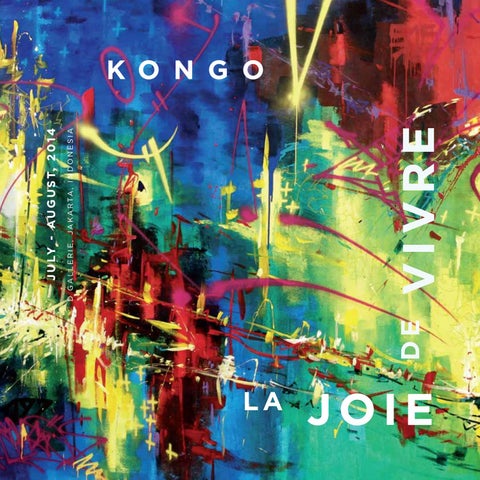
DE
VIVRE
D G A L L E R I E , J A K A R TA , I N D O N E S I A
J U LY - A U G U S T, 2 0 1 4
K O N G O
LA
JOIE
DE
LA
JOIE
Kongo: La Joie De Vivre
VIVRE
D G A L L E R I E , J A K A R TA , I N D O N E S I A
J U LY - A U G U S T, 2 0 1 4

K O N G O
P 4
Photo: LunaCiesla© Kongo: La Joie De Vivre
KONGO: LA JOIE DE VIVRE July, 2014
PUBLISHED BY D Gallerie Jl. Barito I No.3, Kebayoran Baru Jakarta, 12130, +62-21-739 9378 dgalleriejakarta@gmail.com www.dgalleriejakarta.com EDITION 500 copies DESIGNED BY Kotasis Kamar Desain 3x3x3 Yogyakarta, Indonesia www.kotasis.com
PRINTED IN INDONESIA
For this exhibition, Kongo prepares a special exhibition for Bazaar Art Jakarta 2014 and a solo show for D Gallerie. I am ecstatic to be part of this year's Bazaar Art Jakarta, as this year's event is organised by my friends from the Jakarta Art Consultancy.
In addition to his works on linens and the Paris Metro signboards, Kongo also presents a bronze sculpture of his famous signature produced by Landowski Foundeur, a bronze foundry in Paris founded in 1870. This piece that is presented at his Jakarta exhibition is unique, as Landowski Foundeur in fact just closed their production house last month. On a final note, I want to thank my family and each and everyone who has made this exhibition possible. It is always a pleasure to bring together a show that will be the talk of the town.
Esti Nurjadin
ďƒ¨
I hope D Gallerie's participation in Bazaar Art Jakarta will open many more opportunities for Kongo and for D Gallerie.
Kongo: La Joie De Vivre
FOREWORD
I AM VERY PLEASED to once again show Kongo in Jakarta, Indonesia. As the title "La Joie de Vivre" suggests, this exhibition represents the joy of life, and is a celebration of the colourful life we are living. The vivid and vibrant colour of Kongo's work is the testament of the joy of life as Kongo perceives. I am joyful that this year's exhibition coincides with the month of Ramadhan, the holy month of fasting. I celebrate the holy month with joy, love, and forgiveness. I thank God for the coinciding of this year's exhibition with the month of Ramadhan, as it makes the exhibition challenging as well as exciting.
INTRODUCTION P 8
Cyril Phan was born in Toulouse in 1969 from a French mother and a Vietnamese father. When he is 14 he moves with his mother to Brazzaville (Congo). From that originates his artist name Kongo. He comes back to France at the age 18 and lives in the suburbs of Paris where he is still living. Now he shares his time between Paris, Hong Kong and Guadeloupe. These multicultural influences formed his identity and his artistic style. Kongo is a man at ease on all the continents and an artist involved in a search for identity as well as in a thirst for recognition which made him choose graffiti as a means of expression. Street artist, self-taught artist, Kongo became really known in the urban Parisian, European and American scene as a graffiti artist. Within twenty years of artistical work he became an internationally graffiti recognized artist. Committed artist, he played a large part in defending graffiti as an artistical discipline and in making its true worth recognized. Kongo is a member of the collective MAC CREW. He co-founded as well the Kosmopolite festival (international graffiti festival). His
studio "Narvaland" is devoted to graffiti and regularly he welcomes artists from all over the world. Kongo’s friendly personality played a part in making him respected by the international graffiti scene. He participated in many street art festivals, collective exhibitions in museums (such as "Tag in Grand Palais" in 2009, "Graffiti art, forty years of expressionnism" Grimaldi Forum, Monaco 2011 and "Graffiti Fine Art" MuBe in Sao Paulo in 2013), exhibitions in art galleries in Europe, America and Asia. Since 2011, he is focused on the development of his art work outside France and he held a series of exhibitions in Singapore, Jakarta, Shanghai or Sao Paulo. City artist, Kongo’s work does not stop evolving due to the influence of the town. Cyril ‘Kongo’ Phan perpetual movement and his searchs for stretching his own limits. His art evolved from an act of passion expressed on city walls to a more thoughtful and more sophisticated writing on canvas. But he does not leave the street which is still for him an essential source of vibrating energy. His expressive and colored style tends to a calligraphic abstraction which is immediately recognizable where letterings and forms blend in more and
The artist permanently feeds on his travels and his encounters and also on the graffiti international sphere with which he has grown up. His graphic vocabulary uses most of the graffiti classical techniques such as spray, stencil, ink, felt-tip marker. The sophistication of his artistical writing has been noticed by several luxury groups with which Kongo has been collaborating for some years. So the prestigious designer house Hermes produced for his autumn-winter collection 2011-2012 a series of luxurious "carres" based on some of Kongo’s canvases. He also realized with the graffiti artist Colorz the decoration of a trunk from the famous leather goods House Pinel & Pinel.
After three years exhibiting in Asia, Kongo, international art graffiti major figure, is back to Paris. Matignon gallery which goes on opening itself to contemporary art gives him the perfect setting to present his new works: paintings on canvas, works on plexiglas, enamelled plates of the Parisian subway re-decorated by the artist and sculptures. This exhibition is a turning point in Kongo’s thirty years career. It’s not any more a matter of getting out graffiti of the street, of changing its ephemeral appearance or the connotations it conveys but to show it differently as a precious item. This level of demand requires flawless finishes in the works implementation as well as a relevant choice of materials and partners, such as for instance his choice of the Landowski foundry for the realization of a bronze tag sculpture.
His work can be found in many collections such as in France the one of the architect Alain-Dominique Gallizia, passionate art graffiti sponsor who organized the exhibition "Tag in Grand Palais" in 2009; in
text by : Danielle Paquin Jansem
“His graphic vocabulary uses most of the graffiti classical techniques such as spray, stencil, ink, felt-tip marker.”
Asia, the one of Melani W. Setiawan, Jakarta famous collector who owns the first private Museum of Art and Design in Singapore.
Kongo: La Joie De Vivre
more elaborate visual research and where the spontaneous movement with the spray has still prominence.
10
BY CARLA BIANPOEN
P
Wit ho ut Bo rders
Art
Independent art journalist and writer & Artistic Director for the Indonesia National Pavilion, Venice Biennale 2013
Kongo for the first time ever, but it was as if I had known the man for many years. The same sense struck me when I saw his images on a sample page and on a little silk cloth to which I felt an immediate liking. Only in hindsight was I to realize the unusual style and the exuberant colors that respond to the inner sense of delight, a mix of freedom, spontaneity and the visual pleasure, that his exploding colors conveyed, and of the seemingly weird graphic letters/ or codes that appeared like a strange vocabulary erupting and capriciously
dancing
to
rhythms
likening the Brazilian Samba that unconsciously make your body parts swing in all directions.
Operating mostly on the walls lining city alleys graffiti artists then were considered a liability by the authorities who often accused them of vandalism, ruining the aesthatics of the city. But gradually, the overall tastes and considerations changed, not in the least by the examples of artists like Michel Basquiat and Keith Haering, now in the ranks of greats of the art world, who also started to spill out their artistic expressions in the street. For Cyril Phan, better known as Kongo, who initially faced social and personal adjustment problems when he first landed in Paris as a French Vietnam-
ďƒ¨
Only later also did I come to know that Kongo was his nickname, and I came to understand why he was not African as the name would suggest. 'I am French of Vietnamese/French descent', he said over dinner where my good friend Dr. Melani had taken us.
Kongo: La Joie De Vivre
In late January of this year, I met
ese refugee, streets offereed him the space to bring out his artistic urges of expression. He did not stop at himself though, as he stepped further on the chosen path of graffiti. He evolved from the shy and somewhat introvert artist to an activist for graffiti street artists linking to street artists all over the world. He inspired the establisment of the movement Kosmopolite in 2002, infusing it with the social element that differentiate them from the angry street artists of the time. Connecting to street artists in cities of other countries, they have grown into an unstoppable force, holding work shops and other activities in what is called Kosmoplite art tours. That is how Kongo came to Indonesia, where he connected with fellow artists like Darbotz, and that is how he eventually got to enter d'Gallery in Jakarta, with a solo exhibition where his works enjoyed a first time sold-out.
P 12
It is clear that Kongo's art need not be associated with heavy art theories, nor does it need mind-blowing discussion about conceptual thought, for it is just there to be enjoyed just as the artist makes them out of the joy of life. The rise of Cyril (Kongo) Phan from a humble refugee street artist to a celebrity of leading luxury goods and fashion outlets as well as art galleries is truly amazing. As he tells it, he was working in the narrow streets of the bustling city of Hong Kong, when a passer by asked him to design a casquette for his son. They chatted over a glass of beer without his knowing who the man in front of him was. But after a few days he received an inviation to do the Hermes showroom at the HK airport. To his surprise the stranger he had been drinking beer with was no other than the director of Hermes Hongkong/Macau. Other such dignitaries followed suit, and before he could
ated with heavy art theories, nor does it need mind-blowing discussion about conceptual thought, for it is just there to be enjoyed just as the artist makes them out of the joy of life.” overcome his surprise, he found himself doing fashion designs for which he had received carte blanche authority. From then on, his life likened a roller coaster of art designs, covering the globe, attending opening shows, travlling miles and miles covering the globe taking in life as expressed in the cultures he encountered with an openness and joy marking his spirit that knows of no borders. Today Kongo is a cosmopolitan of sorts, but he never forgets his roots in graffiti under the sky, the murals on which he started to convey his inner
feelings, the sense of liberation from the obstacles he was facing, and how it strengthened the artist in him. 'I understood that every day is a magical day', he says, praising graffiti as an ephemeral art, that offers a chance to cristallise the happenings of the day, and infusing every moment with lifegiving inspiration. As Kongo pursues his path as an artist today, the challenge is to retain that spirit, even as his art life in the street has mostly given way to work in the studio.
Kongo: La Joie De Vivre
“It is clear that Kongo's art need not be associ-
14
BY AISHA HABIR
P
Independent Curator
Visua l Po et
Kongo, The Urban
(44),
is
a
French
grafitti artist, better known as his pseudonym, Kongo. Out and about in the graffiti scene since 1987, the self-taught painter has gained an international reputation for his artistic identity and is regarded as one of the pioneers of the French graffiti scene. In recent years, Kongo has been traversing the world – touring China, Africa, America, Southeast Asia, etc – creating cross-cultural dialogues through the universal language of graffiti creative expression. Growing up in three continents, Asia, Africa and Europe, Kongo often identifies himself as citizens of the world, rather than as part of a singular
culture. He first came to France as a Vietnamese refugee at the age of 6 to live with his grandparents in Southern France. Being the only Asian in that French community, he was shy and used drawing and painting as means of expression. Graffiti was perfect for him. “When I started painting graffiti, it was as if there were two of me: Cyril, the shy kid, and Kongo, the freestyle graffiti artist. When I am doing graffiti, I feel that I am no longer shy. I paint everywhere, but people don’t see me when I paint. It is more interesting if everyone only sees your art but doesn’t know what you look like. At one time when people saw the tag ‘Kongo’, they would think that I was an African!” The matter of fact is, he adopted “Kongo” alter-ego having lived in Africa from the ages of 13 to 18. It was
“When I started painting graffiti, it was as if there were two of me: Cyril, the shy kid, and Kongo, the freestyle graffiti artist.”
Phan
Kongo: La Joie De Vivre
Cyril
there that he was introduced to hiphop culture. “Growing up in the Congo, surrounded by African and mixed-race people, I felt good in my [own] skin and loved the energy.” This is perhaps one of the reasons Kongo finds comfort in graffiti art, especially in Paris, where most graffiti artists come from families of immigrants, from Africa, the Middle East, and Asia. Whether or not they are aware of it, these graffiti writers carries with them their own cultural backgrounds to be expressed on the walls as graffiti, which the public can then read as the representations of their self-identity. Travel and cultural exchanges remain an integral part of Kongo’s personal and artistic journey. He draws inspirations not only from his travels, but also his life and dreams. Amongst his favourite artists are Monet, Jean Dubuffet, Matta, Warhol, Pollock, Basquiat and Richter. “Graffiti is my
medium, it leaves a trace in the real world but also in time. I like the idea of leaving part of myself somewhere ... [so that] I am at home everywhere in the world.” Kongo initially gained famed as primarily a graffiti artist, since his mastery of the speciality and his pioneering role in the street artist collective M.A.C. (Mort Aux Cons) has made him one of the major creators of the French graffiti scene for the past 20 years. Most members of this legendary group have been practicing street art since the genre first emerged in France. Kongo also co-founded the international graffiti festival “Kosmopolite Festival” in 1993, followed by “Kosmopolite Art Tour” that started in 2002. The project which aims to link different cultures through art, has grown on a global scale since then, and came to Jakarta last 2012. For the tour, a group graffiti artists
“Graffiti is my medium, it leaves a trace in the real world but also in time. I like the idea of leaving part of myself somewhere P
... [so that] I am at home everywhere in the
16
world.”
Unlike in Indonesia, where graffiti and other forms of street art only have just started to enter the gallery realm, in France, particularly Paris, the relationship has span for over a decade. The market there viewed graffiti as residing on a similarly-established position as other forms of art, in terms of its position in the contemporary art market. Alia Swastika wrote in her curatorial text for the graffiti group exhibition, Wall Street Arts (2010), ‘Not only at the Foundation Cartier; big exhibitions of graffiti are entering such established spaces such as Grand Palais. Graffiti becomes a novel trend with quite a significant influence on the young artists in France, and especially in Paris. ... Graffiti are also collected by the urban middle class who wish to show their openness toward things that
With the motivation to always come up with novel visual expressions, nowadays there are many different visual styles develop by different artists in Paris. Kongo, for example, has his distinction for using letters and visual symbols at the same time. An urban poetry, as he calls it. Along side the evolutionary visages of graffiti over the years, Kongo has managed to move his technique towards a mature artistry. “I chose graffiti because this pictorial movement was up to date with my generation. Graffiti arrived in my life in the eighties and it still is. It is a free art [form] which lives concurrently with the art world, an art which is self-sufficient and has its own operators, masters and critics,” explains Kongo about his choice of artistic expression. He enjoys
are edgy, marginal, and at the same time familiar.’
Kongo: La Joie De Vivre
from Paris and Jakarta collaborated in various events, both in galleries and on the street.
the total freedom graffiti art offers, the spontaneity and the energy that it gives out. His rather recent collaboration with French luxury fashion giant, Hermès, is arguably his most commercial yet intriguing venture to date. The GRAFF Hermès, which took two years to design, is a line of vibrantly coloured scarves, featuring exclusive Kongo artwork, which was launched as part of Hermès’ Autumn/Winter 2011 collection. Although at a glance it seems to be an unlikely pairing, Kongo has no worries about loosing street cred for working with the posh brand as he never stops working on the streets. Kongo appreciates the freedom of artistic direction that Hermès has given him in creating the designs of the scarves. Hermès supports many of Kongo’s projects, such as Kosmopolis, to which part of the proceeds from these scarves go to.
P 18
Whether it is in the city streets, retail stores or high-end art galleries and museums, Kongo only wants people to enjoy his art – an opportunity for his art to be better understood by a wider audience. If anything, the movement pushes him and graffiti artists alike, to explore and use other media and formats, like canvass or installation, instead of walls and trains to share their expressions with others and between them. Kongo believes that graffiti artists should be authentic and be true to who they really are. “To be a good graffiti artists, it’s not just about aesthetics, but you have to stay in the game for a long time,” Kongo elaborates further. Nowadays, he has been involved in numerous art and cultural exhibitions and events, both at home and throughout the world.
“To be a good graffiti artists, it’s not just about aesthetics, but you have to stay in the game for a long time.”
Rendez-Vous A Madeleine mix media on enamel metro sign board 135.5 x 97.5 cm 2014
ďƒ¨ Kongo: La Joie De Vivre
ďƒ¨
P 20
Capital
Amour Toujours
mix media on linen 100 x 100 cm 2014
mix media on linen 100 x 100 cm 2014
Kongo: La Joie De Vivre

P 22
Kongo: La Joie De Vivre
Untitled 100 x 100 cm mix media on linen 2014
Kongo le Parisien mix media on linen 100 x 100 cm 2014
ďƒŞ Mighty Crown - mix media on linen - 80 x 120 cm - 2014
P 24
Power of Life - mix media on linen - 280 x 470 cm - 2014
Kongo: La Joie De Vivre
Photo: Gaspari Claude ©
P 26
Kongo: La Joie De Vivre
Paix Amour Lumiere mix media on linen 600 x 200 cm 2014
P 28
Kongo: La Joie De Vivre
Seine St Denis Vibes mix media on linen 100 x 100 cm 2014
Street Heart mix media on linen 100 x 100 cm 2014
P 30
Direction Narvaland mix media on enamel metro sign board 67.5 x 97.5 cm 2014
Kongo: La Joie De Vivre
Tag 2, 2014 Bronze, fonderie Landowski Modélisation par le sculpteur Hacène Sadoune. 26 x 70 x 10 cm 10 x 27 x 4 inch Edition 2/8
Pte Metro de la Chapelle mix media on enamel metro sign board 15 x 97.5 cm 2014
P 32
Kongo: La Joie De Vivre
Metro Pointe dOrleans mix media on enamel metro sign board 30 x 97.5 cm 2014
P 34
Photo: LunaCieslaŠ
EXHIBITION (SELECTION) 2014 "La joie de vivre" [solo-show]. D Gallerie, Jakarta, Indonesia
"Matignon présente "Kongo" [soloshow]. Galerie Matignon, Paris.
2013 A Stroll in Paris with Kongo [soloshow]. D Gallerie, Jakarta, Indonesia
J’adore l’art de rue [solo-show]. Ming art gallery, Taipei, Taiwan.
2a Bienal Internacional Graffiti Fine Art, MuBE, São Paulo, Brésil.
2012 Kongo…from Narvaland, V2 valerie, Lille. France
40 ans de pressionnisme, Monaco.
“Graff in the city” with Opera Gallery Paris.
TAG, Collection Gallizia, Grand Palais, Paris.
MAC Hexagonade, Pol’N, Nantes.
De la rue jaillit la couleur (individual exposition) galerie Wallworks Paris. Infamous, at The Space, Hongkong.
Thomas Lélu_Works with Kongo, Galerie Dominique Fiat, Paris.
Hainan rendez-vous 2011, Hainan China.
FIAC, Cour Carrée du Louvre, Galerie Dominique Fiat, Paris. 2008 Infusion, Bochum, Germany.
2010 Pick it Up, Dragon I, Hong-Kong.
MAC Sous le granit de 68, Kosmopolite, Bagnolet, Hip Hop Dôme, Bondy, Seine Saint Denis.
Sens de l’Art, La Courneuve, SeineSaint-Denis.
H Inspiré, Carte blanche pour un artiste, Hermès, Hong-Kong.
Macrew, Galerie Quality Street, Montreuil, Seine-Saint-Denis.
2007 Graffiti & Consumption, Biennale bicity Hongkong-Shenzhe, China.
The Oven’s Hot, The Bakery Gallery, New York, USA.
Kosmo Art Tour, Bruxelles, Belgia.
MAC décade, Centre culturel Léo Lagrange, Neuilly-sur-Marne, SeineSaint-Denis.
2006 Moleskine Citynotebook exhibition, Tokyo, Japan.
Narvalow Club, Downtown Café et Living Room, Paris.
Moleskine Citynotebook exhibition, Hong-Kong.
Bon baiser de Paris,Deja vu gallery, Shanghai, China
Do not erase, G.Dot Art space, Beijin, China
Propaganda Revolution, M1nt, HongKong.
Les incurables, Hopital Laennec, Paris.
From Paris with love, Galerie 28th fevrier Dominic Khoo’s, Singapore
Wall Street Arts, Galerie Salihara, Jakarta, Indonésie.
2002 Ombre et lumière, Taxie Gallery, Paris.
Vente Pierre Bergé, Palais de Tokyo, Paris.
2000 Calli-graff, La Laiterie, Centre Européen Jeune Création, Strasbourg.
Ne pas effacer, Galerie Wallworks, Paris. France
One love, Central plaza, Hongkong
2011
Paris première s’expose, Grand Palais Paris.
2009 Vente Millon et associés, Hôtel Drouot, Paris.
Street Heart, Palais de Tokyo, Paris.
Mix’art, Pointe-à-Pitre, Guadeloupe.
2003 MAC crew, Groeninge Museum, Bruges, Belgia.
Paris contre la guerre, canvasexposed during the conflict in Irak, Hôtel de Ville, Paris.
Kongo: La Joie De Vivre
P H A N ‘ KO N G O ’ C Y R I L
PERFORMANCES, MURAL, STREET PROMO, EDITIONS... (SELECTION) 2011
Performance for Hermes’ press conference at The space in Hongkong.
Four windows creation for Hermes’ store opening at Scott square, Singapore.
Creation for Hermes store window, Barcelona.
Performance for 25th Paris Premiere at Grand Palais, Paris.
Window collaboration with Hilton Mc Connico at KADEWE SEIDENBLICKE exhibition by Carres Hermes, Berlin.
Performance for Hermes store opening at Kudamm, Berlin.
Performance for Airbus corporate jet, Hainan China.
Performance for Lacoste, Hainan China.
Performance for Perrier Jouet Hainan China, bottle customization Moët et Chandon, Hongkong.
2010 Two square design for Hermes, Paris.
2007 Performances (since 2005) for national tour Clan Campbell, France.
Canvas with calligrapher Hassan Masoudi, Parc de La Villette, Paris.
Eating Frogs Tour, in China.
Performance picturale for video clip Solide of Les Nubians (band).
Fresco 5 x 10 m GOA France Telecom, Mission 2000, Avignon.
Performance and setup of hall Version Live, Foire de Paris.
Exposition opening at OPHLM, Bagnolet.
Performance and installation over 400 m2 at La Courneuve mall, Seine-SaintDenis. Fresco for the 100th anniversary of the French Institute of Athens, Greece.
Performance at festival Marsatac, Marseille.
Mural over 250 m2 with the collective Tats Cru, Hunt Point Cultural Center, Bronx, New York, USA.
2006 Performance and exposition at Beyrouth, Liban.
Eating Dogz Tour, inHong-Kong, Shenzen, Canton, China.
Performance for 4x4 Nissan model inauguration.
36
Work on advertising billboards for Caterpillar.
Prose Combat, national tour collaboration with FNAC and Citizenship.
Mural for album cover of Metal Sound.
2003 Gladiatorz, fresco with Tats Cru at Bronx Hall of Fame, New York, USA.
Happening for Meeting of Style festival, Queens, New York, USA.
2002 mural over 300 m2 at the end of one year workshop with young people in the town of La Courneuve.
National release of the video TRUMAC born from the meeting of the crews Truskoo, Toulouse, and MAC, Paris.
Performance Akrylonumerik for Nissan, Paris.
Performance for Neuflize OBC Pavillon des Amérique Paris.
Album cover and single My voice, Daddy Mory 2001.
Gallery open and beautifying old shops in the rue Sadi-Carnot, Bagnolet.
Dr. Martens boutique decoration at Châtelet, Paris.
2008 Kosmopolite, organization (since 2002) of International Graffiti and street art Festival, Bagnolet.
1998 Performances for Caterpillar at readyto-wear Salon, Paris.
2004 Graffiti for De quoi sera fait demain ? video clip of Daddy Mory.
2009 Performance for Kassay 30th anniversary, Guadeloupe.
P
Mural for the abolition of slavery, Guadeloupe.
1997 Mural at Creeks store, Marseille.
Performance at Salon ready-to-wear show Who’s Next, Porte de Versailles, Paris.
Né dans la rue - Graffiti, performance at Fondation Cartier, Paris.
2005 Performances for Saian Supa Crew fantastic concers. Performance for evening at Urban Lab organized by RATP.
1999 Mural for promotional tour for rapper Freeman.
Street promo de l’album solo de Don Choa des Fonky Family.
2000 Decorative fences at Great Wheel, Champs Elysees, 1 January 2000, Paris.
1996 Mural for Formula 1 entry of Renault, Renault F1, Paris.
1995 Mural collaboration with local artists, Bronx, New York, USA.
Mural in collaboration with local artists, New Jersey, Connecticut, USA.
1994 Mural on the theme of slavery, prison Basse-Terre, Guadeloupe. 1993 Eight canvases 2 m2 for Paco Rabanne, exposed on Galeries Lafayette, Paris. 1992 Canvas 3 x 12 m, 1st prize , Niort contest. 1991
Completion of two paintings on the esplanade of the Centre Pompidou, Paris.
 Kongo: La Joie De Vivre
S P E C IAL TH ANKS TO Pak Robert Hogenstijn Pak Pujo Broto Ibu Carla Bianpoen Arimbi Nimpuno Probosutedjo Virginia Rusli Aisha Habir Cynthia Kemalawati Stix & Sack
S U PPO RTE D BY
Jl. Barito I No.3, Kebayoran Baru Jakarta, 12130, +62-21-739 9378 dgalleriejakarta@gmail.com www.dgalleriejakarta.com
MEMBER OF
PRINTED IN INDONESIA