trimurti #1
trimurti #2
The City of Ashes
118 x 118 C-Print on Diasec 2
trimurti #3
trimurti #4
3
4
T h e D i v i n i t y o f C av e s
118 x 118 C-Print on Diasec
“We were wanderers from the beginning. We knew every stand of tree for a hundred miles. When the fruits or nuts were ripe, we were there. We followed the herds in their annual migrations. We rejoiced in fresh meat. Through stealth, feint, ambush, and mainforce assault, a few of us cooperating accomplished what many of us, each hunting alone, could not. We depended on one another. Making it on our own was as ludicrous to imagine as was settling down. Working together, we protected our children from the lions and the hyenas. We taught them the skills they would need. And the tools. Then, as now, technology was the key to our survival. When the drought was prolonged, or when an unsettling chill lingered in the summer air, our group moved on - sometimes to unknown lands. We sought a better place. And when we couldn’t get on with others in our little nomadic band, we left to find a more friendly bunch somewhere else. We could always begin again. For 99.9 percent of the time since our species came to be, we were hunters and foragers, wanderers on the savannahs and the steppes. There were no border guards then, no customs officials. The frontier was everywhere. We were bounded only by the Earth and the ocean and the sky - plus occasional grumpy neighbours. When the climate was congenial, though, when the food was plentiful, we were willing to stay put. Unadventurous. Overweight. Careless. In the last ten thousand years - an instant in our long history - we’ve abandoned the nomadic life. We’ve domesticated the plants and animals. Why chase the food when you can make it come to you? For all its material advantages, the sedentary life has left us edgy, unfulfilled. Even after 400 generations in villages and cit- ies, we haven’t forgotten. The open road still softly calls, like a nearly forgotten song of childhood. We invest far-off places with a certain romance. This appeal, I suspect, has been meticulously crafted by natural selection as an essential element in our survival. Long summers, mild winters, rich harvests, plentiful game - none of them lasts forever. It is beyond our powers to predict the future. Catastrophic events have a way of sneaking up on us, of catching us unaware. Your own life, or your band’s, or even your species’ might be owed to a restless few - drawn, by a craving they can hardly articulate of understand, to undiscovered lands and new worlds.” - Pale Blue Dot, Carl Sagan
in darkness/stillness #1 5
6
T h e D i v i n i t y o f C av e s
118 x 118 C-Print on Diasec
in darkness/stillness #2
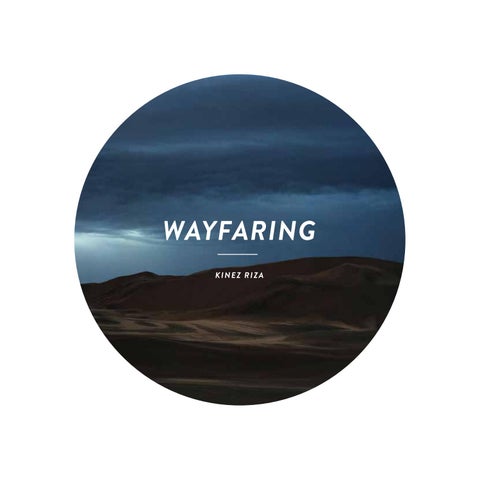
The intention of Wayfaring is to create a photographic series with the reoccuring theme of wandering in search of ideas regarding the human condition. Each series attempts to explain different aspects of the human condition, which are developed during the time the photographs are documented. The relationship between place and context is heavily embodied within the work; the context is determined according to what was innately evoked when the photographs was taken. The photographs rely on meaningful interaction within the place of study for the ideas to form. Presented are selected works from five different series, What the Bushmen Saw, The Divinity of Caves, The City of Ashes, Synchronicity and The Instruments of Belief. What the Bushmen Saw were taken in Africa, a place well known as the Dawn of Man, in a land estimated to have formed 416 to 359 million years ago, and reflects an age when knowledge was understood differently to modern times. Knowledge then was knowing the language of Nature, Beast and Man as equal life-forces contributing to the complexity of the Universe. What is ‘known’ is relative to the ingenuity of humankind in its will to survive, and the realities of men have been so complex in determining the relevance of every day knowledge in order to understand the way we live. Social systems in modern civilisation is by all means constructed systems, whereas the Bushmen were subjected to the empirical complexity of the Universe as a tangent omnipotent force divided equally between Nature, Beast and Man. Nature’s complexity exceeds that which is man-made and exists in our primal core. Nature’s power as an existing life-force before the arrival of men is again revisited in Synchronicity, taken in the Namib desert, the world’s oldest and driest desert, during an unlikely thunderstorm. There was 8 years worth of rain in one day during the time when these photographs were taken, an unlikely contrast between the scarcity and the abundance of water. The complexity of Nature was genuinely felt by myself as I felt electricity running up and down my body while static across the land grew, resulting in my hair standing up on end, and I was subsequently discharged by Nature when lightning struck elsewhere, removing the charge from my body, and my hair fell. This cycle was repeated throughout my time in the desert. 7
connecting principles #1
In The City of Ashes, the nature of volcanoes are deeply reflected within Hindu cosmology. Hindu cosmology believes that the universe is cyclical or oscilating and infite in time. The cycles of birth, death and re-birth is empirically obvious to people living surrounding and witnessing the destruction and creation of life a volcanic eruption brings. As a great - and perceived god-like - force, the eruption is capable of constructing the destinies of men. The Divinity of Caves were taken in a natural cave south of the Teotihuacan pyramids, Mexico, where a candle-lit altar signifies a space in which divinity could be found through prayer or meditation. People have, in various cultures and religious contexts, retreated into darkness and stillness for the divine within their souls to surface. From Muhammad SAW’s First Revelation in a cave, to the Javanese mythology of a banished Princess turned immortal Nyi Loro Kidul in a cave while she meditated. The Divinity of Caves suggests that divinity and faith is an innate predisposition in men, where soul emerges to make itself known to the individual. In The Instruments of Belief, divinity is achieved through rituals and the use of evocative objects - another context relevant in various cultures and religious contexts - as the people of Lome, Togo conduct a voodoo war ceremony in West Africa and summon spirits to aid their strength in battle between tribes. The belief that spirits exist alongside mankind is another human condition which shapes their beliefs about their notion of ‘reality’. The purpose of this series is to convey our relationship with inanimate objects, investing thoughts, beliefs and emotions. - Kinez Riza, 2012
synchronicity
118 x 118 C-Print on Diasec 8
9
synchronicity
118 x 118 C-Print on Diasec
connecting principles #2
10
connecting principles #3
connecting principles #4
connecting principles #5
11
carved identity #1
12
carved identity #2
carved identity #3
vodun #1
the instruments of belief
50 x 74 Printed on Hahnemule paper
vodun #2
13
vodun #3
the instruments of belief
56 x 39 Printed on Hahnemule paper 14
“...inherently we are subject to the same set of Natural laws that governs all entities, provided for us long before our existence on this planet...� Kinez Riza
We walk and live on the land, nourished and nurtured. Yet often we are out of touch with it. How rare it is for us, urban dwellers, to walk bare-footed on soil, to touch a leaf with our hands, to watch the dew before it melts in the morning? Humankind sometimes forget that nature holds their very being, that in this land and air are the things that frame our existence. On a first meeting Kinez Riza would strike as a typical young civilized girl, who people would stereotype with materialistic passions. No, no, she opens her eyes much wider than that. The courage and eagerness to jump out and over the world were shown in her photos, to be in touch with the earth that frames her whole being, to be aware with her spirit and the natural things enriching it. Series by series of her photographs that I have seen were showing her intimacy to the life that she is living, as well as to the life that she is watching. Raw yet interesting, holding a young fresh spirit that I would like to see and show more to the audience in the her next opportunities to come. In this exhibition, Kinez brings us through her wayfaring, following the traces of cold lava in Mount Merapi, out to the enigmatic Namibian desert, all the way through the eyes of the Bushmen in Africa, surrender to the spirits in Togo, West Africa, and down to the candle-lit Mexican caves. This exhibition is divided into five sections: What the Bushmen Saw, The Divinity of Caves, The City of Ashes, Synchronicity, and The Instruments of Belief. In City of Ashes, Kinez follows the traces of cold lava, the result of the eruption of Mount Merapi in 2010, realizing what was once a habitation was swept away by cold lava and thick ashes, changing many ways of life, detouring many dreams and plans. And in the end, the reality that human beings must synchronize themselves with the forces of nature. Silverish horizons of the Namibian desert brought us to awe, admitting that nature can just stand there quietly and take over our perception of beauty and majesty. Untouched, no manipulation, as it is. 15
voodoo war ceremony contact sheet
the instruments of belief
56 x 39 Printed on Hahnemule paper 16
From the stillness, Kinez brought us to the movements of the Bushmen, where things can start with quiet plane, then in a blink of an eye, a rapid movement is there to catch. Kinez captured it the way it is, her photographs showed movement of the reality taken, a second of a momentum. It is a captivating moment indeed, when Kinez turned around and saw this white lioness approaching her, paused, both linked by a moment of curiousity. A few seconds of eye to eye interaction with a beautiful untamed creature, and then broken, gone to their separate ways. Spirits and beliefs, magic and superstitions, religion and gods, even in modern society we are still in close contact with those things. The Instrument of Beliefs series brought Kinez to be a witness of spiritual voodoo ceremony in Togo, West Africa, where the tribesmen were summoning spirits, and showed of the strength they gathered from being possessed by the spirits. To believe that the air contained energy that moves us, and that control of energy is beyond physical strength and the power of words. In the end people will believe what the want to believe, in modern society, beliefs has become more complex statements, where beliefs are analyzed, questioned, doubted, and sometimes dropped and people choose to believe the path of non-believing. Be it ancient spiritual beliefs, modern religions, or new age spiritual philosophy, the essence to surrender to the forces of nature/God(s) is the one thing that keeps the faith flows. Embracing all the unexpected is a huge deal to reach the state of surrendering. Excited by the unexpected life has always brought, Kinez does not try to take control of the unexpected with her way of developing her images. In the era of digital technology, and digital manipulation, Kinez uses film rolls and let loose in the corrosive process of developing the images taken, letting the unforeseen to happen. Wayfaring is not merely a way of traveling, jumping from one place to another, it is more of a journey through, absorbing, digesting what nature and life throws at us at every step, at every breath; The realization of the wonders of the world at each second; A journey through nature to reach an understanding of a self in relation to the entities around us, something that we, urban dwellers often forget they existed. A way of wayfaring is a dangerous path, and uncomfortable if you choose to feel estranged by the surroundings. Exactly the same thing with how we live our lives, regardless the geographical place, and society that we live in, to be in touch with our surroundings in full awareness. Have we not been restraining ourselves to surrender to the nature that grows and nourishes us? Quoting Carl Sagan, that inspired Kinez, “...We could always begin again.” And remember that in the end, “We were bounded only by the Earth and the ocean and the sky.” - Mia Maria, 2012 17
w h at t h e b u s h m e n s aw
85 x 58 Printed on Hahnemule paper
morning apparition
18
conversations between elephants #1
w h at t h e b u s h m e n s aw
56 x 38 Printed on Hahnemule paper
conversations between elephants #2
19
w h at t h e b u s h m e n s aw
the charge #1
78 x 54 Printed on Hahnemule paper
w h at t h e b u s h m e n s aw
56 x 38 Printed on Hahnemule paper 20
the charge #1
w h at t h e b u s h m e n s aw
72 x 100 Printed on Hahnemule paper
conversations between elephants #3 21
the charge #3
w h at t h e b u s h m e n s aw
114 x 38 Printed on Hahnemule paper
22
thank you words
I really appreciate the efforts made into this exhibition by Mbak Esti, who has a wonderful selection of work displayed at D’ Gallerie. As well as having an extensive knowledge of art, Mbak Esti shows great respect to how the artists are portrayed through their work. As this is my first exhibition, I would like to thank her for taking me on. Similarly I would like to acknowldge my gratitude for Mbak Mia Maria from Linggar Seni, Stefanus from Globe Printing and Boim from Kotasis for compiling this catalogue. I hope in some way, the ideas that I explore are relevant and meaningful to the people that have taken their time to view my work. Sincerely, Kinez 23
kinez riza EDUCATION FdA 2008 DIPLOMA (awarded Distinction) CHELSEA COLLEGE OF ART AND DESIGN, LONDON, UK BA 2009 GRAPHIC DESIGN: COMMUNICATION CHELSEA COLLEGE OF ART AND DESIGN, LONDON, UK BA 2010 SOCIOLOGY LONDON METROPOLITAN UNIVERSITY, LONDON, UK GRANTS/AWARDS 2008 AWARDED DISTINCTION FdA ART AND DESIGN CHELSEA COLLEGE OF ART AND DESIGN, LONDON, UK SELECTED BIBLIOGRAPHY TYPE TART, WALLPAPER MAGAZINE, JULY 2009 PORTRAIT OF GRAYSON PERRY, LIBERTINE MAGAZINE: ISSUE 1, JUNE 2010
+62811938142 +447515100512
‘OF MEN AND MACHINES’ (article on the relationship between technology and the human condition), LIBERTINE MAGAZINE: ISSUE 1, JUNE 2010
kinez@wayfaringonline.co.uk kinez.riza@gmail.com
EMPLOYMENT HISTORY CREATIVE DIRECTOR, LIBERTINE MAGAZINE, LONDON, UK OCTOBER 2009 – JUNE 2010
http://www.wayfaringonline.co.uk
CEO & CREATIVE DIRECTOR, WAYFARING HOUSE & HOME, JAKARTA, INDONESIA JANUARY 2012 - CURRENT
Catalogue for
Wayfaring by Kinez Riza
Published by
D gallerie Jakarta, Indonesia March, 2012
DESIGNED BY
Kinez Riza
PREPRESS BY
Kotasis Kamar Desain 3x3x3 Yogyakarta, Indonesia EDITION
500 copies
Jl. Barito I No.3, Kebayoran Baru Jakarta, 12130, +62-21-739 9378 dgalleriejakarta@gmail.com www.dgallerie.net
Printed In Indonesia