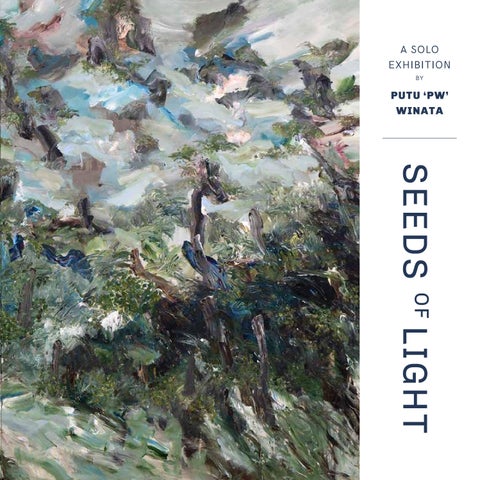
A SOLO EXHIBITION BY
PUTU ‘PW’ WINATA
SEEDS OF
LIGHT
A SOLO EXHIBITION BY
PUTU ‘PW’ WINATA
SEEDS OF
LIGHT
4
SPREADING SEEDS OF HOPEFUL LIGHT
See d s o f L i ght
Curator of fine arts, living in Denpasar / Kurator seni rupa, tinggal di Denpasar
MENEBAR BENIH CAHAYA HARAPAN
Arif Bagus Prasetyo
IT’S BEEN TWO YEARS since the pandemic hit the world. Millions of people lost their lives due to the infections of the cursed virus. Many more lost their jobs and income. Nobody knows when this vicious plague will pass. No one even dares to guarantee that it would ever leave the face of this earth. The road back to a “normal” life seems so far away, it seems endless. With the world never having recovered from this illness, more bad news arrived. A new war is raging. The Northern Hemisphere is smouldering. The fire threatening to spread everywhere. It could drag the world into the hell of the war which ends all. The scent of global annihilation floats in the air. The world seems to be gripped by a terrifying dark cloud. In the midst of all the stifling existential uncertainty, hope is like a light which guides the journey of the ark of life in the heart of a stormy ocean. In today’s gloomy world, hope is the sun that life so desperately needs.
In his exhibition entitled Seeds of Light, Putu ‘PW’ Winata intends to voice his visions of hope. His latest works are artistic expressions about
5
Hope is a concept. It is abstract. Hope is not a concrete thing. It takes no form, it cannot be seen. From one art piece to another, PW expresses his creative interpretation of hope by using the language of abstract painting. He paints hope.
“From one art piece to another, PW expresses his creative interpretation of hope by using the language of abstract painting. He paints hope.”
Put u ‘PW ’ W inat a
Art is able to publish the sun of hope. Art has the power to connect, communicate, transform, and heal. With that power, art constantly conveys the message that hope is always there. Even in works that reveal the saddest of tragedies, art still holds out hope because it gives us beauty. As the world famous painter, Gerhard Richter put it: Art is the highest form of hope.
the spirit of optimism when looking at today’s life which is haunted by anxiety, uncertainty, and confusion. Through art, a medium that is believed to have healing energy, PW spreads a positive message that hope is a light which is faithfully waiting at the end of a dark tunnel. Hope is the sun that surely rises to warm life after a dark night. This optimistic message echoes from the titles of a number of PW’s paintings: “Bersyukur dalam Senja” (Grateful during Dusk), “Manusia dalam Cahaya” (Mankind in the Light), “Sebelum Kau Melihat Cahaya” (Before You See the Light), “Tak Tersentuh Tapi Menerangi” (Untouched But Illuminating), “Bisikan Kedamaian” (Whisper of Peace), etc. Some of the works are even titled “Hope”. PW’s works are like the seeds of light. Light of hope.
6
PW’s paintings basically does not refer to anything concrete which exists outside the painting itself. PW does not seek to represent the concrete world. He does not “transfer” concrete nature onto his canvas or paper. His paintings shun concreteness. However, by painting hope, PW is paradoxically also close to concreteness. He concretizes something abstract, namely hope. It gives shape to hope. His paintings make hope tangible, it gives hope a form which can be seen. In his works, PW speaks of hope in an artistic language that celebrates life. His paintings are imbued with a passion for life that overflows and explodes in a vibrant celebration of lines and colors. Dominated by bright colors and strokes or smears of paint that seem to dance in a half trance, on the precarious threshold between consciousness and unconsciousness, PW’s work echoes joie de vivre, the joy that is released.
See d s o f L i ght
The field of painting PW is in, is like a stage for a cosmic show that performs an energy dance. Visual elements meet and separate, support and contradict each other. Colors and lines explode and spread, expand and contract, melt and condense. PW’s abstract composition is
“PW’s abstract composition is reminiscent of a cosmic drama which sows the seeds of life in fields of stars or in subatomic grounds.”
reminiscent of a cosmic drama which sows the seeds of life in fields of stars or in subatomic grounds. Guided by intuition, PW orchestrates color and motion into unique visual compositions that feel wild yet controlled, free but measured, random yet structured. The imagery in his paintings seem to convey chaos, but at the same time there is rhythm and association which links our memories to something that is vaguely recognizable: landscapes, trees, clouds, etc. Each art piece is like telling a story about the process of creating something from a chaotic high-energy moment, when wild forces reign. Something whose form was identifiable seemed to be vaguely growing from the chaotic turmoil. There is a process of transformation from an unstable energy realm to a stable material realm. In PW’s creative work, at first is the spontaneity of intuition and emotion. The flow of energy. PW paints expressively. He vents the waves of his soul on canvas or paper. Relying fully on instincts and instantaneous stimuli, he poured all the feelings and emotions that were raging in him. Borrowing Sigmund Freud’s theory on the division of structure of the human psyche, the expressive character of PW paintings seems to reflect the Id: the primordial part of the mind, an area where Eros (life instinct) and Thanatos (death instinct) reign. The Id is primitive, unrestrained, and emotional. In the world of the Id, there is no logic. There are only innate instincts, sexual desires, desires for aggression, and pent-up desires. The Id is the dark and
untraceable side of our personality. It is called chaos, a crater full of bubbling stimuli. “The Id contains energy which it derives from instinct, but it is disorganized and produces no collective will, except for the mere pursuit of satisfaction of instinctual needs which is the subject of the pleasure-seeking principle,” said Freud. Although infused with Id, PW paintings do not celebrate chaos. In the wilderness of instinctive lines and colors that dominate the painting space, there is almost always a shadow of the Ego, the mental realm which is on a higher level than the Id. The ego is the mostly conscious aspect of personality. Outward perception, inner perception, and intellectual processes are examples of the activities of the Ego. The ego is controlled by the principle of rational reality, expresses itself through language, and is in
accordance with social demands. Functioning to synthesize, the Ego controls and represses the chaotic turmoil of the Id energy.
7
To a certain extent in his creative process, PW seems to hold back some of his instinctive energy to find a form. As a result, in his paintings, faint traces of the ego appear in the form of basic schemas that represent certain figurative identities, such as trees or flowers. It is informal and unstable. Its existence is not steady. The burst of emotional energy often makes the appearance of figurative identities distorted. Sometimes they seem to exist and not exist, arising and drowning in the flow of abstract images that come from emotional impulses. Although vague, the presence of recognizable forms in the abstract wilderness of PW’s
Put u ‘PW ’ W inat a
8
paintings suggests that chaos isn’t everything. Chaos is not the end. On the contrary, chaos always promises order. Darkness always promises light. There is always hope ahead there.
See d s o f L i ght
PW creatively bends traditional landscape painting. He reinterpreted Impressionism and Post-Impressionism. Absorb the power of Pointillism and Action Painting. It clashes the desire for representation and the spirit of abstraction. The result is dynamic “landscape” paintings that are unique, fresh, and colorful. The image of natural scenery is clearly displayed in several paintings, such as “Kerinduan” (Longing) and “Sebelum Kau Melihat Cahaya” (Before You See the Light). A number of paintings depict the image of a flower tree against a sky background, such as “1,000 Rasa” (1,000 Feelings) and “Pesona Hati” (Charms of the Heart). Other works also display abstract images
“Departing from nature, PW paintings echo things that are essential to nature. His work explores beauty, vitality, tenacity, resilience, regeneration, but also transience, fragility, and decay.”
that are quite easy to create an impression of the landscape, for example the texture of the land surface, topography, cliffs, fields, waters, etc. When painting, PW is inspired by nature. However, he did not paint nature. Nature, even memories or impressions of nature, are only a kind of “entrance” for him to explore the depths of his inner world and pour it as a new creation on canvas or paper. Nevertheless, the nature that inspired him did not disappear in abstract paintings that recorded the movement of the artist’s soul. Instead, nature appears in the painting with a completely new face, in all its freshness, as if it had been seen for the first time. Nature seems to be a vision of the highest ideal of beauty for PW. Nature becomes a symbol of creative energy itself. A number of PW’s works are presented in three dimensions. The “Artwork on Paper” series was done on dented paper and placed in a clear acrylic box. The works of this series specifically raise the theme of the “greenhouse effect”. PW symbolically criticizes modern human behavior which causes the earth to suffer from global warming. Departing from nature, PW paintings echo things that are essential to nature. His work explores beauty, vitality, tenacity, resilience, regeneration, but also transience, fragility, and decay. Nature has a double face: it is both a blessing and a threat. Precisely because of that, nature gives hope. And just as nature is an inspiration, PW’s work exemplifies belief in the light of hope. ---
“Dari karya ke karya, Putu mengungkapkan tafsir kreatifnya tentang harapan dengan menggunakan bahasa seni lukis abstrak. Ia melukis harapan. “
DUA TAHUN SUDAH pandemi melanda dunia. Jutaan orang kehilangan nyawa akibat infeksi virus laknat. Lebih banyak lagi yang kehilangan pekerjaan dan penghasilan. Tak ada yang tahu kapan wabah ganas itu akan berlalu. Bahkan tak seorang pun berani menjamin ia akan pernah pergi dari muka bumi. Jalan kembali ke kehidupan “normal” terasa begitu jauh, seakanakan tak berujung.
Dunia seakan dicekam mendung gelap menakutkan. Di tengah segala ketidakpastian
eksistensial yang menyesakkan, harapan ibarat cahaya yang menuntun perjalanan bahtera kehidupan di tengah amuk badai samudra. Di dunia yang terasa suram hari-hari ini, harapan adalah matahari yang begitu dibutuhkan kehidupan. Dan seni mampu menerbitkan matahari harapan. Seni memiliki kekuatan untuk menghubungkan, mengomunikasikan, mengubah, dan menyembuhkan. Dengan kekuatannya itu, seni terus-menerus mengumandangkan pesan bahwa harapan selalu ada. Bahkan dalam karya yang mengungkapkan tragedi paling pilu sekalipun, seni tetap mengulurkan harapan karena ia memberi kita keindahan. Sebagaimana yang dikatakan oleh pelukis masyhur dunia, Gerhard Richter: Art is the highest form of hope. Seni adalah bentuk tertinggi harapan.
Put u ‘PW ’ W inat a
Belum lagi dunia sembuh dari sakit, kabar buruk lain datang. Perang baru berkobar. Belahan bumi utara membara. Apinya mengancam merembet ke mana-mana. Bisa menyeret dunia ke neraka perang akhir zaman. Bau kemusnahan global mengambang di udara.
9
10
Dalam pamerannya yang bertajuk Seeds of Light, Putu Winata bermaksud menyuarakan visinya tentang harapan. Karya-karya terbarunya adalah ungkapan artistik tentang semangat optimisme dalam memandang kehidupan hari ini yang dihantui kecemasan, ketidakpastian, dan kekalutan. Melalui seni, media yang diyakini memiliki energi penyembuh lara, Putu menebarkan pesan positif bahwa harapan adalah cahaya yang setia menunggu di ujung terowongan gelap. Harapan adalah matahari yang pasti terbit menghangatkan kehidupan selepas malam gulita. Pesan optimistis itu bergema dari judul sejumlah lukisan Putu: “Bersyukur dalam Senja”, “Manusia dalam Cahaya”, “Sebelum Kau Melihat Cahaya”, “Tak Tersentuh Tapi Menerangi”, “Bisikan Kedamaian”, dsb. Beberapa karya bahkan berjudul “Harapan”. Karya Putu ibarat benihbenih cahaya (seeds of light). Cahaya harapan.
See d s o f L i ght
Harapan adalah suatu konsep. Ia abstrak. Harapan bukan benda konkret. Ia tidak berbentuk, tidak dapat dilihat. Dari karya ke karya, Putu mengungkapkan tafsir kreatifnya tentang harapan dengan menggunakan bahasa seni lukis abstrak. Ia melukis harapan. Lukisan Putu pada dasarnya tidak merujuk pada sesuatu yang konkret yang ada di luar lukisan itu sendiri. Putu tidak berusaha merepresentasikan dunia konkret. Ia tidak “memindahkan” alam konkret ke dalam kanvas atau kertas. Lukisannya menjauhi kekonkretan. Namun, dengan melukis harapan, Putu secara paradoksal ternyata juga mendekati kekonkretan. Ia mengkonkretkan sesuatu yang abstrak, yaitu harapan. Ia memberi
bentuk pada harapan. Lukisannya membuat harapan jadi berwujud, memiliki bentuk yang dapat dilihat. Dalam karya-karyanya, Putu berbicara tentang harapan dengan bahasa artistik yang merayakan kehidupan. Lukisannya dijiwai gairah hidup yang meluap-luap dan meletup-letup dalam perayaan riuh garis dan warna. Didominasi warna-warni cerah dan sapuan atau goresan cat yang seakan-
akan menari setengah kesurupan, di ambang genting antara kesadaran dan ketidaksadaran, karya Putu menggemakan joie de vivre, kegirangan yang dilepasbebaskan.
11
Bidang lukisan Putu bagaikan panggung pertunjukan kosmis yang mementaskan tarian energi. Elemen-elemen visual bertemu dan bercerai, bersenyawa dan berselisih. Warna dan garis meledak dan meluruh, memuai dan menyusut, mencair dan memadat. Komposisi abstrak Putu mengingatkan pada suatu drama kosmis yang menyemaikan benihbenih kehidupan di ladang bintang atau lahan subatomik.
Dalam kerja kreatif Putu, pada mulanya adalah spontanitas intuisi dan emosi. Arus energi. Putu melukis secara ekspresif. Dia melampiaskan
Put u ‘PW ’ W inat a
“Komposisi abstrak Putu mengingatkan pada suatu drama kosmis yang menyemaikan benih-benih kehidupan di ladang bintang atau lahan subatomik.”
Dipandu intuisi, Putu mengorkestrasikan warna dan gerak menjadi gubahan visual unik yang terasa liar sekaligus terkendali, bebas tapi terukur, acak sekaligus terstruktur. Citra pada lukisannya tampak menyodorkan kekacauan, tapi serentak dengan itu mengulurkan irama dan asosiasi yang menautkan ingatan kita pada sesuatu yang samar-samar dapat dikenali: lanskap, pohon, awan, dsb. Setiap karya seperti bercerita tentang proses terbentuknya sesuatu dari momen berenergi tinggi yang karut-marut, ketika daya-daya liar berkuasa. Sesuatu yang wujudnya dapat diidentifikasi tampak samarsamar tumbuh dari gejolak chaotic. Ada suatu proses transformasi dari alam energi yang labil menjadi alam materi yang stabil.
12
“Putu secara kreatif membengkokkan seni lukis lanskap tradisional. Ia menafsirkan ulang Impresionisme dan Pascaimpresionisme.”
See d s o f L i ght
gelombang jiwanya di atas kanvas atau kertas. Bersandar penuh pada naluri dan rangsangrangsang seketika, ditumpahkannya seluruh rasa dan emosi yang berkecamuk dalam dirinya. Meminjam teori Sigmund Freud tentang pembagian struktur psike manusia, karakter ekspresif lukisan Putu terasa memantulkan Id: bagian purba dari pikiran, sebuah kawasan tempat Eros (naluri kehidupan) dan Thanatos (naluri kematian) berkuasa. Id bersifat primitif, tak terkendali dan emosional. Di dunia Id, tak ada logika. Yang ada hanya naluri bawaan, nafsu seksual, hasrat agresi, dan keinginan terpendam. Id merupakan sisi kepribadian kita yang gelap dan tidak dapat ditelusuri. Ia disebut chaos, kawah yang penuh dengan rangsangan menggelegak. “Id berisi energi yang diperolehnya dari naluri, tetapi tidak teratur dan tidak menghasilkan kemauan kolektif, kecuali hanya usaha untuk mencapai kepuasan atas kebutuhan naluriah yang menjadi pokok perhatian dari prinsip pencarian kesenangan,” kata Freud. Meskipun diresapi Id, lukisan Putu tidak merayakan chaos. Di belantara garis dan
warna naluriah yang menguasai ruang lukisan, hampir selalu terlihat hadirnya bayang-bayang Ego, wilayah mental yang setingkat lebih tinggi daripada Id. Ego adalah aspek kepribadian yang sebagian besar bersifat sadar. Persepsi lahir, persepsi batin, dan proses intelektual merupakan contoh aktivitas Ego. Ego dikuasai prinsip realitas yang rasional, mengungkapkan diri melalui bahasa, dan sesuai dengan tuntutan sosial. Berfungsi mengadakan sintesa, Ego mengendalikan dan merepresi gejolak energi Id yang kacau. Pada taraf tertentu dalam proses kreatifnya, Putu seperti menahan sebagian luapan tenaga naluriahnya demi menemukan wujud. Walhasil, dalam lukisannya, samar-samar muncul jejak Ego dalam bentuk skema dasar yang mewakili identitas figuratif tertentu, misalnya pohon atau bunga. Wujudnya informal dan labil. Eksistensinya tidak mantap. Hempasan energi emosional kerap membuat penampilan identitasidentitas figuratif menjadi terpiuh. Kadangkadang mereka seperti ada dan tiada, timbultenggelam ditelan arus citraan abstrak yang melanda dari dorongan emosi. Meskipun samar-samar, kehadiran wujud yang dapat dikenali di belantara abstrak lukisan Putu mengisyaratkan bahwa kekacauan bukanlah segala-galanya. Kekacauan bukan akhir segalanya. Justru sebaliknya, kekacauan selalu menjanjikan ketertiban. Kegelapan senantiasa menjanjikan terang. Selalu ada harapan di depan sana.
Putu secara kreatif membengkokkan seni lukis lanskap tradisional. Ia menafsirkan ulang Impresionisme dan Pascaimpresionisme. Menyerap tenaga Pointilisme dan Action Painting. Membenturkan hasrat representasi dan semangat abstraksi. Hasilnya adalah lukisan-lukisan “lanskap” dinamis yang unik, segar, dan penuh warna. Citra pemandangan alam terpampang jelas dalam beberapa lukisan, seperti “Kerinduan” dan “Sebelum Kau Melihat Cahaya”. Sejumlah lukisan mengetengahkan citra pohon bunga berlatar belakang langit, seperti “1.000 Rasa” dan “Pesona Hati”. Karya-karya lain juga menampilkan citra abstrak yang cukup mudah menimbulkan kesan tentang lanskap, misalnya tekstur permukaan tanah, topografi, tebing, padang, perairan dsb.
Sejumlah karya Putu dihadirkan dalam wujud tiga dimensi. Seri “Artwork on Paper” dikerjakan
13
Berangkat dari alam, lukisan Putu menggemakan hal-hal yang esensial pada alam. Karyanya menjelajahi keindahan, daya hidup, vitalitas, ketahanan, regenerasi, tetapi juga kesementaraan, kerapuhan, dan kerusakan. Alam berwajah ganda: ia berkah sekaligus ancaman. Justru karena itulah, alam memberi harapan. Dan seperti halnya alam yang dijadikan inspirasi, karya Putu mengumandangkan keyakinan terhadap cahaya harapan. ---
“Berangkat dari alam, lukisan Putu menggemakan hal-hal yang esensial pada alam. Karyanya menjelajahi keindahan, daya hidup, vitalitas, ketahanan, regenerasi, tetapi juga kesementaraan, kerapuhan, dan kerusakan.”
Put u ‘PW ’ W inat a
Dalam melukis, Putu memang banyak terinspirasi alam. Namun ia tidak melukis alam. Alam, atau ingatan maupun kesan tentang alam, hanya merupakan semacam “jalan masuk” baginya untuk menjelajahi kedalaman dunia batinnya dan menuangkannya sebagai ciptaan baru pada kanvas atau kertas. Meskipun demikian, alam yang mengilhaminya itu tidak menghilang dalam lukisan abstrak yang merekam gerak jiwa sang pelukis. Alih-alih, alam justru menyembul dalam lukisan dengan wajah sepenuhnya baru, dengan segala kesegarannya, seakan-akan baru dilihat untuk pertama kalinya. Alam seolah menjadi visi keindahan ideal tertinggi bagi Putu. Alam menjadi simbol dari energi kreatif itu sendiri.
pada kertas yang tampak penyok-penyok dan ditaruh dalam kotak bening akrilik. Karya-karya seri ini secara spesifik mengangkat tema “efek rumah kaca”. Putu secara simbolis mengkritik perilaku manusia modern yang mengakibatkan bumi menderita didera pemanasan global.
14
See d s o f L i ght
Mimpi acrylic on canvas 80 x 60 cm 2022
15
Terhangatkan acrylic on canvas 80 x 60 cm 2022
Put u ‘PW ’ W inat a
16
See d s o f L i ght
Oasis acrylic on canvas 80 x 60 cm 2022
17
Tanpa Bayangan acrylic on canvas 80 x 60 cm 2022
Put u ‘PW ’ W inat a
See d s o f L i ght
18
Selaras acrylic on canvas 80 x 60 cm 2022
19
Put u ‘PW ’ W inat a
Sahabat Dunia acrylic on canvas 80 x 60 cm 2022
See d s o f L i ght
20
21
Manusia Dalam Cahaya acrylic on canvas 100 x 100 cm 2022
Put u ‘PW ’ W inat a
Sang Pemandu acrylic on canvas 150 x 120 cm 2022
See d s o f L i ght
22
Hadirmu acrylic on canvas 150 x 120 cm 2022
Bersyukur Dalam Senja acrylic on canvas 150 x 120 cm 2022
23
Put u ‘PW ’ W inat a
24
See d s o f L i ght
Daun Daun Pikiranmu acrylic on canvas 150 x 120 cm 2022
25
1000 Rasa acrylic on canvas 150 x 100 cm 2022
Put u ‘PW ’ W inat a
26
See d s o f L i ght
Pesona Hati acrylic on canvas 150 x 100 cm 2022
27
Mekar Pagi acrylic on canvas 150 x 100 cm 2022
Put u ‘PW ’ W inat a
See d s o f L i ght
28
29
Sebelum Kau Melihat Cahaya acrylic on canvas 150 x 300 cm 2022
Put u ‘PW ’ W inat a
30
See d s o f L i ght
Semerbak Mewangi acrylic on canvas 150 x 100 cm 2022
31
Put u ‘PW ’ W inat a
Kerinduan acrylic on canvas 200 x 300 cm 2022
32
See d s o f L i ght
Tak Tersentuh Tapi Menerangi 3, 1, 2 acrylic on canvas 250 x 150 cm 2022
33
Put u ‘PW ’ W inat a
34
See d s o f L i ght
Harapan 1 acrylic on paper 75 x 55 cm 2022
Harapan 2 acrylic on paper 75 x 55 cm 2022
Bisikan Nurani acrylic on paper 75 x 55 cm 2022
Dunia Baru acrylic on paper 75 x 55 cm 2022
35
Put u ‘PW ’ W inat a
36
See d s o f L i ght
Cahaya Hati acrylic on paper 65 x 50 cm 2022
Tanpa Kendali acrylic on paper 65 x 50 cm 2022
37
Cahaya Dalam Badai acrylic on paper 65 x 50 cm 2022
Merebak Mewangi acrylic on paper 65 x 50 cm 2022
Put u ‘PW ’ W inat a
See d s o f L i ght
38
Bisikan Kedamaian acrylic on paper 65 x 50 cm 2022
Nurani 1 acrylic on paper 65 x 50 cm 2022
39
Nurani 2 acrylic on paper 65 x 50 cm 2022
Nurani 3 acrylic on paper 65 x 50 cm 2022
Put u ‘PW ’ W inat a
40
Front View
Rear View
See d s o f L i ght
Impian Dunia 1 (Greenhouse Series) acrylic on paper 50 x 50 cm displayed in 45 x 45 x 8 cm acrylic box 2022
41
Front View
Rear View
Impian Dunia 2 (Greenhouse Series) acrylic on paper 50 x 50 cm displayed in 45 x 45 x 8 cm acrylic box 2022 Put u ‘PW ’ W inat a
42
Impian Dunia 3 (Greenhouse Series) acrylic on paper 50 x 50 cm displayed in 45 x 45 x 8 cm acrylic box 2022
See d s o f L i ght
Front View
Rear View
Impian Dunia 4 (Greenhouse Series) acrylic on paper 50 x 50 cm displayed in 45 x 45 x 8 cm acrylic box 2022
Front View
43
Rear View
Put u ‘PW ’ W inat a
44
Front View
Rear View
See d s o f L i ght
Impian Dunia 5 (Greenhouse Series) acrylic on paper 50 x 50 cm displayed in 45 x 45 x 8 cm acrylic box 2022
45
Impian Dunia 6 (Greenhouse Series) acrylic on paper 50 x 50 cm displayed in 45 x 45 x 8 cm acrylic box 2022
Front View
Rear View
Put u ‘PW ’ W inat a
46
Impian Dunia 7 (Greenhouse Series) acrylic on paper 50 x 50 cm displayed in 45 x 45 x 8 cm acrylic box 2022
See d s o f L i ght
Front View
Rear View
47
Front View
Rear View
Put u ‘PW ’ W inat a
Impian Dunia 8 (Greenhouse Series) acrylic on paper 50 x 50 cm displayed in 45 x 45 x 8 cm acrylic box 2022
See d s o f L i ght
48
I PUTU WINATA was born in Denpasar, Bali, February 27, 1977. His interest in the world of art, since his youth, was honed even sharper at the Faculty of Fine Arts, Metal Crafts Department, at the Indonesian Art Institute, Jogjakarta from 1995 to 1999. At the same time, his interests and talents in the field of painting was also forged, along with his friends in the Sanggar Dewata group. Apart from being actively involved as an administrator at Sanggar Dewata Jogja in 1997, and as the main treasurer at Sanggar Dewata Bali in 2008, Putu ‘PW’ Winata has also always been active in creating and exhibiting since 1996 until now. Some of his latest exhibitions are group exhibitions at the Art Moments Jakarta 2, 2022, “Online Raw Art” and “World Without End” exhibitions in Kuala Lumpur, Malaysia, then the solo exhibition “Garden of Intuition” at the Zen1 Kesiman Gallery, Denpasar, Bali, Indonesia. PW was also included in the top 10 nominations for the 2022 UOB Art of The Year Awards.
49
I PUTU WINATA lahir di Denpasar, Bali, 27 Februari 1977, Ketertarikan pada dunia seni sejak remaja kemudian diasahnya lebih tajam di Fakultas Seni Rupa, Jurusan Kriya Logam, Institut Seni Indonesia, Jogjakarta sepanjang 1995 hingga 1999. Disaat yang bersamaan, minat dan bakatnya dibidang seni lukis juga turut ditempa bersama teman-temannya di kelompok Sanggar Dewata. Selain terlibat aktif sebagai pengurus di Sanggar Dewata Jogja pada 1997, dan sebagai bendahara pusat di Sanggar Dewata Bali pada 2008, Putu ‘PW’ Winata juga selalu giat berkarya dan berpameran sejak tahun 1996 hingga sekarang. Beberapa pameran terakhirnya adalah group exhibition di event Art Moments Jakarta 2, 2022, “Online Raw Art” dan “World Without End” di Kuala Lumpur, Malaysia, kemudian pameran tunggal “Garden of Intuition” di Galeri Zen1 Kesiman, Denpasar, Bali, Indonesia. PW juga termasuk dalam nominasi 10 besar UOB Art of The Year Awards 2022. Kekagumannya akan keindahan dan keagungan alam, banyak dituangkan dalam karya-karyanya. Sedangkan ketekunannya berlatih, bereksperimen, serta bereksplorasi dalam proses penemuan jati diri, kini membuatnya karyanya tidak hanya semakin menarik untuk dinikmati, namun pula kian otentik.
Put u ‘PW ’ W inat a
His admiration for the beauty and majesty of nature is expressed in many of his works. Meanwhile, his perseverance when practicing, experimenting, and exploring in the process of self-discovery has made his work not only more interestingly enjoyable, but also more authentic.
WRITTEN BY: IGO BLADO
PUTU ‘PW’ WINATA
Catalogue for Seeds of Light Putu ‘PW’ Winata April 2022
Curated by Arif Bagus Prasetyo
Published by D Gallerie, Jakarta, Indonesia & Galeri Zen1, Denpasar, Indonesia April 2022
Edition 500 copies
Design by Kotasis 333 Surabaya, Indonesia www.kotasis.com
PRINTED IN INDONESIA
Jl. Barito I No.3, Kebayoran Baru Jakarta 12130, +62 21 739 9378 dgalleriejakarta@gmail.com dgalleriejakarta.com
Ruko Tuban Plaza No. 50 Jl. Bypass Ngurah Rai Tuban Kuta, Badung, Bali Jl. Bypass Ngurah Rai No.86 Kesiman, Denpasar, Bali +62 813 3748 8660 galerizen1@gmail.com www.galerizen1.com