Solutions Manual for University Physics
Volume 2 1st Edition by Ling, Sanny, Moebs
ISBN: 9781938168161

OpenStax University Physics Volume II
Unit 1: Thermodynamics
Chapter 1: Temperature and Heat
University Physics Volume II
Unit 1: Thermodynamics
Chapter 1: Temperature and Heat
Conceptual Questions
1. What does it mean to say that two systems are in thermal equilibrium?
Solution
They are at the same temperature, and if they are placed in contact, no net heat flows between them.
2. Give an example in which A has some kind of non-thermal equilibrium relationship with B, and B has the same relationship with C, but A does not have that relationship with C.
Solution
One possibility is that in some game, A and C are both equally matched with B, but C consistently beats A, maybe because C’s style is hard for A to cope with or C has some psychological advantage. Another is that if two people of different weights lean at the same angle against a wall, they are each in equilibrium with the wall, but they would not be in equilibrium with each other. Other answers are possible.
3. If a thermometer is allowed to come to equilibrium with the air, and a glass of water is not in equilibrium with the air, what will happen to the thermometer reading when it is placed in the water?
Solution
The reading will change.
4. Give an example of a physical property that varies with temperature and describe how it is used to measure temperature.
Solution
Volume as the volume of liquid in an ordinary thermometer increases, the liquid’s interface with air rises along a scale. Electrical resistance the resistance of a piece of silicon in a thermistor decreases with increasing temperature and is read electronically. Color certain chemical reactions cause color changes at certain temperatures, so a set of spots containing such chemicals with slightly different color-change temperatures can indicate temperature. Radiated power and frequency spectrum a bolometer can be pointed at an object, especially one that is too hot or too distant to put a thermometer in contact with, and the radiated power or peak frequency can be measured and converted into a temperature. Other answers are possible.
5. Pouring cold water into hot glass or ceramic cookware can easily break it. What causes the breaking? Explain why Pyrex®, a glass with a small coefficient of linear expansion, is less susceptible.
Solution
The cold water cools part of the inner surface, making it contract, while the rest remains expanded. The strain is too great for the strength of the material. Pyrex contracts less, so it experiences less strain.
6. One method of getting a tight fit, say of a metal peg in a hole in a metal block, is to manufacture the peg slightly larger than the hole. The peg is then inserted when at a different temperature than the block. Should the block be hotter or colder than the peg during insertion? Explain your answer.
Solution
The block should be hotter so the hole will be bigger.
OpenStax University Physics Volume II
Unit 1: Thermodynamics
Chapter 1: Temperature and Heat
7. Does it really help to run hot water over a tight metal lid on a glass jar before trying to open it? Explain your answer.
Solution
In principle, the lid expands more than the jar because metals have higher coefficients of expansion than glass. That should make unscrewing the lid easier. (In practice, getting the lid and jar wet may make gripping them more difficult.)
8. When a cold alcohol thermometer is placed in a hot liquid, the column of alcohol goes down slightly before going up. Explain why.
Solution
The glass expands before the alcohol does.
9. Calculate the length of a 1-meter rod of a material with thermal expansion coefficient when the temperature is raised from 300 K to 600 K. Taking your answer as the new initial length, find the length after the rod is cooled back down to 300 K. Is your answer 1 meter? Should it be? How can you account for the result you got?
Solution
After being heated, the length is (1300 + ) (1 m). After being cooled, the length is ( )( )( ) 1300 1300 1m −+ . That answer is not 1 m, but it should be. The explanation is that even if is exactly constant, the relation LLT = is strictly true only in the limit of small T . Since values are small, the discrepancy is unimportant in practice.
10. Noting the large stresses that can be caused by thermal expansion, an amateur weapon inventor decides to use it to make a new kind of gun. He plans to jam a bullet against an aluminum rod inside a closed invar tube. When he heats the tube, the rod will expand more than the tube and a very strong force will build up. Then, by a method yet to be determined, he will open the tube in a split second and let the force of the rod launch the bullet at very high speed. What is he overlooking?
Solution
The force will go to zero over a very short distance as the rod reaches its expanded length, so very little work will be done. Also, the force is proportional to the area, so on something the size of a bullet it will not be as great as the inventor thinks.
11. How is heat transfer related to temperature?
Solution
Temperature differences cause heat transfer.
12. Describe a situation in which heat transfer occurs.
Solution
Many answers are possible. The energy transfer should be due to a temperature difference.
13. When heat transfers into a system, is the energy stored as heat? Explain briefly.
Solution
No, it is stored as thermal energy. A thermodynamic system does not have a well-defined quantity of heat.
14. The brakes in a car increase in temperature by T when bringing the car to rest from a speed v. How much greater would T be if the car initially had twice the speed? You may assume the car stops fast enough that no heat transfers out of the brakes.
Solution
OpenStax University Physics Volume II
Unit 1: Thermodynamics
Chapter 1: Temperature and Heat
15. A pressure cooker contains water and steam in equilibrium at a pressure greater than atmospheric pressure. How does this greater pressure increase cooking speed?
Solution
It raises the boiling point, so the water, which the food gains heat from, is at a higher temperature.
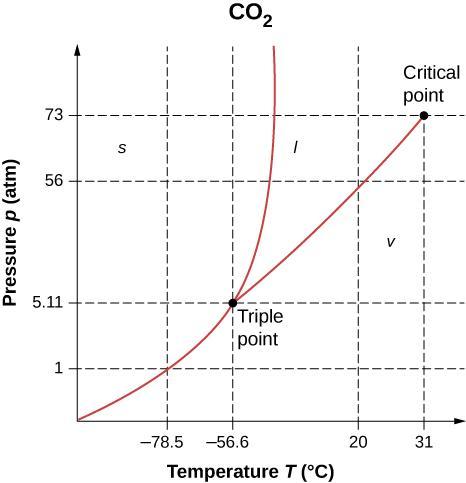
16. As shown below, which is the phase diagram for carbon dioxide, what is the vapor pressure of solid carbon dioxide (dry ice) at 78.5C?− (Note that the axes in the figure are nonlinear and the graph is not to scale.)
Solution
1 atm
17. Can carbon dioxide be liquefied at room temperature (20 ºC)? If so, how? If not, why not?
(See the phase diagram in the preceding problem.)
Solution
Yes, by raising the pressure above 56 atm.
18. What is the distinction between gas and vapor?
Solution
Vapor is gas in the presence of the liquid or solid phase of the same substance.
19. Heat transfer can cause temperature and phase changes. What else can cause these changes?
Solution
work
20. How does the latent heat of fusion of water help slow the decrease of air temperatures, perhaps preventing temperatures from falling significantly below 0 ºC, in the vicinity of large bodies of water?
Solution
As heat is removed, the temperature of the water does not fall till the water is frozen (at least on the surface), so the air tends to stay in equilibrium with it and remains close to 0°C.
21. What is the temperature of ice right after it is formed by freezing water?
Solution
0 C (at or near atmospheric pressure)
3 of 29
OpenStax University Physics Volume II
Unit 1: Thermodynamics
Chapter 1: Temperature and Heat
22. If you place 0 °C ice into 0 °C water in an insulated container, what will the net result be? Will there be less ice and more liquid water, or more ice and less liquid water, or will the amounts stay the same?
Solution
If the container is perfectly insulated, the amount of ice and the amount of liquid water will stay the same.
23. What effect does condensation on a glass of ice water have on the rate at which the ice melts? Will the condensation speed up the melting process or slow it down?
Solution
Condensation releases heat, so it speeds up the melting.
24. In Miami, Florida, which has a very humid climate and numerous bodies of water nearby, it is unusual for temperatures to rise above about 38 ºC (100 ºF). In the desert climate of Phoenix, Arizona, however, temperatures rise above that almost every day in July and August. Explain how the type of heat transfer accounts for this difference and how it helps limit high temperatures in humid climates.
Solution
Evaporation absorbs heat that would otherwise go into raising the temperature.
25. In winter, it is often warmer in San Francisco than in Sacramento, 150 km inland. In summer, it is nearly always hotter in Sacramento. Explain how the bodies of water surrounding San Francisco moderate its extreme temperatures.
Solution
Because of water’s high specific heat, it changes temperature less than land. Also, evaporation reduces temperature rises. The air tends to stay close to equilibrium with the water, so its temperature does not change much where there’s a lot of water around, as in San Francisco but not Sacramento.
26. Freeze-dried foods have been dehydrated in a vacuum. During the process, the food freezes and must be heated to facilitate dehydration. Explain both how the vacuum speeds up dehydration and why the food freezes as a result.
Solution
Low pressure reduces the boiling point and increases evaporation, which cools the food it evaporates from.
27. In a physics classroom demonstration, an instructor inflates a balloon by mouth and then cools it in liquid nitrogen. When cold, the shrunken balloon has a small amount of light blue liquid in it, as well as some snow-like crystals. As it warms up, the liquid boils, and part of the crystals sublime, with some crystals lingering for a while and then producing a liquid. Identify the blue liquid and the two solids in the cold balloon. Justify your identifications using data from the following table.
Solution
The liquid is oxygen, whose boiling point is above that of nitrogen but whose melting point is below the boiling point of liquid nitrogen. The crystals that sublime are carbon dioxide, which has no liquid phase at atmospheric pressure. The crystals that melt are water, whose melting point is above carbon dioxide’s sublimation point. The water came from the instructor’s breath.
28. What are the main methods of heat transfer from the hot core of Earth to its surface? From Earth’s surface to outer space?
Solution
convection and conduction; radiation
29. When our bodies get too warm, they respond by sweating and increasing blood circulation to the surface to transfer thermal energy away from the core. What effect will those processes have on a person in a 40.0-ºC hot tub?
Solution
Increasing circulation to the surface will warm the person, as the temperature of the water is warmer than human body temperature. Sweating will cause no evaporative cooling under water or in the humid air immediately above the tub.
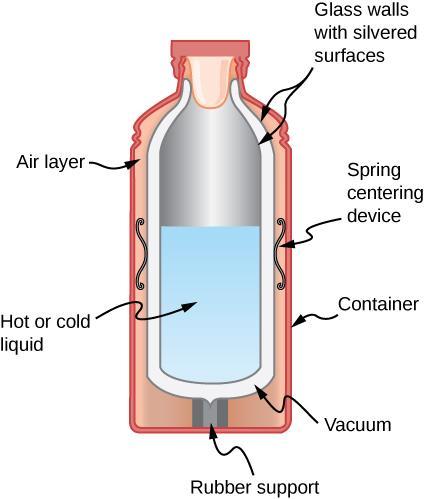
30. Shown below is a cut-away drawing of a thermos bottle (also known as a Dewar flask), which is a device designed specifically to slow down all forms of heat transfer. Explain the functions of the various parts, such as the vacuum, the silvering of the walls, the thin-walled long glass neck, the rubber support, the air layer, and the stopper.
Unit 1: Thermodynamics
Chapter 1: Temperature and Heat
Solution
The vacuum prevents conduction and convection. The silvering reduces radiation by reducing emissivity. The thin walls, which necessarily touch both the hot or cold liquid and the outer container of the bottle, reduce conduction by having a small A and relatively large L. The support, which also necessarily connects the inner wall to the outer container, reduces conduction by being made of a material with low conductivity. The air layer also has low conductivity. The stopper prevents convection (and contamination of the drink).
31. Some electric stoves have a flat ceramic surface with heating elements hidden beneath. A pot placed over a heating element will be heated, while the surface only a few centimeters away is safe to touch. Why is ceramic, with a conductivity less than that of a metal but greater than that of a good insulator, an ideal choice for the stove top?
Solution
It spread the heat over the area above the heating elements, evening the temperature there, but does not spread the heat much beyond the heating elements.
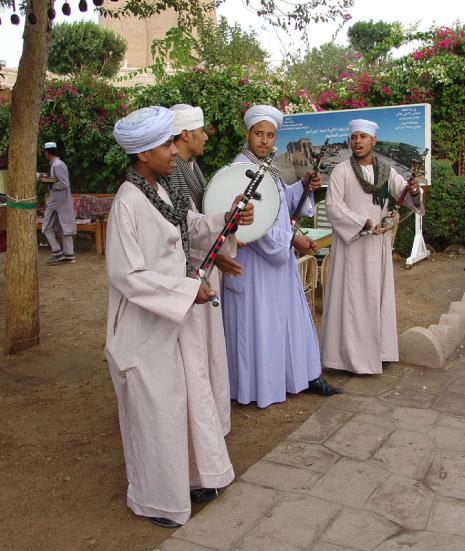
32. Loose-fitting white clothing covering most of the body, shown below, is ideal for desert dwellers, both in the hot Sun and during cold evenings. Explain how such clothing is advantageous during both day and night.
Unit 1: Thermodynamics
Chapter 1: Temperature and Heat
Solution
By day, it allows low-speed air circulation and thus evaporative cooling of sweat. Being white, it reduces absorption of heat radiation. By night, it reduces convective loss, and being white, reduces emission of heat radiation.
33. One way to make a fireplace more energy-efficient is to have room air circulate around the outside of the fire box and back into the room. Detail the methods of heat transfer involved.
Solution
Heat is conducted from the fire through the fire box to the circulating air and then convected by the air into the room (forced convection).
34. On cold, clear nights horses will sleep under the cover of large trees. How does this help them keep warm?
Solution
The tree blocks radiative loss to space. The mass of the tree may also reduce its temperature change.
35. When watching a circus during the day in a large, dark-colored tent, you sense significant heat transfer from the tent. Explain why this occurs.
Solution
The tent is heated by the Sun and transfers heat to you by all three processes, especially radiation.
36. Satellites designed to observe the radiation from cold (3 K) dark space have sensors that are shaded from the Sun, Earth, and the Moon and are cooled to very low temperatures. Why must the sensors be at low temperature?
Solution
If not, their own radiation would overwhelm the radiation from space.
37. Why are thermometers that are used in weather stations shielded from the sunshine? What does a thermometer measure if it is shielded from the sunshine? What does it measure if it is not?
Solution
Page 7 of 29
OpenStax University Physics Volume II
Unit 1: Thermodynamics
Chapter 1: Temperature and Heat
If shielded, it measures the air temperature. If not, it measures the combined effect of air temperature and net radiative heat gain from the Sun.
38. Putting a lid on a boiling pot greatly reduces the heat transfer necessary to keep it boiling. Explain why.
Solution
The lid blocks convection. In particular, it blocks the loss of steam, keeping of the latent heat of the steam in the pot.
39. Your house will be empty for a while in cold weather, and you want to save energy and money. Should you turn the thermostat down to the lowest level that will protect the house from damage such as freezing pipes, or leave it at the normal temperature? (If you don’t like coming back to a cold house, imagine that a timer controls the heating system so the house will be warm when you get back.) Explain your answer.
Solution
Turn the thermostat down. To have the house at the normal temperature, the heating system must replace all the heat that was lost. For all three mechanisms of heat transfer, the greater the temperature difference between inside and outside, the more heat is lost and must be replaced. So the house should be at the lowest temperature that does not allow freezing damage.
40. You pour coffee into an unlidded cup, intending to drink it 5 minutes later. You can add cream when you pour the cup or right before you drink it. (The cream is at the same temperature either way. Assume that the cream and coffee come into thermal equilibrium with each other very quickly.) Which way will give you hotter coffee? What feature of this question is different from the previous one?
Solution
Add the cream first to lower the temperature and reduce the heat loss, as in the previous problem. The different feature is that the cream lightens the color of the coffee and thus reduces its emissivity, further reducing radiative heat loss.
41. Broiling is a method of cooking by radiation, which produces somewhat different results from cooking by conduction or convection. A gas flame or electric heating element produces a very high temperature close to the food and above it. Why is radiation the dominant heat-transfer method in this situation?
Solution
Air is a good insulator, so there is little conduction, and the heated air rises, so there is little convection downward.
42. On a cold winter morning, why does the metal of a bike feel colder than the wood of a porch?
Solution
Because metal conducts heat faster than wood, and the feeling of cold is caused by the rate of heat conduction out of the skin.
Problems
43. While traveling outside the United States, you feel sick. A companion gets you a thermometer, which says your temperature is 39. What scale is that on? What is your Fahrenheit temperature? Should you seek medical help?
Solution
That must be Celsius. Your Fahrenheit temperature is 102 °F Yes, it is time to get treatment. 44. What are the following temperatures on the Kelvin scale?
OpenStax University Physics Volume II
Unit 1: Thermodynamics
Chapter 1: Temperature and Heat
(a) 68.0 °F, an indoor temperature sometimes recommended for energy conservation in winter
(b) 134.0 °F, one of the highest atmospheric temperatures ever recorded on Earth (Death Valley, California, 1913)
(c) 9890 °F, the temperature of the surface of the Sun
Solution
a. To convert from Fahrenheit to Kelvin, first convert to Celsius:
Then convert to Kelvin: 2.2273.15271.0K
45. (a) Suppose a cold front blows into your locale and drops the temperature by 40.0 Fahrenheit degrees. How many degrees Celsius does the temperature decrease when it decreases by 40.0 °F?
(b) Show that any change in temperature in Fahrenheit degrees is nine-fifths the change in Celsius degrees
Solution a. DTC = 22.2 °C; b. We know that DTF = TF2 - TF1. We also know that TF2 = 9 5 T
. So, substituting, we have
rearranging the equation, we have DTF = 9 5
+ 32 and
. Partially solving and
( ). Therefore, DTF = 9 5 DTC .
46. An Associated Press article on climate change said, “Some of the ice shelf’s disappearance was probably during times when the planet was 36 degrees Fahrenheit (2 degrees Celsius) to 37 degrees Fahrenheit (3 degrees Celsius) warmer than it is today.” What mistake did the reporter make?
Solution
The reporter was given temperature differences in Celsius, but treated them as temperatures and converted them to Fahrenheit. However, he should have used the relationship for temperature differences derived in the previous problem, without adding 32.
47. (a) At what temperature do the Fahrenheit and Celsius scales have the same numerical value? (b) At what temperature do the Fahrenheit and Kelvin scales have the same numerical value?
Solution
a. 40 − ; b. 575 K
48. A person taking a reading of the temperature in a freezer in Celsius makes two mistakes: first omitting the negative sign and then thinking the temperature is Fahrenheit. That is, the person reads – C x as F x . Oddly enough, the result is the correct Fahrenheit temperature. What is the original Celsius reading? Round your answer to three significant figures.
Solution 11.4 C
9 of 29
OpenStax University Physics Volume II
Unit 1: Thermodynamics
Chapter 1: Temperature and Heat
Use the following table for questions 49-55.
49. The height of the Washington Monument is measured to be 170.00 m on a day when the temperature is 35.0 C . What will its height be on a day when the temperature falls to –10.0 °C?
Although the monument is made of limestone, assume that its coefficient of thermal expansion is the same as that of marble. Give your answer to five significant figures.
Solution
Using the above table to find the coefficient of thermal expansion of marble:
(Answer rounded to five significant figures to show the slight difference in height.)
50. How much taller does the Eiffel Tower become at the end of a day when the temperature has increased by 15 °C? Its original height is 321 m and you can assume it is made of steel.
Solution
Using the above table to find the coefficient of thermal expansion of steel:
51. What is the change in length of a 3.00-cm-long column of mercury if its temperature changes from 37.0 C to 40.0 C , assuming the mercury is constrained to a cylinder but unconstrained
10 of 29
OpenStax University Physics Volume II
Unit 1: Thermodynamics
Chapter 1: Temperature and Heat
Solution
We use instead of since this is a volume expansion with constant surface area. Therefore: ( )( )( )
52. How large an expansion gap should be left between steel railroad rails if they may reach a maximum temperature 35.0 °C greater than when they were laid? Their original length is 10.0 m.
Solution
Using the above table to find the coefficient of thermal expansion of steel:
53. You are looking to buy a small piece of land in Hong Kong. The price is “only” $60,000 per square meter. The land title says the dimensions are 20 m 30 m. By how much would the total price change if you measured the parcel with a steel tape measure on a day when the temperature was 20 °C above the temperature that the tape measure was designed for? The dimensions of the land do not change.
Solution
On the warmer day, our tape measure will expand linearly. Therefore, each measured dimension will be smaller than the actual dimension of the land. Calling these measured dimensions ' l and 'w , we will find a new area, A. Let’s calculate these measured dimensions:
Because the area gets smaller, the price of the land decreases by about $17,000.
54. Global warming will produce rising sea levels partly due to melting ice caps and partly due to the expansion of water as average ocean temperatures rise. To get some idea of the size of this effect, calculate the change in length of a column of water 1.00 km high for a temperature increase of 1.00 °C. Assume the column is not free to expand sideways. As a model of the ocean, that is a reasonable approximation, as only parts of the ocean very close to the surface can expand sideways onto land, and only to a limited degree. As another approximation, neglect the fact that ocean warming is not uniform with depth.
Solution
To deal with volume increase, we need to use the equation DV = bV0DT.
Let the column have area A. Then = 00 VAL and = .VAL We now have = 0 , ALALT or = 0 LLT Use the above table to find water’s coefficient of volume expansion: ( )( )( ) 432 0 2.110/C110 m1.00 C2.110 m.
11 of 29 in length? Your answer will show why thermometers contain bulbs at the bottom instead of simple columns of liquid.
OpenStax University Physics Volume II
Unit 1: Thermodynamics
Chapter 1: Temperature and Heat
55. (a) Suppose a meter stick made of steel and one made of aluminum are the same length at 0 °C. What is their difference in length at 22.0 °C? (b) Repeat the calculation for two 30.0-m-long surveyor’s tapes.
Solution
a. Use the above table to find the coefficients of thermal expansion of steel and aluminum. Then
b. By the same method with = 0 30.0m L , we have DL = 8.6
56. (a) If a 500-mL glass beaker is filled to the brim with ethyl alcohol at a temperature of 5.00 °C, how much will overflow when the alcohol’s temperature reaches the room temperature of 22.0 °C? (b) How much less water would overflow under the same conditions?
Solution
Assume that the glass beaker is initially at room temperature (22.0 °C), so that its temperature does not change. a. ethyl alcohol: DV = bV0DT = 1.10 ´
water: by the same method, DV = 1.79 mL,which is 7.56 mL less
57. Most cars have a coolant reservoir to catch radiator fluid that may overflow when the engine is hot. A radiator is made of copper and is filled to its 16.0-L capacity when at 10.0 °C. What volume of radiator fluid will overflow when the radiator and fluid reach a temperature of 95.0 °C, given that the fluid’s volume coefficient of expansion is 6 40010/C = ? (Your answer will be a conservative estimate, as most car radiators have operating temperatures greater than 95.0 °C).
Solution
0.475 L V =
58. A physicist makes a cup of instant coffee and notices that, as the coffee cools, its level drops 3.00 mm in the glass cup. Show that this decrease cannot be due to thermal contraction by calculating the decrease in level if the 3350cm of coffee is in a 7.00-cm-diameter cup and decreases in temperature from 95.0 °C to 45.0 °C. (Most of the drop in level is actually due to escaping bubbles of air.)
Solution
0.832 mm; The work shows that the change in volume (from thermal expansion) of the coffee and the cup does not account for all of the level drop. Thus, other factors must be held accountable (such as escaping bubbles of air).
59. The density of water at 0 °C is very nearly 31000kg/m (it is actually 3999.84kg/m ), whereas the density of ice at 0 °C is 3 917kg/m. Calculate the pressure necessary to keep ice from expanding when it freezes, neglecting the effect such a large pressure would have on the freezing temperature. (This problem gives you only an indication of how large the forces associated with freezing water might be.)
Solution
12 of 29
OpenStax University Physics Volume II
Unit 1: Thermodynamics
Chapter 1: Temperature and Heat
If we start with the freezing of water, then it would expand to 1m3 ( ) 1000 kg/m3 917 kg/m3 æ è ç ö ø ÷ = 1.09 m 3 = 1.98 ´108 N/m2 of ice.
60. Show that b= 3a, by calculating the infinitesimal change in volume dV of a cube with sides of length L when the temperature changes by dT
Solution
We rewrite the equation LLT = in differential form: ,dLLdT = or . dL L dT = Now 3 2 3.
=== Substituting dL dT in from above, we have 23 33, dVLLdTLdT == and by comparing forms we get 3.dVVdTVdT == Thus,b= 3a.
61. On a hot day, the temperature of an 80,000-L swimming pool increases by 1.50 C . What is the net heat transfer during this heating? Ignore any complications, such as loss of water by evaporation.
Solution
5.02 108 J
62. To sterilize a 50.0-g glass baby bottle, we must raise its temperature from 22.0 C to 95.0 C . How much heat transfer is required?
Solution
33.0710 J
63. The same heat transfer into identical masses of different substances produces different temperature changes. Calculate the final temperature when 1.00 kcal of heat transfers into 1.00 kg of the following, originally at 20.0 °C: (a) water; (b) concrete; (c) steel; and (d) mercury.
Solution
64. Rubbing your hands together warms them by converting work into thermal energy. If a woman rubs her hands back and forth for a total of 20 rubs, at a distance of 7.50 cm per rub, and with an average frictional force of 40.0 N, what is the temperature increase? The mass of tissues warmed is only 0.100 kg, mostly in the palms and fingers.
Solution
Let N be the number of hand rubs, F be the average frictional force of a hand rub, and d be the distance of each rub. Then the total work done is W = NFd. We can take Q = W. Then we have mcDT = NFd, or DT = NFd mc = 0.17 °C
65. A 0.250-kg block of a pure material is heated from 20.0 °C to 65.0 °C by the addition of 4.35 kJ of energy. Calculate its specific heat and identify the substance of which it is most likely composed.
Solution ( )( )
QmcTc mT
13 of 29
. It is copper.
OpenStax University Physics Volume II
Unit 1: Thermodynamics
66. Suppose identical amounts of heat transfer into different masses of copper and water, causing identical changes in temperature. What is the ratio of the mass of copper to water?
Solution
67. (a) The number of kilocalories in food is determined by calorimetry techniques in which the food is burned and the amount of heat transfer is measured. How many kilocalories per gram are there in a 5.00-g peanut if the energy from burning it is transferred to 0.500 kg of water held in a 0.100-kg aluminum cup, causing a 54.9-C temperature increase? Assume the process takes place in an ideal calorimeter, in other words a perfectly insulated container. (b) Compare your answer to the following labeling information found on a package of dry roasted peanuts: a serving of 33 g contains 200 calories. Comment on whether the values are consistent.
Solution
which is consistent with our results to part (a), to one significant figure.
68. Following vigorous exercise, the body temperature of an 80.0 kg person is 40.0 °C. At what rate in watts must the person transfer thermal energy to reduce the body temperature to 37.0 °C in 30.0 min, assuming the body continues to produce energy at the rate of 150 W?
1watt = 1joule/second or1W = 1J/s ( )
Solution
69. In a study of healthy young men1, doing 20 push-ups in 1 minute burned an amount of energy per kg that for a 70.0-kg man corresponds to 8.06 calories (kcal) How much would a 70.0-kg man’s temperature rise if he did not lose any heat during that time? Solution
0.139 C
70. A 1.28-kg sample of water at 10.0 °C is in a calorimeter. You drop a piece of steel with a mass of 0.385 kg at 215 °C into it. After the sizzling subsides, what is the final equilibrium temperature? (Make the reasonable assumptions that any steam produced condenses into liquid
1 JW Vezina, “An examination of the differences between two methods of estimating energy expenditure in resistance training activities,” Journal of Strength and Conditioning Research, April 28, 2014, http://www.ncbi.nlm.nih.gov/pubmed/24402448
Chapter 1: Temperature and Heat Page 14 of 29
OpenStax University Physics Volume II
Unit 1: Thermodynamics
Chapter 1: Temperature and Heat
Solution
16.4 C
71. Repeat the preceding problem, assuming the water is in a glass beaker with a mass of 0.200 kg, which in turn is in a calorimeter. The beaker is initially at the same temperature as the water. Before doing the problem, should the answer be higher or lower than the preceding answer?
Comparing the mass and specific heat of the beaker to those of the water, do you think the beaker will make much difference?
Solution
It should be lower. The beaker will not make much difference: 16.3 C
72. How much heat transfer (in kilocalories) is required to thaw a 0.450-kg package of frozen vegetables originally at 0 °C if their heat of fusion is the same as that of water?
Solution
35.9 kcal
73. A bag containing 0 °C ice is much more effective in absorbing energy than one containing the same amount of 0 °C water. (a) How much heat transfer is necessary to raise the temperature of 0.800 kg of water from 0 °C to 30.0 °C? (b) How much heat transfer is required to first melt 0.800 kg of 0 °C ice and then raise its temperature to 30.0° C? (c) Explain how your answer supports the contention that the ice is more effective.
Solution
a. 51.0010 J ; b. 53.6810 J ; c. The ice is much more effective in absorbing heat because it first must be melted, which requires a lot of energy, and then it gains the same amount of heat as the bag that started with water. The first 52.6710 J of heat is used to melt the ice, then it absorbs the 51.0010 J of heat as water.
74. (a) How much heat transfer is required to raise the temperature of a 0.750-kg aluminum pot containing 2.50 kg of water from 30.0 °C to the boiling point and then boil away 0.750 kg of water? (b) How long does this take if the rate of heat transfer is 500 W?
Solution
a. 2.47 MJ; b. 34.9410 s
75. Condensation on a glass of ice water causes the ice to melt faster than it would otherwise. If 8.00 g of vapor condense on a glass containing both water and 200 g of ice, how many grams of the ice will melt as a result? Assume no other heat transfer occurs. Use v L for water at 37 °C as a better approximation than v L for water at 100 °C.)
Solution
58.1 g
76. On a trip, you notice that a 3.50-kg bag of ice lasts an average of one day in your cooler. What is the average power in watts entering the ice if it starts at 0 °C and completely melts to 0 °C water in exactly one day?
Solution
13.5 W
77. On a certain dry sunny day, a swimming pool’s temperature would rise by 1.50 °C if not for evaporation. What fraction of the water must evaporate to carry away precisely enough energy to keep the temperature constant?
Solution
Page 15 of 29 water during the process of equilibration and that the evaporation and condensation don’t affect the outcome, as we’ll see in the next section.)
OpenStax University Physics Volume II
Unit 1: Thermodynamics
Chapter 1: Temperature and Heat
Let M be the mass of pool water and m be the mass of pool water that evaporates. ( ) ( ) ( )( ) 3 V37 C V37 C 1.00 kcal/kgC1.50C2.5910 580 kcal/kg mcT McTmL ML
(Note that VL for water at 37 C is used here as a better approximation than VL for 100 C water.)
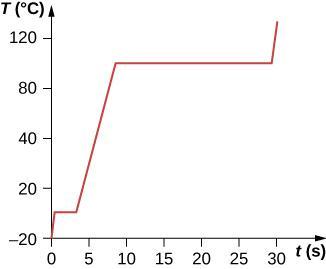
78. (a) How much heat transfer is necessary to raise the temperature of a 0.200-kg piece of ice from 20.0 C− to 130.0 C , including the energy needed for phase changes? (b) How much time is required for each stage, assuming a constant 20.0 kJ/s rate of heat transfer? (c) Make a graph of temperature versus time for this process.
Solution
a. (i) Heat needed to warm ice to 0 C : ( )( )( ) 1ii 0.200kg2.090kJ/kgC20 C8.36kJ QmcT=== ;
(ii) Heat needed to melt ice at 0 C : ( )( ) 2if 0.200kg334kJ/kg66.8kJ QmL=== ;
(iii) Heat required to warm 0 C water to 100 C : ( )( )( ) 3iw 0.200kg4.186kJ/kgC100 C83.73kJ83.7 kJ QmcT====
(iv) Heat required to vaporize water at 100 C : ( )( ) 4iv 0.200kg2256kJ/kg451.2kJ451kJ QmL==== ; (v) Heat required to warm 100 C vapor to 130 C : ( )( )( ) 5iv 0.200kg1.520kJ/kgC30 C9.12kJ
Total heat required 12345 619.0kJ147.9kcal148kcal QQQQQQ =++++===
b. PtQQ tP == ;
(i) 1 1 8.36kJ 0.418s 20kJ/s Q t P === ; (ii) 2 2 66.8kJ 3.34s 20kJ/s Q t P === ; (iii) 3 3 83.7kJ 4.19s 20kJ/s Q t P === ; (iv) 4 4 451kJ 22.6s 20kJ/s Q t P === ;
(v) 5 5 9.12kJ 0.456s 20kJ/s Q t P === ;
Total time 12345 31.00s31s tttttt =++++== . c.
16 of 29
OpenStax University Physics Volume II
Unit 1: Thermodynamics
Chapter 1: Temperature and Heat
79. In 1986, an enormous iceberg broke away from the Ross Ice Shelf in Antarctica. It was an approximately rectangular prism 160 km long, 40.0 km wide, and 250 m thick. (a) What is the mass of this iceberg, given that the density of ice is 3 917 kg/m ? (b) How much heat transfer (in joules) is needed to melt it? (c) How many years would it take sunlight alone to melt ice this thick, if the ice absorbs an average of 2100W/m , 12.00 h per day?
Solution
a. 151.4710 kg ; b. 204.9010 J ; c. 48.5 y
80. How many grams of coffee must evaporate from 350 g of coffee in a 100-g glass cup to cool the coffee and the cup from 95.0 C to 45.0 C ? Assume the coffee has the same thermal properties as water and that the average heat of vaporization is 2340 kJ/kg (560 kcal/g). Neglect heat losses through processes other than evaporation, as well as the change in mass of the coffee as it cools. Do the latter two assumptions cause your answer to be higher or lower than the true answer?
Solution
The heat gained in evaporating the coffee equals the heat leaving the coffee and glass to lower its temperature, so that Vccgg MLmcTmcT =+ , where M is the mass of coffee that evaporates.
Solving for the evaporated coffee gives 33.0 g. If the coffee loses heat in other ways, it evaporates less for the same temperature drop, so your answer will be too high. Likewise, if the coffee’s mass decreases, it needs less evaporation for the same temperature drop, and again your answer will be too high.
81. (a) It is difficult to extinguish a fire on a crude oil tanker, because each liter of crude oil releases 72.8010 J of energy when burned. To illustrate this difficulty, calculate the number of liters of water that must be expended to absorb the energy released by burning 1.00 L ofcrude oil, if the water’s temperature rises from 20.0 C to 100 C , it boils, and the resulting steam’s temperature rises to 300 C at constant pressure. (b) Discuss additional complications caused by the fact that crude oil is less dense than water.
Solution
a. 9.35 L; b. Crude oil is less dense than water, so it floats on top of the water, thereby exposing it to the oxygen in the air, which it uses to burn. Also, if the water is under the oil, it is less able to absorb the heat generated by the oil.
82. The energy released from condensation in thunderstorms can be very large. Calculate the energy released into the atmosphere for a small storm of radius 1 km, assuming that 1.0 cm of rain is precipitated uniformly over this area.
Solution
OpenStax University Physics Volume II
Unit 1: Thermodynamics
Chapter 1: Temperature and Heat
We have a phase change VQmL = . We need to find mass of rain in a cloud of radius 1 km. ( )( )( ) 36271000kg/m0.01m10 m10 kg mV
. With VQmL = and V 2256kJ/kg L = ,
we find 13710 J Q = , about the energy released in the first atomic bomb explosion.
83. To help prevent frost damage, 4.00 kg of water at 0C is sprayed onto a fruit tree. (a) How much heat transfer occurs as the water freezes? (b) How much would the temperature of the 200-kg tree decrease if this amount of heat transferred from the tree? Take the specific heat to be 3.35kJ/kgC , and assume that no phasechange occurs in the tree.
Solution
a. 319 kcal; b. 2.00 C
84. A 0.250-kg aluminum bowl holding 0.800kgof soup at 25.0 C is placed in a freezer. What is the final temperature if 388 kJ of energy is transferred from the bowl and soup, assuming the soup’s thermal properties are the same as that of water?
Solution
To bring the system to 0 C requires heat Q of 21.34 kcal. This leaves ( ) 90.021.34kcal68.66kcal −= to freeze all the soup, leaving 68.66kcal63.84kcal4.82kcal −= to be removed. So, we can now determine the final temperature of the frozen soup: 8.80 C−
85. A 0.0500-kg ice cube at 30.0 C− is placed in 0.400 kg of 35.0-C water in a very wellinsulated container. What is the final temperature?
Solution
First bring the ice up to 0 C and melt it with heat 1 : Q 4.74 kcal. This lowers the temperature of water by 2 : T 23.15 C . Now, the heat lost by the hot water equals that gained by the cold water ( fT is the final temperature): 20.6 C
86. If you pour 0.0100 kg of 20.0 C water onto a 1.20-kg block of ice (which is initially at 15.0 C− ), what is the final temperature? You may assume that the water cools so rapidly that effects of the surroundings are negligible.
Solution
First, we need to calculate how much heat would be required to raise the temperature of the ice to 0 C : ( )( )( ) 4 ice 1.20kg2090J/kgC15 C3.76210 J QmcT=== . Now, we need to calculate how much heat is given off to lower the water to 0 C : ( )( )( ) 11 0.0100kg4186J/kgC20.0 C837.2J QmcT=== . Since this is less than the heat required to heat the ice, we need to calculate how much heat is given off to convert the water to ice: ( )( ) 33 2f 0.0100kg33410 J/kg3.34010 J QmL=== . Thus, the total amount of heat given off to turn the water to ice at 0 C : 3 water 4.17710 J. Q = Since icewaterQQ , we have determined that the final state of the water/ice is ice at some temperature below 0 C . Now, we need to calculate the final temperature. We set the heat lost from the water equal to the heat gained by the ice, where we now know that the final state is ice at f 0 C T : lost by watergained by icewaterwater200waterfwaterice0?iceice15? ,or QQmcTmLmcTmcT →→−→=++=
18 of 29
OpenStax University Physics Volume II
Unit 1: Thermodynamics
Chapter 1: Temperature and Heat
Substituting for the change in temperatures (being careful that T is always positive) and simplifying gives: ( ) ( )( ) ( ) waterwaterficeficeicef
Solving for the final temperature gives ( ) ( ) ( ) waterwaterficeice f watericeice
= + , and so finally, f 13.2 C T =− .
87. Indigenous people sometimes cook in watertight baskets by placing hot rocks into water to bring it to a boil. What mass of 500-C granite must be placed in 4.00 kg of 15.0-C water to bring its temperature to 100 C , if 0.0250 kg of water escapes as vapor from the initial sizzle? You may neglect the effects of the surroundings.
Solution
Let the subscripts r, e, v, and w represent rock, equilibrium, vapor, and water, respectively. ( ) ( )
88. What would the final temperature of the pan and water be in the example Calculating the Final Temperature in Calorimetry if 0.260 kg of water were placed in the pan and 0.0100 kg of the water evaporated immediately, leaving the remainder to come to a common temperature with the pan?
Solution
Let the subscripts Al, e, v, and w represent aluminum pan, equilibrium, vapor, and water, respectively. So, ( ) ( ) AlAl1eVVWWe2 44.0 C mcTTmLmcTT
89. (a) Calculate the rate of heat conduction through house walls that are 13.0 cm thick and have an average thermal conductivity twice that of glass wool. Assume there are no windows or doors. The walls’ surface area is 2120m and their inside surface is at 18.0 C , while their outside surface is at 5.00 C . (b) How many 1-kW room heaters would be needed to balance the heat transfer due to conduction?
Solution
a. 31.0110 W ; b. One 1-kilowatt room heater is needed.
90. The rate of heat conduction out of a window on a winter day is rapid enough to chill the air next to it. To see just how rapidly the windows transfer heat by conduction, calculate the rate of conduction in watts through a 23.00-m window that is 0.634 cm thick (1/4 in.) if the temperatures of the inner and outer surfaces are 5.00 C and 10.0 C− , respectively. (This rapid rate will not be maintained the inner surface will cool, even to the point of frost formation.)
Solution 36.010 W
19 of 29
OpenStax University Physics Volume II
Unit 1: Thermodynamics
Chapter 1: Temperature and Heat
91. Calculate the rate of heat conduction out of the human body, assuming that the core internal temperature is 37.0 C , the skin temperature is 34.0 C , the thickness of the fatty tissues between the core and the skin averages 1.00 cm, and the surface area is 21.40m
Solution
84.0 W
92. Suppose you stand with one foot on ceramic flooring and one foot on a wool carpet, making contact over an area of 280.0cm with each foot. Both the ceramic and the carpet are 2.00 cm thick and are 10.0 C on their bottom sides. At what rate must heat transfer occur from each foot to keep the top of the ceramic and carpet at 33.0 C ?
Solution for the wool carpet: 0.368 W; for the ceramic tile: 7.73 W
93. A man consumes 3000 kcal of food in one day, converting most of it to thermal energy to maintain body temperature. If he loses half this energy by evaporating water (through breathing and sweating), how many kilograms of water evaporate?
Solution
2.59 kg
94. A firewalker runs across a bed of hot coals without sustaining burns. Calculate the heat transferred by conduction into the sole of one foot of a firewalker given that the bottom of the foot is a 3.00-mm-thick callus with a conductivity at the low end of the range for wood and its density is 3300kg/m . The area of contact is 225.0cm , the temperature of the coals is 700 C , and the time in contact is 1.00 s. Ignore the evaporative cooling of sweat.
Solution
44.2 J
95. (a) What is the rate of heat conduction through the 3.00-cm-thick fur of a large animal having a 21.40-m surface area? Assume that the animal’s skin temperature is 32.0 C , that the air temperature is 5.00 C− , and that fur has the same thermal conductivity as air. (b) What food intake will the animal need in one day to replace this heat transfer?
Solution
a. 39.7 W; b. 820 kcal
96. A walrus transfers energy by conduction through its blubber at the rate of 150 W when immersed in 1.00 C− water. The walrus’s internal core temperature is 37.0 C , and it has a surface area of 22.00m . What is the average thickness of its blubber, which has the conductivity of fatty tissues without blood?
Solution ( )21 kATT Q
97. Compare the rate of heat conduction through a 13.0-cm-thick wall that has an area of 210.0m and a thermal conductivity twice that of glass wool with the rate of heat conduction through a 0.750-cm-thick window that has an area of 22.00m , assuming the same temperature difference across each.
Solution
20 of 29
OpenStax University Physics Volume II
Unit 1: Thermodynamics
Chapter 1: Temperature and Heat
This gives 0.0288 wall: window, or 35:1 window: wall
98. Suppose a person is covered head to foot by wool clothing with average thickness of 2.00 cm and is transferring energy by conduction through the clothing at the rate of 50.0 W. What is the temperature difference across the clothing, given the surface area is 21.40m ?
Solution
99. Some stove tops are smooth ceramic for easy cleaning. If the ceramic is 0.600 cm thick and heat conduction occurs through area 14 cm radius and at a rate of 2256 W, what is the temperature difference across it? Ceramic has the same thermal conductivity as glass and brick.
Solution
100. One easy way to reduce heating (and cooling) costs is to add extra insulation in the attic of a house. Suppose a single-story cubical house already had 15 cm of fiberglass insulation in the attic and in all the exterior surfaces. If you added an extra 8.0 cm of fiberglass to the attic, by what percentage would the heating cost of the house drop? Take the house to have dimensions 10 m by 15 m by 3.0 m. Ignore air infiltration and heat loss through windows and doors, and assume that the interior is uniformly at one temperature and the exterior is uniformly at another.
Solution
Initially, ( )126W/C PT = . If we add 8 cm to the attic, the new rate of heat loss is ( ) 111W/C. PT = So the percentage of savings in ( ) heattransfer126111/12612%. =−=
101. Many decisions are made on the basis of the payback period: the time it will take through savings to equal the capital cost of an investment. Acceptable payback times depend upon the business or philosophy one has. (For some industries, a payback period is as small as 2 years.)
Suppose you wish to install the extra insulation in the preceding problem. If energy cost $1.00 per million joules and the insulation was $4.00 per square meter, then calculate the simple payback time. Take the average T for the 120-day heating season to be 15.0 C.
Solution
We found in the preceding problem that 126 WC PT= as baseline energy use. So the total heat loss during this period is
21 of 29 ( )21 kATT Q td = , so that
OpenStax University Physics Volume II
Unit 1: Thermodynamics
. At the cost of $1/MJ, the cost is $1960. From an earlier problem, the savings is 12% or $235/y. We need 2150m of insulation in the attic. At 2$4/m , this is a $500 cost. So the payback period is ( ) $600/$235/y2.6years = (excluding labor costs).
Additional Problems
102. In 1701, the Danish astronomer Ole Rømer proposed a temperature scale with two fixed points, freezing water at 7.5 degrees, and boiling water at 60.0 degrees. What is the boiling point of oxygen, 90.2 K, on the Rømer scale?
Solution
88.5 degrees
103. What is the percent error of thinking the melting point of tungsten is 3695 C instead of the correct value of 3695 K?
Solution
7.39%
104. An engineer wants to design a structure in which the difference in length between a steel beam and an aluminum beam remains at 0.500 m regardless of temperature, for ordinary temperatures. What must the lengths of the beams be?
Solution
Chapter 1: Temperature and Heat Page 22 of 29 ( )( )( )( ) 36 126J/sC15.0 C120days86.410 s/day196010 J
105. How much stress is created in a steel beam if its temperature changes from –15ºC to 40 ºC but it cannot expand? For steel, the Young’s modulus 9221010 N/m Y = from the below table. (Ignore the change in area resulting from the expansion.)
OpenStax University Physics Volume II
Unit 1: Thermodynamics
Chapter 1: Temperature and Heat
106. A brass rod ( ) 929010 N/m, Y = with a diameter of 0.800 cm and a length of 1.20 m when the temperature is 25 C , is fixed at both ends. At what temperature is the force in it at 36,000 N?
Solution
20.9 C
107. A mercury thermometer still in use for meteorology has a bulb with a volume of 30.780cm and a tube for the mercury to expand into of inside diameter 0.130 mm. (a) Neglecting the thermal expansion of the glass, what is the spacing between marks 1 C apart? (b) If the thermometer is made of ordinary glass (not a good idea), what is the spacing?
Solution
a. 1.06 cm; b. 1.11 cm
108. Even when shut down after a period of normal use, a large commercial nuclear reactor transfers thermal energy at the rate of 150 MW by the radioactive decay of fission products. This heat transfer causes a rapid increase in temperature if the cooling system fails ( ) 1watt1joule/secondor1W1J/sand1MW1megawatt. === (a) Calculate the rate of temperature increase in degrees Celsius per second (°C/s) if the mass of the reactor core is 1.60 105 kg and it has an average specific heat of 0.3349kJ/kgC . (b) How long would it take to obtain a temperature increase of 2000 °C, which could cause some metals holding the radioactive materials to melt? (The initial rate of temperature increase would be greater than that calculated here because the heat transfer is concentrated in a smaller mass. Later, however, the temperature increase would slow down because the 500,000-kg steel containment vessel would also begin to heat up.)
Solution a. Q QmcTT mc == ; Recall that 1W 1J/s
109. You leave a pastry in the refrigerator on a plate and ask your roommate to take it out before you get home so you can eat it at room temperature, the way you like it. Instead, your roommate plays video games for hours. When you return, you notice that the pastry is still cold, but the game console has become hot. Annoyed, and knowing that the pastry will not be good if it is microwaved, you warm up the pastry by unplugging the console and putting it in a clean trash bag (which acts as a perfect calorimeter) with the pastry on the plate. After a while, you find that
23 of 29
OpenStax University Physics Volume II
Unit 1: Thermodynamics
Solution ( 1.7kJ/kg ºC)
110. Two solid spheres, A and B, made of the same material, are at temperatures of 0 C and 100 C , respectively. The spheres are placed in thermal contact in an ideal calorimeter, and they reach an equilibrium temperature of 20 C . Which is the bigger sphere? What is the ratio of their diameters?
Solution
A is bigger. Its diameter is greater by a factor of 1/3 41.59.
111. In some countries, liquid nitrogen is used on dairy trucks instead of mechanical refrigerators. A 3.00-hour delivery trip requires 200 L of liquid nitrogen, which has a density of 808 kg/m3 . (a) Calculate the heat transfer necessary to evaporate this amount of liquid nitrogen and raise its temperature to 3.00 C . (Use Pc and assume it is constant over the temperature range.) This value is the amount of cooling the liquid nitrogen supplies. (b) What is this heat transfer rate in kilowatt-hours? (c) Compare the amount of cooling obtained from melting an identical mass of 0-C ice with that from evaporating the liquid nitrogen.
Solution
a. 41.5710 kcal ; b. 18.3kWh ; c. 41.2910 kcal
112. Some gun fanciers make their own bullets, which involves melting lead and casting it into lead slugs. How much heat transfer is needed to raise the temperature and melt 0.500 kg of lead, starting from 25.0 C ?
Solution ( ) ff QmcTmLmcTL =+=+ ; ( ) ( )( )
113. A 0.800-kg iron cylinder at a temperature of 3 1.0010C is dropped into an insulated chest of 1.00 kg of ice at its melting point. What is the final temperature, and how much ice has melted?
Solution
6.3 C . All of the ice melted.
114. Repeat the preceding problem with 2.00 kg of ice instead of 1.00 kg.
Solution
0 C , 1.09 kg of ice melted
115. Repeat the preceding problem with 0.500 kg of ice, assuming that the ice is initially in a copper container of mass 1.50 kg in equilibrium with the ice.
Solution
63.9 C , all the ice melted
116. A 30.0-g ice cube at its melting point is dropped into an aluminum calorimeter of mass 100.0 g in equilibrium at 24.0 C with 300.0 g of an unknown liquid. The final temperature is 4.0 C . What is the heat capacity of the liquid?
Chapter 1: Temperature and Heat Page 24 of 29 the equilibrium temperature is a nice, warm 38.3 C . You know that the game console has a mass of 2.1 kg. Approximate it as having a uniform initial temperature of 45 C . The pastry has a mass of 0.16 kg and a specific heat of ( 3.0kJ/kgºC, ) and is at a uniform initial temperature of 4.0 C . The plate is at the same temperature and has a mass of 0.24 kg and a specific heat of ) 0/(.90kJkgºC . What is the specific heat of the console?
OpenStax University Physics Volume II
Unit 1: Thermodynamics
Chapter 1: Temperature and Heat
Solution
3 1.4510J/kgK
117. (a) Calculate the rate of heat conduction through a double-paned window that has a 21.50-m area and is made of two panes of 0.800-cm-thick glass separated by a 1.00-cm air gap. The inside surface temperature is 15.0 C , while that on the outside is 10.0 C− . (Hint: There are identical temperature drops across the two glass panes. First find these and then the temperature drop across the air gap. This problem ignores the increased heat transfer in the air gap due to convection.) (b) Calculate the rate of heat conduction through a 1.60-cm-thick window of the same area and with the same temperatures. Compare your answer with that for part (a).
Solution
a. 83 W; b. 31.9710 W ; The single-pane window has a rate of heat conduction equal to 1969/83, or 24 times that of a double-pane window.
118. (a) An exterior wall of a house is 3 m tall and 10 m wide. It consists of a layer of drywall with an R factor of 0.56, a layer 3.5 inches thick filled with fiberglass batts, and a layer of insulated siding with an R factor of 2.6. The wall is built so well that there are no leaks of air through it. When the inside of the wall is at 22 C and the outside is at 2 C− , what is the rate of heat flow through the wall? (b) More realistically, the 3.5-inch space also contains 2-by-4 studs wooden boards 1.5 inches by 3.5 inches oriented so that 3.5-inch dimension extends from the drywall to the siding. They are “on 16-inch centers,” that is, the centers of the studs are 16 inches apart. What is the heat current in this situation? Don’t worry about one stud more or less.
Solution
a. 289 W; b. 337 W
119. For the human body, what is the rate of heat transfer by conduction through the body’s tissue with the following conditions: the tissue thickness is 3.00 cm, the difference in temperature is 2.00 C , and the skin area is 21.50m . How does this compare with the average heat transfer rate to the body resulting from an energy intake of about 2400 kcal per day? (No exercise is included.)
Solution
The rate of heat transfer by conduction is 20.0 W. On a daily basis, this is 1,728 kJ/day. Daily food intake is 2400kcal/d4186J/kcal10,050kJ/day = . So only 17.2% of energy intake goes as heat transfer by conduction to the environment at this T
120. You have a Dewar flask (a laboratory vacuum flask) that has an open top and straight sides, as shown below. You fill it with water and put it into the freezer. It is effectively a perfect insulator, blocking all heat transfer, except on the top. After a time, ice forms on the surface of the water. The liquid water and the bottom surface of the ice, in contact with the liquid water, are at 0 C . The top surface of the ice is at the same temperature as the air in the freezer, 18 C− Set the rate of heat flow through the ice equal to the rate of loss of heat of fusion as the water freezes. When the ice layer is 0.700 cm thick, find the rate in m/s at which the ice is thickening.
OpenStax University Physics Volume II
Unit 1: Thermodynamics
Chapter 1: Temperature and Heat
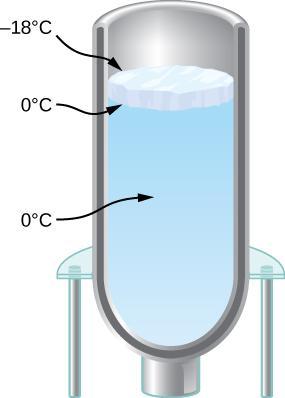
Solution 5 1.810 m/s
121. An infrared heater for a sauna has a surface area of 20.050m and an emissivity of 0.84. What temperature must it run at if the required power is 360 W? Neglect the temperature of the environment.
Solution
620 K
122. (a) Determine the power of radiation from the Sun by noting that the intensity of the radiation at the distance of Earth is 21370W/m . Hint: That intensity will be found everywhere on a spherical surface with radius equal to that of Earth’s orbit. (b) Assuming that the Sun’s temperature is 5780 K and that its emissivity is 1, find its radius.
Solution a. 26 3.8610W ; b. 8 6.9610m
Challenge Problems
123. A pendulum is made of a rod of length L and negligible mass, but capable of thermal expansion, and a weight of negligible size. (a) Show that when the temperature increases by dT, the period of the pendulum increases by a fraction /2. dT (b) A clock controlled by a brass pendulum keeps time correctly at 10 C . If the room temperature is 30 C , does the clock run faster or slower? What is its error in seconds per day?
Solution
Denoting the period by P, we know 2/. PLg = When the temperature increases by dT, the length increases by LdT . Then the new length is a.
by the binomial expansion. b. The clock runs slower, as its new period is 1.00019 s. It loses 16.4 s per day.
124. At temperatures of a few hundred kelvins the specific heat capacity of copper approximately follows the empirical formula =++ 2 , cTT where = 349J/kgK,
OpenStax University Physics Volume II
Unit 1: Thermodynamics
= 2 0.107J/kgK, and = 5 4.5810JkgK. How much heat is needed to raise the temperature of a 2.00-kg piece of copper from 20 C to 250 C ?
Solution 5 2.0210J
125. In a calorimeter of negligible heat capacity, 200 g of steam at 150 C and 100 g of ice at 40 C− are mixed. The pressure is maintained at 1 atm. What is the final temperature, and how much steam, ice, and water are present?
Solution
The amount of heat to melt the ice and raise it to 100 C is not enough to condense the steam, but it is more than enough to lower the steam’s temperature by 50 C , so the final state will consist of steam and liquid water in equilibrium, and the final temperature is 100 C ; 28 g of steam condenses, so the final state contains 172 g of steam and 128 g of liquid water.
126. An astronaut performing an extra-vehicular activity (space walk) shaded from the Sun is wearing a spacesuit that can be approximated as perfectly white ( )0 e = except for a 5cm8cm patch in the form of the astronaut’s national flag. The patch has emissivity 0.300. The spacesuit under the patch is 0.500 cm thick, with a thermal conductivity 0.0600W/m C k = , and its inner surface is at a temperature of 20.0 C . What is the temperature of the patch, and what is the rate of heat loss through it? Assume the patch is so thin that its outer surface is at the same temperature as the outer surface of the spacesuit under it. Also assume the temperature of outer space is 0 K. You will get an equation that is very hard to solve in closed form, so you can solve it numerically with a graphing calculator, with software, or even by trial and error with a calculator.
Solution
The temperature is 284 K, and the rate of heat loss is 0.441 W.
127. Find the growth of an ice layer as a function of time in a Dewar flask as seen in problem
120. Call the thickness of the ice layer L. (a) Derive an equation for dL/dt in terms of L , the temperature T above the ice, and the properties of ice (which you can leave in symbolic form instead of substituting the numbers). (b) Solve this differential equation assuming that at 0 t = , you have L = 0. If you have studied differential equations, you will know a technique for solving equations of this type: manipulate the equation to get dL/dt multiplied by a (very simple) function of L on one side, and integrate both sides with respect to time. Alternatively, you may be able to use your knowledge of the derivatives of various functions to guess the solution, which has a simple dependence on t. (c) Will the water eventually freeze to the bottom of the flask?
Solution
a. // dLdTkTL = ; b. f 2/ LkTtL = ; c. yes
128. As the very first rudiment of climatology, estimate the temperature of Earth. Assume it is a perfect sphere and its temperature is uniform. Ignore the greenhouse effect. Thermal radiation from the Sun has an intensity (the “solar constant” S) of about 21370W/m at the radius of Earth’s orbit. (a) Assuming the Sun’s rays are parallel, what area must S be multiplied by to get the total radiation intercepted by Earth? It will be easiest to answer in terms of Earth’s radius, R (b) Assume that Earth reflects about 30% of the solar energy it intercepts. In other words, Earth has an albedo with a value of 0.3 A = . In terms of S, A, and R, what is the rate at which Earth absorbs energy from the Sun? (c) Find the temperature at which Earth radiates energy at the
Chapter 1: Temperature and Heat Page 27 of 29
OpenStax University Physics Volume II
Unit 1: Thermodynamics
Chapter 1: Temperature and Heat
Solution
a. pR2; b. pR2 ( ) 1- A ( )S; c. 255 K; Yes, that is 18 C− , which is much too low. d. It doesn’t depend on the area.
129. Let’s stop ignoring the greenhouse effect and incorporate it into the previous problem in a very rough way. Assume the atmosphere is a single layer, a spherical shell around Earth, with an emissivity 0.77 e = (chosen simply to give the right answer) at infrared wavelengths emitted by Earth and by the atmosphere. However, the atmosphere is transparent to the Sun’s radiation (that is, assume the radiation is at visible wavelengths with no infrared), so the Sun’s radiation reaches the surface. The greenhouse effect comes from the difference between the atmosphere’s transmission of visible light and its rather strong absorption of infrared. Note that the atmosphere’s radius is not significantly different from Earth’s, but since the atmosphere is a layer above Earth, it emits radiation both upward and downward, so it has twice Earth’s area. There are three radiative energy transfers in this problem: solar radiation absorbed by Earth’s surface; infrared radiation from the surface, which is absorbed by the atmosphere according to its emissivity; and infrared radiation from the atmosphere, half of which is absorbed by Earth and half of which goes out into space. Apply the method of the previous problem to get an equation for Earth’s surface and one for the atmosphere, and solve them for the two unknown temperatures, surface and atmosphere.
(a) In terms of Earth’s radius, the constant , and the unknown temperature s T of the surface, what is the power of the infrared radiation from the surface?
(b) What is the power of Earth’s radiation absorbed by the atmosphere?
(c) In terms of the unknown temperature e T of the atmosphere, what is the power radiated from the atmosphere?
(d) Write an equation that says the power of the radiation the atmosphere absorbs from Earth equals the power of the radiation it emits.
(e) Half of the power radiated by the atmosphere hits Earth. Write an equation that says that the power Earth absorbs from the atmosphere and the Sun equals the power that it emits.
(f) Solve your two equations for the unknown temperature of Earth.
Solution
This file is copyright 2016, Rice
28 of 29 same rate. Assume that at the infrared wavelengths where it radiates, the emissivity e is 1. Does your result show that the greenhouse effect is important? (d) How does your answer depend on the the area of Earth?