Test Bank for Principles of Macroeconomics 14th Edition by Case, Fair, Oster
ISBN: 9780135374993
Principles of Macroeconomics, 14e (Case/Fair/Oster)
Chapter 1 The Scope and Method of Economics
1.1 Why Study Economics?
1) Which of the following is not listed in the book as a reason to study economics?
A) to learn a way of thinking
B) to understand society
C) to be an informed citizen
D) to learn how to make lots of money
Answer: D
Diff: 1
Topic: Why Study Economics?
Status: 13e question
Learning Outcome: Micro-1
2) Among the fundamental concepts in economics is
A) opportunity cost.
B) marginalism.
C) efficient markets.
D) all of the above
Answer: D
Diff: 1
Topic: Why Study Economics?
Status: New question
Learning Outcome: Micro-1
3) Which of the following is the best definition of economics?
A) the study of how individuals and societies choose to use the scarce resources that nature and previous generations have provided
B) the study of how consumers spend their income
C) the study of how business firms decide what inputs to hire and what outputs to produce
D) the study of how the federal government allocates tax dollars
Answer: A
Diff: 1
Topic: Why Study Economics?
Status: 13e question
Learning Outcome: Micro-1
4) The rise of the modern factory system in England during the late eighteenth and early nineteenth centuries is known as the
A) Great Migration.
B) Industrial Revolution.
C) Wealth of Nations.
D) Dark Ages.
Answer: B
Diff: 1
Topic: Why Study Economics?
Status: 13e question
Learning Outcome: Micro-1
5) Which of the following statements is not correct?
A) Economics is a behavioral science.
B) In large measure, economics is the study of how people make choices.
C) If poverty were eliminated, there would be no reason to study economics.
D) Economic analysis can be used to explain how both individuals and societies make decisions.
Answer: C
Diff: 1
Topic: Why Study Economics?
Status: 13e question
Learning Outcome: Micro-1
6) The study of economics
A) is a very narrow endeavor.
B) is a way of analyzing decision-making processes caused by scarcity.
C) is concerned with proving that capitalism is better than socialism.
D) focuses on how a business should function.
Answer: B
Diff: 1
Topic: Why Study Economics?
Status: 13e question
Learning Outcome: Micro-1
7) Which of the following is not one of the three fundamental concepts of economics?
A) profit maximization
B) marginalism
C) opportunity cost
D) the working of efficient markets
Answer: A
Diff: 1
Topic: Why Study Economics?
Status: 13e question
Learning Outcome: Micro-1
8) Suppose that you purchased a ticket to a jazz festival for $100 from an online ticket broker. Once you arrived at the festival, you discovered that parking costs you an additional $15. In this situation, the additional $15 you pay for parking is an example of
A) an economic loss.
B) opportunity cost.
C) marginal cost.
D) an inefficient cost.
Answer: C
Diff: 2
Topic: Why Study Economics?
Status: 13e question
Learning Outcome: Micro-1
9) You have decided that you want to attend a costume party as Black Panther. You estimate that it will cost $40 to assemble your costume. After spending $40 on the costume, you realize that the additional pieces you need will cost you $25 more. The marginal cost of completing the costume is
A) $15.
B) $25.
C) $40.
D) $65.
Answer: B
Diff: 2
Topic: Why Study Economics?
Status: 13e question
Learning Outcome: Micro-1
10) The concept of opportunity cost
A) is relevant only to economics.
B) can be applied to the analysis of any decision-making process.
C) applies to consumers but not to firms.
D) refers only to actual payments and incomes.
Answer: B
Diff: 1
Topic: Why Study Economics?
Status: 13e question
Learning Outcome: Micro-1
11) Opportunity cost is
A) that which we forgo, or give up, when we make a choice or a decision.
B) a cost that cannot be avoided, regardless of what is done in the future.
C) the additional cost of producing an additional unit of output.
D) the additional cost of buying an additional unit of a product.
Answer: A
Diff: 1
Topic: Why Study Economics?
Status: 13e question
Learning Outcome: Micro-1
12) The reason that opportunity costs arise is that
A) an economy relies on money to facilitate exchange of goods and services.
B) resources are scarce.
C) there are no alternative decisions that could be made.
D) people have limited wants.
Answer: B
Diff: 1
Topic: Why Study Economics?
Status: 13e question
Learning Outcome: Micro-1
13) Which of the following is not an opportunity cost of attending college?
A) the tuition you pay
B) the income you could have earned if you didn't attend college
C) the alternative uses of the time you spend studying
D) the cost of the food that you consume while you are attending college
Answer: D
Diff: 2
Topic: Why Study Economics?
Status: 13e modified
Learning Outcome: Micro-1
14) If your tuition is $5,000 this semester, your books cost $600, you can only work 20 rather than 40 hours per week during the 15 weeks you are taking classes and you make $15 per hour, and your room and board is $3,000 this semester (same as if not attending college), then your opportunity cost of attending college this semester is
A) $5,600.
B) $5,900.
C) $10,100.
D) $11,600.
Answer: C
Diff: 3
Topic: Why Study Economics?
Status: 13e question
Learning Outcome: Micro-1
15) If your tuition is $25,000 this semester, your books cost $1,500, you can only work 20 rather than 40 hours per week during the 15 weeks you are taking classes and you make $15 per hour, and your room and board is $7,500 this semester (same as if not attending college), then your opportunity cost of attending college this semester is
A) $26,500.
B) $26,800.
C) $31,000.
D) $38,500.
Answer: C
Diff: 3
Topic: Why Study Economics?
Status: 13e question
Learning Outcome: Micro-1
16) If you own a building and you decide to use that building to open a book store,
A) there is no opportunity cost of using this building for a book store because you own it.
B) there is an opportunity cost of using this building for a book store because it could have been used in other ways.
C) the opportunity costs equal the cost of inventory.
D) the only cost relevant to this decision is the price you paid for the building.
Answer: B
Diff: 2
Topic: Why Study Economics?
Status: 13e question
Learning Outcome: Micro-1
17) You own the video game Grand Theft Auto: VI. The opportunity cost of playing this game for the second time
A) is zero.
B) is one-half the cost of the game, as this is the second time you have played it.
C) is the value of the alternative use of the time you spend playing the game.
D) cannot be calculated.
Answer: C
Diff: 2
Topic: Why Study Economics?
Status: 13e modified
Learning Outcome: Micro-1
18) That which we forgo, or give up, when we make a choice or decision is called
A) out-of-pocket cost.
B) marginal cost.
C) real cost.
D) opportunity cost.
Answer: D
Diff: 1
Topic: Why Study Economics?
Status: 13e question
Learning Outcome: Micro-1
19) Economists often refer to risk-free ventures as A) efficient market outcomes.
B) profit opportunities.
C) those with no opportunity costs.
D) break-even propositions.
Answer: B
Diff: 1
Topic: Why Study Economics?
Status: 13e question
Learning Outcome: Micro-1
20) You are having a party tonight and need to order some pizzas. If you can buy 9 pizzas for $126 or you could buy 10 pizzas for $130 with the promotion currently going on, then the marginal cost of the tenth pizza is
A) $4.
B) $13.
C) $14.
D) $130.
Answer: A
Diff: 2
Topic: Why Study Economics?
Status: 13e modified
Learning Outcome: Micro-1
21) If you eat at a sushi restaurant that charges $20 for its all-you-can-eat sushi special, then the marginal cost of your 10th piece of sushi is
A) zero.
B) $2.
C) $200.
D) $2,000.
Answer: A
Diff: 2
Topic: Why Study Economics?
Status: 13e question
Learning Outcome: Micro-1
22) A market in which profit opportunities are eliminated almost instantaneously is A) a laissez-faire market.
B) a capitalist market.
C) a socialist market.
D) an efficient market.
Answer: D
Diff: 1
Topic: Why Study Economics?
Status: 13e question
Learning Outcome: Micro-1
23) If information is less costly and more easily available, then usually this A) makes markets more efficient.
B) makes markets less efficient.
C) increases profit opportunities.
D) increases the opportunity cost of acquiring more information.
Answer: A
Diff: 2
Topic: Why Study Economics?
Status: 13e question
Learning Outcome: Micro-1
24) An efficient market is a market in which A) everyone always gets what they want.
B) profit opportunities are eliminated almost instantaneously.
C) profits are always very high and persistent.
D) opportunity costs are zero.
Answer: B
Diff: 2
Topic: Why Study Economics?
Status: 13e question
Learning Outcome: Micro-1
25) According to the Economics in Practice, when rains in rural India are plentiful, the opportunity cost of having someone out of the labor force, and therefore unable to work in agricultural production, A) increases.
B) decreases.
C) remains unchanged.
D) is zero, because the person is out of the labor force.
Answer: A
Diff: 2
Topic: Why Study Economics?: Economics in Practice
Status: 13e modified
Learning Outcome: Micro-1
26) According to the Economics in Practice, when rural India is suffering from a drought where agricultural output is low, the opportunity cost of having someone out of the labor force, and therefore unable to work in agricultural production, is A) high B) low.
C) infinite.
D) zero, because the person is out of the labor force.
Answer: B
Diff: 2
Topic: Why Study Economics?: Economics in Practice
Status: 13e modified
Learning Outcome: Micro-1
27) According to the Economics in Practice, in terms of wages and job availability, those students graduating during a recession with a degree in economics are ________ those graduating with a degree in sociology.
A) better off than
B) worse off than
C) affected equally to
D) There seems to be no correlation between a student's major and wages or employment during a recession.
Answer: A
Diff: 1
Topic: Why Study Economics?: Economics in Practice
Status: 13e modified
Learning Outcome: Micro-1
28) According to the Economics in Practice, a majority of the $10 retail value of the Barbie doll
A) is needed to pay for the cost of the Taiwanese plastic used to make the dolls.
B) pays for the Chinese labor used to assemble the doll.
C) is captured in the United States.
D) goes to the Japanese manufacturer of the hair which is used for the dolls.
Answer: C
Diff: 2
Topic: Why Study Economics?: Economics in Practice
Status: 13e modified
Learning Outcome: Micro-1
29) The opportunity cost to Mattel of having its Barbie doll assembled in China is
A) the low wages paid to Chinese workers.
B) the $2 export value the doll carries when it leaves Hong Kong.
C) the $8 of its $10 retail value which is captured in the United States.
D) having the Barbie doll assembled in the next best available location.
Answer: D
Diff: 2
Topic: Why Study Economics?: Economics in Practice
Status: 13e modified
Learning Outcome: Micro-1
30) The reasons to study economics include which of the following?
A) to be an informed citizen
B) to understand society
C) to learn a way of thinking
D) all of the above
Answer: D
Diff: 1
Topic: Why Study Economics?
Status: 13e question
Learning Outcome: Micro-1
31) Marginalism is
A) the best alternative that we forgo when making a decision.
B) the study of how societies choose to use scarce resources.
C) a market situation in which profit opportunities are eliminated almost instantaneously.
D) the process of analyzing the additional costs or benefits arising from a decision.
Answer: D
Diff: 1
Topic: Why Study Economics?
Status: 13e question
Learning Outcome: Micro-1
32) Economics is best defined as the study of
A) financial decision making.
B) how consumers make purchasing decisions.
C) choices made by people faced with scarcity.
D) inflation, unemployment, and economic growth.
Answer: C
Diff: 1
Topic: Why Study Economics?
Status: 13e question
Learning Outcome: Micro-1
33) The Industrial Revolution refers to the rise of the modern factory system in ________ during the late eighteenth and early nineteenth centuries.
A) the United States
B) England
C) France
D) Germany
Answer: B
Diff: 1
Topic: Why Study Economics?
Status: 13e question
Learning Outcome: Micro-1
34) Which of the following statements is correct?
A) Economics is a natural science.
B) In large measure, economics is the study of how people make choices.
C) If poverty was eliminated there would be no reason to study economics.
D) Economic analysis can be used to explain how societies, but not individuals, make decisions.
Answer: B
Diff: 1
Topic: Why Study Economics?
Status: 13e question
Learning Outcome: Micro-1
35) Economics is the study of
A) how to invest in the stock market.
B) how society uses limited resources.
C) the role of money in markets.
D) how government officials decide which goods and services are produced.
Answer: B Diff: 1
Topic: Why Study Economics?
Status: 13e question
Learning Outcome: Micro-1
36) You decide to go to LEGOLAND after you visit Disneyworld in Orlando. The cost of going to LEGOLAND after you visit Disneyworld is the ________ cost of getting from Disneyworld to LEGOLAND.
A) efficiency
B) marginal time and money
C) opportunity
D) profit maximizing
Answer: B Diff: 1
Topic: Why Study Economics?
Status: 13e question
Learning Outcome: Micro-1
37) Suppose that you sign up for a one-day cooking class at the local culinary school for $75. Once you arrive at the class, you discover that you must purchase an apron for an additional $5. In this situation, the additional $5 you pay for the apron is an example of
A) an inefficient cost.
B) marginal cost.
C) opportunity cost.
D) an economic loss.
Answer: B
Diff: 2
Topic: Why Study Economics?
Status: 13e question
Learning Outcome: Micro-1
38) You have decided that you want to attend a renaissance fair as King Henry VIII. You estimate that it will cost $80 to assemble your costume. After spending $80 on the costume, you realize that the additional pieces you need will cost you $20 more. The marginal cost of completing the costume is
A) $20.
B) $60.
C) $80.
D) $100.
Answer: A
Diff: 2
Topic: Why Study Economics?
Status: 13e question
Learning Outcome: Micro-1
39) You have narrowed down your Friday night plans to either going bowling or playing billiards. If you choose to go bowling, then for you playing billiards is the ________ of going bowling.
A) opportunity cost
B) marginal cost
C) empirical cost
D) variable cost
Answer: A
Diff: 1
Topic: Why Study Economics?
Status: 13e question
Learning Outcome: Micro-1
40) That which we forgo, or give up, when we make a choice or a decision is known as A) equity.
B) causation.
C) correlation.
D) opportunity cost.
Answer: D
Diff: 1
Topic: Why Study Economics?
Status: 13e question
Learning Outcome: Micro-1
41) Scarce resources give rise to the concept of A) efficient markets.
B) opportunity costs.
C) laissez-faire.
D) positive economics.
Answer: B
Diff: 1
Topic: Why Study Economics?
Status: 13e question
Learning Outcome: Micro-1
42) Which of the following is an opportunity cost of attending college?
A) the cost of your apartment or dorm
B) the income you could have earned if you didn't attend college
C) the cost of the food that you consume while you are attending college
D) the education you gain from attending college
Answer: B
Diff: 2
Topic: Why Study Economics?
Status: 13e question
Learning Outcome: Micro-1
43) If your tuition is $2,000 this semester, your books cost $400, you can only work 10 rather than 40 hours per week during the 15 weeks you are taking classes and you make $12 per hour, and your room and board is $4,000 this semester (same as if not attending college), then your opportunity cost of attending college this semester is
A) $2,400.
B) $2,760.
C) $7,800.
D) $11,800.
Answer: C
Diff: 3
Topic: Why Study Economics?
Status: 13e question
Learning Outcome: Micro-1
44) If your tuition is $20,000 this semester, your books cost $2,000, you can only work 10 rather than 40 hours per week during the 15 weeks you are taking classes and you make $15 per hour, and your room and board is $8,000 this semester (same as if not attending college), then your opportunity cost of attending college this semester is
A) $22,000.
B) $22,150.
C) $28,750.
D) $36,750.
Answer: C
Diff: 3
Topic: Why Study Economics?
Status: 13e question
Learning Outcome: Micro-1
45) If you own a condo and you decide to lease it to your cousin,
A) there is no opportunity cost of leasing the condo because you own it.
B) there is an opportunity cost of leasing the condo because you could have chosen to live in it.
C) there is no opportunity cost of leasing the condo because you collect rent from your cousin.
D) the only cost relevant to this decision is the price you paid for the condo.
Answer: B
Diff: 2
Topic: Why Study Economics?
Status: 13e question
Learning Outcome: Micro-1
46) You purchased a new video game for your birthday. The opportunity cost of playing this video game for the fourth time
A) is zero, since you own it.
B) is one-fourth the cost of the video game, as this is the fourth time you have watched it.
C) is the value of the alternative use of the time you spend playing the video game.
D) must be the same as the opportunity cost of playing it the first time.
Answer: C
Diff: 2
Topic: Why Study Economics?
Status: New question
Learning Outcome: Micro-1
47) Opportunity cost is
A) what we give up to get something else.
B) marginal cost divided by total cost.
C) the same as real cost.
D) all of the above.
Answer: A
Diff: 1
Topic: Why Study Economics?
Status: 13e question
Learning Outcome: Micro-1
48) Economists often refer to "good deals" as
A) profit opportunities.
B) break-even propositions.
C) efficient market outcomes.
D) those with no opportunity cost.
Answer: A
Diff: 1
Topic: Why Study Economics?
Status: 13e question
Learning Outcome: Micro-1
49) If you can download 10 ring tones for your cell phone for $10 or you can download 11 ring tones for your cell phone for $10.50, then the marginal cost of the eleventh ring tone is
A) $0.50.
B) $10.00.
C) $10.50.
D) $20.50. Answer: A
Diff: 2
Topic: Why Study Economics?
Status: 13e question
Learning Outcome: Micro-1
50) If you eat at a Las Vegas casino that charges $12 for its all you can eat buffet, then the marginal cost of your third trip to the buffet line is A) zero.
B) $4.
C) $12.
D) $36.
Answer: A
Diff: 2
Topic: Why Study Economics?
Status: 13e question
Learning Outcome: Micro-1
51) An efficient market is a market A) that deals in unlimited resources.
B) in which long-term profits are guaranteed.
C) in which profit opportunities are eliminated almost instantaneously.
D) in which there are no opportunity costs.
Answer: C
Diff: 1
Topic: Why Study Economics?
Status: 13e question
Learning Outcome: Micro-1
52) If information is more costly and less easily available, then usually this A) makes markets more efficient. B) makes markets less efficient.
C) decreases profit opportunities.
D) decreases the opportunity cost of acquiring more information. Answer: B
Diff: 2
Topic: Why Study Economics?
Status: 13e question
Learning Outcome: Micro-1
53) The common way of expressing the efficient market concept is
A) "the only true market is a profitable market."
B) "there's no such thing as a free lunch."
C) "only without government interference can a market survive."
D) "once an efficient market, always an efficient market."
Answer: B
Diff: 2
Topic: Why Study Economics?
Status: 13e question
Learning Outcome: Micro-1
54) Opportunity cost is
A) the additional cost incurred from the consumption of one more unit of output.
B) the cost involved when choosing between alternatives.
C) the cost of production which cannot be recaptured.
D) the total cost incurred from the consumption of additional output.
Answer: B
Diff: 1
Topic: Why Study Economics?
Status: 13e question
Learning Outcome: Micro-1
55) The cost involved when choosing between alternatives is known as the
A) marginal cost.
B) sunk cost.
C) opportunity cost.
D) normative cost.
Answer: C
Diff: 1
Topic: Why Study Economics?
Status: 13e question
Learning Outcome: Micro-1
56) According to the Economics in Practice, when rains in rural India are plentiful, the opportunity cost of having children attending school instead of working on harvesting the larger agricultural output
A) increases.
B) decreases.
C) remains unchanged.
D) is zero, because the children are obtaining an education.
Answer: A
Diff: 2
Topic: Why Study Economics?: Economics in Practice
Status: 13e modified
Learning Outcome: Micro-1
57) According to the Economics in Practice, due to the opportunity cost differential, one would expect ________ children at school when the rains have been plentiful in rural India, and ________ children at school when rural India is suffering from a drought.
A) more; fewer
B) fewer; more
C) the same number of; the same number of D) no; all
Answer: B
Diff: 2
Topic: Why Study Economics?: Economics in Practice
Status: 13e modified
Learning Outcome: Micro-1
58) Economists estimate that over one's lifetime, a college degree holder will earn on average ________ someone with only a high school degree.
A) about 15 percent more than
B) three times as much as
C) almost 70 percent more than
D) 27 percent more than
Answer: C
Diff: 1
Topic: Why Study Economics?: Economics in Practice
Status: 13e modified Learning Outcome: Micro-1
59) According to the Economics in Practice, ________ of the $10 retail value of a Barbie doll is captured in the United States.
A) none
B) 35 cents
C) $2
D) $8
Answer: D
Diff: 1
Topic: Why Study Economics?: Economics in Practice
Status: 13e modified
Learning Outcome: Micro-1
60) The opportunity cost to Apple of having components produced by a Japanese firm is A) the wages paid to Japanese workers.
B) the components which are not produced Japan.
C) having the components produced by the next best available company.
D) the value-added captured by Apple in the United States.
Answer: C
Diff: 2
Topic: Why Study Economics?: Economics in Practice
Status: 13e modified
Learning Outcome: Micro-1
1.2 The Scope of Economics
1) The branch of economics that examines the functioning of individual industries and the behavior of individual decision-making units is
A) positive economics.
B) normative economics.
C) macroeconomics.
D) microeconomics.
Answer: D
Diff: 1
Topic: The Scope of Economics Status: 13e question
Learning Outcome: Micro-1
2) Studying how the management of Hewlett Packard decides how many computers to produce and the price to charge for its computers would be considered
A) descriptive economics.
B) empirical economics.
C) microeconomics.
D) macroeconomics.
Answer: C
Diff: 1
Topic: The Scope of Economics Status: 13e question
Learning Outcome: Micro-1
3) Studying how Joshua allocates his time between school and video games is an example of A) macroeconomics.
B) microeconomics.
C) industrial organization.
D) descriptive economics.
Answer: B
Diff: 1
Topic: The Scope of Economics Status: 13e question
Learning Outcome: Micro-1
4) The study of how benefits are determined for city employees would be considered A) microeconomics.
B) macroeconomics.
C) descriptive economics.
D) institutional economics.
Answer: A
Diff: 1
Topic: The Scope of Economics Status: 13e question
Learning Outcome: Micro-1
5) Inflation and unemployment
A) are the focus of normative economics.
B) are a focus of microeconomics.
C) are a focus of positive economics.
D) are a focus of macroeconomics.
Answer: D
Diff: 1
Topic: The Scope of Economics Status: 13e question
Learning Outcome: Micro-1
6) Microeconomics is best described as the study of
A) the choices made by individual households, firms, and governments.
B) inflation, unemployment, gross national product, and the nation's economy as a whole.
C) how markets interact in the aggregate economy.
D) marginal changes in the economy.
Answer: A
Diff: 1
Topic: The Scope of Economics Status: 13e question
Learning Outcome: Micro-1
7) Macroeconomics is best described as the study of
A) very large issues.
B) the choices made by individual households, firms, and governments.
C) the nation's economy as a whole.
D) the relationship between inflation and wage inequality.
Answer: C
Diff: 1
Topic: The Scope of Economics Status: 13e question
Learning Outcome: Micro-1
8) Which of the following is a microeconomics question?
A) Is it sensible for a government to subsidize tobacco production?
B) Why do some countries grow faster than others?
C) Should Congress and the president take action to reduce global warming?
D) Should the government attempt to influence the interest rate to lower inflation?
Answer: A
Diff: 2
Topic: The Scope of Economics Status: 13e question
Learning Outcome: Micro-1
9) Which of the following is a macroeconomics question?
A) Should we have a constitutional amendment to balance the federal budget?
B) Why does a firm decide to enter a particular market?
C) Should the government prevent the merger of two large firms?
D) Should the government put a tax on alcohol in an attempt to reduce highway fatalities?
Answer: A
Diff: 1
Topic: The Scope of Economics Status: 13e question
Learning Outcome: Micro-1
10) We can use macroeconomic analysis to
A) learn how to balance a checkbook.
B) study the choices made by households.
C) understand marginal changes in the macroeconomy.
D) understand why economies grow.
Answer: D
Diff: 1
Topic: The Scope of Economics Status: 13e question
Learning Outcome: Micro-1
1.3 The Method of Economics
1) Better insurance benefits increase the incentive of some individuals to work. This statement is best described as
A) a positive statement.
B) an example of the ceteris paribus assumption.
C) a normative statement.
D) a comparative economics statement.
Answer: A
Diff: 2
Topic: The Method of Economics Status: 13e question
Learning Outcome: Micro-1
2) The government should extend the duration of unemployment benefits to those workers who lost their jobs due to outsourcing. This statement is best described as
A) an example of marginalism.
B) an example of the fallacy of composition.
C) a normative statement.
D) a positive statement.
Answer: C
Diff: 2
Topic: The Method of Economics Status: 13e question
Learning Outcome: Micro-1
3) The amount of education that one has is an important factor in the determination of his or her wage rate. This is best described as
A) a positive statement.
B) an example of the fallacy of composition.
C) a normative statement.
D) an example of marginalism.
Answer: A
Diff: 2
Topic: The Method of Economics Status: 13e question
Learning Outcome: Micro-1
4) Positive economics is an approach to economics that
A) seeks to understand behavior and the operation of systems while making judgments about their usefulness to society.
B) analyzes outcomes of economic behavior, evaluates them as good or bad, and may prescribe preferred courses of action.
C) seeks to understand behavior and the operation of systems without making judgments.
D) examines the role of government in the economy.
Answer: C
Diff: 1
Topic: The Method of Economics Status: 13e question
Learning Outcome: Micro-1
5) Normative economics is an approach to economics that
A) seeks to understand behavior and the operation of systems without making judgments.
B) analyzes outcomes of economic behavior, evaluates them as good or bad, and may prescribe preferred courses of action.
C) applies statistical techniques and data to economic problems.
D) examines the role of government in the economy.
Answer: B
Diff: 1
Topic: The Method of Economics Status: 13e question
Learning Outcome: Micro-1
6) Which of the following is a normative question?
A) Why do gasoline prices increase between Memorial Day and Labor Day?
B) What will happen to gasoline consumption if the federal tax on gasoline is eliminated?
C) To reduce the regressive nature of the gasoline excise tax, should the portion of the gasoline excise tax paid by high-income individuals be increased?
D) How will oil exploration be affected if the government subsidizes oil producers?
Answer: C
Diff: 2
Topic: The Method of Economics
Status: 13e question
Learning Outcome: Micro-1
7) Which of the following is a positive question?
A) Will the level of teenage unemployment increase if the minimum wage is increased?
B) Should the minimum wage be set at one-half the average manufacturing wage to guarantee individuals a decent standard of living?
C) Wouldn't it be more equitable if the minimum wage increased automatically with the cost of living?
D) Wouldn't it be better to try to increase people's wages through job-training programs rather than by requiring employers to pay minimum wages?
Answer: A
Diff: 2
Topic: The Method of Economics Status: 13e question
Learning Outcome: Micro-1
8) Health insurance should be provided to every citizen in a wealthy nation such as the United States. This statement is best described as
A) a positive statement.
B) a normative statement.
C) a marginal statement.
D) an implication of an efficient market.
Answer: B
Diff: 2
Topic: The Method of Economics Status: 13e question
Learning Outcome: Micro-1
9) There is great concern over the idea that citizens should have to provide specific identification to be able to vote in elections. A study of the costs and benefits of implementing a voter identification program is an example of
A) laissez-faire economics.
B) positive economics.
C) labor economics.
D) normative economics.
Answer: B
Diff: 2
Topic: The Method of Economics Status: 13e question
Learning Outcome: Micro-1
10) A measure that can change from observation to observation is known as a(n) A) empirical measure.
B) model.
C) causality.
D) variable.
Answer: D
Diff: 1
Topic: The Method of Economics Status: 13e question
Learning Outcome: Micro-1
11) A formal statement of a theory is known as a(n) A) model.
B) positive statement.
C) empirical measure.
D) causal statement.
Answer: A
Diff: 1
Topic: The Method of Economics Status: 13e question
Learning Outcome: Micro-1
Refer to Scenario 1.1 below to answer the question(s) that follow.
SCENARIO 1.1: An economist wants to understand the relationship between minimum wages and the level of teenage unemployment. The economist collects data on the values of the minimum wage and the levels of teenage unemployment over time. The economist concludes that a 1% increase in minimum wage causes a 0.2% increase in teenage unemployment. From this information he concludes that the minimum wage is harmful to teenagers and should be reduced or eliminated to increase employment among teenagers.
12) Refer to Scenario 1.1. The statement that a 1% increase in the minimum wage causes a 0.2% increase in teenage unemployment is an example of A) equity.
B) normative economics.
C) positive economics.
D) Ockham's razor.
Answer: C
Diff: 2
Topic: The Method of Economics Status: 13e question
Learning Outcome: Micro-1
13) Refer to Scenario 1.1. The statement, "the minimum wage is harmful to teenagers and should be reduced or eliminated to increase employment among teenagers," is an example of
A) marginal economics.
B) normative economics.
C) positive economics.
D) Ockham's razor.
Answer: B
Diff: 2
Topic: The Method of Economics Status: 13e question
Learning Outcome: Micro-1
14) Refer to Scenario 1.1. The collection and use of the data on minimum wage and teenage unemployment over time is an example of
A) law and economics.
B) economic history.
C) econometrics.
D) empirical economics.
Answer: D
Diff: 2
Topic: The Method of Economics Status: 13e question
Learning Outcome: Micro-1
15) Refer to Scenario 1.1. The statement that an increase in the minimum wage causes an increase in teenage unemployment is an example of
A) a fallacy.
B) an economic theory.
C) normative economics.
D) deductive reasoning.
Answer: B
Diff: 2
Topic: The Method of Economics Status: 13e question
Learning Outcome: Micro-1
16) Refer to Scenario 1.1. A graph of the value of the minimum wage on one axis and the level of teenage unemployment on the other axis is an example of
A) an economic theory.
B) an economic model.
C) inductive reasoning.
D) a variable theory.
Answer: B
Diff: 2
Topic: The Method of Economics Status: 13e question
Learning Outcome: Micro-1
17) To isolate the impact of one single factor, economists invoke the assumption of A) inductive reasoning.
B) Ockham's razor.
C) ceteris paribus.
D) post hoc, ergo propter hoc.
Answer: C
Diff: 1
Topic: The Method of Economics Status: 13e question
Learning Outcome: Micro-1
18) The principle that irrelevant detail should not be included in a model is known as A) a fallacy.
B) ceteris paribus.
C) Ockham's razor.
D) normative economics.
Answer: C
Diff: 1
Topic: The Method of Economics Status: 13e question
Learning Outcome: Micro-1
19) Economists use the phrase ceteris paribus to express the assumption
A) "all else equal."
B) "everything affects everything else."
C) "scarcity is a fact of life."
D) "there is no such thing as a free lunch."
Answer: A
Diff: 1
Topic: The Method of Economics Status: 13e question
Learning Outcome: Micro-1
20) The Latin phrase economists use that means all else equal is A) ceteris paribus.
B) cogito ergo sum.
C) carpe diem.
D) caveat emptor.
Answer: A
Diff: 1
Topic: The Method of Economics Status: 13e question
Learning Outcome: Micro-1
21) Marco observed that every time the temperature rises above 90 degrees, he forgets to take out the trash. Based on this observation he concluded that temperatures above 90 degrees result in temporary memory loss. In actuality, Marco
A) committed the fallacy of logic.
B) committed the ceteris paribus error.
C) was confusing causality.
D) showed good reasoning relating to the relationship between temperatures and memory.
Answer: C
Diff: 2
Topic: The Method of Economics
Status: 13e question
Learning Outcome: Micro-1
22) Whenever the Democrats gain control of the Congress, spending on social programs increases; whenever Republicans gain control of the Congress, spending on defense increases. Hence, we know what the next party in control will do. This statement is an example of the A) fallacy of inductive reasoning.
B) post hoc, ergo propter hoc fallacy.
C) fallacy of stability.
D) ceteris paribus fallacy.
Answer: B
Diff: 2
Topic: The Method of Economics
Status: 13e question
Learning Outcome: Micro-1
23) Whenever I go to the grocery store, I always stop at Starbucks on the way home. Therefore, going to the grocery store causes me to go to Starbucks. This statement is an example of the A) fallacy of logic.
B) post hoc, ergo propter hoc fallacy.
C) fallacy of inductive reasoning.
D) ceteris paribus fallacy.
Answer: B
Diff: 2
Topic: The Method of Economics
Status: 13e question
Learning Outcome: Micro-1
24) The economy was expanding during all of the years that I was a student, but as soon as I graduated, the economy contracted. Therefore, the labor market was waiting until I started looking for a job to contract. This statement is an example of the
A) ceteris paribus fallacy.
B) post hoc, ergo propter hoc fallacy.
C) fallacy of logic.
D) fallacy of inductive reasoning.
Answer: B
Diff: 2
Topic: The Method of Economics Status: 13e question
Learning Outcome: Micro-1
25) Every citizen in the United States should be required to become licensed to carry a firearm for the sake of protection. This statement is best described as
A) a positive statement.
B) a normative statement.
C) a marginal statement.
D) an implication of an efficient market.
Answer: B
Diff: 2
Topic: The Method of Economics Status: 13e question
Learning Outcome: Micro-1
26) Rent control laws are imposed when city officials believe landlords have been exploiting tenants. Which of the following criteria are they using to guide their actions?
A) efficiency
B) equity
C) growth
D) stability
Answer: B
Diff: 2
Topic: The Method of Economics Status: 13e question
Learning Outcome: Micro-1
27) A government policy that tries to minimize inflation and unemployment can best be described as trying to achieve economic
A) efficiency.
B) equity.
C) profitability.
D) stability.
Answer: D
Diff: 2
Topic: The Method of Economics Status: 13e question
Learning Outcome: Micro-1
28) Redistribution of income from the rich to the poor is achieved from a tax system that requires taxes to rise with income. Which of the following criteria best explains the goal of this tax system?
A) efficiency
B) equity
C) growth
D) stability
Answer: B
Diff: 2
Topic: The Method of Economics Status: 13e question
Learning Outcome: Micro-1
29) Normative economics ________ and positive economics ________.
A) involves judgments; does not involve judgments
B) involves judgments; also involves judgments
C) does not involve judgments; involves judgments
D) does not involve judgments; also does not involve judgments
Answer: A
Diff: 2
Topic: The Method of Economics Status: 13e question
Learning Outcome: Micro-1
30) It always rains about an hour after you finish washing your car. Concluding that washing your car caused it to rain is an example of the
A) fallacy of logic.
B) post hoc, ergo propter hoc fallacy.
C) fallacy of inductive reasoning.
D) ceteris paribus conditions.
Answer: B
Diff: 2
Topic: The Method of Economics Status: 13e question
Learning Outcome: Micro-1
31) Debbie observes that leaves fall from trees before the fist day of winter, and concludes that the falling leaves cause winter to begin. This is an example of
A) ceteris paribus.
B) the post hoc, ergo propter hoc fallacy.
C) the fallacy of logic.
D) Ockham's razor.
Answer: B
Diff: 2
Topic: The Method of Economics Status: 13e question
Learning Outcome: Micro-1
32) You have observed that every time you do 30 minutes of cardio exercise before taking an exam you get an A. You therefore conclude that to get an A on an exam, all you have to do is 30 minutes of cardio exercise before you take an exam. You have committed the
A) fallacy of logic.
B) fallacy of inductive reasoning.
C) post hoc, ergo propter hoc fallacy.
D) fallacy of division.
Answer: C
Diff: 2
Topic: The Method of Economics Status: 13e question
Learning Outcome: Micro-1
33) If you observe that Event A happens before Event B happens, and you erroneously conclude that Event A caused Event B, you would be guilty of an error called the
A) fallacy of logic.
B) fallacy of inductive reasoning.
C) fallacy of ceteris paribus.
D) post hoc, ergo propter hoc fallacy.
Answer: D
Diff: 2
Topic: The Method of Economics Status: 13e question
Learning Outcome: Micro-1
34) The mistake of inferring causality from two events happening one after the other is called
A) the post hoc, ergo propter hoc fallacy.
B) the fallacy of composition.
C) Ockham's razor.
D) the fallacy of co-dependence.
Answer: A
Diff: 2
Topic: The Method of Economics Status: 13e question
Learning Outcome: Micro-1
35) The post hoc, ergo propter hoc fallacy is the belief that
A) if Event A happens before Event B happens, then Event A causes Event B to occur.
B) what is true for the whole is necessarily true of the parts.
C) what is true for a part is necessarily true for the whole.
D) it is impossible to draw generalizations about cause and effect.
Answer: A
Diff: 2
Topic: The Method of Economics Status: 13e question
Learning Outcome: Micro-1
36) The collection and use of data to test economic theories is
A) empirical economics.
B) descriptive economics.
C) normative economics.
D) positive economics.
Answer: A
Diff: 2
Topic: The Method of Economics Status: 13e question
Learning Outcome: Micro-1
37) A change in economic output is potentially efficient
A) if the value of the resulting gains exceeds the value of the resulting losses.
B) if the value of the resulting gains exactly equals the value of the resulting losses.
C) only if no one is made worse off.
D) if the value of the resulting gains is less than the value of the resulting losses.
Answer: A
Diff: 2
Topic: The Method of Economics Status: 13e question
Learning Outcome: Micro-1
38) An efficient economy is an economy
A) in which output is steady or growing and there is low inflation.
B) that produces what consumers demand and does so at the least possible cost.
C) that distributes output equally among all consumers.
D) in which there is a fair distribution of wealth.
Answer: B
Diff: 2
Topic: The Method of Economics Status: 13e question
Learning Outcome: Micro-1
39) An efficient market is characterized by the fact that
A) output is steady or growing and there is low inflation.
B) profit opportunities are eliminated almost instantaneously.
C) there are no opportunity costs.
D) wealth is distributed fairly.
Answer: B
Diff: 1
Topic: The Method of Economics Status: 13e question
Learning Outcome: Micro-1
40) The four criteria that are frequently used in judging the outcome of economic policy are
A) efficiency, equity, stability, and economic growth.
B) efficiency, equality, stability, and economic growth.
C) efficiency, equality, profitability, and stability.
D) efficiency, equity, profitability, and stability.
Answer: A
Diff: 1
Topic: The Method of Economics Status: 13e question
Learning Outcome: Micro-1
41) You have noticed that there is an increase in the number of homeless people in your city. At the same time you observe that there are also a number of vacant apartments. You believe that the government could reduce the number of homeless people if landlords were required to rent their apartments for less than they are currently charging. This policy recommendation would be motivated by concerns over
A) efficiency.
B) equity.
C) economic growth.
D) stability.
Answer: B
Diff: 2
Topic: The Method of Economics Status: 13e question
Learning Outcome: Micro-1
42) There is a possibility that a national sales tax will be implemented. Many economists argue that items such as food and clothing should be exempt from such a tax because low-income people spend a greater percentage of their income on these goods than do high-income individuals. This argument is motivated by concerns over
A) economic growth.
B) economic stability.
C) efficiency.
D) equity.
Answer: D
Diff: 2
Topic: The Method of Economics Status: 13e question
Learning Outcome: Micro-1
43) Which of the following is an example of a normative statement?
A) The unemployment rate is six percent.
B) There should be no unemployment in an advanced industrial society.
C) Higher prices cause consumers to buy less.
D) Equilibrium price implies that quantity demanded equals quantity supplied.
Answer: B
Diff: 2
Topic: The Method of Economics Status: 13e question
Learning Outcome: Micro-1
44) Which of the following is an example of a positive statement?
A) There should be no unemployment in an advanced industrial society.
B) Higher prices cause consumers to purchase less.
C) Consumption should be distributed fairly in society.
D) People should pollute as little as possible.
Answer: B
Diff: 2
Topic: The Method of Economics Status: 13e question
Learning Outcome: Micro-1
45) Prior to joining a fraternity, James spent most of his evenings and weekends studying for his classes. Once he joined the fraternity, James spent a majority of his evenings and weekends going to parties. This change in behavior is best described by
A) the fallacy of logic.
B) the post hoc ergo propter hoc fallacy.
C) the problem of causality.
D) the ceteris paribus error.
Answer: C
Diff: 2
Topic: The Method of Economics: Economics in Practice Status: 13e question
Learning Outcome: Micro-1
46) A study on the effect of roommates on college grades found that there were strong roommate effects on grade point average, effort in school, and fraternity membership. Which of the following is an example of a normative statement concerning this study?
A) The effects of roommates on grade point average are strong.
B) The effects of roommates on effort in school are strong.
C) The effects of roommates on fraternity membership are strong.
D) In order to maintain a high grade point average, students should only choose roommates who have a high grade point average.
Answer: D
Diff: 1
Topic: The Method of Economics: Economics in Practice
Status: 13e question
Learning Outcome: Micro-1
47) Which of the following is an example of a normative question?
A) How will an increase in the price of diesel fuel affect truck drivers?
B) What fraction of an income-tax rebate check will be spent on consumer goods?
C) Should the government provide free prescription drugs to lower-income citizens?
D) How will an increase in the minimum wage affect migrant workers?
Answer: C
Diff: 2
Topic: The Method of Economics Status: 13e question
Learning Outcome: Micro-1
48) The government should increase the minimum age for collecting Social Security benefits. This statement is best described as
A) an example of marginalism.
B) an example of the fallacy of logic.
C) a normative statement.
D) a positive statement.
Answer: C
Diff: 1
Topic: The Method of Economics Status: 13e question
Learning Outcome: Micro-1
49) The amount of exercise that one gets is an important factor in the determination of his general state of health. This is best described as
A) a positive statement.
B) an example of the fallacy of logic.
C) a normative statement.
D) an example of marginalism.
Answer: A
Diff: 2
Topic: The Method of Economics Status: 13e question
Learning Outcome: Micro-1
50) An approach to economics that applies statistical techniques and data to economic problems is called
A) Ockham's razor.
B) laissez-faire economics.
C) empirical economics.
D) normative economics.
Answer: C
Diff: 1
Topic: The Method of Economics Status: 13e question
Learning Outcome: Micro-1
51) Normative economics
A) is the focus of most modern economic reasoning.
B) answers the question "What ought to be?"
C) predicts the consequences of alternative actions.
D) answers the question "What is?"
Answer: B
Diff: 1
Topic: The Method of Economics Status: 13e question
Learning Outcome: Micro-1
52) Which of the following is a question answered with normative economic reasoning?
A) If the college offers free parking for students, will more students drive to campus?
B) If the college provided more financial aid assistance, would more students benefit?
C) If the college increased tuition, would class size decline?
D) Should the college cut tuition to stimulate enrollment?
Answer: D
Diff: 2
Topic: The Method of Economics Status: 13e question
Learning Outcome: Micro-1
53) Which of the following is a question answered with positive economic analysis?
A) Should the college offer free parking for students?
B) Should the college provide more financial aid assistance?
C) If the college increased tuition, will class size decline?
D) Should the college cut tuition to stimulate enrollment?
Answer: C
Diff: 2
Topic: The Method of Economics Status: 13e question
Learning Outcome: Micro-1
54) The reoccurrence of contagious diseases should be significantly lower in a technically advanced nation such as the United States. This statement is best described as
A) a normative statement.
B) a positive statement.
C) a marginal statement.
D) an implication of an efficient market.
Answer: A
Diff: 2
Topic: The Method of Economics Status: 13e question
Learning Outcome: Micro-1
55) There is great concern over the fact that global warming is causing permanent damage to the global environment. A study of the costs and benefits of purchasing carbon offsets to combat global warming is an example of
A) labor economics.
B) normative economics.
C) positive economics.
D) laissez-faire economics.
Answer: C
Diff: 2
Topic: The Method of Economics Status: 13e question
Learning Outcome: Micro-1
56) Temperature is a measure that changes from time to time and is therefore an example of a(n)
A) empirical measure.
B) causality.
C) variable.
D) model.
Answer: C
Diff: 1
Topic: The Method of Economics Status: 13e question
Learning Outcome: Micro-1
57) A(n) ________ is a formal statement of a theory. A) model
B) empirical measure
C) positive statement
D) causal statement
Answer: A
Diff: 2
Topic: The Method of Economics Status: 13e question
Learning Outcome: Micro-1
Refer to Scenario 1.2 below to answer the question(s) that follow.
SCENARIO 1.2: A scientist wants to understand the relationship between automobile emissions and the level of global warming. The scientist collects data on the volume of automobile emissions and the levels of global warming over time. The scientist concludes that a 1% increase in automobile emissions causes a 0.0003% increase in average global temperatures. From this information he concludes that the automobile emissions are harmful to the environment and should be reduced to stop the increase in global temperatures.
58) Refer to Scenario 1.2. The statement that a 1% increase in the automobile emissions causes a 0.0003% increase in average global temperatures is an example of
A) positive economics.
B) marginal economics.
C) normative economics.
D) the fallacy of logic.
Answer: A
Diff: 2
Topic: The Method of Economics Status: 13e question
Learning Outcome: Micro-1
59) Refer to Scenario 1.2. The statement, "automobile emissions are harmful to the environment and should be reduced to stop the increase in global temperatures," is an example of
A) positive economics.
B) marginal economics.
C) normative economics.
D) the fallacy of logic.
Answer: C
Diff: 2
Topic: The Method of Economics Status: 13e question
Learning Outcome: Micro-1
60) Refer to Scenario 1.2. The collection and use of the data on automobile emissions and global warming levels is an example of A) law and economics.
B) economic history.
C) econometrics.
D) empirical economics.
Answer: D
Diff: 2
Topic: The Method of Economics Status: 13e question
Learning Outcome: Micro-1
61) Refer to Scenario 1.2. The statement that an increase in automobile emissions causes an increase in global warming is an example of
A) an economic theory.
B) a fallacy.
C) deductive reasoning.
D) normative economics.
Answer: A
Diff: 2
Topic: The Method of Economics Status: 13e question
Learning Outcome: Micro-1
62) Refer to Scenario 1.2. A graph of the volume of automobile emissions on one axis and the level of average global temperatures on the other axis is an example of
A) an economic model.
B) an economic theory.
C) a variable theory.
D) inductive reasoning.
Answer: A
Diff: 2
Topic: The Method of Economics Status: 13e question
Learning Outcome: Micro-1
63) By invoking the assumption of ceteris paribus, economists
A) consider the impact of all relevant factors.
B) hold all variables constant when analyzing a model.
C) isolate the impact of one single variable while holding all other variables constant.
D) exclude irrelevant detail when analyzing a model.
Answer: C
Diff: 2
Topic: The Method of Economics Status: 13e question
Learning Outcome: Micro-1
64) Ockham's razor is the principle that states A) supply creates its own demand.
B) we must forgo something when making a decision.
C) costs which have been incurred cannot be avoided.
D) irrelevant detail should not be included in a model.
Answer: D
Diff: 1
Topic: The Method of Economics Status: 13e question
Learning Outcome: Micro-1
65) When an economist states that "price changes cause quantity changes ceteris paribus", she is stating that price changes cause quantity changes
A) always.
B) all else equal.
C) only in theory.
D) only in efficient markets.
Answer: B
Diff: 1
Topic: The Method of Economics Status: 13e question
Learning Outcome: Micro-1
66) The Latin phrase ceteris paribus means that when a relationship between two variables is being studied
A) both are treated as unpredictable.
B) neither of those two variables is allowed to change.
C) all other variables are held fixed.
D) we recognize that some factors are unknown.
Answer: C
Diff: 2
Topic: The Method of Economics Status: 13e question
Learning Outcome: Micro-1
67) Isabel noted that whenever she wore her green contact lenses, the Chicago White Sox would win that evening. Based on this observation, she developed the "green-eyes-for-White-Sox" theory of winning. It is most likely true that Isabel
A) showed good reasoning for the reason the White Sox would win.
B) committed the ceteris paribus error.
C) committed the fallacy of logic.
D) was confusing causality.
Answer: D
Diff: 2
Topic: The Method of Economics Status: 13e question
Learning Outcome: Micro-1
68) Whenever a former governor is elected president, the unemployment rate decreases; whenever a former congressman is elected president, the inflation rate increases. This statement is an example of A) fallacy of logic.
B) post hoc, ergo propter hoc fallacy.
C) ceteris paribus fallacy.
D) fallacy of inductive reasoning.
Answer: B
Diff: 2
Topic: The Method of Economics Status: 13e question
Learning Outcome: Micro-1
69) The unemployment rate was falling during all of the years that I was a student, but as soon as I graduated, the unemployment rate started to rise. Therefore, the job market was waiting until I started looking for employment to start to go bad. This statement is an example of
A) fallacy of logic.
B) post hoc, ergo propter hoc fallacy.
C) ceteris paribus fallacy.
D) fallacy of inductive reasoning.
Answer: B
Diff: 2
Topic: The Method of Economics
Status: 13e question
Learning Outcome: Micro-1
70) Since the legal age to vote in the United States is 18, the legal drinking age in the United States should be lowered to 18. This statement is best described as
A) a normative statement.
B) a positive statement.
C) a marginal statement.
D) an implication of an efficient market.
Answer: A
Diff: 2
Topic: The Method of Economics Status: 13e question
Learning Outcome: Micro-1
71) The decrease in exports from the United States is in part due to the strength of the U.S. dollar relative to foreign currencies. This statement is best described as
A) a marginal statement.
B) a normative statement.
C) a positive statement.
D) an unsubstantiated statement.
Answer: C
Diff: 2
Topic: The Method of Economics Status: 13e question
Learning Outcome: Micro-1
72) Salary caps are imposed when league officials believe some football team owners are taking advantage of their deep pockets and buying more quality players than the other owners can afford to buy. Which of the following criteria are they using to guide their actions?
A) growth
B) stability
C) efficiency
D) equity
Answer: D
Diff: 3
Topic: The Method of Economics Status: 13e question
Learning Outcome: Micro-1
73) Economic stability refers to the condition of steady growth in national output, with ________ inflation and ________ employment of resources.
A) negative; low
B) low; full
C) high; full
D) no; no
Answer: B
Diff: 2
Topic: The Method of Economics Status: 13e question
Learning Outcome: Micro-1
74) The concept of equity would explain the redistribution from the rich to the poor which is achieved from a tax system that requires taxes to
A) fall when income rises.
B) rise when income rises.
C) remain stable when income rises.
D) be unrelated to income.
Answer: B
Diff: 2
Topic: The Method of Economics Status: 13e question
Learning Outcome: Micro-1
75) You always have math problems to work in class whenever you forget to bring your calculator to school. Concluding that forgetting your calculator causes your professor to assign math problems is an example of the
A) fallacy of logic.
B) fallacy of inductive reasoning.
C) ceteris paribus conditions.
D) post hoc, ergo propter hoc fallacy.
Answer: D
Diff: 2
Topic: The Method of Economics Status: 13e question
Learning Outcome: Micro-1
76) Because all workers should be able to earn a living wage, the minimum wage should be raised to $11.50 per hour in the United States. This statement is best described as
A) a normative statement.
B) a positive statement.
C) a marginal statement.
D) an implication of an efficient market.
Answer: A
Diff: 2
Topic: The Method of Economics Status: 13e question
Learning Outcome: Micro-1
77) There is a high correlation between the number of automobiles on the road and the amount of carbon emissions in the atmosphere. This statement is best described as
A) a normative statement.
B) a positive statement.
C) a marginal statement.
D) an implication of an efficient market.
Answer: B
Diff: 2
Topic: The Method of Economics Status: 13e question
Learning Outcome: Micro-1
78) You have observed that every time you get a new tattoo the day before you take an exam you get an A. You therefore conclude that to get an A on an exam, all you have to do is get a new tattoo the day before. You have committed the
A) fallacy of division.
B) fallacy of inductive reasoning.
C) post hoc, ergo propter hoc fallacy.
D) Ockham's fallacy.
Answer: C
Diff: 2
Topic: The Method of Economics Status: 13e question
Learning Outcome: Micro-1
79) If you observe that Kelly Clarkson won American Idol 3 years before Carrie Underwood won, and you conclude that Kelly Clarkson winning caused Carrie Underwood to win 3 years later, you would be guilty of an error called the
A) fallacy of inductive reasoning.
B) fallacy of ceteris paribus.
C) fallacy of logic.
D) post hoc, ergo propter hoc fallacy.
Answer: D
Diff: 2
Topic: The Method of Economics Status: 13e question
Learning Outcome: Micro-1
80) The mistake of inferring causality from ________ is called the post hoc, ergo propter hoc fallacy.
A) two events happening one after the other
B) two or more related events occurring at the same time
C) two or more unrelated events occurring at the same time
D) the same event occurring multiple times
Answer: A
Diff: 1
Topic: The Method of Economics Status: 13e question
Learning Outcome: Micro-1
81) Empirical economics refers to the
A) exclusion of irrelevant data when analyzing a model.
B) collection and use of data to test economic theories.
C) model of economics used prior to the Industrial Revolution.
D) belief that what is true for a part is necessarily true for the whole.
Answer: B
Diff: 1
Topic: The Method of Economics
Status: 13e question
Learning Outcome: Micro-1
82) A change in economic output is ________ if the value of the resulting gains exceeds the value of the resulting losses.
A) potentially efficient
B) always efficient
C) always inefficient
D) irrelevant Answer: A Diff: 2
Topic: The Method of Economics Status: 13e question
Learning Outcome: Micro-1
83) ________ economy is an economy that produces what consumers demand and does so at the least possible cost.
A) An inefficient
B) An efficient
C) A government-controlled D) A command Answer: B Diff: 2
Topic: The Method of Economics Status: 13e question
Learning Outcome: Micro-1
84) ________ market is characterized by the fact that profit opportunities are eliminated almost instantaneously.
A) An inefficient
B) An efficient
C) A government-controlled D) A command Answer: B Diff: 1
Topic: The Method of Economics Status: 13e question
Learning Outcome: Micro-1
85) Many economists argue that items such as food and clothing should be exempt from sales tax because low-income people spend a greater percentage of their income on these goods than do high-income individuals. This argument is motivated by concerns over
A) economic stability.
B) economic growth.
C) equity.
D) efficiency.
Answer: C Diff: 2
Topic: The Method of Economics Status: 13e question
Learning Outcome: Micro-1
86) The statement "people should pollute as little as possible" is an example of a A) positive statement.
B) normative statement.
C) factual statement.
D) non-judgmental statement.
Answer: B
Diff: 2
Topic: The Method of Economics
Status: 13e question
Learning Outcome: Micro-1
87) The statement "the unemployment rate is 5.1%" is an example of a A) positive statement.
B) value judgement.
C) normative statement.
D) non-verifiable statement.
Answer: A
Diff: 2
Topic: The Method of Economics
Status: 13e question
Learning Outcome: Micro-1
88) Prior to joining the glee club, Anjelica spent most of her free time studying in the library. Once she joined the glee club, Anjelica spent her free time hanging out in karaoke bars with other glee club members. This change in behavior is best described by
A) the fallacy of logic.
B) the post hoc ergo prompter hoc fallacy.
C) the problem of peer effects.
D) the ceteris paribus error.
Answer: C
Diff: 2
Topic: The Method of Economics: Economics in Practice
Status: 13e modified
Learning Outcome: Micro-1
89) Based on a study of the effects of roommates on college grades discussed in the Economics in Practice, which of the following is true?
A) The effects of roommates on grade point average are strong.
B) The effects of roommates on effort in school are strong.
C) The effects of roommates on fraternity membership are strong.
D) all of the above
Answer: D
Diff: 2
Topic: The Method of Economics: Economics in Practice
Status: 13e modified
Learning Outcome: Micro-1
1.4 Appendix: How to Read and Understand Graphs
Refer to the information provided in Figure 1.1 below to answer the question(s) that follow.
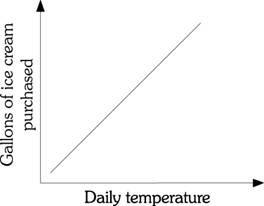
Figure 1.1
1) Refer to Figure 1.1. There is ________ relationship between the daily temperature and the number of gallons of ice cream purchased.
A) a negative
B) a positive
C) both a negative and a positive
D) an inverse
Answer: B
Diff: 2
Topic: Appendix: How to Read and Understand Graphs
Status: 13e question
Learning Outcome: Micro-2
2) Refer to Figure 1.1. The relationship between the daily temperature and the number of gallons of ice cream purchased demonstrates
A) an infinite slope.
B) a negative slope.
C) a positive slope.
D) a zero slope.
Answer: C
Diff: 2
Topic: Appendix: How to Read and Understand Graphs
Status: 13e question
Learning Outcome: Micro-2
Refer to the information provided in Figure 1.2 below to answer the question(s) that follow.
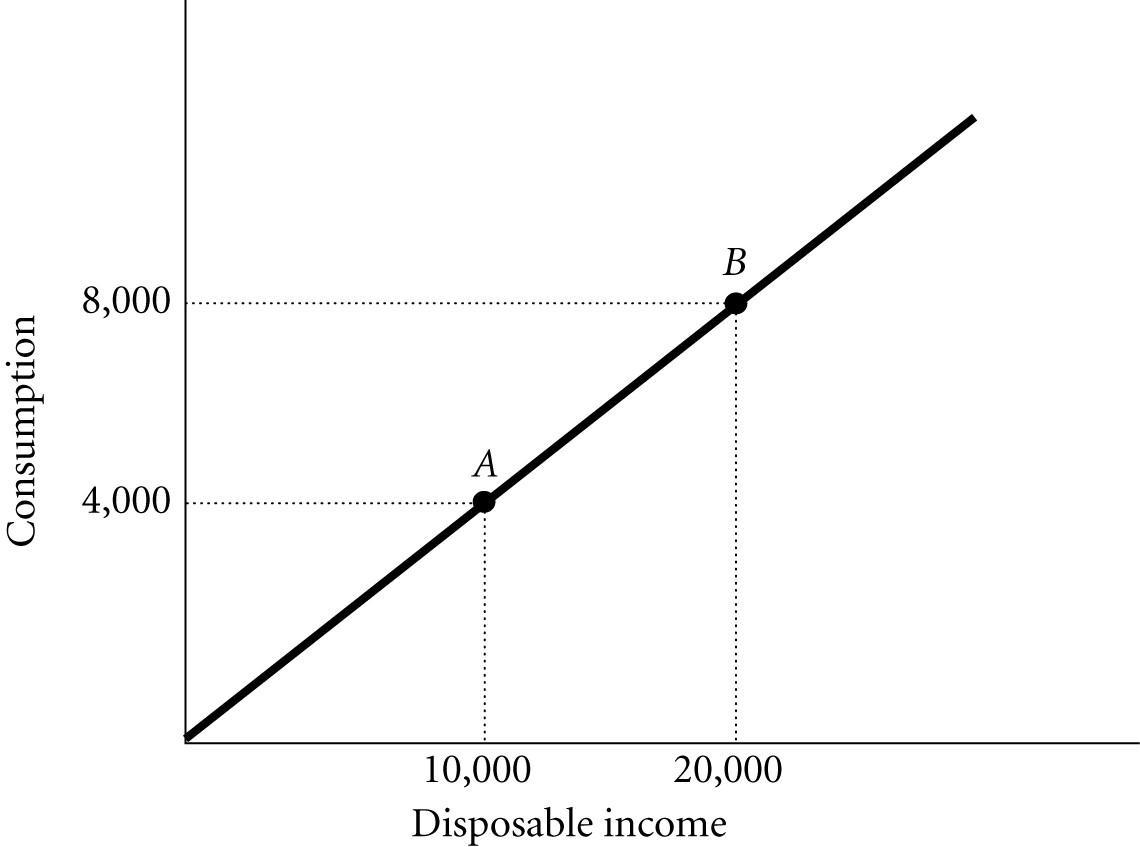
1.2
3) Refer to Figure 1.2. The slope of the line between Points A and B is
A) 0.4.
B) 1.2.
C) 2.5.
D) indeterminate from this information.
Answer: A
Diff: 2
Topic: Appendix: How to Read and Understand Graphs
Status: 13e question
Learning Outcome: Micro-2
4) If the slope of a straight line is -3. and if Y (the variable on the vertical axis) decreases by 6, then X (the variable on the horizontal axis) will
A) increase by 2.
B) decrease by 2.
C) increase by 18.
D) decrease by 18.
Answer: A
Diff: 2
Topic: Appendix: How to Read and Understand Graphs
Status: 13e question
Learning Outcome: Micro-2
Refer to the information provided in Figure 1.3 below to answer the question(s) that follow.
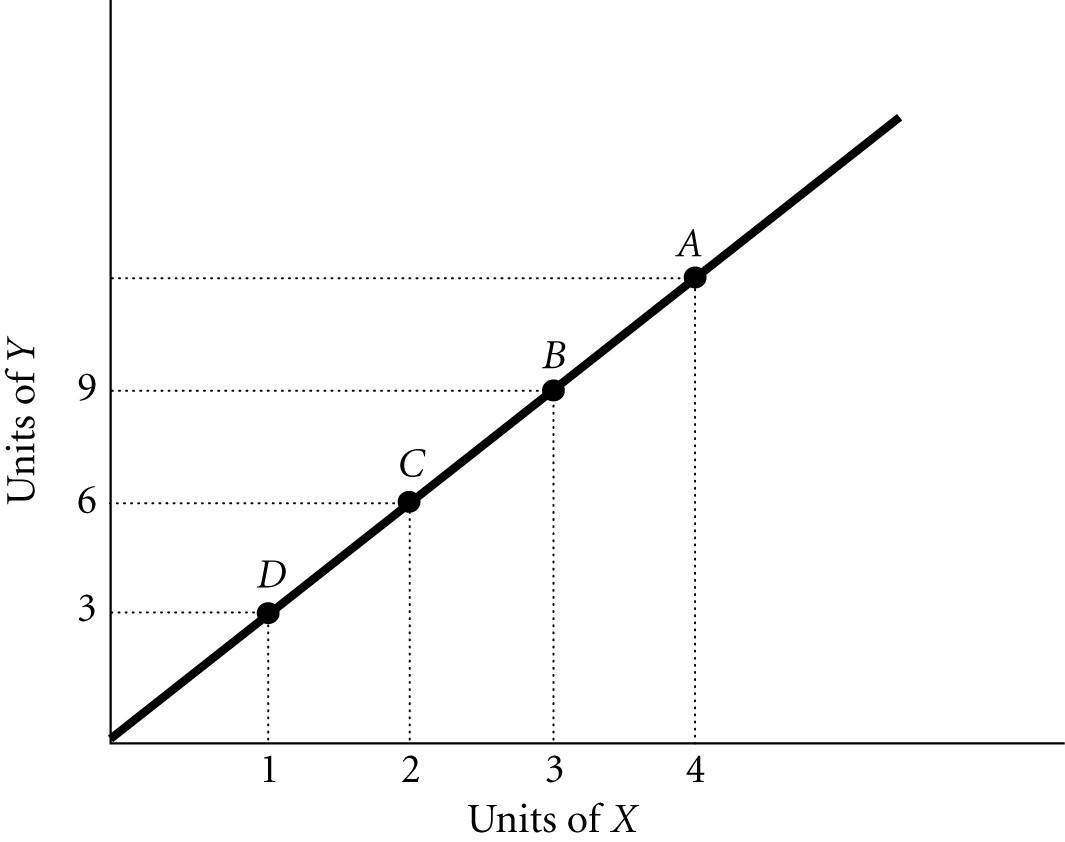
5) Refer to Figure 1.3. The slope of the line is A) positive.
B) negative.
C) increasing at an increasing rate.
D) decreasing at an increasing rate. Answer: A
Diff: 2
Topic: Appendix: How to Read and Understand Graphs Status: 13e question
Learning Outcome: Micro-2
6) Refer to Figure 1.3. The slope of the line between Points B and D is A) -3.
B) -0.33.
C) 0.33.
D) 3.
Answer: D
Diff: 2
Topic: Appendix: How to Read and Understand Graphs Status: 13e question
Learning Outcome: Micro-2
7) Refer to Figure 1.3. The slope of the line between Points D and C is A) -3.
B) -0.33.
C) 0.33.
D) 3.
Answer: D
Diff: 2
Topic: Appendix: How to Read and Understand Graphs Status: 13e question
Learning Outcome: Micro-2
8) Refer to Figure 1.3. If a 45-degree line were also graphed, the existing line shown on the graph would ________ it.
A) lie above
B) lie below
C) cross
D) The answer is indeterminate from this information
Answer: A
Diff: 3
Topic: Appendix: How to Read and Understand Graphs
Status: 13e question
Learning Outcome: Micro-2
9) Refer to Figure 1.3. At Point A, what is the value of Y?
A) 10
B) 12
C) 15
D) indeterminate from this information
Answer: B
Diff: 2
Topic: Appendix: How to Read and Understand Graphs
Status: 13e question
Learning Outcome: Micro-2
10) Refer to Figure 1.3. At Point A the slope of the line is 3, so at Point D the slope would be A) greater than 3.
B) less than 3.
C) equal to 3.
D) indeterminate from this information.
Answer: C
Diff: 2
Topic: Appendix: How to Read and Understand Graphs Status: 13e question
Learning Outcome: Micro-2
Refer to the information provided in Figure 1.4 below to answer the question(s) that follow.
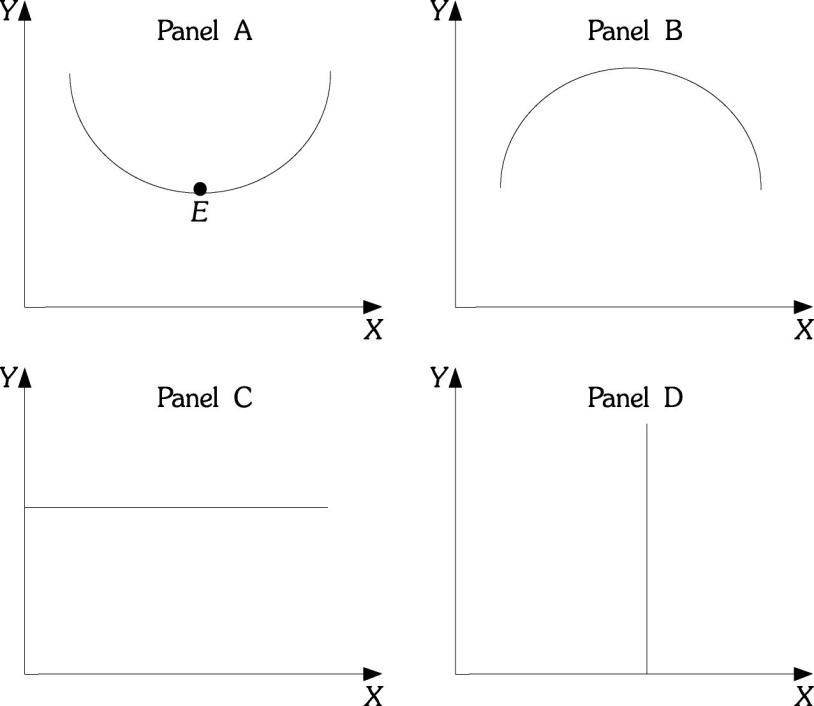
1.4
11) Refer to Figure 1.4. Which of the Panels shows a curve or line that has a slope that is first positive and then negative?
A) A
B) B
C) C
D) D
Answer: B
Diff: 2
Topic: Appendix: How to Read and Understand Graphs
Status: 13e question
Learning Outcome: Micro-2
12) Refer to Figure 1.4. Which of the Panels shows a curve or line that has a slope that is negative and then positive?
A) A
B) B
C) C D) D
Answer: A
Diff: 2
Topic: Appendix: How to Read and Understand Graphs
Status: 13e question
Learning Outcome: Micro-2
13) Refer to Figure 1.4. Which of the Panels shows a curve or line that has a zero slope throughout?
A) A
B) B
C) C
D) D
Answer: C
Diff: 2
Topic: Appendix: How to Read and Understand Graphs Status: 13e question
Learning Outcome: Micro-2
14) Refer to Figure 1.4. Which of the Panels shows a curve or line that has an infinite slope throughout?
A) A
B) B
C) C
D) D
Answer: D
Diff: 2
Topic: Appendix: How to Read and Understand Graphs
Status: 13e question
Learning Outcome: Micro-2
15) Refer to Figure 1.4. At Point E in Panel A, the slope is A) zero.
B) infinite.
C) negative.
D) indeterminate from this information.
Answer: A
Diff: 2
Topic: Appendix: How to Read and Understand Graphs
Status: 13e question
Learning Outcome: Micro-2
16) Refer to Figure 1.4. Panel A shows a curve which has a slope that is A) first positive, then zero, and then negative.
B) first negative, then zero, and then positive.
C) infinite throughout.
D) zero throughout.
Answer: B
Diff: 2
Topic: Appendix: How to Read and Understand Graphs
Status: 13e question
Learning Outcome: Micro-2
17) Refer to Figure 1.4. Panel B shows a curve which has a slope that is A) first positive and then negative.
B) first negative and then positive.
C) infinite throughout.
D) zero throughout.
Answer: A
Diff: 2
Topic: Appendix: How to Read and Understand Graphs Status: 13e question
Learning Outcome: Micro-2
18) Refer to Figure 1.4. Panel C shows a curve which has a slope that is A) first positive and then negative.
B) first negative and then positive.
C) infinite throughout.
D) zero throughout.
Answer: D
Diff: 2
Topic: Appendix: How to Read and Understand Graphs
Status: 13e question
Learning Outcome: Micro-2
19) Refer to Figure 1.4. Panel D shows a curve which has a slope that is A) first positive and then negative.
B) first negative and then positive.
C) infinite throughout.
D) zero throughout.
Answer: C
Diff: 2
Topic: Appendix: How to Read and Understand Graphs
Status: 13e question
Learning Outcome: Micro-2
20) The slope of a non-linear curve
A) is always positive.
B) must first increase then decrease.
C) is not constant.
D) is constant.
Answer: C
Diff: 1
Topic: Appendix: How to Read and Understand Graphs Status: 13e question
Learning Outcome: Micro-2
21) The slope of a horizontal line is A) negative.
B) zero.
C) continually changing.
D) infinite.
Answer: B
Diff: 1
Topic: Appendix: How to Read and Understand Graphs
Status: 13e question
Learning Outcome: Micro-2
22) If the slope of a straight line is 4 and if X (the variable on the horizontal axis) increases by 12, then Y (the variable on the vertical axis) will A) decrease by 3.
B) decrease by 0.33.
C) increase by 3.
D) increase by 48.
Answer: D
Diff: 2
Topic: Appendix: How to Read and Understand Graphs
Status: 13e question
Learning Outcome: Micro-2
23) If the slope of a straight line is 4 and if Y (the variable on the vertical axis) decreases by 20, then X (the variable on the horizontal axis)
A) increases by 5.
B) decreases by 5.
C) increases by 80.
D) decreases by 80.
Answer: B
Diff: 2
Topic: Appendix: How to Read and Understand Graphs
Status: 13e question
Learning Outcome: Micro-2
24) The slope of a vertical line is A) zero.
B) infinite.
C) continually changing.
D) negative.
Answer: B
Diff: 1
Topic: Appendix: How to Read and Understand Graphs
Status: 13e question
Learning Outcome: Micro-2
Refer to the information provided in Figure 1.5 below to answer the question(s) that follow.
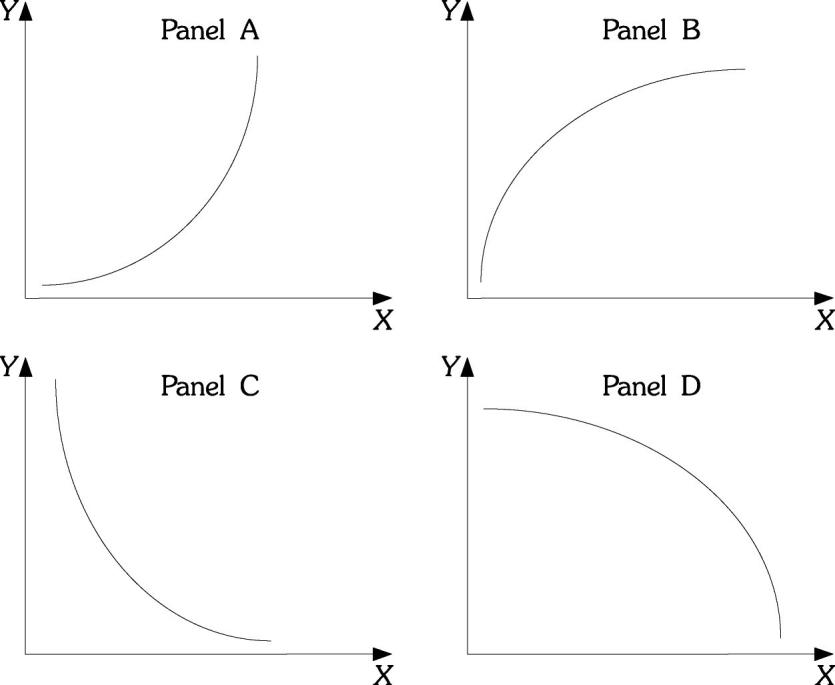
1.5
25) Refer to Figure 1.5. Which of the Panels shows a curve or line that has a slope that is positive and decreasing?
A) A
B) B
C) C
D) D Answer: B
Diff: 2
Topic: Appendix: How to Read and Understand Graphs
Status: 13e question
Learning Outcome: Micro-2
26) Refer to Figure 1.5. Which of the Panels shows a curve or line that has a slope that is positive and increasing?
A) A
B) B
C) C D) D Answer: A
Diff: 2
Topic: Appendix: How to Read and Understand Graphs
Status: 13e question
Learning Outcome: Micro-2
27) Refer to Figure 1.5. As income increases, consumption increases, but for each additional increase in income, consumption increases by a larger and larger amount. If consumption is graphed on the vertical axis and income is graphed on the horizontal axis, the relationship between consumption and income would look like which of the following Panels?
A) A
B) B
C) C
D) D
Answer: A
Diff: 2
Topic: Appendix: How to Read and Understand Graphs
Status: 13e question
Learning Outcome: Micro-2
28) Refer to Figure 1.5. In many industries, as firms produce additional units, average costs of production decline as the firm produces an additional unit, but average costs declines by a smaller and smaller amount as production continues to increase. If output is graphed on the horizontal axis and average costs are graphed on the vertical axis, the relationship between average costs and output would be like which of the following Panels?
A) A
B) B
C) C
D) D
Answer: C
Diff: 2
Topic: Appendix: How to Read and Understand Graphs
Status: 13e question
Learning Outcome: Micro-2
29) Refer to Figure 1.5. Panel A shows a curve with a slope that is A) positive and increasing.
B) positive and decreasing.
C) negative and increasing.
D) negative and decreasing.
Answer: A
Diff: 2
Topic: Appendix: How to Read and Understand Graphs
Status: 13e question
Learning Outcome: Micro-2
30) Refer to Figure 1.5. Panel B shows a curve with a slope that is
A) positive and increasing.
B) positive and decreasing.
C) negative and increasing.
D) negative and decreasing.
Answer: B
Diff: 2
Topic: Appendix: How to Read and Understand Graphs Status: 13e question
Learning Outcome: Micro-2
31) Refer to Figure 1.5. As income decreases, consumption decreases by a decreasing amount. If consumption is graphed on the vertical axis and income is graphed on the horizontal axis, the relationship between consumption and income would look like which of the following Panels?
A) A
B) B
C) C
D) D
Answer: B
Diff: 2
Topic: Appendix: How to Read and Understand Graphs Status: 13e question
Learning Outcome: Micro-2
32) Refer to Figure 1.5. As firms produce additional units, average costs declines by a smaller and smaller amount. If output is graphed on the horizontal axis and average costs are graphed on the vertical axis, the relationship between average costs and output would be like which of the following Panels?
A) A
B) B
C) C
D) D
Answer: D
Diff: 2
Topic: Appendix: How to Read and Understand Graphs Status: 13e question
Learning Outcome: Micro-2
33) If the slope of a straight line is -2. and if X (the variable on the horizontal axis) decreases by 8, then Y (the variable on the vertical axis) will
A) increase by 4.
B) decrease by 4.
C) increase by 16.
D) decrease by 16.
Answer: C
Diff: 2
Topic: Appendix: How to Read and Understand Graphs Status: 13e question
Learning Outcome: Micro-2
Refer to the information provided in Figure 1.6 below to answer the question(s) that follow.
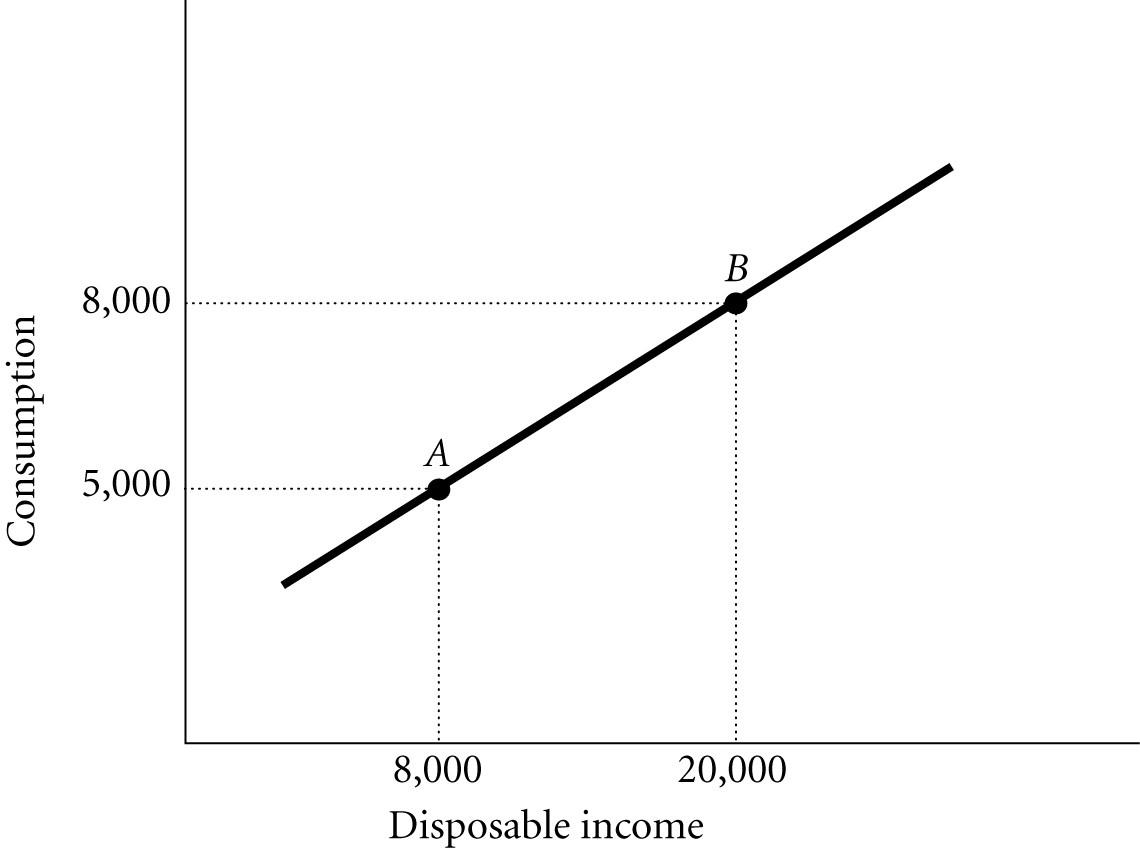
1.6
34) Refer to Figure 1.6. The slope of the line between Points A and B is A) positive and increasing.
B) positive and constant.
C) negative and decreasing.
D) negative and constant.
Answer: B
Diff: 2
Topic: Appendix: How to Read and Understand Graphs
Status: 13e question
Learning Outcome: Micro-2
35) Refer to Figure 1.6. The slope of the line between Points A and B is A) 0.25.
B) 4. C) -0.25.
D) -4.
Answer: A
Diff: 2
Topic: Appendix: How to Read and Understand Graphs
Status: 13e question
Learning Outcome: Micro-2
Refer to the information provided in Figure 1.7 below to answer the question(s) that follow.
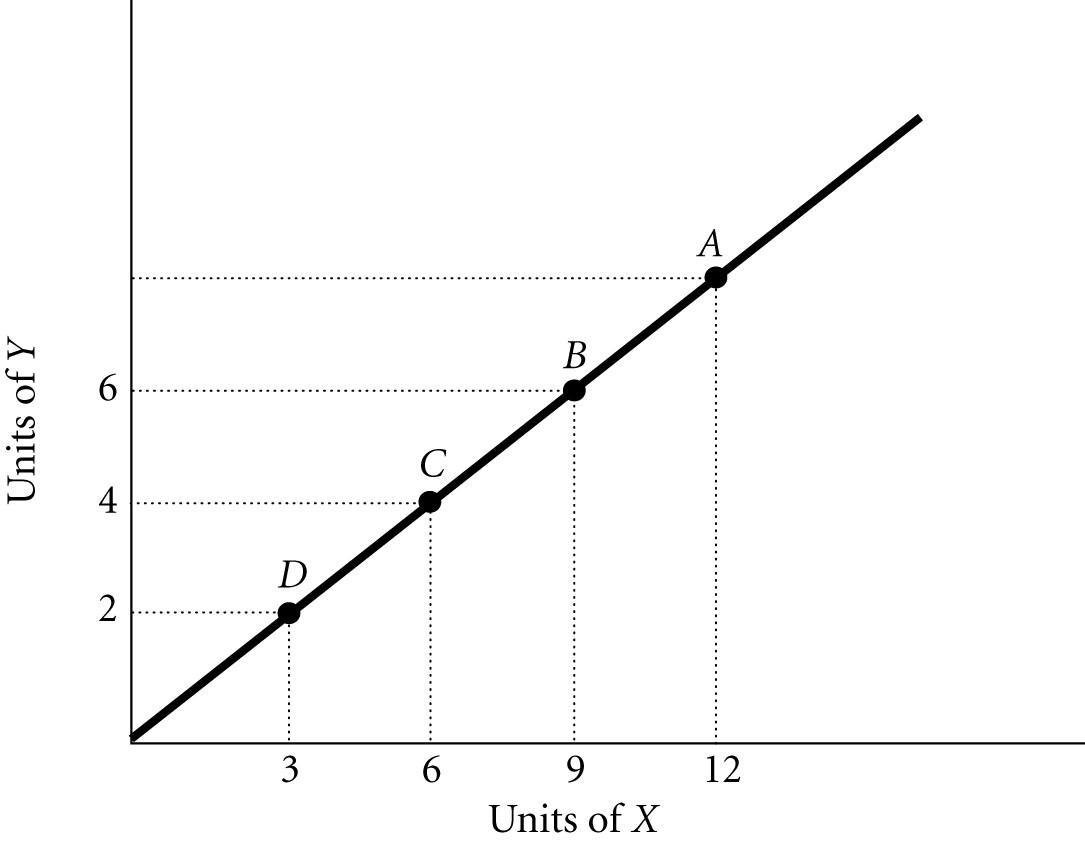
1.7
36) Refer to Figure 1.7. The slope of the line is A) negative.
B) increasing at a decreasing rate.
C) decreasing at an increasing rate.
D) positive.
Answer: D
Diff: 2
Topic: Appendix: How to Read and Understand Graphs Status: 13e question
Learning Outcome: Micro-2
37) Refer to Figure 1.7. The slope of the line between Points D and B is A) 1.5.
B) 0.67.
C) -0.67.
D) -1.5.
Answer: B
Diff: 2
Topic: Appendix: How to Read and Understand Graphs
Status: 13e question
Learning Outcome: Micro-2
38) Refer to Figure 1.7. The slope of the line between Points A and B is A) 1.5.
B) 0.67.
C) -0.67.
D) -1.5.
Answer: B
Diff: 2
Topic: Appendix: How to Read and Understand Graphs Status: 13e question
Learning Outcome: Micro-2
39) Refer to Figure 1.7. If a 45-degree line were also graphed, it would ________ the line shown on the graph.
A) lie above B) lie below
C) cross
D) The answer is indeterminate from this information.
Answer: A
Diff: 3
Topic: Appendix: How to Read and Understand Graphs Status: 13e question
Learning Outcome: Micro-2
40) Refer to Figure 1.7. At Point A, what is the value of Y?
A) 2
B) 4
C) 6
D) 8
Answer: D
Diff: 2
Topic: Appendix: How to Read and Understand Graphs Status: 13e question
Learning Outcome: Micro-2
41) Refer to Figure 1.7. At Point A the slope of the line is 0.67, so at Point C the slope would be A) greater than 0.67.
B) less than 0.67.
C) equal to 0.67.
D) indeterminate from this information.
Answer: C
Diff: 2
Topic: Appendix: How to Read and Understand Graphs Status: 13e question
Learning Outcome: Micro-2
42) The slope of a straight line
A) is always positive. B) must first increase then decrease. C) is not constant. D) is constant.
Answer: D
Diff: 1
Topic: Appendix: How to Read and Understand Graphs
Status: 13e question
Learning Outcome: Micro-2
43) If the slope of a straight line is 5 and if X (the variable on the horizontal axis) increases by 4, then Y (the variable on the vertical axis) will
A) decrease by 0.8. B) decrease by 20.
C) increase by 0.8.
D) increase by 20.
Answer: D
Diff: 2
Topic: Appendix: How to Read and Understand Graphs
Status: 13e question
Learning Outcome: Micro-2
44) If the slope of a straight line is 6 and if Y (the variable on the vertical axis) decreases by 60, then X (the variable on the horizontal axis)
A) increases by 10. B) decreases by 10.
C) increases by 600.
D) decreases by 600.
Answer: B
Diff: 2
Topic: Appendix: How to Read and Understand Graphs
Status: 13e question
Learning Outcome: Micro-2