Test Bank for Managing Business Ethics 2nd Edition by Fugate
ISBN: 9781071941201
Instructor’s Manual
Fugate, Managing Business Ethics: And Your Career, 2e SAGE Publishing, 2025
ISBN: 9781071941201
Instructor’s Manual
Fugate, Managing Business Ethics: And Your Career, 2e SAGE Publishing, 2025
Opening Remarks and Suggestions
This Instructor’s Manual (IM) offers discussion guides, answers, and suggestion for inchapter box features, videos, ethical dilemmas, and job/career specific applications for students. But before outlining these particular details, I describe the overarching objectives of the book, as well as a few suggestions pertaining to things I’ve found useful when teaching this topic and with this book.
• This book and accompanying materials are designed to be interesting, timely, relevant, and engaging for students. The content and design are also intended to fit multiple teaching styles for instructors and diverse learning styles for students. For example, the book fits a flipped classroom approach, wherein students read and prepare on their own (outside of class or asynchronously for online courses), and then come to class, either face-to-face or synchronously online.
• I generally structure my business ethics courses one chapter per week, and for courses that meet twice a week, it can be helpful to work through in chapter box features, such as Where Do You Stand? and Ethics in Action features during the first session if meeting twice a week, or in the first portion for courses that meet once per week. Suggestions and example answers for these features are explained in this IM and are intended to be “plug and play” (i.e., the work is done for you). The second day of the week is often used for the chapter ending case, the associated discussion questions, and application of the 3-Dimensional Problem Solving for Ethics (3D PSE). Either day can be augmented with additional exercises and elements provided in this IM (e.g., videos, ethical dilemmas, and career applications).
Instructor’s Manual
Fugate, Managing Business Ethics: And Your Career, 2e SAGE Publishing, 2025
• Hybrid courses, either a mix of online and face-to-face or asynchronous and synchronous, can be structured the same way. Students can read and work through the in-text box features in the asynchronous portion, and then the case, discussions, and other activities can be used in the synchronous portion of the course.
• Of course, you can utilize the chapters that best suit your teaching style and objectives, but understand that the book was designed and written to be worked through chronologically. To elaborate, the book is organized into four sections and the first introduces some common language and foundational concepts, such as making the case for business ethics, common ethical decision-making perspectives, stakeholders, and the stakeholder approach. This foundation is broadened and deepened with a description of social responsibility and sustainability. These concepts are introduced early as students already use these terms, of incorrectly, and it is helpful to clarify such concepts at the beginning.
• BE SURE TO NOTICE AND USE THE CAREER-RELATED CONTENT IN THE BOOK AND THE IM! CHAPTER 1 IS ESPECIALLY GOOD.
Make the most of this book and your course… and have fun doing it!
Mel Fugate
I use the following text as a brief introduction to the course (e.g., in the syllabus, course catalog, emails, LMS announcements).
The overarching purpose of this course is to equip students with the knowledge and tools to effectively navigate the ethical challenges confronted throughout their careers. Achieving this purpose is critically important as ethical conduct, and lapses, can make or break an individual’s opportunities in a particular job and/or larger career.
My intent as the instructor (and author) is not to tell students what is right or wrong, but instead present them with applicable knowledge and skills to assist their own decision
Instructor’s Manual
Fugate, Managing Business Ethics: And Your Career, 2e SAGE Publishing, 2025 making and conduct. Put differently, the intent is to prepare students to make better choices even in the most difficult circumstances.
LO1-1: Describe why ethics are important to business
LO1-2: Explain key elements of the future of work and business ethics
LO1-3: Summarize how ethics can affect your job, career, and role in society
LO1-4: Articulate common ethical decision-making perspectives
LO1-5: Articulate how to use 3-Dimensional Problem Solving for Ethics to improve your ethical performance
Multimedia Videos, Podcasts, and Voice-Over PowerPoint
Stakeholders
Congress questioning Zuckerberg re: Dilemma Censoring Content Republican Senator GRILLS Zuckerberg on Facebook, Google, and Twitter collaboration - YouTube
**Potential Video Case for Ethical Challenges/Dilemmas facing social media
Simple examples and distinctions Shareholders and Stakeholders Compared in One Minute: Definition/Meaning, Explanation and Examples - YouTube
Prof. Freeman describing a positive and contemporary view of stakeholder approach What is the stakeholder theory? by R. Edward Freeman | ESSEC Classes - YouTube
Trust
Forbes interviews Stephen Covey on Trust - YouTube
Building trust | James Davis | TEDxUSU - YouTube
The Value of Trust | Professor Dan Ariely | TEDxEast - YouTube
Ethical/Moral Dilemmas
Examples 6 Hardest ‘Would You Rather’ Dilemmas Ever - YouTube
**Excellent classic examples in video format for in-class exercise
Instructor’s Manual
Fugate, Managing Business Ethics: And Your Career, 2e SAGE Publishing, 2025
Common/Generic Examples from Work Workplace Ethics Scenarios -- Ethics Video |
DuPont Sustainable Solutions - YouTube
Speaker describes multiple examples The Importance of Business Ethics - YouTube
Example from Grey’s Anatomy ethical dilemma ga1 - YouTube
Example from The Office The Office - Business Ethics (Episode Highlight) - YouTube
I typically open the course with the following exercise, whereas subsequent chapters are opened with the “Where Do You Stand?” feature and discussion.
OPENING DISCUSSION. Are You Ethical and How Do You Know?
The purpose of these questions is to get students to THINK about ethics, and to think about them personally. It also challenges the fact that few or no people, even those that commit horrible crimes or perpetrate unethical conduct over time, admit to being unethical.
How can you prove it?
This prompts students to begin thinking about what ethical behavior “looks like.”
In what situations do ethics matter most?
When other people must trust you because the consequences are potentially great, such as doctors, financial advisors, pilots, first responders, and your boss.
In what situations do ethics matter most in your life?
Expect students to say:
• Job interviews
• Starting a new job
• Working in teams at school or work
Fugate, Managing Business Ethics: And Your Career, 2e SAGE Publishing, 2025
1. As a customer, which do you think is the right thing to do refund or credit for a cancelled flight? Justify your position.
2. What about refunds for delayed flights? If you think refunds for delays are appropriate, then be sure to specify the details. Whether you are for or against, be sure to justify.
3. Assume you are an airline executive, which do you think is the right thing to do? Justify your choice.
4. Again, assume you are an airline CEO, argue the opposite choice to your response to #3.
5. Now, assume that Congress passes a law requiring refunds in some fashion; how does your answer to #3 change?
Customer perspective. One argument is that customers did not receive the service they paid for, and airlines should return their money as a full refund. Moreover, a credit may not have any value, if what I was flying for will not happen in the future (e.g., a particular meeting, one-time vacation with friends, or wedding that was done later with just the couple). Many customers are also (small) business owners, and they cannot spend “airline” credits on more pressing needs (other expenses), especially if air travel is delayed for many months.
Airlines’ perspective. They are already struggling and have no cash coming in, due to the slowdown in business. Therefore, it is entirely possible they do not have the money to refund all of the booked flights. Undoubtedly, some of that money has already been spent. It therefore just isn’t feasible to return money they do not have, and providing credit for future flights is a more predictable, if not sustainable, approach.
Fugate, Managing Business Ethics: And Your Career, 2e SAGE Publishing, 2025
The dilemmas included in the IM are intended to be used either as in-class exercises or homework assignments. It also is effective to have students first complete them individually, and then pair up with a classmate to share, compare, and refine their respective responses into one “best” version.
Consistent with the content on ethical dilemmas presented in Chapter 1, ethical dilemmas are situations in which a both choices in a decision have ethical implications. It is recommended you have students follow the format presented in Chapter 1, wherein they are presented with a scenario and must (1) determine the two choices or options involved in the decision, (2) describe the ethical challenge associated with each choice/option, and (3) make and defend their decision. Be sure to remind students that not all tough decisions are dilemmas, and not all dilemmas are ethical dilemmas unless both options involve ethical challenges.
Use the following scenario as an exercise.
Scenario: Morgan is a financial analyst, who is directed by the regional VP to collect information and complete some analyses to help her determine which employees in their office will be downsized. The VP will then deliver the news to the employees; Morgan is expected to say or share nothing with her colleagues. Importantly, Morgan has worked in this office for 10 years, and many of the employees are not only coworkers but also close friends. She has worked with many since she started, routinely works on the projects with them, and in some cases their families socialize and vacation together.
Morgan is confronted with a dilemma comprised of two options:
1. Tell her coworkers
2. Not tell her coworkers
For each instance, ask students to identify the action and the associated ethical challenge.
Morgan is confronted with a dilemma comprised of two options:
Fugate, Managing Business Ethics: And Your Career, 2e SAGE Publishing, 2025
1. Tell her coworkers (action) which may violate expectations of and loyalty to her boss (ethical challenge).
2. Not tell her coworkers (action) violate the trust of her coworkers and friends (ethical challenge).
TV Test
Warren Buffett, a legendary investor and one of the world’s richest people, explains that ethics, trust, and morals are critical elements of being successful in business. These elements can either make or break your reputation, which he said is something he cannot afford to lose. This is quite a challenge for Buffett who is the face of Berkshire Hathaway which has over 350,000 employees. When confronted with uncertain situations or decisions, he tells his managers to ask and answer the following question: “How would you feel about the details of this situation and your conduct to be written up in the local newspaper for all to see and read?”
Of course, this can include any widely read media outlets online, print, or an interview on the evening news. Scores of students over many years have roleplayed a modified version of this tool with great success. Specifically, imagine that immediately after you make a decision at school or work that you feel enters the gray zone not clearly right, not clearly wrong and a reporter shows up and sticks a microphone and camera in your face, and then asks you to explain yourself. The stakes are raised further if you also assume that the interview (or article) will be seen by family, friends, your kids, parents, and your coworkers (current and past).
Bottom line: If the decision passes this test, meaning you’d be willing to do the interview or have the article/post read, then do it. But anything close to the ethical line should not be done. Buffett says, he uses this to guide his own decision making and conduct and encourages managers to do the same.
For Discussion:
Instructor’s Manual
Fugate, Managing Business Ethics: And Your Career, 2e SAGE Publishing, 2025
1. Think of a tough call you’ve had to make. If you were required to do the interview the TV Test would you have changed your decision or behavior? Explain why or why not.
2. Think of an example or situation where you think someone approached or crossed the line. Imagine you stuck a microphone and camera in their face asking for an explanation. What do you think they would say?
Business Ethics and Your Career
Fostering and Protecting Trust
Nan Russell has written multiple articles in Psychology Today related to trust at work. published an excellent article addressing trust, ethics, and legal v. ethical conduct at work. The article efficiently covers multiple concepts covered in Chapter 1, and thus can serve as supplemental reading. For instance, it also poses a series of questions similar to the TV Test introduced in Chapter 1 and could be used for class discussion. Students can be asked to generate examples of how they might apply the content of the article in the context of their current jobs, for those that are working, in interviews, or in future jobs.
Ethics and Trust at Work | Psychology Today
One of her articles also explains how words, one’s own as well as those of colleagues, can be quite insightful regarding the trustworthiness of individuals, teams, and if you dare, yourself.
What Do Your Words Broadcast About Trust? | Psychology Today
Building Trust and Confidence During an Interview:
o How to Build Trust with Your Interviewer on Your Next Job Interview - YouTube
o #4 - How to Build Rapport at Your Interview - YouTube
o Examples of Ethics and How to in an Interview Ethical Dilemmas in The Workplace: The Ethics Guy on ABC News - YouTube
o “Tell Me About Yourself” How to Answer: Tell Me About Yourself - YouTube
Fugate, Managing Business Ethics: And Your Career, 2e SAGE Publishing, 2025
As explained in this chapter, there is no value in asking someone if they are ethical. Even life-long scoundrels and the most despicable people you’ll ever work with say “yes.” Therefore, the challenge in interviews is to get candidates to discuss actual situations and how they have or would handle them. The intent of this is to reveal their ethical compass and character. The following are a few helpful questions to ask if you’re the interviewer and to be prepared to answer if you’re the candidate:
1. How would you describe an ethical workplace?
2. How do you define honesty and accountability at work?
3. Tell me about an ethical challenge you have faced?
4. Assuming you looked at our webpage, what element(s) made an impression on you and why?
5. I assume you’ve worked with people from different cultures, even if only in college classes. What values and ethics did you find similar and different?
6. If (or when) you have ethical concerns at work, who will you consult? Describe.
7. How would you describe an ethical employee?
8. How would you describe an ethical employer?
For Discussion:
1. As an interviewer, what are two questions you would ask to help assess a candidate’s ethicality?
2. As a job candidate, pick two questions that would make you the most uncomfortable if asked during an interview?
Fugate, Managing Business Ethics: And Your Career, 2e SAGE Publishing, 2025
During normal times, many clinicians in the developed world simply treat patients on a firstcome-first-serve basis, and this works well for both the parties when resources meet patient demand. This, however, is not always the case, and few if any ethical dilemmas are more difficult than those faced by medical professionals who must ration care because patient needs outstrip the resources available to treat them.
Some clinicians are confronted with rationing routinely, such as transplant surgeons who have over 6000 patients die each year (nearly 17 per day) in the United States awaiting donor organs that either go to another patient or aren’t available in the first place. The Centers for Disease Control and Prevention (CDC) also ration the use of various medications, as it did in the fall of 2023 with vaccinations for the pulmonary infection RSV. A shortage required the agency to recommend providing the medication only to infants at risk due to other health conditions, rather than to all infants. As another example, supply shortages of Adderall for treating ADHD required rationing. Some patients reduced and/or skipped doses while waiting for pharmacies to replenish supplies and fill prescriptions.
Even though common, rationing care conflicts with the Hippocratic Oath and provides a fundamental conflict for physicians. The Oath, taken by virtually 100% of U.S. medical school graduates, sets a universal care standard and requires physicians to apply all measures required to appropriately treat a patient, view all patients equally, while not playing God.
Despite such standards, crisis situations on the battlefield or mass casualties due to accidents or natural disasters also require doctors to triage patients and treat them not simply in terms of severity of injuries and needs, but also the likelihood of survival.
The coronavirus pandemic was the direst medical crisis in modern history and made rationing medical resources necessary and frequent in many places where it was otherwise rare. Northern Italy, for instance, was hit especially hard, overwhelming all medical resources and requiring physicians to deny treatment based on age. One doctor stated the
Instructor’s Manual
Fugate, Managing Business Ethics: And Your Career, 2e SAGE Publishing, 2025
situation very plainly: “There is no way to find an exception… We have to decide who must die and whom we shall keep alive.”
This problem for clinicians is further complicated by the fact that no two patients are the same, their conditions can and do deteriorate rapidly, and multiple patients are being treated simultaneously, not to mention the enormous stress experienced by everyone involved. In such circumstances it is difficult for any single doctor to ensure their own decisions are consistent, which means it is significantly more difficult to ensure consistency for a hospital’s entire medical staff.
To deal with such extreme situations, such as a crushing pandemic, the American Medical Association’s Code of Ethics includes “crisis standards of care,” which allows doctors to make treatment decisions based on serving the greatest good for the greatest number, rather than maximizing the benefit to any individual patient.
Hospitals, in Italy and elsewhere, did and do try to help by providing criteria to help guide such decisions. Among the goals of such guidelines are to facilitate appropriate and consistent care by alleviating the need for doctors to make such difficult decisions on the fly, at the bedside, all day, and day after day.
Some of the criteria suggested are:
1. Who has the greatest chance of survival?
2. If survival chances are more or less equal, then treat the patient with the greatest longterm benefit. Younger people, for instance, have more of their lives ahead of them and potentially have more to contribute to society.
3. Another criterion to consider is a given patient’s impact on treating others. This means that medical workers and other first responders would be treated if all other factors were equal.
To clarify, these are intended simply as guidelines or factors to consider, rather than a protocol etched in stone. Moreover, true cultural differences exist. Americans, for instance, are not as likely to accept rationing of any sort, especially when a loved one is critically ill, whereas Europeans some say would be more amenable.
Instructor’s Manual
Fugate, Managing Business Ethics: And Your Career, 2e SAGE Publishing, 2025
Now let’s see what you would do.
Consider a scenario involving three gravely ill patients: (1) a 14-year-old boy with Type1 diabetes, (2) a 27-year-old mother, and (3) an 80-year-old grandfather. Also assume you’re their treating physician and suspect there is a high probability each will die without a ventilator, but you have only one.
For Discussion:
1. To whom would you give the ventilator? Answer this question before moving on to #2.
• More students than not select the 27-year-old mother
• Few-to-no students select the teenager and fewer still the grandfather.
• Other students have said, first come, first served.
2. On what basis did you make your decision? First come, first served? The one with the greatest chance of surviving? The one with the most people depending on him or her? If their chances are the same, do you give it to the youngest? Explain.
• 27-year-old mother, as she has the largest impact on society certainly in the near term, if not also the long term: The current child and ability to rear more children and their subsequent impact on society multiplies.
• Regarding the grandfather, some students have said, “we can assume he’s had a long and full life.”
3. What ethical decision-making approaches are reflected in your choice?
• The justification for the mother is utilitarian, greatest good for the greatest number.
• First come, first served is a deontological approach a policy or belief that people should not “cut the line.”
4. Describe any contextual factors that influenced your choice.
Fugate, Managing Business Ethics: And Your Career, 2e SAGE Publishing, 2025
5. Identify the relevant stakeholders in your choice and explain how each potentially affected your decision and/or how each would be affected by your decision.
Apply the Three-Dimensional Problem-Solving for Ethics (3D PSE)
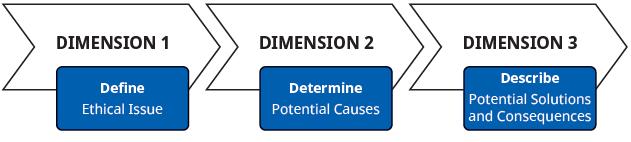
You can apply the 3D PSE from multiple perspectives in this case meatpacking executives and managers, health officials, politicians, employees, and other members of the communities. Just be sure to specify whose perspective. I, however, recommend analyzing the case as if you were an executive and decision-maker at one of the major meatpackers, as any actions that are taken (or not) involve them. Of course, it would also be appropriate and interesting to analyze the case from the perspective of an employee, especially given that their workplaces are rivaled only by aged care homes as hotbeds for the coronavirus.
In this case, as with all others, I recommend focusing on the process more than the actual choice, that means work through all 3 Dimensions for the problem students initially define (either individually or in teams). Rather than predetermining “the problem” and (re)directing the discussion toward it, this recommendation has multiple benefits:
1. Enables students to examine and learn the process as they work through it in class.
2. Builds student’s skill in working the process. The larger goal for the book and course is to build their ethical problem-solving skills, which occurs with practice over many cases and weeks. It therefore isn’t as important that students get the “right” answer on any particular case.
3. Provides multiple views to compare, contrast, and critique. This enables for a potentially richer class discussion and additional student learning, as they are
Instructor’s Manual
Fugate, Managing Business Ethics: And Your Career, 2e SAGE Publishing, 2025
exposed to the reasoning of other students, along with seeing how others applied the 3D PSE.
You can apply the 3D PSE from multiple perspectives, such as that of a treating physician, hospital administrator, or a gravely ill patient’s spouse. However, let’s try it from the perspective of a physician that is treating all three patients, in a hospital that is overwhelmed by the pandemic.
1: Define the Ethical Challenge
a. Gap. What is the gap in this case, from the perspective of the treating physician? What do they have and what do they want? (Describe in one or two sentences.)
From the doctor’s point of view, what is the current situation with the patients, and how do you think you would want it to be?
What do you want? To treat all patients to the best of your ability, which requires the necessary resources. Why? Because it is my responsibility as a physician. Why? This is consistent with my personal values, as well as motives for becoming a doctor. Moreover, the Hippocratic Oath requires me to do the same.
What do you have? Three critically ill patients who die without a vent, but I have only one.
b. Why? Why? Why? (Why × 3) Why is the current situation a problem, from the treating physician’s perspective Ask and answer the same question again why is it a problem two more times to refine your answer? Consider, for instance, what difficulties or undesirable behaviors and outcomes happen as a result of the problem defined?
o In this instance you are deciding who lives and who dies, which means you are at least indirectly responsible for the resulting consequences for all of these patients’ family and friends.
o As a physician, you have a duty to treat all patients to the best of your ability, and the lack of resources (e.g., ventilators) prevents you from doing this. This results in conflicts related to:
Fugate, Managing Business Ethics: And Your Career, 2e SAGE Publishing, 2025
▪ Personal values
▪ Professional norms (expectations by your profession)
▪ Norms of patients and the larger community/society (doctors must treat the sick to the best of their abilities)
Define the problem in one or two sentences: As a physician you have a duty to treat all patients to the best of your ability (what you want), but the limited resources prevent you from doing this which causes horrific outcomes for many people.
c. Stakeholders. Who are the key stakeholders relevant to the defined problem? Please list and explain how each affect or is affected by the problem you defined in “a.”
Then, label each as primary or secondary.
Primary: you the treating doctor, other caregivers for these patients, the three patients, their families, and close others
Secondary: close others besides family members, hospital administrators, other members of the communities in which patients live
Dimension 2: Determine the Causes
a. Individual Characteristics that Cause the Defined Problem. Given the problem you defined in Dimension 1a, how do characteristics of the doctor influence the problem, such as ethical decision-making approach (Chapter 1); level of social responsibility (Chapter 2); work values (Chapters 2 and 4); moral development, moral disengagement, or ethical blind spots (Chapter 3); and perhaps biases (Chapter 4)?
• Morals Treat all (patients) people equally (fairness)
• Personal and professional values help others, save lives, do no harm
• Emotions guilt, frustration, sadness
• Universalism Do no harm, treat all people to the best of your ability
Instructor’s Manual
Fugate, Managing Business Ethics: And Your Career, 2e SAGE Publishing, 2025
• Utilitarianism Rationing is necessary to do the greatest good for the greatest number (e.g., current patients, future patients, and larger society)
b. Contextual Factors that Cause the Defined Problem. Are there particular values, policies, practices, or norms that caused the problem (e.g., organizational culture, Chapters 8 and 10)? These may be for the hospital in which the doctor works, or norms of the profession, industry, or the country.
• Your hospital’s norms (policies and practices) provide appropriate and quality care, treat all patients, use resources appropriately
• Physician’s norms
• Hippocratic Oath (modern version) Medical Definition of Hippocratic Oath (medicinenet.com)
Dimension 3: Describe Your Potential Solutions and the Intended and Unintended Consequences for Stakeholders Make the business case by answering the following questions:
a. What do you recommend and how will you implement it? Describe with reasonable detail your action plan. (Note: This is where your knowledge and skills are demonstrated.)
b. Why do it this way? Consider, for instance, does this reflect a particular ethical decision-making approach (e.g., egoism, utilitarianism, universalism, relativism, or another)? Explain.
If your responses to these questions are unsatisfactory, then go back to Dimension 1 and repeat the process. If, however, you are comfortable and confident in your problem-solving efforts thus far, then ensure you achieve the desired outcomes and avoid any unintended consequences.
Test and Refine Your Recommendations:
c. What is the desired and likely effect in the short- and long-term for the key stakeholders involved in the problem and causes (Dimensions 1 and 2)?
Fugate, Managing Business Ethics: And Your Career, 2e SAGE Publishing, 2025
d. What potential unintended consequences may occur with your proposed solution?
e If any, what are the implications for other stakeholders (e.g., individuals, organizations, and communities), besides those noted in Dimensions 1 and 2?
f Will your solution work? Make a final assessment of whether your chosen solution will reduce or eliminate the causes determined in Dimension 2, and if this will then remedy the ethical problem defined in Dimension 1. If not, then repeat and refine the dimensions.