Is Your Electrostatic Precipitator - Principle and Applications
Do you live in a highly polluted environment? Do you crave fresh, clean air? Industries are part of our economy and so believe that if their factories cause smoke, there’s nothing anyone can do about it.
However, this is far from the truth. There’s a solution to this that technology has. It’s called the Electrostatic Precipitator (ESP). These machines play a great role in minimizing pollution and improving the environment.
What is an Electrostatic Precipitator? An Electrostatic Precipitator (ESP) is a device that filters out fine particles like dust and smoke from flowing gas. It is therefore an integral part of air pollution control and is used in thermal energy and steel factories.
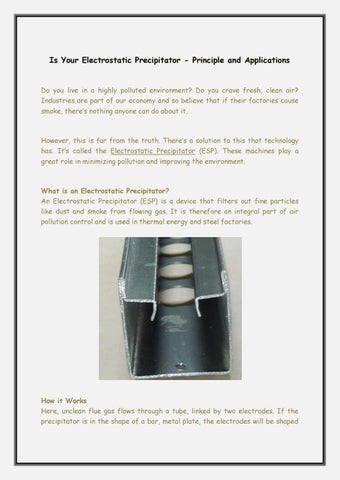
How it Works Here, unclean flue gas flows through a tube, linked by two electrodes. If the precipitator is in the shape of a bar, metal plate, the electrodes will be shaped
accordingly. While one of the plates is positively charged, the other is negatively charged. Dirt particles go past the one that’s negatively charged. As it moves along, it reaches the higher end of the pipe where the positive electrode is fitted. It consists of metal plates that are charged to a high voltage of 50,000–100,000 volts. According to the principle, unlike charges attract, so the negatively charged soot fine particles become attracted to the plates that are positively charged and adhere to them. Electrostatic Precipitator Applications An Electrostatic Precipitator has the following applications:
▪ ▪ ▪ ▪
It is an industrial application for smoke. The dry precipitators are used to collect dry fine particles like ash or cement. However, wet electrostatic precipitators help with removing wet particles like resin, tar, acid, and oil. They can also be used to eliminate any dust contained in flue gases in steam plants.
▪ ▪ ▪
If acid or oil mist needs to be removed in chemical plants or machine shops, electrostatic precipitators can do this. They can be used to sanitize the air in air conditioning systems. Electrostatic Precipitators can also recover certain materials while gas flows.
▪ ▪
You can depend on Electrostatic Precipitators to clean metallurgical heating system gases. If you want to remove rutile in plants such as dry mills, Electrostatic Precipitators can do it for you.
Conclusion From the above, it is evident that Electrostatic Precipitators are incredibly valuable and flexible for industrial use. They are also safe to use and do not cause any side-effects. Their use should, therefore, be encouraged.