Belly Dance
Your Way to Health By Emmaly Wiederholt
M
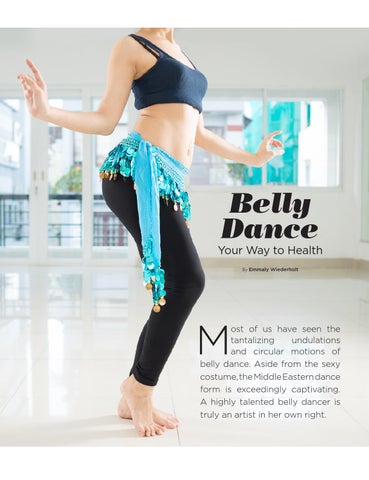
ost of us have seen the tantalizing undulations and circular motions of belly dance. Aside from the sexy costume, the Middle Eastern dance form is exceedingly captivating. A highly talented belly dancer is truly an artist in her own right.
But there’s no reason anyone can’t get into belly dance. The graceful hip drops, rolls and pivots engage muscle groups in the abdomen, pelvis, trunk, spine and neck, working with the body instead of against it. And although belly dance requires skill to reach a performative level, anyone who’s interested can enjoy practicing it. Belly dance, also known as raks sharki in Arabic, is an ancient dance form that evolved throughout the Middle Eastern part of the world. Originally performed only by women, it developed as an improvised solo to live music. Today, belly dance has found popularity in every corner of the globe, from Australia and Asia to the Americas and Europe. Fusion styles and contemporary forms have evolved belly dance away from its original improvisational style, but the sensuous nature of the dance remains. Here in Santa Fe, Deborah Newberg of Saltanah Studios offers classes to everyone and anyone interested in finding both the joy and health benefits of belly dance. She directs her belly dance company, Saltanah Dancers, as well as teaches at Santa Fe Community College and Dance Space Santa Fe. “When I was 26, I walked into my first belly dance class. I saw a flier and decided to check it out,” Newberg relates. “I loved the music right away; it really spoke to me. And the movement… I felt like I was born to do it.” “The movements originate in the torso rather than the limbs,” Newberg explains. “It’s not about extending out through space, but about recycling energy by drawing the energy of the music into yourself and radiating it out again. Each dancer has her own individual expression, but there are also cultural styles from region to region within different countries. In belly dance, there’s more of an emphasis on feeling than on technique for its own sake. The idea is not to display virtuosity. It’s more about expression.” That expression translates into tangible health benefits. The emphasis on the torso can lead to improved posture and muscle tone. Small muscle groups deep in the back that are normally under-exercised are used and strengthened. This toning effect also extends to the arms and shoulders, and is evident early on, since holding the arms aloft is an important element of the dance. The non-impactful nature of belly dance makes it ideal for those looking for exercise that doesn’t place stress on the joints. “Since belly dance was originally a dance form done by all women, there was no body type, since all women have bodies,” asserts Newberg. “As far as the sensuality, it’s a beautiful and sexy way of moving. You don’t need to have any particular body type to express that.”
For more information, visit www.saltanahstudios.com.