Devin Doyle: Future Trends Shaping Fire Protection Systems

Page 1


Devin Doyle: Future Trends Shaping Fire Protection Systems

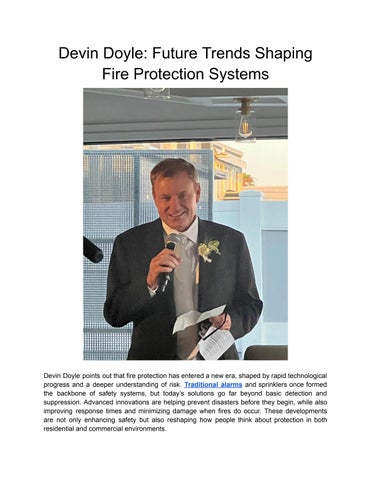
Devin Doyle points out that fire protection has entered a new era, shaped by rapid technological progress and a deeper understanding of risk Traditional alarms and sprinklers once formed the backbone of safety systems, but today’s solutions go far beyond basic detection and suppression Advanced innovations are helping prevent disasters before they begin, while also improving response times and minimizing damage when fires do occur These developments are not only enhancing safety but also reshaping how people think about protection in both residential and commercial environments

One of the most significant advancements lies in smart fire detection systems. Modern sensors can now distinguish between different types of smoke, heat patterns, and environmental changes. By using artificial intelligence and machine learning, these systems can reduce false alarms while identifying real threats faster and more accurately. Connected through the Internet of Things, devices can communicate with each other and send instant alerts to mobile phones, emergency services, and building management systems. This level of connectivity ensures that action can be taken within seconds, even when occupants are not physically present

Equally transformative are new fire suppression technologies that aim to control flames with greater precision and less environmental impact Traditional water-based systems are being supplemented by clean-agent and water-mist technologies that use significantly less water while remaining highly effective These systems are especially valuable in environments where water damage can be as harmful as fire itself, such as data centers, museums, and healthcare facilities. By targeting fires more efficiently, these innovations help preserve both property and critical infrastructure

Another breakthrough is the integration of fire protection into building design. Architects and engineers are now working closely with fire safety experts to create structures that actively resist and contain fire. Fire-resistant materials, improved compartmentalization, and advanced ventilation systems all help slow the spread of flames and smoke. This proactive approach ensures that buildings are not only compliant with safety regulations but are also inherently safer by design. It reflects a shift from reactive measures to prevention-focused strategies that prioritize long-term resilience

Data analytics is also playing a crucial role in revolutionizing fire protection. By analyzing historical data, environmental conditions, and usage patterns, predictive models can identify areas at higher risk of fire incidents This allows organizations to take preventive measures before a problem arises. In industrial settings, predictive maintenance powered by data insights can detect overheating equipment or electrical faults early, reducing the likelihood of ignition These capabilities are helping businesses and communities move from a reactive mindset to a more proactive and informed approach.

The human element remains central to these advancements, with improved training and education supported by virtual and augmented reality tools. Firefighters and safety personnel

can now simulate complex scenarios in controlled environments, enhancing their readiness for real-life emergencies. At the same time, public awareness campaigns and user-friendly technologies are empowering individuals to take greater responsibility for their own safety Easy-to-use apps, clear alert systems, and intuitive controls make it simpler for people to respond quickly and effectively during emergencies.

As fire protection continues to evolve, the focus is shifting toward sustainability and adaptability. Innovations are being developed with environmental considerations in mind, ensuring that safety measures do not come at the expense of ecological balance At the same time, systems are becoming more flexible, able to adapt to different environments and emerging risks. This dynamic approach ensures that fire protection remains effective in a world that is constantly changing, offering greater peace of mind and a stronger sense of security for everyone.

Turn static files into dynamic content formats.

Create a flipbook