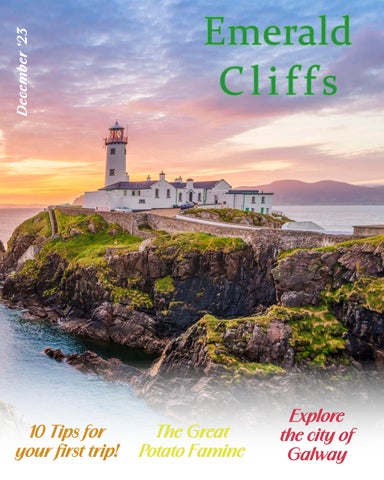
December ‘23
10 Tips for your first trip!
Emerald Cliffs
The Great Potato Famine
Explore the city of Galway
Table of Contents Letter Fom the Editor . . . . . . . . . . . . . . . . . . . . . . . . 04 Hot Takes -Tips for First Trip . . . . . . . . . . . . . . . . . . . . . . . . . . . . . . 06 Monthly Viewpoint -The Great Famine . . . . . . . . . . . . . . . . . . . . . . . . . . . . . . . 11 What’s for Dinner? -Chef’s of Interest . . . . . . . . . . . . . . . . . . . . . . . . . . . . . . . . 20 Something Sweet . . . . . . . . . . . . . . . . . . . . . . . . . . . . 22 Try These Resturants . . . . . . . . . . . . . . . . . . . . . . . . . 24 Encountering Something New -Explore the city of Gallway . . . . . . . . . . . . . . . . . . . . . . . . . 25
Letter from the Editor
Dear Reader, Welcome to Emerald Cliffs Magazine. Here we strive to share experiences and the culture of Ireland. We look to share the beauty of the landscape through our pages and to help you dive into a piece of history through each edition. [personal note] I grew up knowing I was of Irish decent, however, through the generations my family grew smaller and lost touch with many former traditions we used to upkeep. Hence why I have chosen to work on this publication in getting back to my Irish roots. I hope you enjoy your jouney with this reading and if you’re trying to look back on your heritage this will help embrace what is important to Irish people of today. -Katelyn De Villers
4 Emerald Cliffs
https://www.christiesrealestate.com/blog/wp-content/ uploads/2019/03/IrelandLandscape.jpg?is-pending-load=1
Hot Takes Tips for First Trip While I had been to Dublin many moons ago, I recently took a road trip around Ireland, and let me tell you, it’s as green as they all say! Talk about craggy coastlines and lush meadows as far as the eye can see! Oh, and my jaw definitely dropped when I got to see Mizen Head and the Cliffs of Moher!
6 Emerald Cliffs
Understand Lay of the Lands
Currency
Did you know that Ireland is split in
The national currency of Ireland is the
two? I don’t mean physically with one
euro but if visiting Northern Ireland,
land mass here and the other across
you’ll find that they use the pounds
the ocean, but rather the divide of
sterling. IT’S VERY EASY TO FIND
the Republic of Ireland and Northern
AN ATM IN THE BIG CITIES...
Ireland! The Republic of Ireland is an
but once you reach the countryside,
independent nation that takes up most
you’ll find very few. It’s always safe
of the land while Northern Ireland
to have some coins on you but you’ll
(comprised of six counties) is still
want to spend them before you
a part of the United Kingdom.
leave—as you can’t really exchange
Now ya know!
them anywhere else.
While I’d highly suggest visiting
My suggestion? Drinks on you! Buy a
the big cities (Dublin, Cork,
round of beers at the local pub for you
Belfast, Limerick, etc.), the beaches
and your mates, that’s the best way to
and rugged cliffs are a must-see
use up the leftover coins.
near the sea!
Wear Layers
kilometers per hour rather than
Ireland is known for its unpredictable
miles per hour. Most of the major
weather, especially its rainfall.
Irish sites can be visited using public
There is a reason it’s nicknamed the
transportation—though renting a
Emerald Isle after all! Luckily, you’ll
car is worth considering, especially
likely experience a mist rather than a
if you’re looking to get off the beaten
torrential downpour. At least, I hope
track a bit.
that’s the case! If you do rent a car, keep an Regardless of when you visit, you’ll
eye out for potholes. They’re
want to layer up so you can adapt
absolutely everywhere!
to the quickly changing weather. I highly recommend a raincoat and
Irish Food
waterproof shoes.
Let’s face it, Ireland is not known to be a foodie culture but there are some
English is the Main Language
classic Irish dishes that are worth
Don’t stress out about learning
giving a shot. Some of these dishes
another language on your flight over.
include coddle (a hearty stew), boxty
Almost everyone speaks English,
(a potato pancake), bacon & cabbage,
though sometimes it might sound
and beef and Guinness pie.
quite a bit different because of heavy accents.
Want the most authentic experience? Order one of these dishes with a beer
Know How to Get Around
in a local pub!
If you’ve never driven in the UK, you’re in for a treat. Unlike the US, the
Ordering a Beer
Irish drive on the left side of the road
The Irish love stouts (a dark beer)
which can take some getting used to.
and when ordering one in a pub, you
And, to top it off, speed limit signs
might hear them refer to it as “the
and distances are measured in
black stuff.” This name especially
7 Emerald Cliffs
Hot Takes Cont. applies to Guinness. And if you just ask for a pint, you’re going to get served Guinness so if you want something else, you’re going to have to specify.
Overall
Tipping in Ireland is not a given the way that it is in the States. A 10% tip
Ireland is home to quaint towns, the friendliest people you will ever meet, breathtaking scenery, and endless amounts of beer and once you experience it, leaving is going to seem nearly impossible. With any luck, you’ll be back in no time.
is appropriate in sit-down restaurants, but it’s not necessary to tip bartenders or taxi drivers unless you feel the service has gone above and beyond your expectations.
Making the Filling: 1.) Finely chop the onions, carrots, and parsnips and cube the roasted lamb.
Tipping
Flag Down Your Bus DUBLIN CITY BUSES WON’T STOP... even at a designated stop, unless you flag them down like a taxi! Make sure you stick your arm out when you see your bus approaching so that the driver is aware that you want to hop on.
Take Your Time Ireland is a very laid-back country and should be enjoyed in the same manner. Buses tend to be late and if you’re meeting up with a local, don’t count on them showing up on time. Ireland will teach you to slow down and enjoy things that you might have overlooked.
8 Emerald Cliffs
2.) Melt the butter in a Dutch oven over medium heat, then saute the onions until soft. Add the carrots and parsnips and saute for a couple minutes longer. 3.) Stir in the flour and cook for a minute or two, then pour in the lamb drippings and beef stock and stir to combine. 4.) Let the mixture simmer while you peel and cube the potatoes, then add them and the cubed lamb to the mixture. 5.) Mince the fresh parsley and chop the thyme leaves. Season the lamb filling with the fresh herbs, Worcestershire sauce, and freshly ground black pepper. 6.) Let the filling simmer over low heat for 2030 minutes to allow the flavors to blend and the potatoes to cook until fork tender. Spoon the cooked filling into a 6-cup (1.5 liter) enamel dish and set aside to cool slightly as you make the pastry. Baking the Pie Bake at 400°F for about 35 minutes, until the pastry is a rich golden brown. Check it occasionally as it bakes, since the pastry may puff up in places.
Dingle Pie
By: Katelyn De Villers
For the Lamb Filling: -2 ½ cups yellow onion, chopped -2 cups carrot, sliced -1 ⅔ cups parsnip, finely diced -2 cups roasted lamb leg or mutton, cubed -2 tablespoons salted butter -2 cups russet potatoes, peeled and diced -¼ cup all-purpose flour -2 cups beef stock -½ cup lamb drippings or beef stock -2 tablespoons fresh curly parsley, minced
-1 tablespoon fresh thyme leaves, chopped -1 ½ teaspoons Worcestershire sauce -Freshly ground black pepper, to taste For the Hot Water Pastry: -½ cup water -scant ½ cup lard -2 ¼ cups all-purpose flour -¼ teaspoon salt -1 large egg, beaten (for glazing)
9 Emerald Cliffs
-3 large Russet Potatoes (peeled, cut into chunks)
Colcannon
-3 medium Red Potatoes ( skins left on, cut into chunks. The red skins add texture) -4 tbsp Butter (more for serving) -1 tsp Garlic (minced) -2 cups Cabbage or Kale (chopped) -1/4 cup Green Onions -1 1/4 cups Half and Half or Cream (more if needed) -1 tsp Kosher Salt -1/2 tsp Cracked Black Pepper
By: Katelyn De Villers
1.) In a large pot, add the potato chunks. Add enough cold water to completely cover the potatoes. Bring the water to a boil, and cook the potatoes for about 1520 minutes, or until they are fork-tender. Drain in a colander and set aside. 2.) To the same pot, add the butter and melt over medium-high heat. Add the garlic and cook for an additional minute. 3.) Add the kale or cabbage, and continually stir and cook for 4 minutes to help soften the greens. Add the
chopped green onion and cook for an additional 2 minutes. 4.) Return the boiled potatoes to the pot on top of the cooked greens. Pour in the half and half, and mash the potatoes. 5.) Continue to mash and incorporate all the ingredients together. If the potatoes seem dry, add more half and half until you reach your desired creamy texture. Season with salt and pepper, and more to taste if needed.
Monthly Viewpoint The Great Famine Also referred to as "The Great Hunger", that lasted between 1845 and 1849 was arguably the single greatest disaster that affected the Irish history. The famine was caused by the potato
Certain grains such as oats and wheat
blight (fungus) that was inadvertently
were grown, but were exported by the
brought over initially from North
government as were cattle and pork.
America to mainland Europe and had
In just four years, Irelands was on its
eventually made its way to Ireland
knees. Over a million of its population
during the summer of 1845. It was
would die from disease and starvation
not unusual to have crops that failed
and through forced emigration,
and people thought that it was just
Irelands’ population was reduced by
an isolated event. What the eight
almost a further two million people.
million people who lived in Ireland at the time did not realise was that the
The initial efforts to alleviate the
potato crops would fail for the next
problems brought on by the failure
four years and that the disaster would
of the potato crop were slow to
lead to the deaths and the emigration
be organised. As was mentioned
of millions of its peoples to strange,
earlier, it was not unusual to have
foreign and distant lands. The potato
a potato crop fail. People lived on
was the staple diet for the Irish people
their reserves and shared with those
at the time and was the only food
that were better of. Many of them
that was affordable for the masses.
had also eaten their seed potatoes,
11 Emerald Cliffs
Monthly Viewpoint Cont.
therefore depriving themselves of
(the Jamestown and the Macedonian)
their next harvest as well, but as the
laden with supplies to assist the
years went on and the crops kept
starving population.
on failing the world slowly became aware of the plight of the Irish people.
Eventually groups such as the
The British government’s reaction
Quakers, set up soup kitchens in order
at first was slow and some members
to try to save the population. Another
also suggested that the problem was
attempt by the government to get the
in Ireland and should be left to sort
most out of the already starving and
out or let it run its course despite
disease ridden Irish was to establish
the fact that other crops continued
Work houses for the starving. It was
to be produced and exported while
felt that they would feel more worthy
the people were dying. To make
knowing that they were not accepting
matters even worse, some landlords
food for free.
began to evict those tenants who could not pay their rent, sending
These houses were soon themselves
them wandering aimlessly from town
overwhelmed by the new arrivals.
to town in the search of food. The
Another project that was started by the
town of Skibbereen located in the
government was building of new roads
West Cork region was particularly
all across the country side. A physically
affected to the extent that it became
demanding endeavour at the best of
the rallying point for international
times proved to be deadly to many of
efforts to help out. The United States
the starving and weak workers.
who despite being at war with Mexico at the time, dispatched two warships
12 Emerald Cliffs
Boxty
-2 cups leftover mashed potatoes, cold -½ cup flour -½ teaspoon salt -⅛ teaspoon pepper -1 egg -1 tablespoon chives, chopped -2 tablespoons butter
By: Katelyn De Villers
1.) Combine the potatoes, flour (starting with ⅓ cup), salt, and pepper in a small mixing bowl. Lightly mix with a spoon to combine. 2.) Make a well in the center of the mixture, crack an egg into the well, and whisk, then fold it into the potato mixture. 3.) Gently stir in the chives. 4.) Add more flour to the mixture as needed, so that it
can be easily formed into patties. Be careful not to use too much flour. 5.) Melt the butter in a skillet over medium heat. 6.) Form 4 patties with the potato mixture and place them into the skillet, cooking the patties until golden brown on each side, about 5 to 7 minutes per side. 7.) Remove from the pan and serve with extra chives.
Monthly Viewpoint Cont.
Most of those that left Ireland had the
ships that were originally built for
desire to sail for the United States,
transporting cargo back and forth to
but due to availability on ships, their
the new continent.
religion as well as the prices of the tickets being cheaper, forced many
Typhus and other diseases, due to
to once again settle on lands that
the lack of hygiene, was ever-present
were owned by the British in British
and wreaked havoc amongst the
North America (Canada). The major
passengers and crew alike on these
port of departure was Cobh (which
ships. In 1847, of the almost 100,000
incidentally was also the last port
people that sailed for Quebec, 5282
of call for the ill-fated Titanic on her
died during the crossing and a further
maiden voyage), from which ships of
3389 succumbed to illness once they
every size and description, including
had arrived and put on the quarantine
- due to their lack of space, hygiene,
island of Grosse Isle that was located
amenities and general treatment by
just a few kilometres from Quebec
their crews - the dreaded coffin ships
City. Through bad practices lack of
- set sail for ports in far away lands.
space that was brought on by the
If being torn away from ones home
sheer amount of people arriving daily
and country was not enough for those
to the Quarantine Centre, the healthy
suffering people, the voyage to the
were placed amongst the ill, exposing
land of ‘salvation’ proved fatal to
them to the deadly typhus. Many of
many of those who were ill as well
those who had arrived were children
as those who were not. Once on the
who had lost their parents on the
ships, the emigrants were forced to
passage. Many of those worked their
endure the open seas in often unsafe
way east and west to other parts of
14 Emerald Cliffs
Canada, but most of those that had
building and construction. Over the
come to Canada in order to break
years the Irish with their hard work
their yolk from the Empire eventually
and perseverance started becoming
fulfilled their long time desire and
successful and affluent in their new
made their way south and crossed
land. They are now amongst the
into the United States.
highest average income earners in America. Many of them went on to
In 1847 alone, over 37,000 Irish had
become business tycoons such as
arrived in Boston and over 50,000
Henry Ford, great military men and
more to New York.
politicians. The best know of whom is
Upon their arrival to the United States
John F. Kennedy, who was elected in
the new immigrants were greeted by
1960, becoming the first Catholic Irish-
a government that was openly anti-
American president of the United
Catholic and signs advertising jobs
States. His grandfather had emigrated
also said “No Irish Need apply”. The
from New Ross, County Wexford, in 1847.
conditions at the American quarantine stations were much better than at Quebec
In Ireland, several museums have
and those who went through them fared
been built in order to commemorate
much better than their countrymen who
this tragic period of Irish history.
passed through Quebec.
The first official one was the Famine Museum situated in Strokestow,
At first the only jobs available to the
County Roscommon, which was
Irish were physical and often quite
opened by then President Mary
dangerous jobs such as building the
Robinson. Robinson remarked
countries railroads, mining, road
during the launching of the Museum
15 Emerald Cliffs
Landscape Break
Landscape Break
Potato & Leek Soup -4 Tbsp butter -1 onion, chopped -3 large leeks, trimmed, -sliced, thoroughly rinsed, and dried -2 russet potatoes, peeled and diced -3 1/2 cups chicken stock, or vegetable stock -1/2 cup frozen peas salt and fresh cracked black pepper
1.) Melt the butter in a large soup pot and saute the onion, leeks, and potato for about 5 minutes, stirring often. 2.) Add the stock to the pan and bring up to a simmer. Cover, turn down the heat and simmer for about 15 minutes, or until everything is tender. Add the peas to the pot just long enough to defrost them. 3.) Working in 2 batches, process the soup until your desired consistency. It can be smooth, or chunky. 4.) Season to taste with salt and pepper.
18 5.) Serve piping hot with a drizzle of sour cream and a sprinkle Emerald Cliffs of chives.
By: Katelyn De Villers
Monthly Viewpoint Cont.
in 1991, “It is in this part of the
Ireland during this period was over
country that the folk memory of
six million.
the period is the strongest.” Most importantly of all, however, is the
Skibbereen hosts a new Famine
fact that the Strokestown estate
Interpretative Centre, which was
(where the museum is now housed)
built with the purpose of being the
gained notoriety during one of the
authority and a permanent reminder
worst years of the famine when the
to the memory of the thousands
landlord, Major Denis Mahon, was
of people that died in this town.
assassinated by his tenants following
The Skibbereen Trail, well worth
his attempt to clear the estate of two-
walking, is also located in town. It is
thirds of its poverty-stricken and
well marked (maps and information
starving population through assisted
packages are available at the tourist
passage to Canada and mass eviction.
office) and very informative in
The archive of Famine related estate
describing the plight and the squalor
documents is, conceivably, the best single
in which the people lived and died in
archive of its type anywhere in Ireland.
during the Great Famine. The walk will take you past places that played
In Cobh (known as Queenstown
an important role during that tragic
during that period) Co. Cork , you
period in the town’s history. The trail
could visit the Queenstown Story
will also bring you to the mass burial
at Cobh Heritage Centre which was
site in which thousands of people
built in order to preserve the memory
were laid to rest.
of the two and a half million Irish that left their country from that port between 1848 and 1950. The total for
19 Emerald Cliffs
What’s for Dinner? Chef’s of Interest Ever since I moved to the United States, I’ve found that people seem to have a misconstrued idea of Irish food. The cuisine is often defined in a very one dimensional way. Irish food is more than soda bread, stew and shepherds/cottage pie. There are tons of Irish chefs out there who have been paving the way for new and exciting ways to cook Irish food. Here are just a few: The Happy Pear: I found these
recommend it because he makes the
guys while I was on YouTube and
most beautiful dishes that are super
became obsessed. They make great
easy to follow.
wholesome food that is healthy. Irish food can be on the heavier side and it
Darina Allen: Darina is the founder
isn’t always the best for your health
of the Ballymaloe Cookery School
so I’m happy to see these guys shed a
in Shanagarry, County Cork. She is
little light to the Irish cuisine.
arguably the most famous Irish chef in Ireland and that is no surprise to me.
20 Emerald Cliffs
Kevin Dundon: I am obsessed with
She is everything from a chef and a
this man’s cooking show “Kevin
writer to a tv personality. Her cookery
Dundon’s Modern Irish Cuisine”.
school is renowned and is located on
He makes great, simple Irish food
an organic farm where chefs are able
that everyone loves. If you have the
to work in the garden and the kitchen
chance to watch his show I’d highly
all at once.
Advertisements
21 Emerald Cliffs
Something Sweet The most wonderful time of the year? We think so! And in Ireland we celebrate the season in style. Think bustling streets filled with festive shoppers, hot drinks enjoyed in front of a roaring turf fire and carol singers belting out your favourite Christmas tunes. But if you REALLY want to experience Christmas in Ireland, dive in! Brave the freezing waters at Dublin’s Forty Foot swimming spot for the traditional Christmas morning swim. Find the perfect gift at one of the island’s many Christmas markets and show off your language skills with a breezy “Nollaig Shona Duit” in Irish or “Ablythe Yuletide” in Ulster-Scots (Happy Christmas to you!). At Christmas, Ireland is one big party... and everyone’s invited! Let’s start with the famous buskers who perform for Christmas shoppers on Dublin’s Grafton Street. Musicians like Bono, Hozier and Glen Hansard usually swing by and put on a show to support charities. Then there’s Wren’s Day on 26 December when groups of wrenboys dressed up in paint and straw go from door to door, singing, dancing and collecting donations. Lend them a few coins to stave off bad luck in the coming year.
22 Emerald Cliffs
Then to mark the end of the Christmas period, there’s “Women’s Christmas” (Nollaig na mBan) on 6 January. On this day, the women of the house traditionally get a rest after looking after everyone during the festive season and the men take on the household duties. The most important thing about Christmas in Ireland isn’t the presents, the traditions or even the food. It’s the chance for friends and family to come together. And this is where the Irish pub comes into its own. Over the festive season, the pub is pretty much the centre of small villages, towns and even cities, and is usually bursting with reuniting friends and families wrapping hands around hot whiskeys and cosying up beside the fire. It’s off the charts for Christmas spirit.
Soda Bread Cookies Cookies -¾ cup raisins -1 cup water -1¾ cup flour -½ teaspoon baking soda -1 teaspoon caraway seed -½ cup shortening -¾ cup granulated sugar -1 egg large -½ teaspoon vanilla extract Lemon Glaze -1 cup confectioners’ sugar -2 tablespoons milk -½ teaspoon lemon extract
By: Katelyn De Villers
1.) Place a rack in the center of your oven. Preheat the oven to 350 degrees Fahrenheit 20 minutes before baking your cookies. Line a cookie sheet with parchment paper and set it aside. 2.) In a medium pot, combine raisins with water. Bring mixture to a boil on the stove. Reduce to simmer and cook until the liquid is absorbed. Remove pot from heat and let cool 3.) In a medium bowl, combine flour, baking soda, and caraway seeds. Set aside. 4.) In a large bowl, cream together shortening and
sugar. Add eggs and vanilla and mix until combined. Add raisins and the flour mixture alternately. Mix well, the dough will be crumbly. 5.) Shape the dough into small balls, about 1-inch wide. Slightly flatten the cookies to shape them into a disc. Bake on a parchment covered cookie sheet for 12-15 minutes. Remove when the edges of cookies are slightly brown. Allow cookies to cool on the baking sheet for 5 minutes then remove to a wire rack to cool completely. 6.) For the glaze, mix confectioners’ sugar, milk, and lemon extract together in a bowl. Drizzle over the cooled cookies.
Try These Resturants -Professor Steve Solosky
Rustic Stone The Traveling Professor’s favorite
Half-size pasta servings can be available for starters. Sorry, no room for dessert.
dining spot in Dublin City Center. I like the friendly service, busy but not overly loud dining room, rustic (of course) decorating scheme, with a modern take on the food. We ate there on our small group tour to Ireland with 13 diners. We don’t usually sit at one big table, but this time we split up in two tables of four, and one table of five. People raved about the starters of iced cucumber soup with frozen avocados as well as the bean minestrone soup with chorizo. Of course, I loved the crispy chicken wings. For dinner, a few diners soothed their jet lag with massive servings of beef (t-bones, sirloin, rib-eye, fillet). Others praised the monkfish and pasta servings.
24 Emerald Cliffs
Francesca’s Restaurant Located in the Brooks Hotel (where we stay on our small group tours to Ireland) its a good choice for an uncrowded and less noisy dining experience. Service is good, the dining room is bright and airy with an open kitchen. Our travelers liked the gnocchi, traditional Irish dishes like sausage, beef cheeks and hearty salads. I’m usually not a big fan of hotel restaurants, but I make an exception for Francesca’s. It’s a bit more relaxing than the hustle and bustle in some of the other Dublin eating establishments.
Encountering Something New GALWAY city, which started out life as a simple fishing village, is increasingly seen as the cultural, culinary and entertainment capital of Ireland. Shortly, the International Arts Festival will be kicking off, followed by several other festivals of every hue and type, right through to October — craic ’n’ roll guaranteed all the way. https://www.rusticstone.ie/vouchers
Of course, even outside festival time Galway has plenty to offer, with more pubs featuring music and craic than you could reasonably shake a bodhrán stick at. For gigs of every type (rock to traditional, and every stop in between), head for Roisín Dubh on Upper Dominick Street; if you want to immerse in traditional music, Tigh Neachtain, Cross Street is a gem of a place, and nearby Busker Browne’s is both gastropub and a place for tremendous Galway craic. Once the wine capital of Ireland, it’s natural that the
https://www.originalirishhotels.com/hotels/ brooks-hotel
merchants of the city developed a reputation for fine food. The ethos remains the same and Galway probably boasts more restaurants, gastro-pubs and upmarket cafes per
25 Emerald Cliffs
Encountering Something New Cont.
square mile than any other part of Ireland.
structure recalls the trade formerly carried on with Spain; its main
But of course you could go to Galway
purpose was to protect galleons
with nothing more in mind than to
unloading wine and spirits.
wander through its ancient streets. The walls of the city date back to 1270,
Close by, the Galway City Museum
mostly all gone now. But the body
is a surprisingly modernist looking
of the town, centred on Shop and
construction amongst the rest of the
Quay Streets, still retains the feel of
weather and history worn buildings
an ancient, handsome, large village —
of the city. Home to a number of
one with a disproportionate amount
fascinating artefacts, the museum is
of places to drink, let it be said.
currently featuring an exhibition of
Must-sees include the Lynch
paintings by Maurice Quillinan called
Memorial situated in Market Street
Music on the Water.
— a tribute (if that’s the correct word)
26 Emerald Cliffs
to Chief Magistrate James Lynch
The museum’s permanent exhibition
FitzStephen, 1493, who hanged his
‘Galway — Within the Walls’ is a must
own son, thus giving the English
for anyone with an interest in history.
language a new word; although to be
Little is known about the city prior to
fair, other jurisdictions, notably in the
the 12th century — it first appears in
US, also claim this grisly honour.
recorded history as the place where
An area with a more uplifting theme
Toirdhealbhach Ó Conchobhair, king
is the Spanish Arch and Spanish
of Connacht erected a fortification at
Parade, perhaps the most distinctive
Bun na Gaillimhe (the mouth of the
part of Galway. This 16th century
River Galway).
This fascinating exhibition traces events from there to 1230, when the Anglo-Norman Richard de Burgo fought with Gaelic Irish at Galway — but was forced to withdraw. Richard returned in 1232, this time prevailed, and built the first stone castle in Galway. The story of life in medieval Galway is brought alive in this collection of artefacts, drawings, exhibits and paintings. The museum also features a sobering permanent archive of the men from the Connaught Rangers who died in world wars and other campaigns for the now defunct British army regiment.
27 Emerald Cliffs
https://www.tripsavvy.com/