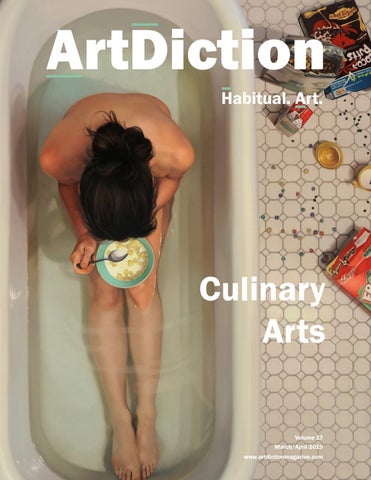
Habitual. Art.
Culinary Arts Volume 17 March/April 2019 www.artdictionmagazine.com
ArtDiction is a platform for artists to display their work and a resource for the habitual art lover.
Staff
Devika A. Strother, Editor-in-Chief devika@artdictionmagazine.com
Delinda Bartek
Isabella Chow, Associate Editor bella@artdictionmagazine.com
Phillip Utterback, Staff Writer phillip@artdictionmagazine.com David Frankel, Senior Account Executive dfrankel@webtv.net
Contributing Writers Delinda Bartek Stella FernĂĄndez Linda Turner
Devika Akeise Publishing assumes no responsibility for the opinions expressed by authors in this publication. Š2019 of Devika Akeise Publishing. All rights reserved. No portion of this publication may be reproduced or utilized in any form or by any means, electronic or mechanical, including photocopying, recording, or by any information storage or retrieval system without permission in writing from the publisher.
artdiction_magazine
artdictionmag
FEATURES
16 Careers in Culinary Arts
Pursuing a career in the Culinary Arts can be quite lucrative and provide a creative means of expression. While some careers in this field can be more demanding than others, they all have something in common.
18 Women & Food
Lee Price uses surrealist self-portraits to bring attention to struggles with food and distractions.
34 Your Obsession with Food Photography
This article explores the reasons for the sudden boom in food photography.
36 International Spices Have you ever wondered which spice to use to give that specific taste you’re searching for? This article will help you make the right choice. Cover photo courtesy of Lee Price.
In Each Issue 5 small talk 6 bella’s books 8 news 10 music 12 exhibits 40 artist / ad index Read about the most popular international sipices on page 36.
©2019 by Devika Akeise Publishing
ArtDiction | 4| March/April 2019
small talk
©denys_kuvaiev
I
n recent years, the interest in Culinary Arts has skyrocketed to an all-time high. With the plethora of cooking shows to watch and stream, the world has realized that this art from is a specialty, exciting to watch, and is one that’s not necessarily easy to master. I've always paid close attention the spices of choice of the expert chefs. For an explanation of some of the most popular spices, go to page 36. What’s also fascinating to watch is our culture’s obsession with photographing food. We explore possible reasons for this artdiction on page 34.
explore some career choices that you may not have thought of. See page 16 for new ideas. Finally, in a creative, thought-provoking way, painter Lee Price (page 18) presents a series of self-portraits that reflects her relationship with food. It’s relatable. It’s vulnerable. As the world of art continues to evolve, shape, and re-shape, Culinary Arts will remain a staple, and ArtDiction will continue to explore new ways of packaging this art form.
The study of Culinary Arts can also lead to a wide range of careers to enter. We
ArtDiction | 5 | March/April 2019
bella’s books Daisy Jones & The Six Taylor Jenkins Reid Random House March 2019 Before the internet and social media made it impossible to hide anything you’ve ever done, being famous involved an often impervious layer of secrecy. If you saw bad behavior in the press, it was either because you were meant to see it, or that it had gotten to levels that even professionals couldn’t hide. When the real stories were told, lifting that veil of mystery made scandals feel juicier; break-ups more shocking; deaths more crushing. So it is fascinating to read Daisy Jones & The Six, a book that is able to hook into that behind-the-scenes phenomena and take you along for the ride. Taylor Jenkins Reid’s new book centers on the titular band, a fictional 70s group made up of The Six, a fledgling rock band with a couple of albums under their belt; and Daisy Jones, a singer-songwriter who duos with the band for a song and then, due to suggestion of an influential producer, ends up staying. All of the different band members and supporting characters tell their perspective on the history of the band to a (mostly) invisible author, documentary-style. The resulting story may be a familiar tale of drugs, sex, and rock-androll, but it reads like a transcript of an amazing lost episode of VH1’s Behind The Music. You’ve got humble beginnings rising to fame; with music that starts in garages and house parties and ends up in stadiums. There are charismaticbut-troubled lead singers, sibling band mates, jealousies, rivalries; love stories and love triangles, weddings and breakups, births and deaths. There may be a tad too much reliance on classic tropes,
but the band—the people and their personalities—feel real. The details that don’t always match up from the overlapping accounts, the hard truths told by some and avoided by others; these touches effortlessly mimic the reality of a story told over 30 years later but remembered like yesterday. It isn’t surprising that there is already an Amazon web series based on Daisy Jones being developed. The fact that Reese Witherspoon selected it for her book club (and is producing the Amazon series) was probably enough to put it on the pop culture radar. The casting of the series will probably be hotly debated in online forums long after the shows are broadcast. Heck, even the
“It isn’t surprising that there is already an Amazon web series based on Daisy Jones being developed. The fact that Reese Witherspoon selected it for her book club (and is producing the Amazon series) was probably enough to put it on the pop culture radar.” audiobook has drawn an amazing pool of Hollywood talent. Honestly, though, it makes sense; you can’t
ArtDiction | 6| March/April 2019
read the book without visualizing it in your head, imagining the characters, and wanting to hear the songs performed. But whether the attention the book is getting attracts or repels you, do yourself a favor and read the book regardless. Like Daisy Jones & The Six themselves, this is something that lives up to the hype. Optic Nerve Maria Gainza Ingram Publisher Services April 2019 In reading Maria Gainza’s highly original new book, Optic Nerve, I was reminded of a quote I came across recently by Joan Miró: “You can look at a picture for a week and never think of it again. You can also look at the picture for a second and think of it all your life.” Time and again while reading this book, I was struck at how very personal art can be to each person; how its meaning can so drastically shift depending on the lens through which it is viewed. Any piece of art, at the right time or in the right context, has the potential to be profoundly impactful, and likely in ways never intended or even imagined by the artist. Optic Nerve is a novel about those intersections of art and life…but it is also so much more
bella’s books art she describes. The connections she makes are eclectic: Rousseau in relation to her fear of flying; Rothko’s connection to her husband’s chemotherapy; Toulouse-Lautrec’s association with walking her dog as a child in Buenos Aires. Her viewpoint is expansive but esoteric; she speaks to those willing to delve deeper for a greater understanding and connection by revealing that exploration in her own life.
“This book, however, is in no way presented like an autobiography; instead, it skips and skims the surface of the narrator’s life, the depth and detail only appearing in conjunction with the art she describes.” than that. Referred to by many as an example of “autofiction” (a form of fictionalized autobiography), Optic Nerve narrator and author share many similarities: both are named Maria, both are Argentinian, and both are heavily involved in the world of art
(Gainza is an art writer who has worked for multiple publications, including The New York Times, ARTnews, and Artforum.) This book, however, is in no way presented like an autobiography; instead, it skips and skims the surface of the narrator’s life, the depth and detail only appearing in conjunction with the
ArtDiction | 7 | March/April 2019
Optic Nerve doesn’t really follow a linear timeline; nor does it ever completely reveal the woman it describes. Gainza places a higher priority on describing the worldview of the narrator than in fully fleshing out the details of her life; you are meant to care more about how she thinks than who she is. The narrator also has an understandable affinity for Argentinian artists without as much name recognition as Rousseau & Rothko. I found myself researching several of the artists and their works in order to get a better understanding of the novel’s reference points; an enjoyable thing to do for someone who writes for an art magazine, but perhaps not so much for a casual reader. The depth of the novel, however, is part of the point: art becomes an optical illusion, endless layers of history and emotion spread a few millimeters thick across a canvas. I’ve never read a book that more accurately depicts the way that art can inveigle its way into the narrative of a life, given the chance; how, for someone who appreciates it, one painting can come to encompass, not just a feeling or a moment, but whole time periods and entire people. Those who understand that connection will find a like-minded friend in this novel; for those who don’t, Optic Nerve is a great place to start learning.
By Isabella Chow
news
$14.7 M. KAWS Painting Sets New Record in Hong Kong On April 1 at Sotheby’s in Hong Kong, a painting by the artist KAWS (aka the New Jersey–born Brian Donnelly) sold for 115.9 million HKD, or about $14.7 million in U.S. dollars, setting a new auction record for the artist. The result came at Sotheby’s “NIGOLDENEYE® Vol. 1” sale, with The Kaws Album (2005) soaring past its estimate of 6,000,000—8,000,000 HKD ($760,000–$1 million). The art, which is a riff on the cover art for the Beatles album Sgt. Pepper’s Lonely Hearts Club (1967), easily eclipsed KAWS’s previous record of $2.7 million, which was set last November in New York at Phillips in its 20th-century evening sale by Untitled (Fatal Group), 2004, a work that presents the artist’s take on the classic Fat Albert cartoon. In this sale, Sotheby’s was offering pieces from the collection of the streetwear impresario Nigo, who styles
his name with the registered trademark (as seen in the name of the auction). It grossed a total of nearly $220 million HKD, or $28 million, across 33 lots, meaning that record-setting painting accounted for about half of the haul. Aside from collecting, Nigo is the creator of the streetwear line A Bathing Ape and co-founder of the clothing label Billionaire Boys Club with the musician Pharrell, and the pieces he was selling displayed a vigorous cross-pollination between art and streetwear: five of the lots were sneakers, four of which were BAPE in collaboration with KAWS. Two lots of two pairs of shoes went for 125,000 HKD, or $15,900, which comes out to about $7,950 a pair (or $3,975 per shoe). The sale was almost entirely comprised of work by KAWS. Other top lots from the auction were three riffs on The Simpsons by the artist, all from 2003: Untitled (Kimpsons), which sold for 21.2 million HKD, or $2.7 million; Untitled (Kimpsons #3), for
The Drawing Center. Paul Warchol/The Drawing Center.
$20.5 million HKD ($2.6 million), and Kimpsons Series, for $7.4 million HKD ($940,000). New York’s Drawing Center Names Four New Board Members The New York Drawing Center has appointed four members to its board of directors: dealers Valentina Castellani and Almine Ruiz-Picasso, filmmaker and collector Harry Tappan Heher, and financier and collector Jean-Edouard van Praet d’Amerloo. Laura Hoptman, executive director of the Drawing Center, said in a statement to press, “All four of our new board members are revered and active participants in the international art community, and bring their precious expertise to an already exceptional and dedicated board.” Castellani is a former director of Gagosian who went independent in 2016, and Ruiz-Picasso is the founder of Almine Rech gallery, which has
KAWS, The Kaws Album, 2005. COURTESY SOTHEBY’S.
ArtDiction | 8| March/April 2019
news locations in Paris, Brussels, London, and New York. Heher is the founder of Pan+Hera Pictures, and van Praet is CEO and president of Brilliance and Financial Technology. Jeff Koons to Retire from Art In a statement released by his publicist, artist Jeff Koons announced the end of his career in art and the termination of all projects and staff at his Manhattan studio by the end of 2019. “I am proud of everything that I have achieved, but the same calling that brought my practice into being is now calling on me to stop,” the statement reads. Another line from the missive, which is said to have perplexed his staff and those nearest to him, reads: “A life-altering religious epiphany has revealed to me a necessary bend in the spiritual path that has guided me since the beginning of my career. I intend to respond to it with acceptance, ending my path in the commercial art world.” Koons, a pop artist who translated kitsch and banality into works worth millions of dollars, has been suffering from a slowdown in business in the past two years, coupled with a series of legal entanglements. The artist is currently embroiled in a $90 million lawsuit filed against him and Gagosian Gallery over charges of undelivered works. In November last year, a French court found Koons guilty of copyright infringement of a 1985 advertisement in his 1988 sculpture “Fait d’hiver.” The artist was ordered to pay the creator of the advertisement a sum of $170,000. This case joins four other past convictions over similar charges dating back to 2014. Koons, 64, was born to a Protestant family in York, Pennsylvania. Hyperallergic has yet received a reply to its inquiry as to which religious faith, if any in particular, was responsible for artist’s epiphany.
Tulips by Jeff Koons at the Broad in Los Angeles (via Pawel Biernacki’s Flickrstream)
On social media, the overall reaction to Koons’s announcement was less than kind. “Good riddance”; “I’ve regained my faith in humans”; and “LOL ur art sucked anyway” were among the most-liked comments on the web. In Paris, the group of prominent cultural figures who opposed the placement of Koons’s sculpture “Bouquet of Tulips” near the Palais de Tokyo (later moved to a garden beside the Petit Palais) issued a “thank you” letter to the artist for his retirement. “We in Paris would like to thank Jeff Koons for finally closing down his production line of distasteful art. Now that he has retired, we accept his gift to Paris as a relic of a bygone era,” the statement reads. ArtDiction | 9 | March/April 2019
An upcoming Christie’s auction in May is expected to break the artist’s $48 million auction record with an estimated $50-$70 million price tag for his sculpture “Rabbit” (1986). Dealers, collectors and auction houses are nervously accommodating to a new reality in which Koons, as he promises in his statement, will be creating art only for himself and his family.
music Avey Tare - Cows on Hourglass Pond Cows on Hourglass Pond is the third solo album from Avey Tare, moniker of David Portner, co-founder of experimental noughties pop band Animal Collective. Cows has a rawer feel than his last offering in 2017, Eucalyptus, but continues Avey Tare’s well-established love affair with psychedelic folk. Despite the raw, fluid nature of this album, Tare has found clearer form in the last two years, creating a selection of songs which stand as well alone as a part of the whole. The album opens slowly, with first track “Whats the Goodside?” meandering along for six and a half minutes before petering out. However, the album is well paced and seems to fine-tune itself as you listen along. By the time you reach the fourth track, “Saturdays (Again)”, the album’s ambient nature is given form, funk and direction. As though Jason Mraz dropped acid with Frightened Rabbit, the listener is carried along on a sea of instrumentals, countered well by the lyrical retelling of the mundane and everyday. Another stand out track is “Remember Mayan”, which is a subtle and pensive addition to the whole, with themes of both nostalgia and anticipation. The song is typical of Tare and his love of mixing seemingly contrasting concepts to form a haunting whole. Indeed, the album as a whole is one of contrasts, of dark and light, as the singer explores the concept of ageing from many angles, most poignantly in “Taken Boy”, which explores Tare’s preoccupation with the path untaken, and the possibilities of life which inevitably get left behind. Interestingly, it is “Taken Boy” and “Saturdays (Again)” which were released as singles ahead of Cows in early 2019, both of which are the more polished offerings from the album as whole, capable of standing
“. . . all three songs combine powerful female vocals delivered beautifully over an electronic beat. ” alone, while other tracks melt into the whole. With a running theme of water and rivers throughout the album, Tare has done with Cows what Tare does best: created flow. Cows is a work which, instrumentally, truly carries the listener along. Sadly, some choppy waters are ahead, with clear high and low points to the album, and some underwhelming lyrics. Fans of Tare’s discography, and of Animal Collective, will be pleased with the latest addition, but if you are introducing his work to someone, it would be best to start elsewhere. Best Track: “Taken Boy”
ArtDiction | 10| March/April 2019
Delta Heavy –Only in Dreams This highly anticipated release from drum & bass duo Delta Heavy is packed full of features and collaborations, and an explosive second album. Unafraid of genre-bending, Only in Dreams blends D&B, dubstep, and trap music with clear rock and hip-hop influences shining through. For this record, it seems the only criteria for Delta Heavy is bass, bass, bass. This album has something for everyone, starting with tracks that heavily feature vocal artists ranging from angry, late night rap duo Everyone You Know to soulful singer-songwriter Jem Cooke. As it progresses, the album becomes more minimalist, returning to Delta Heavy’s hard roots with tracks like glitch-fest “A.I.” stomping from start to finish. While some harder tracks may not be the first choice of listeners drawn in by the mainstream appeal of the album’s opening tracks, they fit well within the album as a high point in terms of tempo and intensity. As a whole Only in Dreams follows the rhythm of a night out, building to a clear peak of intensity and away
music someone you love.
from familiar, more easy listening D&B, before mellowing slightly with a beautiful track featuring Rae Hall, titled “Collide”. Reaching a crescendo with its closing tracks, “Show Me the Light” and “Take Me Home”, all three songs combine powerful female vocals delivered beautifully over an electronic beat. With predictable but powerful drops, “Collide” and its sister tracks stand out as excellent examples of classic club tracks and defiant floor fillers of the future. Its follow-up track, “Replicant”, features KUURO, and is brimming with dubstep influences from wonky baselines to gigantic breakdowns, creating something between trap and D&B that is reminiscent of the homemade underground scene the genre emerged from. The biggest stand-out track on this album, however, is “Here with Me”, which features legendary dubstep duo Modestep; it’s a joyful jump-upand-down celebration of missing
The album heavily features London-based artists, and the influences of the current trend of genre-melding club nights and collaborative releases can clearly be heard. Delta Heavy manage masterfully to blend the distinctive voices of its contributors together into a cohesive album which builds well and doesn’t rely on the talent of those it features; the artists that dominate are Delta Heavy themselves. Best Track: “Here with Me” Little Simz – Grey Area Little Simz is angry and talented. Combining a grimy and savage lyrical flow with jazz, soul, and R&B influences, Grey Area has thrown off the more narrative style of Little Simz’s previous album, Stillness in Wonderland, to create great tracks showcasing her wide range of ability. Produced by her childhood friend and big name producer Inflo, Grey Area feels well-crafted and full of sickening singles. While any of Little Simz tracks from her three albums clearly demonstrated she is a gifted MC, Grey Area feels like a well-crafted piece of work from a lyrical artist of caliber and insight. Since her last work, Little Simz seems to have harnessed her own experiences and vulnerabilities ArtDiction | 11 | March/April 2019
into a cohesive and powerful album which feels like the beginning of a remarkable body of work. What is most striking about Little Simz is her range, and Grey Area’s standout tracks are each tailor-made to showcase this, though layers upon layers of influences run through each track. “Boss” is a defiant and powerful track with hard-hitting grime style and impeccable flow from Little Simz, while “Selfish” is funky, swinging and playful. “Wounds” features smooth vocals from Chronixx juxtaposed with fierce lyrics wrapping around the listener like tendrils of smoke, as Little Simz implores her friend to stay away from guns and the men that carry them. Little Simz’s real life is woven throughout this album, in the anger of grime tracks like “Boss” and “Offence”, but also in the lyrics of heartfelt nostalgic tracks like “101 FM”, which conjures up teenage memories as easily as the smell of your childhood home. With a fierce political edge, Simz explores themes of gun crime, racism and therapy. Grey Area finishes with two tracks, “Sherbet Sunshine” and “Flowers”, which combine funky baselines with honest analysis of relationships and trying to navigate love of others and love of herself. Soulful and sweet, they give the listener an insight into the young woman behind the wordsmith. What makes this album different from the growing number of releases from young female grime and rap artists is that Little Simz is as wise as she is talented, and she delivers an album which not only contains single after single guaranteed to imbed themselves in the listener’s ears, but genuine wisdom and a world-weariness which belies her young age. Best Track: “Wounds” / “Selfish”
exhibits
Frida Kahlo: Appearances Can Be Deceiving Brooklyn Museum February 8—May 12, 2019 Frida Kahlo’s recognizable style was a key to her identity. She defined herself through her ethnicity, disability, and politics, all of which were at the center of her work. Frida Kahlo: Appearances Can Be Deceiving is the largest U.S. exhibition in 10 years devoted to the iconic painter and the first in the United States. It is also the first to display a collection of her clothing and other personal possessions, which were rediscovered and inventoried in 2004 after being locked away since Kahlo’s death in 1954. These items are on display along with paintings, drawings, and photographs from the celebrated Jacques and Natasha Gelman Collection of 20th Century Mexican Art, as well as related historical film and ephemera. Kahlo’s personal artifacts include
examples of Kahlo’s Tehuana clothing, contemporary and pre-Colonial jewelry, and some of the many hand-painted corsets and prosthetics used by the artist during her lifetime. Previously stored in Casa Azul (Blue House), the longtime Mexico City home of Kahlo and husband, Diego Rivera, these possessions were not be disclosed until 15 years after Rivera’s death. The objects show how Kahlo crafted her appearance and shaped her personal and public identity to reflect her cultural heritage and political beliefs, while also addressing and incorporating her physical disabilities. Long Light: Photographs by David Lebe Philadelphia Museum of Art February 9–May 5, 2019 Long Light is the first museum survey devoted to American photographer David Lebe. It examines his artistic
Frida Kahlo (Mexican, 1907-1954). Self-Portrait with a Necklace, 1933. Oil on metal 133/4 x 11 in. (35 x 29 cm). The Jacques and Natasha Gelman Collection of the 20th Century Mexican Art and the Vergel Foundation. ©2019 Banco de Mexico Diego Rivera Frida Kahlo Museums Trust, Mexico, D.F. / Artists Rights Society (ARS), New York.
range and experimentation over five decades, including his powerful representations of gay experience and living with AIDS. The exhibition comprises approximately 145 photographs created from 1969 to the present, drawn primarily from the museum’s collection.
photograph Seven - Self-Portrait in Toaster, January 4, 1975, David Lebe, American, born 1948, © David Lebe.
Un-
ArtDiction | 12| March/April 2019
Lebe (born New York City, 1948) arrived in Philadelphia as a student in 1966 and stayed for more than 25 years. His body of work is rooted in elementary approaches to photography, including pinhole pictures (using a camera but no lens); photograms (using no camera at all); and light drawings (using a conventional camera and long exposures). This simplistic approach allowed him to treat photographs as events in time
exhibits rather than frozen moments. Additionally, he involved himself in pictures, interacted collaboratively with models, rearranged natural objects into fantastical scenes, and painted prints with watercolor.
its inception in 1908 until 1939, was Frank Pick, an executive with London’s Underground. Pick’s enthusiasm for art education led him to commission poster designs from many young artists. Indeed, it is likely that the close relationship between the Art Institute of Chicago and the School of the Art Institute was one reason that Pick chose the museum as the eventual keeper of this poster archive.
More recently, Lebe’s art included digital photography, using it as a challenging process, revisiting earlier series to make different prints (a recurring pattern throughout his career) and exploring its creative limits in new work about landscape, still life, and shadows. Lebe came out as a gay man in the 1970s and was among the first generation of queer artists who explored homosexuality in their work. With the onset of the AIDS crisis and then his own diagnosis in 1988, his art became increasingly focused on gay experience. Through the 1990s he produced diverse series about AIDS that are by turns contemplative, humorous, and confrontational, but always return to a core theme of human touch and exchange. Everyone’s Art Gallery: Posters of the London Underground Institute of Chicago Institute of Chicago May 25–September 5, 2019 In 1919, 39 posters came to the Art Institute of Chicago, courtesy of the Underground Electric Railways London. The posters were part of an effort to encourage Londoners to use this commercial transportation art system: to visit the city’s cultural attractions, go shopping, attend sporting events, and even venture into the countryside—all by taking Underground trains and buses. These posters were installed outside Underground stations on public streets and on the front of buses that traversed the city, creating a public gallery available to all. Over the next 20 years more posters arrived at the museum, coming
Mary Koop. Printed by Dangerfield Printing Company Limited. Summer Sales Quickly Reached by Underground, 1925. Gift of London Underground Railway.)
“These posters were installed outside Underground stations on public streets and on the front of buses that traversed the city, creating a public gallery available to all.” at irregular intervals and eventually forming a collection of almost 350 artworks—an extraordinary sample from the golden age of this remarkable poster campaign, one that continues to this day. Until now, however, the story of how and why these posters came to Chicago has not been known. The architect of the poster campaign, from ArtDiction | 13 | March/April 2019
The exhibition begins with a chronological sampling of the posters. Thematic sections feature popular subjects, while focused displays are devoted to three of the greatest artists who worked for the Underground: Charles Paine, Frederick Herrick, and one of the most illustrious poster artists of the 20th century, Edward McKnight Kauffer, who studied briefly at the School of the Art Institute on his way to Europe. Among the show’s highlights is Charles Paine’s clever take on King Henry the VIII, depicting him with large shears trimming the heads off his topiary queens in Hampton Court by Tram (1922). Others include Mary Koop’s Summer Sales (1925), which invites viewers to follow a riot of brightly colored umbrellas toward their shopping destination; a modernist depiction of time by Clive Gardiner from 1928 urging riders to buy a season Underground ticket; and Harold Sandys Williamson’s Cheap Tickets to Town, Shop between 10 and 4 (1939), an almost surrealistic view of the London cityscape, its sky a sea of floating barrage balloons as protection from German bombs. A century after the initial posters arrived at the museum, this exhibition features 100 posters—a celebration of the gift, Frank Pick’s inventive campaign, and the beautiful artworks it produced.
Careers By Delinda Bartek
ArtDiction | 14| March/April 2019
in Culinary Arts
C
ulinary art is the study of new dimensions of food. With the discovery of fire, human beings have elevated food from a mere staple form of diet to a form of art. It is a unique blend of food, culture, innovation and modernization. If you have ever aspired to work in the culinary industry bust wasn’t sure what was out there, then here is a list of careers that you have ever dreamed of. Careers in culinary industry include Executive Chef, Personal Chef, Baking and Pastry Arts, Sous Chef, Wine Sommelier, Restaurant Manager, and Food Truck Operator. Executive Chef: An Executive Chef is the boss of the kitchen who maintains full control of the kitchen staff and is in-charge of everything that goes out of the kitchen. It is a career many chefs desire to have and the primary responsibility includes creating innovative cuisine and offer a satisfying culinary experience to the guests. Before reaching this position, the Executive chef might have worked in many of the chef roles and so they are well versed with how the kitchen works. Creating unique dishes and running a kitchen makes the position of an Executive Chef highly coveted. They get the satisfaction of running a big kitchen according to their preferences and a competitive salary too. The work environment for an Executive Chef is always stressful including long working hours. In order to maintain the
position, they should always exercise culinary expertise and continue to foster good customer relations. Personal Chef: A personal Chef serves individuals or households for a fee. They are trained cooks employed by one or more household, who customize meal plan based on their clients preferences and dietary requirements. They not only prepare meal for their clients but also shop for the items and clean-up the kitchen after use. Becoming a Personal Chef helps to develop a personal relationship with their clients. It gives independence and autonomy to make decisions with regards to food choices and food preparation techniques. Personal chefs can control their earning potential by setting their own rates. Challenges of a Personal Chef varies from one job to another, which includes poorly equipped kitchen, demanding and difficult to work with customers. Baking and Pastry Chef: Baking and pastry Chef prepares baked foods such as pastries, breads, desserts and baked good. They often supervises the work of other bakers or cooks who are responsible for the baking process. Baking and Pastry Chefs are also expected to create new and exciting desserts to engage the interest of the customers in the restaurants.
ArtDiction | 15 | March/April 2019
ArtDiction | 16| March/April 2019
A baking and Pastry Chef earns a decent salary and can be hired to work in kitchens of hotels, fine dining restaurants, casinos caterers, or in their own bakeries. Working as a Baking and Pastry Chef is often challenging as it requires them to incorporate innovation and creativity in their everyday job. They are expected to be perfect with ingredients, timing and measurements in order to have a successful and satisfying career. Sous Chef: The Sous Chef assist the Executive Chef and is second-in-command in the kitchen to oversee the various kitchen activities. The Sous Chef is expected to prepare and cook food, and know all cooking styles done in the kitchen. The other responsibility include, checking everything going smoothly in the kitchen.
especially when it comes to pairing it with food. Thus, the job of creating a wine list for a restaurant requires creativity and diligence. Restaurant Manager: A Restaurant Manager is one who runs the restaurant. Their responsibilities includes dealing with customers, food quality, staff management and running the business smoothly. Restaurant Mangers often get the freedom of running the business in their own terms. Stress due to long working hours combined with plenty of responsibilities makes this job quite challenging.
Sous Chef can get famous and earn good if they are really good at work. Assisting the Executive Chef, allows them to gather lot of knowledge and experience in food preparation and administration. It is a stressful and challenging job like an Executive Chef role which requires one to take more authority and responsibility in the kitchen.
Food Truck Operator: Food Truck Operators are responsible for the daily operation of the food truck that prepares and sell food. Other responsibilities include managing to ensuring the business is run profitably, customer satisfaction and staff management. A food truck operator makes a decent income. To be successful as a Food Truck Operator, the following skill sets are essential: striving for a career in hospitality industry, being creative, food preparation skills, team player and good time management skills.
Wine Sommelier: A Wine Sommelier is a trained wine professional and specializes in every aspect of wine service, wine storage and wine and food pairings. Job responsibilities may include working with kitchen staff to create optimal food and wine pairings, and checking the conditions of wine cellar.
These are some of the many exciting careers available in the culinary industry. Though passion towards food and cooking can make it easier for someone to enter into the world of culinary arts, a formal education and proper training is essential to become successful in the industry.
Sommeliers enter into this job due to their passion for wine. They take a Wine Sommeliers should be incredibly knowledgeable with wine,
ArtDiction | 18| March/April 2019
Women & Food
L
ee Price is a realist painter with an impressive portfolio of art. She knew from childhood that she wanted to do something related to art when she grew up. “My mother was a high school art teacher. From a very young age I was engaged with art either through watching my mother do her own painting and drawing or having her take me to art museums and galleries on a regular basis,” she recalls. Lee received a BFA in painting from Moore College of Art, but she says she didn’t learn much about painting technique there. “It wasn’t until much later, when I moved to New York City and began studying with various teachers, that I began studying painting and drawing in a more formal way,” she says. Arguably, her most noteworthy paintings are found in her series, Women & Food. These very personal paintings are self-portraits. “Since I was very young I have struggled with issues related to food. I can remember being in grade school, very thin and tall, yet trying to lose weight,” she recalls “A critic once commented, in regard to the subject matter
of my paintings, ‘The women aren’t grossly fat or pathetically thin, but their lives seem to be oppressively ruled by food.’ It would be a very accurate description of the role food has played in my life—bouncing between abstinence and complete loss of control.” Lee created these paintings with the intent to deliver the message of a sense of distraction. She masterfully addresses “how we grasp for things that distract us from being present when the present is too uncomfortable for us to sit with.” Lee further explained that this “checking out” (or compulsion) often creates more harm than if we had just sat with the discomfort in the first place. “I think the best ones show not only the negative aspects of this behavior but also the comfort that’s found in doing it...and the absurdity of it,” she says. Many paintings in the series have an aerial POV. This wasn’t by accident. It should not be interpreted as voyeurism or God’s eye, Lee says. “It’s the subject looking down on herself. Watching herself in the act of a
ArtDiction | 19 | March/April 2019
compulsive behavior; observing. Being completely aware of what she’s doing but unable to stop,” she explains. “I’ve spoken to friends who have had this same experience in relation to drug addiction. It’s like an out of body experience.” Lee is inspired by her own ideas and believes that is, in fact, what art is all about. “You have something to say and you’ve learned a way of saying it, and you feel like you HAVE to say it,” she explains. “One of my favorite quotes is ‘the more personal, the more universal’.” So instead of “self-aggrandizing” over a personal idea, Lee chooses to create. “[What] I have found is that I put [the idea] out there and so many others reso-
nate with it. It’s a way of connecting with people.” “Usually ideas just pop into my head and I go with them without questioning it too much. I have found this works better than trying to contrive subject matter,” Lee explains. An image comes to her mind and then she makes loose sketches to work out the composition. “From there I have to ’build’ the scene in reality— buying or making props, finding the right setting, etc.,” she says. “Once the scene has been created, I bring in my photographer and he shoots the images that I will work from.” For more information, go to www.leepricestudio.com.
Self Portrait Lee Price
ArtDiction | 20| March/April 2019
ArtDiction | 21 | March/April 2019
ArtDiction | 22| March/April 2019
Full Lee Price
ArtDiction | 23 | March/April 2019
“It’s the subject looking down on herself. Watching herself in the act of a compulsive behavior; observing.”
Blueberry Pancake Lee Price
ArtDiction | 24| March/April 2019
Cocoa Puffs Lee Price
ArtDiction | 25 | March/April 2019
ArtDiction | 26| March/April 2019
Sunday Lee Price
ArtDiction | 27 | March/April 2019
ArtDiction | 28| March/April 2019
Jelly Doughnuts Lee Price
ArtDiction | 29 | March/April 2019
Your Obsession with
W
hen the owner of the restaurant I was working at several years ago told me we were teaming up with Foodspotting, a social media app specifically designed to share pictures of food at restaurants, I scoffed at the idea thinking who would want a social media app for food? So little I knew. I had no idea “foodporn” would take off the way it did. Suddenly, everyone was a professional food photographer. There are websites after websites that provide useful tips to get better photographs of your food: how to plate your own meals to enhance the image, where to place lighting, the types of plates to use for certain foods...it’s a little overwhelming. Obviously, photographing food is nothing new; nearly every professionally produced cookbook has pictures, and I’m leery of the ones that don’t, to be honest. But why the sudden explosion of food photography on social media sites like Instagram? I started diving into the dark webs of Google, clicking onto the second, third, and super-rare fourth page of the search engine to try to find out. It turns out, there are a lot of reasons that journalists, social scientists, and neuroscientists have come up with. Which is true? Probably all of them. One major aspect that has changed that accounts for food pervading your timeline: the availability of cameras. No longer do cameras require film (or silver or glass, if you want to go really far back), developing, chemicals, and darkrooms—millions of people carry good quality cameras on their phones. The photos can even be edited immediately without uploading them to a computer in their RAW format for adjusting on Photoshop. The photo features of cameras have become selling points for every new camera that is released. Additionally, people now have platforms to show their food off; with the right hashtag, the audience is there and ready to devour your foodporn.
ArtDiction | 32| March/April 2019
Food Photography By Phillip Utterback Additionally, savvy restaurants and chefs have embraced the hashtag hype. What better way to get images of your food out than to hundreds of millions of people who are ready and willing to follow the food hashtag? Restaurants that have embraced this new trend are generally recognized by social media users that follow food. This exchange perpetuates the hype of the restaurant and the usefulness of posting more food to social media. Photos of food are multi-sensory. Seeing the food, especially something that has been eaten before, reminds us of previous experiences and the tastes from those experiences: our brains connect those two. In some research, participants claim that the food actually tastes better after it has been photographed.1 So, does this brain-trick explain the fascination with food photos? Maybe. Additional research has shown that food photography leads to unhealthy eating.2 How often do we post food on “cheat days”? If the brain makes connections between pictures and eating, it only makes sense that we would make that connection to actually eating that 3-tiered chocolate cake. With the continued growth of social media websites, increased quality of cameras on phones, and ubiquitousness of both in our lives, food photography is not going anywhere anytime soon; I mean, there are even hashtags of people taking pictures of their food. And while Foodspotting, that app that I doubted the purpose of so many years ago has shuttered, it’s purpose has flourished. Like it or not, the hashtag “food” is here to stay...and judging by some of the pictures, I’m here for it. _______ 1. “The Art and Science of Insta-worthy Food Photography - Infogr8.” https://infogr8.com/projects/the-art-and-science-of-instaworthy-food-photography/. Accessed 3 Apr. 2019. 2. “Eating with our eyes: From visual hunger to digital ... - Science Direct.” https://www.sciencedirect.com/science/article/pii/ S0278262615300178. Accessed 2 Apr. 2019.
ArtDiction | 33 | March/April 2019
International Spices by Stella Fernรกndez
ArtDiction | 34| March/April 2019
B
eing asked to write about the top ten most popular spices around the world is like being asked to name ten most delicious cuisines around the world. We all love spices, and nothing can be compared to the feeling you get when you smell that sweet, savory aroma emanating from your cooking after having spiced it up. Just by adding different spices into your meal you can feel an adventurous rush, as the use of spices can easily transport your senses to different places around the world. What makes this more exciting are the lovely colors you get in your meals as a result of that particular ingredient. You may encounter a little problem in your grocery store, however, as the vast array of spices available can leave you a bit confused about
the right ones to buy. Many are not aware that most spices lose their nutritional value after six months, and no one wants to waste their money on spices they never use. As a result, we’ve developed this list of the ten most popular international spices to help you decide when you next go shopping. PAPRIKA: Native to the southern United States, it is also cultivated in parts of Europe, especially in Hungary and Spain. Similar to cumin, it has a savory taste, sweet aroma, and tantalizes the taste buds of umami flavor lovers. Paprika is available in smoked/strong or sweet/mild varieties and has an attractive red color. While it is well used in Hungarian dishes like goulash and paprikash, in India, paprika is mostly used in tandoori dishes and can also be found in some Italian vegan sausages.
ArtDiction | 35 | March/April 2019
RED CHILI FLAKES: Also known as red pepper flakes or crushed red pepper, it is native to India. You might be familiar with this unique spice as it is mostly available in pizza places and Italian restaurants. It is made from a blend of a variety of peppers like bell, cayenne, and ancho. Unlike fresh chilies that have sweetness and heat, red chili flakes are hot and smoky. You need to be cautious when red chili flakes to your dishes, as you need only a little quantity to add heat to it. It is an excellent alternative in the absence of fresh chili pepper when preparing a spicy Mexican or Indian meal. CUMIN: This favorite spice is native to some regions in the Middle East and parts of eastern India. It is used in a lot of spicy dishes across the Middle East, Mexico, India, Portugal, and Spain. Cumin can easily be found in most rich spice blends, Spanish/Latin blends, and curry powder blends. It has a slightly bitter taste plus a savory and pungent flavor. It adds warmth to casseroles, Spanish rice, enchiladas, as well as adding more flavor to Indian or Moroccan dishes such as tofu in lemon olive sauce and tempeh in spicy onion curry. GARAM MASALA: This favorite blend of spices is also native to India. This exciting and exciting aromatic spice blend is said to always
to boost your mood, no matter how down you might feel, as it increases your temperature. Garam (meaning hot) Masala (meaning spice blend) has a beautiful scent of warm toasted spices, the result of a blend that often includes cinnamon, mustard seeds, mace, cloves, bay leaves, coriander, fenugreek, and black peppercorns. A versatile blend, it can be used for anything from spicing up your coleslaw or brown rice to use in preparing desserts. CHINESE 5-SPICE POWDER: With a heavenly aroma, Chinese 5-spice powder is a blend of different spices native to China. It comes in different varieties and is a staple spice in almost every Chinese dish. A blend of Szechwan peppers, fennel, cloves, star anise, and cinnamon, it can be added to Moo Shu vegetables, chickpea scallion pancakes, or to your ketchup to give it an Asian touch. CURRY POWDER: Native to the Indian sub-continent, this spice blend can vary greatly depending on the recipe used. However, this depends on the type you make or buy. Most curry powder recipes include coriander, turmeric, cumin, fenugreek, and chili peppers; however, varieties can also contain ginger, cardamom, clove, garlic, and a host of other spices. As a result, curry powder can range from very spicy to mild, and are used to deepen and enhance the flavors
ArtDiction | 36| March/April 2019
of dishes in an array of cultures around the world. GINGER: Ginger is native to China and India, but has become a staple spice in almost every home around the world. It is available not only as a fresh root, but also in powdered, pickled, candied, and crystalized forms. Ginger is used in the production of some soft drinks, smoothies, teas, beverages or beer, but also comes in handy when baking, adding a warm and peppery aroma and unique flavor to baked goods. As an essential ingredient in Chinese medicine, many use ginger in their daily meals to benefit from its anti-inflammatory properties, as well as to relieve nausea. TURMERIC: An ancient spice originating in Southeast Asia, turmeric is now widely accepted across different regions and cultures. Ground turmeric is popular amongst Moroccan and Indian dishes as a component of curry powder, giving dishes its distinctive yellow color. It is also used in coloring many different foods, from butter and cheeses to condiments and broths, as well as fabrics; it is even used in Hindu and Muslim wedding celebrations. Turmeric has an earthy smell and is aromatic and warm, although in can impart a slightly bitter taste when overused. Besides being used in our everyday meals, many cultures use turmeric in their medicines as well.
FENNEL: Indigenous to the Mediterranean, this ancient spice is well known to the Romans and Greeks. It has a similar aromatic scent and flavor to licorice and is a component curry powder and Chinese 5-spice powder, as well as some liquors. Besides its use in the foods of many Asian and Middle Eastern cultures, fennel is also used in Italian cuisine as the primary flavoring in Italian sausage, as well as many vegan sauces. ALLSPICE: Even though it sounds like a mixture of many spices, allspice is the dried fruit of just one plant, with a fragrance that combines the aromas of cloves, nutmeg, and cinnamon. Allspice comes from berries and is native to south/central America. Although popularly cultivated in Mexico, many say that that the best allspice comes from Jamaica, as it is one of the primary seasonings in Caribbean cuisine. Allspice is used in baking, marinades, mulling spices, and jerk dishes, and is an excellent alternative to cinnamon, cloves or nutmeg. Are you feeling like experimenting with some international flavor in your dishes? Try using any of the spices as mentioned above in your cooking and have a taste of the richness in natural spices the world has to offer.
ArtDiction | 37 | March/April 2019
artist / ad index
Page C2 The Field of Tulips www.thefieldoftulips.com
Page 18 Lee Price www.leepricestudio.com
Page 22 Art Beijing 2019 www.artbeijing.net
Page C4 Art World Conference 2019 www.society6.com/underdott
ArtDiction | 38| March/April 2019
Advertise with Contact dfrankel@webtv.net for information.