Important works formerly from the Estate of Dorrit Black, Adelaide Part I & II
Important works from the Estate of Michael Gleeson-White AO, Sydney
Auction | Melbourne | 26 August 2026
Lots 1 – 85
Wednesday 26 August 7:00 pm
105 Commercial Road South Yarra, VIC telephone: 03 9865 6333
Tuesday 11 – Sunday 16 August 11:00 am – 6:00 pm 36 Gosbell Street Paddington, NSW telephone: 02 9287 0600
Thursday 20 – Tuesday 25 August 11:00 am – 6:00 pm
105 Commercial Road South Yarra, VIC telephone: 03 9865 6333
email bids to: info@deutscherandhackett.com telephone: 03 9865 6333 telephone bid form – p. 224 absentee bid form – p. 225
www.deutscherandhackett.com/watch-live-auction
www.deutscherandhackett.com | info@deutscherandhackett.com





Chris Deutscher
Executive Director — Melbourne
Chris is a graduate of Melbourne University and has over 40 years art dealing, auction and valuation experience as Director of Deutscher Fine Art and subsequently as co-founder and Executive Director of Deutscher~Menzies. He has extensively advised private, corporate and museum art collections and been responsible for numerous Australian art publications and landmark exhibitions. He is also an approved valuer under the Cultural Gifts Program.
Crispin Gutteridge
Head of Indigenous Art and Senior Art Specialist
Crispin holds a Bachelor of Arts (Visual Arts and History) from Monash University. In 1995, he began working for Sotheby’s Australia, where he became the representative for Aboriginal art in Melbourne. In 2006 Crispin joined Joel Fine Art as head of Aboriginal and Contemporary Art and later was appointed head of the Sydney office. He possesses extensive knowledge of Aboriginal art and has over 30 years’ experience in the Australian fine art auction market.
Veronica Angelatos
Art Specialist and Senior Researcher
Veronica has a Master of Arts (Art Curatorship and Museum Management), together with a Bachelor of Arts/Law (Honours) and Diploma of Modern Languages from the University of Melbourne. She has strong curatorial and research expertise, having worked at various art museums including the Peggy Guggenheim Collection, Venice and National Gallery of Victoria, and more recently, in the commercial sphere as Senior Art Specialist at Deutscher~Menzies. She is also the author of numerous articles and publications on Australian and International Art.
Alex Creswick
Managing Director / Head of Finance
With a Bachelor of Business Accounting at RMIT, Alex has almost 30 years’ experience within financial management roles. He has spent much of his early years within the corporate sector with companies such as IBM, Macquarie Bank and ANZ. With a strong passion for the arts Alex became the Financial Controller for Ross Mollison Group, a leading provider of marketing services to the performing arts, before joining D+H in 2011.
Jennifer Terace
Front of House Manager – Melbourne
Jennifer holds a Bachelor of Visual Arts from Edith Cowan University and has experience across event management, retail operations, and community arts program coordination. She has worked as a practicing artist, artist’s assistant, and gallery assistant, gaining valuable insight into both the creative and logistical aspects of the visual arts sector.




Damian Hackett
Executive Director — Sydney
Damian has over 30 years’ experience in public and commercial galleries and the fine art auction market. After completing a BA (Visual Arts) at the University of New England, he was Assistant Director of the Gold Coast City Art Gallery and in 1993 joined Rex Irwin Art Dealer, a leading commercial gallery in Sydney. In 2001, Damian moved into the fine art auction market as Head of Australian and International art for Phillips de Pury and Luxembourg, and from 2002 – 2006 was National Director of Deutscher~Menzies.
Henry Mulholland
Senior Art Specialist
Henry Mulholland is a graduate of the National Art School in Sydney, and has had a successful career as an exhibiting artist. Since 2000, Henry has also been a regular art critic on ABC Radio 702. He was artistic advisor to the Sydney Cricket Ground Trust Basil Sellers Sculpture Project, and since 2007 a regular feature of Sculpture by the Sea, leading tours for corporate stakeholders and conducting artist talks in Sydney, Tasmania and New Zealand. Prior to joining Deutscher and Hackett in 2013, Henry’s fine art consultancy provided a range of services, with a particular focus on collection management and acquiring artworks for clients on the secondary market.
Ella Perrottet
Art Specialist and Senior Registrar
Ella has a Masters of Arts and Cultural Management (Collections and Curatorship) from Deakin University together with a Bachelor of Fine Art (Visual Art) from Monash University, and studied in both Melbourne and Italy. From 2014, Ella worked at Leonard Joel, Melbourne as an Art Assistant, researcher, writer and auctioneer, where she developed a particular interest in Australian women artists. Ella joined Deutscher and Hackett in 2021 as Registrar and is now an Art Specialist, Senior Registrar and Auctioneer.
Eliza Burton Registrar
Eliza has a Bachelor of Arts (English and Cultural Studies and History of Art) from the University of Western Australia and a Master of Art Curatorship from the University of Melbourne. She has experience in exhibition management, commercial sales, and arts writing through her work for Sculpture by the Sea and The Sheila Foundation.
Andrea Kovacic
Gallery Manager, Sydney
Andrea Lillian Kovacic graduated with a Masters in Creative Writing (with Distinction) from the University of Oxford in 2025, together with a Bachelor of Law and Communications, and has undertaken studies in culture and art history at Ca' Foscari University, Venice. Andrea has lived and worked in London for five years, during which time she established herself as a contributor to leading international art magazines, writing on art and culture as both essayist and critic. Her poetry and non-fiction have also been published in Australian literary journals. .

Chris Deutscher
Damian Hackett 0411 350 150 0422 811 034
Henry Mulholland Crispin Gutteridge 0424 487 738 0411 883 052
Veronica Angelatos Ella Perrottet 0409 963 094 0419 277 880
Administration and Accounts
Megan Mac Sweeney Andrea Kovacic (Melbourne) (Sydney) 03 9865 6333 02 9287 0600
Absentee and Telephone Bids
Jennifer Terace 03 9865 6333
Shipping
Ella Perrottet 03 9865 6333


Roger McIlroy
Head Auctioneer
Roger was the Chairman, Managing Director and auctioneer for Christie’s Australia and Asia from 1989 to 2006, having joined the firm in London in 1977. He presided over many significant auctions, including Alan Bond’s Dallhold Collection (1992) and The Harold E. Mertz Collection of Australian Art (2000). Since 2006, Roger has built a highly distinguished art consultancy in Australian and International works of art. Roger will continue to independently operate his privately-owned art dealing and consultancy business alongside his role at Deutscher and Hackett.
Scott Livesey Auctioneer
Scott Livesey began his career in fine art with Leonard Joel Auctions from 1988 to 1994 before moving to Sotheby’s Australia in 1994, as auctioneer and specialist in Australian Art. Scott founded his eponymous gallery in 2000, which represents both emerging and established contemporary Australian artists, and includes a regular exhibition program of indigenous Art. Along with running his contemporary art gallery, Scott has been an auctioneer for Deutscher and Hackett since 2010.
Important works formerly from the Estate of page 12
Dorrit Black, Adelaide, Part I
Various Vendors page 42
Important works from the Estate of page 98
Michael Gleeson-White AO, Sydney
Various Vendors page 138
Important works formerly from the Estate of page 202
Dorrit Black, Adelaide, Part II
Prospective buyers and sellers guide page 220
Conditions of auction and sale page 222
Telephone bid form page 224
Absentee bid form page 225
Attendee pre-registration form page 226
Index page 239
‘Miss Black… is a modern of moderns and is all for the new school of painting [which] does not aim at realism, [but] is founded on design, harmony, and rhythm in forms.’ 1
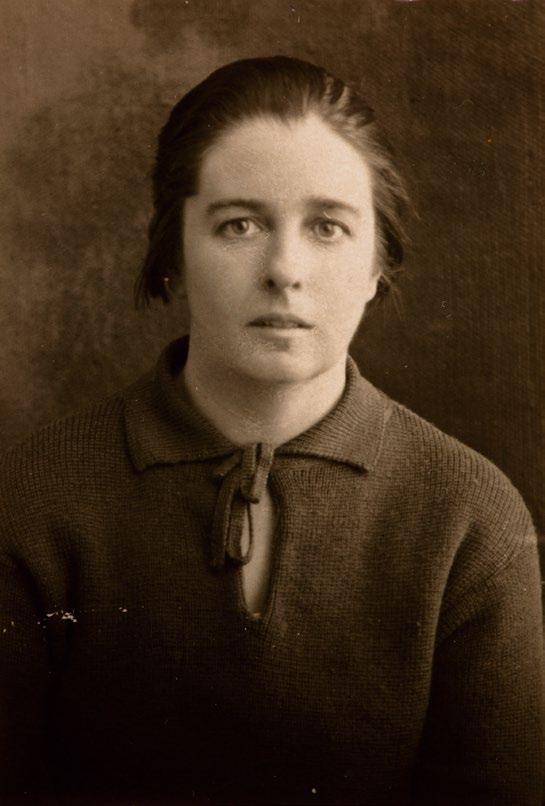
When Dorrit Black returned to Australia in 1929 after two years in Europe, her commitment to modern art was clear. Studying in London and Paris, she had come into direct contact with influential artists and teachers, learning about developments in modern art at their source. Her approach to art was transformed and at home, she joined the ranks of a small group of trailblazing women who, through the exhibition of their art, teaching and – in Black’s case – enthusiastic proselytising, played a pioneering role in the evolution of modernism in Australia.
Black was born in Adelaide in 1891, the first of four children to Alfred Barham Black, a civil engineer and architect, and Jessie Howard Clark. 2 Well-to-do and well-connected, the family lived at Bell Yett, a bluestone house on a ten acre estate near the base of the Adelaide Hills where maids and a gardener helped to oversee the ‘paddocks and trees, fruit of all sorts, and lawn and gardens with horses and cows.’ 3 All of the Black children began their education at Knightsbridge School in nearby Leabrook, which was later known as Mrs Hübbe’s school in acknowledgement of one of its founders. Edith Hübbe was the first woman to matriculate from the University of Adelaide and the wide-ranging curriculum at her school encouraged a broad education that included ‘art tuition, as a right, not as an extra’ and provided lessons for women through to matriculation.4 Black was awarded the school’s prize for drawing in 1904 and in around 1910, with the enthusiastic support of her family, she attended the South Australian School of Arts and Crafts, also taking private lessons in watercolour painting.
In September 1911, Black sailed for London in the company of her parents and a cousin, travelling through England, France, Italy, Switzerland, Scotland and Ireland for twelve months. They visited relatives overseas, but the itinerary also included major cultural and historical sights, as well as great art museums. In addition to important historical art, Black saw contemporary work, describing the Musée du Luxembourg in Paris – which included works by Paul Cézanne, Paul Gauguin and Odilon Redon – as having ‘a splendid collection of modern paintings.’ 5
In 1915, Black moved to Sydney to continue her art studies at Julian Ashton’s Sydney Art School. Teaching followed a traditional approach which focussed on draughtsmanship, with students drawing from plaster casts of classical statuary before progressing to the life studio, and then to painting. Ashton and Elioth Gruner were Black’s teachers, and the influence of the latter’s work can be seen in the painterly impressions of landscape subjects that she made en plein air during these years. Fellow student, Nancy Hall, recalled, ‘we would put our efforts on easels… and Julian Ashton would… appoint three critics and we would go and criticise [the easel works] and then he would get up and criticise the critics, and I remember how Dorrit’s work always stood up… it was always good.’ 6
Black regularly exhibited with the Sydney Society of Artists between 1916 – 20 and after completing her studies around 1920, showed larger groups of works. Committed to a career as a professional artist however, the lure of study overseas was strong and encouraged by the example of her friends and fellow Ashton-school alumni, Grace Crowley and Anne Dangar, she left Sydney and arrived in London in September 1927.
Her first stop was the Grosvenor School of Modern Art in Pimlico which had been founded only two years earlier by Scottish artist, Iain Macnab. It had a decidedly modern outlook, aiming to ‘encourage students to express their own individual ideas rather than be forced to accept worn-out academic theories’ 7 and to that end, Macnab established a small, hand-picked team of teachers whose forward-thinking ideas matched his own. Various classes were offered, including life drawing, painting, composition, lithography and etching, and from 1926 – 30 Claude Flight taught the art of colour linocutting. Revolutionising printmaking in the 1920s and 30s through his passionate advocacy of the colour linocut, he regarded it as the modern medium for the modern age. Although Black’s first introduction to the linocut technique was probably through Thea Proctor in Sydney during the early 1920s 8, she absorbed Flight’s example and his was the most significant and ongoing influence on her work in this medium, characterised by the use of bold colour, the reduction
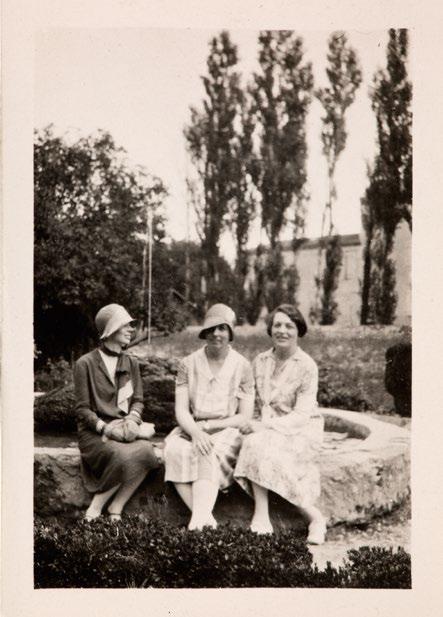
Dorrit Black (centre) in France circa 1928 with two unidentified women – possibly Grace Crowley on the right Art Gallery of South Australia, Adelaide
Image courtesy of Art Gallery of South Australia, Adelaide
of subject matter to simplified shapes, and patterns based on a dynamic system of opposing rhythmic lines and forms.
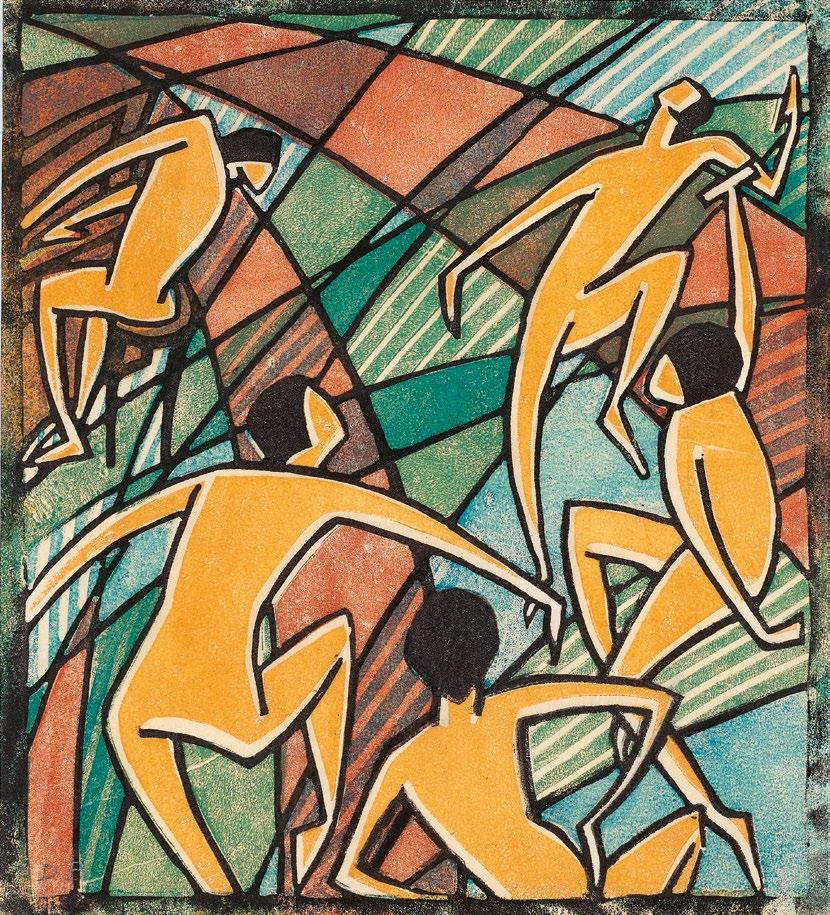
Two of the earliest linocuts Black made after her encounter with Flight, Music and Wings, both 1927 – 28, clearly reflect his influence in their strong design and lively sense of movement. The master evidently approved, writing to her after seeing a trial proof of Music, ‘I think it very good. I especially like the person at the piano… I think you have got away with the idea very well… I believe that rather abstract ideas work better in Lino-cuts than definite views.’ 9 Indeed, Flight’s admiration was such that he included both prints, along with two others (The castle, Taormina, c.1929 and Argentina, c.1929) in the first of the regular exhibitions of colour linocuts that he organised at the Redfern Gallery in London in 1929. Black continued to make colour linocuts throughout her life and following the annual British Lino-cuts exhibition in 1934, the Victoria and Albert Museum purchased The pot plant, 1933, for its permanent collection –the first of Black’s works to be acquired by a public museum.
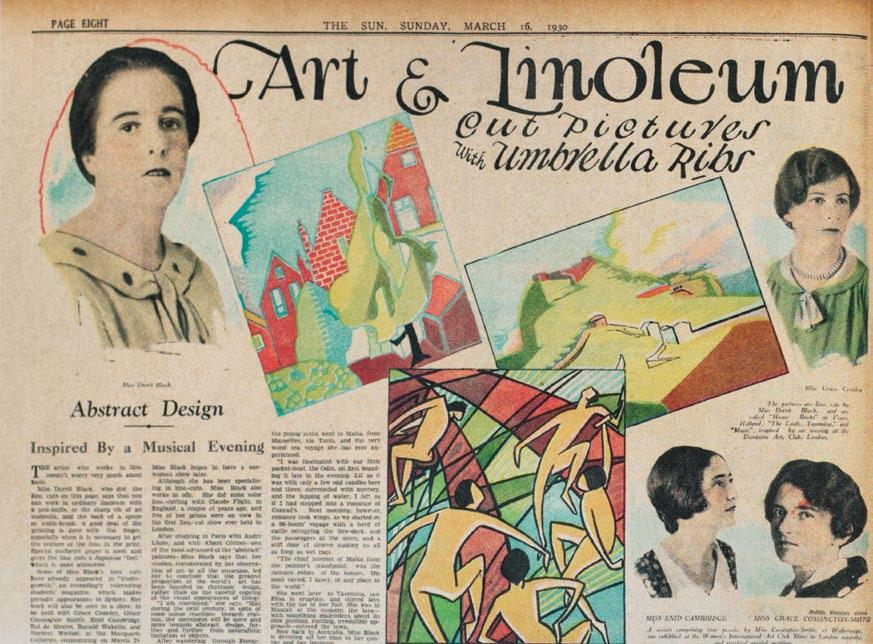
‘Art & Linoleum’, The Sun, Sydney, 16 March 1930 Mitchell Library, State Library of New South Wales, Sydney
Black’s account of her travel and work during the late 1920s records that she ‘crossed over to Paris at the end of December [1927] and settled down in Montparnasse to work at André Lhote’s Academy… [hoping] to acquire a definite understanding of the aims and methods of the modern movement and, in particular – of the Cubists.’ 10 This move was surely encouraged by Crowley and Dangar, who were already studying with Lhote, as well as his reputation as one of the original cubists who had exhibited in the 1911 Salon des Indépendents. In addition, Académie Lhote was one of only two schools in Paris which offered a modernist approach to painting.11 Black explained:
‘Lhote comes in one day a week to pose the model and one day to criticise or ‘correct’, the rest of the time one works by one-self. His teaching is from the standpoint of design, which is the basis of all modern work. He draws his knowledge from the masterpieces of all periods, Egyptian, Chinese, Persian, Greek, African, Primitives and Renaissance; he is extremely catholic in his tastes. He judges the work from standards of rhythm, balance, proportion and line, and applies these standards to its three properties – form, tone and colour.’ 12
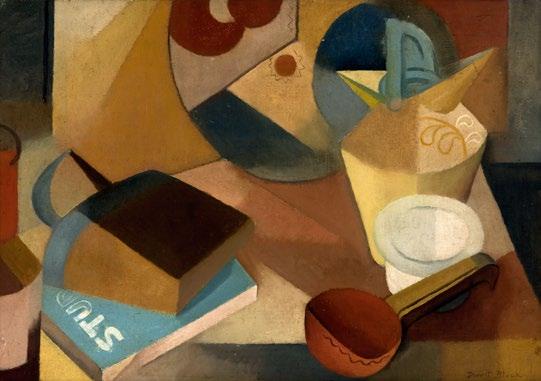
Paintings such as Still life, c.1928 (Art Gallery of South Australia), show how quickly Black responded to Lhote’s teaching, adopting the mathematical principles of the Golden Section and simplifying her subject according to geometric form – a radical transformation from the post-impressionist style of painting she had practiced in Sydney only a few years earlier. Following an extended period of travel through Europe, in 1928 Black spent two months at Lhote’s summer school at Mirmande in the south of France. Crowley and Dangar were also there and a remarkable trio of paintings depicting the distant view of the Medieval hilltop town – each painted by the Australian friends simultaneously – demonstrates their individual responses to Lhote’s approach and the confidence and ambition that now characterised their artmaking.13
Writing to John Young at Sydney’s Macquarie Galleries some months later, Black confirmed that ‘since the beginning of Lhote’s summer class at Mirmande I have been enjoying painting again tremendously, more, I think, than I have ever done before. And I have a pretty clear idea now of the direction in which I want to aim.’ 14 This sense of creative clarity received positive confirmation when, in response to the display of Mirmande, 1928 (Art Gallery of South Australia) and another work by Black in the inaugural exhibition of the Salon d’Art Français Indépendent at the Grand Palais in early 1929, the art critic for the Journal
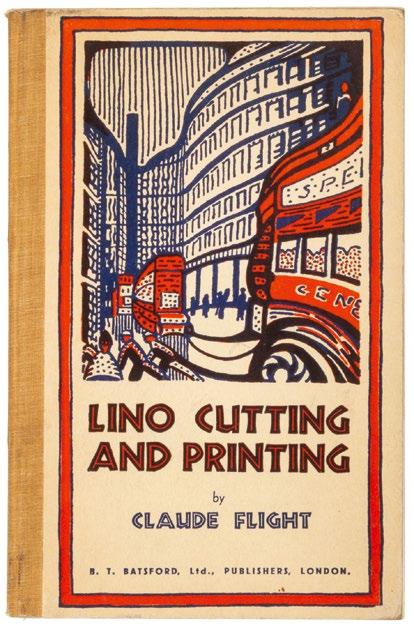
Cover of The art and craft of lino cutting and printing by Claude Flight, 1934
des Débuts pondered, ‘How graceful is the work of Dorothea Foster Black, how cleverly the essential details of a subject are found within a whole and meaningfully harmonised.’ 15
The final element of Black’s international education took place in mid-1929 when she and Crowley attended a series of classes with Albert Gleizes in Paris. An important theorist of cubism, his teaching combined flattening of the picture plane with pictorial movement and building on her experiences thus far, ‘offered… a bridge from cubism to pure abstraction: from the static to the dynamic.’ 16
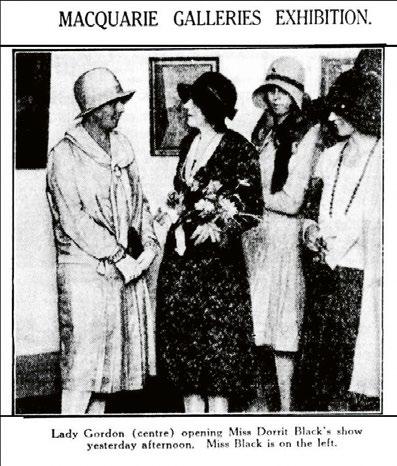
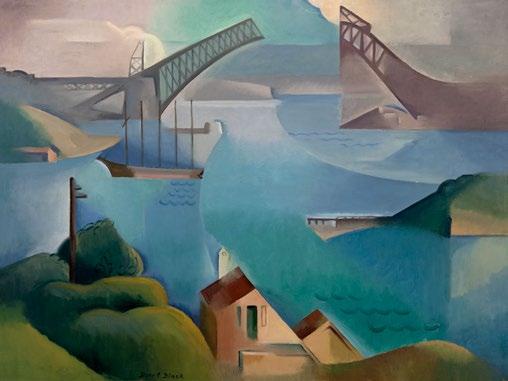
Black returned to Australia in August 1929 and hailed as ‘a modern of moderns’, energetically shared her knowledge and enthusiasm for the cubist-inspired brand of modernism she had learned overseas. Her first solo exhibition opened at the Macquarie Galleries, Sydney in late 1930, mostly showing paintings, prints and tempera studies made during her time in Europe. The Bridge, 1930 (Art Gallery of South Australia), however, was painted in Sydney and in a brilliant palette, combined her new approach to abstraction with the Sydney Harbour Bridge, a distinctively local subject and powerful symbol of modernity
Lady Gordon (centre) opening Miss Black’s show.
Miss Black is on the lef t.
‘Macquarie Galleries Exhibition’, Sydney Morning Herald, Sydney, 11 September 1930
that at the time, was still under construction. Expanding her reach, in 1931 Black opened the Modern Art Centre which comprised an exhibition space and spacious studio, and offered classes in drawing, painting, design, linocutting and art appreciation. Confirming the focus of the Centre in her opening speech, Black noted that it was for ‘those who aimed for something beyond the photographic imitation of objects.’ 17
The death of Black’s father in 1933 prompted her return to Adelaide, where she took responsibility for the care of her mother. They travelled to Europe together on an extended trip between March 1934 – September 1935, staying at Mirmande before visiting Anne Dangar at Moly-Sabata and meeting with Albert Gleizes. In the summer of 1934 Black also holidayed with Claude Flight and his partner, artist Edith Lawrence, on a sketching holiday in Dorset, which she recalled as ‘one of the most enjoyable times of my life… such an awfully jolly & interesting lot of people. Claude got me painting rapid watercolour sketches most of the time, though I did do some of my usual careful constructed & deliberate oils.’ 18
Having lived overseas and interstate for twenty years, Black was little known in her hometown when she returned in the mid-1930s, but with characteristic energy and determination
she continued to make and exhibit new work, balancing family commitments with her career. Her first solo exhibition in Adelaide took place in 1937, the same year that the Art Gallery of South Australia purchased her linocut, Black swans, 1937. This was followed three years later by the acquisition of the major 1928 painting of Mirmande. Black participated in the local art community, joining the Society of Arts (and serving on its council), and when a local branch of the Contemporary Art Society was formed in 1942, she was elected vice-chairman. She also supported the next generation of artists as a mentor and teacher. The best-known of her pupils, Jeffrey Smart, recalled:
‘Dorrit Black was one of the major influences on my painting, and today I am still influenced by her teaching. She came to Adelaide like a shot of adrenalin… she was the first artist I knew who lived and worked in a studio… The whole atmosphere was stimulating, even the way she praised South Australian wines in an oddly French way.’ 19
Writing in the catalogue of her 1945 retrospective exhibition, Black reflected: ‘my interest in realistic painting has been reviving; but it is a different kind of realism, based on all I have learned in the interval of constructive and rhythmical design.’ 20 Her subject matter during these years reflected aspects of her life – still life arrangements in her house and studio, local landscapes and figurative images at the ballet and sketch-club, among others – as well as the skilled hand and trained eye of an experienced artist who had found her creative metier.
When Black’s life ended prematurely as the result of a car accident in 1951, the only Australian institution that represented her work was the Art Gallery of South Australia. Some seventy-five years on, however, after major retrospectives and monographs focussed on her work, as well as research into the broader history of modernism in Australia and the important role of women artists in its development, Black is recognised as a key figure in early twentieth century Australian art and her paintings and prints are highly sought after, collected by public galleries and private individuals alike.
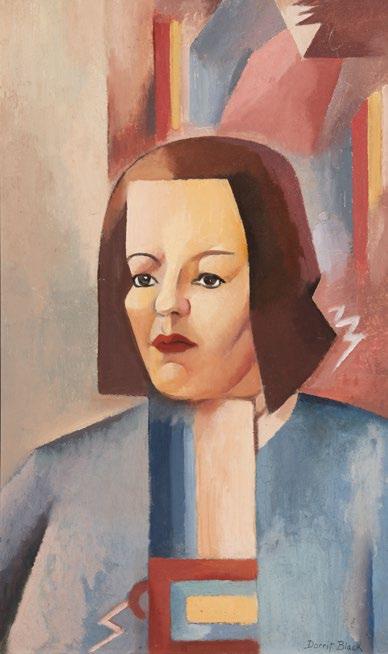
Dorrit Black Head study, c.1933 oil on cardboard
55.5 x 33.5 cm
Art Gallery of South Australia, Adelaide
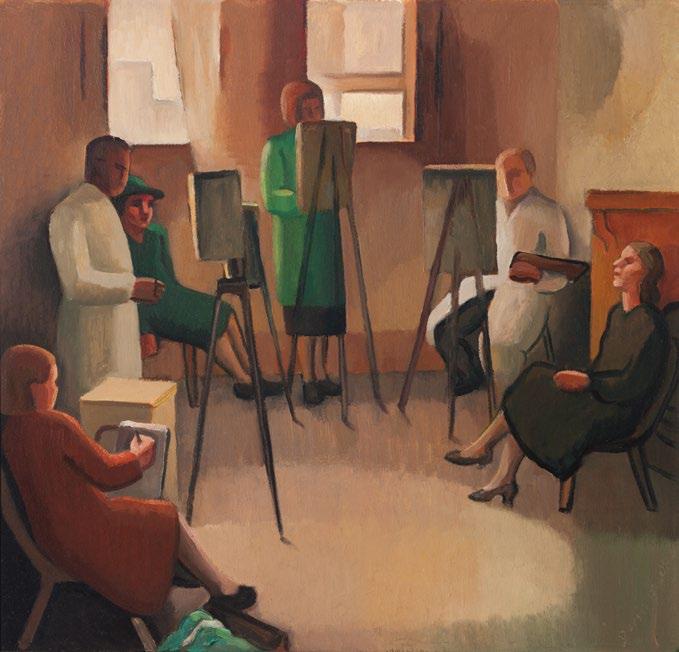
Dorrit Black
The sketch club, 1942 oil on cardboard
55.6 x 58.5 cm
Art Gallery of South Australia, Adelaide
1. Leigh, E., ‘Disciple of modern art’, Register News Pictorial, 5 September 1929, cited in Lock, T., Dorrit Black: unseen forces, Art Gallery of South Australia, Adelaide, 2014, p. 57
2. All biographical information is drawn from the chronology published in Lock, ibid.
3. H. F. B. Finlayson, ‘Notes about Dorrit Black’, c.1951 – 52, cited in North, Ian, The Art of Dorrit Black, Macmillan Australia & the Art Gallery of South Australia, South Melbourne, 1979, p. 8
4. Marjorie Hübbe, Edith’s daughter, cited in Lock, op. cit., p. 173
5. Dorrit Black, cited in Lock, ibid, p. 174
6. Ian North interview transcript with Nancy Hall, April 1974, p. 6, (Art Gallery of South Australia Research Library, Dorrit Black Papers, Ian North Files), cited in Lock, ibid., p. 24
7. Grosvenor School prospectus, cited in Coppel, S., Linocuts of the Machine Age: Claude Flight and the Grosvenor School, Scholar Press in association with the National Gallery of Australia, Aldershot, 1995, p. 12
8. See Freak, E., ‘The Modern Medium: Colour Linocuts’ in Lock, op. cit., pp. 144-145
9. Claude Flight, letter to Dorrit Black, 25 March 1928, quoted in Coppel, op. cit., p. 66
10. Black, D., ‘Account of Travel and Work 1927 - 29’ quoted in Lock, op. cit., p. 217
11. Taylor, E., ‘Together and apart: Anne Dangar, Grace Crowley and modern Paris’ in Edwards, R. (ed.), Anne Dangar, National Gallery of Australia, Canberra, 2024, p. 49. The other school was Académie moderne.
12. ibid
13. See Dorrit Black, Mirmande, 1928, oil on canvas, 60 x 73.8 cm, Art Gallery of South Australia; Grace Crowley, Mirmande, 1928, oil on canvas, 81 x 100.5 cm, Art Gallery of South Australia; and Anne Dangar, Mirmande La Drôme, 1928, oil on canvas, 55.5 x 72.5 cm, private collection.
14. Black to John Young, 16 February 1929, cited in Lock, op. cit., p. 46
15. Fierens, M., Journal des Débuts, Paris, 8 February 1929, cited in North, op. cit., p. 43
16. Lock, op. cit., p. 56
17. ibid., p. 66
18. Dorrit Black, postcard to her sister, 31 July 1934, cited in Lock, ibid., p. 79
19. Jeffrey Smart, cited in North, op. cit., pp. 89 – 90
20. Dorrit Black, 1945, RSASA Gallery, Adelaide, cited in Lock, op. cit., p. 134
Kirsty Grant
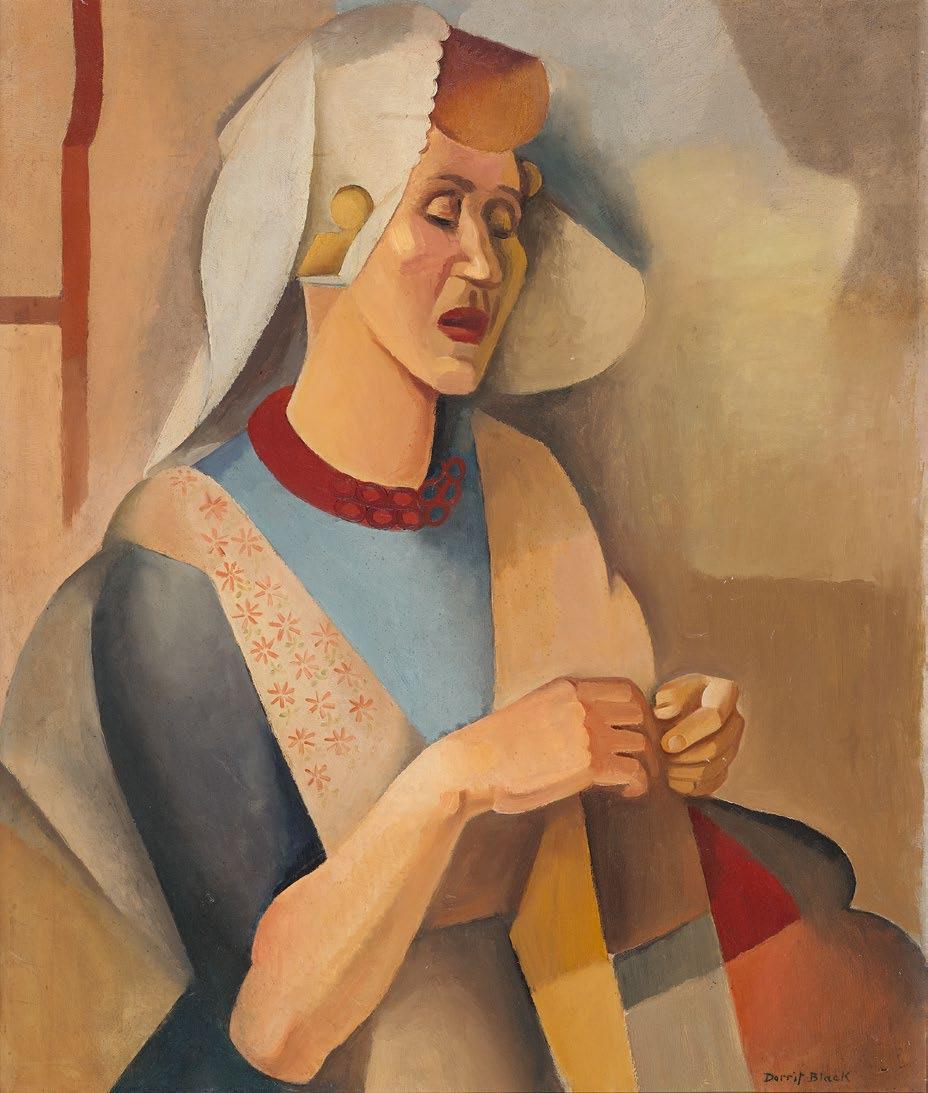
Dutch peasant, c.1931 – 32
oil on cardboard on composition board
75.5 x 63.0 cm
signed lower right: Dorrit Black
Estimate: $100,000 – 150,000
Provenance
Estate of the artist, Adelaide Thence by descent
Helen Finlayson (née Black), Adelaide, 1951 [the artist’s sister] Margaret Michelmore (née Finlayson), Adelaide, a gift from the above Estate of the above, Adelaide
Exhibited
Dorrit Black, Modern Art Centre, Sydney, August 1932
Dorrit Black, Royal South Australian Society of Arts, Adelaide, 10 – 21 May 1949, cat. 2
Dorrit Black 1891 – 1951, Art Gallery of South Australia, Adelaide, then touring to: Art Gallery of New South Wales, Sydney; Newcastle Art Gallery, New South Wales; The Ewing and George Paton Galleries, University of Melbourne, Melbourne, 1975 – 76, cat. 20 (label attached verso, as ‘Dutch Peasant Girl’)
Literature
North, I., The Art of Dorrit Black, Art Gallery of South Australia, Adelaide, and Macmillan, South Melbourne, 1979, cat. 0.43, pl. 22, pp. 58 (illus.), 59, 122
Topliss, H., Modernism and Feminism, Australian Women Artists 1900 – 1940, Craftsman House, Sydney, 1996, p. 144 (illus.)
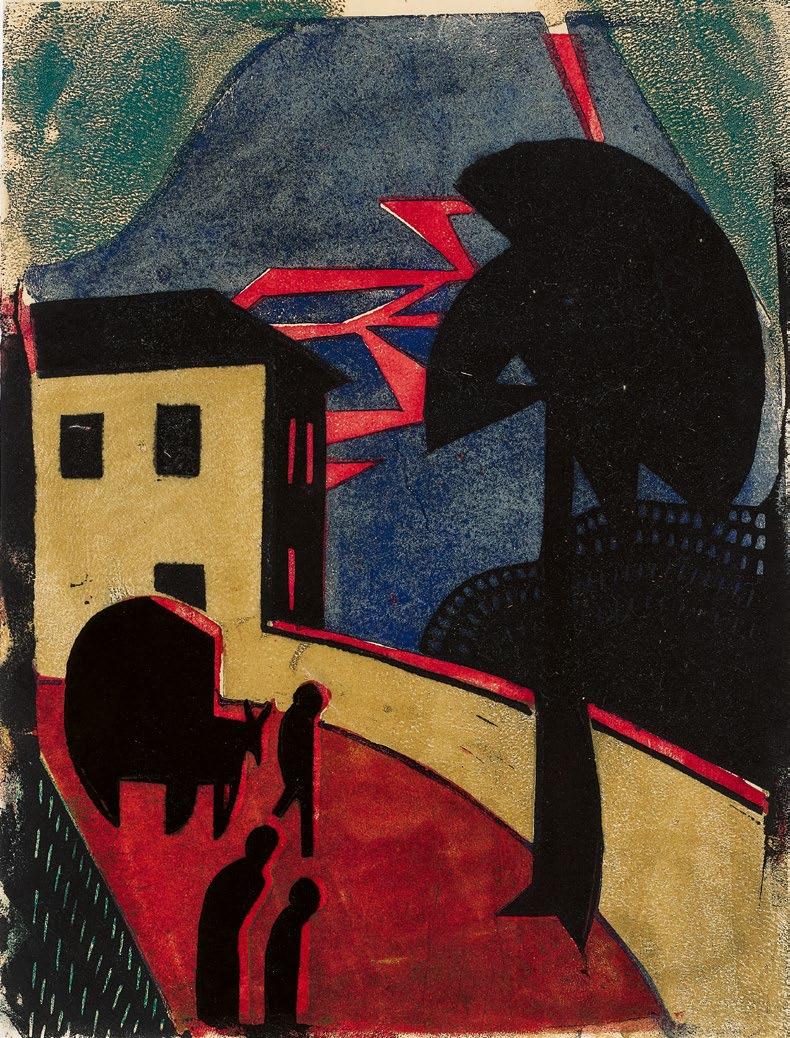
Although painted in Sydney, Dutch peasant, c.1931 – 32 harks back to Dorrit Black’s time in Europe during the late 1920s. As well as studying at the Grosvenor School in London and with André Lhote – both in Paris and at his summer school at Mirmande in the south of France – Black travelled widely during her two year European sojourn and the places she visited and the sights she saw offered much rich visual inspiration for her art. Black painted views of the mountainous landscape around Taormina, Sicily, for example, and the dramatic eruption of Mt Etna that she witnessed during her stay there in November 1928 was the subject of a striking later linocut (see lot 7). The present work reflects time spent in the Netherlands in the company of artist-friend Grace Crowley during the summer of 1929, a trip which also gave rise to a series of prints that depict the picturesque fishing village of Veere.
Black must have been pleased with this painting as she included it in the solo exhibition of her work at the Modern Art Centre, Sydney, in August 1932. Painted in a strong colour
palette of blue and grey, contrasted with rust and ochres, the image combines shallow pictorial space and the geometric simplification she learnt from Lhote, presenting a portrait that, as Ian North writes, ‘suggests not only [the subject’s] physicality but endurance and even a monumentality.’ 1 Black combines abstraction of her subject with a focus on details that caught her eye, including the scalloped edge of the figure’s white bonnet and the delicate floral embroidery on her smock. The brushwork is subtle, densely covering the cardboard support but with an emphasis on light and shade throughout which imparts a sense of movement and enlivens the composition. As a contemporary reviewer observed, ‘light has become the actor. Its cubic capacity penetrates the colour and produces charm through the struggle between colour and form.’ 2
1. North, I., The Art of Dorrit Black, Macmillan Australia & the Art Gallery of South Australia, South Melbourne, 1979, p. 58
2. ‘Art in Sydney’, Christian Science Monitor, 27 August 1932, p. 5, cited in Lock, T., Dorrit Black: unseen forces, Art Gallery of South Australia, Adelaide, 2014, p. 72
Kirsty Grant
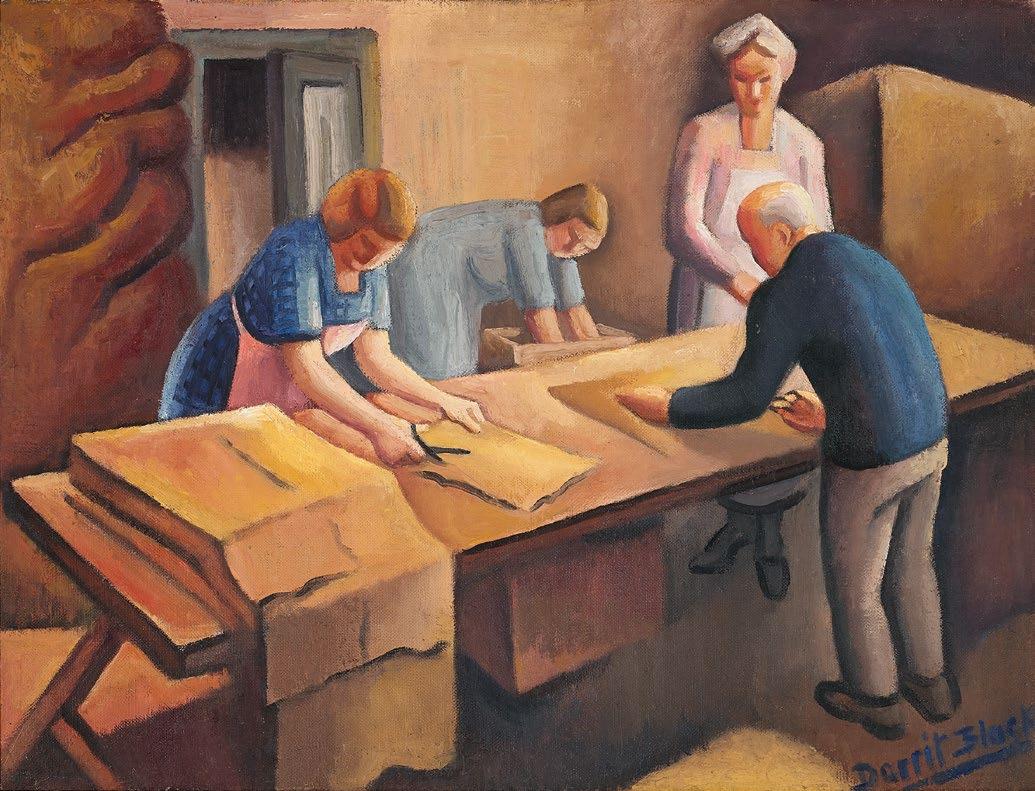
1951)
Depot workers, c.1940 – 42
oil on canvas on cardboard
46.0 x 61.0 cm
signed lower right: Dorrit Black
Estimate: $80,000 – 120,000
Provenance
Estate of the artist, Adelaide Thence by descent
Helen Finlayson (née Black), Adelaide, 1951 [the artist’s sister] Margaret Michelmore (née Finlayson), Adelaide, a gift from the above Estate of the above, Adelaide
Exhibited
Autumn Exhibition, Royal South Australian Society of Arts, Adelaide, 3 – 21 April 1951, cat. 6 (label attached verso)
Dorrit Black (1891 – 1951), Royal South Australian Society of Arts, Adelaide, 24 April – 15 May 2011, cat. 51 (label attached verso, as ‘Depot Workers/The Cloth Cutters’)
Dorrit Black: Unseen Forces, Art Gallery of South Australia, Adelaide, 14 June – 7 September 2014 (as ‘The Cloth Cutters’)
Literature
North, I., The Art of Dorrit Black, Art Gallery of South Australia, Adelaide, and Macmillan, South Melbourne, 1979, cat. 0.78, p. 123 (as ‘The Cloth Cutters’)
Lock, T., Dorrit Black, Unseen Forces, Art Gallery of South Australia, Adelaide, 2014, pp. 124, 128 (illus., as ‘The Cloth Cutters’), 192 (illus.)
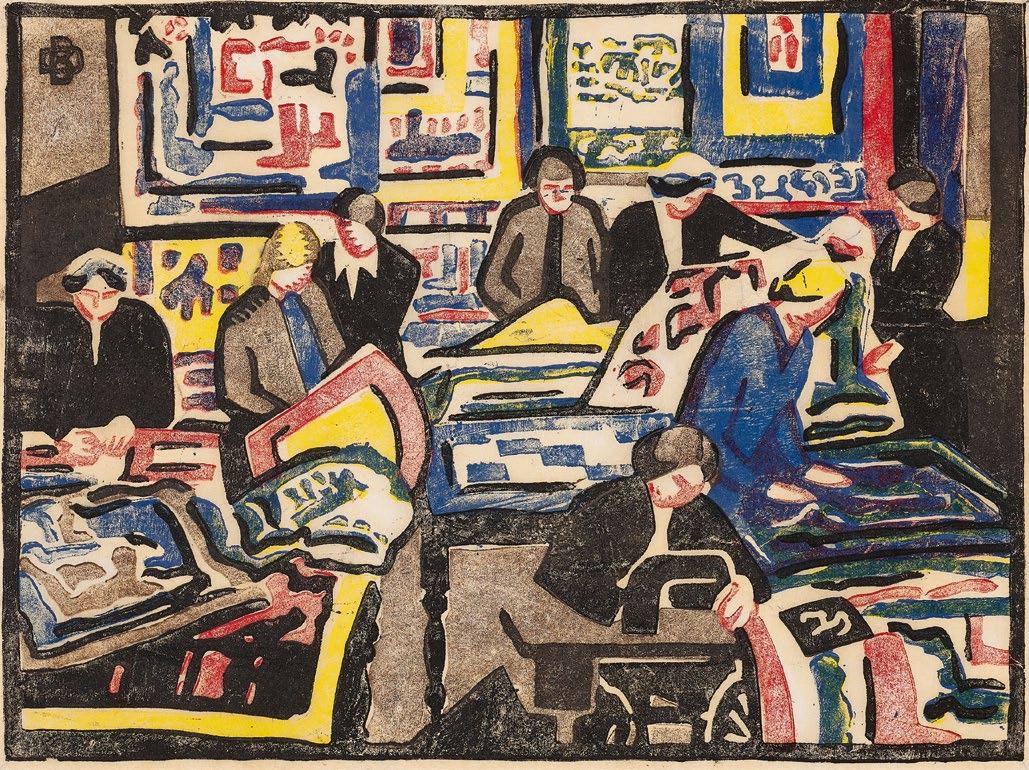
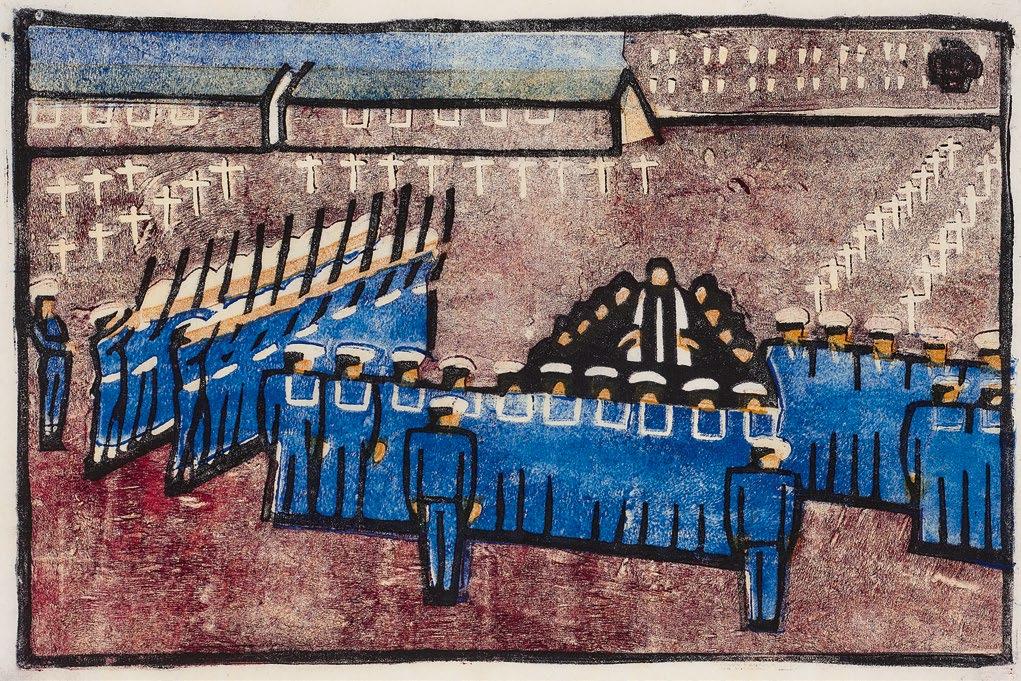
While Australia sent thousands of soldiers to fight in the First and Second World Wars, the men and women who stayed at home mobilised and worked in whatever ways they could to support them. Grace Cossington Smith’s painting, The sock knitter, 1915 (Art Gallery of New South Wales) has come to symbolise the combined efforts of the many women who knitted, quilted and sewed during the Great War, making functional items that were sent to the troops overseas. Dorrit Black’s colour linocut, The wool quilt makers, 1940 – 41, which depicts a group of volunteer women making quilts for the Red Cross, shows that this tradition continued during the Second World War. Black also documented other aspects of life during wartime in her prints – from the light-hearted image, At the cafeteria, c.1943, to the more sombre, Naval funeral, c.1945 – and in addition to depicting these activities on the home front, she actively contributed to the war effort as a local air-raid warden.
There is a sense of order and calm productivity in Depot workers, c.1940 – 42, one of a small group of paintings depicting people at work that Black made during the Second World War. Three women and a lone man, whose grey hair identifies him as too old to enlist, work together, cutting and packing pieces of cloth. Ian North has highlighted the focus and strength embodied in the figures of shearers that Black depicted in another of these works, The wool shed, 1939, (private collection), and here too, her respect for her subjects and the dignity of their labour is clear.1 By this time, the cubist-inspired abstraction of Black’s earlier work had been replaced by a much more direct painterly approach reflecting her maturity and artistic confidence and what she later characterised as ‘a different kind of realism, based on all I have learned in the interval of constructive and rhythmical design.’ 2
1. North, I., The Art of Dorrit Black, Macmillan Australia & the Art Gallery of South Australia, South Melbourne, 1979, p. 91
2. Foreword by the artist, Dorrit Black exhibition catalogue, Royal South Australian Society of Arts Gallery, 1945, cited in Lock, T., Dorrit Black: unseen forces, Art Gallery of South Australia, Adelaide, 2014, p. 134 Kirsty Grant
oil on canvas on board
79.0 x 58.5 cm
signed with initials lower right: DB
Estimate: $80,000 – 120,000
Provenance
Estate of the artist, Adelaide Thence by descent
Helen Finlayson (née Black), Adelaide, 1951 [the artist’s sister] Margaret Michelmore (née Finlayson), Adelaide, a gift from the above Estate of the above, Adelaide
Exhibited
Dorrit Black Memorial Exhibition, Royal South Australian Society of Arts, Adelaide, 22 April – 2 May 1952, cat. 23 on long term loan to the Art Gallery of South Australia, May 1976 (copy of original label attached verso)
Dorrit Black: Unseen Forces, Art Gallery of South Australia, Adelaide, 14 June – 7 September 2014
Literature
North, I., The Art of Dorrit Black, Art Gallery of South Australia, Adelaide, and Macmillan, South Melbourne, 1979, cat. 0.115, pl. 53, pp. 113 (illus.), 106, 125
Lock, T., Dorrit Black, Unseen Forces, Art Gallery of South Australia, Adelaide, 2014, pp. 140, 141 (illus.), 195 (illus.)
In July 1939, Dorrit Black purchased a block of land in Romalo Avenue, Magill, a suburb on the eastern edge of Adelaide, and a few months later construction of her home studio began. The building was complete by the end of the year, and Black wrote to her friend, ‘I’m very thrilled with the little house and I haven’t felt at all nervous or lonely so far. The studio looks awfully nice. At least I think so, and other people appear to also. I wish you could see it.’ 1
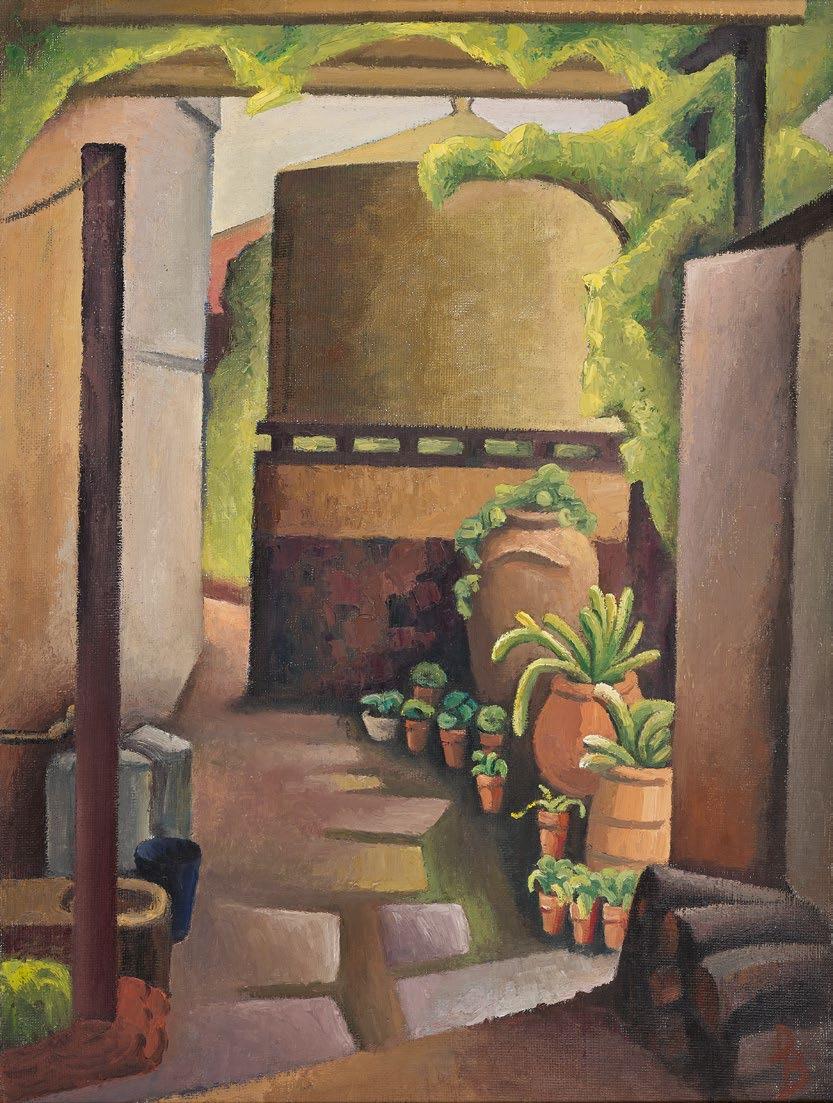
The purpose-built studio had a large south-facing window that looked out to the foothills of the Mount Lofty Ranges, a landscape that ‘had formed the backdrop to her childhood home at the entrance to Stonyfell Road, which led to the mid-nineteenth-century Stonyfell vineyard established by her great-uncle Henry Clark.’ 2 The 1940s was a productive decade for Black and views of this familiar country featured in her paintings, as did subjects that were found even closer to home. She painted a series of still-lifes and interiors depicting aspects of her domestic environment, and Under the pergola, 1951 describes an exterior view of her home. From the pile of
logs stacked in readiness for a warming fire, to the row of plants in terracotta pots lining the path, it is intimate and personal in the way that it reveals aspects of the artist’s everyday life.
There is an emphasis on light and shade in this picture – the spaces under the pergola are in shadow but sunlight creeps in, drawing us through the image towards the narrow opening between the raised water tank and building on the left.
Tracey Lock interprets this painting as a poetic expression of ‘marking time and the contemplation of a spiritual dimension’, suggesting that in it, ‘The artist seems to be encouraging the viewer to contemplate the unknowable land beyond; it is a work of unexpected spiritual gravitas.’ 3 The fact that it is possibly the last work that Black made before her premature death in 1951 certainly gives this painting added poignancy.
1. Dorrit Black to Marjorie Caw, 10 December 1939, cited in Lock, T., Dorrit Black: unseen forces, Art Gallery of South Australia, Adelaide, 2014, p. 183
2. ibid., p. 112
3. ibid., p. 140
Kirsty Grant
Music, 1927 – 28
colour linocut on paper
24.0 x 21.0 cm (image)
30.5 x 24.5 cm (sheet)
edition: 11/50
signed with initials lower left: D.B numbered in margin upper left
Estimate: $50,000 – 70,000
Provenance
Estate of the artist, Adelaide
Thence by descent
Helen Finlayson (née Black), Adelaide, 1951 [the artist’s sister]
Margaret Michelmore (née Finlayson), Adelaide, a gift from the above
Estate of the above, Adelaide
Exhibited
First Exhibition of British Lino–cuts, Redfern Gallery, London, 4 – 27 July 1929, cat. 49 (another example)
Painting and Sculpture by A Group of Seven, Macquarie Galleries, Sydney, 26 March – 5 April 1930, cat. 6 (another example)
Work by Members of the Arts and Crafts Society of Victoria, Town Hall, Melbourne, 13 – 24 October 1931 (another example)
Exhibition of Oils, Watercolours and Lino Cuts by Dorrit Black, Royal South Australian Society of Arts, Adelaide, 7 – 23 July 1938, cat. 31 (another example)
The Drawing, Print and Watercolour Exhibition, Contemporary Art Society of Australia, Melbourne, opened 2 December 1952, cat. 14 (another example)
Dorrit Black 1891 – 1951, Art Gallery of South Australia, Adelaide, then touring to: Art Gallery of New South Wales, Sydney; Newcastle Region Art Gallery, New South Wales; The Ewing and George Paton Galleries, University of Melbourne, Melbourne, 1975 – 76, cat. 50 (another example)
Claude Flight and his Followers: The Colour Linocut Movement between the Wars, Australian National Gallery, Canberra, 18 April – 12 July 1992, and touring, cat. 17 (another example)
Modern Australia Women: Paintings and Prints 1925 – 1945, Art Gallery of South Australia, Adelaide, 24 November 2000 – 25 February 2001, and touring (another example)
Dorrit Black 1891 – 1951, Royal South Australian Society of Arts, Adelaide, 24 April – 15 May 2011, cat. 9 (another example)
Sydney Moderns: Art for a New World, Art Gallery of New South Wales, Sydney, 6 July – 7 October 2013 (another example)
Dorrit Black: Unseen Forces, Art Gallery of South Australia, Adelaide, 14 June – 7 September 2014 (another example)
Cutting Edge: Modernist British Printmaking, Dulwich Picture Gallery, London, 19 June – 8 September 2019 (another example)
Dangerously Modern: Australian women artists in Europe 1890 – 1940, Art Gallery of South Australia, Adelaide, 24 May – 7 September 2025, Art Gallery of New South Wales, Sydney, 11 October 2025 – 1 February 2026 (another example)
Claude Flight letter to Dorrit Black, 6 July 1929
‘Art & linoleum cut out pictures with umbrella ribs’, The Sun, Sydney, 16 March 1930, p. 8 (illus., another example)
North, I., The Art of Dorrit Black, Art Gallery of South Australia, Adelaide, and Macmillan, South Melbourne, 1979, cat. L.1, pl. 5, pp. 25, 27 (illus., another example), 131
Coppel, S., Lino Cuts of the Machine Age: Claude Flight and the Grosvenor School, Scholar Press, Leicester, United Kingdom, in association with National Gallery of Australia, Canberra, 1995, cat. DB1, pl. 31, pp. 42 (illus., another example), 66, 152 (illus., another example)
Topliss, H., Modernism and Feminism, Australian Women Artists 1900 – 1940, Craftsman House, Sydney, 1996, p. 142 (illus., another example)
Hylton, J., Modern Australian Women: Paintings & Prints 1925 – 1945, Art Gallery of South Australia, Adelaide, 2000, pp. 25 (illus., another example), 121
Edwards, D., and Mimmocchi, D. (eds.), Sydney Moderns: Art for a New World, Art Gallery of New South Wales, Sydney, 2013, pp. 79, 178 (illus., another example), 310
Grishin, S., Australian Art: A History, The Miegunyah Press, Melbourne, 2015, pl. 23.4, p. 232 (illus., another example)
Lock, T., Dorrit Black: Unseen Forces, Art Gallery of South Australia, Adelaide, 2014, pp. 9 (illus., another example), 148, 149 (illus., another example), 154 (illus., another example), 199 (illus., another example)
Samuel et al., Cutting Edge: Modernist British Printmaking, Dulwich Picture Gallery, London, 2019, pp. 15, 16 (illus.), 39, 40, 49, 70, 74, 90 (illus.) and illus. back cover (another example)
Freak, E., (ed.) et. al., Dangerously Modern: Australian women artists in Europe 1890 – 1940, Art Gallery of South Australia, Adelaide and Art Gallery of New South Wales, Sydney, 2025, pp. 246, 247 (illus., another example)
Related works
Other examples from this edition are held in the collections of the National Gallery of Australia, Canberra, the Art Gallery of New South Wales, Sydney and the Art Gallery of South Australia, Adelaide
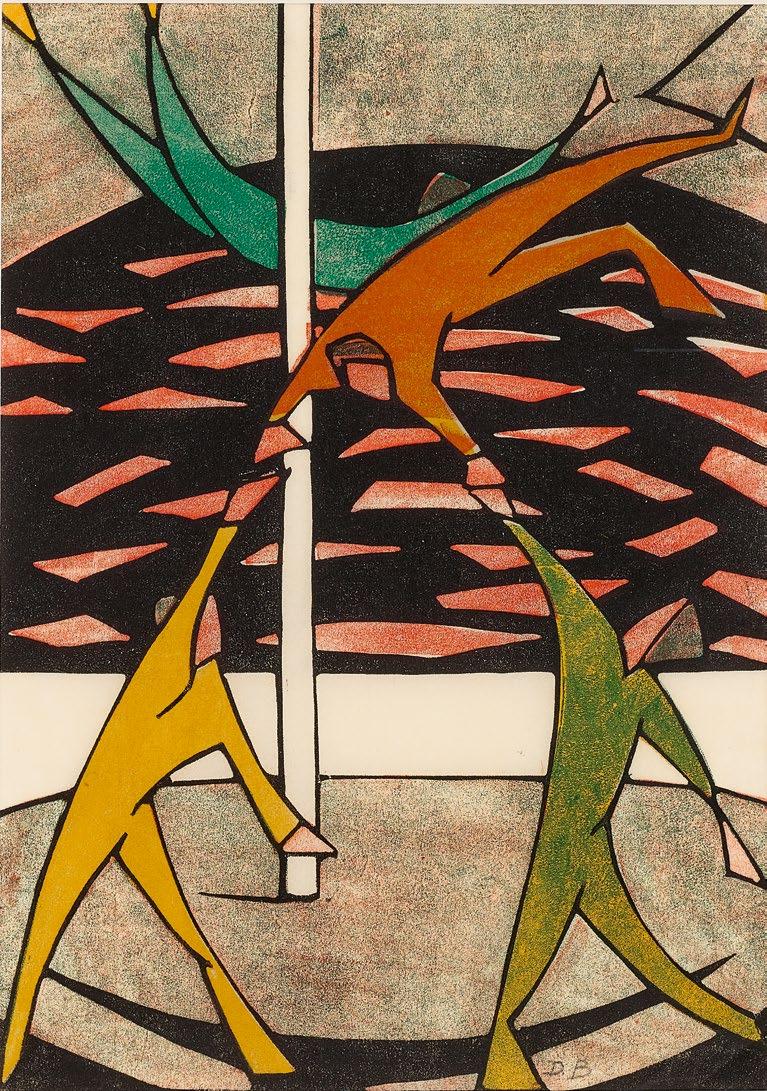
colour linocut on paper
25.0 x 18.0 cm (image)
28.0 x 22.5 cm (sheet)
edition: 5/50
signed with initials lower right: D.B inscribed with title and numbered in margin upper centre: The Acrobats
Estimate: $40,000 – 60,000
Provenance
Estate of the artist, Adelaide
Thence by descent
Helen Finlayson (née Black), Adelaide, 1951 [the artist’s sister]
Margaret Michelmore (née Finlayson), Adelaide, a gift from the above Estate of the above, Adelaide
Exhibited
First Exhibition of British Lino–cuts, Redfern Gallery, London, 4 – 27 July 1929, cat. 36 (another example)
Paintings by Dorrit Black, Macquarie Galleries, Sydney, 1930, cat. 25 (another example)
The Drawing, Print and Watercolour Exhibition, Contemporary Art Society of Australia, Melbourne, opened 2 December 1952, cat. 22 (another example)
Claude Flight and his Followers: The Colour Linocut Movement between the Wars, National Gallery of Australia, Canberra, 18 April – 12 July 1992, then touring to: Art Gallery of New South Wales, Sydney, National Gallery of Victoria, Melbourne, Museum of New Zealand Te Papa Tongarewa, Wellington and Auckland Art Gallery Toi O Tamaki, Auckland, 1992 – 1993, cat. 18 (another example)
A Century of Australian Woman Artists, Deutscher Fine Art, Melbourne, 4 June – 3 July 1993, cat. 106 (another example, illus. in exhibition catalogue, p. 27)
Modernism 1900 – 1950, prints and drawings from the collection, Art Gallery of New South Wales, Sydney, 23 July – 25 September 1994 (another example)
The Dorrit Black Collection, Josef Lebovic Gallery, Sydney, 17 April –29 May 1999, cat. 2 (another example)
Art Deco: from Sydney cinemas and pubs to skyscrapers, Museum of Sydney, Sydney, 12 June – 5 September 1999 (another example) Step Right Up, Albury Regional Gallery, Albury, 10 October 2008 – 4 January 2009 (another example)
Australian Collection Focus: Colour Rhythm, Design – wood and linocuts of the 20s and 30s, Art Gallery of New South Wales, 12 March – 11 July 2010 (another example)
Dorrit Black 1891 – 1951, Royal South Australian Society of Arts, Adelaide, 24 April – 15 May 2011, cat. 10 (another example)
Sydney Moderns: Art for a New World, Art Gallery of New South Wales, Sydney, 6 July – 7 October 2013 (another example)
Dorrit Black: Unseen Forces, Art Gallery of South Australia, Adelaide, 14 June – 7 September 2014 (label attached verso)
Dangerously Modern: Australian women artists in Europe
1890 – 1940, Art Gallery of South Australia, Adelaide, 24 May – 7 September 2025, Art Gallery of New South Wales, Sydney, 11 October 2025 – 1 February 2026 (another example)
Literature
The Sydney Morning Herald, Sydney, 11 September 1930, p. 7 North, I., The Art of Dorrit Black, Art Gallery of South Australia, Adelaide, and Macmillan, South Melbourne, 1979, cat. L.2, pl. 8, pp. 22, 23 (illus., another example), 25, 131
Coppel, S., Linocuts of the Machine Age: Claude Flight and the Grosvenor School, Scolar Press, Aldershot, England, in association with the National Gallery of Australia, Canberra, 1995, cat. DB2, pl. 30, pp. 42 (illus., another example), 152 (illus., another example)
Sheridan, S., Along the Faultlines, Sydney, 1995, back cover (illus., another example)
Butler, R., Printed images by Australian Artists 1885 – 1955, National Gallery of Australia, Canberra, 2007, p. 205 (illus., another example)
Edwards, D., and Mimmocchi, D. (eds.), Sydney Moderns: Art for a New World, Art Gallery of New South Wales, Sydney, 2013, pp. 178 (illus., another example), 310 Lock, T., Dorrit Black: Unseen Forces, Art Gallery of South Australia, Adelaide, 2014, pp. 143 (illus.), 151 (illus.), 152, 200 (illus.)
Grishin, S., Australian Art: A History, The Miegunyah Press, Melbourne, 2015, p. 232 (another example)
Freak, E., (ed.) et. al., Dangerously Modern: Australian women artists in Europe 1890 – 1940, Art Gallery of South Australia, Adelaide and Art Gallery of New South Wales, Sydney, 2025, p. 246 (illus., another example)
Related works
Other examples from this edition are held in the collections of the National Gallery of Australia, Canberra, and the Art Gallery of New South Wales, Sydney
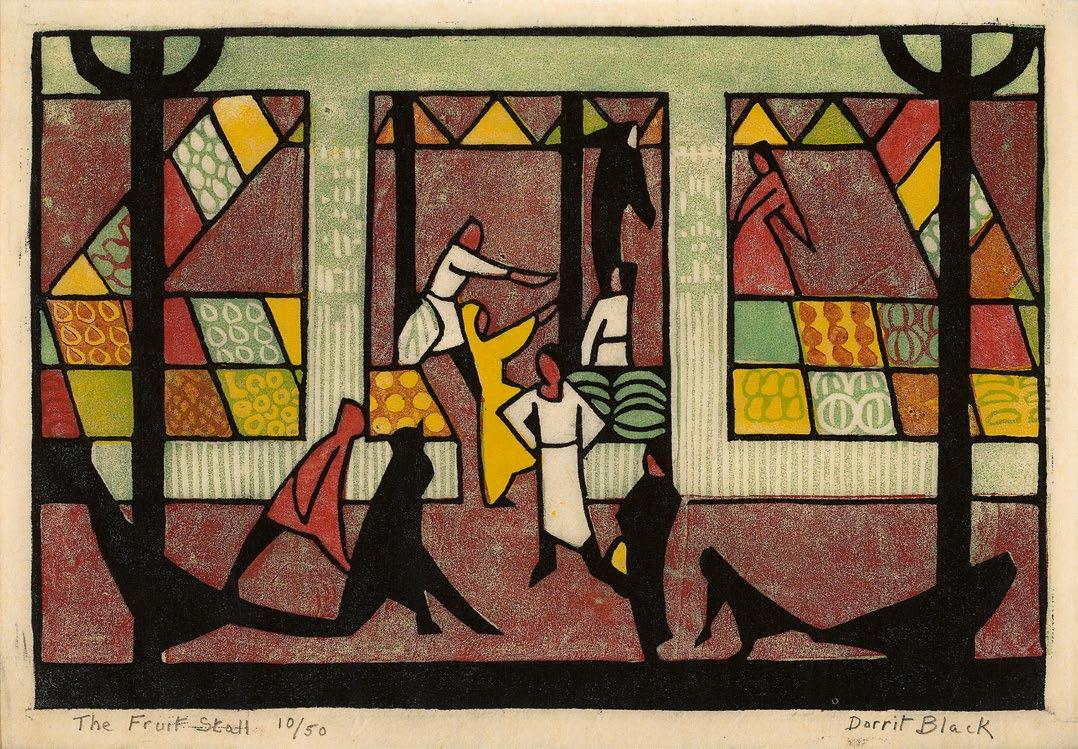
colour linocut on paper
17.5 x 26.0 cm (image)
20.5 x 28.5 cm (sheet)
edition: 10/50
signed below image lower right: Dorrit Black inscribed with title and numbered below image lower left: The Fruit Stall
Estimate: $40,000 – 60,000
Provenance
Estate of the artist, Adelaide
Thence by descent
Helen Finlayson (née Black), Adelaide, 1951 [the artist’s sister]
Margaret Michelmore (née Finlayson), Adelaide, a gift from the above
Private collection, Adelaide, a gift from the above
Exhibited
Spring Exhibition, Royal South Australian Society of the Arts, Adelaide, opened 10 September 1940, cat. 67 (another example, as ‘The vegetable stall’)
The Drawing, Print and Watercolour Exhibition, Contemporary Art Society of South Australia, Adelaide, opened 2 December 1952, cat. 35 (another example)
Dorrit Black (1891 – 1951), Royal South Australian Society of Arts, Adelaide, 24 April – 15 May 2011, cat. 46 (another example)
Dorrit Black: Unseen Forces, Art Gallery of South Australia, Adelaide, 14 June – 7 September 2014 (another example)
Literature
Claude Flight letter to Dorrit Black, 26 October 1931
North, I., The Art of Dorrit Black, Art Gallery of South Australia, Adelaide, and Macmillan, South Melbourne, 1979, cat. L.29, p. 132 (another example)
Coppel, S., Lino Cuts of the Machine Age: Claude Flight and the Grosvenor School, Scholar Press, Leicester, United Kingdom, in association with National Gallery of Australia, Canberra, 1995, cat. DB12, pp. 154, 155 (illus., another example)
Lock, T., Dorrit Black, Unseen Forces, Art Gallery of South Australia, Adelaide, 2014, p. 201 (illus., another example)
colour linocut on paper
27.0 x 20.5 cm (image)
28.0 x 23.0 cm (sheet)
edition: 12/50
numbered in margin upper right
Estimate: $40,000 – 60,000
Provenance
Estate of the artist, Adelaide
Thence by descent
Helen Finlayson (née Black), Adelaide, 1951 [the artist’s sister]
Margaret Michelmore (née Finlayson), Adelaide, a gift from the above
Estate of the above, Adelaide
Exhibited
Painting and Sculpture by A Group of Seven, Macquarie Galleries, Sydney, 26 March – 5 April 1930, cat. 8 (another example)
British Linocuts (Second Exhibition of British Lino–Cuts), Redfern Gallery, London, 23 July – 23 August 1930, cat. 24 (another example)
The Drawing, Print and Watercolour Exhibition, Contemporary Art Society of South Australia, Adelaide, opened 2 December 1952, cat. 34 (another example)
Exhibition of Paintings by the late Dorrit Black, Hahndorf Academy Gallery, Adelaide, 1959, cat. 33 (as ‘Mt. Etna Erupting’, another example)
Dorrit Black 1891 – 1951, Art Gallery of South Australia, Adelaide, then touring to: Art Gallery of New South Wales, Sydney; Newcastle Art Gallery, New South Wales; The Ewing and George Paton Galleries, University of Melbourne, Melbourne, 1975 – 76, cat. 52 (another example)
Colour Linocuts from the Grosvenor School, The Ward Gallery, Sydney, 26 March – 19 April 1980, cat. 43 (another example)
Claude Flight and his Followers: The Colour Linocut Movement between the Wars, Australian National Gallery, Canberra, 18 April – 12 July 1992, then touring to: Art Gallery of New South Wales, Sydney, 14 October – 29 November 1992; National Gallery of Victoria, Melbourne, 16 December 1992 – 1 March 1993; Museum of New Zealand Te Papa Tongarewa, Wellington, 19 March – 16 May 1993; and Auckland Art Gallery Toi o Tāmaki, Auckland, 3 June – 18 July 1993, cat. 19 (another example)
Dorrit Black Collection, Joseph Lebovic Gallery, Sydney, 17 April – 29 May 1999, cat. 5 (another example)
Modern Australia Women: Paintings and Prints 1925 – 1945, Art Gallery of South Australia, Adelaide, 24 November 2000 – 25 February 2001, then touring to: Art Gallery of Western Australia, Perth, National Gallery of Australia, Canberra, S.H. Ervin Gallery, Sydney and Art Gallery of Ballarat, Victoria (another example)
The Story of Australian Printmaking: 1801 – 2005, National Gallery of Australia, Canberra, 30 March – 3 June 2007 (another example)
Dorrit Black: Unseen Forces, Art Gallery of South Australia, Adelaide, 14 June – 7 September 2014 (another example)
Cutting Edge: Modernist British Printmaking, Dulwich Picture Gallery, London, 19 June – 8 September 2019 (another example)
Dangerously Modern: Australian women artists in Europe 1890 – 1940, Art Gallery of South Australia, Adelaide, 24 May – 7 September 2025, Art Gallery of New South Wales, Sydney, 11 October 2025 – 1 February 2026 (another example)
Claude Flight letter to Dorrit Black, 11 June 1930
North, I., The Art of Dorrit Black, Art Gallery of South Australia, Adelaide, and Macmillan, South Melbourne, 1979, cat. L.4, pl. 10, pp. 40 (illus., another example), 41, 131
Coppel, S., Linocuts of the machine age: Claude Flight and the Grosvenor School, Scolar Press, Aldershot, in association with the National Gallery of Australia, Canberra, 1995, cat. DB6, pl. 32, pp. 43 (illus., another example), 152, 153 (illus., another example)
Hylton, J., Modern Australian Women: Paintings & Prints 1925 – 1945, Art Gallery of South Australia, Adelaide, 2000, pp. 11 (illus., another example), 121
Lock, T., Dorrit Black: Unseen Forces, Art Gallery of South Australia, Adelaide, 2014, pp. 152, 153 (illus., another example), 201 (illus., another example)
Grishin, S., Australian Art: A History, The Miegunyah Press, Melbourne, 2015, pl. 23.6, p. 234 (illus., another example)
O’Brien, P., ‘Dorrit Black: The Eruption’, in Coates, R., and Gory, S., eds., Eighty Years of SAM: The Collection, Shepparton Art Museum, Victoria, 2017, pp. 92, 93 (another example)
Samuel, G., et al., Cutting Edge: Modernist British Printmaking, Dulwich Picture Gallery, London, 2019, pp. 50, 71, 72, 120 (illus., another example)
Freak, E., (ed.) et. al., Dangerously Modern: Australian women artists in Europe 1890 – 1940, Art Gallery of South Australia, Adelaide and Art Gallery of New South Wales, Sydney, 2025, pp. 252, 253 (illus., another example)
Related works
Other examples from this edition are held in the collections of the National Gallery of Australia, Canberra, the Art Gallery of South Australia, Adelaide and the Shepparton Art Museum, Victoria
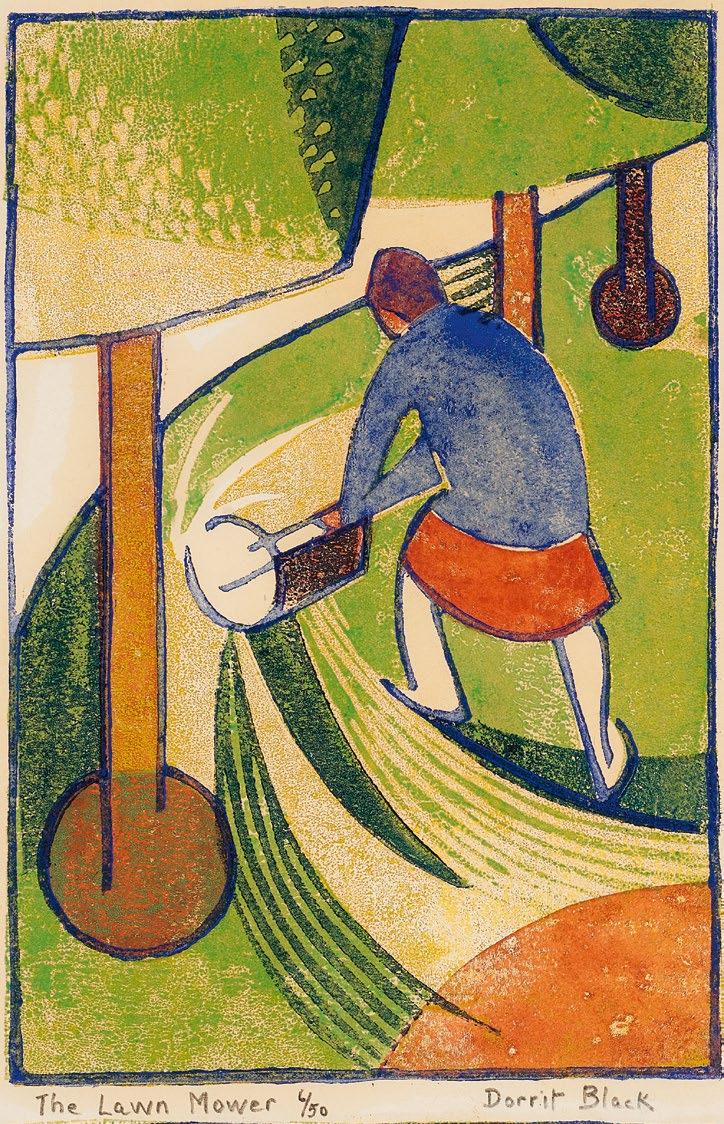
colour linocut on paper
19.5 x 13.0 (image)
25.0 x 15.5 cm (sheet)
edition: 6/50
signed below image lower right: Dorrit Black inscribed with title and numbered below image lower left: The Lawn Mower
Estimate: $40,000 – 60,000
Provenance
Estate of the artist, Adelaide
Thence by descent
Helen Finlayson (née Black), Adelaide, 1951 [the artist’s sister]
Margaret Michelmore (née Finlayson), Adelaide, a gift from the above Estate of the above, Adelaide
Exhibited
Exhibition of Linocuts, Everyman’s Lending Library, Melbourne, 5 – 16 April 1932, cat. 2 (another example)
Fourth Exhibition of British Lino–cuts, Ward Gallery, London, 17 May – 10 June 1933, cat. 44 (another example)
British Lino–cuts (Mostly in Colour), Hastings Public Museum and Art Gallery, Sussex, 9 May – 9 June 1936, cat. 54 (another example)
The Drawing, Print and Watercolour Exhibition, Contemporary Art Society of South Australia, Adelaide, opened 2 December 1952, cat. 2 (another example)
Dorrit Black 1891 – 1951, Art Gallery of South Australia, Adelaide, then touring to: Art Gallery of New South Wales, Sydney; Newcastle Region Art Gallery, New South Wales; The Ewing and George Paton Galleries, University of Melbourne, Melbourne, 1975 – 76, cat. 56 (another example)
A Survey of Australian Relief Prints 1900 – 1950, Deutscher Galleries, Melbourne, 13 April – 5 May 1978, cat. 183 (illus. in exhibition catalogue, p. 93, another example)
Colour Linocuts from the Grosvenor School, The Ward Gallery, Sydney, 26 March – 19 April 1980, cat. 42 (another example) Australian Art, Colonial to Modern, Deutscher Fine Art, Melbourne, 9 – 25 April 1986, cat. 85 (illus. in exhibition catalogue, another example)
Claude Flight and his Followers: The Colour Linocut Movement between the Wars, Australian National Gallery, Canberra, 18 April – 12 July 1992, then touring to: Art Gallery of New South Wales, Sydney, 14 October – 29 November 1992; National Gallery of Victoria, Melbourne, 16 December 1992 – 1 March 1993; Museum of New Zealand Te Papa Tongarewa, Wellington, 19 March – 16 May 1993; and Auckland Art Gallery Toi o Tāmaki, Auckland, 3 June – 18 July 1993, cat. 22 (another example)
The Dorrit Black Collection, Josef Lebovic Gallery, Sydney, 17 April – 29 May 1999, cat. 10A (another example)
Dorrit Black: Unseen Forces, Art Gallery of South Australia, Adelaide, 14 June – 7 September 2014 (another example)
Cutting Edge: Modernist British Printmaking, Dulwich Picture Gallery, London, 19 June – 8 September 2019 (another example)
Young, E., ’Contemporary Art Society Exhibition’, The Advertiser, Adelaide, 2 December 1952, p. 9 (another example)
Biven, R., Some Forgotten… Some Remembered: Women Artists of South Australia, Sydenham Gallery, Adelaide, 1976, n.p. (illus., another example)
North, I., The Art of Dorrit Black, MacMillan and Art Gallery of South Australia, Adelaide, 1979, cat. L.17, pl. 23, pp. 59, 60 (illus., another example), 131
Coppel, S., Lino Cuts of the Machine Age: Claude Flight and the Grosvenor School, Scholar Press, Leicester, United Kingdom, in association with National Gallery of Australia, Canberra, 1995, cat. DB18, pp. 156, 157 (illus., another example)
Lock, T., Dorrit Black: Unseen Forces, Art Gallery of South Australia, Adelaide, 2014, pp. 130, 156, 157 (illus., another example), 202 (illus., another example)
Samuel, G., et al., Cutting Edge: Modernist British Printmaking, Dulwich Picture Gallery, London, 2019, pp. 73, 74 (illus., another example)
Related works
Other examples of this print are held in the collections of the National Gallery of Australia, Canberra, and the Art Gallery of South Australia, Adelaide
The Lawn Mower, c.1932, linocut, printed in black, 6.9 x 10.0 cm, National Gallery of Australia, Canberra Study for linocut ’The lawn mower’, 1931 – 32, gouache, pencil, linocut on paper, 19.7 x 13.0 cm, Art Gallery of South Australia, Adelaide
colour linocut on paper
23.0 x 31.0 cm (image)
27.0 x 37.5 cm (sheet)
artist’s proof edition of 50 signed with artist’s monogram in image upper left
Estimate: $30,000 – 40,000
Provenance
Estate of the artist, Adelaide
Thence by descent
Helen Finlayson (née Black), Adelaide, 1951 [the artist’s sister]
Margaret Michelmore (née Finlayson), Adelaide, a gift from the above
Estate of the above, Adelaide
Exhibited
Dorrit Black (Retrospective), Royal South Australian Society of Arts, Adelaide, 25 October – 3 November 1945, cat. 53 (another example)
Contemporary Group, Farmers Blaxland Galleries, Sydney, 1946, cat. 4 (another example)
Dorrit Black, Royal South Australian Society of Arts, Adelaide, 10 – 21 May 1949, cat. 55 (another example)
The Drawing, Print and Watercolour Exhibition, Contemporary Art Society of Australia, Melbourne, opened 2 December 1952, cat. 15 (another example)
Modern Australia Women: Paintings and Prints 1925 – 1945, Art Gallery of South Australia, Adelaide, 24 November 2000 – 25 February 2001, then touring to: Art Gallery of Western Australia, Perth, National Gallery of Australia, Canberra, S.H. Ervin Gallery, Sydney and Art Gallery of Ballarat, Victoria (another example)
Dorrit Black 1891 – 1951, Royal South Australian Society of Arts, Adelaide, 2011, cat. 45 (another example)
Sydney Moderns: Art for a New World, Art Gallery of New South Wales, Sydney, 6 July – 7 October 2013 (another example)
Dorrit Black: Unseen Forces, Art Gallery of South Australia, Adelaide, 14 June – 7 September 2014 (another example)
Literature
George, E., ‘Woman’s Wide Range’, The Mail, Adelaide, 27 October 1945, p. 7 (another example)
George, E., ‘Paintings displayed by Dorrit Black’, The Mail, Adelaide, 14 May 1949, p. 6 (another example)
North, I., The Art of Dorrit Black, Art Gallery of South Australia, Adelaide, and Macmillan, South Melbourne, 1979, cat. L.40, p. 133 (another example)
Rolfe, M., Patchwork Quilts in Australia, Greenhouse Publications, 1987, p. 82 (illus., another example)
Wilson, S. C., From Shadow into Light: South Australian Women Artists Since Colonisation, Delmont, South Australia, 1988, p. 97 (another example)
Hoorn, J., Strange Women: Essays in Art and Gender, Melbourne University Press, Melbourne, 1994, p. 50 (illus., another example)
Coppel, S., Lino Cuts of the Machine Age: Claude Flight and the Grosvenor School, Scholar Press, Leicester, United Kingdom, in association with National Gallery of Australia, Canberra, 1995, cat. DB42, p. 163 (illus., another example)
Hylton, J., Modern Australian Women: Paintings & Prints 1925 – 1945, Art Gallery of South Australia, Adelaide, 2000, pp. 96 (illus., another example), 97, 121
Samuel, G. & Perry, N., The Cutting Edge of Modernity: Linocuts of the Grosvenor School, Lund Humphries, London, 2002, pp. 73, 75 (illus., another example)
Speck, C., Painting Ghosts: Australian Women Artists in Wartime, Craftsman House, Melbourne, 2004, pp. 185, 186 (illus., another example)
Butler, B., Printed Images by Australian Artists 1885 – 1955, National Gallery of Australia, Canberra, 2007, p. 242 (illus., another example)
Speck, C., Beyond the Battlefield: Women Artists of the Two World Wars, Reaktion Books, London, 2014, p. 156, pl. 100 (illus., another example)
Edwards, D., and Mimmocchi, D. (eds.), Sydney Moderns: Art for a New World, Art Gallery of New South Wales, Sydney, 2013, pp. 179 (illus., another example), 310
Lock, T., Dorrit Black: Unseen Forces, Art Gallery of South Australia, Adelaide, 2014, p. 87 (illus.), 94 (illus.), 126, 206 (illus., another example)
Samuel, G., Cutting Edge: Modern British Printmaking, Bloomsbury, United States, 2019, pp. 73, 75 (illus.)
Related works
Other examples from this edition are held in the collections of the Art Gallery of South Australia, Adelaide, the National Gallery of Australia, Canberra and the Shepparton Art Museum, Victoria
The Wool Quilt Makers, c.1940 – 41, oil on cardboard, 45.5 x 55.0 cm, private collection, illus. in North, I., The Art of Dorrit Black, Art Gallery of South Australia, Adelaide, and Macmillan, South Melbourne, 1979, pl. 39, p. 92
The wool quilt makers (Red Cross Wool Fleece Quilts Relief Committee), c.1940 – 41, watercolour, pastel and pencil on paper, 28.3 x 35.2 cm, Australian War Memorial, Canberra Study for “The wool quilt makers”, c.1941, drawing in brush, black ink over drawing in pencil, 23.0 x 31.0 cm, National Gallery of Australia, Canberra
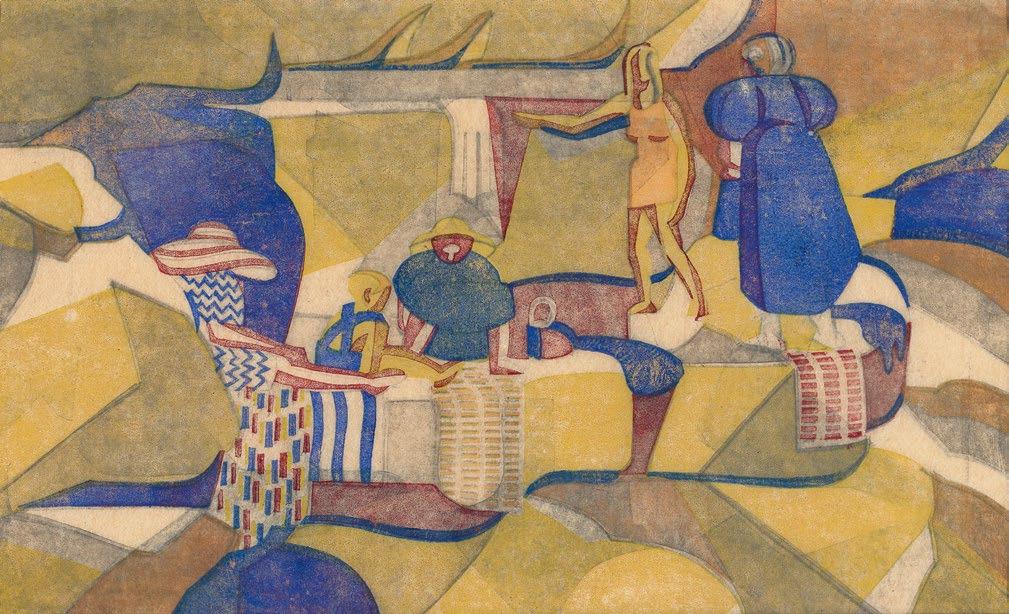
colour linocut on paper
19.5 x 31.5 cm (image)
23.0 x 35.5 cm (sheet)
artist’s proof edition of 50
Estimate: $20,000 – 30,000
Provenance
Estate of the artist, Adelaide
Thence by descent
Helen Finlayson (née Black), Adelaide, 1951 [the artist’s sister]
Margaret Michelmore (née Finlayson), Adelaide, a gift from the above Private collection, Adelaide, a gift from the above
Exhibited
Sixth Exhibition of British Lino-Cuts, Ward Gallery, London, 1 – 25 May 1935, cat. 66 (another example)
Contemporary Group Exhibition, Farmers Blaxland Galleries, Sydney, 13 – 24 August 1935, cat. 79 (another example)
Exhibition of Oils, Watercolours and Lino Cuts by Dorrit
Black, Royal South Australian Society of Arts, Adelaide, 7 – 23 July 1938, cat. 35 (another example)
Exhibition of Modern Lino-Cuts, City of Birmingham Museum and Art Gallery, Birmingham, 30 March
– 19 April 1939, cat. 7 (another example)
Dorrit Black (Retrospective), Royal South Australian Society of the Arts, Adelaide, 25 October – 3 November 1945, cat. 56 (another example)
Claude Flight and his Followers: The Colour Linocut Movement between the Wars, Australian National Gallery, Canberra, 18 April – 12 July 1992, then touring to: Art Gallery of New South Wales, Sydney, 14 October – 29 November 1992; National Gallery of Victoria, Melbourne, 16 December 1992 – 1 March 1993; Museum of New Zealand Te Papa Tongarewa, Wellington, 19 March – 16 May 1993; and Auckland Art Gallery Toi o Tāmaki, Auckland, 3 June – 18 July 1993, cat. 25 (another example)
Sydney Moderns: Art for a New World, Art Gallery of New South Wales, Sydney, 6 July – 7 October 2013 (another example)
Dorrit Black: Unseen Forces, Art Gallery of South Australia, Adelaide, 14 June – 7 September 2014 (another example)
Cutting Edge: Modernist British Printmaking, Dulwich Picture Gallery, London, 19 June – 8 September 2019 (another example)
Dangerously Modern: Australian women artists in Europe 1890 – 1940, Art Gallery of South Australia, Adelaide, 24 May – 7 September 2025 and Art Gallery of New South Wales, Sydney, 11 October 2025 – 1 February 2026 (another example)
Literature
North, I., The Art of Dorrit Black, Art Gallery of South Australia, Adelaide, and Macmillan, South Melbourne, 1979, cat. L.24, p. 132 (another example)
Coppel, S., Lino Cuts of the Machine Age: Claude Flight and the Grosvenor School, Scholar Press, Leicester, United Kingdom, in association with National Gallery of Australia, Canberra, 1995, cat. DB26, pp. 158, 159 (illus., another example)
Edwards, D., and Mimmocchi, D. (eds.), Sydney Moderns: Art for a New World, Art Gallery of New South Wales, Sydney, 2013, pp. 179 (illus., another example), 310
Lock, T., Dorrit Black, Unseen Forces, Art Gallery of South Australia, Adelaide, 2014, pp. 79, 156, 159 (illus., another example), 160, 203 (illus., another example)
Samuel et al., Cutting Edge: Modernist British Printmaking, Dulwich Picture Gallery, London, 2019, pp. 72, 73 (illus., another example)
Freak, E., (ed.) et. al., Dangerously Modern: Australian women artists in Europe 1890 – 1940, Art Gallery of South Australia, Adelaide and Art Gallery of New South Wales, Sydney, 2025, pp. 255 (illus., another example), 342
Related works
On the rocks, England, 1935, watercolour on paper, 19.5 x 31.0 cm, private collection Other examples from this edition are held in the collections of the Art Gallery of South Australia, Adelaide, Queensland Art Gallery | Gallery of Modern Art, Brisbane, and the National Gallery of Australia, Canberra
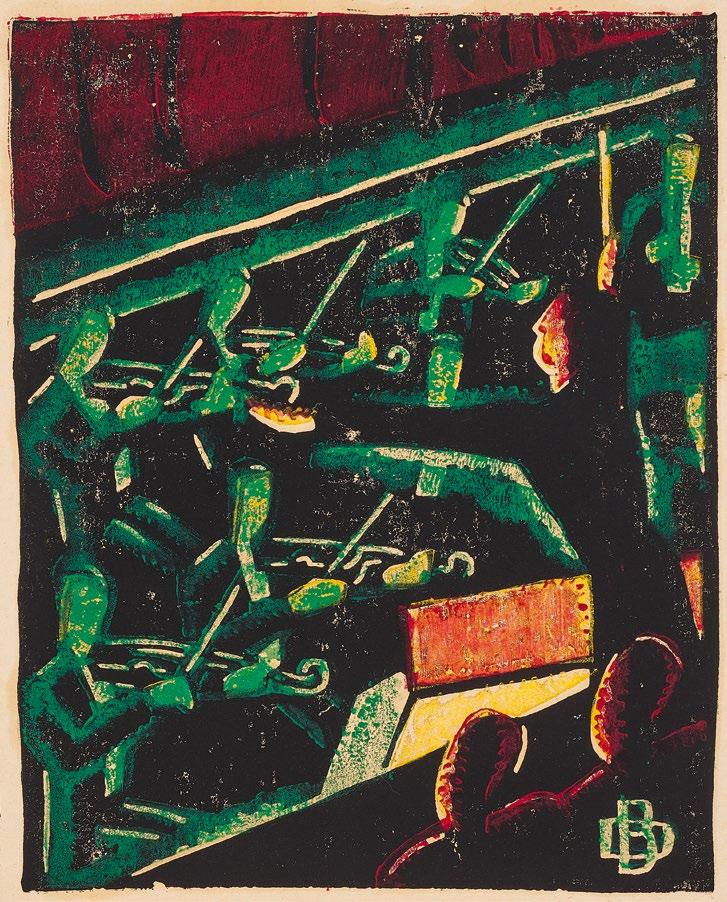
Orchestra pit, Theatre Royal, c.1935
colour linocut on paper
23.0 x 18.0 cm (image)
30.0 x 22.0 cm (sheet)
artist’s proof
signed with artist’s monogram in image lower right
Estimate: $20,000 – 30,000
Provenance
Estate of the artist, Adelaide
Thence by descent
Helen Finlayson (née Black), Adelaide, 1951 [the artist’s sister]
Margaret Michelmore (née Finlayson), Adelaide, a gift from the above
Estate of the above, Adelaide
Exhibited
The Drawing, Print and Watercolour Exhibition, Contemporary Art Society of Australia, Melbourne, opened 2 December 1952, cat. 24 (another example)
Dorrit Black: Unseen Forces, Art Gallery of South Australia, Adelaide, 14 June – 7 September 2014 (another example)
Literature
North, I., The Art of Dorrit Black, Art Gallery of South Australia, Adelaide, and Macmillan, South Melbourne, 1979, cat. L.50, p. 133 (another example)
Coppel, S., Linocuts of the Machine Age: Claude Flight and the Grosvenor School, Scolar Press, Aldershot, England, in association with the National Gallery of Australia, Canberra, 1995, cat. DB31, p. 160 (illus., another example)
Lock, T., Dorrit Black: Unseen Forces, Art Gallery of South Australia, Adelaide, p. 203 (illus., another example)
Related works
Other examples from this edition are held in the collections of the National Gallery of Australia, Canberra and Art Gallery of South Australia, Adelaide
The Orchestra Pit, Theatre Royal, c.1935, watercolour on paper, 22.0 x 17.0 cm, private collection
Sketch For Linocut ‘Orchestra Pit, Theatre Royal, c.1935, pencil on paper, 9.2 x 7.4 cm, private collection
colour linocut on paper
16.0 x 24.0 cm (image)
19.0 x 27.5 cm (sheet)
artist’s proof edition of 50 signed with artist’s monogram in image upper right
Estimate: $25,000 – 35,000
Provenance
Estate of the artist, Adelaide
Thence by descent
Helen Finlayson (née Black), Adelaide, 1951 [the artist’s sister]
Margaret Michelmore (née Finlayson), Adelaide, a gift from the above
Estate of the above, Adelaide
Exhibited
Dorrit Black, Royal South Australian Society of Arts Gallery, Adelaide, 10 – 21 May 1949, cat. 50 (another example)
Dorrit Black Memorial Exhibition, Royal South Australian Society of Arts, Adelaide, 22 April – 2 May 1952, cat. 58 (another example)
The Drawing, Print and Watercolour Exhibition, Contemporary Art Society of Australia, Melbourne, opened 2 December 1952, cat. 33 (another example)
Exhibition of Paintings by the late Dorrit Black, Hahndorf Academy Gallery, Adelaide, 1959, cat. 34 (another example)
Dorrit Black 1891 – 1951, Art Gallery of South Australia, Adelaide, then touring: Art Gallery of New South Wales, Sydney, Newcastle Art Gallery, New South Wales, The Ewing and George Paton Galleries, University of Melbourne, Melbourne, 1975 – 76, cat. 68 (another example)
Project 39 – Women’s Imprint, Art Gallery of New South Wales, Sydney, 1 – 31 October 1982
A Century of Australian Woman Artists, Deutscher Fine Art, Melbourne, 4 June – 3 July 1993, cat. 107 (another example, illus. in exhibition catalogue, p. 75)
Dorrit Black Collection, Josef Lebovic Gallery, Sydney, 17 April – 29 May 1999, cat. 16 (another example)
Dorrit Black: Unseen Forces, Art Gallery of South Australia, Adelaide, 14 June – 7 September 2014 (another example)
Modern impressions: Australian prints from the collection, Art Gallery of New South Wales, Sydney, 2 September 2016 – January 2017 (another example)
Literature
North, I., The Art of Dorrit Black, Art Gallery of South Australia, Adelaide, 1979, cat. L.48, pl. 25, pp. 111 (illus., another example, dated c.1949), 133
Coppel, S., Linocuts of the machine age: Claude Flight and the Grosvenor school, pp. 65–68, England, 1995, cat. DB45, p. 164 (illus., another example)
Speck, C., Painting ghosts: Australian women artists in wartime, Melbourne, 2004, pp. 196, 197 (illus., another example)
Butler, R., Printed images by Australian artists 1885 – 1955, Canberra, 2007, p. 242 (illus., another example)
Lock, T., Dorrit Black: Unseen Forces, Art Gallery of South Australia, Adelaide, 2014, pp. 206 (illus., another example)
Grishin, S., Australian Art: A History, The Miegunyah Press, Melbourne, 2015, pp. 236 (illus., another example), 238
Other examples from this edition are held in the collections of the Art Gallery of South Australia, Adelaide, the National Gallery of Australia, Canberra and the Art Gallery of New South Wales, Sydney Study for linocut ‘Naval Funeral’, c.1945, watercolour and pencil on paper, 16.5 x 23.0 cm, Cruthers Collection of Women’s Art, The University of Western Australia, Perth
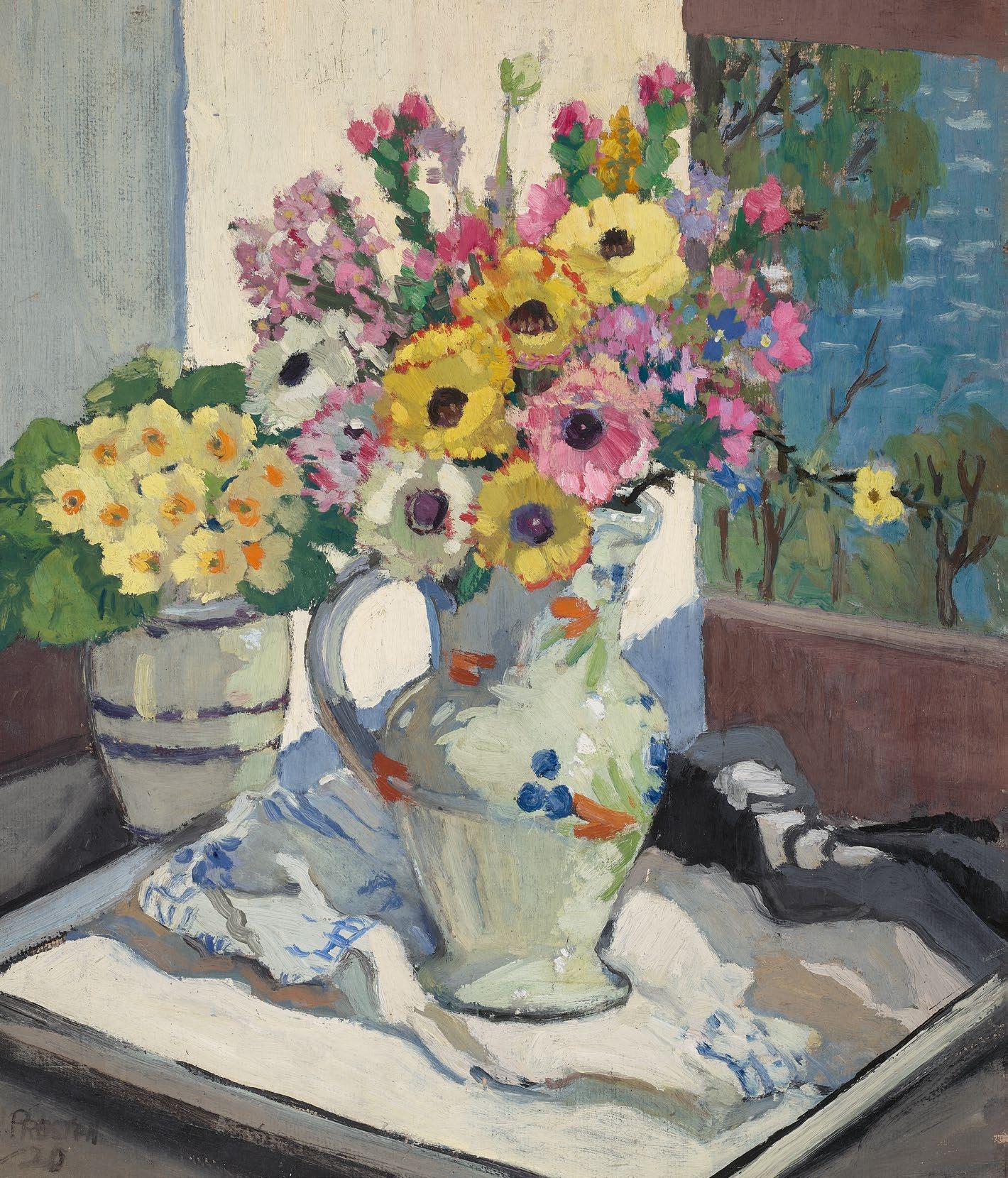
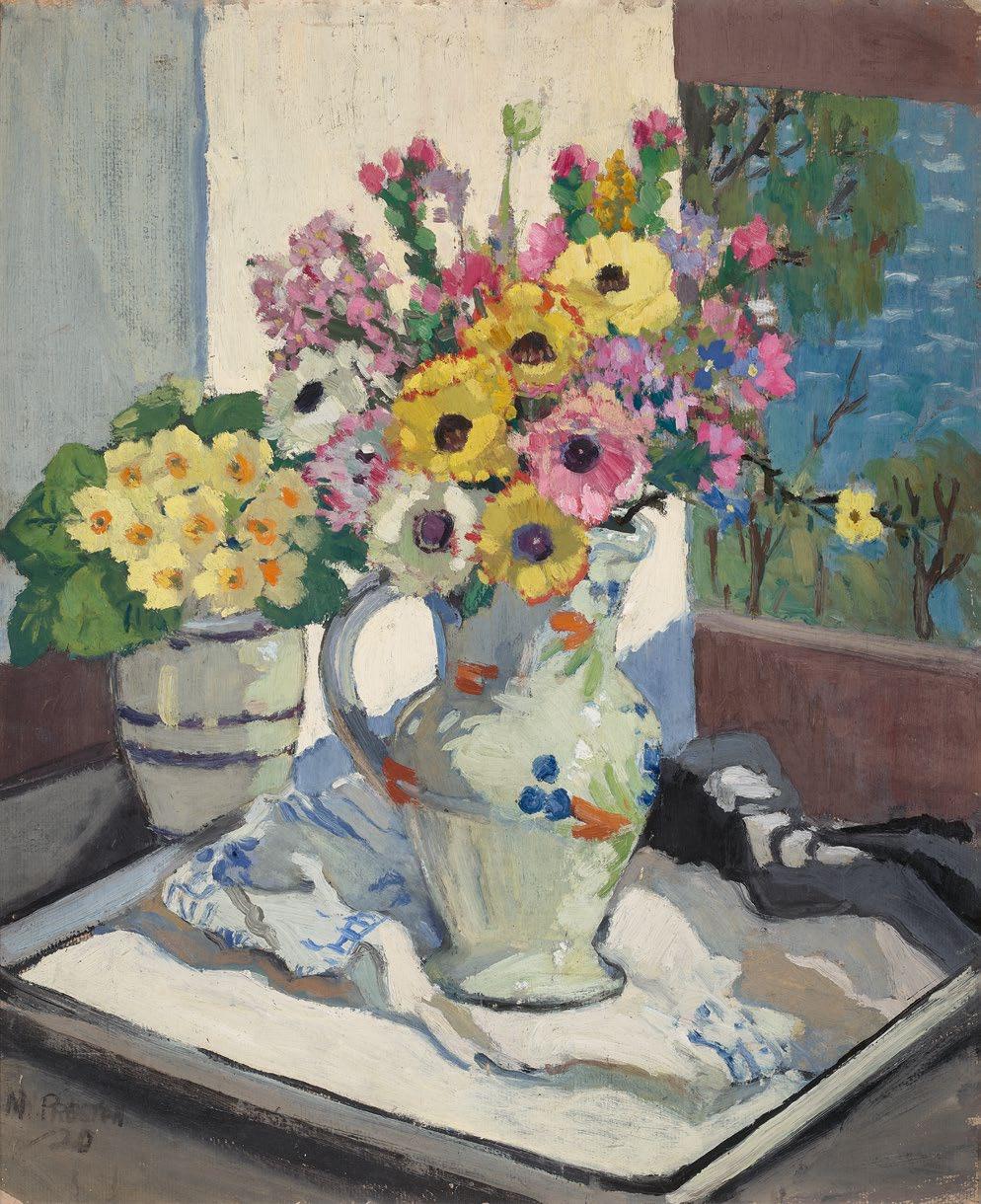
Still life with native rose, 1920
oil on cardboard
55.5 x 45.5 cm
signed and dated lower left: M. PRESTON / /20
Estimate: $350,000 – 450,000
Provenance
Amy Beddome (née Byard), Adelaide Elizabeth White (née Beddome), Adelaide Samuel Paul Mortimer White, Adelaide
Thence by descent
Private collection, Adelaide
Exhibited
Margaret Preston: Art and Life, Art Gallery of New South Wales, Sydney, 29 July – 23 October 2005, then touring to: National Gallery of Victoria, Melbourne, 12 November 2005 – 29 January 2006; Queensland Art Gallery, Brisbane, 18 February – 7 May 2006; Art Gallery of South Australia, Adelaide, 26 May – 13 August 2006 (label attached verso)
Literature
Edwards, D., Peel, R. and Mimmocchi, D., Margaret Preston, Art Gallery of New South Wales, Sydney, 2005, pp. 63 (illus.), 66, 282 Margaret Preston Catalogue Raisonne of paintings, monotypes and ceramics, Art Gallery of New South Wales, Sydney, 2005, Cd–Rom compiled by Mimmocchi, D., with Edwards, D., and Peel, R.
Born Margaret Rose MacPherson, her talent was evident from an early age, and she received initial study from Lister Lister whilst still a teenager. In 1893, she enrolled at Melbourne’s National Gallery’s School of Design under Frederick McCubbin but returned briefly to Adelaide on her father’s death, before recommencing at the Gallery School, choosing painting under Bernard Hall and winning one year’s free tuition for a still life painting. Preston excelled under Hall and ‘was eventually elevated to work in the ‘number one’ studio among the most talented in her cohort, including Hugh Ramsay, Violet Teague and Max Meldrum.’ 1 On conclusion, she returned to Adelaide undertaking a short spell of further tuition before leasing a studio and teaching full time. In 1903, one of her students was Bessie Davidson to whom she became very close, travelling to Europe together the following year with Preston undertaking yet more study in Munich before moving on to Paris where the two attended an atelier libre associated with the renowned Académie Colarossi; she also had paintings selected for the New Salons of 1905 and 1906. Equally important to her increasing knowledge and skill was exposure to the first fauves exhibition in 1905 which allowed
her to attain a technical understanding of artists such as Matisse, Derain and Vlaminck. On returning to Adelaide in late 1906, the two opened a studio school together, a student of which was Stella Bowen who later described Preston as being ‘a red-headed little fire-brand of a woman who was not only an excellent painter… but a most inspiring teacher.’ 2 Davidson returned to Paris in 1910 and by 1911, one local critic considered that Preston was ‘probably unequalled in Australia in the department of still lifes.’ 3 Unfortunately, such displays of support did not prevent the straight-talking artist from feeling increasingly constrained by the otherwise prevailing conservatism of Adelaide. Thus in 1912, she returned to Europe, this time in the company of her star student Gladys Reynell, where she reconnected with Davidson and her old friend Rupert Bunny, and again sought further tuition.
Preston’s continued search for new ideas and teachers has been described as ‘an opportunity to ‘fill the well’ and (thus) be able to return to her own work with refreshed eyes and enthusiasm.’4 Other new inspirations from these years included the decorative possibilities of Japanese prints and post-Impressionism, with Preston infusing her paintings further with defined rhythms and colour whilst simultaneously experimenting with the shallow space of modernism, all underscored by her prodigious intellect. The declaration of war compelled the women to relocate to London, a move which benefited Reynell who could now provide closer family support to her three serving brothers, one of whom,
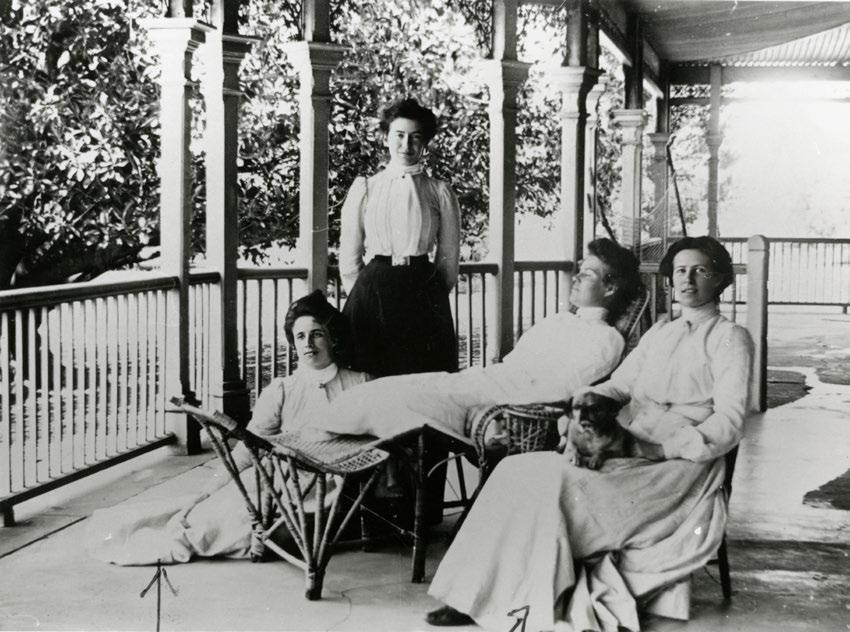
Four young women relaxing at the Reynell family home, featuring Gladys (seated on the floor) and Emily (with the dog on her lap), c.1905
State Library of South Australia, Adelaide
Carew, died at Gallipoli. Preston exhibited regularly at the Royal Academy, New English Art Club and the Society of Women artists, and with Reynell, took two separate groups of women students to Ireland for artist camps. A new radiance entered her work using a palette of less saturated colour to depict still life and dining settings, both indoor and outdoor, arranged on boldly patterned geometric tablecloths with the blooms set in a variety of local and Asian ceramic containers. Her paintings began to gain serious attention with one, Anemones, 1916, aka The window, being hung ‘on the line’ at that year’s Royal Academy, attracting praise for its ‘sheer beauty of painting and colour’ 5, whilst her entry at the following year’s annual exhibition by the Society of Women Artists saw her Indoor still life acclaimed by the Sunday Times as ‘one of the best exhibits.’ 6 Preston and Reynell studied further in pottery and various forms of printmaking, two particular skills they subsequently took to the Seale-Hayne Neurological Military Hospital in Devon, where Rupert Reynell, Gladys’s elder brother, was a surgeon. On his invitation, they taught pottery and basket weaving to shell-shocked veterans and a short film made there poignantly captures Preston helping these damaged men unload a kiln.7
At the cessation of hostilities, it appears the two women began making plans to return to Adelaide together and open their own pottery, but another fate intervened – Preston had met the man who was to become her husband. This was William
(Bill) Preston, a Second Lieutenant Gunner in the Field Artillery Brigades who had served on the Western Front. Recently demobbed, he was now heading back to Australia to take up the position as a manager for Dalton Brothers, a mercantile firm and importing agency. They left London together in 1919, travelling via North America en route to Australia. Reynell, who was already back in Adelaide and had established the pottery she named ‘Reynella’, did not take kindly to the news that the couple were to marry, leading to an awkward estrangement which affected their planned two-person exhibition in Adelaide. In short, neither attended the opening though the show was well received. Happily, the two women reconciled, and the Prestons were married at Christ Church, O’Halloran Hill, Adelaide. Gladys and May Reynell (Carew’s widow) were witnesses, and the reception was held at Reynella. Preston stayed with May prior to the ceremony and gave her daughter Lydia painting lessons, later recalling that her teacher was ‘great fun’ but also ‘had very colourful language for the time. My mother’s eyebrows used to shoot up when Margaret used the word ‘bloody.’’ 8 In thanks for her kindness, Preston gifted May with a still life – Flowers, 1917 (National Gallery of Australia) – depicting ‘bright red geraniums and mauve primulas in a little Chinese porcelain bowl.’ 9 Following a honeymoon on Norfolk and Lord Howe islands, the Prestons moved to Sydney taking up residence at ‘Glenorie’ in Musgrave Street, approximately fifty metres f rom the South Mosman Wharf.
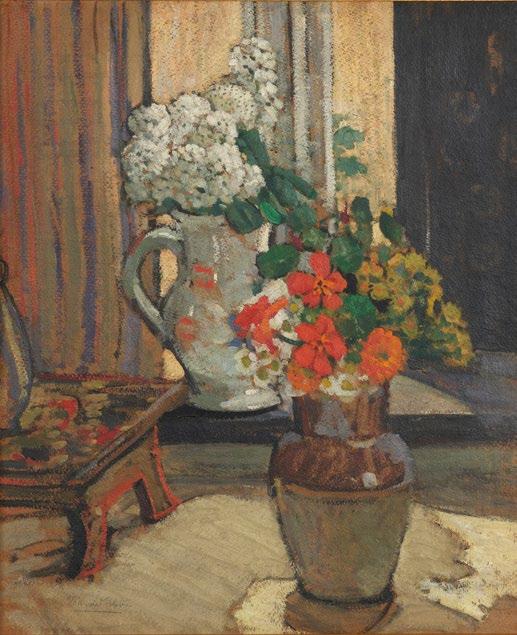
Margaret Preston Nasturtiums, c.1916
oil on cardboard
61.2 x 50.7 cm
Still life with native rose, 1920, dates from this first year in Sydney, likely painted in winter due to the leafless tree trunks visible through the window with the choppy waters of Sydney Harbour beyond. Due no doubt to the activities involved in setting up house in a new city, there are only four works by the artist from 1920 listed in her catalogue raisonné. Apart from native roses, this painting also features buttercups and (probably) pink stocks, and whilst the table setting and palette are similar to her British work, Preston was already responding to ‘regional nuances of colour and light… The striped awnings of earlier English paintings were raised to reveal the urban and harbour landscape’ 10, and indeed, one buttercup seems to be merging with the trees outside. The flowers are contained in a jug and a vase, and Preston again tilts the table’s angle, the bottom corner of which acts as a counterpoint for the pronounced diagonal of the blooms. Significantly, the painting is signed with her new married name, with the artist proclaiming emphatically that ‘(i)f my work would not stand, apart from the merit gained under my previous name as an artist, it would have to go. I did not want to be an artist with a name for past merits.’ 11 The strength of her European work was quickly noticed and the Art Gallery of New South Wales purchased two paintings – Nasturtiums, c.1916, and Summer, 1915 – within months of her arrival.
In Adelaide, Gladys Reynell caused her own scandal by marrying the family’s gardener in 1922 – the ex-serviceman, George Osbourne, who was ten years older and whose standing as a ‘servant’ was beneath her parents’ snobbish dignity. The couple quickly moved to Bendigo as a result and set up a new pottery there. A number of subsequent paintings by Preston feature ceramics made by her friend including the exceptional The pottery of Gladys Reynell, SA , 1922 (Kerry Stokes, Perth).
These events provide some clue as to when Preston gifted the painting to Amy Beddome, née Byard, sister of May Byard who had married Carew Reynell. Beddome’s descendants believe that Still life with native rose was given ‘in return for a small favour’ and although the exact details are now lost, it is plausible that the act occurred during Preston’s wedding or Reynell’s two years later. It has stayed within the family ever since and is now offered for the first time at auction. Still life with native rose is a vital and
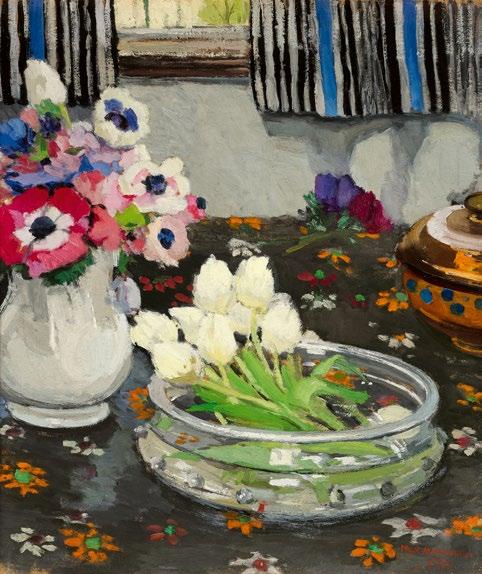
Margaret Preston Anemones, 1916 oil on cardboard
55.5 x 46.0 cm
Private collection
© Margaret Preston/Copyright Agency 2026
Sold for $613,636 (inc. BP), Deutscher and Hackett, Melbourne, 24 April 2024, lot 12
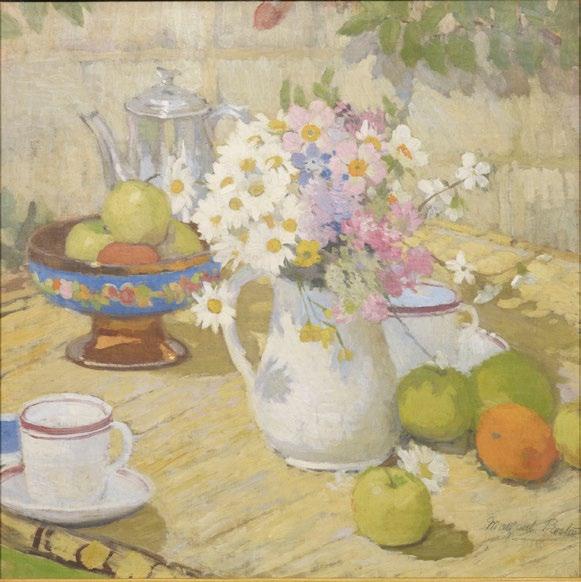
Margaret Preston Summer, 1915 oil on canvas
49.5 x 49.5 cm
Art Gallery of New South Wales, Sydney © Margaret Preston/Copyright Agency 2026
significant painting by Preston who would be described soon af ter as being ‘a distinguished and original artist… with abundant vitality, unerring taste in selection, the intellectual gift of invention and an emotional colour sense which amounts to genius.’ 12
Significantly, Anemones, 1916 (private collection), which in 2024 achieved the highest price ever paid for the artist’s work at auction13, likewise originated in the Reynell family as a gift from Preston to Gladys. Both works are the same size and it is fascinating to study the stylistic differences between the two, painted four years apart – especially given that, by the time she painted Still life with native rose, Preston was already one of this country’s most rigorously trained artists and would remain Australia’s most prominent and outspoken modernist painter for the next four decades. What is equally remarkable is that each of her paintings was a logical step from the one preceding as Preston sought methodically to solve technical and stylistic challenges usually utilising the still life motif which she saw as being akin to a laboratory table ‘on which aesthetic problems can be solved.’ 14
1. Harding, L., Margaret Preston: recipes for food and art, Miegunyah Press, Melbourne, 2016, p. 6
2. Stella Bowen, cited in Edwards, D., Peel, R. and Mimmocchi, D., Margaret Preston, Art Gallery of New South Wales, Sydney, 2005, p. 273
3. ‘South Australian Society of Arts annual exhibition’, Adelaide Advertiser, Adelaide, 6 April 1911, p. 9
4. Harding, op. cit., p. xiii
5. The Morning Post, London, cited in ‘Personal’, The Journal, Adelaide, 23 June 1916, p. 1
6. Rutter, F., ‘The Galleries: Society of Women Artists’, Sunday Times, London, March 1917 cited in Drayton, J., Edith Holmes: her life and work 1885 – 1964, Canterbury University Press, New Zealand, 1999, p. 45
7. War Neuroses, British Pathé, 1918, at: https://www.youtube.com/ watch?v=HYW5WaJRkL4 (accessed 6 July 2026)
8. Butel, E., Margaret Preston, Imprint, Sydney, 1995 (1985 edition), p. 21
9. ibid.
10. Edwards, D. et al ., op. cit., pp. 66, 68
11. Preston, M., ‘The artist who changed her name’, Woman’s Budget, Sydney, 16 December 1931, p. 5
12. Proctor, T., ‘An artist’s appreciation of Margaret Preston’, Art in Australia, Ure Smith, Sydney, 3rd series, no. 22, 1 December 1926 [Margaret Preston issue]
13. See Deutscher and Hackett, Important Australian and International Fine Art, 24 April 2024, lot 12
14. Preston, M., ‘Aphorism 46’, in Gellert, L., and Ure Smith, S., (eds.), Margaret Preston: recent paintings 1929, Art in Australia, Sydney, 1929, non-paginated
Andrew Gaynor
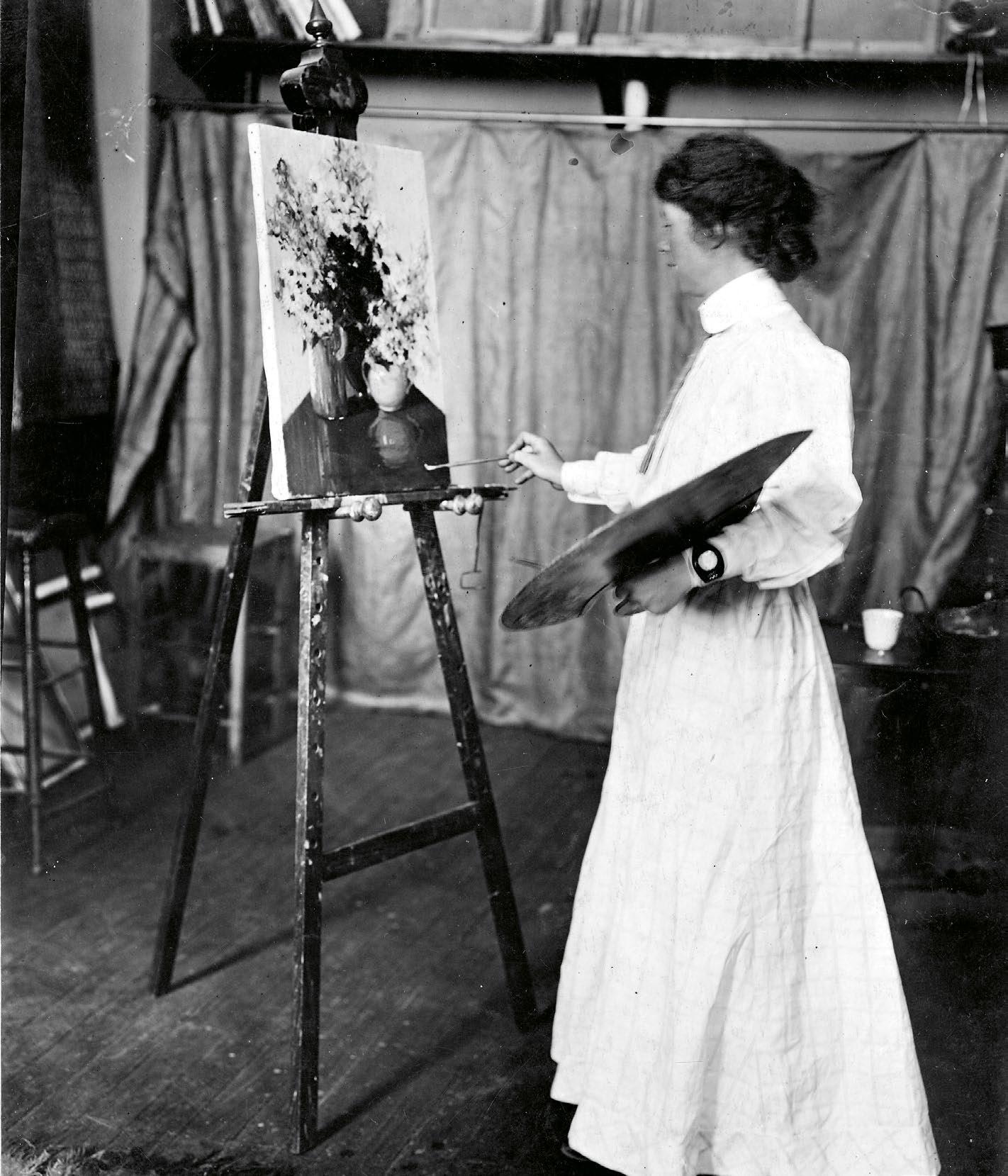
watercolour, bodycolour and gum arabic on paper
44.5 x 63.5 cm
signed lower right: C. Martens
Estimate: $200,000 – 300,000
Provenance
Kenneth R. Stewart Collection, Sydney, until April 1979
Consolidated Press Holdings, Sydney
The H. W. B. Chester Memorial Collection, Sydney
The Dallhold Collection, Perth
Sotheby's, Melbourne, 23 August 1992, lot 184 (as 'Double Bay, c.1840s')
Private collection, London
Exhibited
Conrad Martens Centenary Exhibition, S. H. Ervin Museum and Art Gallery, Sydney, 24 May – 23 July 1978, cat. 41 (as ‘Double Bay, c.1840’)
Conrad Martens: The H. W. B. Chester Memorial Collection, Art Gallery of New South Wales, Sydney, 22 December 1979 – 10 February 1980, cat. 14 (as ‘Double Bay’)
Literature
Lindsay, L., Conrad Martens: The Man and His Art, Angus and Robertson, Sydney, 1968, pl. 2 (illus.)
Focus, Consolidated Press Holdings Ltd., staff magazine, June 1979 (illus. front cover)
Dundas, D., The Art of Conrad Martens, Macmillan, Melbourne, 1979, pp. 23, 44 (illus., as ‘Double Bay, c.1840’) Pearce, B. (ed.), Conrad Martens: The H. W. B. Chester Collection, Art Gallery of New South Wales, Sydney, 1979, cat. 14, pp. 24 (illus., as ‘Double Bay, c.1840s’), 41 de Vries – Evans, S., Conrad Martens on the Beagle and in Australia, Pandanus Press, Brisbane, 1993, p. 157
When Conrad Martens painted this majestic work in the late 1850s, he was at his peak as an artist. Having weathered the lean years of the 1840s Depression, he regained momentum (and new clients) through his long journey in 1851 – 52 from Brisbane, the Darling Downs and Northern New South Wales and on his return to Sydney, now prospering again due to the discovery of gold, he found renewed interest from art buyers. Martens became, for the first time, a public figure giving lectures and enjoying a reputation which would eventually extend over three decades as Sydney’s preeminent resident artist.
One of his best commissions at this time was for the highly successful industrialist and businessman, Thomas Sutcliffe Mort. Martens had known Mort and his family since the 1840s when he went almost weekly to Darling Point to give lessons to Mort’s wife, Theresa. From late 1847, the family were living at Greenoaks, their very grand Gothic-style mansion high on the eastern side of Darling Point, with its extensive gardens facing Double Bay down to the water’s edge and Point Piper and Bellevue Hill in the middle distance. It was one of the most beautiful sites in Sydney and retains its magic to this day, albeit with the gardens much reduced.
Thomas Mort had an abiding interest in pictures and artefacts and Greenoaks included one of the first private art galleries in Sydney to display his collections. Between 1855 and 1857, Martens painted three large-sized works for Mort depicting scenes in Darling Point including one from Greenoaks’ garden looking down to Double Bay.1 The preliminary sketch for this is held by the State Library of New South Wales. 2
Martens recorded in his Account of Pictures entry for January 1859 a very similar and second version of the vista from Greenoaks’ garden, described as ‘ View Double Bay done for Sir Daniel Cooper J. Levick Esq.’ 3 Sir Daniel Cooper was a very wealthy merchant and politician who had been living in Sydney’s Eastern Suburbs at Rose Bay before moving in 1857 to Woollahra House, his vast new residence at Point Piper. He paid Martens’ highest price at the time for Double Bay – twenty-one pounds.
However, for some reason, the Double Bay painting was returned and later offered to another Sydney merchant, James Levick. Levick is noted in the Account of Pictures entry for 10 July 1861 as paying twenty pounds for Double Bay from Mr Mort’s,
View of Sydney Harbour, New South Wales taken from Mr Mort’s house, c.1853 watercolour on paper 30.5 x 44.0 cm
National Library of Australia, Canberra
annotated by Martens as ‘previously done.’4 James Levick was another enthusiastic mid-19th century Sydney art collector with a private gallery. He had an eclectic collection, as indicated in the sale notice shortly before his death at Hunters Hill 5, and had purchased several of Martens’ smaller pictures in the late 1840s, then two large works in 1861, including the Double Bay
Double Bay from Mr Mort’s, 1859 is one of Martens’ large-scale, highly finished, top-of-range paintings. He was always a master of topographical detail and his fine drawing skills underpin the finished work. But the overall effect goes far beyond more prosaic reportage with his handling of watercolour resulting in a poetical response to the beauties of Sydney Harbour. There is richness in the tonalities of the vegetation framing the view which contrasts with the limpid waters and two arcs of sandy beaches forming the bay, which is further emphasised by the darker tones of the still tree-covered peninsula of Point Piper, centre, and the ridge of Bellevue Hill running to the right with a tiny glimpse of Rose Bay in between. In all, it is an exquisitely judged composition both in execution and sensibility. As the great art historian and curator Andrew Sayers wrote: ‘His central
position in Sydney landscape painting – a position he maintained for three decades – was due first to Martens’ determination to give a sense of atmosphere and scale to his subjects and secondly to the suavity of his watercolour technique.’ 6
This painting exemplifies these words and is a superb example of the artist’s work depicting one of Sydney’s most enchanting harbourside locations.
1. Now held in the collection of the National Trust of Australia (NSW). These works were donated in 1981 by the Misses Enid and Margaret Mort.
2. Conrad Martens, From Greenoaks T.S. Mort Esq. Jan. 23 1857, pencil, in View of Sydney and New South Wales (State Library of NSW, DG*G 18, f. 19)
3. Martens, Account of Pictures 1856 – 1878 (State Library of NSW, DL MS 143, f. 9)
4. ibid. (DL MS 143, f. 12)
5. Sydney Morning Herald, Sydney, 6 August 1883, p. 9
6. ‘Turner and the origins of landscape painting in Australia’, by Sayers, A., in Lloyd, M. (ed.), Turner, National Gallery of Australia, Canberra, 1996, p. 206
Elizabeth Ellis OAM
Emeritus Curator, Mitchell Library
State Library of NSW
Knud Bull (Norwegian, 1811 – 1889, lived/worked in Germany (1830s), Australia 1846 – 89)
The city of Hobart Town with Mount Wellington beyond, 1855
oil on canvas
78.0 x 127.0 cm
signed lower centre: K Bull
bears inscription on typed label verso: The City of Hobart Town with Mount Wellington / Knut Bull
Estimate: $500,000 – 700,000
Provenance
Private collection, by descent through the artist’s family Phillips Auctioneers, London, 3 October 1989, lot 12 Private collection, Hobart
Exhibited on long term loan to Tasmanian Museum and Art Gallery, Hobart, October 1989 – July 2015 (label attached verso) on long term loan to Government House, Hobart, July 2015 – June 2026
Related works
View of Hobart Town, 1854, oil on canvas, 55.5 x 88.5 cm, Tasmanian Museum & Art Gallery, Hobart Hobart Town, 1855, oil on canvas, 55.0 x 81.5 cm, private collection
View of Hobart Town, 1855, oil on canvas, 135.0 x 210.0 cm, private collection, on long term loan to the Tasmanian Museum & Art Gallery, Hobart
City of Hobart Town, 1855, hand–coloured lithograph and tint stone, lithographer: Elizabeth Walker, 32.3 x 59.0 cm, National Gallery of Victoria, Melbourne
22.5 x 29.0 cm
The National Museum of Art, Architecture and Design, Oslo, Norway
Although he only painted in Tasmania for a few years – principally 1852 to 1856 – the Norwegian artist Knud Bull has a significant presence in the history of painting in the colony. The only professional landscape artist practising in Hobart at the time, Bull depicted the flourishing port city from a variety of locations, as well as nearby properties and surrounding environs. This superb painting depicts his best-known view, looking across the Derwent Estuary to Hobart (then named Hobart Town). Morning sun illuminates the slopes of Kunanyi / Mount Wellington and is reflected in the pellucid waters, casting a soothing glow over the bustling city established some fifty years prior. The sublime presence of the towering mountain is counterbalanced by the gentle ripple of the water which offers safe haven to passenger, cargo and whaling ships from the turbulent Southern Ocean.
Knud Geemuyden Bull was born in 1811 in Bergen, Norway, a country then under Danish control.1 He and his nine siblings grew up in comfortable and cultivated circumstances: his eldest brother Ole became an internationally renowned violinist and composer, while his youngest, Georg Andreas, became an influential architect. Knud Bull’s artistic interests developed at
an early age; although his preliminary teaching is unknown, it possibly included study in Copenhagen, as he later claimed. In 1833, aged 22, he attended the Dresden Art Academy for six months, studying with Norwegian-born Johan Christian Dahl, an influential participant in the German Romantic landscape movement, and a close friend of Caspar David Friedrich. Following his return to Bergen, Bull exhibited numerous landscapes and portraits in 1836, although only a small number are now known. One of his most accomplished, View of parts of Bergen, Nordnes, and Sandviken from Laksevåg (Parti fra Bergen, Nordnes og Sandviken sett fra Laksevåg) undated, (National Museum, Oslo), shows both his observational training and a close aesthetic relationship to the painting offered here.
Despite the establishment of the Norwegian National Gallery in 1837, and Bull’s participation in the formation of art societies in Christiania (now Oslo) and Bergen, he left Norway, visiting Dresden and spending time in Stockholm. While painting, he also turned his artistic knowledge to less legal ventures. In December 1845, only weeks after arriving in London, Bull and an accomplice were charged that they ‘did feloniously make on block of brass
for printing… a promissory note of a foreign state, to wit, of the Kingdom of Norway.’ Their trial was extensively reported, with the two sentenced to 14 years transportation. During the subsequent four-month voyage on the convict transport John Calvin, Bull’s behaviour was recorded as exemplary, and he formed a friendship with ship surgeon Henry Kelsall, for whom he produced at least one painting and a number of sketches. After nine months’ imprisonment under the brutal regime of Commandant John Price at Norfolk Island’s remote penal settlement, Bull arrived in Van Diemen’s Land on 15 June 1847, aged 35.
Over the next few years, Bull progressed swiftly through the required stages of his sentence, from labouring at a probationary station near Port Arthur, to probationary passholder to Hobart itself (including serving as a drawing master north of Hobart). In 1850, he disrupted this progress by absconding to Melbourne with a forged certificate of freedom under the pseudonym Thomas Evans and was apprehended three weeks later. Yet Bull was fortunate, being returned to Hobart to work for J. G. Medland, a reverend and amateur artist who lived in the opulent Italianate mansion ‘Boa Vista’
(now destroyed). Bull’s ticket-of-leave was granted in March 1852, with his conditional pardon approved in September 1854, having served fewer than nine of his required fourteen years.
As early as 1848, Bull had been enabled to continue with his art, producing a number of somewhat doll-like portraits of his patrons and a sombre shipwreck scene, The wreck of the ‘George the Third’, 1850 (National Gallery of Australia), showing the aftermath of a tragedy in which many convicts drowned.
In 1852, only months after receiving his ticket-of-leave, Bull (recorded as ‘Mr Buhl, a German artist’) exhibited ‘a large oil painting of Mt Nelson… which… possess[es] considerable merit in colouring and in the management of the deep foreground, and [realises] with remarkable fidelity the characteristic features of the trees and the general condition of the forest ground of Tasmania.’ 2 Over the next few years, Bull received considerable praise and attention for similarly scenic paintings.
In 1854, a substantial exhibition was held in Hobart displaying items selected to represent the colony at the 1855 Paris Exposition Universelle. Among the samples of wool, wheat, timber, coal,
National Gallery of Victoria, Melbourne
seaweeds, bird skins and botanical specimens – as well as Palawa woven baskets, carved spears and shell necklaces – was ‘a splendid oil painting, being a view of the port and city of Hobart Town, with Mount Wellington in the distance, from the pencil of Mr. K. Bull, of this city.’ As additional promotion for Tasmania ‘it is framed in colonial wood, richly gilt with native gold.’ 3
This painting (probably View of Hobart Town, 1854, Tasmanian Museum and Art Gallery) was received with sufficiently glowing admiration for Bull to repeat it for further sales, now having a growing family to support. In September 1855 (while the monthslong Paris Exposition was underway), Bull offered two versions of the same scene by lottery. The Hobart Courier urged:
‘The list of subscribers to the lottery for the admirably delineated views of Hobart Town, by Mr. Knud Bull, the intelligent artist… is fast filling up, and we advise those of our citizens who are desirous to possess two art-gems of such surpassing local interest, to make their intentions known before it is too late.’4
It is likely that the impressively scaled view presented here is the larger of these two lottery paintings, valued then at £150. A fourth version is also known – each meticulously painted yet varying in scale, expressive atmosphere, watercraft, buoys and seagulls.
In addition to the paintings, available only to wealthier collectors, a print was also commissioned. This was undertaken for publishers Day & Son in London by artist Elizabeth Walker, who translated the glowing colours of the oil to the soft tonalities of lithography, with additional hand-colouring ‘in the most natural and delicate manner.’ 5 The resulting prints were received with delight by the Hobart press, which advocated them as ideal means of attracting ‘the attention of intending emigrants to our fertile island… The price is moderate, within the reach of everyone.’ 6
Bull was by no means the only, or the first, artist to take advantage of such an impressive vista from or near Bellerive on the estuary’s eastern shore. In addition to John Glover’s earlier Mount Wellington and Hobart Town from Kangaroo Point, 1834
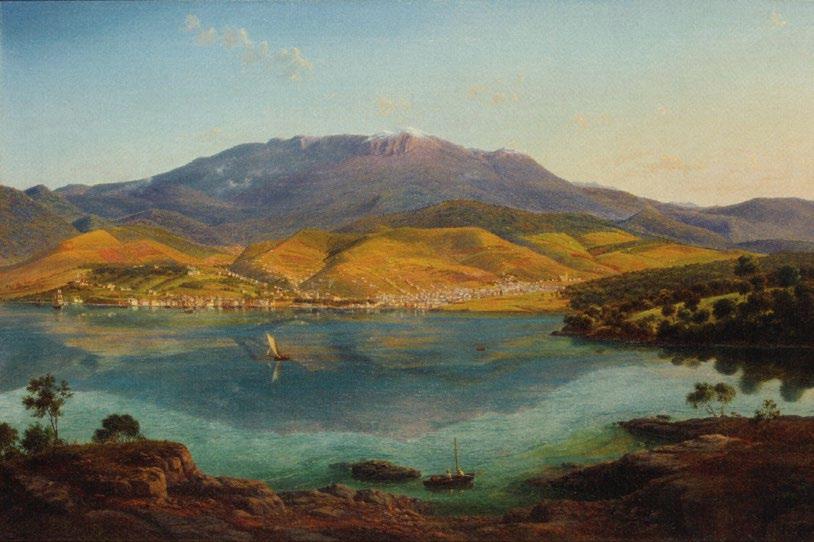
Eugene Von Guérard
View of Hobart Town, with Mount Wellington in the Background, 1856 oil on canvas
61.0 x 91.5 cm
Private collection
(owned jointly by the Tasmanian Museum and Art Gallery and National Gallery of Australia), during Bull’s residence in Hobart Eugene von Guérard produced a high-keyed rendition following a short visit in mid-1855. In 1856, Henry Gritten moved from the mainland to Hobart and – like Bull – saw the commercial potential of multiple versions of this view (as he had previously done in Melbourne with views from the Botanic Gardens). The arrival of a competing landscape artist might have been one factor in Bull’s decision to relocate from Tasmania to the mainland colonies. He subsequently worked between Melbourne, Sydney and Adelaide, in a variety of professions, artistic and otherwise (with additional run-ins with the law) until his death in Sydney in 1889.
1. Complicating research, his first name appears spelled Knut, Knude, Kenud, Kanute and Canute while his surname also appears as Buhl – in addition to pseudonyms used in his illegal activities.
2. The Courier, Hobart, 20 October 1852, p. 3
3. The Courier, Hobart, 9 November 1855, p. 2
4. The Courier, Hobart, 4 October 1855, p. 2
5. The Courier, Hobart, 1 July 1856, p. 3
6. The Courier, Hobart, 28 April 1856, p. 3 Alisa Bunbury
oil on canvas
61.5 x 107.0 cm
signed and dated lower right: E. v. Guerard / 1874
Estimate: $1,500,000 – 2,000,000
Provenance
Sir George Verdon, Melbourne, commissioned and acquired directly from the artist, 1874
Catalogue of ... art furniture, marble statuary, real bronzes, art treasures, oil paintings, water colour drawings, fine old engravings, etc collected by Sir George Verdon, KCMG, CB., Gemmell, Tuckett & Co., Melbourne, 1 June 1891, lot 335 [unsold]
Private collection, a gift from the above c.1891
Thence by descent
Private collection, Melbourne
Private collection, London, acquired in the late 1980s
Exhibited
Eugen von Guérard, Art Gallery of New South Wales, Sydney, with the Australian National Gallery, Canberra and the Australian Gallery Directors Council, 7 June – 13 July 1980, then touring to: Queensland Art Gallery, Brisbane, August 1980; Ballarat Fine Art Gallery, Victoria, September – October 1980; Art Gallery of South Australia, Adelaide, November 1980 and National Gallery of Victoria, Melbourne, December 1980 – January 1981 (label attached verso)
Literature
Nicholls, C. F. (ed.), Victorian Men of the Time, Melbourne, 1877, p. 75 (as ‘View of Mitre Lake’)
Catalogue of Oil Paintings, Public Library, Museums and National Gallery of Victoria, Melbourne, 1879, p. 15 (as ‘Lake and Mitre Rock’) Collection of Sir George Verdon, K.C.M.G., C.B., Auction Catalogue, Gemmell, Tuckett & Company, Melbourne, 1 June 1894, lot 335 (as ‘Mitre Head’)
Bruce, C., Eugen von Guérard, Australian National Gallery & Director’s Council, Canberra, 1980, pp. 57 (illus.), 81, 116 (illus.)
Bruce, C., Comstock, E., & McDonald, F., Eugene von Guerard 1811 – 1901: A German Romantic in the Antipodes, Alister Taylor Publishers, New Zealand, 1982, cat. 149, pl. 41, pp. 150, 262, 263
Related works
Mount Arapiles towards the Grampians, 1870, oil on academy board, 18.5 x 30.5 cm, Hamilton Gallery, Victoria North–West View from the Arapiles, 16 October 1868, pencil, 35.8 x 58.3 cm, PXX18, Dixson Library, State Library of New South Wales, Sydney
Mitre Rock & Lake from Mount Arapiles, pen and ink, in Australien Reminisunzen, portfolio, compiled by Von Guerard, of sketches, newspaper cuttings and prints, PXA54, p. 11, Mitchell Library, State Library of New South Wales, Sydney
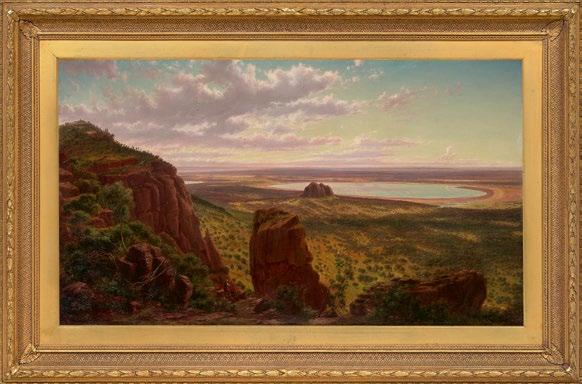
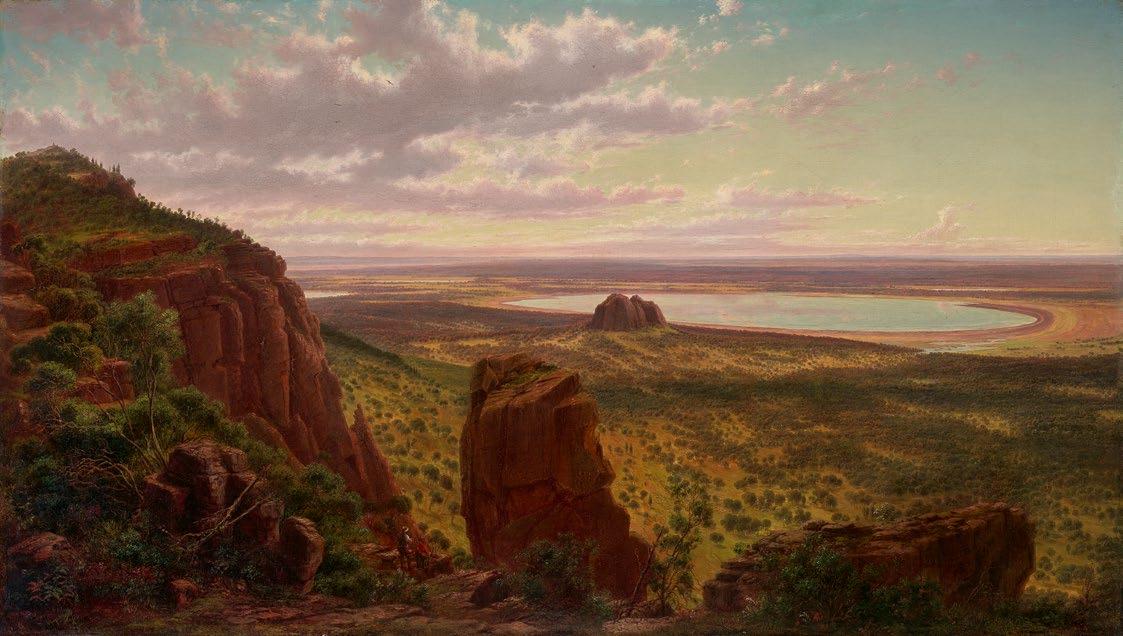
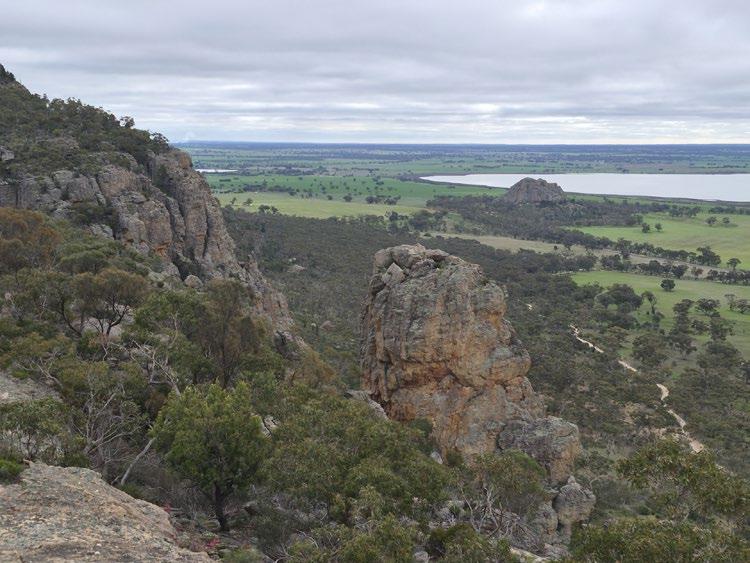
A detail of the rock formations in the foreground showing the accuracy of Eugene von Guérard’s geological observations, July 2026
photographer: Keith Lockwood (local land owner and rock climber, and author of Arapiles: A million mountains, 2008)
When von Guérard saw this view on 16 October 1868, it must have surpassed his wildest expectations. He had seen it illustrated in Major Thomas Mitchell’s Three Expeditions into the Interior of Eastern Australia (1839), but nothing could have prepared him for the immense vastness he experienced from the rocky heights of Mount Arapiles – so named by Mitchell in 1836, but known as Dyurrite to the people of the Wotjobaluk Nations, for whom it is a place of deep cultural, spiritual and historical significance.1
Dyurrite (Mt Arapiles) is a massive, resistant formation of quartzite, metamorphosed from sandstone, that rises steeply from the Wimmera Plains north-west of the Grampians (Gariwerd). For von Guérard, from his elevated vantage point about 100 metres below what is today the Bluff Point Picnic Area and Lookout, the sheer magnitude of this landscape – the seemingly endless open expanse of plains to the north, below equally immense skies –was breathtaking. At the same time, from this vantage point, the physical impact of the monumental rock forms would have been palpable and, at such close range, every fissure, cleft and crevice visible. In the middle distance was the Mitre Rock, described by James Smith, critic for The Argus, as rising ‘like some old Druidical monument.’ 2 Behind it lay the shallow salt Mitre Lake, clouds reflected in its still blue waters, and beyond, the first of the twenty-seven circular lakes that Mitchell had seen to the northeast. Under a makeshift tent – there had been rain showers that
morning – von Guérard settled down to draw, working from 10 am until 4 pm and producing the large pencil and pastel drawing upon which The Mitre Rock and lake from Mount Arapiles is based.
Von Guérard (1811 – 1901), an experienced artist with a passionate and scientifically informed interest in the natural world, arrived in Melbourne in 1852 with years of travel and training in Italy and Germany behind him. He came ‘in the hope of finding an unexplored field for study’ and, on often intrepid sketching expeditions into the furthest reaches of Australia’s southeastern colonies, he did just that. 3 By the end of the decade, his reputation – in the words of Smith, the leading art critic of the day – as ‘decidedly the landscape painter of Australia’ was established.
Von Guérard’s desire to see Dyurrite (Mt Arapiles) dated back to his early days in the colony when he had made copies, on tracing paper, of the illustrations of Mitre Rock and lake from Mount Arapiles, and Mount Arapiles from Mitre Lake, both published in Mitchell’s Three Expeditions 4 Further impetus came with the return of fellow artist, Nicholas Chevalier, and German geophysicist, Georg von Neumayer, from their trip to the site in 1862. Von Guérard had travelled with them on the first leg of the 1862 expedition, led by Neumayer as part of his magnetic survey of Victoria and he would have been keenly interested to hear Neumayer’s account of the ‘commanding’
Thomas Livingstone Mitchell (1792 – 1855)
Mitre Rock and Lake from Mt Arapiles Plate 41 from Three Expeditions into the Interior of Eastern Australia, T. and W. Boone, London, 1838
Eugene von Guérard
Mitre Rock and Lake from Mount Arapiles pen and ink from Australien Reminiszenzen, c.1846 – 58 PXA54, 11c Mitchell Library, State Library of New South Wales, Sydney
view ‘towards the North, over Mallee scrub and large salt-lakes in whose still waters everything is reflected like reality itself’ and to see Chevalier’s paintings, including his Mount Arapiles and the Mitre Rock, 1863 (National Gallery of Australia). 5 On his 1868 expedition he saw the work again, hanging in a ‘lovely big room’ at Alexander Wilson’s station, Vectis, very close to the subject it represented. The neighbouring St Mary’s Lake Station, owned by the Wilson brothers and managed by ‘Mr McDonald’ was about a two hour walk to Dyurrite (Mt Arapiles) and it became the artist’s base for the next four days. There,
Eugene von Guérard North–West View from the Arapiles, 16 October 1868 pencil on paper 35.8 x 58.3 cm from album, Wimmera, Lake Hindmarsh etc., 1868 DL PXX 18, f. 8. Dixson Library, State Library of New South Wales, Sydney
along with milk straight from the cow at breakfast, mutton, potatoes, bread pudding, tea and friendly company and music in the evenings, were the fleas that disrupted his nights.6
Von Guérard painted two views from elevated vantage points on Dyurrite (Mt Arapiles) – one looking to the south-east, Arapiles towards the Grampians, 1870 (Hamilton Gallery), and the present, looking to the north-east, The Mitre Rock and lake from Mount Arapiles. For this subject, an important one for the artist, von Guérard prepared well, traversing the
Eugene von Guérard
Mount Arapiles Towards the Grampians, 1870 oil on board
18.5 x 30.5 cm
Hamilton Gallery, Victoria
ground-level terrain that he would draw from above on the following day. He noted the beauty of the landscape, its trees (including the characteristic pines), saw kangaroos and five or six eagles, studied the Mitre Rock, and observed she-oak growing in a cleft near its peak (visible in the painting). When, from an elevation of around 726 feet (221 metres), he came to draw – and later to paint – this landscape, it was a topography that he knew, in all its detail and from multiple perspectives.
The final composition for The Mitre Rock and lake from Mount Arapiles was resolved in the drawing made at the site – the result of the artist’s considered choice of vantage point. From here he saw the juxtapositions that would bring drama to his composition – the abrupt shifts from the near to the far, from soaring heights and to plunging depths, and between microscopic minute detail and panoramic breadth. The ‘near’, the detailed and geologically accurate portrayal of rocks, was integral to von Guérard’s vision of landscape painting. Like his Düsseldorf contemporaries, and as argued by the German art theorist Carl Gustav Carus, he understood that through the close and penetrating depiction of rocks, it was possible to convey something of their geological history. When he drew the rock stack known by climbers as ‘The Pharos’ and the wall of eroded column-like forms of the Pinnacle Face to its left, he hacked out every cleft, crevice and fracture of their surfaces with his pencil, seemingly describing the ‘strong physical erosion of coastal exposures’ that geologists today believe occurred during ‘the marine incursion of the late Miocene’ when Dyurrite (Mt Arapiles) was an island.7 The
iron-oxide alterations on the rocks appear on the drawing as touches of red-brown pastel, and the gnarled, pebbly character of the rocks on the left is registered in tiny angular strokes. The free-standing Pharos is separated from the ‘mainland’ by a 100-metre-deep chasm, its monumental scale suggested by the two small figures on the ledge between The Pharos and the Pinnacle Face. The delightful white and purple flowering bushes (Erica and Prostanthera roduntifolia ?), probably painted under magnification, bring the foreground even closer to the picture plane, accentuating the dramatic shift into deep pictorial space.
In his review, Smith noted the challenges of a composition in which ‘the eye is carried down a sheer descent of so many hundred feet, that the forest trees upon the slopes shrink to the dimensions of shrubs, and the sheep [to] so many white dots.’ This, and the perspectival challenges of depicting ‘so extensive a scene from a lofty elevation’, were ‘completely overcome’ by the artist. 8 The transition to the middle ground is established through the connection between The Pharos and the subject of the painting, the Mitre Rock. Behind that, the composition opens out to the glorious sweeping form of the lake and beyond, to the blues and violets of the far horizon. The warm tones cast by the late afternoon sun unify the composition, tinging the clouds with pink and casting shadows over the gentle undulations of the plain. Above them, eagles soar – as witnessed by von Guérard on the day. The minutiae of nature is integrated into a composition of expansive breadth and grandeur and we, from our privileged position high above that of the figures below, have the sense of
Nicholas Chevalier (1828 – 1902)
Mount Arapiles and the Mitre Rock, 1863 oil on canvas
77.5 x 120.6 cm
National Gallery of Australia, Canberra
‘everything’ being within our field of vision – even to the detail of the Tiptoe Ridge, the tiny pinnacle visible at the top of the peak on the left. For Smith it exemplified ‘ars celare artem’ – ‘it is (true) art to conceal art’ – and he congratulated Sir George Verdon (1834 –1896) on the commission and acquisition of ‘a very fine picture.’
Verdon commissioned The Mitre Rock and lake from Mount Arapiles in 1874, his second year as a Trustee of the Public Library, Museums and National Gallery of Victoria, and von Guérard’s fourth as, in effect, the Gallery’s Director. His fellow Trustee, J. A. MacPherson had commissioned the smaller companion view, von Guérard’s Mount Arapiles towards the Grampians, four years earlier – a work sold by Deutscher and Hackett in September 2022, and now in the collection of the Hamilton Gallery. Along with a career as a politician and a successful banker, the public-spirited Verdon had a strong interest in the arts: he served as a Trustee from 1872 until 1896; as Vice President in 1880 and President from 1883 until 1896; the Verdon Gallery on the building’s south wing was named in honour of him; and he was the force behind the beautiful English Gothic Revival banking chamber, designed by William Wardell, now housing the ANZ Bank. When von Guérard offered his collection of coins and medals to the Gallery in 1881, it was Verdon who approved the purchase. 9
Von Guérard’s Mitre Rock and lake from Mount Arapiles has not been on public view in Australia since 1980, when it featured in the Australian National Gallery’s landmark exhibition, Eugen von Guérard 1980 – an exhibition that played a critical role in restoring von Guérard to his rightful place as one of Australia’s greatest and most enduringly significant landscape painters.
1. Dyurrite Cultural Landscape, Barengi Gadjin Land Council, Aboriginal Corporation, see: https://www.dyurrite.com.au ‘Mount Arapiles’ was so named because 23 July, the day Mitchell climbed the mount, was the anniversary of the Battle of Salamanca.
2. Smith, J., The Argus, Melbourne, 9 November 1874, p. 5
3. Smith, J., Victorian Men of the Time in Australia, M’Carron, Bird & Co., Melbourne, 1882, p. 75
4. Mitchell, T. L., Three Expeditions into the Interior of Eastern Australia, T. & W. Boone, London, 1839, vol. II, plate 31 and p. 191
5. Georg von Neumayer, ‘Narrative of the Various Trips and Excursions in connexon with the Magnetic Survey’, in Results of the Magnetic Survey of Victoria 1858 – 64, Mannheim, 1869, p. 64
6. [Diary notes], Eugene von Guérard Sketchbook XXXVI, 1867 – 68 - 69, Dixson Galleries, State Library of NSW, Sydney, DGB16, vol 14a, ff. [83], [84]
7. R.A. Cayley and D.H. Taylor, Grampians: Special Map Area Geological Report, Geological Survey Report 107, Natural Resources and Environment, 1997, p. 16
8. Smith, The Argus, op. cit.
9. Gregory, J., Before Felton: The Collections of the National Gallery of Victoria before 1904, see: https://www.beforefelton.com/
Dr Ruth Pullin
The author is grateful to Keith Lockwood for his assistance and his photograph, taken from von Guérard’s vantage point.
oil on canvas on plywood
122.0 x 152.0 cm
signed and dated lower left: G. CLAUSEN. 1884
Estimate: $550,000 – 750,000
Provenance
Sharpley Bainbridge, Esq., J.P., by 1895 Christie’s, London, 10 February 1922, lot 105
Private collection, purchased from the above by a buyer recorded as ‘Major’
William Berstein, Sydney Artlovers Gallery, Sydney
John Brackenreg, Sydney, acquired from the above in June 1975
Private collection
Exhibited
The Exhibition of the Royal Academy of Arts, The 116th, Royal Academy of Arts, London, 5 May – 4 August 1884, cat. 1630
Fourteenth Autumn Exhibition of Pictures in Oil and Water–Colours, Walker Art Gallery, Liverpool, 1 September – December 1884, cat. 1690
Autumn Exhibition, New Gallery, London, September – November 1892
Literature
Blackburn, H. (ed.), Academy Notes, Chatto & Windus, London, 1884, p. 75
‘Current Art III’, The Magazine of Art, London, 1884, p. 397
‘Current Art IV’, The Magazine of Art, London, 1884, p. 446
‘The Royal Academy, Gallery XI’, The Art Journal, London, 1884, p. 244
Monkhouse, C., ‘The Royal Academy’, The Academy, no. 628, London, 17 May 1884, p. 356
‘Burlington House’, The Tablet, London, 24 May 1884, p. 805
‘The Royal Academy IV’, St James’s Gazette, London, 26 May 1884, p. 6
‘The Royal Academy IV’, St James’s Budget, London, 31 May 1884, p. 12
‘The Royal Academy – Third Notice’, Daily News, London, 4 June 1884, p. 7
‘Royal Academy, Fourth Notice’, Illustrated London News, London, 7 June 1884, p. 562
‘Art in October’, The Magazine of Art, London, 1893, p. i
Moore, G., Modern Painting, W. Scott Publishing, London, 1893, pp. 115–122
Moore, G., ‘The New Gallery’, The Speaker, London, 8 October 1893, pp. 436–437
Moore, G., ‘Exteriority’, The Speaker, London, 22 June 1895, p. 685
The Magazine of Art, Cassell and Company Limited, London, 1895, pp. 406, 417
Frank Leslie’s Popular Monthly, Frank Leslie, New York, June 1896, p. 645 (illus.)
Hussey, D., George Clausen, Ernest Benn Ltd., London, 1923, pp. 15, 17 (as ‘Labourers: After Dinner’)
Laver, J., Portraits in Oil and Vinegar, John Castle, London, 1925, p. 88
McConkey, K., George Clausen RA, RWS, 1852 – 1944, Bradford and
Tyne and Wear Museums, Bradford, 1980, pp. 29 – 30 (illus.)
McConkey, K., ‘Figures in a Field – Winter work by Sir George Clausen RA’, Art at Auction 1982 – 83, Sotheby’s, London, 1982, p. 77 (illus.)
McConkey, K., ‘Rustic Naturalism in Britain’, in Weisberg, G. P. (ed.), The European Realist Tradition, Indiana University Press, Bloomington, 1982, p. 222 (illus.)
McConkey, K., British Impressionism, Phaidon Press, London, 1989, p. 33
McConkey, K., Impressionism in Britain, Barbican Art Gallery / Yale University Press, London and New Haven, 1995, p. 108
Holden, K., ‘George Clausen and Henry Herbert La Thangue: Rural Painting and Urban Patronage’, Apollo, London, February 1999, p. 11 (illus.)
McConkey, K., Memory and Desire: Painting in Britain and Ireland at the Turn of the Twentieth Century, Ashgate Publishing, Aldershot, 2002, fig. 67, pp. 132 (illus.), 133
Gruetzner Robins, A., ‘Living the Simple Life: George Clausen at Childwick Green, St Albans’, in Corbett, D. P. et al. (eds), The Geographies of Englishness, Studies in British Art 10, Yale University Press, New Haven, 2002, p. 12
McConkey, K., ‘Un petit cercle de thuriféraires – Bastien–Lepage et la Grande Bretagne’, 48/14: La revue du Musée d’Orsay, no. 24, Paris, Spring 2007, p. 28
McConkey, K., George Clausen and the Picture of English Rural Life, Atelier, Edinburgh, 2012, pp. 63 (illus.), 64, 71, 107, 112, 116, 186, 216, 222
Related works
Farmer’s Boy, 1884, oil on canvas, 36.0 x 25.0 cm, Ashmolean Museum, Oxford
Labourers Resting, graphite on paper, 24.3 x 32.0 cm, Royal Academy of Arts, London
Study for ‘Labourers After Dinner’, c.1884, chalk on paper, 47.0 x 61.0 cm, Royal Academy of Arts, London Study for ‘Labourers After Dinner’, c.1884, chalk and pencil on paper, 46.5 x 62.0 cm, Royal Academy of Arts, London Study for 'Labourers After Dinner', c.1884, chalk on paper, 47.0 x 61.0 cm, Royal Academy of Arts, London (showing the boy drinking) Studies of an old man relating to ‘Labourers After Dinner’, c.1884, pencil on wove paper, 31.0 x 50.0 cm, Royal Academy of Arts, London Study for 'Labourers After Dinner', graphite on paper, c.1884, 31.8 x 22.2 cm, private collection
Reproductive engraving after the picture
J. M. Johnstone, ‘Labourers after Dinner’ from the painting by George Clausen, A.R.A. In the Possession of Sharpley Bainbridge Esq. J.P.,’ engraving, illustrated in The Magazine of Art, Cassell and Company Limited, London, 1895, p. 417
Jules Bastien-Lepage
Les Foins, 1877
oil on canvas
209.0 x 225.0 cm
Musée d’Orsay, Paris
In May 1880, the special feature within the Grosvenor Gallery Spring exhibition was a small retrospective of works by Jules Bastien-Lepage (1848 –1884). The gallery’s managers, who had displayed paintings by Whistler three years before and incurred Ruskin’s wrath, were living up to their reputation for controversy. Lepage’s portraits were admired, but beside the ‘ugly’ Annunciation to the shepherds, 1875 (National Gallery of Victoria), hung the painting that had made his reputation, Les foins (The hay harvest), 1877 – 78.1
While Lepage’s skill could not be denied, this picture’s ‘primeval Eve, as first evolved from the gorilla’, offended critics attuned to the anodyne lotus lands of Burne-Jones and Albert Moore. 2 There was, nevertheless, a ‘little knot of worshippers’ in front of Lepage’s resting field workers, ‘admiring or condemning in the most vehement manner.’ 3
It is sometimes difficult to appreciate the attraction felt by young aspiring artists for the work of older peers who seem to have all the answers, but in the case of George Clausen, a fellow
Grosvenor Gallery exhibitor in 1880, there had been experiments in ru ral genre painting before Lepage’s work presented itself.4 Having left the Government Art Training School, he was aware of the trend towards plein air Naturalism in the work of the Barbizon and Hague School artists, had toured Holland, Belgium and northern France, and had started to collect prints of the work of Jean-Francois Millet. But it was only with Les Foins that he found the rigorous objectivity he was looking for – the ‘verité strictement scientifique’ that Emile Zola had applauded in Lepage’s work. 5 Lepage painted in the fields, so must he. The following year, having shown his final Londonbased canvas at the Royal Academy, he married Agnes Mary Webster, the talented sister of a fellow student, and decamped to Childwick Green near St Albans in Hertfordshire for a new start. It was, he later declared, ‘a liberation… one saw people doing simple things under good conditions of lighting... nothing was made easy for you, you had to dig out what you wanted.’ 6
Clausen was now a tenant on the Toulmin estate, spending his days with a portable easel and sketchbook in the company of hired hands.7 The impact on his work was immediate. The
George Clausen December, 1882 oil on panel 23.0 x 30.5 cm
Private collection
yearly cycle of ploughing, hoeing, harvesting, hedging, of thinning the woodlands and preparing winter feed for sheep filled his sketchbooks and expanded into small works such as December 8 The faces of the present Labourers after dinner, 1884 now become recognisable and to assure himself of their documentary accuracy he acquired a small, handheld 1.5 inch glass plate camera to record their activities. 9
Before visual facts, there were no concessions, and in this respect, he allied himself with contemporary writers and social recorders of the English ‘Hodge’, such as Thomas Hardy and Richard Jefferies.10 This lowest stratum of society, according to Jefferies, had ‘no myths, no heroes … no Achilles, no Agamemnon, and no Homer.’ 11 It was Clausen’s task to give them visual presence. A brief sojourn in Brittany one year and a few weeks in the Paris ateliers the next confirmed his Naturalism, and during 1883 he was busily engaged on larger canvases, the first two of which were Winter work, and Daydreams 12
Without a broad sense of the current diversity of British painting, it is hard to appreciate why these images appeared so extreme. It was not simply that rustics were represented, so much as that their grimy work-clothes, gnarled and swollen fingers, and weather-beaten faces had not been prettified. They may not be
Untitled, 1883 modern print from Marion ‘Academy’ plate, c.1883 photographer: George Clausen Museum of English Rural Life, Reading
named, but they were no less real. The most carefully studied and largest of the sequence was Labourers after dinner, where the recording of specific identities was at its most profound.
The idea for Labourers after dinner began with a simple drawing of two seated field workers and a girl to be followed by three large, folded sheets detailing the possible positions of one, two and then three figures, to which a fourth, the man in the background, was added.
Margin notes on the top right-hand corner of one of these tell us that the man in the foreground is William Smith, a labourer whose son, John, sits behind the woman. She is thought, on the basis of other drawings, to be Susan Chapman, a straw plaiter, while the older man about to draw on his clay pipe is likely to be ‘old Lawrence’.13 This core group was augmented by several other drawings and supplementary oil studies, specifically in the woman’s and boy’s cases.14
All lived close to the painter and his wife. That these individuals have names and addresses was clearly of significance, but they went undeclared; they might typify their class, but not in a generalised or heroic sense à la Millet, and therein was the basis of the offence they caused to conservative critics.
Clausen later expressed his admiration for Lepage’s figures in terms of their mentalities and interactions with the viewer. ‘He paints a man, and the man stands before you and you ask yourself, “What is he going to say?”’ was how he put it.15 The same might be said of this little field gang. Thus, the gap between lived confrontation in real time and space, and its realisation was to be bridged – in this case in a setting that included a closely observed campfire, brushwood and a glimpse of landscape – all to be ready in time for delivery to the Royal Academy in March 1884.
The exhibition opened to a critical chorus – aged members, each with eight allocated places ‘on the line’, were crowding out younger artists. Fatigue set in by Gallery XI, where Clausen’s work was placed, and he had to wait until the beginning of June to be told that his work was ‘fully equal to [Bastien-Lepage] in veracity if not in ugliness.’ 16 He even lacked the French painter’s ‘sentiment’, according to The Art Journal 17 Among his defenders, The Magazine of Art pointed out that glib references to Lepage did not do justice to a ‘thoroughly English work’ in which ‘day-Labourers after dinner denied the light of workingmen’s clubs and socialism’ are represented with ‘such power
and amplitude.’ 18 However, Clausen’s dismay with the Burlington House cartel was such that, after Labourers after dinner was exhibited, he took to the ‘Letters’ pages of The Times in 1886 to call for Academy reform and threw his weight behind the expansion of the newly-formed New English Art Club. He would not return to its Summer exhibition for a further five years.
In 1883, the Toulmin estate passed to John Blundell Maple, the celebrated London furniture retailer who immediately started to convert its mixed arable and grazing fields into paddocks for his stud farm, and Clausen’s tenancy was not renewed. He spent a year in St Albans and a further six years in Cookham Dean in Berkshire before moving to Widdington in Essex where he remained until 1905. By 1892 when Labourers after dinner was first requested for the following year’s New Gallery Autumn exhibition and listed for possible inclusion in the Chicago World’s Fair, the painting had been in the collection of Sharpley Bainbridge (1849 – 1910) of Lincoln for some time.19 Bainbridge, a clothier, who expanded the business into a chain of successful department stores in cities of north-east England, was an avid early collector of Clausen’s work. 20 He
George Clausen Day Dreams, 1883 oil on canvas
70.0 x 152.5 cm
Private collection
was probably advised by the artist’s brother-in-law Alfred George Webster (1852 – 1916), then a teacher, and later Principal of Lincoln School of Art. 21
The move to Essex coincided with fundamental changes in Clausen’s work when the static, grey day subjects such as The girl at the gate, 1889 (Tate Gallery, London) were abandoned in favour of the vivid colour and more impressionistic handling of The mowers (Usher Gallery, Lincoln) and Evening song (private collection), exhibited in 1892 and 1893. The development was approved by ‘new critics’ spearheaded by the Irish novelist, George Moore. In order to convey the significance of the change in Clausen’s recent work, Moore amplified opinions expressed in his recent columns in The Speaker in his book Modern Painting (1893) by contrasting Labourers after dinner with these more recent paintings. The picture that had, for very different reasons, offended the popular press in 1884, was now castigated by those who espoused the avant-garde! ‘Were we ever as mad as that?’ Moore exclaimed when he referred to it. 22
The artist responded, passing a message to the critic through a mutual friend. But it was only in May 1895 that he caught up with Moore in the crowd of
Royal Academy of Arts, London
George Clausen
Study for ‘Labourers After Dinner’, c.1884 chalk on laid paper
47.0 x 61.0 cm
Royal Academy of Arts, London
visitors at that year’s Royal Academy exhibition. In a friendly exchange, he reminded Moore of his early sub-Zola école naturaliste novels in which surface detail – the equivalent of the ‘blank brutality’ of the Labourers after dinner – had been sacrificed to spiritual essence. 23 They agreed that artist and writer had come to similar conclusions at around the same time and both were expressions of artistic integrity.
The aesthetic argument, the central preoccupation of the ‘new critics’, had much to do with the nature of beauty, both popular and refined. There was a tightrope to cross. Back in the day, The Illustrated London News had contrasted the anodyne Anglo-Greek maidens of Albert Moore’s Reading aloud (Glasgow Museum) and the brutality of Clausen’s Labourers after dinner. It had been proof that no other work quite so essentially pierced the contemporary debate. These were not romantic swains and milkmaids, but real people with real lives. Only in their company, in that brief moment in the winter of 1883 – 84, did the vital spark ignite. It even outshone Clausen’s own earlier works. It was, in short, a manifesto.
1. ‘The Grosvenor Gallery – First Notice’, The Standard, London, 3 May 1880, p. 2
2. ‘The Grosvenor Gallery’, The Illustrated London News, London, 8 May 1880, p. 451
3. ‘The Grosvenor Gallery’, The Spectator, London, 12 June 1880, p. 751
4. McConkey, K., George Clausen and the picture of English rural life, Atelier Books, Edinburgh, 2012, pp. 29 – 41
George Clausen
Studies of an old man relating to ‘Labourers After Dinner’, c.1884 pencil on wove paper
31.4 x 50.2 cm
Royal Academy of Arts, London
9. McConkey 2012, op. cit., pp. 54 – 55
10. ibid, pp. 14 – 16, 26, 62
11. Jefferies, R., Hodge and his Masters, Sketches of Rural Life, Smith, Elder & Co, London, 1880, vol. II, p. 204
12. Winter work was first shown at the Grosvenor Gallery in 1883, but when unsold, was later modified, while Day dreams, was sent to the first Royal Institute of Painters in Oil Colours exhibition in November 1883, see Sotheby’s, London, 11 December 2007, lot 54 (essay by Kenneth McConkey)
13. See Robins, A. G., ‘Living the Simple Life, George Clausen at Childwick Green, St Albans’, in Peters Corbett, D., et al, The Geographies of Englishness, Studies in British Art, Yale University Press, New Haven, 2002, no. 10, pp. 17 – 19, and Aitken, op. cit., p. 170 (transcribes addresses from the 1881 census).
14. McConkey, 2012, op. cit., p. 62, fig 87 for the woman’s head study. See also A Moment’s Rest, 1882, 45.7 x 33.0 cm, sold Christie’s, London, 15 December 2011, showing the woman seated in a field setting.
15. Clausen, G., ‘Jules Bastien-Lepage as Artist’, in Theuriet, A., Jules Bastien-Lepage and his Art, T. Fisher Unwin, London, 1892, p. 115
16. The Illustrated London News, London, 7 June 1884, p. 562
17. The Art Journal, London, 1884, p. 280
18. ‘Current Art III’, The Magazine of Art, London, 1887, p. 397. The point was reiterated when, a few weeks later, he showed members of the same group hoeing turnips, see ‘Current Art III’, The Magazine of Art, London, 1887, p. 446
19. On 16 June 1885 Clausen notes in his account book that Labourers [sic.] along with Over the hill (unlocated), had been sent to Aberdeen – the entry being crossed out with the word ‘returned’ (this was possibly to the opening exhibition of Aberdeen Art Gallery). The painter’s mother, Elizabeth Fillan, hailed from Aberdeen; his father was Danish. Since no other reference is made until 1892, we may assume that Bainbridge owned the work before the painter began to keep accounts in 1885. Dates for the New Gallery show and the Chicago exhibition clashed.
20. Anon., ‘The Collection of Sharpley Bainbridge JP, Lincoln’, The Art Journal, 1898, pp. 225 – 229, 272 – 275. The last Bainbridge store in Newcastle-upon-Tyne was sold to the John Lewis chain in the 1970s.
21. McConkey, 2012, op. cit., pp. 41, 81 – 82
22. Moore, G., Modern Painting, Walter Scott Publishing, England, 1893, p. 117
23. Moore, G., ‘Exteriority’, The Speaker, 22 June 1895, p. 685
Kenneth McConkey
5. Zola, E., Le Bon Combat, De Courbet aux Impressonistes, Collection Savoir, Éditions Hermann, Paris, 1975, p. 207
6. Clausen RA, G., ‘Autobiographical Notes’, Artwork, no 25, Spring 1931, p. 19
7. For Henry H Toulmin (1807 – 1871) and the improvements to the estate, see Aitken, C., Childwickbury, published privately, 2011, pp. 13 – 24
8. McConkey, K., ‘Rustic Naturalism at the Grosvenor Gallery’, in Casteras, S. P., and Denney, C., eds., The Grosvenor Gallery, A Palace of Art in Victorian England, Yale University Press, New Haven, 1996, pp. 156 – 57
Kenneth McConkey is Emeritus Professor of Art History at Northumbria University, Newcastle upon Tyne. He is also the author of numerous articles and books focusing upon Impressionism, Modern and British and Irish painters, including George Clausen and the Picture of English Rural Life, published in 2012 by Atelier Books.
31.8
Private collection
oil on canvas
76.0 x 101.0 cm
signed lower right: A. STREETON
inscribed and dated lower left: GLISY 1918 signed and inscribed on artist’s label verso: Aussies bathing / (Glisy) / 14 A Streeton
Estimate: $250,000 – 350,000
Provenance
The Naval & Military Club, Melbourne, a gift from the artist in 1926 Naval & Military Club Collection of Fine Art, Deutscher and Hackett, Melbourne, 21 July 2009, lot 6
Private collection, Sydney, acquired from the above
Exhibited
An Exhibition of Paintings and Drawings by Arthur Streeton, The Fine Arts Gallery, Melbourne, opened 14 July 1926, cat. 9
The Naval & Military Club, Melbourne, until 2009
Arthur Streeton – The Art of War, National Gallery of Australia, Canberra, 15 December 2017 – 29 April 2018, cat. 43
Streeton, Art Gallery of New South Wales, Sydney, 7 November 2020 – 14 February 2021
Literature
‘Art Notes, War Record Paintings. Drawings by Mr A. Streeton’, The Age, Melbourne, 14 July 1926, p. 13
Streeton, A., The Arthur Streeton Catalogue, Melbourne, 1935, cat. 605
Gray, A., Arthur Streeton: the art of war, National Gallery of Australia, Canberra, 2017, cat. 43, pp. 48 (illus.), 60 (illus., detail), 61, 63, 162 (illus.), 163
Tunnicliffe, W., Streeton, Art Gallery of New South Wales and Thames & Hudson, Sydney, 2020, pp. 13, 244 (illus.), 372
Signalling a decisive turning point in his distinguished career, Arthur Streeton’s service as an official Australian war artist in France in 1918 inspired some of his most compelling achievements, revealing a mature painter at the height of his powers confronting an entirely new visual and emotional reality. Long celebrated for his luminous evocations of the Australian landscape, Streeton was suddenly required to depict a world transformed by industrialised conflict, where mechanised warfare, artillery and camouflage had irrevocably altered both the appearance and experience of war. Deliberately rejecting the heroic conventions of nineteenth-century battle painting, he instead evolved a restrained yet profoundly observant pictorial language in which the beauty of the natural world and the devastation of modern warfare coexist in uneasy equilibrium. A subtle work whose haunting stillness alludes to the horrors of war, Troops bathing, Glisy, 1918, eloquently encapsulates this tension – ranking among the most poignant and psychologically nuanced images of Streeton’s wartime oeuvre.
On 14 May 1918, Streeton arrived in France as an official war artist of the Commonwealth, having previously aided the Allied war effort from London as a member of the Royal Army Medical Corps. After preliminary training in Boulogne, he was assigned to the 2nd Division of the Australian Imperial Force (AIF) in the Somme Valley, only a short distance from the front – initially stationed in the stately eighteenth-century Château SaintGratien set within picturesque grounds, before relocating in June to dugouts concealed in the woods near Glisy. Although finding his fellow troops in good spirits following the successful
recapture of Villers-Bretonneux only weeks earlier, Streeton was nevertheless struck by the unsettling juxtaposition of cultivated tranquillity and relentless violence that had come to define life on the Western Front. Writing to his friend and patron Baldwin Spencer, he thus reflected upon the unique pictorial challenges posed by this new form of warfare: ‘True pictures of Battlefields are very quiet looking things. There’s nothing much to be seen, everybody and everything is hidden and camouflaged… it is only in the illustrated papers that one gets a real idea of Battle as it occurs in the mind of the man [who has] never been there.’ 1
At first glance, Troops bathing, Glisy appears to portray an Arcadian idyll. Beneath a broad expanse of sky, sunlight shimmers across the calm waters of a tree-lined lake where ‘Aussie’ soldiers enjoy a rare moment of respite from the privations of the Western Front. Streeton renders the landscape with the lyrical sensitivity for which he was renowned – the tranquil reflections and delicate harmonies of colour recalling the superb pastoral landscapes of his pre-war career, exemplified by the similar composition, The lake, Coombe Banks, 1913 (National Gallery of Victoria). Yet beneath such apparent serenity lurks a pervasive sense of menace. To the right, a violent splash erupts across the surface of the lake as an artillery shell lands near the bathers – abruptly transforming the bucolic scene into a theatre of uncertainty where death may arrive at any moment without warning. Importantly however, Streeton refrains from depicting any violence directly –rather, its psychological impact is conveyed through the disruption alone, the fragile tranquillity of the scene heightening the horror of such intrusion. As a critic for The Age perceptively observed
174.0 x 231.0 cm
Australian
when the painting was exhibited in 1926, ‘Troops Bathing shows the dangers of innocent sport during war time. The whole scheme is a delightful setting of late afternoon sun and rising moon, with trees on a riverbank, bathers and the exploding bomb.’ 2
Significantly, in 1926, eight years after the Armistice, Streeton organised a major exhibition of his war paintings, watercolours and drawings, announcing his intention to present many of them as gifts to Australian public institutions, returned servicemen organisations and distinguished military leaders including Lieutenant General Sir John Monash and Major General Sir Charles Rosenthal, both of whom he greatly admired. Describing the collection as an expression of gratitude to the Australian Imperial Force, Streeton hoped the paintings would not only stand as an enduring testament to the courage, sacrifice and service of those who had fought, but also serve as a lasting ‘reminder of what may be possible in Australia without an efficient
and continuously progressive organisation for the defence of our country.’ 3 Indeed, Streeton’s conviction proved remarkably prescient with his wartime paintings attracting renewed scholarly attention in recent decades, culminating in the National Gallery of Australia’s landmark exhibition, Arthur Streeton: The Art of War, in 2018. Originally gifted to the Naval and Military Club in Melbourne, Troops bathing, Glisy featured prominently in this exhibition, thereby reaffirming its significance both as a valuable record of Australia’s wartime experience and one of the finest painterly meditations on the Great War by an Australian artist.
1. Arthur Streeton, Letter to Sir Baldwin Spencer, 20 July 1918, cited Galbally, A. and Gray, A., (eds.), Letters from Smike: The Letters of Arthur Streeton 1890 – 1943, Oxford University Press, Melbourne, 1989, p. 149
2. ‘Art Notes, War Record Paintings. Drawings by Mr A. Streeton’, The Age, Melbourne, 14 July 1926, p. 10
3. Arthur Streeton, ‘Foreword’, Catalogue of War Pictures Presented by Sir Arthur Streeton to Public Galleries, Returned Sailors' and Soldiers' Organisations, Military Institutions,etc., Melbourne, July 1926
Veronica Angelatos
oil on canvas
40.0 x 50.5 cm
signed lower right: Russell Drysdale bears inscription verso: STOCKMAN - RUSSELL DRYSDALE / THE PROPERTY OF MR. MRS. Geoffrey Collings bears inscription verso: 1965 bears inscription on gallery label verso: “Stockman” / by Russell Drysdale
Estimate: $500,000 – 700,000
Provenance
The Leicester Galleries, London (label attached verso) Geoffrey and Dahl Collings, New South Wales, acquired in 1965 Spink Auctions, Sydney, 28 April 1981, lot 111 (as ‘The Stockman’) Private collection, London
Exhibited
Russell Drysdale, The Leicester Galleries, London, 30 September – 27 October 1965, cat. 20
Literature
Herbert, X., Capricornia, Angus & Robertson Publishers, Melbourne, 1938, 1971 (illus. [reversed] front cover)
Dutton, G., Russell Drysdale, Thames and Hudson, London, revised edition 1969, pl. 140, pp. 173 (illus.), 207 Hardy, F., The Unlucky Australians, Rigby, Adelaide, 1968, 1976 (illus. front cover)
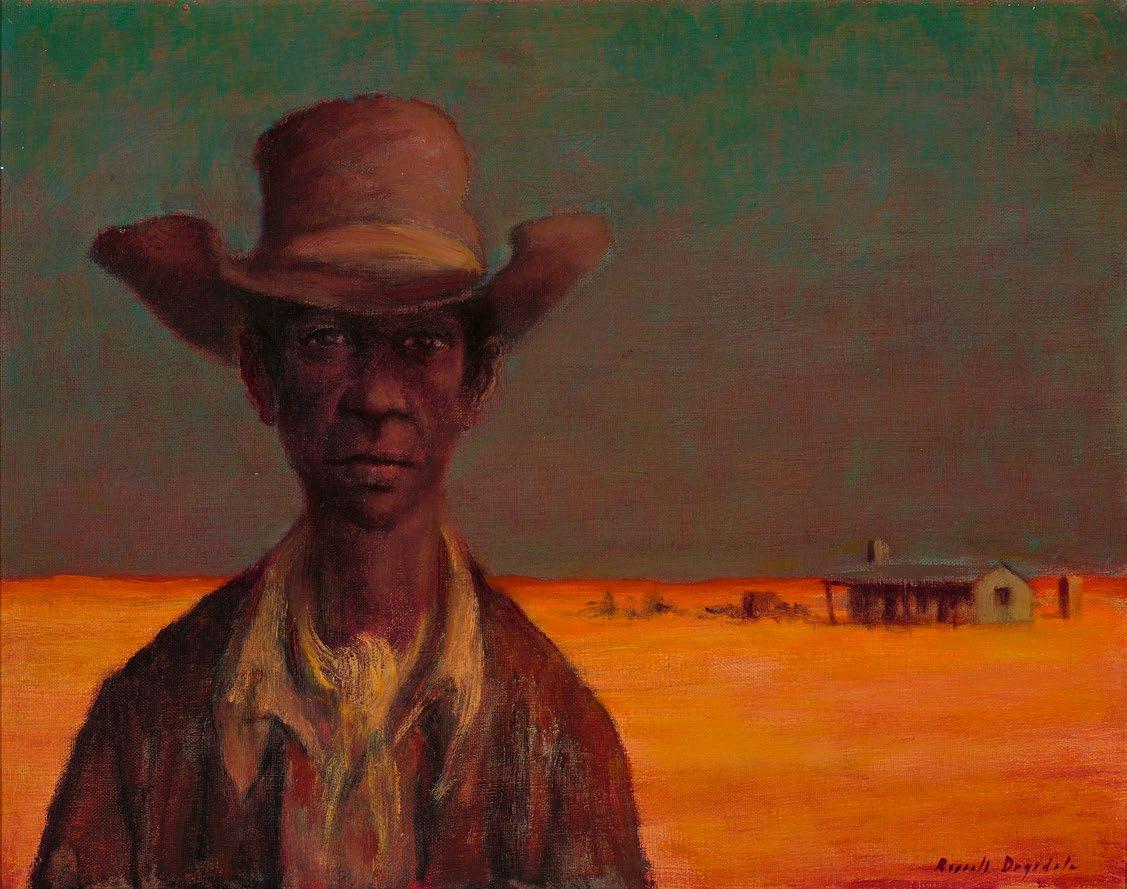
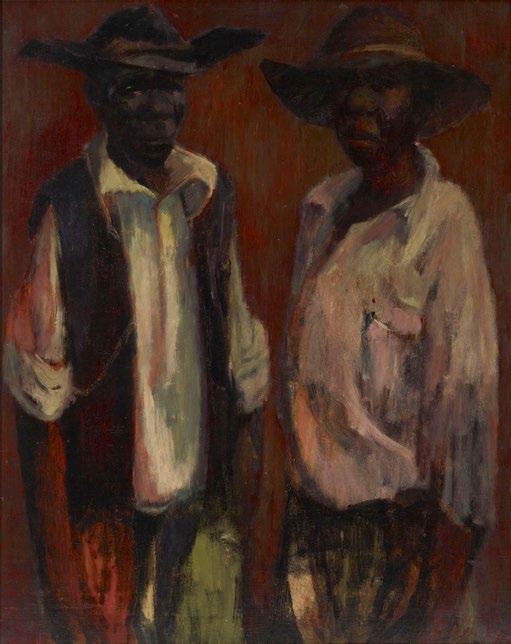
‘Drysdale… was like no one else. His brush left behind on the canvas, marks and textures, harmonies of colour and subtleties of tone orchestrated through the joy of creation. This is evident in his finest works where his mind is in control of the idea and the hand is the perfect executor of the form, achieving the magical skin of oil paint on canvas with depths of emotion and thought that defy verbal description.’ 1
Within the ranks of the great Australian painters of the twentieth century, Russell Drysdale is distinguished by his ability to depict the Australian landscape and the psychologically charged relationship between it and its inhabitants. His colours are sun-bleached and pale, or the rich browns and reds of the earth, and the terrain he depicts is typically vast, flat and dry. Often described in the same tones and with a similar handling of paint, Drysdale’s figures rarely seem out of place, with the harshness of their outback environment and the profound sense of emptiness that pervades these landscapes communicating much about the strength, resilience and spirit of his subjects. As Drysdale explained, ‘[These] are the people that are fascinating. They’ve got this character. They are characters. You can take your society people, however beautiful they might be, but to me they’re ephemeral people. These others aren’t. They just go on. They’re the kind of towers that reach out. The survival thing that means something.’ 2
Russell Drysdale Station boys, c.1953 oil on canvas
76.5 x 60.9 cm
Art Gallery of New South Wales, Sydney
© Estate of Russell Drysdale
Drysdale’s first solo exhibition was held at Riddell Galleries, Melbourne, in 1938 and received an overwhelmingly positive response, with Basil Burdett, the art critic for the Melbourne Herald, writing ‘I have seldom seen a more promising exhibition by a young painter anywhere.’ 3 During the next decade, Drysdale held several more solo exhibitions and further recognition of his art followed with the awarding of the 1947 Wynne Prize and the 1949 Melrose Prize. His work also began to be collected by important institutions during these years. Monday Morning, 1938 was acquired by the Metropolitan Museum of Art, New York in 1941, and the following year, both the National Gallery of Victoria and the Art Gallery of New South Wales purchased their first paintings by the artist, Moody’s Pub, 1941, and Sunday Evening, 1941, respectively.
Drysdale was one of a small number of twentieth-century Australian artists who achieved significant international recognition during his lifetime. First introduced to English audiences in a solo exhibition of recent paintings at Leicester Galleries in London in 1950, he showed there on three subsequent occasions and Stockman, 1965, was included in his third London exhibition in 1965. It was an impressive display, including twenty-four paintings, forty-five drawings and five lithographs, and such was the demand for Drysdale’s work, that almost half of the paintings had been sold beforehand and were loaned back for the exhibition.4 The Art Gallery of Western Australia’s painting, The gatekeeper’s wife, 1965, was one of these loaned pictures as was this work, which was lent by Geoffrey and Dahl Collings, designers and filmmakers, who were friends and close neighbours of the Drysdales at Killcare Heights. 5 The figure of a young Aboriginal stockman who stands face on, looking directly at the viewer, dominates the canvas. In the distance to the right is a small rural house and outbuilding, the only interruptions in a wide featureless landscape that glows orange and red, shadowed beneath a brooding sky. Drysdale travelled extensively through the Australian outback and found great inspiration there: ‘Most of the paintings… that I have done have been about subjects in the country, and figures and landscape, but that is simply because I spend a great deal of my time there. It is an environment which I love and which I like to go back to, and for
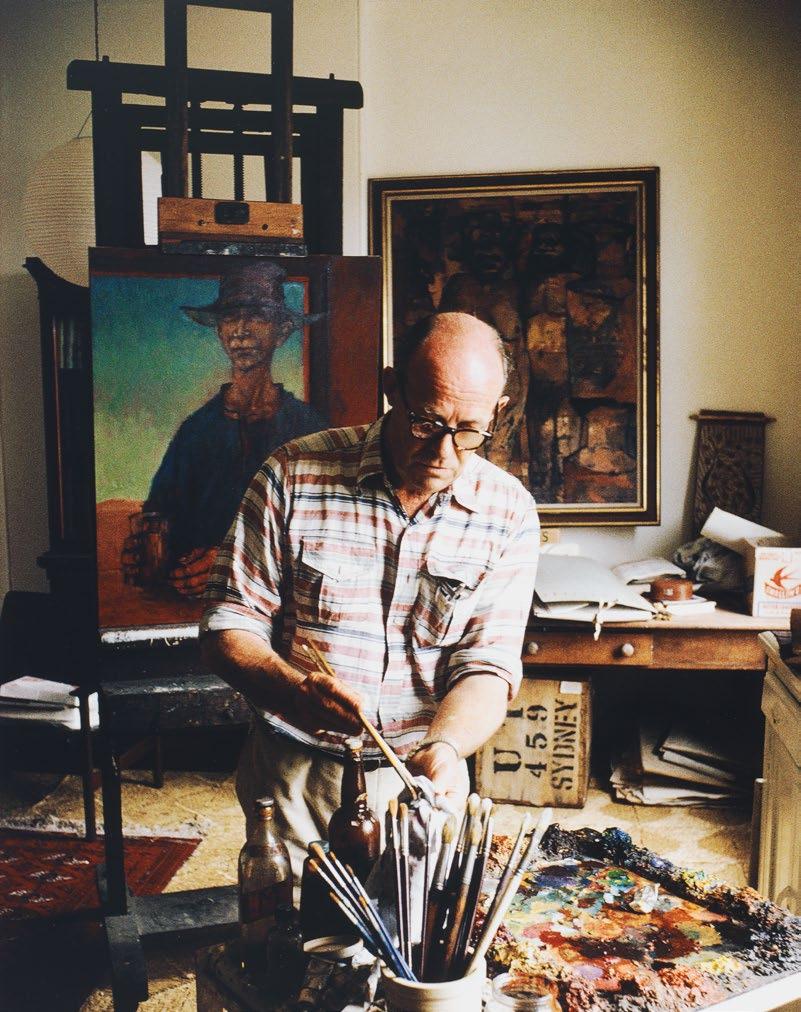
Russell Drysdale, Woollahra, Sydney, 1964 photographer: David Moore
National Portrait Gallery, Canberra
© Lisa, Michael, Matthew and Joshua Moore
me… it is continually exciting, these curious and strange rhythms which one discovers in a vast landscape, the juxtaposition of figures, of objects… This is a very ancient land, and its forms and its general psychology are so intriguing.’ 6 An intense study of character and place, Stockman has long been recognised as an eloquent representation of Australia, featuring on the cover of the 1971 edition of Xavier Herbert’s novel Capricornia, and Frank Hardy’s 1976 book, The Unlucky Australians
1. Klepac, L., Russell Drysdale, Murdoch Books, Millers Point, 2009, p. 322
2. Drysdale interviewed by Geoffrey Dutton, cited in Dutton, G., Russell Drysdale, Thames & Hudson, London, 1964, p. 100
3. Burdett, B., ‘Young painter shows brilliant promise’, Herald, Melbourne, 26 April 1938, p. 10, cited in Smith, G., Russell Drysdale 1912 – 81, National Gallery of Victoria, Melbourne, 1997, p. 19
4. See Klepac, op. cit., p. 322
5. In 1961, their company, Collings Productions, had produced a film about Drysdale.
6. Drysdale interviewed by Hazel de Berg, February 1960, cited in Smith, op. cit., p. 25
Kirsty Grant
oil on canvas
122.0 x 152.0 cm
signed lower left: Fred Williams bears inscription on typed label verso: Fred Williams / “Two Green Clouds”
Estimate: $1,000,000 – 1,500,000
Provenance
Rudy Komon Gallery, Sydney (label attached verso)
Walter McGrath, Sydney, acquired from the above in 1967
Rudy Komon Gallery, Sydney Ray and Diana Kidd, Sydney, acquired from the above 1971 Deutscher and Hackett, Sydney, 17 November 2010, lot 11 (dated 1966)
Private collection, Queensland
Exhibited
Fred Williams, Georges Gallery, Melbourne, 25 September – 14 October 1967, cat. 15
Archibald, Wynne and Sulman Prizes 1967, Art Gallery of New South Wales, Sydney, 20 January – 18 February 1968, cat. 92
Literature
McCaughey, P., Fred Williams, Bay Books, Sydney, 1980, pl. 8, p. 19 (illus.)
Fred Williams, cited in McCaughey, P., and Timlin, J., The Diaries of Fred Williams. 1963 – 1970, The Miegunyah Press, Melbourne, 2024, pp. 217 (illus.), 236, 238, 248
Related works
Green Cloud and Owl, 1965 – 66, oil on canvas, 183.0 x 152.0 cm, private collection, formerly Mertz Collection, USA Green Cloud and Owl II, 1966, oil on canvas, 150.0 x 120.0 cm, private collection, USA
Green Cloud I, 1967, oil on canvas, 152.5 x 183.0 cm, private collection Green cloud and owl, 1965, gouache on paper, 51.0 x 49.5 cm, National Gallery of Australia, Canberra
We are grateful to Lyn Williams for her assistance with this catalogue entry.
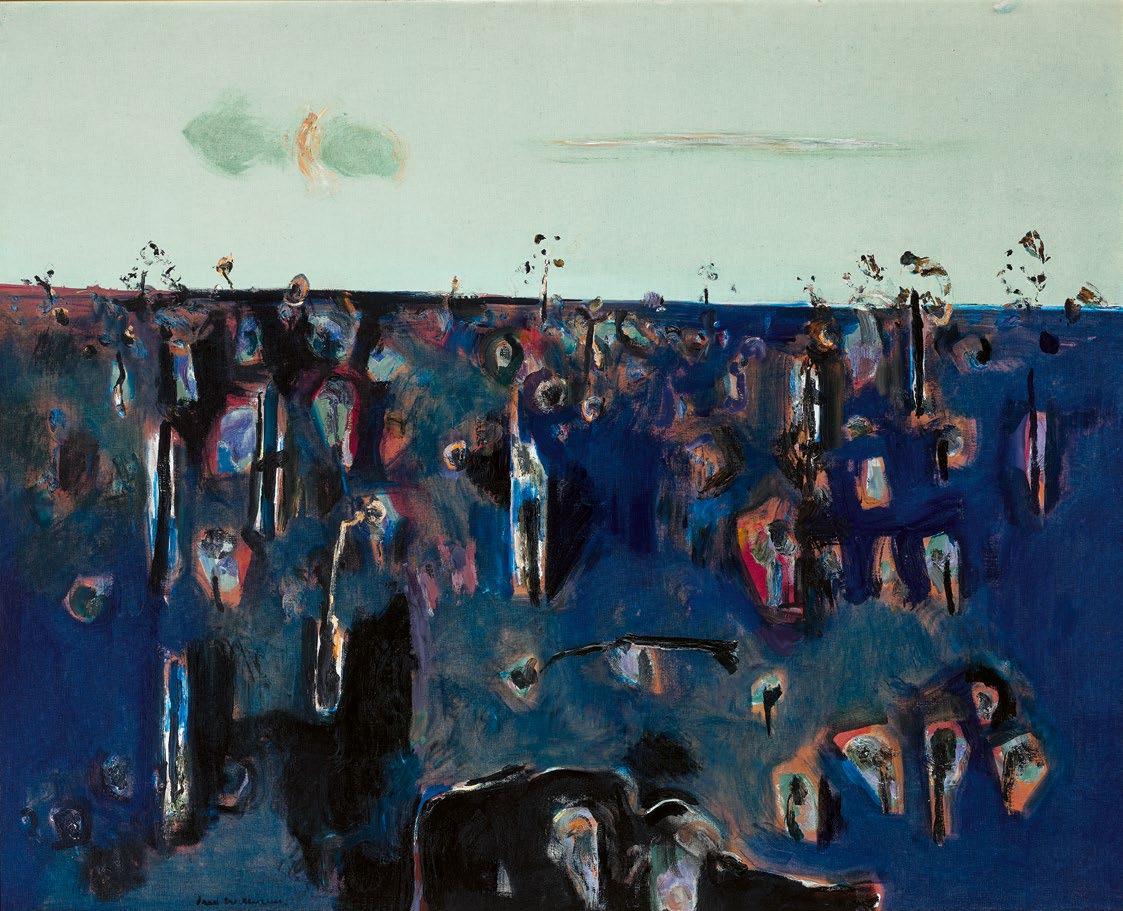
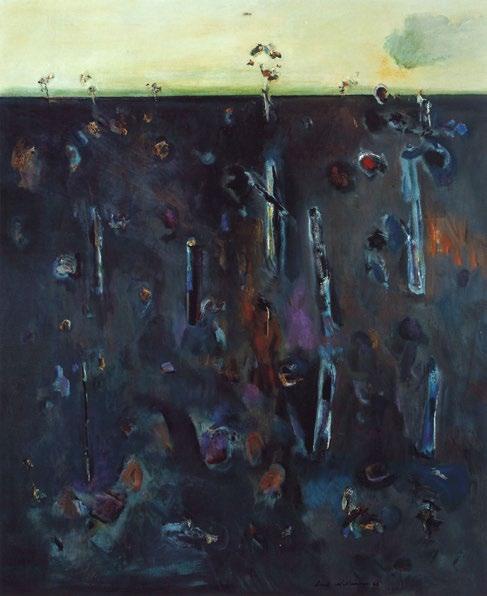
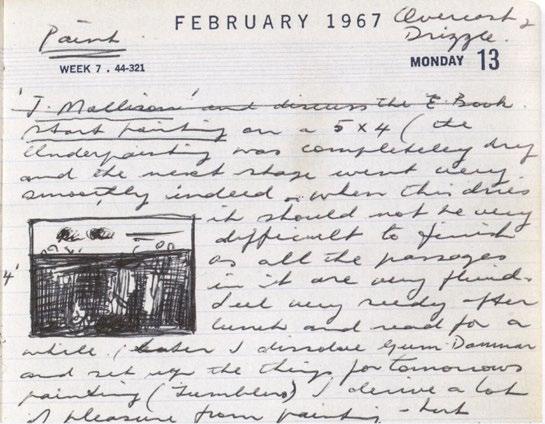
Like so many young artists of his generation, Fred Williams left Australia and travelled overseas at the end of 1951, seeking exposure to broader artistic and cultural influences than those which were available to him in midcentury Melbourne. While his training had emphasised the centrality of the figure in Western art, returning home after five years in London, Williams saw opportunity and creative potential in the landscape of his own country and the focus of his art changed direction. His friend, John Brack, expressed reservations about the landscape – and particularly the ubiquitous gum tree – as a valid subject for contemporary painting, but Williams recognised it as part of a longstanding and respected artistic tradition which was ripe for new interpretation. Similarly, although the antipicturesque qualities of his homeland seemed uninspiring to some, for Williams it represented the ideal subject:
‘It’s perfectly true, it is monotonous… There is no focal point, and obviously it was too good a thing for me to pass up… the fact [that] if there’s going to be no focal point in a landscape [then] it had to [be built] into the paint… I’m basically an artist who sees things in terms of paint.’ 1
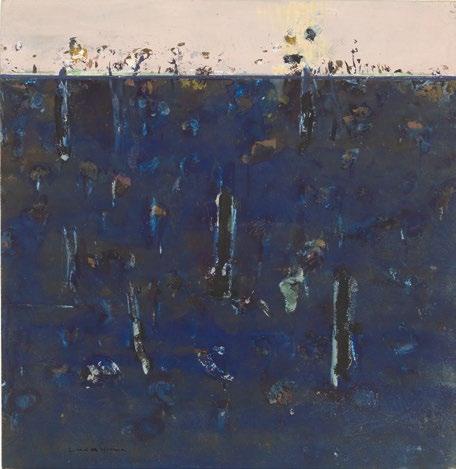
51.0
National
Agency 2026
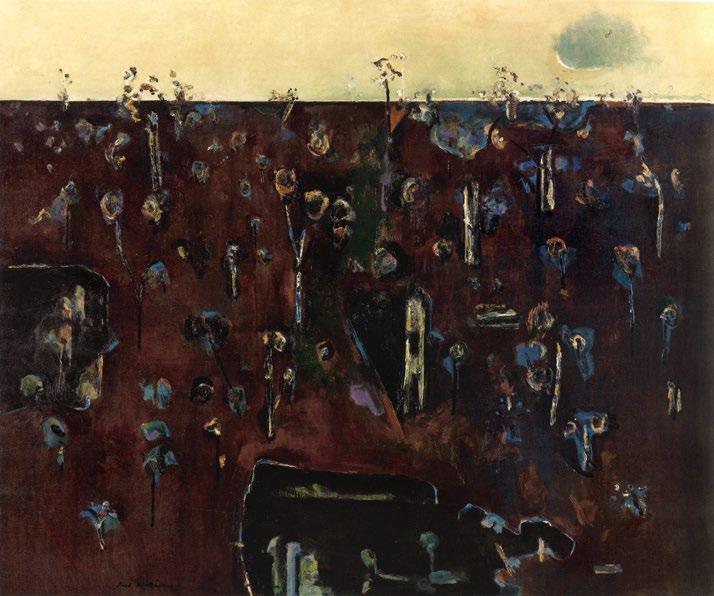
Fred Williams
Landscape with water ponds, 1965 - 67 oil on canvas
153.0 x 184.0 cm
Private collection
© Estate of Fred Williams/Copyright Agency 2026
Williams developed a distinctive painterly language and approach to the formal composition of landscape subjects that is now ingrained in our collective consciousness. Whether he is depicting a semi-rural hillside covered with scrubby bushes and trees, or an abstract aerial view of the desert thousands of kilometres away from any city centre, his images have come to influence the way Australians see and imagine their own country. This phenomenon and the significant place that Williams was carving out for himself within the history of Australian art were recognised early on: ‘Of all the modern Australians, he is said to be the one most likely to emerge as the finest landscapist since Tom Roberts.’ 2
The 1960s was an important decade for Williams. In 1963, he was invited to join the stable of artists represented by Sydney art dealer, Rudy Komon, and the monthly retainer he received gave Williams and his wife, Lyn, the financial confidence to buy a house at Upwey in the Dandenong Ranges, about thirty kilometres to the east of Melbourne. That same year, Williams was awarded the prestigious Helena Rubinstein Travelling Art Scholarship, travelling for seven months in Europe in 1964. The following year was also significant – ‘for the first time [Williams] was able to paint full-time. The concentration and energy, and the time he now brought to his art, resulted in four years of astonishing variety and contrast in his painting.’3 The You Yangs continued to feature as an important subject in his work alongside new landscapes that were based on Upwey and nearby Lysterfield.
The composition of the Upwey landscapes reflected the view from his home studio, looking up a hillside from the base of a valley, and paintings from this series are characterised by a narrow band of sky running across the top of a steep and often treed slope. The response to these works which are now considered ‘classic’ Williams paintings was positive: the National Gallery of Victoria purchased Upwey landscape, 1965, directly from the studio in 1965; in 1966 Williams won the Georges Invitation Art Prize with another major Upwey picture; and the following year, an Upwey subject was awarded the Wynne Prize at the Art Gallery of New South Wales. Since that time, major Upwey paintings have been acquired for the collections of the National Gallery of Australia, Art Gallery of New South Wales and Tate, London. In the words of Patrick McCaughey:
‘They were clearly paintings of substance, well-made and fully fashioned and yet they still allowed Williams’ touch to operate. They made of the drab and featureless bush, a landscape of enduring, even monumental proportions and dignity.’4
Part of the extended Upwey series, Two green clouds, 1967, is one of a small group of paintings that are linked by the presence of a distinctive pale green cloud (or in this case, a pair of clouds) which Williams had seen ‘as it passed its single way across the early evening sky at Upwey.’ 5 The origin of these works was a gouache painted outdoors on a summer evening during early
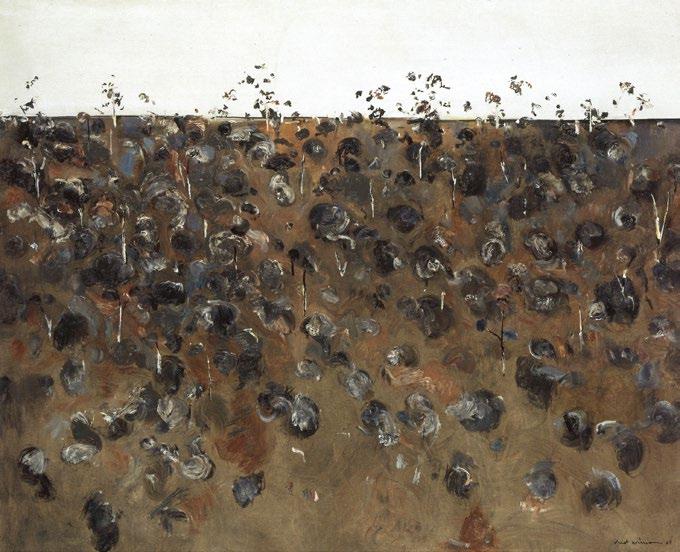
Fred Williams Upwey Landscape, 1965 oil on canvas
147.5 x 183.3 cm
National Gallery of Victoria, Melbourne © Estate of Fred Williams/Copyright Agency 2026
1965 with no light other than that emitted by the moon. Typical of Williams’ practice of working in various media – drawing on the material qualities, technical requirements and creative innovations of one to push his work in another in new directions – subsequent gouaches of this nocturnal scene were followed by a series of five etchings in which he used various intaglio printmaking techniques as expressively as he used a paintbrush, creating rich inky tones and texture on their paper support. James Mollison explains that one of these prints inspired a subsequent gouache painted in Prussian blue and that this, in turn, led to the painting of Green cloud and owl, 1965 – 66 (private collection, formerly the Harold E. Mertz Collection, New York).6
The present painting adopts the familiar composition of the Upwey landscapes. The top third of the canvas depicts a luminous band of summer sky – the sun has gone down but there is still light in the distance – which is interrupted only by the pair of amorphous green clouds that suggest the subtle movement of air on an otherwise still summer’s night. The hillside below, which fills most of the picture, is covered with tall vertical trees and one decisive horizontal in the lower centre representing a tree that has fallen or perhaps one that has been felled. Pictorial space is radically flattened and the foliage that extends beyond the horizon line is described in the painterly hieroglyphics so distinctive of Williams’ hand. At first
glance it is the rich blue of the hillside and the black tree trunks that predominate, but a closer look reveals a typically complex palette where the artist has built up layers of non-representational colour, including green, red, ochres and white highlights, which nevertheless, still describe the subject in a manner that looks and feels like the scrubby local landscapes that we all know. Highly regarded at the time they were made, the Upwey paintings presented a singular vision that ‘revalued Australian landscape painting… and renewed hope in the genre’ 7, further cementing Williams’ place in the history of twentieth century Australian art.
1. Fred Williams interviewed by James Gleeson, 3 October 1978, cited in Mollison, J., Fred Williams: A Singular Vision, Australian National Gallery & Oxford University Press, Canberra, 1989, p. 35
2. Millar, R., ‘Landscapist who is different’, The Australian student, Country Press, Sydney, undated, unpaginated, cited in Hart, D., Fred Williams: Infinite Horizons, National Gallery of Australia, Canberra, 2011, p. 61
3. McCaughey, P., Fred Williams 1927 – 1982, Murdoch Books, Sydney, 1996, p. 166
4. ibid., p. 170
5. Mollison, op. cit., p. 91
6. See Mollison, ibid., pp. 90 – 93
7. McCaughey, op. cit., p. 170
Kirsty Grant
Opposite: Fred Williams photographer: Ernie McLintock © Ernie McLintock
oil on canvas
130.0 x 97.0 cm
signed and dated lower right: John Brack 1978 inscribed with title on artist's label verso: PROMENADE bears inscription on labels verso: 35
Estimate: $500,000 – 700,000
Provenance
Helen Brack, Melbourne
Deutscher and Hackett, Melbourne, 28 April 2010, lot 40
Private collection, Queensland
Exhibited
John Brack, Rudy Komon Gallery, Sydney, 27 May – 21 June 1978, cat. 5
John Brack: A Retrospective Exhibition, National Gallery of Victoria, Melbourne, 10 December 1987 – 31 January 1988, cat. 98 (label attached verso)
John Brack: Selected Paintings 1950s – 1990s, Geelong Art Gallery, Victoria, 15 June – 14 July 1996, cat. 16
A Question of Balance: John Brack 1974 – 1994, Heide Museum of Modern Art, Melbourne, 1 April – 28 May 2000, p. 45
John Brack, National Gallery of Victoria, Melbourne, 24 April – 9 August 2009 (label attached verso)
John Brack x Noel McKenna: A face in the mirror, National Portrait Gallery, Canberra, 3 April – 19 July 2026
Literature
Lindsay, R., John Brack: A Retrospective Exhibition, National Gallery of Victoria, Melbourne, 1987, cat. 98, p. 78 (illus.)
Grishin, S., The Art of John Brack, Oxford University Press, Melbourne, 1990, vol. I, p. 142, vol. II, cat. O246, pp. 33, 164 (illus.)
Grant, K., John Brack, National Gallery of Victoria, Melbourne, 2009, p. 185 (illus.)
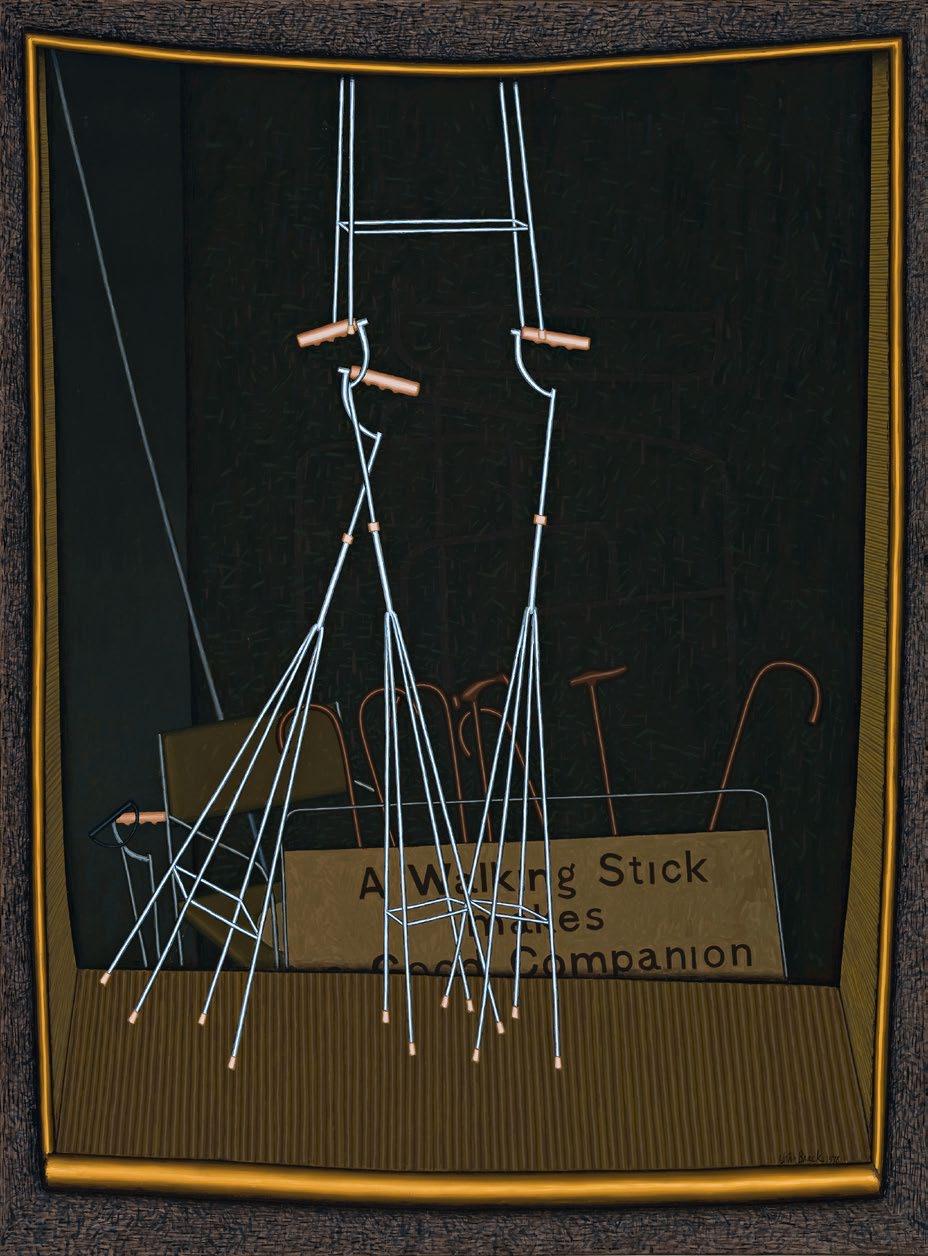
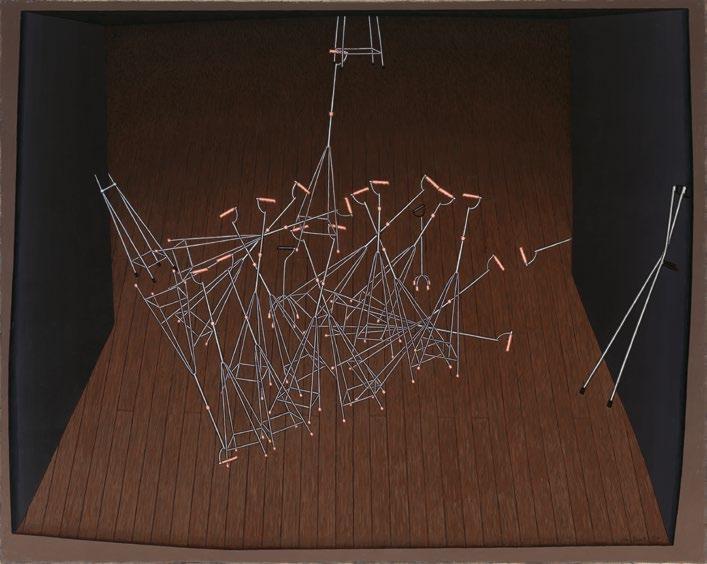
John Brack Display, 1978 oil on canvas
122.0 x 151.0 cm
National Gallery of Australia, Canberra
© Helen Brack
Arguably among the most enigmatic and compelling achievements of his late career, John Brack’s Walking Stick paintings of the late 1970s skilfully translate humble mobility aids into poignant metaphors for the fragility and precariousness of the human condition. Conceived at a moment when the artist’s attention had shifted from depicting people themselves to the objects that sustain – and ultimately come to symbolise – them, these unique compositions thus revisit the concerns of the celebrated Shop Window series while advancing a richer meditation upon balance, companionship and the ambiguities of existence. One of the more conceptually complex examples from this small but significant group, Promenade, 1978, encapsulates well such evolution, powerfully demonstrating Brack’s remarkable ability to elevate the banal into the universal – to distil the commonplace into imagery of extraordinary psychological and philosophical resonance.
Significantly, the genesis of the series lay in the artist’s encounter with the window display of a Melbourne chiropodist featuring a notice proclaiming, ‘A walking stick makes a good companion’, surrounded by an assortment of walking sticks and frames. Struck by the unintended irony of the arrangement, Brack initially translated the display into the watercolour and pen-and-ink drawing A Walking Stick Makes a Good Companion, 1977 (Art Gallery of South Australia), before developing the motif further in Promenade and related paintings such as Tower, 1978 (private collection, formerly Museum of Contemporary Art, Brisbane) and Display,
1978 (National Gallery of Australia). Yet, unlike the earlier Shop Window paintings whose compositions often retained close parallels with their observed sources, here the display serves merely as the catalyst, with reality instead transformed into an autonomous pictorial invention in which the utilitarian objects assume a life entirely their own.1 Suspended with improbable grace, the walking frames perform an elegant yet precarious choreography – their delicate equilibrium suggesting both poise and the ever-present possibility of collapse. As Brack later observed, these works were intended to be ‘both balanced and unbalanced... moving and still... coherent and incoherent’ – a series of deliberately ‘premeditated ambiguities.’2 Perhaps not coincidentally, Brack also produced a group of drawings depicting gymnasts alongside the development of the Walking Stick series – their striking formal affinities reinforcing the artist’s sustained preoccupation with equilibrium, tension and endurance as both physical and existential conditions.
Central to such exploration of instability and uncertainty is Promenade’s complex spatial construction which compels the viewer’s gaze to shift continually between competing perspectives – from the suspended gold frame and frontally-viewed walking frames, downward onto the sloping floor of the display case, back to the boldly inscribed notice, and beyond to the wooden walking sticks receding into the depths of the window. Behind them, emerging almost imperceptibly from a dense, darkened
‘A walking stick makes a good companion’, 1977 photographer: Lawrence Course
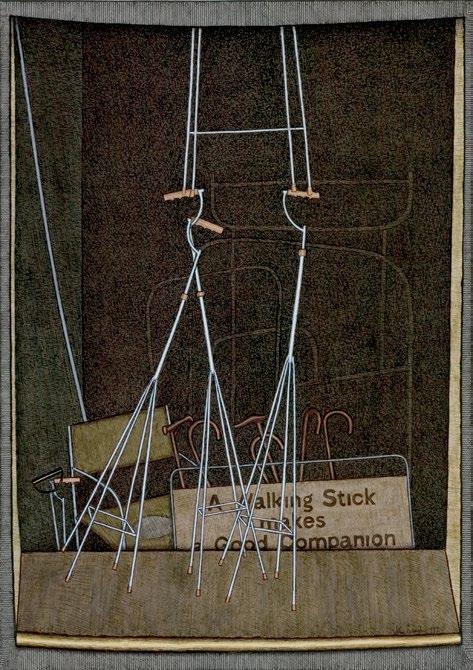
John Brack
void, ghostly wheelchairs echo the forms of the walking frames in the foreground, recalling the spectral presences inhabiting The Slicing Machine Shop, 1955 (private collection). Reconfigured into an intricate arrangement of advancing and retreating forms, at once independent and interdependent, indeed the walking frames are rendered with flesh-coloured handles and feet – becoming subtly anthropomorphic without ever relinquishing their identity as functional objects. Here, as in the Shop Window paintings of the previous decade, Brack dissolves the distinction between interior and exterior, merging the worlds of the shopkeeper and passer-by to create what he aptly described as a paradox illustrative ‘not only of shop windows, but the whole aspect of life itself.’3 The display accordingly becomes a theatrical stage upon which society performs while simultaneously observing itself.
As a young art student frequenting the streets surrounding the National Gallery of Victoria, Brack had long admired the inherent beauty of the hardware and machinery displayed in shop windows, later informing his conviction that ‘...everything, especially the manufactured things… have a peculiar beauty – not the beauty of flowers and apples, but the beauty of efficiency.’4 Appreciated by Brack for their therapeutic function associated with medicine and healing, artery forceps, surgical lamps, syringes, wheelchairs and walking frames consequently became recurring protagonists within his paintings, challenging established notions of aesthetic legitimacy while investing the ordinary with profound symbolic weight.
A walking stick makes a good companion, 1977 watercolour, pen and ink on paper 75.0 x 55.6 cm
Art Gallery of South Australia, Adelaide © Helen Brack
Thus, what originated as the chance observation of a shop window and its reassuring advertising slogan becomes, in Brack’s hands, a quietly profound reflection upon human existence. The walking stick ceases to be merely an object of utility and emerges instead as a symbol of companionship, vulnerability and resilience, while the delicately balanced frames enact the perpetual negotiation between stability and collapse that defines every human life. Indeed, it is precisely this ability to uncover enduring truths within the most commonplace of subjects that distinguishes Brack’s greatest paintings – placing Promenade among the most profound and intellectually rewarding expressions of his oeuvre.
1. Grishin, S., The Art of John Brack, Oxford University Press, Melbourne, 1990, vol. I, p. 142
2. John Brack, Australian Contemporary Art Archive, No.1, Deakin University Media Production, Melbourne, 1980, p. 5
2. Grishin, op. cit., p. 122
4. John Brack cited in ‘John Brack Speaking on his Art’, Tony Morphett, ABC TV Documentary, 1965, p. 2
Veronica Angelatos
oil on composition board
25.0 x 31.0 cm
signed and dated lower right: JEFFREY SMART 64
Estimate: $120,000 – 160,000
Provenance
Galleria 88, Rome Private collection
Macquarie Galleries, Sydney Private collection
Art Galleries Shubert, Queensland (label attached verso, as ‘Bar Tables Skyros’)
Private collection, California, acquired from the above Private collection, Melbourne, acquired from the above in December 2000
Exhibited
Jeffrey Smart, Galleria 88, Rome, 8 – 23 April 1965, cat. 18 Exhibition of Paintings, Jeffrey Smart, Macquarie Galleries, Sydney, 29 September – 11 October 1965, cat. 17
Literature
Quartermaine, P., Jeffrey Smart, Gryphon Books, Melbourne, 1983, cat. 417, p. 108
We are grateful to Stephen Rogers, Archivist for Jeffrey Smart, for his assistance with this catalogue entry.
After having assiduously saved for many years, in 1964 the young Jeffrey Smart left Australia for Europe, arriving in London in February, alongside his friend and fellow painter, Justin O’Brien. Each delighting in the artistic history of the continent, they visited museums and galleries in London and Paris before purchasing a Simca touring car to make the 6000km journey to Greece for the spring and summer.1 Although Smart made drawings and took photographs of promising subjects in the capital, he quickly became disenchanted with the crowds and heat of Athens, seeking instead ‘a summer retreat… somewhere unspoilt.’ 2 Recommendations led the artists to Skyros, a remote island in the Sporades archipelago, where, joined by the artist Brian Dunlop, they stayed in a rustic fisherman’s cottage by the sea for a period of four months. In June of 1964, the Sydney Morning Herald published a missive from the artists in their ‘Hello, Hello’ tabloid segment, relating that Skyros was ‘absolutely biblical, very primitive. A very beautiful place with a town crazily placed on a high jagged rock.’ 3
While this sojourn on Skyros (the first of many) provided for Justin O’Brien a wealth of landscape and figurative subjects, Jeffrey Smart produced only a few paintings of Greek subjects
over the summer, most of which related to Athens – Piraeus I and Piraeus II ; House outside Athens ; and Outskirts, Athens, all dated 1964. With a quiet stillness and compositional serenity, Bar, Skyros, 1964 is a rare painting within Jeffrey Smart’s oeuvre, directly relating to their time on the idyllic island.
Tightly cropped, the view presented by Smart focuses on a chess-like arrangement of three empty bar tables set in shallow space, against a whitewashed wall displaying truncated Greek lettering (eta, theta, and omega) and a heavy wooden door. This orchestration of inanimate objects with no one in sight, is painted by Smart in a fresco-like pattern of flat colour, almost entirely devoid of shadows. The graphic arrangement of foldable table-legs animates the pictorial surface and highlights Smart’s asymmetric composition. With the artist’s crisp outlines and a muted palette ranging from dark brown to cream and white, Bar, Skyros captures the bleaching light of a Greek summer, and the prosaic sophistication of outdoor dining. The tables, however, are empty, stand-ins for absent people. They are devoid of chairs, an assortment of which was painted in contemporaneous paintings Piraeus I and Piraeus II. A green apple provides a focal point and startling shock of colour in an otherwise harmonious chromatic palette. A master of stillness, Smart’s painting of Skyros portrays the ancient stasis of the island, so distinct from the cacophony of burgeoning modernity that he was to find some months later in Rome.
John McDonald noted ‘Smart invites us to look at a functional object as though we were connoisseurs assessing its sculptural qualities.’4 In this respect Smart was indebted to the pittura metafisica of Giorgio Morandi, an artist he admired as one of the greatest of modern artists. In Bar, Skyros, in particular, Smart, like Morandi, presents a mysterious sense of temporal suspension and intimate unhurried contemplation, displaying clusters of everyday objects in few colours, lined up into a simple and serene still life.
1. Pearce, B. and Wilson, N., Justin O’Brien: The Sacred Music of Colour, Art Gallery of New South Wales, Sydney, 2010, p. 166
2. Jeffrey Smart, cited in Pearce, B., Jeffrey Smart, The Beagle Press, Sydney, 2005, p. 143
3. ‘Hello Hello’, Sydney Morning Herald, Sydney, 21 June 1964, p. 121
4. McDonald, J., Jeffrey Smart Paintings of the ‘70s and ‘80s, Craftsman House, Sydney, 1990, p. 48
Lucie Reeves-Smith
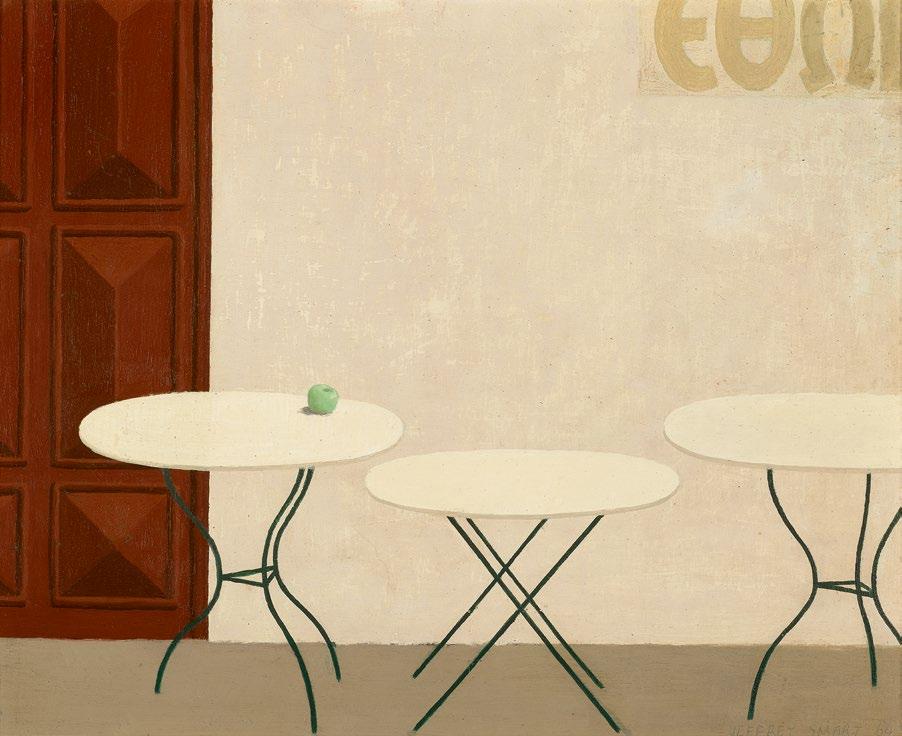
sawn and split soft drink crates on plywood
131.0 x 100.0 cm
signed, dated and inscribed with title verso: ALL THAT JAZZ / 1989 / Rosalie Gascoigne
Estimate: $320,000 – 420,000
Provenance
Roslyn Oxley9 Gallery, Sydney Private collection, Melbourne
Martin Browne Fine Art, Sydney Private collection, Sydney
Deutscher~Menzies, Sydney, 15 March 2006, lot 21 Private collection, Melbourne
Exhibited
What Is Contemporary Art?, Rooseum, Malmö, Sweden, 3 June – 30 July 1989 (illus. in exhibition catalogue, p. 48)
Rosalie Gascoigne, Roslyn Oxley9 Gallery, Sydney, 1 – 18 November 1989, cat. 6 (label attached verso)
20th Century Australian and New Zealand Paintings, Martin Browne Fine Art, Sydney, 22 August – 28 September 1991, cat. 77 (illus. in exhibition catalogue)
Rosalie Gascoigne: Plain Air, City Gallery Wellington, New Zealand, 22 February – 16 May 2004, cat. 14
Rosalie Gascoigne, National Gallery of Victoria, Melbourne, 19 December 2008 – 15 March 2009, cat. 47
Literature
Allen, C., ‘Bill Robinson: Rosalie Gascoigne’, Art Monthly Australia, no. 27, December 1989, p. 19
Delaruelle, J., ‘Free of gobbledegook,’ Sydney Review, Sydney, December 1989, p. 16
Johnson, A., ‘Rosalie Gascoigne’, Art & Text, no. 36, May 1990, p. 151 (illus.)
McDonald, E., ‘“There are only lovers and others …” An interview with Rosalie Gascoigne’, Antic, Auckland, no. 8, December 1990, p. 13 (illus.)
Drury, N., Images in Contemporary Australian Painting, Craftsman House, Sydney, 1992, pl. 162, pp. 176 (illus.), 177, 257 Macdonald, V., Rosalie Gascoigne, Regaro, Sydney, 1998, pl. 7, pp. 45 (illus.), 112
Gascoigne, M., ‘No ordinary woman’, Alumni News, University of Auckland, vol. 12, no. 1, 2002, cover (illus.), p. 2
Rosalie Gascoigne: Plain Air, City Gallery Wellington and Victoria University Press, Wellington, 2004, pl. 18, p. 68 (illus.)
McAloon, W., ‘Roadrunner’, New Zealand Listener, vol. 193, no. 3336, 17 – 23 April 2004
Armstrong, C., ‘Collector profile: Pat Corrigan AM’, Art and Australia, vol. 43, no. 3, Autumn 2006, p. 450 (illus., installation view)
Dedman, R., ‘Rosalie Gascoigne’, Australian Art Market Report, issue 24, Winter 2007, p. 24 (illus.)
Grant, J., ‘Set the letters free’, Eye: The International Review of Graphic Design, no. 64, 2007, p. 29 (illus.)
Gellatly, K., Rosalie Gascoigne, National Gallery of Victoria, Melbourne, 2008, pp. 21, 100 (illus.), 135
Hansen, D., ‘Prescribed Text: Rosalie Gascoigne in Melbourne’, Art Monthly Australia, no. 220, June 2009, pp. 30 (illus.), 31
Gascoigne, M., Rosalie Gascoigne: A Catalogue
Raisonné, Australian National University Press, Canberra, 2019, cat. 345, pp. 236 (illus.), 332, 350 – 351, 353, 370
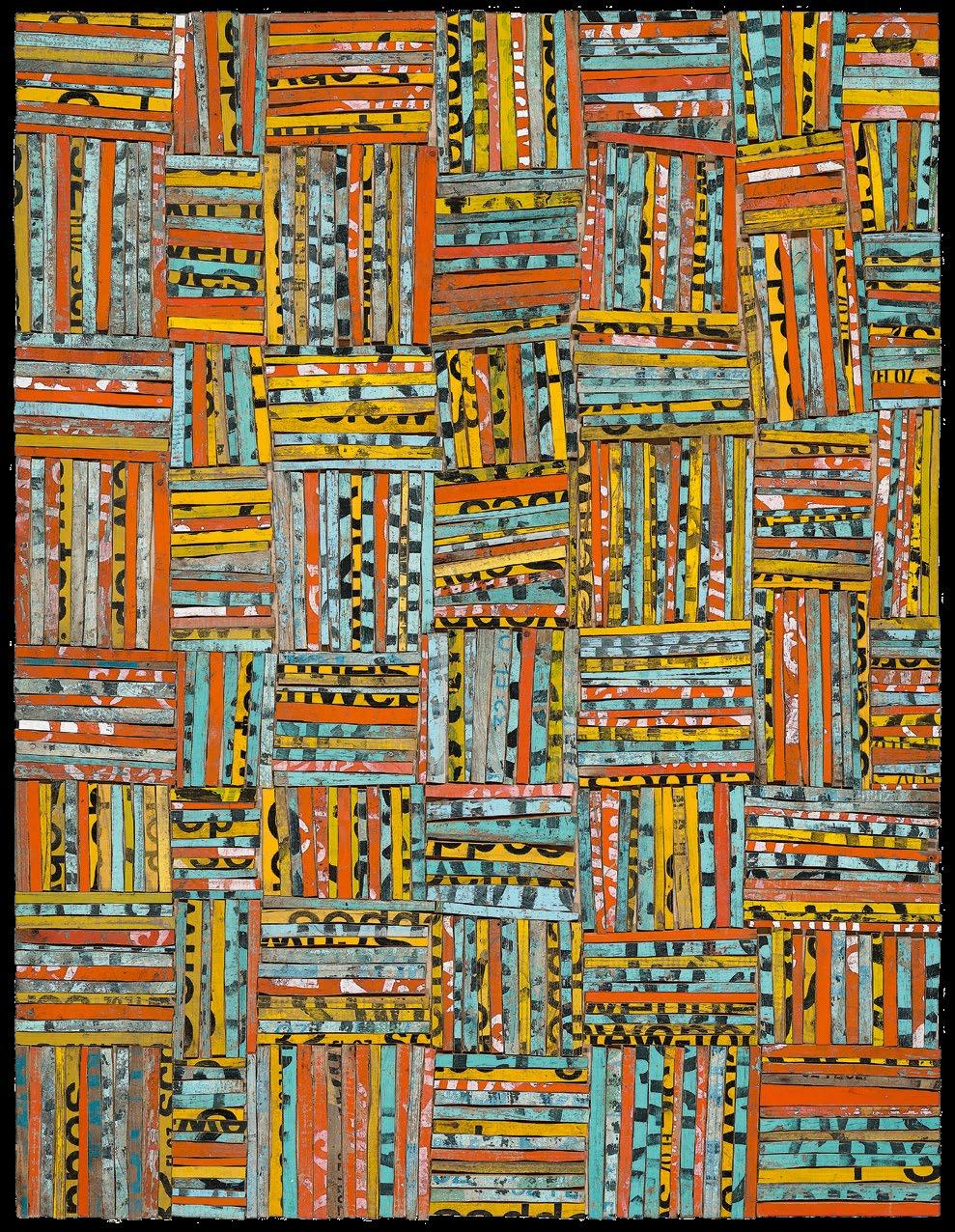
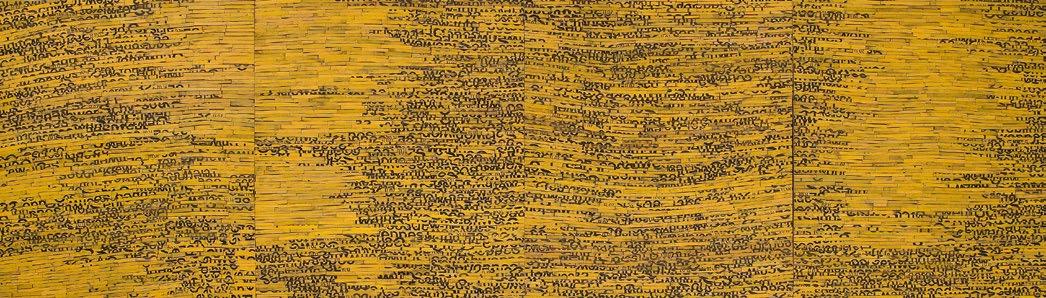
Rosalie Gascoigne Monaro, 1989
sawn and split soft-drink crates on plywood 131.0 x 457.0 cm (overall)
The State Art Collection, The Art Gallery of Western Australia, Perth © Rosalie Gascoigne Estate / Copyright Agency 2026
‘Gascoigne’s art communicates a fervent commitment to life. She flourished from middle into old age, while her peers underwent the more usual passage to resignation and calm wisdom. Most people accept the weakening. Rosalie, growing older, sharpened herself. Her art affirmed the sap of life within weathered forms.’ 1
Rosalie Gascoigne first discovered wooden soft drink crates in 1978 at the Schweppes depot in Queanbeyan, NSW, near Canberra, gathering them up and taking them home with no predetermined sense as to how they would be used in her art. They first appeared in their full, unadorned form in the twenty-piece work, March Past, 1978 – 79 (National Gallery of Australia); its rows of alternating horizontal boards of red, green and faded natural wood inspired by the Anzac Day March she had recently witnessed on a trip to Melbourne. 2 Gascoigne was hooked. From that serendipitous moment she was to use the material across her oeuvre in around 130 works, even returning to her precious stockpile in 1999, the last year of her life, after transition to plastic crate manufactures had made them an increasingly rare resource. 3 As the artist’s husband, astronomer Ben Gascoigne recalled, Gascoigne’s capacity for collecting this material en masse was considerable, and it served her well:
‘It could be disconcerting, returning home after a day at the office, to find the drive blocked by a couple of hundred soft drink crates. They had to be sorted, stacked, cleaned and dismantled, the latter process involving pulling out up to forty nails from each box, with no short cuts. The family helped, but she did most of the work herself.’4
Initially, Gascoigne combined the beautiful, weathered woods and colours of the planks of drink crates in elegant compositions that
lyrically evoked the Australian bush. The typography of various printed brands on these crates – Dales, Tarax, Crystal, Swing – is used to great effect, dancing across the surfaces of works as if mirroring the experience of dappled light and of the changing seasons on the landscape. However, once this preoccupation had run its course, she began to split the boards – first with a tomahawk, and then, a bandsaw – often manipulating the graphic black lettering of her much-loved yellow Schweppes crates into tightly compacted groupings which made the fragmented letters seem to jostle, bounce or rustle across the picture plane.
Notably, All that jazz, 1989 was shown in the artist’s groundbreaking exhibition at Roslyn Oxley9 Gallery, Sydney in November 1989. Gascoigne’s first solo exhibition in Sydney since her Gallery A début in 1976, this landmark show brought together major soft drink crate works such as Monaro, 1988 – 89 (Art Gallery of Western Australia); Wheat Belt, 1989 (National Gallery of Australia); and Outback, 1988 (private collection), with a significant group of retro-reflective road sign works in her signature yellow and orange.
As we see in the majestic All that jazz, this way of working with the slivers of boards also coalesced with Gascoigne’s use of the grid as an important organising principle within her work. Closely aligned to Modernist art practice, the tessellation, compression and repetition that occurs across the work’s structure, no longer evokes feelings or sensations related to the natural world, but instead suggests, in the self-conscious regulation of its surface, a sense of continuum and endlessness that is in and of the work itself. Calling to mind an elaborate and highly coloured patchwork quilt (particularly the geometric creations of the Gee’s Bend quilters of America’s Deep South), the knowing combination
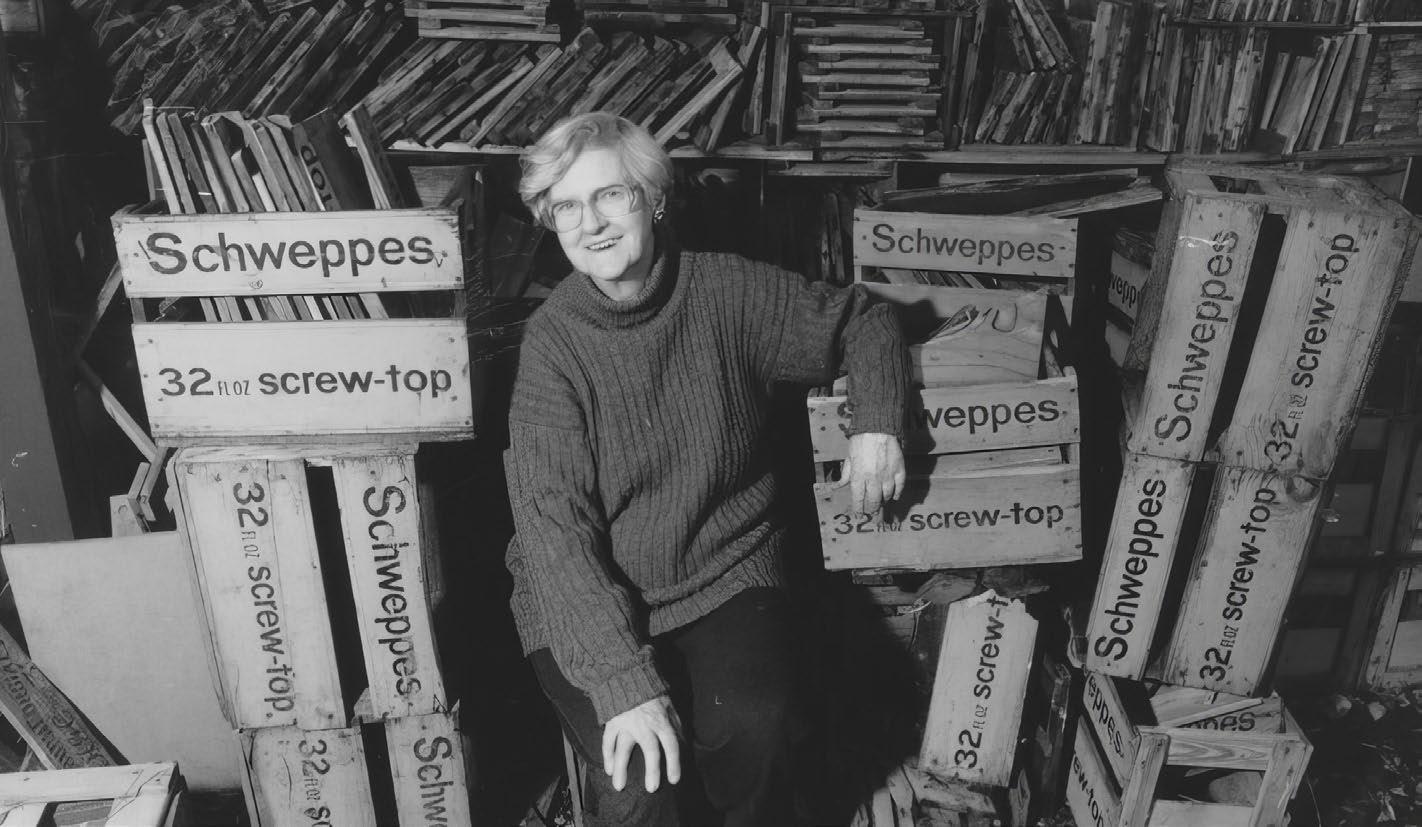
Rosalie Gascoigne, with her collection of Schweppes boxes, 1994 photographer: Richard Briggs
of the work’s title and form brings a sense of musicality and lively movement to the piece. As Mary Eagle has observed:
‘…[A] work by Gascoigne gains aesthetic impact by virtue of how an underlying grid or cell-like structure serves as a ground for deviations – of wave after wave, mirroring, reorientation, transposition, positive-negative inversion, counterbalance, swivelling and, in the text panels, a play of words.’ 5
Like all the artist’s work, the creation of All that jazz was a haptic rather than predetermined experience. Gascoigne was opposed to the idea of planning, and didn’t draw, use collage, or experiment with compositional ideas before commencing a piece. As the artist’s son, Martin Gascoigne has noted, her approach was ‘visual and practical, not conceptual’, and she let her materials ‘take her by the arm.’ 6 By glueing the slivers of wood to a plywood backing board and working in small component parts, Gascoigne could shuffle the pieces until they settled in place and felt ‘right’. As she remarked,
‘I can’t do anything except I can see, and I can arrange… but mostly I can arrange… I can do something that feels like something, but I can’t do anything that looks like something.’ 7
Before beginning, there was no sense as to scale or if the work was single or multi-panelled, horizontal or vertical. This was determined in the making, and in the time sitting with and studying the piece after its completion. This was also the stage at which it was given a title – the title the work seemed to demand for itself.
A major retrospective of Gascoigne's work will be held at the National Gallery of Australia from October 2026 – February 2027, the first since her major survey exhibition at the National Gallery of Victoria in 2009.
1. Eagle, M., ‘Rosalie Gascoigne: Artist and Sculptor’, The Age, Melbourne, 1 November 1999
2. Rosalie Gascoigne, cited in Gascoigne, M., Rosalie Gascoigne: A Catalogue Raisonné Australian National University Press, Canberra, 2019, p. 187. March Past, 1978 – 79 was first exhibited in the artist’s solo exhibition at Ray Hughes Gallery, Sydney in 1979.
3. ibid., pp. 71, 78, 120. The last work Gascoigne made with soft drink crates was Great Blond Paddocks, 1998 – 99. In his catalogue raisonné, Martin Gascoigne gives two different totals, saying Gascoigne made around 127 works from soft drink crates (p. 71) as well as around 130 (p. 120).
4. Gascoigne, S.C.B., ‘The Artist-In-Residence’ in Eagle, M. (ed.), From the Studio of Rosalie Gascoigne, The Australian National University Drill Hall Gallery, Canberra, 2000, p. 12
5. Eagle, M., ‘Rosalie Gascoigne’s Lyrical Derailments’ in Seear, L. & Ewington, J. (eds.), Brought to Light II: Contemporary Australian Art 1966 – 2006, Queensland Art Gallery, Brisbane, 2007, p. 200
6. Gascoigne, M., op. cit., p. 70
7. Rosalie Gascoigne, cited in Peter Ross, ‘Interview with Rosalie Gascoigne (transcript)’, Review, ABC TV, broadcast 12 August 1990.
Kelly Gellatly
(Lots 24 – 37)
Michael Gleeson-White was quite simply one of the most remarkable people you might ever hope to meet. At the age of 100 he remained incredibly sharp and quick-witted. When I met him for our semi-regular lunches he would discourse knowledgeably on art, literature, politics, economics and music. Opera was his passion, and Russian soprano, Anna Netrebko, his not-so-secret crush. No matter what book I mentioned, it seemed Michael had already read it.
He retired from a career in finance in those days before bankers earned six-figure salaries – only slightly to his regret. He could have made excellent use of the money but felt no attraction for the amoral ‘greed is good’ mentality. Although a model of gentlemanly behaviour, he had little time for fools, boasters and ideologues.
Michael respected people of genuine talent in the fields of art, music, literature or business. Even when he was the oldest person in the room, he was always eager to learn something new.
Born in London on 24 October 1925, Michael was the only boy in a family of five children. His father, Eric Gleeson-White, worked for the Bank of England, but as war loomed, he decided to retire and bring his family to Australia. They arrived in Sydney on 14 January 1939, with the temperature at 113 degrees F – or 45 degrees C. From the age of 13 Michael would attend Sydney Grammar, where he excelled academically and on the rugby field. Upon graduation in December 1943, he went straight into the Australian Navy. He would remain in service until 1946, studying part-time for a degree in economics at Sydney University.
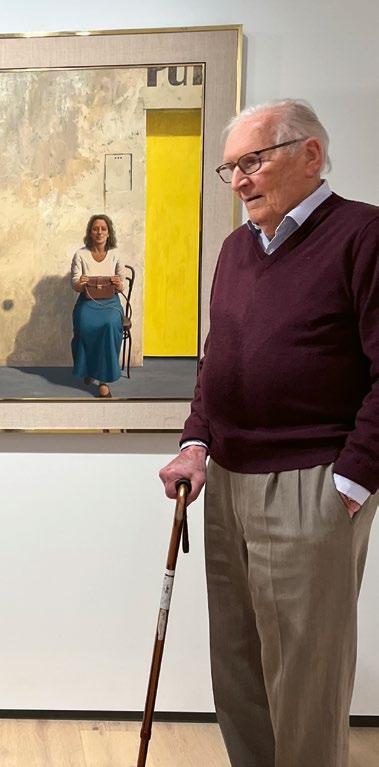
His subsequent career as a stockbroker and merchant banker with firms such as Ord Minnett, Lazard Brothers and Schroders, would find him working out of Sydney, London and Singapore, and travelling frequently. In 1960 he married Judith Lee Street and would raise three gifted daughters, Jane, Sarah and Angela. It was a long, happy marriage that ended with Judy’s death in 2015.
I met Michael when he was serving as Chair of Trustees at the Art Gallery of New South Wales, from 1982 – 88. He was a dynamic, proactive chair who would quiz the curators about potential purchases. One important part of his legacy was his work with then-director, Edmund Capon, to establish the AGNSW Foundation, which raised money for major paintings by artists such as Picasso, Guston, and Kirchner.
Although Edmund remained a close friend, Michael disagreed with his mockery of the 1987 Archibald Prize winner, William Robinson’s Equestrian Self-Portrait. To Michael’s practised eye, Robinson was obviously the most sophisticated artist in the show. He would back his judgment by becoming both a collector of the painter’s work and a friend. Another long-term association was with Jeffrey Smart, with whom
Michael Gleeson-White on his 100th birthday, October 2025 photographer: John McDonald
Left: Michael Gleeson-White, Deutscher and Hackett, Sydney, September 2022
Michael could share his love of opera, especially Wagner. They would conduct an extensive correspondence.
Many of Michael’s most important purchases were made in London, where he acquired works by figures such as Frank Auerbach, R. B. Kitaj, Ivon Hitchens and Avigdor Arikha. Of these artists, he got to know Arikha, a Paris-based polymath much admired by fellow artists, and by critics such as Robert Hughes. Being an avid reader of Samuel Beckett, Michael was delighted to find the writer was one of Arikha’s closest acquaintances.
It would take a full-scale biography to do justice to Michael’s character and accomplishments. For all his decades in Australia he never lost his English accent, or the habit of addressing you as ‘my dear old chap’. His stories, accumulated across the best part of a century, were spellbinding. When asked for the secret of his longevity, he once said: ‘Well, I’ve never been to that place they call ‘the gym’’. By preference, Michael would be at a concert, with friends and family, or at home with a book. We remember this great, much-loved man for his intelligence and charm, his boundless curiosity and lust for life.
John McDonald
oil on canvas
96.0 x 107.0 cm
signed upper right: Fred Williams. bears inscription verso: 862
Estimate: $300,000 – 400,000
Provenance
Estate of the artist
Lyn Williams, Melbourne
Rex Irwin Art Dealer, Sydney (label attached verso)
Michael Gleeson-White AO, Sydney, acquired from the above in May 1994
Estate of the above, Sydney
Exhibited
Rex Irwin Art Dealer at Art Asia, Hong Kong, 18 – 22 November 1993
We are grateful to Lyn Williams for her assistance with this catalogue entry.
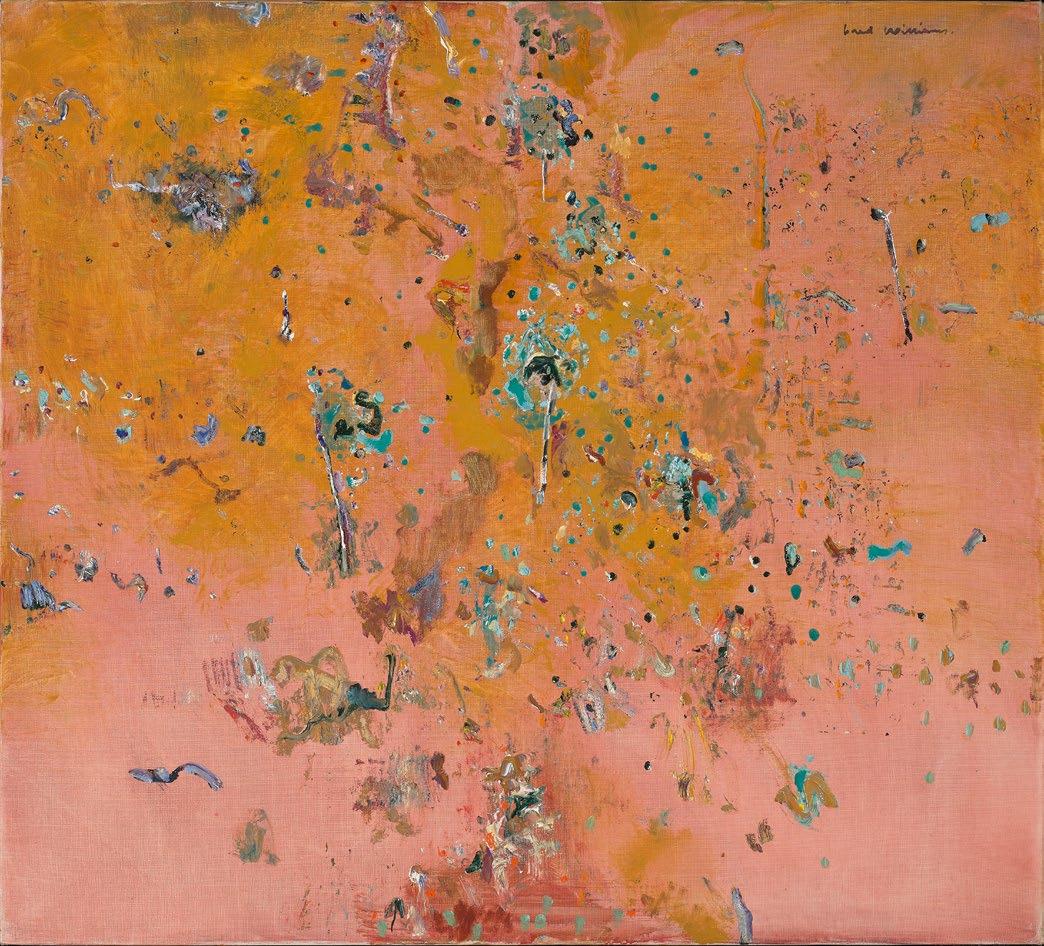
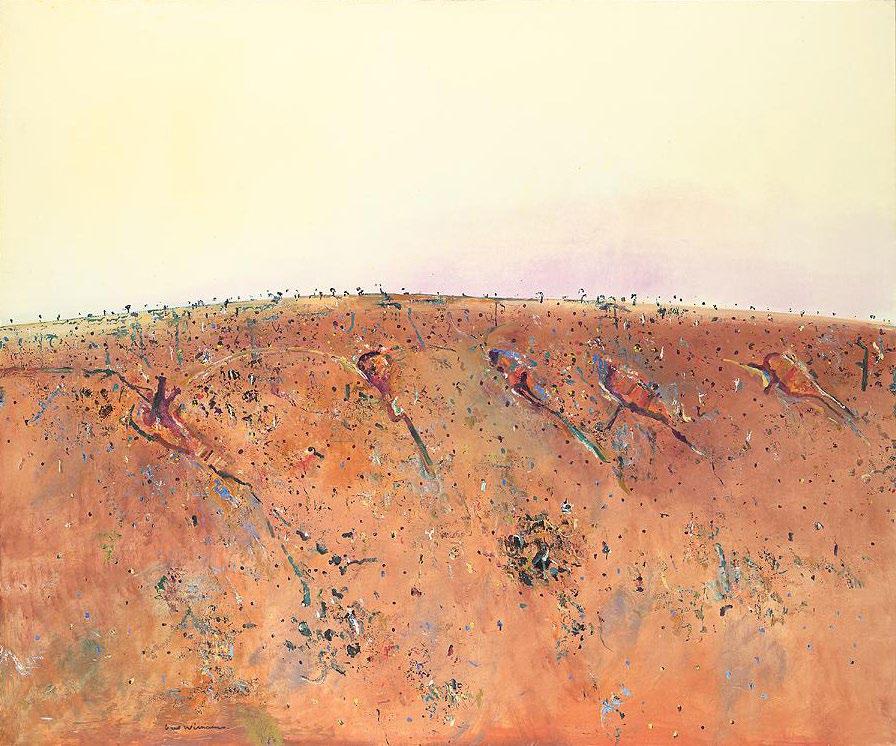
On 2 June 1979, Fred and Lyn Williams flew from Perth to Paraburdoo:
‘I am up at 4am. Don’t really sleep at all – and naturally I’m a wreck. We stagger out to the airport only to find that it’s closed by fog – sit there in a state of depression – finally leave at 7.30am. It’s raining at Carnarvon, and we don’t leave the plane. Fly inland and the rain quickly disappears. It staggers us the time it’s taken to get here – we could have flown to Paris or New York in less time…’ 1
This was the second trip to the Pilbara, a remote region in the far north-west of Australia, that Williams had made that year. The first trip had taken place in May at the invitation of Sir Roderick Carnegie, the artist’s friend who, at the time, was Chairman of Conzinc Rio Tinto of Australia Limited (CRA), now Rio Tinto. Carnegie had been impressed by the recent paintings of Weipa – a coastal mining town in far north Queensland – that he saw in Williams’ studio and recognised that the landscape of the
Pilbara, where CRA had extensive mining operations, would introduce him to a dramatic new landscape unlike anything he had ever experienced and provide fresh creative inspiration.
The Carnegie and Williams families travelled together during the school holidays, flying from Melbourne to Derby in the CRA jet, and then continuing on by light plane and road. 2 The five day trip, which took them from diamond mines at Ellendale, to Broome, Dampier, Mount Tom Price, Hamersley and the Pilbara, was a revelation for Williams who painted gouaches on the spot and took hundreds of photographs of the landscape. On May 13 he wrote in his diary that it had been ‘A day when my head is full of images – to the point where I cannot think about today or tomorrow…’ and a few days later, before they returned to Melbourne, ‘The countryside is beautiful indeed and I would really like to work from [it]… we may well do this for a week soon?’ 3
Williams continued to paint more gouaches in the studio immediately after the second Pilbara visit, but it wasn’t until early 1981, almost two years later, that he began work on the related paintings. Once he started to paint however, the images flowed quickly in a process that was ‘sheer pleasure.’4 As James Mollison explained: ‘The pictures were put down rapidly, with the artist
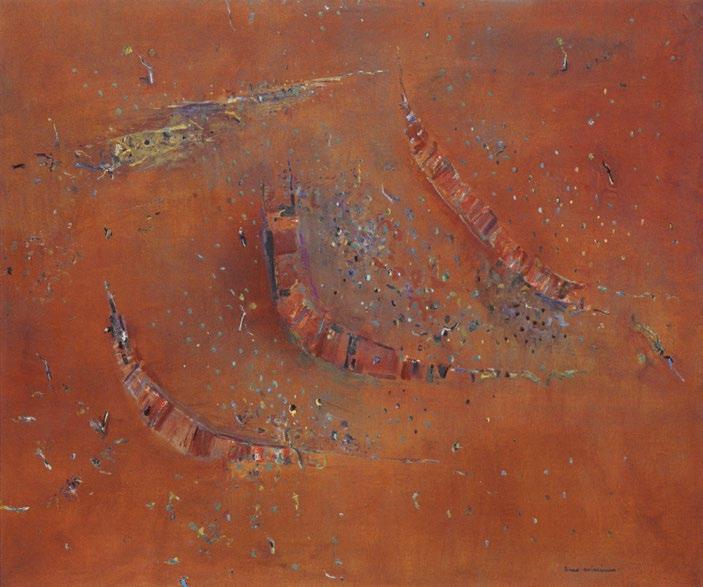
Fred Williams Pilbara landscape, 1981
152.3 x 182.6 cm
National Gallery of Victoria, Melbourne © Estate of Fred Williams/Copyright Agency 2026
frequently using not his brush but scratchy old paint-hardened rags to wipe on land, sky and other elements of the landscape. Details were then drawn in, and the paintings were set aside to dry… Some were never touched after the first day’s work.’ 5
CRA subsequently purchased thirteen oils and eighteen gouaches – now known as The Pilbara Series – which were donated to the National Gallery of Victoria in 2001. The last major series Williams made before his premature death in 1982, it is a masterful expression of an artist working at the height of his powers, combining expansive views of the landscape with focussed close-up images of wildflowers and insects. Responding to the experience of flying over the area, Williams often adopts an aerial perspective, looking down on the open landscape to reveal its overwhelming scale, but he also depicts views from the ground, where flat country is interrupted by gorges, mountains and the distinctive flat-topped mesas. From rich reds and ochres of the earth to pastel-hues of early evening skies, the series is also characterised by striking colour.
Paraburdoo landscape, 1981 is part of the broader series of paintings that Williams made following his experience of the Pilbara. An earthy red ground covers the canvas from edge
to edge, but it is a delicate layer of paint – with brushstrokes visible in the lower right and the weave of the canvas discernible on the left – that suggests both the look and the feel of the dusty red earth of the region. Laid over this is a dazzling array of painterly marks – dots, daubs and lines of colour alongside areas of scumbled texture – that build up an impression of the landscape. Through this very singular abstracted visual language, Williams describes aspects of the area’s geography and the diversity of vegetation, communicating both the physical and emotional experience of being in the landscape. In this painting, both the energy with which it was painted and the pleasure the artist derived from the process are palpable. Indeed, as Williams mused, ‘anyone who could not paint in this particular country is probably in the wrong profession.’ 6
1. Fred Williams Diary, 2 June 1979, cited in Phipps, J., Fred Williams – The Pilbara Series, National Gallery of Victoria, Melbourne, 2011, p. 41
2. Mollison, J., A Singular Vision: The Art of Fred Williams, Australian National Gallery, Canberra, 1989, p. 230
3. Fred Williams Diary, 13 May 1979, cited in Phipps, op. cit., p. 37
4. Lyn Williams, cited in Mollison, op. cit., p. 232
5. Mollison, ibid, pp. 232 – 233
6. Fred Williams Diary, 7 June 1979, cited in Phipps, op. cit., p. 42
Kirsty Grant
oil on composition board
121.0 x 83.5 cm
signed lower left: Fred Williams. bears inscription verso: 9
Estimate: $180,000 – 240,000
Provenance
Rudy Komon Art Gallery, Sydney
Michael Gleeson-White AO, Sydney, acquired from the above in 1962
Estate of the above, Sydney
Exhibited
Fred Williams, Rudy Komon Art Gallery, Sydney, opened 29 August 1962, cat. 9
Art from the Collections of the Trustees of the Art Gallery of New South Wales, Blaxland Gallery, Sydney, 14 – 29 October 1981, cat. 32 (label attached verso)
Related works
Mittagong landscape, 1958, oil and tempera on composition board, 150.6 x 119.6 cm, National Gallery of Victoria, Melbourne Saplings, Mittagong, 1961 – 62, gouache and watercolour on paper, 52.8 x 37.1 cm (sheet), National Gallery of Australia, Canberra
We are grateful to Lyn Williams for her assistance with this catalogue entry.
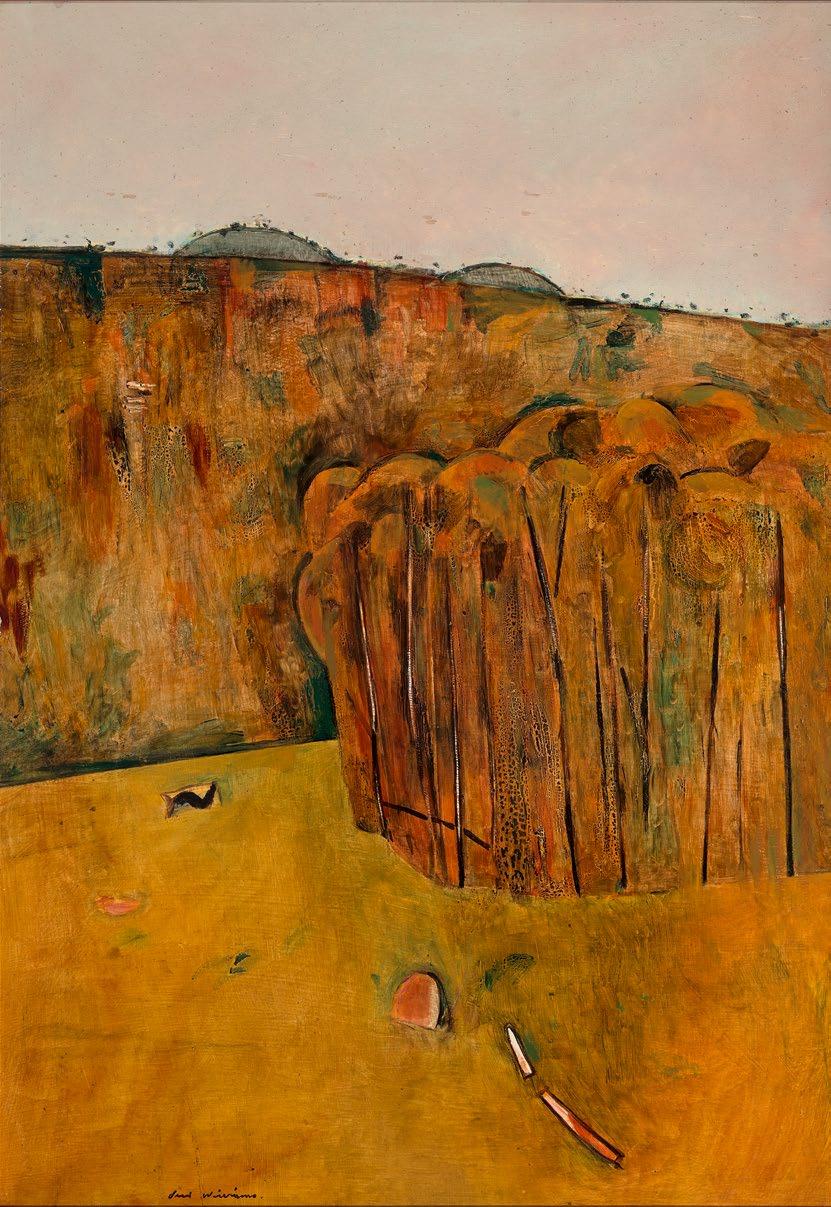
Saplings, 1961, belongs to a select group of early paintings by Fred Williams where he first successfully integrated the ideas of his great hero Paul Cézanne into a tangible reinterpretation of the Australian forest landscape. This group includes other significant paintings such as Landscape with steep road, 1958 (National Gallery of Australia) and The charcoal burner, 1959 (National Gallery of Victoria), in which Williams fragmented then reconstructed a view of the ‘not-very-distinguished-looking scrubby country [which was] known to everybody, but nobody had found the language with which to describe it.’ 1 Australia to that date had a long tradition of ‘painters of the bush’ from the Heidelberg School and its acolytes, through to the modernist breakthroughs of Clarice Beckett, Sidney Nolan and Arthur Boyd. Nonetheless, Williams was determined to bring his own concentrated study to the subject following a revelation in Fremantle as he was returning by ship to Melbourne in December 1956 after four years of study in London and was struck anew by the possibilities of the Australian light and expansiveness.
In Melbourne, he reconnected with former National Gallery School colleagues including John Brack who suggested that Williams visit his friends John and Joan Stephens who lived in Colo Vale, near Mittagong in New South Wales. Located on the traditional lands of the Gundungurra and Dharawal people, this is a region of eucalypt woodlands and open forests set amongst gullies and sandstone gorges cut through by the Nattai River. Williams arrived in August 1957, staying for a month and soon discovered that it was a ‘very romantic bit of country’, noting afterwards that ‘it was in Mittagong that I… formulated my ideas.’ 2 Such was his attraction that Williams returned again the following year, returning each time with a collection of images that marked a turning point in his career, ‘remarkable for their formal mastery and the originality of their vision.’3 He painted Saplings first as a gouache on site in 1958 and worked it into a larger painting three years later in his studio above his step-father’s hardware store in Exhibition Street, Melbourne. This became a common practice for Williams,
bringing stand-alone studies back to the studio and putting them aside ‘for as long as possible… so that I am not emotionally involved.’4 He explained this desire to resist his original impulse as ‘a form of being more objective.’ 5 As with Cézanne and the Cubist painter Georges Braque, Williams recognised that a painting is not simply a replica of a landscape where an artist tries not ‘to reconstitute an anecdotal fact but [instead] constitute a pictorial fact.’6 The gouache version from 1958 is of a softer palette with a pronounced pink blush, whereas in Saplings, 1961, the tone is one of terracotta as if enduring an extended rainless spell. The brushwork too is more vigorous, particularly in the slope of the background gully wall, and he has added two imagined hilltops to the raised horizon line to increase the sense of distance. Additionally, Williams removes clouds and any cast shadows, causing the viewer to focus instead on the formal solidity of the trees and the undulation of their canopies set against the sharply angular lines of the surrounding terrain, a painterly strategy that was to preoccupy him throughout his subsequent career.
1. James Mollison, interviewed by Bala Starr, cited in Fred Williams: Pilbara series, Ian Potter Museum of Art, Melbourne, 2000, p. 5
2. Fred Williams, cited in Mollison, J., A singular vision: the art of Fred Williams, Australian National Gallery, Canberra, 1989, p. 36
3. McCaughey, P., Fred Williams 1927 – 1982, Murdoch Books, Sydney, 1984 (revised ed. 2008), p. 138
4. Fred Williams, recorded by Film Australia. c.1976, cited in Mollison, op. cit., p. 166
5. ibid.
6. Georges Braque, cited in McCaughey, op. cit., p. 114
Andrew Gaynor
Fred Williams, Upwey, Victoria, 1963 photographer: David Moore
National Portrait Gallery, Canberra © Lisa, Michael, Matthew and Joshua Moore
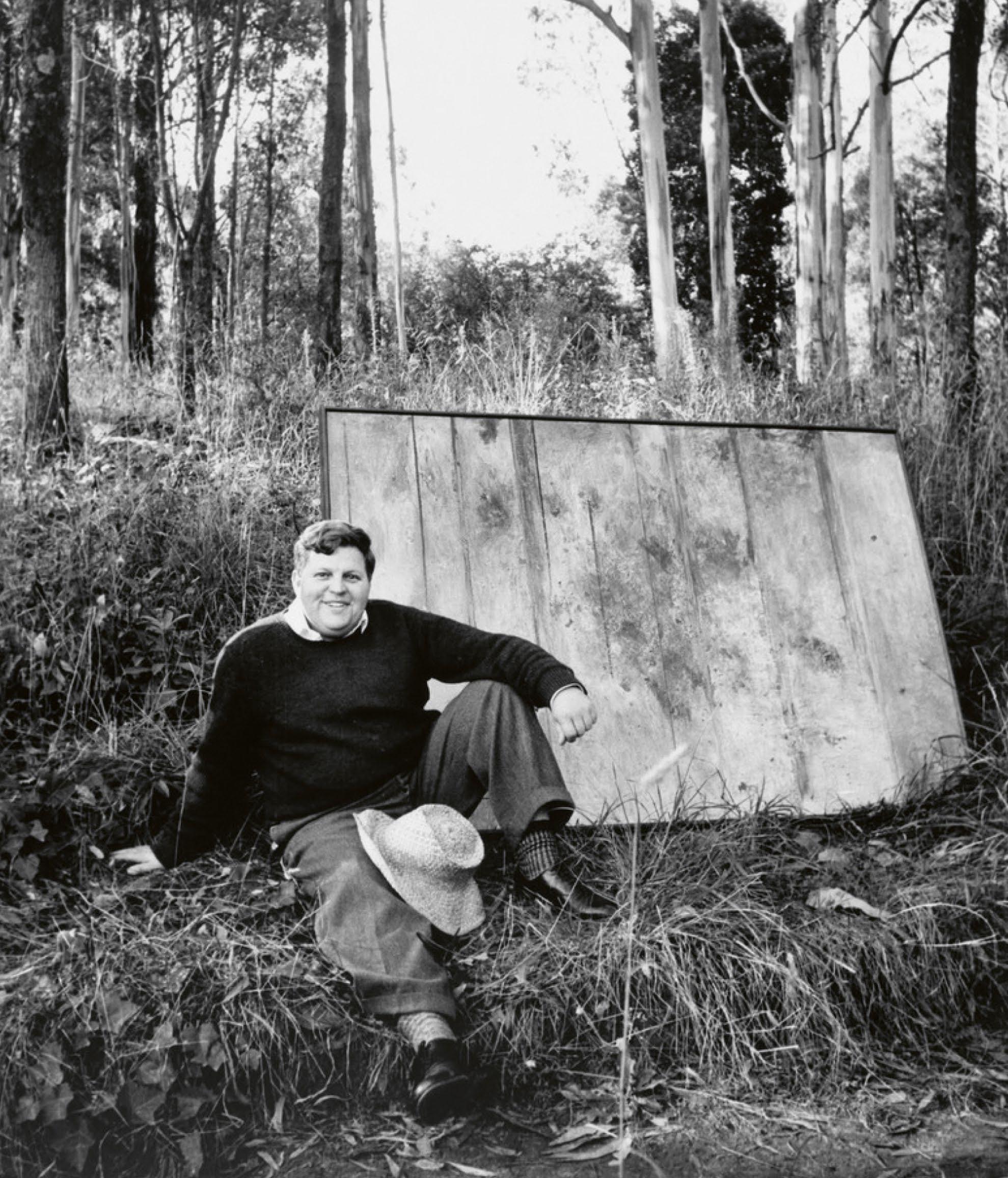
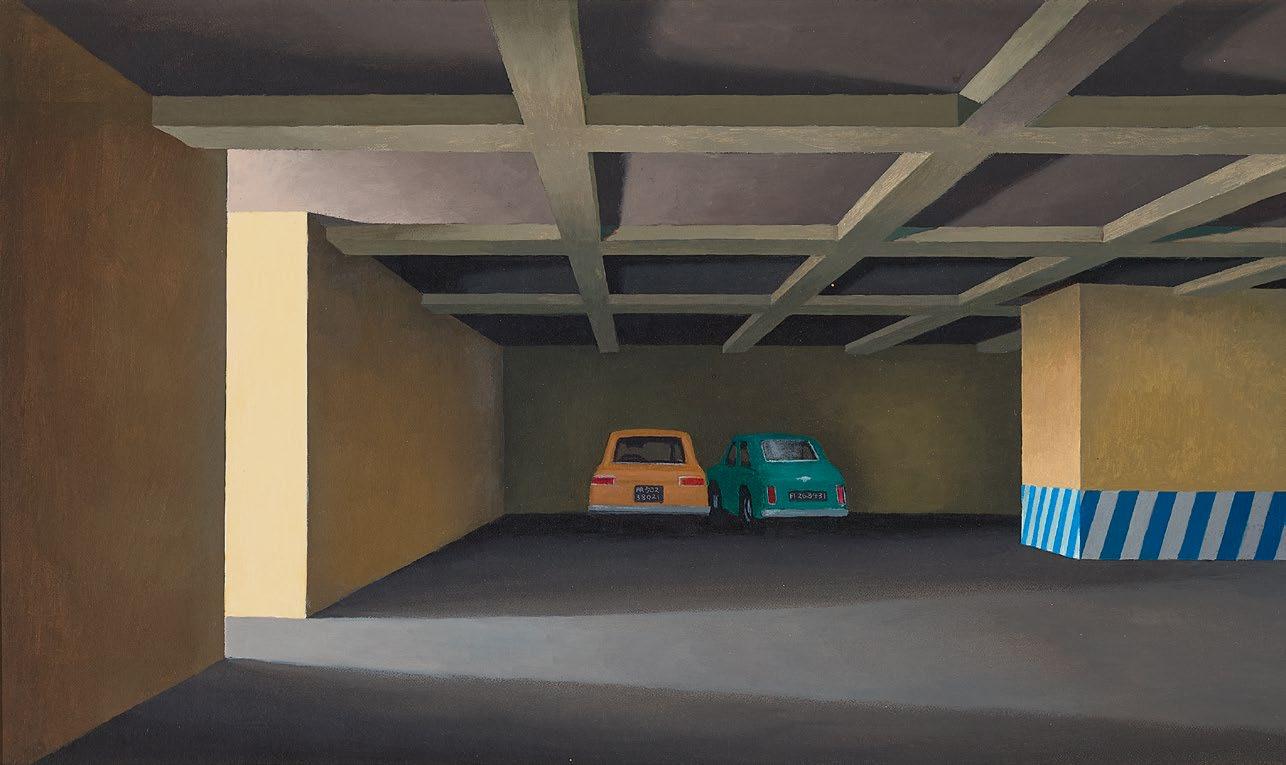
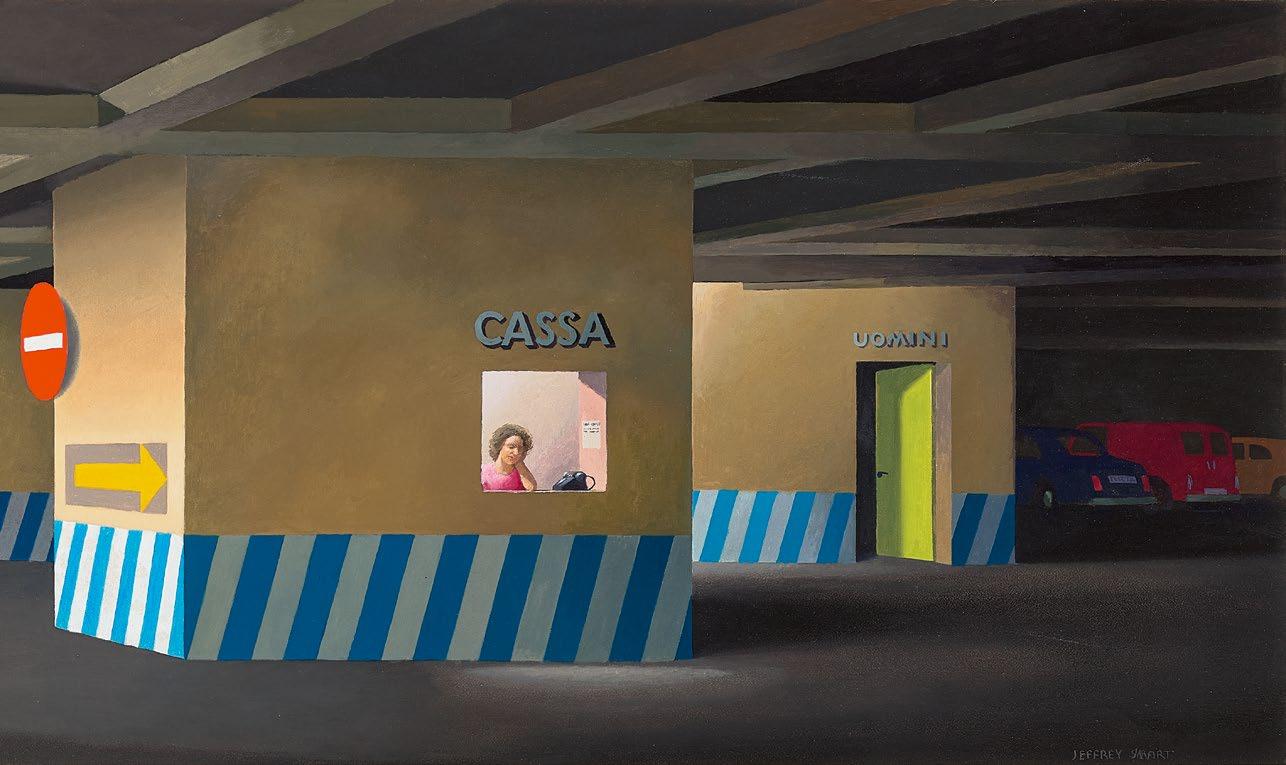
(1921 – 2013)
Municipal car park, 1983
synthetic polymer paint and oil on fibreglass canvas on composition board
36.0 x 120.0 cm
signed lower right: Jeffrey Smart bears inscription verso: 8
Estimate: $300,000 – 400,000
Provenance
Rex Irwin Art Dealer, Sydney
Michael Gleeson-White AO, Sydney, acquired from the above in 1984 Company collection, Sydney, acquired from the above in 2000
Exhibited
Jeffrey Smart: Recent Paintings, Rex Irwin Art Dealer, Sydney, 6 – 24 November 1984, cat. 8
Literature
McDonald, J., Jeffrey Smart: Paintings of the ’70’s and ‘80s, Craftsman House, Sydney, 1990, no. 266, p. 160
We are grateful to Stephen Rogers, Archivist for the Estate of Jeffrey Smart, for his assistance with this catalogue entry.
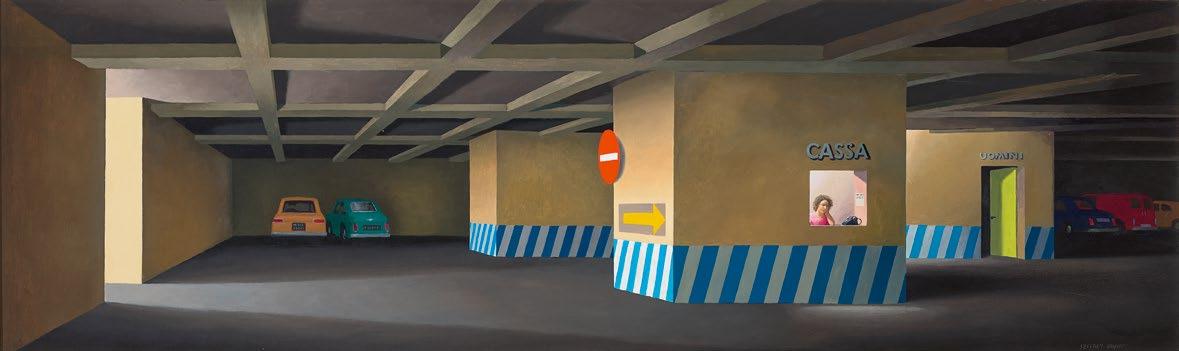
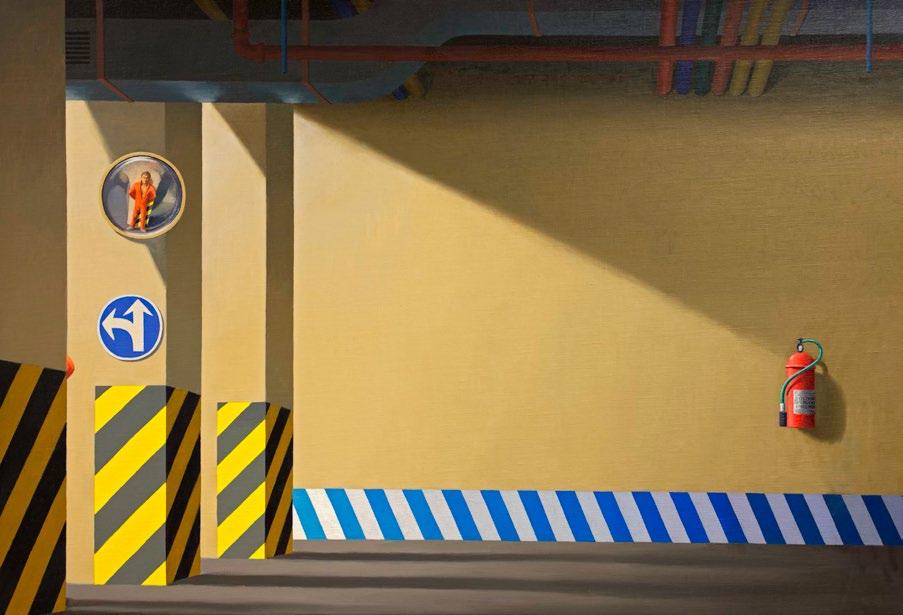
Jeffrey Smart Garage Attendant, 1981 oil on canvas
75.0 x 110.0 cm
Private collection
© The Estate of Jeffrey Smart
Car parks are the ubiquitous non-places of our age. We might use one almost every day but never feel inclined to linger. They are strictly utilitarian spaces that few owners ever attempt to beautify – mostly bare concrete with the odd directional sign stencilled on walls and floors. The largest car park never seems to require more than one attendant, while some have none at all. They are grimy environments, reeking of spilled oil and exhaust fumes.
One marvels at the pleasure Jeffrey Smart took from painting these inhospitable spaces, which make regular appearances in his work. I was driving with him near Naples one day when he pulled over to take a photo and make a quick sketch of a car park that had caught his eye. This was the way Smart found many of his motifs, although they might be completely transformed in the way he chose to paint them.
Smart loved the challenge of taking a scene most of us would barely notice and imbuing it with a near-theatrical character. Municipal car park, 1983 with its deadpan, descriptive title, is a textbook example – a bare interior in which everything seems to be made of concrete, from the gridded ceiling to the yellowtinted cashier’s booth in which a lonely worker is dozing, her head
propped up on one hand. A splash of bright colour is provided by a yellow arrow, a red sign signifying ‘no entrance’, and bands of blue stripes intended to catch drivers’ attention. Neither can one ignore the lime green door to the men’s toilets, left ajar.
The bulk of the picture is as grey and dark as a cave, which is pretty much what it is – an urban cave for sleeping automobiles. But we should remember that a cave is a magical place. Whether we think of the cave in which Odysseus and his men encounter the Cyclops, the underground caverns in Jules Verne’s Journey to the Centre of the Earth, or the grotto in which Tom Sawyer finds hidden loot, to venture into a cave is to step into a realm of mystery.
Can we say as much about Smart’s car park? The artist almost dares us to find anything attractive in this barren setting. Even by the standards of Smart’s other car parks, this one is forbiddingly minimal. A painting such as Morning Jogger in Parking Garage, Adelaide, 1987, seems baroque in comparison. Aside from glimpses of sky and city, it features a figure who looks directly at the viewer, drawing us imaginatively into the picture. It’s the antithesis of the sleeping cashier in Municipal car park
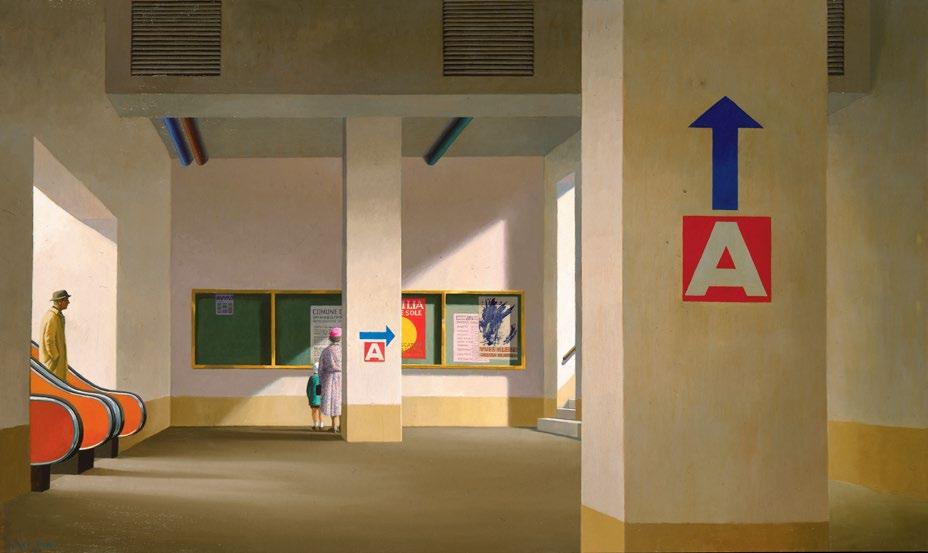
Jeffrey Smart
The Rome Metro, 1982 synthetic polymer paint and oil on canvas
75.0 x 125.0 cm
Private collection
© The Estate of Jeffrey Smart
Smart made complex paintings of car parks in Florence and Pisa, and numerous other examples in which the settings have not been identified. One of the gloomiest is The Underground Car Park, 1993, which has no human presence whatsoever, the only pictorial drama deriving from a red van viewed against the far wall. One smiles, however, at the tubs of greenery placed at the base of the concrete pillars, as if this dismal bunker might be enlivened by the addition of a few nondescript plants.
As always with Smart, the geometric complexity of the composition makes Municipal car park more than a humdrum slice of life. Intensely aware that a successful painting requires a visual lure, not simply a clever idea, Smart has used a series of vertical planes to create a pictorial rhythm. From left to right, a dark, shadowy rectangle of wall gives way to a bright rectangle that reflects an exterior light. Traversing another area of shadow, we pick up the light as it strikes the two pillars facing the entrance. We finish with another squarish wall, illuminated by a fainter light, before concluding with an equivalent area of darkness.
The sequence is very much like a piece of music in which sombre chords and tones are interrupted by sudden highlights
that gradually return to the original key. Given Smart’s lifelong love of music, this is not a far-fetched analogy. He understood that in art, as in music, it’s possible to generate an emotional response by the skilful manipulation of formal elements.
This is what we find in Municipal car park. An empty stage upon which nothing is happening creates a trap for the eye and mind, making us feel this space has its own cache of secrets. We might look for a key in the barely visible vehicles at the extreme right, the partially open door of the toilets, or the cashier’s phone, which may ring at any moment. Smart knew that the longer we look at anything, the more interesting it becomes, as we are prompted to contribute our own stories. The role of the artist is to create a structure that encourages us to slow down and investigate those endless possibilities that lie dormant in every detail.
John McDonald
Writer and editor of the site, ‘Everything the artworld doesn’t want you to know’, at Everythingthe.com
synthetic polymer paint on heavy Fabriano paper 45.5 x 46.0 cm
signed lower right: JEFFREY SMART
Estimate: $100,000 – 140,000
Provenance
Rudy Komon Art Gallery, Sydney Michael Gleeson-White AO, Sydney, acquired from the above in 1980 Estate of the above, Sydney
Exhibited
Jeffrey Smart, Rudy Komon Art Gallery, Sydney, 8 November – 3 December 1980, cat. 12
Literature
Quartermaine, P., Jeffrey Smart, Gryphon Books, South Yarra, 1983, cat. 755, p. 116
McDonald, J. Jeffrey Smart: Paintings of the ’70’s and ‘80s, Craftsman House, Roseville, 1990, no. 207, p. 159
We are grateful to Stephen Rogers, Archivist for the Estate of Jeffrey Smart, for his assistance with this catalogue entry.
As is so often the case with Smart’s paintings, the glorious legacy of the past is pushed aside by the banality of the present. It’s an open question as to whether he prefers it this way, finding an unlikely beauty in shabby walls, concrete bollards, traffic signs, highways and other commonplace features of modern life. The wall in Adrian’s view is beautifully rendered, its stains and patches taking on the nuances of an abstract painting. One thinks of Leonardo da Vinci’s famous advice to painters to pay close attention to the stains on walls, which may stimulate the mind to new discoveries and inventions.
As a devotee of the cinema, Jeffrey Smart would have been familiar with Alfred Hitchcock’s Rear Window (1954), in which James Stewart spends much of the film spying on people in the building next door. This is roughly the theme of Adrian’s view, 1980, which refers to a friend in Rome who found that his apartment window gave him a ringside seat for his neighbours’ sexual activities.
Smart’s version avoids an ‘R’ rating, showing only an anonymous figure displaying his bare back by the window, but the sense of voyeurism remains intact. When someone is not aware that we are looking at them, there must always be a degree of objectification. The figure in the window is a back, a body, not a subject with whom we are exchanging eye contact.
Whether Adrian’s neighbours were exhibitionists or simply careless, this is not Smart’s concern. He uses the view from a window for more general thoughts about visibility and communication. The prominently displayed antenna suggests that the figure in the window might well be watching TV, perfectly oblivious to whatever is going on outside. The dome in the background, which resembles a slightly simplified version of St. Peter’s Basilica, is largely concealed behind a flat, discoloured wall.
Smart gives the mind some assistance by imposing a geometric precision on his composition. To reduce the painting to the form of a diagram would reveal the classical measure of the Golden Ratio in the disposition of planes and shadows. No matter how prosaic the subject matter, Smart’s pictures are constructed with the finesse of a master craftsman.
If there is also a slight feeling of déjà vu about the work, it’s because we’ve seen that truncated basilica before, in The dome, 1977 (Tarrawarra Museum Collection, Victoria), in which the building is mostly concealed by a field of grass. The patchy wall is another favourite motif, recurring in numerous paintings. Even the combination of wall, open window and telecommunications device is reprised in works such as Rooftops, 1968 – 69 and Spring Landscape, 1970 (National Gallery of Australia), or later, in Via Petrarca, Arezzo, 1984 – 85.
Ultimately, Adrian’s view is a meditation on seeing and being seen. But a view is not just something that meets the eye; it’s also an opinion. Adrian may have his own ideas about why his neighbours seem to care so little about their privacy. Smart suggests, not without irony, that the wall we see from Adrian’s window, or the tip of the dome, may be no less interesting than whatever is going on inside the apartment. Playing the contrarian, he trades the sordid thrills of the voyeur for the high-minded pleasures of the aesthete.
J
ohn M cDonald
Writer and editor of the site, ‘Everything the artworld doesn’t want you to know’, at Everythingthe.com
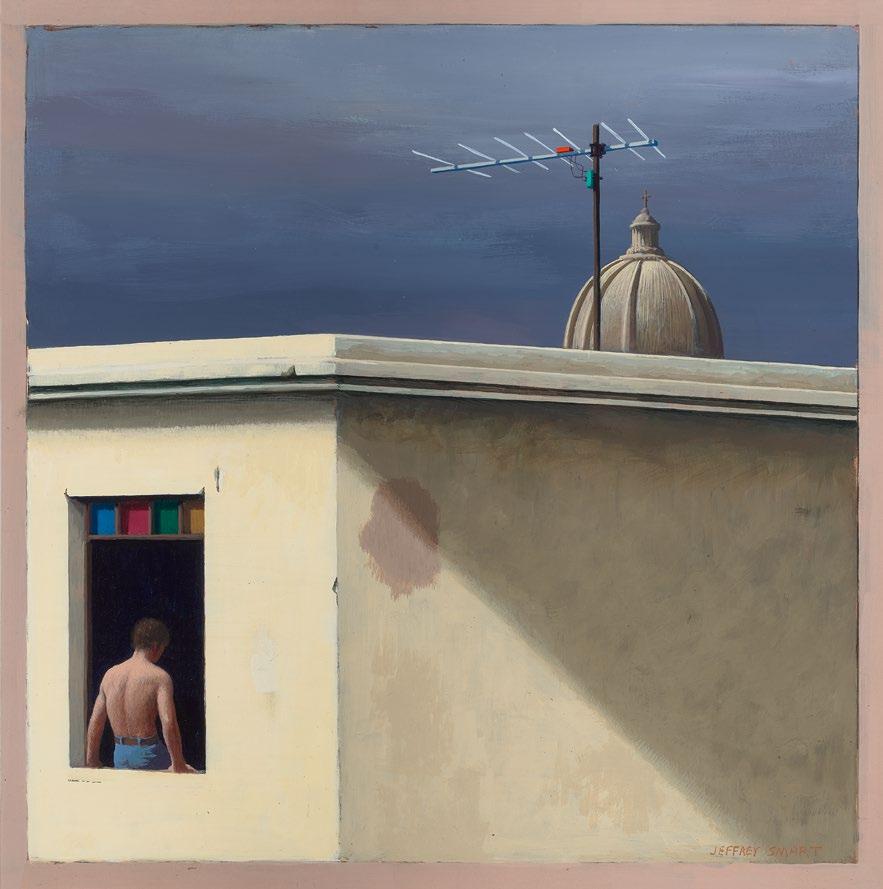
Williams (1927 – 1982)
oil on canvas
96.0 x 106.0 cm
signed lower left: Fred Williams
Estimate: $250,000 – 350,000
Provenance
Estate of the artist
Lyn Williams, Melbourne (label attached verso) Rex Irwin Art Dealer, Sydney (label attached verso, as ‘Barwon in Flood’)
Michael Gleeson-White AO, Sydney, acquired from the above in 1996 Estate of the above, Sydney
Exhibited
Fred Williams, Waterfall Paintings, Rex Irwin Art Dealer, Sydney, 3 September – 5 October 1996, cat. 3 (illus. in exhibition catalogue)
Related work
Barwon in Flood, 1979, oil on canvas, 96.0 x 106.5 cm, illus. in McCaughey, P., Fred Williams 1927 – 1982, revised edition, Murdoch Books, Sydney, 1996, p. 22
We are grateful to Lyn Williams for her assistance with this catalogue entry.
Fred Williams
Lal-Lal Falls, 1976 oil on canvas
103.0 x 103.0 cm
Art Gallery of New South Wales, Sydney © Estate of Fred Williams/Copyright Agency 2026
The late 1970s was an intensely productive period for Fred Williams. He travelled internationally and held a series of solo exhibitions and in 1975 was the first Australian artist to be honoured with an invitation to present a solo exhibition at the Museum of Modern Art in New York. The exhibition of gouaches opened in March 1977, acknowledging the significance of his art and its unique vision of the landscape within a national context, both to audiences who were familiar with the country his images described, and beyond. Introducing the exhibition, the Director of MoMA’s Department of Drawings, William S. Lieberman, wrote: ‘Fred Williams knows Australia. He is not an artist who would disdain a gum tree. He is not a foreigner seeking to impose a natural paradise on some strange, exotic land. He is, however, a romantic artist and his approach to landscape is narrative. His images may at first seem abstract, but they in fact describe actual times and places… Fred Williams’s colours are those of the continent itself… Fred Williams’s vision is authentic.’ 1
Following the celebrated series of Werribee Gorge paintings, he began another series focussing on waterfalls. As he later recalled, ‘My enthusiasm was fired by the [Eugene] von Guérard Waterfall at Strath Creek in the Sydney Gallery. It was a picture I’ve always
admired, and I made a free copy of it about fifteen years ago and had forgotten about it and put it aside… One day I woke up and thought, well actually I wouldn’t mind going around and looking at more of them.’ 2 With this and other nineteenth-century paintings as inspiration, as well as the 1940s publication, Physiography of Victoria as a guide, Williams visited eleven waterfalls across southern Victoria during February and March 1979.
Williams didn’t drive, so painting trips were often made in the company of artist friends. After visiting Strath Creek Falls at the start of February with fellow artist Andrew Sibley, he wrote in his diary: ‘After several abortive efforts we get there (It’s not easy to find – [Despite the frontal viewpoint of] the von Guérard painting it is only accessible from the top – absolutely splendid… It is all very superb to paint… The landscape was quite brilliant around the falls & I will certainly go back there.’ 3 Still absorbed by the possibilities of the subject, the next day, he wrote: ‘I keep thinking of the ‘Strath Falls’ & will attempt a series of (large) pictures of it.’4
It would appear, however, that the idea of waterfalls as a subject had been in his mind for several years. In 1977, he made a small group of paintings of the Lal Lal Falls and the following year, he
Fred Williams
Abbotsford from Dight’s Falls, 1974 oil on canvas
106.7 x 91.5 cm
Private collection © Estate of Fred Williams/Copyright Agency 2026
visited Geelong with Fraser Fair planning to paint a waterfall on the Barwon River. When the pair arrived however, they discovered that the river was in flood, and this painting is one of the works that Williams made in response to the unexpected scene with which he was presented. His process during these years was to make oil sketches on the spot – the canvases were small, approximately one metre square, so that they could be easily transported – recording the essential elements of the landscape, its structure and geography, as well as the colours and qualities of the light. Some of these paintings were reworked later and used as the basis for large-scale studio works. James Mollison writes that in these paintings on finely textured American canvas Williams used pre-Second World War Winsor and Newton paints (bought from Alan Moore, who had been an official war artist). 5
The dynamism and visual complexity of the scene described in Barwon in flood II, 1978, are echoed in the energy of the paint work which conjures up something of the creative energy involved in its making, as well as the artist’s command of painterly gesture. Using a diversity of brushstrokes – from the characteristic dots and daubs that describe the distant vegetation, to the lively dancing lines that represent the movement of the fast-flowing
water – Williams captures both the appearance of the landscape and the feeling of being there. The palette is similarly rich, the luminous colours of the flat terrain beyond the river and the cool pale glow of the sky providing a dramatic contrast to the muddy browns and white highlights of the flooded river. The scene also includes three towering chimneys in the upper right, pointing to the nearby presence of industry and reminding us that this is very much a twentieth-century landscape.
1. Lieberman, W. S., Fred Williams – Landscapes of a Continent, Museum of Modern Art, New York, 1977, unpaginated
2. Fred Williams, cited in Mollison, J., A Singular Vision: The Art of Fred Williams, Australian National Gallery, Canberra, 1989, p. 220
3. Fred Williams Diary, 1 February 1979, cited in Mollison, ibid., p. 223
4. Fred Williams Diary, 2 February 1979, cited in Mollison, ibid.
5. See Mollison, ibid., pp. 220 & 224
Kirsty Grant
gouache on paper
57.0 x 75.0 cm
signed lower left: Fred Williams.
Estimate: $30,000 – 40,000
Provenance
Michael Gleeson-White, AO, Sydney, acquired directly from the artist in 1981 Estate of the above, Sydney
Related work
Flinders Island, 1974, gouache and synthetic polymer paint on paper, 56.8 x 76.8 cm, Museum of Modern Art, New York
We are grateful to Lyn Williams for her assistance with this catalogue entry.
Flinders Island lies to the south of Victoria in eastern Bass Straight and is the largest of fifty islands known collectively as the Furneaux Group. It was the site of much sorrow for Indigenous Australians in the nineteenth century, but by the time Fred Williams visited in 1974, the resident population was sparse, subsisting on rural industries including fishing, muttonbirding, dairying and sheep farming. It was nonetheless a striking environment of great physical beauty and Williams completed there a small suite of robust yet atmospheric gouaches. He travelled to the island at the beginning of the year with his family and his painting colleague Fraser Fair, noting in his diary for 5 January, that he had decided to ‘try for finished pictures on the spot – rather than simply fact gathering.’ 1 Flinders Island, 1981, is an excellent example of this strategy, likely painted on Vinegar Hill looking west towards the peak of Mt Strzelecki, the tallest mountain on the island.
For more than a decade, Williams had been determinedly reinterpreting the Australian landscape, finding patches of otherwise nondescript bush and turning them into masterworks of painterly process. Indeed, it is now possible to visit areas outside Melbourne, particularly the You Yangs and the Dandenongs, and ‘see’ it anew through the artist’s eyes – a response achieved by only a handful of Australian artists. On Flinders Island, Williams was presented with a new range of possibilities from the granite ridges of Mt Strzelecki to the south and Mt Killiecrankie in the north, connected in between by extensive lowlands containing lagoons and marshes fringed by beaches with extensive views over Bass Strait. It was also a landscape of extremes often beset by howling winds which no doubt
played havoc as Williams painted en plein air onto large sheets of watercolour paper. After two weeks, he wrote in his diary that ‘(t) he main character [of the island]… is the apparent hourly changes in the weather – and the main part of my next week’s work will try and include this more.’ 2 Flinders Island is painted using gouache, a most unforgiving medium that does not allow for subsequent corrections once it is dry, particularly when creating large sections of solid colour. It is a testament to Williams’ skill that areas such as the sky and the tonal gradations of the ground are applied so fluidly, with the more thickly textured clouds added later with an equally sure hand. The sparse scrub of the marshes is punctuated by the artist’s trademark dot-dash patches of colour, and he no doubt chose the particular location – a slight depression between hills – due to the inverted curved horizon line it provided. A description of his technique, observed two months later about nearby Erith Island, credits Williams with ‘working from the inside out – [starting] with the minutiae of a painting and [building] up these into a coherent whole.’3
Williams would subsequently develop some of the Flinders and Erith Island ideas into large scale paintings, but it is in these dramatic gouaches that the immediacy of his sensations is retained. A companion work of the same title and dimensions is held in the collection of the Museum of Modern Art in New York.
1. Fred Williams, 5 January 1974, cited in Mollison, J., A singular vision: the art of Fred Williams, Australian National Gallery, Canberra, 1989, p. 166
2. Fred Williams, 18 January 1974, cited in ibid., p. 166
3. Turner, I., ‘Artists’ Camp Erith Island: March 1974’, Overland, no. 60, 1974, p. 42, cited in Hart, D., Fred Williams: Infinite Horizons, National Gallery of Australia, Canberra, 2011, p. 121
Andrew Gaynor
oil on canvas
137.0 x 188.0 cm
signed lower left: William Robinson
inscribed verso: MT TAMBORINE ON FIRE WILLIAM ROBINSON
Estimate: $180,000 – 250,000
Provenance
Ray Hughes Gallery, Sydney
Michael Gleeson-White AO, Sydney, acquired from the above in 1987 Estate of the above, Sydney
Exhibited
The Wynne Prize, Art Gallery of New South Wales, Sydney, 19 December 1987 – 7 February 1988, cat. 49
William Robinson: The Revelation of Landscape, S.H. Ervin Gallery, Sydney, 11 January – 2 March 2003 and touring to Mornington Peninsula Regional Gallery, Victoria, 1 April – 18 May 2003 (as ‘Landscape with fire on Mt Tamborine’)
Literature
William Robinson: The Revelation of Landscape, S.H. Ervin Gallery, Sydney, 2003, pp. 11 (illus. as ‘Landscape with fire on Mt Tamborine’), 40
Related work
Wispy landscape, 1990, oil on canvas, 140.0 x 202.0 cm, Art Gallery of New South Wales, Sydney
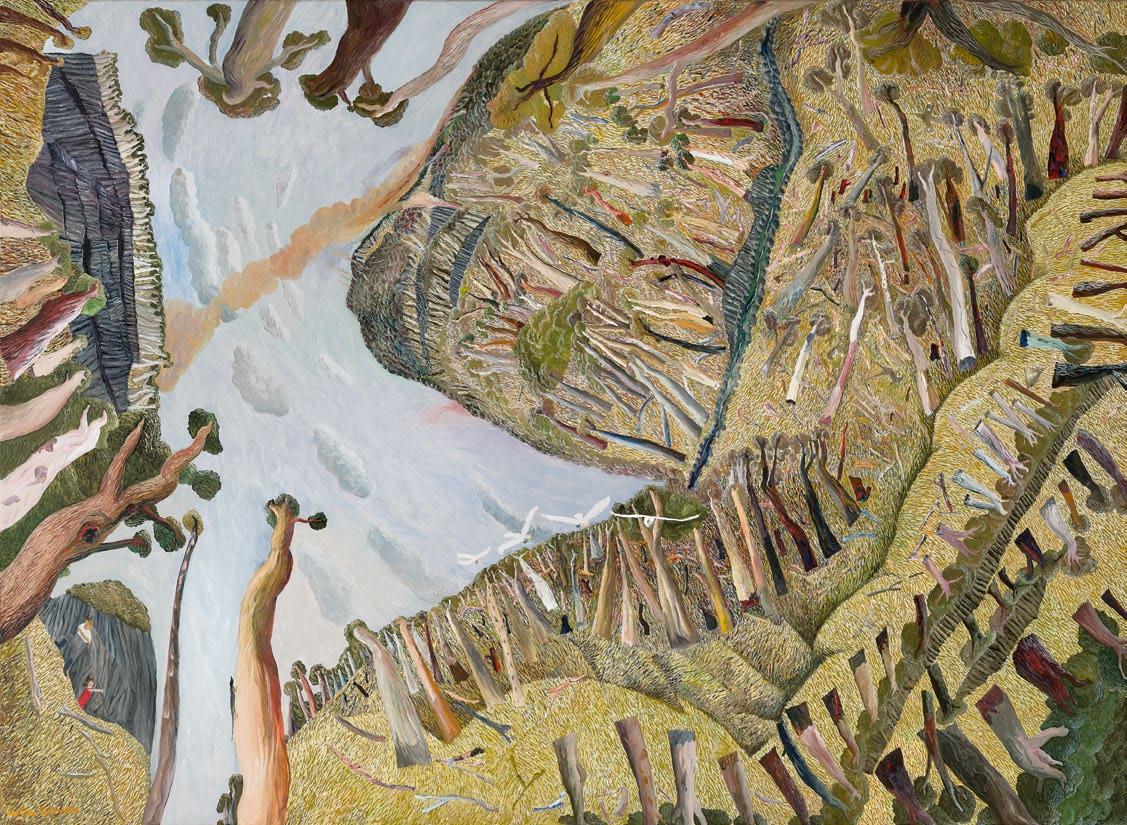
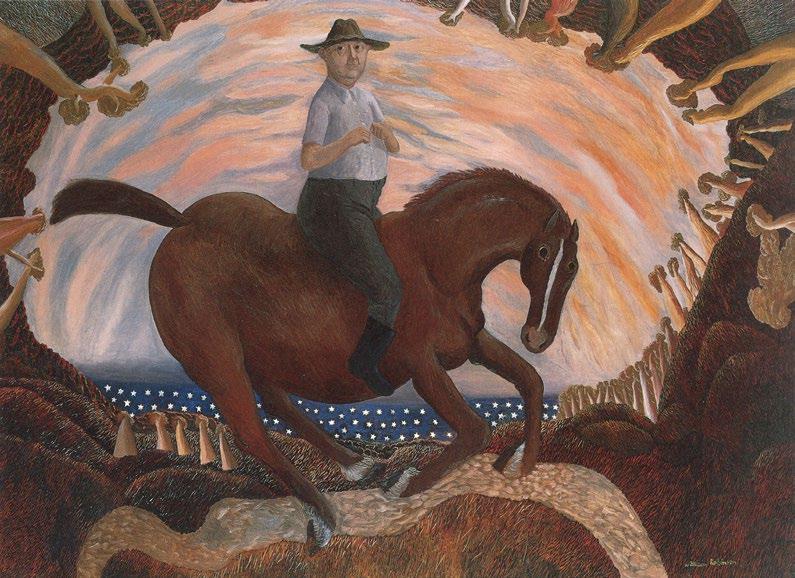
While many Australian landscape painters looked towards Australia’s arid interior for inspiration, Bill Robinson embraced the south-eastern Queensland mountain ranges with their rainforests and soaring features. Combined with his radical treatment of the horizon and distorted perspective, Robinson offered an entirely new approach to Australian landscape painting. Just as Fred Williams altered the way we see our landscape, so too did Robinson. Once one is familiar with his paintings, it is impossible to look skywards through trees and not think of his works.
In 1987, when Robinson painted Mount Tamborine on fire, Michael Gleeson-White was the Chairman of the Trustees at the Art Gallery of New South Wales and as such was involved in the selection and judging of the Archibald and Wynne Prizes. Around this time, a small group of collectors, recently left adrift by the death of art dealer Rudy Komon, seamlessly adopted the art dealer Ray Hughes who represented Robinson. These collectors included Peter Elliott, Ray Kidd and Colin Laverty.
Like Gleeson-White, Elliott and Kidd had amassed extensive holdings of works by Fred Williams, and they knew their paintings well. In time, each became major Robinson collectors.
Elliott, Kidd and Laverty jostled for first choice whenever Robinson works arrived at Hughes’ Sydney gallery. However, Mount Tamborine on fire, the current example, went directly from the artist to the Art Gallery of New South Wales as Robinson’s 1987 Wynne Prize entry – thus bypassing the usual route through Ray’s Surry Hills gallery and so evading the eyes of Elliott, Kidd and Laverty, each of whom expected first choice on any new work.
During judging for the Wynne Prize, Gleeson-White immediately called Ray Hughes and reserved Mount Tamborine on fire for the Gallery’s permanent collection. The Director, Edmund Capon, in his mischievous manner dismissed Robinson as a sort of hokey naïve from the backwaters of Queensland and so the Gallery did not buy the work. But the Trustees, led by
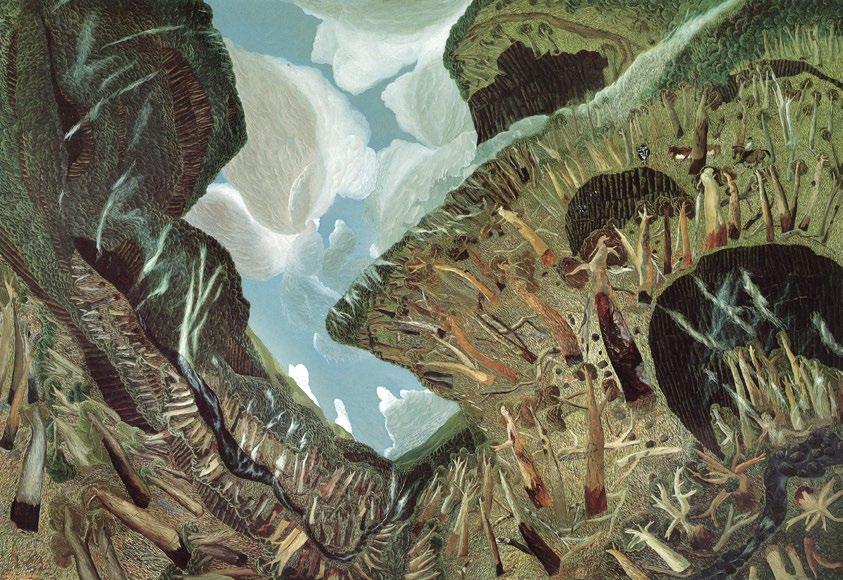
Gleeson-White, awarded Robinson the 1987 Archibald Prize, for his Equestrian self-portrait, 1987. And since the Gallery declined the option to buy Mount Tamborine on fire, GleesonWhite seized the opportunity and acquired the painting for his own collection – much to the chagrin of Elliott, Kidd and Laverty. By 1990, the Art Gallery of New South Wales finally recognised Robinson’s significance and purchased a similar landscape, Wispy landscape, 1990, thereby validating Gleeson-White’s initial instinct. Ironically, Wispy landscape features a cameo of the artist on horseback; Robinson can be seen rounding up cows in the top right area of the work and appears exactly as he did in his Archibald winner Equestrian self-portrait
The dramatic features of the Granite Belt cliffs, meandering rivers and waterfalls offered the perfect subject for Robinson to flaunt his painterly innovations. Mount Tamborine on fire features many of these, most notably his distorted perspectives with the sky spanning from top to bottom of the work. His
staccato application of paint, developed after many years of studying Pierre Bonnard, is most apparent around this period. The small flecks of complementary colour jostle and fizz on the surface, but step back and they combine to form the colour harmonies the artist sought to convey. The artist and his wife Shirley can be seen in the lower left of the work, where Shirley appears to be pointing to a flock of sulphur-crested cockatoos careering through the valley as the pair frolic in their Eden idyll.
Bill Robinson was a deeply spiritual man, and certain paintings may be viewed as his personal homage to the creator. He typically painted every day, all day – except Sundays. God rested on the Sabbath, and so did Robinson, reserving the day for reflection and music in humble observance of the Maker’s achievements. Like the Renaissance masters he so much admired, Robinson looked to the heavens for his inspiration.
Henry Mulholland
1893 – 1979)
Warnford water, pool and dark distance, 1960
oil on canvas
46.0 x 109.0 cm
signed lower left: Hitchens inscribed on label verso: Warnford Water / Pool and dark distance / By Ivon Hitchens / Greenleaves / Petworth Sussex bears inscription on label verso: The property of Compassion in World Farming / Copse House. Greatham. Liss Hants 1970/ Warnford Water, Pool + Dark Distance – 1960
Estimate: $60,000 – 80,000
Provenance
The Waddington Galleries, London Howard Bliss, London
Compassion in World Farming, Hampshire, England, by 1970 New Art Gallery, London
Michael Gleeson-White AO, Sydney, acquired from the above in 1984 Estate of the above, Sydney
Exhibited
The Warnford Water Series and Five Other Paintings, The Waddington Galleries, London, June 1960, cat. 10 (illus. in exhibition catalogue, as ‘Pool and Dark Distance’)
Literature
Wallis, N., ‘At the Galleries: Lagoon and Forest’, The Observer, London, 5 June 1960, p. 17 Khoroche, P., Ivon Hitchens, André Deutsch Limited, London, 1990, pl. 60, pp. 168 (illus.), 270
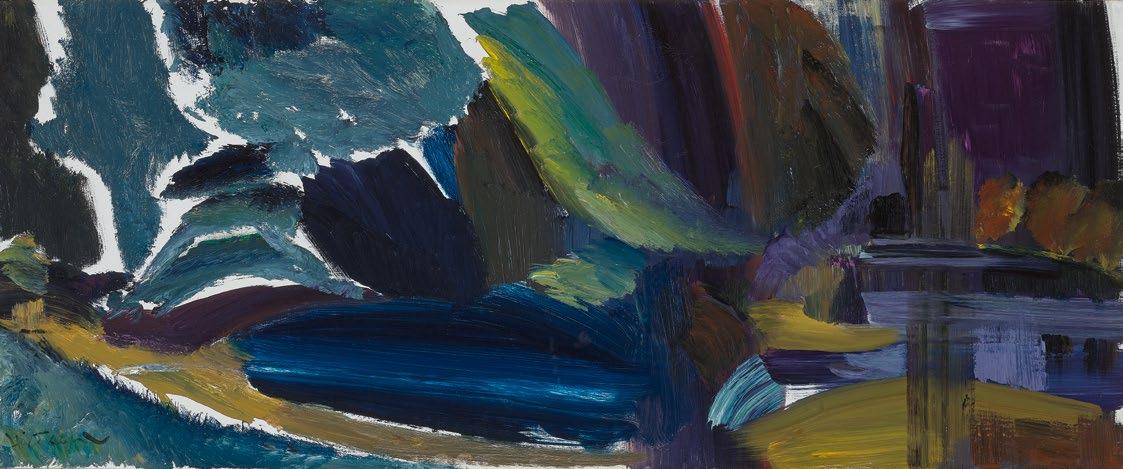
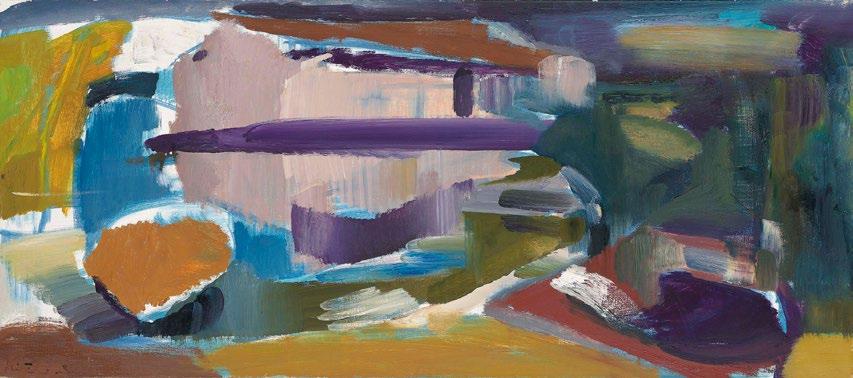
‘Landscape painting is no joke – so wearing on the nerves in England. The work itself is enough worry without the uncertainties of English weather.’ 1
For a good proportion of his long and celebrated career, British painter Ivon Hitchens drew creative inspiration from the same place – a small area of woodland on Lavington Common near Petworth in Sussex. Hitchens, his wife Mary (Mollie) and their young son, John, fled London during World War II after the artist’s Hampstead studio was bombed. They initially lived in a caravan, without electricity and running water, which was slowly augmented by a studio, and then a house. Over the next four decades, Greenleaves, as the property was known, gave rise to an extraordinary body of work that was international in outlook while remaining deeply embedded in the English landscape. Carting his painting supplies across the Common in a wheelbarrow, Hitchens worked en plein air in all weather, finding endless stimulus in the light, colour, sounds and changing seasons of an environment he knew so well.
Hitchens commenced his art education at St John’s Wood School of Art, London, in 1911, followed by training at the Royal Academy Schools from 1912 – 16. After serving for two years in hospital supply during WWI, and being declared unfit for service in 1916, he returned to the RA Schools in 1918 – 19. After graduation, he
became a founding member of the Seven and Five Society 2, a c onservative group which became decidedly pro-modernism after Ben Nicholson joined in 1924 and was followed by artists such as Henry Moore and Barbara Hepworth. Renamed the Seven and Five Abstract Group, they went on to hold the first entirely abstract exhibition in London in 1935. Importantly, as Peter Khoroche has noted, the Seven and Five offered a sense of solidarity without compromising Hitchens’ independence. 3 Accordingly, the artist’s work was transformed during this time, as he strived to unlearn his formal academic training and discover his own distinctly modern voice. While being aware of the work of other young painters, and influenced, early in his career, by Cézanne, Braque and André Lhote, Hitchens was ‘apprehensive that he might be swamped, or thrown off his natural course, by artistic influences whose very attractiveness made them all the more dangerous.’4
Created after the artist’s international success as a representative of Britain at the Venice Biennale in 1956 – where he was invited to show twenty paintings – Warnford water, pool and dark distance, 1960, is Hitchens at his commanding best. In this majestic work, we see the artist assert himself over his subject matter, using the landscape of Warnford Estate in the county of Hampshire – an area at ‘the westernmost point of Hitchens’ painting territory’ 5 – as a source of inspiration, full of visual and emotional power, rather than something to be depicted literally. Together, the artist’s sweeping brushstrokes and imaginative use of colour create both space and form, as the viewer is presented with a suggestion of the water’s edge and pool beyond – achieved, with incredible
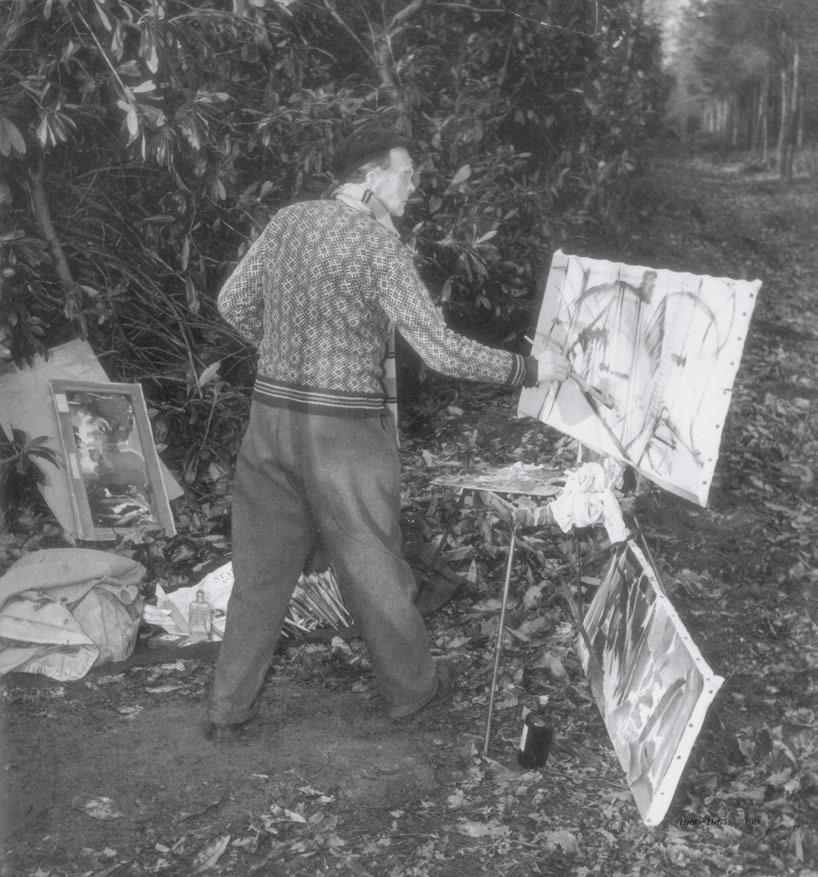
economy, by strong arcs of paint in a range of blues and greens. These are offset by the white spaces of the primed canvas, which allow the eye to settle and the painting itself to ‘breathe’. As Hitchens explained, ‘The white areas or lines of white canvas… are to provide channels isolating the areas of paint so that these can be felt relatively to each other in their shape, area, weight and meaning… The intention is that the spectator’s eye can travel along these areas from ‘floe to floe’, over the picture surface instead of being engulfed or drowned in a morass of paint representing or aping realism.’ 6 Hitchens’ trademark use of the elongated format of the horizontal double square also encourages the viewer’s eye to naturally range across the canvas from left to right.
Music was vitally important to the artist, and his role in a work such as Warnford water, pool and dark distance is to act as a conductor, leading the way into and around his canvas: ‘My pictures are painted to be listened to’, he said. ‘I seek to recreate the truth of nature by making my own song (in paint)…
The artist painting at Greenleaves, Autumn 1955 photographer: Douglas Glass
I try to use notation of tones and colours so that the design flows from side to side, up-down, and in and out. I am not interested in representing the facts as such until this visual music had been created. But this creation must satisfy me as being true to life, though not naturalistically accurate.’ 7
1. Ivon Hitchens in a letter to his patron Howard Bliss, 7 November 1961, cited in Khoroche, P., Ivon Hitchens, new edition, Lund Humphries, Hampshire, 2007, p. 142
2. As the catalogue of the group’s first exhibition in 1920 stated, the Society was not formed ‘to advertise a new “ism” – [we] feel that there has of late been too much pioneering along too many lines in altogether too much of a hurry.’ See The Seven and Five Society, Tate, https://www.tate.org.uk/art/art-terms/s/seven-and-five-society (accessed 16 July 2026)
3. Khoroche, op. cit., p. 23
4. ibid., p. 27
5. ibid., p. 132
6. Hitchens was writing about his painting Divided Oak Tree No. 2, 1958, here, but it equally applies to Warnford Water, Pool and Dark Distance; see Khoroche, op. cit., p. 120
7. Hitchens, I., ‘Notes on Painting’, 7, pp. 51 – 52, cited in Benson, L., ‘Ivon Hitchens’, in Gott, T., Matthiesson, S. and Benson, L., Modern Britain 1900 – 1960: Masterworks from Australian and New Zealand Collections, National Gallery of Victoria, Melbourne, p. 261
Kelly Gellatly
oil on composition board
122.0 x 152.0 cm
signed and dated lower right: Nolan / 1970 bears inscription verso: LANDSCAPE / NOLAN
Estimate: $45,000 – 65,000
Provenance
Marlborough Fine Art, London (label attached verso)
Rex Irwin Art Dealer, Sydney
Michael Gleeson-White AO, Sydney, acquired from the above in 1994 Estate of the above, Sydney
Exhibited
Sidney Nolan Selected Works, Marlborough Fine Art, London, May – June 1979, cat. 9 (illus. in exhibition catalogue, p. 19)
Sidney Nolan Important Paintings, Rex Irwin Art Dealer, Sydney, 5 – 23 April 1994, cat. 11 (label attached verso, illus. on catalogue cover)
Landscape, 1970, by Sidney Nolan is a deliberately enigmatic painting infused with memory and underpinned by a range of technical strategies the artist had developed over the preceding decades. Since 1953, when Nolan and his family relocated to London, he no longer painted in Australia despite numerous return visits1; instead, he would gather images within his photographic mind and collect stray plants and flowers which he pressed within a notebook. Only upon returning to his Putney studio would he begin to paint, usually in frenetic bursts of energy as these stored impressions spilled out. Being removed from the actual motif allowed many other inspirations to rise to the surface as he painted. Consequently, attempting to anchor an image to an identifiable location is usually fruitless, as it was when asking the artist for such information. Indeed, as he once explained, Nolan preferred the painting to speak for him, arguing that ‘I’m very interested, in fact, compelled and dedicated to transmitting emotions and I care for very little else.’ 2
Since his earliest days, Nolan had been fascinated by the dream imagery of the Surrealists and Landscape could almost be a still taken from one of their experimental films, with the grass trees ( Xanthorrhoea) hovering over the gossamer screen of the background. Such mirage-like appearances date back to paintings such as Island, 1947 (Art Gallery of New South Wales) where a naked figure stands isolated within a moody field that fuses water, land and sky, whilst the central grass tree finds its precedent in Grass trees, 1948. The suggestive ambiguity of Island was pushed further in Nolan’s now-iconic African series of 1963, particularly in works such as Zebra, 1963, of which he said: ‘I feel that there’s a kind of painting to be done with animals and
natural camouflage that would be, in a sense, a no-painting; there would be a total disappearance of the image – but if you stared at the painting long enough, the image would eventually waft up.’3 Although there are no animals in Landscape, these possibilities of camouflage and disappearance still hold true. Ironically, Nolan achieved some of the effects by using his wife Cynthia’s stockings as a tool to rub the paint into the surface. The shimmering canopy of the background trees, by comparison, have their genesis in the forests seen in the monumental and multi-panelled River bend, 1964 – 65 (Australian National University, Canberra).
It is difficult to determine exactly when in 1970 Nolan painted Landscape, as it was yet another peripatetic year for the artist with visits to Germany, Honolulu, New York and Norway, as well as an extended visit to Australia between February and April for exhibitions of his work at the Adelaide Festival and the National Gallery of Victoria, interspersed with a visit to Uluru and central Australia. However, just prior, Nolan’s dealer in Perth, Skinner Galleries, mounted an exhibition of smaller landscapes from 1969 which, like Landscape, included no figures. These were likewise dreamlike and shimmering, with Patrick A. E. Hutchings noting presciently in his catalogue essay that ‘Nolan’s explorer has, for the present, left the stage: Nolan himself is exploring here. These pictures are, in a sense, soliloquies in a landscape.’4
1. See Lynn, E. and Nolan, S., Sidney Nolan – Australia, Bay Books, Sydney and London, 1979, p. 172
2. Sidney Nolan, 1978, cited ibid., p. 204
3. Sidney Nolan, cited in ‘Nolan in Africa’, Queen, London, 24 April 1963
4. Hutchings, P. A., ‘Introduction’, Sidney Nolan: Recent paintings, Skinner Galleries, Perth, 1970
Andrew Gaynor
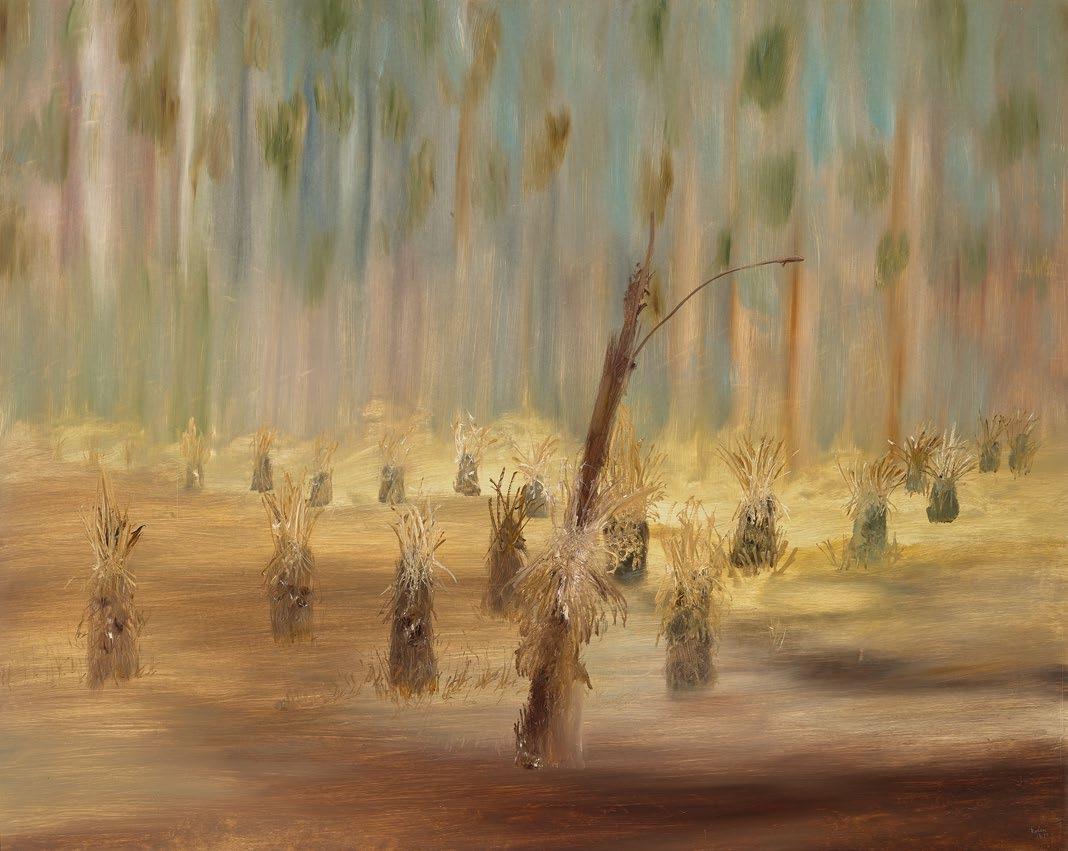
(1920 – 1999)
Bush pond, 1958 – 59
oil on composition board
41.0 x 53.0 cm
signed lower right: Arthur Boyd bears inscription verso: BUSH POND / ARTIST / ARTHUR BOYD
Estimate: $40,000 – 60,000
Provenance
Moreton Galleries, Brisbane (label attached verso, as ‘The Bush Pond’)
Michael Gleeson-White AO, Sydney Company collection, Sydney, acquired from the above in 2000
Exhibited
Art from the Collections of the Trustees of the Art Gallery of New South Wales, Blaxland Gallery, Sydney, 14 – 29 October 1981, cat. 4 Arthur Boyd retrospective, Art Gallery of New South Wales, Sydney, 15 December 1993 – 6 March 1994 and touring to National Gallery of Victoria, Melbourne, 30 March – 23 May 1994; Tasmanian Museum and Art Gallery, Hobart, 9 June – 21 August 1994 and Art Gallery of Western Australia, Perth, 22 September – 20 November 1994, cat. 82 (label attached verso)
Literature
Pearce, B., Arthur Boyd Retrospective, Art Gallery of New South Wales, Sydney, 1993, cat. 82, pp. 96 (illus.), 200
Related works
Old waterwheel, 1959, oil on hardboard, 83.4 x 106.0 cm (sight), Art Gallery of Western Australia, Perth Spring Landscape, 1959, oil on board, 25.3 x 35.4 cm, The University of Melbourne Art Collection, Melbourne
The noted author Marcus Clarke famously described the Australian bush in 1867 as being infused with a ‘weird melancholy’, one filled with ‘the hieroglyphs of haggard gumtrees, blown into odd shapes, distorted [and] cramped with cold nights.’ 1 Painted nearly one century later, Arthur Boyd’s Bush pond, 1958 – 59, captures Clarke’s vivid description with an intensity that verges on the gothic. The landscape was one of Boyd’s earliest subjects, embodied in his paintings of the Mornington Peninsula executed in the late 1930s whilst the young artist was living with his widowed grandfather at Rosebud. In the 1940s, his human dramas were firmly anchored by their own landscapes of the city and its semi-rural suburbia, but between 1950 and 1952, Boyd stunned audiences with Wimmera landscapes filled with piercing light and space. On the strength of such works, he was chosen to represent Australia alongside the deceased Arthur Streeton at the XXIX Biennale in Venice which opened on 14 June 1958. The conservatively-minded
selection committee, presided over by the Prime Minister Robert Menzies, had already chosen a suite of eight landscapes by Boyd comprising similar still and poetic scenes from around Bendigo and the Wimmera, but were likely ignorant of the fact that the artist was about to exhibit his confronting ‘Bride series’ 2 close to the public announcement of his inclusion at Venice. The ‘Brides’ follow a narrative wherein a tragic love triangle is played out by doomed indigenous characters set against expressionist visions of primordial forest, and their exhibition so excited local supporters that they urged the Committee to alter their choices. Not surprisingly, the Committee declined.
One painting the selectors included nonetheless gave a clear indication of the artist’s divergence, being Mount Terrible (near Gaffney’s Creek), 1956, where the bristling trees and bush possess a highly suggestive anxiety. Related paintings from Gaffney’s Creek are ‘typically confined, tangled, harsh in texture [where figures stand] against dark, rotting undergrowth, or stumble across creeks with thin white branches clawing out of the dark.’ 3 Bush pond, too, is informed by this approach, but instead of employing the setting for some human tragedy, Boyd shows a man quietly clearing leaves whilst two white goats eat nearby – all engaged in personal thoughts and actions. A kingfisher darts over the darkly coloured pond and even though the surrounding trees twist and turn with their own melancholic weirdness, the man and animals are comfortable within their surroundings. The paint is rich with impasto, and Boyd uses his brush to actively ‘describe rather than circumscribe’ the whole scene.4 The goat was one of Boyd’s complex array of symbolic characters and motifs, a collection which also included the allegorical Ramox – part ram, part ox, a beast filled with unbridled lust which had first appeared in the artist’s paintings from the 1940s. The goat has a similarly lewd meaning through history (think of Pan with his caprine legs), but it is apparent that Boyd has a different, less provocative intention here, for goats were already a common sight in the Australian bush, long-time feral since their arrival with the first colonists. Like the bushman, they have now adapted to be at home within the skeletal vegetation – an environment the artist came to consider as being symbolically pure, an antipodean Garden of Eden.
1. Clarke, M., ‘Preface’ in: Adam Lindsay Gordon, Sea Spray and Smoke, A.H. Messina and Co., Melbourne, 1867, pp. iv, v
2. The correct title of the series is: ‘Love, marriage and death of a half-caste.’ The term ‘Bride series’ was first coined by Franz Philipp in Philipp, F., Arthur Boyd, Thames and Hudson, London, 1967, p. 83
3. Arthur Boyd Retrospective, supplement to Art and Australia, vol. 31, no. 2, 1993
4. Philipp, op. cit., p.82 Andrew Gaynor
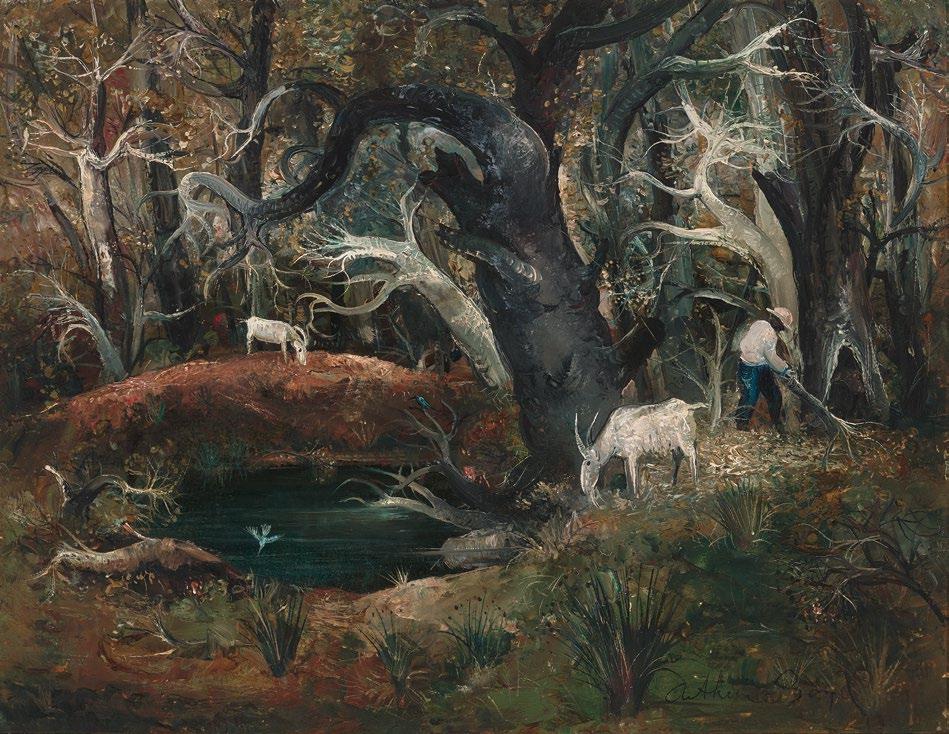
reef, 1957
oil on canvas
51.0 x 60.5 cm
signed and dated lower right: L.REES / 57
Estimate: $35,000 – 45,000
Provenance
Company collection, Sydney Lawson–Menzies, Sydney, 15 April 2003, lot 38 (as ‘Untitled (Possibly “The Reef – Werri Beach”)’)
Michael Gleeson-White AO, Sydney Estate of the above, Sydney
Exhibited probably 29th Annual Exhibition Contemporary Group, Macquarie Galleries, Sydney, 4 – 16 September 1957, cat. 22
After discovering Gerringong on the New South Wales south coast while holidaying in 1939, Lloyd Rees fell in love with the area and, after many return trips, his family bought land and built two cottages, Caloola and Calympa, on the southern side of Werri Lagoon. His brother-in-law was next door, so the arrangement was perfect for family holidays. While family members occupied themselves swimming, sailing, fishing or relaxing, Rees busied himself painting en plein air throughout the long summer days. If he set up his easel facing west, he had the magnificent expanse of Saddleback Mountain rising above the foothills beyond the lagoon from north to south. Looking north, again over the lagoon, he could see the rolling pastures of Renfrew Farm, which led east to the sea before rising to form the strangely shaped Omega Headland with its rock platforms below.
It is likely that The reef, 1957 depicts one such rock formation. These platforms, popular with local fishermen, dominate the Gerringong coast – from Kiama in the north to Boat Harbour, Walker’s Beach and Gerroa in the south. Rees painted most of this landscape during his time on the south coast, with key works from his Gerringong canon including The road to Berry, 1947 (widely acknowledged as a major influence on Brett Whiteley); Omega pastoral, 1950 (National Gallery of Victoria), The road to the mountain, 1954 (Art Gallery of Western Australia) and The coast near Kiama, 1955 (Queensland Art Gallery I Gallery of Modern Art). Interestingly, the work Rees
considered his ‘finest Gerringong landscape’ 1 was destroyed when the train carrying it caught fire en route to the Arts festival of the Olympic Games in Melbourne in 1956.
The reef, though modest in scale, ranks among Rees’ finest Gerringong works. It captures the mood of the sea, the brilliant light of a summer afternoon and the human scale of the figures engaging with the ocean. Rees’ finesse is particularly evident in his treatment of the two figures on the rocks. Two or three deftly placed marks of paint are all he requires to capture their form, scale, colour and mass. During the 1930s, Rees worked predominantly in fine graphite, producing drawings whose forensic detail and masterly execution remain unmatched in Australian art. The idiom ‘you need to walk before you can run’ comes to mind. The spontaneous, energetic application of paint feels effortless, but it was his years of disciplined draughtsmanship that provided the foundation this painterly freedom, enabling him to work with such economy and confidence. Looking closely at Rees’ paintings from the 1940s and 1950s, they appear spontaneous: paint is applied with wristy flourishes, colour often mixed directly on the surface as he works. Here, Rees skilfully exploits the expressive power of paint in a manner that could only have been achieved through decades of observation and practice.
1. Free, R., Lloyd Rees, Landsdowne Press, Sydney, 1972, p. 64
Henry Mulholland
pastel on paper
52.0 x 76.0 cm
signed and dated lower left: William Robinson / 2014
Estimate: $15,000 – 20,000
Provenance
Australian Galleries, Sydney
Michael Gleeson-White AO, Sydney, acquired from the above in October 2018
Estate of the above, Sydney
Exhibited
William Robinson: The artist’s garden, house and memories, Australian Galleries, Melbourne, 14 June – 3 July 2016 and Australian Galleries, Sydney, 19 July – 7 August 2016, cat. 27 (illus. in exhibition catalogue, p. 48)
pastel on paper 55.0 x 75.0 cm
signed, dated and inscribed with title lower left: Canyon Gorge / William Robinson 2000 bears inscription verso: 2
Estimate: $18,000 – 24,000
Provenance
Ray Hughes Gallery, Sydney Michael Gleeson-White AO, Sydney Estate of the above, Sydney
Exhibited
William Robinson: The Revelation of Landscape, S.H. Ervin Gallery, Sydney, 11 January – 2 March 2003, and touring to Mornington Peninsula Regional Gallery, Victoria, 1 April – 18 May 2003
Literature
William Robinson: The Revelation of Landscape, S.H. Ervin Gallery, Sydney, 2003, pp. 34 (illus. as 'From Canyon Gorge'), 40
Avigdor Arikha (French/Israeli, 1929 – 2010)
Nu à plat, 1989
pastel on emery paper
53.5 x 69.0 cm (sight)
signed lower right: Avigdor Arikha dated lower left: 21.III.89
Estimate: $12,000 – 18,000
Provenance
Marlborough Fine Art Gallery, London (label attached verso)
Michael Gleeson-White AO, Sydney Estate of the above, Sydney
Exhibited
Avigdor Arikha, Marlborough Fine Art, London, 14 March – 14 April 1990, cat. 23 (illus. in exhibition catalogue, p. 31, as ‘Flat nude’)
Avigdor Arikha Paintings & Works on Paper, Marlborough Gallery, London, 18 September – 17 October 2015
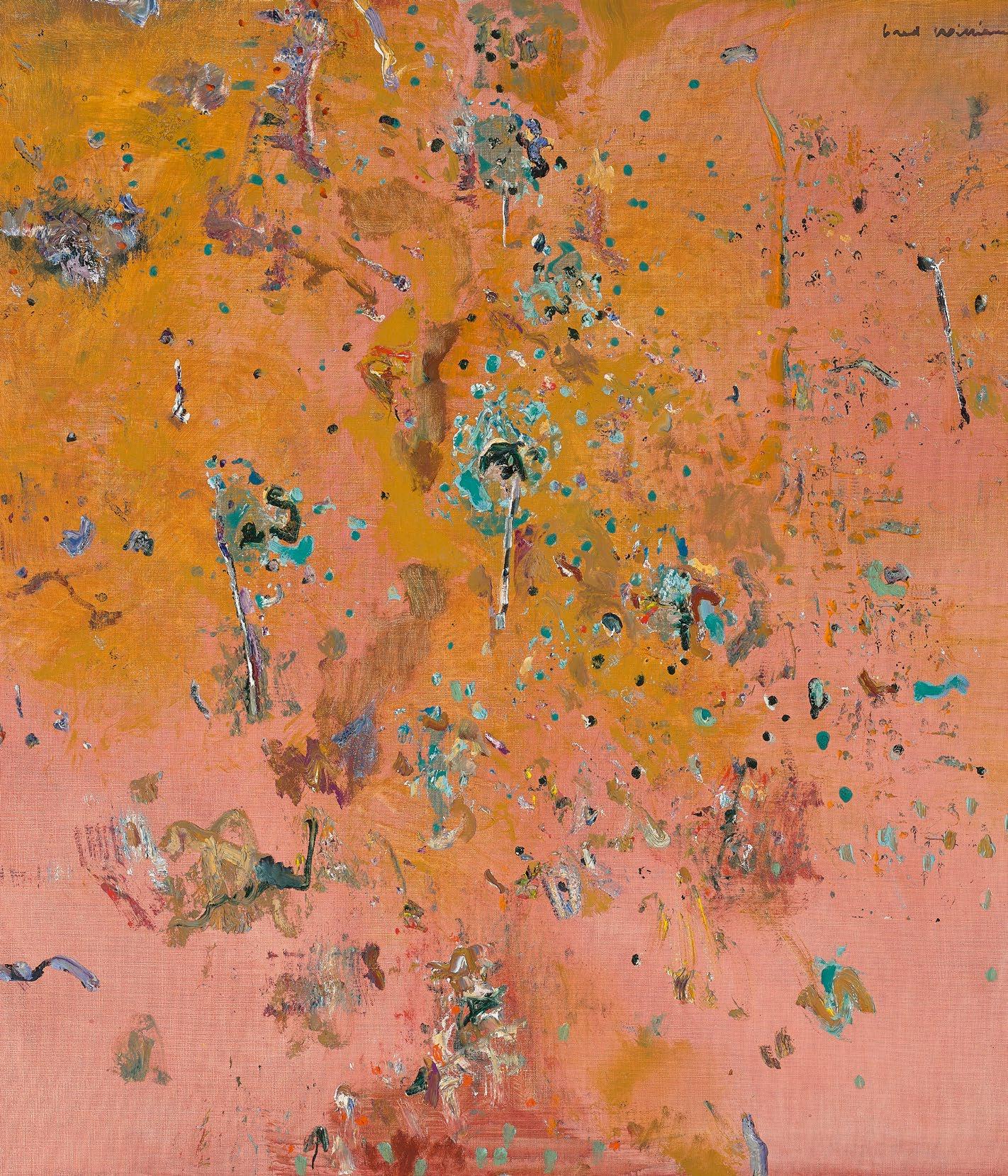
charcoal on paper
76.0 x 101.5 cm
stamped with artist’s monogram lower left: BW signed verso: Brett Whiteley
Estimate: $120,000 – 180,000
Provenance
Australian Galleries, Melbourne
Private collection, Melbourne, acquired from the above in September 1976
Private collection, Melbourne, acquired from the above in March 2010
Exhibited
Recent Interiors, Still lifes, Windowscapes, Sculpture and Ceramics, Australian Galleries, Melbourne, 21 September – 5 October 1976, cat. 4
Brett Whiteley: Recent Nudes, the artist’s studio, Sydney, 3 – 31 October 1981 (illus. in exhibition catalogue, p. 15)
Lloyd Rees: Brett Whiteley: On the Road to Berry, Museum of Modern Art at Heide, Melbourne, 13 July – 5 September 1993 and touring to Art Gallery of New South Wales, Sydney, 17 September – 14 November 1993, cat. 63 (as ‘Figure and Lavender Bay (Wendy Sleeping)’)
Brett Whiteley: Art and Life, Art Gallery of New South Wales, Sydney, 16 September – 19 November 1995, cat. 84 and touring to Museum and Art Galleries of the Northern Territory, Darwin, 13 December 1995 – 28 January 1996; Art Gallery of Western Australia, Perth, 22 February – 8 April 1996; Art Gallery of South Australia, Adelaide, 9 May – 16 June 1996; National Gallery of Victoria, Melbourne, 2 July –26 August 1996 and Tasmanian Museum and Art Gallery, Hobart, 18 September – 17 November 1996, cat. 69 50 Years: Australian Galleries 1956 – 2006, Australian Galleries, Melbourne, 2006 (label attached verso, as ‘Interior Lavender Bay, 1977’ [sic])
Brett Whiteley: Connections, TarraWarra Museum of Art, Victoria, 6 November 2010 – 19 March 2011
Literature
McGrath, S., Brett Whiteley, Bay Books, Sydney, 1979, cat. 81, pp. 47 (illus. as ‘Wendy Asleep, 1973’ [sic]), 226 (illus., as ‘Figure and Lavender Bay’)
McCulloch, A., Encyclopedia of Australian Art, Hutchinson of Australia, Melbourne, 1984, pl. 76, n.p. (illus., as ‘The Studio’)
Klepac, L., Lloyd Rees: Brett Whiteley: On the Road to Berry, Beagle Press, Sydney, 1993, p. 19 (as ‘Figure and Lavender Bay (Wendy Sleeping)’)
Pearce, B., Brett Whiteley: Art & Life., Art Gallery of New South Wales, Sydney, 1995, fig. 18, pp. 26 (illus.), 224 Hallett, B., The Australian Magazine, Sydney, 26 – 27 August 1995, p. 16 (illus.)
Klepac, L., Brett Whiteley Drawings, The Beagle Press, Sydney, 2014, p. 137 (illus.)
Sutherland, K., Brett Whiteley: Catalogue Raisonné 1955 – 1992, Schwartz Publishing, Melbourne, 2020, cat. 8.76, vol. 3 p. 328 (illus.), vol. 7, p. 350
Related works
Study for ‘The Beach’, 1965, charcoal on paper, 56.0 x 76.5 cm, Brett Whiteley Estate, Sydney
Wendy Sleeping, 1973, pen, brush and ink on paper, 30.1 x 33.8 cm (sheet), Brett Whiteley Estate, Sydney Life Cycle – ‘Youth’, 1974, charcoal on linen, 183.0 x 183.0 cm, illus. in McGrath, S., Brett Whiteley, Bay Books, Sydney 1979, p. 47
Interior, Lavender Bay, 1976, pen and ink on paper, 76.5 x 57.2 cm, private collection, illus. in Sutherland, K., op. cit., cat. 137.76, vol. 3, p. 370
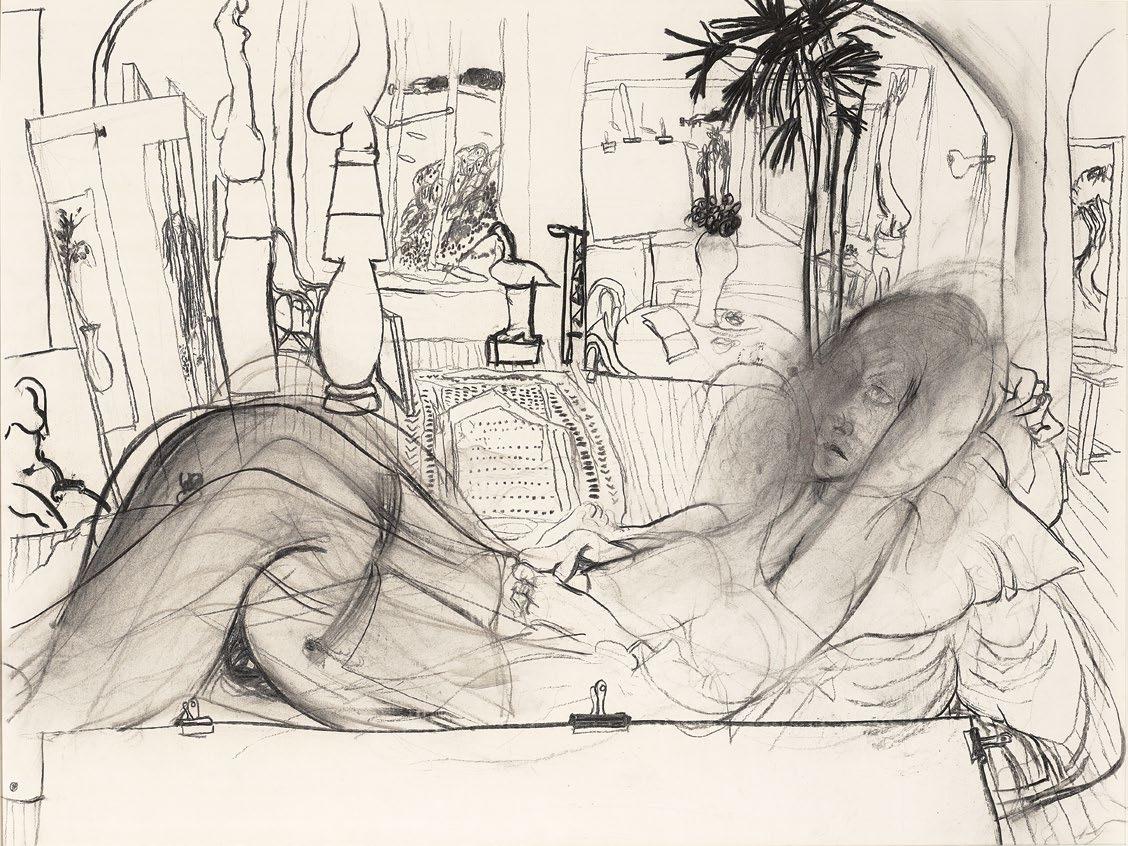
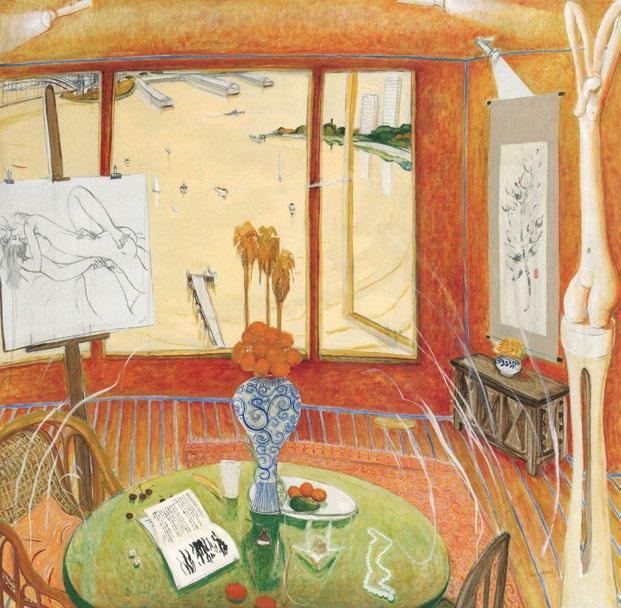
‘Drawing is a completely unrehearsable and unrepeatable visual truth. The purpose of drawing is to make freshness permanent –to trigger astonishment. Out of the billions of moments of futility a few seconds of rightness are immutably held together.’ 1
‘He was quick, eloquent and charged with energy. Drawing for him was almost like big game hunting. He would put on a record and play it as loud as possible, and the stage was set.’ 2
After being busted for drugs in Fiji in November 1969, Brett Whiteley, his wife Wendy and young daughter Arkie returned to Sydney, initially unsure about whether they would stay. However, a major deciding factor in their eventual ‘settling down’ was the house they found in Lavender Bay through their friend, architect Roland Schlicht, who had been in London at the same time as the Whiteleys and was living with his family on the house’s upper floor. 3 With its sprawling spaces and stellar view of Sydney Harbour, the Lavender Bay house was to provide both refuge and creative inspiration for Whiteley throughout the next decade, serving as a constant and clearly recognisable presence in the harbour views, interiors and still lifes that he created during this highly productive time. Indeed, curator Barry Pearce writes of this period as ‘a real rebonding with Australia; a centring, as it were, of [Whiteley’s] universe.’4 As Wendy Whiteley later recalled: ‘In a sense Lavender Bay was Brett’s return to paradise, having come from a very anxious
Brett Whiteley
Interior with time past, 1976
oil, charcoal and ink on canvas
198.0 x 200.0 cm
National Gallery of Australia, Canberra © Wendy Whiteley/Copyright Agency 2026
situation – and it is paradise. He said some quite tender things about it at the time, like ‘I’m home again at last’. And yet that was a really dark period because we started destroying it by being locked into a chemical paradise which had its moment in hell.’ 5
The smudged outlines of Wendy’s head and face, and her relaxed pose in Wendy on cushions, 1976, depict the kind of drug-infused state that the pair increasingly found themselves in during their early experimentation with heroin.6 Yet Whiteley’s mastery of the medium enables him to capture the relaxed intimacy of this moment with both warmth and tenderness, as Wendy, his muse, reclines odalisque-like; the movement of her body echoed by the series of lines and curved arches that appear like ghosts across her form. ‘Whiteley said it was possible to draw with the hand, the wrist, the elbow, the arm and shoulder’, states Lou Klepac7 , and we can feel this sense of pace and vitality – almost an urgency – in the work’s assured linework and complex picturing of space. Whiteley builds the domestic and creative environment he knows so well with marks of breathtaking economy and fluidity, filling the room’s expansive whitewashed spaces with his paintings and sculptures, the family’s rugs, and the objects that he and Wendy collected on their travels. For Whiteley, drawing was as important as painting. It served as an immediate route from looking to making for him, and similarly enabled the most direct expression of his thoughts and perceptions: ‘Some drawings are made in order for me to see something, some
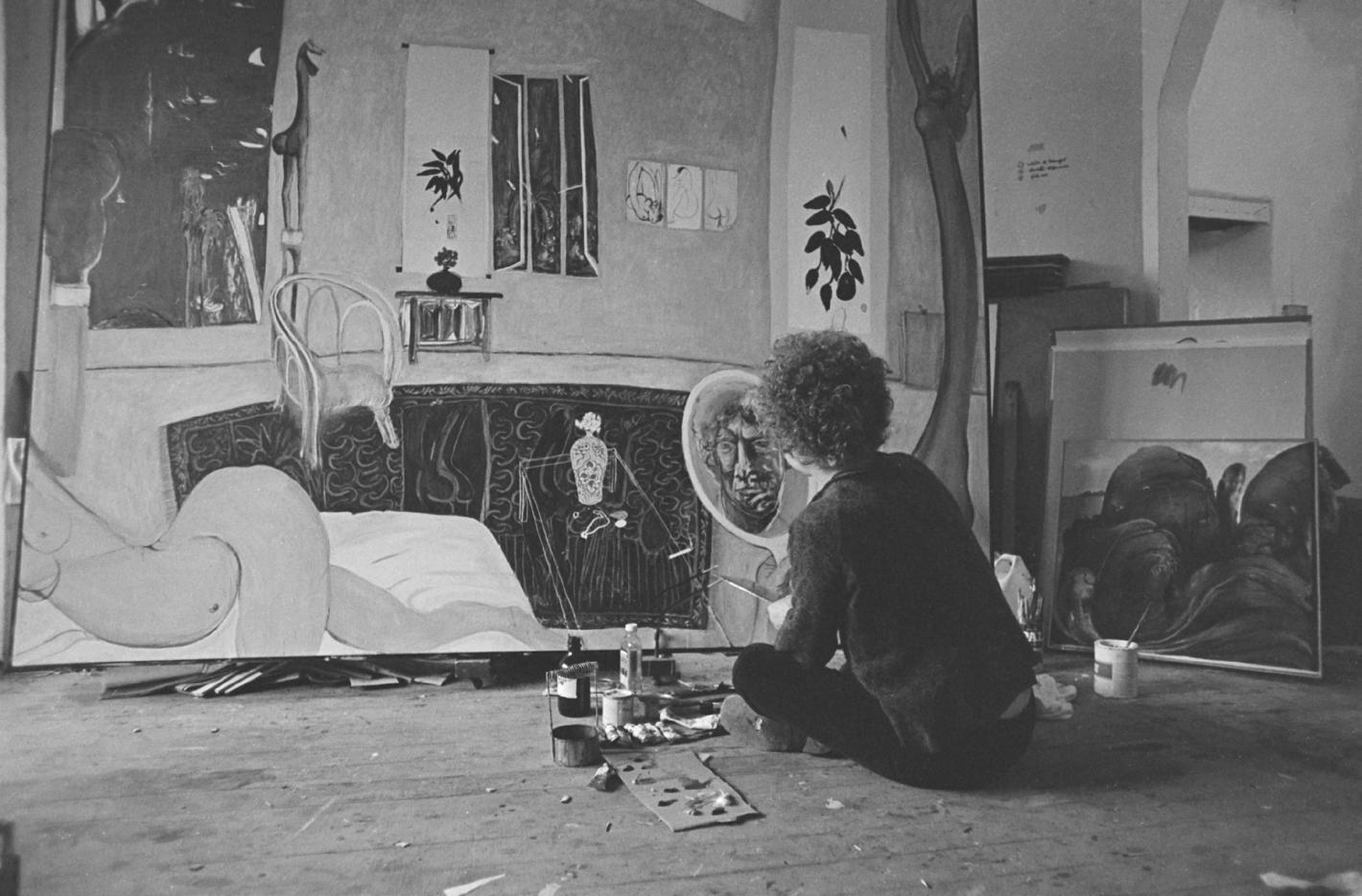
Brett Whiteley working on ‘Self portrait in the studio’, 1977 photographer: Robert Walker Art Gallery of New South Wales, Sydney © Estate of Robert Walker/Copyright Agency
are made in order for me to show off. The best of my drawing, I feel, has been made either in acute self-consciousness or in complete unconsciousness – with no middle-ground.’ 8
While the Lavender Bay interiors serve on one level as an ode to Matisse, and particularly the artist’s The Red Studio, 1911, which Whiteley loved 9, in Wendy on cushions Whiteley is present in the tableau in a way that Matisse never is – making it clear, as he enters the composition (via the blank sheet of paper bulldog-clipped to his drawing surface), that he is both observer and subject. This sense that Whiteley saw the work, in its exploration of his identity and the creative process, as a form of self-portraiture, is further emphasised by the presence of the artist’s painting Interior with Time Past, 1976 (National Gallery of Australia), which won the Art Gallery of NSW’s coveted Sir John Sulman Prize in the year this drawing was made. During this period of extraordinary good fortune – Whiteley was also
awarded the 1976 Archibald Prize for his painting Self Portrait in the Studio, 1976 – the artist seems to be questioning the nature of success, characteristically creating a small note of tension, or foreboding, in this sumptuous, languid scene.
1. Whiteley, B., 162 Drawings, Brett Whiteley 1960 – 85, Robin Gibson Gallery, Sydney, 19 October – 6 November 1985, cited in Klepac, L., Brett Whiteley Drawings, The Beagle Press, Sydney, 2014, p. 22
2. Klepac, ibid., p. 12
3. Grishin, S. et al., Baldessin / Whiteley: Parallel Visions, National Gallery of Victoria, Melbourne, 2018, p. 142. The Whiteleys bought the house in 1974.
4. Pearce, B., ‘Persona and the Painter’ in Brett Whiteley: Art & Life, Thames & Hudson in association with The Art Gallery of New South Wales, new edition, 2004, p. 35
5. ‘Recollections: Wendy Whiteley Interviewed by Barry Pearce’ in Pearce, ibid., p. 48
6. The pair began to use heroin in Lavender Bay in 1974. Wendy travelled to England for treatment in 1985, returning to Australia in 1986. Sadly, Whiteley continued to use and died of a heroin overdose on 15 June 1992 at the age of 53.
7. Klepac, op. cit., p. 15
8. Whiteley, B., 162 Drawings, Brett Whiteley 1960 – 85, Robin Gibson Gallery, Sydney, 19 October – 6 November 1985, cited in Klepac, L., op. cit., p. 179
9. Pearce, op. cit., p. 35
Kelly Gellatly
pencil on card
103.0 x 77.0 cm
signed and inscribed with title lower right: brett whiteley “in and out / of room”
stamped lower left with artist’s monogram bears inscription verso: No. 9
Estimate: $60,000 – 80,000
Provenance
Holdsworth Galleries, Sydney
Private collection, Sydney
Private collection, Sydney, a gift from the above c.2005
Literature
This work will be included in the addendum to Sutherland, K., Brett Whiteley: Catalogue Raisonné, Schwartz Publishing, Melbourne, 2020, provisional cat. 104.75
More than a simple line drawing, In and out of room, c.1975 is an unadulterated expression of the hermetic creative sanctuary that Brett Whiteley found at his home in Sydney’s Lavender Bay. In early 1974, Whiteley and his wife, Wendy, purchased the entire residence on Walker Street, having rented the upstairs apartment since their sudden return from Fiji in November of 1969. Biographer Ashleigh Wilson writes of this milestone: ‘Brett and Wendy turned the house inside out. They cleared obstacles to the sun and the harbour, opened out the main living area, created access between levels, extended the balcony, and installed arches between the rooms.’ 1 These efforts in curating his immediate environment coincided with the emergence of Whiteley’s mature phase as an artist, and the picturesque setting of the Lavender Bay living room provided the basis of his most acclaimed and lyrical paintings: the Matissean interiors of the 1970s: Henri’s armchair, 1974 –75, Interior with time past, 1976; My armchair, 1976, and the Archibald Prize-winning, Self-portrait in the studio, 1976.
Rather than highlighting the expansive views of the harbour that the windows provided, In and out of room is a quiet meditation on interior space. It evidences Whiteley’s move into threedimensionality throughout the 1970s, and the compressed perspective of the image builds on the pictorial devices employed by the artist in the Bathroom and Christie paintings in his London apartment in the early 1960s. As the title would suggest, this drawing presents a visual journey around the artist’s inner sanctum, from a high vantage point and through an open window frame outlined in the bottom left hand corner. Whiteley was an accomplished draughtsman, a facet of his artistic practice he honed throughout this decade. The wrap-around perspective effectively modulates the volumetric space to fit on a small picture
plane, crowding its key identifying features into one unified scene below an arched frame. In and out of room joins a flurry of other line drawings of this space created between 1974 – 77, most bearing titles using variations of ‘Interior, Lavender Bay’. These works, featuring an array of Whiteley’s treasured possessions, artworks and occasionally even sitters such as Wendy or domestic pets, effectively become self-portraits in absentia.
Whiteley’s crisp linework in In and out of room left little room for revision. The scene was quickly recorded, capturing the tensions between the vertical architectural elements of the room, and the organic curves of the objects held within its confines. These range from emblems of domesticity such as an open book, rotary telephone, bunch of flowers in a vase and an electric heater, to Whiteley’s famous wicker armchair dwarfed in the empty room, and a selection of his own artworks described by Wendy as ‘bits of sculpture which were there at the time.’ 2 The rounded forms of the chair, the sculptures and the unruly, leafy canopy of the palms soften an otherwise austere architectural interior. The palms, we know from related works, to be an artwork of Whiteley’s in papier mâché painted electric blue. The three large figurative sculptures are carved mangrove wood forms each titled Her, made by Whiteley between 1975 – 76. Collectively titled Four studies of her, these sensual wooden forms appear in the drawing as stand-ins for his absent muse. Roughly hewn, the sculptures provide an organic counterpoint to the urbane sophistication of the Whiteleys’ living room with its views across Sydney harbour.
1. Wilson, A., Brett Whiteley, Art, Life and The Other Thing, The Text Publishing, Melbourne, 2016, pp. 230 – 231
2. Wendy Whiteley on Self Portrait in the Studio, 1976, interview, 4 June 2012, Art Gallery of New South Wales, see: https://www.artgallery.nsw.gov.au/art/watch-listen-read/ watch/389/ (accessed 27 May 2026)
Lucie Reeves-Smith
40
Ian Fairweather (1891 – 1974)
synthetic polymer paint and gouache on cardboard on composition board
80.5 x 60.5 cm
bears inscription verso: PENELOPE
Estimate: $220,000 – 280,000
Provenance
Macquarie Galleries, Sydney
Private collection, Melbourne
Menzies, Sydney, 23 June 2011, lot 37
Private collection, Sydney, acquired from the above
Exhibited
Ian Fairweather Paintings, Macquarie Galleries, Sydney, 14 – 23 June 1961, cat. 10
Ian Fairweather (from ‘Hut’ series), 1966 photographer: Robert Walker Queensland Art Gallery | Gallery of
Ian Fairweather Monastery, 1961
synthetic polymer paint, gouache on cardboard mounted on composition board
144.5 x 185.5 cm
National Gallery of Australia, Canberra © Ian Fairweather/DACS. Copyright Agency 2026
One of Australia’s most elusive and peripatetic artists, Ian Fairweather’s life encompassed periods living in Canada, China, Bali, the Philippines, India, Melbourne, north Queensland and Darwin. In 1953, he moved to Bribie Island, a small and then remote sand island in Moreton Bay, about 70 kms north of Brisbane – remaining there for the rest of his life. Despite working by the light of a hurricane lamp in a series of thatched huts that were largely open to the elements, Fairweather was to create some of the most majestic and highly regarded works of his career during this time, as his mature work became a highly personal, idiosyncratic mix of figuration, abstraction and calligraphic mark making.
Born in Scotland in 1891, and later settling on the isle of Jersey with his family where he began to paint, Fairweather completed officer training in preparation for the Great War and fought in the Battle of Mons, but was captured on his second day of combat, becoming a prisoner of war in various camps over a four-year period. On deciding to become an artist, he initially trained at The Academy in The Hague before returning to London to enrol at the prestigious Slade School of Art. After Fairweather travelled to China in 1929, where he lived in Shanghai, the life that led him to Fairweather being popularly cast as the archetypal artist-outsider began. This famously included him attempting, at the tender age
of 60, to sail from Darwin to Portuguese Timor in a makeshift raft constructed from materials he scavenged in Darwin. This neartragic journey resulted in the artist being washed up 16 days later on Roti (or Rote), a small Indonesian island to the southwest of Timor. After being deported to Singapore and then repatriated to England, he returned to Australia and settled on Bribie: ‘I had never seen anything so lovely’, he wrote.1 As Claire Roberts and John Thompson have remarked, Fairweather ‘repeatedly return[ed] to the idea of Australia as a place where he might find a safe haven and paint undisturbed. The combination of artistic affinity, financial possibility and attractive geography – a remote island nation linked to the British Empire and yet part of the tropical south – kept pulling him back to Australian shores.’ 2
Despite the relative isolation of his island home (Bribie was only accessible by ferry until 1963), Fairweather maintained a strong connection to events in the major centres and was always interested in the critical reception of his work. He was a good correspondent, maintaining contact with family and friends through letters, and a keen reader. This passion was kept active through the books he received by post from the Public Library of Queensland – an ‘eclectic and opportunistic’ selection ranging from crime thrillers and science fiction to religion and philosophy – and his consumption of journals and magazines, which
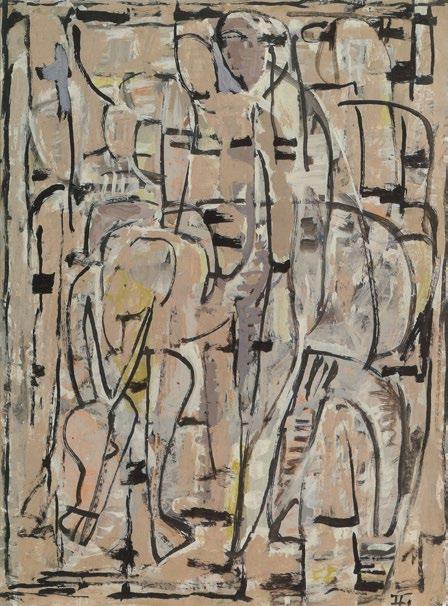
Ian Fairweather Flight into Egypt, 1961 synthetic polymer paint and gouache on cardboard on hardboard
95.0 x 70.0 cm
Tasmanian Museum and Art Gallery, Hobart © Ian Fairweather/DACS. Copyright Agency 2026
included The Times Literary Supplement, the Atlantic and Time magazine, and the science fiction magazine, Galaxy, to which he subscribed. 3 ‘I love books’, he wrote. ‘Even when they are bad – if I have the patience they can take me out of this world.’4
As Claire Roberts and John Thompson note, Fairweather was a product of the education system of the late Victorian and Edwardian Empire, and the richness of the cultural references that appear in his writing and art reveals ‘a sensibility shaped by the Bible and the Book of Common Prayer, Shakespeare and the major English poets, Dickens, the nonsense rhymes of Lewis Carroll, Gilbert and Sullivan, and popular song and literature.’ 5 As part of this education, the artist would no doubt have been taught, if not read, Homer’s The Odyssey, and the story of its intelligent, shrewd and endlessly patient heroine, Penelope. Indeed, it is hard not to imagine that Fairweather may have felt a personal affinity for the interiority and quiet endurance of this ancient character.
In Fairweather’s painting Penelope, 1961, the blocky Cubistinspired form of the epic’s protagonist is presented to us in several overlapping poses. Rendered with incredible economy, her body possesses a quiet solidity as she is both veiled by and seen through rich layers of brushstrokes and colour, and the assured flick of the calligraphic lines that animate the
work’s surface. The complex interconnected forms, webs of curvilinear lines and division of the composition that we see in Penelope are all hallmarks of Fairweather’s later work. Penelope is classic Fairweather – she won’t reveal her secrets quickly, but will reward with extended viewing, slowly revealing (some of) her mysteries over time. As the artist himself wrote:
‘Painting is not something that must be understood. If the picture is for you, it will produce an almost physical sensation, something of joy, of wonder – a tug at the gut. Don’t go trying to understand it. Don’t expect the painter to stand and deliver his innermost convictions in other than his work.’ 6
1. Ian Fairweather, cited in Roberts, C. and Thompson, J. (eds.), Ian Fairweather: A Life in Letters, Text Publishing, Melbourne, 2019, p. 91
2. Roberts & Thompson, ibid., pp. vii-viii. See also Goddard, A., Ian Fairweather: Late Works 1953 – 74, Queensland Art Gallery | Gallery of Modern Art, Brisbane, 2012, p. 20
3. Roberts and Thompson, ibid., p. vii
4. Ian Fairweather, cited ibid.
5. Roberts and Thompson, ibid.
6. Ian Fairweather, cited in Abbott-Smith, N., Ian Fairweather: Profile of a Painter, University of Queensland Press, St Lucia, 1978, p. 151, cited in Fisher, T., The Drawings of Ian Fairweather, National Gallery of Australia, Canberra, 1997, p. 17
Kelly Gellatly
William Robinson (1936 – 2025)
To Beechmont with storm clouds building, 2002 oil on linen
122.0 x 183.0 cm
signed and dated lower right: William Robinson / 2002 dated and inscribed with title on frame verso: 2002 TO BEECHMONT WITH STORM CLOUDS BUILDING
Estimate: $240,000 – 320,000
Provenance
Australian Galleries, Sydney (label attached verso) Private collection, Sydney Deutscher and Hackett, Melbourne, 9 May 2007, lot 25 Private collection, Melbourne
Exhibited
William Robinson: Recent Paintings, Australian Galleries, Sydney, 13 August – 7 September 2002; Melbourne, 24 September – 25 October 2002, cat. 8 (illus. in exhibition catalogue, as ‘To Beechmont with storm clouds’)
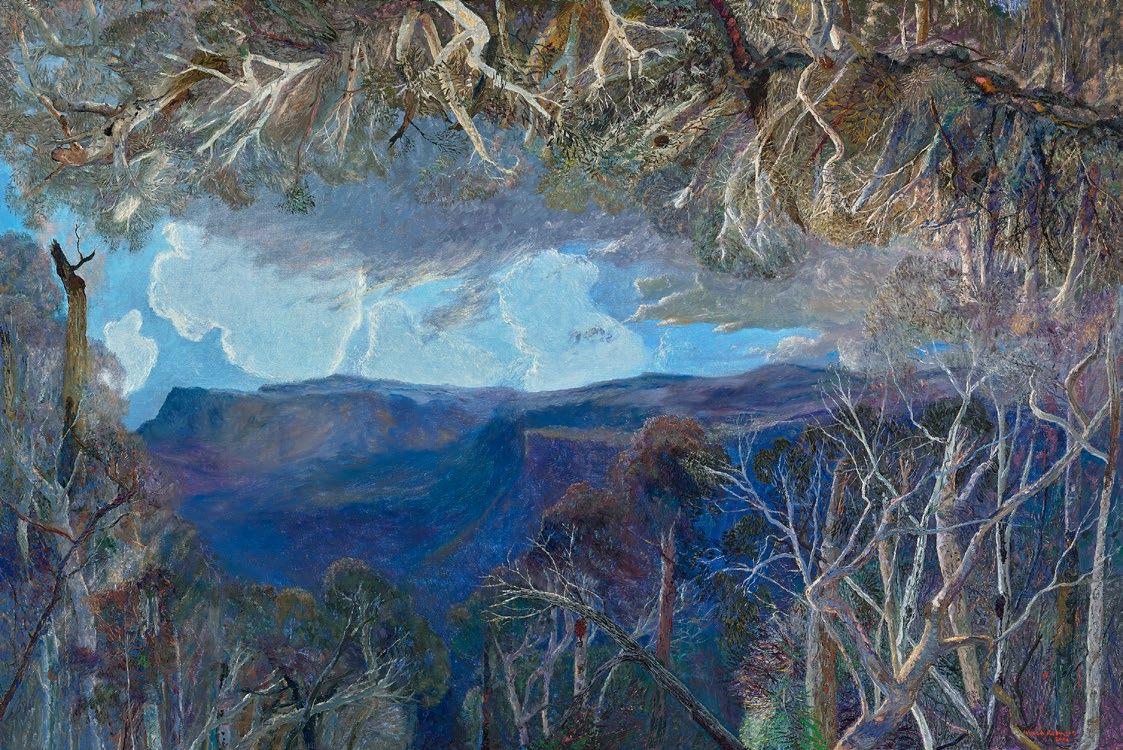
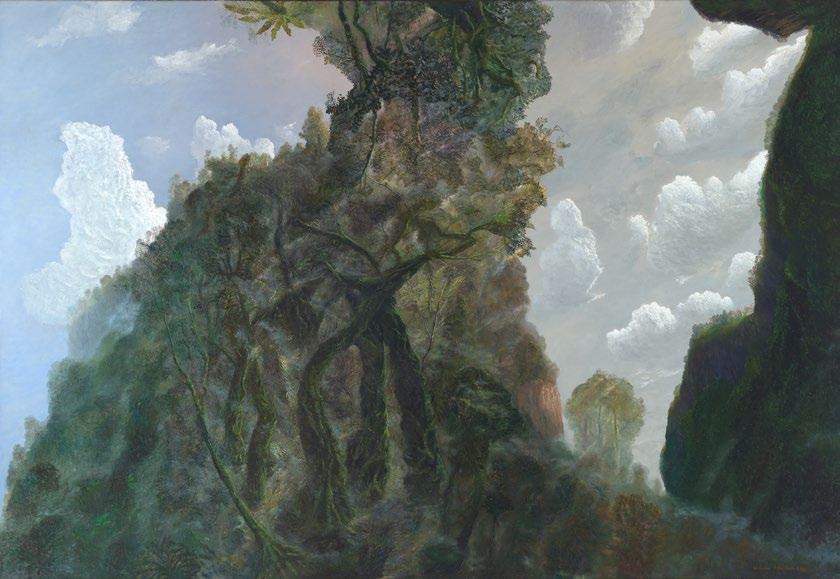
167.5
‘...To see one of Robinson’s landscapes is to be in it as well, to walk, and maybe to forage, with the painter through gumthicketed gullies where any difference between the sky and its reflection is hard to tell – and probably unnecessary to know. The viewer is required to take a leap of faith, and execute something akin to a cartwheel, before penetrating Robinson’s dizzy realms. The resulting experience is partly aesthetic, partly athletic...’ 1
With its multiple viewpoints and sweeping panorama of darkness and light, earth and air, To Beechmont with storm clouds building, 2002 offers a magnificent example of the highly original landscapes for which William Robinson became so widely acclaimed and admired. Departing from predecessors such as Streeton, Drysdale and Williams who focused their attention on either inland or urban landscapes, Robinson was unique in his devotion to an environment hitherto neglected by artists – the ancient, labyrinthine rainforests of his immediate surroundings in the coastal hinterland of southern Queensland and northern New South Wales. Similarly, where the Australian landscape tradition had been characterised by a strong horizontality, Robinson
deliberately eschewed established figure-ground relationships and conventional one-point perspective to transform landscape into a multi-view experience – allowing every fold and fissure to be explored yet still preserving a sense of panoramic continuity.
Immortalising those elements of nature which seem eternal –from the stormy clouds, mysterious in their gauzy substance to the endless forest, teeming with life – the present work powerfully encapsulates the artist’s enduring interest in the relationship between man and the cosmos. In stark contrast to his earlier bucolic farmyard scenes and landscapes which featured the genial folk figures of Bill and his wife Shirley, here the viewer is confronted with a dark, sombre wilderness which, within the context of the artist’s oeuvre, may well be construed metaphorically as a sign of mankind’s spiritual abandonment. Yet throughout his life Robinson steadfastly asserted the contrary – that God is in fact closest to his subject in desolation and moreover, that the artist reveals himself through his pictorial absence. Thus, for Robinson, ‘finding himself’ as a painter, appreciating the landscape and becoming closer to God were
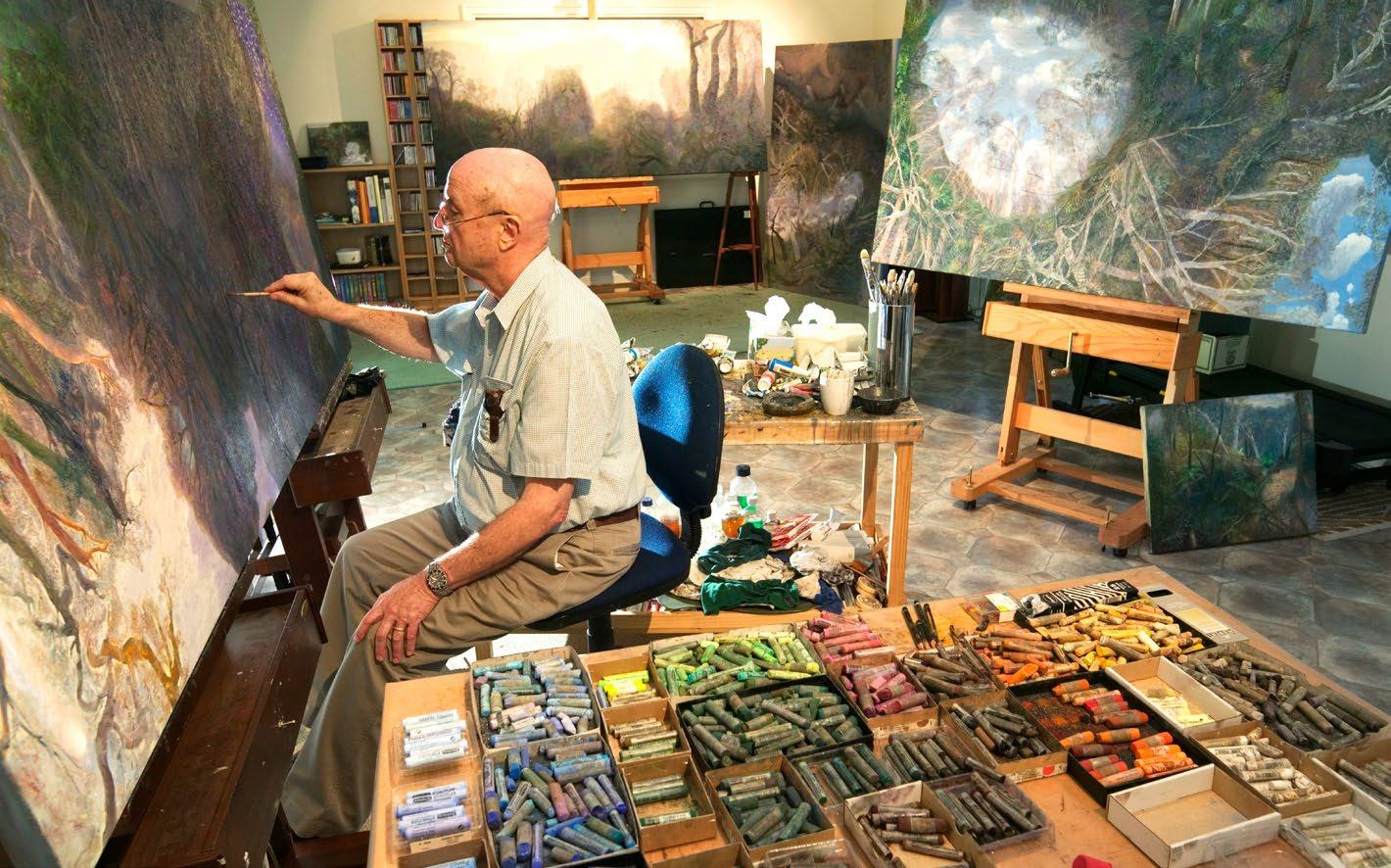
all inextricably linked. Indeed, describing the experience of walking through the forest of 2000 year old beech trees near his property at Springbrook (which he famously captured in the highly acclaimed five-panel masterpiece Creation Landscape – Darkness and Light I – V, 1988, Art Gallery of Western Australia), the artist poignantly evoked his visit to one of the world’s greatest pilgrimage destinations: ‘I wanted to show the presence of God somehow, not only through the mystery of walking through Chartres Cathedral and walking through this forest, but also something about the nature of providence.’ 2
Transcending descriptive landscape for more universal and metaphysical concerns, To Beechmont with storm clouds building celebrates the sheer wonder of creation itself with a panorama that is as grotesque as it is beautiful, as terrifying as it is marvellous – a place in which nature, memory and faith coalesce to offer one of the artist’s most profound meditations on the sacredness of the natural world. Capturing the silent, enduring power of this ancient landscape, Robinson seeks to convey not merely what he observes, but what he perceives
within himself in his lifelong quest for meaning and spiritual truth. Like Wordsworth’s ‘emotion recollected in tranquillity’, for Robinson painting is ultimately an act of contemplating ‘things felt or remembered’; as Hannah Fink astutely observes, ‘... wholeness resides in the experience of the landscape itself – as such, his paintings may be considered both compelling approximations of, and poetic tributes to, that sacred moment in which the physical and spiritual become synonymous.’ 3 Indeed, it is precisely this rare fusion of observation and contemplation, of physical reality and spiritual revelation, that distinguishes To Beechmont with storm clouds building as one of Robinson’s most compelling achievements.
1. James, B., ‘A Landscape We Thought We Knew’, Sydney Morning Herald, Sydney, 29 January 2003, p. 15
2. William Robinson, cited in Fink, H., ‘Light Years: William Robinson and the Creation Story’, Artlink, 2001, vol. 21, no. 4 at: www.artlink.com.au/articles/2555/light-years-williamrobinson-andthe-creation-stor/
3. Fink, ibid.
Veronica Angelatos
oil on canvas
122.0 x 152.5 cm
signed lower right: Arthur Boyd
Estimate: $180,000 – 240,000
Provenance
Holdsworth Galleries, Sydney, acquired directly from the artist c.1984 Private collection, Sydney, acquired from above Private collection, Sydney, a gift from the above in 2003 Estate of the above, Sydney
An untiring and extremely skilful painter of landscapes, Arthur Boyd is undoubtedly among Australia’s most revered artists with his highly personalised images of his homeland now iconic within the national consciousness. Among the more revelatory and widely acclaimed of his achievements, the extended sequence of luminous, sun-parched landscapes inspired by his travels to the Wimmera region in north-west Victoria are particularly celebrated. As Janet McKenzie elaborates, ‘…[in these paintings] Boyd created an archetypal Australian landscape. Possessing both a poetic lyricism and a down to earth quality and capturing the glorious light, these works… [offer] a sense of acceptance that many country-dwelling Australians could identify with.’ 1
Boyd first encountered the Wimmera region during the summer of 1948 – 49 when he accompanied the poet Jack Stevenson on a number of expeditions to Horsham in north-west Victoria. With its flat, semi-arid paddocks and endless horizons, the wheatfarming district presented Boyd with such a stark contrast to the verdant, undulating hills of Berwick and Harkaway (where he had recently undertaken an expansive mural series of Brughelesque idylls at his uncle’s property, The Grange) that he found himself required to develop a new visual vocabulary in order to capture this desolate landscape. Although the Wimmera could not be described as ‘uninhabitable’, it was for Boyd, his first glimpse of the vastness of Australia’s interior. As Barry Pearce notes, ‘…He discovered there a hint of something that had drawn other painters of his generation, a subject tentatively recorded by a few artists of the nineteenth century and touched on by even fewer of the twentieth: the empty spaces of the great interior. Of course, the Wimmera was wheat country and not by any means forbidding, nor forsaken. But in hot dry weather it could have, over sparse, unbroken horizons, a searing expanse of sky that elicited an acute sense of the infinite…’ 2
When initially unveiled at the David Jones Gallery in 1950, the Wimmera landscapes were greeted with universal acclaim – no doubt, as more than one author has observed, ‘because their sun-parched colours were so reminiscent of the Heidelberg school.’ 3 Significantly the paintings resonated not only amongst
the public, but also with institutions such as the National Gallery of Victoria which purchased arguably the most famous work from the series, Irrigation Lake, Wimmera, 1950, and the Art Gallery of New South Wales who acquired Midday, Wimmera, 1948 – 49 – thereby representing the first works by Boyd to enter a major public collection. Imbued with the spirit of the land, these works represented for many their first encounter with these ‘more intimate aspects of the Australian landscape’4 and thus, not only established Boyd’s reputation as ‘an interpreter of the rural Australian environment’ 5, but moreover, launched his career on the international stage, with Boyd subsequently awarded the honour of representing Australia at the Venice Biennale in 1958.
So profound was the impact of the stark simplicity and shimmering light of the Wimmera upon Boyd’s psyche that he would subsequently revisit the subject on several occasions over the following decades – whether painting at his property ‘Riversdale’ on the Shoalhaven river in southern New South Wales, or abroad while residing in London and Italy. A later iteration completed most likely in the early eighties, Wimmera, c.1980, is one such ‘re-imagining’ – encapsulating the complexity of Boyd’s vision which is invariably an amalgam of visual observation, artistic experience and emotional response. Offering a sophisticated reappraisal of the theme in its absolute sparseness, economy of detail and restrained palette, the image is one of intimacy and warmth – a poignant homage to the artist’s beloved homeland, created at the height of his painterly powers. Here there is no angst, no challenge, no dramatic dialogue between man and nature as may be found elsewhere in Boyd’s oeuvre; to the contrary, the work exudes a mood of stillness and calm acceptance, as Franz Philipp astutely observes of such Wimmera paintings ‘…the phrase ‘landscapes of love’ comes to mind.’ 6
1. McKenzie, J., Arthur Boyd: art and life, Thames and Hudson, London, 1967, p. 62
2. Pearce, B., Arthur Boyd Retrospective, The Art Gallery of New South Wales and The Beagle Press, Sydney, 1993, p. 20
3. Campbell, R., ‘Arthur Boyd (1920 – )’, Australia: Paintings by Arthur Streeton and Arthur Boyd, XXIX Biennale, Venice, 1958, n. p.
4. Pearce, op. cit.
5. Philipp, F., Arthur Boyd, Thames and Hudson, London, 1967, p. 67
6. ibid., p. 64
Veronica Angelatos
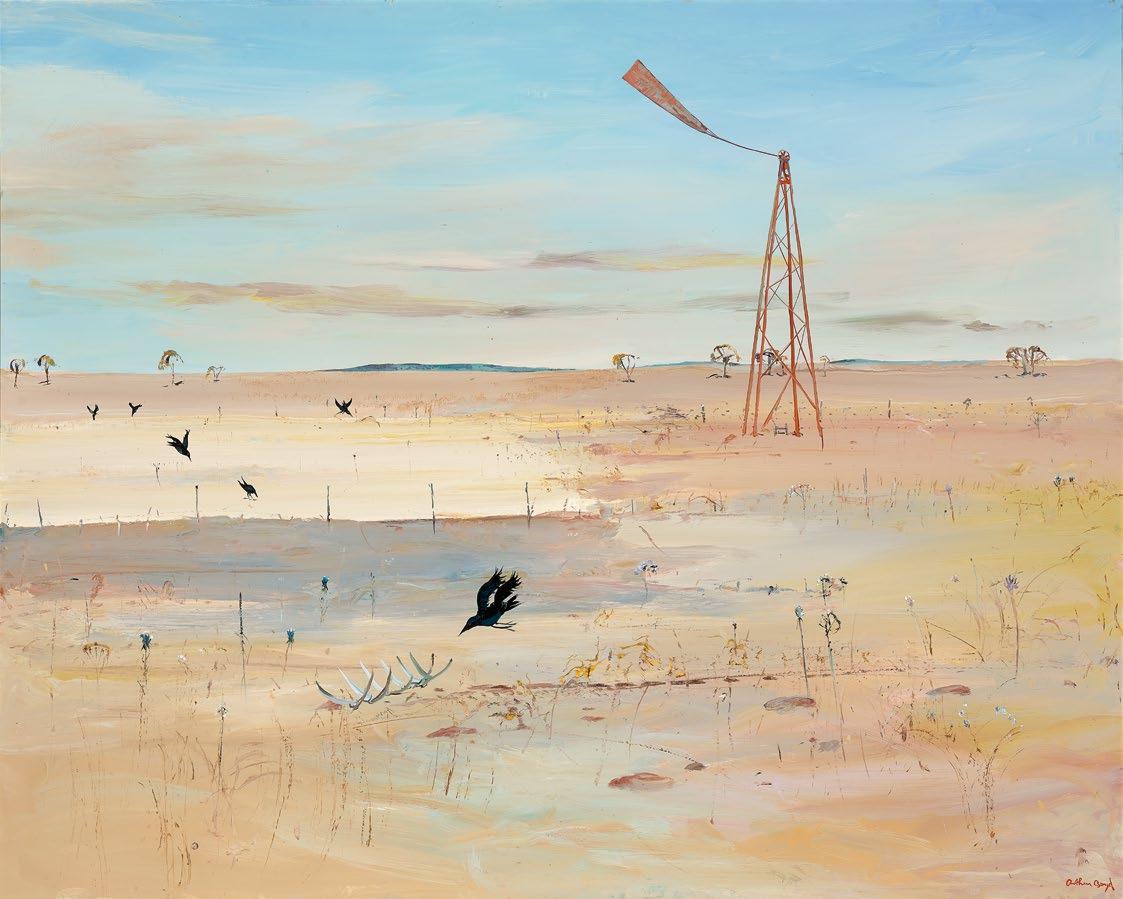
watercolour on paper
160.0 x 120.0 cm
signed and dated lower right: John Olsen / ‘01
Estimate: $65,000 – 85,000
Provenance
Olsen Gallery, Sydney Private collection, Melbourne, acquired from the above c.2001
Exhibited
John Olsen: Figures and Landscape, Olsen Gallery, Sydney, 15 December 2001 – 2 February 2002 (illus. in exhibition catalogue)
Literature
McGregor, K., and Zimmer, J., John Olsen: Journeys Into the You Beaut Country, Thames and Hudson, Melbourne, 2016, pp. 246 (illus.), 340
‘I’ve been nearly drowned on the blessed lake when our boat sank in a sudden storm; nearly been sucked under by the quicksandlike treacherous black mud; nearly been blown away by winds that howl in at midnight, buffeting your tent; I’ve had desert sand blow into my eyes, my paint, the camp oven, and ruin my beautiful fish paellas... but all in all, I’ve had a fabulous time there.’ 1
Located 700 kilometres north of Adelaide, Lake Eyre first captured Olsen’s imagination in October 1974 when he was invited by the esteemed naturalist, Vince Serventy, to venture to the area which had flooded for only the second time in living memory since white settlement. Known as the ‘Dead Heart’, the arid, salt-encrusted interior of South Australia was suddenly transformed into a teeming inland oasis, ‘a carnival of life’, leaving the artist not only awestruck, but inspired – both visually and conceptually – by the contradictions inherent within such a place – of fullness and emptiness, life and death. As Deborah Hart suggests, ‘Life approached the lake, clinging to its edges; however, the lake itself was a place for contemplation, a vast, engulfing space: The void...’ 2 And Olsen himself elaborated ‘[t]he lake might be viewed symbolically as an unconscious plughole of Australia, a mental landscape, as is the habit of painting and writing. Because it is 13 metres below sea level –and perhaps nowhere in Australia does one have the feeling of such complete emptiness – covered by a bowl of endless sky with inviting silences, there is, as you stand on the edge of the lake, a feeling that you are standing on the edge of the void.’ 3
Olsen was so profoundly affected by his experience at Lake Eyre that henceforward motifs of ‘the void’ and ‘the edge’ would become central to his way of interpreting the world for decades to come, indelibly influencing his understanding of the intimacy of form and line; ‘...the serene atmosphere and reductive qualities found in many of his works, where the empty spaces are as important as the marks themselves, and to the line probing space, becoming the edge, where things meet, end and begin again.’4 Revisiting the fringe-like imagery synonymous with his Lake Eyre paintings of the seventies, The lake’s edge, 2001 features an aerial perspective and striking minimalist sensibility, attesting to Olsen’s interest in the maxim permeating Chinese art and literature of ‘stretching emptiness to its limits’ – a perfect encapsulation of the void as evoking both ‘everything and nothingness.’ Set upon a dramatically tilted picture plane that may be apprehended simultaneously on macro and micro levels, the composition captures Olsen’s characteristic informality through the off-centre placement of the lake – a compositional device likewise evident in such iconic works as Dark void, 1976 (formerly in the collection of the National Australia Bank) and Bathurst butter, 1999, which Olsen gifted to his wife at the time, Katherine Howard, on their tenth wedding anniversary.
Demonstrating Olsen’s brilliance as a master watercolourist, notably this work dates from a decade of unparalleled public and critical acclaim in the artist’s vast oeuvre – marked by the publication of Deborah Hart’s definitive monograph (1991) and his autobiography, Drawn from Life (1997), as well as the landmark retrospective hosted by the National Gallery of Victoria and the Art Gallery of New South Wales during 1991 – 92, which cemented his enduring status as one of Australia’s most significant artists.
1. John Olsen, cited in Hawley, J., ‘John Olsen’, Encounters with Australian Artists, University of Queensland Press, Queensland, 1993, p. 134
2. Hart, D, John Olsen, Craftsman House, Sydney, 1991, p. 135
3. Olsen cited in Olsen, J., and Serventy, V., ‘The Dead Heart Lives’, National Times 17 – 22 February 1975, p. 31
4. Hart, op. cit., p. 135 Veronica Angelatos
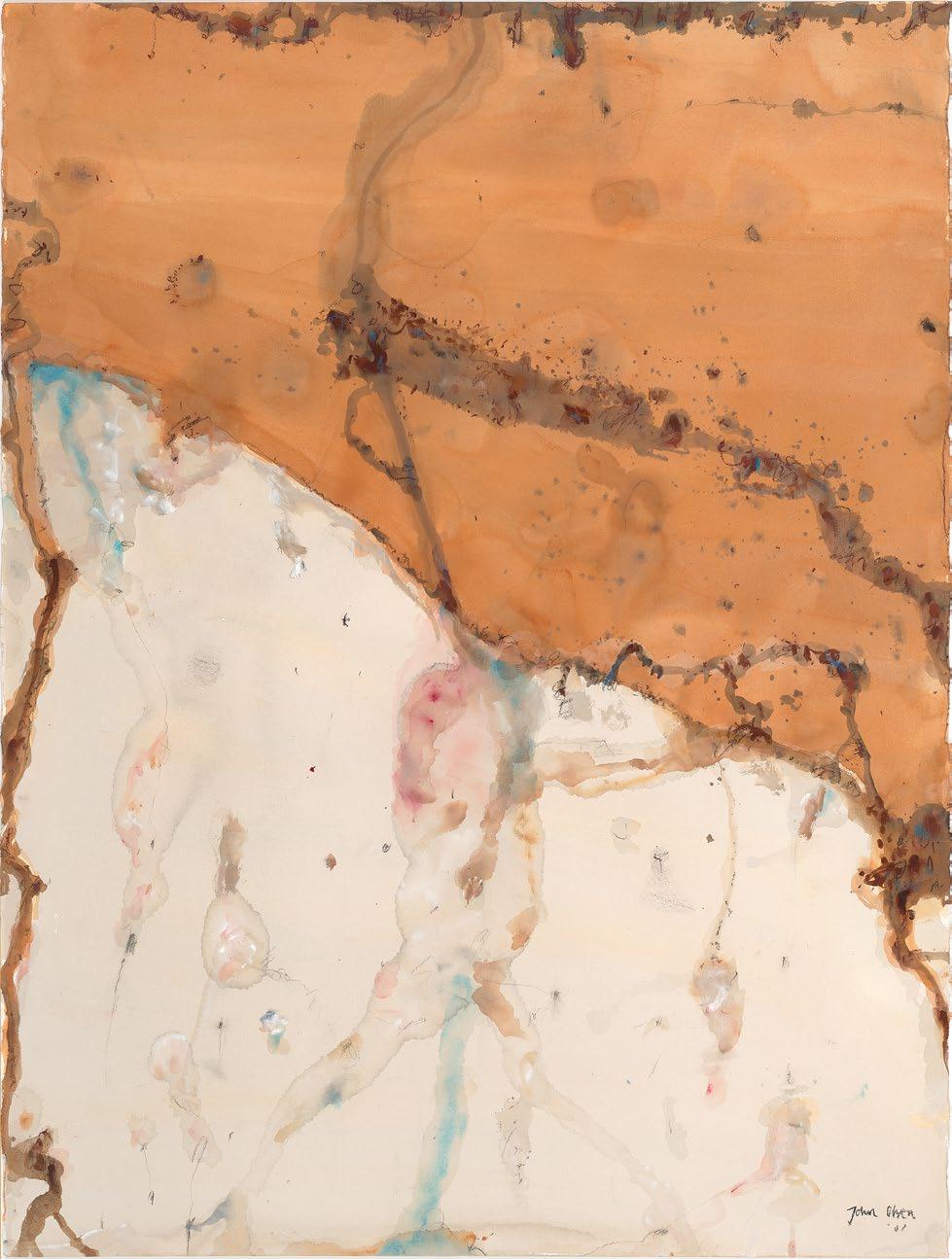
oil on composition board
76.0 x 101.5 cm
signed lower left: Olley
Estimate: $45,000 – 65,000
Provenance
Greenhill Galleries, Adelaide Holdsworth Galleries, Sydney Private collection, Sydney Estate of the above, Sydney
Exhibited
Margaret Olley, Greenhill Galleries, Adelaide, 1 – 23 October 1985, cat. 16
Literature
The Olley Project, https://ehive.com/collections/5439/ objects/465939/still-life-with-kelim (courtesy of The Margaret Olley Art Trust & Philip Bacon Galleries, Brisbane)
‘…I can think of no other painter of the present time who orchestrates his or her themes with such richness as Margaret Olley. She is a symphonist among flower painters; a painter who calls upon the full resources of the modern palette to express her joy in the beauty of things.’ 1
A beloved personality of the Australian art world for more than six decades, Margaret Olley exerted an enduring influence not only as a remarkably talented artist, but as a nurturing mentor, inspirational muse and generous philanthropist. Awarded an Order of Australia in 1991 and later a Companion of the Order of Australia in 2006, Olley was the subject of two iconic ArchibaldPrize winning portraits (by Dobell and Quilty respectively) and honoured with more than ninety solo exhibitions during her lifetime, culminating in a major retrospective at the Art Gallery of New South Wales in 1997. Today her work is held in every major public collection in Australia, while the contents of her Paddington studio have been immortalised in a permanent installation at the Tweed Regional Gallery. Bequeathing a legacy as bountiful as the subject matter of her paintings, indeed her achievements are difficult to overstate – and reach far beyond the irrepressible sense of joy her art still brings.
A striking example of the still-life and interiors for which Olley remains celebrated, Still life with kelim, 1985 superbly encapsulates her lifelong practice of turning to the quotidian for
inspiration, revealing the beauty inherent within the everyday rituals of domestic life. Here dark purple plums rest on a delft blue and white porcelain plate, apples are loosely scattered between a ceramic compote and bowl, while rustic Spanish vases and a flask are balanced by a tall, blue-rimmed jug brimming with freshly cut flowers – all arranged before a marble fireplace and upon a richly patterned kelim reminiscent of the exotic interiors of Matisse. Saturated crimsons and russets sweep across the composition, enveloping fruit, earthenware and textile in a luminous chromatic harmony counterpointed by the cool green-grey tones of the fireplace, while the commanding pedestal bowl and recurring rhythm of rounded vessels and fruit establish a quiet architectural balance beneath the painting’s effortless abundance. Yet such apparent informality belies the meticulous ‘orchestration’ that invariably underpins Olley’s compositions – a discipline directly informed by her experience of the theatre in 1948 when she assisted with painting the sets for Sam Hughes’ productions of Shakespeare’s Pericles and Cocteau’s Orphée (designed by Jean Bellette and Sidney Nolan respectively).
Paying homage to the great European masters of her métier –Vermeer, Bonnard, Matisse and Cézanne among them – Olley carefully choreographs the various components of her exquisite still lifes as though actors upon a stage, advancing the richly laden table towards the picture plane to gently compress pictorial space, while objects both commonplace and beautiful are shuffled this way and that until each vessel, blossom and piece of fruit assumes equal poetic significance. Leading the viewer’s eye through a quietly unfolding, deeply personal drama that resonates with the artist’s delight in her domestic surrounds, indeed each composition reveals the very essence of her identity; as Barry Pearce elucidates, ‘…to live with a Margaret Olley painting is to experience the transfiguration of a passionate, highly focused personality into art. In her paintings, the space surrounding each bowl of fruit, each vase of flowers, and through which the eye traverses a cacophony of surfaces such as patterned carpets, modulated walls, and cluttered tabletops, resounds with her presence. These are reflections of the things she loves, and which embellished the centre of how she prefers her existence to be.’ 2
1. Gleeson, J., ‘Introduction’, Margaret Olley, The Johnstone Gallery, Brisbane, 1964, n. p.
2. Pearce, B., ‘Margaret Olley Retrospective’, State of the Arts, Sydney, August – November 1996, p. 5
Veronica Angelatos
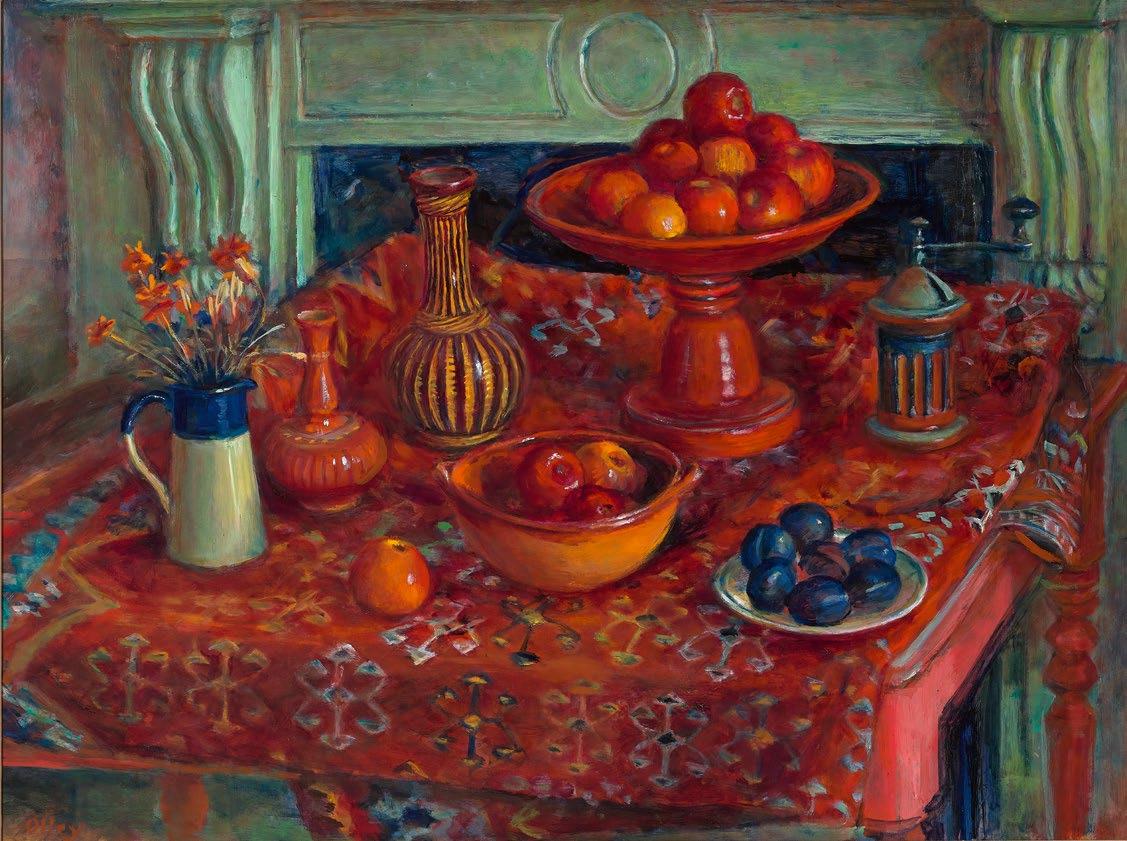
oil on academy board
22.0 x 37.5 cm
signed lower left: … / Eugene von Guerard
Estimate: $120,000 – 180,000
Provenance
Private collection
Leonard Joel, Melbourne, 11 April 1984, lot 150 (as ‘Victorian Coast Line’)
Private collection
Thence by descent
Albert Manning, Melbourne and Perth GFL Fine Art, Perth, 29 November 2022, lot 50
Private collection, Perth
Related works
View of the Granite Rocks at Cape Woolamai, 1872, oil on canvas, 65.8 x 114.6 cm, private collection
View of the granite rocks at Cape Woolamai, c.1872, oil on canvas mounted on cardboard, 21.0 x 36.0 cm, National Gallery of Australia, Canberra
In December 1869, von Guérard spent eight days sketching at Phillip Island. His hosts were John and Georgianna McHaffie who, along with two of John’s brothers, had secured the pastoral licence for the entire island in 1842 – though that changed with the government’s 1868 – 69 subdivisions of the land. During his stay, von Guérard produced a series of large and sketchbook drawings, in which the island’s rocky coastline is portrayed with crystalline clarity and extraordinary geological precision. Among them was the sketch upon which The Pinnacles, Cape Woolamai, c.1872 was based.
On 18 December 1869, von Guérard and Georgianna’s brother, J.B. Henderson, a surveyor and watercolourist, set out on horseback for the ten-mile ride from McHaffie’s homestead at Ventnor to Cape Woolamai. The artist’s impressions of the site are recorded in three double-page sketchbook drawings: the first from the cliff top, the second of the Pinnacles with the Nobbies in the distance, and the third, the drawing for the present work, looking to the south-east.1 As they explored the site, he and Henderson came across ‘thousands of nests of mutton birds’, and lots of ‘shells and bird bones’ – perhaps the remains of middens built up over years by Bunurong people, whose country this is.
In 1855 – 56, von Guérard’s associate, the geologist, zoologist and artist, Wilhelm von Blandowski, reported that ‘The granite of Cape Woolamai is quite peculiar to that locality and forms picturesque pyramidal peaks, on and around which are seen numbers of sea hawks (ospreys) and gulls. This fine-coloured
granite is characteristic, on account of the intense green colour of the mica, and the livid flesh colour of the feldspar.’ 2 Von Guérard’s response was both scientific and Romantic: the forms of the spectacular red granite stacks and their cracks and fissures, created as the hot magma cooled and shrank, are articulated with geological accuracy. Here he also felt the awe-inspiring power of nature at its most elemental: sea, wind, rain and rocks that spoke of an unimaginably ancient geological history.
Von Guérard painted four versions of this subject. Of the largest, View of the Granite Rocks at Cape Woolamai, 1872 , he wrote, ‘Lately I have painted a marine peace [sic.] of very fine red Granit [sic.] rocks from Philip Island [sic.] at Cape Wooloomai [sic.] with fine green waves dashing against those rocks. I hope it will be of some effect.’ 3 The work, exhibited at Melbourne’s Victorian Academy of Fine Arts in 1872 and at the Vienna World Exposition in 1873, received mixed reviews, but the fact that another three versions were painted testifies to the interest it generated. One version is now in the collection of the National Gallery of Australia, another in a private collection.
The work presented here, which shares almost the same dimensions as the National Gallery of Australia’s painting, has the freshness and energy of a study. The brushwork is confident, free and painterly. With sea birds wheeling above the Pinnacles, sea spray suspended in midmotion and a sense of rapidly shifting light and weather conditions, this work has an airy, atmospheric immediacy. It seems that von Guérard enjoyed painting this picture.
1. Eugene von Guérard, Sketchbook XXXVI, 1866 – 1870, Dixson Galleries, State Library of NSW, DGB 16, vol. 14a, ff. [62], [63], [64], [65]
2. William Blandowski, ‘Report no. III to the Surveyor General of an excursion from King’s Station to Bass River, Phillip and French Islands’, in Transactions of the Philosophical Institute of Victoria from August 1855 to December 1856 inclusive, Melbourne, 1857, p. 54
3. Eugene von Guérard, Letter to William Strutt, 29 January 1872, William Strutt papers, ML MSS 167/5, Mitchell Library, State Library of NSW, Sydney.
Dr Ruth Pullin
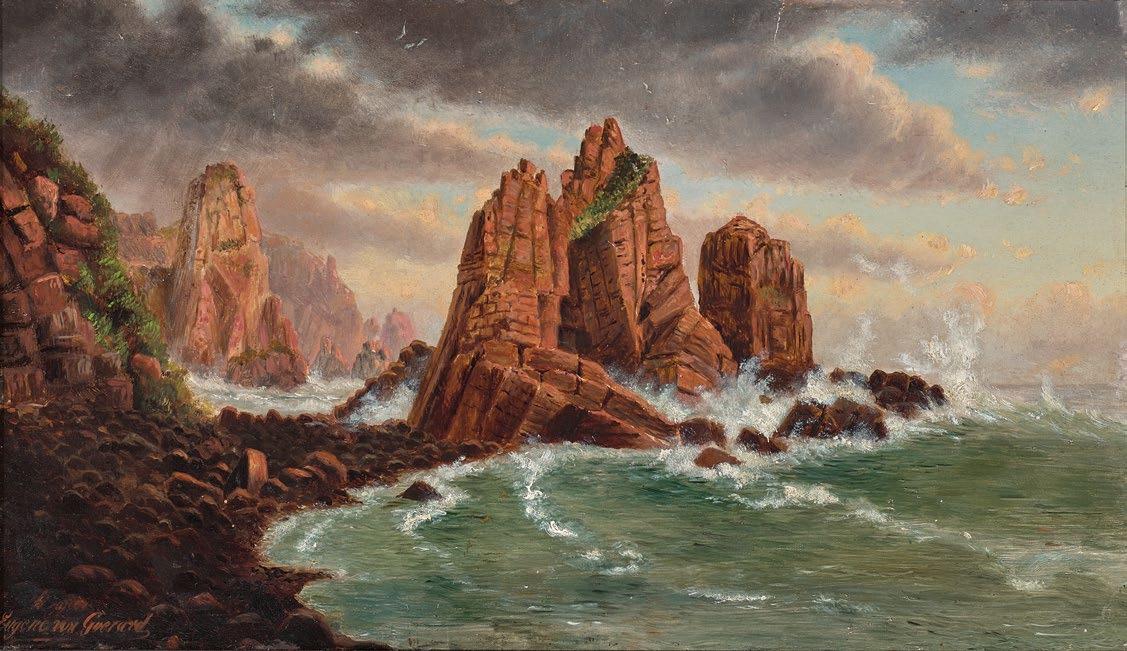
1925)
Yacht India and Schooner Gloriana coming out of Torbay oil on canvas
84.0 x 122.5 cm
signed lower left: Forrest
Estimate: $30,000 – 40,000
Provenance
Private collection, Hobart
Related work
Yacht India and Schooner Gloriana coming out of Torbay, oil on canvas, 63.0 x 114.0 cm, private collection, illus. in Deas Brown, G., Haughton Forrest, Malakoff Fine Art Press, Victoria, 1982, p. 132
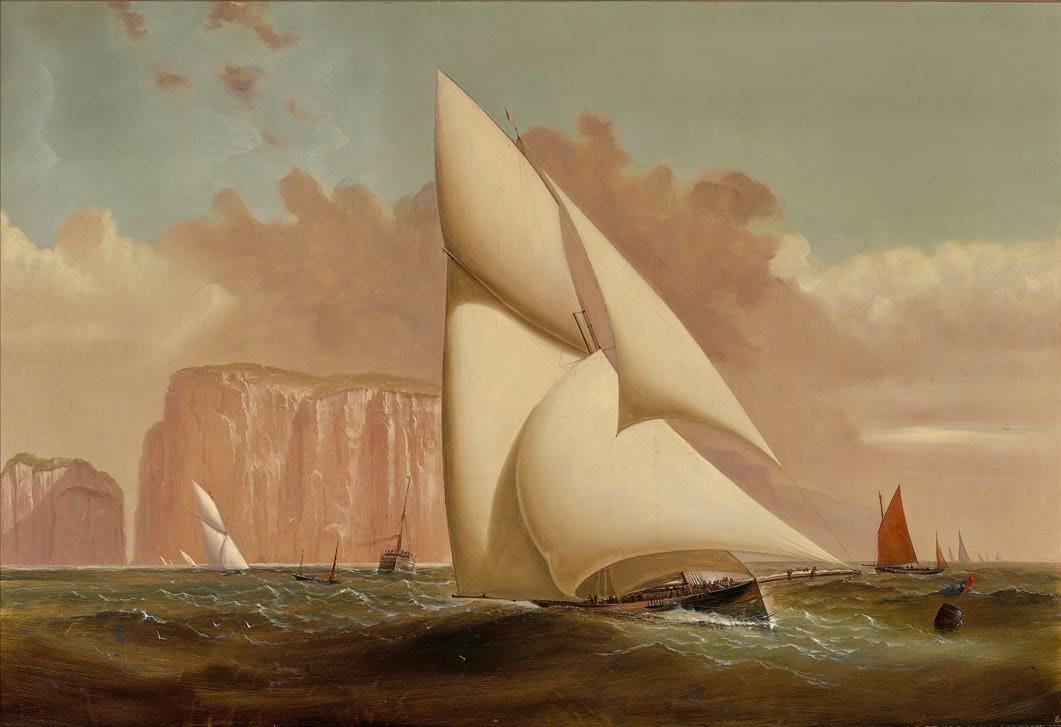
oil on canvas
58.0 x 78.0 cm
signed lower right: F. McCubbin
original John Thallon Frame, Melbourne
Estimate: $120,000 – 180,000
Provenance
Mr Charles Mills, ‘Uardry’, Hay, New South Wales
Thence by descent
Private collection, New South Wales
Thence by descent
Private collection, New South Wales
Related works
Hauling rails for a fence, Mount Macedon, 1910, oil on canvas, 71.5 x 101.5 cm, National Gallery of Australia, Canberra Forest camp, 1914, oil on canvas, 25.3 x 35.5 cm, National Gallery of Victoria, Melbourne
A major influence in Frederick McCubbin’s long career was the imagery and philosophy of the Barbizon school of artists who painted within the Forests of Fontainebleau, fifty kilometres south of Paris, between the 1820s and 1880s. These artists, including Jean-François Millet and Jean-Baptiste-Camille Corot, were not only distinctive in their dedication to plein air painting; they were also driven by the challenge of how to integrate the figure within the landscape. A number of McCubbin’s major works – particularly Lost, 1886 (National Gallery of Victoria); Down on his luck, 1889 (Art Gallery of Western Australia) , and The pioneer, 1904 (National Gallery of Victoria) – explore this same challenge. However, on his only overseas visit to England and France between July and October 1907, McCubbin encountered for the first time actual examples of the paintings of his many painting heroes, writing to Tom Roberts that ‘I actually thought I was somebody over in England, right up against Rembrandt, Turner, Velasquez, Gainsborough, Reynolds. I felt quite in good company.’ 1 He also saw works by Claude Monet and ‘seeing the materiality of so many light-drenched late Turners and French Impressionist pictures bolted McCubbin fully into the new late style towards which he was already tending.’ 2 After his return, his paintings became less populated and lighter in mood, utilising a new palette filled with pinks and soft greens applied with brush and palette knife.
Some years before this, in 1901, McCubbin purchased a twostorey house in Glover Road, Mt Macedon, which he named, not so surprisingly, ‘Fontainbleau’, and the scrubby hills behind it provided the setting for a number of major works including The pioneer. It appears that Macedon landscape (View from Hesket), c.1910 – 12, was painted a kilometre away at the north-eastern foot of Mt Macedon near the village of Hesket which had been
the centre of a timber industry that began in 1837. By the turn of the century, however, the majority of the local white gum, stringybark, messmate and peppermint trees had been felled though sufficient remained to support a small industry. In Macedon landscape (View from Hesket), a reflective McCubbin looks over the now-cleared fields from a position within the surviving scrub. At bottom left may be seen the blue-violet run of low ranges incorporating the Cobaw State Forest, also seen in Hauling rails for a fence, Mt Macedon, 1910 (National Gallery of Australia), with the scene described by McCubbin as being ‘a regular Millet.’ 3 He likely stood where Gallery School students would camp when visiting McCubbin, a site known as the ‘Old Garden’. ‘My father loved the spot,’ said daughter Kathleen Mangan. ‘It was about a mile from our cottage and it had a swampy area there full of that long grass that grows in swamps and also numerous bullfrogs.’4 By having a permanent base at Mt Macedon, McCubbin was able to immerse himself in the local environment as the Barbizon artists had done at Fontainbleau, charting Mt Macedon’s seasons and the variable light of each day. Critics too noted the quality of these radiant works, lauding the artist’s ‘remarkable skill in dealing with and realising the intricacies, colour and atmosphere of the Australian bush; especially… the artistic tangle of the undergrowth, and the charm of solitude and silence.’ 5
Notably, the painting’s original owner, Charles Mills, was the founder of the internationally renowned ‘Uardry’ sheep station in Western New South Wales. The continuing quality of their wool was of such importance to the Australian economy that one of Uardry’s prize merinos was the model for the image on the oneshilling coin in 1938.6 When in Melbourne, Mills lived in Toorak, not far from McCubbin’s home in Kensington Avenue, South Yarra.
1. Frederick McCubbin, Letter to Tom Roberts, late December 1907, cited in McKenzie, A., Frederick McCubbin 1855 – 1917: ‘The Proff’ and his art, Mannagum Press, Melbourne, 1990, p. 269
2. Gray, A. (ed.), McCubbin: last impressions 1907 – 17, National Gallery of Australia, Canberra, 2009, p. 17
3. Frederick McCubbin, Letter to Tom Roberts, 19 January 1910, cited in McKenzie, op. cit., p. 280
4. Kathleen Mangan, cited in McKenzie, ibid., p. 188
5. ‘Mr F. McCubbin. A distinguished artist’, The Argus, Melbourne, 21 December 1917, p. 11
6. Laurissa Smith, ‘Former jackeroo uncovers story behind shilling ram’, ABC News 19 March 2014 at: https://www.abc.net.au/news/rural/2014-03-19/shilling-rambook/5330800 (accessed 5 June 2026) Andrew Gaynor
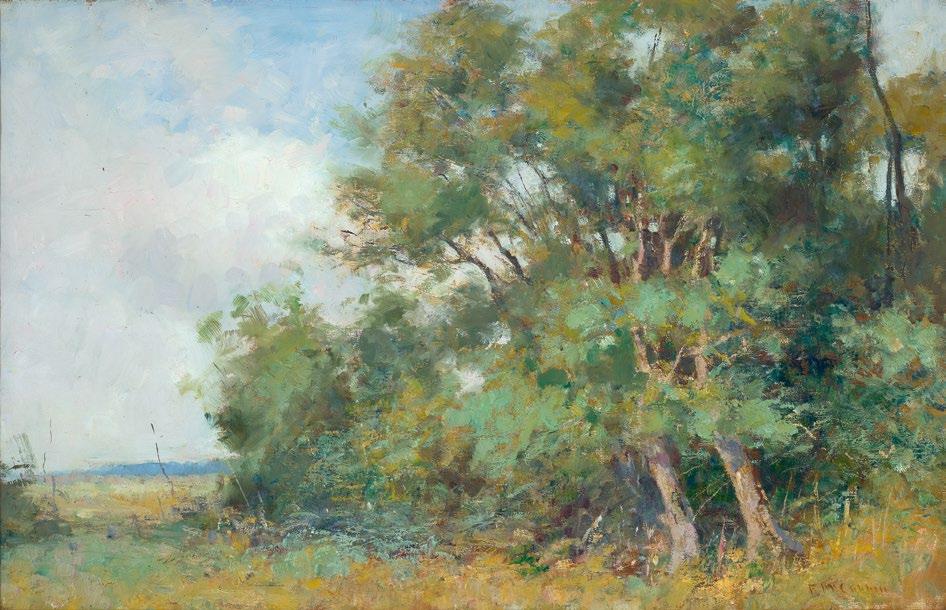
oil on canvas
62.0 x 74.0 cm
signed lower left: A STREETON
bears inscription verso: 275 / RMC / R. M. Clark esq
Estimate: $120,000 – 160,000
Provenance
The Macquarie Galleries, Sydney
Sir Reginald Marcus Clark, Sydney
The Estate of the Late Sir Reginald Marcus Clark, K.B.E., James R. Lawson, Sydney, 10 – 14 June 1954, lot 34 (as ‘Sassafras, Victoria’)
Private collection, New South Wales
Thence by descent
Private collection, New South Wales
Deutscher and Hackett, Melbourne, 4 May 2016, lot 27
Private collection, Victoria
Exhibited
Exhibition of Oil Paintings by Arthur Streeton, The Macquarie Galleries, Sydney, 10 – 26 March 1927, cat. 3
Loan Exhibition of Works by Arthur Streeton, National Art Gallery of New South Wales, 20 November 1931 –20 January 1932, cat. 130 (as ‘Sassafras, Victoria’)
Streeton Memorial Exhibition, The National Art Gallery of New South Wales, Sydney, 12 April –20 May 1945, cat. 42 (as ‘Sassafras, Victoria’)
Literature
Streeton, A., The Arthur Streeton Catalogue, Melbourne, 1935, cat. 880, p. 136
When Sassafras, 1926 was first unveiled in Arthur Streeton’s exhibition at The Macquarie Galleries, Sydney, the art critic for The Sydney Morning Herald hailed the show as being ‘representative of his best style – mellow toned, strongly realistic, and skilfully composed.’ 1 Of the many landscapes, he wrote, ‘Almost without exception, they are bathed in that brilliant, warm light which is so characteristic of Australia, as compared with the broken and colder glow that usually rests on landscapes in England.’ The chief painting in the exhibition was City of laughing loveliness, Sun-girdled Queen, 1921 – a captivating view of Sydney Harbour. Sassafras appealed so greatly to (later Sir) Marcus Clark, then one of Australia’s leading art collectors, that he added it to his already substantial holding of Streeton’s paintings. Indeed, Clark possessed an outstanding collection of Australian and British art representing the proverbial ‘who’s who’ of the time, including Tom Roberts, Frederick McCubbin, Rupert Bunny, George Lambert, Elioth Gruner, Julius Olsson R.A., Sir John Lavery R.A., A.J. Munnings A.R.A. and many others. His Roberts was the stunning Holiday Sketch at Coogee, 1888 (now in the collection of the Art
Gallery of New South Wales), with an equally vibrant work by Bunny, The Green Caterpillar, 1910 (formerly on long term loan to the Art Gallery of New South Wales). His collection aroused such interest that, after a Sydney showing in 1923, it toured Tasmania from June to September of 1926, being exhibited in Hobart at the Tasmanian Museum and Art Gallery, and at Launceston. Five works by Streeton were featured in the Tasmanian exhibition, and years later another six examples, including the present Sassafras, were included in the major Streeton Memorial Exhibition held at the National Gallery of New South Wales in 1945.
Painted in the same richly productive year as Land of the Golden Fleece, 1926 (private collection), Sassafras offers an engaging lyrical setting for a theme that was to occupy the artist in his later years – namely, his deep concern for the future of the Dandenong Ranges and their majestic gum trees. Into the grandeur of the panoramic scene of Sassafras with its majestic and overarching sky of blue and clouds of plenty, Streeton introduces that wanton destruction seen in the vertical reach of dead trees and fallen timbers among the living. Such deforestation is symbolised by the striking image of the remains of a once noble gum, slain in the foreground like some sacrificial victim. Its poignancy is heightened by the natural beauty of the scene and its bravura translation into paint. Streeton had moved to his new home ‘Longacres’ at Olinda in the Dandenongs in 1924. Here he continued to paint pictures of panoramic beauty and abundance. The year before he painted Sassafras, he gave an address to the Forest League titled ‘Australian Trees and Art’. He questioned why ‘should we suffer hundreds and hundreds of acres of valuable timber to be destroyed to facilitate some work of the moment when so little is gained for it?’ 2 The theme continued in such masterly works as Last of the messmates, 1928 (private collection); The vanishing forest, 1934 (Art Gallery of Ballarat, on loan from the Estate of Margery Pierce) and particularly, the confronting Sylvan Dam and Donna Buang AD 2000, 1940 (private collection) where Streeton not only starkly documents the damage being wreaked on the natural world, but condemns with growing vehemence the commercial motivations underlying it.
1. ‘Oil Paintings. Mr. Streeton’s Exhibition’, Sydney Morning Herald, Sydney, 10 March 1927, p. 6
2. Argus, Melbourne, 27 November 1925, p. 23, cited in Mary Eagle, The Oil Paintings of Arthur Streeton in the National Gallery of Australia, National Gallery of Australia, Canberra, 1994, p. 164
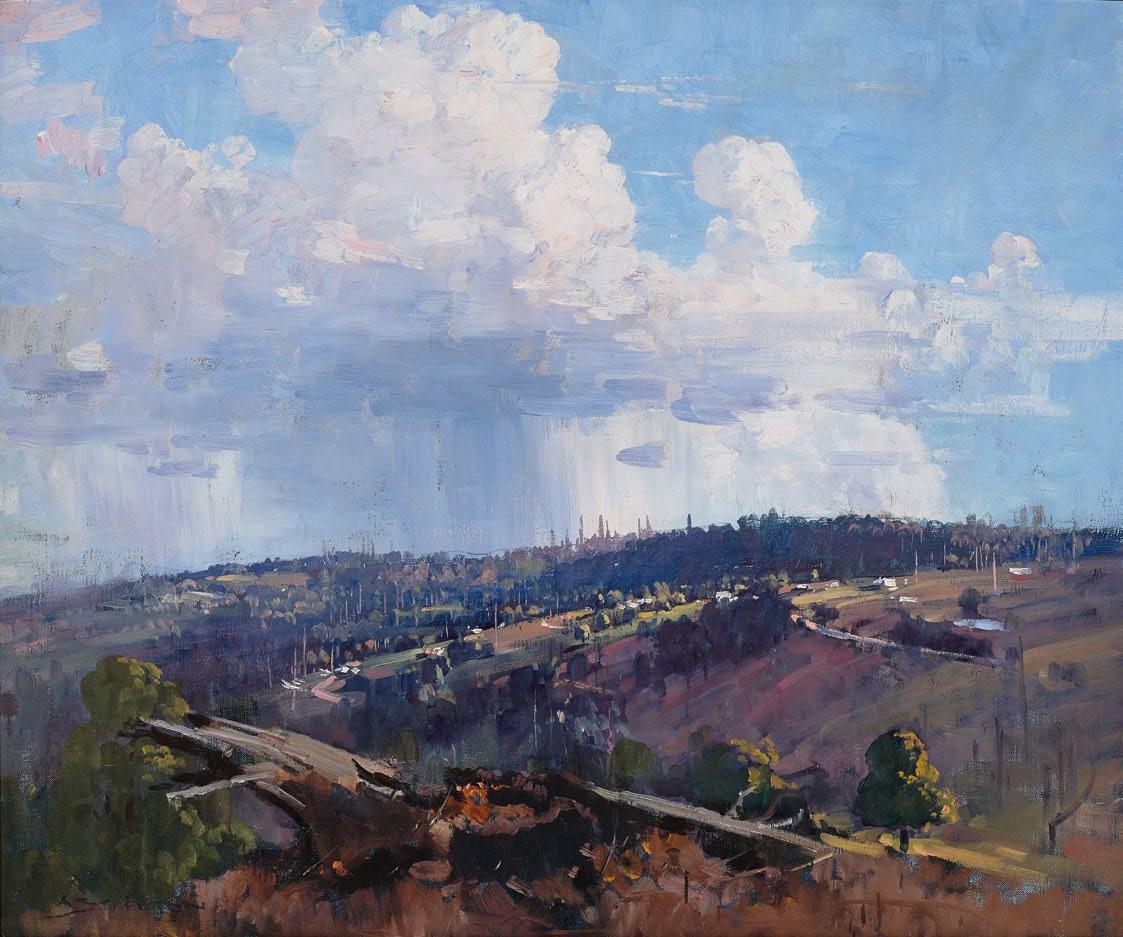
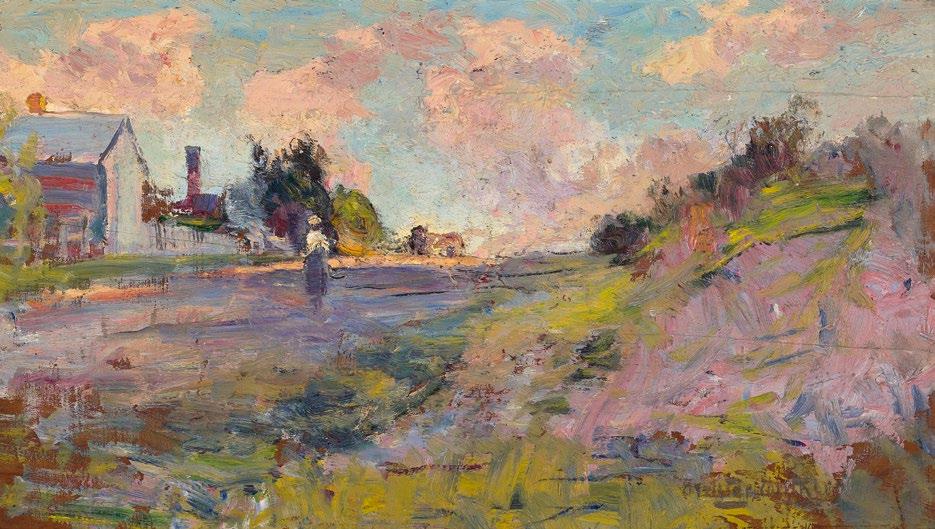
49 Walter Withers (1854 – 1914)
An old cottage, c.1905
oil on wooden panel
21.0 x 35.5 cm
signed lower right: Walter Withers
Estimate: $25,000 – 35,000
Provenance
The Sedon Galleries, Melbourne
John Rowell, Melbourne
Thence by descent
Joan Ackland, Melbourne
Thence by descent
Private collection, Melbourne
Exhibited
Art Union of Paintings By the late Walter Withers and his son Meynell Withers, The Sedon Galleries, Melbourne, 3 – 15 May 1926, cat. 43
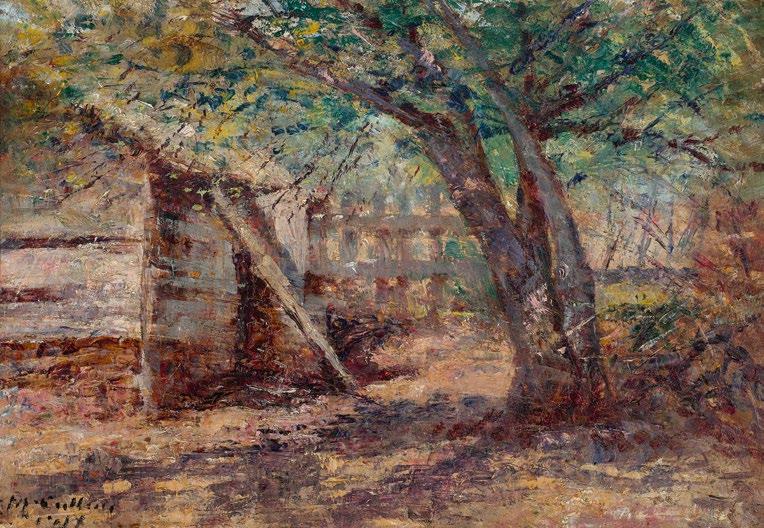
50 Frederick McCubbin (1855 – 1917)
The bush hut, 1911
oil on cedar panel
25.0 x 35.5 cm
signed and dated lower left: F McCubbin / 1911
bears inscription verso: Bush Hut / 40
Estimate: $30,000 – 40,000
Provenance
John Rowell, Melbourne
Thence by descent
Joan Ackland, Melbourne
Thence by descent
Private collection, Melbourne
Exhibited
Pictures by Fred and Louis McCubbin, Athenaeum Art Gallery, Melbourne, 14 August – 1 September 1912, cat. 40 (as ‘Bush Hut’)
oil on canvas on board
30.5 x 38.0 cm
signed lower right: F. V. LAHEY.
Estimate: $30,000 – 40,000
Provenance
Mildred Lovett, Hobart, probable gift from the artist
Thence by descent
Private collection, Melbourne
Private collection, Victoria, acquired from the above
Related works
The Customs House, Hobart, 1923, oil on canvas, 30.8 x 37.0 cm, private collection, illus. in MacAulay, B., Songs of Colour: The Art of Vida Lahey, Queensland Art Gallery, Brisbane, 1989, p. 50
Customs House, Hobart, 1929, oil on canvas on plywood, 41.0 x 51.0 cm, private collection, illus. in MacAulay, B., Songs of Colour: The Art of Vida Lahey, Queensland Art Gallery, Brisbane, 1989, p. 50
This hitherto unrecorded painting of Customs House, Hobart, was likely painted by Vida Lahey on her return to Australia after her second journey to Europe in the late 1920s. Its compositional design and gestural brushwork differ from her earlier pieces, a method she first utilised in paintings done in Italy in 1928, particularly Santa Margherita, 24km from Genoa, and Early morning, Santa Margherita. This is supported by the fact that the painting was originally owned by her close friend, the artist Mildred Lovett, whom Lahey revisited when her ship stopped at Hobart on the journey back to her home in Brisbane, allowing her to stay with her colleague for a period. Lovett already owned an earlier painting by Lahey, Customs House, 1923, which has the same dimensions as this work, and the supposition is that Lahey painted this alternate view in her new style to act as a pendant to the existing work.
Vida Lahey was an extremely important artist in the early twentieth century studying first in her late teens with Godfrey Rivers at the Brisbane Technical College before moving to Melbourne where she trained further at the National Gallery School between 1905 and 1909. In 1912, her early masterwork Monday morning, 1912, was purchased by the Queensland Art Gallery, and has remained a firm favourite with audiences ever since. In 1915, she travelled to London as support for her three enlisted brothers and immersed herself in the war effort. When hostilities ceased, she travelled to Paris studying at the acclaimed Académie Colarossi and took classes with Ethel Carrick. On her return to Brisbane, she rapidly became known for her fresh and vividly executed paintings and watercolours, her intention being to ‘bring home everything she learnt in Europe… she gave much
to her fellow artists and students in Brisbane. This included administrative work and teaching, as well as proselytising the virtues of art as an educational tool.’ 1 However, she soon became exhausted as a result of these efforts and the lingering effects of the war, so readily accepted Lovett’s invitation to stay with her for a few weeks in late 1921 – a relocation which eventually stretched to 1923. The two women, who had known each other since 19142, exhibited together in 1923, and Lahey was to return to Tasmania at least twice more between 1923 and 1928, exhibiting with the Art Society of Tasmania both times.
Of the two other views of Customs House that Lahey painted in 1923 and 1929, her approach is more traditional, exploring ‘the effects of light and colour with a substantial stone pile.’ 3 In the work on offer here, Customs House, Hobart, c.1928, Lahey has moved positions to take in the eastern side of the building, as seen from the farther side of Victoria Dock.4 In the same vein as her Italian paintings, she portrays ‘boats on water with architectural backgrounds… seen against high horizon lines’ 5, in this case, the imposing Mt Wellington (Kunanyi). Behind the building’s ribbed dome, the prominent General Post Office clock tower may also be seen.
1. Gorman, C. and Gorman, T., Intrépide: Australian women artists in early Twentieth Century France, Monash University Publishing, Melbourne, 2020, p. 95
2. See Holmes, J., Mildred Lovett 1880 – 1955: a survey, University Fine Arts Gallery, Hobart, 1989
3. MacAulay, B., Songs of Colour. The Art of Vida Lahey, Works Located to 1989, Queensland Art Gallery, Brisbane, 1989, p. 49
4. The Tasmanian Museum and Art Gallery took over the building in 1990.
5. MacAulay, op. cit., p. 57
Andrew Gaynor
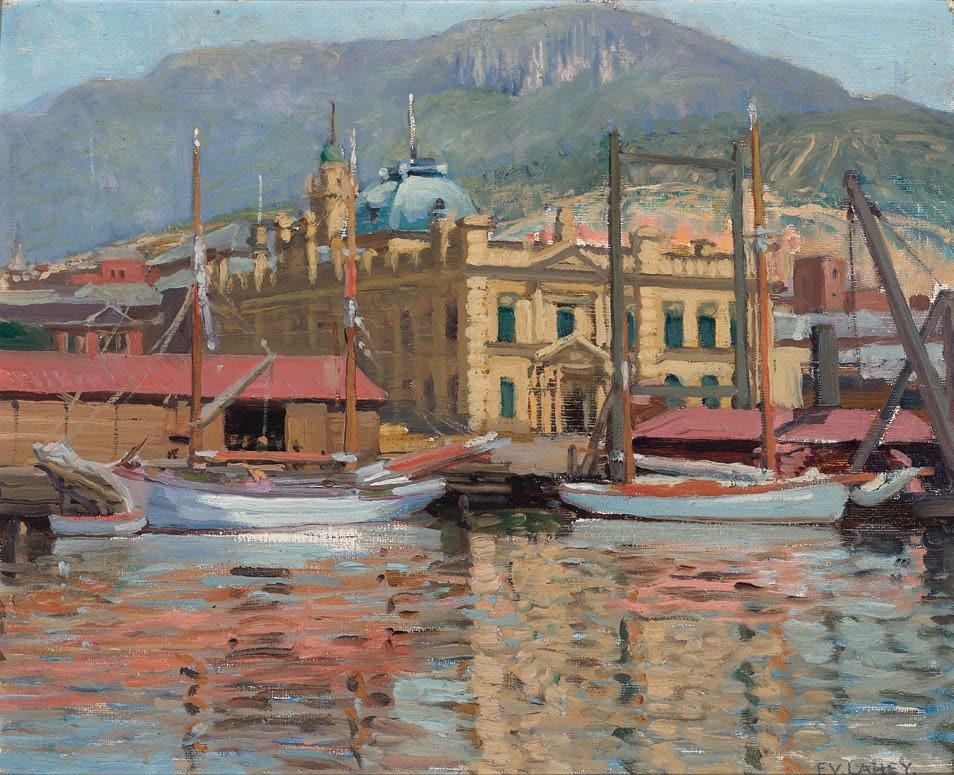
1968)
watercolour on paper on card
26.0 x 35.0 cm
signed lower right: V. LAHEY
signed and inscribed with title on artist’s handwritten label verso: “Coolangatta” / Vida Lahey
inscribed on label verso: Ada + Oswald with love from Vi
Estimate: $25,000 – 35,000
Provenance
Oswald and Ada Lahey, a gift from the artist
Thence by descent
Patricia Hannah, Perth, 1987
Thence by descent
Private collection, Perth
Literature
MacAulay, B., Supplement to Songs of Colour. The Art of Vida Lahey, works Located to 1989, Queensland Art Gallery, Brisbane, 1989, p. 10
Vida Lahey’s delightful watercolour Coolangatta, c.1935, captures the southern Queensland beach resort as it appeared before a post-World War II building boom led directly to the construction of numerous high-rise apartments which altered the skyline forever. An airport built there in 1936 increased tourist numbers even further. Lahey was a prolific artist and her various views of Brisbane and the Gold Coast now form important resources for heritage records of the changing landscape. She exhibited at least seven works during her life done at nearby Burleigh Heads, but only three others are recorded of Coolangatta, which is located on the traditional lands of the Yugambeh people: two from 1946 and one from 1952.1 It appears that Lahey was standing at what is now the Rainbow Bay lookout in Pat Fagan Park looking north, or alternatively, positioning herself in the nearby observation tower of Fagan’s Greenmount Guesthouse (since demolished) which he operated from 1904 to 1944.
Coolangatta shows the lazy curve of Greenmount Beach at the southeastern end adjacent to the headland and gives a clear indication as to why the area became Queensland’s first recognised beach resort, with more than 16,000 people visiting by train in 1914 alone. With a scatter of Couta-style fishing boats beached above the tideline on the sand, the middle ground of the watercolour is occupied by the clusters of guesthouses and homes that already marked the beach’s resort status. At centre, the red brick bell tower of St Augustine’s Catholic Church
pierces the skyline, a prominent landmark since its erection in 1926. Not surprisingly, this landscape has since been replaced by rows of high-rise apartments running along Marine Parade.
Lahey was particularly active during 1935 having been described the previous year in William Moore’s landmark history of Australian art as being ‘the leading artist in Queensland’ 2, noting also her pivotal involvement (with Daphne Mayo) in establishing the Queensland Art Gallery’s new building in 1931. Lahey was now running art classes in Brisbane’s Edward Butler’s building, was a judge for the Gordon Rivers Art Prize and exhibited at the Royal Queensland Art Show in September. In November 1935, she held a notable exhibition of oils and watercolours at Grosvenor Galleries in Sydney, with one critic noting admirably that ‘in the handling of colour, Miss Lahey is a virtuoso.’ 3 The show was mostly comprised of flower studies and indeed, the only other known landscapes from that year are of Brisbane’s Anzac Memorial, City Hall and St John’s Cathedral. Coolangatta was not included at Grosvenor Galleries; she instead gifted the piece to her younger brother Oswald and his wife Ada who had married in 1930.
1. Two of these Coolangatta paintings were included in Exhibition of recent paintings (mainly watercolours) by Vida Lahey, Finney’s Art Gallery, Brisbane, 27 June – 12 July 1946, cats. 1 and 7
2. Moore, W., The story of Australian art: from the earliest known art of the continent to the art of today, vol. 1, Angus & Robertson, Sydney, 1934, p. 112
3. ‘Art exhibitions: Miss Vida Lahey’, Sydney Morning Herald, Sydney, 13 November 1935, p. 9 Andrew Gaynor
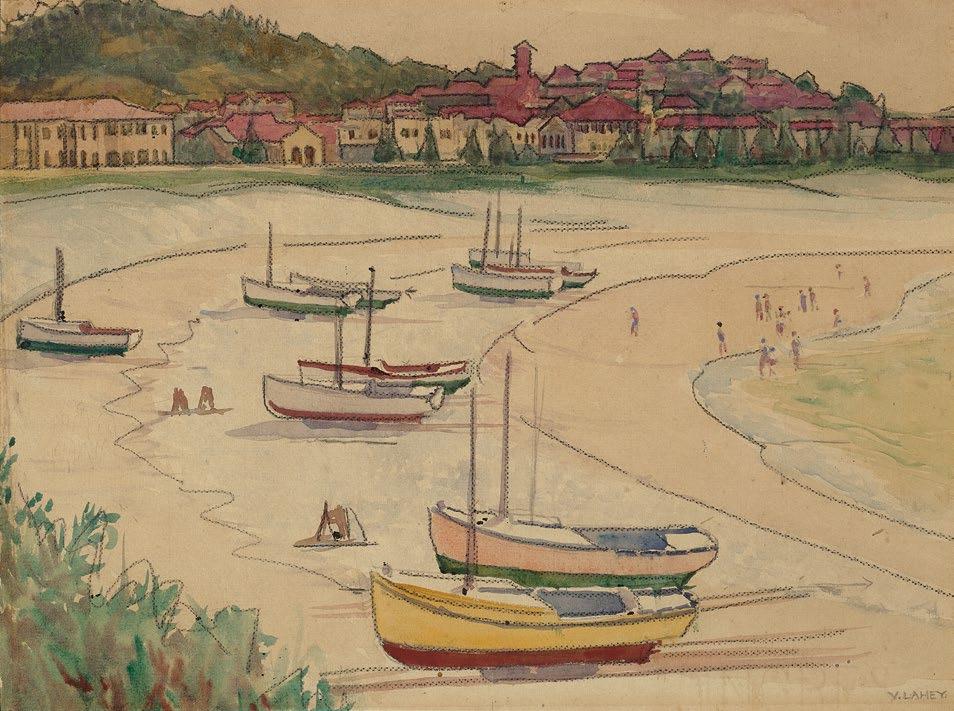
2003)
oil on canvas on plywood
48.0 x 61.0 cm
signed lower left: Nora Heysen
signed and inscribed on label verso: “MELBOURNE STREET SCENE” / NORA HEYSEN
Estimate: $20,000 – 30,000
Provenance
Private collection, Adelaide
Private collection, Melbourne, a gift from the above, c.1992
Deutscher and Hackett, Melbourne, 27 August 2025, lot 5
Private collection, Melbourne
Exhibited
Nora Heysen, S.H. Ervin Gallery, Sydney, 8 September – 15 October 1989, cat. 56
Nora Heysen, National Library of Australia, Canberra, 25 October 2000 – 28 January 2001
Literature
Klepac, L., Nora Heysen, Beagle Press, Sydney, 1989, cat. 56, pp. 56 (illus.), 79
Klepac, L., Nora Heysen, National Library of Australia, ACT, 2000, p. 51
Related work
Flinders Street Station no. 2, 1943 – 44 (dated 1946), oil on canvas on cardboard, 46.0 x 60.9 cm, National Gallery of Victoria, Melbourne
When Nora Heysen was awarded the 1938 Archibald Prize for her striking portrait Madame Elink Schuurman, she set a cat amongst the pigeons, that is, the local scions of the male-dominated art world who complained vociferously. Max Meldrum for one who wrote scathingly that an art career was ‘unnatural and impossible for a woman’ 1; whilst others claimed she was only treated favourably due to her father, the celebrated Hans Heysen. Of course, nothing was further than the truth and she triumphed again in 1943 when she became the first woman to accept an invitation from the Australian War Memorial to become an official war artist. She was eventually sent to New Guinea but in the interim, she spent some months in Melbourne from October 1943 to April 1944, where Flinders Street Station, 1944 (originally titled Melbourne Street Scene), was painted.
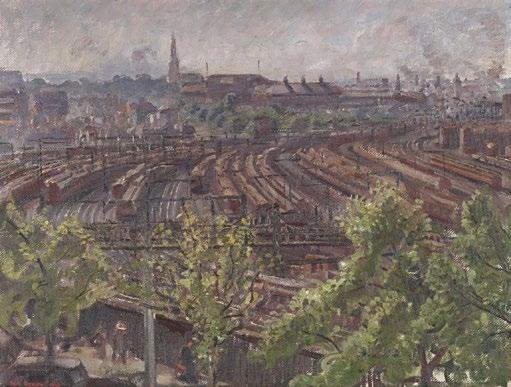
Heysen – or to give her official title, VFX 940085 Captain Heysen, N. AIF – was accommodated at the Menzies Hotel. Her first studio was with other war artists based at the Military History Headquarters on St Kilda Road, then in early 1944 she moved into a new space at 138 Flinders St, a building which had ‘lately been the morgue’,2 from which, she wrote in a letter, ‘the outlook is quite fascinating and I’ve started a canvas of the railway lines and trains.’3 She eventually did two versions of differing views from her window comprising this lot and its companion, the smaller and currently mis-dated Flinders Street Station no. 2, 1943 – 44 (dated 1946) (National Gallery of Victoria) which was also given its current title by the artist prior to its exhibition at the S.H. Ervin Gallery, Sydney, in 1989. However, the artist’s studio was a good 250 metres from the Station and the paintings look to the opposite direction, following the curving rail lines towards Richmond. Visible on the skyline in each is the prominent spire of St Ignatius Church on Richmond Hill, a view which has been obliterated over time by skyscrapers and overgrown vegetation, as well as infrastructure such as the Batman Ave Bridge which now obscures the rail lines.
Initially studying at the North Adelaide School of Fine Art (with generous, low-key input from her father), Heysen was noted first for her extraordinarily precise portraits which presented an accuracy that recalled Vermeer. From 1934 to 1937, she studied in London where she befriended artist Lucien Pissarro’s daughter Orovida, who encouraged her to be livelier with her paint. Indeed, Flinders Street Station could be a magnified incident from a painting by Camille Pissarro, Orovida’s grandfather, whose bustling Boulevard
Nora Heysen
Flinders Street Station no. 2, 1943 – 44 oil on canvas on cardboard 46.0 x 60.9 cm
National Gallery of Victoria, Melbourne
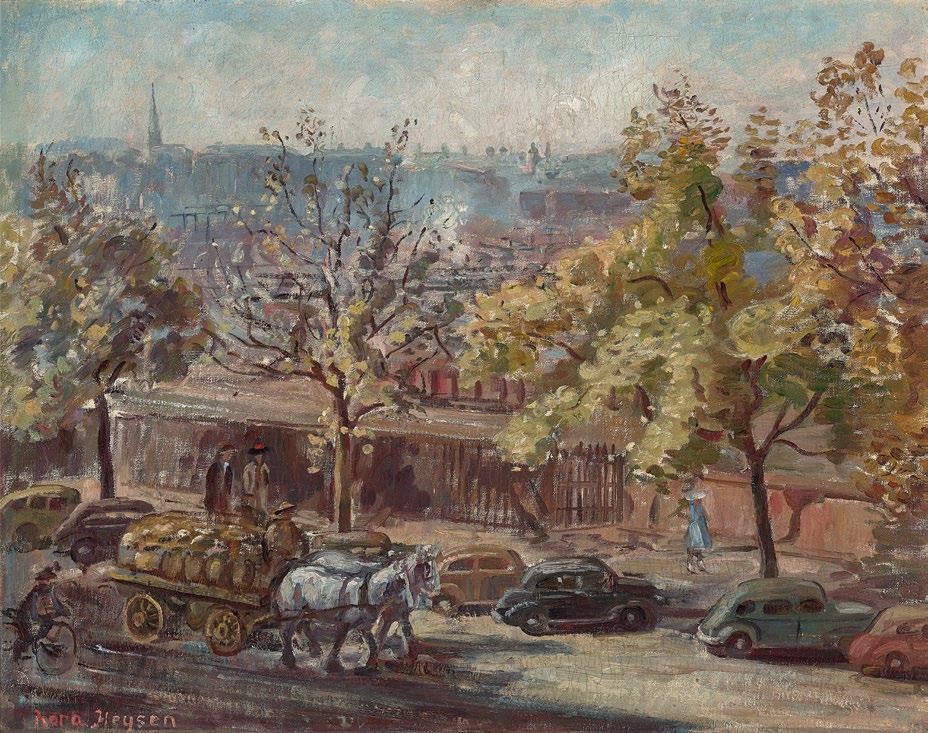
Montmartre, morning, cloudy weather, 1897, was a star of the National Gallery of Victoria’s collection. Following Orovida’s suggestion, Heysen adopted a more painterly technique, as seen in her Archibald winning portrait and in the two Flinders Street views. In the work on offer here, the artist scrutinises the humble scene below her and features three modes of transport set against the vertical pattern made by the palings of the rail-concealing fencing, long since replaced by rusting cyclone wire and now cloaked in ivy.
1. ‘Art Prize to Woman. Marriage before career. Advice by artist’, The Herald, Melbourne, 21 January 1939, p. 8
2. See Nora Heysen, Letter to her parents 19 September 1944, transcribed in Speck, C. (ed.), Heysen to Heysen: selected letters of Nora Heysen and Hans Heysen, National Library of Australia, Canberra, 2011, p. 139. Notably, 138 Flinders Street is still standing, now absorbed within the neighbouring Duke of Wellington hotel redevelopment.
3. Nora Heysen, Letter to her parents, February/March 1944, see ibid. p. 140
Andrew Gaynor
watercolour on paper
36.5 x 26.0 cm (sheet)
signed lower right: ALBERT NAMATJIRA
bears inscription on partial label verso: to my dear Friends / […] Charles, & John / with love to all / from Agnes Baker
Estimate: $40,000 – 60,000
Agnes Baker, New South Wales
Private collection, New South Wales, a gift from the above c.1950s
Thence by descent
John Evans, New South Wales
Thence by descent
Private collection, Queensland
Thence by descent
Private collection, Queensland
‘Space defines landscape, where space combined with memory defines place.’ 1
The visual lexicon employed by Albert Namatjira in his watercolours of central Australia encompassed distant views of hills and mountains, narrow valleys, sloping hillsides, rocky outcrops, monoliths, gorges and gaps, together with local foliage and fauna. Through the depiction of the physical characteristics of his ancestral lands, the connection between place and history comes together in Namatjira’s landscapes, where ‘sights are also sites.’ 2 It is in these renderings that Namatjira’s intimate familiarity with Country is evident, as ‘trees, peaks and monoliths provide a rich range of possibilities and responses that arise from constantly re-engaging with the same subject.’ 3 However, without doubt, the most recognisable and enduring motif of his practice is the iconic luminous white-trunked Ghost Gum (Eucalyptus papuana), known as ilwempe to the Western Arrernte.
Countless variations of the Ghost Gum appear in his work, sometimes rendered as the subject – a portrait of the grand eucalypt. These views, often in vertical format, record a closely observed, often cropped, and finely detailed rendering of the powerful, pock-marked trunk. Here the tree is anthropomorphised, often read as a sentient being ‘where twisted trunks become torsos and branches become arms while the bark functions like skin, folding and wrinkling due to external pressure from the elements.’4 In other views, the Ghost Gum provides the foundation for the pictorial organisation of the landscape. These views, mostly executed in a horizontal format, have the tree placed to either the left or right of the composition, anchoring the foreground and directing the viewer’s gaze to the distant blue peaks through the overhanging branches.
Painted in the last decade of Namatjira’s life and abounding with the artist’s most familiar imagery, the three watercolours offered here – Ghost Gum, c.1950, Mount Sonder at Glen Helen, and South Ranges, c.1958 – each celebrate the majestic Ghost Gum in its own distinctive manner. In Ghost Gum (lot 54), the tree, set to the right of the composition, acts as a counterbalance to the sloping rock formations on the left while the branches and foliage frame the distant blue hills. In Mount Sonder at Glen Helen (lot 55) and South Ranges (lot 56), the white gum of two or three trunks is set to the left of the picture and provides the key to the pictorial organisation. Dominating the foreground, it serves both to open and frame the picture plane. Viewed through the trunk and branches of the tree, the distant mountain range lies beyond small valleys populated with olive-foliaged trees with black trunks in the middle ground, each chronicled in harmonious red and purple tones. The distant vista contrasts strikingly with the luminous whiteness and solid strength of the Ghost Gum which is both the paintings’ focal point and the pointer to a far-off landscape. An incredibly hardy species, ‘the Ghost Gum features in Aboriginal creation stories where individual trees can be considered to represent ancestral beings.’ 5 Namatjira’s innovative and personal painting of the central Australian landscape was both a representation of landscape and a claim to his country. His landscapes can be read as memories of an ancestral site and, through the repeated return to this subject, a claim of ownership is subtly asserted. Gum trees and mountains feature prominently in Namatjira’s work, and the three paintings offered here are compelling examples of both these familiar motifs and the artist’s enduring statement of belonging.
1. Lucy Lippard, cited in French, F., Seeing the Centre: The Art of Albert Namatjira 1902 –1959, National Gallery of Australia, Canberra, 2002, p. 95
2. French, ibid., p. 95
3. ibid., p. 97
4. ibid., p. 117
5. ibid., p. 121
Crispin Gutteridge
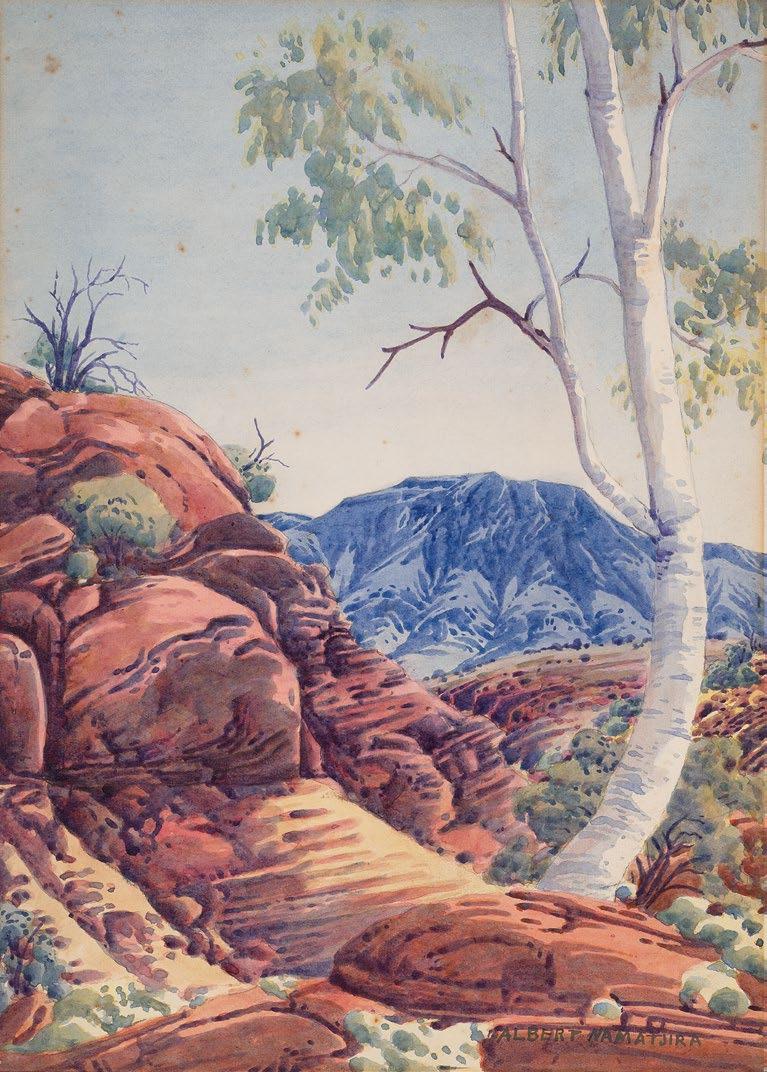
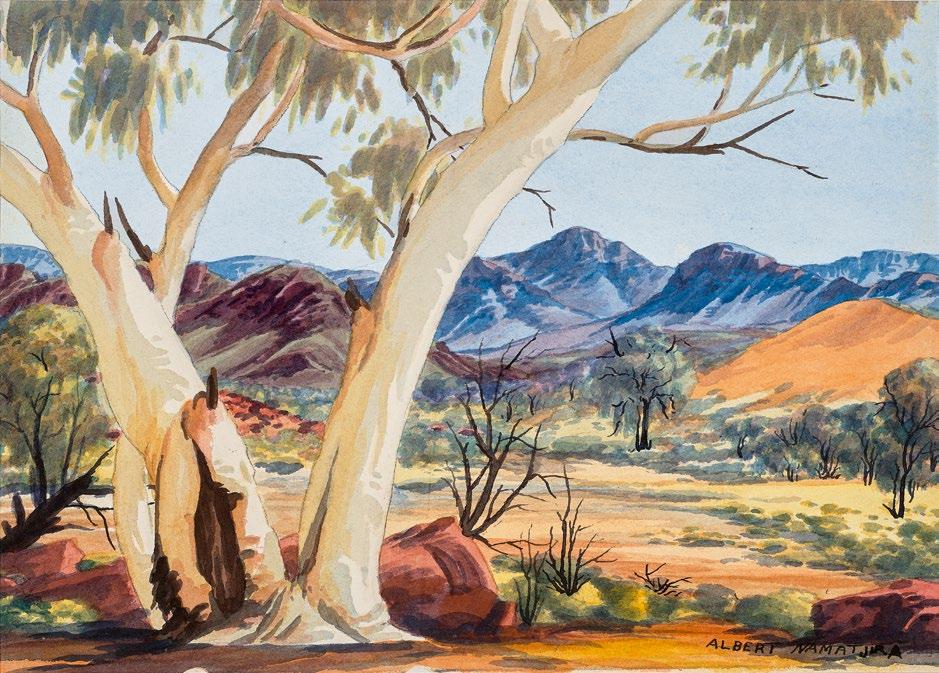
Albert Namatjira (1902 – 1959)
South Ranges, c.1958
watercolour on paper
26.0 x 36.5 cm
signed lower right: ALBERT NAMATJIRA
signed and inscribed with title verso: South Ranges / Albert Namatjira
Estimate: $45,000 – 65,000
Provenance
Malvern Fine Art Gallery, Melbourne
Leonard Joel, Melbourne, 26 July 1989, lot 96 (as ‘South MacDonnell Ranges, Northern Territory’)
Private collection
Mossgreen Auctions, Melbourne, 24 June 2014, lot 4 (as ‘South Macdonnell Ranges, Northern Territory’)
Private collection, Sydney
Literature
McGregor, K., The Life & Times of Albert Namatjira, Badger Editions, Melbourne, 2021, pp. 406 (illus., as ‘South MacDonnell Ranges’), 437
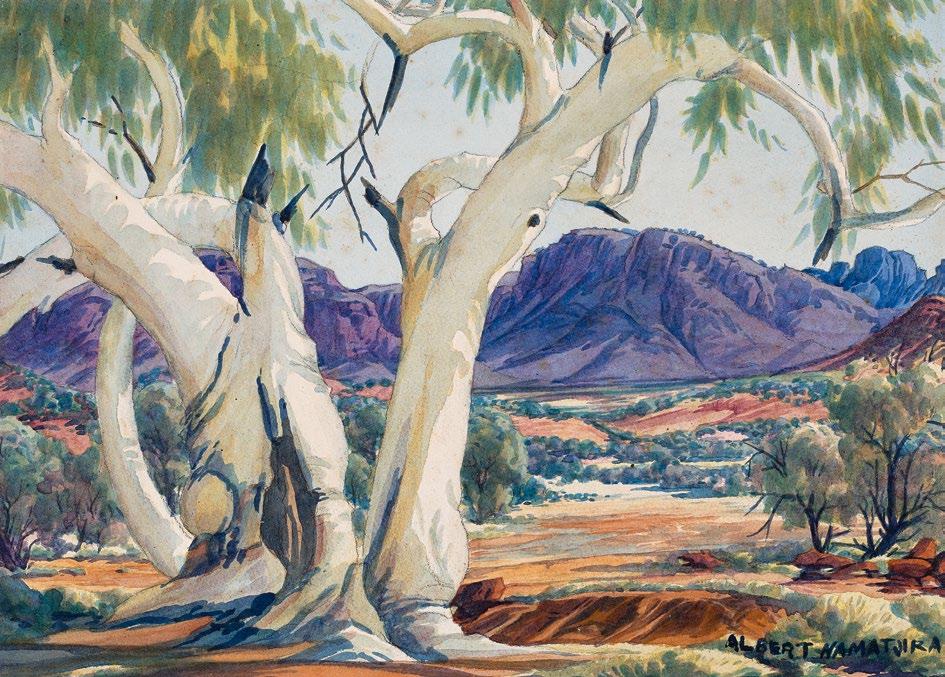
Namatjira (1902 – 1959)
Mount Sonder at Glen Helen
watercolour on paper on card
26.5 x 37.5 cm
signed lower right: ALBERT NAMATJIRA
Estimate: $45,000 – 65,000
Provenance
Geo Styles Gallery, Sydney (label attached verso)
Private collection, Auckland
Bonhams, Sydney, 7 June 2016, lot 62
Private collection, Sydney
gouache on cardboard
37.0 x 51.0 cm
signed with initials lower right: IF
Estimate: $70,000 – 90,000
Provenance
Macquarie Galleries, Sydney Mrs J. E. A. Walkley, Melbourne, 1954
Rob Ferguson
Niagara Galleries, Melbourne
The Reg Grundy AC OBE and Joy Chambers–Grundy Collection, acquired in 1998 (label attached verso)
The Grundy Collection, Bonhams, Sydney, 26 June 2013, lot 22 Private collection, Adelaide
Exhibited
Ian Fairweather, Macquarie Galleries, Sydney, 2 – 14 June 1954, cat. 8 (as ‘Harbour’)
Spring Exhibition, Joseph Brown Gallery, Melbourne, 15 September –8 October 1969, cat. 31 (illus. in exhibition catalogue)
Fairweather, Queensland Art Gallery, Brisbane, 1 October – 27 November 1994, and touring to: National Gallery of Victoria, Melbourne, 17 December 1994 – 19 February 1995; Art Gallery of New South Wales, Sydney, 22 March – 7 May 1995, cat. 18
Literature
Australia Today, October 1963, p. 72 (as ‘Aboriginal’)
Bail, M., Fairweather, Art and Australia Books in association with the Queensland Art Gallery, Brisbane, 1995, pl. 18, p. 90 (illus.)
Bail, M., Fairweather, Murdoch Books, Sydney, revised edition 2009, cat. 109, pl. 102, pp. 123 (illus.), 252
In a letter to his old friend H. S. (Jim) Ede in early 1954, Fairweather detailed all the disasters that had happened to him over the past two years – the raft voyage and subsequent media circus, the strange experience of returning to England after twenty-five years, and the bushfire that had recently swept through his land at Bribie Island, destroying his tent and its contents. Notwithstanding these setbacks, he had built a hut –a frame of poles thatched with grass, with a bed padded with ferns and tables made from reeds. Around him, he wrote, ‘there is only the forest, burnt black with the fire and not a sound, not even the wind. Every new year I always listen for the first sound. It has so often a message, a sign of things to come. This year there was a stillness, a blank. Don’t know what to make of it.’ 1
It was with this frame of mind that Fairweather returned to depicting scenes from the past, such as this gouache, Canal scene, China, 1954 which features a narrow creek and several
Chinese junks with their distinctive geometric sails. ‘The symbolic junks, the crowded buildings, the twisted bridge and line of pedestrians are composed as a kind of serene haphazardness like memory itself.’ 2 Although the actual place was never identified by Fairweather, it is possibly Suchow Creek where it meets the Huangpu River, and where the Bund – known for its massive Art Deco buildings – begins. Here, the Waibaidu Bridge arches across the river on the right, with masses of sturdy buildings all around. Fairweather’s studio was at 235 Szechuan Road (now 235 Si Chuan Bei Lu), opposite the Shanghai Post Office (the tall building with the clock tower). 3 It was on ‘the top floor, spacious and quiet’ and gave him a bird’s eye view of the bustling city which he has recreated here decades later.
1. Abbott-Smith, N., Ian Fairweather: Profile of an Artist, University of Queensland Press, Brisbane, 1978, p. 126
2. Bail, M., Ian Fairweather, Bay Books, Sydney, 1981, p. 118
3. ibid., p. 19
Dr Candice Bruce
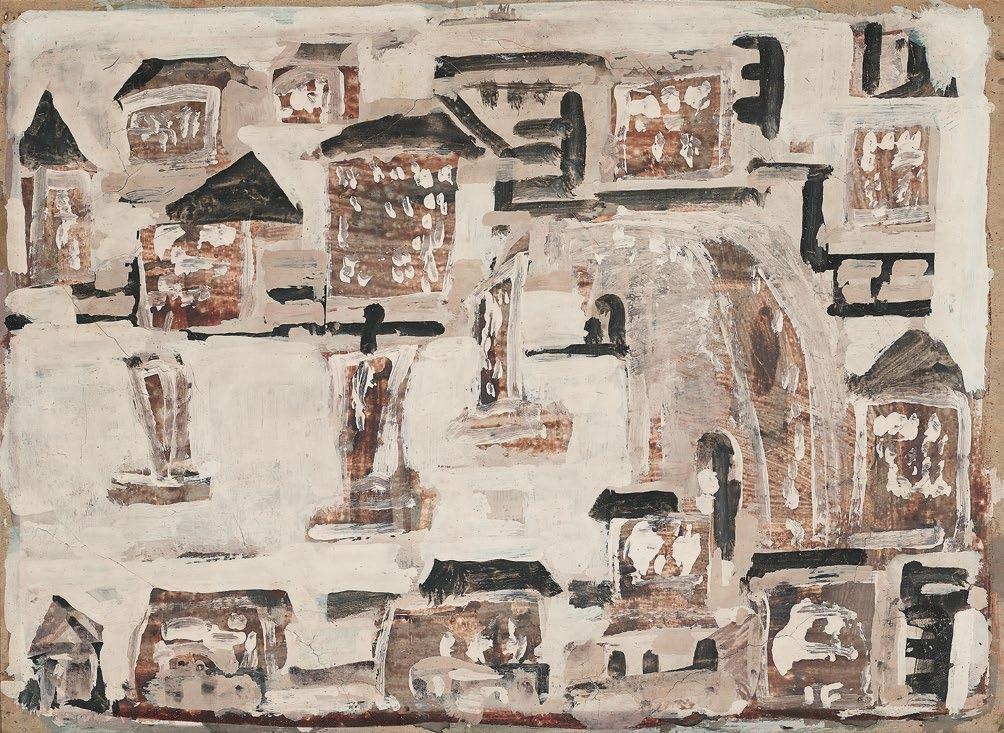
oil on canvas
85.0 x 100.5 cm
Estimate: $40,000 – 60,000
Provenance
Estate of the artist
Watters Gallery, Sydney Private collection
Deutscher~Menzies, Melbourne, 28 August 2002, lot 32 Private collection, Melbourne
Exhibited
Tony Tuckson: Twenty Paintings on Canvas 1947? – 1957?, Watters Gallery, Sydney, 1 – 18 October 1986, cat. 8
Literature
Thomas, D., Free, R., Legge, G., Tony Tuckson, Craftsman House, Sydney, 1989, pl. 14, pp. 48 (illus.), 179
Egyptian-born Englishman Tony Tuckson emigrated to Australia after the end of the Second World War, having served in the Royal Air Force as a Spitfire pilot. Taking advantage of the Commonwealth Reconstruction Training Scheme that was available to ex-servicemen, Tuckson enrolled at East Sydney Technical College in 1946, picking up on his earlier study at the Hornsey School of Art in London from 1937 to 1938, and the Kingston School of Art in 1939. Described by his teachers, abstract artists Ralph Balson and Grace Crowley as their most ‘sincere’ pupil 1 , Tuckson had a distinct advantage over his fellow students, as he had already seen the work of modern artists such as Cézanne, Picasso, Matisse, Soutine, and Klee ‘in the flesh.’ 2 These experiences – along with his voracious study of modern art and absorption of art magazines – were to sustain his creative imagination for years to come. Excluding a trip for the Art Gallery of New South Wales to New Guinea in 1965, Tuckson did not leave Australia again until 1967, 20 years after his arrival. At the time that Cocktails for two No. 2 (TP161), 1947 – 50 was painted, the influential 1953 travelling exhibition French Painting Today, which introduced Australian audiences to Europe’s modern masters for the first time, was not yet a reality, and even Tuckson’s teacher, Balson, had never travelled abroad.
Driven by the need to support his young family, Tuckson was appointed as an attendant and cleaner at the Art Gallery of New South Wales in 1950, before swiftly rising to the position of Assistant Director (from 1950 – 57) under Director Hal Missingham, and later, becoming Deputy Director (1957 – 73). It is here that his life as an artist went underground. 3 Tuckson spent the next two decades working in isolation from a home studio surrounded by bush on Sydney’s North Shore;
his head filled with creative possibilities and the exciting exemplars provided by the artists he admired – Picasso, Matisse, Modigliani, Dubuffet, Pollock, Motherwell, and Twombly, amongst others – and by his increasing knowledge of and deep admiration for Aboriginal and Melanesian art.
In the late 1940s and early 1950s Tuckson’s imagery included figures dancing at parties, nightclub scenes, musicians, and variations on the subject of ‘Cocktails for two’ – a couple sitting at a bar behind which a bartender animatedly shakes a cocktail shaker. The stylised blocky forms of the figures clearly reveal the influence of Picasso, just as the deft exploration of the work’s restricted palette echoes the French artist’s Blue Period (1901 – 04), without the sombre subject matter. Tuckson’s scene is at once cool and appealing – one can almost hear the jazz soundtrack playing in the background. The assured nude and her companion (Tuckson and his wife Margaret) sit on a different plane to the bar and its patterned background, which slope, Cézanne-like, towards the viewer, inviting us into the scene. Rather than simply emulating the respective styles of his masters here, Tuckson explores the formal principles and dynamism of their work as a way in which to feed and expand his own creative practice. As Joanna Mendelssohn has noted: ‘By painting in private, Tuckson was freed from the opinion of others. He was able to experiment, to succeed or fail, taking only his own judgement into account.’4
1. Thomas, D., ‘An Introduction to Tony Tuckson, 1921 – 1973’, Thomas, D., Free, D. & G. Legge, Tony Tuckson, Craftsman House, Roseville, 1989, p. 27
2. Terence Maloon states that Tuckson had opportunities to see the Hugh Walpole collection at the Leicester Galleries in London (16 May – 9 June 1945), comprising 176 works by Cézanne, Picasso, Matisse, Soutine, Klee and others, as well as the Matisse and Picasso exhibition at the Victoria and Albert Museum in December 1945 while on leave from his air force base in Cornwall. The catalogues for both exhibitions were among Tuckson’s papers. See Maloon, T. Painting Forever: Tony Tuckson, National Gallery of Australia, Canberra, 2000, at: https://nga.gov.au/exhibitions/painting-forever-tonytuckson/ (accessed July 2026)
3. From his time as a student until 1962, Tuckson occasionally submitted paintings to the annual exhibitions of the New South Wales Society of Artists and the Contemporary Art Society.
4. Mendelssohn, J., ‘Passion and Beauty: The Paintings of Tony Tuckson’, The Conversation, 28 November 2018, at: https://theconversation.com/passion-and-beautythe-paintings-of-tony-tuckson-107591 (accessed July 2026)
Kelly Gellatly
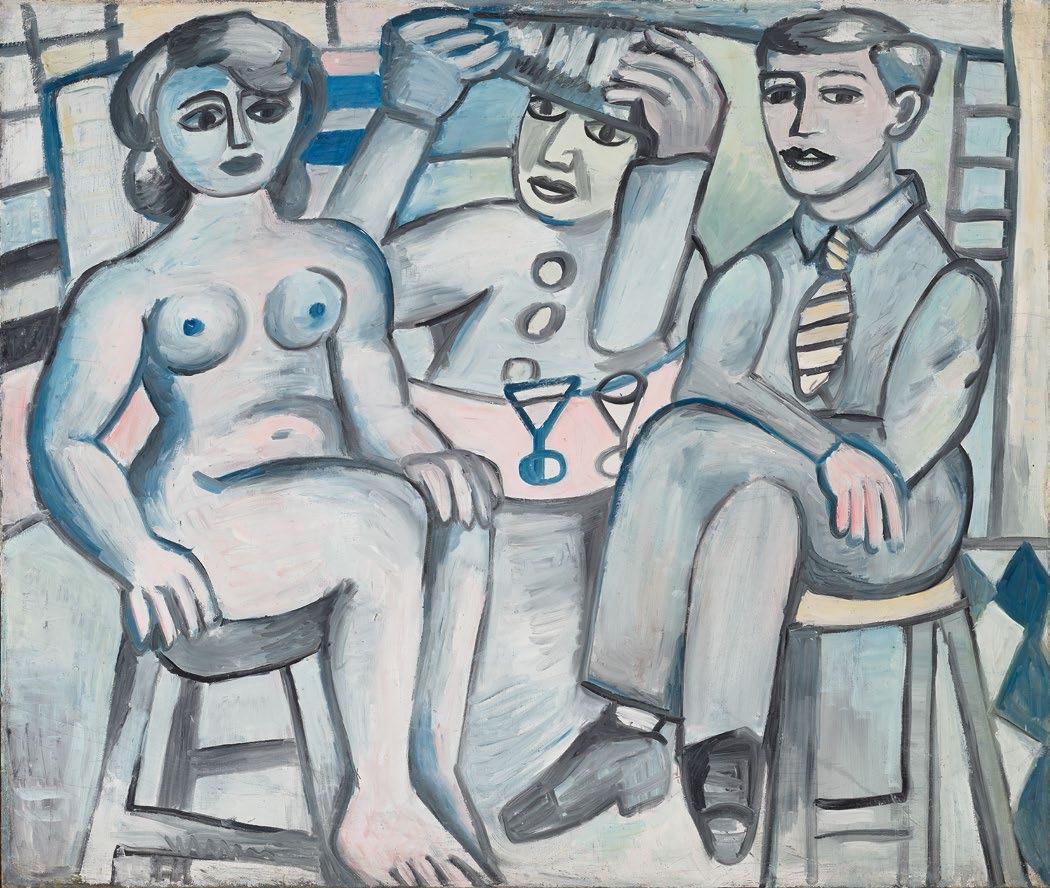
Full tilt, 1954
oil on composition board
61.0 x 78.5 cm
signed and dated upper right: Raokin 54 signed and inscribed with title verso: WEAVER HAWKINS (RAOKIN) / FULL TILT
Estimate: $30,000 – 40,000
Provenance
The artist’s family
Leonard Joel, Melbourne, 23 August 1995, lot 116
Private collection
Sotheby’s, Melbourne, 26 April 1999, lot 92 Private collection
Deutscher~Menzies, Sydney, 4 March 2004, lot 94
Private collection, Sydney
Exhibited
Contemporary Art Society State Exhibition 1955 Madach Prizes, David Jones’ Art Gallery, Sydney, 13 – 21 April 1955, Section 1, cat. 44
Weaver Hawkins: Raokin, David Jones Art Gallery, Sydney, 4 – 17 June 1958, cat. 5
Weaver Hawkins 1893 – 1977: Memorial Retrospective Exhibition, Ballarat Fine Art Gallery, Victoria (illus. on exhibition invitation) and touring, October 1977 – March 1979, cat. 19
Literature
Art and Australia, Fine Arts Press Pty Limited, Sydney, vol. 34, no. 2, Summer 1996, p. 249 (illus.)
Related works
Going Round, 1954, oil on composition board, 78.5 x 60.0 cm, Art Gallery of New South Wales, Sydney
A Fall, 1954, exhibited Sir John Sulman Prize 1954, Art Gallery of New South Wales, Sydney, January 1955, illus. in ‘Prize Entries On Show’, Brisbane Telegraph, Brisbane, 9 May 1955, p. 14
Thrown, 1960, oil on composition board, 59.0 x 77.0 cm, formerly the collection of the late James O. Fairfax AC, New South Wales
‘Life is movement, change, growth. Art moves, changes, grows in unison with life. For creatures with a soul, one cannot be without the other.’ 1
The energetic rhythms and crisp delineation of Weaver Hawkins’ Full tilt, 1954, have their roots in a wide variety of sources including the artists of English Vorticism, alongside whom Hawkins exhibited in London, as well as a deep understanding of ‘such compositional theories as Dynamic Symmetry, Platonic Solids, Magic Squares and the Modular.’ 2 When he began exhibiting his paintings in Sydney in 1946, local audiences were confused as they were at the time happily distracted
by the popular work by Neo-Romantic ‘Charm School.’ This dislocation became magnified in subsequent years as figurative expressionism, followed by international abstraction, found favour to such degree that it was not until the 1970s that Hawkins’ complex, stylised paintings were re-evaluated and celebrated. Permanently disabled under horrifying experiences in World War One, Hawkins nonetheless fought to retrain himself as an artist before exhibiting widely. In Australia, he later also became actively involved as teacher, lecturer and member of the Contemporary Art Society for whom he served as Vice-President, then President, between 1948 and 1963. It is not surprising therefore that historian Frank Campbell described him as being ‘dauntless. (D)isablement, public indifference and rejection did not crush or embitter him.’ 3
Hawkins was already a skilled artist when he was left for days grievously wounded in no-man’s land on the Western Front. After numerous operations – including removal of both elbows – he was left with two withered arms, the left marginally stronger than his right, meaning he had to relearn how to paint la gauche. Such was his ‘dauntless’ personality that he was soon making intricate etchings, and his paintings began to appear in exhibitions. A ‘free thinker’, he married the like-minded artist Renée Villiers and with the growing family, travelled extensively by yacht in the 1920s, living for a year near Siena in Italy. Annoyed that English exhibition reviewers constantly referred him as a ‘wounded artist’, he began signing his name as ‘Raokin’, based on a phonetic attempt by a local Sienese at spelling Hawkins: ‘Signor Hawkins’ became ‘Signor Raokin’. The family arrived in Sydney in March 1935 and settled at beachside Mona Vale where, with a permanent base, Hawkins’ paintings became increasingly radiant and dynamic.
The companion to Full tilt is Going round, 1954 (Art Gallery of New South Wales), which shows a scene from earlier in the race and, as the artist once explained, both paintings were built up ‘step by step, like the architect building a building brick by brick.’4 Working through a series of sketches and watercolours, Full tilt exploits a Futurist technique known as ‘Lines of Force’ whereby ‘objects were outlined, highlighting their two-dimensional character but they were outlined in complementary colours so the image jumps out dramatically.’ 5 In Full tilt, this is strikingly apparent in the cerulean-blue outlines of the front two horses and pulses out from the curved lines that otherwise direct the eye to the riderless horse at the top, a regular scene in horse races near the finish line. Going round also has these blue ‘Lines of Force’ but lacks Full tilt’s overall sense of excitement and anticipation – ‘virile with movement and surging, changing patterns.’ 6
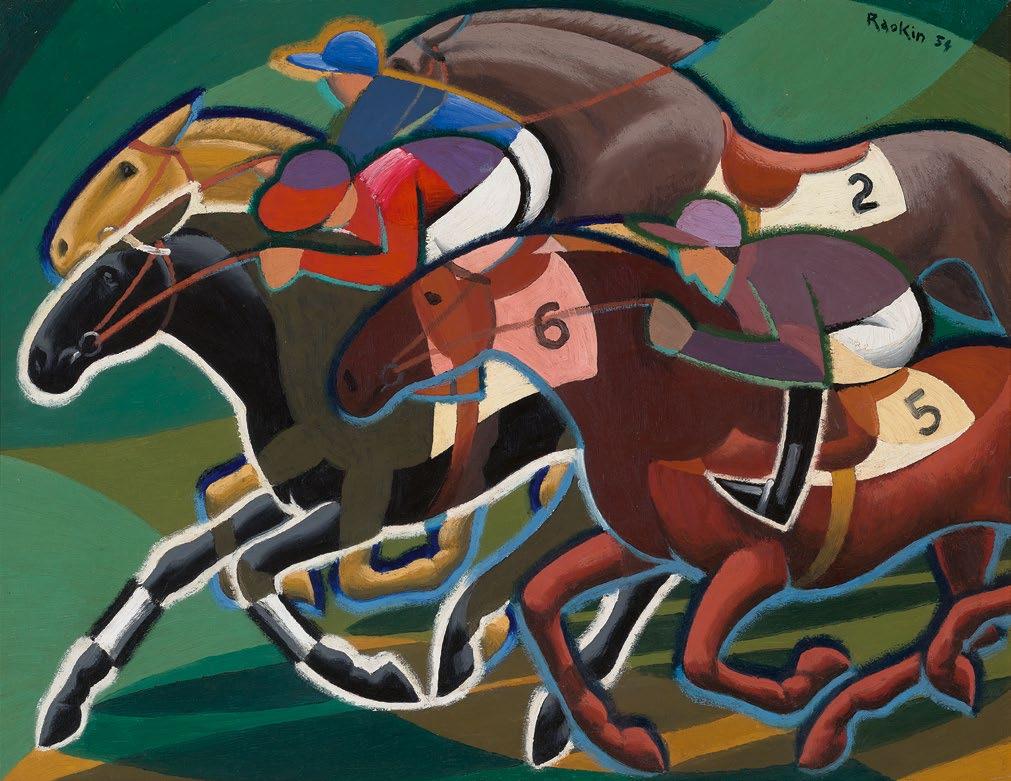
1. Weaver Hawkins, cited in Contemporary Art Society State Exhibition 1955 Madach Prizes, David Jones’ Art Gallery, Sydney, 1955, n. p.
2. Thomas, D., ‘Weaver Hawkins’ in Project 11: Weaver Hawkins, Art Gallery of New South Wales, Sydney, 7 February – 14 March 1976
3. Campbell, F., Raokin, Gallery Irascible, Melbourne, 1996
4. ‘Weaver Hawkins interviewed by Hazel de Berg in the Hazel de Berg collection’ [transcript], 31 December 1965, National Library of Australia, Canberra, ID: 457156, p. 13
5. McIntyre, A., ‘Weaver Hawkins – a tribute to a pioneer’, The Weekend Australian Magazine, Sydney, 15 – 16 April 1978, p. 7
6. Canberra Times, 30 September 1971, cited in Chanin, E. and Miller, S., The art and life of Weaver Hawkins, Craftsman House, Sydney, 1995, p. 85, fn. 33
Andrew Gaynor
(1920 – 1960)
Doll in green dress, c.1947 – 48
brush and ink, and watercolour on paper
29.5 x 24.5 cm
signed with estate stamp lower right: Joy Hester
Estimate: $20,000 – 30,000
Provenance
Tolarno Galleries, Melbourne (label attached verso)
Private collection
Niagara Galleries, Melbourne
Private collection, Sydney
Estate of the above, Sydney
Exhibited
Joy Hester, Tolarno Galleries, Melbourne, 6 – 25 October 1976, cat. 30 (as ‘Doll in Green Dress (Sydney Period)’)
Blue Chip III, Niagara Galleries, Melbourne, 27 February – 31 March 2001, cat. 3 (illus. in exhibition catalogue, p. 5 and back cover)
Joy Hester was a central figure among the group of artists who gathered around John and Sunday Reed, the enlightened patrons whose home, ‘Heide’, in the rural outer-Melbourne suburb of Heidelberg, offered ‘a vibrant intellectual environment and… haven of shared ideas.’ 1 A friend and respected peer of artists including Sidney Nolan and Albert Tucker (whom she married in 1941), Hester was a painter and poet whose work was often deeply personal, reflecting aspects of her own life and experience, as well as describing broader human psychology and universally-felt emotions.
Hester’s art is distinguished from that of her male counterparts in that she worked almost exclusively on paper, using brush and ink, watercolour and gouache. While her constant financial difficulty surely influenced this, Hester had a particular facility with these media. Responding to their immediacy, she produced images which appear both spontaneous and intuitive, with a fluidity and lightness of touch that is difficult to achieve in oil paint. Barrett Reid recalled, ‘Joy drew the way other people speak; it was as natural and as simple as that… She worked wherever she happened to be and she happened to be largely amongst people. I can see her now, in this room (the library at Heide)… She’d squat down there, probably smoking cigarettes ten to the dozen, and yapping away like mad. And in front of her would be a whole pile of paper which she’d be drawing on and taking part in the conversation, laughing, interrupting, listening intently to what everyone was saying and drawing at the same time.’ 2
Doll in green dress, c.1947 – 48 is an unusual subject within Hester’s oeuvre, and with its sparkling eyes and realistically drawn face, notably different from the expressive and exaggerated
features of most of her figures. While the doll’s yellow bonnet has been likened to the stark abstract form of Sidney Nolan’s famous Boy and the moon, c.1939 – 40 (National Gallery of Australia, Canberra)3, this image is most likely connected to the series of images of Gethsemane – a doll that belonged to Sunday Reed – which Hester painted between 1946 – 47. Following their first meeting at the Herald exhibition of French and British Art in Melbourne in 1939, Hester and Sunday established a lifelong friendship which was as complex as it was steadfast, including an intimate romantic liaison and the Reeds’ adoption of Hester’s son Sweeney in 1949.4 Handmade from linen and filled with lavender from the Heide garden, the faceless Gethsemane represented the children that Sunday was unable to bear and assumed a strong and symbolic presence in her life, familiar to visitors to Heide and featuring in her correspondence with Hester as if she was a real child. While some of Hester’s depictions of ‘Gethie’ (in the collections of the National Gallery of Australia and Heide Museum of Modern Art, Victoria for example), are full of the tragedy of Sunday’s childlessness, others are more optimistic, the prominent eyes a symbol, instead, of the delight and wonder of childhood. It is this sense which Doll in green dress reflects, indicative perhaps of the relative stability and happiness of Hester’s life from 1947, when she began a relationship with Gray Smith, with whom she would later have two of her own children.
1. Gellatly, K., Leave no space for yearning: The Art of Joy Hester, Heide Museum of Modern Art, Melbourne, 2001, p. 12
2. Barrett Reid, cited in Gellatly, ibid., p. 14
3. Blue Chip III, Niagara Galleries, Melbourne, 2001, cat. 3
4. See Harding, L. and Morgan, K., Modern Love: The Lives of John & Sunday Reed, The Miegunyah Press, Melbourne, 2015.
Kirsty Grant
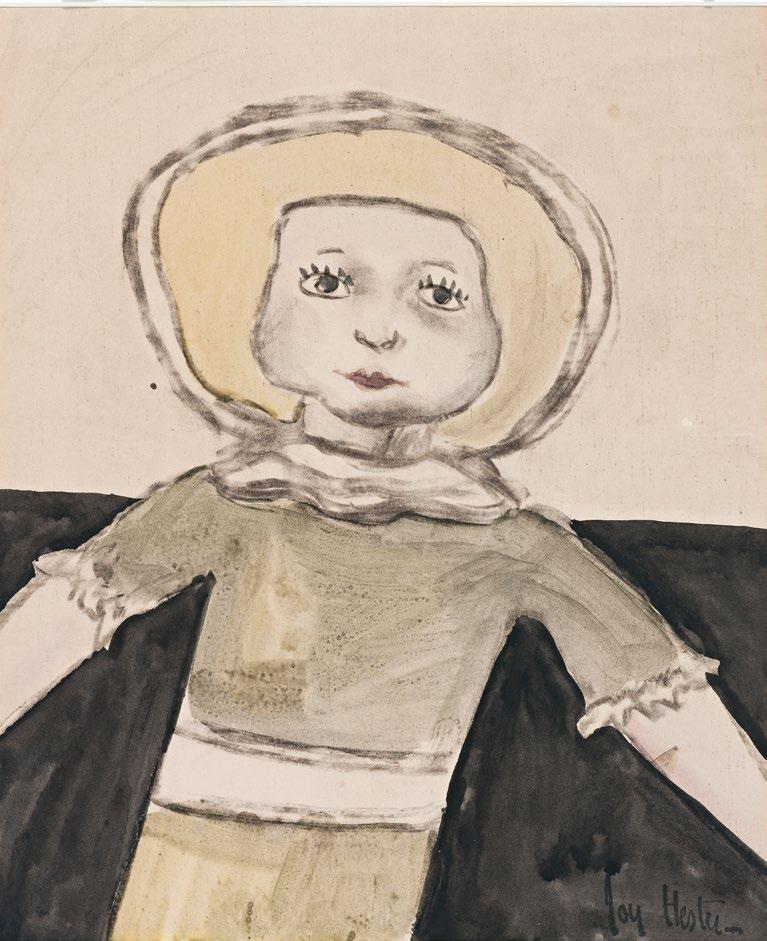
oil on canvas
91.0 x 116.5 cm
signed and dated lower right: Perceval / ‘72
Estimate: $60,000 – 80,000
Provenance
South Yarra Galleries, Melbourne (partial label attached verso)
Bruce Wenzel, Melbourne
Thence by descent
David Wenzel, Melbourne
Gould Galleries, Melbourne
Private collection, Melbourne, acquired from the above in 2000
Exhibited
Recent works by John Perceval, South Yarra Gallery, Melbourne, opening 17 October 1972, cat. 7
Paintings by John Perceval, David Jones Art Gallery, Sydney, 28 May – 9 June 1973, cat. 3
The Australian landscape, Gould Galleries, Melbourne, 7 October – 7 November 1999
Literature
Allen, T., John Perceval, Melbourne University Press, Melbourne, 1992, p. 171
We are grateful to Robert Gould for his assistance with this catalogue entry.
In the early 1970s, John Perceval owned two cars: an applegreen Porsche and a battered Volkswagen station wagon. Whilst ironically representing two sides of the artist’s personality and dynamic, they were also entirely practical when Perceval was seeking inspiration, driving the Porsche all over Victoria ‘investigating landscapes’ and ‘looking for poetry.’ 1 On his return to the family base in Canterbury, he would then load up the station wagon with ‘nearly a hundredweight’ of gear. 2 To enable this, he had an assistant who also travelled to the painting locations as Perceval walked with a limp due to childhood polio and required help loading and unloading his painting equipment. The sites were often patches of humble scrub, usually overlooked, but for Perceval, they were rich in possibility and as a result, many of these sites remain unidentified as the resultant paintings did not always include a location within their title. One such sequence is the small group known as the ‘Red Marsh’ series, of which Sun setting over the marsh, 1972, is a key example.
Perceval’s landscapes had been building in strength from the mid-1950s with the evocative paintings done at Gaffney’s Creek, first shown alongside those from the Williamstown foreshore. By the early 1960s, the scenes became tangled masses, close-up
encounters with ti-tree and spiky saplings done in somewhat melancholic deep blues and black. By the end of the decade, however, he reached a new understanding of the landscape and how to paint its moods, and as artist-critic James Gleeson memorably observed, Perceval now made ‘no distinction between flesh and flower – they are all paint to him… (He) sees this fact as a cause for celebration.’ 3 Perceval was annoyed by other critics such as Robert Hughes who described his work as ‘roly poly’4, countering that ‘I do not hold any particular attitude to my work or to art in general. I chose early not to work from an aesthetic theory or concept but prefer the results to be governed by developments that occur while the work is in progress.’ 5 Technically, the initial layers in his paintings were worked tonally with background, middle ground and foreground spaces, after which the impasto brushstrokes were then applied. Whilst Perceval viewed the process as ‘exhausting… it’s like a ballet dancer’s first night, but every painting is a first night’ 6, the ever perceptive Gleeson also believed that through this effort the artist was able to effectively convey his love for ‘the warmth or crispness of the air and evokes its quality with the exactness of an Impressionist and the feeling of an Expressionist.’ 7
Sun setting over the marsh was exhibited in Melbourne and Sydney in shows that pulsated with colour and optimistic energy. Depicted over the course of five related ‘Red Marsh’ paintings, the anonymous location is revealed at various stages of the day, alive to the artistic challenges presented by an ever-changing light, a sun not of the Impressionists but ‘of the Symbolists, the sun as the source of light and energy, the symbol of all that is positive and affirmative in nature.’ 8 With rich passages of orange, yellow and red blazing above the greens and blues of the sheltered ground, Sun setting over the marsh further reveals the strength of Perceval’s artistic sensibility.
1. Sykes, J., ‘The artist who won fame at home’, The Sydney Morning Herald, 15 February 1973, p. 7
2. ibid.
3. James Gleeson, ‘Flesh or flower: they’re all paint to Perceval’, The Sun-Herald, Sydney, 28 November 1971, p. 140
4. Hughes, R., The art of Australia, Penguin, Melbourne, 1966 (revised edition 1970), p. 235
5. John Perceval, cited in Reed, J., New Painting 1952 – 1962, Longmans, Melbourne, 1963, p. 24
6. Aldridge, R., ‘Picture of the artist in the wheatfield’, The Age, 18 November 1972, p. 14
7. Gleeson, J., Modern painters: 1931 – 1970, Lansdowne Press, Sydney, 1971, p. 95
8. Gleeson, J., ‘Painter in the making’, Sun Herald, 10 June 1973 Andrew Gaynor
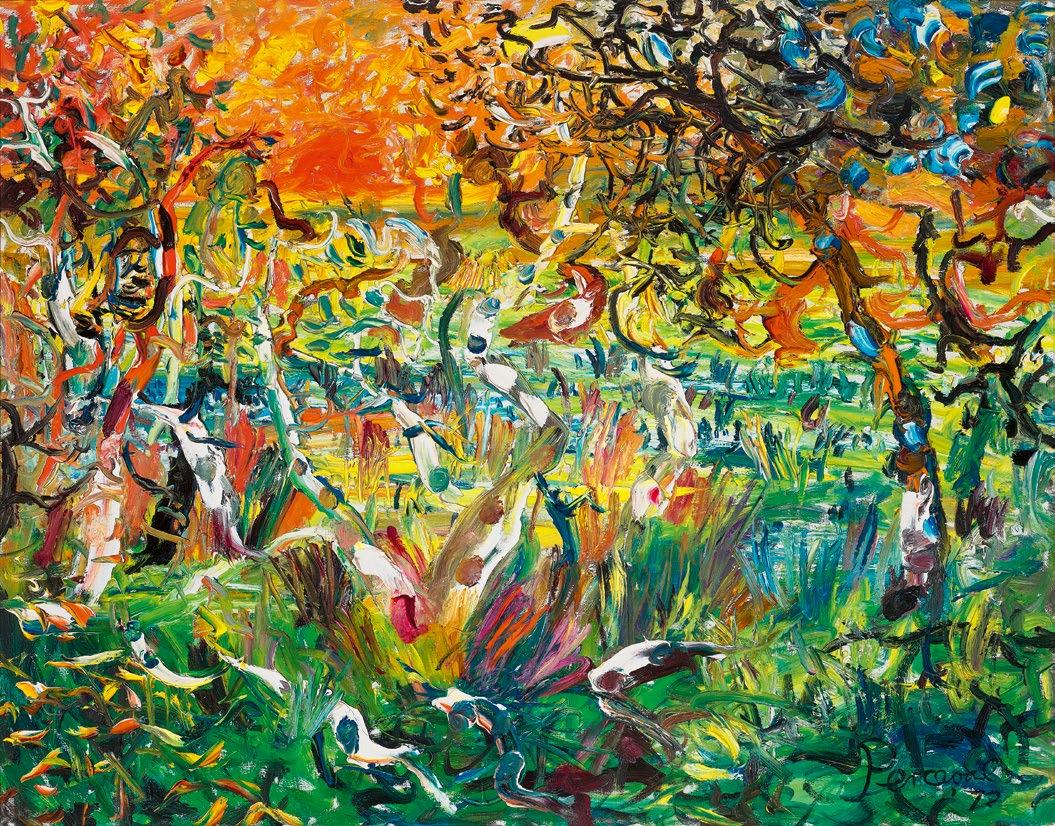
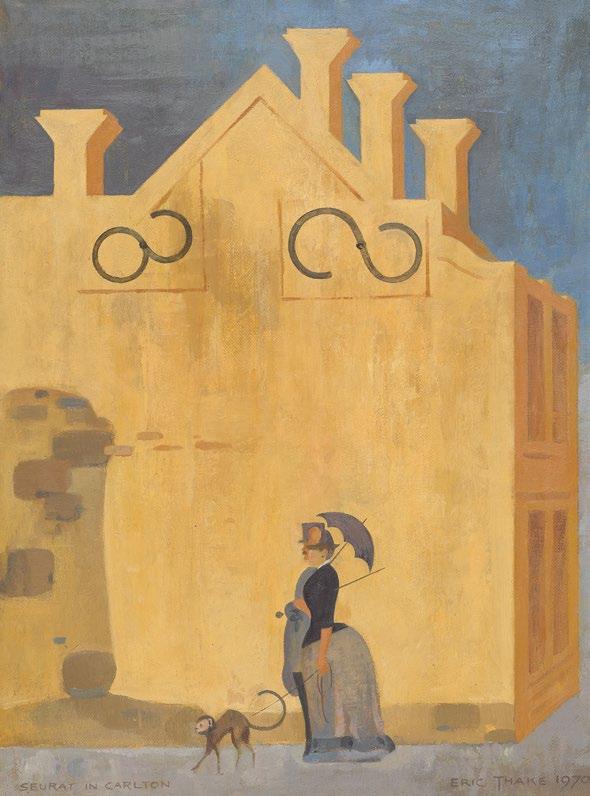
oil on canvas
51.5 x 38.5 cm
signed and dated lower right: ERIC THAKE 1970
inscribed with title lower left: SEURAT IN CARLTON
inscribed with title and dated verso: “SEURAT IN CARLTON” / 1970
Estimate: $20,000 – 30,000
Provenance
Joan Mann, Victoria
Jennifer Campbell, Melbourne
Private collection, Melbourne
Menzies, Sydney, 22 March 2012, lot 10
Private collection, Sydney, acquired from the above
Exhibited
Eric Thake A Retrospective Exhibition, National Gallery of Victoria, Melbourne, 21 May – 4 July 1970, cat. 31
Eric Thake, Macquarie Galleries, Sydney, 2 – 14 February 1977, cat. 6
Literature
Summons, E., ‘Eric Thake’, Art and Australia, Fine Arts Press Pty Limited, Sydney, vol. 15, no. 1, September 1977, pp. 51 (illus.), 54
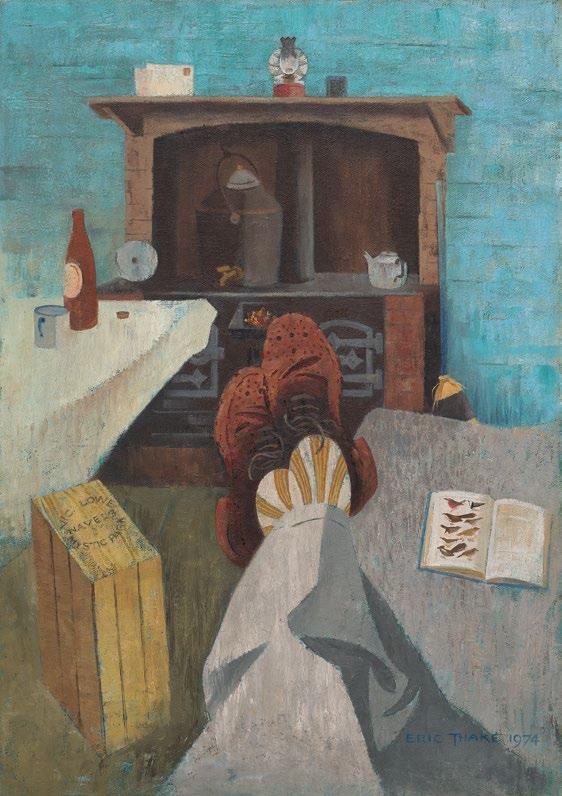
Eric Thake (1904 – 1982)
“We saw the Orange Chat”, 1974 oil on canvas
50.5 x 36.0 cm
signed and dated lower right: ERIC THAKE 1974
inscribed verso on stretcher: “WELL, WE SAW THE ORANGE CHAT” “FROM A SKETCH AT VIC LOWE’S ORANGE BLOCK MYSTIC PARK”
Estimate: $25,000 – 35,000 (2)
Provenance
Macquarie Galleries, Sydney
Private collection, Sydney
Sotheby’s, Melbourne, 22 November 2011, lot 28
Private collection, Sydney, acquired from the above
Exhibited
Eric Thake, Macquarie Galleries, Sydney, 2 – 14 February 1977, cat. 10
Literature
Summons, E., ‘Eric Thake’, Art and Australia, Fine Arts Press Pty Limited, Sydney, vol. 15, no. 1, September 1977, pp. 48, 49 (illus.), 54
Related works
Charles Bryant (1902 – 1960), Orange Chat, c.1920s, watercolour for cigarette card design, 22.0 x 12.0 cm, private collection
This work will be accompanied by Eric Thake, Well We Saw The Orange Chat, 1956, ink and wash on paper
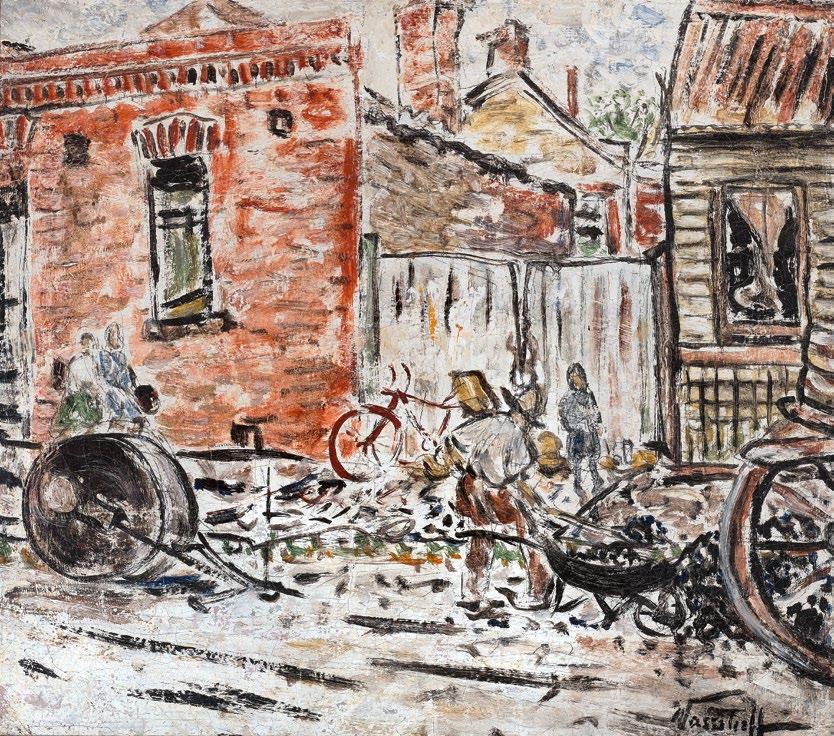
Danila Vassilieff (1897 – 1958)
Fitzroy roadworks, 1937
oil on canvas on board
40.5 x 46.0 cm
signed lower right: Vassilieff
Estimate: $20,000 – 30,000
Provenance
Stuart Macdonald
Private collection, Queensland
Literature
St John Moore, F., Vassilieff and his art, Macmillan Art Publishing, Melbourne, 2012, cat. 96, pp. 48 (illus.), 199
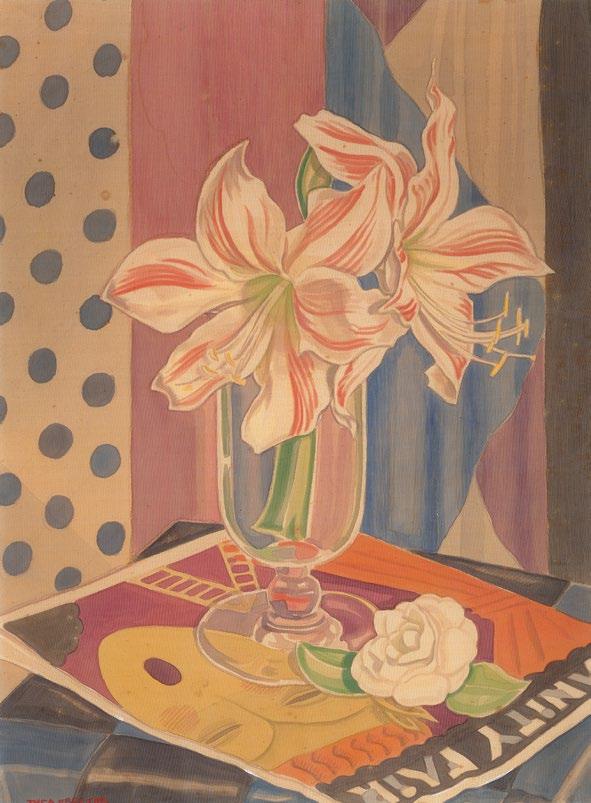
Thea Proctor (1879 – 1966)
Hippeastrum Lilies in a vase, with Vanity Fair Magazine, c.1930s
watercolour on silk
46.5 x 34.0 cm (sight)
signed lower left: THEA PROCTOR
Estimate: $15,000 – 20,000
Private collection, Sydney
Thence by descent
Private collection, Sydney
Thence by descent
Private collection, Sydney
Related work
Hippeastrum Lilies, watercolour, illus. in Ure Smith, S., & Gellert, L. (eds), Art in Australia, Thea Proctor Number, Third Series, no. 43, 15 April 1932, p. 4
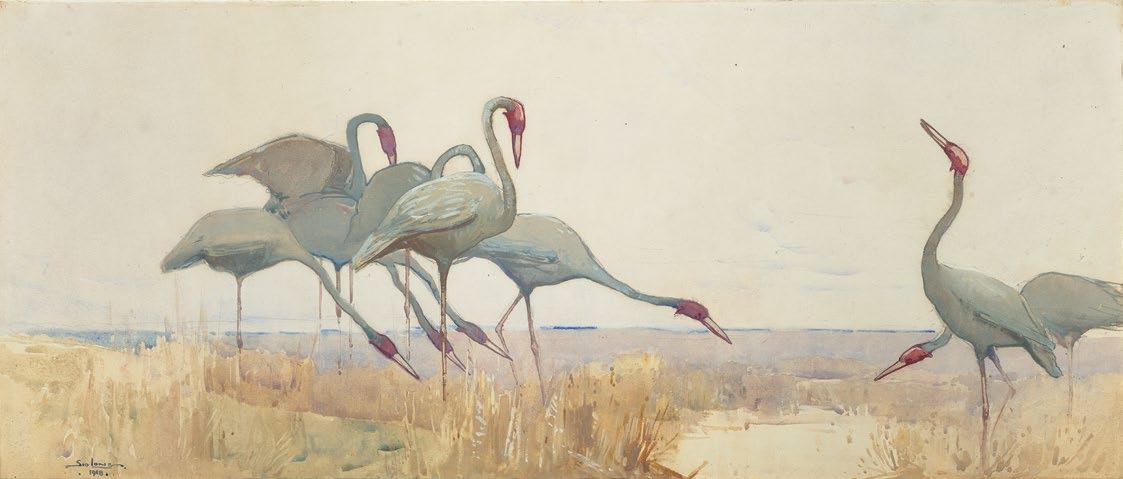
Long (1871 – 1955)
Panel of brolgas, 1918 also known as Native companions
watercolour on paper
32.5 x 74.5 cm (sheet)
signed and dated lower left: SID LONG / 1918 bears inscription on label verso: 289A / Panel of Brolgahs / or “Native Companions”
Estimate: $18,000 – 24,000
Provenance
Private collection, New South Wales
Thence by descent
Private collection, New South Wales
Thence by descent
Private collection, New South Wales
67
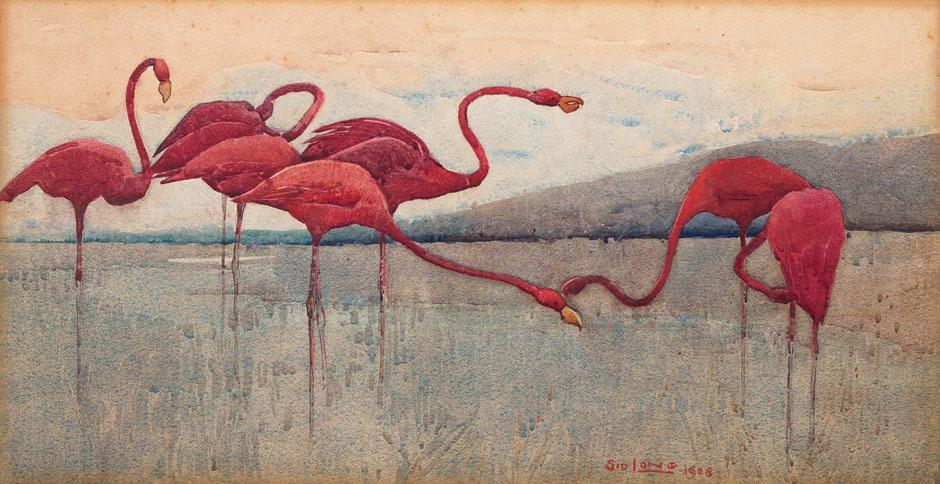
Sydney Long (1871 – 1955)
Pink flamingoes, 1908
watercolour on paper on card
26.5 x 50.5 cm (sheet) signed and dated lower right: SID LONG 1908
Estimate: $15,000 – 20,000
Provenance
Private collection, New South Wales
Thence by descent
Private collection, New South Wales
Thence by descent
Private collection, New South Wales
Sydney Long (1871 – 1955)
oil on canvas on board
61.0 x 25.5 cm
signed lower right: SID LONG
Estimate: $18,000 – 24,000
Provenance
Private collection, Sydney
Thence by descent
Private collection, Sydney
Thence by descent
Private collection, Sydney
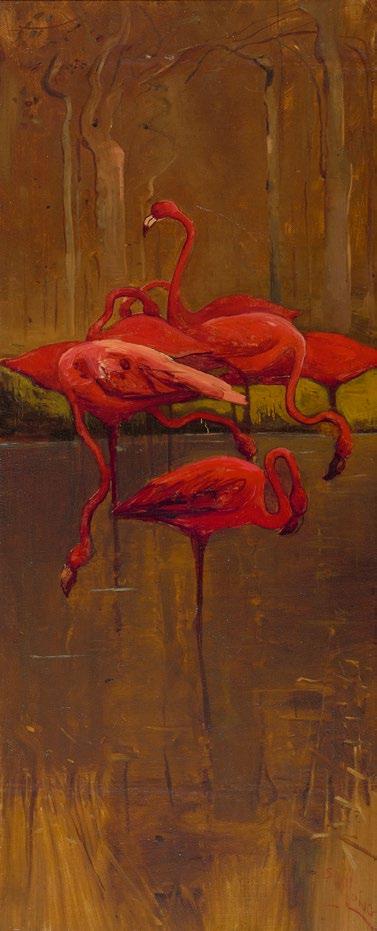
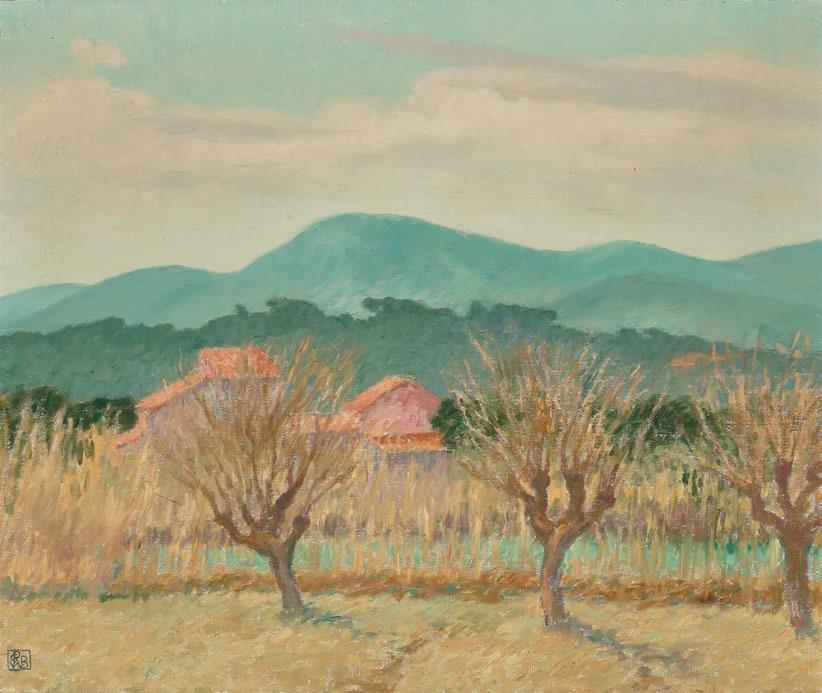
Rupert Bunny (1864 – 1947)
Mulberry trees, c.1924
also known as Hills, at Le Lavandou
oil on canvas
54.0 x 65.0 cm
signed with monogram lower left inscribed verso: 23 HILLS 35 (LE LAVANDOU) bears inscription verso: MULBERRY TREES
Estimate: $30,000 – 40,000
Provenance
The artist, Melbourne
Mr and Mrs Tristan Buesst, Melbourne
Nigel Buesst, Melbourne
Private collection, Adelaide, acquired from the above in 2011
Exhibited
Exhibition of oil paintings by Rupert C. W. Bunny, Anthony Hordern and Sons Galleries, Sydney, 8 – 22 September 1925, cat. 23 (as ‘Hills, at Le Lavandou’)
Rupert Bunny Exhibition, National Gallery of Victoria, Melbourne, 1 October – 10 November 1946, cat. 58 (label attached verso, as ‘Mulberry Trees’)
Past and Present, Victorian Artists Society, Melbourne, 13 – 30 August 1951, cat. 27
Literature
Turnbull, C., & Buesst, T., The Art of Rupert Bunny, Ure Smith Pty. Limited., Sydney, 1948, pl. 27, p. 72 (as ‘Mulberry Trees’)
Shore, A., ‘Victorian art, old and new’, The Argus, Melbourne, 14 August 1951, p. 6 (as ‘Mulberry Trees’)
Thomas, D., Rupert Bunny 1864 – 1947, Lansdowne Press, Melbourne, 1970, cat. 0256, p. 118
Reddin, C., Rupert Bunny Himself: His Final Year in Melbourne, self published, Melbourne, 1987, p. 21 (illus.)
Thomas, D., The Life and Art of Rupert Bunny: A Catalogue Raisonné, Thames and Hudson, Melbourne, 2017, vol. 1, pp. 194, 195 (illus.), vol. 2, cat. 0660, p. 72
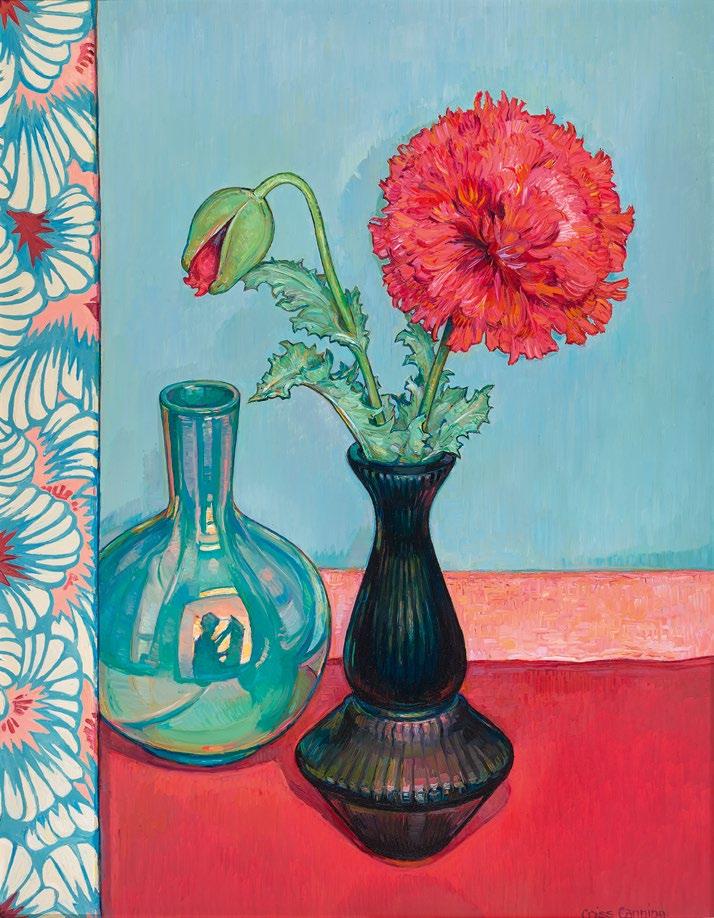
Canning born 1947
Poppies with Venetian silks, 2012
oil on board
46.0 x 36.0 cm
signed lower right: Criss Canning bears inscription on gallery label verso: Criss Canning / Poppies with Venetian Silks / 2012
Estimate: $25,000 – 35,000
Provenance
Private collection, Adelaide, a gift from the artist
Exhibited
Arranging and Reflecting, Savill Galleries, Sydney, 13 November – 7 December 2013 (label attached verso)
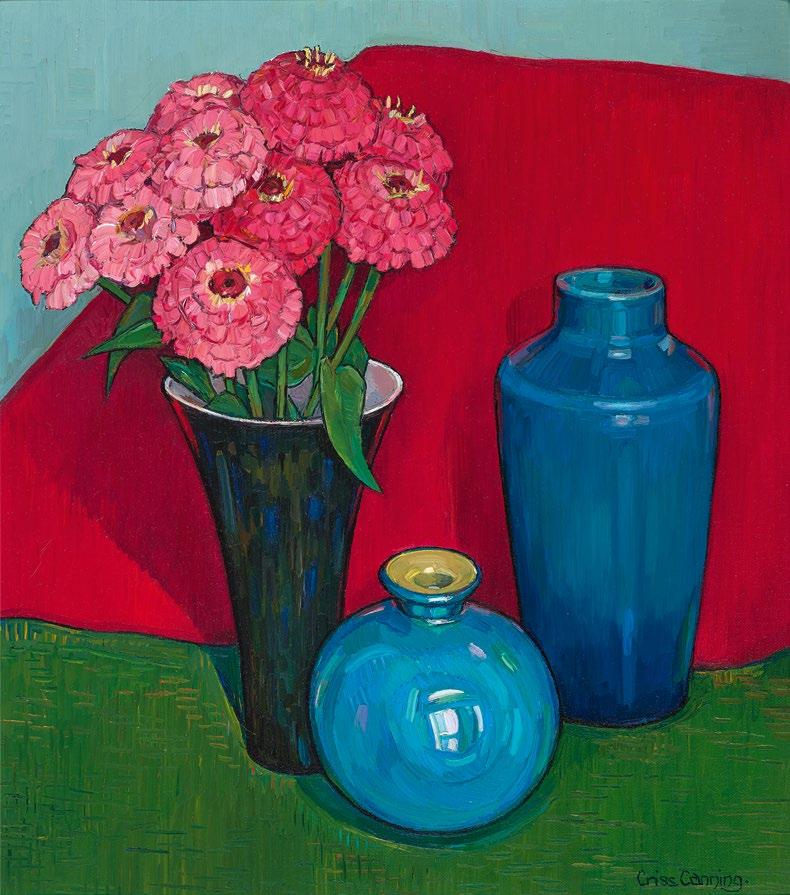
Criss Canning born 1947
oil on canvas
39.5 x 34.5 cm
signed lower right: Criss Canning
Estimate: $20,000 – 30,000
Provenance
Private collection, Adelaide, a gift from the artist
colour screenprint with embossing on Arches cover paper
53.5 x 63.5 cm
edition: 91/250
signed, dated and numbered on estate stamp verso by the Executor for the Keith Haring Estate: 91/250 / Julia Gruen 6/28/90
Estimate: $30,000 – 40,000
Published by Tony Shafrazi Editions, New York Pop International Galleries, inc., New York (label attached verso) Private collection, Sydney and London, acquired from the above
Literature
Littmann, K., Keith Haring: Editions on Paper 1982 – 19 90, The complete printed works, Hatje Cantz, Stuttgart, Germany, 1993, p. 170 (illus., another example)
Phillips, N. E., ‘The Radiant (Christ) Child: Keith Haring and the Jesus Movement’, American Art, The University of Chicago Press, Chicago, on behalf of the Smithsonian American Art Museum, Washington, vol. 21, no. 3, Fall 2007, p. 55 (illus., another example)
Few artists have so successfully dissolved the boundaries between street culture and the establishment as Keith Haring, whose exuberant pictorial vocabulary transformed the walls of New York’s subway stations into one of the defining artistic stages of the 1980s. Executed in a bold, graphic style distinguished by fluid black contours, simplified forms and pulsating lines of energy, indeed Haring’s instantly recognisable imagery defied the conventions of contemporary art, communicating directly with audiences regardless of age, language or cultural background. At the heart of this unique iconography was the Radiant baby –arguably the artist’s most enduring and universally recognised symbol, embodying what Haring himself described as ‘the purest and most positive experience of human existence.’ 1
Notably, the Radiant baby motif first appeared in the early 1980s amongst the hundreds of chalk drawings Haring produced on vacant advertising panels throughout the New York subway system. Conceived as an artistic intervention within the everyday rhythms of urban life, these ephemeral works bypassed the exclusivity of galleries and museums, bringing art directly to the public. Amidst barking dogs, flying saucers and dancing figures, the crawling infant encircled by radiant lines rapidly emerged as Haring’s personal ‘tag’ – a succinct visual shorthand through which he expressed optimism, innocence and the limitless creative potential of humanity.
Although deceptively simple in appearance, Radiant baby is imbued with rich symbolic resonance. The child, rendered in dynamic motion and enveloped by an aura of radiating energy, evokes themes of birth, renewal and universal connectivity, while simultaneously echoing the haloed Christ Child of traditional Christian iconography. Raised within a religious household, Haring frequently acknowledged the abiding influence of spiritual imagery upon his artistic imagination – yet his intention was never doctrinal. Rather, by reducing the human figure to its most elemental form, he sought to create an image capable of transcending cultural, political and linguistic boundaries – a symbol of hope and shared humanity immediately accessible to all.
Created in 1990, the year of Haring’s untimely death at just thirty-one, the present Radiant baby belongs to the celebrated Icons portfolio – a poignant culmination of the artist’s extraordinary career. Revisiting five of his most iconic motifs, the series encapsulated the visual language he had refined over the previous decade into images of remarkable clarity and immediacy. Embossed upon luxurious Arches paper, the brilliant colour and emphatic line preserve all the vitality and spontaneity of Haring’s signature subway drawings, while transforming an ephemeral street intervention into an enduring work of art. More than four decades after first appearing beneath the streets of Manhattan, today Radiant baby remains one of the defining images of contemporary art – a timeless expression of optimism whose joyful simplicity continues to resonate with audiences around the world.
1. Keith Haring, cited in Gruen, J., Keith Haring: The Authorised Biography, New York, 1991, p. 78 Veronica Angelatos
synthetic polymer paint on board in artist’s hand–made frame
30.0 x 89.0 cm
signed and dated upper left: NMcKENNA04
Estimate: $15,000 – 20,000
Provenance
Heiser Gallery, Brisbane (labels attached verso)
Private collection, New South Wales
Deutscher and Hackett, Melbourne, 29 November 2017, lot 38
Private collection, Queensland
Exhibited
Noel McKenna – Australia II including The Queensland Room, Darren Knight Gallery, Sydney, 31 August – 2 October 2004, cat. 24 (illus. in exhibition catalogue) (label attached verso)
Snap Freeze: Still Life Now, TarraWarra Museum of Art, Victoria, 20 May – 11 November 2007 (illus. in exhibition catalogue)
Still Life 1930s – present, Gold Coast City Art Gallery, Queensland, 14 February – 29 March 2009
John Brack x Noel McKenna: A face in the mirror, National Portrait Gallery, Canberra, 3 April – 19 July 2026
Carrara marble and colour pigment
70.0 x 42.0 x 13.0 cm
Estimate: $20,000 – 30,000
Provenance
Barry Stern Galleries, Sydney Private collection, Melbourne, acquired from the above in August 2005
Exhibited
2005 Woollahra Small Sculpture Prize, Woollahra Gallery, Sydney, 22 – 30 October 2005 [winner, viewer’s choice]
Literature
Hynes, V., ‘50 Things / Remarkable Collectors’, Art Collector, Melbourne, January 2019, p. 174 (illus.)
Dorrit Black (1891 – 1951)
Through the window, c.1927
oil on canvas on board
35.0 x 30.0 cm
signed lower right: Dorrit Black bears inscription on labels attached verso: Through the Window
Estimate: $15,000 – 20,000
Provenance
Estate of the artist, Adelaide
Thence by descent
Helen Finlayson (née Black), Adelaide, 1951 [the artist’s sister]
Margaret Michelmore (née Finlayson), Adelaide, a gift from the above Estate of the above, Adelaide
Exhibited
The Younger Group of Australian Artists, Anthony Horderns’ Art Gallery, Sydney, 1 – 16 March 1927, cat. 95
Dorrit Black 1891 – 1951, Art Gallery of South Australia, Adelaide, then touring to: Art Gallery of New South Wales, Sydney; Newcastle Art Gallery, New South Wales; The Ewing and George Paton Galleries, University of Melbourne, Melbourne, 1975 – 76, cat. 10 (label attached verso)
Dorrit Black (1891 – 1951), Royal South Australian Society of Arts, Adelaide, 24 April – 15 May 2011, cat. 8 (label attached verso)
Dorrit Black: Unseen Forces, Art Gallery of South Australia, Adelaide, 14 June – 7 September 2014
Literature
‘The Younger Group, Australian Artists’, The Sydney Morning Herald, Sydney, 3 March 1927, p. 12
North, I., The Art of Dorrit Black, Art Gallery of South Australia, Adelaide, and Macmillan, South Melbourne, 1979, cat. 0.21, pl. 53, pp. 16, 19 (illus.), 121
Lock, T., Dorrit Black, Unseen Forces, Art Gallery of South Australia, Adelaide, 2014, pp. 26, 30 (illus.), 189 (illus.)
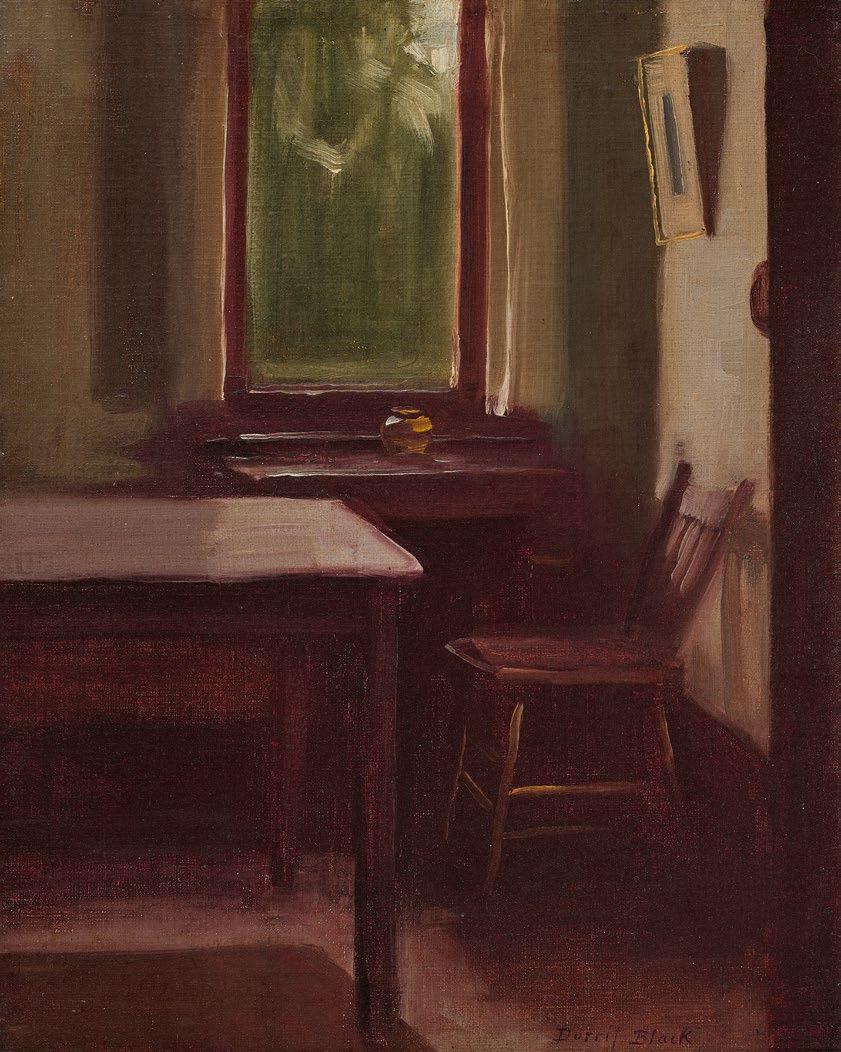
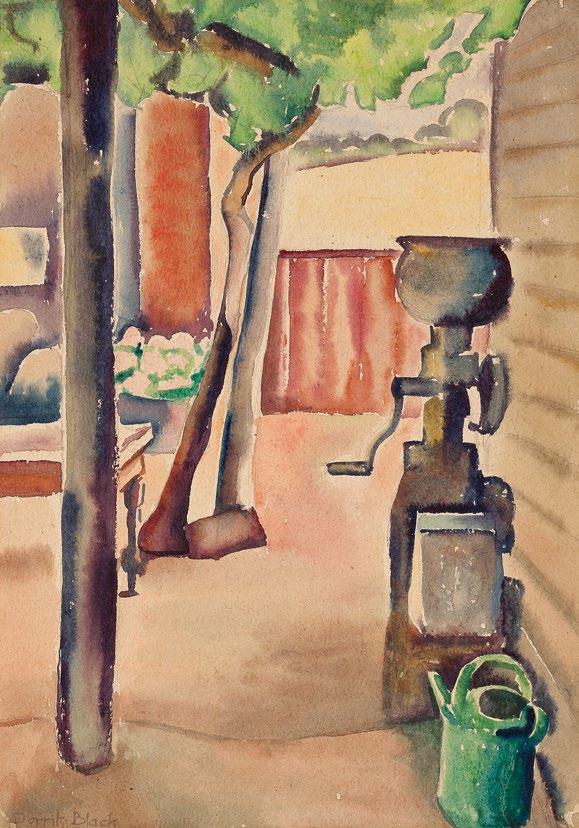
Dorrit Black (1891 – 1951)
watercolour on card
37.0 x 25.0 cm (image)
38.5 x 29.5 cm (sheet)
signed lower left: Dorrit Black
Estimate: $6,000 – 9,000
Provenance
Estate of the artist, Adelaide
Thence by descent
Helen Finlayson (née Black), Adelaide, 1951 [the artist’s sister]
Margaret Michelmore (née Finlayson), Adelaide, a gift from the above
Estate of the above, Adelaide
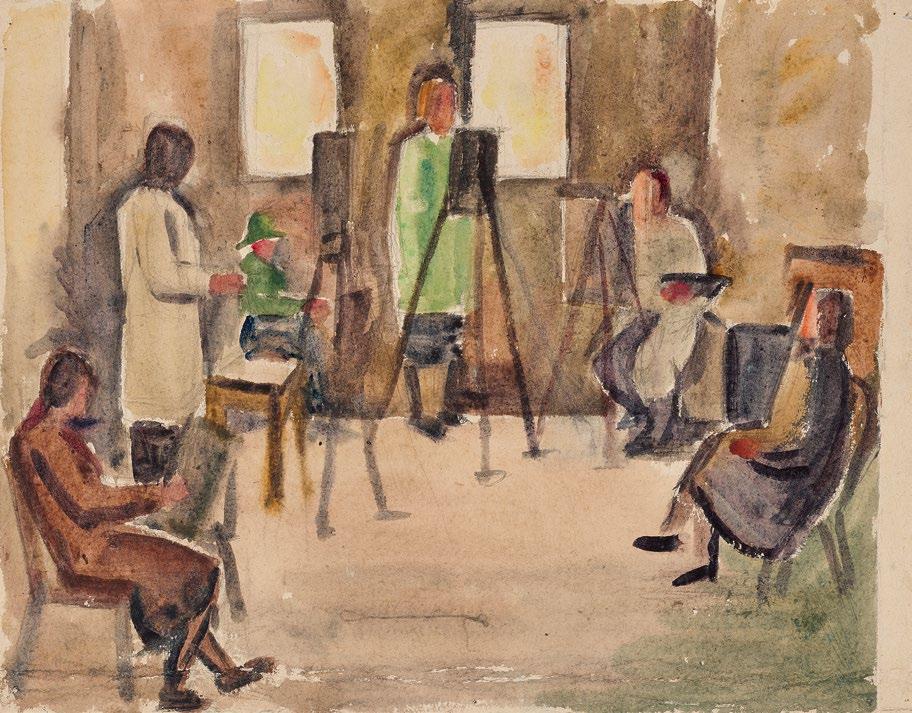
watercolour on paper
31.5 x 38.5 cm (image)
31.5 x 40.0 cm (sheet)
Estimate: $6,000 – 9,000
Provenance
Estate of the artist, Adelaide
Thence by descent
Helen Finlayson (née Black), Adelaide, 1951 [the artist’s sister]
Margaret Michelmore (née Finlayson), Adelaide, a gift from the above
Estate of the above, Adelaide
Literature
North, I., The Art of Dorrit Black, Art Gallery of South Australia, Adelaide, and Macmillan, South Melbourne, 1979, cat. W.59, p. 127
Related work
The Sketch Club, 1942, oil on cardboard, 55.6 x 58.5 cm, Art Gallery of South Australia, Adelaide
Nocturne, Wynyard Square, 1932
linocut on paper
22.5 x 15.0 cm (image)
25.0 x 19.0 cm (sheet)
artist’s proof edition of 50
signed in image lower right with artist’s monogram
Estimate: $10,000 – 15,000
Provenance
Estate of the artist, Adelaide
Thence by descent
Helen Finlayson (née Black), Adelaide, 1951 [the artist’s sister]
Margaret Michelmore (née Finlayson), Adelaide, a gift from the above
Estate of the above, Adelaide
Exhibited
Exhibition of Oils, Watercolours and Lino Cuts by Dorrit Black, Royal South Australian Society of the Arts, Adelaide, 7 – 23 July 1938, cat. 33 (another example, as ‘Wynyard Square’)
Dorrit Black (Retrospective), Royal South Australian Society of the Arts, Adelaide, 25 October – 3 November 1945, cat. 51 (another example, as ‘Wyngard [sic.] Nocturne’)
Print, Drawing and Watercolour, Contemporary Art Society of Australia, Adelaide, 1952, cat. 43 (another example, as ‘Reconstructions, Wynward Square’)
Dorrit Black 1891 – 1951, Art Gallery of South Australia, Adelaide, and touring, 1975 – 76, cat. 55 (another example)
Nocturne: images of night and darkness from colonial to contemporary, Mornington Peninsula Regional Gallery, Victoria, 23 Apil – 16 June 2002 (another example)
Sydney Moderns: Art for a New World, Art Gallery of New South Wales, Sydney, 6 July – 7 October 2013 (illus. in exhibition catalogue, pp. 132, 189 (illus., another example), 310)
Dorrit Black: Unseen Forces, Art Gallery of South Australia, Adelaide, 14 June – 7 September 2014 (another example)
Tatlock Miller, H (ed.)., Manuscripts: A Miscellany of Art and Letters, The Hassell Press, Adelaide, no. 3, November 1932, p. 37 (illus., another example)
North, I., The Art of Dorrit Black, Art Gallery of South Australia, Adelaide, and Macmillan, South Melbourne, 1979, cat. L.16, pl. 24, pp. 63 (illus. another example), 64, 131
Coppel, S., Lino Cuts of the Machine Age: Claude Flight and the Grosvenor School, Scholar Press, Leicester, United Kingdom, in association with National Gallery of Australia, Canberra, 1995, cat. DB16, p. 156 (illus., another example)
Thomas, S., ‘A wider vision: Dorrit Black’s Modern Art Centre’, Art and Australia, Sydney, vol. 44, no. 1, September – November 2006, pp. 98 (illus., another example), 99
Lock, T., Dorrit Black, Unseen Forces, Art Gallery of South Australia, Adelaide, 2014, p. 202 (illus., another example)
Related works
Other examples from this edition are held in the collections of the Art Gallery of New South Wales, Sydney, Queensland Art Gallery | Gallery of Modern Art, Brisbane and the Art Gallery of South Australia, Adelaide Study for ‘Nocturne, Wynyard Square’, 1932, pencil on paper, 22.5 x 15.1 cm, Art Gallery of New South Wales, Sydney
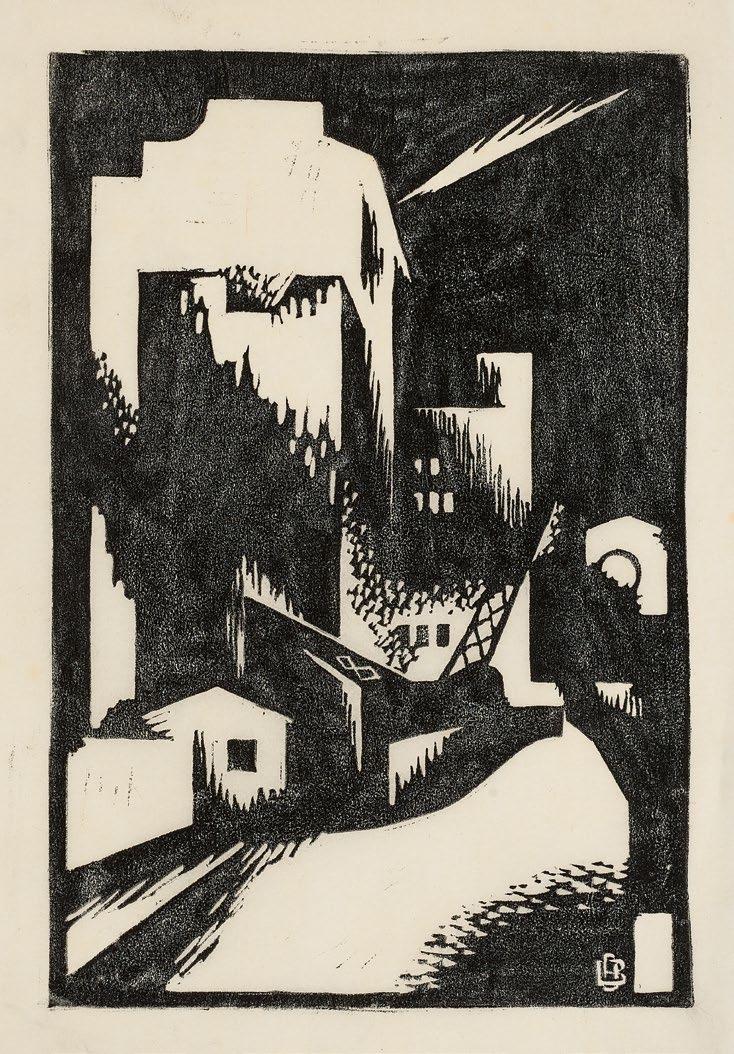
1947 – 49
colour linocut on paper
18.0 x 22.0 cm (image)
21.0 x 31.0 cm (sheet)
artist’s proof edition of 50
signed in image upper right with artist’s monogram
Estimate: $20,000 – 30,000
Provenance
Estate of the artist, Adelaide
Thence by descent
Helen Finlayson (née Black), Adelaide, 1951 [the artist’s sister]
Margaret Michelmore (née Finlayson), Adelaide, a gift from the above
Estate of the above, Adelaide
Exhibited
Dorrit Black, Royal South Australian Society of Arts Gallery, Adelaide, 10 – 21 May 1949, cat. 48 (another example)
Dorrit Black Memorial Exhibition, Royal South Australian Society of Arts Gallery, Adelaide, 22 April – 2 May 1952, cat. 60 (another example)
The Drawing, Print and Watercolour Exhibition, Contemporary Art Society of Australia, Melbourne, opened 2 December 1952, cat. 11 (another example)
Dorrit Black 1891 – 1951, Art Gallery of South Australia, Adelaide, 1975, then touring to: Art Gallery of New South Wales, Sydney; Newcastle Art Gallery, New South Wales; The Ewing and George Paton Galleries, University of Melbourne, Melbourne, 1975 – 76, cat. 66 (another example)
Dorrit Black: Unseen Forces, Art Gallery of South Australia, Adelaide, 14 June – 7 September 2014 (another example)
Literature
North, I., The Art of Dorrit Black, Art Gallery of South Australia, Adelaide, 1979, cat. L.46, pl. 49C, pp. 105 (illus., another example, as ‘Air Travel – The Pineapple Plantation’), 106, 133
Coppel, S., Lino Cuts of the Machine Age: Claude Flight and the Grosvenor School, Scholar Press, Leicester, United Kingdom, in association with National Gallery of Australia, Canberra, 1995, cat. DB48, pl. 34, pp. 43 (illus., another example), 165 (illus., another example)
Lock, T., Dorrit Black: Unseen Forces, Art Gallery of South Australia, Adelaide, pp. 134, 164 (illus., another example), 206 (illus., another example)
Related works
Other examples from this edition are held in the collections of the National Gallery of Australia, Canberra, the National Gallery of Victoria, Melbourne, and the Art Gallery of South Australia, Adelaide
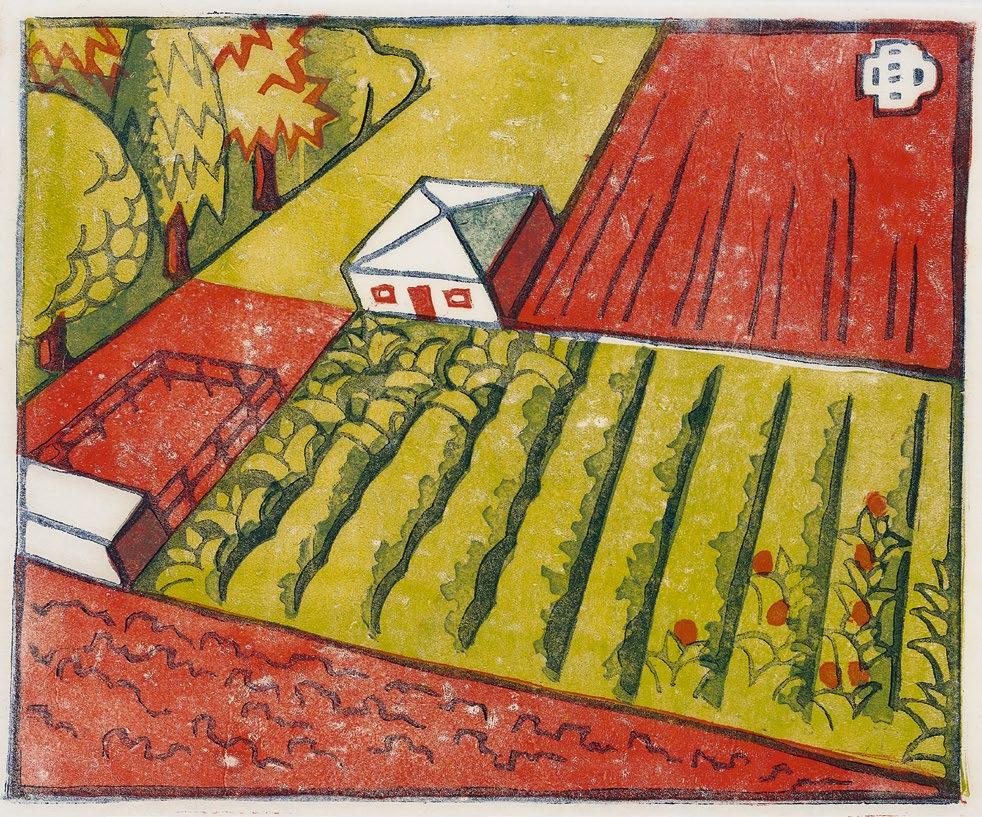
colour linocut on paper
25.0 x 19.0 cm (image)
31.0 x 21.0 cm (sheet)
artist’s proof edition of 50 signed in image upper right with artist’s monogram
Estimate: $10,000 – 15,000
Provenance
Estate of the artist, Adelaide
Thence by descent
Helen Finlayson (née Black), Adelaide, 1951 [the artist’s sister]
Margaret Michelmore (née Finlayson), Adelaide, a gift from the above
Estate of the above, Adelaide
Exhibited
Dorrit Black, Royal South Australian Society of Arts, Adelaide, 10 – 21 May 1949, cat. 46 (another example)
Dorrit Black Memorial Exhibition, Royal South Australian Society of Arts, Adelaide, 22 April – 2 May 1952, cat. 61 (another example)
Print, Drawing and Watercolour, Contemporary Art Society of Australia, Adelaide, 1952, cat. 12 (another example)
Dorrit Black 1891 – 1951, Art Gallery of South Australia, Adelaide, and touring, 1975 – 76, cat. 64 (another example)
Sydney Moderns: Art for a New World, Art Gallery of New South Wales, Sydney, 6 July – 7 October 2013 (illus. in exhibition catalogue, pp. 222, 235 (illus., another example), 310)
Dorrit Black: Unseen Forces, Art Gallery of South Australia, Adelaide, 14 June – 7 September 2014 (another example)
Literature
North, I., The Art of Dorrit Black, Art Gallery of South Australia, Adelaide, and Macmillan, South Melbourne, 1979, cat. L.44, pl. 49A, pp. 103 (illus., another example), 133
Coppel, S., Lino Cuts of the Machine Age: Claude Flight and the Grosvenor School, Scholar Press, Leicester, United Kingdom, in association with National Gallery of Australia, Canberra, 1995, cat. DB46, pp. 164, 165 (illus., another example)
Lock, T., Dorrit Black, Unseen Forces, Art Gallery of South Australia, Adelaide, 2014, pp. 164, 167 (illus., another example) 206 (illus., another example)
Related works
Other examples from this edition are held in the collections of the National Gallery of Australia, Canberra and the Art Gallery of South Australia, Adelaide
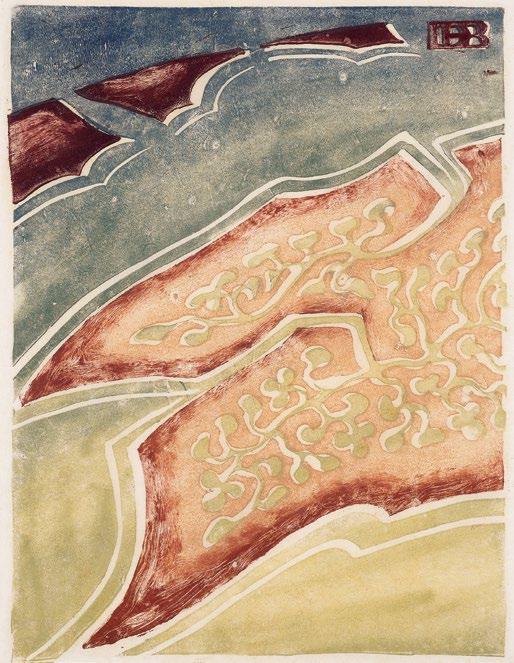
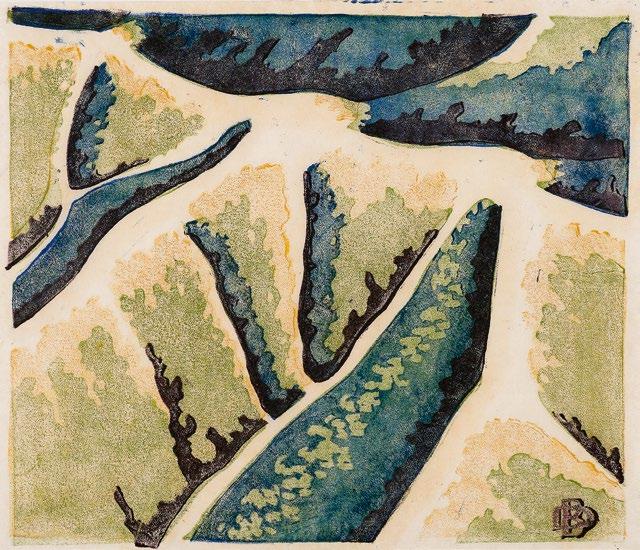
Air travel 4: Over the mountains, 1947 – 49
colour linocut on paper
18.5 x 21.5 cm (image)
21.5 x 25.5 cm (sheet)
artist’s proof edition of 50 signed in image lower right with artist’s monogram
Estimate: $10,000 – 15,000
Provenance
Estate of the artist, Adelaide
Thence by descent
Helen Finlayson (née Black), Adelaide, 1951 [the artist’s sister]
Margaret Michelmore (née Finlayson), Adelaide, a gift from the above
Estate of the above, Adelaide
Exhibited
Dorrit Black, Royal South Australian Society of Arts, Adelaide, 10 – 21 May 1949, cat. 47 (another example)
Dorrit Black Memorial Exhibition, Royal South Australian Society of Arts, Adelaide, 22 April – 2 May 1952, cat. 59 (another example)
Print, Drawing and Watercolour, Contemporary Art Society of Australia, Adelaide, 1952, cat. 12 (another example)
Dorrit Black 1891 – 1951, Art Gallery of South Australia, Adelaide, and
touring, 1975 – 76, cat. 65 (another example)
Sydney Moderns: Art for a New World, Art Gallery of New South Wales, Sydney, 6 July – 7 October 2013 (illus. in exhibition catalogue, pp. 222, 235 (illus., another example), 310)
Dorrit Black: Unseen Forces, Art Gallery of South Australia, Adelaide, 14 June – 7 September 2014 (another example)
Literature
North, I., The Art of Dorrit Black, Art Gallery of South Australia, Adelaide, and Macmillan, South Melbourne, 1979, cat. L.45, pl. 49B, pp. 103 (illus., another example), 133
Coppel, S., Lino Cuts of the Machine Age: Claude Flight and the Grosvenor School, Scholar Press, Leicester, United Kingdom, in association with National Gallery of Australia, Canberra, 1995, cat. DB47, p. 165 (illus., another example)
Lock, T., Dorrit Black, Unseen Forces, Art Gallery of South Australia, Adelaide, 2014, pp. 166 (illus., another example) 207 (illus., another example)
Related works
Other examples from this edition are held in the collections of the National Gallery of Australia, Canberra and the Art Gallery of South Australia, Adelaide
82
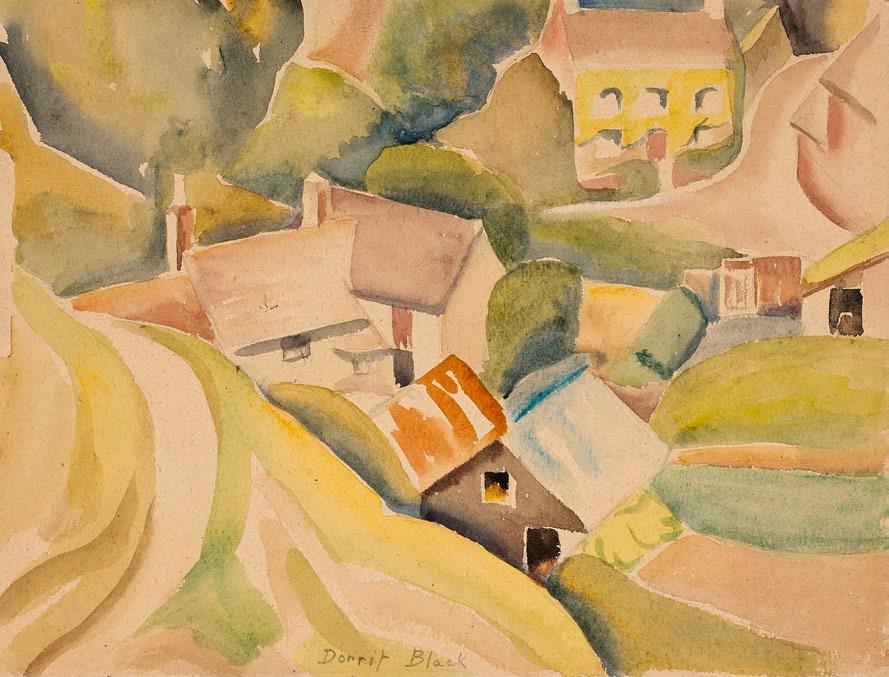
Dorrit Black (1891 – 1951)
Group of cottages, Corfe Castle, 1935
watercolour on paper
26.0 x 33.5 cm
signed lower centre: Dorrit Black inscribed with title twice verso: Group of Cottages / Corfe Castle
Estimate: $6,000 – 9,000
Provenance
Estate of the artist, Adelaide
Thence by descent
Helen Finlayson (née Black), Adelaide, 1951 [the artist’s sister]
Margaret Michelmore (née Finlayson), Adelaide, a gift from the above
Estate of the above, Adelaide
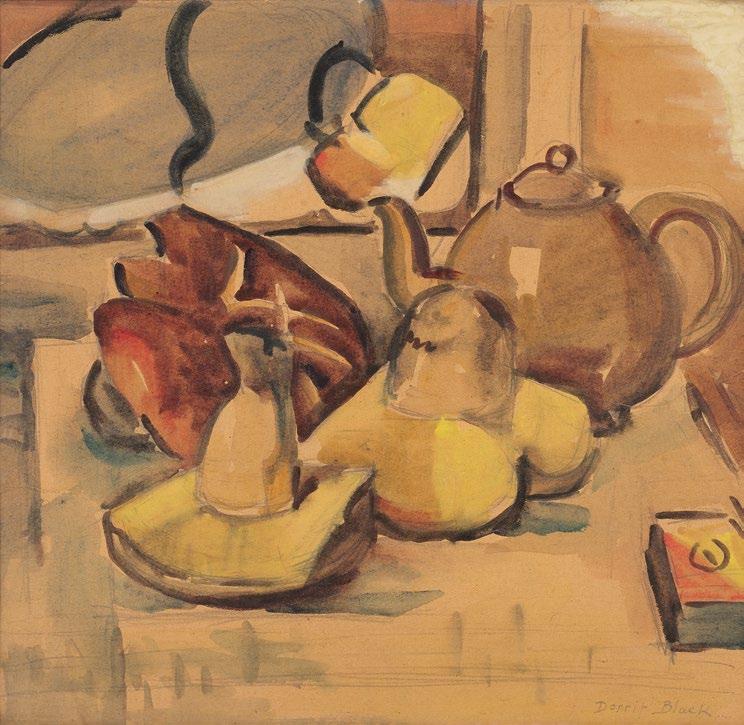
Black (1891 – 1951)
Untitled [Still life with teapot], c.1940 – 51
watercolour on paper
37.5 x 39.0 cm (sight)
signed lower right: Dorrit Black
Estimate: $6,000 – 8,000
Provenance
Estate of the artist, Adelaide
Thence by descent
Helen Finlayson (née Black), Adelaide, 1951 [the artist’s sister]
Margaret Michelmore (née Finlayson), Adelaide, a gift from the above
Estate of the above, Adelaide
Literature
North, I., The Art of Dorrit Black, Art Gallery of South Australia, Adelaide, and Macmillan, South Melbourne, 1979, cat. W.147, p. 130
linocut on paper
19.0 x 23.5 cm (image)
24.0 x 26.5 cm (sheet)
artist’s proof
signed in image lower right with artist’s monogram
Estimate: $8,000 – 12,000
Provenance
Estate of the artist, Adelaide
Thence by descent
Helen Finlayson (née Black), Adelaide, 1951 [the artist’s sister]
Margaret Michelmore (née Finlayson), Adelaide, a gift from the above Estate of the above, Adelaide
Exhibited
Exhibition of Prints, Modern Art Centre, Sydney, opened 3 August 1933, cat. 5 (another example)
Print, Drawing and Watercolour, Contemporary Art Society of Australia, Adelaide, 1952, cat. 46 (another example., as ‘Chinamen’s Garden’)
Dorrit Black (1891 – 1951), Royal South Australian Society of Arts, Adelaide, 24 April – 15 May 2011, cat. 22 (another example., as ‘Chinamen’s Garden’)
Dorrit Black: Unseen Forces, Art Gallery of South Australia, Adelaide, 14 June – 7 September 2014 (another example)
Literature
North, I., The Art of Dorrit Black, Art Gallery of South Australia, Adelaide, and Macmillan, South Melbourne, 1979, cat. L.27, p. 132 (another example, as ‘Hillside’)
Coppel, S., Lino Cuts of the Machine Age: Claude Flight and the Grosvenor School, Scholar Press, Leicester, United Kingdom, in association with National Gallery of Australia, Canberra, 1995, cat. DB22, p. 158 (illus., another example as ‘Chinamen’s Garden’)
Lock, T., Dorrit Black, Unseen Forces, Art Gallery of South Australia, Adelaide, 2014, p. 202 (illus., another example)
Related works
Other examples from this edition are held in the collections of the National Gallery of Australia, Canberra and the Art Gallery of South Australia, Adelaide
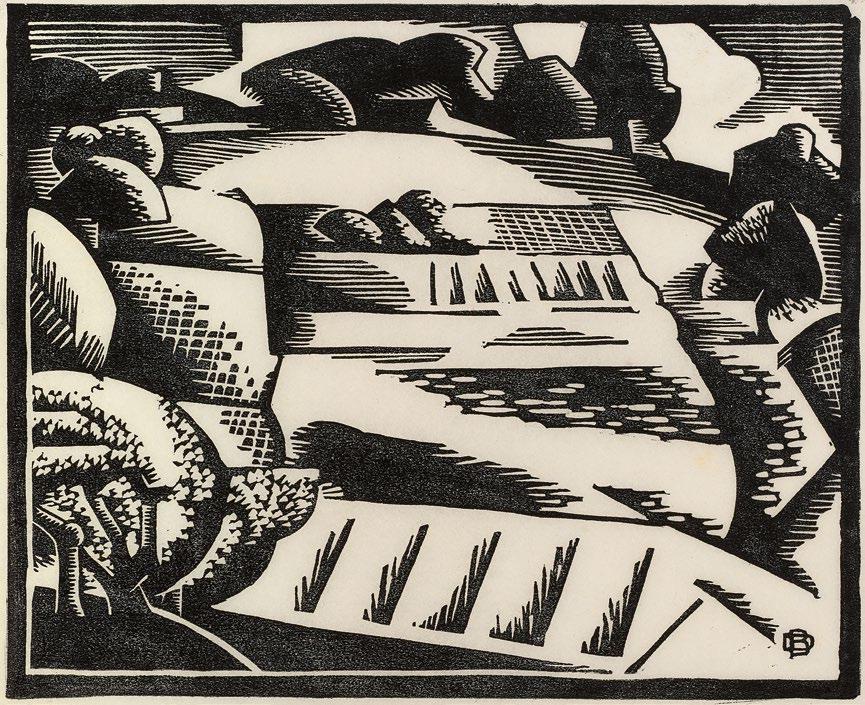
linocut on paper
14.5 x 20.0 cm (image)
16.5 x 22.0 cm (sheet) artist’s proof signed in image lower right with artist’s monogram
Estimate: $6,000 – 9,000
Provenance
Estate of the artist, Adelaide Thence by descent
Helen Finlayson (née Black), Adelaide, 1951 [the artist’s sister]
Margaret Michelmore (née Finlayson), Adelaide, a gift from the above Estate of the above, Adelaide
Exhibited
Progressive Art, Modern Art Centre, Sydney, 1 March – 1 April 1932, cat. 6 (another example)
Exhibition of Oils, Watercolours and Lino Cuts by Dorrit Black, Royal South Australian Society of Arts, Adelaide, 7 – 23 July 1938, cat. 43 (another example)
The Drawing, Print and Watercolour Exhibition, Contemporary Art Society of Australia, Melbourne, opened 2 December 1952, cat. 44 (another example)
Exhibition of Paintings by the late Dorrit Black, Hahndorf Academy Gallery, Adelaide, 1959, cat. 37 (another example., as ‘Trees (woodcut)’)
Dorrit Black 1891 – 1951, Art Gallery of South Australia, Adelaide, and touring, 1975 – 76, cat. 58 (another example)
Dorrit Black (1891 – 1951), Royal South Australian Society of Arts, Adelaide, 24 April – 15 May 2011, cat. 24 (another example)
Dorrit Black: Unseen Forces, Art Gallery of South Australia, Adelaide, 14 June – 7 September 2014 (another example)
Literature
Tatlock Miller, H (ed.)., Manuscripts: A Miscellany of Art and Letters,
The Hassell Press, Adelaide, no. 6, August 1933, p. 45 (another example)
Brown (ed) et. al., A Book of South Australian Women in the First Hundred Years, Rigby, Adelaide, 1936, p. 122 (another example)
Phoenix, Adelaide University Students’ Representative Council, Adelaide, 1939, p. 54 (another example)
North, I., The Art of Dorrit Black, Art Gallery of South Australia, Adelaide, and Macmillan, South Melbourne, 1979, cat. L.20, pl. 25, pp. 65 (illus., another example), 132
Ambrus, C., Australian Women Artists: First Fleet to 1945: History, Hearsay and Her say, Irrepressible Press, Canberra, 1992, p. 82 (illus., another example)
Coppel, S., Lino Cuts of the Machine Age: Claude Flight and the Grosvenor School, Scholar Press, Leicester, United Kingdom, in association with National Gallery of Australia, Canberra, 1995, cat. DB23, pp. 158, 159 (illus., another example)
Lock, T., Dorrit Black, Unseen Forces, Art Gallery of South Australia, Adelaide, 2014, p. 202 (illus., another example)
Related works
Other examples from this edition are held in the collections of the Art Gallery of South Australia, Adelaide, Art Gallery of Ballarat, Victoria and the National Gallery of Australia, Canberra
Gum trees, 1933 – 35, oil on canvas, 42.0 x 59.8 cm, National Gallery of Victoria, Melbourne
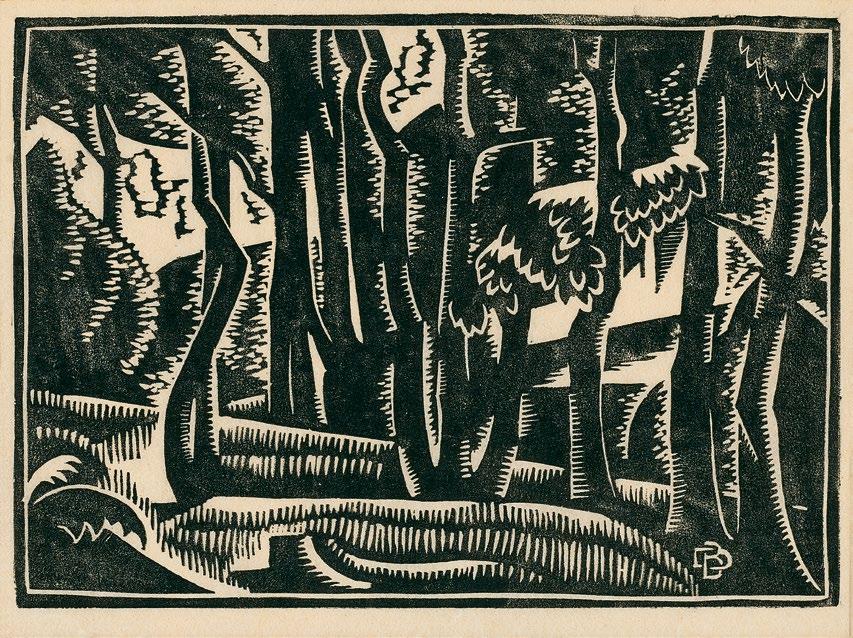

While we are ever grateful and respectful of our past, it’s our future that excites us the most. And always has done. Any business that has managed to flourish across three centuries won’t ever be accused of resting on its laurels or wishing for yesteryear. We stand on the shoulders of those who went before us and in doing so, we have a clearer view of what lies ahead.
And while it rests with the fifth and sixth generations of the Hill-Smith family to guide the ship, it’s all those who make up the wider Yalumba family today we are most grateful for. From our staff to our suppliers, trade partners and supporters. Every one of them has an undying passion for fine wines and great quality in all they do. They inspire us and push us to greater heights, and we look forward to further collaboration with them, as well as new partners, in the years ahead.
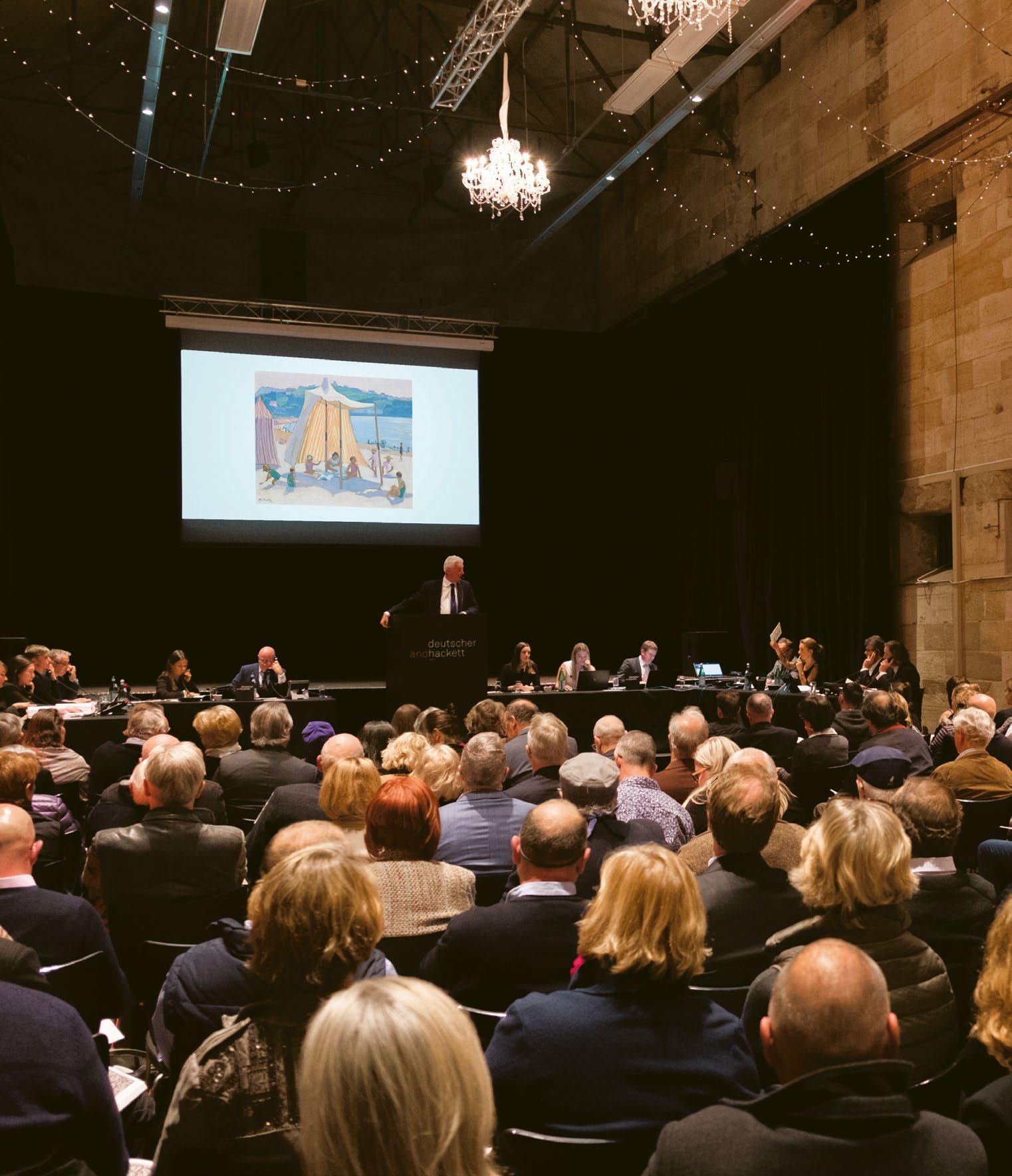
ALL PARTIES ARE STRONGLY URGED TO READ THE CONDITIONS OF AUCTION AND SALE INCLUDED IN THIS CATALOGUE
CATALOGUE SUBSCRIPTIONS
Catalogues can be obtained at Deutscher and Hackett offices or by subscription (see the Catalogue Subscription Form at the back of this catalogue or online for more information).
PRE-SALE ESTIMATES
The price range estimated against each lot reflects the opinion of our art specialists as to the hammer price expected for the lot at auction and is informed by realised prices for comparable works as well as the particularities of each lot including condition, quality, provenance and rarity. While presale estimates are intended as a guide for prospective buyers, lots can be sold outside of these ranges. Pre-sale estimates include GST (if any) on a lot but do not include the buyer’s premium or other charges where applicable.
The reserve is the minimum price including GST (if any) that the vendor will accept for a lot and below which the lot will not normally be sold.
PRE-AUCTION VIEWINGS
In both Sydney and Melbourne pre-auction viewings are scheduled for several days in advance of each auction. Deutscher and Hackett specialists are available to give obligation free advice at viewings or by appointment and prospective buyers are strongly encouraged to thoroughly examine and request condition reports for potential purchases. Pre-auction viewings are open to the public and are free to attend.
SYMBOL KEY
▲ Unless ownership is clearly stated in the provenance, this symbol is used where a lot is offered which Deutscher and Hackett owns in whole or in part. In these instances, Deutscher and Hackett has a direct financial interest in the property or means that Deutscher and Hackett has guaranteed a minimum price.
● Used to indicate lots for sale without a reserve.
EXPLANATION OF CATALOGUING PRACTICE AND TERMS
All information published in Deutscher and Hackett catalogues represent statements of opinion and should not be relied upon as fact. All dimensions are listed in centimetres, height before width and are approximate. All prices are in Australian dollars.
All reference to artists make use of common and not full names in accordance with the standards outlined in the National Gallery of Australia reference publication Australian Art: Artist’s working names authority list. For instance, John Brack rather than Cecil John Brack; Roy de Maistre rather than Leroy Leveson Laurent De Maistre; Rosalie Gascoigne rather than Rosalie Norah Gascoigne.
Terms used in this catalogue have the meanings ascribed to them below:
a. NICHOLAS CHEVALIER: in the opinion of Deutscher and Hackett, a work by the artist.
b. Attributed to NICHOLAS CHEVALIER: in the opinion of Deutscher and Hackett, probably a work by the artist, in whole or in part.
c. Circle of NICHOLAS CHEVALIER: in the opinion of Deutscher and Hackett, a work showing the influence and style of the artist and of the artist’s period.
d. Studio/Workshop of NICHOLAS CHEVALIER: in the opinion of Deutscher and Hackett, a work possibly executed under the supervision of the artist.
e. School of NICHOLAS CHEVALIER: in the opinion of Deutscher and Hackett, a work by a follower or student of the artist.
f. Manner of NICHOLAS CHEVALIER: in the opinion of Deutscher and Hackett, a work created in the style, but not necessarily in the period, of the artist.
g. After NICHOLAS CHEVALIER: in the opinion of Deutscher and Hackett, a copy of a work by the artist.
h. “signed” / “dated” in the opinion of Deutscher and Hackett, the work has been signed/ dated by the artist.
i. “bears signature” / “bears date” in the opinion of Deutscher and Hackett, the work has possibly been signed/dated by someone other than the artist.
Where appropriate, Deutscher and Hackett will include the known provenance, or history of ownership of lots. Non disclosure may indicate that prior owners are unknown or that the seller wishes to maintain confidentiality.
Auctions are open to the public and are free to attend. Deutscher and Hackett may exclude any person at any time in its discretion.
Bidders must register to bid prior to the commencement of an auction. Deutscher and Hackett may impose other obligations on the registration of bidders in its discretion.
Lots are offered for sale on a consecutive basis. Deutscher and Hackett will determine the conduct of the auction in its absolute discretion, including the regulation of bidding. Consecutive or responsive bids may be placed by the auctioneer on behalf of the vendor up to the reserve.
As a courtesy service, Deutscher and Hackett will make reasonable efforts to place bids for prospective buyers in absentia provided written or verbal instructions (as indicated on absentee bid forms included at the back of this catalogue or online) are received 24 hours prior to auction. Where successful, lots will be purchased at the lowest possible bid and in the event of identical absentee bids, the bid received earliest will take precedence. Deutscher and Hackett accepts no responsibility for errors and omissions in relation to this courtesy service and reserves the right to record telephone bids.
Unless indicated otherwise, all lots are subject to a confidential reserve price determined by the vendor. Deutscher and Hackett or the auctioneer may place any number of bids on behalf of the vendor below the reserve price and is not obliged to identify that the bids are being placed on behalf of the vendor.
Bidding usually opens below the listed pre-sale estimate and proceeds in the following increments (the auctioneer may vary the bidding increments at his or her discretion):
$500 – 1,000 by $50
$1,000 – 2,000 by $100
$2,000 – 3,000 by $200
$3,000 – 5,000 by $200 / $500 / $800
$5,000 – 10,000 by $500
$10,000 – 20,000 by $1,000
$20,000 – 30,000 by $2,000
$30,000 – 50,000 by $2,000 / $5,000 / $8,000
$50,000 – 100,000 by $5,000
$100,000 – 200,000 by $10,000
$200,000 – 300,000 by $20,000
$300,000 – 500,000 by $20,000 / $50,000 / $80,000
$500,000 – 1,000,000 by $50,000
$1,000,000+ by $100,000
SUCCESSFUL BIDS
The fall of the auctioneer’s hammer indicates the final bid and the buyer assumes full responsibility for the lot from this time.
Where a lot is unsold, the auctioneer will announce that the lot is “bought in”, “passed”, “withdrawn” or “returned to owner”.
Payment must be made within seven days of the date of sale in Australian dollars by cash, cheque, direct deposit, approved credit cards or electronic funds transfer. If payment is made by credit card the price will increase by any merchant fees payable by Deutscher and Hackett (0.85% (including GST) for Visa and Mastercard and 1.75% (including GST) for American Express). In certain circumstances, extension of payment may be granted at the discretion of Deutscher and Hackett. Cleared funds will be held in an interest bearing trust account by Deutscher and Hackett until remitted to the vendor. Deutscher and Hackett will be entitled to retain any interest earned during this period. Payment by the vendor of any charge to Deutscher and Hackett is to be made within fourteen days of invoice.
The purchase price will be the sum of the final bid price (including any GST) plus a buyer’s premium set at 25% (inclusive of GST) of the final bid price. Buyers may be liable for other charges reasonably incurred once ownership has passed.
Buyers are required to pay a 10% G.S.T which sum is:
a. included in the final bid prices where buying from a GST registered vendor; and b. included in any additional fees charged by Deutscher and Hackett; and c. included in the buyer’s premium.
Where GST applies to some lots the final bid price will be inclusive of the applicable GST. If a buyer is classified as a “non-resident” for the purpose of GST, the buyer may be able to recover GST paid on the final purchase price if certain conditions are met.
Lots paid for in full may be collected from Deutscher and Hackett premises the day after the auction occurs but lots paid for by cheque may not be collected until all funds have cleared. Proof of identification is required upon collection and lots not collected within seven days of the sale may incur costs associated with external storage and freight.
Risk in the lot, including risk of loss or damage, will pass to the buyer on either the date payment is due, whether or not it has been made, or on collection by the buyer, whichever is earlier. The buyer is therefore encouraged to make arrangements to ensure comprehensive cover is maintained from the payment due date.
Deutscher and Hackett directly offers services including storage, hanging and display, appraisals and valuations, collection management and research and in all instances will endeavour to coordinate or advise upon shipping and handling, insurance, transport, framing and conservation at the request and expense of the client. Deutscher and Hackett does not accept liability for the acts or omissions of contracted third parties.
Prospective bidders are advised to enquire about export licences — including endangered species licences and cultural heritage permits, where relevant — prior to bidding at auction. Telephone the Cultural Property and Gifts Section, Museums Section, Ministry for the Arts, on 1800 819 461 for further information. The delay or denial of such a licence will not be grounds for a rescission of sale.
The copyright in the images and illustrations contained in this catalogue may be owned by third parties and used under licence by Deutscher and Hackett. As between Deutscher and Hackett and the buyer, Deutscher and Hackett retains all rights in the images and illustrations. Deutscher and Hackett retains copyright in the text contained in this catalogue. The buyer must not reproduce or otherwise use the images, illustrations or text without prior written consent.
ALL PARTIES ARE STRONGLY URGED TO READ THE CONDITIONS OF AUCTION AND SALE INCLUDED IN THIS CATALOGUE
The terms and conditions of business set forth below are subject to amendment by verbal or written notice prior to and during the auction and sale. They constitute the entire contractual agreement with the buyer in respect to any lot offered at auction. By bidding at auction in any manner compliant with bidding procedures, the buyer and all bidders agree to be bound by these terms and conditions and the terms of the prospective buyers and sellers guide contained in this catalogue, as amended. To the extent that an agent acts on behalf of the buyer, liability for obligations arising from these conditions of business will pass to the buyer. Multiple buyers are jointly and severally liable for obligations arising from this agreement.
1. Definition of terms:
a. The ‘buyer’ refers to the party with the highest accepted bid for any lot at auction and/or such party’s principal where bidding as agent.
b. The ‘vendor’ refers to the party consigning property for sale and/or such party’s principal where acting as agent.
c. ‘Deutscher and Hackett’ refers to Deutscher and Hackett Pty Ltd ACN 123 119 022, its subsidiaries, officers, employees and agents.
d. The ‘hammer price’ refers to the final bid price (including any GST) accepted by the auctioneer, or in the case of a post-auction sale, the agreed sale price (including any GST).
e. The ‘buyer’s premium’ refers to the 25% (inclusive of GST) payable by the buyer calculated as a percentage of the hammer price.
f. ‘GST’ refers to the goods and services tax imposed by the A New Tax System (Goods and Services) Act 1999 as amended.
g. The ‘lot’ refers to the item(s) described against any lot number in the catalogue.
h. The ‘reserve’ refers to the minimum price (including any GST) the consignor will accept for a lot.
2. Agency: Deutscher and Hackett acts as agent for the vendor and the contract of sale for the lot will be between the buyer and the vendor.
3. Property is sold ‘as is’: To the extent permitted by law:
a. no guarantees, warranties or representations are made (express or implied) by Deutscher and Hackett or the vendor in relation to the nature and condition of any lot; and
b. Deutscher and Hackett disclaims liability for any misrepresentations, errors or omissions, whether verbal or in writing, in the catalogue or any supplemental material.
All factual information provided by the vendor is merely passed on by Deutscher and Hackett from the vendor or other source. Deutscher and Hackett has made no attempt to verify this information. All additional statements of opinion represent the specialist opinions of Deutscher and Hackett employees and should not be relied upon as statements of fact.
4. Responsibility to inspect: Responsibility remains with the buyer to satisfy its, his or her self by inspection and evaluation prior to purchase as to the nature and condition of any property.
5. Registration: Bidders must register to bid and obtain a bidder’s paddle prior to the commencement of the auction. Registration requires that bidders provide proof of identity and Deutscher and Hackett may impose other obligations on the registration of bidders in its discretion.
6. Auctioneer’s discretion: Deutscher and Hackett reserves the right to absolute discretion over the conduct of the auction including the regulation of bidding and its increments. This discretion extends to the challenge or rejection of any bid, the right to withdraw any lot and the right to determine the successful bidder or reoffer a lot in the event of a dispute. The prospective buyers and sellers guide details an indicative process for the conduct of auctions. All parties are strongly urged to read the prospective buyers and sellers guide included in this catalogue.
7. Bidding: Deutscher and Hackett may sell each lot to the highest bidder at auction provided the reserve price has been met or where the net amount accounted to the vendor is at least equivalent to the net amount that would have been achieved for a sale at the reserve price. The fall of the auctioneer’s hammer marks the acceptance of the highest bid and the conclusion of a contract for sale between the vendor and the buyer. Unless otherwise agreed in writing with Deutscher and Hackett, the individual physically present at the auction who signals the bid accepts personal liability to pay the purchase price, including the buyer’s premium and all additional fees, taxes and charges.
8. Amounts inclusive of GST: Unless otherwise specified, all amounts specified in this section as payable by the buyer, or otherwise used to calculate payment to Deutscher and Hackett, are inclusive of any GST component. Deutscher and Hackett will provide buyers with a tax invoice that meets the requirements of the Australian Taxation Office.
9. Application of GST to buyers: Buyers are required to pay a 10% GST which sum is:
a. included in the final bid prices where buying from a GST registered vendor; and
b. included in any additional fees charged by Deutscher and Hackett; and
c. included in the buyer’s premium.
If a buyer is classified as a “non-resident” for the purpose of GST, the buyer may be able to recover GST paid on the final purchase price if certain conditions are met.
10. Post auction private sale: Should the lot fail to sell at auction, Deutscher and Hackett is authorised to sell the lot privately for a period of seven days in which event this agreement shall apply to the relevant buyer to the full extent of its provisions.
11. Payment: The buyer will not acquire title until payment has cleared in full. Interest at a rate of 17.5% p.a. will be charged over outstanding accounts where no extension of terms has been granted. Interest will be payable from the payment due date. With respect to each lot purchased, the buyer agrees to make the following payments within seven days from the date of sale:
a. The hammer price.
b. In exchange for services rendered by Deutscher and Hackett, a buyer’s premium calculated at 25% (inclusive of GST) of the hammer price.
c. Post sale packing, handling, shipping and storage where applicable.
d. If payment is made via Visa, Mastercard or American Express, any merchant fees payable by Deutscher and Hackett on the transaction as indicated in the prospective buyers and sellers guide.
Payment must be made within seven days of the date of sale in Australian dollars by cash, cheque, direct deposit, approved credit cards or electronic funds transfer using the form and/or trust account details provided at the back of this catalogue. In certain circumstances, extension of payment may be granted at the discretion of Deutscher and Hackett. Once funds have cleared, the proceeds of the sale less the buyer’s Premium, GST and any commission or costs charged as agreed will be remitted to the vendor within thirty-five days of the date of sale provided payment has been received in full. Funds will be held in an interest bearing account by Deutscher and Hackett until remitted to the vendor. Deutscher and Hackett will be entitled to any interest earned during this period. Application for a cultural heritage export licence or any other licence in no way affects the buyer’s obligation to make payment or collection within the periods specified in sections 10 and 13a.
12. Risk and Title: Risk in the lot, including risk of loss or damage, will pass to the buyer on the earlier of:
a. the date payment is due, whether or not it has been made; and b. collection by the buyer.
The buyer assumes risk for the property in all respects from this date and neither Deutscher and Hackett nor the vendor will be liable for loss or damage occurring after the payment due date. The buyer is encouraged to make arrangements to ensure comprehensive cover is maintained from this date. Title in the lot does not pass to the buyer, even if the lot is released to the buyer, until the buyer has paid all sums owing to Deutscher and Hackett. If a buyer makes a claim against Deutscher and Hackett for damage or loss after sale, the buyer’s premium and the final bid price shall be payable notwithstanding.
13. Freight:
a. The buyer may only remove a lot from the Deutscher and Hackett premises once payment has been cleared in full and must be removed no later than seven days after the date of sale. Should
items not be removed by this time, storage and insurance costs may be charged to the buyer. If a lot has not been collected within 30 days after the date of sale and alternative arrangements have not been with Deutscher and Hackett, the lot may be re-sold by Deutscher and Hackett without reserve at the next auction and Deutscher and Hackett may set off any amounts owed for storage and insurance costs and its standard commission before remitting the proceeds to the buyer.
b. Buyers are required to make their own arrangements for packing, handling, shipping and transit insurance for their property. Deutscher and Hackett does not accept responsibility or liability for the acts or omissions of any third party, such as a shipping agent, whether or not such a party has been recommended or suggested by Deutscher and Hackett.
14. Limited Warranty of Authorship: If a buyer is able to establish that a lot is a forgery in accordance with these conditions for sale within five years of the date of sale, the buyer shall be entitled to rescind the sale and obtain a refund of the hammer price from the vendor. The buyer must return the lot in the state in which it was sold within fourteen days of notifying Deutscher and Hackett of the forgery allegations. For a lot to be established as a forgery, the following conditions must be satisfied:
a. the buyer must supply two independent expert testimonies attesting to the forgery. Deutscher and Hackett is entitled to request further expert evidence where it deems the evidence provided to be unsatisfactory;
b. there must be no conflict of opinion among accepted experts in the field; and
c. the forgery must be able to be proven through means that at the time of publication of the catalogue were commonly employed and that will not damage or otherwise put the lot in jeopardy.
The limited warranty and the right to rescind the sale is not assignable and the buyer must have retained title to the lot without disposing of any interest in it up until the buyer notifies Deutscher and Hackett of the forgery allegations. The buyer acknowledges that it has no rights directly against Deutscher and Hackett if a lot is established to be a forgery.
15. Termination, Breach and Legalities:
a. Deutscher and Hackett breach: To the extent permitted by law, the sole and maximum remedy to a buyer for breach of warranty is a refund of original purchase price, including buyer’s premium. In such an event the sale contract shall be rescinded and all costs associated with returning the property (in the state in which it was sold) to the premises of Deutscher and Hackett are to be borne by the buyer. Deutscher and Hackett is not liable for any indirect or consequential loss or damage for any matter arising directly or indirectly as a result of the sale.
b. Buyer breach: Deutscher and Hackett may, in addition to other remedies available by law, exercise one or more of the following rights or remedies for breach:
i. Cancel the sale and retain any payment or property in Deutscher and Hackett custody as collateral or liquidated damages.
ii. Charge the buyer interest at the rate of 2% above the rate fixed under section 2 of the Penalty Interest Rates Act 1984 (Vic).
iii. Resell the property without reserve at the next auction or privately on five days notice. Any disparity between sale and resale prices, including associated costs such as, but not limited to, legal, storage and sale expenses, will be to the account of the defaulting buyer.
iv. Apply any part payment received from the buyer in respect of any lots at its discretion.
v. Retain any of the buyer’s property held by Deutscher and Hackett until the buyer has satisfied its obligations to Deutscher and Hackett.
vi. Take any other action Deutscher and Hackett deems necessary or appropriate.
vii. Refuse to permit the buyer to participate in future auctions.
viii. Provide the vendor with the buyer’s details to permit the vendor to take action against the buyer to recover the money.
16. Governing law and jurisdiction: These terms and conditions and any matters concerned with the foregoing fall within the exclusive jurisdiction of the courts of the state in which the auction is held.
17. Severability: In the event that any provisions of this agreement should be found unenforceable in a court of law, that part shall be discounted and the remaining conditions shall continue in full force and effect to the extent permitted by law.
(Mr/Mrs/Ms/Miss) Name (please print)
Billing address (PO Box insufficient)
*Not including buyer’s premium or GST (where applicable). Bids are made in Australian dollars.
Please refer to the Prospective Buyers and Sellers Guide and the Conditions of Auction and Sale in this catalogue for information regarding sales.
By completing this form, I authorise DEUTSCHER AND HACKETT to contact me by telephone on the contact number(s) nominated. I understand it is my responsibility to enquire whether any Sale-Room Notices relate to any lot on which I intend to bid. I also understand that should my bid(s) be successful, a buyer’s premium of 25% (inclusive of GST), will be added to the final hammer price.
I accept that DEUTSCHER AND HACKETT provides this complimentary service as a courtesy to its clients, that there are inherent risks to telephone bidding, and I will not hold DEUTSCHER AND HACKETT responsible for any error.
SALE CODE: ARAPILES
SALE No.: 087
Important Australian + International Fine Art
M elbourne Auction 26 August, 7:00 PM Lots 1 – 85 105 Commercial Road South Yarra, VIC 3141
please email or post this completed form to:
deutscher and hackett 105 commercial Road South Yarra VIC 3141
tel: 03 9865 6333 info@deutscherandhackett.com
INTERNAL USE ONLY
RECEIVED BY DATE TIME
SALE CODE: ARAPILES
SALE No.: 087
Important Australian + International Fine Art
M elbourne Auction
26 August, 7:00 PM Lots 1 – 85 105 Commercial Road South Yarra, VIC 3141
(Mr/Mrs/Ms/Miss) Name (please print)
Billing address (PO Box insufficient)
(required)
please email or post this completed form to:
deutscher and hackett 105 commercial Road South Yarra VIC 3141
tel: 03 9865 6333
info@deutscherandhackett.com
INTERNAL USE ONLY
RECEIVED BY
DATE TIME
*Not including buyer’s premium or GST (where applicable). Bids are made in Australian dollars.
Absentee bids must be received a minimum of twenty-four hours prior to auction. All absentee bids received will be confirmed by phone or email. In the event that confirmation is not received, please resubmit or contact our office.
Please refer to the Prospective Buyers and Sellers Guide and the Conditions of Auction and Sale in this catalogue for information regarding sales. By completing this form, absentee bidders request and authorise DEUTSCHER AND HACKETT to place the following bids acting as agent on their behalf up to and including the maximum bid specified. Lots will be bought at the lowest possible bid authorised by a bidder in absentia.
Should the bid be successful, the buyer will be obliged to pay the final bid price plus buyer’s premium of 25% (inclusive of GST) of the final bid price. DEUTSCHER AND HACKETT provides this complimentary service as a courtesy to clients and does not accept liability for errors and omissions in the execution of absentee bids.
(Mr/Mrs/Ms/Miss) Name (please print) Business
SALE CODE: ARAPILES
SALE No.: 087
Important Australian + International Fine Art
M elbourne Auction 26 August, 7:00 PM Lots 1 – 85 105 Commercial Road South Yarra, VIC 3141
please email or post this completed form to:
deutscher and hackett 105 commercial Road South Yarra VIC 3141
tel: 03 9865 6333
info@deutscherandhackett.com
SALE CODE: ARAPILES
SALE No.: 087 Important Australian + International Fine Art
M elbourne Auction 29 August, 7:00 PM Lots 1 – 85 105 Commercial Road South Yarra, VIC 3141
please email or post this completed form to:
deutscher and hackett 105 commercial Road South Yarra VIC 3141
tel: 03 9865 6333
info@deutscherandhackett.com
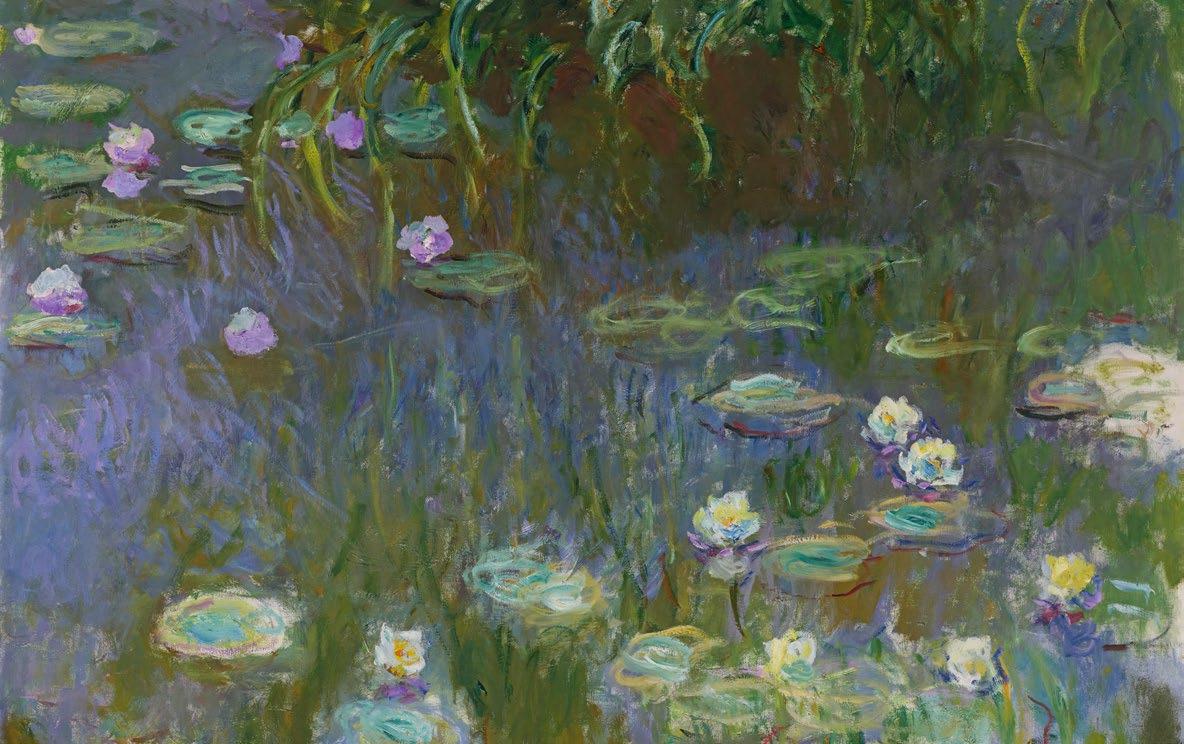
20 Jun - 11 Oct
TOWN HALL GALLERY
12 AUG TO 17 OCT 2026
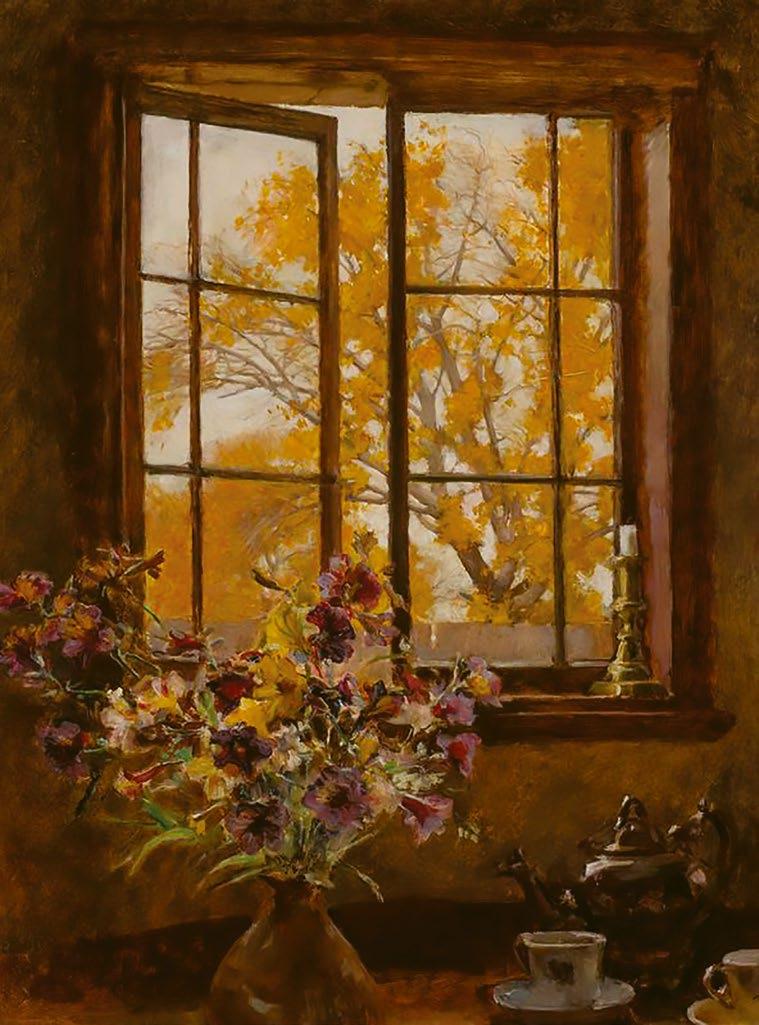
With over 80 works from public and private collections, this landmark exhibition is the largest survey of AME Bale’s work in recent years.
Image: AME Bale, ‘A Castlemaine Casement’, 1927, oil on board, 61.5 x 46.5 cm. Courtesy of the Castlemaine Art Museum Collection.
HAWTHORN ARTS CENTRE
360 BURWOOD ROAD, HAWTHORN, VICTORIA 03 9278 4770




Learn the story of the Library and its vast collections.
Open 9am to 5pm daily, Free entry
Images: 1. nla.cat-vn6929220; 2. nla.obj-137039405; 3. William Shakespeare and Sangorski & Sutcliffe, nla.obj-3937680347; 4. nla.obj-151490967; 5. Lia Ribeiro de Noronha and Nur Aishah Kenton, nla.obj-3640683013; 6. Lisa Maree Williams, nla.obj-3493318273; 7. Zinga Lee and M.P. (Marmion Percy) Adams, nla.cat-vn6891115; 8. NewsLifeMedia Pty Ltd, nla.cat-vn7375611; 9. nla.cat-vn6929220
COPYRIGHT CREDITS
Lot 13 © Margaret Preston/Copyright Agency 2026
Lot 19 © Courtesy Russell Drysdale Estate
Lot 20 © Estate of Fred Williams/Copyright Agency 2026
Lot 21 © courtesy of Helen Brack
Lot 22 © courtesy of The Estate of Jeffrey Smart 2026
Lot 23 © Rosalie Gascoigne/Copyright Agency 2026
Lot 24 © Estate of Fred Williams/Copyright Agency 2026
Lot 25 © Estate of Fred Williams/Copyright Agency 2026
Lot 26 © courtesy of The Estate of Jeffrey Smart 2026
Lot 27 © courtesy of The Estate of Jeffrey Smart 2026
Lot 28 © Estate of Fred Williams/Copyright Agency 2026
Lot 29 © Estate of Fred Williams/Copyright Agency 2026
Lot 30 © William Robinson
Lot 31 © The estate of Ivon Hitchens
Lot 32 © The Sidney Nolan Trust. All rights reserved, DACS/Copyright Agency 2026
Lot 33 © Arthur Boyd/Copyright Agency 2026
LOTS CONSIGNED BY GST REGISTERED ENTITIES
Lot 26 Arthur Boyd
Lot 33 Jeffrey Smart
Some lots consigned for this sale may be subject to the Resale Royalty Right for Visual Artists Act 2009 (Cth). Any payments due under the obligations of the Act will be paid by the vendor.
Design and Photography: Danny Kneebone
Danny Kneebone
Lot 34 © Alan and Jancis Rees/Copyright Agency 2026
Lot 35 © William Robinson
Lot 36 © William Robinson
Lot 37 © Avigdor Arikha/DACS/Copyright Agency 2026
Lot 38 © Wendy Whiteley/Copyright Agency, 2026
Lot 39 © Wendy Whiteley/Copyright Agency, 2026
Lot 40 © Ian Fairweather/DACS/Copyright Agency 2026
Lot 41 © William Robinson
Lot 42 © Arthur Boyd/Copyright Agency 2026
Lot 43 © John Olsen/Copyright Agency 2026
Lot 44 © Margaret Olley Trust and The Olley Project
Lot 54 © Namatjira Legacy Trust/Copyright Agency 2026
Lot 55 © Namatjira Legacy Trust/Copyright Agency 2026
Lot 56 © Namatjira Legacy Trust/Copyright Agency 2026
Lot 57 © Ian Fairweather/DACS. Copyright Agency 2026
Lot 58 © Tony Tuckson/Copyright Agency 2026
Lot 59 © Weaver Hawkins Estate
Under the provisions of the Protection of Movable Cultural Heritage Act, 1986, buyers may be required to obtain an export permit for certain categories of items in this sale from the Cultural Property Section:
Department of Infrastructure, Transport, Regional Development, Communications and the Arts GPO Box 2154
Canberra ACT 2601
Email: movable.heritage@arts.gov.au Phone: 1800 819 461
Design and Photography Manager
With over 25 years in the art auction industry as both photographer and designer. Danny was Art Director at Christie’s from 2000–2007, Bonham’s and Sotheby’s 2007–2009 and then Sotheby’s Australia from 2009–2020. Specialist in design, photography, colour management and print production from fine art to fine jewellery. Danny has won over 50 national and international awards for his photography work and art practice.
© Published by Deutscher and Hackett Pty. Ltd. 2026
ISBN: 978-0-6452421-0-2
Lot 60 © Joy Hester/Copyright Agency 2026
Lot 61 © John de Burgh Perceval/Copyright Agency 2026
Lot 62 © Courtesy of the artist’s estate
Lot 63 © Courtesy of the artist’s estate
Lot 64 © Danila Vassilieff Estate, Heide Museum of Art, 2026
Lot 65 © Thea Proctor Estate / Art Gallery of New South Wales, 2026
Lot 70 © Criss Canning/Copyright Agency 2026
Lot 71 © Criss Canning/Copyright Agency 2026
Lot 72 © The Keith Haring Foundation
Lot 73 © Noel McKenna/Copyright Agency 2026
Lot 74 © courtesy the artist and Sullivan+Strumpf
Arikha, A. 37 B
Black, D. 1, 2, 3, 4, 5, 6, 7, 8, 9, 10, 11, 12, 75, 76, 77, 78, 79, 80, 81, 82, 83, 84, 85 Boyd, A. 33, 42
Brack, J. 21
Bull, K. 15
Bunny, R. 69
C
Canning, C. 70, 71
Clausen, G. 17
D
Drysdale, R. 19
F
Fairweather, I. 40, 57 Forrest, H. 46
G
Gascoigne, R. 23
Haring, K. 72
Hawkins, W. 59
Hester, J. 60
Heysen, N. 53
Hitchens, I. 31
Lahey, V. 51, 52 Long, S. 66, 67, 68
Martens, C. 14 McCubbin, F. 47, 50 McKenna, N. 73 N
Namatjira, A. 54, 55, 56 Nolan, S. 32 0 Olley, M. 44 Olsen, J. 43 P
Perceval, J. 61
Preston, M. 13
Proctor, T. 65 R
Rees, L. 34
Robinson, W. 30, 35, 36, 41 S
Seton, A. 74
Smart, J. 22, 26, 27
Streeton, A. 18, 48 T
Thake, E. 62, 63
Tuckson, T. 58 V
Vassilieff, D. 64 Von Guérard, E. 16, 45 W
Whiteley, B. 38, 39 Williams, F. 20, 24, 25, 28, 29
Withers, W. 49
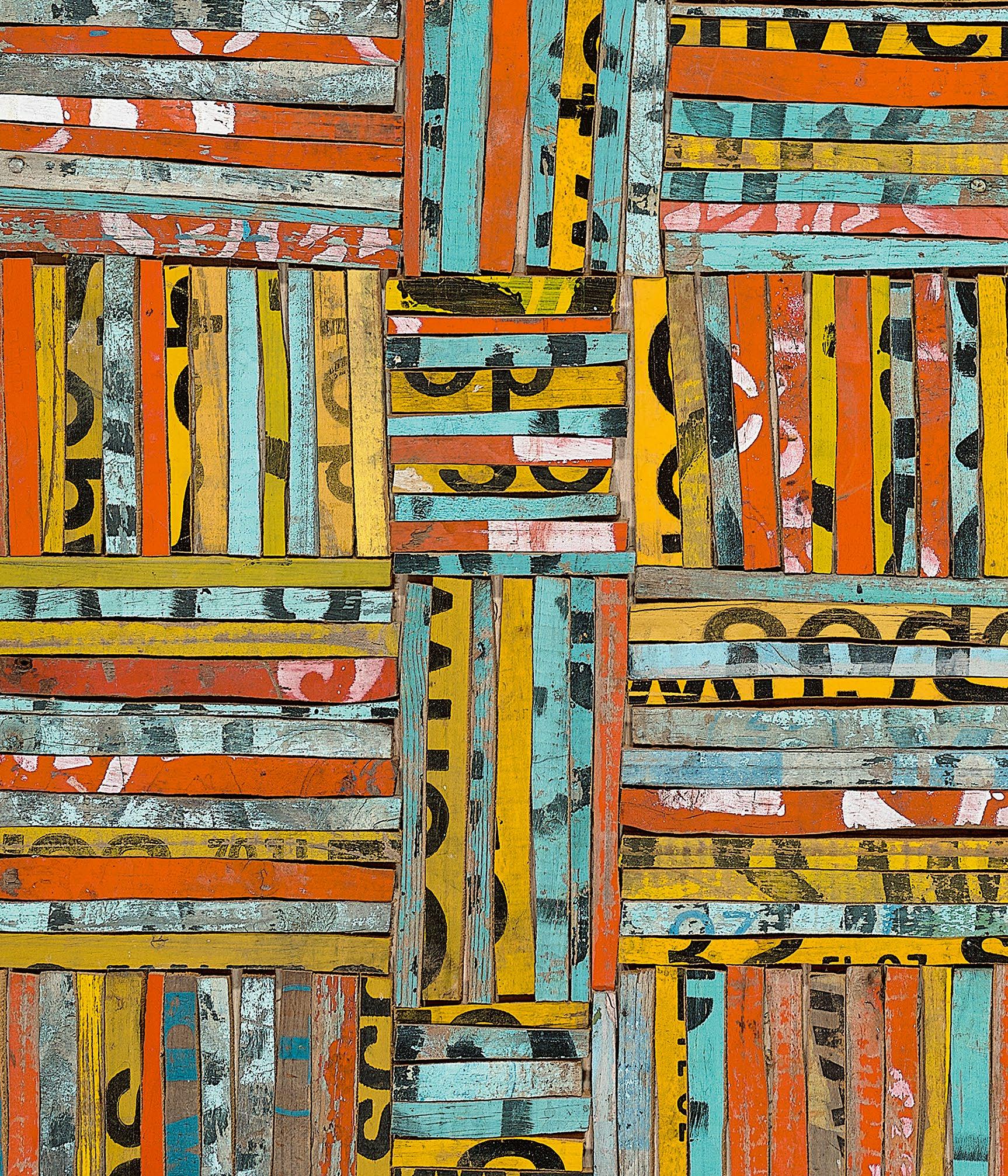
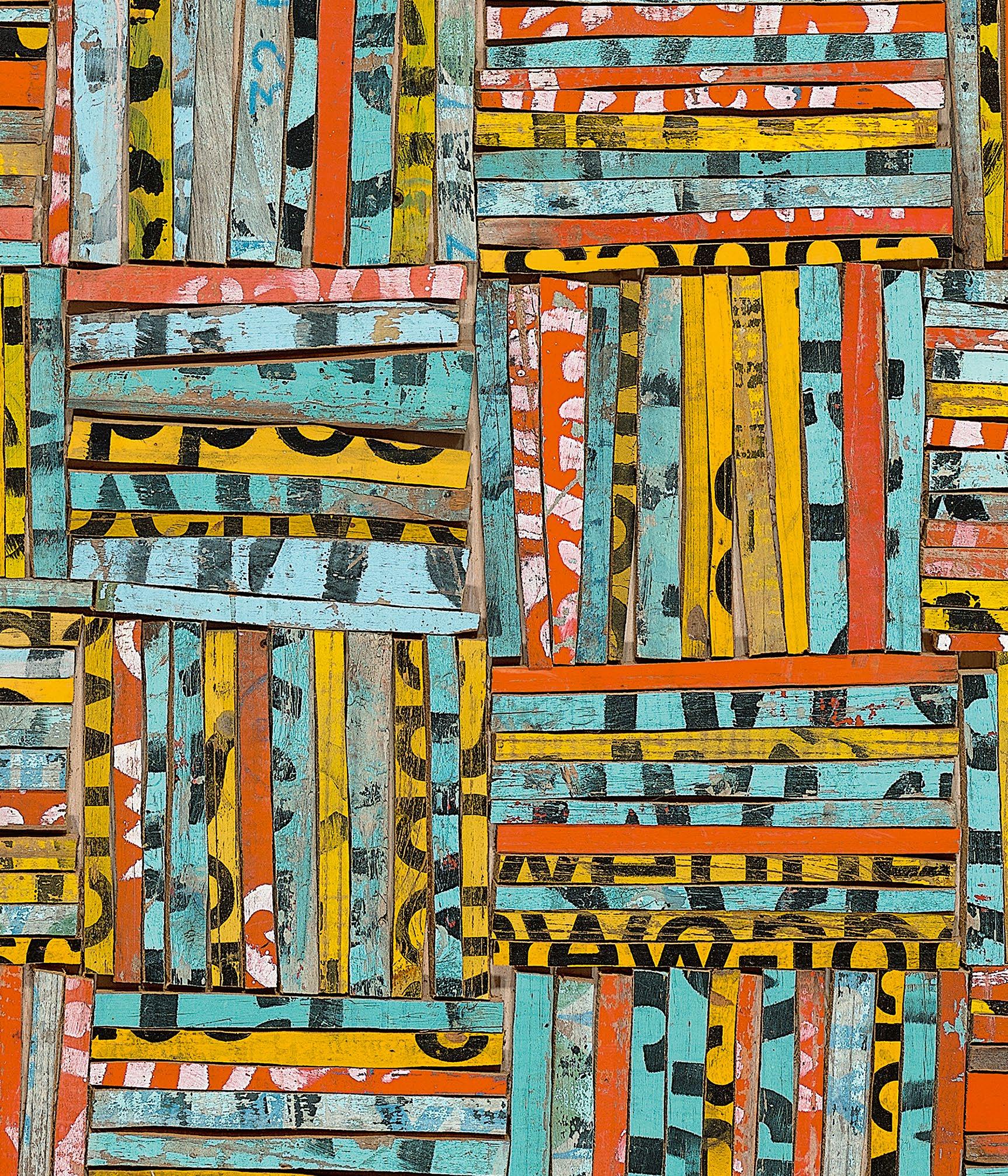
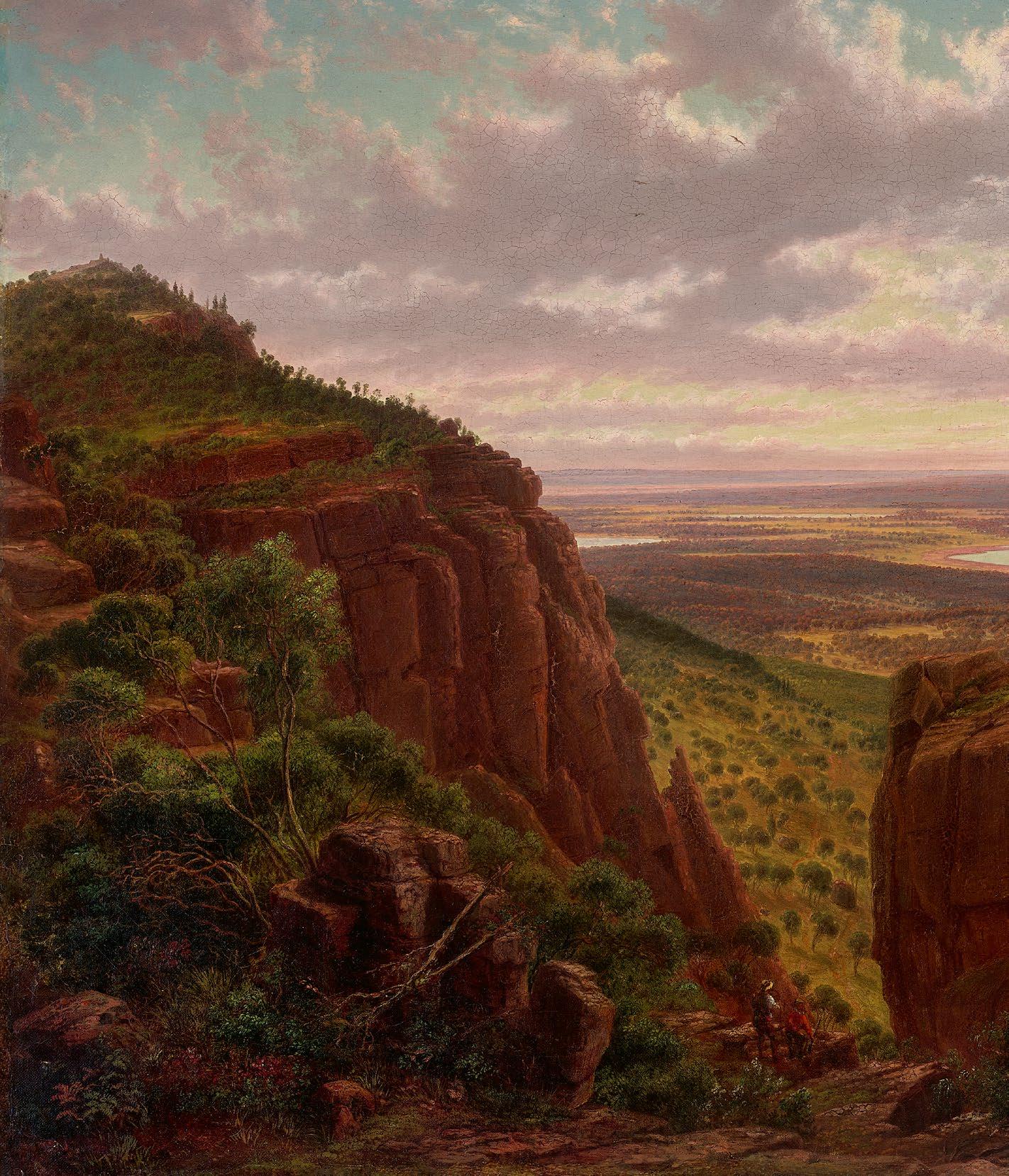
specialist fine art auction house and private gallery