Pre
vie
w
Pre
vie
w
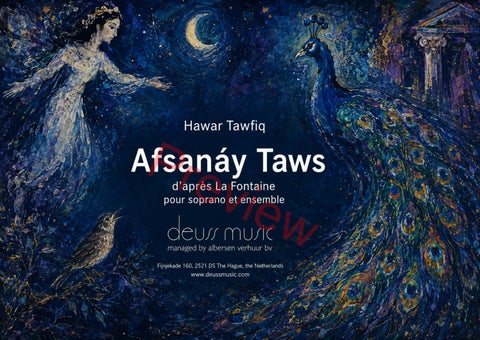
Hawar Tawfiq
Afsanáy Taws d’après La Fontaine pour soprano et ensemble
Pre
dédié à Elisabeth Hetherington
vie (2026)
w
Fijnjekade 160, 2521 DS The Hague, the Netherlands www.hawartawfiq.com www.deussmusic.com
Commissioned by Wonderfeel Festival, with financial support from Fonds Podiumkunsten. World premiere on 4 July 2026 at Podium Het Nest, Landgoed Groeneveld in Baarn.
Performed by: Anna voor de Wind - clarinet in A Pepe Garcia - percussion Aleksey Semenenko - violin Maya Fridman - violoncello Elisabeth Hetherington - soprano Jan-Willem Rozenboom - piano
Pre
vie
Copyright © 2026 by Hawar Tawfiq and Deuss Music managed by Albersen Verhuur b.v. Printed in the Netherlands All rights reserved
w
No part of this publication may be reproduced in any form by any electronic or mechanical means (including photocopying, recording or information storage and retrieval) without permission in writing from the publisher: Deuss Music managed by Albersen verhuur b.v. Fijnjekade 160, 2521 DS, The Hague The Netherlands www.hawartawfiq.com www.deussmusic.com
Pre
vie
w
Marc Chagall, illustration for Le Paon se plaignant à Junon (c.1927-1930)
Ideas and inspiration behind the work: For several years, Wonderfeel Festival had expressed the wish to commission a new work. Due to commitments to larger orchestral projects, I was unable to accept the invitation earlier. When the opportunity finally arose, I decided first to experience the festival itself. Attending Wonderfeel proved decisive: surrounded by nature, with concerts unfolding in open-air settings, the traditional boundaries of the concert hall seemed to dissolve. The landscape, the atmosphere, and the audience all became part of a shared musical experience. It was immediately clear to me that a piece written for Wonderfeel should engage with nature, with animals, and with a sense of storytelling shaped by the outdoors. At the same time, I was searching for a way to connect music with other artistic disciplines. This idea found direction when I encountered Marc Chagall’s illustrations for the fables of La Fontaine. Their dreamlike imagery, populated by animals and poetic transformations, resonated strongly with the atmosphere of Wonderfeel. These visual worlds suggested a musical language that could move freely between narration, color, and imagination. The fable of the peacock complaining to the goddess became a natural starting point. Another important dimension emerged through the festival’s 2026 theme, home. This inspired me to write the vocal part in my mother tongue, Kurdish (Sorani). In doing so, the work connects personal memory with a shared tradition of fable across cultures. Many of these stories, though widely known through La Fontaine, originate in older oral traditions that traveled across cultures. I remember hearing similar tales as a child from my mother, long before encountering them in written form. The piece therefore reflects a return to a personal sense of home, both linguistically and imaginatively.
Pre
The ensemble itself became another central source of inspiration. Wonderfeel offered me the possibility to shape the group of musicians, which allowed the personalities and sound worlds of the performers to influence the composition from the very beginning. The collaboration began with soprano Elisabeth Hetherington, whose artistry had impressed me profoundly when I first heard her in concert several years ago. Her exceptional musical intelligence, combined with her remarkable control over vocal color, opened a wide palette of expressive possibilities and formed an essential starting point for the work. Pianist Jan-Willem Rozenboom has been an important musical collaborator for many years. I vividly remember first hearing him in performance and being struck by the natural flow, clarity, and expressive depth of his playing. His musicianship, transparency of texture, and sense of musical direction continue to be a constant source of inspiration.
vie
I first collaborated with percussionist Pepe Garcia and violinist Aleksey Semenenko two years ago in another work of mine, and their performances left a deep impression. Aleksey Semenenko’s playing immediately stood out for its exceptional expressive range. His approach to the violin transcends purely technical performance: it feels as though the instrument becomes a voice. His extraordinary sensitivity to color, his ability to shift naturally between mysterious, fragile textures and fiery, explosive gestures, and his deeply communicative musical language make him an ideal interpreter for this work. Pepe Garcia brings a similarly distinctive artistic presence. His refined sense of timing, openness to experimentation, and responsiveness to the composer’s intentions make him an invaluable collaborator. Rather than merely executing written material, he actively shapes sound and transforms notation into living musical gestures. This creative engagement with rhythm and color played an important role in shaping the sonic world of the piece.
w
The ensemble was completed with clarinetist Anna voor de Wind and cellist Maya Fridman. Although I had not previously collaborated with them, their artistic profiles and distinctive musical voices made them a compelling addition to the ensemble. Their presence brings new perspectives and colors to the group, expanding the expressive range of the work. In this sense, the collaboration also carries an element of discovery, allowing the music to grow through the meeting of different musical personalities. Ultimately, Afsanáy Taws emerged from the convergence of several elements: the natural environment of Wonderfeel, the poetic imagery of Chagall’s illustrations for La Fontaine, the oral storytelling traditions connected to childhood memory, and the unique artistic personalities of the musicians themselves. Together, these influences shaped a musical fable situated between nature, memory, and imagination. The title Afsanáy Taws can be translated as “The Fable of the Peacock”, reflecting the central narrative image of the work. Hawar Tawfiq May 22, 2026
The Peacock complaining to Juno – Jean de La Fontaine (1678) ﮐ ﻮ ر دی
English
Dutch
Kurdish
The Peacock complaining to Juno
De pauw klaagde bij Juno
Taws glái le xwda krd
The peacock went to complain to Juno, “Goddess,” he said, “it is not without reason that I complain. The voice you have given me pleases no one!”
De pauw ging klagen bij Juno, “Godin,” zei hij, het is niet zonder reden dat ik klaag. De stem die u mij gegeven hebt valt bij niemand in de smaak!
Taws chw bolai xwda w glái lekrd, Wti “xwda”, Glái-krdnákám be honiá Ám dángái kapet baxshiwm Hich kásek arázwi lei niia!
While the nightingale, a small and miserable creature, produces sounds as sweet as they are radiant, and all of spring listens to him.
Terwijl de nachtegaal, een klein en ellendig schepsel, klanken voortbrengt die even zoet als schitterend zijn en heel de lente naar hem luistert.
Lákatekda bwlbwl, Báwbchwki w bádbáxtiái xoiáwá, Dangeki hendá jwan w drawshawáai háiá Ká koi báhar gwei le radágret.
Juno answered in anger: “You jealous bird, be silent! Is it for you to envy the nightingale? You, who wear a neck that shines in a thousand colours, and a tail that unfolds in a splendour that even beauty itself admires. Is there any bird under the sky more beautiful than you?
Juno antwoordde woedend: “Wat ben je een jaloerse vogel. Zwijg! Is het aan jou om de nachtegaal te benijden? Jij, die een hals draagt die schittert in duizend kleuren, en een staart die zich ontvouwt met een kleurenpracht die zelfs de schoonheid verbaast. Is er een vogel onder de hemel die mooier is dan jij?
Xwda bátwráiáwá wálami daiáwá: Chandá balndáiáki chawchnokit, Be dángbá! Bárasti dázanit ká ëirái bá bwlbwl bkáit? To ká mlt bá házaráha ráng dádráwshetáwá, Klkeki rángint háiá ká dákretáwá Tánanát jwanish sársam dákáit. Lázher ám asmana Balndáiáki tr háiá hendái to jwanbet?
Niet elk dier heeft alle schoonheden. Wij hebben ieder zijn deel gegeven.
Hich bwnáwárek niá hámw jwaniákani hábet, Hámw iákek taibátmándi xoi háiá.
Not every creature is given all beauties. Each has received its share. Stop complaining, or I shall take away your feathers as punishment.”
Pre
vie
Houd op met klagen, anders zal ik je verenkleed afnemen om je te straffen.
Pronunciation guide:
Glái máká, Ba szat nádám w hámw párákant lebsándmáwá.
w
The Kurdish alphabet is phonetic: each letter is always pronounced in the same way. Most letters are pronounced similarly to Dutch, with a few specific differences: Á: when á is used, the preceding syllable receives stress or emphasis. X: pronounced like the Dutch guttural “g” (as in goed). Q: a deep, uvular “k”-like sound produced at the back of the throat. E: pronounced as in the Dutch word best. SH: pronounced as in English shop. CH: pronounced as in English child. Ë: pronounced as in English “era”. J: pronounced as in English joke.
ﺗ ﺎ و س ﮔ ﻠﮫ ﯾ ﯽ ﻟﮫ ﺧ ﻮ د ا ﮐ ﺮ . ﮑ ﺮ د7 ﺗ ﺎ و س ﭼ ﻮ و ﺑ ﯚ ﻻ ی ﺧ ﻮ د ا و ﮔ ﻠﮫ ﯾ ﯽ ﻟ و و ﺗ ﯽ ﺧ ﻮ دا ﮔ ﻠﮫ ﯾﮑ ﺮ د ﻧ ﮫ ﮐ ﮫ م ﺑ = ھ ﯚ ﻧ ﯿ ﯿ ﮫ ﺖ ﺑﮫﺧ ﺸ ﯿﻮم7ﺋﮫم د ەﻧﮕ ﮫ ی ﮐﮫ ﭘ ! ﯽ ﻧﯿﯿﮫ7ﮏ ﺋ ﺎر ەز و و ی ﻟ7 ھ ﯿﭻ ﮐ ﮫﺳ ، ﮑ ﺪا ﺑﻮ ﻟﺒﻮ ل7ﻟﮫ ﮐ ﺎﺗ ،ﺑﮫ و ﺑﭽ ﻮ ﮐ ﯽ و ﺑﮫ دﺑﮫﺧ ﺘﯿﮫ ی ﺧ ﯚ ﯾﮫ و ە ﻨ ﺪ ە ﺟ ﻮ ان و د ر ە و ﺷ ﺎ و ە ی ھ ﮫ ﯾﮫ7 ﮑ ﯽ ھ7 د ە ﻧﮕ . ﺖ7 ﯽ ﻟ = ڕ ا د ە ﮔ ﺮ7 ﮐ ﮫ ﮐ ﯚ ی ﺑ ﮫ ھ ﺎر ﮔ ﻮ : ﻣ ﯽ داﯾﮫو ەVﺧ ﻮ دا ﺑﮫ ﺗﻮڕ ەﯾﮫو ە و ە ! ﺑ = د ە ﻧﮓ ﺑ ﮫ، ﻨ ﺪ ە ﯾ ﮫ ﮐ ﯽ ﭼ ﺎ و ﭼ ﻨ ﯚ ﮐ ﯿ ﺖY ﭼ ﮫ ﻧ ﺪ ە ﺑ ﺎ ﺑﮫڕ اﺳ ﺘﯽ د ەز اﻧﯿﺖ ﮐﮫ ﺋﯿﺮ ەﯾﯽ ﺑﮫ ﺑﻮ ﻟﺒﻮ ل ﺑﮑ ﮫ ﯾﺖ ؟ ،ﺘﮫو ە7 ﺗﯚ ﮐﮫ ﻣﻠﺖ ﺑﮫ ھ ﮫز ار ەھ ﺎ ڕ ەﻧﮓ دەدر ەوﺷ ،ﺘﮫوە7ﮑﯽ ڕەﻧﮕﯿﻨﺖ ھﮫﯾﮫ ﮐﮫ دەﮐﺮ7ﮐﻠﮑ . ﺗ ﮫ ﻧ ﺎ ﻧ ﮫ ت ﺟ ﻮ ا ﻧ ﯿ ﺶ ﺳ ﮫ ر ﺳ ﺎ م د ە ﮐﮫ ﯾ ﺖ ﺮ ﺋﮫم ﺋ ﺎﺳ ﻤ ﺎﻧ ﺎ7 ﻟﮫژ ﺖ ؟7 ﻨ ﺪ ە ی ﺗ ﯚ ﺟ ﻮ ا ﻧ ﺒ7 ﻨ ﺪ ە ﯾ ﮫ ﮐ ﯽ ﺗﺮ ھ ﮫ ﯾ ﮫ ھYﺑ ﺎ ، ﺖ7ﮏ ﻧﯿﮫ ھ ﮫ ﻣ ﻮ و ﺟ ﻮ اﻧﯿﮫ ﮐ ﺎﻧ ﯽ ھ ﮫ ﺑ7 ھ ﯿﭻ ﺑﻮ و ﻧﮫ و ەر . ﮏ ﺗ ﺎﯾﺒﮫ ﺗﻤ ﮫ ﻧ ﺪ ی ﺧ ﯚ ی ھ ﮫ ﯾﮫ7 ھ ﮫ ﻣ ﻮ و ﯾﮫ ﮐ ، ﮔ ﻠﮫ ی ﻣ ﮫ ﮐ ﮫ . ﺒﺴ ﮫ ﻧ ﺪ ﻣ ﮫ و ە7 ﺑ ﺎ ﺳ ﺰ ا ت ﻧ ﮫ د ە م و ھ ﮫ ﻣ ﻮ و ﭘ ﮫ ڕ ە ﮐ ﺎ ﻧ ﺖ ﻟ
Instrumentation Clarinet in A Percussion (1 player): - Vibraphone - Bass waterphone (amplified) - Tam-tam (120 cm / 48”) Violin Violoncello Soprano Piano
Duration: ca. 11 minutes Transposed score
Piano preparation
Pre
vie
w
The grand piano is partially prepared to produce octave harmonics on selected strings. Specific strings are prepared with kneaded erasers placed at the appropriate nodal points (typically at the midpoint for octave harmonics). The exact pitches to be prepared are indicated in the example below:
Stage setup: The soprano is not fixed in position. She functions as a narrator within the ensemble space and may move within a defined stage area. Her movement is responsive to the text and musical gestures, but remains within a clearly defined performance space. The ensemble remains in fixed positions, forming a stable sonic landscape around her.
As follows:
Pre Grand piano
Clarinet
Violin
Soprano
Pe rc
uss
ion
vie Violoncello
w
Performance note: At the beginning of the performance, the text of the fable is recited in the official language of the country of performance, either by the soprano or by a narrator/presenter. The recitation should not be neutral, but theatrically shaped in close relation to the musical character of the composition. The opening lines are to be spoken mysteriously and incantatory, as if introducing a myth or ancient tale. The Peacock’s words should sound plaintive, fragile and expressive, reflecting his lament and jealousy toward the Nightingale. The mention of the Nightingale should introduce a sudden sense of lightness, delicacy and wonder, as though another musical being briefly appears through the voice and ensemble. Juno’s first interruption (“Silence!”) must be sudden, powerful and dramatic, corresponding to the musical climax and silence in the ensemble. After this outburst, Juno’s tone transforms abruptly into one of maternal tenderness and wisdom, no longer driven by anger, but by the loving authority of a mother guiding her child until the final warning at the end of the text.
Pre
The spoken introduction should already suggest the four dramatic presences contained in the work: the Narrator, the Peacock, the Nightingale, and the goddess Juno, emerging from the same magical atmosphere as the music itself.
vie
w
Afsanáy Taws d'après La Fontaine pour soprano et ensemble dédié à Elisabeth Hetherington
Hawar Tawfiq
Incantato q=76
Clarinet in A
Vibraphone
3 &4 ∑ 3 &4 ∑
Brillante q.=82
∑ 83 ∑ 83
° 3 ∑ &4
∑ 83
?3 ¢ 4 ∑
∑ 83
° 3 Soprano & 4 ∑ ¢
∑ 83
Violin Violoncello
∑
Tempo primo q=76
3 4 ∑ 3 4 ∑
∑
3 & 4 O™
Piano
{
p
?3 ∑ 4 °
∑ ∑
∑
∑
Ó
œ ˙™
∑
3 4 ∑
∑
∑
3 4 ∑
∑
∑
∑
3 4 ∑
Pre
Brillante q.=82
∑
˙™
Ó
∑
L.V.
˙™
˙™
˙™
œ
˙™
Œ Œ
∑
∑
∑
∑
∑
∑
∑
∑
∑
∑
∑
∑
∑
b œ œ œ b œ œ ™˙
œ nœ b œ
˙™
Ta - ws
chw bo - lai xw - da
w glá - i
The
went
to
∑
p misterioso
∑
b˙ peacock
to
A
O™
O™
∑ 83
∑
∑
∑
Copyright©2026 by Hawar Tawfiq and Deuss Music managed by Albersen Verhuur b.v. Printed in the Netherlands. All rights reserved. Hawar Tawfiq - Afsanáy Taws - 2026
œ
w
‚ ™ ‚™ #‚ ‚™™O ∑
bœ o
∑
Tempo primo q=76
3 4 ∑
∑
∑
3 3 8 4 O™ ‚b ‚ ‚ ‚ ‚ O ™ ‚
∑
pp
vie
∑
∑
arco motor on, medium speed
°p ∑
octave harmonics (see preparation page)
Incantato q=76
A
Juno
L.V.
O™
O™ ∑
∑
complain
∑
∑
∑
∑
∑
∑
10
B
14 Cl.
&
<b> œ n œ œ œ
œ ˙™
nœ b œ ˙
Misterioso e scintillante q.=82
˙
Πo
pp delicato
sempre arco sempre motor on, medium speed
Vib.
& Œ
b˙
˙™
˙™
p
° ° S. ¢& œ n˙
o
˙™
le - krd
L.V.
˙™
&
Pno.
{
?
11 ∑ 16
∑
3≈ 4‰
‰
Œ
Œ
∑
11 ∑ 16
∑
3≈ 4‰
‰
Œ
Œ
∑
3≈ 4‰
‰
Œ
Œ
∑
Pre ∑
∑
∑ ? Œ b Ȯ
∑
vie
11 ∑ 16
∑& Œ
ord.
∑
w
Misterioso e scintillante q.=82
B
pp
∑
∑
oct. harm.
O p
Tempo primo q=76
11 16 O™ ‚b ‚
b‚ ‚ ‚ nœ
Tempo primo q=76
≈ 3 bœ 4 œ œ œ œ œ œ œ œ œ œ œ œ œ ™ œ œ
p
mp L.V.
∑
∑
Œ ˙ “‘ ˙
∑
∑ °
11 ∑ 16
b‚ b‚ ‚
<n>‚ 3 œ œ œ œ œ œ œ œ œ œ œ œ &4
œ œ œ p
11
23
C
∑
&
Cl.
∑
Agile q.=82
Flz.
∑
> Œ ˙ 7
∑
13 œ Œ 16 7 Ro
p soft mallets
Vib.
&
∑
Vln.
° &
∑
∑
?
∑
∑
Vc.
¢
∑
∑ ∑
#b ˙˙ ™™ ° mp Ó
13 16
˙™
Œ
Ó
pp
Π43
L.V.
∑
∑
∑
∑
4 4
∑
3 4
∑
∑
∑
4 4
vie
ord. vib.
∑
&
Pno.
{
“” ˙ œ œ œ ™ œ œ ™ ˙ œ#œ œ ™ œ b œ œ ™
& œ œ
Hawar Tawfiq - Afsanáy Taws - 2026
L.V.
w
∑
Ó
mp
∑
b œœ ™
∑
∑
∑
Agile q.=82
13 ‚ 16
™ ™ 3 4 b œ œû ≈Œ œ œ ˙ p
13 16
Aá
C
4 4
f
œ #œ û≈Ó
∑
arco
∑ b˙™
∑
mf lamentoso
∑
L.V.
4 4
∑
∑
Imitate the sound of a peacock
° S. ¢&
∑
3 4 b˙™ ° 3 4
∑
13 ææ ææ Œ Œ 16 œ œ f pp bœ bœ æ æ Œ Œ 13 16
Pre ∑
Quasi ad libitum circa q=76
p
œœ œ
Aá
W - ti he
œ
˙™
4 4
a
said
Quasi ad libitum circa q=76
3 4
˙™
œ ∑ ? Ó b œ 44 p
13 16 ° #‚ ‚
‚
3 4 # ‚ ‚ # ‚ ‚ O™
∑? Ó
4 œ 4 œ °
12
D Irrequieto q.=82
32 Cl.
4 &4
Vib.
4 &4
∑
9 8
∑
5 8
∑
11 8
∑
3 4
∑
9 8
∑
5 8
∑
11 8
∑
3 4
L.V.
° 4 Vln. & 4 Œ ˙™ o Vc.
?4 ¢ 4Œ
˙™ o
œ 9 5 8 œ œ#œ œ œ b œ b œ œ œ œ œ b œ œ œ œ œ nœ 8 p
9 Ϫ 8 p
mf nobile
° 4w S. ¢& 4
bw
Pre
9 œ ®≈ ‰ 8 RÔ
bœ ™
Œ
Œ
D
?4 w 4w
Pno.
{
?4 4w w
Irrequieto q.=82
9 8
9 Ϊ 8
∑ <n>˙ ™ <n> ˙ ™ pp ‘ “
‰
nœ mp
œ
bœ J
Œ
o
mf
5œ 8 bœ œbœ œ
vie
. b œ. w b œ . 11 b œ œ œ 8 nœ
œœ
œ. 11 œ nœ b œ . 8 J ‰
mp
Ϊ
5 8
mf
w
w
3 4
f pizz.
b œj ‰ nb œœ ‰ ‰ Œ ™ œ
Π43
f
∑
11 8
∑
3 4
5 8
∑
11 8
∑
&4
5 8
∑
11 8
∑
3 4
3