
SUCCESS SNAPSHOTS:
KETTERING UNIVERSITY MOBILITY RESEARCH CENTER: TESTING
TECHNOLOGY ACCELERATES STUDENT AND FACULTY LEARNING AND SUCCESS
As part of the Global Epicenter of Mobility (GEM) EDA Build Back Better Regional Challenge (BBRC) grant, the Testing and Proving (T&P) pillar team at the Office of Future Mobility and Electrification (OFME) supported improvements to global navigation satellite system (GNSS), inertial navigation system (INS), pedestrian targets, and ‘CellularVehicle-to-Everything’ (C-V2X) technologies at Kettering University’s Mobility Research Center in Summer 2024.
This advanced navigation and communication technology is essential for capturing the data precision required for next-generation autonomous vehicle testing and validation. This technology is necessary for developing accurate object detection, collision avoidance, and emergency braking systems that are vital for the future of autonomous driving. While this GEM-funded technology is accessible to Kettering test site customers, university faculty and students have found it to be invaluable in their research and learning efforts.


Unparalleled opportunities for ‘hands-on’ experience. Dr. Jungme Park, an Associate Professor at Kettering University, leads the university’s Autonomous Driving and Artificial Intelligence Laboratory. She is particularly enthusiastic about the GEM-funded technology upgrades—especially enhancements to the GNSS systems—because of the expanded access they offer to students, faculty, and startups. Typically, such advanced and costly technology is only available at large corporations, making this level of access rare in an academic setting. At Kettering, the availability of GNSS systems will enable faculty to conduct more precise research, provide students with valuable hands-on experience in next-generation mobility technologies well before they enter the workforce, and offer startups a more affordable way to test and validate their autonomous driving innovations.
…in the industry there are very high expectations [of employees], but often a lot of students only have theoretical experiences… for my students, it is so helpful to have hands-on experience…The GNSS systems are especially important for students to use…when I was a senior engineer working in the industry, our company got [one of these devices] and no one knew how to use it. This is really giving tremendous educational impact for students – because of this experience they can have a better chance to succeed in future jobs.”
Influencing future industry standards and technology. Both students and faculty at Kettering University are leveraging this technology to validate autonomous technology in line with federal safety regulations. Using the GEM-supported V2X technology, Dr. Park led a research effort to develop a smart safety system at intersections for vehicles to more quickly and effectively sense, send out warnings, and respond to safety issues related to cars, pedestrians, and other objects (Figure 1). Dr. Park published and presented a paper of her research team’s findings at the 2024 Institute of Electric and Electronic Engineers International Conference on Communication, Networks and Satellite (COMNETSAT).
Kettering graduate student Adit Sankhe used the upgraded GNSS and INS equipment to develop vehicle testing procedures around Federal Motor Vehicle Safety Standards (FMVSS) 126 and 127, which focus on vehicle stability and on automatic emergency braking systems. He presented his findings at a Student Research Conference hosted by the University of Michigan-Flint (Figure 2), and looks forward to publishing his research after more testing and validation.
For Sankhe, his dream job after graduation is to work on Research & Development with autonomous automotive companies, and he recognizes that the technology that he’s used as a student are preparing him for the jobs of the future.
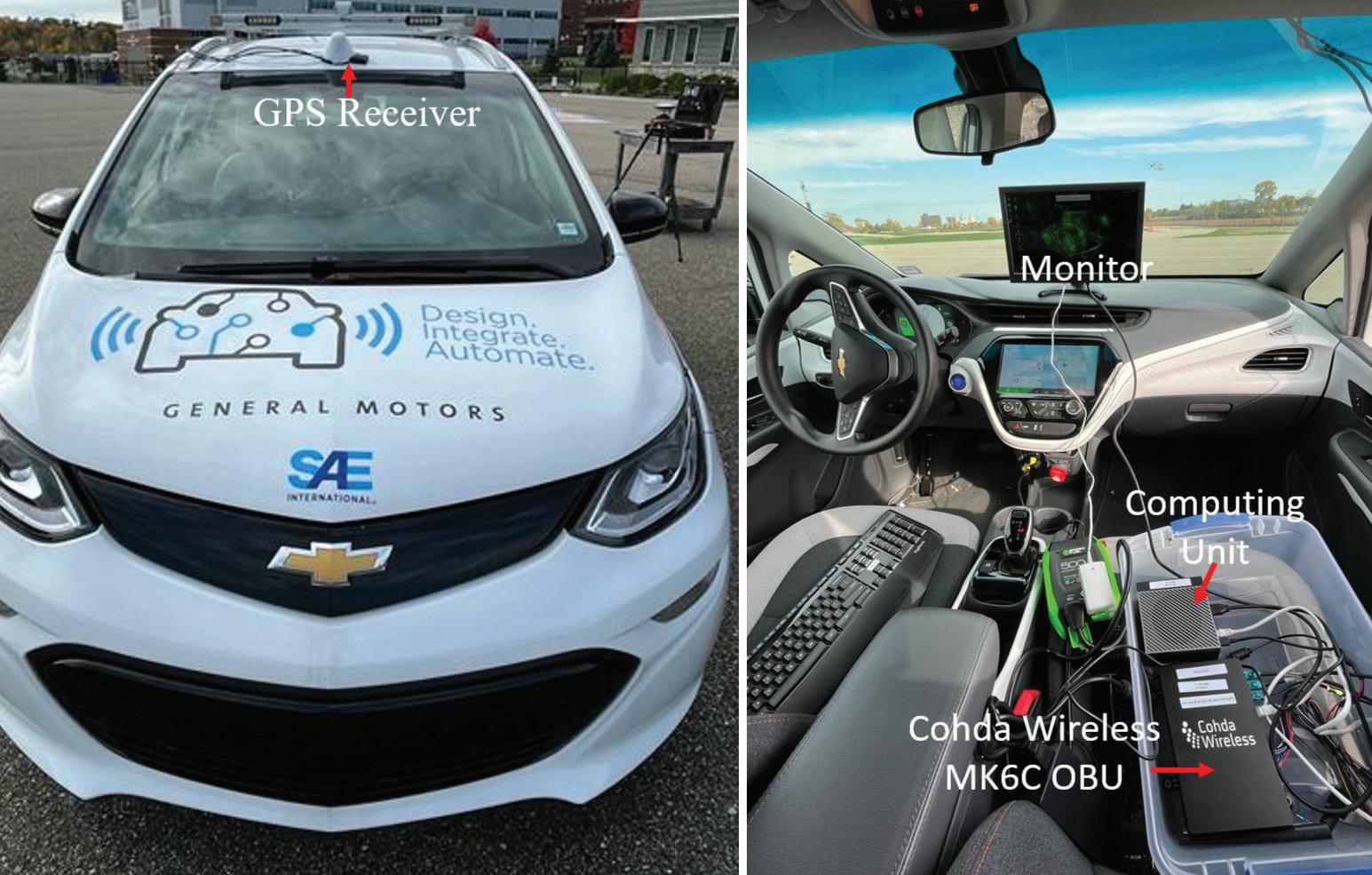
FIGURE 1: THE SET-UP FOR DR. PARK’S C-V2X TESTING AT THE KETTERING MOBILITY RESEARCH CENTER TEST TRACK, INCLUDING THE COHDA WIRELESS DEVICE SUPPORTED BY THE GEM T&P TEAM.
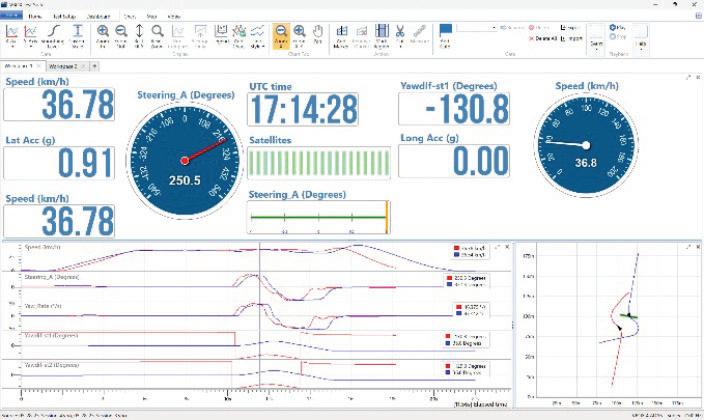
FIGURE 2: A SCREENSHOT USED IN KETTERING GRADUATE STUDENT ADIT SANKHE’S POSTER SUBMISSION TO THE UNIVERSITY OF MICHIGAN-FLINT 2025 STUDENT RESEARCH CONFERENCE, SHOWING MEASUREMENTS USED TO TEST VEHICLE ELECTRONIC STABILITY CONTROL SYSTEMS USING GEM-FUNDED VBOX EQUIPMENT.
[My experiences at Kettering University’s Mobility Research Center] has opened new doors for me as a student, and I will have the opportunity to use my skills gained in my future career…I’ve been very grateful to have the opportunity to work with this equipment –it’s really difficult to get hands on experience on this type of equipment without having industry experience, and this has been an invaluable learning tool.”




— ADIT SANKHE, KETTERING UNIVERSITY ENGINEERING GRADUATE STUDENT