A Report on the North American Survey of Community Restorative Justice Centers
Detroit Justice Center is founded on the belief that we cannot build cities that work for everyone without remedying the impacts of mass incarceration. This mission requires innovative ways of community lawyering—rooted in defensive and offensive fights for racial justice and economic equity—that build up our poorest residents through direct services and novel approaches to land use, housing, and employment. We use a three-pronged approach—what we call “defense, offense, and dreaming”—to serve individual clients, build power, and catalyze systemic solutions. The Metro Detroit Restorative Justice Network is a project in Detroit Justice Center’s Just Cities Lab, where we’re building new systems and structures of community care.
The mission of the Metro Detroit Restorative Justice Network is to increase awareness of and access to restorative practices in Detroit and across the state of Michigan, as both a viable alternative to the criminal legal system and as an adjunctive process to court involvement. We are focused on creating new systems of care as we practice the kind of liberated world we want to create on a larger scale. The Metro Detroit Restorative Justice Network is a special project of the Just Cities Lab at the Detroit Justice Center. Learn more about our work at metrodetroitrj.org or contact us at mdrjn@detroitjustice.org.
FROM DETROIT WITH LOVE
This report summarizes an in-depth research project we launched to evaluate existing models of community-based restorative justice and conflict resolution centers across the U.S. and Canada. Our goal in this research was to collect this data into a publicly accessible resource for other community centers and those seeking to build community-based containers for restorative justice. We aim for this report to inform groups interested in developing their capacity to open a restorative justice center, consider when offering or expanding restorative justice services, and be inspired to discover and support the work that is currently happening in their community.
The survey focused on several critical areas of inquiry crucial to understanding the state of community-based restorative justice, conflict resolution, and mediation centers, such as funding model and fee structure, programs offered, staffing and volunteer systems, physical locations of programs, referral sources, and more.
We want to thank each of our survey participants for their contributions to this research. You have provided invaluable insights into your work and helped us develop a deeper understanding of community-based restorative justice and conflict resolution models nationwide.
We envision a national network of practitioners and centers who are committed to shared values and working on alternatives to violence in their communities. We envision a world without prisons and police, and where restorative justice centers are key sites of community-led repair, healing, and accountability. We know that we have much work to do to build and deepen these systems into existing frameworks of cities, neighborhoods, and communities, and that the people of these cities MUST lead the work.
Thank you for building what’s next; we are walking with you toward the horizon of a just world.
INSIGHTS
We ask, specifically, for readers, funders, and policy advocates to consider how to support resourcing this work in their local communities. Restorative justice, transformative justice, and abolition work can only continue in community with people, and led by the people most impacted by harm and violence.
1 2 3 4
Resource and build capacity for smaller, grassroots organizations, and centers.
While more data is needed, we noted that 30% of responding centers operate on less than $100,000 annually. These organizations also have the lowest rates of facility ownership, court referral access, and structured training. Larger, more established organizations can consider re-granting or grantmaking opportunities to continue to resource smaller, grassroots work. Without intentional investment at this tier, the field risks losing its most community-embedded practitioners.
Invest in practitioner training and support staff.
33% of centers train only as-needed; 6% have no regular training at all. Small-staff organizations are disproportionately affected. Regional training convenings and mentorship from established centers would close this gap.
Build a national resource-sharing network.
The top movement-support priority is direct funding (57%); second is public awareness (49%); third is a unified network for sharing resources and best practices (40%). Infrastructure investments would address multiple field-wide gaps simultaneously.
Get creative with fund-sharing models.
Organizations with 5+ distinct funding sources report meaningfully better perceived adequacy of funds. Grantmakers can support diversification by allowing funding for donor development, earned revenue programs, and financial sustainability planning. Re-granting or grantmaking opportunities can assist in sustaining work and partnership, rather than competing for funds.
“Abolition of the prison industrial complex is essential, but freedom also takes getting to know your neighbors, thinking about how we can help each other, and building an entire society that roots out our culture of harm.”
- Mariame Kaba
5
6
Fund more robust programming and evaluation support.
Overall, 79% of respondents did not feel they were adequately funded, and many only had 1-2 staff members dedicated to restorative justice programming. Altogether, 45% of organizations surveyed do not track post-program recidivism or follow-up postcircle; the smallest orgs are least able to generate outcome data. We recommend that funders should explicitly support community-led restorative justice projects, including data collection, case management systems, and third-party evaluation, so that centers and programs can adequately measure the outcomes of their work and have technical assistance in tracking this information.
Support legislative recognition of restorative justice.
Ultimately, we believe in complete and total divestment from carceral systems, but until we reach that point, we recognize the need for legislation to improve access. Policy advocacy to embed restorative justice in state diversion statutes and court codes would expand referral access and legitimacy for smaller organizations. Lack of formal legislative recognition constrains 9% of respondents; court-intersection challenges affect 6%. While we recognize that policy alone will not expand access without increased funding, we recommend considering local, county, and state-wide initiatives that would expand access to restorative work in schools, court systems and communities.
Dialogue with us! We want conversations that are rich with diverse ideas, questions, frameworks and new ways of approaching this work. Please connect with us to continue the conversation at mdrjn@detroitjustice.org.
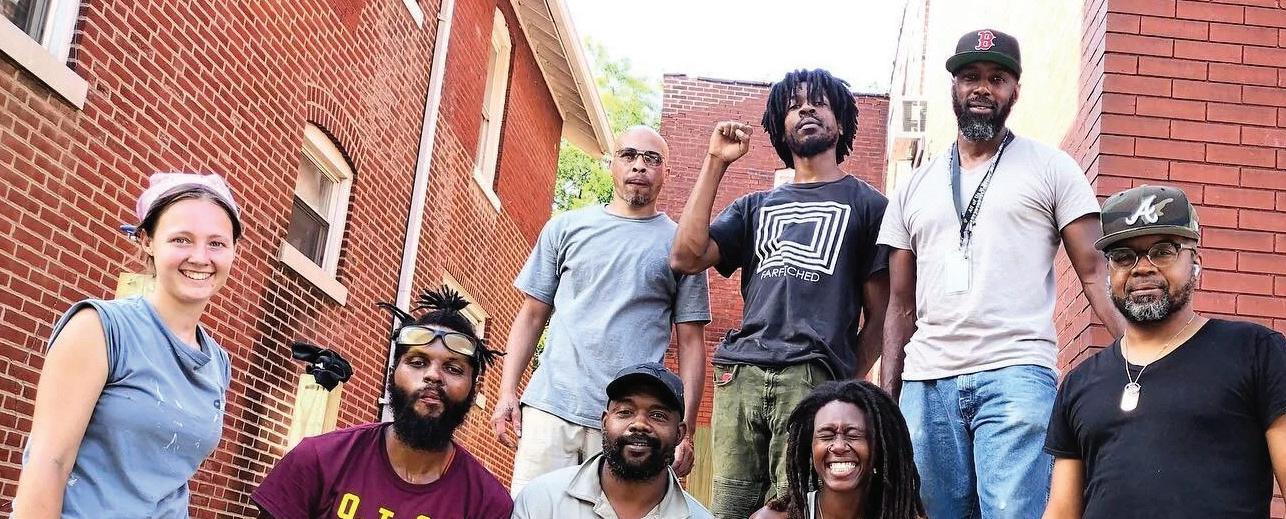
Freedom Community Center
Make Peace. The current punitive approaches to violence, such as police and incarceration, don’t prevent future violence;, they compound it. In the face of this violence, we make peace. By practicing strategies such as restorative justice, pod-mapping, and providing access to timely and affordable mental health support for survivors of harm, we seek to transform our responses to harm.
The cornerstone of our transformative responses is a series of early intervention strategies, including restorative justice processes that intervene and work with people who are experiencing or perpetuating harm before they interact with the police or at the beginning of their interaction with the criminal punishment system. We also post bail for people and support people in release from pretrial detention so that we can intervene in the harm the criminal legal system does to people while they are legally presumed innocent.
Build Power. At its foundation, Freedom Community Center is a community center designed for fostering healing, repairing harm, sharing resources, and building power. We create space so that those directly impacted by violence— from the living room to the street to a jail cage—can share their experiences, their wisdom, and dream collectively of a safer St. Louis.
In order to make durable change, we build power in a community of survivors of violence who have the answers to the question: What keeps us safe?
The leaders we develop at Freedom Community Center have the tools to intervene in violence in their own communities, the political education to analyze systems of power and control, and the strategic and tactical knowledge to advocate for investment into transformative healing resources.
DATA
This survey was developed collaboratively by Metro Detroit Restorative Justice Network’s founder, Angel McKissic, and the community engagement committee. Questions and frameworks were written by the committee as they sought to better understand the national landscape of restorative justice centers—how centers were getting referrals, offering programming, staffing, funding, and sustaining the work, as well as the challenges and barriers they faced.
The survey was revised, edited, and distributed to potential respondents via email in the fall of 2025, with follow-up phone calls to a smaller number of survey participants. Additionally, in 2026, site visits are continuing to learn about and see programming, infrastructure, funding strategies, building staff culture, and other insights not represented in the data herein.
The survey was distributed between September 2025 and January 2026 and had 47 respondents.
During the preparation of this analysis, the authors utilized Claude Sonnet to assist in identifying patterns and trends within the dataset. All AI-generated insights, correlations, and observed patterns were subsequently reviewed, verified, and interpreted by humans to ensure statistical validity and context accuracy. The authors maintain full responsibility for the final conclusions and the integrity of the data analysis.
SuRVEY RESPONDENTS
Respondents to the North American Survey of Community Restorative Justice Centers
US: Michigan, New York, Ohio, Kentucky, Illinois, Minnesota, Missouri, California, Pennsylvania, Georgia, Hawai’i, Vermont, Colorado, New Mexico, Kansas, Louisiana, Texas, Wisconsin, Florida, Tennessee, Maryland, and Washington D.C.
Canada: Ontario and British Columbia
Years in Operation
Services
Our research focused on understanding the range of services centers offer. We were particularly interested in identifying the primary programming areas offered and whether there are any services that are no longer provided and/or other programs that are requested. Additionally, we were curious to know if centers offer training opportunities and for whom. We found that restorative justice circles for community members (53%), restorative justice circles for court/diversion (40%) and healing circles (36%) were the top 3 services offered by participating centers.
Types of Services Offered
Restorative Justice circles for communit y members
Restorative Justice circles for court/arrest diversion Healing circles
Other wraparound services offered include: Technical Skills Training, Substance Use Treatment, Medical Services, Immigration Support, Childcare Services
15% of respondents to this survey do not offer any wraparound services.
“Restorative justice is not only a mindset shift—it is equally a heart-set shift. The difference between restorative justice and traditional justice is far greater than the distinction between punishment and repair. The difference is philosophical, relational, emotional, communal, and spiritual. Restorative justice, when practiced with integrity, is rooted in values, voluntary participation, deep listening, and a commitment to prevent any further harm—within the process or the people involved.”
- Survey Participant
Hidden Water
New York, NY www.hiddenwatercircle.org
I think the best practices for us have been creating all our curriculum, setting our policies, holding all our meetings (including board meetings) in circle. We also have an organization (including board and staff) that are entirely made up of those who have been impacted by sexual harm (those who were harmed, those who caused harm and are ready to take responsibility, non offending parents and other loved ones). This means that we are an organization that just serves itself—a true community. We struggle in some ways without formal funding but we are better off in some other ways because the wisdom comes from the community not the funders. We follow best practices and evolve iteratively. It works.
– Elizabeth Clemants, Founder and Executive Director
PROGRAM HIGHLIGHTS
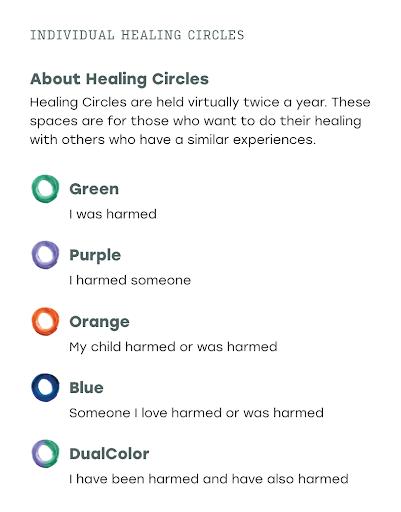
Healing Circles at Hidden Water are affinity groups based on a common experience. All members of the organization have been impacted by childhood sexual violence: circles are divided into folks who: 1) have experienced harm, 2) caused harm, 3) have a family member who harmed or was harmed, or 4) both experienced and caused harm. Circles are held in 12 week sessions to work on both individual and group processes for healing from harm. After completing the healing circle series, participants can also join mixed circles, where different colors may meet in groups to better understand multiple perspectives, and understand healing in community, as well as individually and within families.
Safe(r) Adult Training. This 12-week virtual training equips adults with essential skills to prevent child sexual harm by influencing their environment in subtle, intentional ways. Designed for parents, family members, caregivers, educators, and community members, this program empowers participants to recognize and interrupt boundary-crossing behaviors, respond compassionately to disclosures, and create safer environments through clearer, more accurate conversations with other adults. By focusing on personal and community influence, this training provides innovative tools to address and transform our spheres of influence—helping prevent harm before it happens or before it happens again.
Serve Seniors (Over age 65+)
PARTICIPANTS
YOUNG ADULTS
Serve Adults (Age 25–65)
Serve Justice-Involved Adults (25+) 26% 43% 43%
Serve Formerly Incarcerated Adults
Serve Young Adults
Serve Youth (Under age 18)
Serve Incarcerated Adults (25+)
Serve Formerly Incarcerated Young Adults
Serve Formerly Incarcerated Youth
Serve Justice-Involved
Serve Justice-Involved Youth
Serve Incarcerated
Serve Incarcerated Youth
“From what I know at this point in our work... we are the only ones in the country that work with all three populations—youth, adults, and justiceimpacted. With that said, it is important to be sure that the work of reducing violence and spreading the active principles of restorative justice is work that needs to be shared and balanced. It is not solely on us as an organization.”
– Survey Participant
Annual Number of Participants
Length of Participant Engagement
“We need to each just keep doing something, to the best of our abilities, with the capacity we have. If we all keep moving, and we keep moving together, we will win.”
- Survey Participant
Primary Referral Sources
Community self-referral (51%)
District Attorney’s Office (34%)
Nonprofit/NGO partnerships (34%)
Law enforcement – pre-charge (32%)
Community services partnerships–health, mental health, etc. (30%)
Juvenile justice system (30%)
Colleges/Universities (23%), Municipal Court (17%), Probation and Parole offices (17%), State or Federal Courts (17%), Defense attorneys (17%), Victim advocacy groups (11%), Family or domestic relations courts (2%)
STAFFING
Understanding the staff capacity and roles within centers is essential. We wanted to know the number of staff members employed, how many staff were dedicated to restorative justice programming, and the areas where additional support may be needed. We were also interested in exploring the utilization of volunteers and any challenges that may arise from their involvement. We found that mid- to larger-size organizations utilize more volunteers to expand access to services, and that many centers have 1-2 dedicated restorative justice staff.
Staffing Models
38%
Full-time paid staff dedicated solely to RJ
32% 21%
Volunteers specifically for RJ program Staff split between RJ and other programs
19%
Part-time paid staff dedicated to RJ
13%
External organizations or consultants
Number of Paid Staff Dedicated to Restorative Justice
Number of Paid Sta Dedicated to Restorative Justice
“We have a consistent waiting list for our healing circles that often reaches over 200 people. It takes more than a year to get into our program but without more staff, it is difficult to grow much larger than we are now.”
Varies based on circumstances
- Survey Participant
Number of Volunteer Facilitators
More than 50 volunteer facilitators
21-50 volunteer facilitators
6-20 volunteer facilitators
orgs provide volunteers
1–5 volunteer facilitators
Completion of RJ facilitator training program
Demonstrated understanding of center's mission/ values
Familiarit y with the communit y or population ser ved
Background check or clearance
Personal experience with RJ practices/philosophy
Attendance at periodic refresher course
References from recognized RJ practitioners
Previous experience in mediation or conflict resolution
Commitment to minimum hours/cases per year
Abilit y to communicate in multiple languages
Volunteer Criteria
We do not use volunteer facilitators
PROGRAM EVALUATION
Assessing a program’s strengths and weaknesses, as well as evaluating demographics and data generated from the programming, liability concerns and planning is essential to knowing the efficacy of restorative justice programs. While some respondents collect data regularly, more data is needed to assess quality, inform training and measure outcomes. Evaluation needs to be funded and supported—one capacity-building aspect of the work that organizations are requesting support around.
Measuring Success
Participant satisfaction sur veys/ feedback
Number of successful case resolutions or agreements
Feedback from a ected community
members/stakeholders
Testimonials or success stories
Increased community engagement or participation
Overall program growth and expansion
Recidivism rates of participant
Reduction in disciplinar y actions (schools, prisons)
Reduction in conflict or harm within communities
Long-term monitoring or follow-up with participants
Stakeholder feedback (law enforcement, judiciar y, etc )
Financial sustainabilit y and consistent funding
External evaluations or third-part y assessments
We
“It is best practice to review the impact of the work annually and time of investment to best focus on what the community needs right now to help us move toward the mission and vision for our future.”
Do not track post-program recidivism. Among those who do, outcomes are positive (mostly 0–10%).
59%
Do not track recidivism during the program.
Do Moore Good Philadelphia, PA
www.domooregood.org
One lesson we’ve learned is that the work is strongest when it’s led by people who are from the neighborhood and accountable to it, but structured in a way that anyone on the team can pick up and use.
In our pardon work, that’s meant turning a complicated legal remedy into a simple, community-facing process: training local “pardon coaches,” hosting support out of trusted sites (churches, rec centers, state rep offices, CBOs), and walking people from intake to submission in plain language instead of legal jargon.
With youth, we’ve learned that consistent relationships, fitness, and realworld skills can function as crime prevention if you build in expectations, accountability, and love—not just activities.
And across everything, we’ve learned not to chase scale before trust and systems: start small, document what actually works, and then grow in a way that keeps power and leadership in the hands of the people most impacted.
- Shuja Moore, Executive Director
FUNDING
Our research sought to uncover how restorative justice centers sustain their programming and cover other associated expenses. We aimed to explore various funding sources; we were also curious about challenges to obtaining funding and the pros and cons of different funding types. We found that many centers assess fees for their services and often offer a sliding scale or pro bono options, as well as 30% of centers offsetting participant fees with funding to expand access to services. 60% of centers identified a need for more grant funding and other restorative justice program support (pg 22).
“...Strengthening our partnership with the gender based violence sector has had a high pay off for cross-training and partnerships on funding applications.”
- Survey Participant
Funding Complexity Grows with Organizational Age
Funding Sources
county or city tax 64% 58% 55% 18% 64%
*Note: Only 6% of participants pay the fees; grants, scholarships and donations often pay the service fees, which generate revenue to pay practitioners.
“Prior to the merge, our work was almost completely funded by state grants/ contracts—supporting crucial work, but still work directed by the state focusing mostly on people already in the criminal legal system. Since then, we have been able to expand our funding and programming to offer more community-based and peer programs.”
- Survey Participant
“We struggle in some ways without formal funding but we are better off in some other ways because the wisdom comes from the community not the funders. We follow best practices and evolve iteratively.”
- Survey Participant
Location and Space
One of the major drivers of this research was a desire to better understand physical locations of restorative justice services: where practitioners are doing the work. We found that centers use a mixture of in-person, and virtual services in varied locations, including schools, community centers, faith-based & county buildings. Organizations rent, lease and use space in creative ways to provide services to their communities and 38% of respondents own centers dedicated to the work of healing and restoration.
Locations for Services
38%
49%
45%
Offer services in their own facility/space
Offer services in schools/educational institutions
Offer services online/virtual platforms
Community centers or recreational spaces 34%
Faith/worship spaces 26%
Court facilities 23%
Rented space on an as-needed basis 21%
Clients’ homes 19%
Outreach locations (parks, street) 13%
Co-leased space (with partner orgs) 9%
Leased space (independently) 9%
Temporary shelters or housing facilities 6%
Hospitals or medical facilities 2%
Other (prisons, jails, halfway houses, libraries, workplaces, conferences) 17%
“Our work is fairly different because it is in workplaces. It would be great to connect with other centers/folks doing similar work as this feels like a fairly new frontier for RJ and brings with it a lot of complexity and nuance. Top of mind is power differentials based on roles, fear of retaliation, and context of unionized workplaces.”
- Survey Participant
CHALLENGES & CONSTRAINTS
We aimed to understand the major challenges and barriers that centers are facing as they work to provide restorative services to their communities. While funding was the highest area of challenge, lack of community understanding about restorative justice and difficulty obtaining referrals came up as significant issues for respondents, as well.
Top Challenges
Funding & financial constraints are listed as a top issue for centers in every budget tier
Challenges partnering with or getting referrals from courts, law enforcement, schools 32% 100% 23%
Lack of community understanding or acceptance of Restorative Justice
Other challenges cited include: Difficulty recruiting and retaining trained facilitators/staff (17%), Resistance or skepticism from victims or those harmed (17%), Limited access to consistent training resources (11%), Challenges measuring and showcasing program impact (9%), Space or facility constraints (6%)
Policies related to cross-jurisdictional work (2%)
NEEDS, RESOURCES AND PRIORITIES
We asked centers and programs to identify needs and priorities, so we might consider how resources could be allocated and shared. What do centers and participants see as priorities for expanding or improving services to the communities they serve or communities they live within?
Enhanced community awareness/education campaigns 60% 49%
Resources and Support Needed
Media and communication resources (34%)
Stronger partnerships (legal, schools, community orgs) (34%)
Advocacy (local, state, or national) (32%)
Access to updated RJ research and best practices (32%)
More volunteers or support staff (32%)
Comprehensive training and professional development (30%)
Legislative or policy support for RJ (30%)
Technology/software for case management and data analysis (28%)
Support in data collection, analysis, and program evaluation (26%)
Networking with other RJ centers (26%)
Physical space or facilities for RJ circles (23%)
Resources for specific populations (19%)
Supporting Restorative Justice Practicioners
• Provide grants, scholarships, funding opportunities for community-based programs
• Raise public awareness/narrative shifts about the need for RJ
• Share resources and best practices through a unified network or platform
• Lobby for legislative policy changes that recognize and facilitate RJ processes
• Offer mentorship or partnership opportunities with larger, more established organizations to cultivate and grow the work of respondents cite a need for increased funding or grants for RJ initiatives
“We’ve learned not to chase scale before trust and systems: start small, document what actually works, and then grow in a way that keeps power and leadership in the hands of the people most impacted.”
- Survey Participant
The Dispute Resolution Center
Ann Arbor, Michigan
Restorative justice programming didn’t happen overnight in our county—it took 15-20 years of developing relationships with legal system agencies and the community. We kept a pulse on local politics and legislation, developed allies that support criminal legal reform, as well as led community engagement and educational sessions.
Washtenaw County is unique in that we have a Peacemaking Court, judges who support alternative dispute resolution, and a new prosecutor in 2020 who campaigned on restorative justice approaches and support for alternative dispute resolution not only for misdemeanors, but also felony charges—except in intimate partner and sexual violence. The successes of our center have been developing those relationships, ensuring high quality services (we also have a high degree of vetting during intake), and a diverse, highly skilled and compassionate staff and leadership that are aligned with our values and believe in total transparency and collaboration.
The biggest challenge for us is getting complete buy-in from all criminal legal system agencies for diversion. We hope someday to model collaboration and community partnership through case review, supported by research and the funding that will be needed.
MOVING AHEAD
Deepen the research, always be students of the data.
One of the most important lessons we learned in this survey process was how much more research is needed about restorative justice programming and centers. Many respondents expressed gratitude that we were studying restorative justice centers and programming. We appreciated being able to fund this work through the generosity of the Community Foundation of Southeastern Michigan and recognize that more research is needed to provide a broader analysis.
Center
Indigenous, Black, Female, Queer, and other Marginalized
Voices.
We acknowledge the need for additional surveying and inclusion of more centers in Canada, Mexico, and Latin America, as well as Urban and Indigenous communities, to be truly representative of North America. As practitioners in the Midwest, we also see how our coverage of restorative justice centers must expand South, East, and West, to tribal communities and other non-traditional organizing spaces, and hope to be able to continue this research to capture more stories and data of healing, restoration, and liberation through the conflict process.
Fund and resource this work.
Funding came up over and over as something that organizations need more access to/resources around, want collaboration on, and do not see as adequate, especially amongst smaller, grassroots organizations. 79% of organizations didn’t feel they were adequately funded. Restorative justice work needs to be more robustly funded at the community level. Some states are tackling this through local ordinances and countylevel actions, while others are drafting and passing legislation that requires the use of restorative justice in schools, courts, and community proceedings where harm has occurred.
People desire physical locations for services, and people to connect with when they are in conflict.
Only 38% of respondents are operating out of spaces that they own. Though many of the centers that we interacted with are working virtually, borrowing or leasing space in order to provide services for the community, connection is paramount to the success of programs and centers, whether services are provided in person or virtually. Many centers expressed their dreams of standalone restorative justice centers that do not interface with the court or criminal justice systems.
Invest in practitioners and care for each other.
In order to keep practitioners from burnout, and invite more into the field, people holding space for others need support and community. Some ways practitioners expressed needs for support are: professional organizations and networks, training and capacity building, wellness and healing justice practices, as well as connecting across states and genres of work to better understand best practices, nuances of conflict transformation, and build stronger relationships with one another.
Recognize the carceral structures attached to funding
Many of the funding sources we’ve seen across the nation are connected to the criminal justice system, funding diversion, deflection, and court-based intervention programs. As an abolitionist organization, Detroit Justice Center is questioning how restorative justice work is supporting carceral systems, and urges centers to consider with their boards and internal teams how to divest from these systems and funnel funding from jails and detention centers to community-based healing centers. We hope that this survey will offer an entry point into dialogue about how we pool resources and energy around divestment as a key strategy in resourcing the work.
Dialogue with us! We want conversations that are rich with diverse ideas, questions, frameworks and new ways of approaching this work. Please connect with us to continue the conversation. mdrjn@detroitjustice.org
“Today, I believe there is nothing more subversive than helping to midwife a new evolutionary shift of the human species into an era where we will no longer be entranced with socioeconomic formations and ways of being and thinking that produce disconnection, domination, and devastation. Instead, we can be present upon the Earth in ways that bring healing, wholeness, and a sense of the sacred in our connection with one another and with all of creation.”
– Dr. Fania Davis
The Little Book of Race and Restorative Justice: Black Lives, Healing, and US Social Transformation