CONSPIRING WITH THE DEMONS
SEASON FOR short FILMS
THAT THING CALLED ...
Lars von Trier is back in Cannes. His highly anticipated Antichrist featuring Charlotte Gainsbourg and Willem Dafoe is a Gothic horror tale that unfolds in a woodland scenery possessed by darkness.
Dorte Bengtson’s animation The Sylpphid is selected for Cinéfondation, Rúnar Rúnarsson’s Anna is showcased in Directors’ Fortnight, and Daniel Borgman’s Lars and Peter is running in the short film competition.
A diva in distress, an adolescent in rage, a forbidden embrace. Difficult love in various forms fuels the stories by first-time feature film directors Martin Pieter Zandvliet, Morten Giese and Nicolo Donato.
PAGE 3
PAGE 28 & 35
PAGE 16
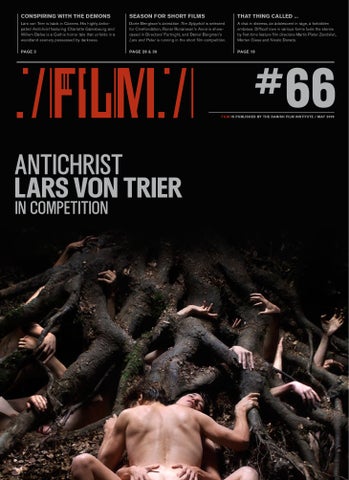
l1l ANTICHRIST LARS VON TRIER in competition
#66
FILM IS PUBLISHED BY THE DANISH FILM INSTITUTE / May 2009
PAGE / FILM#66 /
CANNES SPECIAL ISSUE
INSIDE
l1l FILM#66/ Cannes issue #/.30)2).'Ă´7)4(Ă´4(%Ă´$%-/.3
3%!3/.Ă´&/2Ă´3(/24Ă´&),-3Ă´
4(!4Ă´4().'Ă´#!,,%$Ă´
,ARSĂ´VONĂ´4RIERĂ´ISĂ´BACKĂ´INĂ´#ANNES Ă´(ISĂ´HIGHLYĂ´ANTICI PATEDĂ´!NTICHRISTĂ´FEATURINGĂ´#HARLOTTEĂ´'AINSBOURGĂ´ANDĂ´ 7ILLEMĂ´$AFOEĂ´ISĂ´AĂ´GOTHICĂ´HORRORĂ´TALEĂ´THATĂ´UNFOLDSĂ´INĂ´AĂ´ WOODLANDĂ´SCENERYĂ´POSSESSEDĂ´BYĂ´DARKNESS
$ORTEĂ´"ENGTSON SĂ´ANIMATIONĂ´4HEĂ´3YLPPHIDĂ´ISĂ´SELECTEDĂ´ FORĂ´#INÂŻFONDATION Ă´2Â&#x;NARĂ´2Â&#x;NARSSON SĂ´!NNAĂ´ISĂ´SHOW CASEDĂ´INĂ´$IRECTORS Ă´&ORTNIGHT Ă´ANDĂ´$ANIELĂ´"ORGMAN SĂ´ ,ARSĂ´ANDĂ´0ETERĂ´ISĂ´RUNNINGĂ´INĂ´THEĂ´SHORTĂ´kLMĂ´COMPETITION
0!'%Ă´
0!'%Ă´ Ă´ Ă´
!Ă´DIVAĂ´INĂ´DISTRESS Ă´ANĂ´ADOLESCENTĂ´INĂ´RAGE Ă´AĂ´FORBIDDENĂ´ EMBRACE Ă´$IFkCULTĂ´LOVEĂ´INĂ´VARIOUSĂ´FORMSĂ´FUELSĂ´THEĂ´STORIESĂ´ BYĂ´kRST TIMEĂ´FEATUREĂ´kLMĂ´DIRECTORSĂ´-ARTINĂ´0IETERĂ´:ANDVLIET Ă´ -ORTENĂ´'IESEĂ´ANDĂ´.ICOLOĂ´$ONATO Ă´ Ă´ 0!'%Ă´
l1l
A HEARSE HEADING HOME / IN COMPETITION Lars von Trier’s Gothic horror film Antichrist has created a buzz even before reaching the red carpet. Writer Knud Romer, who appeared in The Idiots, in conversation with von Trier about the film’s extreme imagery. PAGE 3
#66
&),-Ă´)3Ă´05",)3(%$Ă´"9Ă´4(%Ă´$!.)3(Ă´&),-Ă´).34)454%Ă´ Ă´-!9Ă´
ANTICHRIST LARS VON TRIER IN CompeTITIoN
Director Lars von Trier Photo: Christian GeisnĂŚs
LOVE-HATE RELATIONSHIP The stories of von Trier’s relationship to his actors is the stuff that myths are made of. Von Trier’s approach has changed radically over the years. Charlotte Gainsbourg and Willem Dafoe are the two stars in Antichrist. PAGE 9 KINDRED SPIRITS “One of the most complicated tasks I have ever had.� Von Trier’s cinematographer Anthony Dod Mantle, lately in sky-high praise for his work on Slumdog Millionaire, talks about his work and his collaboration with von Trier. PAGE 10
Deliver Us from Evil Photo: Per Anders Jørgensen
ZENTROPA FAMILY Zentropa has had international offices ever since Lars von Trier’s Breaking the Waves. Now the company is seeking to play a more active part abroad. PAGE 13 DANTE’S INFERNO IN WEST JUTLAND A western mixed with Greek tragedy – Ole Bornedal’s Deliver Us from Evil about human nature driven berserk is hard to pinpoint genre-wise. PAGE 14 3 X FEATURE FILM DEBUTS FILM presents three films by first-timers Martin Pieter Zandvliet, Morten Giese and Nicolo Donato – three dramas fuelled by difficult love. PAGE 16
FILM#66 / cannes May 2009
PUBLISHED BY Danish Film Institute EDITOR Susanna Neimann EDITORIAL TEAM Lars Fiil-Jensen, Annemarie Hørsman, Vicki Synnott TRANSLATIONS Glen Garner DESIGN Rasmus Koch Studio ad Morten C. Bak TYPE Cendia, Millton, Akzidenz-Grotesk PAPER Munken Lynx 100 g PRINTED BY Schultz Grafisk CIRCULATION 6,500 ISSN 1399-2813 (print version) ISSN 1903-7511 (online version) COVER Lars von Trier’s Antichrist Photo: framegrab
Applause Photo: Carsten Villadsen
PRODUCER ON THE MOVE Christian Potalivo, this year’s Danish Producer on the Move, has a passion for good stories. PAGE 23
Valhalla Rising Photo: Dean Rogers
DANISH FILM INSTITUTE Gothersgade 55 DK-1123 Copenhagen K, Denmark T +45 3374 3400 susannan@dfi.dk
ADVENTUROUSNESS AND FLEXIBILITY Danish films had a great year at the boxoffice in 2008. Henrik Bo Nielsen, CEO of the Danish Film Institute, stresses the importance of an industry unafraid to take risks. PAGE 24 BIGGER ISN’T ALWAYS BETTER / ANIMATION SPECIAL More available techniques, a growing talent mass and well-proven training programmes are starting to show in Danish animation. FILM presents an area that is booming both artistically and commercially. PAGE 26
FILM is published by the Danish Film Institute (DFI) prior to the festivals in Berlin, Cannes and Amsterdam. The Danish Film Institute is the national agency responsible for supporting and encouraging film and cinema culture. The Institute’s operations Âextend from participation in the development and production of feature films, shorts and documentaries, over distribution and marketing, to managing the national film archive and the cinematheque.
GUERILLA-STYLE FILMMAKING Nicolas Winding Refn was deliberately looking for harsh locations for his coming film Valhalla Rising, shot in the Scottish highlands. PAGE 22
Love and Rage Photo: Rolf Konow
THE SYLPPHID / CINÉFONDATION / ANIMATION SPECIAL “You can create the freakiest worlds in animation.â€? Selected for CinĂŠfondation is Dorte Bengtson’s graduation film The Sylpphid. PAGE 28 THE APPLE & THE WORM / ANIMATION SPECIAL Anders Morgenthaler, who made a forceful debut in 2006 with Princess, is finishing his 2D-animated children’s comedy, The Apple & the Worm. PAGE 30
The Sylpphid. Framegrab
2 X SHORT FILMS / IN COMPETITION & DIRECTORS’ FORTNIGHT Daniel Borgman’s Lars and Peter is in competition, while Rúnar Rúnarsson’s Anna is selected for Directors’ Fortnight – two visually strong stories about the emotional lives of a boy and a girl. PAGE 35
ANTICHRIST / DIRECTOR LARS VON TRIER / interview / FILM#66 / PAGE
A HEARSE HEADING HOME Antichrist Photo: Christian Geisnæs
Over the years, Lars von Trier has brought home six Cannes awards. Now the director is back with his Palme d’Or contestant Antichrist about a grieving couple that retreats to their cabin “Eden” in the woods, hoping to repair their broken hearts and troubled marriage. Knud Romer, who appeared in von Trier’s The Idiots in 1998, talked with the director in early April, when he had just put the finishing touches on his Gothic horror tale.
BY KNUD ROMER
“You look like a priest,” von Trier tells me, as we shake hands outside the screening room on the Filmbyen lot where I’ll be viewing his latest work, Antichrist. The film is shrouded in secrecy and so many security precautions that I feel like I’m attending a screening in the gold vault at the Treasury. “Well, that’s because I’m here to save your immortal soul,” I quip. Ninety minutes later I leave my seat, deeply shaken. Driving home, the
fear and paranoia come rushing back when a hearse overtakes me on the highway. The prospect of interviewing von Trier is a bit unnerving. A master of irony and sarcasm, he can twist any conversation around and make it about you and your sorest spots. A few days later, I wait for him at Filmbyen, and they tell me he’s late. Above his office doors is written, in blood-dripping, red letters: “Chaos reigns”. An hour later, they tell me he wants to do the interview at his house, 20 kilometres north of there. I’m so nervous I’m afraid
PAGE / FILM#66 /
ANTICHRIST / DIRECTOR LARS VON TRIER / interview
I’ll have an accident. Coming up the narrow road to his house overlooking a stream, I ram my car into a fence and some rocks on the parking lot and go to the wrong house before I finally hear a voice calling to me from an open door, “Knud, over here!” Von Trier is graciousness personified. His wife, Bente, has made waffles and herbal tea – the two most comforting things on earth. I cling to both, when I realise we’ll be doing the interview downstairs, in the basement, on two beanbag chairs, with von Trier dressed only in black socks, loose-fitting black underwear and a black T-shirt. I’m suddenly unsure about what’s really going to happen – more so because I intend to discuss how, like so many other great filmmakers, he keeps making the same film over and over again in different, increasingly radical variations. And that, in his case, that film is about a passive, paranoid man, a megalomaniac, who is bedridden (as in Breaking the Waves) or buried alive (as in Antichrist), while sexually abusing a sick or
mentally ill woman to the point of death in order to produce images of sadomasochist desire and voyeuristically satisfy his sexuality. My paranoia is out of control – frankly, I’m afraid I’ll be next! I wasn’t, of course. It wasn’t the Antichrist I met there in the basement but the filmmaker at his most sympathetic and open – to the point of nakedness, even – who lives life on the edge of an acute awareness of death in order to create the apocalyptic visual richness that makes Antichrist such a masterpiece. An hour and a half later I regret that I’m not a better interviewer. It’s my first time, actually, and I talk too much. On the way out, I do what isn’t done: I, very gingerly, hug von Trier to show my thanks. Back in the car, my nervousness and fear and paranoia drain away, and I overtake – it’s true, I swear – a hearse on the way home. Lars von Trier: I’m excited to hear your first question. Remember, it should be a long one!
“Those demons are my friends. Maybe that’s the advantage of making films: that the demons, which are so painful when you meet them, get a different role. They become your friends when you put them in a film. They become your co-conspirators.”
Knud Romer: You did a number of conceptual films where you “obstructed” yourself. Now von Trier, the maker of apocalyptic images, is back. Why did you do the first thing, and why are you back? LvT: It’s all images to me – even if there are chalk lines on the floor. But I … (hesitates) I was feeling down, depressed – I really hit rock bottom – and I doubted that I would ever be able to make another film. But I went back to some of the material from my youth. I was really into Strindberg back then, especially Strindberg as a person. He was amazing. And so I tried to do a film – I never talked about this before, it’s hard to put into words – so I tried to do a film where I had to throw reason overboard a little bit. KR: ”Chaos reigns”. LvT: Yes (laughs). I did a number of images that I tried to put together. Also, it was interesting for me to do a film with just two characters. KR: Bergman’s Scenes from a Marriage … LvT: Yes, Scenes from a Marriage, but in a rather different form. I liked Scenes from a Marriage back in the day. I thought it was huge. KR: But this marriage is more Strindbergian than Bergmanesque. LvT: Yes, they push each other down staircases more in Strindberg.
ANTICHRIST / DIRECTOR LARS VON TRIER / interview / FILM#66 / PAGE
Antichrist. Framegrab
KR: Also, your film’s view of women is probably reminiscent more of Strindberg than Bergman? LvT: Yes, and I’ll probably be asked about that again, my view of women. I always had a romantic view of the battle of the sexes that Strindberg was writing about. We keep describing the relationship between the sexes. I don’t know if an unequivocal truth exists. GENRE FILM – IN QUOTES
KR: Now, you do “genre films” – in very big quotes. You keep telling the same story, your story, in different variations, from different angles, like so many other authors and auteurs do. What is your relationship to genres? Breaking the Waves is melodrama and Dancer in the Dark is a musical. Antichrist is a suspense thriller or horror film. Would you say your relationship to genres was romantic or playful? LvT: Genres are an inspiration. My story is practically the same every time. I’m well aware of that by now. But “genres” – I’ll probably never really hit any genre straight on, because I think you should add something to them. If I were a chef, this would be my version of a classic pork roast. KR: You seem to be helping yourself to all the conventional expressions from the toy chest and putting them into play by turning them completely around.
LvT: I did Film Studies at university, after all, and I was quite fond of genre films. The Asphalt Jungle! Film noir, you know, it was all great. KR: A lazy person who only watches your films will have seen every existing genre. LvT: Yes, all in the same film (laughs). But I’m not particularly faithful to the different genres. I wouldn’t say that. I like it when things rub against each other a bit. KR: Some would say that you – with increasingly transgressive zest – were approaching the most taboo genre of all, pornography. LvT: Well, I’ve flirted with it a little bit, especially in The Idiots. Somehow sexuality and the horror genre are closely related. But pornography? I don’t know. Is it pornography? Maybe. But pornography always bugged me. Porno films are made to be utilitarian. They tend to be pretty crude. EXTREME excitation
KR: Horror films and porno films both put the viewer in a state of excitation. In horror, it’s fear. In porno, it’s lust. The two meet in extreme excitation, where it’s sometimes hard to decode what’s passive suffering and active lust. LvT: That’s very nicely put. I could never phrase it that well.
KR: One thing is experienced positively, as desire, and the other is experienced negatively, as fear. Your films have a similar effect on the viewer. Is this something you consciously strive for or is it a personal emotional expression? LvT: You ask some tough questions, you know. But sure, the point is interesting enough. I do try to make my films affect the audience’s emotions. But I do so by creating as expressive an image as I can for myself. So I’d claim – even if it’s a bit of a lie – that I don’t keep the audience in mind when I make my films. Mainly, I satisfy myself with the images I make. At the same time, I can’t deny that they’re made with the intention of having an effect. KR: This film was extremely fear inducing to me. It’s hard for me to shake. It haunts me. If I had to create those images in my mind first and then face their extreme emotional expressions, I would suffer a nervous breakdown. LvT: Okay. Well ... Film is a pale mirror image of reality. If you sit in the cinema weeping, it’s a pale imitation of a similar emotion you’ve had in real life. Film is a second-rate medium that way, because it will always be living on borrowed emotions from real life. If someone gets scared, probably it’s because they have some fear they can take out and use in the experience of watching a film. But, film
PAGE / FILM#65 /
AMSTERDAM SPECIAL ISSUE
ANTICHRIST / DIRECTOR LARS VON TRIER / interview / FILM#66 / PAGE
has other qualities than evoking emotions. Take Munch’s The Scream, which my young son just copied in a drawing. The Scream is an ingenious expression of an emotion, but people don’t run screaming from the museum. KR: Your films are “screams”? LvT: Hmm ... Antichrist is the one that comes closest to a scream. It came at a time in my life when I was feeling really bad. Inspiration is found in your own fear, your own emotions. That’s where things come from, but then they become something else. It’s not like there’s telepathy going on from the director to the audience, as in, ‘Here you go, this is the key that will put you in the state I was in.’ It’s not like that. The reason why the horror genre – and I’m not even sure that’s what this is – is interesting to me is that I get to do so many different things.
“My perversions, which are reflected in this film, aren’t new. Only the how of it is different. And because some of the material comes from my youth, it may be unreasonable, ecstatic. The emotions and the fears had to be pursued to the last drop of blood. This is a more childish film, I’d say.” Apparently, it’s a very successful form of therapy. Of course, it depends on how high the cliff is. They’re really successful with the little slopes. Ahh, I like to poke fun and tease and that kind of thing. And my male protagonists are basically idiots, who don’t understand shit. In Antichrist, too. So, of course things get fucked up! As for fear being one thing and reality another, that’s debatable. Can fear change the world? I think it can – it does.
On the set Photo: Christian Geisnæs
PASSIVE PARANOIA
KR: For me, it’s a relief to see you return to a hundred percent romantic, symbolic universe with some Catholic reminiscences, the whole shebang – it’s almost preromantic, gothic in a lot of ways, Count Dracula. LvT: Yes, it is. I can’t analyse it, but visually we’re definitely in the romantic genre. KR: You say that film isn’t a clear mirror image of a slice of life. The reality of a horror film indicates a passive viewer. It’s like fear of darkness: a passive, paranoid experience of reality, that of megalomania where everything is about you. We see that over and over again in your films, with the protagonist completely paralysed, bedridden, buried alive! LvT: (Laughs) Yes, let’s not forget Edgar Allan. He was a romantic figure himself. KR: It’s a beautiful thing that your films express fear of darkness, considering that they’re made to be seen in a dark cinema where the viewer is completely vulnerable. LvT: I thought of doing theatre once, because it struck me that you could get so much more scared in a theatre than in a cinema. I was planning to do a stage version of The Exorcist. I feel ill at ease in a cinema, but I feel even more ill at ease in a theatre, because it’s live. Going to a play is a horror scenario for me. Now that we’re discussing audiences, it seems to me that only such an infinitely small part even gets through. But I am very happy about this film and the images in it. They come out of an inspiration that’s real to me. I’ve shown honesty in this project. I think I did that in The Idiots and my other films, too. But this is an afterglow of certain images from much earlier in my life. KR: You seem to be operating with the “primal scene”, the child’s first encounter with, and inability to, understand its parents’ sexuality, which is mysterious to it. The child doesn’t know what’s going on, but it can tell that you’re transported to a very powerful state of both fear and desire. To play Freud, this is the mother of all primal scenes, the fear to end all fears. LvT: I’m listening … KR: Okay, bad question … The film is therapeutic to some extent. But the therapist in the film is not very therapist-like. He is practically a sadist, right? LvT: I’ve had some experience myself with cognitive therapy, which seems mainly to be about how, if you’re afraid of falling off a cliff, they push you over it, and that’s the end of that fear.
EXORCISM
KR: The characters in this film are completely paralysed. Trapped in a cabin, their possibilities for intervening and changing reality are limited. All they have is a wrench and a few incantations to pit against an extremely terrifying reality. How did Catholicism get into the picture, anyway? Old horror flicks have crucifixes and garlic – and so does Catholicism. There seems to be a lot of Catholic baggage in this film. LvT: Well, I can’t answer that, because I’m a very bad Catholic. In fact, I’m not religious in any way. I’m becoming more and more of an atheist. KR: Still, Catholicism is the favourite religion of nonbelievers, because it has so many expressions: rituals, ornaments and so on. That almost takes us back to the toy chest of expressions we mentioned with genre films. Catholicism, too, has a big toy chest of expressions to use. LvT: Yes, they can fascinate and attract us – at least, I was. I see a lot of freedom in that toy chest. To me, Protestantism was always the big beast. But religion in general is shit. I know that much. KR: But, that whole system of expressions is at play, both in Breaking the Waves and Antichrist. LvT: I’ve kept Nietzsche’s Antichrist on my bedside table since I was 12 (laughs). It’s his big showdown with Christianity. KR: Funny you should mention your idea of turning The Exorcist into a play, because exorcism is such a Catholic thing. Are you exorcising your own demons or are you exorcising real-life demons? Isn’t psychoanalysis a form of exorcism, too? LvT: But, those demons are my friends. Maybe that’s the advantage of making films: that the demons, which are so painful when you meet them, get a different role. They become your friends when you put them in a film. They become your playmates, co-conspirators. Maybe Munch felt really good about The Scream. Munch at one point came to Denmark to be cured by one Dr Jacobsen, who treated two great artists, Strindberg and Munch. Both emerged completely changed. Munch definitely for the worse. Munch was a lot more interesting before he came to Denmark and went through that whole thing. Well, I don’t know, but at least it’s interesting, if what they say is true: When the madness recedes, the quality of the works goes down, too. Could be … KR: Is it worth the price?
LvT: It’s never worth the price! I don’t mean to repeat myself, but I’ve been feeling really bad! KR: Let me return to paranoia. The opposite of feeling persecuted and afraid is being on top of things and taking control. Instead of being persecuted by others that you fear, you put yourself in the dominant position and control the others. Is that why you’re calm and content when you’re filming? LvT: I usually am, but I wasn’t this time. I have no fear of making movies, I’m not afraid of making a statement and being judged afterwards. But this time I was afraid just to be there. There’s a certain claustrophobia involved in mounting a big thing like this and being the centre – and I was a considerably poorer centre in this film than in my other films. I really felt I lacked joy. Right now, now that we’ve mixed the film, I feel a lot of joy. It’s been really nice. But otherwise there’s been no ecstasy. Some of my other films were a bit like a game where the director gets to decide what to play. KR: Could it be that, with even more at stake now on all accounts, you made a masterpiece in return? The power and transgression of the film’s images are like a blaze of light! LvT: Phew! ... The difference is that I went back to some youthful material and there’s some substance there, including things I previously tried to eliminate because they were too embarrassing. It’s just that I’m in a phase now where I’m not very happy. KR: Does getting older have anything to do with it? LvT: I damn well think so. KR: How old are you? LvT: I’ll be 53, fuck it. ACTORS AND AUDIENCE
KR: I’d like to talk about your actors. What were they like to work with? You make extreme demands of them, after all. LvT: I worked with Willem before, in Manderlay. He’s a really nice guy. He asked me if I had work for him. So I wrote him that I had this thing, but my wife didn’t think he’d be up for it. I think that provoked him. But he obviously has no compunction about showing his body, nor do I think he should. We were in touch with a few actresses who didn’t really have the nerve. Charlotte was game right away and she had read the script. There was no doubt in her mind. That’s the best: two actors who are really interested in doing the film. And a lot was demanded of them, so they had to be. They did an amazing job! I’ve never seen anyone work as intensely as Charlotte. Her script is scribbled with notes that, thankfully, she didn’t want to show anyone. Very, very hardworking. KR: How do you feel about the reaction you might get in Cannes? LvT: The audience in Cannes is usually pretty open ... What isn’t done? Fucking? KR: There is a certain modesty about genitals.
PAGE / FILM#66 / ANTICHRIST
/ DIRECTOR LARS VON TRIER / interview
Charlotte Gainsbourg and Lars von Trier Photo: Christian Geisnæs
LvT: I would think I still have an audience who appreciate things being shown. KR: Do you think the cruelties in this film, the extreme expression, will have any effect on who will go to see it – that is, get in the way of it getting out there? LvT: I wouldn’t imagine. I want people to see the film, of course. A career is like a series of questions to a certain group. If they go along for the whole ride, they’re “my” people. But above all, I want the film to find its own audience. KR: That’s fetishism, isn’t it, having a cult? You also happen to be an image fetishist … LvT: Aha! KR: For example, you use a special camera that can shoot in extreme slow motion. Instead of wham bam thank you ma’am, you go in the opposite direction: static sorrow, static fear, static paranoia – underscored by images in such extreme slow motion they’re almost stills. LvT: A long time ago I got the idea of doing a long scene just with opera music. And, dipping into the old toy chest, there’s slow motion. It’s become a relatively simple thing to do and it has its own peculiar beauty. At heart, I’m not so proud about reaching for old techniques. But I overlook it here, because this is kind of an “emergency” film, a lifeline. I just had to do something, or I would have just slunk back in bed and stared at the wall. Many of the images in the film come from imaginary journeys I made in my life. I learned some techniques about shamanism and I found a lot of the images on those journeys. There’s this sound of a drum that puts you in a trancelike state, takes you into a parallel world. It’s really interesting and a
load of fun. I never tried LSD, but this has to be like a kind of acid trip, only without the acid. KR: It’s funny how we keep saying the same things in different ways. It’s always about a passive state of beautiful, static images, ecstatic images, passive paranoia, fear and voyeurism – all for satisfying a sadomasochistic desire. LvT: (Giggles) Sure, labels help! KR: Yup, they’re not to be sneezed at. A good helping of perverse inclinations is part of any fairly normal and healthy life. LvT: Yes, we’ll hold on to that, the two of us, or we’d really be bad off ! My perversions, which are reflected in this film, aren’t new. Only the how of it is different. And because some of the material comes from my youth, it may be unreasonable, ecstatic. The emotions and the fears had to be pursued to the last drop of blood. This is a more childish film, I’d say. KR: Some would call it infantile sexual research. LvT: Really? Yes, that’s it! No doubt. That nails it! KR: In fact, that takes us back where we started, with your romantic view of Strindberg.
It’s great material. I don’t believe in witches. I don’t think women or their sexuality is evil, but it is frightening. It’s important to set yourself free when you’re making a film. Who the hell cares what I think? Certain images and certain concepts are interesting to combine in different ways. They show pieces of the human soul and human actions. That’s interesting. I provoke myself, too, you know. My mother was a dyed-in-the-wool women’s libber. I’m pretty open about gender equality. I just don’t think it’ll ever really happen. The sexes are hugely different, or it wouldn’t be fun. I don’t think women should be subjugated. Of course I’m against that. Witch-hunts were obviously horrible. But the image of witches has so many points of fascination that – because I let this film flow to me instead of thinking it up – the highlights that end up on the reel tend to be pretty cartoonish. It’s like hanging a strip of flypaper: Passing thoughts and images are sucked in and get stuck on the film
WOMEN
Transcription and editing: Susanna Neimann. For further information on Antichrist, see reverse section.
KR: Nicole Kidman asked you at one point, ‘Why are you so evil to women?’ If anything, Strindberg was known for his misogyny. I know you don’t hate women. But aren’t you afraid of being charged with taking misogyny to an extreme? Female sexuality as evil. Like the serpent in Paradise, deserving of punishment. Is it all just a romantic game? LvT: I just watched a documentary about witchhunts. Say what you want, but that’s a hell of a story.
Knud RomeR Born 1960. Appeared in Lars von Trier’s The Idiots and co-wrote Christoffer Boe’s film Offscreen. Romer studied Comparative Literature at Copenhagen University and spent several years in advertising. His autobiographical novel, Den som blinker er bange for døden (He Who Blinks Is Afraid of Death, 2006), was a bestseller in Denmark and has been sold to 12 countries. The book won a French booksellers’ prize, Prix Initiales Automne 2007, and the Spanish Premio Cálamo prize for literature. An English translation is due out next year from Serpent’s Tail.
antichrist / ACTORS / FILM#66 / PAGE
“I don’t think I would have been able to trust any other director looking to push me to such extremes. From the outset, he said, ‘Relax, I would never use a cut you’re not comfortable with. I’m on your side.’ And I trusted him completely. I gave him complete control of me. It was a very intense and painful experience, but I wanted it that way. I must have been very masochistic at the time. It wasn’t a pleasure, but I felt good deep inside.” Charlotte Gainsbourg on working with Lars von Trier in Ekko magazine
LOVE-HATE RELATIONSHIP No other Scandinavian director has worked with so many international stars and actors as Lars von Trier. Antichrist is no exception, starring Charlotte Gainsbourg and Willem Dafoe. Over the years, von Trier’s approach to his actors has changed from careful control to hand-held spontaneity.
Nicole Kidman had a similar, mixed experience on Dogville (2003). “One day it would be a fairy tale, the next it was a nightmare. Lars was gentle with me – he was gentle and soft, then he would beat me up emotionally when he felt he needed that,” she said. UNAFRAID TO TAKE RISKS
BY MORTEN PIIL
Lars von Trier’s relationship to his actors resembles an intense drama fraught with love-hate, though no simple formula applies. The Danish director’s approach to his players has changed radically over the 11 films of his career. Naturally, the conflicts have been most widely reported, none more so than his high-voltage clash with the Icelandic vocalist Björk on the set of Dancer in the Dark (2000), which drove her to literally flee into the unknown, jeopardising the film’s completion. SOUL QUAKES
Laying herself open to von Trier’s probing psychoanalytical direction also rocked Anne Louise Hassing to the core when she played Susanne, the “spaz” collective’s somewhat more grounded caregiver in von Trier’s Dogme film The Idiots (1998). She was asked at the time if she would ever work with von Trier again after what she’d been through. “I would, definitely. But if he’d asked me right after the shoot I would have said no. I was spent. Now I know it’s a gift to work with him,” she said.
All the same, von Trier’s unconventional methods, his contentious personality and of course the great parts he writes is generally more alluring than off-putting to most actors who have faith in cinema as a soul-stirring adventure. No other Scandinavian director has worked with so many internationally acclaimed actors and stars as von Trier. The list includes Nicole Kidman, Stellan Skarsgård, Emily Watson, James Caan, Chloë Sevigny, Ben Gazzara, Jean-Marc Barr, Katrin Cartlidge, Lauren Bacall, Barbara Sukowa, Danny Glover, Harriet Andersson, Paul Bettany and Eddie Constantine. Now, von Trier’s new film Antichrist is adding the French actress Charlotte Gainsbourg to the already star-studded list, which already includes her co-actor in the film, American star Willem Dafoe, who played Grace’s father in Manderlay. Unafraid to take risks, the two talented actors are collaborators after von Trier’s heart. Dafoe once said: “I never act. I simply bring out the real animal that’s in me.” It’s not hard to picture von Trier nodding in approval. STRIVING FOR AUTHENTICITY
Early on, von Trier had a rather detached relationship to his actors. In The Element of Crime (1984)
and Europa (1991), he moved his characters around like marionettes in a carefully controlled mise-en-scène. He only started easing up on his rigid control in The Kingdom (1994 & 1997) when he started working with a hand-held camera, which gave his actors much more freedom. As always, von Trier made a radical stylistic choice – he could hardly have been getting farther away from his earlier, tightly controlled storytelling form. Assisted by co-director Morten Arnfred, von Trier coaxed dramatically more human performances from his actors than in his first, rather stiffly acted films. As von Trier discovered, setting the camera free and using available lighting greatly increased the conditions for expressiveness, authenticity and spontaneity in the acting. A central aspect of the Dogme theory thus was tested in practice, enabling the stylistic double move in Breaking the Waves (1996) – over-the-top melodrama shot with a documentary-realistic hand-held camera! Having loosened the straightjacket of technique, von Trier went on to shoot his Dogme film The Idiots (1998) under primitive technical conditions, manning the camera himself. In Dogville (2003) and Manderlay (2005), von Trier presented a new version of extreme stylisation. Now, the actors were practically all that remained on a naked stage in an empty, imaginary space. Even so, the acting is never theatrical but strives for authenticity, same as in the Dogme film
PAGE 10 / FILM#65 /
AMSTERDAM SPECIAL ISSUE
“Antichrist is perhaps the most complicated task I have ever had.”
CINEMATOGRAPHER ANTHONY DOD MANTLE / ANTICHRIST / FILM#66 / PAGE 11
KINDRED SPIRITS
Anthony Dod Mantle, the director of photography on Lars von Trier’s Antichrist, recently won an Oscar for Slumdog Millionaire. He and von Trier are kindred spirits.
BY MORTEN PIIL
Lars von Trier and Anthony Dod Mantle share a similar, overarching artistic goal: Both are transgressive by temperament and like nothing better than venturing into uncharted cinematic territory. Whatever we might expect from Antichrist, a carefully guarded production, this much seems clear: We’re in for an extraordinary visual experience, courtesy of the cinematographer who recently won an Oscar for his dizzyingly virtuosic, inventive work on Danny Boyle’s Slumdog Millionaire.
Lars von Trier and Anthony Dod Mantle Photo: Christian Geisnæs
lost 11 kilos
Anthony Dod Mantle, an Englishman, half Scottish, was pushing 30 in 1985 when he moved to Denmark drawn by the love of a Danish woman. Shortly after his arrival, he was admitted to the National Film School and completed the four-year programme in cinematography. Ever since, he has been based in Denmark. In fact, the Danish film world likes to think of Dod Mantle as one of its own. From the outset, Dod Mantle proved to be a DP who never took anything for granted and always was willing to try out new ways of doing things. An artist who is passionate about his projects, he lost 11 kilos sprinting through the slums of Mumbai when he shot Slumdog Millionaire, all to give audiences a unique visual experience. Not surprisingly, Dod Mantle photographed two of the first four Dogme films, Thomas Vinterberg’s The Celebration (1998) and Søren Kragh-Jacobsen’s Mifune (1999). The worldwide success of the Dogme films made the hand-held camera fashionable and Dod Mantle a target for his more conservative colleagues who considered the traditions of their profession to be under attack by the digital onslaught. “People are afraid of new things and cling to methods that have been tried before,” Dod Mantle said at the time. “That’s hard for me to understand. Unpredictability is a quality we should be aiming for, after all. The cinematic language needs to be renewed!” Von TRIER AND BOYLE
In the same interview, Dod Mantle pointed out that he in no way wanted to be pigeonholed as Mr. Dogme, and, as his subsequent development shows, his visual acumen goes far beyond that. In
particular, his work with von Trier and the British director Danny Boyle ranks him among Europe’s top cinematographers. Dod Mantle was responsible for the cinematic execution of von Trier’s radical, stylistically innovative dramas Dogville (2003) and Manderlay (2005), which were shot in nearly empty studio spaces. His collaboration with Boyle first produced the visually remarkable Vacuuming Completely Nude in Paradise (2001), in many ways a visual study for Slumdog Millionaire. In this more modestly conceived TV film, Dod Mantle’s extremely mobile and dynamic camera undermines the subject’s inherent social realism, creating a kind of neo-expressionism with lots of weird angles and unconventional compositions. “It was a kind of marriage between my camera and a monstrous, larger-than-life character, a manic vacuum-cleaner salesman played by fat-man Timothy Spall, who is best known from Mike Leigh’s films,” Dod Mantle says. “So, visually I had to find the fevered salesman-energy that permeates his being.”
working on antichrist FILM asked Anthony Dod Mantle a few questions about his work on Antichrist and his collaboration with Lars von Trier: “On the shooting of Antichrist, I operated the camera alone, as opposed to Dogville and Manderlay where Lars and I shared the task. “In a lengthy pre-production period the visual strategy was developed, in particular between von Trier, visual effects supervisor Peter Hjorth, and myself. Certain more elaborate sequences were then storyboarded – although, the film has a certain laissezfaire atmosphere in the more naturalistic passages. “My general strategy is to iron out as many misunderstandings as possible in pre-production in an attempt to foresee any shortcomings. It is important that the shooting period gives space for creative thought and occasional improvisation within what can be a stressed working environment.” SEVERAL NARRATIVE MODES
“The camera work on Antichrist can be broken down into several categories, each style being related to a specific narrative intention or theme. For instance, the contemporary drama sequences are, with a few exceptions, all hand-held and naturalistic by intent, whereas visualisation scenes are totally unnaturalistic and static. “A particular body montage expressing anxiety is represented by visually degraded images of body parts. These images are actually shot deliberately on inferior ad lenses to enhance and highlight only certain areas of the frame, helping to emphasise certain body details. “All this, together with other highly complex visual sections, has made Antichrist perhaps the most complicated task I have ever had – certainly compared to any other collaboration I have had with Lars.” DEMANDING AND UNFORGETTABLE
NOT TECHNIQUE BUT THE SPIRIT BEHIND
The next Boyle-Mantle collaboration, the science fiction drama 28 Days Later (2002), was shot on digital video as well as super 8mm and 35mm. Slumdog Millionaire, too, takes advantage of an unconventional technique, small cameras and an innovative DP shooting with feline grace under the worst imaginable conditions. Even so, technical challenges are not Dod Mantle’s main concern. “For me, it’s not the technique itself but the spirit behind a film that hooks me on a project,” he says. “It’s no coincidence that so many of the directors I’ve worked with are solidly anchored in real life and feel they have a personal truth to tell – that’s the spiritual affinity, the close collaboration, that I’m looking for.”
“Working with Lars von Trier develops and challenges the codes and methods of filmmaking. “On Antichrist, we had wonderful moments to remember. We had a good pre-production period over the course of a year where we got to the bottom of what the film was about and how we should visualise it together, incorporating so many different ideas Lars had. And then the shooting was tough in many ways but we survived. If you burn for a project then this can cause conflicts and debate at any time. “Lars can be demanding on all levels, physically and psychologically. To me, that is what makes him interesting and his films unforgettable. “Ultimately I would say that Antichrist in my mind is a prima example of directorial freedom of speech. I have never known anything like this before”
ANTHONY DOD MANTLE Born 1955, England. Took up permanent residence in Denmark in 1985 and enrolled at the National Film School the same year. DP on a large array of Danish as well as international productions – including all of Thomas Vinterberg’s feature films to date, Søren Kragh-Jacobsen’s Mifune (1999), Harmony Korine’s Julien Donkey-Boy (1999), Lars von Trier’s Dogville (2003) and Manderlay (2005), Kevin Macdonald’s The Last King of Scotland (2006), and Danny Boyle’s 28 Days Later (2002), Millions (2004) and Slumdog Millionaire (2008), the latter winning Dod Mantle his first Oscar as well as awards from the National Society of Film Critics, the American Society of Cinematographers and Bafta.
PAGE 12 / FILM#66 /
LARS VON TRIER / filmography
lars von trier’s filMs feature films
THE GOLDEN HEART TRILOGY
THE EUROPA TRILOGY
THE BOSS OF IT ALL / 2006
DANCER IN THE DARK / 2000
EUROPA / 1991
The owner of an IT firm wants to sell out. The trouble is that when he established his firm he invented a non-existent CEO to hide behind when unpopular steps needed taking. When the potential purchaser insists on negotiating with the “president” face to face, the owner has to take on a failed actor to play the part. Von Trier introduces a style he calls Automavision, a computer technique which limits human influence on image composition. USA – LAND OF OPPORTUNITIES TRILOGY
Selma is a Czech immigrant and single mother working in a factory in rural America. Selma harbours a sad secret: She is losing her eyesight, and her son Gene stands to suffer the same fate if she can’t put away enough money to secure him an operation. Selma’s salvation is her passion for music, the all-singing, all-dancing numbers found in classic Hollywood musicals. But when a desperate neighbour falsely accuses Selma of stealing his savings, the drama of her life escalates. Winner in Cannes of the Palme d’Or and for Best Actress (Björk).
In 1945, just after Germany’s surrender, Leo, a young American of German descent, wants to be of help in the old Fatherland and signs on as sleeping car conductor with the Zentropa Express company, owned by the powerful Max Hartmann, and whose daughter, Katharina, Leo falls in love with. But events soon get out of hand, and Leo finds himself turned into a pawn between the power elite and Nazi terrorists gone underground, the socalled Werewolves. Prix Technique and shared Special Jury Prize in Cannes.
MANDERLAY / 2005
THE IDIOTS / 1998
EPIDEMIC / 1987
After leaving Dogville, while travelling with her father and his gangsters to the south, Grace witnesses the horrors and injustice of slavery still going on in a property called Manderlay in Alabama. Revolted with the attitude of the owners of Manderlay, who follow a set of predetermined rules called “Mam’s Law”, Grace decides to stay with some gangsters and give notions of democracy to the slaves and to the white family. Selected for Cannes.
The modern welfare state is so well-organised that special effort is required if you want to throw off the traces and let your instincts run riot. In this tragi-comedy, a group of young men and women turn their backs on society and form a commune in order to cultivate their “inner idiots”. They provoke the people around them by pretending to be retarded. But is there more to their antics than casual roleplaying? Only one member of the group, Karen, manages to turn the game into deadly earnest. Selected for Cannes.
A story of a screenplay-in-theworks about an epidemic that turns real. Europe is facing a disastrous plague. As society collapses, a group of doctors assemble to discuss the crisis. The idealistic doctor Mesmer, played by von Trier, defies the advice of his colleagues and leaves the city in search of a cure. Interwoven with this fictional narrative is the everyday reality of the two filmmakers, von Trier and co-writer Niels Vørsel, shot in grainy black-and-white, as they cast about for ideas. Selected for Un Certain Regard in Cannes.
DOGVILLE / 2003
BREAKING THE WAVES / 1996
The beautiful fugitive Grace arrives in the isolated township of Dogville on the run from a team of gangsters. With some encouragement from Tom, the self-appointed town spokesman, the little community agrees to hide her and in return, Grace agrees to work for them. However, when a search sets in, the people of Dogville demand a better deal in exchange for the risk, and poor Grace learns the hard way that in this town, goodness is relative. But Grace has a secret. A dangerous one. Dogville may regret it ever began to bare its teeth. Selected for Cannes.
In a small community on Scotland’s rugged coast, Bess is considered a good but simple-minded girl, who should not really marry Jan, her oil-rig machinist friend. When Jan is physically disabled in an accident, she succumbs to his wishes of maintaining her sexual life, and tell him about it. When Jan seems to improve, she continues, even in the face of the condemnation from the community. Bess comes to believe that her actions are guided by God and are helping Jan recover, and her sexual behavior becomes more and more deviant. Cannes Grand Prix winner.
THE ELEMENT OF CRIME / 1984 Von Trier’s highly stylised debut feature. Returning to Europe from exile in Cairo, detective Fisher is asked to help investigate a series of murders in which the victims have all been young female ticket sellers. Fisher must immerse himself totally in the psyche of the suspected serial killer, Harry Grey, in order to solve the case and to discern “the element of crime” for himself. But he gets sucked in too deeply, with horrifying consequences. Von Trier called his film “the first film noir shot in colour”. Winner of the Grand Prix Technique in Cannes.
documentaries
TV
SHORT FILMS
D-DAY / WITH SØREN KRAGH-JACOBSEN, THOMAS VINTERBERG, KRISTIAN LEVRING, 2000 Shot on New Year’s Eve by the four Dogme directors, each having at his disposal one main character and a crew, steered from a control center in Tivoli. Improvisations and changes of plot were possible, all depending on what the evening would bring.
OCCUPATIONS / 2007 A French film critic and business man can’t keep quiet during a screening in Cannes. Part of a collective film of 33 shorts, To Each His Own Cinema, in celebration of the 60th anniversary of the Cannes Festival.
THE KINGDOM 1+2 / WITH MORTEN ARNFRED, 1994 & 1997 A modern-day, black-humoured ghost story in a place that frightened von Trier for real – a hospital. The plot has, in classic soap-opera fashion, several strands that play out simultaneously and explore manners and morals among patients and staffers.
THE FIVE OBSTRUCTIONS / WITH JØRGEN LETH, 2003 In 1967 Jørgen Leth made a 13 minute short film called The Perfect Human, a document on human behaviour and a classic in Danish documentary history. In the year 2000, von Trier challenged Leth to make five remakes of this film. Von Trier put forward obstructions, constraining Leth to re-think the story and the characters of the original film. Playing the naive anthropologist, Leth attempts to embrace the cunning challenges set forth by von Trier. It is a game full of traps and vicious turns. An investigative journey into the phenomenon of filmmaking.
MARATHON / 1996 A well-known public figure and a journalist are put together in an isolated location for twenty-four hours. Defences drop, and conversations become increasingly more honest. Eight episodes were shot and edited down to one hour each.
IMAGES OF A RELIEF / GRADUATION FILM, 1982 Von Trier’s graduation film, set in the chaotic final days of WW2, is an attempt to investigate the ambiguous nature of good and evil, guilt and innocence, within the sensitive context of the war. THE LAST DETAIL / FILM SCHOOL FILM, 1981 A gangster film shot in 35mm complete with rain, underground parking lots, bleak concrete landscapes and more rain. NOCTURNE / FILM SCHOOL FILM, 1980 A girl is awakened by a nightmare. There is something wrong with her eyes. Von Trier’s first 16mm school project deals with angst.
THE TEACHERS’ ROOM / WITH RUMLE HAMMERICH, 1994 A six-part talk show merging fiction and realism. The setting is a teachers’ room where renowned Danish novelist Klaus Rifbjerg is “headmaster” and teaches a lesson to political and cultural opinion makers.
MENTHE – LA BIENHEUREUSE / 1979 A Marguerite Duras-inspired adaptation of The Story of O, shot in French. Takes place almost exclusively in a barren whitewalled room, supposedly the inner-sanctum of a monastery.
MEDEA / 1988 Von Trier based his adaptation of Euripides’ tragedy on Carl Th. Dreyer’s script of the same name which he wrote in 1965-6 but never found financing for. Von Trier states in the prologue that his Medea is a personal interpretation and a tribute to the old master.
THE ORCHID GARDENER / 1977 Von Trier’s application film for the Film School is about an emotionally dysfunctional, creatively blocked painter who suffers from an overwhelming angst. Von Trier plays the lead, a jew by the name of Victor Marse.
ZENTROPA FAMILY A year or so after its alliance with Nordisk Film, Zentropa is busy fulfilling its mission to become an international player. Setting up offices in eight European countries so far, Zentropa International is looking to co-produce and produce features, TV films and TV series made by local talent. BY DORTHE KIRKGAARD NIELSEN
For years Zentropa has been raising funds for its films across Europe, and the time has now come to give something back. The Danish production company is looking to aid and support local talent and film scenes in Germany, Norway, Sweden, Poland and elsewhere via financing, sales and production of features, TV films and TV series. Zentropa’s current goal is to become a European mini-studio, though its international ambitions go much further. “We want to conquer the world in our own quiet way. With timely care and common sense,” Peter Garde, Zentropa’s chief financial officer, says. “It costs a lot of money to set up operations in every country. It’s our plan, within three to five years, to be fully represented with operating companies in the old Western Europe. And it’s not unlikely, either, that we’ll be making films in the US within a similar time frame.” FIFTEEN YEARS ABROAD
That Zentropa has offices in several other countries is not really news. Zentropa has been represented abroad ever since Lars von Trier’s
Breaking the Waves went looking for financing 15 years ago. However, for most of those years that was exclusively to drum up financing for films by von Trier, Per Fly, Lukas Moodysson and others. “To comply with national and international regulations for receiving subsidies, we have been keeping offices in several countries. But in the long run, just dipping your snout into other countries’ troughs is too one-sided. No matter how good you get at making movies, no country will keep subsidising you. They want to give you a leg up, but they also want something in return,” Garde says. Now Zentropa is well on the way to becoming a domestic player that boosts new talent in the different countries, a process that took off two and a half years ago when Zentropa opened its office in Berlin. For instance, as a co-production partner, Zentropa International in Berlin recently put up 20 percent of the budget for Hans-Christian Schmid’s Storm, partly via the office there but also via other offices in Cologne and Amsterdam. “The branch office links the film to the Zentropa family all over the world, which is how we get the projects
off the ground,” Garde says. As main producer, Zentropa is doing another film coming out of the Berlin office, Hendrik Handloegten’s drama Summer Window, which starts shooting at year-end. At the same time, going into other countries as a local player is also giving something back to Zentropa. Though Zentropa has had an office in Warsaw for less than a year, the Polish government is already so pleased with the company’s engagement in local films that it is supporting both von Trier’s Antichrist and Per Fly’s next film with the working title The Woman Who Dreamt About a Man. HUGE EARNINGS POTENTIAL
Zentropa’s international expansion obviously is not just about recompensating the countries that have subsidised its films over the years. “Naturally, we also have a financial objective for the expansion,” Garde says. “We expect to be a part of a lot of good films in the long term, and access to local, much bigger markets also spreads the risk. We need a large annual volume to keep 100 people on the payroll.” One Zentropa ambition calls for crafting a German blockbuster in the vein of Lone Scherfig’s Italian for Beginners. With 828,000 admissions in Denmark, that film reached 15 percent of the Danish population. “Denmark only has about 5.5 million people, so it’s considerably more interesting to get a corresponding hit
in Germany, where nearly 81 million people live,” Garde says. Another aspect for Zentropa involves greater freedom from the Danish subsidy policy. “Fanning out across Europe makes us less vulnerable to political decisions in Denmark regarding the Film Act,” Garde says ZENTROPA INTERNATIONAL Zentropa currently has offices in France, Scotland, Holland, Germany, Norway, Sweden, Poland and Italy. In most of those countries, it is known as Zentropa International. Zentropa is also a partner in film companies in Finland, Estonia and Latvia. A Zentropa International office usually employs two people: a producer and an assistant. All the companies are wholly owned by Zentropa’s parent company, Zentropa Folket, in Denmark. All international executives own stock in the parent company. ZENTROPA Founded 1992 by director Lars von Trier and producer Peter Aalbæk Jensen. From 2008 co-owned with Nordisk Film. Zentropa is one of the largest production companies in Scandinavia. Covers film production and a range of services within DVD manufacture and digital communications. Greatly acknowledged for having reinvigorated the industry with Dogme 95. International breakthrough came with Lars von Trier’s Breaking the Waves (1996) and continued with Lone Scherfig’s Berlin winner Italian for Beginners (2000), one of Zentropa’s greatest successes with a record-breaking number of admissions. Has launched several films by Oscar nominee Susanne Bier, Per Fly and Annette K. Olesen, and is co-producer of Thomas Vinterberg’s English-language features. Took home the Crystal Bear in 2006 for We Shall Overcome by Niels Arden Oplev, and saw Annette K. Olesen’s third film in competition in Berlin in 2009, Little Soldier. Releases in 2009: Lars von Trier’s Antichrist and Morten Giese’s Love and Rage.
DANTE’S INFERNO IN WEST JUTLAND
Deliver Us from Evil Photo: Per Anders Jørgensen
“It all started with the idea of inside and outside. Some people are on the inside, and some are on the outside and would like to get in. That structure is as simple as it gets.” Ole Bornedal’s thriller Deliver Us from Evil builds on a traditional dramaturgy that is found in countless American genre films. Even so, the film is hard to place genre-wise, offering a shrilling insight into human nature driven berserk. By Liselotte Michelsen
Deliver Us from Evil can be seen as a fable peeling layer after layer off civilised people, until all that remains is a pile of raw primal urges. The film is also a Gothic tale with roots in Greek tragedy – replete with a chorus. And it has elements of political cinema, touching on such issues as class struggle, refugee policy and religious conflict. The film has a visual style marked by coolly gradated colours that makes even a sun-shiny Danish summer look bleak. “What it’s not, for sure, is a social-realist film showing West Jutland in the year 2009,” Bornedal says. “The interesting thing to me was taking some
characters we all know and put them through some Gothic twists that distort and enhance their qualities to the point of driving them berserk. That sets the wheels in motion, churning up issues of poverty, deficiency and lack of love.” THE beer tent Is A KEY location
When we first meet them, things look rosy enough for Johannes and Pernille, a nice middle-class couple moving into Johannes’ childhood home in a West Jutland village. Alain, a refugee from the Balkans, is helping them fix up the house. Then, Johannes’ younger brother Lars, a truck driver, pops up. A nice elderly lady, Anna, dies under mysterious circumstances, and Anna’s fundamentalist Lutheran husband Ingvar incites a merciless witch-hunt for the person he thinks caused his wife’s death. Steadily, the sleepy little town degenerates into a hellhole worthy of Dante’s inferno. A central location in the film is a beer tent, a place of yelling and fist-fighting, dancing, drinking and crisscross-pissing under the long tables – pure Sodom and Gomorrah, to stay with the film’s biblical terminology. There, the lower class holds court, the proletarians that Johannes, a lawyer,
“A central location in the film is a beer tent, a place of yelling and fist-fighting, dancing and drinking – pure Sodom and Gomorrah.” dresses down in an icily condescending monologue capped with a loud “Loser!” The payback is swift and unforgiving. An angry mob in a lynching mood surrounds his house, the film’s other main location. They want Alain so they can punish him for Anna’s death. Bornedal is obviously referencing a classic western scene here: Johannes is the sheriff defending the jailed horse thief against the angry mob outside. The sheriff represents civilisation, law and order, justice. But in Bornedal’s take on the scene, unlike a classic western, it’s a lot harder to know who to root for and who to boo. “It’s hard to place good and evil in Deliver Us from Evil, because it’s not so clear-cut,” he says. “In a Hollywood version, Johannes would clearly be the hero, but here he’s not. Everyone in the film
DELIVER US FROM EVIL / DIRECTOR OLE BORNEDAL / FILM#66 / PAGE 15
is tainted by evil. It’s like driving a stake into the ground. We have to keep driving until the stake is firmly in the ground – it can’t be halfway in, all wobbly, because that would be saying, ‘Ah, we’re not afraid to look brutality in the eye, but careful we don’t get too close ...’ That would be cheating. To be consistent, the film had to go all the way.”
“The narrator is directed like a manga character. He’s a wild young man, an androgynous type, who stands outside this universe.” EVIL ALWAYS LIES SOUTH
As the title spells out, evil is a central theme. Early on, Pernille tells her two children, “There are no evil people – only unhappy, unloved people.” Bornedal largely shares that view of the world. “There’s always a reason why people act the way they do,” he says. “It depends on the circumstances. We’re so civilised in our part of the world, so we export evil to Sudan and the Middle East and other places in the south. For some reason, evil always lies south, while the north is associated with purity. It’s very Freudian – the mind versus the genitals – everything dangerous comes from down south. Our vocabulary has ‘us up here’ and ‘them down there.’ It’s really symbolic. It’s been part of our debate for the last 20 years and we’ve become so used to it that we don’t even think about it anymore.” Bornedal’s film puckishly, provocatively plays around with several different vocabularies, including racist clichés and religious metaphors. The film’s religious aspects sprang from the character of Ingvar. “To create a diabolical character like Ingvar, we had to root him in something religious, in this case the
Photo: Per Anders Jørgensen
fundamentalist Inner Mission sect,” Bornedal says. “I wasn’t conscious of it at the time, but I now see how it adds a political perspective. Ingvar uses religion to justify his brutal acts. Ingvar’s line: ‘The Lord gave us the word – shall we take it?’ could have been spoken by religious leaders like George W. Bush or Tony Blair. The theme encapsulates our times. And so do the racist clichés. I had fun writing those lines, because it’s fun to circle a hot-button issue without making a big deal out of it. I didn’t intend to make a political statement. The audience can make of it what they want.” Bornedal points out that he doesn’t make a list of messages and philosophical contemplations before he starts writing a film. “I really try to avoid dragging the analytical apparatus into the creative process,” he says. “For example, our locations came out of practical, logistical considerations. We needed a place where people get drunk, where there’d be music and an orgiastic atmosphere – so a beer tent was obvious. “My work is based on feelings and trying to reach a point of absolute spirituality together with my crew. The method is to move into spaces and let yourself be manipulated by your characters and locations, while keeping all your senses open to the basic dramatic substance, that which induces understanding in all people. The moment you start imposing the manuscript on the process too much, and treat and talk and discuss too much, that’s when things tend to go wrong. You should try to avoid discussions and follow a musical beat and listen for a particular note. You could call it a divine note. It resonates in the body and strikes something deep within us, a core of truth and honesty. Once you hit that track, you’re on a roll. Languagelessness and intuition are great to work with.”
“I try to translate that same intensity to film and create a situation where the audience knows all the premises and see the box. It’s a kind of Verfremdung effect – though I have a hard time with that term, because it’s so Bertolt Brecht and East German theatre. “Nonetheless, that’s the technique I use. It’s interesting to use with media-savvy audiences who have seen thousands of films and get a million references. You can’t keep making films for hardened, calloused audiences as if they were at the movies for the first time. This film respects that” For further information on Deliver Us from Evil, see reverse section.
film is a peepshow
As in several of his past films, Bornedal uses a narrator – only, Deliver Us from Evil’s narrator isn’t just a disembodied voice-over but an onscreen character. “The narrator is directed like a manga character. He’s a wild young man, an androgynous type, who stands outside this universe and has nothing to do with it. He gives us the scoop, and we can make of it what we want,” Bornedal says. “He’s a fantastical character who introduces the film’s characters, saying, ‘Now we’re going this way, now this or that is happening.’ The narrator expands the film. “Joel Grey in Cabaret has a similar function. Bob Fosse had an amazing talent for showing that film is a cabaret, a kind of puppet show or peepshow we look into. I was always fascinated by small children watching puppet shows. They watch two little hand puppets in a shoebox and yell, ‘Look out, Punch!’ when the Devil sneaks up on the puppet from behind. They so badly want to jump in and correct the injustice before them.
“In a Hollywood version, Johannes would clearly be the hero, but here he’s not. Everyone in the film is tainted by evil.”
Director Ole Bornedal Photo: Robin Skjoldborg
OLE BORNEDAL Born 1959, Denmark. Began his career in radio and TV, and played a key role in the renewal of Danish TV satire. Wrote and directed a number of plays for the stage, and enjoyed great success with his TV plays and series (for example, the road movie series Charlot and Charlotte from 1996). Bornedal’s breakthrough came with his feature film debut Nightwatch (1994), establishing him as one of the innovative directors of the Danish new wave of the 1990s. Bornedal also directed the US remake, released in 1997. Bornedal’s third feature film, the international English-language coproduction Jeg er Dina (2002), was honoured at Haugesund, Montreal and at the European Cinema Festival in Italy. After several years as theatre director, Bornedal returned to filmmaking in 2007 signing two features in the same year, the children’s thriller The Substitute and Just Another Love Story. The thriller Deliver us from Evil (2009) is Bornedal’s sixth feature film. THURA FILM Founded 1993 by Michael Obel. An important breakthrough came for the company with the successful release in 1994 of Ole Bornedal’s first feature, the thriller Nightwatch (Hollywood remake in 1997). The children’s comedy On Our Own (Lone Scherfig, 1998) received major awards in Amsterdam and Montreal. Boxoffice hits include the action farce Old Men In New Cars (Lasse Spang Olsen, 2002) and the bittersweet The Sun King (Thomas Villum Jensen, 2005). The company has produced the bulk of Ole Bornedal’s films, including the children’s thriller The Substitute (2007) and Just Another Love Story (2007). Both films were sold to the US. Released in the spring of 2009 was Ole Bornedal’s thriller Deliver Us from Evil.
PAGE 16 / FILM#65 /
AMSTERDAM SPECIAL ISSUE
DIVA IN DISTRESS
APPLAUSE / FEATURE FILM DEBUT / DIRECTOR MARTIN PIETER ZANDVLIET / FILM#66 / PAGE 17
Martin Pieter Zandvliet wants to resurrect the spirit of John Cassavetes in his feature film debut Applause, a drama about a famous actress wallowing in loneliness, vanity and alcoholism. BY KIM SKOTTE
On stage, she plays Martha, the aggressive and wounded, alcoholic wife in Who’s Afraid of Virginia Woolf? Off stage, the actress, Thea, is mixed up in a drama that has many of the same tragic, toxic ingredients. A recovering alcoholic, Thea is struggling to win joint custody of her two young sons. However, neither her boys nor her ex-husband – and probably, at heart, not even herself – really believes she is truly reformed and dry. Thea is Thea, a prima donna better suited to acting her heart out than living an ordinary life. Paprika Steen stars in the pivotal role of Thea. Internationally, Steen is best known for her performance in Thomas Vinterberg’s The Celebration (1998), while in Denmark she has long been a leading star of stage and screen. Applause features authentic footage from a production of Who’s Afraid of Virginia Woolf? at a Copenhagen theatre, where Steen won raves as the restless, wounded shrew – the role that Elisabeth Taylor, in the film of the classic Edward Albee play, made a rite of passage for actresses of a special mould. “Paprika Steen was always the key element,” Martin Pieter Zandvliet says. “From the beginning, we wanted her for the role. It was written directly for her. She’s a very upfront, spontaneous person. She says what others only dare to think.” ‘I hate ordinary people!’ Steen says, as Thea, then immediately recants, though without much conviction, ‘Oh, they’re alright.’
Rowlands to act in his film. Wisely, he dropped the idea. A true tribute is better off being discreet than too obvious.
is Paprika Steen. Their son Otto plays one of Thea’s sons in the film. Technicians swapped hats, and the actors read over each other’s shoulders. The furniture in the film even belongs to Steen and Rieks!
LOW BUDGET, HIGH CEILINGS
Zandvliet, a former surf bum who chased waves around the world for 15 years, now had to navigate the choppy waters of the film world. It’s not easy for a self-taught editor and director to break into film. He and his producer, Mikael Rieks of Koncern Film, originally applied to New Danish Screen for funds to make a 50-minute film. This DFI subsidy scheme is for new directors and experimental projects. The budgets are low, but the artistic ceiling is high. Moreover, New Danish Screen has a precedent of promoting medium-length fiction projects to fulllength features if the material and potential are right. That’s what happened to Applause. “I think they were very careful not to pressure me. They wanted me to pursue my ideas in my own way. That was the most important thing,” Zandvliet says. He was first introduced to the world of film 13 years ago when he dated a cinematographer,
THE WORN STAGE OF GREAT FACES
Applause is not a film about alcoholism, but booze is still a big part of it. Michael Falch, who plays the male lead, is a real-life recovering alcoholic. The lines in his face are so deep they look like they were put there with an axe. Steen’s diminutive facial craters do not escape scrutiny either. This is not traditional beautification but intimate theatre on the worn stage of great faces. “There’s a consensus in movies that women should be pretty and that beauty consists in having no flaws. But I think women are more interesting when you can tell they have lived life,” he says. “It’s okay to show some cellulite, not that I’m out to spotlight anything unattractive. I just think it’s much more beautiful when you see the scars. Showing life adds character. Paprika Steen – like Gena Rowlands – only gets more beautiful up close”
“I love the depth of a Cassavetes film. A single glance or frame makes me feel so much more than the fast cutting almost everyone uses today.” Camilla Hjelm Knudsen. At the time, his only experience was filming surfing competitions. While in New York, he realised that film editing was a good place for him to start. He and Hjelm Knudsen made a film, Angels of Brooklyn, and he later had a breakthrough of sorts when he cut Rocket Brothers, a documentary about the Danish rock band Kashmir. Then he started writing – writing up a storm and inching towards the dream of directing.
For further information on Applause, see reverse section.
GOOD ACTING RATHER THAN A GOOD STORY
Paprika Steen as Thea in Applause Photo: Carsten Villadsen
ECHOES OF CASSAVETES
Applause’s unusual mixture of film and theatre was not initially conceived as a key element in the 38year-old director’s first film. It was an experiment. Let’s see if it works, the film’s creative team told each other. “My main worry was that it would seem contrived or pathetic,” Zandvliet says. The shots of the live performance at the theatre focus exclusively on Steen. Her fellow actors aren’t even in the frame. It’s a pure power move, acting at its raw best. The stage sequences give the film a documentary edge, and Steen ends up performing in an unusual hall of mirrors. She is an actress, masterfully and bravely plying her craft on stage. She is a diva in the dressing room, bullying her wardrobe assistant and bitterly scrutinising time’s ravaging march across her face. And she is plain Thea, desperately trying to get her life back on track by acting the most difficult part of all – that of a completely ordinary, responsible person. The spirit of Applause has echoes of John Cassavetes. Indeed, Zandvliet swears by Cassavetes’ eye for human drama. Writing the part for Steen was directly inspired by Gena Rowlands’ appearances in Cassavetes’ films. In fact, Zandvliet even considered the possibility of persuading
In a time when Hollywood is crawling with superheroes and CGI, plot and genre films dominate the movie industry, Applause is clearly coming from a different place entirely – from another tradition that seems almost forgotten, a cinematic tradition centring on the human soul and on acting, that is less about effects and more about what moves us. “As I see it, I’m making a stand for films of a past age – an age I hope will return,” Zandvliet says. “The subjects Cassavetes and Bob Fosse took up were carried by a much greater faith in the characters and more love for them. I love the depth of a Cassavetes film. A single glance or frame makes me feel so much more than the fast cutting almost everyone uses today.” Applause is a welcome change of pace from ubiquitous, frantic fast-cutting. Per Sandholt, who edited Applause, was asked to hold the cuts for as long as the acting held up. “Personally, I fall completely in love if I can get the actors to play well. I’d almost rather have really good acting than a good story or an effective plot,” Zandvliet says. Cassavetes, in his day, gathered his own tight “film family” around him. You sense something similar in the trio of Zandvliet, his co-writer Anders Frithiof August and his producer Mikael Rieks. Rieks’ partner
Director Martin Pieter Zandvliet Photo: Carsten Villadsen
MARTIN PIETER ZANDVLIET Born 1971, Denmark. Completed the film course in editing at the European Film College, 1998. Worked for DR TV, TV 2 Zulu as well as various directors, editing trailers, teasers, shorts and documentaries. Chosen for various festivals including Toronto Hot Docs and Nyon, Zandvliet’s Angels of Brooklyn won a Danish Robert for Best Long Documentary. Applause is his feature film debut. KONCERN FILM Founded 2008 by producer Mikael Christian Rieks and Koncern TV- og Filmproduktion A/S. With a number of projects in the pipeline, the company is making a gradual move to the forefront of Danish production. Rieks, formerly from Nordisk Film, produced the documentaries Overcoming (Tómas Gislason, 2005) and Ghosts of Cité Soleil (Asger Leth, 2006) and the feature film Karla’s World (Charlotte Sachs Bostrup, 2007). The company’s inaugural production is a debuting feature film by Martin Pieter Zandvliet, Applause (2009).
PAGE 18 / FILM#66 /
LOVE AND RAGE / FEATURE FILM DEBUT / DIRECTOR MORTEN GIESE
Love and Rage Photo: Rolf Konow
RAGING EMOTIONS What happens to someone whose whole world suddenly collapses? Morten Giese’s directorial debut Love and Rage explores that question in the story of a young conservatory student struggling with love, a budding career and a fragile mind. BY EVA NOVRUP REDVALL
You might be forgiven for assuming that anyone capable of playing an entire Brahms piano concerto, flawlessly and with élan, had it all together, when behind the performer’s facade uncontrollable, unstable forces may rage. Love and Rage, Morten Giese’s first feature film, charts that inner turbulence. The film follows a young conservatory student, Daniel (Cyron Melville), who appears to have inherited not only his deceased father’s enormous musical talent but also his fragile mind.
Two events, falling in love and a new music professor’s inspiration, bring his emotions to a boil. As he moves closer to the edge, the film becomes intimately aligned with Daniel’s personal experience of the world around him. All along, he gets little support from his selfabsorbed mother who only really sees him when he performs. When Daniel starts going out with Sofie, a cellist, he wants her to see him, and he has a hard time controlling the jealousy and budding sexuality that come with first love. ANYONE COULD END UP PSYCHOTIC
As Giese tells me one afternoon at Zentropa in Filmbyen, his intention with Love and Rage is to describe what happens in jealous relationships, how young men can end up overcome by violent rage. Giese’s short films, Boy Below and My Dad is a Champ, were compelling stories of boys’
experiences with fathers who are different from other people’s fathers, and the need to be seen and loved. Both films were written together with screenwriter Kim Leona, and this close collaboration continued on Love and Rage. “Love and Rage’s story builds on a long research process that came out of a desire to describe how fine the line can be between violent passion and violent aggression,” Giese says. “What does it mean to lose your mind? There is so much prejudice about that: someone is either crazy or normal. I grew up with a father who was schizophrenic, so I know a little bit about those things,” he says. “As I experienced it, his problems originated in certain feelings that are familiar to all of us – completely ordinary feelings that have to do with how you grew up, your work and love. I wanted to explore the myth that someone is either insane or normal. I’m convinced we could all end up psychotic, if we got enough bad breaks.” DRAMATIC FIRST LOVE
As Giese sees it, anxiety or psychosis never comes from just one thing but from several things going wrong in your life. Often, feelings involving love hit people the hardest. “The film’s nub is romantic love. Love is where most people get a real taste of madness – meeting another person, falling madly in love and losing your senses. If you suffer from a deficit of love, falling in love can be epic. You can become obsessed by the thought of losing that love again and see threats and dangers on all sides.
LOVE AND RAGE / FEATURE FILM DEBUT / DIRECTOR MORTEN GIESE / FILM#66 / PAGE 19
“What does it mean to lose your mind? There is so much prejudice about that: someone is either crazy or normal. I grew up with a father who was schizophrenic, so I know a little bit about those things.”
hearing snippets of music. It’s a cacophony of emotions that’s hard not to be fascinated by. I’m full of admiration for people who practice so insanely much and then give us such thrills and raise the roof for brief moments,” Giese says. WHAT ARE FILMS FOR?
Love and Rage Photo: Rolf Konow
“If you are like Daniel, who is angry because his mother let him down, and who has a strong sexual drive that’s fuelled by his anger – well, a tempestuous love affair and the fear of abandonment can make you dangerous to your surroundings. The film explores those powerful emotions that can affect anyone. In particular, the forbidden emotion, jealousy, which can get out of control when you’re young and experience love for the first time,” the director says. THE CLASSICAL MUSIC WORLD
Giese early on knew what kind of story he wanted to tell, but it took him a while to find the setting for it. The picture started to gel when his research led him to Copenhagen’s Royal Danish Academy of Music. “The music conservatory turned out to be perfect,” he says. “I saw some extremely talented and disciplined people there who were capable of communicating all kinds of emotions in the music, but at the same time were lonely people who did not function well socially. It was a perfect framework for the story of a young man falling in love with the same passion and intensity he feels for his music, and the dramatic consequences when he pursues his love with the same obsession he applies to perfecting his music.” SENSITIVE AND DANGEROUS
Love and Rage hinges on the performance of its 24year-old lead, Cyron Melville, who was nominated last year at the Danish film critics’ Bodil Award for his part in Natasha Arthy’s Fighter and was selected
as Denmark’s Shooting Star at this year’s Berlinale. Finding the right actor for the demanding role was hard, Giese says, but Melville’s first audition blew him away. “The role of Daniel is extremely demanding, because the character embraces such extreme sensitivity and danger. We almost need to see what happens inside his head. Saying something softly and gently, while also conveying dangerousness, is an incredibly difficult thing to do. Cyron was brilliant from his first audition on, and he really let himself be consumed by the role,” says Giese, who has a predilection for films with protagonists that are their own worst enemies.
The conservatory setting and the music also helped provide the sensuousness that Giese finds essential in films made for the big screen. He and co-writer Leona worked hard to make sure the story had honesty and truth. Plus, the story should be sensuous in a way that opens up emotions. “In times increasingly ruled by television, we need to ask ourselves, What are films for? What experiences should we give people at the cinema? For me, there has to be an extraordinarily sensual, visual or violent experience. That’s what I try to give people by making a film that penetrates into the head of a young man and gives you some insight into what happens when someone has a mental breakdown,” Giese says. “At the same time, I think it’s a good thing if a film indicates something beyond itself and has multiple layers. Complexity is a strength,” he says. “Love and Rage has a very specific story, but more generally I wanted to make the point that too often we forget to look out for each other – our neighbours, cousins, families. It’s important that we keep on talking and try to understand each other and how we deal with life. If we are aware and attentive to one another, the chances of preventing a personal crisis are much higher. We all have fragile minds, and we’re all responsible for making sure things don’t get out of hand” For further information on Love and Rage, see reverse section.
CACOPHONY OF EMOTIONS
The film includes several subjective sequences showing Daniel’s deteriorating grip on reality. In one, strange hands grope his girlfriend’s body. In another, Daniel pushes himself so hard at the grand piano that blood drips on the keys. His rehearsals up to a big recital help drive the film’s action, which naturally is coloured by music. We first get a sense of Daniel’s incredible talent when he plays Bach’s technically demanding Goldberg Variations. Then when he starts going out with Sofie, she opens his world to more contemporary sounds. “A gift that came with the location was getting to use so much music. There is incredible drama in piano concertos, like the one by Brahms which contains passion and every emotion in life to me. “At the same time, there’s drama in the setting. Walking around the Music Academy, you are always
Director Morten Giese Photo: Christian Geisnæs
MORTEN GIESE Born 1964, Denmark. Graduated from the National Film School of Denmark in editing, 1993. Editor on Per Fly’s awardwinning societal trilogy and numerous other feature films and TV drama series. Boy Below (2003) won Best Short Fiction award at Odense International Film Festival and Best Film at the BUSTER festival. My Dad is a Champ (2005) was selected for Berlin’s Kinderfilmfest. The drama Love and Rage (release 2009) is Giese’s feature film debut. ZENTROPA For further information on Zentropa, see page 13.
PAGE 20 / FILM#66 /
BROTHERHOOD / FEATURE FILM DEBUT / DIRECTOR NICOLO DONATO
IRRATIONAL LOVE Nicolo Donato’s directorial debut Brotherhood is a frequently violent and yet tender story of love between two men in a radical right-wing community. BY Liselotte Michelsen
“A love story,” Nicolo Donato stresses. “Above all, it’s a love story.” That it is, even if the setup is untraditional. Brotherhood is violent, affectionate, a surprising story about a secret love affair between two young men in a radical group. In a muted, at times raw realistic style, using an inquisitive, hand-held camera, Donato paints a picture of the irrational nature of love. The two leads are played by Thure Lindhardt, who was Flame in Flame & Citron (2008), and David Dencik, who broke through in A Soap (2006). Lindhardt and Dencik radiate tension in a volatile blend of strength and vulnerability, reflecting their inner conflicts and contradictions. PAINFUL DILEMMA
Laconic and unambiguously masculine, the two men do their best to hide the feelings that threaten to turn their world upside down. Dropping out of a
“I feel sorry for radical right wings. Resorting to violence is a sign of disenfranchisement.” military career, Lars (Thure Lindhardt) is attracted to the brotherhood of a small, radical group, more in rebellion against his domineering mother than for ideological reasons. The group’s leader sees potential in Lars, even as his right-hand man Jimmy (David Dencik) remains sceptical. Jimmy would rather have his younger brother Patrick (Morten Holst) join the group. When Jimmy and Lars are sent to stay at the group leader’s summerhouse while they fix it up, the vibe between the two silent men soon becomes too strong to ignore. Deeply torn between their feelings for each other and the ideology they cultivate, they start an affair. Eventually, Lars gets fed up with worshipping the Fatherland and creeping around at night bashing Muslims, and when it dawns on him that the group also assaults homosexuals, he wants out. Meanwhile, Jimmy is caught in a painful
Brotherhood Photo: Clinton Gaughran
dilemma. No matter what he does, he will let down his younger brother, his ideology and his buddies – or Lars and himself. As he well knows, the price of disloyalty to the group is severe. Identity conflicts flare up as the film pits the different brotherhoods against each other. NETWORKING IN ZENTROPA’S CAFETERIA
Brotherhood is the directorial debut of DanishItalian Nicolo Donato, 34, a former internationally acclaimed fashion photographer who seven years ago decided he had had enough of fashion. He wanted to make films, at any cost. To pay the bills, he worked in restaurants – at one point he worked in the cafeteria at Zentropa – while taking instruction from filmmakers including Asger Leth and closely studying loads of films by his role models Lars von Trier, Wong Kar Wai, Jørgen Leth, Gus van Sant, Jim Jarmusch and others. Building a network in the film industry (Zentropa’s cafeteria is not a bad place to start!), Donato directed a handful of shorts. His two most recent efforts, My Mother’s Love (2005) and Togetherness (2006), screened at Cannes.
The idea for Brotherhood came to Donato as he was watching the German documentary Men, Heroes and Gay Nazis by Rosa von Praunheim. “You can disagree with people about their opinions, but you can’t judge them by the colour of their skin,” he says. “It’s hard to love everybody, but I still think we should try. I know that sounds kind of hippy-dippy. But we should respect one another. If you have a disagreement, either they walk away or you walk away. Violence is taboo. It’s a sign of low intelligence. I feel sorry for radical right wings. Resorting to violence is a sign of disenfranchisement. They have tried and failed to solve their problems in other ways, and they feel powerless. That’s when people turn to violence.” SUPPORTED BY NEW PILOT FUND
Donato was fascinated by the paradox of homosexuals in radical right-wing environments and saw a good story in it. He presented the idea to Lindhardt who liked it. Then Donato contacted another actor, Morten Holst, and his father, the producer Per Holst, and they were interested in the project, too. The screenwriter Rasmus Birch
BROTHERHOOD / FEATURE FILM DEBUT / DIRECTOR NICOLO DONATO / FILM#66 / PAGE 21
Thure Lindhardt and Daniel Dencik as Lars and Jimmy in Brotherhood Photo: Clinton Gaughran
Laconic and unambiguously masculine, the two men do their best to hide the feelings that threaten to turn their world upside down.
NICOLO DONATO Born 1974, Denmark of Italian descent. Trained at various schools, including Testrup Musik Højskole, two schools of photography, and the National Film School of Denmark, the latter included a master class with William Esper. Donato has worked on music videos, commercials, and has made several short films. His film Togetherness (2006) was screened at Cannes, and was nominated at Seoul International Film Festival for Best International Film. Brotherhood is Donato’s feature film debut.
developed the screenplay with Donato, and the project was supported by the Danish Film Institute’s RÅFILM fund, which is aimed at features with budgets below 10 million kroner (1.34 million euros). Finally, David Dencik and Nicolas Bro came aboard and Brotherhood became a reality. “I always strive to work with people who are better than I am, so I can learn from them,” Donato says. “I think it’s incredibly important to have respect for the film medium. Loving it and respecting it, while provoking it and breaking the rules, instead of just going by the book. The cinematic language doesn’t change itself” For further information on Brotherhood, see reverse section.
ASTA FILM Founded 2002 by producer Per Holst, whose credits include films by Lars von Trier, Nils Malmros and Bille August. Especially known for his production of Bille August’s Palme d’Or, Oscar and Golden Globe winner Pelle the Conqueror (1987). In 2007, Per Holst was nominated for CARTOON’s Producer of the Year in connection with Asta Film’s production of Amazon Jack 3 – Jungo Goes Bananas. Also to his credit are two Swedish Academy Award nominated films Evil (2003) and All Things Fair (1995), the latter also received the Silver Bear in Berlin. Holst’s company Per Holst Film produced the UNICEF Berlin awardwinner The Hideaway (Nils Gråbøl, Denmark, 1991), and Sirup (Helle Ryslinge, Denmark, 1990), which received the Silver Lion in Venice in 1990. His earlier films were produced through the companies: Petra Film, Fiasco Film, Per Holst Filmproduktion and Per Holst Film. In later years he has held production credits on a number of productions for Nordisk Film and A. Film. Asta Film’s most recent credit is Max Embarrassing (Lotte Svendsen, 2008), which received a Special Mention in Berlin, 2009. Director Nicolo Donato Photo: Dan Husted
PAGE 22 / FILM#66 /
VALHALLA RISING / DIRECTOR NICOLAS WINDING REFN
guerrilla-style filmmaking Nicolas Winding Refn caused a stir with his last venture, Bronson. Not a biopic in any ordinary sense, Refn’s film about Britain’s longest-serving prisoner was chided for glorifying a criminal but also praised for its daring originality. Now Refn is finishing Valhalla Rising, a large-scale international co-production with Mads Mikkelsen as Refn’s preferred outsider hero. BY ANNEMARIE HØRSMAN
At the heart of Valhalla Rising is a larger-than-life hero, a misfit by the name of One-Eye. Played by Mads Mikkelsen, One-Eye is a mute warrior of supernatural strength held captive by the chieftain Barde. Aided by an orphan boy, he manages to escape and kill his captor. Pursued by bounty hunters, the two board a Viking vessel bound for unknown shores – a journey into the heart of darkness but also, as it turns out, to a fabled land, where One-Eye discovers his true identity. “As a child I was in love with three things,” director Nicolas Winding Refn says. “Science fiction, Spaghetti westerns and Samurai sword plays – genres where the lead character is a hero of mythical proportion, a silent warrior who stands alone. One-Eye is such a character.” NOT A VIKING FILM
Even though the story has all the trappings of a grand Viking epic, Refn, from the outset, was intent
on telling a modern story of a man’s search for identity. “I’m not really interested in Vikings as such,” he has pointed out. “Rather, my film is about the Vikings who came to America. I’m fascinated by the American dream that says that everything is possible. If you follow your dream, you’ll reach it, somehow. It will cost you blood, sweat and tears, but it’s worth it.” Refn’s approach to the ancient saga was to combine poignant imagery with a close-up, intimate realism. The lengthy production period played its part in lending the film a strong sense of authenticity. The Danish-Scottish team spent two months in the grandiose Glen Affric Mountains in the Scottish highlands. Refn was deliberately looking for desolate, inaccessible locations where he could make use of his special brand of guerrilla-style filmmaking. “The first two weeks were the most crazy,” Mads Mikkelsen said about the shoot. “I didn’t think we’d survive, honestly. We were freezing all day long. But I think that you can feel that madness in the takes, and that’s pretty cool.” MORAL TALES
As he often does in his films, Refn shot most of Valhalla Rising in sequence. “This enables me to explore the film with the characters,” he says. And, if necessary, make room for changes and variations that emerge in the process. “I strongly believe that film is an art form, and art needs to be explored,” he says, pinpointing
his driving force as a filmmaker: his passion for plunging deep into the unknown. Refn’s willingness to go all the way first made waves in 1996 when he and Mikkelsen both had their breakthrough with Pusher. The film was like a slap in the face, with its graphic violence and grungy depiction of Copenhagen’s underworld, and became pivotal to the 1990s’ new wave in Danish cinema. The common thread through all Refn’s films is, in fact, violence. On the surface, Valhalla Rising, with its universe of oppression and vengeance, seems to be no exception. But unlike many action films, there is nothing glamourous or fetishistic about the brutal realism of Refn’s films. They may be violent, but the violence is intrinsic to these moral tales of human depth and vulnerability, tragedy and poetry For further information on Valhalla Rising, see reverse section. NICOLAS WINDING REFN Born 1970, Denmark. Writer, producer and director. Lived in New York from age 10 to 17. At age 24, Refn wrote and directed Pusher (1996), winning instant critical acclaim. Bleeder (1999) premiered at the Venice Film Festival and won the FIPRESCI Award at Sarajevo in 2000. John Turturro starred in Refn’s Fear X (2003), an English-language, Danish-Canadian co-production that was selected for Sundance. In just one year, Refn wrote, directed, and produced the two follow-ups to his now cult-classic Pusher: With Blood on My Hands (2004), and I am the Angel of Death (2005). In 2007, Refn was asked to direct an episode of the BBC show Miss Marple. During pre-production of Valhalla Rising, Refn accepted an offer to write and direct Bronson. Valhalla Rising (release 2009) is Refn’s seventh feature film. NIMBUS FILM Founded 1993 by producers Birgitte Hald and Bo Ehrhardt. Celebrated for several Dogme films, including The Celebration (Thomas Vinterberg, 1998) and Mifune (Søren Kragh-Jacobsen, 1999). Helmed Dagur Kári’s Dark Horse (2005), selected for Un Certain Regard in Cannes, Pernille Fischer Christensen’s double Berlin-winner A Soap (2006), and Ole Christian Madsen’s boxoffice hit, the WW2 drama Flame & Citron (2008). In the pipeline is Thomas VInterberg’s Submarino (release 2010).
Mads Mikkelsen embodies the larger-than-life hero One-Eye in Valhalla Rising Photo: Dean Rogers
PRODUCER ON THE MOVE / CHRISTIAN POTALIVO / FILM#66 / PAGE 23
READY TO RUMBLE “I have a burning desire to make films that people want to see,” Potalivo, 30, says. “I love it when I read a manuscript and know right away that kids will be crazy about it. Or where I sense that, ‘Wow, this is so over the top that people will die laughing’, or this will give people something to think about. It doesn’t have to be mainstream. I just want projects where I know right away that we’ll be giving people good experiences.” OUTBACK ADVENTURE
Photo: Rolf Konow
Growing up with Spielberg films, Christian Potalivo has a passion for good stories. This year’s Danish Producer on the Move recently spent three months in the Australian outback shooting his last film, the action adventure At World’s End. BY ANNEMARIE HØRSMAN
As a kid, Christian Potalivo loved The Goonies and E.T. and watched them over and over. This was back when lines stretched around the block for Hollywood blockbusters from the likes of Steven Spielberg and producers Don Simpson and Jerry Bruckheimer. Now Potalivo is all grown up, but he still loves popcorn flicks fusing fantasy, action and adventure. When time allows, he feeds some of that appetite by doing Danish voices for Disney blockbusters, including Shrek and Chicken Little. A PASSION FOR BIG AUDIENCES
Potalivo is part of a trio of producers at M&M Productions that also includes Johanne Stryhn Hørby and the company’s founder, Tivi Magnusson. Magnusson, who has more than 40 years of experience in the industry, early on sensed that the young producer was a good match for his company – like a knife and fork, he says. This was not least due to Potalivo’s knack for knowing his audience.
One film Potalivo loved as a kid was Robert Zemecki’s Romancing the Stone, a South American jungle adventure starring Michael Douglas and Kathleen Turner, with villains, treasure and romantic liaisons. So, doing At World’s End, an action comedy shot in the Australian outback, was like a dream come true for him. “Compared to Danish films, shooting as far away as Australia for three months with an international crew was a real trip,” Potalivo says. “Unlike us, they were used to doing films on that scale, and there we were, just getting the hang of it – working with tons of helicopters, acting out an adventure with cops and robbers, pushing the envelope. Despite all the difficulties and obstacles on our way through, it was a huge rush to know we were part of something that was quite unique in Danish film, something that really stretched the limits and where there was no compromising on the effects.” Next to the Australian crew and co-production team, Potalivo was a bit of an exotic bird from the North. “I visited the set a lot because I like to be close to the people I work with,” he says. “Being in the loop gives me the insight I need, when I think finances. The Australian crew wasn’t used to that – or that I didn’t mind lending a hand with practical things and had an informal way with people. It was fun to observe this meeting between different cultures and different ways of handling things.” FIGHTING INSTINCT
“Christian was deep into the project, and because of the time difference between Denmark and Australia he also had to work nights,” Tomas Villum Jensen, who directed At World’s End, says. For him, it was a luxury to have his producer close at hand. “Certain decisions were hard for me to make alone, so it was really nice to have a producer who was ready to handle a crisis – be it the weather, problems with the chopper, a broken camera or more general financial battles,” Villum Jensen says. “Christian proved he has a fighter’s instinct,” the director says. “He’s probably the youngest producer I ever worked with, and it was pretty impressive to see this ‘kid’ set people straight who were maybe 20 years older than him. No one messed around with
him. If you want to win, you have to be prepared – and Christian was, to a tee. When he stood by a decision, it wasn’t out of stubbornness but because he had reasoned it out. “We played a little tennis occasionally and I quickly found out that Christian hates losing. He’s like Rocky Balboa that way. He wants to win. He has the same fighting instinct as a producer,” Villum Jensen says. Asked about his dream project, Potalivo says: “I’d like to do a historic film, an episode out of Danish history, for example – the founding of Copenhagen, a royal murder, palace intrigue, that kind of thing. There’s a treasure chest of fantastic stories about Denmark’s genesis, or about any nation’s history, for that matter. And I’d want it to be in the grand epic style of, let’s say, Gladiator, with room to swing a cat,” he says. Whether Potalivo’s dream will ever come true remains to be seen. As Villum Jensen sees it, the young producer clearly has the nerve and the drive to pull off big blockbusters in the future – for audiences all over the world, as well. “It would be more accurate to call Christian a ‘Producer on the Run,’” Villum Jensen says. “’Move’ is too slow for him. He’s the kind of person who rolls up his shirtsleeves and laces up his running shoes – he’s charged up, like a boxer getting into the ring” For further information on At World’s End, see reverse section.
CHRISTIAN POTALIVO Born 1979, Denmark. Since graduating from the National Film School in 2007, Christian Potalivo has been involved in four feature films for M&M Productions – the three children’s films Knights Templar III, Frode and All the Other Rascals and Monster Busters, and the action comedy At World’s End, directed by Tomas Villum Jensen and scripted by Anders Thomas Jensen. At World’s End is not Villum Jensen and Potalivo’s first collaboration. They both got their start in the film business at an early age when they acted in the popular Crumbs series of family films in the early 1990s. M&M PRODUCTIONS Founded 1995 by producers Tivi Magnusson and Kim Magnusson. The company produces feature films and has built up a substantial body of short fiction. Has participated in a number of international coproductions with the UK, Germany, Iceland and others. The WW2 drama The Island on Bird Street (Søren Kragh-Jacobsen, 1997) won a Silver Bear in Berlin and a triple Emmy. The company’s achievements in short fiction have been bestowed with four nominations at the Academy Awards, two of which brought home an Oscar: Election Night (Anders Thomas Jensen, 1998) and This Charming Man (Martin StrangeHansen, 2002). Has produced writer-director Anders Thomas Jensen’s highly successful comedy pieces Flickering Lights (2000), The Green Butchers (2003) and Adam’s Apples (2005). Expected release in 2009 is Tomas Villum Jensen’s comedydrama At World’s End with screenplay by Anders Thomas Jensen. The short fiction The Pig (Dorte W. Høgh, 2009) was nominated for an Oscar.
PAGE 24 / FILM#66 /
INTERVIEW / HENRIK BO NIELSEN
WE NEED TO ENSURE ADVENTUROUSNESS & FLEXIBILITY
Henrik Bo Nielsen has headed the Danish Film Institute for almost two years now. Although Danish films had a terrific 2008, he remains concerned about the future. Lacklustre earnings for some films might stifle more adventurous film projects. The DFI is on the ball. BY DORTHE KIRKGAARD NIELSEN
A 33% domestic market share for Danish films in 2008 makes Henrik Bo Nielsen a happy man. Not to mention that the 4.3 million tickets sold to Danish films is the highest total since 1978. Even so, Nielsen, the Danish Film Institute’s chief since 1 August 2007, sees cause for concern in the state of Danish films. “Danish cinema is teetering on the edge of a knife,” he says. “Things look great, but dark clouds are gathering on the horizon. We had a fabulous year at cinemas in 2008, and Danish films did well at festivals, too: Henrik Ruben Genz’ Terribly Happy won the main prize for best film in Karlovy Vary, and Anders Østergaard’s Burma VJ – Reporting from a Closed Country returned the documentary world cup to Denmark at IDFA in Amsterdam, to name but a few. “This year’s list of theatrical releases is looking good, too,” Nielsen says. “Like last year, we have a wide selection of many different films: narrow and broad, artistically ambitious and more commercial films – with room for both experienced filmmakers and brand new talent. I’d be a scoundrel not to feel pleased. But as head of the DFI, I obviously can’t help but worry.” RISK-TAKING IS IMPERATIVE
CEO of the Danish Film Institute Henrik Bo Nielsen Photo: Jan Buus
Nielsen’s concerns revolve around the financial situation for some films and the willingness of production companies to take chances. It’s exceedingly difficult today to make individual films profitable. “It’s very hard to make money on films these days. Danish film companies are laying people off,” Nielsen says. “Even though 2008 was a great year at the cinema, DVD sales did very poorly in Denmark as in the rest of Europe. What will the consequences of the economic downturn be for Danish films in general? Will companies stick with the tried and true and begin to play it way too safe?” Regarding Danish films in the pipeline for 2009 and 2010, Nielsen sees no immediate cause for concern. Rather, his concern is whether risky projects with crazy ideas will even make it to the DFI’s gates in the future. “Our task as a film institute is to stimulate a substantial artistic risk-willingness. Right now one of our concerns is whether we’re receiving the right applications. It’s essential that ideas for inventive, artistic and socio-critical films also get through,” Nielsen says. He underscores that it’s imperative for the film industry to take chances. You never quite know what will hit home with audiences. As he points out, Niels Arden Oplev’s Worlds Apart, about a young girl living in a tight-knit, rural religious community, and Henrik Ruben Genz’ Terribly Happy, about a young city cop who has a tough time adjusting to life in a
INTERVIEW / HENRIK BO NIELSEN / FILM#66 / PAGE 25
small provincial village, hardly had the makings of blockbusters, though that’s what they became. To obtain a broader view, the DFI this March launched the so-called Thursday Pitches. The Film Institute invited directors and screenwriters to stop in on four given Thursdays in April, May and June to pitch their raw, unfinished ideas for features to Film Consultant Kasper Leick and Head of Development Marianne Moritzen. The goal of these Thursday Pitches is to make sure that more offbeat and original ideas get to the Film Institute and to establish a more direct and non-bureaucratic communication. That is, no written applications. Filmmakers can sign up a week ahead of
“It’s essential that ideas for inventive, artistic and socio-critical films also get through.” time, and the week after their pitch they are informed whether their project has been awarded conceptdevelopment funds of approx. 4,000 euros. Hopefully, the best of the projects will later be sustained by one of the standard DFI subsidy schemes. wanted: greater flexibility
The profitability of individual films is just one of several important issues that will be addressed when the DFI starts discussing the next Danish Film Policy Accord. Such accords run for four years. The present expires in 2010. “What is important to me is any given film’s finances and a company’s ability to put up money for its next film. Leading up to the next film accord, we need to discuss how to ensure better finances for individual films.” Some of these financial issues involve the fact that the DFI today has less money to put into each film than it used to. At the same time, the DVD market is not the bonanza it once was, in part because retailers try to mark down prices of DVD films to almost nothing faster than ever. Furthermore, the structure of the Danish film market features one really big player, Nordisk Film/Zentropa, and a lot of small companies. “As in the rest of Europe, there’s a dearth of medium-sized players,” Nielsen says. Leading in to the next film accord, the DFI has been carrying out fact-finding efforts in the film industry. Under the banner of “Ask & Listen”, key DFI personnel from September 2008 to April of this year have been looking in on all levels of the Danish film industry, asking 250 film industry representatives about the discussions going on among them. “This input will inform the direction we would like to see the next film accord go in,” Nielsen says. “And the discussions in the industry so far all point pretty much in the same direction.” Apart from the problems of making ends meet, another big issue is the need for far greater flexibility in the current film subsidy schemes. “There’s general agreement that the current system with the many types of DFI funding – 11 or 12 different subsidy schemes in all – is too rigid. We need
far greater flexibility, because ideas don’t flourish in boxes. It’s not productive to have such a high level of micro-management, with measured amounts of money for the different schemes,” Nielsen says. Beyond the call for greater flexibility, the Danish film industry would like to get out from under the conspicuous influence of the Danish TV stations. Under the current film accord, the two public TV stations, DR and TV 2, are required to support Danish films with a total of roughly 19.5 million euros annually. The DFI has approx. 34 million euros available every year to fund films. “Both the DFI and many parts of the film industry think the TV stations got too much influence on Danish films in the last accord. Conceiving films as part of a broadcast line-up at too early a stage is not productive. Films need to develop on their own terms,” Nielsen says. PILOT SCHEME FOR video GAMES
Other important issues involve continuing the proud Danish and Scandinavian tradition of a highquality film culture for children and young people. One aspect is video games for children. “We have brilliant traditions that should be extended to video games. The current film accord includes a two-year pilot scheme to make something besides shooter games for children. We need to step up that effort to make it more than a peripheral pilot scheme,” Nielsen says. The pilot scheme for children’s video games is currently included under the talent development fund New Danish Screen. As for talent development in general, Nielsen thinks the DFI continues to secure the food chain in Danish films.
“My job is to build the right framework for creative expression and navigate the DFI through some tricky political waters.”
“New Danish Screen had its budget substantially expanded under the current film accord. Initially, the scheme only covered fiction. Now, it has been extended to documentaries as well, and I’m very optimistic about the output,” Nielsen says. THE OUTSIDER’S ADVANTAGE
Henrik Bo Nielsen, 48, faced some initial scepticism when he took over as head of the DFI because he had very limited prior experience in the film industry. Today, almost two years later, he still thinks it was an advantage for the Film Institute’s head not to be too tight with the film industry. “I came from a media company, and lots of things are the same in the creative industries,” Nielsen says. “I get a lot of assistance on cinematic decisions from the many skilled DFI employees. My job is to build the right framework for creative expression and navigate the DFI through some tricky political waters. Coming from outside, you look at things with fresh eyes and ask the kind of questions people with years in the business too often have stopped asking”
DANISH FILM INSTITUTE A government agency under the Ministery of Culture with an independent governing board. Its main objective is to promote film art, and film and cinema culture in Denmark. This includes support programmes for development, production and distribution, teaching resources, statistical reports, a research library, the national archives, the Cinematheque and a public venue for film events. DFI funding system There are many doors onto DFI’s funding system to ensure variety, volume, quality and audience appeal in Danish film production. Support encompassses films on all platforms – cinema, TV, computer, internet, and even mobil phone – and reaches from the experimental and cutting edge to the broadly appealing. There are seven main production subsidy schemes in the funding system: INNOVATIVE FILMS / CONSULTANT SCHEME Targets artistically ambitious films Assessed by six film consultants For feature films, shorts and documentaries From script to post production MAINSTREAM FILMS / 60/40 SCHEME Grants up to 60% of the film’s production costs Targets popular quality films with a great market potential Assessed by the DFI and external experts Only for feature films TALENT DEVELOPMENT / NEW DANISH SCREEN Aims at furthering the dynamics of Danish film A scheme for manifest talents to try out new ideas Operated jointly by DFI and the national broadcasters DR and TV 2 For feature films, shorts and documentaries TALENT DEVELOPMENT / FILM WORKSHOP Promotes experimental film art Main focus on young directors Initiates and seeks out new projects TALENT DEVELOPMENT / video GAMES Established as a pilot fund in 2008 Supports the development of video games for children Aims at encouraging diversity and originality in Danish video games To strengthen Denmark’s market position Placed under New Danish Screen TV PRODUCTION / PUBLIC SERVICE FUND Established as a pilot fund in 2008 Targets TV drama and TV documentaries Supports development and production Only for commercial TV stations Gives priority to original and innovative projects INTERNATIONAL CO-PRODUCTION Targets co-productions with a non-Danish producer Important contribution to the Danish industry and its competencies Strengthens international partnerships For feature films, shorts and documentaries SPECIAL FOCUS ON CHILDREN AND YOUTH Denmark has a proud tradition for funding production, distribution and the teaching of films for children and youth – to ensure their quality and availability. 25% of production subsidy funds are earmarked to films for children and youth. DFI aids media literacy among children and youth by offering teaching guides and courses, school and pre-school cinema programmes, and supports festivals, organisations and international cultural exchange projects.
FACTS & FIGURES / 2008 19 feature films received production subsidy 6 were films for children and youth 10 were international co-productions 14 were under the consultant scheme 5 were under the 60/40 scheme
PAGE 26 / FILM#66 /
DANISH ANIMATION / AN INTRODUCTION
BIGGER ISN’T ALWAYS BETTER Danish animation is booming, both artisti cally and commercially. The ground has been shifting ever since A. Film brought out Terkel in Trouble in 2004. The film shocked the public and the animation industry alike with its rough animation technique and even rougher language, blazing a new trail for edgy low-budget animation. Thomas Krag, DFI Feature Film Commissioner for children’s films, sees several factors driving Danish animation these years. “There’s a big talent pool in Danish animation,” he says. “Skilled and creative directors and animators are coming out of the National Film School and the Animation Workshop in Viborg – two schools at opposite ends of the country with different education profiles supplementing each other really well. And of course, the tools of the trade have evolved. They are cheaper, faster, more powerful now, and more mobile – making it easy to collaborate on different production phases across national borders. So it’s possible to do animation on a relatively low budget. Consequently, we in
Denmark – and in the other Nordic countries – don’t need to bring in the whole world as financiers in giant co-production setups. That makes it possible to maintain greater artistic integrity and freedom in the films. “On the other hand, at the DFI, we are encouraging the animation projects suited for working on a larger scale to become European co-productions. Films like Niko and The Apple and the Worm succeeded in this and have received Eurimages support.” Big Ambitions – Low Budgets
Esben Toft Jacobsen’s The Great Bear is an example of a 3D-animated feature that has maintained its originality and integrity, despite a low budget. Jacobsen is a young director. His graduation film, Having a Brother, attracted a lot of international attention, including a special mention at the 2007 Berlinale. The Great Bear is a children’s film set in a Nordic landscape of epic proportions. Two kids, a brother and sister, abandon their sibling rivalry on a journey of self-discovery that unfolds when they meet the
world’s biggest bear, a mythical creature and allegory of the magical power of nature. The film is produced by Petter Lindblad for Copenhagen Bombay. Krag has supported The Great Bear at every development phase, from screenplay to pilot and production. “This film really bears that out, if I may,” he says. “Over a long course of development, we turned over everything – from the story, the characters and their relationships, to the visual universe, the technique and practice. And the director’s vision remains intact. We had an intense, continuing dialogue on all aspects, while focusing on finding a model where the technique and finances would match the artistic ambitions. The film was successfully pitched in several forums, including to Annecy Creative Focus and Cartoon Movie in Lyon, and the general reaction was one of astonishment that we were trying to do a film with this much creative ambition at such a low budget, approx 1.5 million euros. But, it looks like we succeeded” For further information on The Great Bear, see reverse section.
NEW DANISH FEATURE FILM ANIMATION / A SELECTION A TALE OF TWO MOZZIES / 2007 Dagmar the dancing mosquito has the hots for Egon. But Egon, putting love on hold, is busy achieving the ultimate sprint on his bike and wants to see the world. A film bubbling with humour and anarchy. Direction Jannik Hastrup, Flemming Quist Møller Production Dansk Tegnefilm
NIKO & THE WAY TO THE STARS / CO-PRODUCTION, 2008 A reindeer boy named Niko dreams about flying like his father, whom he has never met. Despite constant mocking from others, he sneaks away from home to take flying lessons from the squirrel Julius. Direction Michael Hegner, Kari Juusonen Production Animae Vitae (FIN), Cinemaker (FIN) Co-production A. Film (DK), Magma Films (IRL), Ulysses GmbH (DE)
AMAZON JACK 3 – JUNGO GOES BANANAS / 2007 Jungo is the world’s rarest and cutest creature. But Jungo’s horizon is covered in dark clouds. Evil people are hunting this rare jungle animal. Will Jungo and his fox friend Rita survive the attacks? Direction Flemming Quist Møller, Jørgen Lerdam Production PH3
JOURNEY TO SATURN / 2008
THE UGLY DUCKLING AND ME / 2006 Hans Christian Andersen’s fairy tale about an ugly duckling who turns into a beautiful swan is updated as the story of Ratso, a rodent impresario who persuades everyone that he is the duckling’s dad. Direction Michael Hegner, Karsten Kiilerich Production A. Film
SUNSHINE BARRY & THE DISCO WORMS / 2008 It’s not easy to be Barry. An earthworm gets no respect. He lives at the bottom of the food chain. But one day, an old disco record turns his life upside down, and he discovers his true destiny. Direction Thomas Borch Nielsen Production Crone Film, Radar Film
THE APPLE and THE WORM / 2009 Torben is a shiny apple with a dream: making it to the bright lights of the supermarket fruit section. But his dream is shattered one sunny morning when a worm pokes her head out of his perfect skin. Direction Anders Morgenthaler Production Copenhagen Bombay (see page 30)
PRINCESS / 2006
CARSTEN & GITTE’S MOVIE MADNESS / 2008 Anders Morgenthaler’s two friends, the puppets Carsten and Gitte, present a compilation of six colourful short animation and puppet films for the youngest cinemagoers. Direction Anders Morgenthaler, Karla Nielsen, Rikke Hallund, Sabine Ravn, Mette Skov, Esben Toft Jacobsen Production Copenhagen Bombay
THE GREAT BEAR / IN PRODUCTION, 2009 Jonathan and his little sister Sophie are on holiday. Jonathan tries to get rid of Sophie, but when he finally succeeds, it’s in a way Jonathan would never have imagined ... Direction Esben Toft Jacobsen Production Copenhagen Bombay
TERKEL IN TROUBLE / 2004 What’s up, fuckface? Terkel’s street-smart, gory satire set new standards for computer animation and kicked the hallowed tradition of Danish children and youth films in the balls. Direction Stefan Fjeldmark, Thorbjørn Christoffersen, Kresten Vestbjerg Andersen Production Nordisk Film, A. Film
STRINGS / 2005 A mythological marionette film about the son of king Hal Tara, who sets out on a journey to revenge the death of his father. To his surprise, he discovers the truth of his own people and finds true love. Direction Anders Rønnow Klarlund Production Bald Film
The Great Bear. Framegrab
August has lost his beloved sister Christina, a former porn star known as The Princess, and embarks on a mission of vengeance to erase her pornographic legacy. Selected for Directors’ Fortnight. Direction Anders Morgenthaler Production Zentropa GRRRR
This science-fiction spoof is an animation based on a classic Danish comic book by Claus Deleuran, and featuring interplanetary warfare, immoderate beer drinking, and a visit to the Heavenly Realm. Direction Craig Frank, Thorbjørn Christoffersen, Kresten Vestbjerg Andersen Production A. Film
AMSTERDAM SPECIAL ISSUE / FILM#65 / PAGE 27
“I want to work with tactility as a central concept. 3D film can easily get a look that’s too smooth. I want to work with the surfaces of the characters and backgrounds so they become interesting in their visual expression – so you have a feeling that the film has it’s own world that the audience gets to be a part of.” Director of The Great Bear, Esben Toft Jacobsen
PAGE 28 / FILM#66 /
THE SYLPPHID / DORTE BENGTSON / CINÉFONDATION
TO ALL THE SYLPPHIDS OF THE WORLD
In her animated short The Sylpphid, the Danish animation director Dorte Bengtson makes her mark as one of the most original and promising new talents to emerge from the animation programme at Denmark’s National Film School. Unfolding a knowledge of human nature and generous humour, The Sylpphid merges simple, cartoony lines and an abyss of symbolic depth. The film has been selected for this year’s Cannes Festival and the Animation Festival in Annecy.
BY MARIANN MADSEN
The Sylpphid is a skinny little girl with too-big teeth and even bigger dreams of leaving the oppressive four walls of home and experiencing the outside world. Her neurotically anxious mother keeps her locked up, capping her frequent hissy by inflating herself like a balloon and soaring up to the high ceiling. Her mother wants to squelch the yen for freedom in the playful Sylpphid who, as her name implies, is an airborne soul only too much resembling the butterflies her mother swats and pins to the wall. One day, the Sylpphid breaks out through the barricaded front door, while her furious mother sucks in so much air that she soars up to the sky. The Sylpphid is free, though the question remains: Does she have the nerve to live by her convictions? Can she break the pattern? ON THE OTHER SIDE OF THE HILL
For Dorte Bengtson, it’s crucial to tell stories that are personal and yet universal. “The Sylpphid could be me – she could also be my mother. The film is based on my personal experiences and some patterns I’ve noticed in my family that I’ve tried to elevate to something more universal. The Sylpphid is representative of someone who has to break a pattern and come to terms with herself,” she says. “I think everyone has the experience of being held back and not being allowed to live out their
THE SYLPPHID / DORTE BENGTSON / CINÉFONDATION / FILM#66 / PAGE 29
The Sylpphid. Framegrabs
dreams. The people who hold you back aren’t necessarily doing so out of cruelty, but because they themselves have been held back from attaining their dreams. That becomes a repetitive pattern. It’s very clear in many people’s lives and I think it’s an important story to tell,” the director says. The Sylpphid’s story is set in a minimalist universe with a richly detailed symbolism reflecting the theme. “I figured this would be a really small world. The world outside the lopsided house is nothing but a worn path that peters out at the foot of a hill. On the other side of the hill, dreams and wonderful butterflies live. Only, no one in the family ever made it to the other side of the hill,” Bengtson says. The Freakiest WorldS
Bengtson’s enthusiasm for animation is unmistakable. “You can create the freakiest worlds in animation. It’s a limitless medium that way,” she says. “You can make ugly things beautiful. It’s not human to be perfect, and being ugly makes the characters human. Seeing the Sylpphid’s ghastlylooking mother with her saggy breasts and all in real life would knock your eyeballs out. Animation makes it possible without calling undue attention to it or making it gross.”
“The Sylpphid could be me – she could also be my mother.”
“You can create the freakiest worlds in animation. It’s a limit less medium that way. You can make ugly things beautiful.” Bengtson, who trained as an illustrator and graphic designer, graduated from the National Film School of Denmark as an animation director in 2008. “In film school, they teach you to direct your animators, who are the actors in animated film. They train you to be a director, only it’s in the world of animation. Directing is a kind of creative management – I have the ideas and the film inside my head, but I have to manage a whole crew and make them work together to realise my personal vision,” she says. As The Sylpphid proves, Bengtson masters the art of creative management, which is likely a reason why she recently received support from the Danish Film Institute to develop the screenplay for her coming animated feature film with the working title The Dumb People. “The Dumb People is a science-fiction adventure for children that is about freedom of speech,” she says. “The action is set in a mute town behind a wall of sound. People there have had their lips sewed shut by the dictatorship, so they can’t speak.” Bengtson, who will be writing the script with Tine Krull, a screenwriting graduate of the National Film School, is itching to get the project rolling For further information on The Sylpphid, see reverse section.
Director Dorte Bengtson Photo: Leslie Holm
DORTE BENGTSON Born 1971, Denmark. Graduated in animation direction at the National Film School of Denmark, 2008. Worked with the animation company A. Film on TV series, shorts and features, 1996-2004. Creative Consultant at the advertising agency Ipsen & Partners, 1998-2000. Bengtson’s eight-minute graduation film The Sylpphid has been selected for Cinéfondation in Cannes and the International Animation Film Festival in Annecy. In the pipeline is her first feature, The Dumb People.
PAGE 30 / FILM#66 /
THE APPLE AND THE WORM / DIRECTOR ANDERS MORGENTHALER
CHEEKY ON THE OUTSIDE MORAL AT THE CORE Anders Morgenthaler has a very laidback approach to animation. The latest film by the Danish director, writer and cartoonist, The Apple and the Worm, is a 2D-animated comedy for children about a self-absorbed red apple named Torben.
BY CHRISTIAN MONGGAARD
“The great thing about doing things for kids is you get to be moral and say what you mean. I don’t have to tone down the message or shade it,” Anders Morgenthaler says. The director, writer and satirist is following up two dramas, Princess and Echo, with The Apple and the Worm, a fun, animated feature for a much
younger audience. It was a pleasure, he says. “I have small children myself, and I’m really interested in telling stories for kids because they give you such a fantastic, direct response. There isn’t so much bullshit,” Morgenthaler tells me in his office at Copenhagen Bombay, the production company he runs with producer Sarita Christensen. Their company aims to make quality entertainment on different platforms for children and teens.
Morgenthaler, 36, is a graduate of the National Film School’s animation-directing programme. Besides filmmaking, he writes and illustrates books and turns out a daily comic strip for the Politiken newspaper – Wulffmorgenthaler, a twice-removed, uncouth cousin of Gary Larson’s Far Side, co-written with the stand-up comic Mikael Wulff. At rapidly growing Copenhagen Bombay, he and his coworkers mainly do films and TV productions for young audiences. AN anti-deprESSING STORY
Morgenthaler is a member of the European Film Academy and, like all Academy members, he receives a box of the films that are nominated for that year’s European Film Awards. A few years ago, as he was looking through his first box of films, he had a revelation. “You watch 10 of them and they’re simply so depressing,” he says. He asked himself why on earth no one was making films with a brighter outlook on life and realised that his own films for adults were no less depressing. Consequently, he decided to do a fun film that also had something on its mind. The Apple and the Worm is the story of a selfabsorbed red apple named Torben who, like most other apples on his tree, dreams of becoming a handsome, brightly polished show apple. Naturally, he’s scared of everything that might sour life for an apple. When a friend of his is diagnosed with mites, Torben leads the charge to shake him out of the tree. But Torben gets a taste of his own medicine when he is penetrated by a worm – a fast-talking, stubborn worm to boot. Soon, Torben, too, is rudely shaken out of his old life. Accompanied by the worm and another buddy, a pear-shaped apple who drops to the ground in a show of solidarity, Torben sets out through a vast, unknown, potentially hostile world to find a worm doctor. Along the way, the oddball trio meets a singing
The Apple and the Worm. Framegrabs (above and right)
THE APPLE AND THE WORM / DIRECTOR ANDERS MORGENTHALER / FILM#66 / PAGE 31
cherry, bigoted potatoes and cultivated vegetables, and Torben learns a thing or two about himself, which ultimately makes him a better apple. OBSESSED WITH PERFECTION
“I did a picture book about an apple who got a worm,” Morgenthaler says. “Then what does an apple do? Make friends with the worm? Try to get rid of it?” It occurred to him that he could use apples as a symbol of a society that’s fearful and completely obsessed with perfection. “I pictured Torben and his friends as a kind of Texas rednecks,” he says. “They meet some cultivated, fearful vegetables who take an intellectual angle on the civilised way for vegetables to live. They also meet some tropical party fruits – and some root vegetables, who live dry, dull lives and are totally rigid and unpleasant. The different environments that Torben and his friends visit on their trip mirror the human social structure.” All the same, the tone and language of Morgenthaler’s film is refreshingly frank and not at all politically correct. “You can tell how children get all excited when you tell it to them straight,” he says. “The audience sits up when you go close to the boundaries of the acceptable.” WORLDS APART FROM Pixar AND Disney
In 2006, Morgenthaler’s Princess, a blend of animation and live action, was selected for the Directors’ Fortnight in Cannes. The film was inspired by Japanese anime, not only in its style but also in terms of production, which made it doable on a relatively low budget. In Morgenthaler’s concept, you don’t necessarily need 24 frames a second, but maybe only 12 or 16, to tell a story that engulfs the audience. The character design for the 2D-animated The Apple and the Worm is largely Morgenthaler’s own. The
film shows the same unpretentious and inventive approach to the animation process as Princess. “I am not rigid about animation at all. It should be fun and do the job, that’s all I ask. I certainly don’t mind if it’s gorgeous. I saw Bolt at the theatre and thought, ‘Jesus Christ, that’s gorgeous!’ Then I went home and looked at my hand-drawn film,” Morgenthaler shrugs. “Of course, we’re talking about two entirely different things. I’m not trying to measure up to Disney, Pixar or DreamWorks,” he says. “My film tries to communicate a story inside a coherent universe in a completely different way. I know you can’t tell from looking at it, but when we started working on The Apple and the Worm, we were looking at the classic Disney cartoons, the feelings they have and how they use layered backgrounds. We wanted a similar feeling combined with my characters. I choose to use the money I have as well as I can within the available limits.” For his next film, he is considering mixing 2D- and 3D-animation.
“The great thing about doing things for kids is you get to be moral and say what you mean. I don’t have to tone down the message or shade it.” their own thing do well. European animation studios would like to do Pixar, but they can’t. They don’t have the money. So they do something that looks half-ass, or is half-ass. That’s no good. Europeans should be much less rigid about using animation. The French are getting close. That’s cool. And A. Film of Denmark is starting to get it. They don’t care how anything looks. They do animated comedies, like Terkel in Trouble and Journey to Saturn, that are seen by the entire nation” For further information on The Apple and the Worm, see reverse section.
NOT AMERICAN-PERFECT
Morgenthaler tends to change a lot of things in the editing process – even the dialogue. “The cool thing about animation is you have the freedom to do anything you want,” he says. “The technically obsessed would go, ‘But, then their mouths don’t match what they’re saying.’ I don’t give a shit! You have a mouth that moves. It can say anything.” In general, he thinks it’s important for the European animation industry to do things its way instead of trying to copy the Americans. “A lot of people make animated films by writing for years and years, until it’s almost Americanperfect, but Europeans by and large never get it right,” he says. “European films that try to be American generally do poorly, while films that do Director Anders Morgenthaler. Self portrait
ANDERS MORGENTHALER Born 1972. Graduated from Designskolen Kolding, 1998, and from the National Film School of Denmark, 2002. In 2006, Morgenthaler, together with producer Sarita Christensen, founded the production company Copenhagen Bombay. His graduation film Araki – The Killing of a Japanese Photographer (2002) was selected for Berlin and won the Critics’ Award at Poitiers, thus qualifying it for screening at Critics’ Week in Cannes. The animated Princess (2006), Morgenthaler’s feature film debut, was selected for Cannes’ Directors’ Fortnight and won the Silver Méliès at Barcelona Sitges and the Gold Méliès in Lund. His second feature film, the drama Echo (2007) was in competition in San Sebastian, London and AFI, Los Angeles. Is concept director of the compilated Carsten & Gitte’s Movie Madness (2008), a new cinema format for small children launched by Copenhagen Bombay. The animation The Apple and the Worm (2009) is Morgenthaler’s third feature film.
“I pictured Torben the apple and his friends as a kind of Texas rednecks. They meet some cultivated, fearful vegetables, and some tropical party fruits.”
COPENHAGEN BOMBAY Founded in 2006 by producer Sarita Christensen and director Anders Morgenthaler. Partly owned by Nordisk Film. With a specific focus on films for children and young people, the company aims at nurturing the offbeat and absurd rather than conventional family entertainment. Produces feature films, shorts and documentaries for television and cinema, as well as working with crossmedia (books, games, toys and web activities). The company’s documentary film Vesterbro (Michael Noer, 2008) received a special mention at CPH:DOX. Their first two feature films are the animated productions: The Apple and the Worm (Anders Morgenthaler, 2009), and The Great Bear (Esben Toft Jacobsen, 2011).
PAGE 32 / FILM#66 /
ANIMATION / EDUCATION PROGRAMMES
ANIMATION EDUCATION BY MARIANN MADSEN
The international market for animated films is in rapid growth, and Danish animation is making a strong showing. Films in every format are produced, they are distributed internationally, and many are screened at international festivals. The positive trend comes largely thanks to a talent-mass of skilled directors, animators and layout artists. FILM introduces Denmark’s two programmes in animation education – one for directors and one for animators. THE NATIONAL FILM SCHOOL: ANIMATION DIRECTING
Gunnar Wille devised the structure and content of the National Film School’s animation-directing programme, recognising that directing and animating are two distinct practices. He has headed the animation programme since its inception in 1992. The four-and-a-half-year programme trains students to be animation directors in film, TV and computer productions at the highest level. Getting to know every production link in the animation process, students learn the elements of animated filmmaking, including script development, dramaturgy, character design, drawing and computer animation. It all comes together, Wille says, to make them better directors. “The director has artistic oversight and has to be able to merge a team embracing the efforts of many different specialised people
– animators, graphic designers, sound engineers, etc. – into an artistic whole,” he says. The animation world has undergone momentous changes since 1992, and the programme has continually adapted by implementing new technologies and work processes. As early as 1997, computers became the basic tool at the school. Consequently, computer skills became a requirement for admission. “It completely changed the field of applicants and, in turn, the programme itself. The new applicants brought in a whole new set of qualifications. They were less traditional and more revolutionary and later gained a big foothold in the business,” Wille says, mentioning Anders Morgenthaler and Martin de Thurah who were among the first students admitted under the new requirements. Around 2003, digital and interactive media were folded into the National Film School’s animation programme in a partnership with the newly founded DADIU (the Danish Academy of Digital Interactive Entertainment). Students now train to be both animation directors and video-game directors. “Our directing graduates are well equipped to work in the new media world where films, video games and interactive media routinely fuse into new configurations,” Wille says. THE ANIMATION WORKSHOP: CHARACTER ANIMATION
Headed by Morten Thorning since 1998, the Animation Workshop in Viborg has grown from a job-training programme for young people into
“The National Film School trains artists with a strong sense of craft, while the Animation Workshop trains craftsmen with a strong sense of art.” Morten Thorning, the Animation Workshop
an internationally respected school for animators and an artistic melting pot for international animation professionals. As general director, Thorning has built up a national and global network of film studios, industry organisations, EU offices and government and municipal entities. In 2003, the Animation Workshop’s teaching activities were nationalised, and the school was accredited to offer a Bachelor of Arts in Character Animation (BAC). “The strength of character animation lies in its amazing ability to create empathy and sympathy,” Thorning says. “You can craft a very pure statement, leaving out everything else other than the exact thing you want to say.” His ambition is to continually keep the Animation Workshop slightly ahead of the beat when it comes to designing animated characters and developing animation concepts.
early on adopted an international development perspective, and the bachelor programme today counts some of the world’s top animators among its faculty. “The programme is based on bringing in guest instructors from the industry, who are in touch with what’s going on, to teach shorter courses,” Thorning says. “That way, we develop talents to function in an international animation market. Moreover, students view the guest instructors as potential future coworkers, which helps keep them on their toes.” The Bachelor of Arts in Character Animation is the biggest of the Animation Workshop’s seven departments. Its many other activities includes open workshops for professionals and recent alumni looking to meet and develop new projects, as well as a wide selection of classes and master classes for professionals featuring international instructors in the latest knowledge and technology. COOPERATION AND POSITIVE COMPETITION
“The National Film School trains artists with a strong sense of craft, while the Animation Workshop trains craftsmen with a strong sense of art,” Thorning says, nailing the basic difference between the two schools. Animation directors and animators collaborate over the course of their training, particularly on film school students’ graduation films. Cooperation is intrinsic to both
“Our directing graduates are well equipped to work in the new media world where films, video games and interactive media routinely fuse into new configurations.” Gunnar Wille, the National Film School
The baccalaureate programme, which takes three and a half years to complete, admits 25 students every year in two subprogrammes, Character Animators and Computer Graphics Arts. Thorning defines the character animator as the animation director’s digital actor and the computer graphics artist as the digital set designer who develops everything you see, including atmospheres. “Though the two subprogrammes have several areas of work in common, we have to specialise our programme’s different disciplines to attain a sufficiently high level,” he says. The Animation Workshop
programmes and a main reason why the programmes have been able to focus so strongly on their respective specialties, animation direction and character animation. The constructive competitive spirit between the two institutions ensures that each is able to match the other’s high artistic standards
For further information about the animation programmes at the National Film School of Denmark, see www. filmskolen.dk, and for the Animation Workshop, see www.animwork.dk.
VIDEO GAMES / EDUCATION PROGRAMMES / FILM#66 / PAGE 33
By Jonas Heide Smith
For decades, Danish game developers dwelled in the same place as game developers in most countries: on the edge of the mainstream and far from any cultural-political interest. Game designers generally were left to fend for themselves under tough market conditions – especially tough for those who wanted to develop games with specific appeal to Danish audiences. In recent years, however, that’s all changed. One combined education
Tonic Games’ Free Musika, mixing music and adventure, supported by DFI’s subsidy scheme
Hitman: Code Name 47 from 2000, a milestone in Danish video game development
new pixel politics
One of the first memorable Danish video games had players fighting naval battles in five colours using two keys. Today, Danish politicians are backing a national game-design education as well as a children’s games subsidy scheme, following a longheld tradition in Danish cultural politics for nurturing high-quality film and media for children and young people.
In 2005, representatives of a long line of educational institutions convened at the National Film School of Denmark to found an interdisciplinary game education, DADIU – the Danish Academy of Digital, Interactive Entertainment. The initiative was humble and ambitious at once. Humble, because it stuck to existing educations and structures. And ambitious, because it aimed to coordinate nine different learning institutions, in close partnership with the industry.
The Danish hit game Hitman may have added some leverage to the political backing of video games in Denmark.
In practice, students follow a special DADIU curriculum at their separate institutions, meeting for two collaborative productions, in Copenhagen and Aalborg, respectively. ‘Collaborative productions’ is actually a bit of a euphemism. In fact, these are intense, highly ambitious labour camps, where students – over the course of a single sleep-deprived month – have to overcome disciplinary differences, get production crews up and running and produce finished, playable products. Considering the heavy focus on productivity, it’s no surprise that the games industry has welcomed DADIU so warmly. As DADIU coordinator Kristine Ploug points out, the industry’s requirements and desires are central to the design of the academy’s structure. “The initiative specifically emerged as a joint desire from the universities and the industry, and industry representatives are closely affiliated with the programme as evaluators,” Ploug says.
State-funded games
The first Danish subsidy scheme for video games was born in 2007. Housed at the Danish Film Institute, the scheme is awarding approx 1.6 million euros over two years to promising game products for children. Grants are awarded toward finishing prototypes or demos – not, presently, toward finishing actual games. Simon Løvind, the scheme’s games editor, stays in close touch with the applicants. The starting phase is often critical, he says. “Early development is extremely difficult for many developers, because there are very few willing investors at that point,” Løvind says. “Our grants can help developers take the first difficult steps and later they will serve to document a project’s quality.” Why now?
The medium of video games would seem to have gained markedly increased political backing in Denmark. Why, is harder to pinpoint. Kristine Ploug of DADIU describes it as a mix of trends, coincidence and dovetailing interests. “Converging discussions were taking place across quite different institutions, culminating in the founding of DADIU in January 2005 – at the same time that the EU was becoming aware of the value of ensuring European culture in video games,” Ploug says. The Danish 2000 hit game Hitman may also have added some leverage. On the one hand, it proved that Danish games could be a lucrative export good. On the other hand, Hitman’s bald-headed assassin protagonist clearly indicated that the market on its own was no guarantee of constructive role models or childfriendly, Danish-language content For further information on DADIU, see www.dadiu.dk/english, and on the Video games subsidy scheme, see www. dfi.dk/english/nds. DADIU The National Academy of Digital Interactive Entertainment – DADIU in short – teaches video game design. The Academy is a partnership between nine university departments and three art schools in Denmark. video games subsidy scheme The subsidy scheme for games development, founded under the 2007-2010 Film Policy Accord, supports Danish talent in developing video games for children. The scheme awards approx. 1.6 million euros to promising game projects that can strengthen the Danish games industry. The subsidy scheme is part of the talent development New Danish Screen, which is a partnership between the national broadcasters DR and TV 2 and the Danish Film Institute. Is based at the Danish Film Institute.
PAGE 34 / FILM#66 /
THE GIRL WITH THE DRAGON TATTOO / NEWS
The Girl with the Dragon Tattoo Photo: Knut Koivisto
SCANDINAVIAN FILM OF THE YEAR In France, Stieg Larsson’s Millennium Trilogy has sold two and a half million copies, which is more than one fifth of the sales worldwide. On May 13, the first film adaptation of Larsson’s trilogy, The Girl with the Dragon Tattoo, opens on 550 screens across the country. In Denmark, Norway and Sweden, Niels Arden Oplev’s film is already a runaway hit. With 2.4 million admissions in Scandinavia alone, expectations soar high for The Girl with the Dragon Tattoo to become this year’s boxoffice sensation. The first adapation of Stieg Larsson’s thriller trilogy throws together a business reporter, Mikael Blomkvist (Michael Nykvist), and a tattooed and pierced freelance investigator, Lisbeth Salander (Noomi Rapace). Having recently lost a court case that also cost him his job, Blomkvist is hired to investigate an old murder of the niece of industrial magnate Henrik Vanger. Blomkvist is assisted by Salander, a disenfranchised
young woman with excellent research and computer-hacking skills. Together, they delve deep into the Vanger family’s murky past. Although a Swedish production, The Girl with the Dragon Tattoo features Danish creative talent in most key positions. The film’s Danish director Niels Arden Oplev (Worlds Apart, We Shall Overcome) asked his compatriots Rasmus Heisterberg and Nikolaj Arcel to write the script. The director of photography, production designer, editor and composer are Danish, too, and other Danes are handling a string of technical functions. The film is produced by the Dane Søren Stærmose of Yellow Bird, with Nordisk Film as co-producer.
The FULL trilogy in cinemas
Initially, only The Girl with the Dragon Tattoo was intended for theatrical release, but due to the first film’s success, the two following films, The Girl Who Played With Fire and The Girl Who Kicked the Hornets’ Nest, will open in theatres as well. The scheduled world premiere of both films is autumn 2009. All three films will later be compiled into a TV series of six 90-minute episodes. Extended by 30 minutes, The Girl with the Dragon Tattoo will comprise the first two episodes. CONCERT ON THE CROISETTE
The film’s score was recorded by the 90-piece Slovak Radio Symphony Orchestra conducted by Allan Wilson. Jakob Groth, a veteran Danish composer, checked in 33 kilos of sheet music on the plane to Bratislava. During the Cannes Festival, a week of concerts featuring Nordic film music will kick off with a double bill of the music from The Girl with the Dragon Tattoo and Flame & Citron, the latter by composer Karsten Fundal. The
Danish 16-piece ensemble Athelas Sinfonietta Copenhagen is the backing orchestra. FILM ABOUT STIEG LARSSON
The Blomkvist character from The Girl with the Dragon Tattoo bears a striking resemblance to his creator, Stieg Larsson. As a reporter, Larsson specialised in exposing right-wing extremists and anti-democratic movements. Two Danish producers, Helle Winther Remfeldt (Everest Pictures) and Helle Ulsteen (Kamoli Films), are undertaking a major international production about the Swedish bestselling author. The project’s artistic director is Michal Leszczylowski, an internationally acclaimed film editor and director, whose editing credits include several films by Lukas Moodysson. The crew has an exclusive agreement with Larsson’s widow, Eva Gabrielsson. With full access to Gabrielsson’s personal notes, documents and unpublished material, the film will reveal unknown sides of the writer’s life and work
RUNAR RUNARSSON & DANIEL BORGMAN / SHORT FILMS IN CANNES / FILM#66 / PAGE 35
think about how they are behaving. I don’t think that any one person is either right or wrong, or good or bad. People are just all struggling to deal with life as best they can.” “But as hard as life can be, there has to be a kind of beauty in it as well. Life is hard, but it’s also really beautiful, and film is a great medium in which to render that contrast” For further information on Lars and Peter, see reverse section, and Zentropa, see page 13. Framegrab
Struggling to deal with life Selected for the short film competition, Daniel Borgman’s Lars and Peter captures the difficult emotions of a young boy and his relationship to his father in the face of great loss. 9-year-old Lars has lost his mother and is struggling to keep the rest of the family together. His father Peter is, in his own way, trying to come to terms with the loss of his wife. The once so closely knit family has been thrown off balance.
CROSSROAD STORIES Rúnar Rúnarsson was in Cannes last year with his short 2Birds. Now the director, who will be graduating from the National Film School in June, is back with his graduation film Anna, a story of the transition from childhood to adolescence. Anna is a coming-of-age story about 12-year-old Anna who is going through a difficult patch in her life.
“Lars and Peter is about the distance in understanding between an adult and a child, a father and his young son, and how difficult it can be to bridge that gap especially when dealing with issues that are very personal and difficult to discuss,” says New Zealand expatriate Daniel Borgman. To begin with, Borgman was interested in the idea that you could have a family and feel like you had your whole future in place and then lose your partner, becoming all of a sudden a solo parent carrying all the responsibilities. But as the script developed, he found it more interesting to examine that same universe through the eyes of one of the children.
“We used the photography of Gregory Crewdson as a starting point. He makes these amazing stylised images of suburbia, and we wanted to create the same kind of contained suburban universe in which our story could exist on its own. We were telling the story through the naive eyes of a child, and we wanted a universe that reflected this – where everything was a little too nice to be real, but without being a parody. We wanted to stay true to that innocent glossy view before experiences alter your lens.” “As a director, I really want to get to the heart of how things feel to a person, rather than what one should rationally
She lives in a fishing village with her family, but her world is changing, and she is experiencing the first chaotic signs of puberty. “Stories of crossroads are what interest me,” says director Rúnar Rúnarsson who is from Iceland. “Times in your life when things change, go from one thing to another, and you have to make some choices. Adolescence is such a transitional period. The chaotic feelings, experiencing first love, your relation to your parents – all these emotions of limitlessness that, for better or for worse, define this period in your life.”
Through tightly composed images, Rúnarsson conveys the feelings of Anna as she struggles with her family falling apart and her own emotional roller-coaster ride. ”Both Anna and my previous 2Birds are films of youth. I want to show how it feels when everything is turned upside down. In fact, Anna could be me. I remember strongly the mixed feelings from my teenage years, and that’s what I want to recreate in my films.” Rúnarsson is aiming at an effect one could call psychological realism. A minimalistic visual signature present in all his three short films, where tableaulike images, long takes, soft editing and a suggestive score frame the emotional depth of the narratives. “To me, it’s very important to get the audience to sense time the same way as my protagonists. I like to give them the feeling that time stands still. A space where chronological time stops but endless things happen on an emotional level. You can communicate a wealth of emotions and moods in one single image of a face. I like to tell stories that open up to some
Framegrab
DANIEL BORGMAN Born 1981, New Zealand. Moved to Denmark in 2005. Borgman’s first short film, The Man & The Albatross (2007) was selected for competition in Locarno. The 15-minute Lars and Peter is a Danish co-production between twolittleghosts and Zentropa, with support from the Screen Innovation Production Fund in New Zealand.
Photo: Katja Adomeit
emotional channels in people using only a few subtle means. Years back, I made a couple of films that were more in-your-face, with a clear message. Today I prefer to offer people small, subtle statements, rather than to throw a Molotov cocktail” For further information on Anna, see reverse section. RÚNAR RÚNARSSON Born 1977, Iceland. Made the documentary Searching for Rajeev in 2002. Will be graduating from the National Film School in June with Anna. Rúnarsson and his team have received numerous awards for 2Birds, a contestant in Cannes 2008. The Last Farm (2004), was nominated for an Oscar.
Photo: Claudia Hausfeld