A P U B L I C AT I O N O F L I F E , H E A LT H & W E L L N E S S
2026
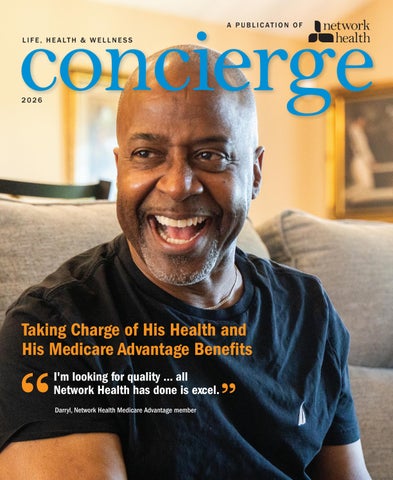
Taking Charge of His Health and His Medicare Advantage Benefits I'm looking for quality ... all Network Health has done is excel. Darryl, Network Health Medicare Advantage member
C O N T E N T S O N Your T E N Plan T SAnytime 3 CManage Health with the Member Portal
8 FEATURE STORY Taking Charge of His Health and His Medicare Advantage Benefits
4 Understanding Types of Care and Your Medicare Advantage Coverage
10 Traveling Outside Wisconsin? Know Your PPO Benefits
5 Breast Cancer Screening: Early Detection Could Save Your Life
Navigating Over-the-Counter Health Tests and Coverage
6 Protect Yourself and Your Family with Opioid Safety and Proper Disposal
11 Our Commitment to Wisconsin Goes Beyond Health Care
7 We’re Social by Nature and Wired for Connection
EDITORIAL STAFF Vice President Marketing
David Sengkhammee
Strategic Marketing Courtnay Brummer and Communications Coordinator Supervisor Creative Design
Debra Sutton
EDITORIAL BOARD Michael Jurmu, Jennifer Quadracci, Kristy Yarcho, Stacy Schwandner, Ted Regalia, Susan Wendt
8
BACK COVER Important Member Information What You Should Know About Fraud
ASK NETWORK HEALTH If you have questions about anything you read in this issue of Concierge, call the member experience team at 800-378-5234 (TTY 711) Monday–Friday, 8 a.m. to 8 p.m. We're available every day, 8 a.m. to 8 p.m. October 1–March 31. Concierge is an annual publication of Network Health. The health information contained in Concierge is meant to supplement, not replace, the advice of health care professionals. © 2026 Network Health Insurance Corporation. No portion of this newsletter may be reproduced without written permission from Network Health Insurance Corporation.
In this issue of Concierge, we're providing you with informative content and a feature story about one of your fellow Network Health Medicare Advantage plan members. Additional content and articles are available on networkhealth.com; our blog, Grow In the Know; and through social media.
Connect With Us Here H5215_5160-03-0826_C 2 | C oncierge • 2026
networkhealth.com
Manage Your Health Plan Anytime with the Member Portal View claims, access member ID cards, go paperless and more— all in one secure place.
Managing your health plan should be simple. With Network Health’s secure member portal, you can quickly access your plan information, track claims, view documents and manage your preferences whenever it’s convenient for you. The portal is personalized to your plan and works on your phone, tablet or computer, so your information is always within reach.
Go Paperless for Faster Updates Cut down on paper clutter and get updates faster by choosing to receive certain communications electronically. Email delivery is secure, convenient and gives you quicker access to important information—including this newsletter. Prefer some materials by mail? You can customize your preferences and choose which communications you’d like to receive electronically or as printed copies.
How to Update Your Preferences
Additional Tools and Resources
1. Log in to the member portal
You can also connect to helpful health and wellness resources, including: • Pharmacy benefits and claims information* • Virtual visits • Your health questionnaire • Wellness programs and tools*
2. Click your name in the upper-right corner 3. Select Change My Communication Preferences 4. Choose email delivery for some or all categories, and opt in to SMS messaging 5. Click Next to save your selections
Your Plan Information in One Place Use the member portal to: • View your benefits and coverage information • Track out-of-pocket expenses • Check claims details and status • Access monthly explanation of benefits (EOB) statements • View your digital Network Health member ID card or request a replacement card • Select or update your personal doctor • Complete your personal health representative form (PHI)
networkhealth.com
To help protect your information, the portal uses multi-factor authentication for added security and peace of mind wherever you access your account. * Not all Network Health plans have a wellness program or pharmacy benefits. Check your plan documents for details.
To get started, scan the QR code or visit login.networkhealth.com. 2026 • C oncierge | 3
Understanding Types of Care and Your Medicare Advantage Coverage By Sarah Dencker, senior vice president of population health at Network Health
If you or a loved one needs care after an illness or injury, it’s important to understand what types of care may be covered by Medicare and your Network Health Medicare Advantage plan.
Skilled care and Medicare coverage Medicare Part A coverage for care in a skilled nursing facility (SNF) requires that specific criteria be met, including: • Skilled services are ordered by a physician. • You have a daily need for skilled services. • The services can only be provided in an inpatient SNF setting, as a practical matter. • The services are reasonable and necessary in intensity, duration and scope. You may need skilled services but not require an inpatient SNF level of care. For example, a non-weight-bearing restriction or a once-daily IV medication may not, by itself, require care in an inpatient SNF. Network Health is committed to helping you receive the right care, in the right place, at the right time. Depending on your clinical needs, this may mean transitioning from an inpatient setting to observation or outpatient care, or from an inpatient rehabilitation or skilled nursing facility to home health, outpatient therapy or outpatient infusion services. These decisions are based on Medicare requirements and your individual clinical needs. This is an administrative process change, not a reduction in your benefits. If you receive a denial on an Explanation of Benefits (EOB), it doesn’t necessarily mean that you owe money. Network Health follows Medicare coverage requirements while continuing to help members access appropriate care.
What is custodial care? Custodial care is assistance with activities of daily living, such as bathing, dressing, toileting and getting around your home. Medicare generally doesn’t cover custodial care when it’s the only care you need. This means custodial care is also not covered by your Network Health Medicare Advantage plan when it’s not part of a covered, medically necessary skilled service. Sometimes, you may need care after an illness or injury, but the care you need may still be considered custodial rather than skilled. 4 | C oncierge • 2026
networkhealth.com
For example, if you fall and break your hip, you may be unable to put weight on your leg for six weeks after surgery. During that time, you may need assistance with daily activities. If you’re unable to actively participate in a rehabilitation program because of your weightbearing restriction, therapy provided during that period may be considered custodial until your restriction is lifted and you can actively participate in a skilled rehabilitation plan of care.
Choosing the right care setting Understanding the difference between skilled and custodial care can help you plan for future health care needs and avoid unexpected coverage decisions. If you have questions about your coverage or the care setting that may be appropriate for you, contact our member experience team at 800-378-5234 (TTY 711) before making care arrangements. We can help you understand your benefits and navigate your options.
Know your options before you need them Planning ahead can help you understand what types of care may be available if you experience a serious illness or injury. You can learn more about long-term care and custodial care coverage options by reviewing resources from the Wisconsin Office of the Commissioner of Insurance at oci.wi.gov/pages/consumers/pi-047.aspx. For a list of companies that offer long-term care insurance policies or riders in Wisconsin, visit oci.wi.gov/pages/consumers/pi-046.aspx. You can also plan ahead by talking with your health care providers about your potential care needs and exploring long-term care or custodial care coverage options before you need them.
Breast Cancer Screening: Early Detection Could Save Your Life By Jennifer Footit-Tank, quality care coordinator at Network Health Breast cancer screening is an important part of preventive health care for people of all genders and identities. Understanding your personal risk and screening options is an important step in protecting your health. For average-risk women, the American Cancer Society recommends annual mammograms from ages 40 to 54, followed by every two years starting at age 55. Those with genetic mutations, personal or family history of breast cancer, prior chest radiation or certain syndromes may need earlier or more frequent screening. Transgender and nonbinary individuals may benefit from personalized screening based on sex assigned at birth, hormone use, surgical networkhealth.com
history and overall risk. Although breast cancer is less common in men, it can still occur. Today’s mammography technology makes screening more comfortable, and most exams take about 10 minutes. Many imaging centers offer 3D mammography, which creates more detailed images and can improve accuracy, particularly for people with dense breast tissue. Cost is another common concern. Routine preventive mammograms are generally covered at no cost. If additional imaging is needed because of symptoms or findings, the exam may be considered diagnostic and have different coverage or out-of-pocket costs. Regular mammograms are an important tool for early detection and improved outcomes. Talk with your doctor about when you should be screened. Refer to your plan documents for coverage details.
2026 • C oncierge | 5
Protect Yourself and Your Family with Opioid Safety and Proper Disposal Use and dispose of opioid medications safely and be prepared for an overdose emergency. By Beth Coopman, PharmD, pharmacist at Network Health
Opioids can be effective for short-term pain management when used as prescribed, but they also carry serious risks, including misuse, addiction and accidental overdose. Safe use and proper disposal help protect you, your family and your community. What are opioids?
Opioids are prescription pain medications such as oxycodone, hydrocodone, morphine, codeine and fentanyl. They are typically used for short-term pain after surgery or injury and work by blocking pain signals.
Why opioid safety matters Opioids can cause drowsiness, slowed breathing, nausea and constipation, and may lead to dependence or addiction. Even one incorrect dose—or use by someone it wasn’t prescribed for—can be dangerous, especially for children, older adults and pets.
Take only as prescribed
• Follow instructions exactly and do not take extra doses or share medication.
Avoid mixing with other substances • Do not use with alcohol.
• Avoid sedatives or sleep medications unless approved by your provider.
Store securely
• Keep in original containers in a locked or safe location, out of reach of children, teens and pets.
Watch for warning signs
• Seek help for extreme sleepiness, slow or shallow breathing, blue/gray lips or nails, or confusion.
When you no longer need opioids • Unused opioids increase the risk of accidental ingestion, misuse or theft. Dispose of them promptly once they’re no longer needed.
Proper disposal options
• Best option: Use pharmacy drop boxes or community take-back events. • Use FDA-approved disposal pouches if available. • Some medications may be flushed only if listed on the FDA flush list. For more information about safe opioid disposal, visit the U.S. Food and Drug Administration (FDA) website at fda.gov/drugs/safe-disposal-medicines/disposal-unusedmedicines-what-you-should-know.
Do not:
• Save leftover opioids • Throw pills in the trash without protection • Crush or alter medications • Share medications
What about Naloxone? Naloxone can reverse an opioid overdose and is available over the counter as a nasal spray. Ask your provider or pharmacist if it’s recommended for you, and ensure family members know how to use it.
Talk to your provider or pharmacist Your health care provider or pharmacist can answer questions about safe opioid use, side effects, tapering or disposal options. 6 | C oncierge • 2026
networkhealth.com
We’re Social by Nature and Wired for Connection
Feel stronger, happier and more connected with pickleball. Looking for a fun, approachable way to stay active without expensive equipment or prior experience? Pickleball is a great way to keep moving while being easy on the joints, and it can support your physical, emotional and social well-being. One of the reasons pickleball has grown so quickly is because it brings people together. The game is naturally social, encouraging conversation, teamwork and connection across all ages and skill levels. Whether with friends or new acquaintances, pickleball creates opportunities to meet new people, build relationships and feel part of a community.
Research continues to show that meaningful relationships and regular social interaction can help reduce stress, improve mental health and support a healthier, more active lifestyle. Sam Clark, wellness supervisor at Network Health
Our commitment to you At Network Health, we’re committed to improving community and population health. Access to fun, welcoming and low-barrier activities can help more people stay active, reduce social isolation and build healthier daily habits. Activities like pickleball make it easier to combine exercise, fun and connection in a way that supports whole-person wellness.
Get in the game with Network Health Community Play We’re excited to announce a new partnership between Network Health and Pickleball Kingdom, offering free indoor open play time for all Network Health members and the public. It’s a perfect partnership given our mission to create healthy and strong Wisconsin communities. Whether you're a beginner or experienced player, join us for free Network Health Community Play on Tuesdays and Thursdays from 11 a.m. to 3 p.m. at Pickleball Kingdom clubs in Appleton and Menomonee Falls. Questions about Network Health Community Play? Scan the QR code or contact Pickleball Kingdom. Appleton: 920-610-5790 info@pickleballkingdomappleton.com Menomonee Falls: 262-286-4801 info@kingdommenfalls.com
networkhealth.com
2026 • C oncierge | 7
Taking Charge of His Health and His Medicare Advantage Benefits After 35 years working in health care and insurance, Darryl knows the value of quality coverage, personal service and making the most of every resource available. By Courtnay Brummer / Photos by Kyle Halter
F
or Darryl, turning 65 meant more than a milestone birthday. It marked a new chapter in his approach to health care—and an opportunity to make the most of the benefits he had earned through a lifetime of working and serving his country in the U.S. Air Force.
Darryl spent 35 years working in health care and insurance, including roles in claims, customer service and leadership. His experience gave him an insider’s perspective on how health insurance works. Even so, he found navigating Medicare could be complicated. As he approached 65, Darryl worked with an agent to compare his existing coverage, Medicare options and the possibility of remaining on his wife’s employer-sponsored insurance. He determined that a Network Health Medicare Advantage plan would save him $204 a month while providing the quality of coverage he wanted. “At this point in my life, the price is not always the determining factor for me,” Darryl says. “I’m looking for quality.” Based on his experience so far, Darryl believes he found it. “I love Medicare. My wife has excellent insurance, but Network Health is better than what I had. And the service is definitely better.”
8 | C oncierge • 2026
networkhealth.com
Personal Service Makes a Difference
wellness visits, rather than waiting until something feels wrong. One of Darryl’s first experiences with Network Health came when His perspective is shaped by personal experience. His older he called the pharmacy team with a question about his diabetic brother once believed he was healthy because he felt fine. Then he had a heart attack. “Just because you feel great, it doesn’t testing supplies. Under his previous insurance, the supplies mean that you are great.” had been provided at no cost. Darryl worried that moving to His mother, now 85, is a breast cancer survivor. These Medicare would mean an unexpected expense. Instead, the experiences reinforced Darryl's belief that staying ahead of pharmacy team confirmed that his supplies were covered. potential health problems is worth the effort. He also has a Darryl was relieved—and impressed by the way Lauren, a personal reason for wanting to remain healthy: independence. Network Health pharmacist, handled the call. “She was so “I want to be self-sufficient. I don’t want my wife to have to take relatable.” care of me.” Having spent years in customer service himself, Darryl recognizes the difference between simply answering a question and making a genuine connection. “With Lauren, it was not I want to be self-sufficient. I don't want just about insurance. It was about me. It was about helping a my wife to have to take care of me. person, not just a script.” That personal connection is what energizes Lauren. “I was able to give Darryl the information he needed to take charge of his health,” she says. “Now he has confidence that when he calls Network Health, he’ll be supported by someone who truly cares.” Darryl says Network Health’s size is an advantage because members can get answers and follow-up from people who take the time to listen. “Talk is cheap. Network Health delivers.”
Talk is cheap. Network Health delivers. Making the Most of His Benefits Darryl isn't the type to leave a benefit unused. He keeps his member information organized, uses his member portal and reads his member guide carefully. “I’m a bookworm. You gave it to me to read, so I’m going to read it.” He has explored his dental benefits, uses his over-the-counter benefit and has taken advantage of the One Pass™ fitness benefit, which includes free gym memberships and digital class options. Darryl says understanding his benefits is part of taking responsibility for his health. “The proof is in the pudding, and the resources are right here for you. Use them.” He encourages other members to learn what their plan covers, keep their member guide handy and ask questions when they need help. The member experience team phone number is on the back of the member ID card, and the member guide includes important phone numbers and resources. Darryl also believes members should take advantage of preventive care, including recommended screenings and networkhealth.com
Darryl exercises three to five times a week and describes himself as a “gym rat.” Staying active helps him maintain his health and quality of life as he gets older.
Knowing When to Ask for Help Darryl’s health care and insurance experience gives him confidence, but he doesn't believe people need to figure everything out alone. His approach is simple: learn, ask questions and use available resources. That approach recently paid off when Darryl spoke with his doctor about improving his diabetes management. A medication he was considering would have cost $216 a month. He contacted the Network Health pharmacy team and learned about a comparable alternative that could cost $19 a month. Darryl then contacted his personal doctor to confirm the alternative was appropriate for him. That's exactly what good health care should look like, he says. “People working together to find answers and solutions.”
Quality Over Convenience Darryl knows plans and circumstances can change. But when asked whether he expects to shop around during open enrollment, his answer is straightforward. “Why would I go with somebody else? All Network Health has done is excel.” Darryl has a keen understanding of exceptional customer service. He also isn't afraid to speak up when something isn't right. To him, being an engaged health care consumer isn't complaining—it’s taking an active role in his health. Darryl’s Network Health Medicare Advantage plan is a resource that helps him protect what he values most: his health, his independence and his quality of life. “I just want to live and feel the best I can as long as I can,” he says. “I really do.” 2026 • C oncierge | 9
Traveling Outside Wisconsin?
Know Your PPO Benefits
By Angela Keenan, director of operations at Network Health
If you have a Network Health Medicare Advantage PPO plan, you have coverage when you travel throughout the United States and its territories. When you’re outside Wisconsin*, you can see out-of-network providers at in-network rates, as long as the provider accepts Medicare. You don’t need a referral or prior authorization to see an out-of-network provider. Some providers may not be familiar with Network Health and may ask you to pay for services upfront. If this happens, our member experience team can help by working with the provider’s office and assisting with reimbursement requests. Before your first appointment, we recommend contacting the provider to confirm they will accept your Network Health plan. While we cannot require an out-of-network provider to accept our plan, we will do our best to explain coverage and payment processes to the provider. You can also share our Out-of-Network Billing and Coverage document with your provider. Visit networkhealth.com/providerresources/medicare-out-of-network and select the document for Medicare Advantage or Group Medicare Advantage. * Coverage and network rules may vary by plan. Refer to your Evidence of Coverage for details.
Navigating Over-the-Counter Health Tests and Coverage By Ted Regalia, vice president of pharmacy benefits at Network Health
Health testing is more convenient than ever. You can now purchase over-the-counter (OTC) cholesterol tests, genetic testing kits and other health tests directly from retailers or online for use at home. While these services can provide helpful information, the best place to start is with your health care provider. Your personal doctor can help determine which tests are most appropriate for your needs based on your health history, risk factors and current guidelines. Most tests ordered by your doctor as part of your medical care are covered. OTC tests you purchase on your own are not covered.
Before purchasing an OTC health test: • Talk with your doctor about whether testing will provide the information you need and the test that's right for you. • Check your plan documents, like the Evidence of Coverage, to understand your coverage. • If you need help understanding your coverage, call the Network Health pharmacy team at 888-665-1246 (TTY 711), Monday–Friday from 8 a.m. to 5 p.m. Regular preventive care—including recommended screenings for cholesterol, blood pressure, diabetes and certain cancers—is an important part of staying healthy and identifying potential concerns early. Preventive care can also help reduce health care costs over time, allowing us to continue offering high-quality benefits. OTC tests can be convenient, but they don't replace personalized medical guidance. Working with your doctor can help ensure you get the right test at the right time, with the support you need to understand your results and take the appropriate next step. 10 | C oncierge • 2026
networkhealth.com
Our Commitment to Wisconsin Goes Beyond Health Care At Network Health, we’re building meaningful connections and bringing our community roadmap to life throughout Wisconsin. We live here, work here and raise our families here, and we’re proud to support the communities that make our state such a special place to call home. We’re truly Wisconsin. Over the past year, we partnered with 124 organizations across Wisconsin and supported 458 member and community events. Through these partnerships, we’re helping strengthen local communities and create lasting connections with the people we serve like you. We’re also committed to supporting Wisconsin businesses. In 2025, we returned more than $1.7 million to the local economy by purchasing goods and services from our own clients whenever possible. Our employees are the heart of our efforts and play a vital role. Together, they contributed more than 3,300 volunteer hours, with 57% of our workforce giving their time and talents to causes they care about. Through their volunteer efforts, 110 organizations received support that helped make a positive impact in communities across the state. From Milwaukee and Waukesha to Oshkosh, Fond du Lac, the Fox Cities, Green Bay and Door County, you’ll find Network Health actively engaged in our state’s northeast and southeast communities where our members live, work and thrive. We’re proud to invest in Wisconsin today and for generations to come.
For a complete list of upcoming events and details, scan the QR code or visit networkhealth.com/community. We can’t wait to see you and continue building a brighter future together.
networkhealth.com
2026 • C oncierge | 11
COVER STORY PRESORT STD US POSTAGE PAID PERMIT 1033 GREEN BAY, WI
1570 Midway Pl. Menasha, WI 54952
NE/SE/SNP/EGWP
Health and wellness or prevention information
Important Member Information
Learn about your rights, benefits, care options and other helpful health plan resources. At Network Health, we want to make it easy for you to understand your health plan, benefits and available services. Organizations such as the National Committee for Quality Assurance (NCQA), the Wisconsin Office of the Commissioner of Insurance (OCI) and the Centers for Medicare & Medicaid Services (CMS) help oversee health plans to support quality care and protect members. As part of these standards, health plans are required to provide information on important topics related to coverage, care options and member rights.
Available resources include:
• Access to Network Health care management employees and services
• Member rights and responsibilities
• Ensuring you receive the service you deserve
• How to submit a claim for reimbursement
• Evaluating new technologies • Falls and osteoporosis prevention • How health plan decisions are made • How to protect yourself from Medicare fraud
• Network Health’s commitment to quality • The importance of sharing health information • Understanding emergency care, urgent care and virtual visits • Population health management
You can download this information at networkhealth.com/required-info. If you do not have access to the internet and need a hard copy, please call our member experience team at the number on the back of your Network Health member ID card.
What You Should Know About Fraud
Network Health takes health insurance fraud seriously. Insurance fraud costs millions of dollars each year, and it results in higher health care costs. Network Health investigates all reports we receive. Tips from our members are critical in helping us identify fraud, waste and abuse. We urge you to contact us if you feel you’ve been impacted.
Here are some examples of possible fraud. • A health care provider bills for services you never received. • A durable medical equipment (DME) supplier bills for equipment different than what was ordered and provided or was unsolicited. • Someone uses another person’s member ID card to get medical care, supplies or equipment. • Misrepresenting alternative medicine or cosmetic procedures as covered plan benefits.
If you suspect fraud, here’s what you can do. • Call your health care provider to make sure the bill is correct. • Call the member experience team at the number located on the back of your Network Health member ID card. • Email us at paymentintegrity@networkhealth.com.