REAL ESTATE EDITION
Issue No. 176
DESTINOLOSCABOS.COM
WHAT WE DO
BETTER MARKETING FASTER SALES
NO DRAMA.
LIST YOUR CABO PROPERTY WITH US LUMARIA C-104 CABO SAN LUCAS MLS 26-3159
$629,000 USD $10,730,740 MXN
Beds | Dormitorios: 2 Baths | Baños: 2 Total M2: 174
$2,600,000 USD $44,356,000 MXN
PARADERO HOMES TODOS SANTOS MLS 26-2457
Beds | Dormitorios: 4 Baths | Baños: 4.5 Total M2: 621
MONTEMAR 403 PEDREGAL MLS 26-524
$625,000 USD $10,662,500 MXN
Beds | Dormitorios: 2 Baths | Baños: 2 Total M2: 145 CONVERSION TO PESOS SUBJECT TO CHANGE. THE INFORMATION SHOWN IN PESOS IS SOLELY BASED ON THE OFFICIAL CONVERSION ON THE DATE THIS AD WAS SUBMITTED. THE OFFERED PRICE IS IN DOLLARS (US CURRENCY), AND IN ACCORDANCE WITH ARTICLE 8 OF THE MONETARY LAW, THE REAL PRICE WILL BE THAT OF PESOS RESULTING FROM THE OFFICIAL EXCHANGE RATE ON THE DATE PAYMENT IS DUE. IN ACCORDANCE WITH NOM 247, PRICES SHOWN IN DOLLARS CAN BE CONVERTED INTO PESOS BY ACCESSING THE FOLLOWING LINK AND PERFORMING THE CORRESPONDING ARITHMETIC MULTIPLICATION BASED ON THE CURRENT EXCHANGE RATE: HTTPS://WWW.BANXICO.ORG.MX/TIPCAMB/MAIN.DO?PAGE=TIP&IDIOMA=SP *PRICES SUBJECT TO CHANGE
CONVERSIÓN A PESOS SUJETA A CAMBIOS. LA INFORMACIÓN MOSTRADA EN PESOS SE BASA ÚNICAMENTE EN LA CONVERSIÓN OFICIAL EN LA FECHA EN QUE SE ENVIÓ ESTE ANUNCIO. EL PRECIO OFRECIDO ESTÁ EN DÓLARES (MONEDA ESTADOUNIDENSE) Y DE ACUERDO CON EL ARTÍCULO 8 DE LA LEY MONETARIA, EL PRECIO REAL SERÁ EL DE PESOS RESULTANTE DEL TIPO DE CAMBIO OFICIAL EN LA FECHA DE VENCIMIENTO DEL PAGO. DE ACUERDO CON LA NOM 247, LOS PRECIOS MOSTRADOS EN DÓLARES PUEDEN SER CONVERTIDOS A PESOS ACCEDIENDO AL SIGUIENTE ENLACE Y REALIZANDO LA CORRESPONDIENTE MULTIPLICACIÓN ARITMÉTICA SEGÚN EL TIPO DE CAMBIO ACTUAL: HTTPS://WWW.BANXICO.ORG.MX/TIPCAMB/MAIN.DO?PAGE=TIP&IDIOMA=SP *PRECIOS SUJETOS A CAMBIOS..
PH. +52 (624) 218 45-34 M A R K E T I N G @ C A B O R E A L E S TAT E . C O M W W W . C A B O R E A L E S TAT E . C O M
Let us help you buy and sell your property with confidence
Buying or selling across borders? Your international property transaction just got easier and more secure. We are a US-based escrow company, fully bonded and insured.
MLS-BCS Special Service Provider (512) 646-7337
GLO BALE SCROW . C O M
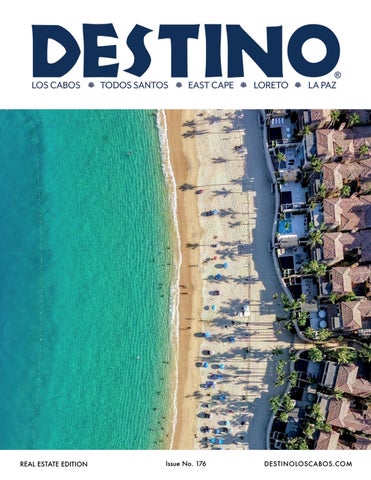
LETTER FROM THE EDITOR The photograph on the cover of our only real estate issue of the year is an overhead shot of Medano Beach. On the left, the ocean, untamed. To the right of the seam of sand, a row of houses. It is an image of a boundary between nature and human settlement. Each of those houses presumably has a cistern beneath it, making each one an operation that someone has to run. Owning property in Baja, especially away from the urban centers of Los Cabos and La Paz, means taking on responsibility that elsewhere belongs to a municipality. The cistern is a good example. Water arrives by truck, well, or desalination plant, and from that moment the homeowner operates a water system, whether they know it or not. Off-grid living is the fully realized version. Power, water, waste: all self-run because there is no outside system to hand them to. The next rung up the ladder is the developer, where master-planned communities build their own desalination and treatment plants. Danzante Bay in Loreto, Contigo Cerritos, and other smaller projects follow the same logic: achieving a healthy degree of self-sufficiency that supports their stewardship of the land they inhabit. Buyers from the U.S., Canada, and mainland Mexico arrive from places where competence is somebody else’s department. A utility treats the water before it reaches you, and once a year a report arrives to confirm everything works. In Baja, the standard gets set property by property. The same desalination plant can deliver excellent water or send aged membranes and cleaning chemicals into your kitchen, and what decides it is funding and someone paying attention. It is fitting that the people who live here take on the role of operators, because the terrain, for all its magnificence, is unforgiving to human life. The aquifers are fully committed, salt air finds the rebar in anything not built to resist it, and a year’s rain can arrive during two months and then not return in a decade. Keeping a house livable here requires daily care. This theme shows up elsewhere in this issue, in places that have nothing to do with cisterns or permits. A boat holds its position and lets twenty-six orcas decide how close they want to come, while a golf pro plays the same course for four years and finds that familiarity keeps opening up new possibilities. A daughter who grew up in Cabo watches the town fill in around her; she neither mourns it nor pretends nothing changed. Welcome to the Fall 2026 real estate edition, Alejandro Ehrenberg
Mobula Ray Aggregation Cabo San Lucas Instagram: @alexsharks_
FEATURES
M A S T H E A D
PUBLISHER Owen Perry EDITOR IN CHIEF Alejandro Ehrenberg INVESTMENT MANAGER Lance Niederhaus COMMERCIAL LEAD Frida Ludwika Rodríguez GRAPHIC DESIGNER Rebeca Beltrán CONTRIBUTORS Jewel Perry Dawn Pier Rian Chandler-Dovis Carly Miller SOCIAL MEDIA Erika Coatzin WEBMASTER Edgar Valdez DISTRIBUTION Christian Jiménez SALES EXECUTIVES Christian Jiménez Yoselin Hideroa EDITOR’S CONTACT alejandro@destinoloscabos.com COVER PHOTO Medano Beach Omar Heredia @om.archivonatural
Follow us: @destinoloscabos
D ES TI N O LOSC A B OS .CO M
Old Lighthouse, Cabo San Lucas Photo: Alexander Paul Ehrenberg Stiles
INTERESTED IN ADVERTISING? Contact us: +52 (624) 105-9700 frida@destinoloscabos.com
DESTINO GROUP SA de CV Tél: (624) 105-9700/ (624)142-4949 / Dirección: Carretera Federal Libre Transpeninsular San José San Lucas. Km. 4.3, Local 6, Col. El Tezal, Cabo San Lucas, Baja California Sur / Email: contact@destinoloscabos.com / © 2021 Destino Group SA de CV / / NÚMERO 176 OTOÑO 2026 Todos los derechos reservados por Destino Group. / Prohibida la reproducción total o parcial del contenido sin previa autorización por escrito de los editores. ISSUE 176 FALL 2026 Printed in Mexico. All rights reserved. No part of this publication may be reproduced in any form without the written consent of the publisher. DESTINO GROUP welcomes all written and photographic material. We cannot guarantee return. Rights to publish unsolicited material are retained for 12 months. Circulation throughout Southern Baja. For more information on distribution visit: DESTINOLOSCABOS.COM
C O N T E N T S
THE BAJA GUIDE
28
Owen Perry on four decades in Baja and why Loreto became home.
10 Breakfast Restaurant Guide Where to start the morning, from Cabo San Lucas to El Triunfo.
12
30
Fall Events Worth Your Time
A Record Sale, New Projects, and Why Loreto Is Still a Ground-Floor Investment
Festivals, tournaments, and rituals in every region this Fall.
A broker on the market’s ceiling, and what buyers get early.
14 Days by the Sea
34 36
18
Elbow Room and Time Space, water, and self-sufficiency on the southern East Cape.
Where to swim, surf, and watch the light change, from Los Cabos to Loreto.
16
Building Danzante Bay
What It Takes to Build in Baja
What to Do When the Heat Breaks
Two architects on cost, timelines, and reading a quote properly.
Trails, reefs, and surf that come back into play as the year comes to a close.
LIFESTYLE & COMMUNITY
Give Back: Ways to Support Baja Sur
38
Local nonprofits working in healthcare, education, and conservation.
The Water Plant Nobody Told You About Once water reaches your cistern, the system is yours to run.
42
After the First Round The five Los Cabos golf courses that hold up best past the first visit.
REAL ESTATE & DEVELOPMENT 20 Cerritos, Pescadero, Todos Santos: Three Towns, Three Markets
44
Three towns fifteen minutes apart, and what separates them for a buyer.
A daughter of Los Cabos on the town that grew up around her.
46
24 What Branded Residences Look Like in Todos
My Cabo
Connect and Protect Twenty-six orcas, one boat, and the distance that made it work.
Santos A development where the land and place are the amenities.
50
Maps San Jose del Cabo and Cabo San Lucas.
27 The Land Before the Title Why the deed rarely tells you everything, and what due diligence should cover.
PHOTOGRAPHY Omar Heredia @om.archivonatural
Noah Duethman @gringoncontentco
Mark Borderud
Alex Sharks @alexsharks_ Joseph A. Tyson
Rafa Rivero @rafari_shoots
Sara Vafa @saraavafaa
Alexander P. Ehrenberg
THE BAJA GUIDE
BREAKFAST RESTAURANT GUIDE The first decision of the day, from Cabo San Lucas to El Triunfo.
CABO SAN LUCAS Cabo Wabo Cantina Open since 1993, downtown. Cabo Wabo is a nightlife landmark associated with Sammy Hagar, with live bands and a daytime happy hour. It also serves a full breakfast and brunch menu: chilaquiles, huevos any style, eggs Benedict, pancakes, breakfast burritos, all with a side of Cabo Wabo potatoes. Mama’s Royal Cafe Mama’s Royal has served breakfast in Cabo for years. The signature dish is stuffed French toast. Huevos divorciados and custom omelets are also popular, as are the fresh-squeezed juices. The dining area, a couple of blocks from the marina, is shaded and split between indoor and outdoor seating. Club Cascadas The resort is used mostly by owners, family, and friends, but the public can dine here with a reservation. Expect classic breakfast fare like eggs, chilaquiles, and pastries. The restaurant is well-appointed, partly below a palapa with a cement floor, and some tables are on the sand. It has an unobstructed view of the Arch. Gardenias Tacos Open since 1980, family-owned, near Medano Beach. The menu focuses on seafood tacos, plus barbacoa or cochinita pibil, all on homemade tortillas. Breakfast tacos are part of the appeal, but you can also find burritos, eggs, and the usual morning dishes. Prices stay reasonable even this close to the marina. El Huerto Farm to Table A local family built El Huerto around a working organic farm, which the region’s semi-desert climate does not make easy. Located in El Tezal, the architecture has hints of a 19th-century Baja hacienda. Gardens, orchards, and lawn games spread across the grounds. The menu blends Mediterranean influences with what the farm produces, like avocado toast, wood-fired dishes, and suckling pig.
Alquimia Cocina Imperfecta Alquimia has two locations, one off the main tourist strip, in a residential pocket of Cabo, and another one near the Riu Hotel. Huevos rancheros, enchiladas verdes, avocado toast, house-baked bread, and fresh-pressed juices. Condé Nast Traveler included it in a guide to Los Cabos as a place locals choose over a resort chain. Prices sit below the tourist-zone average. Sur Beach House Sur is the beach club for the Bahia Hotel, on Medano Beach. Eggs Benedict on a bagel, a croque madame, chilaquiles, and a raw bar with oysters and clams, plus handcrafted cocktails. There are lounge chairs and day beds on the sand or at tables on the terrace. Paddleboard, kayak, and snorkel rentals operate on site. The Ledge at The Cape, a Thompson Hotel Located on the corridor, just outside Cabo, this restaurant’s menu combines contemporary Mexican dishes like chilaquiles and huevos rancheros with American breakfast standards. The banana French toast is a must. On Sundays there’s a brunch buffet with a carving station, sushi, and a dessert table. SAN JOSE & THE CORRIDOR Flora’s Field Kitchen Flora Farms covers 25 working organic acres about ten minutes from downtown San Jose. Sourdough French toast, Bloody Marys with so many veggies as garnish that they become a salad, and chilaquiles are highlights. The produce is grown on site, and the meat comes from a ranch nearby: lush garden setting, live music, a Michelin Green Star. Reservations are essential. People plan a morning around it. Pezgallo Located in La Playita, between Flora and downtown. A casual café known for avocado toast, tostadas, and chilaquiles, with a fine coffee and juice list. Walk-in crowd. Reasonable prices and consistently solid dishes. Ruba’s Bakery & Bistro In the Gallery District, inside a restored 1940s home. Avocado toast with a poached egg on house-baked bread, croissants, French toast, weekend chilaquiles, specialty coffee. Umbrellashaded tables line the street, and breakfast has more consistent praise than dinner. Reservations help on weekends. Acre Restaurant & Cocktail Bar Acre holds a Michelin Green Star. The lush, ample property is 10 minutes from downtown, with treehouse guest rooms and a farm. Weekday breakfast includes cheddar biscuits and roasted baby beets. The weekend brunch is five courses, with 10
mimosas, bellinis, and mezcalitas. Open-air, palm-forested, with mango orchards. Café de Lolita Off the town main square, in the Gallery District. Urban Mexican cooking built on family recipes: Veracruz eggs, conchita, cappuccino, pineapple smoothies. The building has a garden courtyard, retro décor, and an airconditioned indoor section. TODOS SANTOS / PESCADERO / CERRITOS Jazamango / Todos Santos With chef Javier Plascencia at the helm, this restaurant serves brioche French toast, chilaquiles, wood-fired pizza, sweet-corn pancakes, or a cochinita pibil torta. The attached café serves a simpler version of the same food. Al fresco, beside Jazamango’s own farm. Caffe Todos Santos / Todos Santos Downtown, inside a colonial building on one of the town’s prettiest streets. Bagel breakfast sandwiches, lattes, pastries, and classic Mexican dishes. Artsy décor, a little quirky, in keeping with the building. It is one of the town’s most established cafés. La Esquina / Todos Santos Seating is entirely outdoors, and the WiFi makes La Esquina a daytime work spot. It is near downtown, toward Las Playitas. Breakfast burritos, sandwiches on daily-baked bread, smoothies, juices, gluten-free flax pancakes, organic salad. A farmers market sets up here on Wednesdays. Doce Cuarenta / Todos Santos Another self-roasting café, known as much for its coffee as its food. Baked goods and breakfast plates with small twists on the expected. More cosmopolitan than the town’s older cafés, and a favorite within the creative community. Tenoch at Paradero Hotel / Todos Santos Modern Mexican cooking with Japanese influences, a departure from the town’s more traditional breakfast spots. Tenoch is inside the Paradero Hotel, one of the town’s more architecturally distinct properties: desert brutalism. Confirm breakfast service for nonguests directly with the hotel, as availability shifts by season. Benno at Hotel San Cristóbal / Todos Santos Benno is Michelin-recognized: classic Mexican cooking with a Mediterranean edge, using fish bought daily from the fishermen at Punta Lobos and produce grown nearby. Breakfast includes omelets, breakfast burritos with avocado, and huevos San Cristobal. The dining area is indooroutdoor, facing the pool and the beach.
FALL 2026
Cerritos Surf Town / Cerritos Baja Californian cooking throughout the day, with huevos rancheros and a beach breakfast in the mornings. Beachfront, built for guests coming off the sand. Day passes are available to the public if you want to spend the day in the pool. Same Same but Different Café / Cerritos Health-focused, boho, surf-town: mismatched chairs, WiFi, smoothie bowls, avocado toast, flat whites, vegan options. The digital-nomad crowd treats it as a morning fixture, and the coffee is often called the best in Cerritos. Agricole / Pescadero The restaurant is attached to an organic grocery and farm shop, with an open-air dining area set in a garden on the highway between Todos Santos and Los Cabos. The menu is Mexican with Californian touches: layered tomato and Kalamata olive salad, batter-dipped fish tacos, shaved ribeye. LORETO Café Olé A decades-old fixture in Centro. Huevos divorciados, huevos con machaca, huevos nopalitos, omelets, hot cakes, smoothies, plus a separate vegan menu. You order at the counter. Seating is split between indoors and a veranda that stays cool without air conditioning. A group of expats known locally as the Coffee Dudes holds a standing morning table. Pan Que Pan A bakery and bistro centered around its own bread. Pancakes, French toast, savory and sweet crepes. Pan Que Pan appears on nearly every local list of the town’s best breakfasts. Orlando’s Service is alfresco, on a back patio. Orlando’s serves Mexican cooking from breakfast through dinner; the mushroom omelet and the huevos divorciados are the breakfast standouts. El Andador Café Near the Mission. A small café serving breakfast and coffee from a second-story dining area with a direct view of the Mission below. EL TRIUNFO
EAST CAPE Caleb’s Café / Los Barriles On the main street in Los Barriles, family-owned, American and Mexican food: cinnamon sticky buns, fresh-squeezed orange juice, omelets, French toast, pancakes, breakfast sandwiches. Seating splits between an indoor dining area and a sidewalk deck. When people in Los Barriles say they are getting breakfast, this is usually where they mean.
La Playa Restaurante & Bar / Los Barriles Open-air, set directly on the sand, with a view of the Sea of Cortez. On windy mornings, the kitesurfers are visible from the tables. Options include Porky Omelet, a smoked-marlin omelet, biscuits and gravy, and a Hawaiian smoothie.
11
Café El Triunfo Its owner and baker-in-chief opened this café in 2008, in a restored colonial building with gardens and several outdoor patios. Sourdough comes out of a wood-fired oven and tends to sell out, alongside pecan rolls, brick-oven pizza, homemade pasta, and waffles. Bread arrives with olive oil and balsamic. El Triunfo is a very small town, and Café El Triunfo is the reason many visitors come.
THE BAJA GUIDE
FALL EVENTS WORTH YOUR TIME October through December, across every region — festivals, rituals, and local rhythms.
LOS CABOS (Cabo San Lucas & San Jose del Cabo) San Jose Art Walk | Thursdays, late October–May Every Thursday evening, the historic center trades its daytime quiet for open galleries and live music spilling onto Obregón Street. Artists talk shop over wine. Vendors set up along the plaza. The tourist shops close early and the town's real character — the one still built around art, not resort marketing — takes over for a few hours. Los Cabos Billfish Tournament | October 7–11 Now in its 28th year, based out of IGY Marina and Playa Grande Resort. Three days of fishing, roughly 100 boats chasing marlin and sailfish in the waters off Cabo. Smaller than Bisbee's, and priced accordingly — a more accessible entry point for teams who don't have Black & Blue money to spend. Bisbee's Los Cabos Offshore ("Little Bisbee's") | October 12–17 The lead-in to Black & Blue, run out of Puerto Paraíso Mall and the marina. Lower stakes than its bigger sibling, which makes it the better one to watch if you want the atmosphere without the seven-figure tension. Same fish, same marina, smaller crowds. Bisbee's Black & Blue Marlin Tournament | October 19–24 The world's richest fishing tournament, and it shows. Massive payouts, high-end boats, a weigh-in scene at the marina that draws a crowd even from people who don't fish. Last year's purse topped $7.4 million across 177 teams — numbers that keep climbing every edition. If you're not into fishing, the atmosphere is still worth the walk-through. Part party, part spectacle. Get there for the afternoon weigh-ins; that's when the marina fills in. Festival Náutico de Día de Muertos ("Mar de Ofrenda") | November 1–4 (est.), Cabo San Lucas Now in its 5th year. Boats gather in the bay carrying floating altars — flowers, candles, photographs — timed to the main Día de Muertos dates. A parade moves through the marina and downtown alongside it. Not a religious observance in the traditional sense; more of a public spectacle built around the same imagery.
dinner on the 7th — shorter and more contained than the marlin tournaments earlier in October. SCORE Baja 1000 | November 9–15 The 59th running of what SCORE calls "the Granddaddy of All Off-Road Races" — and for the first time in its history, the whole thing takes place within Los Cabos, start to finish. Previous editions ran the length of the peninsula from Ensenada. Custom-built vehicles tear through the desert and along the coast; streets close for the pass-through. Not quiet, not subtle. Earplugs recommended if you're getting close. Concerts at El Ganzo | Year-round , San Jose del Cabo El Ganzo built its reputation as a recording studio before it was a hotel, and the music program never really stopped. An ongoing residency that's hosted The War on Drugs, Tycho, and Khruangbin, plus Viva El Gonzo, the hotel's own annual festival each May. This fall's confirmed date: Mac DeMarco, November 14. More get added through the season; check El Ganzo's site closer to your trip. Sabor a Cabo (Los Cabos Culinary Festival) | December 6 (est.) Organized by the local restaurant association, with a main gala typically landing on the first Saturday of December. Restaurants across both towns take part, though the gala is the centerpiece: chefs, tastings, one big night rather than a spread-out week. Los Cabos International Film Festival | December 9–13 One of Mexico's most respected film festivals, and it doesn't chase Hollywood premieres to prove it. Screenings blend Latin American cinema with international documentary, plus panels, open-air projections, and public plazas turned into pop-up screens across San Jose and Cabo San Lucas. New Year's Eve | December 31, Cabo San Lucas Fireworks over Médano Beach draw the biggest public crowd of the night, visible from most of the beachfront hotels without a ticket. Resorts and nightclubs run their own ticketed parties alongside it — the loudest, most expensive night of the year in Cabo. Recurring — Los Cabos
WWT Championship (PGA Tour) | November 2–8 Held on Diamante's Tiger Woods-designed El Cardonal course, this tournament brings 120 pros to compete for a $6 million purse over four rounds of stroke play. One of the rare desert-meets-ocean terrains on tour — you can watch someone line up a putt with the Pacific behind them.
Farmer's Market at the Shoppes at Palmilla | Fridays, November–April Runs 9am to 1pm, produce and prepared food stalls set up in the Palmilla shopping center's outdoor space. Smaller and more resort-adjacent than the organic markets in San José or Todos Santos — geared toward the corridor's part-time residents and hotel guests as much as locals doing a weekly shop.
Cabo Tuna Jackpot | November 4–7 28th annual, based out of Tesoro Marina. Two days of fishing, tuna only, followed by an awards
San Jose del Cabo Organic Market | Saturdays, November–April Running since 2002 out of Huerta María, a palm
12
FALL 2026
grove just outside downtown. The largest of the region's organic markets: produce, cheese, tamales, baked goods, alongside crafts and live music. Locals and part-time residents outnumber tourists here, even in high season. EAST CAPE Palmas de Cortez Fall Spectacular | October 8–12 (est.), Los Barriles Less polished than Cabo's tournaments, and that's the point. The 31st annual edition, hosted out of Palmas de Cortez, pulls anglers chasing tuna and wahoo in the waters between Los Barriles and the Gordo Banks. No marina crowds, no red carpet weigh-ins, just boats coming in at dusk and a scoreboard that gets updated by hand. LA PAZ Yuridia – "Las Cartas Sobre la Mesa Tour 2026" | October 17 One night at Estadio Arturo C. Nahl. Yuridia built her following on ballads, heavy on heartbreak, and the tour name promises more of the same, cards on the table, no filter. A stadium show is a rare booking for La Paz. Alejandro Sanz – "¿Y ahora qué? Tour 2026" | October 24 Sanz returns to the stage at Estadio Arturo C. Nahl, three weeks after Yuridia plays the same venue. Decades into his career, still one of the best-selling Spanish-language artists alive. TODOS SANTOS / EL PESCADERO / CERRITOS Festival de Cine de Todos Santos | November 23–29 (est.) Now in its 21st year, centered on the Teatro Márquez de León with satellite screenings in La Paz and Los Cabos. The focus stays on Latin American and independent film. It is smaller and more curated than the big Los Cabos festival in December. GastroVino Baja Food & Wine Festival | November, exact dates TBD A multi-day celebration built around Baja's wine country, drawing chefs and winemakers for tastings, pop-up dinners, and pairing events across Todos Santos and Pescadero. Bajaja Music Fest | November 30–December 2 (est.), El Pescadero A boutique festival set on Playa San Pedrito, smaller and more independent than the resort-driven concerts up the coast. Recurring — Todos Santos Todos Santos Farmer's Market (La Esquina) | Wednesdays, 9am–12pm Smaller and more local than the Los Cabos markets. Organic greens, cheeses, tamales. A weekday morning stop rather than a weekend destination. Mercado Orgánico Todos Santos | Fridays, 9am–2pm Runs out of Palma Serena in La Cachora. Organic produce and artisanal goods, often with live music built into the afternoon. Mercado Ranchero | Saturdays, 10am–3pm Started in 2016 as a storefront selling handmade goods from ranches across Baja California Sur — pottery, knives, honey, cheese, all small-batch. The Saturday market adds fresh chickens, organic eggs, and produce on top of what the shop carries year-round. Less a farmers market than a showcase for a ranching culture that's slowly disappearing as land gets sold off or abandoned. LORETO Loreto Founding Day Fishing Tournament | October 2–3 Two days, no marina spectacle, just local boats heading out before sunrise. The tournament marks the same anniversary the town spends the rest of the month building toward, Loreto's founding in 1697, but this version is smaller and more working-class than the fiesta itself. Weigh-ins happen dockside.
Fiestas de la Fundación de Loreto | October 22–25 (est.) Marking 329 years since Loreto's founding on October 25, 1697, the first Spanish mission settlement in the Californias, and for decades the capital of the region. Celebrations center on Plaza Juárez and the malecón. Night of the Conquista Gastronomic Festival | October 26 An evening event on Plaza Juárez, five hours starting at 5pm. Local restaurants and cooks set up stalls around the plaza, serving dishes tied to the region's mission-era history — the "conquista" in the name refers to the Spanish colonization that started here in 1697. Loreto Sprint Triathlon | November 6–7 A shorter-format triathlon along Loreto's malecón and bay — swim, bike, run, all scaled down from full Ironman distance. Two days: check-in and shorter events on the 6th, the main race on the 7th. Loreto Bay Welcome Back Party | November 7 A community event aimed at seasonal residents and part-timers returning to Loreto Bay for the winter season. San Javier Patron Saint Festival (Fiesta de San Javier) | December 1–3, San Javier Held at the Misión San Francisco Javier, a mountain village inland from Loreto, one of the best-preserved Jesuit missions in Baja. The feast day itself falls on December 3rd. Pilgrims make the drive or the walk in; expect a mix of religious observance and a small country fair around the church. Misión Route Cycling Race | December 5–6 A two-day cycling event following stretches of the historic mission route inland from Loreto. Draws mostly amateur and regional riders. Loreto 400 (off-road race) | December 12–13 (est.) A night-route off-road race starting from Loreto's malecón.
DAYS BY THE SEA The beaches of Baja California Sur define much of its rhythm and character. Each one offers something distinct: places to swim, surf, explore, or pause and take in the changing light. LOS CABOS Los Cabos is home to many of Baja’s most accessible and swimmable beaches. Calm bays, soft sand, and clear water invite long swims, while others are better for quiet walks and wide views. Lovers’ and Divorce Beach Located at the Land’s End rock formations, these iconic twin beaches are accessible only by water taxi from Cabo’s marina. Lover’s Beach faces the calmer Sea of Cortez, while Divorce Beach opens to the rough Pacific. El Medano The main beach in Cabo San Lucas is one of the most active in the region. Its long stretch of swimmable water is lined with restaurants, beach clubs, and water sports operators. From quiet mornings to lively afternoons with music and activity, El Medano offers something for everyone. Las Viudas A lesser-known spot along the Corridor, Las Viudas features dramatic rock formations and tide pools that attract photographers and explorers. While the surf is too strong for swimming, it’s a striking place to enjoy the coastline’s raw beauty. Santa Maria A horseshoe-shaped bay surrounded by rocky cliffs. The marine sanctuary here attracts a variety of colorful fish, and its sheltered waters make it a favorite destination for families and kayakers. Chileno Bay A Blue Flag-certified beach between Cabo San Lucas and San Jose del Cabo. Its calm waters and coral formations make it one of the area's best spots for snorkeling and swimming.
Palmilla A favorite among locals, this protected bay on the outskirts of San Jose offers calm waters and a family-friendly setting. Palmilla’s soft sand and gentle surf also make it one of the most swimmable beaches in the region. Costa Azul A hub for surf enthusiasts, with consistent breaks and a lively atmosphere near San Jose. The beach’s access to cafés and surf schools makes it a convenient choice for beginners and experienced surfers. Veleros and El Ganzo Beach Located next to the Puerto Los Cabos Marina, this is one of the few swimmable spots in the area. Visitors can freely walk in with their own umbrellas or reserve a spot at the Veleros Beach Club. Two man-made rock barriers frame the bay, providing shelter for the waters. 14
EAST CAPE The East Cape stretches for miles north toward La Paz, but the beaches listed here are the ones easiest to reach from San Jose del Cabo. Known for surf breaks, clear water, and open views, they offer a quiet contrast to the area’s resort life. Nine Palms Beach A world-class surf break with a laid-back atmosphere. The long right-hand wave attracts both surfers and spectators, especially in the morning when the winds are calm. Shipwrecks Beach Remote and scenic, this beach is a favorite for off-road travelers and surf seekers. The dirt road leading to the beach creates a distinctive sense of isolation, and the views of the Sea of Cortez are unmatched.
Balandra Beach, La Paz Photo: Omar Heredia Instagram: @om.archivonatural
Balandra Famous for its turquoise lagoon and shallow bay, Balandra remains one of Baja's most photographed natural sites. Ideal for kayaking and paddleboarding, it is protected as a natural area with limited daily access to preserve its beauty. Tecolote Located just beyond Balandra, Tecolote offers restaurants, beach bars, and boat rentals for day trips to Isla Espiritu Santo. Its gentle waves and long shore make it perfect for families and groups. El Coromuel One of the closest beaches to downtown La Paz. Recently renovated with piers and shaded palapas, it’s popular among locals for early morning swims and evening walks. LORETO Loreto’s coastline brings sea and mountains within sight of each other. Calm, life-filled waters surround volcanic islands, while the Sierra de la Giganta rises just beyond the bay, creating one of Baja Sur’s most dramatic landscapes. Nopolo Beach A wide, family-friendly beach just south of Loreto, lined with palms and calm water ideal for paddleboarding. Locals jog the shoreline at sunrise as the islands glow pink across the bay.
La Fortuna Beach A tranquil stretch of clear waters meets untouched desert. The surf can be moderate, making it suitable for both swimming and paddleboarding when conditions are calm. TODOS SANTOS / PESCADERO / CERRITOS The Pacific side feels raw and untamed, with strong currents and expansive views. Most beaches are best for walking or watching waves, though Cerritos stands out as a safe swimming spot. Sunsets here are unforgettable — the sun drops straight into the sea. Las Palmas Tucked south of Todos Santos, Las Palmas feels like one of the area’s quiet secrets. The path to reach it winds through a hidden palm oasis, fed by an underground spring.
San Pedrito Known for its consistent surf and quieter setting, San Pedrito in El Pescadero draws experienced surfers and sunset watchers. Access is by a short dirt road from Pescadero. Perfect for long meditative walks. Cerritos A favorite for beginners and longboarders, Cerritos offers reliable waves and surf schools year-round. The scene is relaxed, with cafés and small beach bars. LA PAZ La Paz is home to some of the world’s most beautiful beaches. Shallow turquoise water and soft white sand make them perfect for swimming or wading with children, while reddish hills frame the city’s luminous coastline.
15
Juncalito Beach Juncalito, cherished for its simplicity, is where Loreto residents go to relax. Campers and day visitors set up along the sandy shore, facing the unbroken horizon. The shallow waters stretch far into the sea, creating a sense of infinite calm. Ensenada Blanca Ensenada Blanca, home to the resort Villa del Palmar, offers a secluded stretch of white sand bordered by turquoise waters. Often used as a launching point for snorkeling or kayaking trips, it embodies the serenity that defines Loreto. Coronado Island Out of the five main islands that rise above the water off Loreto, this one is the most popular for a day trip. It features a dormant volcano cone, pristine white sand beaches, and a thriving colony of local sea lions.
THE BAJA GUIDE
WHAT TO DO WHEN THE HEAT BREAKS
Paddle boarding off the Arch Photo: Jules Clark
Hikes, reefs, surf breaks, and slow afternoons: how Fall opens up Baja’s outdoors. LOS CABOS
Hike Sierra de la Laguna Fall is the best season for this hike. Temperatures subside, and the mountains are still green from the rainy season. Trails begin in dry scrub and climb into pine and oak. With a guide, you can reach waterfalls in the canyons or see wild orchids growing on granite. Most hikes start before dawn, for the early light. Early Whale Watching By December, the first humpbacks and grays begin arriving. The primary season is winter, but fall tours catch the early movement without the crowds. Smaller boats mean better positioning: closer to breaches, more time drifting. Book with operators who keep a respectful distance from the animals. EAST CAPE
Snorkeling and Diving in Cabo Pulmo Cabo Pulmo’s protected reef is densely packed with fish, hard coral, and sea turtles near the surface. Fall is prime: visibility is at its peak, and the water stays warm. Divers may spot bull sharks or large groupers. Snorkelers stick closer to shore but still see schools of snapper and rays underfoot. Kitesurfing in Los Barriles By late October, the wind returns and the kites go up. Instructors call out from the sand. Lessons run daily, and the vibe is low-pressure. Pros and first-timers share the same stretch of bay. It’s worth watching even if you don’t kitesurf yourself. LA PAZ
Kayaking and Paddleboarding in Balandra Balandra is known for its turquoise shallows and mushroom rock formation. Fall brings fewer crowds and calmer water. Paddle around the mangroves or beach-hop toward Tecolote. Mornings are quietest; you might share the bay with pelicans and not much else.
16
Whale Shark Tours La Paz handles these well: small groups, certified guides. The season starts in late October and really kicks off in November, as the sharks return to feed on plankton blooms. The sharks are larger up close than most photos suggest.
Afternoon Walks on the Malecon From October on, locals come out to the malecon in the late afternoons, walking, stopping for ice cream. The breeze comes in from the west, and the sun sets behind the bay. TODOS SANTOS / PESCADERO / CERRITOS
Surfing at Cerritos Beach Cerritos is the break for beginners and longboarders. Fall brings steady, manageable swell and water warm enough to skip the wetsuit. Local surf schools set up early with soft-tops and shade tents. Even if you don’t surf, the scene makes for a good day. Workshops at the Modern Elder Academy MEA blends retreat and classroom. Programs focus on transitions: career shifts, life rethinks. The beachfront campus is just south of Pescadero and draws a global crowd. Programs run four days to a week. Hiking Punta Lobos The trail starts behind the old cannery and climbs fast. Within minutes, you’re above the beach, looking down on fishing pangas and up toward cliffs. The full loop takes under two hours, with ocean views the whole way and a chance to spot whales if you time it right. LORETO
Island Tours in Loreto Bay National Park Boats leave early to reach the uninhabited islands of Coronado, Danzante, and Del Carmen, where you can snorkel in coves, hike desert trails, or watch sea lions on the volcanic rock. The sea is flat in fall. Bring a hat; plan for a full day on the water. Hike to San Javier Mission One of the oldest stone missions in Baja, San Javier lies deep in the Sierra de la Giganta. The road there is narrow, through valleys and small groves of date palms. The mission itself is plain stone, largely unchanged. Go early, walk the orchard, and eat at one of the ranch kitchens serving machaca and handmade tortillas. Potentially the oldest olive tree in the Americas grows contorted and magical in a garden behind the church.
THE BAJA GUIDE
GIVE BACK: WAYS TO SUPPORT BAJA SUR Nonprofits across Baja Sur strengthen community health, education, and conservation through direct, local impact. Amigos de los Niños – Los Cabos Provides specialized medical care for children in vulnerable situations, including cardiology, dental surgery, audiology, and vision support. The program connects families with medical teams that deliver treatment without financial barriers. How to get involved: Donate, participate in fundraising events, or offer professional support. Casa Ramé – Los Cabos Dedicated to improving the lives of individuals with neurodevelopmental disabilities through therapeutic programs, education, and family support. How to get involved: Contribute to program growth or volunteer at community activities. Cero Basura BCS – Todos Santos, Pescadero, Cerritos An initiative focused on diverting hazardous waste from landfills and converting it into productive uses, this organization empowers the peninsula’s communities through education, recycling programs, and local stewardship. How to get involved: Donate to wastereduction programs, volunteer at compost or recycling initiatives, or adopt sustainable habits in your home or business. Corazón de Niño – La Paz Supports children with congenital heart conditions by coordinating diagnosis, surgery logistics, and long-term recovery assistance for families across Baja Sur. How to get involved: Sponsor medical care, attend benefit events, or assist families during treatment. Eco-Alianza Loreto – Loreto Protects the marine ecosystem of Loreto Bay through community education, scientific
research, and conservation initiatives focused on long-term ocean health. How to get involved: Join educational programs, support research, or donate to preservation efforts. Environmental Defense Fund – La Paz Advances sustainable fisheries and ocean policy across the peninsula, collaborating with coastal communities, researchers, and environmental leaders. How to get involved: Support initiatives, engage with advocacy efforts, or adopt sustainable travel practices. Fundación Sarahuaro – Los Cabos Promotes community development, education, and resource management programs designed to strengthen families and expand economic opportunity. How to get involved: Volunteer, collaborate on sustainability initiatives, or offer financial support. International Community Foundation – La Paz & Loreto A grant-making organization connecting donors with environmental and social programs, amplifying local impact through long-term partnerships.
How to get involved: Donate to targeted initiatives or partner through philanthropic strategy. Los Cabos Community Blood Bank – Los Cabos The closest blood bank to Los Cabos has long been in La Paz, two hours away. This nonprofit, backed by local foundations including Cabo del Sol’s Heart and Sol, now has a mobile unit that runs donor drives at hotels and businesses across the municipality, collecting, processing, and storing blood for patients in the region. How to get involved: Donate blood at a mobile drive, make a financial contribution, or volunteer. Padrino Children’s Foundation – Todos Santos Provides access to medical care, mental health services, and holistic support for children and families in the Todos Santos corridor. How to get involved: Sponsor care programs or volunteer specialized expertise. PET Los Cabos – Los Cabos An animal-welfare nonprofit focused on responsible pet ownership, accessible spay/
neuter campaigns, adoptions, and fostering in the Los Cabos region. How to get involved: Adopt a pet, volunteer for campaigns or runs, donate to support care and transport programs. Red Autismo – Los Cabos Supports children with Autism Spectrum Disorder through individualized therapies focused on communication, social development, and inclusive education. How to get involved: Donate to therapy programs or volunteer with academic or clinical skills. Shriners San José del Cabo – Los Cabos Helps children requiring specialized surgery or advanced medical treatment by coordinating transportation, lodging, and family care. How to get involved: Support travel funding, contribute lodging or services, or assist with logistics. The Palapa Society of Todos Santos – Todos Santos Manages a certified middle and high school along with the largest bilingual library in Baja Sur, plus English classes for children and adults, children's art programs, and scholarships for local public school and university students. How to get involved: Sponsor a student scholarship, volunteer as a language mentor or at the library, or donate to program operations. VIFAC Los Cabos – Los Cabos Offers shelter and support to pregnant women in vulnerable circumstances, helping mothers and children build stable futures. How to get involved: Donate supplies, volunteer time, or support vocational training.
REAL ESTATE
CERRITOS, PESCADERO, TODOS SANTOS: THREE TOWNS, THREE MARKETS
Pescadero, Baja California Sur Photo courtesy of The Agency Baja
20
FALL 2026
Real estate professional Karina Christensen on Baja’s Pacific side, town by town: who lives where, what it costs, and where the value is right now Buyers often arrive asking for Todos Santos but mean the larger region. How different are Cerritos, Pescadero, and Todos Santos from each other? They’re three towns fifteen minutes apart from each other, and when people say they want to be in Todos Santos, what they’re really talking about is a greater area. They might not be a Todos Santos person at all. They might be a Cerritos person or a Pescadero person. The three are very different. The vibe is different, how they came about is different, and the environment is different. Cerritos started as a surf town, and it still is one. Pescadero is a farming community, and it still is one. Todos Santos was founded as a mission in 1732. You’re choosing between three completely different histories. Starting with Cerritos, who lives there, and how did it become what it is? People have been coming to Cerritos to surf since the 1970’s, but there was no land for sale until about twenty years ago, when the ejido subdivided and sold it. So virtually everything built in Cerritos has been built in the last twenty years. It’s very new, and there’s still a lot of construction going on. If you’re the kind of person who wants to put your flip-flops on in the morning, get your surfboard on the car and go to the beach, Cerritos is it. It attracts families with small children, people who want to be outdoors and stay active. It’s a brand new community, and it feels very welcoming because of that. Cerritos has changed quickly. What can the money now buy, and where does your project, Contigo Cerritos, stand? Twelve years ago, you could buy a condo in Cerritos for US$70K, and even before COVID, US$125K was still possible. Those days are gone. Construction costs have climbed, land prices have nearly quadrupled, and much of what was built then simply couldn’t be built today. The buyer has changed, too. They’re looking for oceanfront, US-standard construction and larger spaces where they can bring the kids and grandkids. Today, the high end in Cerritos
21
REAL ESTATE
Todos Santos is the oldest of the three. What does that history give a buyer that the other two towns can’t? It offers choice. It was founded as a mission in 1732, and over the centuries you’ve ended up with completely different kinds of housing. You can live in a historic home downtown and walk to the restaurants, cafés, and groceries. You can live on a mango grove that was there when the mission was built. Or you go north to Las Tunas and you’re on the beach. It attracts a more culturally interested buyer: people move there for the arts, the galleries, the restaurants. Right now, it’s the best deal of the three towns. Inventory is up 25 percent from last year, and for between US$800K and US$1M you’ll get a three-bedroom home with a pool, in the third or fourth row, four or five years old, in a wide range of locations. Just north of town, lots at Las Playitas are at around US$150K to US$200K.
starts around US$700K for new construction in the second or third row. Serenity is a good example: three bedrooms, three baths, generous space, marble floors and just fifty steps from the beach. Oceanfront homes in South Cerritos range from roughly US$3M to US$5M. Contigo Cerritos is oceanfront, with just fifteen homes and its own desalination plant. Singlefamily homes start around US$3M, with a couple of two-bedroom condos at US$1.4M and US$1.5M. Fifteen minutes north and it’s a different world. What is Pescadero? Pescadero started as a farming community, and that identity is still very much part of what makes it special. There’s a natural oasis here, and people have been farming this land for generations. Beautiful old mango and coconut groves remain, alongside newer sustainable farms. The lots tend to be larger because the zoning is different, and the landscape feels more established, with mature trees everywhere. Most homes are single-family and very design-driven, often created around the land itself, whether that means preserving existing trees or taking advantage of a particular setting. It attracts people who love being close to the beach but don’t necessarily want all the activity of living right on it. The farm-to-table scene feels completely natural here. And there’s also a strong Buddhist presence, including a local stupa that was built with incredible care, with people coming from India to bless it and ensure every detail was done properly.
Five years out, which of the three will have changed the most? Cerritos, easily. It’s so new, and there’s so much happening, that even people who know the area well may be surprised by how quickly it’s changing. Pescadero is growing fast, too, and has become the most high-end of the three, attracting buyers with bigger budgets who want more space, privacy and a quieter lifestyle. Todos Santos has more room to absorb growth, so I don’t expect the same dramatic change, but downtown is getting interesting. Buyers who once only wanted oceanfront are now seeing the appeal of living in town, and we’re starting to see thoughtful infill and smaller condo projects, something Todos Santos really hasn’t had before. The zoning change at the beginning of last year allowing more density downtown was a smart move. And finally, a Chedraui supermarket is going in right as you enter town, which is a big deal for all of us.
In Cerritos, everyone wants to be as close to the ocean as possible. Is that true in Pescadero? Not in quite the same way. San Pedrito is a beautiful beach, but it’s more for long walks than swimming. In Pescadero, a property tucked among mango trees where you can’t even see the ocean can be just as desirable. That’s part of what makes the area special. The land starts to rise as you move inland, so some of the most phenomenal ocean views are actually from the hills, away from the beach but with ridiculous views of the Pacific. That’s also where we’re seeing a lot of new construction now. The high end here starts around US$1.2M and goes up from there. Buildable oceanfront lots are around US$1.5M, but much of the oceanfront land can no longer be developed because of tighter dune restrictions in the last zoning change. Two or three rows back, a good lot is typically US$350K to US$400K.
"They’re three towns fifteen minutes apart, yet completely different."
22
Paradero Hotel, Todos Santos Photo courtesy of Paradero Hotel
FALL 2026
WHAT BRANDED RESIDENCES LOOK LIKE IN TODOS SANTOS Francesco Lee, the real estate advisor bringing Paradero Homes to market, on a development where the land is the main amenity
Branded residences have become a dominant model in luxury real estate. In Los Cabos alone, you have Four Seasons, Park Hyatt, St. Regis… Where does Paradero fit into that? When people hear about branded residences in Todos Santos, most of them arrive with a certain picture in their head. They think of a name they already recognize from somewhere else. Paradero built something different. The whole concept focuses on enriching the land and the area of Todos Santos, and bringing that value into the residences. It’s new for this area, and it’s a concept you have to come and feel for yourself, because the assumptions people bring don’t apply here. It’s not a gated community, it’s a real community. Most branded residences attach to multinational groups that have been around for decades. Paradero is a boutique brand, a single property. What does that difference mean for someone buying here? With the big names, you know what you’re getting before you arrive. The brand travels. Paradero doesn’t work that way, because everything that gives it value is here: the land, the farmland, the mountains, Todos Santos itself. You can’t lift that and put it somewhere else. The owner gets access to all of it. Paradero Homes is 26 homes, and every homeowner has access to all the amenities, facilities, and services the hotel offers.
25
For someone who’s never stayed at Paradero, what does the brand stand for? Local Mexican architects designed the hotel, and the concept is built around brutalist architecture inspired by the natural elements around us. We call it primitive luxury. We don’t stack one amenity on top of another. We prefer guests experience the nature around us. You can hike Punta Lobos. You can surf in Cerritos. We can arrange a sunset on the beach here in Pescadero. Activities linked to the territory, not the kind of over-the-top amenities you find in other luxury hotels. We think the real luxury is enjoying the earth we live in.
Who’s buying at this level, and are they comparing Paradero against the branded product in Cabo, or arriving here some other way? There are different scenarios, but what I’ve seen very often is people who came to Cabo first, because Cabo is what they know. Maybe they liked it, maybe they bought a place there. Then someone tells them about La Paz, or they hear about Todos Santos, and they come and check it out. They found Cabo a bit crowded, maybe overdeveloped, not quite the vibe they were looking for. They come here, understand how special it is, and then want a piece of this little paradise. There’s definitely an appreciation factor, but that comes second. This is a destination where people come to spend their retirement, have a great time, and build a community. It’s more about being part of that and living the life of this place. That said, the appreciation over the years has been real. The million-dollar mark isn’t an issue anymore in people’s minds — it’s very common now to see property come to market above US$1M here.
So what’s the owner’s relationship to the hotel day to day: is Paradero a landlord? No, not at all. You’re part of a whole community. Inside the master plan, there’s a longevity center, a clubhouse for the homeowners. It’s a natural longevity center with a lap pool, a space where people can gather and play instruments together, and wellness activities. It’s really about socializing. That's the concept we want to create. Back home in Tuscany, I met my friends every day. We gathered there every day and did different activities together. Here it’s 26 homes, so you know every neighbor. You do activities with them, you go into Todos Santos downtown together, you go surfing together. You know their families. A strong social life is one of the main factors favoring longevity.
The farm component is unusual: owners decide what gets grown on their own land. Is that part of the brand story, or a separate feature? Every home has its own plot of land, and every plot is different. The HOA helps you grow your herbs, your fruits, your vegetables. You can do the cultivation yourself and learn from it, or you can have them grow everything for you. At the end of the day, you have the crop of the day to use in your 26
Paradero Homes, Todos Santos Photo courtesy of Paradero Homes
THE LAND BEFORE THE TITLE For many real estate buyers in Baja California Sur, the current “escritura,” or deed, is the starting point. It identifies who holds title today. But to determine whether a property is ready for a transaction, you need to look beyond that document. Manuel Frías directs ALLIATY, a real estate closing and transaction advisory firm working throughout Baja California Sur. He believes a successful closing begins long before the signing, with a careful review of the property, its history, and the structure of the transaction. Former ejido land is one example among many. After the Mexican Revolution, the government granted land to ejido communities under an agrarian regime. Over time, some parcels completed the legal process required to leave that regime and become private property. An agrarian antecedent is not, by itself, a defect. What matters is whether the transition into private property was properly completed, documented, and registered. The current deed may not reveal every step behind that history — just as it may not resolve questions about boundaries, land-use rules, liens or restrictions, or whether title is held directly, through a Mexican company or through a bank trust, or “fideicomiso.” Frías recommends that a professional title search form part of a broader due diligence review. A Public Registry certificate provides important current information, but it does not necessarily replace an examination of the chain of title and the supporting documents behind it.
kitchen, or one of the chefs from the hotel can cook something for you. We’re conscious about waste, so whatever the homeowners don’t use goes to a farm market inside the longevity center, where any homeowner can pick vegetables the other homes have grown. Or it goes back to the community. We have a foundation at Paradero. If the restaurant has vegetables it didn’t use, they send them to the local schools. What's available right now, and what does the timeline look like? We’re promoting the project’s first phase — 13 homes available now, in four-, five-, and six-bedroom configurations. The first home built is a fourbedroom at US$2.6 million. Every piece of interior design you see in the photos is included in that price, designed by the same studio that did Four Seasons Punta Mita. The architecture is by Gabriela Carrillo, one of the most renowned architects working in Baja. We can make minor changes, but this is essentially the product you’re going to get. By the end of 2026, we’ll have the lots marked and all the roadways in, and we’ll present the official Longevity Center project. At the beginning of 2027, work starts on the Longevity Center and on the entire first phase of homes. The homes themselves can be built within 18 months of purchase, and the full project is planned for completion in 2030.
Due diligence should be seen as the beginning of the closing process. A single transaction may involve buyers and sellers, brokers, a notary, a fiduciary bank, a surveyor, tax advisors, and government authorities. Identifying issues early, and coordinating the people responsible for resolving them, can prevent delays and help the parties make informed decisions before the transaction advances. For Frías, the lesson extends far beyond ejido history: a successful closing is not simply the execution of a deed. It results from understanding the transaction from the beginning and bringing all its pieces together.
alliaty.com info@alliaty.com 612 120 5110 alliatybcs Alliaty bcs
Todos Santos 612 145 0136 La Paz 612 146 1298
REAL ESTATE
BUILDING DANZANTE BAY Jewel Perry sits down with her father, Owen Perry, to discuss how Baja California Sur has changed and why Loreto makes the perfect home
Let’s start with when you first discovered Loreto. I first moved to Cabo in the ‘90s. There were no cars there yet; the population was maybe 6,000 people. I’d bought a car in San Diego and drove it down the Baja Peninsula with an old friend of mine, John Kenyan. It was an incredible three-day trip on Highway 1, which starts in San Diego and runs all the way to the tip of Cabo. When you make that drive, you cross the peninsula and come out on the Sea of Cortez side, where Loreto is. You pass through this mountain range before crossing back over to the Pacific side toward Cabo, and I remember driving through Loreto and thinking, wow, this is beautiful. The highway runs right along the coast, and it was just picturesque. That’s when I first learned about Loreto.
Americans, but it wasn’t crowded — Loreto was very, very small at the time, and honestly it still is. We were playing backgammon on the beach, surrounded by the mountains and the islands, and I said, wow, this is really cool. That’s when I saw the vision of what the land could be. I started putting out feelers to let people know I was interested in purchasing land, and a couple of months later a contact reached out to say they had a few properties for sale. I went up, and the last stop on the tour was inside the bay, which was known as Ensenada Blanca at the time. I looked in and thought, oh my gosh, if someone built a nice resort in here, I would really like to stay. That’s how it started. Before the hotel was built, we used to stay up on the mountain in those little casitas. There was an energy up there unlike anywhere else. Now that Loreto is almost complete, how has it felt to see it come together? This is a different type of business than I’d ever done before. In Cabo, we’d do a single resort and sell timeshares, or sell real estate through the hotel. But Danzante Bay has become a community. We’ll end
When did you go back and realize the potential the land had? Fifteen years later, I went to Loreto for a weekend. I worked at the resort in Cabo and liked to get away once a month, so we’d leave: we went to the East Cape, Todos Santos, La Paz, and finally Loreto. We were staying at an old whalers’ inn called Nopolo. There were a few other
Danzante Bay on the Islands of Loreto Photo courtesy of REmexico Real Estate
28
up with seven or eight hotels and condominiums, a golf course, a spa, and over 100 house lots, 34 of which have already sold. It has the complete infrastructure of a first-class development: three desalination plants and water treatment plants that are all underground. That’s really made it a first-class masterplan community. It’s taken a lot of hard work, thought, and time to put it all together, but I couldn’t be happier. What is it about Loreto that keeps people coming back year after year? The scenery of Loreto. We’re surrounded by the Giganta mountains and the ocean; you have the five islands, and even Jacques Cousteau visited and ended up convincing the Mexican government to make it a sea park — that’s how special the nature is. So when you add all of that together, it’s a very unique destination, especially since it’s only a two-hour flight from San Diego, but you’re in a totally different scenery and environment. Our resort, VDP Loreto, is about 45 minutes outside of town, and there’s nothing around us. In Cabo, you can head out to a restaurant downtown or a club or a bar, but in Loreto you can’t do that because you’re in the middle of nowhere. Because of this, Danzante Bay has really formed itself into a self-sustaining community. We’ve put a lot of effort into the restaurants and the nightly shows, so there’s entertainment all the time; the kid shows are great, we have weekly beach parties, and restaurants ready to accommodate all tastes. There’s the buffet, and our Michelin-star chef at the steakhouse. I think that’s really created a lot of our success. We also have the hiking trails, snorkeling, fishing, and the 18-hole golf course, which they say is the best in Mexico. If a family wanted to buy in Loreto, what would their options be? This is a masterplan community, and we have Villa del Palmar, which is part timeshare, part hotel. Our company is 40 years old, and we’ve had amazing comments from people who have stayed here over the past 20 years. They show me photos of themselves and their children growing up through their vacations, so it really is amazing. Now, of course, we’ve transitioned into homeownership. We’re really working on evolving the amenities available for homeowners, we’ve put a lot of time and thought into what’s available. You have pickleball courts, tennis courts, basketball courts, and yoga areas on the beach next to the beach club, along with weekly parties and social hours, and you can invite your friends and have barbecues. All of this just adds to the lifestyle you can enjoy in Danzante Bay. What can homeowners expect from Mailena once it’s finished? Mailena is going to be a 140-room wellness resort, catering to people who want to stay for a week and do top-of-the-line health and wellness treatments: different types of spas, which are growing in popularity today. Homeowners can access the Palmar spa, which is state-of-the-art and includes a huge gym. So while homeowners are able to freely enjoy VDP’s gymnasium and spa services, Mailena’s services will come at a price, yet are exclusive to Mailena guests and homeowners. The infrastructure is up to the quality of any five-star community; as I said, we have the desalination plants, so there’s water all around the place, and water treatment plants. Every detail has been thought out so you’re never left wanting. All of this is a selfcontained community, so we don’t need anything from the outside world, which I really think is special.
A RECORD SALE, NEW PROJECTS AND WHY LORETO IS STILL A GROUND-FLOOR INVESTMENT
30
Broker Tracy Collingridge on what’s driving the market, and how she advises buyers who are still deciding You just closed the highest residential sale in Loreto’s history listed at US$5.75 million. What was the property, and what does a sale at that level say about the market? It’s a spectacular property on the beach, north of town. The buyer already owned a home in Loreto, but they saw the value. What they got was probably more house than they needed, maybe even more than they were looking for, but they couldn’t hesitate once they saw it. It’s the kind of property you talk about with friends and family, right on the beach. When someone is willing to put that kind of money into a home in a town like Loreto, it says something. It tells you where people think this market is heading.
How much do you think property values could move in Loreto over the next five years? We’re still at ground floor here. My best guess would be 12 to 15 percent. Some people won’t want to be the first to pay that higher price for a home in Loreto. But once that’s been done, I think we’ll see more buyers looking at properties at that level. I put Cabo at somewhere around a fifth floor. Loreto’s still where you can walk in on the ground.
31
REAL ESTATE
Alta Baja had to go back to the drawing board on density. Where did that leave the project, and when does construction start? The density wasn’t approved, so they had to go back and change it. But what came out of it is actually a better project. The homes have grown, there’s more space and more privacy between properties, and it’s more exclusive: fewer homeowners, but they still get all the amenities. There are very few locations left like it in Loreto. The plan is to start construction before the end of this year, with delivery of the first homes about eighteen months out.
clientele than Villa del Palmar — more affluent luxury seekers, and wellness enthusiasts, looking for an unhurried, restorative escape. When guests leave the property heading back to the airport, there’s a stretch of the drive where you come around a corner and look down over Loreto Bay. With the Sea of Cortes stretched out in front of you and the Sierra de la Giganta rising behind it, it’s nearly impossible not to be struck by the beauty and uniqueness of the place. This is another way our future buyers will discover Loreto.
“Loreto is still a place where buyers can get in early, before the market fully matures.” Are you seeing more people move to Loreto full-time, or is it still mostly second homes? We’re definitely seeing people move here permanently, selling their homes in the US or Canada and relocating. Most of them are closer to retirement age, though I have some in their 40s and 50s. It’s a good mix of people calling and looking to make the move full-time, which is good to see.
Puerto Escondido released its first condo building, Tatamichin. What’s on offer, and how has it sold? It’s the first condominium building in Puerto Escondido. With only 20 units — and eight already sold — remaining residences start around US$900,000, while the penthouses (nearly 5,000 square feet) are priced at approximately US$3.4 million. Condo owners receive priority mooring in the marina directly in front of the building, so you can keep an eye on your boat from your home. It’s an ideal fit for people who love traveling by yacht but don’t want to live aboard full-time, or for anyone who wants family and friends to have their own space while still staying close on the water. For investors, there’s strong resale demand and excellent rental potential.
For someone weighing Cabo, Todos Santos, or La Paz, why should Loreto be on the list? Come and experience it for yourself. It’s hard to describe, but when you step off the plane or walk toward the beach, you instantly think Why didn’t I come here years ago? If you’re in La Paz or Cabo, it’s not far. And dollar for dollar, compared to other locations in Baja Sur, Loreto has the best to offer. If you’re looking in Cabo, Todos Santos, or La Paz, come see Loreto before you decide. Cabo, and even La Paz now, have already seen so much growth.
There’s a new resort opening at Danzante Bay in 2027 with a wellness concept, called Mailena. What does that bring to Loreto? I’m not involved with the hotel, but as agents we need to understand what’s coming to Loreto and how it will affect our market. Mailena is very different from anything currently offered here. It features biohacking suites, deprivation tanks, hydrothermal experiences, and a full wellness spa. I believe it will attract a different
32
REAL ESTATE
ELBOW ROOM AND TIME The southern East Cape is charming because of what it doesn’t have
By Dawn Pier
he southern East Cape remains charmingly isolated by a lack of infrastructure, and most of us who live here would like to keep it that way. We run on solar with a backup generator. We have septic systems, and our water comes by truck. None of it is hardship. I don’t even notice that I live off-grid except when the generator comes on during the odd stretch of cloudy days. Sure, it’s a bit of a drive on a sometimes-rough dirt road, but in exchange you get something scarce — space. Elbow room and time are true measures of luxury. Not marble, not a wine cellar, not minutes to the golf course. Those are lovely, sure, and endlessly reproducible. What can’t be reproduced is the distance between your patio and the sound of traffic. I’m talking about waking up to the sounds of the sea and songbirds. Nothing else. On the East Cape you can still find areas where development is low density and nature outweighs construction. How many people in the world can say that traffic noise is something curious and infrequent? Quiet time in a natural setting — no phone, no conversation — produces a measurable drop in stress. Out here you don’t schedule that time; all you have to do is walk out onto your patio or out your front door. The beach in front of my house has my footprints on it and, most mornings, no one else’s, unless you count turtles’. In a region that hosts millions of visitors a year, that is not a small thing. What makes it possible is space, and space is finite. That space also protects what pulled us here — direct contact with the natural world — and it gives you room to do the things you simply can’t do on a small lot: grow food, expand your solar array and, most important in the desert, catch, recover, store and make your own water.
Yes, you read that right. Make your own water. Atmospheric water generation pulls it straight out of the air, and coastal humidity makes this whole shoreline a good place to do it: the Sea of Cortez is 84°F or warmer by September, and the dew point holds above 70°F better than nine days in ten. It isn’t free — these machines run on roughly 0.3 to 1 kilowatt-hour per liter, so 60 liters a day, a frugal household’s drinking and cooking, wants somewhere between four and 13 kilowatts of dedicated array. Making water takes room. Rainwater capture is next. A 3,200-squarefoot roof sheds nearly 20,000 gallons in an average year — but three-quarters of it arrives between July and September, and in the early 2000s we went six years without measurable rain. A cistern is a tremendous asset and a terrible sole plan. Then use the water twice: greywater capture and treatment recycles what you’ve already spent. Desalination comes last, not because the technology is poor but because it’s the wrong scale for a house — shoreline, intake, brine plan and permits are an answer for a community rather than a family. What about well water? CONAGUA’s studies show the aquifers here are fully committed. Cabo Pulmo’s is running about 165 million gallons a year past its recharge — so no new concessions are being issued. A property may already hold one or two. Make sure they’re named in the purchase agreement. The building materials you choose matter too. Concrete is thirsty — water to mix, more to cure — which is no small thing where water is the binding constraint. In salt air it also fails badly: chloride migrates to the reinforcing steel, the steel rusts and swells, and the face spalls off in sheets. Compressed earth block — mechanically compressed subsoil, clay and aggregate with a lime stabilizer (details at earth-block.com) — carries far less
34
embedded steel, and its thermal mass runs the day’s heat hours behind the sun. Space solves arrival, too. People have been flying to this region for decades. Desi Arnaz and Bing Crosby flew in to Palmilla when the only way in was by private plane or yacht (the airstrip is now part of the golf course). Today Punta Pescadero maintains a strip, and the private field at El Rincon sits just north of Cabo Pulmo. A parcel of real size can carry its own helicopter pad. A property like Villa las Dunas — 28.6 hectares with 502 meters of beachfront — is the kind that goes beyond “elbow room” and offers an opportunity to create a sustainable community in which to share all that space. The independence that self-sufficiency affords is a luxury in its own right. When the grid goes down in town, I have power. When subdivisions in town have no water, my cistern is full. Every system that buys you that independence needs somewhere to sit, though: solar array, cistern, catchment, septic tank, all of it needs square footage. Space is what lets a house run itself, and that is what lets us live this far out. The East Cape’s best asset has always been what isn’t here yet. Developed with a light hand, it can stay that way — and keep being worth the drive. Dawn Pier is an agent with The Agency Baja specializing in East Cape land and development property. She has lived off-grid on the East Cape for more than twenty years.
Las Dunas, Boca del Salado, East Cape Photo: Sara Vafa Instagram: @saraavafaa
REAL ESTATE
WHAT IT TAKES TO BUILD IN BAJA Nina Anguelova and Paulina Zepeda of Architects by the Sea on cost, time, and how a building project in Los Cabos comes together architectsbythesea.com info@architectsbythesea.com
What’s the biggest misconception people have about building here? That it’s cheap. It may have been less expensive twenty years ago, but you have to keep in mind that Baja California Sur is effectively an island. Almost everything comes by boat or by plane, so freight costs are high, and there isn’t much being produced here.
how you know what kind of lighting, controls, and finishes are going in, as well as the supervision fees the builder is including, the taxes, the social security, and the management fee. When comparing quotes, what’s the red flag to watch for? It’s complicated to say, because everybody quotes differently. You must compare apples to apples and oranges to oranges. Take a full concept of each area of the house — foundations, windows, finishes — and compare those global numbers. That’s where the red flags show up. Why is one quote for the foundations so different from the other when there’s a structural project that says exactly how much concrete you need and how much rebar you need?
Labor is expensive too. They hear Mexico and assume it’s cheap. But the cost of living in Cabo and Baja Sur is high: everybody has to earn more to live here, go to the supermarket, and rent a house. The one thing that does work in your favor is property taxes, which are low compared to the US. Why does building here often take longer than people expect, especially for higher-end homes? People sometimes think building here is similar to the US. For a simple home there, they probably build with prefabricated wood systems. Here it takes a little longer; we build with concrete, and concrete has its timing. So building a simple house here takes longer than a simple house in the US.
And always ask what it includes. Social security, taxes, permits, and the builder's management fee. That’s also why people looking to build should be able to analyze and compare properly. Someone will come and say, “Oh, a home that size costs X amount.” Well, have you seen all the details that home involves? The comparison only works if the builder is quoting exactly what you want as a finished product.
Luxury homes take a long time in both places, so that shouldn’t be a surprise. It’s the level of detail these homes involve, and how much of it has to be developed depending on the technology included in the house. Take lighting. It’s one thing to install a light switch. Another is if you want complete control, the full house, where from your phone you move lights, curtains, TV, sound, everything. Then the finishes. The level of detailing. If you have a threshold, if you have a baseboard, if you have light in the baseboard. All these beautiful things you see in luxurious homes take time.
"We’re a boutique firm, and we’re on top of our workers. Our visions get built by other hands, so we have good people who respond and love their job."
What does a responsible, detailed quote include? First, you need all the elements to assess a project: soil mechanics and a recent survey, the right approach, and transparency about the process. We're an open book about what’s possible, what the HOA will allow, and what it won’t. We study the regulations for each project, combine that with the client’s needs, and produce a project that’s as complete as we can make it. People often say, I have this lot, how much is a three-bedroom house? Based on experience, you can give an approximate number. But once you know the client’s specific needs, you develop the detailed project, and then you start quoting item by item. The quote must reflect the full project, because that’s
36
FALL 2026
Casa Savoy San Jose del Cabo Photo: Aldo Gracia
How do you handle budget overruns? We’re open with clients from the start. Even with a detailed project, we always tell them to keep 5% of the budget available at the end for unforeseen things and small changes. Thinking you’re going to stay totally in budget is a little utopian. But we’re usually on target. We’ve lost bids for being the expensive one, and even when we only do the project and not the construction, we ask clients afterward — for educational purposes — how far off we were. They usually say we were on target or even lower. We don’t under-quote to win the bid.
Paulina, you did your master’s in interior design in Barcelona. How does interior design get built into a project from the very beginning? Part of having that background is that I see the house as a finished home from the beginning. It matters because decisions taken afterward, as an afterthought, become more expensive. I had a project in Barcelona where the client ordered a stone tub that weighed two tons. That was a remodel, so the structure obviously wasn’t prepared for it. But if you know from the beginning that you’re going to have a two-ton tub full of water on a second floor, you know you need a specific kind of structural reinforcement.
Once construction starts, how do you keep clients informed? It starts with the building calendar you prepare at the beginning of the process. Then we report regularly, weekly or every two weeks. We tell them what the advances have been, how expenses are moving, and we send pictures, since they’re usually not in the area.
For Baja specifically, the harsh sun exposure is a factor in picking fabrics and woods. But from a concept standpoint, it’s the laid-back quality. There are very expensive luxury homes here, but Baja always has to have that laid-back luxury. You feel like you can be barefoot. You can sit on a couch in your bathing suit. That has to be represented in the fabrics, the color palette, the materials. We work a lot with Mexican artisans and local vendors, because handmade is the new luxury. Not big brands. A piece made by an artisan, with a story behind it.
If we see a material is running late, they hear about it. Unexpected events happen. A strong hurricane can hit the city, and then the priority is bringing food to people, not windows for a house that were ordered six months ago. What matters is that the client knows in advance. We walk them through how building in Baja works and the small things that can delay a project.
Nina, you specialize in lighting. Is there something particular about Baja — the sun, the wind — that shapes how you design here? There’s the natural light and the artificial light. The natural side starts at the beginning of the project, when you decide the home's orientation; most of our clients want an open house with the wind and light coming through all the time. That gets conceptualized from the start. We also look for elements to integrate into the architecture, skylights or a texture that casts a shadow on a certain surface or in a certain area. For artificial lighting, we’re always looking for the visual comfort of the person using the home. So you can sit and enjoy a beautiful ambiance without glare, without ugly lights in your eyes or reflections on the TV. That's the most important part: the visual comfort.
The one thing to keep your eyes on is carpentry. It takes the longest, and it’s a big chunk of the budget. Closets, kitchen, cabinets. Clients tend to change a lot there, and a good carpentry job takes time. So it needs to be quoted and paid in advance, and protected from changes as much as possible. The rest is the team. We’re a boutique firm, and we’re on top of our workers. Our visions get built by other hands, so we have good people who respond and love their job.
37
LIFESTYLE & COMMUNITY
THE WATER PLANT NOBODY TOLD YOU ABOUT In Baja, the water reaching your home is largely out of your hands. Barbara Manfrediz, founder of Water Ways Baja, says your house has its own water plant, and once water hits your cistern, you’re the operator. It’s the one point in the whole system where you have full control, if you choose to take it
Todos Santos Photo: Mark Borderud
38
FALL 2026
Everyone who comes to Baja hears “don’t drink the water.” What are they being warned about? In the U.S., water is treated before it reaches you; it’s regulated, enforced, and every municipality publishes a quality report. That doesn’t exist here. Standards exist, but enforcement isn’t reliable, and the infrastructure is old and stressed. By the time water reaches your home, it could have picked something up in a dozen ways, and no one is accountable for telling you. Water here also varies enormously. One home may be on agricultural water never meant for domestic use. A neighbor might be on desalinated water or a well. That’s why we test water sources we treat. Until you know what’s actually in the water, you’re guessing, and you can’t treat what you haven’t measured.
What does a proper arsenic analysis involve? Any water treatment company that says it can remove arsenic should first tell you how much you started with. To remove it and prove you’ve removed it, you need the starting level, and treatment has to address both arsenic III and V and consider related factors like silica. Many people believe reverse osmosis removes everything; it isn’t that simple. RO can remove arsenic V but not arsenic III on its own. That’s why we tailor the design, sometimes RO plus a media cartridge and sometimes converting arsenic to a removable form first in order to get to truly safe water, not just slightly better water. You can’t do that with something bought off a shelf. Many new developments are required to build desalination plants. Is that water safe? It can be great water. Desalination is a good solution when the plant is run well. The catch is that “run well” assumes consistent funding, trained operators, and real oversight, and that’s not a given. Many local plants aren’t performing as they should. As membranes age, more chloride passes through, and cleaning chemicals used on the equipment often end up in the water delivered to homes. You have no window into any of it until something is very wrong.
How is living with water in Baja different from what most homeowners from up north are used to? Up north, water appears at your home, already treated, under pressure, the moment you want it. Here, water goes into your cistern to be stored, and that changes everything. Once it’s sitting in that warm, cozy tank, bacteria colonize, and algae grow. Before water reaches your cistern, you have no control over what’s in it. The moment it’s in your cistern, you have all the control. You’ve become the operator of your own water plant, whether you realize it or not. When you move here, you trade the certainty of a system someone else runs for control over a system you run yourself.
For a home on desalinated or brackish water, I recommend a professional-grade whole-house reverse osmosis system designed around the water you’re actually getting, with the ability to treat what’s predictable down the line. The plant’s condition is no longer your problem.
What are the most common contaminants you find in Baja? Chloride levels are rising across a lot of the state. One thing people often notice is the water tastes a little salty or metallic. I take arsenic very seriously. Not every source has it, and one well can have arsenic while a neighboring well has none. Where it’s present, it matters enormously, and it’s the reason I won’t design anything off a guess. You need to know the level, and consider it can be arsenic III or V, before you plan treatment.
Short of running a test, how would a homeowner know if their plant’s performance is slipping? They can’t, not with certainty. You might notice the water tasting saltier, or fixtures wearing out faster. But plenty of the real concerns, like chemical solvents, trihalomethanes, known carcinogens, are colorless and odorless. That’s why I don’t love answers that
39
LIFESTYLE & COMMUNITY
How does this connect to the larger environmental picture here? I’ve been here more than fifteen years, and I care deeply about this peninsula. The most direct link is plastic. The moment a homeowner has a system they trust, they stop buying water in single-use bottles. That’s thousands of bottles a year per household that never get bought, never get burned at the dump, never wash up on the beach as microplastics. We partner with Alianza Cero Basura on their zerowaste goals for Todos Santos and Pescadero, donate refill stations at local events and schools, and run public stations of our own, including the free refill station at Cerritos Beach, which is especially popular.
depend on the homeowner noticing something. A properly designed, professionally maintained system means you’re covered whether the plant sending your water is having a good day or a bad one. What makes Water Ways Baja different from an off-theshelf system? Everything starts with testing and understanding the homeowner’s water source before we design anything. Where the water allows, we can leave the mineral complex from the Sierra de la Laguna intact and only remove what shouldn’t be there. Our local water is too complex for off-the-shelf systems. Systems brought down from the U.S. or Canada are built for regulated, predictable water. Read the fine print: most say “not intended for microbiologically unsafe water,” which is exactly the water most of us receive. An off-the-shelf unit can’t answer what actually matters: how high is a given contaminant, and how much treatment does it take to bring it to safe or non-detectable levels? We’ve tested water in homes where people called us for help, and the treatment they had installed was making their water worse.
Scan for a 90-second guide to how water works at your Baja home.
Once a system is in place, what does ownership entail for the client? Almost nothing. We handle everything. We let you know when maintenance is due, do it, and it’s all covered by an annual plan with no surprises. We also watch for shifts in the local water and adjust your system as conditions change, which they do.
Todos Santos Photo: Mark Borderud
40
AFTER THE FIRST ROUND The five Los Cabos golf courses that will define 2026–27 By Carly Miller, PGA • @ctmmiller • substack.com/@carlytmmiller
C
abo does not suffer from a shortage of spectacular golf courses. Spectacle, in fact, is unavoidable here. The more interesting question is which courses remain compelling after the first encounter.
No. 3: Cabo Del Sol Course The Cabo Del Sol Course, formerly the Desert Course, remains one of the most enjoyable public golf experiences in Los Cabos. Tom Weiskopf’s original design established its character through elevation changes, canyon-like arroyos, and ocean views from every hole. Recent work by Fry and Straka has allowed the course to evolve while respecting what made it beloved in the first place.
When I first moved to Cabo in 2020, there were far more courses a golfer could simply call up and book a tee time. The region has changed. Many are now private, a reflection of Cabo’s evolution as much as golf itself. Still, access is not entirely closed. I have included a list of public courses at the end where players can call the golf shop and play. However you manage to get onto a course in Los Cabos, I encourage you to do it. Cabo is better understood from the ground than from a photograph.
This is a course I could return to again and again. My family plays it every winter when they come to visit me for the holidays, and I have so many memories here. And isn’t that what it is all about? It is also one of my favorite courses to bet on because it rewards well-played shots without making every mistake feel terminal, and the shifting wind continually changes club selection and strategy. Cabo Del Sol helped establish Los Cabos as a serious golf destination, and its next chapter feels less like reinvention than a continuation of what has always made it special.
For my 2026–27 forecast, I considered four qualities: playability, the relationship between landscape and course design, the experience surrounding the round, and the people who give a club its character. A great course should make a newcomer feel fortunate and a veteran remain curious. By that measure, these are the five Los Cabos golf courses I believe will define the year ahead.
No. 2: Querencia Querencia has long represented the standard for private-club golf in Los Cabos. Campo Bajo, Tom Fazio’s first design outside the United States, feels grand and intimate at once. It moves through canyons, native cactus, agave, bougainvillea, and elevated desert terrain with natural confidence. The course is beautiful and challenging, and every time I have the pleasure of playing it with both students and friends, it is always a day to remember. My tip if you get invited: remember to roll a few putts before the round, because the greens can be unforgiving if not respected.
No. 5: Chileno Bay Every time I am a guest at Chileno Bay is a dream. It is an extremely polished club while still allowing you to play a round just after you’ve jumped into the pool and had a couple of margaritas. Tom Fazio has now designed two courses routing through the desert, with sculpted bunkering and views stretching from the Sierra de la Laguna Mountains to the Sea of Cortez. Both courses give you room to swing, room to choose, and often more than one reasonable way to play a hole. Their beauty is immediate, the turf is as neat as the turf at Augusta National. Their playability gives them endurance. Service, comfort stations, and atmosphere make Chileno feel less like a test to survive and more like a place to return to.
What separates Querencia is its home-course feeling. There is refinement everywhere, yet as a guest, your experience feels personal. The practice facilities, caddie culture, food, service, and member traditions make golf part of the community’s daily language. With Campo Alto planned to debut in 2026–27, a second Fazio course strengthens an already exceptional golf club.
No. 4: Cabo Real Cabo Real occupies remarkable land. Robert Trent Jones II created a course of contrast: desert foothills, natural arroyos, elevation, wide ocean views, and holes that descend toward the Sea of Cortez. It feels distinctly Cabo because the landscape is not merely scenery; it dictates the rhythm of the round. I had the pleasure of playing as a guest of Lizzy Coghill, a dear friend who has lived in Cabo for over a decade. There was never a shortage of laughter or perfect light, as we finished our round in the golden hours of the afternoon.
No. 1: Cabo Del Sol – Cove Club My number one choice is personal, both sentimental and logical. I know the Cove Club closely, I’ve been the Director of Instruction here for the last four years and familiarity has not diminished its effect. If anything, repetition has clarified why the golf course and its facilities have endured after several decades. The private Jack Nicklaus Signature course, formerly the Ocean Course, contains some of Cabo’s most recognizable holes, particularly where the front nine and finishing holes meet the Sea of Cortez. Yet its greatness is not confined to postcard moments. The routing moves through desert, mountain, and coastline with a narrative quality. It can be visually overwhelming on the first round, then strategically absorbing on the fiftieth.
What makes Cabo Real intriguing in 2026 is the renewed identity taking shape around its developing Surf Club. The course already possesses the maturity and sense of place that only time can create. Bringing golf and surf together gives the project fresh energy and something rare: a refined experience still unmistakably connected to the spirit of Cabo. 42
Cabo del Sol, Cove Club Photo: Rafa Rivero Instagram: @rafari_shoots
The Cove Club also demonstrates that the soul of a course belongs partly to the people who care for it. Agronomy, operations, caddies, golf professionals, culinary teams, and staff shape the experience as surely as bunkers and greens. The first time I walked onto the property in 2021, I felt it immediately. Call it a vibe, an energy, a little Cabo alchemy – whatever it was, I knew I had to be here. The pride is visible in the details and felt in the welcome. The team’s hard work, love, and creativity are what give each and every round its own kind of magic. Honorable Mentions In 2023, I piled into a car with friends and pointed north from Los Cabos, winding through La Ventana and onward to Loreto in search of the older, possibly stranger, more cinematic corners of Baja. Mile by mile, the polished edges of Cabo gave way to open desert, smaller towns, and eventually the enormous deeper red mountains rising from the earth. By the time we reached TPC Danzante Bay, the journey had already earned its keep. The golf course simply finished the argument. It is wonderfully fun to play, and remarkably
democratic in that regard: I was playing to a 1 handicap, while several of my friends were newcomers to the game, and the course managed to delight all of us. But it is the setting that stays with you. The Sierra de la Giganta rising behind you, the Sea of Cortez stretching below, and holes that seem to have been discovered in the landscape rather than imposed upon it. The 17th hole, the spectacular cliffside par three suspending you above the Sea of Cortez, is particularly difficult to forget. I have been plotting a return ever since. Loreto is nothing like Cabo, which is precisely the point. Yet it remains close enough for a quick flight, a proper Baja road trip, or, if fortune is behaving particularly well, an arrival by boat. Many of my clients make the journey that way, turning a few days into a particularly enviable combination of fishing, golf, and wandering through one of Baja’s most historic towns. And while Loreto may tempt you farther north, there is still plenty happening closer to Cabo. El Cardonal at Diamante deserves its own recognition as the home of the World Wide Technology Championship. Tiger Woods’s first completed course design is broad, strategic, and full of choices. 43
Oleada Golf Links may be the course I am most curious to see next. Designed by Ernie Els and expected to open this fall, it promises windswept terrain, dramatic elevation changes, and the sort of Pacific setting that makes you wonder whether you came for the golf or merely used it as an excuse to stand there for four hours. I cannot wait to play it. El Dorado, meanwhile, remains one of the defining private-club experiences in Los Cabos, while Costa Palmas offers its own East Cape interpretation of the game: firm, fast, generous, and beautifully suited to the landscape. Public Courses Cabo Del Sol Course Solmar Golf Links Oleada Golf Links Cabo San Lucas Country Club Palmilla Golf Club – 9-hole Ocean Course Club Campestre San Jose Vidanta Golf Los Cabos Puerto Los Cabos Golf Club
LIFESTYLE & COMMUNITY
MY CABO Growing up in Los Cabos as the rest of the world caught on By Jewel Perry
-
0 years ago, Los Cabos was an empty beach, a seaside Mexican town devoid of the crowds, the busy malls, and hotels that now characterize the area. In the past few decades, Cabo has truly become itself, a Mecca of what it once was, a place viewed by much of North America as party central, Las Vegas’s Mexican cousin.
for millennia — and saw immense potential. The same empty Medano Beach is now crawling with life; tourism is in constant motion, hotels staking the shoreline. Our hotels, La Estancia, Del Arco, and Palmar have now long been a part of the scene. However, despite Cabo’s unprecedented growth, it remains the place I have always known. Cabo has never ceased to be anything but joy for me. I remember as a child growing up in California wishing every night I was by the beach, the giddy feeling of knowing I would be there soon. Giggling with my cousins over quesadillas, running around Walmart, leaving the store with an armful of new toys and renewed spirits.
The beach, the bars, the clubs, the performances and fireworks draw crowds year after year of energetic college students looking to forget their last semester. Families taking a break from life, indulging in the charismatic climate of the Sea of Cortez and its people. To me, my Cabo is very different. My Cabo is where I took my first steps; it’s where my parents met, it’s where my baby shower was, where I spent the first two years of my life, and where my cousins, aunts, and uncles live. My Cabo is memories growing up with my brother and friends in the hotel. It’s the staff who watched my brother and me grow; Araceli, our housekeeper who endured our relentless youth, who, despite not speaking any English, welcomed my British boyfriend to Cabo with warmth before she retired.
I remember my dad looking at the rising sun, which we watched together every morning, singing songs and remarking, “Qué más quieres?” which translates to “What more could you want?” And it was true; there was nothing else. When you travel to Cabo, it’s hard to see past the busy strip and constant action; but if you pause and look around, you will find the most incredible art stores chock-full of indigenous designs and antiques, you will see the people hard at work, providing a true vacation for others while striving themselves.
Cabo is my home, my sanctuary as a child, a place where my happiest moments have been created and encapsulated under the hot sun. Cabo is a community that has survived hurricanes and violence, and, despite every hardship, continues to live with unparalleled strength and determination.
Here is where the true Cabo spirit, which keeps people coming back, lives. The possibility for greatness, the anticipation, the drive. I am unbelievably thankful to my Cabo, the one that gave me so much hope as a child and a resounding belief in my own strength and potential to overcome whatever comes my way.
I remember my dad telling us about the area when he arrived: the empty beach and lonely apartment buildings, the few motels. He looked at the land — home to people
44
Cabo San Lucas, 2012 Photo: Joseph A. Tyson
CONNECT AND PROTECT A MORNING WITH TWENTY-SIX ORCAS, AND THE RESPECT THAT MADE IT POSSIBLE By Rian Chandler-Dovis
Orca Encounter Gulf of California, BCS Instagram: @alexsharks_
LIFESTYLE & COMMUNITY
O
utside of the birth of my children and my marriage, some of the most memorable moments of my life have come from wildlife encounters made possible by Alex Schmidt, someone I am proud to call my friend.
"We shouldn't just be creating a memory for ourselves; we should also strive to create a positive memory for the wildlife."
Alex founded his company, Apex Ocean Divers, to share his passion for marine life and protect the wildness of our oceans. People know him as Alex Sharks, a nod to his two appearances on Shark Week and a reputation for loving sharks, which follows him well beyond Baja. But spend a morning on the water with him and you realize the passion runs much deeper than sharks alone. He works on the water almost every day, but the joy in his voice never dulls, whether he’s talking about sea turtles, manta rays, dolphins, or a pod of orcas cutting through open water. One summer morning a couple of years ago, some friends were visiting from out of town. We woke with the sun and drove through the desert to Las Ventanas to meet Alex at 8 a.m. I am not an early riser. But I have never regretted waking up that morning. On the water, Alex was being coy. He mentioned a possible surprise but wouldn’t say more until he was certain. We spotted a few beautiful creatures and kept moving. Then splashes appeared ahead, and something changed in Alex’s face. He let out a sound I can only describe as pure joy. Orcas.
Alex shared a fact that day I still think about often: orcas have a section of the brain that humans don’t. Researchers don’t fully understand its function yet, but some theorize it may govern a form of emotional processing more complex than our own, and some have speculated it plays a role in a kind of interspecies awareness we don’t yet understand. Whatever it does, their intelligence was impossible to miss. They communicate in distinct dialects, hunt different prey depending on their population, and live inside matriarchal societies that hold together across generations. Watching them study us back that day, I felt how much we still have to learn from them.
I had never encountered one before. Now we sat in the only boat in sight, surrounded by twenty-six of them. Three separate groups had come together to socialize, a gathering researchers call a cuddle pod. I will carry that memory for the rest of my life. The orcas moved around us, curious and unhurried, because we held our distance and let them decide how close to come. No chasing. Just watching. And they watched back.
Blue Whale Gulf of California, BCS Instagram: @alexsharks_
48
I haven’t seen 20+ orcas every time I’ve gone out with Alex, but I have never come back unchanged. Dolphin pods. Humpbacks. Gray whales. And I’m dreaming of the blue whale encounter that I pray sits on my horizon. Alex and his team captured the first extensive footage of a blue whale breaching, six times in a row, a behavior scientists had only theorized about before their drone caught it on video. Blue whales are the largest animals to have ever lived on Earth, and they survive almost entirely on krill, which means they spend most of their lives eating simply to sustain their size. The energy cost of breaching barely makes sense against that math, and sightings of it are rare. These days, Baja California Sur doesn’t get all of him. His work pulls him to the Great Barrier Reef, through Patagonia and Antarctica, across the Pacific Islands, and to other waters where his eye for the animal in front of him, and his insistence on doing right by it, are shaping how people understand and protect the sea. But he still calls BCS home, and says it is a place unlike anywhere else on Earth. “Baja California Sur is one of the last places on Earth where the ocean feels truly wild. What I love most is that every season brings a new mystery. Just when you think you understand these waters, nature surprises you with something we’ve never documented before or still don’t fully understand, like the recent bull sharks gathering at Land’s End. We’re incredibly fortunate to call this place home.” Ask Alex what makes an encounter ethical, and his answer comes back simple: “An ethical encounter is one where the animal’s well-being always comes before the human experience. If our presence changes an animal’s natural behavior, we’ve already crossed the line. One mindset I always try to instill in our guests is that we shouldn’t just be creating a memory for ourselves; we should also strive to create a positive memory for the wildlife.”
Elevating luxury living through premier estate management. We specialize in turnkey property care, high-end rental curation, and hyper-personalized concierge solutions. Every detail of your residence is impeccably maintained to ensure an uncompromised lifestyle and peace of mind.
If you are out on the water, here are a few tips to keep in mind: - Maintain your distance and let the animal choose to approach, not the other way around. - Never chase, no matter how good the moment looks from a little closer. - Before anything else, read the situation. Is the animal hunting? Being hunted? Under stress? If the answer isn’t clear, you wait, or you leave. Simple concepts, but they change everything about how an encounter feels, for the animal and for you. Connect and protect. In a place where so much of daily life plays out on the water, that’s the right standard to hold ourselves to.
ALAN TREJO REYES / SOFÍA BRAVO admin@capepm.com.mx capepmservices
+52 624 113 2714 +52 55 1320 0274
PR
SULAR TRANSPENIN CARRETERA
FI NI ST ER RA
O
BUE NO SA IRE S PLAYA
TER O
P
E AS
ARES
UCAS
O MIJ ONI NT
AN L
DA
BO S
BLV
BOS
A RD
O
S CA
Plaza El Pescador S MILLA
N CO
AN
SE
Vidanta Los Cabos
JO
S
E
AL
M
Cementerio
GO TA
ES
E LO
N PU
Hyatt Place
D EL
NO RT
AL NTA P PU
O
PA
SE
N RT
TO C A
ARIO TEN CEN
O
R FA
A ANU AY ITI
PASE O
O
JO
E VI
CALLE DE LA PLAYA
SIONES VIALIDA 2
CER RO DE L VI G I A
EO D
La Comer
HIDALG
Hospiten
PASEO DE LAS MI
PAS
IDA EN AV
MIGUEL
MAPAS Soriana
Plaza Patio
AI Club Campestre
E LLEND CIO A IGNA
IO
O
Walmart
TO Chedraui Selecto
Fonatur Roundabout
TO EAST CAPE
Plaza Artesanos
EZ NZAL
RIO G
RTNO PL
RT
MORELOS
TER MAGIS
15 DE MAYO AYO 1 DE M VALE
O
Tropicana Inn
5 DE MAYO
Vidanta Golf Course
PO
AD OBL EL D U N A M
MARGARITA MAZA
RO A D R
Central Plaza
JOSE MARIA
O
CORONAD
Mision San Jose del Cabo
Destino Office
VICENTE GUERRERO
LEÓN
O
NA IG
SANTOS DEGOLLADO
EFONSO GREEN ILD
ZARAGOZA
MAURICIO CAST R
OR
TO LL
ZA . Z A R AGO O CI
DE MARQUEZ
D CA PES DEL SEO C. PA
SAN JOSE DEL CABO
Saint Lukes
OLG
SAN JOSE DEL CABO ART DISTRICT
T OR NF MO O C
Cabo Azul Royal Solaris Los Cabos Barceló Gran Faro Los Cabos Viceroy Posada Real Los Cabos
Hyatt Ziva Los Cabos
CABO SAN LUCAS 12 DE OCTU
BRE
ÁLVARO OBRE GÓ
Seven Crown
D
16 DE SEPT.
ES
R
Plaza Amelia Wilkes
A AM EL
P
PATA
BLV
E. ZA
O S Fin ando ist s err a
D C B A
Luxury Avenue
Marina Fiesta
K
Cruise Ship Landing
O SE PA
DE
M A SA CA RIN N BO A LU CA S
sa
Ca
Ha ci
bo
en
Me Br ea th
no
da
Vil
las
Be ac
ME
Do ra
Be ac
hC
rt &
&R esi
Be ac h
de
s
PA SE O
Em
pa c
lay a Re Gran so rt de
ad
Lo ve r
Gr an d Re Solm so rt ar
PACIFIC OCEAN
or aB
ea ch
’s B
ea ch
Di
vo rce B
ea ch
Th
eA
rch
blo
bo
Lo s
hR eso
lub
Pu e
Ca
da
les
DE LA MA RIN A P
DEL C ABO
AN CAMINO VIEJO A S
SÉ JO
RIU
MAPAS da
Plaza Embarcadero
CAM INO REA L
M LA PELÍCANOS
Ca
J
Tourist Assistance Center
BL VD .
I
L
Pabellón Cultural
tel Ho oro Tes
Plaza De La Danza
M
O
E F G H
N
D. P ASE O
D
MADER
AMC Hospital
Puerto Paraíso Shopping Mall
City Club
JOSÉ
TES
Plaza Bonita Mall
INA
AC UA RIO
Fairfield Inn
ARINA
NIÑOS HÉRO
MEdano Suites
PESC ADO R
RO ÁZA D. L V L B
AS DEN CÁR
EN BLVD. CONSTITUY
E
LIBERTA
Hospiten Cabo San Lucas
TO SA N
PASEO DE LA GAVIOTA
OVIEM BR
Lienzo Charro
PASEO DEL
CALLE CABO SAN LUCAS
E 1910
Walmart
16 DE SEPT.
CIÓN D
20 DE N
VILLA
REVOLU
LEONA VICARIO
MORELOS
CARRAN ZA
FRANCISCO
N
Ca
Clu Vi Vil Vil lla bC l la La asc de a del Bo E l a Pa nit Ar sta lm o R das co ito n ar cia osé Bla nco
Pu e
Bo n
blo
bo
s
Sp a
nce
s
SEA OF CORTEZ
Palmilla Sur Photo: Noah Duethman Instagram: @gringoncontentco