DELAWARE
BUSINESS November/December 2026 $5.00
Superstars in Business Honoring 28 years of small business excellence
A PUBLICATION OF THE
DELAWARE STATE CHAMBER OF COMMERCE
THE DELAWARE STATE CHAMBER OF COMMERCE CORDIALLY INVITES YOU TO THE
190
th
ANNUAL DINNER MONDAY, JANUARY 11, 2027 4:00 PM - 7:15 PM | CHASE CENTER ON THE RIVERFRONT FEATURING
REGISTER
PAUL N. HEATH DIRECTOR AND PRESIDENT
SPONSORSHIP OPPORTUNITIES ARE AVAILABLE. CONTACT KELLY BASILE AT KBASILE@DSCC.COM TO LEARN MORE.
More than 200 business and policy leaders gathered in Dover for this year’s Developing Delaware conference in October. The program explored the issues shaping Delaware’s growth and competitiveness, including energy, housing, infrastructure, technology, and workforce development. The day concluded with a conversation between Gov. Matt Meyer and Monique Claiborne, the new president and CEO of the Delaware Prosperity Partnership, on Delaware’s economic future and the opportunities ahead.
In this Issue Features SUPERSTARS IN BUSINESS ......................................................................... 16 Food Bank of Delaware Synergy Consultants & Psychotherapy Practice First Ascent GGA Construction
CONSTRUCTION & REAL ESTATE.................................................................. 28 Building on a Promise Delaware’s Maritime Moment
INNOVATION & TECHNOLOGY ...................................................................... 34 Fiber Infrastructure is Business Infrastructure How Does Delaware Get AI Coordination and Clarity?
BANKING.................................................................................................. 42 Delaware Small Businesses Need More Than Capital to Grow More Than Financial Aid
On The Cover
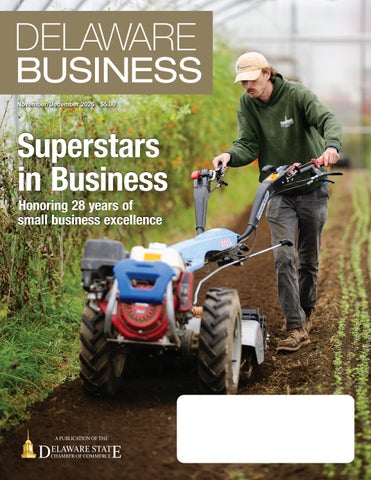
The Food Bank of Delaware, a 2026 Superstars in Business in the nonprofit category. Photo by Nick Wallace Photography. DELAWARE BUSINESS
|
November/December 2026
Departments President’s Message ..........................2 Legislative Priority ..............................3 Election 2026: Changes Ahead in Legislative Hall Member News and Notes ...................5 Nonprofit Spotlight: Goodwill of Delaware and Delaware County State Chamber Scene ....................... 13 Welcome New Members ................... 14 Chamber Calendar ........................... 49 Newsbites ........................................ 50 In Case You Missed It ....................... 54 For Assistance, Contact the Chamber .................................... 56
Volume 31, Number 6 / Delaware Business (USPS 012098) (ISSN 153253542) is published bi-monthly by the DSCC Center for Business Management. Subscription price is $30 a year (included in membership dues). Known office of publication is 1201 N. Orange St., Suite 200, Wilmington, DE 19801. Periodicals postage paid Wilmington, DE 19850. Postmaster: Send address changes to Delaware Business, c/o DSCC Center for Business Management, P.O. Box 671, Wilmington, DE 19899-0671. Telephone (302) 655-7221. 1
Message from the President
DELAWARE BUSINESS EDITORIAL STAFF
Over the years, I have used this space to remind everyone of the significant benefits key industries like agriculture, law, construction, hospitality, and manufacturing, offer to our state. In this case, let me talk about financial institutions and banks in particular. The Michael J. Quaranta American financial system is the envy of the world. When you consider the skylines of metro areas, manufacturing sites across the country, family farms, or vast agribusinesses found in every state in the union, and main streets dotted with retail shops, restaurants, and specialty services, remember that there are local banks behind the success of many of those businesses. When you drive through cities large and small and gaze upon the single-family homes, apartment communities, townhomes and row houses, duplexes, and more, remember that it took money, often loaned from a bank, to make almost all of those housing options a reality. Payment systems are also unheralded and often taken for granted by consumers and businesses. You can travel across the country, or across the world for that matter, take a plastic card out of your wallet, and make a payment. Sit with that one for a moment. You have just traveled hours from home, you know not a soul in a local restaurant, you just finished a nice meal, and you hand over a plastic card for payment. In seconds, your payment is made, and you go on your way. We are in such a hurry these days that we never stop to think about how far we’ve come with modern payment systems. While the banking “footprint” in Delaware is smaller today because of advances in technology, changing business models, and more, the sector still plays a vital role in Delaware’s economy. One only has to travel abroad and visit countries without a banking sector like ours to appreciate what we have and how fortunate we are to have a meaningful segment of that industry situated here.
C
DELAWARE STATE CHAMBER OF COMMERCE
2
John C. Gooden Chair
Michael J. Quaranta President
Regina Donato Editor
Christina Jones Graphic Design
Catherine M. Bassett Mountaire Farms
Natalie Keefer Bank of America
Greg Smith The Chemours Company
Scott Baylis WSFS Bank
Colleen Perry Keith, Ph.D. David A. Tam, MD, Goldey-Beacom College MBA, CPHE, FACHE Beebe Healthcare Robert McGuckin
BOARD OF DIRECTORS CHAIR John C. Gooden M. Davis & Sons, Inc. VICE CHAIR Nicholas A. Moriello, RHU Healthcare Innovation Acceleration, LLC
Andrew Cottone, Ph.D. Aternium Terry Glebocki Delaware Park Casino
Verizon
Michael A. Meoli The Meoli Companies
Bridget Therriault AstraZeneca Rod Ward CSC
BOARD OF GOVERNORS Michael A. Albero, CPA, MST+ AKA Advisory, LLC Tony Allen, Ph.D. Delaware State University
Lisa M. Donlon, PE VanDemark & Lynch Janet Dougherty Fulton Bank, N.A.
Thère du Pont Longwood Foundation Pierre Anderson Artesian Water Company, Inc. Jerry Esposito Espo Enterprises, LLC Steve Baccino Chesapeake Utilities John C. Fannin III Harvey, Hanna & Associates Christopher W. Baker George & Lynch, Inc,
Greg Ballance Diamond Technologies Marcus L. Beal Delmarva Power Mike B. Berardi Wohlsen Construction Co. Adam Blackford Agilent Technologies
G. Kevin Fasic, Esq. Offit Kurman Jennalee Fede, PE Verdantas LLC Brian Frazee Delaware Healthcare Association
Donald T. Fulton Weiner Benefits Group
Martha S. Gilman Robert A. Book II Cornell Property Delaware Electric Cooperative Management Corp. Jennifer Gimler Brady Potter Anderson & Corroon LLP
Joseph V. Giordano Whisman Giordano & Associates, LLC
Dr. Mark T. Brainard Delaware Technical Community College
Jason D. Gonzalez Qnity™ Electronics, Inc.
Beth G. Brand University of Delaware
Lorri H. Grayson GGA Construction
Desa Burton
Dr. LaVerne T. Harmon Wilmington University
Darren Buseman B&M Meats, Inc.
Paul N. Heath Richards, Layton & Finger
Robert L. Byrd ByrdGomes
Logan S. Herring, Sr. The WRK Group
Patrick Callihan Tech Impact
Kirsten Higgins Tidewater Utilities, Inc.
Christopher Carroll Comcast Stuart Comstock-Gay Delaware Community Foundation Charlie Copeland Associates International, Inc.
Melissa Kenny ShopRites of Delaware
Lloyd A. Ricketts Wilmington University
Mac Macleod Carvertise
Chris Schell Schell Brothers
Scott Malfitano CSC
Albert Shields University of Delaware
William E. Manning Saul Ewing LLP Katie McEvoy AT&T Delaware Gregory Miraglia PNC Bank Jeff Mitchell Siegfried Advisory Jonathan D. Moll, CPA Belfint, Lyons & Shuman Chad Moore Beacon Hospitality Colleen Morrone Goodwill of DE & DE County Terry Murphy Bayhealth Medical Center Chris O’Neill PSCI
Tom Horne JPMorganChase
Jed Patterson LabWare
Michael Houghton Morris, Nichols, Arsht & Tunnell, ret.
Chris Perdue Perdue Farms
Cathy Kanefsky Food Bank of Delaware
Dr. Rob Rescigno Collaborative Consulting LLC
Robert “Rob” Rider, Jr. O.A. Newton Apollo Khine Barclays US Consumer Bank Bettina Tweardy Riveros ChristianaCare Matthew Lantange TD Bank Jake Ruddy PCS Alan Levin SoDel Concepts Rhett Ruggerio Ruggerio Willson Watson Mike Little Allen Harim Foods, LLC Dennis M. Salter Edinburgh Capital Andy Lubin Delaware Financial Group Management LLC
Marie Holliday, CPA* The Bonadio Group
Tim Houseal^ Pam Cornforth Young Conaway Stargatt Ronald McDonald House & Taylor, LLP Charities of Greater Delaware Jessica Hunt Jason Danner Siemens-Healthineers Kelly Benefits Strategies Mark Hutton Rick Deadwyler M&T Bank Ernest Dianastasis LeVar Johnson The Precisionists, Inc. Novo Nordisk Brian DiSabatino EDiS Company
Julia B. Keleher, Ed.D, MBA, PMP First State Educate
Robert S. Smith Santora CPA Group Jonathan Starkey Delaware State University Mark Stellini Assurance Media Mike Tatoian Dover Motor Speedway Jim Taylor Saul Ewing LLP Ivan Thomas DETV Dr. Justina M. Thomas Delaware Technical Community College Jana Tidwell AAA Club Alliance Vera Holmes Toliver DuPont Michael S. Uffner AutoTeam Delaware Mike Vanderslice Onterris
Timothy L. Vessel Robert W. Perkins Highmark Blue Cross Blue Brandywine Public Strategies Shield Delaware Mike Petka Robert W. Whetzel Bancroft Construction Richards, Layton & Finger Company Ed Winslow Ciro Poppiti Citizens Bank Freeh Sporkin & Sullivan Kevin M. Wolfgang LLP Evergreen Apartment Group Chip Rankin +Treasurer MilliCare ^Counsel Michael Ratchford W. L. Gore & Associates, Inc. *Immediate Past Chair
STAFF Michael J. Quaranta President Kelly Basile Chief Operating Officer
1201 NORTH ORANGE STREET, P.O. BOX 671 • WILMINGTON, DE 19899-0671 WWW.DSCC.COM
Danielle Blake Vice President, Member Engagement
Melissa Brayman Director, Administration & Finance
Kiley Michulka Events Manager
Regina Donato Director, Communications
Evan R. Park Vice President, Government Relations
Damon Howard Manager, Digital & Print Advertising
Amanda Schimmel Manager, Marketing & Strategic Programs
Kerri Welcher Director, Delaware State Chamber Foundation Tori Will Manager, Administrative & Member Support
November/December 2026 | DELAWARE BUSINESS
LEGISLATIVE PRIORITY
Election 2026: Changes Ahead in Legislative Hall BY EVAN R. PARK
PHOTO BY DICK DUBROFF/FINAL FOCUS
AT THE TIME OF WRITING, Delaware is about one month away from the Nov. 3 general election. By the time this issue reaches readers, Election Day will be less than a week away. While the results will determine the final composition of the House and Senate, we already know the 154th General Assembly will bring significant turnover to Legislative Hall, with several longtime lawmakers departing and a new group of candidates seeking to shape Delaware’s policy landscape in 2027. For Delaware’s business community, those changes could influence discussions around taxes, regulation, workforce development, education, infrastructure, energy, and economic development beginning in January. HOUSE TURNOVER One of the most notable changes in the House of Representatives will be the retirement of longtime Rep. Debra Heffernan in the 6th District. After 16 years of service, Heffernan is leaving Legislative Hall, where she chaired the Joint Capital Improvement Committee, responsible for developing Delaware’s annual bond bill and reviewing capital budget requests from state agencies. She also chaired the Natural Resources & Energy Committee, an area that drew significant attention this session and is likely to remain a major focus when lawmakers return. Rep. Stephanie T. Bolden also will not return to the House after narrowly losing the Democratic primary to Michelle Booker. Bolden has represented the 2nd District since 2010 and held several leadership positions, including chair of the House Elections & Government Affairs and Gaming & Parimutuels committees and vice chair of Appropriations. Her departure will leave another significant opening as the House prepares for the 154th General Assembly. In House District 28, longtime Rep. Bill Carson was defeated by Tyeisha “Tye” Grier. Carson had served in the House since 2007 and chaired the House Agriculture Committee, and his work on behalf of Delaware’s veterans and his involvement in agricultural and economic policy made him a familiar figure on several important issues. The primary also ended Rep. Franklin Cooke’s bid for a fifth term, with Pamela Salaam winning the Democratic nomination in the 16th District. Cooke, first elected in 2018, chaired Delaware’s Law Enforcement Accountability Task Force, giving him a significant role in discussions surrounding public safety and law enforcement policy. Rep. Josué Ortega was also defeated in the Democratic primary in House District 3 by Branden Fletcher-Dominguez, adding to the turnover expected in the House next year. DELAWARE BUSINESS
|
November/December 2026
SENATE CHANGES The Senate will also see an important change. Sen. Ray Seigfried, who won the Senate District 5 seat in a 2025 special election, was defeated by Shay Frisby in the Democratic primary. Seigfried previously served in the House and chaired the Senate Corrections & Public Safety Committee. Other Senate incumbents advanced through competitive primaries, setting up a number of races that voters will decide on Nov. 3. LOOKING AHEAD TO ELECTION DAY The balance of power will be one of the key dynamics to watch. Democrats currently hold 27 of the House’s 41 seats, putting them one seat short of a two-thirds majority, while they hold 15 of the Senate’s 21 seats. The general election will determine whether that balance changes. Another dynamic is the growing presence of the Delaware Working Families Party, a progressive political organization. Candidates endorsed by the organization won eight of the 13 races in which it made endorsements during the primary, including five victories over incumbent state legislators. For businesses, what happens after Election Day will matter, too. Committee assignments often determine where legislation involving taxes, regulation, infrastructure, labor, environmental policy, and economic development takes shape. During the 153rd General Assembly, the State Chamber focused on issues including banking modernization, tax policy, environmental permitting, public contracting, workforce development, and energy policy. Many of those issues are expected to remain part of the conversation when lawmakers return to Dover. With several experienced legislators departing, new candidates on the ballot, and key committee and leadership positions still to be determined, the Nov. 3 election and the organizational process that follows will help determine how the 154th General Assembly takes shape and which policy issues will be at the forefront for Delaware employers in 2027.
Evan R. Park is the vice president of government affairs for the Delaware State Chamber of Commerce.
3
MAKES IT AFFORDABLE.
FREE TUITION OPTIONS
Delaware Tech offers a wide variety of credit programs of study — bachelor’s degrees, associate degrees, certificates and diplomas — designed to prepare you to enter the workforce, continue your education, or both. We also offer developmental and general education programs that provide foundational skills needed to succeed in academic degree and workforce training programs.
MAKE YOUR MOVE. VISIT DTCC.EDU/PROGRAMS FOR MORE INFORMATION.
4
November/December 2026 | DELAWARE BUSINESS
Member
news&Notes Before a Hazard Becomes a Headache Most business owners in Delaware hear “workplace safety visit” and brace themselves. Clipboards. Citations. An unexpected follow-up call from OSHA. SafeDE is none of that. SafeDE is the Delaware Department of Labor’s Office of Safety and Health Consultation. It provides free, confidential on-site help to small- and medium-sized private-sector businesses in general industry, construction, and agriculture. Consultants work independently from OSHA’s enforcement staff. They don’t issue citations, assess penalties, or report findings to inspectors. The one exception is a serious hazard that goes uncorrected beyond an agreed upon deadline triggers a mandatory referral.
compensation costs by 70% after working with SafeDE.
››
WHAT THE CONSULTATION COVERS
A SafeDE consultation starts with an opening conference. The consultant explains the process, what the visit covers, and your rights as an employer. Then, the consultant walks through the facility with you, looking at physical conditions, equipment, and documentation for hazards that may have become easy to miss. The closing conference covers what the consultant found: what’s working, what needs attention, and realistic timelines for making corrections. You
DELAWARE BUSINESS
|
November/December 2026
BY GINA MARTINEZ
SHARP CONSTRUCTION PILOT
leave with a written report. Consultants can also help build or improve safety programs, develop staff training, and set up specialty services such as air quality monitoring or noise surveys. There’s a written action plan at the end and someone to follow up with. All of it is free. Any eligible business can request a visit.
SHARP: SAFETY AND HEALTH ACHIEVEMENT RECOGNITION
SHARP recognizes employers that have worked with SafeDE and built safety programs that meet a defined standard. Certified businesses get an annual exemption from routine OSHA inspections and can display the certification publicly. Staying certified means continued visits and ongoing improvement. Current Delaware recipients include Accudyne Systems, Eagle Group, and Spine Care Delaware. Eagle Group cut its workers’
Delaware is among a handful of states running a constructionspecific version of SHARP through OSHA, built around how construction actually works: shifting crews, project-based schedules, and hazards that change from site to site. To qualify, a company needs 250 or fewer on-site employees and must be operating in Delaware for at least three years. The process includes a safety assessment, hazard correction documentation, employee involvement, and three years of OSHA logs. Certified companies get inspection exemptions and may see reductions in workers’ compensation premiums and experience modification rates. Safer workplaces start with finding problems before they become bigger ones. At worksafe.delaware.gov, you’ll find a free toolkit for employers, blog content for employers and employees, and a newsletter worth subscribing to. We encourage all businesses to start there.
Gina Martinez is the safety and health supervisor at SafeDE.
5
Member
news&Notes Goodwill of Delaware and Delaware County NONPROFIT SPOTLIGHT:
BY COLIN HEFFINGER
Not all opportunities come only once in a lifetime. For Goodwill of Delaware and Delaware County, creating consistent jobs with real, compounding impact on Delaware communities has been at the heart of the nonprofit for more than a century. Through the power of work, individuals with barriers to selfsufficiency obtain meaningful jobs across a variety of industries. Through its recently launched Opportunity Hub in Wilmington and the upcoming debut of a newly transformed location in Dover, Goodwill is investing in people and communities by expanding opportunities for career growth and employment success. With an additional location in Bridgeville in Sussex County, the Opportunity Hubs serve as dedicated
››
spaces for job seekers to enhance their existing capabilities, learn new skills, build confidence, and move forward to employment. It all starts with a Career Navigator, who is dedicated to understanding each individual’s goals and developing a plan to help them succeed. Goodwill’s workforce development model, the Opportunity Accelerator®, further supports that work by helping establish and accelerate the steps needed to accomplish those goals. Leah Williams, vice president of brand and community engagement, explains how the Opportunity Hubs bridge gaps in critical job skills. “Digital expertise and understanding of AI are more and more important across a wide array of roles,” Williams describes. “Our Opportunity
From left: Cheryl Casino, workforce development senior manager; Cheryl Black, Senior Community Service Employment Program (SCSEP) participant; and Barbara White, Goodwill career navigator for SCSEP.
6
Hubs, which are available to both individuals and employers, help people upskill their careers and even gain AI certificates through our partnership with Google. We also help job seekers create resumes and cover letters, provide interview tips, job leads, and offer quarterly hiring events in partnership with the Department of Labor to help job seekers get where they need to be.” In August 2024, Goodwill launched Goodwill Connect, a digital resource platform where job seekers can take skills assessments, access job search tools, and contact Career Navigators. Goodwill Connect also provides a bridge to essential services such as housing, food, and health care. Goodwill Connect aims to serve as a one-stop resource for job seekers looking to create the future they deserve. Looking ahead, Williams says Goodwill’s focus remains firmly rooted in its mission. “As the workforce continues to evolve with automation and AI, the need for digital skills continues to grow,” Williams says. “We’re excited to develop new resources that help people build those skills and succeed in today’s job market.” That work, Williams notes, is made possible through community support. “We’ve been serving Delaware since 1921, and today people have more choices than ever for items they no longer need,” Williams says. “We’re working hard to demonstrate Goodwill as the option of choice when cleaning out unused items because donated items fuel our mission. When you give to Goodwill, your donations go back into the community. Partnering with us helps members of our community start meaningful jobs and a second chance to evolve their skills, leading them to even greater career opportunities in the future.”
November/December 2026
| DELAWARE BUSINESS
COMMITTEE SPOTLIGHT:
Tax and Fiscal Policy
Throughout the 153rd General Assembly, Delaware businesses felt the impact of rising fees and taxes, including increases to fees administered by the Department of State. These changes add up, particularly at a time when many small businesses are already navigating tighter margins. Last session, House Bill 417 was introduced to raise the Gross Receipts Tax exemption, but only for a narrow slice of licensed restaurants in Delaware. The Delaware State Chamber of Commerce supports raising the exemption — we just don’t think it should stop there. Every Delaware business affected by the Gross Receipts Tax deserves the same relief, not just one segment of one industry. That belief has shaped conversations we’ve been having with members of the General Assembly. Rather than pursuing narrow, one-off fixes, we have advocated for a more holistic approach to tax
››
DELAWARE BUSINESS
|
November/December 2026
reform, with a particular focus on the gross receipts tax. Inflation has made that conversation increasingly important. As prices and costs rise, a small business may report higher gross revenue without seeing a corresponding increase in profitability. Because the gross receipts tax is imposed on revenue rather than profit, businesses can face greater tax liability even as their margins remain flat or shrink. We are encouraged by the conversations already underway. Earlier this fall, House Majority Leader Kerri Evelyn Harris joined the State Chamber’s Tax and Fiscal Policy Committee to discuss what a more holistic approach to tax reform could look like. The meeting provided an opportunity for members to share direct feedback about how potential reforms could affect Delaware businesses and the broader economy. We see this as the beginning of a
BY EVAN R. PARK larger conversation. Engaging with lawmakers between legislative sessions gives the business community an opportunity to provide perspective before proposals take shape and explain how potential changes could affect employers of different sizes and industries. The Delaware State Chamber of Commerce remains committed to representing the full spectrum of Delaware businesses in these discussions. Tax policy should reflect economic reality, not just revenue on paper, and we’ll continue to advocate for reforms that recognize the difference between genuine profitability and the effects of inflation. We appreciate Majority Leader Harris’ willingness to engage with our members on this issue and look forward to continuing to work with her and other members of the General Assembly in the coming months and as the 154th General Assembly gets underway next year.
7
Member
news&Notes Chair Message BY JOHN C. GOODEN
When people picture a construction site, they often imagine crews assembling a project piece by piece — one stud, one shingle, one brick at a time. That traditional approach still has its place, but over the past several decades, modular fabrication has reshaped how the industry delivers projects, from industrial plants to hospitals and housing. Modular fabrication involves building major project components, often the size of a tractor-trailer, in a controlled shop environment, then transporting and stacking them on site like oversized building blocks. For process and equipment modules, that can mean structural steel, vessels, piping, electrical systems, and controls, all engineered and assembled before the work ever reaches the job site. The process typically begins with a detailed 3D model of the project. Because
››
8
the model captures every dimension, engineers can plan maintenance access, confirm safe operator reach to instrumentation, and finalize module sizing, stacking configuration, shipping logistics, and field connections well before fabrication starts. That upfront planning helps prevent costly surprises later. Fabrication then moves into a shop, where conditions are far more predictable than at an outdoor job site. Weather is no longer a factor, and overhead cranes make handling large components efficient and safe. This controlled environment tends to improve safety outcomes, quality control, and schedule reliability. Materials can be inventoried and staged in advance, reducing downtime, and shifts can be added to accelerate delivery, much like in a manufacturing operation. As modules near completion, fabricators test them individually and as an integrated system through what
is known as a factory acceptance test, confirming that modules will connect correctly in the field and that piping, power, and instrumentation are properly routed and leak-free. Testing in a controlled setting gives project teams time to validate performance before modules are disassembled, braced for transport, and shipped as oversized loads. At the job site, each module is unloaded, set by crane, and reconnected as it was built in the shop. This approach has deep roots right here in Delaware. Companies across the state, including M. Davis & Sons, have been fabricating modular systems for decades — work that has helped sustain skilled trades, from welders and electricians to pipefitters, even as project delivery methods have evolved. It is a good reminder that behind every module set into place is a local workforce with generations of craftsmanship behind it. That combination of skilled workers and more efficient construction methods matters for Delaware. As our state works to meet growing needs for housing, health care facilities, manufacturing space, infrastructure, and other development, the construction industry is being asked to deliver more amid rising costs, workforce constraints, and increasingly complex projects. Modular fabrication will not be the answer for every development, but approaches that help projects move faster, make better use of skilled workers, and provide greater certainty around cost, quality, and scheduling will be an important part of how Delaware builds for the future.
November/December 2026
| DELAWARE BUSINESS
10 Years of Bridging the Neurodiversity Employment Divide The Precisionists, Inc. (TPI) proudly celebrates its 10th anniversary this year, marking a decade of innovation, growth, and commitment to delivering world-class service to its clients through best practices and the proactive engagement of its talented neurodiverse and neurotypical consultants. Founded in 2016, TPI began with a mission to create 10,000 jobs across the U.S. for individuals with neurodiversities, including those impacted by autism. Over the past decade, the organization has evolved into one of the nation’s largest employers of neurodiverse talent and a trusted business services partner. “Reaching our 10-year anniversary is an incredible milestone and a testament to the dedication of our employees and
››
DELAWARE BUSINESS
|
November/December 2026
the support of our client partners,” said Ernie Dianastasis, founder and CEO of The Precisionists. “What began as an ambitious idea has grown into an organization that has become one of the five largest employers of neurodiverse talent in the country. For our employees that employment comes in the form of sustainable career-based jobs, providing an opportunity of living a life of independence. For our clients, they benefit from the unique talents and innovative solutions our neurodiverse workforce delivers to their critical business processes. We are grateful for everyone who has been part of our journey and excited about the opportunities that lie ahead.” Over the past decade, TPI has expanded its reach and earned national
recognition for its work. The organization has opened four Innovation & Technology Centers in Wilmington, Del.; Philadelphia, Pa.; Nashville, Tenn.; and Phoenix, Ariz., while also providing services in markets including Cleveland and Akron, Ohio; Pittsburgh, Pa.; and Chicago, Ill. TPI has delivered IT and business services to more than 45 Fortune 500 and Fortune 1000 client partners across the U.S. and developed innovative approaches to breaking down barriers to employment for neurodiverse job seekers. As The Precisionists reflects on 10 years of progress, the organization is also looking to the future with renewed purpose. TPI remains focused on driving innovation, strengthening existing partnerships, forming new partnerships, investing in its workforce, and continuing to deliver outstanding results. “When properly assessed and trained, people impacted by autism and other neurodiversities can be extremely highperforming employees. TPI’s employees bring innovative approaches to critical and challenging administrative, business, and information technology functions,” said Dianastasis. “While we are proud of all we have accomplished over the past decade, there is still much more to do. With more than 80% of autistic adults in the U.S. either unemployed or underemployed, we are helping unlock the potential of a significant, talented, and largely untapped labor force — and we are just getting started. Our commitment to excellence, innovation, and lasting impact will continue to guide us as we begin our next chapter.”
9
Member
news&Notes
Delaware’s Education Opportunity: From Priorities to Results BY JULIA KELEHER, ED.D., BOB PERKINS, AND MICHAEL J. QUARANTA Delaware has an opportunity to become a state others look to for how to improve student outcomes while preparing young people for a rapidly changing economy. Gov. Matt Meyer has declared a literacy emergency, launched the Delaware Early Literacy Plan, and supported new investments in reading. Sec. Cindy Marten has established priorities aimed at improving student
››
10
outcomes. Districts and educators are working to translate those priorities into practice. The question now is how the rest of us can help that work succeed. We already have many of the pieces required: statewide priorities, committed education leaders, employers who want to engage, districts that know their students and communities, and families who want strong schools and better opportunities for their children.
The challenge now is connecting those pieces and turning priorities into results.
FROM PRIORITIES TO IMPLEMENTATION
Delaware’s business community has long been involved in education policy, workforce development, and conversations about the skills young people need to succeed. That work remains important.
November/December 2026
| DELAWARE BUSINESS
But policy is only the beginning. Improvement happens in schools and districts, where statewide priorities must become local practice and better results for students. Through the Delaware Education Performance Partnership, or DEEPP, First State Educate is working with state, local education, and business leaders to help make that connection. The work has already begun. We are meeting directly with superintendents and district leaders to understand what they are trying to accomplish, where barriers exist, and where outside partners could be useful. Different communities have different needs, and different partners bring different capabilities. Alignment does not require uniformity. It requires listening to understand what each partner needs and coordination to connect those needs with what others can offer. Businesses can open workplaces to students, provide internships and career exposure, share technical expertise, offer employee volunteers and resources, and encourage employees and retirees to consider service on local school boards. None of this creates a new education agenda. State leaders establish statewide priorities. District leaders and educators implement them. School boards govern, monitor progress, and provide local accountability. The role of the business community is to listen, understand where help is needed, and contribute resources, relationships, expertise, and opportunities that strengthen implementation.
RESULTS OVER PARTICIPATION
Delaware’s current results show why improvement matters. The state has set ambitious goals, including significantly increasing third-grade reading
DELAWARE BUSINESS
|
November/December 2026
proficiency by 2028. Setting a goal is the first step. Successful execution requires knowing what strategies are being used, who is responsible for carrying them out, how progress will be measured, and what will change when results are not improving. We believe success should not be measured by meetings held, programs created, or organizations involved. It should be measured by whether students are doing better. For us, accountability is not about assigning blame or creating a “gotcha” system. It is about being clear-eyed about the outcome, supporting the people responsible for the work, monitoring progress, and adjusting when something is not producing the intended result.
PREPARING FOR WHAT’S NEXT
Education improvement rarely happens within a single program, budget cycle, or leadership term. Because many Delaware employers remain rooted here for generations, the business community can help sustain focus on long-term priorities and outcomes. Delaware has no shortage of people who care about public education. What we need now is the willingness to listen to perspectives different from our own, connect statewide priorities with local needs, and build solutions that reflect the communities they are intended to serve.
DELAWARE’S OPPORTUNITY
We believe Delaware can build a new model for improving student outcomes that recognizes the central role school boards play and is designed for the world our students are entering. Artificial intelligence is reshaping work, employers are adapting to new technologies and
skill demands, and economic conditions are changing quickly. Our approach must reflect our students, communities, educators, employers, and economy. Mississippi and Louisiana show what sustained focus can accomplish. Their progress required clear priorities, disciplined implementation, and the willingness to stay focused on results over time. We should bring that same discipline to Delaware. But the model itself should be ours. The goal is not to become the next Mississippi or Louisiana. It is to build the Delaware story that other states study next. If you are a district leader, school board member, educator, employer, or community partner interested in helping turn these priorities into results, we invite you to engage with the Delaware Education Performance Partnership and contact Julia Keleher at julia@ firststateed.org to learn more.
Julia Keleher, Ed.D., is the executive director of First State Educate. Bob Perkins is the executive director of the Delaware Business Roundtable. Michael J. Quaranta is the president of the Delaware State Chamber of Commerce.
11
Member
news&Notes Delaware State Chamber of Commerce Board Selects Michael F. Smith as Next President On September 30, the Board of Directors of the Delaware State Chamber of Commerce announced the appointment of Michael F. Smith as the organization’s next president. Smith will succeed Michael J. Quaranta, who will retire in mid-December after eight years of service to the State Chamber and Delaware’s business community. Following a national search, the Board selected Smith based on his experience in public policy, higher education, economic development, and community engagement. “Michael Smith brings strong advocacy experience, a deep understanding of Delaware, and a proven ability to build relationships across sectors,” said John Gooden, chair of the Delaware State Chamber of Commerce Board of Directors. “Those strengths will be important as the State Chamber continues to represent the interests of Delaware employers and advocate for a competitive business climate.” Smith was first elected to the Delaware House of Representatives in 2018 to represent the 22nd District, which includes Pike Creek Valley and portions of Hockessin and Newark. His legislative service has included work on the House Capital Infrastructure (Bond Bill), Education, Health & Human Development, Revenue and Finance, and Economic Development, Banking, Insurance & Commerce committees. Smith has been with the University of Delaware since 2014 and currently serves as director of strategic initiatives and partnerships in the College of
››
12
Health Sciences. His work has focused on developing partnerships and advancing initiatives involving higher education, health, workforce development, and external organizations. “I am grateful for the confidence the Board has placed in me and for the opportunity to lead the Delaware State Chamber of Commerce,” said Smith. “The State Chamber has a proud history of advocating for Delaware employers and ensuring the business community has a voice on the issues that affect them. It also brings people together to address shared challenges and opportunities. I look forward to building on that work on behalf of employers and employees across Delaware.” The Board also expresses its deep appreciation to Quaranta for his leadership, dedication, and record of service. During Quaranta’s tenure, the State Chamber underwent a period of significant modernization and growth. Under his leadership, the State Chamber expanded opportunities for members to engage in policy discussions through more robust policy committees, refreshed its conferences and programming, and began implementing its 2025-2027 strategic plan. During this time, the organization
also launched the Delaware Employers and Employees Education Fund, a 501(c)(4) focused on voter education, and rebranded its 501(c) (3) as the Delaware State Chamber Foundation — while introducing new publications and advocacy resources, including the “How They Voted” scorecard and the “Delaware Competitiveness Bluebook,” and modernizing its office space in 2024, much of which had remained largely unchanged since the building was constructed in the early 1980s. The State Chamber’s annual budget also nearly doubled over this period, even as it navigated more than two years of disruption during the COVID-19 pandemic. “Mike Quaranta has led the State Chamber through a period of meaningful change and growth,” said Gooden. “He has helped modernize the organization, strengthen its connection with members, and expand the ways the State Chamber serves Delaware’s business community. We are grateful for his leadership, his commitment to our members, and the organization he leaves well positioned for the years ahead.” Smith and Quaranta will work together during a transition period to support continuity for the State Chamber’s members, staff, and stakeholders.
November/December 2026
| DELAWARE BUSINESS
CHAMBER
SCENE
1. The Delaware Young Professionals Network (DYPN) volunteered at the Food Bank of Delaware’s Healthy Pantry Center. 2. The 33rd Annual Chamber Chase Golf Tournament was held at Kings Creek Country Club in Rehoboth Beach, with proceeds supporting the Delaware Employers and Employees Education Fund.
3. DSCC hosted an Evening Mixer at The Waypoint Rehoboth, built by Superstar in Business winner GGA Construction.
1.
2.
3.
4. DSCC hosted two candidate forums in August for primary elections in the 41st House District and the Democratic state treasurer race. The forums focused on issues affecting Delaware’s business community. 5. DSCC’s Mike Quaranta and Kelly Basile presented to the 2026 Leadership Delaware Inc. cohort.
5.
4.
6. DSCC’s September Networking Breakfast was held at Junior Achievement of Delaware, where attendees toured JA BizTown. 7. Members of DSCC’s board joined the DYPN for a night of mentorship and pickleball at Dill Dinkers Pickleball.
6. 6.
DELAWARE BUSINESS
|
November/December 2026
7.
13
WELCOME New Members 302 STRATEGIES
www.302strategies.com (302) 354-2855 36 E. 5th St. New Castle, DE 19720
BARNHART NORTHEAST INC.
302 Strategies is a lobbying
www.barnhartcrane.com (610) 499-1790 10 Industrial Hwy., A Complex, O Aisle Lester, PA 19029
with experience representing
Memphis, Tenn., as a small, family-
and government affairs firm a wide range of national
and local clients, from large global companies seeking
representation on state and local issues to small businesses and nonprofits.
Barnhart was founded in 1969 in
owned business. While it remains family-run, Barnhart has grown
into one of the largest heavy-lift
and heavy-transport organizations in North America, with more than 70 locations and a reputation for solving complex problems.
BOYS & GIRLS CLUBS OF DELAWARE
ERCO CEILINGS & INTERIORS
www.bgclubs.org (302) 658-1870 669 S. Union St. Wilmington, DE 19805
For more than 90 years, Boys &
Girls Clubs of Delaware has been a trusted place where young
people can learn, grow, and build
a better future. With more than 40 club- and school-based locations across the state, the organization
provides safe, supportive environments where youth can thrive,
especially those who need it most.
COMMON ENERGY
www.commonenergy.us (443) 986-0135 1020 N. Livingston St. Arlington, VA 22205
Paving the way for Your Success & More. The Bonadio Group, formerly Cover and Rossiter, is committed to paving the way for a new era of public accounting and advisory services.
We deliver a full spectrum of services curated to meet your unique needs: • Assurance • Tax • Small Business Advisory
Common Energy is a community solar provider in Delaware,
helping customers reduce their
electricity costs while supporting the development of new clean energy resources.
www.ERCOinteriors.com (302) 994-6200 2 S. Dupont Rd. Wilmington, DE 19805 ERCO Ceilings & Interiors is a
family-owned and operated com-
mercial interior contractor and sup-
plier serving Delaware, New Jersey, Pennsylvania, and Maryland since
1963. ERCO provides commercial
ceilings, wall systems, architectural specialties, blinds, FRP systems, and other interior construction products and services.
FIRST ASCENT
www.firstascentdesign.com (813) 857-2323 1400 N. Market St. Wilmington, DE 19801 First Ascent Design is a
Wilmington-based digital marketing agency serving businesses,
nonprofits, and educational institutions. The agency provides branding, website development, digital advertising, search optimization, and content marketing services.
BE SEEN BY DELAWARE’S BUSINESS COMMUNITY THIS COULD BE YOUR ADVERTISEMENT!
• Advisory & Consulting Reach 3,300+ digital and print subscribers through Delaware Business magazine with advertising and advertorial opportunities designed to put your brand in front of Delaware’s business community. Member ad rates start at $800. Connect With Us: 302.656.6632 | bonadio.com |
14
Contact Damon R. Howard at dhoward@dscc.com to reserve your space.
November/December 2026 | DELAWARE BUSINESS
HEADSHOTS. BUSINESS PHOTOGRAPHY. VIDEOGRAPHY. VISIT WWW.NICKWALLACEPHOTOGRAPHY.COM TO GET STARTED
DELAWARE BUSINESS
|
November/December 2026
15
PHOTOS BY NICK WALLACE PHOTOGRAPHY
Nearly 29,000 small businesses call Delaware home. Together, they make up 98% of the state’s business community and provide jobs for more than half of the state’s workforce. Their reach is broad, their impact undeniable, and their role in our economy essential. For the past 28 years, the Delaware State Chamber of Commerce and its Small Business Alliance have celebrated these organizations through the Marvin S. Gilman Superstars in Business awards. Honorees are small businesses with at least three years of proven success, recognized not only for their strong business performance but also for the positive impact they make in their communities. 16
November/December 2026 | DELAWARE BUSINESS
DELAWARE BUSINESS
|
November/December 2026
17
2026 SUPERSTARS IN BUSINESS AWARD WINNERS Synergy Consultants & Psychotherapy Practice 1-9 Employee Category Synergy Consultants & Psychotherapy Practice is an outpatient mental health practice serving individuals, couples, and families. The practice provides evidence-based therapy for concerns including anxiety, depression, trauma, grief, and life transitions, while also training future clinicians and supporting community wellness through outreach and partnerships. First Ascent 10-40 Employee Category First Ascent is a Wilmington-based digital marketing agency serving businesses, nonprofits, and educational institutions. The agency provides branding, website development, digital advertising, search optimization, and content marketing. Over the past 11 years, First Ascent has partnered with nearly 300 organizations in Delaware and beyond. GGA Construction 41-150 Employee Category Headquartered in Delaware with offices in Middletown and Rehoboth Beach, GGA Construction specializes in commercial construction projects throughout the region. Its portfolio includes health care facilities, schools, multifamily housing, hotels, restaurants, senior living communities, recreational facilities, and commercial developments. Food Bank of Delaware Nonprofit Category The Food Bank of Delaware is a statewide nonprofit dedicated to providing food assistance while addressing the root causes of hunger and poverty. In addition to distributing millions of pounds of food each year through more than 600 community partners, the organization offers workforce training and other programs that help Delawareans achieve longterm stability.
2026 PLANNING COMMITTEE Laura Lloyd
Kevin DiSabatino, Chair DiSabatino Construction
RiversEdge Advisors Christa McLaughlin
Company Angela Coaxum
Whisman Giordano & Associates
Your Part-Time Controller Mark Cohen
Louis Memmolo Weiner Benefits Group Chip Rankin
M&T Bank Pam Cornforth
milliCare by EBC Carpet
Ronald McDonald House of
Services Brett Gilman Smith
Delaware Joseph Farley, Jr.
Cornell Property Management
Associates International, Inc.
Corp. Mike Vanderslice
Ariel Gruswitz Delaware Small Business
Onterris Shawn Williams
Development Center
Artisans’ Bank
2026 SELECTION COMMITTEE Laura Lloyd
Marsha Auld-Saunders
RiversEdge Advisors
CSC
Christa McLaughlin
Patrick Best
Whisman Giordano &
WSFS Bank Angela Coaxum
Associates
Your Part-Time Controller Pam Cornforth
Louis Memmolo Weiner Benefits Group
Ronald McDonald House of
Brett Gilman Smith Cornell Property Management
Delaware Kevin DiSabatino
Corp.
DiSabatino Construction
Janine Sorbello Goldey-Beacom College
Company
Mike Vanderslice
Joseph Farley, Jr. Associates International, Inc.
Onterris Andrea Wojcik
Martha Gilman Cornell Property Management
Delaware Division of
Corp.
Small Business
AWARD OF EXCELLENCE RECIPIENTS: Integrity Nursing LLC (1-10 Employee Category) Delmarva Central Railroad (11-40 Employee Category) AKA Advisory (41-150 Employee Category) Sunday Breakfast Mission (Nonprofit Category)
18
November/December 2026 | DELAWARE BUSINESS
The Delaware State Chamber’s Small Business Alliance and Superstars in Business planning committee appreciate the support and generosity of the following sponsors:
CHAIRMAN:
LEADERSHIP:
Bank of America Delaware Division of Industrial Affairs Martha Gilman/ Carson Development/ Cornell Property Management Corp. Morris James LLP Schell Brothers Sunday Breakfast Mission TD Bank VanDemark & Lynch, Inc. Weiner Benefits Group, LLC Wilmington University
AMBASSADOR:
1440 Film Co. Artisans’ Bank Associates International Atlantic Sands Hotel & Conference Center Citizens Bank Delaware Business Times Delmarva Power Exceptional Care for Children FideliTrade Incorporated Fulton Bank, N.A Gray & Son Harvey, Hanna & Associates Highmark Blue Cross Blue Shield of Delaware JLAM Peter Gilman and Family PNC Bank Santora CPA Group SUN Behavioral Delaware The Bonadio Group Tidewater Utilities Whisman Giordano & Associates WSFS Bank
DELAWARE BUSINESS
|
November/December 2026
ADVOCATE:
Belfint Lyons and Shuman Boulden Brothers Brightfields, Inc. Delaware Cadillac, Delaware Subaru & Kia of Wilmington DiSabatino Construction Goldey-Beacom College Heckler & Frabizzio McHugh Insurance Group MilliCare by EBC MySherpa Onterris Ronald McDonald House of Delaware Your Part-Time Controller
GIFT:
First Ascent
EVENT PHOTOGRAPHY: Dick Dubroff / Final Focus
VIDEOGRAPHY: 1440 Film Co.
PRINT PHOTOGRAPHY: Nick Wallace Photography
*as of 10/12/26
19
20
November/December 2026 | DELAWARE BUSINESS
S U P E R S TA R S I N B U S I N E S S W I N N E R | N O N P R O F I T
BEYOND THE PANTRY
The Food Bank of Delaware is fighting hunger on two fronts, providing food today while helping families build greater stability for tomorrow BY REGINA DONATO | PHOTOS BY NICK WALLACE PHOTOGRAPHY
MORE THAN 157,000 DELAWAREANS are food insecure, and the pressures driving that number are mounting. Rising food costs, inflation, and uncertainty surrounding federal nutrition programs are squeezing household budgets while increasing demand for charitable food assistance. The Food Bank of Delaware is responding to both the urgency and the persistence of that need. “But food distribution is just the beginning. To truly end hunger, we must tackle its root cause: poverty,” says Cathy Kanefsky, president and CEO of the Food Bank of Delaware. “The Food Bank equips our neighbors with the skills and resources to build lasting financial stability through innovative workforce training, financial coaching, and food benefits outreach.” More than 600 community partners help the Food Bank reach Delawareans across the state through neighborhood pantries, mobile distributions, schools, senior services, and other community organizations. In 2025, 14,074 households visited the Food Bank’s on-site pantries, while 8,771 children participated in its weekend meal program. Behind that work are more than 100 employees and 10,700 volunteers, some of which have been volunteering for more than 20 years. Just as important as the scale of its work is how closely the Food Bank listens to the people it serves. Staff regularly gather feedback from pantry guests, workforce training students, volunteers, and community partners, then use those conversations to improve programs and services. Community focus groups, for example, have helped staff better understand the cultural food preferences of families and make purchasing decisions that better reflect what people will actually prepare and eat. “Ultimately, our success is rooted in listening first,” explains Kanefsky. “Whether through surveys, community conversations, focus groups, data analysis or one-on-one interactions, we continually seek to understand what our constituents need today and what they will need tomorrow.” A pantry visit can meet an immediate need, but food insecurity is rarely an isolated problem. For many families, it is closely tied to unstable employment, limited income, and other barriers that make it difficult to gain financial footing. Addressing those issues has become an important part of the Food Bank’s work through its various workforce programs. The Culinary School prepares students for careers in food service, while L.O.G.I.C. provides training for jobs in warehousing and logistics. The Kitchen School offers culinary training for adults with disabilities, and S.T.E.P. provides career training and employment opportunities for adults with disabilities. In 2025, 136 students graduated from Food Bank training programs, up from 91 in 2023. DELAWARE BUSINESS
|
November/December 2026
Financial coaching, food benefits outreach, nutrition education, and agricultural programs similarly round out that approach. Each addresses a different part of the challenge, from helping families access available resources to building skills that can lead to greater stability and reduce the need for emergency food assistance over time. That work has become more difficult as the federal safety net has come under pressure. In April 2025, reductions in USDA food purchases resulted in the loss of more than $1 million worth of federally provided food. The Food Bank strengthened relationships with growers, retailers, and manufacturers to identify new food sources and help make up the difference.
“The Food Bank equips our neighbors with the skills and resources to build lasting financial stability through innovative workforce training, financial coaching, and food benefits outreach.” — Cathy Kanefsky, President and CEO
Several months later, federal legislation eliminated funding for the Food Bank’s SNAP Nutrition Education program. Rather than lose experienced employees, leadership transitioned affected staff members into other nutrition education positions. Then, during the federal government shutdown in fall 2025, thousands of Delaware families faced uncertainty surrounding SNAP benefits. The Food Bank mobilized resources, coordinated with state and community partners, and helped connect families with available services. “These three moments reinforced the importance of remaining agile in an increasingly unpredictable environment,” says Kanefsky. Even as demand grows and uncertainty persists, the Food Bank continues to invest in the programs, people, and partnerships that can help reduce food insecurity over time. That commitment helped earn the organization recognition as a 2026 Marvin S. Gilman Superstar in Business. For the Food Bank, meeting today’s need is only half the work. The other half is helping ensure fewer Delawareans face that same need tomorrow. n 21
22
November/December 2026 | DELAWARE BUSINESS
S U P E R S TA R S I N B U S I N E S S W I N N E R | 1 - 9 E M P L O Y E E S
A BROADER VISION FOR MENTAL HEALTH
How Synergy Consultants & Psychotherapy Practice approaches mental health care and community wellness BY AMANDA SCHIMMEL | PHOTOS BY NICK WALLACE PHOTOGRAPHY
WHAT SHOULD QUALITY mental health care feel like? Fourteen years ago, Dr. Margo Lewis-Jah set out to answer that question by establishing Synergy Consultants & Psychotherapy Practice, PC. Drawing on more than 27 years of experience as a psychotherapist and licensed clinical social worker, Lewis-Jah built a practice that pairs clinical excellence with an understanding of the complex realities people face throughout their lives. Today, Synergy provides comprehensive, culturally responsive care to individuals, couples, and families across Delaware. “Our work extends beyond symptom management. We focus on sustainable healing, personal empowerment, and meaningful life transformation,” Lewis-Jah explains. “Our team is committed to expanding access to high-quality services and fostering resilience across the communities we serve.” That approach is reflected in Synergy’s five guiding principles: compassion, integrity, empowerment, collaboration, and continuous growth. Developed through clinician input, client feedback, and community engagement, these principles are reinforced in team meetings and strategic planning. They provide a framework for maintaining consistent quality while giving the practice room to adapt as clients’ needs and the broader health care environment change. Synergy’s licensed clinicians specialize in a wide range of mental health and psychosocial concerns, including anxiety, depression, trauma, grief, relationship conflict, and major life transitions. Using evidence-based and integrative approaches, clinicians work with clients to understand their individual circumstances and develop a path forward that fits their needs. “Healing is not linear. It is layered, nuanced, and deeply personal,” Lewis-Jah adds. “Therefore, we cultivate an environment that is compassionate and rooted in trust, where every individual feels valued.” Creating that environment starts with the people providing the care. Synergy invests in its clinicians by balancing autonomy with support and creating opportunities for collaboration and continued growth. Clinicians have flexibility in managing their schedules and caseloads, while regular team discussions provide space for problem-solving and shared learning. That investment also extends to emerging professionals through structured internships, clinical supervision, mentorship, and ongoing learning opportunities. The practice’s focus also extends beyond the therapy room. “What sets Synergy apart is our unwavering dedication to both individual DELAWARE BUSINESS
|
November/December 2026
transformation and broader community wellness,” Lewis-Jah says. “We recognize that mental health is deeply interconnected with social, cultural, and systemic factors, and we actively work to address these layers. Our organization stands at the intersection of clinical care and community engagement, ensuring that our impact extends far beyond the therapy room.” That broader focus has also shaped how Synergy approaches access to care. As the insurance system has shifted, the practice has expanded its credentialing, giving clients more opportunities to receive services with reduced or deferred out-of-pocket costs. Synergy also helps clients navigate available resources and identify options that fit their individual circumstances. Together, these efforts provide clients with greater flexibility in how they access mental health services.
“We recognize that mental health is deeply interconnected with social, cultural, and systemic factors, and we actively work to address these layers.” — Dr. Margo Lewis-Jah, Owner and Clinical Director
Community partners similarly play a key role in helping Synergy reach people where they live, work, learn, and worship. From educational institutions and government agencies to faith-based and community organizations, improving mental health does not happen in isolation. Working together, these partners help make mental health care and conversations more accessible, inclusive, and responsive to the communities Synergy serves. “Our vision is to build Synergy into a premier multi-state mental health organization that sets a new standard for clinical excellence and innovative care. We aim to shape the future of mental wellness by using our expertise and influence to advance how mental health services are delivered and create lasting impact in the communities we serve,” LewisJah concludes. n 23
24
November/December 2026 | DELAWARE BUSINESS
S U P E R S TA R S I N B U S I N E S S W I N N E R | 1 0 - 4 0 E M P L O Y E E S
FROM SIDE HUSTLE TO SUPERSTAR
How First Ascent built a business around good work and good people BY AMANDA SCHIMMEL | PHOTOS BY NICK WALLACE PHOTOGRAPHY
LAUNCHED IN 2015 with a short list of clients and a willingness to see where the business could go, Founders Pauline and John Himics initially started First Ascent as a side hustle to help pay off student loans. Their first two projects were a website for a yoga studio and a logo for a gym. Eleven years later, the company has grown into a full-service digital marketing agency with a team of 25, offering communications strategy, branding, web design and development, digital marketing, content development, graphic design, and videography. Its client roster now includes Harry Potter™: The Exhibition, the Philadelphia Ballet, Vermont Law and Graduate School, Goodwill of Delaware and Delaware County, and M. Davis & Sons. Unlike many agency owners who start a firm with years of industry experience, and an established client base, John and Pauline built First Ascent from scratch. The name of the company reflects that mindset: A first ascent entails genuine exploration, with greater risks and challenges than climbing a route pioneered by others. They developed their local network together, using connections from their coworking space to grow the business until they were both able to make the leap to working fulltime at the company. “Our mission is simple: do good work for good people, with good people. That last part matters as much as the first two,” says John. “A happy team does better work, happy clients become long-term partners, and working on things that matter gives people pride in what they do every day.” The values that shaped First Ascent’s early days continue to influence its work culture. They are modeled from the top down and reinforced through a weekly all-hands meeting, a kudos channel in Slack where team members recognize one another, an annual company retreat, and monthly teambuilding activities ranging from happy hours to trips to the local rock gym. Every new hire, regardless of role, meets one-on-one with each member of the team during onboarding. This helps prevent departmental silos that can develop as an agency grows while giving employees a broader connection to the company. Every team member also has a monthly check-in with their manager to discuss how things are going and what they need. Monthly lunch-and-learns give team members another chance to learn from one another while providing a low-stakes way to practice pitching skills. Communication is central to how First Ascent works with clients. Each team stays in regular contact through weekly emails and calls, DELAWARE BUSINESS
|
November/December 2026
monthly reporting meetings, quarterly strategy sessions, and project wrap-ups. With project managers talking with clients at least weekly and often more frequently, small issues can be addressed before they become bigger problems. “We’re flexible with clients who need it, and we show up as genuine cheerleaders when they win an award or host an event. That’s a big part of why clients stay with us through both down years and up years,” adds Pauline.
“A happy team does better work, happy clients become long-term partners, and working on things that matter gives people pride in what they do every day.” — John Himics, President and Co-Founder For many agencies, having an anchor client provides financial security, particularly when managing a large number of client relationships creates significant administrative demands. First Ascent operates differently. Drawing on John’s engineering background, the company has invested in systematizing its processes, allowing the team to spend more of its time on client work. This structure has allowed First Ascent to maintain a diverse client base without relying on any one client, creating stability for both the company and its clients. “What we do best is pair strategic thinking with real execution. We build the strategy with our clients, and then we help them carry it out,” says John. That emphasis on practical expertise extends beyond paid client work. First Ascent encourages team members to lead workshops, often in partnership with nonprofits such as the Delaware Alliance for Nonprofit Advancement and Delaware Community Foundation, on topics such as Google Grants, email marketing, and social media. These opportunities allow employees to build their presentation skills while putting their expertise to work for organizations in the community. With a new permanent home in downtown Wilmington and recognition as a 2026 Superstar in Business, First Ascent has plenty of room to keep climbing. n 25
26
November/December 2026 | DELAWARE BUSINESS
S U P E R S TA R S I N B U S I N E S S W I N N E R | 4 1 - 1 5 0 E M P L O Y E E S
BUILDING MORE THAN BUILDINGS GGA Construction is celebrating two decades of putting relationships at the center of its work BY REGINA DONATO | PHOTOS BY NICK WALLACE PHOTOGRAPHY
FOR 20 YEARS, GGA Construction has helped shape the places where Delawareans live, work, learn, and connect. From schools and health care facilities to hotels and commercial developments, the Middletown-based company’s portfolio can be seen throughout Delaware. Its recently completed projects include The Community Education Building’s Youth Development Center in Wilmington, The Waypoint Hotel in Rehoboth Beach, and Birdie’s Links & Drinks in Middletown. GGA has also built more than 20 student housing projects in Newark, including the recently completed Continental, the company’s largest project of the year. Projects currently underway include Nylon Capital Center in Seaford, Georgetown Police & Public Works in Georgetown, Dover Movie Theater in Dover, and Ciel Senior Living in Rehoboth Beach. GGA was founded in 2006 by Dave and Lorri Grayson, P.E., who saw an opportunity to bring a more customer-focused approach to commercial construction. The team has since grown to 55 employees, with offices in Middletown and Rehoboth Beach. With more than 100 completed projects, the original focus that Dave and Lorri had on GGA’s customers still drives the business today. Approximately 85% of GGA’s work comes from repeat clients, with some relationships spanning two decades. GGA maintains these relationships by working with owners to develop a plan, design, budget, and potential cost savings before construction even begins. “Our top priority is a happy customer who wants to work with us again in the future,” explains Co-Founder and Partner Lorri Grayson. For GGA, their work has always been about more than a completed project. “At GGA, we aim to build more than buildings; we aim to build lasting relationships, meaningful careers, and stronger communities,” says Andrew Volk, a partner at GGA. This idea is reflected in GGA’s workforce, where nearly 25% of employees have been with the company for more than 10 years. “We place importance on retention but are equally invested in recruiting people who share our passion for building,” says Partner John Schneider. Recruiting efforts include internships, employee referrals, and relationships throughout the industry. Once someone joins the team, GGA continues to invest in that employee’s growth through mentorship, continuing education, certification support, safety training, and leadership development. DELAWARE BUSINESS
|
November/December 2026
GGA has also taken a longer-term view of workforce development by supporting organizations including ABC Delaware, ACE Mentor of Delaware, and ACEC. Participating in career fairs and industry programs throughout the year allows GGA to spark interest in careers in construction.
“At GGA, we aim to build more than buildings; we aim to build lasting relationships, meaningful careers, and stronger communities.” — Andrew Volk, Partner As GGA entered its 20th year, it wanted to thank the communities that have supported its growth. The company developed a 20 Ways of Giving program, in which employees voted on causes and organizations that mattered to them, and GGA found ways to invest in and give back to those causes. GGA gave back through charitable donations, volunteerism, and donation drives to more than 20 different organizations. “Our success wouldn’t be possible without our employees and the communities where we build. This was a great opportunity for us to appreciate them both. We always strive to celebrate our employees and communities in a meaningful and positive way,” explains Volk. The combination of long-standing client relationships, employee investment, and community involvement has helped define GGA’s first 20 years in business and is the primary reason for its latest recognition: being named a 2026 Superstar in Business. “We are truly honored and grateful to be recognized as a 2026 Superstar in Business. This distinction reflects the hard work, dedication, and integrity of our entire team, as well as the trust our clients, partners, and communities place in us. We remain committed to delivering exceptional results and building lasting relationships. We sincerely thank everyone who has contributed to our success and made this recognition possible,” finishes Schneider. n 27
Construction & Real Estate
A Predictable Path to the Homes Delaware Needs BY JONATHAN HORNER, ESQ.
DELAWARE’S HOUSING PROBLEM is not complicated to describe or unique to Delaware. We have a housing shortage, and the homes we have cost more than Delawareans can pay. The Delaware State Housing Authority’s 2023 Statewide Housing Needs Assessment found that half of Delaware renters and 21% of homeowners are cost-burdened, spending 30% or more of their gross income on housing, and that the state is short nearly 20,000 affordable units just to meet the needs of renters earning below 50% of area median income. In Sussex County, where demand has run hardest against supply, the gap between what a family earns and what a home costs has never been wider. Since 2023, things have only gotten worse. Shortages do not stay confined to one income band. When there are too few homes at the entry level, buyers move upmarket and compete for the next tier. Teachers, nurses, farmers, and restaurant managers all end 28
up bidding on the same limited inventory. The answer is more housing at every income level, and it has to be built somewhere. That last point is where the conversation usually stalls, and it is where we should be most disciplined. More supply alone is not the goal. The goal is the right supply in the right places: denser housing where infrastructure exists or is planned, and where people already work. Building compactly near existing infrastructure costs less per unit, consumes less farmland, and produces the attached and small-lot housing that actually pencils out at attainable price points. Spreading the same number of units across scattered greenfield sites costs more, takes longer to deliver, and strains infrastructure. This type of development is a concept known as “smart growth.” Recently, Delaware has taken some meaningful steps towards smart growth. The Housing for Every Delawarean Act, signed into law this summer, November/December 2026 | DELAWARE BUSINESS
requires counties and municipalities with populations above 2,000 to incorporate affordable housing plans into their comprehensive plans, tied to a statewide goal of 20% of housing units qualifying as affordable. It also requires most localities to ease restrictions on denser housing types like townhomes and apartments. Maybe the most important part of the law is that it makes comprehensive plans matter by linking the future land use to on-the-ground zoning in a material way – giving predictability to both the public and providers of housing. House Bill 450, the ROAD-DE Act, establishes a statewide transportation impact fee program to fund infrastructure improvements and sets minimum residential density standards in growth areas. DelDOT must spend the fees collected in a county within that county, unless the county or its municipalities decline to adopt the traffic study and density requirements. This bill creates a real, predictable funding source to let lagging infrastructure catch up, replacing a system in which a single project’s approval could hinge on an off-site improvement disproportionate to its impact. Executive Order 18 created a Permitting Accelerator that sets a target of 120 business days for qualifying housing projects and prioritizes infill sites and designated growth areas over undeveloped land. It focuses on mixed-use projects and housing projects where 15% of units are affordable at 80% or 120% of area median income. Compared with permitting timelines that have run 18 to 24 months or longer, that is a substantial change
DELAWARE BUSINESS
|
November/December 2026
and should materially decrease costs for projects utilizing the accelerator. Notice the common thread. Each of these tools rewards the same thing: affordability built into the project, on land where infrastructure already exists. This is a blueprint for smart growth. Notice also what none of them do. They do not build houses. The Housing for Every Delawarean Act leaves jurisdictions to make the implementation decisions, and those decisions are being made right now through comprehensive plan updates and zoning rewrites across all three counties. Whether Delaware gets attainable homes or another round of studies depends on how densities are set, which districts permit what, and whether local codes let the accelerator and the impact fee program actually function. Citizens, builders, housing advocates, lenders, employers, and local officials should be at those tables and demand policies consistent with smart growth and affordability. The state has finally given us a framework worth arguing over, and the next few years will decide whether Delaware can make the necessary changes to address our housing crisis in a major way. n
Jonathan Horner, Esq., is the general counsel of Schell Brothers.
29
Construction & Real Estate
Building on a Promise Wilmington’s next chapter in affordable housing BY MAYOR JOHN CARNEY
EVERY MAYOR INHERITS A CITY already in motion. Few inherit a promise as clear as the one Wilmington made to its neighborhoods. Mayor Mike Purzycki committed federal recovery dollars to rebuilding the East Side because he believed that every Wilmington resident deserved a safe and stable home. As governor, we worked together to rebuild block by block. Now, as mayor, I’ve carried that conviction into this office. This year, Wilmington took another step forward. We opened applications for $8.4 million to help build more affordable housing. The response was immediate. We received requests totaling more than $20 million for 713 new affordable units. The demand shows that people want to build housing that serves Wilmington residents. Government must help make that possible. This work strengthens Mayor Purzycki’s ARPA-era investments, when 30
COVID relief dollars gave Wilmington a rare chance to rebuild entire neighborhoods instead of repairing them one house at a time. He understood that trying to fix everything at once means finishing nothing. So, he focused on the East Side. Walnut to Church. Fourth to 11th. Blocks where decades of disinvestment left families without good options. With partners like Woodlawn Trustees and Habitat for Humanity, that focus produced results. Homes were rehabilitated. New construction took shape. Streets became brighter and safer. People felt comfortable walking home at night. The work proved a simple truth. Housing, safety, and opportunity rise together. A city’s vitality depends on businesses that can compete, expand, and reinvest locally. That moment also proved something essential. When we invested in the East Side, we did more than improve housing. We infused capital into November/December 2026
| DELAWARE BUSINESS
Wilmington’s economy. Small and minority-owned contractors earned work. Local firms gained experience, expanded capacity, and hired more people. ARPA did not just rebuild homes. It strengthened Wilmington’s business ecosystem. And this proposal will follow through on those lessons. Because those lessons matter. That truth guides our current initiative. Affordable housing, economic development, and public safety are not separate agendas. They are one agenda viewed from different angles. A vacant property invites disorder and weakens a block. A stable home strengthens it. Stability brings porch lights on, neighbors present, and eyes on the street. That is one of the strongest crime prevention tools any city has. Affordable housing also supports economic growth. When families can afford to stay in Wilmington, they spend their paychecks at local businesses, enroll their children in local schools, and invest in the safety of their block. A family that stays in Wilmington strengthens Wilmington’s economy. A family that leaves takes that strength with them. Wilmington must be direct about its bottom line. We are a landlocked city. We cannot expand our borders or rely on undeveloped land to grow our tax base. We have two levers. We can attract quality employers. And we can grow, or at least retain, our population. Affordable housing supports both. It keeps teachers, nurses, tradespeople, and young families rooted here instead of losing them to the suburbs. It also strengthens Wilmington’s credibility as a place where employers can invest. A shrinking city cannot support growth. A stable and populated one can. Our $8.4 million program is part of a broader $13.1 million initiative that also supports eviction prevention, home repairs, and the land bank’s work to convert vacant lots into productive use. Like the East Side effort, this depends on partnership. More than 70 developers attended our pre-application meeting in August. Most of the builders able to meet the program’s affordability goal were nonprofits. We are requiring these units to remain affordable for 10 years at 80% AMI. We are prioritizing developments that use city support efficiently and create lasting value. We want investment that compounds. Not temporary fixes. The $8.4 million we committed, like the $22 million invested on the East Side in housing alone, is a strong start. Its purpose is to subsidize construction to create affordable units. It is not the finish line. My administration will make the case for a second round of funding. We will build on what works, just as this program builds on what worked on the East Side. None of this happens through government alone. It takes developers willing to invest in a neighborhood. It takes small and local companies willing to do the patient work of renovation and repair. It takes residents who want to call Wilmington home. I am grateful for all of them. Wilmington’s next decade will be shaped one home at a time. One block at a time. One family at a time. We are building a city that is stable, safe, and thriving. n
Sussex County Family Court
Kent County Family Court
WohlsenConstruction.com DNREC New Laboratory Building
Wilmington Friends School Lower School Renovation
John Carney is mayor of the City of Wilmington. He previously served as the 74th governor of Delaware.
DELAWARE BUSINESS
|
November/December 2026
31
Construction & Real Estate
Delaware’s Maritime Moment
Enstructure, Diamond State Port Corporation, and stakeholders celebrate groundbreaking of the Delaware Container Terminal IN MID-SEPTEMBER, Enstructure and the Diamond State Port Corporation (DSPC) celebrated the groundbreaking of the Delaware Container Terminal (DCT), the upcoming state-of-the-art container marine terminal in Wilmington. The milestone brought together critical partners and collaborators, including the state of Delaware, International Longshoremen’s Association, Delaware Building and Construction Trades Council, community stakeholders, and Delaware’s congressional delegation. Following a successful multiyear collaboration and planning phase, DCT is on track to open in early 2029. “The future doesn’t just happen — we build it. Today, we put shovels in the ground on one of the largest economic development projects in Delaware history,” said Gov. Matthew Meyer at the groundbreaking ceremony. “This private and public investment will create thousands of good middle class union jobs, expand opportunity for Delaware workers and businesses, and establish Wilmington as a leading port on the global stage. The First State is once again showing that we can think big, build big, and lead.” 32
Located at the former Edgemoor industrial site, DCT will significantly expand Delaware’s container-handling capacity and will serve as a vital link for containers, retail goods, and perishable commodities. DCT will improve access to regional, national, and international supply chains while nearly doubling capacity along the Delaware River port complex. DCT will provide ocean carriers and cargo owners with a strategic location accessible by Class I rail service and major highways, including I-495, I-95, I-295, the New Jersey Turnpike, and the Pennsylvania Turnpike. At full scale, the terminal development will increase the physical capacity of the facility to accommodate larger vessels with a quay length of 2,700 feet and a depth of 45 feet. DCT is designed to accommodate container vessels with capacities of up to 16,000 20-foot equivalent units (TEUs), allowing 1.2 million TEUs to move through the terminal each year. DCT will have seven electric ship-to-shore gantry cranes and 24 electric rubbertired gantry cranes to move container cargo, strengthening the region’s November/December 2026
| DELAWARE BUSINESS
broader transportation network and improving access to goods. DCT’s location in Wilmington and proximity to Philadelphia, Baltimore, Washington, D.C., and New York make it an accessible, efficient gateway to the global shipping industry along the Northeast Corridor within a less congested section of the region, offering better service to customers. With 50 million consumers located within a 250-mile radius and 120 million consumers within a 500-mile radius, DCT will increase global access and provide cost-advantaged logistics to the MidAtlantic and Northeast industrial markets. The project is projected to create thousands of jobs in the maritime, construction, supply chain, and logistics industries, creating high-paying employment opportunities for Delaware families while also generating significant economic value throughout the region. As a long-term investment in Delaware’s maritime industry, the project will expand opportunities extending well beyond the terminal’s 137acre footprint. By increasing the state’s marine terminal capacity and ability to accommodate larger vessels, DCT will strengthen Delaware’s competitiveness and create lasting value for the state’s workers, families, businesses, and surrounding communities. DCT is a public-private partnership between Enstructure and the state of Delaware through DSPC. DSPC owns the site, while Enstructure is responsible for the project’s development and will operate the facility under a
long-term concession agreement upon expected completion in 2029. The project represents a total investment of $669 million, including $225 million invested by Enstructure and $325 million invested by the state of Delaware, plus $119 million in federal grants via the Department of Transportation and the Environmental Protection Agency, which was awarded to the state of Delaware to deploy zero-emission port equipment at DCT through the EPA’s Clean Ports Grant Program. The grant also includes investment in preparing and maintaining an emissions inventory, in addition to community engagement and workforce development. “This groundbreaking represents the transition from vision to execution,” said Matthew Satnick and Philippe De Montigny, co-CEOs of Enstructure. “Together with the Diamond State Port Corporation, the International Longshoremen’s Association, and the Delaware Building Trades, we are delivering transformative infrastructure that will strengthen supply chains, expand capacity, and create new opportunities for customers across North America. This investment reflects our confidence in the long-term importance of resilient North American port and supply-chain infrastructure and our commitment to providing reliable, efficient, and innovative logistics solutions where they are needed most. We are grateful for the trust placed in this partnership and remain committed to delivering a modern container terminal that will drive economic growth and serve customers, communities, and the maritime industry for generations to come.” n
CREATIVE DESIGN LEADERSHIP
Sussex County Family Court | Georgetown, Delaware
DELAWARE BUSINESS
|
November/December 2026
33
Innovation & Technology
From Delaware Labs to Global Manufacturing BY KATERYNA GERRANS
ADESIS HAS BUILT its business in Delaware around solving complex chemistry problems and, increasingly, helping customers move those solutions from the laboratory into manufacturing. Adesis is a custom chemistry contract development and manufacturing organization (CDMO) headquartered in Delaware, with more than 100,000 square feet of laboratory, process development, scale-up, and manufacturing space across New Castle and Wilmington. In 2025, the company expanded its footprint overseas, adding manufacturing capacity at a 17-acre site in County Clare, Ireland. Together, the Delaware and Ireland sites give Adesis the ability to support customers as chemistry progresses from milligram-scale development to kilogram-scale production and, where needed, larger-scale manufacturing. Delaware remains the scientific and technical foundation of that model.
DEVELOPING CHEMISTRY THAT CAN BE MANUFACTURED Adesis supports pharmaceutical, biotechnology, medical device, and specialty materials companies with complex chemistry needs. For pharma and biopharma clients, that includes small molecules, peptides, and specialized compounds. For medical device companies, it includes hydrophilic monomers, functional polymers, and coatings. For specialty materials and energy companies, Adesis supports high-purity custom monomers, intermediates, functional materials, heterocyclic building 34
blocks, isotopically labeled materials, organic semiconductor materials, and electronic materials. But solving the chemistry is only part of the challenge. Customers also need processes that are reproducible, scalable, and practical to manufacture. That is where Adesis’ combination of discovery chemistry, process development, scale-up, and manufacturing becomes especially important. Adesis teams work to translate laboratory chemistry into robust processes that can be transferred to larger equipment and repeated consistently as customer demand grows.
FROM LABORATORY DEVELOPMENT TO MANUFACTURING SCALE A defining feature of the Adesis approach is continuity. The company can support programs across the product lifecycle, from discovery through process development, scale-up, and manufacturing. At its Delaware facilities, Adesis can develop and optimize chemistry, demonstrate processes at progressively larger scales, and generate commercial-scale quantities to prepare programs for manufacturing. The Ireland site adds larger-scale manufacturing infrastructure, creating a pathway for processes developed in Delaware to move into higher-volume production within the Adesis network. Keeping development and manufacturing connected helps preserve process knowledge as programs scale and reduces the need to repeatedly November/December 2026 | DELAWARE BUSINESS
transfer chemistry between unrelated suppliers. For customers, that can mean a more efficient transition from development to production.
DELAWARE AS THE TECHNICAL ENGINE Behind Adesis’ development, scale-up, and manufacturing capabilities is a team of more than 100 chemists, roughly 80% of whom are Ph.D.-level scientists, with expertise in some of the most technically demanding areas of organic chemistry, including heterocycles and complex molecules, deuterated compounds, peptides and custom linker chemistry, and high-purity monomers. Adesis’ facilities support batch sizes from milligrams through commercial-scale production in Delaware, with larger manufacturing capacity available through its Ireland operation, backed by ISO 9001-certified quality systems. The value of that technical depth is the team’s ability to translate complex chemistry into practical, scalable manufacturing processes, helping customers move from development into larger-scale production with continuity across the Adesis network.
programs begin, where processes are developed and optimized, and where much of the scientific expertise required to support manufacturing is based. Adesis is a founding member of Intern Delaware and maintains active relationships with organizations such as Delaware Bio and the Delaware State Chamber of Commerce. Through internships, school partnerships, and STEM outreach, the company is also working to strengthen the pipeline of scientific talent needed to support Delaware’s life sciences and advanced manufacturing sectors. As pharmaceutical, medical device, and advanced materials companies look to strengthen development and build more resilient manufacturing supply chains, Adesis sees an opportunity to continue expanding the role Delaware plays in that work. The company’s strategy is straightforward: develop complex chemistry in Delaware, build scalable and reliable processes around it, and provide customers with a path into larger-scale manufacturing as their programs grow. n
GROWING MANUFACTURING WITHOUT LOSING OUR DELAWARE ROOTS
Kateryna Gerrans is the regional sales manager for Adesis, Inc.
As Adesis expands its manufacturing capabilities, Delaware continues to play a central role in the company’s growth. It is where many customer
Let’s Bring Great Science to Life Cancer treatments. Safe drinking water. Sustainable energy. Behind every human achievement, big and small, there is Great Science. At Agilent, we are champions of science. We collaborate with scientists to learn their specific challenges and bring fresh solutions with practical, tangible outcomes to make a positive impact on people and the world around us. © Agilent Technologies, Inc. 2026
DELAWARE BUSINESS
|
November/December 2026
Here in Delaware, we manufacture advanced tools, such as gas chromatographs, mass spectrometers and handheld Raman spectrometers, that scientists use in their labs and in the field. We support our customers on their journey of making a real difference in human lives. Join us. Working together, let’s bring Great Science to life. www.agilent.com/go/careers
35
Innovation & Technology
Gov. Matt Meyer speaks at IQ Fiber’s Kent County facility ribbon cutting earlier in 2026.
Fiber Infrastructure Is Business Infrastructure BY DEE ANNA SOBCZAK
DELAWARE IS GROWING QUICKLY, especially in Kent and Sussex counties. More people bring more homes, businesses, and economic activity, all of which depend on infrastructure keeping pace. Increasingly, that means fiber. According to the latest U.S. Census Bureau estimates, Sussex County’s population grew nearly 17% between 2020 and 2025, reaching more than 277,000 residents. Kent County grew 7.1% over the same period, to nearly 195,000 residents. 36
That growth creates opportunity for businesses already here and those looking to locate here. But roads, utilities, and buildings are only part of the equation. High-capacity connectivity is business infrastructure, too. IQ Fiber is investing more than $150 million to build a new 100% fiberoptic network across Kent and Sussex counties. For businesses, that means more choice. Everybody wins when there’s choice. Competition makes every provider work harder. You have to keep investing in your network, technology, and customer service because businesses have another option. November/December 2026
| DELAWARE BUSINESS
For businesses, fiber brings an important technology advantage. IQ Fiber offers speeds of up to 5 gigabits per second today, with the ability to support 10 gigabits per second. Fiber provides symmetrical speeds, meaning businesses can upload information just as quickly as they download it. That matters for businesses using cloud-based applications, moving large files, or holding video calls. As AI and other technologies evolve, demand for fiber broadband will only increase. We can already see this taking shape. Milford, for example, is developing a new business park, and local leaders are excited about having fiber there to support the businesses that move in. One thing I’ve really appreciated is how committed Delaware has been to helping get this infrastructure built. Gov. Matt Meyer designated IQ Fiber’s investment as a Priority Broadband Project through the state’s Permitting Accelerator. For a project this large, coordination across agencies and communities can make a real difference in keeping things moving. We’re seeing that same spirit of cooperation with utility providers. We meet weekly in our build areas to talk about priorities and utility
DELAWARE BUSINESS
|
November/December 2026
locations. Everyone has limited resources, so talking regularly and working together helps us be thoughtful about where these resources are needed most. What excites us most is what this investment can mean for Kent and Sussex counties over the long term. For a long time, the newest infrastructure has tended to be associated with larger cities and more densely populated areas. Kent and Sussex now have an opportunity to have fiber infrastructure on par with larger cities. That matters for businesses already here, and for those considering Kent and Sussex. It means more choice and access to the infrastructure they need to succeed. And as these communities continue to grow, the infrastructure will be ready to support them. n
Dee Anna Sobczak is the senior vice president of market development and government relations at IQ Fiber.
37
Innovation & Technology
Over 50 students joined FSAII’s Hennovate the State hackathon, working with the Delaware Department of Technology and Information to build solutions for the State of Delaware.
How Does Delaware Get AI Clarity and Coordination? BY JON BELL
RIGHT NOW, AI is more of a weight on Delaware than a resource for it. Ask 10 people in the state about artificial intelligence and you’ll get 10 different reactions ranging from excitement to dread to confusion, sometimes all in the same response. But usually uncertainty, too. Even the most confident prognosticators are betting their hopes (or fears), because there’s too little data and coordination. How much AI is your company using? “Uh, a lot.” How do you know this AI solution will solve your problems? “The vendor said it would.” Guesswork is shaping decisions in classrooms, HR departments, and boardrooms, often based on assumptions, anecdotes, and headlines rather 38
than on any actual insight. And that’s the real problem. Delaware doesn’t have any real data about what AI success could or should look like, and you can’t build a competitive strategy on top of a guess. This is where the First State AI Institute (FSAII) at the University of Delaware comes in. Led by Dr. Sunita Chandrasekaran, who also serves as vice chair of Delaware’s AI Commission, FSAII is a neutral, vendoragnostic front door for AI across every sector in the state, connecting business, government, and education. FSAII is helping lead the construction of an AI Coordination Hub for Delaware: a shared, statewide effort to align the people already having November/December 2026
| DELAWARE BUSINESS
Better clarity can set expectations that lower the anxiety of not knowing what’s coming for students, employers, and everyone else navigating this shift in real time. direction instead of fragmented efforts operating in isolation. The future of AI in Delaware shouldn’t be shaped by the fear of missing out, nor by listening to whatever vendor shouts loudest. It should be a future about building clarity, so each industry can identify and say what it actually needs, and K-16 education can prepare the nextgeneration workforce to meet it. That combination doesn’t just build a stronger workforce (although that’s definitely a win). Better clarity can set expectations that lower the anxiety of not knowing what’s coming for students, employers, and everyone else navigating this shift in real time. Delaware is small enough to move fast and, if we choose to be, coordinated enough to prove what a unified AI strategy actually looks like. That’s the opportunity in front of us. n
success with AI, so Delaware isn’t solving the same problems in 10 different rooms at once. Alongside it, we recently launched the AI at Work survey, a statewide effort to find out, in plain terms, what’s actually happening with AI across Delaware’s workforce: which industries are using it, which job roles are seeing actual gains, what isn’t working, and what people need most to move forward with confidence. That data will replace assumption with evidence, and it will directly shape how Delaware trains its future workforce. We’ve already seen what that workforce is capable of. At Hennovate the State, our recent public-sector hackathon, nearly 50 students worked alongside dozens of mentors on real government challenges, including streamlining DNREC permitting processes and building a chatbot to help users better understand and navigate the Delaware Courts websites. The results weren’t hypothetical exercises. They were nearly a dozen solutions, all showcasing real, practical improvements for work and workers using human-centric AI. That’s the piece too many AI conversations miss — the talent is already here. What’s been missing is coordination: a shared, data-informed
Jon Bell is the Strategy Lead and Program Manager for the First State AI Institute at University of Delaware.
We Care. From the Heart.
From primary care to emergency care, Beebe Healthcare delivers safe, quality services you can trust, with the compassion you deserve. Our teams combine advanced medical expertise with a deep commitment to the communities we serve, listening closely and caring fully. Every visit. Every patient. Every day.
DELAWARE BUSINESS
|
November/December 2026
Visit BeebeHealthcare.org to learn more about our services.
39
Innovation & Technology
Expanding Delaware’s Scientific Advantage
The Innovation Space shows how sustained partnerships can turn science into companies, jobs, and lasting economic growth BY WILLIAM D. PROVINE, PH.D.
DELAWARE HAS A LONG HISTORY of translating scientific innovation into enduring economic strength, from DuPont and Gore to Incyte. That scientific foundation remains one of the state’s clearest competitive advantages. But an advantage does not automatically become growth. Delaware must convert more homegrown discoveries into companies while also attracting promising entrepreneurs and science-based businesses from beyond our borders to grow and put down roots here. Delaware’s renewed focus on innovation and entrepreneurship is creating momentum. Making resources easier to navigate and strengthening connections are important building blocks. To translate that momentum into growth, a statewide strategy must connect Delaware’s research 40
strengths, specialized infrastructure, talent, and capital around the sectors where Delaware is best positioned to compete. The Innovation Space demonstrates how this approach can work. Established in 2017 through a partnership among the State of Delaware, DuPont, and the University of Delaware, we bring together 130,000 square feet of specialized laboratory infrastructure with experienced guidance, company-building programs, and early-stage capital. By integrating these resources around the needs of founders, our model reduces execution risk, accelerates the path from laboratory to market, and gives promising science-based companies a compelling reason to build and grow in Delaware. November/December 2026
| DELAWARE BUSINESS
Delaware’s size allows us to bring decision-makers together quickly while connecting our companies to capital, customers, and talent beyond our borders. Since 2017, The Innovation Space has supported more than 150 startups that have collectively raised more than $1.24 billion. An independent analysis by Econsult Solutions, Inc. estimates that, in 2025, our operations and supported companies generated $356.1 million in economic output, supported 1,250 full-time-equivalent jobs across Delaware, and generated $6.6 million in state tax revenue. Importantly, that impact extends beyond our campus. Prelude Therapeutics grew with us from five employees into a public company based in Wilmington; Adesis leveraged our laboratories as it expanded its broader Delaware operations; and AirJoule advanced from our ecosystem to a 42,000-square-foot manufacturing facility in Newark. Their progress shows how an integrated startup ecosystem can generate jobs, investment, and economic growth across the state. These results reflect the persistence of our founders and the strength of the model, but they were not achieved alone. Our founding partners — the State of Delaware, DuPont, and the University of Delaware — continue to provide an essential foundation. Federal investment, with strong backing from Delaware’s congressional delegation, has helped
expand our capacity. Corporate partners, mentors, and investors have strengthened the network surrounding our founders. The broader lesson is straightforward: Strengthen what works and connect it to a market-focused statewide strategy. Organizations should work together so companies can reach the support best suited to their needs. Delaware’s size allows us to bring decision-makers together quickly while connecting our companies to capital, customers, and talent beyond our borders. Success should be measured by stronger companies, quality jobs, new investment, and lasting economic value. The Innovation Space model is producing those outcomes. Delaware already possesses a scientific advantage; our opportunity is to build and scale the economic system around it — not by chance, but by design. n
William D. Provine, Ph.D., is the founder, president, and CEO of The Innovation Space.
We are proud to provide Superior Service with Personal Attention to Delaware Homeowners & Businesses
. Landlords . Homeowners . Business Owners . Renters
FarmersofSalem.com DELAWARE BUSINESS
|
November/December 2026
One Avenue of the Arts Wilmington, DE 19801 800.498.0954 41
Banking
Navigating the AI Era How Delaware businesses can balance financial technology, security, and human touch BY KELLY FIRMENT AS NEW TECHNOLOGIES RESHAPE the global economy, Delaware business leaders are navigating a financial landscape that is moving faster and becoming more complex. From artificial intelligence and automated payment networks to emerging digital assets and evolving cyber threats, the tools we use to manage, move, and protect money are transforming at an unprecedented pace. For local business owners and executives, this shift presents both an immense opportunity and a strategic challenge. How do organizations harness AI and digital capabilities to operate more efficiently while protecting their assets and maintaining the personal trust of their clients? The answer lies in understanding key technological trends, adopting a “high-tech, high-touch” operational mindset, and prioritizing proactive cyber resilience. AI AS A STRATEGIC FINANCIAL TOOL Artificial intelligence has moved beyond excitement into practical, dayto-day business applications. In financial services, AI is shifting money management from reactive record-keeping to proactive strategy. Today’s AI-powered tools act as virtual financial assistants, processing vast amounts of transaction data to deliver real-time, actionable insights. For individuals and small business owners alike, these tools can automate routine tasks, such as flagging unexpected subscription increases, tracking recurring expenses, alerting users to merchant refunds, and mapping cash flow patterns. For example, through virtual assistants like Bank of America’s Erica®, users across the country have engaged with hundreds of millions of 42
proactive insights that simplify budgeting and highlight financial opportunities. This shift toward intuitive, automated guidance empowers business leaders to make faster, data-driven decisions without getting bogged down in administrative friction.
THE “HIGH-TECH, HIGH-TOUCH” OPERATIONAL BALANCE Great technology strengthens human connection. In Delaware, demand for digital convenience is higher than ever, with more than 80% of our local clients actively managing their finances through online and mobile channels. Far from diminishing personal relationships, this high level of digital engagement enriches them. While routine tasks like deposits, transfers, and reviewing account balances are mainly handled seamlessly via digital channels, more complex and deeper conversations occur face to face or by phone. For Delaware businesses, applying a high-tech, high-touch model means leveraging digital tools for routine efficiency so that employees can focus on high-value, strategic conversations like long-term business planning, capital allocation, risk management, and community impact. Technology should help organizations to be more present in the moments that matter most.
CYBER RESILIENCE: PROTECTING YOUR BUSINESS IN AN AI WORLD As financial management becomes increasingly digital, cybersecurity can no longer be treated as an isolated IT function. It is a fundamental operational necessity and a key component to retaining client trust. The threat landscape is evolving rapidly, driven in part by cybercriminals November/December 2026 | DELAWARE BUSINESS
using AI to make social engineering attacks more sophisticated and persuasive: • Business Email Compromise (BEC): Fraudsters impersonate executives, vendors, or trusted partners to trick employees into transferring funds or revealing credentials. In 2025, the FBI’s Internet Crime Complaint Center reported more than $3 billion in losses. • AI-Assisted Phishing: Criminals harvest public data to craft personalized, highly convincing communications across email, text, phone, and video calls. • Ransomware: Attackers block access to critical business data or threaten public release unless a ransom is paid. To combat these threats, financial institutions deploy machine learning (ML) algorithms that are designed to analyze baseline communication patterns to pinpoint deviations and intercept attacks before breaches occur. Delaware business leaders can adopt similar proactive defense strategies by implementing best practices: • Establish Multi-Channel Verification Protocols: Empower employees at all levels to independently verify any unusual requests to change payment details, account numbers, or credentials, regardless of whether the request appears to come via email, text, or executive voice. • Build and Test Offline Backups: Treat ransomware preparation like disaster recovery. Maintain encrypted, offline backups of essential company data and test restoration procedures regularly.
• Invest in Continuous Workforce Education: Human error remains the primary entry point for social engineering. Regularly train teams to recognize red flags, such as urgent or threatening language, atypical sender domains, and unfamiliar hyperlinks.
LOOKING AHEAD: BUILDING A RESILIENT DELAWARE ECONOMY Navigating an increasingly complex financial landscape requires a commitment to continuous learning, digital adaptability, and robust security. As technology continues to redefine workplace and financial practices, Delaware’s business community is uniquely positioned to lead. By embracing AI to streamline processes, maintaining a steadfast focus on high-touch client relationships, and building strong cyber defenses, local businesses can protect their assets and capitalize on new opportunities. Together, we can build a secure, innovative, and thriving future for our state’s economy. n
Kelly Firment is the president of Bank of America Delaware.
www.ArtisansBank.com
BIG PLANS for your Small Business? Artisans’ Bank knows Delaware business needs! When your small business is roaring to go, Artisans’ Bank is here with products and solutions to help you get going. Let’s talk! NMLS#774924 DELAWARE BUSINESS
|
November/December 2026
FOLLOW US! 43
Banking
A Financial Foundation Why financial education is a competitive advantage for business owners in a digital economy BY JANET DOUGHERTY
AS TECHNOLOGY TRANSFORMS how businesses manage money, owners who strengthen their financial knowledge are better positioned to make informed decisions, manage risk, and drive long-term growth. Financial education is no longer a skill reserved for accountants, finance professionals, or large corporate leadership teams. It has become an essential competency for business owners at every stage of growth and can help them manage cash flow, evaluate financing options, adopt digital payment technologies, and safeguard against cybercrime. As a banking executive, I frequently meet business owners who are experts in their industries but may not have received formal financial training. Yet the decisions they make every day have significant financial implications. The rapid digitization of financial services has created tremendous opportunities for businesses. Online banking platforms, mobile payment solutions, and digital invoicing systems have streamlined processes that once required significant time and resources. These technologies provide 44
business owners with real-time access to financial data and greater visibility into their operations. However, access to more information does not automatically translate into better decision-making. Business owners need foundational financial knowledge to interpret this data and turn information into action. Understanding key metrics such as cash flow, profit margins, liquidity, and debt obligations helps leaders make more informed decisions about hiring, expansion, capital investments, and inventory management. Financial education is also critical when evaluating funding opportunities. Whether considering a line of credit, equipment financing, commercial real estate lending, or other capital solutions, business owners should understand how interest rates, repayment terms, and financing structures affect their overall financial position. Cash flow management remains one of the most important areas where financial education can directly impact business performance. November/December 2026 | DELAWARE BUSINESS
A company may have strong sales and healthy customer demand, yet still encounter difficulties if cash inflows and outflows are not managed effectively. Business owners who understand cash flow forecasting can better anticipate seasonal fluctuations, prepare for unexpected expenses, and maintain sufficient working capital to support daily operations. Business owners should understand not only how their organization sends and receives money but also who has authority to move it, what controls surround those transactions, and how unusual activity is identified. That may include practices such as dual approvals, payment limits, alerts, employee education, and independent verification of requests to change payment instructions. These practices should be reviewed annually, as well as whenever an employee with money movement or approval authority leaves the organization. Technology should make a business faster; it should never make it careless. As businesses become increasingly digital, cybersecurity and fraud prevention have become essential components of financial management. Cybercriminals continue to target businesses of all sizes through phishing scams, business email compromise schemes, payment fraud, and account takeover attempts. While technology providers and financial institutions invest heavily in security measures, business owners and their employees remain a critical line of defense. Focusing on both financial education and technological proficiency helps business owners and their teams recognize fraud risks and implement effective controls. Business leaders should understand the importance of dual approval processes for payments, strong password practices, phishingresistant multifactor authentication, employee training, and routine monitoring of account activity. Banks offer tools and services that can help with this, such as positive pay, which enables owners to review and reconcile transactions before they post to their accounts. Although many entrepreneurs may not have had formal financial education, these skills can be developed over time through practical experience and engagement with financial partners. Banking and treasury management partners should understand how a business operates: how it gets paid, how it pays others, when it experiences cash flow pressure, where it maintains liquidity, what risks concern its leaders, and where they intend to grow. Those conversations can uncover opportunities to automate manual processes, strengthen controls, improve working capital, optimize liquidity, and build a financial infrastructure capable of supporting future growth. The most successful organizations are often led by individuals who understand not only their products, services, and customers but also the financial foundations that support sustainable growth. By prioritizing financial education, entrepreneurs and leaders can strengthen their operations, improve decision-making, and build greater confidence in the future of their businesses. n
Shape S Sh hap ha ape pe Yo Y Your our ou ur Fu F Future utu ut tur ure re
Community-Focused. Nationally Recognized.
Are you ready to use your accounting skills to create a positive community impact? As a locally owned and managed firm, we believe that the financial expertise offered can transform lives and organizations right here at home.
International Tax Accountant
Forprofit Auditor
Nonprofit Auditor
Estates & Trust Accountant
We are listening
belfint.com/careers/current-openings/
Full Charge Bookkeeper
info@belfint.com
www.sharptech.us
Janet Dougherty is a commercial banking executive at Fulton Bank.
DELAWARE BUSINESS
|
November/December 2026
45
Banking
Barclays and Best Egg
A partnership greater than the sum of their parts CONTRIBUTED BY BARCLAYS US CONSUMER BANK
DELAWARE HAS LONG BEEN a place where financial institutions have come to grow and thrive. Over the past half-century, the First State has evolved into a leading hub for digital innovation and is home to some of the country’s best-known financial services companies. Barclays and Best Egg are two such firms that have grown in Wilmington from entrepreneurial startups into market-leading companies, due in no small part to the deep talent pool and opportunities the state of Delaware provides. Earlier this year, Barclays acquired Best Egg, adding a scaled, proven, and capital-light personal lending platform to complement its partnership-driven credit card and deposits businesses.
A TALE OF GROWTH AND SUCCESS: STRONGER BY DESIGN The acquisition tells a broader story than simply two companies that call Delaware home. This year, Wilmington-based Barclays marked its 22nd anniversary as a leading U.S. digital bank, offering credit cards, deposits and now, with its acquisition of Best Egg, personal loans at scale. Fueled by a culture of partnership and innovation, the bank has grown into a
top 10 credit card issuer, serving more than 20 million customers through relationships with some of America’s best-loved brands. In just over a decade, Best Egg has become the sixth-largest loan originator in the U.S. with more than 2 million customers and over $40 billion in personal loans. With Best Egg, Barclays has acquired a true disrupter in the personal lending space. Together, the two companies are dedicated to driving digital innovation in the banking sector with an eye toward improving the financial well-being of their customers. From Best Egg’s digital lending platform to Barclays’ recent credit card partnership with consumer electronics giant Samsung, both organizations see customer-centricity, technology, and a digital-first approach as a way to help consumers manage their financial lives more easily. “We share a belief that financial services should be simple, accessible, and centered on the needs of the customer,” said Denny Nealon, CEO of Barclays US Consumer Bank. “By bringing together Best Egg’s innovative digital lending platform with Barclays’ scale, partnership expertise and broad consumer banking capabilities, we are creating a stronger organization that can help more consumers achieve greater financial independence. We are laser-focused on making it easier for customers to access the financial tools they need, when and where they need them.”
THE WHOLE IS GREATER THAN THE SUM OF ITS PARTS The potential created by Barclays’ acquisition of Best Egg is a true example of the whole being greater than the sum of its parts: two organizations with deep Delaware roots, shared values, and a commitment to creating opportunity for Delawareans and the communities where they live and work. At a time when states across the country are competing for investment and talent, this combination is a powerful reminder that Delaware remains a place where ambitious companies can innovate, thrive, and grow. n 46
November/December 2026 | DELAWARE BUSINESS
Banking
Delaware Small Businesses Need More Than Capital to Grow BY KRISTA PHILLIPS
SMALL BUSINESSES are essential to Delaware’s economic strength. They create jobs, bring new ideas to market, and generate investment in communities across the state. Their ability to grow has implications well beyond any individual company, making it important to ensure entrepreneurs have the financial resources to act on opportunities and help sustain Delaware’s economy. M&T Bank’s position as the No. 1 SBA 7(a) lender in Delaware provides a close view of what that requires. The entrepreneurs we serve are at different stages, from acquiring their first company to expanding an established operation, but the fundamental question is often the same: How can they put capital to work in a way that strengthens the business for the long term? SBA financing can be an effective answer, whether the goal is to purchase a company, open a location, invest in equipment, or fund an expansion. Yet the financing itself is only as useful as the strategy behind it. Business owners need a clear understanding of what they are trying to accomplish, what their company can responsibly support, and which financial solution fits that objective. That begins with a firm command of the numbers. Cash flow, operating expenses, projections, and repayment capacity should inform how much capital an owner seeks and how it is structured. A term loan, line of credit, equipment financing, or SBA-backed loan can each serve a distinct purpose, and choosing among them should start with the needs of the business rather than the availability of a particular product. The banking relationship becomes especially valuable in making those decisions. When conversations begin well before a financing need becomes urgent, bankers can develop a deeper understanding of how a company operates, where it is headed and what could stand in the way. Candid discussions about both performance and challenges create the foundation for better financial decisions when an opportunity arises. For some entrepreneurs, the next step may not be a loan at all. It may be strengthening financial records, developing projection, or refining a business plan so the company is better positioned to pursue financing in the future. Delaware benefits from a strong network of organizations helping owners build that foundation. M&T’s Small Business Accelerator with the Delaware Black Chamber of Commerce helps entrepreneurs strengthen their business plans and financial DELAWARE BUSINESS
|
November/December 2026
strategies. That work is complemented by partnerships with organizations such as La Plaza Delaware, which provides technical assistance to Latinoowned businesses, and West End Neighborhood House through its Launcher entrepreneurship program. M&T also works with community development financial institutions (CDFIs), including True Access Capital, to expand access to financing and guidance for underserved business owners. This broader support system matters because successful small-business banking should not begin with a loan application or end when the funds are disbursed. The objective is to understand where a business is today, where its owner wants to take it, and what financial decisions can help move it forward responsibly. Delaware has no shortage of entrepreneurs ready to pursue the next opportunity. M&T’s position as the state’s No. 1 SBA lender reflects a longstanding commitment to helping them do so, but the value of that work is ultimately measured beyond lending volume. It is reflected in businesses that are better prepared to invest, expand, create jobs, and contribute to Delaware’s economic strength for years to come. n
Krista Phillips is the Delaware regional president and chief customer officer at M&T Bank.
47
Banking
More Than Financial Aid
Financial literacy means looking at the full cost of attendance, expected future income, and the likelihood of degree completion BY JEN O’DONALD
CHOOSING A COLLEGE is highly emotional. Students have spent years working toward this moment, can picture themselves on campus, and parents naturally want to support that dream. Then Decision Day comes, social media fills with college announcements, and the pressure to make the “right” choice can be intense. It is also the time when families need to step back and do the math. Too often, college affordability is viewed one year at a time. A family figures out how to make freshman year work and assumes they will deal with the rest later. But tuition may increase, housing costs change, scholarships may not be renewed, and other expenses add up. The better question is whether the family has a realistic plan through graduation. That requires looking at the full four-year picture: savings, current income, scholarships, federal aid, and, ultimately, how much will need to be borrowed. For families with more than one child, the calculation matters even more. Committing significant resources to one child’s education can affect what is available for the children who come behind them. The same practical approach should be applied to borrowing. A student may understand that $50,000 or $100,000 is a lot of money, but a debt balance can still feel abstract. Translating that balance into an estimated monthly payment makes it much more tangible. Families should consider what the student is realistically likely to earn in the first few years after graduation and how a student loan payment will fit alongside rent, transportation, insurance, groceries, and the other costs of starting an independent life. Future earning potential matters, but a salary someone may reach 15 or 20 years into a career does little to help make a loan payment immediately after graduation. It is also important to understand who is taking on the financial obligation. Parents may be borrowing directly, cosigning private loans, or using savings that might otherwise support retirement or another child’s education. Those tradeoffs should be part of the conversation before a college decision is made. None of this suggests that borrowing for college is inherently a bad decision. 48
A college degree can be an enormously valuable investment, but the economics vary significantly by cost, borrowing, completion, and likely earnings. Completion deserves more attention in affordability conversations. When a student borrows for several years and leaves without graduating, the debt remains even though the student may never receive the full economic benefit of the credential they were financing. That is why affordability should be about more than getting into college or finding a way to pay the first tuition bill. Families should consider whether a school is the right academic and personal fit, whether the student is likely to graduate, whether the financial plan works for the full four years, and what the resulting debt will mean after graduation. The goal should not simply be getting to college. It should be getting through college, earning the degree, and beginning the next chapter on solid financial footing. n
Jen O’Donald is the founder and CEO of GradBridge
November/December 2026
| DELAWARE BUSINESS
Chamber Calendar WHAT’S NEXT?
TUESDAY, NOVEMBER 10 Networking Breakfast at the Youth Development Center
TUESDAY, DECEMBER 8 Taste of Delaware
Join us for a networking breakfast at the Community Education Building’s new 42,000-squarefoot Youth Development Center, which supports families and strengthens the systems that contribute to a thriving workforce and community.
Delaware has built a reputation for world-class flavors, from fresh Arrowhead Point oysters caught in Rehoboth Bay to the homemade ice cream at UDairy Creamery and the innovative brews of Dogfish Head.
FREE for Members $15 Future Member Admission
Sponsorship opportunities are available. Contact Kiley Michulka at kmichulka@dscc.com to learn more.
Join honorary host U.S. Senator Chris Coons for the Annual Taste of Delaware — a crowd favorite event that celebrates the very best of the First State’s food, drink, and hospitality. FREE Admission
Join us at our next event! Fill up your calendar and see our upcoming events by scanning here:
MONDAY, JANUARY 11, 2027 190th Annual Dinner With more than 1,100 business, community, and government leaders, the Annual Dinner has always been the place to be for high-level networking. Held the evening before the General Assembly returns to session, this year’s keynote speaker is Paul N. Heath, director and president of Richards, Layton & Finger. $300 Member Admission* | $395 Future Member Admission $3,000 Member Table* | $3,950 Future Member Table *Member Early Bird Rates available until December 4 DELAWARE BUSINESS
|
November/December 2026
All events on the DSCC calendar are subject to change. 49
Newsbites DSB Accepting Applications for $10M Film Tax Credit Program
DNREC Announces New Law Streamlining Subaqueous Lands Permitting Delawareans who need permits to build docks, install utility lines, or undertake other work on Delaware’s submerged lands and tidal waters will see faster decisions and a clearer path through the approval process under a law signed by Gov. Matt Meyer at the end of the summer. House Bill 456, which updates Delaware’s Subaqueous Lands Act, applies to permits needed for activities on riverbeds, lake bottoms, streams, and tidal lands. “We are cutting the time Delawareans can expect for a straightforward dock permit or a utility line crossing, with clear timelines and more certainty for applicants,” Gov. Meyer said. “DNREC water permitting staff has been identifying ways to improve, and that’s what effective, responsive government looks like.” HB 456 establishes enforceable processing timelines for small residential docking structures, defined as private dock structures of no more than 300 square feet. The department must notify applicants within 30 days whether an application is administratively complete. If DNREC has not issued or denied a permit within 120 days of receiving a complete application, the permit is automatically granted, provided a licensed contractor or consultant has certified that the project poses no public safety or navigational hazard, does not disturb adjacent riparian rights, and does not unduly restrict public access to subaqueous lands. The new law, initiated by DNREC, builds on the Division of Water’s ongoing efforts to modernize environmental permitting. The Residential Services Section has also launched interactive online dashboards that allow homeowners, contractors, and the public to check application status, view their place in a review queue, and retrieve issued permit documents for its highest-volume permits.
50
The Delaware Division of Small Business is now accepting applications for the Delaware Entertainment and Production Tax Credit, the state’s first film tax credit program. The $10 million program is designed to attract film, television, and other entertainment productions to Delaware by providing a tax credit for qualified production expenditures. The program offers a 30% transferable tax credit to eligible film, television, esports, and video game productions that spend more than $100,000 in Delaware over a 12-month period. “By attracting productions to Delaware, we can create opportunities for local businesses, workers, and communities while strengthening our position in the growing entertainment industry,” said Division of Small Business Director CJ Bell. Production companies incorporated or registered to do business in Delaware are eligible to apply. Qualifying projects include feature films, television series, commercials, music videos, video games, and esports productions. Companies must show that their production is at least 70% funded and within 120 days of principal photography. The credit is retroactive to July 1, 2026. The program is also designed to be accessible to smaller, independent filmmakers and Delaware-based production companies. It requires no minimum number of Delaware hires and waives the third-party CPA requirement for qualifying small businesses with projects under $1.5 million. Applications are available at de.gov/ film and will be accepted on a rolling basis until funds are expended.
November/December 2026
| DELAWARE BUSINESS
Whisman Giordano Expands Client Accounting Services Practice Whisman Giordano & Associates LLC (WGA) has expanded its Client Accounting Services (CAS) practice, now led by Alex Lalani, CPA, director. The expansion comes as more organizations turn to outsourced accounting to manage rising financial complexity and a nationwide shortage of accounting talent. WGA’s expanded CAS practice helps businesses and nonprofits with customized solutions designed to keep their financial information accurate and support informed decisionmaking. The firm offers a full range of outsourced accounting services, from day-to-day bookkeeping and financial statement preparation to budgeting, board reporting, internal controls, and advanced CFO-level advisory services. “Today’s leaders need more than historical financial information. They need timely insight and trusted direction that help them make confident decisions,” said Lisa K. DeRose, CPA, CGMA, Whisman Giordano’s managing director. “Alex’s leadership positions our CAS team to deliver meaningful value and become a trusted extension of those we serve.” “When financial information is late or unreliable, it costs businesses and organizations real money and hardwon trust,” said Lalani. “Our job is to take these duties off their plate and put our knowledge to work, so people can focus on their growth and what they want to do.” CAS gives organizations access to an experienced accounting team and CFO-level guidance without the cost of building a full internal finance department.
DELAWARE BUSINESS
|
November/December 2026
Gov. Meyer Signs Order to Cut Licensing Red Tape
In August, Gov. Matt Meyer signed Executive Order 27 to modernize Delaware’s occupational licensing system, remove unnecessary barriers to employment, and make it easier for qualified professionals to enter Delaware’s workforce. That includes military families, professionals with experience earned outside the state, and workers entering licensed professions through alternative or competency-based pathways. The order also seeks to maintain strong public health and safety standards. The executive order directs the Department of State to identify at least five occupational and professional licensing boards for an in-depth review of requirements that may unnecessarily limit workforce mobility or make it more difficult for qualified workers to practice in Delaware. It also urges executive branch licensing boards to refrain from creating new barriers to entering or remaining in a profession unless there is evidence that the requirement is necessary to protect public health or safety or comply with state or federal law. “Government red tape shouldn’t stand between qualified workers and good-paying jobs,” said Governor Matt Meyer. “When a licensing requirement protects public health and safety, we should protect it. But when unnecessary rules keep skilled people out of the workforce, families wait longer for services, businesses have fewer workers and everyone pays more — that’s when government needs to get out of the way.”
JA Inducts 2026 Delaware Business Leaders Hall of Fame Laureates Junior Achievement of Delaware inducted DSCC Chair John Gooden, J. Merrill Keen, and Bryan Keen into the Delaware Business Leaders Hall of Fame on Wednesday, Oct. 28, recognizing their leadership, vision, and dedication to Delaware’s business community. The 2026 laureates are: John Gooden: Throughout more than three decades with M. Davis & Sons, Gooden has established himself as one of Delaware’s most respected business and construction leaders. Rising through the organization from project manager to vice president, president, and now chief operating officer, he has helped transform one of Delaware’s premier industrial contractors into a recognized leader in engineering, construction, modular fabrication, and industrial services.
J. Merrill Keen and Bryan Keen: For more than a century, Keen Compressed Gas has built a strong reputation under generations of family leadership, including J. Merrill Keen and his son, Bryan Keen. In 1969, J. Merrill Keen expanded the company through the acquisition of Anchor Welding Supply, tripling the company’s size and launching its gas distribution division. Bryan Keen became president in 2000 and continued expanding the company’s reach and services, including into high-growth industries such as biotechnology. Created in 1990, the Delaware Business Leaders Hall of Fame recognizes individuals whose careers and accomplishments have positively influenced workforce and economic development throughout the region. The program also celebrates leaders whose achievements, character, and service make them role models for Delaware’s young people.
51
Newsbites Doneene Damon Named to Forbes Top Lawyers List
a lasting legacy in honor of retired President and CEO Ken Sklenar and investing in the professionals who help Richards, Layton & Finger’s Doneene make Easterseals’ mission possible every Damon has been named to the Forbes day. Sklenar recently retired after 13 2026 America’s Top Lawyers years of leadership at Easterseals list. Chair of Richards Layton’s Delaware & Maryland’s Eastern Corporate Trust and Agency Shore and 31 years with the Services Group, Damon Easterseals organization. focuses her practice on the “This organization is powered use of Delaware and New by an extraordinary team of York trusts in a wide range of people who bring our mission commercial transactions. She to life every day,” Sklenar said. also represents banks and “I am especially proud that this trust companies in connection fund will create opportunities Doneene Damon with their trust and agency for direct support professionals services under Delaware to grow, advance, and be and New York law. Her work has earned recognized for the vital work they do.” national recognition from Forbes and The Homes for Life Foundation, Chambers USA. through Micki and Lanny Edelsohn, “Doneene’s recognition on Forbes’ provided an initial $100,000 gift to America’s Top Lawyers list reflects the establish the fund for direct support exceptional legal counsel she provides professionals. Easterseals is seeking to to clients and the esteem in which she raise an additional $100,000, which will is held among her peers,” said Paul unlock a $100,000 matching gift from the Heath, Richards Layton president. “As Homes for Life Foundation, bringing the a nationally recognized authority in trust fund to a total of $300,000. and structured-finance law, she has deep “Ken has helped build a culture technical knowledge, sound judgment, that recognizes the extraordinary and a practical approach that make people behind our mission, and this her an invaluable adviser on complex fund is a meaningful extension of transactions. We are proud to congratulate that commitment,” said Pam Reuther, her on this well-deserved honor.” recently appointed president and CEO A past president of Richards Layton, of Easterseals. “As we look to the future, Damon is the first person of color to we will continue to invest in our people become a partner at a major Delaware and in the strength of our workforce so law firm, the first person of color to be that the individuals and families we serve elected president of a major Delaware can continue to receive the exceptional law firm, and the first woman to serve as support they deserve.” president of Richards Layton.
In this expanded role, Pickard joins Beebe’s Executive Leadership Team and will help advance a more connected strategy for nursing and medical education, clinical professional development, academic partnerships, and workforce development. “Education is essential to building the sustainable healthcare workforce our growing community needs,” said David A. Tam, MD, MBA, CPHE, FACHE, president and CEO of Beebe Healthcare. “As medical education expands across Delaware and Beebe continues to grow its nursing, residency, and clinical training programs, Karen’s experience, vision, and commitment will ensure education remains central to how Beebe plans for the future, expands access to care, and meets the Karen Pickard evolving needs of Sussex County.” A graduate of the Beebe School of Nursing, Pickard has dedicated 26 years to Beebe. She has led the Margaret H. Rollins School of Nursing since 2014 and has championed clinical education throughout Delaware for more than a decade. “I am incredibly grateful for the opportunity to continue serving Beebe and the community that has shaped my own career,” Pickard said. “Education creates opportunity. It strengthens the care we provide today while preparing the nurses, physicians, and healthcare professionals our community will depend on tomorrow.”
Eastern Shore has launched the Kenan J. Sklenar Fund for Direct Support Professional Advancement, creating
Diamond Technologies, a Wilmingtonbased IT and cybersecurity company, has been named a finalist in two categories
Beebe Healthcare Easterseals Announces Kenan Promotes Karen Pickard Diamond Technologies J. Sklenar Fund Named Finalist for National Beebe Healthcare has promoted Karen Technology Awards Easterseals Delaware & Maryland’s Pickard, DNP, MSN, RN, CNE, NEA-BC,
52
to vice president of nursing and health education, academic partnerships, and clinical advocacy.
November/December 2026
| DELAWARE BUSINESS
United States Postal Service
Statement of Ownership, Management and Circulation (All Periodicals Publications Except Requester Publications)
1. Publication Title
2. Publication Number
Delaware Business
0
4. Issue Frequency
of the 2026 MSP Titans of the Industry Awards: Mid-Atlantic MSP and Government/Public Sector MSP. Out of 30 award categories, Diamond is one of only 10 companies named a finalist in more than one category. Companies can be recognized in a maximum of two categories. Diamond was selected as one of nine finalists in the Mid-Atlantic MSP category and one of 10 finalists in the Government/Public Sector MSP category. The MSP Titans of the Industry Awards recognize companies that manage technology and cybersecurity for other organizations. Finalists are recognized for areas including business growth, client results, and innovation. For Diamond, the two nominations reflect the different types of organizations the company supports. Diamond provides IT and cybersecurity services to businesses throughout Delaware, Pennsylvania, Maryland, and New Jersey, while also helping government agencies manage and protect important technology systems. “This recognition reflects the work our team does every day,” said Greg Ballance, president and CEO of Diamond Technologies. “Whether we’re helping a government agency keep an important system running or helping a local business protect its data and technology, our goal is the same: make technology reliable, secure, and easier for our clients to manage.” Winners will be announced Dec. 9, 2026, at the Beverly Hilton Hotel in Beverly Hills, Calif.
IQ Fiber Rated No. 1 Internet Provider by Consumer Reports IQ Fiber®, a Jacksonville, Florida-based provider of 100% fiber-optic internet service, earned the No. 1 spot and received 5 out of 5 ratings for customer satisfaction related to value, speed, reliability, customer service, and technical support. The ratings are based on a survey of more than 105,000 Consumer Reports members. Consumer Reports noted that low scorers included some of the country’s biggest providers. In its assessment of IQ Fiber, Consumer Reports noted the company’s symmetrical upload and download speeds, flatrate pricing, no contracts or data caps, and human customer service representatives. “From the beginning, we’ve put the customer at the center of everything we do,” said Ted Schremp, CEO of IQ Fiber. “Our customers want fast, reliable internet, straightforward pricing, and real people to provide help when they need it. We’re proud to see IQ Fiber earn the top spot in the Consumer Reports survey because it reflects the experiences of the customers we serve every day.”
DELAWARE BUSINESS
|
November/December 2026
1
2
-
0
3. Filing Date
9
09/15/2026
8
5. Number of Issues Published Annually
6. Annual Subscription Price
6
Bi-Monthly
$30.00
7. Complete Mailing Address of Known Office of Publication (Not printer) (Street, city, county, state, and ZIP+4)
Addr 1: Addr 2: City, State ZIP:
1201 North Orange Street, Suite 200 PO Box 671 Wilmington, DE 19899-0671
Addr 1: Addr 2: City, State ZIP:
1201 North Orange Street, Suite 200 PO Box 671 Wilmington, DE 19899-0671
Name: Addr 1: Addr 2: City, State ZIP:
Regina Donato 1201 North Orange Street, Suite 200 PO Box 671 Wilmington, DE 19899-0671
Name: Addr 1: Addr 2: City, State ZIP:
Regina Donato 1201 North Orange Street, Suite 200 PO Box 671 Wilmington, DE 19899-0671
Name: Addr 1: Addr 2: City, State ZIP:
Regina Donato 1201 North Orange Street, Suite 200 PO Box 671 Wilmington, DE 19899-0671
Contact Person Telephone
Regina Donato 3024946980
8. Complete Mailing Address of Headquarters or General Business Office of Publisher (Not Printer)
9. Full Names and Complete Mailing Addresses of Publisher, Editor and Managing Editor (do not leave blank) Publisher (Name and complete mailing address)
Editor (Name and complete mailing address)
Managing Editor (Name and complete mailing address)
10. Owner (Do not leave blank. If the publication is owned by a corporation, give the name and address of the corporation immediately followed by the names and addresses of all stockholders owning or holding 1 Percent or more of the total amount of stock. If not owned by a corporation, give the names and addresses of all the individual owners. If owned by a partnership or other unincorporated firm, give it's name and address as well as those of each individual owner. If the publication is published by a nonprofit organization, give it's name and address.)
Full Name
Complete Mailing Address
11. Known Bondholders, Mortgagees and Other Security Holders Owning or Holding 1 Percent or more of Total Amount of Bonds, Mortgages, or Other Securities. If none, check box Full Name
Complete Mailing Address
DSCC Center For Business Management
1201 North Orange Street, Suite 200, PO BOX 671, Wilmington, DE 19899-0671
12. Tax Status (For completion by nonprofit organizations authorized to mail at nonprofit rates) (Check one) The purpose, function, and nonprofit status of this organization and the exempt status for federal income tax purposes: X Has Not changed During Preceding 12 Months Has Changed During Preceding 12 Months (Publisher must submit explanation of change with this statement below)
PS Form 3526, July 2014
September/October 2026
15.
Extent and Nature of Circulation
Average No. Copies Each Issue During Preceding 12 Months
2,806
a. Total Number of Copies (Net press run)
b. Paid and/or Requested Circulation
Mailed Outside-County Paid Subscriptions Stated on (1) PS Form 3541 (Include paid distribution above nominal rate, advertiser's proof copies, and exchange copies) Mailed In-County Paid Subscriptions Stated on PS (2) Form 3541 (Include paid distribution above nominal rate, advertiser's proof copies, and exchange copies) Paid Distribution Outside the Mails Including Sales (3) Through Dealers and Carriers, Street Vendors, Counter Sales ,and Other Paid Distribution Ouside USPS Paid Distribution by Other Classes of Mail Through (4) the USPS (e.g. First-Class Mail)
c. Total Paid Distribution
[Sum of 15b. (1), (2), (3), and (4)] Free or Nominal Rate Outside-County (1) Free or Nominal Copies Included on PS Form 3541 Rate Free or Nominal In-County Copies Included (2) Distribution (By on PS Form 3541 Mail and Free or Nominal Rate Copies Mailed at Other (3) Classes Through the USPS (e.g. First-Class Mail) Outside the Free or Nominal Rate Distribution Outside the Mail Mail) (4) (Carriers or other means) e. Total Free or Nominal Rate Distribution (Sum of 15d. (1), (2), (3) and (4)) d.
No. Copies of Single Issue Published Nearest to filing Date
2,793
1,097
1,093
1,708
1,700
0
0
0
0
2,806 0
2,793
0 0 0 0 2,806
f. Total Distribution (Sum of 15c. and 15e.) g. Copies not Distributed (See Instructions to Publishers #4 (page #3)) h. Total (Sum of 15f. and g.) Percent Paid i. (15c. Divided by 15f. Times 100)
125 125 2,918
2,806
2,918
100.00%
95.72%
2,806 2,806 100.00%
2,793 2,918 95.72%
* if you are claiming electronic copies, go to line 16 on page 3. If you are not claiming electronic copies, skip to line 17 on page 3. 16. Electronic copy Circulation If present, check box a. Paid Electronic Copies b. Total Paid Print Copies (Line 15c) + Paid Electronic Copies (Line 16a) c. Total Print Distribution (Line 15F) + Paid Electronic Copies (Line 16a) d. Percentage Paid (Both Print & Electronic Copies (16b divided bt 16c x 100) I certify that 50% of all my distribution copies (electronic and Print) are paid above a nominal price 17. Publication of Statement of Ownership
X Publication required. Will be printed in the
November/December 2026
18. Signature and Title of Editor, Publisher, Business Manager, or Owner
Regina Donato
issue of this publication.
Publication not required
Title
Date
Director of Communications
09/15/2026
I certify that all information furnished on this form is true and complete. I understand that anyone who furnishes false or misleading information on this form or who omits material or information requested on the form may be subject to criminal sanctions (including fines and imprisonment) and/or civil sanctions (including civil penalties)
PS Form 3526, July 2014
53
Missed a few of our posts? Here’s a look at some recent highlights, conversations, and mentions of the Delaware State Chamber across social media. @Delaware State Chamber of Commerce @DelawareStateChamber
@DEStateChamber
Travis Geiser: This morning Dover Motor Speedway had the pleasure of hosting the Delaware Department of Transportation (DelDOT) Secretary of Transportation Shante Hastings as she shared an update to the Delaware State Chamber of Commerce Board of Governors. Not shown are the smiles and laughter of the pace car rides after the meeting! Thank you to all that attended!
ICYMI IN CASE YOU MISSED IT
THE MILL: The Mill Seaford was built to be more than a place to work. It’s a place to connect, collaborate, and create new opportunities. We recently welcomed the Delaware State Chamber of Commerce to The Mill Seaford for a Networking Breakfast, bringing together business and community leaders from across the region inside the Nylon Capital Center. This is exactly the kind of activity we’re excited to see taking shape here: professionals making new connections, organizations engaging with the Seaford business community, and people experiencing firsthand the energy building at The Mill and throughout the Nylon Capital Center.
delawarelobbyist: A little business on the back nine
⛳
We couldn’t help but share a few snapshots from the Delaware State Chamber of Commerce Golf Outing, where members of the Ruggerio Willson Watson team enjoyed a day on the course connecting with Delaware’s business community. Del Biz Roundtable: Congratulations to Rep. Mike Smith, named president of the @DEStateChamber after a national search. He succeeds Michael Quaranta, who led the Chamber through eight years of growth. A strong Chamber gives Delaware’s employers a stronger voice in Dover. 54
Placers: Sometimes returning to a familiar place is the best reminder of why the work matters. This morning, members of the Placers team joined the Delaware State Chamber of Commerce at Junior Achievement of Delaware for a networking breakfast and a look at the experiences JA provides for Delaware students. ... We were glad to be back in the space, hear from JA President Rob Eppes, and spend the morning with others invested in preparing Delaware’s future workforce. Thank you to Junior Achievement of Delaware and the Delaware State Chamber of Commerce for bringing the community together. November/December 2026 | DELAWARE BUSINESS
DELAWARE’S DECISION MAKERS IN YOUR POCKET
2027- 2028
LEGISLATIVE ROSTER 154TH GENERAL ASSEMBLY PRE-ORDER YOURS TODAY! Stay connected with Delaware’s decision-makers! The State Chamber’s Legislative Roster is your go-to resource for contact information for state, local, and federal leaders, legislative committee listings, district maps, voter registration information, and more.
WWW.DSCC.COM/ROSTER Advertising opportunities are available. Please contact Damon Howard at dhoward@dscc.com to learn more. DELAWARE BUSINESS
|
November/December 2026
55
CONNECT WITH US The State Chamber of Commerce staff works for you, serving our member companies and organizations statewide. This State Chamber staff directory lists phone numbers and email addresses, as well as individual areas of responsibility. If you need business assistance or information, please don’t hesitate to call or email. Michael J. Quaranta President
Kelly Basile Chief Operating Officer (302) 576-6564 kbasile@dscc.com
Danielle Blake Vice President, Member Engagement (302) 576-6571 dblake@dscc.com
Melissa Brayman Director, Administration & Finance (302) 576-6572 mbrayman@dscc.com
Regina Donato Director, Communications (302) 576-6567 rdonato@dscc.com
Damon Howard Manager, Digital & Print Advertising (302) 576-6579 dhoward@dscc.com
Kiley Michulka Events Manager (302) 576-6575 kmichulka@dscc.com
Evan Park Vice President, Government Relations (302) 576-6590 epark@dscc.com
Amanda Schimmel Manager, Marketing & Strategic Programs (302) 576-6560 aschimmel@dscc.com
Kerri Welcher Director, Delaware State Chamber Foundation (302) 576-6566 kwelcher@dscc.com
Tori Will Manager, Administrative & Member Support (302) 576-6576 twill@dscc.com
(302) 576-6585 mquaranta@dscc.com
C
DELAWARE STATE CHAMBER OF COMMERCE
56
1201 N. Orange Street, P.O. Box 671 Wilmington, DE 19899-0671 (302) 655-7221 www.dscc.com
Facebook: DelawareStateChamber X: DEStateChamber Linkedin: Delaware State Chamber of Commerce YouTube: DEStateChamber Instagram: DEStateChamber
The Delaware State Chamber of Commerce is dedicated to promoting an economic climate that strengthens the competitiveness of Delaware businesses and benefits citizens of the state. Founded in 1837 as the Wilmington Board of Trade, the Delaware State Chamber of Commerce has a long history as the largest, most influential business organization in the state. The State Chamber is uniquely positioned to bring parties together to solve problems, create jobs, promote business, and improve the quality of life for all Delawareans.
November/December 2026
| DELAWARE BUSINESS
• Provide turnkey industrial construction services • Partner with customers from start to finish on every project • Committed to Safety & Quality since 1870 • 5th Generation Industrial Contractor • National Award Winner for Excellence In Construction, Safety and Diversity
400+ Tradespeople
ENGINEERING SERVICES
150+ Years Experience
MECHANICAL SERVICES
� 1-800-91-DAVIS
500+ Satisfied Customers
ELECTRICAL SERVICES
FABRICATION SERVICES
tv www.MDAVISINC.com