KEEPING THE PROMISE
AN EVALUATION OF CONTINUING U.S. OBLIGATIONS ARISING OUT OF THE U.S. NUCLEAR TESTING PROGRAM IN THE MARSHALL ISLANDS HARVARD LAW STUDENT ADVOCATES FOR HUMAN RIGHTS APRIL 2006
KEEPING THE PROMISE An Evaluation of Continuing U.S. Obligations Arising out of the U.S. Nuclear Testing Program in the Marshall Islands
Published by: Harvard Law Student Advocates for Human Rights Harvard Law School Pound Hall 401 1563 Massachusetts Avenue Cambridge, MA 02138 Tel: (617) 495-9362 Fax: (617) 495-9393 Email: hlsadvoc@law.harvard.edu
Authors Adam Watkins Alison Kamhi Kim Smaczniak Libin Zhang
Researchers Steve McGuinness Yukyan Lam
Editor Maggie Gardner
Faculty Advisor / Editor James Cavallaro
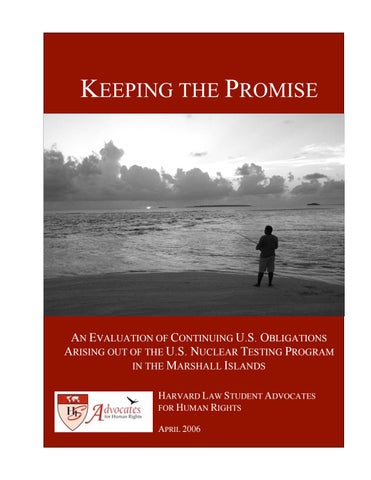
Cover A Rongelapese man fishes for food on a temporary visit to his traditional lands on the contaminated atoll of Rongerik. Photo by Adam Watkins, June 2003.
KEEPING THE PROMISE
i
TABLE OF CONTENTS I. EXECUTIVE SUMMARY AND RECOMMENDATIONS……………………1 II. BACKGROUND: U.S. NUCLEAR TESTING AND RELATIONSHIP.……...3 WITH THE MARSHALL ISLANDS A. The U.S. Nuclear Testing Program…………...……………………3 B. U.S. Legal Relationship with the Marshall Islands…………...……6 III. EFFECTS OF NUCLEAR TESTING ON THE LOCAL POPULATION…..…8 A. Health Effects…….…………………………………………………8 B. Property Effects…………………………………………………….10 C. Loss of Land: Effect on Communities……………………………..12 IV. SHORTCOMINGS OF U.S. EFFORTS AT REMEDIATION….………….14 A. Monetary Compensation: The Nuclear Claims Fund………………14 B. Health and Environmental Programs……………………………….19 V. LEGAL EVALUATION OF CHANGED CIRCUMSTANCES...……………22 A. Legal Foundations of Changed Circumstances……………………22 B. Statutory Analysis: The Purpose of the Compact and…………...…23 Section 177 Agreement C. Analysis of Changed Circumstances in the RMI…….…………..…25 D. Conclusion………………………………………………………….32 VI. CONCLUSION…...………………………………………………...…33 APPENDIX A: METHODOLOGY………………………………………….34 APPENDIX B: LIST OF CONDITIONS AND NUMBER OF………………..…36 NUCLEAR CLAIMS TRIBUNAL AWARDS APPENDIX C: RADIOACTIVE EXPOSURE LIMITS………………………..37 AND CURRENT CONTAMINATION LEVELS ENDNOTES……..…………………………………………………………39
TABLES AND FIGURES Table II-A Nuclear Weapons Yields in RMI, Nevada, and World War II……....………..4 Table II-B Approximate Level of Iodine-131 Released to the Atmosphere………………5 from Selected Nuclear Events Table II-C Castle Series Radiation Doses in the Marshall Islands…...………………..….6 Table II-D: Required Distributions of Section 177-Created Nuclear Claims Fund………7 Table III-A NCI Predicted Radiation Related Cancers After 2004…...……………….….9 Figure III-B Northern Enewetak Atoll Before and After ‘Mike’ Detonation……………10 Figure III-C. Runit Dome, Enewetak……………………………………………………12 Table IV-A Nuclear Claims Fund Balance………………………………...…………….14 Table IV-B Bikini and Enewetak Property Damage Awards…………………...……….15 Table IV-C. Estimated Cleanup Costs for Selected Nuclear Sites……..………...……..16 Figure IV-D. Comparison of the “Affected Area” in Nevada………….………….…….17 and in the Marshall Islands Figure IV-E. Comparison of Nevada and RMI Testing and Compensation……………..18 Table V-A: Factors Cited for Overestimation of Loss-of-Use Property Damages…..…..29 Table C-1: Current Radiation Levels on Some Islands……..……………….…………...38
KEEPING THE PROMISE
1
I. EXECUTIVE SUMMARY AND R ECOMMENDATIONS At the dawn of the Cold War, the United States chose the Marshall Islands as testing grounds for its nascent but powerful atomic bomb program. From 1946 until 1958, military scientists tested 67 nuclear devices with the equivalent explosive yield of 1.6 Hiroshima bombs per day for those twelve years. The testing program exposed the people of the Marshall Islands to radioactive fallout and contaminated nearby atolls, rendering them uninhabitable. To compensate the Marshallese for their sacrifices and hardships, the United States has provided some ad hoc payments and in 1986 created a $150 million Nuclear Claims Fund, intended “to provide, in perpetuity, a means to address past, present and future consequences of the Nuclear Testing Program.” Twenty years later, the Fund is nearly bankrupt, raising the question: Has the United States fully remedied the harms of the nuclear testing, and if not, what else must it do? Based on a year of research, field work and interviews, Harvard Law Student Advocates for Human Rights concludes that, despite good-faith efforts on both sides, negative effects directly attributable to the U.S. testing have not yet been rectified. Most notably, some Marshallese are still unable to return to their homelands because of contamination, and many victims stricken with radiation-related cancers will receive partial compensation or no compensation at all. The report also finds that basic treatment for nearly all radiation-related cancer victims is subject to the discretionary and at times arbitrary decisions made by government officials and foreign hospitals because the Marshall Islands lacks the facilities and expertise to treat such conditions. Without U.S. support, cancer victims with five-year survival rates below 50% are refused funding for treatment and left with no chance of being cured. Finally, the report concludes that the United States has assumed the obligation – under both international law and bilateral agreements – to provide just and adequate compensation for the nuclear testing program’s damages to the people and property of the Marshall Islands. Earlier this month, the U.S. House of Representatives voted unanimously to “commend[ ] the people of the Republic of the Marshall Islands for the contributions and sacrifices they made to the United States nuclear testing program.”1 The United States can fully repay the Marshallese for these sacrifices only by adopting specific remedies designed to adequately compensate those who bore (and in many cases continue to bear) the testing program’s effects. Accordingly, this report offers a balanced list of recommendations which are appropriately tailored to the harm of the U.S. Nuclear Testing Program. Congress should take a number of actions specific to the legacy of the testing: 1) To address personal injury: • Authorize and appropriate funds necessary to replenish the Nuclear Claims Fund to the extent needed to complete payments on outstanding personal injury compensation awards, excluding those “second-generation” claimants who were not yet born (or in utero) upon the completion of nuclear testing; • Authorize and appropriate funds necessary to replenish the Nuclear Claims Fund to the extent needed to provide required compensation for future claimants who were alive (or in utero)
KEEPING THE PROMISE
2
during the testing period but who have yet to manifest or be diagnosed with a compensable condition. 2) To address property damage and remediation: • Authorize and appropriate funds necessary to satisfy awards by the Nuclear Claims Tribunal to Enewetak and Bikini, Rongelap and Utrik (decisions pending), and other atolls (to be decided via the administrative process being devised by the Tribunal); • In the alternative, authorize and appropriate adequate funds directly to the Department of Energy to remediate Bikini, Rongelap, and the northern islands of Enewetak to the point where the reasonably maximally exposed individual will receive no more than 15 mrem above background radiation per year, and authorize and appropriate adequate funds to compensate the peoples of Enewetak, Bikini, Rongelap and Utrik directly for hardship and past and future loss of use of their homelands; • In the alternative, confer jurisdiction upon the U.S. Court of Appeals for the Federal Circuit to review judgments of the Nuclear Claims Tribunal, empowering the court to modify such judgments and enter order for payment. 3) To address health concerns of nuclear-affected populations: • Authorize and appropriate funds sufficient to guarantee off-island referrals for treatment of those patients who were alive (or in utero) during the testing period and who are diagnosed with a compensable radiogenic condition that cannot be adequately treated in the RMI, including nearly all types of cancer; • Specifically authorize and appropriate funds for the Section 177 Health Program at its original Compact of Free Association level of funding; • Specifically authorize and appropriate funds for the ongoing function of the Department of Energy health and environmental programs.
KEEPING THE PROMISE
3
II. BACKGROUND: U.S. NUCLEAR TESTING AND R ELATIONSHIP WITH THE MARSHALL ISLANDS Located in the Western Pacific and spread over 750,000 square miles, the Republic of the Marshall Islands (RMI) is composed of 1225 islands2 with a total land area about the size of Washington, D.C.3 Colonial control of the Marshall Islands passed from Spain in the fifteenth century to Germany in the nineteenth century to Japan in the early twentieth century.4 The United States wrested the Marshall Islands from the Japanese in 19445 and assumed control of the country; in 1947, the RMI became part of the United Nations-created Trust Territory of the Pacific Islands, with the United States as Trustee.6 In 1986, the Compact of Free Association established the RMI as an independent nation freely associated with the United States.7 The U.S. and RMI governments agreed to an amended version of the Compact (sometimes called ‘Compact II’) in 2003, which came into effect on May 1, 2004.8 The Marshall Islands also currently hosts the U.S. Army’s Ronald Reagan Ballistic Missile Defense Test Site (Reagan Test Site). Because of its location and sophisticated radar instrumentation, the Reagan Test Site is “a premier asset” for U.S. military programs testing both offensive and defensive missile systems.9 A. The U.S. Nuclear Testing Program In January 1946, U.S. officials selected Bikini Atoll in the northwest Marshall Islands for the testing of nuclear weapons.10 After evacuating the 167 Bikinians, the United States conducted Operation Crossroads, its first post-World War II nuclear tests, consisting of two nuclear detonations in and above Bikini’s lagoon.11 Two years later, the United States added Enewetak Atoll to its testing program, moving its 145 residents to Ujelang Atoll.12 In 1952, the United States detonated the world’s first hydrogen bomb, which vaporized the Enewetak island of Elugelab, leaving a crater more than a mile in diameter.13 On March 1, 1954, the United States detonated Bravo, the first test in the series dubbed Operation Castle, despite “an unexpected shift in wind conditions.”14 At 15 megatons,* Bravo was approximately 1000 times stronger than the bomb dropped on Hiroshima, making it to this day the largest nuclear test ever conducted by the United States.15 Due to the “unexpected” easterly winds and the weapon’s high explosive yield, Bravo’s fallout cloud swept from Bikini directly over a nearby Japanese fishing vessel and a number of atolls, including Ailinginae, Rongelap, Rongerik, and Utrik.16 The resulting fireball and shock wave were so powerful that on Mejit Island, some 400 miles east of Bikini, residents startled by the blast “thought it was the end of the world.”17 Bravo’s radioactive fallout began showering Rongelap, just 100 miles from the blast site, three to four hours after the detonation.18 One Rongelap survivor, Rinok Riklon, describes white powder falling from the sky; Riklon told our research team that children thought this radioactive fallout was actually bits of detergent and collected it for their mothers to help with the laundry.19 On neighboring Ailinginae Atoll, eight-year-old Lijon Eknilang was gathering coconuts with her family when Bravo was detonated. When the family returned to their camp, they had trouble walking and felt very tired; the water had changed color, and fallout blanketed the food they had
*
A detonation of one megaton has an explosive force equivalent to one million tons of TNT.
KEEPING THE PROMISE
4
laid out to dry.20 With no other food on hand, they wiped the fallout from the dried coconut meat and ate it, despite the now-bitter taste.21 The fallout next spread over Utrik atoll, 320 miles from Bikini. Hella Ben, a child at the time, recalls: We heard noise like thunder and the island was shaking. I started to run around looking for my parents. … All of us thought it was the end of the world; all the kids were crying and running around. … Then the powder came. It covered our bodies and made the water foggy. … It was all so scary.22
By the afternoon of March 1, “a white dust” covered all exposed surfaces on the island.23 The United States was aware of the fallout path soon after the detonation and evacuated its personnel in the area on March 2.24 The United States waited, however, until March 3 to evacuate Ailinginae and Rongelap and until March 4 to evacuate Utrik.25 The Marshallese evacuees were taken to the U.S. base on Kwajalein, where U.S. medical personnel treated them for severe radiation poisoning.26
Even after Bravo, the United States conducted fifty-five more nuclear tests, with the final detonation on August 18, 1958.27 The total yield of the sixty-seven tests was 108,492 kilotons, equivalent to the explosive force of over one hundred million tons of TNT and more than seventyfive times the total yield of the U.S. nuclear tests in Nevada.28 (See Table II-A). The Marshall Islands tests also produced dramatically more fallout than other nuclear incidents. According to the U.S. Centers for Disease Control and Prevention, approximately 6.3 billion curies* of iodine-131, a radioactive element, were released in the RMI due to the nuclear testing, an amount that dwarfs the 150 million curies of iodine-131 released through the Nevada tests, the
*
A curie is a unit of radioactivity, equal to the amount of a radioactive isotope that decays at the rate of 3.7 x 10¹⁰ disintegrations per second.
KEEPING THE PROMISE
5
40 million curies released in the Chernobyl accident, and the 739,000 curies released in Hanford, Washington, from Atomic Energy Commission operations.29 (See Table II-B). Table II-B Approximate Level of Iodine-131 Released to the Atmosphere from Selected Nuclear Events
7 6,300,000,000
Iodine-131 Released (Billion Curies)
6 5 4 3 2 1
150,000,000
40,000,000
739,000
0 Marshall Islands
Nevada Test Site
Chernobyl
Hanford Operations
A recently declassified 1955 Atomic Energy Commission Report documented high radiation levels on all the Marshall Islands after the Bravo test and others in its series.30 A significant number of atolls measured received radiation doses far in excess of any recognized standard for safe limits. (See Table II-C. For a detailed discussion on determining the correct “safe� level of radiation, see Appendix C.) To put these radiation doses into perspective, the maximum radiation dose resulting from the highly publicized 1979 accident at the Three Mile Island Nuclear Generating Station was estimated to be 25 mrem,* less than one-thousandth of the level on Rongelap after Bravo.31
*
One millirem (mrem) is equal to 1 x 10⁻⁵ Joules of energy absorbed per kilogram of matter.
KEEPING THE PROMISE
6
Table II-C. Castle Series Radiation Doses in the Marshall Islands Source: Atomic Energy Commission Report BRAVO
1000000
other Castle tests 100000
1000
100
10
Exposure data presented in Table II-C are only for the Castle series of tests, which represented less than half of the total explosive yield of U.S. nuclear tests in the RMI.32 Operation Redwing in 1956, comprising 17 detonations equal to 20.8 megatons, and Operation Hardtack I in 1958, comprising 33 detonations equal to 28.0 megatons, had a combined yield greater than the Castle test series.33 While the impact and the path of radioactive fallout from these weapons tests remains largely unknown, the contamination from Operations Hardtack and Redwing have likely further contributed to the cumulative radiation burden imposed on the Marshall Islands. B. U.S. Legal Relationship with the Marshall Islands i.
Compact of Free Association
Approved by referendum in the Marshall Islands in 1983, passed by the U.S. Congress in 1985, and signed into law by President Reagan in 1986, the Compact of Free Association established the Republic of the Marshall Islands as a sovereign nation, provided a package of direct economic assistance to the RMI, and granted the United States certain military and defense rights within the RMI.34 In section 177 of the Compact, the U.S. government “accepts the responsibility for compensation owing to citizens of the Marshall Islands ‌ resulting from the [U.S.] nuclear testing
Ujae
Lae
Namu
Namorik
Ailinglaplap
Kili
Aur
Ebon
Taongi
Jaluit
Mili
Majuro
Arno
Maloelap
Erikub
Wotho
Kwajalein
Jemo
Likiep
Wotje
Ailuk
Taka
Utrik
Bikar
Ailinginae
Rongelap
1 Rongerik
Radiation (mrems)
10000
KEEPING THE PROMISE
7
program” in the Marshall Islands.35 The United States agreed to provide $150 million for a Nuclear Claims Fund, to be distributed in accordance with a separate agreement.36 ii. Section 177 Agreement Details of the Nuclear Claims Fund’s management and distribution were set forth in a separate agreement, commonly called the Section 177 Agreement because it elaborated on the terms of section 177 in the original Compact (and came into force contemporaneously). The fund was projected to return at least $18 million* per year.37 Given this anticipated return, the agreement further broke down the disbursements of the fund to each of the affected atolls and to establish a Nuclear Claims Tribunal. (See Table II-D for a detailed description of required disbursements under the Section 177 Agreement.) The United States and the RMI agreed that the Section 177 Agreement would provide a “full settlement of all claims, past, present, and future,” related to the nuclear testing program.38 Table II-D: Required Distributions of Section 177-Created Nuclear Claims Fund TOTAL YEARLY PURPOSE OF FUNDS RECIPIENT DISBURSEMENT DISBURSEMENT Health care program for affected populations (Section 177 Health Program) Medical surveillance and radiological monitoring Loss or damage to property and person of the people of Bikini Loss or damage to property and person of the people of Enewetak Loss or damage to property and person of the people of Rongelap Loss or damage to property and person of the people of Utrik Establishment of a Nuclear Claims Tribunal Operations of the Nuclear Claims Tribunal Payment of monetary awards as determined by the Nuclear Claims Tribunal
RMI government
$30 million
$2 million over 15 years
RMI government
$3 million
Bikini Distribution Authority Enewetak Distribution Authority Rongelap Distribution Authority Utrik Distribution Authority RMI government
$75 million
Nuclear Claims Tribunal Nuclear Claims Tribunal
$7 million
Expected Total
$270 million
$1 million for 3 years $5 million over 15 years $3.25 million over 15 years $2.5 million over 15 years $1.5 million over 15 years One-time disbursement $0.5 million over 14 years $2.25 million for 3 years; $3.25 million for the next 12 years $18 million per year
$48.75 million $37.5 million $22.5 million $0.5 million
$45.75 million
iii. Amended Compact of Free Association In 2003, the United States and RMI agreed to a renewed Compact, which did not address nuclear issues and will gradually phase out direct economic aid in favor of increasing appropriations to a trust fund, with the goal of helping the RMI attain self-sufficiency.39
*
Such a projection was unrealistic from the day the Compact went into effect. See § IV.A.i, infra.
KEEPING THE PROMISE
8
III. EFFECTS OF NUCLEAR TESTING ON THE LOCAL POPULATION A. Health Effects i.
Radiation-Related Illnesses
Acute and prolonged exposure to radiation caused by both immediate fallout and resulting contamination has dramatically affected the health of the Marshallese. Camilla Ingram had a tennis ball-sized tumor removed from her colon and lost twelve centimeters of the colon itself.40 Lijon Eknilang, who turned eight on the day of the Bravo blast, has been pregnant seven times but always miscarried; often the stillborn fetuses were deformed, and one had only one eye. She herself had her cancerous thyroid removed.41 Hella Ben had two miscarriages, including one stillborn “that looked like grapes.”42 Like Lijon Eknilang, she must take daily medication to replace the function of her excised thyroid. Hella Ben continued, “Life is short, and I don’t know if I can live for another three or four years, or three or four months. . . . The U.S. has to take care of the problem fast, before the survivors die.”43 While it is never possible to prove conclusively that a specific person’s condition is radiation-related, the scientific community is increasingly able to identify the overall effects of radiation. The most recent report by the National Academy of Sciences (BEIR VII) suggests that any increase in radiation exposure creates a proportional increase in cancer incidence.44 The BEIR VII reports estimates health risks from radiation to be nine times higher than the previously accepted standard announced in the BEIR I report of 1972.45 Research conducted by Neal Palafox, a doctor with over a decade of experience in the Marshall Islands, found that cervical cancer mortality in Marshallese women is sixty times higher than in United States women, male liver cancer rates thirty times U.S. levels, breast and gastro-intestinal cancer rates five times the U.S. rate, and lung cancer threefold higher.46
Dora Simon (shown here with her granddaughter) was on Utrik the day of the Bravo shot. She has had two thyroid surgeries, including a complete thyroidectomy in 1985. As a result she must take medication on a daily basis.
A recent report by the National Cancer Institute (NCI) estimated that among those alive in the Marshall Islands during the nuclear testing, 243 radiation-caused cancers have already occurred.47 However, because cancers often take decades to appear, this figure represents less than half the total number of cancers caused in the RMI by the U.S. testing program.
KEEPING THE PROMISE
9
ii. As-Yet Undiagnosed Illnesses The same NCI report predicts almost 300 more cancers related to radiation fallout will appear in the exposed population.48 Overall, about 56% of the total radiation-caused cases have yet to develop or be diagnosed as of 2003.49 (See Table III-A). Assuming that the same past ratio of predicted cancers to awarded individuals will continue,50 the Nuclear Claims Tribunal can be expected to provide compensation to over 2,200 additional individuals afflicted with radiationrelated cancers after 2004. Unfortunately, if no action is taken to secure additional funding for the Nuclear Claims Tribunal, thousands of future claimants will not be compensated.
cases
Further, because doses Table III-A. NCI Predicted Radiation-related were calculated from urine Cancers After 2004 (by type) sample measurements Source: National Cancer Institute Report taken soon after 120 51 evacuation , NCI estimates completely 100 ignore subsequent 80 radiation exposure, including any fallout 60 exposure after resettlement back to heavily exposed 40 islands.52 Although 20 resettlement occurred a few decades after the 0 initial nuclear tests (and Leukemia Thyroid Stomach Colon Other only three months after cancers Bravo for those on Utrik), radiation had not disappeared from the islands.53 Rongelap was known to have significant radioactive contamination of land and local foods when the population resettled in 1957.54 The people of Bikini were also resettled prematurely on their home island and ingested large amounts of radioactive cesium from their environment, eventually forcing the Bikinians to move off their home islands a second time as a result.55 By ignoring radiation received after evacuation, the NCI likely underestimates the total number of radiation-induced cancers. iii. Lack of Healthcare Compounding the harm of radiation’s effects, the RMI lacks the capacity to treat (or often even to diagnose) cancer victims in-country.56 The dearth of medical specialists or adequate facilities forces the RMI to spend nearly 25% of its entire health care budget on “referrals” to hospitals in Honolulu and, increasingly, Manila.57 The majority of these referrals are for cancer treatment.58 Unfortunately, U.S.-funded health programs do not pay the cost of off-island referrals for the vast majority of nuclear victims,59 and given the RMI Ministry of Health’s severely limited budget, these victims are at risk of being denied necessary treatment for their radiation-related diseases. The quality of medical care on the outer islands is generally very low: most atolls have just one medical dispensary which is staffed by a health assistant with limited medical training.60 Dispensaries are stocked only with basic drugs such as antibiotics, anti-protozoans, and pain relievers. At best, only primary and preventive care is available, and treatment is hampered by infrequent supply trips and inadequate facilities (including lack of electricity and running water).61
KEEPING THE PROMISE
10
In medical emergencies, the RMI Ministry of Health pays for patients to be airlifted to the main hospital in Majuro.62 The lack of training among outer island health assistants inevitably leads to missed and late diagnoses of conditions that do not present obvious and serious symptoms, such as cancers. Medical care is far more modern in the RMI’s urban areas. Professionally trained doctors perform basic procedures in a moderately sterile environment. However, without a radiologist, oncologist, or facilities to initiate chemotherapy or radiotherapy, cancer victims are unable to receive adequate treatment anywhere in the country, even from the programs specifically designed for nuclear victims.63 Thus cancer patients must be funded for treatment outside the country, and the majority can only receive funding from the Ministry of Health’s Referral Committee.64 Because of limited funds, the Referral Committee has a long list of criteria that a patient must meet to be sent off-island for treatment. Most notably, the committee turns away patients with a five-year survival rate below 50% and those older than 70.65 Additionally, the committee’s $100,000 payment cap per person has in some cases prompted recipient hospitals to refuse treatment due to concerns that medical costs will exceed the cap.66 Recent budget cuts have further reduced the number of referrals the RMI can afford.67 Even those patients who receive a funded referral from the Ministry of Health must still pay for their plane fare, as well as their housing and living expenses while abroad. Camilla Ingram, who was referred to a Honolulu hospital to have a tennis ballsized tumor removed from her colon, had to live in Hawaii for eleven months for her first round of treatment; she will also have to pay to return to Hawaii for her quarterly checkups, with an average cost of more than $1,000 per roundtrip ticket.68 B. Property Effects The U.S. nuclear tests fundamentally reshaped many of the atolls, including vaporizing entire islands. (See Figure III-B.) Many of the islands are still too
Figure III-B. Northern Enewetak Atoll Before and After ‘Mike’ Detonation
KEEPING THE PROMISE
11
contaminated for their inhabitants to return home. The resulting displacement and loss of land has been profoundly disturbing for a people that identify very strongly with their land.
i.
Displacement
The people of the most affected atolls have a long history of evacuations and relocations due to the U.S. nuclear testing program. The Bikinians were moved to Rongerik Atoll in March 1946, when the U.S. military took over their islands for Operation Crossroads.69 In March 1948, conditions of extreme hardship and starvation forced the Bikinians to move to a campsite on Kwajalein,70 then to uninhabited Kili Island.71 The lack of a lagoon on Kili rendered fishing and sea-faring nearly impossible for six months out of the year; this inability to gather food in the traditional manner had profound consequences on Bikinian culture and daily life.72 In 1972, the U.S. Atomic Energy Commission declared Bikini safe for resettlement, but less than six years later, the population was re-evacuated when U.S. officials found the radiation increase in the people “incredible.”73 There is no permanent settlement on Bikini to this day. The U.S. military evacuated the people of Enewetak to Ujelang Atoll in 1947 in anticipation of nuclear testing on Enewetak.74 After being exiled on Ujelang for twenty-eight years, the Enewetakese began a phased resettlement in 1975.75 As of 2006, the northern islands of Enewetak are still off-limits to settlement because of contamination.76 The people of Rongelap and Utrik left their atolls two and three days after Bravo, respectively, and stayed temporarily on Kwajalein. After three months on Kwajalein, the Utrikese were repatriated (and have lived continuously on Utrik since then), and the Rongelapese were moved to Majuro Atoll.77 Upon receiving clearance from U.S. authorities, the Rongelapese returned to their atoll in 1957,78 but left again in 1985, fearing continued contamination.79 As Lijon Eknilang, a Rongelap survivor, told one member of our research team, “I really do miss my home. I want to go back, and if they said I could go back today, I would get up and leave. We are not in our home now.”80 ii. Continued Contamination Radiation from the U.S. nuclear testing continues to render many of the atolls dangerous, even uninhabitable. The Nuclear Claims Tribunal considers 15 mrem to be the acceptable annual limit for radiation exposure, above which habitation is dangerous, while the Administration argues that 100 mrem is the correct standard.81 While this report concludes that 15 mrem is the more appropriate guideline,* under either standard, radiation exposure levels on Bikini, Rongelap and the northern portion of Enewetak are so high that they are currently unfit for human habitation.82 For example, of the 1,919 acres of the Enewetak atoll, only 815 acres (42%) were returned to the Enewetakese for use upon repatriation.83 Nuclear testing vaporized 154 acres, and the remaining 950 acres were too contaminated for resettlement.84 Before the U.S. nuclear testing, the northern Enewetak islands had the highest population density in the atoll because of their larger land area and better reef system.85 These northern islands remain uninhabitable, however, and the Enewetakese were resettled to the southern islands, with less land area and more dangerous waters.86 Since resettlement, several people have lost their lives trying to move between and among the southern islands of Japtan, Medren, and Enewetak.87 Because of the rough waters and
*
For a detailed discussion of this debate, see Appendix C.
KEEPING THE PROMISE
12
inferior reef system in the southern part of the atoll, Enewetakese sometimes fish around the contaminated northern islands in order to have enough food. “We know that the northern part of the atoll isn’t safe,” says Enewetak Mayor Jackson Along, “but where else can we go?”88 The U.S. government attempted to “clean” the remaining islands of Enewetak atoll during the 1970s by bulldozing the contaminated land and debris into a 350-foot wide crater that had been formed by an earlier nuclear test on Runit Island.89 The United States filled this crater with 111,000 cubic yards of radioactive soil and debris and capped the crater with cement.90 The U.S. government then resettled the Enewetakese near this massive nuclear storage facility (known as the Runit Dome, see Figure III-C), which is unmonitored and poses unknown risks to the Enewetakese.91 While the Enewetakese have resettled a portion Figure III-C. Runit Dome, Enewetak. of their atoll, the peoples of Bikini and Rongelap continue to live in exile from their homelands, unwilling to return again to unsafe levels of radiation.92 Recent radiological surveys confirm that by any standard, dangerous levels of radioactive cesium-137 still contaminate Bikini, Rongelap, northern Enewetak, and Rongerik.93 For a fuller discussion of current contamination levels, see Appendix C. In order to restore these lands to a condition appropriate for use, the soil needs to undergo some combination of three costly processes of remediation.94 One alternative involves removing the remaining contaminated soil (an estimated 1.9 million cubic yards on Enewetak alone); a second is to treat the contaminated soil with potassium to counteract the presence of the radionuclide cesium; lastly, through a process called phytoremediation, plants may be used to strip the soil of radioactive elements.95 However, insufficient funds have prevented these procedures from being completed. C. Loss of Land: Effects on the Communities
“I long for my homeland; I want to be buried there when I die.” – Betty Edmond, a Rongelap survivor. 96
Though many cultures have customs built around specific connections to the homeland and particular landscapes, the Marshallese are exceptionally tied to their islands, with “an almost mystical attachment to their land.” 97 For the Marshallese, “[l]and is not just a place to live and
KEEPING THE PROMISE
13
grow food; land in the Marshall Islands is the essence of life. In a country with only 70 square miles of land, land is the most valued commodity.”98 This section examines the effect of loss of land on communities in the RMI by looking at the example of the people of Enewetak. Social hierarchy is organized around land ownership; Enewetakese derive social authority based on their particular land parcels.99 Contemporary hereditary practices, customs, and death rituals all continue to involve the land of the islands itself.100 The Enewetakese essentially identify themselves with the land on which they live, viewing the land as “a part of one’s very person.”101 In fact, before the Enewetakese were officially allowed to return to their island, the United States permitted dying Enewetakese to return because it was so important to them to die on Enewetak land.102 The Enewetakese had to restructure their society while in exile in Ujelang because of the inherent differences in the islands. Enewetak has a lagoon sixteen times larger than Ujelang’s, a coral reef system seven to times as extensive as Ujelang’s, and four times the land area of Ujelang.103 In contrast, Ujelang is rocky and covered with coral rubble from a former typhoon.104 There were bouts of famine during the Enewetakese stay on Ujelang, which not only threatened – and sometimes took – lives, but also frayed the educational and cultural fabric of their society; during famines, the schools closed because every hand was needed to hunt for food.105 The separation from their home also produced severe psychological effects on the Enewetakese. After witnessing from afar the 1952 Mike test on Enewetak (the world's first thermonuclear detonation), the people worried that their own atoll might not have even survived the blast, creating a feeling of aimlessness and alienation.106 Only after 1971 did the Enewetak people finally know for sure that their atoll still existed, though they then also learned that some islands had been vaporized by the tests.107 Upon returning in 1980, the Enewetakese found that their islands hardly resembled the ones they had left behind. The Americans had reshaped the islets by constructing runways and taxiways, as well as a small city that was built to support 10,000 people during the testing era.108 Even the island’s physical contours had been changed by the nuclear testing, leaving no place, for example, for the Enewetakese to beach their canoes. The nuclear testing also affected the vegetation and wildlife on Enewetak, so the Enewetakese can no longer find the materials they need to observe their traditions, like canoe building and mat weaving.109 The United States even drew former property boundary lines incorrectly, mixing up family plots and sometimes wholly redistributing land, fundamentally disturbing the land-based Enewetak social structure.110
KEEPING THE PROMISE
14
IV. SHORTCOMINGS OF U.S. EFFORTS AT REMEDIATION The United States has attempted to remedy the damages caused by the nuclear testing through two routes: monetary compensation (including Nuclear Claims Tribunal awards) and inclusion in medical and environmental programs. It is now apparent that monetary payments to date are inadequate to compensate victims with radiation-related illnesses or to properly remediate contaminated islands. On the health front, while the Department of Energy’s programs conduct cutting-edge scientific research and provide excellent treatment to a handful of people, the vast majority of nuclear victims receive only basic care and are at risk of being denied treatment altogether for some of the most serious radiological conditions, including cancer. A. Monetary Compensation: The Nuclear Claims Fund The Section 177 Agreement allocated $150 million for the creation of a Nuclear Claims Fund, requiring annual disbursements of $18 million over its first fifteen years to a number of sources.111 (See Table II-D for a detailed summary of the disbursements). The four atolls of Bikini, Enewetak, Rongelap and Utrik received a total of $12 million per year for “claims arising out of the Nuclear Testing Program for loss or damage to property or person.”112 A total of $33 million was allocated for health care and medical surveillance.113 The agreement also required the RMI government to establish a “Claims Tribunal” with jurisdiction to “render final determination upon” all claims arising from the U.S. nuclear testing program in the RMI.114 The Tribunal was to receive $500,000 per year for operations and $45.75 million for payment of claims.115 Pursuant to the Section 177 Agreement, the RMI Nitijela (parliament) passed enabling legislation in 1988 establishing the Nuclear Claims Tribunal (NCT or Tribunal).116 The Tribunal sits in the RMI capital of Majuro and adjudicates personal injury claims on behalf of individuals and property damage claims on an atoll-wide basis. i.
Status of the Fund
For the Nuclear Claims Fund to have met the mandated $270 million of disbursements over a fifteen-year period117 would have required a 12.5% annual return.118 Such a rate of return was unrealistic from the day the Compact went into effect,119 and the Fund is now nearly bankrupt. (See Table IV-A). By the end of 2004, the Fund balance was at $3.8 million with more than $14.6 million worth of personal injury awards still
KEEPING THE PROMISE
15
outstanding.120 The Fund balance at the end of 2005 was down to $1.9 million, while the unpaid balance on personal injury awards stood at $15.4 million.121 Past class action property claims have each taken several years and several hundred thousand dollars in expert witness fees alone to complete. Because the Tribunal is now operating on a year-to-year basis, it “no longer has the resources to support the same level of expenditure or length of time of adjudication for outstanding property claims.”122 The Tribunal is now considering “suspending payments to certain categories of recipients, including those born after the testing period and the estates of those who have already passed away. While the Tribunal has chosen not to pursue such a strategy [in 2004], as funds become more scare, these may become painful but necessary steps to take in the future.”123 ii. Property Damage Claims The Tribunal considers loss of use, restoration of property and hardship in its property award determinations, as required by the Restatement (Second) of Torts.124 Furthermore, any awards given by the NCT are offset by prior compensation that the atoll received from the United States, including direct disbursements required by the Section 177 Agreement.125 After hearings in 1999, the Nuclear Claims Tribunal issued compensation for claims brought by the populations of Enewetak 126 and Bikini.127 Property damage claimants bear the burden of proof in relating their damage to the effects of the testing program.128 Property awards, unlike personal injury awards, include post-judgment interest.129 Loss of use is calculated by the rental that could have been obtained had the land been intact and available for rent at market prices.130 While there is debate over the proper methodology for determining “market prices” in the RMI, the Tribunal’s calculations represent the best estimate for what the rent most likely would have been.* After deducting for prior compensation from the United States, the Tribunal set Table IV-B. Bikini and Enewetak Property Damage Awards past and future loss of use at Sources: Nuclear Claims Tribunal $244 million for Enewetak and 131 $278 million for Bikini. 300 Enewetak
$ (millions)
Bikini 250 Restoration costs can include radiation cleanup, soil 200 rehabilitation, revegetation, 132 150 and resettlement. The Tribunal called for soil 100 removal and seeding the land 50 with potassium to block cesium-137 uptake, awarding 0 $108 million to restore and Restoration and Loss of Use Hardship resettle Enewetak and $251.5 Cleanup million to restore Bikini.133 To compensate the Enewetak and Bikini people for hardships suffered during exile (including famine, epidemics, mental depression and cultural loss), the Tribunal awarded approximately $34 million to each atoll.134
*
For a full discussion of the loss-of-use methodological debate, see § V.A.iii, infra.
KEEPING THE PROMISE
16
The Tribunal acknowledged that the awards for hardships “cannot fully repay those who suffered,”135 and referenced Mochizuki v. United States: No compensation is ever equivalent to a serious human loss. Who among us would ever trade our eyes or legs for $5,000 or $20,000 or a hundred times that much? Money damages can never undo the loss of life, false imprisonment or the passage of years. Money, however, is the medium which the law must use as it seeks to right the wrongs. It must use this medium with the full recognition that it is never truly adequate.136
In total, the Tribunal awarded $386 million to the Enewetak people137 and $563 million to the Bikini people.138 In comparison, the U.S. government has allotted tens of billions of dollars to clean up contamination at sites in the United States. (See Table IV-C).139 Unfortunately, only a small fraction of the Enewetak and Bikini compensation has been paid. The Tribunal issued 0.25% of each award in February 2002 and an additional 0.125% in February 2003.140 No other payments have been issued.141 Table IV-C. Estimated Cleanup Costs for Selected Nuclear Sites142 U.S. Sites Cleanup Cost (1998 dollars) Hanford Reservation $50.3 billion Savannah River Site $29.7 billion Oak Ridge Reservation $13.1 billion Idaho National Engineering and Environmental Laboratory $16.3 billion Rocky Flats Environmental Technology Site $6.3 billion Marshall Islands sites Cleanup Cost (1999 dollars) Bikini $0.25 billion Enewetak $0.09 billion Separate claims for property damage in Utrik and Rongelap are currently pending before the Tribunal.143 Property damage claims for fourteen other atolls were filed during 2004.144 In addition, there are thousands of individual property claims and several property class action claims still unresolved; their priority has been lowered in comparison to property damage claims filed on behalf of the atolls specifically included in the 177 Agreement.145 The Tribunal is seeking to address these outstanding claims through an alternative, less formal administrative and regulatory framework.146 Prior Tribunal decisions will provide the basis for this proposed administrative framework; instead of holding an adversarial proceeding, the court will weigh such factors as contamination levels, acreage, and historical property values to determine what, if any, compensation is due.147 iii. Personal Injury Awards The Tribunal’s personal injury compensation program is patterned closely after a compensation program established by the U.S. Congress in 1990 for U.S. civilians exposed to fallout from nuclear testing in Nevada.148 This reflects the international legal principle that victims of radiation exposure in a foreign country are treated no less favorably than citizens of the offending country.149 The Tribunal uses medical conditions listed in U.S. government radiation compensation programs as the basis for the medical conditions subject to compensation.150 There are currently thirty-six medical conditions for which the Tribunal awards compensation to those Marshallese who were alive or in-utero during the nuclear testing period.151 The Tribunal also compensates “second-generation” Marshallese – those who were born after the testing period
KEEPING THE PROMISE
17
whose mothers lived in the RMI during testing – who are diagnosed with a listed condition, but at half the compensation rate of the first-generation exposed population.152 Personal injury awards do not include post-judgment interest, rendering them less valuable with each passing day of delay in full payment. On the other hand, claimants benefit from a statutory presumption that eligible conditions were caused by radiation.153 A number of factors led the Tribunal to presume exposure for those living in the RMI during the testing period: 1) the lack of data estimating exposure levels for nearly all atolls,154 2) the wish to maximize the percentage of awards that went to victims, rather than their lawyers,155 3) a desire to promote expediency in awards so that claims could be processed before more victims died,156 and 4) the example set by the Radiation Exposure Compensation Act (Downwinders’ Act), which presumed exposure for civilians living in specified areas surrounding the Nevada Test Site.157 As of December 31, 2005, the Tribunal had awarded personal injury compensation totaling $88,291,750 to 1,958 individuals.158 (See Appendix B for summary of personal injury awards.) Only $72,867,947 of that amount has actually been paid to the awardees or their heirs, leaving an unpaid balance of approximately $15.4 million.159 The Nuclear Claims Tribunal has followed a cautious payment allocation, awarding money in annual pro rata installments; in 1991, for example, initial recipients received 20% of their awards, with additional annual payments made in subsequent years.160 Nevertheless, the Tribunal surpassed its $45.75 million allotment for personal claims in 1996,161 and the fund’s near-bankrupt status forced the Tribunal to make annual payments of only 1%-5% of total awards in 2005.162 As a result, more than 50% of past awardees have died prior to receiving full payment of the compensation awarded for their personal injuries.163 iv. Comparison with ‘Downwinders’ Current efforts to restore the people and land of the Marshall Islands fall far short of efforts the U.S. government has made to assist Americans living downwind of the Nevada nuclear test site (“downwinders”). A comparison with the U.S. testing in Nevada (and subsequent compensation program) reveals that despite facing much higher levels of exposure and contamination, the Marshallese have actually been compensated at a lower rate. Realizing the significant disparity in the RMI’s exposure and compensation by the U.S. government in comparison to their American counterparts is helpful to understanding the need to revisit the U.S. duty to the Marshallese. With the Radiation Exposure Compensation Act of 1990 (“RECA,” or the “Downwinders’ Act”), Congress initiated a compensation scheme for people who were physically exposed
Figure IV-D. Comparison of the “affected area” in Nevada and in the Marshall Islands.
KEEPING THE PROMISE
18
to nuclear fallout from the tests.164 RECA, like the Nuclear Claims Tribunal’s personal injury scheme, provides awards for claimants diagnosed with specific radiogenic conditions who live within the “affected area,” which is approximately the same area as the entire Republic of the Marshall Islands ().165 Figure IV-E shows that while explosive yields in the RMI were more than 75 times higher than in Nevada and release of radioactive iodine-131 more than 40 times higher, RMI victims have received on average less compensation than their American counterparts.166 A 2002 study concluded that on every atoll of the RMI, the average external radiation dose from U.S. nuclear testing surpassed the average level for Americans living in the six counties nearest the Nevada test site.167 In contrast to the $72.9 million distributed to RMI victims,168 over $1 billion has been granted to date by the Downwinders’ Act on behalf of 24,266 individuals.169
Figure IV-E. Comparison of Nevada and RMI Testing and Compensation Sources: U.S. Department of Justice; Nuclear Claims Tribunal Nevada
108.496 kilotons
Marshall Islands 6.3 billion curies
$41,736
1.404 kilotons
Total Explosive Yield
$37,215
150 million curies Release of Iodine-131
Average Payment
KEEPING THE PROMISE
19
B. Health and Environmental Programs i.
Section 177 Health Program
In 1977, as part of an aid package to its territories, the United States created what is now known as the Four Atoll Health Care Program (“177 Health Program”) to provide “adequate medical care and treatment for any person who has a continuing need for the care and treatment of any radiation injury or illness directly related to” the Bravo test.170 Finding the scope of the initial program too limited, Congress expanded it to provide coverage for direct and indirect effects of the entire nuclear weapons testing program in the RMI,171 including coverage beyond the first generation of nuclear survivors to all descendants of those “affected by the consequences of the United States nuclear testing program.”172 The Section 177 Agreement, implemented with the Compact in 1986, provided for a $2 million annual distribution from the Nuclear Claims Fund to fund the program for the life of the Compact.173 By January 1988, the program’s “major objective” was the “provision of primary, secondary, and tertiary health services and education to the peoples of the Four Atolls.”174 During the life of the first Compact, the program constructed clinics on Majuro, Ejit, Mejatto, Kili, Enewetak and Utrik to deliver primary care services (staffed by medical assistants with quarterly doctor visits), periodically sent specialists to the outer islands, and paid for referrals to the Majuro hospital for secondary care.175 The 177 Health Program continued to be funded with $2 million annual disbursements from the Nuclear Claims Fund until September 2003.176 Facing the prospect of an end to funding, the program scaled down to focus exclusively on primary care and secured $1 million from the Nuclear Claims Fund for fiscal year 2004 operations.177 This reduced level of funding has been maintained for fiscal years 2005 and 2006 through one-time appropriations from the U.S. Congress.178 These budget cuts have forced the 177 Health Program to stop sending specialists to the outer islands and funding referrals to Majuro/Kwajalein or Honolulu.179 Instead, a coordinating office and clinic in Majuro (with two physicians) is supplemented by one physician and one health assistant in residence on each atoll’s primary island (Enewetak, Kili, Mejatto, and Utrik).180 When a patient presents with a medical problem that cannot be treated on the outer island, the 177 Health Program no longer has resources to pay for the medical evacuation; the patient must instead hope that the RMI Ministry of Health agrees to pay the bill.181 Enrollees are quite pleased with the services provided by the 177 Health Program. Criticisms of the program are entirely funding-related: the program no longer pays for off-island referrals; the outer island facilities lack basic medical equipment (and in some cases running water and electricity); medications and supplies sometimes run out.182 Atoll leaders and residents alike praise the fact that a doctor is now available at all times, rather than just on periodic visits.183 One survivor with a view to the future sees the 177 Health Program as the most important aspect of U.S. assistance to the four atolls: even more important than being able to move back home in her lifetime is ensuring that her children will receive adequate medical care.184 Because the 177 Health Program no longer pays for off-island referrals, however, the vast majority of cancer victims are not guaranteed treatment for their conditions.185 U.S. critics of the 177 Health Program have raised concerns about ineligible people enrolling in the program.186 Administrators of the program have taken steps to address this issue: audits have reduced the enrollment to approximately 11,000 persons, and standards for new enrollments have
KEEPING THE PROMISE
20
been tightened (only persons with land rights on the atoll in question are eligible, and such status requires verification by the atoll’s Senator and the applicant’s alab * or mayor).187 Furthermore, the first Compact specifically allowed the RMI government to establish eligibility for coverage under the 177 Health Program.188 ii. Department of Energy Programs The Department of Energy (DOE) program in the RMI was established soon after the Bravo detonation, It’s okay for the DOE to study primarily as “a research program” not 189 responsible for general health care. my body; I have no choice but Despite individual doctors’ efforts to provide expanded services unofficially, giving myself to them to use me the program’s research focus would contribute to the feeling among . . . but they need to do Marshallese survivors that they were “guinea pigs” and that the doctors were something in return. interested only in using them as research subjects, rather than treating --Lijon Eknilang them as patients.190 As one Marshallese, Lijon Eknilang, stated plainly: “It’s okay for the DOE to study my body; I have no choice but giving myself to them to use me . . . but they need to do something in return. . . . They have become very smart now; they are the head of the world. They will know what to do with the next generation if they ever make nuclear things again because they learned from us, from studying our bodies.”191 In 1972, the Department of Energy bifurcated its activities into a medical program and an environmental program (with the latter focused on radiological monitoring and developing remediation techniques).192 Currently, the Department of Energy medical program has one clinic serving each of the RMI’s major population centers (Majuro and Ebeye) and sends a doctor two to four times per year to Utrik atoll and Mejatto island (the latter being the primary settlement area for the exiled Rongelap community).193 The program’s 187 enrollees194 receive one comprehensive medical exam per year and treatment for any potentially radiogenic conditions, including guaranteed referrals for secondary and tertiary care to Majuro, Kwajalein, or Honolulu.195 The program’s doctors also provide limited preventive care unrelated to nuclear effects, such as vaccinations for children.196 Although the DOE medical program provides high quality treatment, some Marshallese survivors feel that the program is inadequate since coverage is limited to radiogenic conditions.197 Survivors who are part of the DOE program are unconvinced that radiation exposure can be ruled out as a cause of many of their illnesses, and are frustrated by what they view as unjustified denials of treatment:198
*
An alab is a traditional leader who oversees the ri-jerbal (working people) and reports to the Iroij (chief).
KEEPING THE PROMISE
21
How can we tell that it is from the radiation or not? ‌ None of us understand that. I know I have all this sickness inside of me ‌ but DOE said they would only treat me if they know the sickness is caused by radiation.199
Marshallese survivors also fault the program for covering only those physically present during the Bravo test, while neglecting those born later who have lived in radiologically contaminated environments.200 However, for those few who are covered, the DOE medical program provides the gold standard for off-island referral, guaranteeing treatment for all radiological conditions.201 Recent cuts in the program’s budget have endangered the effectiveness of this program: Utrik residents report that the DOE medical visits are substantially less frequent than in previous years, increasing the likelihood that even with guaranteed referrals, cancers may be caught too late to be treated effectively.202 When the Compact went into effect, funding for these DOE programs was set at $6.3 million as a line item within the Department of Energy budget ($1.1 million for medical services and $5.2 million for environmental work).203 However, this funding was removed from the budget for the 2005 fiscal year and is now wholly discretionary.204 Congress should ensure that funding for the DOE programs is re-established as a budget line item.
KEEPING THE PROMISE
22
V. LEGAL EVALUATION OF CHANGED CIRCUMSTANCES While the United States has accepted responsibility for the impacts from nuclear testing and sought to provide “the means to address past, present, and future consequences of the Nuclear Testing Program,”205 efforts to date have failed to do so. The nearly 300 Marshallese who have not yet developed, but are projected to develop, radiation-related cancers will receive little or no compensation for their suffering unless additional funding is secured. Current funds are also inadequate to address the non-health related damages to private property, including destruction and degradation that has rendered large portions of some atolls unfit for use, costs of environmental clean-up, and compensation for the hardships faced by the Marshallese. The Section 177 Agreement between the United States and RMI includes a “Changed Circumstances” provision, which allows the RMI government to request additional funding. In September 2000, the RMI submitted such a request to the U.S. Congress. This section analyzes this issue and concludes that recent scientific developments and newly available information represent “changed circumstances” within the terms of the Section 177 Agreement. The clear intent of the Compact that the settlement be “just and adequate” requires the United States to provide additional funding.206 In addition, failing to fully compensate the Marshallese would constitute a violation of the United States’ obligation under international law to remedy harms caused by its actions to the Marshall Islands and its people.207 A. Legal Foundations of Changed Circumstances i.
The Section 177 Agreement
The Section 177 Agreement reiterates that the purpose of the Compact of Free Association, as expressed in its section 177, is “to create and maintain, in perpetuity, a means to address past, present and future consequences of the Nuclear Testing Program, including the resolution of resultant claims.”208 Under Article X, the “Espousal” provision, the RMI agreed to terminate any legal proceedings against the United States or its agents related to the nuclear weapons program. The Article specifies that the Section 177 Agreement provides a “full settlement of all claims, past, present, and future.” Article IX of the Agreement (the “Changed Circumstances Provision”) includes a clause allowing the RMI to request additional funding from Congress for loss or damage arising from the nuclear weapons testing program if: 1. the loss or damage is “discovered after the effective date of this Agreement,” 2. the injury “could not reasonably have been identified as of the effective date of this Agreement,” and 3. failure to provide for these injuries would render the agreement “manifestly inadequate.” ii. The Changed Circumstances Petition In September 2000, the RMI presented a petition to Congress contending that the three requirements of Article IX had been met and requesting additional funding totaling over $3 billion.209 The request includes $14 million for unpaid personal injury awards, $949 million for unpaid property damages to Enewetak and Bikini Atolls, $50 million for medical services
KEEPING THE PROMISE
23
infrastructure, and $45 million annually over fifty years for a health care program for those exposed to radiation. The petition also alludes to funding needs that will continue to develop in the future; for example, as other atolls’ property damage awards are finalized, these claims will require additional sums. These as-yet unquantified requests for funding include an occupational safety program, community education and development programs, and a nuclear stewardship program. The RMI argues that new information is now available on the full extent of the damages from the nuclear testing program:210 information on the long-term health consequences of radiation exposure, the level of environmental clean-up required to ensure safe habitation, and the range and quantity of the fallout from the tests have advanced greatly since the Compact was signed in 1986, rendering prior assessments of injuries to the people and environment of the Marshall Islands incomplete and inaccurate. The petition also contends that the Nuclear Claims Fund had lower than expected investment returns, while costs of health care, medical surveillance, environmental cleanup, and radiological monitoring were higher than expected. Finally, the RMI argues that because the damages were not fully known at the time of the Compact negotiations, Congress intended to “leave the door open” to additional funding via the Changed Circumstances provision, rather than scientifically determining the full extent of damage at the time. iii. The Administration Response In November 2004, the Bush Administration issued a report rejecting the RMI claims of “changed circumstances.”211 The Administration report suggests the sums awarded for personal injury by the Nuclear Claims Tribunal were overly generous212 and that the Tribunal gave awards that would not have been recognized by comparable U.S. nuclear compensation programs.213 It argues the cleanup standards proposed are unnecessarily high and that all loss or damage to property was fully recognized before the ratification of the Section 177 Agreement. The Administration also notes that because the United States had no control over the management of the trust fund or the administration of the Tribunal, any changed circumstances resulting from these would not constitute “damages arising from the nuclear weapons testing program,” as the language of the provision specifically requires. Therefore, the fact that the low investment returns are insufficient to meet the large sums awarded by the Tribunal would not trigger the changed circumstances provision. Furthermore, the Administration argues that the changed circumstances provision does not allow the RMI to add in any new consideration (such as a nuclear education program) to the agreement – such programs could have been included in the original agreement if the parties had so desired. The Administration characterizes the Section 177 Agreement as a “settlement,” implying that the terms of the agreement are essentially decided.214 Under the Administration’s interpretation of the Agreement, the door to additional funding is closed except in the very narrow situation in which some wholly unexpected damage related to the nuclear weapons testing program is discovered. B. Statutory Analysis: The Purpose of the Compact and Section 177 Agreement Close readings of the statutory language and legislative history of the Compact and Section 177 Agreement demonstrate that these agreements were intended to serve dual purposes: to provide a just and adequate settlement of all claims arising from the nuclear weapons testing program;215 and to establish a separate, independent forum for resolution of these claims within the Marshall Islands. The adequacy of the compensation amount is a necessary element of the Compact and Section 177 Agreement.
KEEPING THE PROMISE
i.
24
The Compact’s Language Suggests an Overriding Intent that Compensation Be Just and Adequate
The plain language of the Compact expresses congressional intent that the provisions of section 177 represent a full and final settlement of claims, terminating all obligations of the United States to the injured parties, unless the provisions of the Section 177 Agreement necessitate otherwise: “[T]he provisions of section 177 … constitute a full and final settlement of all claims … except insofar as provided for in the Section 177 Agreement.”216 The termination of claims occurs as a result of – not independently of – the just and adequate settlement provided by section 177 of the Compact. The Administration’s reading of the Compact as a simple settlement of claims is incomplete; it ignores the language pointing to simultaneous obligations that arise from the Section 177 Agreement.217 Statutory language should be given effect so as to reconcile the different provisions in a consistent and sensible manner,218 and the Administration’s interpretation ignores the Compact’s language mandating a “just and adequate settlement.”219 Instead, the most consistent reading of these two sections – “full and final settlement” and “just and adequate settlement” – conditions the finality of settlement upon its adequacy. ii.
The Structure and Language of the Section 177 Agreement Indicate a Congressional Interest in Ensuring Just and Adequate Compensation
The language of the Section 177 Agreement further indicates congressional intent that the Agreement provide just and adequate compensation, rather than simply a lump sum settlement. The Agreement goes to the trouble to set out specific requirements in Article I – creating the Nuclear Claims Fund, specifying terms for its management, requiring the selection of a qualified fund manager, and setting specific performance objectives – that indicate an interest in ensuring adequate compensation. Specifying how the $150 million grant must be managed suggests a concern that future injuries arising from the nuclear testing program be adequately compensated. Likewise, Article IV’s creation of the Nuclear Claims Tribunal, including its specification of operational rules, only makes sense as a method of fulfilling the goal of just and adequate compensation.220 Congress chose to create a body with the jurisdiction to hear and resolve claims, rather than to extinguish the claims via a direct settlement. The Changed Circumstances provision of Article IX perhaps most clearly illustrates congressional intent that the settlement be just and adequate. Although the additional funding is optional, the inclusion of the provision nonetheless indicates that certain funding needs would justify an increase to the original $150 million grant. This Article would be unnecessary if the purpose of the Section 177 Agreement were solely to provide a final settlement of claims. New information is only relevant if Congress intended the adequacy of the grant to compensate the victims of nuclear testing to comprise an essential element of the agreement. Article XI, the strongest evidence of the Section 177 Agreement as a lump sum settlement, limits the indemnity of the United States to $150 million for any claims past, present, and future, brought in any jurisdiction, arising out of the nuclear testing program. Yet this article also includes the express limitation that it is “[s]ubject to Article IX” (the Changed Circumstances provision). That is, the $150 million cap on damages is only valid absent to discovery of additional damages that could justify supplemental compensation.
KEEPING THE PROMISE
25
iii. Legislative History Further Demonstrates Intent to Ensure Adequate Compensation Recognizing the uncertain state of knowledge about the nuclear testing’s full effects, the Compact’s congressional supporters specifically envisioned the provision of additional compensation when scientific advances showed the need, demonstrating a focus on the adequacy of settlement rather than its finality. During the debate over the original Compact, a number of Senators raised the question of the fairness of the “Subsidiary” Section 177 Agreement.221 Senator Alan Cranston elaborated on these doubts: “These provisions, which establish a $150 million trust fund from which all claims are to be paid – an amount which may not be adequate – deny to 5,000 Marshallese, who have already filed claims, their day in court.”222 Senator James McClure, then Ranking Minority Member of the Committee on Energy and Natural Resources, responded to these concerns directly: As you … know, article IX of the subsidiary contains a changed circumstance clause which would allow the Marshallese to ask Congress for relief if circumstances develop which could not have been foreseen, such as newly identified claimants. … As you indicated, there is a continuing moral and humanitarian obligation on the part of the United States to compensate any victims – past, present, or future – of the nuclear testing program. For this reason, I fully expect that if new claims develop Congress should and will provide any assistance required, absent compelling contradictory evidence.223
One of the Senators who had raised the initial concerns, Senator Howard Metzenbaum, responded by noting that “the record is clear that if the need for further assistance arises, nothing in the Compact will discourage the Marshallese from seeking additional money and that the Senate shall give a sympathetic hearing to these appeals.”224 Senator McClure remarked that “there is an enormous burden on Congress to state affirmatively that if future valid claims develop we will do everything possible to compensate adequately all newly-identified victims.”225 Congressional statements support the conclusion that the Changed Circumstances provision was included in recognition of a continuing moral obligation held by the United States to the Marshallese injured by the nuclear testing program. Acknowledging the great uncertainty surrounding the extent of the damages, Congress recognized that later discoveries could obligate additional compensation. The Changed Circumstances provides a mechanism to resolve such an inadequacy. C. Analysis of Changed Circumstances in the RMI While the Changed Circumstances provision does not itself require Congress to act, it provides the framework enabling Congress to address changes that prevent the Compact from achieving its goal of “just and adequate” compensation. This section evaluates the existence of changed circumstances in order to determine if additional funding is justified under the terms of the Section 177 Agreement. i.
The Definition of “Changed Circumstances”
In essence, the Changed Circumstances provision suggests that Congress should allocate additional compensation for damages that, had they been known at the time of the negotiation of the Compact, would have required supplementary funding to reach a fair and just agreement acceptable to both parties. Three elements serve as a prima facie test of the funding request’s legitimacy:226 the
KEEPING THE PROMISE
26
discovery of additional injuries must have been made after the date of the Section 177 Agreement; the scope of the injuries could not reasonably have been identified at the time of the Agreement; and failure to provide these remedies must render the Agreement manifestly inadequate.227 Discovered After 1986: The first element of “changed circumstances” is that the loss or damage must be “discovered after the effective date of this Agreement.”228 The Section 177 Agreement came into effect in 1986, and any damage that was not known until after that year would satisfy this requirement. In the context of an agreement to provide compensation for such damages, to “discover” a loss would indicate something more than to be merely aware of the possibility of a loss. Rather, a discovered loss or damage must be sufficiently specific and defined in scope so as to allow a judicial or administrative body to provide a remedy in practice. During congressional debate, for example, Senator McClure suggested that newly identified victims would fall into this category of discovered damages.229 A discovery that radiation from the nuclear testing program impacted more Marshallese than anticipated in 1986 clearly falls within the scope of the first element. The recent National Cancer Institute Report estimating that the U.S. nuclear testing program will cause hundreds of cancers outside of Rongelap and Utrik atolls provides such evidence.230 Could Not Reasonably Have Been Identified by 1986: The second element narrows the scope of injuries to those that “were not and could not reasonably have been identified” at the time of the Agreement’s ratification.231 The term “reasonable” indicates a reasonable person standard: whether a reasonable person in the same position as the drafters of the agreement (Members of Congress in 1986) could infer the existence of the loss from other facts already known to him.232 The reasonable person standard does not necessarily impute a duty to ascertain facts.233 A positive duty to seek additional facts is commonly indicated by the term “should”;234 instead, the drafters limited the requirement to injuries that could have been reasonably identified.235 Although it is not feasible to establish the exact information available to the all those Members of Congress who worked on the Agreement, the legislative record provides some evidence of the state of their knowledge in 1986. Publicly available information, such as scientific knowledge relevant to the nuclear testing program, can supplement the legislative record, as it can reasonably be inferred that such information was also available to the drafters of the legislation. Manifestly Inadequate: The final element of damages that constitute changed circumstances is that a failure to provide for them must render the Section 177 Agreement “manifestly inadequate.” Manifest inadequacy must be considered in the context of Article IX’s purpose – which is to create a means to request supplementary funding – and in light of the Section 177 Agreement’s dual purposes of (1) fully settling all claims arising out of the nuclear testing program, and (2) ensuring that the settlement is just and adequate.236 Compensation may be inadequate to fully settle claims if it fails to meet a legal threshold such as the constitutionally mandated minimum of just compensation for a government taking of private property. Manifest inadequacy under the “just and adequate” clause imputes a moral standard of fairness. Whatever the standard adopted, however, providing a victim no (or de minimus) compensation for his losses would represent the clearest example of manifest inadequacy, as it would render the agreement clearly inadequate to fulfill either express purpose. ii. Personal Injury Claims The $15.4 million requested by the RMI to complete payment of already-made Tribunal personal injury awards should receive high priority for immediate funding. Furthermore, strong scientific evidence indicates several hundred Marshallese will develop cancers or other radiation-related
KEEPING THE PROMISE
27
diseases,237 and without additional funding these victims will go uncompensated for their injuries. The uncompensated personal injury claims meet a prima facie test of the elements of the changed circumstances provision, and the requested funds are legitimately needed to remedy the damages suffered as a result of the nuclear testing program. Provision of additional funds should be limited, however, to those alive or in utero during the nuclear testing program.238 Prima Facie Case: New evidence on the full scope of radiation-related health effects has emerged only recently; the latest report presenting a more accurate prediction of the number of cancers arising from the nuclear testing program was published in 2004.239 Thus, the full extent of human health damages could only have been “discovered after the effective date” of the Section 177 Agreement. Nor could these injuries have been “reasonably identified” at that time. While there was general speculation that additional radiation-related injuries could develop in the future, the specific damages from chronic exposure that later emerged could not have been identified in 1986.240 Finally, the failure to provide compensation to those who develop radiation-related diseases would render the Agreement “manifestly inadequate” by violating one of the primary purposes of the Agreement. These diseases result directly from the nuclear weapons testing and fall clearly within the scope of damages Congress intended to resolve through the Section 177 Agreement and the Compact. Furthermore, there is an immediacy to these claims that requires prompt response. The pro rata system of payment mandates that each claimant collect only a portion of her award each year. The current inadequacy of the Nuclear Claims Fund has forced both the initial awards and the pro rata awards to be severely restricted.241 This situation has resulted in over 50% of the injured Marshallese dying before being fully compensated.242 Those who were diagnosed more recently have received substantially lower awards, and the hundreds more who will be stricken with cancer after the Nuclear Claims Fund runs out will go uncompensated absent congressional action. Such a failure to provide any compensation at all would seem the very definition of “manifestly inadequate.” Administration Critique of the Personal Injury Awards: The Administration response to the Changed Circumstances petition includes very little valid criticism of the personal injury award system. The Tribunal bases awards on several U.S. radiation compensation programs, such as the Radiation Employees Compensation Act (RECA).243 Comparisons to RECA are illustrative of the advances in science and knowledge that necessitate additional funding to compensate radiationrelated diseases. RECA itself was amended several times to expand the population of claimants and to add six types of cancer to the list of compensable diseases.244 These amendments resulted in a dramatic increase in the number of claims filed.245 To ensure continued funding, Congress in 2002 mandated appropriations for RECA through 2011.246 In light of these ongoing awards and amendments of the RECA program, additional funding for the Tribunal should be viewed as perfectly reasonable.247 However, there is one category of personal injury awards that should be reconsidered. The Tribunal compensates those born after the cessation of the nuclear testing program who are afflicted with radiogenic conditions at one-half the award rate for first generation victims.248 Awards to the second generation of Marshallese who were not acutely exposed to radiation are not based on sound scientific principles249 and divert funds from first-generation victims. Additional funding granted to the Nuclear Claims Tribunal for personal injury should be limited to firstgeneration victims (i.e., those born or in utero before the end of the testing period) unless and until scientific evidence shows radiogenic effects on second-generation victims.
KEEPING THE PROMISE
28
iii. Property Damage Claims The Tribunal’s property awards are divided into three categories of compensation: loss of land use, losses due to hardship, and the cost of environmental restoration of still-contaminated land. Each of these categories of award is examined separately to consider whether additional funding is warranted under the Changed Circumstances provision. While there is some debate about appropriate standards and formulas used to calculate these awards, those used by the Tribunal better adhere to the requirements of international and U.S. law. Furthermore, under any proposed standards, U.S. payments to date are inadequate to compensate losses and fully resettle all islands, making further compensation required under the Compact and Section 177 Agreement,250 and under international law.251 a.
Loss of Use of Land
The additional funding needed to pay the balance for the loss of use of the Bikini and Enewetak atolls totals $278 million and $244 million respectively.252 Further funding will presumably be required when the other atolls’ awards are finalized. Currently less than one-half of one percent of the Bikini and Enewetak awards has been actually paid.253 While it is not evident that there are any “changed circumstances” relating to the loss of use of land that meet the technical requirements of Article IX, under any loss-of-use calculation (including the formula proposed by the Congressional Research Service), the amount granted by Congress in 1986 is manifestly inadequate to compensate the victims of the nuclear testing program for their property losses. The Compact and Section 177 Agreement explicitly mandate just and adequate compensation for both losses to person and property;254 failure to provide any additional funding would be contrary to the stated objectives of the those documents. For this reason, this report recommends additional compensation for lost use of Bikini and Enewetak, as well as for lost use of Rongelap and Utrik once those decisions are issued by the Tribunal. Prima Facie Case: The damages related to lost use of land prior to the Tribunal award (“past loss use”) do not meet the technical requirements of the Changed Circumstances provision. The lost use of land between 1946 and 1997255 is not an injury “discovered after the effective date” of the Section 177 Agreement. One could argue that such damages were not quantified as of 1986 and therefore were only “discovered” at the time these losses were conclusively measured. Yet even under such an interpretation, these damages were cognizable as of 1986. Congressional members were aware that the property damages included the loss of use of the highly contaminated atolls that would continue for some time into the future.256 However, while full funding of past loss-ofuse awards may not be justified under a strict interpretation of the Changed Circumstances provision, the United States is still obligated to act since compensation thus far is not “just and adequate,” as required under the Compact.257 Loss-of-Use Methodology Debate: The Tribunal calculated loss of use by multiplying an annual rental value by the total affected acreage summed across the years of loss and adjusted for the time value of money.258 The recent Congressional Research Service (CRS) report notes that this methodology is “reasonable and appropriate.”259 Another CRS report, however, is highly critical of the Tribunal’s method of calculating the annual rental values, contending it inflates rents by a factor of ten.260 The Tribunal relied on two U.S. real estate appraisal firms to establish estimated rent levels for the period of lost use. However, because the Marshallese do not traditionally rent or lease their land, very few data points exist from which
KEEPING THE PROMISE
29
to extrapolate a market rental price.261 The Tribunal’s experts analyzed every real estate transaction ever recorded in the RMI, fitting a trend line of annual rents to the 174 properties that most resembled the agricultural uses of rural atolls.262 The key CRS criticism is that the Tribunal estimates are based on transactions on more urbanized atolls where rental rates in modern times have mirrored the government rate (the rental rate the RMI government is required by national law to pay private landholders).263 The Tribunal’s approach, however, is the closest approximation of actual market-based rental prices: empirical evidence shows that the government rental rate effectively serves as a floor for private rental rates even outside of urban areas, despite what market economics might prevent.264 Other CRS criticisms are similarly overstated, as noted below in Table V-A. Table V-A: Factors Cited for Overestimation of Loss-of-Use Property Damages ISSUE CRS POSITION265 REJOINDER Exponential Model of Rent Growth.
Typically real estate rents reflect real estate values, and empirical evidence suggests these values do not increase exponentially over time.
The model is not strictly exponential, but rather fits a trend line to empirical data to provide the best estimate for actual rental conditions for the period of time in question.266 To the extent that any ‘market’ exists in the RMI for land, rents are set by the ‘market leader’ – the national and local governments.267 In the RMI, foreigners are prohibited by law from Quantity of Failure to account for portions of the purchasing land, making a market-based analysis Land island that were vaporized. Such required for determining hypothetical purchase Affected vaporized portions of the atoll are not price impossible.268 Furthermore, no claim was temporarily unusable, and do not earn made by either party at trial that the U.S. exacted a an increasing rent over the years. permanent taking of land.269 Finally, given the Instead this land should be treated as though it had been purchased at the time extreme cultural ties to land,270 it would be of its destruction. nonsensical to compensate destruction of land at a lower rate than contamination of land. Value of The value of the use of alternative atolls Agricultural output may be a proper measure of during periods of evacuation is assumed offset value because the use is not hypothetical (as Alternative to be less than the value of the use of Habitation loss of use on the contaminated atolls was), and the evacuated atolls. Such an actual use value may be easier to calculate.271 assumption is based on agricultural From 1969-1978, Bikini was unsuitable for human output of the atolls, which is habitation due to cesium-137 contamination of the inconsistent with the original assumptions of the model- that the value food chain. The return of some Bikinians during of an atoll is not based on its economic that period is not properly considered as an offset to loss of use because of the dangerously high level of productivity. Additionally, the Bikini radiation. award ignores their return to the atoll from 1969 -1978, treating the value of use of the contaminated atoll as zero rather than at a reduced rate. Reinvestment 100 percent of all proceeds from past Proper compensation over long periods of time of Rent lost use of land are assumed to have requires taking into account the time value of been invested into US treasury bonds, money. U.S. Treasury bonds represent a standard an unrealistic savings rate. rate used for this type of calculation.272
CRS proposes an alternative methodology to estimate the rental value of land on the contaminated atolls, though it does not calculate total loss-of-use awards based on its estimates.273 This model is based on the agricultural outputs of the atolls and results in estimates of annual rents starting from $77 per acre in 1982 and increasing to $166 per acre in 1990.274 While a full evaluation of the CRS methodology is beyond the scope of this report, it is important to note the CRS figure of rental
KEEPING THE PROMISE
30
values may be significantly underestimated, as CRS itself recognized.275 The CRS methodology gives no valuation to the environmental amenities or cultural values of the land lost by the Marshallese despite their contributions to the total economic value of the land. Given the deep cultural ties to the land in traditional Marshallese culture, it is likely that these values would be substantial and could easily be as high as the market value of farmland. CRS notes that estimates for annual rental values of the most valued environmental amenities, such as wetlands, have been quantified at up to nearly $1600 per acre,276 while other sources put the value of wetlands at up to $60,000 per acre.277 Furthermore, even using the CRS methodology, total compensation for property damage is likely still inadequate because of the other components that should be incorporated into the award: environmental remediation and hardship. Finally, the CRS report fails to consider the lost use of marine resources, particularly access to coral reefs (and their wildlife) which dwarfed the physical size of the land lost.278 Legal precedent in the U.S.administered Marshall Islands courts before independence recognized the right of landowners to obtain compensation for loss of use of such marine resources.279 Overall, even CRS agrees that the Tribunal’s loss-of-use methodology – using market-based renal value as the basis of compensation – is proper.280 The rent calculation formula employed by the Tribunal’s real estate valuation firms is a reasonable approach that adheres to the international obligations of the United States281, and more closely approximates actual RMI rent levels than the CRS methodology.282 Thus, the Tribunal’s loss-of-use awards are appropriate, and should be fully paid by Congress. Alternatively, Congress may grant jurisdiction to the Federal Circuit Court of Appeals to review the Tribunal awards for property damages. Such an approach presents a method of resolving this complex question of facts involved in calculating loss of use damages, and would also help ensure finality for the issue. b.
Environmental Restoration
The $360 million requested for environmental restoration of the affected atolls should receive priority for additional funding. New developments in scientific understanding of radiation protection standards283 and knowledge of the full extent of the nuclear fallout constitute “changed circumstances” under Article IX. While there is some debate over the appropriate radiological dose limit to guide cleanup, under any standard – including the one proposed by the Administration – a number of islands are still unsuitable for human habitation. The Administration suggests that full resettlement of some islands should be abandoned. However, the Compact and Section 177 Agreement explicitly mandate the provision of funding so as to allow the resettlement of the affected atolls by those evacuated from their homelands.284 Compensation has thus far been inadequate to achieve this requirement, and additional funding is therefore justified under the terms of these agreements and under international law.285 Prima Facie Case: Radioactive contamination of the atolls meets the elements for changed circumstances under Article IX of the Section 177 Agreement. While it was certainly recognized at the signing of the Compact that damages arising from the nuclear testing program included continued contamination, the full extent of the damages was not “discovered” until after 1986. Measurements of radioactive fallout from Bravo and others in its series were not available to the RMI until the 1990s.286 Negotiations for the provisions of funding were conducted without full awareness of the level of contamination throughout the Marshall Islands. Furthermore, acceptable standards for environmental clean-up are far more stringent than in 1986, largely due to advances in scientific understanding of the health effects of radiation exposure.287 Finally, the failure to provide additional funding for environmental restoration would render the Section 177 Agreement
KEEPING THE PROMISE
31
“manifestly inadequate” by specifically violating the provisions of the Compact and Section 177 Agreement establishing that contaminated lands be remediated for resettlement.288 Radiation measurements on the ground also justify additional compensation. All data show that the radiation levels in at least Bikini, northern Rongelap, and northern Enewetak remain above any acceptable standard of environmental cleanup, even if the inhabitants are assumed to eat primarily imported food.289 This cleanup can not be completed without additional funding, and failure to do so would violate the express intentions of those drafting the agreement. Under the cleanup standard adopted by the Tribunal, additional portions of Enewetak, Rongerik, and Rongelap atolls also require additional environmental restoration.290 Since this report concludes that the cleanup standard adopted by the NCT is the more reasonable one,291 it recommends that Congress grant the full sum awarded for environmental restoration by the Nuclear Claims Tribunal. The Administration’s Critique of Environmental Restoration Awards: The Administration denies that there are changed circumstances that can serve as a basis for a funding request for environmental cleanup.292 The Administration, however, is factually in error when it states that the “current dose limit has been used to guide clean up decisions both before and after the Compact was enacted.”293 In fact, the Administration earlier in its report recognized that a less stringent standard was used to guide attempts to clean Bikini in 1984.294 The Administration argues that the contaminated atolls are not wholly inhabitable, concluding that “most historically inhabited islands in the northern atolls could be resettled under specific conditions.”295 Yet these “specific conditions” include the total elimination of consumption of local foods and groundwater.296 One of the goals of the Marshallese in returning to their traditional homelands is to be able to regain a measure of self-sufficiency and the means to economic advancement. The definition of resettlement should include the fundamental ability to pursue one’s livelihood, and in rural areas this includes agricultural pursuits. The Administration’s proposals to restrict activities of returning evacuees and wholly abandon some islands contradict the Compact and Section 177 Agreement’s explicit calls for resettlement.297 Finally, even the Administration’s proposed resettlement method would require additional cleanup of the northern atolls prior to resettlement. A failure to provide additional funding to effect the resettlement of the contaminated atolls would directly violate the intentions expressed in the Compact and Section 177 Agreement, even by the Administration’s own standards. c.
Losses Due to Hardship
It is undeniable that the Marshallese suffered greatly as a result of the nuclear testing program. However, hardship losses do not constitute “changed circumstances” under a strict interpretation of the Section 177 Agreement. Neither the Administration nor CRS, however, has forwarded any criticism of these awards. Compensation for hardship is the smallest of the three types of property damage, totaling only $34 million for each of the atolls receiving an award.298 Quantification of non-economic loss is always difficult to calculate, and the well-documented hardships endured by the dislocated peoples of the RMI are the likely basis for the apparent agreement that these awards are justified, despite not meeting the technical requirements of the Section 177 Agreement. d.
Additional Requests for Funding
The RMI additionally requests funds for medical services infrastructure, a revamped health care program, an occupational safety program, community education and development programs, and a nuclear stewardship program. While none of these additional requests falls within the definition of
KEEPING THE PROMISE
32
“changed circumstances” under Article IX, in order to right the harms caused by nuclear testing effectively and efficiently, additional funding for health programs is recommended above.299 D. Conclusion The ongoing development of radiation-related diseases and the remaining contamination of some atolls are clear cases of damages that meet the requirements of “changed circumstances” under the Section 177 Agreement. This report recommends that Congress honor the express intent of its earlier agreements by providing funding for these damages in their entirety and without delay. Additionally, this report recommends that funding be provided for the loss of use of the affected atolls, though these damages may not strictly be construed as “changed circumstances.” The United States is obligated under the Compact, Section 177 Agreement, and international law to provide additional funding for these outstanding property damages. Congress should fulfill its expressed commitments to provide just and adequate compensation for all personal and property losses arising from the nuclear testing program.
KEEPING THE PROMISE
33
VI. CONCLUSION The original Compact of Free Association between the United States and the Marshall Islands “specifically endorses [and] affirms that the governments of the parties to the Compact are founded upon respect for human rights and fundamental freedoms for all.”300 Indeed, the Compact and its associated agreements constituted a serious, good-faith effort on the part of the United States to recognize the infringements on human rights caused by its nuclear testing program in the Marshall Islands, and fulfill its obligations to remedy these harms. Twenty years later, however, advances in scientific knowledge and experience in treating nuclear victims have demonstrated that the promise of “just and adequate” compensation has not yet been fulfilled. Radioactive fallout has caused cancer among hundreds of Marshallese, and still hundreds more are expected to be stricken in the future. Yet without Congressional action these victims will not be compensated, and may not even be able to receive treatment for their conditions. Nearly fifty years after U.S. testing ended, the atolls of Bikini and Rongelap, and the northern islands of Enewetak lay devoid of permanent settlement, too radioactive for their people to return safely to these homelands. Though the technology now exists to clean up these islands and ready them for unfettered habitation, insufficient funding prevents full resettlement. Less than three weeks ago, the U.S. House of Representatives, in a unanimous vote “solemnly acknowledge[d]” the cataclysmic Bravo test and “commend[ed] the people of the Republic of the Marshall Islands for the contributions and sacrifices they made to the United States nuclear testing program in the Marshall Islands.”301 Without taking action by providing adequate compensation, however, this recognition rings hollow. It is up to the current United States Congress and Administration to keep the promise of its predecessors by acting without delay to ensure that the Marshallese people are fully repaid for their sacrifices.
KEEPING THE PROMISE
34
APPENDIX A: METHODOLOGY This report is based on primary and secondary research conducted in the Marshall Islands between December 29, 2005, and January 25, 2006, secondary research conducted between September 2005 and April 2006. The importance of this issue came to the attention of Harvard Law Student Advocates for Human Rights (HLS Advocates) from the experiences and preliminary research in the Marshall Islands of Adam Watkins from July 2002 through June 2003 and June 2004 through August 2004, including site visits to Rongelap, Rongerik and Kwajalein Atolls. Field research was conducted by Adam Watkins on Majuro Atoll between December 29, 2005, and January 20, 2006, and by Caitlin Daly on Utrik Atoll from January 22, 2006, to January 25, 2006. Overall, twenty-six separate interviews were conducted, including interviews with: survivors of the nuclear testing; doctors who see, diagnose, and treat such individuals; Nuclear Claims Tribunal staff; elected political leaders; and the head of the U.S. Department of Energy’s Marshall Islands Program. Interviews Conducted in the Marshall Islands 1. 2. 3. 4. 5. 6. 7. 8. 9. 10. 11. 12. 13. 14. 15. 16. 17. 18. 19. 20. 21. 22. 23. 24. 25. 26.
Bill Graham, Public Advocate, Nuclear Claims Tribunal, Majuro, December 30, 2005. Jack Niedenthal, Bikini Atoll Trust Fund Liaison, Majuro, December 30, 2005. Bill Graham, Public Advocate, Nuclear Claims Tribunal, Majuro, January 4, 2006. James Matayoshi, Rongelap Atoll Mayor, Majuro, January 4, 2006. Ishmael John, Enewetak Atoll Senator, Majuro, January 4, 2006. Dr. Terry Hamilton, Marshall Islands Program Director, Lawrence Livermore National Laboratory, U.S. Department of Energy, Majuro, January 5, 2006. Joe Saul, Utrik Atoll Mayor, Majuro, January 5, 2006. Eldon Note, Bikini Atoll Mayor, Majuro, January 6, 2006. Hiroshi Yamamura, Utrik Atoll Senator, Majuro, January 6, 2006. Dr. Virgilio Villaroya, Nuclear Claims Tribunal Diagnostician, Majuro, January 11, 2006. Dr. Gael LaviĂąa, Physician and Administrator, Section 177 Health Program, Majuro, January 12, 2006. Mike Slinger, Enewetak Atoll City Manager, and Jackson Along, Enewetak Atoll Mayor, Majuro, January 12, 2006. Helkenna Anni, Mejit Island Senator, Majuro, January 12, 2006. Camilla Ingram, Majuro, January 18, 2006. Dr. Masao Korean, Majuro Hospital, Majuro, January 18, 2006. Dr. Sheldon Riklon, Director of Clinical Operations, Department of Energy Health Program, Majuro, January 18, 2006. Betty Edmond, Majuro, January 18, 2006. Rinok Riklon, Majuro, January 18, 2006. Lijon Eknilang, Majuro, January 19, 2006. Dora Simon, Majuro, January 19, 2006. Hella Ben, Majuro, January 19, 2006. Catherine Jibaiur, Majuro, January 20, 2006. Kimberly Kelen, Utrik, January 22, 2006. Dr. Nabin Kumar Oli, 177 Health Program Doctor, Utrik, January 23, 2006. Harris Joel, Utrik Elementary School Head Teacher, Utrik, January 24, 2006. Nine Brejin, Utrik, January 25, 2006.
KEEPING THE PROMISE
35
Sections of this report were drafted by Adam Watkins, Alison Kamhi, Kim Smaczniak, and Libin Zhang, all students at Harvard Law School and members of HLS Advocates. Research assistance was provided by Yukyan Lam and Steve McGuinness, also students at Harvard Law School and members of HLS Advocates. Adam Watkins coordinated the research project and integrated the various memoranda and drafts. The report was edited Maggie Gardner, Harvard Law School student and member of the Harvard Law Review and HLS Advocates, and by James Cavallaro, Clinical Professor of Law at Harvard Law School and Clinical Director, Human Rights Program of Harvard Law School. Portions of the report relating to the Reagan Test Site were reviewed and approved by a missile defense expert (who wishes to remain anonymous), who formerly consulted for the U.S. Missile Defense Agency and has operational experience at the Reagan Test Site. The authors wish to thank the following individuals for their assistance in the process of researching and writing this report: All the interviewees, Caitlin Daly, Erika Strong, Natalie Nimmer, K.C. deBrum, Espern McAvoy, Carl Ingram, Caleb McClennan, Meredith Hubbell, Anne Dwojeski, Mindy Jane Roseman, Tyler Giannini, Bonnie Docherty, Brett O’Brien, Ed Stewart, Holly Barker, Jonathan Weisgall, Davor Pevec, Neikoj Noah, Tracy Lokboj, Mary Note, James Plasman, Philip Okney, Bill Graham, Gregory Danz, Kester Albert, Emma Gulibert, Cathlina deBrum Wakefield, Sherwood Tibon, Joe Murphy, Rose Murphy, Kenneth Kramer, Richard Hickson, Giff Johnson, John Manning, Laurence Tribe, Binaifer Nowrojee, Tina Stege, Scott Stege, Abacca Anjain-Maddison, Billiet Edmond, Louise Francois, Ansel Oliver, Gabrielle Tenzer, Greg Leifer, Ming Tam.
KEEPING THE PROMISE
36
APPENDIX B: LIST OF CONDITIONS AND NUMBER OF NUCLEAR CLAIMS TRIBUNAL A WARDS (AS OF DECEMBER 31, 2003)302 Conditions Also Recognized by U.S. Radiation Compensation Programs 303 CONDITION AWARDS NCT COMPENSATION LEVEL Leukemia Lung (bronchial) cancer Lymphomas (except Hodgkin’s disease) Cancer of the thyroid Cancer of the breast Cancer of the stomach Cancer of the pharynx Cancer of the pancreas Cancer of the colon Cancer of the ovary Cancer of the liver Cancer of the kidney Cancer of the bone Non-malignant thyroid nodule Meningioma (benign brain tumor) Tumors of the brain Cancer of the rectum Non-melanoma skin cancer Other cancers
49 202 57 132 95 33 25 23 26 56 36 12 8 981 16 3 19 1 47
$125,000 $37,500 $100,000 $50,000-75,000 $75,000-$100,000 $125,000 $100,000 $125,000 $75,000 $125,000 $125,000 $75,000 $125,000 $12,500-$50,000 $100,000 $125,000 $75,000 $37,500 varies
Conditions Clearly Linked to Fallout from the Bravo Test or Deemed Radiogenic by the Tribunal, But Not Known to be Compensated by U.S. Programs CONDITION AWARDS NCT COMPENSATION LEVEL Unexplained hypothyroidism Severe growth retardation due to thyroid damage Radiation sickness Beta burns Benign tumor of the salivary gland Unexplained bone marrow failure Other conditions
17 2 72 72 29 6 8
$12,500 $100,000 $12,500 $12,500 $12,500-$37,500 $125,000 varies
Total Personal Injury Awards (through December 1, 2003)
2027 (1865 individuals)
$83.05 million
A total of 57 new and 10 amended personal injury awards were approved during 2004 for an additional $2.91 million in compensation.304
KEEPING THE PROMISE
37
APPENDIX C: RADIOACTIVE EXPOSURE LIMITS AND CURRENT CONTAMINATION LEVELS A. The Tribunal’s Adoption of the 15 mrem Radiation Protection Standard is Justified The Bush Administration’s Response to the Changed Circumstances Petition asserts that exposure to 100 mrem* per year above background level is the correct regulatory dose limit for baseline radiation. However, the Nuclear Claims Tribunal’s establishment of 15 mrem per year as the safe limit from which to measure damages is a more appropriate limit because it parallels current Environmental Protection Authority (EPA) standards applied in the United States, and follows the fundamental international principle requiring that radiation protection standards for releases outside national borders be no less stringent than would apply domestically.305 Furthermore, under any potential protection standard, all experts agree that some islands are still too contaminated for human habitation. The purpose of setting a regulatory dose limit for members of the public is to reduce the harmful effects of radiation on human health to acceptable levels. What is considered a safe dose limit has declined dramatically over time due to new findings regarding the effects of radiation, as well as increased interest in reducing general public health risks. When the Compact was enacted, the generally acceptable radiation exposure limit was 500 mrem per year.306 In 1991, the U.S. Nuclear Regulatory Commission promulgated a radiation protection standard of 100 mrem per year from all sources of radiation for members of the general public, along with the adoption of an as-lowas-reasonably-achievable (ALARA) standard.307 The federal government has repeatedly established regulatory dose limits lower than 100 mrem since 1990,308 and in 1997 the EPA issued an agency guidance document setting a 15 mrem limit for cleanup of radioactive Superfund309 sites.310 Under the Superfund law, EPA issued two directives applying the threshold requirement of “overall protection of human health and life” for any remediation plan for radiologicallycontaminated U.S. sites.311 These EPA directives established 15 mrem per year as the maximum upper-end dose limit.312 This 15 mrem standard has been applied to various sites in the United States, and expert testimony before the Nuclear Claims Tribunal suggested that if the Marshall Islands were in the United States, that standard would apply to them as well.313 On December 21, 1998, following a hearing on the matter of cleanup criteria, the Nuclear Claims Tribunal adopted 15 mrem per year above background radiation as the cleanup criterion for the Northern Atolls.314 Both the express language of the Section 177 Agreement principles as well as international legal principles support this finding. The Section 177 Agreement specified that the Tribunal “may have reference to the laws of the Marshall Islands…, to international law and, in the absence of domestic or international law, to the laws of the United States.”315 Here, the Tribunal first referenced international legal principles316, determining that radiation protection standards should be at least as stringent for citizens of an exposed nation as in the country that caused the release.317 It then applied the Third Restatement of Foreign Relations Law, under which the United States is obligated to apply “generally accepted international rules and standards for the prevention, reduction, and control of injury to the environment of another state.”318 Since the most closely analogous domestic U.S. contamination sites are held to a 15 mrem per year standard by the EPA, the Tribunal’s choice of that same standard for radiation contamination caused by the United States in the Marshall Islands should be deemed reasonable.
*
One mrem is equal to 1 x 10⁻⁵ Joules of energy absorbed per kilogram of matter.
KEEPING THE PROMISE
38
B. Current Contamination Levels Require Additional Cleanup Radioactive contamination of a number of northern RMI islands currently exceeds the 15 mrem per year standard. While exact radiation exposure depends on a number of factors – most notably the mix of locally grown and imported foods consumed by the population – both recent radiological surveys of the RMI demonstrate that additional cleanup is necessary.319 Even under the Administration’s preferred 100 mrem standard, parts of four atolls (Bikini, Enewetak, Rongelap, and Rongerik) remain unsafe for unfettered human habitation. Testimony in last year’s Congressional hearings by authors of both reports confirm that additional cleanup is necessary. In 2005 testimony before the House of Representative Resources Committee, Dr. Steve Simon suggested that some northern atolls contain islands where it would be inappropriate for the original populations to resettle due to the high radiation level still extant.320 Dr. John Mauro, a health physicist, also testified that the resettled populations have increased levels of exposure.321 Table C-1 shows the results to the two recent radiological surveys in the RMI. Note that at least three islands (and as many as eleven) exceed the Administration’s preferred 100 mrem standard, while at least 14 islands (and as many as 20) exceed the EPA/Nuclear Claims Tribunal standard of 15 mrem. Table C-1: Current radiation levels on some islands, in mrem (values adjusted for 2005 *) 1994 NATIONWIDE RADIOLOGICAL 2002 SC&A Source STUDY322 REPORT323 2484 kcal/day diet 2484 kcal/day diet 3208 kcal/day diet, Diet assumption 75% local food 18 % local food 100% local food Predicted Exposure Range Low High Low High Low High Bikini-Bikini 160 1600 80 400 Northern Rongelap 120 800 40 240 Enewetak-Enjebi 63 400 16 160 Rongelap 40 240 12 80 Bikini 40 240 12 80 Rongerik 40 240 12 80 Southern Rongelap 40 240 12 80 Northern Enewetak 32 200 12 60 Enewetak-Aoman 24 160 7.9 40 Enewetak 16 120 6.3 40 Bikini-Eneu 16 120 6.3 40 Enewetak-Bijiri 12 90 5.6 32 Enewetak-Lojwa 12 90 5.6 32 Ailinginae 7 60 1.6 16 Utrik 5 50 1.6 12 Enewetak-Runit 5 50 1.6 12 Ailuk 2 16 1.6 8 5 22 Mejit 1.6 12 0.6 5 5 21 Likiep 0.2 2 0.2 2 5 21 Wotje 0.2 2 0.2 2 4 18 *
Values adjusted for the present by using the cesium-137 half-life of 30 years.
KEEPING THE PROMISE
39
ENDNOTES 1
H. Res. 692, 109th Cong. (2006). Embassy of the Republic of the Marsh. Is., Environment, http://rmiembassyus.org/Environment.htm (last visited Apr. 8, 2006). 3 Cent. Intelligence Agency, World Factbook: Marshall Islands, http://www.cia.gov/cia/publications/factbook/geos/rm.html (last visited Apr. 5, 2006). 4 Embassy of the Republic of the Marsh. Is., History of the Marshall Islands, http://www.rmiembassyus.org/History.htm (last visited Apr. 5, 2006). 5 See Robert C. Kiste, History of the People of Enewetak Atoll, in I THE NATURAL HISTORY OF ENEWETAK ATOLL 17, 20 (Dennis M. Devaney et al. eds., 1987) (“The American invasion in 1944 devastated and practically denuded both the Enjebi and Enewetak Islands. Ten percent of the local population was killed.”). 6 See id. 7 See id. 8 See Compact of Free Association Amendments Act of 2003, Pub. L. No. 108-188, 17 Stat. 2720; Embassy of the Republic of the Marsh. Is., Compact, as Amended Now Implemented (May 4, 2004), http://www.rmiembassyus.org/RMI-US%20Compact.htm. 9 U.S. Army Space and Missile Defense Command, Reagan Test Site, http://www.smdc.army.mil/RTS.html (last visited Mar. 28, 2006). 10 See Micr. Support Comm., Marshall Islands: A Chronology: 1944-1981 5, http://worf.eh.doe.gov/ihp/chron/A27.PDF (last visited Apr. 5, 2006). 11 See Embassy of the Republic of the Marsh. Is., Listing of Nuclear Tests in the Marshall Islands: A Chronology of Events, http://www.rmiembassyus.org/Nuclear%20Issues.htm (last visited Apr. 5, 2006) [hereinafter Listing of Nuclear Tests]. 12 See Ann C. Deines et al., Marshall Islands Chronology 1944 to 1990 (Jan. 11, 1990), http://worf.eh.doe.gov/ihp/chron/. 13 See Kevin O’Neill, Building the Bomb, in ATOMIC AUDIT: THE COSTS AND CONSEQUENCES OF U.S. NUCLEAR WEAPONS SINCE 1940 33, 47 (Stephen I. Schwartz ed., 1998). 14 Letter from K.D. Nichols, General Manager, Atomic Energy Commission, to W. Sterling Cole, Chairman, Joint Committee on Atomic Energy (Sept. 14, 1954), available at http://worf.eh.doe.gov/ihp/chron/A18.PDF. 15 See Nuclear Weapons Archive, Operation Castle, http://nuclearweaponarchive.org/Usa/Tests/Castle.html (last visited Apr. 5, 2006). 16 See Micr. Support Committee, supra note 10, at 5. 17 Interview with Dr. Masao Korean, Doctor at Majuro Hospital, in Majuro, Marsh. Is. (Jan. 18, 2006). 18 See Micr. Support Committee, supra note 10, at 8. 19 See Interview with Rinok Riklon, in Majuro, Marsh. Is. (Jan. 18, 2006). 20 See Interview with Lijon Eknilang, in Majuro, Marsh. Is. (Jan. 19, 2006). 21 See id. 22 Interview with Hella Ben, in Majuro, Marsh. Is. (Jan. 19, 2006). 23 Interview by Caitlin Daly with Nine Brejin, in Utrik, Marsh. Is. (Jan. 25, 2006). 24 See Deines et al., supra note 12. 25 Letter from P.W. Clarkson to K.E. Fields (Mar. 6, 1954), available at http://worf.eh.doe.gov/ihp/chron/A11.PDF. 26 See id. 27 See Listing of Nuclear Tests, supra note 11. 28 See id. 29 See Nuclear Claims Tribunal, Approach to Compensation, http://www.nuclearclaimstribunal.com/appro.htm (last visited Apr. 8, 2006). 30 See A. J. BRESLIN & M. E. CASSIDY, U.S. ATOMIC ENERGY COMM’N, RADIOACTIVE DEBRIS FROM OPERATION CASTLE, ISLANDS OF THE MID-PACIFIC 37 (1955) [hereinafter AEC Report]. 31 See David C. Holtzman, Cancer and Three Mile Island: No Significant Increase in Five-Mile Radius, 111 ENVTL. HEALTH PERSP. 166, 167 (2003), available at http://www.ehponline.org/docs/2003/1113/EHP111pa166PDF.PDF (“The maximum dose—which refers to the worst possible exposure, in which a person would have been outdoors and directly downwind of the plant—was estimated to be 25 mrem.”). 32 See Listing of Nuclear Tests, supra note 11. 2
KEEPING THE PROMISE
33
40
See id. See Compact of Free Association Act of 1985, Pub. L. No. 99-239, 99 Stat. 1770 (1986) [hereinafter Compact I]. 35 Id. at § 177 (a). 36 See id. at § 177(b)-(c). 37 Id. 38 See Agreement Between the Government of the United States and the Government of the Marshall Islands for the Implementation of Section 177 of the Compact of Free Association, U.S.-Marsh. Is., art. X, § 1, (Jun. 25, 1983). [hereinafter Section 177 Agreement]. 39 See Compact of Free Association Amendments Act of 2003, supra note 8. 40 See Interview with Camilla Ingram, in Majuro, Marsh. Is. (Jan. 8, 2006). 41 See Interview with Lijon Eknilang, supra note 20. 42 Interview with Hella Ben, supra note 22. 43 Id. 44 See NAT’L A CAD. OF S CIS., BEIR VII: HEALTH RISKS FROM LOW-L EVELS OF IONIZING RADIATION REPORT IN BRIEF 3 (2005), available at http://www.nap.edu/reportbrief/11340/11340rb.pdf. 45 See CONG. RESEARCH SERVS., REPUBLIC OF THE MARSHALL ISLANDS CHANGED CIRCUMSTANCES PETITION TO CONGRESS 14 (2005) [hereinafter CRS Changed Circumstances Report]. 46 See HOLLY M. BARKER, BRAVO FOR THE MARSHALLESE: REGAINING CONTROL IN A POST -NUCLEAR, POST COLONIAL WORLD 66 (2004). Because no studies yet prove a link between uterine/cervical cancer and radiation exposure, the Nuclear Claims Tribunal does not provide compensation for the afflicted people. See id. 47 See NAT’L CANCER INST., DIV. OF CANCER E PIDEMIOLOGY & GENETICS, ESTIMATION OF THE BASELINE NUMBER OF CANCERS AMONG MARSHALLESE AND THE NUMBER OF C ANCERS ATTRIBUTABLE TO EXPOSURE TO FALLOUT FROM NUCLEAR WEAPONS TESTING CONDUCTED IN THE MARSHALL ISLANDS 18-19 (2004) [hereinafter NCI Report]. 48 See id. 49 See id. at 16. 50 For the time period of 1946 to 2003, the National Cancer Institute predicts that the Marshall Islands will have 240 radiation-related cancers and almost 3000 cancers overall. See id. at 19-20. For those estimated 240 radiation-related cancers, the Nuclear Claims Tribunal made awards to 1865 individuals. See NUCLEAR CLAIMS TRIBUNAL, ANNUAL REPORT TO THE NITIJELA FOR THE CALENDAR YEAR 2003 17-18 (2003) [hereinafter NCT 2003 Report]. 51 E. T. Lessard et al., Protracted Exposure to Fallout: The Rongelap and Utirik Experience, 46 HEALTH PHYSICS 511, 512 (1984). 52 NCI Report, supra note 47, at 8. 53 STEVEN L. SIMON & JAMES C. GRAHAM, FINDINGS OF THE NATIONWIDE RADIOLOGICAL STUDY 26-27 (1994). 54 Marsh. Is., Changed Circumstances Petition attachment VI (Sep. 11, 2000) (on file with Harvard Law Student Advocates for Human Rights). 55 See Micr. Support Committee, supra note 10, at 31. 56 See Eugene Kroon et al., Cancer in the Republic of the Marshall Islands, PAC. HEALTH DIALOG, Sept. 2004, at 70, 75; see also Interview with Dr. Gael Laviña, in Majuro, Marsh. Is. (Jan. 12, 2006); Interview with Dr. Sheldon Riklon, Director of Clinical Operations, Department of Energy Health Program, in Majuro, Marsh. Is. (Jan. 18, 2006). 57 See Kroon et al., supra note 56, at 71. 58 See Interview with Dr. Sheldon Riklon, supra note 56. 59 See id.; Interview with Dr. Gael Laviña, supra note 56. 60 See Interview with Dr. Gael Laviña, supra note 56; Interview by Caitlin Daly with Dr. Nabin Kumar Oli, in Utrik, Marsh. Is. (Jan. 26, 2006). 61 See Interview with Dr. Gael Laviña, supra note 56; Interview by Caitlin Daly with Dr. Nabin Kumar Oli, supra note 60. Four outer islands are, however, served by doctors from the 177 Health Program (Enewetak, Kili, Utrik, and Mejatto). See Interview with Dr. Gael Laviña, supra note 56. 34
KEEPING THE PROMISE
62
41
For such emergency medical evacuations, the nearest Air Marshall Islands plane is diverted to pick up the patient. 63 See Kroon et al., supra note 56, at 71. Skin cancer is the only cancer can be treated in country. See Interview with Dr. Sheldon Riklon, supra note 56. 64 See Kroon et al., supra note 56, at 71. There are some very limited alternatives. The 187 people in the DOE program (see § IV.B.ii, infra) are guaranteed referral. See Interview with Dr. Sheldon Riklon, supra note 56. If study and treatment of the patient’s condition “uniquely benefit[s] Graduate Medical Education,” the Tripler Army Medical Center (Tripler) may take the case and fund treatment. Donald A. Person, The Pacific Island Health Care Project: Easing the Cancer Burden in the United States Associated Pacific Islands, PAC. HEALTH DIALOG, Sept. 2004, at 243, 244. From 1998 to 2004, Tripler took on 192 such cancer cases from the Marshall Islands. See id. at 245. While this program is undoubtedly a benefit to the RMI health care system, free care at Tripler “is an exception rather than the rule.” Kroon et al., supra note 56, at 71. In 2004, Tripler’s ability to handle cases from the RMI was curtailed by overseas deployment of Army physicians, and referrals to Tripler plummeted to just two cases during the fourth quarter of FY 2004. See REPUBLIC OF MARSH. IS. MINISTRY OF HEALTH, FY 2004 ANNUAL REPORT 72-73 (2005), available at http://www.rmiembassyus.org/Health/RMI%20MOH%20Annual%20Report%20FY%202004.pdf. 65 See Interview with Dr. Sheldon Riklon, supra note 56. 66 See id. 67 The total number of off-island referrals dropped by 49% from 1999 to 2003 (from 147 to 75), rebounding somewhat in 2004 (to 95 cases) with sharp increases in referrals to the lower cost Shriner’s hospital in Honolulu and hospitals in the Philippines. See REPUBLIC OF MARSH. IS. MINISTRY OF HEALTH, supra note 64, at 73. 68 See Interview with Camilla Ingram, supra note 40. 69 See Micr. Support Committee, supra note 10, at 7. 70 See id. at 9. 71 Id. at 11. 72 See id. 73 See id. at 21, 23, 31. 74 Id. at 9. 75 See Interview with Ishmael John, Enewetak Atoll Senator, in Majuro, Marsh. Is. (Jan. 4, 2006). 76 See id. 77 See Deines et al., supra note 12. 78 See id. 79 See id. 80 Interview with Lijon Eknilang, supra note 20. 81 See DEP’T OF STATE, REPORT EVALUATING THE REQUEST OF THE GOVERNMENT OF THE REPUBLIC OF THE MARSHALL ISLANDS P RESENTED TO THE CONGRESS OF THE U NITED STATES OF AMERICA 42 (2004) [hereinafter Administration Response]. 82 See Appendix C, § B. 83 See In re People of Enewetak, Nuclear Claims Tribunal, No. 23-0902 (2000), at 2 (Marsh. Is.). 84 Id. 85 See Interview with Mike Slinger, Enewetak Atoll City Manager, and Jackson Along, Enewetak Atoll Mayor, in Majuro, Marsh. Is. (Jan. 12, 2006). 86 See Interview with Ishmael John, supra note 75. 87 See Interview with Mike Slinger and Jackson Along, supra note 85. 88 Id. 89 See O’Neill, supra note 13, photo insert section; see also The Brookings Inst., The Cactus Dome, http://www.brookings.edu/fp/projects/nucwcost/runit.htm (last visited Apr. 18, 2006). 90 See O’Neill, supra note 13, at 47. 91 Id.; see also Interview with Mike Slinger and Jackson Along, supra note 85. 92 See supra, text accompanying notes 73 and 79. 93 See SIMON & G RAHAM, supra note 53, at 30-31. Under the more protective 15 mrem standard, Ailinginae, Utrik, and the “unaffected” atolls of Ailuk, Mejit, Likiep and Wotje may be in need of remediation as well. See id.; John J. Mauro et al., Investigations into the Current and Projected Radiation Exposures to the People
KEEPING THE PROMISE
42
of Selected Atolls and Islands of the Republic of the Marshall Islands Due to Residual Radioactivity in the Environment from Nuclear Weapons Testing S-8 (2002) (on file with Harvard Law Student Advocates for Human Rights). For more information, see Appendix C. 94 See In re People of Enewetak, Nuclear Claims Tribunal, No. 23-0902 (2000), at 18-24 (Marsh. Is.). 95 Id. at 18-19. 96 See Interview with Betty Edmond, in Majuro, Marsh. Is. (Jan. 18, 2006). 97 Kiste, supra note 5, at 19. 98 See BARKER, supra note 46,at 61. 99 See id. at 61-62. 100 Testimony of Dr. Laurence M. Carucci Before the Nuclear Claims Tribunal, In re People of Enewetak, No. 23-0902 (April 1999) (DVD on file with Harvard Law Student Advocates for Human Rights). 101 Id. 102 See id. 103 See Kiste, supra note 5, at 22. 104 See id.; see also Laurence M. Carucci & Mary H. Maifeld, Ien Entaan im jerata: Times of Suffering and Ill Fortune: An Overview of Daily Life on Ujelang and Enewetak Since 1946 (Rec’d by the Nuclear Claims Tribunal on behalf of the People of Enewetak 1999) (on file with Harvard Law Student Advocates for Human Rights). 105 Id. 106 See Carucci & Maifeld, supra note 104. 107 Id. 108 Id. 109 Id. 110 Id. 111 The Section 177 Agreement provides that the Fund “be invested with the performance goal of producing for each year of the existence of the Fund average annual proceeds of at least $18 million (Annual Proceeds) for disbursement in accordance with this Agreement.” Section 177 Agreement, supra note 38, art. I, § 2. 112 See id. at art. II, §§ 2-5. 113 Id. at art. II, § 1. 114 See id. at art. IV, § 1. 115 Id. at art. II, § 6. 116 Dick Thornburgh, Glenn Reichardt & Jon Stanley, The Nuclear Claims Tribunal of the Republic of the Marshall Islands: An Independent Examination and Assessment of Its Decision-making Processes 59 (Jan. 2003), available at http://www.bikiniatoll.com/ThornburgReport.pdf. 117 Id. at 11. 118 U.S. GEN. A CCOUNTING O FFICE, MARSHALL ISLANDS: STATUS OF THE NUCLEAR CLAIMS T RUST FUND 24 (1991), available at http://www.gao.gov/cgi-bin/getrpt?NSIAD-92-229. 119 See id. at 25 (“Cognizant U.S. and RMI government and investment firm officials said that a 12 percent or higher return was considered achievable in the early 1980s, when negotiations for the agreement were taking place. . . . However, the funds were not provided by the United States until 1986, when the average yield on long-term bonds had declined [from 13.57] to 6.67-percent annually.”). Furthermore, a huge loss of Fund value occurred in 1987, shortly after the Fund was fully invested in U.S. stocks and bonds, as the Dow Jones Industrial Average declined by almost a quarter. See Stock Market Crash!, Black Monday, the Stock Market Crash of 1987 (2005), http://www.stock-market-crash.net/1987.htm. 120 NUCLEAR CLAIMS T RIBUNAL, ANNUAL REPORT TO THE NITIJELA FOR THE CALENDAR YEAR 2004 1 (2004) [hereinafter NCT 2004 Report]. 121 See Interview with Bill Graham, Public Advocate, Nuclear Claims Tribunal, in Majuro, Marsh. Is. (Jan. 5, 2005). 122 NCT 2004 Report, supra note 120, at 8. 123 Id. at 12. 124 RESTATEMENT (SECOND) OF TORTS § 929 (1979): Harm to Land from Past Invasions
KEEPING THE PROMISE
43
(1) If one is entitled to a judgment for harm to land resulting from a past invasion and not amounting to a total destruction of value, the damages include compensation for (a) the difference between the value of the land before the harm and after the harm, or at his election in an appropriate case, the cost of restoration that has been or may be reasonably incurred, (b) the loss of use of the land, and (c) the discomfort and annoyance to him as an occupant. The tribunal chose the appropriate compensation under § 929(1)(a) to be the cost of restoration instead of the diminution in market value caused by the harm. The cost of restoration approach was selected because of the community’s preference for restoring the damaged land; the land represents the collective labor of many generations, and the people’s sense of self is deeply embedded in each particular parcel of land. The cost of restoration approach is also justified because the market value is unrealistic and uncertain since the Marshallese do not traditionally sell land rights and do not have a concrete concept of land value. See In re People of Enewetak, Nuclear Claims Tribunal, No. 23-0902 (2000), at 13-14 (Marsh. Is.). 125 See, e.g., In re People of Enewetak at 10. 126 Id. at 34. 127 In re People of Bikini, Nuclear Claims Tribunal, No. 23-04134 (2001), at 45 (Marsh. Is.). 128 In re People of Bikini Order, Nuclear Claims Tribunal, (Aug. 3, 2000) (Marsh. Is.). 129 Id. 130 The United States evacuated the people of Bikini in 1946, informing them that they could return in 1947. However, the United States continued to use Bikini as a test site until 1958, detonating twenty-three atomic and hydrogen bombs during the testing period. Some Bikinians returned in the early 1970s, but all were evacuated in 1978 when high amounts of radiation were found to remain. See Jack Niedenthal, A History of the People of Bikini Following Nuclear Weapons Testing in the Marshall Islands: With Recollections and Views of Elders of Bikini Atoll, 73 HEALTH PHYSICS 28, 29-33 (1997). 131 See In re People of Bikini at 23; In re People of Enewetak, Nuclear Claims Tribunal, No. 23-0902 (2000), at 11-12 (Marsh. Is.); In re People of Enewetak, Order of July 27, 2000, Nuclear Claims Tribunal, No. 230902, at 5 (Marsh. Is.). 132 See In re People of Enewetak at 28. 133 See In re People of Enewetak, Order of May 5, 2000, Nuclear Claims Tribunal, No. 23-0902, at 2 (Marsh. Is.); In re People of Bikini at 37. The Tribunal rejected a third technique, phytoremediation, or the use of plants to strip radioactive contaminants from the soil, because “the application of the technique for cleanup of radioactive contaminants has not been demonstrated in the coral atoll environment and there is no reliable data to assess costs associated with such a clean up effort.” In re People of Enewetak at 19. 134 See In re People of Enewetak at 33; In re People of Bikini at 45. 135 See In re People of Enewetak at 33. 136 Mochizuki v. United States, 43 Fed. Cl. 97, 97 (Fed. Cl. 1999). 137 See In re People of Enewetak at 34. The total Enewetak award was adjusted to $386 million to reflect accurately pre-judgment interest from the loss of use calculation in January 1997 to the date of the award in April 2000. See In re People of Enewetak, Order of May 5, 2000, at 2; In re People of Enewetak, Order of July 27, 2000, at 5; see also E-mail from Bill Graham, Public Advocate, Nuclear Claims Tribunal, to author (Apr. 19, 2006) (on file with Harvard Law Student Advocates for Human Rights). 138 See In re People of Enewetak, Order of May 5, 2000, at 2; In re People of Enewetak, Order of July 27, 2000, at 5; In re People of Bikini at 45. 139 U.S. DEP’T OF ENERGY, OFFICE OF ENVTL. MGMT., ACCELERATING CLEANUP: PATHS TO CLOSURE 2-15, 216 (1998). 140 NCT 2003 Report, supra note 50, at 4. 141 Interview with Bill Graham, supra note 121. 142 See U.S. DEP’T OF ENERGY, supra note 139; In re People of Enewetak at 34; In re People of Bikini at 45. 143 NCT 2004 Report, supra note 120, at 2-6. 144 Id. at 1. 145 Id. at 2. 146 Letter from James H. Plasman, Defender of the Fund, Nuclear Claims Tribunal, to Laurie K. Beale, Stoel Rives LLP (Feb. 4, 2005) (on file with Harvard Law Student Advocates for Human Rights).
KEEPING THE PROMISE
44
147
See id. at 2. See Radiation Compensation Exposure Act (RECA), 42 U.S.C. § 2210 (2000). For further discussion of RECA, see § IV.A.iv, infra. 149 See INT ’L ATOMIC ENERGY AGENCY, ASSIGNING A VALUE TO TRANSBOUNDARY RADIATION EXPOSURE 9 (1985) (“As a basic principle, policies and criteria for radiation protection of populations outside national borders from releases of radioactive substances should be at least as stringent as those for the population within the country of release”); see also RESTATEMENT (THIRD) OF FOREIGN RELATIONS LAW § 601(1)(a) (1987), “State Obligations with Respect to Environment of Other States and the Common Environment”: 148
(1) A state is obligated to take such measures as may be necessary, to the extent practicable under the circumstances, to ensure that activities within its jurisdiction or control (a) conform to generally accepted international rules and standards for the prevention, reduction, and control of injury to the environment of another state or areas beyond the limits of national jurisdiction. 150
Nuclear Claims Tribunal, Summary of Key Decisions of the Marshall Islands Nuclear Claims Tribunal 4 (Feb. 1999) (on file with Harvard Law Student Advocates for Human Rights) [hereinafter NCT Decisions Summary]. 151 NCT 2004 Report, supra note 120, at 10-11. 152 See NCT Decisions Summary, supra note 150, at 7. Studies of Japanese atomic bomb survivors’ children do not show significant effects from radiation. See NAT’L A CAD. OF SCIS., supra note 44, at 4. 153 See NCT Decisions Summary, supra note 150, at 4. 154 See Nuclear Claims Tribunal, History and Activities, http://www.nuclearclaimstribunal.com/hist (last visited Apr. 6, 2006). 155 See Dick Thornburgh et al., supra note 116, at 25-26. 156 See id. at 27. 157 See id. at 28. For a detailed comparison with the “downwinders,” see § IV.A.iv, infra. 158 See Interview with Bill Graham, supra note 121. 159 See E-mail from Bill Graham, supra note 137. 160 See NCT Decisions Summary, supra note 150, at 10. 161 See id. 162 See NCT 2004 Report, supra note 120, attachment 1, at 1. 163 See E-mail from Bill Graham, supra note 137. 164 See 42 U.S.C. § 2210 (2000). 165 Id. at § 2210 (4)(a). While first-generation RMI claimants receive the same compensation no matter which atoll they are from, the Downwinders’ program is more differentiated, allowing individuals compensation based on the length and type of exposure, as well as geographical location, see id. 166 See Nuclear Claims Tribunal, Approach to Compensation, http://www.nuclearclaimstribunal.com/appro.htm (last visited Apr. 6, 2006); NCT 2004 Report, supra note 120, at 11; U.S. Dep’t of Justice, Radiation Exposure Compensation System Claims to Date, http://www.usdoj.gov/civil/omp/omi/Tre_SysClaimsToDateSum.pdf (last visited Apr. 18, 2006). 167 See 2004 NCT Report, supra note 120, Attachment 2, at 2-3. 168 See E-mail from Bill Graham, supra note 137. 169 U.S. Dep’t of Justice, Radiation Exposure Compensation System Claims to Date, supra note 166. 170 An Act to Authorize Certain Appropriations for the Territories of the United States, to Amend Certain Acts Relating Thereto, and for Other Purposes, Pub. L. No. 95-134, § 104(4), 91 Stat. 1159 (1977). 171 An Act to Authorize Appropriations for Certain Insular Areas of the United States, and for Other Purposes, P.L. 96-205, § 102, 94 Stat. 84 (1980). Congress directed the Secretary of the Interior to “immediately begin the development of the comprehensive health care and environmental monitoring plan.” S. REP. 96-467, at 9 (1979). 172 Compact I, supra note 34, at § 103(j)(1). 173 See Section 177 Agreement, supra note 38, at art. II, § 1(a).
KEEPING THE PROMISE
174
45
Memorandum of Understanding between the U.S. Department of Energy and the 177 Health Plan 1 (Jan. 1988), available at http://worf.eh.doe.gov/ihp/chron/H50.PDF. 175 See Administration Response, supra note 81, at § 5.2. 176 See Interview with Dr. Gael Laviña, supra note 56. 177 See id. 178 See Interview with Bill Graham, Public Advocate, Nuclear Claims Tribunal, in Majuro, Marsh. Is. (Dec. 30, 2005). 179 See Interview with Dr. Gael Laviña, supra note 56. 180 See id.; Interview by Caitlin Daly with Dr. Nabin Kumar Oli, supra note 60. The salaries paid to these doctors are extremely low, ranging from $1500 per month on Majuro to $2300 per month on Utrik. See Interview with Dr. Gael Laviña, supra note 56. 181 See Interview with Dr. Gael Laviña, supra note 56. 182 See Interview with Dora Simon, in Majuro, Marsh. Is. (Jan. 19, 2006); Interview by Caitlin Daly with Kimberly Kelen, in Utrik, Marsh. Is. (Jan. 22, 2006); Interview by Caitlin Daly with Dr. Nabin Kumar Oli, supra note 60; Interview by Caitlin Daly with Harris Joel, in Utrik, Marsh. Is. (Jan. 24, 2006); Interview by Caitlin Daly with Nine Brejin, supra note 23. 183 See Interview with James Matayoshi, Mayor, Rongelap Atoll Local Government, in Majuro, Marsh. Is. (Jan. 4, 2006); Interview with Joe Saul, Mayor, Utrik Atoll Local Government, in Majuro, Marsh. Is. (Jan. 5, 2006); Interview with Eldon Note, Mayor, Bikini Atoll Local Government, in Majuro, Marsh. Is. (Jan. 6, 2006); Interview with Hiroshi Yamamura, Senator, Utrik Atoll, in Majuro, Marsh. Is. (Jan. 6, 2006); Interview with Jackson Along and Mike Slinger, supra note 85; Interview with Dora Simon, supra note 182; Interview by Caitlin Daly with Dr. Nabin Kumar Oli, supra note 60; Interview by Caitlin Daly with Harris Joel, supra note 182. 184 See Interview with Lijon Eknilang, supra note 20. 185 For a fuller discussion of the off-island referral crisis, see § III.A.iii, supra. 186 See Administration Response, supra note 81, § 5.2. 187 See Interview with Dr. Gael Laviña, supra note 56. 188 See Compact I, supra note 34, § 103(j). (“Nothing in this subsection shall be construed as prejudicial to the views or policies of the Government of the Marshall Islands as to the persons affected by the consequences of the United States nuclear testing program.”). 189 See Robert A. Conard, Brookhaven Nat’l Lab., Fallout: The Experiences of a Medical Team in the Care of a Marshallese Population Accidentally Exposed to Fallout Radiation 15 (Sept. 1992) (on file with Harvard Law School Human Rights Advocates) [hereinafter Fallout]. 190 See id. at 15, 41; see also Interview with Lijon Eknilang, supra note 20. 191 See Interview with Lijon Eknilang, supra note 20. 192 See CRS Changed Circumstances Report, supra note 45, at 8; see also Interview with Dr. Sheldon Riklon, supra note 56. 193 See Interview with Dr. Sheldon Riklon, supra note 56. Enrollees living in the RMI but not in Majuro, Ebeye, Utrik or Mejatto are flown into Majuro or Ebeye annually for their checkup. See id. Enrollees living outside the RMI are either treated at the DOE-affiliated clinic in Hawaii or are eligible to be reimbursed for the fee charged in a visit to a mainland U.S. doctor’s office. See id. 194 Only those physically present on Rongelap, Ailinginae, and Utrik on the day of the Bravo shot are eligible. See Interview with Dr. Sheldon Riklon, supra note 56. 195 See id.; Administration Response, supra note 81, § 5.3. 196 See Interview with Dr. Sheldon Riklon, supra note 56. 197 See Interview with Joe Saul, Mayor, supra note 183; Interview with Betty Edmond, supra note 96. 198 See Interview with Betty Edmond, supra note 96; Interview with Lijon Eknilang, supra note 20; Interview with Hella Ben, supra note 22. 199 Interview with Lijon Eknilang, supra note 20. 200 Interview with Dora Simon, supra note 182; Interview by Caitlin Daly with Kimberly Kelen, supra note 182; Interview by Caitlin Daly with Harris Joel, supra note 182. 201 See Interview with Dr. Sheldon Riklon, supra note 56. 202 See Interview by Caitlin Daly with Dr. Nabin Kumar Oli, supra note 60; Interview by Caitlin Daly with Harris Joel, supra note 182; Interview by Caitlin Daly with Nine Brejin, supra note 23.
KEEPING THE PROMISE
203
46
See CRS Changed Circumstances Report, supra note 45, at 8. See Interview with Bill Graham, supra note 121. 205 Section 177 Agreement, supra note 38, preamble. 206 Compact I, supra note 34, § 177(b). 207 See International Covenant on Civil and Political Rights, Dec. 16, 1966, art. 2 § 3, 999 U.N.T.S 171 (“Each State Party to the present Covenant undertakes: (a) To ensure that any person whose rights or freedoms as herein recognized are violated shall have an effective remedy, notwithstanding that the violation has been committed by persons acting in an official capacity.”). 208 Section 177 Agreement, supra note 38, preamble. For more information about the Section 177 Agreement, see supra § II.B.ii. 209 See Changed Circumstances Petition, supra note 54. 210 See id. 211 See Administration Response, supra note 81, Executive Summary. 212 See id. at § 6.1. 213 Id. 214 Id at § 2.3.6 (“The Section 177 Agreement provided a lump-sum settlement of $150 million.”). 215 See Compact I, supra note 34, § 177(b) 216 Id. at § 103(g) (emphasis added). 217 See infra, text accompanying notes 220-221. 218 See, e.g., State ex rel. Wood v. Fisher Foods, Ltd., 581 N.W.2d 409, 413-14 (Neb. 1998); 82 C.J.S. Statutes § 307 (2005). 219 See Compact I, supra note 34, at § 177(b) (“The Government of the United States and the Government of the Marshall Islands shall set forth in a separate agreement [i.e., the Section 177 Agreement] provisions for the just and adequate settlement of all such claims which have arisen in regard to the Marshall Islands and its citizens and which have not as yet been compensated or which in the future may arise…”) (emphasis added). 220 Section 177 Agreement, supra note 38, at art. IV (“Claims Adjudication Process”). The agreement establishes a number of rules for the basic operation of the Tribunal, including among others: the independence of the Tribunal from other legislative or executive bodies, qualifications to serve as a member of the Tribunal, and factors to consider in handing down awards. See id. 221 See 131 CONG. REC. S15568-01 (daily ed. Nov. 14, 1985) (Senators Paul Simon (IL), Edward Kennedy (MA), Spark Matsunaga (HI), Howard Metzenbaum (OH) and John Kerry (MA) expressed “serious reservations about the constitutionality” of the agreements). 222 Id. 223 Id. 224 Id. 225 Id. 226 John C. Babione, Mission Accomplished? Fifty-four Years of Suffering for the People of the Marshall Islands and the Latest Round of Endless Reconciliation, 11 IND. INT’L & COMP L. REV. 115, 140 (2000) (introducing the concept of a “prima facie case” of changed circumstances). 227 Id. 228 Section 177 Agreement, supra note 38, art. IX. 229 See 131 CONG. REC. S15568-01 (daily ed. Nov. 14, 1985) (“there is an enormous burden on Congress to state affirmatively that if future valid claims develop we will do everything possible to compensate adequately all newly-identified victims”). 230 See NCI Report, supra note 47 at 20. 231 Section 177 Agreement, supra note 38, art. IX. 232 See, e.g., RESTATEMENT (SECOND) OF TORTS § 11 cmt. a (1965) (“The circumstances which the actor should know are those which a reasonable man would know if he were in the actor's position. The qualities which primarily characterize the reasonable man, to whose standard the actor is required to conform in order to be protected in his ignorance of the actual facts, are normal acuteness of perception and soundness of judgment.”). 233 See, e.g., RESTATEMENT (SECOND) OF AGENCY § 9 (1958) (comparing a “reason to know” from “should know”); RESTATEMENT (SECOND) OF TORTS § 12 (1965) (comparing the same terms). 234 See RESTATEMENT (SECOND) OF TORTS § 12 cmt. a (1965). 204
KEEPING THE PROMISE
235
47
See Section 177 Agreement, supra note 38, art. IX See supra § V.B.i. 237 See supra § III.A.i. 238 See NAT’L A CAD. OF S CIS., supra note 44, at 4. 239 See supra § III.A.ii. 240 See supra text accompanying note 44-45. 241 See supra IV.A.iii. For a history of changes in the pro rata payment system, see Thornburgh et al., supra note 116, at 34-36. 242 See Interview with Bill Graham, supra note 121. 243 See supra text accompanying note 148. 244 CRS Changed Circumstances Report, supra note 45, at 10. 245 Id. 246 Id. at 11. 247 For further discussion of U.S. radiation injury compensation programs, refer to § IV.A.iv, supra. 248 This new class of claimants was created by an Act of the Nitijela (parliament) in 1994. Members of the Nuclear Claims Tribunal actively opposed the legislation, recognizing that such new claims would limit the funds available to the first-generation claimants. The Tribunal asked the RMI Attorney General to determine whether the law violated the Tribunal’s legally mandated independence, but the Attorney General took no action. Ultimately, the Tribunal imposed a reduction of 50% on the awards to the new category of claimants. See 2004 NCT Report, supra note 120, at 3,5. 249 See NAT’L A CAD. OF S CIS., supra note 44, at 4. 250 See supra text accompanying notes 217-225. 251 See, e.g., RESTATEMENT (THIRD) OF FOREIGN RELATIONS LAW § 601(3) (1987). 252 CRS Changed Circumstances Report, supra note 45, at 13. 253 See NCT 2004 Report, supra note 120, at 6. 254 See Compact I, supra note 34, at § 177(b); Section 177 Agreement, supra note 38, at art. IX. 255 See CONG. RESEARCH SERVS., LOSS-OF-USE DAMAGES FROM THE U.S. NUCLEAR TESTING IN THE MARSHALL ISLANDS: TECHNICAL ANALYSIS OF THE NUCLEAR CLAIMS TRIBUNAL’S METHODOLOGY AND ALTERNATIVE ESTIMATES 6 (2005) [hereinafter CRS Loss of Use Report]. 256 Section 177 Agreement, supra note 38, art. VI, § 1 (“The Government of the United States reaffirms its commitment to provide funds for the resettlement of Bikini Atoll by the people of Bikini at a time which cannot now be determined.”) (emphasis added). Given the limits of scientific understanding of radiation’s effect at the time of the Compact, damages related to the future loss of use of land (damages post-1997) may constitute newly discovered damages and constitute “changed circumstances.” 257 See supra text accompanying notes 216-220. 258 See In re People of Enewetak, Nuclear Claims Tribunal, No. 23-0902 (2000), at 6 (Marsh. Is.). 259 CRS Changed Circumstances Report, supra note 45, at 22. 260 See CRS Loss of Use Report, supra note 255, at 34. 261 See id. at 15. 262 See In re People of Enewetak at 8; CRS Loss of Use Report, supra note 255, at 17. Since literally zero transactions had occurred on Bikini or Enewetak, the appraisers were forced to look to different atolls for market values. See CRS Loss of Use Report, supra note 255, at 17. 263 CRS Loss of Use Report, supra note 255, at 16-17. 264 See Hallstrom Group & Raymond A. Lesher Co., Appraisal Report of the Loss in Value in Enewetak Atoll in the Republic of the Marshall Islands (1996), at 19 (on file with Harvard Law Student Advocates for Human Rights). 265 See CRS Loss of Use Report, supra note 255, at 20-22. 266 See In re People of Enewetak at 8. 267 See id. 268 See id. at 7. 269 See In re People of Enewetak at 5; In re People of Bikini, Nuclear Claims Tribunal, No. 23-04134 (2001), at 8 (Marsh. Is.). 270 See supra § III.C. 271 Cf. In re People of Enewetak at 10-11. 236
KEEPING THE PROMISE
272
48
See Miller v. United States, 223 Ct. Cl. 352, 400 (1980) (relying on U.S. Treasury bond rate to set interest rate in Fifth Amendment Takings Clause case). 273 See CRS Loss of Use Report, supra note 255, at 25. 274 See id. at 32. 275 See id. at 34. 276 See id. at 35. 277 See Frank B. Cross, Natural Resource Damage Valuation, 42 VAND. L. REV. 269, 314 n.240 (1989). 278 See Hallstrom Group & Raymond A. Lesher Co, supra note 264, at 17. 279 See In the matter of the proceedings by the Trust Territory of the Pacific Islands, Plaintiff, for the Condemnation of the Property of Lojelan Kabua, et al., Defendants, Civil Action No. 294, Civil Action 2078, Memorandum Opinion, Mar. 28, 1979 (Marsh. Is.). 280 See id. at 14 (“The NCT’s loss-of-use methodology is based on sound economic concepts.”). 281 See Inst. for Int’l Law, Resolution: Responsibility and Liability under International Law for Environmental Damage art. IV (1997) (“Failure of the State to enact appropriate rules and controls in accordance with environmental regimes, even if not amounting as such to a breach of an obligation, may result in its responsibility if harm ensues as a consequence, including damage caused by operators within its jurisdiction or control.”). 282 See Hallstrom Group & Raymond A. Lesher Co, supra note 264, at 19. 283 See supra text accompanying notes 44-45. 284 See Compact I, supra note 34, at §§ 103(i), 103(k), 103(l); Section 177 Agreement, supra note 38, at art. VI, § 1. 285 See International Covenant on Civil and Political Rights, supra note 207. 286 See Interview with Bill Graham, supra note 121 (discussing the “bombshell” AEC report, supra note 30); Marsh. Is., Changed Circumstances Petition attachment VI (Sep. 11, 2000) (on file with Harvard Law Student Advocates for Human Rights). 287 See CRS Changed Circumstances Report, supra note 45, at 14; Appendix C. 288 See Compact I, supra note 34, at §§ 103(i), 103(k), 103(l); Section 177 Agreement, supra note 38, at art. VI, §1. 289 See Appendix C, Table C-1. Depending on methodological assumptions and the applicable radiation protection standard, portions of as many as seven additional atolls (five of which are currently inhabited) could also be considered unsafe. See id. 290 See id. 291 See Appendix C. 292 See Administration Response, supra note 81, at § 8.4. 293 Id. 294 See id. at § 8.3. 295 See id. at Executive Summary. 296 See id. at § 8.3. 297 See Compact I, supra note 34, at §§ 103(i), 103(k), 103(l); Section 177 Agreement, supra note 38, at art. VI, §1. 298 See In re People of Bikini, Nuclear Claims Tribunal, No. 23-04134 (2001), at 45 (Marsh. Is.); In re People of Enewetak, Nuclear Claims Tribunal, No. 23-0902 (2000), at 33 (Marsh. Is.). 299 See supra § III.A. 300 Compact I, supra note 34, at § 104(a). 301 H. Res. 692, 109th Cong. (2006). 302 Adapted from NCT 2003 Report, supra note 50, at 17-18. 303 Radiation Exposure Compensation Act (RECA), Radiation-Exposed Veterans Compensation Act, U.S. Energy Employee Occupational Illness Compensation Act, and Veterans’ Administration Regulatory List. 304 NCT 2004 Report, supra note 120, at 11. 305 See INT ’L ATOMIC ENERGY AGENCY, supra note 149, at 9. 306 See CRS Changed Circumstances Report, supra note 45, at 14. 307 See 10 C.F.R. §§ 20.1101, 20.1403 (2003). The ALARA standard requires that radiation exposures to the general public be maintained as far below 100 mrem per year as is reasonably achievable. See 10 C.F.R. § 20.1003 (2003).
KEEPING THE PROMISE
308
49
See CRS Changed Circumstances Report, supra note 45, at 27-28. Comprehensive Environmental Response, Compensation and Liability Act (CERCLA), Pub. L. No. 95510, 92 Stat. 1780 (1978), reauthorized by Pub. L. No. 99-499, 100 Stat. 1613 (1986). 310 See CRS Changed Circumstances Report, supra note 45, at 27. 311 See ENVTL. PROT. AGENCY, OSWER NO. 9200.4-18, ESTABLISHMENT OF CLEANUP LEVELS FOR CERCLA SITES WITH RADIOACTIVE CONTAMINATION (1997) [hereinafter Establishment of Cleanup Levels]; Envtl. Prot. Agency, Directive 9200.4-31P, Radiation Risk Assessment at CERCLA Sites: Q&A (1999) [hereinafter Radiation Risk Assessment]. Additional guidance is provided in E NVTL. PROT. A GENCY, OSWER 9355.3-01, GUIDANCE FOR CONDUCTING REMEDIAL INVESTIGATIONS AND FEASIBILITY STUDIES UNDER CERCLA (1988). 312 See Establishment of Cleanup Levels, supra note 311; Radiation Risk Assessment supra note 311. 313 See Consolidated Property Damages Cases, Nuclear Claims Tribunal, No. 23-0902, et al. (1998), at 5 (Marsh. Is). 314 Id. 315 See Section 177 Agreement, supra note 38, at art. IV, § 3. 316 See INT ’L ATOMIC ENERGY AGENCY, supra note 149, at 9. 317 See Consolidated Property Damages Cases, at 3. 318 See RESTATEMENT (THIRD) OF FOREIGN RELATIONS LAW § 601(1)(a) (1987). 319 See Table C-1. 320 See U.S. Nuclear Legacy in the Marshall Islands: Joint Hearing Before the H. Comm. on Resources, and H. Comm. on Int’l Relations, 109th Cong. 98 (2005) (statement of Steven L. Simon). 321 See id. at 86 (statement of John Mauro, Senior Vice President, S. Cohen & Associates). 322 SIMON & GRAHAM, supra note 53, at 30-31. 323 John J. Mauro et al., supra note 93. 309