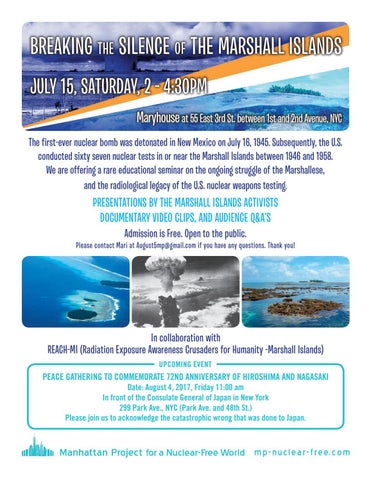
BREAKING the SILENCE of THE MARSHALL ISLANDS JULY 15, SATURDAY, 2 - 4:30PM Maryhouse at 55 East 3rd St. between 1st and 2nd Avenue, NYC The first-ever nuclear bomb was detonated in New Mexico on July 16, 1945. Subsequently, the U.S. conducted sixty seven nuclear tests in or near the Marshall Islands between 1946 and 1958. We are offering a rare educational seminar on the ongoing struggle of the Marshallese, and the radiological legacy of the U.S. nuclear weapons testing.
PRESENTATIONS BY THE MARSHALL ISLANDS ACTIVISTS DOCUMENTARY VIDEO CLIPS, AND AUDIENCE Q&A’S Admission is Free. Open to the public. Please contact Mari at August5mp@gmail.com if you have any questions. Thank you!
In collaboration with REACH-MI (Radiation Exposure Awareness Crusaders for Humanity -Marshall Islands) UPCOMING EVENT
PEACE GATHERING TO COMMEMORATE 72ND ANNIVERSARY OF HIROSHIMA AND NAGASAKI Date: August 4, 2017, Friday 11:00 am In front of the Consulate General of Japan in New York 299 Park Ave., NYC (Park Ave. and 48th St.) Please join us to acknowledge the catastrophic wrong that was done to Japan.
SOLIDARITY AGAINST THE US-JAPAN NUCLEAR ENERGY COOPERATION AGREEMENT
What is the US-Japan Nuclear Energy Cooperation Agreement? The official name of the treaty is: the Agreement for Cooperation Between the Government of the United States of America and the Government of Japan Concerning Peaceful Uses of Nuclear Energy. The treaty determines how nuclear-energy-related info, technology, nuclear material, equipment, components, services, spent fuel, etc. is handled in order to promote nuclear energy in Japan. The treaty became effective in July 1988 with a 30-year maturity date. Why do we need to pay attention to the Agreement now? The Agreement is about to mature in July 2018, and will be automatically extended unless one of the two participating countries notifies the other country six months prior to the termination. If the Agreement is extended in July 2018: • Japan will continue to promote nuclear energy as its energy policy. • Rokkasho Reprocessing Plant, a controversial facility in Japan, will be started in Fall 2018. • Japan will continue to be able to reprocess spent fuel, which is not allowed in any other non-nuclear weapon states. This creates tensions among countries in Northeast Asia. Japan currently has 48 tons of separated plutonium, which they don’t know what to do with. Depend ing on who controls the government, Japan could become a potential nuclear-weapon state. The copy of the current treaty is available here: https://nnsa.energy.gov/sites/default/files/nnsa/05-13-multiplefiles/2013-05-02%20 Japan_123.pdf What can we do to stop the automatic extension of the Agreement? Please reach out to elected officials, such as members of the US Congress, and raise concerns about this issue, because: • The Agreement only benefits the nuclear industry, and it is not in the best interest of the American people.
• The Agreement could impact the security of the Northeast Asian region and the rest of the world. • Promoting nuclear energy in a country with many active earthquake faults and active volcanoes creates a higher risk of having another nuclear disaster that could have global effects. • We are worried about security implications of Japan’s stockpile of 48 tons of separated plutonium in addition to the start-up of Rokkasho Reprocessing Plant which is scheduled for late 2018. Rokkasho could separate up to an additional 8 tons of plutonium annually in the facility. • The Japanese government has not been clear as to its policies on its use, management, storage, disposal and security of the 48 tons of plutonium. • Such a large stockpile of separated plutonium is a proliferation threat, could become a target to nuclear terrorism, and could become an environmental disaster if another nuclear accident happens. • Reprocessing of spent nuclear fuel requires excessive costs and has serious safety risks and environmental concerns, as we have seen at the Hanford Site. Instead of extending the treaty, the US and Japan could jointly cooperate to: • Discuss alternative energy policies and implement nuclear-free policies. • Review issues associated with Japan’s existing stockpile of 48 tons of separated plutonium, and analyze ways to safely and securely store them with independent third-party experts and all stakeholders, including those whose lands and waters are being put at risk. • Conduct risk assessment and comprehensive reviews on reprocess ing spent fuel in Japan. • Supply and exchange information and technology on how to contain and monitor Japan’s plutonium stockpile and radioactive waste materials from nuclear facilities and nuclear accidents in order to keep them out of the food, water, air, and land of local citizens for future generations.