www.ies.org.sg THE MAGAZINE OF THE INSTITUTION OF ENGINEERS, SINGAPORE
SEPTEMBER 2026 I MDDI (P) 002/03/2026
THE SINGAPORE ENGINEER
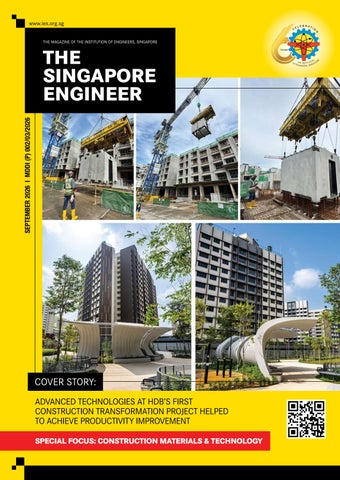
COVER STORY: ADVANCED TECHNOLOGIES AT HDB’S FIRST CONSTRUCTION TRANSFORMATION PROJECT HELPED TO ACHIEVE PRODUCTIVITY IMPROVEMENT SPECIAL FOCUS: CONSTRUCTION MATERIALS & TECHNOLOGY THE SINGAPORE ENGINEER I SEPTEMBER 2026
1
IES CHARTERED ENGINEERING BOARD
The Chartered Engineering Registry aims to provide professional recognition to qualified Engineers, Technologists and Technicians across all sectors. Being registered as a Chartered Engineering Professional will be an external validation of your experience, expertise and practising competence; and is a quality mark to differentiate your professional standing in the following sectors of engineering: Aerospace
Built Environment
Chemical & Energy
Environment & Water
Engineering Project Management
Infrastructure
Railway & Transportation
Renewable Energy
Sustainability
Systems
cebsg.org ies.org.sg
Organised by:
Supported by:
4 – 6 November 2026 | Suntec Singapore Convention and Exhibition Centre
8,000+
300+
Trade Attendees
Exhibitors
500+
125+
Conference Delegates
Speakers
50+
Countries Represented
Drive the Future – Autonomous Innovation, Smart Infrastructure, and Urban Mobility Singapore Urban Mobility Week (SUMW) unites the land transport ecosystem through a comprehensive exhibition, the Leaders Summit, and Industry Forums, showcasing the policies, technologies, and partnerships shaping the future of urban mobility.
Spanning Key Transport Sectors
As a key platform for solution providers, policymakers, and operators, SUMW facilitates business matchmaking, networking, policy dialogue, and high-level discussions on emerging trends and investment priorities across Asia.
Public & Multi-Modal Transport
Autonomous, Electric & Connected Vehicles
Intelligent Transport Systems (ITS) & Digital Technologies
Infrastructure & Urban Transport Planning
Energy, Sustainability & Charging Solutions
Logistics & Last-Mile Innovation
SUMW 2026 at a Glance Exhibition Showcase
Hosted Buyer Programme
Technical Visits
Leaders Summit
Industry Forums
AV Regulators Forum (By-Invite-Only)
How You Can Participate Attend the Conference Secure your Conference Pass for access to the Leaders Summit and Industry Forums, featuring 120+ speakers, real-world case studies and actionable insights across three days.
REGISTER NOW
Register by 30 September and save up to 20% on 3-Day Conference Passes.
Visit the Exhibition
REGISTER NOW
Explore products, technologies and solutions shaping the future of urban mobility — from autonomous transport and AI-driven systems to smart infrastructure and sustainable solutions. Free registration for trade visitors
sgurbanmobility.com
@sgurbanmobility
High-Level Networking
President Mr Mervyn Sirisena
CONTENTS
Chief Editor Mr T Bhaskaran t_b_n8@yahoo.com Executive Director Mr Syafiq Shahul
IES UPDATE 04
Publications Manager Mr Desmond Teo desmond@iesnet.org.sg
Celebrating the successful completion of GELP 2026!
NEWS & EVENTS 06
Contributions to science and technology honoured at PSTA 2026
08
Connect-X 2026 brings sustainability, technology and growth down to practical decisions
10
bauma CHINA 2026 advances global industry exchange with new dual-venue format
12
Cross Island Line Phase 3 to connect Jurong Lake District to Gul Circle with four new stations
COVER STORY 14
Advanced technologies at HDB’s first Construction Transformation Project helped to achieve productivity improvement
SPECIAL FOCUS: CONSTRUCTION MATERIALS & TECHNOLOGY 17
Design & layout by 2EZ Asia Pte Ltd Published by The Institution of Engineers, Singapore 70 Bukit Tinggi Road, Singapore 289758 Tel: 6469 5000 Email: publications@iesnet.org.sg
Turning plastics waste into resilient building materials Cover designed by Irin Kuah
Three engineering firsts showcase how Singapore can build safely
04
Cover images by HDB
06
IES UPDATE
15
NEWS & EVENTS
19
COVER STORY 02
Media Representative Trevor Teh TSE@mnc-link.com
Printed in Singapore
DESIGN AND ENGINEERING SAFETY 18
Editorial Panel Er. S Yogeeswaran Dr Chandra Segaran Dr Ang Keng Been Dr Aaron Sham Mr Jaime Vega Bautista Jr
DESIGN AND ENGINEERING SAFETY THE SINGAPORE ENGINEER I SEPTEMBER 2026
ENVIRONMENT & WATER ENGINEERING 21
Economic resilience in Southeast Asia starts with designing with water
24
Meiden Singapore to commence operation of demonstration plant that will use Flat-sheet Ceramic Membrane in seawater desalination
25
Jacobs appointed to deliver feasibility study for potential desalination plant in Singapore
WORKPLACE SAFETY & HEALTH 26
Workplace major injury rate reaches all-time low in 1H 2026
28
Record 367 recipients honoured at WSH Awards 2026
29
Updated scaffold fire safety requirements
RAILWAY & TRANSPORTATION ENGINEERING 30
Why more data does not mean better engineering decisions
PROJECT APPLICATION 32
Tunnel boring machine completes Elbe Underpass
34
Moving a large protective canopy from one building to another in Sweden
36
Engineering solutions for construction of a complex cable-stayed bridge
37
Crane-independent building redevelopment
The Singapore Engineer is published monthly by The Institution of Engineers, Singapore (IES). The publication is distributed free-of-charge to IES members and affiliates. Views expressed in this publication do not necessarily reflect those of the Editor or IES. All rights reserved. No part of this magazine shall be reproduced, mechanically or electronically, without the prior consent of IES. Whilst every care is taken to ensure accuracy of the content at press time, IES will not be liable for any discrepancies. Unsolicited contributions are welcome but their inclusion in the magazine is at the discretion of the Editor.
PRODUCTS & SOLUTIONS 38
Duty cycle crane for hydraulic engineering
39
Generational change in the control of specialist foundation engineering equipment
40
Driver assistance system promotes safety on construction sites
24
30
ENVIRONMENT & WATER ENGINEERING
32
RAILWAY & TRANPORTATION ENGINEERING
39
PROJECT APPLICATION THE SINGAPORE ENGINEER I SEPTEMBER 2026
PRODUCTS & SOLUTIONS 03
IES UPDATE
Celebrating the successful completion of GELP 2026! The Global Engineers Leadership Programme (GELP) 2026, jointly organised by IES Academy (IESA) and NTUC PME, in collaboration with NUS, was successfully completed on 25 September 2026! Held over five days and themed ‘AI and the Reshaping of Jobs’, GELP 2026 brought together senior engineering and business leaders to explore how AI, technology, geopolitics and industry disruption are shaping the future of engineering. PROGRAMME HIGHLIGHTS Ministerial dialogue Participants engaged in a dialogue with Dr Tan See Leng, Minister for Manpower and Ministerin-charge of Energy and Science & Technology in the Ministry of Trade and Industry, moderated by Associate Professor Chai Kah Hin, Dean, NUS School of Continuing and Lifelong Education (NUS SCALE).
NUS leadership sessions Participants explored creative problem solving, geopolitics and industry disruption, Generative AI, responsible AI leadership and leadership development, through the NUS course series ‘Design and Engineering Leaders of the Future’. Capstone presentations Participants applied their learning through group capstone projects, presenting their opportunity and risk analyses, and recommendations.
Fireside chat The programme opened with a welcome address by IES President Mr Mervyn Sirisena, followed by a fireside chat with Mr Danny Kim, Founder and CTO, FullArmor Corporation, on ‘From Cyber Startup to Global Markets – The Crucial Importance of Trust and Integrity’, moderated by Mr Lew Yii Der, Vice President (Professional Development), IES.
Graduation dinner & panel discussion The programme concluded with a panel discussion on ‘Impact of AI and Robotics on Engineering Design and Production’, moderated by Mr David So, Senior VicePresident, SIA Engineering Company. The following panel members took part in the discussion: • Dr Marcelo H Ang Jr – Professor, Mechanical Engineering, NUS • Mr Poon King Wang – Chief Strategy and Design AI Officer, SUTD • Mr James Kok – Head, Strategic Partnerships, AI Singapore (AISG) • Mr William Lee – Roboticist AI – Stealth AI Startup Congratulations to all GELP 2026 participants! We applaud our participants for their resilience and commitment to professional growth.
Participants engaged in a dialogue with Minister Dr Tan See Leng (on right).
The programme included a fireside chat with Mr Danny Kim (on left), from FullArmor Corporation.
GELP 2026 participants and guests who attended the engaging event, with Minister Dr Tan See Leng.
04
THE SINGAPORE ENGINEER I SEPTEMBER 2026
WE’RE 60!
THANK YOU FOR SIXTY YEARS OF UNWAVERING SUPPORT AND COMMITMENT TO ENGINEERING EXCELLENCE. WE ARE HONOURED TO CELEBRATE THIS DIAMOND JUBILEE MILESTONE WITH YOU AS WE BUILD A RESILIENT AND INNOVATIVE FUTURE TOGETHER.
www.ies.org.sg
NEWS & EVENTS
Contributions to science and technology honoured at PSTA 2026
Group photo of the winners with President Tharman Shanmugaratnam and NRF Chairman Mr Heng Swee Keat: First row, from left to right, Mr Wu Jian, Er. Lee Chuan Seng, President Tharman Shanmugaratnam, Mr Heng Swee Keat and Prof Wu Jishan. Second row, from left to right, Dr Liu Boxiang, Dr Yu Shengkai, Mr Thomas Ting, Mr Tan Ren Kai and Dr Hou Yi. Image: National Research Foundation.
The President’s Science and Technology Awards (PSTA) 2026 has celebrated the scientists, engineers and research leaders who have made exceptional contributions to Singapore’s science and technology ecosystem. Organised by the National Research Foundation, Singapore (NRF), the awards comprise the President’s Science and Technology Medal (PSTM), the President’s Science Award (PSA), the President’s Technology Award (PTA), and the Young Scientist Award (YSA). President Tharman Shanmugaratnam and NRF Chairman Mr Heng Swee Keat presented the awards to the following recipients: PSTA (presented by the President) • PSTM: Er. Lee Chuan Seng, Chairman, Committee of Government Scientific Advisors • PSA: Professor Wu Jishan, Provost’s Chair Professor, Department of Chemistry, Faculty of Science, National University of Singapore (NUS) • PTA: Mr Wu Jian, Programme Director for Connectivity and Principal Metrologist; Dr Yu Shengkai, Senior Principal Scientist; and Mr Tan Ren Kai, Research Engineer, all from the Agency for Science, Technology and Research (A*STAR) National Metrology Centre; and Mr Thomas Ting Cheng Heong, Director (Technology and Innovation) and Chief Digital Officer, Maritime and Port Authority of Singapore (MPA) YSA (presented by NRF Chairman) • Biological and Biomedical Sciences: Dr Liu Boxiang, Presidential Young Professor, Department of Pharmacy and Pharmaceutical Sciences, Faculty of Science, NUS 06
• Physical, Information and Engineering Sciences: Dr Hou Yi, Presidential Young Professor, Department of Chemical and Biomolecular Engineering, College of Design and Engineering, NUS Professor Tan Chorh Chuan, Permanent Secretary (National Research and Development), said, “The calibre of the PSTA recipients reflects the strength and depth of Singapore’s research ecosystem, from foundational science to real-world innovation. Their work has pioneered system-of-systems approaches to synergise major national projects, advanced the frontiers of key scientific fields, and developed innovative solutions that have enhanced Singapore’s competitiveness.” “In recognising these outstanding leaders, we also celebrate the work and achievements of our wider community of researchers, engineers, and innovators whose quiet passion for solving hard problems has produced innovations that benefit both society and industry. Their collective example inspires future generations of scientific leaders,” he added. Winner of the PSTM The PSTM is the apex award of the PSTA, recognising individuals who have shaped the science and technology ecosystem itself, rather than a single discovery or technology. This year’s recipient, Er. Lee Chuan Seng, is known for pioneering a ‘system of systems’ approach to national planning, in which Singapore’s land, energy, water and infrastructure needs are planned together rather than separately, to achieve better system-level synergies. He provided valuable thought leadership and guidance in several national-level feasibility studies, spanning multiple areas such as the following: THE SINGAPORE ENGINEER I SEPTEMBER 2026
NEWS & EVENTS
IES congratulates Er. Lee Chuan Seng On behalf of the Council and Members of the Institution of Engineers, Singapore (IES), Mr Mervyn Sirisena, President, IES, congratulated Er. Lee Chuan Seng on his being conferred the prestigious President’s Science and Technology Medal Er. Lee Chuan Seng (PSTM), by President Tharman Shanmugaratnam. In a letter to Er. Lee, Mr Sirisena said, “This recognition is a fitting tribute to your decades of visionary leadership, professional excellence and steadfast commitment to advancing Engineering, Sustainability and Innovation in Singapore.” Focusing on various aspects of Er. Lee’s distinguished career, that have made an enduring impact across many facets of Singapore’s development, Mr Sirisena pointed to Er. Lee’s leadership in the joint BCA-SPRING Committee to develop the CAD Standards CP83, which paved the way for electronic submissions through CORENET, marking an important milestone in the digital transformation and productivity of Singapore’s construction industry. Mr Sirisena also mentioned that, as Founding President of the Singapore Green Building Council, Er. Lee championed the advancement of green building practices and contributed to the development of Singapore’s Green Mark benchmarks. He stated that Er. Lee’s contributions have also extended to Environmental Governance, through his leadership of the National Environment Agency Board, to National Research, by guiding national
• Underground space as a strategic resource, including the Gali Batu Caverns feasibility study. • Large-scale solar power integration and battery energy storage systems that will help keep the power grid stable as more renewable energy comes online. • Green Mark standards that shaped energy-efficient, environmentally sustainable building design into standard industry practice, alongside innovations such as upcycling of waste residues into construction materials, contributing to Singapore’s goal of becoming a Zero-Waste Nation. Within the RIE ecosystem, Er. Lee has contributed significantly in various capacities. He has been the Chairman of the Committee of Government Scientific Advisors since October 2023, providing scientific advice on major R&D initiatives undertaken under THE SINGAPORE ENGINEER I SEPTEMBER 2026
research priorities through the Committee of Government Scientific Advisors for the National Research Foundation, and Engineering Education, through his service in key IES Engineering Accreditation Board evaluation panels, which has strengthened Singapore’s capabilities, while ensuring the highest international standards in Engineering were upheld. Mr Sirisena also highlighted Er. Lee’s contributions to IES. “As an esteemed IES Fellow and longstanding member of the IES family, IES is especially pleased to celebrate this proud moment with you. Your more than 10 years of service on the IES Council, including your tenure as IES Vice President from 1995 to 2006, have contributed significantly to the advancement of IES and the Engineering profession. Your receipt of the IES-IEEE Joint Medal of Excellence in 2019 demonstrates the high regard your contributions are held by the engineering community,” Mr Sirisena said in the letter. “The President’s Science and Technology Medal is therefore not only a celebration of your exceptional personal achievements, but also a recognition of the lasting and profound influence you have had on Singapore’s Engineering, Built Environment, Sustainability and Innovation landscape. Your distinguished career exemplifies the very best of the engineering profession and serves as an inspiration to present and future generations of engineers,” he added. “We wish you continued success and look forward to your continued contributions to IES and the wider engineering fraternity in Singapore.” Mr Sirisena said, in conclusion.
RIE2025 and the plans for RIE2030. As Chairman of the Urban Solutions and Sustainability (USS) Technical Advisory Workgroup, he drove the development of the USS RIE2025 Masterplan. He continues to serve as Scientific Advisor to the Ministry of National Development and the National Environment Agency. National Research Foundation The National Research Foundation, Singapore (NRF), set up on 1 January 2006, is a department within the Prime Minister’s Office. The NRF sets the national direction for research and development (R&D) by developing policies, plans and strategies for research, innovation and enterprise. It also funds strategic initiatives and builds up R&D capabilities by nurturing research talent. 07
NEWS & EVENTS
Connect-X 2026 brings sustainability, technology and growth down to practical decisions
The event attracted around 110 attendees.
From lifecycle costs and material choices to AI and workforce readiness, Singapore’s inaugural Connect-X briefing examined the questions behind change in the built environment. Held on 14 August, at the NTUC Centre in Singapore, Connect-X 2026 addressed questions such as: • Who pays for sustainability over the long term? • What problems should technology solve? • How must businesses and people adapt as the industry changes? Organised by Quantum APAC and The Future Atlas, the inaugural event brought together around 110 practitioners across development, architecture, design, technology, materials and business transformation. In the programme, speakers tested sustainability and technology against practical considerations – whether a decision addresses a real problem, improves the way a business or project works, and creates value over time. “Connect-X was built on the belief that challenging market conditions call for stronger connections, honest conversations and a shared commitment to action. The value of the evening extended beyond the stage. It was present in the exchange of experience, the questions being asked and the new relationships formed,” said Nish P K N, Executive Director and Founder of Quantum APAC. The programme opened with an address by Allen Ang, BBM, Executive Vice President and Head of Green Building, Decarbonisation and Safety at City Developments Limited. Ang asked, “How do we build better, work smarter and create more value with less?” His address considered how businesses could 08
Allen Ang, Executive Vice President and Head of Green Building, Decarbonisation and Safety at City Developments Limited, presents the Opening Address.
reduce carbon, energy, waste and manpower, while improving performance. It linked sustainability to direction, technology to useful tools and collaboration to scale, with people responsible for putting each into practice. In his keynote on ‘Sustainability, Cost Pressure & Commercial Decision Making’, Chew Teck Soon, Independent Advisor to Boards and Senior Executive Advisor in AI, Sustainability Strategy and Governance, examined sustainability through the question of who bears the cost of present consumption and deferred investment. Using four building cases, he showed how decisions made today can shift costs to future owners, users or the wider public. He also proposed closer scrutiny of sinking fund schedules so that future liabilities are recognised before failures occur. He concluded, “The money always gets paid. The only question is by whom, and when.” Jean Leong’s presentation on behalf of Main Partner Goodrich Global brought the focus on long-term THE SINGAPORE ENGINEER I SEPTEMBER 2026
NEWS & EVENTS value into material selection. Leong, Regional Head of Marketing and Branding Communications, used project examples to explain how material choices affect environmental performance, aesthetics, durability and commercial value. Her examples included choosing different carpet constructions for different uses, applying digital printing to bespoke surfaces and integrating acoustic performance into material solutions. Her practical recommendations included considering lifecycle costs, selecting materials for their intended application and involving material specialists earlier in the design process. Leong closed her presentation with the statement, “Every material decision is more than a design decision. It is a business decision.” The realities of organisational change were explored during a fireside discussion with Serene Kwok, Founder and Chief Transformation Strategist at Bluehive Consulting. The discussion was facilitated by Candice Lim, Regional Director, Editorial & Content Strategy at Quantum APAC and Founder of The Future Atlas. Drawing on her work with small and mediumsized businesses, Kwok discussed how duplicated work, fragmented information, inconsistent processes and misaligned management priorities can impede transformation. Technology may form part of the response, but the starting point is understanding how the business currently operates and what needs to improve. Kwok summarised the approach in three steps. “Start with the problem. Improve the process. Then decide on the technology,” she said. A panel discussion on ‘Rethinking Growth: Building Sustainable, Competitive and Future-Ready Businesses’, was moderated by Muhammad Khalil Shaiful, Senior Vice President, Group Technology Office at Boustead Singapore. The panellists were Lauren Ang, Managing Principal of Adapt D&B; Webb Poh, Founder of BuiltChat; and Ar. Lin Hongsui, Director of ID Architects. They discussed technology and AI, workforce readiness, skilled labour shortages and the practical demands of business transformation. AI and digital systems were considered as tools that can support decisions, productivity and project delivery. Design still depends on creativity, professional judgement and accountability, together with the physical and tactile experience of being present in a space. The discussion also considered the demands facing young designers entering practice. They need patience to work through difficult assignments and see them through, while becoming familiar with the tools and working methods they encounter after graduation. Their design education provides the foundation. Changing digital and AI-enabled workflows make continued learning and adaptation part of professional practice. THE SINGAPORE ENGINEER I SEPTEMBER 2026
Taking part in the panel discussion were, from left, Muhammad Khalil Shaiful (the moderator), Webb Poh, Lauren Ang and Lin Hongsui.
The presentation programme concluded with “Context Beyond Borders” by Yun Wai Wing, Director of SPARK Architects. Through projects undertaken across the region, Wing showed how design decisions must respond to local climate, regulation, delivery conditions, user expectations and cultural context, as architectural practices work across different markets. Attendees also valued the composition of the room and the opportunity for exchange. Vinson Chua, Co-founder of Lumani Pte Ltd, noted the quality and breadth of participation, spanning industry stakeholders and ecosystem providers. Lin Jun Yao of Chan & Chan Engineering said the evening created opportunities to reconnect with familiar colleagues, meet new people and think more deeply about the industry. “We learnt a great deal from our first Connect-X. Friday gave us a clear answer – the idea was relevant, it resonated and there is every reason to take Connect-X further,” said Lim. Goodrich Global was the Main Partner for Connect-X 2026. Sika and Wynist were Strategic Partners. ARDEX Quicseal, Breezway, Climate Asia, Dow, Hunter Douglas and Leetsteel supported the event as Supporting Partners. Bluehive Consulting was the event’s Collaborator. Quantum APAC Quantum APAC works with organisations across Asia-Pacific through market analytics, industry media, targeted events and commercial advisory. Its work connects businesses, industry stakeholders and decision-makers through market insight, focused dialogue and regional engagement. The Future Atlas The Future Atlas is a content-driven platform exploring sustainability, urban futures, design, technology, culture and the systems shaping how we live. Through editorial publishing, visual storytelling and curated exchange, it brings practitioner knowledge and regional perspectives into wider discussion. 09
NEWS & EVENTS
bauma CHINA 2026 advances global industry exchange with new dual-venue format bauma CHINA 2026, the International Trade Fair for Construction Machinery, Building Material Machines, Mining Machines and Construction Vehicles, is entering a new stage of development. At a press conference held in Shanghai on 12 August 2026, the organisers, Messe München, presented the latest preparations for the upcoming trade fair, including the implementation of the new ‘One Show, Two Venues’ concept, the supporting programme and the launch of the Global Buyer Invitation Program. Under the theme ‘New Quality, Boundless Innovation, Shared Future’, bauma CHINA 2026 aims to strengthen technological exchange, business cooperation and international market development across the construction machinery industry. Record scale across two Shanghai venues For the first time, bauma CHINA will take place at two exhibition venues in Shanghai. The Shanghai World Expo Exhibition & Convention Center (SWEECC) will host the show from 23 to 26 November, while the Shanghai New International Expo Centre (SNIEC) will open from 24 to 27 November 2026. Stefan Rummel, CEO of Messe München, outlined the latest progress of show preparations. “The introduction of the ‘One Show, Two Venues’ format marks a significant milestone for bauma CHINA. It reflects the strong demand from exhibitors driven by China’s ongoing growth in the construction machinery industry, while also addressing the sector’s ongoing transformation towards intelligent, green and high-end development,” he said. Together, the two venues will provide a record exhibition area of 400,000 m2. Close to 4,000 exhibitors from more than 30 countries and regions are expected to participate. SNIEC will continue to cover the full construction machinery value chain, including large-scale machinery, mining and building material equipment, construction vehicles, components, power transmission and fluid technology. SWEECC will complement these sectors with a stronger focus on emerging technologies, industry ecosystems, conferences and live demonstrations. A unified ‘One Badge, Two Venues’ system and complimentary shuttle buses will connect the two locations. The official WeChat Mini Program and AI-supported customer service will provide additional digital services. Strong participation from international and Chinese manufacturers Leading international exhibitors include Caterpillar, 10
Wirtgen Group, Komatsu, Fayat Group, Hyundai Doosan Infracore, Skyjack and Ammann. Major Chinese manufacturers include XCMG, SANY Group, Zoomlion, Shantui, Lingong (SDLG), LiuGong, Zhejiang Dingli, Lonking, NFLG, Lovol Heavy Industry, Sinoboom, CRCHI and Sunward Intelligent. Several companies are planning exhibition presences at both venues. Global Buyer Invitation Program launched bauma CHINA also announced the launch of its 2026 Global Buyer Invitation Program. Building on the international bauma NETWORK and cooperation with industry partners, the programme will target professional buyer delegations from Southeast Asia, the Middle East, Africa, Europe and the Americas. Within China, associations, industry organisations and media partners will support visitor outreach and business matching, helping to connect international buyers with Chinese manufacturers and suppliers. Focus on innovation, green development and international markets The supporting programme will address technological innovation, international market development, electrification, green transformation, mining, digitalisation and intelligent machinery. Planned events include the Construction Machinery Innovation Conference and the Construction Machinery Marketing & Business Matching Conference, in cooperation with China Construction Machinery Association (CCMA), the 2026 Construction Machinery Electrification & Green Development Conference with China Council for the Promotion of International Trade Machinery Industry Sub-Council (CCPIT-MSC), and the Global Attachments Forum (GAF) with China Construction Machinery Co Ltd (CNCMC). Live equipment demonstrations and remote-control operation experiences will complement the conference program. Chinese construction machinery industry maintains growth momentum Speaking on behalf of the Chinese co-organisers, Su Zimeng, Chairman of the CCMA, highlighted the continued development of China’s construction machinery sector. According to preliminary CCMA statistics, revenue among key member enterprises increased by 15.5% year on year, in the first half of 2026. Based on Chinese customs data compiled by the association, construction machinery import and export trade THE SINGAPORE ENGINEER I SEPTEMBER 2026
NEWS & EVENTS reached USD 35.627 billion, up 20.5%, while exports increased by 21.7% to USD 34.373 billion. New-energy construction machinery also maintained strong momentum. Sales of electric wheel loaders reached 25,445 units in the first half of 2026, up 82.4% year on year, while electric excavator sales increased by 129% to 321 units. Automation, Artificial Intelligence and other next-generation technologies are also expanding across the sector. “At bauma CHINA 2026, exhibitors will present new technologies and solutions ranging from complete machines and core components to new-energy powertrains and digital-intelligent applications. The exhibition will reflect the continued transformation and growing international orientation of China’s construction machinery industry,” said Su Zimeng, Chairman of CCMA. Exhibitors prepare for bauma CHINA 2026 XCMG, which has participated in bauma CHINA since 2002, plans to present a new generation of equipment and scenario-based solutions for intelligent,
new-energy and green construction applications. “bauma CHINA is both a showcase for industry innovation and an important opportunity for XCMG to engage directly with customers and the market,” said Chen Xiaodong, bauma CHINA project lead at XCMG. SANY Group will exhibit at both venues, with nearly 10,000 m2 across four exhibition zones. The company plans to showcase developments ranging from construction machinery and intelligent technologies to AI- and robotics-related applications. The 2026 edition also coincides with SANY Group’s 40th anniversary. With its dual-venue concept, expanded international participation and new global buyer programme, bauma CHINA 2026 will further strengthen connections between China and global markets under the theme ‘New Quality, Boundless Innovation, Shared Future’. All images by Messe Muenchen Shanghai
Some of the exhibits at bauma CHINA 2024, the previous edition of the event. THE SINGAPORE ENGINEER I SEPTEMBER 2026
11
NEWS & EVENTS
Cross Island Line Phase 3 to connect Jurong Lake District to Gul Circle with four new stations
Annex B
The Land Transport Authority (LTA) has announced the alignment and station locations for the Cross Island Line Phase 3 (CRL3). CRL3 will extend the CRL westwards from CR19 station in Jurong Lake District to CR23 station at Gul Circle, enhancing rail connectivity in Singapore’s western region and cutting travel times.
Alignment of CRL3 and CRL
Better accessibility and time savings for commuters in the west CRL3 will provide residents CRL3 alignment and workers in the west with more direct and convenient rail travel options. When CRL3 is completed, commuters travelling to and from the western parts of Singapore using the CRL can expect time savings of up to 50 minutes. CRL3 is approximately 10 km and comprises four underground stations – CR20, CR21, CR22 and CR23 stations. Two of the four stations will be interchange stations, with CR21 station connecting commuters to the Jurong Region Line at JS12 station, and CR23 station connecting to the East-West Line at Gul Circle station. Together with other ongoing rail expansion projects, CRL3 will expand Singapore’s rail network to more than 360 km. As part of CRL3, a second CRL rail depot of approximately 23 hectares will be constructed at the former Raffles Country Club site, to provide maintenance facilities and stabling for the CRL train fleet. This will be co-located with a multi-storey bus depot, to provide parking, charging and maintenance facilities for public buses. Construction works for CRL3 are expected to commence in 2027, with the stations targeted to open by the late 2030s. Noise and vibration impact studies will be conducted prior to the commencement of CRL3 construction works. LTA will engage and work closely with stakeholders to implement comprehensive mitigating measures to address construction noise, dust, safety and traffic concerns. Land acquisition To facilitate the construction of CRL3 and related road works, the Government will need to acquire 12
CRL3 alignment
seven industrial properties. In addition, eight industrial properties will be partially acquired. These partial acquisitions will largely affect ancillary features such as green verges and boundary fences. The Singapore Land Authority (SLA) has gazetted the acquisition of the affected land. SLA and LTA will work closely with the affected parties and assist them through the acquisition process. The CRL The CRL will be Singapore’s eighth and longest, fully underground MRT line at around 67 km long, when completed. It will serve existing and future developments in the eastern, western and northeastern corridors, linking major hubs such as Changi, Punggol Digital District, Jurong Lake District and Tuas. CRL alignment It will also provide additional, alternative travel options for commuters, thus reducing crowding across other parts of the rail network. When fully completed, the CRL is expected to have a daily ridership of at least 600,000 in the initial years, growing to one million in the longer term. Phase 1 of the CRL is approximately 29 km long and comprises 12 stations. Construction works for Phase 1 are well in progress and is expected to be completed by 2030. The CRL-Punggol Extension, which is around 7 km long and comprises four stations, is targeted for completion in 2032. CRL Phase 2 spans around 15 km with six stations, and is targeted for completion in 2032. Works are also underway for an approximately 6 km extension from CR2 station to CR1/TE32 station at Changi Terminal 5. THE SINGAPORE ENGINEER I SEPTEMBER 2026
COVER STORY
Advanced technologies at HDB’s first Construction Transformation Project helped to achieve productivity improvement Successful innovations being adopted in other BTO projects.
Garden Waterfront II @ Tengah, the first of two BTO projects under the Construction Transformation Project, was completed in June 2026.
Garden Waterfront II @ Tengah, the first Construction Transformation Project (CTP) of the Housing & Development Board (HDB), has been completed, marking a key milestone in HDB’s efforts to transform the way public housing is built. The second project, Garden Waterfront I @ Tengah, is on track for completion by the end of 2026. Through the use of advanced construction technologies and more productive building methods, both Build-To-Order (BTO) projects are on track to achieve the targeted 25% improvement in site productivity over the projected baseline productivity rate of 0.6 m²/man-day. Site productivity is defined as the amount of constructed floor area completed per man-day. A project is deemed to be more productive if more square metres of floor area can be constructed with the same man-days. Launched in 2022, in partnership with Obayashi Singapore Pte Ltd, the CTP was conceived as a testbed for HDB to trial new ways of building more productively and safely, with less reliance on manpower. The 25% improvement in site productivity was achieved through a combination of measures, including greater prefabrication and the adoption of technologies which enabled tasks to be 14
completed with greater precision in a shorter time. Several innovations are now being adapted and progressively introduced in other BTO projects, enabling HDB to reap productivity gains on a wider scale, as it continues to deliver a strong supply of homes for Singaporeans. HDB’s Deputy Chief Executive Officer (Building), Dr Johnny Wong said, “As Singapore’s largest housing developer, HDB is constantly looking for more innovative and efficient ways to build at scale. Garden Waterfront gave us the opportunity to test new technologies and construction methods in an actual BTO development and learn what works.” “We are now taking the successful innovations beyond this testbed and applying them more widely. This is part of our continued efforts to make construction safer, more productive and less manpower-intensive, while delivering quality homes for Singaporeans,” he added.
TAKING SUCCESSFUL INNOVATIONS BEYOND THE CTP Greater standardisation and more flexibility One area explored under the CTP was how greater standardisation and prefabrication could make THE SINGAPORE ENGINEER I SEPTEMBER 2026
COVER STORY construction more productive, without compromising the design of HDB flats. At Garden Waterfront I & II @ Tengah, HDB adopted a fabrication system that allowed more structural works to be completed off-site, reducing the volume and complexity of work required on-site. This reduced crane usage and manpower requirements, while easing coordination demands and site congestion, enabling works to proceed more efficiently. Differences between HDB flats with beams (images on the left) and the beamless system which was adopted for the CTP at Additionally, by using more Garden Waterfront (images on the right). standardised, prefabricated building components and moulds that can be replicated and produced at scale, the modular system reduces reliance on manual labour and improves construction productivity. Such higher level of standardisation also allows common precast components to be used across more HDB projects, giving HDB greater flexibility to redirect supply where needed, The Intelligent Lifting Frame (ILF) uses real-time sensing to detect any imbalance. The operator can fine-tune the lifting thereby strengthening the points via a controller for more precise load positioning – all from a safer distance. resilience of HDB’s building programme. Building on this technology, HDB has developed an Building on this modular design, HDB subsequently Intelligent Lifting Frame (ILF) in collaboration with developed flats with beam- and column-free living the National University of Singapore and A*STAR. spaces, giving residents greater flexibility to configure Using real-time sensing, the ILF can detect imbalances their homes according to their needs. This design has and enable the crane operator to remotely fine-tune since been rolled out to a total of six projects to date, the lifting points. This keeps heavy loads level, including projects in Bayshore, Bukit Merah, Kallang / minimises swaying, and enables precast components to Whampoa and Mount Pleasant. be positioned more accurately – allowing workers to operate from a safer distance. MAKING HEAVY LIFTING OF PRECAST The technology has the potential to improve COMPONENTS SAFER AND MORE productivity for the lifting process by up to 30%. The PRODUCTIVE ILF has been trialled in a Jurong West BTO project Lifting large and heavy precast components into and is currently undergoing further refinement before position is an integral part of HDB construction. wider deployment. Traditionally, several workers are needed to manually guide and adjust the orientation of these components PUSHING THE POSSIBILITIES OF 3D as they are lifted by cranes. CONCRETE PRINTING Under the CTP, HDB piloted the SkyJuster, a The CTP also enabled HDB to explore new gyroscopic device that controls the rotation and possibilities with 3D concrete printing, to create stabilisation of lifted precast components during lifting complex architectural forms, without the moulds and operations. Used together with a tower crane, the formwork typically required in conventional methods. SkyJuster reduced the number of workers required One example is the botanic arbor at the common to manually guide and adjust the components into green between Garden Waterfront I and II @ Tengah. position while they are being lifted and installed. THE SINGAPORE ENGINEER I SEPTEMBER 2026
15
COVER STORY Comprising 22 uniquely shaped, curved segments, the structure was ‘printed’ at HDB’s Centre of Building Research at Woodlands. Measuring up to 13.6 m in length, 3.7 m in width, and 3.6 m in height, the arbor is the largest 3D printed freestanding landscape structure in an HDB development to-date. The structure was fabricated using a combination of 3D concrete printing and cast infill, with new fibre-reinforced concrete materials. Through parametric modelling – a Located next to the adult and elderly fitness corners at the common green, the curvilinear structure provides a sheltered smart rule-based digital communal space where residents of all ages can gather, exercise and enjoy the surrounding greenery. design process – and structural analysis, HDB and Obayashi optimised the important step in HDB’s longer-term efforts to thickness of each segment, reducing the volume of transform how public housing is built. The experience concrete required, by an estimated 50% compared to from Garden Waterfront I and II @ Tengah has a conventionally built structure of equivalent size. demonstrated how new technologies can translate into tangible productivity gains and be progressively scaled BRINGING INNOVATION INTO THE HOME across HDB’s building programme. Innovation under the CTP extends beyond how flats Building on the learnings from the CTP, HDB will are built, to how residents can live more sustainably continue to work with industry and research partners in their homes. Garden Waterfront I and II @ Tengah to explore the next generation of construction are the first BTO projects in Tengah where flats will solutions. This includes harnessing the growing be equipped with a Smart Adapter which enables capabilities of Artificial Intelligence and advanced residents to monitor their household electricity robotics, as well as standardising more precast consumption in real time. components, to develop solutions that can be deployed at scale. This will enable HDB to build FROM TESTBED TO WIDER TRANSFORMATION more productively and efficiently while continuing to The completion of the first CTP project marks an deliver quality homes for Singaporeans.
Smart Adapter piloted at Garden Waterfront I and II @ Tengah Developed in collaboration with M1 Net Ltd and STARSG Technology Pte Limited, the Smart Adapter connects to a dedicated mobile application, giving residents greater visibility of how much electricity they use. This helps them make more informed decisions about their consumption and adjust their usage habits to save energy. More than 2,000 flats across Garden Waterfront I and II @ Tengah will be equipped with the Smart Adapter, with plans to extend the rollout to about 5,600 more homes across four projects in Tengah. The Smart Adapter and basic energy-monitoring service are provided at no cost to residents. Those who want more detailed information on their energy use can also choose to subscribe to Smart Home packages offered by commercial vendors.
16
The Smart Adapter is installed alongside the Smart Distribution Board in the service closet within the flat. The adapter lets residents monitor their energy usage via an app.
THE SINGAPORE ENGINEER I SEPTEMBER 2026
SPECIAL FOCUS: CONSTRUCTION MATERIALS & TECHNOLOGY
Turning plastics waste into resilient building materials Atlas Building Composites is commercialising MIT research to turn plastics waste into parts for buildings and other infrastructure. The world needs more homes. The world also has too much plastics. Perhaps the only thing those two problems have in common is that they are hard to solve. Atlas Building Composites, a spin-off from MIT, is on a mission to address both problems with a single solution. The company has developed an AI-powered robotic manufacturing platform capable of turning single-use plastics into durable building materials. The company emerged from ‘Home Architecture for Universal Sustainability’or ‘MIT HAUS’, a research effort in the MIT Department of Mechanical Engineering. Atlas uses waterless plastics recycling and large-scale composite additive manufacturing technology to make parts like home foundations, decks and trusses for walls, floors and roofs. “Our mission is to convert waste plastics pollution into durable composites to build 1 billion homes,” says Atlas chair and co-founder A J Perez who is also an MIT research scientist. Atlas’ parts are already being used to support barns, sheds, decks and docks. Most recently, the company supplied the US Army Corps of Engineers with American-made recycled composite trusses to construct a 40 ft bridge in a Massachusetts wetland. Perez and Atlas co-founder Matt Pouliot envision deploying thousands of their AI robotic production systems around the world. A key enabler for that scale is the company’s ability to recycle low-grade plastics into building components, without water. Research for impact Since earning his PhD at MIT, Perez has been developing advanced fabrication techniques for homes and new techniques for plastics recycling. Perez met Pouliot, a former Maine senator, and the pair started Atlas to commercialise the technology Perez had been developing at MIT. The founders worked with MIT’s Technology Licensing Office and have since worked with researchers at other universities to independently develop technology for the company’s robotic manufacturing platform which the founders call the Atlas Factory Stack. First, single-use plastics from water bottles and other objects is shredded and fed into the Atlas system where it is melted and fused with American-made fiberglass to make it stronger than wood. From there, a large-scale 3D printer creates the parts, including trusses for floors, walls, roofs and bridges. Through research at MIT, Perez has shown large composite trusses can be printed in under 13 minutes THE SINGAPORE ENGINEER I SEPTEMBER 2026
Single-use plastics from water bottles and other objects is shredded and fed into the Atlas system where it is melted and fused with American-made fibreglass to make it stronger than wood. From there, a large-scale 3D printer creates the parts, including trusses for floors, walls, roofs and bridges. Image: Atlas.
and support over 4,000 pounds, exceeding key building standards. “At MIT, we have demonstrated we can produce 60 to 80 pounds of parts per hour, and the systems we are specifying in Atlas factories operate in the 150 to 200 pound per hour range. There is the potential for our robotic manufacturing platform to produce each part at a lower cost than injection molding, and it is far more flexible and convenient. For example, we can manufacture the parts in the reverse order so that they will be placed on the finished goods pallet next to the machine,” said Perez. The founders envision Atlas as a technology provider enabling the creation of home factories close to wherever homes need to be built. Today, each Atlas factory cell is capable of producing the structural framing components for about one small home per day. Going global Plastics last far longer than wood, especially for applications where they are in contact with the ground or water. That adds to the company’s environmental benefits. Atlas’ bridge with the Army Corps of Engineers was installed in less than a day. The founders are also in talks with international franchise partners to deploy the Atlas Factory Stack across the globe. “To accomplish our mission, I fundamentally believe it is not going to be one far-away company dominating the industry. It is going to be every country leveraging Atlas Factory Stacks to create local recycling jobs, local factory jobs, local construction jobs and to stimulate their economies with local materials,” said Perez. 17
DESIGN AND ENGINEERING SAFETY
Three engineering firsts showcase how Singapore can build safely The BCA Design and Engineering Safety Awards 2026 honours four engineers whose first-oftheir-kind solutions unlock constrained urban sites and create functional spaces for Singapore. The Building and Construction Authority (BCA) has recognised four Professional Engineers, their firms and project teams, with the Design and Engineering Safety Award (DESA) 2026, for three landmark projects that set Singapore engineering firsts – New Central Manpower Base (CMPB), IOI Central Boulevard Towers and Geneo at Singapore Science Park. These developments showcase technical excellence in urban engineering. At CMPB, Singapore’s first suspended auditorium safely supports 468 seats from above, freeing up space below for a large, columnfree public hall, while IOI Central Boulevard Towers saw Singapore’s first application of the Observational Method for an Earth Retaining and Stabilising Structure (ERSS) within a dense, infrastructure-heavy site. Geneo at Science Park features the nation’s tallest Mass Engineered Timber (MET) canopy, at 27 m. Together, these projects demonstrate how engineering enables land-scarce Singapore to optimise space, elevate public environments, and build safely for the future.
Singapore’s first suspended auditorium. Image: Meinhardt (Singapore) Pte Ltd.
BCA Group Director (Building Engineering) Er. Tan Chun Yong said, “As Singapore continues to develop within a highly urbanised environment, engineers must work around existing infrastructure and buildings innovatively while meeting stringent safety requirements. This year’s Design and Engineering Safety Award (DESA) winners are a testament to how sound engineering can turn complex site and design constraints into ambitious developments that will serve the community for decades.”
DESA 2026 (INSTITUTIONAL CATEGORY) Winner: Er. Clement Chen, Executive Director, Meinhardt (Singapore) Pte Ltd Project: New Central Manpower Base (CMPB) The Central Manpower Base (CMPB) marks the start of the National Service journey. The vision behind the
Aerofoil-shaped reinforced concrete fins. Images: Meinhardt (Singapore) Pte Ltd.
Raft foundation incorporating engineered voids. Images: Meinhardt (Singapore) Pte Ltd. New Central Manpower Base (CMPB)
18
THE SINGAPORE ENGINEER I SEPTEMBER 2026
DESIGN AND ENGINEERING SAFETY new CMPB is to bring together registration, medical screening, fitness assessment and visitor services, within a single, welcoming campus. To realise this, engineers had to reimagine traditional structural design and construction to optimise space for every activity. Singapore’s first suspended auditorium The 468-seat auditorium is Singapore’s first suspended auditorium that does not sit on a grounded floor. The design by Er. Chen minimised the need for multiple supporting columns by ensuring that the auditorium’s loads are carried upwards, through the adoption of mega steel trusses at roof level, freeing the space below for a large, column-free public hall. A 208 m bridge built above an operating MRT station The 208 m, multi-span pedestrian bridge links CMPB and Cashew MRT station. It was constructed directly above an operating MRT infrastructure. With strict limits on additional load that could be imposed of the MRT structure, Er. Chen designed a calibrated raft foundation with carefully positioned voids, reducing its weight by about 40% while maintaining the structural strength and stability needed to support the bridge. Large fins combining structure, shading and architecture The building’s 68 tapered reinforced-concrete fins rise approximately 32 m (about 10 storeys high) along CMPB’s frontage. Each fin is set at a unique angle to provide structural support and solar shading. Due to their height, each fin was divided into five segments, secured on-site. A proprietary bracket system enabled installation without full-height, temporary supports, allowing for faster installation. Building Information Modelling (BIM) was also utilised to coordinate precise geometry, angle and connections, before fabrication and installation, improving accuracy, safety and productivity.
Transfer truss over public infrastructure corridor. Image: KTP Consultants.
Inter-storey transfer truss integrated within functional building zones. Image: KTP Consultants.
Artist’s impression of large, open, column-free areas. Image: IOI Properties Singapore.
DESA 2026 (COMMERCIAL CATEGORY) Winner: Er. Aaron Foong, Senior Executive Director, KTP Consultants Pte Ltd, a member company of Surbana Jurong (SJ) Group
Dual-function secant bored piles. Image: KTP Consultants. IOI Central Boulevard Towers
Project: IOI Central Boulevard Towers IOI Central Boulevard Towers is a mixed-use development at Marina Bay, where nearly one-third of the site was occupied by a Common Services Tunnel (CST), a major monsoon drain, MRT protection zones and conserved heritage trees. During construction, engineers had to overcome severe site constraints to execute deep foundation works safely while ensuring all surrounding facilities remained fully operational and protected. Transfer trusses carry building loads across protected infrastructure corridors Er. Foong designed long-span transfer trusses that carry the load of the 12-storey East Tower across the THE SINGAPORE ENGINEER I SEPTEMBER 2026
restricted zones to columns and foundations outside them. Integrated into the inter-storey car park, the approximately 7 m high trusses preserved usable space and created a large column-free public area at ground level with improved pedestrian movement, through the development without increasing building height. Singapore’s first use of the Observational Method for ERSS Below ground, the team adopted an innovative dualfunction Secant Bored Pile (SBP) system in challenging marine clay geology. The piles that initially retained earth during excavation were retained as the West Tower’s permanent deep foundation. 19
DESIGN AND ENGINEERING SAFETY The project was also the first in Singapore to apply the Observational Method to an Earth Retaining and Stabilising Structure (ERSS), using live sensor data and pre-agreed thresholds, to verify how the ground and retaining structure were performing, and safely optimised the temporary support required during excavation. Together, these approaches maintained safety requirements while improving material efficiencies and reduced embodied carbon. It saved approximately 10,000 m³ of concrete and 1,000 tonnes of steel reinforcement. The Observational Method (OM) is an approach where design is progressively optimised during construction, based on real-time monitoring data, allowing for potential cost and time savings without compromising safety. The term Earth Retaining and Stabilising Structure (ERSS) refers to temporary or permanent engineering systems used to support deep excavations.
Analysis model and construction of Singapore’s tallest arched MET canopy structure. Images: CapitaLand, Ronnie and Koh Consultants Pte Ltd.
DESA 2026 (COMMERCIAL CATEGORY) Winner: Er. Teoh Eng Sin, Structural Technical Director, Mott MacDonald Singapore Pte Ltd Winner: Er. Ponnampalam Thusiyanthan, Technical Director (Mass Engineered Timber), Ronnie & Koh Consultants Pte Ltd Project: Geneo at Singapore Science Park Geneo was designed as a life sciences and innovation hub with purpose-built R&D workspaces that adapt to changing research needs while providing welcoming public spaces for the wider community. Delivering this vision required engineers to balance structural performance, flexibility and sustainability on a sloping site bordered by transport infrastructure and utilities. Singapore’s tallest Mass Engineered Timber canopy The showpiece is Singapore’s tallest Mass Engineered Timber (MET) canopy – rising 27 m and spanning a 3,000 m2 public plaza. Its cathedral-inspired unconventional columns and arches serve as both the canopy’s main structural supports and defining architectural features. Er. Ponnampalam was behind the complex geometry design that required specially engineered connections, extensive off-site prefabrication and digitally planned assembly sequences to ensure precise alignment and safe load transfer. Vibration-controlled floors for adaptable laboratories Er. Teoh also developed a hybrid post-tensioned and reinforced-concrete structural system to achieve column-free spans of up to 19.2 m while meeting stringent vibration performance requirements. This gives future occupants greater flexibility to reconfigure laboratory layouts, equipment and building services without major changes to the primary structure. 20
Artist’s impression on Singapore’s tallest arched MET canopy structure. Image: CapitaLand. Geneo at Singapore Science Park
DESA Since 2008, the BCA Design and Engineering Safety Award (DESA) has given recognition to the Qualified Person for Structural Works, the firm and the project team, for ingenious design processes and solutions in overcoming project challenges to ensure safety in design, construction and maintenance of building and civil engineering projects, locally. Now in its 19th edition, the award celebrates projects where sound engineering judgement, innovation and collaboration have enabled complex developments to be realised safely while delivering lasting value to the public.
BCA The Building and Construction Authority (BCA) champions a safe, sustainable and liveable built environment for Singapore. As a leader in the sector, BCA is dedicated to driving industry transformation and setting rigorous standards in building safety, quality and environmental sustainability. By advancing innovation, digitalisation, and the development of a skilled workforce, BCA fosters a dynamic industry that is ready to meet the evolving needs of the nation and build a resilient and progressive built environment for all. THE SINGAPORE ENGINEER I SEPTEMBER 2026
ENVIRONMENT & WATER ENGINEERING
Economic resilience in Southeast Asia starts with designing with water by Adrian Marsden, Southeast Asia Water Business Leader, Arup Water considerations must become a design input from the very beginning. Southeast Asia’s economic success has been built on several assumptions – growing populations, expanding trade, reliable energy supplies and increasingly connected regional markets. Yet one critical assumption is becoming progressively less certain – water. Water underpins almost every sector that drives the region’s growth. It irrigates crops, powers industry, supports manufacturing, cools data centres and sustains rapidly growing cities. Unlike many other resources, it has few substitutes. When energy is constrained, systems can diversify supply. When labour shortages emerge, automation can improve productivity. When water systems fail, production slows, investment becomes riskier and communities bear the cost. The question for Southeast Asia is therefore no longer whether water matters. It is whether the region can continue to grow economically without fundamentally redesigning the way it plans, governs and values water. The United Nations University’s Institute for Water, Environment and Health gave this challenge a name in its flagship 2026 report – ‘water bankruptcy’. The report argues that many regions are no longer experiencing temporary water crises from which recovery is expected. Instead, they are entering a structural condition where groundwater, rivers, wetlands and other forms of natural water capital have been depleted to such an extent that a return to historical conditions is either impossible or prohibitively expensive. In financial terms, societies have not merely spent their annual water income, they have exhausted their long-term savings (Madani, ‘Global Water Bankruptcy: Living Beyond Our Hydrological Means in the PostCrisis Era’, 2026). As lead author Kaveh Madani observed, “For much of the world, normal is gone.” Southeast Asia has not reached that threshold everywhere, but the warning signs are increasingly visible. Rising demand, climate variability, environmental degradation and fragmented governance are converging on the region’s water systems, simultaneously. The deeper challenge is that economic growth continues to be planned, project by project, while water functions as a basin-scale system shared across cities, industries, communities and national boundaries. Closing that gap is now central to economic resilience. THE SINGAPORE ENGINEER I SEPTEMBER 2026
Mr Adrian Marsden
Water is the next infrastructure transition Over the past two decades, governments and investors have treated energy transition as a strategic priority. Decarbonisation, energy security, renewable generation and grid resilience have become matters of national importance. Water faces an equally significant transition. The future of water systems must be built around resilience, circularity, integrated planning and environmental stewardship. Yet unlike energy, water has often remained a secondary consideration in economic development decisions. This is partly because the benefits of water investment are spread across multiple sectors. Improved water security supports manufacturing, agriculture, public health, ecosystems and economic productivity, simultaneously. The benefits are real but often diffused, making investment decisions more challenging. Water should therefore be treated with the same strategic importance as energy security. Without reliable water systems, many of Southeast Asia’s future growth sectors simply cannot expand. Data centres, semiconductor fabrication, advanced manufacturing and green industries all depend on secure water supplies. Singapore provides a compelling example. For decades, it has pursued a deliberate diversification strategy through its Four National Taps approach, combining imported water, local catchments, NEWater, and desalination (‘Our Water Story’ by PUB, Singapore’s National Water Agency). That thinking continues today. At Singapore International Water Week 2026 (SIWW2026), new funding was announced to develop water efficiency and recycling solutions for semiconductor fabrication and data centres, recognising that future economic competitiveness will depend on water resilience as much as water supply (Speech by Mr Gan Kim Yong, Deputy Prime Minister and Minister for Trade and Industry, at SIWW2026; Announcement of RIE2030 Water Technologies Research Funding by PUB, at SIWW2026). The lesson extends beyond Singapore. Water availability should become as fundamental to investment decisions as energy, land and labour. Water must be designed at the scale of systems and basins In many major developments, water is still assumed 21
ENVIRONMENT & WATER ENGINEERING rather than integrated. Power availability, logistics, labour costs, and land values frequently dominate site selection. Water often enters the conversation later, once development plans are already established. Yet a project can secure land, permits and utilities, only to discover that the surrounding water system cannot reliably support long-term operations. In a changing climate, this risk is becoming increasingly significant. Water availability must therefore be assessed as rigorously as energy demand. It should be evaluated against future growth scenarios, climate uncertainty and environmental constraints. Most importantly, it must be understood at the scale of the basin rather than the individual project. The Mekong Delta illustrates the challenge. Home to approximately 17 million people and responsible for around half of Vietnam’s rice production and roughly 65% of its aquaculture output, the delta faces increasing salinity intrusion, freshwater shortages and groundwater depletion (UNEP-DHI, 2026; Pham, 2026). Saltwater is moving further inland, threatening agriculture, drinking water supplies and livelihoods. At the same time, upstream interventions influence downstream outcomes across multiple countries. Hydropower development, water abstraction and river regulation create impacts that extend well beyond national borders. This is no longer solely a water issue. It is a food security issue, an economic development issue and, increasingly, an energy security issue. Using water more productively Economic resilience is not only about developing new water sources. It is equally about making better use of existing ones. One of the water sector’s largest hidden opportunities for achieving economic resilience is by reducing Non-Revenue Water (NRW), the treated water lost through leakage, theft, metering inaccuracies, and operational inefficiencies. Global estimates suggest that approximately 126 billion m3 of water are lost annually as NRW (Liemberger and Wyatt, 2019; Miya/Proparco, 2025). In Malaysia alone, annual losses have been estimated at around MYR 2 billion. These losses represent wasted energy, treatment capacity and capital investment. Reducing NRW often provides a more cost-effective path to resilience than developing entirely new supply infrastructure. Recovering lost water can be equivalent to creating a new source without constructing a dam, desalination plant or inter-basin transfer scheme. The same principle applies to wastewater. According to UN-Water, approximately 44% of global domestic wastewater is not safely treated (UN-Water, SDG 6 Synthesis Report, 2024). Valuable water, nutrients, and energy continue to be discarded rather than recovered and reused. A resilient future therefore requires greater emphasis on efficiency, circularity and resource recovery, not simply larger infrastructure assets. 22
Better decisions through better system intelligence Resilience is ultimately a decision-making challenge. Governments, utilities and investors need better information about how water moves through complex systems and how risks may evolve. Digital twins and advanced analytics are becoming increasingly important in this context. Arup’s proof-of-concept digital twin for the Pasig River in Manila, developed with RiverRecycle and the Asian Development Bank, demonstrates what this can look like in practice. The platform integrates satellite imagery, modelling, operational data and socio-economic information, to improve understanding of how waste moves through the river system and where interventions can have the greatest impact (Arup, RiverRecycle and Asian Development Bank, 2025-2026). The significance extends well beyond river pollution. The real value of digital twins is not visualisation, but decision quality. By bringing multiple sources of information into a shared operating picture, they allow agencies and operators to move from reactive management to anticipatory management. The same principles can be applied to flood management, drought preparedness, water allocation and basin planning. Better information enables better decisions and more effective investment. Designing for communities as well as infrastructure Technical solutions alone will not be enough. Large organisations often possess greater resources to adapt to water shortages. They can invest in alternative supplies, recycling systems or operational changes. Communities and small-scale farmers rarely have the same flexibility. Those least responsible for water stress are frequently the most vulnerable to its consequences. Economic resilience therefore requires more than reliable infrastructure. It requires systems designed to protect social resilience alongside economic performance. At Arup, this thinking is embedded within our ‘Design with Water’ approach which views rivers, catchments, treatment systems, ecosystems and communities, as components of a single connected system rather than separate assets managed independently (Arup, Design with Water Framework, 2024). Resilience should not be treated as an outcome that emerges after infrastructure is complete. It must become a design input from the very beginning. Southeast Asia already knows what to do The encouraging reality is that Southeast Asia does not need to invent entirely new solutions. The region already possesses many of the technical capabilities, governance tools and practical examples needed to strengthen resilience. The challenge is one of scale, integration and urgency. Water considerations must move upstream into investment decisions, planning approvals and financing structures. Basin governance must be THE SINGAPORE ENGINEER I SEPTEMBER 2026
ENVIRONMENT & WATER ENGINEERING
Pasig River Digital Twin: Data Platform.
strengthened. Data and digital technologies must be used to improve decisionmaking. Investments must be targeted towards efficiency and circularity, not simply new supply. This direction aligns closely with recommendations emerging from the Asian Water Development Outlook 2025 and the Asian Development Bank’s Southeast Asia Resilient and Water Secure Cities Facility (ADB, 2024; ADB, 2025). Pasig River Digital Twin: Waste Hotspots. Most importantly, engineers must increasingly think beyond assets. The traditional role of the water engineer is centred on designing physical infrastructure – dams, pipelines, pumping stations and treatment plants. Those skills remain essential, but the challenge facing Southeast Asia today is broader. Tomorrow’s engineers must understand systems, economics, governance, data, climate adaptation and community outcomes, Pasig River Digital Twin: Pumping Stations and Trash Traps. alongside traditional technical disciplines. winners will not necessarily be the countries, cities or The future engineer will not simply design businesses with the most water. They will be the ones infrastructure. They will design resilience. that learned to design with it – system by system, basin And in Southeast Asia’s next decade of growth, the by basin and generation by generation. THE SINGAPORE ENGINEER I SEPTEMBER 2026
23
ENVIRONMENT & WATER ENGINEERING
Meiden Singapore to commence operation of demonstration plant that will use Flat-sheet Ceramic Membrane in seawater desalination The use of the membrane is expected to improve energy efficiency.
Overall view of the demonstration plant
Membrane Tank
Meiden Singapore Pte Ltd (Meiden Singapore), an overseas subsidiary of Meidensha Corporation (Meiden) has completed the construction of a demonstration plant at the Tuas Desalination Plant (TDP) in Singapore. The demonstration plant will use Meiden’s Flat-sheet Ceramic Membrane in the pre-treatment of seawater. Operations at the plant commenced from June 2026. Meiden Singapore will conduct approximately six months of operation to verify stable operation at the large-scale demonstration plant and validate energysaving effects. In 2010, Meiden signed a Memorandum of Understanding (MoU) with PUB, Singapore’s National Water Agency, concerning the joint development of water treatment technologies. Since then, the two parties have conducted demonstration research at various water treatment plants in Singapore. Following the promising results from a collaborative pilot project with PUB from 2021, Meiden proceeded with the construction of the demonstration plant in 2024. The demonstration plant is co-funded by Meiden, National Research Foundation, Singapore and PUB, under the Living Lab (Water) Programme. Enhancing energy efficiency for treating desalinated water The demonstration plant involves retrofitting one of the existing Dissolved Air Flotation (DAF) Systems with
Process flow diagram
24
THE SINGAPORE ENGINEER I SEPTEMBER 2026
ENVIRONMENT & WATER ENGINEERING Meiden’s Flat-sheet Ceramic Membrane technology at TDP. It will have the capacity to treat seawater and produce up to 6 million gallons (nearly 28,000 m3) per day of filtrate for the downstream treatment processes. As an alternative to the conventional pre-treatment technology of combining DAF and polymeric Ultrafiltration Membranes, using only the Flat-sheet Ceramic Membrane without DAF during the filtration process has the benefits of lower energy consumption and effective treatment of feed water in the event of algae blooms, oil and grease spills. In this demonstration project, Meiden Singapore will verify the performance of newly designed Membrane Units and Membrane Cassettes for seawater applications. Flat-sheet Ceramic Membrane Meiden’s submerged-type Flat-sheet Ceramic Membrane, which is said to have a longer lifespan, higher permeability and more robust properties, can be seamlessly installed into the existing tanks available in the desalination plants. These membrane features allow the installation costs to be minimised and contribute to higher economic performance.
Meiden Singapore Pte Ltd Established in 1975, Meiden Singapore is engaged in manufacturing and selling transformer and switchgear products. In addition, the company assembles and sells Flatsheet Ceramic Membrane Units.
Flat-sheet Ceramic Membrane Element
Flat-sheet Ceramic Membrane Unit
Jacobs appointed to deliver feasibility study for potential desalination plant in Singapore Study to assess land-optimised and dual-mode desalination designs to support the country’s long-term water security. Jacobs has been appointed by PUB, Singapore’s national water agency, to deliver a feasibility study for a potential new desalination plant in Singapore, supporting the nation’s long-term water security. The study will explore innovative designs that maximise land efficiency in one of the world’s most land-constrained urban environments and integrate multiple uses, such as incorporating higher multistorey buildings or deeper basements, which could house treatment facilities. The study will also examine the viability of a dualmode facility, capable of treating both seawater and freshwater, to improve operational flexibility and weather resilience of Singapore’s water supply. Jacobs will provide advisory and feasibility services including conceptual design development, treatment technology assessment, construction methodology analysis, lifecycle cost evaluation and risk assessment. The appointment builds on Jacobs’ decades-long relationship with PUB, delivering critical water infrastructure that supports Singapore’s long-term water resilience strategy. Notable projects include the Deep Tunnel Sewerage System, NEWater facilities, THE SINGAPORE ENGINEER I SEPTEMBER 2026
Changi Water Reclamation Plant, Tuas Water Reclamation Plant and, most recently, the New Kranji Water Reclamation Plant. Consistently ranked among the top design firms in water treatment and desalination by Engineering News-Record (ENR), Jacobs delivers solutions that address water scarcity driven by climate change and population growth. Jacobs has been at the forefront of innovative desalination plant design, delivery and maintenance for decades, supporting some of the region’s most significant desalination projects, including the Sydney Desalination Plant and Gold Coast Desalination Plant, which were developed to strengthen water security during Australia’s Millennium Drought, a prolonged period of severe drought and water shortages between the late 1990s and 2010s. Jacobs continues to advance resilient water infrastructure through projects such as Alkimos Seawater Desalination Plant, in Australia; the Carlsbad Desalination Plant and the Torrance Groundwater Desalter Expansion, in the US; and the Tuas Desalination Plant, in Singapore. 25
WORKPLACE SAFETY & HEALTH
Workplace major injury rate reaches all-time low in 1H 2026 Government steps up action on vehicular incidents. Singapore’s Workplace Safety and Health (WSH) performance in 1H2026 has broadly remained stable compared with the same period last year, with the annualised major injury rate, excluding Platform Workers (PWs), improving from 15.8 per 100,000 workers in 1H2025 to an all-time low of 14.6 in 1H2026. This is excluding 2020, when work was disrupted by COVID-19. The annualised overall fatal injury rate rose from 0.97 in 1H2025 and 0.96 in 2H2025 to 1.1 in 1H2026, with 21 workplace fatalities, where vehicular incidents were the leading cause, accounting for nine fatalities. The rise in the fatal injury rate underscores the need for continued vigilance. After seven workers lost their lives over four weeks in end-May and June, the Ministry of Manpower (MOM), with the support of the Multi-Agency Workplace Safety and Health Taskforce (MAST), stepped up workplace safety measures. These measures included enhanced penalties and a two-week nationwide voluntary Safety TimeOut that have helped to arrest the rise in fatal injuries. MOM is now reviewing further measures to strengthen WSH ownership and accountability, including tougher deterrence through enforcement, and a review of the bizSAFE programme, to better reflect companies’ actual WSH performance, with greater emphasis on training and progressive safety practices. Mr Dinesh Vasu Dash, Minister of State for Manpower, said, “The all-time low in major injuries reflects the hard work of employers, workers and safety professionals. The rise in fatal injuries, particularly from vehicular incidents, is a serious concern. We had taken actions including a voluntary Safety Time-Out, while strengthening WSH ownership and accountability more broadly. Employers and workers must continue to stay vigilant and make workplace safety and health a priority every day.” Construction sector sees improvements The Construction sector saw encouraging improvements in 1H 2026. Its annualised fatal and major injury rate fell from 27.6 per 100,000 workers in 1H 2025 to 24.1 in 1H 2026, the lowest since 2020. The absolute number of fatal and major injuries also declined from 75 to 69. The improvement was driven by regular construction works, where fatal and major injuries fell from 26 in 1H2025 to 19 in 1H2026. However, smaller-scale construction works (e.g. Additions & 26
Alterations and renovation) accounted for 70% of the sector’s fatal and major injuries in 1H2026. MOM is reviewing measures to strengthen deterrence and accountability among contractors undertaking smallerscale construction works. Continued focus on manufacturing safety The Manufacturing sector’s annualised fatal and major injury rate remained broadly stable at 28.4 per 100,000 workers in 1H2026, compared with 27.8 in 1H2025. However, trends differed across industries. Fatal and major injuries in Metalworking rose from 18 in 1H2025 to 28 in 1H2026, making it the largest contributor to such injuries in Manufacturing, while those in Food & Beverages Manufacturing fell from 22 to 15, over the same period. MOM will maintain a higher inspection frequency for Metalworking, with a focus on addressing machinery safety and mitigating slip, trip and fall risks. Addressing vehicular risks Vehicular incidents remain the leading cause of workplace fatalities and are a particular concern for Platform Workers (PWs). In 1H 2026, vehicular incidents accounted for 38 of the 44 fatal and major injuries involving PWs. Despite this, the annualised PW fatal and major injury rate improved from 95.9 per 100,000 workers in 1H2025 to 92.1 in 1H2026. MAST has been expanded to include the Ministry of Home Affairs and Traffic Police, strengthening whole-of-government efforts to tackle vehicular and traffic risks at workplaces. The Platform Worker Safety Workgroup (PWSW), formed in March 2026, is also studying measures including training, support for safer driving and riding behaviours, safety technology, and data collection and analysis. The workgroup is expected to conclude its work by end-2026. Increase in reported occupational diseases following expanded coverage There were 620 occupational disease (OD) cases in 1H2026, up from 485 in 1H2025. This increase is attributed, in part, to MOM’s expansion of OD coverage under the Workplace Safety and Health Act and Work Injury Compensation Act from 1 December 2025, as well as greater awareness of reporting through enhanced workplace health initiatives. The rise therefore reflects broader detection and stronger surveillance – it is not due to a deterioration in workplace health standards. THE SINGAPORE ENGINEER I SEPTEMBER 2026
WORKPLACE SAFETY & HEALTH Sustaining WSH improvements Strong WSH outcomes require continued collaboration across the WSH ecosystem. MOM will continue working with unions, employers, industry partners, MAST and other government agencies, to drive WSH improvements through stronger ownership, science and technology, and a strong workplace safety culture.
Noise-induced hearing loss accounted for 57% of cases, followed by work-related musculoskeletal disorders (23%) and occupational skin diseases (11%). MOM will continue working with tripartite partners and the medical community, to strengthen the detection, reporting and management of occupational diseases.
WORKPLACE MAJOR INJURY RATE REACHES ALL-TIME LOW Government steps up action on vehicular incidents
SINGAPORE’S WORKPLACE SAFETY AND HEALTH PERFORMANCE
Annualised fatal injury rate rose
1.1
per 100,000 workers (1H 2026), up from 0.97 (1H 2025)
Annualised major injury at all-time low
14.6
per 100,000 workers (1H 2026), down from 15.8 (1H 2025), excluding platform workers.
JAN-JUN 2026
FATAL & MAJOR INJURY PERFORMANCE (PER 100,000 WORKERS) FOR KEY INDUSTRIES/WORK ACTIVITIES Construction
1H 2026 1H 2025
24.1 27.6
Manufacturing
1H 2026 1H 2025
28.4 27.8
Transportation & Storage
1H 2026 1H 2025
19.8 21.6
Platform Work
1H 2026 1H 2025
92.1 95.9
IMPROVED PLATFORM WORKER (PW) INJURY RATES The annualised PW fatal and major injury rate improved from 95.9 per 100,000 workers in 1H 2025 to 92.1 in 1H 2026 VEHICULAR INCIDENTS REMAIN A KEY AREA OF CONCERN However, vehicular incidents accounted for 38 of the 44 fatal and major injuries involving PWs in 1H 2026
MOM WILL CONTINUE TO TAKE FIRM ENFORCEMENT ACTION against companies that fail to put in place adequate measures to protect their workers
MOM is reviewing measures such as bizSAFE to strengthen workplace safety and health ownership and accountability.
Singapore’s Workplace Safety and Health performance (January – June 2026) THE SINGAPORE ENGINEER I SEPTEMBER 2026
27
WORKPLACE SAFETY & HEALTH
Record 367 recipients honoured at WSH Awards 2026 Singapore to build on WSH progress. A record 367 companies and individuals, who demonstrated workplace safety and health (WSH) excellence, were honoured at the WSH Awards 2026 Ceremony, held on 24 September. Themed ‘Celebrating the Best’, the annual awards recognise organisations and individuals that have demonstrated exemplary WSH leadership, implemented effective workplace safety and health practices, and made sustained contributions towards safer and healthier workplaces. This year’s recipients were selected from 820 applications across 10 award categories, reflecting the growing commitment across industries to strengthening WSH standards and performance. In his Opening Address, Guest-of-Honour, Mr Dinesh Vasu Dash, Minister of State (MOS) for Culture, Community and Youth, and Manpower, outlined three priorities for sustaining Singapore’s WSH progress – by recognising excellence, helping more companies improve and keeping safety standards forward-looking. He congratulated this year’s award recipients for demonstrating that strong WSH outcomes are achievable through effective leadership, robust systems and a deeply embedded safety culture, even in complex and demanding work environments. On recognising excellence, MOS Dinesh noted that the 367 award recipients serve as role models for industry, demonstrating that WSH excellence is not determined by the size of an organisation, but by the strength of its leadership, commitment and culture. Their achievements show how organisations can successfully integrate WSH into business decisions, day-to-day operations, and engagement with contractors and partners, to raise safety standards across their wider ecosystems. On helping more companies to improve, MOS Dinesh announced the launch of StaySAFE, an enhanced WSH Council programme that builds on the earlier StartSAFE initiative. StaySAFE provides companies with more tailored support to identify workplace risks, strengthen safety management practices and sustain improvements over time. New features include reviews of past near misses and workplace incidents, using root cause analysis methodologies, as well as recommendations tailored to address company-specific risks. The programme is also open to all companies, regardless of their level of WSH maturity. On the launch of StaySAFE, Mr Abu Bakar Mohd Nor, Chairman of the WSH Council, emphasised 28
the importance of helping companies continuously strengthen their WSH capabilities. He said, “WSH excellence is not a destination, but a journey of continuous improvement. The companies that make the greatest progress are often those that are willing to look critically at their near misses, learn from experience and take action before harm occurs. StaySAFE is designed to support this process, helping companies strengthen their capabilities and build safer workplaces over time.” On keeping safety standards forward-looking, MOS Dinesh also announced new scaffold fire safety requirements. From 1 March 2027, scaffold netting used to enclose scaffolds erected outside buildings must meet prescribed fire-retardant specifications. The requirement will apply to projects awarded on or after that date, and is part of ongoing efforts to strengthen scaffold fire safety and mitigate the risks posed by scaffold fires. The WSH Awards 2026 reaffirms that WSH is a shared responsibility. By recognising excellence, supporting more companies in strengthening their WSH capabilities and keeping safety standards responsive to emerging risks, Singapore can continue building safer, healthier and more resilient workplaces for all. WSH AWARDS 2026 CATEGORIES The WSH Awards covers several key WSH areas, including performance, best practices, and innovative ideas, under the following categories: WSH Developer Awards This award recognises developers who play an active role in ensuring good workplace safety and health practices among their contractors. Workplace Safety and Health Performance Awards This award recognises organisations that have performed well in WSH through the implementation of sound WSH management systems or processes. Organisations are awarded Excellence, Gold, or Silver Awards, depending on their performance. bizSAFE Partner Awards This award recognises bizSAFE Partners that have been proactive and committed in bringing business partners on board the bizSAFE programme. bizSAFE Exemplary Awards This award recognises bizSAFE STAR Enterprises that have exemplary risk management and WSH performance. THE SINGAPORE ENGINEER I SEPTEMBER 2026
WORKPLACE SAFETY & HEALTH Companies that have won this award for three consecutive years will be conferred the Gold Award.
care for workers under their charge by improving the WSH performance in their workplaces.
Culture of Acceptance, Respect and Empathy (CARE) Awards This award recognises companies with exemplary mental well-being practices and highlights them as employers of choice.
Safety and Health Award Recognition for Projects (SHARP) This award recognises projects that have performed well in WSH through the implementation of sound WSH management systems or processes.
Workplace Safety and Health Innovation Awards This award recognises work teams for coming up with innovative solutions to improve WSH in their workplaces. WSH Tech Awards This award recognises bizSAFE Enterprises that have adopted technology to enhance the way WSH is managed in their workplace. Workplace Safety and Health Officer Awards This award recognises registered WSH officers for cultivating safe and healthy workplaces in Singapore. Workplace Safety and Health Award for Supervisors This award recognises supervisors who demonstrate
WSH Developer Awards
3
WSH Developer Awards
77
bizSAFE Partner Awards
13
bizSAFE Exemplary Awards
17
CARE Awards
23
WSH Innovation Awards
12
WSH Tech Awards
8
WSH Officer Awards
1
WSH Award for Supervisors
16
Safety and Health Award Recognition for Projects (SHARP)
197
Total
367
WSH Awards 2026 categories and number of winners in each category
Updated scaffold fire safety requirements Scaffold fires can spread rapidly across combustible materials such as timber and scaffold netting. To strengthen scaffold fire safety, the Ministry of Manpower (MOM) will introduce new requirements to shorten the permissible duration of timber scaffolds and strengthen the fire-retardant specifications for scaffold netting. Shorter permissible duration for timber scaffolds As announced previously, from 1 January 2027, the permissible duration for the use of timber scaffolds will be reduced from nine months to three months, to mitigate fire risks arising from the prolonged presence of combustible timber materials. Exemptions may be granted on a case-by-case basis where the use of timber scaffolds beyond three months is required under extenuating circumstances, such as technical constraints that prevent the use of alternative types of scaffolds. Mandatory fire-retardant scaffold netting From 1 March 2027, scaffold netting used to envelop scaffolds erected outside buildings must meet fire-retardant specifications set by the Commissioner for Workplace Safety and Health. The requirement will apply to projects awarded on or after 1 March 2027, regardless of the material used for the scaffold. Manufacturers, suppliers, scaffold contractors and occupiers of the workplace
THE SINGAPORE ENGINEER I SEPTEMBER 2026
will be responsible for ensuring that the netting meets the required specifications. Based on a joint review conducted by MOM and the Singapore Civil Defence Force (SCDF), the Commissioner for Workplace Safety and Health will accept scaffold netting that meets any one of the recognised fire test standards, under the British Standards [BS 5867-2: 2008 (Type B)], Japanese Industrial Standards [JIS L 1091: 1999 (Category 3 of Method A-1 or A-2, and Category 2 of Method D)], or the National Fire Protection Association of the United States [NFPA 701: 2023 (Test Method 2)]. From 1 March 2028, fire-retardant scaffold netting must also be certified by certification bodies accredited by the Singapore Accreditation Council, in accordance with specifications set by the Commissioner. This will provide independent thirdparty verification of product compliance. Building safer workplaces Employers and industry stakeholders should review their project schedules, procurement arrangements and contractual obligations early, to ensure compliance with the new requirements. They should remain vigilant against scaffold fire risks by maintaining fire safety systems, keeping firefighting provisions and access routes unobstructed, and keeping combustible materials and potential ignition sources away from scaffolding and netting.
29
RAILWAY & TRANSPORTATION ENGINEERING
Why more data does not mean better engineering decisions by Daniel Woods, Project Director, Metro Transit Solutions (Singapore) The illusion of control. As MRT systems continue to modernise, the volume of data available to engineers has increased significantly. Condition monitoring systems, real-time dashboards and automated alerts now provide unprecedented visibility into asset performance. Across the industry, there is a growing expectation that more data will lead to better decisions, improved reliability and stronger control over complex railway systems. In many respects, this expectation is justified. Data has enhanced fault detection, enabled predictive maintenance and improved the ability to track system performance over time. However, experience from railway renewal and maintenance environments suggests that the relationship between data and decision-making is not always straightforward. While data improves visibility, it does not necessarily guarantee understanding. In some cases, it can create a perception of control that masks underlying risk. Data present but degradation still missed In well-instrumented systems, it is reasonable to assume that emerging issues will be identified early through monitoring and analysis. Yet, there are situations where gradual degradation develops over time, with indicators present within the data, but not recognised in a way that prompts timely intervention. In such cases, the issue is rarely the absence of information. Instead, it lies in how that information is interpreted, prioritised or understood within the broader system context. Individual parameters may remain within acceptable limits, while collectively indicating a trend that warrants attention. Without sufficient context or experience, these signals can be overlooked until the condition becomes more pronounced. This highlights an important distinction. The presence of data does not, in itself, ensure that risk is being actively managed. Visibility versus understanding Modern monitoring systems are effective at presenting what is happening within individual assets. They can identify temperature variations, vibration patterns, electrical performance and a wide range of operational parameters. These insights are valuable, particularly for condition-based maintenance and performance tracking. However, data typically reflects conditions within defined system boundaries. It does not always capture how assets interact, how degradation propagates across interfaces, or how multiple small deviations may combine into a larger risk. 30
Mr Daniel Woods
Relationship between data volume and system understanding. Image: Daniel Woods.
In MRT renewal environments, where new systems are integrated with legacy infrastructure, these interactions become particularly important. Changes in one system may influence the behaviour of another in ways that are not immediately visible through standard monitoring outputs. As a result, data may accurately describe local conditions while failing to convey system-level implications. Understanding therefore requires more than observation. It requires interpretation. Fragmented data and system-level perspective A further challenge lies in how data is structured and accessed. In many railway environments, monitoring systems are aligned to specific assets, contracts or disciplines. Track, signalling, power and rolling stock systems often generate and store data independently, each with its own interfaces, formats and performance metrics. While this structure reflects how projects and maintenance activities are organised, the structure can make it difficult to develop a coherent, system-level view. Engineers may have detailed visibility within their own domains, but limited insight into how conditions are evolving across adjacent systems. For organisations responsible for long-term asset performance, this fragmentation has strategic implications. Where data is not considered holistically, emerging risks at system interfaces may not be identified early, particularly in renewal programmes where interactions between old and new assets introduce additional complexity. Confidence and the absence of alarm As monitoring systems become more advanced, there is a natural tendency to associate the absence of alarms with system stability. When dashboards THE SINGAPORE ENGINEER I SEPTEMBER 2026
RAILWAY & TRANSPORTATION ENGINEERING indicate that parameters are within expected ranges, confidence in system performance increases. However, not all risks generate immediate or clearly defined alerts. Gradual degradation, in particular, may develop through combinations of minor deviations that fall below individual thresholds. Over time, these small changes can accumulate into conditions that materially affect performance or reliability. In these situations, reliance on formal indicators alone may delay recognition of emerging issues. Confidence, while understandable, may not always be proportionate to actual system condition.
Fragmented asset-level monitoring compared with an integrated system-level perspective. Image: Daniel Woods.
Decision-making in a data-rich environment The increasing availability of data is also influencing how engineering decisions are made. In some cases, there is a shift from direct interpretation of system behaviour towards validation of system outputs. Engineers are presented with analysed data, processed trends and predefined alerts, and are expected to respond accordingly. While this approach improves efficiency and consistency, it can reduce the extent to which underlying assumptions are challenged. If data is accepted without sufficient interrogation, there is a risk that important context is lost. For leadership teams, this has important implications. Decision-making may appear more informed due to the volume of available information, yet still be vulnerable if the underlying interpretation is incomplete. The quality of decisions therefore depends not only on the availability of data, but on how effectively it is understood and questioned. The limits of data in renewal environments MRT renewals present conditions where the limitations of data become more apparent. Legacy assets may not be fully instrumented, and their condition is not always completely visible. Interfaces between new and existing systems may behave differently over time, particularly as assets age or operating conditions change. Access constraints, night works and compressed delivery schedules further limit the opportunity for extended analysis. Decisions often need to be made within short timeframes, based on a combination of available data, observation and experience. In these contexts, data provides valuable input, but it does not remove uncertainty. The ability to interpret incomplete or evolving information remains a critical engineering capability. Experience and interpretation Experienced engineers tend to approach data differently. Rather than relying solely on outputs, they THE SINGAPORE ENGINEER I SEPTEMBER 2026
consider how the data aligns with physical conditions, operational history and known system behaviours. They are more likely to question inconsistencies, explore underlying causes and recognise when observed trends do not fully align with expectations. This approach is not a rejection of data, but a more integrated use of it. Data is treated as one input among several, combined with observation, discussion and professional judgement. Developing this capability requires exposure to realworld conditions, including situations where systems do not behave as anticipated. It is through these experiences that engineers learn to distinguish between what data shows and what it may not reveal. A balanced perspective It is important to recognise that data and monitoring systems have delivered significant benefits to modern railways. They have improved visibility, supported maintenance planning and enabled more proactive management of assets. These advances should be valued and continued. However, there is a need to maintain balance. Data should support engineering decision-making, not replace it. Systems should enhance understanding, not create an illusion of completeness. Closing reflections The challenge for modern MRT systems is not the availability of data, but the interpretation of it. As railways become more complex and more instrumented, the risk is not that engineers lack information, but that they place undue confidence in what that information appears to represent. Maintaining safe and reliable railway systems will therefore depend not only on what is measured, but on how well those measurements are understood within the broader system context. In an increasingly data-driven environment, engineering judgement remains essential. Without it, visibility alone may provide reassurance but not control. 31
PROJECT APPLICATION
Tunnel boring machine completes Elbe Underpass A 5.2 km cable tunnel for the SuedLink Elbe crossing was completed in less than 18 months of construction. As one of several ultrahigh-voltage direct-current (UHDC) transmission lines planned in Germany, SuedLink is a key project in the expansion of Germany’s energy infrastructure. With a length of approximately 700 km, this ‘electricity highway’ operated by the two transmission system operators TenneT Germany and TransnetBW will connect northern Germany’s offshore and onshore wind power regions with industrial sites in southern Germany, specifically in Bavaria and The Mixshield for ElbX during the factory acceptance test in July 2024. Baden-Württemberg. With a transmission The main challenges for tunnel advancement at capacity of 4 gigawatts, SuedLink will transport ElbX were, in particular, the geology, the high water electricity from Schleswig-Holstein to Southern permeability of the ground, the water pressure beneath Germany. To do so, the 525 kV direct-current lines the Elbe River, and the relatively compact diameter for will pass under the Elbe River, through a tunnel a Mixshield. approximately 5.2 km long, running from Wewelsfleth “The tunnelling route beneath the Elbe River (Schleswig-Holstein) to Wischhafen (Lower Saxony). features highly variable geology, consisting of clay, With the breakthrough into the target shaft on silt, peat, sand, gravel, as well as stones and boulders. 22 June 2026, the tunnel boring machine (TBM) – To cope with the extremely sticky Lauenburg clay on christened ‘Elsa’ – completed the tunnelling work that this, geologically, very heterogeneous drilling section, began in February 2025. An average of 233 tunnel rings the TBM is equipped with a powerful centre flushing made of concrete segments were installed each month, system at the cutterhead with a capacity of 500 m3 corresponding to 303 m of tunnel length per month. per hour,” explains Herrenknecht Project Manager PORR is constructing the cable tunnel for the Johannes Faißt. SuedLink Elbe crossing, on behalf of the transmission A total of 1,200 m3 of bentonite slurry flowed system operator TenneT. PORR has commissioned the through the machine’s circulation system, every hour. ARGE Tunnel ElbX – a joint venture between PORR This prevented the cutterhead and the mining tools and Wayss & Freytag Ingenieurbau AG – to build mounted on it from becoming clogged. the tunnel. In addition to the six underground cables, The Mixshield is sealed against water pressure the tunnel will house the associated building, safety, of up to 3.8 bar – which prevails 20 m below the control, and monitoring systems, as well as rails for the riverbed – using a multi-layer sealing system. The tunnel vehicles required for maintenance and repairs. TBM not only excavates the tunnel but also lines it simultaneously with prefabricated concrete segments. Mixshield for highly variable geology and high water The tunnel will have an inner diameter of 4 m and pressure an outer diameter of 4.60 m. To navigate the ElbX For the construction of the tunnel, the ARGE Tunnel route – which includes curves, descents and ascents – ElbX consortium ordered a TBM from Herrenknecht AG, the TBM is equipped with a navigation system from that was specifically tailored to the project’s requirements. Herrenknecht’s subsidiary VMT. The Mixshield has a diameter of 4,900 mm, is 190 m “The engineering challenge was to incorporate the long, and weighs a total of 700 metric tons. technology of a highly complex Mixshield into a 32
THE SINGAPORE ENGINEER I SEPTEMBER 2026
PROJECT APPLICATION
Assembly of the TBM in the launch shaft: A look inside the complex technology of the Mixshield.
The Mixshield ‘Elsa’ reaches the target shaft at the ElbX construction site.
machine with a diameter of just under five metres – the conveyor system, electrical systems, hydraulics, ventilation systems, the transport system for the segments, and walkways for the crew on the machine. The systems supplying the machine are therefore distributed across twelve gantries,” emphasised Project Manager, Johannes Faißt.
of the power grid to facilitate decarbonisation. Tunnels for high-voltage cables are being built with Herrenknecht TBMs in many countries and also in urban centres such as London and Berlin. For underground crossings of existing infrastructure or topographical obstacles, Herrenknecht offers not only tunnelling solutions but also various drilling and laying technologies for protective casing and pipeline construction, as well as for gas or hydrogen pipelines. In Germany alone, an estimated 4,500 crossings are expected as a result of the numerous grid expansion projects.
Comprehensive separation technology Herrenknecht Separations also supplied a customdesigned separation system with chamber filter presses for dewatering fine solids, as well as two water treatment plants at the launch and reception shafts. The separation plant ensured a continuous slurry cycle, thereby enabling stable and high-performance tunnelling by the TBM. “The filter presses ensured efficient dewatering of even the finest particles, thereby reducing disposal effort and costs,” explained Gino Vogt, Head of Herrenknecht Separations. The two water treatment plants at the start and end shafts ensured the resource-efficient provision of process water as well as its safe treatment and discharge back into the Elbe River, in compliance with strict environmental regulations. Precision-fitted formwork for 24,000 tunnel segments Herrenknecht Formwork manufactured the segment formwork – including 3D surveying – for the production of prefabricated concrete segments for the tunnel construction, as well as the handling equipment for demoulding, turning and transporting the segments. The 5.2 km long tunnel structure consists of approximately 4,000 segment rings, each 1,300 mm wide and composed of six elements. The formwork ensured the highest level of dimensional accuracy throughout the entire production process for the 24,000 tunnel segments – a crucial prerequisite for the precise fit of the segments and, consequently, the quality of the tunnel structure. Technology for key sections of grid expansion ElbX is an outstanding example of how Herrenknecht’s mechanical tunnelling technology supports the expansion THE SINGAPORE ENGINEER I SEPTEMBER 2026
PROJECT DATA Project SuedLink ElbX Client TenneT TSO GmbH Contractors ARGE Tunnel ElbX (PORR GmbH & Co KGaA und Wayss & Freytag Ingenieurbau AG) Application Tunnel for high-voltage underground cables Tunnelling length 5,224 m
MACHINE DATA Machine type Mixshield Diameter 4,900 mm Cutterhead drive power 720 kW Torque 2,369 kNm
33
PROJECT APPLICATION
Moving a large protective canopy from one building to another in Sweden A mobile construction crane was ideal for the task. Between two six-storey residential blocks in Uppsala, Sweden, a Liebherr mobile construction crane had to move large sections of a canopy from one building to the next. For the contractor, Pontáns Kranar, the MK 88-4.1E proved to be the perfect solution. With its long reach, flexible positioning and 15° luffing position of the jib, the crane was able to move many of the elements directly from roof to roof – without the need for any intermediate storage. A Liebherr MK 88-4-1E mobile construction crane is moving a large canopy from one building to another in Uppsala, Sweden. The job was tailor-made for the Liebherr MK 88-4.1E. Thanks to its ability to be positioned in the immediate vicinity of the buildings, the mobile construction crane was able to lift around half of the nearly 20 elements of the protective roof from the newly renovated building and position them directly onto the neighbouring block of flats. The aluminium segments, which were up to 20 m long and some still covered with fabric, weighed around 1 tonne. The direct transfer from one roof to the next saved a significant amount of time. Some segments had to be temporarily stored on the lawn, at first. However, once the crane had been moved to its next position, they could be quickly picked up and placed on the target roof. By the evening, the extensive job was complete. The major advantage of the MK 88-4.1E was already evident when choosing the set-up location. Trees and obstructions made the use of a conventional mobile crane in the same load-bearing class practically impossible. The crane operator, Henri Haandrikman, was able to set up the crane directly next to the scaffolding of the renovated building and reach all the segments for dismantling, from there. A conventional mobile crane would have had to be The MK 88-4.1E lifts a section of the canopy from the fully renovated set up on the road some distance away and would building (top) and places it directly onto the neighbouring building (below). have been correspondingly much larger. crane. With the jib angled at 15°, the crane positioned Long reach despite the boom’s steep angle the white protective canopies precisely onto the Even the required hook height of around 30 m posed prepared scaffolding of the target building. no problem for the compact mobile construction “The 15° angle is simply perfect for this job. This jib 34
THE SINGAPORE ENGINEER I SEPTEMBER 2026
PROJECT APPLICATION position reduces the reach only minimally, but gives me an extra ten metres of lifting height at the end of the jib. And the continuously height-adjustable driver’s cab is particularly practical. For installation work like this, precise manoeuvring is no problem because I have a direct line of sight to the load and to the fitters on the roof,” said Mr Haandrikman, who has been working with mobile and mobile construction cranes for over 20 years. In addition to the variable ballast system, Mr Haandrikman cites the MK 88-4.1E’s electric mode as a further advantage, as it enables quiet operation on the building site. “I also find the extensive lighting system very beneficial. We rely on it particularly during the long Swedish winter, and it allows us to significantly extend our operating hours,” he said. The experienced crane operator and his MK 88-4.1E are not only in action in the greater Uppsala area. He is also on the move with his silver-blue Liebherr mobile construction crane in Enköping and in the capital, Stockholm. “We do a lot of work in concrete construction. There, I install formwork and reinforcing steel or have concrete buckets on the hook. The crane is also frequently used in steel construction and for erecting prefabricated timber houses, which can be built particularly quickly with an MK crane,” he said. For Pontáns Kranar, the MK 88-4.1E is therefore a versatile crane – particularly where long reaches and quick repositioning are required despite limited space.
One of the strengths of the Liebherr mobile construction crane is that it can be positioned close to a building.
The crane operator could execute precise load manoeuvres with the roof segments which weighed up to 1 tonne.
Liebherr-Werk Ehingen GmbH Liebherr-Werk Ehingen GmbH is one of the leading manufacturers of mobile and crawler cranes. Its range of mobile cranes extends from 2-axle, 35-tonne cranes to heavy-duty cranes with a lifting capacity of 1,200 tonnes and a 9-axle chassis. The lattice-mast cranes on mobile or crawler chassis achieve lifting capacities of up to 3,000 tonnes. Equipped with universal boom systems and a wide range of optional equipment, they are in use on construction sites all over the world. A comprehensive, global service network ensures high availability of the mobile and crawler cranes. Liebherr Group The Liebherr Group is a family-run technology company with a highly diversified product programme. The company is one of the largest construction equipment manufacturers in the world. It also provides high-quality, user-oriented products and services in a wide range of other areas. The Liebherr Group includes over 150 companies across all continents. Liebherr was founded by Hans Liebherr in 1949 in the southern German town of Kirchdorf an der Iller. Since then, the employees have been pursuing the goal of achieving continuous technological innovation and bringing industry-leading solutions to its customers. THE SINGAPORE ENGINEER I SEPTEMBER 2026
The ability to quickly reposition, a long reach and the machine’s compact design are just some of the highlights of the MK 88-4.1E.
35
PROJECT APPLICATION
Engineering solutions for construction of a complex cable-stayed bridge The bridge is part of the Mumbai-Pune Expressway’s Missing Link project in India.
A bird’s eye view of The Missing Link project. Image: Doka.
The Mumbai-Pune Expressway, a vital artery connecting two of India’s major cities, is undergoing a significant upgrade, with the construction of the 13.3 km ‘Missing Link’ project. This aims to revolutionise connectivity, by reducing travel distance by over 6 km and travel time by approximately 30 minutes. Doka plays a pivotal role in this project, providing expertise and innovative systems for the construction of this complex cable-stayed bridge. Bridging the gap The Missing Link project is designed to bypass the Khandala Ghat section of the existing expressway, notorious for its hairpin bends and susceptibility to landslides. This ambitious undertaking, spearheaded by the Maharashtra State Road Development Corporation (MSRDC), is being constructed by the infrastructure and engineering multinational corporation Afcons Infrastructure Ltd which is executing Package-II. The project includes two, eight-lane twin tunnels, viaducts and a series of bridges, including a 650 m long cable-stayed bridge with a diamond-shaped pylon soaring 181.77 m high, making it one of the tallest in India. This bridge is a testament to engineering ingenuity, designed to navigate steep slopes and hazardous sections of the existing expressway, transforming the 19 km stretch from the Khopoli Exit 36
to the Sinhagad Institute into a ‘zero-fatality corridor’. Formwork solutions Doka’s expertise in formwork solutions is evident in its contributions to the cable-stayed bridge’s construction. The diamond-shaped pylon, with its complex geometry and inclinations in different directions, presented a unique challenge. The company’s engineers devised a tailored solution combining the Xclimb60 Short Track and Automatic climbing formwork SKE100 plus systems. This innovative approach allows for the efficient and precise execution of the construction process, addressing both the simpler and more intricate sections of the pylon. Doka’s formwork systems are known for their safety, speed and efficiency, and this project is no exception. The Automatic climbing formwork SKE50 plus and SKE100 plus, Guided climbing formwork Xclimb 60, along with the Large-area formwork Top 50, ensure rapid and safe construction progress, while minimising manual handling, thereby reducing risks for on-site crews, and accelerating construction timelines. By collaborating closely with Afcons Infrastructure Ltd and leveraging its engineering expertise, Doka is contributing to the successful completion of this vital infrastructure project which will significantly improve connectivity and safety on the Mumbai-Pune Expressway. THE SINGAPORE ENGINEER I SEPTEMBER 2026
PROJECT APPLICATION
Crane-independent building redevelopment Performing challenging formwork tasks at apartment building in Switzerland. During the refurbishment of an apartment building on Bollenhofstrasse in Dietikon, Switzerland, the constraints were clearly defined. The work had to be done within the existing structure with limited space, and the crane was not to be used once the slab has been concreted. Therefore, for the formwork operations on a sloping reinforced concrete slab and a lift shaft, the required solution needed to be adaptable, easy to work with and capable of operating without the need The sloping reinforced concrete slab was supported securely using DUO formwork in combination with MULTIPROP for a crane. Slab Props and SRU components. Image: PERI. With the DUO Universal Formwork system, from PERI, the contractor, Wanner & Lott AG, opted for a system that is specifically suited to these requirements. Working without a crane after the concreting phase A major challenge posed by the project was that it was no longer possible to use a crane once the slab had been concreted. Therefore, the formwork solution used had to be easy to work with even without lifting equipment. DUO Universal Formwork met this requirement, thanks to its low weight. All components in the system weigh less than 25 kg and can therefore be carried and fitted by hand. This meant that the formwork operations could continue efficiently, even without access to a crane. One system for multiple applications In this project, DUO was used for both the lift shaft and the sloping reinforced concrete slab. The versatility of the system was particularly evident during the construction of the sloping reinforced concrete slab. Thanks to the adaptable modular design, the formwork could be adjusted to the required geometry. DUO’s high level of adaptability reduced the need for additional formwork solutions and simplified the performance of various formwork tasks on site. Lower material requirements and cost-effective implementation As well as being easy to use, DUO impressed with THE SINGAPORE ENGINEER I SEPTEMBER 2026
The low weight of the formwork elements made them easier to transport and assemble on the construction site. Image: PERI.
its efficiency on site. Deploying the system made it possible to reduce material requirements compared with a conventional solution. Furthermore, it was possible to use existing materials for the most part, which had a direct impact on the project’s cost-effectiveness. A versatile solution for building redevelopment The project in Dietikon demonstrates the benefits of DUO in building redevelopment projects. The lightweight system components enabled work to be carried out without the need for a crane and made handling straightforward on the construction site. As the DUO system could be used for both the sloping reinforced concrete slab and the lift shaft, a single system was sufficient to carry out a variety of formwork tasks. This simplified the planning process and made it easier to carry out the work on site. 37
PRODUCTS & SOLUTIONS
Duty cycle crane for hydraulic engineering Hydraulic engineering places demanding requirements on both equipment and personnel. Heavy structural components, constantly changing job sites, and operations on pontoons or in coastal environments require powerful, reliable machinery. Whether constructing a new quay wall, upgrading existing port infrastructure or carrying out coastal protection works, today’s hydraulic engineering and civil engineering projects are becoming increasingly complex. At the same time, the size and weight of structural components continue to grow. Therefore, cranes must handle high lifting capacities and perform well under demanding site conditions. J.u.H. van der Linde has been active in the construction industry for more than 130 years and has built extensive expertise in civil engineering, building construction, pipeline construction and steel hydraulic engineering. With its own fleet of machines and pontoons, the company carries out projects on inland waterways, in the Wadden Sea and around the East Frisian Islands. To meet future project requirements, the company has invested in a SENNEBOGEN 670 E. With a maximum lifting capacity of 70 tonnes, the duty cycle crane significantly expands the company’s capabilities for heavy lifting and assembly operations, becoming the most powerful machine of its kind in the fleet. The investment forms part of the company's longterm fleet modernisation strategy. Acquired from the rental fleet of Gebrüder Willing GmbH, the SENNEBOGEN 670 E replaces older machines that have delivered reliable service for decades. Jörg Hoppe, Managing Director and Head of Hydraulic Engineering at J.u.H. van der Linde, said, “Structural components are becoming increasingly heavier, so we have to keep pace with changing requirements. Our previous machines have served us faithfully for more than 30 years. Now it is time for them to retire and make way for the new generation represented by the SENNEBOGEN 670 E, complemented by a 643 E telescopic crawler crane. Coastal protection is one of the most important safeguards for inland areas and there is always plenty of work for these machines.” With this investment, the company is well positioned to complete future infrastructure projects efficiently and reliably. Alongside the technical capabilities of the machine, the long-standing partnership with SENNEBOGEN played an important role in the purchasing decision. For more than 30 years, a SENNEBOGEN 612 M mobile crane has been operating reliably as a yard crane at the company’s Emden facility. The positive experience gained over decades in terms of reliability, durability and cost-effectiveness was a key factor in selecting the new duty cycle crane. For J.u.H. van der Linde, not only the machine’s 38
performance but also its day-to-day availability on construction sites is of decisive importance. The practical advantages of the new duty cycle crane became evident during its initial assembly at the company’s yard. Thanks to the integrated counterweight handling system, the SENNEBOGEN 670 E was assembled without the need for an additional assist crane. At the same time, machine operators received hands-on familiarisation with the new equipment. Particularly on projects involving frequent relocations, this solution reduces logistical effort, shortens setup times and increases operational flexibility. In hydraulic engineering, where machines are regularly transported between different construction sites, these benefits contribute to greater efficiency and improved project productivity. The SENNEBOGEN 670 E will be deployed on a wide range of hydraulic engineering projects on land and on water. Its primary applications include: • Coastal protection projects • Construction of new quay walls • Modernisation and expansion of existing port facilities • Steel hydraulic engineering • Lifting and positioning heavy steel structures • Operations on pontoons and inland waterways With its high lifting capacity and robust design, the duty cycle crane enables J.u.H. van der Linde to complete even the most demanding hydraulic engineering projects efficiently, safely and reliably.
Thanks to the integrated counterweight handling system of the SENNEBOGEN 670 E, the crane can be assembled without the need for an additional assist crane. THE SINGAPORE ENGINEER I SEPTEMBER 2026
PRODUCTS & SOLUTIONS
Generational change in the control of specialist foundation engineering equipment Serving as both a control and operating interface, BAUER’s B-Tronic integrates machine functions, process data, and assistance systems into a single environment, creating the foundation for efficient workflows on the jobsite. In short, B-Tronic connects operator and machine. With B-Tronic 4, BAUER has created a modern, standardised control system across its equipment portfolio. Today, the platform is used in a wide range of specialist foundation engineering machines – from BAUER rotary drilling rigs and duty-cycle cranes to piling rigs from RTG. B-Tronic supports operators during The BAUER B-Tronic 5 consistently focuses on dynamics, process support and practical operation for demanding drilling applications. Image: BAUER Group. daily operations, automates recurring tasks, and provides valuable data for analysis and project planning. Sensors continuously capture operating data, making it available in the cab, on mobile devices, and in the office. The result is a seamless flow of information – from execution in the ground to project documentation. BAUER continues to enhance and expand this system. Rotary drilling rigs, in particular, place significant demands on operators in specialist foundation construction. Their work processes are highly dynamic and complex, requiring numerous decisions to be made within short periods of time. To address these Dynamic user interface: The display adapts individually to the current work challenges, BAUER has introduced the next generation step. Image: BAUER Group. of its control system – B-Tronic 5. Developed specifically for rotary drilling rigs, it focuses on process phases. User-defined thresholds provide visual dynamic operation, process support, and practical feedback whenever deviations occur. This ensures that usability for demanding drilling applications. operators receive exactly the information they need at B-Tronic 5 was developed in close collaboration the moment they need it. with experienced equipment operators. Their feedback B-Tronic 5 presents all relevant machine and process from real-world jobsites played a decisive role in data in a clear, structured format. Messages, functions, shaping the system’s structure, operating logic and and guidance are logically organised and quickly functionality. The result is a control platform designed accessible. Integrated support tools assist operators around actual workflows. The user interface can be directly during operation and are complemented by individually configured and functions are tailored to practical usage tips. This reduces time spent searching typical operating conditions. The goal is to reduce for information and simplifies operation, particularly operator workload and allow users to focus on the in complex working situations. drilling process itself. B-Tronic 5 reflects the fact that every operator works At the heart of the new generation is a dynamic differently. Personal user profiles enable customised user interface. Rather than relying on static displays, work screens tailored to individual preferences. the system automatically adapts to the current stage Frequently used functions can be arranged as widgets, of operation. Content and visualisations change creating an operating environment that matches each dynamically as work progresses through different user’s needs and supports uninterrupted workflows. THE SINGAPORE ENGINEER I SEPTEMBER 2026
39
PRODUCTS & SOLUTIONS
Driver assistance system promotes safety on construction sites With its new Brake Assist system, Hamm is offering yet another solution for improved safety on construction sites. The assistance system detects potential collision risks and, in an emergency, slows the machine down or brings it to a complete stop. Brake Assist is initially being introduced on the tandem rollers in the HX series, with further models to follow. Increasing demands on safety standards Asphalt construction sites are among the most challenging working environments in the construction industry. Heavy machinery often moves around in confined spaces, while surveying, testing and operating personnel are present in the immediate working area, at the same time. Particularly when working with rollers, people and machines must work together effectively to ensure the required paving quality. Additional challenges arise from high asphalt temperatures, changing weather conditions, restricted visibility and noise emissions. At the same time, evaporation, the build-up of vapours, blind spots and heavy construction site traffic make it difficult to spot potential hazards. Under these conditions, even brief moments of inattention or unexpected movements in the vicinity of machinery may lead to critical situations. As modern construction sites become increasingly complex, the demands placed on technical safety solutions are also rising. Construction companies are increasingly looking for systems that actively support machine operators and provide additional layers of safety. The new Brake Assist helps the operator to spot hazards at an early stage and intervenes automatically in an emergency. Brake Assist with high-performance sensors At the heart of the new assistance system are highperformance LiDAR sensors that continuously scan and monitor the machine’s surroundings. The sensors generate a precise, real-time image of the immediate vicinity of the machine, detecting people, objects or other obstacles in the machine’s path. If an obstacle approaches the defined danger zone, the system reacts automatically. The Brake Assist
The new Brake Assist system from Hamm enhances safety in road construction. High-performance LiDAR sensors are mounted on the roof of the tandem rollers to detect people, objects and obstacles.
assesses the situation within a fraction of a second and, if necessary, automatically initiates a three-stage controlled braking manoeuvre. At first, only the machine’s speed is reduced. If the obstacle does not move out of the danger zone or continues to approach the machine, the machine is braked in a controlled manner until it comes to a complete stop. If an emergency situation arises, the machine initiates an emergency stop. Various parameters, such as the direction of travel, the current speed, the set working width, the track offset and the steering angle are analysed for this. The operator remains involved in the work process at all times, but is provided with an additional layer of safety for situations in which people, vehicles or obstacles unexpectedly enter the working area. Thanks to the system’s active intervention, collisions can be prevented or their consequences significantly minimised. The Brake Assist is also designed to not interfere with the operator’s normal working routine. Identifying risks and responding to them With this intelligent combination of object detection and automatic braking, Hamm’s Brake Assist goes beyond traditional warning systems. Instead of simply flagging up hazards, the system actively helps to defuse critical situations and improve safety on construction sites.
ADVERTISERS’ INDEX IES 60 –––––––––––––––––––––––––––––––––––– Page 05
IES Membership ––––––––––––––––––––––––––– Page 13
IES Academy ––––––––––––––––––––– Inside Back Cover
IES-INCA –––––––––––––––––––––– Outside Back Cover
IES Chartered Engineer –––––––––––– Inside Front Cover
SUMW –––––––––––––– Page Facing Inside Front Cover
40
THE SINGAPORE ENGINEER I SEPTEMBER 2026