THE MAGAZINE OF THE INSTITUTION OF ENGINEERS, SINGAPORE
JULY 2026 I MDDI (P) 002/03/2026
THE SINGAPORE ENGINEER
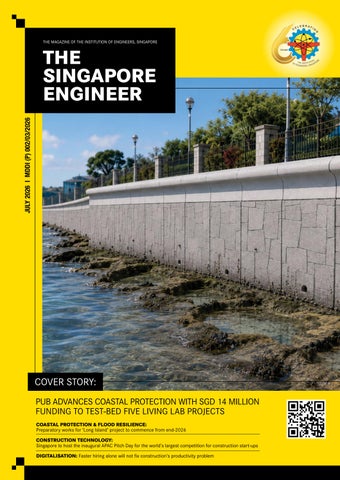
COVER STORY: PUB ADVANCES COASTAL PROTECTION WITH SGD 14 MILLION FUNDING TO TEST-BED FIVE LIVING LAB PROJECTS COASTAL PROTECTION & FLOOD RESILIENCE: Preparatory works for ‘Long Island’ project to commence from end-2026 CONSTRUCTION TECHNOLOGY: Singapore to host the inaugural APAC Pitch Day for the world’s largest competition for construction start-ups DIGITALISATION: Faster hiring alone will not fix construction’s productivity problem
THE SINGAPORE ENGINEER I JULY 2026
1
WE’RE 60!
THANK YOU FOR SIXTY YEARS OF UNWAVERING SUPPORT AND COMMITMENT TO ENGINEERING EXCELLENCE. WE ARE HONOURED TO CELEBRATE THIS DIAMOND JUBILEE MILESTONE WITH YOU AS WE BUILD A RESILIENT AND INNOVATIVE FUTURE TOGETHER.
www.ies.org.sg
IES CHARTERED ENGINEERING BOARD
The Chartered Engineering Registry aims to provide professional recognition to qualified Engineers, Technologists and Technicians across all sectors. Being registered as a Chartered Engineering Professional will be an external validation of your experience, expertise and practising competence; and is a quality mark to differentiate your professional standing in the following sectors of engineering: Aerospace
Built Environment
Chemical & Energy
Environment & Water
Engineering Project Management
Infrastructure
Railway & Transportation
Renewable Energy
Sustainability
Systems
cebsg.org ies.org.sg
President Mr Mervyn Sirisena
CONTENTS
Chief Editor Mr T Bhaskaran t_b_n8@yahoo.com
IES UPDATE
Executive Director Mr Syafiq Shahul
06
Building a resilient future: insights from the IES Coastal Protection Seminar
07
Advancing Singapore’s EV charging future with the launch of the SS 722:2026 Series
08
Lean construction for station rejuvenation
NEWS & EVENTS 09
Exploring the utilisation of wastewater resources for the built environment
10
PUB completes construction of Tengah Service Reservoir
11
Refurbishment of disinfection systems at waterworks
12
Singapore launches AI-enabled Workplace Safety and Health tool
13
MOM launches open call
14
LTA awards second civil contract for Changi Southern Corridor
16
Duration for the use of timber scaffolds to be reduced
Publications Manager Mr Desmond Teo desmond@iesnet.org.sg Editorial Panel Er. S Yogeeswaran Dr Chandra Segaran Dr Ang Keng Been Dr Aaron Sham Mr Jaime Vega Bautista Jr Media Representative Trevor Teh TSE@mnc-link.com Design & layout by 2EZ Asia Pte Ltd
COVER STORY
Published by The Institution of Engineers, Singapore 70 Bukit Tinggi Road, Singapore 289758 Tel: 6469 5000 Fax: 6467 1108
17
Printed in Singapore
AiR Digital achieves ISO certification for its AI-powered platform
PUB advances coastal protection with SGD 14 million funding to test-bed five Living Lab projects
COASTAL PROTECTION & FLOOD RESILIENCE
Cover designed by Irin Kuah
20
Preparatory works for ‘Long Island’ project to commence from end-2026
22
Strengthening Singapore’s water resilience strategy
Cover image by Kajima Corporation
07
10
IES UPDATE
19
21
COVER STORY 02
NEWS & EVENTS
COASTAL PROTECTION & FLOOD RESILIENCE THE SINGAPORE ENGINEER I JULY 2026
INTERNATIONAL BUILT ENVIRONMENT WEEK
2 - 4 SEP 2026 Marina Bay Sands, Singapore
Empowering People, Accelerating Intelligence Drive digital transformation for project delivery — empower engineering team with next-gen intelligence and insights. Ticketing Is Now Available
Why You Should Attend
Conference
BEX Asia
Professional Accreditation
Ecosystem Connectivity
Real project insights across APAC — including sustainability delivery at scale.
Compare technologies supporting greener, smarter built environments.
Earn recognised accreditation points while advancing sustainability capabilities.
Connect across the value chain to drive greener project outcomes.
See how advanced engineering methodologies are applied to real-world builds — not just modeled. IES members enjoy extended access to early bird rates.
IES member rates inside. Scan to get your ticket.
www.ibew.sg
CONSTRUCTION TECHNOLOGY 26
Singapore to host the inaugural APAC Pitch Day for the world’s largest competition for construction start-ups
DIGITALISATION 28
Faster hiring alone will not fix construction’s productivity problem
RAILWAY & TRANSPORTATION ENGINEERING 30
Productivity pressure in long-term MRT renewals
PROJECT APPLICATION 32
Challenging tunnel construction project in Denmark
34
Executing the lifting operations for Finland’s tallest bridge pylon
36
Excavation completed for new sludge digestion plant in Frankfurt
PRODUCTS & SOLUTIONS 37
Bringing AI-run autonomous operations to legacy water assets
The Singapore Engineer is published monthly by The Institution of Engineers, Singapore (IES). The publication is distributed free-of-charge to IES members and affiliates. Views expressed in this publication do not necessarily reflect those of the Editor or IES. All rights reserved. No part of this magazine shall be reproduced, mechanically or electronically, without the prior consent of IES. Whilst every care is taken to ensure accuracy of the content at press time, IES will not be liable for any discrepancies. Unsolicited contributions are welcome but their inclusion in the magazine is at the discretion of the Editor.
Aeration and digital maintenance solutions for water infrastructure projects 38
Sustainable water solutions from AERZEN Solution for high-flow ultrapure water and boiler feed applications
39
Reshaping how radon is measured
40
Next-generation articulated haul truck from Komatsu
26
28
CONSTRUCTION TECHNOLOGY
34
40
PROJECT APPLICATION 04
DIGITALISATION
PRODUCTS & SOLUTIONS THE SINGAPORE ENGINEER I JULY 2026
2 - 4 SEP 2026
Marina Bay Sands, Singapore
The Built Environment Expo
Join APAC’s Premier Built Environment Expo Be part of the industry gathering at BEX Asia 2026 to discover innovations and source for the most comprehensive solutions and services across the entire building’s life cycle that will accelerate your projects. Gain actionable knowledge through CPD accredited seminars alongside networking with your industry peers.
Register Now to Claim Your Free Badge *Onsite registration will be charged at S$20
BEXAsia
bex-asia
An anchor exhibition of
www.bex-asia.com
IES UPDATE
Building a resilient future: insights from the IES Coastal Protection Seminar
A big thank you to everyone who joined us at the Coastal Protection in Practice & Applications in Singapore Seminar on 2 July 2026, organised by the IES Civil & Structural Engineering Technical Committee! As one of Singapore’s most critical engineering priorities, safeguarding our coastlines requires continuous innovation, knowledge exchange and collaboration. It was fantastic to see so many industry professionals come together to discuss practical strategies for longterm climate resilience.
The Coastal Protection in Practice & Applications in Singapore Seminar highlighted practical strategies for long-term climate resilience.
Key takeaways & highlights • Climate Adaptation & Flood Standards: Navigating evolving design principles and flood protection standards. 06
• Advanced Construction Technologies: Practical design considerations reshaping modern coastal engineering. • Real-World Case Studies: In-depth insights into landmark projects, including the construction of Tuas Port Phase 1. THE SINGAPORE ENGINEER I JULY 2026
IES UPDATE
Advancing Singapore’s EV charging future with the launch of the SS 722:2026 Series
Distinguished speakers shared their expertise and insights at the event.
The IES Standards Development Organisation (IESSDO) was honoured to launch the SS 722:2026 Series, marking a significant milestone in strengthening Singapore’s electric vehicle (EV) charging infrastructure. Organised by IES-SDO, in collaboration with the Singapore Standards Council, Enterprise Singapore and the Land Transport Authority (LTA), the launch event on 13 July 2026 brought together more than 120 industry professionals to exchange insights on the latest developments in EV charging technologies, infrastructure and standards. Singapore’s progress in EV adoption has been supported by three key pillars: • Clear policies and incentives • Continued expansion of charging infrastructure • A robust regulatory and standards framework With approximately 33,000 EV chargers deployed across Singapore, supporting 70,000 to 80,000 EV THE SINGAPORE ENGINEER I JULY 2026
cars today, a strong technical foundation is essential to ensure that the charging network continues to expand safely and reliably. The progression from TR 25 to SS 722 reflects the rapid evolution of EV charging technologies and the importance of keeping standards relevant, safe and future-ready. Developed through close collaboration among government agencies, industry representatives, academia and technical experts, the series combines international technical practices with Singapore’s local operational requirements, providing an important foundation for the safe and reliable deployment of EV charging infrastructure. IES extends its appreciation to the distinguished speakers for sharing their expertise and insights – Ngien Hoon Ping, SMRT; Lam Wee Shann, LTA; Er. Melvyn Thong, LTA; Er. Lim Say Leong, Clint Global International Pte Ltd; Er. Ray Tan, DSTA; Alex Chong, NTU (ERI@N); and Alvin Foo, PSA. 07
IES UPDATE
Lean construction for station rejuvenation
The seminar brought together engineers and industry professionals to exchange ideas on the use of lean construction to deliver station rejuvenation works more efficiently and safely.
Jointly organised by the IES Civil & Structural Technical Committee and Transportation & Traffic Division, in collaboration with the Land Transport Authority (LTA), the IES–LTA Seminar on Lean Construction: Station Rejuvenation Works was held on 13 July 2026. The seminar brought together engineers and industry professionals to exchange ideas on the use of lean construction to deliver station rejuvenation works more efficiently and safely. The programme featured insightful presentations from experts from LTA, SMRT, BCA, industry partners and international organisations, covering topics such as lean construction methodologies, 08
digital transformation, DfMA, design optimisation, construction robotics and practical case studies from live railway projects. We were also honoured to have Mr Ng Lang, Chief Executive of LTA, as our Guest-of-Honour, and IES President Mr Mervyn Sirisena who delivered the opening address. A heartfelt thank you to all our speakers, moderators, organising committee members and participants, for making the seminar a success. Your contributions and active discussions continue to strengthen collaboration across the industry, as we work towards delivering safer, smarter and more sustainable rail infrastructure. THE SINGAPORE ENGINEER I JULY 2026
NEWS & EVENTS
Exploring the utilisation of wastewater resources for the built environment A new global cross-sector partnership between domain experts, utilities and academic institutions has been established to investigate and assess the potential of transforming byproducts from wastewater treatment into materials for the built environment. The project is funded by the Ramboll Foundation and the project team is actively looking for industry partners to join and help bring this to scale. The collaboration brings together expertise from across the wastewater, construction and university sectors, to explore how bio-based raw materials, derived from residual sludge and sediment generated during wastewater purification, can be utilised as feedstock for low-carbon, circular building materials. The project team includes Ramboll (consultant), Henning Larsen (architect), Royal Danish Academy and University of Canberra. The ambition is to redefine wastewater treatment plants as resource hubs that contribute to a circular bioeconomy and the decarbonisation of the built environment, and eventually, to bringing sludge into the built environment as a feasible, scalable material solution. Looking for industry partners Moving beyond this initial work, the new collaboration will expand the range of applications under investigation and broaden engagement across industry and academia. The project will help establish the foundations for a long-term international research partnership exploring additional architectural applications, including boards and fire-retardant materials, as well as broader circularity and biodiversity potentials. At this stage, the team is also actively looking for manufacturing partners to join and help bring this to scale. The project is structured around three integrated activities – delegation visits that create connections, generate insights and catalyse larger-scale research initiatives; outreach activities designed to grow partnerships across industry and academia; and the consolidation of knowledge, opportunities and stakeholder networks throughout the wastewater value chain. Addressing a growing global resource challenge Wastewater treatment plants generate substantial volumes of sludge during processing operations. Globally, between 53 and 75 million tonnes of sludge are produced annually. In Australia, approximately 372,000 tonnes are generated each year, with 6% still directed to landfill. Denmark produces around 140,000 tonnes annually, with 15% directed to landfill and 25% incinerated. THE SINGAPORE ENGINEER I JULY 2026
Byproducts from wastewater treatment can be converted into building materials. Image: Ramboll.
As urbanisation continues and wastewater treatment capacity expands worldwide, these volumes are expected to increase. While some established pathways for wastewater sludge utilisation exist, particularly in agriculture, significant quantities remain underutilised. At present, there are no established applications of wastewater sludge in the built environment. At the same time, wastewater treatment facilities represent a globally abundant and growing source of material that is generated and available at a local scale. Supporting the transition to a circular bioeconomy Staying within planetary boundaries and achieving a net-zero carbon future depends on the decarbonisation of buildings. However, this cannot be achieved using conventional building materials alone. It requires a shift away from a fossil-based, nonrenewable and extractive economy towards a circular bioeconomy within the construction sector. Making this transition is critical to achieving the objectives of the Paris Agreement and the 2030 Agenda for Sustainable Development. By sourcing building materials from local renewable resources, new value chains can be created, that support both local economies and global sustainability goals. Such approaches have the potential to address growing raw material demand driven by rapid urbanisation while reducing the carbon footprint of cities. Through this project, the partners aim to explore how wastewater treatment residues can be transformed from an underutilised waste stream into valuable and functional architectural materials, reframing them as local resources rather than liabilities and creating new value within wastewater treatment systems. 09
NEWS & EVENTS
PUB completes construction of Tengah Service Reservoir PUB, Singapore’s National Water Agency, has completed the construction of Tengah Service Reservoir (SR), a key water supply infrastructure that will support current and future water demand in Tengah Town, home to a growing residential and industrial population. Costing approximately SGD 120 million, the construction of Tengah SR commenced in May 2022 and was completed in November 2025. As part of Singapore’s water supply network, service reservoirs store treated drinking water from PUB’s treatment plants, before it is piped to homes and businesses, helping to ensure a continuous and reliable water supply. Strategically located in the western region of Singapore, Tengah SR is a potable water SR comprising two water tanks. It has the capacity to hold a combined equivalent of about 22 Olympicsized swimming pools of potable water. Tengah SR was planned to support the projected increase in water demand from upcoming residential developments in Tengah Town, which is expected to house about 42,000 households, as well as businesses in the upcoming Tengah industrial precinct which is part of the Jurong Innovation District. Tengah SR is built on high ground, to maintain stable and consistent water pressure across the network. Located at the highest point in Tengah, the SR enables potable water to flow to surrounding developments via gravity, without the need for additional pumping, thereby improving operational efficiency and saving costs. It is operated remotely through a centralised system that enables real-time monitoring and control of key operational functions, increasing work productivity while reducing the need for manual intervention and enhancing operational reliability. The system can also quickly detect shifts in demand or supply, allowing prompt operational response through automated alerts. Local construction firm Chye Joo Construction Pte Ltd was awarded the tender to construct Tengah SR. This marked the first time an SR in Singapore was built using the slipform construction method, which involved continuous, round-the-clock pouring of concrete to cast a seamless, circular wall from the ground up. The resulting concrete walls of the water tanks thus have no construction joints. This minimises the risk of water leakage and improves the performance of the SR. PUB worked closely with the Housing & Development Board (HDB) during the planning and development of Tengah SR to ensure that the facility was fully integrated with Tengah’s overall masterplan. 10
Aerial view of Tengah Service Reservoir. Image: PUB.
Interior of Tengah Service Reservoir Tank 1. Image: PUB.
The SR’s design also took into consideration its surroundings, with the installation of dark brown aluminum façade fins enabling the SR to blend more naturally into the surrounding environment. As Tengah SR was developed within a forested area, PUB implemented a series of environmental mitigation measures during construction, to minimise impact to the surrounding habitat. These included wildlife shepherding prior to site clearance, inspections for possible nesting areas before tree felling and the erection of temporary hoarding around the work areas to prevent wildlife from entering worksite(s) during construction. Service reservoirs play an important role in Singapore’s water supply system. They serve as a buffer against daily fluctuations in water demand and help maintain supply reliability during periods of peak usage or unexpected interruptions. PUB currently operates over 10 such service reservoirs, including NEWater service reservoirs for industrial customers. Singapore’s water demand is expected to rise with population growth, urban development and industrial expansion. PUB will continue investing in and expanding Singapore’s water supply infrastructure, including service reservoirs, to ensure a reliable and resilient water supply network for long-term needs. THE SINGAPORE ENGINEER I JULY 2026
NEWS & EVENTS
Refurbishment of disinfection systems at waterworks
Industrie De Nora, an Italian multinational company, recently announced that it has been selected to supply its Sentinel ultraviolet (UV) technology with upgraded electronic ballast systems for the refurbishment of UV disinfection systems at the Johor River Waterworks of PUB, Singapore’s National Water Agency. The project was awarded by Flotech Controls, PUB’s appointed contractor. A company listed on the Euronext Milan, Industrie De Nora specialises in sustainable electrochemical technologies and in green hydrogen. Originally commissioned in 2011, the existing UV systems at the waterworks have operated successfully, providing reliable disinfection, as part of a critical asset supporting Singapore’s drinking water supply. With the system approaching the later stages of its operational lifespan, PUB commissioned a tender for the replacement or refurbishment of the UV systems to ensure long-term continued reliability. The appointed contractor, Flotech Controls, proposed a refurbishment and retrofit approach supported by De Nora, particularly given the space constraints within the building housing the existing UV systems. The project forms part of De Nora’s Sentinel retrofit programme, enabling modernisation of system performance, while retaining core infrastructure. By allowing reuse of key system components, the retrofit approach also supports more sustainable project delivery through reduced material consumption and minimised waste, and a reduced carbon dioxide footprint. The upgraded system will deliver enhanced operational performance, including extended lamp life and a reduced footprint, thereby supporting improved efficiency within the existing installation. The project is scheduled for installation in 2027. THE SINGAPORE ENGINEER I JULY 2026
Industrie De Nora has been selected to supply its Sentinel ultraviolet (UV) technology with upgraded electronic ballast systems for the refurbishment of UV disinfection systems at the Johor River Waterworks of PUB, Singapore’s National Water Agency. Images: De Nora.
Flotech Controls selected De Nora’s Sentinel UV system due to its proven reliability in medium pressure applications, ease of maintenance and ability to be retrofitted into existing infrastructure without the need for full system replacement. The award also reflects the strong preference many water operators place on technologies that combine dependable performance with straightforward operation and serviceability. De Nora’s established presence in Singapore, including local sales and aftersales support, was also an important factor in the selection. Designed for demanding drinking water applications, De Nora’s medium pressure UV technology provides robust disinfection performance while helping operators simplify maintenance planning and extend the value of installed assets through practical retrofit pathways. This approach enables utilities to modernise critical systems efficiently, while minimising disruption. 11
NEWS & EVENTS
Singapore launches AI-enabled Workplace Safety and Health tool The Singapore Workplace Safety and Health (WSH) Conference 2026, which addressed the theme ‘Insight to Impact: Collective Effort for Stronger WSH Outcomes’, unveiled new national workplace safety and health initiatives, as the country moves to sustain progress towards Vision Zero and strengthen support for safer, healthier and more resilient workplaces. Held at Marina Bay Sands, on 26 July 2026, the Singapore WSH Conference 2026, the ninth edition of the biennial event, brought together over 1,500 policymakers, business leaders, WSH professionals and industry practitioners. Jointly organised by the Workplace Safety and Health Council (WSH Council), Ministry of Manpower (MOM), National Trades Union Congress (NTUC) and Singapore National Employers Federation (SNEF), the Singapore WSH Conference 2026 focused on how Singapore’s WSH ecosystem can better anticipate emerging risks, strengthen shared ownership and translate safety insights into practical action, across workplaces. At the event, Minister of State for Manpower Mr Dinesh Vasu Dash announced the launch of the Safety Advisory and Guidance Engine (SAGE), an AI-enabled knowledge and decision-support tool developed by the WSH Council in partnership with the Singapore Institution of Safety Officers. Designed for WSH professionals, SAGE helps users retrieve relevant information, identify workplace hazards and apply best-practice control measures based on Singapore’s WSH framework. By making authoritative guidance easier to access, the tool aims to support faster, more consistent decision-making in safety-critical environments, while complementing the experience and professional judgement of WSH practitioners. The move comes as Singapore enters the next phase of its WSH journey. According to the Workplace Safety and Health Report 2025, released by MOM in March 2026, Singapore’s workplace fatal injury rate fell to a record low of 0.96 per 100,000 workers in 2025, while major injury rates across most workplace settings declined to an all-time low of 15.7 per 100,000 workers. However, reported workplace injuries rose by 2.5%, underscoring the need for continued vigilance even as Singapore remains among the safest working environments globally. Further, at the Singapore WSH Conference 2026, MOM launched the open call for the Alliance for Action on Safety and Health for Employment Longevity (AfA-SHEL). “Singapore’s workplace safety and health progress is not a static achievement, but a continuous national 12
Mr Abu Bakar Bin Mohd Nor, Chairman, WSH Council delivers his welcome address.
Minister of State for Manpower, Mr Dinesh Vasu Dash, delivers his opening address.
The Singapore WSH Conference 2026 brought together over 1,500 policymakers, business leaders, WSH professionals and industry practitioners.
effort. As we advance the WSH 2028 agenda, our focus must be on sustaining the progress we have made, strengthening support for workers, employers and WSH practitioners, and ensuring that our WSH system remains responsive to the needs of a changing economy. By working together, we can continue to raise WSH standards and build safer, healthier and more resilient workplaces,” said Mr Dinesh. The WSH Council also introduced a new WhatsApp Channel to provide employers, workers and WSH practitioners with mobile-first access to alerts, advisories and resources. This complements the council’s existing WSH Bulletin, social media channels and website. Strengthening workplace safety through collective action Beyond the national announcements, The Singapore WSH Conference 2026 served as a platform for industry leaders and practitioners to examine how stronger WSH outcomes can be achieved across different workplace settings. The programme featured leaders from SMRT, SATS Group, CapitaLand Investment, NTUC, SUTD, BCA, Seatrium and other organisations, with discussions spanning boardroom accountability, SME safety excellence, worker voice, emerging risks, health and well-being, and technology as an enabler of safer workplaces. THE SINGAPORE ENGINEER I JULY 2026
NEWS & EVENTS
Minister of State for Manpower, Mr Dinesh Vasu Dash and Mr Abu Bakar Bin Mohd Nor, Chairman, WSH Council, with the WSH Council members, speakers and sponsors.
The conference was complemented by Learning Journeys hosted by PSA Corporation, NESST Singapore, SMRT, SBS Transit and Expand Construction, giving delegates first-hand exposure to how safety leadership, smart technology, automation, workplace and dormitory design, and continuous improvement are being applied across construction,
worker housing, port operations and public transport. The Singapore WSH Conference 2026 concluded with a call for organisations to move from insight to impact by strengthening shared responsibility, practical innovation and a people-centred approach to workplace safety and health.
MOM launches open call The Ministry of Manpower (MOM) launched the open call for the Alliance for Action on Safety and Health for Employment Longevity (AfASHEL) at the Workplace Safety and Health (WSH) Conference 2026, held on 23 July 2026. The AfA-SHEL was announced by the Minister of State for Manpower, Mr Dinesh Vasu Dash during the MOM’s Committee of Supply Debate in March 2026. Jointly led by MOM, the National Trades Union Congress (NTUC) and the Singapore National Employers Federation (SNEF), the AfA brings together employers, workers, relevant government agencies, healthcare institutions, solution providers and other stakeholders, in order to co-create practical, industry-led solutions to strengthen WSH and support employment longevity. Addressing workplace safety and health for stronger employment longevity Singapore’s workforce and work conditions are evolving, with technology transformation blurring the lines between blue- and white-collar jobs, as well as people remaining economically active over longer careers. As such, there is a need to develop innovative solutions and engender stronger WSH ownership, for workers to remain safe, healthy and employable through the full span of their working lives, while supporting businesses to build safer and more inclusive workplaces. Three focus areas Through the AfA-SHEL, MOM and its tripartite partners aim to crowdsource practical, scalable
THE SINGAPORE ENGINEER I JULY 2026
solutions that strengthen WSH, while supporting longer, healthier working lives for workers in Singapore. The AfA will focus on developing practical solutions in three key areas: • Injury prevention for the general workforce, beyond high-risk workplaces. • Supporting returning to work, after a serious injury or health episode. • Workplace adaptation and job redesign to make work tasks, processes and environments safer and more suitable for Singapore’s increasingly diverse workforce, comprising people with varied physical and health needs. Open call for organisations MOM is inviting Singapore-registered organisations to participate in the AfA, through an open call, from 23 July to 31 August 2026. Selected organisations will participate in an innovation programme to develop their prototypes over approximately 14 months. The participants will receive funding support, access to WSH and industry experts, as well as consultancy support from an assigned account manager. Following the close of the open call, applications will be evaluated by the AfA Secretariat, comprising MOM, NTUC, SNEF and the WSH Council. Around 30 organisations will be selected, with balanced representation across the AfA’s three focus areas. Interested organisations can submit their proposals, by 31 August 2026, via https://go.gov.sg/ afashel2026opencall
13
NEWS & EVENTS
LTA awards second civil contract for Changi Southern Corridor
Location map of Changi Southern Corridor.
The Land Transport Authority (LTA) has awarded the second civil contract for the enhancement of road networks along Xilin Avenue, East Coast Parkway (ECP) and Tanah Merah Coast Road (TMCR), as part of the Changi Southern Corridor project, to a joint venture between CES_SDC Pte Ltd (previously known as Sembcorp Design and Construction Pte Ltd) and KTC Civil Engineering & Construction Pte Ltd. The contract is valued at around SGD 757 million and construction is expected to commence in the third quarter of 2026. Both companies are established local construction and civil engineering contractors with strong track records in rail and infrastructure projects. CES_SDC was involved in the construction of Marina South station on the Thomson-East Coast Line and is currently involved in the construction of two stations on the Jurong Region Line, as well as another station along the Cross Island Line-Punggol Extension. KTC Civil Engineering & Construction previously constructed Tampines interchange station on the Downtown Line and Orchard Boulevard station on the Thomson-East Coast Line. It is currently involved in the construction of Sungei Bedok station on the Thomson-East Coast Line and two stations on the Cross Island Line. Enhancement of road networks The contract covers the design and construction of new flyovers, tunnels and underpasses, as well as the widening of the existing Changi Airport 14
Diversion Canal, with new vehicular bridges and road enhancement works along Xilin Avenue, East Coast Parkway (ECP), Tanah Merah Coast Road (TMCR) and Changi Coast Walk. When completed, the enhancements will provide full and direct road connectivity to the future Changi Airport Terminal 5, from ECP, Pan-Island Expressway (PIE) and Xilin Avenue. In addition, with the increased road capacity and enhancements, motorists can look forward to smoother traffic flow and more travel options to the Changi East region, from the PIE and ECP. Apart from road infrastructure, new cycling paths will be built along Xilin Avenue and TMCR to enhance connectivity between Tampines, East Coast and the future Changi East developments. In addition, the existing pedestrian underpass (ECP Underpass No 10) between ECP and the ECP Service Road will be upgraded and extended to serve both pedestrians and cyclists. Together with the existing Park Connector Network, these improvements will strengthen first- and last-mile connectivity and provide more seamless, barrier-free journeys along the Xilin–Changi East corridor. To facilitate these works, traffic diversion along the ECP, PIE and TMCR will be necessary, due to site constraints and the construction sequencing required for the infrastructure works. Details of these diversions will be announced at a later date. LTA will take measures to mitigate inconvenience to motorists and minimise impact to greenery. THE SINGAPORE ENGINEER I JULY 2026
NEWS & EVENTS
Artist’s impression of enhancement of Xilin Ave / ECP / Tanah Merah Flyover Interchange / Tanah Merah Coast Road.
Changi Southern Corridor Works The first contract was awarded in September 2024 and comprised enhancements to the existing interchange at PIE / ECP / Airport Boulevard. Works under this contract commenced in the fourth quarter of 2024. After this second contract, LTA will call the remaining road civil infrastructure tender in the fourth quarter of 2026. The scope will include enhancement to the road infrastructure networks fronting the entrance to the future Changi Airport Terminal 5 along TMCR, and construction and realignment of
Changi Northern CorridorWorks In September 2024, LTA had also awarded a civil contract for the enhancement of a section of Loyang Avenue, Telok Paku Road, Nicoll Drive and Changi Coast Road at the Changi Northern Corridor. As part of the Changi Northern Corridor transport infrastructure improvements, the existing dual 2-lane road from Loyang Avenue to Aviation Park Road will be widened to a dual 4-lane road by 2030, to support the intensification of developments in the Changi industrial and business districts. Together with the completion of Loyang Viaduct in 2028, the widened roads will help alleviate traffic congestion in the Changi North area. LTA had earlier carried out a comprehensive Environmental Impact Study (EIS) along the area to evaluate the environmental impacts of the proposed road-related infrastructure works. As
THE SINGAPORE ENGINEER I JULY 2026
cycling paths and park connectors along TMCR. When completed, there will be 3.5 km of new cycling paths, providing pedestrians, cyclists and other active mobility users with safer and more comfortable journeys. These enhancements are part of the Changi Southern Corridor which will support key developments of Changi Airport Terminal 5 and Changi East developments. When completed, it will enhance multimodal connectivity in the Changi region and support the growth and development of Changi’s aviation sector. Works are expected to be completed by 2034.
part of this study, nature groups were engaged to identify flora and fauna in the vicinity of the worksite, and to develop mitigation measures to minimise environmental impact. Together with the Loyang Viaduct, the enhancements to Loyang Avenue, Telok Paku Road, Nicoll Drive and Changi Coast Road will be part of the Changi Northern Corridor, serving key industrial and business districts such as Loyang Industrial Estate, Changi Airfreight Centre, and the Aviation Logistics Park. Along with the two upcoming Cross Island Line (CRL) stations – Loyang and Pasir Ris East – and improvements to the active mobility network in Loyang and Changi North, residents, commuters, and motorists can look forward to greater convenience, shorter travelling times, and improved intra-town and inter-town connectivity when the enhancements are completed by 2030.
15
NEWS & EVENTS
Duration for the use of timber scaffolds to be reduced Scaffold fires present a serious safety risk to workers, emergency responders and members of the public. The use of scaffold systems is prevalent across the construction sector and scaffold fires, especially those involving combustible materials such as timber, can spread rapidly, complicate evacuation and firefighting efforts, as well as result in significant damage, disruption and potential loss of lives. Taking into account industry feedback and international developments, the Ministry of Manpower (MOM) is introducing measures to strengthen fire safety requirements associated with the use of scaffolds. Duration of use of timber scaffolds Timber scaffolds are combustible and can accelerate the spread of fire when ignited. To mitigate fire risks arising from the prolonged presence of combustible timber materials, particularly in environments involving hot works, MOM will reduce the permissible duration for the use of timber scaffolds from the current 9 months to 3 months, with effect from 1 January 2027. The effective date of 1 January 2027 has been determined to provide industry stakeholders with sufficient time to prepare for the new requirements, adapt their practices and processes, and secure the necessary materials and resources. The reduction in the permissible duration also addresses safety concerns associated with the deterioration of timber over time, due to exposure to weather, wear and tear, and mechanical damage, which may compromise structural integrity. Shortening the permissible duration promotes regular renewal and replacement of scaffold materials, reduces the likelihood of undetected defects and encourages the adoption of more durable, noncombustible scaffold systems such as steel, aluminium and modular metal scaffold systems.
To facilitate a smooth transition for the industry, timber scaffolds set up before 1 January 2027 can still be used for a duration of 9 months. Any new timber scaffold that is set up at these sites from 1 January 2027 will be subject to the new permissible duration of 3 months. Extension for the use of timber scaffolds beyond the permissible duration may be granted on a case-by-case basis, based on extenuating circumstances such as technical constraints. Fire performance requirements for scaffold nettings Together with SCDF, MOM is reviewing the introduction of fire performance requirements for netting that envelops scaffolds set up outside buildings. Obligations to ensure that the netting conforms to the new requirements may be placed on scaffold contractors, netting manufacturers, netting suppliers and/or other relevant parties in the industry. This measure aims to reduce the risk of flame spread, in the event of a fire. More details will be shared ahead of its implementation, to ensure sufficient lead time is provided for industry to transition to these new requirements. Building safer workplaces The shift towards reduced use of timber scaffolds, together with the review of fire performance requirements for scaffold nettings, marks an important step forward in lowering scaffold fire risks. They will also enhance overall worksite safety, improve housekeeping conditions and strengthen risk control in construction operations. MOM will continue to work closely with industry to ensure that these changes are implemented effectively and that safety remains a shared priority across the construction sector.
AiR Digital achieves ISO certification for its AI-powered platform AiR Digital Solutions, the technology subsidiary of Singapore-listed global concrete innovation leader Pan-United Corporation Ltd, has achieved ISO/ IEC 27001:2022 certification for its AI-powered operations management platform. ISO/IEC 27001:2022 is an internationally recognised standard for managing information security risks. The certification underscores AiR Digital’s robust approach to cybersecurity and data privacy, including safeguards against threats such as cyberattacks, unauthorised access and data leaks.
16
This certification marks an important milestone in AiR Digital’s continued growth as a trusted technology partner. It provides customers with added assurance that the company operates on a secure and scalable framework with robust governance, operational resilience and quality assurance standards. The certification also supports AiR Digital’s ability to scale its solutions across markets and industries, while maintaining consistency, reliability and data security.
THE SINGAPORE ENGINEER I JULY 2026
COVER STORY
PUB advances coastal protection with SGD 14 million funding to test-bed five Living Lab projects The results will help determine their potential deployment. PUB, Singapore’s National Water Agency, will kickstart the test-bedding of coastal protection measures under the Coastal Protection and Flood Management Research Programme’s (CFRP) Living Lab pillar, with a total funding of about SGD 14 million awarded to five projects. The measures will be implemented at selected locations along Singapore’s coastline, from 2027. Launched in 2023, the CFRP comprises three pillars – the Coastal Protection and Flood Resilience Institute (CFI) Singapore, Applied Research, and the Living Lab – to drive the development and application of solutions, as well as grow a vibrant research and development ecosystem for flood resilience locally. The projects reflect close collaboration with industry partners, universities and government agencies to support Singapore’s long-term coastal resilience efforts. By advancing solutions from research and pilot studies into real coastal environments, PUB aims to build on proven concepts with a view to deploying them at scale in the future. Test-bedding locations are chosen based on technical, operational and environmental factors, including the suitability of site conditions. The results from the five Living Lab projects, which will be
assessed over three years, will help determine whether they can be used for future coastal protection works. By test-bedding solutions that have been developed through earlier research, PUB seeks to accelerate learning, refine designs and build confidence for potential future deployment, while supporting the growth of local industry capabilities and cross-sector knowledge transfer. THE FIVE LIVING LAB PROJECTS XblocPlus interlocking concrete armour blocks [Team members: National University of Singapore (NUS), Delta Marine Consultants Singapore, Woh Hup Engineering and Sentosa Development Corporation] This project builds on a proof-of-concept completed under PUB’s Global Innovation Challenge in 2021. The project explores the use of modular blocks of XblocPlus, a single-layer, interlocking concrete armour unit, designed to protect shorelines from coastal erosion. The modular system has been successfully applied in more than 40 project locations across 30 countries globally, including in the AsiaPacific region.
Artist’s impression of XblocPlus at Tanjong Rimau, Sentosa. Image: Delta Marine Consultants. THE SINGAPORE ENGINEER I JULY 2026
17
COVER STORY Tailored for Singapore’s wave climate, XblocPlus offers a more compact, material-efficient and sustainable alternative to conventional armour rocks. The project will evaluate the long-term hydraulic and structural performance of XblocPlus modules at Tanjong Rimau, at the western end of Sentosa, complementing slope stabilisation works at the site by reducing wave-induced erosion at the slope toe, alongside cost and productivity benefits enabled by more efficient construction and monitoring techniques. Eco-sand tube with innovative eco-material [Team members: Nanyang Technological University (NTU), Surbana Jurong, HSL Constructor and National Parks Board (NParks)]
Artist’s impression of the eco-sand tube deployed along a coastline. Image: NTU.
The eco-sand tube is one of the 17 ongoing Coastal Protection and Flood Resilience Institute (CFI) Singapore research projects and one of two that have been selected to progress to the test-bedding stage. This innovative measure utilises jute fibre, a biodegradable and natural alternative to synthetic geotextiles, with innovative low carbon eco-material, to treat the sand infill. The eco-sand tubes will be used to form a bund-like barrier that will harden over time. These tubes will be deployed at two locations with different coastal conditions – along the Changi coastline and the seaward side of Yishun Dam, under sandy and muddy conditions, respectively. Building on findings from earlier research, the test-bedding will evaluate the eco-sand tube’s durability, performance and its ability to trap sediments behind it, as well as promote marine biodiversity. Watertight Modular Solution [Team members: NUS, KTC Civil Engineering & Construction, Surbana Jurong and Housing & Development Board (HDB)] The Watertight Modular Solution is the second CFI Singapore research project identified for the Living Lab pillar and will be trialled at East Coast Park. It seeks to evaluate the watertightness of modular concrete and geotextile tube units – fabric tubes filled with cement-treated soil as infill material – that can be retrofitted onto existing coastal protection structures such as seawalls and rock revetments.
Artist’s impression of the Watertight Modular Solution. Image: NUS.
18
THE SINGAPORE ENGINEER I JULY 2026
COVER STORY This helps to overcome the challenge of seawater seepage through porous structures such as rock revetments. Additionally, the modular design also enables coastal protection structures to be raised incrementally over time, supporting Singapore’s longterm response to future sea level rise. Shellfish gabions – hybrid solution for coastal and ecological defence [Team members: Singapore University of Technology and Design (SUTD) and Mlion Corporation]
The project will be test-bedded at East Coast Park and builds on prior research exploring the use of recycled oyster shells at Changi Sailing Club by Dutch engineering consultancy firm Witteveen+Bos. The project taps on Mlion’s expertise in biorock technology which promotes coral reef growth, to measure and validate the effectiveness of the gabions in dissipating wave energy. Mlion is a local small and medium enterprise (SME) with a regional footprint in providing engineering solutions, including sustainable infrastructure and materials innovation, across Southeast Asia. Adaptive eco-friendly seawall [Team members: Kajima Corporation, Samwoh Innovation Centre, Delta Marine Consultants Singapore, Oung Construction (S), Singapore Institute of Technology (SIT) and NUS] The adaptive seawall builds on Japanese construction company Kajima’s project in Tokyo, which integrates eco-friendly features such as grooves and tide pools to enhance marine biodiversity. This project will use precast concrete elements to simulate how coastal protection infrastructure can be built up progressively to respond to gradual sea level rise. In addition, the seawall panels will be constructed using low-carbon materials and equipped with smart sensors and self-healing mechanisms to reduce carbon emission and maintenance costs. The eco-friendly seawall will be test-bedded at Changi Beach to assess its performance while monitoring biodiversity outcomes under local coastal conditions.
Artist’s impression of shellfish gabions at low tide. Image: SUTD.
Artist’s impression of the adaptive eco-friendly seawall. Image: Kajima Corporation. THE SINGAPORE ENGINEER I JULY 2026
19
COASTAL PROTECTION & FLOOD RESILIENCE
Preparatory works for ‘Long Island’ project to commence from end-2026 Measures to be implemented to mitigate impact on the environment and community. Preparatory works for ‘Long Island’, Singapore’s large-scale critical coastal protection strategy, will commence from end-2026. The Housing & Development Board (HDB), the appointed reclamation agent for ‘Long Island’, will implement measures to mitigate the impact of preparatory works on the environment and community, based on findings from an Environmental Study. The Urban Redevelopment Authority (URA) also reiterated the government’s commitment to continue engaging stakeholders on the planning and design of ‘Long Island’, before finalising reclamation plans. Preparatory works to be carried out progressively ‘Long Island’ is a critical coastal protection measure to safeguard lives and livelihoods, as rising sea levels increasingly affect low-lying coastal areas, including Singapore’s East Coast. Given the scale of the project, preparatory works are essential to laying the groundwork for the future land reclamation for ‘Long Island’. This is to support the timely implementation of ‘Long Island’, in order to respond to climate risks and meet our national needs. The preparatory works will take place in the waters off the East Coast and primarily involve the removal of seabed obstructions, followed by the construction of temporary sand bunds and sand infilling. The works will be at least 130 m away from the shoreline and will be clearly demarcated by silt screens and/or floating barriers. The preparatory works will be conducted in phases. The first phase will start in end-2026 and will be carried out in the waters west of Bedok Jetty. The first phase will cover an area of approximately 570 ha, and it will span around 7 km in length from east to west, and up to 1 km wide from north to south. The second phase of preparatory works will be carried out in the waters to the east of Bedok Jetty and will cover an area of approximately 155 ha. To facilitate the continued use of part of the sea space fronting East Coast Park for water sports and the hosting of major international sporting events, including the Southeast Asian (SEA) Games in 2029, the second phase will commence only after the completion of these events. More details on the commencement date of the second phase will be shared when ready. Members of the public can continue to access the beaches along East Coast Park throughout the preparatory works. Beaches will remain open and accessible for near-shore swimming, while all exercise 20
paths and tracks will remain accessible for jogging and cycling. However, sea users are advised to maintain a safe distance from the marine vessels deployed for the works and the designated work area which will be cordoned off to ensure public safety. Safety advisories will be put up at East Coast Park and on agencies’ websites. Safety advisories can be found on go.gov.sg/longisland and on www.nparks.gov.sg/visit/parks/park-detail/ east-coast-park Mitigation measures to guide sensitive implementation of preparatory works HDB commissioned an Environmental Study for the preparatory works, to study the potential impact of works on the environment and the community. The Environmental Study identified mitigation measures that should be adopted to address the potential environmental impact. As part of the Environmental Study process, HDB consulted the nature groups on the scope of study. The Environmental Study identified the following key findings and mitigation measures for the preparatory works: • No significant changes to water quality which will continue to meet the prevailing marine water quality criteria. • Slight, localised changes to the currents and waves near Bedok Jetty, which are expected to have minimal impact on existing water-based activities. Near-shore activities such as swimming can continue along the entire stretch of the East Coast. • Up to minor visual and ambient air quality impact is expected from sand infilling operations, with intermittent sediment plumes and dust. To minimise impact, silt screens will be deployed to contain the sediment plumes, and dust levels will be closely monitored. • Up to minor impact on some of the terrestrial and marine biodiversity, as there are some coral and seagrass beds found near the site of the preparatory works, that may experience short-term and localised impact from the sediment plumes. However, the majority of coral and seagrass in the vicinity, including at Sisters’ Island Marine Park, will be largely unaffected. • Some sea sports enthusiasts will be displaced, due to reduction in sea space along East Coast. The impact will be mitigated by the phasing of preparatory works, THE SINGAPORE ENGINEER I JULY 2026
COASTAL PROTECTION & FLOOD RESILIENCE
The preparatory works for the ‘Long Island’ project will be conducted in phases and measures will be taken to mitigate their impact on the environment and community. Image: HDB.
with kiteboarding being the most affected and with minor to moderate impact on other sea sports. Agencies will continue to work closely with affected sea sports enthusiasts to explore alternative sites to continue their activities within the sea space to the east of Bedok Jetty, in the interim, and elsewhere in Singapore. An Environmental Monitoring and Management Plan (EMMP) will be put in place to closely monitor environmental conditions throughout the preparatory works, including water quality, suspended sediment levels, noise and dust. The EMMP outlines the mitigation measures, monitoring requirements, and roles and responsibilities required to manage and mitigate environmental impact, ensuring that the project’s environmental impact remains within the levels predicted in the environmental assessment. The Environmental Study report was available for public feedback for four weeks from 30 June 2026. Agencies will thoroughly evaluate the feedback received and incorporate suitable suggestions, before finalising the mitigation measures that will be adopted.
engagements. The technical studies will cover further environmental and engineering assessments for the actual reclamation profile and works, and they are expected to be completed over the next few years. As this project will span a few decades, agencies will continue to engage Singaporeans and stakeholders to shape the plans and design for ‘Long Island’ at various stages of the planning process, in the years ahead. Drawing on ideas gathered from more than 14,000 people to-date, agencies will begin the next phase of public engagement from end-2026. This phase will build on collective aspirations for ‘Long Island’ to strengthen Singapore’s flood resilience, support sensitive and sustainable development, and preserve flexibility to meet the evolving needs of current and future generations. To shape a shared vision for ‘Long Island’, agencies will invite Singaporeans and stakeholders to explore key topics, including potential recreational activities along the new coastline and within the future reservoir. More information on ‘Long Island’ and the upcoming preparatory works can be found at go.gov.sg/long-island.
Detailed plans and design for ‘Long Island’ to be further developed The area that is used for preparatory works is not reflective of the future land profile of ‘Long Island’. Agencies will continue to develop detailed plans for ‘Long Island’, including its final reclamation profile, which will continue to be refined through ongoing technical studies and upcoming public engagements. The main reclamation works for ‘Long Island’ will be undertaken later and will commence only after agencies have completed the relevant technical studies, determined mitigation measures, and reviewed and incorporated feedback from further public
‘Long Island’ is a critical coastal protection measure to safeguard lives and livelihoods, as rising sea levels increasingly affect low-lying coastal areas, including Singapore’s East Coast. Given the scale of the project, preparatory works are essential to laying the groundwork for the future land reclamation for ‘Long Island’. This is to support the timely implementation of ‘Long Island’, in order to respond to climate risks and meet our national needs.
THE SINGAPORE ENGINEER I JULY 2026
21
COASTAL PROTECTION & FLOOD RESILIENCE
Strengthening Singapore’s water resilience strategy Mr Robert Chan, Vice President, Water, Asia at AECOM discusses the approaches to deal with intense and less predictable rainfall, caused by climate change. The Singapore Engineer (TSE): How would Singapore’s current generation of flood and catchment models perform under El Niño-driven extremes that push them beyond original design assumptions? Robert Chan (RC): Singapore’s flood and catchment models were built on decades of historical rainfall data and, for a long time, that data was stable enough to support planning and design, but their predictive accuracy and design reliability will become increasingly stressed if events exceed the historical conditions on which many drainage standards and calibration datasets were originally based. Climate change is altering the picture. Singapore’s annual rainfall has increased at a rate of 83 mm per decade over the past 40 years and the Meteorological Service Singapore’s V3 projections indicate that extreme rainfall events could intensify by as much as 92% during the April-May inter-monsoon period, by the end of the century. El Niño climate variability may further amplify these extremes, creating storm characteristics that lie outside the range for which existing models were originally designed. Even where forecasts remain accurate, drainage infrastructure may still be temporarily overwhelmed by rainfall intensities beyond its design capacity. The more immediate concern is operational. Agencies that depend on these models for forecasting, emergency response and infrastructure planning, need to be confident that model outputs remain robust under changing climate conditions. This requires continuous recalibration, validation against new extreme events and incorporation of updated climate projections, as part of routine practice, rather than as a post-event exercise. Singapore has the technical and institutional capability to do this well. The challenge is ensuring that model adaptation keeps pace with the evolving climate risk landscape. TSE: Where are the gaps in data, calibration and integration with existing control systems? RC: The gaps are most visible where different systems meet. In areas of rapid urban growth, surface runoff patterns have changed faster than sensor networks have been updated to reflect them, which affects how accurately models can represent local flood behaviour. Data on truly extreme rainfall events also remains limited, making it difficult to calibrate 22
Mr Robert Chan
models confidently for conditions outside historical experience. Calibration tends to be strongest for known flood scenarios and is often updated following significant events. As rainfall patterns become more variable under climate change, there is a risk that gradual shifts in catchment behaviour or storm characteristics are not fully captured between calibration cycles. A more continuous approach to validation and recalibration would help ensure that models remain representative of current and future conditions. Singapore’s drainage network spans more than 8,000 km of drains, rivers and canals, making effective integration between modelling systems and operational teams critical. At that scale, any disconnection between forecasts, field observations and infrastructure operations can slow decisionmaking. The greatest opportunities for improvement lie in strengthening real-time data sharing, creating tighter feedback loops between model outputs and operational actions, and establishing clearer escalation and response protocols across agencies. Through shared data, joint working arrangements and increasingly automated decision-support tools, model insights can be translated quickly into on-the-ground flood mitigation measures. TSE: How do these models work? What are their limitations? RC: Hydrological and hydraulic models simulate how rainfall moves through a catchment – from precipitation to surface runoff, through drainage networks and ultimately into reservoirs, waterways, or tidal systems. Engineers use them to predict how catchments react and behave under different storm conditions and identify where the system is most likely to come under stress. However, their outputs are only as reliable as the assumptions and data that underpin them. The core limitation is that they perform well within the range of conditions they have been calibrated against, and less well outside it. Input data quality matters, so land-use data, soil conditions and the physical dimensions of drainage infrastructure, all influence what the model produces. When any of those inputs are outdated, incomplete or insufficiently detailed, the outputs carry greater uncertainty. Climate change presents an additional challenge because future rainfall patterns may differ THE SINGAPORE ENGINEER I JULY 2026
COASTAL PROTECTION & FLOOD RESILIENCE significantly from the historical observations on which many models were developed. Equally important is how those outputs are communicated and translated into operational decisions. A model may produce technically sound results but if forecasts/results are difficult for operations and decision-makers to interpret quickly, their practical value is reduced in a fast-moving situation. Ensuring the accuracy of the translation is just as important as the modelling itself. TSE: What does intensifying and less predictable rainfall mean for legacy drainage and reservoir assets? RC: Legacy drainage infrastructure is designed to handle specific peak flows within defined return periods. As those return periods compress, the hydraulic headroom built into original designs erodes. Singapore’s data already shows a general upward trend in annual maximum hourly rainfall, from an average of 96 mm in 1980 to 117 mm in recent years, alongside an increase of 1.5 days per decade in the number of days with hourly rainfall totals exceeding 70 mm. That steady intensification places growing pressure on assets that were never sized for this level of demand. The challenge is not only that rainfall is becoming more intense, but also less predictable in its timing, duration and spatial distribution. This makes it harder for operators to anticipate system stresses and rely on historical operating assumptions. For reservoirs, timing is just as critical as volume. Singapore’s V3 projections indicate that wet months could intensify by up to 58% whereas dry months may become as much as 42% drier. That shift makes reservoir management considerably more complex, since the seasonal patterns that operators used, to guide storage and release decisions, are becoming less reliable. Operators need to balance flood protection, water security and operational safety, under more variable conditions. The practical response lies in smarter operations – revised protocols, better real-time data, adaptive control systems and targeted upgrades, where they are most needed, rather than large-scale replacement of existing infrastructure. The priority is to improve the resilience and flexibility of existing assets so that they can continue to perform effectively under a wider range of future conditions. TSE: How are digital twins and scenario modelling informing decisions on when to upgrade, augment or operate existing infrastructure differently? RC: A digital twin creates a live, continuously updated representation of an infrastructure system that operators can use to test different scenarios, before making decisions. For water infrastructure, that means being able to test how a drain, pump station or reservoir would perform under a future storm event and to see where the system would struggle, without waiting for that event to occur. THE SINGAPORE ENGINEER I JULY 2026
This changes how infrastructure investment decisions get made. Scenario modelling makes it possible to assess whether a change in how an asset is operated could achieve the same outcome as a capital upgrade, or whether a targeted intervention in one part of the network reduces risk more cost-effectively, with less disruption, than a broader programme. For Singapore, where infrastructure operates at high density and decisions carry long-term consequences, having that level of analytical clarity before committing resources is valuable and ensures investments are evidence-based and risk-driven. Rather than relying solely on historical performance, agencies can use digital twins and scenario modelling to determine when infrastructure should be upgraded, where additional capacity will have the greatest impact and when smarter operational strategies can extend the useful life of existing assets. TSE: What are the approaches for further strengthening Singapore’s long-term water resilience strategy? RC: The UN’s 2026 assessment on global water stress found that nearly 4 billion people experience significant water scarcity for at least one month each year. Singapore’s Four Taps strategy was built to ensure the country never joins that statistic and it has delivered that objective. The next phase of resilience will come from broadening the foundations that strategy rests on. One approach is in using digital technologies more extensively to support predictive operations. As rainfall patterns become more variable and extreme, digital twins, advanced forecasting and scenario modelling can help operators make better decisions about reservoir management, drainage operations and infrastructure investment, before risks materialise. Another approach is to expand the role of naturebased infrastructure. Blue-green elements such as wetlands, rain gardens and cleansing biotopes already feature in programmes like ABC Waters, but there is scope to move them from a complementary role into a more primary position within the flood management accounting framework. These approaches can improve resilience while also delivering environmental and community benefits. Perhaps the most important long-term challenge is capability development, and the binding constraint is talent. The intersection of hydrology, real-time data systems and infrastructure operations is a narrow professional profile, and the talent pipeline regionally remains thin. Singapore has used institutional design to build capability in sectors that are strategically critical. Applying this approach to water resilience workforce planning will help address one of the most significant long-term constraints facing the sector. The next stage of water resilience will be defined less by building larger infrastructure and more by creating a smarter, more adaptive system – one that combines engineering, data, nature-based solutions 23
COASTAL PROTECTION & FLOOD RESILIENCE
Blue-green elements such as wetlands, rain gardens and cleansing biotopes feature in programmes like ABC Waters.
and human expertise, to manage an increasingly uncertain climate. TSE: Is there additional information that you would like to provide? RC: It is worth setting Singapore’s position against the global context. The World Wide Fund for Nature (WWF) estimates that 2.7 billion people face water scarcity for at least one month each year, and the trajectory is worsening. What Singapore has demonstrated is that solutions to water scarcity can be engineered through deliberate institutional design, long-term investment horizons and a willingness to build infrastructure that serves multiple functions simultaneously. The Keppel Marina East Desalination Plant is a clear expression of that – a dual-mode facility capable of treating both seawater and reservoir water, built underground with a 20,000 m² green roof above, rendering it essential infrastructure, with the public need in mind. The challenge in the next phase is maintaining the same quality of decision-making, under conditions that are materially less predictable than those that 24
Singapore’s original water strategy was designed for. Climate variability does not undermine the logic of the Four Taps framework, instead, it reinforces it. The task now is to ensure that the infrastructure, models and institutions underpinning that framework remain calibrated to the environment they actually face. Going forward, success will depend not only on physical infrastructure, but also on the ability to continuously adapt, through better data, stronger operational capabilities and informed policy choices. Singapore’s fundamental advantage lies not merely in the infrastructure it has built, but also in its institutional capacity to transform that infrastructure, as circumstances change. Climate uncertainty will continue to challenge water systems worldwide, but resilience lies in how swiftly institutions can learn, adapt and respond. In that respect, Singapore is well positioned. The future of water resilience will not be defined by building larger infrastructure alone, but by creating a smarter, more adaptive and more integrated system that can anticipate change rather than simply react to it. Organisations will not succeed by predicting every disruption, but by building the agility and resilience to adapt, as conditions change. THE SINGAPORE ENGINEER I JULY 2026
CONSTRUCTION TECHNOLOGY
Singapore to host the inaugural APAC Pitch Day for the world’s largest competition for construction start-ups This solidifies the country’s position as the region’s innovation leader in construction technology. The Building and Construction Authority (BCA) of Singapore recently announced that Singapore will be hosting the inaugural Asia Pacific (APAC) Pitch Day for the 10th edition of the Construction Startup Competition (CSC) which will be staged in 2026. The competition is hosted by leading venture capital and built environment (BE) stakeholders, including Cemex Ventures, Caterpillar, Dysruptek by Haskell, Ferrovial, Hilti, VINCI Group’s Leonard, NOVA by Saint-Gobain, Trimble, Zacua Ventures, and BCA. The debut of CSC in Singapore marks a significant milestone, cementing the republic’s position as a premier regional hub for Construction Technology (ConTech). This partnership will facilitate greater exchange of innovative global solutions with local and regional Built Environment (BE) firms, while providing Singapore’s startups with the chance to engage with the world’s leading venture capital and construction firms. A growing global market Acute needs in the global BE sector – spanning from the demand for greater sophistication in design to the need for greater efficiency and productivity – have driven momentum for BE firms to search for innovative technology and solutions. This growing demand has fuelled significant investment growth, with global ConTech investment having doubled from 2024 to reach USD 6.57 billion in 2025. The APAC region is also fast becoming a key engine of this global ConTech flywheel, accounting for almost 20% of global ConTech investment in 2025 (source: Cemex Ventures Top 50 Startups Report 2025: https:// www.cemexventures.com/top-50/) By hosting the CSC APAC Pitch Day, Singapore is strategically positioning itself at the nexus of this ecosystem, bridging the gap between global capital and regional innovation. The Construction Startup Competition The Construction Startup Competition (CSC) has become the leading global platform for disruptive construction technology since its inception in 2017. Through its past nine editions, the platform has empowered over 4,100 startups from over 80 countries, offering them greater industry recognition, opportunities to pilot their solutions in real projects, funding from global venture capitalists and strategic partnerships with BE industry leaders. Many startups have gone on to collaborate with 26
Home-grown startup Ailytics was named a finalist winner at CSC’s European Pitch Day in 2025.
the participating companies after taking part in the competition. In 2025, 44 finalist start-ups, including homegrown startup Ailytics which develops AI-powered video analytics solutions for construction worksites, advanced to the US and European Pitch Day events, collectively securing over USD 448 million in investment. Ailytics was also named a finalist winner at CSC’s European Pitch Day in 2025 – a testament to the global competitiveness of Singapore’s homegrown innovative solutions. The CSC continues to connect emerging companies with leading corporates, investors and industry decision-makers, seeking scalable solutions to some of construction’s most pressing challenges. CSC2026 will conclude with three flagship Pitch Days, designed to connect startups with regional innovation hubs and global industry leaders. Finalists will have the opportunity to present their solutions in the APAC Pitch Day in Singapore, the European Pitch Day in Helsinki, and US Pitch Day in Las Vegas. This year’s edition introduces five strategic focus areas aligned with the sector’s evolving priorities: • Preconstruction Tech: Technologies that use data, analytics and digital planning, to improve decisionmaking before construction begins. • Jobsite Productivity & Building Systems: Solutions that optimise on-site execution by improving labour, equipment and building system performance. • ClimaTech for the Built World: Technologies that reduce carbon emissions, improve energy efficiency and enable sustainability, across buildings and construction. THE SINGAPORE ENGINEER I JULY 2026
CONSTRUCTION TECHNOLOGY • Smart Manufacturing & Logistics: Digital and automated solutions that enhance production efficiency, supply chain coordination and material flows. • Smart Buildings and Infrastructure: Connected systems that use data, sensors and automation, to operate buildings and infrastructure more efficiently, safely and intelligently. Through these categories, the competition aims to spotlight the technologies driving greater efficiency, resilience, sustainability and performance, across the construction value chain. The inaugural APAC Pitch Day The CSC continues to expand its global footprint, with a strategic move into the APAC region through the collaboration with Singapore’s BCA as a key partner. This milestone strengthens CSC’s presence in one of the most dynamic and innovation-driven construction ecosystems. Based on submissions from applicants across the Asia Pacific region, five finalist winners will be invited to participate in The APAC Pitch Day, hosted at the International Built Environment Week (IBEW) 2026’s ConTech Summit, on 2 September 2026. These finalists will join the top 125 global entries and will gain access to one of the most influential networks of venture capital and stakeholders in the BE industry. The winner will receive a cash prize, access to one of the most influential networks of venture capital and stakeholders in the BE industry, and a place among the top 30 global entries of the CSC. The event aims to attract promising startups from across the region, giving local and regional BE firms a
direct pipeline to access and evaluate technologies that are ready to be piloted or adopted, while presenting an opportunity to introduce CSC’s global network of partners and investors to Singapore’s Innovation and Technology (I&T) ecosystem. “Singapore’s ConTech ecosystem has crossed a new growth threshold, positioning us to lead the next wave of innovation and technology development. BCA is proud to welcome the inaugural APAC edition of the CSC to Singapore – a move that establishes the country as a gateway for introducing ConTech innovation from the US and Europe markets to the rest of APAC,” said Mr Heng Teck Thai, Deputy CEO, BCA. “Our CSC partners will benefit by unlocking connections within the APAC region, whilst giving our local solution providers access to these international markets. Having a greater exposure to the best cutting-edge solutions globally will help to accelerate Singapore’s BE transformation through innovation and technology,” he added. “We see Singapore increasingly positioning itself as a global technology hub, and through the CSC, we aim to expand our footprint and bring the platform closer to the local ConTech community, enabling stronger access to collaborations and investment opportunities,” said Mr Miguel Carralón, Investment Manager at Cemex Ventures. “At the same time, this expansion will allow us to provide greater visibility to the rest of the CSC partners on the highly disruptive innovations emerging across the region, fostering new connections and unlocking opportunities that might otherwise remain untapped,” he added.
Competition receives record-breaking number of applications Construction Startup Competition (CSC) 2026 has officially closed applications for its landmark 10th edition, with 798 startup applications from around the world – the highest number received since the competition was established in 2017. Compared to the previous edition, the competition achieved a 40.3% increase in applications, further strengthening its position as one of the world’s leading open innovation platforms dedicated to the construction industry. The record-breaking edition reflects the accelerating pace of innovation across the construction market. For the past decade, the CSC has connected promising startups with leading construction companies, investors and decision-makers worldwide. Beyond visibility, the initiative has become a launchpad for emerging companies looking to validate technologies, secure pilot opportunities, establish commercial partnerships and scale internationally. After a series of promotional events and a well-coordinated marketing and communications
THE SINGAPORE ENGINEER I JULY 2026
campaign, CSC2026 successfully attracted applications from 62 countries. A total of 64% of applicant startups are based in Europe and North America, while the remaining applications came from APAC (23%), Latin America (7%), the Middle East (5%), and Africa (1%). This year’s edition focused on five new strategic innovation areas aligned with the priorities of the sponsoring partners, while also reflecting the challenges and opportunities that resonate most strongly with startups. Preconstruction Tech accounted for 21.7% of all applications, followed by Jobsite Productivity & Building Systems (32.5%), ClimaTech for the Built World (22.8%), Smart Manufacturing & Logistics (9.9%) and Smart Buildings & Infrastructure (13%). Following the application phase, participating partners will now evaluate the submissions, before selecting the startups advancing to this year’s international Pitch Days in Singapore (IBEW), Las Vegas (Trimble Dimensions), and Helsinki (Recotech & Slush).
27
DIGITALISATION
Faster hiring alone will not fix construction’s productivity problem by Avtandil Mekudishvili, Regional Lead, APAC, PlanRadar The use of digital tools is becoming equally important.
Mr Avtandil Mekudishvili
AI and digital project management tools are becoming increasingly integral to how construction firms manage and deliver projects.
Singapore’s decision to accelerate the hiring of migrant construction workers from 2027 could not come at a more critical time. Demand for infrastructure, housing and redevelopment projects remains strong, while contractors continue to grapple with labour shortages that have constrained delivery timelines since the pandemic. At first glance, faster hiring appears to be the obvious solution. More workers should mean faster completion, improved productivity and fewer project delays. But construction’s productivity problem has never been purely about manpower. In fact, adding more workers into already fragmented project environments without improving coordination may unintentionally create a new set of inefficiencies. More people on site means more subcontractors to manage, more approvals to process, more documentation to track and more communication points across increasingly complex delivery chains. Without the right systems in place, projects do 28
not necessarily move faster when teams expand. Sometimes, they slow down. The coordination challenge behind construction delays This is the paradox facing modern construction. The industry is scaling its workforce but, at the same time, projects are becoming harder to coordinate. As a result, the real competitive advantage is shifting away from labour capacity alone towards the ability to manage information, communication and decisionmaking, in real time. Recent industry research from PlanRadar highlights the scale of the challenge. Keeping projects on schedule and managing mid-project changes emerged as the two most significant day-to-day challenges facing project managers. At the same time, one in four respondents reported that delayed approvals typically add more than a month to project timelines, demonstrating how operational bottlenecks can undermine delivery, regardless of workforce availability. That is why Artificial Intelligence (AI) and digital THE SINGAPORE ENGINEER I JULY 2026
DIGITALISATION project management tools are rapidly becoming essential infrastructure for construction firms. Construction has long operated through fragmented workflows. Site instructions are exchanged through phone calls. Variation requests sit inside email chains. Approvals are delayed because the right stakeholder cannot be reached quickly enough. Teams on-site and in the office often work from different versions of the same information. When projects involve hundreds of workers across multiple contractors and consultants, these inefficiencies compound quickly. A delayed approval on a single change request can halt several downstream activities. Missing documentation can trigger disputes over accountability. Time spent reconstructing project history after issues emerge becomes time taken away from actual delivery. Often the real problem is a lack of visibility. Nearly 80% of construction professionals report that at least half of their project documentation is spread across unconsolidated communication channels, making it harder to track decisions, verify responsibilities and respond quickly when issues arise. Unsurprisingly, respondents who could easily locate documentation were twice as likely to feel confident demonstrating which party was responsible for delays and cost impacts. Why AI is becoming essential on construction sites These are the kinds of problems AI is well-positoned to solve. While it is not replacing personnel, AI is increasingly handling the repetitive administrative burden that slows projects down. Digital platforms can now automate approval workflows, consolidate project communication, track changes in real time and surface critical information instantly. Industry sentiment suggests there is growing recognition of this potential. PlanRadar’s research found that 58% of project managers believe AI could help reduce workload across their biggest day-to-day challenges, while 65% believe it could streamline some of their most significant administrative burdens, including coordinating approvals across stakeholders and consolidating scattered communications. This has major implications for project delivery. When approvals are routed automatically to the correct stakeholders, response times improve. When documentation is centralised within a single system, disputes become easier to resolve. When project managers gain real-time visibility into delays, cost impacts and outstanding actions, they can intervene before problems escalate. The cumulative impact is significant – less time spent chasing information and more time spent moving projects forward. AI’s role in managing mid-project changes AI is also streamlining inspections and reporting processes that have traditionally consumed substantial THE SINGAPORE ENGINEER I JULY 2026
amounts of manual effort. Site teams can now capture progress digitally, through mobile devices, photographs and structured workflows that automatically generate reports and maintain audit trails. Some AI-enabled systems can even analyse construction contracts to identify obligations related to change orders, notification periods or delay claims, allowing teams to respond faster and reduce commercial risk. Importantly, the benefits are already becoming measurable. Among construction professionals using digital project management platforms with integrated AI functionality, two-thirds of respondents report saving at least two hours per week, per project on administrative and coordination tasks. While that may appear modest in isolation, across multiple projects and teams, it represents meaningful productivity gains that can be redirected towards delivery and problem-solving. This matters because keeping projects on schedule has become increasingly difficult in an environment where timelines are compressed and project complexity continues to rise. Singapore’s construction sector is a prime example. Urban density, complex infrastructure requirements and overlapping trades already create high coordination pressure. Faster hiring will help alleviate labour shortages, but it will also increase the number of moving parts that project teams must manage simultaneously. The broader lesson from industry research is that the challenge is no longer simply finding enough workers. As project teams become larger and more specialised, success increasingly depends on how effectively information flows between stakeholders, how quickly decisions can be made, and how confidently teams can manage change without disrupting delivery. The future of construction depends on better collaboration Construction firms that continue relying on fragmented communication methods may struggle to fully benefit from expanded labour access. Meanwhile, firms that invest in AI-enabled coordination systems will likely be better positioned to integrate larger teams efficiently while maintaining project control. The lesson is clear. More workers alone will not guarantee faster delivery. As Singapore prepares for the next phase of construction growth, the conversation should not focus solely on how quickly the industry can hire. It should also focus on whether project teams have the digital tools needed to manage growing complexity at scale. PlanRadar PlanRadar is an award-winning, digital SaaS platform for documentation, communication and reporting in construction, facility management and real estate projects. The platform operates across the globe, with a presence, currently, in over 75 markets. 29
RAILWAY & TRANSPORTATION ENGINEERING
Productivity pressure in long-term MRT renewals by Daniel Woods, Project Director, Metro Transit Solutions (Singapore) When efficiency becomes risk.
Mr Daniel Woods
As Singapore’s MRT network progresses through sustained phases of renewal, productivity naturally becomes a central concern. Access windows are limited, costs are closely managed and expectations for performance remain high. In this environment, efficiency is often viewed as an unqualified good. However, experience from long-term renewal programmes suggests that efficiency, when pursued without sufficient context or recalibration, can itself become a source of risk. Over extended periods, productivity pressure can subtly influence behaviour, decision-making and risk tolerance in ways that are not immediately visible, yet materially affect safety and reliability.
provide a reasonable starting point. As delivery progresses, opportunities often arise to refine methodologies, optimise sequencing and improve output. Learning, repetition and familiarity can deliver genuine gains. However, productivity assumptions set early are not always revisited with sufficient rigour, as conditions change. What began as a reasonable target under one set of constraints can become misaligned with reality as assets age, interfaces evolve and cumulative fatigue takes hold. Without periodic recalibration, productivity expectations can harden into fixed benchmarks, even when the operating environment no longer supports them.
Productivity assumptions and evolving reality Productivity targets are typically established during early planning, informed by design assumptions, access forecasts and an allowance for risk and uncertainty. In well-structured programmes, these assumptions
Pressure over time Short-duration projects can absorb intensity. Longterm renewal programmes cannot. When night works or renewal activities continue over months and years, the effects on people and systems accumulate.
Conceptual illustration of the relationship between productivity pressure and workforce resilience over sustained MRT renewal programmes. The shaded region represents conditions where delivery pressure exceeds organisational resilience, increasing the likelihood of safety, quality or performance degradation. Image: Daniel Woods.
30
THE SINGAPORE ENGINEER I JULY 2026
RAILWAY & TRANSPORTATION ENGINEERING Fatigue increases, work becomes repetitive and familiarity with the environment can reduce vigilance. Over time, teams may begin to accept outcomes that are ‘good enough’, rather than continually questioning whether safety, quality and efficiency remain optimised. This shift is rarely deliberate. More often, it reflects the normal human response to sustained pressure and routine. If left unrecognised, these behavioural changes can quietly erode safety margins.
deliverable over decades, a long-term mindset is essential. Railway assets do not operate in isolation. They function as interconnected systems with defined interfaces, lifecycles and maintenance requirements. When engineering teams understand not only what an asset does, but why it exists, how it interfaces with other systems and what its whole-life implications are, decision-making becomes more realistic. Shortterm optimisation can then be weighed appropriately against long-term resilience.
Efficiency versus resilience Healthy efficiency in renewal environments is achieved through balance. Productivity, quality and workforce rotation must all be optimised together. When one is pushed beyond sustainable limits, resilience is reduced. Efficiency becomes unsafe when output targets are pursued without regard to fatigue, asset condition or interface complexity. The line between productive momentum and unsafe acceleration is often subtle, and it shifts over time. Maintaining this balance depends heavily on experienced senior staff who can recognise early warning signs and adjust expectations before risks crystallise.
Closing reflections Efficiency is not inherently risky. On the contrary, it is vital to the successful delivery of large-scale renewal programmes. Risk emerges when efficiency is pursued without sufficient regard for human limitations, system complexity and the cumulative effects of time. As Singapore’s MRT network continues to renew itself, productivity pressure should be managed as a system-level risk, not an individual failing. By recalibrating expectations, valuing experience and maintaining balance between efficiency and resilience, renewal programmes can deliver safely, sustainably and with confidence over the long term.
The importance of feedback loops Effective feedback between site teams and planners is essential to sustaining realistic productivity over long programmes. While formal handover processes exist, they are not always completed with sufficient timeliness or clarity, particularly following demanding night works. When site feedback is delayed, diluted or not fully understood, planning teams may continue to rely on forecasted performance rather than actual conditions. Over time, this disconnect can widen the gap between planned and achievable output. Robust handover processes, supported by planners with sufficient renewal experience, are therefore critical to maintaining alignment between expectation and reality. Leadership under pressure Leadership behaviour plays a decisive role in how productivity pressure is managed. Experienced leaders focus on developing efficient, repeatable processes rather than relying on last-minute acceleration to recover time or cost. They understand when restraint is required and are willing to challenge unrealistic expectations. In high-pressure commercial environments, less experienced staff may be more vulnerable to undertaking unnecessary or poorly sequenced tasks, particularly if leadership lacks the technical competence to intervene. Strong leadership provides clarity, prioritisation and protection against unsafe escalation, even when delivery pressure intensifies. A long-term mindset For MRT renewals to remain safe, sustainable and THE SINGAPORE ENGINEER I JULY 2026
Installation works within a constrained MRT tunnel environment. Image: Daniel Woods.
31
PROJECT APPLICATION
Challenging tunnel construction project in Denmark The Nordhavn Tunnel project in Copenhagen is being implemented using PERI solutions.
The 1.4 km long Nordhavn Tunnel in Copenhagen is being constructed as a twin-tube tunnel, with separate directions of travel.
The Nordhavn Tunnel will provide a new link between Copenhagen city centre and the harbour. The unique location and complexity of the 1.4 km long structure pose significant challenges in terms of organisation and execution. PERI is supporting the project with sophisticated formwork and access solutions, as well as comprehensive technical support, thereby ensuring safe, continuous and predictable construction progress. Tunnel construction in the heart of the city The Nordhavn Tunnel will run beneath Svanemølle Harbour and the Kalkbrænderiløbet waterway and shipping channel, providing a direct link between the districts in the north of Copenhagen. This will bring the Nordhavn district, a key urban development area, closer to the existing urban structures. At the same time, an underground transport link is being built, which will relieve pressure on above-ground traffic routes and enable people to travel through the city more quickly. The new infrastructure comprises two separate 32
The tunnel is being constructed using the cut-and-cover method, with the bottom plates, walls and slabs being concreted in succession across 54 sections.
tunnel tubes with a total of four lanes and will ensure smooth and safe traffic flow in future. The Nordhavn Tunnel is being constructed using the cut-and-cover method, which allows for a phased and precise implementation. At the same time, it offers good accessibility and safe working conditions – a key advantage in a challenging, inner-city environment. THE SINGAPORE ENGINEER I JULY 2026
PROJECT APPLICATION
Eight VTC Tunnel Formwork Carriages enable precise and repeatable concreting cycles, ensuring steady construction progress on the Nordhavn Tunnel.
PERI systems ensure uninterrupted construction progress To ensure the tunnel construction project progresses efficiently, PERI is supporting the project with a bespoke combination of various formwork, access and load-bearing systems. Eight VTC Tunnel Formwork Carriages are being used for the in-situ concrete construction of the tunnel. These enable repeatable concreting operations, with high geometric precision and reliable load transfer, resulting in a smooth and efficient concreting process. In technical buildings and pumping stations, MAXIMO Wall Formwork ensures a high degree of flexibility for varying geometries, as well as a consistently high-quality concrete finish. Bottom plates and slabs are formed and securely supported using DUO Universal Formwork and MULTIFLEX Girder Slab Formwork in combination with MULTIPROP Shoring Towers. LGS Working Platforms spanning the excavation pit allow for safe and space-saving routing of service lines. The system concept is complemented by PERI UP Stair Towers which provide safe access to the excavation pit. Technical support for project management and execution PERI’s technical support team has been involved in the project from the outset and maintains close, ongoing contact with the project and site management teams on site. On this basis, the systems are tailored to meet specific requirements and are backed up by structural calculations and project-specific technical support throughout the planning and implementation phases. Close communication helps ensure that the project progresses smoothly, throughout all stages of construction. Comprehensive technical documentation of the individual planning stages also helps the contractor to carry out the project in a structured and efficient manner and provides valuable guidance even in later stages of construction. The outcome is a comprehensive solution in which high-performance systems, technical expertise and project support complement each other seamlessly. THE SINGAPORE ENGINEER I JULY 2026
MULTIPROP Shoring Towers are used as a supporting structure for concreting the slab, ensuring that this work can be carried out safely.
LGS Working Platforms enable optimal positioning of service lines.
PERI formwork and scaffolding systems are used on the construction site and are tailored to work seamlessly together.
PROJECT CREDITS Contractor BESIX-MTH Joint Venture, Søborg, Denmark Client Vejdirektoratet, København V, Denmark Client consultant Rambøll, København S, Denmark Detailed design NIRAS, Jacobs Sverige, Stockholm, Sweden BESIX Engineering & Design, Brussels, Belgium Field Service PERI Denmark, Greve
All images by PERI SE
33
PROJECT APPLICATION
Executing the lifting operations for Finland’s tallest bridge pylon Ensuring safety under demanding subarctic and maritime conditions.
The Kruunuvuori Bridge, centrepiece of the ambitious Kruunusillat (Crown Bridges) project, is one of the most technically demanding infrastructure projects currently under construction in Northern Europe.
The construction of the Kruunuvuori Bridge in Helsinki, Finland’s longest and tallest bridge, is one of the most technically demanding infrastructure projects in Northern Europe. To erect the structure’s defining element, a 135 m reinforced concrete diamond-shaed pylon, a Liebherr 630 EC-H 40 Litronic tower crane was deployed by TYL Kruunusillat, which performed all pylon-related lifting operations from winter 2022 through to the completion of structural work in 2025. A tall crane for a tall bridge The crane was deployed for the positioning of formwork sections, the lifting of reinforcement cages and concrete delivery equipment, and the handling of structural components, required at the various elevation levels. With a maximum lifting capacity of 40,000 kg and a maximum jib radius of 80 m, the crane offered the performance envelope needed to service the pylon structure throughout its construction height. 34
A Liebherr 630 EC-H 40 Litronic tower crane supported the construction of the Kruunuvuori Bridge in Helsinki, Finland.
The hook height achievable in standard configuration reaches 80 m, with extended configurations available for greater heights – a critical factor, given that the pylon ultimately rises to 135 m above sea level. The decision to deploy a Liebherr 630 EC-H 40 THE SINGAPORE ENGINEER I JULY 2026
PROJECT APPLICATION Litronic was largely influenced by the fact that the crane was already part of the construction company TYL Kruunusillat’s own fleet. The EC-H series is engineered for demanding environments. With its high-performance hoist units, the crane is equipped with multiple drives, ensuring both operational precision and safety. Technical configuration The configuration of the 630 EC-H 40 Litronic on the Kruunuvuori Bridge site required more than standard setup planning. The Liebherr Tower Crane Solutions (TCS) team was involved, from an early stage, to calculate the appropriate tower configuration for the project’s unusual height requirements and anchor tie-in positions. “Both the complex guying geometry and the regular adjustments to the guying and hook heights, driven by the progress of the construction works, required a high level of structural engineering expertise. By fully utilising the available structural capacity, we were able to apply our know-how to deliver a safe and efficient solution,” said one of the TCS team members. This level of technical partnership is a core component of the Liebherr service offering for complex construction projects. Challenges and solutions Commissioned by the City of Helsinki and designed by WSP Finland and Knight Architects, the cablestayed bridge spans approximately 1.2 km across Kruunuvuorenselkä bay, connecting the districts of Laajasalo, Korkeasaari and Kalasatama to Hakaniemi in the city centre. The bridge has been designed with a required service life of 200 years, a specification that places it among the most demanding infrastructure programmes in the Nordic region. The Kruunuvuori Bridge site presented a set of environmental and logistical challenges. The bridge crosses an open stretch of the Baltic Sea in the outer harbour of Helsinki, a location with no sheltering topography and full exposure to wind from multiple directions. Under Nordic winter conditions, ambient temperatures routinely fall well below 0 °C, for extended periods, placing significant operational demands on the mechanical and electrical systems of a tower crane configured to its maximum height. Wind loading at the tall tower configurations required for pylon work was a particularly critical factor. At the heights involved, with the crane mast tied into a pylon structure that itself rises 135 m, both the static and dynamic wind forces acting on the crane assembly had to be carefully assessed. The combination of wind exposure and the heightrelated challenges of the tower configuration made accurate TCS configuration work essential to the safety and operational continuity of the crane, throughout the construction phase. The crane’s robust mechanical design and the reliability of the Litronic control system proved their value throughout multiple Nordic winters, on this exposed maritime site. THE SINGAPORE ENGINEER I JULY 2026
The EC-H series is engineered for demanding environments.
At the heights involved, with the crane mast tied into a pylon structure that itself rises 135 m, both the static and dynamic wind forces acting on the crane assembly had to be carefully assessed.
Significance of the project When the Kruunuvuori Bridge opens to tram traffic in late 2026, it will stand as Finland’s longest bridge at approximately 1.2 km and the tallest bridge structure in the country. It will also rank among the longest bridges in the world dedicated exclusively to public transport, cyclists and pedestrians, with no provision for private car traffic. The bridge anchors a broader urban development programme that will add over 20,000 new residents to the Laajasalo area and deliver a sustainable, yearround public transport connection to the heart of Helsinki. Designed to remain in service for 200 years, the Kruunuvuori Bridge reflects Helsinki’s long-term commitment to sustainable infrastructure investment, and the Liebherr 630 EC-H 40 Litronic played a central role in making its most complex structural element a reality. 35
PROJECT APPLICATION
Excavation completed for new sludge digestion plant in Frankfurt In total, approximately 45,000 m³ of soil were excavated and processed. A modern sludge digestion plant is currently being built on the site of the Frankfurt am Main Municipal Sewerage Authority (SEF) wastewater treatment plant, in Germany, which will ensure that the city’s wastewater treatment system is ready to meet future challenges. For the new construction, W Schmidt-Diehler GmbH, together with specialists from the Bauer Umwelt division of BAUER Resources GmbH and BAUER Spezialtiefbau GmbH, created the turnkey excavation pit, covering an area of approximately 5,800 m². Reusing excavated soil Work began in February 2025 and was completed by the end of September 2025. Right from the start, the team faced particular challenges. The construction site had been filled with a variety of materials, to a depth of up to 4 m, in the 1960s. “We had to separate the backfilled soil from the natural gravel, in order to sustainably reuse the latter, for example, as an aggregate for concrete. Our goal is to keep as many materials as possible in the cycle. Every ton of reused gravel and of recycled concrete reduces the need for new resources and protects the environment,” said Felix Blanco Ochando, Senior Site Manager in the Bauer Umwelt division of BAUER Resources GmbH. At the same time, the site had to be prepared for special foundation engineering work. Three construction phases The work involved three construction phases – removal, drilling and excavation. In the first construction phase, the fill material was removed and a stable drilling subgrade, covering approximately 6,700 m², was created through soil conditioning by adding lime-cement. This was followed by the second construction phase which involved the installation of auger-cast concrete piles using a BAUER BG 30 and a sheet pile wall and employing the U-Jagged method with an RG 19 T pile driver from RTG, resulting in greater stiffness and, in this case, does not require anchoring. Nevertheless, bored and GEWI anchors were installed in certain areas to optimise stability. “It was precisely the combination of different methods and the close collaboration between Bauer Resources and Bauer Spezialtiefbau, that made for a smooth process here,” said Mr Ochando. In the second construction phase, the sheet pile wall was anchored, and areas suspected of containing 36
The Semi-GPS 3D excavator grades the subgrade with an accuracy of up to 2 cm. Image: BAUER Group.
Drone footage documented the progress of construction and the total volume of excavated soil, which amounted to 45,000 m³. Image: BAUER Group.
unexploded ordnance were surveyed, in parallel, while the third construction phase (excavation) had already begun. A total of approximately 45,000 m³ of soil was moved with an accuracy of 2 cm. This was made possible, in part, by the use of advanced technology. A Semi-GPS 3D excavator operated semi-autonomously, supported by a rover bar and drone surveying. The third construction phase involved the complete final excavation, the preparation of the fine subgrade, drainage and drainage layers, as well as the installation of a gravel base course as the foundation for the new digesters. Turnkey excavation handover At the end of September 2025, the excavation was handed over on a turnkey basis. Upon final completion, the new sludge digestion plant will play a key role in Frankfurt’s sewage sludge treatment, featuring advanced technology, sustainable construction and a foundation that has been thought through, down to the last detail. THE SINGAPORE ENGINEER I JULY 2026
PRODUCTS & SOLUTIONS
Bringing AI-run autonomous operations to legacy water assets Water utilities and industrial operators face mounting and overlapping pressures – ageing infrastructure, a shrinking pool of skilled operators, climate variability and rising operating costs. Conventional plants rely on continuous oversight that is increasingly difficult to manually perform, particularly at remote, unmanned or older sites built without modern control networks. BlueNexus Technologies, a Singapore-based watertechnology company, aims to address these challenges by standardising autonomous operation into packaged products, rather than treating each plant as a one-off engineering project. This is part of a broader shift that the company describes as moving from humanoperated to AI-operated water infrastructure. The AquaX product family The AquaX product family, from BlueNexus Technologies, applies Artificial Intelligence (AI) to the day-to-day operation of water treatment facilities. The AquaX family is anchored by the AquaX Robot, a plant-wide AI agent at the core of the company’s autonomous operations. Built on a self-developed, large language model (LLM) and multimodal sensing – including vision, acoustic and infrared inputs – it is designed to optimise treatment processes, flag
potential equipment failures before they occur and operate round-the-clock, with minimal on-site staffing. In deployments to-date, analysis shows reductions of up to 90% in on-site manpower, roughly 50% fewer equipment failures and about 35% lower costs for operations and maintenance. The AquaX Hub, the newest member of the AquaX family, is a compact edge device that extends that capability to a single asset. It monitors and inspects equipment through multimodal sensing and runs a self-contained processing loop that continues to operate when network connectivity drops. The device integrates with existing SCADA, cloud and enterprise systems through standardised, secured APIs, and is intended for installations that conventional automation has not reached – standalone assets, remote or unmanned facilities, and legacy plants. Operators can begin with a single hub and expand towards fully AquaX Robot-operated plants over time. i-WaterHub is the company’s standardised, modular water-treatment plant, operated autonomously by the AquaX Robot and designed to deliver industrial and municipal treatment, at capacities of 2,500 m3 to 40,000 m3 per day. i-WaterHub has been deployed across more than 15 installations, over the past three years.
Aeration and digital maintenance solutions for water infrastructure projects Ingersoll Rand Singapore offers consultants and engineering firms insight into solutions for integrated air and aeration, and water treatment, for water and wastewater projects across Southeast Asia. With aeration systems playing a critical role in plant energy consumption and lifecycle costs, Ingersoll Rand’s portfolio supports design optimisation, system reliability and long-term operational performance. Solutions from the company include next generation, high-speed maglev turbo blowers, advanced aeration diffuser systems, and compressed air solutions suitable for municipal and industrial applications. The solutions also include professional services spanning installation support, system audits and performance optimisation, as well as predictive maintenance technologies, that work across any compressor brand – enabling data-driven operations and maintenance strategies.
THE SINGAPORE ENGINEER I JULY 2026
Technology for wastewater treatment Ingersoll Rand also offers Aerobic Granular Sludge (AGS) technology, a next-generation solution for municipal wastewater treatment, combining compact design, high efficiency and sustainability. By using naturally formed microbial granules, AGS enables simultaneous removal of organic matter, nitrogen and phosphorus, within a single reactor – delivering consistent, high-quality effluent. Ideal for urban environments, AGS can reduce plant footprint by up to 75%, while lowering energy consumption by 30% to 60%, through simplified operations and advanced automation. Its flexible design also allows municipalities to expand capacity without additional land, making it a future-ready, cost-effective solution for growing cities. Altogether, these capabilities support consultants and EPC (engineering, procurement and construction) contractors, in delivering scalable, energy-efficient, and future-ready water infrastructure solutions aligned with regional sustainability objectives.
37
PRODUCTS & SOLUTIONS
Sustainable water solutions from AERZEN The AERZEN Water Treatment System is an intelligent ecosystem that combines efficient blower technologies, advanced aeration components, process control and engineering expertise, to optimise overall plant performance. By linking these technologies into a complete system, AERZEN helps municipal and industrial customers improve efficiency, reliability and operational flexibility, while reducing operating costs and supporting their sustainability goals. One of the key technologies within the system is the Delta Hybrid D31S, the newest size in the Delta Hybrid gear-driven, screw blower series. Designed for demanding water and wastewater treatment applications, the Delta Hybrid D31S combines the durability of positive displacement machines with the efficiency benefits of internal compression. Delivering an extended turndown ratio of up to 1:5 and energy savings of up to 37%, compared to conventional blowers, it provides operators with greater process efficiency and operational flexibility. Complementing the Delta Hybrid D31S, the AERZEN Water Treatment System incorporates advanced aeration panels and diffuser technologies
together with intelligent process controls. Integrated concepts combining blower technologies and aeration systems have the potential to deliver energy savings of up to 55% while reducing CO2 emissions by as much as 65%. Recognising the importance of plant reliability and operational continuity, AERZEN offers rental services and after sales services. The company offers temporary equipment solutions, emergency support, preventive maintenance solutions, modernisation programmes and technical expertise. AERZEN supports customers throughout the lifecycle of their facilities, to ensure reliable long-term operation. Founded in Germany in 1864, AERZEN (Aerzener Maschinenfabrik GmbH) has more than 160 years of experience in delivering innovative technologies and integrated solutions for water and wastewater treatment. With a presence in over 50 countries, AERZEN supports municipal and industrial customers worldwide, with efficient blower technologies, aeration systems and comprehensive support services, that help improve process performance while reducing energy consumption and the carbon footprint.
Solution for high-flow ultrapure water and boiler feed applications QUA, an Aquatech company, has announced the launch of FEDI GIGA Q-Connect, a pre-engineered skid of multiple FEDI GIGA stacks, specifically designed for high flow, ultrapure water and boiler feed applications, with a compact footprint. This rack-based assembly concept needs just three headers – for feed, permeate, and reject – to simplify its design and require less piping and instrumentation work. QUA’s FEDI GIGA Q-Connect is ideal for any highflow ultrapure application requiring water conductivity in the range < 0.055 μS/cm to 1 μS/cm. Reflecting QUA’s ongoing commitment to help deliver reliable high-flow ultrapure water, the FEDI GIGA Q-Connect offers a range of advantages: • High flow due to arrangements of multiple FEDI GIGA stacks in parallel. • Reduced piping & instrumentation work due to the requirement for only three headers. • Rapid assembly of headers using Victaulic connections. • Ease of electrical connection (DC supply) due to common junction box arrangement. 38
• Use of railing-mounted metallic rollers for easy removal of FEDI GIGA stacks for simplified maintenance. • Reduced engineering manhours, installation time and on-site manhours due to pre-engineered assembly. • Pre-engineered stack and header assembly help to avoid human error during on-site installation. QUA QUA, an Aquatech company, is a leading name in advanced membrane products for industrial water purification needs. Founded in 2009 with a goal to help industries meet their challenging water purification demands, the company has completed over 1000 installations in more than 30 countries. The company’s technologies enable industrial and municipal customers to ensure environmental compliance and build their water resilience. QUA’s portfolio includes FEDI (Fractional Electrodeionisation), Q-SEP (hollow fibre ultrafiltration membranes), EnviQ (hollow-fibre and flat sheet submerged membranes), CeraQ (ceramic membranes) and EDR-Q (electrodialysis reversal). THE SINGAPORE ENGINEER I JULY 2026
PRODUCTS & SOLUTIONS
Reshaping how radon is measured Radonova Laboratories has reached a new milestone. With more than 1,500 of the company’s SPIRIT radon loggers sold, the achievement represents not only commercial success but also a clear shift in how radon can be measured and monitored, in both workplaces and residential environments. Since its launch, SPIRIT has helped make continuous radon measurement more accessible and practical. Where traditional methods have often been time-consuming, the device enables more efficient follow-up measurements and shorter measurement periods.
More than 1,500 SPIRIT radon loggers have been sold.
Data-driven radon monitoring in everyday use A key part of this development is the integration of measurement hardware with digital tools. Radonova’s reporting features allow users to quickly generate documentation in line with established standards. At the same time, integrated dashboards provide clear visualisations of radon levels, making analysis and follow-up easier. From specialist tool to broader adoption SPIRIT was initially developed with radon consultants and mitigation companies in mind. The need for flexible tools for follow-up measurements during working hours was significant, particularly as regulatory demands for workplace radon assessments increased. However, its use has quickly expanded. Today, the device is also used by property companies and larger employers. Its user-friendly design enables a wider range of organisations to carry out measurements efficiently, both in workplace settings and for shorterterm measurements in residential properties. Continuous development moving forward One of SPIRIT’s core strengths is its flexibility. The device can be used for everything from short-term residential measurements to follow-up monitoring in workplaces. The ability to visualise data via web and mobile platforms also makes it easier to track changes over time. The development is driven by close interaction between technology and user needs. While 1,500 units sold marks a clear milestone, Radonova sees it as part of an ongoing journey. Work continues to further improve both hardware and software, with a focus on making the device even more user-friendly. The continued growth in demand highlights the need for reliable and easy-to-use measurement solutions. With SPIRIT, Radonova has helped make radon THE SINGAPORE ENGINEER I JULY 2026
monitoring more accessible and practical across a wider range of applications. The health risk due to radon Radon is a radioactive gas that cannot be seen and has no smell or taste, yet it is the second leading cause of lung cancer, after smoking. According to the World Health Organization (WHO), radon is responsible for between 3% to 14% of all lung cancer cases in a given country, depending on average radon levels and prevalence of smoking in the population. Sources of radon Radon can originate from several places, but the ground is by far the most common source. Soil radon accounts for the majority of elevated indoor radon levels. Radon gas is naturally produced when uranium and radium in bedrock breaks down and decays. Areas with uranium-rich bedrock or permeable soils, such as sand and gravel, have a particularly high risk. Through cracks and leaks in building foundations, radon can seep indoors and accumulate where occupants then inhale it as they breathe. The second source of radon is building materials, especially aerated concrete (blue concrete). This material contains radium which decays and releases radon. The problem is especially pronounced in walls and floor structures covering large surfaces. Combined with soil radon, blue concrete can contribute to high indoor concentrations. Other building materials such as sandstone, brick, natural stone, gypsum, and granite contain naturally occurring radioactive elements that can break down or decay into radon gas. However, it is suggested that radon emitted from these materials is normally low. Household water is also a possible source. Radon is mainly found in private drilled wells supplying household water. Radon in municipal water supplies is generally not a major issue. 39
PRODUCTS & SOLUTIONS
Next-generation articulated haul truck from Komatsu Komatsu recently introduced the HM460-6 articulated haul truck, a next-generation articulated dump truck engineered to help contractors move more material with greater consistency, across challenging ground conditions. Designed around a new high-output powertrain, an advanced traction control system and a redesigned operator environment, the HM460-6 reflects direct customer input on performance, efficiency and control, in demanding applications. The HM460-6 is built for quarry, construction, large-scale site development, mining and infrastructure operations, where variable terrain, soft ground and haul road conditions limit productivity. With a higherrated payload and improved fuel efficiency compared to the Komatsu HM400-5 (which this new model replaces), the truck is designed to deliver a lower cost per ton, while maintaining stable, predictable operation throughout the haul cycle. The increase in the truck’s rated payload capacity up to 46.3 tons (compared to the 44.2 ton capacity of the HM400-5) also allows for the opportunity for more material to be hauled in each cycle – further driving added productivity and increasing the total volume of material that can be hauled in a period of time. At the core of the HM460-6 is the new proprietary Komatsu DBA127 engine equipped with a two-stage turbocharger system. The engine delivers 518 gross horsepower at 1,700 rpm, providing increased torque at lower engine speeds, to support strong acceleration, improved hill-climb capability and efficient power delivery under load. It also eliminates the complexity of an exhaust gas recirculation (EGR) system through a simplified design, uses less fuel and helps extend service intervals, lowering the total cost of ownership. Paired with a new nine-speed Komatsu transmission and intelligent gear control, the powertrain is designed to balance performance and fuel efficiency, across a wide range of conditions. This new truck also features the Komatsu Traction Control System, paired with cross-axle differential locks, to help maintain traction on soft, uneven or
The new, articulated haul truck has been designed for increased traction, power and payload.
muddy ground. Combined with a hydro-pneumatic suspension system engineered to balance ride comfort and stability, the HM460-6 is designed for reliable hauling across the toughest terrain. The DBA127 engine’s two-stage turbocharger system is designed to deliver efficient boost across a wide operating range, supporting strong low-speed torque while maintaining consistent performance at higher speeds. An electronically controlled bypass valve helps manage boost pressure, contributing to durability and smooth engine response. The engine meets U S EPA Tier 4 Final and EU Stage V emissions standards and is designed with extended maintenance intervals to help reduce downtime. Traction performance is a central focus of the HM460-6’s design. The Komatsu Traction Control System continuously monitors wheel speed and slip, automatically applying brake force to individual wheels when traction loss is detected. This system works in conjunction with an inter-axle differential lock and a manually activated cross-axle differential lock, providing operators with multiple layers of traction assistance, based on ground conditions. Together, these systems are designed to help reduce tyre spin, thereby extending tyre life, limiting material spillage and supporting steady travel on grades or soft surfaces.
ADVERTISERS’ INDEX IES 60 –––––––––––––––– Page Facing Inside Front Cover
IES Membership ––––––––––––––––––––––––––– Page 25
IES Academy ––––––––––––––––––––– Inside Back Cover
IES-INCA ––––––––––––––––––––––– Outside Back Cover
IES Chartered Engineer –––––––––––– Inside Front Cover
RX –––––––––––––––––––––––––––––––––––– 03 and 05
40
THE SINGAPORE ENGINEER I JULY 2026