www.ies.org.sg
RAILWAY & TRANSPORTATION
MARCH 2026
MDDI (P) 002/03/2026
www.ies.org.sg
RAILWAY & TRANSPORTATION
MARCH 2026
MDDI (P) 002/03/2026
ENGINEERING: Managing risk at system interfaces during MRT renewals
COASTAL PROTECTION: Protecting coastal reservoirs at north-west coast
CONCRETE TECHNOLOGY: Concrete ‘battery’ developed at MIT now packs 10 times the power



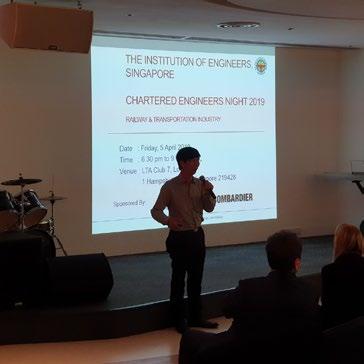
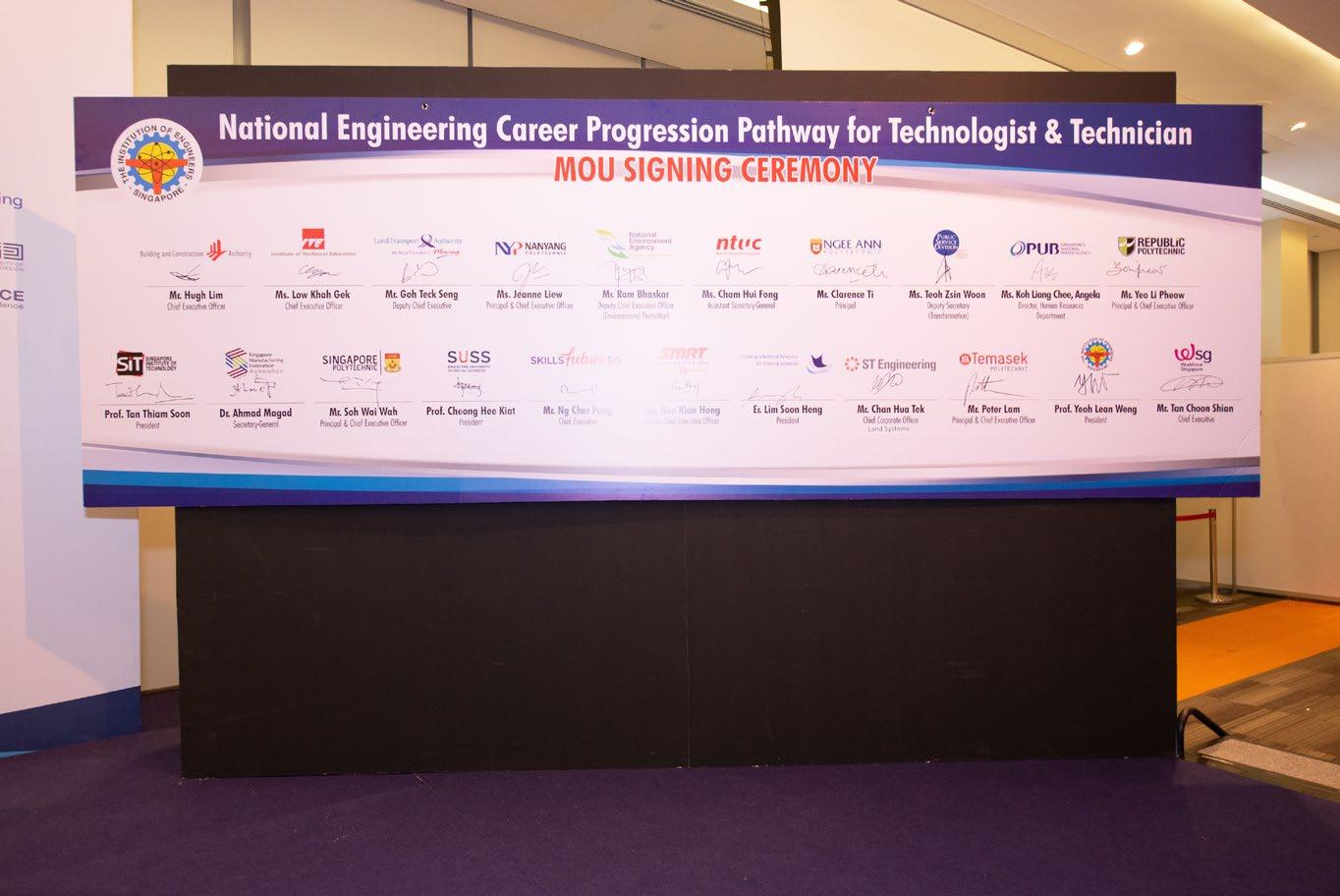


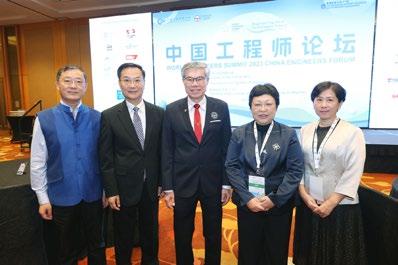
The Chartered Engineering Registry aims to provide professional recognition to qualified Engineers, Technologists and Technicians across all sectors.
Being registered as a Chartered Engineering Professional will be an external validation of your experience, expertise and practising competence; and is a quality mark to differentiate your professional standing in the following sectors of engineering:










24 Protecting coastal reservoirs at north-west coast
26 Concrete ‘battery’ developed at MIT now packs 10 times the power
28 Dismantling a road bridge in Germany
30 Doka advances construction of Denmark’s third-longest bridge
32 Unique visitor access to the Trevi Fountain in Rome
33 Excavating a metro tunnel under the Panama Canal
34 Corrosion protection system for the façade steelwork of office building
35 World and market premières from the Wirtgen Group
36 Caterpillar presents three new compact equipment models
37 Komatsu offers end-to-end attachment and equipment solutions
38 Topcon unveils new products at CONEXPO 2026
39 Trimble presents the 2026 Tekla software
40 Compressed air for tough drilling applications

The Singapore Engineer is published monthly by The Institution of Engineers, Singapore (IES). The publication is distributed free-of-charge to IES members and affiliates. Views expressed in this publication do not necessarily reflect those of the Editor or IES. All rights reserved. No part of this magazine shall be reproduced, mechanically or electronically, without the prior consent of IES. Whilst every care is taken to ensure accuracy of the content at press time, IES will not be liable for any discrepancies. Unsolicited contributions are welcome but their inclusion in the magazine is at the discretion of the Editor.
New national standards launched to support healthier indoor environments and sustainable cooling.
Ngee Ann Polytechnic (NP) announces two major initiatives to strengthen Singapore’s advanced manufacturing ecosystem.
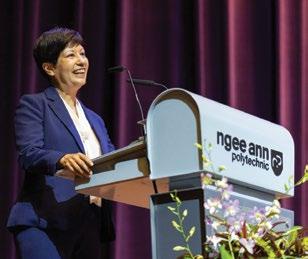
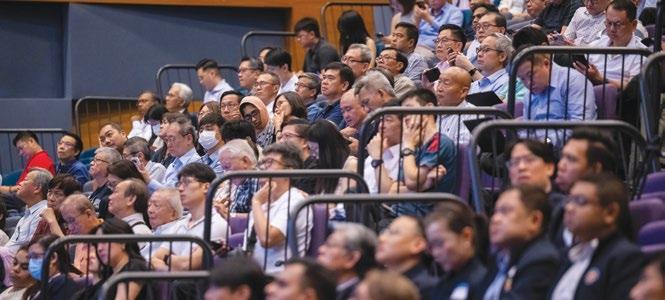
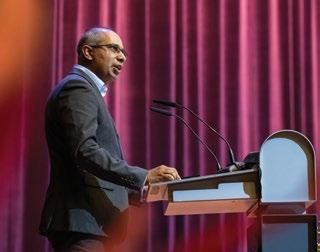
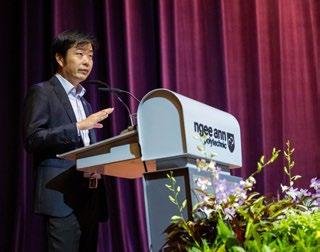
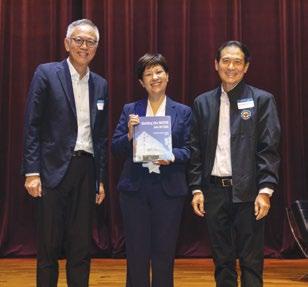
The Institution of Engineers, Singapore (IES) brought together leaders from industry, academia and public agencies at the World Engineering Day 2026: Charles Rudd Distinguished Global Lectures (WED 2026: CRDGL) to examine how emerging technologies are reshaping the future of engineering. Held on 10 March 2026, at the Ngee Ann Polytechnic (NP) Convention Centre, WED 2026: CRDGL carried the theme ‘Engineers and the Future of
Engineering: Opportunities of Emerging Technologies’. The event attracted about 1,700 in-person and online attendees.
Ms Indranee Rajah, Minister, Prime Minister’s Office, Second Minister for Finance and Second Minister for National Development, graced the event as the Guest-ofHonour.
At the event, distinguished speakers, Dr Bicky Bhangu, Operating Partner, Emerging Technologies, Temasek Holdings, and Dr Hanbin
Zheng, Head of Science and Technology Network, British High Commission, shared insights on technological transformation and the future skills required of engineers. World Engineering Day for Sustainable Development is observed annually on 4 March to highlight the role of engineering in modern life and sustainable development. Proclaimed by UNESCO in 2019 and organised by the World Federation of Engineering Organizations (WFEO), it features global activities that showcase innovative solutions supporting the United Nations Sustainable Development Goals.
HEALTHIER AND SUSTAINABLE BUILDING PRACTICES
At WED 2026: CRDGL, three key standards for the built environment, TR 141:2025 for hybrid cooling systems, SS 553 for air-conditioning and mechanical ventilation, and SS 554 for indoor air quality in air-conditioned
buildings, were also launched.
These national standards were developed by expert workgroups under the Singapore Standards Council which is overseen by Enterprise Singapore and supported by the IES-Standards Development Organisation (IES-SDO).
The updated standards provide guidance on hybrid cooling while maintaining thermal comfort and indoor air quality, as well as on energy-efficient measures to reduce airborne disease transmission during an outbreak.
The guidance on hybrid cooling is aligned with the Go 25 movement which aims to sustain indoor ambient temperatures at around 25° C to reduce energy consumption, prevent overcooling and strengthen long-term climate resilience.
The Go 25 initiative is led by the Ministry of Sustainability and the Environment, and the Singapore Green Building Council, with support from the Building and Construction Authority and the National Environment Agency.
As part of its 60th anniversary (IES60) celebrations, IES unveiled the IES60 logo at WED 2026: CRDGL. The commemorative logo marks six decades of IES’ contributions to the engineering fraternity while underscoring the institution’s continued commitment to advancing engineering excellence and innovation.
The IES60 milestone will feature a year-long series of commemorative programmes and industry engagements celebrating six decades of nation-building and the evolving role of engineers in shaping Singapore’s future.
“As IES marks 60 years, we are focused not only on celebrating our heritage, but on strengthening the profession for the future. Through collaboration with institutions, industry and regulators, we will continue to equip engineers with the capabilities needed for emerging technologies,” said Er. Chan Ewe Jin, President, IES.

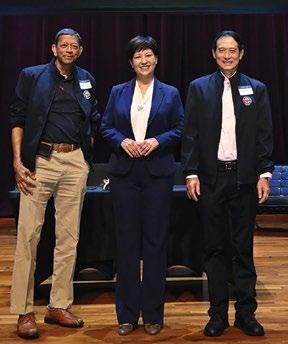
At WED 2026: CRDGL, Ngee Ann Polytechnic (NP) announced two major initiatives to strengthen Singapore’s advanced manufacturing ecosystem. Firstly, in partnership with Siemens – the only SkillsFuture Queen Bee in advanced manufacturing – NP will launch a leading-edge smart manufacturing platform aimed at helping SMEs kickstart their transformation journey. Secondly, NP and the Agency for Science, Technology and Research (A*STAR) will introduce Singapore’s first stackable Specialist Diploma in Smart Manufacturing (SDSM), with a strong focus on the use of Artificial Intelligence for industrial innovation.
Accelerating Industry 4.0 adoption through applied innovation Developed through NP’s strategic partnership with Siemens, the
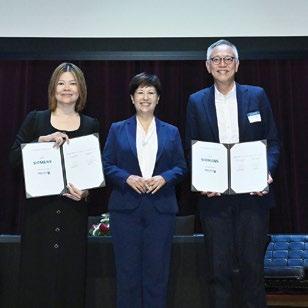
in partnership with Siemens, it will launch a leading-edge, smart manufacturing platform aimed at helping SMEs kickstart their transformation journey.
smart manufacturing platform integrates digital technologies, automation and data analytics within a reconfigurable, industryready set-up. The platform enables companies, particularly SMEs, to pilot automation and robotics solutions for specific manufacturing processes before deploying them at scale in their own facilities. By lowering adoption risks and shortening experimentation cycles, the platform supports faster and more confident Industry 4.0 transformation. Through Siemens’ industry expertise and NP’s strengths in applied engineering education, companies gain both technology solutions and the capabilities to support their implementation.
Future-proofing the workforce with AI-focused skills for smart manufacturing
Complementing the platform, NP, in partnership with A*STAR, will introduce Singapore’s first stackable Specialist Diploma in Smart Manufacturing (SDSM).
Designed for industry practitioners like engineers and manufacturing professionals, and also fresh graduates, the SDSM equips learners with applied capabilities in next generation manufacturing such as AI, automation and more.
The programme adopts a module stackable structure, where learners accumulate Post-Diploma Certificates (PDCs) towards a full Specialist Diploma. PDCs and selected short courses are cross-recognised between NP and A*STAR, allowing learners to progressively build their qualification through modules offered by both training providers.
For a start, under this model, NP will offer two PDCs in Smart Manufacturing Automation & Analytics and Industrial Cybersecurity & Resilience, while A*STAR will offer another in AI for Manufacturing.
As the first polytechnic-led programme to offer a stackable and scalable pathway towards a full qualification in smart manufacturing, the SDSM provides learners with greater flexibility while deepening their expertise in smart manufacturing.
“As AI and the rapid pace of technological change reshape the engineering landscape, education and industry must work closely to translate innovation into real-world impact. By partnering Siemens and A*STAR, NP will enable companies to pilot smart manufacturing solutions and equip engineers with the skills to optimise them. Through this integrated approach, we will collectively strengthen Singapore’s advanced manufacturing ecosystem,” said Mr Lim Kok Kiang, Principal & CEO, Ngee Ann Polytechnic.
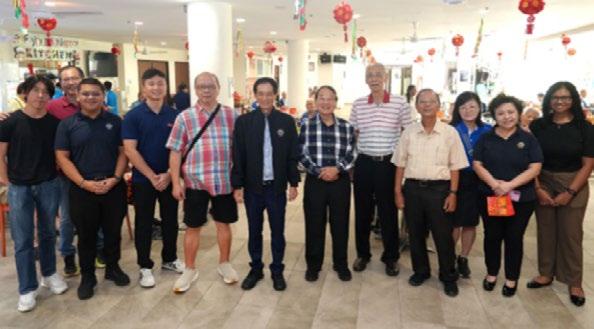
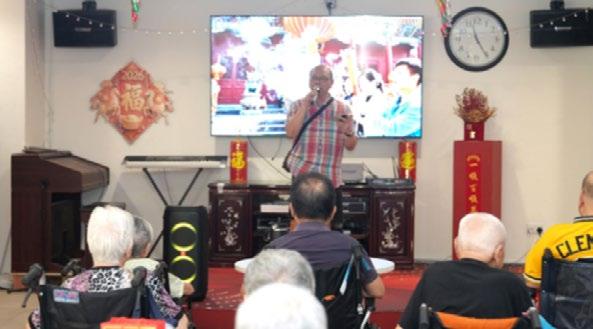
On 2 March 2026, members of the IES Social Services Committee and IES President Er. Chan Ewe Jin spent a wonderful morning with the 180 residents of the Moral Home for the Aged Sick. From distributing mandarin oranges and snacks, to some high-energy karaoke
performances that brought the house down, the atmosphere was buzzing with festive energy!
Shout-out to our amazing volunteers from the Young Engineers Committee, the Temasek Polytechnic Student Chapter and IES Secretariat for making this visit so special.

Bentley Systems Incorporated, the infrastructure engineering software company, has announced the opening of submissions for the Year in Infrastructure event and YII Awards programme, which recognises digital innovation in how infrastructure is designed, built and operated, using Bentley software.
“Originally, the Bentley awards recognised designers who used 3D technology to drive efficiency. Now they assess how massive projects are building and leveraging rich data assets to create value throughout the entire lifecycle of a project – from initial financial decision-making through design and construction,” said Monica Schnitger, Founder, President and Principal Analyst of Schnitger Corporation.
Over the past two decades, more than 5,500 of the world’s most significant infrastructure projects have participated in Bentley’s award programme.
Past winners have included landmark projects such as the digital twin for structural monitoring of St Peter’s Basilica in Vatican City; the Seine Nord Europe Canal in France; the Thames Tideway Tunnel in the UK; Siemensstadt Square in Germany; Sydney Airport in Australia; the Fairmont Udaipur Palace in India; the Beijing Zhangjiakou highspeed railway in China; the Ontario Line subway in Canada; and EchoWater, one of the largest agricultural water recycling facilities in the United States.
These projects demonstrate how digital innovation delivers measurable economic, environmental and societal impact.
“Around the world, infrastructure professionals rely on Bentley software to design, build and operate infrastructure that is more resilient, efficient and sustainable. The YII Awards celebrate real
world results from teams that are innovating in areas that include ground informed design, connected data and AI. It is important to promote this work as best practice, as these achievements set a new standard for what is possible across the infrastructure ecosystem,” said Cate Lochead, Chief Marketing Officer at Bentley Systems.
Submissions are evaluated by independent panels of industry experts, based on digital advancement and quantifiable results, including improvements in efficiency, cost performance, resilience and sustainability.
The YII Awards 2026 recognise excellence across the full spectrum of infrastructure disciplines and innovation, under categories including Bridges and Tunnels; Cities and Facilities; Construction; Energy Production; Geospatial and Reality Modeling; Project Delivery; Rail and Transit; Roads and Highways; Structural Engineering; Subsurface Modeling and Analysis; Transmission and Distribution; and Water and Wastewater.
Finalist projects contribute to the industry through detailed project stories, digital playbooks and presentations shared as part of the awards programme.
Submission details
• Opens: 18 March 2026
• Closes: 3 May 2026
• Eligibility: Projects of any size or stage, that utilise Bentley software
• Finalists and Winners: Finalists will be announced in August 2026. Finalists will be invited to present their projects at the Year in Infrastructure event in Singapore, on 6 and 7 October, where category winners will be revealed.
For more information or to submit a project, visit Awards / The Year in Infrastructure / Bentley Systems.
Bentley Systems Incorporated has announced that the Alabama Department of Transportation (ALDOT), in the US, is using Bentley’s Blyncsy solution to enhance its existing performancebased budgeting process for highway maintenance. ALDOT adopted a performance-based budgeting model more than 15 years ago and continues to refine its implementation to ensure maintenance funds are allocated based on objective, data-driven insights. Historically, collecting asset condition data across Alabama’s 11,000 miles of roadway network has required significant manual effort and resources. While ALDOT has long employed a data-driven statewide survey, traditional methods, such as manual inspections, are labourintensive and can introduce inconsistencies.
To improve efficiency and accuracy, ALDOT is incorporating Blyncsy’s automated AI analytics into its established process, providing a faster and more consistent assessment of specific designated roadway assets.
Blyncsy, part of Bentley’s Asset Analytics portfolio, uses crowdsourced high-resolution dash camera imagery from vehicles and applies AI to automatically analyse roadway conditions. This provides a consistent, empirical assessment of critical assets, such as guardrails and signage, across the entire roadway network.
To support the next phase of nation-building, the Building and Construction Authority (BCA) is working with the Built Environment (BE) sector to strengthen the BE professions. At the same time, BCA is pressing on with efforts to improve liveability in private developments.
Second Minister for Finance and National Development Indranee Rajah outlined these initiatives at the MND Committee of Supply Debate on 4 March 2026.
Strengthening the BE professions BE professionals are pivotal to Singapore’s development. Examples of such professionals include engineers, architects, project directors and construction managers. Their involvement spans across the entire development process, from initial design through construction and into postconstruction.
As Singapore continuously refreshes its buildings and infrastructure to optimise the use of limited land, the BE sector offers exciting and rewarding careers to shape Singapore’s future. For example, the industry expects to require at least 1,000 new architects and engineers annually, for the coming years, as construction demand grows.
Thanks to the collective efforts of various BE sector stakeholders, encouraging progress has been made since the Taskforce for Architectural and Engineering Consultants launched its recommendations in September 2025.
The Taskforce was co-chaired by Ms Indranee Rajah, Second Minister for National Development and Mr Chaly Mah, Chairman of SJ Group, and comprised industry representatives. The Taskforce aimed to ensure Singapore maintains a robust pipeline of
skilled BE professionals and capable firms to deliver the nation’s infrastructure needs. The Taskforce’s recommendations can be obtained from go.gov.sg/bcaaetaskforce-fullreport
Some of the key developments include:
• Industry support for the INSPIRE Internship Programme that features deeper on-the-job learning, dedicated mentorship and higher starting salaries. SJ Group has already onboarded the first batch of six INSPIRE interns, while firms such as PH Consulting Pte Ltd, DCA Architects Pte Ltd and Aedas Pte Ltd, have also committed to the programme.
The Professional Engineers Board (PEB) and Board of Architects (BOA) will also recognise relevant pre-graduation internship work experience as qualifying practical experience towards professional registration.
• Continued focus on qualitybased procurement following the expansion of the Reduced Fee Score to cover public sector projects up to SGD 100 million. Since the launch of the Reduced Fee Score, 10 out of 11 project tenders have been awarded to bids with the highest quality scores. This move is expected to help discourage unsustainable fee diving, allow firms to focus on delivering value and quality, and provide firms with more resources to invest in human capital and business transformation.
• Clear resolve to improve workplace well-being, with over 50 firms and service buyers committing to the Built Environment Culture of Appreciation, Respect and Empathy (BE CARE) Charter that outlines best practices to develop more collaborative relationships amongst project teams and safeguard wellbeing for all.
Building on this positive
momentum, the Government will be partnering the industry to uplift the Quantity Surveying profession. Quantity Surveyors (QSes) play critical roles within the consultant team to ensure smooth delivery of projects and it is critical to ensure that the Quantity Surveying profession will be able to support the ambitious building plans.
QSes manage contracts and project costs within the consultant team. During the planning and design stage, QSes estimate costs and procure BE services for clients. During the construction stage, QSes process payment claims and change orders, until the project accounts are closed.
BCA has established a dedicated workgroup comprising industry representatives, service buyers, Institutes of Higher Learning and relevant agencies, to study and propose recommendations to strengthen the Quantity Surveying profession through leveraging emerging technologies, strengthening talent pipelines and professional competencies, as well as enhancing the value proposition that QSes bring to project teams.
Additionally, measures to improve liveability in private developments will be studied. BCA is reviewing the Building (Strata Management) Act to enhance the management of stratatitled residential developments. The review includes key areas such as supporting Management Corporation Strata Titles (MCSTs) to maintain adequate sinking funds to upkeep and upgrade their estates, and equipping MCSTs to run their estates better.
The public consultation on the draft amendments will be conducted from 9 March to 8 April 2026 through the REACH platform.
BCA is also reviewing the Accessibility Fund scheme. Introduced in 2007, the Accessibility Fund aims to encourage building owners to upgrade their properties with accessibility and universal design features, to better support seniors, persons with disabilities and families, through voluntary upgrading works.
As part of this review, BCA is exploring widening the range of eligible features under the Accessibility Fund, such as active ageing and dementia-friendly installations, as well as expanding the eligibility criteria to enable more existing buildings to benefit from the support.
To ensure lifts and escalators meet modern safety standards, BCA
is studying measures to enhance the safety of older lifts and escalators, such as the inclusion of safety features that help regulate their speed and movement. BCA is also exploring the provision of co-funding support to eligible private building owners and operators for selected essential safety features. Further details will be announced when ready.
The Ministry of National Development (MND) and the Building and Construction Authority (BCA) have announced the following change in a senior appointment at BCA:
Mr Kelvin Wong Wee Siong, currently Chief Executive Officer (CEO) of BCA, will relinquish his appointment on 1 May 2026.
Mr Derek Tan, currently the Executive Director/Planning and Chief Infrastructure Planning Officer (CIPO) at MND, will join BCA as CEO (Designate) on 1 April 2026 and take on his appointment as CEO of BCA, on 1 May 2026.
As CEO of BCA, Mr Wong played an instrumental role in steering the Built Environment (BE) sector’s recovery from the COVID-19 pandemic. He led coordinated efforts with industry leaders, Trade Association and Chambers (TACs) and government agencies to address manpower and financial challenges while ensuring the safe restart of construction activities.
Following COVID-19, he oversaw key policy changes, including the shift to firmbased regimes for supervision and safety inspections, the introduction of Mandatory Energy Improvement and the Accessibility Code review to enhance the safety, sustainability and liveability of Singapore’s physical environment.
Under his leadership, BCA fostered a stronger innovation eco-system and made strides

in industry transformation, technology adoption and enterprise development, through the launch of CORENET X, new grants and incentives, sectoral manpower development initiatives and collaborative procurement practices.
As Executive Director/ Planning and Chief Infrastructure Planning Officer in MND, Mr Tan led transformation efforts in Singapore’s underground utilities space and worked closely with BCA and the National Parks Board (NParks) on strategic policies and initiatives. He previously served concurrently as Group Director, Special Duties, in the Land Transport Authority (LTA) and the founding CEO of EV-electric Charging Private Limited (EVe), driving the rollout of electric vehicle charging infrastructure.
Mr Tan started his career in HDB where he held several diverse portfolios. In particular, he served as HDB’s Group Director, Housing Management,

where he oversaw large-scale operations with over 2,000 staff to manage more than one million sold and public rental flats. Mr Tan’s extensive experience and familiarity with the builtenvironment sector positions him well for his new appointment as CEO, BCA.
The Building and Construction Authority (BCA) champions a safe, sustainable and liveable built environment for Singapore. As a leader in the sector, BCA is dedicated to driving industry transformation and setting rigorous standards in building safety, quality and environmental sustainability. By advancing innovation, digitalisation and the development of a skilled workforce, BCA fosters a dynamic industry that is ready to meet the evolving needs of the nation and build a resilient and progressive built environment for all.
World of Concrete 2026, a comprehensive event dedicated to the concrete construction and masonry industries, was held from 19 to 22 January 2026, with education beginning on 19 January. Held at the Las Vegas Convention Center, USA, the event brought together more than 47,400 registered professionals who connected on the future of construction and discovered breakthrough resources for education, skills development and workforce growth.
More than 1,300 exhibiting companies spanned multiple product categories, including material handling, concrete producers, construction technology, precast, concrete masonry, concrete reinforcement, cement production, demolition and repair, surfaces, and decorative products.
A total of 284 new exhibitors joined World of Concrete, bringing innovative solutions to the market, as the market size for cement and concrete products continues to grow and is projected to reach USD 508 billion in 2030, at a compound annual growth rate of 4.9%.
Participating countries included Australia, Canada, Brazil, China, the Czech Republic, Dominican Republic, India, Italy, Belgium, Brazil, Germany, Japan, Korea, Libya, Mexico, New Zealand, the United Kingdom, and more, reinforcing World of Concrete’s global reach, as concrete and masonry construction demand across the world rises and the United States remains the world’s fourth-largest cement producer.
“World of Concrete is where the future of concrete and masonry construction is built. We are honoured to be part of a worldwide community that
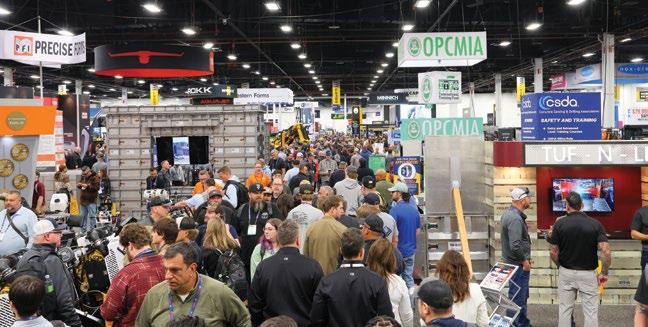
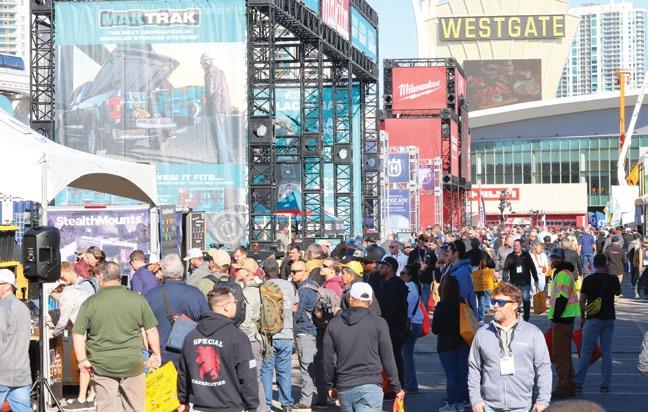
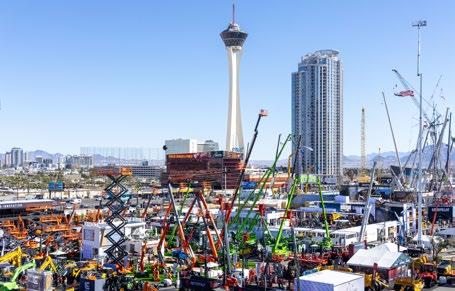
At World of Concrete 2026, more than 1,300 exhibiting companies presented products under multiple categories, attracting more than 47,400 registered professionals.
champions innovation, elevates performance and celebrates the artistry of craftsmanship. Each year, our exhibitors and attendees come together to connect, collaborate, and uncover new opportunities that will continue to shape the industry’s future,” said Jackie James, Vice President, World of Concrete.
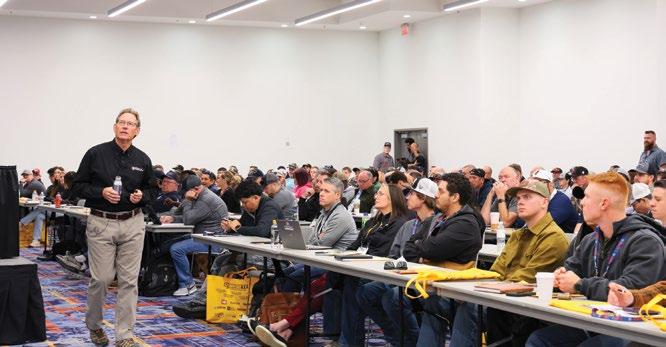
The comprehensive World of Concrete 2026 education programme introduced new resources to the community, adding bilingual seminars to the established Spanish track for
core classes and including key education highlights and question and answer sessions in Spanish. World of Concrete hosted several experts who shared insights on timely topics including economics, engineering and future forecasting for the industry.
‘The Economic Forecast with Ed Sullivan and Pierre Villere’ focused on navigating economic volatility with strategic insights from distinguished economists revealing critical market projections and sector-specific intelligence. Sullivan, Economist at The Sullivan Report and Villere, Senior Managing Partner at Allen-Villere Partners,
provided critical information on data-driven cement and construction forecasts, economic analysis and market outlooks.
Two new engineering courses were introduced this year to discuss concrete construction efficiency and strategic choices. The courses ‘Engineering: Designing for Constructability’ and ‘Engineering: Bridging the Gap Between General Contractor & Engineer’, addressed both strategic design choices and improving construction productivity through enhanced communication.
Interactive event features
The Construction Industry Management (CIM) Live and Silent Auctions, raised USD 2.3 million for the CIM initiative which awards students with a four-year Bachelor of Science degree in Concrete Industry Management programmes at five public universities in the US, all of which offer four-year CIM degrees.
The World Championship SPEC MIX BRICKLAYER 500 assembled 28 masons from around the world competing for the title of ‘World’s Best Bricklayer’ along with cash and other prizes.
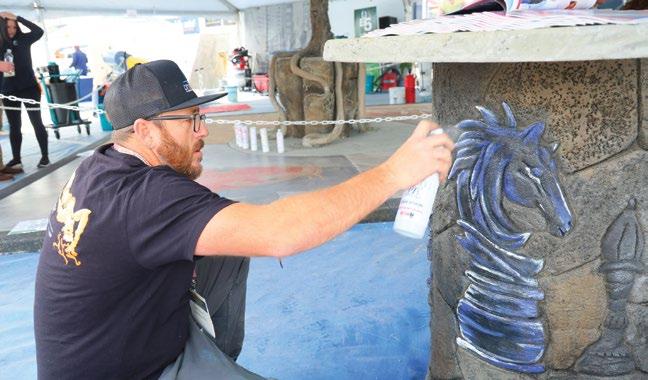
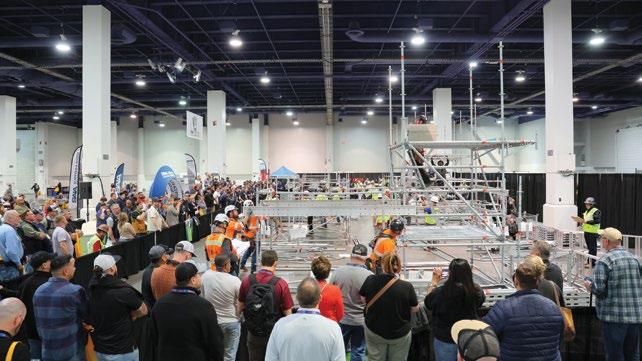
Interactive sessions including Epoxy Live!, American Society of Concrete Contractors (ASCC) Decorative Concrete Experience, Artificial Rock Carving Live! and the Scaffold & Access Industry Association (SAIA) Scaffold Builders Challenge highlighted cuttingedge techniques while celebrating the exceptional skills and talent driving the concrete and masonry construction industries forward.
“The ability to engage with our largest audience of end-users, understand market sentiment and seeing projects develop continues to be key at World of Concrete,” said John Paul Marcantonio, President & CEO, Bosch Power Tools North America.
World of Concrete 2027
World of Concrete will return to the Las Vegas Convention Center, from 19 to 21 January 2027, with
education beginning on 18 January.
World of Concrete
World of Concrete is an annual international event dedicated to the commercial concrete and masonry construction industries. The event includes
indoor and outdoor exhibits, with the industry’s leading suppliers showcasing innovative products and technologies, demonstrations and competitions, and a world-class education programme.
World of Concrete is organised by Informa Markets.
Held from 3 to 7 March 2026, in Las Vegas, Nevada, USA, CONEXPOCON/AGG 2026, the latest presentation of North America’s largest construction trade show, attracted more than 140,000 construction professionals from 128 countries.
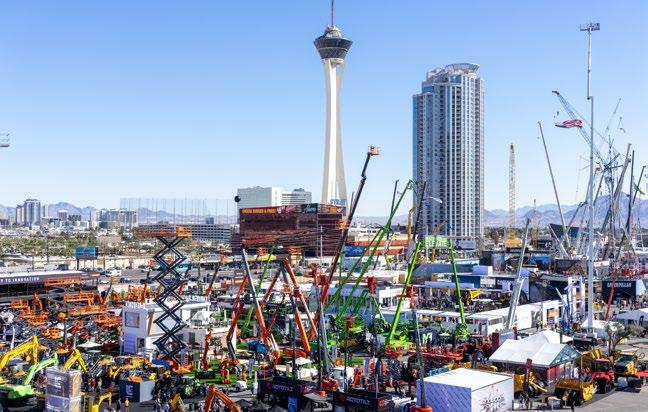
Spanning more than 3,000,000 ft2 of exhibit space, CONEXPOCON/AGG 2026 featured over 2,000 exhibitors showcasing the latest equipment, technology and services across every major construction sector.
The show brought together contractors, manufacturers, technology leaders and workforce advocates to present and discuss how the new equipment, emerging technologies and solutions can help the construction sector build more efficiently, safely and sustainably, while maintaining strong industry momentum.
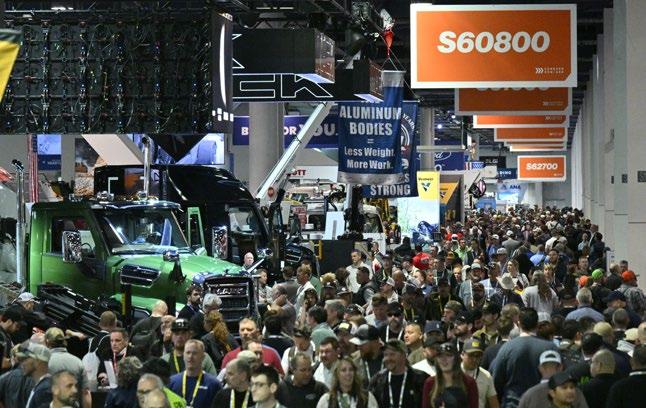
Covering massive earthmoving machines, towering cranes and next generation paving equipment, digital jobsite solutions, automation, sustainability and advancements, the show floor offered attendees the opportunity to see innovations up close, connect directly with manufacturers and make informed purchasing decisions that will shape projects and businesses in the years ahead.
“CONEXPO-CON/AGG is where the construction industry comes to see what is next. This week demonstrated the resilience and ingenuity of our industry. From advanced machinery to digital tools that help crews work safer and smarter, the innovations unveiled here will shape jobsites for years to come,” said Dana Wuesthoff, Show Director, CONEXPO-CON/AGG.
The energy on the show floor translated into real business opportunities for show attendees who travelled to Las Vegas to evaluate new machines and connect
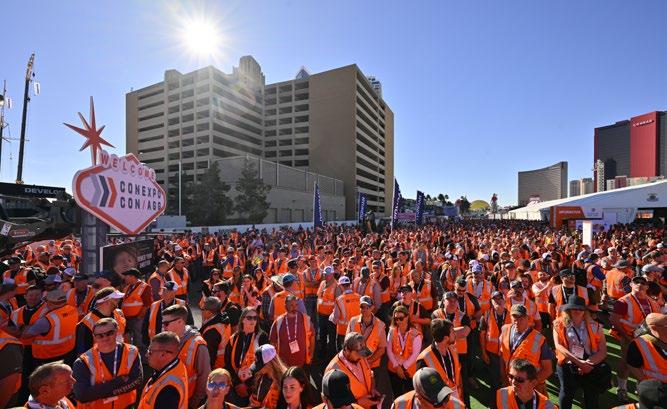
with manufacturers. For many at the show, CONEXPO-CON/AGG provides a rare opportunity to see equipment firsthand, compare solutions and make purchasing decisions.
“We have actually made deals here, met clients and connected with new partners. It is one of the best places to bring the industry together and move business forward,” said Ryan Ford of F&G Trucking Crane.
Across the show floor, manufacturers unveiled technologies and equipment designed to define the next generation of construction jobsites.
Komatsu highlighted advancements in intelligent machine control and automation, including its PC220LCi-12 intelligent excavator, which uses integrated sensors and 3D design data to help operators excavate to grade with greater precision and reduce rework. Komatsu also introduced the allnew HM460-6 46-ton articulated truck, the largest in its lineup.
LiuGong showcased a range of
advanced machines including the 870 HE Loader, 952F excavator and 924 FE Electric Excavator, underscoring the industry’s growing investment in electrification and lower-emissions equipment.
“We have seen a lot of equipment that we are looking to purchase in the near future. Being able to put your hands on the machines and talk directly with manufacturers makes CONEXPOCON/AGG a great show for companies like ours,” said Thomas Coyne of Donjon Marine.
Technology innovators across the show floor also demonstrated how digital solutions are transforming construction workflows.
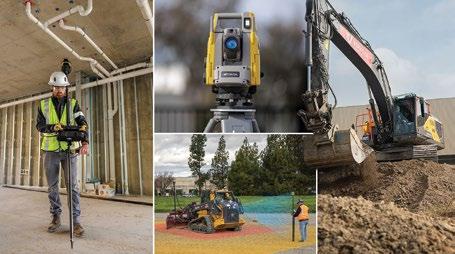
Topcon Positioning Systems 3DMC Edge is a new feature within the 3D-MC environment, engineered to focus directly on a machine’s cutting edge for enhanced accuracy and responsiveness.
Samsara showcased connected operations technology that enables contractors to monitor equipment utilisation, safety and fleet performance, across jobsites.
Meanwhile, Doka demonstrated advanced formwork and digital job
site solutions designed to improve efficiency and safety on complex infrastructure and building projects.
Compact equipment leader Bobcat also showcased innovations focused on the future of compact construction, highlighting advances in AI, electrification, autonomy and connectivity, including its Bobcat Jobsite Companion, an AI-enabled system designed to help operators work more efficiently with realtime machine insights and jobsite guidance.
Innovation across the industry was further recognised through the Next Level Awards which honour breakthrough technologies transforming how construction projects are built and managed. The awards spotlight equipment and technology innovations that improve productivity, sustainability and jobsite safety, reinforcing CONEXPO-CON/AGG’s role as the global stage where the construction industry unveils ideas and machines shaping its future.
“Autonomy and retrofit technology are changing the game. The ability to upgrade existing machines with sensors and automation is accelerating adoption across the industry,” said Federik FilzReiterdank of Crewline.
Across millions of square feet of exhibits, attendees had the opportunity to see thousands of machines, technologies and solutions while connecting directly with the manufacturers and innovators shaping the next era of construction.
“CONEXPO-CON/AGG highlights the innovation pipeline that keeps construction moving forward. The technologies introduced this week are not concepts. They are real-world solutions contractors can adopt now to build faster, safer and more sustainably. I have witnessed a lot of energy, excitement and engagement between the exhibitors and the industry stakeholders,” said Eric Sauvage, President & CEO of LBX Company and CONEXPO-CON/AGG 2026 Show Chair.
“This is what CONEXPO-CON/
AGG is all about. This has been another one of the best editions of CONEXPO-CON/AGG,” he added.
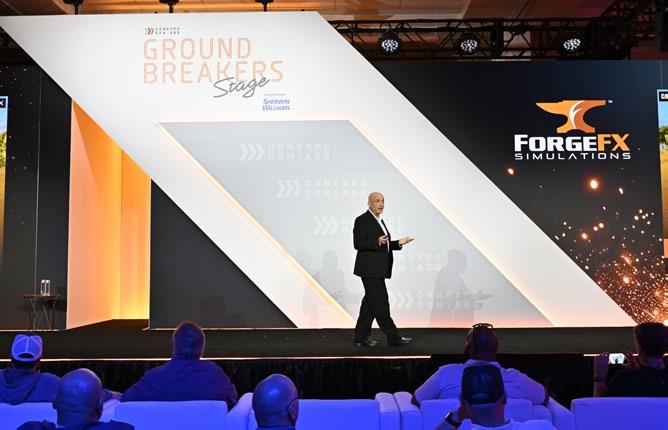
The Ground Breakers Stage served as a hub for forwardlooking conversations, drawing strong attendance for sessions on artificial intelligence, workforce development, infrastructure investment, sustainability and the evolving role of data across construction operations.
Industry leaders and technology experts explored how digital transformation, manufacturing advancements and collaborative partnerships are reshaping the sector and helping companies
navigate changing market dynamics.
The momentum continues beyond the show floor as the Ground Breakers Stage sessions are now streamed on demand, where they have already generated thousands of online views, extending the conversation around the technologies and ideas transforming construction.
A global gathering focused on building the future
CONEXPO-CON/AGG 2026 reinforced construction’s role as a driver of economic development, supporting infrastructure modernisation, energy expansion, manufacturing growth and resilient
communities. The show created opportunities for contractors and manufacturers to connect directly, exchange ideas and accelerate adoption of technologies that improve project outcomes.
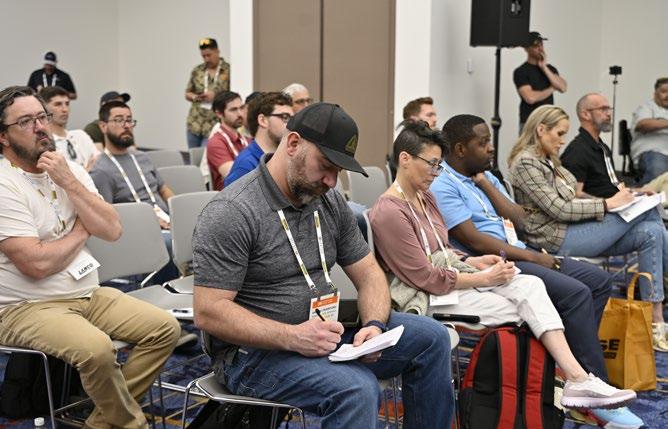
In addition to exhibits, attendees participated in 150 comprehensive education sessions, live demonstrations and peer-to-peer discussions designed to deliver actionable insights for businesses of every size.
Classroom education is a cornerstone of the CONEXPOCON/AGG experience, delivering an all-encompassing lineup of panels, workshops and keynote conversations, designed to help attendees stay ahead of a rapidly evolving construction landscape. From hands-on equipment insights to forward-looking discussions on artificial intelligence, sustainability and workforce innovation, CONEXPO-CON/AGG provided learning opportunities for every role and career stage.
New weekend workshops for 2026 brought together hundreds of women in construction, small business owners and maintenance professionals for peer-driven learning at the show.
The expanded lineup helps industry professionals connect with others who understand their daily challenges and opportunities, and included:
Shop Talks & Walks: Hands-on training focused on preventive maintenance, fleet efficiency and real-world equipment solutions.
EmpowerHER Workshop: Held in celebration of Women in Construction Week 2026, these sessions connected women industrywide for mentorship and inspiration.
Small Business Workshop: Dedicated to helping small business owners and family-run firms strengthen operations and build partnerships.
“This show brings people together to learn about the latest equipment and technology while also sharing ideas on how to recruit and train the next generation of
workers,” said Adonis Smith of IUOE Local 478.
As the industry continues to evolve, CONEXPO-CON/AGG remains the premier destination for discovering solutions, building partnerships and preparing for the demands of tomorrow’s jobsites.
The next CONEXPO-CON/AGG will be held in Las Vegas, from 13 to 17 March 2029, continuing its tradition of bringing the global construction industry together to drive progress.
CONEXPO-CON/AGG
CONEXPO-CON/AGG is North
America’s largest construction trade show, showcasing the latest equipment, products, services and technologies for the construction and aggregates industries. Held every three years in Las Vegas, the event brings together contractors, manufacturers and industry professionals from around the world.
The Principal Sponsors are Association of Equipment Manufacturers (AEM), National Ready Mixed Concrete Association (NRMCA) and National Stone, Sand & Gravel Association (NSSGA). The Show Sponsor is Associated General Contractors of America (AGC). AEM is a Show Producer.
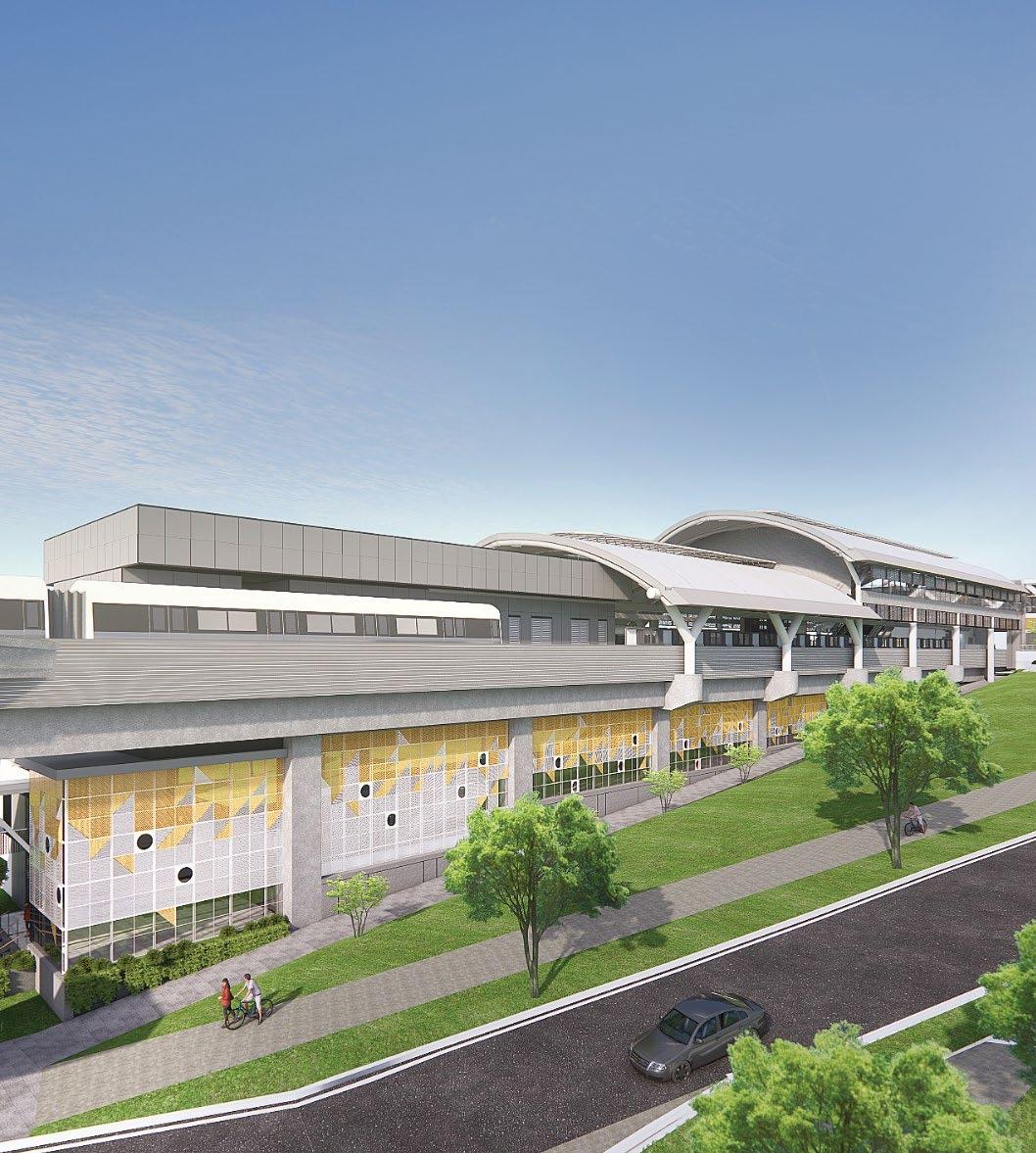
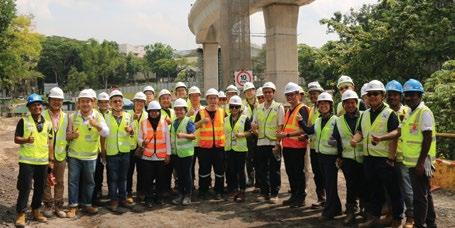
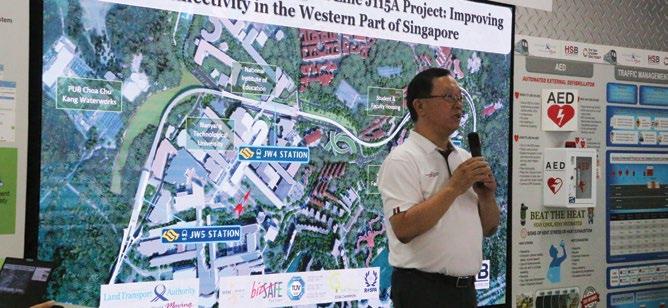
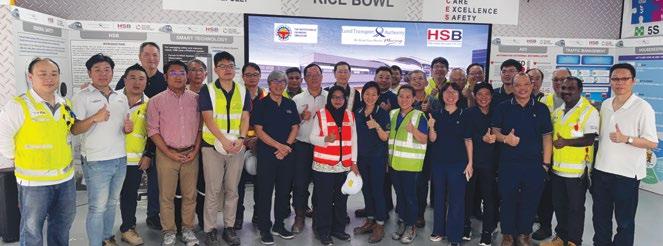
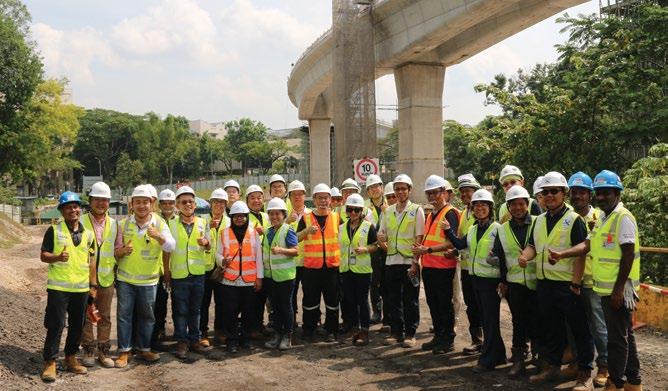
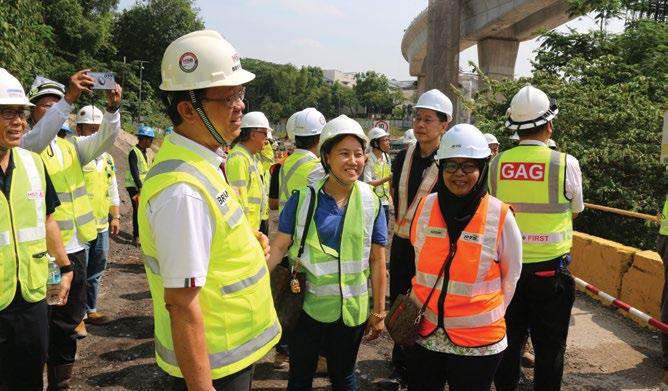
The IES Transportation and Traffic Division organised a technical site visit to the J115A project on 26 September 2025. The visit, involving 20 delegates from various agencies, institutions, consultants, contractors and operators, was jointly hosted by the Land Transport Authority (LTA) J115A Project Team and the main contractor, Hwa Seng Builder Pte Ltd (HSB).
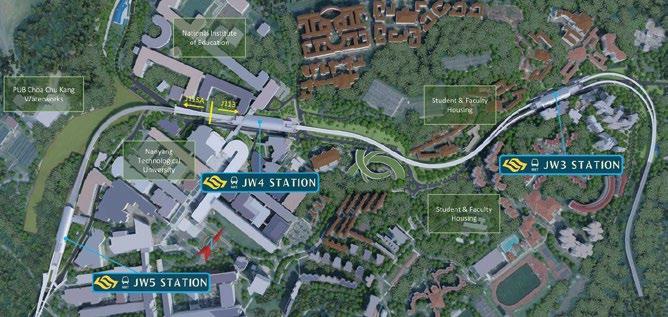
Contract J115A covers the design and construction of JW5 Station and its associated viaduct, with a total route length of approximately 0.7 km. Awarded to HSB in May 2022, JW5 Station is the final station on the western branch of the Jurong Region Line (JRL) and is located within the NTU campus.
Project overview
The Jurong Region Line (JRL) is an above-ground, medium-capacity MRT system designed to serve Choa Chu Kang, Tengah, Jurong West, Jurong Industrial Estate, Nanyang Technological University (NTU) and Jurong East to West Coast. The line spans approximately 24 km and includes planned interchanges with the existing North South Line (NSL), East West Line (EWL), as well as future MRT lines.
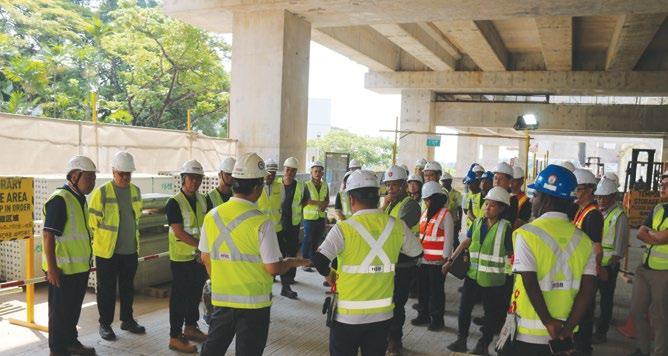
During the visit, HSB Project Director, Bryan Bu, provided an overview of the J115A works, including station construction, portal frame construction over the live roads and the construction of precast segmental box girders.
Station design and construction
JW5 Station is an at-grade island platform station consisting of five levels – Ground Level, Lower Concourse Level, Under Platform Level, Platform Level and Upper Concourse Level.
The station adopts a braced structural system consisting of columns, beams and slabs. To enhance productivity, precast secondary beams and precast planks with cast-in-situ topping are adopted. For safety, the secondary precast beams are secured using three lines of defence prior to beam stitching.
The station features two roof levels, namely the lower and upper roofs. The roof structure comprises
a steel arch framing system supported by steel Y columns at both sides at 15 m spacing. All the steel roof components were fabricated off-site and installed
on-site, using bolted splicing connections, eliminating welding works at height and expediting construction, while reducing safety risks.
Portal frame and viaduct construction
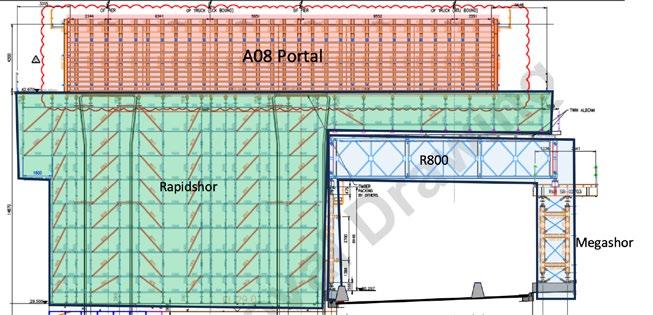
To facilitate portal frame construction over live roads, Megashor and Rapidshor shoring systems were adopted. These systems offer modular design with fewer components to assemble, reduced erection time, excellent alignment accuracy and lightweight components, and with the flexibility to accommodate site constraints. Importantly, live traffic is maintained beneath the shoring system, minimising disturbance to road users and stakeholders, during construction.
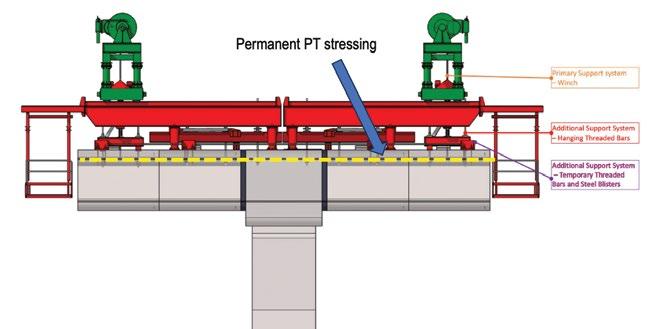
The viaduct comprises rectangular piers ranging from 6 m to 23 m in height, with typical spans between 40 m and 60 m. Designed as a fully integral structure, the viaduct is continuous over three to five spans, with bearings and expansion joints located at the end of the continuous girders. Construction is carried out using precast segmental box girders, erected via the balanced cantilever method, while end spans are launched using falsework staging.
Construction within an active university campus
Constructing MRT infrastructure within an active university campus presents many challenges. The proximity of works to academic buildings and halls of residence requires careful planning to minimise disruptions during lectures and examinations, while ensuring residents’ comfort at night. The safety of students and staff remains the highest priority throughout the project.
To address these challenges, LTA and HSB have implemented comprehensive monitoring systems, including instrumentation to monitor ground movement, noise and vibration levels, and structural integrity. These measures ensure that nearby buildings remain unaffected by construction activities. Additionally, advanced construction methodologies –such as viaduct construction
over live roads – enable traffic to continue flowing while works proceed overhead, reducing both disruption and overall duration of
construction.
J115A also overcame challenges posed by the hilly terrain, narrow construction corridors and
restricted working time during school hours within NTU. HSB carried out the launching of numerous segments at night, under strict surveillance, with the students’ safety and welfare in mind, in order to avoid disruptions to the bustling campus during the day.
Through meticulous planning and innovative engineering solutions, the J115A project demonstrates how technical excellence can be achieved while prioritising safety, stakeholder needs and community considerations. The integration of advanced construction technologies and futureproofing measures ensures that the infrastructure remains resilient and adaptable over its design life span.
Despite the challenges encountered, the J115A project has made good progress, and achieved Basic Structure Completion (BSC) for the viaduct on 30 December 2025, and for the JW5 Station on 30 January 2026.
In addition, HSB was awarded the Champion Shield at the LTA Annual Safety, Health and Environment Awards Convention (ASAC) 2025, in recognition of its exemplary safety performance on this project.
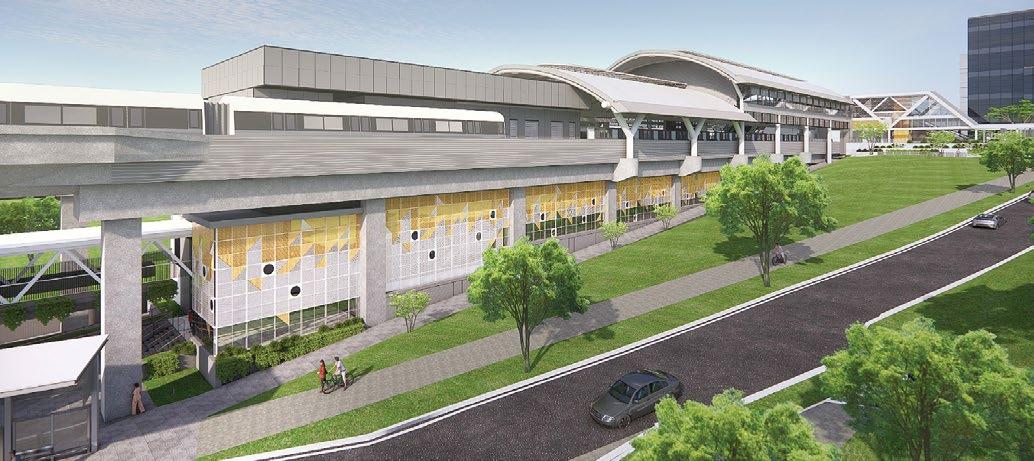
The engineering highlights include the adoption of safety and environmental measures and minimising the impact to stakeholders and infrastructure.
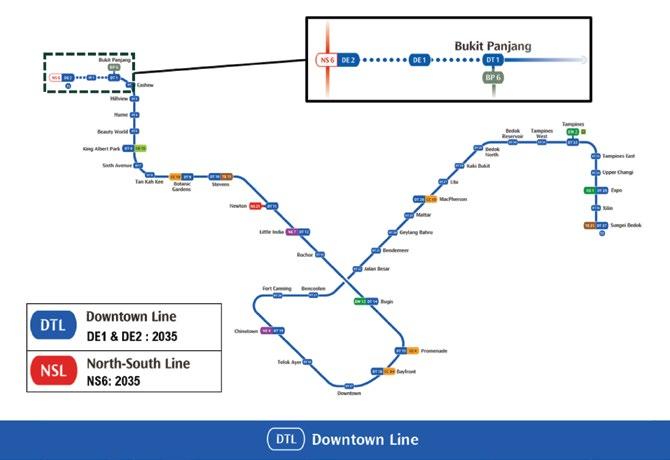
The Land Transport Authority (LTA) has awarded the first civil contract for the Downtown Line 2 extension (DTL2e), which is for the design and construction of tunnels between DE1 station and DE2 interchange station on DTL2e. The contract has been awarded to a joint-venture between Woh Hup Engineering Pte Ltd and Underground Technology Engineering Construction Pte Ltd.
The contract, valued at around SGD 326 million includes the construction of two mainline tunnels and a tunnel connection to Gali Batu Depot, along with associated additions and alterations works within the depot.
Woh Hup Engineering Pte Ltd is a Singapore-registered construction company specialising in infrastructure and building projects, and is currently involved in the design and construction of Punggol Interchange station and tunnels for Cross Island Line-Punggol Extension (CPe) as well as Loyang station and tunnels for Cross Island Line Phase 1 (CRL1).
Underground Technology Engineering Construction Pte Ltd which is also experienced in tunnelling works, is currently involved in the construction of tunnels between CR2 Aviation Park station and the Changi East Depot for CRL1.
Engineering highlights
Three bored tunnels under this contract, each approximately 1 km long and reaching depths of up to 21 m, will be designed and constructed beneath Sungei Kadut Avenue, Sungei Kadut Way and Woodlands Road. These tunnels will be built close to the NorthSouth Line (NSL) and existing infrastructure such as Sungei
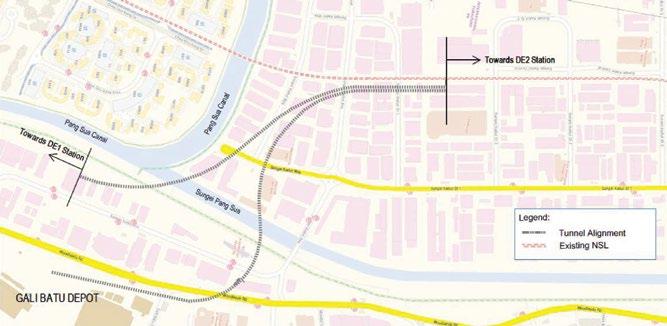
Pang Sua and Pang Sua Canal. Additionally, a cut and cover tunnel will be built at Gali Batu Depot as part of a new Reception Track. Real-time monitoring and safety measures will be implemented during the tunnelling works. LTA and the contractor will implement necessary mitigation measures to ensure ground stability and safe construction, and minimise
impact to nearby stakeholders and infrastructure.
LTA had also carried out a comprehensive Environmental Impact Assessment and will implement all the necessary mitigation measures outlined in the Environmental Monitoring and Management Plan. LTA and the contractor will also continue to engage the various stakeholders
including nature groups, during the construction works.
Construction works are expected to start by the second quarter of 2026. During the construction, LTA and its appointed contractor will maintain regular contact with residents and stakeholders, and provide regular updates on the progress of the works via circulars, flyers, newsletters, face-to-face engagement, social media and community activities.
Two additional civil contracts
LTA has awarded two additional civil contracts for DTL2e, at a combined contract value of around SGD 735 million.
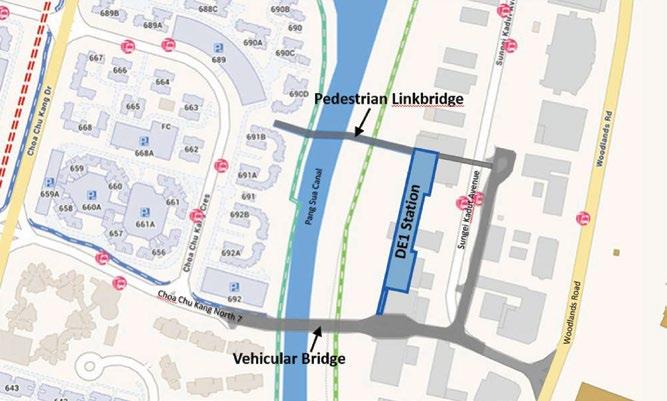
The first of the two contracts, for the design and construction of an underground station (DE1) located along Sungei Kadut Avenue, was awarded to Woh Hup Engineering Pte Ltd at a contract value of around SGD 285 million. The contract includes constructing a vehicular bridge to extend Choa Chu Kang North 7 and a pedestrian link-bridge over Pang Sua Canal to enhance connectivity between Yew Tee, DE1 station and the Rail Corridor.
Woh Hup Engineering Pte Ltd was also awarded the contract for tunnelling works between DE1 station and DE2 interchange station for the DTL2e project.
NS6/DE2 interchange station
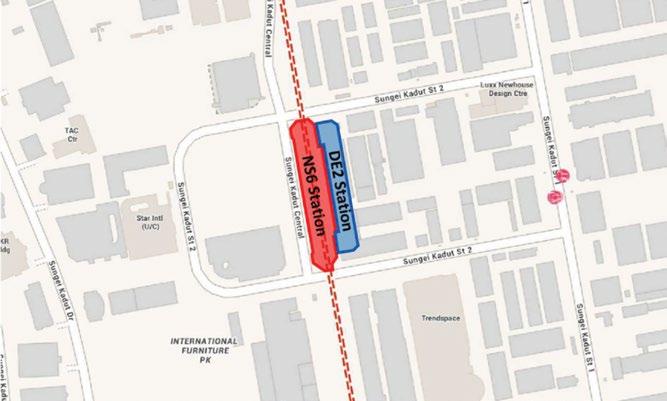
The second contract, for the design and construction of the NS6/DE2 interchange station on the DTL2e, was awarded to a joint-venture between Samwoh Corporation Pte Ltd and China Communications Construction Company Ltd (Singapore Branch). The contract, valued at around SGD 450 million, involves the construction of an underground DE2 station on the DTL and a connected aboveground NS6 station between the Yew Tee and Kranji stations on the NorthSouth Line (NSL).
Samwoh Corporation Pte Ltd is an established local company
that provides civil engineering and construction services. Its completed projects include the Sentosa Gateway Tunnel and the flyover slip road from Seletar West Link to Seletar Expressway (SLE).
The company is currently involved in the enhancement of a section of Loyang Avenue, Telok Paku Road, Nicoll Drive and Changi Coast Road at the Changi Northern Corridor, as well as the enhancement of road networks at the Pan Island Expressway (PIE), East Coast Parkway (ECP) and Changi Flyover at the Changi Southern Corridor.
China Communications Construction Company Limited has an extensive track record in delivering design-and-build
construction services both locally and abroad.
The company is currently involved in the construction of CR6 Tampines North station, CR15 King Albert Park and CR17 Clementi interchange stations on the Cross Island Line, JS8 Boon Lay interchange station on the Jurong Region Line, and the Johor Bahru – Singapore Rapid Transit System Link viaduct and tunnels. It is also involved in the construction of the Jurong East Integrated Transport Hub.
Engineering highlights
Located along Sungei Kadut Avenue and Sungei Kadut Central, respectively, the DE1 and NS6/ DE2 stations will be concurrently
constructed using Earth Retaining and Stabilising Structures (ERSS) because of complex ground conditions in the area, due to materials such as hard granite.
The works will be carried out within a constrained workspace and in close proximity to the NSL. To minimise the impact on NSL commuters, LTA will plan and coordinate closely with relevant agencies and the NSL operator SMRT, to carry out these works during non-operating hours.
LTA and the contractors will implement real-time monitoring of ground stability and relevant safety measures to ensure the safe conduct of construction works and minimise impact to nearby stakeholders and infrastructure. LTA has also carried out a comprehensive Environmental Impact Assessment and will implement all the necessary mitigation measures as outlined in the Environmental Monitoring and Management Plan.
Construction works for the DE1 and NS6/DE2 stations are expected to start in the second quarter of 2026. During the construction, LTA will also work closely with the stakeholders to
provide all necessary mitigating measures to control construction dust and noise, and to ensure safety and vector control at all times.
LTA and its appointed contractors will also work closely with residents and stakeholders to minimise any disruption and inconvenience that may be caused, and will provide regular updates to residents and stakeholders on the progress of the works.
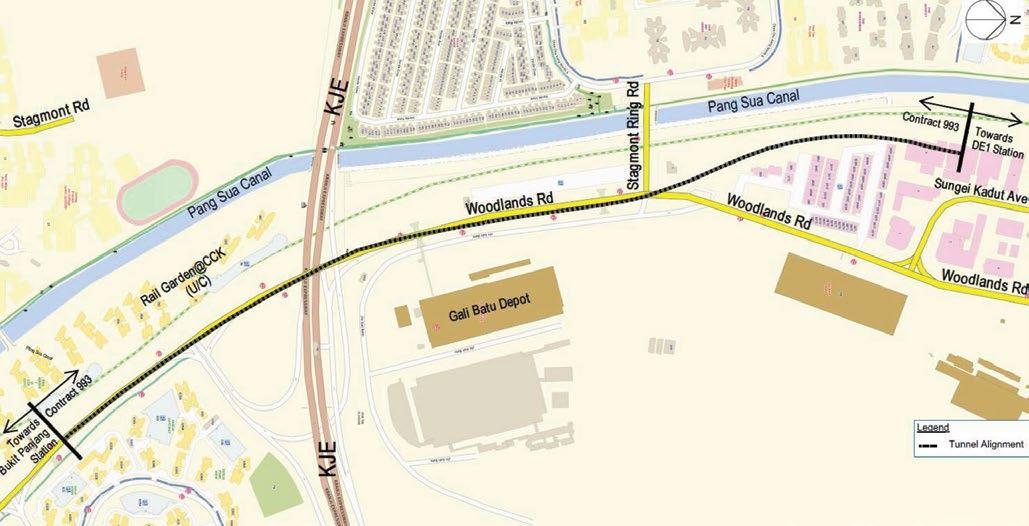
LTA has awarded the final civil contract for the DTL2e, which is for the design and construction of the tunnels between the existing Bukit Panjang station and the upcoming DE1 station on the DTL2e. The contract has been awarded to China Railway Tunnel Group Co Ltd (Singapore Branch) at a contract value of around SGD 199 million.
China Railway Tunnel Group Co Ltd (Singapore Branch) is a construction company specialising in tunnelling and infrastructure projects. The company is currently completing the construction of Prince Edward Station for Circle Line 6.
Engineering highlights Under this contract, a set of twin bored tunnels, each approximately 1.8 km in length, will be constructed beneath Woodlands Road and existing infrastructure such as the Kranji Expressway (KJE) flyover. Tunnel construction will be carried out within a limited workspace due to its proximity to the existing Bukit Panjang station.
To minimise the impact on the existing railway structures as well as DTL commuters, LTA will plan and coordinate closely with relevant agencies and the DTL operator, SBS Transit, to carry out sensitive works during nonoperating hours.
LTA and the contractors will also implement real-time monitoring of ground stability and relevant safety measures to ensure the safe conduct of construction works, and to minimise the impact to nearby stakeholders and infrastructure. During the construction, LTA and its appointed contractor will provide regular updates to residents and stakeholders on the progress of the works.
Construction works for the tunnels are scheduled to begin in the third quarter of 2026.
by Daniel Woods, Project Director, Metro Transit Solutions (Singapore)
In large-scale MRT renewals, interface risk is not an exception to be managed, but an inherent condition that must be actively governed throughout the asset lifecycle.
Singapore’s MRT network is entering a prolonged phase of renewal. As systems age and asset replacement programmes accelerate, attention is often directed towards individual components such as track, signalling, power supply or civil structures. While each presents technical challenges, experience consistently shows that some of the most persistent risks do not arise within individual systems, but at the interfaces between them.
Interfaces are particularly challenging where new systems are required to operate alongside legacy assets that may be several decades old. In many renewal programmes, systems are not replaced simultaneously.
Instead, new equipment must be integrated into an existing environment, with assumptions made about the condition, behaviour and remaining life of adjacent assets. These assumptions are not always visible at the design stage, yet they can significantly influence safety, performance and long-term reliability, particularly as renewal volumes increase and engineering access becomes more compressed.
and new: The reality of staggered renewals
Integrating new systems with legacy infrastructure is rarely straightforward. Where components are replaced incrementally, interfaces must function across different generations of technology, materials and design philosophies. Testing can confirm compatibility at a point in time, but it cannot always

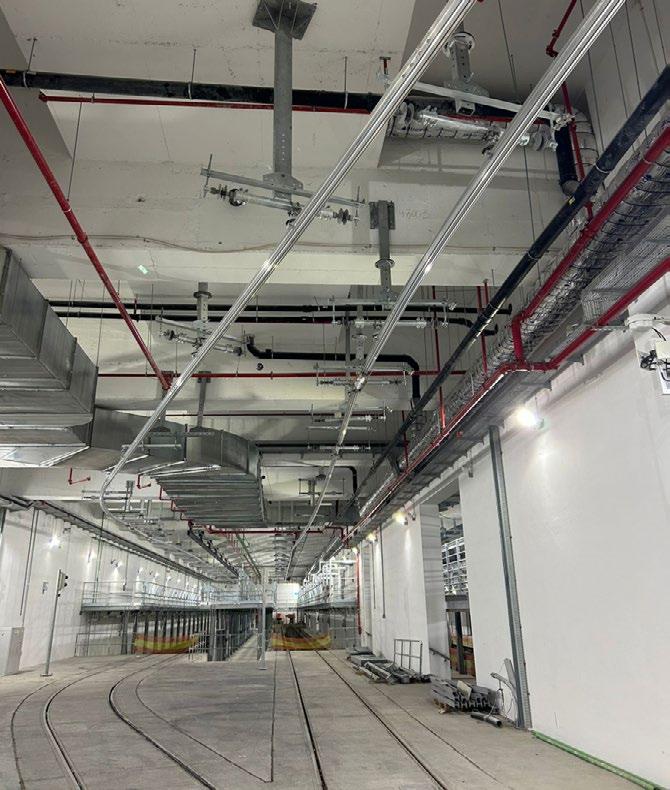
predict how systems will behave as assets continue to age.
Decisions on where to draw the line between retention and replacement are therefore critical. Lifecycle cost-benefit analysis is essential, not only to justify renewal strategies, but also to understand the long-term implications of retaining assets that may already be approaching
the limits of their design life. While full replacement is not always feasible, the risks associated with partial renewal must be clearly understood and actively managed.
Legacy civil structures and hidden constraints
Civil structures tend to outlast mechanical and electrical systems. Tunnels, viaducts and stations
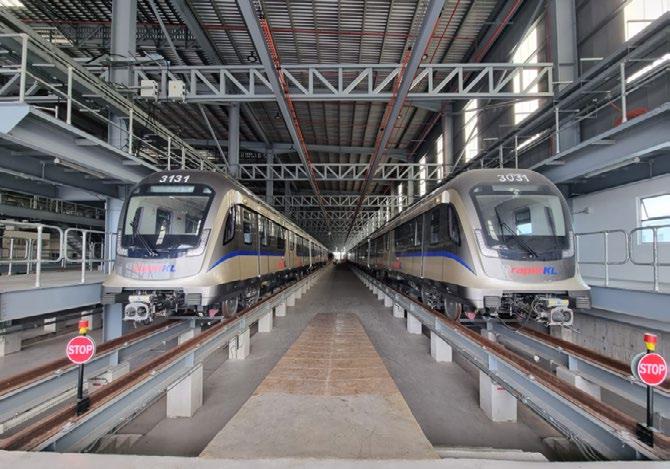
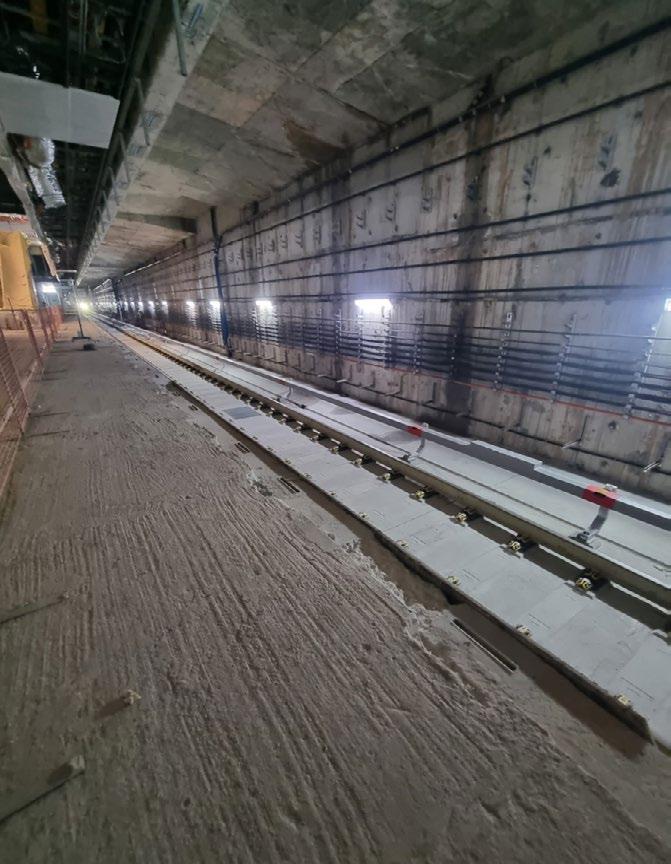
constructed decades ago often remain fundamentally sound, yet deterioration over time is inevitable. The challenge lies in understanding how this deterioration influences the performance of new systems installed within or upon these structures.
At the design stage, the true condition of an asset may not be fully visible. Fatigue, water ingress, material degradation and historic construction tolerances can all constrain how new signalling, power or track systems perform once installed. Component selection, installation methodology and maintenance access must therefore be considered with a clear understanding of both current condition and future renewal requirements.
Designing systems to interface with legacy assets requires more than compliance with current standards. It requires engineers to anticipate how assets will behave over time, and how future interventions may be constrained by decisions made today.
Fragile assumptions in planning
A common assumption during renewal planning is that existing assets are fundamentally sound unless proven otherwise. In reality, many MRT assets are approaching 40 years of service and some underlying weaknesses may not be apparent through visual inspection alone.
Competent engineers recognise that hidden fragilities often only reveal themselves during construction, testing or operation. Where assumptions remain unchallenged, interface risks can emerge late in the programme, when options for mitigation are limited and costly. Planning therefore needs to accommodate uncertainty, supported by contingency and flexibility, rather than relying solely on optimistic assumptions.
Contractual segmentation and system responsibility
Modern MRT renewals are typically
delivered through multiple contracts and suppliers. Each organisation has clearly defined responsibilities, often focused on delivering a specific scope of work, safely and efficiently. While commercially effective, this structure can create gaps in systemlevel responsibility.
Interface risk does not always sit neatly within a single contract. Where each party focuses on its own deliverables, issues at system boundaries can go unnoticed. Without strong oversight from the asset owner or an appointed system integrator, these gaps may persist until the later stages of delivery.
Effective interface management is therefore a specialist task. Depending on scale and complexity, it may require a dedicated individual or team, with authority across contracts and disciplines, and focused on ensuring that the railway functions as a coherent system.
Why interface risks are underestimated
Interface risks are often underestimated because they are inherently complex and rarely fail in obvious ways. They require coordination across disciplines, alignment between organisations and careful sequencing of testing and commissioning activities. Where legacy assets are involved, small misalignments can accumulate into risks that are difficult to detect early. In environments dominated by time, cost and quality pressures, interface issues can struggle to compete for attention against more tangible asset-specific risks. Yet it is often at interfaces where minor inconsistencies accumulate into significant operational or safety issues.
Experience and early warning signs
Experience plays a critical role in recognising early warning signs of interface failure. However, experience should not be confused with length of tenure alone. Deep expertise in a single activity does
not necessarily equate to systemlevel understanding.
Engineers who have worked across multiple functions or disciplines often develop a broader appreciation of how interfaces behave under different conditions. This breadth of experience enables earlier identification of emerging risks and more effective challenging of fragile assumptions.
Process versus judgement in interface management
Formal interface management processes provide essential structure. Interface registers and defined review points help ensure visibility and accountability. On large programmes, this discipline is necessary. However, processes alone are rarely sufficient. Interfaces evolve as works progress and conditions change.
Informal engineering judgement, supported by strong cross-team relationships, often plays a decisive role in identifying and resolving interface risks early. Where teams rely solely on documentation and contractual mechanisms, issues are frequently discovered late, during testing or commissioning.
risk-
Compliance-based interface management focuses on whether requirements and procedures have been met. If drawings align and tests pass predefined criteria, the interface is considered complete.
Risk-based thinking goes further. It asks whether the interface will perform reliably over time, under real operating conditions. In MRT renewals, an interface may be compliant at handover yet still carry latent risk due to unknown asset condition, material compatibility or misaligned system life cycles.
Effective interface management depends on leadership structures that provide authority across systems, not just within individual contracts. This authority must
Interfaces are particularly challenging where new systems are required to operate alongside legacy assets that may be several decades old. In many renewal programmes, systems are not replaced simultaneously.
Instead, new equipment must be integrated into an existing environment, with assumptions made about the condition, behaviour and remaining life of adjacent assets. These assumptions are not always visible at the design stage, yet they can significantly influence safety, performance and long-term reliability, particularly as renewal volumes increase and engineering access becomes more compressed.
be established early, particularly during design, when decisions on component selection and assumed asset life are made.
While optimisation and value engineering are legitimate, shortterm savings achieved through aggressive component selection can, however, increase lifecycle cost or accelerate future renewal. Senior engineers with sufficient technical credibility must therefore be empowered to balance capital cost against long-term system resilience.
As MRT renewals continue, a shift in mindset is required. Data and digital tools will play an increasingly important role, but they cannot replace engineering judgement developed through hands-on experience.
Ultimately, managing interface risk safely and predictably over the long term requires organisations to recognise experience as a strategic asset, empower systemlevel leadership and ensure that technology supports rather than replaces professional engineering.
All images by Daniel Woods
Raising dykes and replacing tidal gates are among recommended measures.
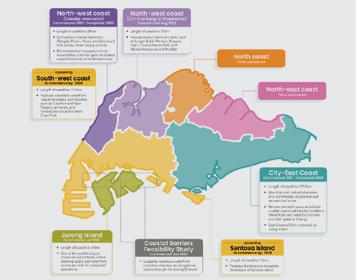
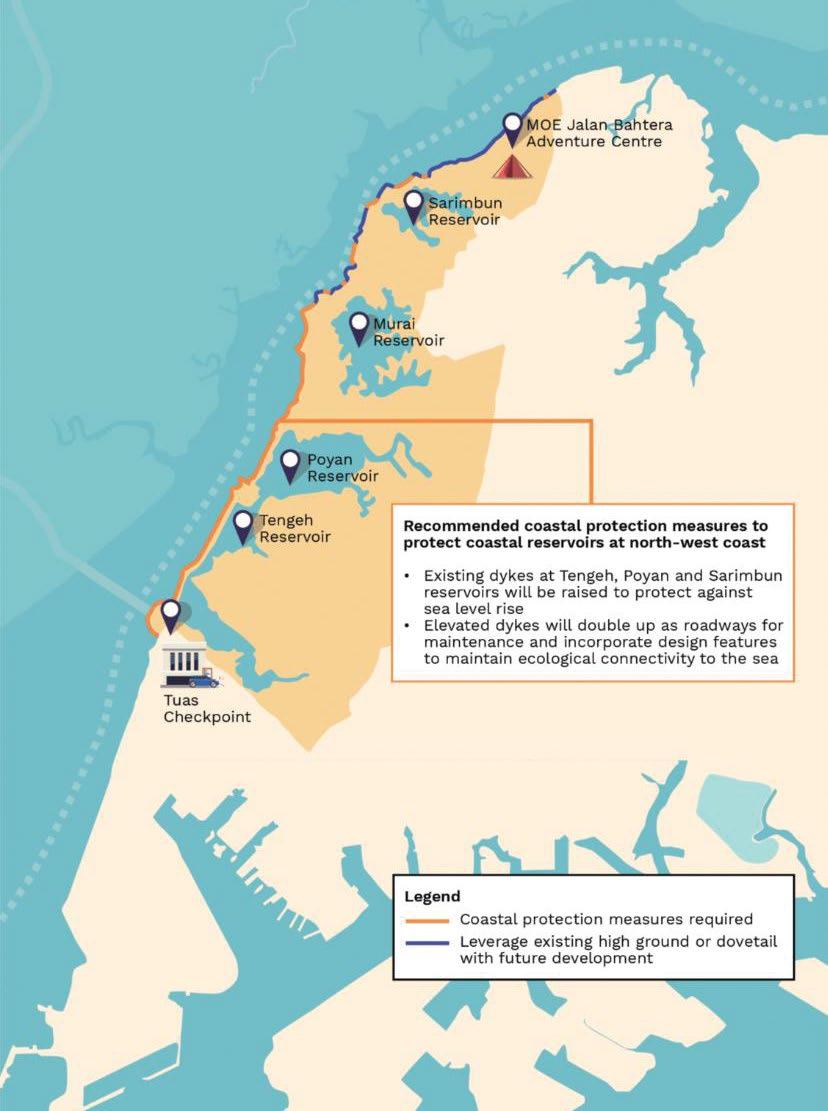
PUB, Singapore’s National Water Agency has completed the sitespecific study (SSS) for a 24 km stretch of the north-west coastline from Tuas Checkpoint to Lim Chu Kang.
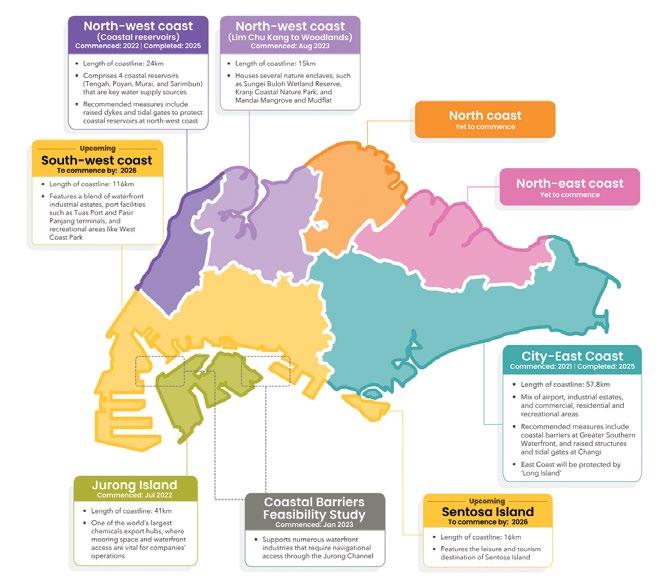
This is one of two sections that make up the north-western coast and is home to four coastal reservoirs – Tengeh, Poyan, Murai and Sarimbun – that are vital freshwater sources for Singapore. The SSS, which commenced in April 2022, assessed options to safeguard the reservoirs against seawater intrusion due to rising sea levels.
Recommendations include raising and strengthening existing dykes at Tengeh, Poyan and Sarimbun reservoirs. The elevated dykes will double up as roadways for maintenance and incorporate design features to maintain ecological connectivity to the sea.
For the remaining coastline, the continuous line of defence will be achieved by leveraging existing high ground, dovetailing coastal protection measures with future developments (e.g. raise ground) and replacing tidal gates at the reservoir dykes.
With the completion of the SSS for this stretch of the coastline, PUB and relevant government agencies will work together to develop the detailed engineering designs of the recommended measures. Construction of the measures is targeted to commence from mid-2030s, subject to studies to be carried out.
The Government continues to make steady progress on the SSS across Singapore. PUB completed the SSS for City-East Coast, which
includes the Greater Southern Waterfront and Changi in 2025. Recommended measures include coastal barriers and raised structures, which were showcased at PUB’s inaugural Coastal Protection Exhibition at VivoCity in August 2025.
The SSS for the second section of the north-west coast, which covers a 15 km stretch from Lim Chu Kang to Woodlands, is on track and should be completed this year. In September 2025, PUB conducted an Our Coastal Conversation (OCC) session, where over 50 participants went on a site walk at Sungei Buloh Wetland Reserve (SBWR) and the nearby Kranji
Dam and Tidal Gatehouse, before engaging in discussions on how these areas could be protected. Ideas include designating public trails around the existing SBWR visitor centre and carpark as Transiently Floodable Areas (TFA) and re-designing the existing Kranji Dam and Tidal Gatehouse as multi-functional spaces. More public engagement sessions will be held before PUB announces the recommended measures for this area.
The SSS for south-west coast and Sentosa Island, as well as PUB’s Risk Assessment Study (RAS) for eight offshore islands are due to commence in 2026.
Improved carbon-cement supercapacitors could turn the concrete around us into massive energy storage systems.
Concrete already builds our world, and now it is one step closer to powering it, too. Made by combining cement, water, ultra-fine carbon black (with nanoscale particles) and electrolytes, electron-conducting carbon concrete (ec3, pronounced ‘e-c-cubed’) creates a conductive ‘nanonetwork’ inside concrete that could enable everyday structures like walls, sidewalks and bridges to store and release electrical energy. In other words, the concrete around us could one day double as giant ‘batteries’.
As MIT researchers report in a new PNAS paper, optimised electrolytes and manufacturing processes have increased the energy storage capacity of the latest ec3 supercapacitors by an order of magnitude. In 2023, storing enough energy to meet the daily needs of the average home would have required about 45 m3 of ec3, roughly the amount of concrete used in a typical basement. Now, with the improved electrolyte, that same task can be achieved with about 5 m3 – the volume of a typical basement wall.
“A key to the sustainability of concrete is the development of ‘multifunctional concrete,’ which integrates functionalities like this energy storage, self-healing and carbon sequestration. Concrete is already the world’s most-used construction material, so why not take advantage of that scale to create other benefits?” asks Admir Masic, Lead Author of the new study, MIT Electron-Conducting CarbonCement-Based Materials Hub (EC³ Hub) Co-director, and Associate Professor of Civil and Environmental Engineering (CEE) at MIT.
The improved energy density
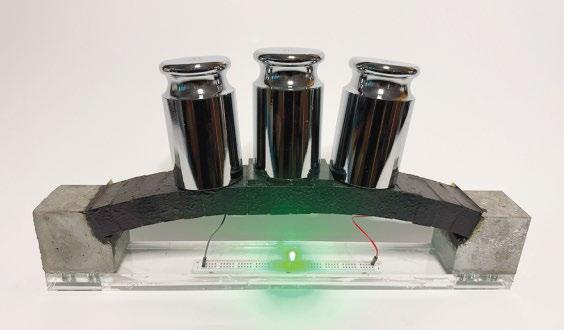
An electron-conducting carbon concrete (ec³)-based arch structure integrates supercapacitor electrodes for dual functionality. The prototype demonstrates both structural load bearing and the ability to power an LED, with the light’s intensity varying under applied load, highlighting the potential for real-time structural health monitoring via the supercapacitor. Image: MIT EC³ Hub.
was made possible by a deeper understanding of how the nanocarbon black network inside ec3 functions and interacts with electrolytes. Using focused ion beams for the sequential removal of thin layers of the ec3 material, followed by high-resolution imaging of each slice with a scanning electron microscope (a technique called FIB-SEM tomography), the team across the EC³ Hub and MIT Concrete Sustainability Hub was able to reconstruct the conductive nanonetwork at the highest resolution yet.
This approach allowed the team to discover that the network is essentially a fractal-like ‘web’ that surrounds ec3 pores, which is what allows the electrolyte to infiltrate and for current to flow through the system.
“Understanding how these materials ‘assemble’ themselves at the nanoscale is key to achieving these new functionalities,” adds Masic.
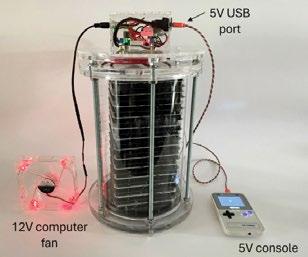
A 12 Volt ec³ supercapacitor prototype is made by stacking ec³ electrodes sandwiched by porous separators soaked in electrolyte. It powered a 12 V computer fan and a 5 V video game console via USB. Image: MIT EC³ Hub, from the PNAS paper.
Equipped with their new understanding of the nanonetwork, the team experimented with different electrolytes and their concentrations to see how they impacted energy storage density.
As Damian Stefaniuk, first author and EC³ Hub research scientist, highlights, “We found that there is a wide range of electrolytes that
could be viable candidates for ec3. This even includes seawater which could make this a good material for use in coastal and marine applications, perhaps as support structures for offshore wind farms.”
At the same time, the team streamlined the way they added electrolytes to the mix. Rather than curing ec3 electrodes and then soaking them in electrolyte, they added the electrolyte directly into the mixing water. Since electrolyte penetration was no longer a limitation, the team could cast thicker electrodes that stored more energy.
The team achieved the greatest performance when they switched to organic electrolytes, especially those that combined quaternary ammonium salts –found in everyday products like disinfectants – with acetonitrile, a clear, conductive liquid often used in industry. A cubic metre of this version of ec3 – about the size of a refrigerator – can store over 2 kWh of energy. That is about enough to power an actual refrigerator for a day.
While batteries maintain a higher energy density, ec3 can, in principle, be incorporated directly into a wide range of architectural elements – from slabs and walls to domes and vaults – and last as long as the structure itself.
“The Ancient Romans made great advances in concrete construction. Massive structures like the Pantheon stand to this day without reinforcement. If we keep up their spirit of combining material science with architectural vision, we could be at the brink of a new architectural revolution with multifunctional concretes like ec3,” proposes Masic.
Taking inspiration from Roman architecture, the team built a miniature ec3 arch to show how structural form and energy storage can work together. Operating at 9 V, the arch supported its own weight and additional load while powering an LED light.
However, something unique happened when the load on the
arch increased. The light flickered. This is likely due to the way stress impacts electrical contacts or the distribution of charges.
“There may be a kind of selfmonitoring capacity here. If we think of an ec3 arch at architectural scale, its output may fluctuate when it is impacted by a stressor like high winds. We may be able to use this as a signal of when and to what extent a structure is stressed, or monitor its overall health in real time,” envisions Masic.
The latest developments in ec³ technology bring it a step closer to real-world scalability. It has already been used to heat sidewalk slabs in Sapporo, Japan, due to its thermally conductive properties, representing a potential alternative to salting.
“With these higher energy densities and demonstrated value across a broader application space, we now have a powerful and flexible tool that can help us address a wide range of persistent energy challenges. One of our biggest motivations was to help enable the renewable energy transition. Solar power, for example, has come a long way in terms of efficiency. However, it can only generate power when there is enough sunlight. So, the question becomes ‘How do you meet your energy needs at night, or on cloudy days’?” explains Stefaniuk.
Franz-Josef Ulm, EC³ Hub Co-director and CEE Professor, continues the thread, “The answer is that you need a way to store and release energy. This has usually meant a battery which often relies on scarce or harmful materials. We believe that ec3 is a viable substitute, letting our buildings and infrastructure meet our energy storage needs.”
The team is working toward applications like parking spaces and roads that could charge electric vehicles, as well as homes that can operate fully off the grid.
“What excites us most is that we have taken a material as ancient as concrete and shown that it can do something entirely new. By combining modern nanoscience
with an ancient building block of civilisation, we are opening a door to infrastructure that does not just support our lives, it powers them,” says James Weaver, a Co-author on the paper, who is an Associate Professor of Design Technology and Materials Science and Engineering at Cornell University, as well as a former EC³ Hub researcher.
The American Concrete Institute (ACI) and the Singapore Concrete Institute (SCI) announced that the two organisations have signed a Memorandum of Understanding (MoU) to increase collaboration and cooperation between the organisations. Through the MoU, both organisations commit to improving concrete construction by making the relevant technical expertise of each organisation available through publications, meetings, conferences, committee membership and other strategic initiatives.
ACI’s Strategic Plan calls for the need to expand into key international locations, provide ACI documents in other languages and customise them where appropriate, and increase international participation in ACI. By signing this MoU, ACI continues to advance this strategic goal.
Founded in 1978, SCI is dedicated to upholding standards of excellence in the use of concrete, improving concrete technology and encouraging its use, and enabling people interested in concrete technology to meet and communicate, among other objectives.
The demolition work was subject to enormous time pressure.
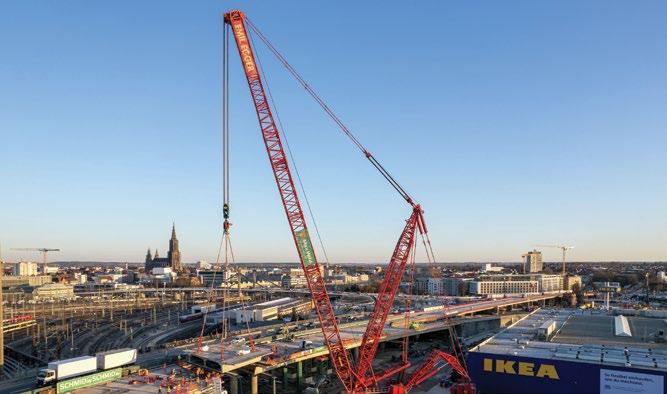
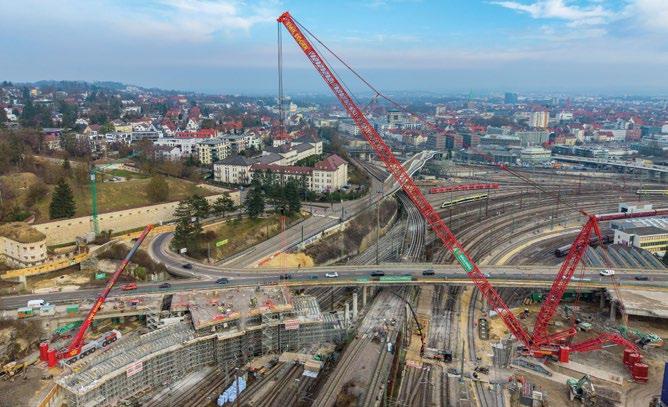
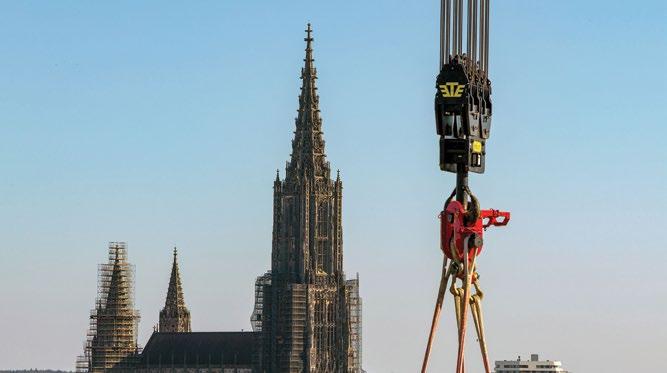
In Ulm in southern Germany, a dilapidated, two-lane prestressed concrete bridge on the B10 federal highway was dismantled after around three years of planning. The railway tracks running underneath, with a width of over 100 m, and the associated overhead lines, did not allow for demolition by explosion or conventional excavation.
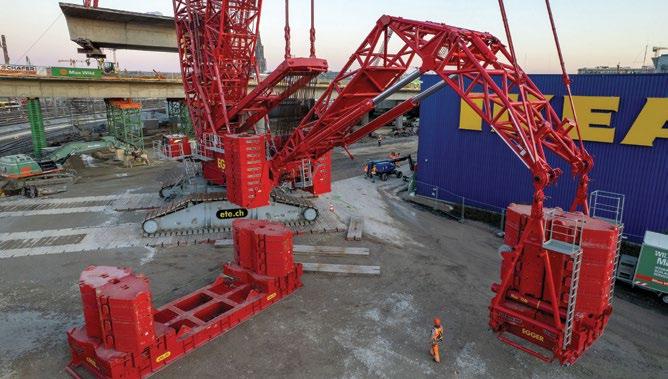
Instead, the bridge structure was cut into individual segments and lifted out in a controlled manner, using a crawler crane. The Swiss crane and logistics company Emil Egger AG (ETE), brought its Liebherr LR 11000 crawler crane to the city on the Danube for this challenging task. Around 40 heavy transports and four days of assembly were required before the powerful crawler crane could begin its roundthe-clock operation.
The tricky bridge dismantling was carried out by the crane in two phases. For the first and heaviest lifts over shorter distances, the crawler crane was configured with an 84 m long lattice main boom (SL2DBV). The boom was then extended to 128 m, in order to reach the more distant sections.
The large crane operated with a maximum ballast of up to 750 t. The derrick ballast alone accounted for 450 t, which was extended to a radius of 30 m for some lifting operations, using the hydraulically adjustable V-frame folding frame.
Weight determination crucial
“We developed the dismantling concept together with the construction and logistics company Max Wild. A major challenge in this large infrastructure project here in Ulm was the segmentation of the bridge sections,” said Michael Egger, Managing Director of Emil Egger AG.
The demolition was carried out in sections and followed a clearly defined procedure. First, the
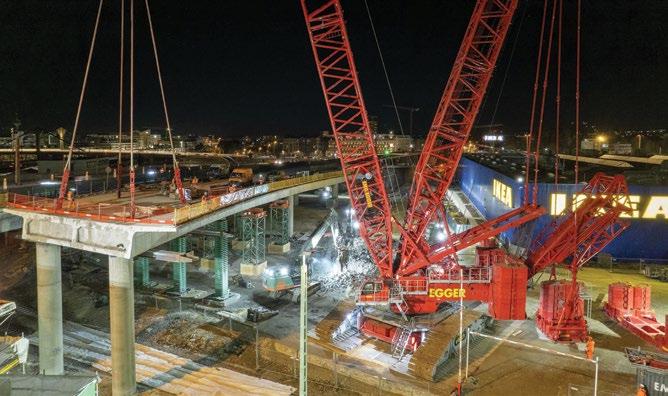
respective carriageway segment was attached to the hook of the crawler crane. After the load was picked up by the LR 11000, the concrete saws began their work on the bridge.
The diamond-tipped wire saws ran in a circle for about five hours until the approximately 17 m wide and over 2 m high prestressed concrete structure was cut through.
“It was crucial to determine the weight of the individual segments as accurately as possible. Only
then could we compensate for the expected load via the extendable derrick ballast and safely lift the component after it had been completely cut through,” explained Egger.
V-Frame and VarioTray make work easier
“The V-Frame and VarioTray were of course extremely useful and made the work much easier. This was particularly true for the lifts
where we had to bring the bridge sections in from a greater distance and place them near the crawler crane, where the demolition excavators were breaking up the concrete elements,” said Egger.
“Thanks to the separable derrick ballast, there was no need for timeconsuming reballasting with an auxiliary crane. The crane achieves its full performance thanks to the 30 m derrick radius. We have been using the V-Frame for six years now and would not want to do without this feature,” he added.
The crawler crane was also supported by a Liebherr LTM 1650-8.1 which had also come to Ulm from Switzerland. Initially, the powerful mobile crane helped to set up the LR 11000. It then moved to the opposite side of the track and took over the dismantling of an access ramp to the old bridge structure. Similar to the use of the large crane, individual ramp segments weighing up to 110 t were hooked up, the concrete structure was sawn apart and finally removed piece by piece.
If everything goes according to plan, the new bridge in Ulm should be completed in autumn next year. After that, the opposite direction will follow. Then Egger’s red cranes will return to the Danube and once again play a central role in dismantling the remaining federal highway bridge.
Liebherr-Werk Ehingen GmbH is a leading manufacturer of mobile and crawler cranes. Its range of mobile cranes extends from 2-axle 35 t cranes to heavy-duty cranes with a lifting capacity of 1,200 t and a 9-axle chassis. Its lattice boom cranes on mobile or crawler travel gear deliver lifting capacities of up to 3,000 t. With universal boom systems and extensive auxiliary equipment, they can be seen in action on construction sites throughout the world.
The Liebherr Group is a familyrun technology company with
a highly diversified product range. The company is one of the
largest construction equipment manufacturers in the world.
Modernising a key section of the Scandinavian road and rail network.
With the construction of the new Storstrøm Bridge, Denmark is modernising a key section of the Scandinavian road and rail network. To ensure safe and stable progress under complex geometrical and environmental conditions, Doka is supporting the project with an integrated formwork and shoring concept designed to deliver predictable workflows across all critical execution stages.
With a total length of approximately 3.8 km, the Storstrøm Bridge will become Denmark’s third-longest bridge. Beyond its size, the project plays a strategic role within a high-capacity north–south transport corridor. Together with the Fehmarnbelt Fixed Link, it forms part of a continuous connection between Scandinavia and Central Europe, supporting cross-border passenger and freight transport by road and rail.
“The Storstrøm Bridge project demanded a concept that could adapt precisely and easily to changing geometries while withstanding high wind loads. Doka’s engineering approach provided the stability and flexibility required to maintain a reliable construction sequence under continuously changing geometric conditions, particularly in the onshore environment”, explains Aurelia Penza, Technical Manager, Itinera, the contractor for the project.
Strengthening a key Scandinavian–European transport corridor Doka has been contributing to the Storstrøm Bridge project since 2019, across multiple phases. The scope included solutions for the approximately 80 m long approach bridges on both sides, onshore prefabricated pierheads, cantilever

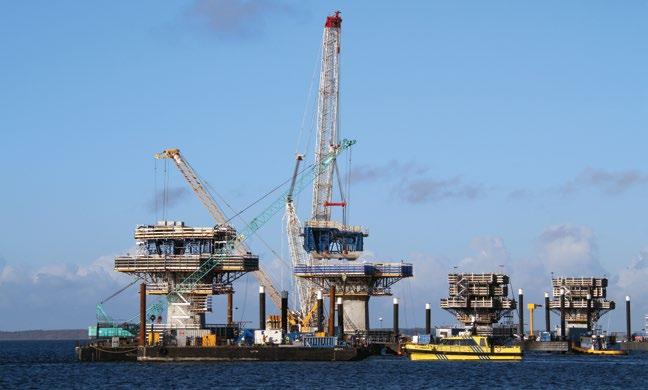
structures connecting the precast bridge segments to the pylon, as well as formwork for the pylon itself. To complete the overall setup, a tailor-made working platform was implemented to support the closing structural works of the cable-stayed bridge.
“For Denmark, the Storstrøm Bridge represents a significant step in enhancing the national transport network and its cross-border connectivity. Our involvement since 2019 reflects our close collaboration with the client and our ability to support technically demanding bridge construction projects. As a reliable partner, we at Doka make it work – delivering high-performance solutions for complex infrastructure projects,” adds Martin Overgaard Skovsege, Managing Director, Doka Denmark.
Engineering excellence for demanding requirements
As the central supporting structure of this cable-stayed bridge, the 102 m pylon not only transfers all forces into the foundation but also features a highly complex design with variable geometry, integrated recesses, prefabricated boxouts, and casing pipes for the stay cables.
The pylon works marked a critical point within the overall sequence. By combining SKE100 plus platforms for high loads and multi-level working areas with flexible SKE50 plus platforms on the spacerestricted sides, a cost-effective and efficient system was realised.
Tailor-made working platform for the final structural operations
The closing stage of the cablestayed bridge was supported by a tailor-made working platform that enabled the final operations of the project. Erected level by level, using the Staxo 100 load-bearing tower, it rested on four stationary SKE100 plus and SKE50 plus climbing brackets, reusing the proven anchorage points from the pylon construction.
Two integrated stair towers ensured safe and comfortable access throughout all operations.
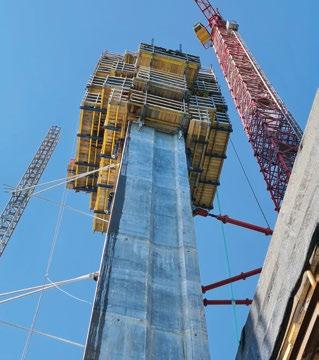
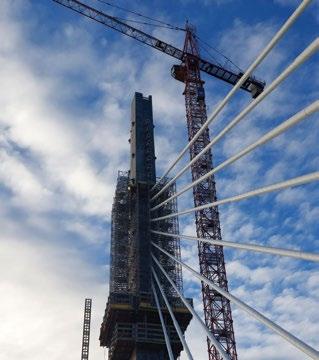
Firmly connected to the pylon, the platform provided stable and reliable working conditions even under demanding wind and load requirements, successfully completing the pylon works and marking a key milestone in the overall construction sequence.
Doka’s contribution to the Storstrøm Bridge project demonstrates how engineeringdriven formwork and shoring solutions can support complex infrastructure projects across multiple, independent stages, from early works through to key structural milestones.
The bridge is expected to open to road traffic in 2026, with rail services scheduled to follow.
Doka is a world leader in providing innovative formwork, solutions and services in all areas of construction. The company is also a global supplier of well-thought-out scaffolding solutions for a varied spectrum of applications.
With more than 160 sales and logistics facilities in more than 50 countries, Doka has a highperforming distribution network for advice, customer service and technical support.
Doka employs 9,000 people worldwide and is a company of the Umdasch Group which has stood for reliability, experience and trustworthiness for more than 150 years.
Project
Storstrøm Bridge
Location Sjælland, Denmark
Structure
Cable-stayed bridge
Bridge length Approx 3,830 m
Main span 320 m
Pylon height 102 m (mast 69 m)
Completion 2026
PROJECT CREDITS
Client
Vejdirektoratet (Danish Road Directorate)
Contractor Itinera
Formwork and shoring solutions provider
Doka
Doka systems used: Automatic climbing system SKE100 plus & SKE50 plus, Load-bearing tower Staxo 100, Large-area formwork Top 50 and Framed formwork Framax Xlife
A temporary footbridge in the drained fountain basin enabled visitors to experience the Baroque cultural monument up close.

The Trevi Fountain, built in the 18th century by Nicola Salvi in the Baroque style, is one of the most popular tourist attractions in the world. The fountain basin had to be completely drained and cordoned off, for the extensive restoration work to take place. In order to allow visitors a direct view of the statues and fountain architecture, the city of Rome decided to erect a temporary footbridge within the drained basin.
PERI UP Modular Scaffolding was used for the structure, which could be flexibly adapted to the complex geometry of the fountain basin and provided a load-bearing capacity of 500 kg/m². This meant that the temporary structure could ensure safety and stability, even when visitor numbers were high. Access to the footbridge was provided by the PERI UP Public Stair, which was specially developed for public areas and met the applicable safety requirements and standards.
Protecting the monument and ensuring high visitor safety
Special attention was paid to protecting the vulnerable structure. The scaffold supports were placed on rubber pads and wooden boards to avoid damaging the surface of the fountain basin. Multi-layer panels were used on the walkway surface of the footbridge, ensuring a safe and comfortable footing for visitors.
Trevi Fountain footbridge installed safely and cost-effectively
In addition, it was possible to assemble the footbridge in its entirety without any welding or cutting work. Once the works were completed, the entire scaffolding could be dismantled without a trace, meaning that all components were fully reusable for future projects.
The solution proposed by PERI enabled the hiring of a scaffold that was quick and easy to erect,
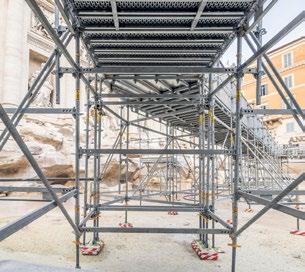
supports were placed on rubber pads and wooden boards to protect the vulnerable surface
complied with regulations and met the client’s requirements. With the temporary footbridge installation at the Trevi Fountain, PERI demonstrated how the PERI UP Scaffolding Kit can be used to create safe, cost-effective and visitor-friendly solutions even in challenging settings – such as at one of the world’s most famous cultural monuments.
A Herrenknecht Mixshield tunnel boring machine (TBM) is used.
Since September 2024, a giant Herrenknecht tunnel boring machine (TBM) has been excavating a metro tunnel under the Panama Canal. On February 2, 2026, the construction consortium HPH reached an important milestone with the giant TBM (with a diameter of 13.5 m), passing under the Panama Canal – the breakthrough to the future Balboa metro station. From here, the last 1.5 km remain to be completed before final breakthrough.
The approximately 4.5 km tunnel is the key structure of the new Metro Line 3 which will connect the western suburbs and downtown Panama City. Until now, 150,000 people commute across a bridge to and from work every morning and evening.
The 25 km journey currently takes up to several hours in constant traffic jams.
First time under the Panama Canal
For the first time, a tunnel boring machine is crossing under the Panama Canal, one of the world’s most heavily used and therefore most important waterways. The specifications are correspondingly strict, stipulating that the tunnel construction must not compromise the operational safety of the Panama Canal at any time.
In view of the complex geology with high groundwater pressure over 60 m below sea level, the contracted Consortium HPH with the companies Hyundai Engineering & Construction, Posco Engineering & Construction and Hyundai Engineering opted for a Herrenknecht machine of the Mixshield type. In order to be able to run the metro through the tunnel on two tracks, a correspondingly large tunnel
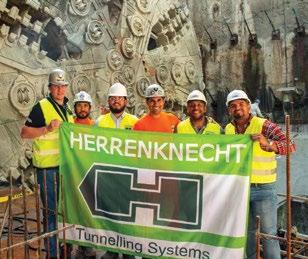
In October 2025, they achieved their peak performance to-date, of 150 segment rings or 300 metres per month. After breaking through to the future Balboa station east of the Panama Canal on 2 February 2026, Herrenknecht specialists are now helping the Consortium HPH team get the TBM ready for the last stage of about 1.5 km to the final breakthrough.
PROJECT DATA
diameter was planned – with a TBM diameter of 13.5 m. This makes it the largest machine of its kind in Latin America.
The Mixshield machine type developed by Herrenknecht is designed to safely and efficiently handle complex ground conditions and high groundwater pressure. In close cooperation with the customer’s specialists, Herrenknecht engineers equipped the machine with an accessible cutting wheel for the underpass of the Panama Canal. The cutting tools at the front of the cutting wheel can be changed from the rear, under atmospheric pressure.
The diverse equipment and services from the Herrenknecht Group interlock and optimise the entire tunnel construction process.
The customer also uses the Herrenknecht.Connected digital platform.
Since tunnelling began in September 2024 on the western shore of the Panama Canal, the teams have been steering the large machine safely and with everincreasing performance towards its destination. They mastered the critical crossing under the Panama Canal without any problematic incidents.
Project Panama Metro Line 3
Client Panama Metro
Contractors
Consorcio HPH Joint Venture
(Hyundai Engineering & Construction Co Ltd
Posco Engineering & Construction Co
Hyundai Engineering Co Ltd)
Application Metro
Drive length 4.5 km
Geology
Sandstone, siltstone, tuff, clay and sand, breccias, mudstone, pyroclastic rocks, basalt and andesite
MACHINE DATA
Machine type
Mixshield
Diameter 13,460 mm
Cutterhead drive power 5,600 kW
Torque 26,616 kNm
The advantages include durability and a reduction in application complexity.
Steelpaint has secured its first largescale civil engineering application in Germany, for its Stelcatec corrosionprotection technology, supplying the single-coat system for the façade steelwork of the DERTour Deutschland GmbH office building in Frankfurt am Main.
The project is being delivered by Steelpaint’s long-standing application partner Heinrich Schmid GmbH & Co KG which was contracted to carry out the coating works for the DERTour building.
About 1,600 m² of steel surface is being protected using StelcatecL-1NE, applied as a single 150 µm coat in RAL 6027. The system was selected following Heinrich Schmid’s experience with the coating in other industrial market segments. The technology provides long-term corrosion protection while reducing application complexity, compared with conventional multi-coat civil engineering coating systems.
Surface preparation for the project has included mechanical grinding to PSt2 and abrasive blasting to PSa 2, creating a suitable substrate for the one-coat application.
According to Steelpaint, the specification reflects a balance between durability and practical application.
While Steelpaint is best known for supplying coatings to marine, offshore and hydraulic engineering sectors, the Frankfurt project represents a significant step in extending Stelcatec into the German civil engineering market. The company said the project’s scale and visibility make it an important reference for future structural steel applications.
According to Steelpaint, a key factor in the system’s selection was its suitability for application
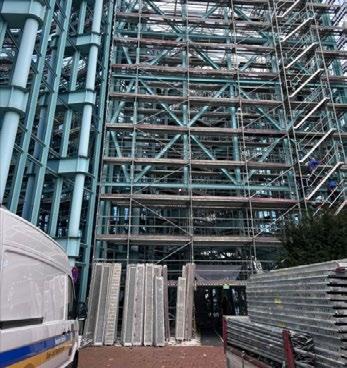
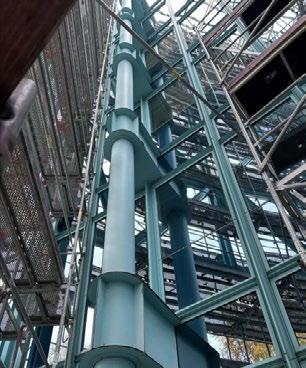
during late autumn and winter.
Conventional multi-coat systems often require extensive scaffold encapsulation, heating and humidity control, to achieve acceptable curing conditions in cold and damp weather.
The company said that the contract demonstrates how coating technologies developed for harsh industrial environments can be transferred into civil engineering applications where construction timelines, access constraints and weather exposure are critical considerations.
“The project is being carried during a period that is typically unfavourable for external coatings work. Stelcatec is designed to expand the workable application window, allowing steel protection to proceed without the need for full scaffold enclosure or artificial climate control. This simplifies application and helps maintain project schedules,” said Steelpaint Director Frank Müller.
“This project shows that a onecoat corrosion protection system can be deployed at meaningful scale on a civil engineering façade in Germany. It supports our
strategy of broadening Stelcatec’s application beyond traditional marine and hydraulic markets into building and infrastructure projects,” he added.
Florian Stark, Team Leader at Heinrich Schmid, said, “From an applicator’s perspective, reducing the number of coats and environmental controls required can have a direct impact on logistics, scheduling and overall costs. On this project, the system has enabled steady progress under challenging seasonal conditions.”
DERTour Deutschland, part of the DERTour Group, is one of Germany’s largest travel groups, operating across tour operating, travel agency and destination management activities. The Frankfurt am Main building serves as a key office location for the company’s German operations and is designed as a modern administrative workplace with a steel-intensive façade construction.
The corrosion protection work forms part of a wider building renewal programme. External coatings works was scheduled for completion in March 2026.
At CONEXPO-CON/AGG 2026, held in Las Vegas, the Wirtgen Group and John Deere presented innovative products, with a clear focus on customer needs. The shared booth showcased Wirtgen, Vögele, Hamm and Kleemann products, and a wide range of smart automation solutions.
Fourteen Wirtgen Group Machines were equipped with the latest technologies – including Smart Level Pro, Smart Pave, Smart Compact Pro or the Wirtgen Group Performance Tracker solutions. On the one hand, they address machine operators who are relieved of some of their workload, thanks to smart automated functions and, on the other hand, they are assisted in the achievement of even more precise results.
The collection of performance data provides customers with comprehensive and seamless project documentation and important insights into how they can optimise operating costs.
Global firsts and market premières
A particular highlight was the market première of the new Wirtgen large milling machine W 210 XF which was presented with Precision Grinding. Thanks to a newly developed grinding shaft, optimum surface quality is achieved on asphalt, concrete and cobblestone pavements, while maintaining the material properties.
With the WR 240 X, Wirtgen presented a model from the latest generation of wheeled cold recyclers and stabilisers. A new operating concept, using digital assistance systems such as Mix Assist and Wirtgen Group CoPilot, as well as WPT Stabilizing, ensures high mixing quality, ergonomics and efficiency.
For concrete paving applications, the slipform paver SP 33 attracted
visitors’ interest, due to the flexibility offered by its ability to pave in both offset and Crosspave modes.
Vögele presented the new Dash 5 generation of pavers for the first time in the US. The focus was on the world premières in the 10 ft class – the SUPER 2000-5 X tracked paver and the wheeled SUPER 2003-5 X version with the redesigned VR 600 und VF 600 screeds. The Dash 5 generation machines are characterised by operator comfort, automated processes, shorter setup times, and low noise and exhaust emissions.
Also at the show was the new SUPER 800-5 P Dash 5 Mini Class paver. With its new hopper wall geometry and a redesigned operator’s platform, it offers an ideal overview and ergonomics. The new VR 500 screed for the 8 ft class also attracted a great deal of attention and was shown here in combination with the SUPER 1700-3.
At Hamm, the focus was on automated compaction and, therefore, on the Smart Compact Pro system. Here, the new Realtime Density Scan sensor on the machine determines the asphalt density in real time, in order to
automatically and separately regulate compaction energy and compaction modes in both drums. The Hamm compactor for earthworks, HC 200i C VA, presented a further innovative solution. Here, Smart Compact enables automated compaction to a preset target value in MN/m² (MPa), on the basis of a new compaction measurement and a variable amplitude. With the HC 100i G, Hamm also presented a new model especially for the machine rentals market.
Another market première also led the line-up of machines presented by Kleemann . The MOBISCREEN MSS 1102 PRO, from Kleemann, the first scalper of the PRO Line series, is now available on the North American market.
The robust plant is designed for efficient processing of materials at rates of up to 827 US t/h (750 t/h) and is ideal for use in quarries. High throughput rates, flexible configuration options and an intuitive plant control concept ensure high productivity and safety.
With SPECTIVE CONNECT, operators get direct access to all relevant process data on a smartphone or tablet.
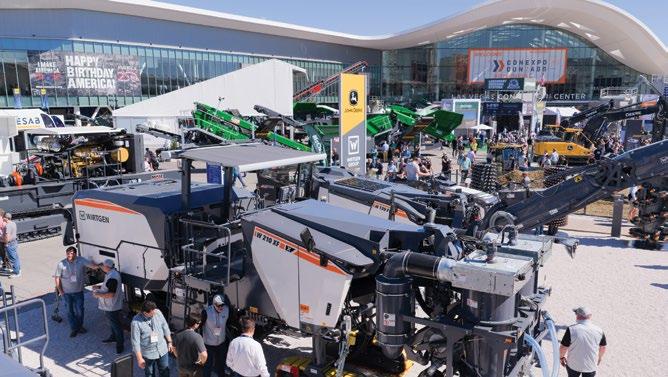
Caterpillar previewed three compact equipment models at CONEXPO-CON/AGG 2026. These products will be supplied to customers later this year and in early 2027.
Operating in tight spaces
Ideal for tight spaces, where larger machines are unable to navigate, the new Cat TUL100 compact utility loader delivers power and versatility, with proven reliability and durability for this fast-growing market segment. Its rated 1,000 lb (454 kg) operating capacity delivers the performance needed for big jobs, but its 36 in (914 mm) and 42 in (1067 mm) track width options enable this performer to work in tight spaces.
Powered by the 24 hp (17.9 kW) Cat C1.1 turbo diesel engine, the new TUL100 features a robust hydraulic system for high performance. Versatility is at the core of this new compact utility loader design which includes a wide range of attachments, including augers, power box rakes, trenchers, buckets and forks. A choice of coupler options will help ensure contractors have the right tool for the task.
Intuitive multifunction joysticks and customisable settings allow operators to fine-tune machine performance for a range of skill levels. The TUL100 has an approximate operating weight of 3,600 lb (1,633 kg) and a maximum lift height of 7 ft (2.1 m). Available with Cat VisionLink, the loader will fit seamlessly with the rest of the customer’s fleet.
A new addition to the product line, the new Cat 253 CTL builds on the foundation of the 259D3 to provide a blend of power and compact
size that complements the existing lineup between a 249D3 and a 255. With similar operational specs to the 259D3, the 253 is set apart by its redesigned undercarriage that features rigid, frame-mounted axles combined with the next generation, one-piece undercarriage frame.
This design enhances traction and stability in varied conditions, with a focused improvement in grading performance. Two fixed configuration choices are available, and customers can customise the machine through purpose-built kits, ensuring flexibility without complexity.
An electronically controlled Cat 3.3B turbo diesel engine powers the new CTL and meets US EPA Tier 4 Final and Stage V emission standards. It comes standard with 15 in (380 mm) C-Pattern tracks. The standard flow performance package offers a 20 gpm (75.7 lpm) flow rate at 3,336 psi (230 bar). A high flow performance package is available in applicable regions, increasing hydraulic flow to 30 gpm (112 lpm) while maintaining 3,336 psi (230 bar).
The 253’s one-piece sealed and pressurised cab with adjustable joystick pods provides a clean and quiet operating environment with attachment visibility for all-day
operator comfort. Standard features such as dual self-level, return-todig/attachment positioner, and float, allow operators to efficiently perform repetitive tasks. Creep and two-speed are standard features for optimum speed control.
Replacing the Cat 300.9D, the new Cat 301 CR micro mini excavator features a compact radius design and shares the same engine platform with multiple other Cat compact models for familiarity and ease of service. It provides the market with a single configuration that boasts a 71.7-in (1820-mm) dig depth. This 1 ton platform offers several new features, including seat-mounted pilot controls, higher travel speeds with two-speed, folding rollover protective structure (ROPS), first and second auxiliary hydraulic options, new gauge cluster and improved stability.
Increasing the 301 CR’s versatility, Caterpillar launched a manual coupler and a new A13 auger for the 1 ton platform machine. These items pair with an existing B1 hammer and Caterpillar’s range of trenching and clean-up buckets to deliver flexibility for the customer.
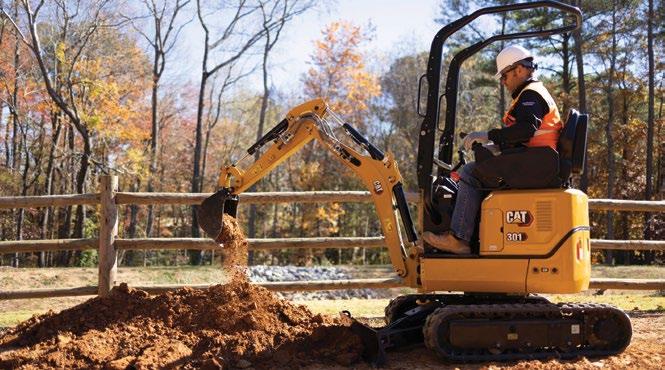
The Komatsu attachment lineup on display at CONEXPO-CON/AGG 2026 demonstrated how purposebuilt tools can help extend machine versatility, improve efficiency, and support measurable productivity gains, across construction, demolition and waste jobsites.
The attachments that were displayed at the event included:
• Komatsu universal quick coupler prototype, currently in development, showcased on the PC88MR-11 compact excavator – designed for fast attachment changes with a simple on/off switch sequence, enabling efficient swaps and durable operation of a wide range of rigid and hydraulic attachments.
• Komatsu JMHB80H hydraulic breaker engineered for dependable performance and consistent breaking power in demanding conditions.
• Komatsu JMHB130H hydraulic breaker with integrated, automatic greasing system to help extend service intervals and support uptime.
• Komatsu JMHB230V hydraulic breaker featuring fully automatic, variable speed technology that adjusts power and striking velocity, based on material.
• Montabert HCM900 multiprocessor for versatile demolition applications –interchangeable high-strength steel teeth with 360° rotation for precise positioning.
• Montabert V57 hydraulic breaker with variable-energy technology designed to match striking power and speed to the application.
• Lehnhoff SQV series fully automatic, symmetric quick couplers designed to significantly reduce attachment change time from inside the cab.
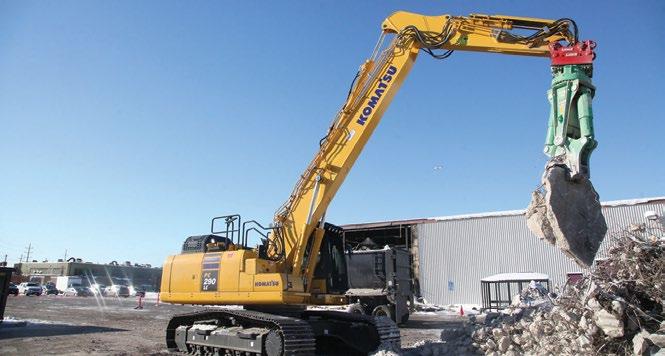
Attachments like a Lehnhoff fully automatic, symmetric quick coupler and the Montabert multiprocessor can help make quick work of demolition tasks.
optimise breaking efficiency, while advanced blank-firing protection helps reduce unnecessary stress on machine components.
The JMHB80H breaker is designed to deliver consistent performance while minimising downtime in demanding conditions. The inside is simple and reliable – no tie rods, but with high-quality components, automatic pressure regulation, high back pressure tolerance and blank firing protection. Compatible with Komatsu’s PC88 excavator, it is a compact breaker that is ideal for utility applications.
The Komatsu JMHB130H breaker is designed to improve efficiency and reduce interruptions to maintenance. An integrated automatic greasing system helps extend service intervals and support consistent performance. Compatible with Komatsu’s PC130LC-11 and PC138USLC-11 excavators, this breaker offers a well-matched solution for midsize breaking applications.
The JMHB230V breaker features fully automatic variable speed technology that adjusts power and striking velocity, based on the material being worked. This adaptive control is designed to help
• Hensley buckets – customisable for construction, quarry and mining applications. For breaking applications, Komatsu highlighted several options engineered to balance power, durability and serviceability.
The Montabert HCM900 multiprocessor showcased on the PC490LC-11 demolition excavator is designed to handle a wide range of demolition tasks while reducing the need for frequent attachment changes. Its powerful design and full 360° rotation enable operators to position the tool accurately, supporting productivity and control in high-demand demolition environments.
The Montabert V57 hydraulic breaker incorporates variableenergy technology that automatically adjusts striking power and speed to match application requirements for performance across a range of materials.
The Lehnhoff SQV series range of automatic quick couplers is designed to significantly reduce change time by allowing operators to switch attachments hydraulically from inside the cab.
In addition to breakers and couplers, Hensley buckets that were displayed are designed to enhance excavator and wheel loader productivity in construction, quarry and mining applications.
At CONEXPO 2026, Topcon Positioning Systems announced new 3D machine control technologies, functionalities and safety features for earthmoving and paving applications, as well as geomatic technologies for surveying and building construction applications. By connecting equipment, people and processes, the new technologies are designed to increase productivity across applications and project phases, through a centralised platform approach.
Machine control platform updates Topcon’s heavy construction equipment central platform is 3D-MC machine control software, designed for precise, realtime guidance and control for excavation, grading, paving, milling and other earthmoving operations. New functionalities made possible through updated configurations for 3D-MC include:
• 3D-MC Edge – a new feature within the 3D-MC environment, engineered to focus directly on a machine’s cutting edge for enhanced accuracy and responsiveness. This configuration is ideal for machines performing general earthwork grading operations, such as wheeled tractor-scrapers, tow-behind scrapers, box blades and push dozers.
Excavator-focused updates with new functionalities, for ease of use, safety and productivity, include:
• Slope Control – a function that automatically adjusts the excavator bucket’s tilt and rotation angles, based on the digital design surface model. The system uses the 3D design to guide the attachment to the correct orientation, reducing operator fatigue from manual control, enabling faster completion of complex work, improving accuracy for better finish quality, maximising efficiency of the tilt rotator and increasing uptime, while reducing costly mistakes.
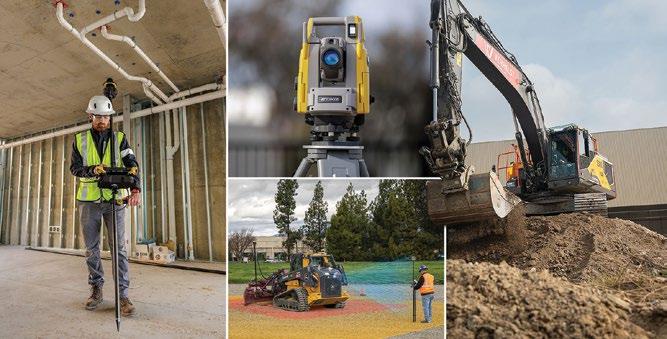
• Hybrid Lock – a feature within 3D-MC that automatically switches between local positioning system (LPS) tracking using robotic total stations and global navigation satellite system (GNSS) tracking to maintain continuous, accurate machine guidance. It is designed to prevent downtime when the robotic total station briefly loses its line of sight to the prism.
• Load weighing – an onboard weighing system for excavators designed to increase safety and reduce wear and tear on trucks and trailers. Weighing material as it is loaded in the truck supports even distribution, prevents overloading resulting in fines and lowers fuel costs associated with dispatching trucks loaded below full capacity.
The GTS-M1 robotic total station for machine control is a nextgeneration instrument that tracks a 360° prism mounted on heavy construction equipment for LPS tracking. It is beneficial for applications, such as fine grading, milling and paving for road construction, or in environments where satellite-based positioning is not feasible due to obstructed sky conditions caused by dense tree cover, tunnels etc. The GTS-M1 is also a valuable part of Hybrid Lock functionality.
Topcon Awareness System is an AI system utilising digital
cameras mounted on construction vehicles to detect movement or obstructions that could cause an accident or conflict. It provides blind-spot detection with alerts sent to the operator and the cloud portal. The system has userconfigurable zones of influence that help the operator avoid accidents and create records for accident analysis.
Topcon Site Manager is the cloud management system for Topcon machine control construction solutions that enables remote control, data sharing and work order creation for connected solutions.
The LM-1000 load weighing system for aggregate handlers is a trade-approved onboard weighing system for all types of loaders, designed to increase safety and improve operational efficiency of the loading vehicles.
Topcon Origo, the latest addition to the Capture Reality 3D mass data solution portfolio, is a spatial positioning system for interior building layout. It uses localisation and reusable spatial reference maps to acquire real-time position, as easily as with the current layout methods of optical or laser equipment. The handheld system mounts the scanner and controller to a single rover pole for easy movement on a job site, as there is no need for calibration or levelling.
Trimble has introduced the 2026 version of its Tekla software for constructible Building Information Modeling (BIM), structural engineering and steel fabrication management, delivering datadriven workflows that connect design and construction.
This release accelerates the entire design-to-detailing process by reducing manual effort and rework, enabling a wider scope of complex tasks without the friction and data-loss risks of switching between disparate applications.
The 2026 portfolio – including Tekla Structures, Tekla Structural Designer, Tekla Tedds, and Tekla PowerFab software – promotes project-wide consistency through a seamless flow of data that eliminates ‘black boxes’ between stakeholders.
Whether it is viewing live project statuses directly within a 3D model, synchronising project data through connected workflows, or linking drawings, models and field information across office, shop and site, Tekla delivers a single source of truth that updates in real-time.
Access to Trimble Assistant is embedded across the Tekla portfolio. It specialises in assisting new and existing users to take full advantage of features and troubleshoot issues without leaving the software interface.
Additionally, the new AI Model and Drawing Assistant in Tekla Structures is an early preview feature (distributed through Trimble Labs) for modelling operations using natural language. This context-specific productivity tool helps users execute tasks through simple natural language prompts.
The shared foundation of AI, automated workflows and realtime connected insights deliver accuracy in every phase of the design-to-construction lifecycle through several new feature enhancements.
Tekla Structures 2026: Connected Data Workflow Productivity
• AI Cloud Fabrication Drawings: A ‘human in the loop’ AI service that uses user-defined drawing libraries from past projects to automatically generate fabrication drawings. It provides top suggestions that users can verify, significantly reducing setup and cleanup time.
• Project Settings Management Console: First-ever user interface for administrators to manage customised environments and project settings from the cloud. It simplifies the installation process and ensures all users have consistent upto-date settings throughout a project, promoting smoother collaboration.
• Integrated workflows with Trimble Connect common data environment: Property sets, drawings metadata and status sharing across the Trimble ecosystem expand integration capabilities. Teams can manage live project data across systems and access a single source of truth directly from their working interface, helping to accelerate decisions and reduce rework.
• Simultaneous Model & Drawing Editing with Design Reuse: Enables detailers to work on General Arrangement drawings and the 3D model, side by side, with changes reflected instantly. This, combined with the ability to reuse previous projects, can speed up design creation and reduce manual rework.
• Layout Manager ‘Out of Tolerance’ Workflow: Automatically flags discrepancies between the design model and as-built data (e.g. misaligned anchor bolts), allowing for corrections before steel parts arrive on site.
Tekla Structural Designer 2026: Consolidating Design Tasks
• Accurate Center of Rigidity (COR): A new, highly precise calculation for seismic design that replaces older approximations, allowing engineers to design structures with greater
confidence and safety in mind.
• Integrated Portal Frame Design (Eurocode): A new integrated portal frame design for industrial low-rise buildings and improved masonry design solutions for North American users.
• Interoperability: Enhanced interoperability with Revit and SketchUp allows for tighter collaboration with architects. In addition, Tekla Structures models can now be published to the cloud and pulled into Tekla Structural Designer for verification.
Tekla Tedds 2026: Automating Calculations
• New & Expanded Calculations: For the US market, a new Steel Beam Torsion (AISC360) calculation allows engineers to design for torsional forces without manual work. For Eurocode users, a new Wind Assessment calculation automates complex wind pressure analysis for any building site.
• One-Click Access to Tekla Structural Designer LT: Every Tekla Tedds subscription now includes one-click access to a starter version of Tekla Structural Designer, allowing users to perform 3D analysis tasks (like floor vibration or composite beam design) without leaving their ecosystem.
Tekla PowerFab 2026: Validating Shop Floor Quality
• Pre-Shipment Validation: A new route validation feature prevents items from being shipped unless all manufacturing steps are complete.
• Shop Floor Focus: New features in PowerFab Go ensure workers only see tasks relevant to their specific station, reducing distractions and errors.
• Sustainability: Simplified LEED reporting allows fabricators to track material origin and recycled content with a single flag, automating what used to be a manual documentation process.
Atlas Copco has expanded its DrillAir portfolio of portable air compressors, with the launch of the X-Air 900-20, a versatile and fuel-efficient solution designed for demanding drilling applications in Africa, Australia and New Zealand, Central and South America, the Middle East, and Southeast Asia.
Engineered for flexibility, reliability and ease of operation, the X-Air 900-20 supports a wide range of applications across mining and construction, helping customers operate efficiently across diverse job sites and working conditions.
Built on Atlas Copco’s expertise in portable air solutions for tough applications, the X-Air 900-20 combines advanced compressor control, a compact footprint and a robust design, to deliver dependable compressed air where it matters most.
One compressor for multiple applications
At the core of the X-Air 900-20 is PACE technology which allows operators to set working pressure anywhere between 14 bar and 20 bar. This flexibility enables a single compressor to support different drilling applications, helping customers maximise fleet utilisation and reduce the need for multiple machines on site.
In mining, the X-Air 900-20 is particularly well suited for blast hole drilling and dimension stone quarry drilling, where consistent air delivery and adaptability are essential for productivity.
In construction, the compressor supports applications such as slope anchoring, down-the-hole (DTH) solar piling, and ground engineering drilling. By matching pressure to application needs, operators
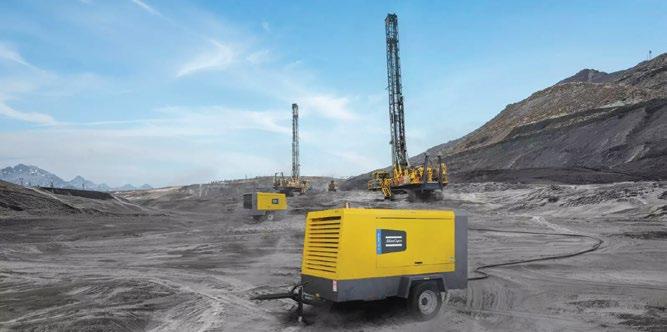
can optimise performance, while avoiding unnecessary fuel consumption and component wear.
Fuel-efficient operation with smart control
Designed to reduce operating costs, the X-Air 900-20 features ECO mode, delivering measurable fuel savings of up to 50% during unload conditions. By switching from idle to no-load operation, the compressor minimises unnecessary fuel use, helping lower total cost of ownership while supporting longer component life and efficient, easy operation.
Fuel efficiency is further supported by FuelXpert technology which continuously manages fuel consumption throughout operation. Together, these technologies help customers control fuel costs while maintaining reliable air delivery on site.
The compressor is equipped with the Xc2004 smart air controller, providing operators with clear machine information, intuitive control and easy monitoring.
The controller supports efficient operation, machine protection and built-in alarms, helping
operators manage the compressor confidently – even in demanding working environments. Connectivity features further enable transparent, data-driven insight into machine performance and value in use.
Designed for reliability and easy maintenance
The X-Air 900-20 is engineered for long-term performance in tough conditions. Its strong metal bodywork and corrosion-protected canopy support durability in demanding environments, while the compact footprint makes the unit easy to transport, position and deploy on site.
Maintenance is simplified through large service doors, a new vessel design and long service intervals, helping reduce downtime and service effort. Built-in monitoring features support timely maintenance and help protect key components.
A range of optional packages, including high-ambient, highaltitude and cold climate configurations, allows the X-Air 900-20 to be adapted to local operating conditions and customer requirements.