www.ies.org.sg THE MAGAZINE OF THE INSTITUTION OF ENGINEERS, SINGAPORE
AUGUST 2026 I MDDI (P) 002/03/2026
THE SINGAPORE ENGINEER
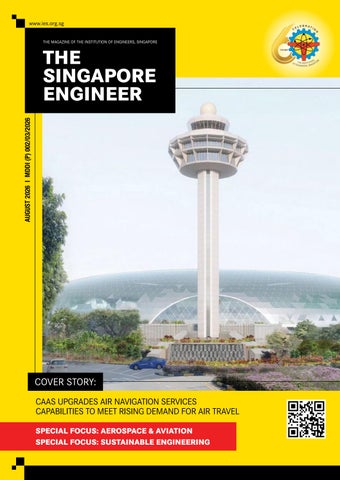
COVER STORY: CAAS UPGRADES AIR NAVIGATION SERVICES CAPABILITIES TO MEET RISING DEMAND FOR AIR TRAVEL SPECIAL FOCUS: AEROSPACE & AVIATION SPECIAL FOCUS: SUSTAINABLE ENGINEERING THE SINGAPORE ENGINEER I AUGUST 2026
1
8
NTU MAE ntu.edu.sg/mae
ENGINEERING THE SPACE FRONTIER
2025 Shanghai Ranking's Global Ranking of Academic Subjects
The School of Mechanical and Aerospace Engineering (MAE) at Nanyang Technological University, Singapore is a global leader across aerospace, robotics, new energy and advanced manufacturing, turning research into solutions with industry. As the space sector accelerates, we are channelling these strengths into the space domain, from autonomous systems to the energy and materials technologies behind the next generation of flight and exploration.
2026 QS World University Rankings by Subject
Our Space Research Focus Material, Design & Structure
AI & Robotics
Associate Professor
Nanyang Assistant Professor
Mir Feroskhan
Kim Mun Sek
Director, Intelligent Cybernetics Lab BEng Aerospace, NTU PhD Aerospace, Florida Institute of Technology
Beyond Ground-Based Monitoring AI-enabled onboard intelligence for space situational awareness.
Backed by the EDB Space Technology Development Programme with industry partner Digantara.
LEO
space-based observer for orbital monitoring
4
onboard cameras on a LEO observer for broader view
LEO
20,000
high-resolution space-based images in the SpaceDet dataset
MEO
Advanced Manufacturing
4
peer-reviewed publications across SSA detection, datasets and orbit propagation
Director, MSK Lab BS, UC Berkeley MS, Cornell University PhD Chemical Engineering, Stanford University
Lunabatteries for Space
Energy storage designed to survive vacuum, deep cold and the lunar surface, addressing a recognised NASA and ESA priority gap.
A research direction progressing from lab prototype to representative demo, toward orbital/lunar technology insertion.
~350 h
lunar-night energy storage duration
GEO
+127 °C to -173 °C
Geocenter Tracker
350 h
Research focus
Onboard vision-based perception
Battery systems built for lunar-night survival: 1. Low-temperature cell and pack architecture with high safety margin 2. AI-assisted state estimation, prognostics and dawn-recovery control 3. Validation via thermal-vacuum, cold-start and robotic mission testing
Lunabatteries
A satellite that monitors orbital objects from space: 1. Crowded orbits under continuous monitoring 2. Onboard AI for object detection and tracking 3. Real-time orbital awareness
AI orbit estimation
higher theoretical capacity of Li-metal vs graphite anodes, at material level
lunar-surface thermal swing to design for
Satellite
Cam 1 Cam 2 Cam 3 Cam 4
~10x
Debris
Edge-enabled onboard processing
Research focus
Interphase engineering
Low-volatility, cold-tolerant electrolytes
Self-stabilising interphases
President Mr Mervyn Sirisena
CONTENTS
Chief Editor Mr T Bhaskaran t_b_n8@yahoo.com
IES UPDATE
Executive Director Mr Syafiq Shahul
10
Celebrating innovation and impact at National Engineers Day 2026!
Publications Manager Mr Desmond Teo desmond@iesnet.org.sg
11
Celebrating 60 years of engineering excellence on the greens!
12
IES Chartered Engineering Night 2026 celebrates engineering excellence
14
Advancing safer demolition practices through standards
Media Representative Trevor Teh TSE@mnc-link.com
NEWS & EVENTS 16
Singapore space summit returning in 2027 with expanded industry and innovation focus
18
Record-breaking trade attendance at Singapore Airshow 2026
19
Asia Pacific business aviation event gathers momentum
20
EuroBLECH 2026 focuses on smart investment as well as resource efficiency and production resilience
22
New BCA study confirms 80% energy efficiency target is within reach for Singapore’s built environment sector
24
ASHRAE Annual Conference showcases innovation and leadership for the future of the built environment
10
Design & layout by 2EZ Asia Pte Ltd Published by The Institution of Engineers, Singapore 70 Bukit Tinggi Road, Singapore 289758 Tel: 6469 5000 Email: publications@iesnet.org.sg Printed in Singapore
Cover designed by Irin Kuah Cover image by CAAS
14
IES UPDATE
18
IES UPDATE
20
NEWS & EVENTS 04
Editorial Panel Er. S Yogeeswaran Dr Chandra Segaran Dr Ang Keng Been Dr Aaron Sham Mr Jaime Vega Bautista Jr
NEWS & EVENTS THE SINGAPORE ENGINEER I AUGUST 2026
COVER STORY 26
CAAS upgrades air navigation services capabilities to meet rising demand for air travel
SPECIAL FOCUS: AEROSPACE & AVIATION 30
Aerospace’s next advantage lies in a robust ecosystem
31
Contributing to the next chapter of aerospace engineering
32
Advancing the future of Sustainable Aviation Fuel
34
Building the foundation for smarter skies in Asia-Pacific
36
Integrated digital maintenance ecosystems in aerospace manufacturing
38
Building cyber resilience into aviation’s operational backbone
39
Bird Detection Radar for the Soekarno-Hatta Airport in Jakarta
28
31
COVER STORY
32
34
SPECIAL FOCUS: AEROSPACE & AVIATION 06
SPECIAL FOCUS: AEROSPACE & AVIATION
SPECIAL FOCUS: AEROSPACE & AVIATION THE SINGAPORE ENGINEER I AUGUST 2026
23 - 25 March 2027
The 9th edition Marina Bay Sands, Singapore Halls B & C | Level 1
POWERING THE FUTURE OF
AIRSIDE OPERATIONS inter airport Southeast Asia is the dedicated airside operations exhibition and conference for Asia. The event brings together airport operators, airlines, ground handlers, and solution providers to explore the technologies, innovations, and partnerships powering every movement on the airside — safely, efficiently, and sustainably.
#IASEA 2025 KEY NUMBERS
3,621
6,259m2
134
ATTENDEES FROM 53 COUNTRIES/REGION
EXHIBITION SPACE
EXHIBITORS
59
4
SPEAKERS
PAVILIONS
EXHIBIT AT
IASEA
2027 Supporting Partner
Supported by
Held in
@interairportsea
@interairportsoutheastasia
www.interairport-southeastasia.com
SPECIAL FOCUS: SUSTAINABLE ENGINEERING 40
UN carbon market expands to renewable power sector
42
When rooftop chillers ‘fight’ each other
44
Making the chiller more efficient
46
Building trust into the reinforcing steel supply chain
48
Healthy buildings, sustainable futures: why material selection matters
50
Understanding EPDs for HVAC
52
Supporting Singapore’s greener built environment
The Singapore Engineer is published monthly by The Institution of Engineers, Singapore (IES). The publication is distributed free-of-charge to IES members and affiliates. Views expressed in this publication do not necessarily reflect those of the Editor or IES. All rights reserved. No part of this magazine shall be reproduced, mechanically or electronically, without the prior consent of IES. Whilst every care is taken to ensure accuracy of the content at press time, IES will not be liable for any discrepancies. Unsolicited contributions are welcome but their inclusion in the magazine is at the discretion of the Editor.
PRODUCTS & SOLUTIONS 54
Hyster Atlas automated lift truck portal wins two product awards
56
Advanced concept for high-performance profile milling
44
SPECIAL FOCUS: SUSTAINABLE ENGINEERING
48
SPECIAL FOCUS: SUSTAINABLE ENGINEERING 08
46
SPECIAL FOCUS: SUSTAINABLE ENGINEERING
54
PRODUCTS & SOLUTIONS THE SINGAPORE ENGINEER I AUGUST 2026
Better information. Smarter decisions. Safer skies. Viasat’s satellite communications network helps connect aircraft, controllers and ANSPs with the trajectory information they need to improve safety, efficiency and predictability. Predictability See aircraft intent, not just position Safety Enhance situational awareness across the airspace Efficiency Enable more direct, optimized flight paths Resilience Extend secure connectivity beyond terrestrial coverage
Trusted by more than 90% of the world's transoceanic aircraft. Discover how Viasat is supporting the future of Asia-Pacific airspace connectivity.
Copyright © 2026 Viasat, Inc. All rights reserved. Viasat, the Viasat logo and the Viasat signal are registered trademarks of Viasat, Inc.
IES UPDATE
Celebrating innovation and impact at National Engineers Day 2026!
Mr Mervyn Sirisena, IES President, presents the Welcome Address.
The Guest-of-Honour, Dr Syed Harun Alhabsyi delivers a congratulatory speech.
Mr Mervyn Sirisena, IES President, presents a token of appreciation to the Guest-of-Honour, Dr Syed Harun Alhabsyi.
The representative of a winning student team in the Engineering Innovation Challenge (EIC), with Mr Mervyn Sirisena and Dr Syed Harun Alhabsyi.
On 14 August 2026, National Engineers Day (NED) 2026, organised by IES, brought together nearly 400 attendees to celebrate the future of engineering and the visionary people shaping it. IES was honoured to welcome Dr Syed Harun Alhabsyi, Senior Parliamentary Secretary, Ministry of Education and Ministry of National Development, as the Guest-of-Honour. Dr Syed delivered an inspiring congratulatory speech and presented awards to the outstanding winning student teams in the Engineering Innovation Challenge (EIC). KEY HIGHLIGHTS FROM NED 2026 Strengthening Singapore’s engineering pipeline IES signed two milestone Memoranda of Understanding (MoUs): • A new MoU with the Association of Aerospace Industries (Singapore) (AAIS) to advance industry collaboration, STEM initiatives, training and knowledge sharing. • An MoU with 11 tertiary institutions, reaffirming the partnership to further engineering education, innovation and talent development. 10
The Guest-of-Honour being briefed on one of the winning student projects.
IES signed a new MoU with AAIS. THE SINGAPORE ENGINEER I AUGUST 2026
IES UPDATE
IES renewed the MoU with 11 tertiary institutions.
Fireside chat and audience Q&A The attendees had the privilege of hearing from Mr Yee Boon Cheow, Deputy Chief Executive (Infrastructure & Development), Land Transport Authority. He shared invaluable perspectives on how emerging technologies are transforming transport and creating dynamic new opportunities for engineers. The session concluded with an engaging Q&A session, where attendees posed thoughtful questions on the future of mobility and smart infrastructure. Together, these partnerships and discussions embodied the theme for NED 2026 – Engineering the New Future: Unlocking Opportunities through Emerging Technologies – as we continue to nurture a future-ready engineering community. A huge thank you to the dedicated judges and mentors who spent countless hours guiding the EIC
Mr Yee Boon Cheow, Deputy Chief Executive (Infrastructure & Development), Land Transport Authority, shares invaluable perspectives in a fireside chat.
participants, and to all participating schools for fostering the next generation of engineering trailblazers! Our heartfelt gratitude also goes out to our generous sponsors, supporting organisations and industry partners. Your unwavering support made NED 2026 a resounding success!
Celebrating 60 years of engineering excellence on the greens! As part of IES’s 60th Anniversary celebrations, we are excited to invite our members, partners and the wider engineering community, to IES60 Golf 2026! Join us for a day of friendly competition, highvalue networking and celebration, as we mark six decades of advancing Singapore’s engineering landscape. Event details Date: Tuesday, 13 October 2026 Time: 11.00 am – 10.00 pm Venue: Seletar Country Club Dress Code: Golf attire (Day) / Smart casual (Banquet) Event highlights • Networking & Banquet: Connect with industry leaders over a round of golf and a celebration dinner in the evening. • Exclusive Gift: Every golfer will receive a limitededition IES 60th Anniversary commemorative golf
THE SINGAPORE ENGINEER I AUGUST 2026
Celebrating six decades of advancing Singapore’s engineering landscape.
polo shirt. • Sponsorship Opportunities: Showcase your organisation’s support for the engineering community with custom sponsorship packages. How to join Whether you are looking to play, bring a corporate team, or sponsor the event, we would love to have you with us! Register at https://tinyurl.com/ IES60Golf. Enquire today: Contact us at events@iesnet.org.sg. We look forward to welcoming you on the greens!
11
IES UPDATE
IES Chartered Engineering Night 2026 celebrates engineering excellence
Certificates of Appreciation were presented to volunteer assessors.
Mr Mervyn Sirisena, IES President, delivers the Opening Address.
Participants gained deep industry insights from two featured industry leaders, Mr Ho Chai Teck (left), Chief Specialist (Coastal & Flood Resilience), PUB, and Mr Joshua Au (right), 2nd Vice Chair, Data Centre Chapter, SGTech.
On 28 July 2026, IES proudly hosted the IES Chartered Engineering Night 2026 that brought together engineers, industry leaders and distinguished professionals, for an evening dedicated to recognition, knowledge sharing and strategic networking. The evening commenced with opening remarks by Mr Mervyn Sirisena, IES President, who reaffirmed IES’ steadfast commitment to advancing professional excellence and fostering lifelong learning across the Singapore engineering community. A major highlight of the night was the presentation of Certificates of Appreciation to volunteer assessors. IES celebrated their invaluable contributions to the Chartered Engineer (SG) Scheme, acknowledging their vital role in upholding the high standards, rigour and integrity of the professional assessment process. Participants also gained deep industry insights from two featured industry leaders: • Mr Ho Chai Teck, Chief Specialist (Coastal &
Flood Resilience), PUB, who shared crucial updates on Singapore’s proactive strategies and national engineering efforts in coastal protection. • Mr Joshua Au, 2nd Vice Chair, Data Centre Chapter, SGTech, who delivered a presentation on the key technologies driving modern AI data centres, focusing on power demands, thermal management and connectivity. The programme also highlighted continuous updates regarding the Chartered Engineer (SG) Scheme and ongoing Skills Development initiatives, underscoring IES’ dedicated efforts to support engineering professionals at every stage of their careers. IES extends its heartfelt appreciation to the speakers, volunteer assessors, the Chartered Engineering Board, the organising committee and all attendees, for contributing to a memorable and impactful event. For more information on the Chartered Engineer (SG) Scheme, please visit https://cebsg.org.
12
THE SINGAPORE ENGINEER I AUGUST 2026
IES CHARTERED ENGINEERING BOARD
The Chartered Engineering Registry aims to provide professional recognition to qualified Engineers, Technologists and Technicians across all sectors. Being registered as a Chartered Engineering Professional will be an external validation of your experience, expertise and practising competence; and is a quality mark to differentiate your professional standing in the following sectors of engineering: Aerospace
Built Environment
Chemical & Energy
Environment & Water
Engineering Project Management
Infrastructure
Railway & Transportation
Renewable Energy
Sustainability
Systems
cebsg.org ies.org.sg
IES UPDATE
Advancing safer demolition practices through standards
The speakers at the seminar.
On 27 July 2026, the IES Standards Development Organisation (IES-SDO) was honoured to launch the SS 557:2026 – Code of Practice for Demolition. The event, which included a seminar, was coorganised with the IES/IStructE Joint Committee and the Building and Construction Authority (BCA), in collaboration with the Singapore Standards Council and Enterprise Singapore, and supported by the National University of Singapore’s Department of Civil and Environmental Engineering. SS 557:2026 provides the industry with a practical framework to identify the risks early and carry out demolition works more safely and responsibly. The revised standard will benefit the industry by: • Identifying structural risks earlier, through comprehensive demolition planning and structural stability reports. • Supporting safer demolition works, by strengthening guidance on demolition sequencing and temporary structural supports. • Improving coordination and accountability, with clearer guidance for managing demolition activities and deliberate collapse. • Promoting more responsible demolition practices, by addressing environmental considerations alongside structural safety. 14
The attendees acquired perspectives on emerging demolition technologies, evolving engineering practices and lessons learnt from industry projects.
Together, these provisions provide building owners, developers, engineers and contractors with greater clarity and confidence in planning and managing demolition works safely. Beyond the launch, regulators, engineers, contractors, consultants, academia and industry practitioners exchanged perspectives on emerging demolition technologies, evolving engineering practices and lessons learnt from industry projects. The discussions reinforced the fact that safe demolition starts long before the first structure is dismantled. It begins with good planning, robust engineering and close collaboration. THE SINGAPORE ENGINEER I AUGUST 2026
WE’RE 60!
THANK YOU FOR SIXTY YEARS OF UNWAVERING SUPPORT AND COMMITMENT TO ENGINEERING EXCELLENCE. WE ARE HONOURED TO CELEBRATE THIS DIAMOND JUBILEE MILESTONE WITH YOU AS WE BUILD A RESILIENT AND INNOVATIVE FUTURE TOGETHER.
www.ies.org.sg
NEWS & EVENTS
Singapore space summit returning in 2027 with expanded industry and innovation focus The Singapore Space Summit will return on 25 and 26 February 2027, at the Sands Expo and Convention Centre, Marina Bay Sands. Supported by the National Space Agency of Singapore (NSAS), the event will feature an expanded conference and exhibition programme showcasing the technologies and innovations shaping the future of the global space economy. Following the success of this year’s event, the organiser, Experia Events, anticipates that new industry partnerships will be shaped at the Singapore Space Summit 2027. The inaugural Singapore Space Summit, held in February 2026, had more than 2,000 attendees; 300 participating companies and organisations; over 60 international speakers, including representatives from 20 national space agencies; and delegations from 43 countries and regions. The summit brought together government leaders, industry executives, researchers and investors, to exchange perspectives on the commercialisation of space technologies, strengthen international partnerships and explore how space-enabled capabilities can address economic, security and sustainability challenges. Leck Chet Lam, Managing Director of Experia Events, said, “The strong response to the inaugural Singapore Space Summit in 2026 reaffirmed the importance of having a platform in Asia Pacific, where governments, industry, investors and innovators can come together to address opportunities and challenges across the global space economy.” “We are building on this momentum by expanding industry participation and introducing new initiatives that support startups and innovation. We look forward to welcoming the international space community back to Singapore Space Summit 2027 to foster new partnerships and shape the future of the space sector,” he added. To be held under the theme ‘Connecting the New Space Economy: Where Space, Connectivity and Economic Resilience Converge’, the expanded conference programme will feature keynote addresses, fireside chats, panel discussions and networking sessions, examining the technologies, policies and partnerships shaping the future of the global space economy. The highlights will include: • Heads of Space Agencies (HOSA) Panel – Bringing together leaders of national space agencies to discuss the opportunities, challenges and priorities, shaping the future of the global space sector. • Orbital Sustainability – Exploring how space situational awareness, traffic coordination and 16
governance frameworks are evolving to keep orbits safe and accessible amidst the rapid growth of satellites and constellations. • Commercial Space Economy – Examining what it takes to scale deep-tech ventures into commercially viable businesses, where the next investment opportunities lie, and how Asia can build the funding ecosystem needed to sustain its space ambitions. • Dual-Use Technologies and Technological Sovereignty – Discussing how Asia can secure its supply chains, manage the overlap between commercial and security applications, and strengthen technological independence through investment, regulation and partnerships. • AI-Powered Digital Twins for Resilient Cities – Exploring how satellite data, geospatial intelligence and Artificial Intelligence (AI) are enabling smarter urban planning, infrastructure management and climate resilience, across Asia. • Space Security and Cyber Resilience – Examining how Asia can build resilient and trusted space infrastructure by strengthening cyber resilience, developing sovereign capabilities and enhancing regional cooperation, against emerging threats. Together, these themes will explore the technologies, policies and partnerships driving the next phase of growth across the global space economy. ST Engineering will return as a Founding Partner, reaffirming its commitment to advancing Singapore’s space ecosystem. Drawing on its capabilities in satellite design and manufacturing, ground station services, Earth observation and geospatial analytics, the company will contribute to discussions on how space-based technologies can address real-world needs and support continued development of an innovative and resilient space sector. Goh Ing Nam, General Manager of ST Engineering Satellite Systems and ST Engineering Geo-Insights, said, “We bring together satellite engineering and geospatial expertise to turn space-based technologies into practical solutions for real-world challenges. ST Engineering’s return as a Founding Partner reflects our commitment to advancing Singapore’s space ambitions and unlocking new possibilities through innovation and industry collaboration.” Singapore Space Summit 2027 will also see increased participation from Singapore’s space industry, through an expanded Singapore Pavilion, organised in collaboration with the Association of Aerospace Industries Singapore (AAIS). The pavilion will showcase a broader cross-section of Singapore companies and their capabilities, providing local enterprises with greater opportunities THE SINGAPORE ENGINEER I AUGUST 2026
NEWS & EVENTS to engage with international customers, partners and investors, while highlighting the continued growth of Singapore’s commercial space ecosystem. AAIS Chief Executive Mr Chew Hwee Yong, said, “As Singapore’s space sector continues to develop, platforms like the Singapore Space Summit play an important role in connecting our companies with global markets, technologies and partners. The inaugural edition delivered tangible value for both Singapore Pavilion participants and the association, translating into meaningful opportunities, greater international visibility and new partnerships.” “As the national association, we look forward to returning with an even stronger Singapore Pavilion that showcases the capabilities and strengths of Singapore’s space ecosystem, while engaging with international delegations and forging new connections,” he added. The summit will further strengthen its innovation platform, through a partnership with Frenchheadquartered company Starburst which joins the event as Innovation Partner. A global aerospace, space and defence innovation platform, Starburst
has identified more than 15,000 startups, completed over 150 investments, and works with more than 100 corporate and government partners worldwide. As Innovation Partner, Starburst will support the scouting and curation of globally relevant startups, contribute to programme development and help shape the summit’s innovation platform. The partnership will also establish a dedicated programme for Seed and Series A companies, connecting promising NewSpace and deep-tech startups with investors, government agencies, established industry players and commercial end-users, from the Asia-Pacific region. Nicholas Hong, Managing Director, Starburst Singapore, said, “As Innovation Partner, we look forward to identifying high-potential Seed and Series A companies, bringing relevant technologies and business models to the summit, and creating meaningful opportunities for start-ups to engage with government agencies, established industry players, investors and commercial end users across Asia-Pacific.” Singapore Space Summit 2027 will also welcome Unseenlabs as Co-Sponsor, further strengthening industry support for the summit.
Stockist of round bar raw material in Stainless Steel & Nickel Alloy
EUROPEAN PRODUCED MATERIAL
NO MOQ
Stockists of Stainless Steel, Titanium Nickel Alloys. Available in Bar, Sheet & Plate. Exotic Steel, Nickel Alloy Steel, 316Ti, Inconel, Hastelloy, Titanium, 17-4, F55 Engineered Plastic PTFE & PVDF, PEEK, Polyimide, PPS, PEl, PE, PP, PVC Trusted by industries in Singapore and beyond for over 20 years, with on-time delivery you can count on.
PHARMACEUTICAL
AVIATION
MED-TECH
PRECISION ENGINEERING
OIL AND GAS
ENERGY
Email: liamvickers@impactspecialmetals.com | Web: www.impactspecialmetals.com THE SINGAPORE ENGINEER I AUGUST 2026
17
NEWS & EVENTS
Record-breaking trade attendance at Singapore Airshow 2026 Singapore Airshow 2026, Asia’s leading international aerospace and defence exhibition, and the 10th edition of the event, was held at the Changi Exhibition Centre, from 3 to 6 February 2026. The strong turnout, with 65,000 trade attendees from more than 130 countries and regions, over 1,100 participating companies and approximately 1,300 delegate meetings conducted, underscores the Asia-Pacific region’s growing influence in shaping the future of aviation and defence, while celebrating two decades of Singapore Airshow’s role as a key platform for Singapore Airshow 2026 brought together over 1,100 participating companies and 65,000 trade industry leaders, government officials attendees, from more than 130 countries and regions. Image: Singapore Airshow. and military delegations to convene, Beyond transactions, Singapore Airshow’s strength exchange ideas and forge strategic lies in its ability to bring together the decision-makers partnerships within the global aerospace ecosystem. who matter. Industry leaders leveraged the platform Reflecting sustained confidence in the Singapore not merely to display solutions, but to announce Airshow, close to 95% of participating companies market-shaping partnerships. have also indicated their interest in returning for the ST Engineering’s unveiling of their advanced 2028 edition. unmanned systems and ground vehicles, coupled with “Achieving record trade attendance at our 10th strategic alliances with Shield AI and Airbus Defence edition reflects the strength and resilience of the and Space, underscores why Asia-Pacific’s aerospace aerospace and defence sector,” said Mr Leck Chet community views Singapore Airshow as the definitive Lam, Managing Director of Experia Events, organiser venue where regional innovation meets global of Singapore Airshow. collaboration and where announcements carry weight “This edition not only marks a major milestone for that resonates across the industry. Singapore Airshow but also highlights the sector’s vitality, with our trade visitors engaging in dynamic Industry voices shaping the next era of aviation discussions, sharing insights and exploring new AeroForum, Singapore Airshow’s dedicated thoughtcollaborations, across aviation and defence,” he added. leadership platform, delivered its strongest edition yet, with three days of high-level dialogue. Driving real business outcomes Featuring more than 50 speakers across 15 strategic Singapore Airshow 2026 provided the platform for sessions, the programme drew close to 1,000 delegates translating connections into concrete commitments. and set the stage for conversations that will shape Across four intensive trade days, the event did not industry priorities well beyond 2026. just showcase breakthrough technologies, it also Organised in collaboration with Alton Aviation catalysed millions in strategic investments and forged Consultancy, Aviation Week Network, Bloomberg, partnerships that will shape the sector’s trajectory for FlightGlobal and NexAvian, the programme deep years to come. dived into cybersecurity, Artificial Intelligence (AI), GE Aerospace’s USD 300 million commitment to sustainable aviation, advanced air mobility, outlook expand engine repair capabilities in Singapore through of the civil aviation market, and regional and global 2029, exemplifies the scale of transactions facilitated defence trends. at the event. Multiple Memoranda of Understanding Singapore Airshow expanded AeroCampus to signed between Singapore’s Economic Development its largest scale yet, hosting 23 exhibitors across Board and global aerospace leaders will expand MRO commercial, government and education sectors. capabilities, establish technology centres of excellence This year marked a milestone, with the first-time and advance next-generation R&D initiatives, participation of overseas aviation training institutions demonstrating how Singapore Airshow serves as the and engagement of 2,500 students with opportunities catalyst for Asia-Pacific’s strategic aerospace ambitions in aerospace and aviation. to take tangible form. 18
THE SINGAPORE ENGINEER I AUGUST 2026
NEWS & EVENTS
Asia Pacific business aviation event gathers momentum Business Aviation Asia Forum & Expo 2027 (BAAFEx 2027) is attracting strong exhibitor interest, from across the business aviation ecosystem, as the sector continues its growth trajectory across Asia Pacific. The second edition of BAAFEx 2027 will be held from 22 to 24 March 2027 at Singapore’s Changi Exhibition Centre. The event will bring together business aviation stakeholders spanning aircraft manufacturing, aircraft ownership and management, charter operations, aviation fuel, flight support, inflight connectivity, cabin interiors, MRO, FBO, regulatory services, recruitment, specialised aviation solutions and more. BAAFEx 2027 is expected to welcome more than 3,000 industry professionals and trade visitors, and over 75 participating companies, across exhibitions, sponsorships and a three-day forum programme. This
represents a 50% increase in visitors and exhibitors as compared to BAAFEx 2025. Among the companies confirmed to participate are AEG Fuels, Amber Aviation, Boeing Business Jets and Lufthansa Technik. Leck Chet Lam, Managing Director of Experia Events, organisers of BAAFEx 2027, said, “The interest we are seeing for BAAFEx 2027 reflects the diversity and maturity of the business aviation ecosystem. Business aviation is not supported by one part of the industry alone. It depends on aircraft manufacturers, operators, regulators, airports and service providers, working together to support the industry’s development.” “BAAFEx provides a focused platform for stakeholders to connect, exchange perspectives and drive the sector’s continued growth across the region,” he added.
Towards a sustainable Grid
清 畅
ECO-FRIENDLY SF6-FREE SWITCHGEAR The QCX E-24 series (E-GIS) is the main switch unit applied in the distribution network and is now widely used in places such as state grid, high-speed railways, subways and new energy. The environmental-friendly gas (C4F7N,CO2) will greatly reduce the greenhouse effect as compared to SF6 while maintaining the same excellent insulation capacity as SF6 gas. The switchgear design is also able to be kept at a smaller size for easier switchgear replacement for existing building structures. **RMU / SWG / GIS customisable to customer requirements.
Company Name: TGM GLOBAL PTE LTD Address: 50 Ubi Crescent, #01-04, Singapore 408568 Website: www.global-tgm.com Tel: +65 6848 2146 Email: sales@global-tgm.com Company Name: Beijing Qingchang Power Technology Co.,Ltd. Address: Room11 building C, Shangdi No.3 street #9, Haidian District, Beijing, China Website: www.qch365global.com Tel: 010-82893776 Email: qc_marketing@qch365.com
THE SINGAPORE ENGINEER I AUGUST 2026
19
NEWS & EVENTS
EuroBLECH 2026 focuses on smart investment as well as resource efficiency and production resilience EuroBLECH 2026, the world’s leading sheet metal working technology exhibition, will be held, from 20 to 23 October 2026, at the Hannover Exhibition Grounds, Hannover, Germany. At EuroBLECH 2026, the 28th edition of the event, visitors will be able to meet leading manufacturers, specialist suppliers and technology providers, from across the full sheet metal working value chain, with live machinery demonstrations, technical world premieres and hands-on product discovery, that offer a close-up view of the solutions shaping modern production. Under the theme ‘For a Stronger Future – Smart & Sustainable Production’, EuroBLECH 2026 will focus on the technologies helping manufacturers improve productivity, reduce resource use, strengthen supply chains and make better investment decisions. Across 15 technology sectors and eight exhibition halls, the exhibition will cover the full spectrum of sheet metal working technology. EuroBLECH 2024, the previous edition of the event, brought together 1,317 exhibitors and 38,946 visitors from 114 countries, with 81% of visitors involved in purchasing decisions. At EuroBLECH 2026, visitors will be able to explore solutions from exhibitors including Adige, AIDA, Amada, ArcelorMittal, Bodor, Bystronic, EAGLE, Ermaksan, LVD, Motofil , MVD, Prima Power, Salvagnini, TRUMPF, Valk Welding, Voortman and Yamazaki Mazak, alongside a broad line-up of exhibits covering machinery, automation, tooling, forming, joining, surface technology, digital production, subcontracting and more. “Manufacturers have more choices than ever, but the real challenge is understanding which solutions will deliver the greatest value for their operations,” said Ms Evelyn Warwick, Event Director for EuroBLECH, on behalf of RX, the organisers of the event. “EuroBLECH 2026 brings the industry together so visitors can see solutions in action, compare approaches, speak directly with technical experts and make informed investment decisions based on their own production priorities,” Ms Warwick added. More ways to discover as well as compare and connect EuroBLECH 2026 offers visitors more ways to explore innovation, find specialist suppliers and make their time at the exhibition more productive. The new Innovation Zone | Advanced Manufacturing will spotlight technologies launched within the past 12 months, giving visitors a close-up 20
EuroBLECH 2026 will be held at the Hannover Exhibition Grounds, Hannover, Germany.
Visitors can witness live machinery demonstrations at the event.
view of some of the latest developments in machinery, automation, smart manufacturing, tooling innovation and digital production. New specialist areas, including the Job Shop & Subcontractors Market, Tooling & Forming Solutions Spotlight and Laser, CNC & Cutting Solutions Spotlight will help visitors quickly find subcontracting partners, tooling and forming expertise, and laser, CNC and cutting technologies. Visitors can also book guided tours through the online ticket shop, with expert-led routes covering priority topics and sectors including Smart Manufacturing and Resource-Efficient Production and Market Opportunities, in the areas of Electronics, HVAC, Aerospace and Defence. The EuroBLECH Awards and Award Trails will spotlight technical excellence in smart and sustainable sheet metal working, helping visitors discover recognised innovations across the show floor. “EuroBLECH 2026 is designed to support a more focused and productive visitor experience. From dedicated feature areas and guided routes to expert-led content and digital planning tools, visitors will have THE SINGAPORE ENGINEER I AUGUST 2026
NEWS & EVENTS clearer ways to discover relevant solutions, understand key industry developments and connect with the suppliers shaping the future of sheet metal working,” said Ms Warwick. A new expert-led conference programme for 2026 EuroBLECH 2026 will feature a dedicated conferencestyle programme on the NextGen Technology Stage, with access to all sessions included in the exhibition ticket. Visitors will hear from industry experts, innovators and technology leaders, on the technologies and pressures reshaping sheet metal working, from AI, automation and smart manufacturing to sustainability, energy efficiency, circular production and workforce development. Sessions will focus on practical questions facing manufacturers now, including how to make smart production deliver real value, where AI is already working, how to reduce waste and energy intensity, and how suppliers can respond to changing buyer expectations. In addition, EuroBLECH 2026 will host the BME Buyer Day on 22 October. Organised with Bundesverband Materialwirtschaft, Einkauf und Logistik (BME), the dedicated procurement programme will feature networking, presentations and panel discussions, on purchasing KPIs, supply chain management, steel market developments, economic security, CBAM and AI-supported product costing.
20 – 23 October 2026 Hanover, Germany
FOR A STRONGER FUTURE
AINABLE T S U S & T R A SM PRODUCTION
Be part of the sheet metal industry’s most important event.
1,300+ global exhibitors
160,000+ sqm of live technology Innovation Zone
NEW Industry Awards
Guided Visitor Tours
Where the future of sheet metal working unfolds.
JOIN US IN HANOVER
Cutting | Forming | Joining | Flexible & hybrid manufacturing | Digital & automated processes | Surface treatment | Additive | Assembly | Factory equipment & more
Exhibits at EuroBLECH 2024, the previous edition of the event.
THE SINGAPORE ENGINEER I AUGUST 2026
21
NEWS & EVENTS
New BCA study confirms 80% energy efficiency target is within reach for Singapore’s Built Environment sector The Building and Construction Authority (BCA) shared insights from the completed Design Prototyping for Decarbonisation (DPfD) study, confirming that Singapore’s target of achieving an 80% improvement in energy efficiency from 2005 levels is technically feasible for new and existing office buildings, new hotel buildings and new mixed-development buildings, with incremental decarbonisation pathways proposed to accommodate varying financial, operational and technical considerations, across different buildings. A public report documenting details of the study will be made available by end of 2026. The announcement was made at the Singapore Green Building Council (SGBC) Awards Gala Dinner 2026 by Guest-ofHonour Ms Grace Fu, Minister for Sustainability and the Environment. This comes as Singapore’s buildings sector makes steady progress towards its ‘80-80-80 in 2030’ targets under the Singapore Green Building Masterplan (SGBMP). As of July 2026, the following results have been achieved: *For the target to have 80% of buildings by Gross Floor Area (GFA) to achieve Green Mark Certification by 2030, 66% of buildings by GFA have been greened. *For the target to have 80% of the new buildings to be achieve Super Low Energy (SLE) standard from 2030, approximately one-third have achieved the SLE standard. *For the target to have best-in-class buildings improve energy efficiency by 80% compared to 2005 levels by 2030, our best-in-class buildings have achieved 72% improvement in energy efficiency from 2005 levels, thus far. Charting the path to 80% energy efficiency The DPfD is a consultancy study commissioned by BCA to explore decarbonisation pathways for highrise commercial office, hotel and mixed-development building typologies. The study assessed the technical options and commercial viability across a range of solutions, providing building owners with practical guidance on how to improve the energy efficiency of their buildings. Two strategies emerged as particularly impactful. First, plug load management offers a practical and accessible means for building owners to track and reduce energy consumption, with green leases enabling landlords and tenants to co-share cost savings. 22
Second, Alternative Cooling Technologies (ACTs) – such as Passive Displacement Cooling (PDC) and Hybrid Cooling systems – are capable of reducing building cooling energy consumption by 30% to 50%, while maintaining thermal comfort. Given that cooling accounts for 40 to 60% of building energy consumption, ACTs can help to provide a meaningful pathway to meet Singapore’s decarbonisation goals. As of July 2026, at least 33 public buildings and 14 private buildings in Singapore have adopted ACTs. At Dulwich College (Singapore), the adoption of PDC across classrooms, the auditorium, and collaborative spaces has achieved 49.5% energy savings for the airdistribution system. At Paya Lebar Green, a cooling system combining perimeter active chilled beams with interior VAV (Variable Air Volume) AHU (Air Handling Unit) systems and a high-efficiency dual-temperature chiller plant has delivered 45% energy savings. SingLand to pilot advanced solutions at The Clifford Singapore Land Group (SingLand), one of the developers involved in the DPfD study, has committed to advancing its decarbonisation efforts through the Green Building Innovation Cluster (GBIC) Demonstration programme for the redevelopment of The Clifford at Raffles Place (The Clifford). The project will adopt high-efficiency lighting solutions and promote plug load management systems in its office floors, with a target to raise its office block’s energy efficiency performance from 65% to 75%, compared to a 2005 baseline. SingLand will also test-bed Passive Displacement Cooling solutions in the building’s retail space to assess viability ahead of potential scaling up. “The findings from the DPfD study gives the industry the evidence it needs to act with confidence. We now know that achieving 80% energy efficiency improvement is technically feasible for new and existing office buildings, new hotels and mixed developments,” said Mr Tan Chee Kiat, Deputy CEO (Industry Development) of BCA. “ACTs alone can cut cooling energy consumption by up to 50% – the technology is ready and the business case is clear. With extreme weather patterns and rising temperatures increasing the urgency to act, I strongly encourage building owners and developers to take that next step towards adopting ACTs in their buildings,” he added. THE SINGAPORE ENGINEER I AUGUST 2026
NEWS & EVENTS
ASHRAE Annual Conference showcases innovation and leadership for the future of the built environment ASHRAE concluded its 2026 Annual Conference, held from 27 June to 1 July, in Austin, Texas, USA, bringing together more than 2,233 registered HVAC&R and building science professionals from around the world, for five days of technical learning, collaboration and leadership. The conference featured discussions on today’s most pressing industry challenges, including data centre cooling, cybersecurity, dehumidification system design, indoor environmental quality, commissioning and other emerging topics shaping the built environment. More than 100 technical sessions were presented across eight conference tracks, giving attendees opportunities to exchange ideas, explore new technologies and gain practical insights. Among the most attended sessions were: • A Completely Waterless Two-Phase Cooling Architecture for Megawatt-Scale AI Data Centres • Designing HVAC Systems for Data Centres • Agentic AI Framework for Building Energy Simulation and Operation • A2L Refrigerants in Data Centres: Issues, Strategies, and Future Trends • Fluid Quality Monitoring and Maintenance in Direct-to-Chip Liquid Cooling: Differentiating TCS and FWS Requirements The conference also marked the beginning of a new year for the society, as Sarah E Maston assumed the role of 2026–27 ASHRAE President. During her inaugural address, Maston introduced her presidential theme ‘Changing the Game: Retrofitting for Resilience’, challenging the industry to work together to improve the performance, efficiency and resilience of existing buildings. “We need to figure out how team ASHRAE, with its wealth of knowledge and educational offerings, can help create a game plan to make existing buildings more efficient, healthy and resilient. This year we are going to focus on codes, technical guidance and building our team,” said Maston. As part of her vision for the year, Maston emphasised the role of interactive learning in preparing the next generation of building professionals. She announced the launch of ASHRAE HVAC Hero, an educational video game that places players in the role of a facility manager responding to maintenance challenges while improving building performance. Players explore building systems, apply ASHRAE Standards and Guidelines and compete to reduce energy use and carbon emissions through informed decision-making. ASHRAE HVAC Hero was made possible through the support of premier donor, 24
Daikin, along with sponsors, Vertiv and the ASHRAE Foundation. Another conference milestone was the introduction of ASHRAE Vision 2035, a long-range framework designed to guide the society’s volunteer leaders and strategic plans through 2035. The vision establishes a shared direction for advancing ASHRAE’s mission while addressing the evolving needs of the built environment. Vision 2035 focuses on five strategic areas: • Personalised and Resilient Environments • Regenerative Development • Human-Centred and Equitable Design • Intelligent Building Lifecycle • Low Carbon and Circular Built Environments The conference also celebrated the accomplishments of ASHRAE members during the society’s annual Honors and Awards programme. Outgoing President Bill McQuade delivered his final State of the Society address, reflecting on the progress made during his society theme ‘Healthy Buildings: Designing for Life’. The ASHRAE Learning Institute (ALI) complemented the conference with 10 professional development courses designed to help attendees expand their technical expertise. The most highly attended courses included: • Guideline 36: Best of Class HVAC Control Sequences • Basic Concepts for Demystifying Dehumidification • Understanding Design and Installation Requirements for A2L Refrigerant Systems The 2027 ASHRAE Winter Conference will take place, from 23 to 27 January 2027 in Chicago, Illinois, USA. The AHR Expo will be held from 25 to 27 January 2027. ASHRAE ASHRAE is an international society of more than 50,000 heating, refrigerating and air-conditioning professionals from over 132 nations dedicated to serving humanity and promoting a sustainable world. Founded in 1894, ASHRAE is an industry leader in research, standards writing, publishing, certification and continuing education. ASHRAE members are dedicated to promoting a healthy and sustainable built environment for all, through strategic partnerships with organisations in the HVAC&R community and across related industries. The society is showcasing integrated building solutions and sustainability in action, through the opening of the ASHRAE Global Headquarters building in metro-Atlanta, Georgia, USA. THE SINGAPORE ENGINEER I AUGUST 2026
CLEAN AIR SOLUTIONS
BIG SAVINGS WITH CLEAN AIR CHOOSING THE RIGHT FILTER SAVES ENERGY AND IMPROVE INDOOR AIR QUALITY
Sustainable Camfil’s energy-efficient filters are designed to lower energy use, reduce CO2 emissions, and support your ESG goals
Performance Longer filter life, consistent efficiency, and reduced energy use all help deliver the lowest total cost of ownership (TCO)
Certified Tested to ISO 16890 and certified by Eurovent to ensure optimal filter and system performance—delivering clean air with proven, long-term results
Upgrade your filters and start saving today! For more information, visit www.camfil.com or send your enquiry to sgsg-enquiry@camfil.com
COVER STORY
CAAS upgrades air navigation services capabilities to meet rising demand for air travel Air navigation services (ANS) provided by the Civil Aviation Authority of Singapore (CAAS) are set for a major SGD 4 billion ‘man-machine-method’ upgrade over the next 15 years, as Singapore gears up to meet rising demand for air travel, better serve passengers and airlines, and strengthen Singapore’s position as a global air hub. The International Civil Aviation Organization (ICAO) projects that air passenger volume will nearly triple over the next 25 years, with the Asia-Pacific region accounting for half of this growth. Air navigation service providers (ANSPs) need to build capacity and capabilities to better manage our skies, that match investments in airport infrastructure on the ground. As a major air hub, Singapore will continue to invest in ANS capabilities to ensure that flying remains safe, efficient, and sustainable throughout the region, as demand grows.
MAN: GROWING THE ATCO WORKFORCE AND DEEPENING ENGINEERING AND R&D CAPABILITY GROWING THE ATCO WORKFORCE Operating one of the busiest and most complex airspaces in the world, CAAS air traffic control officers (ATCOs) are key to the air hub’s daily operations and growth. Today, CAAS ATCOs manage 2,000 flights a day, including 1,000 flights into and out of Changi Airport. To meet rising demand for air travel and prepare for the opening of Changi Airport Terminal 5 (T5), CAAS will grow its current workforce of 500 ATCOs by about 40% to around 700 by the mid-2030s. Air Traffic Control (ATC) is a specialised profession that offers many well-paying career opportunities for Singaporeans. Beyond operations, ATCOs can also progress to take on planning, technology, management and international leadership roles. CAAS will attract more Singaporeans to join the profession through a sign-on bonus for recruits, an undergraduate degree with ATC specialisation, an ATC Undergraduate Scholarship, and an ATC Management Associate Programme to develop future ATC leaders. In addition, CAAS will deepen its air navigation engineering and R&D capabilities to drive the development of innovative operational modules and applications, and concepts of operation. ENGINEERING DEVELOPMENT CENTRE CAAS will establish an Engineering Development Centre to advance our engineering capabilities in ANS. In partnership with industry, research partners and 26
the wider aviation ecosystem, the centre will focus on customising and enhancing systems, while integrating and operationalising innovation to meet Singaporespecific needs. In doing so, it will build deeper local expertise, strengthen operational agility and ensure long-term system resilience. CAAS will provide more details on this Engineering Development Centre when ready. SUPPORT FOR RESEARCHERS AT AIR TRAFFIC MANAGEMENT RESEARCH INSTITUTE PURSUING DOCTOR OF PHILOSOPHY DEGREE CAAS is providing a stipend top-up to local PhD students under the Nanyang Technological University Research Scholarship scheme to attract talent and build up Singapore’s in-country research capabilities in air traffic management (ATM). This will support the SGD 800 million RIE funding that was recently announced.
MACHINE: DEVELOPING CUTTING EDGE SYSTEMS AND UPGRADING INFRASTRUCTURE
CAAS ATCOs will continue to be supported by cutting-edge systems and infrastructure, in their work. CAAS will progressively replace or upgrade over 30 air navigation systems to leverage new technology such as Artificial Intelligence (AI) to help ATCOs make faster and better decisions, and equip them with enhanced tools to provide safe and seamless air travel. The new systems will be designed with open modular architecture to facilitate adoption of advanced operational concepts and integration of future systems across various platforms. The key systems include the following: NEW AIR TRAFFIC MANAGEMENT SYSTEM The Air Traffic Management System (ATMS) is used to provide ATC services for aircraft arriving and departing Changi and Seletar Airports, and aircraft flying through airspace under Singapore’s responsibility. The NexGen ATMS will replace the current system which is reaching the end of operational life. The new system will be able to support up to one million aircraft movements annually and process up to 4,000 concurrent aircraft positions in real-time, doubling current capacity. It will cater for up to 150 THE SINGAPORE ENGINEER I AUGUST 2026
COVER STORY
The new operations building at Singapore Air Traffic Control Centre (SATCC) (artist’s impression).
ATCO workstations at Singapore Air Traffic Control Centre (SATCC), up from the current 100. Work for the new system has started and is projected to be completed in 2030. INTEGRATED DIGITAL TOWER SYSTEM Using cameras and sensors, the Integrated Digital Tower System (IDTS) will provide ATCOs an augmented, real-time digital view of the Changi aerodrome with all the safety-critical information, integrated, correlated and presented on a common display The new air traffic control operations room at SATCC (artist’s impression). and control environment, for better situational awareness and decisionthey arise. It will also allow exchange of digital flight making. plans and aeronautical information with airlines It will also allow ATCOs the flexibility to operate and ANSPs in the region to improve traffic flows outside the constraints of the physical control towers. and better balance air traffic demand with available With IDTS, there will be a total of 54 aerodrome capacity. Work on the iATM will start in 2027 and is ATCO workstations, up from the current 20. Work projected to be completed in 2030. on the IDTS will start in August 2026 with the first operationalisation in 2030 and full completion in midOPEN PLATFORM FOR AIR NAVIGATION 2030s when T5 is ready. SERVICES The Open Platform for Air Navigation Services INFO-CENTRIC AIR TRAFFIC MANAGEMENT (OPANS) will enable the seamless sharing and The Info-Centric Air Traffic Management (iATM) will exchange of ANS-related digital information – allow CAAS to use data and predictive analytics to including aeronautical information and flight plans better anticipate and manage traffic situations before – within CAAS and with external stakeholders such THE SINGAPORE ENGINEER I AUGUST 2026
27
COVER STORY
The upgraded Changi Control Tower (artist’s impression).
as other ANSPs in the region, airport operators and research institutes. Digital connectivity lays the foundation for new concepts of operations and facilitates regional collaborative decision making. Work on the OPANS has started and is projected to be completed in 2028. CAAS will refurbish and upgrade the SATCC and the Changi Control Tower to increase capacity and house the new systems. In time to come, CAAS will commence three-runway operations at Singapore Changi Airport. SINGAPORE AIR TRAFFIC CONTROL CENTRE Operational since 1981, SATCC The current Changi Control Tower. Image: Changi Airport Group. provides 24/7 approach and area control services. SATCC houses critical air navigation systems, including the core ATM maintenance rooms, as well as improved staff system, surveillance radars, communications facilities amenities, including pantries, restrooms and a canteen. and navigational aids, as well as other specialised operational systems. CHANGI CONTROL TOWER CAAS is building a new SATCC complex to Operational since 1981, the Changi Control Tower house the new systems and capabilities. To maintain has become an icon for Singaporeans and travellers uninterrupted 24/7 operations, the upgrading is being alike. CAAS will be upgrading the Changi Control done in phases. Phase 1, covering new electrical Tower to expand the current facilities and house new substations and a multi-storey car park, has been systems. The transformation will include re-cladding completed. Phase 2, to be completed by end 2028, the external façade and the construction of a new will deliver new ATC operations, equipment and Annex Building between the Changi Control Tower 28
THE SINGAPORE ENGINEER I AUGUST 2026
COVER STORY and Jewel Changi Airport. Works will commence in November 2026 and be completed by the end 2028. During this period, the Changi Control Tower will be covered in scaffolding and aesthetic mesh. THREE-RUNWAY OPERATIONS To meet the increase in air travel demand, Changi Airport is progressing towards three-runway operations by the end of this decade, after the third runway is operational for civil use. The threerunway operations will increase Changi Airport’s flight handling capacity and enhance the safety and efficiency of air traffic in the region.
METHOD: AUGMENTING THE ATCO WORKFORCE, MITIGATING THE IMPACT OF WEATHER, AND OPTIMISING REGIONAL TRAFFIC FLOWS
New concepts of operations enabled by technology, particularly Artificial Intelligence (AI), will have a transformative impact on ANS, augmenting the ATCO workforce, mitigating the impact of adverse weather and optimising regional traffic flows. CAAS will work with other ANSPs and industry partners to develop and deploy new technologies and pioneer new ways to manage air traffic, unlock latent capacity in the skies and make flying safer, more efficient and resilient. AUGMENTING ATCO WORKFORCE CAAS will roll out various initiatives to augment the ATCO workforce to raise productivity and reduce cognitive load as traffic grows. Multi Sector Planner Currently, in some control sectors, air traffic is managed by two ATCOs – the tactical controller who gives commands and communicates directly with the pilots, and the planner who plans the flow of the air traffic through the sector, manages coordination and assigns flight levels. CAAS has developed and will trial the AI-powered Multi Sector Planner from 2027 to allow one planner to support two to three control sectors. The Multi Sector Planner will streamline coordination, reduce ATCO load and enhance safety. Digital ATCO Assistant CAAS is developing a Digital ATCO Assistant to support decision-making and reduce cognitive load. The Digital ATCO Assistant will help ATCOs anticipate emerging traffic and weather situations, provide recommendations on how to sequence traffic and space out aircraft, and manage disruptions. Automated read-back error detection CAAS has developed a tool to automate detection of THE SINGAPORE ENGINEER I AUGUST 2026
read-back errors between pilots and ATCOs. This will help reduce safety occurrences like runway incursions and loss of separations. The tool will enter live trials later this year. MITIGATING THE IMPACT OF WEATHER Convective weather can reduce flight throughput and airport capacity. By leveraging technology to better predict the impact of weather on flight movements, ATCOs can better anticipate bottlenecks and constraints, make early interventions and mitigations, and reduce diversions to other airports. OPTIMISING REGIONAL TRAFFIC FLOWS CAAS will continue to work with other ANSPs in the region and industry partners to optimise air traffic flows across flight information regions, through harmonised procedures and interoperable systems, common situational pictures of weather, flight information and aeronautical information and collaborative decision making. For a start, CAAS is developing an AI-enabled Air Traffic Flow Management tool to anticipate and analyse demand-capacity gaps, and propose recommendations which ANSPs can adopt collaboratively. Since September 2025, CAAS, the Air Traffic Management Bureau of the Civil Aviation Administration of China, and the Hong Kong Civil Aviation Department have started daily operational coordination calls to share information and coordinate air traffic flows. Since then, three other ANSPs have joined the calls – the Republic of Korea Ministry of Land, Infrastructure and Transport; Aeronautical Radio of Thailand Limited; and Viet Nam Air Traffic Management Corporation. Mr Han Kok Juan, Director-General of CAAS, said, “As a global air hub, we are committed to serving all airspace users and to deliver for them an even smoother, more seamless and safer travel experience. We plan ahead. We invest, partner and leverage technology to ensure that we have the capacity and capabilities we need to meet rising demand and benefit from aviation’s growth.”
CIVIL AVIATION AUTHORITY OF SINGAPORE
The mission of the Civil Aviation Authority of Singapore (CAAS) is to grow a safe, vibrant air hub and civil aviation system, making a key contribution to Singapore’s success. CAAS’ roles are to oversee and promote safety in the aviation industry, develop the air hub and aviation industry, provide air navigation services, provide aviation training for human resource development, and contribute to the development of international civil aviation. All images by CAAS, unless otherwise stated
29
SPECIAL FOCUS: AEROSPACE & AVIATION
Aerospace’s next advantage lies in a robust ecosystem Going beyond the considerations on land, runway access and skilled labour. The ecosystem advantage For aerospace companies deciding where to locate, considerations relating to land, runway access and skilled labour remain essential. But they are no longer enough. Increasingly, the deciding factor is the ecosystem surrounding a site – suppliers down the road; a Maintenance, Repair and Overhaul (MRO) specialist that can turn around a critical part overnight; or a research team next door, willing to test new ideas. As the industry grapples with surging post-pandemic demand, stretched MRO capacity and mounting pressure Established in 2008 by JTC, Seletar Aerospace Park (SAP) has grown into a thriving ecosystem. to decarbonise, few companies can tackle these challenges alone. together companies, technology providers, academia, Competitive advantage now comes from the strength trade associations and government agencies, to of the ecosystem around them. accelerate collaboration in Digitalisation, Talent Development, Sustainability and Innovation. Where collaboration takes flight The Aerospace Open Innovation Challenge (AOIC), This is where Seletar Aerospace Park (SAP) stands organised by JTC and Enterprise Singapore (ESG), apart. Established in 2008 by JTC, SAP has puts real operational challenges from established grown into a thriving ecosystem of more than aerospace companies before start-ups, helping 80 multinational and local aerospace companies, solutions progress from concept to commercial employing over 6,000 professionals, across component adoption. The programme’s growing traction reflects manufacturing, MRO, business and general aviation, industry demand. Following its inaugural edition in and Research and Development (R&D). 2024, the second AOIC in 2026 attracted more than SAP’s value lies not only in the companies it brings 140 applicants. together, but in the collaboration they enable. A Collaboration also extends to industry-wide component manufacturer can work alongside an challenges. Through the JTC–Association of Aerospace MRO specialist and an R&D team to solve challenges Industries (Singapore) (AAIS) Community of Practice, in weeks, instead of months, accelerating innovation industry leaders exchange ideas and practical and reducing time to market. approaches to shared challenges such as waste The ecosystem extends across Singapore. Punggol management and carbon accounting. Digital District (PDD) contributes AI, cybersecurity and smart-city expertise for digital test-bedding. Building for the industry’s next chapter Jurong Innovation District (JID), Singapore’s largest Sustainability has become a baseline expectation living lab for advanced manufacturing, supports rather than a differentiator. At SAP, green building the journey from ideation to industrial scale. Onestandards, solar energy adoption and resource-efficient North adds a dense concentration of start-ups and infrastructure are increasingly embedded into new research institutes driving technology co-development. developments from the outset, enabling companies to Together, these connected ecosystems give SAP pursue their sustainability goals while future-proofing companies access to capabilities far beyond what any their operations. single park could house. Yet, an ecosystem is more than just its infrastructure. It is also where people work, meet and connect. Situated Making collaboration intentional at the heart of SAP is The Oval which brings dining and Ecosystems do not emerge by chance. They are built lifestyle spaces within conserved colonial bungalows, through deliberate partnerships and shared platforms. with Hampstead Wetlands Park nearby offering green At SAP, JTC’s Industry Connect initiatives bring spaces for recreation and informal connections. 30
THE SINGAPORE ENGINEER I AUGUST 2026
SPECIAL FOCUS: AEROSPACE & AVIATION
Contributing to the next chapter of aerospace engineering The significance of Rolls-Royce Singapore to the company’s civil aerospace business. Singapore’s aviation sector brings together advanced manufacturing, Maintenance, Repair & Overhaul (MRO) expertise, research partnerships and aviation talent, in one of the world’s most vibrant aviation hubs. Rolls-Royce has been active in Singapore and the region since the early 1930s. Today, Singapore serves as the regional hub for Rolls-Royce’s Civil Aerospace, Defence and Power Systems businesses. For Civil Aerospace, Singapore connects several parts of the engine lifecycle – high-value component manufacturing, partnership-led technology development, MRO activities and talent development. Rolls-Royce’s 154,000 m2 Seletar Campus was opened in February 2012 by former Prime Minister Lee Hsien Loong at Seletar Aerospace Park. The campus brings together Rolls-Royce’s manufacturing, innovation, training and customer support capabilities. This is exemplified by Fan Blade Singapore (FBSG), the lead manufacturing facility for Rolls-Royce’s hollow titanium Wide Chord Fan Blades. FBSG manufactures over 90% of the company’s fan blades globally, supporting the performance, efficiency and safety of its patented Trent aero engines. With just under 700 employees locally, the Seletar Campus also houses the Regional Training Centre (RTC) and Customer Service Centre. Singapore provides collaboration opportunities for Rolls-Royce and its industry partners. SAESL, its joint venture with SIA Engineering Company, has been operating since 2001 and is the recognised market leader in MRO activities for Rolls-Royce Trent engines. Long-standing collaboration continues between Rolls-Royce and government bodies such as A*STAR and ARTC, alongside research and learning institutions such as SIMTech and NTU. In 2025, Rolls-Royce announced the second phase of its Smart Manufacturing Joint Lab (SMJL) with A*STAR and SAESL – a SGD 34 million investment initiative to explore key innovations, including additive manufacturing, automation and Artificial Intelligence (AI), to meet rising aviation demand. The first phase of SMJL was launched in 2017, with SGD 68 million invested into improving process efficiencies and implementing advanced manufacturing technologies across Rolls-Royce’s FBSG facility and SAESL’s MRO operations. A 2026 Memorandum of Understanding with the Singapore Economic Development Board builds on this collaboration, to strengthen Rolls-Royce’s technology development and industrial capabilities in Singapore. This includes looking at the establishment THE SINGAPORE ENGINEER I AUGUST 2026
Rolls-Royce’s Seletar Campus, at Seletar Aerospace Park, houses the company’s manufacturing, innovation, training and customer support capabilities.
of an AI Centre of Excellence, which would focus on the use of agentic AI in power system applications. Supported by Rolls-Royce’s university partnerships, Singapore remains an important base for developing aerospace talent. The RTC is the first facility of its type in Asia-Pacific and is designed to develop the high-value skills needed to advance the aviation sector. Rolls-Royce has also partnered with the Science Film Festival since 2022, reaching hundreds of thousands of young people across the region. This includes engagements with local schools in Singapore, involving interactive learning sessions and hands-on workshops. Singapore also allows Rolls-Royce to support growing demand for air travel and increasing regional connectivity. Asia-Pacific currently accounts for 20% of its global civil large engines in operation, and the company holds a 52% share of the widebody market in APAC, with around 530 engines in service. Customers include Singapore Airlines, Scoot, All Nippon Airways, Thai Airways, Asiana, Japan Airlines and Air New Zealand. This year marks 30 years of Rolls-Royce’s relationship with Singapore Airlines, beginning with its first Trent 800 order for the Boeing 777, and a decade of Trent XWB support for Singapore Airlines’ Airbus A350 fleet. Together, these capabilities provide the foundations to serve customers today while developing the technologies, skills and expertise needed to support regional connectivity and the next phase of aviation growth. 31
SPECIAL FOCUS: AEROSPACE & AVIATION
Advancing the future of Sustainable Aviation Fuel Developments in pretreatment technologies can improve efficiency and output quality. As the global transport sector accelerates its decarbonisation efforts, aviation and long-haul transport continue to present significant challenges. Unlike passenger vehicles and rail, which have seen rapid progress, aviation remains reliant on high-energy liquid fuels. Hydrotreated Vegetable Oil (HVO) and Sustainable Aviation Fuel (SAF) represent a shift from first-generation biofuels, such as biodiesel blends (e.g. B7), towards more advanced alternatives. One of their key advantages is their compatibility with current systems. These fuels are The increased use of biofuels can help to reduce the carbon footprint of the aviation sector. considered ‘drop-in’, meaning they can be used in existing diesel engines, which introduces additional operational costs and marine applications and aircraft turbines, without environmental burdens related to material handling modification. and disposal. SAF, in particular, can be blended directly with Newer approaches focus on optimising earlier stages conventional jet fuel, making it a viable pathway for such as filtration and degumming, to achieve the reducing aviation emissions, while next-generation required quality, without bleaching. By eliminating propulsion technologies are still in development. the bleaching stage entirely, solutions such as Pre2Fuel A defining characteristic of these fuels is their can reduce bleaching earth consumption by 100%, reliance on waste-based feedstocks. Materials such contributing to lower material usage, reduced waste as used cooking oil, animal fats and non-edible and improved process efficiency. vegetable oils are increasingly being utilised, aligning These types of innovations are increasingly aligned with circular economy principles. However, these with broader sustainability frameworks. For instance, feedstocks present a challenge – their quality can GEA’s Pre2Fuel has been included in the company’s vary significantly, as they often contain high levels of ‘Add Better’ portfolio which identifies resourcecontaminants. As a result, effective pretreatment is efficient and environmentally responsible solutions. critical to ensure the final fuel meets stringent purity Such initiatives help provide greater transparency standards. for customers seeking technologies that support To address this, advancements in pretreatment decarbonisation goals and more sustainable technologies are playing an important role in production practices. Complementary advisory improving both efficiency and output quality. Modern services, including validated consulting approaches, processes are designed to handle a wide range of further support companies in optimising operations as feedstocks, whether processed individually or blended, they transition towards lower-carbon energy systems. while consistently reducing impurities such as metals At the same time, regulatory frameworks are and phosphorus. This flexibility is essential for accelerating the adoption of SAF. As the industry producers managing diverse and variable raw material expands with new SAF and HVO plants planned streams. globally, the ability to process diverse feedstocks Technologies such as GEA’s Pre2Fuel process efficiently will become increasingly important. illustrate how innovation in pretreatment can enhance In summary, while the transition to low-carbon consistency and reliability, particularly when working aviation remains complex, advancements in biofuel with lower-quality or mixed feedstocks. processing are helping to bridge the gap. By improving One notable development in this space is the efficiency, reducing environmental impact and shift away from traditional bleaching steps in enabling greater flexibility in feedstock use, modern biofuel pretreatment. Conventional processes often pretreatment technologies are contributing to a more rely on bleaching earth to remove contaminants, resilient and sustainable aviation ecosystem. 32
THE SINGAPORE ENGINEER I AUGUST 2026
GEA PrE2FuEl Cleared for takeoff. The road to more decarbonized transport is gaining momentum. While aviation still faces major hurdles, GEA Pre2Fuel is making important strides. This breakthrough in biofuel pretreatment slashes operating costs by 50% and CO₂ emissions by 12%. But how? By eliminating the traditional bleaching process, manufacturers benefit from more efficient, sustainable fuel production. Whether it’s hydrotreated vegetable oil (HVO) for trucks and rail or sustainable aviation fuel (SAF) for jets, Pre2Fuel ensures high purity standards while utilizing waste-based feedstock like used cooking oils and animal fats.
GEA Westfalia Separator (S.E.A.) Pte. Ltd. 202 Kallang Bahru, #06-01 Singapore 339339 Tel. +65 6338 8113 Email: WSSingapore@gea.com www.gea.com
SPECIAL FOCUS: AEROSPACE & AVIATION
Building the foundation for smarter skies in Asia-Pacific From connectivity to predictability. As air traffic across Asia-Pacific continues to grow, the aviation industry faces a critical challenge – how to safely accommodate increasing demand while improving efficiency, resilience and sustainability. The answer lies not only in expanding infrastructure, but also in improving the quality of information available to those managing the skies. For airlines, air navigation service providers (ANSPs) and air traffic controllers, better and more updated information leads to more informed and timely decisions, and ultimately, better outcomes for the entire aviation ecosystem. At the same time, the region is preparing for a new generation of airspace users. Alongside growth in commercial aviation, uncrewed aerial systems (UAS), advanced air mobility (AAM) vehicles and increasingly connected operations are expected to place new demands on airspace management. Supporting this diverse mix of traffic will require a more collaborative, digital and data-driven approach. One of the most significant developments supporting this transition is the evolution of aircraft communications. While voice communications remain fundamental to aviation, modern data link technologies are enabling aircraft and ground systems to exchange richer operational information, helping stakeholders move from reactive to predictive decision-making. Trajectory-Based Operations (TBO) is a key example. By sharing information about an aircraft’s intended flight path – not just its current position – controllers gain greater visibility into future aircraft movements. This enhanced predictability can improve traffic flow management, support earlier conflict detection and help optimise the use of available airspace. Experience from early implementations has demonstrated how better trajectory information can contribute to more efficient climb and descent profiles, more direct routings and improved operational awareness. These benefits can help support safety objectives while reducing delays, fuel consumption and emissions. Satellite communications are playing an increasingly important role in enabling this transformation. By complementing terrestrial communications networks, satellite connectivity provides secure, reliable communications across both continental and oceanic airspace. This helps ensure that critical operational information can be exchanged wherever aircraft operate, supporting a more connected and interoperable aviation environment. For Asia-Pacific, the opportunity is significant. Many 34
states are exploring and undertaking modernisation initiatives to meet future demand while maintaining the highest levels of safety. As traffic volumes increase and new entrants, such as drones and advanced air mobility vehicles, enter the ecosystem, secured access to timely and accurate information will become increasingly important. Success will depend on collaboration across the aviation community. Airlines, ANSPs, regulators, aircraft manufacturers, and service and technology providers, all of whom have a role to play in creating a connected environment where information can be shared effectively and securely. As a global provider of aviation connectivity solutions, Viasat is supporting this evolution through satellite communications services that enable secure air-ground data exchange and enhanced trajectory information sharing. By helping to connect aircraft, controllers and ANSPs, connectivity can become a powerful enabler of safer, more efficient and more predictable operations. The future of airspace is not simply about managing more traffic. It is about creating a smarter, more connected aviation ecosystem – one that is ready to support growth, integrate new airspace users and help unlock the full potential of modern aviation.
By connecting the flight deck to the wider aviation ecosystem, Electronic Flight Bags (EFBs) support more efficient and predictable operations.
Access to timely and accurate operational information helps ANSPs and airline operations centres make more informed decisions and manage traffic more efficiently. THE SINGAPORE ENGINEER I AUGUST 2026
SPECIAL FOCUS: AEROSPACE & AVIATION
Integrated digital maintenance ecosystems in aerospace manufacturing by Yap Mun Foong, Co-Founder, Neptrix Beyond predictive analytics. The aerospace and aviation industry is accelerating towards highly connected manufacturing ecosystems powered by Industrial Internet of Things (IIoT), Artificial Intelligence (AI) and predictive analytics technologies. As aircraft systems become increasingly sophisticated and production tolerances tighten, aerospace manufacturers and Maintenance, Repair & Overhaul (MRO) facilities face growing pressure to improve operational reliability, equipment availability and process efficiency, while maintaining strict quality and compliance standards. One of the key operational challenges in aerospace manufacturing is unplanned equipment downtime. Production environments rely heavily on precision manufacturing equipment, robotic automation systems, laser cutting machines, heat treatment systems and inspection equipment. Unexpected failures can lead to production delays, supply chain disruptions and increased operational costs. Traditional preventive maintenance approaches, based on fixed maintenance intervals, are often inefficient, as they may result in unnecessary servicing or delayed fault detection. To address these challenges, manufacturers are increasingly adopting AI-driven predictive maintenance systems integrated with IIoT-enabled shopfloor infrastructure. These systems collect realtime operational data such as vibration patterns, motor load conditions, temperature variations, energy consumption, machine cycle times and other operational parameters. Data acquired from programmable logic controllers (PLCs), SCADA systems and retrofitted sensors, can then be analysed using machine learning algorithms, to identify anomalies and predict potential equipment failures before breakdowns occur. Predictive analytics can be further enhanced when integrated with supporting operational systems. Many manufacturers are now combining predictive maintenance platforms with Computerised Maintenance Management Systems (CMMS), spare parts inventory management systems, and Human Resources Management System (HRMS) for technician attendance, certification and manpower allocation, to create a more comprehensive maintenance ecosystem. By linking AI-generated alerts directly to maintenance scheduling, work order management, technician assignment and spare parts availability, maintenance teams can respond more efficiently while 36
Engineer retrofitting conventional equipment with a smart sensor to extend predictive maintenance.
reducing delays caused by manual coordination and inventory shortages. The adoption of integrated maintenance and monitoring systems enables organisations to transition from reactive maintenance towards condition-based maintenance strategies. This improves Overall Equipment Effectiveness (OEE), reduces unplanned downtime and enhances maintenance planning accuracy. In aerospace environments where equipment reliability is critical, even small improvements in machine uptime can generate operational impact. A notable example is the collaboration between A*STAR, Pratt & Whitney Singapore and local technology startups, in deploying AI-powered Connected Factory Analytics solutions within aerospace manufacturing operations. By combining industrial AI, predictive maintenance and integrated maintenance management systems, the project reportedly achieved up to 75% reduction in unplanned equipment downtime and improved spare parts management efficiency by approximately 90%. The collaboration also demonstrated how partnerships between research institutions, industry leaders and local innovation companies can accelerate practical Industry 4.0 adoption. The project was subsequently mentioned at the Singapore Aerospace Technology Leadership Forum, highlighting growing industry interest in smart manufacturing and connected maintenance ecosystems within the aerospace sector. As aerospace manufacturing continues evolving towards smart factory ecosystems, the integration of AI, IIoT, predictive analytics and digital maintenance platforms is expected to become an essential component of future operations, enabling stronger operational resilience and improved competitiveness. THE SINGAPORE ENGINEER I AUGUST 2026
Di gi tal transformation
SIMPLIFIED. Engineering is complex, Digital transformation doesn't have to be. Neptrix NX:V5 Platform is built by engineers who understand both the factory floor and the technologies that power Industry 4.0. We believe that every complex engineering problem deserves a simple, practical solution. Through real-time visibility, machine connectivity, AI-driven insights, and operational intelligence, Neptrix helps corporates improve productivity, reduce downtime, and unlock measurable business value. Trusted by manufacturers from SMEs to Fortune 500 companies.
Industrial IOT
Manufacturing Execution
Multivariate AI Platform
Digital Twins
Predictive Maintenance
Let’s build what’s next. Contact us to explore how Neptrix can accelerate your digital transformation journey.
sales@neptrix.com
www.neptrix.com
Available at: Singapore, Malaysia, Hong Kong, Taiwan, India Reseller and Channel Partners welcomed.
Maintenance Management
SPECIAL FOCUS: AEROSPACE & AVIATION
Building cyber resilience into aviation’s operational backbone by DANIEL GOH CISSP, ECSA, Director of ATET Pte Ltd Making aircraft secure for takeoff. On the morning of 20 September 2025, passengers at London Heathrow, Brussels, Berlin Brandenburg and Dublin found themselves checking in the way travellers did in the 1970s – by hand, with pen and paper. The cause was not a system glitch but ransomware, deployed against MUSE, the shared passengerprocessing software made by RTX subsidiary Collins Aerospace. ENISA, the European Union’s cybersecurity agency, confirmed the ransomware attribution within days, and Britain’s National Crime Agency made an arrest. No aircraft was touched and no safety system was breached, yet a single compromised vendor cascaded across four major airports and disrupted operations for the better part of a week. The Collins incident is the clearest illustration of the trend that has defined aviation cybersecurity over the past 18 months. The sector’s greatest exposure no longer sits in the cockpit, but in the sprawling, interconnected ground enterprise and, increasingly, in the Operational Technology (OT) that runs it. For aviation and aerospace organisations operating in Singapore – one of the world’s busiest air hubs and the largest maintenance, repair and overhaul (MRO) centre in Asia – that exposure now comes with a hardening regulatory expectation and, encouragingly, a clear pathway to address it. In recent years, several cyber attacks have been reported, indicating that threat actors have multiplied and specialised. The OT problem What unites these stories is the collapsing boundary between IT (Information Technology) and the OT that physically moves aircraft, baggage, fuel and people. Airports and MRO facilities depend on OT for baggage handling, jet bridges, building management, fuel distribution, ground power and production lines, much of it legacy equipment never designed to be networked or routinely patched. Dragos, in its 2026 OT year-in-review, found poor IT/OT network segmentation in 81% of the assessments it conducted, and reported that the number of ransomware groups hitting industrial organisations rose by roughly half in a single year, with manufacturing, including aerospace production and MRO, absorbing the largest share of victims. Check Point’s Manufacturing Threat Landscape 38
2026 found that ransomware against manufacturers rose 56% year on year in 2025, to 1,466 incidents. Roughly half of all attacks it tracked were driven by legacy OT systems, lengthening supply chains and industrialised ransomware-as-a-service; in Europe alone, it estimated that 80% of manufacturers still run critical OT with known, unpatched vulnerabilities. Aerospace production and MRO sit squarely inside that target set, and the costs are real. The adversaries are also moving closer to the engineering itself and first compromising less-defended third part suppliers, and then pivoting inward into the aerospace, aviation and defence firms. From good practice to obligation Regulators have responded, and the bar is rising. In Europe, EASA’s Part-IS regime now requires aviation organisations to run formal information-security management systems, phased in through October 2025 and February 2026, while the EU’s NIS2 Directive designates air transport as an essential sector. In the US, the FAA’s proposed rule to embed cybersecurity into aircraft airworthiness standards remained unfinalised, as of mid-2026. Singapore has moved decisively. Under the Cybersecurity Act, the Cyber Security Agency of Singapore (CSA) announced, on 2 March 2026, that it will mandate the Cyber Trust mark for the organisations at the heart of national resilience. Critical Information Infrastructure (CII) owners must attain the mark at its highest Advocate (Level 5) tier by the end of 2027, while CII auditors and licensed cybersecurity service providers must certify even sooner. Aviation is a designated CII sector. For airport operators, airlines, air-navigation service providers and the aerospace and MRO firms that serve them, certification is shifting from a mark of distinction to a condition of doing business. The Cyber Trust mark The Cyber Trust mark is CSA’s risk-based certification, for larger, more digitalised organisations. Rather than a fixed checklist, it begins with a guided risk assessment that places an organisation on one of five preparedness tiers – Supporter, Practitioner, Promoter, Performer and Advocate – and tests it against up to 22 cybersecurity domains spanning governance and oversight, education, informationTHE SINGAPORE ENGINEER I AUGUST 2026
SPECIAL FOCUS: AEROSPACE & AVIATION asset protection, secure access, and resilience. Certification is earned through independent thirdparty assessment and is valid for three years, with annual surveillance audits. Crucially, in 2025, CSA enhanced the mark (published as Singapore Standard SS 712:2025) to extend beyond classical IT security into Cloud, Artificial Intelligence and, the most relevant here, OT. The OT pillar threads OT-specific controls through all 22 domains and makes one decisive change for safety-critical industries – it re-orders the classic security priorities, putting safety first, then availability, integrity and confidentiality, and treats human safety and physical impact as explicit factors in risk decisions. It is positioned as a pathway to the international OT standard IEC 62443 and maps to ISO/IEC 27001. ATET Security ATET Pte Ltd, the cybersecurity brand of Asteria Visions and a CSA-licensed cybersecurity service provider (licensed for managed SOC monitoring and penetration testing), guides Singapore organisations through the full journey to the Cyber Trust mark. This begins with a self-assessment of the risks, to scope both the IT and OT environments, followed by a gap analysis against the appropriate tier and the OTspecific control statements, a prioritised remediation roadmap, and ongoing CISO-as-a-Service support to sustain the programme between audits. ATET works alongside CSA-appointed certification bodies which carry out the independent assessment that issues the Cyber Trust mark. Aviation’s safety culture, honed over decades, has not yet been matched by equivalent cyber resilience. The Cyber Trust mark with its OT pillar offers a credible bridge between the two, that operators can cross, with the right guidance, before the regulator requires it.
“Like many engineering SMEs, we had long treated cybersecurity as an IT afterthought – yet our airfield lighting systems are pure operational technology, where failure is not an option. What worried me most was simply not knowing where our gaps were. Achieving the Cyber Trust mark with its OT pillar changed that: it turned a vague concern into a clear, evidenced programme and gave me real peace of mind. Just as importantly, the certification has become a genuine differentiator. It shows larger, security-conscious clients that they can trust us” – John Lim, Managing Director and Founder, Chartered Asia Technology Enterprise (CATE)
THE SINGAPORE ENGINEER I AUGUST 2026
Bird Detection Radar for the Soekarno-Hatta Airport in Jakarta
MERLIN True3D Bird Detection Radar System
DeTect Inc has been awarded the contract to supply its MERLIN 7360 True3D Bird Detection Radar (BDR) to the Soekarno-Hatta Airport in Jakarta. MERLIN is an advanced and widely used BDR system, with over 600 BDR systems installed worldwide, in aviation safety and bird protection applications. The MERLIN technology was originally developed for, and is currently used by, the US Air Force and NASA, for detection and alerting of hazardous bird and drone activity on an around airfields, with systems currently used by commercial airports in Canada, the EU, the Middle East, Africa and Asia. The Jakarta system will include 7360 True3D radars at the ends of each of its two runways, to provide full 3D 360° airfield and surrounding airspace, with automatic display and alerting of high-risk bird activity via monitors in the airport bird control team vehicles and at airfield operations and in the control tower. The system will be manufactured in the US, and the project will be managed by DeTect’s APAC Regional office in South Korea. DeTect’s CEO, Gary Andrews, said, “We are gratified to have been selected by InJourney Airports to supply and support DeTect’s bird radar system technology at Soekarno-Hatta International Airport (CGK), one of Southeast Asia’s busiest airports.” DeTect is a fully integrated radar company founded in 2003 with research, engineering and manufacturing facilities and offices worldwide. DeTect products include MERLIN BDR, HARRIER Security and Surveillance Radars, DroneWatcher Counter-UAS systems, MERLIN Bird Monitoring and Mitigation Systems, HARRIER Aircraft Detection Lighting Systems, and HARRIER Beyond Visual Line-of-Sight radars.
39
SPECIAL FOCUS: SUSTAINABLE ENGINEERING
UN carbon market expands to renewable power sector Helping countries move closer to their Paris Agreement goals. Renewable power projects can now seek credits under the Paris Agreement’s carbon market, after the UN Body overseeing the mechanism adopted a new methodology for grid connected renewable electricity. This decision reflects the Article 6.4 Supervisory Body’s focus this year on building the practical rules and tools needed to expand the Paris Agreement Crediting Mechanism. It opens the door for eligible grid-connected renewable electricity projects to generate UN-backed carbon credits, ensuring those credits reflect real, additional and verified emission reductions. The methodology, together with supporting tools and standards, sets out which projects can qualify, how emission reductions must be measured and what checks are needed before credits can be issued. By supporting renewable electricity projects where finance is still a barrier, the methodology can help countries move closer to their Paris Agreement goals, including efforts to keep 1.5 °C within reach, while contributing to sustainable development. Simon Stiell, UN Climate Change Executive Secretary said, “Despite clear progress, the shift to renewable based electricity generation is still not happening fast enough, and people, communities and economies are paying the price – household bills through the roof, a planet that keeps heating, worsening climate disasters like heatwaves and floods, and countries exposed to costly fuel imports instead of energy they control. Renewables are now the cheapest power almost everywhere in the world. What is needed now in many countries is more accessible finance to build them faster.” “The UN carbon market can help close that gap, unlocking finance for projects that would not otherwise move ahead, under strong rules and with real climate impact. That means more clean power on the grid, helping countries move faster towards their climate goals. For developing countries, it can also open new revenue streams for climate action that deliver real benefits on the ground,” he added. Supporting clean-power projects Renewable power is growing fast, but many countries still need support to get projects built. Countries have committed to work towards tripling global renewable energy capacity by 2030, a goal that will require much more investment in clean power. Data from national climate plans (known as Nationally Determined Contributions, or NDCs) submitted to UN Climate Change shows that many countries’ planned renewable electricity capacity for 2030 depends fully or partly on international support 40
– underscoring the role of finance in getting clean power built. The decision comes as countries look to electrify more of their economies, from transport and buildings to industry. The incoming COP31 Presidency has proposed raising electricity’s share of global energy use from just over 20% today to 35% by 2035, a shift that would require much faster deployment of clean power. Expanding impact across major greenhouse gases “The mechanism is increasingly moving into sectors that matter for people’s daily lives and for countries’ climate plans. This methodology is conservative by design, so that expanding into clean power does not come at the cost of what the Paris Agreement requires.” said Mkhuthazi Steleki, Chair of the Supervisory Body. The new methodology expands the range of projects that can issue credits under the Paris Agreement Crediting Mechanism, bringing another major source of greenhouse gases into scope. It adds renewable power to earlier methodologies covering methane from landfill gas and nitrous oxide from nitric acid production. “These are familiar project types, but crediting them credibly takes careful design. With this methodology, we have put practical rules and conservative safeguards together. That is the balance a highintegrity mechanism needs,” said Jacqui Ruesga, ViceChair of the Supervisory Body. Further progress and next steps The Supervisory Body also considered a draft methodology for energy efficiency measures in household cooking and requested further work before taking a decision. This includes further consideration on issues such as non-permanence, uncertainty and conservativeness, with a view to considering the methodology together with the related methodological tools and standards as a coherent package. Additionally, the Supervisory Body adopted updates to the mechanism registry procedure, a key part of the infrastructure needed to issue, hold, transfer and track credits under the Paris Agreement Crediting Mechanism. Further work will continue on post-issuance authorisations, implementation of the Baku decisions and related methodological tools needed to support projects in practice. The Article 6.4 Supervisory Body’s final meeting of the year ahead of COP31 will take place in Bonn, from 5 to 9 October 2026. THE SINGAPORE ENGINEER I AUGUST 2026
SPECIAL FOCUS: SUSTAINABLE ENGINEERING
When rooftop chillers ‘fight’ each other by Jay Wang, Ir Pua Ching Tian and Muhammad Anas Bin Mat Marzuki, Megagenix Pte Ltd What dynamic CFD reveals about hot-air recirculation. Sustainability in commercial buildings is often discussed through visible measures such as insulation, glazing and solar panels. Yet avoidable energy losses can also occur out of sight – on the rooftop, in the way air moves around a chiller array. Chillers are among the largest energy consumers in commercial and industrial buildings. Their performance depends not only on equipment specification, but also on the airflow environment. Under certain wind conditions and tight arrangements, warm discharge air from one chiller can be drawn back into a neighbouring intake. This hot-air recirculation raises inlet temperatures, reduces cooling capacity and can increase energy use by the compressor. The problem is not entirely static. Ambient temperature changes throughout the day, while wind influences how discharged heat travels across the rooftop. A steady-state simulation captures one operating point. A dynamic assessment shows how the thermal field develops over a daily cycle. A 24-hour simulation approach A recent study compared two layouts for a 32-unit rooftop chiller array using dynamic Computational Fluid Dynamics (CFD). The simulation represented the hourly ambient-temperature variation recorded on 21 February 2025, with dry-bulb temperature rising from approximately 26 °C at midnight to a peak of 36 °C between 14:00 and 15:00 hours, before declining in the evening. A southerly wind of 2.2 m/s at a reference height of 10 m was applied as the representative wind condition. This condition was selected from climatic wind-rose data comprising more than 227,000 hourly observations. All plan, side-elevation and three-dimensional temperature results presented in this article correspond to the same critical mid-afternoon operating condition, allowing the two chiller configurations to be compared on a consistent basis. The study aimed to identify hot-air recirculation, compare the thermal performance of the two layouts and support an informed design decision before the rooftop arrangement was finalised. Two configurations with two outcomes Design A arranged all 32 chillers in tight parallel rows near the centre of the rooftop. Although compact and symmetrical, the arrangement created a continuous zone of elevated air temperature, leaving limited space 42
for the discharged heat to disperse before interacting with neighbouring unit intakes. Design B used a staggered and clustered arrangement of the same 32 units. By separating the clusters and opening lateral airflow paths between them, the arrangement allowed better dilution and dispersion of discharged air before it could reach adjacent intakes. Why it matters Chiller efficiency, commonly expressed as the Coefficient of Performance (COP), generally decreases as condenser inlet-air temperature rises. Persistent recirculation can expose chiller intakes to air several degrees above ambient, increasing compressor power demand while reducing available cooling capacity. Across a large array operating continuously, even a modest efficiency penalty can accumulate significantly over the equipment lifecycle. Although the study did not quantify a specific, annual energy-saving percentage, it demonstrated how equipment arrangement can influence the thermal environment in which chillers operate, and highlighted where further optimisation should focus. Rooftop layout is also a design-stage consideration. Once structural supports are fabricated and equipment is procured, reconfiguration can be expensive or impractical. CFD therefore helps project teams identify airflow and thermal risks before committing to a particular arrangement. A broader lesson Rooftop chiller configuration is not merely a spaceplanning exercise. It is a thermal-fluid design decision that can influence recirculation risk, condenser inlet conditions and long-term operating efficiency. Under the assessed wind condition and 24-hour ambient-temperature profile, Design B provided a more favourable airflow environment than Design A, with lower overall recirculation risk for most chiller units. However, localised hotspots remained at corner units and windward-facing cluster edges, showing that a better-performing arrangement is not necessarily a fully optimised one. The study demonstrated how dynamic CFD can reveal thermal interactions that may be overlooked during conventional layout reviews or singlepoint assessments. By identifying these risks before equipment procurement and structural supports are finalised, project teams can make more informed decisions regarding unit spacing, orientation and positioning. THE SINGAPORE ENGINEER I AUGUST 2026
SPECIAL FOCUS: SUSTAINABLE ENGINEERING
Design A: Plan view temperature
Design B: Plan view temperature
Design A: Side view temperature
Design B: Side view temperature
Design A: 3D view temperature
Design B: 3D view temperature
The results of a simulated study comparing the performance of a 32-unit rooftop chiller array with two different layouts.
As cooling demand continues to grow, improving how rooftop equipment interacts with its surrounding airflow may offer a practical and often overlooked pathway towards more energy-conscious building design. THE SINGAPORE ENGINEER I AUGUST 2026
(Megagenix Pte Ltd is a Singapore-based engineering simulation consultancy, specialising in Computational Fluid Dynamics, Finite Element Analysis and energy modelling, for the built environment and industrial sectors). 43
SPECIAL FOCUS: SUSTAINABLE ENGINEERING
Making the chiller more efficient Assessing the possibilities. The basic mechanical chiller technology has been the same since the last 40 to 50 years. There are major improvements in the controls and also perhaps some minor improvements in manufacturing technology, allowing for closer tolerances that lead to gradual improvements in efficiency. So it is assumed that there is not much that can be done to improve the efficiency of a chilling system. But, actually, there are lots of ways in which the efficiency of the complete chilling system can be improved. Depending on individual systems, there can be many other ways possible, as well, which can be identified after a detailed audit of the individual systems. Some considerations for improving the chiller system efficiency • Choosing the correct type of refrigerant compressor for the chiller: The newest type of refrigerant compressor available in Singapore is the contactless, oil-less, variable speed, magnetic bearing, centrifugal compressor. These compressors are available in small and medium capacity and can be used to build a multi-compressor chiller. They offer a maintenancefree solution. • Reviewing, closely, the chilled water temperature required for the process: It is common to use machines running at standard temperatures of 5 °C or 7 °C. But, at times, the process does not need water at such low temperatures. Just changing the outlet temperature from 5 °C to maybe 10 °C, could save a huge amount of power.
• Checking the distance of the chiller from the end-use point: The further away a chiller is from the end-use point, higher is the loss of temperature in transit and, also, it will need greater pumping power to carry the water further. • Recognising the importance of maintenance: The importance of proper preventive maintenance should never be underestimated. As an example, a dirty condenser in the chiller could result in higher condensing temperatures and eventually in a huge increase in power consumption that could be as high as 15%. There are many other aspects of a chilling system that could be improved, and all these put together can result in consistent long-term energy savings. It is said that for a chilling solution, lower capital costs will likely result in high long-term operating and maintenance costs and, inversely, for lower longterm operating and maintenance costs, the initial investment will probably have to be slightly higher. Novus Technik Novus Technik is a 20-year-old company in the field of heating and cooling solutions. The company provides energy-efficient systems that offer long-term benefits. In addition, Novus Technik can advise customers on best practices for system integration in a chilling solution, based on their specific requirements for existing systems or new installations. For more information, visit www.novus.com.sg
There are many ways to improve the energy efficiency of chilling systems.
44
THE SINGAPORE ENGINEER I AUGUST 2026
HEATPUMP
INTRODUCING
Boiler? Cooler Tank? More costly? Space Constraint?
Heatpump is a machine that consist of heating one side and chilling on other. Hence, its function of two machines in one! Our Heatpumps heating capacity range from 6kW to 2600kW and hot water outlet temperature from 45C to 80C on standard machines. We have both air-cooled and water-cooled versions. We can support customised machines for higher capacities and temperature up to 100C. Introducing our Modular Series (WWM) Heat Pump with reversible water side for indoor installation. Bi-circuit units reversible water side with hermetic R410A scroll compressors, high efficiency installation and source side plate exhanger. Made to allow total accessibility to internal components for service and maintenance. Easy installation and maintenance thanks to practical disassembly of the cooling circuit from hydronic side. Can be connected upto 8 machines These machines are BUILT AND ASSEMBLED IN EUROPE bwith latest technology, industry leading features and efficiency.
Novus Technik Pte Ltd
10 Marina Boulevard, MBFC Tower 2, Level 39 Singapore 018983
Tel: +65 6225 3602
Email: comm@novus.com.sg
Website: www.novus.com.sg
SPECIAL FOCUS: SUSTAINABLE ENGINEERING
Building trust into the reinforcing steel supply chain by Lee Brankley, Ayhan Tugrul, Ladin Camci and Chin Seng Yap at CARES Certification Pte Ltd The case for digital traceability. Reinforcing steel sits at the heart of every major material choices with confidence, rather than relying structure, yet the industry has long relied on paperon conservative default assumptions that discourage based certificates, siloed records and manual checks genuine improvement. to prove where that steel came from and how A trial on the HS2 Euston station project in the UK sustainable it really is. As governments and clients illustrated the tangible benefits. Digitising the chain demand verifiable progress on net-zero commitments, of custody for around 712 tonnes of reinforcement this gap between physical materials and trustworthy delivered an estimated 11-day saving in processing digital data has become a serious risk for the built time, alongside a clearer, real-time picture of the environment. carbon performance of the steel actually used on site. The Grenfell Tower Inquiry was a stark reminder Scaled to a 60,000-tonne project, the same efficiencies of what happens when documentation lacks point to significant time and cost savings, alongside transparency and third- party assurance is not more accurate as-built carbon accounting than rigorously enforced. In its wake, policy directions, traditional paper-based methods allow. such as the UK’s Construction Products Reform The relevance to Singapore is direct. More than Green Paper, have made clear that data integrity, five million tonnes of reinforcement products have traceability and accountability must be built into already been managed through the CARES Cloud how safety-critical materials like rebar are procured in Singapore’s built environment, supporting the and used. traceability and sustainability data that clients, CARES, an independent, profit-for-purpose regulators and green building rating systems certification body, has spent the past decade increasingly require. developing the CARES Cloud, a cloud-based digital As construction moves towards digital-first ecosystem that tracks every batch of reinforcing steel assurance, tools that connect physical materials from the mill to the construction site. to verified, real-time data are no longer a nice-toUsing unique bar marks rolled into each piece of have. They are becoming essential infrastructure for rebar at the point of casting, the system preserves an delivering genuinely low-carbon, safe and accountable unbroken chain of custody, through cutting, bending, buildings, and for giving industry a reliable digital welding and delivery. Contractors and clients can record of what has actually been built. access assurance dashboards showing certification status, compliance records and, critically, verified carbon footprint data linked to each shipment. This last point matters increasingly for sustainability reporting. Generic industry-average carbon datasets tend to overstate the embodied carbon of reinforcement steel produced via the electric arc furnace route, which is common in many markets. Access to product-specific, audited Environmental Product Declarations allows engineers and procurement The CARES Cloud is a cloud-based digital ecosystem that tracks every batch of reinforcing steel from the mill to the teams to make lower-carbon construction site. 46
THE SINGAPORE ENGINEER I AUGUST 2026
Pioneer of Press Technology Application Area Plumbing HVAC Fire Industry
WORLD NOVELTY
The new Novopress32
HIGHLIGHTS LED LIGHT RING For more luminosity and reliable pressing INTEROPERABILITY Easy information exchange via display & app NO NEED FOR SERVICE Constant pressing force of 32 kN thanks to innovative pressing THEFT PROTECTION Locking & unlocking the device via app
www.novopress.com
Distributors and stockists in Singapore/Malaysia
www.novus.com.sg Novus Technik Pte Ltd Level 39, Marina Bay Financial Centre Tower 2, 10 Marina Boulevard, Singapore 018983 Tel No : +65 6225 3602 (Mainline) Email: comm@novus.com.sg
SPECIAL FOCUS: SUSTAINABLE ENGINEERING
Healthy buildings, sustainable futures: why material selection matters A new performance metric for healthy buildings. The conversation around sustainable buildings is evolving beyond energy performance and carbon reduction, to also include occupant health and wellbeing. Increasingly, the industry is recognising that truly sustainable buildings must also support the health and wellbeing of the people who occupy them. As a result, Indoor Air Quality (IAQ) is becoming highly recognised as a critical consideration in building design, bringing greater attention to the role of material selection. The connection between materials and IAQ In dense urban environments such as Singapore, discussions around IAQ often focus on ventilation strategies and air exchange rates. While ventilation remains an essential component of healthy building design, it is only part of the solution. The quality of the building envelope and the materials specified within it influence the indoor environment throughout the life of a building. Certain construction materials may release volatile organic compounds (VOCs), which can contribute to high indoor pollutant levels, over time. Reducing VOC emissions supports both healthier indoor environments and broader sustainability objectives, by minimising emissions to the surrounding environments. As result, IAQ is becoming an important consideration in building design, alongside greater emphasis on low VOCs and material transparency in building certification schemes such as LEED, WELL and Living Building Challenge. Making informed material choices “Healthy buildings are the result of well-considered design and specification decisions. While ventilation systems play an important role, the materials incorporated within the building envelope have a lasting impact on Indoor Air Quality. By taking a holistic approach to design and material selection, project teams can create spaces that support building performance, sustainability goals and occupant wellbeing,” said Nikki Buckett, Building Science Manager of Knauf Insulation APAC. Building envelope materials, such as mineral wool insulation, can 48
play a broader role in healthy sustainable building design than is often recognised. Beyond thermal efficiency, mineral wool insulation can support acoustic comfort and indoor environmental quality, particularly when specified with independently verified low-emission credentials, such as the highest EUROFINS Indoor Air Comfort Gold certification, and supported by transparent material disclosures including Red List Free declarations. Material transparency Architects and consultants are asking a fundamental question “What is the material made of?” This has led to growing interest in material transparency initiatives such as ingredient disclosures and Red List Free declarations. Developed under the Living Building Challenge framework, the Red List identifies chemicals that are considered harmful to human health and the environment. Products that are Red List Free demonstrate that these substances have been intentionally avoided, supporting healthier and more responsible material choices. Designing for the future The future of building performance will be measured not only by how efficiently buildings operate, but also by how effectively they support the health and wellbeing of the people within them. As the industry continues to balance occupant health and wellbeing with sustainability goals, informed material selection is becoming an increasingly important part of delivering buildings that perform better, for both people and the environment.
Besides its thermal efficiency, mineral wool insulation (as in the partition wall shown in the image) supports acoustic comfort and indoor environmental quality.
THE SINGAPORE ENGINEER I AUGUST 2026
BEYOND VENTILATION: DESIGNING HEALTHIER BUILDINGS BETTER OUTCOMES COME FROM SMARTER MATERIALS. CHOOSE MATERIALS THAT ARE: LOW VOC FOR BETTER AIR QUALITY FREE FROM HARMFUL INGREDIENTS HIGH PERFORMING FOR ACOUSTIC COMFORT
INDEPENDENTLY VERIFIED FOR HEALTHIER BUILDINGS Knauf Insulation glasswool products are independently certified to the highest Eurofins Indoor Air Comfort Gold standard for exceptionally low VOC emissions and are Declare Red List Free for material transparency. Together, these credentials support specifiers to select materials that create healthier indoor environments. Learn more about healthy building design in our latest white paper and upcoming CPD programmes.
FIND OUT MORE
SPECIAL FOCUS: SUSTAINABLE ENGINEERING
Understanding EPDs for HVAC by Yeo Wei Liam, Managing Director, Systemair and Hannah Jouy, Marketing Consultant, Systemair They are important in advancing sustainable construction practices. Today’s sustainability in the built environment has evolved beyond energy efficiency to encompass over 20 environmental factors, including material efficiency, CO2 emissions and the Global Warming Potential (GWP). These complexities are evaluated through lifecycle assessments (LCAs) and verified via Environmental Product Declarations (EPDs). Where energy-efficient ventilation meets EPD transparency. As sustainability reporting laws worldwide grow stricter, These stages are categorised into three types of the demand for EPDs is surging, raising the EPDs: question, “What are EPDs, and how should they be • Cradle-to-Gate: Covers production and end-of-life interpreted?” stages. At its core, LCAs comprehensively assess a product’s • Cradle-to-Gate Plus Options: Includes additional environmental impacts throughout its lifecycle. At the construction and use stages. same time, EPDs certify these evaluations, offering • Cradle-to-Grave: Encompasses all five stages. vital environmental information about materials and Systemair adheres to globally recognised standards components used in construction. While EPDs for to ensure accurate and transparent EPDs. The traditional materials have been available for years, company’s EPDs typically follow a Cradle-to-Gate their scope has expanded to encompass technical model, reflecting what is generally applicable across all equipment and HVAC products. This shift is crucial, projects. As operational energy use varies significantly, as ventilation systems influence indoor air quality depending on project-specific factors such as airflow, (IAQ) and energy consumption. pressure, climatic conditions and local energy sources, EPDs are gaining global traction, as national these variations make it impractical to generalise building codes increasingly mandate LCAs for new energy use within EPDs. buildings. Organisations like the Singapore Green Product selection tools and life-cycle cost calculators Building Council are highlighting their importance and address this variability, enabling project-specific energy EPDs also contribute valuable credits to green building performance assessments. This helps stakeholders make certifications such as BREEAM and LEED. informed decisions that align with their sustainability goals. As LCAs become mandatory in building projects, Breaking it down EPDs play a pivotal role in ensuring accurate All LCAs in the construction sector adhere to the same environmental assessments and are critical in choosing structure, whether for individual products or entire the right solution for a project. For example, Systemair buildings, as defined by the most globally recognised EPDs, compliant with EN 15804, ISO 14025 and standard, EN 15804 (Sustainability of construction ISO 14040/14044 standards, are published on the works – Environmental Product Declarations). EPDs company’s website and verified by the Norwegian EPD communicate ‘verifiable, accurate, non-misleading Foundation, which is a member of the ECO Platform, environmental information’, through the following making our EPDs globally recognisable. lifecycle stages: In total, these EPDs cover tens of thousands of item numbers. Examples include the MUB EC fans • Production: Raw materials, transport, and and air curtain series like Pamir and Arden. These manufacturing. certifications support sustainable construction globally, • Construction: Transport and installation processes. reinforcing the importance of integrating EPDs into • Use: Maintenance, repair, replacement, every building lifecycle phase. refurbishment, and resource consumption. As the demand for sustainable practices continues to • End-of-Life: Deconstruction, demolition, waste rise, EPDs play a pivotal role in driving compliance, processing, and disposal. fostering innovation and ensuring quality ventilation. Together, these efforts pave the way for a more • After-Life Benefits: Potential for reuse, recovery or sustainable future in the built environment. recycling. 50
THE SINGAPORE ENGINEER I AUGUST 2026
Air curtains designed to blend in and stand out Your perfect climate solutions, tailored by Systemair and Frico
Pamir Series
Arden Series (Recessed air curtains)
Super Energy-Efficient: Designed for ultimate comfort and energy savings.
High Efficiency: Save up to 50 % energy with advanced EC motors.
Stylish Design: Perfectly complements modern interiors.
Intelligent Control: Configure settings for maximum indoor comfort.
Greenmark Demand Equipped with EC motors for maximum efficiency
✓
Less energy use, resulting in lower energy costs and lower CO₂ emissions
✓
Easy to control and adjust ventilation rate to actual need
✓
Low sound level
✓
All control and protection electronics are integrated in the motor
Ready to meet your EPD requirements At Systemair, we adhere to globally recognised standards to ensure accurate and transparent Environmental Product Declarations (EPDs). Systemair EPDs, compliant with EN 15804, ISO 14025, and ISO 14040/14044 standards, are published via the ECO Platform and the Norwegian EPD Foundation. Contact Us Today Systemair Singapore 33 Tannery Lane #01-01 347789 Singapore Singapore Scan the code to learn more about our EPDs!
Systemair (SEA) Pte Ltd | 33 Tannery Lane #01-01, 347789 Singapore | Tel: +65 68420688 | sales@systemair.com.sg | www.systemair.com
SPECIAL FOCUS: SUSTAINABLE ENGINEERING
Supporting Singapore’s greener built environment Powering a sustainable future. Champion Programme (DCP), to drive continuous Sustainability is becoming a key consideration across improvement and support Singapore’s net-zero Singapore’s built environment. With increasing roadmap. emphasis on Green Mark requirements, ESG Guided by the principle that “you cannot reduce commitments and responsible procurement, businesses what you do not measure”, Cantal has implemented are looking beyond product performance and cost. EcoStruxure Building Activate energy management and Today, greater attention is placed on how products automation software for buildings, as part of the DCP, are manufactured, how operations are managed and to monitor real-time electricity consumption across its whether supply chain partners contribute towards office and production lines, enabling targeted energylong-term environmental goals. reduction initiatives. Industrial collaboration not only At Cantal, sustainability is embedded throughout helps decarbonise a company’s own operations, it also its products and operations. The company believes supports broader sustainability objectives. This may that reliable power distribution and environmental include contributing towards Green Mark requirements, responsibility should go hand in hand. supporting ESG reporting efforts, strengthening Cantal’s MAC low-voltage switchboard series has responsible procurement practices and aligning with been awarded the ‘Leader’ rating, under the Singapore corporate carbon reduction targets. As sustainability Green Building Product (SGBP) certification scheme, expectations continue to evolve across both public administered by the Singapore Green Building Council and private sector projects, supply chain alignment is (SGBC). This recognition reflects the company’s becoming an increasingly important consideration. commitment to delivering electrical infrastructure At the same time, sustainability should not come at solutions that support greener building developments, the expense of reliability. In electrical infrastructure, without compromising safety, performance or reliability. safety, system performance and long-term reliability Cantal also continues to improve the sustainability remain key priorities, especially for facilities where of its manufacturing operations. Today, about 60% of continuous operation is critical. the company’s electricity needs are supported by solar As Singapore continues progressing towards a energy generated from its on-site solar system. The more sustainable built environment, the industry is remaining 40% is supplied through Sembcorp’s green expected to place greater emphasis on solutions that energy programme, where electricity consumption balance performance, reliability and environmental is offset through International Renewable Energy responsibility. Through ongoing product innovation Certificates (I-REC). Meanwhile, excess solar energy and responsible operational practices, companies generated by the company’s system is exported back across the sector can contribute meaningfully towards to SP Group’s grid, thereby contributing renewable supporting Singapore’s long-term sustainability goals. energy to Singapore’s power network. With this dual green energy source structure, Cantal has not only significantly reduced market-based Scope 2 emissions, but also directly lowered the process emissions of its products, which rely primarily on electricity during manufacturing, thus providing partners with a lowercarbon product option within their sustainable supply chain. In addition, Cantal has Today, about 60% of Cantal’s electricity needs are supported by on-site solar energy generation. The remaining installed EV charging facilities to 40% is supplied through Sembcorp’s green energy programme. encourage the adoption of electric vehicles, which contributes to the reduction of Scope 1 and Scope 3 transportation-related emissions. For businesses, leading sustainability organisations offers strategic advantages. Cantal has officially partnered with Schneider Electric under the Decarbonization Solutions must balance sustainability with performance and reliability.
52
THE SINGAPORE ENGINEER I AUGUST 2026
PRODUCTS & SOLUTIONS
Hyster Atlas automated lift truck portal wins two product awards Hyster has announced two major award wins for the Hyster Atlas automated lift truck portal. The revolutionary lift truck automation solution won a GOOD DESIGN award in the robotics category, and was selected as the AGV Solution of the Year by the SupplyTech Breakthrough Awards. Hyster Atlas, which was launched in September 2025, enables implementation of automated lift trucks in as little as one day, without any software engineering experience, through an easy-to-use, dragand-drop portal, making it easier to amplify teams’ work in manufacturing facilities. When utilising the portal, users can easily map their facility by operating the truck manually. As the truck is driven, waypoints are automatically created along the travelled path, to define routes. No coding is required. To update that route, waypoints can simply be dragged and dropped into new locations, making it easy to implement and update automated solutions, even if users have no software engineering experience. “With the demands placed on material handling operations, the last thing teams need is technology that is complex and cumbersome to use,” said Noah Salmonson, Product Manager, Automation, Hyster. “The Hyster automated lift truck portal was created to amplify what teams can accomplish, not leave them buried in complicated software. These award wins recognise the simplicity of working within the Hyster Atlas portal, and the value of that simplicity in
meeting operational goals,” he added. The first Hyster Atlas automated lift truck, an automated tow tractor, was designed to fit a broad range of workflows, and is capable of working with a variety of cart styles. The truck offers an automated hitch and unhitch option to limit manual intervention. To further ease the manual burden of managing automated lift truck fleets, automated wireless charging enables the truck to return to a charging station dock when needed, without operator or supervisor intervention. Automation components are integrated separately on top of standard Hyster lift trucks, allowing updates and adjustments, without interfering with other components, and enabling simpler service by the Hyster dealer network.
Hyster Atlas automated lift truck portal.
Hyster Atlas automated tow tractor with portal.
54
THE SINGAPORE ENGINEER I AUGUST 2026
PRODUCTS & SOLUTIONS
Advanced concept for high-performance profile milling Cutting tool specialist Sandvik Coromant has announced the launch of CoroMill MR20, an advanced indexable milling concept, engineered to deliver high stability, predictable performance and good metal removal rates across demanding materials and applications. Designed for manufacturers who require process security, CoroMill MR20 brings new levels of confidence and productivity to profiling and face milling operations. CoroMill MR20 is a single-sided, round-insert concept, optimised for ISO M, ISO S and ISO P materials. Its combination of security and versatility makes it ideal for pocketing and complex profiling in titanium and other HRSA materials used in aerospace, as well as in oil and gas components. The tool also excels in ISO P die and mould applications, delivering reliable roughing and semifinishing performance. In ISO M materials, it handles heavy metal removal for pump and valve components with the high predictability and productivity these industries demand. CoroMill MR20 is Sandvik Coromant’s first-choice solution for these applications. “Our goal while developing CoroMill MR20 was to create a polyvalent cutter that offers the highest level of process security. Customers machining high value components need predictable, repeatable performance – and CoroMill MR20 delivers exactly that,” said Alvaro Ruiz, Global Product Application Specialist at Sandvik Coromant.
CoroMill MR20 is engineered not only for performance but also for more sustainable machining. By enabling higher feed per tooth, the tool reduces the energy required during machining. Its long tool life means fewer inserts are consumed, lowering the overall carbon footprint associated with production. “Increasing feed capability while extending tool life means fewer resources used and less waste generated. It is a win for productivity and for sustainability,” said Mr Ruiz. An advanced tool design ensures superior resistance to fatigue and deformation ensuring repeatability and long cutter body life. The new integrated under-coolant system guarantees high performance, especially in long-chipping and difficult-to-machine material. One of the key innovations is the optimised insert seat design, where the large contact area between the insert and cutter body minimises micro-movement, for maximum stability. The six-edged insert features a thick, robust body for high bulk strength and superior edge-line security. Tight manufacturing tolerances promote gradual and predictable insert wear, supporting efficient, unmanned production, minimised scrap and maximised operational uptime. With its combination of stability, versatility and cutting efficiency, CoroMill MR20 equips manufacturers to push performance boundaries while maintaining full control of their process.
ADVERTISERS’ INDEX ATET Pte Ltd ––––––––––––––––––––––––––––– Page 05
Megagenix Pte Ltd –––––––––––––––––––––––– Page 41
Camfil Singapore Pte Ltd –––––––––––––––––––– Page 25
Nanyang Technological University ––––––––––– Page 02 - School of Mechanical & Aerospace Engineering
Cantal United Pte Ltd –––––––––––––––––––––– Page 53 China Harbour (Singapore) ––––––––––––––––– Page 23 Engineering Company Pte Ltd
Neptrix Pte Ltd ––––––––––––––––––––––––––– Page 37 Novus Technik Pte Ltd –––––––––––––– Pages 45 and 47
GEA Westfalia Separator (SEA) Pte Ltd ––––––– Page 33
Reed Exhibitions Limited ––––––––––––––––––– Page 21
IES 60 –––––––––––––––––––––––––––––––––––– Page 15
RELX (Singapore) Pte Ltd ––––––––––––––––––– Page 07
IES Academy ––––––––––––––––––––– Inside Back Cover
Rolls-Royce Singapore Pte Ltd ––––––––––––––– Page 03
IES Chartered Engineer ––––––––––––––––––––– Page 13
Singapore University –––––––––––––– Inside Front Cover of Social Sciences
IES Membership ––––––––––––––––––––––––––– Page 55 IES-INCA –––––––––––––––––––––––––––––––––– Page 35 Impact Special Metals –––––––––––––––––––––– Page 17
Systemair (SEA) Pte Ltd –––––––––––––––––––– Page 51 TGM Global Pte Ltd ––––––––––––––––––––––– Page 19
JTC Corporation –––––– Page Facing Inside Front Cover
UK Certification Authority –––––––– Outside Back Cover for Reinforcing Steels
Knauf Insulation Pte Ltd –––––––––––––––––––- Page 49
Viasat Singapore Holdings Pte Ltd ––––––––––– Page 09
56
THE SINGAPORE ENGINEER I AUGUST 2026
Trust the CARES Code
Every bar. Fully traceable. Fully certified. Behind every CARES Code is a full digital record, traceable, transparent and independently verified. No speculation, no grey areas. Just evidence. CARES gives you confidence in every decision, from design to as-built.
The CARES mark
• Dot-dash-dot denotes CARES approved steel. • Number of ribs between next two dots after CARES, certification mark, indicate country of origin (In this example, country, = five). • Number of ribs between next two dots indicates steel mill number. (this example, mail, number, equals 25). – Dash denotes Grade 500.
5 ribs
2 ribs
5 ribs Bar mark 5-25 is shown
CARES Cloud App
Manufacturer’s identification mark using CARES’ product marking system
Assured Steel Certification Independent Impartial Trusted
carescertification.com
Your Digital Golden Thread to Structural Safety