




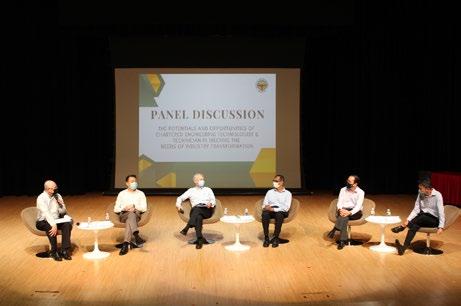
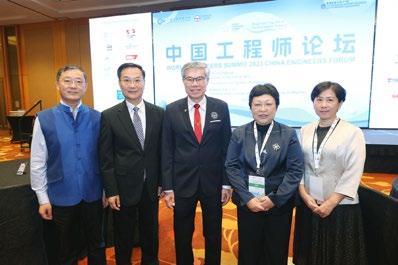
The Chartered Engineering Registry aims to provide professional recognition to qualified Engineers, Technologists and Technicians across all sectors.
Being registered as a Chartered Engineering Professional will be an external validation of your experience, expertise and practising competence; and is a quality mark to differentiate your professional standing in the following sectors of engineering:










05 A deep dive into meteorological systems Powering up fire safety standards!
06 Visit by IES C&S TC to Jakarta and Bandung
08 American microbiologist wins 2026 Lee Kuan Yew Water Prize
10 Signify announces new programme and next generation solutions
11 Armstrong Fluid Technology appoints Danilo Elez as Chief Executive Officer
12 Power Automation partners TBEA to expand power equipment portfolio
13 Mistral AI accelerates Singapore expansion Octave unveils new brand identity

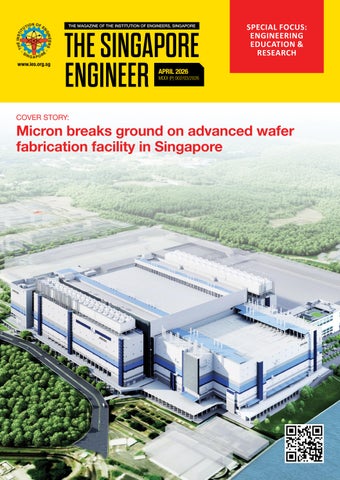
14 Micron breaks ground on advanced wafer fabrication facility in Singapore
16 Strengthening Singapore’s maritime talent pipeline
17 SIT appoints Professor Susanna Leong as new Deputy President (Academic) & Provost

President Er. Chan Ewe Jin
Chief Editor
T Bhaskaran t_b_n8@yahoo.com
Ms Jasmine Foo
Dr Chandra Segaran
Dr Ang Keng Been
Dr Aaron Sham
Mr Jaime Vega Bautista Jr

18 Electrical and fire safety of EVs: a critical analysis for a densely populated Singapore
27 How digital fire safety management must become standard in construction and renovation
30 Overcoming cyber threats in the age of AI
32 Responding to workforce challenges
34 Sophisticated solutions for high-tech industries
38 Siemens introduces new AI-powered on-premises analytics for industrial drives
39 Reducing cooling waste in data centres
40 Smarter weighing for high-dynamic systems

The Singapore Engineer is published monthly by The Institution of Engineers, Singapore (IES). The publication is distributed free-of-charge to IES members and affiliates. Views expressed in this publication do not necessarily reflect those of the Editor or IES. All rights reserved. No part of this magazine shall be reproduced, mechanically or electronically, without the prior consent of IES. Whilst every care is taken to ensure accuracy of the content at press time, IES will not be liable for any discrepancies. Unsolicited contributions are welcome but their inclusion in the magazine is at the discretion of the Editor.
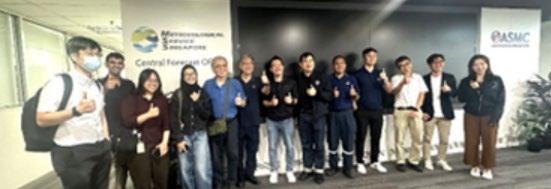
On 9 April 2026, members of the IES Systems Engineering Technical Committee (SETC) visited the Meteorological Service Singapore (MSS), a division under the National Environment Agency (NEA), for an inside look at the technology powering our nation’s weather resilience.
The visit highlighted several objectives of MSS, including the following:
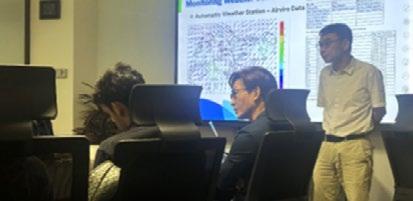
• Operational Excellence: The tour of the Central Forecast Office enabled the visitors to see realtime weather monitoring in action.
• Systems Integration: The visit provided an insight into the data collection and forecasting technologies that support Singapore’s safety.
• Cross-Sector Impact: It enabled the visitors to understand how
meteorological data secures our aviation, maritime and urban infrastructure.
A big thank you to MSS for the warm hospitality and for sharing how Systems Engineering translates into real-world public service. Engagements like these are essential for keeping our engineering community at the forefront of industry innovation.
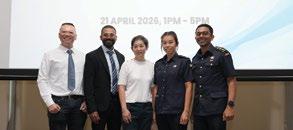
On 21 April 2026, the Mechanical and Electrical (M&E) Engineering Technical Committee of The Institution of Engineers, Singapore (IES) hit a major milestone!
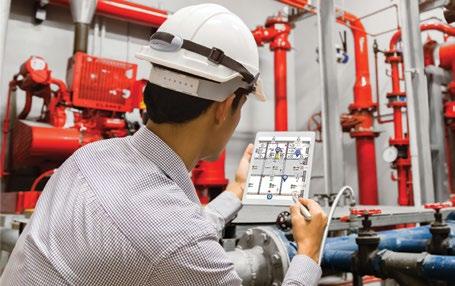
We successfully hosted a powerhouse seminar, diving into the Key Amendments to Fire Code 2023, specifically covering the critical 5th Batch of Amendments (March 2026).
The energy was electric as we welcomed a full house of nearly 400 industry practitioners, all gathered to stay at the absolute forefront of fire safety excellence.
The seminar was a deep dive into the future of the built environment, featuring:
• Direct Updates from SCDF: A comprehensive look at the latest Fire Code amendments and vital audit findings for non-residential developments.
• Technical Excellence: Cuttingedge sharing on high-performance smoke control systems.

• Expert Guidance: Navigating the latest Singapore Fire Safety Engineering Guidelines to ensure safety and compliance.
A huge thank you to our experts! This session’s success was driven by the incredible expertise of our guest speakers. A massive shoutout to:
CPT Hamzah K Shakir
LTA Zhang WenXi
Er. Shyam Dayanandan
Er. Victor Ho
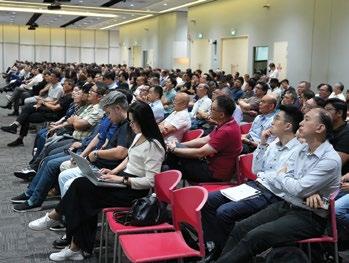
Thank you for sharing your invaluable insights and for helping us raise the bar for the entire industry!
In an ever-evolving landscape, sessions like these are essential. We are proud to support our community in staying sharp, staying updated, and strengthening fire safety practices across Singapore. Together, we are building a safer, more resilient built environment.
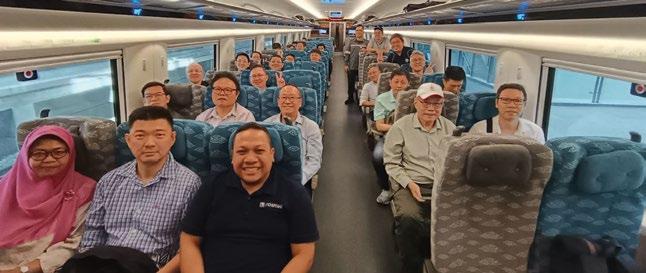
From 8 April to 10 April 2026, a delegation from the Civil and Structural Technical Committee (C&S TC) undertook an overseas learning trip to Jakarta and Bandung, in Indonesia.
Comprising about 30 engineers, with specialisations in various fields ranging from rail and rolling stock, to urban development and more, the delegation was led by Er. David Ng and Prof Poh Leong Hien.
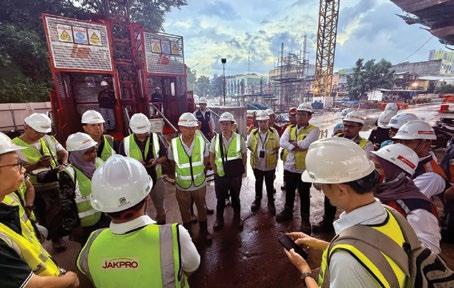
Day one of the trip saw the delegation visit the Manggarai Station LRT Jakarta Project Phase 1B, during which, the members were given an exclusive tour of the facility’s concourse, mezzanine and platform levels.
The massive project is comparable to the size of Singapore’s MRT tracks. Detailed planning of the LRT has resulted in its high accessibility to busways and commuter lines. Engineers at the site also shared more about the improvements between phase 1A and 1B of the project, such as shifting equipment to higher levels, for increased safety and reduced traffic congestion on the ground level.
As part of a crucial transit hub, this project features high-level construction to integrate with existing transport, including piers reaching approximately 28 m – a significant engineering challenge indeed!
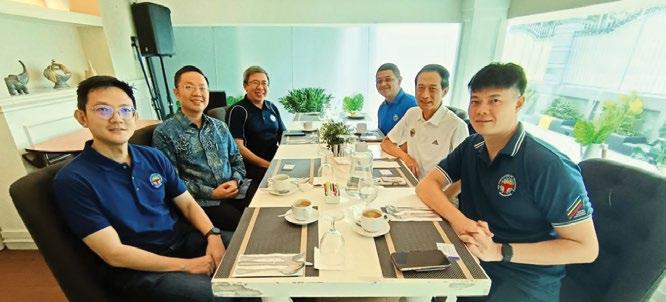
The following morning, the organising committee and IES Council Members met with Mr Allan Tandiono, Director General of Railways under the Ministry of Transportation, Indonesia. During the meeting, the council members gained deeper insight into the policies and pre-planning behind the scenes, for developments in Indonesia’s transportation landscape. Together, the group discussed ways to strengthen relations between local and Indonesian counterparts, as well as possible collaborations between engineers from both countries.
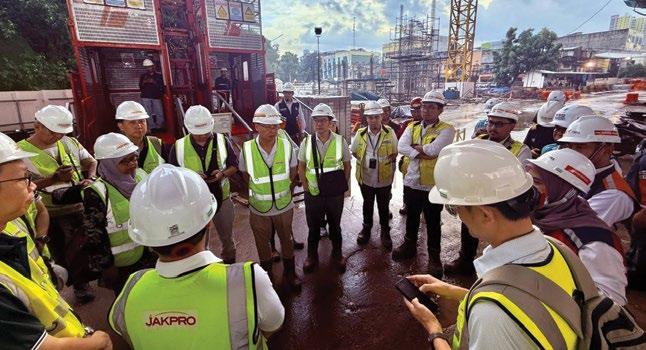
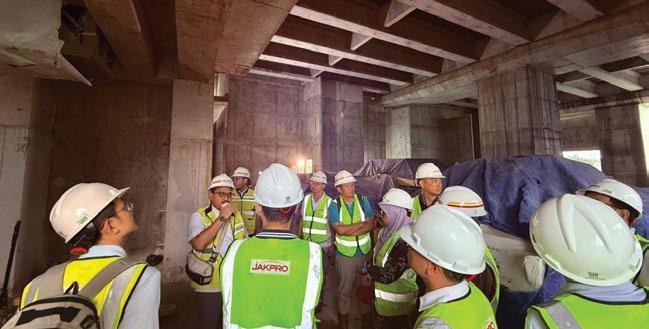
‘Light-Rain Transit’: In spite of a heavy downpour, all participants joined the site visit to phase 1B of the Manggarai Station LRT Project, which granted them exclusive access and an unmatched view of Jakarta, from the platform level of the station under construction.
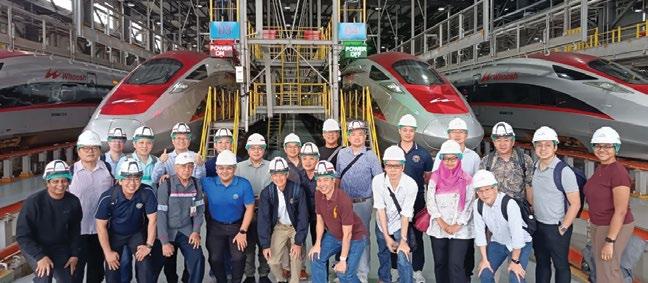
The delegation then spent the second day with the Whoosh team, first learning about the inception of the project and its regular operations, including how its trains
ply the full 1,423 km route from Halim station in Jakarta to Tegalluar Summarecon station in Bandung, making over 62 trips daily, across 13 tunnels.
In order to ensure the safety of
passengers, a total of 28 sensors for wind, rain, earthquakes and foreign objects have been strategically placed along the tracks, for early detection and minimal disruption. The advanced monitoring system, as well as the high intermodal integration of stations, further improve the value and accessibility of Whoosh, possibly explaining the high number of international passengers availing themselves of the service, with Singaporeans being the second most frequent international Whoosh riders.
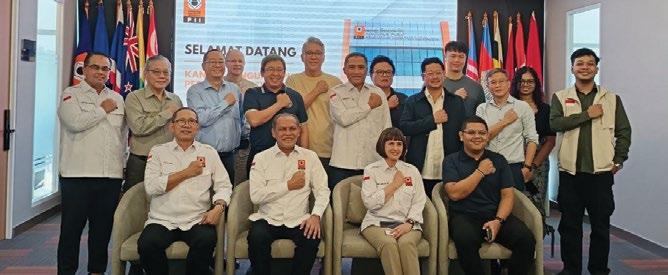
The final day of the visit was still jam packed with activities, kicking off with a visit to Persatuan Insinyur Indonesia (PII) or The Institution of Engineers, Indonesia – IES’ counterpart – where participants and the organising committee discussed matters pertaining to attracting more young engineers to get involved in the respective engineering institutions and play a more active role in the institutions’ organised activities.
Beyond that, the group discussed ways in which to grow the pool of women in engineering – a nod to Ir. Santhi H Serad, the first female Executive Director in the 74-year history of PII.
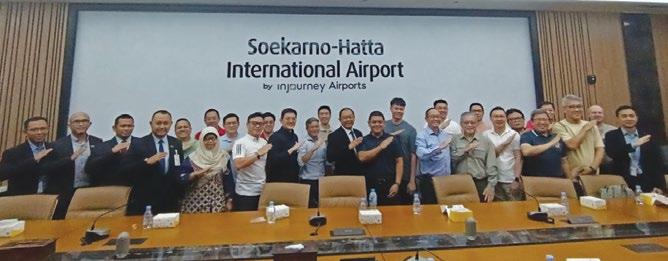
The delegation’s last stop was at Soekarno-Hatta International Airport (CGK), where Assistant Deputy, Communication and Legal (CGK), Mr Yudis Tiawan, presented on the recent enhancement of CGK airport, including the beautification of the airport, particularly in Terminal 3, and the revitalisation of all terminals, through ongoing work that will continue up till 2031.
The revitalisation works include the rejuvenation of various engineering features, mechanical and electrical technologies such as the baggage handling system, the Automatic People Mover System (APMS) or skytrain, visual docking guidance systems (A-VDGS), among others.
The trip proved to be a fun-filled and highly educational experience which allowed for in-depth insight into the construction and operations of multiple engineering feats within Indonesia, fostering a deeper appreciation for the engineering profession.
Professor Joan Bray Rose has been awarded the Lee Kuan Yew Water Prize 2026 for her work as a key pioneer in the development and global adoption of Quantitative Microbial Risk Assessment (QMRA), a science-based approach to safeguard the quality of drinking water, as well as water reuse systems. Her work has transformed the science of microbial risk management and guided policies that protect public health and ensure safe water for communities worldwide. Professor Rose’s expertise in the domain of water quality and health has also played a key role in strengthening Singapore’s used water management, and the introduction of NEWater, Singapore’s third National Tap.
Commenting on her accolade, Professor Rose, the 11th recipient of the Lee Kuan Yew Water Prize said, “I am deeply honoured to receive this esteemed award. This recognition reflects our collective progress in advancing microbial risk science and its role in protecting public health today. Safe water is one of the world’s most fundamental yet unevenly distributed resource, critical to sustaining human life.”
“As microbial risks continue to evolve, strengthening the robustness of our water systems remains an ongoing endeavour to ensure they remain dependable and resilient, safeguarding both water quality and people’s lives,” she added.
Professor Rose is currently the Homer Nowlin Chair in Water Research, Director of the Water Alliance at Michigan State University.
Uncovering invisible risks to revolutionise water safety
In the late 1980s and 1990s, Professor Rose led a team to
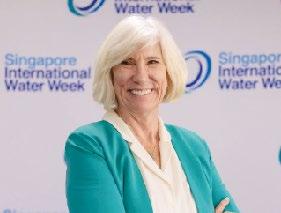
Professor Joan Bray Rose
investigate a series of waterborne disease outbreaks across the United States. Among the most severe was the 1993 Cryptosporidiosis outbreak in Milwaukee, Wisconsin, where an estimated 403,000 residents fell ill and at least 69 deaths were recorded [1].
She was the first to demonstrate the widespread occurrence of Cryptosporidium as a zoonotic pathogen [2] in the United States, and its transmission to humans through inadequately filtered and disinfected drinking water supplies.
By establishing Cryptosporidium as the causative agent of these outbreaks, Professor Rose highlighted the vulnerability of drinking water systems to microbial contamination – a challenge with global public health implications.
Her findings also revealed a critical gap – that pathogens could evade conventional water treatment, while existing monitoring systems detected microbes without quantifying risk and public health responses were largely reactive rather than predictive.
Professor Rose then pioneered QMRA in the 1990s and early 2000s to address these critical gaps undermining water safety and public health. QMRA introduced a systematic, science-based approach to assess and manage microbial risks in drinking and other forms of water, including reuse water.
By enabling scientists to quantify infection risks and illness
probabilities based on pathogen concentrations, exposure pathways and consumption patterns, QMRA shifted water management from reactive ‘detect and correct’ approaches to proactive ‘predict and prevent’ strategies. This revolutionised water safety, boosting the quality of water systems to reliably meet health standards.
QMRA is now widely adopted in drinking water regulations worldwide including the United States Environmental Protection Agency’s Safe Drinking Water Standards and the World Health Organisation’s Third Edition of the Drinking Water Quality Guidelines in 2004. Her work has enabled water utilities and regulators to define treatment requirements based on tolerable health risks for any given water source.
Professor Rose extended the application of QMRA beyond drinking water to assess microbial risks in treated wastewater and water reuse systems. This development greatly strengthened global confidence in leveraging recycled water as a viable and sustainable supply source, and Professor Rose has since strongly advocated the adoption of water reuse to address the problem of global water scarcity.
She also advised the Orange County Water District’s Independent Advisory Panel and the California State Water Resources Control Board’s Expert Panel on water reuse. Her guidance contributed to California’s Indirect and Direct Potable Reuse regulations, now models for water reuse standards worldwide, including in Australia, Spain and the United States.
For over two decades, Professor
Rose worked closely with PUB, Singapore’s National Water Agency, to strengthen water quality and safety. She was instrumental in the advancement of NEWater which was introduced in 2003, serving on the NEWater Expert Panel from 1998 to 2002.
In her role, Professor Rose shared her expertise, provided guidance on best practices for water quality monitoring and reviewed findings from health studies which demonstrated the long-term safety of NEWater.
From 2003 to 2019, she also chaired PUB’s External Audit Panel, supporting the safe and robust implementation of water reuse in Singapore.
In recognition of her significant contributions, she was conferred the Honorary Citizen Award by the Government of Singapore in 2015.
Tapping on the QMRA approach, PUB has since strengthened the capabilities to use water quality surveillance data to guide treatment processes and ensure compliance with local and international drinking water standards and guidelines. Beyond research, she has advanced global knowledge and capacity in microbial risk assessment through training and collaborative initiatives such as launching the QMRA Summer Institute [3] and QMRAwiki [4]. She has also strengthened preparedness for waterborne disease outbreaks worldwide by spearheading major international initiatives such as the Global Water Pathogen Project [5] and Wastewater Sphere [6].
Recognising a steadfast champion of global public health
Professor Rose, who recently turned 72, has dedicated her professional life to improving water quality and safeguarding public health outcomes. She is widely regarded as one of the world’s leading authorities in water microbiology and received the 2024 International Water Association Global Water Award
for her contributions.
Today, she continues to lead research on emerging microbial health risks, driven by a deep and enduring commitment to improving lives worldwide. Her work remains critical as cities strengthen their water resilience against evolving public health and climate challenges.
Professor Rose will receive the Lee Kuan Yew Water Prize – an award certificate, a gold medallion, and SGD 300,000, presented in partnership with Temasek Foundation – at an award ceremony on 16 June 2026, held during the official opening of the Singapore International Water Week (SIWW) 2026.
She will also deliver a keynote lecture the same day. SIWW2026 is expected to gather 2,500 leaders, experts and practitioners from governments, cities, utilities and industry, and over 25,000 trade visitors.
Lee Kuan Yew Water Prize
Launched in 2008 to honour outstanding contributions by individuals or organisations towards solving the world’s water problems by developing or applying innovative technologies, or implementing policies and programmes which benefit humanity, the Lee Kuan Yew Water Prize, named after Singapore’s first Prime Minister, is one of the key highlights of the Singapore International Water Week (SIWW).
As one of the premier global platforms, the biennial Singapore International Water Week (SIWW) gathers thought leaders, experts and practitioners from governments, cities, utilities and industry to share knowledge and best practices on innovative water, coastal and flood solutions, and foster partnerships to tackle urban water and associated climate challenges.
Organised by Singapore International Water Week Pte Ltd, a subsidiary of PUB, Singapore’s
National Water Agency, the 11th edition of SIWW will be held from 15 to 18 June 2026 at the Sands Expo and Convention Centre in Singapore.
Temasek Foundation
Temasek Foundation supports a diverse range of programmes that uplift lives and communities in Singapore and Asia. Temasek Foundation’s programmes are made possible through philanthropic endowments gifted by Temasek, as well as gifts and other contributions from other donors.
These programmes strive to deliver positive outcomes for individuals and communities now, and for generations to come.
Collectively, Temasek Foundation’s programmes strengthen social resilience, foster international exchange and catalyse regional capabilities, advance science and protect the planet.
References
[1] https://wwwnc.cdc.gov/eid/ article/9/4/02-0417_article
[2] Zoonotic pathogens cause infectious diseases that can be transmitted from animals to humans. https://www.who. int/news-room/fact-sheets/detail/ zoonoses
[3] Launched in 2006, The QMRA Summer Institute has trained over 400 professionals worldwide in pathogen risk assessment across water, food, and environmental contexts, with extended collaborations in Singapore, Japan, India, China, Canada, Brazil, Australia, and parts of Europe.
[4] QMRAwiki is the first comprehensive database of microbial dose-response relationships, which has been instrumental in advancing disease transmission modelling and risk characterisation.
[5] The Global Water Pathogen Project (GWPP) is funded by Dow, Dow-Corning and GATES Foundations, in partnership with UNESCO. GWPP creates a comprehensive knowledge hub on water pathogens, aiming to improve global water safety and sanitation.
[6] A sub-portal of GWPP to advance environmental surveillance of sewage for SARS-CoV-2 and support public health measures. W-Sphere aggregated data from over 2,600 cities, counties and regional systems globally.
Signify, a world leader in lighting, is taking a dual leap in its commitment to global sustainability with the announcement of the ‘Brighter Lives, Better World 2030’ programme alongside its nextgeneration Interact connected lighting solutions.
Together, these initiatives showcase Signify’s mission to bridge ambitious climate targets with actionable, intelligent technology, delivering tangible impact across cities, buildings and communities. As global electricity demand rises and climate resilience becomes increasingly critical, this integrated approach creates measurable results, addressing the most urgent challenges faced by modern energy grids, businesses and municipalities, worldwide.
Building on a decade of sustainability leadership and remaining firmly committed to its 2040 net-zero ambition, Signify’s third chapter of ‘Brighter Lives, Better World’ pivots heavily towards empowering its customers. Responding to the global surge in electricity demand, resource scarcity and volatile energy pricing, the programme is designed to deliver energy and resource reductions.
By the end of 2030, Signify commits to achieving the following:
• Saving 60 TWh of energy cumulatively for its customers.
• Achieving a 35% annualised reduction in portfolio CO₂ emission intensity.
• Generating 41% of revenues from solutions that support benefits beyond illumination (up from 31% in 2024), including safety and security, health and well-being, solar lighting and efficient food production.
To champion the circular economy, Signify is introducing a ‘use less, use longer, use again’ framework driven by two distinct

customer programmes - Signify Circle and Signify Switch.
Professional customers will be supported by Signify Circle, a new initiative delivering products and services aligned with clear circularity criteria. Signify Circle revenues will span four categories that include dedicated Circle products, Light as a Service, remanufacturing and spare parts & upgrade kits.
To support energy efficiency transitions, the expanded Signify Switch programme will guide customers in financing and deploying efficient LED systems.
“Brighter Lives, Better World 2030 is designed to deliver solutions that improve lives, save energy and make better use of resources – which is exactly what our customers are asking for. It shows that impact and opportunity go hand in hand, as we create real value for society, while building a stronger, more resilient company,” said As Tempelman, Chief Executive Officer of Signify.
“Southeast Asia's energy demand is soaring, with nearly 80% fuelled by fossil fuels. This creates a critical imbalance as emissions are set to rise by a third, by 2050, while fossil
fuel shortages loom. The urgency has never been greater,” said Jitender Khurana, Chief Executive Officer of Professional Business for Southeast Asia & Far East.
“Buildings account for 40% of global energy consumption and emissions, making lighting upgrades one of the most immediate levers available – capable of reducing energy use by up to 80% while directly cutting Scope 1 and 2 emissions. Through 'Brighter Lives, Better World 2030, we enable partners to act now with intelligent systems that deliver real energy savings and data-driven solutions, paving the way for circular, futureready growth,” he added.
Progress on Signify’s Brighter Lives, Better World 2030 program, will be reported on a quarterly basis, in line with the company’s financial results.
Next-generation solutions Translating these strategic sustainability goals into immediate action, Signify introduced four major additions to its Interact platform at the Light + Building 2026 exhibition, held from 8 to 13 March 2026, in Frankfurt, Germany. These solutions prove that sustainability
and operational efficiency go hand in hand, by unlocking the power of real-time data.
The newly unveiled data-enabled solutions include the following:
• Interact for Intelligent Buildings: Trusted in over 40,000 projects worldwide, Signify Interact for Intelligent Buildings transforms buildings into intelligent environments, giving owners and facility managers greater insight and control.
The new Interact Building suite offers owners and facility managers deeper insights through centralised, real-time monitoring and automation, to optimise lighting across all professional indoor spaces, ultimately reducing, further, the operational costs, and maximising energy savings.
• Interact EasyConnect: Simplifying and accelerating the deployment of connected outdoor lighting through cellular and hybrid connectivity, Interact EasyConnect removes the need for complex wiring and extensive infrastructure,
enabling faster and more flexible implementation of smart lighting systems. This supports cities and operators in transitioning efficiently towards scalable, future-ready lighting networks.
• Central Management System (CMS): The CMS empowers city operators with a unified digital platform to remotely monitor, control and manage large-scale outdoor lighting networks. By centralising operations and delivering realtime system visibility, it enhances maintenance efficiency, improves responsiveness and ensures consistent lighting performance, across urban environments.
• Traffic and Weather Adaptive Lighting Systems: By dynamically adjusting lighting levels in response to real-time traffic flow and weather conditions, rather than relying on fixed schedules, this intelligent approach enhances road safety and visibility when needed, while minimising unnecessary energy consumption during lowactivity periods.
With both initiatives underway, Signify reinforces its commitment to a resilient, responsible future, advancing low-impact manufacturing, ethical supply chains and greater access to lighting in under-served communities.
Guided by the principle that corporate impact and market opportunity go hand in hand, Signify continues to create longterm value through Brighter Lives, Better World 2030 and its next-generation Interact platform, combining climate action with IoT innovation, to power smarter, more sustainable environments.
Signify
Signify is a world leader in lighting for professionals, consumers and the Internet of Things. The company’s Philips products, Interact systems and data-enabled services deliver business value and transform life in homes, buildings and public spaces.
Armstrong Fluid Technology, a global leader in intelligent, energy-saving fluid flow and whole building mechanical solutions, recently announced the appointment of Danilo Elez as Chief Executive Officer. In this role, Danilo will lead the company’s next phase of growth and innovation.
Danilo joins Armstrong at a pivotal moment in its history, recognising the company’s clear differentiation in system-level fluid flow. This deep expertise connects system design and analytics to improve performance across the entire lifecycle of a building. The company’s solutions support the infrastructure behind buildings and mission critical applications worldwide. At the same time, that impact comes with a responsibility

to optimise energy use and accelerate sustainability and decarbonisation globally.
Danilo brings extensive experience in the HVAC and building technologies industries, with senior leadership roles in Trane, KONE, and Johnson Controls. He has led global organisations and is known for driving sustainable growth, strengthening operational
performance and integrating engineered products with services, digital capabilities and system-level solutions. His leadership approach and experience align closely with Armstrong’s strategy and values.
Danilo holds an MBA from the University of Chicago Booth School of Business and undergraduate degrees in Industrial Engineering and Economics from the University of Wisconsin–Madison. A Fulbright Scholar, he brings a global perspective shaped by international experience.
Founded in 1934, Armstrong Fluid Technology has remained a privately held company, enabling a long-term perspective grounded in its core values of learning and innovation, community and sustainability, and aims for net-zero carbon operations by 2030.
Power Automation (PA), a whollyowned subsidiary of SP Group, announced recently that it has signed an exclusive distributorship agreement with global power solutions provider TBEA Co Ltd (TBEA), which will enable PA to expand its portfolio of power equipment and solutions in Singapore.
PA is Singapore’s leading engineering services and technology solutions provider specialising in power systems automation and digitalisation. This collaboration builds on PA’s strong track record in Singapore’s power sector and supports its continued expansion of capabilities to serve utilities and infrastructure developers in Singapore.
Under the agreement, PA will be the exclusive distributor to TBEA’s portfolio of primary power equipment and solutions in Singapore, including gas-insulated and air-insulated switchgear, power and distribution transformers, and reactors, which are critical components in the construction, expansion and upgrading of power networks.
The partnership will also include technical training and knowledge transfer from TBEA to PA’s engineering team, strengthening local capabilities in in-market engineering, system integration, installation, testing, commissioning and lifecycle management.
This complements PA’s existing strengths in grid automation, protection systems and digital monitoring & control solutions. With the addition of TBEA’s primary power equipment, PA will be able to provide one-stop support for power infrastructure projects with integrated physical and digital solution capabilities across the asset lifecycle.
“Power networks are becoming increasingly complex, as electricity
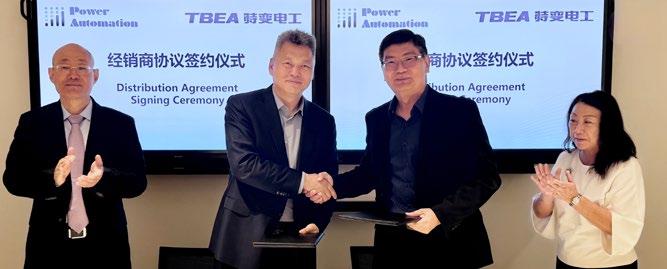
demand grows, energy systems evolve and the energy transition accelerates. Through this partnership with TBEA, PA will broaden the range of equipment and solutions we can bring to our customers, while strengthening our engineering and delivery capabilities,” said Mr Brandon Chia, Managing Director of PA.
“By combining TBEA’s equipment expertise with PA’s engineering and system integration capabilities, we are well positioned to support customers’ demand for the continued development of reliable and resilient power infrastructure in Singapore,” he added.
“We look forward to working closely with PA to deliver reliable, high-quality energy solutions to Singapore’s market, contributing to the country’s energy security and sustainable development goals. This collaboration also reflects the deepening economic and trade ties between China and Singapore, and we are proud to play a part in fostering bilateral cooperation in the energy sector,” said Mr Li Bianqu, Director of TBEA Co Ltd, Chairman of TBEA International Engineering & Contracting Company.
Established in 1996, Power Automation (PA) is a leading engineering services and
technology solutions provider for power systems automation and digitalisation. PA combines deep utility domain expertise with strong system integration capabilities to support the reliable and efficient operation of power infrastructure across grid control systems, substation automation, protection systems and smart utility asset management.
In Singapore, PA has supplied the majority of protection systems and remote terminal units used in the national transmission and distribution networks. Beyond Singapore, PA has delivered mission-critical automation and control systems for utilities and infrastructure operators across Asia, supporting the modernisation, digitalisation and resilience of power networks. Power Automation is wholly-owned by SP Group.
Established in 1988, TBEA is a leading global energy equipment manufacturer and system solution provider. It is a national high-tech enterprise group and a large-scale energy equipment manufacturing conglomerate, listed on the Shanghai Stock Exchange.
TBEA focuses on three core businesses – power transmission and distribution equipment, new energy, and new materials.
Mistral AI recently announced its expansion in Singapore through a strategic partnership with HTX and collaborations with Singtel, NCS and ST Engineering, to advance local Artificial Intelligence (AI) capabilities.
Headquartered in France, Mistral AI is a pioneer company in generative AI.
By combining independent infrastructure with its leading models, Mistral AI will provide customisable AI solutions to serve Public Services & Education, Healthcare & Sustainability, and Finance, Logistics & Manufacturing, enabling secure, responsible deployment of frontier AI in mission-critical environments. This reflects the company’s commitment to Singapore’s AI growth and the broader Asia Pacific region.
Mistral AI and HTX (Home Team Science and Technology Agency) have announced a Strategic Partnership for Innovation (SPI) master agreement to collaborate on AI capabilities for Singapore’s public safety, at the recent MTX (Milipol TechX Summit) 2026 event organised by HTX.
Mistral AI will provide HTX with infrastructure that will support
high-performance inference and fine-tuning, as well as a developer toolkit to facilitate rapid, secure application development. In addition, Mistral AI will work with HTX to identify innovative technology and engineering solutions to enhance Home Team’s operations and deepen HTX’s technical capabilities through training.
In parallel, Mistral AI has also entered strategic Memoranda of Understanding (MoUs) with Singtel, NCS and ST Engineering, further strengthening its ecosystem. The partnerships will focus on applying and scaling the deployment of Mistral AI’s frontier AI models across enterprise and missioncritical environments, enabling organisations to develop highimpact use cases by providing secure infrastructure and deployment frameworks.
Mistral AI will be working with RE:AI, the sovereign AI cloud business of Singtel Digital InfraCo, to scale AI adoption and develop industry-specific AI use cases across sectors such as financial services, defence, government shared services and healthcare.
To accelerate adoption, the
Octave, the potential software spin-off from Hexagon AB, recently unveiled its new brand identity, marking a major step towards its transition into an independent company.
Comprising Hexagon’s Asset Lifecycle Intelligence and Safety, Infrastructure & Geospatial divisions, alongside the Bricsys, ETQ and Projectmates businesses, Octave’s brand signals a clear vision of purpose and mission to unleash intelligence at scale.
The new brand unifies a market-leading portfolio that solves and simplifies complexity
across the entire lifecycle, from design and build to the operation and protection of people, property and assets.
Industrial and infrastructure organisations are facing escalating complexity and uncertainty across their operations. Today’s leaders face a world of operational chaos, fragmented systems and data they cannot trust.
Octave meets these challenges by transforming fragmented data into decisive action, helping leaders cut through the noise and turn unpredictability into a competitive edge.
companies aspire to set up an Applied AI Centre of Excellence (CoE) which will serve as a joint engineering hub to co-create secure AI environments, and rapidly prototype and deploy solutions.
Mistral AI and NCS are working together to deliver advanced AI solutions for organisations operating in highly regulated and secure environments, such as healthcare, transport and telecommunication. By combining NCS’ strengths in system integration with Mistral AI’s advanced and customisable AI models, the partnership helps clients deploy secure, reliable AI solutions that are ready for operational use.
Mistral AI is expanding its collaboration with ST Engineering to integrate agentic fact-checking capabilities into ST Engineering’s AGIL Trust, a multimodal deepfake and misinformation detection solution, providing public security agencies with two-layer validation.
These initiatives build on Mistral AI’s momentum in Singapore and Asia Pacific, as it continues to invest in building local capabilities and expertise, and to expand collaborations to support and drive AI and long-term success.
The Octave portfolio is powered by domain-specific Artificial Intelligence (AI) that helps organisations achieve crucial outcomes across the lifecycle, that were previously difficult to address. By connecting the flow of data into one contextualised platform and leveraging domain-specific AI, Octave solutions provide the intelligence required to optimise performance across four core pillars – Design, Build, Operate and Protect – where performance, safety and reliability are non-negotiable and failure is not an option.
Approximately SGD 31 billion investment over 10 years will support long-term manufacturing requirements and AI-driven demand.
Micron Technology Inc broke ground in late January, on an advanced wafer fabrication facility located within the company’s existing NAND manufacturing complex in Singapore. This new facility represents a planned investment of approximately SGD 31 billion (USD 24 billion) over 10 years and is designed to ultimately provide 700,000 ft2 of cleanroom space.
Wafer output is scheduled to begin in the second half of Calendar Year 2028, helping Micron address growing market demand for NAND technology, driven by the rapid expansion of AI and datacentric applications.
The groundbreaking ceremony for this facility, Singapore’s first double-storey wafer manufacturing fab, was marked by the attendance of Mr Gan Kim Yong, Deputy Prime Minister and Minister for Trade and Industry of Singapore; Dr Beh Swan Gin, Permanent Secretary of the Ministry of Trade and Industry; Mr Jermaine Loy, Managing Director of the Singapore Economic Development Board (EDB); and Ms Jacqueline Poh, CEO of JTC Corporation.
“Micron’s leadership in advanced memory and storage is enabling the AI-driven transformation reshaping the global economy,” said Mr Manish Bhatia, Executive Vice President of Global Operations at Micron Technology.
“We are grateful for the longstanding support from and successful partnership with the Singapore government, including EDB and JTC. This investment underscores Micron’s long-term commitment to Singapore as an important hub in our global manufacturing network, enhancing

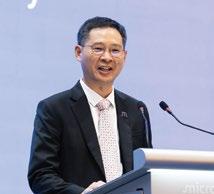


supply chain resiliency and fostering a vibrant ecosystem for innovation,” he added.
This new fab will become an integral part of Micron’s NAND Center of Excellence in Singapore.
The facility provides the essential capacity to support continued technology transitions, positioning Micron to meet long-term demand for advanced storage solutions. Additionally, co-locating R&D with
manufacturing improves efficiencies, accelerates time-to-market, and deepens research partnerships between industry and academia.
Micron’s previously announced high-bandwidth memory (HBM) advanced packaging facility, also located in the same Singapore manufacturing complex, is on track to contribute meaningfully to Micron’s HBM supply in Calendar Year 2027.
As HBM becomes a part of Micron’s Singapore manufacturing footprint, the company expects opportunities for synergies between NAND and DRAM production.
Micron will maintain flexibility in managing the pace of capacity ramps in the new facility to align with market demand.
Micron’s advanced wafer fabrication facility investment will create around 1,600 jobs. Combined with the previously announced 1,400 jobs from the HBM advanced packaging facility, the company’s expansion will support about 3,000 new jobs, in total. These positions will focus on fab engineering and operations, integrating AI, advanced robotics and smart manufacturing technologies to enhance efficiency and innovation.
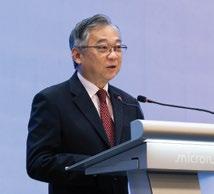
“Micron’s latest expansion will strengthen our semiconductor ecosystem and further anchor Singapore as a critical node in the global semiconductor supply chain,” said Mr Jermaine Loy, Managing Director of the Singapore EDB.
“This investment rides on growth in AI and will provide good jobs for Singaporeans. Micron’s advanced facility will leverage advanced robotic automation and boost our advanced manufacturing ecosystem, helping our workforce seize new opportunities,” he added.
The fab will comply with the company’s sustainability commitments and build on the site’s recognition as both a World Economic Forum Sustainability Lighthouse and an Energy Efficiency National Partnership (EENP) Award recipient.
The fab will also adhere to LEED standards, such as greenhouse gas abatement, water recycling and

At the groundbreaking ceremony for Micron’s new advanced wafer fabrication facility (from left to right), Mr Joshua Lee, CVP and Singapore Country Manager, Micron Technology; Mr Chen Kok Sing, SVP, Global Assembly and Test, Micron Technology; Ms Jacqueline Poh, CEO, JTC; Dr Beh Swan Gin, Permanent Secretary, Singapore Ministry of Trade and Industry; Mr Manish Bhatia, EVP Global Operations, Micron Technology; Mr Gan Kim Yong, DPM and Minister for Trade and Industry; Mr Sanjay Mehrotra, Chairman, President and CEO, Micron Technology; Mr Jermaine Loy, Managing Director, EDB; Ms April Arnzen, EVP, Chief People Officer, Micron Technology; Mr Buddy Nicoson, SVP, Global FE Operations, Micron Technology; and Ms Daphne Au, VP, Asia Government and Public, Micron Technology.

At the ceremonial digging for Micron’s new advanced wafer fabrication facility (from left to right), Mr Joshua Lee, CVP and Singapore Country Manager, Micron Technology; Mr Jason Lin, SVP of Storage Technology & Products, Micron Technology; Mr Chen Kok Sing, SVP Global Assembly and Test, Micron Technology; Ms Jacqueline Poh, CEO, JTC; Dr Beh Swan Gin, Permanent Secretary, Singapore Ministry of Trade and Industry; Mr Manish Bhatia, EVP Global Operations, Micron Technology; Mr Gan Kim Yong, DPM and Minister for Trade and Industry; Mr Sanjay Mehrotra, Chairman, President and CEO, Micron Technology; Mr Jermaine Loy, Managing Director, EDB; Ms April Arnzen, EVP, Chief People Officer, Micron Technology; Mr Buddy Nicoson, SVP, Global FE Operations, Micron Technology; Mr Ben Tessone, SVP, Chief Procurement Officer, Micron Technology; and Ms Daphne Au, VP, Asia Government and Public, Micron Technology.
waste circularity.
In collaboration with academia and ecosystem partners, Micron’s investment creates opportunities to build a futureready semiconductor workforce through multiple pathways, offering real-world learning experiences such as internships for students, upskilling the current workforce in AI and smart manufacturing, and advancing R&D talent development to drive future innovation.
Micron Technology Inc
Micron Technology Inc is an industry leader in innovative memory and storage solutions, transforming how the world uses
information to enrich life for all. With a focus on customers, technology leadership, and manufacturing and operational excellence, Micron delivers a portfolio of high-performance DRAM, NAND and NOR memory and storage products.
The innovations from Micron fuel the data economy, enabling advances in AI and computeintensive applications that create opportunities – from the data centre to the intelligent edge and across the client and mobile user experience.
The initiatives include launching Singapore’s first Maritime Engineering Doctoral Training Centre, introduction of a new, specialised Master’s Programme, and establishment of strategic industry partnerships.
In conjunction with the Singapore Maritime Week (SMW) 2026, the Singapore Institute of Technology (SIT) announced a suite of new initiatives to strengthen Singapore’s maritime talent pipeline and support the sector’s transformation towards decarbonisation, electrification and digitalisation.
Supporting the rapid transformation of Singapore’s maritime sector is SIT’s Maritime Engineering Doctoral Training Centre (MEDTC), Singapore’s first doctoral training centre dedicated to deepening maritime engineering capabilities. It aims to equip specialists with advanced technical expertise and operational insight, thereby enabling the next generation of maritime engineers to tackle complex challenges and lead Singapore’s maritime sector into the future.
As an industry-integrated platform that enables applied, real-world research, the centre supports Industrial Doctorate and Industrial Master’s (ID/ IM) projects co-developed with industry partners and embedded in operational environments, ensuring research outcomes are directly relevant to industry needs and are implementable.
Unlike traditional, academically driven doctoral programmes, SIT’s ID/IM programmes are distinguished by a student profile made up predominantly of working professionals from partner companies. This model enables companies to upskill and retain talent through research, while ensuring that projects are grounded in real operational challenges.
SIT’s ID/IM programmes that leverage MEDTC benefit from the real-world industry projects that aim to address critical challenges. These include electric harbour craft design, battery safety, vessel systems integration and operational optimisation.
Through SIT’s role as the lead of the Future Ship & System Design (FSSD) programme, research done through MEDTC contributes to sustainable ship design, operational efficiency and Singapore’s ambition for a greener port ecosystem.
The FSSD is a national programme led by SIT and initiated by Maritime and Port Authority of Singapore (MPA) and Singapore Maritime Institute (SMI), to advance sustainable and energy-efficient ship design. FSSD focuses on developing and validating technologies for electric harbour craft to support maritime decarbonisation, operational efficiency and talent development.
SIT is also introducing a new Master of Science (MSc) in Vessel Management targeted to commence in early 2027. Developed in collaboration with DNV, the programme responds to the maritime sector’s need for more industry-ready vessel managers amidst growing operational complexity, tighter regulatory requirements and the transition towards more sustainable vessel operations.
The programme addresses the shortage of qualified technical and marine superintendents by equipping learners with the skills to manage safety, compliance
and performance, in real-world maritime environments.
The MSc in Vessel Management adopts a flexible, competency-based and practice-oriented pathway, combining SIT’s applied learning pedagogy with DNV’s global industry expertise. Learners will acquire both technical mastery and managerial competence, be prepared to lead vessel operations, ensure regulatory compliance, optimise performance and drive innovation across the maritime value chain.
By integrating classroom learning with advanced simulations, on-thejob training and industry projects, learners gain hands-on exposure to digitalisation, decarbonisation, systems integration and operational risk management.
The programme comprises technical, management and elective domains, designed on a competencybased model that allows learners to build practical skills, operational judgement and leadership acumen needed to navigate evolving maritime challenges, while tailoring their learning to their career stage and interests.
By providing an alternative pathway for engineering graduates and mid-career professionals, the programme strengthens Singapore’s pipeline of industry-ready maritime talent, empowering learners to translate applied knowledge into practical solutions and supporting companies in cultivating a resilient, skilled workforce that can meet the demands of a digitalised, sustainable and future-ready maritime sector.
Deepening collaboration through strategic partnerships
At SMW 2026, in order to advance maritime research, innovation
and workforce development, SIT signed four Research Collaboration Agreements (RCAs) as well as three Memoranda of Understanding (MoUs). The RCAs were signed with DNV, Jurong Port, RINA and Zeabuz.
The RCA with DNV will support the development of remote and autonomous maritime capabilities through applied research and upskilling across technical, operational and training domains. This includes work related to shore-based Remote Operations Centres (ROC) for selected bunker vessel functions, as well as the development of frameworks to support remote operations and strengthen operational readiness.
The collaboration will also leverage SIT’s FSSD Lab to explore operational concepts for remote and autonomous vessel functions, supporting industry readiness for more digitally enabled maritime operations. There will also be knowledge-sharing between academia, research and industry, to help build the skills needed for new operating models.
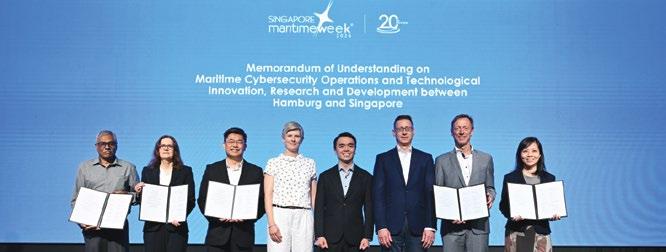
An MoU was signed with MPA, Hamburg Port Authority, University of Hamburg, Hamburg University
of Technology, and Singapore University of Technology and Design, on maritime cybersecurity collaboration, that aims to strengthen maritime cybersecurity capabilities through joint research, training and operational initiatives.
A framework will be developed to enhance cyber resilience across maritime operations, including incident reporting, simulationbased exercises and research into emerging technologies, with SIT contributing expertise in operational technology cybersecurity and supporting training and knowledge exchange.
An MoU was also signed with MPA-PSA Marine to support
a hybrid internship programme, giving SIT students exposure to both industry practices and government policy in the decarbonisation of the harbour craft sector.
Another MoU was inked with Singapore Polytechnic Centre of Excellence in Maritime Safety (CEMS), Sea Forrest and Pyxis to develop practical training for electric harbour craft operators. The training will incorporate best practices including SIT’s research outcomes in battery thermal incidents and failures. It will feature realistic scenarios and decision-making exercises covering operations, maintenance and emergency response.
The Singapore Institute of Technology (SIT) has appointed Professor Susanna Leong, previously Vice President (Applied Research), as Deputy President (Academic) & Provost, with effect from 1 April 2026. Prof Leong succeeded Professor John Thong, who has stepped down after four years in the role.
As Deputy President (Academic) & Provost, Prof Leong will provide strategic leadership for SIT’s academic mission. Building on her experience as Vice President (Applied Research), she will oversee an integrated academic portfolio where applied research, curriculum, faculty development and student learning are closely aligned, to further strengthen
SIT’s applied learning and industry engagement outcomes.

Prof Leong joined SIT in 2013 and has played a significant role in the development and growth of SIT’s applied learning and research offerings. Since being appointed Vice President (Applied Research) in 2022, Prof Leong established research partnerships with industry and agencies in areas such as food technology, biotechnology and applied AI. As Assistant Provost (Applied
Research), she launched the university’s Industrial Doctorate and Industrial Master’s Programme which supports upskilling through innovation at the postgraduate level. As the founding Cluster Director of the Food, Chemical and Biotechnology Cluster at SIT, Prof Leong established differentiated, industry-aligned capabilities to deliver industry-relevant education and research.
Prof Leong holds a PhD in Chemical Engineering from the University of Cambridge and is an Adjunct Professor at the Yong Loo Lin School of Medicine, National University of Singapore and the Singapore Institute of Food and Biotechnology, A*STAR.
by Er. Simon Lee, Fellow of IES; Honorary Secretary, IES; Honorary Fellow, ASEAN Federation of Engineering Organisations (AFEO); and Director of Bescon Engineering Services Pte Ltd
This article provides a practising engineer’s viewpoint on the electrical and fire safety for electric vehicles and charging stations.
INTRODUCTION: BALANCING AMBITION WITH RISK
Singapore has set ambitious targets to achieve carbon neutrality by 2030 and net zero by 2040. The widespread adoption of Electric Vehicles (EVs)is a cornerstone of this strategy. However, as EV adoption grows in our densely populated urban environment, so too does the potential fire risk, despite no major incident having occurred locally, yet. This risk was starkly highlighted in August 2024 by a series of alarming EV fires in South Korea. A fire in
Mode
1 Connection of EV to a standard AC socket-outlet, utilising a cable and plug, without communication cable and residual current device
2 Connection of EV to a standard AC socket-outlet utilising a charging cable assembly with in cable control box with residual current device
3 Connection of EV to AC supply network utilising AC EV charging equipment with control function from charging equipment to EV
4 Connection of an EV to AC or DC supply network utilising a DC EV supply equipment, with a control function from charging equipment to EV
EV charging modes
(EVCS)
an Incheon apartment basement garage took over eight hours to extinguish, damaged more than 100 vehicles and hospitalised more than 20 people, due to smoke inhalation. Days later, another major fire occurred in a parking tower.
These incidents raise urgent questions. How can a single EV fire cause such extensive damage? Is Singapore’s current fire code adequate for protecting premises, especially basements with numerous EVs and charging
32A 230V AC 3 pin or 32A
400V AC 5 pin domestic or industrial socket outlet, flexible cable, plug & connector
32A 230V AC 3 pin or 32A 400V AC 5 pin industrial socket outlet as per IEC 60309 protected by 30mA RCCB, flexible cable, plug & connector
≤63A 230V AC 3 pin or
≤63A 400V AC 5 pin mechanically interlocked connector as per IEC 60309 protected by 30mA RCCB, flexible cable, plug & connector
≥100A 400V AC or DC 5 pin mechanically interlocked connector as per IEC 60309 protected by 30mA RCCB, flexible cable, plug & connector
≤ 2.3kW or 10A
facilities?
While the perceived risk of an EV fire is low, it is imperative for engineers, building owners and policymakers to understand the potentially catastrophic nature of these events.
This analysis examines the electrical and chemical origins of EV battery fires, their unique fire behaviour, and the critical preventive and mitigative measures required to ensure public safety, as we transition to greener transportation.
Charging light electric vehicle (Not permitted in Singapore)
≤ 2.3kW
Domestic EV Charging
≤ 44kW
• Preferred charging for EV
• Domestic EV Charging
• Public EV charging
≥50kW & ≤500kW
• Fast Charger
• Public EV charging
• Does not stop automatically when fully charged
• Does not protect the user if charging cable is faulty
• Automatically stops when fully charged
• Shock protection provided by in cable box RCCB
• Automatically stops when fully charged
• Shock protection provided by EVCS type A or
B RCCB
•Installation by qualified LEW
• Automatically stops when fully charged
• Shock protection provided by EVCS type A or
B RCCB
• Installation by qualified LEW
ELECTRICAL SAFETY IN EV CHARGING: THE FIRST LINE OF DEFENCE
Modern EV batteries (40 kWh - 100 kWh) require significant power (2.3 kW - 500 kW) to charge.
The charging process – involving frequent plugging / unplugging and high current flow – presents inherent electrical and fire hazards over time, particularly from insulation failure, faulty connections and overheating. Congregations of charging points amplify this risk.
In Singapore, the Electric Vehicles Charging Act 2022 and Technical Reference 25 (TR25:2022) provide the regulatory framework, aligned with international standard IEC 61851. The regulation mandates four charging modes, with Modes 3 and 4 being the preferred and safest, for domestic and public use.
Key electrical safety measures under the Electric Vehicles Charging Act 2022
• Type-Approved Chargers: All EV chargers must be approved by the Land Transport Authority (LTA).
• Communication & Control: Chargers (Modes 2-4) automatically stop when the EV is fully charged and monitor insulation integrity.
• Shock Protection: Residual Current Circuit Breakers (RCCBs) are mandatory to cut power, in case of leakage.
• Qualified Installation: Fixed chargers must be installed by a Licensed Electrical Worker (LEW).
• Ongoing Maintenance: Periodic inspection and maintenance by qualified personnel are required. These measures form a robust foundation for electrical safety, shifting the focus to the more complex challenge of the battery itself.
Lithium-ion batteries (LIBs) are the primary energy storage technology used in EVs, supplying electrical power to the motor
that propels the vehicle. Most EVs use LIBs due to their high energy density, fast charge and discharge capability, long cycle life, durability and relatively low cost, compared to alternative battery chemistries.
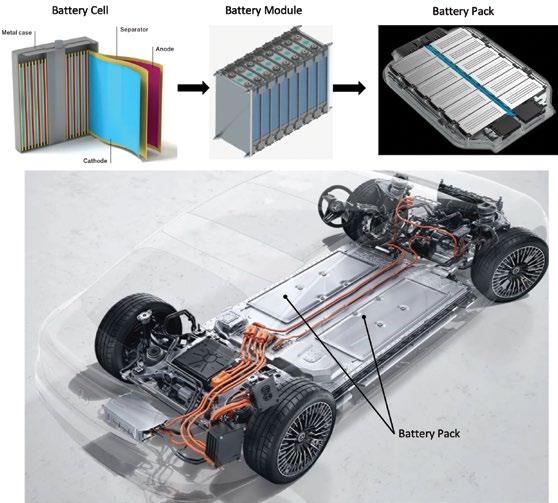
An EV battery pack consists of many individual lithium-ion cells electrically connected to meet the required power and energy demands. Cells connected in series increase the overall voltage, while cells connected in parallel increase the available current. A
combination of series and parallel connections is typically used. Groups of cells form modules, and multiple modules are assembled into the complete EV battery pack, as illustrated in Figure 1.
A typical EV lithium-ion cell is illustrated in Figure 2. Each cell consists of the following main components:
• Anode
• Cathode
• Electrolyte
• Separator
• Outer casing
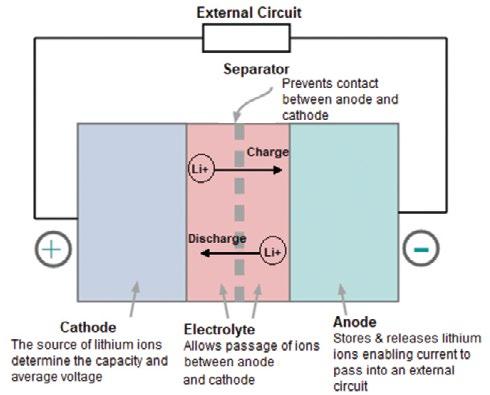
The cathode is the positively charged electrode during discharge and is the destination for lithium ions when the battery supplies power. Common cathode materials include lithium cobalt oxide (LiCoO2), as well as other lithium metal oxides.
The anode is the negatively charged electrode during discharge and is typically made from carbon (graphite). During discharge, lithium ions migrate away from the anode.
The separator is a microporous polymer membrane placed between the anode and cathode. It prevents direct electrical contact between the electrodes while allowing lithium ions to pass through its pores.
The electrolyte is an organic, ionconducting solution that enables lithium ion transport between the electrodes. It is typically composed of a lithium salt (like LiPF6) dissolved in a mixture of organic carbonate solvents (e.g. ethylene carbonate, dimethyl carbonate, ethyl methyl carbonate).
These organic carbonates are volatile, flammable liquids. Their flash points are typically between 25 °C (77 °F) and 140 °C (284 °F), meaning they can easily ignite at operating temperatures or during a failure. Thus, the LIB electrolyte is a major fire hazard and a key contributor to battery flammability.
The outer casing provides mechanical protection and helps contain internal pressure, protecting the cell against thermal and mechanical damage.
The electrodes are connected to an external circuit, to enable charging and discharging. During charging, an external power source drives electrons from the cathode to the anode through the external circuit, while positively charged lithium ions migrate through the electrolyte from the cathode to the anode. During discharge, when the EV motor draws power, the process reverses.
Although LIBs are generally safe, it can be subjected to repeated, external, mechanical, electrical and thermal impacts, during
frequent acceleration, deceleration, accidents, extreme weather and flooding. These are all considered normal operating conditions of the LIB.
Mechanical impact
Mechanical abuse includes external damage such as impact, indentation, puncture, crushing or deformation of the battery. If the outer casing is compromised, air can enter the cell and react with the electrolyte and active materials, generating heat.
Mechanical deformation can also cause internal damage to critical components such as the separator or current collectors. If the separator is damaged, the anode and cathode may come into direct contact, resulting in an internal short circuit. This can rapidly increase temperature and lead to battery failure.
Damage from crushing, water submersion or severe impact may render a battery unstable or cause delayed failure. In vehicle collisions, EV batteries – despite being integrated into the chassis – may still suffer internal damage that is not immediately visible. In many cases, internal battery damage may become apparent only later, particularly during charging, when heating or venting occurs.
This risk is also relevant when transporting second-hand EVs, such as on ships. Repair histories may be incomplete and crews may have no way of determining whether a vehicle has previously been involved in an accident. Since the EV battery is not externally visible, assessing its internal condition is extremely difficult without specialist diagnostic equipment.
Electrical abuse primarily includes overcharging and over discharging. LIBs are designed to operate within specific voltage limits, corresponding to defined states of charge. When these limits are exceeded, undesirable electrochemical reactions occur. Overcharging or over discharging
may result from manufacturing defects, cell damage or failures in the battery management system (BMS).
Both conditions can lead to similar safety hazards.
During overcharging, electrolyte decomposition occurs on the cathode surface, increasing battery temperature. Excessive lithium-ion migration destabilises the cathode structure and, in oxygen containing cathodes, oxygen may be released. The released oxygen participates in exothermic side reactions, increasing internal pressure and potentially causing cell rupture.
Additionally, excess lithium ions can deposit on the anode as metallic lithium, forming lithium dendrites. As dendrites grow, they may penetrate the separator, leading to an internal short circuit, with potentially catastrophic consequences.
During over discharge, lithium ions continue to leave the anode. At very low voltages, the copper current collector at the anode can oxidise and dissolve into the electrolyte as copper ions. These ions may later deposit as metallic copper on the cathode, creating conductive pathways that can cause short circuits when the battery is recharged.
Using an incorrect or defective charger can also lead to electrical abuse. Although most lithiumion chargers include overcharge protection, incompatible chargers may supply excessive voltage, causing battery overheating, swelling and structural breakdown.
Over discharge is particularly likely when batteries are stored, unused, for extended periods. LIBs should never be allowed to discharge below approximately 2 V per cell.
Below this threshold, both the anode and cathode begin to degrade, significantly increasing the risk of internal short circuits upon recharging. This risk is especially relevant for recalled products, recycling streams, or end-of-life equipment that may have been stored for long durations.
Charging LIBs at low temperatures (below 0 °C or 32 °F) presents additional risks. Cold temperature charging can cause lithium plating, where lithium deposits as metallic lithium on the anode surface. This damage is permanent and increases susceptibility to short circuits, particularly during fast charging or mechanical stress.
Exposure to extreme temperatures can cause LIBs to fail or ignite. Thermal abuse may result from external heat sources, high ambient temperatures or internal heat generation due to poor design, manufacturing defects or other abuse conditions.
Under normal operation, heat generated during battery cycling should remain within safe limits. However, the rate of heat generation at the electrodes may exceed the battery’s ability to dissipate heat. While some heat is lost through radiation and conduction, residual heat can accumulate within the cell.
If heat accumulation continues, exothermic side reactions may occur, leading to a rapid temperature rise known as thermal runaway. The temperature at which this occurs depends on the specific battery chemistry. A temperature of approximately 60 °C is often cited as a reference point above which LIBs become increasingly prone to failure, although actual thresholds vary by design.
Thermal stress or sudden temperature changes can also cause internal pressure build up, potentially resulting in venting, rupture or explosion.
When transporting LIBs, environmental conditions along the shipping route must be carefully considered. Temperatures inside dry shipping containers can reach twice the ambient temperature. In summer conditions, in regions such as the Middle East, internal container temperatures may reach 80 °C, posing a significant risk to battery safety.
Overall, LIBs enable the widespread
adoption of electric vehicles through their high performance and efficiency. However, mechanical, electrical and thermal abuse can compromise battery safety, particularly during accidents, improper charging, long term storage or transportation. Understanding these failure mechanisms is essential for safe design, handling, transport and end-of-life management of EV battery systems.
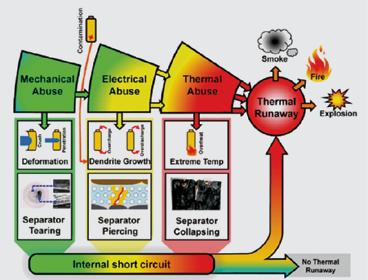
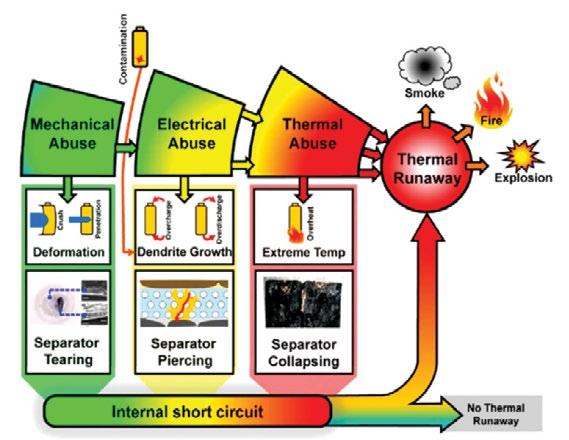
Thermal runaway is one of the most critical failure modes of LIBs. Mechanical, electrical or thermal abuse can initiate battery failure which may develop gradually or occur within milliseconds. Once failure begins, it can escalate into thermal runaway, a condition that is extremely difficult to arrest, as illustrated in Figure 3.
Thermal runaway occurs when the temperature of a lithium-ion cell exceeds a critical threshold, causing heat generation within the cell to become self-sustaining. As a result, the cell temperature rises exponentially due to a cascade of exothermic reactions.
STAGES OF THERMAL RUNAWAY
Stage 1: Triggering and initial abuse (the cause)
This is the initiation event that
locally heats the cell beyond its safe operating window and may be categorised as follows:
• Mechanical abuse: Physical penetration (e.g. crash), crushing or deformation, causing an internal short circuit.
• Electrical abuse: External short circuit, severe overcharging (lithium plating on the anode) or rapid discharging (Joule heating).
• Thermal abuse: External fire or overheating of the battery pack.
• Manufacturing defects: Metallic particle contamination, electrode misalignment or weak spots in the separator.
Stage 2: Onset of exothermic reactions (~ 80 °C - 120 °C)
As the cell heats up, the first destabilising reactions begin, consisting of:
• Solid Electrolyte Interphase (SEI) layer decomposition: SEI, a stable layer on the anode, starts to decompose exothermically (~ 80 °C - 120 °C). This consumes electrolyte and generates heat.
• Loss of separator integrity: The polymer separator (typically polyethylene / polypropylene) begins to melt (~ 130 °C - 180 °C). This causes a massive internal short circuit as anode and cathode come into direct contact, driving a rapid temperature spike.
Stage 3: Major decomposition reactions and gas generation (~ 150 °C - 300 °C)
With the separator gone, reactions accelerate violently:
• Anode reaction: Lithiated graphite (LiC₆) reacts directly with the electrolyte, releasing more heat and flammable hydrocarbon gases (e.g. H2, CH₄, C₂H₄).
• Electrolyte decomposition and vaporisation: Organic solvents (EC, DEC, DMC) decompose and boil, creating immense internal pressure and ejecting highly flammable vapour.
• Cathode material breakdown: The metal oxide cathode, eg Nickel Manganese Cobalt (NMC) and Lithium Iron Phosphate (LiFePO4 or LFP), releases oxygen through exothermic decomposition (~ 200 °C - 300 °C for NMC, much higher for LFP). This is a critical differentiator.
The NMC cathode releases abundant oxygen which fuels combustion of the ejected gases and surrounding materials, like a blowtorch.
The LFP cathode has stronger phosphate bonds, releasing little to no oxygen, and making thermal runaway less violent and slower to propagate.
Stage 4: Catastrophic failure and cell venting
The internal pressure exceeds the cell’s vent design threshold.
• Venting: The cell’s safety vent ruptures, ejecting hot, toxic and flammable gases, and aerosolised electrolyte (a jet of vapour and mist). This is often called ‘venting with flame’ if gases ignite immediately upon contact with air.
• Fire: Ejected gases ignite, causing a jet fire. The remaining solid contents (electrodes, debris) can combust, especially if oxygen is available from the cathode or environment.
Stage 5: Propagation (the packlevel threat)
In an EV battery pack, the key danger is propagation – the runaway of one cell heats its
neighbours, triggering them in a domino effect.
• Heat transfer: The fire and hot plume from the failing cell heats adjacent cells.
• Electrical energy dump: The failing cell can short-circuit its module, forcing current into neighbouring cells.
• Chain reaction: Neighbouring cells undergo the same process, amplifying the event. A pack can be fully consumed in minutes.
The thermal decomposition of the electrolyte, electrodes and other components produces a wide range of hazardous gases. The exact mix depends on the battery chemistry, state of charge and temperature, but the most significant mix includes highly toxic gases, flammable / explosive gases, and irritant and asphyxiant gases.
Highly toxic gases
• Carbon Monoxide (CO) is a product of incomplete combustion. It is colourless, odourless and binds to the hemoglobin in blood, causing asphyxiation.
• Hydrogen Fluoride (HF) is, arguably, the most dangerous toxic gas from standard LiPF₆-based electrolytes. LiPF₆ decomposes in the presence of heat and moisture to produce HF which is highly corrosive, penetrates skin and causes severe, deep tissue damage and systemic poisoning. It poses a severe risk to first responders and occupants in confined spaces.
Organo-fluorine compounds (e.g. POF₃, PF₅) are other decomposition products of LiPF₆ that are toxic and hydrolyse to form more HF upon contact with moisture (e.g. in the lungs or mucous membranes).
Flammable / explosive gases Hydrogen (H₂) is generated from reactions with the electrolyte or electrode materials. It is highly explosive and expands the risk zone.
• Methane (CH₄), Ethane (C₂H₆), Ethylene (C₂H₄) etc are light hydrocarbons from solvent
decomposition, adding to the fuel load and flammability.
Irritant and asphyxiant gases
• Carbon Dioxide (CO₂) is a product of complete combustion. At high concentrations, it acts as an asphyxiant.
• Various organic vapours, from fragmented solvent molecules, can be irritants and narcotic substances.
The electrolyte is a primary fuel source in LIB fires. During thermal runaway, its decomposition, along with other cell materials, generates a hazardous cocktail, dominated by highly toxic Hydrogen Fluoride (HF) and Carbon Monoxide (CO), in addition to explosive gases like Hydrogen.
EV battery systems differ fundamentally from those used in portable electronics. EV battery packs typically possess power and energy capacities that are up to three orders of magnitude greater than those of smartphone batteries. High power enables rapid acceleration, while large energy capacity supports an extended driving range.
To achieve this, EVs integrate large numbers of cells within a battery pack that includes electrical interconnections, thermal management systems and a battery management system, all enclosed within a protective casing. While this architecture enhances performance and safety, it also increases the complexity of thermal control, particularly within the confined space of the battery enclosure.
Under severe external impacts or extreme operating conditions, LIBs can fracture, releasing sparks, flammable gases and toxic smoke. These emissions may ignite, leading to sustained combustion, jet flames or gas explosions. Although the probability of spontaneous ignition in LIBs is relatively low, EV batteries are more vulnerable to external mechanical, thermal and electrical
stresses, arising from frequent acceleration, deceleration or collision events.
Such conditions are comparatively rare in portable electronic devices. Due to the much larger energy content of EV battery packs, thermal runaway and ignition events pose a more severe fire hazard. Nonetheless, advanced safety measures in EV and battery pack design significantly reduce the likelihood of catastrophic failure.
Despite these safeguards, the fire hazard associated with EV batteries remains significant because of the flammable electrolyte contained within each cell. Battery fires can occur when electrolyte leaks and encounters an ignition source. Fires involving LIBs are particularly challenging to extinguish, due to rapid burning rates, the release of toxic gases and the fact that the fuel source is enclosed within a protective casing.
For LIBs, thermal runaway is typically characterised by a rapid temperature increase exceeding 10 °C per minute or by activation of the safety vent, indicating that exothermic thermochemical and electrochemical reactions are underway. Thermal runaway is commonly accompanied by the ejection of dense dark smoke, hot particles and high-velocity jet flames. Because these processes originate within individual cells, the hazard escalates significantly if thermal runaway propagates to neighbouring cells within a battery pack.
Once thermal runaway begins, smoke is released through the safety vent or structural failures in the cell casing. This smoke is a mixture of flammable and toxic gases that may ignite upon contact with sparks, electrical arcs or flames, or even ignite spontaneously under poor cooling conditions. The resulting fire can further heat adjacent cells, promoting propagation.
If the internal gas generation rate exceeds the venting capacity, the cell may rupture violently. While safety vents are designed to relieve internal pressure during the pre-
ignition phase, they cannot fully protect against external heating from nearby burning cells or radiant heat. Additionally, if vented gases accumulate in an enclosed space and mix with oxygen, a gas explosion may occur in the presence of an ignition source.
In fire engineering studies, the heat release rate (HRR) is used to assess the fire hazard connected with EVs:
HRR =
where
ṁ [kg/s] is the combustion rate determined by the rate of loss of specimen mass during a combustion test
ΔHe [MJ/kg] is the heat of combustion Af [m2] is the area of the battery fuel in the EV
ṁ" [kg/m2/s] is the mass burning rate ŋ is the burning intensity which depends on the availability of oxygen ΔHc is the heat of combustion of EV batteries, which changes depending on the battery type.
The HRR of an EV fire can also be assessed using the average heat flux (q") of the battery and its EV battery area (AEV):
HRR =AEV q″
The average heat flux for a fully charged EV can be assumed for a credible worst-case scenario. For example, for an EV with lithiumtitanate or lithium-titanium-oxide (LTO) batteries, the average heat flux (q") is approximately 2.3 MW/m2 in the fully charged phase. Considering the area of the battery AEV ≈ 3 m2,
the average HRR of a fire of such an EV can be estimated as follows: HRR =AEV q″= 3 m2 × 2.3 MW/m2 ≈ 7 MW
The HRR can be used to determine the required amount of water needed to extinguish the fire.
The absence of comprehensive fire tests for electric vehicles (EVs) restricts our engineering understanding of the actual fire risk associated with their usage. However, the above calculation suggests that the commonly accepted design HRR for fire protection systems in car parks should be around 7 MW, which is comparable to that for conventional vehicle fires.
According to the U S Department of Energy data for 2018 vehicles, light-duty EVs have driving ranges between 100 km and 550 km, with a median of approximately 200 km, whereas light gasoline vehicles typically achieve minimum ranges of around 400 km and median ranges near 700 km. Assuming that the heat of flaming combustion is approximately seven times the stored electrical energy, the total heat release from a 90 kWh EV battery pack can be estimated as: QLIB = 90 kWh × 7 = 2.3 GJ
A 90 kWh battery pack may support a driving range of roughly 400 km. For a gasoline vehicle achieving the same range, at a fuel consumption rate of 7.3 L/100 km, the total heat release from combustion of gasoline is estimated as:
QGASOLINE = 400 km × 7.3 L/100 km × 47 MJ/kg × 0.75 kg/L = 1 GJ
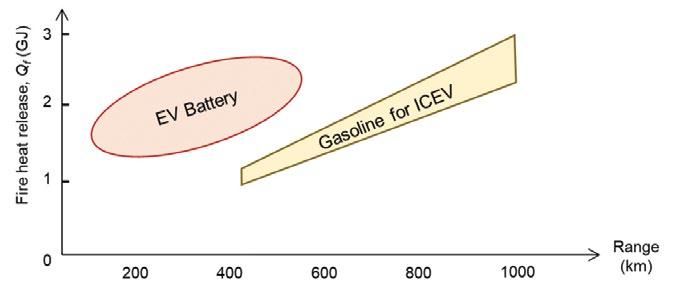
The heat release from an EV battery fire is therefore approximately twice that of a gasoline vehicle with an equivalent driving range.
This indicates a potentially larger fire hazard and underscores the need for more stringent riskmitigation strategies for EVs. Unlike gasoline vehicles, where fuel mass decreases with driving distance, the mass and energy content of EV battery packs remain nearly constant during operation.
Consequently, the potential heat release from an LIB fire does not vary significantly across a state-ofcharge range of approximately 20% - 100%, reinforcing the persistent nature of the hazard throughout vehicle operation.
In summary, thermal runaway in LIBs is a complex, self-accelerating process, driven by a sequence of exothermic reactions and gas generation events. In EV applications, the large energy content and tightly packed battery architecture amplify both the consequences and challenges of thermal runaway.
While advanced design and safety measures reduce the likelihood of failure, the high potential heat release and difficulty of suppression make thermal runaway a critical consideration in EV safety engineering.
The rapid adoption of EVs has brought renewed attention to fire risks associated with EV parking and charging infrastructure. While EV fires share many characteristics with conventional vehicle fires, they also present distinct challenges related to battery behaviour, fire suppression and potential re-ignition. Understanding these differences is essential for effective risk assessment and fire protection design.
Fire risk in EV parking areas EV fires are broadly comparable to gasoline vehicle fires in terms
of fire load, heat release rate, and smoke production. However, LIB fires exhibit several unique characteristics that complicate fire response.
One of the most critical differences is that EV battery fires are difficult to extinguish and prone to delayed re-ignition, which sometimes occurs hours or even days after visible flames have been suppressed.
As a result, EV fires typically require significantly longer firefighting operations and extended post-incident monitoring.
The likelihood of a battery fire is reduced by intrinsic safety mechanisms built into modern EVs. These include robust battery design, cell separation, thermal protection and battery management systems that monitor voltage, temperature and current. These systems are designed to prevent conditions that could lead to overheating or short circuits. If these intrinsic safety measures fail and a battery enters a burning state, cooling the battery becomes the most effective mitigation strategy.
Conventional sprinkler systems are generally ineffective because EV batteries are packaged within sealed enclosures and are typically located on the underside of the vehicle, limiting direct water contact. In open road scenarios, some fire services mitigate the risk of re ignition by immersing the vehicle in large, purpose-built water tanks for extended periods, that is, often 24 hours or more.
Battery fires may originate not only from collision damage but also from manufacturing defects, separator degradation or ageing effects. These issues can cause internal short circuits, leading to gradual temperature increases. At temperatures above approximately 70 °C, flammable electrolyte vapours begin to evaporate, increasing internal pressure.
This pressure may be released through an off-gassing event. If heating continues, separator failure can occur, triggering thermal
runaway which results in a rapid temperature rise and potentially explosive combustion of electrolyte gases in the presence of an ignition source.
The overall fire risk associated with EV charging stations remains a subject of ongoing evaluation. At present, charging stations generally present a lower fire load than vehicles and relatively few fire incidents have been recorded. However, this risk profile may evolve as charging infrastructure expands and ages.
Potential causes of fires at charging stations include:
• Electrical malfunctions or short circuits
• Damaged or improperly maintained charging cables
• Faulty charging equipment
• Electrical surges or grid instability
• Overheating due to high charging power or inadequate cooling
• Improper use of charging equipment
• Lightning strikes
As charging infrastructure becomes more complex, additional fire risks arise from the integration of energy management systems. To support EV charging demand, manage intermittent renewable energy sources such as solar photovoltaics, and balance electrical grid loads, many installations now include energy buffer storage systems.
These systems typically rely on large LIB arrays arranged in racks, housed either in dedicated rooms or containerised enclosures. While essential for grid stability and charging reliability, these battery systems introduce fire and explosion risks associated with thermal runaway, particularly if adequate detection, ventilation and fire protection measures are not in place.
EV parking areas and charging stations introduce fire risks that are different in nature rather than in magnitude, from those for conventional vehicles. While EV fires are not inherently
more frequent, their extended duration, re ignition potential and suppression challenges require careful consideration in fire safety design. As charging infrastructure and energy storage systems continue to expand, targeted fire protection strategies will be critical to managing these evolving risks effectively.
Opening or removing the highvoltage battery should not be attempted. According to NFPA guidelines, offensive firefighting is recommended when the traction battery is not involved in the fire. Once the onboard battery is involved in the fire, there is greater difficulty in suppressing the EV fire, because the burning battery pack inside the EV is inaccessible to external firefighting and can reignite without sufficient cooling.
As a result, a larger amount of suppression agent is needed to cool the battery, extinguish the fire and prevent reignition. An alternative is to allow the battery to burn itself out under controlled conditions. After extinguishment, the vehicle should be relocated to a distance of at least 15 m from other vehicles and buildings, to mitigate the risk of re-ignition.
In Finland, multiple approaches to EV fire suppression have been evaluated. Current recommendations favour the use of a conventional branch pipe or an underbody sprinkler system to cool the battery. Submerging a burning EV in water is known to extinguish the fire rapidly.
However, Finnish operational practice generally considers moving a burning vehicle to be too hazardous.
As a result, vehicles are typically extinguished on site and may subsequently be submerged to prevent re-ignition. An alternative approach involves transporting the burned vehicle in a container without initial submersion, allowing for rapid intervention if re-ignition occurs during transport.
Compared with the extensive body of research on thermal runaway in LIBs and protection strategies, significantly fewer studies address fire suppression and extinguishing technologies for battery fires. Existing research consistently shows that LIB fires are difficult to extinguish, require large quantities of water and present a high risk of re-ignition.
Re-ignition events are particularly challenging because they can occur unpredictably, even long after the initial thermal event. Allowing the vehicle or battery pack to burn out completely is one method to eliminate the risk of re-ignition, as the consumption of active materials significantly reduces this risk. In practice, however, this approach is not always feasible or appropriate, making active suppression necessary.
NFPA 10 (2018) classifies fires into five categories. While EV fires do not fit neatly into a single class, their components correspond to several fire classes which can be categorised as follows:
• Class A: Solid combustible materials, such as seat foam and plastic interior components.
• Class B: Flammable gases released during battery thermal runaway, as well as combustible liquids including coolant, brake fluid, windshield washer fluid, transmission fluid and liquid fuels in hybrid EVs.
• Class C: Electrical components, including high-voltage systems and battery management systems (BMS).
• Class D: Lithium metal particles that may be released from charged LIBs.
Using carbon dioxide or dry chemical agents alone can suppress visible flames, but it does not sufficiently cool the battery pack or prevent re-ignition. In contrast, water spray can both suppress flames and provide effective cooling, although it may introduce secondary risks such as electrical faults, hydrogen generation from reactions with lithium, and
contaminated runoff. Despite these drawbacks, water remains one of the most effective agents due to its superior cooling capacity.
The extinction mechanisms of LIB fires are still not fully understood. Most experimental studies focus on small-scale or portable LIB fires, raising questions about the effectiveness and reliability of existing suppression strategies for full-scale EV fires.
While carbon dioxide and dry chemical agents can extinguish open flames, suppressing flames without adequate cooling may allow flammable gases to accumulate, increasing the risk of delayed ignition or gas explosions. Cooling the battery or limiting heat transfer between cells is generally beneficial and reduces the likelihood of propagation.
Extinguishing an EV fire typically requires prolonged water application. Several operational considerations have been identified:
• Fire barriers or shutters between charging stations and other parked vehicles.
• Battery access tools: Specialised tools such as fire lances, which inject water directly into the battery pack, have proven effective in experimental studies. These tactics require aggressive intervention and highly trained personnel.
• Fire blankets: Fire blankets are ineffective when the battery itself is involved in the fire.
• Electrical safety: The risk of electrocution must be addressed. However, available evidence indicates this risk is manageable, as the high-voltage battery is not directly connected to the vehicle chassis and no incidents or near misses have been reported in fire tests or operational statistics.
• Re-ignition risk: EV batteries may re-ignite, necessitating extended on-scene operations, continued monitoring and specific post-fire storage arrangements.
• Firefighting runoff: Firefighting water runoff may contain elevated
concentrations of pollutants such as nickel and cobalt, indicating a need for further research and environmental risk assessment.
Overall, EV fire suppression remains a complex and evolving challenge, requiring a balance between effective cooling, firefighter safety, environmental protection and the mitigation of re-ignition risks.
The transition to EVs is essential for Singapore’s sustainable future. However, the unique and severe nature of LIB fires demands proactive and tailored safety
strategies. By strengthening electrical standards, mandating safer charging practices, innovating in battery management and rigorously updating our fire protection codes and emergency response tactics, we can mitigate these risks.
The goal is not to hinder adoption but to ensure that our pursuit of a greener tomorrow is built on a foundation of unwavering safety for all.
[1] Fire Code 2023.
[2] Brookes Bell: ‘Lithium Batteries Whitepaper’.
[3] Peiyi Sun, Roeland Bisschop,
The Land Transport Authority (LTA) and the Singapore Civil Defence Force (SCDF) intend to implement differentiated licence plates for Electric Vehicles (EVs), including plug-in hybrid EVs (PHEVs), and will commence a stakeholder engagement exercise to gather feedback on the proposed design and implementation approach. This can help SCDF responders more easily identify whether a vehicle is an EV and adopt specialised procedures during an incident.
In a joint news release, issued late March, LTA and SCDF stated that they would engage authorised motor dealers as well as selected signcraft workshops to seek views on the proposed design and approach to implement differentiated licence plates. This would take place over a month, starting end-March. The engagement would be done through focus group discussions and online surveys. LTA and SCDF would also engage EV and PHEV owners to gather feedback. In developing a suitable design for EV licence plates, LTA and

Huichang Niu, Xinyan Huang: ‘A Review of Battery Fires in Electric Vehicles’.
[4] Vesa Linja-aho: ‘Electric Vehicle Charging Safety’, IEEE.
[5] Arup: ‘Electric Vehicles (EVs) and Charging Infrastructure’.
[6] Polish Alternative Fuels Association: ‘Fire Safety of Electric Vehicles and Battery System’.
[7] ‘A review of fire Safety in Electric Vehicles’, International Research Journal of Engineering and Technology, Volume 10, Issue 9, Sep 2023.
[8] John T Warner: ‘Lithium-Ion Battery Chemistries’, 2019.
[9] Siemens Switzerland AG, Danfoss Fire Safety A/S, Danish Institute of Fire and Security Technology: ‘Fire Safety in parking garages with electric vehicles’, White paper, 2023.




SCDF considered their visibility and ease of identification. Three proposed designs were developed to be easily recognisable by first responders as well as traffic and enforcement cameras. The proposed designs are tentative and subject to feedback. The finalised design will also take into account
the operational requirements of government agencies. Adequate time will be provided for existing EV and PHEV owners to replace their current vehicle licence plates. More details on the finalised design and implementation approach will be shared in the second half of 2026.
by Avtandil Mekudishvili, Regional Spokesperson, APAC, PlanRadar
A wake-up call for fire safety in all building phases.
Fires are often discussed as freak accidents. Tragic? Yes. Yet time and again, investigations reveal a more uncomfortable truth, that many fires are foreseeable and therefore preventable. The recent Wong Fuk Court fire in Hong Kong is a sobering reminder of how quickly fire risk can escalate when buildings are undergoing renovation or construction. Early findings from the investigation point to how disruption to normal building systems, combined with inadequate oversight, can turn routine works into deadly scenarios.
What makes such incidents particularly alarming is that they occur not in abandoned structures, but in lived-in, familiar spaces –homes, offices and commercial buildings, where occupants reasonably assume a baseline level of safety.
Renovation and construction phases, however, fundamentally alter that baseline. Fire protection systems may be partially disabled, escape routes obstructed, combustible materials introduced and site activity intensified. Yet fire safety during these phases is too often treated as a box-ticking exercise focused on regulatory compliance, rather than a dynamic risk that requires constant management.
The lesson from Wong Fuk Court is clear. Fire safety preparedness, not just compliance, must become standard practice across all building phases. And in an era where construction is increasingly complex and fast-moving, technology has a critical role to play in helping
stakeholders identify, manage and mitigate fire risks before disaster strikes.
Fire safety spanning the entire project lifecycle
Traditionally, fire safety has been most rigorously enforced at the point of building completion and occupancy. Fire certificates, inspections and approvals tend to cluster around handover milestones. While these checks are essential, they overlook a crucial reality that some of the highest fire risks occur long before a building is officially occupied.
Fire safety must be integrated from the earliest planning and design stages through construction, renovation, handover and ongoing operations. Decisions made at the design stage, such as the layout of escape routes, compartmentation strategies and selection of fireresistant materials, set the foundation for a safer building. Poor design choices are difficult and costly to correct later, and their consequences often become visible only under stress.
During construction and renovation, risks multiply. Temporary work may block exits or reduce access for firefighting. Fire detection and suppression systems may be deactivated or operating in partial modes. Hot works, flammable materials and evolving site conditions introduce hazards that change daily. In renovation projects, these challenges are compounded by fragmented documentation, unclear responsibilities and the

coexistence of construction activity with building occupants.
Past incidents across the region echo these vulnerabilities. Construction-related fires in projects, from residential refurbishments to large-scale infrastructure developments, repeatedly cite poor coordination, lack of real-time oversight and outdated information, as contributing factors.
The Wong Fuk Court fire underscores how the absence of integrated, lifecycle-wide fire safety oversight can have devastating consequences, even in dense urban environments with established regulatory frameworks.
Fire safety cannot be something we ‘return to’ once the construction dust settles. It must be actively managed throughout the entire project lifecycle.
A robust fire safety management plan is not a single document filed away for compliance. It is a living framework that evolves with the project. At its core, it should encompass several interlinked components.
It begins with site analysis and hazard identification, establishing a clear baseline understanding of fire risks before work commences. This includes identifying ignition sources, combustible materials and vulnerabilities unique to the site.
Detection and alarm systems must remain functional and reliable, even during temporary work. When permanent systems are disrupted, suitable interim
measures should be clearly defined and monitored.
Emergency exit planning is critical. Escape routes must remain clear, well-signposted and unobstructed – a challenge on busy sites where layouts change frequently. Temporary alterations should be documented and communicated immediately.
Effective suppression systems and firefighting resources, from sprinklers to extinguishers and access routes for emergency responders, must be appropriate to the evolving risk profile of the site.
People, not just systems, matter. Training and drills ensure that workers, contractors and site managers know how to respond under pressure. This includes understanding alarm signals, evacuation procedures and individual responsibilities.
Clear communication protocols are essential, defining leadership roles and enabling real-time alerts when conditions change. Fire safety fails when information is siloed or delayed.
The safe handling and storage of hazardous materials, particularly flammables used in construction and renovation, requires strict controls and constant oversight.
Ongoing maintenance and inspections ensure that all fire safety measures remain reliable. Systems that are installed but not tested or serviced offer false reassurance.
Inclusive evacuation plans for people with special needs demonstrate a genuine commitment to safety, ensuring no one is left behind during emergencies.
Finally, continuous improvement and review closes the loop. Lessons from near-misses and incidents must be fed back into updated plans, rather than being forgotten once work resumes.
The persistent gaps in fire safety are rarely due to a lack of technical knowledge. Standards, codes and best practices are well-
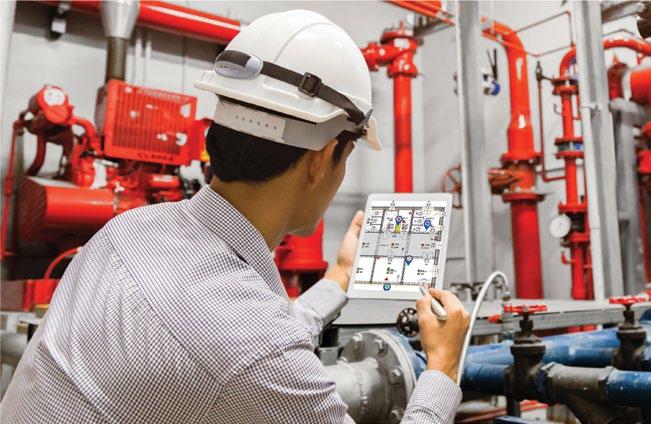
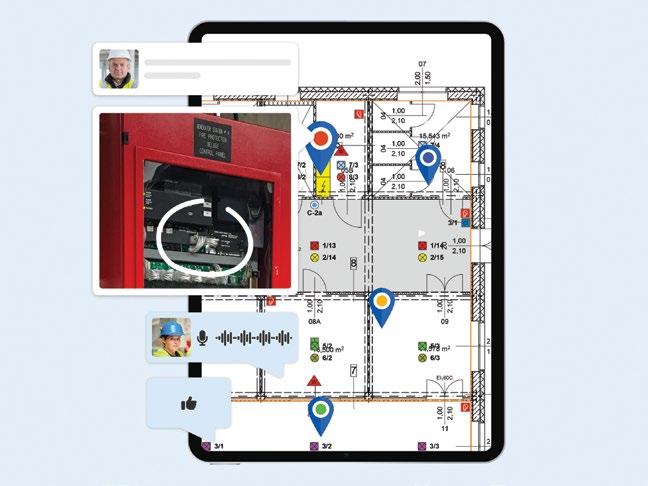
documented. The real weaknesses lie in execution.
Inconsistent documentation means critical information is often outdated or inaccessible when it is most needed. Paper-based checklists, scattered emails and siloed reports make it difficult to form a real-time picture of risk.
Slow problem reporting allows small issues – a blocked exit, a disabled alarm, improperly stored materials – to linger until they become serious hazards.
Fragmented workflows between designers, contractors, subcontractors, facility managers
and regulators create blind spots. Each party may assume another is responsible for fire safety oversight, resulting in gaps where no one is actively managing risk.
In renovation projects especially, these shortcomings are amplified. Buildings are already in use, responsibilities are blurred and changes happen quickly. Traditional approaches struggle to keep pace.
This is where digital fire safety management becomes not just helpful, but essential. Digital
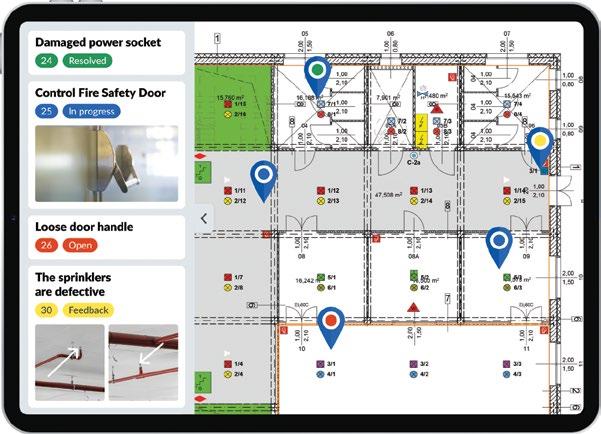
platforms can transform fire safety from a static compliance exercise into an active, transparent process. By centralising all fire safety documentation – plans, permits, inspection records and incident reports – digital tools ensure that everyone is working from a single source of truth. No more guessing as to which version is current.
Real-time insights allow stakeholders to see emerging risks as they develop. Issues can be logged on-site, assigned instantly and tracked through to resolution, reducing delays and ambiguity.
Replacing paper-based checklists with searchable, auditable digital trails improves accountability. It becomes easier to demonstrate compliance, identify patterns and learn from recurring issues.
Critically, digital fire safety management supports ongoing maintenance and inspection schedules well beyond initial approvals. Alarms, sprinklers and emergency lighting can be monitored systematically throughout construction, renovation and operation, and not just at handover.
In high-risk phases like refurbishment, where conditions change daily, this level of visibility and coordination can mean
the difference between early intervention and irreversible tragedy.
The next step for the built environment community Singapore has long been recognised for its rigorous construction governance and emphasis on safety. The next step is to extend that leadership into the digital domain.
Regulators should consider mandating greater digital visibility for fire safety in renovation permits and contractor oversight, ensuring that risks are actively monitored rather than retrospectively reviewed.
Developers and builders must move beyond static checklists and adopt fire safety plans as living documents – continuously updated, reviewed and shared across project teams.
Engineers and site managers should demand real-time tools that enable proactive risk tracking and faster issue resolution, thereby empowering them to act before small lapses escalate.
Digital fire safety management is not about adding bureaucracy. It is about making safety easier to manage, harder to ignore and impossible to lose, in the noise of daily site activity.
Replacing paper-based checklists with searchable, auditable digital trails improves accountability.
Tragedies like the Wong Fuk Court fire should never be reduced to isolated incidents or technical footnotes. They are warnings about complacency, fragmentation and the dangers of treating fire safety as an afterthought.
If meaningful change is to emerge, it must go beyond tightening individual rules. It requires a shift in mindset –recognising that fire risk evolves across the building lifecycle, and that managing it demands better tools and better processes.
Singapore is well positioned to lead by example. By embracing lifecycle-wide fire safety strategies powered by digital management, it can set a benchmark for safer, smarter cities across the region and ensure that the lessons of past tragedies are translated into lasting protection for the future.
PlanRadar is an award-winning, digital SaaS platform for documentation, communication and reporting in construction, facility management and real estate projects. The platform operates across the globe, with a presence, currently, in over 75 markets.
The Singapore Engineer (TSE): With the increasing use of AI, what are the cybersecurity challenges for organisations?
Darren Guccione (DG): AI adoption is accelerating across APAC, including Singapore, transforming enterprise operations while introducing new cybersecurity risks. Earlier this year, Gartner warned that misconfigured AI could shut down national critical infrastructure in a G20 country by 2028, highlighting a structural reality – human errors amplified by automation and scale pose the greatest threat.
Autonomous systems, service accounts and AI agents now outnumber human users in many environments, frequently operating with persistent privileges and limited oversight. A single compromised credential or misconfigured model can cascade across cloud, Software as a Service (SaaS) and operational technology environments.
Singapore’s Model AI Governance Framework and related APAC regulations emphasise identity-first controls, task-bound permissions and human accountability. Organisations must enforce leastprivilege access, apply zero-trust principles and continuously monitor both human and non-human accounts. In the AI era, operational resilience depends not on model sophistication, but on disciplined governance of all identities.
TSE: What are the challenges for the manufacturing industries, infrastructural facilities and data centres, in particular?
DG: Manufacturing, infrastructure and data centres are high-value
operational targets. Cyber threats in the manufacturing space can disproportionately disrupt production lines, compromise sensitive designs or operational technology (OT) and impact national services.
These environments are complex, with IT, OT and cloud systems interacting across distributed sites. Engineers, contractors and AI agents often have privileged access, making consistent enforcement difficult. At the same time, operations demand speed and uptime, so security measures must protect critical systems without slowing workflows.
Continuous verification, leastprivilege enforcement and session monitoring ensure that every action is authorised and auditable, preventing misuse or lateral movement.
Unlike legacy Privileged Access Management (PAM) tools, which are often complex, slow to deploy and hard to integrate, modern cloud-native platforms streamline access controls and connect seamlessly with identity providers, Security Information and Event Management (SIEM) platforms and Continuous Integration / Continuous Delivery (CI/CD) pipelines. This reduces operational friction, allowing security teams to focus on proactive risk mitigation rather than routine administration while maintaining strong protection without disrupting industrial workflows.
TSE: What are the special concerns of Small & Medium-sized Enterprises (SMEs)?
DG: Cybersecurity incidents can have a significant impact on

organisations, both operationally and financially. The Singapore Cyber Landscape 2024/2025 report, produced by the Cyber Security Agency of Singapore (CSA), highlighted that phishing attacks surged by nearly 49% in 2024, with over 6,100 reported cases while ransomware incidents increased by approximately 21% year-on-year.
The number of infected systems jumped by around 67% to more than 117,000 compromised devices. Singapore ranked as the seventh most-targeted country globally for DDoS attacks in late 2024. These trends underscore that businesses of all sizes across Singapore and the wider APAC region face heightened exposure to identity-based threats and other cyber risks which can disrupt operations and lead to financial and reputational damage.
For SMEs, these threats are particularly acute. Limited IT resources make it challenging to keep up with rapidly evolving attacks, while fragmented access controls and weak credential hygiene increase the risk of account takeover. Cybersecurity cannot simply be an IT afterthought. It must be embedded into how organisations manage identity and access, across systems.
TSE: What are the approaches that companies could adopt to address the above challenges?
DG: Organisations can mitigate these risks by adopting a zerotrust, identity-first approach. Centralising credential and access management reduces complexity and improves visibility, while enforcing least-privilege access ensures permissions are granted on
a need-to-know, time-bound basis.
Automating approvals and provisioning reduces human error and IT overhead, while continuous monitoring of accounts and sessions helps detect anomalies early. Employees must treat Multi-Factor Authentication (MFA) prompts and access approvals deliberately, not as routine clicks. For AI-driven systems, verifiable identities, bounded access and outcome-based monitoring ensure actions are auditable, controlled and aligned with organisational goals.
TSE: What are some of the solutions that Keeper Security is offering, that are relevant to Singapore-based organisations?
DG: Expectations around cybersecurity are increasing, with greater accountability placed on organisations. For example, Singapore’s Model AI Governance Framework for Agentic AI sets a new standard for accountable oversight of autonomous systems, addressing risks such as unauthorised actions, data misuse and operational disruption.
At its core, the framework calls for identity-first, outcome-driven controls. Each AI agent must have a verifiable identity, permissions must be task-specific and timebound, and human accountability must be enforced at every stage. Keeper Security’s zero-trust PAM platform is uniquely suited to meeting these requirements. By continuously validating identity, context and intent, Keeper eliminates implicit trust, enforces granular access controls and monitors activity in real time. Organisations can detect deviations, prevent privilege escalation and maintain auditready oversight without slowing innovation. Its lifecycle-based controls span development, testing, deployment and continuous monitoring, ensuring AI agents operate securely at machine speed.
For Singapore-based enterprises navigating cloud, SaaS and
hybrid environments, Keeper transforms regulatory compliance into a strategic advantage. By embedding identity-first security from the outset, organisations can confidently deploy autonomous systems, safeguard sensitive operations and maintain operational resilience while enabling innovation at scale.
TSE: Could Keeper Security provide more information on an actual project application, such as securing the Atlassian Williams F1 Team?
DG: Atlassian Williams F1 Team provides a real-world example of protecting a fast-moving, globally distributed workforce. Generating terabytes of telemetry and engineering data each race weekend, the team needed secure access for engineers worldwide without slowing operations.
KeeperPAM centralised privileged accounts and credentials, enforced least-privilege access, monitored sessions in real time and automated provisioning. This zerotrust approach ensured high-speed, secure access across devices, networks and locations, reducing operational friction and turning identity security into a competitive advantage.
It demonstrates that zerotrust PAM can protect even the most high-value, high-pressure environments – a model applicable to APAC enterprises and SMEs alike.
TSE: Any other information that you would like to provide?
DG: The centre of gravity in cybersecurity is shifting. As workforces become distributed, automation accelerates and AI systems scale, identity – not infrastructure – is becoming the decisive battleground. In 2026, human and non-human accounts outnumber traditional endpoints in many enterprises, creating an attack surface that is faster-moving, more complex and more opaque than ever before.
Emerging threats are evolving in parallel. AI-driven deepfakes, synthetic personas and contextaware social engineering are reaching levels of realism that challenge legacy authentication methods. Automated attacks can exploit trusted workflows at scale, while quantum ‘harvest now, decrypt later’ activity is forcing organisations to rethink the longevity of encryption and data resilience.
The organisations that will succeed are those that treat identity and cryptography as living systems – continuously monitored, validated and adapted. Precision, visibility and agility will define operational resilience, while continuous governance and realtime insight into both human and machine accounts will become the foundation for navigating the next era of cyber threats.
Keeper Security, the leading zero-trust and zero-knowledge Privileged Access Management (PAM) platform, recently announced the release of new Remote Browser Isolation (RBI) capabilities within KeeperPAM, delivering major adoption and usability improvements for modern web workflows within privileged vault sessions. These enhancements address a persistent challenge in zero-trust environments: enabling secure, policy-driven access to dynamic, multi-tab web applications and filebased workflows directly within privileged sessions. With support for multi-tab browsing, secure file uploads and full JavaScript interaction, Keeper is closing the gap between security and productivity in remote, browser-based access.
by Nicklas Bylund, Head of
Sandvik Coromant
A structured, component-focused approach that helps manufacturers bridge the skills gap while maintaining performance.
A 2024 study by Deloitte and The Manufacturing Institute predicts that nearly two million manufacturing roles could go unfilled over the next decade, if talent shortages are not addressed. While addressing this gap will take time, manufacturers must still presently meet the ever-growing demand for increasingly specialised and complex components.
Across aerospace, automotive and general engineering, applications are becoming increasingly specialised, placing greater demands on the machined components.
From ever more difficult to machine, heat resistant alloys in aircraft engines to automotive parts in both steels and aluminium, manufacturers are expected to achieve tighter tolerances, superior surface finishes and consistent quality, under increased cost pressure. These demands place a higher pressure also on tooling and machining strategies.
With expertise in short supply, due to the persistent shortage of skilled machinists, programmers and engineers, many manufacturers have relied on traditional trial-anderror methods to refine production.
However, as complexity grows, these approaches are proving increasingly inadequate, introducing inefficiencies, variability and risk, as well as consuming limited time and resources.
In the face of these industrywide challenges, Deloitte, in its 2025 Manufacturing Industry Outlook, stated the need for ‘new approaches and tools that can be leveraged across the business to maximise efficiency and build resilience, and prepare for a potential new era of industry expansion’. To stay competitive,
manufacturers do need approaches that are aligned with the demands of modern production.
In the context of components, this means solutions that align tooling choices, machining strategies and process data, creating a consistent foundation for repeatable, highquality results. This is where Sandvik Coromant’s ‘Engineering Projects’ comes into play.
Engineering Projects has been developed by Sandvik Coromant to help manufacturers strengthen the capability, stability and performance of their machining processes for critical components.
Designed in response to the growing complexity of components and the shortage of specialist expertise, Engineering Project engineers provide structured, end-to-end support that spans every stage of production. Through close collaboration with customer teams, engineers utilise their knowledge of tooling, machining and CAM programming, and parts processing, to deliver a complete, production-ready tooling package.
Each project begins with a detailed consultation, where Sandvik Coromant engineers work with customer teams to review component designs, material specifications, tolerances, machining requirements and production targets. In understanding these elements early, engineers can decipher whether it would be best to optimise existing equipment or create a tailored strategy, whilst also factoring in any challenges that they may face in the process.

Following this phase, tooling specialists design or select the optimal combination of standard and special cutting tools, adaptors and work-holding solutions, as well as CAM, with tool path optimisation.
For advanced applications –such as aerospace components made from difficult materials or automotive parts manufactured in large quantities – this process often results in tooling packages that blend standard solutions with specially designed components. Through Sandvik Coromant’s acquisitions, holding solutions can also be developed and delivered.
With tooling strategy determined, CAM programmers translate the strategy into production-ready programs. Using software such as Mastercam, Siemens NX and Vericut, toolpaths, feed rates and cutting sequences are virtually modelled.
This digital verification helps to identify potential collisions, optimise cutting forces, predict cycle times as well as reduce waste from failed tooling trialand-error stages. This benefits operators by allowing them to run complex processes reliably even without highly specialised in-house expertise.
Once finalised, the complete tooling packages can be delivered as precision-balanced, spindleready assemblies with full technical documentation. Engineering Projects employees, together with local account managers and local specialists, help oversee the initial setups and test cuts.
This allows the team to apply their expertise in real-time, confirming dimensional accuracy and surface integrity, making any
necessary adjustments to fine-tune the process and ensure consistent output.
After validation, workflows can be implemented across global production sites. Supported by Sandvik Coromant’s coordinated approach to cross-border projects, this solution includes supply management, ensuring clear communication and consistent production standards across markets.
Creating lasting value
Through leveraging specialist expertise gained from extensive experience with similar components, digitally validated workflows and data-driven insights, Engineering Projects deliver efficiency, consistency and productivity gains.
Furthermore, with these processes in place, in-house teams and operators are freed from repetitive trial-and-error tasks, allowing them to focus on activities that support longterm organisational capability, such as knowledge management, cross-departmental projects and mentoring colleagues.
Over time, these operational and organisational benefits create lasting value. These projects establish a foundation for continuous improvement and organisational strength. Stable, repeatable processes allow manufacturers to scale complex production while maintaining high standards and adapting to future challenges.
Collectively, these improvements contribute to achieving Manufacturing
Wellness, a state where production processes are resilient, thriving and positively impactful on both people and societies.
As manufacturing grows more complex and skilled talent remains scarce, success depends on approaches that deliver consistency and confidence, direct to the shop floor. Engineering Projects provide the tooling, expertise and global reach to make that possible –overcoming skills gap complexities to deliver predictable, high-quality outcomes.
Together with its customers and partners, Sandvik Coromant contributes towards a sustainable future, supplying tooling solutions to the world’s engineering industries.
Sandvik Coromant has introduced CoroTurn PI, a new family of internal turning tools, combining precision chip breaking, alldirectional turning and a special tool holder design to unlock significant productivity gains. Designed for high process security, the tool concept is ideal for demanding operations in ISO P, ISO M and ISO K materials.
Machining internal features such as holes in shafts, ring gears or connection hubs presents several challenges. Vibration, deflection and chip build-up are common issues that can compromise both productivity and quality. CoroTurn PI addresses these challenges with a high-precision chip breaker, multiple coolant configurations and support for both roughing and finishing operations in a single tool, delivering quality and efficiency in demanding internal turning applications.
At the heart of CoroTurn PI is a tool holder design with two separate insert seats, one for
roughing and one for finishing. That means fewer tool changes, reduced cycle times and higher output.
Furthermore, each roughing insert comes with eight cutting edges, boosting tool life and driving down cost.
CoroTurn PI utilises the patented PrimeTurning method, where small entering angles and all-directional turning deliver flexibility and control. The small angles, paired with the tool’s precision chip breaker, enable secure chip evacuation, despite the limitations of internal features.
To further optimise performance, the tool comes with customisable
coolant delivery options, tailored for components with blind or through holes. The result is better chip control, smoother machining and greater reliability.
Achieving ultra-fine and high-purity cleaning.

In order to secure a future-proof and competitive position in the market, numerous companies are restructuring their product ranges. The trend is towards sophisticated solutions for high-tech industries.
This not only means higher demands on the precision of components, but also extremely strict specifications regarding particulate and film cleanliness, which must be achieved in a process-reliable, economical and sustainable manner. This requires a different approach to cleaning, a critical look at the entire production chain and manufacturing environment, and an experienced partner.
In the course of industrial transformation, more and more companies are focusing on the manufacture of high-quality products and components, with good margins. The focus is on high-tech industries that promise stable demand through growth in the future.
The extremely high demands on manufacturing precision in industrial sectors, such as the semiconductor supply industry, electronics manufacturing,
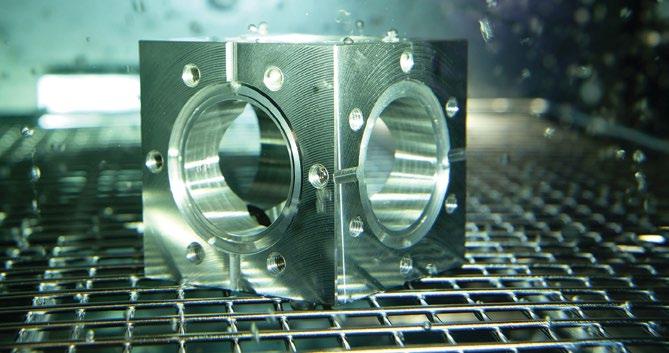
The specifications for particulate cleanliness extend into the submicrometre range and, in the case of film-like contamination, even nanolayers of organic and inorganic residues, for example, must be removed in a process-reliable and reproducible manner.
e-mobility, the optical and optoelectronic industry, sensor technology, photonics, thin-film technology, vacuum technology, laser and analysis technology, and aerospace, include the cleanliness of components.
This applies regardless of whether the components are barely visible electronic parts, millimetre-small connecting elements, precision optics or metre-sized structural components, and regardless of the materials from which they are manufactured.
This trend poses challenging tasks for parts cleaning. Unlike conventional component cleaning, which usually involves removing large quantities of manufacturing residues, such as chips and processing media, ultra-fine and high-purity cleaning is all
about removing minimal residual contamination. The specifications for particulate cleanliness extend into the subnicrometre range.
Depending on the industry, component and its application, filmlike residual contamination, such as organic and inorganic residues, ionic residues and microorganism residues, must be removed in a process-reliable and reproducible manner, down to nanometre levels. In high-purity applications, such as the manufacture of components for EUV lithography, so-called hydrogeninduced outgassing (HIO) substances must also be taken into account.
The requirements for particulate cleanliness to be met during cleaning are specified by the corresponding surface cleanliness class (ORK) according to EN ISO 14644-9 (SCP – surface cleanliness by particle concentration) or the corresponding VDI guideline 2083, sheet 9.1.
Film-chemical, organic and inorganic surface cleanliness is usually defined by individual specifications or factory standards. In addition, outgassing rates may be evaluated using mass spectrometers.
These demanding tasks require a partner who, on the one hand, has comprehensive technological expertise and knowledge of the applications and physical relationships. On the other hand, experience in this field of cleaning and appropriate test facilities for cleaning trials under productionrelated conditions, should be available.
As an experienced full-service provider of future-oriented and globally available solutions for ultra-fine and high-purity cleaning, Ecoclean meets these requirements.
Selecting the right cleaning process and system technology
In order to meet these strict cleanliness specifications in a process-reliable, reproducible and sustainable manner, several cleaning steps are usually required
along the manufacturing chain. The following questions play a role in selecting the optimal solution for the respective cleaning process:
• What material is the part made of?
• What is the geometry, dimensions and weight of the component?
• What contaminants need to be removed?
• What cleanliness requirements must be met?
• Which cleaning process and which chemicals are suitable for this?
On this basis, it is possible to determine which and how many cleaning steps are required, and which medium and which process technologies are to be used? Other aspects to be taken into account include the required quality of the rinsing medium and the appropriate drying technology, as well as clean part handling and the ambient conditions, for example, connection or integration into a clean room or clean environment.
along the production chain
The basis for ultra-fine or highpurity cleaning is ‘oil- and greasefree’ parts. In order to achieve and maintain this level of cleanliness, a cleaning process is carried out after the various processing steps, such as machining, forming, grinding or polishing.
The effect of the cleaning medium used is enhanced by various process technologies that can be combined in almost any combination, such as steam degreasing, spray, high-pressure, immersion, ultrasonic and megasonic cleaning, as well as plasma cleaning, injection flood washing, pulsed pressure cleaning (PPC) and ultrasonic plus. These process options ensure that the required cleanliness is consistently achieved, even for geometrically complex workpieces.
For intermediate cleaning processes or parts with less stringent cleanliness specifications, modular single- or multi-chamber systems, operating under full vacuum, are typically used. Depending on the processing medium used, these systems can be operated with an environmentally friendly solvent, e.g. hydrocarbons or modified alcohol, or a specially selected water-based cleaner.
The design, system engineering, media flow and treatment of these systems are specially tailored to ultra-fine cleaning and high-purity applications. Thanks to the process mechanics concentrated in the working chamber, e.g. injection flood washing, ultrasound and PPC, this type of system also offers advantages when cleaning large and complex workpieces.
Ultrasonic multi-bath immersion systems are the optimal solution
for parts with a wide variety of materials, high throughput requirements and/or strict cleanliness specifications. In addition to individually designed cleaning systems for highend applications, the plant manufacturer offers an efficient solution with the UCMSmartLine and UCMPerformanceLine series of systems consisting of standardised modules.
The electrical and control technology is integrated into the respective modules for the process steps of cleaning, rinsing, drying, loading and unloading, as well as for the transport system. This, together with the provision of process mechanics tailored to requirements, such as PPC, allows the systems to be optimally adapted to the respective task. The option of upgrading the cleaning system, at a later date, ensures future-proofing, in the event of increased requirements.
Ecoclean
The SBS Ecoclean Group develops, manufactures and distributes future-oriented equipment, systems and services for industrial component cleaning and surface finishing, as well as tailor-made automation solutions.
Ecoclean determines the right system concept for the application and the optimal cleaning process in its own High Purity Test Centre. It has a Class 7 clean room with Class 6 zones and various measurement and analysis methods (e.g. microscopy, residual gas analysis, and UV light and fluorescence measurement). In addition to the productspecific development of cleaning processes and parameters, the plant manufacturer also uses the test centre to carry out contract cleaning orders. A packaging station for cleaned parts ensures that the high level of cleanliness achieved is also delivered to the customer.
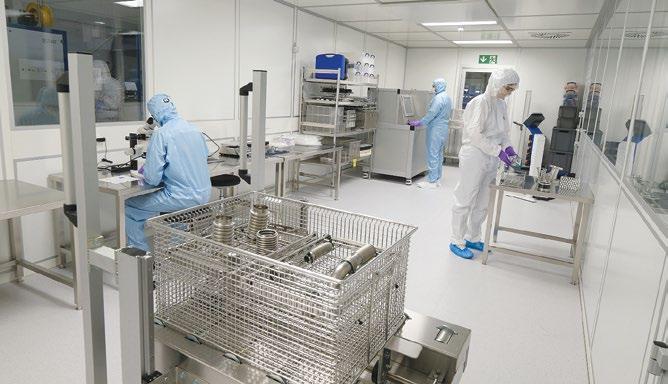

Siemens has introduced the Drivetrain Analyzer Onsite (DTA Onsite), a new, on-premises analytics solution for industrial drive systems. The software enables users to evaluate drive data entirely within their own infrastructure and meet stringent data-sovereignty requirements.
As the first module of the new solution, Siemens has released DTA Onsite – Monitoring which provides continuous condition monitoring of mechanical and electrical drivetrain components, using locally executed AI methods for pattern recognition and anomaly detection.
A new module for local condition monitoring
DTA Onsite – Monitoring captures high-resolution, including precision time protocol (PTP) synchronised, vibration and analogue signals acquired, depending on the use case, via the Connection Modules Vibration (CM VIB), Fast Process Parameters (CM FPP) and IOT (CM IOT).
This includes vibration data, analogue values and fingerprint information, which are preprocessed locally and then analysed within the system.
The user interface provides plant-level overviews, KPI trend views and detailed diagnostic dashboards – all accessible through a standard web browser.
The integrated Industrial AI identifies deviations from typical drivetrain behaviour and provides indications of potential mechanical changes or early-stage wear. All data remains within the user’s own infrastructure, as the analytics are executed entirely on the industrial PC.
Drivetrain
With Drivetrain Analyzer Onsite, Siemens is expanding its drivetrain analytics portfolio, with a solution

tailored for users preferring strictly local data processing.
The Drivetrain Analyzer Cloud, launched last year, supports cross-site, cloud-based analyses and fleet-level evaluations. In contrast, DTA Onsite targets industrial environments where data sovereignty, latency requirements or isolated network architectures are key considerations.
Both systems follow the same modular concept but differ in operating model, integration environments and regulatory deployment contexts. Like Drivetrain Analyzer Cloud, DTA Onsite is part of Siemens Xcelerator.
DTA Onsite runs on industrial PCs and uses a containerised software architecture. The solution supports open and documented interfaces such as MQTT, gRPC and OPC UA, enabling integration into SCADA systems, edge platforms, industrial IPC environments and maintenance software. Data streams from sensors and automation equipment are consolidated locally and visualised through a unified monitoring interface.
DTA Onsite – Monitoring can be deployed in a wide range of industrial environments
and is specifically designed for applications with variable load, speed and operating profiles. This includes production machinery such as extruders, packaging machines and textile machines, where mechanical and process-related changes must be detected early.
The solution is equally suitable for infrastructure applications such as in pump stations, compressors or conveyor systems, which often operate continuously or across varying load conditions. Motion-control applications with dynamic movement profiles also benefit from the detailed monitoring capabilities, as load peaks and changing operating states are systematically captured and analysed.
Siemens Digital Industries empowers companies of all sizes within the process and discrete manufacturing industries to accelerate their digital and sustainability transformation across the entire value chain.
Siemens’ automation and software portfolio transforms the design, realisation and optimisation of products and production.
Vaisala, a global leader in measurement instruments and intelligence for climate action, has introduced Origo, a next-generation, modular measurement platform, designed to transform environmental monitoring in data centres and other mission critical-buildings.
Why half a degree matters
A temperature sensor off by just 0.5 °C (32.9 °F) might sound trivial but, for example, in a 10 MW data centre, that small error can cost more than USD 800,000 in wasted cooling energy over 10 years. In life sciences cleanrooms, for example, the stakes are even higher. Any critical environmental parameter such as temperature or relative humidity can compromise product integrity or research outcomes, with losses that go far beyond energy costs.
Air cooling remains essential in a rapidly evolving data centre market
There are an estimated 12,000 data centres worldwide, with the US and Europe accounting for more than half the number. While liquid and hybrid cooling are growing fast, for high density AI workloads, air cooling remains the universal foundation of data centre thermal management.
It provides the room-level baseline cooling every facility needs, while liquid cooling adds targeted, high efficiency heat removal for the hottest racks. As a result, hybrid architectures – air for space, liquid for the densest loads – are now standard, in both new builds and retrofit projects.
Impact at scale
Reliable, precise measurement is critical for optimising air-cooled environments.
“Generic sensors with ±0.5 °C accuracy drive overcooling and energy waste, costing operators tens of thousands of dollars annually. Origo’s precise ±0.1 °C

and ±1% RH accuracy and stable measurements reduce unnecessary cooling while ensuring the reliable environmental control that critical facilities depend on. It translates to performance that pays for itself in months and protects uptime for years to come,” says Anu Kätkä, Vaisala’s Product Line Manager for HVAC and Critical Buildings.
Applied at global scale, eliminating the ‘half-degree’ error across today’s predominantly air-cooled installed base – roughly 80% of the world’s estimated 12,000 data centres –would avoid around USD 805 million in wasted cooling energy every year, totalling approximately USD 8 billion over a decade, based on moderate 10 MW sites.
With data centres consuming about 1.5% of global energy, and demand set to more than double by 2030, precision sensing is essential to keep energy use and emissions in check, while safeguarding IT performance.
Designed for today and tomorrow Origo is engineered for simplicity and long-term adaptability. Its modular design enables monitoring of multiple parameters through Vaisala’s compatible probes, such as carbon dioxide (CO₂) and dew point sensors, on the same platform. This flexibility makes Origo a future-proof solution that adapts to evolving measurement
requirements also in other critical environments such as cleanrooms, life sciences applications and semiconductor manufacturing.
Backed by Vaisala’s commitment to reliability, Origo ensures accurate measurements and dependable performance throughout its service life, helping operators to protect processes, reduce risk and optimise resources.
Origo’s field replaceable probes allow quick on-site updates with minimal interruption. Vaisala’s wide range of services, from accredited calibrations to technical support, is available to complement site expertise.
As high-speed packaging lines and robotic systems continue to increase in speed, precision and autonomy, weighing is evolving – from a simple control point into a core element of modern automation architectures, delivering actionable real-time process data.
In high-dynamic environments, such as multi-head combination weighers, dynamic filling processes, or robotic systems exposed to variable load profiles, manufacturers are under growing pressure to achieve short cycle times, high throughput and high repeatability, whilst maintaining Overall Equipment Effectiveness (OEE) and advanced diagnostic capabilities.
As a result, conventional weighing solutions are increasingly reaching their mechanical and digital limits.
To address these cross-industry requirements, HBK has developed the PW22i single point load cell, specifically designed for highdynamic mechatronic systems, spanning both high-speed packaging applications and advanced robotic use cases. By embedding IO-Link communication directly at sensor level, the PW22i turns weighing into an intelligent automation component, seamlessly connected to the control layer.
Thanks to its exceptional mechanical stiffness and high natural resonant frequency, the PW22i has a short settling time, which is a critical requirement for fast cycle applications. These characteristics enable precise and repeatable measurements, supporting giveaway reduction in packaging processes, as well as measurement stability under dynamic loads in robotic systems. Available in 10 kg, 20 kg and 50 kg
capacities – and certified to accuracy class C3MR – the PW22i ensures reliable results under demanding operating conditions.
“The PW22i was designed for environments where mechanical dynamics are high and measurement reliability is critical in real time. Whether in high-speed packaging lines or robotic applications with rapidly changing load profiles, we combine ultra-fast dynamic weighing with IO-Link intelligence directly at sensor level. This enables plug-and-play integration, faster commissioning and direct use of weighing data within existing control architectures,” said Simon Kleefeldt, Product Manager, Weighing Sensors, at HBK.
The standardised IO-Link interface and M12 4-pin connector simplifies commissioning, replacement and retrofit of existing systems. Smart functions such as data preprocessing, self-monitoring and diagnostics provide continuous
visibility into sensor condition and process behaviour, supporting predictive maintenance strategies and OEE optimisation, across both packaging lines and robotic cells – or end-of-arm tooling systems.
Designed for demanding industrial environments, the PW22i features an IP67 degree of protection and a patented overload stop, allowing it to withstand up to five times its nominal capacity. This robustness ensures reliable operation under mechanical stress, eccentric loading and transient forces, which are common in high-dynamic industrial and robotic applications.
The PW22i supports machine builders, system integrators and manufacturers in designing faster, more connected and more intelligent systems, where weighing becomes a key enabler of operational performance, product quality and data-driven process control, across packaging automation and industrial robotics.