Relay Conversations:

Alexandra Harder Lindek
PhD Dissertation 2026 | Kolding School of Design
Relay Conversations: Attuning to When Relations Are Ready to Move
PhD dissertation submitted February 2026
PhD defence: 16 April 2026
© Copyright: Alexandra Harder Lindek, 2026
Graphic design: Maximilian Schmidauer / max.schmidauer@gmail.com
Photography: Alexandra Harder Lindek, unless otherwise explicitly stated.
Main Supervisor: Associate Professor Sune Klok Gudiksen, Kolding School of Design (DSKD), Denmark.
Co-supervisors: Associate Professor Morten Krogh Petersen, Kolding School of Design (DSKD), Denmark. Professor Andrew David Morrison, Oslo School of Architecture and Design (AHO), Norway.
Assessment Committee:
Associate Professor Canan Akoglu, Kolding School of Design, Denmark.
Professor Joyce Sheau Roei Yee, Northumbria University, UK. Associate Professor Sanna Marttila, IT University of Copenhagen, Denmark.
Department: Lab for Sustainability and Design
Printed by: Jelling Bogtrykkeri
Published by:
Kolding School of Design
Ågade 10
DK – 6000 Kolding Denmark
www.designskolenkolding.dk
Photographic, mechanical, digital, or any other form of reproduction from this book is permitted solely in accordance with the agreement between Copy-Dan and the Ministry of Higher Education and Science.
Any other use without the written consent of the publisher is prohibited by the applicable Copyright Act. Exceptions are extracts used for reviews and discussions.
Life itself is as much a long walk as it is a long conversation, and the ways along which we walk are those along which we live. There are beginnings and endings, of course. But every moment of beginning is itself in the midst of things and must, for that reason, be also a moment of ending in relation to whatever went before. Likewise, every step faces both ways: it is both the ending, or tip, of a trail that leads back through our past life, and a new beginning that moves us forward towards future destinations unknown. (Ingold & Vergunst, 2008, p. 1)
It is that society itself is to be rethought from top to bottom once we add to it the facts and the artifacts that make up large sections of our social ties. (Latour, 1992, p. 254)
Transition design is therefore concerned with protecting or repairing ‘the between’ (the relationships at all levels of scale that exist between people, nature and artifacts) or, in other words, to enable the parts of everyday life to belong together, to become (or to continue to be) intrinsically related. It is out of this kind of relationship that the holistic fabric of everyday life emerges, and it is the destruction or decline of this kind of relationship that leads to the disintegration of the Domains of Everyday Life. Ultimately, as a repairer of ‘the between’ the transition designer would make possible what might be described as the pinnacle of relationships of belonging together, ‘I–Thou’ relationships. (Kossoff, 2011, p. 282)
This PhD dissertation explores how designers can support situated transitions towards other ways of living through what I conceptualise as a relay conversation approach. The project is grounded in longterm, practice-based engagements with complex transition challenges, where change unfolds unevenly across people, institutions, materials, environments, and everyday practices. The dissertation takes as its point of departure the lived, relational, and often fragile conditions through which transformation gradually emerges, rather than treating transitions as linear processes driven by predefined solutions.
My motivation for this research grew out of design practice, where the most consequential moments were not planned interventions or tangible outputs but subtle relational encounters, which are moments of trust, hesitation, resonance, or care, where something shifted between people and situations. These moments resisted being formalised or measured but shaped what became possible. Over time, they drew my attention to design as an ongoing relational practice deeply entangled with timing, presence, and ethical responsibility. The dissertation builds on this experiential foundation by exploring how such relational work might contribute to sustainability, understood not only as outcomes or impact but also as ongoing ways of living, relating, and sustaining change over time.
Against this backdrop, the dissertation asks how designers can support situated transitions by working with conversations that unfold over time across actors and contexts. Instead of treating conversations as isolated events or facilitation tools, I examine how sequences of conversations—carried forward, translated, and reconfigured across situations—enable relations, perspectives, and forms of agency to travel. The research explores what this kind of relay-oriented work requires of designers, how it can be shaped in practice, how it is conditioned by different systemic contexts, and what ethical implications arise when designers engage so closely with people’s lives and futures.
The study is conducted as a case-based PhD by publication, drawing on three extended design cases situated in different institutional, organisational, and socioecological contexts: a municipal organisation, coffee value chain, and regional mobility initiative. Across these cases, we worked as designer-researchers, engaging closely with participants through design dialogues, everyday encounters, and ongoing correspondence over time.
The cases were not approached as sites for testing a predefined method but as evolving situations through which the relay conversation approach gradually took form. The relay metaphor—borrowed from a baton passed between runners—served as a way of linking conversations across participants and contexts, while acknowledging that each situation was already in motion before our engagement and would continue to unfold afterwards. Knowledge was generated iteratively through cycles of engagement, reflection, and re-engagement, and through continuous dialogue with participants, colleagues, and co-authors.
Methodologically, the dissertation treats relay conversations not as a fixed technique but as a relational and temporal design practice inspired by the logic of a relay, where concerns, questions, and imaginings are passed between participants and reconfigured along the way. Conversations are understood as unfolding across time, bodies, and places, shaped by institutional conditions, material arrangements, and affective dynamics.
The research foregrounds presence, embodiment, and reflexivity, positioning the designer-researcher as an integral part of the inquiry. Designerly judgement, sensibility, and ethical care shape what can be sensed, articulated, and acted upon in situated transition work. Across the cases, the findings show that transformation unfolds through ongoing correspondences between relations, times, and materials, rather than through discrete interventions. Facilitating such processes involves listening with the body and being present to subtle shifts in tone, rhythm, or silence that shape how conversations unfold. Over time, the capacity to sense when relations are ready to move and to respond with care, patience, or restraint emerged as a key aspect of how transformation took form in practice.
The discussion builds on three interrelated orientations that are suggested earlier in the dissertation and unfolded through the cases: resilience, interdependence, and emergence. These orientations are enacted through facilitation, embodiment, and reflexivity as relational modes of designerly engagement. I argue that facilitation operates as a temporal practice of holding space and sustaining continuity; embodiment enables designers to sense local rhythms, frictions, and interdependencies; and reflexivity supports ethical and responsive navigation of uncertainty, power, and vulnerability in situated transition work. Together, these orientations illuminate how resilience, interdependence, and emergence are enacted through practice. In these cases,
resilience appears as the capacity to stay with situations over time, adapting and learning as conditions change. Interdependence becomes visible through embodied engagement with people, institutions, materials, and environments. Emergence is supported through patience, trust, and responsiveness to small relational openings as they arise.
The cases also reveal significant tensions, where relay-oriented practices challenge conventional expectations of design projects, particularly regarding timelines, deliverables, and impact assessment. Through this open-ended engagement, ethical questions arise around consent, responsibility, and closure, especially when designers become closely involved in participants’ everyday lives. I critically reflect on these tensions not as shortcomings to be eliminated, but as conditions that must be navigated thoughtfully if design is to contribute meaningfully to transitions.
With this dissertation, I propose a rethinking of designerly agency in relational systemic design. In preference to positioning designers as drivers of change or managers of consensus, agency is understood as distributed and relational, emerging through correspondences between actors, materials, and contexts. From this perspective, design does not scale through the replication of methods but through resonance, that is, through locally attuned practices that allow relational shifts to travel across situations without being standardised.
In conclusion, the dissertation contributes to design research by developing and critically examining the relay conversation approach through situated practice. With this approach, I seek to keep the tension between systemic and relational design open as a productive condition for working with complexity and change.
While systemic design provides tools for mapping relations, identifying patterns, and articulating leverage points, relational design foregrounds proximity, partiality, and lived engagement from within situations. The relay-oriented approach brings these perspectives into situated dialogues, extending design for sustainability beyond goaloriented frameworks toward sustainability as something that must be lived, negotiated, and sustained through relationships over time.
In this sense, the relay conversation approach does not provide a stable framework but a way of working with timing, sensibility, and care, attuning to when relations are ready to move and learning to move with them.
Finally, the dissertation points to several directions for future research. Further inquiry could deepen the understanding of designerly facilitation as a situated and cultivated competence, particularly how relational attunement, ethical reflexivity, and responsiveness to temporal and organisational dynamics develop over time.
Future studies might also examine the performative role of the designer–researcher and how relay-oriented approaches unfold across longer time horizons and more distributed contexts.
Danish
Denne ph.d.-afhandling undersøger, hvordan designere kan understøtte situerede transitionsprocesser mod andre måder at leve på gennem det, jeg udvikler som en stafetsamtale-tilgang (relay conversation approach). Afhandlingen er forankret i langvarige, praksisbaserede engagementer med komplekse transitionsudfordringer, hvor forandring udfolder sig i forskelligt tempo på tværs af mennesker, institutioner, materialer, miljøer og hverdagspraksisser. I stedet for at forstå transitioner som lineære processer drevet af foruddefinerede løsninger, tager afhandlingen udgangspunkt i de levede, relationelle og ofte skrøbelige betingelser, hvorigennem forandring gradvist tager form. Min motivation for dette ph.d.-projekt udspringer af designpraksis, hvor de mest betydningsfulde øjeblikke ikke var planlagte interventioner eller håndgribelige outputs, men subtile relationelle møder: øjeblikke præget af tillid, tøven, resonans eller omsorg, hvor noget forskød sig mellem mennesker og situationer. Disse øjeblikke lod sig vanskeligt formalisere eller måle, men havde afgørende betydning for, hvad der senere blev muligt. Over tid skærpede de mit blik for design som en vedvarende relationel praksis, tæt forbundet med timing, nærvær og etisk ansvar. Afhandlingen bygger videre på dette erfaringsgrundlag ved at undersøge, hvordan sådant relationelt arbejde kan bidrage til bæredygtighed forstået ikke blot som resultater eller effekt, men som vedvarende måder at leve, relatere og opretholde forandring over tid.
På denne baggrund undersøger afhandlingen, hvordan designere kan støtte situerede transitioner ved at arbejde med samtaler, der udfolder sig over tid og på tværs af aktører og kontekster. Samtaler anskues ikke som isolerede begivenheder eller faciliteringsværktøjer, men som sekvenser, der bæres videre, oversættes og omformes på tværs af situationer, og som dermed gør det muligt for relationer, perspektiver og handlemuligheder at bevæge sig på tværs. Forskningen udforsker, hvad denne form for stafetorienteret arbejde kræver af designere, hvordan det kan formes i praksis, hvordan det betinges af forskellige systemiske kontekster, samt hvilke etiske implikationer der opstår, når designere engagerer sig tæt i menneskers liv og forestillede fremtider.
Studiet er gennemført som en case- og artikelbaseret ph.d.-afhandling og bygger på tre længerevarende designcases placeret i forskellige institutionelle, organisatoriske og socio-økologiske sammenhænge:
en kommunal organisation, en kaffeværdikæde og et regionalt mobilitetsinitiativ. På tværs af disse cases arbejdede vi som designer-forskere i tæt samspil med deltagerne gennem designdialoger, hverdagslige møder og løbende korrespondance over tid. Casene blev ikke betragtet som arenaer for afprøvning af en på forhånd fastlagt metode, men som dynamiske situationer, hvor stafetsamtale-tilgangen gradvist kunne tage form. Stafetmetaforen – inspireret af stafetløbet, hvor en stafetstav gives videre mellem løbere – fungerede som en måde at forbinde samtaler på tværs af deltagere og kontekster, samtidig med at det blev anerkendt, at hver situation allerede var i bevægelse før vores engagement og ville fortsætte med at udfolde sig efterfølgende. Viden blev udviklet iterativt gennem gentagne kredsløb af engagement, refleksion og fornyet engagement samt gennem kontinuerlig dialog med deltagere, kolleger og medforfattere.
Metodologisk betragtes stafetsamtaler ikke som en stringent metode, men som en relationel og temporal designpraksis inspireret af stafettens logik, hvor bekymringer, spørgsmål og forestillinger gives videre mellem deltagere og omformes undervejs. Samtaler forstås som noget, der udfolder sig over tid, kroppe og steder, formet af institutionelle betingelser, materielle arrangementer og affektive dynamikker. Projektet fremhæver betydningen af nærvær, kropslighed og refleksivitet og positionerer designer-forskeren som en integreret del af undersøgelsen. Designerens dømmekraft, sensibilitet og etiske omsorg er afgørende for, hvad der kan sanses, artikuleres og handles på i dette situerede transitionsarbejde.
Casene indikerer at forandring udfolder sig gennem vedvarende korrespondancer mellem relationer, tider og materialer snarere end gennem afgrænsede interventioner. At facilitere sådanne processer indebærer her at lytte med kroppen og være opmærksom på subtile forskydninger i tone, rytme og tavshed, som former samtalernes videre forløb. Over tid fornemmede vi i stigende grad, hvornår relationer var klar til at bevæge sig – og at reagere med omsorg, tålmodighed eller tilbageholdenhed – som et centralt aspekt af, hvordan forandring tog form i praksis.
Diskussionen bygger på tre indbyrdes forbundne orienteringer, som foreslås tidligere i afhandlingen og udfoldes gennem casene: resiliens, interdependens og emergens. Disse orienteringer realiseres gennem facilitering, kropslighed og refleksivitet som relationelle former for designerengagement. Jeg argumenterer for, at facilitering kan forstås som en temporal praksis, der skaber og holder et fælles rum og opretholder kontinuitet. Her gør kropslighed det muligt for designere at fornemme lokale rytmer, friktioner og gensidige afhængigheder, mens refleksivitet understøtter en etisk og responsiv navigering af usikkerhed, magt og sårbarhed i situeret transitionsarbejde.
Samlet set tydeliggør disse orienteringer, hvordan resiliens, interdependens og emergens realiseres gennem praksis. I casene fremstår
resiliens som evnen til at blive i situationer over tid og tilpasse sig i takt med skiftende betingelser. Interdependens bliver synlig gennem kropsligt engagement med mennesker, institutioner, materialer og miljøer. Emergens understøttes gennem tålmodighed, tillid og opmærksomhed på små relationelle åbninger, når de opstår. Casene peger samtidig på væsentlige spændinger. Stafetorienterede praksisser udfordrer gængse forventninger til designprojekter, særligt hvad angår tidsrammer, leverancer og vurdering af effekt. Gennem dette åbne engagement opstår etiske spørgsmål om samtykke, ansvar og afslutning, især når designere bliver tæt involveret i deltagernes hverdagsliv. I afhandlingen reflekterer jeg kritisk over disse spændinger, ikke som mangler der skal elimineres, men som vilkår der må navigeres omhyggeligt, hvis design skal bidrage meningsfuldt til transitionsprocesser.
Med denne afhandling foreslår jeg en gentænkning af designerens handlekraft i relationelt systemisk design. Frem for at positionere designere som drivkræfter for forandring eller som konsensusmanagere forstås handlekraft som distribueret og relationel, fremvoksende gennem korrespondancer mellem aktører, materialer og kontekster. Set i dette lys skaleres design ikke gennem gentagelse af metoder, men gennem resonans – gennem lokalt afstemte praksisser, der gør relationelle forskydninger i stand til at bevæge sig på tværs af situationer uden at blive standardiseret.
Afslutningsvis bidrager afhandlingen til designforskningen ved at udvikle og kritisk undersøge stafetsamtale-tilgangen gennem situeret praksis. Med denne tilgang søger jeg at holde spændingen mellem systemisk og relationelt design åben som et produktivt vilkår for at arbejde med kompleksitet og forandring. Hvor systemisk design tilbyder redskaber til at kortlægge relationer, identificere mønstre og formulere strategiske påvirkningspunkter, fremhæver relationelt design nærhed, partiel viden og levet engagement indefra situationer. Den stafetorienterede tilgang bringer disse perspektiver i situeret dialog og udvider design for bæredygtighed fra målstyrede rammer til en forståelse af bæredygtighed som noget, der må leves, forhandles og opretholdes gennem relationer over tid. I denne forstand tilbyder stafetsamtale-tilgangen ikke et stabilt framework, men en måde at arbejde med timing, sensibilitet og omsorg – ved at afstemme sig efter, hvornår relationer er klar til at bevæge sig, og ved at lære at bevæge sig med dem.
Endelig peger afhandlingen på flere retninger for fremtidig forskning. Yderligere studier kan uddybe forståelsen af designerfacilitering som en situeret og kultiveret kompetence, herunder hvordan relationel afstemning, etisk refleksivitet og opmærksomhed på temporale og organisatoriske dynamikker udvikles over tid. Fremtidig forskning kan også undersøge designer-forskerens performative rolle samt udforske, hvordan stafetorienterede tilgange udfolder sig over længere tidshorisonter og i mere distribuerede kontekster.
I could never have completed this dissertation without all of you who I met with regularly throughout the project, who I knew where to find when I needed them, and who believed that I could succeed in this endeavour (especially when I myself was most in doubt). The support I received from you is beyond words, and for that, I am deeply grateful.
I am deeply grateful to Kolding School of Design and to my fellow students and teachers who helped lay the foundation for this PhD project.
A special thank you to Ulla Ræbild, my long-standing supervisor, whose mastery of feed-forward and emphasis on navigating through intuition have guided me much further than I expected.
Together with Maria Mackinney, you opened the doors to academia just slightly ajar during my master’s thesis. At the time, I was not ready, as I needed to explore other paths in the industry first. Nevertheless, your thoughtful words, early invitations, and belief in me stayed with me.
I owe a great debt of gratitude to all my former colleagues in the design industry, from whom I have learned so much design-wise, strategically, organisationally, and relationally—people I have had fun, travelled, and built worlds with. Working alongside kind and talented people is a gift that extends far beyond the present moment.
Anuschka Hoevener, a special thank you for our time in Berlin and for trusting me with the responsibility for your collection. Thank you, Lise Skovgaard Hviid—I would share office space with you anytime. My Trollbeads family holds a very special place in my heart; they are all wonderful colleagues and a truly special company with its heart in the right place. Thank you all!
A heartfelt thank you to my colleagues at Kolding School of Design for believing that I was the right person. A huge thank you, Anne Louise Bang, for entrusting me with projects that helped shift my understanding of design and the role of design in new directions, opening up new ways of seeing what I could be part of and contribute to.
A special thank you to Solveig Berg Søndergaard for a deeply inspiring and rewarding collaboration in the Thread project—your personality and commitment are truly compelling. I greatly admire how
you have carried the work forward into what Sheworks Atelier is today. Thank you to Else Skjold and Marie-Louise Nosch for showing us immense trust and giving us the freedom to run the project. Finally, I thank all the participants and supporters who made it possible for our ideas to unfold along the way.
Moreover, I thank Birte Muhs and her colleagues at Kolding Municipality for a truly generous collaboration and all the socioeconomic enterprises and partners whose view of humanity is both admirable and inspiring.
I am also grateful to my colleagues and everyone in the LAB for Sustainability and Design for being there for me by providing care and inspiration. The moments we have shared and the ways in which diverse perspectives have been enacted and made tangible have been a great source of strength for me.
I also thank our students, who push boundaries, bring new perspectives, and lead the way towards a future shaped by greater care and connectedness.
This project would in no way have come into being without the collaboration of colleagues, partners, and all participants who placed their invaluable trust in us. I am deeply grateful to you all.
Signe, a huge thank you to you for our dream team collaboration on the pilot projects in Middelfart and Esbjerg that preceded this PhD project and for bringing your constant drive, positive spirit, and designerly sensibility into the project at City Hall. A heartfelt thank you to everyone involved in and around these projects for the meaningful collaborations, participation, support, and curiosity.
Thank you, Lene Lawaetz of Brobygning Middelfart, for the opportunity to experiment with new formats for engaging participants. Thank you, Sys Horn Kaarsen, for generously sharing your network and experience with sustainable initiatives in the city.
A special thank you to Jesper Schlüter and Thomas Rødgaard Poulsen for a constructive and rewarding collaboration, and for their courage to explore new paths together, and for creating opportunities that eventually led to the collaboration with the steering group at the town hall on the New Administrative Work Practices. In this context, I would also like to thank the steering group, particularly Birgitte Stenderup and Peter Hillerup, for generously sharing valuable knowledge, sparring, and engagement. A sincere thank you to all the employees who participated with openness and trust.
Liv and Sune, it has been a pleasure working with you—travelling together, laughing together, finding our way, and learning from one another across several projects, including Strategic Foresight for Sustainability. A heartfelt thank you as well to all our partners in this project.
A great thank you to Peter Larsen Kaffe and Löfbergs and to everyone I worked with there for their time, trust, and willingness to open up and share experiences from within a transformation process. A special thank you to Christina Singh and Lars Aaen Thøgersen for paving the way and generously sharing your knowledge of the coffee industry.
I am also deeply grateful for the collaboration with participants, partners, and colleagues in the Mobility Maker project. Morten and Mathias, a special thank you for making it possible for me to use the project as a case study for my PhD dissertation. Thank you for refining the work together, the endless conversations, invaluable sparring, and simply being who you are.
I am thankful for the immensely valuable collaboration with Allan Holst and Lars Haahr Jensen and their colleagues for believing with us that new pathways for engagement exist and for sharing your extensive knowledge of mobility, rural areas, and participatory processes in a regional context.
A very special thank you goes to all of you who have provided indispensable guidance throughout this PhD journey. What an experience it has been! I am deeply grateful, and I would not have made it here without you.
Sune, my main supervisor, I hardly know where to begin or how to thank you. You have a remarkable ability to see possibilities, especially for others, and to share them generously. I have benefitted from that in countless ways. Thank you for thinking along with me, for nudging me forward, and for seeing the red thread when it was not always clear to me. Thank you as well for guiding me with calm and confidence throughout the PhD process and the many intricacies of the research world. Thank you for co-authoring one of the publications, for always finding the time, and for continuing to ask the good questions.
An equally invaluable thank you goes to you, Morten, my cosupervisor, for consistently sharpening my thinking by bringing a critical perspective, for offering new viewpoints, and for taking the time to engage in discussions around the productive tensions within the project. Thank you for contributing your particularly finely tuned understanding of people and everyday life. Thank you for making time when it was needed; for the long, warm drive to Linköping; for other good journeys; and for co-authoring two publications.
My dear friend and colleague, Karen, thank you for somehow always finding time for a conversation, for parallel writing, and for sitting on my shoulder and guiding me through difficult decisions along the way. Thank you for taking me to LA on short notice and for introducing me to Krystina Castella and her colleagues at ArtCenter College of Design. What a truly wild and wonderful trip we had together. I cannot thank you enough.
In this context, a special thank you is also due to Lynda Grose for a thoroughly insightful dinner conversation, for generously sharing perspectives, and for drawing lines from your time at Esprit to future ways of thinking about consumption and production.
Andrew Morrison, you were hospitality itself when I visited Norway—how can I thank you? You connected me with your many skilled and wonderful colleagues, and you shared your perspectives on design, research, writing, and the world. Your kindness and generosity live on with me and my family in our hearts. You and your family have an open invitation to visit us should you ever pass by.
I want to thank the doctoral school shared between AAA and DSKD for the essential support they provided throughout my PhD journey. Your guidance, resources, and encouragement made a real difference along the way.
I also acknowledge the designated assessment committee members—Canan Akoglu, Sanna-Maria Marttila, and Joyce Sheau Roei Yee—for engaging with this project.
I thank the reviewers of the publications on which this dissertation was based, although I do not know you personally. Thank you for your valuable engagement, feedback, and correspondence, which have undoubtedly improved and refined the manuscript and expanded my knowledge in the field.
To all of my PhD colleagues, it has been a pleasure to be part of this group, sharing the ups and downs of a journey that, while often staggered, has been ours together. A special thank you to Maria and Mathias for our joint initiative, the ‘Søhøjlandet Writing Circle’. I could not imagine completing this work without our writing sessions and discussions, both big and small. Mathias, thank you as well for co-authoring with me. Camilla, we were fortunate to have your enthusiasm, experience, and laughter as part of this community.
Thank you, Maximilian, for your extraordinary work on the graphic design for this dissertation and for being such a delightful companion throughout the process.
I thank my family, friends, and neighbours, all of whom have supported me in the sweetest ways throughout this process. I could not have completed this journey without you. Your kind questions; understanding even when my answers were long or made little sense; encouragement; and belief in me have meant the world.
Thank you, Rikke, for the walks and fresh air together. Sara, thank you for your curiosity and support. Maja, thank you for always being there.
Last but not least are those no longer with us but laid the foundation for the path I have been able to walk, helping me find new ways and trails, with faith in where I come from, strength, and the will to keep going. Thank you, Grandma!
Mom and Dad, I am endlessly grateful for your unwavering support in everything I set out to do and for your boundless curiosity.
My deepest and most enduring thanks go to my dear family— Theodor, Elliot, and Christian—for being yourselves, for your constant support, and for collecting wonderful memories and experiences with me along the way. You have given me the energy to continue. Thank you for giving me space for focus and journeys, dark chocolate, laughter, and hugs. Thank you for being you—always in my heart.
Summary
Acknowledgements
Table of Contents
List of Figures
1 Introduction
1.1 Research Context and Motivation
1.2 Shaping a Design Foundation: From Practice to Epistemology
1.3 Living through Entangled Crises
1.4 Design and Sustainability
1.5 Design Beyond Outcomes: What Could Design Be?
1.6 Designing in a Relational World: Worldviews, Regeneration and Transition
1.7 Overview of Design Cases and Publications
1.7.1 Design Cases
1.7.2 Publications
1.8 Main Theoretical and Methodological Sources, Considerations
1.9 Research Questions and Reading Guide
1.9.1 Reading Guide
2 Research Field and Research Questions
2.1 Navigating Sustainability Pathways: Designerly Orientations in Systemic Transitions
2.1.1 From Environmental Clean Up to Entangled System Dynamics
2.1.2 Early Approaches within DfS
2.1.3 Conceptual Shifts: Wicked Problems and Expanding Design Horizons
2.1.4 Nature-Inspired Design: From Cradle-to-Cradle to Biomimicry
2.1.5 Designing for Ethical Consumption: Expanding the View on Systems
2.1.6 Towards Integrated Systems: From Access-Based Models to Social Transitions
2.1.7 Design for Social Innovation: Enabling Participation and Generating Social Value
2.1.8 Situated Rehearsals and Design-Anthropological Interventions
2.1.9 Systemic Design: Embedded Local Flows and Systemic Optimisation
2.1.10 Design for Sustainability Transitions: Towards Regenerative and Relational Futures
2.1.11 From Sociotechnical to Sociotechnical-Ecological Systems
2.1.12 Regenerative Orientations and Systemic Complexity
2.2 Transition Design
2.3 Systemic Design for Sustainability: Situated Infrastructuring Practices
2.3.1 Systemic Engagements with Complex Entanglements
2.3.2 Situated Practices of Infrastructuring for Regenerative Futures
2.3.3 The Designer Role Entangled in Complexity
2.4 Orientations for Situated Design Engagement in Sustainability Transitions
2.4.1 Resilience: Becoming-with in Living Systems
2.4.2 Interdependence: Engaging in Relational, Nested Systems
2.4.3 Emergence: Attuning and Holding Space
2.4.4 Connecting Resilience, Interdependence, and Emergence
2.5 Research Questions
2.5.1 Tracing the Research Questions Through the Dissertation
3 Research Design, Redesign, and Re-Redesign
3.1 Relay (Practice) Approach
3.2 Pilot Studies as Methodological Grounding
3.2.1 Pilot Studies: Empirical Indications and Methodological Learnings
3.3 Cases
3.3.1 Town Hall Case
3.3.2 Coffee Case
3.3.3 Mobility Case
3.4 Clarification of concepts: engagements, conversations, dialogues
3.5 Exploring Design Dialogues: A Relational Approach (to Systemic Design)
3.5.1 From Co-design to a Relational Systemic Orientation
3.5.2 Situational and Place-Based Encounters
3.5.3 Anthropological Ethnography
3.5.4 Semi-structured Design Dialogues
3.5.5 Scaffolding Possible Futures
3.6 Research materials and analytical sensibilities
3.7 Methodological orientation and reflections
3.8 Limitations of the Study
4 Presentation of Publications
4.1 Terminological Development Across the Publications
4.2 (Publication 1) Pleasures, Participation or Practices? Unpacking the Black Box of Designing in and with Organizations
4.3 (Publication 2) Relational Frictions in Circular Economy Ecosystems: Designing for Transformative Futures
4.4 (Publication 3) Designing for Relay-tional Co-becoming
5 Cross-Case Discussion: Relational Patterns, Practices, and Implications
5.1 How Does a Relay-Oriented Design Practice Perform as Systemic Design
5.1.1 The Qualities and Potential of the Relay Approach
5.1.2 How the Approach Performs as a Systemic Design Practice
5.1.3 Methodological Contributions and Tensions
5.2 What Relational Patterns of Transformation Emerge Across the Cases
5.3 How Does Designerly Agency Emerge Through Systemic and Relational Practice
5.3.1 Case-Specific Features and Emergent Relational Insights
5.3.2 Relational Practice and Designerly Agency Across Cases
5.3.3 Emergent Relational-Ethical Patterns Across Cases
5.3.4 Reflections on Designerly Agency in Systemic and Relational Practic
5.4 Systemic Design as Anticipatory and Transformative Practice
5.4.1 Systemic Design and Embodiment
5.4.2 Systemic Design and Reflexivity
5.4.3 Systemic Design and Facilitation
5.4.4 Cultivating Regenerative Futures Through Anticipation
5.5 Relational Design and Infrastructuring Practices
5.5.1 Navigating Complexity Through Relational Emergence
5.5.2 Relational Ethics and Infrastructuring Practices
5.5.3 The Situated Role of the Designer-Researcher
5.5.4 Inviting the Unforeseen: Relational Design as Anticipatory Practice
5.6 Synthesis: Frictions, Commitments, and a Situated Reorientation of Systemic Design
5.6.1 Situated Regeneration and More-than-Human
Commitments Demonstrated
5.6.2 Systemic and Relational Design Under Anthropocene Conditions: Ontological and Epistemological Tensions
5.6.3 From Leverage Points to Lived Relations: Implications for Regenerative Futures
5.6.4 What Is Gained and What Is Lost? A Critical Evaluation of a Relay-Oriented Practice
6 Synthesis and Contribution
6.1 Designerly Roles and Relational Sensitivities
6.2 Shaping Relay Conversations to Cultivate Interdependence, Emergence, and Resilience
6.3 Navigating Systemic and Relational Conditions
6.4 Ethical Implications and a Designerly Position in Situated Transition Work
6.5 Researcher Positionality, Implications, and Future Directions
Any figures presented in this dissertation may not be reused without the consent of the original copyright owner.
Figure 1: Overview of cases and publications (see Appendix for author statements). Visualization by Alexandra Harder Lindek / Graphic design by Maximilian Schmidauer. Page 12.
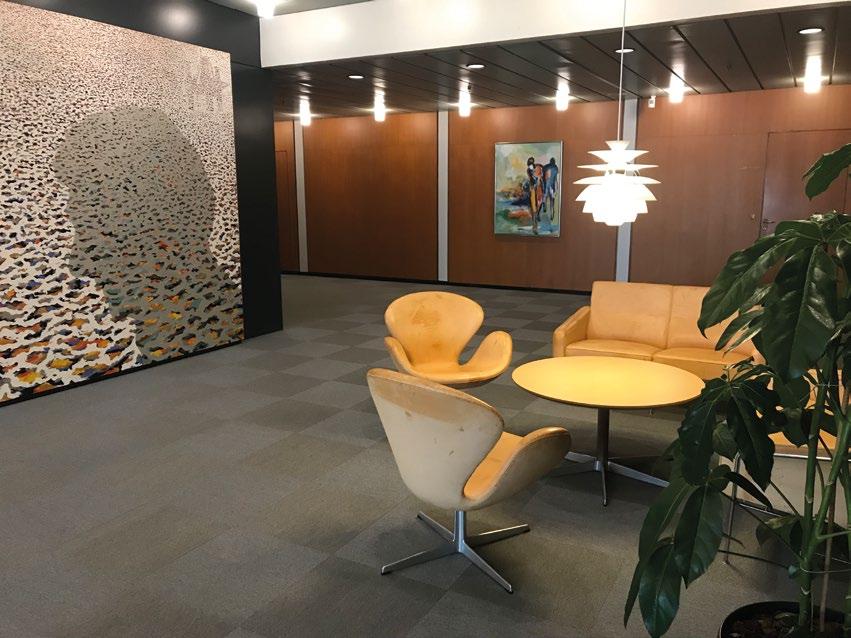
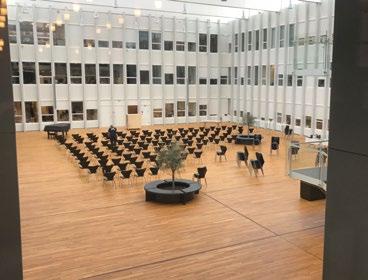
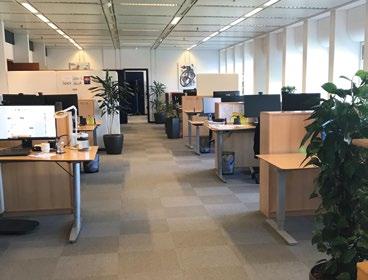
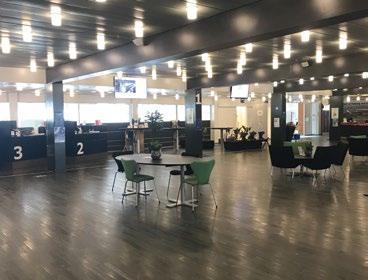
Figure 2: Selected views of the town hall. Page 13.
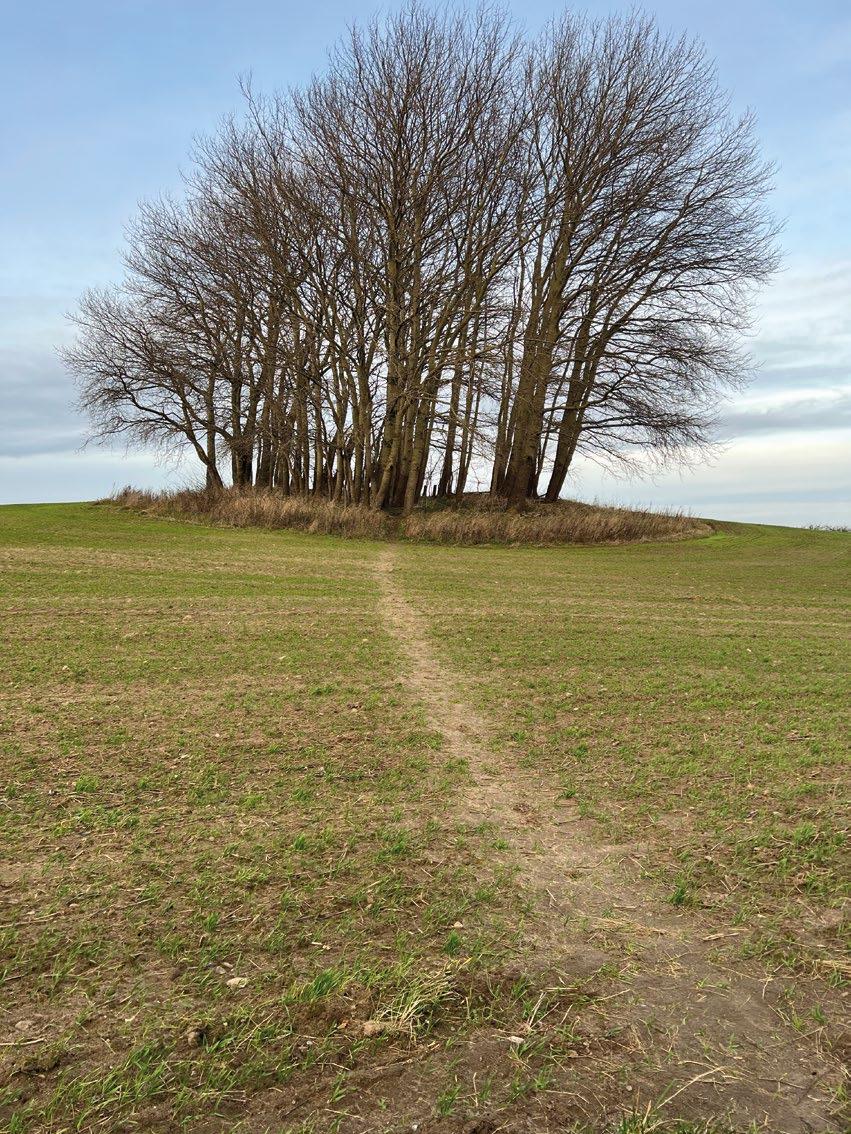
Figure 3: Selected view from a rural area in the mobility case. Page 15.
Figure 4: Theoretical landscape orienting this dissertation and its appended publications. The orienting landscape foregrounds central design fields and methodological bridges that orient the research across the dissertation. Broader ontological, epistemological, and ethical orientations (including posthumanist, pragmatist, and reflexive traditions) shape the work without constituting discrete fields within the figure. References are abbreviated for visual clarity; see the reference list for complete citations. Visualization by Alexandra Lindek / Graphic design by Maximilian Schmidauer. Page 25.
Figure 5: Reprinted from Ceschin, F., & Gaziulusoy, I. (2020). Design for sustainability: A multi-level framework from products to socio-technical systems (figure 12.4, p. 149). Routledge. Licensed under CC BY-NC-ND 4.0. Page 26.
Figure 6: Reprinted from Ceschin, F., & Gaziulusoy, I. (2020). Design for sustainability: A multi-level framework from products to socio-technical systems (figure 12.5, p. 164). Routledge. Licensed under CC BY-NC-ND 4.0. Page 34.
Figure 7: Timeline of cases with associated events and activities. Visualization by Alexandra Harder Lindek / Graphic design by Maximilian Schmidauer. Page 52-53.
Figure 8: Overview of empirical and analytical work with case experiments and approach adaptations. Visualization by Alexandra Harder Lindek / Graphic design by Maximilian Schmidauer. Page 60-61.
Figure 9: Relay conversations and relay strings in the town hall case. Circles represent individual relay conversations, and connecting lines indicate the sequence and number of conversations within each string. Visualization by Alexandra Harder Lindek / Graphic design by Maximilian Schmidauer. Page 62.
Figure 10: Illustrative facilitation guide for town hall case relay conversations. Visualization by Alexandra Harder Lindek / Graphic design by Maximilian Schmidauer. Page 63.
Figure 11: Example of the online whiteboard as a shared workspace in a town hall relay conversation (See also Publication 1). Visualization by Alexandra Harder Lindek. Page 64-65.
Figure 12: Example of an online relay string for sharing and following batons (See also Publication 1). Visualization by Alexandra Harder Lindek. Page 67.
Figure 13: Analytical lenses with example stories from the relay conversations (See also Publication 1). Visualization by Alexandra Harder Lindek. Page 67.
Figure 14: Relay conversations and relay strings in the coffee case. Circles represent individual relay conversations, and connecting lines indicate the sequence and number of conversations within each string. Visualization by Alexandra Harder Lindek / Graphic design by Maximilian Schmidauer. Page 68.
Figure 15: Example from online relay conversations in the coffee case (anonymised). Page 68.
Figure 16: Illustrative facilitation guide for coffee case relay conversations. Visualization by Alexandra Harder Lindek / Graphic design by Maximilian Schmidauer. Page 69.
Figure 17: Example from online relay conversations in the coffee case (anonymised). Page 70.
Figure 18: Selected examples from a relational analysis highlighting frictions in the coffee case. Visualization by Alexandra Harder Lindek / Graphic design by Maximilian
Schmidauer. Page 71.
Figure 19: Clustering of innovation partners based on their use of coffee by-products. Visualization by Alexandra Harder Lindek / Graphic design by Maximilian Schmidauer. Page 72.
Figure 20: Clustering of innovation partners based on the type of by-product used. Visualization by Alexandra Harder Lindek / Graphic design by Maximilian Schmidauer. Page 72.
Figure 21: Relay conversations and relay strings in the mobility case. Circles represent individual relay conversations, and connecting lines indicate the sequence and number of conversations within each string. Visualization by Alexandra Harder Lindek / Graphic design by Maximilian Schmidauer. Page 73.
Figure 22: Pre-conversation touchpoints. Visualization by Alexandra Harder Lindek / Graphic design by Maximilian Schmidauer. Page 74.
Figure 23: Artefacts used to support discussion and collect insights in the mobility case, including a whiteboard, pens, magnets, a mobile photo printer, and consent forms. Page 75.
Figure 24: Selected images from a workshop with the municipalities in the mobility case. Photographs by Morten Krogh Petersen. Page 76.
Figure 25: Selected images illustrating department-specific coffee solutions. Page 78.
Figure 26: Examples from the rural mobility case showing a local “secret place” meaningful to Stine’s daughter and her friends. Photographs by Mathias Poulsen. Page 82.
Figure 27: Ceschin and Gaziulusoy’s three-dimensional framework for Design for Sustainability, comprising innovation level, scope of design intervention, and framing of the design problem. The figure is revisited here to support the analysis and discussion of the empirical cases. Reprinted from Ceschin, F., & Gaziulusoy, I. (2020). Design for sustainability: A multi-level framework from products to socio-technical systems (figure 12.5, p. 164). Routledge. Licensed under CC BY-NC-ND 4.0. Page 145.
Figure 28: Correlation between sub-questions, key concepts and synthesised relational insights. Visualization by Alexandra Harder Lindek / Graphic design by Maximilian Schmidauer. Page 153.
1.O
1.3 Living through
1.4 Design and Sustainability mes:
1.6 Designing
Designing in a Relational
(1) THREAD: Textile Hub for Refugees’ Empowerment, Employment and Entrepreneurship Advancement in Denmark. This was a nationally funded project (Innovation Fund Denmark, Grand Solutions) running from March 2017 to November 2019. In the DSKD part of the project, my colleagues Solveig Berg Søndergaard, Else Skjold, and I worked alongside women affected by displacement and migration in Kolding, aiming to support their empowerment, within the project’s institutional framework that sought to enable pathways towards employment.
Beep, beep! A text message pops up on my screen. The sender this Saturday evening is a woman participating in a project I’m working on.1 Contact. I hope she’s okay. The message says: “Is this colour okay?” accompanied by a high-five, a smiley, and a heart emoji, and a photo of crocheted elements for a baby mobile.
Sitting on my sofa (movie on pause), I smile. Though work-related, it doesn’t feel like work—more like a friend reaching out. I find myself thinking about the days until we meet again. She is waiting for my response to continue, and Thursday afternoon feels too far away. The participation that unfolds through this project is a deeply relational matter.
I wonder if the task we’ve set ourselves is too ambitious. What if we fail? What if we don’t have enough items for the upcoming pop-up shop? Other such what ifs come to mind.
We really don’t want to disappoint these brave and skilled women. We’re on a shared journey of ups (well-made textile crafts, smiling eyes, and moments where we meet as equals) and downs (experiences of trauma linked to displacement, navigating the Danish welfare system, and striving for agency).
I can’t quite grasp it, but this moment of her reaching out—daring to trust, to expect something—feels fragile. How do I find the balance between showing care and creating space for empowerment and agency? This moment is not something you can plan, design, or measure. I only have my inner compass.
To accommodate this, my time for connection can’t be limited to certain hours or specified frames. I know her story; we’ve laughed together, and hugged when the war in her home country reignited or when the welfare system proved too rigid for humans. Now she’s putting all her energy into this work. The severe back pain leaves her body when she crochets, she has told me.
The contact, the sense of connection, is crucial. It goes beyond the professional. It’s about trust, mutual interest, and friendship. A relational matter. I feel a sudden rush of goosebumps, a quiet recognition of something deeply human enacted between us. I am only slowly beginning to sense these bodily engagements as essential to how I navigate as a designer.
Experiences like this did not yet have a name or a method, but they shaped my attention. They made me increasingly curious about how design practice unfolds through relations, timing, responsiveness, and care—and how such moments resist being planned, standardised, or neatly accounted for. They also raised questions about sustainability understood not only as outcomes but as ongoing ways of engaging with people, practices, and everyday life. These experiences form the experiential backdrop for this PhD project.
(2) I deliberately avoid fixed categorical labels here, as the women I met through this project cannot be reduced to administrative or national identities. Instead, I refer to them through the situated practice and relations that brought us together.
Every week, for more than a year, we met in a textile-based empowerment project with women who had arrived in Denmark from different parts of the world.2 We shared our passion for textile arts and crafts, using the medium as a space for exchange, even without a common linguistic language at first. Without ever putting it into words, it was our way of creating space for empowerment through deep, embodied engagement. Later, I realised how this kind of connection expanded not only the women’s networks but also our mutual capacity to change through each other’s stories.
The questions raised in this narrative form the starting point of this dissertation. They concern what should be recognised as design in such situations and what it means to design when the work primarily unfolds through relating rather than through producing tangible outputs. From the outside, the project could easily be described as a series of textile workshops; however, the textile crafts functioned mainly as a shared ground—a means rather than the core of the work. What came to matter most was not the facilitation of workshops as such but the ongoing navigation of relations, moods, expectations, and vulnerabilities—entanglements of family, culture, background, politics, religion, everyday life, materials, and skills. These entanglements unfolded within the group, between individual women, and across institutional and organisational contexts. This required continuous sensing, careful adjustment, and judgement—it was what the situation called for. It made me question not only how to navigate such situations but also why this kind of work might be understood as a designerly responsibility rather than something peripheral to design.
One participant described the experience as follows: “I feel happy and I am doing something important. I feel proud inside me, because I haven’t done this before” (Fatemeh, personal communication, 20 Dec 2018, 0:32). Statements like this pointed to forms of change that could not be reduced to skills acquisition or economic outcomes alone. This ongoing engagement, marked by moments of trust, sensing, and mutual adjustment, gradually shaped the methodological and ethical questions that this dissertation takes up.
1.2
Shaping a Design Foundation: From Practice to Epistemology
The journey of developing what would later be articulated as the relay conversation approach began years before this PhD project. It was not something I had planned, nor could I articulate it with meticulous
(3)(2005–2010) BA & MA in fashion, Kolding School of Design.
intensions at the time. One could, however, say that having observed and experienced the fashion industry and its lack of a systemic (social, cultural, and ecological) and regenerative mindset, I was more than ready to engage in alternative ways of designing.
At this stage, what caught my curiosity was glimpses or moments of what I would now describe as thinking or imagining otherwise together. These were moments when I questioned what was happening between myself, my colleagues, other project participants, and case situations. I also reflected on how my role as a design-practitioner was changing. Looking back, these moments proved to be the most crucial points in the projects, enabling the breaking of barriers as well as the creation of new connections and infrastructures that supported imagining otherwise together.
Perhaps it has been a dawning transition, but with a background in fashion design,3 my initial practical foundation was informed by a shift from user-centred to participatory design (Sanders & Stappers, 2008), while still largely grounded in a rational, solution-oriented understanding of design aligned with an epistemology in which existing situations are changed into preferred ones (Simon, 1969/1996). This foundation encompassed both practical engagement and theoretical frameworks. In the following, I trace these formative influences and their epistemological implications, highlighting the threads that continue to shape my approach to design today. While Simon (ibid.) conceptualised design as rational problem solving, Lawson (1980/2005) emphasised its cognitive and iterative nature—a process that navigates open-ended situations and allows for intuition alongside analytical reasoning. Within the Scandinavian design ethos, characterised by participation, collaboration, and social responsibility (Binder & Brandt, 2008; Redström, 2006), this foundation was further informed by Archer’s (1979) conception of design as a distinct human mode of knowing alongside science and art, which later contributed to Cross’s (1982) articulation of designerly ways of knowing. While these perspectives offered important grounding, they also left open questions about how design knowledge emerges in practice, particularly in situations characterised by relational complexity and uncertainty.
Alongside these more formal accounts of design knowledge, my own practice increasingly drew attention to how knowing emerged through engagement with materials and situations. In this sense, Schön’s (1983) idea of designing as a conversation with the materials of a situation (p. 78) resonated deeply with my own explorations at the time, for instance through 3D modelling and recordings of textile movement on the body, practices in which knowledge emerged through material engagement and reflection-in-action. This reframing of design as a reflective and situated practice paved the way for broader understandings of design’s scope and responsibility. Building on Rittel and Webber’s (1973) notion of wicked problems, Buchanan (1992) expanded design’s
1.3
horizon from problem-solving towards systemic and contextual understanding, situating it as a mediating discipline between theory and practice.
Later, participatory and co-design approaches (Sanders & Stappers, 2012) would further embody these shifts—from rational problemsolving to relational and contextually grounded design practices, a movement that would later become central to the development of the relay conversation approach.
Collectively, these reflections on design practice and its relational, context-sensitive nature highlight that design does not happen in isolation. They point to the importance of understanding how human and more-than-human worlds are entangled—a perspective that frames the challenges explored in the following section.
Life on Earth is out of balance (IPCC, 2023; Planetery Boundaries Science, 2025; Rockström et al., 2009; Whitmee et al., 2015); you can sense it in what seem like the tiniest phenomena (the disappearance of bees and beetles, shifts in soil microbiomes, and altered rhythms of seasons, flowering, and migration), and you can feel, see, and hear it on larger scales (extreme weather events, droughts, hunger, and forced migration). However, this is not about mastering hierarchies or identifying single causes. Across disciplines, scholars increasingly point to how social, ecological, and material processes are deeply entangled and mutually dependent. As Morin (2018) writes, “we share the same fate as the Earth” (p. 5).
The systemic interdependencies that sustain life have become increasingly visible through overlapping crises: climate breakdown, biodiversity loss, rising socioeconomic inequality, precarity in the labour market, geopolitical conflict, and the overexploitation of natural resources (IPBES, 2019; IPCC, 2023; Riddle et al., 2024; Standing, 2011; see also Conceição, 2024 for UNDP’s articulation of geopolitical conflict and resource exploitation). Morin and Kern (1999) referred to these interrelated and mutually reinforcing crises as a polycrisis. More recently, and along the same lines, Lawrence et al. (2022) have described how “global systems become causally entangled in ways that significantly degrade humanity’s prospects” (p. 2). I would extend this to include the prospects of flourishing lives—human and more-than-human alike. Seen through this lens, hierarchies of value and logics of control rooted in managerial or technocratic approaches offer little help (Tsing, 2015). Our printed paper savings or digital coins—symbols of human progress—cannot restore mutual flourishing (Kimmerer, 2024; Raworth, 2017). Acknowledging that human beings bear responsibili-
ty for much of this imbalance, Morin’s (2018) reminder becomes ever more urgent: “the awareness of our participation in the complex web of the Planetary Era” (p. 5) cannot stand alone, but needs to be coupled with “the perception of the struggle attending this turn of the millennium” (ibid.).
The global crisis is overwhelmingly complex, yet small, situated adjustments may open possibilities for change (Folke, 2016; Gibson-Graham, 2006; Walker & Salt, 2006). Since transitions unfold in everyday life, several scholars have argued for attending to the scale of local, mutual interdependencies, where social, material, and ecological systems meet (Akama et al., 2020; Escobar, 2018; Manzini, 2015).
The small things we do every day, the systems we are part of, and the structures we have built around us have brought us to where we are. We may not be able to plan our way out through predefined solutions; systems evolve as we do. Instead, cultivating iteration as a principle of resilience may offer a way to move with change rather than against it (Folke, 2016; Walker & Salt, 2006).
Responding to entangled crises is therefore less about predefined solutions than about how ways of living, relating, and acting are continuously shaped and reshaped in situated contexts. In this project, hope is therefore not treated as an abstract ideal but as something that emerges through situated practices of acting, sensing, and imagining otherwise together (Braidotti, 2019; Escobar, 2018; Freire, 1994/2021; Haraway, 2016; Wahl, 2016/2022)
Design has long been implicated in shaping how societies organise production, consumption, and everyday life. Through technologies, infrastructures, services, and practices, design is intertwined with the social, material, and ecological systems that underpin contemporary ways of living. Thus, in the context of accelerating environmental degradation and widening social inequalities, questions of sustainability have become increasingly central to design research and practice. This view builds on longstanding accounts of design as a practice that actively shapes social organisation and everyday life (Buchanan, 1992; Manzini, 2015) and as a field deeply implicated in the ways in which worlds are continuously made and remade (Escobar, 2018).
In this dissertation, sustainability is approached not as a predefined goal, metric, or end state to be achieved but as an ongoing, situated practice. It unfolds through everyday decisions, relations, and interventions across time and across social, ecological, and material domains. Sustainability then becomes less about optimising isolated outcomes and more about sustaining relations, capacities, and possibi-
lities for flourishing within and across interconnected socioecological systems. This processual and relational understanding of sustainability resonates with accounts that foreground sustaining everyday practices and relations rather than achieving abstract targets (Kimmerer, 2024; Manzini, 2015).
This understanding aligns with growing critiques of solutionist and technocratic approaches to sustainability, which tend to frame complex socioecological challenges as problems that can be addressed through targeted interventions or technological fixes (Raworth, 2017). While such approaches may offer short-term improvements, they often fail to engage with the relational, cultural, and structural dynamics through which unsustainable conditions are continuously reproduced. As Tsing (2015) provocatively asks, what if “precarity, indeterminacy, and what we imagine as trivial are the center of the systematicity we seek” (p. 20)?
Design, when understood as a situated and relational practice, offers a different mode of engagement with sustainability challenges. Thus, as opposed to operating from a distance or imposing predefined solutions, design practices can work from within complex contexts, engaging directly with the entanglements of people, materials, institutions, technologies, and environments. In this sense, design becomes a way of attending to how practices, values, and relations are shaped and reshaped over time. This view of design as a situated and relational practice aligns with accounts of design as an ontological activity, shaping ways of being, knowing, and doing through material and social arrangements (Escobar, 2018).
This orientation positions design as particularly relevant in the context of transitions. Transitions towards more sustainable ways of living are not singular events or linear processes but gradual, uneven, and often contested transformations that unfold across multiple scales. They involve shifts in practices, norms, infrastructures, and worldviews, and they require forms of engagement that can hold uncertainty, plurality, and change. Along the same lines, Kossoff (2015) argues that transitions towards more sustainable ways of living involve interrelated shifts across domains of “political, technological, cultural, social, economic, and ecological” (p. 2) life. From this perspective, transitions are best understood not as linear pathways but as holistic and emergent processes in which parts and wholes are mutually constituted over time (Kossoff, 2015).
From this standpoint, the relevance of design lies not only in its capacity to propose alternatives but in its ability to participate in and support ongoing processes of transition. If sustainability is understood as something that is continuously made and remade in practice, design may be understood less as the production of discrete artefacts or solutions and more as an ongoing mode of engagement with complexity, responding to emerging conditions, and navigating relations over time.
1.5
This raises a critical question that guides the following section: if sustainability is approached as a situated, relational, and ongoing practice, what does this require of design—and how, in turn, might design itself need to be rethought?
Building on the understanding of sustainability as an ongoing, situated practice, this section turns to a more fundamental question: what, then, might design be in such contexts? While design is often associated with the creation of tangible artefacts, services, or solutions, the situations addressed in this dissertation challenge such bounded understandings. Across complex and entangled socioecological contexts, design work does not always take the form of clearly delineated interventions, nor does it necessarily culminate in recognisable design outputs.
Instead, these contexts prompt renewed questions about what should be recognised as design, who or what participates in designing, and where design takes place. Such questions were already introduced in the opening narrative of this dissertation, but they resurface here with renewed urgency in light of sustainability understood as relational, ongoing, and contested. This perspective resonates with views that foreground design as an ongoing, relational practice shaping social and material worlds (Escobar, 2018; Manzini, 2015).
Across the projects informing this PhD, design work often unfolded through subtle acts of relating, timing, and attunement rather than through the production of discrete design outcomes (Schön, 1983; Suchman, 1987). Design took place in how situations were held open, how conversations were initiated or paused, how attention shifted between actors, and how emerging concerns were responded to rather than predefined. Drawing on Ingold’s (2013) concept of attentive engagement with environments, these practices required sustained attention to interactions and unfolding dynamics.
In this sense, design involved adjusting tempo, sequencing participation, and navigating when to intervene and when to refrain. Such practices foreground responsiveness over control and suggest a form of design that operates between actors, practices, and contexts. Design, here, becomes a matter of facilitating conditions for something to emerge rather than determining in advance what that something should be (Akama & Light, 2018). Specific examples of these practices are returned to in Section 1.7 and Chapter 3.
Such an understanding points to a broader potential of design in contexts marked by entanglement and polycrisis. When challenges are interconnected, uncertain, and unfolding across scales, design cannot be reduced to problem-solving or solution delivery. Instead, its potential lies in navigating complexity, working with partial knowledge, and engaging with situations as they evolve. This orientation resonates with Tsing’s (2015) emphasis on precarity and indeterminacy as central to understanding complex, entangled systems.
Here, design becomes less about resolving complexity and more about staying with it—sensing tensions, negotiating differences, and supporting collective capacities to respond. This reframing aligns with perspectives that view design as an ongoing and situated practice of sense-making and world-shaping within conditions of uncertainty and interdependence (DiSalvo, 2022a; Puig de la Bellacasa, 2017).
Within this framing, the role of the designer-researcher also shifts. In favour of acting as an external expert defining problems and proposing solutions, the designer becomes implicated in the situations they engage with. Designing and researching involves being attentive to one’s own positioning, assumptions, and interventions as well as to how these shape what becomes possible in a given context.
This reflexive stance does not seek neutrality but acknowledges that design practice is always situated and partial. Recognising this is not a limitation but a condition for engaging responsibly with complex and entangled situations. As Carl DiSalvo (2022a) argues, engaging with the speculative social requires designers to recognise the partiality of their interventions and the ways these participate in shaping collective possibilities. This view resonates with perspectives that foreground the ethics of care and relational responsibility in more-than-human worlds (Puig de la Bellacasa, 2017) and with understandings of living systems as entangled and self-organising (Capra & Luisi, 2014/2019).
Together, these reflections suggest that understanding design as relational, responsive, and situated requires a broader shift in how knowledge, agency, and change are conceived—a shift that is explored more explicitly in the following section.
Design practice is shaped by underlying assumptions about the world (Schön, 1983). Historically, many design approaches have adopted a linear, technical-solution mindset, framing challenges as problems to be solved and outcomes as predetermined. By contrast, this dissertation adopts a relational, systemic, and regenerative worldview in which social, ecological, and material systems are understood as interdependent, dynamic, and continually evolving. Within this relational worldview, qualities are understood as arising “from processes and patterns of relationships” among interdependent parts (Capra & Henderson, 2009, p. 7). Adopting a relational and dynamic understanding of the world has important epistemological consequences for design. Such an orientation resonates with arguments that addressing sustainability in holistic terms requires more fundamental changes to how worlds are imagined, organised, and designed (Escobar, 2018). Consequently, design cannot be understood as a purely linear or fully preplanned activity. Instead, I approach design as situated, responsive, and attuned to the specific contexts in which it unfolds (cf. Akama & Light, 2018; Schön, 1983; Suchman, 1987).
This relational worldview is supported by the literature on systemic and regenerative transformations. Ceschin and Gaziulusoy (2020) highlight the importance of addressing sustainability across interconnected sociotechnical-ecological levels, while scholars such as Raworth (2017), Steffen et al. (2018), and Rockström et al. (2009) emphasise the need for non-hierarchical, interdependent approaches to enable meaningful transformation. This understanding resonates with ecological systems thinking, as articulated by Capra and Luisi (2014/2019), who describe this as a move “from the world as a machine to the world as a network” (p. 17), proposing an ecological view that “recognizes the fundamental interdependence of all phenomena, as we are all embedded in (and ultimately dependent on) the cyclical processes of nature” (p. 17).
Within this frame, regenerative design approaches become central. In the design field, regenerative design is often described as adopting a holistic viewpoint that “is biophilic, biomimetic, participatory, and closely tied to the uniqueness of particular places, aiming for co-evolution between humans and the rest of nature” (Buckton et al., 2023, p. 826, drawing on Camrass, Reed, and Wahl). Buckton et al. further emphasise that “fully regenerative futures depend on reciprocal relations between human and wider ecological systems” (2023, p. 831). In this dissertation, regenerative design is understood as aiming for net-positive, transformative impacts that actively restore and enhance social-ecological systems over time, moving beyond minimising harm
1.7
towards supporting the conditions for ongoing planetary health (Reed, 2007; Wahl, 2016/2022). Fitzpatrick (2025) further conceptualises regeneration as emerging through the interplay of worldviews, practices, and places, framed as nested and mutually influencing relations rather than discrete elements. Within this interpretation, sustainability is not simply about maintaining existing conditions but about enabling the emergence of new capacities, relations, and possibilities across social, ecological, and material domains—a move that resonates with calls for pluriversal and relational approaches to sustainability and transition (Escobar, 2018).
Viewed through this lens, design practice is approached as adaptive, relational, and experimental. Hence, linear planning and predefined outcomes become insufficient on their own; instead, design unfolds situationally, through engagement with emergent dynamics, the sequencing of participation, and the modulation of interventions in response to unfolding contexts (Akama & Light, 2018; Schön, 1983; Suchman, 1987). However, this has epistemological consequences: what counts as knowledge, expertise, or intervention in design becomes inherently situated, partial, and relational. Transitions are approached not as linear change processes or clearly bounded pathways but as ongoing, multi-scalar reconfigurations of relations across social, technological, cultural, and ecological domains. This understanding shapes how transitions are conceptualised in the dissertation and informed the ways in which the cases in this PhD were approached and carried out. The following section provides an overview of the design cases and publications included in the dissertation. Each is briefly introduced to clarify its focus, scope, and contribution, offering orientation before the theoretical and methodological sources are presented in Section 1.8 and the research questions are outlined in Section 1.9.
Together, the three design cases constitute the empirical foundation of this PhD. They function as the core research material and are unfolded through three publications, as well as through a cross-case discussion in the dissertation. While they differ in scale, context, and relational conditions, they are analytically connected through a shared concern with how designers engage in and support transitions as relational, situated, and ongoing processes. The cases are presented first, followed by an overview of the publications through which key insights and contributions have been developed and disseminated.
OVERALL PROJECT TITLE
INITIATOR(S)
PROJECT DURATION
OVERALL FRAMING
DESIGN AND RESEARCH INQUIRY
TITLE
TYPE
PUBLICATION VENUE
AUTHORS
CANDIDATE’S ROLE
New administrative work practices at Esbjerg City Hall – towards a future hybrid work culture
Esbjerg Municipality
June 2021 – May 2022
(relay conversations took place Oct – Nov 2021)
How can post-pandemic digitalisation, increased remote work, and a new town hall layout inform the development of new administrative working procedures and spatial arrangements?
How can designers support the development of new administrative working procedures by encouraging shared practices and a common work culture?
Better Lives, Better Coffee
Peter Larsen Kaffe (PLK), Löfbergs, and the Strategic Foresight for Sustainability project (SF4S)
Aug 2022 – Feb 2024
(relay conversations took place Mar – May 2023)
How can a transformation from a linear to a circular economy be realised within the coffee industry?
How can designers explore the conditions for collaboration and innovation in circular economy ecosystems?
Pleasures, participation or practices? Unpacking the black box of designing in and with organizations
Empirical-conceptual paper
Nordes 2023
This Space Intentionally Left Blank
Alexandra Harder Lindek, Morten Krogh Petersen
Responsible for paper development, writing, research material collection (data), analysis, and synthesis as main author. Guidance on paper framing and data analysis co-conducted with co-supervisor Morten Krogh Petersen.
[Figure 1]: Overview of cases and publications (see Appendix for author statements).
Relational Frictions in Circular Economy Ecosystems: Designing for Transformative Futures
Empirical research article
Strategic Design Research Journal
Alexandra Harder Lindek, Morten Krogh Petersen, Sune Klok Gudiksen
Responsible for paper development, writing, research material collection (data), analysis, and synthesis as main author. Guidance on framing and analysis from co-supervisor, Morten Krogh Petersen and main supervisor, Sune Klok Gudiksen.
Mobility Makers (MM): Customising sustainable mobility mixes to fit users’needs (in rural areas)
Region Midt and the Mobility Makers project
Nov 2023 – Oct 2027
(relay conversations took place Sep 2024 – Jan 2025)
How can everyday mobility practices in rural areas be transformed through a deeper understanding of citizens’ needs developed in place-based living labs?
How can designers employ relay conversations to inform the development of context-sensitive living labs in rural areas?
Designing for relay-tional co-becoming
Methodological-conceptual paper
Nordes 2025 Relational Design
Alexandra Harder Lindek, Mathias Poulsen
Responsible for paper development and writing as main author. Research material (data) collected jointly with co-author Mathias Poulsen, with whom guidance and feedback on paper framing and analysis was co-conducted; additional feedback on refinement provided by supervisor Sune Klok Gudiksen.
1.7.1
Empirically, this PhD is anchored in three design cases selected for their capacity to support an inquiry into relay-oriented, relational design practices across different transition conditions. Rather than being chosen to represent specific sectors or contexts, the cases were selected because they offered distinct opportunities to engage with situated transitions through varying forms of proximity, relational entanglement, and uncertainty.
Collectively, the cases enable an exploration of how relay-oriented design practices unfold when designers engage closely with established organisational routines, with distributed actors across a global value chain, and with open-ended everyday practices in place-based community contexts (municipal administration, a coffee value chain, and rural mobility practices). Across these settings, the cases allowed for sustained engagement with transitions as relational processes—shaped by existing relationships, institutional constraints, and emergent dynamics—rather than as predefined change trajectories (see Figure 1).
Importantly, the cases also differ in terms of the designers’ prior relationships and modes of engagement, ranging from prior collaboration with parts of the organisation, through mediated and distance-based engagement, to entering contexts with no prior relational ties. This variation made it possible to examine how designerly engagement, attentiveness, and intervention shift depending on relational conditions.
Below, I provide a brief overview of each case, focusing on what each case made possible to explore in relation to the research question. Together, they form the empirical grounding for the methodological and analytical discussions developed in Chapters 3–5.
This case offered a setting for exploring how relay conversations can support designers in facilitating transitions within a relatively bounded organisational context characterised by established routines, formal structures, and strong institutional responsibilities. It provided an opportunity to engage closely with how everyday practices, shared meanings, and work cultures shift during periods of organisational change.
Initiated by Esbjerg Municipality, the project
addressed how post-pandemic digitalisation, increased remote working, and a new town hall layout could inform the development of new administrative working procedures and spatial arrangements. While anchored in the physical setting of the town hall, the organisational practices under transformation were deeply entangled with wider urban relations, including citizen contact, casework, and the administration of public rights and services. In this sense, the organisational transition extended well beyond the building itself and into the city.
The case was characterised by close and sustained engagement. I acted as project lead and, together with colleagues, facilitated all relay conversations while maintaining ongoing dialogue with the steering group and related working groups. Previous collaboration with parts of the organisation meant that the work unfolded within an existing relational fabric, allowing for situated, trust-based engagement. This case made it possible to examine how relay-oriented design practices can support the reconfiguration of established routines and shared practices through relational sense-making in an organisational transition context.
This case created an opportunity to explore relay-oriented design engagement within a global, linear value chain undergoing a transition towards circular and regenerative practices. It enabled close interaction with a sustainability frontrunner company and its partners while attending to the frictions that arise when established business operations must coexist with long-term transformative ambitions.
Initiated by Peter Larsen Kaffe (PLK), Löfbergs, under the Strategic Foresight for Sustainability (SF4S) project, the case focused on how collaboration and innovation might be fostered within the coffee industry as it navigates a shift from linear to circular economic models. Rather than observing the transition from a distance, the project allowed for active engagement with internal organisational dynamics, innovation agendas, and value-chain relations at a moment where “business as usual” and experimental sustainability initiatives were tightly interwoven. The engagement was characterised by mediated and distance-based relationships. My relationship with Peter Larsen Kaffe was established through my principal supervisor’s prior collaborations with the company, which shaped both access and positioning. While the project was initially envisioned as a longitudinal engagement, organisational changes and the emergence of a spin-off company limited the possibility of continuing experimental interventions. Nevertheless, the case offered a valuable setting for examining how relational design practices operate when designers engage across organisational boundaries and at a distance, and how relay-oriented sensibilities can support the exploration of interdependencies and tensions within sustainability transitions.

This case provided an opportunity to engage with transitions as open-ended, emergent processes unfolding within everyday life across rural communities. It allowed for the exploration of relay conversations in contexts characterised by diffuse social networks, less clearly bounded actor constellations, and strong entanglements between mobility practices, place, and lived experience.
Initiated by Region Midt as part of the Mobility Makers project, the case addressed how everyday mobility practices in rural areas might be transformed through place-based living labs. Rather than focusing on predefined solutions or infrastructures, the project enabled engagement with mobility as a relational and more-than-human practice shaped by habits, landscapes, social relations, and access to resources. This broader understanding of mobility opened space for less tightly scripted forms of engagement and experimentation.
Unlike the town hall and coffee cases, I entered this context without prior relationships with the participating communities. Collaboration was established through my co-supervisor’s involvement in
the wider Interreg project and through coordination with the regional project partners. This lack of prior relational grounding made the case particularly generative for examining how designers attune, build relationships, and engage relationally when transitions unfold under conditions of uncertainty, emergence, and ongoing negotiation. The case thus offered a setting for exploring relay-oriented engagement as a way of “acting with” evolving practices rather than steering predefined change trajectories.
While the design cases form the empirical grounding of this PhD, the insights generated through these engagements are articulated and examined through the three publications presented below. Together, the cases and publications form an interwoven structure In which situated design practice, methodological reflection, and theoretical development mutually inform one another across the dissertation.
Publications 1.7.2
This PhD is structured as a dissertation by publications and comprises three peer-reviewed publications, which are briefly introduced here and presented in full in Chapter 4 (see Figure 1 for an overview of cases and publications).
The publications address different aspects of the overarching research question, and each draw primarily on empirical material and insights from one design case. While they can be read as standalone contributions, I situate, connect, and critically reflect on their findings across the surrounding chapters. In particular, in Chapters 3 and 5, I elaborate the methodological foundations, cross-case analysis, and theoretical discussion that extend beyond the scope of the individual publications and allow additional insights to emerge across the body of work.
Lindek, A. H., & Petersen, M. K. (2023). Pleasures, participation or practices? Unpacking the black box of designing in and with organizations. In S. Holmlid et al. (Eds.), Nordes 2023: Linköping University. https://doi.org/10.21606/nordes.2023.120
Publication 1 develops a relational approach to designing in and with organisations through the town hall case. The paper challenges dominant methodological and cognitive perspectives in design management by showing how designerly contributions emerge through relations between designers and organisational practices over time. It introduces three modes of designing—designing for pleasure, participation, and sociomaterial practices—as a way of critically examining what designers and organisations can achieve together during organisational change.
Publication 2
Lindek, A. H., Petersen, M. K., & Gudiksen, S. K. (2023). Relational frictions in circular economy ecosystems: Designing for transformative futures. Strategic Design Research Journal, 16(3), 295–314. https://doi.org/10.4013/sdrj.2023.163.02
Publication 2 analyses relational frictions within circular economy ecosystems through the coffee case, focusing on how agency shapes collaboration and innovation across a global value chain in transition. The paper shows how frictions—emerging from entangled human and more-than-human relations—both challenge and enable transformative change and argues for participatory design approaches that can engage productively with these tensions in sustainability transitions.
Publication 3
Lindek, A. H., & Poulsen, M. (2025). Designing for relay-tional co-becoming. In E. Brandt, T. Markussen, E. Berglund, G. Julier, & P. Linde (Eds.), Nordes 2025: Relational design, 6–8 August, Oslo, Norway. Oslo School of Architecture and Design. https://doi.org/10.21606/nordes.2025.21
Publication 3 serves as a methodological and analytical contribution that develops the relay conversation approach as a relational design practice oriented towards co-becoming. Drawing primarily on the Mobility Makers case, the paper explores how designers engage with uncertainty, emergence, and evolving place-based relations and reflects autoethnographically on how such engagements challenge conventional understandings of designer roles and participation in futures-in-themaking.
This dissertation approaches relay conversations not as a fixed method but as a relational, systemic design practice that requires attunement to when relations are ready to move. To study such practices, it draws on a constellation of design-theoretical perspectives and orientations that foreground relationality, participation, and situated transitions over predefined outcomes.
The dissertation draws on a constellation of theoretical and methodological perspectives that together support an inquiry into relayoriented, relational design practice in situated transitions. These perspectives have been selected not to offer a comprehensive theory of design or transition but to foreground particular ways of attending to
relations, practices, and emergent as they unfold in practice.
At the core of this constellation are perspectives from systemic design, relational design, and co-design. Systemic design provides a foundation for engaging with complex sociotechnical-ecological conditions and for understanding transitions as ongoing, interconnected processes rather than linear change trajectories (Irwin et al., 2015; Jones, 2014). Relational design foregrounds how design work emerges through relations—between people, practices, institutions, and material conditions—shifting attention from individual designers or methods to situated engagements and practices (Akama & Light, 2020; Barad, 2007). Co-design, also referred to as participatory design, further informs the project by emphasising participation, shared inquiry, and the ethical implications of designing with rather than for others (Ehn, 2008; Pickering, 2022; Sanders & Stappers, 2008).
Across these perspectives, the dissertation is guided by three orienting lenses: resilience, interdependence, and emergence. These concepts function as sensitising orientations that support attention to how practices endure and adapt over time (resilience), how actors and conditions are mutually entangled (interdependence), and how new possibilities arise through relational dynamics rather than predefinition (emergence) (Folke, 2006; Loorbach et al., 2010; Meadows, 2008). Together, they help frame transitions as situated, relational, and contingent processes.
Methodologically, these theoretical orientations are closely intertwined with ethical and practical considerations emerging from design practice. With this dissertation, I foreground the designer-researcher’s positionality as an integral and performative dimension of inquiry, emphasising attentiveness to participation, intervention, and presence. This includes an ongoing negotiation of openness, accountability, and ethical care in situations where designers actively engage in shaping relations and futures-in-the-making (Gottlieb, 2024).
Together, these theoretical and methodological sources support an understanding of relay conversations not as a generalisable technique but as a relational, systemic design practice that requires attunement to timing, context, and relational readiness. This orientation provides the foundation for the research question introduced in the following section, which asks how a relay conversation approach can support designers in facilitating situated transitions towards other ways of living.
1.9.1
Building on the theoretical and methodological considerations outlined above, in this dissertation I explore how relay-oriented design practices can support designers in facilitating situated transitions towards other ways of living. Rather than treating relay conversations as a fixed method, I approach them as a relational, systemic design practice that requires attunement to timing, context, and relational readiness.
The overarching research question guiding this work is: How can a relay conversation approach support designers in facilitating situated transitions towards other ways of living?
This question is unfolded through a set of interrelated sub-questions that articulate the dimensions of practice, method, and ethics that the dissertation seeks to examine. I ask what roles, competencies, and sensitivities designers need in order to enact relay-oriented approaches in support of situated transitions; how such approaches can be shaped and facilitated to cultivate interdependence, emergence, and resilience; how different systemic conditions can shape, challenge, or enable the practice; and what ethical implications arise from engaging in these situated, relational processes. Collectively, these questions connect the empirical cases, theoretical perspectives, and methodological reflections introduced in this chapter, emphasising that answers emerge across the dissertation rather than in a single chapter or publication.
This dissertation is structured to provide a coherent thread through theory, method, and practice while remaining transparent about the nonlinear, iterative nature of the research journey. Throughout the project, case experiments, dialogues with peers and colleagues, and engagement with the literature have entangled in unanticipated ways, shaping both the questions asked and the insights generated. I use “I” when describing my personal reflections and interventions and “we” to acknowledge the collaborative contributions of co-authors, colleagues, and participants—human and more-than-human—whose engagements were central to making the design experiments possible.
The chapters can be approached as follows:
• Chapter 2 (Field and Research Questions) introduces the constellation of design-theoretical perspectives, including systemic design, relational design, and participatory design, alongside the orienting lenses of resilience, interdependence, and emergence. These perspectives provide the conceptual grounding for the
empirical work and establish the lenses through which the cases are later examined.
• Chapter 3 (Research Design, Redesign, and Re-Redesign) unfolds the methodological grounding of the dissertation while tracing how the relay conversation approach evolved through pilot studies and the three cases (the town hall case, the coffee case, and the mobility case). This chapter foregrounds ethical considerations and the performative role of the designer-researcher, emphasising that approaches and practice co-emerged rather than following a predefined plan.
• Chapter 4 (Presentation of Publications) presents the three peer-reviewed papers, situating each publication within the evolving study and highlighting terminological and conceptual developments that occurred across the publications.
• Chapter 5 (Cross-case Discussion: Relational Patterns, Practices, and Critical Reflections) synthesises insights across the cases, examining patterns, frictions, and emergent possibilities while critically reflecting on methodological, theoretical, and practical implications. Throughout this discussion, the interplay and tension between systemic and relational design perspectives are traced, illustrating how these frameworks illuminate different dimensions of relay-oriented practice.
• Chapter 6 (Synthesis and Contribution) draws together the findings of this work to discuss the broader significance of relayoriented design practices, the ethical and practical dimensions of engaging in situated transitions, and the performative role of the designer-researcher. Each subsection engages with one of the sub-questions, generating a synthesis and highlighting the contribution of the work to design research and practice.
This structure is intended to orient the reader through the dissertation while hinting at the project’s nonlinear, emergent character. Although the chapters are presented in sequence, the research itself unfolded iteratively, with case experiments, literature engagement, and dialogue with peers and collaborators entangling in multiple, sometimes unpredictable ways. My hope is that this arrangement allows the reader to appreciate both the conceptual thread of the dissertation and the situated, exploratory nature of the work itself.
2.1.2 Early Approaches DfS 2.1.3 Conceptual Wicked
2.1.4 Nature-Inspired
2.1
This chapter establishes the theoretical foundation and positioning of the dissertation by situating the research within key developments in design for sustainability and by introducing conceptual and analytical positions that inform an understanding of design as a systemic, situated, and relational practice. Rather than offering an exhaustive review of sustainability-oriented design theories, the chapter foregrounds selected frameworks and concepts that make explicit my research positioning and underpin the conceptual and methodological choices developed across the dissertation.
I begin by outlining how Design for Sustainability (DfS) has evolved from a primary focus on environmentally informed product innovation towards broader sociotechnical and systemic perspectives. Building on this development, I introduce the framework by Ceschin and Gaziulusoy (2016, 2020), which serves as a structuring device for situating the three empirical cases (introduced in Chapter 1) in relation to different levels and framings of sustainability-oriented design interventions. In doing so, I draw on adjacent strands of design theory that address complexity and open-ended problem spaces, notably through the concept of “wicked problems“ and its continuing influence on design thinking.
While the DfS innovation framework (Figure 5, p 26) offers a helpful overview of how design interventions may operate across multiple system levels, it does not fully account for the situated, emergent, and processual qualities that characterise sustainability transitions in practice. To attend to these qualities, the chapter further introduces perspectives from transition design and systemic design for sustainability, foregrounding how designers engage with ongoing transitions through long-term infrastructuring practices. Together, these perspectives contribute to an understanding of sustainability transitions as relational and evolving processes, and they set the stage for articulating three interrelated orientations—resilience, interdependence, and emergence—as mutually shaping foundations for situated design engagement in transitions.
This conceptual and practice-oriented framing supports an understanding of sustainability transitions as dynamic, interdependent, and evolving processes and positions design as an attuned, engaged, and situated practice within them. The chapter concludes by presenting the overarching research question and associated sub-questions alongside a clarification of how I take up and address these questions across the dissertation’s chapters and publications.
Peschl, 2019
Simon, 1969
Sevaldson, 2010; 2015
Jones, 2021
Capra & Luisi, 2014
Capra, 1996
Morin & Kern, 1999
Systemic Design
Müller, 2021
Rockström et al., 2009
Walker & Salt, 2006
Irwin, 2015; 2018; 2022
Transition Design
Tonkinwise, 2011; 2015; 2023
Meadows, 1999; 2001; 2008
Buchanan, 2019 Vink, 2023
Pickering, 2022
Lee & Ingold, 2020
Bawaka Country et al., 2013; 2016
Marcus, 1995
Schön, 1983
Flyvbjerg, 2001
Kusenbach, 2003
Clarke, 2003; 2005
Gottlieb, 2024 Light, 2023
Suchman, 1987
Design Anthropology
Latour, 1992; 2005
Holman Jones, 2017
Steffen et al., 2018
Gaziulusoy & Brezet, 2015
Design for Sustainability
Ceschin & Gaziulusoy, 2016; 2020,; 2024
Loorbach et al., 2010
Walker et al., 2004
Pink, 2015 Folke, 2016
Hannerz, 2003
Despret, 2004; 2013
Stirling, 2015
Kossoff, 2015; 2019
Escobar, 2018; 2024
Haraway, 1988; 2016
Relational Design
Quist & Vergragt, 2004
Buckton et al., 2023
Kimmerer, 2024
Braidotti, 2012; 2019
Barad, 2007
Østern et al., 2021
Mol, 2002
Rabinow et al., 2008
Akama & Light, 2020 Akama, 2015
Ingold, 2013; 2021
Kjærsgaard et al., 2016
Binder & Brandt, 2008
[Figure 4] Theoretical landscape orienting this dissertation and its appended publications. The orienting landscape foregrounds central design fields and methodological bridges that orient the research across the dissertation. Broader ontological, epistemological, and ethical orientations (including posthumanist, pragmatist, and reflexive traditions) shape the work without constituting discrete fields within the figure.
References are abbreviated for visual clarity; see the reference list for complete citations.
Anderson, 2004
Fry, 2009; 2019
Manzini, 2007; 2014; 2015
Wahl, 2016 Ehrenfeld, 2019
Regenerative Orientations
Tsing, 2015
Akama & Yee, 2016
Light & Akama, 2014 Thahja & Yee, 2022
Bjögvinsson et al., 2012
Smith & Otto, 2016
Binder et al, 2011
Buur & Larsen, 2010
Raworth, 2017
Shove & Walker, 2007
Reed, 2007
Nielsen & Bjerck, 2022
Sanders & Stappers, 2008; 2012
Participatory Design
Ehn, 2008; 2009
Kensing & Greenbaum, 2012
2.1.1
Over time, DfS has evolved from targeted interventions at the product level to systemic approaches that address the interconnectedness of sociotechnical and ecological challenges. The following sections outline the key strands in that development, focusing on how the scope and orientation of DfS have expanded. The aim is to situate the cases in this dissertation within a widely used framework for DfS and to identify how different orientations foreground distinct capacities for transformation. In doing so, the section also foregrounds how different DfS orientations implicitly frame the roles of users, practices, and everyday contexts and how design interventions have sought to engage with these in different ways.
2.1.2
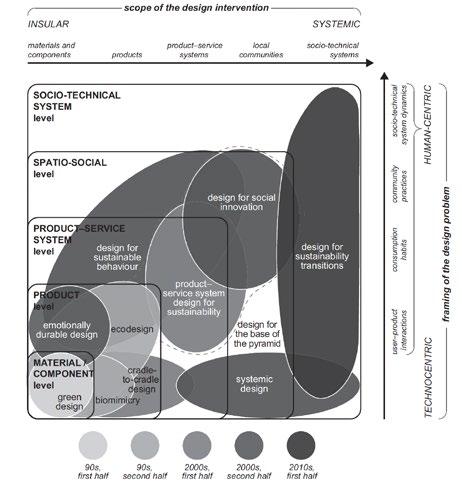
[Figure 5] Reprinted from Ceschin, F., & Gaziulusoy, I. (2020). Design for sustainability: A multi-level framework from products to sociotechnical systems (figure 12.4, p. 149). Routledge. Licensed under CC BY-NC-ND 4.0.
Since the late 1980s, when the first definitions of sustainable development were formulated (World Commission on Environment and Development, 1987), design has been recognised as a key driver in developing new sustainable strategies and models for production and consumption (Bhamra & Hernandez, 2021). From there, various approaches under the umbrella of Design for Sustainability (DfS) emerged, each reflecting different levels of intervention and orientations.
Initially, green design focused on environmental waste management, addressing material-level issues in the manufacturing industry through reduce-reuse-recycle principles. In parallel, approaches such as ecodesign emerged, expanding the perspective to include the technical environmental aspects of sustainability, such as energy efficiency, resource optimisation, and emissions reduction (see Figure 5 for an overview of approaches and indicative decades). While these early approaches helped establish environmental concerns as a core design issue, their scope remained limited. They tended to overlook the social dimensions of a product’s lifespan and use context and often treated sustainability challenges as technical problems, detached from broader patterns of behaviour, everyday practices, and systemic
2.1.3
change (Ceschin & Gaziulusoy, 2024). As such, these early DfS approaches had a limited scope, and transformative potential remained limited— prompting the development of more integrated and systemic perspectives that followed.
As the scope of sustainable design expanded, a parallel shift occurred within design theory, drawing attention to the inherently complex and contested nature of the problems designers engage with. Therefore, I will explore how this broader conceptual orientation within design theory has contributed to rethinking the scope and nature of design problems and laid the groundwork for later developments in systemic and relational design. This also provides a conceptual bridge to themes that recur across the field and to which I return later in the chapter, particularly the themes of emergence and interdependence. Around the same time, a broader awareness emerged within design theory that the kinds of problems designers engage with are not merely technical but fundamentally complex, unpredictable, and open-ended. In their influential article “Dilemmas in a general theory of planning“, Rittel and Webber (1973) introduce the distinction between “tame“ and “wicked“ problems, arguing that societal problems are embedded in “the ambiguity of their causal webs” and shaped by the “growing pluralism of the contemporary publics” (p. 167). Expanding on this, in his seminal essay “Wicked problems in design thinking”, Buchanan (1992) argues that design problems are often “indeterminate” and “wicked” in the sense that they resist definitive problem statements or fixed solutions. While Buchanan (1992) explicitly introduces wicked problems into design thinking, his contribution extends beyond the problem framing itself by reframing design as a situated, systemic, and interpretive human capacity. He further notes that “design has no special subject matter of its own apart from what a designer conceives it to be”, making design thinking potentially universal in scope (p. 16). This expansive understanding of design both enables engagement with complex societal challenges and introduces a productive tension: while design becomes harder to delimit as a discipline, it also gains relevance as a way of engaging with situations that resist stable definitions. While not explicitly addressing sustainability, Buchanan’s framing has since become foundational to understanding how design engages with ethically and socially complex challenges. While early formulations of wicked problems primarily emphasised interconnection instead of interdependence, they nonetheless opened up a problem space in
2.1.4
which design is understood as relational, contingent, and emergent rather than linear and controllable. As others have argued, design not only responds to the world but also actively shapes the conditions under which futures unfold, as design practices participate in configuring what and how future possibilities become imaginable and liveable (see, e.g., Fry, 2009). This conceptual turn anticipated a growing interest in how design relates to “signs, things, actions and thoughts” (Buchanan, 1992, p. 20) in ways that challenge disciplinary boundaries by foregrounding interconnections within design and across the sciences. As Engholm (2023) later argued, Buchanan’s four orders can be read not as successive replacements but as accumulating layers, a reading that aligns with contemporary concerns about planetary-scale complexity. It also laid the groundwork for later expansions of design practice, emphasising interpretation, invention, and contextual negotiation rather than predefined objectives—orientations that resonate with later conceptualisations of design as an emergent, situated, and relational practice (see, e.g., Bjögvinsson et al., 2012; Manzini, 2015; Tonkinwise, 2011).
As sustainability thinking in design began to expand beyond product efficiency and user–object relations, two influential approaches, cradle-to-cradle (C2C) and biomimicry, surfaced, each drawing on nature’s principles in distinct ways to inspire regenerative and systemic thinking. Cradle-to-cradle design envisions industrial systems that emulate natural regenerative cycles. It aims to create closed-loop systems where materials are treated either as biodegradable biological nutrients or as technical nutrients designed for continuous reuse without loss of quality or value (Bakker et al., 2010). This regenerative approach fosters innovation and proposes a positive vision of eco-effective design that shifts the narrative from reducing harm to generating benefit (Bjørn & Hauschild, 2013; Braungart et al., 2007).
C2C has contributed to the awareness and understanding of sustainable design, but its implementation in business and design practice has raised questions. While designers can explore and demonstrate C2C principles through pilot projects, it is more difficult when the implementation of the principles reaches into more strategic levels where the designer typically has no direct influence, such as restructuring production systems (Bakker et al., 2010). In addition, the approach has been criticised for its predominant focus on materials, for promoting technical solutions alone, and for its limited attention to whole lifecycle impacts, such as energy consumption (Bakker et al., 2010; Bjørn & Hauschild,
2.1.5
2013). Some scholars have also warned against a dogmatic application of the concept that overlooks situational and systemic complexity (Bakker et al., 2010; see also Ceschin & Gaziulusoy, 2016).
While C2C introduces regenerative principles and has been extended into product-service systems, its product-centric orientation may limit engagement with the social and relational dimensions, potentially bypassing opportunities to explore how design can shape shared values, behaviours, and collective futures across broader socioecological interdependencies.
Biomimicry draws inspiration from nature’s models, processes, and ecosystems to develop sustainable solutions to human challenges. It operates on three levels: mimicking natural forms, replicating biological processes, and emulating ecosystem dynamics (Benyus, 2008; Volstad & Boks, 2012). Like C2C, biomimicry supports waste elimination and closed-loop systems by aligning human production with nature’s regenerative principles. However, its technological optimism often focuses on radical material and process innovations while addressing problems in isolation through a product-focused engineering perspective. Although biomimicry’s emphasis on nature as a mentor aligns with strong sustainability principles, it does not inherently promote longterm planning, organisational mindset shifts, or explicit sociotechnical system transformations (Gaziulusoy, 2015; Mathews, 2011). Despite its emphasis on nature-inspired innovation, biomimicry often remains confined to technocentric applications, overlooking the relational and systemic complexities inherent in sustainability transitions.
By the late 1990s, the research field of DfS began to focus on increasing product lifetime through stronger emotional relationships between product and user both in order to keep products longer (Chapman, 2009; Jordan, 2000; Stahel, 1986; Van Hinte, 1997) and subsequent to investigate whether behaviour change theories could result in more mindful and sustainable behaviour during possessing a product (Lilley, 2009; Niedderer, 2007). While attention to product lifecycles and user behaviours expanded the sustainability perspective beyond the moment of purchase, the focus remained largely situated in the relationship between user and object. As such, the design intervention continued to centre around individual choices and consumer practices, often leaving systemic conditions and structural enablers unaddressed.
Simultaneously, Buchanan (2001) revisited and extended the “four orders of design” introduced in 1992 (see Section 2.1.3). He rearticulated the four orders as symbols, things, action, and thought, thereby expanding the scope of design beyond the object to include communication, interaction, and the shaping of environments. In doing so, he foregrounded how things are always situated within the everyday lives of society and culture: “[H]uman beings can never see or experience a system, yet we know that our lives are strongly influenced by systems and environments of our own making and by those that nature provides” (p. 12). This reflection marks an important conceptual shift from designing isolated artefacts to recognising the environmental, cultural, and systemic contexts through which design unfolds.
Buchanan’s perspective offers an important early recognition of systemic conditions in design. Yet, his framing remains largely centred on the designer’s cognitive navigation of complexity, without engaging the broader entanglements of agencies, voices, and materials that shape and transform systems in practice. Furthermore, although Buchanan acknowledges collaboration within professional product development, his framework does not explicitly extend to more diverse, situated forms of participation that have since become central in sustainabilityoriented design, nor does it engage deeply with iterative, embodied, or more-than-human modes of knowledge and design engagement.
Even so, Buchanan elaborated further on these ideas in “Surroundings and environments in fourth order design” (2019), where he refined the fourth order—thoughts—to concern problems of integration: environments as organisations and systems. While this contribution was made nearly two decades later, it built on his earlier propositions and reinforced a systemic orientation that would go on to influence design approaches engaging with sustainability as a matter of sociotechnical and ecological interdependence. Together, these developments mark an important widening of design’s conceptual horizon towards systemic concerns. At the same time, they leave open questions regarding how such systemic orientations are enacted in situated practice, negotiated across multiple actors, and attuned to relational, embodied, and morethan-human dynamics—questions that later approaches to DfS would begin to address more explicitly.
The following overview highlights how these orientations opened up new perspectives for sustainability in design, yet each left important aspects unaddressed that later approaches sought to confront.
• Early DfS approaches addressed environmental impacts and product lifecycles but often overlooked broader social and systemic dimensions.
• Conceptual shifts in design theory drew attention to complexity and wicked problems but tended to foreground the designer’s cognitive framing rather than situated or relational entanglements.
2.1.6
• Nature-inspired approaches (C2C, biomimicry) introduced initial regenerative principles, although their focus often remained product- or technocentric.
• Ethical consumption and systemic design thinking expanded attention to user practices and systemic contexts but continued to leave structural conditions and more-than-human dynamics underexplored.
Together, these orientations illustrate a widening scope of DfS towards more interconnected and systemic understandings of sustainability-oriented design. In the following, I further outline a set of distinct yet interrelated approaches that have shaped the design research field’s evolving response to sustainability. While varying in scope and emphasis, they each contribute to the growing orientation towards system-level transformations—an orientation I return to in the discussion chapter (5), where these limitations are revisited through the lens of relay conversations and situated transition practices.
Aiming to address global inequality and access to essential resources, Base of the Pyramid (BoP) approaches leveraged user- and human-centred design approaches alongside inclusive business models to reach underserved populations. In parallel with BoP strategies, the field saw a shift towards systemic models that integrate products, services, and social actors—most notably in the development of ProductService Systems (PSS) (Ceschin & Gaziulusoy, 2016). PSS originated from the realisation that radical reductions in resource consumption were necessary for sustainability, making product-level innovations insufficient (Mont, 2002; Stahel, 1997). Instead, PSS introduced a systemic approach that integrates products, services, and actor networks (Manzini et al., 2001), initially emphasising economic and environmental sustainability. Over time, PSS perspectives have expanded to incorporate socioethical dimensions, broadening its relevance to systemic transitions (Vezzoli et al., 2017). By shifting from ownership to access and sharing models, PSS offer a framework for rethinking consumption and promoting more sustainable modes of provision. However, while PSS represents an important step towards integrated and resource-aware design, its ability to foster transformative change may be limited by a primary focus on functionality and efficiency, often at the expense of relational and situated dynamics. Engaging more fully with the spatial, social, and systemic dimensions of sustainability remains a challenge and an area of ongoing development.
2.1.7
The following approaches reflect how design increasingly engages with systemic transformation through social participation, place-based experimentation, and ecological integration. While their orientations differ, they each point to evolving roles for design in sustainability transitions, a trajectory further developed in Design for Sustainability Transitions (DfST). Design for Social Innovation (DSI) encompasses both an innovation-driven approach that seeks to solve specific social challenges and a broader transformative perspective that aims to reshape behaviours and enhance social well-being (Manzini, 2007). In this broader sense, social innovation can be understood as the recombination of existing resources to generate new forms of social value (Manzini, 2014). Manzini (2015) further foregrounds the role of designers as active agents who facilitate and amplify citizen-led initiatives, supporting transitions towards more sustainable ways of living.
This perspective positions design practice not just as a means of problem-solving but as an enabler of systemic change, fostering participatory processes and long-term social transformation. However, with its emphasis on social practices, DSI does not fully engage with the mutual shaping of social and technical systems, a perspective emphasised in science and technology studies (STS) through concepts such as “material participation” (Marres, 2016) and “ontological politics” (Mol, 2002). These perspectives foreground the mutual shaping of relations across social, technical, and material domains, an entanglement later explored through notions of interdependence and emergence.
2.1.8
(4) DAIM is an abbreviation for Design Anthropological Innovation Model.
A related but more locally rooted strand of design practice can be found in the Scandinavian participatory design tradition, which has long worked with democratic engagement, everyday life, and systemic entanglements. The DAIM4 project (Halse et al., 2010), for instance, explored future transitions through design-anthropological collaborations, addressing issues such as waste handling and mobile device services in the public sector. Through design-led ethnographic interventions based on situated rehearsals, the project aimed to prototype possible futures and support collective imagination. By integrating sustainability as an embedded concern within participatory processes, these experiments anticipated later systemic and regenerative design approaches
2.1.9
while remaining grounded in situated social practices. As I return to in the discussion (Chapter 5) and concluding reflections (Chapter 6), these early explorations provide valuable insight into how designers can engage with locally situated futures.
Like C2C and biomimicry, systemic design also draws inspiration from natural ecosystems, aiming to create complex networks of material and energy flows that minimise waste and enhance resource efficiency (Barbero & Toso, 2010). Rooted in generative science, it views byproducts as potential value generators and challenges the traditional linear “cradle-to-grave” model by promoting a holistic production perspective (Barbero & Toso, 2010). As DfS has evolved from insular innovations, where sustainability challenges were tackled in isolation, towards more complex multiactor interventions at the product-service system, spatio-social, and sociotechnical levels (Ceschin & Gaziulusoy, 2024), systemic design emphasises the integration of local resources. By fostering interconnections within a specific region, this approach aims to strengthen sociomaterial resilience (Barbero & Fassio, 2011). Hence, systemic transformations require engagement with existing institutions and infrastructures, where cultural and regulatory barriers can impede change (Loorbach et al., 2010). Moreover, like C2C, systemic design primarily focuses on optimising production systems without addressing individual consumption patterns. To drive broader sustainability transitions, it is therefore often integrated with approaches such as PSS design and DSI (Ceschin & Gaziulusoy, 2016). While these integrations add value, both PSS and DSI still lack the mutual shaping of social and technical systems emphasised in sociotechnical system design approaches.
2.1.10
Design for Sustainability Transitions (DfST) has its roots in the abovementioned emerging focus during the 1990s on transforming sociotechnical systems for sustainability (Green & Vergragt, 2002; see the Sociotechnical System level in Figure 6 for a more detailed perspective). These transitions affect multiple stakeholders as they diffuse into society and involve long-term, complex processes of social change (Quist & Vergragt, 2004).
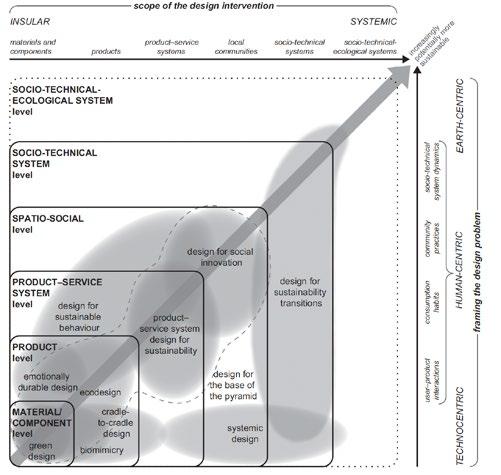
[Figure 6] Reprinted from Ceschin, F., & Gaziulusoy, I. (2020). Design for sustainability: A multi-level framework from products to sociotechnical systems (figure 12.5, p. 164). Routledge. Licensed under CC BY-NC-ND 4.0.
Within this field, backcasting has been highlighted as a strategic approach, linking visioning, stakeholder engagement, and action-oriented planning (Quist & Vergragt, 2006) and exemplifying how DfST seeks to guide the transformation of sociotechnical systems across technological, social, organisational, and institutional dimensions. In this regard, it encompasses design for PSS, which aim to reshape production-consumption systems through business model innovation, and DSI, which supports broader societal change.
As the field has evolved, scholars have begun integrating broader ecological and posthumanist concerns, including multispecies sustainability perspectives and just ways of being in the world (Escobar, 2018; Forlano, 2017; Gaziulusoy & Brezet, 2015; Rupprecht et al., 2020). These viewpoints have informed more-than-human design (Veselova & Gaziulusoy, 2021) and, more recently, contributed to what has been termed “earth-centric design” in the extended multilevel innovation framework (see Figure 6; Ceschin & Gaziulusoy, 2020). This broader integration also opens towards a sociotechnical-ecological systems (STES) perspective, with Ahlborg et al.’s (2019) approach being a central example, which is unpacked in more detail below.
Recognising that human activities, technologies, and social structures are deeply interconnected with ecological systems, and that these systems mutually influence one another, makes it essential, from my perspective, to include ecological aspects as integral and equal components of any system. Such systems necessitate a holistic approach wherein social, technological, and ecological factors are analysed and designed together to achieve sustainable solutions.
Ahlborg et al. (2019) propose integrating technology as a central component in socioecological systems research. Their STES approach emphasises that society, technology, and environment are co-constituted and co-emergent entities. This perspective highlights the mediating role of technology in human–environment interactions and underscores the importance of symmetrical attention to all three components to better understand the complexities of sustainability transitions. As they state: “However, in the hands of subordinate actors and based on other relations and values—such as nurturing and care, or possibly an ethic of ‘stewardship’—technologies can be redesigned to adapt to the needs of a more sustainable society” (Ahlborg et al., 2019, p. 10).
Such an orientation also reflects posthumanist concerns with decentring the human and acknowledging the entanglements between human and more-than-human agents in shaping planetary futures (Forlano, 2017). Together, these developments signal a deeper shift in the role of design—from transforming systems for humans to participating in systems with and beyond humans.
2.1.12
The increase in complexity of scope and framing progresses towards radical innovations, where the object of design is correspondingly more complex (Ceschin & Gaziulusoy, 2020). With this extended level of the DfS framework, the sociotechnical-ecological system level (see Figure 6), Ceschin and Gaziulusoy (2020) illustrate how design can support large collectives in envisioning and articulating pathways towards long-term futures that attend not only to “existing humans but also of non-humans and future generations” (Ceschin & Gaziulusoy, 2020, p. 164).
(5) Newsletter published by International Geosphere–Biosphere Programme (IGBP).
This widening of design’s scope brings ecological entanglements to the foreground. The profound and irreversible impact of human activity on Earth’s systems, articulated through the concept of the Anthropocene (Crutzen & Stoermer (2000),5 underscores that sustainability challenges can no longer be addressed as isolated or sectorial concerns. Instead, they call for a fundamental rethinking of dominant paradigms, shifting from egocentric to ecocentric worldviews in which sustainability is understood through interdependence, care, and co-constitutive ecological awareness (Lehmann, 2023).
While such shifts signal a necessary reorientation, they also raise critical questions about who defines desirable futures, whose voices are included in shaping them, and how systemic ideals are translated into socially just and context-sensitive practices (Escobar, 2018; Manzini, 2015; Stirling, 2015). Then, regeneration emerges not merely as an aspirational aim but as a situated and contested practice. As Buckton et al. (2023) note, “regeneration is thus simultaneously a means and an end” (p. 835), involving the ongoing co-creation of life-friendly systems grounded in mutual interdependence between living beings and both organic and inorganic matter. Here, life-sustaining synthesis is inseparably entangled with dynamic processes of the non-living world (Nørreklit & Paulsen, 2023).
Viewed this way, a regenerative orientation expands sustainability beyond mitigation, reframing it as the collective cultivation of conditions that actively support and sustain life across human and more-thanhuman realms. Such conditions cannot be designed as fixed outcomes, as they unfold within complex, dynamic, and relational systems where resilience is built through interdependence and where possibilities for transformations emerge over time. This understanding foregrounds systemic complexity as a central concern for sustainability-oriented design, and it sets the stage for approaches that engage with change as ongoing, situated, and ethically charged. In the following section, I turn to transition design as an approach that explicitly engages with such complexity and seeks to situate design practice within long-term societal transitions.
2.2
(6) This citation refers to a publicly available webinar in the Dialogues in Transition series hosted by the Transition Design Institute at Carnegie Mellon University. Although not a peer-reviewed source, the session features central figures in the development of Transition Design and offers valuable insights into the approach’s theoretical grounding and evolution.
Design for Sustainability Transitions (DfST) and Transition Design (TD) both aim to support societal change towards more sustainable futures, yet they differ in emphasis and orientation. DfST typically focuses on transforming sociotechnical systems through design interventions, often within existing institutional and practical contexts (Gaziulusoy & Öztekin, 2019; Italia, 2023). In contrast, TD builds on ecological and sociopolitical traditions, including systems thinking, deep ecology, and ecofeminism, to reimagine design as a catalyst for broader societal transformation (Bisson et al., 2022). During a recent Dialogues in Transition webinar, Gideon Kossoff articulated that this orientation stems from a desire to move beyond mechanistic metaphors towards an emerging ecological worldview that frames life as “a cooperative, a relational, creative enterprise” (Kossoff et al., 2025, 00:16:50).6 In the same webinar, Cameron Tonkinwise explained that “transition design is always about two things at once: you are solving and responding to the problem as it arrives from the context, and you are responding to it in a way so that it becomes the beginning of something else” (Kossoff et al., 2025, 00:41:20). This dual orientation reflects a shift in emphasis—from solving for sustainability to designing with and through transitions—where design engagement is both situated in the present and oriented towards the cultivation of future possibilities.
Kossoff’s (2011) foundational work further grounds this orientation in a holistic view of everyday life, proposing that the transition designer is concerned with repairing the between (p. 271)—the relationships between people, nature, and artefacts—and facilitating the recovery of the nested domains of everyday life. This involves dwelling with the parts of everyday life while coming to know their authentic wholes (a sensibility Kossoff builds on from Goethean science) in order to protect or facilitate conditions in which the organic fabric of everyday life can re-emerge (Kossoff, 2011, p. 283). As Kossoff (2011) reminds us, “Whilst solutions must be designed and implemented locally, in place, they must also be informed and energized by planetary concerns, by the concerns of people and other beings in all places” (p. 273). This stance resists the false dichotomy between universal and particular (pp. 273–274) by treating whole–part relations as dynamically interdependent—a stance that resonates with the orientation developed later in this chapter.
While Kossoff’s framing offers a holistic and relational foundation for transition design, other scholars highlight the practical and systemic complexities of changing everyday life, sometimes challenging the neat fit between domains and multi-level perspectives (Shove & Walker, 2007). Engaging with this kind of complexity requires more than new methods and more than “theory change” alone (Tonkinwise, 2023); it suggests a shift in engagement with the systems, communities, and eco-
2.3 2.3.1
logies we design with (Tjahja & Yee, 2022). This orientation towards complexity, situated change, and relational engagement informs the systemic design and infrastructuring practices discussed in the following section and, later, provides a basis for articulating key orientations of design engagement in sustainability transitions.
In the previous sections, I have outlined systemic design as anticipatory and transformative, relational and ethical. However, these orientations only come to matter when design is enacted within the dense fabric of sociotechnical-ecological entanglements. In this section, I therefore turn to systemic design and infrastructuring as practices that do not stand outside complexity but take shape within it. To engage complexity is to make interdependencies visible and actionable, to embed futures in the fragile terrain of everyday relations, and to accept that such futures are always contested and political. For designers, this entails more than shifting methods or perspectives—it requires entering into entangled roles where design becomes performative, negotiated, and situated in the very relations that shape systemic change.
Systemic design is increasingly challenged to move beyond abstract systems thinking. Instead, it requires engagements situated within sociotechnical-ecological entanglements. Rather than treating complexity as a backdrop, systemic design unfolds in and through these relations, making interdependencies visible and actionable. Engaging with complexity therefore requires attention to concrete localities and their entangled materialities.
Prioritising place-based inquiry can surface specific alternatives to learn from but never to be simply duplicated (Ceschin & Gaziulusoy, 2020). Learning from complexity also entails integrating perspectives from socioecological systems (SES) and sociotechnical systems (STS). These viewpoints may, at times, conflict theoretically or methodologically, yet holding them together is essential to cultivate a pluralistic appreciation of social, technological, and ecological domains (Ahlborg et al., 2019; also see Section 2.1).
2.3.2
As Akama and Yee (2016) argue, designing for plurality requires openness to the disorder and the serendipity of unfolding change, where intimacy as a relational quality emerges through humility, receptivity, and responsiveness rather than control. Jones (2021) supports this multi-scale view by explaining how “[s]ystemic design is concerned with higher order social systems that encompass multiple sociotechnical subsystems” (p. 7). Hence, systems thinking becomes crucial for shaping design practice in relation to both interconnected systems and social complexities (ibid.).
The Mobility Makers project illustrates this point. Social domains (households, workers, commuters, etc.), technical domains (vehicles, timetables, digital platforms, roads, etc.), and ecological domains (local landscapes, biodiversity, energy flows, animals, soil, air, etc.) are tightly interwoven (see Publication 2 and Section 1.1). Economy, likewise, threads through all domains, as household and market practices (social), as transaction infrastructures and valuation models (technical), and as flows of energy and materials (ecological). Recognising these mutualistic interdependencies calls for performing differently (Buckton et al., 2023) and “cultivating collective reflexivity” (Vink, 2023, p. 36). This entails appreciating our planet “as a whole living, self-regulating system” (Capra, 2021/2024, p. 288), and encountering “our full humanity” (Meadows, 2001, p. 2). Finally, acknowledging divergent ontologies that are fundamentally different ways of understanding and enacting the world not only highlights complexity as inherently plural but also makes visible the need for infrastructuring practices that can sustain negotiation and collaboration across conflicting positions. The following section examines infrastructuring as a set of situated practices through which such negotiations can be held and sustained over time.
Infrastructuring foregrounds how systemic design takes shape through situated, long-term practices that enable and sustain collective capacities for change. By embedding futures in everyday relations and material arrangements, infrastructuring makes transitions tangible. At the same time, it turns them into sites of friction, disagreement, and negotiation, making regenerative futures inherently political. Each practice is nested in other (often social) practices and entangled in wider temporal and political systems (Bjögvinsson et al., 2012; Tonkinwise, 2023). Thus, it is insufficient to consider attitude, behaviour, and choice in social practice change; it requires attention to relational and material constraints that might hinder transformation (Tonkinwise, 2023, drawing
2.3.3
on Shove, 2010). Manzini (2015) further emphasises how what he calls diffuse and expert design have to work together (locally) in everyday life to co-imagine the “emerging continent” (pp. 3, 27) where ethics and standards for resilience are reflected in balanced ecosystems. Harmony between community and the natural world is described by Kossoff (2015, pp. 33–34) as resilience and related to meeting community needs rooted in locally attuned domains of everyday life. These ideas align with Escobar’s relational ontology reminding us that “nothing preexists the relations that constitute it” (2018, p. 101). While infrastructuring unfolds, frictions and disagreements inevitably emerge. These should not be seen as failures but as constitutive moments in negotiation of futures. This resonates with Tsing et al.’s (2024) insistence that futures are situated and contested. As also discussed in Publication 2 (on relational frictions in circular economy ecosystems), infrastructuring practices can both enable and hinder systemic transitions. If infrastructuring makes futures practical and political, it also reshapes who participates and how. In the following subsection, I turn to what this means for the designer, considering how roles, skills, and responsibilities shift as design becomes entangled with the relations it seeks to change.
The inherently performative, negotiated, and situated character of systemic change calls for repositioning the designer. Instead of acting as a distant strategist or neutral facilitator, the designer becomes an actor entangled in the very relations that shape transitions. Building on the interplay of diffuse and expert design (see Section 5.5.1), abilities such as enabling awareness, facilitating participatory encounters, and supporting the scaling of citizen-led initiatives become additional roles required of designers in sustaining collaborative innovation (Ceschin & Gaziulusoy, 2024; Ratanen et al., 2025). Although this range of practices may sound somewhat mechanical, Escobar (2018) foregrounds the importance of embodied knowledge and learning, stating that “knowing is relating” and, thus, there is a need for “[e]ngaging in people’s lifeworlds” through our inner capacities such as senses, intuition, and reflexivity (Escobar, 2018, p. 157, following Anzaldúa, 2002). The urgency of moving from competitive individualism to mutualistic relations, and of acting differently than neoliberal prescriptions, is shared in recent research that emphasises the need to create regenerative conditions for human and more-than-human flourishing (see Buckton et al., 2023; Ehrenfeld, 2019; Vink, 2023). As Sevaldson (2015) argues in relation to gigamapping, the exercise is less about producing an objec-
2.4
tive map of complexity than about co-creating shared interpretations, underscoring that designers are not outside collective sense-making but entangled in its negotiation.
When considered in combination, these discussions foreground systemic design as an engaged, situated, and relational practice unfolding within complexity. To analytically explore how such engagements may be oriented in sustainability transitions, I introduce three key orientations—resilience, interdependence, and emergence—which offer a lens for considering how design practices can be understood in relation to sociotechnical-ecological change.
In this section, I draw together insights from designerly orientations towards sustainability (Section 2.1), transition design (Section 2.2), and systemic design for sustainability as situated infrastructuring practice (Section 2.3). Based on this synthesis, I articulate three key orientations for engaging with sustainability transitions: resilience, interdependence, and emergence.
2.4.1
Navigating the entangled nature of sustainability transitions requires design approaches that can engage with uncertainty, disturbance, and systemic shifts across multiple scales. Resilience is defined by Walker et al. (2004) as “the capacity of a system to absorb disturbance and reorganise while undergoing change so as to still retain essentially the same function, structure, identity, and feedbacks” (“Resilience”, para. 1). This definition, widely used in ecological systems thinking, has informed broader understandings of social and institutional resilience, as well as emerging work on Earth system resilience (Folke et al., 2010).
In the context of transition design, resilience is not only about resisting change or bouncing back but about maintaining coherence while navigating transformation. Irwin (2011) describes design as working with the principles of living systems, supporting patterns and practices that contribute to system viability over time. This perspective invites a shift from control-oriented approaches to iterative, long-term involvement that allows systems to learn through disruption (Gaziulusoy & Öztekin, 2019).
2.4.2
Promoting sustainability through transition cannot be achieved through technical or managerial influences alone. A relational intent suggests that both cultural and ecological engagement are needed to foster resilience. Drawing on relational ontologies, Escobar (2018) emphasises that many design traditions see ecological sustainability as inseparable from cultural transformation. These approaches reframe design as an ongoing engagement with the living qualities of social and ecological systems, seeking to cultivate conditions for diversity, regeneration, and self-organisation.
In this view, resilience becomes a question of how to participate in and support dynamic processes of change, rather than preserve stability. It calls for practices that are attuned to the situated, evolving nature of systems, what Haraway (2016) describes as developing response-ability—a concept that foregrounds situated, collective attentiveness in preference to holistic notions of living systems. While Haraway remains sceptical of holistic and autopoietic framings, scholars such as Escobar (2018) and Kossoff (2011, 2015) argue that relationality and autonomy need not be opposed. From this perspective, resilience can be understood not as systemic closure but as the capacity of situated collectives to sustain life-supporting relations over time. In this project, I draw on these perspectives pragmatically, taking resilience to mean the situated capacity to sustain and reconfigure relations in practice rather than adherence to any single ontological position.
Approaching complexity in sustainable design requires a shift from isolated problem-solving towards an engagement with the entangled, relational nature of systems. From a systems perspective, everything is connected, materially, socially, and ecologically, and, thus, design interventions always reverberate across multiple levels and domains (Capra & Luisi, 2014/2019; Meadows, 2008). Rather than acting on a system from the outside, sustainable transitions demand an attunement to the dynamic relations that shape and constitute it.
This involves recognising systems as interdependent and adaptive. As Capra and Luisi (2014/2019) write, “deep ecological awareness recognizes the fundamental interdependence of all phenomena” (p. 12) and views life as “a network of phenomena” in which humans are “just one particular strand in the web of life” (p. 12). They further suggest that “power as empowerment” means enabling this connectedness to flourish (p. 14).
Drawing on relational ontologies, Escobar (2018) similarly argues that reality is not made up of separate entities but of mutually constituted relationships. These relationships are dynamic and evolving, never permanent: “complex systems […] are in no sense fixed and static but open and adaptive, often existing within conditions of instability and far from equilibrium (poised between order and chaos)” (p. 171). This implies designing with instability. While the idea emerges from systems thinking, it intersects—albeit from a different ontological position—with Haraway’s (2016) notion of response-ability and Pickering’s (2022) call to act with the world.
Indigenous ontologies, such as those articulated by Bawaka Country et al. (2013), affirm that all beings come into existence through relationships. This means that design is not a neutral act but a practice of care, reciprocity, and situated ethics. In such framings, “caring as” rather than “caring for” (Bawaka Country et al., 2013) reflects a co-becoming with place, people, and more-than-human others, a dynamic also reflected in Publication 3, where this is explored in further depth. These stances inform a broader shift in design practice: from problem-solving by individual expert actors to a more participatory, placebased, and iterative mode of engagement. As Nielsen and Bjerck (2022) point out, relationships themselves become the key “design material” in such approaches, and design processes become defined by “the dynamic nature of people in networks” (p. 1067). Similarly, Fincher et al. (2015) call for “giving up delusions of mastery and control and instead seeing the world as uncertain and yet unfolding” (p. ii).
In this light, cosmopolitan localism (Kossoff, 2019; Manzini, 2015) offers a framework for connecting local identities with global solidarities through “inter-regional and planet-wide networking” (Kossoff, p. 52), in which locally emerging networks are nested within broader planetary networks. The pivotal shift lies in moving away from globally centralised accumulations of production and consumption towards the empowerment of communities grounded in their own cultural and historical contexts. Designing from that perspective means fostering a sense of belonging at multiple levels while acknowledging that many human affairs, especially economic ones, remain deeply entangled with ecological degradation through global systems of production and consumption.
When designing for sustainability transitions, it thus becomes less about directing outcomes and more about cultivating conditions that support transformation through relationships (Tjahja & Yee, 2022). These conditions are rarely controllable but can be nurtured by attending to interdependencies—visible and invisible, human and morethan-human—that shape possibilities for regeneration and just futures. Such interdependencies are nested across scales, where local actions both depend on and contribute to the resilience of wider planetary systems. By their very nature, they make the work inherently complex and
2.4.3
open-ended and call for approaches that can respond to what emerges through these dynamic relationships.
Responding to complexity requires an openness to what cannot be fully anticipated or predefined. Rather than approaches that aim to control outcomes, sustainable transitions demand a sensitivity to emergence, to what arises through situated, relational processes over time. In complex systems, change unfolds through ongoing interactions between human and more-than-human actors, technologies, institutions, and ecosystems, making design less about managing inputs and outputs and more about creating the conditions for new possibilities to take shape (Irwin, 2015).
From a relational perspective, emergence is not just a property of systems but a process of becoming. In complex systems, key properties arise not from individual parts but from “the interactions and relationships between” them (Capra & Luisi, 2014/2019, p. 14). As Akama and Light (2020, p. 3) put it, when navigating complexity, being “present in the moment and receptive to emergence and serendipity” is essential. Similarly, Rittel and Webber (1973) remind us that in the face of wicked problems, “part of the art of dealing with [them] is the art of not knowing too early which type of solutions to apply” (p. 164). This does not imply passivity but a design stance grounded in attentiveness and responsiveness rather than linear implementation. In Fry’s (2019) terms, designing for the Sustainment is a work of conceptual emergence—a situated and unfinished project that opens towards the futural.
Emergence is not limited to social contexts but also characterises ecological and technological systems. Capra and Luisi (2014/2019) describe how systemic properties emerge from the patterns of relationships within a whole; no single element contains or controls the outcome. Likewise, Meadows (1999) calls for “letting go into Not Knowing” (p. 19), arguing that the absence of certainty can be the basis for radical empowerment. Such framings resonate with transition design’s iterative and processual orientation (Irwin et al., 2022) and with design approaches that emphasise world-making and openness (Vink, 2023) alongside Haraway’s (2016) emphasis on response-ability as an ethical dance towards uncertain futures.
In this view, design becomes a practice of attuning to unfolding change, of working with rather than against uncertainty. It means resisting the urge to finalise futures in favour of holding space for what might emerge through relational interplay—socially, materially, and ecologically. Such spaces have been described as empty in-between spaces (Akama, 2015; Light & Akama, 2014) or as collaborative conditions and structures that support emergence (Gottlieb, 2024).
2.4.4
(7) While “interdependence” is used here to emphasize mutual reliance, the term “entanglements” is employed more extensively in Publication 3 to describe affective, inseparable relationalities — particularly in relation to mobility, care, and more-than-human relations. These dynamics are further explored through the concept of co-becoming, which highlights how identities and possibilities emerge together through relational processes.
These three orientations—resilience, interdependence,7 and emergence—are not separate concerns but mutually shaping modalities of a design mindset attuned to complexity. In combination, they form a conceptual and practical foundation for working within sustainability transitions. Resilience without interdependence risks reducing adaptation to technical robustness, interdependence without emergence may result in static system mapping without transformative potential, and emergence without resilience may lead to openness without anchoring.8 Viewed in this way, navigating complexity appears less as a matter of mastering systems and more as a question of cultivating ways of engaging with their dynamic, relational, and unpredictable nature. This calls for design approaches that foster responsiveness, nurture relational sensitivity, and support regenerative and ethically attuned futures to take root. In this sense, there is a need for the designer to become an attuned practitioner (Escobar, 2018; Manzini, 2015), one who is able to perceive and respond to subtle shifts across social, ecological, and technological domains, hold space for multiple ways of knowing, and work reflexively within the tensions of transformation.
2.5
(8) This formulation is developed as a synthetic reflection, inspired by diverse contributions across sustainability science and design theory. It draws on resilience thinking (Walker et al., 2004; Manzini, 2015), relational and systemic perspectives on interdependence (Meadows, 2008; Escobar, 2018; Tonkinwise, 2023), and emergent properties in complex living systems (Capra & Luisi, 2014; Ahlborg et al., 2019).
The three orientations outlined above—resilience, interdependence, and emergence—not only function as analytical lenses in this dissertation. They also shape how I approach inquiry itself: how questions are formed, where attention is directed, and how responsibility is understood in relation to situated transition processes. In this process, I aim to attune to the unfolding dynamics of transitions, noticing how moments of presence, doubt, and relational tension inform the questions I ask.
Against this theoretical backdrop, and alongside others in the field, I am preoccupied with the question of how we, as designers, researchers, and people, can contribute to better futures. Quietly and insistently, it pops up, especially in moments of presence and doubt. I have tried to stay with these moments, to listen, to feel from the inside what a situation does in me and what it calls for from me. At the same time, I have tried to attend to the larger configurations in which each local situation is embedded and infiltrated—relationally, socially, materially, and ecologically. How can (or should) we design in and out of an ever-shifting, more-than-human world of entangled dynamics
and overlapping urgencies? What kinds of presence and preparation are needed when our task is still to make life a little better—now and in the future—yet the perspectives and responsibilities involved are broader, and the conditions more complex, than ever before?
Design has often been framed as a future-oriented practice aimed at improving the world. As Simon famously notes, design is about “changing existing situations into preferred ones” (1969/1996). I still find this impulse compelling. Yet, as the conditions for design have shifted, so too has my relationship to this formulation. Working within complex and entangled systems has made it increasingly clear that acting towards preferred futures also requires learning when to slow down, hesitate, and stay with uncertainty. As Meadows reminds us, “in a world of complex systems it is not appropriate to charge forward with rigid, undeviating directives” (2001, “Stay humble. Stay a learner”, para 2). This tension—between the urgency to act and the need to dwell— resonates with Stengers’ (2018) notion of slow science, emphasising the value of slowing down to engage responsibly with complex systems. Accordingly, transitions today unfold in settings of entanglement and uncertainty marked by ecological, social, technological, and existential urgencies. They require us to act, yet also to pause and reflect. As Stirling warns, “with unfeasibly short periods to ‘save the planet’, participation is seen as a threat [...] dissent an unaffordable ‘luxury’” (2015, p. 66). Tsing further points out that, perhaps “precarity is the condition of our time—or, to put it another way, our time is ripe for sensing precarity” (2015, p. 20).
This way of thinking—to stay close to the emergent while keeping a systemic perspective in view—has shaped both the research and the design approach developed throughout this dissertation. It has led me to ask questions that are simultaneously methodological, ethical, and epistemological, questions about the presence and preparation of the designer, about ways of sensing and acting within complexity, and about how space can be held for regenerative, place-based transitions to unfold—within communities, collectives, and institutions.
These questions have emerged through an ongoing movement between theory, practice, and reflection. Thus, they have taken shape through iterative engagement with the literature, experimentation across cases, and continuous dialogue with colleagues and peers—mirroring the broader methodological stance of the project. They raise a number of interconnected questions that are further unfolded throughout the dissertation, each from a different angle and within different parts of the work. Together, they point to the scope, ethos and epistemology of what I refer to here as a relay conversation approach—a designerly, systemic, and situated way of engaging with transition processes.
The central research question is:
How can a relay conversation approach support designers in facilitating situated transitions towards other ways of living?
This is further explored through four sub-questions:
What roles, competencies, and sensitivities do designers need when working with a relay conversation approach in support of situated transitions?
How can a relay conversation approach be shaped and facilitated to cultivate interdependence, emergence, and resilience?
How do different systemic conditions shape, challenge, or enable a relay conversation approach in practice?
What ethical implications arise from engaging in a relay conversation approach in situated transition work?
2.5.1
In the following, I outline how the research questions introduced above are taken up and explored across the dissertation. While these questions are presented here in a consolidated form, they have not guided the project as fixed points of departure. As described earlier, they have taken shape through an iterative movement between theory, practice, and reflection.
The overarching research question—how can a relay conversation approach support designers in facilitating situated transitions towards other ways of living—is addressed across the dissertation as a whole. It functions as a connective thread, not a question answered in a single place. The different publications and chapters engage with this question from distinct angles, foregrounding different dimensions of what a relay conversation approach entails analytically, in practice, methodologically, and theoretically. In the discussion chapter (5), these insights are brought together and articulated as a set of guiding principles for engaging in relay conversations in transition contexts.
The first sub-question concerns the role and presence of the designer within transition processes. This question is explored most explicitly in Publication 1 and Publication 3. Publication 1 develops a relational understanding of designerly contributions in organisational contexts, shifting attention from individual capabilities to how design emerges through relations between designers, organisations, and sociomaterial practices. Publication 3 extends this concern by examining how designers sense, respond, and act within complex and evolving situations, foregrounding situated judgement and the relational dynamics of design dialogues as prefigurative engagements within broader systemic transitions. Reflections on the designer’s role are further consolidated in the discussion chapter (5), where these empirical and analytical insights are brought into dialogue.
The second sub-question addresses how a relay conversation approach can be shaped and facilitated to cultivate interdependence, emergence, and resilience. This question raises methodological and epistemological considerations that are developed across the methodological chapter and revisited in Publication 1, Publication 3, and the discussion chapter (5). The dissertation articulates a situated and responsive research approach shaped by uncertainty, emergence, and ongoing negotiation and does not propose a replicable method.
The third sub-question examines how different systemic conditions shape, challenge, or enable a relay conversation approach in practice. This question cuts across the empirical cases and is addressed implicitly in the analyses and explicitly in Publication 2 and in the discussion chapter, where differences between organisational, institutio-
nal, and place-based contexts are reflected upon.
The fourth sub-question concerns the ethical implications of engaging in a relay conversation approach in situated transition work. These reflections are most directly addressed in the discussion chapter, where insights from the individual publications are brought into dialogue. Here, I reflect on both the transformative potential and the ethical tensions and limitations of relay conversations, including issues of responsibility, inclusion, and relational accountability in place-based transition processes.
With this dissertation, I do not aim to offer definitive answers to the research questions. Instead, I trace how these questions have been unfolded, complicated, and rearticulated throughout the project. The intention with this work is to invite you to engage with the research as an ongoing inquiry—one that mirrors the transition processes I seek to cultivate through a relay conversation approach.
3.3 Cases
3.3.1 Town Hall Case 3.3.3 Mobility Case
Clarification of concepts: engagements, sations, dialogues 3.5 Design
Approach 3.5.1 From Co-design REDESIGN, RE-REDESIGN
Case 3.3.2 Coffee Case concepts: engagements, conver dialogues 3.5 Exploring Design
WORKSHOPS, RELAY CONVERSATIONS KICK-OFF / CLOSING EVENTS
STATUS MEETINGS, FOLLOW-UPS, ETC.
NUMBER OF RELAY CONVERSATIONS AND STRINGS
Status meeting, steering group. 17 Aug .2021
Status meeting, steering group. 16 June 2021
Status meeting, and recommendations, steering group.
Monthly meeting, presentation, Innovation & Marketing. 28 Sep. 2023
Monthly meeting, presentation, Innovation & Marketing. 22 Aug. 2023
Follow-up, Innovation & Marketing.
29 Mar. 2023
Intro CCC, Innovation & Marketing.
21 Feb. 2023
Planning initial meetings, Innovation & Marketing.
17 Feb. 2023
6 relay conversations, 8 participants, 1 string. 15 Mar – 3 May 2023.
- workshop, Innovation & Marketing. 11-14 Sep. 2023
Closing meeting, PLK now GrowGrounds. 21 Feb. 2024
Monthly meeting, Innovation & Marketing. 14 Dec. 2023
Monthly meeting, Innovation & Marketing. 29 Nov. 2023
Monthly meeting, Innovation & Marketing. 26 Oct. 2023
Workshop - follow-up relay conversations towards living labs with region and municipalities. 30 Jan. 2025
Status meeting with project lead DK, the region.
29 Nov. 2024
Rural area public meeting, presentation. 2 Nov. 2024
Meeting with project lead DK, the region.
9 Oct. 2024
Status meeting with project lead DK, the region.
21 June 2024
23 relay conversations, 29 participants. 3 relay strings. 11 Sep. 2024 - 16 Jan. 2025
Meeting with project lead DK, the region.
15 Aug. 2024
Follow-up, Innovation & Marketing.
23 Jan. 2023
Kick-off workshop with region and municipalities. 11 Mar. 2024 Mobility Maker project meeting. 29 - 31 May 2024
Follow-up with rural municipality 3 and the region.
30 Apr. 2024
Follow-up with rural municipality 2 and the region.
15 Apr. 2024
Follow-up with rural municipality 1 and the region.
5 Apr. 2024
This chapter unfolds the methodological grounding of my PhD project while also offering insights into how the relay conversation approach has been explored and shaped through pilot studies and three cases (the town hall case, the coffee case, and the mobility case). As opposed to presenting a predefined methodological framework, the chapter traces how the approach emerged from a growing sense of wonder and curiosity rooted in practice. As described in the introduction, this curiosity gradually developed into a potential research trajectory, which was explored and refined through engagement with pilots and case-based experiments (see Table 7 for an overview of cases). The relay conversation approach thus did not precede the empirical work but evolved in close dialogue with it.
The methodological orientation of the project has been informed by the cases’ back-talk (Schön, 1983), by an understanding of cases as sites for situated learning and problem-driven inquiry (Flyvbjerg, 2001), by ongoing engagement with relevant literature, by experimenting with different analytical perspectives, and through continuous discussions with colleagues and peers. Hence, the methodological grounding of this PhD project was not established prior to the empirical work but emerged through an iterative engagement with the pilots and cases. While the chapter initially unfolds the methodological grounding of the project through pilots and cases, it gradually shifts towards a more focused analytical exploration of design dialogues as a relational approach to systemic design. Building on insights emerging across the cases, Section 3.5 synthesises these experiences by foregrounding how design dialogues operate as situational, relational, and prefigurative engagements, bringing together central concerns with resilience, interdependence, and emergence.
In this way, the relay conversation approach and its guiding principles are not presented as a recipe-like or generalisable method but as orienting principles that can orient practice while remaining responsive to the specificities of each situation. Situations differ, and it is precisely the local specificities—relations, histories, and conditions—that shape the specific character of a situation. While general principles may inspire practice, in this research they are deliberately not applied unmodified across contexts, as doing so would risk overlooking the situated dynamics. Moreover, treating the approach as a fixed method would go against the systemic nature of the inquiry, which emphasises continual, locally sensitive adjustments and a constellation of overlapping principles (Capra & Luisi, 2014/2019; Meadows, 2008; Wahl, 2016/2022).
Each case has posed distinct challenges or foregrounded different aspects of the approach. Accordingly, the chapter follows the iterative
process through which the relay conversation approach has been shaped and explored, describing and discussing its principles in varying depth across the cases depending on which aspects became most salient in each context.
(9) By light structures, I refer to temporary networks of actors that emerge around a shared issue and take shape through situated engagement. Huybrechts et al. (2018) describe such formations as infrastructuring activities in communities, with the designer acting as a trigger. This view echoes Latour’s (2005) emphasis on groups as relational accomplishments that need to be continually made and remade.
(10) As the conversations are conducted over time the approach has a built-in extended temporal dimension. This also gives us the opportunity to bring other actors‘ statements into the conversation at appropriate times.
The relay conversation approach was initially initiated from a deep engagement with the question of how we, as designers, could contribute to processes that cultivate locally anchored and sustainable network scenarios. Our intention was to co-explore and, where possible, co-create for resilience within a community by nurturing horizontal, reciprocal relations. Thus, we sought to get to know the different actors within the community and to foster new light structures9 capable of connecting and anchoring potential resources. To get closer to everyday practices and lived experiences, we set up a dialogue process composed of small-scale, open-ended conversation experiments linked over time.10
The dialogue process and the way we connected the individual conversations was inspired by a relay race. A relay race is a competition where a team of athletes, typically in running, take turns completing parts of a course. One runner passes on a baton to the next person within a designated exchange zone. The goal is for the team to finish the entire course as quickly as possible by combining the individual efforts of each participant.
Our approach, however, had no competitive aspect—quite the opposite. The emphasis was on configuring and reconfiguring relationships while attending to both social and ecological contexts, not merely on the transfer of information. The approach was built on a loosely structured interview format, combined with a relay-like manner in which concerns, questions, and imaginings could be passed from one participant to the next as a baton. This became a way of linking conversations and building an infrastructure across a situation (Bjögvinsson et al., 2012). We asked the participants to distil our conversation into a short “what-if” baton to carry forward to the next person (Dunne & Raby, 2013; Irwin, 2018). This was not about simplifying complexity but about creating a shared imaginative space. As facilitators and consistent participants, we carried the merged details with us and reintroduced them when they could contribute meaningfully to another conversation. Each sequence of conversations, which I call a “relay string”, linked participants in a chain where insights, questions, and imaginative propositions could travel from one person to the next. In another kind of study this would be unthinkable for reasons of objectivity, detachment, or methodological purity (Haraway, 1988; Schön, 1983; Suchman, 1987). Here, however, the aim was not to control or claim om-
(11) Where two page numbers are provided, the first refers to the pagination of this dissertation, while the second corresponds to the original pagination of the publication.
niscience but to bring perspectives into relation and dwell with them (Kossoff, 2011). Furthermore, the baton served as a reminder of life’s entanglement—something had happened before our engagement, and something would happen after; it does not unfold in isolation (see Publication 1, p. 97 / 5,11 figure 3 of relay string and workshop).
Having outlined the relay conversation approach, I now turn to the two pilot studies that formed the methodological and experiential groundwork for the subsequent cases of this PhD project. Rather than functioning as cases in their own right, the pilots served as exploratory and formative engagements through which the relay format, its elements, and my role as a designer-researcher were tested, challenged, and gradually refined.
The pilots provided early, situated indications of how relay conversations unfolded in practice, what they rendered possible, and how the relational “space” might place different demands on us as designerresearchers. Experiences from these settings informed both the design of the later cases and the adjustments made along the way. As such, the pilots are not analysed with the same depth or structure as the cases but are narrated more loosely as an inspirational point of departure—highlighting the key experiences that shaped how I approached the cases that followed.
Across both pilots, the inquiry centred on how designers can contribute to locally anchored engagement and collaborative networks in urban contexts. However, each pilot was approached situationally, responding to different scales, actors, and dynamics. The account below therefore foregrounds learning moments and methodological shifts, offering an initial grounding for how the approach was further explored in the cases that follow.
3.2.1
Across the pilot studies, engaging the participants in relation to place gradually emerged as an important concern while also revealing differences in how place could be entangled in conversation. In the first pilot, the participants were met individually at locations meaningful to them, such as workplaces, cultural institutions, or community spaces.
(12) The relay conversation format, in which each participant speaks individually, helps ensure that all voices can be heard, in contrast to typical workshop formats where hierarchical dynamics often influence who speaks and how contributions are received.
While this grounded the conversations in the participants’ everyday practices, we gradually sensed a potential for coming closer to placespecific relations than the setting alone afforded, particularly when we did not yet share a spatial understanding of the local context.
This insight led to a methodological shift in the second pilot, where conversations were organised as go-alongs (Kusenbach, 2003). Walking through participant-selected routes enabled shared reference points, stronger spatial anchoring, and richer, more situated dialogue. Places themselves began to function as conversational triggers, fostering imagination and reflection in ways that pre-made artefacts (e.g., Binder et al., 2011; Bjögvinsson et al., 2012; Sanders & Stappers, 2012) had not in the first pilot. While artefacts can mediate dialogue and enable the shared exploration of ideas (Gaver 2012; Schön, 1983), the movement through participant-selected locations offered a more dynamic, situational form of engagement that interwove people, places, and conversation. This transition marked an important learning: that place-based dialogues are not only about where conversations take place but are also about moving through place together. In addition to the shaping influence of place, questions of who was invited into the relay and how conversations were connected across differences became equally central.
In both pilots, the participants were initially invited through the initiators’ existing networks, followed by efforts to broaden participation across everyday roles and social relations beyond the initiators’ immediate networks. Particular attention was given to including younger voices, as they required a different kind of outreach and effort. Invitations were organised as individual relay conversations, deliberately designed to mitigate hierarchical dynamics and support participation on more equal terms, regardless of formal roles or decision-making authority.12
The baton played a key role in connecting conversations across differences. By handing over concerns, visions, or “what-if” propositions from one participant to the next, the relay format created indirect encounters between actors who might not otherwise meet. In both pilots, this connective logic was extended through the use of Instagram profiles for each relay string, enabling the participants to follow and reflect on the unfolding dialogue over time. Across the pilots, the baton thus functioned as both a connective device and a means of redistributing voice and attention.
The conversations in the pilots were guided by a loosely held framework inspired by Sanders and Stappers’ (2012) path of expression, moving between present experiences, past trajectories, and future imaginaries (see also Publication 1, pp. 96-97/4-5). Rather than functioning as a strict interview guide, the framework operated as a mental orientation, supporting conversational flow while allowing the participants’ stories to shape direction and depth.
(13) The relay format required a different type of facilitation than, for example, a workshop, where ‘collaboration’, ‘purpose’, and ‘feasibility’ are central. This “designerly facilitation” emphasizes human perspective, experiential knowledge, and a creative approach (Aguirre, Agudelo, & Romm, 2017).
The “what-if” framing of the batons consistently oriented conversations towards imagining alternative futures. While, in the first pilot, dialogue was primarily supported by physical, pre-made artefacts, the second pilot increasingly relied on context-specific engagements in the form of participant-prepared routes through the local environment. The COVID-19 lockdown further expanded the methodological repertoire, as parts of the second pilot were conducted online, introducing new ways of sharing maps, images, and notes digitally. These experiences highlighted the importance of adaptability and context sensitivity in semi-structured engagements.
Across both pilots, our role as designer-researchers combined facilitation and mediation, with a shared focus on everyday practices and lived experience. Rather than aiming for immediate solutions, we sought to make relational dynamics, invisible practices, and emerging possibilities more tangible.13 Leaving behind traces—such as batons, shared stories, or visual material—was understood as a modest form of empowerment (Capra & Luisi, 2014/2019), enabling the participants to connect insights and potentially act beyond the conversations.
The pilots also foregrounded the importance of time between relay conversations. In some instances, the participants interacted independently during these intervals, while we used the time to reflect, discuss, and recalibrate our engagement. In the second pilot, the adjusted format—in which the participants designed and led the routes—required us to relinquish some control and acknowledge the participants as situated experts. These shifts enabled access to more situated, experiential, and relational forms of knowledge (drawing on Sanders & Stappers, 2012; Sevaldson, 2010) through sensory experience, chance encounters, and movement. At the time, this was less an explicit methodological stance than a practical commitment. We did not conceal our presence or perspectives in the field; instead, we engaged openly as designer-researchers. It was only later in the inquiry that we came to articulate this as an acknowledgement of our situated, embodied presence as part of the knowledge produced (Pink, 2009). These evolving ways of engaging also raised questions about how the material generated through the relay conversations could be approached analytically.
The analytical approaches employed in the pilots were exploratory and iterative, reflecting their role as methodological testing grounds. In the first pilot, three analytical lenses were used to interpret the material: cross-networks, resource and material flows, and fluid boundaries between spaces and roles. In the following pilot, we instead applied six more generic lenses—places, communities, qualities, challenges, time, and opportunities—to sort and group the participants’ statements. This shift also reflected a reorientation of analytical attention, with less emphasis on economic or material flows and increasing attention given to the perceived qualities, relations, and affective dimensions of the urban environment. The lenses thus foregrounded how the participants expe-
rienced, valued, and connected to place. While these categories supported initial sense-making and dialogue with the participants, subsequent reflection revealed their limitations. As the inquiry progressed, analytical attention increasingly shifted from categorisation towards relations, specific statements, and moments that allowed both the participants and the researchers to see situations differently. This learning informed the gradual move away from predefined analytical lenses in the later cases.
(14) Here, ‘semi-structured conversations’ refers to situated conversational encounters guided by a flexible framework. While these engagements might elsewhere be described as semi-structured interviews, the term ‘conversation’ is retained to foreground relational dynamics, conversational flow, and a more dialogical, open-ended mode of engagement than is typically implied by interview formats. Across the cases, the relay conversation approach gradually loosened, culminating in the final case, where no predefined questions guide was prepared.
Having outlined the relay conversation approach and the methodological learnings emerging from the pilot studies, I now turn to how its various elements were enacted out across the cases. For each setting, I describe how the approach was enacted in practice with attention to locations and go-alongs, invitations and baton-sharing, semi-structured conversations,14 the designer role, and analytical strategies. This caseby-case presentation shows both the consistency of the approach and the ways in which it was adapted to local conditions and emergent dynamics (see also Figure 8 for an overview of case experiments and approach adaptions and Figure 7).
PURPOSE
INITIAL MEETING (PRE)
LOCATION AND MEETING FORMAT
EXPERIMENT I, TOWN HALL CASE
To ensure a diverse and relevant participant composition by including actors across roles, existing social or organizational groupings, and everyday practices. Sectors, and existing social or organizational groupings.
To structure conversations sequentially in order to mitigate hierarchical dynamics, enable participants to engage on equal terms, and create new relational connections across existing organizational or social groupings.
EXPERIMENT II, COFFEE CASE
Employees were selected by the steering group to represent each department and invited to participate via email. (purposive sampling, steering-group mediated)
9 strings of 4-5 employees, one per department.
Engaging a diverse range of actors as everyday experts across practices and roles.
Gaining initial, contextspecific insights to prepare relay conversations and supporting artefacts.
Participants were initially contacted by the Innovation & Marketing department, with whom the online conversations were coordinated. (purposive sampling, gatekeeper-mediated)
1 string, 8 participants from 6 departments (relay conversations)
Internal e-mail from the project group to the employees participating in the intitial meetings, followed by an e-mail from us. The relay conversation participants received an e-mail from us.
Initial meetings with each department, including walkthroughs of the town hall to experience the organizational and spatial context in which change was needed.
Getting close to everyday practices and situated experiences.
EXPERIMENT III, MOBILITY CASE
Initial participants were suggested by employees from each of the three municipalities, after which subsequent participants were identified through the relay conversations. (purpose and sequential sampling)
[Figure 8] Overview of empirical and analytical work with case experiments and approach adaptations.
3 strings, one per community.
Internal e-mail from the Innovation & Communication department, followed by direct contact from us. Consent form.
Meetings with Chief Innovation Officer and employees from Innovation & Communication, conducted both physically and online.
The relay-conversations were planned as online meetings due to project time and budget constrains, and in anticipation of COVID-19 lockdown in Denmark.
Initial contact by phone call, followed by e-mail or text message. Consent form.
Meetings and a workshop with employees from the three municipalities and the regional authority.
Conversations were conducted online due to participants' busy schedules and geographically distributed offices.
Conversations were conducted primarily as go-alongs – mostly on foot and a few by car –with a small number conducted online.
THE RELAY-CONVERSATIONS
Engaging particpants, developing understanding, intervening, and collecting empirical material.
Planned duration: approximately 1 hour.
Supporting engagement, facilitating reflection, and collection of empirical material through tangible or digital materials.
Facilitating cross-participant learning and reflection by sharing insights and stories across relay conversations, enriching perspectives and supporting collective sense-making.
Connecting the conversations and infrastructuring, open up to multiple perspectives, collective network/ practices/living.
Maintaining trust and confidence, clarifying next steps, and allowing time for reflection, discussion, and adjustment.
Create temporal space for participants to initiate their own discussions, allow chance encounters to occur, and enable self-initiated trial actions.
A prepared framework based on present-pastfuture structure (inspired by Sanders and Stappers, 2012, “path of expression”; see also paper 2) informed the conversation. The framework was not brought explicitly into the sessions but held as a guiding structure.
Online/digital artefacts for engagement and collection of empirical material: floor plan for discussion, colored cards for note-taking (dimensions: time, place, space, qualities, possibilities, challenges, community), photos of everyday objects, sticky notes, pens, pre-drawn route following the conversation framework, and the previous baton.
A prepared framework based on a present-pastfuture structure (inspired by Sanders and Stappers, 2012, “path of expression”; see also paper 2) informed the conversations and guided the formulation questions. The conversations were recorded. No artefacts
Insights and stories from one relay conversation were occasionally shared with participants in subsequent conversations to enrich dialogue and encourage reflection.
As the conversations were conducted online, batons were written on a shared online whiteboard as formulated by the participant. Within each relay string (4–5 participants), individual batons were shared during the process to spark reflection and dialogue. Relevant concerns or matters were occasionally carried forward to subsequent conversations.
Participants were thanked and informed about next steps. A follow-up e-mail included a link to the shared relay string and information about upcoming workshops.
No predefined conversation framework or question guide was prepared for this case.
Artefacts for engagement and collection of empirical material (their baton) at the end of the conversation: A3 whiteboard, pens, magnets, mobile photo printer with extra paper, camera/phone for photos, and the previous baton.
Perspectives, observations, or concerns from previous relay conversations were shared to inform ongoing discussions and foster collective understanding.
Insights or stories from one relay conversation were shared with the next when they could add value, weaving perspectives together and elaborating them collaboratively.
No formal batons were collected. Instead, with participants’ permission, relevant perspectives or concerns were carried forward and shared across conversations when considered a potential contribution. This was done to bring perspectives together and dwell on them collectively.
Participants were thanked, followed by a brief e-mail. No batons were involved.
Participants were explicitly encouraged to discuss matters between relay conversations. To support this, shared online whiteboards with batons from each relay string were made available. In this case, several chance encounters occurred in corridors, some of which led to self-initiated initiatives.
There was time between conversations. Although crossdepartmental exchange was not explicitly encouraged, participants occasionally referred to conversations they had had with other participants beforehand.
Selected photos from places encountered during the conversation were printed and used alongside a physical whiteboard on which the participant’s baton was formulated. This supported attention to places, moments, and material conditions, and helped hold on to words and phrases during the articulation of the baton.
Participants were thanked and informed about next steps, including potential subsequent participants and possible living labs. When participants wished to reflect further on the phrasing of their baton, this was handled through follow-up e-mail correspondence.
Attention to relational aspects increased over time, making us more aware when participants mentioned having spoken with others about relevant matters. Both chance encounters between relay conversations (participant–participant or participant–acquaintance) and encounters during relay conversations (participants introducing us to acquaintances) occurred.
• Overall framing: Post-pandemic increased digitalisation, more hours at the home office, and a new layout of the town hall were to set the direction of new administrative working procedures and make space for a hundred more employees.
• Design and research inquiry: How can designers support the development of new administrative working procedures by encouraging shared practices and a common work culture?
• Initiator: Esbjerg Municipality, partnership agreement between Esbjerg Municipality and Kolding School of Design.
• Project duration: 13 months.
• Relay conversations: 43 participants, nine strings of 4–5 employees, one per department.
[Figure 9] Relay conversations and relay strings in the town hall case. Circles represent individual relay conversations, and connecting lines indicate the sequence and number of conversations within each string.
In this case, the relay conversations were planned to be conducted online for several reasons: 1) we anticipated another COVID-19 lockdown in Denmark and 2) to save time and resources while prioritising engagement with more participants. For the same reason, we first met with a small, selected group from each department and conducted department-specific walks around the town hall to observe, experience, and photograph their immediate environment, while it was still late summer and before the flu season.
Although the town hall is a large building, housing 400 employees and with citizen-oriented areas across the ground floor, first floor, second floor, and basement, and soon hosting two additionally departments with 100 more employees, we were able to see almost every room and corner of the town hall, with several routes overlapping in the common areas and the connecting departments.
Knowing in advance that the 43 relay conversations would be conducted online proved advantageous; however, there were moments when in-person engagement—being in the same room, pointing, and touching—would have added value. Moreover, the online format became an experimental aspect of the approach, offering new insights into how relay conversations could be conducted remotely while still maintaining relational and place-based sensitivity.
(before the conversation)
1) introduction: (5-10 minutes)
2a) Stories: (approx. 15 minutes)
2b) Exploring stories through analytical categories (approx. 10 minutes)
• Email with practical information and preparation: Participants are invited to reflect on one good day and one challenging day, each framed as a short story, and to optionally share a photo in advance.
• Preparation of boards: We prepare one board per participant and one shared board for the relay chain (Local MED).
Note: Update numbering on the prompt cards and the relay circle, and, if relevant, the placement of departments on the map.
2c) Receiving a baton –opening toward the future (approx. 10 minutes)
• Welcome and introduction: who we are
• Explanation of the relay conversation and the overall agenda
• Introduction to the concept board (what it is, why we use it, and how it works)
• Clarification of the mindset for the conversation and what will happen afterwards
• One positive and one challenging story from the participant
• Stories may be shared verbally and/or placed on the board using cards
• We ask follow-up questions to identify approximately three key elements from each story
• These elements are noted on the cards using six analytical categories: Possibilities, Challenges, Place, Time, Qualities, and Community.
• The analytical categories are introduced and explained as they become relevant in the unfolding conversation.
“What if…?” questions or statements, such as: “The town hall is the citizens’ house…”
“It is important that citizens feel safe and welcome…”
“How can we support and enact our role as hosts (towards citizens, collaborators, etc.) in the building?” This serves as a transition toward the participant’s own formulation of a baton, linking the relay logic with future-oriented reflection.
3) Formulating a baton (10 – 15 minutes)
4) Closing: (5 – 10 minutes)
(after the conversation)
The baton can be formulated as a question to the next participant, a topic to be explored further, or a statement that captures a concern or possibility emerging from the conversation.
• Ask for consent to share the relay anonymously with other colleagues at the town hall once all relay conversations have been completed
• Invite participants to reach out if they later think of something they would like to add, emphasise differently, or prefer not to share after all
• The participant’s board is downloaded as a PDF after the conversation
• Screenshots of the prompt cards are saved on OneDrive
• The baton/relay string: selected elements are copied to the shared Local MED board and to the next participant’s board
• Follow-up email to the participant with thanks, practical information, and a link to their board
[Figure 10] Illustrative facilitation guide for town hall case relay conversations.


møde lokale skærm



Docking


[Figure 11] Example of the online whiteboard as a shared workspace in a town hall relay conversation (See also Publication 1).
at finde den balance. Især forstyrrelserne når man sidder på kontoret og har brug for fordybelse.
Og har også en rigtig god kultur og har det rigtig godt med hinanden - vi er sammen om sagerne. En god dag er når jeg kommer på kontoret og alle er der. Det giver en god dynamik og vi kan have god sparring om sagerne og vi også hygger os. Har nogen at gå til frokost med og snakke med til frokost. Har været bekymret for hvordan det ville blive her efter corona - ville jeg bare sidde derinde (på rådhuset) alene. fast dag om tirsdagen - personalemødealle møder ind. Ellers er det individuelt og hvordan det passer med møder og hvornår der er flest mennesker på kontoret. Når vi er hjemme ringer vi sammen flere gange om dagen. Under corona havde vi møder hver morgen, hvor vi lige snakkede sammen. Vi havde rigtig travlt, men også stort behov for at snakke sammen om udmeldinger Nu har vi et fast møde om torsdagen. Skærm på kontoret til online forhandling, men vi bruger også den skærm til at holde møder med dem der evt. er hjemme. Det fungerer rigtig godt. V snakker om om det er
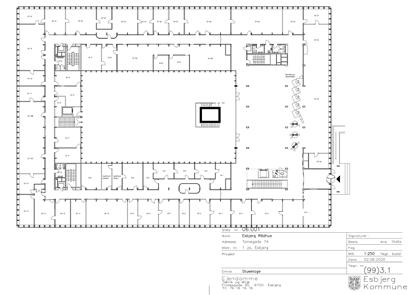
The employees selected to participate on behalf of each department received an e-mail invitation from us. Due to the relatively high number of participants, we set up a Doodle poll with available relay conversation timeslots and blocked out our own calendars for almost six weeks. Consequently, the participants signed up in random order. For each relay string (4–5 participants from the same department), we shared their individual batons on an online whiteboard throughout the process. We did this with the intention of sparking both individual reflection and informal dialogue between conversations. The random order sometimes resulted in more than an hour between relay conversations within the same relay string, allowing the participants time to
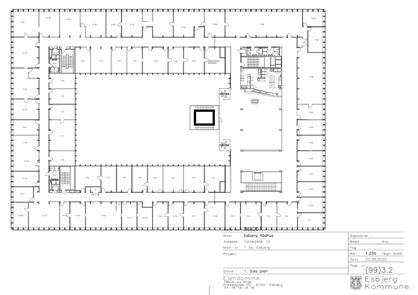
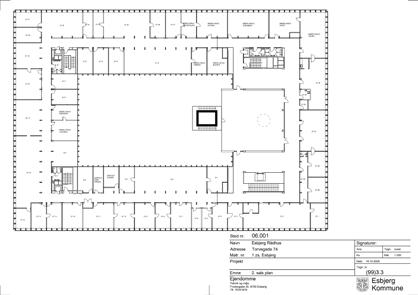
engage with the batons. During the sessions, we occasionally observed participants logging into the online whiteboard, and several referred to colleagues’ batons during their conversations.
For this case, we prepared an illustrative framework as a stepwise route ending with a space for the next baton on an online whiteboard. As in Pilots I and II, the framework was inspired by Sanders and Stappers’ (2012) “path of expression” (see also Publication 1, pp. 96-97/4-5). For this, we memorised a list of guiding questions, adjusting them as conversations often took unexpected directions. Once a conversation began, typically after a brief introduction and a couple of initial ques-
(15) In the pilot studies, we used Instagram to share and circulate ‘batons’ and facilitate reflection across participants.
tions, we ensured to ask about the past. The “what if” framing of the previous participant’s baton naturally opened the conversation towards the future. When the discussion fell silent, we occasionally made use of the prepared questions but more often followed the participant’s own statements, including relational matters we could not have anticipated (see Figure 10).
On the online whiteboard, we placed digital artefacts as shared points of reference and as situated means of collecting and materialising insights: a floor plan to use as a basis for discussion, coloured cards tagged with different dimensions (time, place, space, qualities, possibilities, challenges, and community), photos of everyday objects from the town hall, sticky notes, pens, and a pre-drawn route including the conversation framework with the previous baton and a space for the next (see Figure 11).
As the conversations unfolded, we wrote the participants’ stories, perspectives, statements, and batons directly onto the board. This allowed the participants to refine their contributions in writing and enabled us to revisit earlier points when needed.
Our role as designer-researchers in this case combined process co-facilitation (working closely with the steering group), mediation (across the relay conversation participants, between the participants and the steering group, and within the steering group itself), and co-design, as we actively intervened through both relay conversations and steering group engagements.
Drawing on experiences from the two pilots, we deliberately emphasised the time in-between activities, particularly between relay conversations, as a critical space for reflection, sense-making, and informal exchange. In this organisational context of cultural change and transformation, however, social media platforms such as Instagram were not appropriate for holding, sharing, or circulating perspectives and batons.15 Instead, we adopted a more situated approach to enabling conversations to travel within the organisation. For example, as relay conversations came to an end, we explicitly invited the participants to continue the dialogue with colleagues and reach out to us if new ideas, concerns, or perspectives emerged (see Figure 12). Occasionally, insights, stories, or “batons” from one conversation were shared with participants in subsequent sessions to enrich the dialogue and stimulate reflection across different conversations and relay strings—an approach we had also explored in the pilot studies.
As in the pilots, we did not position ourselves as objective or detached facilitators. Rather, we were actively engaged, drawing on our experiences and openly articulating our stance as designers aiming to cultivate more holistic and sustainable ways of working.




[Figure 12] Example of an online relay string for sharing and following batons (See also Publication 1).
In this case, we used six generic analytical lenses (places, communities, qualities, challenges, time, and opportunities) for the relay conversations, although the approach was slightly different from how we had done it previously (see Figure 13). As all of the conversations were conducted online, the participants naturally became involved in discussing whether a particular statement or story was more closely related to, for example, “communities” or “opportunities”.
Nevertheless, what allowed the participants, the steering group, the city council, and ourselves to gain new insights and see things differently was the relational entanglements of qualitative stories, perspectives, statements, and “what-if” questions. Based on this experience, we decided not to apply such categorial lenses in the next cases (the coffee case and the mobility case—see also Section 3.3).
I make rules; I find that this is the best way to do it. Meetings differ, so the rules also change depending on the situation.
Challenges
I have to be here by 7:40 at the latest — the uncertainty is uncomfortable. Sometimes I park in the time-restricted parking spaces (two hours), which affects whether or not I feel stressed.
On a challenging day, there are too many meetings; people arrive late, have not prepared, and are unable to stick to the agenda.
my flexible working hours — they allow me to arrive earlier.
[Figure 13] Analytical lenses with example stories from the relay conversations (See also Publication 1).
My calendar has to adapt to everyone else’s, because I work so much across departments. As a result, it is difficult to schedule a full day of working from home.
It is important that participants have prepared in advance. I always send out the agenda, preferably several days beforehand.
Time
It helps when you arrive at a meeting room where everything just works and you are able to enter a little early.
I often have a plan B and C. The uncertainty around IT is the same in all rooms, but my project participants do not like the high tables.
I end up driving around without knowing how long it will take, then park on a side street and have to walk. My schedule no longer fits, and I also have to remember where I parked that day.
• Overall framing: Transformation from a linear to a circular economy.
• Initiator: Peter Larsen Kaffe and Löfbergs.
[Figure 14] Relay conversations and relay strings in the coffee case. Circles represent individual relay conversations, and connecting lines indicate the sequence and number of conversations within each string.
• Project duration: 16 months.
• Overall project: Strategic Foresight for Sustainability (SF4S), funded by the European Union Erasmus+ programme.
• Relay conversations: Eight participants, six semi-structured conversations.
The coffee case differed somewhat from the pilots. I began conducting relay conversations with employee participants from Peter Larsen Coffee (PLK) and Löfbergs (L), but these could not extend across the broader circular coffee community (CCC) due to internal reorganisation in PLK following the transitions of the innovation team into the spin-off GrowGrounds. While the relay conversations could not extend across the broader CCC, reflecting on participant selection hinted at the potential value of widening the circle of voices in future engagements. Initially, I conducted semi-structured interviews with employees from the innovation and marketing department, which were also part of the overall SF4S project delivery (see Figure 7, pp. 78-79 for an overview of case progression). These interviews, together with a co-development project meeting, contributed to my understanding of the coffee industry and PLK and served as the foundation for six semi-structured conversations, which I treated as relay conversations, involving eight employees. The conversations were conducted online due to the participants being located in multiple offices (two PLK offices in Denmark and the Löfbergs office in Sweden) and the participants’ limited availability.
[Figure 15] Example from online relay conversations in the coffee case (anonymised).
The online interviews were coordinated with the innovation and marketing department, who initially contacted the participants on our behalf. We then sent calendar invitations for the online interview meetings. No batons were shared in this case.
Participant:
Participant department/placement in organizational structure:
Location:
Date: Time frame:
Intro: Approx. 10 min
Now (Present): Approx. 15 min
• Welcome and introduction: who we are, projects (SF4S + Phd)
• Focus: further development of Circular Coffee Community (CCC)
• (only if..) Did you sign the consent forms? (SF4S + PhD) / Thank you for signing and returning the consent forms.
• (RECORD??) Is it okay – GDPR etc.
• explanation of conversation frame
• Can you describe your main tasks in PLK?
• Who do you work most closely with?
• What is the Circular Coffee Community?
• What is your relation to CCC? / How are your tasks connected to the CCC?
• How is it to work with the community and the related activities in the organization? Are there any internal barriers?
• How do you think CCC impacts PLK? Positive and negative?
• How do you discover and explore new opportunities in relation to CCC?
• What happens before/during/after a new member joins CCC?
• Do you need to make changes in the organizational structure – when there is a new project case (business incubator)?
• Are there any external barriers? For instance, with the partners?
Past (Memories): Approx. 7,5 min
• How do you think the focus of the different tasks were different before you/ they started working with the Circular Coffee Community?
• Why did you/they make this change in focus?
Future (Dreams): Approx. 7,5 min
Thanks again: Approx. 5 min
After conversation
To do:
• Are there any signs that your core task will change within the next 5 or 10 years?
• How do you think?
• What will it take to get there?
• How do you imagine the future of PLK from your perspective?
• Do you have anything else you want to add or something that you think I should have asked you about?
Thank you so much - If you come to think about anything…. That you forgot to say, or something you want me to delete. Please reach out.
• Send thank-you-email and e.g. pictures for approval (GDPR)?
• Save pictures, notes and recordings.
• What are the initial findings/insights? Interesting quotes etc.
• Adjust the script for the next person.
[Figure 16] Illustrative facilitation guide for coffee case relay conversations.
ARTEFACTS/ PREPARATION
• Conversation guide
• Notebook
• Recorder (iphone – test) + charger or record via teams.
Although these were not relay conversations, and no baton was formulated or passed on, the framework for the semi-structured conversations followed the same present-past-future structure as in the pilots and the town hall case (inspired by Sanders and Stappers’ 2012 “path of expression”; see also Publication 1, pp. 96-97 /4-5). We memorised guiding questions to structure the dialogue and, where relevant, I shared insights and perspectives across the interviews to guide the dialogue (see Figure 16). The semi-structured conversations were digitally recorded and transcribed.
In the coffee case, our roles as designer-researchers were carried out at a distance. Although we held regular physical meetings and workshop activities with the chief innovation officer and colleagues from the innovation and marketing department, these meetings were not situated within their coffee-related work environments. Similarly, the online semi-structured conversations were distanced from the participants and their everyday contexts. In practice, we remained facilitators of the process (with support from innovation and marketing), mediators (between the interview participants and, to some extent, between the participants and the chief innovation officer), and co-designers (by presenting analyses to the chief innovation officer). Even so, we lacked the embodied, sensory dimension of engagement that was present in previous cases. While the baton was not formally passed on, I carried insights from one conversation to the next whenever a matter or perspective could contribute to another discussion. This approach aimed to bring perspectives together and elaborate on them iteratively.
[Figure 17] Example from online relay conversations in the coffee case (anonymised).
As in the earlier pilots, we were not objective facilitators, moderators, or designers. Our engagement drew on our experiences, and we remained transparent about our stance—to cultivate new ways of transforming business cases for regenerative futures.
Building on experiences from the previous pilots and the town hall case, we focused on relational entanglements in this case as well. Therefore, as an analytical exercise, we turned to Adele Clarke’s situational maps to visualise and examine relational dynamics within the situation (Clarke, 2003, 2005; see also Publication 2, p. 104/295). Hence, we mapped drivers, barriers, and frictions to uncover interdependencies, power structures, and historical influences—elements that Clarke emphasises as crucial for understanding complex situations and relations dynamics—which in our case, proved central for reflecting on conditions shaping transition processes (see “ordered situational map” and “relational analysis”, Publication 2, appendices B, C, D, pp. 120-122 /311-313; and Figure 18 for examples of frictions). The analysis showed how what acted as a driver for some could function as a barrier for others, while frictions simultaneously hindered progress and highlighted areas requiring radical change to align with the shared vision of the CCC (including conditions for coffee farmers and the long-term viability of coffee production). Additionally, the mapping revealed gaps in representation, where the absence of certain stakeholders limited collective agency (see Figure 19 and 20 for mapping of innovation partners in relation to byproducts and innovation field; see also Publication 2, p. 104/295 for further elaboration).
"Coffee production is increasingly challenged by deforestation and climate change, leading to expectations of reduced coffee availability in the future"
(Marketing & Circular Innovation)
• Positions coffee as a vulnerable resource
• Frames sustainability as a future risk management issue
"Developing and cultivating more resilient plant varieties is positioned as a key response to environmental pressures” (Retail)
• Emphasises technological-biological adaptation
• Frames resilience as something that can be engineered upstream
[Figure 18]: Selected examples from a relational analysis highlighting frictions in the coffee case.
Circular Coffee Community (CCC)
frictions
"Coffee is framed as one offering among several, alongside machines, service models such as rental, and the sale of knowledge"
(Out of Home)
• Positions coffee within a broader service ecosystem
• Opens for business model diversificarion
"Coffee is maintained as the core product of the business, despite changing environmental and market conditions"
(Marketing & Circular Innovation)
• Suggests limits to business model transformation
• Reveals a stabilising narrative
[Figure 19]: Innovation partners by coffee by-product use. Clusters show how partners engage with coffee by-products.
[Figure 21] Relay conversations and relay strings in the mobility case. Circles represent individual relay conversations, and connecting lines indicate the sequence and number of conversations within each string.
(16)In total, 23 relay conversations were held with 29 participants. While relay conversations are generally designed as individual encounters, certain contexts—such as sessions with children or youth—may involve more than one participant at a time. Similarly, some participants chose to attend together due to situational or practical reasons.
• Case challenge: Customising sustainable mobility mixes to fit user’s needs (in rural areas).
• Initiator: Region Midt.
• Project timespan: 12 months.
• Overall project: Mobility Maker (MM), funded by the European Union Interreg North Sea.
• Relay conversations: 29 participants, three strings, one per community.
In the mobility case, we began with a workshop involving employees from the region and the three municipalities. Next, the 23 conversations16, organised in three strings (one per community), were conducted mostly as go-alongs (on foot for most, by car for a few). A couple of them took place online to accommodate the participants’ schedules. We did not follow a rigid structure or question guide but brought a bag with an A3sized whiteboard, pens, magnets, a mobile photo printer, extra photo paper, and a camera/phone to take photos during the conversation, enabling both intervention (previous baton) and collection (participant baton) in the final part of each conversation. We also shared insights or stories from one relay conversation to the next whenever we sensed that a perspective, observation, or concern could enrich the ongoing dialogue. Our intention was to weave perspectives together and elaborate on them together. The photos we printed of the places we had just visited, together with the exercise of formulating the baton, served as tangible references to revisit points from the conversation as it unfolded.
The invitations in this case were more unpredictable. As a start, we received 3–4 potential participant names from each of the three municipalities. We contacted them either by phone or e-mail, and the participants themselves suggested conversation participants for the coming relay (see Figure 22 for example of touchpoints). As a result, the conversations did not follow a fixed order. On one hand, this meant that the relay participants did not always know who would receive their baton or who would be a part of the overall dialogue. On the other hand, it allowed for topics, perspectives, and concerns to emerge organically and enabled the inclusion of people outside the municipal networks who nevertheless brought relevant perspectives to the dialogue. This approach also led to a less structured and more responsive facilitation of the relay conversations.
[Figure 22]: Pre-conversation touchpoints.
In this case, we did not prepare a specific structure or question guideline. Nevertheless, we brought artefacts for common reference, potential intervention, and as a situated means of collecting insights (e.g. the baton) at the end of the conversation: an A3-sized whiteboard, pens, magnets, a mobile photo printer with extra photo paper, a camera/phone for taking photos during the conversation, and the previous baton (written on the whiteboard alongside selected photos, drawings, and notes about local places).
In general, the conversations flowed naturally. If a conversation went silent, we either asked further questions about what the participant had already shared (often relational and context-specific) or, when relevant, introduced insights or perspectives from another conversation. Out of consideration, we decided not to record the conversations, as this might have been intimidating and risked making the situation more exposed and potentially inhibiting for participants..
During the relay conversations, we increasingly attended to the relational aspects of the situation. For example, we became more aware when a participant mentioned in passing that they had spoken with someone else about a matter. Both chance encounters between relay conversations (participant with participant or acquaintance) and chance encounters during relay conversations (participant introducing us to an acquaintance) occurred. Similarly, we noted interdependencies and relational dynamics in the participants’ stories and observed how the stories we shared intertwined with what emerged from the dialogues.
In this case, the project frame allowed us to take an additional step towards relational engagement. This was the first experiment in which we explicitly adopted the approach of “acting with” (Pickering, 2022, p. 155): 1) we did not prepare a framework of questions for the participants, allowing space for what might emerge, and 2) we
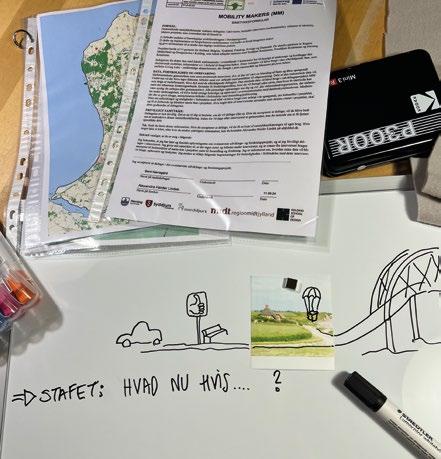
[Figure 23]: Artefacts used to support discussion and collect insights in the mobility case, including a whiteboard, pens, magnets, a mobile photo printer, and consent forms.
allowed ourselves to participate fully, attuning to the situation to sense the web of life we were entangled in (Anzaldúa, 2002; Gottlieb, 2024; Pink, 2015). This meant that besides being co-facilitators (facilitating the relay conversations and coordinating the process with Region Midt and the three municipalities), we also acted as mediators (between the relay participants and between the participants and the municipalities and region) and co-designers (by intervening with the relay conversations, the municipalities, and the region). Furthermore, we enacted a different kind of facilitation: designerly facilitation. Thus, “acting with” (Pickering, 2022, p. 155), attuning to the situation and nurturing co-becoming with emerging futures (Bawaka Country et al., 2013; Peschl, 2019), guided our engagement (see also Publication 3).
Our non-objective, performative, and embodied approaches during the relay encounters were continually discussed among us, the participants, and the wider research team. We drew on theoretical grounding from peers in the field of mobility (e.g. Jensen, 2014; Sheller, 2014) as well as from broader fields (e.g. DiSalvo, 2022b; Peschl 2019; Pickering, 2022; Scharmer, 2016) to reflect on our field engagements, which required working with rich, situated narratives, including our own affective experiences (Adams et al., 2021; Holman Jones, 2017). To make the research material more accessible and relatable to others, we turned to autoethnographical traditions (Adams et al., 2021; Bochner & Ellis, 2022; Holman Jones, 2017; see also Publication 3, p. 125/1).
I am a little anxious—we have reached the moment of handing over the baton from one of our previous participants—and though the baton is proper, it might be a bit too political for a 14-year-old. What is she to say to this question: ‘What if it was the citizens themselves who managed the mobility options in their neighbourhoods and municipality?‘ She thinks for a short while, and then she surprises me for the second time by giving an everyday example of why this suggestion is relevant: the private bus can’t pick up my friends. She explains that sometimes she has to get off the private bus because it is not allowed to pick up her friends, and they have to find another way to get on together. To the point.
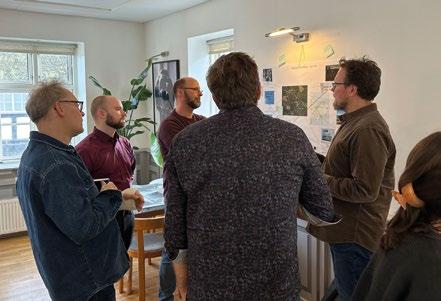
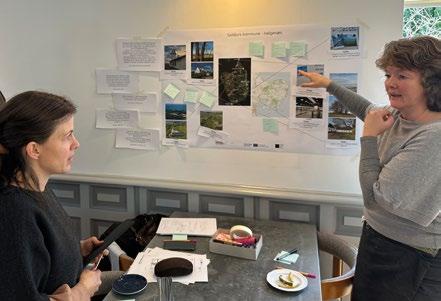
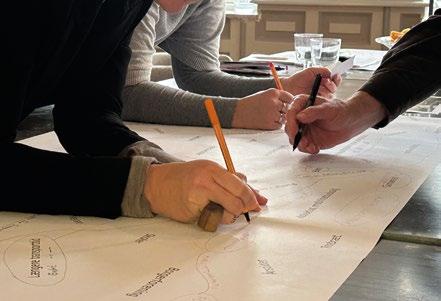
The following excerpt is presented as a reflexive account rather than as empirical evidence in a conventional sense. It makes visible how analytical attentiveness emerges through situated, embodied, and ethical engagements, and how my expectations and assumptions were challenged in the moment of interaction. What becomes visible in this moment is how the relay principle operates not only as a methodological device, but as a situated negotiation of relevance, age, and agency. The question framed as ‘political’ is translated into an everyday concern, and understanding emerges through the displacement between my anticipated response and the participant’s situated knowledge.
Later, in a workshop with the region and the municipalities, we facilitated a relational mapping exercise inspired by Clarke’s situational maps (Clarke, 2003), In which multiple participants actively engaged in exploring the relationality of local situations. Unlike in the coffee case, where the analysis was conducted solely by us, this exercise emphasised co-construction, with the participants actively contributing alongside us. Using selected field stories, a research material wall organised by the community, and the local “what-if” batons, the participants collaboratively: 1) selected the two most relevant elements from a baton statement, 2) added them to a shared “messy map”, 3) drew lines connecting the elements, and 4) labelled the relational theme on each line. Although not in any assigned group, we participated and contributed additional stories during the exercise. The cases illustrate how the relay conversation approach was enacted, adjusted, and reworked across different contexts. While the preceding sections have focused on how specific elements were configured in practice, the following section turns to a more reflective articulation of the dialogical logic underpinning these engagements.
3.4 3.5
Before moving on, I briefly clarify how I use the notions of engagements, conversations, and dialogues. Throughout this dissertation, “engagements” refer to the broader processual framing of inquiry, including how encounters are staged, revisited, and held open over time. “Conversations” denote the situated, everyday encounters themselves, typically loosely structured and relational in character. I retain “dialogues” to signal an analytically and ethically attentive register where such conversations are understood as part of a larger, facilitated inquiry. Therefore, by “design dialogues”, I mean inquiry-driven, facilitated engagements across stakeholders, practices, and places that surface relations, negotiate meanings, and scaffold potential trajectories without prescribing solutions.
As I had already realised through the pilot projects, I could not thoroughly plan for the above-described moments where the participants articulated the specificities of their relational dependencies, nor could I hope to understand local situations from a distance. In the pilot projects, we therefore experimented with being part of, and engaging in, local dialogues. This mode of engagement appeared to alter the quality of the conversations both for the participants and for us. By being physically present and bodily engaging with the situation, we found that we could ask more relevant questions and engage in deeper discussions. This also enabled us to participate on more equal terms. We were no longer only asking questions and taking notes; we became active participants in the dialogue by sharing our own standpoints, suggesting new perspectives, or bringing in stories or concerns we had heard from other participants. Any sense of what difference our engagement may have made for the participants can only be inferred from how they acted during the conversations: they planned where to take us, were often difficult to stop within the allotted time, wanted to show us additional places, shared personal reflections, and suggested other people we should reach out to.
3.5.1
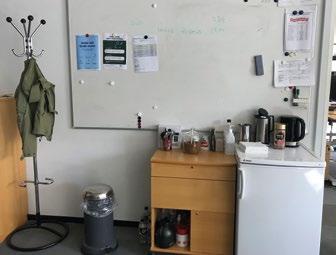
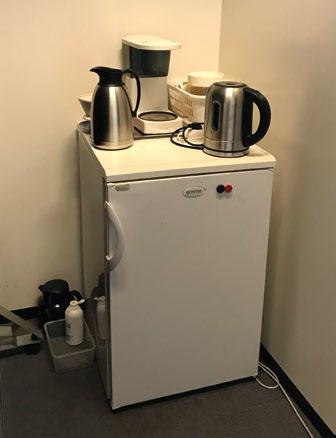
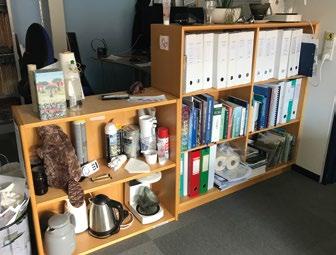
[Figure 25]: Selected images illustrating department-specific coffee solutions.
The evolution from user-centred design to co-designing, as articulated by Sanders and Stappers (2008), has laid important groundwork for more participatory and situated practices. Their insistence to move beyond “the person formerly known as the ‘user’” reoriented the roles of the designer, researcher, and participant. Yet, this landscape remained largely human-centred, with limited scope for more-than-human interdependencies and systemic transformation. This limitation became increasingly tangible in my own practice, prompting an incremental shift from co-design as participatory methods towards a more relational systemic orientation. Across the pilot projects, our engagement shifted from working with participants at fixed locations to moving with them through their local areas, attending to how relationships, practices, and atmospheres unfolded in situ. This approach was confirmed and challenged in the town hall case: while we could not always be physically co-present for the 43 online relay conversations, our prior in-person encounters had sensitised us to the local dynamics, enabling us to think along with the participants and suggest alternatives despite not sharing the same physical space.
Within this relational orientation, possible alternatives were not predefined but arose through ongoing engagement and embodied sensing in the moment. Most often, we had to intuitively perceive these alternatives in situ. Who would think coffee and getting exercise would have anything to do with each other? Only that afternoon did it start to click. This unexpected connection exemplified how alternatives surfaced through relational engagement. We talked with a participant who, like many of her colleagues, spent most of the day sitting still in front of a screen. She felt it affected both her body and her productivity.
I was beginning to sense this would be a topic we would have to dive more into and engage in. She (and others before her) pointed at something almost invisible but essential.
I was thinking about our short introduction to the in-house physiotherapist, who among other things motivated some to bike in front of their screen. Although I almost instinctively anticipated her answer, I asked anyway;
like many others, she didn’t like sweating in her regular clothes. Though seemingly not related, my mind wandered to another conversation on another hot topic: coffee.
We had had around a quarter of the relay conversations, and though online, I could easily recall the characteristic smell in the town hall. I could vividly recall all the department-individual coffee solutions. During the initial meetings, more than one group had taken us to the canteen and told us about the not-so-good coffee.
Some simply wished for better-quality coffee; others specifically wanted freshly brewed coffee. The steering group wanted the department-specific machines removed, and several participants emphasised the loss of chance encounters across departments due to small, individual coffee stations in nearly every office.
I decided to share the coffee story that came to mind. One colleague had mentioned picking up a cup of coffee from the canteen. Before telling the story, I wondered how she would respond. It was not intended to solve her challenge as a simple problem, but rather to encourage her to think differently about the situation. I had to give it a try. At first, she noted the time-consuming aspect, then fell silent. I reminded myself that quite often this means thinking. We then discussed other topics, but in a later encounter, she highlighted how the story had resonated: opportunities for fresh coffee, exercising mind and body, and meeting colleagues by chance. (as introduced in Publication 1, p. 97/5).
Although it felt transgressive to share the everyday coffee challenges at the town hall, and although we did not want to spark controversies, we had to open up to a different conversational culture: one in which entanglements could be surfaced and where, as Wahl (2016/2022) suggests, “open dialogue aiming at envision[ing] a more desirable future is the beginning of a design conversation that has the potential to become culturally transformative” (p. 147).
The coffee case differed because we had not been able to visit their locations due to time constraints and their distributed locations. Suggesting new approaches proved more difficult, as we lacked the same direct understanding of the status quo; this made the conversations feel more detached. We had not observed their everyday surroundings, and the very essence of the case—the coffee—was produced elsewhere, far beyond the local setting. To me, this case illustrated the difficulty of imagining sustainable transformation when one is not close to the concrete situation (see Publication 2, p. 104/295). It also highlighted the importance of recentring relations with practices, infrastructures, and ecologies. In this light, it reinforced my adoption of a relational systemic orientation, in which participation extends across human and more-than-human actors and the focus shifts from isolated artefacts or
users towards situational entanglements (Escobar, 2018; Forlano, 2016; Haraway, 2016; Tsing, 2015).
The mobility case expanded the relational approach by moving into broader, less bounded territories where entanglements became more diffuse and emergent. The case was different in scope and framing, as we explored mobility broadly. Our point of departure was rural areas with less defined borders. It did not make the case any less complex. On one hand, we had more freedom in terms of preconditioned directions; on the other hand, the conversations and their entanglements were, to some extent, more unpredictable. In our effort to leave more space for things to emerge and for the conversation to be an open co-created dialogue, we left the progression open and did not prepare a structured framework of questions regarding present, past, or future. However, towards the end of these conversations, the baton handover naturally took the form of envisioning future scenarios. In this, we experienced that the more we dared to engage openly, the more we sensed the (often invisible) entanglements of human and more-than-human practices— practices of life. Thus, as part of my engaged inquiry stance, I draw on Halse and Boffi’s (2016) interpretation of design interventions not as tests or prefigured solutions but as ways to enable new forms of experience, dialogue, and awareness to emerge—a deliberate strategy of complexification.
Escobar (2018, p. 97) frames this progression in research well: “[W]hat we are witnessing in the turn to animal, nonhuman, more-thanhuman, and posthuman studies is the return of all those unacknowledged aspects of the living that make life possible.” Drawing on this, I return to the three orientations highlighted in Section 2.4—resilience, interdependence, and emergence. These orientations increasingly guided our back-and-forth dialogic practices, reflexivity, and analytical reflection in the mobility case, helping us attune to the situated dynamics of sociotechnical-ecological systems (STES) and hold space for change to unfold through relationships.
Along the same lines, Latour (1992, p. 254) emphasises that “society itself is to be rethought from top to bottom once we add to it the facts and the artefacts that make up large sections of our social ties”. This did not happen without preparation, but a different kind of preparation. We prepared for “opening and attuning in new ways” (Tsing et al., 2024, introduction section; see also Publication 3), for listening and being present without knowing exactly where we were going. We prepared for the possibilities of uncertainty, as described by Akama et al. (2018), and inner work that required embracing embodied knowledge, reflexivity, intuition, and emotional attunement, as elucidated by Anzaldúa (2002; see also Publication 3, p. 124/1).
To underline that we cannot bracket ourselves out as participants, I draw on Haraway (2016, p. 100), who insists: “No species, not even our own arrogant one pretending to be good individuals in so-called
3.5.2
modern Western scripts, acts alone.” She further rejects objectivity and argues that knowledge is situated, stating: “It matters which stories tell stories, which concepts think concepts. […] which figures figure figures, which systems systematize systems” (p. 101). Her point is both epistemic and performative: the figures and narratives we choose condition what can be perceived and done. Picking up on the practical implications, Forlano (2016, p. 43) argues that “decentering the human […] offer[s] a way of enabling designers to think and act more critically about their responsibility to cultivate more ethical ways of living and working”. In the same spirit, Tsing (2015) invites attention to landscapes and assemblages as active participants in world-making. Across the cases described above, the approach was gradually refined as engagements moved from bounded organisational contexts to more distributed and less predictable settings, which further underscores the importance of situational and place-based engagement. This orientation—attending to relational entanglements and worlds-in-formation—set the stage for the situational, place-based encounters that formed the core of our design dialogues, as detailed in the next section.
A well-established strand of design scholarship reframes design as working with situations rather than merely producing objects. It links problem-framing, meaning-making, and action in evolving contexts (Buchanan, 1992; Dorst, 2015, 2019). In line with Section 2.1, this means engaging resiliently with disturbance, relationally with interdependencies, and openly with emergence. Following Suchman (1987), purposeful action is inevitably situated: it unfolds among particular people, practices, places, and materials. In our practice, this situatedness became increasingly evident. Our experiences showed that situated openness cannot be fully planned in advance. In practice, we found that these theoretical commitments only materialise when engagements are treated as living encounters. The encounters exemplified how situated relations constantly shape what becomes possible in a dialogue and highlighted the co-constitutive nature of relational engagement. With the design dialogues, we have increasingly nurtured this by treating each engagement as a facilitated encounter in which understandings and possibilities co-develop through interaction. An example from the rural mobility case is when we had planned to meet Stine for a go-along conversation in one of the rural areas. Before we had even set off, her daughter appeared. She wanted to come along and even took the lead, showing us a small “secret place” that mattered to her and her friends (see Figure 26). Later, as our planned conversation drew to

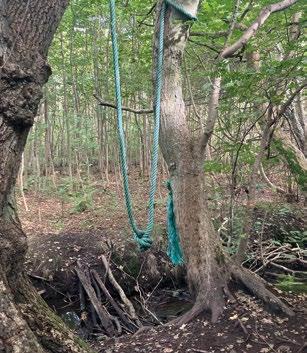
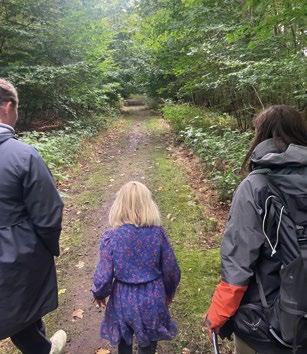
a close, a young girl passed by wheeling her bike, and Stine reached out to her, on our behalf, and invited her to join us for a conversation. Each unexpected encounter opened additional possibilities. New perspectives from a mother, her child, and a passing young person deepened our understanding of the relational entanglements shaping mobility in this rural area. Such moments shifted our attention from planned sequences to unfolding relational entanglements.
While the preceding section has shown how design dialogues unfolded through situational and place-based encounters, the mobility case also made visible the methodological demands such encounters entail. As the engagements became more open-ended and relationally complex, it was not sufficient to account only for what was said or proposed in the dialogues. Rather, a need emerged to attend to the situation in its relational, material, and embodied complexity, as encountered through our situated engagements—including movements across places, unfolding relations, material conditions, and our own embodied and affective involvement as designers–researchers.
To engage with and communicate these dynamics more systematically, particularly in the later stages of the project, we turned to anthropological ethnography as a methodological orientation. This offered a way of following practices, meanings, and relations across sites and scales while foregrounding situated knowledge, reflexivity, and the performative conditions under which the research encounters took place.
(17) De la Cadena, M. (2015). Earth Beings: Ecologies of Practice across Andean Worlds. “Worlding is a notion that I borrow from both Haraway (2008) and Tsing (2010), and that I think they composed in conversation. I use the concept to refer to practices that create (forms of) being with (and without) entities, as well as the entities themselves. Worlding is the practice of creating relations of life in a place and the place itself.” (de la Cadena, 2015, p. 291).
Anthropological ethnography supplies a way of attending to lived practices, embodied relations, and the situated knowledges that design should engage with when working on sustainability transitions. A multi-sited orientation follows relations, movements and linkages across places: as Marcus (1995) notes, multi-sited work is organised around “chains, paths, threads, conjunctions, or juxtapositions of locations” so that the logic of association among sites defines the ethnography (Marcus, 1995, p. 105). In practice, this required constant reflexivity about positionality, as the presence of “being within the landscape, and as the landscape changes across sites” demands continuous renegotiation as research moves across multiple scales and contexts (Marcus, 1995, p. 112)—a condition that became increasingly salient in the mobility case.
The emphasis on movement and relationality helps unsettle dichotomies (for example, local/global; nature/culture) and aligns with Escobar’s critique of modernity’s dualisms (Escobar, 2018). In that light, Descola extends the move beyond the nature/culture split by showing that ontologies differ historically and culturally: “the ordinary state of the world is indeed a multiplicity of reverberating differences, and resemblance is only the expected means to render this fragmented world intelligible and tolerable” (Descola, 2006, pp. 12–13). The familiar Western nature/culture split is only one way to distribute interiority and materiality; other regimes allocate properties differently across beings and objects (Descola, 2006). This invites attentiveness to different ways of construing individuality, agency and relatedness in the field.
Hence, attending to the in-between of relations, where meetings, learning and worlding take place, is crucial. Drawing on De la Cadena’s (2015) notion of worlding16, which captures practices that create forms of being-with and the relations that make places and their ways of life, I emphasise the importance of registering relational encounters and emergent practices in situ. Akama’s use of Ma—the productive ‘in-between space’—is helpful here, since “a net is made first of all of empty space.”(Akama, 2015, pp. 262–274; see also PDF pagination pp. 2–4). Thus, paying attention to such voids, atmospheres and tacit gaps is critical for registering how people, materials, technologies and more-than-human beings co-emerge in practice. This aligns with relational and nomadic understandings of subjectivity (Braidotti, 2012), supporting an ethnographic stance that is affective and embodied rather than detached. Methodologically, my ethnographic position combines (a) selective multi-sited presence where relations require following, (b) sustained attention to affective, sensory and embodied ways of knowing, and (c) openness to alternative ontologies and distributions of agency. This orients ethnography as an approach to becoming-with—engaged and co-constitutive rather than extractive—and prepares the ground for the dialogic, co-generative approaches that follow.
(18) See Publication 3 for a fuller treatment of commitment to curiosity as an ethical-practical approach to facilitation.
(19) For the foundational role of facilitation in participatory design traditions, see e.g. Kensing & Greenbaum (2012) and Ehn (2008).
(20) Buur & Larsen (2010) frame these effects as innovation. I use collective sense-making to foreground relational becoming and care rather than businessoriented connotations.
When ethnographic approaches are incorporated into design, dialogue becomes a central medium. With semi-structured design dialogues, I aim for a balance: sufficient framing to support the participants in articulating their experiences and values while avoiding steering them into pregiven problem/solution framings. This aligns with classic ethnographic commitments—“to grasp the native’s point of view, his relation to life, to realize his vision of his world” (Malinowski, 1922/2005, p. 25)—and with a design orientation that privileges learning from and with participants rather than imposing ready-made solutions (Spradley, 2016). From “learning from people” (ibid., p. 3), the approach here moves towards “learn[ing] to be affected” (Despret, 2004, p. 131), keeping encounters exploratory and responsive. The following section turns to how we operationalised these commitments in practice, focusing on the facilitation of design dialogues and reflecting on how our own experiences as facilitators shaped the process.
Grounding my position in care and affectedness (Haraway, 2008) implies an openness to being moved and transformed by encounters with others (Despret, 2004). This entails a nurtured curiosity17 towards “transformative, responsive relationships” (Baan Hofman, 2023, p. 3), In which dialogues are not controlled for consensus but kept exploratory, tentative, and oriented towards co-learning.
Within such dialogical spaces, facilitation cannot be understood as a neutral consultancy role outside the process (Buur & Larsen, 2010).18 Instead, facilitation is itself a form of participation, entangled in “constant relating to the other actors” (ibid., p. 137). This requires the facilitator to hold open the multiplicity of perspectives—not by suppressing tension or friction but by recognising them as possible drivers of collective sensemaking and co-becoming.19 Through the cases, discussions with colleagues, and engagement with theory, we became increasingly attuned to these dynamics. In this perspective, the quality of dialogue—its openness, responsiveness, and ongoing acts of care—is a precondition for emergence. As opposed to seeking closure, facilitation is about sustaining relational entanglements as spaces in which new possibilities can take shape.
Following on from that participatory, relational stance, walkalong (go-along) approaches blur boundaries between people and place, surfacing atmospheres, emotions, and embodied knowing (Anderson, 2004; Kusenbach, 2003). Pink’s sensory ethnography further attends to such multisensorial modes of knowing and emphasises that ethnography produces context-situated, subjective accounts rather than objective data (Pink, 2009). Together, these practices (including Pink’s sensory ethnography) surface affective and sensory modes of knowledge and prepare the ground for dialogues oriented towards care and affectedness (cf. Hannerz, 2003; Smith & Otto, 2016). Anderson suggests that “talking whilst walking (…) produces (…) a collage of collaboration” where meanings
3.5.5
are enacted in movement (Anderson, 2004, p. 260), which resonated increasingly through our cases as we observed the enactment of relational dynamics in the field.
Through our cases, we saw dialogues become performative sites where participants co-authored meanings and experimented with new exploratory ways of relating (Light & Akama, 2014). Over time, we moved away from structured formats, allowing the encounters to be more emergent and responsive. However, making space for this often requires leaving out highly structured representational toolkits and recipe-like methods. Along similar lines, Vink warns that a “view from above, from nowhere” risks turning systemic design into static diagnosis and professionalised tooling that undermines the embodied, situated shaping of social systems (Vink, 2023, p. 37; see also Haraway, 1988). In our project, learning and change often occurred through the participants’ embodied habits and actions rather than abstract planning; therefore, the body’s movements and practiced habits were primary media for transformation (Dewey, 1934/1980; Dewey & Bentley, 1949). In other words, the dialogues are simultaneously analytical (producing situated understandings) and prefigurative in scaffolding nascent relational arrangements that might be taken forward in practice (Smith & Otto, 2016). In short, in this project, semi-structured design dialogues functioned as an approach to co-learning and small-scale prefiguration that links directly to resilience, interdependence, and emergence.
Expanding on the prefigurative potential of semi-structured design dialogues, in the following section I explore how dialogical scaffolds can open space for exploring possible futures that are not predetermined but emerge through situated and relational engagements.
When the future is not treated as a linear projection, dialogical scaffolds can open space for collaboratively exploring regenerative possibilities as they emerge in practice. In this study, I consider a perspective of multiplicity, where futures are already entangled in everyday narratives of “social, material, and political practices” (Watts, 2008, p. 188) and on the premise that stories of the future cannot be considered neutral in their effects (Kjærsgaard et al., 2016, pp. 1–4). Such scaffolds differ from predesigned prototypes, such as interview guides, artefacts, or role-plays, as they arise within the dialogue itself. They hold uncertainty, allowing relations to be rehearsed, values-in-the-making to be tested, and openings to be sensed as they emerge (Akama et al., 2018; Ehn et al., 2014; Smith & Otto, 2016).
Such dialogical engagements resonate with design anthropological accounts of scholars who describe “virtual experiments on the emergent”
(Smith & Otto, 2016, pp. 22–23), “ethnographies of the possible” (Smith & Otto, 2016, p. 33), and the significance of contingent encounters where novelty is sparked in situated, more-than-human relations (Akama et al., 2020). From this perspective, virtuality refers to the latent field of possibilities not yet actualised but capable of taking form (Massumi, 2002; Rabinow, 2008; Smith & Otto, 2016). Massumi (2002) further conceptualises the virtual as a lived paradox: a pressing field of potential that is sensed affectively before it is actualised in practice. While emergence emphasises what arises unpredictably in practice—such as a surprising turn in a dialogue—virtuality highlights the dimension of potential that can take form but is not yet actualised.
As a whole, these perspectives point to a shift from analysing what is already given to engaging with what might yet come into being in practice—through experiments, possible worlds, and contingent encounters. As noted by Fitzpatrick (2020, p. 29), existing studies highlight that regenerative agendas across disciplines are increasingly recognised conceptually, yet their practical implementation remains limited. In response to these observations, dialogical scaffolds can offer a situated way to co-create possible futures that are neither predetermined nor arbitrary but are situated, affective, and open-ended.
In this study, the materials generated through these dialogues are treated as research materials rather than fixed data points (Pink, 2009). Their value lies in capturing emergent relational entanglements, affective experiences, and embodied practices. They are not simply objects to be counted or categorised but traces of ongoing co-constitutive processes (Akama et al., 2020; Smith & Otto, 2016) that provide insight into complex sociotechnical-ecological systems. Approaching research in this way acknowledges the iterative, exploratory nature of engagement (Bochner & Ellis, 2022; Holman Jones, 2017): through repeated encounters, concept boards, conversations, and movement-based observations, new insights emerge over time, and the researcher’s attention and intuition play a role in discerning patterns and themes.
In summary, the methodological orientation adopted in this study positions design dialogues as situated, relational, and prefigurative practices. Through multi-sited engagement, reflexive facilitation, and attention to affective and embodied knowledge, these approaches provide a framework for exploring emergent possibilities and co-creating relational arrangements that can inform transitions towards regenerative futures. I see this orientation as reflecting an iterative and responsive approach to research design—a continual process of designing, redesigning, and reredesigning—attentive to emergent possibilities and relational entanglements, a sensitivity progressively refined through engagements with participants, spaces, and materials in this transition research. At the same time, adopting such an embedded, relational, and iterative approach entails specific methodological constraints and limitations, which are addressed in the following section.
3.8
The methodological choices outlined above also shape the scope and limitations of this study. Access to projects, scope of inquiry, and temporal constraints (see section 5.2) influenced both observation and intervention. The three cases, while rich and illustrative, are situated within specific organisational, social, ecological, and technical contexts, which limits the generalisability of the findings. Moreover, the iterative, emergent nature of interventions means that standardised or universal methodological prescriptions are neither feasible nor appropriate.
A further consideration concerns the researcher’s positional involvement. Participation in the cases was a deliberate methodological choice, allowing deep insight into relational, emergent, and situated dynamics. While different researchers might have emphasised alternative aspects or made different interventional choices, this variability is understood here as an inherent condition of relational and emergent research rather than a methodological shortcoming. Nevertheless, the approach preserves the entangled character of systemic design: while details may vary with timing, setting, or participant constellation, the orientation toward relational, emergent, and context-sensitive engagement remains central. This highlights both the situatedness of the findings and the methodological contribution of embedding research within ongoing practice.
Additionally, the study is constrained by the agendas of the larger projects in which the PhD was embedded. Navigating these multiple priorities required balancing the research focus with organisational needs, illustrating the pragmatic limits of embedded, action-oriented research.
res, Participation or Unpacking the Black with Organizations
4.3 (Publication Circular Economy Designing for Transformative 4.0 Presentation
In this chapter, I introduce the three publications which, together with the cover essay, constitute this dissertation and collectively address the overarching research question and its sub-questions (see Section 1.7.2 for an overview of the publications and Section 2.5 for how the research questions are addressed across the dissertation).
4.1
Across the three publications, certain terms have shifted or been replaced. These changes reflect both the gradual sharpening of the relay conversation approach and the concurrent development of the study’s theoretical orientation. The terminological movement mirrors the learning-through-practice trajectory I have been engaged in, where concepts are refined in and through situated design engagements rather than fixed in advance (see Section 4.5 for further elaboration).
In Publication 1, we used the term “conversation” to foreground everyday life and informal, situated exchanges. In Publication 2, relay conversations were hinted at as “adaptive step-by-step approaches that foster co-becoming and gradual transformation” (p. 116/307). In Publication 3, “conversation” referred to specific encounters, while “dialogue” denoted the entangled and evolving weave of exchanges unfolding over time. Throughout this dissertation, I retain “dialogues” to signal a facilitated and attentive mode of engagement while keeping open the everyday sense of “conversations”.
The terms used to describe those involved in the studies also vary across the publications. In Publication 1, “interlocutor” and “participants” are used sparingly, primarily referring to employees and human participants within sociomaterial practices, without explicitly addressing more-than-human actors. In Publication 2, the term “actors” is employed to denote both human and more-than-human elements shaping the situation. In Publication 3, “participants” refers to those taking part in specific activities, while “actors” is used more broadly to encompass humans as well as more-than-human entities. This terminological movement reflects an increasing attentiveness to relational and more-than-human dimensions across the studies.
In Publications 1 and 2, participants are referred to by their roles or positions within the organisational structure, while their names are omitted. In Publication 3, participants are referred to either by pseudonym, by descriptions of their roles within the community (e.g. “two retired priests” or “the young girl”), or a combination of both. As
a result, participants are not fully anonymised, as individuals may be recognisable to those familiar with the workplaces or local contexts involved. This approach was adopted with the participants’ informed consent. In other forms of reporting and public communication related to the projects, individuals have not been highlighted unless explicitly agreed upon.
In Publication 1, the developed practice is referred to as a “relay conversation method”. As the work progressed and the practice evolved into a less rigid and less recipe-like format, it is in Publication 3 described as a “relay conversation approach”. Throughout this dissertation, the term “approach” is used to emphasise its adaptive, situated, and processual character.
Design Research Society Society
DRS Digital Librar y DRS Digital Librar y
Nordes Conference Series
Jun 12th, 9:00 AM - Jun 14th, 5:00 PM
Pleasures, par ticipation or practices? Unpacking the black box of par or practices? Unpacking the black box of designing in and with organizations designing in and with organizations
Alexandra Harder Lindek
Design School Kolding
Mor ten Krogh Petersen
Design School Kolding
Follow this and additional works at: https://dl.designresearchsociety.org/nordes
Citation Citation
Harder Lindek, A.,and Krogh Petersen, M.(2023) Pleasures, par ticipation or practices? Unpacking the black box of designing in and with organizations, in Holmlid, S., Rodrigues, V., Westin, C., Krogh, P. G., Mäkelä, M., Svanaes, D., Wikberg-Nilsson, Å (eds.), Nordes 2023: This Space Intentionally Left Blank, 12-14 June, Linköping University, Norrköping, Sweden. https://doi.org/10.21606/nordes.2023.120
This Research Paper is brought to you for free and open access by DRS Digital Library. It has been accepted for inclusion in Nordes Conference Series by an authorized administrator of DRS Digital Library. For more information, please contact dl@designresearchsociety.org
ALEXANDRA HARDER LINDEK
THE DESIGN SCHOOL KOLDING AL@DSKD.DK
As a contribution to the field of design management, this paper responds to the uptake of design in organizations by developing and fleshing out a relational approach. The dominating approaches are methodological and cognitive, putting the human designer and her capabilities front and center. In contrast, the relational approach pays close, empirical attention to how designerly contributions come into being as the designer relates to her organization. Thereby, the relational approach enables a more critical understanding of what organizations and designers can achieve together. We unfold our arguments through ethnographic accounts of crucial moments in a development project concerning workplace design. These ethnographic moments were crucial, as they questioned what we could achieve together. We suggest evaluating such achievements through three distinct modes of designing: 1) Designing for human pleasures, 2) Designing for human participation, and 3) Designing for socio-material practices.

MORTEN KROGH PETERSEN
THE DESIGN SCHOOL KOLDING MKP@DSKD.DK
In recent years, many designers have left behind the design studio to employ their competencies in other organizational settings. Nevertheless, what can, and should designers do in and with organizations?
The field of design management gives some answers. Here it is suggested that managers and organizations today would do well to adopt a “design attitude,” implying that managers “would [then] approach problems with a sensibility that swept in the broadest array of influences to shape inspiring and energizing designs for products, services, and processes that are both profitable and humanly satisfying” (Boland & Collopy, 2004: 3). Richard J. Boland and Fred Collopy, both professors in management, develop this design attitude by contrasting it with what they term a “decision attitude”: “In a clearly defined and stable situation, when the feasible alternatives are well known, a decision attitude may be the most efficient and effective way to approach problem-solving. But when those conditions do not hold, a design attitude is required. The decision attitude and the analytic tools managers have to support it were developed in a simpler time” (Boland & Collopy, 2004: 4).
But how, more precisely, to unfold this design attitude in practice? How to make sure that designers aid organizations in harnessing the broadest array of influences, resulting in inspiring and energizing designs? Design researchers have responded to these questions in three distinct ways. The first response is methodological. This methodological response develops recipe-like, process-oriented models for how to work as a designer in organizations (see, for instance,
Tschimmel, 2012). The second response is cognitive, focusing on describing the cognitive styles of designers and arguing that these styles are different from those employed by non-designers (see, for instance, Dorst, 2011, 2015). The problem with these two responses is that by putting the human designer and her methodologies and cognitive abilities front and center, they neglect and make absent the organizational setting in which she operates (see, for instance, Law & Singleton, 2005). This neglect of the organizational setting hampers critical analyses of specific uptakes of design in organizational settings. Such analyses seem more needed than ever, as understandings and deployments of design have become increasingly variegated, resulting in a proliferation of purposes, hopes, and dreams attached to having designers do work in and with organizations (Julier, 2017, see also Kimbell 2011, 2012).
This paper develops a relational approach to enable critical analyses of designerly engagements with organizations. With this relational approach, we “treat everything in the social and natural worlds,” design methodologies and cognitive styles included, “as a continuously generated effect of the webs of relations within which they are located” (Law, 2009: 141). This relational approach enables us to describe and analyze how organizational specificities – specific people and artifacts, politics, and cultures, for instance – all take part in deciding what designers can and cannot do in and with organizations.
We do so through a developmental design project in which one of us, Lindek, took part, which aimed at redesigning how work was to unfold at the town hall of a municipality in the wake of the COVID-19 pandemic. As part of Lindek’s engagement in the project, Lindek developed ‘the relay conversation method’. After completing the project, and as a part of Lindek’s current doctoral work, Lindek approached Petersen to discuss

how the relay conversation method might be developed from a consultancy method to a method for conducting research through design, as this is one of the central ambitions for her doctoral work. “Well, is designing only about enabling conversations?” Petersen asked This question prompted Lindek to give a detailed account of the project. It became clear that the town hall managers, employees, and artifacts had drawn Lindek into their specific understandings of what a designer like her had to offer their specific organization.
An organization like the town hall can, in a relational approach, be understood as “an exercise in ordering” (Law, 1994: 43), and in the following, we will tease out three such ordering attempts: designing for human pleasure, designing for human participation, and designing for socio-material practices. We aim to show how such ordering attempts enable specific organization-artifact-designer configurations, and point to “artful integrations” (Suchman & Bishop 2000) of the designer’s work rather than a take-it-or-leave-it revolutionizing value-creation. By forwarding these configurations, we wish to enable less heroic and more modest and situated discussions of what design can and should do in organizations
The project and its steering group were created by the city council of a Danish municipality The COVID-19 pandemic gave the town hall managers and employees new experiences with working remotely. The city council wished to explore how these experiences could power the creation of new and better working practices at the town hall. This wish resulted in the project being developed as a part of the partnership agreement with our design school in June 2021 The steering group comprised 15 members (see, Figure 1)
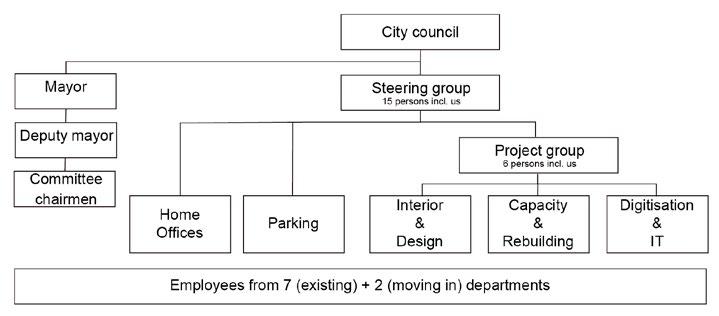
13 were employed at the town hall, fulfilling roles such as manager, head of department, consultant, and union representative Two, employed at our school, fulfilled the roles of design consultant and Head of Business Development This steering group answered to the city council, which was also to approve the recommendations formulated at the end of the project process. Additionally, 5 internal working groups from the town hall were created: Interior & Design, Capacity & Rebuilding, Digitisation & IT, and Parking & Home Offices. All 5 internal working groups referred to the steering group. The last organizational construct created by the project was a project group, in which the design school had one of 6 seats. The project group’s task was to ensure that the project did not run astray by outlining three focus areas, which we outline below
This partnership agreement reads:
“As an effect of the experiences gained with working from home during the COVID-19 pandemic, employees and management at the town hall voiced a desire to continue enabling remote work. To work remotely more extensively would enable several more departments and employees to be moved to the town hall. However, working from home also places new demands on flexible solutions.”
The requirements for these “flexible solutions” are elaborated upon in the project management framework through the three focus areas mentioned. While working from home utilizing digital solutions was adequate for completing concrete tasks, the steering group urged us to find out how working remotely could also support learning and creativity. The second focus was acknowledging the need for office spaces that embraced quiet zones, knowledge sharing, and common areas, such as the canteen and meeting rooms. This need was to be fulfilled through specific furnishings and interior design. The third focus had less to do with the COVID19 pandemic. It highlighted, instead, that the town hall is a public building, and the steering group wished to ensure it could continue enabling trusting meetings and relations between citizens and authorities
These 3 focus areas and the steering group’s wishes for the project to give the impression that the experiences gained during the COVID-19 pandemic had left the town hall ready for a radical re-design of its physical layout. However, the 3 focus areas came with 6 caveats, also spelled out in the project management framework:
• The building is not to be enlarged or remodeled
• The solutions must be specific to the departments – only meeting rooms, canteen, and conversation facilities should be crossdepartmental
• The individual departments need permanent locations in the town hall.
• No fixed agreement will be made on how much the employees are allowed to work at the town hall or remotely
• The project’s questions of where and how to work in the future spur many opinions and emotions, and therefore a co-creational process to create ownership was important.
• The project must clarify the advantages of working at the town hall or remotely.
Taken together, the complex organizational set-up of the project, including the three focus areas and the 6 caveats, left us in a bit of a pickle: On the one hand, we were met with expectations of changing everything at the town hall – its physical layout, interior design, and the working practices unfolding there. On the other hand, we were not allowed to change anything – we could not, for instance, enlarge or remodel the town hall building or experiment with the individual departments’ permanent locations. One solution was to insist that design – through the designer’s specific methodologies and cognitive abilities – can somehow clear up this mess of contrasting expectations. This solution would entail stories of a somewhat heroic designer sorting out organizational messiness all by herself. Another solution embeds the designer in the messy organizational realities and sees her methodologies and cognitive abilities as outcomes of the specific ways she “relates to the object of study and to the socio-material collective in which he or she operates” (Vikkelsø, 2007: 298). It is this second option we unfold here, as it allows us to bring to the fore and discuss what kinds of valuecreation design work sensitive to organizational messiness might enact.
The following sections give ethnographic accounts of three pivotal moments in the development project: an introductory meeting, setting up and completing relay conversations, and looking for unused spaces. They were pivotal because they asked Lindek to relate to the socio-material collective of the town hall in three different ways, highlighting three different ways by which she could come to create value in the project.
At the first introductory meeting, we met the Head of HR & Administration at his town hall office. We came prepared with a ‘conversation starter’; a piece of A4 paper upon which we had printed the three themes of the project: 1) The physical layout of the town hall, 2) Online meetings, and 3) The home office. The material conversation starter was our attempt at ensuring that the conversation with the Head of HR & Administration would tell us more about what we believed to be the
project's key themes. It was also to function as a place to take notes.
The Head of HR & Administration told us he had worked at the town hall for many years. He knew every nook and cranny of the town hall and the history of every reconstruction made. He also wanted us to know this history and handed us a booklet detailing the transformations that the town hall had undergone over the years. Further, he told us about his specific vision for the transformations the project should bring about. He stressed that “furniture is important,” elaborating that “we have a lot of designer furniture and beech tables, which we would like to keep.” When we walked around the building with him, he pointed out the furniture they wanted to keep.
During the meeting, he also underlined that the white painting on the walls was non-negotiable. Earlier, employees could choose between a range of colors in a color guide when rearranging or swapping offices, but such rearranging and swapping had resulted in too many layers of paint on the town hall’s old walls. So, from now on, only white.
What to make of this meeting? The conversation underscored that the Head of HR & Administration had specific expectations as to what we, as designers, could and should be able to do in his organization, that is, the town hall. He referred to us as ‘designers’ during the conversation several times. We thought he expected us to compile a new design guide on aesthetics and finish. While within our competencies, our point is that he referred to a specific version of designers and design competencies, seeking to enact a specific mode of designing.
We suggest that the central assumption within this particular mode of designing is “that design is something with which an object can be endowed” (Shove et al.2007: 129), enabling specific human affective experiences. We were unsurprised that the Head of HR & Administration approached us with these expectations. The idea of designing as endowing products or services with ‘something’ that results in positive human experiences is perhaps the most widespread way for designers and design agencies to market their value (Shove et al. 2007: 125). Within design research, we also find a body of work that highlights and seeks to develop this mode of designing artifacts for the human experience. Desmet & Hekkert (2007), for instance, argue that the “emerging interest in user-centered design has stimulated a shift of focus from the users’ behaviour and cognition to the users’ affective experience of (and involvement in) the humanproduct interaction” and attempt to “develop a general framework of product experience” (Desmet & Hekkert,
2007: 57). Another critical contributor to this mode of designing is Patrick W. Jordan, who combines his backgrounds in mechanical engineering, ergonomics, and psychology in devising ways in which the designer might come to design “pleasurable products” (Jordan 2000).
While this mode of designing – designing artifacts for human pleasure – could be of value in the project, it was not the mode of designing we had envisioned we would take part in unfolding. During our tour around the town hall, we passed by the canteen. Here the Head of HR & Administration remarked that he would like to see a change from the current “cafeteria-like look,” a place designed for eating lunch, to a place where employees could meet and mingle across departments, that is, designed to take part in fostering cross-departmental collaboration. Through this remark, our interlocutor alluded to a quite different mode of designing, which came closer to our expectations, namely that we would enable the town hall employees to participate in designing the future layout of the canteen and the whole town hall.
To enable such employee participation in the town hall's future layout, we developed the participatory method of relay conversations. We did so in two steps.
First, we invited representatives from each of the seven existing departments on a walk and talk, where they showed us their working spaces. They told us stories about the situation right now – their experiences of work at the town hall amid the pandemic –intermingling stories of the past and hopes for the future. We distilled 6 analytical categories from these walks and talks: Possibilities, Challenges, Place, Time, Qualities, and Community.
In the second step of involving the employees, we invited 43 employees, representing the seven existing departments and the two departments moving in, to engage with us in individual relay conversations (see, Figure 2). With a pending pandemic, we decided to

Figure 2: Relay conversation steps and duration, inspired from Sanders and Stappers’ “path of expression” (Sanders & Stappers 2014). Focusing first on the present, then the past, and then the future.
undertake all the conversations online. We used an online whiteboard upon which we had put photos of artifacts specific to the town hall environments, and floor plans as a facilitation tool.
In formulating questions for the employees involved, we took inspiration from Sanders and Stappers’ “path of expression” (Sanders & Stappers 2014). This path of expression utilizes psychological theory about memory and creativity. It asks participants to go “through the successive considering of present experiences, good and bad memories from the past, and hopes and dreams for the future” (Sanders & Stappers 2014: 8, see also Sanders & Stappers 2012). In our case, we elicited the employees’ present experiences working through a pandemic. We talked with the employees about their good and bad memories. And we asked them to detail their hopes and dreams for the future layout of the town hall. We asked the employees to tell stories from their everyday work life at the town hall, prompting them to tell us about a good and challenging day at work. We extracted the essential elements from these conversations and asked them to place them within the 6 categories developed through the walk and talks. We introduced the baton from the previous conversation and ended by having them formulate a baton. We could all see, read, rethink, and adjust the outcome by live sharing our notes on the online whiteboard.
We used an online calendar to organize the many conversations where the employees could choose a fitting timeslot. As a result, the employees were involved in random order, and the resulting relay strings were cut across all nine departments (see, figure 3)
To give an example of the contents of the relay conversations: one employee stated that our bodies are not made for sitting still in front of a screen for 7,5 hours a day. We told this employee of a colleague with whom we had had a conversation earlier, who went to get one cup of coffee at a time instead of fetching a whole pot. At a first glance, this seems like a waste of time. However, when explaining this behaviour in a later conversation, the employee pointed to the integrated exercise of body and brain, the opportunity of chance meetings with colleagues, and – of course –fresher coffee. This need for integrating bodily movement and exercise into the workday was expressed throughout the relay conversations, and later materialized as kitchenettes on each of the town hall floors.
Building on such and other analytical results of the relay conversations, we formulated 5 principles regarding the future layout of the town hall:
• Citizen- and business-oriented activities are to take place under joint official hosting.
• Outdoor spaces and exercise opportunities will be an integrated part of the layout of the town hall.
• Meeting and conversation facilities are shared by all the employees as is already the case with kitchen and canteen facilities.
• Executive offices are to be moved to smaller offices with limited meeting facilities.
• More spaces are allocated for developing ideas and for immersive work.
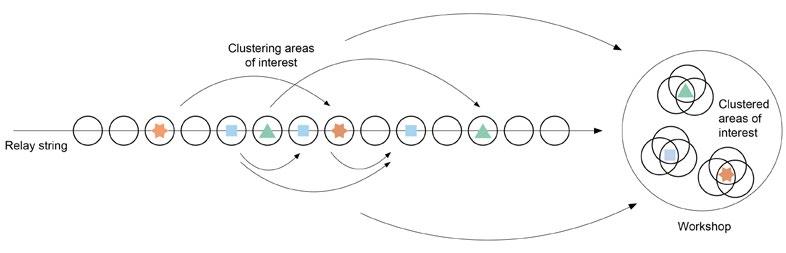
However, between each conversation, we, as a minimum, had a small time slot to jot down insights that could be important to bring forward in the following conversations
These 5 principles were presented to the city council, who, we were told, regarded the 5 principles as having “a nice ring to them.” The 5 principles were then approved and adopted by the city council.
In this part of the project, we engaged in and were drawn into a different mode of designing. While the first mode of designing considers how humans might get pleasure from relating to artifacts enriched with design, this second mode asks the designer to enable human participation in the design process. Design research on Participatory Design (PD) inspires this second mode of designing. Halskov & Hansen 2015, which conducts a review of all full papers from the Participatory Design Conferences (PDC) 2002–2012, offer 5 fundamental aspects of PD:
• Politics: People affected by a decision should be able to influence it.
• People: People play critical roles in design by being experts in their own lives.
• Context: The use situation is the fundamental starting point for the design process.
• Methods: Methods are means for users to gain influence in design processes.
• Product: Participation aims to design alternatives, improving quality of life.
All 5 fundamental aspects of PD were present in this part of the project. However, participation cannot be ensured by checking points on a list. We agree with Andersen et al. (2015), which argues that “although designers constantly consider and address participation, there is a surprising lack of detailed accounts and analyses of what constitutes participation” (Andersen et al., 2015: 252). Instead, Andersen et al. (2015), urges us always to understand participation as “a specific achievement,” which “must be accounted for as such” (Andersen et al., 2015: 251). So, what specific kind of participation did we achieve here?
conversations. Individual conversations enabled the employees to tell their stories of their daily work, bypassing existing organizational hierarchy and layers of decision-making. Letting time pass between the conversations enabled the employees involved to reflect upon their participation in the project while allowing us to mediate and inspire across relay strings (see, Figure 4). The delay between the relay conversations created an opportunity for talks in the corridors, which we encouraged by telling the employees: “If you talk to your colleagues and come up with new ideas, come to think about new perspectives, or something else, please reach out to us!”
This encouragement proved to work well. Before entering the relay conversations, several employees referred to informal conversations with colleagues Further, employees self-organized small-scale trial-anderror experiments in their offices and meeting facilities. One example is the decision to establish kitchenettes on each floor. Another example: Employees tested how it would affect working procedures if the Head of the Secretariat moved from an individual to an open office. As designers, we know that participation can be challenging to achieve – participation is best understood as a “matter of concern” within rather than a “matter of fact” of PD (Andersen et al. 2015, see also Latour 2004).
Moreover, the specific form of participation that unfolded here did not align with the steering group’s idea of what kind of participation the project should yield. Before the relay conversations and the employees’ trial-and-error experiments, the steering group had agreed to share the baton statements of the employees involved with all employees at the town hall. This was to let them in on the contents of the relay
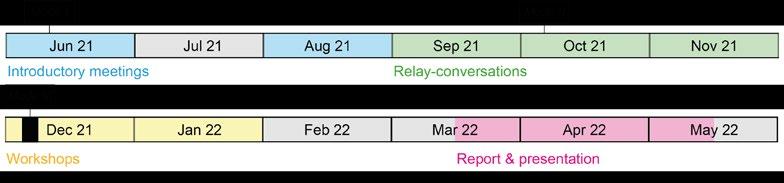
Various kinds of workshops have been forwarded as the preferred method for designers keen to achieving participation (see, for instance, Greenbaum & Kyng 1991, and Robertson & Simonsen 2012). In this project, however, we departed from the collaborative enactment of participation that the workshop format enables by conducting individual relay conversations with the employees and letting some time pass between the
conversations. Subsequently, this decision was reversed by the steering group. The employees’ participation had become somewhat unruly, the steering group found. The relay conversations were not only about present, past, and future work at the town hall. They also prompted transformations in daily work practices. Transformations that the steering group had not envisioned And perhaps these transformations did not
align with the dreams of the city council, to whom the steering group was responsible
We learn here that designing for participation can spill over into the third mode of designing, namely designing for socio-material practices. It is to this third and last mode we turn now.
Apart from the 5 principles for the future layout of the town hall introduced above, we were also asked to develop concluding recommendations. We approached this task by meeting up with the steering group. During the meeting, we pinpointed the challenges expressed in the relay conversations. Based on this meeting and two subsequent workshops, we transformed the 5 principles into a new layout for the town hall. The critical challenge, as already highlighted in the 5 principles, was a need for more space for unfolding a more dynamic workday while at the same time avoiding disturbing one another. One employee having online meetings in the office space, for instance, was disturbing to fellow employees, and thinking about not disturbing fellow employees was felt by other employees to restrict creativity in solving their tasks. Another concern was how to handle confidential citizen and business cases. This concern clashed with the wish to be a welcoming and open institution and would, to be solved, require spaces dedicated to confidential conversations (see, Figure 5).
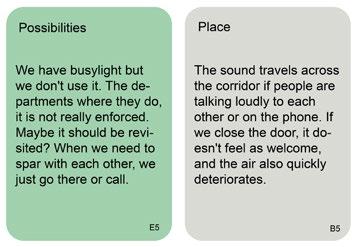
Figure 5: These are examples of 2 of the 6 analytical categories: a) statement about disturbing fellow employees (Possibilities category). b) Statement about sound traveling and confidentiality versus hospitality (Place category).
Walking around the town hall and mapping the layout and the use of it to find more space, we came across 6 offices on the second floor. These offices were used on Wednesdays only. We wondered why we had not been shown these 6 offices earlier on. We asked the relevant employees. While some did not know, others told us the offices belonged to the 6 committee chairpersons. They,
the committee chairpersons, only used their offices on Wednesdays, where they held meetings. “Great,” we thought, “these offices can be utilized as meeting facilities on Mondays, Tuesdays, Thursdays, and Fridays!” We presented this idea of dual use of the committee chairpersons’ offices to the steering group. Their faces expressed avoidance. They told us that they would get back to us later on that matter. A few days passed, and we were told we could not touch those offices as it was “a delicate political matter.”
Another example: During our work, we learned that the town hall comprised 33 one-person offices occupied by managing employees and equipped with meeting facilities. During the relay conversations managing employees and employees had all expressed a wish to keep this convenient resource, where they did not have to book nor share the meeting facilities with the other departments. Since this solution was unsustainable due to the many new colleagues at the town hall, we recommended separating offices from meeting facilities. This recommendation was, again, regarded as a delicate political matter. It was seen as “a drastic change” by the managing employees having to give up the sole occupancy of their offices. However, as shown above, it was accepted as one of the 5 principles
In this third mode of designing – designing for sociomaterial practices – artifacts such as an office equipped with meeting facilities are not to be endowed with design as in Mode I. Neither are the offices solely utilized to elicit human participation as in Mode II. What, then? We suggest, with analytical help from anthropologist and design researcher Arturo Escobar, that we were here drawn into what Escobar terms “ontological design” (Escobar, 2018). Escobar elaborates: “Design is ontological in that all design-led objects, tools, and even services bring about particular ways of being, knowing, and doing” (Escobar, 2018: 9).
In this part of the project, we suggested tinkering with the designed artifacts of the 6 chairpersons’ and the 33 one-person offices. Not only as something we as designers could endow with certain qualities or as written or talked about in our recommendations. But as designed artifacts that, in Escobar’s view, participate in enabling particular ways of being, knowing, and doing, that is, particular socio-material practices. Through our tinkering, the offices went from being understood as a passive container for human work to becoming “vibrant matter” (Bennett 2010). The offices’ vibrant participation in, for instance, keeping organizational hierarchies in check or, perhaps, bringing about more intense collaboration between managers and employees was a deciding force in determining what we, as
No 10 (2023): NORDES 2023: THIS SPACE INTENTIONALLY LEFT BLANK, ISSN 1604-9705 www.nordes.org
designers, could and could not help the steering group to achieve.
Our research question read: What can, and should designers do in and with organizations? Perhaps counter-intuitively, we approached this question by bracketing strong statements concerning our commitment to unfolding a specific design methodology or applying specific cognitive abilities belonging to only us, the designers. This bracketing allowed us, instead, to develop and tell stories about three specific modes of designing: designing for human pleasure, designing for human participation, and designing for socio-material practices. What to make of these three modes of designing? What do they tell us about what designers can and should do in and with organizations? To answer these questions, we will unbracket the human designer and discuss what she can and should do when entering organizations, working in and with organizations, and leaving organizations behind.
Our notion of modes of designing is “an attempt to find a way of imputing quite general patterning strategies to the materially heterogeneous networks of the social” (Law 1994: 95), specifically the materially heterogeneous networks of designing in and with organizations. As we saw in the stories above, when the designer leaves the design studio behind and starts working in and with organizations, she is confronted with, drawn into, and asked to handle patterning strategies that may differ from those performed in and by the design studio. Think about the Head of HR & Administration. He enrolled pieces of furniture, which to him were endowed with design, in his attempt at ordering the project and its potential value creation along the lines of artifacts eliciting human pleasure. A second ordering attempt was the project management framework’s call for creating ownership amongst the employees and managers for the recommendations produced in the project. An ordering attempt that we responded to by employing the participatory method of relay conversations
We admit that then and there – when we first entered the project with the town hall – these attempts at ordering us as designers and our potential value creation created frustrations. We became frustrated because these ordering attempts did not fully align with what we expected that we would be doing and the value we would be creating. This frustration was expressed in our impression that the steering group expected us to change everything without touching anything. Our frustration can be understood as an outcome of us expecting
organizational singularity while being confronted with organizational multiplicity. We suggest understanding and working with organizational multiplicity as the norm rather than the exception when entering into collaborations with organizations. This can be done by listening carefully to the differing expectations formulated by the organization and trying to connect these expectations to relevant modes of designing. Or, as we did in this project, to attempt to background what we found less relevant modes of designing, in our case designing for human pleasures.
WHEN WORKING IN AND WITH ORGANIZATIONS:
EMBRACING SPILLOVERS BETWEEN MODES OF DESIGNING
All three modes of designing describe specific configurations of relations between the organization, artifact, and designer. Designing for human pleasure highlights an organization's aesthetics – in our case, we were asked not to let the project destroy the town hall’s existing aesthetic qualities. Designing for human participation speaks of a lack of employee engagement in organizational change processes. It expects the designer to enable such participation through various artifact-driven methods, the relay conversations employed here being the case in point. Designing for socio-material practices offers to transform how work is done, and in doing so, it enrolls artifacts and prior conversations as change agents. We saw this in the employees’ self-organized trial and error experiments, through which they experimented with their future working practices on-site. We also saw how these employee experiments were later shut down by the steering group as the steering group felt that these experiments were premature.
These examples should make it clear that we do not want to suggest a simple hierarchy between the three modes of designing. Designing for socio-material practices, for instance, is by no means always and everywhere a more value-creating response to organizational challenges than, say, designing for human pleasure. What we do want to suggest, however, is that the three modes of designing can spillover into one another in quite unpredictable ways. Designing for participation can spillover into designing for sociomaterial practices which again can ‘spillback’ into designing for human participation and designing for human pleasure. Such spillovers and spillbacks are not solely in the hands of the designer. To attempt ultimate control would be in vain. What can be done by the designer, however, is to register spillovers and spillbacks, and to embrace and analyze them as resources for navigating the organizational multiplicity in which she operates.
We will end by returning to Petersen’s question to Lindek: “Well, is designing only about enabling conversations?” The answer, now, is no. Designing in and with organizations is, instead, about being drawn into, experimenting with, and handling different modes of designing. Here we have suggested three modes of designing, which all urge the designer to embrace that her value creation lies not only in engendering conversations but also in tinkering with organizational ways of being, knowing, and doing.
This also raises questions concerning the generalizability of the three modes of designing developed here. Are they only unfolding in this specific development project, at this specific town hall, or could they be useful in other development projects, working with other kinds of organizations and at other sites? We have developed the three modes of designing as a response to situated field encounters, but these encounters also resonated with bodies of design research literature. This means that it is likely that similar modes of designing unfurl in other projects. And that is precisely the point of this paper: design has overspilled into other fields, the relevant field here being management, that have formed specific ideas about what design is and how it works. These ideas might be misunderstood. We suggest, however, taking the situated ideas very seriously, as they take part in determining what organizations, artifacts, and designers might achieve together. The designer, keen to work in and with organizations, thus, would do well to understand better what is already on the canvas. The three modes of designing developed here are meant as an analytical aid in working up this understanding.
In this paper, we have proposed a particular take on collaborations between organizations, artifacts, and designers. Existing approaches place the human designer front and center, arguing that the human designer brings specific design methodologies and cognitive styles into organizations. Here, these methodologies and cognitive styles can be employed to solve the thorny organizational problems of our time, the field of design management proposes. These approaches fail to care for the specificities and vibrancy of the organizational setting to which the designer relates. As an effect, they bridle our ability to systematically and critically discuss what designers can hope to achieve in and with organizations. Instead, we suggest a relational approach, which understands everything – the designer and her methodologies and cognitive styles included – as relational effects.
10 (2023): NORDES 2023: THIS
This relational approach prompted us to give ethnographic accounts of critical moments in a developmental design project These were key moments, as they made present different configurations of the relations between the organization, designer, and artifacts and thus gave different answers on what designers can and should hope to achieve when collaborating with organizations. We transformed the three critical moments into three modes of designing: 1) Designing for human pleasures, 2) Designing for participation, and 3) Designing for socio-material practices. We hope these three modes of designing will be taken up and developed further by designers as analytical tools for navigating and ensuring the broadest possible value-creation in organizational design collaborations.
Thanks to the partnership agreement between Esbjerg Municipality and Design School Kolding, employees at Esbjerg townhall and designer Signe Brøchner.
Andersen, L.B., Danholt, P., Halskov, K., Hansen, N.B. and Lauritsen, P., 2015. Participation as a matter of concern in participatory design. CoDesign, 11(3-4), pp.250-261.
Boland, R. and Collopy, F. eds., 2004. Managing as designing (p. 298). Stanford, CA: Stanford business books, pp.3-4.
Desmet, P. and Hekkert, P., 2007. Framework of product experience. International journal of design, 1(1), pp.57.
Dorst, K., 2011. The core of ‘design thinking’ and its application. Design studies, 32(6), pp.521-532.
Dorst, K., 2015. Frame creation and design in the expanded field. She Ji: The journal of design, economics, and innovation, 1(1), pp.22-33.
Escobar, A., 2018. Designs for the Pluriverse. In Designs for the Pluriverse. Duke University Press.
Greenbaum, J.M. and Kyng, M. eds., 1991. Design at Work: Cooperative Design of Computer Systems.
Halskov, K. and Hansen, N.B., 2015. The diversity of participatory design research practice at PDC 2002–2012. International Journal of HumanComputer Studies, 74, pp.81-92.
Jordan, P.W., 2000. Designing pleasurable products: An introduction to the new human factors. CRC press.
Julier, G., 2017. Consultant social design, austerity and citizenry. City, 21(6), pp.813-821.
Kimbell, L., 2011. Rethinking design thinking: Part I. Design and culture, 3(3), pp.285-306.
Kimbell, L., 2012. Rethinking design thinking: Part II. Design and Culture, 4(2), pp.129-148.
Latour, B., 2004. Why has critique run out of steam? From matters of fact to matters of concern. Critical inquiry, 30(2), pp.225-248.
Law, J., 1994 Organising modernity: Social ordering and social theory. John Wiley & Sons
Law, J., 2009. Actor network theory and material semiotics. The new Blackwell companion to social theory, 3, pp.141-158.
Law, J. and Singleton, V., 2005. Object lessons. Organization, 12(3), pp.331-355.
Robertson, T. and Simonsen, J., 2012. Participatory Design: an introduction. In Routledge international handbook of participatory design (pp. 1-17). Routledge.
Sanders, E.B.N. and Stappers, P.J., 2012. Convivial toolbox: Generative research for the front end of design. Bis
Sanders, E.B.N. and Stappers, P.J., 2014. Probes, toolkits and prototypes: three approaches to making in codesigning. CoDesign, 10(1), pp.5-14.
Shove, E., 2007. The design of everyday life. Berg, pp.125-129.
Suchman, L., & Bishop, L. (2000). Problematizing'innovation'as a critical project. Technology Analysis & Strategic Management, 12(3), 327-333.
Tschimmel, K., 2012. Design Thinking as an effective Toolkit for Innovation. In ISPIM Conference Proceedings (pp.1-20). The International Society for Professional Innovation Management (ISPIM).
Vikkelsø, S., 2007. Description as intervention: Engagement and resistance in actor-network analyses. Science as Culture, 16(3), pp.297-309.
Alexandra
Harder Lindek a *| Morten Krogh Petersen a | Sune Klok Gudiksen b
a Kolding School of Design, Lab for Sustainability & Design: Kolding, Denmark
b Kolding School of Design, Lab for Play & Design: Kolding, Denmark
* Corresponding author: al@dskd.dk
In response to the growing tension between business growth and sustainable consumption, strategic design management offers frameworks to facilitate the transition from linear to circular models. This article examines the multifaceted challenges and opportu nities companies face when engaging in circular economy (CE) ecosystems. Specifically, the article addresses the question: How does agency shape collaborative dynamics in the initiation and maintenance of partnerships within the global coffee value chain d uring socio-technical transitions towards circular practices? Through stakeholder interviews and follow -up conversations with decision-makers, our analysis highlights how relational frictions emerging from the entangled dynamics of human–more-than-human systems serve as both challenges and opportunities in navigating CE ecosystems. Our findings indicate that these frictions reveal the interconnected and context-dependent nature of collaborative practices, shaping both conflicts and transformations. We contextualize these findings within design and innovation management approaches, emphasizing the need for evolving participatory modes that enable transformative collaborations and foster circular futures.
Keywords: Circular Economy Ecosystems, Co-becoming, Human–More-than-human, Relational Frictions, Sociotechnical-Ecological Transformation, Strategic Design.
Companies are increasingly encouraged to engage in genuine interorganizational collaboration that encompasses both human and more-than-human actors within their value chain ecosystems. Excluding certain actors diminishes the likelihood of fostering regenerative ecosystems, as every element within the system shapes the whole (Eisenreich, F ü ller, & Stuchtey, 2021; Pascucci, Alexander, Charnley, & Fishburn, 2023). Ignoring these interdependencies risks overlooking insights and opportunities arising from relat ionality (Raworth, 2017; Steffen, et al., 2018; Rockström, et al., 2009; Escobar, 2018).
To address these challenges, companies are urged to adopt collaborative, non -hierarchical ecosystem models (Chesbrough & Appleyard, 2007; West, Vanhaverbeke, & Chesbrough, 2006). Traditional business models, with siloed structures and short-term KPIs, are increasingly unsustainable in light of resource scarcity and climate change (De Angelis, 2018; Mostaghel & Chirumalla, 2021; CGR, 2021; Das & Bocken, 2024). This narrow focus perpetuates current practices and impedes long-term viability. As Escobar (2018) emphasizes, the complexity of interdependent systems cannot be grasped by isolating single
Lindek, A H.; Petersen, M K.; Gudiksen, S K. (2023). Relational Frictions in Circular Economy Ecosystems: Designing for Transformative Futures Strategic Design Research Journal Volume 16, number 03, Sept – Dec 2023. 295-314. DOI: 10.4013/sdrj.2023.163.02
elements. A holistic understanding is crucial to transitioning value chains toward sustainability (Irwin, Kossoff, & Tonkinwise, 2015).
The linear coffee supply chain increasingly depletes the people, climates, and environments it relies on. Thus, climate change is expected to reduce suitable areas for growing coffee by up to 50% by 2050 (Grüter, Trachsel, Laube, & Jaisli, 2022), raising questions about coffee's future as a viable business. This study explores these questions through a collaboration with Danish coffee company Peter Larsen Kaffe, part of the Löfbergs consortium, which is moving toward circularity but has not yet achieved a fully circular value chain. Thus, this case study explores how design can navigate relational interorganizational change processes in the context of circular economy ecosystems. Throughout this paper, we use the term circular economy ecosystems (CE ecosystems) to describe multi-actor systems engaged in transitions from linear to circular practices, drawing on ecosystem thinking from both sustainability and innovation studies.
First, the article outlines recent studies on circular value chain transitions and highlights the importance of understanding how networks of stakeholders evolve into CE ecosystems. We adopt a relational perspective on socio-technical transformations, focusing on co-becoming, where actors iteratively adapt and evolve through mutual engagement, shaping shared futures (Manzini, 2015; Peschl, 2019). This iterative engagement, driven by collaboration and adaptive responses to challenges, is crucial for realizing regenerative systems.
Second, we present the research approach, including an analytical exercise using situational maps (Clarke, 2005), which guides the exploration of relational dynamics in the case study. The analysis uncovers and discusses the frictions identified in the study, followed by a discussion on frictions as an alternative to traditional drivers and barriers, visualizing interrelationships to foster deeper strategic thinking, and the coexistence of linear value chains and CE ecosystems.
Finally, we highlight the role of design in facilitating value chain transitions toward CE ecosystems, offering insights for organizations seeking to foster innovation and develop effective strategies for sustainability.
The tension between pursuing business prosperity and adopting sustainable consumption practices poses a pressing challenge if we aim to balance planetary boundaries and tackle issues like climate change and biodiversity loss for a viable future (Raworth, 2017; Rockström, et al., 2009). Although many profit-driven businesses may not initially experience negative impacts, their focus on short-term prosperity contributes to an imbalance that, over time, produces unforeseen societal and global consequences (Jones, 2014). With multiple planetary boundaries already crossed and inequality on the rise in most countries (United Nations), companies must prioritize more than profit and recognize their value chains as parts of broader, interconnected systems. This shift is critical to aligning business resilience with planetary health (Escobar, 2018; Raworth, 2017; Rockström, et al., 2009).
To navigate this landscape, it is essential for businesses to recognize how value chains fit into what we frame as broader sociotechnical-ecological systems, where every action is both influenced by and influences the interconnected environment. This article focuses on the
Lindek, A. H.; Petersen, M. K.; Gudiksen, S. K. (2023). Relational Frictions in Circular Economy Ecosystems: Designing for Transformative Futures. Strategic Design Research Journal Volume 16, number 03, Sept – Dec 2023. 295-314. DOI: 10.4013/sdrj.2023.163.02 page 297
current boundaries of linear value chains and their operations within a landscape of evolving roles. It explores how sellers and buyers relate, particularly through new types of resources, recovered relatedness, and rediscovered values in everyday practice s (Irwin, Tonkinwise, & Kossoff, 2022). As value chains evolve, businesses are called to rethink their internal practices and their interaction with external systems. In order to facilitate less resource -demanding ways of conducting business, it is necessary for businesses to acknowledge entanglement and build stronger, more collaborative collectives. Most importantly, businesses are encouraged to develop partnerships that intertwine incumbent systems systems that co-evolve and reshape based on new knowledge and ways of being (Irwin T. , Kossoff, Tonkinwise, & Scuppelli, 2015; Escobar, 2018). In this way, businesses are not seen as isolated entities but as part of a larger ecosystem, where actions are influenced by, and contribute to, the interconnected, evolving systems they are embedded in.
We consider this process a socio-technical transformation involving diverse stakeholders in tackling complex, “wicked” problems (Aarikka-Stenroos, Ritala, & Thomas, 2021; Geels & Kemp, 2007; Rittel & Webber, 1973), which contain contradictory information a nd stakeholder values within a fragmented network (Buchanan, 1992). Irwin et al. characterize this complexity as interwoven dynamics of everyday life, spanning multiple scales (Irwin, Tonkinwise, & Kossoff, 2022) and the disconnection they describe reveals the need for approaches that acknowledge the interdependence and relational dynamics within ecological, social, and economic systems, as well as the co-evolution required in a post-Anthropocene epoch (Lehmann, 2023).
The process of paving the way for a CE ecosystem to emerge and evolve requires companies, decision-makers, and other actors to learn to engage in, explore, and navigate complex, interdependent stakeholder relationships (Aarikka-Stenroos & Ritala, 2017; Adner, 2017; Aarikka-Stenroos, Ritala, & Thomas, 2021; Heikkinen, Kujala, & Blomberg, 2023; Kaipainen, et al., 2023). This process, however, demands not only the ability to understand and map these interrelations but also the practical wisdom to navigate them effectively. As Flyvbjerg argues, practical wisdom involves the ability to make judgements in complex situations where decisions are often ambiguous and uncertain, guided by experience rather than strict rules (Flyvbjerg B. , 2001). Previous studies demonstrate the complexity and expansive nature of stakeholder interdependency (Adner, 2017, p. 55), and thus, for companies, the ability to adapt and respond wisely in these situations is crucial.
Peter Larsen Kaffe has taken steps to establish a community, Circular Coffee Community, of diverse stakeholders around their collaborative, innovative initiatives and value propositions.
As 'business as usual' proceeds for both Löfbergs and Peter Larsen Ka ffe, alongside their initiatives under what they call the 'Era of We' an initiative aimed at fostering collaborative stakeholder engagement for sustainable innovation we, the authors, view these initiatives as experiments. Specifically, we see them as experimental opportunities to learn how a company’s engagement with diverse stakeholders can emerge and evolve when aiming “to accomplish sustainable development, thus simultaneously creating environmental quality, economic prosperity and social equity, to the benefit of current and future generations” (Kirchherr, Reike, & Hekkert, 2017, p. 229). These complex interrelations underscore the transformation necessary for a circular economy, where interdependence and relational awareness foster 19sustainable pathways in interorganizational collaborations.
Lindek, A. H.; Petersen, M. K.; Gudiksen, S. K. (2023). Relational Frictions in Circular Economy Ecosystems: Designing for Transformative Futures. Strategic Design Research Journal Volume 16, number 03, Sept – Dec 2023. 295-314. DOI: 10.4013/sdrj.2023.163.02
As explained above, various stakeholders in the circular economy (CE) ecosystem engage in complex and often interdependent relationships, where both opportunities and challenges arise. These opportunities and challenges are often seen as drivers and barrie rs (Bocken, De Pauw, Bakker, & Van Der Grinten, 2016; Ranta & Mäkinen, 2018). Two main reasons explain why these dynamics occur: (1) it is difficult to decide who should primarily drive change whether it is the consumer, the company, or the politicians, and (2) engaging stakeholders across the diverse CE ecosystem simultaneously presents a challenge. In this research, we define drivers and barriers as follows (inspired by Tan, Tan, & Ramakrishna, 2022, p. 2):
● Drivers: Factors that have a positive influence on the emergence and evolution of the Circular Coffee Community ecosystem, including those of a motivating, supporting, enabling, or accelerating character.
● Barriers: Factors that have a negative influence on the emergence and evolution of the Circular Coffee Community ecosystem, including those of a hindering, constraining, challenging, or restricting character.
In this paper, we contribute to the literature by examining how drivers and barriers manifest in a company's ecosystem strategy, using a case study of Peter Larsen Kaffe. This case shows how these dynamics influence the company's efforts to 'circularize' its value chains and engage stakeholders in transformative collaborations, a key step in advancing the CE agenda. Drawing on Flyvbjerg's work on practical wisdom, which emphasizes the importance of context, experience, and practical judgment in navigating complex situations (Flyvbjerg, 2011), we argue that understanding these dynamics is essential for companies navigating interdependencies within their CE strategies.
Several scholars have highlighted the lack of knowledge on how ecosystems emerge and evolve (Aarikka-Stenroos, Ritala, & Thomas, 2021; Heikkinen, Kujala, & Blomberg, 2023; Kaipainen, et al., 2023). A key factor in understanding these dynamics is the agency of actors. Aarikka-Stenroos et al. (2021, pp. 272-273) argue that “the agency of actors is fundamentally enabled and constrained by both the specificity of the underlying assets of each actor and the institutional environment.” This suggests that how acto rs navigate relationally depends on their resources and the broader institutional context.
In this paper, we examine how the agency of actors in the CE ecosystem affects their ability to collaborate and innovate despite the drivers and barriers they face. By focusing on relations and agency, we aim to provide insights into how actors can navigate the challenges of building and sustaining circular economy ecosystems.
In this qualitative design case study, we explore how collaborative partnerships are initiated and sustained within the context of socio-technical transitions to circular practices in the coffee industry. The study focuses on Peter Larsen Kaffe's transition to circularity, examining how agency shapes collaborative dynamics and why design plays a key role. This research goes beyond observation to understand how organizational practices and relationships are actively influenced by design decisions.
Lindek, A. H.; Petersen, M. K.; Gudiksen, S. K. (2023). Relational Frictions in Circular Economy Ecosystems: Designing for Transformative Futures. Strategic Design Research Journal Volume 16, number 03, Sept – Dec 2023. 295-314. DOI: 10.4013/sdrj.2023.163.02 page 312
The semistructured interviews with Peter Larsen Kaffe and Löfbergs employees occurred as Peter Larsen Kaffe was actively establishing interorganizational collaboration to achieve circularity in its coffee value chain. Thus, employees provided insights into company practices, strategies, and potential drivers of and barriers to Circular Coffee Community. These perspectives were informed by the various Peter Larsen Kaffe departments which were concurrently engaged in regular business activities and were selec ted in dialogue with representatives from the innovation and marketing departments, with the aim of covering key aspects of the company’s value chain. The two departments under Operations, Micro Roastery Production and Technicians & Service, were not intentionally excluded, but rather represent areas that could naturally have been included in a subsequent interview cycle. Their absence reflects a practical limitation of the study, not a deliberate methodological choice. One stakeholder from Löfbergs offered a broader global perspective, complementing Peter Larsen Kaffe’s primarily Danish focus.
The semistructured interviews, follow-up conversations, and official documents provided an inside-out exploration of the emerging ecosystem from the perspective of the keystone company’s value chain, which was appropriate at this nascent stage of ecosystem development for an individual company. To ensure the clarity and relevance of insights presented in this paper, we streamlined the use of direct citations by omitting repetitive wording and condensing less essential passages. This approach maintains the q ualitative richness of the statements while focusing on its relevance to the relational dynamics shaping interorganizational collaborations.
While the scope of participants offered valuable insights into the early formation of the CE ecosystem, future research could include additional departments and external stakeholders to further illuminate the interdependencies and frictions shaping circula r economy transitions.
Table 1: Three types of methods to obtain knowledge about the situational specificities of Peter Larsen Kaffe, Löfbergs, and the Circular Coffee Community.
Methods
Semi-structured interviews with employees.
Conducted to clarify situational interrelationships between key elements, dilemmas, interests, and viewpoints, with interviewees representing ongoing linear business operations.
Follow-up conversations with the decision-maker.
Followed up on initial insights to explore resonance with their perspectives, highlighting aspirations toward building a transformative CE ecosystem.
Participants / Activities / Source References
Six interviews with eight employees. Between March 23 to May 3, 2023.
(Peter Larsen Kaffe)
Community Coordinator, Marketing Event Manager, Marketing Controller, Finance Senior Consultant, Out-of-home Two Key Account Managers and Head of Retail (Löfbergs) Head of Marketing
Online meeting, Chief Innovation Officer (CIO), August 22, 2023 (early findings)
In person meeting, CIO and external partner, September 12–13, 2023 (initial analysis)
Online meeting, CIO, October 26, 2023 (ecosystem progress)
Desktop research
Comprised retrospective reflections and future visions of the company.
The page number printed on this page is incorrect. Please refer to this page as page 299.
Official company reports (see references) and company documents such as organizational chart, newsletters, event invites, and videos from YouTube channel (see materials list).
Lindek, A. H.; Petersen, M. K.; Gudiksen, S. K. (2023). Relational Frictions in Circular Economy Ecosystems: Designing for Transformative Futures. Strategic Design Research Journal Volume 16, number 03, Sept – Dec 2023. 295-314. DOI: 10.4013/sdrj.2023.163.02 page 313
Using situational analysis (Clarke, A. E., 2003; Clarke, 2005), we map relational frictions, drivers, and barriers in the circular economy ecosystem, aiming to guide transformation. As Clarke (2005) suggests, this approach reveals the interdependencies, po wer structures, and histories that are essential for understanding and shaping transitions in Peter Larsen Kaffe's value chain.
Given the empirical nature of the case study, we employed Adele Clarke’s situational maps as an analytical tool to visualize and analyze the relational dynamics within the emerging CE ecosystem. Situational maps help map out the key human, more -than-human, discursive, and other elements, revealing the complex relations among them (Clarke, A. E., 2003). This approach illuminated how drivers for some actors acted as barriers for others, revealing frictions that both hindered progress and highlighted where radical change was needed to align with the shared Circular Coffee Community vision. Additionally, the analysis exposed gaps in representation, identifying stakeholders whose absence limited collective agency.
Nold (2023) further emphasizes the relational approach as a means to explore the multilayered, multi-sited dynamics of situations, while Clarke highlights how this approach captures the entangled relations of discourse, agency, action, and context (Clarke , A. E., 2003).
In the case of Peter Larsen Kaffe, the complexity of the socio-technical environment, with its diverse stakeholders and evolving interactions, required an analytical lens capable of illuminating these otherwise invisible interrelations. By applying situational maps, we were able to unpack the hidden dynamics within this transition toward a circular economy, offering insights into the broader shifts at play and the role of various actors within them. Thus, when taking the next step in the analysis the relational analysis with situational maps (Clarke, 2005) we chose to create one map focusing on the Circular Coffee Community and related drivers and another focusing on the Circular Coffee Community and related barriers.
To understand how circular economy principles take shape within a real -world setting, this section analyses Peter Larsen Kaffe’s efforts together with the Circular Coffee Community to foster a circular ecosystem. By examining perspectives from production, processing, and consumption, we uncover how the company mobilizes dialogue, collaboration, and innovation in pursuit of its 2030 goal of zero waste and circularity. At the same time, the company’s 2021/2022 report highlights critical challenges, including global competition, resource constraints, and heightened sustainability demands (Peter Larsen Kaffe Management & KPMG, 2022).
3.1. Main factors and an overview of the present value chain
The interviews revealed differing perspectives across departments on Circular Coffee Community’s purpose and goals. Marketing emphasized fostering collaboration and systemic change, while other departments focused more on resource efficiency or market differentiation. For instance, the event manager described Circular Coffee Community as a dynamic community of experts sharing knowledge and resources (personal communication, March 15, 2023), whereas the financial controller highlighted practical goals, s uch as better coffee plant utilization (personal communication, May 3, 2023). These differences illustrate the challenge of balancing visionary ambitions with operational realities.
The page number printed on this page is incorrect. Please refer to this page as page 300.
Lindek, A. H.; Petersen, M. K.; Gudiksen, S. K. (2023). Relational Frictions in Circular Economy Ecosystems: Designing for Transformative Futures. Strategic Design Research Journal Volume 16, number 03, Sept – Dec 2023. 295-314. DOI: 10.4013/sdrj.2023.163.02
Peter Larsen Kaffe categorizes Circular Coffee Community partners into innovation, market access, knowledge, and value chain partners, reflecting an effort to engage diverse actors in circular business models. However, competitive tensions hinder full coll aboration. As the community coordinator noted, inviting competitors into the Circular Coffee Community remains a sensitive issue, even though it aligns with the systemic goals of circularity (personal communication, March 15, 2023).
Despite Circular Coffee Community’s ambitions, critical gaps in representation remain. The focus on consumer-facing initiatives, such as reusing spent coffee grounds, overshadows upstream issues like farming and agroforestry. Furthermore, more -than-human stakeholders such as soil, water, and biodiversity are often absent from discussions, creating "sites of silence" that impede systemic progress (Clarke, 2003, p. 561).
Circular Coffee Community demonstrates innovative circularity efforts but also highlights the difficulty of aligning diverse stakeholder needs and addressing systemic gaps. By broadening its focus to include upstream value chain elements and more -than-human actors, Circular Coffee Community could enhance its potential as a model for regenerative ecosystems.
The brewing of coffee, central to its consumption, leaves behind spent coffee grounds, with less than 1% of the bean utilized in the process (Peter Larsen Kaffe & Löfbergs, 2022). This generates approximately 60 million tons of waste globally each year, de spite the grounds being rich in biomaterials like nutrients, cellulose, and oils (Forcina, Petrillo, Travaglioni, Chiara, & Felice, 2023). While these materials hold significant potential for reuse, most end up discarded.
Circular Coffee Community initiatives have explored ways to reclaim coffee waste by creating diverse products ranging from cocktails to car doors, pens, furniture, mushroom cultivation, creams, and soaps. Yet scaling these efforts reveals systemic challeng es. As the Out of Home senior consultant noted, “It’s not the portfolio we’re missing. It’s everything in between...” (personal communication, March 15, 2023). This refers to logistical gaps and a lack of cohesive systems for collecting and processing spent coffee grounds efficiently.
Consumer engagement also presents a major barrier. The head of retail highlighted the challenge: “How does that make sense for Mrs. Jensen, who buys a bag of coffee?” (personal communication, April 25, 2023). This question underscores the difficulty of connecting largescale sustainability initiatives with consumers’ daily lives, where tangible incentives are often needed for participation.
While Circular Coffee Community efforts to upcycle spent coffee grounds into high -value products, such as food-grade materials, have reduced waste, they fall short of broader circular economy (CE) aims. CE aims not just to minimize waste but to restore eco systems (Ellen MacArthur Foundation, 2023a). Current initiatives do not address upstream conditions, such as those faced by coffee farmers or the long-term viability of coffee production.
Achieving systemic impact requires stronger collaboration across the value chain and infrastructure to support consumer participation. Without these efforts to scale, CE practices risk remaining fragmented and disconnected from the deeper transformations needed to ensure sustainable futures for all stakeholders.
page 313
The page number printed on this page is incorrect. Please refer to this page as page 301.
Lindek, A. H.; Petersen, M. K.; Gudiksen, S. K. (2023). Relational Frictions in Circular Economy Ecosystems: Designing for Transformative Futures. Strategic Design Research Journal Volume 16, number 03, Sept – Dec 2023. 295-314. DOI: 10.4013/sdrj.2023.163.02 page 313
Revisiting the heuristic visualization, we added more-than-human stakeholders to the farming phase before coffee cherries are harvested (see Figure 1). During the situational analysis, critical more-than-human elements were largely absent from discussions. These “sites of silence” (Clarke, A. E., 2003, p. 561) may be key to advancing a regenerative circular economy. For instance, farmland is often assessed by hectares rather than soil quality or its role in local ecosystems (Marbun, Nasution, Hanum, & Karim, 2019).
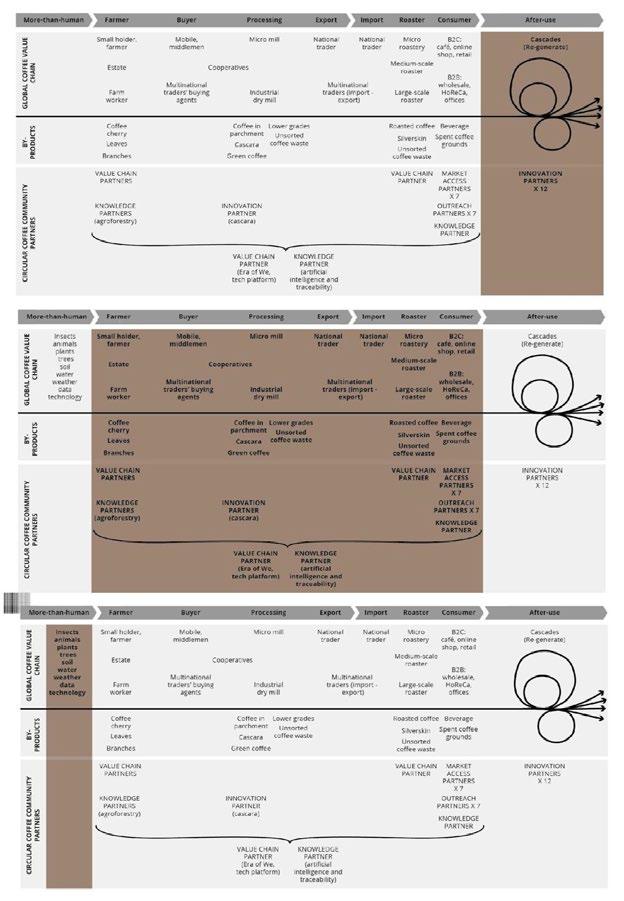
The page number printed on this page is incorrect. Please refer to this page as page 302.
Lindek, A. H.; Petersen, M. K.; Gudiksen, S. K. (2023). Relational Frictions in Circular Economy Ecosystems: Designing for Transformative Futures. Strategic Design Research Journal Volume 16, number 03, Sept – Dec 2023. 295-314. DOI: 10.4013/sdrj.2023.163.02
A stakeholder mapping session with Peter Larsen Kaffe’s innovation team held shortly before their transition into the spin-off GrowGrounds served to surface previously overlooked stakeholder groups, including more-than-human actors. This intervention revealed critical gaps in the case owners’ perspective and led to the addition of a category for more-than-human stakeholders. Reflecting on this, Peter Larsen Kaffe’s CIO remarked, “That is essentially what it is all about” (personal communication, September 13, 2023).
The Ellen MacArthur Foundation (2022) cautions that failing to return nutrients to soil depletes its health and increases reliance on chemical fertilizers. Yet, in interviews, soil health and regenerative farming practices were not mentioned. Instead, the focus was on the Peter Larsen Kaffe platform 'Era of We', which aims to bypass middlemen and improve farmers’ economic conditions. Climate challenges were acknowledged, with the Out of Home senior consultant highlighting the need for more robust coffee pla nts: “If we could make a different type of coffee plant…” (personal communication, March 15, 2023).
These findings reveal a dominant human-centered perspective, often reducing circular economy challenges to human willingness or motivation. However, as Latour reminds us, “things strike back,” emphasizing the necessity of considering human –more-than-human (dis)entanglements (Latour, 2000). Advancing regenerative practices therefore calls for tailored approaches that address the unique dynamics of each value chain underscoring the importance of deeper sector-specific investigations.
When innovation aimed at radical socio-technical change intersects with communication strategies targeting consumers, the collaborative community’s focus becomes unclear. This case illustrates a fundamental debate: should companies push for circular econom y transitions or wait for consumer demand to pull? In this instance, the innovation department drives change, highlighting urgent issues like coffee farmers' poverty and environmental threats. However, their outreach targets innovation partners focused mainly on consumer behavior, which perpetuates the push-or-pull dynamic that seems to hinder more proactive, co-creative transformations.
Retail’s primary concern is ensuring financial compensation for farmers, but their approach reflects a more immediate focus on the next customer, rather than long -term transformation. The problem arises when financial incentives and stakeholder demands across the value chain collide. As one Retail interviewee explained, the complexities of the stock exchange and trading systems often prevent profits from reaching farmers (Head of Retail, personal communication, April 25, 2023). This highlights the challenge of bridging gaps within the value chain and underscores the need for a holistic approach, addressing all stakeholders not just the end consumer.
Additionally, communicating complex, radical transformations to consumers remains a challenge. Retail employees are concerned about high customer expectations but recognize the potential for future shifts, driven by science-based targets and new product offerings. Despite this, introducing circular products or sustainable practices is slow, as innovations in consumer behavior and expectations lag behind. Nevertheless, shifts like those seen during the COVID-19 pandemic such as the rise in at-home brewing suggest there is potential for change, when everything is turned upside down at the same time and when new possibilities emerge, challenging the traditional push-or-pull dynamics.
page 313
The page number printed on this page is incorrect. Please refer to this page as page 303.
Lindek, A. H.; Petersen, M. K.; Gudiksen, S. K. (2023). Relational Frictions in Circular Economy Ecosystems: Designing for Transformative Futures. Strategic Design Research Journal Volume 16, number 03, Sept – Dec 2023. 295-314. DOI: 10.4013/sdrj.2023.163.02 page 313
Having analyzed the empirical findings from production, processing, and consumption perspectives related to the circular economy value proposition, it is clear that organizational practices and interdepartmental dynamics play a crucial role in shaping the traject ory of transformation. The next section will explore the implications of these findings for decisionmaking processes, particularly how they impact circularity within the coffee value chain. We will also discuss how design and innovation management fields can pro vide guidance on navigating this complex transformation, ultimately offering pathways forward for both practitioners and scholars.
The findings illustrate that navigating circular economy (CE) ecosystems is not a linear progression from barriers to drivers but a far more entangled process. The frictions observed across production, processing, and consumption stages suggest that existi ng managerial and design frameworks struggle to capture the relational and adaptive nature of circular transitions. Rather than seeing challenges as isolated obstacles, we argue that transformation in CE ecosystems emerges through ongoing frictions negotiations, misalignments, and reconfigurations that shape both collaboration and resistance.
To advance design and innovation management approaches within these evolving ecosystems, we propose three key shifts: (1) replacing the contrast between drivers and barriers with a friction-based perspective, (2) integrating relational mappings of human an d more-thanhuman actors to illuminate hidden interdependencies, and (3) recognizing the interwoven development of company-specific value chains and broader CE ecosystems. Achieving meaningful transformation in this space requires more than overcoming obstacles it calls for an approach that fosters 'co-becoming,' where actors adapt and evolve through mutual shaping and collaboration (Manzini, 2015; Peschl, 2019; Haraway, 2016).
Although we agree that “identifying and comparing the drivers of and barriers to CE implementation would benefit the acceleration of the development path” (Ranta & Mäkinen, 2018, p. 1), we propose that the term frictions might offer a more insightful persp ective. Friction offers a lens to understand the dynamics of interconnected economic systems, highlighting the tensions that often drive transformation (Tsing, 2005). Rather than categorizing elements as purely drivers or barriers, friction reveals their i nterconnected and context-dependent nature, where what enables progress in one area may act as a barrier elsewhere (Tsing, 2005). This perspective underscores the complex interdependencies and interactions within the system, emphasizing the relational complexities shaping change. Our findings indicate that 'friction' more accurately encapsulates these relational complexities, where differing perspectives, values, or practices interact to generate frictions that drive both conflict and collaboration, reshaping socio-technical landscapes (Tsing, 2005; Drazin, Knowles, Bredenbröker, & Bloch, 2020).
The concept of 'co-becoming' enriches this perspective by emphasizing iterative processes through which actors human and more-than-human co-evolve, forming new relational patterns (Manzini, 2015; Peschl, 2019). Friction thus becomes a productive force, rev ealing alternative pathways and emergent forms of collaboration, while making visible the diverse
The page number printed on this page is incorrect. Please refer to this page as page 304.
Lindek, A. H.; Petersen, M. K.; Gudiksen, S. K. (2023). Relational Frictions in Circular Economy Ecosystems: Designing for Transformative Futures. Strategic Design Research Journal Volume 16, number 03, Sept – Dec 2023. 295-314. DOI: 10.4013/sdrj.2023.163.02 page 313
values, knowledge, and power dynamics embedded in CE transitions (Bennett, 2010; Kjærsgaard & Boer, 2020).
4.2.
Relational mapping emerged as a critical heuristic tool for addressing the complexity of CE ecosystem transitions. By visually representing connections among actors, activities, and resources, these heuristic maps help identify friction points and untangle barriers to circularity. Offering a simplified but generative way to engage with complexity of value chains and ecosystem interactions, they enable companies to explore how linear and circular models interact, illustrating overlooked dynamics in value cha ins. Beyond visualization, relational maps serve as strategic tools, fostering deeper engagement with stakeholders. They allow for iterative re-assessments of how systems evolve, encouraging reflexivity and adaptability in decision-making processes a capacity increasingly recognized as vital in democratic and design-oriented transitions (Vink, 2022). Such reflexivity supports the relational perspective underpinning co-becoming, helping to surface previously hidden interdependencies.
4.3. Co-existing of company value chains and eco-systems?
Balancing linear value chains with CE ecosystems presents a strategic dilemma: how to integrate sustainability ambitions without undermining profitability. The coexistence of these models highlights persistent frictions between current market dynamics and long-term regenerative aims. This tension calls for a rethinking of traditional business strategies, shifting towards ecosystem-based innovation. Such navigating involves a broader perspective, where companies adopt more adaptive strategies to align linear value chains with circular ecosystem priorities. Effective navigation hinges on the ability to manage relational frictions, using them as opportunities to explore new partnerships, align stakeholder objectives, and co -create regenerative futures. To support future applications, the following summary outlines key strategies for managing frictions and advancing regenerative change within evolving CE ecosystems:
● Frictions: Open up possibilities for sociotechnical-ecological transformation by making visible and reshaping entangled relations between human and more -thanhuman actors through collaborative exploration.
● Relational landscape mapping: Use heuristic visualizations to reveal hidden interdependencies and support more strategic and adaptive navigation of complex CE ecosystems.
● Co-existence of value chains and CE ecosystems: Call for rethinking traditional business models by balancing sustainability and profitability through integration of regenerative principles and future-oriented ecosystem perspectives.
To foster circular transformation, design and innovation management could benefit from shifting focus from isolated products or processes toward a broader, systemic involvement with a variety of stakeholders. As outlined in the 'Era of We', innovation shou ld emphasize step-by-step involvement, starting with close partners and progressively broadening the network. This approach, grounded in open innovation frameworks (West, Vanhaverbeke, &
The page number printed on this page is incorrect. Please refer to this page as page 305.
Lindek, A. H.; Petersen, M. K.; Gudiksen, S. K. (2023). Relational Frictions in Circular Economy Ecosystems: Designing for Transformative Futures. Strategic Design Research Journal Volume 16, number 03, Sept – Dec 2023. 295-314. DOI: 10.4013/sdrj.2023.163.02
Chesbrough, 2006; Chesbrough & Appleyard, 2007), acknowledges the need for flexible, evolving relationships.
However, navigating this transition requires more than technological innovation; it demands an ability to engage with the frictions and interdependencies that characterize CE ecosystems. Design practices offer tools to facilitate this process, enabling bus inesses to better align their strategies with the evolving demands of circular practices. By integrating co -design approaches and fostering collaborative, adaptive strategies, organizations can develop more resilient and regenerative business models. The transition from a linear to a circular economy thus invites companies to adopt an open innovation approach one that emphasizes collaboration, mutual learning, and iterative development. This reflects the core of cobecoming, where transformation arises from dynamic and relational engagements between human and more-than-human actors.
The transition towards circular economy ecosystems presents both urgent challenges and transformative potential. As industries and organizations attempt to shift from linear models to regenerative, circular approaches, they encounter deeply embedded struct ural, organizational, and cultural frictions. While these frictions can be perceived as barriers, they also offer critical opportunities for innovation and systemic change. Addressing these complexities requires moving beyond isolated interventions towards an integrated, relational understanding of transformation one that embraces interdependencies between human and more-than-human actors, as well as between companies and broader ecosystems.
This paper advocates for an extended systemic and relational approach to interorganizational collaboration in evolving CE ecosystems. By "extended," we refer to the need for a holistic stakeholder engagement, incorporating both human and more -than-human elements, to support transformations that move beyond human-centered designs. Using the agro-food case of a coffee company within the global coffee value chain, this study demonstrates the importance of addressing the perspectives of actors at all stages of the value chain to enable regenerative systems.
Siloed approaches and a focus on short-term goals were significant barriers, preventing company members from fully embracing a broader, systemic business perspective. Despite aspirations for sustainable practices, the focus on near-term customer needs and immediate market dynamics restricted the capacity for anticipatory, long -term innovation. Moreover, when one dimension such as business interests dominates over others, the balance and reciprocity necessary for ecosystem dynamics can be compromised. This limits the emergence of collaborative synergies, shared ownership, and mutual learning, which are key for enabling regenerative transitions.
The linear value chain remains underexplored, especially regarding its potential for transformation. In this case, innovation at the production stage showed promise for "doing more good," such as regenerating nature, while consumption-focused innovations tended toward "doing less bad," failing to initiate systemic changes. Both perspectives, however, underscore the need for comprehensive ecosystem-wide shifts that challenge hierarchies and redistribute agency.
313
The page number printed on this page is incorrect. Please refer to this page as page 306.
Lindek, A. H.; Petersen, M. K.; Gudiksen, S. K. (2023). Relational Frictions in Circular Economy Ecosystems: Designing for Transformative Futures. Strategic Design Research Journal Volume 16, number 03, Sept – Dec 2023. 295-314. DOI: 10.4013/sdrj.2023.163.02
While Peter Larsen Kaffe in practice primarily approached circularity as a socio -technical challenge, this study reveals the need to understand such transitions as fundamentally sociotechnical-ecological. Although the company’s vision aimed to secure the long-term viability of the coffee industry and improve farmers' livelihoods (implicitly addressing ecological concerns) the operational scope of their circularity efforts focused mainl y on partners related to the latter stages of the value chain. The relational dynamics uncovered in interviews and heuristic visualizations exposed how ecological entanglements, such as climate vulnerability and resource regeneration, are inseparable from organisational and technological concerns. This aligns with Ceschin and Gaziulusoy’s (2019) Design for Sustainability framework, which emphasizes the importance of addressing sustainability challenges at the socio-technicalecological system level, through earth-centric and complex systemic innovation. Acknowledging these dimensions is essential for enabling truly systemic and regenerative change.
This study also highlighted the challenges of engaging external stakeholders in co -creating circular futures. While external perspectives can inspire innovation, they often feel disconnected from the immediate concerns of those embedded in the value chain. Tools like heuristic relational visualizations help untangle complexities and foster deeper discussions, supporting broader systemic thinking.
The slow progress of CE ecosystem implementation in established companies points to the need for more sector-specific studies to explore barriers, frictions, and actor dynamics. Frictions, in particular, serve as catalysts for reflection and transformation by revealing underlying tensions and opening pathways for change. Navigating these frictions involves fostering deeper collaborations and aligning diverse stakeholder perspectives to support broader systemic thinking and co-create circular futures.
While the scope of participants offered valuable insights into the early formation of the CE ecosystem, future research could include additional departments and external stakeholders to further illuminate the interdependencies and frictions shaping circula r economy transitions.
Finally, this study emphasizes the importance of adaptive step-by-step approaches that foster co-becoming and gradual transformation. Building strong stakeholder engagement and ensuring equal participation across value chain hierarchies are crucial for ach ieving regenerative and circular ecosystems that balance environmental, social, and economic priorities.
We sincerely thank Peter Larsen Kaffe and Löfbergs for their collaboration and support throughout this study. We are also grateful to the individual employees who generously shared their time and insights during the interviews. We also thank our international partners in the Strategic Foresight for Sustainability project for the collaboration and exchange of perspectives. Funded by the European Union. Views and opinions expressed are however those of the author(s) only and do not necessarily reflect those of the European Union or the European Education and Culture Executive Agency (EACEA). Neither the European Union nor EACEA can be held responsible for them.
page 313
The page number printed on this page is incorrect. Please refer to this page as page 307.
Lindek, A. H.; Petersen, M. K.; Gudiksen, S. K. (2023). Relational Frictions in Circular Economy Ecosystems: Designing for Transformative Futures. Strategic Design Research Journal Volume 16, number 03, Sept – Dec 2023. 295-314. DOI: 10.4013/sdrj.2023.163.02 page 313
We refer to this visualization as a heuristic to underscore its function as a generative tool for discussion and reflection rather than a comprehensive or definitive representation. As such, it serves to simplify and make accessible complex system interactions while remaining open to contextual interpretation and iterative refinement.
Adner, R. (2017). Ecosystem as structure: An actionable construct for strategy. Journal of management, 43(1), 39-58. https://doi.org/10.1177/0149206316678451
Aarikka-Stenroos, L., & Ritala, P. (2017). Network management in the era of ecosystems: Systematic review and management framework. Industrial marketing management , 67, 23-36. https://doi.org/10.1016/j.indmarman.2017.08.010
Aarikka-Stenroos, L., Ritala, P., & Thomas, L. D. W. (2021). Circular economy ecosystems: A typology, definitions, and implications. In S. Teerikangas, T. Onkila, K. Koistinen, & M. Mäkelä (Eds.), Research Handbook of Sustainability Agency (pp. 260–276). Edward Elgar. https://doi.org/10.4337/9781789906035.00024
Bennett, J. (2010). Vibrant Matter: A Political Ecology of Things. New York, USA: Duke University Press. https://doi.org/10.1515/9780822391623
Bocken, N. M. P., de Pauw, I., Bakker, C., & van der Grinten, B. (2016). Product design and business model strategies for a circular economy. Journal of Industrial and Production Engineering, 33(5), 308–320. https://doi.org/10.1080/21681015.2016.1172124
Buchanan, R. (1992). Wicked Problems in Design Thinking. Design Issues, 8(2), 5–21. https://doi.org/10.2307/1511637
Ceschin, F., & Gaziulusoy, İ. (2019). Design for sustainability: a multi-level framework from products to socio-technical systems. Routledge. https://doi.org/10.4324/9780429456510
Haigh, L., Wit, DM., Daniels, VG., Colloricchio & A., Hoogzaad, J. Circularity gap report 202. from www.circularity-gap.world/2021#downloads
Chesbrough, H. W., & Appleyard, M. M. (2007). Open innovation and strategy. California management review, 50(1), 57-76. https://doi.org/10.2307/41166416
Clarke, A. E. (2003). Situational analyses: Grounded theory mapping after the postmodern turn. Symbolic interaction, 26(4), 553-576. https://doi.org/10.1525/si.2003.26.4.553
Clarke Adele, E. (Ed.). (2005). Situational analysis: Grounded theory after the postmodern turn . Sage Publications.
Das, A., & Bocken, N. (2024). Regenerative business strategies: A database and typology to inspire business experimentation towards sustainability. Sustainable Production and Consumption, 49, 529544. https://doi.org/10.1016/j.spc.2024.06.024
De Angelis, R. (2018). Business models in the circular economy: Concepts, examples and theory . Springer. Drazin, A., Knowles, R., Bredenbröker, I., & Bloch, A. (2020). Collaboratively Cleaning, Archiving and Curating the Heritage of the Future. In Design Anthropological Futures (pp. 199-214). Routledge. Eisenreich, A., Füller, J., & Stuchtey, M. (2021). Open Circular Innovation: How Companies Can Develop Circular Innovations in Collaboration with Stakeholders. Sustainability, 13(23), 13456. https://doi.org/10.3390/su132313456
Ellen MacArthur Foundation. (2023a, 10 12). Ellen MacArthur Foundation. Retrieved from The circular economy in detail deep dive: https://ellenmacarthurfoundation.org/the-circular-economy-indetail-deep-dive#:~:text=Regenerate%20nature,What%20if%20we&text=A%20circular%20economy%20avoids%20the,to%20relying%20on%20f ossil%20fuels. + https://ellenmacarthurfoundation.org/regenerate-n
Escobar, A. (2018). Designs for the pluriverse: Radical interdependence, autonomy, and the making of worlds. Duke University Press.
Flyvbjerg, B. (2001). Making social science matter: Why social inquiry fails and how it can succeed again Cambridge university press.
Flyvbjerg, B. (2011). Case study. I The Sage handbook of qualitative research (s. 301-316).
Forcina, A., Petrillo, A., Travaglioni, M., Chiara, S. d., & Felice, F. D. (2023). A comparative life cycle assessment of different spent coffee ground reuse strategies and a sensitivity analysis for verifying the environmental convenience based on the location of sites. Journal of Cleaner Production, 385(135727). https://doi.org/10.1016/j.jclepro.2022.135727
The page number printed on this page is incorrect. Please refer to this page as page 308.
Lindek, A. H.; Petersen, M. K.; Gudiksen, S. K. (2023). Relational Frictions in Circular Economy Ecosystems: Designing for Transformative Futures. Strategic Design Research Journal Volume 16, number 03, Sept – Dec 2023. 295-314. DOI: 10.4013/sdrj.2023.163.02
Geels, F. W., & Kemp, R. (2007). Dynamics of socio-technical systems: Typology of change processes and contrasting case studies. Technology In Society, 29(4), pp. 441–455. https://doi.org/10.1016/j.techsoc.2007.08.009
Grüter, R., Trachsel, T., Laube, P., & Jaisli, I. (2022). Expected global suitability of coffee, cashew and avocado due to climate change . PloS one, 17(1). https://doi.org/10.1371/journal.pone.0261976
Haraway, D. J. (2016). Staying with the trouble: Making kin in the Chthulucene. In Staying with the Trouble. Duke University Press.
Heikkinen, A., Kujala, J., & Blomberg, A. (2023). Outlining stakeholder engagement in a sustainable circular economy. In Stakeholder engagement in a sustainable circular economy: Theoretical and practical perspectives (pp. 1-15). Cham: Springer International Publishing.
Irwin, T., Kossoff, G., & Tonkinwise, C. (2015). Transition Design Provocation. Design Philosophy Papers, 13(1), 3–11. https://doi.org/10.1080/14487136.2015.1085688
Irwin, T., Kossoff, G., Tonkinwise, C., & Scuppelli, P. (2015). Transition design overview. Carnegie Mellon School of Design. Retrieved August, 25, 2015. academia.edu: https:// www.academia.edu/13122242/Transition_Design_Overview
Irwin, Terry, Tonkinwise, Cameron, & Kossoff, Gideon. (2022). Transition Design: The Importance of Everyday Life and Lifestyles as a Leverage Point for Sustainability Transitions. Cuadernos del Centro de Estudios en Diseño y Comunicación. Ensayos, (105), 73-106. Epub 01 de marzo de 2022. https://dx.doi.org/10.18682/cdc.vi105.4189
Jones, P. H. (2014). Systemic design principles for complex social systems. In G. S. Metcalf, Social systems and design (pp. 91-128). Springer. https://doi.org/10.1007/978-4-431-54478-4_4
Kaipainen, J., Uusikartano, J., Aarikka-Stenroos, L., Harala, L., Alakerttula, J., & Pohls, E. L. (2023). How to engage stakeholders in circular economy ecosystems: the process . In Stakeholder Engagement in a Sustainable Circular Economy: Theoretical and Practical Perspectives . Springer International Publishing.
Kirchherr, J., Reike, D., & Hekkert, M. (2017). Conceptualizing the circular economy: An analysis of 114 definitions. Resources, conservation and recycling, 127, pp. 221-232. https://doi.org/10.1007/9783-031-31937-2_7
Kjærsgaard, M. G., & Boer, L. (2020). Design anthropological frictions: Mundane practices meet speculative critiques. In Design anthropological futures (pp. 217-234). Routledge.
Latour, B. (2000). When things strike back: a possible contribution of ‘science studies’ to the social sciences. The British journal of sociology, 51(1), pp. 107-123. https://doi.org/10.1111/j.14684446.2000.00107.x
Lehmann, S. (2023). Reconnecting with nature: Developing urban spaces in the age of climate change. Emerald Open Research, 1(5). https://doi.org/10.1108/EOR-05-2023-0001
Manzini, E. (2015). Design, when everybody designs: An introduction to design for social innovation. The MIT Press
Marbun, P., Nasution, Z., Hanum, H., & Karim, A. (2019, 5). Evaluation of land suitability on arabica coffee plantation by parametric method in Lintongnihuta District. In IOP Conference Series: Earth and Environmental Science, 269(1), p. 012155. https://doi.org/10.1088/17551315/260/1/012155
Mostaghel, R., & Chirumalla, K. (2021). Role of customers in circular business models. Journal of Business Research, 127, s. 35-44. https://doi.org/10.1016/j.jbusres.2020.12.053
Nold, C. (2023). Mapping and sensing Dewey's situations as design and social science methods. In S. R.N. Holmlid (Ed.), Nordes 2023: This Space Intentionally Left Blank. Norrköping, Sweden: Linköping University. https://doi.org/10.21606/nordes.2023.76
Pascucci, S., Alexander, A., Charnley, F. & Fishburn, J. (2023). The circular economy: landscape, dimensions and definitions. In A. Alexander, S. Pascucci & F. Charnley (Ed.), Handbook of the Circular Economy: Transitions and Transformation (pp. 1-16). Berlin, Boston: De Gruyter. https://doi.org/10.1515/9783110723373-001
Peschl, M. F. (2019). Design and innovation as co‐creating and co‐becoming with the future. Design Management Journal , 14(1), s. 4-14. https://doi.org/10.1111/dmj.12049
Ranta, V. A.-S., & Mäkinen, S. J. (2018). Exploring institutional drivers and barriers of the circular economy: A cross-regional comparison of China, the US, and Europe. Resources, Conservation and Recycling, 135, s. 70-82. https://doi.org/10.1016/j.resconrec.2017.08.017
Raworth, K. (2017). A Doughnut for the Anthropocene: humanity's compass in the 21st century. The lancet planetary health, 1(2), pp. e48-e49. https://doi.org/10.1016/S2542-5196(17)30028-1
Rittel, H. W., & Webber, M. M. (1973). Dilemmas in a general theory of planning. Policy sciences, 4(2), pp. 155-169. https://doi.org/10.1007/BF01405730
page 313
The page number printed on this page is incorrect. Please refer to this page as page 309.
Lindek, A. H.; Petersen, M. K.; Gudiksen, S. K. (2023). Relational Frictions in Circular Economy Ecosystems: Designing for Transformative Futures. Strategic Design Research Journal Volume 16, number 03, Sept – Dec 2023. 295-314. DOI: 10.4013/sdrj.2023.163.02 page 313
Rockström, J., Steffen, W., Noone, K., Persson, Å., Chapin, F. S., Lambin, E. F., & Foley, J. A. (2009). A safe operating space for humanity. nature, 461(7263), pp. 472-475. https://doi.org/10.1038/461472a
Steffen, W., Rockström, J., Richardson, K., Lenton, T. M., Folke, C., Liverman, D., & ... & Schellnhuber, H. J. (2018). Trajectories of the Earth System in the Anthropocene. Proceedings of the National Academy of Sciences, 115(33), pp. 8252-8259. https://doi.org/10.1073/pnas.1810141115
Tsing, A. L. (2005). Friction: An ethnography of global connection. Princeton University Press. Vink, J. (2022). Designing for plurality in democracy by building reflexivity. The Pluralist, 17(1), 52-76. https://doi.org/10.5406/19446489.17.1.06
West, J., Vanhaverbeke, W., & Chesbrough, H. (2006). Open innovation: a research agenda. In Open innovation: Researching a new paradigm (Vol. 17, pp. 285-307). https://doi.org/10.1093/oso/9780199290727.003.0014
(The following materials were reviewed as part of the situational analysis and background research.)
Reports:
● Peter Larsen Kaffe Statusrapport 2022 & Löfbergs Sustainability Report 2021/2022, Löfbergs, 2022
● Peter Larsen Kaffe Management & KPMG, årsrapport, Peter Larsen Kaffe, Viborg, 2022
Documents for website:
Peter Larsen Kaffehttps://www.mynewsdesk.com/dk/peter-larsen-kaffe/pressreleases/nukan-du-spise-dit-kaffegrums-hos-7-eleven-3251850, may 23.
Websites:
● Circular Coffee Community, Löfbergs Group, https://circularcoffeecommunity.com, march 2024.
PLK documents
● Organisational chart.pptx
● Organisation_PLK_CCC_marts2023.doc
CCC newsletters from:
● May 2022,
● June 2022
● September 2022
● November 2022
CCC event invites from:
● April 2022
● June 2022
● August 2022
The page number printed on this page is incorrect. Please refer to this page as page 310.
Lindek, A. H.; Petersen, M. K.; Gudiksen, S. K. (2023). Relational Frictions in Circular Economy Ecosystems: Designing for Transformative Futures. Strategic Design Research Journal Volume 16, number 03, Sept – Dec 2023. 295-314. DOI: 10.4013/sdrj.2023.163.02
CCC YouTube Channel:
● Circular Coffee Community, https://www.youtube.com/@circularcoffeecommunity6438
Appendix B: Ordered Situational Map of Circular Coffee Community (Sensitive personal information and names have been anonymized using black boxes.)
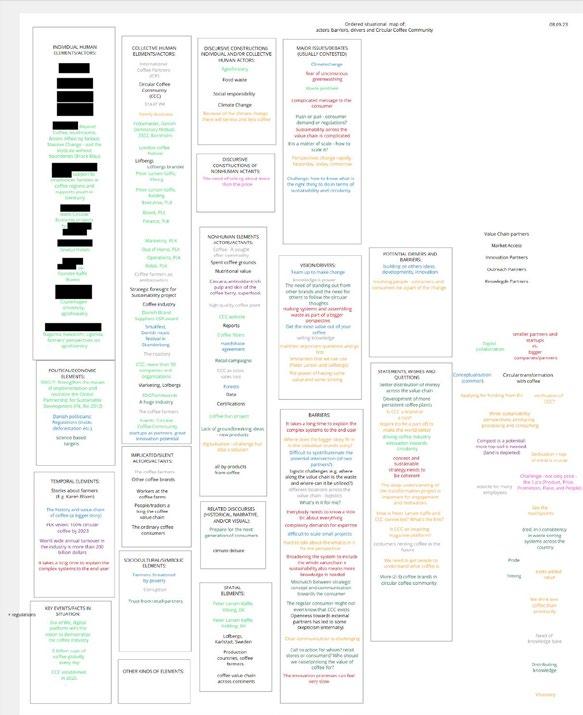
page 313
The page number printed on this page is incorrect. Please refer to this page as page 311.
Appendix C: Relational Analysis – Circular Coffee Community and Drivers
(Sensitive personal information and names have been anonymized using black boxes.)
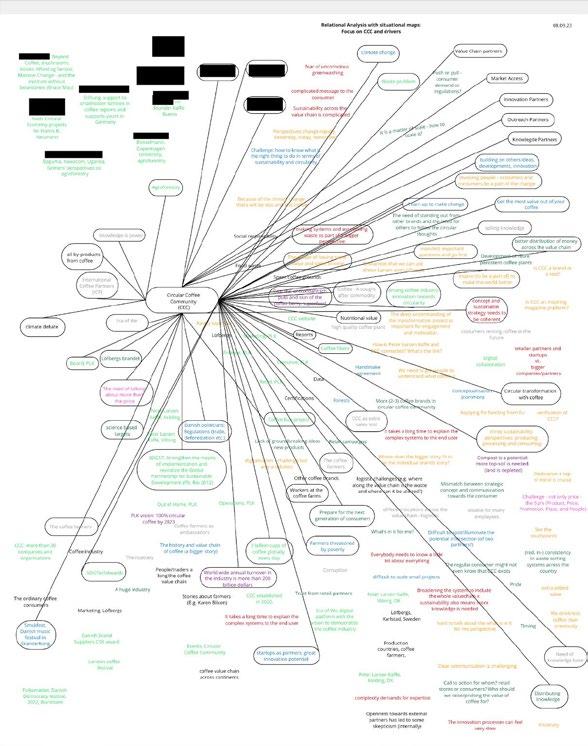
Lindek, A. H.; Petersen, M. K.; Gudiksen, S. K. (2023). Relational Frictions in Circular Economy Ecosystems: Designing for Transformative Futures. Strategic Design Research Journal Volume 16, number 03, Sept – Dec 2023. 295-314. DOI: 10.4013/sdrj.2023.163.02 page 313
The page number printed on this page is incorrect. Please refer to this page as page 312.
Lindek, A. H.; Petersen, M. K.; Gudiksen, S. K. (2023). Relational Frictions in Circular Economy Ecosystems: Designing for Transformative Futures. Strategic Design Research Journal Volume 16, number 03, Sept – Dec 2023. 295-314. DOI: 10.4013/sdrj.2023.163.02
Appendix D: Relational Analysis – Circular Coffee Community and Barriers (Sensitive personal information and names have been anonymized using black boxes.)
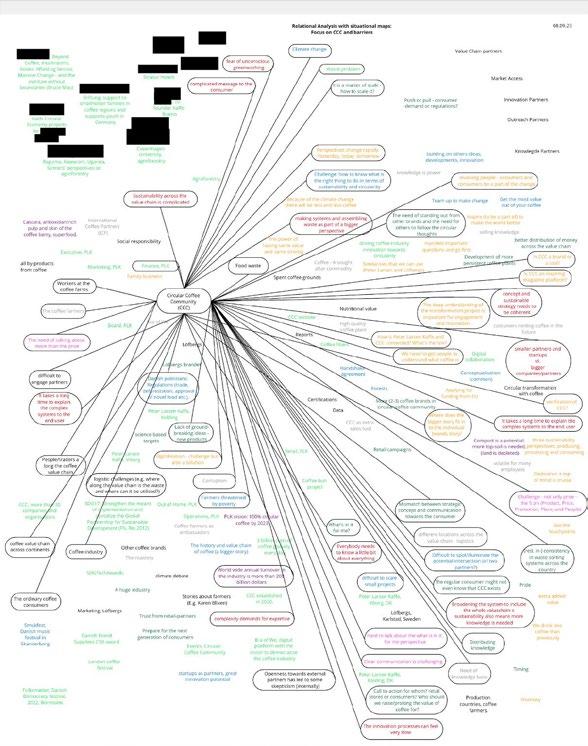
page 314
The page number printed on this page is incorrect. Please refer to this page as page 313.
Design Research Society Design Research Society
DRS Digital Librar y DRS Digital Librar y
Nordes Conference Series
Aug 6th, 9:00 AM - Aug 8th, 5:00 PM
Designing for relay-tional co-becoming Designing for relay-tional
Alexandra Harder Lindek
Kolding School of Design, Lab for Sustainability and Design
Mathias Poulsen
Kolding School of Design, Lab for Play Design
Follow this and additional works at: https://dl.designresearchsociety.org/nordes

Par t of the Ar t and Design Commons
Citation Citation
Lindek, A.H.,and Poulsen, M.(2025) Designing for relay-tional co-becoming, in Brandt, E., Markussen, T., Berglund, E., Julier, G., Linde, P. (eds.), Nordes 2025: Relational Design, 6-8 August, Oslo, Nor way. https://doi.org/10.21606/nordes.2025.21
This Research Paper is brought to you for free and open access by DRS Digital Library. It has been accepted for inclusion in Nordes Conference Series by an authorized administrator of DRS Digital Library. For more information, please contact dl@designresearchsociety.org

ALEXANDRA HARDER LINDEK KOLDING SCHOOL OF DESIGN AL@DSKD.DK
ABSTRACT
This paper explores how the relay conversation approach can facilitate designerly co-becoming in rural communities working towards emerging futures. Building on relational perspectives in design research, we engage with the idea that participation in design is not merely about including diverse voices but about fostering conditions for mutual becoming. We examine how this approach unfolds through ongoing engagements and situated moments, where designers and communities navigate uncertainty and collectively shape new potentials. Rather than treating design as a predefined problem-solving activity, the relay conversation approach works with the evolving dynamics of place, social relations, and ecological entanglements.
Through autoethnographic reflections, we discuss how these engagements challenge conventional roles of designers and require a heightened sensitivity to the situated nature of futures-in-themaking. We suggest that this approach not only supports new ways of designing together but also nurtures conditions for co-becoming—where designers, participants, and worlds emerge together in perpetual reciprocal transformation, often revealed through subtle yet significant moments of sensitivity.
INTRODUCTION
A LIFE AFTER COWS1
Then we go to the old stables, where all the cows are now gone, and we learn about the impossibility of running smaller farms these days. There’s fierce
1 In this paper, italics indicate an autoethnographic story written by us.

MATHIAS POULSEN KOLDING SCHOOL OF DESIGN MP@DSKD.DK
competition, the technology is too expensive, and the 100 cows he used to own was simply not enough anymore. There’s a strong sense of nostalgia, of something that was lost, but he doesn’t seem bitter or without hope for the future. He’s very much alive, still. Towards the end, after we’ve seen another stable and the milking station, we return to the topic of communities. He dreams about communities where you can discuss and disagree, also about cultural issues, religious issues, and other fundamental questions. “Where does that leave democracy”, he asks, if we can’t have such discussions? I almost can’t make myself leave, because this conversation is just so vibrant, still, and talking about dialogue, community and democracy, it’s so profound. But we must go, we have another appointment, and we already feel a little bad for stealing so much of his time. We thank him, sincerely, for his hospitality and generosity, he has just shared everything that matters most to him with us, two complete strangers. As I’m about to enter the car, he interrupts and brushes the sleeve of my jacket. He must have noticed I had leaned against a gate covered in bird droppings, and he doesn’t want us to smear that all over the car. I’m moved, by the whole conversation, and by the caring attention embodied by this little gesture of brushing my jacket.
With numerous encounters like this, we have been collectively struck by a sense of surprise and gratitude, overwhelmed by the willingness of people to share so much with the two of us. There is something about these encounters that lingers beyond our capacity to comprehend it with our rational faculties alone. By writing this paper, we hope to come a little closer to grasping what took place and what we can do to improve the likelihood that it might happen again. We write the paper as an inquiry (Richardson & St. Pierre,
2005) to better grasp what happens in those precious moments, and how we might design for them.
We have come to recognize how certain fleeting fragments of interaction – which we refer to as moments – can hold particular resonance. These are not necessarily dramatic or even visible. They might be sensed only faintly: as a shift in tone, a pause that lingers, a sudden change of route, or a glance that opens something new. We experience them as ethical and affective openings – not planned or provoked, but emergent in the relational fabric of the relay. Guillemin and Gillam (2004) speak of a “micro-ethical” attentiveness in research practice, where significance resides not in grand events but in small, situated experiences. It is in these ephemeral instants that attunement becomes possible – not only for us as researchers, but perhaps also for participants. Moments, in this sense, offer a brief convergence of potential, like what Wolin (2016) describes as fugitive moments in democratic life, where something otherwise becomes momentarily thinkable or felt.
To deepen our understanding of the local situated sociomaterial practices, we have deliberately embraced a more open and intuitive approach, allowing ourselves to be guided by the subtleties and nuances that emerge in the moment. This openness is not only methodological but also reflects our commitment to acting with participants rather than imposing predefined structures, thereby creating opportunities for co-becoming and shared exploration.
We draw on experiences from five previous community projects in less densely populated areas, through which the participatory, relational relay conversation approach has been developed. The approach consists of a series of individual walk and talk conversations with actors across a shared situational proximity (Lindek & Petersen, 2023). Kusenbach and others have referred to this as go-alongs, with Kusenbach specifically describing it as an in-situ technique (Kusenbach, 2003) In the relay approach, each conversation ends with a baton for the next participant, creating links across shared interests–ranging from personal puzzlements to future imaginaries around rural life and mobility. The intuitive step-by-step format fosters perpetual transformation, as places are made “by the interweaving of routes over time or concurrently” (Lee & Ingold, 2020, p. 78)
We write as a postdoctoral researcher and a PhD fellow, based in two interdisciplinary design labs. One of us has worked with democratic participation through playful approaches since 2014; the other has co-developed the relay approach through five community projects since 2020. While we bring different experiences and disciplinary affiliations, we share a commitment to cobecoming with participants an embodied, iterative, and situated practice inseparable from who we are and

how we change through the work.
Rather than striving for neutrality, we recognise that insights emerge through entangled encounters often revealed through subtle yet significant moments of sensitivity. This resonates with Akama’s call to move beyond placelessness and objectivity in Dominant Design (Akama, 2021) Our attempt to get closer to socio-material practices has led us to listen more deeply, stay open, and be guided by intuition.
The moments described above originate from an Interreg North Sea project called Mobility Makers. The project, running from November 2023 to July 2027, involves 13 partners from the Netherlands, Belgium, Germany, France, Sweden, and Denmark. It aims to transform everyday mobility practices in rural areas by developing a deeper understanding of citizens’ needs through insights from living labs in these communities.
In Denmark, the project is led by Region Midt in collaboration with Kolding School of Design. Together, we work closely with three municipalities to ground the project in locally situated practices.
We build on the premise that mobility is not a free good neither for society, the planet, nor the individual (Andersen, Gudmundsson, & Have, 2024). Therefore, we remain critical of an unreflective use of mobility as a justification for new infrastructure projects aimed at simply increasing mobility (ibid.). At the same time, we argue for at broad understanding of mobility and its inherent interrelation with thriving rural life. Building on mobility research, we draw on questions such as: “in what situations being able to move, to enter, to pass, or to wander versus being able to stay, to dwell, to reside, or to belong might be desired options or coerced, an paradoxically interconnected and co-produced” (Sheller, 2014, p. 794).
With these questions, we consider mobility not as an isolated phenomenon but as relationally entangled in larger ecological interconnections of place, care and cobecoming – an orientation we now turn to in the next section (Holst et al., accepted). Although not the focal point of this article, the context of mobility has played a crucial role in shaping the enquiry. It offered an entry point where a seemingly technical issue – rural transport – filtered through and entangled with everyday lives, relationships, and ways of being.
The pilot project is set up in three municipal rural areas. Identifying relevant living labs (Kesselring, et al., 2023, p. 16) requires deep engagement with the communities, and part of this engagement entails embracing uncertainty in the face of complex challenges. As Rittel and Webber (1973, p. 164) remind us, “part of the art of dealing with wicked problems is the art of not knowing too early which type of solutions to apply.”
No 11 (2025): NORDES 2025: RELATIONAL DESIGN, ISSN 1604-9705 www.nordes.org
While the Mobility Makers project was not initiated from within existing community collaborations, the groundwork has been made possible through long-term relation-building between the regional authority and the involved municipalities. Further, their commitment to the premise of engaging with uncertainty without predefined outcomes has been a precondition for the project. The relay conversations constitute the first phase of the project. In the next phases, insights will be explored further through ideation workshops and the development of living labs (see figure 1 and caption).

As we move through the landscape by car from the countryside, then train, light rail, and finally a flex bus we arrive in a rural corner of Denmark, bordered by the ocean on two sides. A place of local proximity. We attune to this local context, sensing the entangled interconnections of everyday life and mobility
In pursuit of sustainable directions and better future lives, it is impossible to isolate mobility as a phenomenon or ignore the relational interdependencies that underpin it (Pascucci, Alexander, Charnley, & Fishburn, 2023; Escobar, 2018; Rockström, et al., 2009).
Like a growing number of contemporary design scholars (Fry & Nocek, 2020; Mareis et al., 2022), we are concerned about the role of design today, in relation to issues of sustainability and more broadly the possibility of human and more-than-human flourishing. As Carl DiSalvo (2022a, p. 242) compellingly argued:
Simply enabling others to participate in design as we know it, as we are familiar with it and as it is comfortable will be insufficient for imagining and instantiating other associations.
Escobar highlights that shaping the world is inherently a cultural process, where design is “ontological in that all design-led objects, tools, and even services bring about particular ways of being, knowing, and doing” (Escobar A. , 2018, p. x). Further, design always brings particular ways of living and becoming, and we contend that those ways should to a much higher degree help us “act and
think in life-friendly ways” (Nørreklit & Paulsen, 2023, p. 9) that allow for mutual flourishing.
In response to these issues, we pursue the possibility of “acting with the world rather than on it” (Pickering, 2022, p. 155), an idea similar to “sympoiesis” and “making-with” (Haraway, 2016, 58-61). It builds on a relational ontology (Escobar A., 2018; Escobar, Osterweil, & Sharma, 2024), where “all flourishing is mutual” (Kimmerer, 2024) and where “things and beings are their relations; they do not exist prior to them” (Escobar, 2020, p. 71).
As Goodman states “Worldmaking as we already know it always starts from worlds already on hand; the making is remaking” (Goodman, 1978, p. 6), and FuadLuke further elaborates on this idea: “remaking is also re-relationing, that is re-configuring relations” (Luke, 2020). In our understanding, re-relationing involves not only making existing connections more transparent but also fostering new ways of organizing mobility and everyday practices.
That shift calls for a heightened relational sensitivity (Akama, 2015; Akama & Light, 2020; Gottlieb, 2024) and an increased capacity for affective attunement (Massumi & Manning, 2012). While our curiosities may address monumental questions pertaining to our very existence, we focus on the “nuanced rhythms of the minor” (Manning, 2016, p. 1), as the affective energies we are tracing often “transpires within and across the subtlest of shuttling intensities” (Gregg & Seigworth, 2010, p. 2).
Acknowledging our mutual interdependencies, “giving up delusions of mastery and control, and instead seeing the world as uncertain and yet unfolding” (Fincher et al., 2015, p. ii), might open trajectories for co-becoming (Bawaka Country et al., 2013, 2016; Peschl, 2019) where “human and more-than-human beings never are –not isolated, not static, not known – but only become as they constantly emerge together” (Bawaka Country et al., 2013, p. 188). Building on the theoretical insights into relational entanglements and co-becoming, we now consider how these concepts shape our methodological approach. A central question that emerged is: How can relay conversations facilitate designerly co-becoming in rural communities aiming for emerging futures?
Attuning to the nuances of everyday mobility and rural life, we recognize the need to not only map but also shape the evolving relations between human and morethan-human actors. By centring life-friendly (Nørreklit & Paulsen, 2023) and regenerative practices, we seek to foster conditions where co-becoming can flourish where communities actively participate in designing their own futures. This calls for an approach that embraces uncertainty, affective attunement, and the
No 11 (2025): NORDES 2025: RELATIONAL DESIGN, ISSN 1604-9705 www.nordes.org
perpetual unfolding of relationships, informed by ethnographic sensibilities attuned to movement, situated presence, and sensory ways of knowing (Ingold & Vergunst, 2008; Pink, 2015). In what follows, we reflect on how our methodology has helped us navigate these complexities through a form of situated empiricism that resists dichotomies between theory and experience, in line with Escobar’s (2018) critique of modernity’s dualisms.
If a methodology section resists a recipe-like method, does it still qualify as one? Before we unpack our methodological approach, we want to acknowledge the importance of cultivating rigorous research practices. However, we contend that dominant ideas of rigour, with their roots in a “positivist approach” (Østern et al., 2021, p. 12), are counterproductive to our aspirations Instead, we argue that “rigour is not a fixed characteristic” (Hagen & Tangaere, 2023, p. 434), but must be in constant dialogue with the purpose of the inquiry. What is the research trying to do? In our case, it is a rigour that nurtures “fluidity, complexity and performativity” (Østern et al., 2021, p. 12), and it should only be considered “trustworthy in as much as it turns something around, makes it differently comprehensible.” (Ravetz & Gregory, 2018, p. 9). Ideally, it is a rigour that emphasise “care and attentiveness” in that it is “flexible and in love with life” (Ingold, 2021, p. 14). While we cannot unfold this conception of rigour here, we can only hope that it is embodied in our writing throughout the paper. Building on this premise, our initial approach to this project grew out of an intention to act with rather than on the mobility situation in local contexts (Pickering, 2022). This intention became increasingly important as we caught glimpses of what mattered to the people we engaged with nuances we could not have imagined, uncovered from a distance, or anticipated through an interview guide. In these moments, we reminded ourselves to trust our intuition and remain open open, listening, and receptive (Peschl, 2019), much like the people we were engaging with. With this approach, we seek to engage in “learning from the future as it emerges” (Scharmer, 2016, p. 7)
The methodological approach taken here is deliberately situated and reflexive, emerging through embodied, relational engagements with place and participants. While grounded in systemic design (Ceschin & Gaziulusoy, 2019; Sevaldson, 2022), it resists method as prescription. Instead, it leans towards what Sevaldson calls a “methodology without methods” a pragmatic and flexible orientation that favours responsiveness over replication. This stance allows us to attune to situated complexities rather than applying pre-determined techniques, thus positioning the method not only within
systemic design transitions, but as a contribution to its methodological pluralism (Fitzpatrick, Luthe, & Sevaldson, 2024).
The concept of conversation is central to our approach and engagement aiming at informed democracy (Flyvbjerg, 2001), where listening and curiosity towards what we hear, see and sense are as important as asking questions. As Meadows (2001) suggests, dancing with the system requires us to stay awake, pay attention, and respond to feedback. In this sense, the goal is not to arrive at fixed conclusions, but to remain open to “the going, the movement” an ongoing becoming, as Braidotti (2012, p. 362) suggests. This approach opens to a broader perspective, where more-than-human presences also shape the conversation. While the relay conversations centred on human voices, they unfolded in places alive with more-than-human presence along forest trails, near the sea, in open fields. Wind, trees, stony paths, horses, and shifting waves subtly shaped the relational atmosphere. One example: the rhythm of the sea changed each time a ferry passed the tip of the peninsula. These beings did not speak our language, yet they shaped what could be noticed and shared. Through subtle shifts in tone, pauses, or re-orientations in the dialogue, these agents left traces in the shared space –gently expanding what the conversation could hold. In an attempt to “commit to opening and attuning in new ways” (Tsing et al., 2024, introduction section) and Sachs Olsen (2022), we approach these presences not as passive background but as participants that co-create the conditions for conversation. This interplay between human and more-than-human agents unfolds in practice through our relay conversation method, where both voices and local presences co-create the dialogue.
The relay conversation approach builds on a loosely structured, go-along interview format, where each conversation is interlinked with the next, like a baton passed in a relay race, transmitting ideas and perspectives through each encounter. The baton – a message or reflection formulated by each participant at the end of the conversation – acts as a reminder of life's entanglement. It acknowledges what came before our encounter and what will follow; the conversation does not unfold in isolation (see figure 2).
This format was chosen to foster situated, embodied and sensory knowledge – knowledge that emerges not only through words, but through walking together, noticing, and being in place. The baton’s open-ended character supports continuity, yet also transformation, allowing each conversation to build on the previous while moving in new directions. Moreover, the participant-led
No 11 (2025): NORDES 2025: RELATIONAL DESIGN, ISSN 1604-9705 www.nordes.org
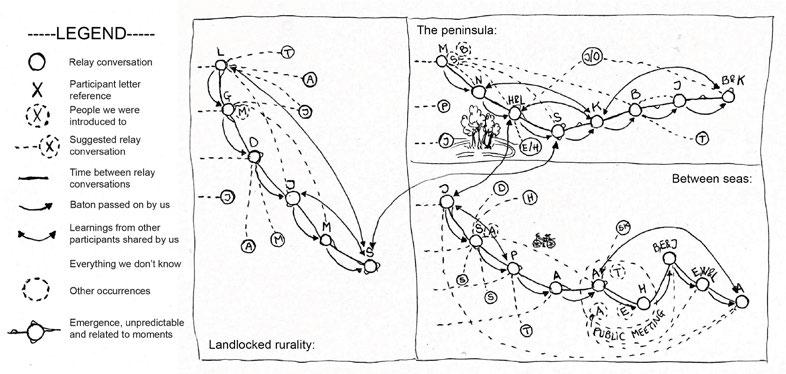
selection of the next conversation partner ensures that the process remains locally grounded and networked –an iterative and relational design choice.
The relay conversation approach rests on a set of guiding principles: reflexivity (Vink & KoskelaHuotari, 2022), a sensitivity to emergence, and a commitment to engaging with the local situation as it unfolds. Rather than applying a predefined method and designerly artefacts, the approach remains open to evolving dynamics and seeks to foster awareness of the interrelations that shape each encounter. Not planning or not knowing was our potential venturing into the unknown kept us alert. This requires relational sensitivity and presence, where listening becomes an active and embodied practice. Conversations are not facilitated with the aim of producing specific outcomes, but with a willingness to let direction and meaning emerge in relation with the participant. In this way, the approach attends to both social and ecological entanglements not by transferring information, but by configuring and reconfiguring relationships over time.
In this project we have implemented the approach across three municipalities, engaging participants from three rural areas. Over five months, we conducted 23 relay conversations with 29 individuals ranging from second-grade school children to senior citizens, including private individuals, volunteers, business managers, and leaders of civic associations. Through this process, participants passed on batons, shaping an evolving dialogue on mobility in everyday life.
Initially our contact persons in the municipalities suggested the first 2-3 potential participants. Depending on the contact information, we reached out by phone or e-mail explaining our engagement in mobility and rural life and our genuine wish to see everyday practices
through their eyes. Most accepted our invitation, and we arranged a time to meet. Some immediately knew where to take us and how we should proceed (on foot, by car, etc.), while others needed time to decide. These ofteninvisible preparatory tasks are fundamental to building trust and forming the foundation for engagement in participatory practices (Yee, et al., 2024)
During a conversation, we began by aligning expectations, explaining that we were not mobility experts, but designers, researchers, and facilitators engaged in development processes. Instead, they were the experts in their own everyday practices and community life (Sanders & Stappers, 2012). We approached them with curiosity and ensured that our broad perspective on mobility was clearly communicated.
After spending most of the scheduled hour with Børge and Ketty, two retired priests, they suggested we drive up to see the culture house in the old priest’s house an invitation we gladly accepted, having already heard about it in earlier conversations. As illustrated in the conversation with the two priests, ending a go-along conversation is challenging. We aim to stay within the time while avoiding cutting them off too abruptly. As we came out of the charming old culture house, we thought the tour was over But then they insisted we see the view from a hill, a small patch of trees overlooking the bay to the north. Later, reviewing our notes, we realized Niels had spoken of the same spectacular view
These seemingly disconnected places are what guides us. They reveal how embodied encounters and situated experiences contribute to situated acts of worldmaking (Haraway, 2016; Tsing, 2015), where knowledges do not exist in isolation but is always in relation Thus, our engagement is not only about creating insights but about making use of future potentials in a sensible and thriving manner (Peschl, 2019, p. 11). To engage with
11 (2025): NORDES 2025: RELATIONAL DESIGN, ISSN 1604-9705 www.nordes.org
mobility in rural areas is not only to map infrastructures or identify barriers but also to be present in the ongoing becoming of places and relations to learn from within through entangled situated acts of listening, sensing and responding.
As we approach the outskirts of a larger city, I feel a little uneasy. Usually, I’ve spoken with the person beforehand, but this time it was my colleague now home sick who made the initial contact. We reassure each other while navigating between polished company cars. Upstairs, we meet Julie, managing director of a machinery firm, and soon we’re seated in a corner of her office. Toward the end of the conversation, a theme begins to surface: helping each other. For Julie, it’s about knowledge and coordination hard to align with busy lives. When we pass on the previous baton “What if you could use public transportation whenever you needed it?” she pauses, then reframes: “What if one could create greater understanding of each other’s needs in the local community?” Later, Morten, a local shopkeeper, shares a story about tourists left without a bus. Spotting an older man nearby, he asked if the man might give them a lift. When we share Julie’s baton with him, he finds it highly relevant. He ends by wondering aloud: “What if there were more volunteers?” Between conversations, we reflect on volunteering as a kind of local mobility. One participant asks: “How could it become legal to say, ‘I’m going to the city at 14:30’? How many people fit in a car before it’s a problem? Would you accept the favour?” In the crisp afternoon, we walk through Signe’s neighbourhood. She shares her hesitation: What if a small task grows bigger than I can manage? Earlier, she had mentioned her son’s school commute the bus doesn’t always fit, and giving a ride might make her late I share how Steen, from another municipality, always stops if he sees someone waiting at the local bus stop. I hesitate will it feel like pressure? She listens quietly and returns to it later: “What do I do next time I see someone waiting? Do I stop? And how would they react?” Though all three speak of helping, their perspectives and hesitations shift. These aren’t structured interviews, but open-ended conversations shaped by what matters in the moment. On the way home, we begin sketching a workshop on volunteering and mobility. It’s no longer just about buses it’s about how to care, even when the rules make it hard.
Maintaining curiosity about details particularly those whose significance might not be immediately apparent is crucial, as they may hold the key to deeper insights. Over time, these relational entanglements may assemble across conversations, sometimes even connecting across local contexts. These moments, fragmented yet interconnected, remind us that knowing is not merely an abstract, detached act but something we come to understand from within. As Flyvbjerg (2001, p. 143) suggest, embodied knowing is deeply tied to experience, to the way we move through and dwell in
the world. Similarly, Peschl (2019, p. 10) describes how we must feel our way forward, attuning ourselves to emergent potentials rather than imposing predetermined solutions.
Deciding whom to reach out to next and how to approach them was an ongoing process requiring patience and openness. Typically, we called, emailed, or texted those suggested as relevant people to meet next. At times, however, serendipity came into play: As one conversation begins to wind down in the dusk, just before the very committed resident proudly representing the third generation of her family living in this small town has to rush off to football practice with her son, we eagerly discuss how children might move more freely in the community. Then we pause. A young girl walks by, wheeling her bike. The woman gently reaches out, explaining her engagement with us, and on our behalf, asking if it would be okay for us to contact her. Relief. A possible conversation with a young person from the community. We had talked about this earlier –the challenge of reaching young people – and the importance of making space for their participation in the conversation.
Serendipity played a key role in making connections and passing on the relay, but some processes were less straightforward.
Some conversations have been a long time coming, and sometimes, young people are harder to get involved in a project like this. When we spoke to Mette, she suggested we reach out to Kristian, a young man working at the local grocery store. He contacted us and seemed interested in joining the relay conversations. But then he disappeared, and for a while, we heard nothing Later, when meeting Steen by the lighthouse, we ran into him by change he was apparently also working in the ice-cream truck.
Our correspondence with Kristian remained irregular. We never quite knew what to expect. The day before our scheduled meeting, he texted: “I live next to the store”. But what did that mean, exactly? We asked if he wanted to meet there no reply We crossed our fingers, and drove out, hoping we might find him. Even upon arriving, we weren’t sure. Would he show up? And if he did, would he have much to say? His messages had been so brief, skimming the surface. If he spoke the way he texted, it could be a long hour. We got out of the car. As we turned the corner, we spotted a young man. Was this Kristian? A moment of awkward hesitation before realizing that, yes, this was indeed him.
This is not simply a methodological choice, but also a relational and ethical stance. As Escobar (2018) reminds us, “we are not just, or even primarily, detached observers but rather participants and designers who engage the world by being immersed in it. Knowing is relating.” (p. 157) Relearning to walk the world as a living being (Pinda in Escobar, 2018) becomes part of
No 11 (2025): NORDES 2025: RELATIONAL DESIGN, ISSN 1604-9705 www.nordes.org
the work: not only making sense of others’ experiences but letting ourselves be moved by them. In that sense, the relay conversation approach becomes an experiment in participating in and designing through situated encounters recognising that such participation also demands inner work, involving reflexivity, embodied knowledge, intuition, and emotional attunement (Anzaldúa, 2002).
Rejecting the innocence of the distanced observer, we follow performative approaches that insist “it is acceptable, desirable and required to be embodied and affected” (Østern et al., 2021, p. 14) as a researcher. Being affected by what we encounter is not a necessary evil, but a moral obligation, a way of becoming “response-able” (Haraway, 2016, p. 98). Eventually, we realized we needed to embrace and unfold our own affective experiences and our entanglement in the multiple processes of co-becoming. To achieve that, and to enable others to join us by telling the stories, we turned to the rich tradition of autoethnography. Here, we understand autoethnography as “story-centered pursuits that connect the personal, the relational, and the structural.” (Adams, Boylorn, et al., 2021, p. 5). That is, autoethnographic work is always both concerned with who we as researchers are (becoming), with cultivating relationships and with critiquing larger cultural issues. This is an approach and way of life that rejects the idea that research should be conducted in “distanced, objectifying, neutral, and value-free ways” (Bochner & Ellis, 2022, p. 9). In contrast, autoethnography allows us – beckons us - to fully embrace and unfold “ambiguity, contradiction, contingency, and chance (…) exercising, embodying, portraying, and enacting uncertainty” (Bochner & Ellis, 2022, p. 15). Autoethnography almost always involves “sensemaking that defies logic or sits outside language and sometimes conscious awareness” (Adams, Holman Jones, et al., 2021, p. 5), telling stories that engage with “the world as shifting, partial, unfinished, and animated by feeling and imagination” (Holman Jones, 2018, p. 6).
Further pursuing our relational commitment, we contend that autoethnography can create an “affective force that literally moves us in relation to and with one another” (Holman Jones, 2018, p. 9–10). It is a “relational practice” (Holman Jones, 2018, p. 10) that is concerned with “assembling a we” (Holman Jones, 2017, p. 132) by telling stories that readers can become involved with (Ellis, 1999, p. 674). Finally, we believe that autoethnography has the “the power to embody and materialize (…) the change we seek in ourselves, our lives, and our worlds” (Holman Jones, 2018, p. 11). It is performative, prefiguring other possible worlds, enacting change through the way we seek to engage (Poulsen, 2024, p. 119)
In our ongoing attempts to act with the world, to wait for something to emerge, we have approached the analysis by following what Sarah Pink calls the “ethnographic hunch” (Pink, 2021). We have let ourselves be drawn towards sensorial, affective experiences from the relay conversations, trusting that they may be as important as our cognitive capacity in terms of assessing what matters most. With this approach we emphasize an “openness to knowing, feeling, and thinking differently through our contact with other people’s worlds” (Pink, 2021, p. 33) and we are tracing those moments where we sense that we may have “found something significant for the course of our research.” (Pink, 2021, p. 34).
In the following, we will identify some of these moments that stand out for us, illustrated with brief glimpses into the autoethnographic stories from the field.
Again and again, these conversations have been marked by an overwhelming openness towards us At the same time, we keep reminding ourselves to listen truly listen with openness and receptivity (Peschl, 2019) to the lives and everyday situations we become entangled in. The not knowing where we are going or who we will meet is both challenging and liberating. That day, we wondered: Where would Stine take us? Before we found out, her daughter came running from the school playground. She wanted to join us on our walk, and we were only excited to learn about the world from her altitude too. (…) Putting one foot in front of the other, again and again, we approached the forest The girl, clearly at home here, told us about her frequent visits. She knew her way around. Then she mentioned a “secret place”, and we were immediately intrigued. Would she show it to us two strangers she had just met? Oh, yes, absolutely. She was insistent that we follow her, leading us down a narrow path to a small creek and a tree with a makeshift swing dangling from one of its branches. This was it, she said A secret place she visits with her friends from school. How delightful. The conversation took on multiple layers, shifting in and out sometimes all four of us together, sometimes in pairs. We hadn’t planned for this, but followed along, trusting it would bring us closer to the situation. And they trusted us, too with their stories, their reflections on what makes for good lives for children. It felt somehow meant to be that a child would join us on this small forest walk. Beyond openness, the situations demand our presence, our curiosity and our patience.
No 11 (2025): NORDES 2025: RELATIONAL DESIGN, ISSN 1604-9705 www.nordes.org
While making a connection with Kristian at a distance had proved difficult, the situation changed completely face to face. When we met him, he immediately invited us into the store where he worked, and there, we paused somewhere in the middle of the vegetable section. “We’re a very local community, everybody knows everybody” he told us, and this was clearly important to him. He seemed to deeply appreciate this, and there was no sense of him running away from the place where he had spent all his life.
Then we went on, and he told us he loved living here because he “could just leave his house and walk in that direction (he pointed), across the field, you can just walk”. There was as sense of adventure in the way he spoke. Of exploring hidden secrets, of what he described as almost magical experiences. When we finally left the store, much later than expected, we were utterly surprised. This young man, with whom we had not managed to establish much of a conversation beforehand, had so overwhelmed us with his personal stories, his vibrant curiosity and his deep reflections about life, community, nature and freedom.
If it is true that we often “fall in love with certain concerns (…) because someone has infected us with their passion” (Wegener, 2022, p. 69), then this is an example of Kristian’s curiosity awakening a similar sense of curiosity in us. While he had lived the same place, in the same small, tight-knit community, for 20something years, he had also maintained his love for the people and the landscape, nurturing his curiosity and sense of adventure in seeing something new and surprising in what could be considered trivialities of everyday life.
On one of our first trips, we met Mette, the chairwoman of the local grocery store. After a long journey by train, bus, and car, we arrived in a beautiful landscape on a warm, sunny autumn day. We were primed for gratitude when Mette picked us up and took us for a drive around the peninsula. She told us about life here, the lack of cell phone coverage, and the challenges of running the grocery store with such a small customer base. At the southern tip, by the lighthouse, Mette hoped we could see porpoises. We missed them, but we ran into Steen, in the ice-cream truck, who handed us the keys to the lighthouse. The view was stunning, and as we stood there, a ferry passed by, changing the rhythms of the water. “Some say this place has a special kind of spirituality” Mette said. We continued our journey, passing a small company producing microgreens, and Mette introduced us to Britt, the owner We made a mental note of this connection. At some point, we realized we were well beyond the agreed hour, unsure how to wrap up the conversation. We joked, “What do
we do now? Dive roll out of a moving car?”. In this situation, and every so often in later conversations, we were struck by a strong sense of gratitude by the immense generosity embodied, in this case, by Mette.
Like illustrated by the story we told at the beginning, and the “caring attention embodied by this little gesture of brushing my jacket”, we have repeatedly found ourselves enmeshed in webs of caring practices. If care entails “everything that we do to maintain, continue, and repair our 'world' so that we can live in it as well as possible” (Tronto, 1994, p. 103), then we have certainly experienced how the people in these rural communities actively care for their shared lives.
After a long drive with Lotte around the outskirts of town, we sat in her parked car, as there was more, she wanted to share about life here. While she did not always agree with the priorities of younger generations, it was clear how deeply she cared about their wellbeing. She wanted them to experience freedom and mobility, to move about on their own, without relying on adults or their supervision. Her concern for their lives was always intertwined with the life of the town If young people could have a good life here, she believed, they might return later to establish families and reconnect with the community.
What we have presented here is not intended as an exhaustive analysis of our rich and sprawling empirical research materials but merely glimpses that may act as catalysts for better grasping the processes of cobecoming.
In the previous section, we introduced a series of themes that have emerged from the relay conversations: patience, presence, openness, curiosity, generosity, gratitude and care. While these themes may seem like autonomous categories, they were always-already entangled and in the following, we will weave them closer together to explore how they might aid us in creating better conditions for moments of relationality and co-becoming. What are the choices we can make, the actions we can take, and the practices we can cultivate?
We have come to believe that these conversations and encounters demand a sincere curiosity from us. We were reminded, again and again, how people like Kristian and so many others where themselves curious, about the places they live and the possible futures they could create together. They encouraged us, in their ways, to become as curious as possible, to cultivate a “wild virtue of curiosity” and the “ability to find others
No 11 (2025): NORDES 2025: RELATIONAL DESIGN, ISSN 1604-9705 www.nordes.org
actively interesting” (Haraway, 2016, p. 127). This kind of curiosity is “relational and interdependent” (Harris & Jones, 2022, p. 94), it is not merely about being interested or wanting to know something, it is a curiosity that “manifests and enchants us in the expansive, the open-ended, the speculative” (Harris & Jones, 2022, p. 88)
Arriving at the school, the headmaster introduced us to the three 2nd-year children we were meeting. They were having an outdoor day, making stewed apples over the fire and planting in a garden where cuttings were taken from a nearby private garden, blending local life in a simple, open way. One boy led us to the garden, and after meeting the others, we went for a walk with the headmaster. While her presence was meant to make the children feel at ease, the conversation didn’t flow as we had hoped. However, when we asked about their favourite places, the dynamic shifted. One boy shared his love for the school’s bird collection, and a girl mentioned the triple somersault. As we stepped outside, the girl tugged on my sleeve and said, “You have to hear the bad stuff too the hill by the inn is no fun to ride up on a bike.” Suddenly, the children began to open up, and we were no longer the ones asking questions. They shared their world with us. Even now, we remain puzzled. What could we have done differently? How do we stay patient and curious when someone is hesitant to engage?
We find that these situations call for a certain affective attunement and relational sensitivity (Akama, 2015; Gottlieb, 2024). We understand this relational sensitivity as being “visceral, intuited, intimate, felt” (Akama, 2015, p. 267) and it demands of us that we are “present in the moment and receptive to emergence and serendipity” (Akama & Light, 2020, p. 3). This relational sensitivity requires us to foreground the relational, requesting that “designers themselves, along with their personalities and mindsets, need to be social.” (Tjahja & Yee, 2022, p. 142). In the end, we must be able to appreciate “social relationships as a valid and important outcome of their work.” (Tjahja & Yee, 2022, p. 146).
It was cold and windy on this December day, and as we approached the ocean, it seemed uncertain whether we could continue or would need to turn back. High tide and strong winds had pushed the water onto the beach, narrowing our path, but we pressed on. It felt like a small adventure calling us forward. Britt told us that if you deliver a hag stone to the ice-cream truck by the lighthouse, you get a lollipop. So, there we were, searching for hag stones, fossilized sea urchins, belemnites, and other sea treasures, with the wind howling so loudly we could hardly hear each other. I wondered, “What kind of conversation is this, where
words are drowned out by the elements? Is this research?” As I questioned the relevance of it all, I remembered something I had recently read by Cyril Tjahja and Joyce Yee, who argued that cultivating relationships “should take precedence over any design activity” (Tjahja & Yee, 2022, p. 143). We may not have been talking much, but we were together, sharing the moment and the experience. Isn’t that what relationships are made of? Shared experiences? It was just a fleeting thought, quickly carried away by the wind, but it brought me peace as we continued walking, soon finding shelter and an opportunity to resume our conversation.
Although we write these stories from a distance, without the immediate presence of those we met, we retain a sense of proximity. Even now, recounting these experiences, reminiscing on the encounters with people and places, instil in us both an invigorating sense of gratitude When writing the stories, we have used a kind of “emotional recall” where we have imagined “being back in the scene emotionally and physically” (Ellis, 1999, p. 675). We have a feeling that writing these stories might sometimes expand our “emotional and empathic capacity” by sharing “micro-experiences secrets, epiphanies, traumas to encourage others to consider, listen, and respond” (Adams, Boylorn, et al., 2021, p. 3). We argue that writing autoethnographic stories with the pulsating affective intensities from the encounters, we only further become entangled in the relationships with people and places, reminding us of our responsibility and nurturing our response-ability.
If we are, with numerous detours and much doubt, inching closer to an approach that cultivates moments of relational intensity, we wonder what it demands of us as design researchers and human beings. What is the ethical commitment of relational design in this sense?
Doing research like this cannot merely be a matter of “mining the world for data”, as Tim Ingold scornfully described it, but should rather be understood as a way of “honouring the world, and of offering something in return for the gift of existence” (Ingold, 2021, p. xii). It calls for an ethical orientation that “brings gratitude for the gifts of life into dialogue with our responsibilities within the wider webs of life” (Rose, 2015, p. 5). As designers, we cannot merely enter the scene with predetermined ideas, but we must mobilize the “humility to consider what’s required, who is there and how they can contribute” (Tjahja & Yee, 2022, p. 142)
The responsibility, then, is also always a responseability (Haraway, 2016), a commitment to an “open and honest curiosity that brings one into transformative, responsive relationships” (Baan Hofman, 2023, p. 3).
No 11 (2025): NORDES 2025: RELATIONAL DESIGN, ISSN 1604-9705 www.nordes.org
As Haraway argued, cultivating response-ability requires “the risk of being for some worlds rather than others and helping to compose those worlds with others.” (Haraway, 2016, p. 178).
EMBRACING CHANGE
All that you touch You Change. All that you Change Changes you. The only lasting truth Is Change (Butler, 1993, p. 11)
Through this paper, we have been tracing moments of relational intensity moments that may catalyse a sense of co-becoming. Yet, as we discuss here, such moments come at a cost: they require that we, too, are willing to change, to become otherwise, through the encounters. Where Redström has argued that “a solution might not even be visible until our perspective has changed enough to allow another world to come into view” (Redström, 2020, p. 94), we contend that it is not merely our perspective that must change, it is us.
Such change is rarely easy, as it asks us to become what we are not, and to “loosen up at the moment when everything in me would prefer not to” (Berlant, 2022, p. 223). Marisol de la Cadena, similarly, describes disconcertment as “the feeling that assaults individuals including their bodies when the categories that pertain to their world-making practices and institutions are disrupted” (de la Cadena, 2015, p. 276) In this project, such “disconcertment” was perhaps subtle, but nonetheless important to acknowledge. Biding our time, cultivating the patience to wait for what might – or might not – emerge, nurturing a vibrant curiosity, being present, appreciating situations where we lost complete track of where the conversations, paying as much attention to the landscape as to the words, where our curiosity leads us “a bit too far off the path” (Haraway, 2016, p. 127).
In this paper, our emphasis remains on the role of the designer-researcher in these conversations, and how such methods call for an engagement that is both performative and deeply relational – rather than extractive or solutionist (Tjahja & Yee, 2022). While it is tempting to anticipate future outcomes, we risk losing sight of what is already unfolding – how designers are being reshaped through the encounter. Our experience with relay conversations suggests that such approaches may offer a subtle yet significant contribution to the wider design process. By creating a slow and situated backdrop, they help surface overlapping concerns and local entanglements across communities. They bring forth specificities and variations that strengthen a reflexive and embodied
designer role, sensitive to emergence and informed by a broader ecology of voices.
More than anything, we are coming to terms with the fact that that our actions and decisions are always embedded in much wider webs of life and that design is always “partial, fragile, and often lacking (…) contrary to the heroics of much of design discourse” (DiSalvo, 2022b, p. 154). Where the all-too familiar approach of “acting on the world presumes that we are the only agents around”, we are humbly, slowly trying to learn to better “act-with” the world, to acknowledge that “the world itself is a lively place that we need to collaborate with.” (Pickering, 2022, p. 155). Hence, it is crucial that we cultivate a sensitivity to “what wants to emerge and go with the flow in a process of co-creation and cobecoming with the unfolding future” (Peschl, 2019, p. 12). We have a sense that those moments contain “a seed of a new civilization and an image of a possible future” (Manzini et al., 2019, p. 2) that may grow from our shared commitment to the encounter. Is it possible, we wonder, to peek through the prism of these encounters, to see something we could not see before, to think what could not be thought before (St. Pierre, 2021)? It may be that we need to linger in uncertainty, to stay with the discomfort of not knowing what will happen next, to shift “beyond what we thought we knew to open up new possibilities” (Pink et al., 2018, p. 125). Those moments are asking us to lean towards each other, to listen, to do the sometimes-difficult work of relating to each other as humans who share the gift of existence.
We suggest, cautiously, that there is much to learn from these moments. Struck by feeling of being enchanted, it dawns on us that they may “foster an ethically laudable generosity of spirit” (Bennett, 2001, p. 10). It may be that such charged encounters are alluding to a different way of relating and becoming, perhaps revealing even the faintest glimmer of a way for us to “go onwards in a different mode of humanity” (Plumwood, 2007).
The challenge to us as design researchers, then, would be to embrace in full the gravitas of the situation, acknowledging that there is always more at stake, much more, than a mere transaction of information. When we are with others like this, we are creating a life together in those moments, we are living together, if only for a short while, as we, often literally, share a path, and “this togetherness requires an attention to the ethical responsibilities of care that emerge when we live, think, act and attend as part of the world, rather than distinct from it.” (Bawaka Country et al., 2013, p. 188)
We wonder if that living-together does not reach beyond the confines of the moment, into the future. Are we not, in some small way, still living together now, our lives entangled, and by their generosity we have come to know, in our bodies, that there are other ways of living, “other ways of making worlds” (Tsing, 2015, p. 155).
No 11 (2025): NORDES 2025: RELATIONAL DESIGN, ISSN 1604-9705 www.nordes.org

The obligation for us is to find better ways of honouring their generosity, everything they have entrusted us with, and that obligation cannot be confined by this project or that project. We must take it upon us to live in ways that embody this commitment, to carry with us and share the generosity, curiosity and care as we continue on our way.
Through this paper, we have told stories of encounters charged with a sense of relational intensity. We have sought to mostly avoid any talk of answers and solutions, delaying the gratification of that familiar urge to create a semblance of order and clarity.
While the project from which this paper emerged moves on and may eventually propose situated interventions for mobility living labs, there is another trajectory we feel encouraged to follow. We have to believe that this so-called ending is merely a brief pause and the possibility for something new to begin.
This approach comes with obligations. The depth of engagement through the relay conversations walking with, listening to, and staying with the local expands our responsibility towards both human and more-thanhuman participants. Their presence continues to shape how we think, act, and design. These conversations are not a separate prelude, but a formative part of the project, bringing with them a commitment to sustain and carry relational insights forward, even when agendas collide or clarity dissolves. This is not something we can leave behind; it travels with us.
Where do we go from here? Maybe we can reiterate the autoethnographic point that our writing should be involved in creating spaces and communities, in “assembling a we” (Holman Jones, 2017, p. 132), and in keeping dialogue alive, striving to “sustain our hope of living better lives and in a more just and loving world” (Bochner & Ellis, 2022, p. 15). What this paper wants, and what we can only dream of, more than anything, is exactly to keep dialogue alive, to stay in the messy, entangled relations where we cross paths with more humans and more-than-humans – to learn from, contribute to, live with, co-become with for emerging futures. It is in these encounters and enchanted moments glimpses of relations moments we have sought to facilitate. These moments did not merely enchant – they unsettled our assumptions, reoriented our attention, and occasionally reframed what we thought we were designing for. It is through such attunement that we have entangled ourselves in relations to see, hear, and sense the web of life we might design with, if we participate in caring, patient, present, receptive, and curious ways.
And with that, we wonder if there is any other way to end than with yet another baton, this time from us – to
you?
…
What if the role of this paper is merely to cultivate the possibility for a continued process of conversation and co-becoming unfolding between you and us?
We thank all the volunteers who took part in the relay conversations, and our collaborators in Region Midtjylland, and the three municipalities. We also thank our international partners in the Mobility Makers project for the exchange of perspectives, and the two reviewers for feedback that helped improve the manuscript.
Adams, T. E., Boylorn, R. M., & Tillmann, L. M. (Eds.). (2021). Advances inautoethnography and narrative inquiry:Reflections on the legacy ofCarolyn Ellis and Arthur Bochner Routledge.
Adams, T. E., Holman Jones, S. L., & Ellis, C. (Eds.). (2021). Handbook ofautoethnography (Second edition). Routledge.
Akama, Y. (2015). Being awake to Ma: Designing in between-ness as a way of becoming with. CoDesign, 11(3–4), 262–274. https://doi.org/10.1080/15710882.2015.1081243
Akama, Y., & Light, A. (2020). Readiness for contingency: Punctuation, poise, and co-design. CoDesign, 16(1), 17–28 https://doi.org/10.1080/15710882.2020.1722177
Akama, Y. (2021). Archipelagos of designing through ko-ontological encounters. In Arts-based methods for decolonisingparticipatoryresearch (pp. 101-122). Routledge.
Andersen, C. F., Gudmundsson, H., & Have, S. (2024). NationalMobilititetsstrategi:Hvorfor, Hvadog Hvordan? Concito.
Anzaldúa, Gloria. 2002. “Now Let Us Shift . . . the Path of Conocimiento. . . . Inner Work, Public Acts.” In This Bridge We Call Home: Radical Visions for Social Transformation, edited by Gloria Anzaldúa and Analouise Keatin, 540–578. New York: Routledge.
Bawaka Country, Suchet-Pearson, S., Wright, S., Lloyd, K., & Burarrwanga, L. (2013). Caring as Country: Towards an ontology of co-becoming in natural resource management. Asia PacificViewpoint, 54(2), 185–197. https://doi.org/10.1111/apv.12018
Bawaka Country, Wright, S., Suchet-Pearson, S., Lloyd, K., Burarrwanga, L., Ganambarr, R., GanambarrStubbs, M., Ganambarr, B., Maymuru, D., &
No 11 (2025): NORDES 2025: RELATIONAL DESIGN, ISSN 1604-9705 www.nordes.org
Sweeney, J (2016). Co-becoming Bawaka: Towards a relational understanding of place/space. Progress in Human Geography, 40. https://doi.org/10.1177/0309132515589437
Bennett, J. (2001). The enchantment of modern life: Attachments,crossings, and ethics Princeton University Press.
Berlant, L. (2022). On the Inconvenience of Other People. Duke University Press.
Bochner, A. P., & Ellis, C. (2022). Why Autoethnography? Social Work and Social Sciences Review, 23(2), 8–18. https://doi.org/10.1921/swssr.v23i2.2027
Braidotti, R. (2012). NomadicTheory: The Portable Rosi Braidotti. Columbia University Press.
Butler, O. E. (1993). Parable of the Sower. Four Walls Eight Windows.
Baan Hofman, L. (2023). Immanent obligations of response: Articulating everyday responseabilities through care. Distinktion: Journal of SocialTheory, 0(0), 1–18.
https://doi.org/10.1080/1600910X.2023.2222339
Ceschin, F., & Gaziulusoy, İ. (2019). Design for sustainability: a multi-level framework from products to socio-technicalsystems Routledge.
de la Cadena, M (2015). EarthBeings: Ecologies of Practice across Andean Worlds. Duke University Press.
DiSalvo, C. (2022b) Designas DemocraticInquiry: Putting Experimental Civics into Practice. The MIT Press.
Disalvo, C. (2022a). What might be the speculative social? In CriticalbyDesign?:Genealogies, Practices, Positions (pp. 230–247). https:// doi.org/10.1515/9783839461044-014
Ellis, C. (1999). Heartful Autoethnography. Qualitative Health Research - QUAL HEALTH RES, 9, 669–683. https://doi.org/10.1177/104973299129122153
Escobar, A. (2018). Designs for thepluriverse: Radical interdependence,autonomy,and the making of worlds Duke University Press.
Escobar, A. (2020). Pluriversal Politics: The Real and the Possible. Duke University Press.
Escobar, A., Osterweil, M., & Sharma, K. (2024). Relationality: Anemergent politics of lifebeyond the human. Bloomsbury Visual Arts.
Fincher, R., Rose, D. B., & Gibson, K. (Eds.). (2015). Manifesto for Living in the Anthropocene. Project Muse.
Fitzpatrick, H., Luthe, T., & Sevaldson, B. (2024).
Methodological Pluralism in Practice: A systemic design approach for place-based sustainability transformations. Context.Syst.Des.J, 2, 1-42.
Flyvbjerg, B. (2001). Making Social Science Matter: Why SocialInquiry Fails and How It Can Succeed Again Cambridge University Press.
Fry, T., & Nocek, A. (Eds.). (2020). Design in Crisis: New worlds, philosophies and practices (1st edition). Routledge.
Goodman, N. (1978). Ways ofworldmaking Hackett Pub Co.
Gottlieb, L. (2024). Relational sensitivity in participatory design. CoDesign, 20(3), 440–460. https://doi.org/10.1080/15710882.2024.2317943
Gregg, M., & Seigworth, G. J. (Eds.). (2010). The Affect Theory Reader. Duke University Press.
Guillemin, M., & Gillam, L. (2004). Ethics, reflexivity, and “ethically important moments” in research. QualitativeInquiry, 10(2), 261–280. https://doi.org/10.1177/1077800403262360
Hagen, P., & Tangaere, A. (2023). Practice-based evidence for social innovation: Working and learning in complexity. In The Routledge Companion to Design Research (2nd ed.). Routledge.
Haraway, D. J. (2016). Staying with the trouble:Making kin in the Chthulucene. Duke University Press.
Harris, D., & Jones, S. H. (2022). Against lists: A PostManifesto for a Wild, Ecological Creativity. In TransformativeVisionsforQualitativeInquiry Routledge.
Holman Jones, S. (2017). Assembling a We in Critical Qualitative Inquiry. In N. K. Denzin & M. D. Giardina (Eds.), QualitativeInquiry in Neoliberal Times Routledge, Taylor & Francis.
Holman Jones, S. (2018). Creative Selves/Creative Cultures: CriticalAutoethnography,Performance, and Pedagogy (S. Holman Jones & M. Pruyn, Eds.). Springer International Publishing. https://doi.org/10.1007/978-3-319-47527-1_1
Holst, S., Krogh Petersen, M., Poulsen, M., Harder Lindek, A., & Schmidauer, M. (accepted). Designing with rural mobilities: Attempts at relational design. Accepted for publication in Proceedings of Nordes 2025
Ingold, T. (2021). Correspondences (1st edition). Polity.
Ingold, T., & Vergunst, J. L. (2008). Introduction, Ways of Walking: Ethnography and Practice on Foot. In Ways ofWalking:Ethnography and Practice on Foot (pp. 1-19). Taylor and Francis.
No 11 (2025): NORDES 2025: RELATIONAL DESIGN, ISSN 1604-9705 www.nordes.org
Kesselring, S., Simon-Philipp, C., Bansen, J., Hefner, B., Minnich, L., & Schreiber, J. (2023). Sustainable mobilities in the neighborhood: Methodological innovation for social change. Sustainability, 15(4), pp. 1-18.
Kimmerer, R. W. (with Burgoyne, J.). (2024). The Serviceberry: Abundance andReciprocity in the Natural World Scribner.
Kusenbach, M. (2003). Street phenomenology: The goalong as ethnographic research tool. Ethnography, 4(3), pp. 455-485.
Lee, J., & Ingold, T. (2020). Fieldwork on foot: Perceiving, routing, socializing. In Locating the field (pp. 67-85). Routledge.
Lindek, A. H., & Petersen, M. K. (2023). Pleasures, participation or practices? Unpacking the black box of designing in and with organizations. Nordes 2023: Conference proceedings.
Luke, A. G. (2020). Indisciplinary world re-making: artifacts as exploration, inquiry, disturbance, reorientation and action. Traversing Territories: 1460 days of eco-socialdesigninginSouthTyrol & beyond, s. 174-183.
Manning, E. (2016). The Minor Gesture Duke University Press. https://doi.org/10.1215/9780822374411
Manzini, E., Dilnot, C., & Staszowski, E. (2019). Politics of the Everyday. Bloomsbury Visual Arts.
Mareis, C., Greiner-Petter, M., & Renner, M. (Eds.). (2022). Critical by Design?: Genealogies, Practices, Positions. transcript Verlag. https://directory.doabooks.org/handle/20.500.1285 4/79712
Massumi, B., & Manning, E. (2012, June 6). Affective Attunement In A Field Of Catastrophe (B. M. S. Thomsen & J. Fritsch, Interviewers) [PeripetiTidsskrift for Dramaturgiske Studier]. https://www.peripeti.dk/2012/06/06/affectiveattunement-in-a-field-of-catastrophe/ Meadows, D. (2001). Dancing with systems. Whole Earth, 106(3), pp 58-63.
Nørreklit, L., & Paulsen, M. (2023). Life-friendly: who we are and who we want to be. Journal of Pragmatic Constructivism, (13(1), pp.. 9-22.
Pascucci, S., Alexander, A., Charnley, F., & Fishburn, J. (2023). The circular economy: landscape, dimensions and definitions. In Handbook of the Circular Economy: Transitions and Transformation (pp. 1-16).
Peschl, M. F. (2019). Design and Innovation as Cocreating and Co-becoming with the Future. Design
Management Journal, 14(1), 4–14. https://doi.org/10.1111/dmj.12049
Pickering, A. (2022). Acting with the World: Doing without Science. E-Cadernos CES, 38, Article 38. https://doi.org/10.4000/eces.7894
Pink, S. (2015). Doing Sensory Ethnography Sage.
Pink, S. (2021). The Ethnographic Hunch. Duke.
Pink, S., Akama, Y., & Sumartojo, S. (2018).
Uncertainty and Possibility: New Approaches to Future Making in Design Anthropology (1 edition). Bloomsbury Academic.
Poulsen, M. (2024). The Junk Playground as Agora Designing for Playful Democratic Frictions Kolding School of Design.
Plumwood, V. (2007). A review of Deborah Bird Rose’s ‘Reports from a Wild Country: Ethics for Decolonisation’ – AHR. Ecological Humanities https://australianhumanitiesreview.org/2007/08/01/ a-review-of-deborah-bird-roses-reports-from-awild-country-ethics-for-decolonisation/
Ravetz, A., & Gregory, H. (2018). Black gold: Trustworthiness in artistic research (seen from the sidelines of arts and health). Interdisciplinary Science Reviews, 43(3–4), 348–371. https://doi.org/10.1080/03080188.2018.1533669
Redström, J. (2020). Certain Uncertainties and the Design of Design Education. She Ji: The Journal of Design, Economics, and Innovation, 6(1), 83–100.https://doi.org/10.1016/j.sheji.2020.02.001
Richardson, L., & St. Pierre, E. A. (2005). Writing: A Method of Inquiry. In The Sage handbook of qualitative research, 3rd ed (pp. 959–978). Sage Publications Ltd.
Rittel, H. W. J., & Webber, M. M. (1973). Dilemmas in a general theory of planning. Policy Sciences, 4(2), 155–169. https://doi.org/10.1007/BF01405730
Rockström, J., Steffen, W., Noone, K., Persson, Å., Chapin, F. S., Lambin, E. F., & Foley, J. A. (2009). A safe operating space for humanity. nature, pp. 472-475.
Rose, D. B. (2015). The ecological humanities. In K. Gibson, D. B. Rose, & R. Fincher, Manifesto for Living in the Anthropocene. Punctum books.
Sachs Olsen, C. (2022). Co-creation beyond humans: The arts of multispecies placemaking Urban Planning, 7(3), 315-325.
Sanders, E. B., & Stappers, P. J. (2012). Convivial toolbox: Generative research for the front end of design. Bis.
No 11 (2025): NORDES 2025: RELATIONAL DESIGN, ISSN 1604-9705 www.nordes.org
Scharmer, C O. (2016). Theory U: Leading from the future as it emerges. Berrett-Koehler Publishers.
Sevaldson, B. (2022). Designing complexity: The methodologyandpracticeofsystemsoriented design. Common Ground Research Networks.
Sheller, M. (2014). The new mobilities paradigm for a live sociology Current Sociology, 62(6), 789-811.
St. Pierre, E. A. (2021). Post qualitative inquiry, the refusal of method, and the risk of the new. Qualitative Inquiry 27(1), 3-9.
Tjahja, C., & Yee, J. (2022). Being a sociable designer: Reimagining the role of designers in social innovation CoDesign, 18(1), 135–150.
Tronto, J. C. (1994). Moral Boundaries; A political Argument for an Ethic of Care. Routledge.
Tsing, A. L. (2015). The Mushroom at the End of the World: On thePossibility of Life inCapitalist Ruins Princeton University Press.
Tsing, A. L., Deger, J., Saxena, A. K., & Zhou, F. (2024). Field guide to the patchy anthropocene: The new nature. In Field Guide to thePatchyAnthropocene. Stanford University Press.
Vink, J., & Koskela-Huotari, K. (2022). Building reflexivity using service design methods. Journal of Service Research, 25(3), 371-389.
Wegener, C. (2022). Rhythms of writing: Connecting (with) words. In B. Simpson & L. Revsbæk (Eds.), Doing Process Research inOrganizations (1st ed., pp. 59–79). Oxford University Press https:// doi.org/10.1093/oso/9780192849632.003.00 04
Wolin, S. S. (2016). Fugitivedemocracy: And other essays (N. Xenos, Ed.). Princeton University Press.
Yee, J., Akama, Y., Franco, A. A., Chen, K.-L., Imanishi, H., Kikuchi, Y., Teerapong, K. (2024). Invisible Designing: Emotional and Affective Labour in Relational Participatory Practices. Proceedings of theParticipatory Design Conference 2024:ExploratoryPapers and Workshop, 2, s. 67-72
Østern, T. P., Jusslin, S., Nødtvedt Knudsen, K., Maapalo, P., & Bjørkøy, I. (2021). A performative paradigm for post-qualitative inquiry. Qualitative Research, 14687941211027444. https://doi.org/10.1177/1468794121102744
No 11 (2025): NORDES 2025: RELATIONAL DESIGN, ISSN 1604-9705 www.nordes.org
5.0
In this chapter, I synthesise and critically discuss the key relational insights that emerged across the three cases through the development and application of the relay approach. The discussion serves as a bridge between the analyses and the concluding reflections. By bringing the cases into dialogue, I articulate recurring patterns, tensions, and commitments. I then situate these insights within broader debates in systemic design, examining what becomes possible—and constrained— when systemic design is enacted through relational practice within complex sociotechnical-ecological conditions and ongoing movements. In doing so, I highlight what this implies for how designers might engage with situated, regenerative futures.
I begin by examining how a relay-oriented design practice performs as systemic design in practice and by identifying shared and situated patterns of transformation across the cases. I then explore how designerly agency emerges through systemic and relational practice and how systemic design can be understood as anticipatory and transformative. Finally, I engage relational design and infrastructuring practices more explicitly before synthesising the discussion through an examination of tensions, commitments, and a situated reorientation of systemic design.
(21) By “technical systemic thinking”, I refer to approaches that prioritise system optimisation, coordination, and functional integration while giving limited attention to the mutual shaping of social, technical, and material relations. Related critiques are discussed in Sections 2.1.7 and 2.1.9, drawing on perspectives from Science and Technology Studies (STS), such as material participation (Marres, 2016) and ontological politics (Mol, 2002).
Across the three studies, my empirical trajectory moves from investigating systemic design within organisational and managerial frames towards exploring more performative and relational practices in community-based settings. This shift marks a gradual movement from analysing systemic structures and coordination processes to engaging with design as embodied and relational practice.
In the first publication, systemic design is approached through design management and innovation perspectives, focusing on how organisational structures and sociomaterial practices shape designer roles and sensibilities. In the second publication, the focus shifts towards strategic design within circular-economy ecosystems, where systemic frictions and coordination challenges come to the fore, while also revealing the limits of technical systemic thinking.20 In the third publication, the inquiry turns more explicitly towards relational practices within systemic design, foregrounding embodied facilitation and attunement as performative modes of transformation.
Empirically, the three cases span organisational, ecosystemic, and community-based contexts, enabling an examination of how relay-ori-
5.1
ented practices unfold across different scales, actor constellations, and sociotechnical-ecological conditions.
Through this progression, the inquiry increasingly foregrounds more-than-human sensibilities. These evolving, entangled practical–theoretical insights have led me to question how systemic design can engage with interdependence, emergence, and resilience in practice and to reconsider design’s role under the more-than-human conditions of the Anthropocene.
As the discussion now shifts from individual case analyses towards cross-case synthesis, it is helpful to return to the four sub-questions that structure the inquiry. Introduced earlier in the dissertation, these questions now serve as analytical lenses for synthesising insights across the cases. They concern (1) the roles, competencies, and sensitivities designers enact when working with a relay conversation approach; (2) how such an approach can be shaped and facilitated to cultivate interdependence, emergence, and resilience; (3) how different systemic conditions shape, challenge, or enable relay-oriented practices; and (4) the ethical implications of engaging relationally in situated transition work.
The following sections engage these questions in turn while also examining how a relay-oriented practice reconfigures what systemic design becomes in practice.
Building on the cross-case trajectory outlined above, this section examines how a relay-oriented design practice performs as systemic design in practice. While the dissertation is situated at the intersection of systemic design and Design for Sustainability (DfS), the discussion increasingly foregrounds a relational mode of designing. This shift specifies how systemic design is enacted and gradually reoriented through situated, temporal, and relay-oriented engagements. In this sense, relationality is not introduced as an alternative framework but as a way of articulating how systemic design becomes lived, performed, and sustained over time. Here, I explore the relay approach as lived methodological orientations operating between design, theory, and practice, enabling transformation through relational responsiveness.
5.1.1
While each case brought distinct contextual learnings, the experiences also shaped the evolving methodology as the relay approach gradually became a temporal and relational way of staying with transitions. In the following, I explore how this approach performs as a systemic design practice under conditions of complexity and uncertainty—how it operates through relations alternatively to linear sequences and how, instead of seeking control, optimisation, or prediction, it enables transformation through care, attunement, and responsiveness.
The relay approach does not offer a fixed structure but moves through patterns of entanglement, interdependence, and emergence in which meaning and agency co-evolve. These movements rely on an embodied engagement with the world, understood as attentiveness unfolding through the designer’s sensibility and responsiveness to the temporalities of systemic change. At the same time, they invite a slow and in-between mode of working, in which moments of reflection, pause, and everyday experimentation become integral to the design process. Here, the aim is not fixed on outcomes but a sustained emphasis on relational continuity and collective learning.
Thus, the relay approach can be understood as lived methodological orientations that evolve between design theory and practice— a form of systemic design practice that enables what Capra and Luisi (2014/2019) describe as “power as empowerment” (p. 14) by holding space for transformation to occur. It is a way of designing that is as much about sensing and caring as it is about structuring and making.
5.1.2
Practised as a relay-oriented approach, systemic design is performed by keeping systems open to movement, responsiveness, and ongoing relational negotiation. Systems are not treated as configurations to be aligned or optimised but as continually evolving, shaped through situated relations, temporal rhythms, and human and more-than-human interdependencies.
Revisiting core systemic design concerns such as scope, framing, and innovation level, this section explores how these are enacted through a relational and performative mode of practice. From this perspective, systemic design cannot be performed at a distance or through predefined standards. It unfolds through proximity, attentiveness, and sustained engagement, where the designer’s role becomes epistemic as well as metho-
dological—navigating tensions, shaping framings, and learning with the system as it moves.
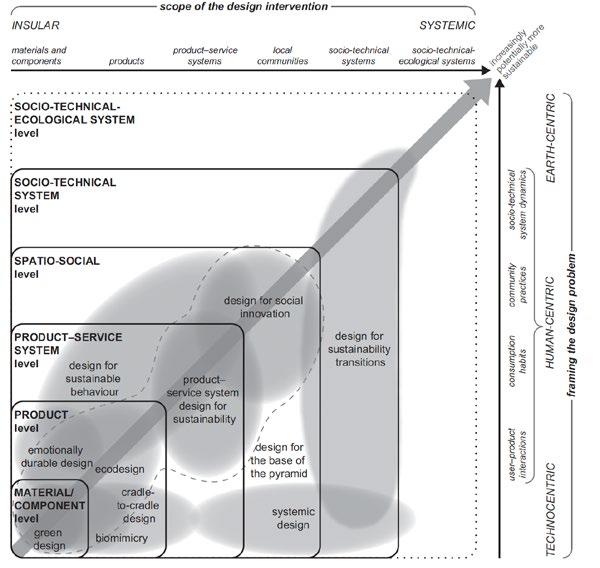
[Figure 27]: Ceschin and Gaziulusoy’s three-dimensional framework for Design for Sustainability, comprising innovation level, scope of design intervention, and framing of the design problem. The figure is revisited here to support the analysis and discussion of the empirical cases. Reprinted from Ceschin, F., & Gaziulusoy, I. (2020). Design for sustainability: A multi-level framework from products to sociotechnical systems (figure 12.5, p. 164). Routledge. Licensed under CC BY-NC-ND 4.0.
Building on the conceptual shift towards systemic and multi-actor approaches in Design for Sustainability (DfS), I return here to Ceschin and Gaziulusoy’s (2020, see Figure 27) three-dimensional framework—introduced earlier in the dissertation— to engage with it more in depth. The framework, comprising innovation level, scope of design intervention, and framing of the design problem, is used here as an analytical lens to discuss how the three cases in this study engage with different orientations to sustainability. While the framework was originally used to map the evolution and diversity of design approaches within the sustainability field, I employ it here as an analytical lens and structuring device to explore how the cases may stretch across multiple layers and contribute to ongoing shifts in practice. In positioning the cases within the framework, I do not assign fixed locations but trace how each case moves across dimensions over time. The placements discussed below are therefore analytical approximations used to make visible orientations, tensions, and shifts as they unfold through practice.
Despite different starting points and emphases, all three cases begin with a predominantly technical or product-focused entry point but are driven by ambitions that gesture towards higher levels of innovation. The mobility case initially centres on eco-technical aspects, while the coffee case originates in sociotechnical configurations (see Publications 2 and 3). The town hall case, situated in a municipal workplace context, starts with a call for a sustainable design guide for office spaces—arguably rooted in a green design or cradle-to-cradle logic, with an emphasis on material reuse. While the scope is initially narrow, the framing revolves around explo-
ring “new ways of working in the wake of COVID-19” (Publication 1, p. 93/1). As the project unfolds, however, the design process gradually opens towards deeper cultural and institutional questions, eventually engaging with new forms of working culture, thus aligning with the field of design for social innovation, particularly where it intersects with participatory, community-based practices at the spatio-social level.
In this sense, the cases demonstrate varying trajectories towards more systemic forms of innovation, where sustainable outcomes require integration of ecological, technical, and social dimensions. This sets the stage for a more detailed positioning of each case in relation to the three dimensions of the DfS framework.
While I draw on the framework to position the cases within existing design traditions and to reflect on how sustainability-oriented design has evolved, my analysis also highlights where the framework begins to falter. In particular, its linear structure and assumptions of progression (from local to systemic, or from technical to earth-centric) do not fully account for the complex, situated, and interdependent nature of design practice. Some cases may operate locally while engaging deeply with planetary concerns.
In positioning the cases within this framework, my aim is not only to map their trajectories across predefined dimensions of sustainabilityoriented design but also to reflect on how such mappings may foreground certain logics while obscuring others.
I am particularly interested in how the cases begin to challenge or stretch the framework’s boundaries, especially where interdependencies, systemic frictions, and emergent dynamics become central to both process and outcome.
These tensions open towards a more epistemic reading of my design practices. By examining how the cases trouble or reconfigure the framework’s dimensions, I reflect on the epistemic role of the designer not only in framing design problems but also in learning from and with systemic frictions. Read through the relay-oriented approach, scope does not simply expand by adding actors or scales but through sustained relational engagement that allows concerns, practices, and responsibilities to travel across contexts. This view resonates with Buchanan’s (1992) interpretation of design as a reflective and repositioning practice through placement, where framing problems is inseparable from engaging with their sociomaterial and conceptual entanglements, and is, itself, a core design activity.
The horizontal dimension in the framework ranges from insular product-level interventions to more integrated, systemic engagements across actors, structures, and scales. The town hall case takes material reuse and sustainable interior design as a starting point to achieve better ways of working. It spans from a material-component level (reuse and
a sustainable interior; the first level in the framework) towards a local communities level if we take not just the internal working culture in the wake of COVID-19 (product-service systems; the third level) but also the front-desk service tasks into account (such as the family centre and social authority work). Through these citizen-facing services, the case becomes relationally entangled with broader urban social dynamics as everyday interactions connect municipal practices with the lives, rhythms, and vulnerabilities of the city.
The coffee case engages actors across the value chain, from producers to consumers, and includes institutional and policy aspects. Although the design spans social systems, it does not fully incorporate ecological aspects such as soil, plant, or landscape health. Thus, while addressing a global agenda, it is positioned towards the systemic end of the spectrum yet remains primarily within a sociotechnical scope (the fifth level, towards the upper right corner).
The mobility case, although implemented locally, targets broader challenges in mobility infrastructure. It addresses structural issues at the sociotechnical-ecological system level (the sixth level, towards the upper right corner).
The vertical dimension spans from techno-centric to earth-centric framings, depending on how sustainability challenges are interpreted and situated. In the town hall case, the design problem is framed around transforming internal working practices within a public institution. It involves rethinking physical, digital, and hybrid forms of work and is positioned at the level of community practices (town hall with local public services; the fourth framing level).
In the coffee case, the design problem centres on securing the long-term viability of the coffee industry, including improving the livelihoods of farmers and supporting the next generation of producers. It thereby engages with sociotechnical system dynamics, particularly in relation to value chains, institutional structures, and global production–consumption relations (the fifth framing level).
In the mobility case, the design challenge is framed within systemic mobility issues and governance structures in rural areas. While institutional and behavioural aspects are foregrounded, the framing also attends to the interconnections between infrastructures and everyday practices, positioning it within a sociotechnical perspective (the fifth framing level). Across the cases, framing emerges not as a one-time articulation of the problem but as an ongoing design activity performed through attentiveness, negotiation, and relational responsiveness.
This composite dimension reflects the depth and potential reach of a design initiative. Synthesising the two previous dimensions, it spans from material and product innovation to broader sociotechnical and ecological system transformation. Within the logic of the framework, higher innovation levels are associated with greater potential for sustainable impact.
In the town hall case, the initiative is positioned at the spatio-social level, aiming to transform workplace culture and public service delivery within a municipal setting. These shifts may influence wider administrative and social systems, including citizen engagement and service accessibility (the fourth innovation level, diagonally).
The coffee case operates at the sociotechnical-ecological system level. It has the potential to influence global value chain transitions and promote both societal and ecological transformation through shifts in production and consumption practices. This transformative capacity aligns with system-level innovation and the potential to shift regimes, as described by Ahlborg et al. (2019) (the sixth innovation level).
While the innovative initiatives in the mobility case are primarily centred on human needs and institutional transitions, these are understood within the project as enabling conditions—minor yet necessary shifts towards longer-term sociotechnical-ecological transitions, including an emerging attentiveness to earth-centric concerns as articulated in the most recent extension of the framework.
Rather than assigning fixed positions to each case, this comparative reading suggests that the scope of design intervention is not static but shifts in response to contextual drivers, stakeholder dynamics, and the designer’s orientation (this is further discussed in Publication 1, p. 93 /1). It also raises questions about how ecological concerns are integrated, or backgrounded, in design efforts framed as sustainable or regenerative.
Although the framework does not aim to position specific cases but rather to illustrate the broader evolution of DfS approaches, I have used it as a reflective tool to discuss how each case engages with different aspects and levels of sustainability. Hence, I also point to nuances and dimensions that the framework or its underlying discourse may overlook.
As also acknowledged in the framework, the boundaries between different approaches are fluid, with blurry edges and overlaps. Accordingly, the aim here is not to pinpoint exact placements but to highlight tensions, shifts, and perspectives that may stretch or complement the narrative of DfS.
While the framework supports an increasingly inclusive and systemic understanding of sustainability, I find that it also risks reinforcing a progression-based logic, implying that moving from local to systemic or from technical to earth-centric is inherently more desirable. It also implies a particular facilitation logic in which impact is assumed to increase
through broader systemic engagement rather than through situated, iterative, or relational practices. This tends to flatten the performative, relational, and situated dimensions of regenerative design and may also overlook the epistemic role of the designer in navigating tensions, shaping framings, and learning from complex system dynamics. This reflection is not meant to critique the value of the framework, which offers a significant contribution in providing an overview of the expanding landscape of sustainability-oriented design, but rather to consider how it may be further expanded through practice-based perspectives. What becomes visible through this reading is not a rejection of systemic design but how systemic qualities are enacted from within practice through relational, embodied, and temporal work. In this context, I have used the figure not as a static map but as a tool to think with and against, inviting a more nuanced understanding of how design practices contribute to sociotechnical-ecological transitions. Taken together, these reflections draw attention to dimensions of systemic design practice that tend to remain implicit or under-articulated, particularly the performative work through which scope is enacted, negotiated, and sustained over time.
This section approaches designerly engagement through three primary analytical lenses: facilitation, embodiment, and reflexivity. These are not treated as individual competencies but as relational modes of engagement through which broader orientations of resilience, interdependence, and emergence unfold in practice.
The methodological journey leading to the relay-conversation approach began long before this PhD, emerging from observations of how systemic design was practised and from experiencing my own role as a designer differently within these processes. Over time, these experiences gradually became embodied as a set of intuitive, relational practices through which new connections and collaborative possibilities could unfold.
Across the earlier cases, small invitations to loosen the format appeared, yet project structures often constrained the extent to which these could be followed. In the second pilot, introductions to other actors were partially mediated; in the town hall and coffee cases, similar constraints applied. These moments, although limited, sharpened our sensitivity to what remained just out of reach and highlighted the potential for iterative, emergent patterns when conditions allowed. Such constraints did not halt the process but reoriented the work towards attunement, patience, and readiness for future openings.
(22) See Horlings (2016), Moriggi (2021), Bai et al. (2016), Olsson et al. (2014), Moore et al. (2018), Vanni & Crosby (2023), Tsing (2015) – synthesizing socio-ecological systems research; here approached from a sociotechnical-ecological perspective including infrastructures and artefacts alongside social and ecological relations.
These kinds of brief openings resonate with Light’s (2023) concept of “moments of being-in-relation”, where possibilities emerge through shared engagement and situated presence. Even minor, ephemeral encounters in everyday contexts—corridors, coffee stations, or local errands—became sites where new connections and ideas could unfold. Collectively, these constrained yet telling moments foreground facilitation as a temporal and relational practice in contrast to a fixed role or predefined intervention. Understood this way, emergence is not something that can be designed directly but is supported through facilitation, where the time between conversations and iterative engagement (the temporal) creates space for unpredictable patterns, ideas, and related perspectives to emerge and develop. This highlights the value of expanding participation and engagement not through recruitment but through relational continuity and trust built over time.
Interdependence becomes visible through embodiment: by physically engaging in participants’ local contexts (the spatial), relationships and mutual connections are experienced directly, and participants introduce facilitators to new actors, places, and practices. Being locally anchored enables sensing “the going, the movement” (Braidotti, 2012, p. 362) and attuning iteratively to the unique rhythms, infrastructures, and socioecological configurations of each place.21 This growing attentiveness to small relational moments prompted reflection on how designers might actively create and facilitate space for interdependence to unfold. Drawing on earlier project experience, these insights gradually became embodied guides, informing how facilitators attune to local rhythms and co-shape interactions with participants. This positions embodiment as a condition for learning with the system as it moves.
Resilience is strengthened through reflexivity, in which attention to emotions, moods, and relational dynamics (the affective) allows facilitators to adjust, adapt, and act responsibly. Such reflexivity operates both as an ethical orientation and as a practical capacity for navigating uncertainty and tension within situated design processes. In the coffee case, navigating systemic frictions between reductionist, competitive worldviews and regenerative principles required ongoing reflexive practice (Capra & Luisi, 2014/2019). These worldviews shape how sustainability, value, and responsibility are perceived and enacted.
In more personal experiences, small interactions, such as with young participants in a local school, revealed how awareness, listening, and responsive presence can open new relational possibilities, even in
5.1.3
constrained circumstances. These experiences have become embodied guides, stored as situated knowledge that informs how designers, acting through facilitative roles, engage, adapt, and scaffold potential trajectories for collective emergence (Anzaldúa, 2002; Haraway, 1988; Manzini, 2015; Østern et al., 2021).
Across the preceding sections, a set of methodological contributions and tensions becomes visible—not as a coherent method to be replicated but as situated orientations enacted through practice. These contributions do not appear as explicit methodological steps; they take form through designerly sensibility, relational ethics, and situated judgement, operating at the edges of formalised design processes.
First, the discussions foreground designerly sensibility as an epistemic capacity that operates through attunement, timing, and responsiveness to what emerges in and between encounters. This sensibility draws on intuition (Anzaldúa, 2002; Escobar, 2018; Lawson, 1980/2005), not as something opposed to rigor but as a capacity sharpened through accumulated experience, embodied engagement, and repeated exposure to complexity. Here, intuition becomes a cultivated form of knowing that supports judgements about when to act, when to wait, and when to withdraw. While difficult to fully articulate or formalise, this sensibility remains central to how transitions are facilitated in practice.
Second, the cases reveal relational ethics as an ongoing commitment enacted through care, accountability, and attentiveness to asymmetries of power and participation. Ethical considerations emerge not only in moments of decision-making but through how relations are sustained over time, how invitations are extended or withheld, and how responsibilities travel across contexts within the relay-oriented approach.
Third, situated judgement emerges as a central methodological tension. This form of judgement involves navigating uncertainty, partial knowledge, and competing concerns as integral conditions of practice. It acknowledges the impossibility of standing outside the systemic situation being engaged, positioning the designer as always already implicated in the unfolding transition.
Taken together, these contributions articulate a methodological orientation that is performative and situated, foregrounding practices that often remain tacit in systemic transitions yet are decisive for how learning, accountability, and emergence are supported. In this sense, the relay conversation approach does not resolve methodological tensions but holds them open as productive conditions for working with complexity and change.
5.2
This concluding articulation of Section 5.5 prepares the ground for Section 5.6, where the implications of these methodological tensions are discussed in relation to the dissertation’s overarching research questions.
Having explored how the relay approach performs across three distinct contexts, I now turn to the key insights that cut across them. Four interlinked insights stand out:
(1) Relay-like processes help temporalise and distribute agency across actors and sites. They reveal how transformation unfolds through situated rhythms and mutual becomings rather than linear planning, underscoring the importance of temporality and distributed agency in systemic design practice. In the town hall case, this became particularly visible when the participants referred to conversations continuing in corridors and when small-scale experiments emerged, such as relocating the head of the Secretariat to an open office (see Publication 1 for further examples, p. 93/1).
(2) Designerly presence functions as an attuning practice, mediating between emergent local needs and wider systemic constraints. Such presence is not about control or neutrality but about cultivating relational awareness and helping others perceive interdependencies, positioning design as a mediating and participatory practice of sense-making (cf. Escobar, 2018). An example from the mobility case was when, after spending most of the scheduled hour with the two priests, they wanted to show us the nearby culture house. We drove along, not knowing that we would get to see the culture house, the cemetery, and “pollen”, a small patch of trees, as well as a stunning view from the peninsula, that others had also told us about (Publication 3, p. 129/5). This unexpected unfolding illustrates how knowledge and relational insight can travel through participants in a relay, creating shared understandings that extend beyond the formal encounter.
(3) Systemic frictions—regulatory, material, and relational— both hinder and enable transitions, shaping possibilities for collaboration. By attending to frictions as generative rather than purely obstructive, systemic design can illuminate the subtle movements through which transformation takes form and emphasise the ethical and methodological discernment required to navigate frictions and ambiguity. In the coffee case, a central friction emerged between ambitions to secure the future of coffee and the reluctance to radically reconfigure either production conditions or customer-facing products. This tension generated
What roles, competencies, and sensitivities do designers need when working with a relay conversation approach in support of situated transitions?
How can a relay conversation approach be shaped and facilitated to cultivate interdependence, emergence, and resilience?
How do different systemic conditions shape, challenge, or enable a relay conversation approach in practice?
What ethical implications arise from engaging in a relay conversation approach in situated transition work?
[Figure 28]: Correlation between sub-questions, key concepts and synthesised relational insights.
frictions between departments and shaped what kinds of change could be pursued (see also Publication 2, p. 104/295).
(4) Embodied, relational methods reveal forms of knowledge and agency that are otherwise invisible to conventional, instrumental approaches. They point to how knowing and designing become intertwined through bodily, affective, and situated engagement—expanding the epistemological foundations of systemic design towards more-thanhuman, performative modes of inquiry. In the mobility case, embodied and relational methods were crucial for sensing local atmospheres and for noticing how one relay conversation could open up the conditions for the next—dynamics that would have been difficult to grasp through more instrumental approaches (see Publication 3, p. 125/1).
Designerly presence, situated role-taking, relational sensitivity
Attunement, relational facilitation, emergence
Frictions, distributed agency, organisational conditions
Ethics, embodiment, more-than-human relations
(1) Relay-like processes, (2) Designerly presence, and (4) Embodied approaches
(1) Relay-like processes, (2) Designerly presence, and (4) Embodied approaches
(1) Relay-like processes and (3) Systemic frictions
(4) Embodied, relational methods
Figure 28 illustrates the interconnections between the sub-questions, key concepts, and synthesised insights, highlighting how each insight contributes to understanding systemic design across the three contexts.
Thus, the figure articulates how questions, concepts, and insights co-evolve across the dissertation. It shows how the relay conversation approach operates as a relational configuration that cuts across analytical levels, contexts, and concerns.
Collectively, these four insights capture the core empirical and theoretical contributions that emerged across the three studies, spanning from organisational to community-based contexts. Each insight connects a specific empirical observation with a conceptual shift in understanding systemic design as relational, temporal, embodied, and affective. Other potential insights, such as ethical reflexivity and col-
5.3
lective becoming, I have instead woven through the discussion as crosscutting dimensions that deepen and contextualise the four key insights.
In this section, I summarise and compare the three cases to explore how designerly agency emerges through systemic and relational practice. While the cases reveal shared relational-ethical patterns, they also unfold within different systemic conditions that shape how the relay approach takes form in practice. I therefore attend to how relational practices, forms of engagement, and capacities for action are negotiated across settings.
The section moves from case-specific features and emergent relational insights, through a cross-case examination of relational practice and designerly agency, towards identifying shared relational-ethical patterns. Bringing the three cases into a dialogue makes it possible to reflect on how systemic design is enacted through relational practice within organisational, ecosystemic, and community-based transitions and how these enactments condition the possibilities for transformation.
5.3.1
Here, I explore how the relay approach unfolded across three distinct organisational settings, focusing on how relational practices and designerly agency emerged in response to specific systemic conditions. The three cases, situated within different organisational configurations, offered opportunities to examine how the relay conversation approach unfolds under diverse purposes and constraints. The cases served as living laboratories (Ehn, 2009; Sjöman & Hesselgren, 2020) for exploring the relay conversation approach as a mode of co-becoming with the future (Peschl, 2019). The intention was not to develop a fixed method or formula but to explore how the relay approach could unfold across different settings. The cases therefore helped to illuminate distinct perspectives. Across the three cases, different organisational logics shaped what kinds of relational engagements became possible; how agency could circulate across actors, practices, and relations; and how the relay approach could unfold.
The town hall case (Publication 1, p. 93/1) revealed how deeply institutional hierarchies shape the scope of relational engagement. It highlighted the tension between the promise of flexibility and the persistence of administrative structures—a tension that simultaneously enabled and constrained the relay conversation approach. What stood out in this case was the relationship between what could have been a conventionally siloed workplace and the citizens. Although most of the encounters took place within the organisation, the case was continuously entangled with the city beyond its walls. Citizens were present not only through citizen-facing functions but also through the public nature of the building and the political accountability embedded in municipal governance. In this sense, the town hall case cannot be understood as an internal organisational intervention alone but as situated within broader urban and civic relations. An example of this was the delicate political matter with the six offices used by committee chairpersons only on Wednesdays (see Publication 1, p. 99/7; see also Appendix for floor plan overviews of meeting facilities on each floor). These entrenched traditions were characteristic of the challenge of designing for flexibility within an institution bound by regulations for handling both confidential citizen- and business cases. The engagement with power structures was particularly challenging, and I will return to this theme in Section 5.11 when discussing the designer’s scope of agency.
What this case makes visible for a designer-researcher (non-exhaustive):
• Power structures and institutional hierarchies embedded in the organisation constrained the scope of relational engagement and limited the redistribution of agency.
• Institutional reporting formats shaped what kinds of embodied and situated knowledges could circulate beyond the project process.
• Existing sociomaterial and design management vocabularies lacked terms to articulate what enabled small, situated transitions to occur through relational and embodied engagement.
This case made visible how power hierarchies, institutional formats for reporting, and limited sociomaterial vocabularies constrained the circulation of embodies and situated knowledges.
The second case
In contrast, the coffee case unfolded within a private-sector setting, where the organisational dynamics and innovation framing posed
different challenges to relational design. This case, focused on the coffee value chain, had other characteristics. It was company-centric and (what I later saw as one of the obstructions for radical innovation) with scoping grounded in the Marketing & Innovation department focused on eliminating waste across the value chain. The project was framed around a shared concern between the mother and daughter companies: ensuring the next generation of coffee farmers and, thus, the future of coffee itself. Although positioned as a frontrunner in sustainability, the company’s approach tended to privilege communication and end-consumer narrative over relational engagement across the full value chain.
What this case makes visible for a designer-researcher (non-exhaustive):
• Organisational ownership of the initiative, anchored within a single department, constrained participation and reinforced siloed innovation logics.
• Instrumental framings of sustainability privileged measurable outcomes, such as decarbonisation targets, over relational engagement across the value chain and with more-than-human stakeholders.
• Radical transformation required forms of sensing, openness, and relational attunement that exceeded circular economy and loop-oriented material framings.
• The designer-researcher’s role shifted from facilitating predefined innovation processes towards holding space for emergent relations and forms of knowing that resist instrumentalisation.
The mobility case offered a more open organisational frame, which allowed the relay-approach to unfold as an attuned, place-based inquiry into the lived realities of rural mobility. In this case, it was clearer to us how we could hold space for the kind of knowledge (see Chapter 3) we were after and, thus, attuning more directly with the people in the rural communities got us closer to the complexities of their lived experiences.
Operating within a time-limited Interreg framework, the mobility case combined structured deliverables with locally grounded inquiry. The openness of our partners allowed the relay approach to unfold through slow, place-based encounters and go-alongs.
What this case makes visible for a designer-researcher (non-exhaustive):
• Temporal openness and minimal pre-structuring enabled embodied attunement and allowed relational dynamics to emerge on the participants’ own terms.
5.3.2
(23) The notion of readiness is informed by Akama and Light’s (2020) discussion of readiness for contingency in codesign, where readiness is not understood as a skillset or a preparatory phase, but as an ongoing, ethical and embodied orientation toward what might emerge in situated encounters. Their reflections on poise, punctuation, and attunement resonate particularly with the Mobility case, where openness, temporal flexibility, and relational sensitivity were central to how the relay approach unfolded.
• Ethical engagement involved participating as a whole person, recognising participants as relational beings rather than respondents or stakeholders.
• While the temporary project organisation afforded flexibility, its time-bound nature also revealed tensions between project rhythms and the durational character of systemic transformation.
• Across this case, openness and slow pacing appeared closely linked to relational readiness.
During the case-processes, the relay approach was adapted to divergent systemic conditions—from hierarchical rigidity and organisational silos to temporal openness. These contrasts set the stage for a deeper exploration of how relational readiness and designerly agency were negotiated within each setting.
Reflecting across the three settings, I began to see how relational readiness22—understood here as a situated capacity to respond to contingency instead of a reliance on predefined plans (Akama & Light, 2020)—and the scope of my designerly agency were continually negotiated. They were shaped both by the systems encountered and by how I met them. This led me to examine how agency, power, and relational sensitivity were not given but were constantly negotiated through the specific configurations of each case.
In the town hall case, the circulation agency was constrained both by structural hierarchies and by institutional formats for accountability and reporting. The requirement to deliver a final report formalised the process and made it difficult to hand over the embodied and situated knowledge that had emerged through the relay conversations. This limitation highlighted how institutional accountability formats can suppress the circulation of relational insight. In retrospect, engaging citizens more directly could have expanded the field of agency beyond the administrative hierarchy and strengthened the relational dimension of the inquiry.
In the coffee case, the project’s framing within a single department (Innovation & Marketing) revealed how organisational silos delimit both ownership and participation. Invitations were issued top-down, and the conversations were conducted online, which further constrained the emergence of new relations. While the company’s sustainability ambitions were genuine, transformation remained framed through measurable outcomes, such as science-based targets, leaving little room for the less quantifiable aspects of mutual flourishing (Kimmerer, 2024).
For me, as the designer-researcher, this raised questions about what kinds of knowledge count as legitimate and how to hold space for what cannot yet be measured or named (Haraway, 2016).
In the mobility case, the temporary and loosely structured project organisation created space for a different kind of attentiveness. By approaching the encounter with readiness in contrast to predefined plans (Ingold, 2013; Willis, 2006), I could engage in an attuned mode of participation, allowing relational dynamics and shared entanglements to emerge through the conversations themselves (Akama, 2015; Akama & Light, 2020). This openness required an ethics of honesty, participating as a whole person rather than a detached professional. However, while it enabled deeper relations, it also revealed the fragility of timebound structures when faced with the slow rhythms of systemic transformation (Escobar, 2018; Irwin, 2015).
Drawing together insights from the three contexts, it becomes clear that relational emergence is shaped not only by organisational openness but also by temporal and structural readiness. What began to crystallise throughout the cases were the interdependent conditions of readiness, openness, temporality, and relational sensitivity.
In the town hall case, the inability to pass the baton beyond assigned employees underscored how agency remained confined within predefined hierarchies. The potential for relational emergence depended not on the designer’s initiative alone but on the system’s capacity to redistribute agency.
This case, I would say, was an example of emerging relational conceptions and experiments clashing with hierarchies and organisational structures. The organisation simply was not fully ready to restructure and plan otherwise. This caused me to reflect on both my role as a designer-researcher, engaging with organisations, and on how to get closer to relationality, not just as working procedures, citizen services, and shared square metres but on a deeper, more radical level (see Escobar, 2018).
While the town hall and coffee cases revealed how systemic rigidity and instrumental framings constrained the potential for relational emergence, the mobility case demonstrated how a more open and temporally fluid framing allowed such emergence to unfold—partly because the design process itself became embedded in everyday practices rather than being orchestrated from above.
However, what further made a difference in the three cases was the way we were engaged. In the first two cases, our role was more towards a design consultancy function with a clearly defined task to carry out. In the mobility project, we had the overall framework for the international project (customising sustainable mobility mixes to fit users’ needs), and in the Danish part of the project our close partners acted out of both dissatisfaction with existing approaches and openness and curiosity towards a slow, explorative process of inquiry. This
5.3.3
foundation matched the relatively slow relay approach better. Furthermore, in terms of the framework, we agreed on a broader conception of mobility, wherein “mobility” and “the good life in rural areas” were already intersecting and entangled. This meant that, together, we were investigating what the framework for the project actually was. Hence, it was possible to come with only a loose framework guided by listening, noticing, and our curiosity. There was no fixed set of questions, no set meeting point, and no plan for where the go-along would take us. These emerged from the conversation itself.
Another aspect that I think mattered in terms of paving the way for systemic transformation in these cases were (1) the (more or less) open framework and scope/decisions governing progress in the cases and (2) the timing of our engagements in the projects—the earlier the better (what we would refer to as pre-project phase in a regular defined project).
These premises were closer to the kinds of designerly engagements I have been trying to both investigate and develop in order to get closer to a designerly approach towards systemic transitions. They all show how the entanglements of systemic transitions need situated approaches related to context but also that, consequently, this is time consuming and requires relational sensitivity. In the town hall case, reporting formats limited what could be circulated; in the coffee case, marketing framings narrowed the scope of relational inquiry; and in the mobility case, temporal openness enabled slow emergence. Hence, agency in systemic transitions is not evenly distributed but emerges where structural openness meets relational sensitivity (Akama & Light, 2020; Barad, 2007; Escobar, 2018; Pickering, 2022).
In each case, the relational emergence was conditioned by four interdependent dimensions: readiness, the system’s capacity to respond to uncertainty; openness, the willingness to share control; temporality, the rhythm and pacing of engagement; and relational sensitivity, the embodied ability to sense when and how to intervene. Together, these dimensions shaped not only the outcomes but the very possibility of transformation while also pointing beyond individual cases towards recurring relational-ethical patterns.
Through the three cases, emergence, interdependence, and resilience appeared not as abstract principles but as situated, embodied practices. Distinct sensibilities developed across encounters as evolving modes of responsiveness. While emergence, interdependence, and resilience were present in all cases, they were enacted differently depending
5.3.4
on the degree to which attunement became possible within each context’s constraints.
In the town hall case, emergence was constrained by hierarchy. In the coffee case, relational engagement was channelled through existing value-chain logics and performance targets, which tended to privilege measurable outcomes over more open-ended exploration. In the mobility case, it was nurtured by openness. These variations show how systemic sensibilities are not fixed competencies but contextual responses shaped by attunement and the capacity to dwell with uncertainty, where attention to absence enables a “receptiveness to ambiguous and liminal dimensions” (Akama & Light, 2020, p. 11).
In retrospect, I realise that bodily attunement was already present in the first case, though at the time I lacked the language to grasp it fully. I sensed it without yet being able to articulate its significance—a subtle gap between sensing and articulating that gradually narrowed as the research progressed. As my practice evolved (and I explored different research fields), this tacit responsiveness became a more explicit orientation. These patterns point to an ethics of timing—or temporal sensitivity—as a way of responding when relations are ready to move. This resonates with calls within systemic design for an ethical stance grounded in attentiveness, care, and relational readiness (Akama & Light, 2020; Bawaka Country et al., 2013; Ingold, 2021; Tronto, 1993). In the following section, I reflect on how this temporal sensibility relates to designerly agency and the possibilities for transformation in systemic and relational practice.
What seemed to pave the way for transformation was less about applying tools or following fixed methods and more about cultivating presence, relational sensitivity, and temporal attunement. In this, what I kept being curious about (and kept discussing with colleagues) was how to sense when relations were ready to move and how to prepare for it (Akama & Light, 2020; see also Gottlieb, 2024, on relational sensitivity as a methodological stance)—those moments where something resonates that makes other ways of living together possible, such as when, in the mobility case, Signe speculated out loud about picking people up at the bus stop: “What do I do next time I see someone waiting? Do I stop? And how would they react?” (Publication 3, p. 131/ 7), or when we told relay participants in the town hall case that they were more than welcome to reach out to each other and discuss what we had talked about with their colleagues. In some of the next conversations, their colleagues told us about the conversations in the corridors. The
in-between is important for the system to evolve, to move—as making and knowing emerge through correspondence, “drawing out potentials immanent in a world of becoming” (Ingold, 2013, p. 31). Similarly, in the mobility case, when we were almost coming to an end in our conversation with Anna, we asked whether we could go along to the inn to talk some more without imposing or intruding. These moments, subtle yet powerful, illustrate that transformation in systemic design does not occur through intervention but through resonance—when relations are ready to move. In the coffee case, one of these moments came after a stakeholder mapping session, when the CIO recognised how previously overlooked more-than-human stakeholders were central to the case (Publication 2).
The three cases illustrate different degrees of openness and readiness, revealing how agency in systemic transitions emerges not from individual actors but from relational configurations. In the mobility case, this agency circulated more freely—across people, materials, and landscapes—suggesting a shift from participation as contribution to participation as co-becoming. This invites a rethinking of what “participation” means in systemic design.
Together, the cases demonstrate that systemic design cannot be detached from its contexts. It is not a transferable method but a situated, relational practice attuned to temporal, material, and institutional conditions. Even within a single region, the three rural communities revealed strikingly different relational configurations. This illustrates that systemic design does not scale by replication but by resonance through locally attuned correspondence (Ingold, 2013).
Methodologically, the relay approach evolved from a loosely defined method to a temporal and sensitive way to stay with transitions as they unfolded. Hence, taking distance from sequential tools, it allowed knowledge and agency to travel across scales, times, and bodies (Light & Akama, 2014; Light et al., 2017; Peschl, 2019). Theoretically, these experiences began to reframe my understanding of transformation not as a planned intervention but more as something that unfolds through distributed relations. Further, in practice, distributed agency meant that transformation did not originate from one actor—designer/researcher, manager, or citizen—but from their evolving relations (Escobar, 2018; Latour, 2005; Light & Akama, 2014). Across the three cases, relational responsiveness became both a methodological and an ethical anchor that expressed the ability to move with what emerged instead of imposing direction. In the town hall case, agency emerged through shifting collaborations between employees, the steering group, the city council, and the citizens; in the coffee case, it was distributed across departments, partners, and value chains; and in the mobility case, it unfolded in temporal alignment with the participants’ everyday rhythms across municipalities and the region.
The relay conversations became micro-sites where agency was shared, deferred, and redistributed among human and more-than-human relations—including materials, infrastructures, and landscapes that shaped what could be said or done. Our role, then, was not to steer but to host these micro-sites of becoming, creating conditions where relational shifts could unfold and travel across contexts. Here, “materials” should not be understood narrowly as physical artefacts alone. While tangible elements such as whiteboards, images, and written prompts were part of the cases, the primary materials shaped through the relay conversations were relational and temporal: shared narratives, affective shifts, moments of resonance, and the micro-sites of interaction through which agency was redistributed. In this sense, the relay conversations themselves became material conditions for transformation.
For me, facilitating and holding that kind of space meant listening with the body and being present to subtle shifts in tone, rhythm, or silence that shaped the unfolding of each conversation. Ultimately, the capacity to sense when relations are ready to move became central to how transformation unfolded. Through the cases, this meant sensing when to intervene and when to let a participant’s story guide the collective reflection.
My attunement to sensibility in the conversations grew gradually from noticing subtle affective shifts to recognising moments of resonance and discussing them with colleagues. These traces became crucial for understanding how transformation could be sensed and traced through lived experience beyond what could be measured or predefined.
This way of knowing is not only methodological but ethical as acts of care and attentiveness towards more-than-human interdependencies. It points to an ethical dimension of systemic design in which care, attentiveness, and temporal sensitivity are not peripheral but constitutive conditions for transformative practice. The subtle transformations observed in the three cases were not enacted through discrete interventions but unfolded through ongoing correspondences between relations, times, and materials, whereby movements were sustained through care, attentiveness, and readiness. In this sense, systemic design is less about directing systems and more about learning to move with them (Akama & Light, 2020; Ingold, 2013). Across the cases, these dynamics made visible how different forms of systemic frictions—including institutional structures, dominant framings of value, and sedimented ways of working—constrained what kinds of embodied and situated knowledges could circulate. Together, they raised methodological questions about how systemic design might be practised otherwise.
5.4
In Section 2.4, I outlined three conceptual orientations—resilience, interdependence, and emergence—as modalities of a design mindset attuned to complexity. While these orientations informed the project from its outset, they were not foregrounded as analytical lenses during the individual studies. Rather, they have taken shape through an ongoing movement between theory, practice, and reflection, gradually crystallising through engagement across cases and publications. Drawing on these cumulative insights, I turn to systemic design as anticipatory and transformative practice through three interrelated dimensions: embodiment, reflexivity, and facilitation. While analytically distinct, these dimensions resonate with the earlier orientations: embodiment foregrounds interdependence through the lived body, reflexivity supports resilience through practices of accountability and adjustment, and facilitation sustains emergence by holding open space for contingency and becoming. Together, these articulations highlight how systemic design anticipates not by predicting or modelling futures but by cultivating regenerative futures through situated and dialogical engagements.
When systemic design is approached through embodied practices, it foregrounds the lived body, affect, and material relations as epistemic resources for transformation. Embodiment offers a way of understanding systemic design not only as cognitive or analytical but as grounded in the lived body and its perceptual, affective, and material entanglements.
In the same line of thinking, Merleau-Ponty’s phenomenology positions the body not as “a thing among things” but as the very site through which world and meaning are constituted (1962/2025). In this sense, systemic design approaches embodiment as shaping how designers sense and act within complex systems. Other scholars, such as Despret (2004, 2013), emphasise that affect and sensitivity are not subjective residues but fundamental to how knowledge emerges. In systemic design, embodied practices can therefore foreground intuition, attentiveness, and responsiveness to sociomaterial relations as integral to transformation. This resonates with Anzaldúa’s (2002) notion of inner experiences as catalysts for collective change and Østern et al.’s (2021) post-qualitative approaches, where embodiment itself becomes method. Recent design research, such as Diatta et al. (2022), highlights this, sho-
5.4.2
wing how embodiment brings forth new relationalities with materials and expanding how systemic design can engage with transitions. In this configuration, these perspectives reposition embodiment as anticipatory practice—attuning to what is emergent rather than prescribing predetermined futures. This orientation towards embodied knowing sets the stage for reflexivity as a practice of accountability and responsiveness.
Within systemic design, reflexivity is not merely individual selfawareness but a dialogical practice of fostering sensitivity to entangled societal and relational structures. While reflexivity has often been conceptualised as a methodological “mirror” (Argyris & Schön, 1989; Schön, 1983), in systemic design it can take a more situated and relational form. Vink (2022, p. 6) defines reflexivity as “a dynamic process of cultivating an awareness of the multiplicity of social structures internalized by oneself and others”, highlighting how reflexivity is not static but enacted in ongoing relations. Drawing on feminist and posthuman perspectives, Akama (2015) and Haraway (2016) foreground accountability and situatedness as key conditions for reflexive practice where we are never outside the relations we study and design within. In this sense, reflexivity in systemic design is less about evaluating from a distance and more about cultivating responsiveness within entanglements. In my own work, reflexivity has been structured into the process through intervals between dialogical encounters and collegial reflections. Thus, reflexivity supports anticipation not as foresight but as an ongoing capacity to respond to what unfolds across time and relations. These in-between spaces created openings for adjustment without assuming neutrality, allowing participants to return with perspectives shaped by conversations elsewhere. In systemic design, reflexivity is therefore not only an inward-looking exercise but a relational practice of accountability, where responsiveness to what emerges across encounters becomes a central condition. This insistence on relational responsiveness links directly to the question of facilitation, where neutrality proves equally illusory.
5.4.3
Systemic design approaches foreground that facilitation is never neutral but an active practice of holding space, committing to emergence, and engaging in situated co-creation. From this perspective, neutrality in systemic entanglements is an illusion.
5.4.4
Rather than maintaining control or seeking consensus, facilitation in systemic design entails ongoing attunement to others (Buur & Larsen, 2010). Relatedly, Rasmussen (2011) outlines conditions for creative cooperation, emphasising the composition of the participants, the facilitator’s personal capabilities, and knowledge of available methods. While these principles remain relevant, they largely frame facilitation as a matter of organisational process. In systemic design, however, facilitation extends beyond method and control, engaging more deeply with affective, embodied, and relational entanglements. Shaw (2002) similarly critiques managerial notions of facilitation as control, instead framing it as “participating with” rather than “acting on” processes. Thus, notions of neutrality and detached subjectivity do not resonate within systemic facilitation; talkative or silent, facilitators remain part of becoming-with. Facilitation is therefore anticipatory, as it holds uncertainty, commits to emergent openings, and makes space for relations to reconfigure in open-ended ways. Such anticipatory dimensions of facilitation point towards systemic design more broadly as an anticipatory and transformative practice.
Transition design (Irwin et al., 2022) positions systemic design as future-oriented, engaging with societal transitions that unfold over long horizons. However, anticipation in systemic design differs from established methods such as foresight or backcasting (Quist & Vergragt, 2006), which often seek to plan pathways towards predefined scenarios. Instead, systemic design works anticipatorily by cultivating openness to multiple possibilities, situated in relational and material contexts (Capra, 1996/1997; Light, 2023; Morrison, 2023). These regenerative futures, Buckton et al. (2023) argue, require precisely such anticipatory practices to not only be sustainable but life-enhancing. Fitzpatrick (2025) further demonstrates how methodological pluralism in systemic design enables regenerative engagements in practice. Seen in this way, anticipation is not about prediction but about holding space for experimentation, contingency, and emergence (Tsing, 2015). Considered jointly, the dimensions of embodiment, reflexivity, and facilitation shed light on aspects of how systemic design operates in practice while also pointing to its anticipatory role in cultivating regenerative and transformative futures.
5.5
In the following section, I turn to relational design as a way of articulating how systemic design transitions take form in practice. While Section 5.4 highlighted anticipation as a condition for cultivating regenerative futures, the present section explores how relational design offers concrete orientations for such futures in situated and relational terms. By tracing its capacity to navigate complexity, foreground ethics, situate the role of the designer-researcher, and scaffold anticipatory practices, relational design emerges not merely as a methodology but as an ethos—one that sustains spaces for emergence, transformation, and collective ways of living.
5.5.1
Relational design approaches offer ways of navigating complexity by attending to multiple relations, agencies, and situated dynamics at play, thereby opening possibilities for emergent communities, collective visions, and shared ways of living. As Latour (2005) shows, collectives are constantly reassembled, while Ahlborg et al. (2019) emphasise the intertwined sociotechnical-ecological character of transitions. Aligned with this, Escobar (2018) frames design as part of the pluriverse— an open-ended interplay of worlds—while Dorst (2015) highlights the generative potential of novel approaches. Viewed through this lens, I align with Manzini’s (2015) understanding of relational design as creating openings for emergent communities and with Wahl’s (2016/2022) extension of relational design towards practices of shared worldviews and collective living. Taken together, these viewpoints suggest that futures are cultivated not through control but through relational attunement. Thus, in this dissertation, relational design is approached as a way of navigating complexity by staying with unfolding relations and emergent configurations. Such navigation, however, is not neutral; it entails ethical commitments regarding how relations are held open over time.
5.5.2
Relational design foregrounds ethics and infrastructuring as central practices, where designers engage in co-becoming, redistribute authority, and hold open spaces for alternative futures. Infrastructuring, as described by Bjögvinsson et al. (2012), shifts design from delivering solutions to enabling ongoing collective practices, while Kossoff (2011) stresses repairing the “in-between” of everyday practices in life. In this sense, relational ethics shifts design from producing outcomes to sustaining conditions for ongoing collective becoming. Adding to this, Vink and Oertzen (2018) argue that methods should remain plural and reflexive rather than prescriptive, opening design towards this kind of relational attunement. I follow these lines while also drawing on Light (2023, pp. 24, 26), who frames such practices as “everyday utopias” that actively hold open possibilities for “worlds in the making”. It is precisely this relational worldview—where futures are enacted through situated practices, shared responsibility, and ongoing care—that this project seeks to engage and support. Together, these perspectives underscore the ethical responsibility of relational design to sustain spaces where alternative futures can be enacted. Such ethical commitments are inseparable from the situated presence of the designer-researcher.
5.5.3
Relational design further highlights the situated role of the designer-researcher, whose reflexive commitment shapes how relations are assembled, narrated, and performatively enacted as possible worlds. Relational and reflexive commitment demands turning to the inner worlds of emotions, personal viewpoints, and identities, as this often latent knowledge shapes human intentionality, for instance, towards sustainability (Horlings, 2015; Ives et al. 2020). Relational design requires an acknowledged partiality in which involvement and responsiveness become conditions for knowing. To encounter in this way and hold “open the possibility of surprise”, Harris and Holman Jones (2022, p. 86) argue that we should cultivate a politeness, sensibility, and sincere curiosity towards human and more-than-human habits to free potential change. Along the same lines, Holman Jones (2017) frames qualitative inquiry as “assembling a we”, a collective network gathering with each other in which we enable plural worlds through performative connections (Poulsen, 2024). “Living the questions”, as Wahl (2016/2022, p.
5.5.4
147) reminds us, may open design dialogues with the potential to become culturally transformative. In this sense, the designer-researcher is never a neutral observer but an active participant in the relational fabric of cultural change.
Across these dimensions of navigating complexity, engaging ethics, and situating the researcher, relational design emerges as an anticipatory and transformative practice, one that not only addresses past and present challenges but also scaffolds the emergence of futures that are open-ended, situated, and affectively grounded. While systemic design often anticipates futures through projection and planning, relational design anticipates by inviting the unforeseen and staying responsive to what emerges.
As Escobar et al. (2024) argue, relationality points towards emergent forms of politics. Relatedly, anthropological perspectives on the contemporary emphasise the importance of cultivating conditions of possibility rather than prescribing futures in advance (Rabinow et al. 2008). Here, anticipation is not a matter of preconceived planning or prediction, but an open-ended, situated practice focused on staying responsive to what emerges and resisting premature closure. As Rabinow et al. (2008) suggest, such an orientation requires not being “previous to the question” (p. 88) and remaining attentive to emergent configurations, assemblages, and future collectives that cannot be fully known in advance.
Lindström and Ståhl contribute to this discussion from the field of participatory design, drawing on design anthropology, framing invitations not as pathways to predefined design outcomes but as situational openings oriented towards the unpredictable and an “ongoing living with technologies” (Lindström & Ståhl, 2016, p. 195). Such openness also entails welcoming serendipity (Müller, 2021), understood in design ethnography as receptiveness to the unforeseen, allowing unexpected relations and events to shape outcomes. This orientation reflects what, across the cases, the relay approach increasingly came to emphasise: that relational design operates simultaneously as an approach and an ethos, binding ethics, practice, and reflexivity together. In this way, relational design not only advances methodological and ethical commitments but also connects back to the systemic transition orientations of resilience, emergence, and interdependence outlined in Section 2.4.
5.6
The analyses in the previous sections demonstrate how relayoriented design practices perform systemic design in situated contexts while simultaneously challenging some of its underlying assumptions. Across the cases, systemic design frameworks provided important orientations for engaging with complexity, interdependence, and sustainability. Yet, as demonstrated across the three cases, these frameworks proved insufficient for capturing the embodied, relational, and ethical dimensions through which change unfolded in practice.
Building on these analyses, this section synthesises insights across the cases to reflect on broader implications for research, practice, and regenerative futures. In doing so, it foregrounds a central tension running through the dissertation: the productive tension between systemic design and relational design as practices grounded in different ontological and epistemological commitments.
While systemic design typically seeks to describe systems, identify patterns, and locate leverage points from an analytical vantage point, relational design positions the designer within ongoing relations, embracing partiality, involvement, and inherent uncertainty. This move has important implications for how sustainability is understood—as an ongoing, situated practice that must be sustained through relationships over time. The relay-oriented approach developed with this dissertation does not seek to resolve this tension. Rather, it explores what becomes possible—and what is complicated—when these approaches are brought into situated dialogue.
In what follows, I synthesise how such situated design engagement can support emergent, relational, and context-sensitive pathways towards sustainability while also foregrounding the tensions, limitations, and responsibilities that arise when systemic and relational commitments intersect in practice.
5.6.1
Across the three cases, different regenerative ambitions and configurations emerge, highlighting the interplay between internal and external regeneration (Buckton et al., 2023). In the town hall case, efforts primarily focus on regenerating workplace culture and collaboration, with limited engagement in broader ecological transformation. The coffee case emphasises post-consumer value creation and brand repositio-
5.6.2
ning, supporting internal innovation while external ecological impacts remain marginal. In contrast, the mobility case engages more directly with socioecological networks, fostering community ties and localised interventions; yet, systemic ecological transformation remains implicit. Collectively, these positions illustrate the contextual specificity and complexity of pursuing regenerative futures, emphasising the need for relationally sensitive design practices that can respond to both emergent and situated dynamics.
As demonstrated across the three cases, regenerative ambitions do not align neatly with predefined sustainability goals or metrics. Rather, they emerge through situated negotiations between organisational priorities, local socioecological relations, and more-than-human agencies. This underscores how regenerative futures are not implemented through universal frameworks but cultivated through relational commitments that remain open to context, contingency, and ethical judgement.
The cases illustrate that systemic design in practice cannot rely on linear, predictable, or top-down approaches, particularly under the complex and interdependent conditions of the Anthropocene. Rather than predefined solutions, design unfolds as a relational, emergent practice, responsive to local conditions, temporal rhythms, and evolving socioecological networks.
Viewed through the cases, these differences are not merely methodological but ontological and epistemological. Systemic design operates on the assumption that systems can be sufficiently described to inform strategic intervention, cultivating a form of responsibility grounded in overview and abstraction. Relational design, by contrast, assumes that systems are lived from within and only partially knowable, cultivating responsibility through proximity, involvement, and ongoing negotiation.
Building on insights from participatory and relational design traditions (Bjögvinsson et al., 2012) and systemic-ecological perspectives that foreground interdependence and emergence (Capra & Luisi, 2014/2019; Vink, 2022), the cases show how design interventions catalyse adaptive pathways rather than fixed outcomes (this is further elaborated on in Publication 1).
The relay-oriented approach does not reject systemic perspectives on complexity, leverage, or interconnection. Instead, it repositions
5.6.3
them within situated, relational practice in which systemic insights become resources for navigation rather than instruments of control. Thus, the relay-oriented approach extends design for sustainability beyond goal-oriented frameworks, attending instead to how sustainable practices are lived, negotiated, and sustained.
This perspective also challenges assumptions of rapid, outputdriven design processes. Instead, the relay-oriented approach emphasises sustained attention, relational attunement, and the capacity to hold space for emergent possibilities. In this sense, systemic design under Anthropocene conditions requires a shift from sprint-like interventions towards long-term engagement, resilience-building, and interdependent learning.
Place-based specificity emerges as a critical factor for effective design engagement. Places are not static containers but situated outcomes of practices and movements, as they take shape at the intersection of ecological, political-economic, and sociocultural processes (Horlings, 2016; Lee & Ingold, 2020). They are continuously produced constellations of relations, shaped by local identities, cultures, material conditions, and socioecological interactions (Moore et al., 2018; Vanni & Crosby, 2023).
Each case demonstrates how these place-specific dynamics shape interventions and their reception. Design approaches must therefore be attuned to the material, social, and more-than-human conditions that constitute these settings. Locally anchored engagement enables designers to sense the flow of activity, identify emergent opportunities, and scaffold potential trajectories for living together otherwise (Braidotti, 2012; Tsing et al., 2024). Within this shift, innovation is less understood as the introduction of novel solutions and more as the cultivation of relational capacities that allow alternative practices and futures to emerge over time. Importantly, this shift does not entail abandoning systemic design’s concern with interconnection, scale, long-term transformation, or innovation. Rather, the cases show how such concerns are reworked through lived relations, where leverage points are encountered not only as abstract system properties but as situated opportunities emerging in everyday practices. Across the empirical engagements, this anchoring was enacted through ethnographic engagement, dialogical methods, and iterative facilitation, respecting the agency of both human and ecological actors.
Taken together, these insights highlight the importance of re-
5.6.4
lational, context-sensitive, and participatory design for cultivating regenerative futures, reframing sustainability as a relational and ethical practice rather than a predefined end state. Here, collaborative approaches, attentive to interdependencies and emergent dynamics, enable interventions that are socially robust, ecologically aware, and ethically grounded while also acknowledging the limitations and situatedness of any single project.
The preceding discussion has highlighted how place-based, context-sensitive, and relational practices shape the potential of relay-oriented interventions. Across the cases, situated engagement revealed both the promise and the complexity of fostering collaborative, regenerative, and more-than-human futures. While the interventions were designed to be attentive, iterative, and emergent, they also confronted practical and ethical boundaries: time, resources, participant consent, and the limits of what can be anticipated in sociotechnical-ecological systems.
These dynamics foreground the core questions of systemic design practice: How can designers act responsibly and effectively in contexts that are continuously evolving? How do the iterative, marathonlike rhythms of relay-oriented approaches balance with expectations for tangible outcomes, accountability, and closure? While systemic design offers analytic leverage and evaluation frameworks, relay-oriented practices foreground relational emergence, which often resists standard metrics and predefined indicators of success, including conventional sustainability metrics. Addressing these questions requires a critical evaluation of both the qualities and limitations of the approach as well as reflection on the designer-researcher’s positional involvement. The following section turns to these considerations, critically examining the systemic, relational, and ethical dimensions of the practice.
Reflecting critically on the systemic design practice across the cases highlights both the strengths and the challenges of relay-oriented approaches. The approach fosters interdependent, emergent, and embodied engagement, enabling designers to hold space for multiple perspectives and relational dynamics. Its structured-yet-flexible nature supports iterative learning, attunement to situational cues, and responsiveness to emergent needs, demonstrating the value of designerly sensibility in practice.
Yet, tensions are unavoidable. Interventions are inherently bounded by time, resources, and project-specific agendas. Unlike conventional design projects with clear deliverables and fixed deadlines, relay-oriented processes unfold iteratively, making “completion” a relative concept.
This raises questions for participants and researchers alike: How long should engagement continue? Who consents to open-ended processes, and to what extent is it ethically defensible to sustain interventions that may never fully conclude? There is also the practical challenge of assessing impact: standard metrics may not capture emergent, relational, or sociotechnical-ecological outcomes, and attempts to quantify may inadvertently constrain the open-ended dynamics the approach seeks to support. Ethical considerations are particularly nuanced. Sharing insights across participants introduces responsibilities around confidentiality, consent, and the proximity of researcher involvement in everyday contexts. Even with consent, relational sensitivity is required, especially when narratives travel between participants or when anonymity is partial. Balancing openness, accountability, and ethical care is an ongoing negotiation, highlighting the performative, situated, and relational character of systemic design practice.
In this dissertation, I have explored how a relay conversation approach can support designers in facilitating situated transitions towards other ways of living. I did not approach this question as a problem to be solved through a singular method or linear intervention. Instead, the inquiry emerged from a desire to engage differently as a designer—and as myself—within complex, interdependent systems where transitions are already underway. Through this work, I show how systemic design is increasingly enacted through relational, situated, and relay-oriented engagements, revealing patterns of interdependence, emergence, and resilience in practice.
Over the course of the research, the relay conversation approach became both an object of inquiry and a means of engaging with complexity, relationality, and uncertainty. It offered a way of staying with situations over time, of remaining attentive to how relations between human and more-than-human actors unfold, and of resisting the impulse to simplify or stabilise what is inherently dynamic. In this sense, the approach supported an ongoing effort to bring systemic interdependence into the foreground, not as an abstract concept but as something lived, sensed, and negotiated in practice.
Across the cases, transitions did not appear as outcomes to be designed or controlled but as situated and ongoing processes shaped by place-based conditions, systemic configurations, and the sensitivities of those involved. Engaging in this work required a willingness to proceed without full plans, to remain open and invitational, and to listen carefully to what situations afforded and resisted. This meant accepting that the work could not be fully scripted in advance and that the designer’s role is inevitably entangled with the worlds they seek to engage with.
Underlying this inquiry is a commitment to the possibility of other, more just ways of living. This commitment is not neutral. It reflects a belief that some worlds are worth standing up for and that design practice cannot avoid taking a position when engaging in transitions that affect how lives, relations, and futures are shaped (Haraway, 2016). Hope, in this sense, has functioned not as an abstract ideal or promise of positive outcomes but as an orientation grounded in uncertainty—sustaining the work precisely because the future remains open and undecided (Solnit, 2004/2016).
The overarching research question has therefore been addressed cumulatively and indirectly, through situated engagements and analytical reflections that explore how designers can participate in sustainability transitions without predetermining their direction. Rather than offering a tool for steering change, the relay conversation approach has come to operate as a way of sustaining conversations across time, scales, and actors—allowing new relations, meanings, and possibilities to emerge.
6.1
In the following sections, I revisit the four sub-questions that have guided the inquiry. Rather than restating the findings from individual chapters, these sections synthesise key insights from across the dissertation, focusing on the roles and sensitivities of designers; the cultivation of interdependence, emergence, and resilience; the influence of systemic conditions; and the ethical implications of engaging in situated transition work through a relay conversation approach.
Working through the relay conversation approach highlighted that the designer’s role in situated transition work cannot be reduced to that of an expert implementing predefined solutions. Rather, it requires a continuous negotiation between presence, attentiveness, and humility. Our engagement in the cases revealed that being designers in this context involves showing up in ways that are both deliberate and responsive, attuned to the flows of the relationships, practices, and emerging possibilities around us.
Key competencies are:
• Relational attunement: The ability to perceive and respond to the dynamics between actors, both human and more-than-human, recognising that these relations are constantly shifting.
• Temporal sensitivity: A capacity to follow processes over time, to notice subtle changes, and to adapt interventions in ways that are aligned with ongoing developments rather than imposed schedules.
• Ethical reflexivity: Constantly reflecting on the effects of one’s presence and interventions, considering both intended and unintended consequences for participants, systems, and futures.
• Designerly facilitation: A designerly approach to facilitation, attending to and supporting the conditions in which emergence can occur without imposing methods or solutions and in ways that remain open and responsive rather than bound to prescribed methods.
• Comfort with uncertainty and emergence: Embracing unpredictability as a condition for transformative work while simultaneously attending relationally, temporally, and ethically.
Engaging in these roles demanded a heightened awareness of my own positioning and limitations. The relay conversation approach required me to shift between listening and intervening, leading and fol-
6.2
lowing, stepping in and stepping back—a rhythm that foregrounded both responsibility and vulnerability. In practice, these competencies were inseparable from the sensitivities that guided them: attentiveness to others’ perspectives, to place, to timing, and to the emergent patterns that could not be predicted or controlled.
In this sense, the designer’s role in relay conversation work is performative and entangled: it is enacted in situ; shaped by relational, material, and temporal conditions; and always situated within a broader commitment to fostering transitions towards more just and regenerative ways of living. Far from being a neutral or detached position, it requires a continuous balancing of care, presence, and reflexivity, where competencies and sensitivities are mutually constitutive. These performative roles and sensitivities reflect the relational patterns and relay-oriented practices identified across the three cases in Chapter 5.
In addressing how a relay conversation approach can be shaped to foster interdependence, emergence, and resilience, I found that its facilitation requires careful attention to both structure and openness. Rather than imposing rigid methods or predetermined sequences, the approach works by curating conditions in which relationships, interactions, and ideas can unfold, allowing patterns to emerge organically over time. In this way, sustainability is not approached as a predefined goal or endpoint but as an ongoing, situated practice that must be cultivated and sustained through relational and temporal engagement.
Across the cases, these practices illustrate how sustainability is enacted through careful attention to timing, interdependence, and relational emergence. In several cases, this meant resisting the urge to introduce additional materials or frameworks too early, instead allowing space for listening, observation, and relational attunement before shaping the conversational field:
• Sequencing and pacing: Conversations need to be timed and spaced in ways that allow reflection, adaptation, and the accumulation of relational knowledge. Too rigid a schedule risks constraining emergence, while too loose a structure can result in dissipated attention and fragmented engagement.
• Connecting diverse perspectives: Interdependence was supported by creating spaces where participants with different experiences, expertise, and worldviews could engage with one another. In
this process, systemic frictions—regulatory, material, and relational—sometimes became visible, both constraining and enabling transitions. By attending to these frictions as generative rather than purely obstructive, the relay conversation approach helped illuminate subtle relational dynamics. This attention also emphasised the ethical and methodological discernment required to navigate ambiguity. In the coffee case, for example, a central tension emerged between ambitions to secure the future of coffee and the reluctance to radically reconfigure production conditions or customer-facing products. Noticing this tension revealed how different departments and stakeholders interacted and highlighted the kinds of change that could be pursued.
• Attending to relational patterns: Noticing shifts in engagement, tensions, and alliances became a primary form of design intervention. Interventions were less about controlling content than about supporting the relational field in which emergence could occur.
• Balancing guidance and invitation: The approach required shifting between gentle facilitation and active prompts, offering cues or provocations to stimulate reflection while leaving space for the participants to take ownership of the process.
Through this work, it became evident that cultivating resilience is inseparable from cultivating interdependence and emergence. A relay conversation approach does not generate predictable outcomes; it supports the system’s capacity to adapt, self-organise, and co-evolve, and it requires designers to maintain sensitivity to both human and more-thanhuman relations as they unfold.
In practice, shaping such conversations demands attentiveness, patience, and a willingness to let the process guide interventions. In doing so, the designer’s role becomes less about controlling outcomes and more about holding space for relational emergence, sustaining the conditions in which the participants collectively navigate complexity, and allowing new connections, meanings, and possibilities to develop over time in relay-oriented systemic practice.
6.3 In exploring how systemic conditions shape the facilitation of relay conversations, I found that the contexts in which transitions unfold profoundly influence what is possible, what is resisted, and how relationships develop. As discussed in Chapter 5, these systemic conditions both create tensions and open opportunities between systemic structu-
res and relational practices, thereby co-constituting the possibilities and limitations of each intervention.
Across the cases, several dimensions of systemic conditions proved especially significant:
• Regulatory and organisational structures: Policies, hierarchies, and formal procedures both enabled and constrained participation, decision-making, and the flow of information. For example, rigid reporting requirements sometimes slowed emergent discussion, while more flexible protocols allowed participants to experiment and adapt collaboratively.
• Material and infrastructural conditions: Physical spaces, digital tools, and available resources shaped the rhythms and affordances of conversations. The configuration of spaces—whether co-located or virtual—affected how the participants interacted, how trust was built, and how emergent insights could be documented and sustained.
• Temporal and scheduling pressures: The timing and pace of engagement often determined whether relational patterns could develop or whether interactions remained superficial. Systemic pressures, such as tight project deadlines or institutional rhythms, required careful negotiation to protect spaces for emergent dialogue.
• Cultural and relational norms: Existing social conventions, histories, and professional cultures shaped what participants felt able to express, how conflicts were navigated, and the degree of openness to experimentation. Recognising these norms—and occasionally intervening to create space for alternative interactions—was a key aspect of sustaining interdependence and emergence.
Navigating these systemic conditions required attentiveness, flexibility, and ethical discernment. I found that the relay conversation approach does not eliminate systemic constraints but it can render them visible, highlight points of leverage, and support participants in collectively exploring ways to work with, around, or through them. In practice, this meant continuously observing, interpreting, and responding to contextual signals, balancing intervention with responsiveness, and remaining aware of how our actions were entangled with the system. In this sense, systemic conditions are neither merely obstacles nor neutral backdrops; they are co-actors in the transition process, shaping possibilities and limits and calling for a designerly sensitivity that is both situational and ethical.
6.4
In reflecting on the ethical dimensions of relay-oriented practice and relational systemic design, I found that engaging in situated transitions requires more than methodological rigor—it demands attentiveness to the consequences of participation, intervention, and presence. Ethical considerations were not peripheral; they were woven into every moment of engagement, shaping what could be done, how it could be done, and the responsibilities I held as a designer, researcher, co-participant, and human.
Several interrelated ethical implications emerged across the cases:
• Responsibility for relational effects: Every intervention, prompt, or facilitation in a relay-oriented systemic design had potential impacts on the participants, relationships, and emerging patterns. Even well-intentioned actions could reinforce inequalities, misunderstandings, or unintended dependencies, which required continuous reflection and ethical discernment.
• Care and attentiveness: Sustaining transitions relied on a careful balance between guiding conversations and allowing them to unfold. This included noticing who was included or excluded, how voices were amplified or silenced, and how temporal rhythms shaped participation. Caring for the relational and temporal integrity of the process became an ethical practice in itself.
• Transparency and positionality: My role as designer-researcher was entangled with the systems and participants I engaged with. Being open about intentions, acknowledging limitations, and reflecting on my positional influence were crucial for ethical engagement. This reflexivity made it possible to work with tensions between facilitation and intervention, observation and participation, and authority and co-creation.
• Engaging with uncertainty and emergent outcomes: The inherently unpredictable nature of relay conversation work challenged conventional notions of responsibility. Ethical practice involved embracing uncertainty, attending to emergent possibilities, and being willing to act without the full knowledge of consequences while continuously weighing the potential impacts on participants and systems.
Through this lens, the designer’s position is not neutral or detached but situated, relational, and performative. It requires a continual negotiation between care, attentiveness, and action where ethical responsibility is inseparable from relational engagement and methodolo-
6.5
gical choices. The work highlighted that design in situated transitions is as much about holding space, listening, and responding ethically as it is about shaping processes or outcomes.
In sum, attending to the ethical dimensions of relay conversation work foregrounds the importance of designerly sensitivity, reflexivity, and presence as constitutive elements of responsible transition practice. It reinforces the idea that facilitating change is never value-neutral and that designers must engage with the moral and relational stakes inherent in situated transformation.
This dissertation has foregrounded the designer-researcher’s positionality as an integral and performative dimension of relay-oriented, relational systemic design practice. Throughout the study, embodied expertise, relational engagement, and reflective practice shaped both the design interventions and the interpretation of findings. Continuous reflexivity—supported by ongoing dialogue with colleagues—enabled sustained attention to ethical, methodological, and relational tensions while allowing multiple perspectives to inform how emergent processes were sensed, interpreted, and acted upon. Rather than seeking neutrality or distance, the study positions researcher involvement as a condition of relational and situated inquiry, where knowledge is co-produced through engagement with people, places, and more-than-human conditions.
Building on the insights from Sections 6.1–6.4, several avenues for further research emerge. Future studies could explore how relayoriented design and relay conversation approaches unfold across a wider range of sociotechnical-ecological contexts, over extended temporal horizons, and with more diverse actor constellations. For instance, in the coffee case, future research might investigate relay conversations spanning entire value chains—from producers and local communities to distributors, roasters, and consumers across continents—to better understand how interdependence, emergence, and resilience develop in highly distributed systems.
Further inquiry could also deepen the understanding of designerly facilitation as a situated and cultivated competence. Investigating how relational attunement, ethical reflexivity, and responsiveness to temporal, material, and organisational dynamics are developed in practice may help clarify how designers support emergent and interdependent transition processes over time. Closely related to this is the need for more research into the performative role of the designer-researcher: how researchers both enact and respond to systemic transformations in real time
and how positionality shapes facilitation, participation, and emergent outcomes.
Finally, future research could examine how methodological approaches such as anthropological ethnography and semi-structured design dialogues can be combined, adapted, and sustained within longterm transition processes. Such work may offer practical insight into how systemic relations, lived practices, and emergent patterns can be attended to, documented, and mobilised through ongoing communication in ways that support more just, relational, and regenerative ways of living.
References
Adams, T. E., Boylorn, R. M., & Tillmann, L. M. (Eds.). (2021). Advances in autoethnography and narrative inquiry: Reflections on the legacy of Carolyn Ellis and Arthur Bochner. Routledge.
Aguirre, M., Agudelo, N., & Romm, J. (2017). Design facilitation as emerging practice: Analyzing how designers support multi-stakeholder co-creation. She Ji: The Journal of Design, Economics, and Innovation, 3(4), 198–209. https://doi.org/10.1016/j. sheji.2017.11.003
Ahlborg, H., Ruiz-Mercado, I., Molander, S., & Masera, O. (2019). Bringing technology into social–ecological systems research—motivations for a socio–technical–ecological systems approach. Sustainability, 11(7), 2009. https://doi.org/10.3390/ su11072009
Akama, Y. (2015). Being awake to Ma: Designing in between-ness as a way of becoming with. CoDesign, 11(3–4), 262–274. https://doi.org/10.1080/15710882.2015.10 81243
Akama, Y., & Light, A. (2020). Readiness for contingency: punctuation, poise, and codesign. CoDesign, 16(1), 17–28. https://doi.org/10.1080/15710882.2020.1722177
Akama, Y., Light, A., & Kamihira, T. (2020, June). Expanding participation to design with more-than-human concerns. In Proceedings of the 16th Participatory Design Conference 2020-Participation (s) Otherwise-Volume 1 (pp. 1–11).
https://doi.org/10.1145/3385010.3385016
Akama, Y., Pink, S. & Sumartojo, S. (2018). Uncertainty and possibility: New approaches to future making in design anthropology. Bloomsbury Academic.
Akama, Y., & Yee, J. (2016). Seeking stronger plurality: Intimacy and integrity in designing for social innovation. In Cumulus Hong Kong 2016: Open Design for E-very-thing, 21st–24th November 2016, Hong Kong
Anderson, J. (2004). Talking whilst walking: a geographical archaeology of knowledge. Area, 36(3), 254–261. https://doi.org/10.1111/j.0004-0894.2004.00222.x
Anzaldúa, G. (2002). Now let us shift . . . the path of conocimiento. . . . inner work, public acts. In G. Anzaldúa & A. Keatin (Eds.), This bridge we call home: Radical visions for social transformation (pp. 540–578). Routledge.
Argyris, C., & Schön, D. A. (1989). Participatory action research and action science compared: A commentary. American Behavioral Scientist, 32(5), 612–623. https://doi.org/10.1177/0002764289032005008
Bai, X., Van Der Leeuw, S., O’Brien, K., Berkhout, F., Biermann, F., Brondizio, E. S., ... & Syvitski, J. (2016). Plausible and desirable futures in the Anthropocene: A new research agenda. Global environmental change, 39(2016), 351–362. https://doi.org/10.1016/j.gloenvcha.2015.09.017
Bakker, C. A., Wever, R., Teoh, C., & De Clercq, S. (2010). Designing cradle-to-cradle products: A reality check. International Journal of Sustainable Engineering, 3(1), 2–8. https://doi.org/10.1080/19397030903395166
Barad, K. (2007). Meeting the universe halfway: Quantum physics and the entanglement of matter and meaning. Duke University Press.
Barbero, S., & Fassio, F. (2011). Energy and food production with a systemic approach. Environmental Quality Management, 21(2), 57–74 https://doi.org/10.1002/ tqem.20318
Barbero, S., & Toso, D. (2010). Systemic design of a productive chain: Reusing coffee waste as an input to agricultural production. Environmental Quality Management, 19(3), 67–77. https://doi.org/10.1002/tqem.20254
Bawaka Country, Suchet-Pearson, S., Wright, S., Lloyd, K., & Burarrwanga, L. (2013). Caring as Country: Towards an ontology of co-becoming in natural resource management. Asia Pacific Viewpoint, 54(2), 185–197. https://doi.org/10.1111/apv.12018
Benyus, J. (2008). A good place to settle: Biomimicry, biophilia, and the return of nature’s inspiration to architecture. In Biophilic design: The theory, science, and practice of bringing buildings to life (pp. 27–42). John Wiley & Sons, Inc.
Bhamra, T., & Hernandez, R. J. (2021). Thirty years of design for sustainability: an evolution of research, policy and practice. Design science, 7, e2. https://doi.org/10.1017/dsj.2021.2
Binder, T., & Brandt, E. (2008). The Design: Lab as platform in participatory design research. Co-design, 4(2), 115–129. https://doi.org/10.1080/15710880802117113
Binder, T., De Michelis, G., Ehn, P., Jacucci, G., & Linde, P. (2011). Design things. MIT press.
Bisson, M., Palmieri, S., Ianniello, A., Botta, L., & Palomba, R. (2022). Transition design: an opportunity for design and designers. In INTED2022 Proceedings (pp. 26922702). IATED. https://doi.org/10.21125/inted.2022.0786
Bjögvinsson, E., Ehn, P., & Hillgren, P. A. (2012). Design things and design thinking: Contemporary participatory design challenges. Design Issues, 28(3), 101–116. https://doi.org/10.1162/DESI_a_00165
Bjørn, A., & Hauschild, M. Z. (2013). Absolute versus relative environmental sustainability: What can the cradle-to-cradle and eco-efficiency concepts learn from each other? Journal of Industrial Ecology, 17(2), 321–332. https://doi.org/10.1111/j.1530-9290.2012.00520.x
Bochner, A. P., & Ellis, C. (2022). Why autoethnography? Social Work and Social Sciences Review, 23(2), 8–18. http://www.jstor.org/stable/23032294
Braidotti, R. (2012). Nomadic Theory: The Portable Rosi Braidotti. Columbia University Press.
Braidotti, R. (2019). Posthuman Knowledge. Polity Press.
Braungart, M., McDonough, W., & Bollinger, A. (2007). Cradle-to-cradle design: creating healthy emissions—a strategy for eco-effective product and system design. Journal of cleaner production, 15(13-14), 1337–1348. https://doi.org/10.1016/j.jclepro.2006.08.003
Buchanan, R. (1992). Wicked problems in design thinking. Design Issues, 8(2), 5–21. https://doi.org/10.2307/1511637
Buchanan, R. (2001). Design research and the new learning. Design Issues, 17(4), 3–23. https://doi.org/10.1162/07479360152681056
Buchanan, R. (2019). Surroundings and environments in fourth order design. Design Issues, 35(1), 4–22. https://doi.org/10.1162/desi_a_00517
Buckton, S. J., Fazey, I., Sharpe, B., Om, S., Doherty, B., Denby, K., Lait, R., Bridle, S., Ball, P., Carmen, E., Collins, L., Nixon, N., Yap, C., Cain, M., Connolly, A., Fletcher, B., & Frankowska, A. (2023). The regenerative lens: A conceptual framework for regenerative social-ecological systems. One Earth, 6(7), 1–35. https://doi.org/10.1016/j.oneear.2023.06.006
Buur, J., & Larsen, H. (2010). The quality of conversations in participatory innovation. CoDesign, 6(3), 121–138. https://doi.org/10.1080/15710882.2010.533185
Baan Hofman, L. (2023). Immanent obligations of response: Articulating everyday response-abilities through care. Distinktion: Journal of Social Theory, 0(0), 1–18. https://doi.org/10.1080/1600910X.2023.2222339
Capra, F. (1996/1997). The web of life: A new scientific understanding of living systems. (First Anchor Books trade paperback ed.). Anchor Books. (Original work published 1996)
Capra, F. (2021/2024). Patterns of connection: Essential essays from five decades. University of New Mexico Press. (Original work published 2021)
Capra, F., & Henderson, H. (2009). Qualitative growth. London: The Institute of Chartered Accountants in England and Wales.
Capra, F., & Luisi, P. L. (2014/2019). The systems view of life: A unifying vision. Cambridge University Press. (Paperback edition, 2016; corrected 2019)
Ceschin, F., & Gaziulusoy, I. (2016). Evolution of design for sustainability: From product design to design for system innovations and transitions. Design Studies, 47, 118–163. http://dx.doi.org/10.1016/j.destud.2016.09.002
Ceschin, F., & Gaziulusoy, İ. (2020). Design for sustainability: A multi-level framework from products to socio-technical systems. Routledge.
Ceschin, F., & Gaziulusoy, İ. (2024). Design for sustainability: Reflections on a dynamically evolving field. In Routledge Handbook of Sustainable Design (pp. 21–37). Routledge.
Chapman, J. (2009). Design for (emotional) durability. Design Issues, 25(4), 29–35. https://doi.org/10.1162/desi.2009.25.4.29
Clarke, A. E. (2003). Situational analyses: Grounded theory mapping after the postmodern turn. Symbolic Interaction, 26(4), 553–576. https://doi.org/10.1525/si.2003.26.4.553
Clarke, A. E. (Ed.). (2005). Situational analysis: Grounded theory after the postmodern turn. Sage Publications.
Conceição, P. (2024). Human Development Report 2023/24. Breaking the Gridlock: Reimagining Cooperation in a Polarized World. United Nations Development Programme.
Cross, N. (1982). Designerly ways of knowing. Design Studies, 3(4), 221–227. https://doi.org/10.1016/0142-694X(82)90040-0
Crutzen, P. J., & Stoermer, E. F. (2000). The “Anthropocene”. Global Change Newsletter, 41, 17–18.
De la Cadena, M. (2015). Earth beings: Ecologies of practice across Andean worlds. Duke University Press.
Descola, P. (2006, January). Beyond nature and culture. In Proceedings-British Academy (Vol. 139, p. 137). Oxford University Press.
Despret, V. (2004). The body we care for: Figures of anthropo-zoo-genesis. Body & Society, 10(2-3), 111–134. https://doi.org/10.1177/1357034X04042938
Despret, V. (2013). Responding bodies and partial affinities in human–animal worlds. Theory, Culture & Society, 30(7-8), 51–76. https://doi.org/10.1177/0263276413496852
DiSalvo, C. (2022a). Design as democratic inquiry: Putting experimental civics into practice. MIT Press.
DiSalvo, C. (2022b). What might be the speculative social? In C. Mareis, M., GreinerPetter, & M. Renner (Eds.), Critical by design? (pp. 230–247). Transcript Verlag.
Dewey, J. (1934/1980). Art as experience. A Wideview/Perigee Book.
Dewey, J., & Bentley, A. F. (1949). Knowing and the known. Beacon Press.
Diatta, M. D., Goncalves, R. D., & Grocott, L. H. (2022). A family of sensibilities: Toward a relational design practice grounded in materiality and embodiment. Design and Culture, 14(2), 205–229. https://doi.org/10.1080/17547075.2021.2018539
Dorst, K. (2015). Frame innovation: Create new thinking by design. MIT press.
Dorst, K. (2019). Design beyond design. She Ji: The Journal of Design, Economics, and Innovation, 5(2), 117–127. https://doi.org/10.1016/j.sheji.2019.05.001
Dunne, A., & Raby, F. (2013). Speculative everything: Design, fiction, and social dreaming MIT press.
Ehn, P. (2008). Participation in design things. In Proceedings of the Participatory Design Conference (PDC) (pp. 92–101). ACM Digital Library. DOI: 10.1145/1795234.1795248
Ehn, P. (2009). Design things and living labs: Participatory design and design as infrastructuring. In M. Botta (Ed.), Multiple ways to design research: Research cases that reshape the design discipline (Proceedings of the Fifth Swiss Design Network Symposium, November 12–13, Lugano). Swiss Design Network.
Ehn, P., Nilsson, E. M., & Topgaard, R. (2014). Making futures: Marginal notes on innovation, design, and democracy. The MIT Press.
Ehrenfeld, J. (2019). Flourishing: Designing a brave new world. She Ji: The Journal of Design, Economics, and Innovation, 5(2), 105–116. https://doi.org/10.1016/j.sheji.2019.03.001
Engholm, I. (2023). Design for the new world: From human design to planet design. Intellect.
Escobar, A. (2018). Designs for the pluriverse: Radical interdependence, autonomy, and the making of worlds. Duke University Press.
Escobar, A., Osterweil, M., & Sharma, K. (2024). Relationality: An emergent politics of life beyond the human. Bloomsbury Publishing.
Fincher, R., Rose, D. B., & Gibson, K. (Eds.). (2015). Manifesto for Living in the Anthropocene. Project Muse.
Fitzpatrick, H. (2025). Facilitating regeneration through methodological pluralism: A systemic design journey across mountain communities (Doctoral dissertation, Arkitektur- og designhøgskolen i Oslo). Arkitektur- og designhøgskolen i Oslo.
Flyvbjerg, B. (2001). Making Social Science Matter: Why Social Inquiry Fails and How It Can Succeed Again. Cambridge University Press.
Folke, C. (2016). Resilience (Republished). Ecology and Society, 21(4):44. https://doi.org/10.5751/ES-09088-210444
Folke, C., Carpenter, S. R., Walker, B., Scheffer, M., Chapin, T., & Rockström, J. (2010). Resilience thinking: Integrating resilience, adaptability and transformability. Ecology and Society, 15(4). http://www.ecologyandsociety.org/vol15/iss4/art20/
Forlano, L. (2016). Decentering the human in the design of collaborative cities. Design Issues, 32(3), 42–54. https://doi.org/10.1162/DESI_a_00398
Forlano, L. (2017). Posthumanism and design. She Ji: The Journal of Design, Economics, and Innovation, 3(1), 16–29. https://doi.org/10.1016/j.sheji.2017.08.001
Freire, P. (1994/2021). Pedagogy of hope: Reliving pedagogy of the oppressed. Bloomsbury.
Fry, T. (2009). Design futuring: Sustainability, ethics and new practice. Berg.
Fry, T. (2019). Starting at the end: A journey in time. Journal of Futures Studies, 23(4), 159–164. https://doi.org/10.6531/JFS.201906_23(4).0018
Gaziulusoy, A. I., & Brezet, H. (2015). Design for system innovations and transitions: A conceptual framework integrating insights from sustainability science and theories of system innovations and transitions. Journal of Cleaner Production, 108, 558–568. http://dx.doi.org/10.1016/j.jclepro.2015.06.066
Gaziulusoy, A. I. (2015). A critical review of approaches available for design and innovation teams through the perspective of sustainability science and system innovation theories. Journal of Cleaner Production, 107, 366–377. http://dx.doi.org/10.1016/j.jclepro.2015.01.012
Gaziulusoy, İ., & Erdoğan Öztekin, E. (2019). Design for sustainability transitions: Origins, attitudes and future directions. Sustainability, 11(13), 3601. http://dx.doi.org/10.3390/su11133601
Gaver, W. (2012, May). What should we expect from research through design?. In Proceedings of the SIGCHI Conference on Human Factors in Computing Systems (pp. 937–946). ACM. https://doi.org/10.1145/2207676.2208538
Gibson-Graham, J. K. (2006). A postcapitalist politics. University of Minnesota Press.
Gottlieb, L. (2024). Relational sensitivity in participatory design. CoDesign, 20(3), 440–460. https://doi.org/10.1080/15710882.2024.2317943
Green, K., & Vergragt, P. (2002). Towards sustainable households: A methodology for developing sustainable technological and social innovations. Futures, 34(5), 381–400. https://doi.org/10.1016/S0016-3287(01)00066-0
Halse, J., & Boffi, L. (2016). Design interventions as a form of inquiry. In R. C. Smith, K. T. Vangkilde, M. G. Kjærsgaard, T. Otto, J. Halse, & T. Binder (Eds.), Design anthropological futures (pp. 89–103). Routledge.
Halse, J., Brandt, E., Clark, B., & Binder, T. (2010). Rehearsing the future. The Danish Design School Press.
Hannerz, U. (2003). Being there... and there... and there! Reflections on multi-site ethnography. Ethnography, 4(2), 201–216. https://doi.org/10.1177/14661381030042003
Haraway, D. J. (1988). Situated knowledges: The science question in feminism and the privilege of partial perspective. Feminist Studies, 14(3), 575–599. http://www.jstor.org/stable/3178066
Haraway, D. J. (2016). Staying with the trouble: Making kin in the Chthulucene. Duke University Press.
Harris, D., & Jones, S. H. (2022). Against lists: A post-manifesto for a wild, ecological creativity. In N. K. Denzin & M. D. Giardina (Eds.), Transformative visions for qualitative inquiry (pp. 85–97). Routledge, Taylor & Francis.
Holman Jones, S. (2017). Assembling a we in critical qualitative inquiry. In N. K. Denzin & M. D. Giardina (Eds.), Qualitative inquiry in neoliberal times (pp. 130–135). Routledge, Taylor & Francis.
Horlings, L. G. (2015). Values in place; A value-oriented approach toward sustainable place-shaping. Regional Studies, Regional Science, 2(1), 257–274. https://doi.org/10.1080/21681376.2015.1014062
Horlings, L. G. (2016). Connecting people to place: Sustainable place-shaping practices as transformative power. Current Opinion in Environmental Sustainability, 20, 32–40. http://dx.doi.org/10.1016/j.cosust.2016.05.003
Huybrechts, L., Dreessen, K., & Hagenaars, B. (2018). Building capabilities through democratic dialogues. Design Issues, 34(4), 80–95. https://doi.org/10.1162/desi_a_00513
Ingold, T. (2013). Making: Anthropology, archaeology, art and architecture. Routledge.
Ingold, T. (2021). Correspondences. Polity Press.
IPBES (2019), Global assessment report of the Intergovernmental Science-Policy Platform on Biodiversity and Ecosystem Services (Brondízio, E. S., Settele, J., Díaz, S., Ngo, H. T. Eds.). IPBES Secretariat. https://www.ipbes.net/global-assessment
IPCC, 2023: Summary for policymakers. In H. Lee & J. Romero (Eds.), Climate change 2023: Synthesis report. Contribution of Working Groups I, II and III to the Sixth Assessment Report of the Intergovernmental Panel on Climate Change (pp. 1–34). IPCC. https://www.ipcc.ch/report/ar6/syr/downloads/report/IPCC_AR6_SYR_SPM.pdf
Irwin, T. (2011). Design for a sustainable future. In S. G. McNall, J. C. Hershauer, & G. Basile (Eds.), The business of sustainability: Trends, policies, practices and stories of success (Vol. 2, The global supply web, pp. 41–60). Praeger.
Irwin, T. (2015). Transition design: A proposal for a new area of design practice, study, and research. Design and Culture, 7(2), 229–246. http://dx.doi.org/10.1080/17547075.2015.1051829
Irwin, T. (2018). The emerging transition design approach. In Proceedings of DRS 2018: Design as a catalyst for change (pp. 25–28). Design Research Society. https://doi.org/10.21606/drs.2018.210
Irwin, T., Tonkinwise, C., & Kossoff, G. (2022). Transition design: An educational framework for advancing the study and design of sustainable transitions. Cuadernos del Centro de Estudios en Diseño y Comunicación. Ensayos, (105), 31–72. https://doi.org/10.18682/cdc.vi105.4188
Italia, M. (2023). Design-led sustainable transition in organization: A framework to guide and evaluate employee change. In IASDR 2023: Life-Changing Design (pp. 1–19). doi.org/10.21606/iasdr.2023.533
Ives, C. D., Freeth, R., & Fischer, J. (2020). Inside-out sustainability: The neglect of inner worlds. Ambio, 49, 208–217. https://doi.org/10.1007/s13280-019-01187-w
Jensen, O. B. (2020). Mobilities design: Cities, movements, and materialities. In Handbook of urban mobilities (pp. 295–303). Routledge. https://www.routledgehandbooks.com/doi/10.4324/9781351058759-30
Jones, P. (2021). Systemic design: Design for complex, social, and sociotechnical systems.In G. S. Metcalf, K. Kijima, & H. Deguchi (Eds.), Handbook of systems sciences (pp. 787–811). Springer. https://doi.org/10.1007/978-981-15-0720-5_60
Jones, P. H. (2014). Systemic design principles for complex social systems. In G. S. Metcalf (Ed.), Social systems and design (pp. 91–128). Springer. https://doi.org/10.1007/978-4-431-54478-4_4
Jordan, P. W. (2000). Designing pleasurable products: An introduction to the new human factors. Taylor & Francis.
Kensing, F., & Greenbaum, J. (2012). Heritage: Having a say. In Routledge international handbook of participatory design (pp. 21–36). Routledge.
Kimmerer, R. W. (2024). The Serviceberry: Abundance and reciprocity in the natural world Allen Lane.
Kjærsgaard, M. G., Halse, J., Smith, R. C., Vangkilde, K. T., Binder, T., & Otto, T. (2016). Introduction. In R. C. Smith, K. T. Vangkilde, M. G. Kjærsgaard, T. Otto, J. Halse, & T. Binder (Eds.), Design anthropological futures (pp. 1–16). Routledge, Taylor & Francis Group.
Kossoff, G. (2011). Holism and the reconstitution of everyday life: A framework for transition to a sustainable society (PhD thesis, University of Dundee, Centre for the Study of Natural Design; thesis extract, “Conclusion: A New Kind of Design”, pp. 252–284). https://www.academia.edu/6237300/Conclusion_A_New_Kind_of_Design_Phd_ Thesis_Extract
Kossoff, G. (2015). Holism and the reconstitution of everyday life: A framework for transition to a sustainable society. Design Philosophy Papers, 13(1), 25–38. https://doi.org/10.1080/14487136.2015.1085698
Kossoff, G. (2019). Cosmopolitan localism: The planetary networking of everyday life in place. Cuadernos del Centro de Estudios en Diseño y Comunicación. Ensayos, (73), 50–65. https://doi.org/10.18682/cdc.vi73.1037
Kossoff, G., Tonkinwise, C., & Irwin, T. (2025, May 21). Dialogues in Transition: Looking back on ten years of Transition Design [Webinar]. Transition Design Institute, Carnegie Mellon University. https://vimeo.com/1086517380
Kusenbach, M. (2003). Street phenomenology: The go-along as ethnographic research tool. Ethnography, 4(3), 455–485. https://doi.org/10.1177/146613810343007
Latour, B. (1992) Where Are the missing masses? A sociology of few mundane artifacts. In W. E. Bijker & J. Law (Eds.), Shaping technology/building society: Studies in sociotechnical change (pp. 225–258). The MIT Press.
Latour, B. (2005). Reassembling the social: An introduction to actor-network-theory. Oxford University Press.
Lawrence, M., Janzwood, S., & Homer-Dixon, T. (2022). What is a global polycrisis? And how is it different from a systemic risk (Version, 2.0), The Cascade Institute. https://cascadeinstitute.org/technical-paper/what-is-a-global-polycrisis/?utm_source=chatgpt.com
Lawson, B. (1980/2005). How designers think: The design process demystified (4th ed.). Architectural Press/Elsevier. (Original work published 1980)
Lee, J., & Ingold, T. (2020). Fieldwork on foot: Perceiving, routing, socializing. In Locating the field (pp. 67–85). Routledge.
Lehmann, S. (2023), Reconnecting with nature: Developing urban spaces in the age of climate change. Emerald Open Research, 1(5). https://doi.org/10.1108/EOR-05-2023-0001
Light, A. (2023). In dialogue with the more-than-human: Affective prefiguration in encounters with others. Interactions, 30(4), 24–27. https://doi.org/10.1145/3599956
Light, A., & Akama, Y. (2014, October). Structuring future social relations: The politics of care in participatory practice. In Proceedings of the 13th Participatory Design Conference: Research Papers-Volume 1 (pp. 151–160). https://dx.doi.org/10.1145/2661435.2661438
Light, A., Powell, A., & Shklovski, I. (2017, June). Design for existential crisis in the anthropocene age. In Proceedings of the 8th International Conference on Communities and Technologies (pp. 270–279). https://doi.org/10.1145/3083671.3083688
Lilley, D. (2009). Design for sustainable behaviour: Strategies and perceptions. Design Studies, 30(6), 704–720. https://doi.org/10.1016/j.destud.2009.05.001
Lindek, A. H., & Petersen, M. K. (2023). Pleasures, participation or practices? Unpacking the black box of designing in and with organizations. In S. Holmlid, V. Rodrigues, C. Westin, P. G. Krogh, M. Mäkelä, D. Svanaes, & Å. Wikberg-Nilsson (Eds.), Nordes 2023: This space intentionally left blank. Linköping University. https://doi.org/10.21606/nordes.2023.120
Lindek, A. H., Petersen, M. K., & Gudiksen, S. K. (2025). Relational frictions in circular economy ecosystems: Designing for transformative futures. Strategic Design Research Journal, 16(3), 295–313. https://doi.org/10.4013/sdrj.2023.163.02
Lindek, A. H., & Poulsen, M. (2025). Designing for relay-tional co-becoming. In E. Brandt, T. Markussen, E. Berglund, G. Julier, & P. Linde (Eds.), Nordes 2025: Relational design. Oslo School of Architecture and Design. https://doi.org/10.21606/nordes.2025.21
Lindström, K., & Ståhl, Å. (2016). Politics of inviting: Co-articulations of issues in designerly public engagement. In R. C. Smith, K. T. Vangkilde, T. Otto, M. G. Kjaersgaard, J. Halse, & T. Binder (Eds.), Design anthropological futures (pp. 183–197). Bloomsbury Publishing.
Loorbach, D., Van Bakel, J. C., Whiteman, G., & Rotmans, J. (2010). Business strategies for transitions towards sustainable systems. Business Strategy and the Environment, 19(2), 133–146. https://doi.org/10.1002/bse.645
Malinowski, B. (1922/2005). Argonauts of the western Pacific: An account of native enterprise and adventure in the archipelagoes of Melanesian New Guinea [E-Labrary edition]. Routledge.
Manzini, E., Vezzoli, C., & Clark, G. (2001). Product-service systems: Using an existing concept as a new approach to sustainability. Journal of Design Research, 1(2), 27–40. https://doi.org/10.1504/JDR.2001.009811
Manzini, E. (2007). Design research for sustainable social innovation. In R. Michel (Ed.), Design research now: Essays and selected projects (pp. 233–245). Birkhäuser. https://doi.org/10.1007/978-3-7643-8472-2_14
Manzini, E. (2014). Making things happen: Social innovation and design. Design Issues, 30(1), 57–66. https://doi.org/10.1162/DESI_a_00248
Manzini, E. (2015). Design, when everybody designs: An introduction to design for social innovation. MIT press.
Marcus, G. E. (1995). Ethnography in/of the world system: The emergence of multisited ethnography. Annual Review of Anthropology, 24(1), 95–117. https://doi.org/10.1146/annurev.an.24.100195.000523
Marres, N. (2016). Material participation: Technology, the environment and everyday publics. Palgrave Macmillan. https://doi.org/10.1057/9781137029669
Massumi, B. (2002). Parables for the virtual: Movement, affect, sensation. Duke University Press. https://doi.org/10.2307/j.ctv11smvr0
Mathews, F. (2011). Towards a deeper philosophy of biomimicry. Organization & Environment, 24(4), 364–387. https://doi.org/10.1177/1086026611425689
Meadows, D. (1999). Leverage points: Places to intervene in a system. The Sustainability Institute. https://donellameadows.org/wp-content/userfiles/Leverage_Points.pdf
Meadows, D. (2001). Dancing with systems. Whole Earth, 106(3), 58–63. https://donellameadows.org/archives/dancing-with-systems/
Meadows, D. (2008). Thinking in systems. Chelsea Green Publishing. https://research. fit.edu/media/site-specific/researchfitedu/coast-climate-adaptation-library/climatecommunications/psychology-amp-behavior/Meadows-2008.-Thinking-in-Systems. pdf
Merleau-Ponty, M. (1962/2025). Phenomenology of perception (C. Smith, Trans.; T. Honderich, Ed.). Bard Collega Digital Commons. https://digitalcommons.bard.edu/hapl_marginalia_all/445
Mol, A. (2002). The body multiple: Ontology in medical practice. Duke University Press. https://doi.org/10.1215/9780822384151
Mont, O. K. (2002). Clarifying the concept of product–service system. Journal of Cleaner Production, 10(3), 237–245. https://doi.org/10.1016/S0959-6526(01)00039-7
Moore, M. L., Olsson, P., Nilsson, W., Rose, L., & Westley, F. R. (2018). Navigating emergence and system reflexivity as key transformative capacities. Ecology and Society, 23(2). https://doi.org/10.5751/ES-10166-230238
Moriggi, A. (2021). Green care practices and place-based sustainability transformations: A participatory action-oriented study in Finland (Doctoral dissertation). Wageningen University and Research. https://doi.org/10.18174/544553
Morin, E. (2018). From homeland Earth; A new manifesto for the new millennium. Journal of Conscious Evolution, 1(1), 10. https://digitalcommons.ciis.edu/cejournal/vol1/iss1/10
Morin, E., & Kern, A. B. (1999). Homeland Earth: A manifesto for the new millennium. Hampton Press.
Morrison, A. (2023). Venturing into design futures literacies. In A. Morrison (Ed.), Design Futures Literacies, Vol. 1: Practices & Prospects (pp. 24–60). Oslo School of Architecture and Design (AHO), FUEL4DESIGN Project.
Müller, F. (2021). Design ethnography: Epistemology and methodology. Springer Nature.
Niedderer, K. (2007). Designing mindful interaction: The category of performative object. Design Issues, 23(1). https://doi.org/10.1162/desi.2007.23.1.3
Nielsen, B. F., & Bjerck, M. (2022). Relational design. In Proceedings of the Design Society, 2, 1061–1070. https://doi.org/10.1017/pds.2022.108
Nørreklit, L., & Paulsen, M. (2023). Life-friendly: Who we are and who we want to be. Journal of Pragmatic Constructivism, 13(1), s. 9–22. https://doi.org/10.7146/jopracon.v13i1.142620
Olsson, P., Galaz, V., & Boonstra, W. J. (2014). Sustainability transformations: A resilience perspective. Ecology and Society, 19(4), 1. https://doi.org/10.5751/ES-06799-190401
Peschl, M. F. (2019). Design and innovation as co-creating and co-becoming with the future. Design Management Journal, 14(1), 4–14. https://doi.org/10.1111/dmj.12049
Planetary Boundaries Science. (2025). Planetary Health Check 2025 (N. H. Kitzmann, L. Caesar, B. Sakschewski & J. Rockström, Eds.; contributions from B. Sakschewski, L. Caesar, L. S. Andersen, M. Bechthold, … N. Wunderling). Potsdam Institute for Climate Impact Research (PIK). https://doi.org/10.48485/pik.2025.017
Poulsen, M. (2024). The Junk Playground as Agora— Designing for Playful Democratic Frictions (Doctoral dissertation). Kolding School of Design.
Pickering, A. (2022). Acting with the world: Doing without science. E-Cadernos CES, 38, Article 38. https://doi.org/10.4000/eces.7894
Pink, S. (2009). Doing sensory ethnography. SAGE. https://doi.org/10.4135/9781446249383
Puig de Bellacasa, M. (2017). Matters of care: Speculative ethics in more than human worlds. University of Minnesota Press.
Rabinow, P. (2008), Marking time: On the anthropology of the contemporary, Princeton University Press.
Rabinow, P., Marcus, G. E., Faubion, J. D., and Rees, T. (2008). Designs for an anthropology of the contemporary. Duke University Press. https://doi.org/10.1515/9780822390060
Rasmussen, L. B. (2011). The art of facilitation: How to shape creative and convergent collaboration. In L. B. Rasmussen (Ed.), Facilitating change: Using interactive methods in organizations, communities and networks (pp. 397–424). Polyteknisk Forlag.
Raworth, K. (2017). A doughnut for the Anthropocene: Humanity‘s compass in the 21st century. The Lancet Planetary Health, 1(2), pp. e48–e49. https://doi.org/10.1016/S2542-5196(17)30028-1
Redström, J. (2006). Towards user design? On the shift from object to user as the subject of design. Design Studies, 27(2), 123–139. https://doi.org/10.1016/j.destud.2005.06.001
Reed, B. (2007). Shifting from ‘sustainability’ to regeneration. Building Research & Information, 35(6), 674–680. https://doi.org/10.1080/09613210701475753
Riddell, R., Ahmed, N., Maitland, A., Lawson, M., & Taneja, A. (2024). Inequality Inc.: How corporate power divides our world and the need for a new era of public action. Oxfam International. https://doi.org/10.21201/2024.000007
Rittel, H. W., & Webber, M. M. (1973). Dilemmas in a general theory of planning. Policy Sciences, 4(2), 155–169. https://doi.org/10.1007/BF01405730
Rockström, J., Steffen, W., Noone, K., Persson, Å., Chapin, F. S., Lambin, E. F., & Foley, J. A. (2009). A safe operating space for humanity. Nature, 461(7263), pp. 472–475. https://doi.org/10.1038/461472a
Rupprecht C. D. D. et al. (2020). Multispecies sustainability. Global Sustainability 3, e34, 1–12. https://doi.org/10.1017/sus.2020.28
Sanders, E. B. N., & Stappers, P. J. (2008). Co-creation and the new landscapes of design. Co-design, 4(1), 5-18. https://doi.org/10.1080/15710880701875068
Sanders, E.B.N. and Stappers, P.J., 2012. Convivial toolbox: Generative research for the front end of design. BIS.
Scharmer, C. O. (2016). Theory U: Leading from the future as it emerges. Berrett-Koehler Publishers.
Schön, D. A. (1983). The reflective practitioner: How professionals think in action. Routledge.
Sevaldson, B. (2010). Discussions & movements in design research. FORMakademisk, 3(1). https://doi.org/10.7577/formakademisk.137
Sevaldson, B. (2015). Gigamaps: Their role as bridging artifacts and a new sense sharing model. In Proceedings of Relating Systems Thinking and Design (RSD4), September 1-3, Banff, 1–11. https://rsdsymposium.org/gigamaps-as-artefacts/
Shaw, P. (2002). Changing conversations in organizations: A complexity approach to change. Routledge.
Sheller, M. (2014). The new mobilities paradigm for a live sociology. Current Sociology, 62(6), 789–811. https://doi.org/10.1177/0011392114533211
Shove, E. (2010). Beyond the ABC: Climate change policy and theories of social change. Environment and Planning A: Economy and Space, 42(6), 1273–1285. https://doi.org/10.1068/a42282
Shove, E., & Walker, G. (2007). CAUTION! Transitions ahead: Politics, practice, and sustainable transition management. Environment and Planning A: Economy and Space, 39(4), 763–770. https://doi.org/10.1068/a39310
Simon, H. A. (1969/1996). The sciences of the artificial (3rd ed.). MIT Press.
Sjöman, M., & Hesselgren, M. (2020). Designerly living labs: Early-stage exploration of future sustainable concepts. In Proceedings of DRS2020 International Conference: Synergy (Vol. 2, pp. 787–802). https://doi.org/10.21606/drs.2020.225
Smith, R. C., & Otto, T. (2016). Cultures of the future: Emergence and intervention in design anthropology. In R. C. Smith, K. T. Vangkilde, M. G. Kjærsgaard, T. Otto, J. Halse, & T. Binder (Eds.), Design Anthropological Futures (pp. 19–36). Bloomsbury Academic.
Solnit, R. (2004/2016). Hope in the Dark: Untold Histories, Wild Possibilities. Haymarket Books.
Spradley, J. P. (2016). The ethnographic interview. Waveland Press.
Stahel, W. R. (1986). Product life as a variable: The notion of utilization. Science and Public Policy, 13(4), 185–193. https://doi.org/10.1093/spp/13.4.185
Stahel, W. R. (1997). The functional economy: Cultural and organizational change. In D. J. Richards (Ed.), The Industrial Green Game: Implications for Environmental Design and Management (Vol. 1, pp. 91–100). National Academies Press. https://www.nationalacademies.org/read/4982/chapter/7
Standing, G. (2011). The precariat: The new dangerous class. Bloomsbury Academic. https://doi.org/10.1111/j.1468-246X.2011.01423.x
Steffen, W., Rockström, J., Richardson, K., Lenton, T. M., Folke, C., Liverman, D., & ... & Schellnhuber, H. J. (2018). Trajectories of the Earth System in the Anthropocene. In Proceedings of the National Academy of Sciences, 115(33), pp. 8252–8259. https://doi.org/10.1073/pnas.1810141115
Stengers, I. (2018). Another science is possible: A manifesto for slow science, trans. Stephen Muecke. Polity Press.
Stirling, A. (2015). Emancipating transformations: From controlling ‘the transition‘ to culturing plural radical progress. In The politics of green transformations (pp. 54-67). Routledge.
Suchman, L. A. (1987). Plans and situated actions: The problem of human-machine communication. Cambridge University Press.
Tjahja, C., & Yee, J. (2022). Being a sociable designer: Reimagining the role of designers in social innovation. CoDesign, 18(1), 135–150. https://doi.org/10.1080/15710882.2021.2021244
Tonkinwise, C. (2011). Only a god can save us–or at least a good story: I♥ sustainability (because necessity no longer has agency). Design Philosophy Papers, 9(2), 69-80. https://doi.org/10.2752/144871311X13968752924554
Tonkinwise, C. (2023). Some theories of change behind and within transition designing. In Strategic Thinking, Design and the Theory of Change (pp. 270-293). Edward Elgar Publishing. https://doi.org/10.4337/9781803927718.00027
Tronto, J. C. (1993). Moral Boundaries: A political argument for an ethic of care. Routledge. https://doi.org/10.4324/9781003070672
Tsing, A. L. (2010). Alien vs. predator. STS Encounters, 1(1), 1–22. https://doi.org/10.7146/stse.v1i1.135087
Tsing, A. L. (2015). The mushroom at the end of the world: On the possibility of life in capitalist ruins. Princeton University Press.
Tsing, A. L., Deger, J., Saxena, A. K., & Zhou, F. (2024). Field guide to the patchy anthropocene: The new nature. In Field Guide to the Patchy Anthropocene. Stanford University Press.
Van Hinte, E. (1997). Eternally yours: Visions on product endurance. 010 Publishers.
Vanni, I., & Crosby, A. (2023). Place-based methodologies for design research: An ethnographic approach. Design Studies, 85, 101168. https://doi.org/10.1016/j.destud.2023.101168
Veselova, E., & Gaziulusoy, İ. (2021). When a tree is also a multispecies collective, a photosynthesis process, and a carbon cycle. In Proceedings of Relating Systems Thinking and Design (RSD10) 2021 Symposium (Nov 2–6, Delft, The Netherlands). https://openresearch.ocadu.ca/id/eprint/3885/
Vink, J. (2022). Designing for plurality in democracy by building reflexivity. The Pluralist, 17(1), 52–76. https://doi.org/10.5406/19446489.17.1.06
Vink, J. (2023). Embodied, everyday systemic design–a pragmatist perspective. Design Issues, 39(4), 35-48. https://doi.org/10.1162/desi_a_00731
Vink, J., & Oertzen, A. S. (2018, June). Integrating empathy and lived experience through co-creation in service design. In ServDes2018. Service Design Proof of Concept, Proceedings of the ServDes. 2018 Conference (pp. 18–20). Linköping University Electronic Press. https://doi.org/10.21606/servdes2018.79
Volstad, N. L., & Boks, C. (2012). On the use of biomimicry as a useful tool for the industrial designer. Sustainable Development, 20(3), 189–199. https://doi.org/10.1002/sd.1535
Wahl, D. C. (2016/2022). Designing regenerative cultures. Triarchy Press.
Walker, B., Holling, C. S., Carpenter, S. R., & Kinzig, A. (2004). Resilience, adaptability and transformability in social–ecological systems. Ecology and Society, 9(2). http://www.ecologyandsociety.org/vol9/iss2/art5/
Walker, B., & Salt, D. (2006). Resilience thinking: Sustaining ecosystems and people in a changing world. Island Press.
Watts, L. (2008), The future is boring: Stories from the landscapes of the mobile telecoms industry. The 21st Century Society: Journal of the Academy of Social Sciences, 3 (2): 187–98.
Whitmee, S., Haines, A., Beyrer, C., Boltz, F., Capon, A. G., de Souza Dias, B. F., ... & Yach, D. (2015). Safeguarding human health in the Anthropocene epoch: Report of The Rockefeller Foundation–Lancet Commission on planetary health. The Lancet, 386(10007), 1973-2028. https://www.thelancet.com/action/showPdf?pii=S0140-6736%2815%2960901-1
Willis, A. M. (2006). Ontological Designing. Design Philosophy Papers, 4 (2), 69–92. DOI: https://doi.org/10.2752/144871306X13966268131514
World Commission on Environment and Development. (1987). Our common future. Oxford University Press. https://www.brundtland.co.za/wp-content/uploads/2022/08/Brundtland-Report-1987-Our-Common-Future.pdf
Quist, J., & Vergragt, P. J. (2004, October). Backcasting for industrial transformations and system innovations towards sustainability: Relevance for governance. In Governance for Industrial Transformation. Proceedings of the 2003 Berlin Conference on the Human Dimensions of Global Environmental Change (pp. 409–437). Environmental Policy Research Centre.
Quist, J., & Vergragt, P. (2006). Past and future of backcasting: The shift to stakeholder participation and a proposal for a methodological framework. Futures, 38(9), 1027–1045. https://doi.org/10.1016/j.futures.2006.02.010
Østern, T. P., Jusslin, S., Nødtvedt Knudsen, K., Maapalo, P., & Bjørkøy, I. (2021). A performative paradigm for post-qualitative inquiry. Qualitative Research. https://doi.org/10.1177/14687941211027444
ARKITEKTSKOLEN AARHUS/DESIGNSKOLEN KOLDING
Medforfattererklæring (ph.d.-afhandling)
I henhold til § 12, stk. 4 i Bekendtgørelse om ph.d.-uddannelsen ved universiteterne og visse kunstneriske uddannelsesinstitioner* skal der, såfremt en afhandling bygger på artikler/manuskripter udarbejdet i samarbejde med andre, følge erklæringer med fra hver af forfatterne om den ph.d.-studerendes andel i arbejdet.
Den ph.d.-studerendes navn Alexandra Harder Lindek
Afhandlingens titel
RELAY CONVERSATIONS PAVE THE WAY FOR CIRCULAR ECONOMY ECOSYSTEMS - An Investigation of Participatory Design Approaches for Transition Design.
Denne medforfattererklæring gælder artikel/manuskript nr.
Titel: PLEASURES, PARTICIPATION OR PRACTICES? UNPACKING THE BLACK BOX OF DESIGNING IN AND WITH ORGANIZATIONS
Omfanget af den ph.d.-studerendes bidrag til artiklen/manuskriptet er vurderet ud fra følgende skala:
A. har bidraget til samarbejdet (0-33%)
B. har bidraget i væsentlig omfang (34-66%)
C. har i alt overvejende grad udført dette arbejde selvstændigt (67-100%).
Erklæring om de enkelte elementer Omfang (A,B,C)
1. Formulering i idéfasen af den basale videnskabelige problemstilling ud fra teoretiske spørgsmål, der ønskes afklaret, herunder sammenfatning af problemstillingen til spørgsmål, der skønnes at kunne besvares gennem udførelsen af analyser, respektive konkrete forsøg eller undersøgelser.
2. Planlægning af forsøgene/analyser og udformning af undersøgelsesmetodikken på en sådan måde, at de under 1 stillede spørgsmål med rimelighed kan forventes besvaret, herunder metodevalg og selvstændig metodeudvikling.
3. Involvering i analysearbejdet, respektive den konkrete forsøgsvirksomhed eller undersøgelse.
4. Præsentation og fortolkning og diskussion af de i artikelform opnåede resultater.
ARKITEKTSKOLEN AARHUS/DESIGNSKOLEN KOLDING
Medforfatternes underskrifter
Dato Navn
08.05.25
Titel Underskrift Morten Krogh Petersen Associate Professor
Den ph.d.-studerendes underskrift

Medforfattererklæringer indleveres samtidigt med afhandlingen
*Bekendtgørelse nr. 1039 af 27 august 2013
ARKITEKTSKOLEN AARHUS/DESIGNSKOLEN KOLDING
Medforfattererklæring (ph.d.-afhandling)
I henhold til § 12, stk. 4 i Bekendtgørelse om ph.d.-uddannelsen ved universiteterne og visse kunstneriske uddannelsesinstitioner* skal der, såfremt en afhandling bygger på artikler/manuskripter udarbejdet i samarbejde med andre, følge erklæringer med fra hver af forfatterne om den ph.d.-studerendes andel i arbejdet.
Den ph.d.-studerendes navn Alexandra Harder Lindek
Afhandlingens titel
RELAY CONVERSATIONS PAVE THE WAY FOR CIRCULAR ECONOMY ECOSYSTEMS - An Investigation of Participatory Design Approaches for Transition Design.
Denne medforfattererklæring gælder artikel/manuskript nr.
Titel: Relational Frictions in Circular Economy Ecosystems: Relational Frictions in Circular Economy Ecosystems: Designing for Transformative Futures
Omfanget af den ph.d.-studerendes bidrag til artiklen/manuskriptet er vurderet ud fra følgende skala:
A. har bidraget til samarbejdet (0-33%)
B. har bidraget i væsentlig omfang (34-66%)
C. har i alt overvejende grad udført dette arbejde selvstændigt (67-100%).
Erklæring om de enkelte elementer Omfang (A,B,C)
1. Formulering i idéfasen af den basale videnskabelige problemstilling ud fra teoretiske spørgsmål, der ønskes afklaret, herunder sammenfatning af problemstillingen til spørgsmål, der skønnes at kunne besvares gennem udførelsen af analyser, respektive konkrete forsøg eller undersøgelser.
2. Planlægning af forsøgene/analyser og udformning af undersøgelsesmetodikken på en sådan måde, at de under 1 stillede spørgsmål med rimelighed kan forventes besvaret, herunder metodevalg og selvstændig metodeudvikling.
3. Involvering i analysearbejdet, respektive den konkrete forsøgsvirksomhed eller undersøgelse.
4. Præsentation og fortolkning og diskussion af de i artikelform opnåede resultater. C
ARKITEKTSKOLEN AARHUS/DESIGNSKOLEN KOLDING
Medforfatternes underskrifter
Dato Navn
26.05.05
Morten Krogh Petersen
Sune Klok Gudiksen
Titel Underskrift
Associate Professor
Associate Professor

Den ph.d.-studerendes underskrift
Medforfattererklæringer indleveres samtidigt med afhandlingen
*Bekendtgørelse nr. 1039 af 27 august 2013
ARKITEKTSKOLEN AARHUS/DESIGNSKOLEN KOLDING
Medforfattererklæring (ph.d.-afhandling)
I henhold til § 12, stk. 4 i Bekendtgørelse om ph.d.-uddannelsen ved universiteterne og visse kunstneriske uddannelsesinstitioner* skal der, såfremt en afhandling bygger på artikler/manuskripter udarbejdet i samarbejde med andre, følge erklæringer med fra hver af forfatterne om den ph.d.-studerendes andel i arbejdet.
Den ph.d.-studerendes navn Alexandra Harder Lindek
Afhandlingens titel
RELAY CONVERSATIONS PAVE THE WAY FOR CIRCULAR ECONOMY ECOSYSTEMS - An Investigation of Participatory Design Approaches for Transition Design.
Denne medforfattererklæring gælder artikel/manuskript nr.
Titel: DESIGNING FOR RELAY-TIONAL COBECOMING
Omfanget af den ph.d.-studerendes bidrag til artiklen/manuskriptet er vurderet ud fra følgende skala:
A. har bidraget til samarbejdet (0-33%)
B. har bidraget i væsentlig omfang (34-66%)
C. har i alt overvejende grad udført dette arbejde selvstændigt (67-100%).
Erklæring om de enkelte elementer Omfang (A,B,C)
1. Formulering i idéfasen af den basale videnskabelige problemstilling ud fra teoretiske spørgsmål, der ønskes afklaret, herunder sammenfatning af problemstillingen til spørgsmål, der skønnes at kunne besvares gennem udførelsen af analyser, respektive konkrete forsøg eller undersøgelser.
2. Planlægning af forsøgene/analyser og udformning af undersøgelsesmetodikken på en sådan måde, at de under 1 stillede spørgsmål med rimelighed kan forventes besvaret, herunder metodevalg og selvstændig metodeudvikling.
3. Involvering i analysearbejdet, respektive den konkrete forsøgsvirksomhed eller undersøgelse.
4. Præsentation og fortolkning og diskussion af de i artikelform opnåede resultater. C
ARKITEKTSKOLEN AARHUS/DESIGNSKOLEN KOLDING
Medforfatternes underskrifter
Dato Navn Titel Underskrift Mathias Poulsen Postdoc, PhD
13.05.25
Den ph.d.-studerendes underskrift
Medforfattererklæringer indleveres samtidigt med afhandlingen
*Bekendtgørelse nr. 1039 af 27 august 2013

Floor plan overview
Floor plan overview with colour coding to visualise the use of meeting facilities. The question “What are these rooms used for?” refers specifically to the six offices allocated to committee chairpersons and used only on Wednesdays. See the legend below for an explanation of the colour codes.
What do these rooms look like??
”In pockets, we make desirable futures happen, with all the anticipatory baggage we hope that brings. Every small utopian project sits in tension with, and as a critique of, the dominant systems of the present, niggling away, fueling not only conviction but also imagination. Possibilities are revealed by offering what is worth living for through living as. Design is implicated in providing such tastes of an intentionally different future and in affecting people’s sense of potential.”

(Light, 2023, p. 25)