LANDSCAPE
One Textile Direction Project Report
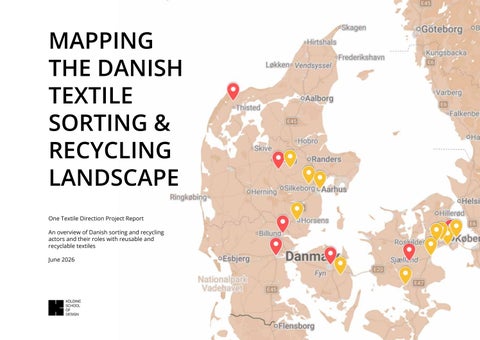
An overview of Danish sorting and recycling actors and their roles with reusable and recyclable textiles
June 2026


An overview of Danish sorting and recycling actors and their roles with reusable and recyclable textiles.
Editors: Cathryn Anneka Hall and Karen Marie Hasling
Mappings: Cathryn Anneka Hall
Layout: Simon Myken Sole Christensen & Cathryn Anneka Hall Icons: Freepik
Kolding School of Design 2026 www.designskolenkolding.dk
ISBN: (digital)
The report is based on a study conducted as part of One Textile Direction (2022-2025), a research project co-funded by the TRACE Partnership by Innovation Fund Denmark, www.trace.dk
You can read more about the One Textile Direction project here: trace.dk/textiles/one-textile-direction/
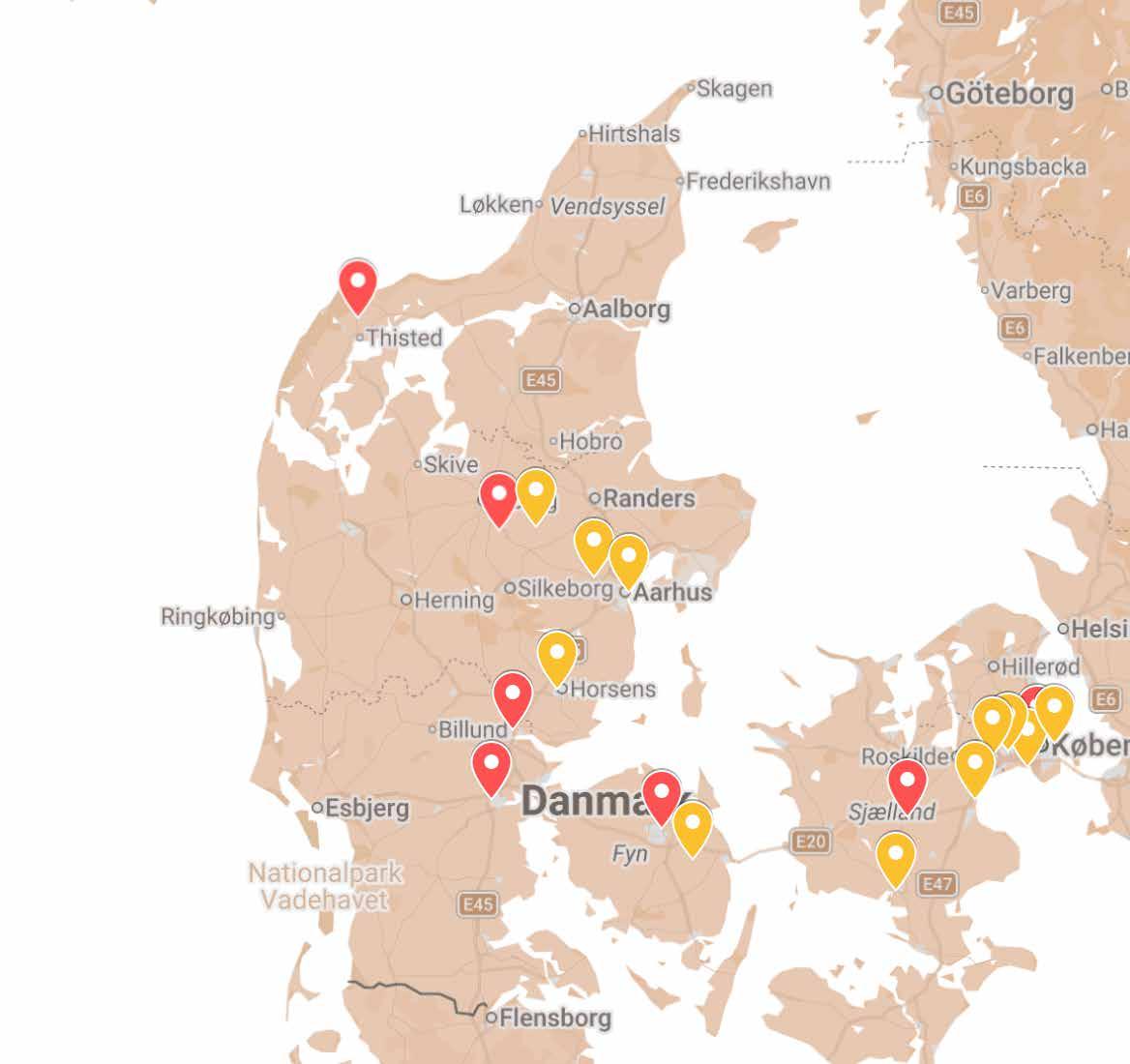
You can find the mapping on Google MyMaps follow this link: tinyurl.com/OTD-RecyclersandSorters
You can read more about the study in: Hall, C. A., Hasling, K. M., Hvass, K. K., & Kiørboe, N. (2025). Denmark. In M. Wynn, & T. Wiegand (eds.), Sustainability, the Circular Economy and Digitalisation in the European Textile and Clothing Industry: How Digital Technologies are Enabling the Circular Economy (pp. 161-199). Springer. doi.org/10.1007/978-981-97-9116-3
INTRODUCTION
This report disseminates a research study mapping the Danish textile recycling and sorting actors that were active in 2024-2025. While these industries continually change (it is expected that some of this information is already out of date), this research presents a ‘snapshot in time’ of how discarded textiles are processed in Denmark. Therefore, the purpose of this study was to shed light on the Danish situation in 2024-2025 as a baseline for future research to build on as well as highlight possible opportunities and challenges for textile reuse and recycling going forward.
The research was conducted by Cathryn Anneka Hall, at Kolding School of Design as part of One Textile Direction (2022-2025), a research project co-funded by the TRACE Partnership by Innovation Fund Denmark.
Utilising a range of methods such as desk research, interviews, company visits, this study has resulted in two formats:
• Mapping of Danish sorting and recycling companies based on geography
• Visual mapping of Danish sorting and recycling companies process flows
CONTEXT
EU member states have been required to collect discarded textiles since 2025. In Denmark this regulation was implemented in 2023 (Miljø- og Ligestillingsministeriet, 2021). Since then, Danish municipalities have begun to add textile waste collection to their duties for the purpose of recycling.
Prior to this legislation only reusable textiles were collected by charity organizations and private actors, such as by bring-banks and over shop counters (Koligkioni et al., 2018; Watson et al., 2020) and textile waste
was placed in the general (residual) waste category to be incinerated (Watson, Trzepacz, and Miljøstyrelsen, 2018). However, due to this new legislation textiles not suitable for reuse is now collected to be utilised for textile recycling.
Although many see this as a two-stream system (Rossi, Damgaard and Logan, 2024), there are now three streams in Denmark for textiles to be sorted into: reuse, recycling and incineration. This third category, incineration, is important because there are certain textiles that are not suitable to be collected by the municipalities for recycling. These are outlined by Miljø- og Ligestillingsministeriet (2022) as clothes and textiles that are wet, mouldy, soiled, or with food residues and those that contain unwanted substances that can cause problems in recycling, e.g. chemical, oil or paint stains as well as certain impregnation agents. These should not be placed in the designated municipal textile waste bins (for recycling) but be collected with the general (residual) waste.
The burden of ensuring textiles enter the correct stream is placed on the citizens. They are required to sort their unwanted textiles into those:
• that can be reused by donating them to charities etc.;
• suited for recycling, collected by the municipalities;
• that are unsuited for reuse or recycling and thus must be incinerated.
This citizen-based responsibility results in many mistakes in which the wrong type of textiles is placed in the wrong collection stream. For example, reusable textiles are placed in textile bins collected by the municipality for recycling and vice versa. Thus, textiles collected for reuse and recycling must be professionally sorted (Rossi, Dam-gaard and Logan, 2024). Any textiles mistakenly placed in residual waste currently cannot be recovered.
This report explores the sorting practices of two collection streams: reuse and recycling, as well as establishing actors that are actively recycling within and outside of Denmark.
METHODS
To establish the Danish landscape of textile sorting and recycling the study was undertaken through three tasks.
The first task was to create a list of actors that sort textiles both for reuse and recycling, as well as those that recycle textiles both physically within Denmark and abroad. These lists were compiled through the author’s own knowledge, basic desk research and reaching out to the actors and asking them to fill any gaps. This resulted in a list of twelve sorters and seven recyclers.
Secondly, the list of actors was translated into a Google MyMaps to study location and provided an open-access method of communicating the study. For this mapping one location was selected for each actor even when an actor has multiple facilities (where possible this was the primary location). Please note that the address of one of the actors could not be found and therefore was excluded from the mapping.
Finally, to gain deep knowledge, the third task was to contact and visit each actor and map their sorting or recycling processes. However, not all actors were available to be visited and provide information. Therefore, this resulted in three sorters and one recycler being excluded from process mapping. However, these actors were still included on the Google MyMap. The process maps, presented in this report were created by the researcher, as part of the research process, at the time each visit occurred. They are considered sketches to aid understanding rather than formalised communication of the companies’ processes. They have not been produced by a graphic designer, and this means that there may be inconsistencies with icons, text size and overall logic when viewed as a collection.
SORTERS
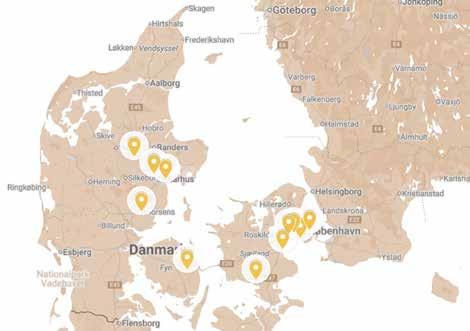
This study found 12 active textile sorting actors across Denmark. Table 1 these actors and provides details of the type of sorting (by hand or automated) they conduct, the focus (to primarily obtain reuseable textiles or recyclable textiles) and finally the level at which they sort (see below for more details).
You can find the mapping on Google MyMaps follow this link: tinyurl.com/OTD-RecyclersandSorters
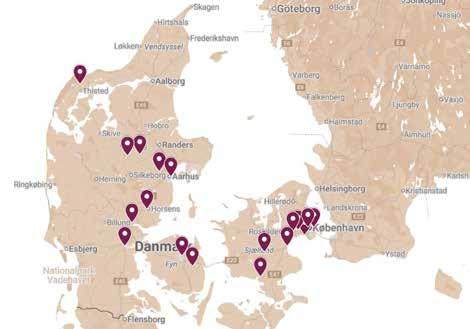
Table 1. Danish Sorting Actors active in 2024/25
Figure 1. Map of Danish Sorters
Figure 2. Map of Danish Recyclers
Sorting Type
There are two types of sorting, hand and automated. Hand sorting is just as it is described, where the sorting is conducted by people visually assessing the textiles and moving items into categories by hand. This is true for those that pre-sort and remove the non-textiles and nonrecyclable textiles with their hands as well as those that sort into more detailed categories. Sorting for reuse, in particular, cannot, currently, be done by machine (Pehrsson et al., 2023).
In contrast, automated sorting removes the need for people and speeds up the sorting process using machines. This is focused on sorting for recycling, into fibre type and colour, and can be achieved using a range of different technologies (Robinson et al., 2026). However, it should be noted that sorting for recycling is not always automated. Sorting recyclable textiles by hand is often completed by actors that focus on reusable textiles but due to the recyclable textiles present in the collection stream they will attempt to monetise these textiles and sort them for customers that recycle.
Sorting Focus
Each actor has a focus area. This represents the stream of textiles that they sort. For example, those that focus of recyclable textiles, sort the textiles collected by the municipalities, that theoretically should contain majority textiles suitable for recycling. However, as previously discussed this is not always the case. The opposite is true of the actors that focus of reusable textiles. Lastly, there are actors that process both streams.
Sorting Level
Across the actors in Denmark there are three levels of sorting that are practiced.
Level 1 is referred as ‘pre-sorting’ activities. Here the sorter removes non-textile items and dirty/wet textiles. These cannot be recycled and are sent to residual waste. The remaining textiles are unsorted and are
sent on to more detailed private sorters, typically abroad. There is a debate whether ‘pre-sorting’ can even be defined as a ‘sorting’ activity. Here we describe it as sorting for the incineration stream.
Level 2 divides the textiles into the three streams. First pre-sorting is conducted to remove non-textile waste and textiles that cannot be recycled and can only be incinerated. Next the remaining textiles are divided into those that can be reused and those suited for recycling. Once again, these are sent on to more detailed sorting, typically abroad.
This type of activity (Level 2 sorting) is especially necessary because citizens constantly place the wrong textiles in the wrong collection stream, i.e. recyclable textiles in the reusable collection streams (for charities etc..) and reusable textiles in the recyclable collection (for municipalities).
Level 3 is detailed sorting. Actors that sort at this level will first conduct pre-sorting (removal of non-textiles and non-recyclable textiles for incineration) as all the others do. The remaining textiles are then sorted between reuse and recycling before being divided into more detailed categories. These ‘detailed’ categories are determined by the sorter’s customers. For example, reusable textiles could be sorted into jackets and further still into denim jackets, leather jackets, wool jackets etc… if there is a buyer that demands this and will pay a premium for this level of sorting rather than buying a catch-all ‘jacket’ category for a cheaper price.
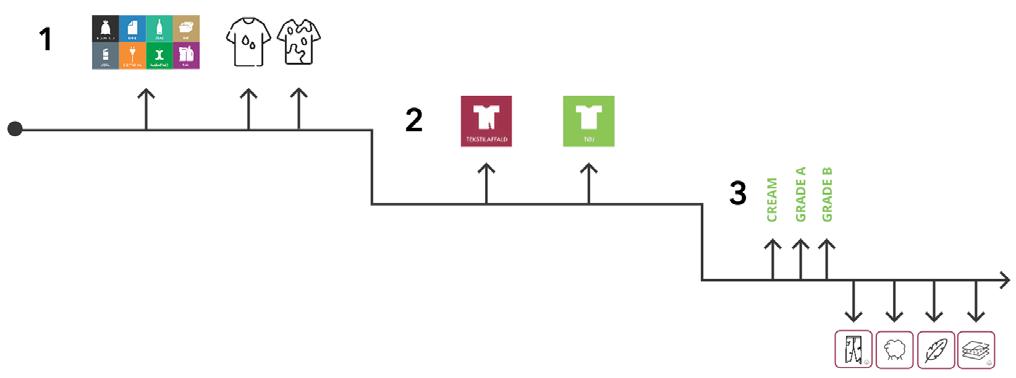
Figure 3. Sorting Level 1, 2 and 3
AFFALDPLUS
OPTIMISATION MODEL
TEXTILE AFFALD COLLECTED BY MUNICIPALITIES
From peoples homes
NON-TEXTILES, WET/DIRTY INCINERATED


TEXTILES BETWEEN (TEXTILAFFALD)
(LEVEL 2) OF TEXTILES LEVEL EXPORT
AFFALDPLUS RECYCLING / INCINERATION
CATEGORIES (< 20)
CATEGORIES (<100)
CATEGORIES (>100)
COLLECTED IN BAGS WITH BULKY WASTE
Taken to a recycling centre
2/3% REUSABLE TEXTILES** IS SEPARATED FOR PLUSBUTIKKERNE
**This is only taken from the items donated as Tøj at the recycling centre
TEXTIL AFFALD & TØJ BINS within an Affaldplus Recycling Centre

REUSABLE TEXTILES RECYCLABLE TEXTILES


GENBRUG BUTIK
PlusButikkerne’
Located within/near their recycling centre
CLOTHING IS SPLIT INTO 18 PRODUCT CATEGORIES*^*
INCINERATION UNSOLD TEXTILES RETURNED TO BE EXPORTED
98% REUSABLE TEXTILES IS EXPORTED FOR FURTHER SORTING
AffaldPlus, a municipal waste management company, is legally not allowed to sort textiles. They describe their activities as “optimisation of logistics” and they do this by hand. These optimisation activities describe how they optimise the transport of textiles to the next step and is a grey area in the legislation. However, the purpose of this study is not to argue over Danish legislation, rather to gather a full picture of how discard textiles are processed in Denmark.
*^Paired shoes are collected together with clothing. If good quality single shoes are found it is
*FOR FURTHER SORTING NEWRETEX *FOR FURTHER SORTING DUBAI* TURKEY POLAND BELGIUM
*It is a German company that has a sorting facility in Dubai. However, the textiles are sent directly to Dubai.
Other companies from the countries listed also may have sorting facilities in other countries but the textiles are sent to the listed countries first
AffaldPlus collect textiles from their recycling centres and from people’s homes across (Faxe, Næstved, Ringsted, Slagelse, Sorø and Vordingborg) six Danish municipalities. They conduct this at Level 2, dividing the textiles into the three streams: reusable, recyclable and incineration, and Level 3, detailed sorting of textiles.
AffaldPlus has 19 recycling sites and 14 garden waste sites distributed in the six AffaldPlus municipalities. In addition, they operate PlusButikkerne (recycled shops) in Næstved, Rønnede and Slagelse, as well as the recycled building markets, PlusByg, in Næstved, Ringsted and Vordingborg.
Textiles for recycling is collected from constituents’ homes via a dedicated bins and delivered directly to AffaldPlus facility or collected with bulky waste and delivered to recycling stations for all waste (bulky and textiles) to be placed in the correct bins. People can also take both textiles for recycling and textiles for reuse to a recycling centre and place them in the relevant bin.
For the textile recycling stream (both those that are collected from people’s homes and from the recycling centres), first they remove the non-textiles that cannot be recycled and things that need to be burned. This includes anything that cannot be reused and will not be accepted by the recyclers they have contract with (currently NewRetex). Recyclable clothing is taken out and sent to NewRetex for further sorting and recycling. Any reusable textiles, paired shoes and good quality down products (i.e. bedding) found in the textile recycling stream is collected and exported.
The textiles collected as reusable from the recycling centres is sorted in a similar way. Non-textiles and items that cannot be recycled are removed for recycling or incineration. Recyclable quality textiles are also removed and are sent to NewRetex. Most of the reusable textiles are exported. A small percentage is taken and categorised into 18 different product groups. These 18 different product categories are then ready to be sold in the ‘PlusButikkerne’. Each Plusbutik requests specific product categories to be sent to them when they are needed. Clothing that is not sold in the PlusButikkerne is returned to AffaldPlus and exported.
A scheme has been developed in which good quality yarns found in either stream (which previously used to be sent for incineration as it could not be reused or recycled) are collected and sold in the PlusButikkerne. They have more yarns than can be sold so they also donate yarns to a homeless charity, who uses them to knit items.
SORTING MODEL
SORTING LEVEL
SORTING, REMOVE NON-TEXTILES, WET/DIRTY
ETC... TO BE INCINERATED

SORT OF TEXTILES BETWEEN
(TØJ) & RECYCLING (TEXTILAFFALD)
DETAILED SORT OF TEXTILES
3A SORT INTO SOME CATEGORIES (< 20)
3B SORT INTO MANY CATEGORIES (<100)
3C SORT INTO DETAILED CATEGORIES (>100)


Frelsens Hær (The Salvation Army) is a not-for-profit that conducts textile sorting by hand. They collect these themselves, advertising for reusable clothing only, in bins placed at recycling centres and in specific street locations across Denmark or into their shops. They conduct Level 3 detailed sorting of textiles in less than 100 categories.
Frelsens Hær is a business, not a charity and they employee staff to sort clothing, run their shops and so on. They do have volunteers that help in the shops, but they either work with paid staff or pop into self-service stores for short bursts to help tidy up etc... Frelsens Hær’s ambition is to reduce the amount of clothing exported out of Denmark and sell as much as possible.
Citizens can donate in two ways: into bins and these clothes are taken to their sorting centre or directly to shops (not self-service shops) where the items are processed by the shops themselves to be sold. Clothing at the sorting centre is sorted by grade (Grade 1 or 2). Grade 1 is also split into A, B, C categories. Shoes are combined into the Grade 1 but separated for Grade 2. This is because at the point of export, their customer requires them to be separated in Grade 2. Once sorted, Grade 1 items are then priced and sent to stores.
Sorting is done based on trends and not brand. Frelsens Hær have researched their specific types of customers, and which items sell in which of their 18 stores they have across Denmark. This has resulted in five clusters of stores that have similar needs, and sorting is done to meet the needs of these clusters.
All items in Grade 1 are recorded in their computer system. Weights are taken (this is also the case for second grade) and this data is used to understand the quality of clothing that is donated and from which routes.
There is a cascade system in place that moves clothes between different types of shops to get as much value from the clothes as possible. From Grade 1, the highest value items are sent to the ‘curated’ shops but if they do not sell, they are moved to the other types of stores. First the
‘normal’ stores (this included, staffed shops, self-service shops, hybrid - staffed and self-service and staffed flea markets), then ‘kilo sale’ and finally ‘outlet’ stores. If an item cannot be sold at the outlet, it is then exported. However, not all items start at the top. They may start life in a normal store or for a kilo sale before cascading down the system. Grade 2 textiles are sent straight to the outlet and what is not sold is exported.
Textiles that are heavily soiled such as with paint etc. that could contaminate other clothing in a bag or are not wanted by the export partners are placed in ‘restaffald’ (general waste) for incineration.
Frelsens Hær also works with several small upcycling bands. There are five examples of clothing that is taken from Grade 2 clothing for upcycling:
• T-shirts are sent to be overprinted and reused.
• Towels, a new stream still in development, will be turned into bath robes
• Jeans are chopped up for tops of shoes in collaboration with Vaer Upcycling and therefore they accept broken jeans.
• Men’s shirts are cut into sections and resewn into new products. In case a shirt has imperfections or strains, these can be around.
• Sneakers are also used to be created into new sneakers (brand?).
Although not technically upcycling. Damaged or stained T-shirts can also be sent to a local business to be used as wipers (the business cut these up themselves into the desired wiper size, this is not done by Frelsens Hær).
The upcyclers only take a certain amount of clothing at a time. Thus, some of these items still flow with the rest of the Grade 2 and is found in the outlet stores.
There is always ‘stuff’ that is donated. This is anything that is not clothes, such as pillows, cuddly toy, hair dryers etc. If the item is in good working order, the items are sent to flea markets to be sold. If the item is not in working order, it is disposed of in accordance with the municipal guidelines, e.g. a non-working hair dryer would be placed in electronic waste.

SORTING LEVEL SORTING MODEL
NON-TEXTILES, WET/DIRTY
INCINERATED


INTO SOME CATEGORIES (< 20)
INTO MANY CATEGORIES (<100)
INTO DETAILED CATEGORIES (>100)


Neotex is private business that conducts textile sorting by hand. The textiles are collected by municipalities for recycling and Neotex sorts them at Level 2, dividing the textiles into the three streams: reusable, recyclable and incineration.
Neotex collect textiles directly from recycling centres so their drivers can make a quick visual inspection when emptying the textiles bins. Any obvious non-textile waste (such as carboard, plastic etc…) can be placed in the correct bins within the recycling centre. Any wet textiles can be separated and placed in the general (residual) waste bins. This, they admit, is not a perfect system; it happens very quickly, and some things are missed by the drivers. At their facility Neotex sorts manually and visually to sort:
The Reject
This includes non-textiles, wet textiles, mattresses (such as toppers), toys, teddy bears and much more which does not belong with textile waste (i.e. books and bric-a-brac and so on).
Pillows and duvets with down and feathers
This is a struggling category as the old customer no longer accepts this and a new customer needs to be found.
Shoes
Single/paired broken shoes as well as single reusable shoes. These are sent to a client in Poland that attempts to pair the single shoes and recycles the rest.
Textiles for direct reuse and reusable paired shoes
These reusable textiles and shoes are sorted together and exported to Belgium and Holland for fine sorting for reuse.
Textiles suitable for recycling
This is a mix of all eligible fibre-compositions, plus polyester bedding. This is exported to a partner in Southern Europe who uses handheld NIR scanner to sort textiles by fibre composition. Neotex is working together with their partner in southern Europe to become the sister
Northern European sorting centre for recycled textiles using NIR scanners. This is a work in progress.

SORTING LEVEL
SORTING MODEL
LEVEL 1
PRE SORTING, REMOVE NON-TEXTILES, WET/DIRTY TEXTILES ETC... TO BE INCINERATED
LEVEL 2
PRE-SORT (AS LEVEL 1)
BASIC SORT OF TEXTILES BETWEEN REUSE (TØJ & RECYCLING (TEXTILAFFALD)
LEVEL 3
PRE-SORT (AS LEVEL 1)
BASIC SORT (LEVEL 2)
DETAILED SORT OF TEXTILES
3A SORT INTO SOME CATEGORIES (< 20)
SORT INTO MANY CATEGORIES (<100)
3C SORT INTO DETAILED CATEGORIES (>100)


* Take-back items from fashion brands may include customer returns that are damaged, faulty, or sun-damaged from being displayed in stores. While some of these items may still be usable, brands often do not want them placed on the second-hand market, as this could damage their brand identity. These items cannot be landfilled, so Newretex ensures they are recycled.
**Take-back materials and factory offcuts represent a small part of the business. For example, Dilling sends offcuts from its factory in Lithuania to be sorted and recycled.
***Dish cloths represent a minor sorting stream. They are removed to prevent contamination of the pure-colour fractions. However, they are not removed from all fractions and are typically directed to the mixed-colour category, as they often contain stripes or multiple colours. For this reason, they cannot be mixed with pure-colour or white fractions.
Newretex is a private business that conducts automated textile sorting and sorting by hand. They process textiles from private companies and those collected by the municipality for recycling. They conduct Level 3, detailed sorting of textiles in less than 100 categories.
Newretex sorting activities focus on sorting textiles for recycling.
To achieve this, they use automated sorting equipment. However, depending on the source of the textiles, this depends on whether they will hand sort it first.
They sort four different streams of discarded textiles:
• Textiles collected from private homes by municipalities
• Private companies (i.e. laundries)
• Fashion brands take back*
• Production factory off cuts**
However, their core business is sorting textiles from private companies and textiles collected by municipalities.
Textiles collected by municipalities are first sorted by hand to obtain the recyclable textiles. They remove:
• Non-textiles for recycling, (such as plastic, cardboard etc.);
• Re-usable textiles together with paired shoes to be exported for fine sorting;
• Products with feathers (down) to be exported for specialised recycling
• Non-recyclable textiles, such as single shoes, multi-layer textiles and wet textiles and are sent for incineration.
Single shoes are sent for incineration as they have no market for them. Multi-layer products, such as jackets, cannot be assessed by the scanner in their automated sorting machine as it can only read the composition of the surface fabrics. Textiles that are reusable are exported with the rest of the clothing. Textiles that are broken are sent for incineration
The rest of the textile, suited for recycling, is then sorted by the machines (see below).
Items from private companies can either be hand sorted or go straight
to automated sorting. The textiles will only be hand sorted if it is known to be cotton-rich in composition (typically from professional laundries) and therefore suitable to be used for wipe cloths. In this case the textiles are sorted by colour (six different colour categories and structure (knit or weave). In the future these cotton-rich textiles could be a feedstock for chemical recycling, but currently chemical technologies are still in development/scaling.
In addition, items received from fashion brands are sometimes delivered with packaging, such as hang tags, price tags, plastic bags, or cardboard inserts placed around the collar and down the placket of shirts to maintain their shape. This packaging is removed by hand before the items are scanned and sorted by the machine.
The recyclable textiles that have been sorted by hand or come from other waste streams are then processed by machine. The automated sorting line scans for weight, hard trims, composition, colour, moisture and structure. For structure, denim and heavy twill can be recognised but with further training this could also be improved if required. Currently, 31 categories are sorted generally. These can be summarised under eight broader titles: wet textiles, cotton & cotton-rich, polyester, wool, denim, mixed and dish cloths***.
Sorting categories vary depending on market demand. The categories above provide an overview of the material compositions currently being sorted. In addition to composition, materials can also be sorted by colour and Newretex’s machine is trained to sort into around 50 different colours. However, the more training, more specific sorting could be possible.
There are occasions when the waste from private companies comes in and it does not require any sorting because it is homogenous already. However, if specific data is required then items will go through the automated sorter to gather this data.
LEVEL SORTING MODEL
PRIVATE HOMES


Ragn-Sells is a private business that conducts textile sorting by hand. They process textiles from private companies and those collected by the municipality for recycling. They conduct Level 1 pre-sorting activities.
Ragn-Sells conducts pre-sorting activities, removing non-textiles, wet textiles, soiled textiles, single shoes and non-recyclable textiles.
Examples of non-recyclable textiles are single socks (used to be recycled - not in the current market), carpets, blankets that are multi material, polyester pillows/duvets. They also remove the plastic bags that the textiles are donated in (for plastic recycling).
The remaining textiles (reusable and recyclable*) are placed in bales and exported to the Boer Group for fine sorting. Items with feathers can be recycled and are included with the rest of the textiles to be exported for fine sorting.
* They used to sort between recycled and reusable textiles but in the current market there is no point.
Paired shoes are collected in their own category. These are exported to a specific partner in Europe for re-use. Good quality single shoes are placed to one side in the sorting process in the hope that the pair might be found. If the pair cannot be located, single shoes are sent to incineration. The reason for this sorting behaviour is because Ragn-Sells have a policy that no items exported should be sorted outside EU. Their partner, which they send paired shoes to, also accepts single shoes, but they are sent outside the EU.
Ragn-Sells, pointed out that they see many examples of textiles that could be reused or recycled but are soiled/dirty and therefore have to be sent for incineration. At the time of the study, Ragn-Sells had three contracts with municipal waste companies that all had different collection methods. Some textiles were collected loose, which is a problem in wet weather, as it causes the textiles to become wet and thus are sorted for incineration. Consequently, they advocate for textiles to be discarded in plastic bags.
Another issues, is that sometimes municipalities collect textiles in trucks that also have been used for organic, garden or residual waste. This can make the textiles wet or contaminate them. These are removed from the pile of textiles to be sorted first before sorting activities are untaken.
They also have contracts with private companies, such as retail shops, truck drivers and construction companies (uniforms and other textiles) and they sort these textiles in the same way.
SORTING MODEL


•


RØDE KORS SHOPS (260 ACROSS DENMARK)
RØDE KORS OUTLET STORES (2 IN DENMARK) (ALSO OUTLET SECTIONS WITHIN SHOPS) DONATIONS DIRECT TO SHOPS UNSOLD ITEMS IN THE WEB-SHOP ARE EXPORTED (LONGER THAN 4 WEEK CYCLE)


RØDE KORS DONATION BIN LOCATED ALL OVER DENMARK BRANDS DONATE UNSOLD CLOTHES


Røde Kors (Red Cross) is a charity that conducts textile sorting by hand. They collect these themselves, advertising for reusable clothing only, in bins placed in specific street locations across Denmark or into their shops. They conduct Level 3 detailed sorting of textiles in less than 100 categories.
Røde Kors has both formal sorting at their sorting facility, and informal sorting, conducted by volunteers in the shops. Donations from the Røde Kors bins are collected by van and formally sorted across two facilities in Horsens and Køge. 1/3 of the bins are emptied, transported and sorted this way. The other 2/3 of the bins are emptied by local shops and are informally sorted (see below).
The items from bins that arrive at Horsens or Køge facilities are formally sorted as follows. First, non-textiles are removed together with single shoes and waste (wet, dirty or textiles that cannot be recycled or reused such as duvets and rugs). The ‘cream’ is then sorted out from the remaining textiles. These garments must be in almost perfect condition to be sold in the second shops around Denmark.
Second quality is sorted for Råstof - ‘raw materials to order’ (see below) and outlets. The rest of the textiles are bailed and exported for further fine sorting (reuse and recycling).
Customers that would like a specific type of textiles can order 10 kg or a 50-item box. This is called ‘Råstof’. These are textiles sorted specifically for the customer. Example: box of suit jackets for an up-cycler.
The cream is further sorted by Røde Kors. This is first sorted into fifteen broad categories. The cream from Køge is sent to Horsens (bigger facility) for quality checking. Once the quality of each garment is checked, they are sorted into 85 more refined categories and boxed up. Boxes of a specific clothing type can be ordered and delivered to any of the 260 Røde Kors shops as required.
Sometimes brands donate clothing. These are most often mixed in with other garments that have been sorted as ‘the cream’.
Across the 260 shops, the prices of the clothing can differ. Prices are determined by volunteers with knowledge of what price a garment can command in the particular shop. The distribution of clothing from the Horsens facility is equal to all shops. Shops that command a higher price do not get priority over any types of clothes during the sorting process.
Donations in-store and the donations from near-by donation bins are informally sorted by volunteers. First, the ‘cream’ is sorted to be sold in the shops. Unlike the sorters that work in the Røde Kors Køge and Horsens facilities, the volunteers have not been formally trained to conduct sorting. However, they have knowledge of what sells in their specific shop and therefore sort accordingly.
Further to removing the ‘cream’, donations are sorted by removing the waste according to a short criterion: moist or wet textiles, large stains or holes, smells bad, cotton rugs/carpets, duvets or pillows, soft toys and clippings/textile strips.
The leftovers (lower grade reusable textiles) are sent to the nearest facility (Horsens or Køge) for sorting and export.
Clothing in Røde Kors shops have a 4-week shelf life. If they have not sold in this time frame, they are sent to the sorting facility to be exported. Leftover items from the shops (both lower grade and items that have not sold) are not sorted again. However, a pre-sorting is conducted where non-textiles and textiles for incineration (wet, dirty or textiles such as rugs, pillows, duvets etc.) are removed if they haven’t already been by the volunteers (this can sometimes get left in by mistake) and are then mixed with the rest from the formal sorting (see above) and exported for further fine sorting (reuse and recycling).
Røde Kors utilizes approx. 30% of what gets donated, which is used across the Røde Kors stores and web shop in Denmark. The rest is exported.
SORTING MODEL



Stena Recycling is a private business that conducts textile sorting by hand. They process textiles from private companies and those collected by the municipality for recycling. They conduct Level 2, dividing the textiles into the three streams: reusable, recyclable and incineration.
Stena’s core activities are Level 1 pre-sorting activities (A). Here the waste is removed, such as non-textiles, wet textiles, soiled textiles (oil, paint or dirt) and single shoes and the rest is exported for further sorting. They have a specific agreement here that the sorters will remove any textiles Stena does not sort for that cannot be reused or recycled are also removed, for example polyester bedding. They will also be sorted for specific reuse and recycling categories.
Stena also conduct Level 2 sorting (dividing the textiles into the three streams: reusable, recyclable and incineration), but this is a very small proportion of what they do (B). Here the waste is removed, re-usable textiles are separated and sent for further fine sorting for reuse. The rest is also exported for further sorting, most likely for recycling (unless reusable items have been missed).
Stena also have special agreements with private companies to process their discarded textiles; this is primarily workwear items. The quality of the textiles from the private companies tends to be better than textiles collected from by the municipalities.

REMOVE NON-TEXTILES, WET/DIRTY TO BE INCINERATED

1) TEXTILES BETWEEN
(TEXTILAFFALD)

TRASBORG BIN WITHIN A RECYCLING CENTRE TRASBORG BIN ON THE STREET
SORT OF TEXTILES
SORT INTO SOME CATEGORIES (< 20)
SORT INTO MANY CATEGORIES (<100)
SORT INTO DETAILED CATEGORIES (>100)



Trasborg is private business that conducts textile sorting by hand. They collect these themselves, advertising for reusable clothing only, in bins placed at recycling centres and in specific street locations across Denmark. They conduct Level 3 detailed sorting into more than 100 categories.
Sorting is conducted for profit and therefore, Trasborg must consider if the costs for salaries, packing materials and shipping make it worth sorting and sending. It is often not cost effective to sort for recycling, but the profits coming from sorting for reuse covers the costs in some cases and avoids the costs of disposal.
Sorting for reuse
This is split into 3 grades: The cream, grade A and grade B. Overall these three grades they have 240 sorting categories for reuse. These are split between seasons and gender (women/men) and children. In addition, there is also categories for toys and paired shoes. When quantities of a sorting category are too small, they can be grouped together. Therefore the 240 categories are generally combined into approx. 84 categories.
This is space saving and means clients, that would like to buy more than one category do not need to wait for a specific fraction to be big enough to send they can buy multiple sorted categories at once. Accessories such as belts and jewellery which are found in the collections can also be sold to customers but the quantities are small.
Reject
Examples of items removed from the stream: mattresses, rugs, very dirty textiles (paint), polyester duvet and pillows, underwear, nontextiles (books etc...), wet textiles.
Trasborg also sells unsorted ‘original’ textiles (after the waste has been removed).
Sorting for recycling
There are currently very few markets to send textiles for recycling.
Trasborg sorts recyclable textiles into the following categories: textiles for white cotton wipers, textiles for coloured cotton wipers, broken jeans, acrylic, wool, textiles with feathers, single shoes (soles).
SORTING MODEL
SHOP MANAGER PREPARE CLOTHES BY SEASON & CAMPAIGNS
KØGE FACILITY
AFTER FINE SORTING ‘CREAM’ RETURNED TO (PURCHASED BY) UFF

NO FORMAL SORTING (FEATHERS EXCEPTION) ONLY REMOVAL OF WASTE


INTO RECYCLING FRACTIONS
POSSIBLE

CORE BUSINESS
ADDITIONAL ACTIVITIES (SMALLER PORTION)


TEXTILES LEAK INTO RE-USABLE STREAMS
SORTING OCCURS PIECE BY PIECE
SORTED INTO RECYCLING FRACTIONS WHERE POSSIBLE
EXPORT FOR MANUAL FINE SORTING IN EUROPE
UFF Humana Denmark is not-for-profit association that conducts textile sorting by hand. They collect these themselves, advertising for reusable clothing only, in bins placed in specific street locations across Denmark. They conduct Level 1 pre-sorting activities.
UFF Humana have two very separate parts to their business. Their core business is the collection of reusable textiles through their own bins from around Denmark. Here the drivers first screen for obvious waste when transferring the textiles from the bins to the vans and remove it (to a separate area of the van). A second screening is conducted at the warehouse when transferring the textiles from the van into large bales ready for export. Here, once again, more obvious waste can be removed. For example: non-textiles, single socks etc... All non-textiles from both screenings are sorted into the appropriate recycling category, such as carboard or plastic, or for incineration in residual waste. Selected sellable categories also removed (i.e. feather bedding).
The UFF Humana model, exports these textiles to large professional sorting facilities in Europe and then buys back ‘cream’ quality textiles from the same or similar sorters to be sold in their stopes. A dedicated “supplier” from the shops sort through these clothes so the right items go to the right shop as well for specific seasons and campaigns.
at the warehouse) as a raw material to upcycle into a large variety of bags for sales in their stores. Other upcycling initiatives in the sewing room: improving a shirt adding fabric on collar, different clothing repair jobs, production of specific items on-demand (curtains) etc.
Furthermore, the sorter may find flawless items of high value, just wet. Such items may be taken aside, washed, dried, and placed back into the ‘Original Clothes’ that are to be exported. Finally, there are always items that they are unsure what to do with. At the time of the study, there were karate belts and rolls of jersey (from a shop) which was not suitable for their sewing workshop.

SECOND SCREENING OBVIOUS WASTE REMOVED
NICHE PROJECT (TEMPORARY) RECYCLABLE ITEMS REMOVED ONLY

REUSABLE TEXTILES LEAK INTO RECYCLABLE STREAM
EXPORT FOR MANUAL FINE SORTING IN EUROPE SEWING WORKSHOP PROPER FABRIC REMOVED
In addition to the core activities described above UFF Humana also pre-sort textiles collected by municipalities for recycling. They have two objectives: Sort according to what their customers are able and willing to receive, and do it very fast. Sorting is done piece by piece in which the items that cannot be no reused or recycled or has no demand/market, such as single socks, elastic bedsheets, pillow covers, and multi-layer items (e.g. jackets with lining) are removed and go to incineration. The rest of the textiles (both reusable and recyclable) are bagged, exported and sold to professional sorting facilities in Europe.

The sorter may also find pieces of fabric in good condition as well as curtains, bed sheets etc.... These pieces can be taken aside, washed, dried, and handed over to the UFF Humana sewing workshop (located
RECYCLERS
This study found seven active textile recycling actors across Denmark, both that recycle textiles within Denmark itself and with partners abroad. Table 2 outlines recycling level (fibre, polymer or monomer), the materials outcome (yarn or non-woven), waste input (pre– or postconsumer) and the composition of the input (polyester, cotton or a mix).
Table 2. Danish Recycling Actors active in 2024/25
Textile
Polyester, Cotton Yarn
Polyester, Cotton Yarn *Recyclers that were excluded from the detailed study
Recycling Level
There are many ways of describing textile recycling, such as mechanical, chemical, thermal, physical, thermochemical, etc… This can make it very difficult to understand the field of textile recycling. Regardless of the name, the aim of any recycling process is to return a textile to one of three levels: fiber, polymer, or monomer (Harmsen, Scheffer and Bos, 2021). Recycling at fiber level implies that the fibers remain intact. This is conducted with mechanical methods, shredding textiles. Whereas recycling at polymer level disassembles the fibers leaving the polymers intact., achieved through melting and dissolving methods. Finally, recycling situated at monomer level occurs when the fiber and polymers are broken down into the original chemical building blocks (monomers or oligomers) using chemicals, enzymes or hydro-thermal methods. Regardless of the level the textile is recycled at, it must then be built up again from monomer to polymer to fiber to yarn/non-woven and so on (Hall, Hasling and Ræbild, 2025).
Waste Input
The type of textiles used in the recycling process can be divided into two broad categories: pre-consumer and post-consumer textiles. These are defined by ISO (2016) as follows:
• Post-consumer material is generated by households or by commercial, Industrial and institutional facilities in their role as end users of the product which can no longer be used for Its intended purpose. This Includes returns of material from the distribution chain.
• Pre-consumer materials are diverted from the waste stream during a manufacturing process. Excluded is reutilization of materials such as rework, regrind or scrap generated in a process and capable of being reclaimed within the same process that generated it.
Input Composition
This is the composition the textiles that are being recycled. Understanding the composition of textiles often determines the best recycling level and method that can be used.
Material Output
This is the type of textiles that is created from the recycled fibres. This could be recycled non-woven materials or recycled yarns. In this study the composition of the output materials was not a focus area and therefore has not been included.
CELLULOSE PROTEIN BLENDS


*COULD BE POST-CONSUMER BUT AS SOME OF THE WASTE IS PRE-CONSUMER IT IS CLASSIFIED AS PRE-CONSUMER AS A WHOLE
**THESE COULD BE ANY MATERIAL. REALLY USES OFF CUTS OF FIRE RETARDANT PET MATERIALS. THIS PROPERTY IS CARRIED FORWARD INTO THE RECYCLED TEXTILE. THEY COULD COME FROM DENMARK OR ELSEWHERE. THEY ALSO USE WOOL (OFF CUTS FROM WOVEN PRODUCTION) FROM KVADRATS SUPPLIER IN NORWAY.


RETARDANT (FROM RECYCLED FIRE RETARDANT TEXTILES)


Convert and Really are owned by the Danish textile company, Kvadrat. Convert conducts fibre level textile recycling and Really transforms the recycled fibres into non-woven applications. They mix recycled fibres with a binder that are air-laid and compressed under heat to produce hardboards for tabletops or fluffy mats for acoustic panels.
Convert and Really are separate businesses but have a special relationship. Convert will only recycle textiles for hard boards for Really. Other textile recycling that is not in direct competition can be undertaken (e.g. with HZ acoustic). Really also collaborate with customers to make tailored hard boards that utilise a customer’s own waste.
The recycling, primarily, takes place at Convert’s facility in Denmark, but Really also purchase recycled textile fibres from a recycler in Germany. Depending on the product they wish to produce, the input material can be either pre- or post-consumer textiles. The German recycler provides recycled textiles that are a combination of both pre- and post-consumer. The waste streams these textiles come from enable consistent repeatable colours to be obtained.
Really’s core business is creating hardboards. For this they require >60% cotton or 100% wool. This is so the binder can adhere to the fibres. Wool fibres are sourced from Kvadrat’s own textile waste streams, mainly from Innvik in Norway. When recycling cotton textiles, the shredding process produces flakes. However, for the hardboards, they require fibres, so a pulling step is added to open textiles. When recycling wool textiles, these can just be shredded into fibres. They use specific colour sorted cotton textiles (for example, blue comes from denim) or wool fibres for the outer, visible, layer. The core can be any colour as the final product is edged by a sub-contractor.
The fluffy mats can be any type of textile. ‘Flakes’ can be used to produce these mats and therefore, if cotton is used as input, they can just be shredded (no extra pulling step needs to be added). Cotton has good acoustic properties, so if other fibres are used, it is necessary to
compensate by creating a denser mat to get the acoustic properties desired. One of Really’s product range is fire-retardant acoustic panels and these are made from recycling textiles that were originally created for fire retardant applications and thus carry these properties forward.
HAACK RECYCLING

HAACK RECYCLING


OUTSIDE HAACK


Haack Recycling conducts fibre level textile recycling at their facility in Denmark. They can recycle a range of textiles across pre- and postconsumer categories as well as polyester, cotton or a total mix of compositions. Their core business is producing recycled non-woven fabric rolls / panels. These are produced by shredding the textiles, mixing them with a binder, air-laying them and compressing them under heat. They can produce three types of products: fluffy mat, compressed mat or hardboards.
Haack Recycling sells the recycled materials (as fabric rolls, acoustic panels or panels for tables tops), they produce B2B, as well as develop products from the recycled materials. They work with external collaborators to conduct some of the processing, such as an air-lay process. However, they are present during the production (to work through any challenges that could arise) and thus this works more like a form of ‘machine rental’ than outsourced production. They do outsource the production of products, such as stitching to create laptop covers, frame building for their acoustic panels and printing for decorative panels.
Currently, there is such a big supply of post-consumer textiles (and companies trying to find ways to use their waste) that Haack can choose what types of textiles they accept. Unfortunately, there is less demand for the recycled fibres, materials and products that are produced. At present, it makes sense for the company to use textile waste from private companies, such as workwear from laundries. This is because the textiles are more uniform in colour and composition. They also use pre-consumer off cuts from production in Denmark. In this case the composition of the final product is known and controllable. However, they are open to work with any material that they can turn into a product for the market.
There are two scenarios in which Haack will accept textile waste:
• The company wishes to develop a product from their waste together with Haack
• Haack sees a potential product that can be developed from the waste.
Haack Recycling charges 10DKK per kg of textile waste. However, if a company buys a recycled product made with their textile waste, the cost of the textile used is deducted from the price. For example, a company provides 50 kg of textiles which costs them 500 DKK. They purchase products that contain 50 kg of textiles, and 500 DKK is deducted from the cost. The company generates income from the processing (i.e. recycling and non-woven processes) of the textiles.
Haack Recycling is exploring a recycled binder to create a 100% recycled product. Bio-binders are also possible, but as the textile waste they currently use contain man-made fibres it does not make sense to use it. They use recycled wood for their frames, and they attempt to explore recycled options wherever possible, and products are always under development. The products (stuffing, covers, acoustic deco modules, acoustic wooden frame, acoustic image and tabletop) are the ones currently available.
Haack Recycling are also developing a process to recycle polyester textiles into filament for 3D printing and have produced some tokens from festivals entrance bracelets. These tokens will be used for future festivals.

AUTOMATED SORTING


Newretex conducts fibre level textile recycling in collaboration with recyclers outside of Denmark in Europe. They also work in Europe and globally to produce recycled yarns. They work with both pre- and postconsumer textiles.
NewRetex both sorts and recycles textiles. They have a flexible sorting operation that is adjustable for what the market is ‘asking’ for. They can sort textiles for all levels of textiles recycling (fibre, polymer and monomer) to be utilised in the fashion, car and construction industries etc. However, for their own recycling business they only use fibre level recycling.
Newretex has developed a variety of recycled yarns with a range of different recycled fibres. The development of new yarn compositions and colours is ongoing. Their core business, currently, is working with workwear customers as they see them as the ‘most ready’ for the recycled fibres.
The yarns that they are currently producing contain 20% recycled content combined with recycled PET and virgin cotton fibres. This recycled content of their yarns is either made from:
• 60%/40% recycled post-consumer cotton / polyester fibres
• 99% recycled post-consumer cotton fibres.

They can also work with other waste types, such as 50%/50% cotton/ polyester and 70%/30% cotton/polyester, but they have specifically chosen to start with the two above. These yarns are created, primarily, for workwear customers, such as for jersey t-shirts/sweats, knitted socks and woven products. They are in the process of developing a colour card for yarns that customers can choose from based on the colours that they can repeatably obtain.
They are also developing other recycled yarns. For example, 20% post-consumer cotton textiles (99% cotton) recycled by NewRetex, 30% hemp and 50% organic cotton. They have previously developed a woolmix post-consumer recycled fibre yarn. This contained wool, but also
some other fibre types, (i.e. acrylic, polyester, viscose etc.). They are not producing this yarn at present but could develop something similar in the future.


Retextil Global conducts fibre level textile recycling in collaboration with their sorting and recycling partners in Europe. They use post-consumer textiles, such as garments discarded by consumers, textiles from private companies and other wastes such as used carpets from an expo. These textiles could be any fibre type, natural and synthetic. The composition is a typical mix of what they find in average clothes on the market. They don’t use PVC, PFAS or natural/synthetic leather.
The textiles are shredded and blended with recycled foil (made from PE, PP and other types of plastics). These are then processed into nonwoven planks that can be used as a building material as an alternative to wood and in some cases steel or concrete. Examples of their application: facades, piers, fences, decking, garden furniture etc… The material has been tested for child safety and can be used for children’s play equipment.
Retextil Global produce two types of products:
• 60% recycled textiles / 40% recycled plastic foil (PE/PP)
• 30% recycled textiles / 70% recycled plastic foil (PE/PP)
For the 60/40 blend they also produce a version with a brushed surface to get a different effect. As a recycled product there is some variation in texture for each plank.
There is no colour sorting of the textiles, and therefore (without dying) the product is a grey colour. Dye can be added to create a coloured product. Colour sorting the textiles would probably have no effectbut they haven’t tried. It is possible to add fire retardant additives if required.
This product is unique because when you create a similar product from recycled plastic you would need to add additives for strength. However, including the recycled textiles in the product removes the need for additives. It is a lot stronger (40% or sometimes even more) than plastic with additives.
They recommend placing something under the material when cutting to
capture the pieces as it contains plastics. When used in water, without friction, there is no shedding.
Alongside recycling element of the business there is also shop, education, repair etc...
POLYESTER/CELLULOSIC* WASTE TEXTILES
*COTTON/LINEN OR ANY OTHER NATURAL CELLULOSIC MATAERIAL
(ELASTANE 5%, MMCF 10% CAN BE ACCEPTED)
(NYLON/WOOL/DOWN/OTHER PROTEINS/POLYAMIDE/ACRYLIC SHOULD BE AVOIDED 0.1-0.5% ACCEPTED) MIXED COLOUR
PROCESS DESIGNED FOR POST-CONSUMER BUT COULD BE USED FOR PRE-CONSUMER

MECHANICAL SHREDDING REMOVAL OF TRIMS
TEXTILE CHANGE TECHNOLOGY


VERY SMALL UNIFORM SHREDDED TEXTILES

WASTE (HAZADOUS WASTE)
FORMED FROM DYES, HEAVY METALS, COMTAMINATES SUCH AS ELASTANE FORMS A SINGLE WASTE THAT IS SENT FOR INCINERATION

POLYESTER GRANULATE CELLULOSE FIBRE
1. REMOVAL FINISHES, INCLUDING PFAS
2. PREP FOR DECOLOURISATION
3. REMOVAL OF HEAVY METALS
4. DECOLOURISATION
5. SEPARATION OF POLYESTER & CELLUOSIC
OTHER INDUSTRIES POSSIBLE BUT UNCERTAIN IF THE GRADE OF POLYESTER WOULD BE SUITABLE

POLYESTER MELT SPINNING
CONVERTED TO PELLETS

CONVERTED TO CELLULOSE SHEETS
STEP 2,3 & 4 COULD BE SKIPPED FOR POLYESTER TO CARRY THE COLOUR BUT THIS IS NOT POSSIBLE FOR CELLULOSIC MATERIAL
MECHANICAL PROCESSING YARN / NON-WOVEN (POSSIBLE BUT NOT HOW THE PROCESS HAS BEEN DESIGNED)
Textile Change has developed a polymer level textile recycling technology with a proof-of-concept pilot plant in Denmark. However, their model is to sell their knowledge and expertise to manufacturers globally that can implement the technology and use it to feed their production. It is designed to combat post-consumer cotton/textile blends. Contaminates, such as, elastane (<5%) and man-made cellulosic fibre (<10%) can be accepted. Nylon, wool, down (feathers), other protein fibres, polyamide and acrylic should be avoided (0.1-0.5% accepted).
For the Textile Change technology to be implemented the textile, first, needs to be shredded. This ensures that trims are removed, and textiles are cut into very small pieces. The smaller the piece, the less energy and solvent needs to be used. This also makes the textiles pumpable to different areas. The process could work with larger pieces or even a full garment (such as the steps to remove the colour etc...) but this is not efficient and not easy to scale and not pumpable. The process uses heat, but not extreme heat like some other technologies and is based on green chemistry principles (i.e. none of the solvents used are toxic and all alkalines and solvents are reusable in a closed loop).
Textile Change work with a dissolution technology that dissolves polyester into a solvent (keeping the polymer chain whole – polymer level recycling). In a cotton/polyester blend, this leaves the cellulose intact. Prior to this dissolution, the technology can also remove the colour from the textiles. This is useful as manufactures like to work with white textiles. Theoretically you could leave the colour in the polyester. However, for the recycled cellulose that will be used for viscose production, there cannot be dyes present so these would need to be removed. In theory, they could sell just the decolourisation steps to a company if they already had a separation process in place.
The textile composition used as an Input for the process is decided by the customers. For example, higher cotton content or 50/50 distribution of polyester and cotton etc... Currently cellulose is more desirable as an output but is more expensive to process whereas the polyester is
simpler to process. Many factors play into what types of input materials are used. However, the benefit of this technology is the separation of blends, so it is unlikely to be used to recycle a mono-material stream.
The technology could be sold to manufacturers that only process one type of material, such as a manufacturer that produced polyester textiles and desires using recycled polyester. In this case the manufacture could recycle a blended product, use the polyester themselves and sell on the cellulose.
The cellulosic fibre produced from the process could be used for mechanical processing of yarns and non-wovens, but the current set-up has been designed so that it enters man-made cellulosic fibre (MMCF) processing. Therefore, the focus is not on creating long fibre length. The fibres could be (and has been proven to be) used to make paper and could be used in other non-woven production.
MMCF WET SPINNING


Textile Pioneers conduct fibre level textile recycling (core business) with pre-consumer textiles, cut & sew jersey cut-offs. This is blended with recycled polyester from plastic bottles (60% cotton / 40% polyester) to produce recycled yarns for t-shirts to sell to their customers. In addition, they work on projects with both fibre and polymer level recycling technologies. All recycling occurs in collaboration with companies outside of Denmark and Europe.
Textile Pioneer’s core business counts for 90% of what they do. This can be described as producing circular products in a linear set up. The textile cut & sew off-cuts are colour sorted (63 colours) and thus colour is carried through the recycling process into the product without having to dye. Textile Pioneers can also product dye the textiles, if a customer requires a specific shade. They also produce 100% recycled polyester products from plastic bottles.
The remaining 10% of activities is developing circular products in a circular set up. It is vital for their business model that when a recycled textiles is produced the company will buy it back and use it. There are two examples shared by Textile Pioneers on how they work with companies to recycle and process waste into a new product.
Example of the projects they have works on: Unsold cotton garments from a brand were sent to a recycler in Portugal who focuses on recycling cotton. Garments were not colour sorted, so when mixed with organic cotton fibres, the jersey produced was grey with recycled coloured flecks. This looked recycled and is currently popular, but in future this could change. The jersey was then used by the brand for a product.
The second example is an EU funded project that hadn’t started yet, investigating polymer level recycling of polyester (see left).
Not included in the model (left) is Textile Pioneers banana stem development product. Banana stem is the one of most durable cellulosic fibres (but not as durable as polyester) and the fibres could be used for workwear in a woven fabric but also to produce jersey t-shirts.
The banana stem is processed mechanically using an enzyme to soften it. It is blended with organic cotton for price. It is possible to produce yarns of 20%/40%/60% or 100% banana stem. Textile Pioneers do not offer 20% banana fibre, as they see this as green washing.
REFERENCES
Hall, C.A., Hasling, K.M. and Ræbild, U. (2025) ‘Design for Recyclability: Textiles’, in A. Buettner and E. Weidner (eds) Springer Handbook of Circular Plastics Economy. Cham: Springer Nature Switzerland, pp. 583–599. Available at: https://doi.org/10.1007/978-3-031-662096_29
Harmsen, P., Scheffer, M. and Bos, H. (2021) ‘Textiles for Circular Fashion: The Logic behind Recycling Options’, Sustainability, 13(17), p. 9714. Available at: https://doi.org/10.3390/su13179714
ISO (2016) ISO 14021:2016(en), Environmental labels and declarations — Self-declared environmental claims (Type II environmental labelling). Available at: https://www.iso.org/obp/ ui/#iso:std:iso:14021:ed-2:v1:en
Koligkioni, A., Parajuly, K., Sørensen, B.L. and Cimpan, C. (2018)
‘Environmental Assessment of End-of-Life Textiles in Denmark’, Procedia CIRP, 69, pp. 962–967. Available at: https://doi. org/10.1016/j.procir.2017.11.090
Miljø- og Ligestillingsministeriet (2021) Bekendtgørelse om affald. Available at: https://www.retsinformation.dk/eli/lta/2021/2512
Miljø- og Ligestillingsministeriet (2022) Vejledning om sorteringskriterier for husholdningsaffald. Available at: https://www.retsinformation. dk/eli/retsinfo/2022/9793
Pehrsson, A., Köppe, G., Geldhäuser, S., Krichel, A., Pohlmeyer, F., Müller, K. and Breton, J. (2023) TECHNOLOGY ASSESSMENTREDEFINING TEXTILE WASTE SORTING: Impulses and findings for the future of next-gen sorting facilities. Texaid, International Centre for Sustainable Textiles, CETIA. Availble at: https://tinyurl. com/2955bl2m
Robinson, M., Ghosh, S., Qian, F., Du, C., Vallati, M. and Goswami, P. (2026) ‘Recent Development on Sorting of Textiles Waste by Fibre
Type for Recycling: A Mini Review’, Textiles, 6(1), p. 28. Available at: https://doi.org/10.3390/textiles6010028
Rossi, V., Damgaard, A. and Logan, H.M. (2024) Recycling potential of separately collected post-consumer textile waste. Environmental Project no. 2270. Denmark: The Danish Environmental Protection Agency. Available at: https://www2.mst.dk/Udgiv/ publications/2024/06/978-87-7038-623-4.pdf
Watson, D., Trzepacz, S., Gravgård Pedersen, Ole, Danmark, and Miljøstyrelsen (2018) Mapping of textile flows in Denmark. Miljøstyrelsen. Available at: https://www2.mst.dk/Udgiv/ publications/2018/08/978-87-93710-48-1.pdf
Watson, D., Trzepacz, S., Svendsen, N.L., Skottfelt, S.W., Kiørboe, N., Elander, M. and Nordin, H.L. (2020) Towards 2025: Separate collection and treatment of textiles in six EU countries. Enviromental Project 2140. Denmark: Miljøostyrelsen. Available at: https://www2.mst.dk/Udgiv/ publications/2020/06/978-87-7038-202-1.pdf