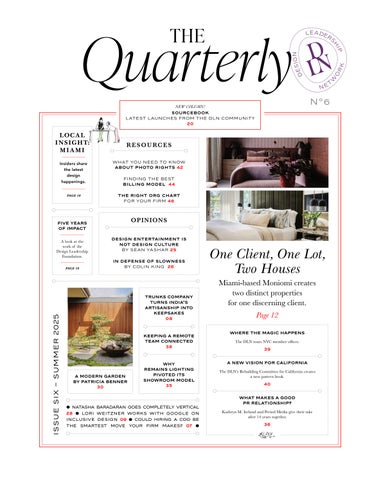
THE
N°6
NEW COLUMN! SOURCEBOOK LATEST LAUNCHES FROM THE DLN COMMUNITY 20
LOCAL INSIGHT: MIAMI
R E S O U RC E S
Insiders share the latest design happenings.
WHAT YOU NEED TO KNOW ABOUT PHOTO RIGHTS 42
PAGE 10
THE RIGHT ORG CHART FOR YOUR FIRM 46
FINDING THE BEST BILLING MODEL 44
OPINIONS
FIVE YEARS OF IMPACT A look at the work of the Design Leadership Foundation.
issue six – summer 2025
PAGE 18
DESIGN ENTERTAINMENT IS NOT DESIGN CULTURE BY SEAN YASHAR 25 IN DEFENSE OF SLOWNESS BY COLIN KING 26
TRUNKS COMPANY TURNS INDIA’S ARTISANSHIP INTO KEEPSAKES 08
KEEPING A REMOTE TEAM CONNECTED 38
A MODERN GARDEN BY PATRICIA BENNER 30
WHY REMAINS LIGHTING PIVOTED ITS SHOWROOM MODEL 35
⬤ NATASHA BARADARAN GOES COMPLETELY VERTICAL
28 ⬤ LORI WEITZNER WORKS WITH GOOGLE ON INCLUSIVE DESIGN 09 ⬤ COULD HIRING A COO BE THE SMARTEST MOVE YOUR FIRM MAKES? 07 ⬤
One Client, One Lot, Two Houses Miami-based Moniomi creates two distinct properties for one discerning client. Page 12 WHERE THE MAGIC HAPPENS The DLN tours NYC member offices.
39 A NEW VISION FOR CALIFORNIA The DLN’s Rebuilding Committee for California creates a new pattern book.
40 WHAT MAKES A GOOD PR RELATIONSHIP? Kathryn M. Ireland and Period Media give their take after 14 years together.
36
THE issue six – summer 2025
EAR COMMUNITY,
LE A D E
RS H IP
In design—and in leadership—we’re always negotiating the relationship between the big picture and the details: between vision and execution, intuition and data, creativity and discipline. And if there’s one thing I’ve been reflecting on lately, it’s how the most meaningful breakthroughs happen when we learn to see across categories and connect ideas, people, and practices in unexpected ways. That’s what we strive to do at the DLN: to offer a space that honors the full spectrum of who you are. Whether you’re a design principal or a business executive, you bring both strategic insight and creative vision to your work—and we aim to meet you there, where inspiration meets execution and leader ship takes shape. This issue of The Quarterly reflects that intention. Whether you’re looking for business intelligence, creative inspiration, or personal clarity, I hope you’ll find something here that speaks to you. We each contain multitudes, and design is a complicated business—one that asks us to balance vision with structure, solitude with connection, and imagination with resolve. We hope the DLN—and The Quarterly—help you strike that balance, and remind you that you don’t have to do it alone. Here’s to your next breakthrough! Warmly,
O
N N
I
E D U CAT I
Michael Diaz-Griffith Executive Director and CEO
SP
I R AT I O N
COM
M
U N
IT Y
As this issue goes to print, we are right on the heels of the tenth-annual DLN Business Forum, where conversations ranged from policy effects on luxury business to international tariffs, protecting intellectual property to leading through uncertainty, artificial intelligence applications to finding stillness in a fast-paced world. I can’t think of any other community in the world whose members would convene for such a broad range of topics—and demonstrate interest, leadership, and expertise in them all. This kind of range—from political awareness to design style, technological knowledge to emotionally intelligent leadership— is what makes the DLN special, and it’s also what we hope to reflect in our editorial offerings. In this issue, you’ll find best practices on managing remote teams, opinions on the impact of social media on design culture, advice on optimizing PR and marketing, and deep dives into special projects. You’ll find white papers from our latest virtual programs, whose subjects duly reflect the wide reach of our members’ interests and intellectual curiosity. We’re also debuting a few new franchises: The first, Local Insight (p. 10) brings some of the conversations that happen during our Community Gatherings to print in the form of takeaways from locals on a region’s current design scene (beginning, this issue, with Miami). Meanwhile, we’ve adapted our onetime Partner Sourcebook to a Sourcebook (p. 20), a new market section where we’re spotlighting new launches from DLN members and partners alike. I hope that, as always, you find this mix interesting, inspiring, and informative, and that you continue to let us know what you’re itching to write, learn, and hear about. Happy summer!
COLL ABO
R I AT
ON
Hadley Keller Director of Editorial and Community Engagement
REPORT
BOOKSHELF REA
D EMBRACING BEAUTY: SERENE SPACES FOR LIVING
RELAXED LUXURY
Chad Dorsey |
Assouline
Beth Webb |
Architect and designer Chad Dorsey makes the case for a new kind of luxury: relaxed, unfussy, and deeply livable. This book explores the spaces— and the sensibility—behind his signature “relaxed luxury” style.
FROM HAND TO HOME: THE ARCHITECTURE OF DOUGLAS WRIGHT
Douglas Wright |
Rizzoli
Douglas Wright’s debut monograph captures the timeless, classically rooted architecture that has defined his practice. From ground-up residences to thoughtful renovations, the book offers a window into a portfolio where proportion, history, and detail quietly shine.
4
Rizzoli
The follow-up to Beth Webb’s first book is a study in layered, organic elegance. Known for interiors that are as atmospheric as they are refined, Webb’s latest work continues to blur the line between restraint and richness.
POWERHOUSE
Penny Drue Baird |
Schiffer Publishing
From mountain retreats to coastal escapes, PowerHouse is a tour of distinctive American homes shaped by setting, architecture, and personality. Each one tells a story about the people who live there—and how they live. PRE-ORDER
HOUSE RULES:
THIS IS HOME
Jeffrey Alan Marks |
100 WAYS TO FEEL AT HOME
Rizzoli
Designer Jeffrey Alan Marks’s second volume is a love letter to the coastal charm of California. These interiors channel the region’s relaxed beauty, filtered through Marks’s signature lens of polish and ease.
Emma Beryl Kemper | Union Square & Co House Rules is part design guide, part manifesto. It helps readers refine their personal style while learning the principles that make a house both expressive and beautifully designed.
DESIGN REIMAGINED: A FRESH AND COLORFUL TAKE ON TIMELESS ROOMS
LOVE HOW YOU LIVE: ADVENTURES IN INTERIOR DESIGN
With Design Remix, Corey Damen Jenkins established himself as a force in American design— bold, elegant, and unabashedly joyful. His second book picks up the thread, offering a look at the evolution of his practice and point of view.
A first look inside the world of an AD100 designer known for richly layered, joyfully personal interiors— filled with color, pattern, art, and craftsmanship. Each project is a reflection of the client, the maker, and the moment.
Corey Damen Jenkins
|
Rizzoli
TRADITION MADE NEW: HOUSES WITH A SENSE OF SOUL AND HISTORY
Timothy S. Adams |
Rizzoli
In his first book, architect Timothy S. Adams shares homes that draw deeply from tradition, material integrity, and the hand of the maker—spaces that feel grounded, enduring, and fully lived in.
the quarterly – issue six – summer 2025
Rodman Primack
|
The Monacelli Press
AN ENGLISH VISION: TRADITIONAL ARCHITECTURE AND DECORATION FOR TODAY
Ben Pentreath | Rizzoli
Two decades in, Ben Pentreath marks a milestone with a collection of new work that reflects his distinct approach to classical architecture—rooted in tradition but always with a wink. His London- based firm’s signature blend of rigor and play is on full display.
RESOURCE
VIRTUAL PROGRAMS
THIRD QUARTER
FOURTH QUARTER
WHAT IS AI’S ROLE IN YOUR CREATIVE COMPANY?
EVERYONE WANTS A BOOK DEAL— WHAT DOES IT ACTUALLY ENTAIL?
There’s plenty of discussion about artificial intelligence going on now, but what are its practical applications for the design industry? How can creative leaders harness new technology to streamline workflow and work smarter, not harder? Join a discussion of your peers to hear how leaders of creative companies are using AI to update systems, optimize procedures, and work smarter.
STRATEGIC SUCCESSION PLANNING TO PROTECT YOUR LEGACY
As future planning goes, there’s no more important job you can undertake for the long-term well-being of your company than to develop an effective succession plan. And even if retirement seems far off, in the case of this work, the best laid plans are the earliest made. This deep-dive discussion will touch on everything from legal considerations to financial best practices to shifting dynamics within your firm as you prepare a succession plan that works for you, your business, and the future.
HOW TO OPTIMIZE YOUR COMPANY FOR HOSPITALITY WORK
If you’re not working on a hospitality project right now, chances are you want to or will be soon. As the lines between residential and hospitality work continue to blur, more and more design professionals are taking on both. But the workflow and practices you’ve perfected for residential clients may not fly on the hotel side. In this informative discussion, hotel operators and experienced hospitality design firms share the attributes that make for a compelling hotel design partnership.
There may be no greater career bucket list achievement than a mono graph. But what exactly goes into producing your own book? In this session, an expert panel of publishers, published authors, and book agents pull back the curtain on the—often confusing—world of book proposals, contracts, process, publication, and promotion.
WHAT DESIGN MAGAZINE EDITORS WANT NOW
Following last year’s lively and informative discussion with leadership from Galerie, Luxe, and House Beautiful, we’ll invite another slate of design magazine Editors-in-Chief for an updated conversation on the direction of their brands, the role of design media, and, of course, what they’re hoping to see in pitches from design professionals.
GUIDELINES FOR SUCCESSFUL CREATIVE COLLABORATION
Every high-end design project entails at least a few creative collaborations —often as many as a dozen or more. What’s the best way to manage— and optimize—these partnerships? Set divisions of labor? Joint contracts? A responsibility matrix? Join your peers for a discussion on collaboration from pitch to construction to install and even media coverage.
In addition to our regular slate of programs, the DLN has been convening biweekly tariff roundtables to discuss the ongoing tariff news. Scan the QR code below to join the next one.
the quarterly – issue six – summer 2025
5
BY HAND
By Hand: At BarnesVanze, Every Employee Is Encouraged to Sketch It’s a familiar argument in architecture and design circles—should designers know how to hand draw? In celebration of those in the “yes!” camp, we spotlight a hand-drawn rendering from our Membership.
6 By Wayne Adams, BarnesVanze DLN Member
AT BARNESVANZE, SKETCHES ARE VISUAL shorthand that allow us to explore ideas rapidly, explain design intent, and increase client engagement. Everyone in the firm is encouraged to sketch, regardless of role. It provides a fast, unfiltered way to think through design challenges and share solutions, unconstrained by the structure of digital tools. Sketching communicates design in a unique language and style that the CAD medium (digital methods or tools) can not match. While CAD has rigid parameters, it lacks warmth and spontaneity. Sketches can be fluid, expressive, and help express an emotion. A sketch captures
the essence of a concept and can be interpreted differently by the viewer; it becomes a gesture, thus increasing engagement. But neither CAD nor sketching can replace the other. Design is a layer of refinements. These elevation sketches were the early studies for an old Irish stone automotive garage/workshop, which will house a collection of classic European cars. The stone work will become essential to the central experience. We were able to capture the texture of the building with a hand drawing, using layers of different media, such as pen, markers, and colored pencils on a textured paper background.
the quarterly – issue six – summer 2025
IS HIRING A COO THE SMARTEST BUSINESS MOVE YOU HAVEN’T MADE YET? Some design leaders are taking cues from the tech and finance industries with this addition to their org charts. Writer Kathryn O'Shea Evans explores the benefits.
Andrea Schumacher DLN Member
ANDREA SCHUMACHER CAN SEE THE FUTURE. “I manifest stuff,” says the designer, who has offices for her eponymous firm—Andrea Schumacher Interiors—in Denver, and a new outpost in Santa Barbara, California. Among her recent visions, which has she made true? Hiring a new COO with serious chops in the commercial space: Matt Bosquez. “We’re growing and expanding, and he comes from a sector of the interior design world that I don’t have or know how to maneuver, which is the hospitality space,” Andrea says. “I love doing residential too, and that part of our business is not changing. We’re a hundred percent committed to that also, but we’re just adding to it by bringing him on.” Matt is COO of ASI Residential, and he and Schumacher created a separate LLC together for their new global hospitality business, ASI Studios, of which he is part owner. “He will be in charge [of that] and he is bringing those clients to the table,” she says. “He just got us another project, so we’re full steam ahead.” When she listed the COO position, Schumacher received more than 500 résumés. She spent nine months discussing the opportunity with Matt, who was the perfect fit. “He’s been doing this for 20 plus years [and] he’s managed $ 3 billion worth of portfolio assets for his previous company,” she says. “I’m always trying to put people in front of me in my orbit who are smarter than me and that have skill sets I don’t have.” For designers who want to focus on creativity, hiring a COO can be a prescient move. As partner and managing director at Benjamin
Johnston Design, Erich Ploog works as the de facto COO. “My job is really to keep all of our creative folks on track, and my ultimate role goal is to free up as much of Ben’s time as possible to service clients and to be creative,” says Erich, who spent the first part of his career in manage ment consulting for Fortune 100 companies. “So all the headaches of managing a business, all the financials, all the payroll, HR, anything related to that stuff he no longer has to worry about. And he just knows that that’s all being handled and he can focus on what he’s great at.” Benjamin Johnston Design has more than 20 full-time employees, and is typically juggling 50 to 60 projects at the same time. “We also outsourced our accounting and procurement to a company called DesignerAdvantage, which is based out of Boston,” Erich notes. “For us, it was a way to provide a more professional service without having to take on more staff to handle those functions.” Andrea is now able to concentrate on her role as brand ambassador and on business development says “it’s smart to try to remove yourself a little bit from the day to day and let people who are smarter than you drive the ship.” Her only regret? Not hiring the position sooner: “I think you could probably even onboard a COO when you have six to eight people running the company so that you’re not spinning your wheels with contracts and running the bookkeepers and all that stuff. I don’t want to do any of that. I want to keep getting the best clients we can get in the door so we have more and more exciting projects.”
By Kathryn O’Shea-Evans
the quarterly – issue six – summer 2025
7
PROJECT SPOTLIGHT
Pack It Up Trunks Company is reviving the way historical legends traveled around the world. All it takes is a few hundred—sometimes thousands—of hours of handiwork. By Isiah Magsino
8
TAKE A MOMENT TO RECALL THIS EARLY SCENE in James Cameron’s 1997
film, Titanic. In the chaotic scrum of passengers boarding the mythic boat, a beacon of refinement emerges: Rose, played by Kate Winslet, steps out of her car offering her gloved hand to an attentive man ready to help her step foot onto the ground. As she walks towards the Titanic, blasé about its sheer size, her towering travel trunks in the car remain in clear view, ready to be whisked away to her grand suite. It’s a small detail with large implications. She’s a lady of status, sure. But, traveling with trunks and in such fashion, signals something deep pockets can’t buy nor always identify: elegance. It is the same way stylish legends like Sarah Bernhardt and Empress Eugénie commissioned custom trunks for their travels, and how even André Leon Talley became synonymous with his. (Once, the late fashion editor was in a car accident and his first concern was the state of his traveling trunks.) While traveling trunks may be considered archaic to some, Trunks Company of Jaipur is reviving the spirit of luxury travel’s past while adding a personal touch. Founded in 2011 in Jaipur by brothers Priyank and Paritosh Mehta, Trunks Company is a brand that offers an umbrella of bespoke travel storage units. There are the classic travel trunks—some of which take thousands of hours to finish from paint to construction.Then, there are the lifestyle trunks: a bar cabinet for liquid libations; a gorgeous
oxblood vanity for social swans; a chess set for the competitive; and even a watch trunk for the collector. One watch trunk took 2,800 hours to produce and was recently part of a sale at a Sotheby’s auction. “Every detail and interaction is thought through before the trunk begins to take physical form. From start to finish, every single aspect of these masterpieces is envisioned, designed, and engineered entirely in-house at our Jaipur Atelier,” Paritosh Mehta says. While each trunk is designed to accompany the lifestyle of the client, there is one hallmark detail that ties these trunks back to Mehta’s home. “I have always had a deep affinity for the city’s culture and heritage of arts and craft,” he says. “Trunks Company became the vehicle to express my love and fascination for the layered history, artistic legacy, and striking architecture that my birthplace emanates. This is evident even in the house’s signature, the Hexagonal Insignia, which is inspired by the iconic architectural element of Rajasthan, the jaali (latticework).” Type A folks may question the practicality of traveling with trunks at today’s rapid pace. But, true luxury aficionados know that material convenience is seldom the prevailing hallmark of a life well lived. “For me, these trunks are more than just creations—they’re vessels that carry one’s memories, emotions, passions, and legacies,” says Paritosh. Isn’t that worth the extra luggage fee?
the quarterly – issue six – summer 2025
RESOURCE
INCLUSIVE BY DESIGN A coalition organized by Google is reimagining how we design for every type of person.
By Lori Weitzner DLN Partner Pollack/Weitzner
9
I HAVE ALWAYS BEGUN THE DESIGN PROCESS
from the perspective of impact: How will this design, how will these colors, how will these materials and textures impact their users? In what way might they alter mood, evoke memories and associations, calm the mind, fire the imagination or inspire rest, play or produc tivity? These are some of the questions I discuss in my book, Ode to Color: The Ten Essential Palettes for Living and Design. The premise is simple enough: color, color combinations and design can influence how we feel, sometimes profoundly, and so it is a powerful tool in creating environments that cater to our unique needs, moods, and aspirations. It is, in other words, a critical tool for wellness. I experienced this truth at a deeper level when I set out to provide the optimal study and living space for my then-10-year-old-daughter, who recently had been diagnosed with ADD. She had noticeably struggled to focus, absorb, and maintain concentration at a young age. Using what I knew about her condition, I altered the color and lighting, among other things, in her living space to minimize distraction and maximize learning. I modified
those changes over the years as she grew and matured and faced different, sometimes heavier, curricular burdens. These modifications were not cure-alls. But they mattered significantly. It was not until a few years ago, however, that I became involved with Google Xi, a cutting- edge “experience institute” dedicated to identifying ways of creating inclusive environ ments for immensely diverse populations, including those considered “neurodiverse” by today’s standards. These are people like my daughter, or many of her classmates, or many of our friends or co-workers who find it challenging to thrive in, or even adapt to, standard educational and work environments, however we characterize those challenges. While much has been written and said about neurodiversity, I don’t favor the term, as we are all “neurodiverse” in some way and by some measure. Diversity of all kinds is baked into humanity itself. At Google Xi, I joined a community of artists, researchers, authors, philosophers and event planners—what we call our design coalition—intent on studying the impact of design on diverse individuals, with the express
the quarterly – issue six – summer 2025
goal of creating inclusive, flexible environments that intentionally maximize the comfort, productivity and learning of those who inhabit them. Equally important, this community aspires to educate those in the best position to deploy their collective expertise to achieve those ends: designers, architects, and developers. It is one thing to undertake the creation of a “beautiful” space —which often is measured by the trends of the moment; it is quite another to conceive of design as a means to meet people where they are and to take them to a higher ground. Prevailing notions of beauty are, and always will be, important. Beauty lifts us up, inspires us, enlivens our spirits. But Google Xi seeks to delve deeper into the potential of design to assist us, not just please us. In that sense, it offers me the opportunity to expand greatly upon and bring to life what, to me, is the first principle of design: consider its impact on the user. Google Xi has held two summits on these topics with a third slated for November; results of its research will be shared with the A&D community soon.
LOCAL INSIGHT
Local Insight: Miami Welcome to Local Insight, a new Quarterly column where we take the temperature of the design scenes in areas the DLN visits for our Community Gatherings. Here, the latest from Miami.
10
“From the beginning of its development, we worked on the design vision of Little River, an emerging Miami neighborhood which is now becoming a hot destination for food, design, and residential. More and more of our design friends are moving to Little River: Studio Twentyseven is there, The Future Perfect just moved in, and we’ll open our new design studio and community hub, La Sala, here in December.” — Monica Santayana and Ronald Alvarez Moniomi
“It’s no secret—Miami is undergoing a bold cultural evolution. The city is becoming a magnet for creativity, with a fresh wave of art, design, and architecture reshaping its identity. New restaurants from New York, L.A., Milan, and Paris are planting flags, while a new generation of galleries is rewriting the rules. One standout is CY— a curated collection of crafted objects, vintage furniture, and art that’s setting the tone (and the bar) for what’s next.” — Tamara Feldman Tamara Feldman Design
“Miami is finding a new design identity. Long gone are the days of high-gloss white lacquer with pops of color for which Miami has been previously known. In this moment, the city is undergoing a design renaissance as new residents seek unique and personalized spaces developed by talented design professionals. It is invigorating to see these changes take shape, and we count ourselves lucky to be a part of the conversation that decides what this city we call home will become.” — Rodrigo Albir Studio RODA
“Miami is set to host significant international design events, reinforcing its position on the global stage. The World Architecture Festival will make its U.S. debut in Miami Beach from November 12 – 14, 2025, bringing together leading architects and designers for awards, keynote talks, and exhibitions. Additionally, Design Miami, scheduled for December 4 – 8, 2025, will feature top galleries and designers, attracting collectors and professionals worldwide. Meanwhile, the Institute of Contemporary Art, Miami, located in the Design District, has expanded its exhibition space by acquiring the neighboring De la Cruz Collection building, adding 30,000 square feet for contemporary art displays. This expans ion underscores Miami’s commitment to fostering contemporary art and design” — Laetitia Laurent Laetitia Laurent
the quarterly – issue six – summer 2025
LOCAL INSIGHT
“The design scene in Miami is becoming more curated, more intentional. A defining shift: the elevation of ceramics and textiles. Once considered ‘decorative arts,’ these mediums have entered the realm of higher echelon art. Recent editions of Art Basel have seen an explosion of ceramic and textile works—often overshadowing more traditional painting-based presentations. A perfect example of this evolution is Galería La Cometa, a space where modern and contemporary works intersect to bridge artistic periods, with a strong focus on Latin American voices. Among them, the work of Olga de Amaral stands out. Her current retrospective at the Institute of Contemporary Art Miami—on view through October—is nothing short of spectacular. Spanning over six decades and featuring more than 50 pieces, the show is a masterclass in materiality, symbolism, and innovation. De Amaral’s woven gold-leafed tapestries blur the lines between sculpture, textile, and spiritual artifact—anchoring this global shift toward the elevation of craft-based media. In both design and art, Miami isn’t just keeping pace—it’s setting the tone. Bold, layered, and globally relevant.” — Maria José Puente Puente Growth Marketing
“Fifty years ago when I moved to Miami, it felt lower than New York, Paris, Milan, London and other world class cities in terms of design sophistication. Since 2002, when Art Basel first held the fair in Miami, the international family of artists, architects, and designers have flooded in. Today, Miami has more buildings designed by Pritzker Prize-winning architects than any other city in the world.” — Michael Wolk Wolk Design
“Miami’s design scene has reached a pivotal moment. The city’s unique position at the crossroads of the Americas has fostered a distinctive aesthetic that blends global influences with a distinctly tropical flavor, as it also has become a destination from all over the world. This fusion has given rise to a new wave of creative talent, from architecture and design to fashion and art. Miami’s design voice is no longer derivative; it’s bold, innovative, and unapologetically vibrant. The city’s streets are now a canvas for world-class architecture, street art, and design experimentation, all set against the stunning backdrop of its azure sky. For me, the most significant thing happening in Miami design is that the city has finally found its own voice—a voice that transcends predictable clichés and speaks to a new era of sophisticated, coastal living. This emerging design identity is not just about aesthetics; it’s about the city’s growing confidence, its willingness to take risks, and its commitment to innovation. Miami’s design scene is no longer just a reflection of other cities’ influences; it’s a beacon of creativity that shines brightly on the global stage.” — Fanny Haim Fanny Haim & Associates Inc.
the quarterly – issue six – summer 2025
11
PROJECT STUDY
A 12
ALE OF TWO HOUSE Cae cuptatemqui ut rati dolupta sperfer Monica Santayana and Ronald Alvarez ferum nust, que consequi aut labori velibus. of Miami-based MONIOMI take a bifurcated approach to a modern beach home and its guest house.
By Monica Santayana and Ronald Alvarez DLN Members
the quarterly – issue six – summer 2025
the quarterly – issue six – summer 2025
PROJECT STUDY
14
ALTHOUGH THEY ARE ON THE SAME LOT, these were conceived as two separate projects. While we were in the process of updating the North Bay Road residence, the client purchased the home across the street with the idea of turning it into a guesthouse and play space for their children. The design strategy then became a balancing act: The main home remained serene and neutral, while the Bungalow was intentionally more saturated and expressive, a place where color could shine and
tell a different story. Customization was at the heart of both spaces, though in different ways. In the main house, we created solutions specific to the family’s needs; the guesthouse focuses squarely on leisure. The home’s proximity to the beach played a major role. The client emphasized the importance of indoor/outdoor living, so we prioritized durable, natural materials and performance fabrics to withstand the climate while maintaining a relaxed, beach-adjacent vibe.
the quarterly – issue six – summer 2025
PROJECT STUDY
N O RT H B AY ROA D THE USE CASE
The family’s full-time residence, designed for everyday living with a focus on functionality, growth, and quiet sophistication.
THE DESIGN BRIEF
The directive was to design a “Modern Beach” home that felt peaceful, natural, and timeless, one that could grow with the family while reflecting their evolving design sensibilities. Efficiency in architectural layout was a key goal. The overall scheme leaned into muted, tonal colors with layered textures, creating a subtle but beautiful sense of calm.
THE PALETTES
We kept the palette contemporary but warm, beach-inspired without relying on coastal clichés. Soft, muted tones and natural textures establish a serene environment. Every room was highly customized, allowing us to fine-tune the atmosphere while keeping everything cohesive and tailored.
THE CUSTOM ELEMENTS
• • •
Custom game table in the living room for family time A console table that wraps around the sectional, providing both surface area and storage Built-in millwork in the home office that includes a hidden bar
THE CHALLENGES
Maximizing layout efficiency was the primary challenge here. We needed to ensure the home would adapt with the family’s needs over time, which meant smart space planning, creative storage solutions, and even adding square footage where possible, all while maintaining a clean, serene aesthetic.
SOURCES
• • •
Thomas Newman’s “Pearl” chandelier. This was the very first edition and hangs in the living room. Lindsey Adelman lighting appears in the nursery (Paradise Bauble sconces) and ceiling (Cherry Bomb). A custom game table by Casey Johnson brings character and function to the living space.
the quarterly – issue six – summer 2025
15
PROJECT STUDY
THE BUNGALOW THE USE CASE
A multifunctional space serving as a guesthouse, an amenities hub, and a designated play space for the children. This allowed us to create an environment for fun and leisure without disrupting the calm of the main home.
THE DESIGN BRIEF
As a guest and amenities home, this project gave us more creative freedom. We leaned fully into that opportunity, designing each room with a distinct color story. Compared to the main home, the Bungalow is bolder, more playful, and filled with moments of whimsy that reflect MONIOMI’s signature style.
THE PALETTES
Here, we embraced rich, tonal saturation to differentiate each space and lean into the playfulness of its function. The great room and kitchen are wrapped in mint tones; the guest suite is steeped in mustard; and the primary suite goes bold with a moody plum. Seashell motifs and color-matched drapery add layers of visual interest and a touch of fantasy.
16
THE CUSTOM ELEMENTS
• • •
Customized arcade game consoles A pool table with custom patterned felt Color-matched drapery to heighten each room’s tonal experience
THE CHALLENGES
The challenge here was working within the constraints of the existing structure. Since this wasn’t a new build, we had to preserve key architectural elements per the client’s request while still making a bold visual impact.
SOURCES
• •
The kitchen features one-of-a-kind seashell art by Shellegance. The corridor leading to the guest suite is wrapped in CMO Paris 3D raffia-textured wallcovering, adding depth and tactile interest to the space.
the quarterly – issue six – summer 2025
PROJECT STUDY
17
the quarterly – issue six – summer 2025
DESIGN LEADERSHIP FOUNDATION
THE DESIGN LEADERSHIP FOUNDATION BY THE NUMBERS As the DLF celebrates its fifth anniversary, we take a look at its impact— and the path ahead. By Ruth Mauldin
AS THE DESIGN LEADERSHIP FOUNDATION
celebrates its fifth anniversary in 2025, we’re proud of the incredible impact we’ve made alongside the DLN community to expand access and opportunity for students in design. Since our founding, we’ve helped students in architecture, interior design, and landscape architecture gain the tools, access, and experi ences needed to succeed in our industry. In five years, we’ve awarded over 100 Materials and Technology Awards, reached more than 850 students through immersive on- campus workshops, and funded 56 full-ride summer work experience scholarships. Following a breakout year in 2024—when we tripled our outreach—2025 is already on track to be our biggest year yet, with more professional development programming delivered this spring than ever before. Our local-to-local approach continues to drive our growth, enabling DLN members to support students in their own communities. This year in Los Angeles, we returned to Santa Monica College for our second Profes sional Horizons Workshop, connecting 15 local professionals with over 50 students. In Chicago, our partnership with One Million Degrees paired nine mentors with students from the City Colleges of Chicago as well as two professional development events.
18
the quarterly – issue six – summer 2025
DESIGN LEADERSHIP FOUNDATION
At Mississippi State University, our fourth annual workshop served over 275 students through panels, interviews, and roundtables. Students tell us these experiences have been transformational, with one describing it as “the most informative day I’ve had in college,” and another saying, “My confidence as a designer has exponentially grown.” Looking ahead, we’re excited to launch a third workshop site in Atlanta on September 22 – 23, 2025. We will also be introducing an enhanced summer work experience program in 2026, maximizing impact and opportunity for the students and firms alike. If you’re interested in helping expand access and opportunity in design—whether by mentoring, hosting, or simply sharing ideas— we’d love to speak with you. Your involvement can open doors for the next generation of designers.
19
Reach Ruth at: RuthMauldin@designleadershipfoundation.org
the quarterly – issue six – summer 2025
NEWS
SOURCEBOOK This season, the latest launches from the DLN community exude warmth and inviting texture. New Aria Soft Blinds from HUNTER DOUGLAS swath windows to offer an elegant, light-filtering alternative to tradi tional venetian blinds that are fully controll able with Hunter Douglas’s automation.
Contact: Charlotte Parker, charlotte.parker @hunterdouglas.com
CLIVE LONSTEIN has debuted his first furniture collection, a series of tables and benches cast in glass, now available through STUDIOTWENTYSEVEN.
Contact: Clive Lonstein, cl@clivelonstein.com
20
CLARENCE HOUSE’S newly launched Africa Collection celebrates the vast range of craft and natural materials across the African continent and spread through the diaspora. Homages to block printing, weaving, ceramics, and natural animal print emerge through materials like jute, sisal, cut velvet, and more.
Contact: Danica Jones, danica.jones@fabricut.com
Hand-knotted with soft tonal palettes, STARK’S new Luxury Textures collection offers full customi zation with textural interest.
Contact: Johanna Kohr, jkohr@starkcarpet.com
WATERWORKS’S new solid stone sinks are all carved from a single block of Italian stone and available in eight stone types, two sizes, and multiple mounting options.
Contact: Ann Gilligan, agilligan@waterworks.com OFFICINE GULLO collaborated with Pierattelli Architetture on a sumptuous bar cabinet in Canaletto walnut, Carrara marble, faux leather, and scratched nickel.
LUTRON launched a new solid brass toggle keypad, the Aviena, whose warm brass nods to history with smart home capabilities.
Contact: Cecilia Ramos, cramos@lutron.com
Contact: Cecilia Magherini, c.magherini@officinegullo.com
the quarterly – issue six – summer 2025
NEWS
Summer Soirée, the latest line from PHILLIP JEFFRIES, blends architectural and natural influences with touches of metallics and embroi dery to channel the warm glow of summer evenings. Shown is the Palmera pattern in the Moroccan Sunset colorway.
Contact: Michelle Daniels, michelle@phillipjeffries.com
Waterproof, food-safe, and maintenance-free, GROTHOUSE’S Durata Zero finish combines the raw elegance and matte texture of natural wood with the durability of composite. Suitable for kitchen countertops, bathroom vanities, and bartops, it can be adapted to any wood finish, offering a wide array of looks.
Contact: Paul Grothouse, pgrothouse@glumber.com
Chloe Warner’s REDMOND ALDRICH DESIGN unveiled RAD Goods, a product line beginning with fabric and wallpapers derived from Chloe’s own drawings.
During the Design Leadership Workshop at Colonial Williamsburg, participants got up-close access to restoration work, including using paint from BENJAMIN MOORE’S Williamsburg Color Collection, a palette that brings historic reference to widely usable colors.
Contact: Chloe Warner, chloe@redmondaldrich.com
Contact: José Veliz, jose.veliz@benjaminmoore.com KRAVET’S Atelier indoor-outdoor collec tion offers a range of graphic weaves and textural bouclés that stand up to the elements.
Contact: Alana Moskowitz alana.moskowitz@kravet.com
JANUS ET CIE’S Boheme Collection, created in collaboration with Sebastian Herkner, includes seven pieces available in three color ways of dual-toned polypropylene and powder coated aluminum.
Want to submit a product or collection to this column? Email hadley@designleadershipnetwork.org
Contact: Aubrey Williams, awilliams@janusetcie.com
the quarterly – issue six – summer 2025
21
SPOTLIGHT
FROM INSPIRATION TO FABRICATION: THOMAS PHEASANT LEADS A DYNAMIC DESIGN COMPETITION AT PARIS’S ÉCOLE BOULLE What the experience shows about teamwork, inspiration, and design education.
22 By Thomas Pheasant DLN Member LAST SEPTEMBER, I RECEIVED A SURPRISE INVITATION from Laurent Scordino-Mazanec, the director of the École Boulle in Paris, to tour their famous school. He had recently been to New York City and had seen my design work at the showroom of Par Excellence, a collective of French artisans whose NoLita space I designed. Working on the space was a crash course in French savoir faire, a thread that led to École Boulle. Located in the 12th arrondissement, the École Boulle was founded in 1886 and remains today one of the largest schools of art and design in Europe. It took me a mere 15 minutes to realize how special this institution is. My tour began with a visit to many of the workshops where students and faculty are engaged in the process of creating everything from marquetry to bronze, restoration to upholstery—each floor is dedicated to a different craft. At the end of the tour, during a discussion with the director and faculty, I was asked: If you could create a project or program for the students, what would you do? My first thought was, I’m someone who designs and finds others to fabricate those designs. While my years of experience have taught me a lot, I am not a fabricator. But, after a few weeks of mulling it over, I returned to the school in December with my team from Par Excellence NY and presented the idea of Creating From Inspiration. I shared examples of my own process of taking experiences and transforming them into furnishings and interiors. I then shared an image from the Musée de l’Orangerie and asked that each participating student visit the museum and conceptualize an object based on that experience. The only requirements were that they had to be able to discuss the
connection of their design to their experience in the museum and the object had to be functional. One hundred and twenty first-year students from all the various departments of the applied arts signed up. The concept: They would be divided into groups and receive guidance from me throughout a week of work before presenting their final design. I would select the team with the winning design. That team would have the opportunity to fabricate their design in the following semester, with Par Excellence providing mentors from their collective of artisans to assist the winning team with their fabrication. That spring, I returned to Paris for the five-day program. On day one, students and faculty gathered in the auditorium, where we revisited the parameters of the program and my thoughts on the concept of inspiration. The participants were divided into 19 design teams consisting of students from different departments and then sent on their way to begin. Two days later, I spent the day meeting the teams and sharing comments and insight with them. My goal was not to dictate design direction but to support their designs and help them clarify their ideas. From this review, each team would have to refine and prepare their finished design to be formally presented on Friday. As I reviewed the concepts with each team, I was so taken by not just their designs but their passionate involvement in the process as a team. I left the school with such energy. This program had pushed far beyond an exercise in creativity; it had exposed the students to the art of collaboration and
the quarterly – issue six – summer 2025
SPOTLIGHT
23
commitment to the creation of a singular idea. It was clear that the project had fostered a remarkable sense of ownership and pride in the designs for every team. On the day of final presentations, the auditorium was packed, and you could feel the excitement from all the students. I had prepared a notebook with information on each of the 19 designs and a list of categories for scoring each one on: creativity, presentation materials, connection to the inspiration, how they articulated their design. As the program went on, I became emotional, seeing how in one short week,
these students had connected so deeply to a creative process. At the end, the presentations were so strong that I insisted on selecting not one but two winners. Ultimately, the importance of the program was more about the creative journey than it was about a winning design. I love that this experience gave them an opportunity to work on an idea that would be formed by a space they did not choose, an unrealistic timeline, and the realities of working with others. What could better prepare them for a life in design?
the quarterly – issue six – summer 2025
COLLABORATION
SASHA BIKOFF CREATES AN ESCAPIST LOUNGE FOR DLN PARTNER CHUBB AT ART BASEL MIAMI BEACH The collaboration marks the second year Chubb has tapped a DLN Member to conceive a one-of-a-kind experience for its VIP lounge at the fair. By Hadley Keller
“I WANTED TO TAKE PEOPLE OUT OF THE FAIR AND TELEPORT THEM TO A COLLECTOR'S LIVING ROOM,” proclaims DLN member Sasha Bikoff
24
of her vision for the Chubb VIP Lounge at last year’s Art Basel Miami Beach fair. For inspiration, Sasha looked to iconic collectors like Helena Rubinstein and Peggy Guggenheim, then pulled in an eclectic mix of furniture, lighting, art, and accessories to create an imagined living space. “I imagined this as the living room of a patron of the arts with eccen tric, maximalist style,” she says. In signature Sasha fashion, stylistic influences range from Memphis Milano with the desk she designed for Abner Henry (debuted at High Point Market last year) to European antiques from Newel Gallery and modern pieces sourced at Eclectic Patina in West Palm Beach. It was also important to incorporate nods to the fair’s host city: The Fromental wallpaper she used—in a pattern designed by DLN member Timothy Corrigan— “has a classical European sensibility but the color palette is very Miami and tropical and bright.” Similarly, Sasha’s own Disco Dot rugs are “an homage to the disco era but they also really nod to the nautical deco architecture of Miami,” she explains. There were plenty of custom elements, too, like the Studio M light fixtures and a backgammon table devised with Elevate—a popular attraction in the booth. “I wanted it to feel immersive so I’m so happy people have actually been playing backgammon,” says Sasha, who reported there was even a line for the table as the lounge was getting busy. The finishing touch to the lounge is the inclusion of work by students at the New York Academy of Art, which is the recipient of a fellowship from Chubb. Sasha paid a visit to the school to see the artists at work before kicking off the design process, so the featured pieces were truly incorporated into her vision. This is the second year that Chubb has looked to the DLN to level up its Art Basel presence; in December 2023, the company worked with San Francisco-based member Noz Nozawa, who devised a neon-hued space with graphic wallpaper and Lutron lighting for the lounge. As Sasha sees it, it’s the perfect collaboration. “Chubb really let my freak fly,” she says. “Their partnership with the DLN makes so much sense because they get us designers. They are around collectors and creatives; they work with private collections in homes so they really responded to this idea of transporting people to a living room within the fair.”
“Their work gives the mix of living with emerging art and also with antiques—it makes it feel like a true collectors’ space.”
Sasha Bikoff DLN Member
the quarterly – issue six – summer 2025
OPINION
Design Entertainment Is Not Design Culture Sean Yashar weighs in on the effects of a quarter century of content over creation.
By Sean Yashar
THE EARLY 2000S WERE AN EXCITING TIME to be alive in design, full of
experimentation, with the intention to enroll a newfound audience of design enthusiasts through a new form of media I refer to as Design Entertainment. In response to growing interest in the mainstream for home and lifestyle content at the turn of the 21st century, design leaders began an intentional push to open a historically closed-door interior design world to the masses. For a golden moment, it appeared that we were on track to have interior design and decorative arts rise in the mainstream, to levels of engagement and praise associated with fine art, film, fashion, and music. Not one to gatekeep, early in my career I worked on projects that embraced the opening of the door. Many of my clients and colleagues were similarly excited to share their love of design on a bigger stage for farther reach. What we as a community did not realize, was that we were not opening a door, per se, but rather Pandora’s box: Design Entertainment As a consumer-facing approach to design education, Design Entertain ment should have been integrated into the culture, not replaced it. Unfortunately, the last quarter century has led to fracture rather than integration, as the design industry hopefully pursued a new category of members without a long plan, without proper dosage. Absent any checks and balances to protect honor for the métier, the industry helped create a generation of pseudo-experts, consumers rather than future shareholders of the true craft of design. Today, the once patron of the past has become the ‘influencer’–flattening, misinforming, and competing rather than supporting design. In an age where the patron has been replaced by the influencer, and the influencer is packaged as the expert, we have officially entered an upside-down world that is trivializing the interior design profession. In this dystopic era, the faker is the maker. CGI images are sold as real. What is derivative is presented as original. The better one steals the louder the applause. All the while, some of the most gifted creatives are falling back, their voices unable to compete with an army of pretenders, holding loudspeakers in their hands, pushing slop content with ignorant confidence. Platforms that were once embraced as commons for the exchange of ideas are no longer spaces for dialogue. Honest users will attest that social media is hardly social anymore, and an increasingly isolating experience. Advanced algorithms hold our attention, while holding us back from our true selves. Twenty-five years of expanded access to interior design has led to a society that aspires for what? Pursuit of homogeneity? Each home
identical to the other; each Pinterest board referencing the same derivative source material. Pins that are often mislabeled, forever rewriting histories of authorship that fewer and fewer people seem to find important.
“We must abort mission on the myopic strategy of mainstreaming design.” AI isn’t the problem, either. The real danger lies in believing the fallacy that it can threaten true design. The deeper issue is education. We’re facing a generation increasingly detached from the humanity at the heart of design—so much so that some believe artificial intelli gence could replace it. In reality, AI should serve only to reinforce the authority and insight that interior designers already possess. We must protect the design practice. Not as the gatekeepers, but as guardians for the survival and growth of the métier in the future. Twenty-five years of observation is enough time to recognize, that we must abort mission on the myopic strategy of mainstreaming design. Gatekeeping of the prior century was wrong when it was rooted in exclusion, but there were merits to keeping the art and practice of design controlled. Content for the least common denominator may cast a wider net for some quantitative metrics, but over time it erodes the fabric of the art form. Mainstreaming design made it possible for more people than ever to understand the principles of interior design, but left to their own devices without leadership and guidance, consumers chose the alluring sell of conformity over individualism, commerce over art. It’s not their fault. Blame the parents, not the kids. I encourage professional interior designers to act with more integrity for their future selves, to limit their patience for what they put up with moving forward into this next design era. The moment members of our design community collectively recognize the need to nurture design culture over Design Entertainment, we can ignite a renaissance of profound appreciation for the art and craft of interior design and decoration.
This op-ed was adapted from an essay on Sean’s Substack, The Culture Creative Papers, entitled Make Interior Design Again: A Quarter Century Audit of the Design Industry
the quarterly – issue six – summer 2025
25
OPINION
BEYOND THE SCROLL: RECLAIMING INTUITION IN THE AGE OF INFINITE INSPIRATION During the tenth-annual DLN Business Forum, multihyphenate creative Colin King reflected on the conflation of styling and design in the digital era—and offered his advice for preserving a sense of discovery. The following is an excerpt from his talk.
By Colin King
26
I STYLE SPACES. I ARRANGE OBJECTS. I design things, direct shoots,
obsess over shadows, and occasionally have existential crises about whether a single bowl is too much or not enough. My title changes depending on the day—or the client. Sometimes I’m a stylist. Sometimes a designer. Sometimes I get introduced as a creative director, which sounds nice, but often just means I’m the one deciding how the curtain should fall. The common thread—the thing that has stayed constant—is a desire to create spaces and images that feel lived-in, human, and quietly magnetic. Not perfect. Not polished. But full of intention. Because intention drives results. Whether it’s a product launch, a catalog campaign, or a retail rebrand, when a space or image feels intentional, it performs—connecting emotionally and commercially. Lately, though, I’ve been feeling something shift. Maybe you have too: We’re surrounded by beauty. It’s never been easier to find it—on our phones, in our inboxes, on Pinterest boards full of travertine and low-slung furniture. And yet, I find myself wondering: With so much inspiration at our fingertips, have we actually stopped feeling inspired? There was a time when finding inspiration felt like a real activity. An adventure, even: You’d spend an afternoon flipping through old design books, or slowly tearing pages from a magazine—carefully, with a metal ruler, like you were doing surgery. You’d walk through a flea market and spot something—a brass object, a lumpy ceramic—and feel your brain light up. Or you’d travel and come back with a single, perfect detail etched in your mind: the way linen curtains moved in a Greek rental. The color of a stone floor in a Milanese apartment. Inspiration took time. It arrived on its own schedule. And maybe because of that, it felt more sacred. Now? Inspiration finds us. It shows up uninvited. It floods our screens at all hours. Before I’ve brushed my teeth, I’ve already seen seven perfectly styled vignettes, three trending palettes, and a new Scandinavian brand that I apparently need to know about.
“With so much inspiration at our fingertips, have we actually stopped feeling inspired?”
the quarterly – issue six – summer 2025
And don’t get me wrong—I save things, I screenshot, I’m not above a mood board. But I’ve started to ask myself: When does inspiration cross the line into imitation? When do all those saved images start to cancel each other out? Because here’s the thing: the more we scroll, the harder it becomes to tell where someone else’s eye ends and our own begins. The algorithm gets smarter. And our instincts—if we’re not careful—get quieter. It’s not that the images aren’t inspiring; it’s that they come so fast, and in such quantity, that we don’t have time to metabolize them. So the question becomes: how do we make space again? How do we slow the scroll, so we can actually see?
“We’re building a new visual language: one that speaks directly to how brands connect with consumers.” For a long time, styling was seen as decoration. The garnish. A pillow fluff, a branch trim, a well-placed lemon. But to me, styling is punctuation. Sometimes it’s the period at the end of a sentence. Sometimes it’s the whole damn paragraph. It’s the thing that makes a space feel intentional—not staged. Alive—not static. And yet, styling doesn’t exist in a vacuum anymore. I’ve been hired to “style” a shoot and ended up: Rearranging the entire floor plan, rewriting the messaging, diplomatically suggesting that maybe we don’t need that oversized fiddle-leaf fig in the corner… So what was I doing? Styling? Designing? Directing? Yes. All of the above. And sometimes also playing therapist, mediator, or motivational speaker to a slightly frazzled creative team. The roles bleed together. There was a time when I wanted clear job descriptions. I wanted a lane, a label, a sense of where I started and where I stopped. But over time, I’ve learned that the blur isn’t a breakdown—it’s a breakthrough. We’re not losing clarity. We’re gaining fluency. We’re building a new visual language: one that speaks directly to how brands connect with consumers. In my work with Beni Rugs, Zara Home, Crate & Barrel, West Elm, and Audo, that fluency has helped turn quiet creative choices into bold brand moments. Whether I’m styling, designing, consulting, or art directing— it all comes from the same impulse: to tell a story, to shape an experience, to guide a feeling from concept to reality. I’ve had a complicated relationship with the word “stylist.” It’s the title that opened doors for me, and the one I’m most often called— but sometimes, it feels like a box. Like shorthand for something much smaller than the work actually is. Because styling isn’t just a task— it’s a lens. It’s not what I am, but it’s one of the most nuanced tools I use to shape emotion, story, and space. Let’s talk about the algorithm for a second. Our ever-present, aesthetically savvy overlord. It’s trained to show us what works. What’s trending. What everyone else is saving. But what it doesn’t show us is what’s
true. It doesn’t know what we feel, what we notice. The algorithm rewards speed. Familiarity. Repetition. Which is why you start to see the same gestures, the same tones, the same surfaces, again and again. To protect my intuition, I’ve learned to step away. I take long walks. I sit in silence. I revisit the same five objects on my shelf and see what they have to say that day. I sketch. I write. I let boredom in—because boredom is where intuition gets louder. Stillness gets a bad rap in our culture. It’s often mistaken for laziness, for indecision, for not doing enough (especially in the age of social media, where movement equals momentum and productivity is always performative). But in my world, stillness is a strategy—a powerful one. In content-saturated markets, stillness isn’t passive—it’s a competitive edge. It invites pause. It holds attention. So where does that leave us? What is a stylist now? We’re not just translators anymore. We’re brand storytellers. Documentarians. Interpreters of atmosphere in a commercial world. Most people will never step foot into the rooms we style. They won’t feel the air, smell the flowers, hear the floor creak. They’ll experience it once, through one image. That image has to hold the entire mood, to speak on behalf of everything the space can’t say out loud. And so our job becomes translating space into feeling. We make the intangible visible.
“I stopped trying to match the reference, and started trying to match the feeling behind it.” In my time in this industry, I’ve noticed a shift: The briefs are looser now, the roles more fluid. And honestly, the best projects—the ones that hum with something real—are usually the ones where the creative trust is wide open. One of my mentors, Robin Standefer, once told me, “The mood board is light because I want to create something that doesn’t exist yet.” That line cracked something open for me. I stopped trying to match the reference, and started trying to match the feeling behind it. I began pulling inspiration from stranger places: old paintings, foreign films, a puddle of light on the subway wall. Because here’s the thing: what we make takes time. It takes hours of looking, shifting, second-guessing. It takes presence. Energy. Patience. And then—poof—it’s out in the world, consumed in seconds. Saved. Liked. Forgotten by lunch. There’s no shame in wanting to be seen. We all want that. But the most meaningful work I’ve made—the work that stays with me— has come from a quieter place. It’s come from intuition, from stillness, from the joy of making something just because it feels right. The algorithm will always want more—but the good work? It wants meaning. And meaning, in this business, is the difference between noise and resonance.
the quarterly – issue six – summer 2025
27
SPOTLIGHT
Vertical Thinking Ten years after launching her eponymous brand, Natasha Baradaran has opened a new Los Angeles showroom and brought all her manufacturing—from textiles to furniture— in house. Here’s what she’s learned about vertical integration, American craftsmanship, and effective management in the process. Congratulations on the new showroom! How has it been going?
I’m from Los Angeles. I’ve been working as an interior designer in LA for over 25 years, and while I love all my showroom partners and really respect their point of view, I really wanted to have a location where I was able to show my brand and my pieces through my own lens. It allows me to show a more personal and intimate view of what I do.
28
changing hats and having all the different parts of the business kind of fuel each other. But I think the newest arm, the business of manufacturing, has really turned everything on its head. Furniture manufacturing is very different than creating products that inspire me. It gives me more control over timelines, more control over experimentation, and a place that I really see is a laboratory of design.
“It gives me more control over timelines, more control over experimentation, and a place that I really see is a laboratory of design.”
How does owning your own manufacturing position you better in today’s market?
Tell us about how your market has changed in the ten years you’ve been in business.
I entered the world of furniture just by accident. It was like a six-piece capsule collection, and I really created it just to see what I’m into personally as a designer—and I realized that I love making things. Then I entered the world of textiles, which really allowed me to play with color. During all of this period of time, I was building my interiors practice, so it was this constant shift of
We have an incredible level of customization that we offer, of course, and since I’m able to go to the artisan work room daily, if I’ve been recently inspired by something, I can just walk on the floor and sketch it, and we do it. I’ve never had that before. When I was a younger designer. I visited Nancy Corzine, and she did that, and it amazed me: to be able to work with collaborators and come up with a process in a day. I think that kind of accelerated timeline of having a vision and being able to turn it into some thing, show it, get feedback, and then decide if we want to distribute it around the country, that has been incredible.
the quarterly – issue six – summer 2025
SPOTLIGHT
We hear a lot about the difficulty of finding expert artisans now— did you encounter that?
I don’t think the difficulty is in finding them, just because Los Angeles has had such a history through the movie industry, which has largely gone elsewhere. These artisans, some of them, have been doing it for generations in their family, and their opportunity is drying up just because movies aren’t being made in the same way in California. I feel very empowered that we can work with these people to prevent these trades dying out. I also feel very proud to be in the same vein of other female-founded furni ture brands of Southern California, like Rose Tarlow—who is across the street from me on Melrose—or Sally Sirkin Lewis or Nancy Corzine. I wouldn’t be doing what I’m doing today in LA if they did not pave the way.
29
“I feel very empowered that we can work with these Well at first, I had been making my people to prevent these furniture in a certain way for ten years, trades dying out.” and over a very short period of time,
What were the biggest challenges you encountered bringing manufacturing in-house?
a new group of artists had to learn how to make our pieces seamlessly—and there’s a learning curve. So the amount of prototyping involved was very detailed. But the bigger challenge was that it meant managing a totally different type of workforce—and even very different specialties within that. We do everything from case pieces to upholstery to metal work to finishing all in one facility, and that requires careful management. I hired about 27 new people, trained them, and now manage them.
Natasha Baradaran DLN Member
the quarterly – issue six – summer 2025
PROJECT STUDY
By Patricia Benner DLN Member
30
ARDEN OF EARTHLY ELIGHTS
Cae cuptatemqui ut rati dolupta sperfer Patricia Benner gives a historic ferum nust, que consequi aut labori velibus. Brentwood garden a multisensory new life. Cae cuptatemqui ut rati dolupta sperfer ferum nust, que consequi. the quarterly – issue six – summer 2025
31
the quarterly – issue six – summer 2025
PROJECT STUDY
P RO J E C T T E A M ARCHITECT/INTERIORS STUDIO TIM CAMPBELL PHOTOGRAPHY CAITLIN ATKINSON
32
WE WERE THRILLED WHEN A PREVIOUS CLIENT CAME TO US with an exciting new project: a midcentury modern gem originally designed by the famous SoCal trio Buff, Straub, and Hensman. To our delight, the owner was committed to maintaining the architectural integrity of the home by retaining the original scale and character of the building and garden. A series of courtyards engage with the interior living spaces, creating opportunities for both gardens and quiet areas for reflection and enjoyment. This interweaving of interior and exterior spaces throughout the property made for a wonderfully collaborative design process with the architects and owner. A carefully selected palette of materials like dark stone, ipe wood, and corten steel appear not only in the garden, but inside the home as well.
The sound of water was very important to the owner, so we designed three distinct water features tailored to each garden area. A long linear trough at the entrance guides visitors to the front door, a natural boulder feature softly trickles in the inner courtyard, and a round dish centered on the pool creates a focal point for the rear garden. The plant palette is richly textured with large leafy shade plants and cheerful bands of grasses. Mature cycads saved from the original garden now create a dramatic backdrop to the rear deck, while specimen juniper trees bring their calming presence and sculptural form to the interior courtyard. Mature sycamore trees provide shade in the garden and visually connect with the grand, stately sycamores found throughout the neighborhood.
the quarterly – issue six – summer 2025
PROJECT STUDY
33
the quarterly – issue six – summer 2025
RESOURCE
How to Elevate Your Brand in a Luxury Market It’s about more than just good product or service
By Hanane El Moutii Professional Member ÉCLAT PR IN THE FAST-PACED AND EVER-CHANGING DESIGN LANDSCAPE, distinguishing your brand requires
34
more than exceptional products or projects—it demands a carefully crafted approach to branding, storytelling, and market positioning. Hanane El Moutii, Founder of ÉCLAT PR with offices in NYC, LA, Paris and Milan, has successfully guided both emerging and established design brands to stand out in this competitive space. Here are her key strategies for design leaders looking to leave a lasting impact: 1. EMBRACE AUTHENTIC STORYTELLING
4. OPTIMIZE DIGITAL PRESENCE
In a crowded market, authenticity resonates. Every brand has a unique story—whether rooted in heritage, innovation, or sustainability. Crafting a compelling narrative that aligns with your core values allows your audience to connect emotionally with your brand. For example, when working with Perro Verde Mezcal, we highlighted the brand’s artisanal craftsmanship and commitment to sustainability, creating a narrative that stood out in the luxury spirits market.
A strong online presence is essential for visibility and engagement. In addition to a visually captivating website, it’s important to focus on social media platforms that resonate with your target audience. Consistency in content, tone, and aesthetics is key to cultivating a unified brand image.
2. LEVERAGE STRATEGIC COLLABORATIONS
Collaborations with like-minded designers, brands, or even influencers can amplify your reach. Strategic partnerships not only bring fresh perspectives but also introduce your brand to new audiences. When Éclat worked with Flexform to showcase their furniture at the Goldstein House, the collaboration merged iconic architecture with Italian design, creating a moment that resonated globally. 3. INVEST IN EXPERIENTIAL MARKETING
Design is a sensory experience, and creating immersive, memorable moments can leave a lasting impression. From curated showroom openings to pop-up installations, experiential marketing engages audiences in meaningful ways. At Éclat, we’ve witnessed the power of these experiences firsthand—such as the launch of Porro’s flagship store in New York City, where impeccable curation and storytelling captivated both media and consumers. During Frieze Los Angeles, we brought Italian furniture brand Edra out of the showroom and into the luxurious Penthouse West at 8899 Beverly, offering guests a deeply personal and immersive lifestyle experience with the brand’s furniture in an intimate setting.
5. CULTIVATE MEDIA RELATIONSHIPS
Securing press coverage in top-tier publications can elevate a brand’s credibility and reach. Building genuine relationships with journalists and editors who cover design ensures your projects and milestones receive the attention they deserve. By tailoring pitches to align with media interests, you can maximize impact and generate buzz. 6. HIGHLIGHT SUSTAINABILITY AND PURPOSE
Today’s audiences value brands that prioritize sustainability and social responsibility. Whether it’s sourcing materials ethically or supporting community initiatives, integrating purpose into your brand’s DNA not only appeals to conscious consumers but also strengthens brand loyalty. In one example, we hosted an intimate dinner for our client Isabel Marant at Dan Brunn’s Net Zero Bridge House, offering guests a unique experience that reflects these values. 7. KEEP LEARNING
The design industry is constantly evolving. Keeping a pulse on emerging trends while staying true to your brand identity is key. Whether it’s exploring new materials, embracing technology, or adapting to cultural shifts, innovation keeps your brand relevant.
the quarterly – issue six – summer 2025
RESOURCE
BEYOND BRICK AND MORTAR How Remains Lighting pivoted its sales strategy from a showroom model to a roving, social-centered approach.
By David Calligeros DLN Partner Remains Lighting THE CLIENT-FACING SIDE OF REMAINS LIGHTING had originally been organized around brick and mortar showrooms. I opened this business 29 years ago as a source for architectural antiques. Not only was 1996 essentially pre-internet, some probably remember the days of sending the junior designer out shopping for a project with a Polaroid camera and packages of film, hand-assembling “tear sheets” with a sharpie and a stapler, but the world of antiques was also a more traditionally oriented sector of the economy and slower in adopting new media compared to other business types. Remains kept the showroom model longer than we may have otherwise in part because of our roots in that traditional world of antiques. As we grew into multi-city and eventually-international business, we kept the showroom-centered model not so much as a prime driver of sales, but as another arrow in our marketing quiver. That is, we’d need space for an account manager’s desk anyway; the cost difference between office space “upstairs” and a showroom on the street is a marketing spend. Our posture on showrooms started to change slowly in the mid 2010s as we felt the obvious trend toward online specifying and shopping. Our clients were increasingly comfortable specifying expensive antiques and custom-built products through a digital connection; or, at least, with the support of email, shipping physical samples, relationship familiarity, et al., the physical visit to a showroom was no longer a hard requirement. This trend away from showrooms was supercharged during the pandemic. We were in negotiations to expand our presence in Greenwich, CT in February of 2020, but chose to close that showroom at the expiry of the lease, later that spring. We closed our Chicago showroom under similar conditions later in the summer of 2020. In both of those territories, we kept the account managers who previously ran those showrooms. Our focus since then has been on empowering the account managers to expand their range geographically, in all territories, focusing on special invitation, client-centered events. That could be as simple as taking clients out to lunch across town, or it could mean getting on a plane to spend a week in a city hours away. Whatever the case, deempha sizing the sense of “staffing a shop” and focusing on growing relationships is the future of our business. Apart from the basic needs to provide a meeting space, an office space, and a space to display samples, the continued value we see in the showrooms is brand experience, whether that manifests as collection release events, cocktail parties, class-
room and event space for organizations we support, or otherwise. Another result of the process of refining our relationship with showrooms is that we have freed up resources for other, more targeted marketing efforts. These targeted dollars support closer client relationships where the targets can experience how Remains is committed to delivering a high standard. This position aligns with the two main growth trajectories for Remains. The first path is the streamlined digital process for clients to view, research, and specify antique fixtures and new fixtures from our madeto-order collections. We’ve invested in our backend infrastructure with a state-of-the-art enterprise resource planner and in continued improvements to our online presence which makes the sales process independent of any specific showroom. The second path relates to the fact that a large share of our business comes from fewer, larger, and usually fully-custom projects. Those projects, whether residential or insti tutional, are built on long and collaborative relationships with lighting designers, architects, interior designers, and builders. The process of developing those bids and winning those contracts happens as much in our clients’ offices as it does in our engineering and estimating department headquartered in our Brooklyn factory; it’s largely decoupled from the showrooms. Lastly, we are seeing significant growth in the world of historic lighting preservation and conservation. As you can imagine, those projects are not new-product or showroom driven whatsoever. The process of growing into our current position vis-à-vis showrooms has been complex as our business model. Remains began in the world of antiques and I still love and am building that arm of the business. We also design collections of products that are made-to-order. Third, we have the custom-built and preservation side of the business, which doesn’t have a physical manifestation in terms of samples to display in a showroom. Creating a unified showroom strategy that serves the clients for all three verticals appropriately involves stitching together many different threads. As other makers reconsider their sales channel strategies, they should examine the core vectors of their clients’ specification process and craft their marketing efforts toward highly impactful, memorable moments that speak to their clients’ needs and interests. The nature of the product plays into this significantly as well. A fabric vendor will require different approaches than a stone vendor. No matter the trade, the world of selling high design is increasingly experience driven, so showroom or not, the client experience must be refined and distinctly memorable.
the quarterly – issue six – summer 2025
35
SPOTLIGHT
LONG-TERM RELATIONSHIP With a working relationship that spans 14 years, DLN members Kathryn M. Ireland and Matt Walker and Joshua Fearnley of Period Media open up about what makes a good PR relationship.
WE TALK A LOT IN THE DLN about
collaborative relationships and working across disciplines, whether it’s an architect and interior designer or a designer and publicist; so much of this industry depends on those relationships. So we’re excited to look at you all as a kind of case study.
36
K I And then I just suddenly
thought, Oh, my God, this is great. Why didn’t I get a PR before? The truth is, at the beginning—and I won’t name names, not that I even remember—but I did try somebody and it just didn’t work. You know so many of these relationships are about chemistry—you have to get that right for it to work. Josh and Matt were great because they always took my calls, even at eleven o’clock at night. I’d just pretend I was in a different country: Oh, time difference!
How has your strategy changed over the course of 14 years? KI Now that there are fewer opportunities
with magazines, you have to reinvent the wheel! It’s all about Instagram now.
MW Meanwhile, my background before
working with Josh, which was just a few years before Kathryn, was entertainment and celebrity, so we could offer this combination of shelter—which was Josh’s background—and entertainment.
JF You got the cover of TV Guide!
with our relationship. The first few years were very Million Dollar Decorators- focused, which was fun, but after that is when the real work began. It became this constant reinvention and reintroduction of Kathryn and her world, her textiles, her projects, her relationships, which I feel like we’re still working through today.
KI I remember I did get one of the biggest
JF Kathryn has so much going on beyond
laughs on the show though: We were filming somewhere and the producer said, “I think the audience would like to know something that you’ve never talked about with anyone else in public before.” I said, “I am not discussing losing my virginity.” Anyway, let’s get back to Matt and Josh.
her home projects, which gives us the opportunity to build different stories around each of these different elements: the textiles, the boot camps, the books…
KI Oh God, I was in every magazine.
Kathryn, what was it that first appealed to you about Josh and Matt? KI I had always done my own PR before
them; I was just lucky enough that I knew people in magazines, and when I first started working in fashion, all my friends were assistant editors. But when Million Dollar Decorators came out and there was a barrage of press, I realized there was so much I didn’t know. One of the most important things to remember is that you can’t do everything. MW We met Kathryn just a few months
before the show premiered, so we really hit the ground running.
MW That’s what’s been really interesting
MW By the way, this is our relationship. KI My God, how do they contain me?
No, but what I love is that they never turn down a challenge—they run with stuff. But it got harder then, when the show was over. I always say, if you want PR, you have to have something to say! You have to know what you want and be ready for it, or there’s no point hiring someone.
the quarterly – issue six – summer 2025
Kathryn M. Ireland DLN Member
SPOTLIGHT
Joshua Fearnley DLN Professional Member Period Media It’s so important to be clear about those intentions, too. KI You may want to start just trying to be
So it sounds like your relationship has gotten deeper in that time, too; you’re not just meeting to update on new projects, but you’re acting as strategic partners upfront. MW Exactly. Kathryn and I are on the
phone three or four times a week— KI Or day! MW Or day, yes. But, we’re always talking
through the next step and vision for how to get there. KI And even when it comes to projects,
we look long-term; we may hold onto a project for years before it gets press. Mean while, most magazines don’t want things if they’ve been on Instagram, so I’ll show lots of the process, of me in the rubble on Instagram, but save the bigger story.
That’s a hot topic now, too, with press: How should designers strategize what to show on Insta gram, save for a print pitch, share on my website, put in a book— especially in a time of such insatiable appetite for content? KI I leave it to them! MW We do work through it very collabo-
ratively. KI But whenever we shoot, I’ll always make
sure we shoot it multiple ways, so we can use it for magazine pitches, for social media, for a book. JF She’s one of the few clients we have
who really thinks through that—and she always has. She knows the importance of having an abundance of those assets for different purposes. MB Plus, we’ll always have entertaining
shots that we can use for more lifestyle stories after a big story runs.
in regional publications—if you’re a complete unknown, you’ve got to build a profile. So you need to build with your PR to make that happen, and take baby steps towards recognition. JF One thing that we experience a lot is
that designers think they need PR. And oftentimes, when they come to us, they don’t really even know what that means. There’s a big education component to what we do at the beginning of our process to help people figure out what their goals are, because ultimately, a lot of times when they come to us, they really don’t know. They either have a good body of work that they really are excited about, or they’ve just been referred by someone, or they feel like it’s the next natural step in the process. KI Another big part of it is trust—you have
to let them guide you. Matt is like my shrink! And you have to remember that it takes time. Building this strategy isn’t a one month thing. The longer you work together, the more successful it will be. MW No matter the client, and no matter
Matt Walker DLN Professional Member Period Media
the quarterly – issue six – summer 2025
what the working relationship, we always have the overarching goals in mind. But I think one thing that people are always a little bit surprised with our relationship with Kathryn, given it is so organic and obviously we have a lot of fun together, but it is also extremely structured and extremely organized. I think this is something that not everyone understands, going into PR does not necessarily make one’s life easier. PR is work—and you have to be willing to do that work to make it success ful. Kathryn is willing to do the work.
37
RESOURCE
STAYING CLOSE WHILE WORKING APART How Frank Ponterio keeps his team connected across multiple offices.
By Kristen Flanagan
Frank Ponterio
38
WHEN THE PANDEMIC HIT, CHICAGO-BASED INTERIOR DESIGNER Frank Ponterio pivoted
quickly to remote work, like most studio leaders. But even after his office reopened, the shift stuck. Today, his 14-person team operates in a hybrid model, with staff based in Chicago, Naples, Florida, Atlanta, and St. Louis. Some work from one of two official offices; others are fully remote. “I had great team members that I didn’t want to lose,” says Frank. “Life happened— people got married, people’s spouses needed to move, people had families.” Rather than forfeit talent to geography, he leaned into flexibility. What followed was a deliberate, thoughtful approach to maintaining connection, creativity, and company culture across time zones. Below, Frank shares the systems, rituals, and outlooks that keep his team moving forward—together.
START THE WEEK OFF WITH SMALL TALK
FOSTER A CULTURE THAT FEELS MORE LIKE FAMILY
Every Monday kicks off with a full-team Zoom meeting. The agenda? Watercooler chat that gives way to deep design work. “We start with a round-robin about everyone’s weekend,” says Frank. “It’s intentional—we want to stay connected personally, not just professionally.” The rest of the day is dedicated to breakout charettes on active projects, where Ponterio meets with each team working through design decisions and problem-solving in real time.
For Frank, creating an environment where people feel comfortable bringing their whole selves, and sometimes their actual families, is a sign that what he’s doing is working. “Two of the design team not only brought their significant others to Chicago for the holiday party, but they brought their moms and dads, too,” he says.
STAY NIMBLE WITH MIDWEEK “15”
On Wednesdays and Thursdays, the team reconvenes for 15-minute check-ins. These “speed-dating” sessions help keep momentum between Monday meetings and help to replicate the kind of serendipitous hallway conversation that’s hard to replicate remotely, but essential to progress. “If someone’s stuck on something, we can quickly unblock them instead of waiting a full week.” MAKE PROFESSIONAL DEVELOPMENT A SHARED EXPERIENCE
To foster continuous learning, the team gathers monthly for a not-quite book club, usually centered around a podcast, masterclass, or design-related media. “We’ll do it during lunch or late on a Thursday so it feels casual,” Frank says. The topics range from fashion and lighting to the business of design. “It’s another way we stay curious and connected.” COMMIT TO—AND BUDGET FOR—IN-PERSON MOMENTS
Each summer, the team convenes for a development session, and every winter, they celebrate the holidays together. Last year, he flew the entire staff to Chicago for the holiday party. Of course, these gatherings come with a price tag. “I never had to put team members up in hotels or pay for flights and Ubers before,” he notes. “Now, we’re probably doing upwards of 50 hotel nights a year.”
the quarterly – issue six – summer 2025
ONBOARD THOUGHTFULLY, WITH A SYSTEM THAT SCALES
The firm dedicates nearly a month to onboar ding new hires, with the first two weeks focused on training and the following weeks tailored to each team member’s role. They even hired a “lead assistant” with a business backg round and serious systems savvy to oversee the process, creating detailed manuals, cheat sheets, and video tutorials. DESIGNATE OFFICE HOURS OVER OPEN-ENDED ACCESS
Rather than relying on Slack or constant text chains, Frank prefers structured communi cation. “We’ve found that respecting people’s time—with scheduled check-ins instead of constant interruptions—helps everyone stay more focused and efficient,” he says. KEEP THE CULTURE DRAMA-FREE AND PURPOSEFULLY JOYFUL
Years ago, Frank made a conscious shift in the kind of firm culture he wanted to cultivate. “I didn’t like going into my own office, which is a terrible feeling,” he admits. Today, he hires for mindset as much as talent and conducts multi-round interviews to ensure each new addition shares the firm’s collaborative, positive energy. “There’s always group laughter on our calls,” he says. “That’s how it should be— it’s design, not brain surgery.”
WHERE THE MAGIC HAPPENS Inside DLN member offices in New York City.
THE DAY BEFORE THE DLN’S tenth-annual Business Forum, New York City-based members are opening their doors for an inside look at the studios, workspaces, and neighborhoods where their design vision comes to life.
HOLLANDER DESIGN WITH ED HOLLANDER, MELISSA REAVIS AND STEPHEN EICH
GACHOT WITH CHRISTINA VICTORI AND JACK GARBUTT
KLIGERMAN ARCHITECTURE & DESIGN WITH MARGIE LAVENDER
DAN FINK STUDIO WITH DAN FINK
the quarterly – issue six – summer 2025
39
FEATURE
WHAT SHOULD THE FUTURE OF LA ARCHITECTURE LOOK LIKE? THE DLN HAS SOME SUGGESTIONS The Rebuilding Committee for California is devising a new pattern book for California homes.
WHAT ROLE CAN DESIGN PLAY IN A CRISIS?
40
Over the course of nearly four months, this has been the driving question behind the DLN’s Rebuilding Committee for California, a virtual advisory group that has been meeting weekly since the outbreak of California’s devastating wildfires earlier this year. From early information sharing discussions to the eventual formation of three Action Groups—Emergency Response, Best Practices, and Design Vision—the group has sought to apply design knowledge and creative thinking to address ever-shifting needs as California communities recover, plan, and rebuild post-fires. Established based on a suggestion from Michele Trout and Heidi Bonesteel of the LA-based Bonesteel Trout Hall, the Rebuilding Committee has since enlisted over 60 DLN members and partners, including many—like Michele—who have lost their own homes and offices to the fires, to lend their deep know ledge of the built environment to its triple causes. Heidi leads the Best Practices Action Group, whose focus is best practices for design firms and professionals offering discounted goods and fees to fire victims. The Emergency Response Action Group, led by May Sung, keeps track of code and policy changes, with the goal of creating a guide to clearly outline them. The most aesthetics-oriented of the groups, the Design Vision committee takes as its goal an ambitious one: to define the future of LA’s vernacular architecture. By Hadley Keller
the quarterly – issue six – summer 2025
That ambition was on full display this past weekend, when thirty architects, interior designers, builders, and partners from the DLN community gathered in at the Brentwood offices of Studio LIFE/STYLE for a two-day design charette to begin producing The Golden California Pattern Book a guide to seven regionally appropriate architectural styles intended as a starting point for contextually sensitive, community-enriching new designs. The concept for the pattern book and the charette were put forth by Jaime Rummerfield, who, in addition to running her eponymous design firm (following years as one half of the lauded Woodson & Rummerfield’s), is cofounder with Ron Woodson of Save Iconic Architecture, the Los Angeles nonprofit dedicated to suppor ting awareness, preservation, and restoration of architectural landmarks. Jaime’s longtime passion and deep familiarity with California’s historic styles provided a valuable reference for defining a new vernacular. “A lot of people who lost homes don’t have a reference point for California architecture,” Jaime says. “The goal of this pattern book is to give them that, and to provide a list of the creatives who can help them achieve it.” Over two days of intensive research, drawing, development, and case studies, the group developed patterns for seven architectural styles appropriate and native to Southern California. Their work represents a practical, sensitive, and human-centric path forward for Los Angeles’s built environment, one that prioritizes lifestyle, environment, and community in equal measure as architectural style. “We had architects, interior designers, landscape professionals; it was a great combi nation of all different disciplines and talents,” says Bay Area architect Geddes Ulinskas, an active member of the Rebuilding Committee since its inception.
“Just seeing how everybody played so well together was incredible,” effuses Elizabeth Graziolo, founder and principal of Yellow House Architects, who flew to Los Angeles along with one of her staff members to take part in the weekend. “I almost got teary-eyed when I arrived,” Shannon Wollack says of hosting the group in the offices of her firm. “I had never seen such a passionate, dedicated group of people working together so collaboratively.” “It really was an incredible example of the talent in this group,” says Jaime. “What came out of it is so exceptional.” The next step: compiling the research and drawings into The Golden California Pattern Book, which will be disseminated by the DLN in the form of a downloadable guide and made available to any interested architects, builders, developers, and the general public in an effort to secure Los Angeles’s design future. Jaime also sees the possibility for a Golden California case study program, further exploring the themes discussed in the charette. “This initiative is a uniquely powerful example of our community in action,” says DLN CEO Michael Diaz-Griffith. “With deep determination, personal commitment, and a huge amount of collaborative spirit, the DLN’s Design Vision Action Group is forging not just a pattern book, but a future for Los Angeles that preserves the character of local commu nities, fosters livable neighborhoods, and shapes inspiring streetscapes that feel like home. We are deeply proud of Jaime and the entire group, and we can’t wait to share their work with the world. It’s a vital new resource for everyone engaged in the work of rebuilding and renewing Los Angeles.”
the quarterly – issue six – summer 2025
41
RESOURCE
WHAT YOU NEED TO KNOW ABOUT PHOTO RIGHTS & USAGE The intersection of photography and design has never been more complex, especially in today’s digital landscape, where images are constantly and simultaneously disseminated across myriad media platforms. As design professionals and brands increasingly lean on photography to showcase their work, understanding photo rights and usage is crucial. Here, a panel of experts discuss the nuances of photo rights, licensing, and best practices for usage in the design industry.
PANELISTS MARTHA NORTH
42
CHRISTINA WEBER
Martha North is a seasoned photography agent and manager with decades of experience in the creative industry. She has pioneered an alternative model for representing photographers, offering services that include client negotiations, contract management, and payment collection. Her strong business acumen and commitment to honesty have earned her a respected reputation in the field.
As the photo director at Hearst, Christina Weber brings a wealth of experience in visual storytelling and creative direction. With a keen eye for imagery, she collaborates with top photographers and artists to produce compelling content for publications. Christina’s insights into the publishing world provide a critical perspective on photo usage rights.
LIZZIE SOUFLERIS
Lizzie Soufleris is the visuals editor at Architectural Digest, where she directs photo shoots and curates visual content for both print and digital platforms. Her role involves balancing artistic vision with legal consid erations, making her an invaluable resource for understanding the intricacies of photo licensing and rights.
KEY DISCUSSIONS AND STRATEGIES 1. UNDERSTANDING COPYRIGHT VS. USAGE RIGHTS:
•
•
•
Copyright is automatically granted to the creator of an image (the photographer) upon its creation. This means that even if a designer commissions a photo, the copyright remains with the photographer unless explicitly transferred. Usage rights can vary widely depending on the contract. Terms such as “unlimited, non-transferable, worldwide usage for self-promotion” should be clearly defined to avoid misunderstandings. Types of Licenses: °
ROYALTY-FREE
°
RIGHTS-MANAGED
A one-time fee allows for usage without ongoing royalties, but restrictions on how the image can be used may apply. This type of license is often more expensive but grants specific rights for defined uses, including duration and territory.
2. THE IMPORTANCE OF CONTRACTS:
• •
Every agreement should specify usage rights, including how photos can be used for promotional purposes versus commercial use. Designers should ensure that contracts include clauses about obtaining homeowner releases when photographing private spaces to mitigate legal risks.
the quarterly – issue six – summer 2025
RESOURCE
3. COLLABORATION BETWEEN DESIGNERS AND PHOTOGRAPHERS
Establishing a collaborative relationship between designers and photo graphers is crucial. Both parties should feel comfortable negotiating terms that benefit everyone involved. Designers should prioritize hiring photographers who are open to discussions about usage rights and who understand the importance of maintaining professional relationships. Open communication is vital. Designers should discuss their intended use of images with photographers to ensure that all parties are aligned on usage rights. If there is any uncertainty about usage, it is wise to consult with the photographer before proceeding. 4. NAVIGATING BRANDING AND ADVERTISING:
•
•
•
Designers must be cautious when granting permission for images to be used in advertising. A clear understanding of the differences between promotional and commercial use is essential. Brands should not assume that they have rights to images simply because they were provided by a designer. Proper licensing agreements should always be established. If a photographer sells an image for use by a brand, it is good practice to confirm that all necessary permissions have been obtained to prevent legal disputes.
5. ETHICAL CONSIDERATIONS:
•
•
•
Designers should be aware of the ethical implications of using images without proper rights. Respecting the work of photographers fosters a collaborative environment and protects professional relationships. When a designer communicates with a brand about using an image, it’s essential to clarify ownership and rights upfront to avoid misunderstandings. Handling Misuse of Photographs:
°
°
Instances of unauthorized usage can arise when brands or individuals use images without proper rights. Designers must be vigilant and proactive in ensuring that usage aligns with contractual agreements. If a designer discovers unauthorized use, they should gather evidence and consult with legal counsel to determine the best course of action.
CONCLUSION Photo rights and usage are critical components of the design profession that require careful consideration and understanding. By establishing clear contracts, maintaining open lines of communi cation, and ensuring proper licensing, design professionals can navigate the complexities of photography with greater confidence. As the industry evolves, ongoing education and dialogue among designers, photographers, and clients will be essential for fostering healthy professional relationships and protecting creative rights.
the quarterly – issue six – summer 2025
43
RESOURCE
FINDING THE RIGHT BILLING MODEL Effective billing practices are essential for the financial health and stability of any design firm. In the absence of a one-size-fits-all solution, design professionals must prioritize adaptability and strategic decision-making based on firm size, project scope, client relationships, and individual business philosophies. Here, DLN members share their experiences, challenges, and strategies for successful financial management of their firms, offering a comprehensive overview of diverse billing approaches and best practices that are constantly evolving to meet both the changing needs of the industry and client expectations.
KEY DISCUSSIONS AND STRATEGIES
44
The core of the discussion revolved around three primary billing models—hourly billing, flat fees, and hybrid approaches—along with strategies for managing procurement, shipping, and client communication.
1. HOURLY BILLING: TRANSPARENCY AND CONTROL
Many participants championed hourly billing, emphasizing its transpa rency and the inherent control it provides over profitability. This method allows for precise tracking of time spent on each task and project, leading to a straightforward calculation of fees. However, the perceived lack of predictability for clients was a recurring concern. To mitigate this, some firms provide clients with detailed estimated total fees based on historical data for similar projects. This offers some predictability while maintaining the flexibility inherent in hourly billing. This approach proved particularly effective for clients requiring extensive revisions or significant project adjustments. Despite the administrative overhead of detailed time tracking, the greater control over profitability and the ability to accurately reflect the true cost of extensive client input were frequently cited as outweighing the drawbacks. 2. FLAT FEES: PREDICTABILITY AND SCOPE MANAGEMENT
Flat fees, while offering clients the comfort of upfront cost certainty and simplifying budgeting, present significant challenges. Panelists frequently recounted instances where flat fees resulted in reduced profitability due to unforeseen scope creep or extensive revisions. The key to successful flat-fee billing, they agreed, lies in meticulously defining the scope of work within the initial contract. This involves clearly outlining deliverables, specifying the number of design revisions allowed, and establishing procedures for handling any changes or additions to the project scope. Several firms implement a tiered system of flat fees, with the fee varying according to project size, complexity, or the number of rooms involved. This allows for greater accuracy in estimating costs and reduces the risk of significant financial losses.
the quarterly – issue six – summer 2025
RESOURCE
3. HYBRID MODELS: COMBINING TRANSPARENCY AND PREDICTABILITY
Recognizing the limitations of both purely hourly and purely flat-fee approaches, many firms utilize hybrid models. These combine elements of both, often employing flat fees for initial design phases (concept development, schematic design) and transitioning to hourly billing for subsequent phases (design development, construction documentation) where the scope can be more fluid. Other firms use a flat fee for design services and hourly billing for project management or construction administration. This approach provides upfront cost clarity for the core design work while maintaining flexibility for the potentially unpredictable aspects of project execution. 4. RETAINERS AND MONTHLY FEES: MANAGING CASH FLOW AND CLIENT EXPECTATIONS
Several participants successfully utilized retainers or monthly fees, especially for larger or longer-term projects. This strategy ensures a consistent cash flow, simplifying financial management. The retainer amount is typically established based on an estimated hourly rate or a percentage of the project’s total budget, and it covers a specific period, often a month. Some firms utilize the retainer as a buffer for unex pected costs or scope changes, while others credit back any remaining balance at project completion. This method also helps manage client expectations, as it eliminates the need for constant budget monitoring and provides a predictable payment structure. However, it requires careful estimation of the time commitment needed for the project. If the project extends significantly beyond the initial estimate, it’s crucial to have clear communication with the client regarding additional fees. 5. MANAGING PROCUREMENT AND SHIPPING COSTS: TRANSPARENCY AND LIABILITY
Procurement and shipping costs represent a significant portion of project expenses and can be a source of contention with clients. Several different strategies were shared: • MARKUP ON GOODS Many firms simply mark up purchased goods by a set percentage (ranging from 20% to 55%, depending on the type of item and the client). This simplifies billing but can potentially lead to disputes if clients perceive the markup as excessive. • SEPARATE FEES Others charge a separate fee for shipping and related services (e.g., delivery, installation, warehousing), often calculated as a percentage of the total cost of goods or a flat fee per item. • CLIENT-DIRECT PROCUREMENT Some firms have clients purchase goods directly from vendors, reducing the firm’s liability and simplifying billing but potentially sacrificing some control over the purchasing process. 6. CLIENT COMMUNICATION AND TRUST
The importance of clear communication with clients was emphasized throughout the discussion. Transparency regarding fees and billing practices helps build trust and minimizes potential disputes. Providing clients with upfront estimates, even when using hourly billing, can enhance the client experience and manage expectations. CONCLUSION The session highlighted the diverse and evolving landscape of design firm billing. The optimal approach depends on several factors, and there is no one-size-fits-all solution. Successful firms often adapt their billing strategies to meet the specific needs of each project and client, while maintaining transparency and building trust. The session underscored the value of clear communication, careful scope definition, and proactive management of project costs.
the quarterly – issue six – summer 2025
45
RESOURCE
OPTIMIZING YOUR FIRM’S ORGANIZATIONAL STRUCTURE
Effective organizational structure is paramount for a design firm’s success. This session explored diverse models, highlighting their strengths and weaknesses, and emphasizing the importance of adaptability to evolving industry needs and firm growth. The discussion revealed that there’s no one-size-fits-all solution, with optimal structures varying considerably based on firm size, specialization, project types, and even the personalities within the team.
46
KEY DISCUSSIONS AND STRATEGIES 1. DIVERSE ORGANIZATIONAL MODELS: A CASE STUDY APPROACH
The session adopted a case study approach, with each panelist detailing their firm’s structure and rationale. This highlighted the wide range of successful models: • JANICE PARKER | Janice Parker Landscape Architects Emphasized a highly structured, protocol-driven approach. Her firm utilizes a detailed project charter for each project, meticulously outlining goals, benefits, stakeholders (including architects, contractors, and vendors), and long-term objectives. This proactive planning extends to a comprehensive project org chart that maps out every step, from initial client intake to final project delivery. This level of detail allows for precise budgeting and hourly allocation, enabling effective project management and profitability tracking. Janice stressed the importance of identifying and prioritizing «vital few» tasks to maintain momentum and avoid getting bogged down in less crucial activities. Her firm also uses a detailed design revision log, which documents all changes and helps manage client expectations and potential cost overruns. •
FRANK PONTERIO | Frank Ponterio & Associates
Utilizes a pod system, grouping an interior architect/architect, interior designer, and assistant to work collaboratively on projects. This fosters team cohesion and allows for flexibility in resource allocation, with team members shifting between projects as needed based on individual skill sets (e.g., 3D rendering expertise). Frank stressed the importance of clear roles and responsibilities within each pod, facilitating efficient workflow. He also highlighted the significance of strong relationships with industry partners, emphasizing collabo rative kickoff meetings to establish shared processes and expectations.
•
BARBARA LOWENTHAL | Harrison Design
Represents a larger firm with multiple offices across the United States. Harrison Design employs a hybrid structure with a central principal management team overseeing financial and budgetary strategies, while individual principals manage their respective offices. The studios within each office operate with a shared production pool, allowing for flexibility in assigning staff based on project needs. Daily calls ensure workload alignment, and a weekly review of billable hours helps maintain project budgets and individual staff quotas. Harrison Design also incorporates a mentorship program, offering incentives for staff to attend industry events and pursue continuing education. •
CHRIS GODDARD | Goddard Design
Emphasized the importance of letting go of micromanagement and delegating responsibility. His firm utilizes a highly specialized model, assigning each team member a single, clearly defined task. This «assembly line» approach maximizes individual efficiency and minimizes inter-team conflicts. He also prioritizes strong client relationships, ensuring direct communication and oversight, and utilizes a flat fee structure for all staff, avoiding the complexities of tiered billing. This model requires fewer, highly skilled employees, resulting in increased productivity and reduced training time. His firm has eliminated internships, finding them less productive than anticipated.
the quarterly – issue six – summer 2025
RESOURCE
2. MANAGING TIME AND RESOURCES
4. FLEXIBILITY AND ADAPTABILITY
The discussion extensively covered methods for managing staff time and resources: • HOURLY VS. FLAT-FEE BILLING The participants discussed the advantages and disadvantages of both hourly and flat-fee billing models. Some found hourly billing to be more transparent, while others preferred the predictability of flat fees. The choice often depends on project scope, client relationships, and the firm’s overall financial strategy. • TIME TRACKING AND REPORTING Various methods for tracking billable hours were discussed, inclu ding daily and weekly reports, and different software solutions (e.g., Deltek, Design Manager). The participants agreed on the importance of regular monitoring to identify potential overages and ensure profitability. • TRAINING AND DEVELOPMENT The participants highlighted the importance of investing in staff training and development, even if it means allocating non-billable hours. This investment is viewed as crucial for fostering employee growth, improving overall team skills, and ensuring the long-term success of the firm. • ADDRESSING INEFFICIENT TIME USE Several strategies were discussed for addressing instances where staff might be spending excessive time on a project. These include frank conversations, daily job reports, and assigning additional tasks.
•
3. TRAINING AND DEVELOPMENT
•
•
•
The flexibility of staff hours was a recurring theme. Chris noted that he allows staff to work their hours in a way that suits their productivity patterns, whether in the morning or evening. This flexibility has reportedly increased overall productivity and morale within his firm. Dawn Carlson of Kravet discussed the importance of maintaining open communication with suppliers and partners, especially during times of uncertainty. This collaboration allows for a more fluid approach to managing projects and adjusting to changing circumstances.
5. MANAGING COSTS AND CLIENT EXPECTATIONS
•
•
The participants discussed the balance between managing project costs and meeting client expectations. Janice emphasized the importance of ensuring clients understand the scope of work and the associated costs, especially when revisions are made. Barbara mentioned that they have a set number of billable hours for each team member, which helps maintain transparency with clients regarding what they can expect.
6. DAILY AND WEEKLY CHECK-INS
•
•
Regular team meetings, such as daily calls or weekly check-ins, were highlighted as crucial for maintaining alignment among team members. Frank shared that his firm holds a daily morning call where team members discuss their workloads and any roadblocks they may be facing. Barbara’s firm conducts a weekly review of hours logged, enabling proactive management of project budgets and timelines.
The conversation touched on the importance of nurturing junior staff. Janice mentioned her practice of integrating junior designers into client meetings to expose them to real-world interactions and expectations. Chris shared his approach to hiring and training, where he emphasizes the need for new hires to engage directly with clients to understand their needs better. This method encourages growth and confidence among junior staff.
CONCLUSION The session illuminated the importance of organizational structure in design firms, showcasing various models that promote efficiency, accountability, and collaboration. By embracing diverse approaches and fostering a culture of communication and transparency, firms can navigate challenges effectively and enhance their operational success. The DLN remains committed to supporting its members through ongoing discussions about best practices in organizational structure and project management. Follow-up sessions will continue to explore these themes and provide resources for design professionals.
the quarterly – issue six – summer 2025
47
RESOURCE
MANAGING TARIFFS & TRADE RIGHT NOW As new and changing tariffs continue to affect the design industry, understanding their implications is crucial for professionals navigating these changes. Here, legal expert Lauren Triebenbach and purchasing professional Dawn Carlson break down what business leaders need to know, including how tariffs are structured, their immediate impacts, and strategies for effectively managing costs while maintaining strong supplier relationships.
KEY DISCUSSIONS AND STRATEGIES 1. UNDERSTANDING TARIFFS
•
•
DEFINITION
Tariffs are taxes imposed by governments on imported goods, varying by product and country of origin. Lauren Triebenbach defined tariffs as a specific type of duty, with the key distinction that duties can vary by quantity or be a flat fee. •
48
IMPACT ON IMPORTERS
Importers, not exporters, bear the cost of tariffs. This means companies need to be deliberate in their pricing strategies to account for these additional costs. •
Goods valued under $800 can typically enter the U.S. duty-free; however, this exception will not apply to imports from China and Hong Kong after May 2nd, 2025, leading to a 100% tariff on those items. 2. CURRENT TARIFF LANDSCAPE
•
°
°
SECTION 301 TARIFFS
Implemented in 2019, these tariffs specifically target goods from China. Rates vary widely, ranging from 7.5% to 100% depending on the specific product category. These tariffs were originally designed to address concerns about intellectual property and trade practices with China. IEEPA (INTERNATIONAL EMERGENCY ECONOMIC POWERS ACT) TARIFFS
A 25% tariff on imports from Mexico, Canada, and China. These tariffs are ostensibly linked to combating issues like fentanyl importation. The tariff includes specific nuances:
°
°
•
25% tariff on imports from Mexico and Canada
•
10% exception for Canadian energy resources
•
Additional 20% tariff on goods from China
•
•
25% tariff on steel products
•
25% tariff on aluminum products
•
Notably, items subject to these tariffs are exempt from the recently announced reciprocal tariffs
•
However, these items remain subject to IEEPA and Section 301 tariffs
RECIPROCAL TARIFFS
The most recent layer of tariffs, announced with a 90-day suspension period. These tariffs represent an additional potential cost for importers, adding complexity to the existing tariff landscape.
GOODS IN TRANSIT
For goods already in transit before a tariff takes effect, they may be exempt from new tariffs if they clear customs by the specified deadline. •
STACKABLE TARIFFS
Many products may be subject to multiple tariffs, leading to compounded costs. For example, a product might incur both Section 301 and Section 232 tariffs, significantly increasing its overall price. 3. STRATEGIES FOR MANAGING TARIFF IMPACTS
•
CUSTOMS BONDED WAREHOUSES
These facilities allow imported goods to be stored without incurring immediate tariffs, providing flexibility in managing payments. Goods can be stored for up to five years, which can help businesses manage cash flow. •
FOREIGN TRADE ZONES
Similar to bonded warehouses, these zones allow goods to be imported without immediate tariffs, and they can be kept indefinitely until they enter U.S. territory for consumption.
SECTION 232 TARIFFS (STEEL AND ALUMINUM TARIFFS)
Implemented under the Trade Expansion Act of 1962, these tariffs impose:
TARIFF ASSESSMENTS
Tariffs are assessed based on the country of origin. This means that even if goods are shipped through third countries to avoid tariffs, the original country of manufacture will determine the applicable tariffs.
TYPES OF TARIFFS
Tariffs can be categorized into several types, including:
THE DE MINIMIS EXCEPTION
•
NEGOTIATION AND COMMUNICATION
Maintaining open lines of communication with suppliers is vital. Dawn Carlson emphasized the importance of fluid conversations with international partners to navigate uncertainties and frustrations stemming from tariffs. •
SCENARIO PLANNING
Companies are encouraged to engage in scenario planning with suppliers to assess potential impacts of future tariffs. This proactive approach can help businesses remain agile in response to changing conditions.
the quarterly – issue six – summer 2025
RESOURCE
4. INDUSTRY-SPECIFIC CONSIDERATIONS
EXPERTS
•
TEXTILE INDUSTRY
LAUREN TRIEBENBACH is a respected attorney specializing in construction
The textile sector faces unique challenges due to its reliance on foreign materials. Panelists discussed how tariffs on imported textiles impact pricing and availability of goods, with some companies choosing to absorb costs rather than pass them on to clients.
and real estate law. As a Partner at Michael Best & Friedrich LLP, she leads the firm’s Construction Law Section, advising on complex disputes, contract negotiations, and risk management strategies. She earned her J.D. from Marquette University Law School and her B.A. from Washington University in St. Louis. Recognized as Milwaukee’s “Lawyer of the Year” in Construction Law (2023), she has also been listed in Best Lawyers in America since 2020. Beyond her legal work, Lauren is actively involved in professional organizations and serves on multiple community boards, including the Charles Allis Art Museum.
•
LUXURY MARKET CONCERNS
In the luxury sector, even small increases in costs can lead to significant changes in consumer behavior. Companies must remain vigilant about maintaining affordability while managing rising costs. •
PROJECT DELAYS
Participants noted that some clients are pausing projects due to uncertainty surrounding tariffs and rising costs. This creates a ripple effect, impacting timelines and planning for design professionals. 5. LEGAL CONSIDERATIONS AND CONTRACT LANGUAGE
•
Lauren Triebenbach highlighted the importance of including specific language in contracts to preserve the right to negotiate costs associated with tariffs. This proactive approach can help prevent disputes and maintain healthy client relationships.
•
FLEXIBILITY IN CONTRACTS
DAWN CARLSON is a seasoned professional in the textile industry, with
over two decades of experience. She joined Kravet in the late 1990s and, after eight years, was appointed Director of Purchasing in 2006. In this role, she oversaw purchasing responsibilities for Kravet and its Lee Jofa and Portfolio divisions. Prior to this, Carlson served as Director of Converting and Customer Service for the Portfolio division and was a project lead for the Oracle project team.
Contracts should include provisions that allow for adjustments based on changing tariff conditions. This can include clauses that specify how tariffs will be handled and who bears the cost. 6. LONG-TERM STRATEGIES AND MARKET ADAPTATION
•
•
•
As tariffs continue to evolve, companies are encouraged to develop long-term strategies for sourcing materials. This may involve diversifying revenue streams or suppliers. Some business leaders are refraining from raising prices, instead seeing these new hurdles as an opportunity to demonstrate unwavering commitment to clients and to strategize shifting margins another way. Leaders of companies with products that cannot be manufactured in the U.S. are concerned that they will be forced to lay off American workers.
CONCLUSION The discussion underscored the need for design professionals to remain informed and adaptable in the face of changing tariff landscapes. With effective communication, understanding of tariff structure, and proactive adaption of contracts, professionals can navigate these challenges more effectively. The DLN is committed to providing ongoing support and fostering conversations around tariffs and their implications in the design industry. For further information and updates, please join the upcoming Google group dedicated to tariffs and related discussions.
Join our Navigating Tariffs Together Google Group to stay abreast of new developments and participate in ongoing discussions.
the quarterly – issue six – summer 2025
49
elcome NEW 50
Ann Feldstein, MOXIE MARKETING & COMMUNICATIONS, Mineola NY @MOXIEMARKETINGCOMMUNICATIONS Braden Meadows, STEPHEN W. HACKNEY LANDSCAPE ARCHITECTURE, Knoxville TN @STEPHEN_W_HACKNEY Jean Stéphane Beauchamp, JEAN STÉPHANE BEAUCHAMP DESIGN, Montreal @JSBEAUCHAMPDESIGN Tamara Feldman, TAMARA FELDMAN DESIGN, North Miami Beach FL @TAMARAMAGELDESIGN Tiffany Skilling, TIFFANY SKILLING INTERIORS, Indianapolis IN @TIFFANYSKILLINGINTERIORS Daniel Paul, TOM STRINGER DESIGN PARTNERS, Chicago @TOMSTRINGERDESIGNPARTNERS Christine Carney, BLACKBERRY FARM DESIGN, Maryville TN @BLACKBERRYFARMDESIGN Simon Prunty, HOERR SCHAUDT LANDSCAPE ARCHITECTS, Chicago @HOERRSCHAUDT Glenna Stone, GLENNA STONE INTERIORS, Philadelphia @GLENNASTONEDESIGN Augusta Hoffman, AUGUSTA HOFFMAN STUDIO, New York @AUGUSTA.HOFFMAN Traci Connell, TRACI CONNELL INTERIORS, Dallas @TRACICONNELLINTERIORS Leslie Martin, M + M INTERIOR DESIGN, La Jolla CA @M_M_INTERIOR_DESIGN Lauren Lowe, LAUREN ELAINE INTERIORS, Atlanta @LAURENELAINEINTERIORS Kerri Pilchik, KERRI PIKCHIK PILCHIK DESIGN, Ridgewood NJ @KERRIPILCHIKDESIGN Dan Demeules, MURPHY & CO. DESIGN, Wayzata MN @MURPHYCODESIGN T.J. Majdecki , MURPHY & CO. DESIGN, Wayzata MN @MURPHYCODESIGN Robert Norris, SPITZMILLER & NORRIS, INC., Atlanta @ROBERTDNORRIS Jill Murphy, MURPHY & CO. DESIGN, Wayzata MN @MURPHYCODESIGN Durston Saylor, H DURSTON SAYLOR INC, New York @DURSTONSAYLOR Jennifer Morris, JMORRIS DESIGN LLC, Brooklyn @JMORRISDESIGNER Amity Worrel, AMITY WORREL & CO., Austin TX @AMITYWORRELCO Monica Santayana, MONIOMI DESIGN, Miami @MONIOMIDESIGN Anne Carr, ANNE CARR DESIGN, Los Angeles @ANNECARRDESIGN Lucy O’Brien TARTAN & TOILE, S warthmore PA @TARTANNTOILE Monet Masters, FORBES MASTERS, Atlanta @FORBESMASTERS Tavia Forbes, FORBES MASTERS, Atlanta @FORBESMASTERS Gar y Gordon, G A RY G O RDO N LIGHT IN G, New York NY David Ries, RIES HAYES LLC, New York NY @RIESHAYES Ronald Alvarez, MO N I O MI, Miami @ MO N IO MIDE S IGN
the quarterly – issue six – summer 2025
MEM BERS Nadia Lauterbach, Lauterback, NADIA PALACIOS ARCHITECTURE + INTERIORS + LANDSCAPE, Houston @NADIAPALACIOSRD Lisa Erdmann, LISA ERDMANN & ASSOCIATES INTERIORS, Palm Beach FL @LISAERDMANNINTERIORS Geoffrey Valentino, HOLLANDER DESIGN LANDSCAPE ARCHITECTS, Chicago @HOLLANDER_DESIGN David Boronkay, SLOCUM HALL DESIGN GROUP INC., Watertown MA @SLOCUMHALLDESIGN Susan Weiss, EMERSON BAILEY COLLECTION, Bozeman MT @EMERSONBAILEYCOLLECTION Rachel Cannon, RACHEL CANNON LIMITED INTERIORS, Baton Rouge LA @RCLINTERIORS Joseph Aldrich, THE CYPRESS GROUP MARKETING, INC, Chicago @THECYPRESSGROUP Steven Cooper, COOPER PACIFIC, West Hollywood CA @COOPERPACIFICKITCHENS Amie Weitzman, AMIE WEITZMAN DESIGN LLC, New York NY @AMIE_WEITZMAN Adrianne G. Bugg, PILLAR AND PEACOCK, Florence AL @PILLAR_AND_PEACOCK Liz Carroll, LIZ CARROLL INTERIORS, Wilmington NC @LIZCARROLLINTERIORS Lauren Stern, LAUREN STERN DESIGN, Larchmont NY @LAURENSTERNDESIGN Edel Legaspi, LEGASPI COURTS DESIGN, Los Angeles @LEGASPICOURTSDESIGN Brandeis Short, PILLAR AND PEACOCK, Florence AL @PILLAR_AND_PEACOCK Blake Solberg, MURPHY & CO. DESIGN, Wayzata MN @MURPHYCODESIGN Patricia Watson, TASTE DESIGN INC., Middletown RI @TASTEDESIGNINC Heather Dewberry, HUFF-DEWBERRY INC. Atlanta @HEATHERDEWBERRY Jeff Murphy, MURPHY & CO. DESIGN, Wayzata MN @MURPHYCODESIGN Katharina Plath Nourry, HEAD&HAND, New York @HEADANDHANDPR Matthew Schuh, PS & DAUGHTERS, Strafford PA @PSANDDAUGHTERS Phoebe Schuh, PS & DAUGHTERS, Strafford PA @PSANDDAUGHTERS Jay Britto,Britto, B R I T TBRITTO O C H ACHARETTE RETTE LLC , Miami RITTOCHARETTE Jeremias LLC, Miami@B@BRITTOCHARETTE Anna Baraness, STUDIO AK, New York NY @STUDIOAKINTERIORS Will Huff, HUFF-DEWBERRY INC., Atlanta @HEATHERDEWBERRY Hans Herrmann, Hermann, SMH ARCHITECTS, Dallas @SHMARCHITECTS Hans Kristin Tarsi, STUDIO AK, New York @STUDIOAKINTERIORS Genna Margolis, SHAPESIDE, Los Angeles @SHAPESIDE Christine Cachot, CACHOT CONSULTING LLC, New York B r y a n Ya t e s , YAT E S D E S Y G N , D a l l a s @ YAT E S D E S Y G N Wa r d We l c h , S T U D I O S F W, N e w Yo r k @ H O U S E S F W
the quarterly – issue six – summer 2025
51
DESIGN LEADERSHIP NETWORK the quarterly – issue six
PETER SALLICK Founder MICHAEL DIAZ-GRIFFITH Executive Director and CEO HADLEY KELLER Director of Editorial and Community Engagement MEGHAN BUONOCORE Director of Events BETH FUCHS BRENNER Director of Partnerships RUTH MAULDIN Director of the Design Leadership Foundation AMANDA OPPENHEIMER Membership Coordinator ELLIE BROWN Digital Media Manager
creative team
MICHAEL DIAZ-GRIFFITH HADLEY KELLER Creative Direction STUDIO SAMUEL Art Direction and Graphic Design XAVIER SALLUSTRAU Graphic Design OKTAY SÖNMEZ Graphic Design MARIE COGNACQ Illustration
the quarterly – issue six – summer 2025
PRSRT STD U.S. POSTAGE PAID MILFORD, CT PERMIT NO. 80
The Design Leadership Network is a membership organization serving principals of architecture, interior design, and landscape architecture firms, as well as leaders of related creative fields. Through a slate of educational programming, digital resources, tailored experiences, and targeted discussion-based networking, the DLN champions community, collaboration, growth, and best practices in the high-end design industry. We are supported by dedicated partners, who represent top brands both within and outside of the interior design industry with a shared passion for supporting creative business. 11 East 44th Street, Suite 1206 New York, NY 10017
BECOME A MEMBER To learn more about DLN membership and begin your application, visit us online.
questions?
membership@designleadershipnetwork.org
the quarterly – issue six – summer 2025