INFORMALITY AS DESIGN: A SHIFT IN PERSPECTIVE
Hussam Farghal
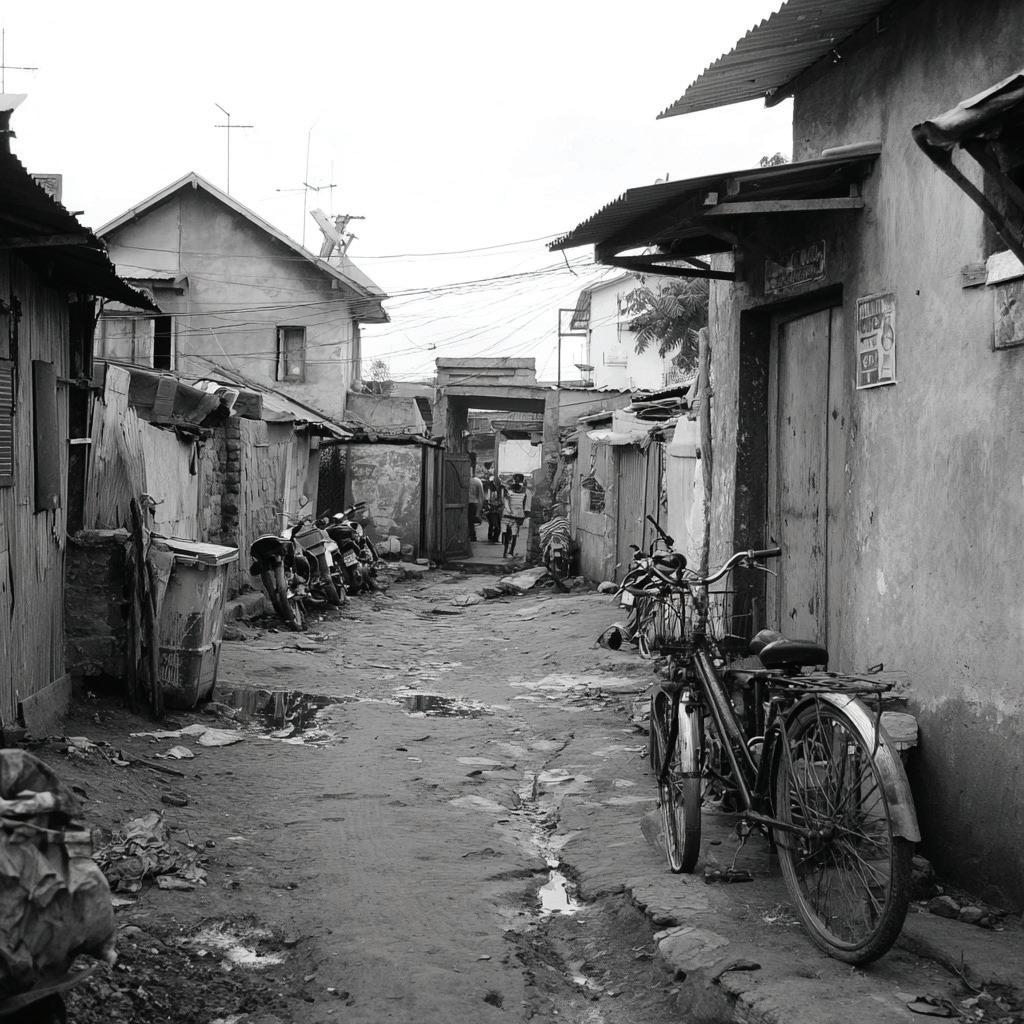
in terms of informal urbanism, a place where everything is spontaneous, with no planned streets or certain hierarchy in buildings, and for sure no infrastructure. in these settlements, the people or residents shape a collective power to secure the area and raise each other’s children. No style or theme is followed in this area, no straight lines, everything is organic. narrow entrances to the areas and sometimes these entries are dark, maybe filthy, as they are represented by the media. No obvious segregation between different uses the market as same as the houses and so on.
01 02 03 04
My initial understanding of informal urbanism was shaped by the perception that these areas lack safety, have poor lighting, and experience high crime rates. As a result, they can feel intimidating for a stranger to enter.
The AI-generated materials were initially assumed to be of low quality; however, the use of inclined steel sheets demonstrates a level of adaptability that is not necessarily unsuitable for this context.
As the street or pathway becomes narrower, it becomes harder to proceed, creating a sense of enclosure that can make a stranger hesitant to continue.
Motorcycles are widely used in informal settlements because they are affordable, flexible, and can move easily through narrow pathways. As streets become tighter, they become the most practical way to transport people and goods.
These areas were seen as lacking infrastructure, with no proper roads, drainage, or sanitation systems. Informal settlements were often imagined as dirty spaces with a high presence of diseases and viruses.
Imagine a neighborhood located on the periphery of a vast metropolitan city. It is spatially and physically deteriorated, not necessarily a slum, but a poorly constructed environment marked by low-quality infrastructure and inadequate services. Streets may be uneven, drainage insufficient, and public spaces underdeveloped. Planning regulations formally exist, yet encroachments are common and building codes are loosely enforced, reflecting a gap between policy and practice.
Socially, however, the area tells a different story. A strong sense of community prevails, social cohesion functions as a form of collective security, and residents often rely on informal networks to organize and manage shared spaces. The neighborhood is relatively dense, fostering daily interaction and mutual support.
Economically, the community may consist primarily of lower-middle-class households rather than the extremely poor. Situated in the Global South, this neighborhood ultimately reflects broader structural challenges, failures in urban planning, weak governance, corruption,
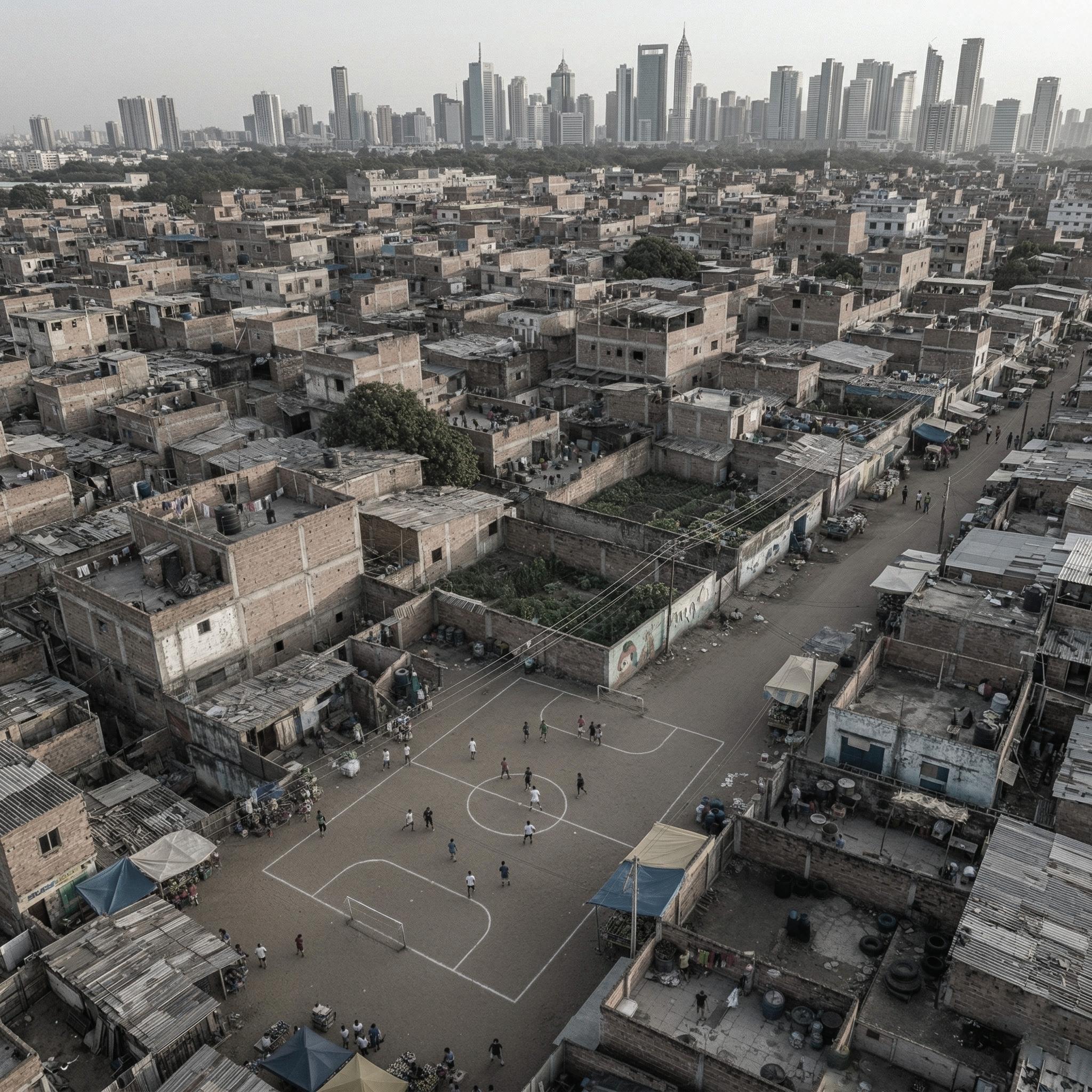
IMAGE 2: BASED ON REVISED UNDERSTANDING
01 02 03, 04 05 06
After engaging with the theoretical foundations of informal urbanism, we found that informality is an integral part of metropolitan development. As Henry George illustrated in Progress and Poverty (1879), processes of urban progress are often accompanied by the persistence of poverty.
The generated image illustrates atypical building types found in informal settlements in the Global South. It shows concrete block construction combined with flat steel roofing, reflecting adaptation to hot climate conditions.
The spatial integration of solid elements (built structures) and voids (green pockets).
Informal vendors play an essential role in supporting daily life by providing accessible goods and services within the community.
In informal areas, street soccer fields function as shared spaces rather than fixed zones. The street becomes a flexible playing ground where activities overlap, and play pauses when a car passes, reflecting a constant negotiation of space.