INFORMALITY AS DESIGN: A SHIFT IN PERSPECTIVE
THE PROMPT
Generate a realistic image based on the following description of urban informality. "Urban informality is an urban environment, where people and structures in an environment have created spaces to serve there basic needs for life. I imagine the buildings looking irregular and unplanned. Visually all people are sharing land for community garden or pop up street vendors setting up shop to sell goods to locals and to make income. Please remove all text. Please change the viewpoint to show vendors selling to locals next.
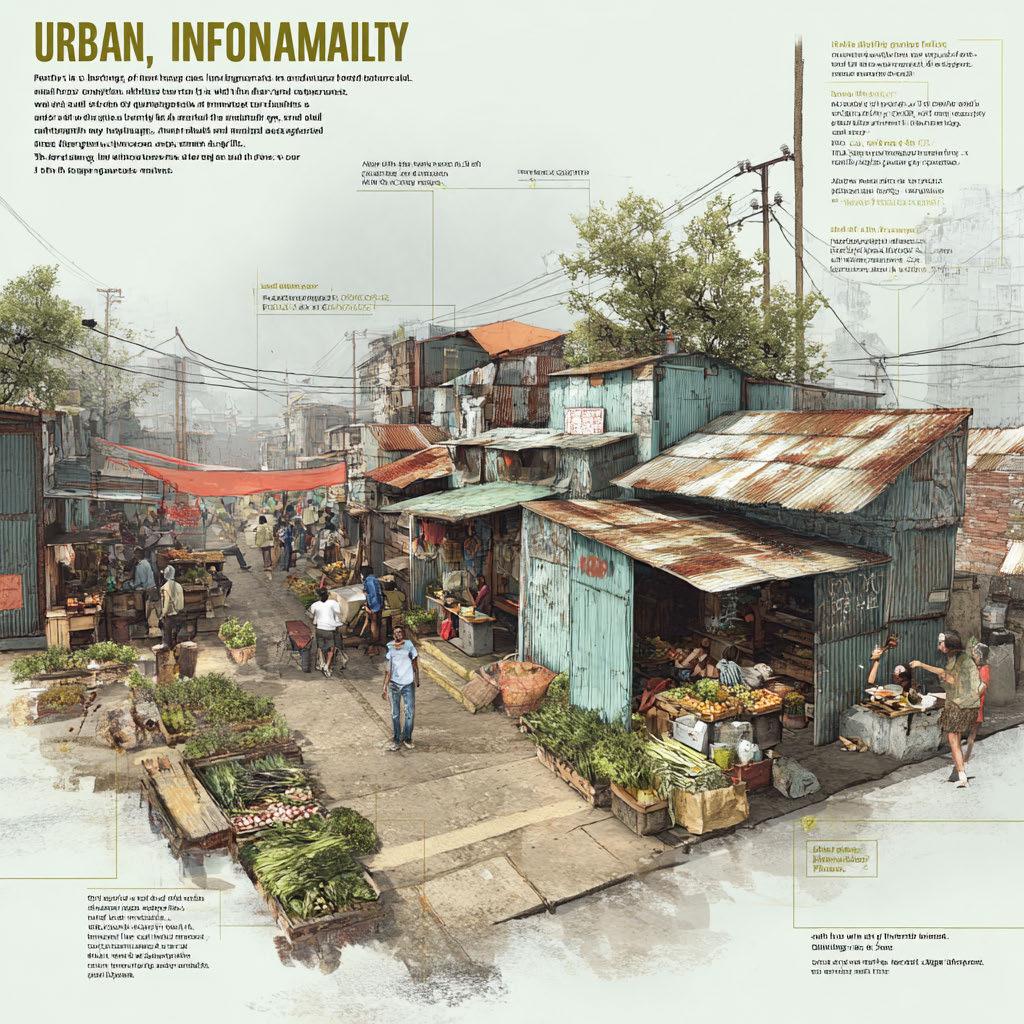
IMAGE 1: BASED ON INITIAL UNDERSTANDING
INFORMALITY AS DESIGN: A SHIFT IN PERSPECTIVE
SEEING AND INTERPRETING INFORMALITY
01 02 03 04
Using Midjourney made me more aware of how much control, and lack of control, exists in AI image making. While some elements responded to my prompt, others were added automatically, especially material choices. This aligns with what Ghertner describes as ‘aesthetic judgment,’ where informality is recognized through familiar visual cues rather than actual lived conditions.
AI introduced text and labeling into the image, turning it into something that looks like an academic poster. Even when requesting to remove text, it remained.
Even though the layout appears unplanned, the settlement feels visually stable. This misses the idea that informality is constantly changing through incremental growth and adaptation, not just irregular form.
Irregular building forms and dense wiring visually signal ‘informality’ but the image also adds stereotypical materials that wern‘t in the prompt, like corrugated metal. These materials repeat across buildings, showing how informality is often reduced to a set of recognizable visual cues.
Street vendors occupy circulation space, suggesting informal economies layered onto infrastructure. However, this reads as a fixed condition instead of an active, shared use of space that shifts over time.
IMAGE 1: BASED ON INITIAL UNDERSTANDING
INFORMALITY AS DESIGN: A SHIFT IN PERSPECTIVE
Generate a realistic image based on the following description of urban informality. It is sidewalks turning into markets with folded tables and traps where food is being cooked and sold steps away from someone's front door. Its vacant lots becoming community gardens with scrap wood and hand painted signs. Houses of 1-4 story heights growing room by room with patchwork, scrap wood, and leftover pieces of metal. There are tangled wires overhead, mismatched brick streets with people of all ages interacting, and constantly being rebuilt by the people living in it. It's what happens when people don't wait for permission, funding, or planning but instead respond to what they need right now. Show the image from the street view with a dense urban character with people interacting, out in the elements. SEEING AND INTERPRETING INFORMALITY
THE PROMPT
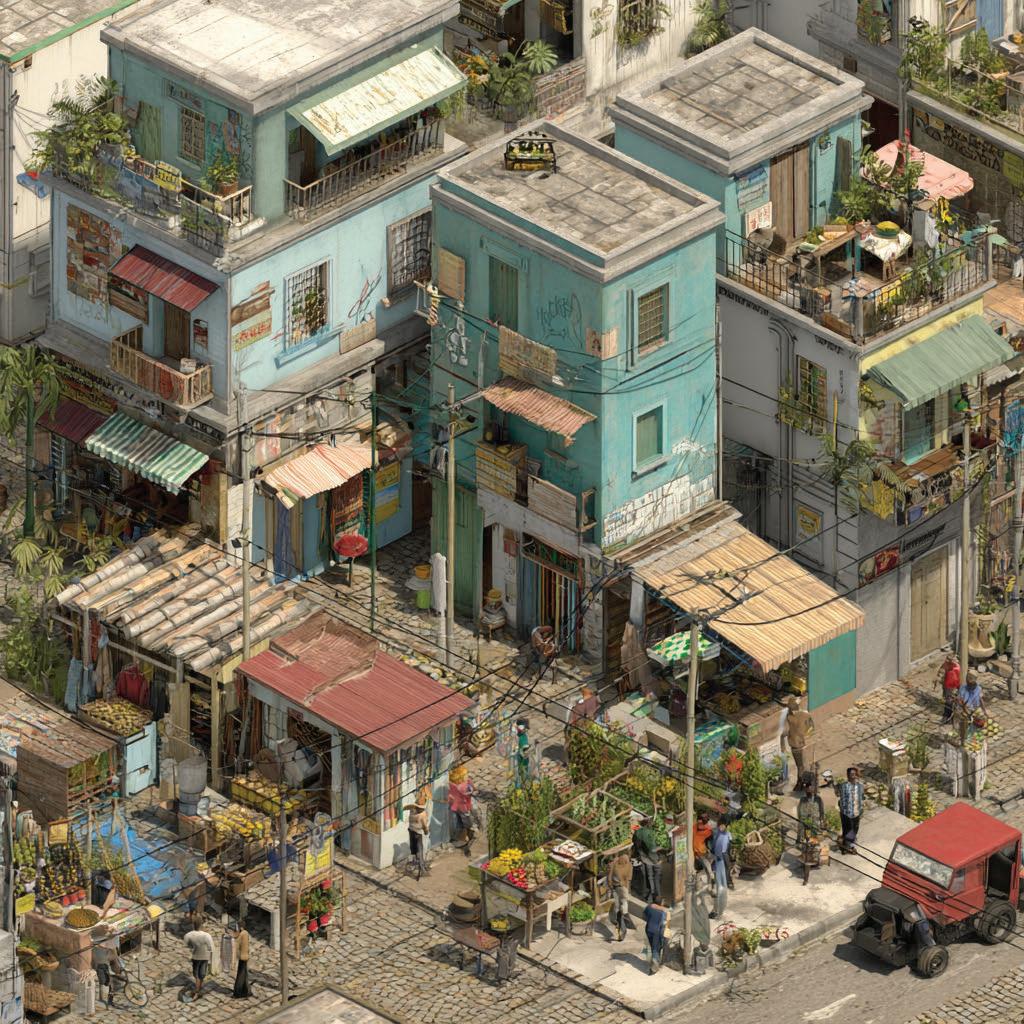
IMAGE 2: BASED ON REVISED UNDERSTANDING
INFORMALITY AS DESIGN: A SHIFT IN PERSPECTIVE
SEEING AND INTERPRETING INFORMALITY
02 03 04
When generating the second AI-based image, I noticed how often I had to correct the AI’s assumptions instead of it building directly off my prompts. Each iteration required adjustments to push the image closer to what I actually intended.
Different building planes help suggest incremental growth, with structures expanding in uneven ways. The tight spacing also begins to blur the line between public and private space, making the environment feel more fluid.
The image still includes familiar materials like corrugated metal and exposed wiring, even when not fully specified. Although AI does start to integrate different materials throughout the image.
Circulation paths start to function as active marketplaces. This shows how space is continuously redefined based on immediate social and economic needs rather than staying fixed.
Shifting the viewpointwith AI to view the street level shows the space more active and lived in. Unlike the first image, I had to request a specefic viewpoint to better captures the density and energy of everyday activity.
IMAGE 2: BASED ON REVISED UNDERSTANDING