INTERPRETING INFORMALITY
A COMPARATIVE STUDY OF REPRESENTATION AND PERCEPTION
PROMPT
Generate an informal neighborhood where daily life runs on a mix of formal and improvised systems. The street is crowded with activity: street vendors, children playing, people attending daily chores. Buildings are varied and show incremental change over time such as CMU block and stucco beside older brick, visible seams where a room or floor was added, different roof pitches, recycled doors and windows, etc. Ground floors blur into public life and hint at mixed use typology. Municipal elements appear unevenly, suggesting selective investment rather than complete absence. The scene should feel lived-in, functional, and realistic
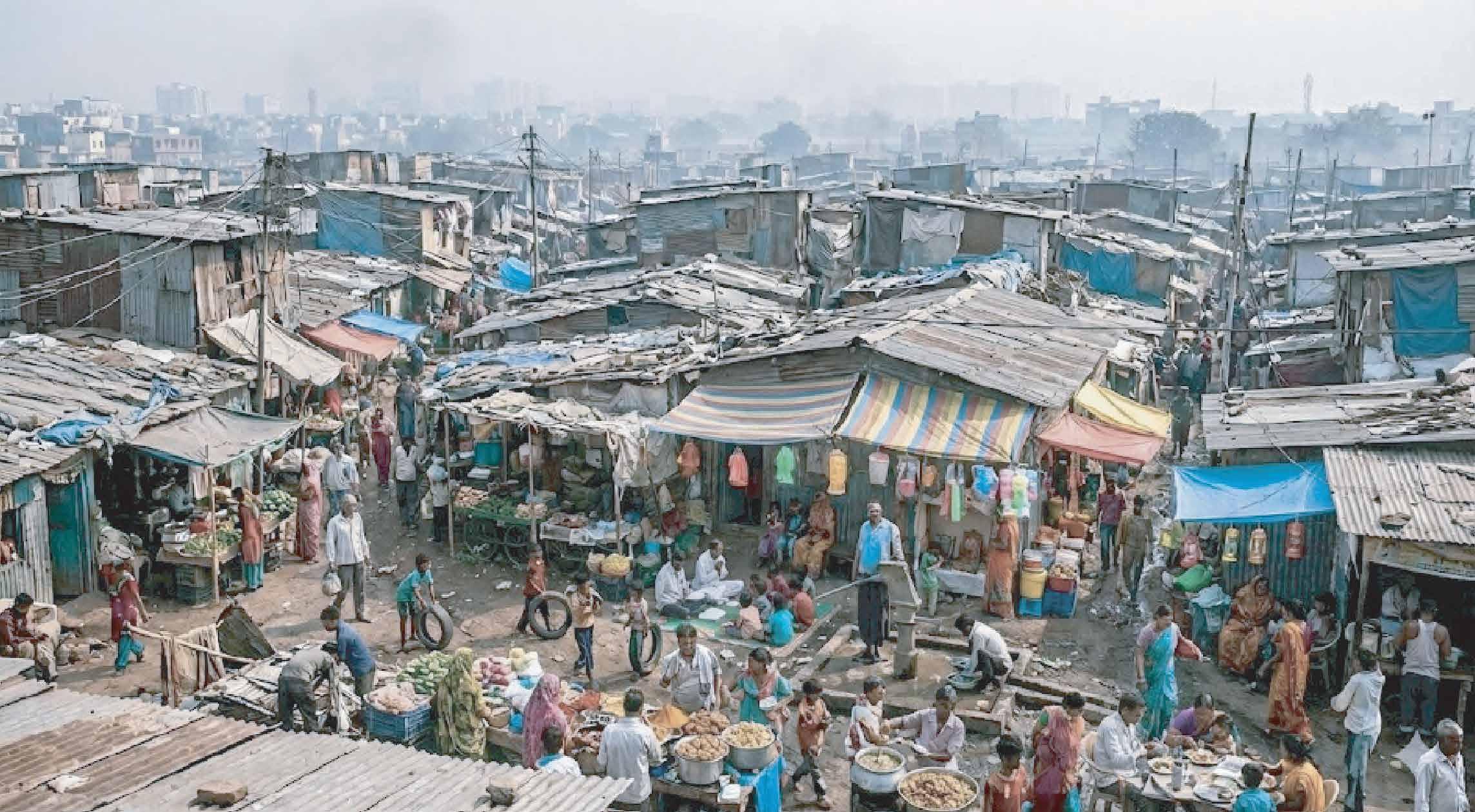
IMAGE 1: BASED ON INITIAL UNDERSTANDING
INTERPRETING INFORMALITY
A COMPARITIVE STUDY OF REPRESENTATION AND PERCEPTION
My initial understanding of informal urbanism was shaped by the perception that these areas lack safety, have poor lighting, and experience high crime rates. As a result, they can feel intimidating for a stranger to enter.
The image assigns a specific cultural and geographic identity (e.g., South Asian) despite none being specified in the prompt, reflecting the AI model’s overreliance on dominant visual datasets.
Although the prompt specifies varied construction (CMU, stucco, brick, incremental additions), the image reduces this to a narrow palette of corrugated metal and temporary materials.
The scene is rendered as uniformly dense and crowded, reinforcing a singular image of compression rather than the variation implied in the prompt.
The prompt calls for a mix of formal and improvised systems, yet the image is dominated by makeshift construction, minimizing the presence of more permanent building types. 01 02 03 04
IMAGE 1: BASED ON INITIAL UNDERSTANDING
INTERPRETING INFORMALITY
A COMPARITIVE STUDY OF REPRESENTATION AND PERCEPTION
PROMPT
Generate an informal neighborhood where daily life runs on a mix of formal and improvised systems. The street is crowded with activity: street vendors, children playing, people attending daily chores. Buildings are varied and show incremental change over time such as CMU block and stucco beside older brick, visible seams where a room or floor wasadded, different roof pitches, recycled doors and windows, etc. Ground floors blur into public life and hint at mixed use typology. Municipal elements appear unevenly, suggesting selective investment rather than complete absence. The scene should feel lived-in, functional, and realistic
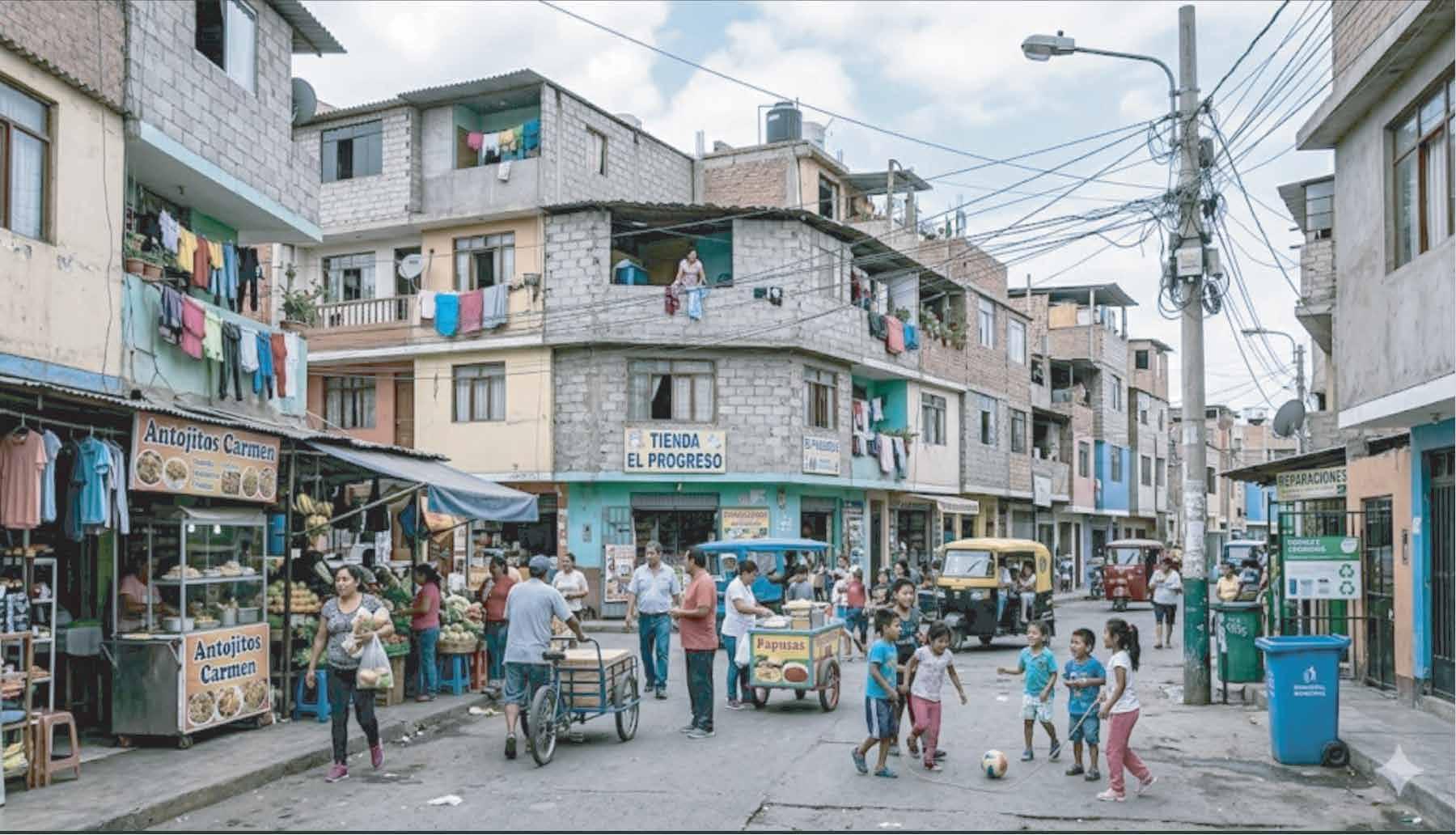
IMAGE 2: BASED ON REVISED UNDERSTANDING
A COMPARITIVE STUDY OF REPRESENTATION AND PERCEPTION 01 02 03
The revised understanding of informality focuses more directly on the coexistence of formal and improvised systems within the urban fabric. Greater emphasis is placed on incremental construction, mixed-use ground conditions, and the distribution of daily life across the street. The image begins to reflect these ideas through more legible building types, clearer spatial organization, and a broader range of visible activities. However, the revised image still has issues as the AI model continues to rely on recognizable visual patterns and assumptions.
The image introduces Spanish-language signage (“Antojitos,” “Tienda”), assigning a specific regional identity that was not defined in the prompt. 01 02 03 04
Although the prompt specifies varied construction (CMU, stucco, brick, incremental additions), the image reduces this to a narrow palette of corrugated metal and temporary materials.
A child appears to play multiple games simultaneously ( soccer and jump rope), suggesting compositional inconsistencies typical of AI generated imagery.
IMAGE 2: BASED ON REVISED UNDERSTANDING