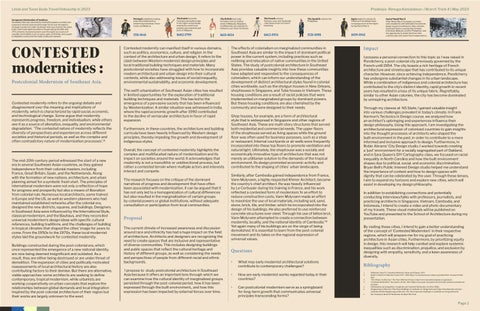
Linda and Turan Duda Travel Fellowship in 2023 European Colonization of Southeast Asia
Southeast Asia was colonized by several European countries over a period of several centuries.One major factor was the region’s strategic location for trade. Southeast Asia was a hub for the spice trade, which was highly lucrative in Europe during the 16th and 17th centuries. European powers saw the region as a source of valuable commodities such as spices, gold, and timber, and sought to establish control over the trade routes and markets.
CONTESTED modernities : Postcolonial Modernism of Southeast Asia.
Contested modernity refers to the ongoing debate and disagreement over the meaning and implications of modernity, which is characterized by rapid social, economic, and technological change. Some argue that modernity represents progress, freedom, and individualism, while others see it as a source of alienation, inequality, and environmental degradation. “The contested nature of modernity reflects the diversity of perspectives and experiences across different societies and historical periods, as well as the complex and often contradictory nature of modernization processes’.[1]
The mid-20th century period witnessed the start of a new era in several Southeast Asian countries, as they gained independence from their colonial masters, including France, Great Britain, Spain, and the Netherlands. Along with the formation of new nations, architecture, and urban planning aimed for a symbolic fresh start. The principles of international modernism were not only a reflection of hope for progress and prosperity but also a means of liberation from colonial rule. Numerous local architects, some trained in Europe and the US, as well as western planners who had maintained established networks after the colonial era, designed the new districts, squares, and buildings. Designers in Southeast Asia were influenced by the International Style, classical modernism, and the Bauhaus, and they reconciled universal modernism’s design ideas with specific cultural references, building traditions, and the challenges of building in tropical climates that shaped the cities’ image for years to come. From the 1950s to the 1970s, these local modernist styles laid the groundwork for contested modernity. Buildings constructed during the post-colonial era, which once represented the emergence of a new national identity, are now being deemed insignificant and outdated. As a result, they are either being destroyed or are under threat of demolition. The expansion of cities and politically motivated reassessments of local architectural history are also contributing factors to their demise. But there are alternative, viable approaches: some architects are seeking to define contemporary, tropical modernism, while urbanists are working cooperatively on urban concepts that explore the relationships between global demands and local integration inspired by the post-colonial architecture of their region but their works are largely unknown to the west.
Pradeepa Renuga Kannadasan | M.arch Track II | May 2023 Portugal establishes trading
The Dutch East India
1511-1641
1602-1799
posts and settlements in present day Indonesia, TimorLeste, and Malacca.
Company dominates trade in the region and gradually extends its control over present-day Indonesia and parts of Malaysia.
The British East India
The French colonize
Company sets up trading posts in Malaysia, Singapore, and Myanmar, and expands its influence over these territories.
Vietnam, Laos, and Cambodia, collectively known as French Indochina.
1613-1824
1662-1954
Contested modernity can manifest itself in various domains, such as politics, economics, culture, and religion. In the context of the architecture and urban design, it refers to the clash between Western modernist design principles and local traditional building techniques and materials. Many postcolonial societies have struggled with how to incorporate modern architectural and urban design into their cultural contexts, while also addressing issues of social inequality, environmental sustainability, and economic development. The swift urbanization of Southeast Asian cities has resulted in limited opportunities for the exploration of traditional building techniques and materials. This has led to the emergence of a pervasive society that has been influenced by Westernization. A similar situation was witnessed in India, where the rapid economic growth after 1990 contributed to the decline of vernacular architecture in favor of rapid expansion. Furthermore, in these countries, the architecture and building curricula have been heavily influenced by Western design principles, thereby impeding the growth and development of indigenous styles. Overall, the concept of contested modernity highlights the complex and multifaceted nature of modernization and its impact on societies around the world. It acknowledges that modernity is not a monolithic or unidirectional process, but rather a contested terrain where multiple actors and interests interact and compete. The research focuses on the critique of the dominant narratives of progress and development that have often been associated with modernization. it can be argued that it has not only led to a homogenization of cultural differences but also resulted in the marginalization of certain groups by colonial powers or global institutions, without adequate consultation or participation from local communities.
Proposal The current climate of increased awareness and discussion around race and ethnicity has had a huge impact on the field of architecture. Architects and designers are recognizing the need to create spaces that are inclusive and representative of diverse communities. This includes designing buildings and public spaces that reflect the cultural heritage and history of different groups, as well as considering the needs and perspectives of people from different racial and ethnic backgrounds. I propose to study postcolonial architecture in Southeast Asia because it offers an important lens through which we can examine how the cultural identity of marginalized groups persisted through the post-colonial period, how it has been expressed through the built environment,, and how this expression has been impacted by external forces over time.
The Spanish colonize the
Japan begins to expand its
1521-1898
1859-1945
Philippines.
The effects of colonialism on marginalized communities in Southeast Asia are similar to the impact of dominant political power in the current system, including practices such as redlining and relocation of native communities in the United States. The study of postcolonial architecture in Southeast Asia provides valuable insights into how these communities have adapted and responded to the consequences of colonialism, which can inform our understanding of the development of distinct architectural styles found in colonial cities worldwide, such as the shotgun houses in New Orleans, shophouses in Singapore, and Tube houses in Vietnam. These housing conditions are a result of racist policies that were implemented on marginalized groups by dominant powers. But these housing conditions are also cherished by the community and were designed to their needs. Shop houses, for example, are a form of architectural style that is widespread in Singapore and other regions of Southeast Asia. These are multi-story structures that served both residential and commercial needs. The upper floors of the shophouse served as living spaces while the ground floor was often used for business purposes, such as a shop or restaurant. Internal courtyards or air wells were frequently incorporated into these top floors to promote ventilation and natural light. Ultimately, the shophouse was a socially and economically innovative type of architecture that was not merely an utilitarian solution to the demands of the tropical environment. Its design promoted economic activity and contributed to the shaping of cities’ urban landscapes. Similarly, after Cambodia gained independence from France, Vann Molyvann, a highly respected Khmer Architect, became the country’s chief architect. He was heavily influenced by Le Corbusier during his training in France, and his work reflected a contested form of modernism.‘In an effort to reduce construction costs, Vann Molyvann made an effort to maximize the use of local materials, including soil, sand, stone, brick, tile, and timber, which he incorporated into the design of his buildings. He also preferred to use reinforced concrete structures over steel. Through his use of béton brut, Vann Molyvann attempted to create a connection between modernity, locality, and the national identity of Cambodia.’[2] Yet again many of his buildings are on the verge of being demolished. It is essential to learn from the post-colonial movement and its takes on the regional expression of universal values.
Questions •
What may early modernist architectural solutions contribute to contemporary challenges?
•
How are early modernist works regarded today in their countries?
•
Can postcolonial modernism serve as a springboard for long-term growth that communicates universal principles transcending forms?
influence in Southeast Asia, occupying much of the region during World War II.
End of World War II
After World War II, European countries were weakened, and nationalist movements began to gain momentum in their colonies. Southeast Asian countries like Vietnam, Indonesia, Malaysia, and the Philippines saw the opportunity to break free from their colonial rulers and assert their independence.
Impact I possess a personal connection to this topic as I was raised in Pondicherry, a post-colonial city previously governed by the French until 1954. The city boasts a rich heritage of French architecture and streetscape that has contributed to its unique character. However, since achieving independence, Pondicherry has undergone substantial changes in its urban landscape. While a combination of indigenous and colonial architecture has contributed to the city’s distinct identity, rapid growth in recent years has resulted in a loss of its unique fabric. Regrettably, similar to other Asian colonies, the city has become dominated by uninspiring architecture. Through my classes at NS State, I gained valuable insight into various challenges prevalent in today’s climate. In Frank Harmon’s Tectonics in Design course, we analyzed how an architect’s upbringing and experiences influence their design philosophy. Using this approach, I am investigating the architectural expression of colonized countries to gain insights into the thought processes of architects who shaped the built environment in the past, in order to contribute to a more informed and inclusive approach to design. Furthermore, in Robin Abrams’ City Design studio, I worked towards creating a ‘just’ environment for a racially segregated part of Oakland, and in Sara Queen’s DIY Cartography class, we focused on racial inequality in North Carolina and how the built environment shapes due to political, social, and economic discrimination. Bryan Bell’s Public Interest Design studio helped me understand the importance of context and how to design spaces with dignity that can be celebrated by the user. Through these lenses, I aim to expand my horizons and explore new cities, which will assist in developing my design philosophy. In addition to establishing connections and potentially conducting interviews/talks with professors, journalists, and practicing architects in Singapore, Vietnam, Cambodia, and Indonesia, I intend to create a video and photo documentary of my travels. These visual materials will be published on YouTube and presented to the School of Architecture during my presentation. By visiting these cities, I intend to gain a better understanding of the concept of ‘Contested Modernism’ in their respective regions, which will prepare me for my goal of practicing architecture in Asian cities. Furthermore, by prioritizing equity in design, this research will help combat and explore systemic inequalities such as discrimination, prejudice, and exclusion by designing with empathy, sensitivity, and a keen awareness of diversity.
Bibliography 1. 2. 3. 4. 5. 6. 7.
AlShehabi, Omar H. Contested Modernity. Simon and Schuster, 2019. Modern ASEAN Architecture Project 2015 -2020. https://www.maseana.iis.u-tokyo.ac.jp/index.html. Accessed 29 Mar. 2023. “New Khmer Architecture.” The Vann Molyvann Project, http://www.vannmolyvannproject.org/projects. “Contested Modernities.” Encounters, 20 Dec. 2022, https://www.seam-encounters.net/encounter-projects/contested-modernities/. Globalization and Inequalities: Complexity and Contested Modernities. by Sylvia Walby. Disappearing Architecture: Why These Buildings in Cambodia Are Being Destroyed, https://theculturetrip.com/asia/ cambodia/articles/disappearing-architecture-why-these-important-buildings-in-cambodia-are-being-destroyed/. The Vietnamese Brand Of Modernism By Phạm Phú Vinh.
Page 1
#
Travel Plan : Postcolonial Modernism of Southeast Asia. Singapore (5 Days ) Stop 1 : Singapore Connecting with Johannes WIDODO, Director of Graduate Programs in Architectural Conservation - National University of Singapore. Tiong Bahru Estate is a showcase housing project that was built in the 1930s and 1940s and has been listed as a historical monument since 2003. Peranakan houses in Singapore are traditional homes that reflect the unique blend of Chinese and Malay cultures. These houses are characterized by their colorful facades, intricate carvings, and ornate tiles. The Golden Mile Complex & People’s Park Complex are a mixed-use building that opened in 1970’s and is facing demolition, but there is a public debate about whether it should be preserved and renovated. Esplanade - Theatres on the Bay, Opened in 2002 and features a distinctive design that combines traditional Malay and Chinese architectural elements with modern materials and technologies. The Old Hill Police Station, also known as the Phoenix Park Police Station, is a historic building located in Singapore’s River Valley neighborhood. The Concourse & The Colonnade Condominiums are Post modern high rise commercial and residential building on Beach Road.
Cambodia (5 Days ) Stop 2 : Phnom Penh
Stop 3 : Siem Reap
Stop 8 : Quezon City
The Angkor Wat temple complex is significant for its architectural and cultural value. The design of Angkor Wat is characterized by its focus on symmetry, balance, and harmony with nature which was one of a main inspiration for post colonial architecture.
Parish of the Holy Sacrifice- • The church’s altar is shaped like a “salakot”, which is a traditional Philippine hat made from woven bamboo or rattan.
Vietnam (5 Days )
National Arts Center by Leandro V. Locsin is an example of modernist architecture, characterized by clean lines, use of concrete, and minimal ornamentation.
Stop 4 : Ho Chi Minh City The tube houses are a unique expression of Vietnamese architecture and culture, shaped by a combination of European and indigenous influences. Dong Khoi Street, formerly known as Rue Catinat during the French colonial period, was an important commercial and cultural center of Saigon during the colonial era.
1283 215 158 102 104 289 280 1224 3655
Travel insurance (medical/emergency/cancella�on/baggage Personal supplies
102 100
Taman Mini Indonesia Indah is a cultural park in Jakarta was built in the 1970s to showcase the diversity of Indonesia’s many cultures. Its architecture features traditional Indonesian elements.
Local Expenses Visa fees Hotel Food MRT/Bus Pass (Transporta�on) Taxi Sim card (1 week) Esplanade Ticket
36 529 120 20 25 8 22
Combodia(5 Days)
Visa fees Food MRT/Bus Pass (Transporta�on) Sim card (1 week) Hotel (Phnom Penh ) Hotel (Siem Reap) Angor wat Entry fee The State Palace in Phnom Penh Chatumuk Hall Conference Ticket Taxi (within Phnom Penh) Taxi (from & back to Siem Reap)
28 52 0 5 183 84 37 10 10 50 120
Vietnam(5 Days)
Visa fees Food MRT/Bus Pass (Transporta�on) Taxi Sim card (1 week) Hotel (Ho Chi Min City) Hotel (Hue) Hotel (Hanoi) Entry fee
45 80 60 65 10 170 75 79 29.7
Philipines(6 Days)
Visa fees Food MRT/Bus (Transporta�on) Taxi Sim card (1 week) Hotel (Manila)
25.71 60 15 24 5.53 552
Indonesia(5 Days)
Visa fees Food MRT/Bus (Transporta�on) Taxi Sim card (1 week) Hotel (Jakarta)
50 50.88 0 20 11 329
Singapore(5 Days)
PHILIPPINES CAMBODIA
VIETNAM
General Science Library became a public library in 1882 is a prime example of Vietnamese modern architecture.
Stop 5 : Hue Phu Cam Church was built in the style of Modern Architecture, it was designed by the architect Ngô Viet Thụ.
Stop 6 : Hanoi National Convention Center is a symbol of Vietnam’s growing economic and political influence in the region and the world, as it is capable of hosting major international conferences and events.
Royal University of Phnom Penh Campus which features a mix of traditional Khmer architecture and postmodern elements such as a colorful geometric facade and a large, sculptural entrances.
Saint Andrew the Apostle Church is a combination of Spanish and Filipino styles, reflecting the country’s colonial past and cultural heritage.
Phsar Thmey market constructed in 1937 during the French colonial period, The market is located in the heart of the city and is a hub for local commerce and tourism.
Stop 10 : East Jakarta
The Bitexco financial tower’S exterior is made of glass and steel, and its shape is intended to resemble the shape of a lotus bud, which is a symbol of purity and enlightenment in Vietnamese culture.
Philippines (6 Days )
Phnom Penh National Stadium is one of Vann Molyvann’s finest work which is under renovation.
Indonesia (5 Days )
The Independence Palace was built in the 1960s as the home and workplace of the South Vietnamese president during the Vietnam War. The palace designis anexampleof Contested modernism.
Connecting with Khmer Architecture Tour, Group of Architectural stuents and Pratisoners who will take me around camodia exporling Khmer Architecture in Cambodia.
Chaktomuk Conference Hall by Vann Molyvanna aesthetically pleasing fan-shaped hall topped with a traditional Khmer tower is situated close to the Royal Palace and hovers like a bird on the embankment overlooking the river junction at Chaktomuk.
Stop 9 : Los banos
SINGAPORE
Stop 7 : Manila INDONESIA
Stop 11 : Central Jarkarta
The Tanghalang theater has a roof made of precast concrete panels with circular indentations that resemble woven bamboo mats, a traditional material in Filipino homes.
National Monument Jakarta is a symbol of independence and post-colonial identity.
Magallanes Church is reminiscent of the traditional Philippine bahay kubo, or nipa hut, which is also round in shape.
Istiqlal Mosque and Mosque Said Naum are the Largest mosque in Southeast Asia and its a Blend of modern and traditional Islamic architectural elements.
The Meralco building has a façade with vertical fins designed to resemble banana plant leaves, reflecting the plant’s cultural significance in Filipino traditions.
Intiland Tower is a Prominent example of post-modern architecture in Indonesia by Paul Rudolph.
Risen Lord Parish, The church’s roof is made of cogon grass, a traditional roofing material in the Philippines that has been used for centuries.
Jakarta Cathedral is one of the oldest Christian churches in Jakarta and it Reflects a blend of European and Javanese architectural styles.
Flights
To Singapore Phnom Penh, Cambodia Ho Chi Minh City, Vietnam Hue, Vietnam Hanoi,Vietnam Manila, Philippines Jarkarta, Indonesia Raleigh Total
From Raleigh Singapore Phnom Penh, Cambodia Ho Chi Minh City, Vietnam Hue, Vietnam Hanoi,Vietnam Manila, Philippines Jarkarta, Indonesia
Total Con�gency (15%) Final Total
6952.82 1042.923 7995.74
Page 2