Sarah Casaday - Proposal for the 2018 Linda & Turan Duda Travel Fellowship M.ARCH | May 2018
LIMINAL CITIES:
ARCHITECTURAL IDENTITY OF POST SOCIALIST EASTERN EUROPE “Memory is life. It is always carried by groups of living people, and therefore it is in permanent evolution. It is subject to the dialectics of remembering and forgetting, unaware of its successive deformations, open to all kinds of use and manipulation. Sometimes it remains latent for long periods, then suddenly revives. History is the always incomplete and problematic reconstruction of what is no longer there. Memory always belongs to our time and forms a lived bond with the eternal present; history is a representation of the past.” -Pierre Nora 1
INTRODUCTION Since the fall of communism roughly thirty years ago, Eastern Europe has undergone many transitions in cultural, economic and political spheres which have led to identity crises. The abrupt shift from planned socialist economies to market capitalism turned millions of lives upside down. In addition to the economic transformation, these countries transitioned from centuries of domination by authoritarian foreign entities to independence and the establishment of democratic political systems. This forced these newly autonomous nations to reckon with the past, and offered an opportunity to forge their own national identities through the built environment. Beginning in the early modern period, the distinction between East and West in Europe can be seen. Once one ventured beyond Berlin or Vienna, they entered a land of “other:” vaguely European, somewhat Asiatic, but distinctly heterogeneous from each. From that point forward, Eastern Europe has been set apart and arguably looked down upon by its western neighbors.2 Thus, Eastern European identities offer a compelling area of study for any scholar, but particularly for the architect. The identity crisis that Eastern European nations face manifests in the processes of architectural creation, destruction, preservation and banalization. These processes contribute to the contested nature of Eastern European national identities and the struggles between their past, present, and desired future. My research focuses on national identity creation through architecture in three pairs of post-socialist cities. These six cities are: Post-Soviet Kiev and Tbilisi, Post-Warsaw Pact Budapest and Warsaw, and PostYugoslav Belgrade and Skopje. In addition to their socialist pasts, all of these cities contain physical reminders of imperial pasts which left behind architectural legacies of foreign domination. These imperial and totalitarian regimes sought to employ architecture as a means to project power and identity. After the fall of these empires and regimes, their architecture lost its original function and now serves as unwelcome monuments to an undesirable past.3 The newly independent nations of Eastern Europe have had to structure their identities in reaction to their past, their own histories, and the influences of globalization. The search for identity manifests in many forms; one of the most discernible is the use of architecture and public space. Nations seek to shape their architectural identities through four processes: creation, destruction, preservation, and banalization. Under this framework, creation can be understood as new construction that is meant to support the formation of national identity. Destruction is the elimination of that which does not fit into the desired national narrative, which can be seen through the toppling of Soviet monuments as part of decommunization efforts. The act of preservation is the deliberate conservation of monuments or structures from the past.
Preservation can serve the purpose of remembrance or promotion (in the case of heritage preservation for tourism, often at the expense of local residents). Though the original function of the building is often not preserved, the building itself remains. Banalization refers to the sanitization of a structure’s past and the neutralization of its original meaning so as to make it unoriginal. Often, banalization occurs through the reappropriation of a building’s function as a product of the proliferation of neoliberal globalization.4 How do you forge a national identity for a new nation? In Eastern Europe we see nations attempting to answer this question. Today we see a retreat of liberal democracy across the world in a way we haven’t seen since the Interwar period. Populist, authoritarian regimes have come to power across Eastern Europe, including in Hungary, Poland, Russia and Turkey. The rise of these illiberal democracies around the world is, in part, a reaction to neoliberal globalization, liberal democracy, secularization, and immigration, all of which are perceived as threats to identity. The leaders of these movements have forced their own reinterpretations of history on their people and on the fabric of their cities. It is in times like these that remnants of the past get renamed, repurposed, or demolished to create a unilateral view of history. In recent years, we have seen the governments of Viktor Orbán of Hungary and Andrzej Duda of Poland attempt to form homogeneous national identities for their nations. Advancing Hungarian Christian and Polish Catholic identities respectively, their governments are anti-secular, anti-immigrant, and anti-democratic. We see the agenda of such leaders reflected in their nations’ architecture as they rewrite history through not only their speeches and laws, but also through monuments, museums, and other aspects of public space that further the cultural hegemony of the majority. This provokes the questions of who owns public space, who owns a nation’s architectural identity, and who owns history itself. In the past few years, the same questions have been brought to the forefront here in the United States in the aftermath of the events in Charleston and Charlottesville. These two horrific events prompted a national discussion about what belongs in our shared public spaces and whose history they should tell. Should these monuments remain in situ no matter the pain they cause, should they be torn down and destroyed, effectively erasing history, or should they be placed in museums and given their proper historical context? This question hits even closer to home with the protests in Chapel Hill over “Silent Sam” and the toppling of a Confederate monument in Durham. At the heart of these events is a battle for the soul of a nation. Will our words, symbols, and monuments serve those who idealize a homogeneous nation, or will they reflect the reality of a multicultural society? Furthermore, how can architecture depolarize society and help to promote an inclusive national identity in a world that is growing increasingly polarized and exclusive?
PROPOSITION I propose to study the liminal national identities of six post-socialist cities in Eastern Europe through an analysis of their architecture and urban fabric. Belgrade, Budapest, Kiev, Skopje, Tbilisi and Warsaw have all undergone transitions from authoritarian communist regimes to varying degrees of capitalist democracies in the past three decades.
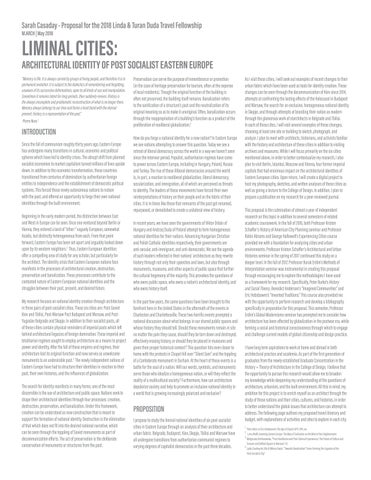
As I visit these cities, I will seek out examples of recent changes to their urban fabric which have been used as tools for identity creation. These changes can be seen through the decommunization of Kiev since 2014, attempts at confronting the lasting effects of the Holocaust in Budapest and Warsaw, the search for an exclusive, homogeneous national identity in Skopje, and through attempts at branding their nation as modern through the glamorous work of starchitects in Belgrade and Tbilisi. In each of these cites, I will visit several examples of these changes, choosing at least one site or building to sketch, photograph, and analyze. I plan to meet with architects, historians, and activists familiar with the history and architecture of these cities in addition to visiting archives and museums. While I will focus primarily on the six cities mentioned above, in order to better contextualize my research, I also plan to visit Berlin, Istanbul, Moscow and Vienna, four former imperial capitals that had enormous impact on the architectural identities of Eastern European cities. Upon return, I will create a digital project to host my photography, sketches, and written analyses of these cities as well as giving a lecture to the College of Design. In addition, I plan to prepare a publication on my research for a peer-reviewed journal. This proposal is the culmination of almost a year of independent research on this topic in addition to several semesters of related academic coursework. In the fall of 2016, both Professor Kristen Schaffer’s History of American City Planning seminar and Professor Robin Abrams and George Hallowell’s Experiencing Cities course provided me with a foundation for analyzing cities and urban environments. Professor Kristen Schaffer’s Architectural and Urban Histories seminar in the spring of 2017 continued this study on a deeper level. In the fall of 2017, Professor Burak Erdim’s Methods of Interpretation seminar was instrumental in creating this proposal through encouraging me to explore the methodologies I have used as a framework for my research. Specifically, Peter Burke’s History and Social Theory, Benedict Anderson’s “Imagined Communities” and Eric Hobsbawm’s “Invented Traditions.” This course also provided me with the opportunity to perform research and develop a bibliography specifically in preparation for this proposal. This semester, Professor Erdim’s Global Modernisms seminar has prompted me to consider how architecture has been affected by globalization in the postwar era, while forming a social and historical consciousness through which to engage and challenge current models of global citizenship and design practice. I have long term aspirations to work at home and abroad in both architectural practice and academia. As part of the first generation of graduates from the newly established Graduate Concentration in the History + Theory of Architecture in the College of Design, I believe that the opportunity to pursue this research would allow me to broaden my knowledge while deepening my understanding of the questions of architecture, urbanism, and the built environment. All this in mind, my ambition for this project is to enrich myself as an architect through the study of these nations and their cities, cultures, and histories, in order to better understand the global issues that architecture can attempt to address. The following page outlines my proposed travel itinerary and budget, with explanations of activities and sites to explore in each city. 1
Pierre Nora in Eric Hobsbawm’s The Age of Empire 1875-1914, xix. Larry Wolff, Inventing Eastern Europe: The Map of Civilization on the Mind of the Enlightenment. Małgorzata Omilanowska, “Post-Totalitarian and Post-Colonial Experiences: The Palace of Culture and Science and Defilad Square in Warsaw,” 121. 4 Lydia Coudroy de Lille & Milena Guest, “Towards Banalization? Trans-Forming the Legacies of the Post-Socialist City.” 2
3
PRELIMINARY BUDGET TRANSPORTATION BREAKDOWN DAILY EXPENSE BREAKDOWN Airfare & Railfare Lodging & Daily Expenses
$2088 $3308
Visas (Russia & Turkey) $180 Health Insurance (World Nomads) $156 Admission/Tickets $185 Sketching Supplies $40 International Data $85 Contingency (15-20%) Total Minimum Expenditure $6992
$950
Flights from RDU to TXL Berlin-Warsaw Train Warsaw-Krakow Train Krakow-Lviv Train Lviv-Kiev Train Kiev-Moscow Train Moscow-Tbilisi Flight Tbilisi-Istanbul Flight Istanbul-Skopje Flight Skopje-Belgrade Train Belgrade-Budapest Train Budapest-Bratislava Train Bratislava-Vienna Ferry Vienna-Prague Train Flights from PRG to RDU Total
$559 $35 $15 $45 $11 $45 $86 $141 $149 $53 $28 $24 $36 $44 $817 $2088
City Lodging Food, Transport, Other Days Berlin $45 $55 2 Warsaw $34 $45 5 Krakow $32 $45 3 Lviv $22 $35 2 Kiev $37 $40 4 Moscow $45 $45 3 Tbilisi $24 $35 4 Istanbul $32 $40 2 Skopje $35 $35 3 Belgrade $32 $35 4 Budapest $36 $45 4 Bratislava $38 $40 2 Vienna $48 $55 2 Prague $37 $45 3 Total 43
PROPOSED TRAVEL PLAN Warsaw, Poland (5 Days) Kiev, Ukraine •
• •
The city of Warsaw, rebuilt after its destruction by the Nazis in World War II, is itself a symbol of the Polish people’s resistance and resilience. Warsaw’s Stare Miasto (Old Town) was rebuilt with the help of Matthew Nowicki, who served as head of NCSU’s Department of Architecture from 1948 to 1950. In addition to the Old Town, I plan to visit sites of Holocaust remembrance, including POLIN Museum of the History of Polish Jews and the Warsaw Ghetto. Prior to travel, speak with Prof. Michael Meng (Clemson University - History) about his research on Poland’s Jewish spaces.
Budapest, Hungary • • •
•
Krakow, Poland • • •
(4 Days)
Visit Memento Park, an open-air museum of toppled and decontextualized Communist monuments. Visit the House of Terror, opened by the ruling Fidesz government which aims to cast Hungary as a victim of the Nazis rather than as their allies. Visit sites of Jewish and Holocaust remembrance (including the Holocaust Memorial Center, Dohány Street Synagogue, Budapest Ghetto, and Wallenberg Holocaust Memorial Park). Visit hotly contested Liberty Square, which has a combination of pro-Soviet, anti-Russian, anti-Nazi and pro-Fascist monuments within its bounds.
(3 Days)
Since Warsaw was almost completely destroyed during World War Two, Krakow affords the opportunity to explore its well-preserved medieval center. Take a day trip to nearby Auschwitz. Visit Krakow’s Nowa Huta neighborhood, a planned socialist realist utopia.
•
• •
Lviv, Ukraine Belgrade, Serbia •
• •
• • •
(4 Days)
Since the Euromaidan protests of 2013 and the Russian invasion of Eastern Ukraine in 2014, Ukraine has engaged in a concerted decommunization effort to distance themselves from Russia. Tens of thousands of Soviet and communist symbols have been removed, and monuments promoting Ukrainian nationalism have been erected in their place. Visit Independence Square, a historically contested space and site of the 2013 Euromaidan protests. Visit St. Michael’s Cathedral of the Golden Domes, one of many Ukrainian Orthodox churches that was destroyed by the Soviets but has been rebuilt following Ukraine’s independence.
(2 Days) (4 Days)
Following independence in the early 1800s, much of the Ottoman urban fabric of Belgrade was erased after three centuries of rule. I will visit the Bajrakli Mosque, the only Ottoman mosque remaining in Belgrade out of over 200 that existed in the early nineteenth century. Visit Novi Beograd, a communist planned city developed on Le Corbusier’s principles. Visit the site of the Waterfront project, an attempt to remake the urban fabric of Belgrade’s riverside through $3.5 billion in UAE money with little transparency and no public consultation. Meet with Ljiljana Blagojević, architectural historian and Lecturer at the Faculty of Architecture at the University of Belgrade. Contact Prof. Brigitte Le Normand (University of British Columbia), an expert on urban planning in Yugoslavia. Meet with architect and anti-Waterfront project activist Ljubica Slavković.
Total $200 $395 $231 $114 $308 $270 $236 $144 $210 $268 $324 $156 $206 $246 $3308
Tbilisi, Georgia • • •
•
•
•
•
KIEV VIENNA BUDAPEST
BELGRADE
SKOPJE
TBILISI ISTANBUL
(4 Days)
Skopje, Macedonia •
• •
(2 Days) •
(2 Days)
As the capital of the Ottoman Empire, Istanbul left its imprint on the cities of Southeastern Europe. Once independent, these nations rejected and attempted to erase their Ottoman architectural heritage, which was seen as backward. Visit the contested spaces of Hagia Sophia and Gezi Park, as well as structures such as the Istanbul Hilton, the Atatürk Cultural Center, and SALT Galata.
•
(3 Days)
Since Macedonia was created following the breakup of Yugoslavia in the early 1990s, its identity and even its name have been contested by Greece, its neighbor to the south. Through the Skopje 2014 project, Macedonia’s ruling party sought to remake the nation’s identity through a complete transformation of the city center to promote their nationalist ideology. Skopje 2014 has been widely criticized for being a costly appropriation and amalgamation of multiple styles of architecture that has resulted in a counterfeit, theme park copy of a European city center. Contact Dragan Krstevski, the founder of the First Archi Brigade, a group of architects and activists which opposes Skopje 2014. Meet with Miroslav Grčev, a Macedonian architect and professor of urban planning at the Faculty of Architecture in Skopje who has been a vocal critic of Skopje 2014.
Vienna, Austria
(3 Days)
As the capital of the Soviet Union, Moscow influenced the architecture of most of the cities of study. Visit Red Square, Kremlin, GUM, Fallen Monument Park.
Istanbul, Turkey •
WARSAW
As the capital of the German Empire and the Nazi state, Berlin influenced the identities of several cities of study. Visit remnants of the Berlin Wall, Holocaust Memorial, Reichstag Building, and Leipziger Platz.
Moscow, Russia •
BERLIN
Georgia, the birthplace of Stalin, has always struggled with how to identify itself in relation to Russia and the West. Visit Fabrika, a former Soviet sewing factory transformed into a vibrant complex of creative spaces, shops, and bars. I plan to visit new structures that seek to promote Georgia as modern and Western (Bridge of Peace, Rhike Park, Tbilisi Public Service Hall), as well as structures that show their reluctance to cut ties with their Soviet past (like the Ministry of Highway Construction and the Wedding Palace). In addition to navigating their Soviet past and desire to Westernize, a pride for their Georgian identity and heritage shows in Sameba Cathedral, a modern, massive rendition of traditional Georgian church architecture that imposes itself on a hill over Tbilisi.
Berlin, Germany •
MOSCOW
(2 Days)
As the capital of the Austro-Hungarian Empire, Vienna visibly left its mark on the cities of its periphery. The city of Vienna itself, with its imperial architecture and its Ringstrasse, served as a role model for the newly independent capitals of Central and Southeastern European nations. In addition, these cities looked to Vienna’s modernist architecture, including that of Otto Wagner and Adolf Loos, for creating their own architectural identities.
Bratislava, Slovakia
(2 Days)
Prague, Czech Republic
(3 Days)
• •
Visit the Old Town, Jewish sites, and Lennon Wall. Meet with Jaroslav Ira, lecturer at Charles University and co-instructor for NCSU’s Public History in Prague summer program. Prof. Ira served as the editor of the book Materializing Identities in Socialist and Post-Socialist Cities.