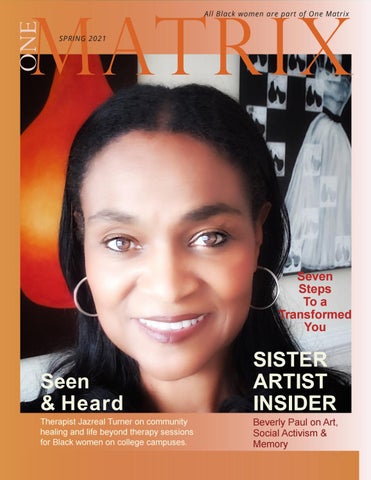
MATRIX
ONE
All Black women are part of One Matrix
SPRING 2021
Seven Steps To a Transformed You
Seen & Heard
Therapist Jazreal Turner on community healing and life beyond therapy sessions for Black women on college campuses.
SISTER ARTIST INSIDER
Beverly Paul on Art, Social Activism & Memory Pg 1
One Matrix Magazine, Spring ‘21
CONTENTS 5
Welcome Home, Sis
7 The Publisher’s Cut
One Matrix We are not a monolith but we sure do have a lot in common. Come see some of yourself!
10 Sister Artist Insider
DC area artist Bevely Paul talks about activism, community and the ways that her artwork reflects the experiences of Black women in America.
20 Seen & Heard
How PA-based therapist, Jazreal Turner helps with transitional challenges and what she recommends for her clients beyond therapy.
26 Seven Steps to Renewing Your Mind & Transforming Your Life by Rev. Beve
Next Issue - Summer 2021 A Brush & The Law How White women who make decisions about the lives of Black families in courts often overlook and trivialize care for Black girls
Photo Courtesy of Printful, Used by permission
The Be Light Campaign & the development of Safe Spaces for Black girls - A Discovery Through Stories. Two Races One Identity Interviews and Narratives with Biracial Folks Getting to Joy We talk of joy but many of us feel pain. How do we get to joy? Mothers & Daughters on Relationship Poverty & the Environments Where We Live Money! And so more! Pg 3
ONE
MATRIX
C. Chekejai Coley, Publisher Reverend Beverly “Rev Beve” Saunders Biddle, Senior Editor Tina Marie Coley, Managing Editor Kimberlyn Peat, Advisory Editor Issue Advisors Anthony Goggins Erica Knight Monique Gordon Melonia Turner Contributors Beverly Paul, Artist & Contributory Editor Rev. Beverly “Rev Beve” Saunders Biddle Jazra’el Turner, LMFT Special Thanks Stephan Groce Simone Jenifer Dr. Kocava Selassie, Ph.D. Selena P. Johnson, National Association of Black Social Workers Nappy.Co Pennsylvania Coalition Against Domestic Violence
@Designingsistas
One Matrix Magazine, Spring ‘21
WELCOME HOME, SIS The great scholar, educator & suffragist, Dr. Anna Julia Cooper is quoted as saying, “women’s cause is one and universal.” It’s true. We are not a monolith but, in some ways, our hearts beat the same rhythm. We are encountering some of the same things. We are often disproportionately impacted by discriminatory practices in institutions schools, courts, hospitals, work spaces and sometimes even in supermarkets. Here, in the pages of One Matrix, we offer new imaginings for ourselves. We welcome you to be a part of imagining a space (and maybe a world) where you see yourself and everything
around you in a new way — in ways that affirm you. Here is our comfort space, our work space and a space to work on our conditions and heal. Here we welcome your voice, your experiences and your genius. We are in this together so grab some tea and put your feet up ‘cause here, you are home - steady & stable. We work on a visualizing, the actualizing, the realizing and the materializing together. We think new thoughts together so let’s think some things through so that we get to that special place where we all deserve to be.
“A woman’s cause is one and universal” -
Dr. Anna Julia Cooper.
We say,YEP! And, we are in this together! Now, let’s work on a way out.
Image & layout by Canva. They said I could use it; just this once, though.
Pg 5
The Suffragettes
BEFORE DOPE WAS DOPE SHE WON
One Matrix on Shopify https://one-matrix.myshopify.com/
One Matrix Magazine, Spring ‘21
Dr. Anna Julia Cooper
Frances Barrier Williams
Ida B. Wells - Barnett
https://one-matrix.myshopify.com/
The women on our shirts represent progress! Women like Dr. Anna Julia Cooper and Ida B. who did profound work in education, politics and in publishing. Many of them also fought for the vote for Black women as well as for the lives of Black people. We still continue to gain ground because of their work. Pass on the knowledge and understanding to the next generation.
Our long-sleeve adult and children’s Ts are comfortable for all seasons - winter, fall and spring. Our long-sleeve Ts are comfy even during cooler summer nights.
• 100% combed and ring-spun cotton • Heather colors are 52% combed and ring-spun cotton, 48% polyester • Athletic Heather is 90% combed and ring-spun cotton, 10% polyester
Model is a model for Printful. One Matrix makes no claims to this image. Used by permission.
Pg 9
One Matrix Magazine, Spring ‘21
Painter Mixed Media Artist Textile Diva
SISTER ARTIST INSIDER DC area artist Bevely Paul talks about the representation of Black art, activism, community and the ways that her artwork reflects the experiences of Black women in America.
I See People But They Look Like Trees, B. Paul. Private Collection
Pg 11
If? What’s Wrong With This Picture, B. Paul. Private Collection
One Matrix Magazine, Spring ‘21
SISTER ARTIST INSIDER Beverly Paul on Art, Social Activism & Memory
Mixed media artist and visual artist Beverly Paul has a lot to share about how social justice and memory play significant roles in her work during this interview with OMM. She also speaks with us about why she uses Black women as a part of her subject matter and how she uses art to give them (us) a voice. Enjoy her interview. It’s rich with history, culture, the African aesthetic and so much more.
Pg 13
BE WELL
Jazreal Turner, LMFT Image Credit, Jazreal Turner, Used by permission
H
ealing from trauma and pain is not an easy thing to do. It’s especially hard when trying to heal alone. There are oftentimes feelings of shame, angst, repressed anger or guilt that might be challging to confront. Healing though, is necessary. In the Black community, we have been moving through the muck of those feelings to the best of our ability without the acknowledgement of induced pain nor the benefit of support for generations. That hurt has lasted for a very long time and, in turn, passed down. We are in the process of changing this however. Jazrael Turner, a Licensed Marriage and Family Therapist (LMFT) is doing some of that work from a small community just outside of Philadelphia, PA. Ms. Turner works with individuals as well as with families. She shares her ideas on how to move beyond the session to continue to connect to self.
One Matrix Magazine, Spring ‘21
JT: I am a licensed marriage family therapist practicing in Montgomery County, PA. which is right outside of Philadelphia. I have been a mental health therapist for over seven years now serving diverse populations. I work with people from various backgrounds and cultures as well as people with diverse mental health diagnoses. I also work with groups and individuals of different ages. They can be as young as six to mid-sixties. OMM: That is a wide range of ages. Although we know there are no two stories that are exactly alike, what are some of the challenges that you see and, do you see any similar challenges across the board? JT: Over time, I have seen a range of different mental health diagnoses from anxiety to depression and trauma, which is PTSD (Post Traumatic Stress Disorder). I have also seen individuals who are suffering with substance abuse issues. I now primarily serve transitional-aged youth — those who are ages 18 - 30. This particular group has the issues that I mentioned as well as a number of transitional issues. OMM: What stands out about this particular group and, what are transitional issues? JT: This particular group faces the transitional issues that come with that age group which are challenges associated with anxiety, depression and low self-esteem. They are also coming into adulthood. The lighter term is “growing pains” but they are becoming adult members of society. They are leaving home, going to work or college. Everything is changing in big and meaningful ways. I work, in particular, with many college students that are in that age group. I work with mainly young African-American women who are in that same transitional phase. Om: Tell us about your work with these young women. Why is it important to you to center this particular group? JT: These young African-American
women are from both Historically Black Colleges and Universities (HBCUs) and Primarily White Institutions (PWIs). I would say that issues that some are facing — those who are mainly at PWIs — have to do with being seen and heard. They face unique challenges connected to race and gender that can be hard to navigate. They are in classes and expected to participate but, even if they respond in a way that shows their brilliance, oftentimes their ideas and their brilliances don’t get validated in classes by White teachers and that creates many issues. They often experience levels of aggressions in classes from those around them and that has an impact. OMM: Black women often come from challenging situations at home — not in all cases, but in many. They have witnessed or experienced violence at home or racism in school. Some have also experienced or witnessed family financial challenges and there are still many other Adverse Childhood Experiences (ACEs) that most Black women experienced early in life as children. This doesn’t exclude men who face similar circumstances but some young women look at school as a way out and then find that they came out of situations at home but face new ones in PWIs. They persevere to the extent that they can but they get to a point where they need to process. They may go to a White therapist only to find that again, they are not really being heard or understood. The therapist might understand the transitional issues but
they can’t really understand or validate their life experiences or the racism that these young women face in class which adds more pain and anxiety. How do you address compounded trauma along with unresolved trauma?
JT: As a therapist, I am looking at how
racial trauma impacts on them and working to support them by connecting them to their own sense of validation. OMM: Regarding being seen and heard. It’s like silencing and erasure and that has been a long-standing issue in our community — an impact and byproduct of racism. What are some of the ways that you recommend Black women address this? What would be some examples of a safe space for them? JT: One thing that’s really big for me is that I support young women with locating support — other places, people or orga-
Image Credit @streetphonicz
OMM: Greetings Jazrael, Thank you for sitting down to speak with us. You are a marriage and family therapist; so you work with children and families. Tell us about your work.
Pg 23
One Matrix Magazine, Spring ‘21
https://jenennemacklin.com/book/
Pg 29
One Matrix Magazine, Spring ‘21