3 minute read
An Approach to Lighting-HVAC Integration

from Oct/Nov 2025
By Craig DiLouie, LC, CLCP
Craig DiLouie is education director for the Lighting Controls Academy.
Lighting-HVAC integration is considered a major building block in smart, efficient, and responsive buildings—and the next frontier for networked lighting control (NLC) systems. To support the adoption of this advanced control approach, the DesignLights Consortium (DLC) introduced the NLC-HVAC Integration Toolkit in February 2025.
This free resource is designed to help integrate NLC with HVAC systems. Aimed at both new construction and retrofit projects, the toolkit provides guidance and tools to maximize energy savings through clear communication and coordination among project teams.
Many commercial buildings waste energy by conditioning unoccupied spaces. Lighting upgrades that include NLCs offer an opportunity to address this inefficiency by sharing occupancy data with HVAC systems. Research shows NLCs deliver an average of 48 percent lighting energy savings, while integration with HVAC systems can add up to 30 percent in HVAC savings. This combined impact strengthens the case for investing in NLCs.
Occupancy sensors can play a role in saving HVAC energy. HVAC systems regulate indoor temperature and air quality, often operating whether or not spaces are occupied. Constant air volume (CAV) systems run fans at fixed speeds, while variable air volume (VAV) systems adjust airflow through variable fan speeds or louvered VAV boxes.
Lighting occupancy sensors can save energy by sharing occupancy data with the HVAC system. This signal can cause zones to shift into “occupied-standby” mode, reducing airflow and adjusting temperature setpoints (setback) in unoccupied areas. Communication can occur through low-voltage contact closure or digitally via a building automation system (BAS).
NLCs are particularly well-suited for this role. Their architecture often includes a communication layer capable of integrating with BAS platforms. If luminaire-level lighting controls (LLLC) are deployed, each luminaire includes an embedded sensor, providing highly detailed occupancy data that can further optimize HVAC response.
Integration works best on large BAS projects with VAV HVAC and aligned lighting zones. Smaller buildings can also benefit, especially with newer wireless thermostat technologies. In new construction, integration should be incorporated (and initiated) early in the design process. For existing buildings, projects often begin with an LED upgrade that includes NLCs, which can reduce costs and qualify for incentives. The additional savings from HVAC integration can further improve payback.
Successful integration requires owners, managers, lighting, electrical, and HVAC working together. Because each system carries its own complexity, combining them demands careful planning, clearly defined responsibilities, and consistent communication throughout design, installation, and programming. The DLC’s NLC-HVAC Integration Toolkit helps overcome integration challenges by offering:
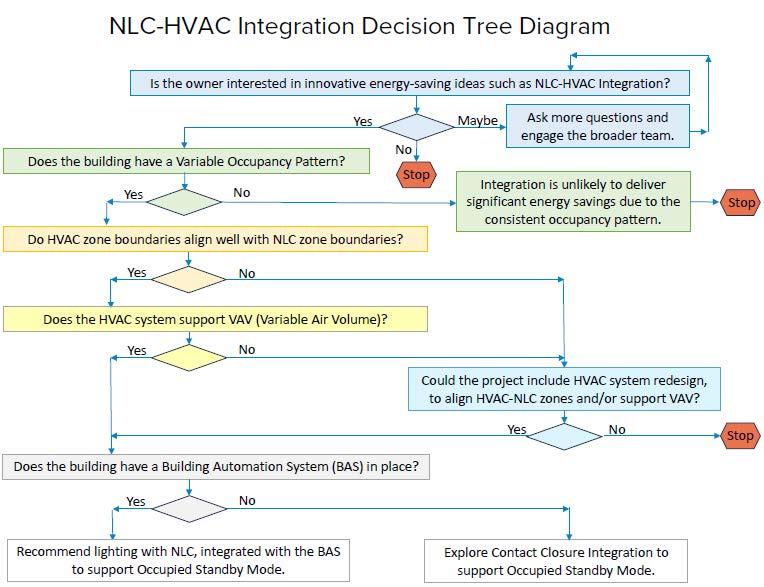
• Decision Tree: Guidance on identifying suitable projects and available incentives.
• Handbook: Roles, responsibilities, relevant standards, and a glossary.
• Responsibility Matrix: A task and accountability spreadsheet for integration projects.
• Case Studies: Eighteen successful examples across seven building types.
• Project Template: A sample integration specification aligned with CSI Division 25.
By providing these resources, the DLC supports better collaboration between the lighting and HVAC industries. The result is more projects that save energy by conditioning and lighting spaces only when needed.
Access the free toolkit here.