

designing lighting

Why UL Solutions?
Get circadian-effective news and updates
At UL Solutions, a global leader in safety science, testing, inspection and certification, we have the knowledge and expertise to help you navigate emerging lighting technologies and regulations.
Because lighting can impact human health and building environments, human-centric lighting (HCL) solutions designed for homes, offices and commercial spaces are of growing importance to:
• Building owners
• Indoor lighting specifiers
• Operations and facilities managers
• Sustainability managers
Connect with us to discuss your plans or to learn more about UL 24480, the Design Guideline for Promoting Circadian Entrainment with Light for Day-Active People. Visit us online and stay up to date on upcoming webinars and assets.
BOOM
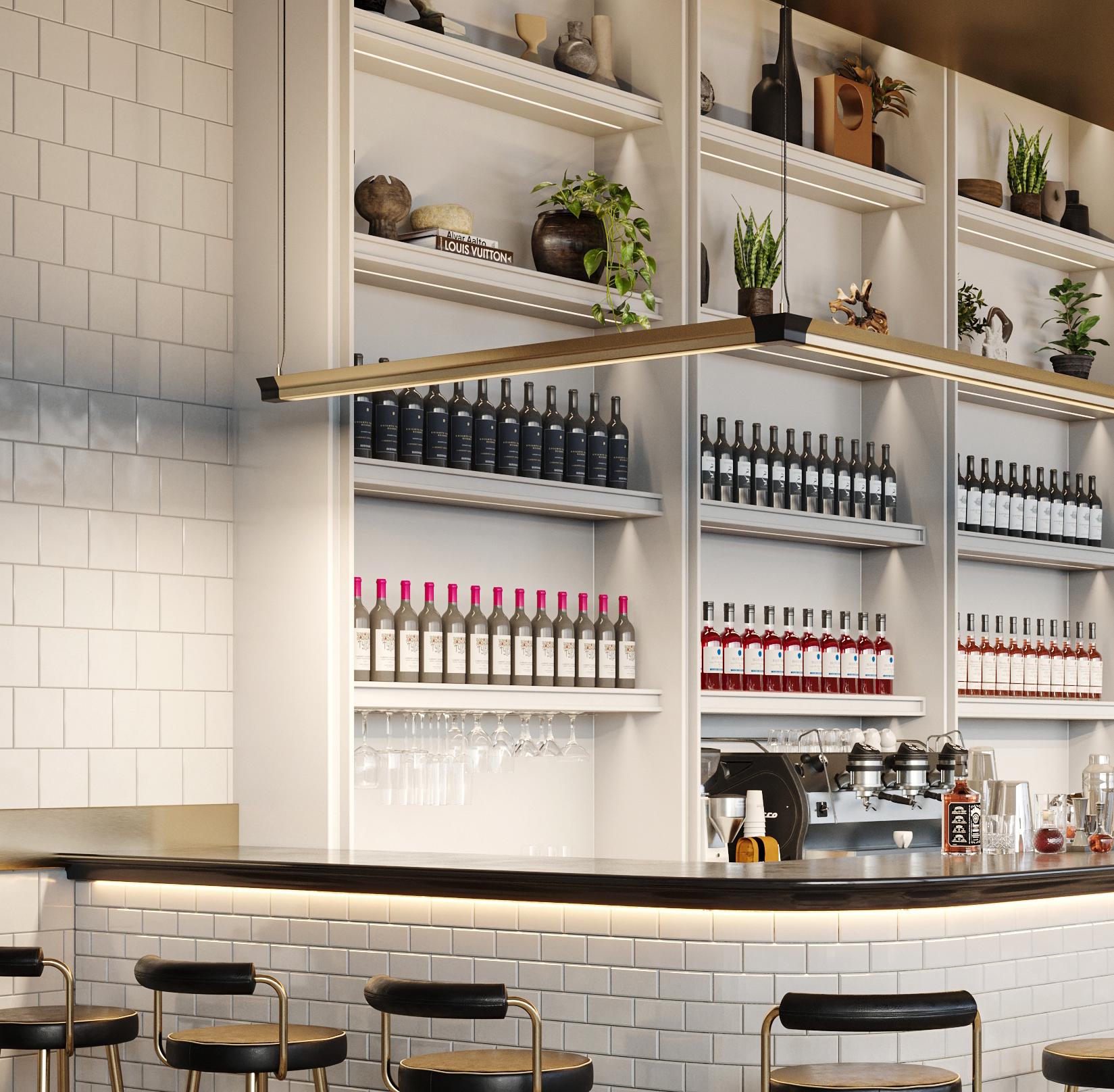
Impactful and highly customizable, this direct/indirect fixture allows you to specify down to the inch to create lines, squares, rectangles, U-shapes, and T-Shapes. Decorative panels and end caps match any décor, pairing sophisticated style with the high quality of our vast assortment of light engines and optics.

proud sponsor designing lighting, Tradeshows and conferences are vital to the development and growth of our industry. Please show your support by attending.
22-23Nov|London


Bock


PROJECT
Bock is committed to using only the highest quality materials with endless customization options to perfectly match your lighting requirements.

Photographer: Chad Baumer
By Mariana G. Figueiro, PhD and Mark S. Rea, PhD
A
By Randy Reid
Two
By Kelly Gordon
The


Mariana Figuiero
David Warfel
Abiran Raveenthiran Kelly Gordon
Jacob Wright
Parker Allen
Grand Wailea Maui
Jim Benya Stefanie Schwalb
Craig Dilouie

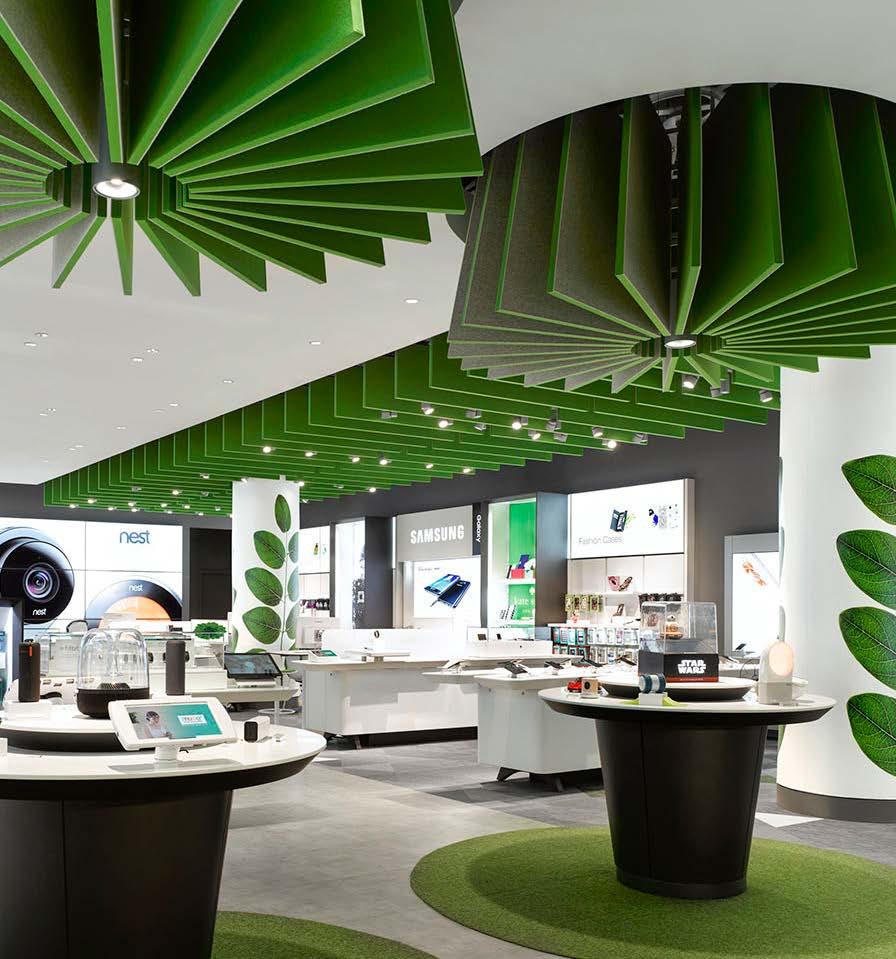


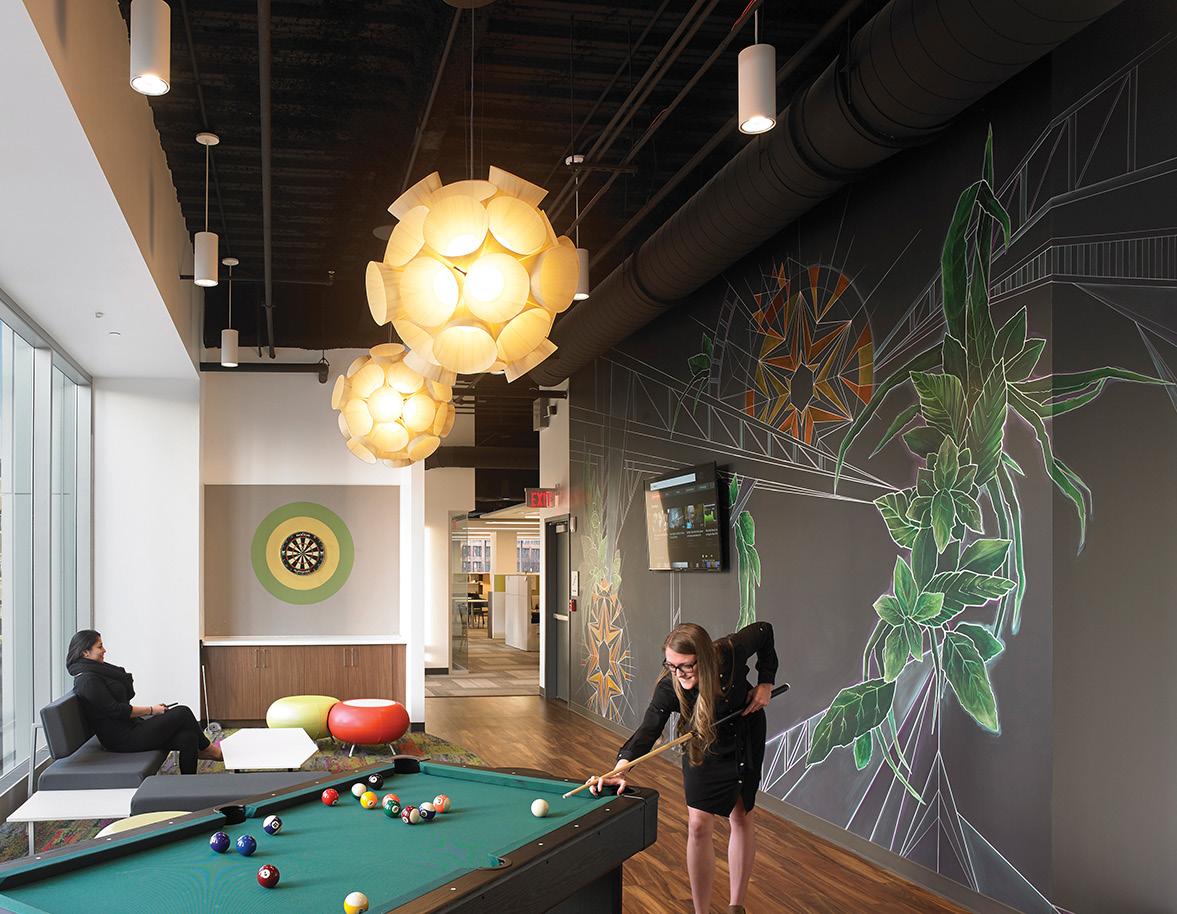


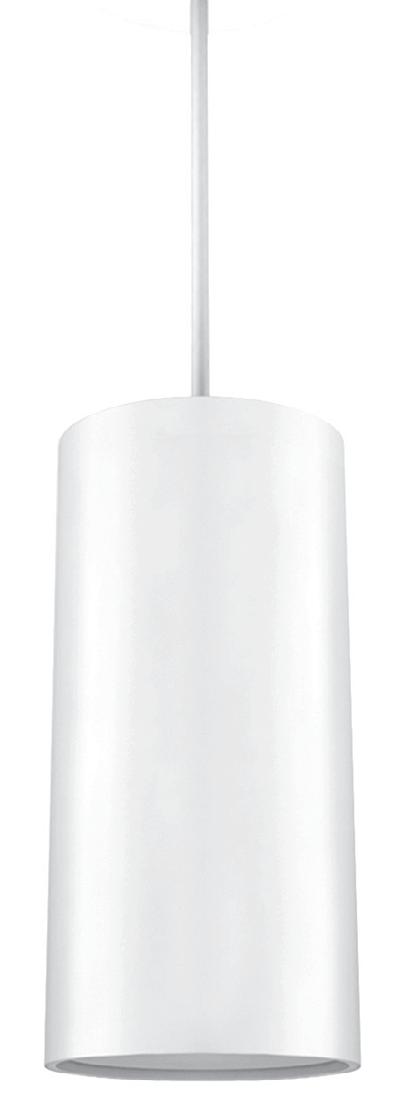


Every family has one.
The tall one. The short one. The outdoorsy kind. Those who rather stay in. Some are well-rounded. Others are complete squares.
But we share the same pedigree, so we hang together.
Thrive with our backs against the wall. Find a way to help others. And always lead the way.
Visit Bestlight.Amerlux.com/Rook-family to get to know our new interior and exterior family of architectural pendants and wall mounts, available direct or direct/indirect light distribution.
Rook 350 Wall Mount
Rook X
Rook 350 Round
Rook 475
Rook 350 Square
Rook 250 Mini
Rook 250
A Fresh Look at Luminaire-Level Lighting Controls
By Craig DiLouie, LC, CLCP
By Stef Schwalb
By David Warfel
By Abiran Raveenthiran
By Parker Allen

Photo Credit - Giada Paoloni
n 75% energy savings, low maintenance costs
n Sleek LED alternative to Corn Cob bulbs
n Traditional look of metal halide with LED bypass lamp performance
n Wide range of shapes, styles, and lumen packages
n Super lightweight


Editorial Director: Randy Reid
Editorial Director: Randy Reid

Publisher: Cliff Smith
Publisher: Cliff Smith
Director of Audience Development: Angie Hullfish
Director of Audience Development: Angie Hullfish
Contributing Writers:
Contributing Writers:
James Benya PE, FIES, FIALD
Principal at Design Services, Inc. and The Benya Burnett Consultancy
James Benya PE, FIES, FIALD Principal at Design Services, Inc. and The Benya Burnett Consultancy
Juan Davila
Craig Dilouie
Principal at ZING Communications
European Lighting Contributor Global Business Development Director HER Lighting
Stefanie Schwalb
Hospitality Lighting Contributor Interim Managing Editor at Boston Magazine
Craig Dilouie Principal at ZING Communications
David Warfel
Stefanie Schwalb
Residential Lighting Contributor
Hospitality Lighting Contributor Interim Managing Editor at Boston Magazine
Founding Designer Light Can Help You
David Warfel
Staff Writers:
Parker Allen
Katie Smith
Residential Lighting Contributor Founding Designer Light Can Help You
Jacob Wright
Staff Writers:
Published by EdisonReport
Parker Allen
Katie Smith
Jacob Wright
1726C General George Patton Dr. Brentwood, TN 37027
Phone: 615-371-0961 designinglighting.com
Published by EdisonReport 1726C General George Patton Dr. Brentwood, TN 37027
Phone: 615-371-0961 designinglighting.com
designing lighting is focused on the Business of Lighting Design™ and provides business information to the lighting design community. In addition to the website, designing lighting publishes bi-monthly online magazines featuring original content, interviews within the community and highlights successful award winning lighting designs. While designing lighting is based in the U.S., it has contributors from Europe and is developing a global presence.
(ISSN 2693-9223)
designing lighting is focused on the Business of Lighting Design™ and provides business information to the lighting design community. In addition to the website, designing lighting publishes bi-monthly online magazines featuring original content, interviews within the community and highlights successful award winning lighting designs. While designing lighting is based in the U.S., it has contributors from Europe and is developing a global presence.
(ISSN 2693-9223)
Statements and opinions expressed in articles and editorials in dl are the expressions of contributors and do not necessarily represent the policies or opinions of the EdisonReport. Advertisements appearing in the publication are the sole responsibility of the advertiser.
Statements and opinions expressed in articles and editorials in dl are the expressions of contributors and do not necessarily represent the policies or opinions of the EdisonReport. Advertisements appearing in the publication are the sole responsibility of the advertiser.
Earlier this year we retained Signet Research to conduct our first editorial and advertising measurement study. The results revealed that designing lighting (dl) subscribers share their issue with 2.3 others in their professional office.
Earlier this year we retained Signet Research to conduct our first editorial and advertising measurement study. The results revealed that designing lighting (dl) subscribers share their issue with 2.3 others in their professional office.
In addition, 57% of subscribers report they specify or recommend purchase of products mentioned editorially or contacted the manufacturer for more information. And, 76% of subscribers are specifying or recommending the purchase of products advertised or contacting the advertiser for more information.
In addition, 57% of subscribers report they specify or recommend purchase of products mentioned editorially or contacted the manufacturer for more information. And, 76% of subscribers are specifying or recommending the purchase of products advertised or contacting the advertiser for more information.
We are pleased to confirm the good news of this thirdparty research: dl delivers an active, involved audience of subscribers, reading and specifying product cited editorially and, they are responding favorably to our advertisers.
We are pleased to confirm the good news of this thirdparty research: dl delivers an active, involved audience of subscribers, reading and specifying product cited editorially and, they are responding favorably to our advertisers.
At designing lighting (dl) our tag line is The Business of Lighting Design™️ and we love feedback! As circulation has grown, we see a recurring theme in our in our social media responses. Our subscribers prefer content where we visit the project and interview the design team in person. For me, it is far more exciting to write about a design where I have visited and met face-to-face with the designer to learn about the many challenges and solutions.
At designing lighting (dl) our tag line is The Business of Lighting Design™️ and we love feedback! As circulation has grown, we see a recurring theme in our in our social media responses. Our subscribers prefer content where we visit the project and interview the design team in person. For me, it is far more exciting to write about a design where I have visited and met face-to-face with the designer to learn about the many challenges and solutions.
In this issue, I visited two projects. the Grand Wailea Maui and the Aberta Bair Theater in Billings. I was on vacation in Maui and coincidently designer Kelly Hannon of Focus Lighting was at the resort commissioning fixtures. In Billings, Madeline Randolfi met me at the theater on a Saturday morning to accommodate my flight.
In this issue, I visited two projects. the Grand Wailea Maui and the Aberta Bair Theater in Billings. I was on vacation in Maui and coincidently designer Kelly Hannon of Focus Lighting was at the resort commissioning fixtures. In Billings, Madeline Randolfi met me at the theater on a Saturday morning to accommodate my flight.
Not only do we learn from visiting design teams at projects, we learn from meeting with designers at tradeshows. Later this month we will attend the IES Annual Conference (Orlando). In September, we will be at the ArchLIGHT Summit (Dallas) and the IALD Enlighten Americas (Palm Springs). In October, we will have a video Illumination Awards studio at Light + Building (Frankfurt) and attend the SDA Showcase (New York). Thanksgiving week, we will be at Light 22 (London).
Not only do we learn from visiting design teams at projects, we learn from meeting with designers at tradeshows. Later this month we will attend the IES Annual Conference (Orlando). In September, we will be at the ArchLIGHT Summit (Dallas) and the IALD Enlighten Americas (Palm Springs). In October, we will have a video Illumination Awards studio at Light + Building (Frankfurt) and attend the SDA Showcase (New York). Thanksgiving week, we will be at Light 22 (London).
If you are attending any of these shows, please say hello and give us your feedback.

If you are attending any of these shows, please say hello and give us your feedback.
Lighting control for the modern world
Casambi’s wireless lighting control system provides the most robust, cost-effective, and simple solution tailored for today’s and tomorrow’s lighting designers and electric engineers. With more than 3 million nodes installed, and an ecosystem of partners that continues to expand, Casambi is enabling award-winning products that suit any designer’s vision to deliver a full-featured lighting control system—without compromising on aesthetics or functionality.

CALL FOR NOMINATIONS
Want to make a difference in WILD from the top, or know someone who does? Nominations are open for the 2023 Board of Directors.
WILD has been operating under an elected Board of Directors capacity for the past year, with regional leadership supporting us. If you've taken notice and want to be a part of WILD from the top or know someone who does, consider being on our board! Nominate yourself or someone you think would shine, there are six chairs to fill on the panel to help in various ways. All WILD members are eligible to run and vote.
Visit the WILD website to find out more.
The first outdoor spotlight with darklight lens
Dark Sky precise light beams without spill light
Simply programmed Control with Bluetooth or 0-10V

10 distributions incl. adjustable zoom optics
Adjust light color dynamically with Tunable white and RGBW
Discover the new Beamer projector www.erco.com/beamer-site/en_us
Light is the fourth dimension of architecture

The Dark Skies Matter
By

JAMES R. BENYA, PE, FIES, FIALD
Softball complex in Panama City Beach, FL, Compliments of Pete Strasser
Designers of outdoor lighting are either facing or will soon face limitations on their designs by a new generation of codes and standards associated with the Dark Sky movement. While outdoor lighting codes are not a totally new idea, 21st century standards such as the Model Lighting Ordinance (MLO) are designed to restrict design freedom relative to off-site impacts like light trespass and light emitted upward into the sky. And the message is getting out to regulators. Those who work in California face the state’s environmental code, CalGREEN and the Title 24 energy code that together limit commercial lighting very much like the MLO does, and the California Coastal Commission is especially concerned about any lighting along or near the coastline. Those who work in Florida know that lighting on or near many of its beaches is restricted to long wavelength, fully shielded luminaires, and not many of them. And those who work in Southern Arizona face stiff standards to help preserve the night sky for astronomy. Slowly, place by place, modern lighting codes are becoming part of our regulatory framework.
To any lighting designer, this might seem unfair and severely limiting to artistic freedom. Several generations of inspired and award-winning designs might not ever be replicated, and in a number of cases, the original is being constrained to limited use or removed altogether. For example, the spectacular 2020 lighting of the Acropolis, winner of three [d]arc Awards, employs flood lighting techniques and high color temperature light sources that are frowned upon among dark sky advocates. The spectacular and iconic Twin Towers
of Light in New York are limited to sporadic use because they cause migratory birds to get lost in the beams and fly in circles to their deaths, by the thousands. And, in major cities where upper-story penthouse living is a luxury, prominent LED building identification and product advertising signs are facing well-financed opponents in high stakes legal battles to either prevent the signs altogether or, at least, require significant dimming and late-night shut off.
The start of the Dark Skies movement can be traced to the predecessors and founders of the International Dark-Sky Association. IDA was founded in 1991 by Dr. David Crawford, an astronomer and recipient of the 2021 IES Medal, and Dr. Tim Hunter. Although heavily influenced by the impacts on astronomy by anthropogenic light at night (ALAN), IDA has somehow managed to take a broad view of the topic and early on, looked upon ALAN’s impacts on people, plants, and all other manner of living beings. Even before the “human centric lighting” era, IDA members and other scientists were studying the impacts (mostly negative) of ALAN with disturbing results. Thanks to Dr. Crawford and his unbeatable promoting skills, the IDA and IES collaborated in developing the MLO, including the lighting zones, TM-15-11 and the BUG system. Meanwhile, a pair of scientists from the University of Southern California, Dr. Travis Longcore and Catherine Rich, published Ecological Consequences of Artificial Night Lighting that discusses the impacts of light at night on a number of different species. Their work became an integral part of the Dark Skies movement. There are still challenges in bringing them together, but that’s

buildings in 1979. Now, we must turn our attention to reducing
what I think professional lighting designers should do.
what I think professional lighting designers should do.
It has taken a decade since the MLO for the dark skies idea to even begin to mature. At first, there was an undercurrent of push-back because outdoor lighting was competing with the energy efficiency improvements of using LED luminaires. Early LEDs were most efficient at high color temperatures, and this gave rise to 4000K and 5000K lighting outdoors that still persists. But major improvements in 3000K, 2700K and now 2200K have occurred, and the efficacy of these sources is at least 75% of that attainable with the glaringly bright high CCT lights. This became critically important in 2015 when the American Medical Association, frustrated with a lack of progress and the amount of disinformation, took a stand in declaring all outdoor lighting should be 3000K and less. I remain frustrated, however, as far too many people confuse glare with good vision and think 4000K (or higher) is good because its glaring. It is not, with a few notable exceptions. For instance, the US Tennis Association (USTA) requires 4000K or higher for competitive tennis court lighting. I still wonder how they played tennis under incandescent lighting, but honestly, I think it has more to do with television cameras than tennis.
It has taken a decade since the MLO for the dark skies idea to even begin to mature. At first, there was an undercurrent of push-back because outdoor lighting was competing with the energy efficiency improvements of using LED luminaires. Early LEDs were most efficient at high color temperatures, and this gave rise to 4000K and 5000K lighting outdoors that still persists. But major improvements in 3000K, 2700K and now 2200K have occurred, and the efficacy of these sources is at least 75% of that attainable with the glaringly bright high CCT lights. This became critically important in 2015 when the American Medical Association, frustrated with a lack of progress and the amount of disinformation, took a stand in declaring all outdoor lighting should be 3000K and less. I remain frustrated, however, as far too many people confuse glare with good vision and think 4000K (or higher) is good because its glaring. It is not, with a few notable exceptions. For instance, the US Tennis Association (USTA) requires 4000K or higher for competitive tennis court lighting. I still wonder how they played tennis under incandescent lighting, but honestly, I think it has more to do with television cameras than tennis.
That said, I am encouraged by the increasing stream of publicity and several important initiatives. In 2021, the IES and IDA announced a strategic collaboration to address “the global issue of light pollution that negatively affects our environment and the human condition.” The first joint action was to create “Five Principles for Responsible Outdoor Lighting,” that include
That said, I am encouraged by the increasing stream of publicity and several important initiatives. In 2021, the IES and IDA announced a strategic collaboration to address “the global issue of light pollution that negatively affects our environment and the human condition.” The first joint action was to create “Five Principles for Responsible Outdoor Lighting,” that include
1. All lighting should have a clear purpose
1. All lighting should have a clear purpose
2. Light should be directed only where needed
2. Light should be directed only where needed
3. Light should be no brighter than necessary
3. Light should be no brighter than necessary
4. Light should be on only when it is useful
4. Light should be on only when it is useful
5. Use warmer colored lights where possible
5. Use warmer colored lights where possible
The MLO helped by providing professionals with guidance, and the USGBC helped by adding controlling light pollution as a point in LEED. But still, the three major decision makers for most lighting remain price, availability, and whether it will light the heck out of everything. Nasty, glaring 5000K LED floodlights and LED replacement lamps are leaping off the shelves of distributors and DIY stores and onto small commercial properties and private homes at an alarming rate, and ill-advised cities are installing 4000K LED streetlights. People tend to relate glare with safety and security. This awful trend breaks every one of the five principles, and it is out of control at the moment.
The MLO helped by providing professionals with guidance, and the USGBC helped by adding controlling light pollution as a point in LEED. But still, the three major decision makers for most lighting remain price, availability, and whether it will light the heck out of everything. Nasty, glaring 5000K LED floodlights and LED replacement lamps are leaping off the shelves of distributors and DIY stores and onto small commercial properties and private homes at an alarming rate, and ill-advised cities are installing 4000K LED streetlights. People tend to relate glare with safety and security. This awful trend breaks every one of the five principles, and it is out of control at the moment.
Now along comes help from two influential organizations that I think can make a quantum difference. DesignLights Consortium® (DLC) has introduced LUNA, technical requirements that are “…intended to mitigate negative impacts of lighting at night by establishing system performance specifications and best practices.” It serves as a qualified products program similar to their energy efficiency programs, and I hope will be used by utilities and ESCOs to eliminate poor lighting practices in the retrofit and replacement lighting market.
Now along comes help from two influential organizations that I think can make a quantum difference. DesignLights Consortium® (DLC) has introduced LUNA, technical requirements that are “…intended to mitigate negative impacts of lighting at night by establishing system performance specifications and best practices.” It serves as a qualified products program similar to their energy efficiency programs, and I hope will be used by utilities and ESCOs to eliminate poor lighting practices in the retrofit and replacement lighting market.
The other is the National Association of Innovative Lighting Distributors (NAILD), a national nonprofit trade association driving lighting innovation through networking and education. They believe that through proper training, the distributor’s employee “at the counter” will educate electricians and contractors as they sell them appropriate gear. They have embarked on a Dark Sky Training program for their members. I think this may be one of the best ideas yet, as a huge percentage of lighting “designs” are in fact the recommendations of a salesperson. Try to imagine a world without unshielded 5000K floodlights and wallpacks! Now if only the DIY stores and websites would stop selling high CCT LED products to consumers.
The other is the National Association of Innovative Lighting Distributors (NAILD), a national nonprofit trade association driving lighting innovation through networking and education. They believe that through proper training, the distributor’s employee “at the counter” will educate electricians and contractors as they sell them appropriate gear. They have embarked on a Dark Sky Training program for their members. I think this may be one of the best ideas yet, as a huge percentage of lighting “designs” are in fact the recommendations of a salesperson. Try to imagine a world without unshielded 5000K floodlights and wallpacks! Now if only the DIY stores and websites would stop selling high CCT LED products to consumers.
Finally, dark sky concerns are not limited to lighting, either. A whole new generation of billboards and signs using LED pixels instead of floodlights is rapidly replacing old fashioned billboards, offering constantly changing and very bright images. In response, IES RP-39-19 dramatically reduces recommended sign luminance according to lighting zone, which is a start. But, it does not address the ability to “aim” the light of a modern LED billboard at an intended audience while not lighting neighbors’ homes and yards and seems based on obsolete technology and techniques. Now that LED billboards can be aimed and dimmed and their emitted spectrum controlled according to time, I foresee a revolution in this already evolving marketplace that will also require visionary leadership to develop appropriate standards based on new capabilities.
Finally, dark sky concerns are not limited to lighting, either. A whole new generation of billboards and signs using LED pixels instead of floodlights is rapidly replacing old fashioned billboards, offering constantly changing and very bright images. In response, IES RP-39-19 dramatically reduces recommended sign luminance according to lighting zone, which is a start. But, it does not address the ability to “aim” the light of a modern LED billboard at an intended audience while not lighting neighbors’ homes and yards and seems based on obsolete technology and techniques. Now that LED billboards can be aimed and dimmed and their emitted spectrum controlled according to time, I foresee a revolution in this already evolving marketplace that will also require visionary leadership to develop appropriate standards based on new capabilities.
The big question that the lighting industry should ask itself is whether we want to make a bigger commitment and get better organized to address how our work ends up regulated. Like many things in our industry, we rely too much on personal initiatives until the government gets involved. That’s how energy codes went, and how, until recently, we, the IES, and the lighting industry developed the lighting energy codes as professionals and experts. Unfortunately, once governments get involved, the industry as a whole loses control as lobbyists and influencers take over and the probability of a high-quality and appropriate outcome diminishes. We are at an inflection point in the challenge to achieve and maintain dark skies. I hope we can rise to the occasion and, like we did with energy codes, encourage better applications, design skills and our own standards well enough to achieve significantly darker skies without excessive government blundering. ■
The big question that the lighting industry should ask itself is whether we want to make a bigger commitment and get better organized to address how our work ends up regulated. Like many things in our industry, we rely too much on personal initiatives until the government gets involved. That’s how energy codes went, and how, until recently, we, the IES, and the lighting industry developed the lighting energy codes as professionals and experts. Unfortunately, once governments get involved, the industry as a whole loses control as lobbyists and influencers take over and the probability of a high-quality and appropriate outcome diminishes. We are at an inflection point in the challenge to achieve and maintain dark skies. I hope we can rise to the occasion and, like we did with energy codes, encourage better applications, design skills and our own standards well enough to achieve significantly darker skies without excessive government blundering. ■

PUCL post-top LED lanterns from Holophane® at the City Hall in Fountain, Colorado.

Santa & Cole
Lighting for Circadian Entrainment in Myeloma Transplant Patients
Lighting for Circadian Entrainment in Myeloma Transplant Patients
MARIANA G. FIGUEIRO, PHD
By Professor and Director, Light and Health Research Center
MARIANA G. FIGUEIRO, PHD By Professor and Director, Light and Health Research Center
The survival of virtually any organism depends on a complex system of internally generated, repeating physiological processes called circadian rhythms. In humans, these rhythms cycle at a period of roughly (but not exactly) 24 hours and include processes such as sleeping and waking, hormone production (e.g., melatonin and cortisol), core body temperature, and digestion, just to name a few. The pattern of light and dark on the retina is the principal environmental cue for synchronizing human circadian rhythms to our local position on Earth, ensuring our body does the right things at the right times of day and night. Disruption of these rhythms by light at night and insufficient daytime light exposures has been linked to poor sleep and a host of health and behavioral problems.
The survival of virtually any organism depends on a complex system of internally generated, repeating physiological processes called circadian rhythms. In humans, these rhythms cycle at a period of roughly (but not exactly) 24 hours and include processes such as sleeping and waking, hormone production (e.g., melatonin and cortisol), core body temperature, and digestion, just to name a few. The pattern of light and dark on the retina is the principal environmental cue for synchronizing human circadian rhythms to our local position on Earth, ensuring our body does the right things at the right times of day and night. Disruption of these rhythms by light at night and insufficient daytime light exposures has been linked to poor sleep and a host of health and behavioral problems.
Patients with multiple myeloma—a cancer that forms in plasma cells and accumulates in bone marrow, crowding out healthy blood cells that fight infection—spend 2–3 weeks in hospital rooms while undergoing autologous stem cell transplantation to combat the disease. The healthcare environment’s typically low daytime light levels and frequent exposures to light at night can lead to circadian disruption and compromise patients’ recovery. To address these concerns, the Light and Health Research Center (LHRC) and collaborators (William Redd and Heiðdís Valdimarsdottir), under funding from the National Cancer Institute, conducted peerreviewed pilot research to determine whether administering circadian-effective light early in the day could maintain multiple myeloma patients’ alignment with the day-night cycle, as indicated by high nighttime melatonin levels and good sleep quality.
Patients with multiple myeloma—a cancer that forms in plasma cells and accumulates in bone marrow, crowding out healthy blood cells that fight infection—spend 2–3 weeks in hospital rooms while undergoing autologous stem cell transplantation to combat the disease. The healthcare environment’s typically low daytime light levels and frequent exposures to light at night can lead to circadian disruption and compromise patients’ recovery. To address these concerns, the Light and Health Research Center (LHRC) and collaborators (William Redd and Heiðdís Valdimarsdottir), under funding from the National Cancer Institute, conducted peerreviewed pilot research to determine whether administering circadian-effective light early in the day could maintain multiple myeloma patients’ alignment with the day-night cycle, as indicated by high nighttime melatonin levels and good sleep quality.
Fifty-five patients were randomly assigned to two lighting conditions, providing either circadian-effective light (n=27) or circadian-ineffective light (n=28) in their hospital rooms between 7 and 10 a.m. each day. The circadian-effective light treatment was specified following the circadian stimulus (CS) model developed by LHRC researchers over the past 20 years.1-4 For this study, the circadian effective light was specified to a criterion CS value of
Fifty-five patients were randomly assigned to two lighting conditions, providing either circadian-effective light (n=27) or circadian-ineffective light (n=28) in their hospital rooms between 7 and 10 a.m. each day. The circadian-effective light treatment was specified following the circadian stimulus (CS) model developed by LHRC researchers over the past 20 years.1-4 For this study, the circadian effective light was specified to a criterion CS value of

Figure 1: The typical position of the experimental luminaire in a patient room. Daysimeters were positioned on the wall behind the head of the patient bed, on the luminaire, and on the patient’s chest as a pendant.
Figure 1: The typical position of the experimental luminaire in a patient room. Daysimeters were positioned on the wall behind the head of the patient bed, on the luminaire, and on the patient’s chest as a pendant.
0.3, been in sleep in populations.5-7 (Readers are to explore the LHRC’s freely available Calculator
0.3, which has been shown in field studies to improve sleep in other populations.5-7 (Readers are encouraged to explore the LHRC’s freely available web-based CS Calculator.)
The Lighting
The
Acuity Brands developed the study’s custom-made freestanding 3000K luminaires (Figure 1), which were used to deliver either the circadian-effective bright white light (BWL) condition (ranging between 1000 lx and 1300 lx, CS = 0.3) or the circadian-ineffective dim white light (DWL) condition (about 90 lx, CS = 0.1), measured at the patient beds’ pillow surface. The CCT of 3000K was chosen to make the rooms’ appearance less institutional and more homelike, and the ambient lighting form factor was selected over light boxes to reduce patients’ compliance burden. CS levels were continuously monitored on the wall behind each bed, on each luminaire, and at each patients’ chest level using three separate Daysimeters (calibrated light meters developed by LHRC researchers8, 9). The measurements showed that patients in the BWL condition received significantly (p < 0.001) higher CS values than those in the DWL condition.
Acuity developed the study’s freestanding 3000K luminaires which used to deliver either the circadian-effective bright white light (BWL) condition (ranging between 1000 lx and 1300 lx, CS = 0.3) or the circadian-ineffective dim white light (DWL) condition (about 90 lx, CS = 0.1), measured at patient pillow surface. The of 3000K was chosen make less homelike, and ambient lighting form was over boxes reduce patients’ compliance burden. CS levels were continuously monitored on the wall behind each bed, on each and patients’ chest using three separate Daysimeters (calibrated light meters developed LHRC 9). showed the received significantly (p < 0.001) higher CS values than those in the
Study Results
Study
Sleep quality and depression scores were assessed prior to hospitalization, on post-transplant days two and seven, and on post-engraftment day three (i.e., after the body accepts the transplanted stem cells,
Sleep quality depression were prior to hospitalization, on post-transplant days two and seven, and on post-engraftment day three (i.e., after the accepts the cells,
the discharge from Nighttime were to and Sleep was using devices measure activity assessed
Center for Epidemiological Studies Depression Scale (CES-D). Nighttime melatonin levels were assessed via the measured concentrations of creatinine-corrected urinary melatonin-sulfate (6-sulfatoxymelatonin, or 6-SMT) in the patients’ first morning void urine samples.
typically the day before discharge from the hospital). Nighttime melatonin levels were assessed prior to hospitalization and post engraftment. Sleep quality was assessed using wrist-worn devices that measure activity and light. Depression scores were assessed using the Center for Epidemiological Studies Depression Scale (CES-D). Nighttime melatonin levels were assessed via the measured concentrations of creatinine-corrected urinary melatonin-sulfate (6-sulfatoxymelatonin, or 6-SMT) in the patients’ first morning void urine samples.
Patients’ sleep time in the BWL condition steadily improved over the course of the study, whereas those in the DWL condition slept for shorter durations by the study’s end compared to the beginning (Figure 2A).
Patients’ sleep time in the BWL condition steadily improved over the course of the study, whereas those in the DWL condition slept for shorter durations by the study’s end compared to the beginning (Figure 2A).
Depression scores, obtained in an earlier, peer-reviewed iteration of this study10 involving fewer patients (BWL = 23 patients, DWL = 21 patients), but retaining the strong statistical effect, were also significantly better among those experiencing the BWL condition compared to those in the DWL condition (Figure 2B).
Depression scores, obtained in an earlier, peer-reviewed iteration of this study10 involving fewer patients (BWL = 23 patients, DWL = 21 patients), but retaining the strong statistical effect, were also significantly better among those experiencing the BWL condition compared to those in the DWL condition (Figure 2B).
Patients’ nighttime melatonin levels in the DWL condition declined compared to their pre-hospitalization levels. The levels among patients in the BWL condition remained almost constant, suggesting that their circadian rhythms remained aligned following their admission and treatment (Figure 3).
levels in declined to their The levels among BWL condition remained suggesting rhythms following and (Figure 3).
Discussion
Our study suggests that implementing a robust, appropriately timed pattern of light and dark in hospital
study that robust, timed light dark hospital

Figure 2. (A) Mean sleep time (in minutes) throughout the study’s four assessment days for the two light conditions. Although not statistically significant, sleep duration at the end of hospitalization increased by over 50 minutes in the BWL group compared to the DWL group. (B) Depression (CES‐D) scores throughout the study’s four assessment days for the two light conditions. Mean depressive symptoms increased for both groups, but only the mean score for patients in the DWL condition met the criteria for clinically significant depression. The data presented in panel B were reported in Valdimarsdottir et al.10
Figure (A) sleep minutes) study’s four for the light conditions. Although not significant, at end of increased over 50 minutes the group compared the DWL (B) Depression scores the assessment days two conditions. increased for groups, the mean score patients in DWL the criteria clinically significant depression. data in panel reported Valdimarsdottir et
rooms can maintain patients’ circadian alignment, which leads to better sleep. Given that good sleep has been linked to a series of health benefits, this approach represents an important first step for improving health in hospitalized patients, especially among those in longer term recovery from procedures like autologous stem cell transplantation.
rooms can maintain patients’ circadian alignment, which leads to better sleep. Given that good sleep has been linked to a series of health benefits, this approach represents an important first step for improving health in hospitalized patients, especially among those in longer term recovery from procedures like autologous stem cell transplantation.
These results should be interpreted in the context of some important limitations, the principal ones being the study’s preliminary nature and small sample size. Also, because the results do not include post-hospitalization assessments, it cannot be said whether the circadian-effective light delivered during hospitalization affected primary disease outcomes during the extended post-transplant period. We have just been awarded a large grant from the National Cancer Institute to perform, together with Memorial Sloan Kettering Cancer Center in NYC, a clinical trial that will extend these preliminary results while also measuring immune function biomarkers and patients’ symptom burden.
These results should be interpreted in the context of some important limitations, the principal ones being the study’s preliminary nature and small sample size. Also, because the results do not include post-hospitalization assessments, it cannot be said whether the circadian-effective light delivered during hospitalization affected primary disease outcomes during the extended post-transplant period. We have just been awarded a large grant from the National Cancer Institute to perform, together with Memorial Sloan Kettering Cancer Center in NYC, a clinical trial that will extend these preliminary results while also measuring immune function biomarkers and patients’ symptom burden.
Despite these limitations, our findings demonstrate that this easy-to-deliver, lowcost intervention nonetheless improves sleep quality during hospitalization for autologous stem cell transplantation patients.
Despite these limitations, our findings demonstrate that this easy-to-deliver, lowcost intervention nonetheless improves sleep quality during hospitalization for autologous stem cell transplantation patients.
In our next column, we will outline possible design strategies for implementing a comprehensive lighting regime in hospital rooms to promote patient recovery and general well-being. ■
In our next column, we will outline possible design strategies for implementing a comprehensive lighting regime in hospital rooms to promote patient recovery and general well-being. ■
Despite these limitations, our findings demonstrate that this easy-to-deliver, low-cost intervention nonetheless improves sleep quality during hospitalization for autologous stem cell transplantation patients.
Despite these limitations, our findings demonstrate that this easy-to-deliver, low-cost intervention nonetheless improves sleep quality during hospitalization for autologous stem cell transplantation patients.

3. The mean difference between pre-hospitalization and post-treatment nighttime melatonin levels for the two conditions (6-SMT per ng/ng creatinine). The positive difference means that melatonin levels after hospitalization were significantly decreased in the patients receiving DWL, while they remained stable in the patients that received BWL, reinforcing the suggestion that circadian alignment was better maintained in patients who experienced the BWL condition.
3. The mean difference between pre-hospitalization and post-treatment nighttime melatonin levels for the two conditions (6-SMT per ng/ng creatinine). The positive difference means that melatonin levels after hospitalization were significantly decreased in the patients receiving DWL, while they remained stable in the patients that received BWL, reinforcing the suggestion that circadian alignment was better maintained in patients who experienced the BWL condition.
References Cited
References Cited
1. Rea MS, Figueiro MG, Bullough JD, Bierman A. A model of phototransduction by the human circadian system. Brain Research Reviews. 2005; 50: 213-228.
1. Rea MS, Figueiro MG, Bullough JD, Bierman A. A model of phototransduction by the human circadian system. Brain Research Reviews. 2005; 50: 213-228.
2. Rea MS, Figueiro MG, Bierman A, Bullough JD. Circadian light. Journal of Circadian Rhythms. 2010; 8: 2.
2. Rea MS, Figueiro MG, Bierman A, Bullough JD. Circadian light. Journal of Circadian Rhythms. 2010; 8: 2.
3. Rea MS, Nagare R, Figueiro MG. Modeling circadian phototransduction: Retinal neurophysiology and neuroanatomy. Frontiers in Neuroscience. 2021; 14: 1467.
3. Rea MS, Nagare R, Figueiro MG. Modeling circadian phototransduction: Retinal neurophysiology and neuroanatomy. Frontiers in Neuroscience. 2021; 14: 1467.
4. Rea MS, Nagare R, Figueiro MG. Modeling circadian phototransduction: Quantitative predictions of psychophysical data. Frontiers in Neuroscience. 2021; 15: 44.
4. Rea MS, Nagare R, Figueiro MG. Modeling circadian phototransduction: Quantitative predictions of psychophysical data. Frontiers in Neuroscience. 2021; 15: 44.
5. Figueiro MG, Kalsher M, Steverson BC, Heerwagen J, Kampschroer K, Rea MS. Circadian-effective light and its impact on alertness in office workers. Lighting Research & Technology. 2019; 51: 171-183.
5. Figueiro MG, Kalsher M, Steverson BC, Heerwagen J, Kampschroer K, Rea MS. Circadian-effective light and its impact on alertness in office workers. Lighting Research & Technology. 2019; 51: 171-183.
6. Figueiro MG, Plitnick B, Roohan C, Sahin L, Kalsher M, Rea MS. Effects of a tailored lighting intervention on sleep quality, rest–activity, mood, and behavior in older adults with Alzheimer’s disease and related dementias: A randomized clinical trial. Journal of Clinical Sleep Medicine. 2019; 15: 1757-1767.
6. Figueiro MG, Plitnick B, Roohan C, Sahin L, Kalsher M, Rea MS. Effects of a tailored lighting intervention on sleep quality, rest–activity, mood, and behavior in older adults with Alzheimer’s disease and related dementias: A randomized clinical trial. Journal of Clinical Sleep Medicine. 2019; 15: 1757-1767.
7. Figueiro MG, Sahin L, Kalsher M, Plitnick B, Rea MS. Long-term, all-day exposure to circadian-effective light improves sleep, mood, and behavior in persons with dementia. Journal of Alzheimer's Disease Reports. 2020; 4: 297-312.
7. Figueiro MG, Sahin L, Kalsher M, Plitnick B, Rea MS. Long-term, all-day exposure to circadian-effective light improves sleep, mood, and behavior in persons with dementia. Journal of Alzheimer's Disease Reports. 2020; 4: 297-312.
8. Bierman A, Klein TR, Rea MS. The Daysimeter: A device for measuring optical radiation as a stimulus for the human circadian system. Measurement Science and Technology. 2005; 16: 2292-2299.
8. Bierman A, Klein TR, Rea MS. The Daysimeter: A device for measuring optical radiation as a stimulus for the human circadian system. Measurement Science and Technology. 2005; 16: 2292-2299.
9. Figueiro MG, Hamner R, Bierman A, Rea MS. Comparisons of three practical field devices used to measure personal light exposures and activity levels. Lighting Research & Technology. 2013; 45: 421-434.
9. Figueiro MG, Hamner R, Bierman A, Rea MS. Comparisons of three practical field devices used to measure personal light exposures and activity levels. Lighting Research & Technology. 2013; 45: 421-434.
10. Valdimarsdottir HB, Figueiro MG, Holden W, Lutgendorf S, Wu LM, Ancoli‐Israel S, et al. Programmed environmental illumination during autologous stem cell transplantation hospitalization for the treatment of multiple myeloma reduces severity of depression: A preliminary randomized controlled trial. Cancer Medicine. 2018; 7: 4345-4353.
10. Valdimarsdottir HB, Figueiro MG, Holden W, Lutgendorf S, Wu LM, Ancoli‐Israel S, et al. Programmed environmental illumination during autologous stem cell transplantation hospitalization for the treatment of multiple myeloma reduces severity of depression: A preliminary randomized controlled trial. Cancer Medicine. 2018; 7: 4345-4353.
Figure
Figure

What happens when two industry innovators join forces? We’re ready to show you. GE Current, a Daintree company, and Hubbell Lighting have come together to form Current — your single source for reliable advanced lighting and intelligent controls. As Current, we’ll deliver the solutions you need and the value you seek — with greater e ciency and unrivaled customer service. Now that’s a powerful combination.
Photo Credit:

RANDY REID By


Saint Louis has long been associated with discovery, innovation, and collaboration. Just over 200 years ago this “Gateway to the West” served as the launchpad for a legendary expedition, and 100 years back a rising jazz star described its riverboats as “floating conservatories.”
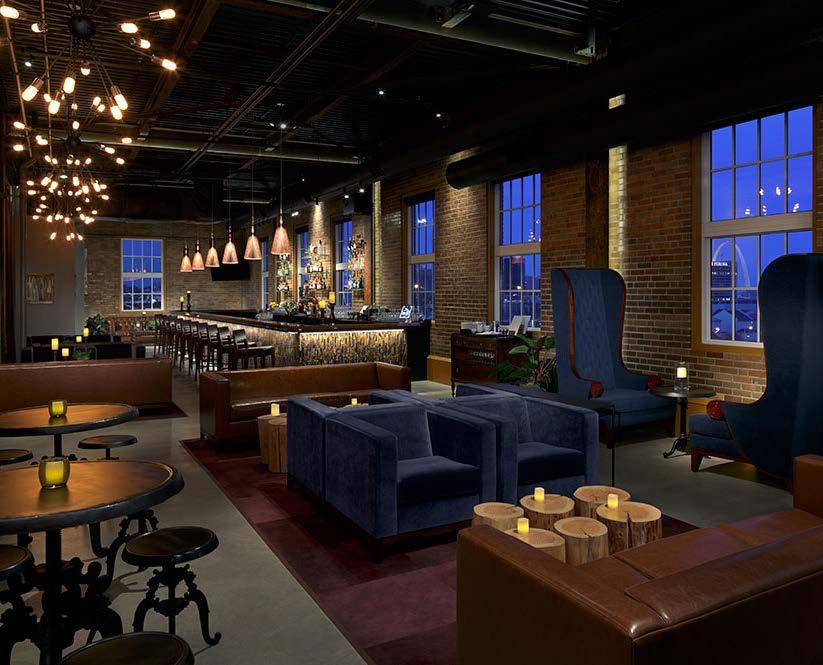
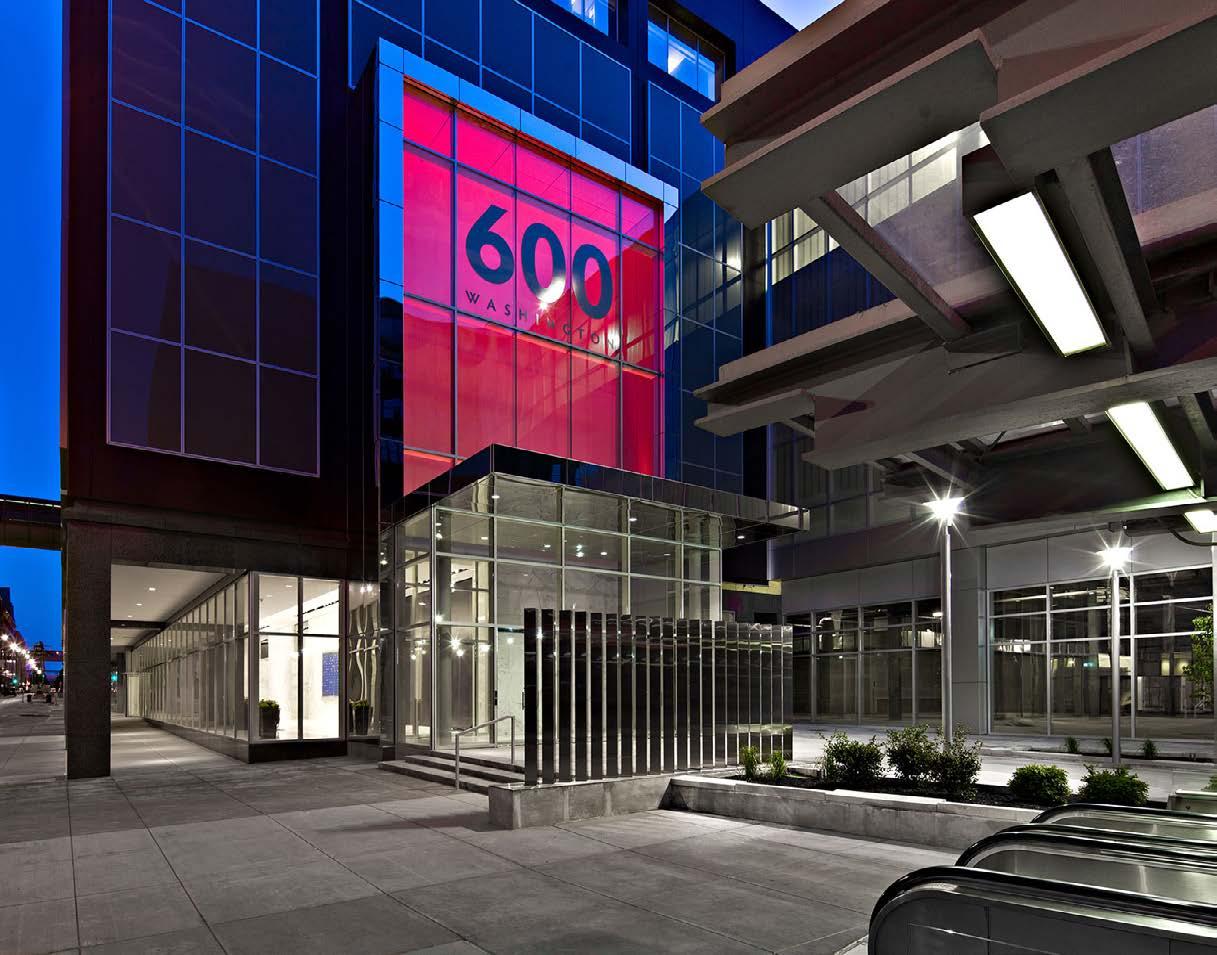
More recently, in 1993, a Saint Louis lighting luminary critiqued the senior project of an architectural engineering student. Little did they realize that this chance meeting would blossom into future collaborations and culminate in the merger of their lighting design firms. Randy Burkett Lighting Design and Envision Lighting Design have combined their considerable forces to become Reed Burkett Lighting Design.
When Randy Burkett had a key employee leave his company, what appeared at first to be bad news became fuel for transformation. As an alternative to finding senior lighting designers to fill in, he sought another lighting business owner whose collaboration might become long-term.
Randy Burkett and Lisa Reed had been collaborating on key projects for many years since that chance encounter in 1993. Lisa was coming in to help on key projects and working together led to the merger. Envision Lighting Design was a growing firm. Merging with Randy met certain of Lisa’s goals, and it put the two of them in a position to solicit new and exciting clients that neither had access to before. Lisa says of her mentor
turned business partner, “I’ve always admired Randy as my iconic definition of a lighting designer.”
turned business partner, “I’ve always admired Randy as my iconic definition of a lighting designer.”
Before the merger, Lisa’s firm was operating from a coworking space and searching for something more permanent. As fate would have it, Randy had some open office space and offered it well before they ever knew they would merge. The two of them value the office culture and the physical office experience and have hybrid set-ups and have worked to offer their employees flexibility between office and remote working.
Before the merger, Lisa’s firm was operating from a coworking space and searching for something more permanent. As fate would have it, Randy had some open office space and offered it well before they ever knew they would merge. The two of them value the office culture and the physical office experience and have hybrid set-ups and have worked to offer their employees flexibility between office and remote working.
When looking at trends, Randy says that, currently, outdoor lighting is over 50% of his business, but 20 years ago outdoor lighting was less than 20%. He designs lighting for many large-scale urban parks, sculpture gardens, and more. He believes that the current generation is excited about living in cities and making them livable, so the lighting is changing. Lisa on the other hand often works in healthcare, higher education, and commercial offices. Lisa and Randy had strengths in different markets, opening up new project opportunities for both of them.
When looking at trends, Randy says that, currently, outdoor lighting is over 50% of his business, but 20 years ago outdoor lighting was less than 20%. He designs lighting for many large-scale urban parks, sculpture gardens, and more. He believes that the current generation is excited about living in cities and making them livable, so the lighting is changing. Lisa on the other hand often works in healthcare, higher education, and commercial offices. Lisa and Randy had strengths in different markets, opening up new project opportunities for both of them.
Randy explained that a lot of his time was consumed by administrative work and that he wanted to get back to lighting design. He said, “The time I do have left in lighting, I want to spend designing, not administration.” His passion
Randy explained that a lot of his time was consumed by administrative work and that he wanted to get back to lighting design. He said, “The time I do have left in lighting, I want to spend designing, not administration.” His passion

for design is best demonstrated in the work he produces. He craves spending more time with clients and working on passion project. Lisa says that before the merger, she spent a lot of time doing billing and accounting but is excited to have a team of people who can take on office tasks, freeing her to do more design.
for design is best demonstrated in the work he produces. He craves spending more time with clients and working on passion project. Lisa says that before the merger, she spent a lot of time doing billing and accounting but is excited to have a team of people who can take on office tasks, freeing her to do more design.
When it comes to the current workload, the duo is plenty busy. Randy expresses that one of the biggest trials he used to face was convincing a client that lighting design is a legitimate discipline. Now it’s more likely to be seen as vital to the user, and most don’t need to be convinced that a lighting designer is essential. As Randy says, “The people who know enough about lighting to design successful environments need to be out there talking about it.”
When it comes to the current workload, the duo is plenty busy. Randy expresses that one of the biggest trials he used to face was convincing a client that lighting design is a legitimate discipline. Now it’s more likely to be seen as vital to the user, and most don’t need to be convinced that a lighting designer is essential. As Randy says, “The people who know enough about lighting to design successful environments need to be out there talking about it.”
The firm is now at work on a new visitor center for the botanical gardens in town and, like the gardens themselves, their firm is continuing to grow. “People are excited about lighting and realizing they’re making a difference with not only their clients but the whole world.”
The firm is now at work on a new visitor center for the botanical gardens in town and, like the gardens themselves, their firm is continuing to grow. “People are excited about lighting and realizing they’re making a difference with not only their clients but the whole world.”
And just who were those explorers venturing forth over 200 years ago from Saint Louis to light the path of westward expansion? You may have guessed it already: the legendary Lewis and Clark.
And just who were those explorers venturing forth over 200 years ago from Saint Louis to light the path of westward expansion? You may have guessed it already: the legendary Lewis and Clark.
And that future star plying the riverboat trade off the banks of Saint Louis? None other than the great Louis Armstrong. We look forward to seeing where the expedition takes Reed Burkett Lighting Design: perhaps to a place where light becomes music distilled. Saint Louis continues to inspire. ■
And that future star plying the riverboat trade off the banks of Saint Louis? None other than the great Louis Armstrong. We look forward to seeing where the expedition takes Reed Burkett Lighting Design: perhaps to a place where light becomes music distilled. Saint Louis continues to inspire. ■
LIGHTFAIR AWARD WINNER 2022
TRUCIRQUE & TRUCURVE
By PureEdge Lighting
Recessed Lighting Any Shape, Any Color
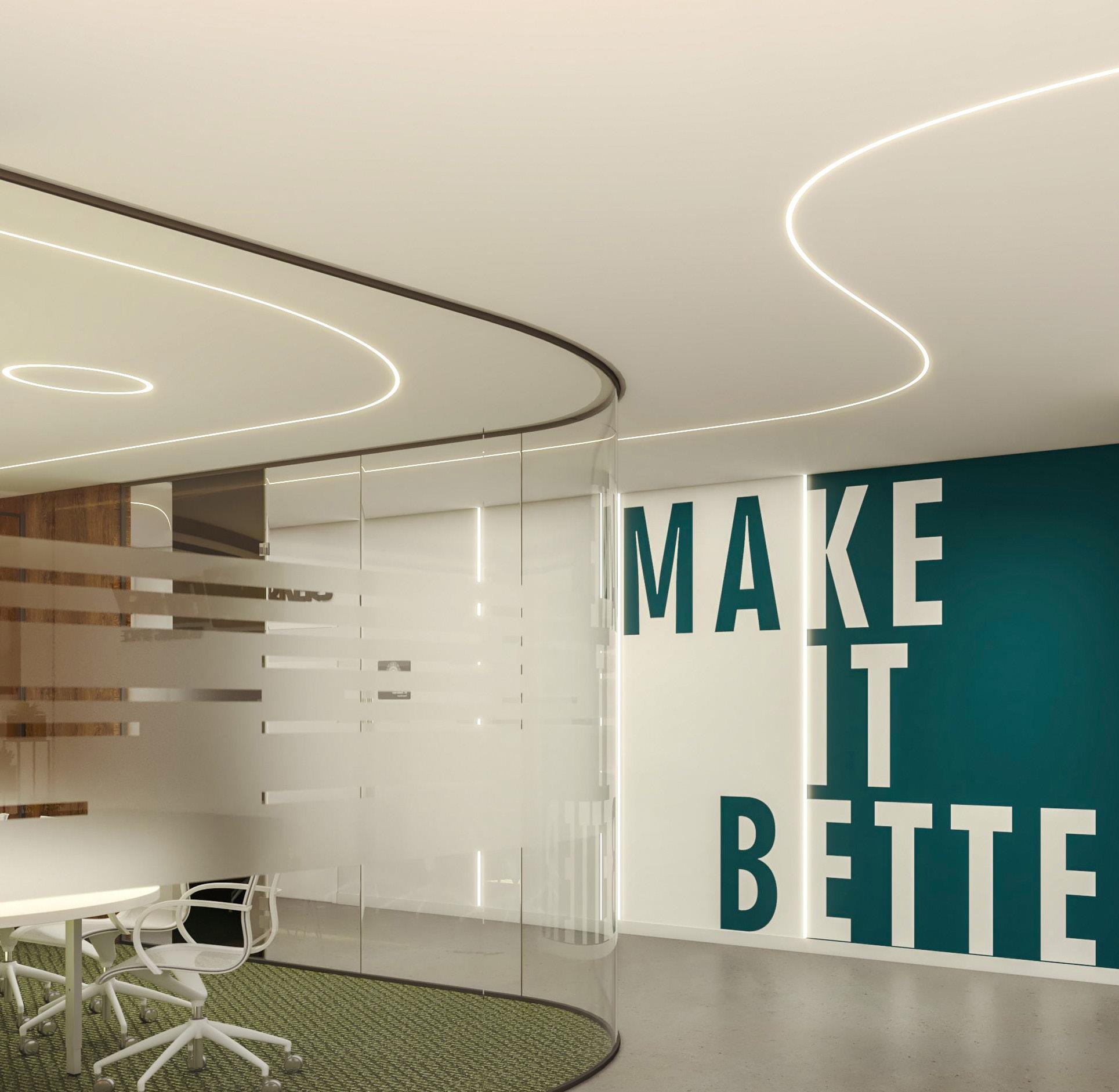
TruCirque, our patent-pending recessed 5/8” lighting system, is a pristine circle of continuous illumination and recent winner at this year’s LightFair! TruCurve, our new patent-pending curved recessed lighting system, can be used for the outer curvature of architectural features or used to create a unique curved design on a flat ceiling. They both have a half inch lens and plaster-in to the drywall for a smooth finish with no stud or joist modification required. Illuminate your unique space with any shape, any color! TruCirque and TruCurve feature Infinite Color RGB+TW, 6500K-2000K.

FOR MORE INFORMATION, CONTACT YOUR LOCAL PUREEDGE LIGHTING REPRESENTATIVE OR VISIT PUREEDGELIGHTING.COM

By
ECLECTICISM MIXES TRADITION WITH
ECLECTICISM MIXES TRADITION WITH


KATIE SMITH By
Photo Credit: Zumtobel
KATIE SMITH
Photo Credit: Zumtobel
Motuvun is a picturesque hilltop town in the countryside of Istria in Croatia. The Motuvun Forest at its base produces the region’s famous truffles and brings many visitors to the area. The views are spectacular overlooking the verdant valley below as well as its vineyards. Naturally, when Mladen Rožanić opened his boutique hotel, he aptly named it Roxanich which simply translates to good red wine.
Motuvun is a picturesque hilltop town in the countryside of Istria in Croatia. The Motuvun Forest at its base produces the region’s famous truffles and brings many visitors to the area. The views are spectacular overlooking the verdant valley below as well as its vineyards. Naturally, when Mladen Rožanić opened his boutique hotel, he aptly named it Roxanich which simply translates to good red wine.
The boutique hotel sits on a hillside and was designed by Idis Turato. Turato’s sleek creation lies in the heart of an emerging culinary area, surrounded by vineyards and the Livade truffle forests. The historical building turned hotel stands near the Motuvun cellar overlooking the Mirna River Valley.
The boutique hotel sits on a hillside and was designed by Idis Turato. Turato’s sleek creation lies in the heart of an emerging culinary area, surrounded by vineyards and the Livade truffle forests. The historical building turned hotel stands near the Motuvun cellar overlooking the Mirna River Valley.
Roxanich is a blend of contemporary and traditional with its large glass exterior, natural stone buildings and green shutters, reminiscent of old Istria The four-floor building holds thirty-two unique bedrooms, a restaurant, an event room, spa, lounge, club, wine cellars, winemaking, and many others. Turato wanted the lighting to evoke emotion and deeply
Roxanich is a blend of contemporary and traditional with its large glass exterior, natural stone buildings and green shutters, reminiscent of old Istria The four-floor building holds thirty-two unique bedrooms, a restaurant, an event room, spa, lounge, club, wine cellars, winemaking, and many others. Turato wanted the lighting to evoke emotion and deeply
connect with the architecture of the hotel. With Zumtobel on board, he easily integrated black-coated controllable lighting systems. To create an atmosphere of warmth and welcome, 3000K light fixtures are utilized throughout. Downlights are used to maintain energy efficiency, and in keeping with Turato’s sophisticated design, light sources are almost invisible.
connect with the architecture of the hotel. With Zumtobel on board, he easily integrated black-coated controllable lighting systems. To create an atmosphere of warmth and welcome, 3000K light fixtures are utilized throughout. Downlights are used to maintain energy efficiency, and in keeping with Turato’s sophisticated design, light sources are almost invisible.
In the hallways, lights are aimed to bring attention to specific design elements. General lighting contributes to elevate the surroundings. Vintage light fixtures are used in the restaurant, creating islands of light. The wine cellar holds a lightweight and highly resistant fixture with special optics to prevent glare The lighting design wouldn’t be complete without the controls that manage all lighting.
In the hallways, lights are aimed to bring attention to specific design elements. General lighting contributes to elevate the surroundings. Vintage light fixtures are used in the restaurant, creating islands of light. The wine cellar holds a lightweight and highly resistant fixture with special optics to prevent glare The lighting design wouldn’t be complete without the controls that manage all lighting.
Lighting design in a place that mixes traditional culture, modern design, and beautiful natural surroundings can be difficult. Lighting should highlight these features, not distract from them. Turato and Zumbotel met the challenges and the result is a sublime getaway in the hills of Croatia. ■
Lighting design in a place that mixes traditional culture, modern design, and beautiful natural surroundings can be difficult. Lighting should highlight these features, not distract from them. Turato and Zumbotel met the challenges and the result is a sublime getaway in the hills of Croatia. ■
Lighting design in a place that mixes traditional culture, modern design, and beautiful natural surroundings can be difficult. Lighting should highlight these features, not distract from them.
Lighting design in a place that mixes traditional culture, modern design, and beautiful natural surroundings can be difficult. Lighting should highlight these features, not distract from them.


STUDIO
S Submit your project. Its free. And easy!

MAKEOVER Maui
MAKEOVER Maui

By
A visit to the island of Maui must include a stop at the Grand Wailea, a Waldorf Astoria Resort. This getaway is an oceanfront paradise offering posh accommodations, award-winning restaurants, Hawaii's largest art collection and much more. Kelly Hannon of Focus Lighting recently completed and commissioned its spectacular lighting design.
A visit to the island of Maui must include a stop at the Grand Wailea, a Waldorf Astoria Resort. This getaway is an oceanfront paradise offering posh accommodations, award-winning restaurants, Hawaii's largest art collection and much more. Kelly Hannon of Focus Lighting recently completed and commissioned its spectacular lighting design.
Working from my temporary remote office a few miles away, I met Kelly at the site for a tour. (OK, I was really on vacation, but I did answer some emails.)
Working from my temporary remote office a few miles away, I met Kelly at the site for a tour. (OK, I was really on vacation, but I did answer some emails.)
As the Waldorf began the considerable remodeling job, they hired Tihany Design for interior design.
Focus Lighting, founded by Paul Gregory, has closely collaborated with Tihany for 20+ years and has done much design work on the islands, including the nearby Andaz Maui. In addition, Kelly had been involved in other
As the Waldorf began the considerable remodeling job, they hired Tihany Design for interior design. Focus Lighting, founded by Paul Gregory, has closely collaborated with Tihany for 20+ years and has done much design work on the islands, including the nearby Andaz Maui. In addition, Kelly had been involved in other
Waldorf properties, such as the ongoing NYC renovations, and quickly jumped on board to redesign these spaces.
Waldorf properties, such as the ongoing NYC renovations, and quickly jumped on board to redesign these spaces.
For the Grand Wailea, Kelly began in late 2019--right before COVID-19 hit. In most cases the pandemic slowed down projects, however this was unique in that COVID accelerated the project.
For the Grand Wailea, Kelly began in late 2019--right before COVID-19 hit. In most cases the pandemic slowed down projects, however this was unique in that COVID accelerated the project.
The tourism industry in Hawaii was completely shut down, therefore construction and other projects were pushed forward quickly. Issued in 2020, Kelly received seven scopes for the property, and they are being completed one-by-one. As of this writing, the two most recent are the lounge and the breakfast dining area. A grab-and-go snack area is in the works.
The tourism industry in Hawaii was completely shut down, therefore construction and other projects were pushed forward quickly. Issued in 2020, Kelly received seven scopes for the property, and they are being completed one-by-one. As of this writing, the two most recent are the lounge and the breakfast dining area. A grab-and-go snack area is in the works.
The most stunning design is the Botero Lounge. Kelly said, “They wanted to modernize the space so they
The most stunning design is the Botero Lounge. Kelly said, “They wanted to modernize the space so they
RANDY REID WITH KATIE SMITH By
RANDY REID WITH KATIE SMITH
Photo Credit: www.grandwailea.com

added a sushi counter up front, and made it more like a lounge.” Named after Fernando Botero, the Columbian artist, the lounge features Botero sculptures, new landscaping, and it exudes a modern Italian aesthetic.
Most eye-catching is the Laspec custom-made chandelier in the center featuring Philips warm glow bulbs.
Each bulb is 5 watts, with 90 CRI and dimming. During the day, luminaires are dialed down to around 60% output but can go as low as 20%. These dimto-warm bulbs are medium screw base sockets with a simple line voltage dimmer. The main fixture was
assembled on site and installed in January, but the drawings were approved in early 2021. Due to Covid, the manufacturing and transportation took 8 to 9 months.
Not bad for bespoke luminaires in the middle of a pandemic!
The Laspec chandelier anchoring the bar coordinates with the smaller decorative sconces mounted to the columns and table lamps attached to the bar top and integrated into the millwork liquor display. There is dramatic landscape lighting highlighting the design from VITA Landscape architects. Combined, these signature flourishes transform the Botero Lounge


Photo Credit: Kelly Hannon
Photo Credit: Kelly Hannon
are all in the same language.”
“They are not identical, but are all in the same language.”
Kelly Hannon
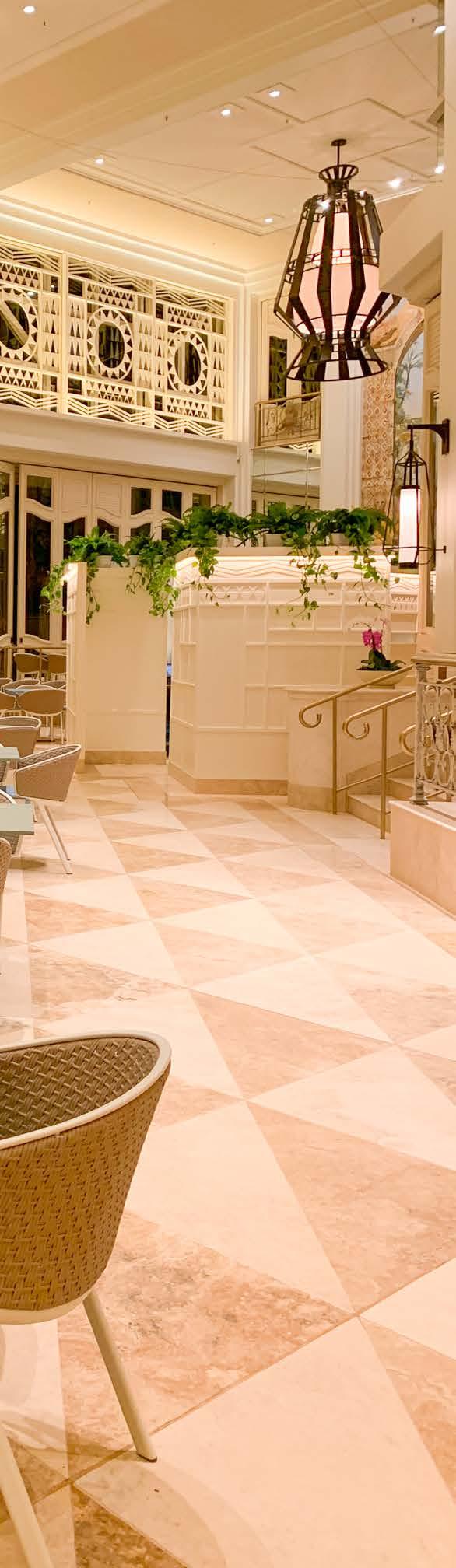
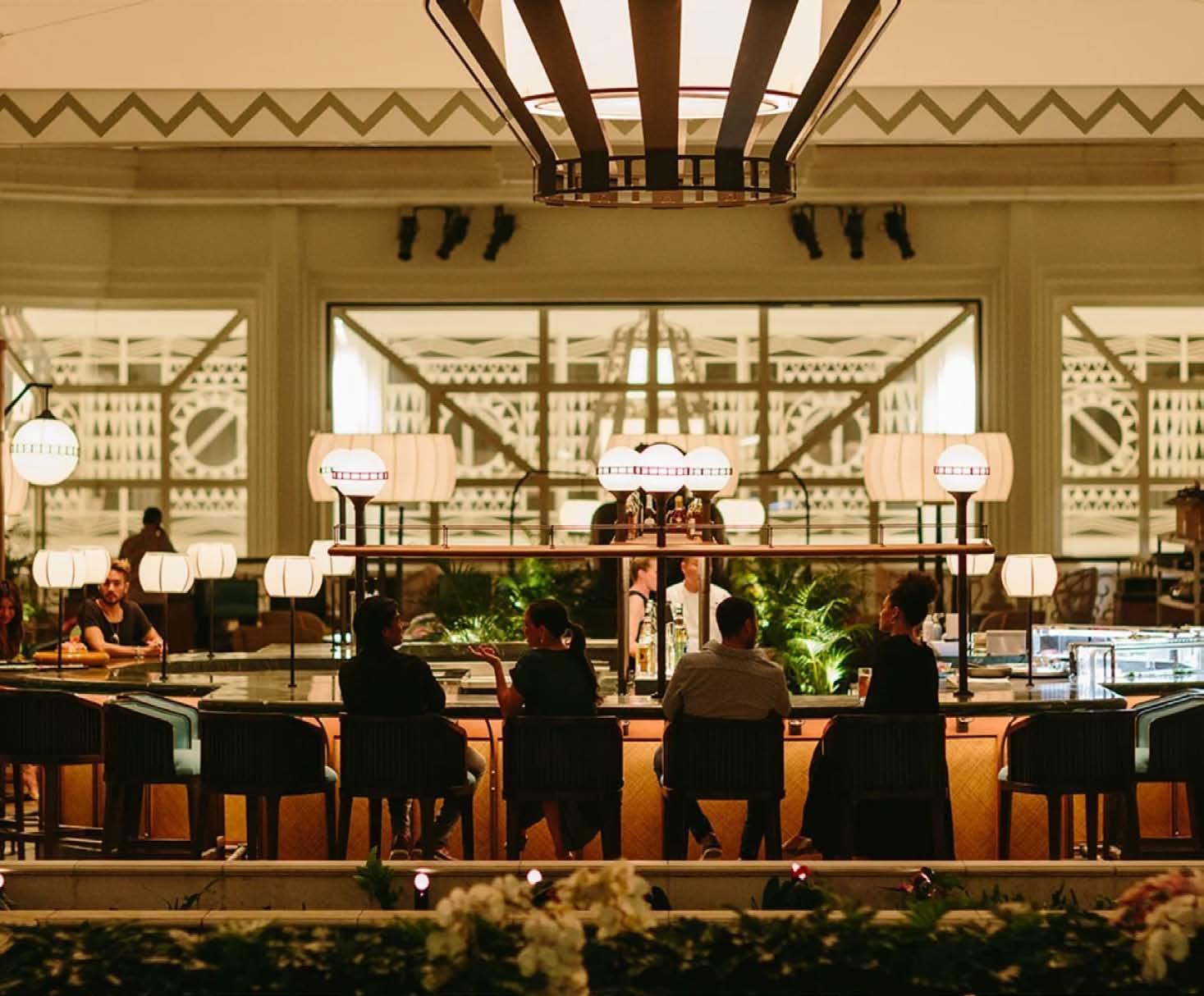
into a captivating outdoor oasis, well suited for live entertainment.
ellipsoidal projectors with gobos to create palm tree breakup patterns along the tiled floor.
Kelly made a point that really resonated with me: "They are not identical, but are all in the same language." That is when I began to study each fixture to see the subtle differences.
Kelly made a point that really resonated with me: "They are not identical, but are all in the same language." That is when I began to study each fixture to see the subtle differences.
The recessed fixtures from LF Illuminations,
The recessed fixtures from LF Illuminations, valuDIM luminaires, are aimed at walkways and bars. The valuDIM is adjustable with a round, flat minimal trim. It uses a standard driver which works with either 0-10v or forward or reverse phase dimmers and achieves minimum visible light output of less than 2%.
reverse phase dimmers and achieves minimum visible light output of less than 2%.
Consuming only 15-watts, these lights
Consuming only 15-watts, these lights emphasize the action at the lounge. Although the lounge isn't new, it’s been remodeled to fit with the resort’s modern and chic aesthetic.
The ‘Ikena grand dining space is used dayto-day for breakfast/brunch buffets and can also be rented for events such as weddings. The main lights in this area are Amerlux Evoke series downlights, wall washers, and accent
The ‘Ikena grand dining space is used dayto-day for breakfast/brunch buffets and can also be rented for events such as weddings. The main lights in this area are Amerlux Evoke series downlights, wall washers, and accent fixtures all in 2700K. Because the room gets so much natural daylight, the lights are primarily used at night.
After dark, the uplight linear luminaires throughout the resort illuminate screens with traditional Hawaiian patterns. The patio has
After dark, the uplight linear luminaires throughout the resort illuminate screens with traditional Hawaiian patterns. The patio has
As a special treat, Kelly took us to their current work-in-progress, Loulu. This is a grab-and-go cafe with new finishes, a new configuration, new lights, and new fans. This retail area includes Amerlux Hornet recessed adjustable
in place. She will return to redirect when the displays are in place.
As a special treat, Kelly took us to their current work-in-progress, Loulu. This is a grab-and-go cafe with new finishes, a new configuration, new lights, and new fans. This retail area includes Amerlux Hornet recessed adjustable accents and wet location accents over food prep surfaces. I was able to witness Kelly aiming the lights, without the retail displays in place. She will return to redirect when the displays are in place.
Moving away from admiring the beautiful work, we talked about the business of lighting design. Focus frequently works with repeat customers and collaborators, which is how
Moving away from admiring the beautiful work, we talked about the business of lighting design. Focus frequently works with repeat customers and collaborators, which is how this project came about. While the scope varies by client’s needs, it generally covers all phases of design including schematic design, design development, and construction documentation. It also covers construction administration which entails extensive coordination on shop drawings and submittals as well as site visits. The process culminates in the commissioning trip to apply the finishing touches and deliver the full vision to the client.
all phases of design including schematic design, design development, and construction documentation. It also covers construction administration which entails extensive coordination on shop drawings and submittals as well as site visits. The process culminates in
It was a joy to tour the space with Kelly, where she showed off her unique and modern design, and how first-class lighting dramatically elevated the Grand Wailea resort. ■
It was a joy to tour the space with Kelly, where she showed off her unique and modern design, and how first-class lighting dramatically elevated the Grand Wailea resort. ■
Photo Credit: www.grandwailea.com

“There’s beauty in these fixtures, they have the appropriate scale and
BILLINGS IS Booming!
BILLINGS IS Booming!
RANDY REID By
By
With the recent work-from-anywhere mantra, people are on the move and Montana is growing. I found myself in Big Sky Country earlier this month at a GE Lamp reunion celebrating with people who worked together in the Atlanta district almost 40 years ago!
With the recent work-from-anywhere mantra, people are on the move and Montana is growing. I found myself in Big Sky Country earlier this month at a GE Lamp reunion celebrating with people who worked together in the Atlanta district almost 40 years ago!
On my way to the ranch, I stopped in Billings where I met Madeline Randolfi, a commercial interior designer with Cushing Terrell, and Tim Kiser, the Technical Director of Alberta Bair Theater.
On my way to the ranch, I stopped in Billings where I met Madeline Randolfi, a commercial interior designer with Cushing Terrell, and Tim Kiser, the Technical Director of Alberta Bair Theater.
We discussed the rapid growth of Billing's population, and Madeline explained that during the pandemic, many people moved here buying homes site-unseen. Tim added, “A buddy of mine is a realtor and he personally sold 15 houses during the height of the pandemic, all through FaceTime.” This explains why my 3.5-star hotel was $350.
We discussed the rapid growth of Billing's population, and Madeline explained that during the pandemic, many people moved here buying homes site-unseen. Tim added, “A buddy of mine is a realtor and he personally sold 15 houses during the height of the pandemic, all through FaceTime.” This explains why my 3.5-star hotel was $350.
With Billings being a melting pot of new and current residents, the city craved a world-class theater. The Alberta Bair Theater is a newly expanded and renovated 90-year-old Fox Theater originally completed in 1931 once featuring vaudeville acts.
With Billings being a melting pot of new and current residents, the city craved a world-class theater. The Alberta Bair Theater is a newly expanded and renovated 90-year-old Fox Theater originally completed in 1931 once featuring vaudeville acts.
The weather had a significant effect on the design of the lobby as well as the stage. Because of frigid and snowy winters, the expansion of the theater now captures a large portion of what was the existing sidewalk, allowing patrons to be inside the building and out of the snow. Given
The weather had a significant effect on the design of the lobby as well as the stage. Because of frigid and snowy winters, the expansion of the theater now captures a large portion of what was the existing sidewalk, allowing patrons to be inside the building and out of the snow. Given
RANDY REID
Photo Credit: Eureka Lighting
the potential for three to four-foot snow drifts on the rooftop during the winter and the additional weight from stage lighting and rigging, the existing structure was strengthened. Tim reinforced that the additional support provides the ability to host larger productions.
Madeline and Michael Gieser, a lighting designer with Cushing Terrell, completed the construction documents in 2019. Madeline explained that the two-year remodel was funded mostly by private donations and grants. The theater has the potential to bring a large amount of business to the city thus to the local economy.
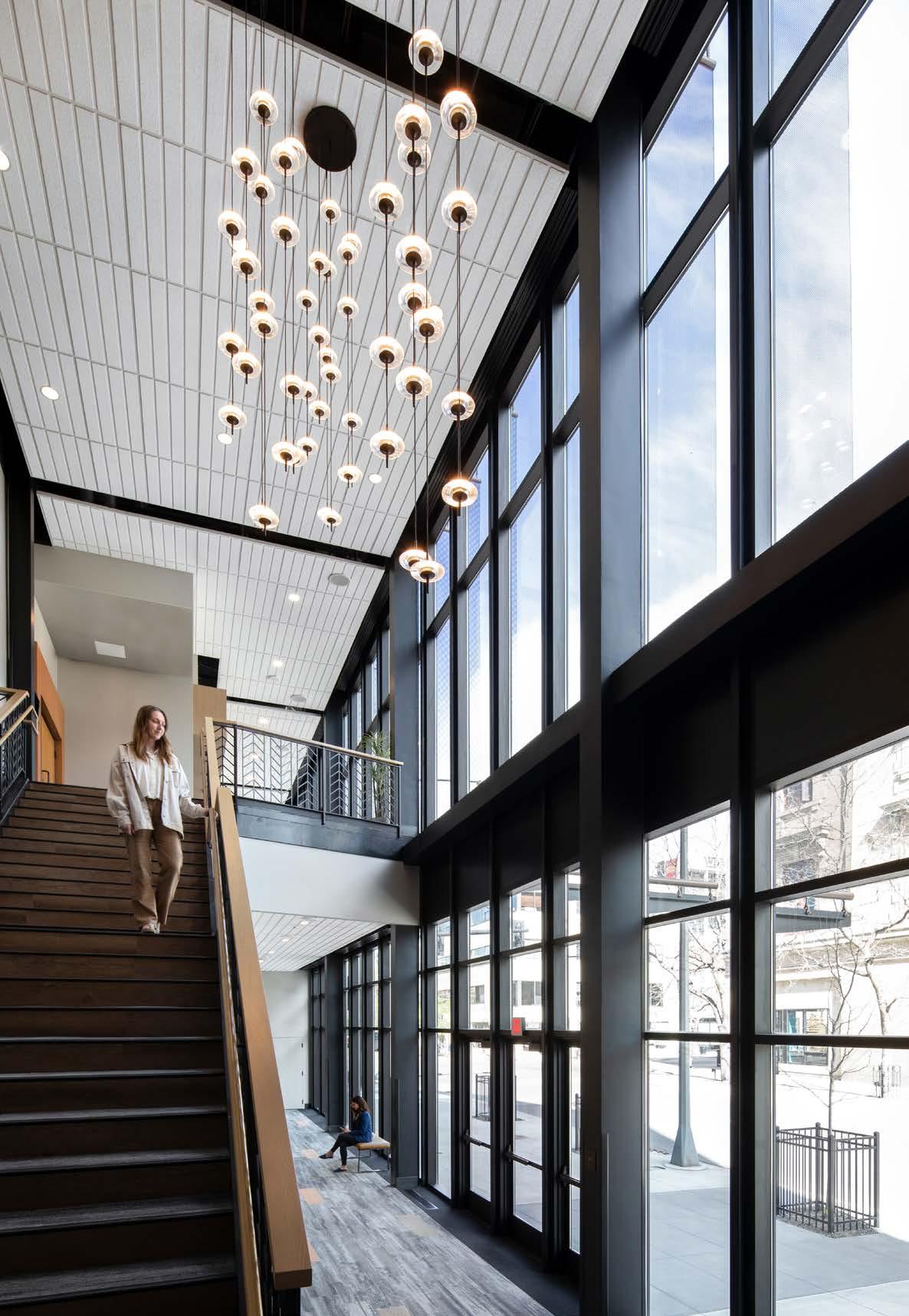
The space presented a unique opportunity because of the sheer size of the two-story expanded lobby. Madeline described the design process stating, “Michael and I knew that we needed a luminaire with a large presence. It was difficult to find a fixture with enough volume to fill the space, and that also maintained the elegance of the remodel.” Madeline recalled that the original concept was to have multiple single decorative pendants that would have filled the two-story space. Then during the early stages of the project, the design team introduced the idea of one large pendant.
After working through multiple iterations, the design team had exhausted all solutions to find the perfect fixture.
The Eureka rep, Frank Dugas, came by at a very opportune time. Frank introduced Madeline and Michael to the Droplet Celeste - a clean minimalist pendant featuring elegant artisanal casted glass discs. When Madeline saw installation images of the luminaire, she was impressed by its volume to appropriately fill a space. It was at that moment that the design team knew they found their answer. She explained, “There’s beauty in these fixtures; they have the appropriate scale and length while maintaining the desired aesthetic.”
The design team knew that the Alberta Bair Theater board members would equally love the Droplet Celeste. As difficult as it can be for board members to agree on a decision, they did not hesitate as these multiple pendants added much more interest than one large fixture.
The luminaires were ordered just before COVID impacted the construction industry and disrupting the supply chain. With Eureka's pre-made plug-and-play packages, the design team found it easy to adjust the number of units to customize the luminaire to their liking.

The installation is beautiful as these glass luminaires cascade from above. Vertical stems pass through the light fixture to create visual continuity accentuated by the glowing glass disc to create a striking effect. At 3000K the luminaire blends well with the aesthetic of the building and its history. Besides looking beautiful from inside, seeing the lights through windows from across the street, is stunning. The chandelier is art in its own right.
As the electrical engineer on the project, Michael was responsible for the lighting controls. “We used the Acuity nLight system. The fixtures are individually controlled by 0-10v power packs that are usually energized to 100% when the building is occupied," he explained.
The theater seats just under 1,400 people, but with the 4,800 square foot lobby, the theater can now accommodate more pre or post show events. The expansion provides the residents of Billings and the surrounding areas an opportunity to mingle inside of the theater with a beverage in hand, he explained.
Besides being a venue for the performing arts, the Alberta Bair Theater often partners with local schools to host educational programming. The nonprofit theater not only serves as an auditorium but also acts as a locale for children to foster their creativity.
The original Fox Theater was built on land owned, farmed, and ranched by Alberta Bair’s family. Before Alberta's passing, she donated the land for the arts. During the Great Recession, in order to fulfill Alberta's wishes, the city ensured that the theater remained.
If you ever find yourself in Montana, don’t hesitate to step into the Alberta Bair Theater in the center of downtown Billings. White you're at it, you may as well enjoy a show. ■

The Perfect Downlight for Any Space
MX Downlight, Adjustable, Wall Wash & Pinhole
MX luminaires create a warm and inviting space using soft, uniform lighting in this contemporary mission-style hospitality application. A dynamic solution for consistent lighting and limitless design possibilities.
Trimmed, Trimless, and Wood Ceiling
Half inch and 2 inch Regressed
Non-Conductive and Flat Mount
Color options in White, Black, Satin Nickel, Antique Bronze, and Wheat


The L-Prize Calls All Innovators for the Prototype Phase
The Calls for the Prototype Phase

More than a decade ago, the Department of Energy (DOE) staged a technology competition that challenged the lighting industry to develop high-performance, energy-saving LED replacements for conventional 60-watt, screw-in light bulbs. The DOE dubbed its effort the “L-Prize,” which two years later resulted in the Philips 10-watt, A-19 LED replacement lamp that helped revolutionize lighting. The technology innovations in that L-Prize winner—more efficacious LED chips, electronic miniaturization, better heat transfer, improved optics, and remote phosphors—found their way into later generations of Philips LED products. At
More than a decade ago, the Department of Energy (DOE) competition that industry high-performance, LED replacements for 60-watt, screw-in light bulbs. The DOE dubbed its effort the “L-Prize,” which two years later resulted in the Philips 10-watt, A-19 LED replacement lamp that helped revolutionize lighting. The technology innovations in that L-Prize winner—more efficacious LED chips, electronic miniaturization, better heat transfer, optics, and phosphors—found into later generations of Philips products. At
the time, progress on the luminous efficacy of LEDs was a big focus, and the L-Prize winner showed that 90 lumens per Watt (lm/W) efficacy with high color rendering and very long life was possible, raising the bar for the entire lighting industry. Just in the United States alone, today’s LED replacement lamps are helping to avoid an estimated 98 million metric tons of carbon emissions each year.
the time, progress on the luminous efficacy of LEDs big and L-Prize winner showed lumens per Watt efficacy high color and long life was possible, the bar for the entire lighting industry. Just in the United States alone, today’s LED replacement lamps are helping to avoid an estimated 98 million metric tons of carbon emissions each year.
Fast-forward to 2021 by which time 90 lm/W was no longer a stretch goal for LED lighting products, but significant headroom for performance and application
Fast-forward to 2021 by which time 90 lm/W was no longer a stretch goal for LED lighting products, but significant headroom for performance and application
KELLY GORDON By
Pacific Northwest National Laboratory
The new L-Prize seeks innovative luminaires and connected systems that demonstrate exceptional achievement across six areas.
KELLY GORDON By
Pacific National
The new L-Prize seeks innovative luminaires and connected systems that demonstrate exceptional achievement across six areas.
improvement remained. The DOE developed an ambitious follow-on L-Prize competition specifically targeting breakthroughs in lighting for commercial buildings, a sector that accounts for 36% of national lighting energy use. Commercial and institutional buildings often have long operating hours and need relatively high-output lighting for general illumination supporting workplace safety and functionality. These factors point to potential for energy savings and quality improvements in buildings traditionally lit by linear fluorescent tubes. The new L-Prize calls for luminaires and control systems that can capture additional benefits of LED lighting in terms of energy performance, lighting quality, advanced connected lighting control, and life cycle sustainability. The competition encourages and rewards technical innovation and attention to diversity, equity and inclusion (DEI) in the design, manufacturing, and application of LED-based lighting systems.
improvement remained. The DOE developed an ambitious follow-on competition specifically breakthroughs in lighting commercial buildings, a sector that accounts for 36% of national lighting energy use. Commercial and institutional buildings often have long operating hours and need relatively high-output lighting for general illumination supporting workplace safety and functionality. These factors point to potential for energy savings and quality improvements in buildings traditionally lit by linear tubes. The new L-Prize calls for control systems can capture benefits of LED lighting in terms of energy performance, lighting quality, advanced connected lighting control, and life cycle sustainability. The competition encourages and rewards technical innovation and attention to diversity, equity and inclusion (DEI) in the design, manufacturing, and application of LED-based lighting systems.
We are rolling out the L-Prize in three phases, with the Concept Phase now complete and four winners of $20,000 each announced by Energy Secretary Jennifer
We are rolling out the L-Prize in three phases, with the Concept Phase now complete and four winners of $20,000 each announced Energy Secretary Jennifer
Granholm in January 2022. An L-Prize myth holds that only these four winners can advance to the Prototype Phase, but that’s not correct. Each phase of this L-Prize is effectively a separate competition. Everyone is welcome to enter whether you competed in the prior phase or not and we’re looking for new participants to enter each phase.
Granholm in January 2022. An L-Prize myth holds that only these four can advance to the Phase, but that’s not correct. phase of this L-Prize is effectively a separate competition. Everyone is welcome to enter whether you competed in the prior phase or not and we’re looking for new participants to enter each phase.
Our vision for what lighting can accomplish features significant energy savings, excellent lighting quality, and functionality that improves indoor environments for people. The L-Prize is the chance for lighting innovators to be recognized for creativity and engineering in luminaires and systems that break through traditional limitations and trade-offs. The rewards are significant, with a prize pool that totals $12.2 million across the Concept, Prototype, and Manufacturing and Installation (M&I) phases.
Our vision for what lighting can accomplish features significant energy savings, excellent lighting quality, and functionality that improves indoor environments for people. The L-Prize is the chance for lighting innovators to be recognized for creativity and engineering in luminaires and systems that break through traditional limitations and trade-offs. The rewards significant, with a prize pool that totals $12.2 million across the Concept, Prototype, and Manufacturing and Installation (M&I) phases.
The Prototype Phase, which officially opened on June 30, 2022, features two separate tracks: one for luminaires and one for connected systems, offering
The Prototype Phase, which officially opened on June 30, 2022, features two separate tracks: one for luminaires and one for connected systems, offering

Photo Credit: Adobe Stock - Gorodenkoff
multiple pathways to participate, whether you are a small independent luminaire manufacturer or a large luminaires and controls manufacturer. Over the course of the next year, entrants will develop physical prototypes for one or both tracks that demonstrate their innovative approaches. Submissions are due May 1, 2023, when they will be evaluated by an Expert Review Panel consisting of eight independent lighting industry thought leaders. We will award and recognize up to six winners of this phase to share a prize pool of $2 million.
multiple pathways to participate, whether you are a small independent luminaire manufacturer or a large luminaires and controls manufacturer. Over the course of the next year, entrants will develop physical prototypes for one or both tracks that demonstrate their innovative approaches. Submissions are due May 1, 2023, when they will be evaluated by an Expert Review Panel consisting of eight independent lighting industry thought leaders. We will award and recognize up to six winners of this phase to share a prize pool of $2 million.
The final M&I Phase increases the stakes, with a prize pool of $10 million to be split among up to four competitors. This final phase carries through all the innovation opportunities of the Prototype Phase, and then adds in requirements for commercial availability and installation(s), and incentivizes U.S. content and manufacturing. We anticipate teams may be needed for this final phase, so we’ve opened up a Teaming List. It’s a way for manufacturing partners, materials or component suppliers, end-user installation host sites, utilities, energy service companies, and others to express their interest to collaborate with or support an L-Prize team in pursuit of the $10 million prize pool.
The final M&I Phase increases the stakes, with a prize pool of $10 million to be split among up to four competitors. This final phase carries through all the innovation opportunities of the Prototype Phase, and then adds in requirements for commercial availability and installation(s), and incentivizes U.S. content and manufacturing. We anticipate teams may be needed for this final phase, so we’ve opened up a Teaming List. It’s a way for manufacturing partners, materials or component suppliers, end-user installation host sites, utilities, energy service companies, and others to express their interest to collaborate with or support an L-Prize team in pursuit of the $10 million prize pool.
We’re proud of the fact that this L-Prize awards bonus points for exceeding minimum technical requirements in certain categories. Bonus points in the area of product life cycle reward sustainable and environmentally friendly designs. Bonus points in technical innovation recognize designs that are easy to use or cost effective. Bonus points for DEI acknowledge diversity within the participating teams and in the communities that will benefit from resulting innovations, including communities that have been historically disadvantaged.
We’re proud of the fact that this L-Prize awards bonus points for exceeding minimum technical requirements in certain categories. Bonus points in the area of product life cycle reward sustainable and environmentally friendly designs. Bonus points in technical innovation recognize designs that are easy to use or cost effective. Bonus points for DEI acknowledge diversity within the participating teams and in the communities that will benefit from resulting innovations, including communities that have been historically disadvantaged.
The L-Prize is the chance for lighting innovators to be recognized for creativity and engineering in luminaires and systems that break through traditional limitations and trade-offs.
The L-Prize is the chance for lighting innovators to be recognized for creativity and engineering in luminaires and systems that break through traditional limitations and trade-offs.
LED lighting has evolved from simply imitating previous lighting technologies to the still nascent but real potential to better manage lighting energy use, integrate with other building systems, streamline maintenance and operations, and even respond to electric grid signals, increasing the value and resiliency of buildings. We on the L-Prize team embrace this shift and seek to unlock the full potential to combine high luminaire efficacy with exceptional lighting quality, data-driven control and functionality, and sustainable design and construction for the future of illumination in commercial and institutional buildings. ■
LED lighting has evolved from simply imitating previous lighting technologies to the still nascent but real potential to better manage lighting energy use, integrate with other building systems, streamline maintenance and operations, and even respond to electric grid signals, increasing the value and resiliency of buildings. We on the L-Prize team embrace this shift and seek to unlock the full potential to combine high luminaire efficacy with exceptional lighting quality, data-driven control and functionality, and sustainable design and construction for the future of illumination in commercial and institutional buildings. ■

The technology innovations in the original L-Prize winning bulb have had a lasting impact, finding their way into millions of subsequent products that continue to save massive amounts of energy every year.
The technology innovations in the original L-Prize winning bulb have had a lasting impact, finding their way into millions of subsequent products that continue to save massive amounts of energy every year.
Kelly Gordon currently serves as Pacific Northwest National Laboratory (PNNL) Program Manager for the DOE Solid-State Lighting program, and as Team Lead for the PNNL Advanced Lighting Team. Her professional focus is on lighting energy efficiency and the advancement of high efficiency building technologies and systems.
Kelly Gordon currently serves as Pacific Northwest National Laboratory (PNNL) Program Manager for the DOE Solid-State Lighting program, and as Team Lead for the PNNL Advanced Lighting Team. Her professional focus is on lighting energy efficiency and the advancement of high efficiency building technologies and systems.

New 48V Low Voltage Magnetic Track System




A Fresh Look at LuminaireLevel Lighting Controls
Craig DiLouie is education director for the Lighting Controls Association, a council of the National Electrical Manufacturers Association that educates the public about lighting control technology and application (www.LightingControlsAssociation.org).
CRAIG DILOUIE, LC, CLCP By
Luminaire-level lighting controls (LLLC) are a subset of lighting controls in which control functions are integrated into luminaires, allowing individual luminaire control. This approach is highly flexible and responsive, and advanced options additionally offer connectivity to produce data-related benefits. According to a 2020 report by the DesignLights Consortium® (DLC) and Northwest Energy Efficiency Alliance (NEEA), average energy savings can exceed 60% with this approach.
This article defines and describes LLLC technology, system types, advantages and disadvantages, and what’s familiar and distinctive in regards to design and installation.
The LLLC Approach
Definitions for LLLC vary, but the common idea is sensors and control functionality being embedded into luminaires. Today, there is a wide variety of control systems designed around the approach to maximize energy savings while addressing specific user needs.
In the majority of LLLC systems, the three major control elements installed in the luminaire or luminaire retrofit kit are:
Sensors: The sensors may include an occupancy sensor, daylight sensor, or a multipurpose unit combining the two.
Control functionality: This element may be an integral part of the LED driver(s) or a separate device that sends dimming signals to the driver(s).
Wireless or wired connectivity: The luminaires may be wired via low-voltage, low-voltage digital, or power over Ethernet (PoE). Wireless connectivity is achieved via an onboard radio transmitter and receiver connecting the luminaire to an LLLC network using an accepted protocol.
Depending on the system, a fourth element, centralized network hardware and software, may be added as a layer atop the LLLC luminaires. Centralized hardware may include hubs or gateways, which serve as central collection points for managing the flow of data in a network. Data may be stored to a central server or the Cloud for retrieval and analysis.
In January 2021, the NEEA published the 2020 Luminaire Level
Lighting Controls Incremental Cost Study. In their report, the NEEA categorized LLLC as Clever, Smart, or Hybrid, producing informal definitions that may be helpful to visualize the offering.
Clever: Clever LLLC systems satisfy basic DLC networked lighting controls requirements for dimming, occupancy sensing, daylight response, and high-end trim.
Smart: Smart LLLC systems build upon Clever capabilities while adding collection and analytic capability for energy and other (e.g., occupancy) data that can be used for Internet of Things (IoT) applications such as space utilization.
Hybrid: Clever-Smart hybrid LLLC systems are Clever systems with energy monitoring capabilities but not advanced data

Control strategies
The foundational LLLC layer places key elements of an autonomous yet groupable control system within each luminaire with a versatile range of inputs and outputs.
Inputs include the occupancy sensor, daylight sensor, manual controls, and any programming. The control functionality decides whether and how to change the lighting based on the commissioning and desired sequence of operations. Depending on the system, outputs may include scheduling, switching, dimming, color tuning, and data.
These combinations of inputs and outputs enact a range of popular control strategies including occupancy/vacancy sensing, daylight harvesting, scheduling, high-end trim (institutional task tuning), manual control/override, color tuning, and more.
With an LLLC-enabled luminaire, we have a single lighting point capable of independently enacting one or more popular control strategies. When networked, the luminaires can participate in multiple, layered strategies that can be modified or custom programmed as needed, using individual luminaires as building blocks. This allows the control solution to be closely adapted to the application so as to maximize energy savings while ensuring occupant satisfaction.
For more advanced systems with centralized connectivity, additional control strategies are available along with useful analytics. This is an area where certain functionalities have become common, while others are still evolving as technology advances.
For example, additional control strategies such as HVAC room temperature, shading, and plug load control can be incorporated. Luminaires can also integrate other sensors, such as air temperature and humidity sensors and low-resolution infrared cameras.
Fine-grained occupancy and other data from highly distributed sensors can be captured for purposes such as space optimization using the manufacturer’s software. Sensor data may also be fed to third-party, and in some cases custom, apps. If paired with Bluetooth or Wi-Fi connections, operators may gain the additional ability to enact asset tracking and contact tracing.
Energy Savings
In August 2020, the NEEA published a study seeking to compare one-for-one LLLC retrofits with a comprehensive networked lighting controls (NLC) redesign. This study found that a one-for-one LLLC upgrade produced comparable energy savings and lighting quality as an NLC redesign at a competitive cost in a retrofit in a prototypical open office, an application well suited to LLLC.
In this application, the LLLC options generated 50-74% energy savings for the controls alone (not including the LED upgrade), while the NLC solution demonstrated 67% savings. The highestperforming LLLC had additional features such as scheduling, task tuning, plug load control, and energy monitoring. Meanwhile, the installed cost for the LLLC was roughly onethird to one-half of the NLC redesign option.
Advantages and disadvantages
LLLC offers several advantages as an NLC option. By embedding sensors and control functionality into each
luminaire, control is overall highly granular and responsive, which can increase energy savings.
Designer: For the designer, LLLC offers flexibility by reducing the need to predetermine switch leg wiring/zones.
Contractor: For the electrical contractor, it can ensure control compatibility, simplify wiring, and reduce time and risk by eliminating installation of control devices.
Distributor: For the electrical distributor, it offers an energysaving solution that can streamline product schedules for lighting projects.
Owner: The owner gains energy savings, the ability to finetune and reconfigure the system in the future, and potentially advanced functionality/data.
Occupants: Users interact with a lighting system that satisfies energy codes while offering personalization potential.
The primary inhibitors, meanwhile, are the luminaires’ higher base cost, higher complexity of the project, insufficient value or savings for a given project, and uncertain owner interest in advanced functionality. In addition, occupants and designers may have objections to systems that permit every luminaire to operate independently as opposed to in a uniform and coordinated manner.
The advantages often outweigh the disadvantages. Initial costs can be offset through simplified hardware installations and value-added functionality. Additionally, careful system selection can anticipate other concerns and result in a solution that is well-tailored to occupant needs.
Applications
The Department of Energy estimated the installed base of networked luminaires will grow from less than 1% currently to about one-third of all lighting in commercial buildings by 2035. Due to its advantages, LLLC is positioned to play a strong role in this growth.
Currently, LLLC is typically installed in office buildings and schools but is also deployed in high-bay, parking garage, gas station, library, and other applications.
Generally, two types of applications are most suitable for LLLC strategies. The first is situations where both luminaire-specific granular control of luminaires and coordinated zonal control is beneficial. Examples include open office coordination of occupancy zones, space requirements, and daylighting zones.
The other is where the use of the granular data from advanced LLLC systems can contribute to space optimization and facilities management. For example, occupancy sensors on every luminaire, combined with detailed building drawings, could be extrapolated into occupant traffic patterns.
Codes and rebates
The 2018 and 2021 versions of the International Energy Conservation Code (IECC) specifically mention LLLC in Section C405.2. This section identifies two paths for compliance with the code’s automatic shutoff, light reduction controls, and daylight response requirements—

one based on traditional control devices and the other on LLLC.
In open offices, where IECC requires occupancy sensing with control zoning limited to a maximum of 600 sq.ft., LLLC can simplify installation.
While not mentioning LLLC directly, the upcoming 2022 version of ANSI/ASHRAE/IES 90.1 and the 2022 version of California Title 24, Part 6, effective in 2023, contain similar requirements for limiting the zone size of occupancy sensing in open offices, which provides opportunities for LLLC systems.
Additionally, starting with the 2016 version, the ANSI/ ASHRAE/IES 90.1 energy standard allowed open office lighting to automatically turn on to more than 50% of power as long as the control zone is no larger than 600 sq.ft., which can make LLLC an attractive consideration.
Rebates: A majority of commercial lighting rebate programs incentivize installation of energy-saving lighting controls. Standard rebates incentivize devices such as luminaireintegrated occupancy sensors and daylight dimming systems, for which LLLC systems will often qualify.
In addition, rebate programs that incentivize advanced lighting controls may align with LLLC to allow access to these more comprehensive opportunities. According to the rebate fulfillment firm BriteSwitch, more than one-fourth of rebate programs now separately incentivize installation of NLCs with prescriptive rebates. A majority of these programs qualify products based on listing in the DLC’s NLC Qualified Products List, which in 2022 has been transitioning to the Version 5.0 Technical Requirements. These technical requirements combine required and reported system capabilities, of which LLLC is a reported capability.
Designing with LLLC
As a lighting solution of luminaires, an LLLC system is designed similarly to a standard system. Overall, the lighting must satisfy the owner requirements and the design intent. Attention to detail, however, must be given to aligning task areas and dedicated luminaires.
As a controls solution, an LLLC system can simplify energy code compliance, particularly in complex spaces such as open offices with granular control requirements. If that is the sole goal, a basic (NEEA “Clever”) LLLC system may be appropriate and achieved with relative ease.
With more advanced (NEEA “Smart”) LLLC systems, the control solution may be programmable from a central point, with energy, occupancy, and other data collection. Design flexibility is gained in control zoning. The designer should familiarize themselves with integration and data capabilities for various systems. The designer should also note that the installation of a network may require owner IT buy-in and involvement.
If required by the advanced LLLC system, the designer may need to incorporate the networking hardware (hub, gateway, server) and software into the project deliverables. Some applications can be served by wireless networking, wired networking, or a hybrid wired-wireless solution. The designer must also decide how programming and data will be accessed—web browser, mobile app—and who will be allowed to access it.
Depending on the product capabilities and specific configuration ordered, some LLLC systems can be configured for different control objectives. For example, the designer could zone the direct (task) component of direct/indirect luminaires to be individually controlled but the indirect (ambient) component to be controlled as a group. Or, a row of luminaires might operate independently for occupancy sensing but be assigned to a group for daylight response.
Image courtesy of Cooper Lighting Solutions.
For best results, the designer should produce a clear written controls narrative along with a detailed sequence of operations.
Installing LLLC
Some LLLC solutions feature all sensors and control functionality pre-installed in the luminaire by a single manufacturer, while others are available as discrete devices that can be added to luminaires in the field.
In particular, when luminaires with pre-installed wireless LLLC are deployed on a project, installation can be greatly simplified. Additionally, sensors, controllers, and drivers are pre-tested as compatible. Depending on the type of LLLC and the needs of the project, there can be fewer requirements to mount discrete sensors (or perhaps no need for discrete sensors), and, for advanced LLLC systems, the amount of supporting hardware is likely reduced. Basic LLLC systems provide further potential benefit during installation because of the lack of supporting hardware, except for switches, in many cases.
If it is a wireless solution, no control wiring is required. This can be particularly advantageous in a lighting upgrade project in an existing building, where utility rebates coincidentally may be available to reduce cost.
Despite potentially simpler installation of an integrated lighting and control system, increased labor should be expected for configuring and commissioning all of the sensors, manual
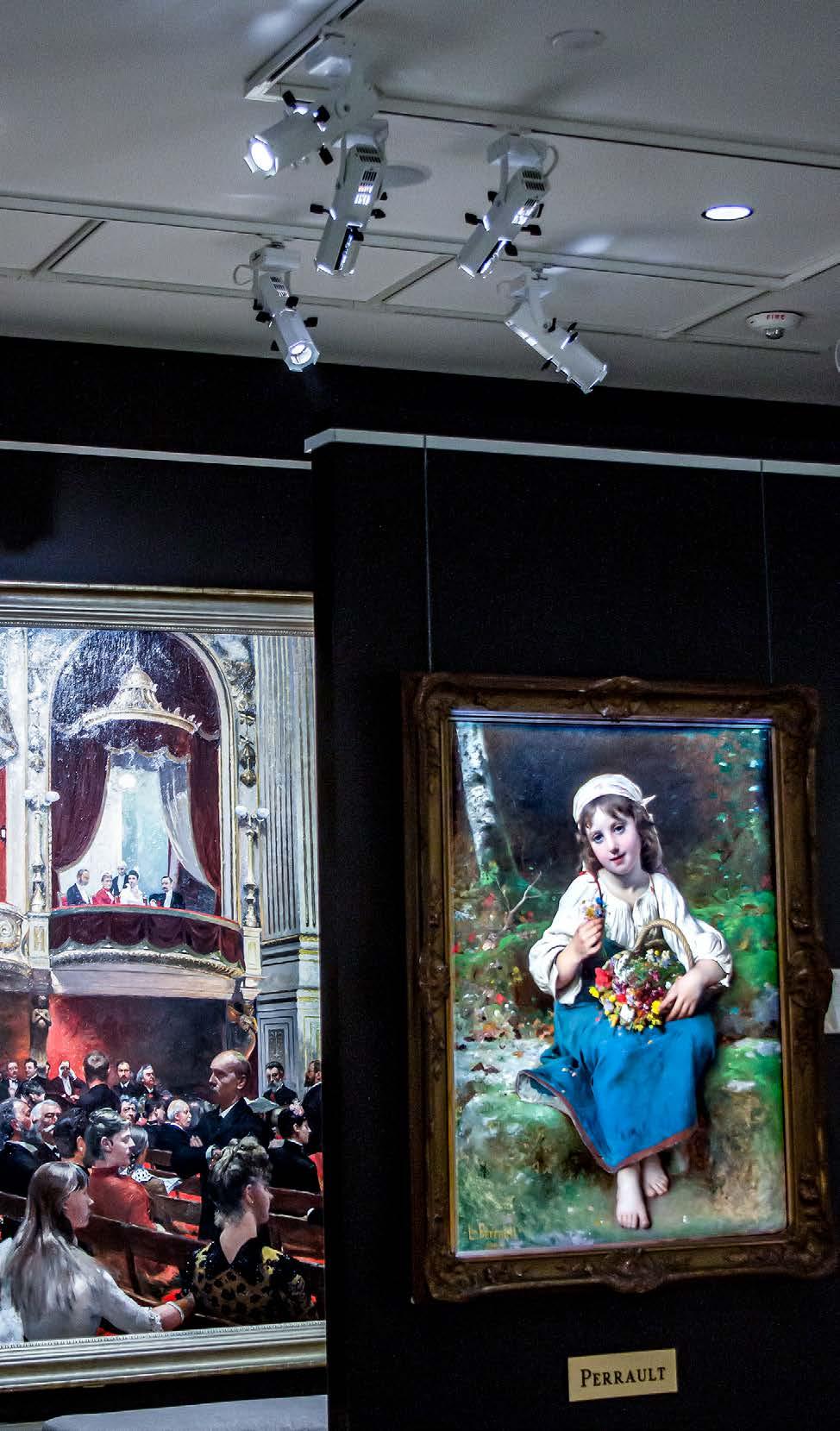
controls, networking/communications between the devices, and additional components such as gateways and central controllers that may be needed depending on the LLLC type and project expectations. Additionally, some coordination with the owner’s IT department may be needed.
Configuration of LLLC systems is often through software accessible via a mobile app (or web browser for centralized systems). For centralized systems, the software is more sophisticated and enables facility operators to organize and program the network and also view the data in a useful presentation format.
Contractors interested in LLLC should familiarize themselves with the technology, particularly the principles of wireless communication, and specific products, which can vary in approach to setup and programming.
LLLC as NLC Option
NLC systems have a well-documented place in buildings as an important tool in addressing the energy efficiency of buildings. LLLC offers an NLC deployment option that places sensors and control functionality within the luminaire, creating a strong value proposition in certain common applications.
For projects with a need to manage overlapping complexity, desire for simplified onsite wiring, or granular access of data as part of a more comprehensive solution, LLLC systems should be considered. ■
THE MOSAIC SERIES

The Mosaic Series features high CRI output with tunable white from 1800K to 8000K with a CRI of 90+ across the entire color temperature range. Rich blues, ambers, reds, violets, and greens can be added in gradients, or they can completely saturate the field being lit. Paired with our data track system, the Mosaic Series gives you the flexibility of a versatile lighting system in a neat, architectural package. Contact us to learn more.
MANUFACTURED BY
THE RECESSED MOSAIC THE MOSAIC FLOOD LUMINAIRE THE MOSAIC PROFILE PROJECTOR
JUST IN...
New architectural lighting products available for specification

Multi-talented Nina Edwards Anker’s awardwinning nea studio has released Chlorophyta, stunning sconces and chandeliers made from locally sourced chlorophyta, a.k.a marine algae, The translucent algae diffuses the light and the golden-hued brass or bronze frames reflect the LED bulbs in an even warmer light.


Amerlux has added two new members to its stunning Rook family of aluminum pendants and wall mounts. The Rook X, an exterior wall-mount cylinder with a 2.7-inch aperture, and the Rook 250, an interior pendant with a 2.5-inch aperture, continue the Rook product family’s heritage of translating the control, performance and comfort of Amerlux’s award-winning downlights into sophisticated new formats.
Refractory has launched the Isthmus Chandelier featuring five Isthmus pendants arranged in a linear sequence. The hand-polished cast glass components are held by an asymmetric bronze structure from above. No angles are the same, as the lenses distort the cast bronze shagreen texture in between. The orientation of each pendant can be rotated as preferred. The rectangular ceiling canopy can be finished to match the fixture or ceiling.


BETACALCO's WARP is a revolutionary triple circuit luminaire delivering high-efficiency diffused, spot, and indirect light, allowing the user to transition from general ambient to mood lighting. Available in two sizes 18" & 24",the Warp family offers two styles of pendant plus a ceiling-mounted version. The color temperature of each light source can be individually selected to deliver an effect best suited to the application.
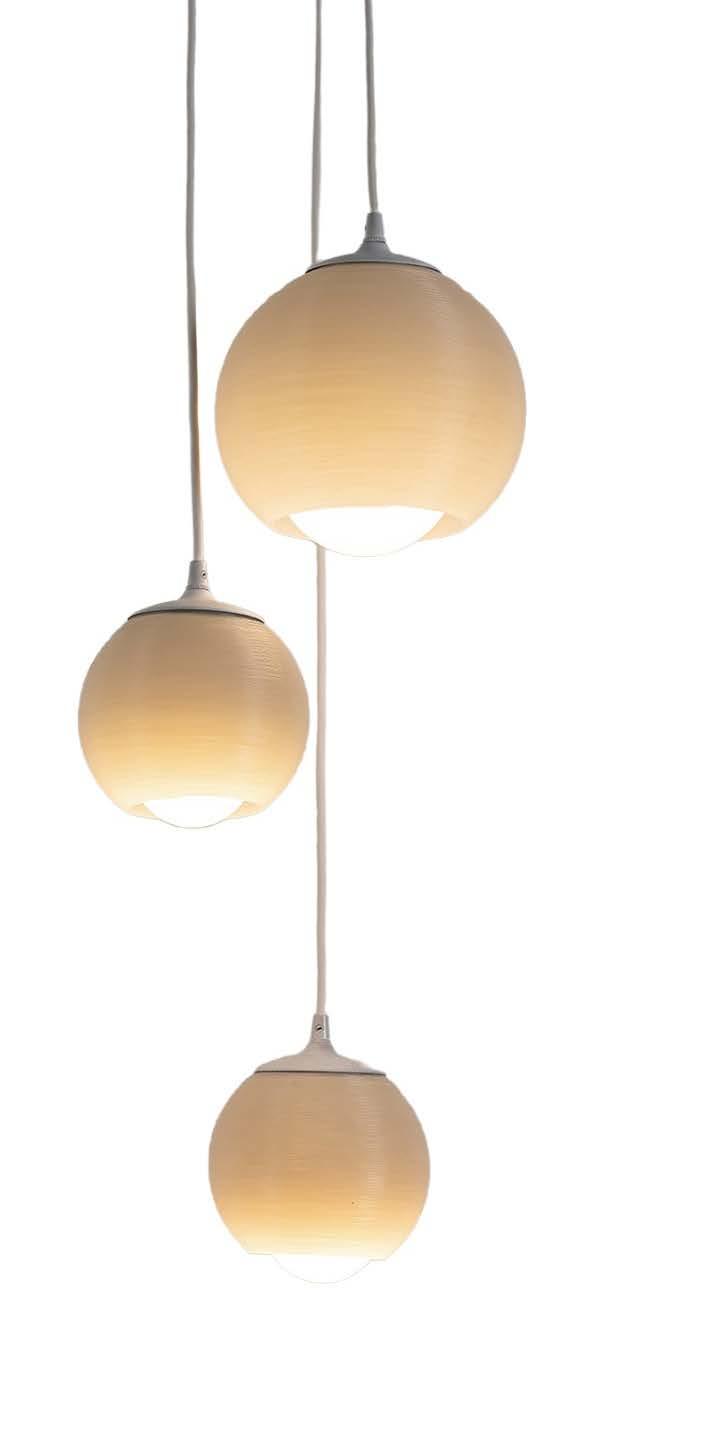

Seagrass

LightArt has developed a new oceansourced coil pendant. Designed with 100 percent recycled plastic from Oceanworks, these breakthrough pendants transform nearshore and ocean-bound plastic into two stunning light fixtures. Sea Foam, is a soft white circular fixture, and Seagrass, a kelp green teardrop-shaped fixture. Unified by kindred values in transparency and sustainability, LightArt and Oceanworks’ partnership helped create LightArt’s first 100 percent recycled Coil fixture.


ConTech Lighting by Leviton announced the introduction of the new Gallery XL Track Luminaire designed for the demands of museums, retail displays, and other architectural spaces. The Gallery XL expands our broad portfolio of track luminaires by adding a solution that brings together outstanding optical control, LED options, outputs up to 4600 lumens, adjustability, and shielding.


DMF Lighting, introduces the H Series, a highperforming recessed downlight. featuring a single, compact, field-adjustable LED light module with reliable performance. The ENERGY STAR® certified LED downlights offer field-selectable lumens, Natural Warm Dim technology, quality construction and contractor-friendly installation features — all at an attainable cost.

Litetronics International, Inc. introduces its new Vivid LED Frame, a design-forward approach to standard flat panel illumination that’s ideal for popular drop/grid ceiling. Available in both 2’ X 2’ (18, 27, and 36 Watts) and 2’ X 4’ formats (24, 34, and 45 Watts), Vivid is available in three different color temperatures (3500K, 4000K, 5000K), and features 0-10V dimming.
Sea Foam
INTO THE LIGHT
STEF SCHWALB By

Designing premium spaces for sporting arenas is no easy feat—just consider the scale alone. Interior designers and lighting professionals have numerous elements to consider for embarking on any project of this size. Now think about the best way to light each individual premium area within that space in a way that makes them enticing and unique. That was the challenge presented to the creatives at Flos Bespoke and New York City–based interior design firm Goodrich for the UBS Arena at Belmont Park, the new home of the legendary NY Islanders.
For more than a century, this historic park has hosted discerning guests for countless entertainment and sports events, but the time had come to take the hospitality aspect to a whole new level. By elevating the surroundings and visitor experience, the team at Goodrich worked with Flos Bespoke on custom lighting to define the spaces, create atmosphere, and transform the arena’s larger space and terrace into a series of intimate moments. The result is 100-plus custom fixtures ranging in scale and size, including: 5 globe cantilever sconces and an array of 26

How the Collaboration of Flos Bespoke and Goodrich Brought the UBS Arena to Belmont Park
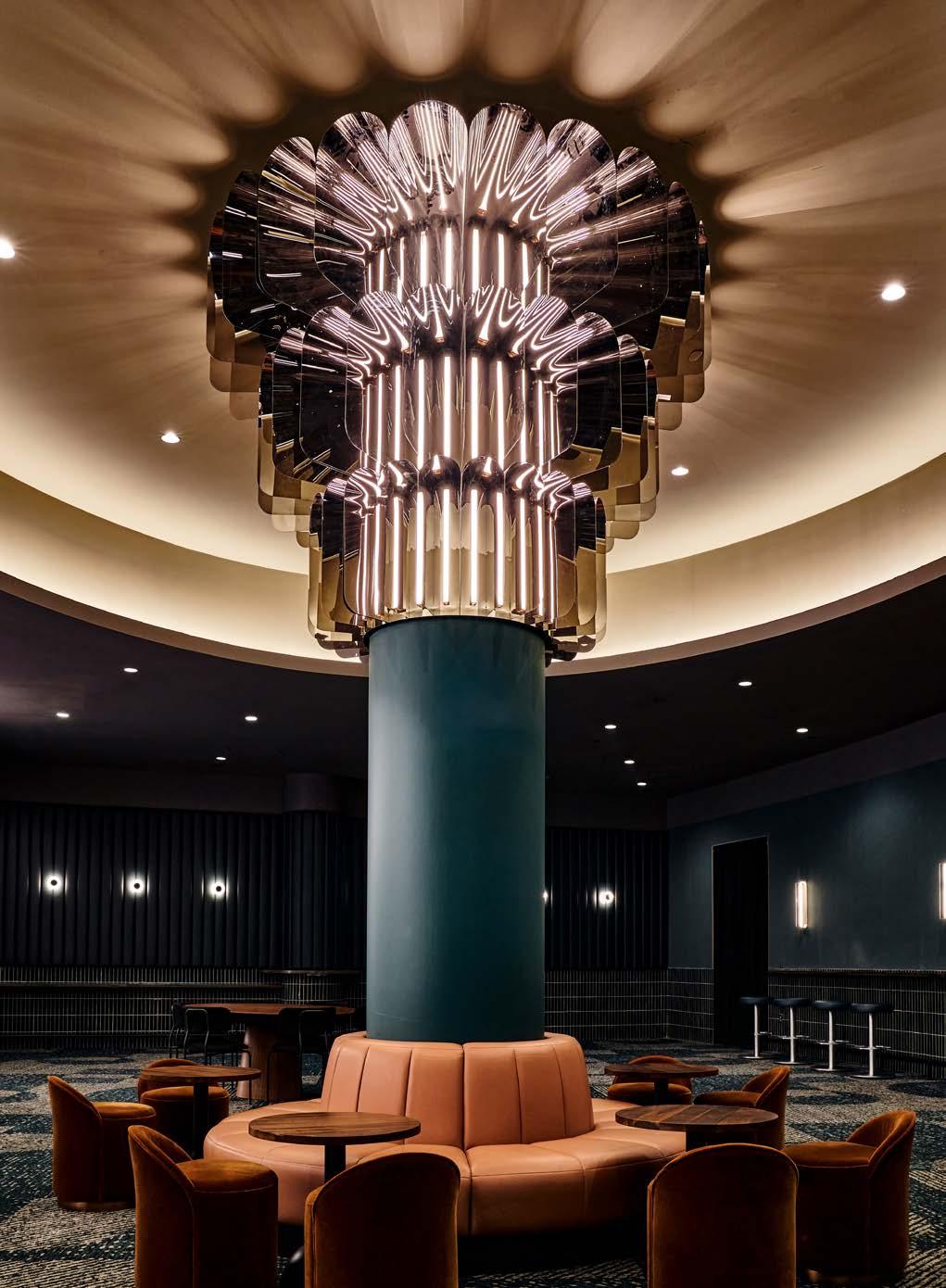

Photo Credit - FLOS
pendant lights at the Dime Club, 14 chandeliers in the Spotlight Suites, 3 flush mount chandeliers at Premium Entrances, 10 cantilever sconces and 2 column-mounted chandeliers at the UBS Club, 1 column fixture at the Verizon Lounge, and 36 bar lights at the Pitchbook Suites. We connected with Ian Coll, Head of Flos Bespoke, and Hines Fischer, Furniture & Lighting Director at Goodrich, for insights on the project.
“The building’s architecture was inspired by legendary New York stadiums, such as Stanford White’s Madison Garden II and Ebbets Field, and set in legendary Belmont Park,” says Fischer. “Throughout the arena, we drew inspiration for the forms and scale of the light fixtures from this rich history.” That inspiration helped to create the diverse range of custom fixtures, which, while developed specifically to define each space,

“The building’s architecture was inspired by legendary New York stadiums, such as Stanford White’s Madison Garden II and Ebbets Field, and set in legendary Belmont Park,” says Fischer. “Throughout the arena, we drew inspiration for the forms and scale of the light fixtures from this rich history.”
Hines Fischer


also strived to provide an aspirational feel throughout the arena. “The fixtures on the terraces and the entryways were designed to be ambassadors, welcoming people to the grand building and acting as a bridge between the architectural style of the arena and the warm, welcoming interiors we wanted to create inside,” continues Fischer. “As you travel deeper into the building, the clubs and premium spaces each took on their own unique story, which our design team worked hard to define. The design vocabulary was inspired by classic New York venues such as the Bemelmans Bar, King Cole Bar, and Sardi’s—anchoring the experience in the history of the city.”
like to think our fixtures have added to their experience!”
In terms of seeking inspiration and innovation in design and lighting today, Fisher doesn’t hold back on what he sees of great influence and importance. “Keeping your inspiration unique and fresh is a constant challenge in an era when the internet pulls us all toward the same trends. Our designers turn to books to search forgotten or underappreciated design movements from the last century, bringing fresh perspectives and ways of thinking to our work,” reveals Fischer. “Matthew Goodrich, our principal and founder, is particularly knowledgeable about design history and always brings fresh inspiration and design philosophies that just cannot be found scrolling through social media. Many intelligent thinkers have spent their careers considering design and how it relates to the human social experience. As young designers, we do ourselves a disservice if we don’t study their work so we can stand on the shoulders of giants.” ■

While collaborating on a project for a venue of this size presents several challenges, the teams at Flos Bespoke and Goodrich proved to be a seamless partnership throughout the production process. “Working together with Goodrich on the initial design and approval phase of this project was condensed to just six weeks. The resulting production process of the custom fixtures took place over the course of 20 weeks and was timed for delivery to coincide with the arena’s lowuse period during their off-season,” explains Coll. “Our engineering team rose to the challenge of producing 10 unique custom assemblies simultaneously, and our main design objective was to ensure that all the pieces should have a uniform glow— without any visibility or glare from the LED source.”
Of course, this isn’t the first time the team at Flos Bespoke had worked on large sporting arenas, so that expertise definitely came in handy. “By the time the UBS Arena opportunity came to us, we had already had the experience of working on custom lighting for other sporting arenas of this size: specifically, the Barclay Center concourse [located in Brooklyn, NY] and the New Balance Sports Center in Boston, MA,” notes Coll. “The intention behind the lighting design was to bring a level of visual comfort and composition to each area—not just the VIP areas. While fans visiting these areas might understandably have their focus on grabbing some refreshments during the interval, or on their team’s performance, we do

Photo Credit - Giada Paoloni
HO PE THIS SERIES IS NOT ABOUT BETTER RESIDENTIAL LIGHTING. IT IS ABOUT HOPE.
DAVID WARFEL By

I was first honored and then a little terrified when Randy Reid invited me to write a series for the residential section of designing lighting (dl). What could I, a residential lighting designer of no particular importance, offer such an esteemed community of award-winning designers, successful manufacturers, and hardworking lighting professionals across the world?
But, I am terrible at saying no, so I drummed up a few article ideas and accepted the challenge. I started a first draft and rambled along for a couple hundred words about the need for lighting design in residential construction. Boring stuff, really, and by page three my enthusiasm was gone. Then I realized something I hadn’t before—the solution to the problems plaguing residential lighting will be found not in lighting layout or lighting design, but somewhere in between. And it is going to take courage and cooperation to get there.
Lighting Layout: Installer-focused solutions that ignore human wellbeing. Before I take a stab at plotting a new direction for the
entire industry (what is that saying about pride?), allow me to catch up those of you who are largely unfamiliar with residential lighting, as I was for the first fifteen years of my career. A colleague, passionate about light but not in the profession, pointed out to me that architects, interior designers, electricians, showrooms, distributors, and manufacturers were offering a service they called lighting design to homeowners, but the results were entirely different than the service I delivered under the same name. “It shouldn’t be called the same thing,” he claimed, suggesting that lighting layouts were common, but lighting designs were rare.
What is a lighting layout? You can spot them easily. If there are circles drawn in tidy rows and grids in nearly every room, if each bedroom features four cans and a fan, if bathrooms have a downlight over the sink, if kitchens have lights evenly spaced between the counter and island, if there is a downlight above the tub, you are looking at a lighting layout.
Lighting layouts are easy to draw: find the centerlines,

make a grid, and put circles where the lines intersect. They are easy to sell: fifteen dollars each if you buy a contractor pack of ten. They are easy to install: twenty-six cans, fourteen j-boxes, two undercabinet bars, done. They help get homes built on time and on budget, but they punish the occupants for decades with glare from wafer lights that should be left in the garage and lumens spilled on the carpet instead of delivered to the countertop. The alternative I sell to clients every day is something we call lighting design.
Lighting Design: Beautiful custom-tailored solutions with out-of-reach price tags.
A lighting design (at least how I do it) looks like a mess in plan view. Light fixtures don’t line up neatly. Single recessed downlights seem to hang out in the strangest of places. There are scary absences of recessed lights where they should be, like between the island and the dining table. There are far too many fixtures.
Lighting designs are difficult to draw: aiming angles and ceiling heights and beam spreads and control zones litter the pages. Designs are difficult to sell: those recessed lights are going to cost how much?! They threaten the budget and the timeline in new builds, but they reward the occupants with decades of beautiful, functional, biologydriven lighting that supports wellbeing and life at every turn.
Lighting design is my line of work, and it is a pretty good business. We’re finding plenty of clients to keep our growing team of designers busy and profitable. But profit and busyness are not what makes me truly happy. I want to make the world a better place, and that means my ultimate

goal is to put myself out of business. I want lackluster lighting layouts to be abolished and expensive lighting designs to become irrelevant. I want something different, something in between.
Wait, did I just say that I hope to go out of business? Yes, I did, and shouldn’t that be the goal of anyone who wants to help others? When we volunteer our service to help others at a food pantry or with safe housing, do we hope that there are always people in need, or do we hope that someday the need is filled?
Lighting Hope: Scalable, affordable solutions for better lives.
If lighting layouts fail to deliver the benefits of light, and lighting designs are out of reach for most of us, what, then, is the alternative? There is no name for the in between, the third way. This kind of lighting could be called mediocre, or okay, or marginal. It could also be called better, attainable, or sustainable. It could be called lighting help. Today I will call it Lighting Hope.
Lighting Hope is a bit of a dream, a vision, for something in between. It is a strange turn of words that I will use to explore the middle ground and alternatives to the way we light our homes today. Over the course of the next few issues of designing lighting (dl), I will ruminate on the issue under the following titles:
■ Replace Edison & Redesign the Downlight
■ Save Copper through Cooperation
■ The Dimmer is Dead: Long Live the Next Lightswitch
■ Light Readings Against Humanity
■ Plug In to Better Lighting for All
Photo Credit: David Warfel
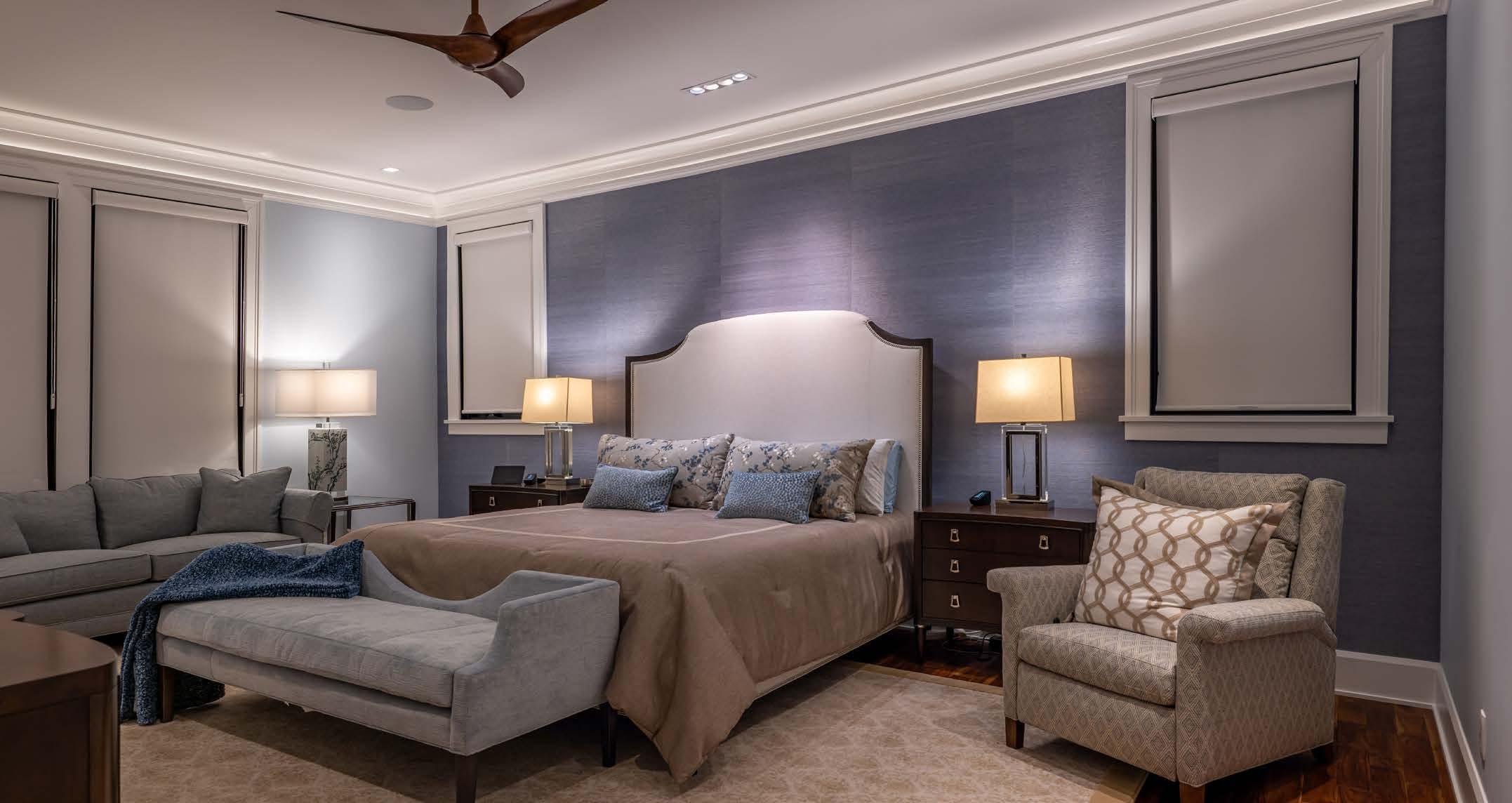
The rather odd-sounding concept of Lighting Hope is an invitation for us to use everything we know about light and lighting to make the world a better place, starting with our friends, family, and neighbors, and extending around the globe. Lighting Hope is not yet easy, popular, or profitable, but it does offer us the opportunity to rethink the tools we use and how we use them. Over the coming months, I hope to at least get closer to answering the following questions.
Why are homeowners and builders reluctant to use recessed downlights with built-in LED modules in place of the beloved 150-year-old E26 base? How could we, as manufacturers, offer them hope instead of fear of incompatibility and premature failure?
Why is low voltage lighting struggling to make headway in residential markets, despite nearly every fixture containing a low voltage LED source? How could we, as an industry, cooperate to change the future and conserve resources like copper?
Why are we still selling traditional switches and dimmers designed for line voltage, fixed white lighting when we know that natural light is a critical source of inspiration? How could we, as inventors, deliver a new light switch that would change the way homeowners interact with light every day?
Why are horizontal illuminance levels our most common calculation for homes, despite no homeowner ever taking a light reading on the floor? How could we, as technical experts, make light more understandable and accessible to the average homeowner?
Why is good lighting found in luxury homes and rarely—if ever—anywhere else? Why do those living in apartments suffer subconscious but very real damage from bad lighting? Why do hundreds of millions of people increase their risk of premature death by relying on light from burning wood and fossil fuels? How could we, as humans, help our neighbors live better lives with better lighting?
Courage is needed, because we need to consider changing everything from the lights we sell to the way we use them, and from the way we do business to the words we use.
I do not have all the answers, though I will ask the questions over the coming months because I believe that we, the lighting industry, do have all the answers. We simply need the courage to consider changing everything, to step outside of the way things are and imagine the way things could be. Together, we can make the world a better place.
And that is reason enough for hope. ■
"Courage is needed, because we need to consider changing everything from the lights we sell to the way we use them, and from the way we do business to the words we use."
David Warfel
Make Magic with Networked Lighting Controls

ABIRAN RAVEENTHIRAN By VxV Solutions Inc.
Sassy, Warsaw, Poland Compliments of Casambi
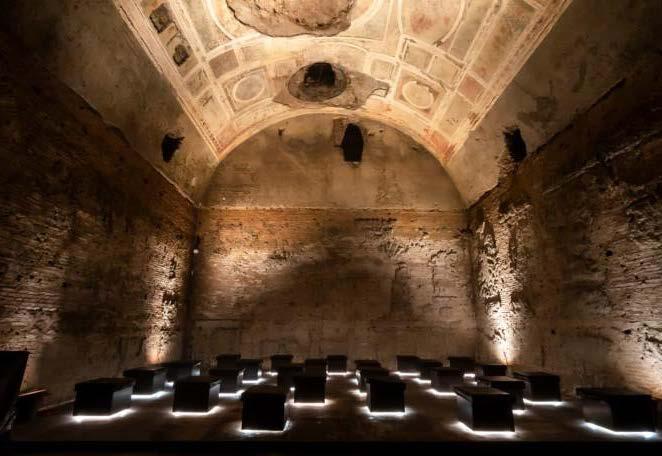
Energy-saving goals and energy codes are taking advantage of several technologies to create more efficient and cleaner buildings. New solutions and startups appear to be popping up more frequently and promise advances that seem magical. Best stated by Arthur C Clarke, "Any sufficiently advanced technology is indistinguishable from magic."
Networked Versus Standalone Lighting Controls
A networked lighting controls system allows for the communication of wireless or wired control devices in a single space to other areas of the building. The communication and function of these distributed room devices is controlled by a centralized device or app, acting as the command center. This system takes the controllability of the space further with timeclock functions, controlling multiple spaces together, master keypads, and integration of touchscreens.
A networked system is also capable of tying into other connected systems within the building such as BAS,
security, fire alarm, AV, IT systems and more. It puts the power of data into the end users' hands with the ability to track occupancy, monitor energy consumption, master controls and even make adjustments to the function of the devices throughout their building or even multiple buildings. This differs from a standalone lighting controls system in that it is a single or group of devices to control the lighting within an isolated space or area of the building. The wireless or wired devices - lighting controllers, sensors, and keypads within that room - have the ability to communicate with one another in order to meet a limited design intent (i.e. on/off, dimming, scene selection, daylight harvesting, etc).
The challenge of cost continues to be the elephant in the room on any project. Ultimately, a networked lighting controls solution is more costly than standalone systems but offers a plethora of benefits in the long term. A project is often stripped of its beauty and functionality through the rigorous process that is value engineering. One of the first items to be axed is lighting and controls. In the majority of applications, the bare minimum to allow for code compliance is left. Typically, these are standalone controls with dimming and/or occupancy timeouts.
What we often overlook is that some lighting control manufacturers, such as Casambi and Crestron, use the same "building blocks" of devices for both standalone and networked applications. This means that the same in-room devices, such as load controllers, occupancy sensors and keypads, are used whether standalone or networked applications. Standalone systems that have the ability to turn into a networked system and those
"Any sufficiently advanced technology is indistinguishable from magic."
Arthur C Clarke
Domus Aurea, Rome, Italy, Comliments of Casambi
that do not are in line costwise with one another.
This means we can phase out the scope of intelligent lighting controls such that there is the eventual ability to have a fully sophisticated system down the line.
How do we do this? Simple!
Start with a list of manufacturers that use the same in-room devices for networked and standalone systems and create designs with both. During tender, make sure that standalone devices that do not have the flexibility and scalability are not included in the package. Install as much of the hardware as possible to minimize the overall cost down the road. Items like processors and gateways can be added to the project as part of a future phase. Confirm if running additional cabling prior can be included as part of the scope if the budget allows for it.
In future budget allowances, bring in the networking hardware and commissioning of the system. Technologies like Casambi take this one step further by not requiring a processor to turn a standalone solution into a networked one. Casambi’s nodes live in load controllers, light fixtures, switches and sensors to create a low-energy bluetooth mesh system to control any number of lights in a room,
floor or building. Some projects may even have the possibility of not requiring additional hardware and installation. The future phases can purely be time spent commissioning the system to be better and smoother. The more commissioning time, the extra layers of sophistication we can bring to a system. This includes but not limited to adding harsher timeouts, dimming further to reduce energy consumption, integration across other building systems and others.
Note to stay consistent with in-room device manufacturers throughout the various potential phases of projects. The fewer manufacturers, the less need to manage multiple systems and complex scopes of integration and restriction each manufacturer brings.
The scientific advancement of modern-day lighting control technologies has allowed lighting controls to be the eyes and ears of your building to provide significant amounts of data to further optimize solutions. This phasing of projects using standalone lighting controls with the flexibility of future networking capabilities allows for there to always be the opportunity for your building to have the sophistication it needs and deserves and puts the magic of the building into the users' hands.■

St Helens Rugby Club, Liverpool, England, Compliments of Casambi
Architectural Lighting Certificate
Designed for people working in the industry who desire graduate education but have no previous formal education in lighting.
Classes begin September 7, 2022
Attend class online (fall & spring) and in-person (summer week-long intensive in Boulder).
Earn nine university credits and achieve a professional graduate certificate granted by CU Boulder.
For more information visit: https://www.colorado.edu/rmla/architectural-lighting-certificate

an Awards Program with a Twist The Silhouette Awards,
each an Awards Program with a Twist
By
Every day on my way to work, I pass by a work of art that always catches my eye. It is beautiful, yet simple. It is a series of interconnected poles, each one resting on and supported by another. Without its neighbors, each would fall to the ground. But together, they keep each other upright. The important truth distilled in this simple piece of artwork is that our personal and professional lives depend so much on the support and guidance of others. This is especially true for young professionals figuring out what to make of their careers and their lives. Every Plato needs his Socrates, someone to stoke the fire of creativity and passion within himself. Someone with real world experience who has navigated the challenges of professional life. Someone who can offer advice and guidance. A good mentor can make all the difference.
A strong belief in the importance of mentorship led Eve Gaut of Parrot PR and Marketing and Katia Kolovea of Archifos to create the Silhouette Awards in 2021. The goal of this global program is to “identify the rising stars of the lighting industry,” wherever they are, and support them as they grow their careers. The name might be a
little misleading—it is not a traditional awards program. Rather than receiving a trophy or certificate, the winners are awarded with a 6-month mentorship with an industry leader. I have followed this program since this past January, when the inaugural winners were announced. Now that the first round of mentorships are wrapping up, I spoke with the mentors and mentees to find out how the program went. To my surprise, almost everyone I reached out to enthusiastically agreed to share their experiences.


The Process
When the Silhouette Awards began in the fall of 2021, Eve and Katia contacted twenty well-established and notable lighting professionals to serve as the inaugural mentors. They then opened up the program to applicants who were asked to submit a 3-minute video in which they described themselves, their mentorship goals, and another passion outside the lighting industry. All videos were then reviewed by the mentors, who chose their top 20 out of a field of more than 50 submissions. They also picked their top 5 – the applicants who they felt they could help the most. Sam Koerbel, one of the mentors, emphasized how difficult this process was. “Everyone who applied was 100% qualified, so it was really about creating the right fit between the mentors and mentees.”
PARKER ALLEN
Merging Steel by Steve Benneyworth
The winners and their mentors were announced at the end of January with each mentor paired with a mentee in their top 5. Now, six months later, the mentorships have officially come to a close—though, as I found out, this is really just the beginning of these relationships.
The Mentorships
The first challenge these pairings faced was getting to know each other. Àfrica Sabé Dausà compared that first meeting with her mentor to a first date. Their initial meetings were dedicated to getting familiar and discussing interests. From that point on, there were very few rules or constrictions – the pairings were free to tailor their relationships and their time together to what best fit them.
Multiple participants highlighted the importance of timing. It began in late 2021, when the world was still experiencing the disruption of the pandemic. Though our shift to a more virtual world is advantageous in some ways, it also presents challenges. Conversations and connections can’t happen as organically as they used to—everything has to be scheduled. Want to talk about a new idea for a project? Let’s set up a Zoom meeting. The effect this has on young professionals, to whom forming connections and collaborations is vital, cannot be overstated. When she heard about the program, Gabi Kourac thought it was the perfect opportunity. “I needed a buddy,” she quipped. The Silhouette Awards provided this opportunity to form a personal and creative relationship with a fellow lighting enthusiast, one who the mentee would never have connected with otherwise.
The mentorships were not free from obstacles. Even the best made plans must change when real life gets in the way, whether it be a job change, a difficult project, a growing family, or a health issue. The starkest example of this was the pairing of Anna Sbokou and her mentee, Valeriya Gorelova, who is based in Moscow. They had barely begun their mentorship when the war in Ukraine erupted. All of a sudden, lighting took a backseat to much more pressing issues. The original vision for the mentorship changed dramatically, as they found themselves discussing backup plans rather than lighting design. However, there was a silver lining–Valeriya was given some time to evaluate the relationship with her partners, discuss marketing plans, and figure out what they need to have in-house. This was an opportunity that she wouldn’t normally have had.
One thing that stood out to me was how little of the relationship revolved around lighting design. Though lighting was the thread that tied this entire program together, both the mentors and mentees mentioned that few of their conversations were lighting specific. Many of the mentees came into the program with lighting careers already established, so much of the focus was on personal and professional development, on opening doors and inspiring new opportunities. As Iris Molendijk, a mentee, said, “The mentors don’t have to fill things in

completely for you, but they can start the drawing and empower you to finish the sketch.”
Several of the participants were pleasantly surprised at the deep connection they formed with their partners. What started out as monthly meetings quickly evolved into regular texts and emails. Monica Luz Lobo, a mentor, stated that the most important thing she got out of the program was a new friendship—she and her mentee grew together, and now have a relationship that will last their entire lives.
The Future
The initial iteration of this program was wildly successful, butit will no doubt face some growing pains as it matures. One mentee mentioned that she would have liked some time to settle in and get to know her fellow mentees before the program began. The clock started when the winners were announced, and she wasn’t expecting to be a winner, so she was caught off guard and underprepared.
some before
It is reasonable to expect that submissions will grow as more people learn about the program. Naturally, an awards program can be selective but there are many young talents that could benefit from a mentor. In the future, perhaps they will increase the number of mentors to accommodate all of the deserving applicants. Perhaps they will change the program from a set time period every year to a rolling basis so that young professionals are always being paired with a mentor.
Overall, the experiences of both the mentors and mentees were overwhelmingly positive. Some are planning on future collaborations. Others are planning to meet in person as soon as they have the opportunity. The mentors even created a WhatsApp group where they could all chat and share their experiences with one another as well as with the second round of mentors. A worldwide community of lighting professionals is forming around the Silhouette Awards. Every pairing that I spoke with is planning on staying in touch. That’s the sign of good pairings. That’s the sign of a good program. That is a program that is here to stay. ■

Supply chain has been the focus of many businesses in the last couple of years, with recent quarterly reports and earnings calls addressing logistical woes and strategies to adapt to the situation. While the current state of affairs is far from being stable, there is reason to be cautiously optimistic. The latest market update published by Maersk, one of the world’s largest global container shippers, details changes observed in the global supply chain. Much of it is shrouded in uncertainty, as the full extent of the geopolitical fallout due to the Russian-Ukraine conflict is yet to be seen. However, they pointed to a few improvements in supply chain operations, something that would’ve been considered wishful thinking in months past.
A key point of interest is the gradual improvement of the Asia Pacific to North America route. Waiting time at major ports like Long Beach and Los Angeles has decreased slightly to 15 days, with export volume expected to increase in coming months. Vancouver also saw a reduction in wait time, but yard density is still severe. However, other ports continue to worsen, and demand remains stable at a very high level.
On Asia Pacific exports, Shanghai is beginning to return to normal after a lockdown in April and May caused by a COVID-19 outbreak. Factories are starting to get back in full swing and demand has returned. Many other operations in China, like city area and interstate trucking, has returned to pre-lockdown levels.
Europe is facing more challenges than before, mainly because they are impacted to a greater extent by the war than North America. Additionally, Germany is experiencing labor strikes at key ports, furthering congestion, backlog, and uncertainty.
Much remains to be seen as to how the supply chain will look at the end of the year, but we are finally starting to see the adaptations and adjustments pay off to an extent. The Maersk report can be read in full .
PEOPLE ON THE MOVE



Rebecca Ho-Dion has been promoted to Principal, the first female
of Lighting Designers Team Site
THURSDAY,
29 SEPTEMBER 2022
8:30 A.M. Conference Registration Open
Business of Light X IALD (Separate Registration Required)
9:00 A.M. – 1:00 P.M.
Leaders as Coaches: The art and science of coaching successful teams. This appeals to us to focus on mentoring next generation leaders. Thus speaker is working with several lighting designers with great success. We might get a few endorsements from them.
Jen Armstrong, Founder and Executive Coach, MBA, PCC
2:00 – 4:00 P.M. Palm Springs Architectural Bus Tour Sponsored by Axis Lighting IALD LIRC Member Meeting
5:00 – 6:00 P.M.
Emerging Lighting Designer Reception (By Invitation Only) Sponsored by LIRC
6:30 P.M. President’s Opening Reception Sponsored by Cooper Lighting
FRIDAY, 30 SEPTEMBER 2022
August 3
August 3
August 3
August 3

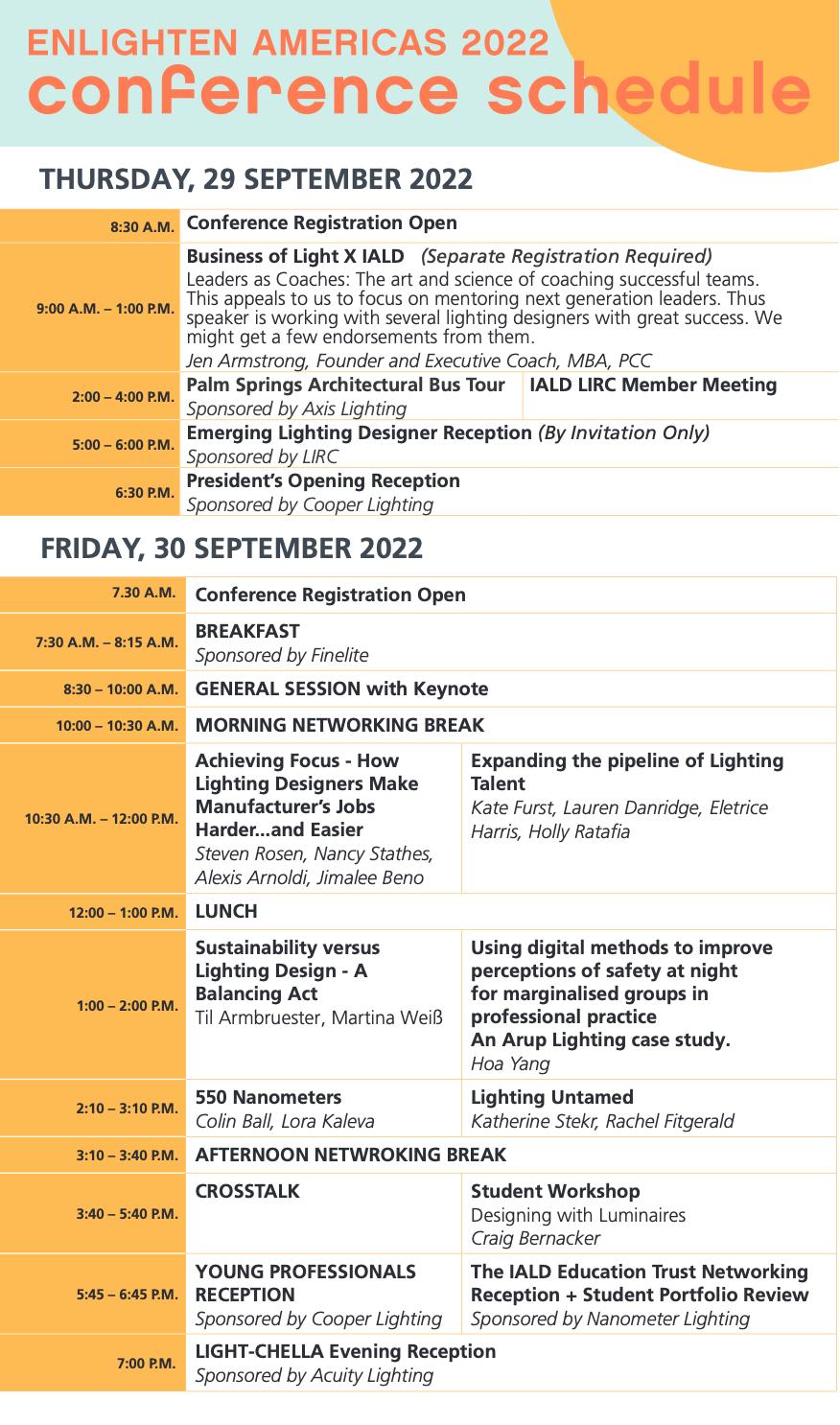
Modified ) Press OUTGOING 20220803 - Asset pack to Desinging Lighting - Randy Reid
7.30 A.M. Conference Registration Open
7:30 A.M. – 8:15 A.M. BREAKFAST Sponsored by Finelite
8:30 – 10:00 A.M. GENERAL SESSION with Keynote 10:00 – 10:30 A.M. MORNING NETWORKING BREAK
10:30 A.M. – 12:00 P.M.
Achieving Focus - How Lighting Designers Make Manufacturer’s Jobs Harder...and Easier
Steven Rosen, Nancy Stathes, Alexis Arnoldi, Jimalee Beno
12:00 – 1:00 P.M. LUNCH
1:00 – 2:00 P.M.
Sustainability versus Lighting Design - A Balancing Act Til Armbruester, Martina Weiß
2:10 – 3:10 P.M. 550 Nanometers Colin Ball, Lora Kaleva
Expanding the pipeline of Lighting Talent
Kate Furst, Lauren Danridge, Eletrice Harris, Holly Ratafia
Using digital methods to improve perceptions of safety at night for marginalised groups in professional practice An Arup Lighting case study. Hoa Yang
Lighting Untamed Katherine Stekr, Rachel Fitgerald
3:10 – 3:40 P.M. AFTERNOON NETWROKING BREAK
CROSSTALK
3:40 – 5:40 P.M.
5:45 – 6:45 P.M.
YOUNG PROFESSIONALS RECEPTION Sponsored by Cooper Lighting
Student Workshop Designing with Luminaires Craig Bernacker
The IALD Education Trust Networking Reception + Student Portfolio Review Sponsored by Nanometer Lighting
7:00 P.M. LIGHT-CHELLA Evening Reception Sponsored by Acuity Lighting
SATURDAY,
1 OCTOBER 2022
8.30 A.M. Conference Registration Open
8:30 A.M. – 9:30 A.M. BREAKFAST 9:30 – 10:30 A.M.
Mixing and matching luminous colours
Johanna Enger
10:30 – 11:00 A.M. MORNING NETWORKING BREAK
Who’s in your corner?
Innovating the Lighting Design Process: Computational Tools to Illuminate and Empower Architecture
Patrick McBride, Nathan Sharnas, Jason Smith
11:00 A.M. – 12:30 P.M.
Jessica Krometis, Catherine Leskowat
12:30 – 1:30 P.M. LUNCH
Integrating Germicidal UV with Architectural Lighting
David Pfund, Craig Bernecker
August 3
August 3
Lighting Detox
Kristin Bredal
1:45 – 2:45 P.M.
August 3
August 3
The Lighting Industry’s Guide to Change Management Emad Hasan Sponsored by Lumenture
2:45 – 3:15 P.M. AFTERNOON NETWROKING BREAK
August 3
August 3
3:15 – 4:15 P.M.
Specifying a Bright Future: Decarbonizing and Detoxifying Lighting Systems
The hidden potential of Residential Lighting Design Anna Sbokou
August 3
August 3

4:30 – 5:45 P.M.
Brad Koerner
CLOSING SESSION - Lovers of Light
Ron Steen + Special Guests
IALD Enlighten Americas 2022
Westin Mission Hills Resort
29 September – 01 October 2022
Palm Springs, CA USA
Modified ) Press OUTGOING 20220803 - Asset pack to Desinging Lighting - Randy Reid
Modified ) Press OUTGOING 20220803 - Asset pack to Desinging Lighting - Randy Reid


salutes and thanks its advertisers for their support. We applaud the achievements of lighting practitioners and recognize the importance of their work in architecture and design.


Jill Cody began her lighting design firm almost by accident. After working for HGA in Milwaukee, she moved to Seattle with her husband and discovered almost all lighting design there was provided through engineering firms.
An architect hired her to design a Coeur d'Alene, Idaho resort. At the time, she had no desire to set up a business and worked out of the architect’s office. After being in demand by word of mouth, she opened Dark Light. This has given her the flexibility to chose the clients and projects she works with. And, she emphasizes that both groups are remarkable!
Jill first thought of the name Dark Light during an education seminar at Lightfair. She recalls, “There were these two presenters from Norway giving an esoteric presentation. They began discussing the importance of darkness to complement light and it really resonated.” She felt strongly about not naming the firm after herself. Thinking about the 2 or 3 hours of daylighting that Norway experiences in the winter, Dark Light was born. She continued that so much of what a lighting designer does is not just lighting objects, but deciding what not to light. “You can’t drive focus if you light everything. So, the name implies that we are thinking more than just the additive, sometimes it is the subtractive.”
Before COVID, Jill planned for expansion as she realized the benefits of diversifying geographically. She chose St. Louis as a second location for only one reason—that is where Dark Light Principal Ron Kurtz lives. Jill explained, “Seattle has been a great place to start Dark Light because the city has experienced so much growth, but we need expertise in other geographic and design areas.” She highlighted that Ron brings experience diversity with his strong footprint in hospitality design.
Dark Light has worked on projects for several big clients including T-Mobile and Microsoft. Jill admitted that sometimes you just get a project randomly and then you build on it. She said, “We have been really fortunate because there’s so much tech work going on in our market.”
Many of the spaces are open floor plans with meeting rooms of various sizes, some as small as accommodations for two people. Tech clients typically want the amenities space to provide a different environment, not just a break room, but for collaboration as well. Jill practices Dark Light's style of dichotomy, "If a person is working under 30-footcandles of uniform light and they are there for a long time, they need a break. Our goal is to provide visual relief when outside of those main workzones."
Another area of expertise is higher education. Jill mused that students get exposed to her lighting design at various universities, then upon graduation, some experience Dark Light designs in Seattle at many of the tech companies.
Jill doesn’t use the word "nighttime", instead she says “after dark”, because Seattle can be dark at 4:00 pm in the middle of December. Her specifications use a lot of 3000K, not because of freezing cold temperatures, but because of sad and dreary winters. She strives to give clients a lantern effect.
On Dark Light’s choice not to specialize in particular project types, Jill stated, "The truth is that's the way we work. Yes, there are certain technical requirements of certain jobs, but at the end of the day we’re doing the same thing for all of our projects. We are lighting a task or creating focus and enhancing the materials that are important to the architect.”
Jill concluded by explaining the importance of her team and she attributes their tremendous growth to the incredible people she works with which now includes Ron in St. Louis and the rest of the team scattered around this country. She also expressed her good fortune to be working as a lighting designer, a profession that makes a real difference, and that has so many amazing people.


ADAPT LINEAR
.845 lumens per foot / up to 92 CRI
.S mooth 0-100% dimming
.5 colors and 9 beam angles

.Assembled to spec in Los Angeles, CA for fast delivery (AMS - Acclaim Modular Systems)
.Straight or curved applications
.Conect up to 100 linear feet on a single feed
.Go from 5W to 10W output with the flick of a switch ( Acclaim’s PowerSwitch™ Technology)
.Standard in white, black or gray + custom color finishes
.Available in 1 ft. and 4 ft. sections


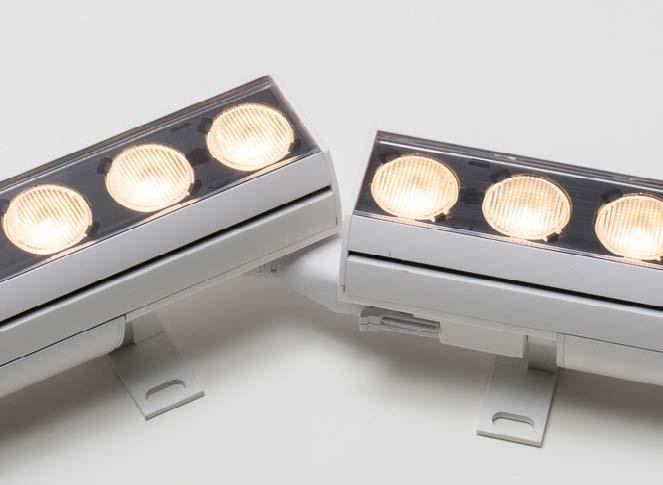


EdisonReport.tv serves as a hub for all digital content in the lighting industry. A premier source for critical information surrounding lighting, EdisonReport.tv is dedicated to delivering industry news by way of video and serving its audience by spotlighting product launches and up-to-date educational videos, as well as information about upcoming webinars.
How Many Ways - Can Lighting TELL A STORY?


Biophilic Design: The Architecture of Life

Women in Lighting Workshop in Taipei
1er Encuentro Internacional de Arte Luminíco
Verozza Fusion
HLB Lighting Design: Nvidia Voyager