Industrial Design
ROBERT BRONWASSER
89
REBIKE – urban mobility concept
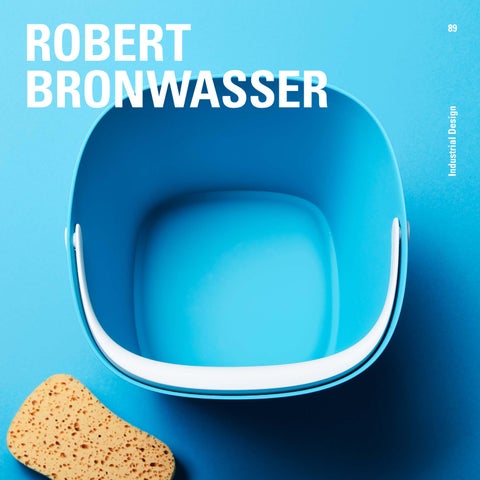
COVER: BUCKET – concept for an everyday product BACKCOVER: PLUNGE – friendly watering can for Elho
ROBERT BRONWASSER
All photos by Thomas van Schaik
Robert Bronwasser (1968) is a Dutch industrial designer known for creating products that combine functionality, character, and a human touch. After graduating from Delft University of Technology in 1992, he founded his own studio, developing a multidisciplinary practice spanning consumer products, furniture, bicycles, and professional appliances.
SMYLE by design.
His design philosophy is captured by the idea of Smile by Design: good design should not only solve practical problems, but also create positive emotions. Through clear forms, intuitive interactions, thoughtful details, and a sense of friendliness, Bronwasser aims to make everyday experiences more enjoyable. Working closely with manufacturers, engineers, and clients, he translates ideas into products that balance aesthetics, ergonomics, usability, and production efficiency. His work has earned international recognition and numerous awards, while collaborations with leading brands have established his reputation as a distinctive voice in contemporary Dutch design. Simplicity, accessibility, and longevity are central to his approach. Rather than following trends, Bronwasser creates timeless products that people can understand, enjoy, and keep for many years. Sustainability is therefore embedded in his design philosophy through durable materials, efficient production, and enduring aesthetics. For Bronwasser, design is ultimately an act of optimism: a belief that thoughtful design can make everyday life just a little better – and bring a genuine smile to the people who use it. FLAIROSOL – next generation sprayer for AFA Dispensing
4
‘Enjoy everyday design.’ Your motto has a very healthy glow to it I just love what I do, and I do what I love. I've always been creative. Even when I was a teenager, and the other kids were busy fooling around, I was sitting at home making drawings. I was a bit of a nerd, an outsider. Most kids stop playing with Lego when they're 12 but I still play with Lego now, I love the stuff! How long have you been working as an industrial designer? I've been an independent designer for more than 30 years now. In that time I've become a signature industrial designer. Most signature designers make one-off pieces and are often more involved in furniture. I design pieces for serie and mass production, but I'm able to add my personal signature to the work. Of course that's a very lucky situation. Companies hire me because they like my work. That means you have this really nice way of working because you're always doing things people like. It's very positive. This is important in a world which feels somewhat less than positive. Does that enjoyment transmit to the finished product? It's a part of the process. My whole way of working with companies. I don't call them clients because we work together. It's not like they give me an assignment and they pay. We have a commitment together to create something that people are going to like and love and use. It's important to know that you're doing it together. I'm an independent designer, but I'm also part of a team. You have the marketeers, the sales, the producers too. There's a lot of people involved, and I try to get everybody really focused on the process in very open relationships. This is essential. You have to be able to discuss things.
5
That kind of working relationship requires confidence When you start out as a young designer you have a different relationship with your client. You do what they ask of you. And if you say, “no, we have to do it this way,” it seems as if you are stubborn or you're just being ‘creative.’ But if you start working with your clients, you can really discuss things and search for ways to improve them. That's the best way to make really clear decisions. Clarity of concept is the real challenge, right? A big part of the process is making decisions to skip things out. To pare things back. When you do that, the product itself becomes clearer and more often the primary function is better than when there's a lot of other stuff you probably don't use, cluttering things up. That's the feedback I get, that people understand my products. This is a result of there being a really clear concept behind them. It's not a design language, because the design language is just how I shape the product. The concept itself comes first, the function and the way of use. Then I can translate this into form using my design language.
WE SHOULD INNOVATE TO IMPROVE.
HEINEKEN – beer fountain
6
So you do a lot of work before you begin making models? It always starts with looking and thinking. I have these three steps: look, think, create. First you must look. You have to dive into the company, the brand, the competition, the context. You can only add a new product if you know what's already out there and what fits the brand you're working for. So you first have to get a good view of the current landscape. This will lead you to the opportunities.
MILKSHAKER – milk shaker for Hendi
This phase of the process is crucial because a new product only makes sense when it really adds something. Just creating a new product is quite easy. You can design one hundred products a week, but do they really add anything to the market? The question is, how can we improve things? How and where's the product going to be used? Who will be using it? You are looking for purpose It's about answering the ‘why’ of the product. What's the reason for this new product to exist? Why does it fit the brand? Why would people buy and use it? And if you can answer those questions, you already have a direction. And this is before even the first sketch. And the thing is, if you work hard in the ‘think’ phase, you end up with a clear vision of what the product will be without even designing it. Then the brand gets really enthusiastic. This is what we need! They get really eager to see what it will look like. So the story behind the product has to come first. I don't start by designing dozens of different concepts and discussing them all. Now I try to focus first on a really clear vision for what the new product or collection should do for the brand in the market, and for the end user.
7
INFINITY – circular office chair for NO-EM, visual by Benno Bas
8
Did you always work like this? No, no, no. When I was starting out as a designer I would make endless sheets of sketches, and then discuss all the sketches with the clients, and make a lot of models. But over the years, I started to realize it's not about the design, or the sketches and concepts, it's about what kind of product do we really need? As you gain more experience, you end up dealing with higher-ups at the companies you work with – art directors, marketing directors and so on. This means you can have proper discussions about what is really needed. Eventually, what used to be a brief of several sides of A4 which basically said “design this” becomes an open discussion. We need something new, or we need a replacement. We want a redesign, without a brief. This is the starting point. Then, what do you think, Robert?
You have to trust the designer's instincts Well, I recently designed an office chair, which eventually won the Red Dot Award. My pitch to get the project was something along the lines of, “I haven't designed an office chair before, so I know I can do it” Bold move! Well, I've worked in lots of different fields and I can use the expertise of all those completely other markets to do something new, or have at least a fresh view on things. I've been doing this for over 30 years, designed 500 or more products. That means I'm often the most experienced person in product development at the table. I always say, if we can get the thinking right, the creating is easy. Because then I can rely on all my years of experience to translate our concept into a design. Of course, if you have a design that fits a story, this is useful for marketing too.
THE CONCEPT ITSELF COMES FIRST, THE FUNCTION AND THE WAY OF USE. 9
Were you a born industrial designer? How did you get started? When I was a kid, it was obvious I would do something creative. My father was an architect, and my granddad was a very good painter. So at home it was quite normal to be creative. And it was encouraged. First, I wanted to be an architect because my dad was one. But this was the 1980s and industrial design as a job was becoming very attractive. I was lucky too, the drawing teacher at my high school knew the Deacon of Industrial Design at Delft. He saw me drawing, and said, “You have to visit the industrial design department at Delft. I think that fits you very well.” I always processed information first. I always first made sketches and then thought about the concept before making the final drawing. So I went to the open day at Delft when I was 17, and it was immediate: “This is what I want to do.” With product design, you have one thing that's made in large quantities and people actually touch and use it. I really liked that aspect of direct connection.
10
I SEE MYSELF AS A VERY CRITICAL CONSUMER, BUT I’M A GUT DESIGNER.
PROCESS – all designs start with a sketch
CORALS – modular seating collection for Casala
11
12
WE HAVE A COMMITMENT TOGETHER TO CREATE SOMETHING THAT PEOPLE ARE GOING TO LIKE AND LOVE AND USE.
FLOWER – cheerful coatstand designed for Cascando MASCOLORI – casual shoes
13
How much time do you spend observing people using the finished product? Many design studios do a lot of consumer research, but I don't go in for that. I see myself as a very critical consumer, and I'm a gut designer, I design things I would like to have and use. I observe, of course. I look at markets and I talk to people. I talk to the marketeers at the brands I'm working with. But basically a lot comes from my own gut feeling. Data-driven design can become homogeneous I went to the Milan design fair not long ago and a lot of the big brands had exactly the same colors. I couldn't easily tell what booth I was at, it was all burgundy and beige. Next year it will be another color. You can only stand out if you dare to be different, but you can't go crazy either. You have to find something in-between, because if you stand out too much, people don't understand what you're doing. That's always a challenge.
UNIQ – hot dish serving collection for Hendi BENTO – ergonomic office toolbox for Dataflex
14
Does mass production amplify that challenge? Well, the nice thing is when you produce a lot of something you have limitations. I like these limitations. If you're making a one-off, you can do anything because there's only one, you can change it easily. There's also a thing about being a designer. My ideas of how things should be, my interest in design detailing, is way higher than most people. So maybe there could be some really nice design detail that I like, but most people wouldn't even see it. Perhaps we see these flourishes as designers, and the actual users, they see other details. I've learned to sometimes make concessions so that a product becomes easier to manufacture. Maybe that means it isn't the ‘ideal’ design product, but it's actually more ideal to design a product that works, for the right price. I have heard a lot of stories of designers working with brands, getting stuck on their vision for a design. The company wants to change something, the economics are not right, or whatever. But the designers say ‘no, it has to be my way.’ This just ends up with a very frustrating process, where the product becomes too expensive, or just won't be produced. I understand that I'm just part of the whole project. Sometimes I have to give in a bit because everything has to work. It's not just the visual aspects. The cost, the quality. All the things you may not see directly, but which are also part of the design.
ONE – coffee and tea set for Simon Levelt
15
GRAPE – wine rack for Goods
16
DESIGN IS ALL ABOUT EMOTION.
Have design consumers changed over the course of your career? Well, we are in a strange moment right now. If you look what's coming to the market, I think there are a lot of really overdesigned products. Over-designed in a bad way. For example, I really hate what's going on with cars. So many unnecessary details, like the competition for who can do the weirdest thing with the rear lights? I've been on the road for the last three weeks and I just haven't seen any good-looking cars.
Perhaps our culture is losing the ability to discriminate? People are too much focussed on their smartphones and forget to enjoy the real things. But when I'm on the train, for example, I look out of my window. When I'm on holiday, I take a lot of photos of details. I pay attention to things that people just pass by. When you take the time to look, you notice that there is beauty in a lot of simple stuff. Like my studio is outside the city, it's green, it's open. There's no design in my garden, but that's good. It eases your mind. We need to teach people to buy less and buy better. To think about what you buy. To ask yourself, do you really need it? Does it really add something? Does it improve my life? Of course, sometimes you need to replace stuff. But you also should wonder, can I repair it, or can I accept that it's damaged? That runs counter to the economy of planned obsolescence
And cheapness too. A lot of products are just cheap, low quality. It doesn't matter how it looks or how it feels, because it's cheap. You can buy it, and a couple of weeks later, throw it away. For me, it's important to appreciate what you have. Buy something good, not expensive or luxurious, but buy something good that functions well, and then enjoy using it. For example, I've had the same pans in my home for 30 years. Most products in my house are 20 years old.
It sounds kind of weird, right?
Luckily, there are still some brands trying to create interesting products for the right price. Things that are functional and look good.
I think we would be better off focusing on how can we use new techniques to really improve a product, not just add things because we can.
This does beg the question, what SHOULD we make? We should innovate to improve. There's a lot of ‘innovation’ where you have to wonder, does this really add anything? Is it really an innovation when you open your car doors and a logo is projected on the floor? Is that the kind of innovation we need? Is it innovation that you can open your curtains with your iPhone?
17
Do you spend a lot of time with your own products? Are you surrounded by them? Yes! My studio is fully decorated with my own designs and art. I designed my desk, the chairs, all the seating components, all the paintings around me are made by me as well. At home there's a bit less because my family doesn't want to live in a showroom. But I use many of my own products. I design things that I like myself, so why not use them too? It would be quite weird if I didn't use my own products. Can you see how your thinking has evolved by looking at the products around you? I think so. My way of working and thinking has become more direct because I have a library of solutions already in my head from all the projects I've done. So I can make decisions easier and quicker. I sketch less than I used to and I think more. As a result my design language is stronger. That may also be because the projects I'm doing now, I get more freedom as a designer.
I’M AN INDEPENDENT DESIGNER, BUT I’M ALSO PART OF A TEAM.
18
Not having a path to follow can be a challenge of its own I can tell you it was the hard way.
Did you go direct from school at Delft to working for yourself? I have never had a proper job! When I was 12, I started selling drawings. I'd made advertisements and posters, cartoons, and postcards. And while I was studying, I was working as an assistant drawing teacher too, helping other students learn to draw. Because I was good at drawing, I started working for some companies, not doing design, but making nice sketches or illustrations. So I started my studio straight from university.
At Delft I learned industrial design based on the process. How to design and involve marketing and economics and construction and materials. But I completed my degree project at Philips Design, where I was surrounded by really good designers from all over the world. Then, one day at Philips, Stefano Marzano, the new head of design, wanted all the designers at Philips to know his strategy for the company. So he brought Mendini and Alessi, all friends of his from Italy and he had them give talks about the meaning of design. This was a life changing moment. At Delft I had learned the process and all the skills but they hadn't taught me how to think about design. These great designers told me that design is all about emotion and the relationship between the product and user. I realized there's a lot more to design than just doing all the steps right.
STUDIO – my creative living room
19
VAAX – ceramic vase for Goods
And this lesson eventually evolved into your SMILE principles? I work with a really good marketing consultant. We wanted to come up with something simple to explain how I design. I already had my motto: ‘Enjoy everyday design’, because I like to design products that people enjoy every day. And he asked, "Why?” The reason is that I want people to be happy with the designs. I want to bring a smile to people's faces. From there we came up with the smile as a really nice guiding set of principles.
20
So, ‘S’ is for smart? Yes, or simple. Design should lead to a smart and simple solution that really adds something. M is for modesty. I always design products for other people. The product is not the hero. It's not a museum piece. It's a part of an environment. Also, the modesty comes in the use of materials and energy to create it. Acknowledging that it has impact. You have to think about what you want to create. The I is iconic because I want to design products that are original and have character. New archetypes, not repeating what's already there, with a slight change. The design classics are not designed to become a classic, they became the classics because they have personality. L is for logical. That sounds like the easy part but in the end it's the hardest. How can you make a product that people understand directly? How is it going to be used? Do people understand it? Will it improve their lives? And finally, E for enjoyable. This brings it all together. A pleasure to look at and a pleasure to use. You've got to have principles
LIPTON – tea serving collection
It's not that I have this list in mind when I design. It's more that these SMILE principles are the way I think. Having the principles really helps me when I'm sitting with clients. Dieter Rams had his 10 principles of good design. I have five!
21
PREVIOUS PUBLICATIONS 01 CHRISTOPH NIEMANN Illustration Design 2009 02 MICHEL MALLARD Creative Direction 2009 03 FUN FACTORY Product Design 2009 04 ANDREAS UEBELE Signage Design 2010 05 HARRI PECCINOTTI Photography 2010 06 KUSTAA SAKSI Illustration Design 2010 07 5.5 DESIGNERS Product Design 2011 08 NIKLAUS TROXLER Graphic Design 2011 09 JOACHIM SAUTER Media Design 2011 10 MICHAEL JOHNSON Graphic Design 2011 11 ELVIS POMPILIO Fashion Design 2011 12 STEFAN DIEZ Industrial Design 2012 13 CHRISTIAN SCHNEIDER Sound Design 2012 14 MARIO LOMBARDO Editorial Design 2012 15 SAM HECHT Industrial Design 2012 16 SONJA STUMMERER & MARTIN HABLESREITER Food Design 2012 17 LERNERT & SANDER Art & Design 2013 18 MURAT GÜNAK Automotive Design 2013 19 NICOLAS BOURQUIN Editorial Design 2013 20 SISSEL TOLAAS Scent Design 2013 21 CHRISTOPHE PILLET Product Design 2013 22 MIRKO BORSCHE Editorial Design 2014 23 PAUL PRIESTMAN Transportation Design 2014 24 BRUCE DUCKWORTH Packaging Design 2014 25 ERIK SPIEKERMANN Graphic Design 2014 26 KLAUS-PETER SIEMSSEN Light Design 2014 27 EDUARDO AIRES Corporate Design 2015 28 PHILIPPE APELOIG Graphic Design 2015 29 ALEXANDRA MURRAY-LESLIE High Techne Fashion Design 2015 30 PLEIX Video & Installation Design 31 LA FILLE D'O Fashion Design
2016 2016
32 RUEDI BAUR Graphic Design 33 ROMAIN URHAUSEN Product Design
2016 2016
67 EIKE KÖNIG Art Design 68 CHRISTOPHER NOELLE Light Design
2023 2023
34 MR BINGO Illustration Design 35 KIKI VAN EIJK Product Design 36 JEAN-PAUL LESPAGNARD Fashion Design
2016 2016
69 DENNIS HINZE Sport Fashion Design 70 KLASIEN VAN DE ZANDSCHULP Interactive Design
2023
2017
37 PE'L SCHLECHTER Graphic Design 38 TIM JOHN & MARTIN SCHMITZ Scenography Design
2017
71 VALENTIN VODEV Industrial Design 72 GERMANS ERMICS Sculptural Design 73 MADE BY JAMES Type & Logo Design 74 SNASK Branding & Video 75 CRAFTING PLASTICS! STUDIO Design Research
2023 2023 2024 2024
76 STUDIO BRUCH Graphic Design 77 GEMMA O'BRIEN Graphics & Lettering 78 MARLOTA Fashion Design 79 RONAN BOUROULLEC Product Design 80 FRANCESCO FRANCHI Editorial & Information Design
2024 2024 2024 2025
81 FIELD.IO Experiential Design 82 SUPERFLEX Art Design 83 MIKE MEIRÉ Design as Cultural Editing 84 EVA CREMERS Digital Design 85 EIKO OJALA Illustration Design 86 PEARSON LLOYD Product Design 87 CHRISTOPH HEFTI Textile Design/Art 88 BURROWLAB Type Design
2025 2025 2025 2026 2026 2026 2026 2026
2017
39 BROSMIND Illustration Design 2017 40 ARMANDO MILANI Graphic Design 2017 41 LAURA STRAßER Product Design 2017 42 PHOENIX DESIGN Industrial Design 2018 43 UWE R. BRÜCKNER Scenography Design 2018 44 BROUSSE & RUDDIGKEIT Design Code 2018 45 ISABELLE CHAPUIS Photography Design 2018 46 PATRICIA URQUIOLA Product Design 2018 47 SARAH-GRACE MANKARIOUS Art Direction 2018 48 STUDIO FEIXEN Visual Concepts 49 FRANK RAUSCH Interface Design 50 DENNIS LÜCK Designing Creativity 51 IAN ANDERSON Graphic Design 52 FOLCH STUDIO Strategic Narrative Design
2019 2019 2019 2019 2019
53 MARC TAMSCHICK Spatial Media Design 2020 54 TYPEJOCKEYS Type Design 2020 55 MOTH Animation Design 2021 56 JONAS LINDSTRÖM Photography 2021 57 VERONICA FUERTE Graphic Design 2021 58 CHRISTOPHE DE LA FONTAINE Product Design 2021 59 DAVID KAMP Sound Design 60 THOMAS KURPPA Brand Design 61 NEW TENDENCY Product Design 62 MARTHA VON MAYDELL Illustration Design 63 STUDIO KLARENBEEK & DROS Design Research
2021 2021 2022 2022 2022
64 JOUPIN GHAMSARI Photography Design 2022 65 LOTTERMANN AND FUENTES Photography Design 2022 66 SUPER TERRAIN Graphic Design
2022
2023
2024
2025
Design Friends would like to thank all their members and partners for their support.
Support Design Friends, become a member. More information on www.designfriends.lu
In collaboration with
Service Partners
Partners
COLOPHON PUBLISHER Design Friends COORDINATION Anabel Witry, Hyunggyu Kim LAYOUT Olga Silva INTERVIEW Mark Penfold PRINT Imprimerie Schlimé PRINT RUN 250 (Limited edition)
BOARDMEMBERS Anabel Witry (President) Guido Kröger (Treasurer) Heike Fries (Secretary) Hyunggyu Kim (Member) Olga Silva (Member)
ISBN 978-2-919829-19-4 PRICE 5 €
COUNSELORS Vera Heliodoro, Hyder Razvi, Silvano Vidale
DESIGN FRIENDS Association sans but lucratif (Luxembourg)
WWW.DESIGNFRIENDS.LU WWW.ROBERTBRONWASSER.COM
Design Friends is financially supported by
This catalogue is published for the lecture of Robert Bronwasser "Smile by Design." at Rotondes on October 7th, 2026 organised by Design Friends.
WWW.DESIGNFRIENDS.LU