CHRISTOPH HEFTI
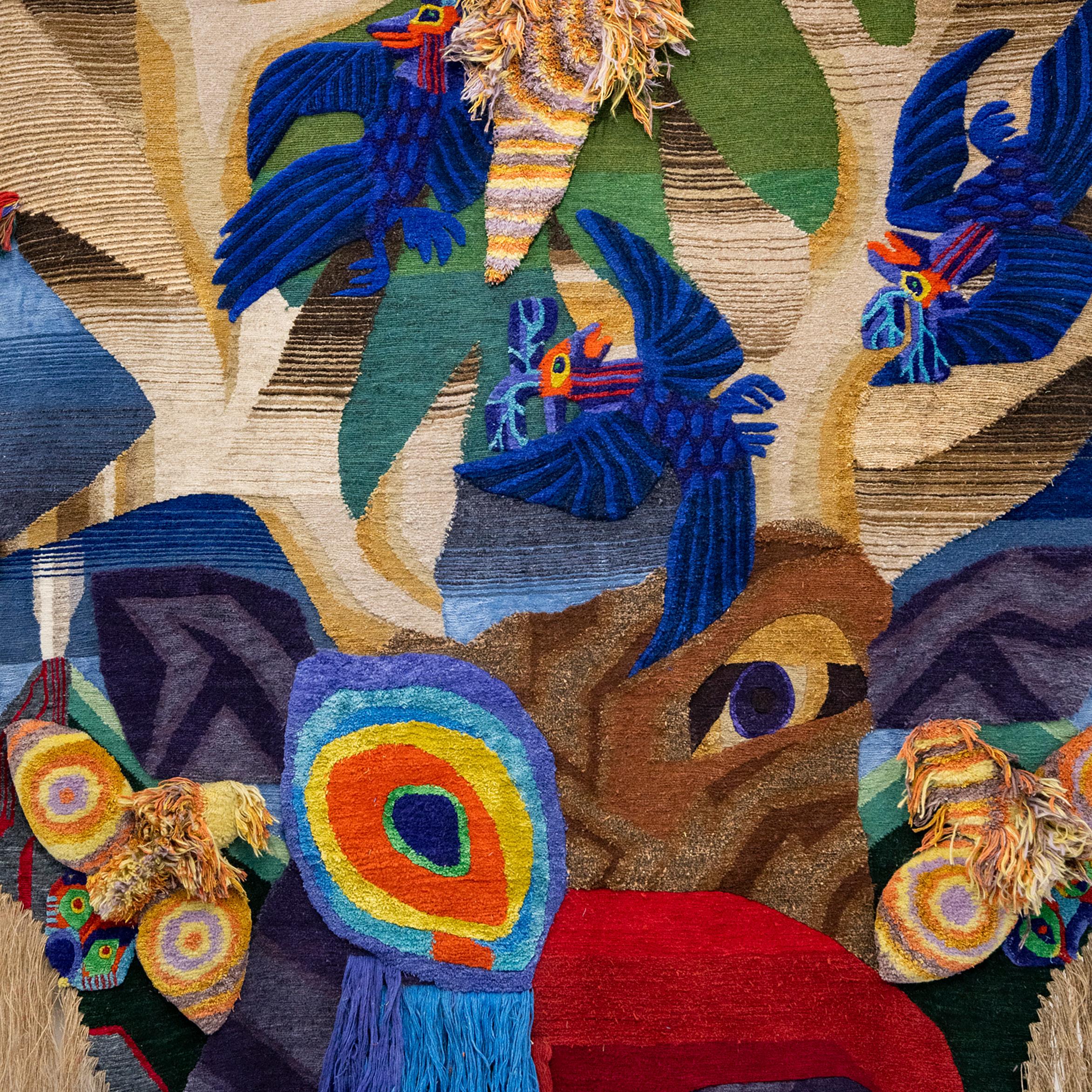
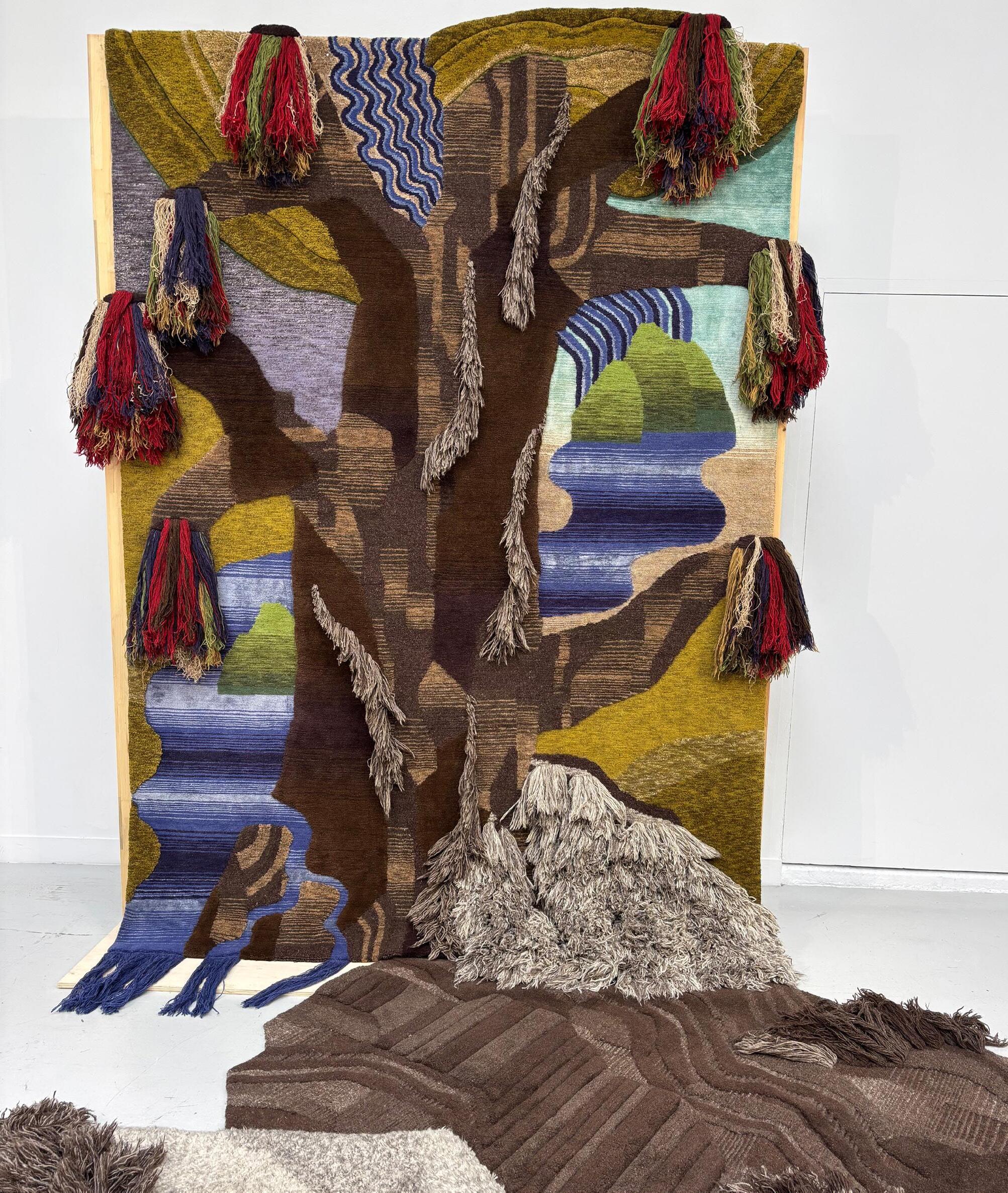
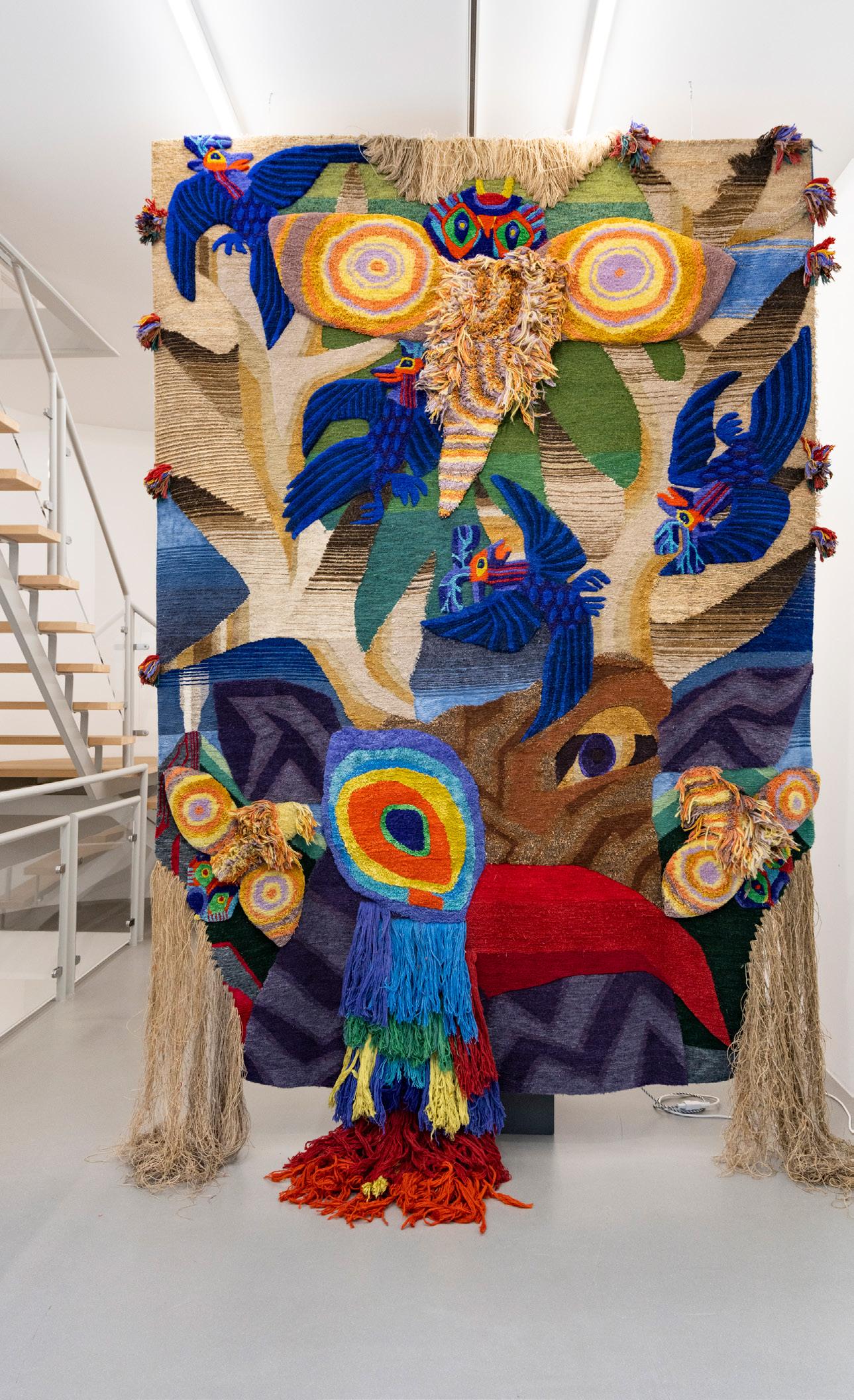
COVER: The Deer, 2023, Hand-knotted rug, Nepal, © C. Hefti
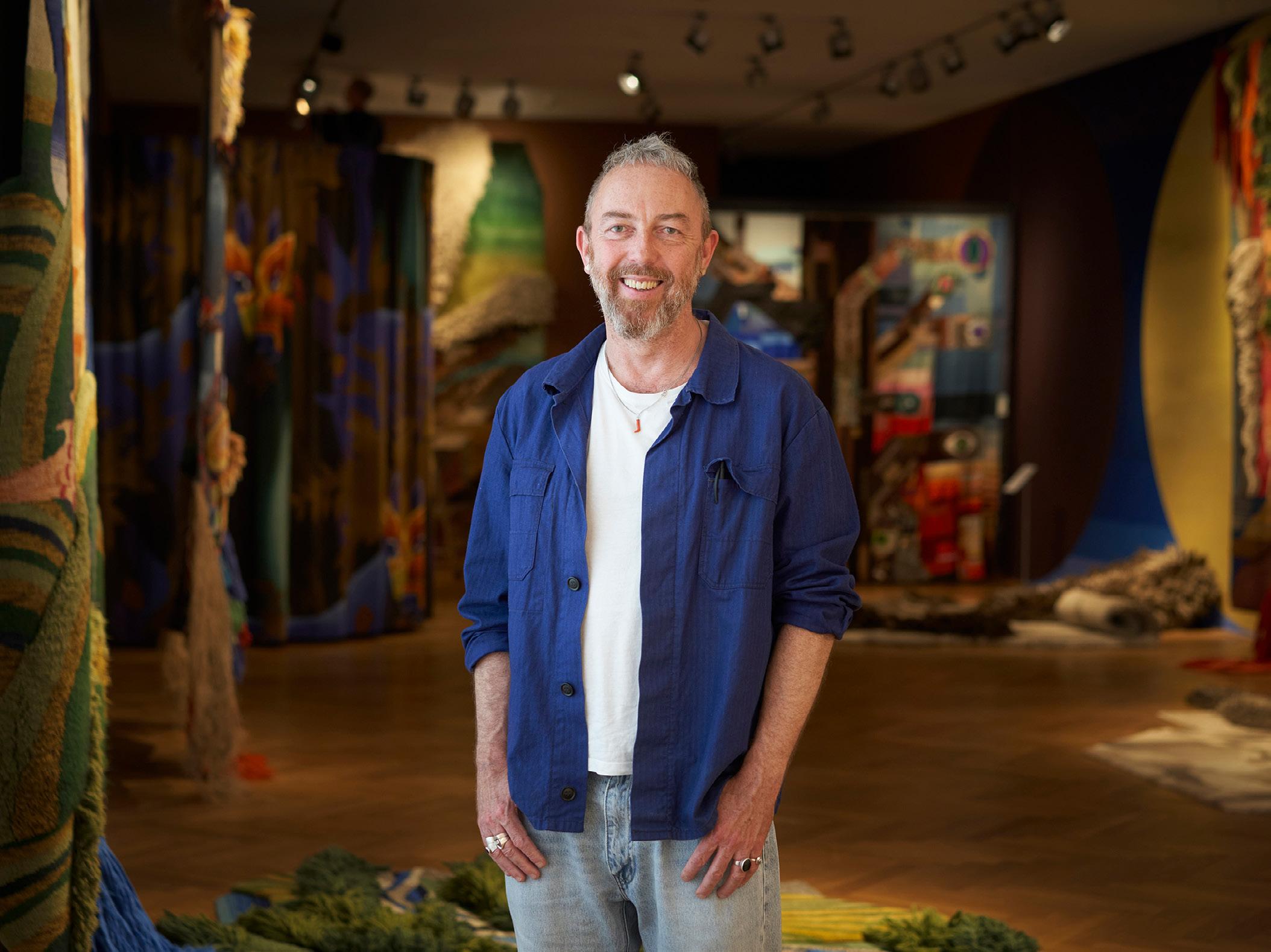
© Hans Schuermann / Gewerbemuseum Winterthur
CHRISTOPH HEFTI
MAKING MAGIC CARPETS IN KATH MANDU
C. Hefti
HOW DID YOU GET INTO TEXTILE DESIGN?
I come from a small village in Switzerland. My parents had the butcher’s shop. But when I was a child all I wanted to do was draw. Drawing, drawing, drawing and painting, all the time. And my parents, they just let me get on with it.
I was not really interested in skiing, in sports. In fact I was a bit of a sickly child, I was always ill. Because of this, I would often miss school events and stay at home. And for me, this was like Super Paradise, because there I could spend my time drawing!
DRAWING, DRAWING, DRAWING AND PAINTING, ALL THE TIME.
SO YOU SET COURSE FOR DESIGN EARLY ON!
When I was 16, I went to study the foundation course at the Art School in Zurich. For me, that was just the best thing ever. Leaving the village and going to the big city.
And you know, from then on, I wasn’t sick or fragile any more! It just went away, I became a very strong guy. So I think I developed the fragility just to be able to create a space where I could do all my drawing and avoid playing football.
WHAT MADE YOU CHOOSE TEXTILES?
In those days, in Zurich, you could not study Fine Arts. In Switzerland, they had a different system, focused on crafts. You could study graphics, or textiles, photography, print...
So I started studying textiles. Not because textiles was my big love. I didn’t think, ‘This is what I want do with my life.’ It was more that I really wanted to stay at the art school. So the question was, what’s the coolest thing I can spend the next four years doing?
SO YOU KIND OF FELL INTO IT?
Another important factor was the course directrice , I fell in love with her way of being. She’s still a very good friend of mine now. She was this German intellectual lady from the ‘80s, wearing Yamamoto dresses with short gray hair, you know. I was so impressed by her. I remember she said things like, ’I’m not interested in beautiful fabrics!’
I GOT A BIT BORED WITH JUST MAKING A DESIGN AND NEVER KNOWING WHAT WOULD BE MADE FROM THE FABRIC.
I had just come from the village, I didn’t study at university, and quite honestly I didn’t understand what she was saying a lot of the time. I didn’t know what she meant when she talked about, ’the dialog between the body and the space.‘ I was just very attracted to the whole package, it sounded so great.
So it wasn’t clear to me exactly what a textile designer might do, once his studies were finished. I just wanted to spend my next four years in really cool surroundings.
DID YOU GO STRAIGHT FROM ART SCHOOL TO WORK FOR JEAN PAUL GAULTIER?
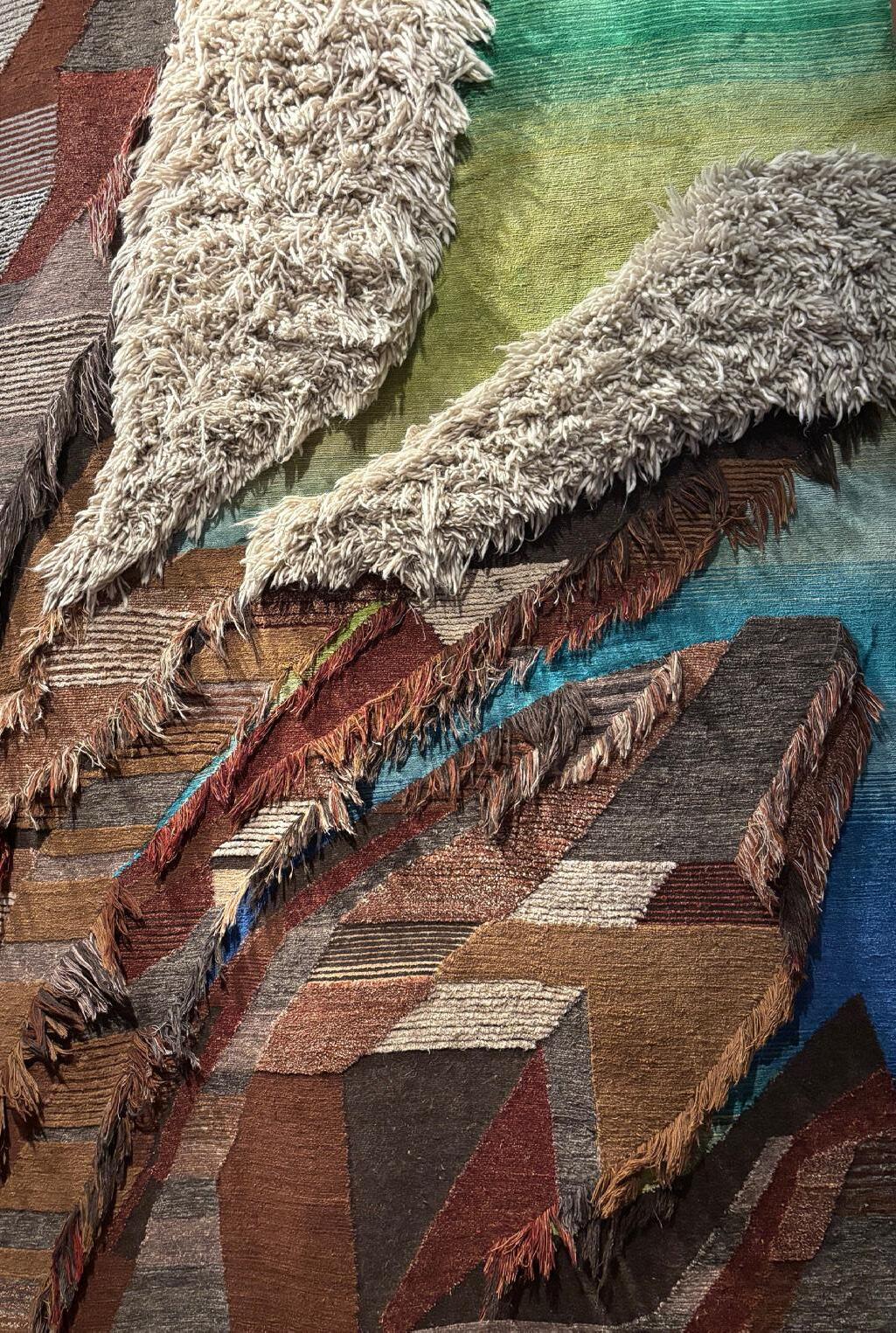
4 — Lost and Found, 2024 Special Edition Hand-knotted rug, Nepal, © C. Hefti
Oh, no. After the course, I started working for a textile company in Zurich. They were really cool. They were doing prints and designs which they sold to all the houses in Paris. Mugler and Montana and so on. I designed fabrics for them.
The boss there started to take me to Paris, and I discovered there was a little bit more to the world. But after a couple of years I got a bit bored with just making a design and never knowing what would be made from the fabric.
I always thought, if I knew which designer would buy the design I would do it differently each time. Sometimes I might see a design working best as a top, or it should be really big like a huge coat or jacket. But this was not good for the company, everything had to be multi purpose.
So I decided to move to London and study fashion at St Martin’s. That was very cool. Once again, I just wanted to live in London. I got the job at Jean Paul Gaultier while I was still in London.
HOW DID YOU MEET JEAN PAUL GAULTIER?
It was funny, I applied for an internship with him. I never got a reply, nothing. So I thought, ‘yeah, typical!’ Then, more than a year later, out of the blue, they contacted me. At first I thought it were my friends playing a joke on me, but it was real.
They arranged a meeting in a hotel in London. That was very exciting. I knocked at the hotel room, and there in the doorway stood Jean Paul Gaultier. He was super friendly and funny. We had a beer, and I showed him my stuff.
It seemed strange they would arrange all this just for an internship. And I didn’t actually need an internship anymore. So I felt a bit uncertain. But of course, you don’t say no to an interview like that.
When I mentioned the internship he said, no, no, no, it would be a real job. He told me I should move to Paris and work for him. So that’s exactly what I did.
HE WAS SUPER FRIENDLY AND FUNNY. WE HAD A BEER, AND I SHOWED HIM MY STUFF.
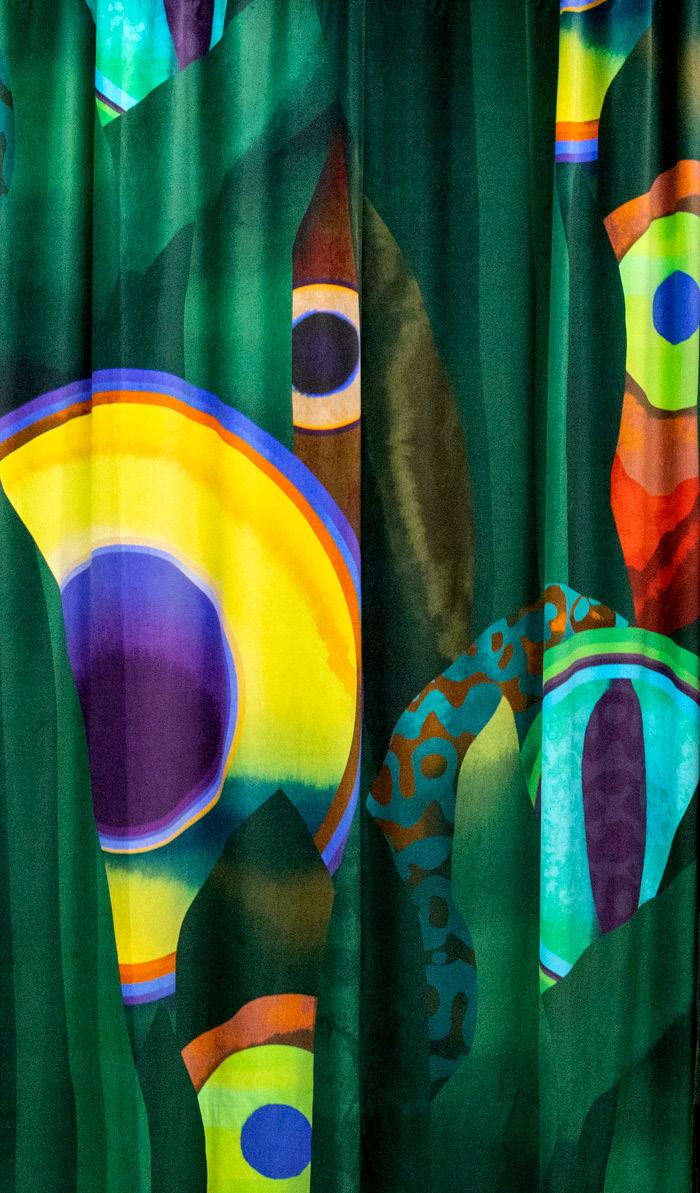
5 — Animal Eyes, 2023 Curtain, digital print on cotton velvet, © C. Hefti
THAT MUST HAVE BEEN AN INCREDIBLE DAY!
Yeah, it was super. It was enchanting. I really liked Gaultier so much because I didn’t expect to feel comfortable with him but he made me feel very at ease.
HOW DID YOU LIKE THE WORLD OF PARIS FASHION?
Well, Gaultier was nice but it was not easy to work for him. The studio setting was kind of difficult. It was the first time I experienced this Paris Fashion hierarchy. You have to figure everything out yourself. And when one thing goes wrong, they all enjoy stabbing you in the back.
AND WHEN ONE
THING GOES WRONG, THEY ALL ENJOY STABBING YOU IN THE BACK.
I look back now and I think, ‘Oh, my God, how did I survive this?’ At first I was a bit lonely and then suddenly a shoe designer started, and another designer who was closer to my age, and they were super, super nice. We became friends immediately. We went having a drink in Montmartre or behind Bastille and Belleville, seeing bands and such while the others went to fashion places such as Bain Douche.
IT MUST HAVE BEEN AMAZING GOING OUT TO THE CLUBS AND BARS OF PARIS, SEEING YOUR OWN WORK ON PEOPLE’S BACKS?
Of course, that’s very nice. But I always carried with me a little bit of that Swiss village boy. I always kept a little bit of distance. My father told me before leaving Switzerland, that I should never do something I don’t want, just to please others.
To tell the truth, till the last day I worked in Paris fashion I had a big problem with this hierarchy thing. Dries Van Noten, where I designed textiles for the next 13 years, was totally not like that though. He’s in Belgium, in Antwerp.
I like it when you can just go and talk to people. You can have the boss and the employee, of course, but when conversation is about the work itself, you talk equally. This is how it should be, how it was with Dries Van Noten and with the last artistic director of Mugler, Casey Cadwallader. We would just hang out, and talk. In Paris, they never really managed that simple little thing.
YOU CAN HAVE THE BOSS AND THE EMPLOYEE, OF COURSE, BUT WHEN CONVERSATION IS ABOUT THE WORK ITSELF, YOU TALK EQUALLY.
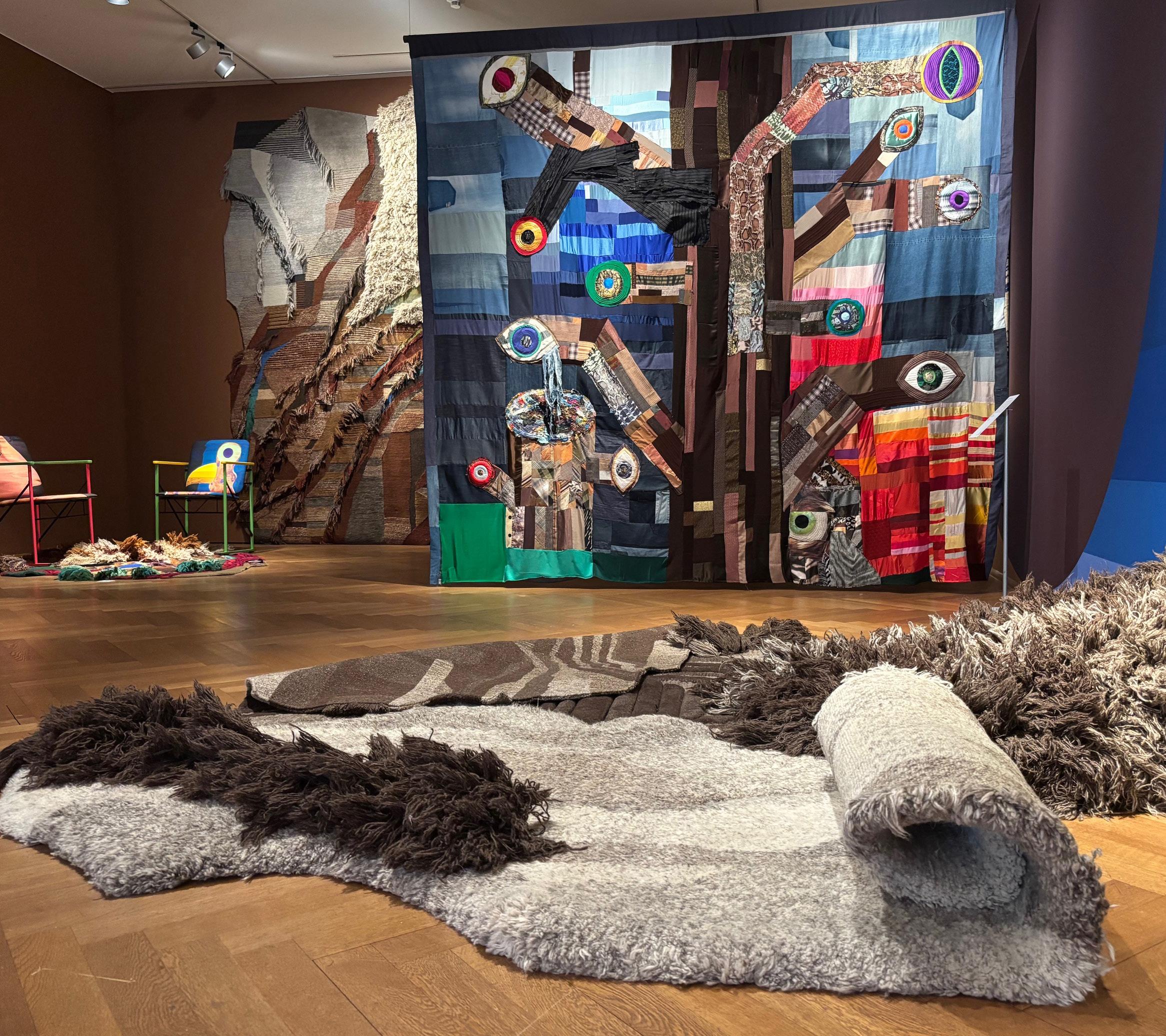
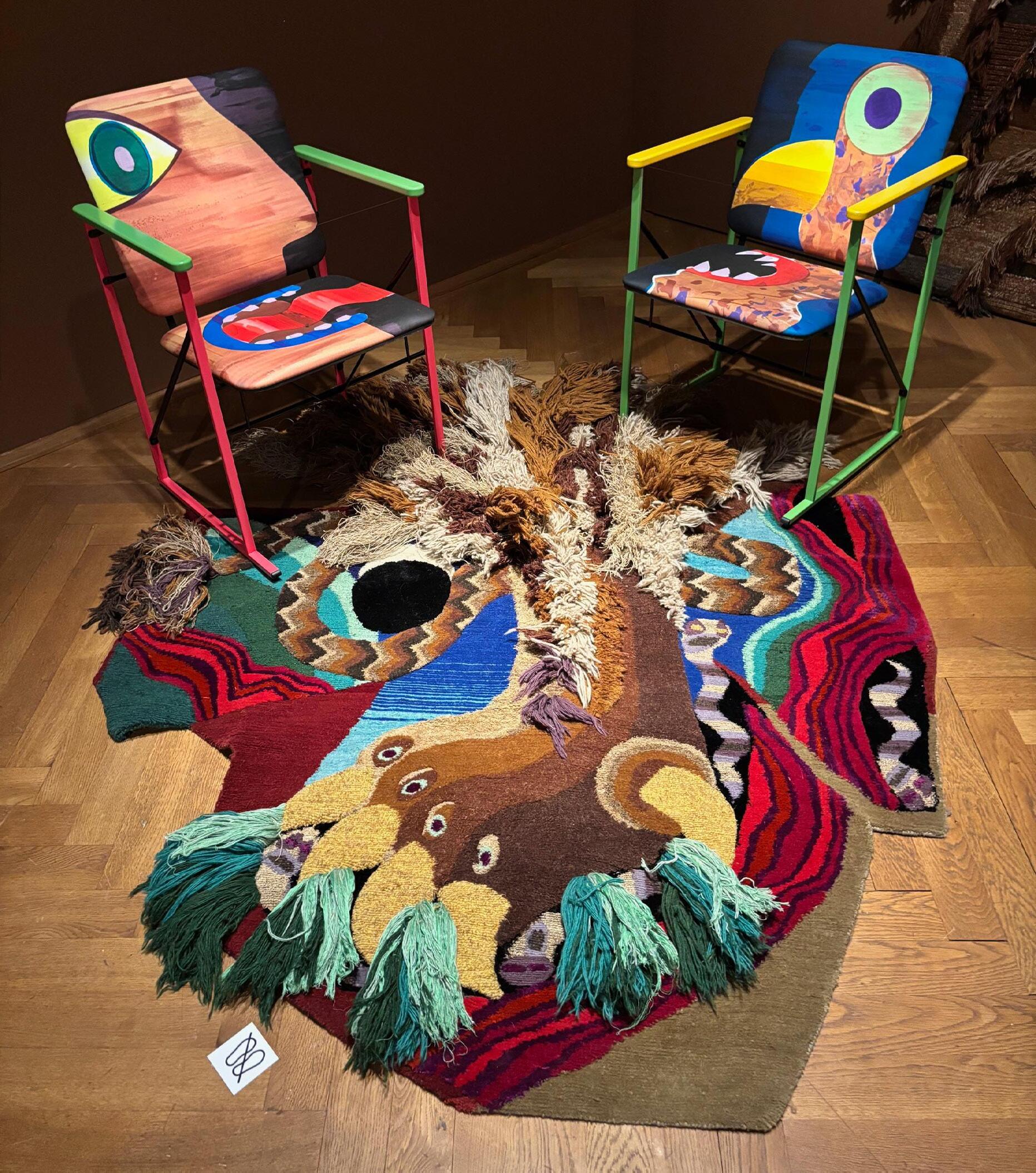
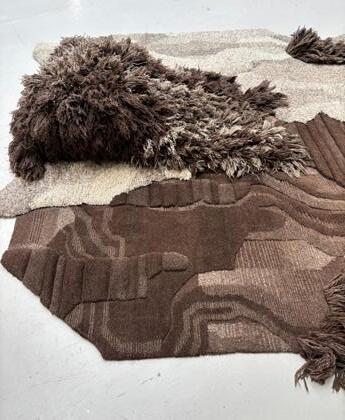
7 — Rug: Animal Foot, 2023 Hand-knotted rug, Nepal Chairs: Human talking, Animal not understanding a word, 2024
by
Screenprinted
hand on Yrjo Kukkapuro Chairs, © C. Hefti
HOW DID YOU GET FROM FASHIONISTA TO CARPET-ISTA?
After all those years in fashion, I got a bit tired and I just wanted something else. I thought at first that I had to move away from textiles, but then I realized I should keep the textiles but drop the fashion. And then, one day, out of the blue, I thought about doing a carpet.
I did not sit with myself at a meeting table to say, ‘I’m gonna build a business in carpets.‘ I had some savings and I thought, you know what? I want to treat myself to going somewhere and meeting people, maybe developing a carpet.
First, I went to Mexico and traveled through Latin America. But I really got very inspired when I discovered they make beautiful carpets in Nepal. So, I decided to go there. I thought, maybe I will meet some people, who knows! Once I started going there, I realized, this is perfect for me. And I was determined to do it differently than the fashion work. I wanted a different rhythm.
So I made the kind of carpets which people hadn’t seen before. And the funny thing is, people responded very well to them.
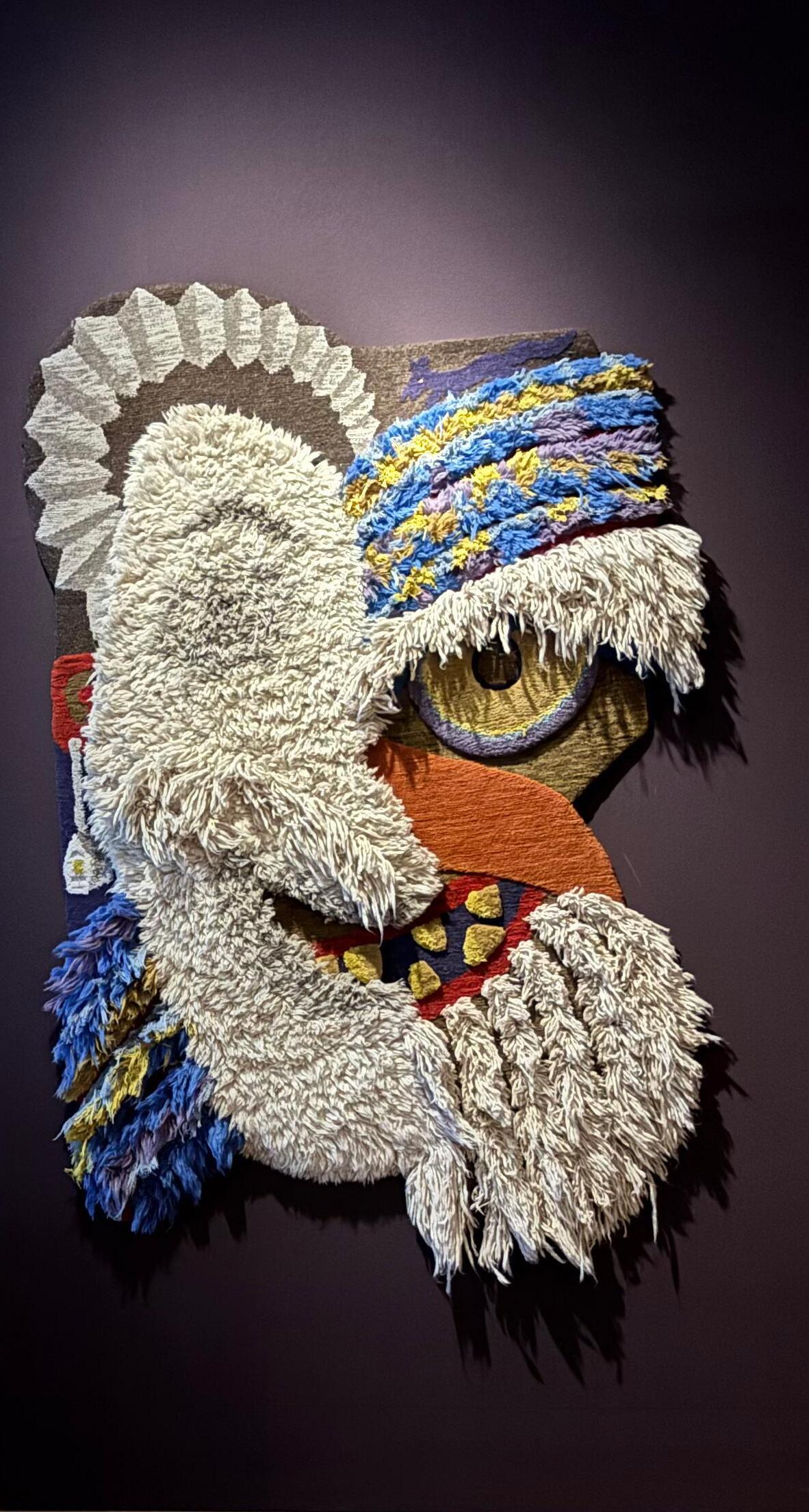
8 — Swiss Mask, 2019 Hand-knotted rug, Nepal, © C. Hefti
WHAT WAS IT LIKE IN NEPAL, THAT FIRST VISIT?
The first time in Nepal, I was thinking, ‘OK, make this carpet how you want it because there’s a really big chance you’re just going to make one carpet and it will live in your apartment for the rest of your life.’
But it went from Nepal to gallery Maniera in Brussels quite quickly. They took it to a fair and it really grabbed attention there. At that point I realized ‘wow, okay, let’s do a second carpet, and another.’ And it became a business.
Sometimes though, I still want to go back to that moment when I’m a little bit lost. I always go back to that moment and remind myself, ‘Christoph, you started this because you wanted freedom. You wanted your own thing.’
Of course, the naivety is a bit worn now. But when I design, I go back there in my mind.

BEGINNINGS ARE SPECIAL. WHEN THERE IS NO ESTABLISHED PATH, ORIGINALITY IS AT ITS STRONGEST.
Creativity is a wild beast. I never really know whether I’m on the path or not. When I make a carpet for a fair I don’t know for sure whether it’s going to be a success or not. This is good because I cannot be too calculated about it. If I try to do that, it just doesn’t work.
It’s really like magic when it works. Maybe it was a coincidence that someone was there who loved the carpet and that made it successful? It’s impossible to know. It just needs one person, or one journalist. Then you start to see the carpet has a life of its own. But when I release the carpet, I have no clue.
DO YOU GO BACK TO NEPAL
VERY OFTEN?
Oh yes, I spend a lot of time in Nepal. The first two times I went for about six weeks. I wanted to learn how it works out there. I had one address, then I found another, just exploring organically. I didn’t know if I would meet the right people or not. But for me, it was important to be in Nepal.
When I used to work for Dries Van Noten, designing the fabrics, I went to Italy all the time, where we produced the fabrics. After all those years, I knew every kind of weaver and technician. It was fantastic to be right next to a weaving room.
They would show me, 'look, this is a bit too tight, this is too loose. We can print on that material, but then it’s more expensive.' etc . So I would make the design a little bit more luxurious looking. Then I pop outside, away from the noise of the machines to make a call to Dries for his OK. I love all that.
But even when I started to work in these luxury houses in Paris, it had already become more of a digital thing. Sending files by we transfer and all that. So, when I started with the carpets, I thought, okay, I want to be in touch with the crafts people, I’m going to lean into that. That’s why I wanted to go to Nepal. I wanted to explore.
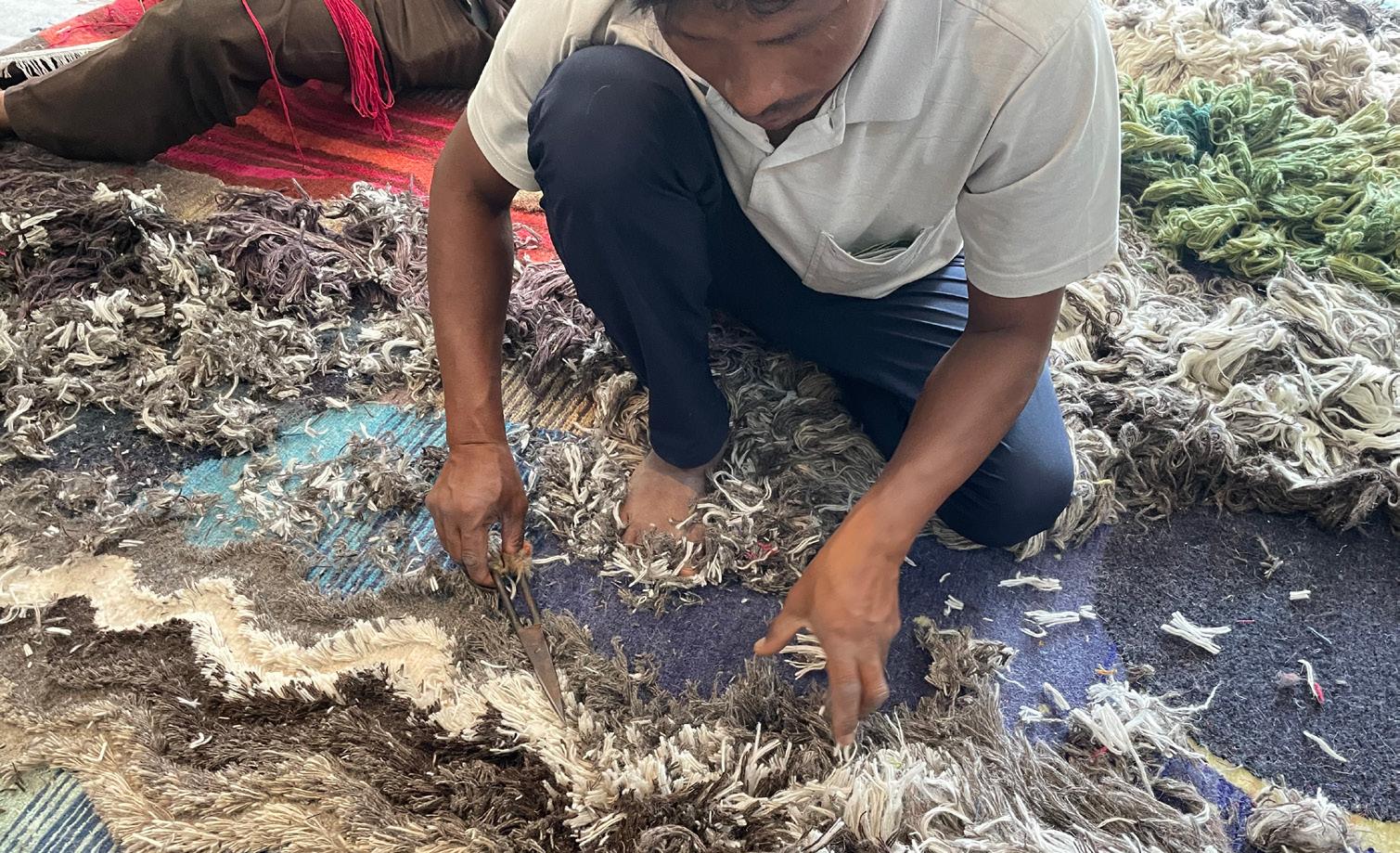
The weavers are difficult to get to know. They don’t really speak English, and I don’t speak Nepali but I talk with the boss, with the people from the Atelier, we discuss a lot. Different combinations of knots, all the technical details. I wanted to learn about everything. The so-called ‘dying master’, the technicans and so on. And then, one day they said, ‘Okay, now bring us a design and we will weave a carpet.’
So for four days I was working like crazy. I put all my knowledge into one carpet. That’s why they became like a collage. That’s why they are so multi-thickness, When they saw my design, they weren’t sure they could do it. They didn’t know if they could mix the really thick wool with a really fine silk because that brings this tension into the carpet. So then I learned about tension in the carpet.
THEY DIDN’T KNOW IF THEY COULD MIX THE REALLY THICK WOOL WITH A REALLY FINE SILK BECAUSE THAT BRINGS THIS TENSION INTO THE CARPET.
SOUNDS PRETTY INTENSE
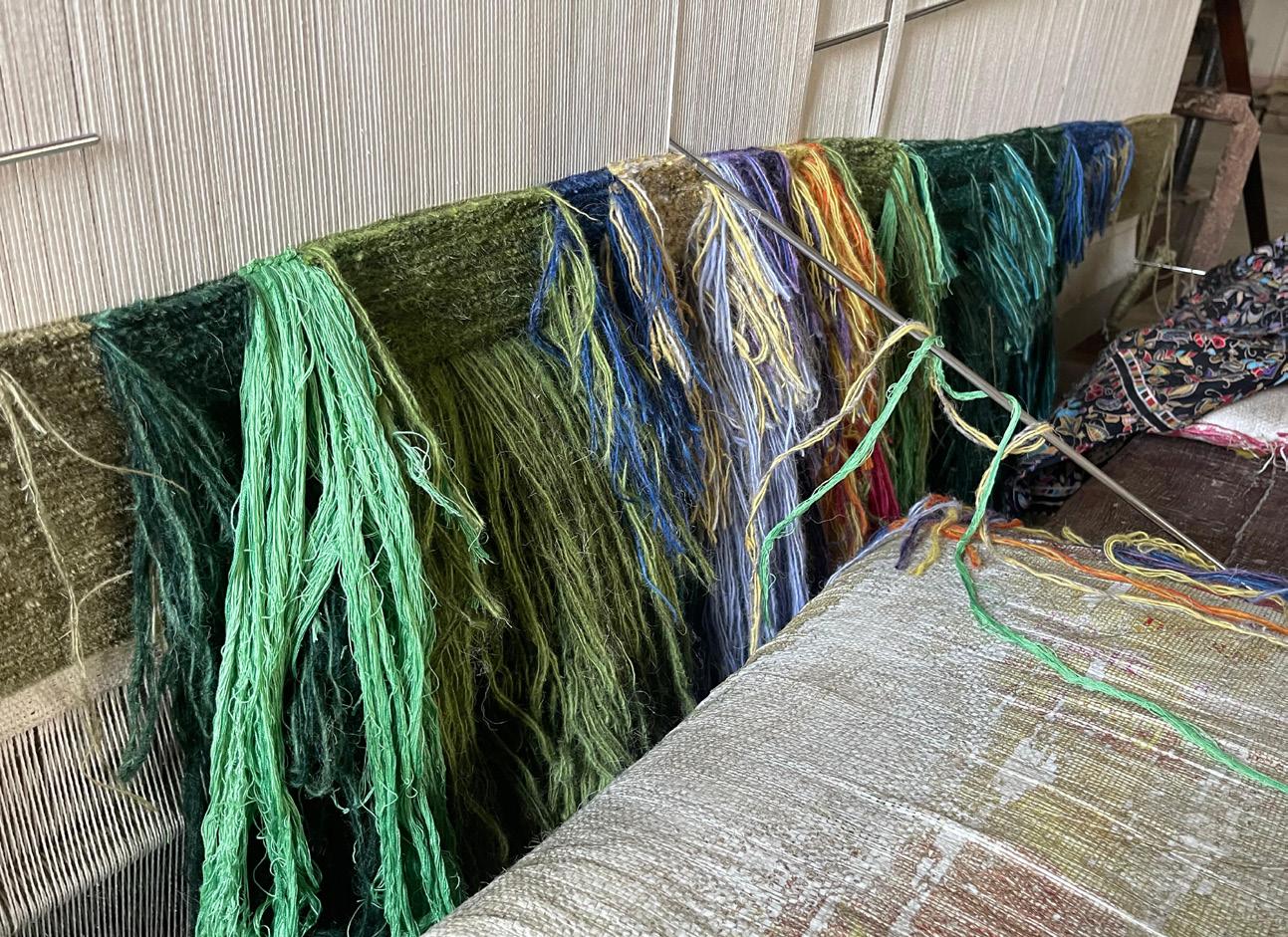
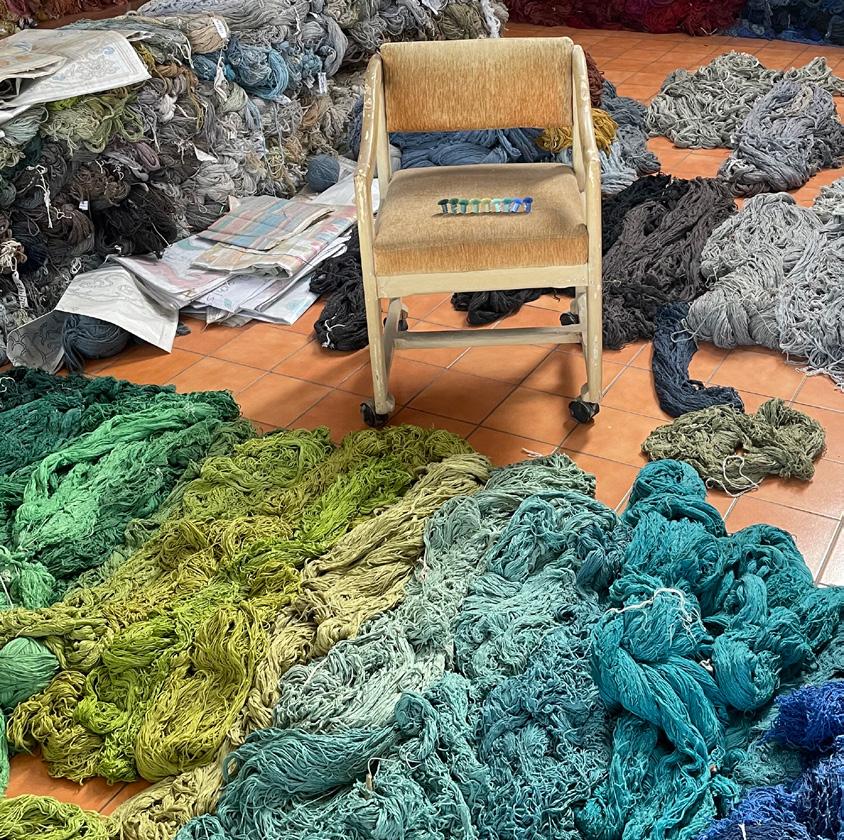
The other important thing about going therea couple of years ago I discovered a warehouse with some left over wool and lots of super beautiful materials. I’m most happy when I’m there.
In the beginning, I always thought I needed to be very well prepared before going to Nepal, so I made all the designs first. But then, by coincidence, I found these hills of wool in different colors at the warehouse. And just wandering around I would discover color combinations I never would have figured out sitting in my hipster studio, fiddling with these little pom-poms . You have to be there.
In the evening I’m always alone, so I have time to think about this or that color combination. Should I put this into that carpet? Or should I create a carpet just for that?
I’m very disciplined. I always work, work, work when I’m there. Each day they take me to the warehouse, about one hour outside of Kathmandu, and they drop me there. Me and my sketchbooks. I have my food and my thermos flask and they come and fetch me before the sun goes down, because the electricity there is unreliable.
So I’m always in a nerdy type of state. If I finish my work early I just take an hour to do a bit of freestyle with different yarns and colors. Think about how I could work with these really nice brown, warm wools. Can I find the opposite? Is it this blue silk? And in the evening, I sit there in the restaurant and I just think about it, doing drawings.
YOUR PROCESS
IS VERY ANALOG, VERY ORGANIC
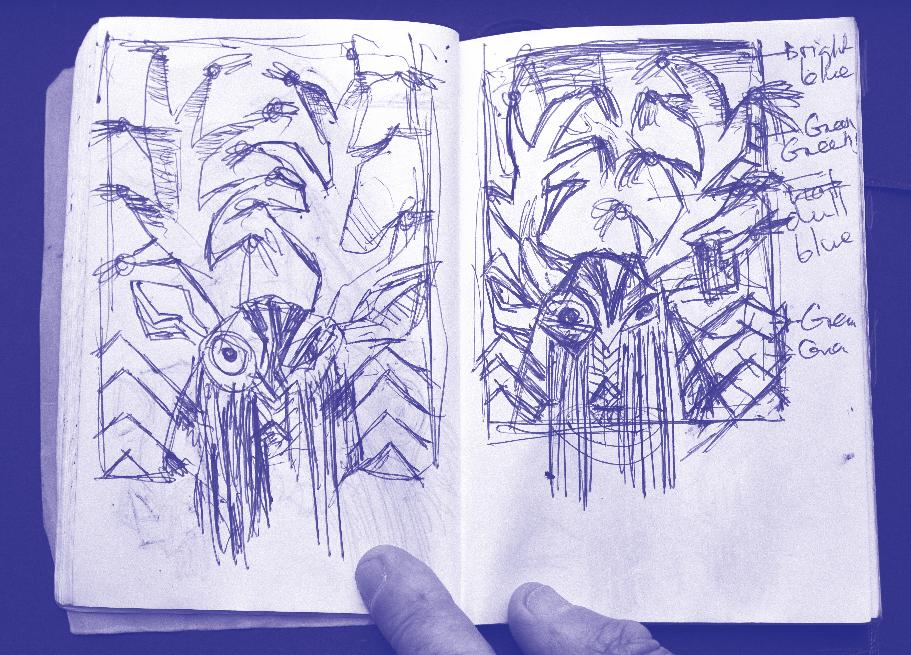
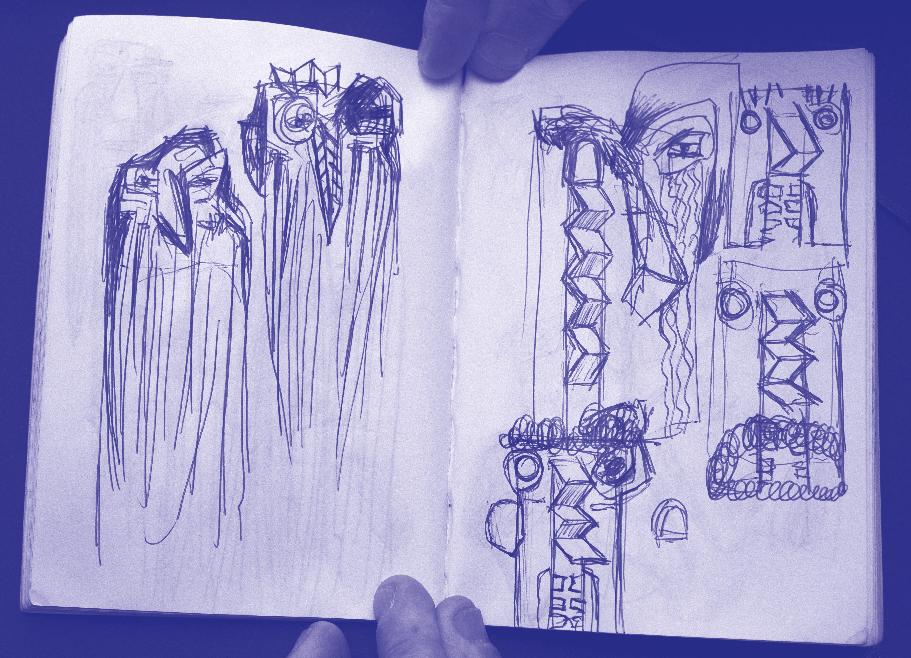
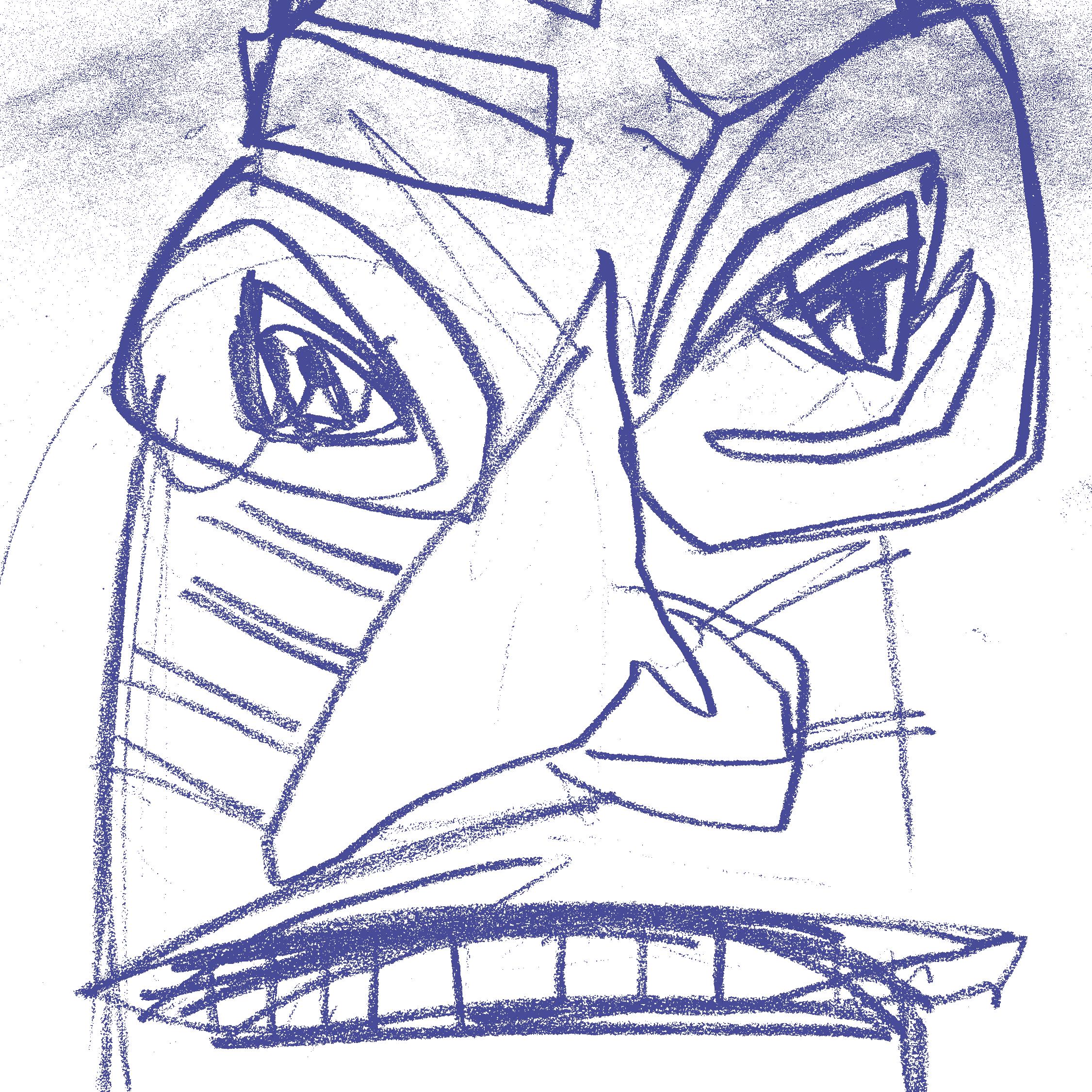
I always start with drawings. I have to draw. I always have to draw a lot. In fact, I draw constantly, all different things, till I get into a scene or a shape. Sometimes I have to draw almost the same thing three or four times. When that happens, I know it’s not changing shape anymore. I don’t really control it too much.
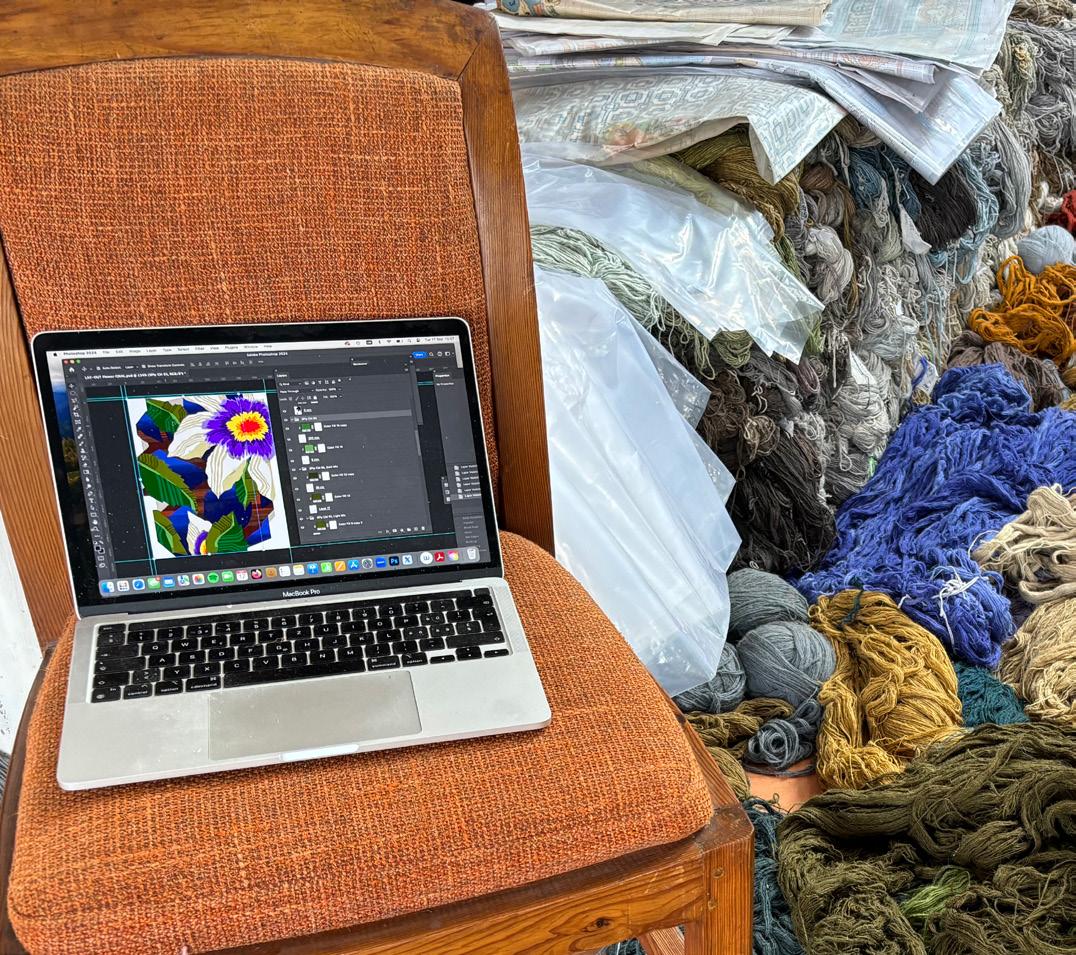
And then, once the drawing is done, it goes into Photoshop. Every knot has its own layer. The weavers in Nepal are very precise.
SO DRAWING IS AT THE HEART OF IT?
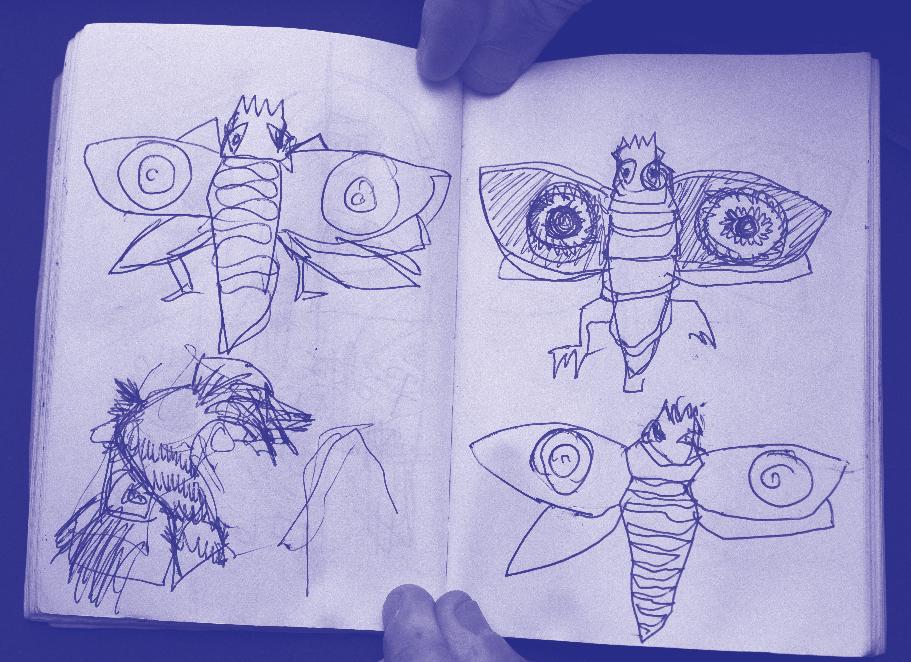
Yes, but I’m not so busy with producing a nice drawing. And I’m not just sketching carpets. In the last couple of years when I draw, I think of how a carpet could look. But before, I was just drawing, till it goes to this direction or that and I see, for example that I want to incorporate a moth.
But I don’t Google what a moth looks like. There is so much inside of us, we can imagine so much more. So then I start drawing pages full of moths. Then I give them faces. Or it could be that you suddenly think, what about if the moth was a carpet?
It’s like I’m in communication with the drawing, rather than thinking or figuring out stuff. But I have to think about how long I want to spend on the drawings. There is always this moment when I know it’s time for a work to enter the computer. And then of course, it starts all over again once I draw on the computer, because with a sketch you can cheat yourself.
You get the essence on paper. But when I start to draw it out more, it’s cleaner and sharper but it maybe looks like a bit of an ‘80s carpet. I did not really expect that! Is this good or not? Do I want this or not? You have to communicate with the work.
In life generally, I’m really bad at taking decisions, I’m always a bit tortured. But with the drawing I always have the feeling that the work, it decides by itself. The decision is happening - but , not here in my head. It’s more the work telling me which direction it wants to go. It’s kind of strange. I always try to find a team within my work process.
YOU PRODUCE BEAUTIFUL
THINGS, IS IT IMPORTANT THAT THEY’RE ALSO USEFUL?
Yes, it’s really important for me. If a thing does not have the potential to be useful, I probably would not even have an idea in the first place. If I was just making a drawing or a painting I really wouldn’t know what to do.
Right now I’m doing a lot of trees and carpets. So I could paint a tree. But isn’t it nicer to have a tree which is a carpet? I’m just super happy about being a designer. I want to design stuff that people see and use. Sometimes people have said, ’I thought you were making carpets, but it’s actually art.‘ For me though, as long as it’s a carpet, I’m a designer.
Now, the motivation, the thing in my head is maybe a bit more of an artist’s mindset, but it doesn’t matter. What matters is what comes out at the end. That’s why, when I have an idea for a printed fabric, I want to know that it’s a curtain, for example. That helps tremendously. When it’s folded, you only see the colors, it’s abstract, then when you pull it closed, you have a landscape, or faces or something.
It's exactly the same when I make the ceramic lamps I always build a socket for the light bulb, and have a nice cable. But people, they don’t buy it as lamp. They just find it a nice sculpture or something, they don’t even take the cable. Even so, I could not just make sculpture without thinking that it is a light. It always has to be a lamp.
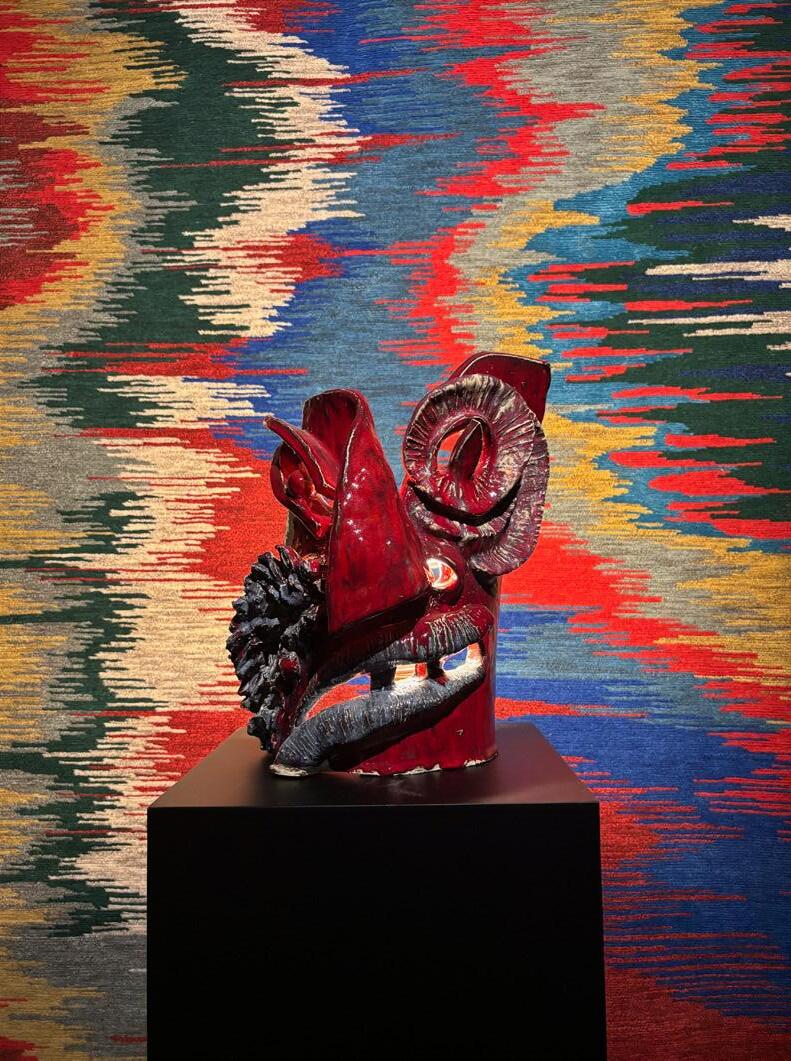
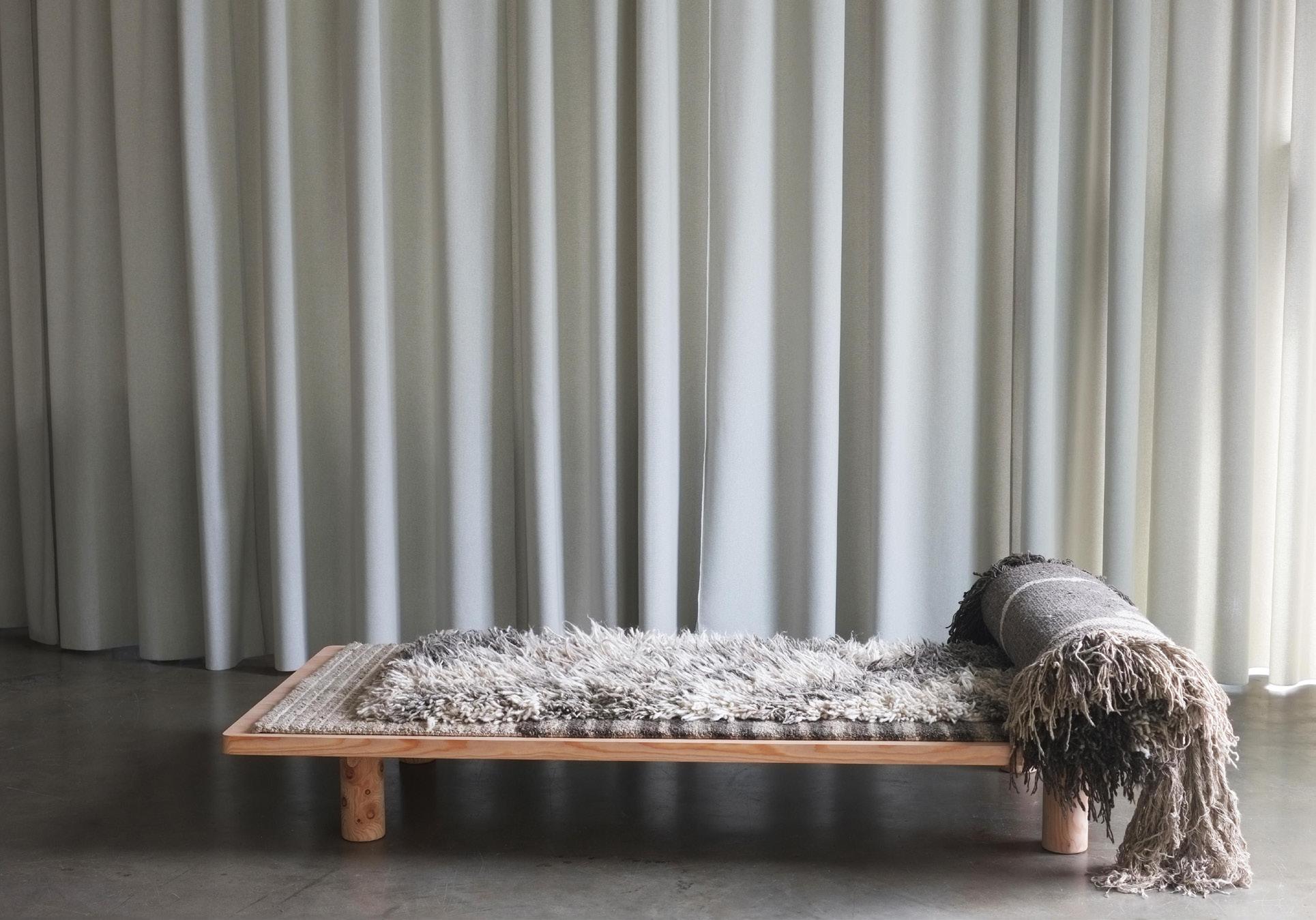
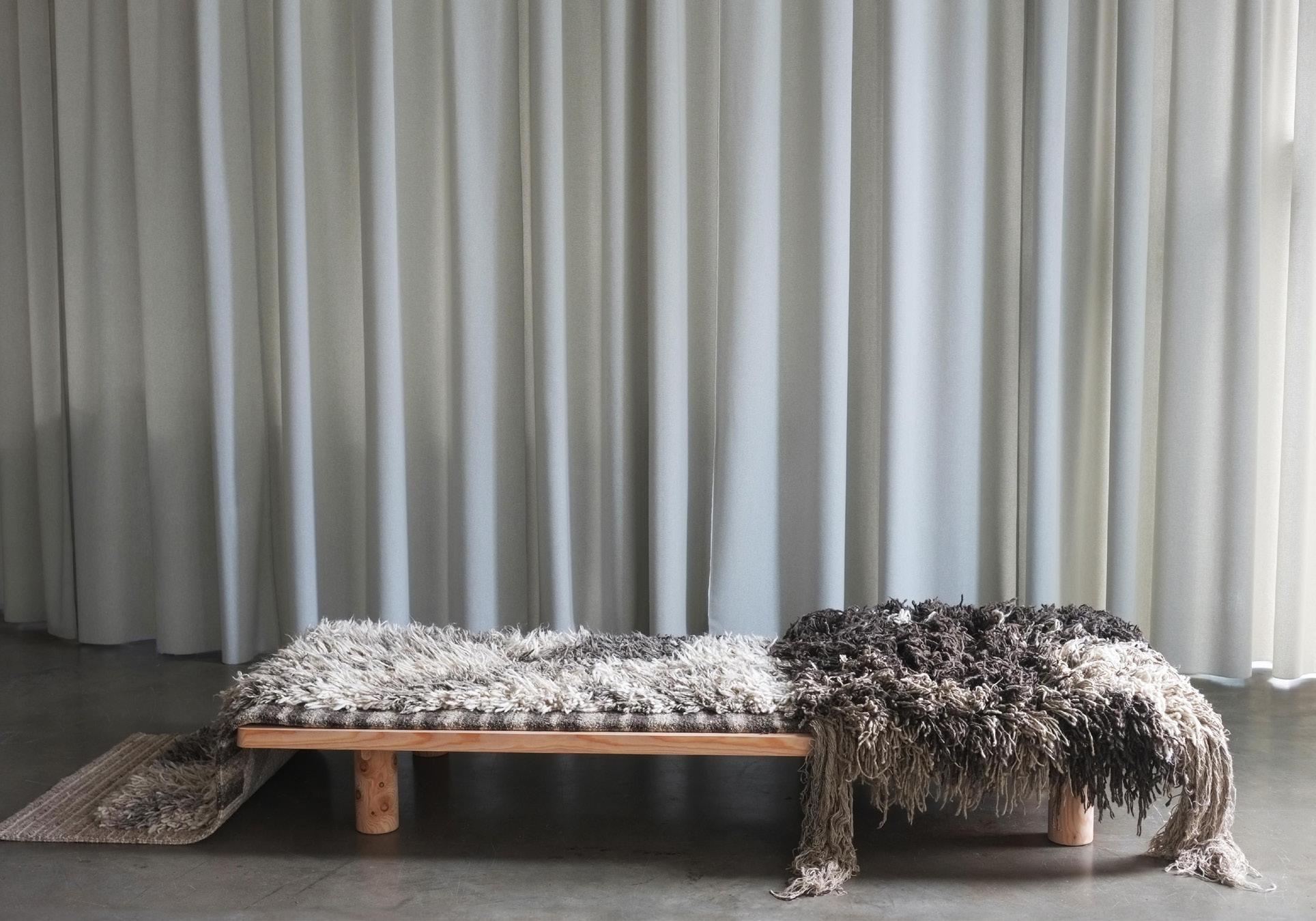
11 — Story of shelter, 2026, in collaboration with Jörg Boner, Product Designer, © J. Boner/C. Hefti
2020 54 TYPEJOCKEYS Type Design 2020
55 MOTH Animation Design 2021 56 JONAS LINDSTRÖM Photography 2021 57 VERONICA FUERTE Graphic Design 2021 58 CHRISTOPHE DE LA FONTAINE Product Design 2021 59 DAVID KAMP Sound Design 2021
THOMAS
Design Friends would like to thank all their members and partners for their support.

COLOPHON
PUBLISHER Design Friends
COORDINATION Heike Fries
LAYOUT Annick Kieffer
INTERVIEW Mark Penfold
PRINT Imprimerie Schlimé
PRINT RUN 250 (Limited edition)
ISBN 978-2-919829-16-3
PRICE 5 €
DESIGN FRIENDS
Association sans but lucratif (Luxembourg)
BOARDMEMBERS
Anabel Witry (President)
Guido Kröger (Treasurer)
Heike Fries (Secretary)
Hyunggyu Kim (Member)
COUNSELORS
Vera Heliodoro, Hyder Razvi, Olga Silva, Silvano Vidale WWW.DESIGNFRIENDS.LU C_HEFTI_2017
Support Design Friends, become a member. More information on www.designfriends.lu
Design Friends is financially supported by
This catalogue is published for the lecture of Christoph Hefti "Stories & atmospheres" at Rotondes on April 29th, 2026 organised by Design Friends.
In collaboration with Partners Service Partners