SCOTTSBLUFF JAPANESE HALL • MERRICK STRIP • A NOVEL IDEA BOOKSTORE • MULE DEER
OCTOBER 2026
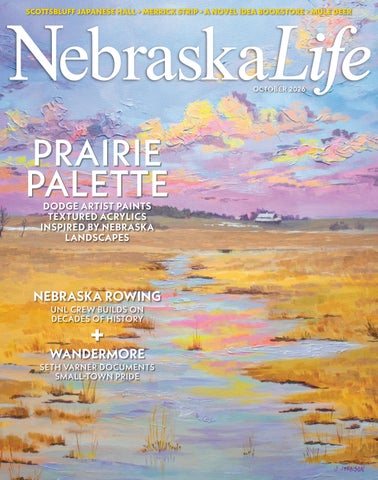
PRAIRIE PALETTE DODGE ARTIST PAINTS TEXTURED ACRYLICS INSPIRED BY NEBRASKA LANDSCAPES
NEBRASKA ROWING UNL CREW BUILDS ON DECADES OF HISTORY
WANDERMORE
SETH VARNER DOCUMENTS SMALL-TOWN PRIDE
When we all leave five,
OUR HOMETOWNS THRIVE Not all assets are created equal. Some are best left to children, others to charity. Nebraska Community Foundation can help you secure your family’s legacy and help your hometown thrive. Learn about the Five to Thrive movement and tax-wise charitable giving at fivetothrivene.org. ABOVE: Jeana and Tanner Hackel of Ord have designed an estate plan to benefit their children and favorite charitable causes. By leaving 5% to their local community foundation, the Hackels are helping ensure future generations of Valley Countians will enjoy the same thriving community where they built a business and raised their family.
Not your typical community foundation Nebraska Community Foundation works with donors and local leaders in 298 communities to create bolder, brighter futures through charitable giving. For more than 30 years, we’ve reinvested over a half a billion dollars into our hometowns. Join our movement to build stronger communities and a Greater Nebraska!
NebraskaHometown.org ■ 402.323.7330
SAVINGS WITH INCENTIVES. Nebraska’s utilities offer several incentives for energy-efficient upgrades and for switching from fossil fuels (propane and natural gas) to
electricity—cutting emissions, lowering costs, and building a sustainable future.
To learn more about the benefits of public power in Nebraska, visit publicpowered.com.
Public Power utilities across the United States are celebrating Public Power Month.
Nebraska a 100% Public Power State Custer Public Power District proudly serving rural Nebraska.
© Linda Teahon
NEBRASKALIFE.COM 3
SPECIALIZING IN
THE NECK UP.
Columbus Otolaryngology Clinic – Specializing in the neck up Your everyday life deserves high-quality care. Look no further than Columbus Otolaryngology Clinic, where we specialize in everything from the neck up. Our expert medical providers keep an eye on your health so they can meet your ear, nose and throat, or ENT, needs. They treat general and pediatric ENT issues, nasal and sinus problems, thyroid conditions and sleep apnea. They also diagnose and treat head, neck, skin, tongue, tonsil and vocal cord cancer.
Our team offers one-on-one, personalized care that distinguishes us from other ENT providers. We focus on treating the whole person, and our providers take the time to get to know you and your life so they can make an accurate diagnosis. You can depend on Columbus Otolaryngology Clinic — we reach new heights every day to provide top-tier care for all your ear, nose and throat care needs.
Scan the QR code to learn more about Columbus Otolaryngology Clinic.
402-562-4720
OCTOBER 2026
FEATURES 18 Nebraska Rowing Nebraska Rowing, pg. 18
For 57 years, the University of Nebraska-Lincoln rowing club has kept its tradition alive through generations of students and alumni, including Olympic silver medalist Lisa Rohde.
story by Brady Oltmans photographs by Jeremy Buss
24 Before the Quilts Go
A return to the Nebraska Sandhills and a collection of her great-grandmother’s quilts lead Jenna Rose through generations of family history, memory and belonging.
story and photographs by Jenna Rose
30 Nebraska in 531 Stops
Seth Varner turned a quest to visit all 531 incorporated Nebraska communities into Wandermore, a project devoted to documenting overlooked places and people.
story by Kristin Dahl photographs by Seth Varner
42 Painting Old 91
Artist Jeanette Johnson from Dodge turns Nebraska’s open skies and rural landscapes into nostalgic acrylic paintings.
by Ariella Nardizzi Before the Quilts Go, pg. 24
46 Map Mayhem
A 9-mile sliver of Merrick County juts between Howard and Nance counties, preserving a curious boundary shaped by Nebraska’s territorial history and political wrangling.
story by James J. Kimble photographs by Alan J. Bartels
DEPARTMENTS 9 Editor’s Letter
A perspective from the desk of Chris Amundson.
10 Flat Water News
Scottsbluff’s restored Japanese Hall preserves local history; Nebraska’s Rivers From Above explores the state from the air; Lincoln bookstore A Novel Idea celebrates books and cats.
Nebraska in 531 Stops, pg. 30 NEBRASKA LIFE, ISSN 1091-2886, is published bimonthly for $32 per year by Flagship Publishing, Inc., 5552 North River Run Dr., Provo, UT 84604. Periodical postage paid at Provo, UT, and at additional mailing offices. POSTMASTER: Send address changes to Nebraska Life, PO Box 970460, Orem, UT 84097.
CONTENTS 5
DON’T MISS THESE EVENTS IN
N E B R
A S K A
Crossroads Junk & Vintage Market
Heart of the Holidays December 13
Christmas on the Farm at Wessels TBD
A holiday market featuring vendors from across the region specializing in seasonal vintage goods, antiques, re-purposed items, wood, metal, and architectural salvage. Also features handmade and
A family-friendly holiday festival held at the York City Auditorium from 1–5pm. Features a Light Parade, ice skating, trackless train rides,
Experience the sights, sounds, and smells of Christmas on the farm in 1920. Explore the house, schoolhouse, church, and Mercantile. Enjoy holiday
baked goods. The perfect place to find a unique
s’moresville, horse-drawn carriage
refreshments and special crafts.
holiday gift.
rides, letters to Santa, and much more. Holiday treats and joyful energy around every corner.
Don’t miss photo opportunities with Santa and Mrs. Claus.
November 14
Admission is $3. Children 12 and under are free. Held indoors at Holthus Convention Center.
YORKVISITORS.ORG
6 NEBRASKA LIFE
STORIES IN THIS ISSUE COME FROM:
Lakeside pg. 24 Dodge pg. 42
Scottsbluff pg. 10 St. Edward pg. 14 Merrick County pg. 46
Wahoo pg. 30 Lincoln pg. 54 Beatrice pg. 55
ON OUR COVER Dodge artist Jeanette Johnson paints Nebraska in textured acrylic layers, depicting colorful scenes that evoke a sense of longing for the land. Story begins on page 42.
DEPARTMENTS 14 Storyteller
PAINTING BY JEANETTE JOHNSON
A Nebraska Life reader recalls a 1949 fishing trip near St. Edward when he dove into a gravel pit to retrieve a stranger’s 5-pound bass.
16 Trivia
Test your knowledge of Nebraska’s ghost towns. Answers on page 56.
36 Poetry
Soft prairie light inspires our poets, from the glow of sunrises to lightning and fireflies.
38 Kitchens
Three Italian-inspired takes on pasta and pizza.
50 Museums
Big or small, these museum advertising partners preserve Nebraska history and heritage for all.
16
54 Traveler
Experience the written word at the Nebraska Celebration of Books Festival; seasonal traditions on display at the Winter Festival of Prairie Cultures; plus more events across the state.
60 In The Wild
Meet Nebraska’s mule deer, patient and elusive residents of the state’s western two-thirds.
62 Naturally Nebraska
Alan J. Bartels recalls forgotten tents and missed shots while making the case for better preparation outdoors.
Above: Micheal Peterson; Ken Smith Page 5: Jeremy Buss; Jenna Rose; Seth Varner
36
CONTENTS 7
BECAUSE YOU LOVE NEBRASKA ...
SUBSCRIBE
and give
Nebraska Life is like a visit from an old friend. Each issue is filled with thoughtful and entertaining stories about life in Nebraska. Consider giving Nebraska Life subscriptions to everyone on your holiday list.
SUBSCRIBE AND GIVE TODAY! 1 YEAR
32
$
2 YEARS
56
$
1-800-777-6159
Scan, call or go online to subscribe
From the Editor
More Yarn
OCTOBER 2026 Volume 30, Number 5 Publisher & Editor Chris Amundson Associate Publisher Angela Amundson Editorial Assistant Savannah Dagupion Photo Coordinator Erik Makić Staff Writer Ariella Nardizzi Design John Anton Sisbreño, Rasa Velicka Advertising Sales Robert Schonlau Subscriptions Shiela Camay
Nebraska Life Magazine c/o Subscriptions Dept. PO Box 970460 Orem, UT 84097
1-800-777-6159 NebraskaLife.com
SUBSCRIBE Subscriptions are 1-yr (6 issues) for $32 or 2-yrs (12 issues) for $56. Please call, visit NebraskaLife.com or return a subscription card from this issue. For fundraising and group subscription rates, call or email subscriptions@nebraskalife.com. ADVERTISE Advertising deadlines are three months prior to publication dates. For rates and position availability, please call or email advertising@nebraskalife.com. CONTRIBUTE Send us your letters, stories, photos and story tips by writing to us, emailing editor@nebraskalife.com or visiting NebraskaLife.com/contribute. COPYRIGHT All text, photography and artwork are copyright 2026 by Flagship Publishing, Inc. For reprint permission, please call or email publisher@nebraskalife.com.
G
RANDMA LISETTA TRIED to teach me to crochet an afghan once. I managed a few rows, but I had more patience for fishing and pheasants than for yarn. She lived across the street from us in Norfolk, and one of her afghans was always folded at the foot of my bed. She crocheted tablecloths, doilies and placemats, too, along with colorful afghans large enough for everything from a single bed to a kingsize bed. I remember her hands always being busy. Years later, when I was helping look after her, those hands had become restless. She watched television and worked crossword puzzles, but sometimes she seemed unsettled. I kept remembering Grandma with a crochet hook in her hands and an afghan going. Angela and I went to Hobby Lobby, picked out skeins of yarn and bought a pattern book. We took them to Grandma and asked her to crochet an afghan for our first child. A couple of weeks later, she finished it. We brought more yarn, and she crocheted another. We kept bringing yarn for years. Grandma lived to be 100. She crocheted afghans until she was no longer able to, and they found their way into homes throughout the family. Jenna Rose never met her great-grandmother Florence, but she knew where to find her quilts. Her cousin Connie had been keeping them at her ranch north of Lakeside. When Connie decided to pass them along to other family members, Jenna wanted to photograph them first. She arrived to find Connie waiting with her daughter Megan. Jenna had imagined Megan would be much older. Later, Megan admitted she had expected the same of Jenna. They were only a year and a month apart and had spent nearly 40 years without knowing each other existed. They shared meals, sorted photographs and took the quilts out onto the prairie for pictures. Connie remembered staying with Florence during the school week and watching her put quilts together. By the end of the visit, Jenna had photographed her great-grandmother’s handiwork and stood beneath the northern lights getting acquainted with a cousin. Jenna put some miles on the car and got acquainted with a cousin she’d never known. Some of my favorite visits were just across the street. As a boy, I could walk over to Grandma’s. Years later, Angela and I would stop by with more yarn. I never got much farther than those few rows of stitches. We still have the bright blue and green afghan she crocheted for our son Julian. Angela’s favorite is a cream-colored one. Most of the year, it stays folded in our cedar chest. When she brings it out, we get to talking about Grandma. It’s thick, with the feel of a heavy cable-knit sweater, just right for cool autumn evenings. CHRIS AMUNDSON Publisher & Editor editor@nebraskalife.com EDITOR LETTER 9
Noteworthy news, entertaining nonsense
Saving Japanese Hall
Descendants rescued a 1928 gathering place and generations of family stories BY ARIELLA NARDIZZI It took a police escort and utility crews lifting power lines to move Scottsbluff ’s Japanese Hall. On Dec. 10, 2019, the 91-yearold building left its longtime home on Avenue C and crossed Mitchell Pass on a truck bed, bound for Legacy of the Plains Museum. Residents lined the streets on the snowy December day to watch it go. Descendants had saved it from demolition. In the early 20th century, Japanese immigrants came to western Nebraska for railroad work and jobs in the sugar beet fields. Built by the Japanese Americanization Society of Scottsbluff in 1928, the hall hosted language classes, dances, church services, theater productions, sports clubs
and other gatherings. Nearby were Japanese-owned restaurants, a mercantile, a billiard hall and a weekly newspaper. For Vickie Sakurada Schaepler, the hall’s history was family history, too. Her grandfather, Tokuzo Sakurada, helped build it. In 2012, Schaepler attended a celebration of life there and saw his photograph hanging among portraits of the Issei, first-generation Japanese immigrants. She looked at the pictures and wondered what would happen to them if the building disappeared. Relatives told Schaepler that her grandfather helped dig the basement by hand, hauling the dirt away with horses and wagons. Driving home, she began thinking about how to save the building. Not everyone saw the point. One long-
time member of the Japanese American community told her the building was old and should be knocked down. He later became one of the project’s strongest supporters. The work stretched on for years. COVID slowed fundraising, and the first exhibit company closed after beginning the installation. “It was the fourth generation that really wanted to preserve this history,” said Schaepler, a third-generation sansei. Nebraska’s 1921 Alien Land Law kept Issei from owning farmland. Federal law at the time barred Japanese immigrants from becoming U.S. citizens. Schaepler tells of one family that saved silver coins until an American-born daughter came of age, then bought the farm in her name. Another family stored cabbages in a
Legacy of the Plains Museum (both)
The Japanese Hall in Scottsbluff, built in 1928, served as a gathering place for Japanese Americans for decades. The cultural hub hosted language classes, dances, church services and entertainment.
10 NEBRASKA LIFE
FLAT WATER
cellar, pulling them out through the winter to sell to Germans from Russia making sauerkraut. The hall project pulled descendants together again. Schaepler said families who had gathered in different church communities after World War II worked together on the building and its history. The restored hall opened at Legacy of the Plains in June 2024. Inside are the hall’s piano, benches, kitchen cupboard, theater photographs and baseball memorabilia. Families keep bringing more: military papers, dolls, playing cards, photographs and trunks of documents. A kendo outfit belonging to Schaepler and her sister Diane Sakurada Mercer’s father turned up in a barn. Schaepler grew up hearing that her grandfather arrived in the United States in 1912. His passport says 1907. “The family stories are really the most important,” Mercer said. Visitors still stop before the old Issei portraits that once hung in the hall, looking for grandparents and great-grandparents. Sometimes they point to a face and tell the museum who it is.
Legacy of the Plains Museum
Now, the hall lives at Legacy of the Plains Museum in Gering and serves as a gathering place once more. Exhibits and artifacts inside teach about an untold chapter of history.
Following the Water BY CHRIS AMUNDSON From the North Platte near Broadwater to the Missouri at Brownville, Nebraska’s rivers cross far more than open prairie. They wind through Sandhills, canyon country, farm valleys, cities and small towns. Along the way are familiar names – Platte, Niobrara and Republican – and lesser-known waterways such as the Dismal, Calamus and Snake. Mark Dahmke followed them with a drone. His book, Nebraska’s Rivers from Above, gathers 122 aerial photographs of more than two dozen waterways across eight major river systems. Dahmke spent about five years driving thousands of miles and making thousands of images, photographing places from Merritt Reser-
voir and Thedford to Lincoln, Beatrice, Omaha and Nebraska City. While sorting through boxes in 2020, Dahmke found an eighth-grade report he had written in 1971 about Nebraska’s rivers and lakes. Nearly 50 years later, he decided to take up the subject again. The resulting collection reveals how thoroughly water shapes Nebraska. The Platte spreads into braided channels across the center of the state. The Niobrara cuts through northern canyon country. The Loup system reaches into the Sandhills while the Missouri defines much of Nebraska’s eastern edge. Dahmke began with a schoolboy’s curiosity and a subject close to home. A half-century later, that curiosity carried him across Nebraska – camera in hand, still finding places he had never seen.
Nebraska’s Rivers from Above by Mark Dahmke Mark Dahmke Photography 190 pages, hardcover, $95 Available through online booksellers or at a discount at markdahmke.photography.
FLAT WATER NEWS 11
FLAT WATER
A Novel Idea Bookstore (both)
A Novel Idea Bookstore has served Lincoln for 35 years. Its loaded bookshelves, painted staircase and whimsical environment draw patrons in just as much as the resident cats, Charlie and Cricket, do.
Shelf Life
Thirty-five years of books, oddities and Lincoln regulars BY ARIELLA NARDIZZI A Novel Idea Bookstore has been part of downtown Lincoln for 35 years, long enough for college students to become parents and longtime customers to bring in another generation of readers. Inside the two-story shop on North 14th Street, stairs painted like book spines, stained glass, a resident gargoyle and a pair of store cats have become familiar fixtures. Cinnamon Dokken opened the store while finishing college at the University of Nebraska-Lincoln, starting with about 2,000 books in an unheated basement and shelves pieced together from scrap lumber. She wore six layers against the cold. When space heaters blew the building’s fuses, customers raised flashlights and kept browsing.
12 NEBRASKA LIFE
The bookstore moved to its current location in 1992, two blocks from UNL and amid the restaurants, theaters, galleries and student traffic around 14th and O streets. Starry fabric stretches above the science section. Downstairs, a gargoyle named Fritz keeps watch near the art books and sometimes even dresses for the occasion. Stray cats have been part of the store almost from the beginning. Charlie, gray with white paws, disappears into corners and crannies. Cricket, a brown tabby, is more likely to settle into a customer’s lap. One predecessor, Silas, became familiar enough to regulars to land in a Jeopardy! clue. Dokken’s shelves range from children’s books and mysteries to history, cook-
books, science and rare volumes. She has a particular fondness for older books and the marks left by people who owned them before. “We don’t always know what the bookstore means to somebody until much later,” Dokken said. For some customers, that relationship now stretches across decades. They return after college, bring family members or introduce their children to a shop they first knew when they were young. “There are people who came to us as babies,” Dokken said. “We’d walk the floor with them while their parents shopped. Now those babies are bringing their babies.” On North 14th Street, another generation is already climbing the painted stairs.
Farm Fresh from our family to yours
VISIT OUR TWO LOCATIONS Open year-round
UNION ORCHARD
2405 S. Hwy 75, Union, NE • 402-263-4845 (8 miles north of Nebraska City)
..................................
CENTRAL APPLE MARKET
701 Central Avenue, Nebraska City, NE • 402-873-1090 (Downtown)
APPLE PICKING Available throughout Fall season
BREAKFAST & LUNCH
Downtown Location: Available daily, year-round. Orchard: Available on weekends only, around September–October.
Apples • U-Pick • Pies and Bakery Items • Cider Donuts Gourmet Foods • Cider • Wine Tasting • Wine/Beer • Slushies Frozen Adult Drinks • Breakfast & Lunch
UnionOrchard.com
Check the events section of our Facebook page for information on bands and speakers
NEBRASKALIFE.COM 13
A Memorable Fishing Day by JIM LIGHTNER
I
Alan J. Bartels
T WAS LATE September 1949 when my friends Hal Hasselbalch, Dennis Moore and I decided it was the perfect day to go fishing. The weather was as fine as late September can bring, and we figured it might be our last chance of the season. Hal borrowed the family car, and we headed to our favorite spot: Leo Corcoran’s gravel pit, two miles south of St. Edward. When we arrived, three cars were already parked there – a testament to the pit’s local reputation. It was indeed a perfect fishing day, but no one seemed to be catching anything. By 5:30 p.m., with empty stringers and Mom’s reminder that supper was at 6:00 sharp ringing in my ears, we decided to call it a day. As we were leaving, we noticed an older gentleman fishing at the north end of the gravel pit. He was clearly frustrated, groaning as he wrestled with his fishing line. Hal went over to investigate and learned the fisherman was Andy Ostlund of Newman Grove, a friend of the Hasselbalch family. Hal explained that Andy had hooked a big fish, but the fish had managed to tangle itself on the far side of a reed bed, making it impossible for him to reel it in. As I approached the car, Hal introduced me to Andy, who lamented that he’d probably have to cut the line. That’s when inspiration struck. I noticed
14 NEBRASKA LIFE
the other cars were leaving, and I turned to Andy. “Don’t cut your line,” I told him. “I have a plan.” Andy gave me a puzzled look but held off cutting the line. With the gravel pit now nearly empty, I walked about 100 feet to a nearby stand of trees, took off my clothes, and hung them on a clean branch. Slipping into my shoes to protect my feet from the sharp stones, I rejoined the group. “Here’s the plan,” I said. “I’ll follow the line to the fish and bring it in.” Despite their protests, I assured them it might just work. I stepped out of my shoes and waded into the muddy lake. As the water reached my waist, I switched to a side stroke, keeping the fishing line looped between my thumb and index finger. The reed bed gave way to deep, cold water, and I swam another 15-20 feet to where the line plunged into the gravel pit’s murky depths. Taking a deep breath, I dove. The surface water had been warm, but below it was black as night and freezing cold. For a moment, I questioned my sanity. Just then, my fingers slid into the open mouth of the fish. I released the line, slid my thumb under the fish’s lower jaw, and clamped down. The fish returned the favor by biting down on my fingers. With my prize
SEND YOUR SHORT STORIES about life in Nebraska to: editor@nebraskalife.com
secured, I turned and kicked for the surface. “I got him!” I shouted as I broke through the water. Swimming back, I asked Andy to keep the line taut to avoid tangles. When I reached the reeds, I stood and walked to the bank, the bigmouth bass dangling from my hand. I’ve often thought it’s too bad no one had a camera that day – I was wearing nothing but a big smile on my face and a bigmouth bass hanging from my hand. Andy pried open the fish’s mouth and carefully freed my fingers, which were miraculously unscathed. “Well!” Andy exclaimed. “Whose fish is this – yours or mine?” “It’s yours,” I said. “I just helped a little.” After more effusive thanks from Andy, I retrieved my clothes and headed home. Mom was unimpressed by my excuse for being late, calling my stunt “the dumbest thing you’ve done so far.” Dad, however, seemed to appreciate the humor, even if he wisely kept his laughter to himself. Weeks later, Hal informed me that Andy had the 5-pound bass mounted by a taxidermist in Norfolk. I thought that was the end of the story – until December. As I walked into school, Hal greeted me with a question: “Have you gotten a package from Newman Grove?” I asked why I would be receiving a package from Newman Grove, but Hal just grinned and said, “You’ll see. Keep an eye out – it should arrive soon.” After school, I asked Mom if any mail had come for me. “No,” she replied. The next afternoon, her answer was the same. By the third day, though, she handed me a neatly wrapped package and asked, “Who’s Andy from Newman Grove?” “Oh!” I exclaimed. “That must be Andy Ostlund!” As it turned out, Andy had forgotten my name. He had called Hal to get my address and then mailed me a gift. I tore it open to find a Christmas present and a letter. In his letter, Andy wished me a Merry Christmas and thanked me again for helping him catch the fish. Inside the box were three of the most beautiful casting lures I’d ever seen – the kind of lures every fisherman dreams of having in their tackle box when chasing a big bigmouth bass.
(402) 476-2211 | LINCOLNSYMPHONY.COM
Walk in the footsteps of pioneers and outlaws at Rock Creek Station in Fairbury – once a stagecoach stop, Pony Express relay station and key site along the Oregon and California Trails. Jefferson County invites you to wander rolling farm plains, spend nights under the stars, dine in friendly hometown eateries and hunt across its expanses. History, nature and hospitality await.
Call or go online to plan your visit
402-729-3000 | VisitOregonTrail.org This invitation is from Jefferson County Visitors Committee 518 E St | Fairbury, NE 68352
STORYTELLER 15
Fuehrers
Ghost Towns Uncover the stories left behind questions by BEN JENKINS
Micheal Peterson
GENERAL
1
Before its cemetery became known for ghost stories, Spring Ranche in Clay County was a stopping point along what historic route?
Joy Bronson
2
The neighboring central Nebraska ghost towns of Kronborg, Nysted and Dannevirke were founded by immigrants from what European country?
David Rosales Designs Rosarita Sugar Skull Pendant
3
The Niobrara River country around Meadville provided hideouts for what Nebraska outlaw known as the “King of the Horse Thieves?”
4
Used from 1889 until 1982, Nebraska’s only railway tunnel was named for what ghost town in Dawes County?
5 308-234-3313 • stagecoachgifts.biz 310 3rd Ave, Kearney • 1/2 mile north of I-80
16 NEBRASKA LIFE
boomed during World War I as a production center for what fertilizer component?
About 15 miles east of Alliance lie the ruins of Antioch, which
No peeking, answers on page 56.
MULTIPLE CHOICE
6
Since Edholm’s decline in the 1940s, little remains of the Butler County village besides two grain elevators and what other place? a. Post Office b. Cemetery c. Schoolhouse
7
Two of these mythological names belonged to real Knox County communities that became ghost towns. Which did not? a. Jupiter b. Venus c. Mars
8
TRUE OR FALSE The Poetry of Joy
General William Tecumseh Sherman sampled Dobytown’s whiskey and described it as “tanglefoot.”
The Poetry of Joy Legacy of a life well-lived.
What others are saying
and real; a gift. The writing is vivid “The Poetry of Joy has been moved me deeply, the page. Many passages the characters breathe on resolve in us and yet, somehow, still capturing how life can challenge meaningful ways. her Joy Bailey Klute. Through I wish I could have known her strength, I feel as if I have glimpsed daughter’s words, though, of shaping her poetry was clearly her way resilience, and artistry. Her life on her own terms.”
— Rana Khalil Zab
Judith Klute Johnson
11
up in poverty Mabel Faye Bailey, growing Life was difficult for Joy her mother’s of World War I. Following in Oklahoma at the end quit grammar ten years old, Joy had to death when she was just seemingly siblings. Still, she overcame school to care for her younger can be seen in with wit and humor that insurmountable obstacles Judy, The Poetry of Written by her daughter her poetry and her life. Nebraska as from Oklahoma to Hampton, Joy follows Joy’s journey the inspiring and wife and mother. It is a poet, homemaker, farm 1900s. family life in the mid-century heartwarming story of
J OY
9
The Poetry of Joy
History Nebraska
T H E P O E T RY O F
St. Deroin in Nemaha County declined partly because its longtime Missouri River ferry stopped operating. What ended the service? a. The owner drowned b. The ferry burned down c. The river changed course
By: Judith Klute Johnson
Heartwarming story of Joy Bailey Klute, poet, wife and mother, and family farm life in mid-1900s small-town Nebraska.
What did nearly all the homesteaders of DeWitty have in common? The Sandhills settlement grew in the early 1900s, but drought and crop failures drove the last settlers away by 1936. a. They were Civil War veterans b. They were Black c. They were railroad workers
12
by Judith Klute Johnson
13
A few of the stories in the book: • Mother, Get This Man Some Food! • A Halloween to Remember • Getting Ready for Christmas • “Herb, Get the Gun!” • A Legacy of Love and Fried Chicken
10
14
Which bank traces its beginnings to old Lemoyne, where its original foundation now lies beneath Lake McConaughy? a. Adams Bank & Trust b. Pinnacle Bank c. First National Bank of Omaha
Wee Town in Pierce County was so small that its city council held meetings in a booth at the restaurant. Oreapolis, near Plattsmouth in Cass County, had more city blocks on its proposed map than residents living there in 1859. Sioux City’s crackdown on liquor and gambling helped fill Covington in Dakota County with saloons, brothels and gambling dens.
15
Water could help heat Ionia’s so-called volcano.
Order today!
$20.00
Limited time offer—FREE shipping!
JK Johnson Publications
E-mail: jk johnson48@yahoo.com 402-380-1990
TRIVIA 17
BIG RED GOES
BACKWARD From borrowed boats to Olympic silver, more than 50 years of Husker rowing. story by BRADY OLTMANS photographs by JEREMY BUSS
T
HE ON-CAMPUS BOATHOUSE at the University of Nebraska-Lincoln looked like two sheds fused together and dropped in a parking lot. Galvanized tin siding enclosed the boats, rowing machines and changing booths. Fall races usually span September through November; spring regattas fall in April and May. The Huskers practice on Pawnee Lake near Lincoln until cold weather sends them indoors. Winter workouts and competitions use rowing machines. For races across the Midwest and as far as Tennessee, students haul their boats on trailers and often camp near the courses. Athletes filed through the door. Some changed into workout gear in the corner booths. Others dropped their sweats next to the rowing machines. Sophie Kruse, the club’s vice president and then the reigning Miss Chadron, led from her machine. “We don’t have a coach right now so we’ve been doing all the workouts ourselves,” Kruse said. Painted on the inner walls were former Husker rowers’ names and nicknames in red paint on a white wall. The seven athletes at practice joined a club whose members had been recruiting classmates and gathering equipment since 1969.
The club had sent one recruit to the Olympics. Others returned as alumni to raise money and help with equipment. A dozen members made up the team at this practice. Most of the seven students had little rowing experience. Boats hung along the walls, many collected from across the country after years on the water. Kruse’s lighthearted manner gave way to steely determination as the rowers worked among the boats and painted names. Al Maybee had started with neither boats nor a team.
WHEN AL MAYBEE walked away from football after high school, he needed a new athletic outlet. “I thought that there had to be something better that built the athletes up instead of tearing them down,” Maybee explained. He studied rowing as a graduate student in Lincoln and considered it the perfect sport. UNL had no rowing program, so in 1969 he began creating one. The club would race for the first time in 1971. Maybee also began a tradition that later brought an Olympian to the team: searching campus for
Nebraska rowers train on Pawnee Lake, building on almost six decades of Husker rowing history. Back at the club’s boathouse, names painted on the walls mark generations of Huskers who came before them. NEBRASKA ROWING 19
Founder Al Maybee built Nebraska rowing from scratch, recruiting students and seeking donated oars and shells from clubs nationwide. By its second year, about 100 rowers had joined.
20 NEBRASKA LIFE
potential rowers. He promised recruits equipment by spring, then wrote to rowing clubs across the United States asking for oars and shells, the long, narrow racing boats. The first recruits also needed a coach. Bill Brush, a Nebraska student who had rowed in Massachusetts, helped teach them the sport. Kansas State was the first to respond, Maybee recalled. He loaded a boat called Genesis onto a trailer and set out for Boston, collecting equipment along the way. On the return trip, he picked up a four-oared shell from Purdue. It had been an eight-oared shell until a car drove through it while the team was going to practice. “It was like a fish in the water, I didn’t care,” Maybee said. “It was a great boat, so I brought that back.” Dozens of men and women joined the growing program. Financing required more persuasion. Maybee repeatedly met with athletic director Bob Devaney, the Husker football coach, who had little enthusiasm for rowing. Maybee recalled telling Devaney his team was bigger than the football team. The old ball coach pointed to the trophy case. Maybee countered that his rowers would compete against Ivy League schools,
opponents no Big Eight football team would face. The club also needed somewhere to practice. It secured permission to use Capitol Beach, where the prospect of an Olympic sport on the lake initially won support. Then the complaints began. “We were out there at first light, yelling and the power boat and everything,” Maybee said. “It was getting people out of bed kind of early. They said they didn’t think that was going to work.” The Huskers traveled to Boston’s Head of the Charles regatta. Rowing coach Harry Parker let them use a four-oared shell that had appeared in the Olympics a few years earlier. Maybee brought the news back to Devaney. As Maybee remembered it, Devaney had another objection. “You’ll have to know one thing,” he said. “I’ll never support an athletic event in which the athlete crosses the finishing line going backwards.” Maybee recalled Devaney rising from his seat and leaning forward. “And sitting on their ass.” Maybee countered with rowing’s place in the Olympics. A decade later, a former Husker rower would come home with a silver medal.
LISA ROHDE GREW up on a farm between Emerson and Hubbard in northeast Nebraska. Outside of Wide World of Sports, she knew little about rowing before arriving in Lincoln in the fall of 1973. She was a freshman in the snack hall between Abel and Sandoz when someone approached her. “Hey, you look like you’d be a good rower,” Rohde remembered him saying. “We’re going to have an introductory thing at the lake this weekend. Are you interested in trying out?” Rohde was already on the Husker volleyball and basketball teams. She went to the lake anyway and loved rowing. At basketball practice, one group ran sprints while the others waited. Rohde leaned against the wall, waiting for her next turn, and fell asleep. Her coaches sent her home. “There were just so many more opportunities than you have in high school when you’re from a small town in northeastern Nebraska,” she said. She gave up volleyball and basketball and kept rowing. She liked the rhythm of synchronized rowing. Maybee encouraged her to attend developmental rowing camps. She transferred to the University of Pennsylvania for physical therapy school
and continued competing. She trained for the 1980 Games, which the United States boycotted. Rohde briefly quit rowing, returned and missed the national team in 1983. She resolved to make the 1984 Olympics in Los Angeles. She quit her job and moved across the country to Long Beach, living with six other aspiring Olympic rowers. At the singles trial, the winner would race as the country’s Olympic single sculler. The next four finishers would join the quadruple sculls crew. Rohde finished second. “It’s just an amazing experience, to be able to represent your country,” Rohde said. At Lake Casitas in California, Rohde raced in women’s quadruple sculls. Her boat carried four rowers and a coxswain. The Americans false-started in their Olympic race, Rohde recalled. One warning was allowed; another false start would mean disqualification. On the restart, they held back a little longer than usual and began in fifth place. They worked through the field. With 150 meters left, the Americans were neckand-neck with Denmark. Romania crossed the line first. The Americans checked the scoreboard to learn who had taken silver. The United States had beaten Denmark. Rohde and her teammates received their
Maybee pushed Nebraska athletic director Bob Devaney for support, arguing that his growing rowing team deserved a place in Husker athletics despite Devaney’s skepticism of the sport.
NEBRASKA ROWING 21
medals as music by John Williams accompanied the ceremony. “They’re playing this amazing music as we’re walking up and it was just, it was more than I could have imagined,” she said. “I’m just so thankful that Nebraska had a rowing team because that certainly changed my life.”
Maybee told Devaney that rowers could make it to the Olympics. A decade later, former Husker rower Lisa Rohde proved his point, winning silver with Team USA in 1984.
22 NEBRASKA LIFE
JUSTIN MILLER FOUND the club as Rohde had. In winter 2005, the Omaha native walked into Selleck dining hall and spotted two people at a booth. He thought rowing was cool after watching the start of the 2000 movie The Skulls and approached them. “Hey, do you want to try rowing?” one asked. Miller said he wasn’t in shape for that. “I’ll get you in shape,” came the answer. “Show up tomorrow.” Miller kept coming to the boathouse on Y Street. In spring, the team traveled to Austin, Texas, for his first outing in a rowing boat. Morning practices put them on Branched Oak Lake under the stars, before dawn. After-class practices ended with the crew docking by flashlight and moonlight. “You’ve got to be a little weird,” Miller laughed. “We’re definitely a little different.” For hauling the trailers, the team turned to farm-raised classmates from towns like Ravenna and Bassett. Miller threw up after his first race. The oars tore at his teammates’ hands, too. They kept rowing for the moments when their strokes matched and the boat moved with them, guided by the coxswain’s calls. “There’s this thing called ‘swing,’ it’s where all eight rowers are in it together and they’re clicking,” Miller explained. “It’s almost therapeutic. “You just hear the click of the oars and it’s hard to get and then you’ve got the cox up front yelling at you.” Several of Miller’s teammates stood in his wedding party. He still wakes at 5 a.m. to exercise on his rowing machine two or three days a week. For years, he brought his family back to campus in Lincoln. The student union once displayed a photograph from the
Today’s rowers are carrying that legacy forward while working to rebuild the club. A 10-year plan calls for more athletes, better equipment, expanded travel funding and eventually a paid coach to help Nebraska rowing reach its next generation.
2009 Wichita Frostbite, his last race. His team was under a bridge, with rival Kansas State behind them. “That’s pretty cool,” Miller said. “That meant the world.” Miller lives in Bennington and helps the club through Friends of Nebraska Rowing, the alumni group that supports equipment, travel and students. In the boathouse, his nickname, “Three Seat,” joins the painted names of the rowers who came before and after him.
SOPHIE KRUSE ARRIVED at Nebraska with more rowing experience than most recruits. A four-time letter-winning swimmer, she had drawn interest from NCAA Division III schools but wanted a larger university. Her aunt suggested trying a rowing team. She chose UCLA, where her parents had met. A back injury interrupted her rowing at UCLA. She joined the club crew team, then soured on Los Angeles. Nebraska offered
a university closer to her home in Longmont, Colorado. She expected the transfer to end her rowing days. Then she encountered a campus recruitment contest. “I thought I was done with it but they had a little competition where it was like a 150-meter sprint and winner gets a gift card,” Kruse explained. “I thought I could destroy everybody. I ended up doing it and stuck with it.” She won the gift card and joined the club. The club’s founder, its Olympic medalist and Friends of Nebraska Rowing helped support the students. A 10-year plan posted on the boathouse wall set goals for equipment, travel, membership and a coach’s salary. The plan called for roughly $300,000 and growth to about 50 rowers by the end of the decade. Travel meant loading expensive boats and finding affordable places to sleep. Some host schools offered gym floors. Often, Nebraska’s rowers camped.
“Driving the trailer is a bit scary because, you know, you have $100,000 worth of equipment on there,” Kruse said. “Loading it and packing it isn’t bad. Most of us have done it several times and we have a system and a rhythm.” In May 2025, Kruse and Alanna Snyder won silver in the women’s pair at the American Collegiate Rowing Association National Championship Regatta in Oak Ridge, Tennessee. That August, the alumni group announced a university job opening for a full-time head coach and a larger fundraising effort. Ben Mertz is now the team’s head rowing coach. The club practices on Pawnee Lake, northwest of Lincoln. At the indoor practice, Kruse led the seven students through their exercises. The names of the Huskers who had rowed before them were painted on the walls among the hanging boats. The rowers pushed against the footrests and pulled the handles toward them. NEBRASKA ROWING 23
Before the
Quilts Go A Sandhills visit to photograph a great-grandmother’s handiwork story and photographs by JENNA ROSE
M
ORNING RISES OVER the Nebraska Sandhills ranch my great-grandmother once owned, and I wake before the sun. I wonder if she did the same, rushing to the windows to catch the first light, needing the morning songs of meadowlarks and turtledoves as I do. Even the ranch’s current owner, Marty, loves to tell me about the sunrises he sees. I pull on pants, a shirt, and boots, not wanting to miss the color over Swan Lake. It sits high in the valley, framed by cottonwoods. I can’t take a long walk this morning because I need to clean up and head to Lakeside to meet my cousin Connie. Before this trip, Connie decided it was time to pass my great-grandmother Florence’s quilts to other family members, and I asked to photograph them before they left her care. As I drive up Whitman Road to Connie’s, it’s hard not to stop every five seconds to photograph the next hill, marshy pond, or golden valley. By the time I make it to Hyannis, I’ve added 30 minutes to the drive for photos. I head north on Hwy 250 from Lakeside toward Connie’s ranch. I don’t live here anymore, and it’s a two-day drive from my home in the mountains of Southern California to visit my family in Kansas City, then another seven hours and forty minutes into what feels like the middle of nowhere, yet, at the same time, the center of everything. BEFORE THE QUILTS GO 25
Jenna Rose’s cousin Connie and her daughter Megan hold a quilt made by great-grandmother Florence in the Sandhills. Made from shirt, dress and feed sack scraps, the quilts paint a portrait of a hard-working woman who contributed to the fabric of her family’s homesteading story.
I feel guilty about how slowly I’m making my way to Connie’s. With my spotty reception, she can’t text or call me, and I keep pulling over for photos. Cars slow down to ask if I’m all right while I stop to take photos, and my heart swells with love for this place. I finally pull into Connie’s driveway, and she comes out to greet me with her daughter, Megan, whom I had imagined was much older than me. But when I meet her, I realize she looks about my age, though I keep that thought to myself. We head inside for a meal Connie has
26 NEBRASKA LIFE
prepared, warm and generous in a way that feels instantly familiar. Every meal on this trip carries a kind of nostalgia, pulling me back to my childhood, to my mom’s kitchen, and to both of my grandmothers’ cooking. At Marty’s, his mom, Joan, made green beans with melted cheese, a dish some might pass on, but for me it was a Nebraska staple I had forgotten. I went back for seconds. After dinner, we sort through the photos Connie gathered for me to scan. Over the past few years, like Connie, I’ve become a keeper of our family’s history, digitizing
and collecting photographs and letters, inherited Bibles, family tree research, a painting, and a beautiful mantel clock. Love of family, place, and name runs quietly beneath our conversation as we pass photographs between us. Speaking their stories aloud feels significant and turns them from memories into a connection we carry.
I REALIZE THE sun is beginning to set, and I haven’t completed the main purpose of my visit: photographing my great-grandmother’s quilts. We hurry
down the road, chasing the last of the light, two cars filled with quilts, my camera gear, and a thrifted chair. We find a quiet stretch of backlit prairie and set the chair in place. I photograph the quilts, hoping to honor my great-grandmother and the immense, often unseen labor of women’s work stitched into each piece. The careful saving of shirt scraps, dress remnants, and feedsack fabric tells its own story. It’s a portrait of a woman I never had the chance to meet, and I try to know her through what she chose to keep and create. As I work, we talk. I tell them that, though I never met Florence, I feel deeply connected to her, as though her love has outlasted her. Connie shares memories of staying with her during the school week and of being nearby as she put her quilts together. Those small, ordinary moments feel carried forward, not just in the quilts but in us.
Florence’s handmade quilts rest on a chair at Connie’s ranch north of Lakeside. An old family photograph captures Swan Lake Ranch. A present-day image shows a ranch along Whitman Road.
BEFORE THE QUILTS GO 27
28 NEBRASKA LIFE
With her quilts in my hands, I can’t help but think of how our family, any family, is like a quilt. Not made all at once, but slowly and patiently, by many hands over time. Each piece carries its own texture, color, and story. Some are worn thin and softened by years of use, while others are bright and new, still finding their place. A quilt is more than fabric. It is warmth, memory, and belonging, a reminder of who we are, and that we are held not just by where we come from, but by those who came before us. The stitching is not perfect. Some threads pull tight, others loosen; some edges align, others don’t. But that is its beauty, the quiet evidence of care, of hands that chose to keep piecing it together. The sun sets, and we head back to the house. Connie asks if I’d like to pick out a quilt to keep, and I choose a Grandma’s Flower Garden patterned quilt with soft pastel solids and floral print hexagons on a clean white background. Megan runs into town to see a friend,
and I keep scanning photos and family recipes while Connie makes us supper. On her way home, Megan calls to say the northern lights are out, and I can’t believe my luck. When she arrives, we pile into her pickup, Megan, Connie, her dad Chris, me, and my camera gear, and drive down the road to escape the hills. We step out into the dark and look up. Red, green, and white swirls of light create a gorgeous show. Megan’s brother, Rory, joins us, and we all stand there gawking at the sky. Eventually, the men decide they’ve seen enough and head back to the house. Connie lingers with us before retreating to the pickup to escape the chilly November air. Megan tells her to take the pickup home and says we’ll walk back once we’ve had our fill of the lights. Connie leaves, and the night slows, settling around us. Megan tells me how much it meant to meet me and spend time together. We laugh at how carefully we’ve both tried to play it cool about something that already feels obvious:
our connection isn’t casual, and we’ll be in each other’s lives from here on out. She admits she expected me to be much older; I laugh, realizing I thought the same. We’re only a year and a month apart, and somehow, we’ve lived nearly 40 years without knowing the other existed. It’s a quiet kind of recognition, the feeling of knowing someone immediately, as if they’ve always been there, woven into the fabric of your life. We know how recently we were strangers, yet that fact feels untrue. The years apart don’t disappear, but they soften, becoming just another line of stitching in something larger, something that has held us all along. I feel the same about our great-grandmother’s Swan Lake Ranch, a familiarity I can’t shake. As if a larger design is already in place, waiting for us to arrive. And somehow, we have, under a sky filled with northern lights, in a place that holds the stories of a Sandhills family we are both proud to belong to.
At Swan Lake, Rose describes the ranch as both in the middle of nowhere and at the center of her whole world.
30 NEBRASKA LIFE
NEBRASKA IN 531 STOPS
In 2020, Seth Varner drove to Nebraska’s 531 incorporated communities. story by KRISTIN DAHL photographs by SETH VARNER
E
LSIE EILER PUT on her honorary sheriff ’s department badge, took a stick from the wall of the Monowi Tavern and pointed it at the young men at the table. “Now I may be old,” she said, “but I won’t hesitate to use this if any of you boys misbehave!” Seth Varner had stopped with six friends in July 2025 on their way to Deadwood, South Dakota. Eiler recognized Seth and his original traveling companion, Austin, from earlier visits. This time, they had brought company. Monowi (population 1) sits near Nebraska’s northern border in Boyd County. Eiler runs the tavern and serves as mayor and librarian. Farmers, families and officers from neighboring counties come through her door, along with travelers such as Seth. Seth, a Wahoo native, drove from town to town in 2020 until he had visited and photographed all 531 incorporated communities in Nebraska. Along the way, he photographed welcome signs and buildings and sought out people who could tell him about the towns. WANDERMORE PUBLISHING 31
Seth Varner’s fascination with small-town Nebraska began young, and years later he and a friend turned that curiosity into a summer roadtrip project, traveling across the state, posing for photos beside welcome signs and documenting the towns they visited.
He and his wife, Eliese, now plan trips around museum visits and appointments with shopkeepers, curators and longtime residents. In Monowi, he has returned several times to the tavern Elsie and her husband, Rudy, took over in 1971. Customers had to drive to reach the tavern, so Elsie and Rudy made sure one of them was there. After Rudy died in 2004, Elsie kept it running. By the tavern’s 50th anniversary in 2021, Elsie kept a toy box beneath the television for children visiting with their families. Farmers gathered for winter euchre tournaments on Sunday nights. She cooked meals for area law enforcement officers who held their monthly meetings there. During their 2020 travels, Elsie showed Seth and Austin Rudy’s Library, a collection of thousands of books her late husband had owned. She also showed them an old church where she had been one of the last people to attend services. Their Monowi visit lasted several hours. Two of Seth’s early stops took him to southeast Nebraska: Liberty (population 32) and Barneston (population 88). Residents told him who had occupied
32 NEBRASKA LIFE
The road trips became Wandermore, a quest to visit all 531 incorporated communities in Nebraska and, over time, document the people, history and places that define them.
the buildings and which businesses once lined Main Street. Liberty grew along the railroad in the 1880s, earning the nickname “Stringtown.” During construction, 400-500 railroad workers sometimes joined the people who had settled the area decades earlier. Nearby Barneston occupies part of the former Big Blue Reservation. In 1855, the United States government confined the Otoe-Missouria people to reservation land along the Big Blue River. The government sold off acreage and moved the tribe to present-day Oklahoma in 1881. The tribe’s headquarters are now in Red Rock. Mary Jane Barnes, of Otoe ancestry, and her husband had farmed and traded
on the reservation since 1859. They remained after the tribe’s removal, and their land was developed into a townsite. A railroad line between Marysville, Kansas, and Beatrice crossed the reservation before Barneston developed. An Indian mission school building still stands in the village, though it has been moved from its original site. In Beatrice, the Gage County Historical Society keeps the county’s records and photographs in another railroad building, the 1906 Burlington passenger depot. The last major masonry work dates to the 1990s. The society is raising money to repair brick columns at the east canopy, limestone base blocks and mortar joints
around the building. Failing caulking between brick steps needs replacing, too. Several downtown buildings still display their construction dates. At Fifth and Court streets, the former Gage County Bank stands in native limestone, built in 1874. The conversations in Liberty and Barneston changed how Seth planned his trips. “We started learning that every town has a story that deserves to be told,” Seth said. “Really, the only way to discover that is by meeting with folks.” Long before those trips, Seth carried a disposable camera through Butler and Seward counties with his father. His father photographed churches, cemeteries and family landmarks while documenting family history. Seth, then a third grader, aimed his camera at water towers, population signs and roadside oddities. “I always had an eye for the oddities,” he said. “Even from a young age, I was photographing that stuff.” In March 2020, the COVID-19 pandemic sent him home from the University of Nebraska at Omaha, where he was a freshman. Back in Wahoo, he worked at Dairy Queen and attended classes online.
As Wandermore gained popularity on Facebook, Varner began receiving invitations to spend more time in various communities. Those deeper visits became the basis for his Nebraska travel guide. WANDERMORE PUBLISHING 33
He recruited Austin to visit every incorporated community in the state. They began April 22. Their early outings were day trips from Wahoo. Every four to eight days or so, they visited a group of towns, then returned home to sleep in their own beds and work their next Dairy Queen shifts. Their first stops were brief: a selfie beside a welcome sign, a few minutes walking around town, then back in the car. Seth thought he might give the photographs to his mother to make a scrapbook. Austin’s mother sent a small, pink plush Energizer bunny along as their mascot. The friends took it from town to town, posing with it beside welcome signs. “It wasn’t even supposed to be this big thing,” he said. “It was just for fun.” His mother suggested a Facebook page so friends and family could follow their progress. Residents sent invitations to museums, restaurants and other places they wanted the pair to see. As pandemic restrictions eased, Seth and Austin accepted those invitations and stayed longer at each stop. In Pickrell, they photographed a veterans memorial, then got back in the car. One drove while the other wrote a Facebook post about the community they were leaving. Followers sent money to help pay for gasoline, meals and lodging. Some residents offered free food. By the end of the Nebraska travels, Seth and Austin had broken even. The pair had set out between work shifts; people in the towns helped them keep going as the miles added up. Getting across western Nebraska took more planning. Seth spent about 35 hours working out a route through 198 towns over eight days. On one of those days,
Varner expanded Wandermore to Iowa, South Dakota, Kansas, North Dakota and Minnesota. His wife, Eliese, helps with social media, book orders and travel, with Colorado now underway.
34 NEBRASKA LIFE
they visited 32 towns and drove more than 600 miles. They also made stops at all 93 county courthouses during the Nebraska project. Their final community was Wahoo. On July 17, after more than 9,000 miles, they recorded the last stop in their hometown, where residents welcomed them with a parade. “As far as actual Nebraskans go, we’re super passionate about our small towns,” Seth said. The photographs and visits became the basis for a Nebraska travel guide. Wandermore Publishing now produces guides to Nebraska and other states. The Nebraska volume includes photographs, accounts of the 2020 visits and town-name histories for the original list of 531 communities. Eliese first joined Seth during his Kansas travels. The Omaha native had met him while they were resident assis-
tants in college. She spent several days visiting communities she otherwise might never have seen. “I get to be with my best friend,” she said. After they married in 2025, she joined him full time, helping document the trips, manage social media and package book orders. “Going to those rural places and learning to slow down, I feel like it’s a more connected lifestyle,” she said. In June 2021, Seth and Austin returned to Monowi for the tavern’s 50th anniversary. Area law enforcement officers served Eiler a meal, reversing their usual arrangement. Her grandson, Adam Lassise, came from the Netherlands. He flew from Amsterdam through Minneapolis to Omaha, where his mother met him for the drive to Monowi. “It’s grandma,” he said.
FIVE MORE NEBRASKA STOPS Bakers Candies | Greenwood
Bakers makes foil-wrapped meltaway chocolates in Greenwood. Founder Kevin Baker used his experience with aerospace equipment to automate candy production at the family-owned company. Its factory outlet is at 831 S. Baker St.
Master’s Hand | Tekamah
Master’s Hand began with a mother and her children making candles for Christmas presents. The shop south of Tekamah now sells candles, gifts, baked goods and chocolates. Seth and Eliese stop for the cinnamon rolls.
The Alpine Inn | Omaha
Fried chicken draws diners to this family restaurant in the Ponca Hills. Through the dining-room windows, customers can watch raccoons arrive for scraps. The family has operated the restaurant since 1973.
Sugar Shack Home Decor | Edgar
Evening Hayride and Nanny’s Gingerbread are among the candle names at this Edgar shop. At 707 Fifth St., Sugar Shack sells candles, household goods and gifts. It was a 2021 Nebraska Passport stop.
Sweet & Saucy | Hooper
Pizza and ice cream share the menu at this Hooper stop. The Saucy Buster sundae combines peanut butter and hot fudge. Find the restaurant on West Howard Street, just off Main Street. WANDERMORE PUBLISHING 35
Morning comes to Brady Nebraska Jerry Gronewold, Kearney You can hear it coming long before you see it, moving down the farm driveway south of Brady with the quiet patience of an old farm cat that knows every rut, every gate, every porch step. The old farmhouse waits. Inside, a family gathers around breakfast. The coffee is hot, the stove has done its work, but there is no electricity. Only the gray promise of morning. Someone watches through the window shades. The light reaches the porch and seems to knock softly at the front door, asking to be welcomed in.
P
marekuliasz/iStock
rairie light can blaze from the sun, pulse through distant lightning or flicker softly among fireflies. These poets trace its many forms and the feelings they stir, from wonder and stillness to the ache of memory.
Silent Lightning on the Prairie Laura Hilkemann, Firth
Powdery moths pollinate Pale moonlit blossoms While a soundless thunderstorm Forming some counties over Sets pulsating glows On the sturdy horizon – Briefly outlining dark Cloud-mountains floating Beyond the field of alfalfa Where fireflies flicker their Little luminescence in response.
36 NEBRASKA LIFE
Then it slips around the house, climbs the cottonwoods, touches every branch and every nest, until the trees begin to glow. From there it continues its quiet journey, stretching across fields of grass, following fence lines and creek bottoms, waking birds, cattle, and windmills. No one can hurry it. Prairie light arrives in its own time, asking for nothing, leaving no corner untouched, until the whole prairie remembers what daylight feels like.
Late Summer
Vaughn Neeld, Cañon City, CO The blazing summer sun drains the sky of color until it seems to be molten metal. The rays silver edges of barrow-ditch grass into shards of pseudo swords. Storm clouds hover in the distance as if hesitant to brave the harsh prairie light. Within the humid swelter of the barn, we wait for the joust to begin.
Prairie Ocean
Dorie Stone, Council Bluffs, IA A fierce sun blazed out of an endless sky blue to the horizon. They wound up a bison path to the ridge deep in prairie grasses seed heads and flowers tossing in the wind. I’ve never seen the ocean, he said It’s like this, she replied stretching out her arms and turning in a circle no trees, no houses only an endless expanse of rolling waves. He stared and saw the vastness spread below him. They were alone in the world.
Ken Smith
Small Light on the Front Porch Paul Dickey, Omaha
In the dusk after the farm work is over, he’ll sit on the swing a few hours, watch the sun go down, balance his checkbook on his knee, and stare off at the neighbor’s lights into the air. For no reason that made sense to me, though sometimes I’d swear he’d whisper a name. Not wanting to share his darkness with his small light. I’d wait inside at the window for him to get himself up to retire to his private study not saying a word.
SEND YOUR POEMS on the theme “Generations” for the January/February 2027 issue by Dec. 1, and “Frost and Fog” for the March/April 2027 issue by Jan. 1. Email poetry@nebraskalife. com or mail poems to the address at the front of this magazine.
I would then go to the porch and sit on it myself, watching without enough light.
POETRY 37
38 NEBRASKA LIFE
Italian
INSPIRED Creative takes on pasta and pizza
recipes and photographs by DANELLE MCCOLLUM
M
ODERN AMERICAN FARE owes a debt to Italian cuisine, with pizza and pasta becoming ubiquitous fixtures on the dinner table. These recipes take some of those familiar flavors to create novel dishes sure to please the pickiest palates. The Three Cheese Stuffed Shells are a fun change of pace for pasta lovers tired of spaghetti; the Best Pasta Fagioli Soup combines pasta and beans in a hearty soup; and the Easy Skillet Pizza Dip gives all the flavors of a pizza minus the crust.
Best Pasta Fagioli Soup With a tomato-based broth, lean ground beef, ditalini pasta, beans and plenty of herbs and spices, this hearty, flavorful soup is the epitome of comfort food. If ditalini pasta can’t be found, other small pastas like elbow macaroni or tiny shell pasta can be substituted. The recipe makes a lot of soup, but it is great as leftovers and freezes well. In large Dutch oven over medium heat, cook beef until no longer pink. Drain and set beef aside. In same pot, heat olive oil. Add onion, celery and garlic and cook until vegetables are tender, about 8 minutes. Stir in beef broth, crushed tomatoes and tomato paste. Stir in Italian seasoning, and salt and pepper, to taste. Cover and simmer for about 1 hour. Stir in cooked ground beef, along with pasta. Simmer until pasta is tender, about 10 minutes. Add beans and cook until heated through. Serve hot topped with fresh parsley, Parmesan cheese and drizzle of olive oil.
3 lbs lean ground beef 3 Tbsp olive oil 1 large onion, diced 2 cups diced celery 6-8 cloves garlic, minced 12 cups beef broth 1 28 oz can crushed tomatoes 1 6 oz can tomato paste 2 Tbsp Italian seasoning Salt and pepper, to taste 2 cups uncooked ditalini or other small pasta 2 15 oz cans cannellini beans, drained Chopped fresh parsley, for garnish Parmesan cheese, for garnish Serves 16-20 KITCHENS 39
Easy Skillet Pizza Dip Seasoned tomato sauce is combined with two kinds of cheese and diced pepperoni, baked until golden and bubbly, then served with baguette slices or breadsticks. It’s essentially a crustless version of a pepperoni pizza – instead of baking the toppings on the crust, you dip the crust into the toppings. The recipe calls for diced pepperoni, but home cooks can just as readily chop up sliced pepperoni, or swap in any other favored pizza toppings. Heat oven to 350°. Add tomato sauce, Italian seasoning and garlic to small, ovenproof skillet and stir to combine. Bring to simmer over medium-high heat. Reduce heat and dollop ricotta over sauce. Sprinkle mozzarella and pepperoni on top. Transfer skillet to oven and bake 1015 minutes, or until cheese is melted. If desired, broil pizza dip for an additional 2-3 minutes until cheese is golden. Garnish with a drizzle of olive oil and sprigs of fresh basil. Serve with breadsticks, baguette slices, pita chips, etc.
40 NEBRASKA LIFE
2 15 oz cans tomato sauce 1 tsp Italian seasoning 1-2 cloves garlic, minced 1 cup ricotta cheese 1 cup diced mozzarella cheese 3/4 cup diced or chopped pepperoni Olive oil, for garnish Fresh basil, for garnish Breadsticks or baguette slices Serves 8
Three Cheese Stuffed Shells Jumbo pasta shells are stuffed with three cheeses and seasonings, then baked in your favorite marinara sauce. The addition of a bit of sour cream and some seasoned breadcrumbs gives a perfect consistency to the cheesy filling. Using a marinara sauce with meat can make an even heartier meal. The dish is a good way to serve a crowd and freezes well when prepared in advance. Heat oven to 350°. Cook pasta according to package directions. Drain, then rinse with cold water to cool so you can handle pasta while stuffing. In large bowl, combine ricotta cheese, 1 cup mozzarella, Monterey Jack cheese, sour cream, bread crumbs, oregano, basil, and salt and pepper to taste; mix well. Spray 9×13-inch baking dish with nonstick cooking spray and cover bottom of dish with thin layer of marinara sauce. Fill shells with cheese mixture and place in dish; cover with remaining sauce. Sprinkle remaining mozzarella cheese on top of sauce. Bake, covered, for about 30-40 minutes or until cheese is melted and sauce starts bubbling. Uncover and bake an additional 5-10 minutes.
1 16 oz package jumbo shell pasta 1 16 oz container ricotta cheese 2 cups shredded mozzarella cheese, divided 1 cup shredded Monterey Jack cheese 3 Tbsp sour cream 1/3 cup dried bread crumbs, seasoned 1 tsp dried oregano 1 tsp dried basil Salt and pepper to taste 2-3 cups marinara sauce Serves 8
WE’RE RAVENOUS TO taste (and publish) your favorite family recipes and stories that accompany them. Send recipes and stories to kitchens@nebraskalife.com or to the address at the front of this magazine. KITCHENS 41
42 NEBRASKA LIFE
Painting
Old 91 A Dodge artist builds Nebraska’s fields and skies in thick acrylic by ARIELLA NARDIZZI photographs by JEANETTE JOHNSON
G
OLDEN LIGHT SPREADS
across a sky as Jeanette Johnson works a second layer of acrylic paint into the grooves of modeling paste. Storm clouds rise in thick ridges above a wide horizon. On canvas, the Dodge artist depicts Nebraska in layers of texture and color. Johnson lives on the same family farm near Dodge where she grew up. Five generations of her family have lived there. “I paint a moment in time,” Johnson said. “I’m not just trying to capture the way things look, I’m also capturing the way it makes me feel.” As a girl growing up on the dairy farm, Johnson loved to draw. She copied Disney video covers and sent drawings to Highlights magazine. Her parents let her stay inside to watch Bob Ross on PBS while her siblings did Sunday farm chores. They still tease her about it.
Her grade school and high school art teachers encouraged her. At Wayne State College, she initially enrolled in art education. She wanted to make art rather than teach it, and her instructors suggested graphic design as a way to earn a living. After college, Johnson worked at a print shop and later in the marketing office at Northeast Community College. She put down her paintbrushes for about 12 years. When she picked them up again, she set herself a challenge: five paintings in five months. After years at a computer, she wanted to make something she could touch. For subjects, she looks to the roads around Dodge. Johnson pulls over when a view catches her eye and takes photographs from different angles. Her “Scenes From Old 91” collection takes its name from the old route of Nebraska Highway 91. The paintings depict the countryside around Snyder, Dodge, Howells and Clarkson.
JEANETTE JOHNSON 43
Dodge artist Jeanette Johnson depicts Nebraska on big and small canvases. Her murals showcase community elements, while fine art such as “A Season, Changed,” layers textured acrylics.
44 NEBRASKA LIFE
Some paintings take place nowhere in particular. They are composites of rural sites she has seen, driven past or returned to. Others depict a particular landmark. In “Sentinel of the Pass,” the formations of Scotts Bluff National Monument rise above the prairie beneath a broad turquoise sky. Johnson first saw the bluffs as a child and remembers them towering over the plains. Closer to home, “Still Spring” sets an irrigation pivot beneath a purple sky and a narrow band of orange sunset. Round bales line the distant field. A wheel and the metal framework of the pivot fill the foreground. In her studio, Johnson smears modeling paste across the canvas to build texture: a bank of storm clouds or a break in the sunset. Then she layers acrylic paint into it, pushing color into every ridge and groove. Her cloudscapes combine raised texture
with pops of pastel color. The acrylic paint builds like a storm on the canvas. Johnson says people often tell her they’ve been there before, standing in that same light or along the same stretch of rural road. In 2023, Johnson took her painting off the canvas and onto a wall at home. Her first floral barn mural covered the cinder block exterior of a former milking parlor. Bright, abstract flowers spread across the building, teaching her how outdoor paint behaves, how color blends at scale and how to transfer a small design onto a big surface. More murals followed beyond the family farm. Johnson painted the shelter at Sunnyview Park in Wayne, a downtown pocket park in Blair, the back of the Clarkson Public Library and the baseball grandstand at Holsten Memorial Park in Dodge.
Grace Hunke
Her newest project is on the blank side of the FirstBank of Nebraska in downtown Wahoo. People see her paintings while visiting the park, checking out books, depositing a check or heading to a ballgame. The grandstand, her largest mural yet, carries red, white and blue baseball imagery. Long before she painted it, she had looked at its gray surface and imagined the possibilities. For murals, Johnson draws on her graphic design training. “It’s the technical, analytical and creative all on one massive canvas,” Johnson said. A mural begins with a community theme. Johnson builds the design digitally, working through color, shapes and how the piece will read from a distance. On site, she maps it with a loose grid or projects the design at night and traces the outline, then fills it in.
“I love murals because they lead to a bigger transformation of a public space,” she said. “I see spaces around town and think, ‘Why not turn that into art?’” As she paints Nebraska’s fields and skies, she often thinks about the people who lived here before her: pioneers who crossed the plains, families who stayed through drought and downturn and her own relatives who broke ground on the acreage where she now lives with her family. “My paintings,” she said, “are a form of gratitude to anyone who’s ever called Nebraska home.”
Find Jeanette’s work:
Holsten Memorial Park in Dodge, Clarkson Public Library, Sunnyview Park in Wayne and Art Alley & Pocket Park in Blair. jeanettejohnsondesign.com
Johnson’s work feels nostalgic and familiar, with wide-open skies and rural scenes any Nebraskan would know. “Upon Wings of White” (left) paints a trumpeter swan migration along the Platte River. “Must Have Rained Last Night” (above) shows a hometown scene of a sunset in Snyder. JEANETTE JOHNSON 45
‘up there’ Writer explores Nebraska’s Merrick Strip story by JAMES J. KIMBLE photographs by ALAN J. BARTELS
M
Shifting boundaries in the 1870s left Merrick County with a 9-milelong, 200-rods-wide projection known as the Merrick Strip.
ARCH 2019 FLOODS forced accountant Schuyler Sharp to travel regularly through an apparent spacetime warp on Nebraska Highway 22. Heading west from Fullerton, the first leg of his journey passed through only two counties – Nance, where he started, and Greeley, where he would turn south toward Grand Island. But on the return trip, something very odd would happen. Sharp was traveling the same route as his morning commute. But in a geographical twist that belongs in an episode of The Twilight Zone, that final stretch of his drive had him traveling through not just two, but three counties – with Greeley County mysteriously replaced by Howard County. That cross-county switch is easily explained. As Highway 22 leads east from Highway 281, the road performs a paved balancing act precisely atop the boundary between Greeley County to the north and Howard County to the south. Westbound travelers remain in Greeley County for this stretch, while eastbound travelers – like Sharp driving home – spend about eight minutes in the south lane across the dividing line in Howard County. But after Sharp left Howard County behind, he was not yet home in Nance County. At this point he spent about 45 seconds driving through one of Nebraska’s most remarkable cartographic oddities. For less than a mile, he was crossing a projection of Merrick County known to locals as the Merrick Strip. Although not as famous as Missouri’s boot heel or Italy’s toe, this unusual stretch of land represents more than just a confusing moment for drivers. They pass a sign reading “Entering Merrick County” only to drive by another welcoming them to Nance County seconds later. The strip’s legacy is a reminder of Nebraska’s frontier past – with a healthy dose of political wrangling thrown in for good measure. Whereas many Nebraska counties comprise a roughly square or rectangular shape, Merrick County’s history has made it into a geographic oddity. For instance, the county’s southern boundary originally ran along the Platte River. But not long after the county was founded, the meandering stream forged a new channel, stranding a sliver of Merrick County on the Hamilton County side of the river. Prairie Island, a 10-mile-long sandy swath of Merrick County, connects to the rest of its home county by two bridges across the Platte’s newer path. MERRICK STRIP 47
Few roads cross through the Merrick Strip. Those that do challenge even the best 4-wheel-drive vehicles – especially after a rain. Travelers willing to explore the area dotted with farms and ranches are rewarded with scenery and wildlife sightings.
And then there is the Merrick Strip. This narrow ribbon of land extends like a remote antenna 9 miles up from what would for any other county be its northwestern corner. The strip juts between Howard and Nance counties, separating them like misbehaving children who must be kept 200 rods apart. Those 200 rods – about 5/8 of a mile – are a tiny thread of prairie that tells a colorful tale. Merrick County dates to 1858, just a year after the Nebraska Territorial Legislature granted the local Pawnee Tribe a reservation including both banks of the Loup River – and thus a big chunk of Merrick County’s northern territory. The lawmakers had one stipulation: the western boundary of the reservation could not extend to the township section line of what would eventually become Howard County. Instead, a barrier of 200 rods would separate natives from white settlers living to the west.
48 NEBRASKA LIFE
Few human residents live in the Merrick Strip, but the rolling land is a haven for cattle and corn.
CURIOUS CARTOGRAPHY The 9-mile-long, 200-rod-wide Merrick Strip originally was a buffer between the Pawnee and early settlers. The strip remained after the tribe’s reservation was legislated out of existence in 1879.
MERRICK STRIP Wolbach
22
Rive
p Lou
30
Fullerton
Silver Creek
r 14
Clarks St. Paul
92
Central City 281
N
30
Chapman Grand Island
Pl
at
te
Ri
ve
r 14
10 miles
39
IN 1879, THE Pawnee Reservation was legislated out of existence as the land officially became Nance County, named for Albinus Nance, the new governor of Nebraska. The Pawnee were relocated to Indian Territory in Oklahoma. Merrick County officials retained what they could of the county’s northern reaches, which amounted to Silver Creek township – an odd-shaped knob to the northeast – and the strip to the northwest. Drawing a line connecting the two panhandles on a map reveals the ghostly border of old Merrick County. Ironically, said Ladd Reeves – whose family owned land in upper Merrick County for generations – the 200-rods-wide strip on the west side of the former reservation also extended north of Merrick County. This left another no man’s land west of Nance County. In 1881, the Nebraska Legislature added that narrow strip to Nance County proper. Otherwise, Boone County might have found itself with its own protruding panhandle, a sort of thumbs down to match Merrick County’s eternal thumbs up. As it turned out, Merrick was the only county in the area to end up with a pronounced panhandle. By the 20th century, residents in Central City – the county seat of Merrick County – began referring to the projection as “Up There.” Others called it the Landing Strip. This latter nickname is a joke. The rolling hills of the Merrick Strip would make for a harrowing spot to land an airplane. One could argue that the region would fit better if merged with one of Merrick County’s northern neighbors. Neither Howard nor Nance counties have been interested. The cost of maintaining the strip’s few aging bridges over Rock Creek is apparently too high to attract any map-altering suitors. And besides, changing the boundary lines after 145 years would strip away a small – 200-rods-wide – piece of Merrick County’s out-of-this-world identity. The Merrick Strip, also known as the “Landing Strip” or “Up There,” is not marked by billboards. The jagged boundaries of Merrick County slip seamlessly into the surrounding Central Nebraska scenery. The Central Nebraska county was founded in 1858. MERRICK STRIP 49
DAVID CITY Bone Creek Museum of Agrarian Art, p 50
GRAND ISLAND Stuhr Museum of the Prairie Pioneer, p 50
KEARNEY Museum of Nebraska Art (MONA), p 51
LA VISTA Czech and Slovak Educational Center and Cultural Museum, p 51
CHADRON Museum of the Fur Trade, p 51
BANCROFT John G. Neihardt State Historic Site, p 51
50 NEBRASKA LIFE
FREMONT Dodge County Historical Society Museum/ Louis E. May Museum, p 51
WEEPING WATER Weeping Water Valley Historical Society, p 52
MUSEUMS
KALEIDOSCOPE! THE RETURN OF
OUR ANNUAL ART SHOW & SALE IS BACK! JOIN US AND DOZENS OF NEBRASKA ARTISTS THIS HOLIDAY SEASON NOVEMBER 7TH FROM 10AM - 5PM
mona.unk.edu
MUSEUM OF THE FUR TRADE
Visit the
John G. Neihardt State Historic Site Nebraska’s Poet Laureate in Perpetuity
See the history of the first business in
North America–The fur trade UNIQUE ITEMS TO VIEW!
John Kinzie’s gun HBC officer’s sword Brass handle cartouche knife William Clark fabric samples Chief ’s coat Kit Fox Society lance Russian American Co. note Oldest dated trap 1755 Parchment HBC officers certificate Andrew Henry’s leggings Open 8 a.m.-5 p.m., May 1-Oct. 31 3 miles east of Chadron, Nebraska on US Highway 20 www.furtrade.org 308-432-3843 • museum@furtrade.org
Celebrating Nebraska's Poet Laureate in Perpetuity and author of Black Elk Speaks
• Museum • Bookstore • 1890s Historic Study • Sacred Hoop Garden Free and open to the public.
402-648-3388 • neihardtcenter.org 306 W Elm St • Bancroft
Visit this unique cultural experience in LaVista! Our exhibits highlight the Czech & Slovak rich history and culture. Our displays include an Immigration Room, a Sokol Room and a Music Room, with a wall of accordions! Our gift shop offers beautiful garnet and Moldavite jewelry, Czech Christmas ornaments, crystal, cookbooks, plus so much more!”
8106 S. 84th St. • LaVista 402-686-9837
CzechAndSlovakMuseum.org
Explore Dodge County's
Georgian Architecture
The May Museum takes you back to turn-of-the-century Dodge County life. Tour the landscaped grounds, a Nebraska Arboretum Site.
Open all year except March
Wed-Sat, 10 am-4:30 pm | Final tour available at 3:30 pm
ADMISSION IS FREE Donations welcome
Louis E. May Museum
Dodge County Historical Society MayMuseum.com 402-721-4515 | 1643 North Nye Ave | Fremont
MUSEUMS 51
Stop in and see our new displays!
VISIT Lake
weeping water heritage trail heritage trail self‒guided tour featuring 17 A 3.2‒mile self‒guided tour 17 weeping heritage trail heritage trail 3.2‒milewater self‒guided tourfeaturing featuring 17 weeping water heritage trail heritage trail Weeping Water’s history. A 3.2‒mile self‒guided tour featuring 17 sites highlighting Weeping Water’s history. self‒guided tour featuring 17 sites highlighting Weeping history. A 3.2‒mile self‒guided tourWater featuring 17 A 3.2‒mile self‒guided self‒guided tour featuring 17 self‒guidedtour tourfeaturing featuring17 17 A 3.2‒mile self‒guided tour featuring 17 Weeping Water’s history. sites highlighting Weeping Water’s history. sites highlighting Weeping Water history. Weeping Water’s history. sites history. siteshighlighting highlightingWeeping WeepingWater’s Water history.
history. rich about learn and town scenic ourour Stroll history. richhistory. itsrich about learnlearn andand town scenic itsits town scenic through Strollthrough at: avaliable Maps at: avaliable Maps history. rich its about learn and town scenic ourour Stroll history. richhistory. itsrich aboutits learn andand town scenic at: avaliable Maps learn town scenic through Strollthrough history. rich its about learn and town scenic ourour Stroll history. richhistory. itsrich aboutits learn andand town scenic learn town scenic through Strollthrough at: avaliable Maps at: avaliable Maps at: avaliable Maps Maps at: avaliable at: Maps avaliable at: avaliable Maps
just from: mahoney state park, Scenic drive drive from: from: mahoney mahoney state state park, park, just aa short, short, Scenic Scenic drive from: mahoney state park, platte riverstate park, and louisville rec area louisville rec area platte river state park, and louisville lakes rec area just a short, Scenic drive from: mahoney state park, from: mahoney state park, Scenic drive from: mahoney state park, just aa short, short, Scenic Scenic drive from: mahoney state park, just drive from: mahoney state park, from: mahoney state park, Scenic drive from: mahoney state park, just a short, Scenic drive from: mahoney state park, platte riverstate park, and louisville rec area louisville rec area platte river state park, and louisville lakes rec area Funded in Cass County Tourism visitcasscounty.com in part part by by Cass Cass County CountyTourism Tourism••••visitcasscounty.com visitcasscounty.com Funded in part by Cass County Tourism visitcasscounty.com platte riverstate park,andand louisville rec louisville rec area areaarea platte river state park, louisville lakes rec Funded in Cass County Tourism visitcasscounty.com in part part by by Cass Cass County CountyTourism Tourism•••visitcasscounty.com visitcasscounty.com Funded in part by Cass County Tourism • visitcasscounty.com Funded Cass County Tourism visitcasscounty.com in part part by by Cass Cass County CountyTourism Tourism••••visitcasscounty.com visitcasscounty.com Funded in in part by Cass County Tourism visitcasscounty.com
Step into the timeless charm of Hotel Garber, a beautifully restored historic hotel offering distinctive hospitality in the heart of Red Cloud, Nebraska.
FALL ESCAPE
15% off room rate $25 credit at Forrester’s
402.746.2545 HOTELGARBER.COM
52 NEBRASKA LIFE
AlwaysKayak
McConaughy!
Watch the seasons change in beautiful Keith County! Enjoy fall kayaking, fishing, birdwatching, beachcombing and more!
Scan to enter to WIN A WEEKEND in Keith County!
Plan your trip at ILoveLakeMac.com today!
800-658-4390 I-80 Exit 126, OGALLALA
MUSEUMS
City of Alliance 1/4V
MUSEUMS 53
TAKING TO THE ROAD FOR FOOD, FUN AND FESTIVITIES by ARIELLA NARDIZZI
LITERATURE
NEBRASKA CELEBRATION OF BOOKS NOV. 14 • LINCOLN
Nebraska authors, readers, booksellers and publishers gather on the second floor of the Nebraska Union and Jackie Gaughan Multicultural Center on Nov. 14 for the Nebraska Celebration of Books. The free festival runs from morning roundtables to afternoon signings, with books for sale in between. The festival began in 1991 as the Nebraska Literature Festival. At 10 a.m., Nebraska Book Award winners open the morning in the Ubuntu Room with a discussion of fiction, illustration and books for children and teens. At 11 a.m., editors and essayists from The Lives of Immigrants and Refugees: Tales of Migration, Hope, Grief, and Finding Home in Nebraska discuss migration and finding home. The vendor market runs from 10 a.m.-3 p.m.
in the Unity Room. At noon, readers can choose a self-publishing panel or the Quiet Book Club, where they bring a book and read in the company of strangers. Another Nebraska Book Award roundtable follows at 1 p.m., featuring nonfiction and poetry. At 2 p.m., Karen Russell discusses The Antidote: A Novel, the 2026 One Book One Nebraska selection, with Judi gaiashkibos, executive director of the Nebraska Commission on Indian Affairs, in Swanson Auditorium. An awards open house and author signings follow at 3:15 p.m. At 4 p.m., organizers present the Nebraska Book Awards, Jane Geske Award and Mildred Bennett Award, then announce the 2027 One Book One Nebraska selection. bookfestival.nebraska.gov. (402) 471-3434.
WHERE TO GO
FRANCIE & FINCH BOOKSHOP Browse Nebraska authors, new releases and local art at this downtown independent bookshop. Readings and signings regularly bring writers through the door. 130 S. 13th St. (402) 781-0459.
WHERE TO EAT
THE GREEN GATEAU
Settle in for lunch, dinner or weekend brunch. Save room for the namesake green gateau – dark chocolate cake with chocolate mousse, pistachio buttercream and almond fondant. 330 S. 10th St. (402) 477-0330.
WHERE TO STAY
THE KINDLER HOTEL
Nebraska artist Ken Kindler gives this downtown boutique hotel its name. His copper sculptures greet guests. Upstairs, 45 rooms and suites combine contemporary design with Art Deco details. 216 N. 11th St. (402) 261-7800.
Authors, readers and booksellers gather for a day of literary appreciation in Lincoln.
54 NEBRASKA LIFE
Nebraska Celebration of Books
OTHER EVENTS YOU MAY ENJOY Homestead National Historical Park
HISTORY
WINTER FESTIVAL OF PRAIRIE CULTURES LATE NOVEMBER-DECEMBER • BEATRICE
Decorated trees and tabletop displays fill the Education and Heritage centers at Homestead National Historical Park during the Winter Festival of Prairie Cultures, beginning the Friday after Thanksgiving. Past displays have featured Czech, Danish, Irish, Jewish, German, Swedish and other traditions. The Homestead Act of 1862 offered eligible claimants 160 acres and drew families from across the United States and around the world. They brought their holiday foods, decorations and customs with them. The festival also recognizes Indigenous traditions that preceded homesteading. Visitors move from one cultural display to another, comparing the ways households celebrated the season. Past festivals have included an Indigenous winter count, dulcimer music, holiday tea traditions and a baking competition inspired by the park’s Palmer-Epard Cabin. Bakers were invited to make a gingerbread house, cake, cookie or food sculpture inspired by the cabin. Two Sunday programs are scheduled at 2 p.m. Dec. 6 and 13 in the Education Center. Check the park’s website for speakers and program details. Admission is free. The Heritage and Education centers are open 9 a.m.-5 p.m. daily during the festival except Christmas
Day. Trails remain open from sunrise to sunset. nps.gov/home/planyourvisit/winter-festival.htm. (402) 223-3514.
WHERE TO GO
GAGE COUNTY HISTORICAL SOCIETY & MUSEUM Walk through Gage County history inside a 1906 Burlington passenger depot. Exhibits follow the county’s communities, industries and people from its founding days to the present. 101 N. 2nd St. (402) 228-1679.
WHERE TO EAT
PLAYA AZUL MEXICAN RESTAURANT
Order tacos, tamales, chile rellenos and other Mexican favorites at this longtime Beatrice restaurant, then finish with fried ice cream or sopapillas. 2102 N. 6th St. (402) 228-7191.
WHERE TO STAY
THE COTTAGE AT OAK AVEN ACRES
Have a two-bedroom Cape Cod cottage to yourself outside Beatrice, surrounded by 80 acres of native timber. Period furniture fills the rooms, and a back deck overlooks the woods. 23480 SW 75th Rd. (402) 239-9087.
NOVEMBER Frost Frolic Holiday Market Nov. 7 • Fairbury
The 4-H and Merchants buildings at the Jefferson County Fairgrounds fill with gifts, handmade wares and holiday treats for the 36th Frost Frolic Holiday Market. Shop 9 a.m.-3 p.m. Admission is $2; children 12 and younger are free. Cash only. Proceeds support Homeless No More Cat Rescue. 56885 PWF Rd. (402) 300-1139.
Fort Atkinson Candlelight Nov. 7 • Fort Calhoun
Follow interpreters by candlelight among Fort Atkinson’s historic buildings for “Elysian Fields,” set in 1827 as the 6th Infantry faces the prospect of abandoning the fort. Call ahead for tour details. 6-10 p.m. 201 S. 7th St. (402) 468-5611.
Mystery at the Mansion Nov. 14 • Nebraska City
Villains from history, myth and horror gather under a Blood Moon for Mystery at the Mansion: A Villain’s Vendetta. Guests take on characters, mingle through Arbor Lodge Mansion, collect clues and try to identify the killer. $35. 6-8 p.m. 2600 Arbor Ave. (402) 873-8733.
‘America the Beautiful’ Thru Nov. 15 • David City
Fields, landscapes and rural life fill “America the Beautiful” at the Bone Creek Museum of Agrarian Art. Drawn from the museum’s permanent collection, the exhibition marks the nation’s 250th anniversary through works depicting American land, history and agrarian life. The patriotic song gives the show its name. 312 N. 5th St. (402) 367-4488.
TRAVELER 55
TRIVIA ANSWERS Questions on p 16-17
Winter Wonderland of Trees
DECEMBER
The Plainsman Museum’s annual Winter Wonderland of Trees fills the Main Building with trees decorated by area residents and groups. Wander among the branches and Yuletide vignettes, then follow junior detectives Vivian and Orville through an animated Christmas mystery. 210 16th St. (402) 694-6531.
Magic City Christmas
November-December • Aurora
Keith County Craft Fair Nov. 21 • Ogallala
Handmade gifts, seasonal decor, specialty foods and baked goods fill the fairgrounds for the Keith County Holiday Craft Fair. Local and regional vendors set up shop, with door-prize drawings throughout the day. Free admission. 9 a.m.-4 p.m. 1000 W. 3rd St. (308) 284-4066.
Lectures and Libations Nov. 22 • Fremont
The conversation comes to Five-O-Five Brewing for Native American Heritage Month. The Louis E. May Museum hosts the discussion on Indigenous peoples, their societies, cultures and interactions. 3:30 p.m. 349 N. Main St. (402) 721-4515.
Stuhr Fantasy of Trees
Nov. 27-Jan. 3 • Grand Island
Stuhr Museum’s Fantasy of Trees fills the Leo B. Stuhr Building with displays created by businesses, organizations and community groups. Each tree reflects its decorators’ chosen theme. Wander among the branches, choose a favorite and vote through Dec. 20 for the People’s Choice Award. Entry is included with museum admission. 3133 W. US Hwy. 34. (308) 385-5316.
Elmwood Holiday Extravaganza Nov. 28 • Elmwood
The Elmwood Holiday Extravaganza starts with a pancake feed at the firehouse and keeps going all day. From there, wander to the craft fair, Veterans Museum, historic tours, Candy Cane Lane and the Aldrich House’s Journey into Christmas display. A live nativity and parade of homes add more stops before the soup supper and Starry Knight Parade downtown after dark. 7 a.m.-10 p.m. 402 E. D St. (402) 994-6705.
56 NEBRASKA LIFE
Dec. 3-6 • Chadron
Magic City Christmas nods to Chadron’s old nickname. In 1885, residents moved to the new townsite so quickly the place became known as the Magic City. Santa arrives by train for visits and the tree lighting. The Festival of Trees, live nativity, Parade of Lights and holiday shopping join other events in the area’s Country Christmas celebration. (308) 432-3006.
Victorian Christmas on Main Dec. 5 • Plattsmouth
Father Christmas, Scrooge, a Snow Princess and other costumed characters wander Plattsmouth’s Downtown Historic District for caroling, Yuletide music and a tree lighting at Cass County Museum. 5-8 p.m. S. 4th St. (402) 990-2003.
‘Deck the Halls’ Symphony
1 Oregon Trail gas, tire repairs, 2 Denmark food, beer 3 Doc Middleton and pool, with 4 Belmont houses out 5 Potash back, but no city 6 b. Cemetery council. People are still 13 True – Its prodying to get in! moters planned 7 a. Jupiter 276 blocks; the 8 c. The river town had just changed course 187 residents. 9 b. They were Black 14 True – Operators 10 a. Adams Bank & crossed the Trust – The bank Missouri River moved to Brule to escape Iowa’s before the water prohibition camarrived. paign. Coving11 True – The town ton welcomed near Fort Kearny their business. catered to sol15 True – Water and diers with liquor oxygen reacting and gambling. with iron sulfide 12 False – Wee minerals can Town offered release heat.
Trivia Photographs Page 16, Top The ruins of Antioch Page 16, Bottom Town of Lemoyne Page 17, Covington
Dec. 6 • Lincoln
Lincoln’s Symphony Orchestra brings its annual “Deck the Halls” concert to the Lied Center for two performances. Guest conductor Lucas Waldin and jazz and soul vocalist Rajdulari are joined by Bell-issimo handbell choir, Lincoln Suzuki Studios, Standing Bear High School Vocal Music Program and adaptive dance company Dancing Beyond Limits. 2 and 6 p.m. 301 N. 12th St. (402) 472-4747.
Switchback Celtic Christmas Dec. 11 • Red Cloud
Brian FitzGerald and Martin McCormack play the Red Cloud Opera House with mandolin, guitar, bass and vocal harmonies. Holiday favorites, Irish classics and the duo’s originals fill the setlist. 7:30-9:30 p.m. 413 N. Webster St. (402) 746-2653.
‘Spirits Do Not Rest’ Dec. 13 • Bancroft
Author Margaret Lukas discusses Spirits Do Not Rest: Heartbreak at Wounded Knee, her 2025 historical novel set against the 1890 massacre at Wounded Knee on the Pine Ridge Reservation. An author signing and light reception follow at the John G. Neihardt State Historic Site. Free. 2-4 p.m. 306 W. Elm St. (402) 648-3388.
Life’s too short, enjoy pizza! Satisfy your taste buds in Burwell with hot, fresh pizza! Dine in for lunch buffets, carry out or take home from our grab-and-go freezer. FRESH • HOT • LOCAL 204 Grand Ave • Burwell • 308-346-5200 • burwellpizza.com
TRAVELER
Welcome to
BROKEN BOW
“Center Of It All” on Scenic Highway 2, along the Sandhills Journey National Scenic Byway.
Broken Bow has something for everyone. • 126 total acres of parks • Aquatic center • Fishing pond • Picnic and camping facilities
• Numerous playgrounds • Visit our downtown merchants • Custer County Historical Society • Restaurants & brewery
The roots are deep. The roots are strong. But they don’t keep us earthbound. They keep us growing.
For more info: brokenbow-ne.com BROKEN BOW. ROOTED, BUT NOT STANDING STILL.
the village of
MORRILL
a recreator’s dream Morrill Village has everything a family vacation needs. Just 20 minutes from the bustle of Scottsbluff, you can hit the range at the public 9-hole golf course, go for a dip at the community swimming pool, stroll through the city park or enjoy a game of pickleball. And don’t forget to pack your tackle box and poles for some fishing at the sand pit ponds!
START PL ANNING YOUR GETAWAY TODAY
VILLAGE OF MORRILL
VillageOfMorrill.com 308-247-2312 Mon-Fri, 7:30 am to 4:30 pm 118 S Center Morrill, NE
TRAVELER 57
NebraskaLife.com
SATURDAY, NOVEMBER 28, 2026
PHOTOS WITH SANTA
COOKIES & HOT CIDER GERMAN CHRISTMAS MARKET CHRISTMAS GIFTS
SUBSCRIBE NOW! 1 YEAR
32
$
2 YEARS
56
$
1-800-777-6159
CELEBRATE THE SEASON AT KIMMEL ORCHARD & VINEYARD!
Call or go online to subscribe
Where history and fun go hand-in-hand
Visit
Bowling - 2 Bowling Alleys Golf - Golf Courses Reading and Research - Libraries in O’Neill and Atkinson Swimming - Swimming pools in O’Neill and Atkinson Walking/Bicycling Trails - Cowboy Trail and Bluebird Trail in Atkinson
Discover
More things to do in Holt
58 NEBRASKA LIFE
Holt County Visitors Committee 125 S 4th St • O’Neill, NE 402-336-2355 • lauri@oneillchamber.com exploreholt.com
LOVE your STATE
The publisher of Nebraska Life magazine now has magazines for two other states (and an island). Subscribe for your home state, or discover a new one.
NebraskaLife.com
ColoradoLifeMag.com
UtahLifeMag.com
MauiMagazine.net
SUBSCRIBE TODAY! 1 YEAR
32
$
2 YEARS
56
$
1-800-777-6159
Scan, call or go online to subscribe
MULE DEER photograph by AJ DAHM
T
HE HUGE EARS of mule deer are said to resemble those of a mule. Unlikely to bolt frantically like their white-tailed cousins, mule deer seem to be the wiser and more patient occupants of Western Nebraska. With the ability to leap a three-wire fence in a single bound and stump trophy hunters with their ability to disappear, clearly the mule deer is no fool. Animal Facts A scarcity of deer led the Nebraska Legislature to outlaw deer hunting in 1907. When the season was reinstated in 1945, 275 of 277 deer harvested that year were “mulies.” When startled, mulies prefer to escape with a short series of bounding leaps before stopping to look back at the threat. Size Adults weigh between 100 and 330 pounds. Diet Leaves, grass, legumes, berries and pine needles are among the mule deer’s preferred foods. They also forage in grain fields and on hay bales. Life span Mule deer commonly live nine to 11 years. Captive individuals have lived more than 20 years. Reproduction Late autumn is mating season. The largest bucks breed the majority of does; while yearling does rarely breed. Mature does often birth twins. Nebraska range Mule deer are most common in the western two-thirds of Nebraska.
60 NEBRASKA LIFE
WILD
Did you know?
Mule deer will occasionally hybridize with white-tailed deer. The offspring exhibit characteristics of each species.
IN THE WILD 61
NATURALLY NEBRASKA
A Click and a Missing Tent Preparation keeps autumn outings on target
by ALAN J. BARTELS
O
N A MILD SUMMER evening, I was target shooting with a new lever-action rifle, as easy on the eyes as it was formidable in the field. Even though I was wearing hearing protection, the click of the firing pin after pulling the trigger – not the cartridge firing – seemed deafening. The rifle hadn’t misfired. I’d failed to advance a round after loading. Later it happened again. But by the end of the evening, I was familiar with and comfortable operating that Henry. I hope that preparation, combined with the stinging memory of my buddy laughing at my minor mishaps, will keep me from making that mistake on a hunt. Autumn has returned to Nebraska. The days are shorter and cooler, and those of us who take to the field come fall have some preparing to do. A safe, successful and fulfilling outdoor experience is, at least in part, up to us. We’ve likely all heard that old adage that practice makes perfect. Speaking for myself, perfection is a stretch, whether it be marksmanship, identifying birds, setting my camera for a split-second shot in changing light or adjusting the drag when the big fish bites. Fortunately, perfection is not required for good times outdoors. For me, the most rewarding parts of an outdoor experience are not what I harvest from the wild. That certainly can be part of it. But the discipline of following through with the preparation increases my odds of success and heightens the reward. Sometimes that reward is nothing more than a safe day outdoors. That disci-
62 NEBRASKA LIFE
Alan J. Bartels finds inspiration in his many travels across Nebraska, picking up a few trinkets and stories along the way.
pline transcends outdoor pursuits and can be applied elsewhere in life. A tale that has circulated around Nebraska for decades comes to mind. The locations and details change, but it’s the same basic story. A game warden checks a group of hunters from Omaha on open-
ing day of quail season. The warden asks if they’ve had any luck. Smiling ear to ear, the hunters proudly report taking their legal limit. Imagine the warden’s surprise when the trunk opens to reveal a warm pile of meadowlarks. In every version I’ve heard, these unintentional poachers hail from a big city. Whether the story has some basis in fact, I can’t say. But it is a good reminder for hunters everywhere to identify their quarry and know what’s in their sights before pulling the trigger. That reminds me of hunting squirrels north of Greeley in Stanley Johnson’s shelterbelt. I was a teenager just getting into hunting. One elm tree had a distinctly reddish blemish on its trunk. During one hunt, I targeted that rufous spot with my .22 rifle, twice, thinking it was a fox squirrel. Fortunately, nobody was along to laugh at me. There’s a lot more to do outdoors during autumn than hunt. The milder season between summer and winter is my favorite time for camping. These days, I pack and repack multiple times in the days leading up to the adventure, and I make a list. That way I don’t forget anything. But I didn’t always prepare that way. In my younger days, when I returned from camping, the gear always got stacked in the same basement corner. When it was time to go camping again, I loaded it back up. Imagine my disappointment after driving two hours to Long Lake in Brown County only to discover there was no tent! I’d forgotten loaning it to a friend.
Nature is calling. Stay awhile.
Escape to Lied Lodge at Arbor Day Farm, where scenic views and peaceful guest rooms create the perfect place to slow down and reconnect. During your stay, explore Tree Adventure, tour historic Arbor Lodge, enjoy locally inspired dining, and discover seasonal experiences across the 260-acre farm.
Plan your stay at arbordayfarm.org.
Machine tree planting
RV Campgrounds at Davis Creek Recreation Area
Water Quality sampling at Pibel Lake Recreation Area
As designated by the Nebraska Legislature, the Lower Loup NRD’s purposes and authority include erosion and flood control, development of recreational facilities and fish and wildlife habitat, and soil and water conservation. Protecting Lives, Protecting Property, Protecting the Future.
308-728-3221 • LLNRD.org
NEBRASKA LIFE 63
$8.95
Harvest Safety
Take the Farm Safety Quiz
ENTER TO WIN Harvest Safety Prize Package
Includes Huskers vs Ohio State Football Tickets and an Autographed Football.
More than 25 other winners will receive an
Plus Ethanol Gas Card or Farm Store Gift Card