DOBBY’S FRONTIER TOWN • STRIPED BARK SCORPION • OLD POOR FARM • NEBRASKA BEEF
JULY/SEPTEMBER 2026
CROW BUTTE A RUGGED CLIMB INTO PINE RIDGE LEGEND
JOHN M. THAYER
NEBRASKA MARCHES INTO THE CIVIL WAR
+
RECIPES
THREE WAYS TO SAVOR SWEET CORN
HOW NEBRASKANS ARE PROTECTING LAND, WILDLIFE AND OUR FUTURE.
WATCH ON THE PBS APP
NELife_ConservationWorksJULY:AUGUST2026.indd 1
4/22/26 9:59 AM
59 AM
UFARM IS NOW PART OF PEOPLES COMPANY UFARM land management continues as you know it, now backed by the expanded services of Peoples Company.
SCAN THE QR CODE TO LEARN MORE!
PeoplesCompany.com | 855.800.LAND
Stop in and see our new displays!
weeping water heritage trail heritage trail self‒guided tour featuring 17 A 3.2‒mile self‒guided tour featuring 17 weeping water heritage trail heritage 3.2‒mile self‒guided tour featuringtrail 17 weeping water heritage trail heritage trail Weeping Water’s history. self‒guided tour featuring 17 sites highlighting Weeping Water’s history. A 3.2‒mile self‒guided tour featuring 17 sites highlighting Weeping Water history. 3.2‒mile self‒guided tour featuring 17 self‒guided tour tour featuring featuring 17 17 A 3.2‒mile self‒guided A 3.2‒mile self‒guided tour featuring 17 Weeping Water’s history. sites highlighting Weeping Water’s history. sites highlighting Weeping Water history. Weeping Water’s history. sites siteshighlighting highlightingWeeping WeepingWater’s Water history.
history. rich about learn and town scenic ourour Stroll history. richhistory. itsrich about learnlearn andand town scenic itsits town scenic through Strollthrough Maps available at: at: avaliable Maps at: avaliable Maps history. rich its about learn and town scenic ourour Stroll history. richhistory. itsrich aboutits learn andand town scenic at: avaliable Maps learn town scenic through Strollthrough history. rich its about learn and town scenic ourour Stroll history. richhistory. itsrich aboutits learn andand town scenic learn town scenic through Strollthrough at: avaliable Maps at: avaliable Maps at: avaliable Maps Maps at: avaliable Maps avaliable at: avaliableat: Maps
just from: mahoney state park, Scenic drive drive from: from: mahoney mahoney state state park, park, just aa short, short, Scenic Scenic drive from: mahoney state park, platte riverstate park, and louisville rec area louisville rec area platte river state park, and louisville lakes rec area just a short, Scenic drive from: mahoney state park, from: mahoney state park, Scenic drive from: mahoney state park, just aa short, short, Scenic Scenic drive from: mahoney state park, just drive from: mahoney state park, from: mahoney state park, Scenic drive from: mahoney state park, just a short, Scenic drive from: mahoney state park, platte riverstate park, and louisville rec area louisville rec area Funded in part by County Tourism ••••visitcasscounty.com platte river park, louisville lakes rec Cass County Tourism visitcasscounty.com in part state by Cass Cass County Tourism visitcasscounty.com Funded in part by Cass County Tourism visitcasscounty.com platte riverstate park,and louisville rec louisville rec area areaarea platte river state park, andand louisville lakes rec area
Funded part Cass County Tourism visitcasscounty.com inLIFE part by by Cass Cass County CountyTourism Tourism••••visitcasscounty.com visitcasscounty.com 4 NEBRASKA Funded in in part by Cass County Tourism visitcasscounty.com Funded Cass County Tourism visitcasscounty.com in part part by by Cass Cass County CountyTourism Tourism••••visitcasscounty.com visitcasscounty.com Funded in in part by Cass County Tourism visitcasscounty.com
LOVE your STATE
The publisher of Nebraska Life magazine now has magazines for two other states (and an island). Subscribe for your home state, or discover a new one.
NebraskaLife.com
ColoradoLifeMag.com
UtahLifeMag.com
MauiMagazine.net
SUBSCRIBE TODAY! 1 YEAR
32
$
2 YEARS
56
$
1-800-777-6159
Call or go online to subscribe
MATTHEW PIEPER, MD IS COLUMBUS’
DOCTOR. RADIOLOGY
Scan the QR code to learn more about Columbus Community Hospital.
columbushosp.org
402-562-3180
JULY/SEPTEMBER 2026
FEATURES 20 Nebraska Goes to War Nebraska Goes to War, pg. 20
John Milton Thayer leads Nebraska Territory’s first regiment from Omaha into the Civil War, where the soldiers face disease, hardship and battle at Fort Donelson and Shiloh.
by Ron Soodalter
28 Crow Butte
A climb up Crow Butte reveals sweeping White River Valley views, crumbling sandstone and the legend of a daring Crow escape.
by Ariella Nardizzi
34 Old Poor Farm
Once a refuge for people in need, the Dodge County Poor Farm now gives injured and neglected animals a place to belong.
by Kristin Dahl
46 Beef State
Nebraska earned its Beef State reputation through generations of ranchers, cattle feeders and farm families.
Old Poor Farm, pg. 34
by Alan J. Bartels
DEPARTMENTS 10 Editor’s Letter
A perspective from the desk of Chris Amundson.
12 Flat Water News
Dobby’s Frontier Town brings history to life; striped bark scorpions glow after dark; North Platte shop gives old footballs new life; Mills artist wins Nebraska Life Art Award.
Beef State, pg. 46 NEBRASKA LIFE, ISSN 1091-2886, is published bimonthly for $32 per year by Flagship Publishing, Inc., 4300 Ardglass Lane, Timnath, CO 80547. Periodical postage paid at Timnath, CO, and at additional mailing offices. POSTMASTER: Send address changes to Nebraska Life, PO Box 270130, Fort Collins, CO 80527.
CONTENTS 7
DON’T MISS THESE EVENTS IN
N E B R
A S K A
York County Harvest Market
21st Czechfest
Boo on the Farm
October 4
October 18
October 25
An annual vendor fair hosted by York County Community Coalition. This family-friendly event brings the community together to enjoy local food, crafts, and shopping. This year we’ve expanded the vendor space to hold more than 30 vendors.
An annual celebration of Czech culture with authentic food, polka music, and traditional dancing. Includes a scavenger hunt, accordion lessons, a silent auction, Czech language lessons, and vendor booths.
Trick-or-treat around Wessels Living History Farm, play games, enjoy wagon rides and yummy concessions.
YORKVISITORS.ORG
8 NEBRASKA LIFE
STORIES IN THIS ISSUE COME FROM: Mills pg. 15 Crawford pg. 28 Alliance pg. 12
Nickerson pg. 34 Omaha pg. 20, 57 North Platte pg. 14
Grand Island pg. 56 Hampton pg. 16
Franklin County pg. 13
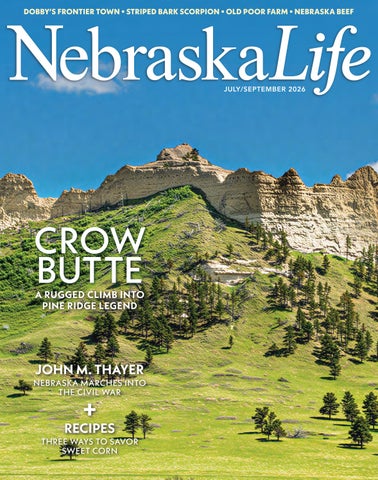
ON OUR COVER Crow Butte’s sandstone walls rise from the Pine Ridge escarpment near Crawford, once the site of a daring escape in Native lore. Story begins on page 28.
DEPARTMENTS
PHOTOGRAPH BY DISCOVER NORTHWEST NEBRASKA/ BRANDON DAVENPORT
16 Storyteller
A Nebraska Life reader recalls the travelers who stopped at her family’s Hampton farm and the meals her parents shared with them.
18 Trivia
School yourself on Nebraska colleges. Answers on page 58.
40 Poetry
Poems carried by rivers, memories and summer days.
42 Kitchens
Three ways to savor sweet corn.
52 Museums
Big or small, these museum advertising partners preserve Nebraska history and heritage for all to experience.
40
56 Traveler
Celebrate Irish and Celtic culture at Greeley Irish Festival; hunt for treasures across Central Nebraska’s Junk Jaunt; plus 14 other events across the state.
62 Naturally Nebraska
Alan J. Bartels finds catfish, conversation and much-needed rain along the Cedar River.
42 Above: marekuliasz/iStock, Danelle McCollum Page 7: First Nebraska Volunteer Infantry Regiment, Company A Reenactors; Kristin Dahl, University of Nebraska at Omaha
CONTENTS 9
10 NEBRASKA LIFE
From the Editor
JULY/SEPTEMBER 2026 Volume 30, Number 4 Publisher & Editor Chris Amundson Associate Publisher Angela Amundson Editorial Assistant Savannah Dagupion Photo Coordinator Erik Makić Staff Writer Ariella Nardizzi Design John Anton Sisbreño, Rasa Velicka Advertising Sales Robert Schonlau Subscriptions Shiela Camay
Nebraska Life Magazine c/o Subscriptions Dept. PO Box 270130 Fort Collins, CO 80527
1-800-777-6159 NebraskaLife.com
SUBSCRIBE Subscriptions are 1-yr (6 issues) for $32 or 2-yrs (12 issues) for $56. Please call, visit NebraskaLife.com or return a subscription card from this issue. For fundraising and group subscription rates, call or email subscriptions@nebraskalife.com. ADVERTISE Advertising deadlines are three months prior to publication dates. For rates and position availability, please call or email advertising@nebraskalife.com. CONTRIBUTE Send us your letters, stories, photos and story tips by writing to us, emailing editor@nebraskalife.com or visiting NebraskaLife.com/contribute. COPYRIGHT All text, photography and artwork are copyright 2026 by Flagship Publishing, Inc. For reprint permission, please call or email publisher@nebraskalife.com.
I
Where We Lived, How We Lived
N 2012, with permission, I flew my airplane over Crow Butte to photograph a wildfire. Flames ran up the butte as firefighters worked below. One photograph appears here. Alongside it is one Regina Ochoa’s brother took during the 1985 Pine Ridge fire. I’ve been interested in Crow Butte for years, so I asked Nebraska Life writer Ariella Nardizzi to climb it. Rancher Austin Soester led her through grass, cactus and loose gullies. Local lore tells of Crow warriors reaching the summit in 1849 with Sioux warriors in pursuit. The Sioux guarded the southern approach while the Crow kept fires above. In the escape story, they lowered themselves down the north face and slipped past the camp below. Ariella tried to trace their route. She found crumbling edges and a long drop to the White River Valley. Thirteen years after the Crow’s reported escape, the Civil War took Thomas Edwin Keen from Otoe County to Shiloh, Tennessee. In April 1862, a spent canister shot punched through his haversack, ruined his tin cup and smashed his hardtack. Keen dug out the ball and kept it. After the battle, he complained that newspapers elsewhere filled columns with their soldiers while Nebraska had nobody “to puff ” its regiment. He told his family to read Gen. Lew Wallace’s reports on what the Nebraskans had done. Ron Soodalter quotes Keen’s letters about his time in the Civil War. Keen wrote home about camp life, bullets through his clothing and unpaid wages. Keen’s letters survived. So did the stories Tom Feller grew up hearing from his father about cattle feeders around Wisner. When Feller began recording them, many of those men had died. He interviewed their wives instead. “Within five years those women were gone, too,” he told Alan J. Bartels. For his documentary, Feller got Super 8 film from a widow in Beemer. He sat in his basement watching hours of another man fishing. “Then there it was: men feeding with teams of horses and trains delivering cattle,” he said. When Bartels interviewed Feller for “Beef State,” Feller was thinking about filming his own operation. Somebody would eventually want to know how he’d fed cattle, too. At a farmhouse east of Hampton, Joy Klute had a story of her own. Her husband, Herbert, opened the back door while she made breakfast. A traveler stood outside. “Mother, get this man some food!” Herbert said, then went back to loading the wagon. Joy carried out breakfast and coffee. The traveler ate quickly, asked for more coffee and headed down the road. Later, Joy told her daughter, Judy Johnson, about it. “You should have seen the look on his face,” she said. Judy wrote down her mother’s account of that breakfast, and now her story is documented in this issue’s “Storyteller.” Before you put away that box of photographs, letters, home movies and keepsakes, ask about the people behind them. Find out where the house stood, how the family made its living and who came to the back door. Write down the stories for whoever opens that box next. Years later, someone may turn to that archive, or an issue of Nebraska Life, to learn where we lived and how we lived. CHRIS AMUNDSON Publisher & Editor editor@nebraskalife.com NEBRASKALIFE.COM 11
Noteworthy news, entertaining nonsense
Fall at Frontier Town
Dobby’s Frontier Town showcases the community, love and effort that goes into its preservation BY ARIELLA NARDIZZI A cluster of pioneer-era buildings stands on the northeastern edge of Alliance. Dobby’s Frontier Town is home to 27 structures – a schoolhouse, a church, a bank, a saloon and more, each moved here board by board to preserve a High Plains town in place. Up close, the details separate one story from the next. Kenneth “Dobby” Lee
was the visionary behind this project. He hauled, rebuilt and revived frontier-era structures on his land, filling them with donated artifacts and shaping it into a place where the stories of the Plains could one day be an immersive experience. A newly built livery stable reaches two stories to the sky. The general store, post office, First National Bank and jail anchor a corner of the village, while the Lonesome Duck Saloon waits with creaking
floorboards. The German Evangelical Immanuel Lutheran Church was first built in 1912. Even the schoolhouse, an authentic one-room building from 1889, waits for a bell that once rang. Other stories run deeper than their foundations. The log cabin of Nebraska’s first black homesteader, Robert Anderson, resides here. Anderson’s story began as a slave in Kentucky in 1843. After the Civil War, he moved West and built his
Lori D White
Volunteers keep the spirit of the West alive by preserving 27 structures and countless artifacts in Alliance. The pioneer village also hosts a Fall Festival each year. Visit Alliance
12 NEBRASKA LIFE
FLAT WATER
second home from logs he hauled from Pine Ridge. Nearby, a historic Texaco station from Chadron State Park and a baled hay house speak to the layered history of this region. When Dobby died in 2009, the future of this living archive wavered. The village risked falling to disrepair. Instead, the community of Alliance stepped in. A board of members took ownership to keep Dobby’s dream alive, along with volunteers – many of them lifelong residents. Among them is Lori White, president and volunteer, who can often be found elbows deep in a restoration project. She assists in more than 50 hours of work around the site per week. “It’s all a labor of love,” she said. “Emphasis on the labor. But it’s a love for Dobby, his vision and this community.” That community love is most visible each autumn, when the frontier town fills again. The beloved Fall Festival takes place every year. During the two-day gathering of Western heritage, live music drifts between buildings, Dutch oven lids lift to reveal slow-cooked meals and fast-draw competitors test their speed while visitors can wander between vendors and craft booths. Inside the saloon, sweet sarsaparilla pours from the tap. At Josiephine’s Photo Parlor just next door, portraits from an older century emerge in darkrooms. The morning begins with Cowboy Church, and the notes of St. John’s Bass carry across the grounds. Donations are appreciated. Proceeds help preserve the buildings and the stories inside them, maintained by the dedicated volunteers who continue the work Dobby started.
Dobby’s Frontier Town is open daily from 8 a.m.-6 p.m., May 1-Sept. 30. Take a self-guided tour or speak with a volunteer on site. Visit dobbysfrontiertown.com for more information.
Eddie Harris/iNaturalist
Amid limestone and grassland in Southern Nebraska, the striped bark scorpion (Centruroides vittatus) makes its home. They lie dormant underground from fall to spring.
Striped Bark Scorpion
An unlikely resident of Nebraska’s grasslands BY SAVANNAH DAGUPION On a warm Nebraska night, the striped bark scorpion crawls among rocks and grass, its body nearly invisible against the ground. Sweep an ultraviolet light across the terrain, however, and the small arachnid glows blue-green. At roughly 2 inches long, Centruroides vittatus is an unlikely Nebraskan. The tan scorpion has two dark stripes along its back, slender pincers and a tail tipped with a stinger. The species ranges from northern Mexico through the south-central United States. Southern Nebraska marks the northern edge of that range. Published records long placed it in Thayer County. A 2025 study documented it in Franklin County, the second Nebraska county with published observations. There, researchers found scorpions among limestone outcrops in mixed-grass prairie. Its nighttime menu includes cockroaches, crickets, spiders and other small prey. It grips them with its pincers and sometimes
uses its stinger to subdue them. Across its range, birds, lizards and grasshopper mice hunt the little hunter in turn. In Franklin County, field surveys found striped bark scorpions active from late March through October. After a gestation of about eight months, a female gives birth to live young that climb onto her back. The young molt within a few weeks, then leave to fend for themselves. From late October to mid-March, Nebraska’s striped bark scorpions remain dormant underground, their activity greatly reduced. They live about four years. A UV-reactive layer in the exoskeleton produces the blue-green glow, but its purpose remains unknown. Experiments with other scorpion species suggest fluorescence may help the animals detect light and sense whether they are under cover. On a dark Nebraska night, that faint shine reveals the striped bark scorpion among the rocks. Even at the far northern edge of its range, it has found a place here. FLAT WATER NEWS 13
Second Life of a Football
Kristin Dahl (both)
Hide Park Apparel owners Josh and Katelyn Sperle give old football leather new life in the form of hats, earrings and keychains, which are sold at their storefront in North Platte.
BY KRISTIN DAHL The leather is darkened and scarred, cut from footballs that once bounced across practice fields and Friday night turf. Now those scuffs are stitched into hats hanging in a small shop in downtown North Platte. Inside Hide Park Apparel, hats, earrings and keychains line the shelves, each finished with a patch cut from an old football. The items are brand new, but the leather carries the marks of past games. Josh and Katelyn Sperle run Hide Park Apparel. They opened the store in October 2025. The idea began years earlier in Texas, when Josh noticed a pile of dusty old footballs in his parents’ garage. He picked one up, a ball he’d tossed around as a kid, now scratched and worn, and wondered how it might be used again. “I played with these footballs all the time,” Josh said. “Now they were just sitting there, probably never going to be used again.” Josh loved hats, football and the way objects carry years of use. He cut his first prototype from an old ball, shaping the leather
14 NEBRASKA LIFE
into the outline of Texas and stitching it onto a simple hat. Friends and family immediately saw the charm. When the Sperles moved back to Katelyn’s hometown of North Platte in 2020, the story of football took on a new depth. Nebraska’s Friday night lights, small-town rivalries and stadiums filled with generations of fans reminded them how deeply football is woven into the state’s identity. After opening their store, requests followed from area schools, including North Platte High, St. Pat’s and Hershey, then from teams beyond Nebraska across the nation. A selection of Hide Park’s Nebraska-themed hats is now available at Scheels in Lincoln. Josh carefully cuts each patch from worn leather and fastens it to a brand-new hat. Crisp fabric meets leather marked by past games, each piece carrying signs of where it’s been. Nebraska-shaped patches with football stripes sit alongside a leather corn patch, nods to the state the Sperles now call home. The shapes are familiar, the wear unmistakable. In towns and cities across Nebraska, the
games keep going. Footballs move from hand to hand, players graduate, fields empty, rosters turn. Like the game-day memories, some of those balls don’t disappear when the lights go out. In North Platte, they’re cut, stitched and worn again.
FLAT WATER
The Winning Field
A Mills painter finds her prizeworthy subject at the end of a ranch day
Chana Orton
Mills artist Chana Orton was selected as the winner of the 2026 Nebraska Life Art Award for “Last Light,” an acrylic on canvas. The painting reflects her family’s beloved ranch land in Keya Paha County.
BY ARIELLA NARDIZZI “Last Light” began the way many ranch days do – mid-task. Chana Orton was stacking hay bales when the shift in light stopped her in her tracks. In a meadow near Mills in Keya Paha County, rolling hills and long shadows stretched across the field as the sun sank toward the horizon. It’s ground her family has worked since 1901. The scene was familiar: a cut hay field, bales splayed across it and a break of trees. It’s a view that can be easy to pass by. Orton didn’t. The artist recognizes that field by labor as much as sight. At 14, she was behind the wheel of a tractor, stacking large hay bales. Years of work trained her eye to notice how weather builds and light settles.
“The painting is a symbol of the pride that I have for our way of life,” she said. “It is about seeing the beauty at the end of all the work.” The acrylic-on-canvas painting won the 2026 Nebraska Life Art Award, presented at the Association of Nebraska Art Clubs Conference. The selection was made through a blind judging process. Nebraska Life Editor Chris Amundson said the piece stood out for its quiet depiction of a familiar hay field rendered through light and shadow. Orton, a member of the Sand Painters Art Club in Valentine, told the story of her family’s land through the subtle relationship between color and light. She used soft blending and muted colors in the background to create atmospheric depth, then gradually built detail and intensity toward
the foreground. The streaming light came together through careful placement of color and minuscule shifts in palette. Reflective tones show the sun’s glow bouncing across the field. The painting reflects the passion behind much of Orton’s work: challenging others to look at rural life and everyday landscapes in a new light. “There is so much beauty in simple spaces if you take time to look,” she said. “Light and shadows work together to tell ever-changing stories.” In “Last Light,” the hay is cut, the bales are scattered and the final rays of sun settle over the field.
View Orton’s gallery and prints at chanaortonart.weebly.com. FLAT WATER NEWS 15
‘Mother, Get This Man Some Food!’ by JUDY JOHNSON
Judy Johnson
At their farmhouse east of Hampton, Herbert and Joy Klute welcomed travelers with hot meals.
O
UR FARM WAS a mile and a half east of Hampton, Nebraska, on Highway 34. Back in the 1950s and ’60s, there seemed to be many more hitchhikers traveling that road than one sees today. Some may have hopped a freight train and gotten off at Aurora or York – few trains stopped in Hampton – then walked the rest of the way. Many stopped at our house. They weren’t scary, though they would have frightened us if we girls had been home alone. They didn’t come at night, not that we knew of. Usually they showed up at mealtime, especially breakfast, while Dad was outside feeding cattle. I think they knew they could count on a good hot meal. I sometimes wonder whether they had some sort of signal for others traveling on foot – maybe not a big red X on a fencepost, exactly, but something that said, in code, Stop here. They have good food. Whatever it was, Dad was a kindhearted man who
would never turn anyone away, even at his own expense. Mom told me about one time a man stopped at the farm. It was morning, probably around 7 a.m. Dad was outside loading the feeding wagon while Mom was making breakfast – bacon or ham and eggs, fried potatoes, toast and, of course, coffee. She wanted it ready because Dad would be in any minute. Just as she was about to dish it up, Dad opened the back door and said, “Mother, get this man some food!” Then he went back to loading the wagon. Mom looked up and saw a man sit down on the back stoop. She put Dad’s breakfast on a plate, filled a mug with coffee and carried it out to him. “You should have seen the look on his face,” she told me years later. “I don’t think he was expecting a freshly cooked meal handed to him on a dinner plate.”
SEND YOUR SHORT STORIES about life in Nebraska to editor@nebraskalife.com
16 NEBRASKA LIFE
He thanked her, took the plate and set the coffee mug beside him. Mom said she tried not to watch him eat, but he finished that breakfast in record time. When she asked whether he wanted anything else, he said no food, but he would take a little more coffee if it wasn’t too much trouble. When he finished, he headed on down the road, very thankful for his farmhouse breakfast. That was not the only time Dad brought people home for dinner. If an insurance man or seed corn salesman came to the field around morning or afternoon lunch, Mom would carry out sandwiches and pie or cake, always enough for the extra person, and never in a way that made him feel awkward or uncomfortable. I was reminded of that when I read the biblical account of Abraham and Sarah welcoming three strangers near their tent at Mamre. Dad was a little like Abraham that way, telling his wife to make food and prepare a feast for passing visitors. He was a gracious host who knew how to make strangers feel comfortable and welcome. In the Bible, those men turned out to be angels. Before they left, they promised that Sarah, who was nearly 90 and had never borne a child, would have a son within the year. Though Sarah doubted them at first, she did have a son, and they named him Isaac, which means “joy” or “laughter.” He brought both to his aged parents. Those visitors, angels unaware as Scripture calls them, rewarded Abraham and Sarah for their kindness. This story is adapted from The Poetry of Joy: Legacy of a Life Well-Lived by Judith Klute Johnson, published in 2025 by Morris Publishing.
The stories in this book are BRILLIANT, HARROWING, POETIC, and REVELATORY.
AVAILABLE THIS FALL
nebraskapress.unl.edu
Walk in the footsteps of pioneers and outlaws at Rock Creek Station in Fairbury – once a stagecoach stop, Pony Express relay station and key site along the Oregon and California Trails. Jefferson County invites you to wander rolling farm plains, spend nights under the stars, dine in friendly hometown eateries and hunt across its expanses. History, nature and hospitality await.
Call or go online to plan your visit
402-729-3000 | VisitOregonTrail.org This invitation is from Jefferson County Visitors Committee 518 E St | Fairbury, NE 68352
STORYTELLER 17
Fuehrers
Universities and Colleges Get schooled on schools by BEN JENKINS
Union Adventist University
GENERAL
1
KWSC, 91.9 the Cat, is the campus radio station at which Nebraska school? The letters after the K offer a clue.
2
Creighton has a connection strong enough to make heads spin. Three Jesuits tied to the university led the 1949 exorcism that inspired what 1973 horror film?
Stone Bearer Necklace Bora Handcrafted Jewelry
3
At Nebraska Wesleyan, psychology students train rats to clear hurdles, climb ropes and cross tightropes. What was the contest called before the U.S. Olympic Committee sent a cease-and-desist letter in 2003?
4
College of Saint Mary’s first students reported to class where Omaha travelers once checked in. What kind of building housed the college when it opened in 1923?
308-234-3313 • stagecoachgifts.biz 310 3rd Ave, Kearney • 1/2 mile north of I-80
18 NEBRASKA LIFE
No peeking, answers on page 58.
5
Before weather apps, Doane’s Boswell Observatory was the first home of the Nebraska Signal Service Office. That operation is known today as what federal weather agency?
KWSC-FM Student Radio Station
MULTIPLE CHOICE
6
Peru State’s library has a longer résumé than most graduates. For more than 75 years, the building housed which campus facility? a. Gymnasium b. Dining hall c. Administration building
7
A 1992 scheduling pileup sent Herbie Husker to football and basketball, leaving which home event mascot-less and helping inspire Lil’ Red? a. Volleyball b. Baseball c. Wrestling
8
Little Priest Tribal College fulfills its namesake’s instruction, “Be Strong and Educate My Children.” What role did Chief Little Priest hold in the Winnebago Tribe? a. Last war chief b. First tribal chairman c. Tribal school superintendent
9
UNO baseball and softball stopped borrowing diamonds in 2021. Maverick Park on Scott Campus gave both programs what first? a. An on-campus home b. A conference championship c. A Division I schedule
10
UNL’s International Quilt Museum began with one king-size gift. In 1997, Ardis and Robert James donated about how many quilts? a. 100 b. 1,000 c. 10,000
University of Nebraska-Lincoln
TRUE OR FALSE
11
Nebraska native Val Fitch went from Chadron State College to the Manhattan Project during World War II, then shared the 1980 Nobel Prize in Physics.
12
Long before laptops became standard campus gear, Union Adventist University installed a computer terminal in every dorm room in 1983.
13
Louie the Loper, UNK’s mascot, is a jackalope, the mythical horned jackrabbit.
14
Midland University got its name because its Fremont campus sits near Nebraska’s geographic middle.
15
The original Bellevue College, a separate school from today’s Bellevue University, moved the grave of Omaha Tribe leader Big Elk while building on Old Elk Hill.
Nebraska Vines and Vistas Relax with a glass of wine and enjoy a memorable sunset from our ur porch. Just minutes southeast of North Platte, I-80 exit 179. Look for our wines at Nebraska retail locations or shop our website. May-Sept.: Daily, 1-6 p.m.; Friday, 1-8 p.m. Oct-April: Friday-Sunday, 1-5 p.m. Check our website and Facebook for winter hours.
An Estate of Fine Wine
feather-river.com • 308-696-0078 5700 SE State Farm Rd • North Platte
TRIVIA 19
History Nebraska
Nebraska Goes to War John Milton Thayer raised a frontier regiment that marched into two of the Civil War’s defining early battles by RON SOODALTER
I
N JULY 1861,
Col. John Milton Thayer asked Maj. Gen. John C. Fremont for permission to take five companies of Nebraska Territory’s new infantry regiment to Fort Leavenworth for weapons. Five companies were far more than the errand required. That was the point. Business owners in Omaha, Plattsmouth, Nebraska City and the Elkhorn country wanted the soldiers kept close to home to guard settlements and overland routes. Thayer had other ideas. He wanted his volunteers with the Union armies. In a 1901 Omaha World-Herald interview, he put his preference bluntly: “We were tired of fighting Indians, and since it had to be, we wanted a try at fighting white men.” Thayer called his maneuver “a little strategy.” Once the first five companies were moving, he persuaded Fremont to order the other five to St. Louis. “Of course, there was no necessity for taking five companies along,” Thayer recalled, “but I got the permission just the same.” The maneuver sent the First Nebraska Volunteer Infantry Regiment south. Its soldiers would go from sleeping beneath open sky and waiting months for pay to standing in battle lines at Fort Donelson and Shiloh.
JOHN M. THAYER 21
They would march across Missouri, Tennessee and Arkansas, then return west on horseback. Thayer entered the war as a territorial militia commander and left it a Union general.
A territory raises a regiment
Strong young men were at a premium in Nebraska Territory. The 1860 census counted 28,841 people within the future state’s boundaries. Every recruit pulled labor from a farm, shop or freight route. Congress had created Nebraska Territory in 1854 through the Kansas-Nebraska Act. The act repealed the Missouri Compromise’s restriction on slavery north of latitude 36 degrees, 30 minutes and allowed settlers in the new territories to decide whether slavery would be legal. The 1860 census recorded 15 enslaved people in Nebraska Territory. In January 1861, the territorial legislature overrode the governor’s veto and prohibited slavery. Thayer was 41 when the Civil War began. Born in Bellingham, Massachusetts, he graduated from Brown University in 1841, studied law and practiced in Worcester. He also served as a lieutenant in the Worcester Light Infantry. Thayer moved to Omaha in 1854, where he practiced law, farmed and entered territorial politics. He led two territorial militia expeditions against the Pawnee and eventually rose to major general of the militia. By 1860, he had served in the territorial legislature and at Nebraska’s constitutional convention. On April 15, 1861, three days after Confederate guns opened on Fort Sumter, President Abraham Lincoln called 75,000 militia into federal service. Thayer wrote Secretary of War Simon Cameron asking permission to raise a Nebraska regiment. Ten companies totaling about 1,000 men assembled at Omaha between June 11 and July 21. Territorial Gov. Alvin Saunders commissioned Thayer as colonel.
22 NEBRASKA LIFE
Blankets and ostrich plumes
At Pilot Knob, Missouri, the recruits had no tents. They slept in the brush with only their blankets and the sky above them. Heavy dew, fog and nights standing guard in rain left Keen with four severe chills and what he called the ague. He spent time in a hospital set up in three large tents. About 30 patients slept inside, Keen wrote, and some lay on blankets spread over the ground. His medicine arrived irregularly until he “raised a fuss about it.” By Sept. 9, the men who had slept in brush were drilling in full uniform. Keen listed a blue frock coat, blue trousers and a tall black Hardee hat looped on one side. An eagle, a bugle insignia and an ostrich plume completed the outfit. “We present a gay appearance on parade,” he wrote. The ostrich plume did not solve the pay problem. The government still owed Keen his wages. Postage stamps from his sister “came in good play,” allowing him to continue writing Find a Grave/Allegheny Antiques home. The same letter that described the regiment’s bright uniforms Thomas Edwin Keen joined them July instructed his family that an officer would 19. Keen, a 22-year-old farm laborer in contact them if anything serious hapOtoe County, had written his sister that pened to him. spring saying he would not enlist. He Through the fall, the First Nebraska changed his mind when the regiment remarched across Missouri, guarded railmained about 100 men short. His crop, he roads, searched for Confederate guerrillas wrote, had amounted to “little or nothand fought in a small December engageing,” and he thought it his duty to serve. ment near the Blackwater River. For seven Keen believed the regiment would months after leaving Omaha, the regiremain inside Nebraska Territory. Instead, ment saw little serious fighting. Its ranks he traveled from Omaha to St. Joseph, then thinned anyway. St. Louis and Pilot Knob, Missouri. He had Disease did what Confederate bullets no money for postage and doubted the ofhad not yet done. It moved through the ficers and men of his entire company could camps and killed men before they had scrape together 50 cents among them. faced a major battle. Most of the recruits were Nebraskans, The First Nebraska spent part of the although some came from neighboring winter at Georgetown, Missouri. Most of states. They left Omaha with little formal Company H slept in a church. Keen and training and without the uniforms that seven others occupied an old printing would later give the regiment such a grand office. In a Jan. 25, 1862, letter, he reportappearance. Thayer’s first five companies ed intermittent fever throughout camp departed July 30. The others soon followed.
Ammodramus/Wikimedia Commons
Nick Number/Wikimedia Commons
From Nebraska Territory to the fields of Fort Donelson in Tennessee, Col. John M. Thayer forged the First Nebraska into a disciplined force to help secure a pivotal Union victory. On the cover, an 1862 illustration shows that Civil War battle. Above, Thayer’s Lincoln home and grave at Wyuka Cemetery root his legacy in Nebraska soil. JOHN M. THAYER 23
Presented in 1863 to Thayer by officers of the First Nebraska Regiment, this ceremonial sword honored his leadership. It also marked a distinct shift from his role as a frontier leader to statesman, later helping in Nebraska’s quest for statehood.
and an average of three deaths each week. He suspected treatment in the regimental hospital, although he admitted he did not know the cause. Outside, the ground remained frozen, sloppy and cold. While there, Thayer was drawn from his quarters by a commotion outside. Two men had arrived seeking an enslaved man who had escaped, carrying an order from division commander Brig. Gen. Frederick Steele allowing them to reclaim him. President Abraham Lincoln had instructed Union troops in Missouri not to interfere with slavery, hoping to avoid alienating slaveholders who remained loyal to the Union. Thayer questioned the man claiming ownership and learned that he sympathized with the Confederacy. He ordered both men out of camp emptyhanded. According to historian James E. Potter, “Thayer gave the slave his freedom with directions on how to reach Kansas and later recalled meeting him in Kansas after the war.” On Feb. 2, 1862, the First Nebraska started toward Tennessee.
Snow at Donelson
For five days, the Nebraskans marched through mud and snow from Georgetown to Jefferson City. At night, the soldiers spread their tents on the ground and slept on them. From Jefferson City they traveled by rail to St. Louis, then by steamer through Paducah, Kentucky, to the ruins of Fort Henry.
24 NEBRASKA LIFE
Brig. Gen. Ulysses S. Grant had captured Fort Henry on Feb. 6 and was moving against Fort Donelson on the Cumberland River. Donelson guarded the river route to Nashville and central Tennessee. The First Nebraska arrived below Fort Donelson on the night of Feb. 13. The soldiers disembarked the next morning. Snow covered the ground, and they spent the night on the line, lying on their arms. Morning came at 10 degrees. Grant assigned the regiment to Brig. Gen. Lew Wallace’s division. Thayer took command of a brigade that included the First Nebraska and three Ohio regiments. Direct command of the Nebraskans passed to Lt. Col. William D. McCord, a 26-year-old Plattsmouth lawyer who had helped organize the regiment. The Confederate commanders inside Fort Donelson planned to break through the Union right, clear Wynn’s Ferry Road and escape toward Nashville. At dawn Feb. 15, their troops attacked Brig. Gen. John A. McClernand’s division. Union regiments gave ground as soldiers, horses, wagons and artillery crowded the road. Wallace sent Thayer’s brigade toward the broken line. The First Nebraska crossed Indian Creek, climbed the opposite slope and moved into position beside Illinois artillery. McCord’s men had barely formed when Confederate troops advanced through the brush. Keen estimated that the attackers came within 200 yards. For three-quarters of an hour, the artillery and the First Nebraska maintained a steady fire. The Confederate
advance stalled and withdrew toward the fortifications. Keen escaped with holes in his clothing. A bullet passed through the cape of his overcoat. Another ball and three buckshot tore through his coattail, and his trousers were cut in two places. He reported three Nebraskans killed and 10 wounded. The breakout failed, and Confederate troops fell back into Fort Donelson. The next morning, Brig. Gen. Simon Bolivar Buckner asked Grant for surrender terms. The two men had known each other before the war, but Grant offered no accommodation: “No terms except unconditional and immediate surrender can be accepted.” Buckner surrendered roughly 12,000 men. The victories at Forts Henry and Donelson opened the Tennessee and Cumberland rivers to further Union advances and brought Grant national attention as “Unconditional Surrender” Grant. Ohio regiments and Illinois artillery also fought on the line. In his official report, Wallace singled out the Nebraskans: “To say they did well is not enough. Their conduct was splendid. They alone repelled the charge.”
On to Shiloh
Seven weeks after Fort Donelson, the First Nebraska entered one of the bloodiest battles of the Civil War. The regiment camped north of Pittsburg Landing on the Tennessee River while Grant prepared to advance against Corinth, Mississippi, where two major
A Second Nebraska Infantry encampment, top, reflects the troops in the 1860s. Another WPA-era illustration, below, depicts Thayer enforcing orders while protecting an African American man.
Confederate railroads crossed. Maj. Gen. Don Carlos Buell’s Army of the Ohio was marching to join him. Confederate Gen. Albert Sidney Johnston intended to strike before the two Union armies combined. At daybreak April 6, Confederate troops came out of the woods near Shiloh Church and attacked Grant’s forward camps. Through the day, Union forces fell back toward Pittsburg Landing. Wallace’s division was camped several miles north of the main battlefield. Orders, unfamiliar roads and a change of direction delayed its march. McCord reported that the First Nebraska left camp about noon and reached the Union position near Pittsburg Landing about 7 p.m. The men bivouacked in heavy rain. At 5:30 a.m. April 7, the First Nebraska moved forward beside the Ninth Indiana Battery. Thayer again commanded the brigade. McCord commanded the regiment. Before the advance, Thayer directed the soldiers to lie down when not engaged, fire from kneeling or prone positions whenever possible and use folds in the ground for cover. After the Union artillery exchanged fire with Confederate guns on a ridge, Thayer ordered an advance. Grape and canister struck the Nebraskans, killing a sergeant and wounding an officer and a member of the color guard. McCord ordered the men to lie down. He later wrote that the order helped the regiment avoid greater losses. The soldiers rose, advanced and formed another line. Confederate troops charged.
History Nebraska (all)
JOHN M. THAYER 25
Reenactors of the First Nebraska Volunteer Infantry Regiment gather in period uniform. They keep alive Nebraska Territory’s Civil War history and the frontier soldiers who marched east.
First Nebraska Volunteer Infantry Regiment, Company A Reenactors
The Nebraskans fired and repelled them, then shifted again when another force threatened the Union flank. At the next position, McCord reported the most destructive fire the regiment had yet faced. Three men were killed there, several officers were wounded and the soldiers began running short of ammunition. The First Nebraska withdrew through the 76th Ohio, refilled its cartridge boxes in a ravine and returned to the line. McCord reported that the regiment remained in action from 5:30 a.m. until 5 p.m. Keen remembered the movement from ground level. When orders came to advance on a Confederate battery, the soldiers went forward at a double-quick. At the flash and smoke of the enemy guns, they dropped flat as canister and shell passed over them. They rose and advanced again. During the fighting, Keen felt what he called a “wild excitement.” Only afterward, when he walked the field and saw bark stripped from trees and brush cut down by bullets, did he wonder how so many had escaped. The Confederate army withdrew toward Corinth that afternoon. The two days at Shiloh left more than 23,000 Union and Confederate soldiers killed, wounded or
26 NEBRASKA LIFE
missing. McCord reported four Nebraskans killed and 22 wounded. Disease continued to kill Nebraska servicemen in camps and hospitals after the regiment’s largest battles. Historian Frederick H. Dyer recorded 239 Nebraska deaths during the Civil War, 159 of them from disease. Thayer praised the First Nebraska for moving through the day under heavy fire “without flinching.” Keen worried about how the regiment would be remembered. Illinois, Indiana and Ohio newspapers filled their columns with accounts of their own soldiers, he wrote, while Nebraska had nobody “to puff ” its regiment. He directed his family to Wallace’s official reports for evidence of what the Nebraskans had done. Keen carried a smaller record of Shiloh in his pocket. A spent canister shot about the size of a walnut had pierced his haversack, ruined his tin cup and smashed his hardtack. He removed the ball and kept it.
Back in the saddle
Shiloh marked the second and last time the First Nebraska fought in a battle between armies of that size. Its war continued through long marches, garrison assignments, guerrilla fighting and sickness.
The regiment joined the advance on Corinth, marched to Memphis and served at Helena, Arkansas. On Christmas morning 1862, Keen’s breakfast at Van Buren, Arkansas, consisted of about two-thirds of a hard cracker, a piece of fat pork and coffee. He walked 2 miles from camp, came upon a twoyear-old steer and shot it. Keen filled his haversack with meat, then directed other soldiers toward the carcass. Within two hours, he wrote, little remained but bones. The regiment returned to Missouri in 1863. It fought at Cape Girardeau in April and pursued Confederate troops through the southeastern part of the state. In October, the infantrymen received horses. Their official designation changed to the First Nebraska Cavalry on Nov. 6. The men who had marched south on foot would return to Nebraska in the saddle. The regiment served in northeastern Arkansas through the spring of 1864, scouting, pursuing Confederate forces and guarding roads. After veteran soldiers completed their furloughs, the First Nebraska left Omaha on Aug. 15, 1864, and reached Fort Kearny eight days later. Three years after Thayer maneuvered the regiment away from frontier duty, its soldiers were back on the Platte.
Subscribe today
In each issue you will find breathtaking outdoor adventure, mouth-watering recipes, stunning photography, captivating stories and humor from every corner of Nebraska. Whether you’re a longtime resident, newcomer or distant admirer – if you love Nebraska, then this magazine is meant for you. The cavalrymen guarded stage and telegraph stations, escorted travelers and joined U.S. Army operations along the Platte and into Colorado Territory during escalating conflict with Native nations. On July 10, 1865, the unit received its final designation: First Nebraska Veteran Cavalry. Its soldiers remained in federal service until July 1, 1866 – eight months before Nebraska entered the Union as the 37th state. Thayer had left direct command of the regiment after his promotion to brigadier general in 1862. He served in the Vicksburg campaign and finished the war as a brevet major general. Nebraska voters elected Thayer as one of the new state’s first two U.S. senators in 1867. President Grant later appointed him governor of Wyoming Territory. Thayer served as Nebraska’s governor from 1887 to 1892. In a 1901 Omaha World-Herald interview, Thayer returned to the maneuver that had taken the First Nebraska away from Omaha. “There was lots of swearing in Nebraska over the way Thayer had stolen the regiment out of the state,” he recalled, “but it was too late to do anything but swear, so we went joyously on our way.”
1 YEAR
32
$
Subscribe 2 YEARS
56
$
In each issue you will find breathtaking outdoor adventure, mouth-watering recipes, stunning photography, captivating stories and humor from every corner of Nebraska. Whether you’re a longtime resident, newcomer or distant admirer – if you love Nebraska, then this magazine is meant for you.
1 YEAR
30
2 YEARS
50
$ $ nebraskalife.com
1-800-777-6159 Scan, call or go online to subscribe
1-800-777-6159 • nebraskalife.com JOHN M. THAYER 27
TheSECRET ESCAPE from
CROW BUTTE The legends and landscapes behind one of Nebraska’s most acclaimed summits by ARIELLA NARDIZZI
28 NEBRASKA LIFE
CROW BUTTE 29
Jim Manternach
R
OCK CRUMBLES TO dust under my boots as I edge along the spine of Crow Butte. It’s just wide enough to put one foot in front of the other. On either side, sandstone sloughs into the folds of the White River Valley. The height slows me, but the impermanence of the rock demands focus with every step. I look down the north face of sheer, brittle cliffs that overhang in places, and try to picture a band of Crow warriors lowering themselves over this edge on ropes fashioned from rawhide or blankets. Local lore says they slipped past a ring of Sioux encamped below. Three days of singing and firelight, then silence. Standing there, I can imagine it. Ahead, Austin Soester moves nimbly along the ridge. He steps confidently, like the bighorn sheep that roam the area. His gracefulness comes from decades of roaming these ridgelines above his lifetime home near Crawford. We had departed from Soester’s ranch
30 NEBRASKA LIFE
just a mile southeast of the butte an hour earlier, bouncing across the pasture in a side-by-side. Crow Butte loomed ahead, rising about 400 feet from its base. In western Dawes County, known as Butte Country, the landscape lifts into towers of ash and stone. Crow Butte stands apart. It’s visible from nearly every direction and located on private land bordering the Ponderosa Wildlife Management Area. Its alluring summit draws adventurers and nature photographers for its loose-rock climb, White River Valley views and enthralling escape story. Climbers need permission from various landowners. Soester talked as we drove. One hand was on the wheel, the other pointing out pieces of a place he knows by memory. He knows where elk move at first light or where his family runs cattle – 1,000 head spread across land his family has worked for generations. “The buttes were my backyard,” he said.
He grew up scrambling every nearby formation – Barrel Butte, Crown Butte and unnamed rises that don’t show up on maps. He first stood on the summit of Crow Butte after moving on to his plot of the family land following graduation from Chadron State College. His earliest memories are of hunting these ridges. Now, he ranches the land, guides hunting trips in the Sandhills and leases nearby ground for grazing. By the time we parked at the base, the smooth exterior from afar had resolved into gullies, ledges and crumbling seams. The rock here is a mix of sandstone, volcanic ash, siltstone and limestone. It has a softness to it, breaking apart in hand and underfoot. That’s part of what makes getting to the top harder than it looks.
WE STARTED FROM the southeast, angling through a sloping bowl of grass and cacti. I watched every step, anxiously awaiting a rattlesnake’s warning buzz.
Ariella Nardizzi (all)
Crow Butte rises 400 feet above the White River Valley in Dawes County, also known as Butte Country. The awe-inspiring escarpment has served as a landmark for early settlers, climbers, ranchers and even a famous battle between Crow and Sioux warriors.
CROW BUTTE 31
Chris Amundson
Along Pine Ridge, innumerable sandstone buttes sharply rise, challenging the notion of Nebraska’s flat horizon. The routes to many of these summits require scrambling off-trail up steep, crumbling gullies. In 2012, a wildfire ravaged parts of Pine Ridge; decades later, the landscape is still regrowing.
32 NEBRASKA LIFE
Early spring is best for this climb, said Soester, before the heat rouses everything. Game trails stitched the hillside, left by elk, mule deer and the occasional mountain lion. We followed their paths when they made sense and veered off when they didn’t. “The animals always know the easiest path,” Soester said. On the east wall is Moonshiners’ Cave – or what used to be. During Prohibition, two rooms blasted into the butte housed a moonshine operation. The cave has since been dynamited shut, burying the rowdy history in stone. Soester has also come across what he believes are Indigenous artifacts scattered in the dirt. At the base of a narrow gully, the route steepened. We switched from walking to scrambling, using both hands to climb loose dirt and rock. Cacti poked from the cracks. As I topped out on the saddle, the White River Valley opened below. Routes to the summit exist from the east and west. Each converges on the north ridge, tied to the 1849 battle behind the butte’s name. Historical accounts agree on the pursuit but not the details. A National Register nomination for the Bordeaux Trading Post
says a band of Crow raided trader James Bordeaux’s herd in October 1849 before Sioux warriors pursued them to the butte. An interpretation of a Lakota winter count kept by Battiste Good records the Crow arriving near dark and escaping that night. In local legend, the standoff lasts three days and nights. In that telling, the Crow sang, danced and lit fires in defiance. Below, the Sioux warriors guarded what they thought was the only access point from the south. They waited. On the fourth day, there was silence. When the Sioux climbed to the summit, they found no one. Some accounts say the Crow used ropes made from blankets. Others say they killed the stolen horses and fashioned rawhide ropes. The details shift depending on who tells it. The warriors then lowered themselves down the steep, unguarded north face and tiptoed through the camp to escape undetected. I tried to trace a line down the face. There wasn’t one. Just crumbling edges and unforgiving exposure to the valley floor.
FROM THE TOP of Crow Butte, 4,407 feet above sea level, the view stretches in
Jim Manternach
BUTTE BUCKET LIST Across Pine Ridge, these four routes range from a marked park trail to loose-rock scrambles.
History Nebraska
every direction. The White River curves through pastures dotted with cattle, and fences trace property lines. In 2012, wildfires ravaged parts of Pine Ridge. Burn scars remain among the regrowth. On the horizon, Barrel Butte and other formations rise from the plains. We sat for a while at the top, letting the wind do most of the talking. Soester pointed out parcels from our vantage point. James English purchased the 40-acre plot in 1907. Today, his great-grandchildren – Crawford resident Ralene Suchor and her cousins – own it. The surrounding land supports grazing, with nutrient-rich short grass that sustains cattle. Southwest of the formation is the Crow Butte uranium mine, Nebraska’s first, which began production in 1991 and has been on standby since 2018. In Nebraska Pioneer Reminiscences, Anna Robinson Cross wrote that Crow Butte guided settlers and travelers home during long winter drives across the prairie. From the valley, it offers a clear reference point. From the ridge, it demands careful attention to where the ground gives and where it holds. The rock still crumbles beneath boots, and the north face still hides the route no one thought to watch.
Crown Butte: Located on public land within the Ponderosa Wildlife Management Area, Crown Butte requires a steep scramble. Climbers who reach the summit can sign the papers tucked inside a jar hidden in a natural alcove – a tradition of the unofficial Crown Butte Climbers Club. Barrel Butte: Visible from the top of Crow Butte, this eastern neighbor offers a challenging scramble. Two rocky buttresses lead upward, though the northernmost formation is the true summit. Lovers Leap: A steep escarpment rises from the eastern edge of Fort Robinson State Park. The demanding scramble rewards climbers with views across Pine Ridge. Its name comes from a local legend about two lovers kept from one another. Red Cloud Buttes: Hikers can begin at the West Trailhead in Fort Robinson State Park. The Red Cloud Buttes Trail leads visitors beneath towering formations named for Oglala Lakota leader Red Cloud.
Courtesy Regina Ochoa
BEFORE YOU GO: Fort Robinson trails reopened after the June 2026 South Fork Fire, but burned trees, unstable ground and damaged fences may remain. Check with the park before climbing Lovers Leap or hiking near Red Cloud Buttes. NEBRASKALIFE.COM 33
SHELTER AT THE
OLD POOR FARM by KRISTIN DAHL
34 NEBRASKA LIFE
A former county poor farm now shelters animals with nowhere else to go.
Old Poor Farm (all)
Once a homestead for Dodge County residents who couldn’t support themselves, The Old Poor Farm in Nickerson has found new life as an animal sanctuary. Volunteers, like Farrier Craig Shogren, manage most of the labor, tending to the animals’ care. POOR FARM 35
Old Poor Farm
M
ARSHMALLOW TROTS DOWN
The sanctuary cares for miniature horses, donkeys, sheep, potbellied pigs and other animals with missing limbs or permanent injuries. Many surrendered animals come from histories of neglect, making adoption difficult. Board member Courtney Brown chips in around the land, feeding Jack, a miniature horse.
36 NEBRASKA LIFE
the gravel drive, tail wagging as if she has waited all morning for company. The fluffy white dog’s tongue hangs from one side of her mouth, giving her a lopsided grin. “She’s our official greeter,” Kathleen “Kathy” Drawbridge said with a laugh. “The kids named her. Once they called her Marshmallow, there was no changing it.” She circles for attention, then wanders toward the barns. Marshmallow often spends the day napping after a long night guarding the property from raccoons, coyotes and other unwelcome visitors. A historical marker beside the gravel road near Nickerson identifies the Dodge County Poor Farm. Beyond it, weathered red barns and outbuildings stand amid thick grass and trees in the Elkhorn River Valley. Rain the night before softened the yard, but visitors can cross without sinking into mud.
Inside one barn, wood creaks beneath visitors’ feet. Lumber salvaged from an old bridge still supports the building decades later. Nearby stands a tree hollowed by ants and nicknamed Alice after Alice in Wonderland. Dodge County bought 160 acres here in 1872 to provide relief for residents who could not support themselves. A residence was added in 1884, and by 1888 the farm covered 245 acres. More than 400 people lived there during its operation. County governments then carried much of the responsibility for residents who needed food, shelter or care. In rural counties, relief often took the form of a working farm. The Dodge County farm housed people who were poor or elderly, people with disabilities, orphans, single mothers and injured laborers. People came after illness, injury or devastating loss, or because they had no family able to care for them. “There’s a huge stigma attached to poor
Kristin Dahl
farms,” said Drawbridge, founder and executive director of The Old Poor Farm Animal Sanctuary. “People thought if you ended up there, there must be something wrong with you. Like you were somehow a failure.” Taxpayers funded the property, with self-sufficiency as the goal. Residents, called inmates in county records, helped tend livestock, raise crops and maintain the farm while receiving food, shelter and care. The county hired a steward and stewardess, usually a married couple, to oversee the operation. The steward handled livestock and farm business. The stewardess ran the household and cared for residents who were sick. “The idea was really more of a family setting,” Drawbridge said. “Everybody pitched in.” After Drawbridge and her late husband bought the abandoned homestead in 1989, she searched courthouse records and old files for the names and stories of former res-
idents. She pieced together accounts from county documents and listened as descendants began calling with family memories. “We started getting calls from all over the country,” she said. “People finally felt comfortable talking about it because the stigma had faded.” Those records and conversations became the foundation of Drawbridge’s book, The Unforgotten Truth of the Life and Times at the Dodge County Poor Farm. One former resident was a man named Joe. Historical records described him as “simple-minded,” a term used at the time. Joe knew every building by heart and understood the personalities and routines of the farm’s animals. While many residents eventually left, Joe stayed and became a caretaker. “He was welcome to stay,” Drawbridge said. Board members Louie Kiefer and Court-
ney Brown credit Joe with helping build the wooden enclosure around the farm’s water tower. They believe the covered water-barrel tower is the last of its kind in Nebraska. “That wasn’t professionally built,” Brown said. “That was someone given an opportunity to show their skill and shine.” The enclosure still stands. Brown, who works in bookkeeping and payroll, and Kiefer, who works with people with disabilities, serve on the sanctuary’s board and volunteer at the property. They care for animals and welcome visitors. Kiefer said the years he has spent at the farm have changed him, too. “This place has caused a lot of growth for us,” he said. “It’s been a bit of a life changer.” Drawbridge’s research also includes an account of a young man named Frank, who injured himself while jumping from a freight train in search of adventure. POOR FARM 37
Kristin Dahl (both)
Hungry, hurt and wearing tattered clothes, Frank sat nervously in the kitchen while the steward and stewardess offered him coffee, sandwiches thick with ham and a place to recover. He remained at the farm for a week. After coffee, sandwiches and rest, Frank left healthy enough to travel. By the 1930s, the Great Depression had strained county poor farms across the country. Federal and state old-age assistance programs began reducing the need for institutions that required recipients to live onsite. Officials called institutional aid “inside relief.” “Outside relief ” allowed people to receive assistance while remaining in their homes and communities. The Dodge County farm’s final resident died in 1944. The county rented the property in 1945 and sold it in 1955. A farmer bought the land for agriculture. The resi-
38 NEBRASKA LIFE
dence was demolished in 1970 after years of neglect and vandalism. For years, the remaining barns and outbuildings stood empty. “We were city kids,” Drawbridge said with a smile. “I’m from North Omaha. My husband was from Elkhorn. We just wanted an acreage.” Doors and windows were gone from the remaining buildings. People laughed when they heard what the couple planned to restore. “We had more time than money,” she said. So they worked. Vacation days became restoration projects. Tax refunds paid for siding and roofing. “It never felt like a family farm,” Drawbridge said. “It always felt like this needed to be shared.” In 2001, the property became home to The Old Poor Farm Animal Sanctuary. Its barns and pastures now shelter
animals with disabilities, permanent injuries or histories of neglect that make adoption difficult. “It’s come full circle,” Kiefer said. “Where it was once a sanctuary for people, now it becomes sanctuary for animals.” Ruby, a miniature donkey, became the Drawbridges’ first rescue when she came to the farm malnourished and pregnant in 1997. Veterinarians doubted her foal would survive. Abby did. Born that September without cartilage in her front knees, Abby faced another threat when a veterinarian recommended euthanasia. The Drawbridges put her front legs in casts and changed them morning and night for weeks. She later ran and jumped with the other donkeys and spent the rest of her life at the farm. Descendants of Ruby and Abby still live on the property.
Poomba, a potbellied pig once used in a petting zoo, came to the sanctuary wary of people after being mistreated, Drawbridge said. Drawbridge gives Poomba space, providing food, warmth and shelter without forcing contact. The sanctuary also houses miniature horses, sheep and animals with missing limbs or permanent injuries. “They don’t know they’re handicapped,” Drawbridge said. “They just live.” From vaccinations to feeding and other daily care, nearly all of the work is handled by volunteers. Drawbridge said she has never taken a paycheck for her work at the property. “We want people to work from the heart,” she said. School groups now walk the farm to hear about county poor farms and the people who lived in them. Students see the water tower Joe helped enclose, the
old barns and the land where residents once worked. “They go home knowing something their parents don’t know,” Drawbridge said, laughing. “You don’t know how far you came,” she said, “if you don’t know where you came from.” Drawbridge also spent years identifying former residents buried on the property. She said their remains were later moved to Potter’s Field at Ridge Cemetery in Fremont, where no individual headstones marked their graves. Drawbridge said she worked with Dodge County in 1995 to establish a memorial honoring 24 known residents and arrange a funeral. She said a state senator and other community members attended. A monument now stands in Potter’s Field. “These folks,” Drawbridge said quietly, “they mattered.”
A red corn crib was originally built in 1889 for storing ear corn. It was expanded in 1920 to accommodate a John Deere elevator and shelled corn stored on the second floor. The property is now maintained by founder and executive director Kathy Drawbridge, and board members Louie Kiefer and Courtney Brown.
POOR FARM 39
Rivers of Time
Al Dunworth, Culbertson
T
Marekuliasz/iStock
I stood upon a footbridge plank. Gentle waters flowed underneath. A gurgle, soft, I strangely seem To be addressed by passing steams. Gazing upriver I felt the flow Through my body; through my soul. She whispered to me of things to be, Of Fate’s good promise, of dreams to come. Yet oft I’ve heard the sirens tell Things that young men wish to hear, But now of age and fragile bone, I yearn only for her peace. So I turned my back and viewed the stream As it slowly moved away from me It is then she whispered of my past As if it knew my heart. She spoke to me of what had been, Of lovers lost, of passing friends, Of childhood memories long since gone – All drifting farther to the past. A teardrop fell from my wrinkled cheek To join its brethren in the creek. In the distance, a whip-poor-will Broke the morning still.
hese poets find different ways to the river: by kayak, on foot, from a footbridge or across a Platte River sandbar. Along the way come sisters, cranes, old friends, and memories carried downstream.
One Feather
River Sisters
The feather stopped floating near the water’s edge. A small cottonwood seedling had interrupted its migration down the river’s broad, flat channel. Caught in time and illuminated by the late afternoon sun, the feather danced in the prairie wind. So, too, the crane that once adorned this feather danced the night before as it settled into its evening roost site on the Platte River sandbar. One river, one feather, thousands of cranes, millions of years … for how long?
Riding the river in her blue kayak, my silver-haired sister leans back to coast on the breath between strokes. As the eldest, she was the one who always led, scouting a path in the world ahead, following an inner compass, sending us lessons we were too young to grasp. On this winding waterway, we drift in her silent wake, baptized by a sprinkle of maple seeds. Our paddles dip and swirl tiny tempests that recede into the current of memory. Our lives entwined like roots of the trees bending in the summer breeze to ripple the river with their fingertips.
Ron Cisar, Omaha
40 NEBRASKA LIFE
Claudia Reinhardt, Lincoln
On the River
Stephen A. Murray, Georgetown, Texas Hanging out on long summer days At the river is heaven’s gift. Shallow Platte River water flows Slowly around islands of sand, Willows give shade at river’s edge. Hot day on the sun-soaked river, Sandbars so hot they burn the feet. Throw footballs, toss Frisbees, play catch. Dash the dog barks and runs and leaps, Cools off with a warm river bath. Glowing orange sun sets in the west. Scrounge around for wood, light the fire, Roast hot dogs, blacken marshmallows. Bottles of pop stuck in the sand Stand like soldiers at attention. The moon is full, the stars are bright, The drowsy Platte flows slowly by. KOMA plays rock-and-roll, Strum guitars, feed the fire – and laugh, Boys talk of girls, girls talk of boys. River time stretches out the day, Sun moon and stars the only clock. Pack up the hours and take them home, Drenched with fatigue, sleep comes easy, While the river flows and sandbars cool.
SEND YOUR POEMS on the theme “By the Fire” for the November/December 2026 issue by Oct. 1, and “Generations” for the January/February 2027 issue by Nov. 1. Email poetry@nebraskalife.com or mail poems to the address at the front of this magazine.
Jessica Kroeger
The Elkhorn River is a Spirited Girl Laura Hilkemann, Firth
The Elkhorn River is a spirited girl Perpetually aged almost four. She runs southeast across the prairie In her own capricious, meandering way As if collecting coreopsis and coneflower Into a colorful, wildflower bouquet. Sometimes she skips under cobalt skies Whose white puffs of cumulus clouds Cause rippling reflections upon her past chores Fulfilled at the prominent, old flour mills Where worded cotton sacks were once filled With captured white billows of sifted wheat. Occasionally, the child’s too full of herself And believes she’s grown up like the Platte, But usually, she contentedly plays with her toys – Floating tubes she can spin, push, and splash.
POETRY 41
Aww
SHUCKS NEBRASKA SWEET CORN GETS GRILLED recipes and photographs by DANELLE McCOLLUM
R
OASTED, GRILLED OR boiled and wand-buttered, sweet corn from roadside stands is one of the signature flavors in Nebraska. On the cob or off, kernels of golden goodness make for sweet meals and memories.
Grilled Pesto Corn Nebraska grills sizzle with mountains of meat, but you need your veggies, too. Corn on the cob raises the heat on flavor when fresh ears meet metal for this sweetly simple recipe. Lightly oil grill grate and then preheat to medium high. Remove husks and silk from corn ears. Brush kernels with olive oil and season with salt and pepper. Grill corn, turning once or twice, until kernels are tender, 10-12 minutes. Remove from heat and cool slightly. Cut kernels from cobs and place in large bowl. Add pesto and toss to coat. Stir in green onions and cilantro. Add additional salt and pepper if desired. Serve immediately. 6 ears fresh corn on the cob 1 Tbsp olive oil Salt and pepper to taste 1/4 cup prepared pesto 2-3 green onions, sliced 1/4 cup fresh cilantro, chopped Serves 6
KITCHENS
43
Mexican Street Corn Pasta Salad Grilling steak? Here’s a grilled corn salad side that threatens to steal the backyard suppertime show with peppers, cheese, tangy lime and grilled corn ears. Sounds like a good time. Preheat grill to medium-high. Remove husks and silk from corn ears and brush kernels with olive oil. Grill, turning frequently, until lightly charred, 10-15 minutes. Remove from heat and cool. Cut kernels from cobs and place in large bowl. Cook pasta according to package directions. Rinse under cool water and drain. In a large bowl, combine pasta, grilled corn, red bell pepper, green onions, jalapeño pepper, cheeses and cilantro. In a small bowl, whisk together mayonnaise, sour cream, chile powder and lime juice. Stir into pasta and corn mixture. Add salt and pepper if desired. Refrigerate until serving.
3-4 ears corn on the cob 1 Tbsp olive oil 8 oz rotini pasta 1 red bell pepper, seeded and chopped 3 green onions, chopped 2-3 Tbsp jalapeño pepper, seeded and chopped 1/2 cup Cotija or feta cheese, crumbled 3 Tbsp grated Parmesan cheese 2 Tbsp fresh cilantro, chopped 1/3 cup mayonnaise 1/3 cup sour cream 1 tsp chile powder 2 Tbsp lime juice Salt and pepper to taste Serves 6-8
44 NEBRASKA LIFE
Roasted Corn Jalapeño Dip Fans of heat can add spice to mealtimes with this corn concoction combining sweet corn and jalapeño peppers. You might want to have a cold one handy. Preheat grill to medium-high. Remove husks and silk from corn ears. Brush kernels with olive oil and season with salt and pepper. Grill corn, turning frequently, until hot and lightly charred, 10-15 minutes. Remove from heat and cool. Cut kernels from cobs and place in large bowl. Preheat oven to 350°. In medium bowl, stir together cream cheese, mayonnaise, Mexican cheese, garlic, chili powder and chipotles in adobo. Add corn, jalapeño peppers, red bell pepper, green onions and cilantro. Combine. Place dip in an oven-proof dish and bake for 20-25 minutes, or until bubbly and light golden brown. Serve with tortilla chips.
3 ears fresh corn on the cob 1 Tbsp olive oil Salt and pepper to taste 8 oz cream cheese 1/2 cup mayonnaise 1 cup Mexican cheese blend 1 garlic clove, minced 1/2 teaspoon chili powder 1 tsp chopped chipotles in adobo (from a can) 2 jalapeño peppers, seeded and minced 1 red bell pepper, chopped 2 green onions, chopped 1/4 cup fresh cilantro, chopped Serves 6
KITCHENS
45
CR Jewell moves cattle at the University of Nebraska-Lincoln’s Gudmundsen Ranch near Whitman. Cowboys and cattlemen statewide contribute to our state’s reputation as the Beef State. AJ Dahm
BEEF STATE Cattle and the people who raise them grow Nebraska’s identity by ALAN J. BARTELS Editor’s Note: This story first appeared in the July/August 2020 issue of Nebraska Life. A reader favorite, we’re pleased to share it again.
N
EBRASKA BEEF. THESE words are a stamp of quality and point of pride in a state where cattle outnumber residents 3-to-1. The beef raised by Nebraska’s farm and ranch families is world-class, served in homes and restaurants around the world and contributing more than $1 billion annually to our state’s economy. Cattle are so common in Nebraska that the animals are part of the landscape. Many cattlemen care for the same breeds and brands as their ancestors while farm and ranch youth work through rites-ofpassage summer fair livestock shows and bucket calf chores. Cattle and cattle people are part of our state’s identity, and we proudly promote Nebraska’s cattle culture on billboards, license plates and in national advertising campaigns. Beef, it’s what’s for dinner, and from gate to plate, Nebraska truly is the Beef State. Billboards in Cherry County proclaim, “God’s Own Cow Country.” They would be appropriate near the “Good Life” signs at our state’s borders – or anywhere statewide – considering that Nebraska beef exports regularly top the nation. Those heavenly Sandhills acres once were considered a hellish wasteland. Only
when cowboys ventured into the dunes after the winter of 1878 was the region found to be hospitable to ranching. Strays were discovered healthy and fat alongside generations of other escapees sustained by lush meadows and abundant water. Cattlemen began establishing large ranches. Bartlett Richards’ 500,000-acre Spade Ranch covered so much of Cherry and Sheridan counties, and employed so many cowboys with families, that he hired a school teacher to educate all the children. James Bixby moved from Maywood to fill the position in 1908 and brought his seven children and wife, Jenny. Their son, Lawrence, spent the winter of 1909 helping ranch hands skin 10,000 Mexican cows that died in a blizzard: 50 cents per cow, two bits for every calf. “Richards was intimidating,” said Ellsworth resident Stephanie Graham, Lawrence Bixby’s granddaughter. “He rode up one time real fast and said ‘Keep skinnin’ ‘em boys and get home before you freeze!’ ” The grisly experience didn’t chill Bixby’s interest in cattle. “Grandpa was 13 when he said, ‘Someday I hope to own the Spade.’ ” Eventually he did. The ranch remains in the Bixby family today. Unlike Bixby’s many helping hands, Terri BEEF STATE 47
Nebraska Capitol Commission
University of Nebraska-Omaha
Maverick, the 1,500-pound bronze bovine mascot of the University of Nebraska-Omaha, strikes a pose near the school’s student wellness center. Omaha’s contributions to Nebraska’s Beef Culture stampeded when the world’s largest stockyards operated in the city in the 1950s.
Licking grew up an only child in a haybale house near Stapleton. Skills learned working her adoptive parents’ ranch came in handy during the first calving season after marrying. Her husband, Wayne, had just left their home south of Thedford when a first-calf heifer began having problems. “I got her in the headstall, hooked up the come-along and pulled the calf,” Licking said. “When Wayne got home, I gave him a hard time. He told me, ‘Well, if I didn’t think you could handle it yourself, I wouldn’t have left.’ ” Another time, Licking was driving her children to meet the school bus when she saw an old cow having a calf. There was no calf on the ground when she returned a half hour later. The heifer was in distress – the calf was coming out backwards. Licking sprang into action and through the fence to try to save the cow and its calf. “When I saw that a leg and the head were out, I prayed for strength, something we do a lot here on the ranch,” Licking said. “It took everything I had to push the head back in and grab the other leg. With the
48 NEBRASKA LIFE
heifer pushing, I was able to pull that calf, too. I don’t think it would have made it another 15 minutes.” Self-sufficiency is common among Nebraska’s cattlemen. Humor, too. “Ranchers have three marriages. One to your spouse, one to the land and another to the animals you care for,” said Licking, who along with her husband, managed to save all of their first-calf heifers during the 2020 calving season. “If my spouse gets me down, which happens to all couples, the land and animals bring me back up. If you’re still married after your first calving season, it’s meant to be, and if you don’t have God at the helm, you’re in deep doo-doo.”
HOWARD COUNTY FARMER Randy Kauk finds meaning in his family’s iron cattle brand beyond its distinctive design meant to curtail cattle rustling. Nebraska’s more than 33,000 registered cattle brands form a cattle code decipherable by cattlemen and brand inspectors. Kauk’s M/K is read as “M-bar-K.” The corn, soybean, alfalfa and cattle farmer from Farwell
remembers visiting the Nebraska State Capitol in Lincoln to choose a brand with his father, Morris. “Unbelievable that M/K was available – my dad’s initials. Now that brand is my family’s identity,” said Kauk, who even burned the cattle brand into his picnic table. “Dad loved livestock, and I am where I am because of him.” Morris Kauk died in 1998. “I think of him when I see that brand on my black angus cows,” Kauk said. While Kauk never branded an angus he didn’t like, McCook rancher Angus Garey never owned one of the black cows famous for its marbled meat. He raised purebred Herefords “out of habit” after growing up in his family’s cattle business. Garey’s fondness for those red and white animals aside, he judged nearly every cattle breed in America during 35 years as a county fair livestock judge. “I worked almost every county fair in Western Nebraska from Chadron to Kimball and Franklin to Valentine,” Garey said. “I have to be honest; I named a lot of champions that weren’t
A bull represents agriculture at the Nebraska State Capitol in Lincoln. At top, one side of the sign at Dude’s Steakhouse is painted as an Angus cow. Cattle gain weight at 15 The other is a Hereford. feedlots in the Wisner The restaurant known for area. The porterhouse animals are fed its 30-ounce with heavy machinery, steak has been a Sidneybut cowboys still play a role. landmark since 1952. Joshua Hardin
BEEF STATE 49
Alan J. Bartels
Jorn Olsen
Cattle are loaded into a trailer at the Milldale Ranch in Logan County. The ranch founded in 1884 near Gandy is family-owned and operated by seventh-generation descendants of founder Charles T. Stewart. The ranch began raising Herefords in 1893.
Herefords, and there are poor show cattle and great show cattle in every breed. You just judge them fair.” Honesty and fairness were tools of the trade for Garey while working as a banker and simultaneously raising his own herd. Those dual occupations gave him a unique outlook on the beef industry. “I’ve seen profitable times and then you get something like the 1980s farm crisis. Stressful for farmers and ranchers but not fun for ag lenders, either,” Garey said. “Eventually I had to sit down and visit with the borrowers, and the worst part was foreclosing on people I cared about. Usually there was a way to negotiate things so everyone walked away with something to their name.” Tom Feller remembers names like Albers, Borgelt, Dinklage, Mansfield and others from stories his father, Doug, told him as a child. “Those guys and others were the titans of Nebraska’s cattle-feeding industry,” Feller said. “Their drive and ambition always stuck with me.” Feller is a modern-day heavyweight when it comes to Nebraska beef. His Feller & Co cattle feeding business in Wisner has space for 15,000 head. Cattle are trucked to his feedlots to gain weight before going to slaughter. “We run a cattle hotel,” said Fell-
50 NEBRASKA LIFE
er, who takes in cattle from local farmers, investors and producers in the Sandhills. “When cows are bawling because they are out of grass, I get a call,” Feller said. Louis Dinklage had one of the largest cattle-feeding operations in America when Bill Feller joined him in a partnership spanning 50 years and the progression from feeding with shovels to mechanized feed wagons. By 1929, Wisner had more cattle cars going in and out than any other Chicago & Northwestern Railroad station. Wisner was known as “Beef Center of Nebraska.” Most of the animals shipped to Omaha’s Union Stockyards, the world’s largest livestock market until meatpackers began buying directly from feedlots in the 1950s. At its height, the Omaha operation handled cattle, sheep and hogs from 30 U.S. states and Canada; employed 400 workers and handled $2.5 million in livestock each day ($18 million today). The stockyards covered 250 acres. The livestock industry in Omaha – including 19 meatpacking plants, commission firms and a special livestock railroad – employed half of Omaha’s workforce. The history of Nebraska’s beef industry and cattle culture fascinates Feller. His office contains photos, advertisements and other memorabilia about Nebraska’s cattle-feed-
ing industry. That history was nearly lost. “Most of those guys were gone when I started this mission. So, I talked to the wives and recorded their stories,” Feller said. “Within five years those women were gone, too.” Research for his documentary Beef Moments in Cuming County included Feller interviewing his father, uncle and local cattle feeder Herb Albers. He scoured newspaper archives and located some Super 8 film from a widow in Beemer. “I sat in my basement hour after hour watching video of this guy fishing. Then there it was: men feeding with teams of horses and trains delivering cattle,” Feller said. “There is nothing like it anywhere. I need to film my own operation. Someday people will want to know what was happening with Nebraska’s beef industry in 2020.” Bull seller Galen Frenzen has seen a lot in his 77 years. He weathered the Cedar River inundating his fields, pastures and feedlots with mile-wide flows in 1966. He persevered through floods in 2019, too. “Farmers are eternal optimists and professional gamblers,” said Frenzen, former president of the Nebraska Cattlemen’s Association who farms near Fullerton and Belgrade. “I guess we’re not very smart.”
5-year-old Quinn Smith has a handful leading her Scottish highland calf, Otis, on her family’s rural Cozad acreage.
Caitlin Smith
Frenzen dispels the dumb-farmer stereotype that was never true. Always at the mercy of Mother Nature and equipment breakdowns, Nebraska’s cattlemen deserve honorary degrees in meteorology and mechanics. Frenzen studied animal science at the University of Nebraska-Lincoln. “When we first started selling bulls, buyers bought based on the look of an animal,” Frenzen said. Decades later, he breeds for moderate birth weights, strong maternal traits and efficient performance, while doing artificial insemination, ultra-sounding and genetic testing. “Buyers each have their own taste in cattle,” Frenzen said. “Diversity is important. To put it into perspective: We’d be in trouble if we all liked the same woman.” Frenzen and his wife, Gwen, a former Nebraska Angus Queen from Diller, raised two sons and a daughter. The children placed in the top 10 nationally showing Hereford and Angus cattle. Now the couple’s five grandchildren have taken a liking to cute calves. “That’s good because busy kids stay out of trouble,” Frenzen said. “I’ll retire when the undertaker shuts the lid. My children and theirs will take over the operation when I’m gone.”
Alan J. Bartels
Never an official state motto, “THE BEEF STATE” appeared on Nebraska license plates 1956-1965. When the phrase became available in Nebraska again in 2014, Loup County rancher Bruce Switzer, below, was one of many Nebraskans to bolt them on to show Beef State pride.
BEEF STATE 51
OMAHA Durham Museum, p 52
BAYARD Chimney Rock Museum, p 53
LA VISTA Czech and Slovak Educational Center and Cultural Museum, p 53
WYMORE Great Plains Welsh Heritage Centre, p 55
HENDERSON Henderson Mennonite Heritage Park, p 54
BANCROFT John G. Neihardt State Historic Site, p 54
FREMONT Louis E. May Museum, p 54
52 NEBRASKA LIFE
RED CLOUD National Willa Cather Center, p 55
KEARNEY Museum of Nebraska Art, p 53 Kearney Area Children’s Museum, p 54
CHADRON Museum of the Fur Trade, p 53 Dawes County Historical Museum, p 55
MUSEUMS
Visit this unique cultural experience in LaVista! Our exhibits highlight the Czech & Slovak rich history and culture. Our displays include an Immigration Room, a Sokol Room and a Music Room, with a wall of accordions! Our gift shop offers beautiful garnet and Moldavite jewelry, Czech Christmas ornaments, crystal, cookbooks, plus so much more!”
8106 S. 84th St. • LaVista 402-686-9837
CzechAndSlovakMuseum.org
MUSEUM OF THE FUR TRADE
See the history of the first business in
North America–The fur trade UNIQUE ITEMS TO VIEW!
John Kinzie’s gun HBC officer’s sword Brass handle cartouche knife William Clark fabric samples Chief ’s coat Kit Fox Society lance Russian American Co. note Oldest dated trap 1755 Parchment HBC officers certificate Andrew Henry’s leggings Open 8 a.m.-5 p.m., May 1-Oct. 31 3 miles east of Chadron, Nebraska on US Highway 20 www.furtrade.org 308-432-3843 • museum@furtrade.org
MUSEUMS 53
Where history and fun go hand-in-hand
Visit
Experience life the
MENNONITE WAY Henderson Mennonite Heritage Park and History Museum Explore our 8 1/2 acre site with its turn-of-the-century farmstead, depot, country church, and school, where stories of Henderson’s Mennonite immigrants come to life!
Bowling - 2 Bowling Alleys Golf - Golf Courses Reading and Research - Libraries in O’Neill and Atkinson Swimming - Swimming pools in O’Neill and Atkinson Walking/Bicycling Trails - Cowboy Trail and Bluebird Trail in Atkinson
Discover
May-Sept. Tue-Sat, 1-4 pm or open upon request
402-723-4252 HENDERSONHERITAGE.ORG 1 mile south of Henderson, I-80 Exit 342 Paid in part by a grant from York County Visitor’s Bureau.
More things to do in Holt Holt County Visitors Committee 125 S 4th St • O’Neill, NE 402-336-2355 • lauri@oneillchamber.com exploreholt.com
Visit the
John G. Neihardt State Historic Site Nebraska’s Poet Laureate in Perpetuity
Celebrating Nebraska's Poet Laureate in Perpetuity and author of Black Elk Speaks
• Museum • Bookstore • 1890s Historic Study • Sacred Hoop Garden Free and open to the public.
402-648-3388 • neihardtcenter.org 54 NEBRASKA LIFE
306 W Elm St • Bancroft
Explore Dodge County's
Georgian Architecture
The May Museum takes you back to turn-of-the-century Dodge County life. Tour the landscaped grounds, a Nebraska Arboretum Site.
Open all year except March
Wed-Sat, 10 am-4:30 pm | Final tour available at 3:30 pm
ADMISSION IS FREE Donations welcome
Louis E. May Museum
Dodge County Historical Society MayMuseum.com 402-721-4515 | 1643 North Nye Ave | Fremont
MUSEUMS
Welsh Heritage
DAWES COUNTY HISTORICAL
MUSEUM 3 miles south of Chadron
Open daily May-Sept By appointment all year Mon-Sat 10-4 Sun and Holidays 1-5
(308) 432-4999
341 Country Club Rd · Chadron dchsdirector@gmail.com
MUSEUMS 55
TAKING TO THE ROAD FOR FOOD, FUN AND FESTIVITIES by ARIELLA NARDIZZI
FESTIVAL
HOLIDAY TOAST NEBRASKA WINE FESTIVAL NOV. 14 • GRAND ISLAND
Nebraska wines fill tasting glasses at Fonner Park during the Holiday TOAST Nebraska Wine Festival, where winemakers gather for an afternoon and evening of sampling. From noon to 8 p.m., wineries pour more than 100 wines, ranging from crisp whites to bold reds, with plenty of chances to compare favorites and ask about the grapes behind each bottle. Admission includes a tasting glass and samples from participating wineries, along with a three-course progressive dining experience. Appetizers pair with wines from 12:30-2 p.m., entrees and sides from 3-4:30 p.m. and desserts from 5:30-7 p.m.
WHERE TO EAT
THE CHOCOLATE BAR
The name promises dessert, but breakfast deserves a look, too: cinnamon roll French toast, peppercorn biscuits and gravy and craft coffee. Come back for lunch or dinner, and leave room for chocolate. 116 W. 3rd St. (308) 675-0664.
WHERE TO STAY
The courses give guests a chance to try Nebraska wines with different foods and consider pairings for their own holiday tables. Between tastings, Wine Bingo puts a local spin on the familiar game. TOAST replaces BINGO across the card, with Nebraska wine trivia mixed into play. It’s free to join, with prizes for winners. The Nebraska Winery and Grape Growers Association produces the festival. Guests can purchase bottles to take home and leave them at Wine Check while they browse the artisan and food vendors. Guests must be 21 or older and show ID. toastwinefest.com. (402) 405-1291.
GRAND ISLAND KOA JOURNEY Settle into a rustic cabin or choose a deluxe cabin with a private bathroom at this campground south of Grand Island. RV and tent sites are available, too. 904 S. B Road, Doniphan. (866) 703-8964.
WHERE TO GO
RAISING NEBRASKA
Try a combine simulator or watch a film inside a grain bin at this 25,000-squarefoot center inside the Nebraska Building at Fonner Park. Open WednesdayFriday, with free admission. Call before planning a weekend visit. 501 E. Fonner Park Road, Ste. 100. (308) 385-3967.
More than a dozen winemakers offer unlimited tastings at Nebraska’s biggest event. Nebraska Winery & Grape Growers Association
OTHER EVENTS YOU MAY ENJOY Holiday Lights Festival
HOLIDAY
OMAHA HOLIDAY LIGHTS FESTIVAL NOV. 28-JAN. 1 • OMAHA
White lights trace old buildings above the Old Market’s brick streets as Omaha begins its 27th annual Holiday Lights Festival. From Nov. 28 to Jan. 1, take an evening walk through a city dressed for the season. In the Old Market, lights, garlands and bows brighten the blocks from 10th to 13th Streets and Farnam to Jackson Streets. North Omaha lights a six-block area around 24th and Lake Streets, while South Omaha lights 24th Street between L and Q Streets. At The RiverFront, hundreds of trees shine across 72 acres, from Gene Leahy Mall through Heartland of America Park and Lewis & Clark Landing. A nearly 70-foot tree rises at the 8th Street Arrival Plaza. On Friday and Saturday nights, a multimedia show combines video projections, lights and music across the Gene Leahy Mall Performance Pavilion, Burlington Building and 10th Street Bridge video wall. Plan time to walk between the displays and watch the show. The festival opens Nov. 28 at Gene Leahy Mall. Music begins at 5 p.m., followed by the lighting ceremony at 6 p.m. Gather for the countdown as the displays come to life. The festival supports Shine the Light on Hunger, benefiting Food Bank for the Heartland. Drop canned goods in orange barrels at participating Baker’s supermarkets or give online. Peanut butter, cereal, canned fruit and vegetables, pasta and
rice are among the foods the drive seeks to help fill neighbors’ cupboards. holidaylightsfestival.org.
WHERE TO EAT
BROTHER SEBASTIAN’S STEAK HOUSE & WINERY Modeled after California’s Spanish monasteries, this Omaha steakhouse has welcomed diners since 1977. Settle into the dimly lit dining room for Nebraska beef and lobster tail, then finish with lemon cake. 1350 S. 119th St. (402) 330-0300.
WHERE TO STAY
THE PEREGRINE
This Art Deco hotel takes its name from the peregrine falcon recovery program atop the neighboring WoodmenLife Tower. Outside, scan Omaha’s tall buildings for the birds. Ledges above the streets offer nesting sites resembling the cliffs they use in the wild. 203 S. 18th St. (402) 509-7901.
WHERE TO GO
BOB KERREY PEDESTRIAN BRIDGE Stand in Nebraska and Iowa at once on this 3,000-foot footbridge across the Missouri River. Known as “Bob the Bridge,” the curving span links Omaha and Council Bluffs and honors former U.S. Sen. Bob Kerrey. 705 Riverfront Drive.
OCTOBER Hallowfest at Ponca Oct. 10 & 17 • Ponca
Pumpkins roll down the Missouri River bluffs during Hallowfest at Ponca State Park. Both Saturdays bring pumpkin archery, campsite decorating and trickor-treating. Reservation-only haunted hayrack rides run Oct. 10, 6:30-11 p.m. On Oct. 17, join pumpkin carving, s’mores and a costumed pet parade, 9 a.m.-4 p.m. A park entry permit is required. 88090 Spur 26 E. (402) 755-2284.
Chadron Trunk-or-Treat Oct. 24 • Chadron
Little monsters roam Nebraska’s first and oldest state park during Trunk-or-Treat at Chadron State Park. A bounce house at the Trading Post, archery and pellet-gun shooting join campground trunk-or-treating. Free trams link the Trading Post and campground. Campers in the decorating contest get a free night’s stay. A park entry permit is required. 4-7 p.m. Mountain Time. 15951 Hwy. 385. (308) 432-6167.
Lincoln Co. Demo Derby Oct. 24 • North Platte
Drivers crumple fenders and battle for a share of a $10,000 purse during the Lincoln County Demo Derby at the fairgrounds racetrack. Multiple classes compete throughout the evening. Admission $10. 6 p.m. 5015 W. Rodeo Road Ave. (308) 534-8191.
Halloween at the Hollow Oct. 24 • Lewellen
Oregon Trail history sets the scene for Halloween at the Hollow at Ash Hollow State Historical Park. The annual gathering brings families together for spooky
TRAVELER 57
TRIVIA ANSWERS activities at a place where wagon travelers once stopped to rest and drink spring water. 1 p.m. 4055 Hwy. 26. (308) 778-5651.
Governor’s Lecture in Humanities Oct. 27 • Lincoln
Historian and author Nathaniel Philbrick explores the American Revolution during the 31st annual Governor’s Lecture in the Humanities. Attend free at the Lied Center for Performing Arts or watch online. 7:30 p.m. 301 N. 12th St. (402) 472-4747.
NOVEMBER Autumn Festival Nov. 5-8 • Ralston
The Autumn Festival, An Arts & Crafts Affair fills Liberty First Credit Union Arena with hundreds of handmade goods. Browse rows of artists and crafters, enter the hourly gift certificate drawing and stop for food and drinks. 11 a.m.-8 p.m. Thursday and Friday, 9 a.m.-6 p.m. Saturday and 10 a.m.-4 p.m. Sunday. Adult admission $10, good all weekend with a hand stamp. 7300 Q St. (402) 331-2889.
Offutt Brass Concert Nov. 13 • Red Cloud
Offutt Brass presents “Patriotic Favorites for America 250” at the Red Cloud Opera House for Veterans Day and America’s 250th anniversary. The U.S. Air Force Heartland of America Band ensemble plays classical tunes, patriotic favorites, jazz and contemporary selections. Admission is free. 7:30-9:30 p.m. 413 N. Webster St. (402) 746-2653.
Crawford Cattle Call Nov. 14 • Crawford
The Crawford Cattle Call fills downtown Crawford with a celebration of northwest Nebraska’s ranching country. Visitors get a close look at livestock and meet the people who raise them. A photo contest, hay bale decorating, goat roping and food and craft vendors round out the gathering. crawfordcattlecall.weebly.com.
Crossroads Holiday Market Nov. 14 • York
The Crossroads Junk & Vintage Holiday Market fills the Holthus Convention
58 NEBRASKA LIFE
Center with vintage finds, antiques and repurposed goods. Browse metalwork, architectural salvage, handmade gifts and baked goods, all indoors near the junction of I-80 and Highway 81. Admission $3; children 12 and younger free. 9 a.m.-3 p.m. 3130 Holen Ave. (402) 363-2675.
‘Flora and Fauna’
Thru Nov. 16 • Omaha
The tropical plants of Anna McCaslin’s Hawaiian childhood meet the Midwestern landscapes of her adult life in “Flora and Fauna – Nature’s Palette” at Lauritzen Gardens. The lifelong watercolorist gathers flowers, foliage and garden wildlife into a collection shaped by the places she’s called home. Included with garden admission; free for members. 100 Bancroft St. (402) 346-4002.
Valentine Lights Parade Nov. 21 • Valentine
The Holiday Preview, Valentine Parade of Lights & Heart of Christmas Celebration sends lighted floats down Green Street. Afterward, gather at the Cherry County Fairgrounds 4-H Building for s’mores, a food bar, Christmas sweater and tree contests and a visit with Santa Claus. Parade begins at 6 p.m. 120 S. Green St.
Questions on p 18-19 1 Wayne State died in 1866 from College wounds while 2 The Exorcist serving as U.S. 3 Rat Olympics, Army scout. a cease-and 9 a. On-campus home desist prompted a 10 b. Nearly 1,000 new name, Xtreme 11 True, Fitch was Rat Challenge. born near 4 Omaha’s Merriman. Continental Hotel 12 True 5 National Weather 13 False, Louie is a Service pronghorn. 6 a. Gymnasium, the 14 False, the name building also housed is from a Kansas a chapel, roller rink campus and pool. 15 True, Big Elk’s 7 a. Volleyball, Lil’ Red remains were debuted next fall. moved to Bellevue 8 a. Last war chief, he Cemetery.
Trivia Photographs Page 18, Top Union Adventist University Page 18, Bottom KWSC, 91.9 the Cat, at Wayne State College Page 19 Lil Red
Christmas at Kimmel Nov. 28 • Nebraska City
Christmas at Kimmel Featuring a German Christmas Market fills the orchard with cookies, hot cider and holiday vendors. Browse gifts from 10 a.m.-4 p.m., and bring the kids for portraits with Santa from 9 a.m.-4 p.m. After shopping, head into Nebraska City for the downtown Christmas tree lighting at 4:30 p.m. 5995 G Road. (402) 873-5293.
‘Athleta’
Thru Nov. 29 • Kearney
The Museum of Nebraska Art’s “John Raimondi: Athleta” traces the making of the artist’s 29-foot bronze sculpture through 13 photographic studies. In 1989, Raimondi studied athletes at Kearney State College, now the University of Nebraska at Kearney, then combined movements from several sports into a single figure. 2401 Central Ave. (308) 865-8559.
Life’s too short, enjoy pizza! Satisfy your taste buds in Burwell with hot, fresh pizza! Dine in for lunch buffets, carry out or take home from our grab-and-go freezer. FRESH • HOT • LOCAL 204 Grand Ave • Burwell • 308-346-5200 • burwellpizza.com
TRAVELER
Welcome to
BROKEN BOW
“Center Of It All” on Scenic Highway 2, along the Sandhills Journey National Scenic Byway.
Broken Bow has something for everyone. • 126 total acres of parks • Aquatic center • Fishing pond • Picnic and camping facilities
• Numerous playgrounds • Visit our downtown merchants • Custer County Historical Society • Restaurants & brewery
The roots are deep. The roots are strong. But they don’t keep us earthbound. They keep us growing.
For more info: brokenbow-ne.com BROKEN BOW. ROOTED, BUT NOT STANDING STILL.
the village of
MORRILL
a recreator’s dream Morrill Village has everything a family vacation needs. Just 20 minutes from the bustle of Scottsbluff, you can hit the range at the public 9-hole golf course, go for a dip at the community swimming pool, stroll through the city park or enjoy a game of pickleball. And don’t forget to pack your tackle box and poles for some fishing at the sand pit ponds!
START PL ANNING YOUR GETAWAY TODAY
VILLAGE OF MORRILL
VillageOfMorrill.com 308-247-2312 Mon-Fri, 7:30 am to 4:30 pm 118 S Center Morrill, NE
TRAVELER 59
SUBSCRIBE & SHARE FRUIT U-PICK
One of Nebraska’s leading destinations since 1925!
NATURE TOURS
LOCAL PRODUCTS
NEBRASKA LIFE
WINE TASTINGS
@kimmelorchard @kimmelorchard kimmelorchard.org 5995 G Road, Nebraska City, NE Apple Barn Store Hours
Closed Monday & Tuesday Wednesday - Friday, 10:00 am - 6:00 pm Saturday, 9:00 am - 5:00 pm Sunday, 11:00 am - 5:00 pm The Orchard is Open April – November
POLLINATOR PLAYGROUND
In each issue you will find breathtaking outdoor adventure, mouthwatering recipes, stunning photography, captivating stories and humor from every corner of Nebraska.
1 year • $32 2 years • $56 RIDE. RELAX. ENJOY
nebraskalife.com
1-800-777-6159 60 NEBRASKA LIFE
NATURALLY NEBRASKA
Fishing in the Rain The day’s best catch measures more than an inch
I
TOOK A DAY off work recently to go fishing with a friend in Nance County. A string of 80-degree days had me optimistic that the weather would be perfect for catching a few channel catfish and possibly a flathead or two. We met in St. Paul and transferred our gear into one vehicle. Daybreak brought slightly humid air, a cool breeze and overcast skies. Ditching our plans for gas station donuts and coffee on the road, we opted for breakfast at the Skyline Café in St. Paul. Plus, the Skyline sells bait. Half a dozen older gentlemen turned their heads our way as we pushed through the door. We exchanged nods as my fishing buddy and I shuffled past and settled into a deep booth. You know the scene: a bunch of local guys gathered around several tables pushed together for coffee, a bite to eat and a chance to solve the world’s most pressing problems. The cast changes a little from day to day depending on commodity prices, doctor’s appointments, grandchildren’s activities and other commitments, but the core group is mostly the same. After ordering biscuits and gravy and debating whether we should add some shad to our bait bucket, I couldn’t help but overhear chatter from the elder statesmen holding court in the center of the room. One man’s comment about the drought set off a flurry of responses: sandbars were poking out of the North Loup River north of town, and some farmers were already irrigating. When another man mentioned the previous night’s forecast of a 40% chance of rain that morning, all those guys looked toward the windows. Nothing yet.
62 NEBRASKA LIFE
by ALAN J. BARTELS
Alan J. Bartels casts for channel catfish on the Cedar River and welcomes a much-needed day of Nebraska rain.
Planning an outdoor event or a fishing trip is a good way to inspire the heavens to drop a little rain. We weren’t even to the Merrick County line when a fine mist began coating the windshield. No matter. Dreary days can be really good for fishing. Besides, I’d happily fish in the rain if it meant moisture falling on Nebraska’s farms and ranches. A Cherry County winemaker once told me, “It’s not how much rain you get that is important. It’s when you get it that matters most.” Years earlier, a rancher friend from
Loup County shared a similar sentiment after I commented on how good the hills looked days after a light rain shower. It was a greenhorn comment that showed how little I knew about ranching. My patient friend Bruce explained that forage can quickly green up, but depending on the timing, the biggest benefits of a good rain may come a year or two later. When the ground cracks and I drag out the sprinkler to save my withering jalapeño and tomato “crop,” the farmers and ranchers I know are thinking about pastures and harvests well beyond my garden. Many of them seem to be equal parts mechanic, engineer, agronomist, veterinarian and meteorologist. The University of Nebraska should award them honorary degrees. The men at the Skyline weighed the forecast against the North Loup River’s sandbars and fields already under irrigation. My friend and I weighed it against the Cedar River, our bait bucket and hopes for a channel catfish or two. We arrived at our fishing spot, baited up and cast our lines into the gentle current of the Cedar River. I caught a 2-pound channel cat right away as a heavy drizzle began falling. It never poured, but we fished through everything from a wet mist to steady sprinkles all day long. A really nice channel catfish rolled once before spitting out the hook. We landed a bunch of fish, but the rain was what all those guys at the Skyline had been hoping to see. The best catch of the day landed in area rain gauges: more than an inch. I’ll gladly fish through another day like that.
Nature is calling. Stay awhile.
Escape to Lied Lodge at Arbor Day Farm, where scenic views and peaceful guest rooms create the perfect place to slow down and reconnect. During your stay, explore Tree Adventure, tour historic Arbor Lodge, enjoy locally inspired dining, and discover seasonal experiences across the 260-acre farm.
Plan your stay at arbordayfarm.org.
Machine tree planting
RV Campgrounds at Davis Creek Recreation Area
Water Quality sampling at Pibel Lake Recreation Area
As designated by the Nebraska Legislature, the Lower Loup NRD’s purposes and authority include erosion and flood control, development of recreational facilities and fish and wildlife habitat, and soil and water conservation. Protecting Lives, Protecting Property, Protecting the Future.
308-728-3221 • LLNRD.org
NEBRASKALIFE.COM 63
$8.95
TOP-TIER RELIABILITY. Nebraska’s energy infrastructure consistently ranks among the nation’s best. WHY? Customers’ dollars get reinvested back into the system that serves them, not into the pockets of shareholders. That’s the value of Nebraska’s consumer-owned public power systems.