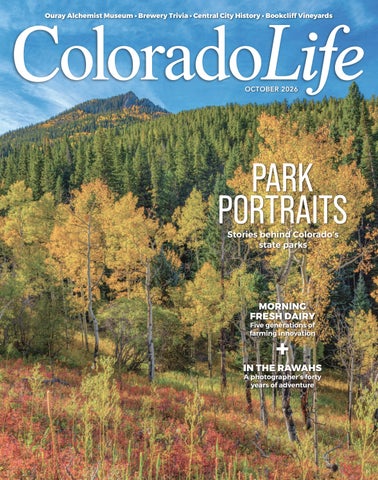
Ouray Alchemist Museum • Brewery Trivia • Central City History • Bookcliff Vineyards
OCTOBER 2026
PARK PORTRAITS Stories behind Colorado’s state parks
MORNING FRESH DAIRY
Five generations of farming innovation
IN THE RAWAHS A photographer’s forty years of adventure
M A K E YO U R R E TI R E M E N T E V E N M O R E
Extraordinary
Wind Crest® has everything you need for vibrant senior living, including stylish floor plans, resort-style amenities, and additional levels of care should you ever need them.
Call 1-888-964-0047 for your free brochure.
Wind Crest, Inc., a nonprofit organization, is solely responsible for fulfilling financial responsibilities to residents under the contract. Wind Crest is within the network of communities developed and managed by Erickson Senior Living.®
2666250
Highlands Ranch WindCrest.com
COLORADOLIFEMAG.COM 3
VISITDELTACOUNTY.COM VISITDELTACOUNTY.COM
HOT SPRINGS ALAMOSA, CO
S 3 SLIDE ES N A 4 L AP L AS A B CA N SHADE S AEROBIC
Alamosa’s Best Kept Secret
Colorado’s Back Colorado’s Back Yard Yard:: Your Your Hidden Hidden Playground Playground Photo Courtesy of Grand Mesa Nordic Council
Discover why this geothermal swimming pool, a favorite among locals and visitors since 1955. 719-298-0662 • 5895 Hwy 17 • Alamosa, CO
splashlandllc.com Photo: Courtesy of Grand Mesa Nordic Council
VISIT Lake
AlwaysKayak
McConaughy!
Only 3 hours from Denver
Watch the seasons change in beautiful Keith County! Enjoy fall kayaking, fishing, birdwatching, beachcombing and more!
Scan to enter to WIN A WEEKEND in Keith County!
Plan your trip at ILoveLakeMac.com today!
4 COLORADO LIFE
800-658-4390 I-80 Exit 126, OGALLALA
CONTENTS ISSUE NO. 86 | OCTOBER 2026
FEATURES 16 Five Generations Fresh
Since 1894, the Graves family has farmed near Bellvue, where the fifth generation now delivers fresh milk to doorsteps, churns out ice cream and welcomes visitors to Morning Fresh Dairy for tours. story by Ariella Nardizzi photographs by Erik Makić
Five Generations Fresh, p 16
22 Forty Years in the Rawahs
Since his first backpacking trip at age 12, photographer Dean Allen has returned to the Rawah Wilderness to explore its alpine lakes, rugged peaks and storied past. story and photographs by Dean Allen
28 Unexpected Colorado
From record-breaking climbs to historic dam failures to wildlife encounters, discover the surprising stories behind 10 of Colorado’s state parks. story and photographs by Joshua Hardin
40 From Wings and Windups to Wine
Two aerospace engineers and a former college pitcher take the reins at Bookcliff Vineyards, turning grapes grown in Palisade into award-winning wines at their Boulder winery. story and photographs by Dan Leeth
Forty Years in the Rawahs, p 22
IN EVERY ISSUE 9 Editor’s Letter
Chris Amundson reflects on life in Colorado.
10
14
Sluice Box
A 150-year-old Boulder cottonwood becomes a Little Free Library; an Ouray museum houses antique medicines and pharmacy artifacts; Central City’s gold rush origins.
Trivia
Colorado’s breweries and beer history. Answers on page 49.
From Wings and Windups to Wine, p 40
COLORADO LIFE MAGAZINE, ISSN 2166-3823, is published bimonthly for $32 per year by Flagship Publishing, Inc., 5552 North River Run Dr., Provo, UT 84604. Periodical postage paid at Provo, UT, and at additional mailing offices. POSTMASTER: Send address changes to Colorado Life, PO Box 970460, Orem, UT 84097.
CONTENTS 5
We have stories to tell and adventures to share.
Discover Conejos County ConejosVacation.com
CCT_CO-Life_3.5x4.75.indd 1
2/6/23 3:42 PM
Visit Summit County’s Enchanting B&B
Experience historic charm at Frisco Lodge. Our exceptional hospitality, afternoon wine and cheese, award winning courtyard, outdoor hot tub and romantic fireplace are just a few reasons our guests rated us the #1 bed & breakfast in Frisco and all of Summit County! See why our guests think we are the best
6 COLORADO LIFE
www.friscolodge.com fri l d fri 1-970-668-0195 321 Main St | Frisco, CO
Stories in this issue come from Walden p 30
Bellvue p 16 Boulder p 10, 40
Eldorado Springs p 33
Brighton p 33 Denver p 46 Littleton p 30, 32 Franktown p 31
Central City p 12 Black Hawk p 1, 32
Palisade p 47
ON THE COVER
Aspen trees glow with yellow foliage in Golden Gate Canyon State Park, one of 42 operating parks, near Golden. Story begins on page 28.
Divide p 32 Buena Vista p 50 Pueblo p 31
Ouray p 11 Pictou p 30
PHOTOGRAPH BY JOSHUA HARDIN Map by Raven Maps & Images
IN EVERY ISSUE
38
34 Kitchens
Root vegetables shine in savory sides and sweet treats.
38 Poetry
From mining dreams to aspens, rust and gold color Colorado’s poetry.
46 Go.See.Do.
Denver Botanic Gardens dazzles with half a million lights; Palisade celebrates an Olde Fashioned Christmas; and 14 more events around the state.
46
50 Peak Pixels
Joshua Hardin explores light and composition along the Collegiate Peaks Scenic Byway.
Above: Noah Wetzel, Denver Botanic Gardens/Scott Dressel-Martin Page 5: Erik Makić, Dean Allen, Bookcliff Vineyards CONTENTS 7
Give a gift OF A COLORADO SUBSCRIPTION
Brighten someone’s year with the gift of Colorado Life! They’ll explore the state in person or from the comfort of home with six inspiring, insightful and beautifully crafted issues each year.
SUBSCRIBE AND GIVE TODAY! 1 YEAR
32
$
2 YEARS
56
$
970-480-0148
Call or go online to subscribe ColoradoLifeMag.com 8 COLORADO LIFE
From the Editor
OCTOBER 2026
Special Deliveries
Volume 15, Number 5
Publisher & Editor Chris Amundson
Associate Publisher Angela Amundson
Editorial Assistant
Savannah Dagupion
Photo Coordinator Erik Makić
Staff Writer
Ariella Nardizzi
Design
John Anton Sisbreño, Rasa Velicka
Advertising Sales Robert Schonlau
Subscriptions Shiela Camay
Colorado Life Magazine c/o Subscriptions Dept. PO Box 970460 Orem, UT 84097 970-480-0148
ColoradoLifeMag.com
SUBSCRIBE
FIRST LEARNED ABOUT Morning Fresh Dairy through our daughter Liesl, who spent a summer giving tours there. At supper, she brought home stories about the cows. They had friends, she told us. When they stepped into the dairy’s round milking parlor, they looked for one another, like ladies gathering at the beauty salon. Some were so comfortable that they didn’t want to leave after their milking. My dad, George, was a dairy farmer, and he knew his cows individually, too. He named them and could tell you which one was Mabel’s granddaughter. In winter, he played country music for the herd. I was proud of Liesl for doing that work. Her supper-table stories sounded familiar. In this issue, we visit the Graves family’s Morning Fresh Dairy in Pleasant Valley near Bellvue. Five generations have worked this land. Today, their business includes home milk delivery, milk for noosa yoghurt and Howling Cow Café, where visitors can try ice cream developed by fifth-generation family member Amber Graves. We often celebrate Colorado through hiking, fishing, camping and photography. Colorado’s farms and ranches also put milk, meat, fruit and vegetables on our tables. For the Graves family, living in this beautiful valley means feeding cows, tending fields and getting fresh milk onto somebody’s doorstep. Five generations have chosen that life, each finding new ways to make a living at it. Our former photo editor Joshua Hardin left his staff role to pursue a book project about state parks across all 50 states. I’m proud of Josh. You’ll find some of his Colorado work in “Unexpected Colorado.” We’ll keep you posted on the book. Publishing Colorado Life is work we love, too, and we’re grateful to our readers. When you renew your subscription or give the magazine to family and friends this holiday season, you help us keep sending writers and photographers out across the state. Thank you for another magazine in the mailbox. And if a bottle of Morning Fresh milk arrives on your porch, Liesl could tell you a little about the company its cows keep. Chris Amundson Publisher & Editor editor@coloradolifemag.com
Subscriptions are 1-yr (6 issues) for $32 or 2-yrs (12 issues) for $56. Please call, visit ColoradoLifeMag.com or return a subscription card from this issue. For fundraising and group subscription rates, call or email subscriptions@coloradolifemag.com.
ADVERTISE
Advertising deadlines are three months prior to publication dates. For rates and position availability, please call or email advertising@coloradolifemag.com.
CONTRIBUTE
Send us your letters, stories, photos and story tips by writing to us, emailing editor@coloradolifemag.com or visiting ColoradoLifeMagazine.com/contribute.
COPYRIGHT
All text, photography and artwork are copyright 2026 by Flagship Publishing, Inc. For reprint permission, please call or email publisher@coloradolifemag.com.
Back on our family farm: That’s me at left, with my brother Brent Amundson and my daughter Liesl pictured at right. EDITOR LETTER 9
NUGGETS AND OBSERVATIONS ABOUT LIFE IN COLORADO
The Giving Tree Readers find an unexpected book nook inside a Boulder cottonwood stump by ARIELLA NARDIZZI When the stump of a 150-year-old cottonwood on Boulder’s West Pearl Street was slated for removal, Chess Piccione decided to save what remained. Families once held hands around the trunk, six people wide. Its canopy shaded passersby. Piccione helped turn its hollow trunk into a library for the historic West End neighborhood. The Arnett-Fullen Treehouse is one of nearly 300 Little Free Libraries in the
Boulder area, part of a nonprofit network working to expand access to books. Readers can take a book or leave one to share. Many of the libraries are handmade miniature boxes scattered along sidewalks around the city. This one mirrors the adjacent Arnett-Fullen House. Built in 1877, the “Gingerbread House” is known for its ornate design and steep roof with multicolored pastel shingles. Willamette Arnett, the home’s first owner, planted 10 cottonwoods when the house was built.
The surviving stump outside its iron gates may be one of them. The building was designated a local landmark in 1990, later renovated by Historic Boulder and now serves as a private residence. The matching treehouse has a tricolored roof atop the 8-foot stump. Inside, a skylight illuminates a dozen books on wood shelves salvaged from the trunk. Titles span genres, though Piccione says each Little Free Library develops its own personality. “The books inside feel like a peek into the neighborhood and the interests of the community,” she said. On West Pearl, that leans toward gardening, travel and fiction. Piccione is a traveling librarian, restocking cubbies around the city as a volunteer for Little Free Library. She first got to know Boulder during the pandemic by distributing duplicate titles from her work in publishing. Now, she encourages others to “pollinate” each stand with their own books. When the city cut down the dying cottonwood in 2022, residents protested. Inspired by a library carved into an old elm in East Boulder’s Arapahoe Ridge neighborhood, Piccione proposed the same for West Pearl. She connected with city departments, tree specialists, neighbors and the Arnett-Fullen homeowners to rally support.
Outside the historic Arnett-Fullen House on West Pearl Street in Boulder, a Little Free Library mirrors its architectural charm with a tri-color roof. The LFL is one of 300 around the city working to expand book access.
10 COLORADO LIFE
Karen Jacot
Because the library is carved into a stump, Piccione estimates it will last 30 years. Still, she hopes the treehouse becomes a landmark of its own. This spring, the hollow stump finally filled with books. Foot traffic through this stretch of Boulder is steady. “People really just stumble upon it while walking down the sidewalk. Which is funny,” Piccione said, “because it’s this massive tree stump with a roof.” That spark of excitement in people’s eyes over something unexpected is the whole point of the project. As she says it, passersby stop on the sidewalk to gaze up at the structure. “What a fun surprise,” one person exclaims. They peer inside, take a book and continue on their way.
Find the Treehouse The Arnett-Fullen Treehouse stands beside the sidewalk in front of the Arnett-Fullen House at 646 Pearl St. in Boulder. Stop to browse, take a book or leave one to share.
Ariella Nardizzi
LFL volunteer Chess Piccione transformed the 150-year-old tree stump into a library, encouraging residents to take or leave a book inside the hollowed-out nook.
Visit Ouray/Brooke Warren
The cure to curiosity lives at the Ouray Alchemist Museum on Main Street, where Curtis and Nancy Haggar have been collecting medicinal artifacts for more than 50 years.
A Dose of History Antique remedies and a pharmacist’s stories fill an Ouray museum by ARIELLA NARDIZZI A purple-and-gold jar bears the label “LEECHES.” A cork press resembles an alligator, and an 1867 prescription calls for opium and camphor. Even the soda fountain has a medicinal past: sarsaparilla was once thought to cure tuberculosis and syphilis. These are among the objects inside the Ouray Alchemist Museum, a re-created frontier pharmacy at 533 Main Street in Ouray. Pharmacist Curtis Haggar has spent more than 50 years collecting old medicines, bottles, tools and drugstore fixtures. His wife Nancy, also a pharmacist, joined the venture after they met in 2002. Much of the collection came from old pharmacies, former mining towns in the San Juan Mountains, neighbors and fellow history buffs. The artifacts, Curtis said, have a way of turning up on their own. “You don’t find them. They find you,” he said. Curtis’s own Colorado story began in 1971. He graduated from college with a suitcase and $500. He intended to hitchhike to Orlando, Florida, but headed west instead. A job at a Denver pharmacy introduced him to older pharmacists whose stories sparked his interest in the profession’s past. In 1993, he moved to Ouray and traveled
throughout the San Juans as a pharmacist, collecting artifacts that would later become his museum. He met Nancy while purchasing fixtures from the sale of the 1888 Aspen Drugstore in 2002. Curtis told the owner, “Name your price. But I get Nancy, too.” Nancy jokes it was one heck of a deal. They were married four years later. The couple built the Main Street museum in 2010, outfitting it with restored fixtures, gargoyles, a copper dome and stained glass. More than 700 hand-blown pharmacy bottles fill the collection, many still containing their original drugs. During private tours, Curtis explains how early remedies were administered and how modern medicines came to be. His delivery, honed over 14 years of guiding visitors, is as much a draw as the objects. “It’s like going to a comedy club, but people actually learn something,” he said. Tours must be booked in advance and last about two hours. Admission is $20 per person. Nearly 79, Curtis has no plans to stop giving tours. He remains fascinated by how pharmaceuticals have changed and welcomes visitors’ own experiences and knowledge. “I hope to live to 103-and-ahalf,” he said. SLUICE BOX 11
Denver Public Library (all)
John H. Gregory’s 1859 gold discovery sparked a rush to the foothills west of Denver, transforming a remote gulch into a booming mining district. The discovery also helped pave the way for Colorado’s territorial government, 15 years before statehood.
Birth of a Territory The four-dollar gold find that helped create Colorado by RON J. JACKSON, JR. Four dollars’ worth of gold lay in John H. Gregory’s pan on May 6, 1859. The Georgia miner had followed traces of gold into the Rocky Mountain foothills and found a vein in the rock near present-day Central City. Within weeks, thousands of prospectors would crowd into the gulch. Colorado celebrates its 150th anniversary of statehood this year. Gregory’s strike helped turn Central City into a boomtown and fueled demands for a territorial government. Colorado Territory followed on Feb. 28, 1861, 15 years before statehood. Gregory had earned his mining chops in Georgia before reportedly losing his money in the Panic of 1857. He drifted westward as far as Fort Laramie in present-day Wyoming, where he heard about William Greeneberry Russell’s 1858 gold discoveries near present-day Denver. Rus-
12 COLORADO LIFE
sell’s party had found gold at Little Dry Creek, near what is now Englewood, helping spark the Pikes Peak Gold Rush. Gregory headed south to investigate. A 1943 account in The Steamboat Pilot describes him panning gullies and creek beds in early 1859 until heavy storms forced him to shelter under boulders on beds of pine needles. He huddled beneath a bearskin coat with his gold pan and shovel. Starving and destitute, he stumbled into the small settlement of Arapahoe, near present-day Golden. There he met farmer David K. Wall, who agreed to feed him and finance supplies for another expedition in exchange for a percentage of his gold. With Wall’s backing, Gregory returned to the mountains with a ragtag party of greenhorns. The May discovery became known as the Gregory Lode. Gold-bearing rock promised work beyond panning the loose flakes washed into streambeds. The dig-
gings lay between present-day Central City and Black Hawk, some 40 miles west of Denver. News of Gregory’s good fortune sent an avalanche of gold seekers into the region. Central City became a boomtown, eventually known as “The Richest Square Mile on Earth.” By June, Horace Greeley, editor of the New York Daily Tribune, had come to inspect the excitement. He and fellow journalists Albert D. Richardson and Henry
Villard reported, “There are said to be five thousand people already in this ravine, and hundreds more pouring into it daily.” Their dispatch also warned that nearly every pound of provisions had to come by wagon from the Missouri River, some 700 miles away. Winter would shut down the sluices. The men warned that latecomers could face six months without employment, food or shelter. Gregory sold two claims for $21,000 and headed east in 1859. He returned to Colorado the following year before going back to Georgia. The growing mining industry needed mills, roads and workers. Mining towns needed merchants, builders and banks. Gregory came to the mountains looking for gold. His discovery helped draw thousands of settlers who built towns and pressed for a government of their own. Less than two years after that four-dollar pan, Congress created a new territory: Colorado.
Prospectors flocked to the diggings between present-day Central City and Black Hawk after Gregory’s strike. Central City became known as “The Richest Square Mile on Earth.”
Discover
GILPIN COUNTY’S RICH PAST
Visit the Gilpin History Museum, tour the historical Central City Opera House and discover the darker side of Gilpin County’s history with the Creepy Crawls in October.
228 E 1st High St Central City, CO 303-582-5283 GILPINHISTORY.ORG SLUICE BOX 13
EXPLORE
Colorado
BREWERIES
TRAVEL ⦁ HISTORY ⦁ ADVENTURE ⦁ RECIPES
Tap into your knowledge by BEN JENKINS
Rob Spradling/R3 Media Production
GENERAL Treat yourself, or share with friends and family. Each keepsake issue (6 per year) is filled with entertaining stories and beautiful photography about life in Colorado.
SUBSCRIBE TODAY! 1 YEAR
32
$
2 YEARS
56
$
1
Chin Curtain IPA, Stubble Kölsch and Friendly Mutton Chop Märzen offer clues to the name of Longmont’s Grossen Bart Brewery. Its name is German for “big” what?
2
Denver’s FlyteCo Tower occupies the base of Stapleton’s former control tower. What 1990 action sequel used the airport as a stand-in for Washington Dulles?
3
An April Fools’ joke became a real beer when Denver’s Wynkoop Brewing Company made a stout with what unusual animal ingredient?
4 970-480-0148
ColoradoLifeMag.com 14 COLORADO LIFE
Big Bad Wolf, Golden Goose and Little Red Cap are beers at a Loveland brewery named for what German storytellers?
5
In 1986, John Hickenlooper lost his job during Colorado’s oil
bust. Two years later, he helped open Wynkoop Brewing Company. What was his profession before brewing? FlyteCo Tower
STEP BACK IN TIME TO The grandeur of a bygone era awaits you at Rosemount in Pueblo! Built in 1893, this 37-room, 24,000 square-foot mansion was the family home of prominent businessman John A. Tatcher and his family. Take a guided tour of the mansion, and step back in time.
MULTIPLE CHOICE
6
Two founders of Boulder Brewing Company, established in 1979 as Colorado’s first craft brewery, shared what profession? a. Circus clowns b. Professional ice hockey players c. Physicists
Open February-December
Tuesday-Saturday • 10 am–2:30 pm
7
Loveland’s Verboten Brewing takes its name from the German word for “forbidden,” a reference to Bavaria’s 1516 beer purity law. Which ingredient was not among the three the law allowed? a. Wheat b. Water c. Hops
8
Twisted Pine Brewing Company in Boulder makes a beer with six kinds of chile peppers, including ghost peppers. The beer shares its name with which rapper? a. Ice Spice b. Ghostface Killah c. Pop Smoke
9
Employees at Fort Collins’ New Belgium Brewing Company voted to give up their annual profit-sharing bonus to help pay for electricity generated by which renewable source? a. Solar b. Wind c. Geothermal
10
Which industry helped keep Coors in business during Prohibition? a. Soaps b. Automobile parts c. Ceramics
419 West 14th St • Pueblo • 719-545-5290 John Hickenlooper
TRUE OR FALSE
11
Colorado went dry four years before national Prohibition began.
12
Leadville brewers can use fewer hops because water boils at a lower temperature there.
13
Bierstadt Lagerhaus in Denver pours its Slow Pour Pils slowly to eliminate the foam before serving.
14
At Longmont’s Shoes & Brews, a combination running shoe store and taproom, running faster can make your beer cheaper.
15
Blue Moon Belgian White originated at Coors Field’s Sandlot Brewery, the first brewery inside a Major League Baseball stadium.
No peeking, answers on page 49.
MONDAY-THURSDAY 11AM-8:30PM FRIDAY-SATURDAY 11AM-9:30PM CLOSED SUNDAYS
218 S. L IN C O L N ST. | B U RL IN G TO N , C O
719-346-8790 WWW.THEDISHROOMBURLINGTON.COM DISHROOM.BURLINGTON@GMAIL.COM
TRIVIA 15
FIVE GENERATIONS
fresh
16 COLORADO LIFE
Fresh milk and fresh ideas keep a Bellvue family farm going story by ARIELLA NARDIZZI photographs by ERIK MAKIĆ
I
NSIDE THE MILKING parlor at Morning
Fresh Dairy, 40 Holstein cows step onto the Dairy-Go-Round. The platform turns steadily as workers attach milking equipment and the animals quietly chew their cud. In seven minutes, the ride is over. Most cows step off. Some push their way back on. “We call those girls our joy riders,” said Spencer Normandin, a tour guide for Morning Fresh Dairy. “The current record is seven times around because they love it so much.” The milk they’ve produced begins its short journey through pipes into the processing room. There, it will be separated, pasteurized and bottled in glass. By midday, delivery trucks will be taking bottles to doorsteps across Northern Colorado. It’s all part of the dairy’s promise to get milk from “moo to you” within 24 hours. The Graves family has farmed Pleasant Valley near Bellvue since 1894. Cornfields spread across the open farmland between Rist Canyon and Poudre Canyon, with the Poudre River meandering along the farm’s edge and foothills rising toward the mountains. Five generations have found ways to make a living here, from growing crops to
selling milk and opening a café. Now Rob and Lori Graves’ children are bringing experience from other industries back to the farm, with ideas of their own. Before milk is poured, it passes through a processing plant. A gravity-fed system engineered by Bryan Graves, part of the fifth generation, moves milk through the plant. A separator spins cream away from skim milk, allowing the dairy to make
products with different fat contents. A metal flavorizer sits nearby, used to make the dairy’s flavored milks. Chocolate and Root Beer Float are regular offerings, while seasonal batches include Strawberry, Eggnog and Milkaccino coffee. Flash pasteurization briefly heats the milk to kill harmful bacteria. Homogenization distributes fat evenly through the milk. After cooling, the finished product goes into reusable glass bottles, ready to be loaded into delivery trucks. Those glass bottles make return trips, too. Customers leave their empties for collection, and the dairy washes and refills them. Milking, processing and bottling all happen here, close to the fields that produce much of the cows’ feed. The family uses manure to fertilize its crops, and nutritionists monitor the animals’ diets. In the 1950s, the Graves family milked about 80 cows. Today, the milking herd numbers more than 1,300, each producing about 10 gallons a day over three milkings. Rob installed the rotary parlor in 2015, allowing workers to milk 40 cows at a time. The cows face inward as the platform turns. Workers clean their udders before MORNING FRESH DAIRY FARM 17
Morning Fresh Dairy Farm
The Graves family has worked the land in Pleasant Valley outside of Bellvue since 1894. It’s home to Morning Fresh Dairy and other family entities, providing farm-fresh milk to Northern Colorado.
18 COLORADO LIFE
attaching the milking equipment and apply a protective treatment afterward. Away from the parlor, the animals have access to sand bedding, food, water and outdoor corrals. Fans stir the air on hot days, and barn side panels open or close with the weather. The cows also get seasonal access to pasture. Yellow identification tags help workers track individual cows. “Our herdsmen don’t look at our cows like numbers, but like they’re a part of the family,” said Amber Graves, Rob’s daughter and a member of the fifth generation. “Since we’re a smaller dairy, our team can really get to know them.” Public farm tours follow the milk through the parlor and processing and bottling operations, with a chance to visit the calves. The tours began in 2018 and last about 60 to 90 minutes. “People are so disconnected from our food systems. These tours help them get back in touch with it, seeing firsthand
how their milk is processed,” said marketing manager Wren Bridgwater.
WILLIAM CHARLES GRAVES and his wife, Arista, settled here in 1894, growing alfalfa, corn and beets. Their son, William Charles “Charley” Graves Jr., attended Pleasant Valley School #7 on the property. Built in 1879, the one-room schoolhouse served local farm kids until 1913. Now listed on the National Register of Historic Places, it remains a stop on dairy tours. Visitors can see original window frames and carvings left in the door frame. During the Great Depression in 1934, Charley began selling milk to keep the farm afloat, marking the start of Graves Dairy. His son, Robert “Bob” Graves, and Bob’s wife, Sherry, carried the business forward while raising four children. When their 10-year-old daughter Laura developed leukemia, none of her family
Morning Fresh Dairy Farm
were a suitable bone marrow donor. In 1979, she became the first patient with leukemia to receive a bone marrow transplant from an unrelated donor. The transplant extended her life, though she later died after her leukemia returned. Her experience helped establish that an unrelated donor could offer a chance at survival. Bob and Sherry joined other families, doctors and supporters in helping create a national donor registry. The organization, now known as NMDP, reached its 150,000th transplant in 2026. Laura’s brother, Rob, later took over the dairy with his wife, Lori. They modernized the equipment and renamed the delivery service Morning Fresh Dairy, emphasizing how quickly the milk could reach customers. Rob encouraged his children to gain experience elsewhere before deciding whether to return to the farm.
“Our dad proved himself to his dad and we’re all trying to do the same,” Amber said. “Our older ancestors did this job out of necessity to live. Being able to go beyond, build the business and have a symbiotic relationship with our community is pretty cool.”
THE FIFTH GENERATION Graves children grew up following their dad around the dairy as he checked sprinklers, fed cows and vaccinated calves. Later, they all helped sell products at farmers markets, meeting the people who took the family’s milk home. Amber Graves left to study chemical engineering at the Colorado School of Mines in Golden. After graduating, she designed natural gas processing facilities before returning to the family business in 2020. That year, cafes and restaurants closed during the pandemic, leaving the dairy
The dairy practices compassionate cow care for its herd of 1,300 and prioritizes sustainability. The community can experience the Graves’ innovative methods firsthand during weekly public tours.
MORNING FRESH DAIRY FARM 19
Amber (left) and Lori (right) raise the future sixth generation on the farm. Amber brought the dairy into the modern age, founding Ummber’s Ice Cream to utilize a cream surplus.
with a surplus of cream. A lot was going to waste. Milk kept coming through the parlor every day, but the customers who usually bought the cream had closed their doors. “What do you do when you own a dairy farm, you’ve got extra time and extra cream? Obviously make ice cream,” Amber said. She began testing recipes in an at-home ice cream maker, sharing batches with family and friends. She also tried making butter before settling on ice cream. Her young nephews supplied the name. During those early experiments, they pronounced her name “Amber” as “Ummber.” It stuck. Ummber’s Ice Cream uses pure cane sugar and, of course, cream straight from the dairy. The fruit flavors contain real fruit without artificial flavoring. Among Amber’s most beloved creations are Strawberries & Cream and Banana Pudding, although she has trouble choosing a favorite.
20 COLORADO LIFE
“All of them,” she said confidently. The ice cream is sold by the scoop, half-pint or pint at Howling Cow Café on the farm. Opened by Lori in 2014, the café serves coffee and pastries and stocks Morning Fresh milk and products from local vendors. Visitors can finish a farm tour with a scoop of ice cream made here. Amber also brings her engineering training to the dairy’s operations and infrastructure projects. Still, she sees her job in simple terms. “Show up and do hard work,” she said. It’s something she learned growing up on the farm, watching her parents lead by example. She hopes her own children will find their individual paths, just as she did, and decide whether to return to the family business on their own terms. That means taking care of the land that has sustained the Graves family for more than a century. “If we trash the land, it wouldn’t be here for me and my kids. You’ve got to take care of it and it will take care of you,” she said.
Cultured in Colorado IN ANOTHER CORNER of the Morning Fresh Dairy facility, the
same milk that fills glass bottles is turned into thick, creamy noosa yoghurt. Its origins began thousands of miles from Bellvue, on Australia’s Sunshine Coast. In 2004, Aussie expatriate Koel Thomae, who had been living in Colorado, discovered a shop serving creamy yoghurt mixed with passion fruit purée near the beach town of Noosa. One spoonful, and she knew she needed to recreate it back in the States. The tangy, full-fat Australian yoghurt was unlike anything she could find in the U.S., where low-fat was all the craze. Four years later, she stumbled upon a Morning Fresh Dairy flyer in a Boulder coffee shop and pitched a partnership to Rob Graves: She’d turn the dairy’s liquid gold into small batches of yoghurt. Noosa launched in 2010, selling four flavors at Colorado farmers markets and local Whole Foods stores. Customers regularly bought out the farmers market stock, and the business grew into larger supermarkets. The “h” in yoghurt made the trip from Australia, too. Whole milk, honey and fruit purée remain central to the recipe. Flavors range from blueberry, lemon and strawberry rhubarb to dessert-worthy salted caramel. Some of the milk comes straight from Morning Fresh through a pipeline connecting the dairy to the yoghurt facility. Neighboring Colorado dairies supply the rest. Noosa also built a treatment plant on the property, cleaning water used in production so it can irrigate the farm’s crops. A craving that began on Australia’s Sunshine Coast found its footing in the foothills of Pleasant Valley. MORNING FRESH DAIRY FARM 21
FORTY YEARS IN THE
RAWAHS A photographer retraces a lifetime of close calls and discoveries in Colorado’s northern mountains story and photographs by DEAN ALLEN
Dean Allen reflects on the isolation of a campsite at Rockhole Lake in the Rawah Wilderness. Rawah is the Arapaho word for “wild place,” to which Allen has taken many trips throughout his lifetime.
1
983. WE ACCIDENTALLY broke nearly every wilderness regulation on the books. But we were just kids and didn’t know any better. The rangers let us off with a warning and a gentle lecture. I was 12 and on my very first backpacking trip with a church youth group. Camp Lake was my temporary home. I had a plastic sheet and a rope for a leanto shelter. I was unfazed when my cotton sleeping bag got soaked during an afternoon thundershower. I whittled a walking stick, fished, learned how to start a fire and paddled around the frigid waters in the bowl of a large hollow log. I felt like a mountain man exploring new territory. I had no idea of the history of the Rawah Wilderness or its influence on Colorado and on me. The Rawahs stretch north to south near Wyoming along the border of Larimer and Jackson counties. The spine of
The Rawahs stretch north to south near the Colorado-Wyoming border. Above the Laramie River Valley, undulating foothills give way to rugged peaks.
24 COLORADO LIFE
the Medicine Bow Mountains delineates more than just the county line, though. It also separates the types of human access. High above the Laramie River Valley on the east side is the Rawah Wilderness, where motorized traffic is not allowed. Colorado State Forest stretches along the west side, with snowmobile and fourwheel-drive routes accessible from the expansive North Park. Ancient Precambrian metamorphic and igneous rocks give the Rawahs a ruggedness many don’t expect. I’ll always remember scratching my way up the glacier-carved Island-Carey Lake cirque to bivouac on a blind ridge in the shadow of an unnamed tower. The authentic wilderness experience is what continually draws me here. Rawah is an Arapaho word for “wild place.” Around 1820, a French-Canadian fur trapper named Jacques La Ramée de-
cided to trap the Laramie River against the advice of fellow trappers. At the next rendezvous, La Ramée was missing. His friends, including famous mountain man Jim Bridger, organized a party to hunt for the trapper with no luck. For years, it was believed he had been killed and his body hidden beneath the ice of a beaver pond. The river now bears La Ramée’s name, with a different spelling. Kit Carson also trapped the Laramie’s headwaters, surviving what he remembered as his worst bear encounter. Wikimedia Commons
CARSON’S BEARS WERE on my mind
in 1993 when I was pulled from sleep by a noise outside my tent. The dim morning gave the tent just enough light to make it feel spooky. I heard it again. The snapping of a branch. Chipmunks don’t do that. It was something big. I had returned to Camp Lake in my early 20s. This time alone. It had been 10 years, and I was curious what I could find that I remembered. I didn’t stay alone for long, though. Screwing up my courage, I unzipped my sleeping bag. I cringed at the noise tearing at the mountain’s stillness. Peering through the mesh door, I saw a dark, almost black form. A bear? It turned, and I saw the rising antlers. It was a moose. Moose were transplanted from Utah and Wyoming into North Park beginning in 1978, with later releases in the Laramie River Valley. They thrived in the Rawahs’ willow thickets, cold, wet valley bottoms and snowy high-elevation basins. It’s possible that the moose I saw was the offspring of an original transplant. Of course, moose aren’t the only wildlife species found in the Rawahs, making this a rich hunting area. There is regulated hunting for elk, deer, moose, black bear and small-game species. I had a startling night encounter with a bighorn sheep while descending from a sunset photo shoot. I rounded a boulder into the top of a scree-filled couloir. I caught it in my headlamp’s glare. We both froze, only feet from each other. I watched, amazed, as it bolted into the inky void. But for many outdoor enthusiasts, wildlife in the Rawahs means fish. The most productive fishing in the Rawah Wilderness is found in alpine cirque lakes such as Twin Crater Lakes, Island Lake and the clustered Rawah Lakes system. Just their names inspire me.
In the early 1800s, the Laramie River attracted trappers from around the world. Explorer Christopher “Kit” Carson trapped the river’s headwaters and survived his worst bear encounter during the endeavor.
Library of Congress
Arthur Lumley/Wikimedia Commons
Moose thrive in the remote Rawah Wilderness due to the thick willows and cold, wet valley basins. They were transplanted here from Utah and Wyoming in 1978. FORTY YEARS IN THE RAWAHS 25
FISHING WASN’T ON my mind in 2022 when the wind began violently whipping at my three-season tent near Rockhole Lake. Snow was coming, and I didn’t relish the idea of such a paltry shelter. But the tent wasn’t my only option. Earlier, I had found a boulder that offered shelter. There, I spent a silent and peaceful night while an early-season blizzard pounded the Rawahs. I woke up to a winter wonderland. All of that snow is precious. Gold to the south might be yellow, but in the Rawahs it’s crystal clear. To get here, I had hiked along the gurgling water streaming through a collection of small canals at the West Branch trailhead. On other trips, I’ve stumbled upon an abandoned canal near the Camp Lake trail. These artifacts hint at an endeavor that linked the mountains to farms far out on the plains.
In the early 1900s, Wallis Link, a Fort Collins rancher, helped launch an effort to collect water from the Laramie River’s tributaries and divert it into the Poudre watershed. The plans grew into the Laramie-Poudre Tunnel Project, with financial backing from landowners on the plains. By 1907, more than 150 workers, mostly Japanese and Greek, had labored on Upper Ditch. An irrigation district formed in Weld County to help finance the larger project. But the enterprise ran into trou-
26 COLORADO LIFE
During a 2022 trip near Rockhole Lake, Allen sheltered beneath a boulder as an early-season blizzard hit.
ble in 1922 when the U.S. Supreme Court divided the available water between Colorado and Wyoming, leaving Colorado with less than the project’s promoters had promised. The company struggled financially, but the tunnel remains in use. The Laramie River Valley is still lush and green, dotted with haystacks and ranches. The mountain diversions foreshadowed much larger undertakings like the Colorado-Big Thompson Project. The Rawahs received federal wilderness protection in 1964. More than 40 years after that first trip, I’m still finding profound experiences in
the Rawahs. On my most recent trip, I caught two beautiful 12-inch cutthroat trout in Twin Crater Lakes. I peered into North Park from South Rawah Peak as the sun settled over the sandy valley. I even survived a violent afternoon thunderstorm in a tent above Grassy Pass. After it relented, I climbed Sheep Mountain, awed by the scene at my feet. I stood there thinking of the forces that raised these peaks, the conflicts that played out among them and the lives, both wild and human, that still depend on them. And I watched as the sky blazed with sunset on the fading storm clouds.
RAWAH RESOURCES State Forest State Park: Maps, camping information and recreation access on the west side of the mountains. cpw.state.co.us/state-parks/stateforest-state-park Rawah Wilderness: Forest Service information on wilderness regulations, trails and current conditions. fs.usda.gov/r02/arp/recreation/ rawah-wilderness
FORTY YEARS IN THE RAWAHS 27
Early morning light illuminates the red sandstone hogbacks along the Fountain Valley Trail in Roxborough State Park.
Unexpected
COLORADO Surprising Sights and Stories in 10 State Parks story and photographs by JOSHUA HARDIN
E
LDORADO CANYON’S NAKED Edge is the scene of a long-running speed-record rivalry
among climbers. Teams race the clock from a bridge over South Boulder Creek, up the sandstone cliffs and back down to the same bridge. In 2022, Stefan Griebel and Joe Kennedy completed the circuit in 22 minutes, 44 seconds. That included approximately 200 feet of approach climbing, the 460-foot Naked Edge itself, a steep descent and the run back to the bridge. They shaved 90 seconds off the previous record. Even for experienced climbers, the Naked Edge can be a full-day outing. Elsewhere in Colorado’s state parks, patience is more useful than speed. Birdwatchers at Barr Lake work on species lists that can take a lifetime to complete. Colorado’s 42 operating state parks extend from Eastern Plains reservoirs to rocky Front Range ridges, high mountain forests to Western Slope riverways. These 10 show some of that variety, with wildlife to watch, water to explore and stories worth a closer look. At Roxborough, the red rocks are remnants of an ancient mountain range. At Mueller, a dairy operation had an illegal sideline.
The Nokhu Crags in the Never Summer Mountains rise dramatically above State Forest State Park. More than 70,000 acres of varied landscapes and ecosystems call this region home. The nearby town of Walden is known locally as the Moose Viewing Capital of Colorado.
1
Lathrop The park features two lakes, Martin and Horseshoe, that offer fishing for tiger muskie as well as rainbow trout, bass, catfish and bluegill. Martin accommodates powerboats and waterskiers, while Horseshoe’s wakeless water suits canoes and kayaks. If fishing isn’t a main attraction, hiking and mountain bike trails offer views of the Spanish Peaks, one of Southern Colorado’s most distinguishing landmarks. Walls of hard igneous rock, exposed by erosion, radiate outward from the mountains like spokes. A spur from the Hogback Trail leads to the spot where William Henry Jackson photographed Horseshoe Lake in 1885. Though Colorado acquired land that would eventually become Cherry Creek and Golden Gate Canyon state parks earlier, Lathrop became the first official state park in 1962. Located 3 miles west of Walsenburg, the park is named after Harold Lathrop, the initial parks director.
30 COLORADO LIFE
2
State Forest State Forest spans more than 70,000 acres of varied landscapes, from lakes, forests and mountain valleys to sand hills. The park’s centerpiece is the Nokhu Crags, a dramatic focal point of the Never Summer Mountains. Moose feed in the willow thickets below the peaks and along the road to North Michigan Reservoir. Rangers at the Moose Visitor Center can point visitors toward recent sightings. The animals had help getting established. In the late 1970s, state wildlife experts brought 24 moose from Wyoming and Utah to establish a breeding population in North Park. In 1995, the Legislature declared nearby Walden the Moose Viewing Capital of Colorado. The Crags began as shale that heat from magma transformed into hard rock called hornfels. Erosion exposed the steep layers, while glaciers carved the cirques now occupied by high mountain lakes.
3
Roxborough Roxborough’s Fountain Formation consists of 300-million-year-old reddishbrown arkose sandstone and conglomerate slabs tilting upward at angles of up to 60 degrees. Those red slabs contain sediment eroded from the Ancestral Rocky Mountains. Later mountain-building tilted the deposits into the formations visible today. The remains of one mountain range became part of the scenery of another. Other sedimentary layers formed under different conditions and at different times. The approximately 280-million-year-old Lyons Formation formed in an ancient desert, while the roughly 100-millionyear-old Dakota Hogback preserves sediments from the shore of a seaway. Different slopes and exposures create microclimates, allowing prairie and mountain wildlife to live in the same park south of Littleton. Grasslands and Gambel oak grow around the red spires.
4
Castlewood Canyon A 15-foot wall of water surged toward Denver after a dam within the present-day park collapsed in the 1933 Cherry Creek Flood. Built in 1890 to supply irrigation water, the dam failed after torrential rain. Two people died in the torrent. Many others escaped because telephone switchboard operators worked through the night warning residents along the flood’s path. Accounts gathered decades later from people who had been children during the flood preserved memories of those warnings and the approaching water. The dam’s crumbling remains are a curiosity for the park’s visiting history buffs and a reminder of a tragic engineering failure. The creek’s more placid waters carved a verdant, and less silty, canyon tucked into the Black Forest near Franktown. Trails along the creek lead to the ruins.
5
Lake Pueblo Lake Pueblo’s two marinas serve sailors, motorboaters and waterskiers. Visitors enjoy views of the Greenhorn and Wet Mountain ranges southwest of the reservoir. A steady breeze favors sailing, while the Arkansas River below the dam offers tubing. The South Shore Marina rents pontoon boats for visitors who want to get out on the reservoir without bringing a boat. Anglers can also choose the river corridor or nearby ponds. There was considerably more water here long before anyone built the reservoir. During the Cretaceous Period, an inland sea covered the region. Sediments accumulated on its floor, preserving plant and animal fossils in the rock layers that formed. The Arkansas River later carved the valley now occupied by Lake Pueblo, exposing sedimentary rocks in the bluffs on either side. Fossils can be seen in the park’s exposed rock layers, but they must stay there; collecting them is prohibited.
Mule deer are spotted along the Fountain Valley Trail in Roxborough State Park (top), Martin Lake is abundant with fish in Lathrop State Park (middle) and birdwatchers scout birds at Barr Lake State Park (bottom). 10 STATE PARKS 31
6
Chatfield Chatfield has a hot-air balloon launch where private operators offer rides over its reservoir. Recreational balloon pilots launch here, too. Passengers get a different view of the Denver area, with water below the basket and the Front Range beyond. The park also has runways for aircraft whose pilots stay on the ground. South of the campgrounds, paved strips serve a field for radio-controlled model airplanes. Catastrophic flooding along the South Platte River in 1965 prompted construction of Chatfield Dam. Work began in 1967 and was completed in 1975. The reservoir where boaters and balloon passengers now spend their leisure time was built to protect communities downstream.
7
Mueller Tucked into highlands west of Pikes Peak near Divide, Mueller has trails that wander through aspen groves and meadows. Grouse Mountain is one of the park’s popular hiking destinations, with views toward Pikes Peak and across the surrounding mountain country. The Cahill Cabin and Cahill Pond Interpretive Loop departs from the same trailhead leading to Grouse Mountain, taking leaf-peepers through the aspens in autumn. The moderate, 2.6-mile route passes the 1920s cabin where brothers John and Lester Cahill lived. The brothers operated a dairy barn and illegal bootlegging whiskey stills. They were also cattle and horse thieves. Hikers can still see remnants of the cabin and a whiskey still along the park’s trails.
8
Golden Gate Canyon The Horseshoe Trail meanders through aspen groves to Frazer Meadow and an old farm. Families in Golden Gate Canyon grew crops and raised cattle, and some of their cabins remain today. The 2.5-mile Raccoon Trail winds through the woods. The trail’s highlight, Panorama Point, is an expansive view across 100 miles of the Continental Divide. High mountain meadows and streamside corridors break up the park’s dense forest and rocky peaks. The park also has 125 picnic sites, each with a table and charcoal grill.
32 COLORADO LIFE
Fall foliage is on full display in each park across the state. The best spots to search for golden aspens are along the Raccoon Trail in Golden Gate Canyon, (left), Rattlesnake Gulch in Eldorado Canyon (right) and the Elk Meadow Loop in Mueller State Park (bottom).
Later landowners included Bill and Dorothy Harmsen, founders of Jolly Rancher Candy. They bought additional tracts over nearly 25 years, eventually owning more than 2,000 acres now included in Golden Gate Canyon. They sold the ranch to the state in 1978. Their former mountain retreat, a four-bedroom house, later served as the Harmsen Ranch Guest House.
9
Barr Lake More than 370 different bird species have been recorded at Barr Lake. The roost of so many birds in Brighton brightens the day of roster-clutching birdwatchers. The birders flock to the park to check off personal life lists of species they seek to spot within their lifetime. Bald eagles are a star attraction. Boardwalks and blinds allow birdwatchers to observe the raptors from safe distances without disturbing nesting activities. American white pelicans, Bullock’s ori-
oles, belted kingfishers and western grebes are other species sometimes observed. The southern half of the lake is a wildlife refuge, where boats and watersports are prohibited. During autumn migration, Bird Conservancy of the Rockies also runs a banding station at the park. Visitors who register for a public session can watch biologists weigh and measure birds captured in mist nets, then attach small numbered bands before release. If a bird is caught again, its band helps researchers trace its movements.
10
Their familiarity extended beyond the climb itself. The bridge-to-bridge clock includes the approach, the scramble down and the sprint back across South Boulder Creek. Editor’s note: Joshua Hardin, a former photo editor of Colorado Life, has been working on a book project exploring state parks in all 50 states. Here, he shares a selection of his Colorado material. Watch for details on how to order the book in a future issue of Colorado Life.
Eldorado Canyon
The park near Boulder has hundreds of routes over steep, golden-hued sandstone cliffs. The Naked Edge requires precise, technical moves, even for climbers who know the route well. By 2024, Stefan Griebel had climbed it more than 350 times. Sometimes he made three laps in three hours as he and Joe Kennedy prepared to go for a record.
Follow Along Follow Josh’s state park project at stateparkphotos.com. Find his photography and books at viewfindermedia.com, and follow him on Instagram @viewfindermedia or Facebook at Viewfinder Media. 10 STATE PARKS 33
34 COLORADO LIFE
Celebrate our
Colorado Roots T
he harvest season and warm family traditions – usually in the form of a homecooked meal – go hand-in-hand. Returning to one’s roots is important, especially to Coloradans. Families with ties to the land contributed this trio of locally grown recipes, all proudly featuring some of the best the soil has to offer.
Roasted Roots & Tahini Drizzle Complete with a quartet of colorful root vegetables, often found growing in gardens across the state, this roasted-roots side dish is the center of attention at any meal. The recipe features sweet and salty notes and is complemented by a bright and nutty tahini drizzle – perfect for even picky eaters. Peel and cube root vegetables. Combine vegetables with garlic and onion in large bowl with the olive oil, salt and pepper. Mix well to coat the vegetables with oil. Divide mixture on 2 large baking sheets (lined with aluminum foil for easy cleanup), making sure vegetables are in a single layer and not too crowded. Roast at 350° for 45-50 minutes, until vegetables are fork-tender. Larger cubes of vegetables will take longer to cook than smaller cubes, so be sure to cut firmer vegetables into the smaller cubes. Top with tahini drizzle. To make tahini drizzle, whisk together ingredients, adding more olive oil depending on how oily your tahini is, and drizzle over the roasted vegetables.
1/2 lb carrots 1/2 lb beets 1/2 lb turnips 1/2 lb sweet potatoes 3-5 cloves garlic left whole 1 medium onion, sliced 1/4 cup extra-virgin olive oil Sea salt Pepper to taste Tahini drizzle 1/4 cup lemon or lime juice 1/2 cup tahini 1/4 cup olive oil 1/2 tsp sea salt Pinch of cumin
Serves 4-6
KITCHENS 35
Chris Amundson
Johnson Farm Carrot Cake Some Coloradans prefer to eat dessert first. What better way to do that than with a root vegetable dish that is actually cake? This family recipe pulls straight on the heartstrings, featuring locally grown carrots and a number of other sweet ingredients. Complemented perfectly by traditional ingredients like cinnamon and ginger are the surprise supporting actors, applesauce and pineapple. Slather on the cream cheese frosting and dig right in! Gently combine eggs, oil, applesauce and vanilla. Stir in brown sugar and white sugar for 3 minutes, and then add pineapple. In a separate bowl, combine flour, baking powder, baking soda, salt, cinnamon and ginger. Add dry ingredients to the oil and sugar, and stir only until combined. Add carrots and stir until evenly mixed. Pour into a greased and floured 9 x 13-inch pan. Bake at 350° for 30-35 minutes. To make frosting, beat butter and cream cheese for at least 4 minutes. Add vanilla and powdered sugar and mix well. Add a teaspoon of milk at a time until it reaches the desired consistency.
4 3/4 1/2 1 1 1 3 1/2 2½ 2 1/2 1 2 1
eggs cup oil cup applesauce Tbsp vanilla cup brown sugar cup white sugar cups grated carrots cup crushed pineapple, drained cups flour tsp baking soda tsp salt Tbsp cinnamon tsp baking powder tsp ginger
Cream cheese frosting 8 oz cream cheese 1/2 cup butter softened 3-4 cups powdered sugar 2 tsp vanilla 1-2 tsp milk
Serves 12
36 COLORADO LIFE
Bountiful Autumn Salad Keeping it fresh and light, this simple and textured salad pairs sweet potatoes and apples with raisins, spinach and quinoa to transform into a staple autumn supper. Add the perfect crunch with a handful of toasted walnuts (alongside the sautéed potatoes and apples) and this salad is sure to warm up any drafty dinner table. In oiled frying pan, saute sweet potato 7-10 minutes until tender. Add apples; saute 3-5 minutes. Add spinach; sauté 2-3 minutes. Combine with remaining ingredients. Serve at room temperature or chilled.
2 sweet potatoes, peeled and cubed 4 apples, peeled, cored and sliced thin 2 cups cooked quinoa 1 cup raisins 1/2 tsp sea salt 1 tsp cinnamon Chopped spinach Toasted walnuts
Serves 4-6
Chris Amundson
What’s in Your Recipe Box?
The editors are interested in featuring your favorite family recipes. Send your recipes (and memories inspired by your recipes) to editor@coloradolifemag.com or mail to the address at the front of this magazine. KITCHENS 37
OUR STATE THROUGH THE WORDS OF OUR POETS
Lusty Aurum Marina J. Ashworth, Denver Rust is the badge of bygone thirst Gold dreams that lost their shine Pikes Peak lured divers rosy buds 59ers – jugs full of LustWine. Scant few struck supernal rich Cauchemar woke dreams to bust Dry Creek’s name proved for true Tools and minds lost Hope to rust Haste towns rose like weeds Shanties of Pikes Peak rush We became territory in 61 Docs signed with the ink of lust
O
Vic Schendel
ld mining dreams linger, autumn settles over the landscape and golden light catches the mountains. Rust and gold emerge where change has left its mark, and these poets find beauty in what fades, weathers and endures.
Dreams died in old Dry Creek Some home laying soft with the rust The rest rode trails of new dreams Lit by the Stars of Hope and Lust
Red Gold Sandy Morgan, Colorado Springs
Rust And Gold J. Craig Hill, Grand Junction Gold is the fair-haired child of the color wheel, the gold standard for wealth and beauty, the color found on angel’s wings and wedding rings and lavish ballroom walls. Rust is the outcast cousin from the dark side of the wheel, the biblical corrupter of misplaced treasures, the color found on barbed wire fences and time-worn benches and abandoned-garden walls. Rust and gold don’t sit together at school lunch tables, but once each year they collaborate to create (with some assistance from red and brown) a symphonic cacophony of color.
38 COLORADO LIFE
is the color of my daughters’ hair – yes, twin fawns of a gazelle are my girls – as they sprawl among rust and gold leaves by the side of the trail, whispering their twin-talk to one another, their hair echoing the impossible beauty of Colorado in Septober.
The Gathering Storm Larry French, Evergreen Storm clouds over peaks Sunfire spills through mountain pines Evening breathes pure gold
Noah Wetzel
Fool’s Gold
Indian Summer at Washington Park
Cher L. Tom, Palisade
Beverly Saylor, Centennial
Sluice boxes swirl with dirty creek water Washed with flakes of rust caught in twisted screens. Gold-rich dreams drifting and tumbling over the rocks below. Leaf-mountains rustle beneath my boots – soft socks catching Gold-tinted aspen leaves itching their way past my toes Into my heart.
A Lovely Shade of Gold Robert Basinger, Rifle What color is forgive’ness? Ocean blue. What color is the sky? It’s up to you. What color is compassion? A healthy shade of green. What color is our planet? Life is but a dream. The color of my heart Is a good deed for a friend When I get up in the morning I’ll try it all again Spread a little happiness The color of my soul What color is redemption? A lovely shade of gold.
Blackened marigolds shrivel into themselves like wrinkled women too long in the sun. Bewildered brown-leaved cannas hide their embarrassment, unaware their broad leaves still shelter lingering petunias hovered like chicks with a mother hen. First frost chills the ground, issues a ten-minute warning. Patrons queue up as the ice-cream truck plays a silly tune to stretch summer beyond wilted leaves floating to the grass.
Send Your Poems on the theme “Waiting” for the January/February 2027 issue, deadline December 1, and “Through the Trees” for the March/April 2027 issue, deadline January 1. Email your poems to poetry@coloradolifemagazine.com or mail to the address at the front of this magazine. COLORADO POETRY 39
40 COLORADO LIFE
Two aerospace engineers and a former pitcher take over Boulder’s Bookcliff Vineyards story and photographs by Dan Leeth
W
In Palisade, Bookcliff Vineyards grows the grapes that are trucked to its Boulder winery and tasting room, where a new generation of owners turns them into awardwinning wines.
HAT DO YOU want to do when you
grow up?” That is a question every kid hears from the time they first enter kindergarten until they finally graduate from high school. While some succeed in pursuing their self-predicted career choices, others, like Colorado native Jordan Dickard, stumble into totally unrelated endeavors. When Dickard graduated from high school, he planned to pursue a career as an aerospace engineer. While studying aerodynamics and flight mechanics at the University of Colorado Boulder, he and his roommate, fellow aerospace student Christopher Allison, dabbled in grape fermentation and produced a little homemade wine. After graduation, Dickard got a job in the aerospace industry and moved to Northern California, where he did satellite work for defense contractors. While living there, he admits he became infected with the “wine bug.”
BOOKCLIFF VINEYARDS 41
Founders John Garlich and Ulla Merz planted the Palisade vineyard, made wine at home in Boulder and sold it at farmers markets before opening the winery. They later hired Will Thompson to oversee production.
42 COLORADO LIFE
After six years in the Golden State, Dickard moved back to Colorado and reconnected with Allison. The pair soon rekindled their interest in grape fermentation, visited a hobby brew store, bought a five-gallon carboy of grapes and began making wine in the bathtub. It did not turn out well, Dickard admits, but it fed the wine bug. After five or six vintages of homemade wine, the quality had improved and the quantity increased, with the pair eventually producing the equivalent of 1,000 bottles a year. They began thinking about starting their own wine brand. This pair of aerospace engineering
graduates wanted to make their wine exclusively from Colorado-grown grapes, which led them to John Garlich and Ulla Merz. On trips from their home in Boulder to camp in the canyons around Moab, these outdoorsy folks had passed through the Grand Valley, where they saw an influx of vineyards once again sprouting around Palisade. Colorado grape growing dates to the 1800s. In 1890, Grand Junction founder George A. Crawford planted 60 acres of grapes and other fruit near Palisade. Growers discovered that the Grand Valley’s hot days, cool nights and intense sunlight suited Bordeaux grape varieties
Bookcliff Vineyards
such as Cabernet Sauvignon and Merlot as well as Rhône varieties including Syrah and Viognier.
THE WINE BUSINESS took a bit of a
recess when Colorado went dry in 1916, four years before national Prohibition. With wineries closed, farmers transformed their vineyards into peach, cherry and apple orchards. Wine grapes began to return in the 1970s, and today Colorado’s Western Slope vineyards supply fruit to wineries across the state. Garlich, a civil engineer, and Merz, a computer scientist and software developer, had previously tried to grow grapes in
their Boulder backyard with poor results. In the mid-1990s, these wine lovers acquired 10 acres in Palisade and planted their own vineyard, where they employed sustainable farming practices and fertilized the vines with compost. They trucked their harvested grapes back to their home in Boulder, where they made the wine. The couple sold it at a local farmers market under the Bookcliff Vineyards brand name. Their 10-acre vineyard eventually expanded to 37 acres, and they moved winery operations from their basement to an industrial condominium complex in north Boulder. Still holding full-time jobs, the couple
Jordan Dickard (above) and Christopher Allison bought the Boulder winery in 2023 after the founders grew tired of the 250-mile commute to Boulder. Head Winemaker Thompson joined them as co-owner.
BOOKCLIFF VINEYARDS 43
hired a young winemaker, Will Thompson, from Washington state to oversee the winemaking operation. Thompson had attended Whitman College in Walla Walla, where he was a pitcher for the college baseball team. Taking a summer job at a winery tasting room, he says he learned a lot about wine. After graduation and a year spent teaching English in Japan, he returned to Walla Walla, where he enrolled in a trade program in winemaking. “Originally, I wanted to get into making beer,” he says, “but the principles of fermentation are pretty much transferable between beer and wine, so I started the program.” Part of the curriculum included a full internship at a winery, where he learned to love winemaking and discovered it paid better than beer. After working for various Washington wineries, he secured a temporary job at a New Zealand winery to work the 2020 harvest. He flew to Los Angeles, overnighted in a hotel and awoke the day of his flight to find that New ZeaBookcliff Vineyards
44 COLORADO LIFE
land had closed its borders because of COVID-19. Thompson had already lined up a job with Garlich and Merz for later that summer. He called them, explained the situation and asked if he could start earlier than planned. Instead of dashing Down Under, he was soon bound for Boulder to make Bookcliff wine. Garlich and Merz eventually found the 250-mile commute between their Palisade vineyards and Boulder winery a bit onerous. When Dickard and Allison approached them to buy grapes, the couple offered to sell the lads the entire Boulder winemaking operation while they kept ownership of the vineyards in Palisade. In September 2023, Dickard and Allison, both of whom were still in their early 30s, became Bookcliff winery owners. To ensure the product did not drop in quality, Thompson, also in his early 30s, joined the new ownership group.
BOOKCLIFF’S GRAPES, still grown in
the Grand Valley, are trucked to Boulder to be crushed, fermented, barreled and bottled. Dickard explains that letting the grapes sit overnight before crushing helps to extract the tannins and stabilize the fruit. From a business standpoint, he points out the marketing advantage of having production located close to the Front Range population centers. While other wine regions may have the cachet, Colorado wines have proven their quality in competition. TEXSOM, a well-regarded international wine competition held in the Dallas area, receives thousands of submissions. Bookcliff ’s 2022 Syrah, Hawkridge Cabernet Sauvignon and Hawkridge Malbec received platinum medals there in 2024. Its 2023 Graciano received double gold at the 2024 San Francisco International Wine Competition. Besides producing award-winning wines, the trio of young Bookcliff owners brings new energy to a biblically old business. They continue to offer on-site tastings and wine by the glass at both their Boulder winery tasting room, 1501 Lee Hill Drive, Unit 17, and their vineyard tasting room at the base of the cliffs in Palisade, 670 39 Road.
Bookcliff pairs award-winning Colorado wines with classes, live music and other experiences at both locations. Thompson (below) has helped ensure the winery’s quality through its transition to new ownership.
Bookcliff Vineyards
Both locations frequently offer on-site classes that range from preparing charcuterie boards to learning the art of Texas line dancing, an endeavor best pursued after a few glasses of wine. The Palisade location also offers summer Sunset Saturday gatherings outside its above-the-vineyards tasting room, with live music by a rotating array of Grand Valley musicians and nourishment sold by local food trucks. Like most wineries, Bookcliff offers a wine club where members purchase a certain number of bottles twice annually. Besides discounted wine, club members can join “Booked with Bookcliff ” wine-fo-
cused international tours. Destinations have included Portugal, British Columbia, Argentina and Italy. Always eager for an opportunity to study and sample foreign wine production, one member of the young ownership trio and their spouse accompany each tour. Owning an award-winning winery was not what these three young men envisioned doing when they were cramming for fluid dynamics finals or trying to perfect a curveball. None of them regrets stumbling into the totally unrelated endeavor of producing some of Colorado’s outstanding wines.
BOOKCLIFF VINEYARDS 45
COLORADO’S CALENDAR OF EVENTS by ARIELLA NARDIZZI
LIGHT SHOW BLOSSOMS OF LIGHT NOV. 20-JAN. 10 • DENVER
More than half a million LED lights illuminate the York Street gardens during Denver Botanic Gardens’ Blossoms of Light. For more than 40 years, the annual holiday display has brightened winter evenings with lights and immersive installations. Each evening from Nov. 20 to Jan. 10, the Gardens opens from 4:30 to 9 p.m. Lights wind through the Japanese Garden, South African Plaza, Cottonwood Border, Shady Lane and other outdoor spaces. A 200-foot choreographed light tunnel stretches along the O’Fallon Perennial Walk, while the UMB Amphitheater is filled with hundreds of light sticks that respond to holiday music. Take a break at Offshoots Café or the Hive Garden Bistro for nuts, holiday
treats and warm drinks, which are especially welcome during cold evenings. Paths are concrete, but shoes with good traction are recommended, along with warm clothing. The event runs rain, snow or shine, and some sections of the path may be icy. Leave tripods and drones at home; neither is permitted during the evening event. Advance tickets go on sale to the public Nov. 9. Select a date and entry time online to enter the Gardens during that window. Free parking is available in the Gardens’ parking structure, though spaces fill quickly. Check signs before parking on nearby residential streets. Blossoms of Light is closed Nov. 26 and Dec. 25. botanicgardens.org. (720) 865-3500.
WHERE TO GO
MOLLY BROWN HOUSE MUSEUM
Lion statues flank the entrance to Titanic survivor Margaret “Molly” Brown’s stone and brick home. Tour exhibits inside the restored house. 1340 Pennsylvania St. (303) 832-4092.
WHERE TO STAY
FLORA HOUSE DENVER
This 1892 Victorian mansion has seven flower-themed rooms, a garden, fire pit and hot tub within walking distance of Denver Botanic Gardens. 1430 Race St. (720) 531-2169.
WHERE TO EAT BAROLO GRILL
Northern Italian fare draws on Piedmont and Tuscany, with seasonal ingredients in dishes such as agnolotti di mais and braised duck. 3030 E. 6th Ave. (303) 393-1040.
Denver Botanic Gardens on York Street illuminates with the glow of half a million lights. Denver Botanic Gardens/Scott Dressel-Martin
Lisa Levy Kral
Each year, Palisade puts on a Western Slope holiday extravaganza. On Friday, the kick-off sees caroling, a parade and tree lightings. Saturday brings the excitement with a winter market, carriage rides, gingerbread house contest, nativity sets, soup challenge and children’s activities.
HOLIDAY
OLDE FASHIONED CHRISTMAS DEC. 4-5 • PALISADE
Palisade celebrates Christmas with two days of caroling, carriage rides and a parade of lights. Friday’s festivities wind through downtown, while Saturday brings shopping, Santa and a soup competition. On Friday, Altrusa Palisade serves a $1 Cup of Warmth at Slice O’Life Bakery, just in time to warm up before Taylor Elementary’s Christmas carolers march down Third and Main at 5 p.m. The town tree is lit following the performance, and the Parade of Lights begins downtown at 5:30 p.m. Floats have included Peach Street Distillery’s Christmas tree made from stacked wooden barrels. At 6 p.m., the Palisade Fire Station adds its own glow with the Lighting of the Tower. Saturday’s Winter Faire fills downtown with local artisan booths, food and music
from 10 a.m. to 4 p.m. Clark’s carriage rides offer a slow way to see it all, stopping at the market and other event locations. Nearby, Ordinary Fellow hosts Christmas tree shoppers and farm animals starting at 11 a.m. At the Plaza, local restaurants compete in the Soup Challenge, with the public deciding on the tastiest bowl. Participating restaurants include Reckless Brewing Company, Fidel’s Cocina and Bar, Maison La Belle Vie Winery & Eatery and Peach Street Distillers. Tasting runs from 11 a.m. to 1:30 p.m., with winners announced at 2 p.m. Families can enter the gingerbread house contest, ride the Candy Cane Train or browse more than 60 nativity sets from around the world at the Seventh-day Adventist Church. palisadecoc.com/ofc. (970) 464-7458.
WHERE TO GO
BLUE PIG GALLERY
More than 90 Colorado artists are represented at the gallery inside the J.W. Hugus Building. Browse local art, take a workshop or stop for coffee at The Artful Cup inside the gallery. 101 W. 3rd St. (970) 464-4819.
WHERE TO STAY
SPOKE AND VINE MOTEL
The renovated 1955 motel combines retro design with sustainable features within walking distance of downtown Palisade. Pet-friendly rooms welcome four-legged travel companions. 424 W. 8th St. (970) 464-2211.
WHERE TO EAT
PÊCHE RESTAURANT
Regional products from the Grand Valley shape the contemporary American menu, with dishes such as foie gras with peaches, Oscietra caviar and butternut squash soufflé. 336 Main St. pecherestaurantcolorado.com. GO. SEE. DO. 47
OTHER EVENTS YOU MAY ENJOY NOVEMBER Delta CattleWomen Annual Fundraiser Nov. 13 • Delta
A prime rib dinner, dancing and auctions support beef promotion, agricultural education and scholarships at Delta CattleWomen’s annual fundraiser. Cimarron provides live music at the Delta Elks Lodge. Event begins at 5 p.m. $50. 563 Main St. (970) 361-6385.
Astronomy Nights Nov. 13 • Aurora
Explore constellations, planets and the night sky with the Denver Astronomical Society. Learn the stories behind the constellations, then look through members’ telescopes at the Plains Conservation Center. 5:30-8:30 p.m. 21901 E. Hampden Ave. (303) 326-8380.
Bighorn Sheep Festival Nov. 14 • Georgetown
Expert volunteers help visitors spot bighorn sheep on the hillsides near Georgetown and learn about Colorado’s state mammal. Downtown festivities include crafts, music, hikes and children’s activities. 10 a.m.-3 p.m. visitclearcreek. com/bighorn-sheep-festival.
Castle Rock Starlighting Nov. 21 • Castle Rock
Caroling, Santa visits and the firefighters’ 90th annual chili supper accompany Castle Rock’s star lighting. Festivities fill Historic Wilcox Square, downtown and Festival Park. The ceremony begins at 5 p.m.; the star lights around 5:30 p.m., followed by fireworks. Free. 2-6 p.m. (303) 688-4597.
Yuletide and Winterfest Nov. 27-28 • South Fork
South Fork celebrates Thanksgiving weekend with two holiday gatherings. Friday’s Yuletide Lighting of the Trees runs from 4:30-7:30 p.m. at the Visitor
48 COLORADO LIFE
Center and historic water tower. On Saturday from 9 a.m.-3 p.m., more than two dozen vendors sell food, crafts, artwork and holiday goods at the Rio Grande Club & Resort. (719) 873-5512.
Creede Chocolate Festival Nov. 27-28 • Creede
Sample chocolate creations around Creede, from fudge to chocolate-dipped bacon, and vote for your favorites. A winter craft market runs both days. Friday brings a magic show and live music; Saturday features a brass quintet, tree lighting and movie night. (719) 658-2374.
Christmas in Color
Nov. 27-Dec. 30 • Morrison
Millions of lights synchronize with holiday music on the radio outside Red Rocks Amphitheatre. The 1-mile drive winds through twinkling tunnels of light. One ticket covers a vehicle and festive Christmas glasses are included. 18300 W. Alameda Pkwy. christmasincolor.net.
FROST, A Cirque Holiday Extravaganza Nov. 28-29 • Parker
Acrobatics, dance, music and energy meet onstage at the PACE Center for an all-ages holiday show. Performers show off aerial stunts set against a festive backdrop. Saturday’s show begins at 7 p.m., Sunday begins at 2 p.m. 20000 Pikes Peak Ave. (303) 805-6800.
Christmas at the Fort Dec. 4 • Delta
The Fort Uncompahgre Interpretive Center celebrates an 1820s Christmas with living history, caroling, tree lighting, a visit from Santa Claus, warm drinks and cookies. The reconstructed trading post has dirt floors and displays of furs, hides and trade goods. 440 N. Palmer St. (970) 874-7566.
Grand Junction Lights Up Dec. 5 • Grand Junction
Lighted floats and vehicles roll down Main Street, past downtown’s decorated shop windows, during Grand Junction’s biggest parade of the year. Thousands line the route to watch Santa Claus and other holiday characters pass. 5 p.m. (970) 255-4923.
Winter Wonderlights
Select December Nights • Burlington
More than 90,000 holiday lights illuminate the Old Town Museum on select December evenings. Visit Santa and take a wagon or barrel train ride. Special nights feature treats from Mrs. Claus’ bakery, reindeer visits or a live nativity. 5-9 p.m. 420 S. 14th St. (800) 288-1334.
Ullr Fest
Dec. 17-19 • Breckenridge
DECEMBER
Viking helmets fill Main Street as festivalgoers honor Ullr, the Norse god of snow, during Breckenridge’s 63rd annual celebration. Join the parade, take part in an unofficial world-record attempt for the longest shotski or gather around the Ullr Bonfire. (970) 453-2913.
Vail Film Festival
Alamosa Light Parade
French and French-speaking films fill the screens at this year’s Vail Film Festival. Its French Showcase pairs film screenings with Franco-American panel discussions and a filmmaker masterclass, introducing audiences to the people behind the films. (970) 306-6843.
Lighted floats roll down Main Street as thousands gather for Alamosa’s Christmas Light Parade, an evening celebration in the high desert of southern Colorado. Santa joins the procession through downtown in the San Luis Valley. 6 p.m. (719) 589-4840.
Dec. 3-6 • Vail
Dec. 19 • Alamosa
TRIVIA ANSWERS Questions on pages 14-15 1 Beard 2 Die Hard 2 3 Roasted bull testicles. 4 The Brothers Grimm 5 Petroleum geologist. 6 c. Physicists. 7 a. Wheat – The law listed only barley, hops and water. 8 b. Ghostface Killah 9 b. Wind 10 c. Ceramics – Coors made dinnerware and labware. That
business became CoorsTek. 11 True – Colorado in 1916; nationwide in 1920. 12 False – Cooler boils draw less bitterness from hops. 13 False – Its foam rises about an inch above the rim. 14 True – Run 800 meters in 3:05, pay $3.05 a pint. 15 True – Originally called Bellyslide Wit.
Trivia Photographs Page 14, Top Coors Brewery, Golden Page 14, Bottom FlyteCo Tower Brewery, Denver Page 15 John W. Hickenlooper
SUBSCRIBE TODAY! 1 YEAR
32
$
2 YEARS
56
$
970-480-0148
Call or go online to subscribe
ColoradoLifeMag.com
GO. SEE. DO. 49
Homecoming in the Collegiate Peaks by JOSHUA HARDIN
A
SPEN GROVES ILLUMINATED by
morning sun can look as though someone has switched on a row of lamps inside the woodland. Central Colorado’s Collegiate Peaks tower above the trees. Photography students can enroll in an Ivy League of mountain image making here without the steep cost of tuition. Along the roads between the Arkansas Valley and Cottonwood Pass, the subjects range from broad mountain views to the light and patterns within an aspen grove. Low-angled light adds texture to the trunks and brings out layers in the hillsides that midday sunlight tends to flatten. Where leaves remain, backlighting turns them translucent and gives a grove a glowing, almost three-dimensional quality, especially in early morning and late afternoon. A trunk positioned between the camera and the sun blocks glare while allowing the leaves around it to glow. Seven years before Colorado achieved statehood, the Harvard Geographic Expedition of 1869 sought to measure the mountains firsthand. The summits fell short of the rumored estimates of 18,000 feet or higher, but the explorers did find plenty of peaks in excess of 14,000 feet. The explorers named Mount Harvard for their sponsor and Mount Yale for the alma mater of expedition leaders Josiah Dwight Whitney and William Henry Brewer. Subsequent groups added Princeton, Columbia and Oxford. The Arapaho name for the Collegiate Range and Mount Massive is hiwoxuu hookuhu’ee, or “Elk’s Head.” The Collegiate Peaks Scenic Byway, called “the Avenue of Fourteeners,” follows the foot of the Sawatch Range through the Arkansas Valley. The 57-mile route begins near Twin Lakes and heads south through Buena Vista toward Poncha Springs and Salida. The drive takes about 1.5 hours, but stops require more time.
50 COLORADO LIFE
Side trips lead to the former mining camps of St. Elmo, Vicksburg and Winfield. Browsing Salida’s galleries offers a relaxing source of inspiration before heading out to the next highway. To reach Cottonwood Pass, head west on Main Street in Buena Vista and continue on Chaffee County Road 306. The road climbs above 12,000 feet to cross the Continental Divide. At the pass, it becomes Gunnison County Road 209 and descends toward Taylor Park Reservoir. Snow closes the pass seasonally, so county road conditions are worth checking before the trip. Cottonwood Pass Road offers closer views of the Collegiate Peaks. Aspens at higher elevations generally change color before those on lower slopes. As the leaves fall, the pale trunks and branching patterns become easier to see against dark evergreen forests. A circular polarizer filter can accentuate the contrast between warm leaf colors, a deep blue sky and dark evergreens. Rotating the filter changes its effect, reducing reflections on foliage and revealing more color. It also reduces the light reaching the camera, which may require a slower shutter speed or a higher ISO. Ribbons of road cut through aspens at the next curve of the highway, then disappear beneath the trees. These leading lines draw the eye into such vast landscapes. Including a passing vehicle adds a sense of
scale. Even a familiar car looks small beneath those trees. Wide-angle lenses are the natural go-to tool to capture massive mountains carpeted by timberlands, with room for the shifting weather above them. Nearby trunks or low vegetation give these broad views a foreground. A tighter composition concentrates on patterns within a grove. Tall aspens naturally pull the eye upward, toward the sky where clouds gathering around the peaks can add drama. Vertical compositions can convey the sheer height and openness of Continental Divide country better than horizontal landscapes. Breathing room above the trees allows clouds to become part of the scene. Too much empty sky, though, leaves less room for the trees and mountains. Fresh snow sometimes dusts the higher summits while the aspens below are still gleaming with gold. Brief rain showers saturate the forests in deep colors as well as needed moisture. A polarizer reduces glare on wet leaves and trunks. Stronger storms can bring wind that quickly strips trees of their dry leaves. A tripod steadies the camera, but sharp leaves still require a lull in the wind or a faster shutter speed. At Rainbow Lake near Buena Vista, I made a vertical image looking toward the foot of Mount Yale. A rain shower soaked the scene soon after I clicked the shutter, sending leaves flying into the atmosphere, never to be reattached to the tree branches. The leaves looked like new graduates tossing their mortarboard caps into the air at commencement – as if celebrating a wellearned degree in fall photography!
Josh took this photo with a Nikon D300 camera and Sigma 17-35mm lens at 23mm, exposed at f/11, 1/20 second, ISO 200.
PEAK PIXELS 51
$8.95
SOUTHERN UTE
R
US
C U LT U
AL
ER N U EUM
U TH
TE
SO
CULTURAL CENTER & MUSEUM
CENTER & M
503 Ouray Drive • PO Box 737 • Ignacio, CO 81137 • 970.563.9583 EMAIL | museum@southernute-nsn.gov • IG | southern ute museum_sum • WEB | southernutemuseum.org