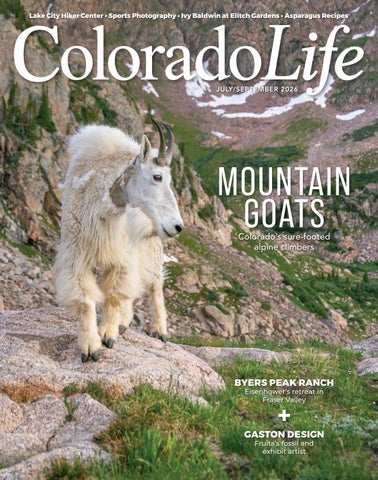
Lake City Hiker Center • Sports Photography • Ivy Baldwin at Elitch Gardens • Asparagus Recipes
JULY/SEPTEMBER 2026
MOUNTAIN GOATS Colorado’s sure-footed alpine climbers
BYERS PEAK RANCH Eisenhower’s retreat in Fraser Valley
GASTON DESIGN Fruita’s fossil and exhibit artist
M A K E YO U R R E TI R E M E N T E V E N M O R E
Extraordinary
Wind Crest® has everything you need for vibrant senior living, including stylish floor plans, resort-style amenities, and additional levels of care should you ever need them.
Call 1-888-964-0047 for your free brochure.
Wind Crest, Inc., a nonprofit organization, is solely responsible for fulfilling financial responsibilities to residents under the contract. Wind Crest is within the network of communities developed and managed by Erickson Senior Living.®
2 COLORADO LIFE
2666250
Highlands Ranch WindCrest.com
CONTENTS
ISSUE NO. 85 | JULY/SEPTEMBER 2026
FEATURES 14
Hiker Haven, p 14
Hiker Haven
In the remote mountains of Lake City, a church transforms the town into an essential lifeline where meals, “trail magic” and community sustain weary long-distance backpackers traveling through Colorado. story by Ariella Nardizzi photographs by Michael Underwood
20 Framing the Game
Photographer Gavin Liddell captures Denver’s sports culture through the lens, from Rockies dugouts to Broncos sidelines and all the fan traditions in between. story by Ariella Nardizzi photographs by Gavin Liddell
28 The Beatles of the Backcountry
Mountain goats roam cliffs in the Gore Range above Silverthorne, their curiosity and resilience defining life in the high alpine. story and photographs by Dean Allen
40 Byers Peak
At Byers Peak Ranch near Fraser, Dwight Eisenhower found refuge in the solace of nature – fishing, governing and deciding a presidency where Colorado’s quiet shaped national history. by Eric Peterson
Framing the Game, p 20
IN EVERY ISSUE 7 8
Editor’s Letter
Chris Amundson reflects on life in Colorado.
Sluice Box
Denver’s historical Elitch Gardens; state stamp commemorates Colorado’s 150th anniversary; Gaston Design Inc. builds exhibits inspired by Mexican folk art; the Big Thompson Flood, remembered 50 years later.
Byers Peak, p 40
COLORADO LIFE MAGAZINE, ISSN 2166-3823, is published bimonthly for $32 per year by Flagship Publishing, Inc., 4300 Ardglass Lane, Timnath, CO 80547. Periodical postage paid at Timnath, CO, and at additional mailing offices. POSTMASTER: Send address changes to Colorado Life, PO Box 270130, Fort Collins, CO 80527.
CONTENTS 3
Share the Adventure with your Circle of Friends
Colorado Life celebrates the people, places, history, food and culture that make Colorado unique. Gifting to your circle of friends and family spreads the love of this great place. It’s easy and affordable.
SUBSCRIBE TODAY! 1 YEAR
32
$
4 COLORADO LIFE
2 YEARS
56
$
970-480-0148 | ColoradoLifeMag.com
Stories in this issue come from
Fraser p 40 Denver p 10, 20, 47, 50 Silverthorne p 28 Fruita p 8
ON THE COVER
A shaggy mountain goat nanny crosses the rocky high country of Eagle’s Nest Wilderness as morning light reaches the peaks near Silverthorne. Story begins on page 28. PHOTO BY DEAN ALLEN
Lake City p 14
Durango p 46 Map by Raven Maps & Images
IN EVERY ISSUE 12
Trivia
A look back at 150 years of statehood. Answers on page 49.
34 Kitchens
Asparagus spears shine bold and bright in every dish. Three recipes reimagine an ingredient that adapts to many flavors.
38 Poetry
34
Across mountains, meadows and plains, summer lingers in verse.
46 Go.See.Do.
Hot-air balloons fill the skies over Durango for the annual Animas Valley Balloon Rally; Denver Arts Week celebrates the city’s creative scene with First Friday Art Walks and free entry to museums; and 15 more events happening around the state.
50 Peak Pixels
Joshua Hardin reflects on what it means to be Coloradan and American while taking a walk through history with his camera in hand.
50 Above: Danelle McCollum, Joshua Hardin Page 5: Michael Underwood, Gavin Liddell, Dwight D. Eisenhower CONTENTS 5
MONDAY-THURSDAY 11AM-8:30PM FRIDAY-SATURDAY 11AM-9:30PM CLOSED SUNDAYS
218 S. L IN C O L N ST. | B U RL IN G TO N , C O
719-346-8790 WWW.THEDISHROOMBURLINGTON.COM DISHROOM.BURLINGTON@GMAIL.COM
6 COLORADO LIFE
From the Editor
A Little Peace and Quiet
JULY/SEPTEMBER 2026 Volume 15, Number 4
Publisher & Editor Chris Amundson
Associate Publisher Angela Amundson
Editorial Assistant
Savannah Dagupion
Photo Coordinator Erik Makić
Staff Writer
Ariella Nardizzi
Design
John Anton Sisbreño, Rasa Velicka
Advertising Sales Robert Schonlau
Subscriptions Shiela Camay
Colorado Life Magazine c/o Subscriptions Dept. PO Box 270130 Fort Collins, CO 80527 970-480-0148
ColoradoLifeMag.com
SUBSCRIBE
Subscriptions are 1-yr (6 issues) for $32 or 2-yrs (12 issues) for $56. Please call, visit ColoradoLifeMag.com or return a subscription card from this issue. For fundraising and group subscription rates, call or email subscriptions@coloradolifemag.com.
ADVERTISE
Advertising deadlines are three months prior to publication dates. For rates and position availability, please call or email advertising@coloradolifemag.com.
CONTRIBUTE
Send us your letters, stories, photos and story tips by writing to us, emailing editor@coloradolifemag.com or visiting ColoradoLifeMagazine.com/contribute.
COPYRIGHT
All text, photography and artwork are copyright 2026 by Flagship Publishing, Inc. For reprint permission, please call or email publisher@coloradolifemag.com.
D
EAN ALLEN SPENT a day and a half bushwhacking into the Black Creek drainage north of Silverthorne before reaching Bubble Lake. There was no trail to follow. He worked through krummholz, cliffs and broken granite, looking for a place with nobody around. The next morning, 14 mountain goats gathered around his tent. For a man who had come all that way for solitude, 14 goats was quite a crowd. Dean named four of them John, Paul, George and Ringo. They followed him around the lake, scrambled over rock that stopped him cold and stayed nearby for three days. Eagles Nest Wilderness gives a person room. It covers 133,496 acres – about 209 square miles – with roughly 180 miles of trails through the Gore Range. Dean had left even those trails behind. He was hardly the first person to come to Colorado hoping everybody else would stay home. In 1905, Theodore Roosevelt stopped in Colorado Springs before heading into the mountains to hunt. He had one request for the crowd: don’t follow him. “One thing you cannot do on a hunt,” he said, “and that is to carry a brass band.” Dwight Eisenhower went to Byers Peak Ranch near Fraser for a little peace and quiet, although the presidency made both harder to come by. He fished St. Louis Creek, painted, cooked and tried to get away from Washington. The Secret Service, staff and communications crews came along. Ike wrote that his simple fishing trips had become “as elaborate as troop movements.” Herbert Hoover joined him in 1954 and complained to reporters that presidents could no longer count on being left alone while fishing. Gerald Ford had the same problem on skis. During a 1974 trip to Vail, six Secret Service agents chosen for their skiing ability followed him on the mountain. When someone told Ford how proud Vail was to have him there, he joked, “You make me justice of the peace and I’ll quit.” Stephen King found quiet of a different sort. In September 1974, he and his wife, Tabitha, spent a night at the Stanley Hotel in Estes Park. They were the only guests. King wandered the empty corridors, had a nightmare that night and left with the beginnings of The Shining. After days on the Colorado Trail, though, a crowded dinner table can look pretty good. The trail runs 500-plus miles from Denver to Durango, crosses eight mountain ranges and six wilderness areas and climbs about 89,000 vertical feet. In Lake City, thru-hikers step into the Trail Hiker Center, strike a brass gong and hear a roomful of people yell, “Hiker!” The first church potluck drew 45 townspeople and two hikers. The Sunday dinners can draw 80 to 140 guests. Gavin Liddell didn’t need a wilderness area. Three days after moving to Denver, he walked into Coors Field at 5:30 a.m. on Opening Day with his camera. The concourse was empty. The seats were quiet. The purple Rockies sign glowed as the sun came up over downtown. For a few hours, he had nearly the whole ballpark to himself. Then the gates opened. Dean had 14 goats. Gavin had Opening Day. Chris Amundson Publisher & Editor editor@coloradolifemag.com EDITOR LETTER 7
NUGGETS AND OBSERVATIONS ABOUT LIFE IN COLORADO
Rachel Fixsen (all)
Bones, Masks and Sugar Skulls Artist Robert Gaston turns curiosities into museum exhibits by RACHEL FIXSEN A decorated wooden canoe from Papua New Guinea hangs from the ceiling of Robert Gaston’s workshop in Fruita. Paper wasps’ nests line one wall. Against another rests a slab of rock imprinted with ripples from an ancient body of water. Gaston collects what interests him, from fossils to folk art. Following his curiosity led him into a unique niche. In the 1980s, while home from college, he took a summer job at Lin Ottinger’s Rock Shop in Moab. While rock hounding and prospecting for fossils, he found an ankylosaur fossil that scientists later identi-
8 COLORADO LIFE
fied as a previously unknown species. The paleontologist who described it named it Gastonia, after Gaston. That find connected Gaston with paleontologists and museum professionals. He also met a retired mold-maker in Fruita who taught him casting techniques. Gaston began with dinosaur claws, putting his sculpture training to work. “My interest in paleontology didn’t stem from dinosaurs, it stemmed from the aesthetics of bones,” he said. He loved their forms, shapes, textures and patterns. Before long, he was the guy who made quality fossil casts. Museums started asking for larger and more complicated replicas.
“Things just kind of snowballed,” Gaston said. He continues to make small dinosaur claws for museum gift shops and full-scale skeletons of dinosaurs and ancient mammals for exhibits. 3D printers now handle some simpler pieces, but Gaston says he gets better results by hand on larger, more intricate replicas. He kept traveling and collecting. Gaston and a small crew now create traveling museum exhibits. They choose the theme, collect artifacts and artwork, write interpretive material, fabricate cases and displays, then pack and install the show. Two exhibits draw on Gaston’s interest in
Mexico, sparked on childhood family trips. It was an outing close to home that introduced him to Mexican folk art. His mother brought him to a gallery in his hometown of Knoxville, Tennessee, to see a display of antique Mexican masks. She bought him one with a blue snake curled around the face and another with a lizard perched on the forehead. He kept them. His exhibit, “Mexican Roots,” examines Indigenous and European influences in Mexican folk art. For “Lives of the Dead,” which explores Día de los Muertos traditions, Gaston gathered calaveras decorated with rolled paper, tiny glass beads, glitter and papier-mâché. Ancient symbols mix with whimsy, dread and humor. He plans to arrange some on a shelf modeled after a tzompantli, an ancient Mesoamerican structure used to display human skulls. The exhibit also includes delicate alfeñique figures made of sugar paste and embellished with sugar blossoms. Gaston carefully brought back a set of doll-sized figures from a candy shop in Mexico City.
Robert Gaston curates traveling museum exhibits out of his workshop in Fruita. Much of his inspiration comes from Mexican folk art, creating calaveras and alfeñique figures.
He often buys or commissions work directly from artists and has a special appreciation for self-taught artists. Two other exhibits, “Bizarre Headgear” and “Animal Armor,” focus on horns, shells, plates and other structures animals use for protection, combat and survival.
The smaller shows are “more popular with the midsize towns,” Gaston said; he’s glad to offer cultural richness to those places, having grown up in a midsize city himself. The two masks his mother bought for him that day in Knoxville still travel with “Mexican Roots.”
Centennial State Stamp Fielder photograph marks Colorado’s 150th anniversary by ARIELLA NARDIZZI Colorado’s spacious skies, amber waves of grain and purple mountain majesties have long filled the photographs of late nature photographer John Fielder. His image of Jagged Mountain now appears on a commemorative postage stamp marking 150 years of Colorado statehood. The U.S. Postal Service issued the Colorado Statehood Forever stamp this year, featuring Fielder’s photograph of Jagged Mountain. Its rugged ridges rise above the verdant Weminuche Wilderness in San Juan National Forest, southeast of Silverton. Colorado, nicknamed the Centennial State, gained statehood Aug. 1, 1876 – 100 years after the United States declared in-
dependence. The Postal Service printed 16 million copies in panes of 20 for sale nationwide as Forever stamps. Fielder spent a 50-year career crisscrossing nearly every corner of Colorado by foot, ski, raft, wheels and horseback – and usually with a camera in hand. “Mountains Majesty: On the Summit with John Fielder” showcases mountain photographs selected by History Colorado members through Jan. 10, 2027, at the History Colorado Center in Denver. History Colorado is also home to John Fielder’s Colorado Collection, with more than 6,000 photographs spanning lush alpine lakes, mountain landscapes and stark summits, chosen from 200,000-plus photographs Fielder took. Each year, a new
United States Pos
tal Ser vice
Fielder exhibit is included with general admission; adults $20, youth free. As Fielder once said, “Give me an infinite view, and I can’t be any happier than being in the high country of Colorado in the Rocky Mountains.” SLUICE BOX 9
Denver Public Library (both)
High Above Elitch’s For nearly two decades, Ivy Baldwin kept Denver’s eyes on the sky. by JUSTIN KIERSKY For about 200 feet, Ivy Baldwin fell. In late August 1890, a crowd descended on Elitch Zoological Gardens to watch Baldwin’s aerial performance. The Rocky Mountain News reported that his balloon shot up like “a flash of white into the clouds, with the daring aeronaut dangling from the rope below.” At 2,500 feet, Baldwin began climbing hand over hand toward the basket. There was a pause while he attached his parachute. Then he stepped off. “The parachute seemed to tremble in the air and then opened,” the paper reported. The crowd cheered, and afterward people headed for the streetcars “talking nothing but Baldwin and his balloon.” Elitch Gardens had been open less than four months. John and Mary Elitch had spent three years transforming an apple orchard at 38th and Tennyson into a resort with a zoo, botanical gardens and vaudeville acts. P.T. Barnum was among the guests when the Gardens opened May
10 COLORADO LIFE
1, 1890. By the end of that first summer, Baldwin had taken center stage. Born William Ivy in Houston in 1866, Baldwin stood just over five feet tall and wore a gunslinger’s mustache. He ran away from home before he was 13 and joined a traveling circus, learning tightrope walking, trapeze stunts and ballooning. He later performed with Thomas and Sam Baldwin as one of the Baldwin Brothers. By 1890, he made balloon ascensions every Sunday afternoon at Elitch Gardens, sometimes swinging from a trapeze beneath the balloon with a cigarette dangling from his lips. John Elitch died of pneumonia in March 1891. A group of investors operated the Gardens for the next few years, and Mary bought the property back at a sheriff ’s sale in 1894. Baldwin was still part of the show. That August, Rocky Mountain News photographer Harry Buckwalter came to Elitch’s with an idea: photograph Denver from Baldwin’s balloon. The balloon could not lift both men and Buckwalter’s camera equipment, so Buckwalter went up alone.
He had never piloted a balloon. As he rose above the Gardens, a boy in the crowd reportedly called after him: “Goodbye, mister. You’re going to die this time!” Buckwalter survived. His photographs and an article titled “Dancing in the Air” appeared in the Rocky Mountain News the following week. Baldwin had plenty of close calls himself. One Fourth of July, his clothes caught fire as he slid down a rope beneath his balloon. He had ordered an asbestos suit for the stunt, but it had not reached him. He spent the next week recovering from burns. In 1894, Baldwin joined the U.S. Army Signal Corps and trained soldiers to handle observation balloons at Fort Logan. During the Spanish-American War, he served with the Army’s balloon unit in Cuba. He continued appearing at Elitch’s through 1907, going up on summer weekends for balloon ascensions, parachute drops and trapeze stunts. Eldorado Canyon was the stage for his final act. Baldwin strung a high wire 582 feet above South Boulder Creek in 1907 and strolled across more than 80 times. On July 31, 1948, his 82nd birthday, he came back for one more walk. At his daughter’s insistence, a lower wire was strung across the canyon. About 3,000 people showed up. Baldwin stepped onto the wire backward, spun around and crossed the void.
At Elitch Zoological Gardens in Denver, stuntsman Ivy Baldwin performed aerial stunts for an awe-inspired crowd.
Colorado National Guard
Joshua Hardin
Big Thompson, 1976 Fifty years later, survivors’ stories return to Loveland by JOSHUA HARDIN The morning after the Big Thompson Flood, Loveland High School’s trophy case filled with messages. Telephone lines were overwhelmed. Families searching for relatives and friends left notes asking survivors to call home, while scraps of news moved through CB radio bands. Local teacher Jan Way saved the messages in a scrapbook. Fifty years later, they are on display a few miles away at the Loveland Museum. By then, 144 people were dead. July 31, 1976, had begun as a sunny Saturday in Big Thompson Canyon between Loveland and Estes Park. Thousands of residents and visitors were in the canyon during Colorado’s centennial summer, picnicking, hiking and floating the river in innertubes. That evening, a thunderstorm settled over the mountains. Rain poured into the narrow, rocky canyon, and the Big Thompson rose fast. The river tore through asphalt, shattered bridges and swept away homes, businesses and vehicles. Colorado State Patrol Sgt. Willis Hugh Purdy drove toward Drake as the water
rose, warning people in low-lying areas and trying to stop motorists from entering the canyon. At a 50th-anniversary event in Loveland this summer, Colorado State Patrol Capt. Chris Grimsley described Purdy’s progress through the worsening storm. “He turned another vehicle around. He warned another family. He closed another section of highway,” Grimsley said. Purdy died in the flood. Estes Park Police Officer Michael Owen Conley was off duty, driving home from Loveland with his wife, Phyllis, when a boulder blocked the road near Waltonia. Conley stopped and began directing motorists, campers and families toward higher ground. The flood overtook the couple. Phyllis escaped; Conley clung to a telephone pole until the water tore it from the ground and swept him away. “He wasn’t scheduled to work. He simply chose to stop and help strangers,” Estes Park Police Chief Ian Stewart said at the anniversary commemoration. By daylight, helicopters were lifting people from the canyon. Crews evacuated more than 800 people, many to Loveland High School, where the American
Red Cross opened a rescue center. There, handwritten messages accumulated in the trophy case as families waited for names and news. Those notes now share a gallery with photographs, maps, oral histories and objects recovered after the water receded. “Connected by the Canyon: 50 Years Since the Big Thompson Flood,” at the Loveland Museum through Nov. 28, includes before-and-after maps and aerial photographs showing how the flood reshaped the canyon. An X-ray machine helped identify victims. Nearby is delicate, water-damaged needlepoint made by Bessy Horton and recovered by her granddaughter Shar after the flood washed away Horton’s Cedar Cove home. Loveland Museum collections manager Ashley Yager grew up hearing about the flood from her parents, who were in the canyon that day and escaped before she was born. Yager said she wanted the exhibit to remember both the losses and the people who helped. “It is important to remember the people who died, but also remember the people who helped,” Yager said. The flood prompted better forecasting, faster emergency communications and roadside signs directing people above the flood line. Along Highway 34, the instruction is blunt: “CLIMB TO SAFETY.” SLUICE BOX 11
150 YEARS OF COLORADO HISTORY
Test your knowledge for the state’s sesquicentennial by BEN JENKINS
Erik Makić
GENERAL
1
1876: Colorado had barely become a state when the presidential election rolled around. Coloradans didn’t vote directly for president that year, though. Who chose the state’s three presidential electors?
2
1882: When Colorado’s largest known historic earthquake rattled Denver, several objects inside the Windsor Hotel stopped at about 6:25 p.m., leaving behind a handy clue to the quake’s timing. What stopped?
3
Circa 1900: Colorado once had “tent houses” with windows, double walls and even shingled roofs, all designed to keep patients in the state’s dry, fresh air. What disease were they being treated for?
970-480-0148
ColoradoLifeMag.com 12 COLORADO LIFE
4
1921: After Pueblo’s catastrophic flood, engineers moved the Arkansas River away from downtown. Decades later, water returned to part of the old channel as what presentday attraction?
5
1969: Project Rulison detonated a 40-kiloton nuclear device more than 8,400 feet underground near present-day Parachute. It worked well enough to release natural gas. So why couldn’t anyone use it? Denver Public Library
STEP BACK IN TIME TO The grandeur of a bygone era awaits you at Rosemount in Pueblo! Built in 1893, this 37-room, 24,000 square-foot mansion was the family home of prominent businessman John A. Tatcher and his family. Take a guided tour of the mansion, and step back in time.
MULTIPLE CHOICE
6
1876: Colorado’s constitution was printed in English, Spanish and what third language? a. French b. German c. Italian
Open February-December
Tuesday-Saturday • 10 am–2:30 pm
7
1892: Grover Cleveland supporters founded the paper that became The Denver Post. Which Cleveland position angered Colorado’s silver interests? a. Opposing federal silver purchases b. Restricting mining on federal land c. Opposing Colorado statehood
8
1950s: CU surgeons cooled patients to slow circulation during early open-heart surgery. How? a. Ice-water bath b. Refrigerated room c. Snow-packed blankets
9
1972: Voters rejected public funding after Denver won the 1976 Winter Olympics. What happened next? a. Denver gave up the Games b. Denver hosted only indoor events c. The Games were delayed four years
10
1976: Denver’s Auraria neighborhood takes its name from Latin aurum. What does it mean? a. Gold b. River c. West
419 West 14th St • Pueblo • 719-545-5290 Denver Public Library
TRUE OR FALSE
11
1896: Leadville built a 58,000-square-foot Ice Palace with a ballroom, theater, skating rink and carousel house.
Visit Summit County’s Enchanting B&B
12
1905: Colorado once went through three governors in a single 24-hour period.
13
1929: The Royal Gorge Bridge was originally built to carry trains and mining freight across the gorge.
14
1966: The northwest Colorado town of Artesia changed its name to Dinosaur to capitalize on nearby Dinosaur National Monument.
15
1993: Dinger became the Rockies’ mascot after construction crews digging Coors Field uncovered a complete triceratops skull.
No peeking, answers on page 49.
Experience historic charm at Frisco Lodge. Our exceptional hospitality, afternoon wine and cheese, award winning courtyard, outdoor hot tub and romantic fireplace are just a few reasons our guests rated us the #1 bed & breakfast in Frisco and all of Summit County! See why our guests think we are the best
www.friscolodge.com fri l d fri 1-970-668-0195 321 Main St | Frisco, CO
TRIVIA 13
14 COLORADO LIFE
HIKER HAVEN
Lake City turns generosity into a lifeline for thousands of long-distance backpackers.
story by ARIELLA NARDIZZI photographs by MICHAEL UNDERWOOD
FEATURE 15
O For hikers trekking hundreds and thousands of miles on the Colorado Trail and Continental Divide Trail, a stop at the Lake City Hiker Center feels like coming home. Most stay for the free community dinners on Sunday nights, which serve hearty fare from taco bars to Thanksgiving.
16 COLORADO LIFE
N SUNDAY EVENINGS
in Lake City, the smallest sound sparks the loudest welcome. A hiker steps through the doors of the Presbyterian Annex, taps a small brass gong and the room erupts as cheering voices shout, “Hiker!” Backpacks slide to the floor, boots thump against the wall and weary travelers find themselves at home around a long table where steaming dishes await. This is the Community Presbyterian Church’s Trail Hiker Center, and for those walking thousands of miles on the Colorado and Continental Divide trails, there may be no warmer stop. Lake City may seem unassuming, tucked into the San Juan Mountains of Hinsdale County along Highway 149. But for hikers on the 500-plus-mile Col-
orado Trail or the 3,100-mile Continental Divide Trail, the town is a lifeline and oasis – what hikers call a “gateway town,” where trails intersect with supplies, rest and community. Set in the most remote county in the continental U.S., at 8,671 feet and ringed by rugged peaks where the Gunnison River begins its flow, Lake City is both secluded and essential for travelers crossing the San Juans. Now in its fifth year, the Hiker Center runs daily from June through September, offering free meals, supplies, shuttles, showers and, perhaps most importantly, community. In a town of around 400 year-round residents, it has become a unifying place where generosity flows. The welcome is largely thanks to Rev. Jason Brian Santos, minister at Community Presbyterian and the visionary
behind the Hiker Center. Santos, who is Filipino and finds joy in cooking and hospitality, first saw the idea while serving at a church in Pennsylvania, where he volunteered along the Appalachian Trail. Arriving in Lake City during the 2020 pandemic, he wondered whom he could serve. Noticing weary backpackers drifting through town, he organized a potluck. Forty-five townspeople and two hikers showed up. Last season, more than 974 signed the log book, and many more didn’t. That figure is nearly twice the town’s year-round population, a surge that transforms Lake City each summer. Today the weekly dinners draw 80 to 140 guests. “It began as an idea to serve the hikers, and ended up serving my community as a whole,” Santos said. “It takes a village.”
SUPPORTING THRU-HIKERS WITH HOSPITALITY
The Hiker Center occupies the Annex at 418 Silver St., a modest wooden building tucked off the main drag. Inside, a family-style table fills the hall, while bins along the walls brim with toiletries, socks, food, chargers and donated gear. Loaner bikes are available for town errands. “Laundry Angels” handle free wash. A daily shuttle brings thru-hikers back to the trail, and families send care packages from home. In trail culture, these small, unexpected kindnesses are known as “trail magic.” Lake City is one of only a handful of access points to the Continental Divide Trail in Colorado, making it a natural gathering place despite its isolation. Other gestures keep visitors coming
Rev. Jason Brian Santos, minister at Community Presbyterian, is the visionary behind the Trail Hiker Center. He first began serving backpackers after moving to Lake City in 2020. Now, he welcomes over a thousand hikers each season, providing them with meals, laundry services, donated gear and, most importantly, community.
HIKER HAVEN 17
back: cinnamon buns on Tuesdays, fresh donuts Wednesdays, shaved ice Thursdays, popcorn Fridays. For those who miss the big Sunday meal, Monday leftovers are served. But Sundays are the highlight: eight themed dinners each summer, from Cuban feasts to Jamaican jerk chicken, Thanksgiving spreads to Oktoberfest. Santos plans menus to provide protein and vegetables, while volunteers handle prep, serving and cleanup. “Kindness breeds kindness,” Santos said. “It’s a self-generating goodness when people connect intimately.” Stories of kindness abound. One volunteer, after shuttling hikers all day, still drove 17 mountain miles to return a forgotten rain tarp. Another time, towns-
18 COLORADO LIFE
people nursed a sick backpacker back to health with meals, medicine and a place to stay until he could continue. Kyla Pearce – known on the trail by her chosen nickname, or “trail name,” Bags – stopped in Lake City last summer while walking the entire Colorado Trail in one continuous journey. “It felt like I was coming home,” she said. “Without ever having met me, the people at the Hiker Center welcomed me with open arms. The love I felt and trail magic provided are the reasons I could finish my thru-hike.” Volunteers Jim and Glenda Walker, Lake City residents since 2008, have contributed to hikers’ success since the center’s inception. To them, feeding and supporting hikers on their pilgrimage
across Colorado is a “simple kindness,” and one that’s been the most rewarding time they’ve spent giving back to their community. “We are overwhelmed by their stamina and courage to face the trail’s challenges, and it is so rewarding to hear their stories and encourage them on their way,” the Walkers said. For Santos, such moments show how the center has reshaped town life and revived the church’s role. At first, locals dismissed hikers as vagabonds. “Now,” he said, “people see them as an opportunity to serve.”
THE HEART OF A GATEWAY TOWN
The exchange goes both ways. For thru-hikers, the center is rare nourishment
and fellowship after days in the backcountry. For townspeople, it’s a chance to live vicariously through travelers. While the church counts only 40 members, that number quadruples in summer as 90 volunteers swell the ranks. Support comes from the presbytery, townspeople and past hikers who send donations after completing their journeys. Even the town government awarded the center $4,000 for the economic lift it brings. Guests who join church dinners also book hotel rooms and spend at restaurants, making the center a benefit to both town and trail. “The trail has solidified our place in the community. The hikers are part of our larger rhythms and ecosystem every summer,” Santos said.
Santos hopes to see the model replicated in other trail towns. For now, his focus remains on the narrow valley and brown wooden building on Silver Street. “Lake City wants to be defined by our sense of hospitality,” he said. “Everything we do is from the heart. It’s not just a commercial idea of tourism, but a genuine human connection the whole community supports.” At the close of every Sunday meal, hikers linger, swapping storm stories and summit tales, trading numbers and planning the next leg as volunteers box up leftovers. By morning, the hikers leave, boots crunching on gravel as they climb back into the San Juans. For one night in Lake City, though, they are home.
The Hiker Center is entirely volunteer-run and consists of financial support from the presbytery, townspeople and past hikers’ donations. Lake City’s government even extended a contribution to the church for the economic lift it brings. Many travelers come for the Hiker Center and stay for the town’s lodging, restaurants and shops.
HIKER HAVEN 19
From ballparks to ski towns, Gavin Liddell photographs Colorado sports. story by ARIELLA NARDIZZI photographs by GAVIN LIDDELL
20 COLORADO LIFE
FEATURE 21
Denver photographer Gavin Liddell’s career follows the seasons. In spring and summer, he works as assistant photographer for the Rockies. Come fall and winter, he shifts to the Denver Broncos and ski towns.
22 COLORADO LIFE
T
HREE DAYS BEFORE Opening Day, Gavin Liddell packed up and moved to Denver. By 5:30 a.m. on game day, he was inside Coors Field with his camera, hours before the gates opened. The concourse was empty, the seats quiet and the purple Rockies sign glowing as the sun came up over downtown. Soon the aisles would fill with vendors and fans, but for a few hours Liddell has the ballpark nearly to himself. These days, Liddell’s career runs with the seasons. Spring and summer mean Colorado Rockies baseball, where he’s finishing his second season as assistant photographer. Fall shifts to the Denver Broncos sidelines. Winter sends him back to the snow, where his own interest in sports began. He has also photographed college athletics and the Super Bowl with the Kansas City Chiefs.
Liddell didn’t grow up in Colorado’s sports orbit. Born and raised in New England, his earliest sports memories were shaped in the shadow of Fenway Park. Back then, he was more interested in nontraditional sports like snowboarding and skateboarding. Liddell also didn’t pick up a camera until high school, and when he did, he gravitated to the action. While earning his graduate degree at Syracuse University’s Newhouse School of Public Communications, he spent time trailing the club hockey team. Shooting the fast-paced game and learning players’ stories made him fall in love with sports photography. From there, his path bent west, following his family to Steamboat Springs and photographing ski town life for the local magazine. Then came the call about an opportunity with the Rockies.
A Rockies game day starts well before the first pitch. After early morning images come equipment prep, staff photos, fans filling the park and batting practice. By game time, the quiet stadium he photographed at sunrise is packed and energetic. His favorite stretch arrives just before the game begins. “The starting pitcher leaving the bullpen, the guys taking the field. For five minutes before the game starts, the stadium holds their breath,” Liddell said. “It’s a pinch-me moment where you’re like, ‘I’m really doing this.’” For the duration of the game, he works from the photo well. While every sport comes with its challenges, Liddell says baseball is especially difficult to anticipate. Through his lens, he tracks the pitcher, the bases and the outfield.
“You’ve got to have a mind for chaos,” he said. “As soon as the ball leaves the pitcher’s hand, there’s no telling what will happen a hundred times over each game.” At the ballpark, he turns from the field to the stands, looking for fans’ reactions as much as plays. Over 81 home games, he builds camaraderie with the team. The long season gives him time to notice things beyond the action, like the way certain players lock into a game-day headspace or how others keep the clubhouse energy up. “I feel it in my heart when they have a big win or a big loss,” Liddell said. His favorite frames come from photos that feel like a day at the ballpark, not just a stat line. A fan leans over the railing, hands on their head after a home run. A vendor hands off a dripping rainbow snow cone in the middle of July.
Liddell followed his family west from New England to Steamboat Springs. There, he gained experience photographing life around a ski town at his favorite mountain for a local magazine.
FRAMING THE GAME 23
In the fall, Liddell works as a freelance photographer. During the Denver Broncos season at Empower Field at Mile High in Denver, he captures energetic stills like these, as defensive lineman John Franklin-Meyers ran through a tunnel of his teammates before an October football game against the New York Giants.
24 COLORADO LIFE
Despite the Colorado Rockies’ challenging season, Liddell feels like he wins and loses with the team. Baseball, he says, is one of the harder sports to anticipate as a sports photographer. He gets the shot though, as Rockies’ Zac Veen leaps toward first base at Coors Field.
FRAMING THE GAME 25
Liddell still talks about a game when the Rockies came back from a massive deficit to win on a walk-off home run by Brenton Doyle. As Doyle rounded the bases, he launched his helmet high into the air. For a team that had taken its share of losses, that game was a bright spot. “These are the moments you work in sports for,” Liddell said. He swears he could see a gleam in the batter’s eye as the home run cleared the outfield. Another favorite image came on a snowy Opening Day, when flakes stuck to players’ caps and blanketed the bleachers. “In typical Colorado fashion,” he said, “it’s the first game of the season, and it’s snowing.”
BY FALL, LIDDELL’S season narrows to a handful of Broncos home games. Fewer than 10 dates at Empower Field at Mile High pack four quarters with fan interactions, tailgates, plays and celebrations. Baseball gives Liddell months to photograph the action. On a football sideline, a play is over in seconds. Every snap of the shutter matters. Liddell sees plenty of overlap between the die-hard fan culture he grew up with in New England and what he has found in Denver. “People care. They want their teams to be good. When they’re not, they’ll let you know – but they’re still there, packing the house.” Across Denver, that loyalty shows up in orange jerseys at grocery stores and Rockies, Broncos and Avalanche hats around town. Fans still fondly remember the first pitch thrown when Coors Field opened in the spring of 1995. In Colorado, Liddell’s subjects shift from a packed stadium to life in a ski town without leaving the state. Baseball stretches through summer and football fills the fall. Then snow begins to collect in the high country. By the time Coors Field goes quiet again, Liddell has another place to point his camera.
26 COLORADO LIFE
FRAMING THE GAME 27
Beatles of the Backco u The
Colorado’s Marvelous Mountain Goats story and photographs by DEAN ALLEN
28 COLORADO LIFE
ountry
A band of mountain goats climb a rocky cataract near the Black Creek drainage of the Gore Range, north of Silverthorne.
MOUNTAIN GOATS 29
J Mountain goats were declared a native species to Colorado in 1993, protecting them and their homes on rocky exposed cliffs. A nanny and her kid rest beside Bubble Lake in the heart of Eagle’s Nest Wilderness.
30 COLORADO LIFE
OHN, PAUL, GEORGE and Ringo awkwardly sprinted around isolated Bubble Lake at 11,200 feet, rugged terrain that moments before had required me to struggle through. They screeched to a stop just a few feet away. “Hi!” their large, liquid eyes seemed to say. “Where we goin’?” “Hey, guys,” I said, although they were all female, called nannies. Nannies and their kids often gather near high-country lakes and meadows where summer forage is plentiful – and, in this case, where they got to hang out with me. “Let’s see if we can make it to the end of the lake.” I turned and resumed my painstaking trek through thick krummholz and small cliffs. Officially, a group of mountain goats is called a band. This seems perfectly appropriate. Add a couple of flamboyant scarves and you’ve got Steven Tyler from Aerosmith. Mine, however, were the Beatles. The quartet followed until they got impatient. Then they scrambled above me onto rock where I didn’t dare tread. They
stopped atop a wide crack in the granite. John, Paul and George bolted down a steep face and landed directly in front of me. Ringo, always the more reserved band member, hesitated at the top. “Do I really want to do this?” she seemed to wonder. Then she danced down the mini-cliff and trotted out to join her friends, looking mighty pleased with herself. Watching them cross nearly vertical rock was mesmerizing. Mountain goats spend much of their lives on steep cliffs and broken alpine terrain. Their split hooves have hard outer edges and soft, rubbery pads that grip tiny cracks and rough surfaces. On flat ground they can look almost clumsy. On granite, they make the rest of us look that way. That steep country is more than a playground. Mountain goats tend to stay close to rocky “escape terrain,” where cliffs and ledges give them an advantage over predators. Females with young are particularly reluctant to wander far from it. What looked to me like an obstacle course was,
to them, home turf. The Beatles waited ahead, then jumped as if I had goosed their collective rears when I finally caught up. “Aagh! What are you doing?” they seemed to say, scattering again. We played leapfrog all the way to the lake’s outlet. The air over Bubble Lake was crisp after an afternoon thunderstorm. Thin clouds hung over the Black Creek drainage of the Gore Range as evening settled in. The goats wandered off while I sat and soaked up the quiet. I deserved the rest. I’d spent a day and a half bushwhacking through this trailless gorge deep in the Eagles Nest Wilderness north of Silverthorne. I picked my way back to camp in the twilight, alone again. That night, zipped into my sleeping bag, I liked knowing my new friends were somewhere out there – whether or not they had actually agreed to guard me. In the morning, 14 goats gathered around my tent. They milled between boulders, nosed
through the tundra and watched me unpack breakfast with the casual interest of neighbors leaning over a fence. I had come all this way for solitude. Instead, I had acquired an audience with horns. Photo opportunities abounded. I spotted a patch of fireweed on a nearby south-facing slope, climbed just above it and sat on a lichen-covered boulder. Ten minutes later, the band followed. One adolescent female took particular delight in devouring the purple flowers while I photographed her. I wouldn’t have had the opportunity if mountain goats had not been introduced to Colorado. The state began transplanting goats from elsewhere in the West into Colorado’s high country in the late 1940s. More transplants followed, including in the Gore Range, through 1972. In 1993, the Colorado Wildlife Commission declared mountain goats a native species, although wildlife biologists generally consider them introduced here. The goats I met at Bubble Lake certainly seemed at home.
Mountain goats prefer terrain between 40 degrees and vertical. Their large, V-shaped toes are made from a firm, sharp-edged rubber that molds to nubbins in the rock, which keeps them from slipping.
MOUNTAIN GOATS 31
ADULT MALES, CALLED billies, spend much of the year apart from the nanny-and-kid groups. Come autumn, they search out females and compete for breeding opportunities. Mature billies can weigh around 250 pounds; nannies are smaller. Around a group, the hierarchy is hard to miss. Goats snort, posture and circle one another, and both sexes carry sharp black horns. Their fights are nothing like the head-on collisions of bighorn rams. Mountain goats slash upward and jab at an opponent’s flank or rump. Older males even develop a thickened shield of skin over the rear, useful armor when everybody around you is carrying a pair of daggers on their head. If I spent enough time with them, I imagine I’d begin to understand at least some of their language. For three days, though, they seemed content to forage wherever I happened to be. I suspected their devotion had less to do with my personality than with sodium. Mountain goats seek mineral salts, and animals accustomed to people have been known to lick places where hikers have urinated. In other words, sometimes the mountain goat following you really is waiting for you to pee. Their menu is otherwise broad. They eat grasses, flowering plants, shrubs, mosses, lichens and even conifer needles, depending on season and what the alpine landscape offers. That flexibility helps them get through a year in country where snow, wind and short growing seasons limit the menu. Their coats are just as specialized. Mountain
goats carry thick winter fur with long guard hairs over a woolly undercoat. They begin shedding in early summer. Adult males generally molt first, while females with kids shed later; lactation can delay the process. Despite it being mid-August, several of my nannies still wore ragged clumps of winter coat along their flanks. They looked halfway between majestic alpine mammals and sofas somebody had dragged through a hedge. The shag is built for cold. Mountain goats are alpine specialists, and researchers are watching how warming temperatures, shifting snowpack and changing vegetation affect the places they live. On hot summer days, goats often seek shade or snowfields to cool down. Up at Bubble Lake, though, the immediate concern seemed to be breakfast. On my last morning, John, Paul, George and Ringo were among the first to appear as I packed camp. I knew I was leaving. Did they? It’s difficult not to assign human motives to an animal that has spent three days staring at you, following you and occasionally acting offended by your approach. Love, joy, resentment? I had no idea. Curiosity, at least, was hard to miss. As I hoisted my pack, I heard the thudding of hooves. The rest of the band gathered around. I said my goodbyes and started down the drainage. For the first time in three days, none of them followed.
Unlike most grazing animals, mountain goats eat just about anything that grows. Their digestive system has adapted to survive in a barren alpine tundra. Goats can be seen munching on moss, lichen, krummholz needles, shrubs, grass and flowering plants.
Goat Country THREE PLACES to look for mountain goats, from easiest to hardest:
Mount Blue Sky: In summer,
mountain goats are often visible along the summit road. Check road status and reservation requirements before going.
Gore Lake: Hike from East Vail into the Eagles Nest Wilderness. Goats frequent the lake and surrounding high country, but give them plenty of room. Chicago Basin: Ride the Durango & Silverton Narrow Gauge Railroad to the Needleton wilderness stop, then backpack about 7 miles into Chicago Basin. Climbers can tackle Mount Eolus, North Eolus, Windom Peak and Sunlight Peak – with mountain goats often sharing the basin. Wherever you find them, keep your distance and never feed or approach wildlife.
MOUNTAIN GOATS 33
34 COLORADO LIFE
Spears
SPARE
to
Asparagus adds fresh flavor to a variety of dishes recipes and photographs by DANELLE McCOLLUM
A
SPARAGUS ADAPTS TO whichever flavors it’s married with.
Whether cooked as a side along with salmon or integrated into a flavorful orzo salad, asparagus is a welcome addition to many dishes.
Sweet and Spicy Pork and Asparagus Ground pork and fresh asparagus are sauteed in a sweet and spicy Asian-inspired sauce, then served over rice in this unique and delicious dish. Make sure to use plain ground pork as opposed to ground Italian sausage or anything with seasoning. In medium bowl, whisk together soy sauce, water, brown sugar, cornstarch and garlic cloves. Add pork and toss to blend. Heat sesame oil in heavy, large wok or deep skillet over high heat. Add asparagus, jalapeño, ginger and red pepper flakes. Cook until asparagus is crisp-tender, about 3 minutes. Using a slotted spoon, transfer asparagus mixture to a plate. Add pork mixture to pan and cook until browned, using wooden spoon to break up pork into small pieces, about 3-4 minutes. Return asparagus mixture to pan. Stir in rice vinegar. Stir-fry until pork is cooked through, another 3-5 minutes. Add water by tablespoonfuls if it becomes too dry. Add green onions; toss to incorporate. Season to taste with salt and freshly ground black pepper. Serve over rice.
6 Tbsp soy sauce 1/4 cup water 2 Tbsp brown sugar 1 ½ Tbsp cornstarch 2 cloves garlic, minced 2 lbs ground pork 2 Tbsp sesame oil 1 bunch asparagus, trimmed and cut into 1/2-inch pieces 1 jalapeño, seeded and minced 2-3 Tbsp minced peeled fresh ginger 1/2 tsp red pepper flakes 2 Tbsp rice vinegar 3-4 green onions, sliced Salt and pepper, to taste Hot cooked rice, for serving Serves 6-8 KITCHENS 35
Lemon Orzo Asparagus Salad Orzo pasta is cooked with turmeric for wonderful color and flavor, then tossed with fresh asparagus and a lemon vinaigrette in this delicious springtime side dish. This dish is light and easy to make, and it is perfect for taking to potlucks or brunches. In medium bowl, whisk together ingredients for dressing: lemon juice, lemon zest, garlic, 1/4 tsp salt, pepper and olive oil. Set aside. Wash asparagus and snap off tough end pieces. Lay in a 9x13-inch glass baking dish. Pour boiling water over asparagus to cover. Let stand until water is warm, about 10 minutes. Drain water and cut asparagus into 2-inch pieces. Meanwhile, bring chicken stock, turmeric and 1 tsp salt to boil in large pot. Add orzo and cook until tender, 8-10 minutes. Drain but do not rinse. Place warm orzo in large bowl and toss with asparagus, herbs and dressing. Mix well. Serve chilled or at room temperature.
1/3 cup lemon juice 1 tsp lemon zest 2 cloves garlic, minced 1/4 tsp salt 1/4 tsp pepper 1/3 cup olive oil 1 lb asparagus 4 cups chicken stock 1/4 tsp turmeric 1 tsp salt 2 cups orzo pasta 1/4 cup chopped fresh herbs (dill, parsley, chives, etc.) Serves 6
36 COLORADO LIFE
Sheet Pan Salmon and Asparagus Salmon and fresh asparagus are topped with a lemon dill sauce, then baked together for an easy, all-in-one dinner solution. The salmon and asparagus take about the same time to roast; thinner asparagus will cook more quickly, so choosing thicker asparagus is a good idea. Preheat oven to 425°. Line large baking sheet with foil. Spray with nonstick cooking spray. Place salmon in center of baking sheet; season with 1/2 tsp salt, lemon pepper and thyme. Arrange asparagus spears around salmon. In small bowl, whisk together olive oil, lemon juice, honey, fresh dill, garlic, and salt and pepper, to taste. Drizzle or brush mixture over salmon and asparagus. Bake at 425° for 15-20 minutes, or until salmon is cooked through and asparagus is just tender. Garnish with fresh lemon slices, if desired.
1 ½-2 lbs salmon 1 bunch fresh asparagus 1/2 tsp salt 1/2 tsp lemon pepper 1/2 tsp dry thyme 1/3 cup olive oil 1/4 cup lemon juice 1 Tbsp honey 2 Tbsp chopped fresh dill 2 cloves garlic, minced Pinch of salt and pepper 1-2 lemons, sliced (optional) Serves 4-6
What’s in Your Recipe Box?
The editors are interested in featuring your favorite family recipes. Send your recipes (and memories inspired by your recipes) to editor@coloradolifemag.com or mail to the address at the front of this magazine. KITCHENS 37
OUR STATE THROUGH THE WORDS OF OUR POETS
A Scoutmaster’s A-Frame Sunrise Evan McCollum, Castle Rock
Noah Wetzel
I
n the longest light, dawn unfolds above Pikes Peak, cherries disappear by the handful and afternoons stretch beneath a cloud-freckled sky. These poets celebrate the season’s lingering warmth and the life, wonder and renewal it brings into view.
Nurturing Rays (Kyrielle Sonnet) Ruth Rodgers, Arvada The sun’s rays nurture life on earth Still, snows of winter prove their worth Sow, grow, harvest, rest – spiral ‘round Cycling seasons again astound Emerging from long, dark, cold days Early light changes winter’s ways Inspiring life in warming ground Cycling seasons again astound Long, sunny days we celebrate Blossoms stun, fruit ripens, life’s great Reaping, storing for months homebound Cycling seasons again astound The sun’s rays nurture life on earth Cycling seasons again astound
38 COLORADO LIFE
Above tree line on Pikes Peak the morning did not arrive – it unfolded. Cold air held our breath like a secret. Then light – purely, slowly spilled lavender into silver, purple rising into it, pink slipping through, apricot warming the edge of the sky. And blues – more blues than I knew existed – blending, becoming. From the rough-hewn A-frame above Barr Camp, two men and eighteen boys were quiet, except for reverent murmurs. No one spoke. Even boots forgot to scrape. I tried not to blink, afraid the world might change while my eyes were closed. Minute by minute the colors lifted, like breath in the cold – there, then gone.
June 20th, 2025 J. Craig Hill, Grand Junction Coffee and sweet rolls at dawn on my deck A brisk morning walk on the East Creek trail Freshly picked cherries from a roadside shack Eating them all before I get back An afternoon writing a poem for November And baking my grandmother’s cinnamon pie An evening with friends drinking mezcal and beer And toasting the longest light of the year
Mark Weidman
Under a Cloud-Freckled Sky
A Season of Renewal
Vaughn Neeld, Cañon City
Hal Sponheim, Loveland
We lay on a quilt spread on the wayward grass. Never as uniform or well-behaved as cultivated lawns, ours defied taming, determined to stay wild and free. We spread-eagled beneath the cloud-dabbled sky, daydreamed, or leg wrestled, or built cloud fantasies – floating castles, flying pigs, grotesque goblins. As images drifted into mist, we studied the swirls, specks, ribbons that laced the fluid in our eyes – chains of detached retinal cells linked like boxcars, or diatoms, or sisters holding hands. What were they? Why were they there? Were they alive? Would we go blind if we gazed too long at the sun? Finally, on a dreamy, long, delicious afternoon, we slept – adrift – amid the wayward grass, the images beneath closed eyes, the cloud-freckled sky.
Luminescence glows softly and long this earliest of light in June. And a robin sings its cheerful song awakening me from my cozy cocoon. Standing outside on this longest of days no shadow is cast at noon. Invisible to the intense rays I hide like a cloak with the moon. As evening lingers the light is still warm, beckoning to stay out and play. We come together, a new season’s reborn, and all may start a new day. So the northern sun begins its high, long arc across the sky this solstice. Bringing life and hope, from out of the dark, to our world so in need of its solace.
Send Your Poems on the theme “Gifts” for the November/ December 2026 issue, deadline October 20, and “Waiting” for the January/February 2027 issue, deadline November 1. Email your poems to poetry@coloradolifemagazine.com or mail to the address at the front of this magazine. COLORADO POETRY 39
40 COLORADO LIFE
When Ike Came to Fraser Long before interstates and Cold War summits, Dwight Eisenhower savored quiet days at Byers Peak Ranch – cooking trout, chatting with locals and escaping Washington’s glare. by ERIC PETERSON
Erik Makic (left); Eisenhower Presidential Library
A statue of Dwight Eisenhower stands in downtown Fraser, honoring his love of fishing and connection to the Fraser Valley (left). Eisenhower paints during a visit to the area, another pastime he often enjoyed at Byers Peak Ranch (above).
BYERS PEAK RANCH 41
Associated Press
Eisenhower gives running mate Richard Nixon a fishing lesson at Byers Peak Ranch in 1952. The mountain retreat offered a brief break from the presidential campaign before the pair returned to politics.
R Eisenhower’s artwork reflected Colorado and figures from American history. His paintings include St. Louis Creek, which flows past Byers Peak Ranch, and a portrait of George Washington (opposite page).
42 COLORADO LIFE
ICHARD NIXON WASN’T
dressed for it. In the summer of 1952, Dwight Eisenhower pulled on his waders at Byers Peak Ranch and handed his running mate a fishing rod. There’s a photo of the moment: Eisenhower smiling in chest waders, Nixon in a crisp shirt and tie, looking uncertain. “You want me to do what?” Nixon quipped. On the 3,800-acre spread outside Fraser, the general-turned-candidate relished time away from the campaign, and from Washington’s demands soon to follow. That fall, Eisenhower would win the presidency in a landslide, with Nixon as his vice president. Byers Peak Ranch wasn’t just a fishing hole or mountain hideaway. For Eisenhower, the high-country retreat became a sanctuary where he weighed whether to run for president, signed bills as commander-in-chief, and stole rare moments
to cook, paint, or chat with locals at the bar. More than an escape, it was a place where world affairs and small-town Colorado briefly overlapped – and where the man known as Ike could simply be himself. The Colorado link started with Mamie Doud of Denver. Dwight, then a 25-yearold Army lieutenant, married 19-year-old Mamie in her family’s Lafayette Street home in 1916. The house later became known as the “Summer White House” during his presidency. Her father banked with Aksel Nielsen, a Denver financier who, with Carl Norgren, bought Byers Peak Ranch in the 1930s. Nielsen took Eisenhower fishing on the South Platte when Ike was a young officer, starting a friendship that lasted a lifetime and drew the future president to the Fraser Valley. Eisenhower visited Byers Peak Ranch in the late 1930s, then returned after WWII while contemplating his political future. “A
Dwight D. Eisenhower
lot of people wanted him to run for president, and he was trying to decide whether as a Republican or Democrat,” said Dave Lively, a historian and tour guide in Grand Lake. “He spent time at the ranch talking to Aksel Nielsen.” When Ike finally accepted the Republican nomination in 1952, the ranch became a favored getaway. By then he was 62 years old, a five-star general turned politician, on the cusp of becoming America’s 34th president. After his inauguration in 1953, he and Mamie often summered in Denver. She stayed at her family’s Lafayette Street home – the “Summer White House” – while Ike slipped away to Fraser for what he called his bachelor-style escapes. He also worked there. During his late-summer trips to Colorado, Eisenhower conducted official business from afar – including signing the 1954 Social Security Amendments at Byers Peak Ranch
on September 1, 1954. But the ranch was more about freedom: fishing, painting, cooking, chatting with neighbors who didn’t always recognize the president in their midst. “He liked chatting with some of the locals in Fraser at the bar,” Lively said. Other stories recall him ducking into small shops or taverns, striking up conversations with residents who only later realized they’d been talking with the president of the United States. Fishing remained his passion. Ike loved casting into St. Louis Creek, though its willows made security difficult. “Our simple fishing expeditions became as elaborate as troop movements,” he later wrote. To simplify things, Norgren and Nielsen had ponds dug and stocked so their friend could fish without Secret Service headaches. He painted, too – a hobby encouraged by Winston Churchill. One of his most striking canvases depicts Byers Peak, the
Dwight D. Eisenhower
rugged ridgeline rising over the valley. In bold colors and thick strokes, he tried to capture what he called the “religious experience” of being in Fraser – a sense that the mountains brought him closer to life’s mysteries. And he cooked: meals for himself and for his detail, which he wasn’t allowed to do at the White House. Locals remember the approachable president. Shanna Ganne of the Grand County Historical Association recalled hearing stories of Eisenhower wandering into the Fraser Mercantile, where two longtime residents “didn’t even realize who Eisenhower was.” But his time in Grand County ended abruptly. In September 1955, after a visit to the ranch, Eisenhower went golfing in Denver and suffered a massive heart attack. He was 64 years old and only midway through his first term. The health scare rattled the nation and allies abroad, unsure how the BYERS PEAK RANCH 43
Cold War might unfold without the steady hand of the president. His doctors forbade further high-altitude retreats, closing the Byers Peak chapter of his presidency. The Norgren family continued using the ranch for riding and skiing, but the presidential link faded. “We were kids – we had a ball,” said John Norgren, Carl’s grandson, in an interview. He remembered summer horseback rides and winter ski outings with a dozen cousins at a time. “We had free rein of the place,” he said. “Nobody made a big deal about it.” Attempts to establish an Eisenhower museum at the ranch in the 2010s stalled. Dave Lively, who once guided tours about Ike’s Colorado years, even tried to purchase 10 acres around Nielsen’s house to create a small museum. But the owners wanted him to buy the entire ranch – millions of dollars beyond reach. “I couldn’t make it work,” he said. Nielsen remained a close friend and adviser to Eisenhower into his final years. In 2018, Nielsen’s house and a 20-acre district were listed on the National Register of Historic Places. Four years later, part of the ranch was sold to developers. Today, Byers Peak Ranch is a patchwork of private holdings. The historic district remains, but much of the land is off-limits to the public. Still, the meadows and trout ponds recall Eisenhower’s retreat, while nearby exhibits at the Cozens Ranch Museum and a nine-foot bronze statue in Fraser keep his legacy alive. For Ike, Colorado was more than scenery. It was a refuge where he considered his political path, ran the nation from afar, and savored life’s simplest pleasures. Visitors to the Fraser Valley can still honor his memory – by casting into clear waters, painting a mountain vista, or cooking a trout dinner for family, friends, or even, perhaps, a security detail.
Eisenhower shares his paintings with Byers Peak Ranch owner Aksel Nielsen (top). In 1954, he and Mamie returned to Colorado, where he balanced presidential duties with time in Fraser (right). After a 1955 heart attack, he recovered at Fitzsimons Army Hospital, where a preserved suite marks his stay (opposite page).
44 COLORADO LIFE
Grand County Historical Association; National Archives (below)
Ike’s Colorado Landmarks DWIGHT EISENHOWER’S ties to Colorado run deep, from his Denver marriage to summers spent fishing near Fraser. Visitors can still trace his footsteps at sites across the state. Doud House – Denver
Mamie Doud grew up at 750 Lafayette Street, and she and Dwight were married there in 1916. During Eisenhower’s presidency, the home became known as the “Summer White House” while he worked at Lowry Air Force Base.
Eisenhower Chapel – Lowry Air Force Base, Denver
University of Colorado Anschutz
How Colorado Shaped Ike’s Presidency COLORADO WAS MORE than a backdrop for Dwight Eisenhower’s fishing trips. Time in the Fraser Valley and in Denver shaped his choices, his policies and even how the world saw U.S. leadership in the 1950s. Choosing a Party
After World War II, both Democrats and Republicans pressed Eisenhower to run for president. At Byers Peak Ranch, he sounded out his friend Aksel Nielsen about whether to run at all – and if so, under which banner. His decision to stand with Republicans in 1952 ended two decades of Democratic dominance in the White House.
Working Vacations
Eisenhower helped define the modern “working vacation.” During a 10-day stay at Byers Peak Ranch in 1954, he signed dozens of bills while also fishing and painting. In Denver, he held cabinet meetings at Lowry Air Force Base while staying at the Doud family home. These Colorado summers showed that a president could govern from afar while still recharging.
Cold War Crisis
In September 1955, after leaving Byers Peak Ranch, Eisenhower suffered a massive heart attack in Denver. For weeks the nation and its allies wondered whether the president would recover – at the height of the Cold War. Ike came back with a new emphasis on delegation, strengthening NATO’s collective leadership to ensure stability if he were incapacitated again.
Conservation and Highways
Fishing St. Louis Creek and painting Byers Peak underscored Eisenhower’s love of the outdoors. As president, he expanded the national park system and signed laws protecting wilderness. Colorado’s rugged terrain also reinforced his conviction that America needed better highways. In 1956, he signed the Federal-Aid Highway Act, launching the Interstate system. The state later honored him by naming the Eisenhower Bore of the I-70 tunnel.
A Colorado Compass
From political beginnings to global crises, Eisenhower’s Colorado years influenced his presidency. In the mountains and in Denver, Ike found both respite and perspective – and the country felt the results.
This brick chapel at the former Lowry base – where Ike held cabinet meetings in the 1950s – is now preserved as the Eisenhower Memorial Chapel, open for tours.
Fitzsimons Army Hospital – Aurora
Eisenhower was treated here after his heart attack in 1955. The preserved “Eisenhower Suite” on the 8th floor includes his hospital room, Secret Service quarters and press facilities.
Byers Peak Ranch – Fraser Valley
Ike’s beloved “Western White House” is now mostly private property, though a 20acre historic district remains. Exhibits at the Cozens Ranch Museum in Fraser tell the story of his time there.
Statue in Fraser
A nine-foot bronze sculpture of Eisenhower with fishing rod and net stands at the Fraser River Valley Lions Fishing Ponds, honoring his passion for angling in Grand County.
Eisenhower Tunnel – I-70 Continental Divide
The westbound bore of this vital mountain passage is officially named the Eisenhower Memorial Bore, honoring his role in launching the Interstate system.
Eisenhower Park – Denver
At 4300 East Dartmouth Ave., this city park carries Mamie’s family name as well as the president’s, reminding visitors of the couple’s lasting ties to the Mile High City. BYERS PEAK RANCH 45
COLORADO’S CALENDAR OF EVENTS by ARIELLA NARDIZZI
FESTIVAL
ANIMAS VALLEY BALLOON RALLY OCT. 16-18 • DURANGO
Each fall, burners flare along Main Avenue before hot air balloons rise above the Animas Valley, filling an October weekend with color. The event opens Friday evening with the Downtown Balloon Glow on Main Avenue. Balloons and candlesticks – baskets without their envelopes – line up in front of the Durango & Silverton Narrow Gauge Railroad and the General Palmer Hotel. Starting at 6 p.m., crews coax fabric upright with fans and flames as burners ignite in rhythmic bursts. Pilots chat with visitors about their passion for the skies. On Saturday and Sunday, early spectators watch nylon spread across the grass
at Hermosa Meadows. By 8 a.m., a mass ascension sends a kaleidoscope of color overhead. Balloons like “Floating Awaysis” in desert hues, “Pondemonium” with its three-dimensional ducks and fish, and even a buoyant “Humpty Dumpty” join the procession. After the morning launches, pilots offer free tethered rides for a brief rise above the valley floor. The balloon stays secured to the ground, but riders still get a taste of lift. The event is weather permitting, but when conditions align, the spectacle is fleeting, vivid and gone again by mid-morning. animasvalleyballoonrally. com. (505) 947-1242.
WHERE TO GO
THE DURANGO ARTS CENTER
Durango’s creative scene hosts rotating contemporary exhibitions, live theater and workshops. Gallery spaces showcase visual arts, photography, ceramics and mixed-media works. 802 E. 2nd Ave. (970) 259-2606.
WHERE TO STAY STRATER HOTEL
Downtown lodging transports guests back in time at the 1887 Strater Hotel, where 88 rooms feature Victorian furnishings, brass fixtures and a classic saloon atmosphere. 699 Main Ave. (970) 247-4431.
WHERE TO EAT
EL MORO SPIRITS & TAVERN
Korean fried cauliflower, pork sugo and rainbow trout give this Main Avenue tavern an adventurous menu. Pair dinner with cocktails and the local buzz of a downtown dining room. 945 Main Ave. (970) 259-5555.
Color fills the sky above the Animas Valley for the annual Balloon Rally in Durango.
Animas Valley Balloon Rally
Rebecca Todd/Visit Denver
For 10 days, Denver transforms into an open-air gallery for Denver Arts Week. Vibrant neighborhoods are on display with First Friday Art Walks and more than a dozen museums, such as the Molly Brown House Museum, offer free entry for an evening.
ARTS & CULTURE DENVER ARTS WEEK NOV. 6-15 • DENVER
Art spills from galleries and into the streets during Denver Arts Week, hosted by Visit Denver. From Nov. 6-15, the Mile High City becomes a showcase of creativity with hundreds of events unfolding in neighborhoods that double as studios and gathering spaces. The week opens with First Friday Art Walks on Nov. 6. Along Santa Fe Drive, long known for its Latino heritage, galleries and alleyway studios fill with local artists’ works. Farther west, the 40 West Arts District adds galleries, murals and creative spaces of its own. Farther north, RiNo’s industrial edges and mural-lined streets offer another backdrop for an evening of art.
On Nov. 7, Free Night at the Museums keeps the momentum going from 5-10 p.m. More than a dozen of Denver’s institutions open their doors to patrons at no cost. Free shuttles make it possible to move from the History Colorado Center’s 15 exhibitions to the Museum of Contemporary Art’s “Colorado Currents” showcase, then on to the Freyer-Newman Center at the Denver Botanic Gardens for art and science talks, all in one evening. Music, theater and other performances continue across the city throughout the week. For 10 days, the city is an open-air gallery, unfolding block by block through the arts. visitdenver.com/denver-arts-week. (800) 233-6837.
WHERE TO GO
MUSEUM OF NATURE & SCIENCE
DMNS has educated visitors for over 125 years. Their new exhibit, “Encounters in the Milky Way,” is narrated by Pedro Pascal. 2001 Colorado Blvd. (303) 370-6000.
WHERE TO STAY THE ACOMA HOUSE
If art were lodging, it would be The Acoma House. Each room bears the mark of the artist who designed it, while an exterior mural welcomes guests to the Golden Triangle District. 1114 Acoma St. (720) 310-2828.
WHERE TO EAT PIG AND TIGER
The Michelin-recognized Taiwanese restaurant has a tapas-style menu of chili wontons, jade fried rice and a plum spritz. 2200 California St. (720) 696-7979. GO. SEE. DO. 47
OTHER EVENTS YOU MAY ENJOY OCTOBER Telluride Horror Show Oct. 16-18 • Telluride
The 17th annual Telluride Horror Show brings three days of genre cinema to the mountain town, showcasing horror, thriller, sci-fi, dark fantasy and dark comedy films from around the world. The lineup mixes new releases, shorts and features at venues throughout Telluride. telluridehorrorshow.com.
Children’s Victorian Halloween Oct. 24 • Pueblo
Rosemount Museum’s historic mansion becomes a Halloween Victorian Village for Children’s Victorian Halloween, with tricks, treats and prizes for costumed kids. The day concludes with a costume contest. Trick-ortreat bags are provided. 10 a.m.-1 p.m. $4 admission. 419 W. 14th St. (719) 545-5290.
Emma Crawford Coffin Races Oct. 24 • Manitou Springs
The Emma Crawford Coffin Races began in 1995, with residents racing homemade coffins down the 900 block of Manitou Avenue. It’s inspired by Emma Crawford, whose coffin was carried up the 7,200foot slope and buried near the summit of Red Mountain in 1891. Years of weather eroded her grave, and in 1929 her remains washed down the mountainside. Casket handles, a nameplate and bones were later recovered. A parade at noon honors Crawford, with the races to follow from 1-2 p.m. (719) 685-5089.
Erie Family Stories Oct. 24 • Erie
A story told from the audience can become a scene onstage moments later during Motus Playback Theater’s “Stories of Your Family Rooting in Erie.” The actors turn memories of home, family and community into improvised performances. Tea and cookies are provided afterward to encourage further discussion. General admission $25. 450 Powers St. (720) 432-2004.
‘Frankenstein’ Pops Oct. 29 • Fort Collins
Fort Collins Symphony joins Fort Collins Comic Con for “Halloween Pops Concert
48 COLORADO LIFE
– Frankenstein,” screening the 1931 film while the orchestra performs Michael Shapiro’s score live. Guests are encouraged to attend in costume. 7 p.m. 417 W. Magnolia St. (970) 482-4823.
Munchkin Masquerade Oct. 31 • Boulder
Dozens of shops along Boulder’s red-brick Pearl Street provide treats for costumed kids during the Munchkin Masquerade. Trick-or-treating is open to children 12 and under. 3-6 p.m. 1300 block of Pearl Street. (303) 449-3774.
NOVEMBER Rim Rock Marathon & Half Nov. 1 • Fruita
Red rock monoliths rise alongside runners in the Rim Rock Marathon & Half Marathon as the course follows Rim Rock Drive through Colorado National Monument. Both distances give runners sweeping views across the monument, and registration includes access to the monument, a medal and post-race food. The marathon begins at 7:30 a.m.; the half marathon at 9 a.m. 324 N. Coulson St. (970) 639-1387.
Ridgway Film Fest Nov. 13-15 • Ridgway
Filmmakers from Ridgway and beyond converge at the 12th annual Ridgway Independent Film Fest at the historic Sherbino Theater. Screenings are followed by filmmaker conversations, discussions and networking opportunities. 604 Clinton St. (970) 318-0892.
Veterans Day Run & Parade Nov. 14 • Denver
Runners start the Denver Veterans Day Run, Festival and Parade with a 5K, 10K or 25-pound rucksack run. Then marching bands, floats, military vehicles, historical reenactments and more circle City Park in the parade. Colorado Veterans Project keeps the gathering going with a beer garden, vendors and additional activities. Races begin at 8:30 a.m.; the parade at 10:30 a.m. The festival continues until 2:30 p.m. 2001 Colorado Blvd. denverveteransday.com.
Celebrate Agriculture Nov. 17-18 • Hotchkiss
Delta County celebrates its agricultural roots with two days of art, food and community during Celebrate Agriculture at Heritage Hall at the Delta County Fairgrounds. The highlight is the Colorado Department of Agriculture Ag Mural, displayed as Colorado marks America’s 250th and the state’s 150th anniversaries. An art show, artists’ reception and community dinner add to the celebration. 403 S. 4th St. (970) 874-2108.
‘A Celtic Christmas’
Nov. 19 • Colorado Springs
Irish step dancers and musicians from A Taste of Ireland bring folk music, tap battles and storytelling to the stage at the Pikes Peak Center during “A Celtic Christmas.” Holiday classics get a Celtic twist in a production built around music, dance and Irish tradition. 7:30 p.m. 190 S. Cascade Ave. (719) 477-2121.
Steamboat Opening Day Nov. 21 • Steamboat Springs
Powder Day donuts, coffee and mimosas greet early skiers and snowboarders during Steamboat Opening Day at 7:30 a.m. At 8:30 a.m., lifts start turning after the ringing of the Champagne Powder Snow Bell. The first 100 riders get a free T-shirt and socks. Opening depends on snow conditions. 2305 Mt. Werner Circle. (970) 879-6111.
Turkey Trot & Fun Run Nov. 26 • Buena Vista
The Collegiate Peaks rise beyond runners in the Buena Vista Turkey Trot 5K & Family Fun Run, whose mostly flat course follows the Arkansas River. The event also collects food pantry items for local organizations. Family fun run at 10 a.m.; 5K at 10:30 a.m. 203 S. Railroad St.
‘Nutcracker!’ at Avalon Nov. 29 • Grand Junction
Tchaikovsky’s familiar score fills the Avalon Theatre as “Nutcracker! Magical Christmas Ballet” arrives Thanksgiving weekend. Dancers share the stage with acrobatics, elaborate costumes and giant puppets in the touring holiday production. 3 p.m. 645 Main St. (800) 320-1733.
‘Home Alone’ in Concert Nov. 29 • Denver
At Boettcher Concert Hall, the Colorado Symphony plays scores from the beloved comedy classic, Home Alone. 2:30 p.m. 1000 14th St., #15. (303) 623-7876.
TRIVIA ANSWERS Questions on pages 12-13 1 The legislature 2 Pendulum clocks 3 Tuberculosis 4 Pueblo Riverwalk 5 Radioactivity 6 b. German 7 a. Federal silver purchases 8 a. An ice-water bath 9 a. Denver gave up the Games 10 a. Gold 11 True
12 True 13 False – It was built as a tourist attraction. 14 True 15 False – Workers found only a small rib and fragments; the species couldn’t be identified with certainty
Trivia Photographs Page 14, Top Royal Gorge Bridge Page 14, Bottom The Great Pueblo Flood of 1921 Page 15 Leadville Ice Palace
We have stories to tell and adventures to share.
Discover Conejos County ConejosVacation.com
CCT_CO-Life_3.5x4.75.indd 1
GO. SEE. DO. 49
2/6/23 3:42 PM
Gratitude is Golden by JOSHUA HARDIN
D
URING A MORGAN COUNTY sugar beet harvest, I talked about the weather with a farmer sitting in his tractor. It was one of many Colorado stops that began with a camera. The expression “f/8 and be there” is apt. While the exact aperture used varies, the “be there” part of the equation is essential. This year marks the 250th anniversary of the Declaration of Independence and the 150th anniversary of Colorado statehood. Congress adopted the Declaration on July 4, 1776; Colorado entered the Union on Aug. 1, 1876. I’ve been lucky enough to visit every state in the nation and all 64 Colorado counties. Every state offers natural jewels for those who seek them. I’ve watched emerald grasses sway across the rolling prairie of the Nebraska Sandhills, black basalt sea stacks rise from sapphire Pacific waters along the Oregon Coast and rhododendrons bloom along North Carolina’s Appalachian Blue Ridge. I’ve walked beneath Utah’s sandstone arches and among the bright white neoclassical marble monuments of Washington, D.C. Colorado offers that same variety on a smaller scale. I’ve watched first alpenglow touch Longs Peak from Trail Ridge Road in Rocky Mountain National Park, peered into Black Canyon of the Gunnison and sampled a lager sourced purely from local ingredients at Colorado Farm Brewery near Alamosa. Images and stories from those trips, and many more, have appeared in this magazine. The drive to explore can be a luxury, but it doesn’t always require a long road trip. It can mean browsing a RiNo art gallery during lunch, walking the Wheat Ridge Greenbelt in the afternoon or fishing at Boyd Lake State Park over the weekend. A camera is not required, but your
50 COLORADO LIFE
attention is. There are plenty of ways to appreciate what our local communities offer without traveling very far. I was born in Colorado to parents who moved here as children from Midwestern and Northwestern states. I grew up with classmates whose parents came from Mexico, India, Finland, Nigeria, the Philippines and elsewhere. Someone whose family has lived for generations in the Four Corners or San Luis Valley will know Colorado differently than someone who moved here this summer. Years of residency don’t necessarily determine how deeply someone cares about home. My travels have also taken me to places tied to difficult chapters of Colorado history: the grasslands at Sand Creek, where U.S. cavalry attacked a peaceful Cheyenne and Arapaho village in 1864, and Amache, where more than 10,000 people of Japanese ancestry passed through a World War II incarceration site. I’ve also visited the sage country where sheep herders and cattle ranchers clashed during the northwest Colorado range wars, Denver streets where an anti-Chinese riot erupted in 1880, and the route associated with the Espinosa killings from South Park toward La Veta Pass. At places like these, I try to learn what happened before deciding what to
photograph. At Amache, a reconstructed guard tower and barrack rise above old foundations. At Sand Creek, the view is open grassland. By occasionally looking backward, I get more perspective on what I see in front of me. Knowing the history can change where I stand, what I include in the frame and how long I stay. Sometimes the best part of an assignment is the picture I hoped to make. Other times it is a conversation, side road or local detail I might have missed if I had hurried through. If you’re reading this magazine, you’re probably curious about history, geography, food, art or the outdoors, too. Any of those interests can be a reason to take a closer look at Colorado. For this issue, I photographed the golddomed Capitol in Denver in the morning. Colorado miners donated 200 ounces of gold to gild the dome in 1908. As the sun rose from the plains, the gold leaf caught the light above downtown while the Colorado and U.S. flags hung below. I hope readers keep this issue with the others Colorado Life has published since 2012 and pull it from a shelf years from now. The photograph will show Colorado at 150: the Capitol dome in morning light and the Colorado and U.S. flags below. When I look at the photograph, I think about how much there is to appreciate here – and how much we still have to learn.
Josh shot this photo with a Nikon
D800E camera and Nikon 24-70mm lens, exposed at f/11, 1/200, ISO 400.
PEAK PIXELS 51
$8.95
SOUTHERN UTE
R
US
C U LT U
AL
ER N U EUM
U TH
TE
SO
CULTURAL CENTER & MUSEUM
CENTER & M
503 Ouray Drive • PO Box 737 • Ignacio, CO 81137 • 970.563.9583 EMAIL | museum@southernute-nsn.gov • IG | southern ute museum_sum • WEB | southernutemuseum.org