Daily Echo Monday, 7th September, 2050
£4.80
The
Design Economy Edition
How Design Hubs Helped Put Our Region Back on the Map Civic & Public Services Correspondent | 7 September 2050
Ask most people on the high street what a Regional Design Growth Hub does and you’ll probably get a shrug. That’s perhaps the strongest sign of success. Twenty years ago, policymakers worried that too much opportunity, investment and skilled work was concentrated in a handful of places. Many towns struggled to retain young talent, while businesses often lacked the design expertise needed to innovate and grow. Today, the network of Regional Design Growth Hubs created by Mayoral Strategic Authorities and devolved administrations has become such a normal part of civic life that few residents think about it anymore. Yet its impact can be seen almost everywhere. At the North East Design Growth Hub in Middlesbrough, engineers, health professionals, software developers, manufacturers and community groups work side by side. What began as a modest collaboration space now supports hundreds of local organisations each year, helping them develop new services, products and business models. “It’s become part of the region’s infrastructure,” said Hub Director Aisha Khan. “People don’t come here because they’re interested in design. They come because they want to solve problems, grow a business or improve a service.” That shift in thinking has helped transform regional economies across the UK. Wales, Scotland and the North East have all continued to see strong growth in design-led industries, while regions
have developed distinctive specialisms rooted in local strengths. These place-based approaches echo long-standing efforts to build regional capability and specialisation rather than relying on a one-size-fits-all model. In Teesside, former energysector expertise has evolved into climate adaptation and circular manufacturing services. Across South Wales, designers work alongside public bodies to improve health, housing and transport systems. Dundee has become known for combining digital design with community-centred innovation. The hubs have also changed who gets to participate in the economy. Twenty-three-year-old Maya Wilson recently completed a Design for AI Stewardship apprenticeship, helping local organisations introduce artificial intelligence responsibly and effectively. Similar roles barely existed a generation ago. “My parents thought I’d have to leave the region to find opportunities,” she said. “Instead, I’ve built a career solving local problems with local organisations.” New professions such as ecosystem designers, AI stewardship specialists and circular manufacturing designers have emerged alongside more traditional design careers, reflecting the changing skills needs identified decades ago. Regional hubs have become key places for developing these capabilities close to where people live. Importantly, regions have not grown in isolation. Through the UK Design Capability Exchange, hubs share successful
Local Whistleblower’s AI Warning Transforms National Policy Technology Correspondent | 7 September 2050
Residents still remember the 2035 AI benefits scandal involving local software engineer Daniel Price, whose warnings were ignored until thousands were wrongly assessed by an automated system. The government inquiry that
followed concluded that the failure was not technical, but human. The report found that the increasing automation of decision making had “reduced the ability of [human] users to make critically informed decisions about people’s needs” relying instead on
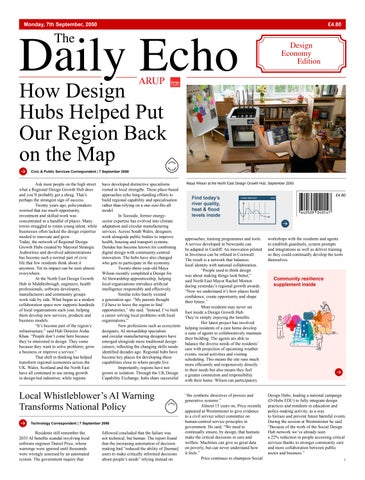
Maya Wilson at the North East Design Growth Hub, September 2050
Find today’s river quality, heat & flood levels inside
FLOOD FORECAST
LIVE
£4.80
approaches, training programmes and tools. A service developed in Newcastle can be adapted in Cardiff. An innovation piloted in Inverness can be refined in Cornwall. The result is a network that balances local identity with national collaboration. “People used to think design was about making things look better,” said North East Mayor Rachel Morton during yesterday’s regional growth awards. “Now we understand it’s how places build confidence, create opportunity and shape their future.” Most residents may never set foot inside a Design Growth Hub. They’re simply enjoying the benefits. Her latest project has involved helping residents of a care home develop a suite of agents to collaboratively maintain their building. The agents are able to balance the diverse needs of the residents’ care with projection of upcoming weather events, social activities and visiting scheduling. This means the site runs much more efficiently and responsively directly to their needs but also means they feel a greater connection and responsibility with their home. Wilson ran participatory
workshops with the residents and agents to establish guardrails, system prompts and integrations as well as deliver training so they could continually develop the tools themselves.
“the synthetic directives of proxies and generative systems.” Almost 15 years on, Price recently appeared at Westminister to give evidence to a civil service select committee on human-centred service principles in government. He said; “We need to continually ensure, by design, that humans make the critical decisions in care and welfare. Machines can give us great data on poverty, but can never understand how it feels.” Price continues to champion Social
Design Hubs, leading a national campaign (D-Hubs EDU) to fully integrate design practices and mindsets in education and policy-making activity, as a way to foresee and prevent future harmful events. During the session at Westminister he said “Because of the work of the Social Design Hub network we’ve already seen a 22% reduction in people accessing critical services thanks to stronger community care and more collaboration between public sector and business.”
Community resilience supplement inside
1