How do I engage with citizens for this projects? How do I pitch this project to my Mayor? are few of the questions professionals working in and for local administrations ask themselves.
Storytelling is not just for communication professionals. Storytelling is a tool for anyone who wants to change the way things are perceived or understood by others.
Building on the needs of cities involved in URBACT networks, and a series of webinars, this guide captures different elements and good practices of storytelling to equip you, urban professionals, with tools and techniques that help you better engage with your citizens, your elected officials.
urbact guide storytelling
STATION 1
What is urban storytelling?
What is urban storytelling?
Urban storytelling is the practice of making urban change understandable and meaningful to different audiences (stakeholders) through narratives.
From the campfire to the neighbourhoods
Since the dawn of mankind, humans make sense of the world through stories. Stories are wired in our brains. We use them to make sense of our surroundings, learn, connect, understand change and share meaning and values. In other words, stories reflect our perception of the world. This becomes especially significant when things are complex or uncertain, and we need to create a common vision of our human experience.
Cities are no different. Urban change is rarely understood through plans or data alone. It becomes real when people can place it within a story that resonates with their emotions and expectations, when the story explains what is changing, why it matters and how the intended audience is part of it. Not everything, every piece of evidence or data needs to become a story, but if you want to make sense of urban complexities, stories will help you create powerful – and shareable – narratives.
“ “
If you want to make sense of urban complexities, stories will help you create powerful – and shareable–narratives.
A powerful tool for city-making
Cities working on sustainable urban development deal with complexity every day. Strategies, policies and investments often bring together different sectors, timeframes and interests. These different contexts have varied effects across different populations and governance levels. It is important to recognise that these impacts may differ according to socioeconomic status, gender and the diverse backgrounds of community members.
When this complexity is presented only through technical language or isolated measures, people struggle to see the bigger picture. Even well-designed policies can feel distant, fragmented or imposed, sometimes resulting in loss of credibility and trust.
Urban storytelling helps cities:
• connect policies, measures and investments into a coherent whole
• make strategic choices understandable beyond expert circles
• support participation by clarifying purpose and direction
• build shared understanding across departments, stakeholders and communities
Storytelling, in this sense, is not a communication add-on. It is a way of sharing a vision of how change is governed and implemented. While there are professionals and companies that create stories on commission, there’s nothing more powerful than stories that originate within the city. With a little method, cities can become better storytellers.
Storytelling goes to town
Storytelling links long-term vision with everyday experience and shows how different policies reinforce each other and have an impact on the city and its communities.
Good storytelling also helps people grasp priorities, trade-offs and choices. It creates a shared language between institutions and communities and it does it through different forms, languages and processes. It becomes more powerful when it is crafted together with stakeholders and embodied in the urban spaces.
ITY STORY: ALTEA (ES), STORY-DOING THROUGH A CRITICAL WALK
In the southern part of the Valencian region, in Altea, a railway line has long cut through the upper and lower parts of the city. More than an infrastructure issue, it has created a visible and lived division between neighbourhoods. Crossing points are limited and often unsafe. Public space is fragmented, and daily routines such as going to school, accessing services and meeting others are shaped by this barrier.
Over the years, the issue has been discussed through plans, technical studies and institutional meetings. Possible solutions existed, yet progress remained slow. The problem was not only technical. Different actors understood the railway in different ways: as a mobility constraint, a safety concern, a planning issue, or simply an unavoidable given. What was missing was a shared, embodied understanding of what the railway meant in everyday life-a shared story and meaning.
Instead of organising another presentation, the city has chosen a different approach through its involvement in one of the URBACT Action Planning Networks. It has organised a “critical walk.” Politicians, municipal staff, regional authorities, university experts and stakeholders walked together along the railway, stopping at key points where the division was most visible.
No slides. No speeches. Just the city, experienced together.
Walking the route has made the problem tangible. Participants encountered difficult crossings, disconnected spaces and underused areas. Conversations shifted from abstract positions to shared observations.
The walk did more than generate ideas, it also reframed the narrative. The railway was no longer only a technical issue to manage but part of a broader story about reconnecting neighbourhoods, improving public space and restoring continuity in everyday life.
This changed narrative has helped align departments and opened the discussion to wider involvement, including residents and schools. A fragmented issue became a shared story, one that could-and indeed did-guide future decisions on new urban solutions.
The story is explained in details during the URBACT webinar “How to use storytelling to engage citizens in local projects”. Recording is available here.
Storify the citywith a grain of salt
Urban storytelling comes into play when cities need to explain how dif ferent actions and decisions fit into a broader strategy or to frame an invest ment or a plan in terms people can re late to. It serves a two-fold objective: align internal teams around shared priorities and make participation more meaningful.
Cities that use storytelling well often:
• begin with real situations and people, not abstract objectives
• describe change over time, not just final outcomes
• acknowledge tensions and uncertainty
• treat stories as spaces for dialogue, not just messages to deliver
Storytelling is sometimes mistaken for promotion. In reality, good urban storytelling does not simplify complexity, rather, it helps people navigate it together.
Co-funded by
STATION 2
What is the science behind storytelling?
What is the science behind storytelling?
Storytelling works because it aligns with how humans think, connect and decide … individually, socially and politically.
From the nursery to the city council
Before we understand policies, we understand stories.
Children learn through stories and play. Adults narrate events, invent characters and create situations that help children understand what is safe, what is fair and what is possible… or not. Through storytelling, they build a model of the world, shaped by values, habits and expectations.
City transformations can be powerful stories
Sustainable urban development involves long-term transformation across sectors, spaces, governance levels and communities. Storytelling works because it aligns with how humans process change. Storytelling does not replace evidence. It makes evidence meaningful.
• It improves memory retention
• It strengthens emotional engagement
• It supports persuasion through identification rather than confrontation
• It creates shared frames that enable collective action
• It helps build political and public buy-in
ITY STORY
A story of accessibility through an Urban Safari
in Banja Luka
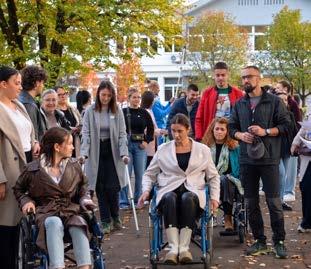
In Banja Luka (BiH), accessibility is usually discussed in terms of rules and standards. But during an “Urban Safari,”- implemented as part of the URBACT Pioneers Accelerator initiative - architects and city staff gained new insights by using wheelchairs and mobility aids to move through public spaces themselves. They faced curbs, slopes and doorways in a way they hadn’t before. What had seemed like minor features turned into real challenges, and even short distances felt much harder.
Storytelling (in this case we can refer to this experience as “storydoing” - see station 7 to learn about it) doesn’t replace facts about inclusive design, but sharing these personal experiences makes the data feel more meaningful. By connecting both thought and feeling, this “adventure” around the city helped people remember the issues, feel emotionally involved and empathise with those affected by reduced mobility. Memories become linked to physical effort and the worry of facing obstacles. After the experience, participants felt “transformed” and they started to see and deal with accessibility issues in new ways.
The three (not so secret) powers of storytelling
Storytelling links long-term vision with everyday experience and shows how different policies reinforce each other and have an impact on the city and its communities.
Good storytelling also helps people grasp priorities, trade-offs and choices. It creates a shared language between institutions and communities and it does it through different forms, languages and processes. It becomes more powerful when it is crafted together with stakeholders and embodied in the urban spaces.
Brain /mind- how individuals process stories
Neuroscience shows that stories activate multiple regions of the brain, including our “crocodile” areas responsible for memory, emotion and sensory processing. A coherent narrative can create neural coupling, meaning the listener’s brain activity aligns with the storyteller’s.
Stories stimulate neurochemicals such as dopamine (attention and anticipation) and oxytocin (empathy and trust). This combination strengthens recall and wide emotional resonance.
Cognitive research confirms that people remember structured narratives (with recognisable protagonists) far better than disconnected facts. Behavioural sciences show that we make sense through mental “shortcuts”, connecting the dots. Stories provide these dots… sequence, causality and tension. This is the architecture that our brains prefer.
ITY STORY:
CHECKING WIESBADEN’S PULSE WITH COLLABORATIVE STORYTELLING
The COVID-19 pandemic accelerated existing trends in the inner city of Wiesbaden (DE), such as retail decline and changing patterns of use. So, the city launched a group storytelling project to find out what gives its city-centre life. This was a time when people were looking for ways to reconnect and understand the changes around them.
Experts say people use stories to make sense of change, especially in uncertain times. Wiesbaden did this on purpose by collecting stories from many people to help everyone understand each other and feel more connected. The project involved guiding walks through neighborhoods, mapping emotions to locations, working with artists to visualise future scenarios, holding a public exhibition and incorporating insights into the city’s inner-city strategy.
Instead of only looking at shop numbers or new buildings, the city asked residents to share what mattered most to them. People talked about places they loved and places that made them sad. On guided walks, they shared memories and frustrations, like an old bathhouse now turned into a club, childhood neighborhoods and hidden green spots found together.
These stories became pictures in public places, turning private memories into a story everyone could see. The “heartbeat” idea brought people together, from shop owners to activists, from city planners to local residents, giving them a simple way to talk about what makes their city special, even though it’s complicated.
Society: how groups create meaning
In sociology and organisational theory, storytelling is central to sense-making. When people face uncertainty, they construct narratives to interpret events and guide action. Therefore, stories:
• build shared frames of reference
• transmit values and norms
• shape collective identity
• support coordinated action
Just as families and cultures rely on shared stories, cities need narratives that connect diverse actors, citizens and perspectives. The story is not just about urban spaces – even when these are the settings - but what they mean to those who inhabit them.
In the public sector, storytelling simplifies complexity through consistent messages and without denying it, with the aim of strengthening trust and legitimacy. Political science consistently shows that legitimacy depends not only on technical correctness but on shared understanding. Stories provide that connective tissue.
Shaping intentional urban stories
Understanding the science behind storytelling helps cities become intentional in their storytelling practice. This means:
• structuring strategies as mental – or even physical– journeys (challenge → choices → direction) rather than lists of measures
• anchoring abstract goals or complex policymaking in real world implications
• acknowledging uncertainty instead of masking it
• framing trade-offs within a broader narrative of purpose
When policies are presented as coherent stories – ideally with one consistent message – people are more likely to remember, discuss and act on them.
“
“ When policies are presented as coherent stories – ideally with one consistent message – people are more likely to remember, discuss and act on them.
Who is your story for?
Who is your story for?
Effective urban storytelling begins with clarity about your own change story and becomes powerful when it is consciously shaped for the people who need to hear it.
It starts with you, and it lives with them
Every city initiative begins with an intention. You are trying to improve public space, reduce emissions, revitalise a neighbourhood, strengthen local democracy, or attract investment. There is always a change at the centre.
If you are not clear about the story you want to tell about that change, it becomes difficult to communicate it with coherence. But clarity on its own is not enough. A story only becomes meaningful when it lands in the world of someone else.
Urban storytelling sits at the meeting point between your intention and their reality. It asks two questions at the same time: What change are we trying to explain? And who needs to understand, support, question or act on it?
It is not about choosing between your perspective and the audience’s. It is about aligning them so that the story remains true to your purpose while resonating with their concerns and values.
From broadcasting to connecting
Cities operate in complex environments. A single project can involve elected representatives, civil servants, residents, local businesses, funders, activists and partner organisations. Each sees the same initiative through a different lens.
When stories are told only from the internal perspective of the administration, they can sound technical or abstract. When stories are shaped only to please an audience, they risk losing strategic clarity and, sometimes, credibility.
Alignment creates traction. When your intention and their interests meet, the story becomes easier to grasp and easier to remember. It also builds trust. People are more likely to engage with a policy when they feel that its purpose has been explained in terms that relate to their own experience.
This is particularly important in integrated urban development, where policies intersect and trade-offs are real. Good storytelling does not remove complexity, but it helps different actors navigate it from their own starting point.
What do your stakeholders need?
To better understand your audience, it is useful to move from general categories such as “residents” or “businesses” to more concrete profiles. One effective approach is to develop personas, fictional but realistic representations of key audience groups based on real insights. A persona might describe not just who someone is, but how they experience the issue: a parent concerned about safe routes to school, a shop owner worried about declining footfall, or a young professional navigating housing costs. By giving your audience a face, a context and a set of priorities, personas help teams move beyond assumptions and ground their storytelling in lived experience.
Building on this, you can explore each persona’s needs, expectations and concerns in more depth. What are they trying to achieve in their daily life? What frustrates them? What would make a change feel meaningful or acceptable? Tools such as user journey mapping (including this tool from the Playbook series) can help you trace how different people encounter a policy or service over time, revealing moments where communication can connect or break down. When cities take the time to understand these perspectives, they are better able to shape stories that speak to real motivations, anticipate resistance and make the purpose of urban change both clear and relevant.
From intention to audience fit
The first step is internal clarity. adapting your message, you need to agree on your core story. What is the change you are proud of, or what is the change you want to achieve? What problem are you addressing? What is, or will be, different now or in the future, compared to before? If your team can not summarise this in a few consistent messages, the story will feel fragment ed externally.
Once this core is clear, the focus shifts to the audience. Who needs this story? A group of residents concerned about daily life will not listen in the same way as a managing authority assessing compliance, or a councillor thinking about electoral accountability.
Mapping your stakeholders helps you see who has influence, who has interest, and who may feel uncertain or resistant. Tools such as a simple power–interest matrix from the URBACT Toolbox can clarify where to focus your energy.
Empathy mapping exercises and the “5 Whys” tool - also available in the URBACT toolbox - can help you move beyond surface reactions and understand deeper motivations.
Your story does not need to change its essence. What changes is the entry point. For one audience, you may begin with a human situation that illustrates the need for change. For another, you may begin with a strategic objective or a measurable result. The structure remains coherent, but the doorway shifts.
When this is done well, the story feels relevant without losing integrity. It becomes both yours and theirs.
ITY STORY: NICOSIA (CY)
DJs as Next Generation storytellers
In Nicosia, the municipality explored how public space could come alive after dark. As part of the URBACT Cities After Dark Network, the city hosted free DJ lessons in Eleftheria Square, followed by a public party where rookie DJs performed.
The message was not only about music. It was about supporting young people to learn skills, build networks and turn passion into opportunity. Some participants later bought equipment, joined the local DJs Association and began performing professionally.
The audience was clear: young residents and emerging musicians. Social media was chosen as the main channel because it was where this community already connected.
The same initiative described in a formal report would have felt different. Framed for youth, through their platforms, it became an invitation rather than an announcement.
One initiative, different openings
Imagine a city introducing a new mobility plan that reduces car traffic in a neighbourhood.
For residents, the story might begin with everyday experience: children crossing busy roads, the noise of traffic at night, the desire for safer public space.
For elected representatives, the story may start with public health data, alignment with climate commitments and visible improvements in quality of life.
For local businesses, the entry point may focus on increased footfall, more attractive streets and long-term vitality.
The measures are the same. The strategic direction is the same. What changes is the first chapter.
Cities that are effective storytellers listen carefully before they speak. They notice what questions are being asked. They choose an opening that resonates and then guide the conversation towards the broader vision.
Align before you speak
Before your next meeting, report or consultation, pause and test your alignment. Write down your core story in three sentences. Then name your primary audience and complete this thought: “this matters to them because…”
Notice where the connection feels weak. Adjust your opening so that it links your intention with their lived reality. This small step can transform how your message is received.
“
Write down your core story in three sentences. Then name your primary audience and complete this thought: “this matters to them because…”
“
ITY STORY: MAKING THE INVISIBLE VISIBLE THROUGH STORIES AND EDUCATION
In Chalandri, a 1,900 year old Roman aqueduct runs underground, largely forgotten beneath modern urban development. Through the Urban Innovative Actions project Cultural H.ID.RA.N.T. (Hidden IDentities ReAppear through Networks of WaTer) , the city reframed this hidden infrastructure as both climate solution and cultural asset.
The story connected reuse of non-potable water to climate adaptation, urban wellbeing and local identity. But it was not told in the same way to everyone.
For schools, the focus was on environmental education and creative workshops. For residents, it was about water saving and neighbourhood stewardship. For policy makers, it demonstrated a model of sustainable urban development.
Festivals, history walks, games, performances and direct communication were used to reach different groups. The core narrative remained consistent.
The language and entry point shifted.
By translating the same story into terms that resonated with each audience, the aqueduct moved from being invisible infrastructure to shared civic project.
This project has been therefore continued and transfered to other European cities through the URBACT Hydro-Heritage Cities network.
What are the magical ingredients of a story?
What are the magical ingredients of a story?
Behind every effective urban strategy lies a simple structure, a narrative arc that includes the challenge, the choice and the change.
City strategies, Integrated Action Plans, urban projects, investment documents are often seen as technical artefacts. They contain objectives, indicators, budgets and timelines. They are written to be precise, defensible and aligned with regulation. Yet inside every strategy there is a story.
Find your story seeds
Before a story can take shape, it needs raw material. In urban strategies, this material already exists, often hidden in plain sight within reports, data, workshop discussions or everyday conversations. These fragments are what we call story seeds. A story seed is not yet a story, but a signal of something that matters: a tension, an ambition, a contradiction or a possibility. Cities do not need to invent stories from scratch. They need to learn how to recognise these seeds and develop them.
Every story has a shape
Whether told around a campfire, in a novel, or in a city council meeting, stories tend to follow a similar structure.
• They begin somewhere
• Something disrupts the normal
• A challenge emerges
• Choices are made
• Something changes and maybe it becomes the “new” normal.
This basic structure is often called the narrative arc. Variations of it appear everywhere. From the Pixar story spine (“Once upon a time… until finally…”) to the hero’s journey, where a protagonist faces obstacles and returns transformed.
Urban storytelling works in much the same way: strategies, policies, and investments already hold narratives. The key is to identify their elements and organise them for the intended audience. Think of it as a simple recipe that any city staff member can use.
Urban policies often fail to resonate not because they lack substance, but because they lack structure. When strategies are presented as lists of measures, people struggle to follow the logic. When data is detached from context, it becomes forgettable. A clear narrative arc helps audiences understand:
• where we are starting from
• what the challenge is
• what is at stake
• what choices are being made
• what change we are aiming for
In integrated and participatory settings, this structure becomes even
The storytelling ingredients: a practical recipe for cities
Every strong urban story – the ones that have already been told and the ones that are yet to happen – contains recognisable moments. These moments are not fictional, they already exist inside strategies, plans, investments but also in visions of the future. The task is to identify them and connect them into a clear narrative arc. Here are the key ingredients:
THE STARTING POINT
THE KEY CHARACTERS
THE TENSION
THE CHOICE THE TRANSFORMATION
THE NEW NORMAL
THE STARTING POINT
Every city’s story begins somewhere. As challenges or opportunities become apparent, it becomes clear that change is needed. These revelations prompt action to address underlying issues and pursue improvement.
The Starting Point grounds the story and shows why action was needed.
THE KEY CHARACTERS
The people or groups who play a key role at a critical moment by enabling, mediating or pushing an action forward. In urban stories, the “hero” is often collective such as a neighbourhood, a department, a stakeholder coalition, a citizen group or even the city itself. Characters give the audience someone to follow.
THE TENSION
A moment of disagreement, risk or high stakes. For example, when priorities, resources or approaches are contested. Without tension, there is no story. Tension (or Opponents) may also take many forms, such as competing political priorities, limited funding or social inequities. It may suggest institutional resistance or suggest institutional resistance or uncertainty about outcomes. Sometimes it is real as a climate risk or a physical barrier.
Tension clarifies what is at stake and why decisions matter.
THE CHOICE
The moment when a direction is taken, during a council meeting, through a prototype/temporary action, etc., and alternatives were set aside. This is the turning point. The Choice shows leadership and responsibility. It makes governance visible.
THE TRANSFORMATION
The moment when an action, policy or measures show that change is possible or already happening. It can take many shapes. A successful pilot, a visible shift in collaboration, a new service, or a behavioural change. Transformation turns intention into change and guides the moral of the story.
EMOTIONAL RESONANCE
Facts explain. Emotions connect. All of them - from joy to anger to shame and to fear. A strong urban story includes moments that reflect what humans experience, touch shared values and create empathy. Emotions do not weaken policy, but rather they can strengthen commitment. Emotions make stories more memorable, salient and human-centred.
THE NEW NORMAL
The moment when a new way of acting, collaborating or investing started to feel realistic and achievable. The new normal does not mean everything is solved. It means that change is no longer exceptional, it becomes part of everyday practice.
This ingredient signals durability and direction.
How these ingredients form a narrative arc
THE TENSION
THE CHOICE
THE TRANSFORMATION
THE EMOTIONAL RESONANCE
THE KEY CHARACTERS
THE STARTING POINT
THE NEW NORMAL
This arc mirrors both the story spine and the logic of policy development:
• recognising a need
• engaging actors
• facing constraints
• making decisions
• testing change
• embedding new practice
Cook the right story
In practice, applying this recipe means:
• identifying who the protagonist is before drafting a policy presentation
• clearly naming the challenge instead of hiding it in technical language
• explaining what is at stake in human terms
• describing change as a journey, not a static outcome
• concluding with a clear invitation to act
ITY STORY: KRAKÓW KOBIET, FINDING
ANOTHER
PROTAGONIST OF THE CITY
Kraków’s public narrative has long centred on kings, scholars and monumental heritage. The city’s identity is strong, but selective. The absence of women’s contributions created a quiet but persistent tension in how the city tells its own story.
The initiative Kraków Kobiet – Krakowianki , a public trail for tourists and residents in the city, addresses that gap directly. It begins with a clear reframing: What if the city is viewed through the women who shaped it? The Kraków’s women trail and its app, tell a different story. This shift establishes a new protagonist. Alongside political and academic elites, the narrative now includes Helena Radlińska, who helped shape social pedagogy in Poland, Kazimiera Bujwidowa, who fought for women’s access to higher education, and Nobel Prize laureate Wisława Szymborska, whose work gave Kraków an international cultural voice.
Beyond these well-known figures, the story incorporates generations of less visible women: teachers, merchants, activists, resistance couriers, whose labour and creativity influenced neighbourhoods and institutions. The transformational trail is not about replacing one history with another. It’s about expanding the protagonist of the city itself. Familiar places acquire additional meaning. Gender equality becomes visible not as a policy statement, but as part of the city’s lived history.
Through curated walking trails, exhibitions and storytelling formats, the city’s spaces speak differently. Courtyards, theatres and university halls acquire additional memories and meaning. The new normal is a broader urban identity, one where the city acknowledges more of those who shaped it.
Find out more about this initiative here .
Choose your words: how language shapes the story
Language shapes how urban change is understood. By choosing words that are concrete, inclusive and honest, cities can turn strategy into a story that people recognise as their own.
Words are never neutral
Cities work with plans, regulations, indicators and technical standards. Over time, this language becomes normal inside institutions. Terms such as ‘urban regeneration’, ‘resilience’, ‘integrated action’ ‘energy community’, ‘stakeholder engagement’ or ‘non potable water network’ feel precise and efficient.
But outside City Hall, those same words can feel distant, abstract or even intimidating.
Instead of language simply describing reality, it acts as a frame for it. The words you choose influence how people understand a problem, whether they feel included, and whether they see themselves as part of the solution.
Choosing your words carefully is not about simplifying content. It is about shaping perception responsibly.
Language builds trust or distance
Urban change often generates uncertainty. When language is heavy with jargon or acronyms, it can create a barrier between institutions and communities. People may feel that decisions are happening somewhere else, in a language they do not speak.
Conversely, clear and intentional language can:
• make complex ideas accessible
• signal openness and transparency
How the
driest topic becomes meaningful: language and human anchors
The key is not to dramatise them artificially and instead reconnect them to human consequence.
Some topics appear resistant to storytelling: procurement rules, governance reforms, financing mechanisms, zoning adjustments.
Instead of starting with the instrument, start with the impact.
“
“Making streets safer for children” feels different, even if both refer to the same mobility policy.
“ Reducing car dependency” may sound restrictive.
Rather than: “The city introduced an innovative blended finance mechanism.”
Begin with: “For years, small local projects could not access funding. Good ideas stayed on paper.”
Then, introduce the mechanism as the turning point that unlocked possibility.
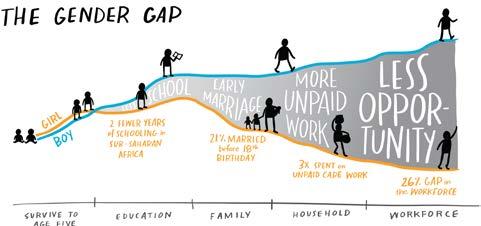
Data and indicators remain essential. They provide credibility and accountability. But when presented alone, they rarely move people. When linked to a moment, a decision or a lived situation, they gain depth. The following illustration of how a series of seemingly small incidents become a very evident gender gap is a great example of how to present data in an impactful way.
EXAMINING INEQUALITY - GATES FOUNDATION
Even small shifts in framing can transform perception. A “housing density adjustment” becomes a story about making room for the next generation. An “energy efficiency retrofit programme” becomes a story about warmer homes and lower bills.
The strategy does not change, but the entry point does.
Five shifts that strengthen storytelling
First, move from abstract nouns to concrete images. Instead of ‘social cohesion’, describe neighbours meeting in a shared garden. Instead of ‘climate resilience’, describe shaded streets during a heatwave. Concrete language helps people visualise change.
Second, reduce unnecessary acronyms. Internal shorthand such as ULG, IAP, SUMP or SIB may be efficient within a project team, but it excludes those not already familiar. Replacing acronyms with plain language signals inclusion.
Third, name people and places. Stories become more credible when they refer to real streets, neighbourhoods and everyday situations. Place-based language grounds strategy in lived experience.
Fourth, acknowledge tension honestly. Language that only celebrates success can feel artificial. Naming tradeoffs, uncertainty or past failures builds authenticity.
Fifth, choose verbs carefully. Compare ‘implement measures’ with ‘open a new space’, or ‘deliver outputs’ with ‘bring neighbours together’. Verbs shape energy. They suggest movement, care or authority.
Small shifts in wording can significantly change how a story is received.
Rewriting the same message
Consider a typical sentence from a strategy document:
“The municipality will implement an integrated regeneration framework to enhance multifunctional urban spaces.”
Now rewrite it with different language:
“We are bringing new life to our main square so it becomes a place to meet, play and work throughout the day.”
Both describe coordinated urban change, but the second makes it easier to imagine, discuss and relate to. We are not seeking to remove substance here, rather we are trying to ensure that language opens the door rather than closing it.
ITY STORY:
RAVENNA (IT) REGENERATION THROUGH STORYMAKING OF MEMORY AND STORIES
Ravenna’s Darsena district is a former industrial area shaped by work, water and layered history. Like many regeneration zones, it could easily have been described through planning language: infrastructure renewal, mixed use de velopment, economic revitalisation.
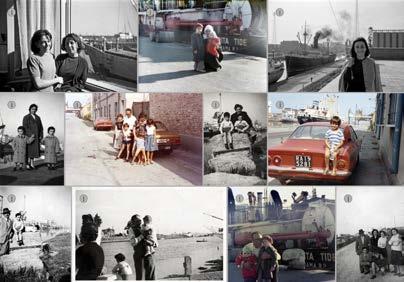
Instead, the city launched “Unroll the Memory”, a public call inviting residents to share amateur films, photographs and family videos connected to the area. What emerged was not a technical narrative, but a collective portrait of everyday life.
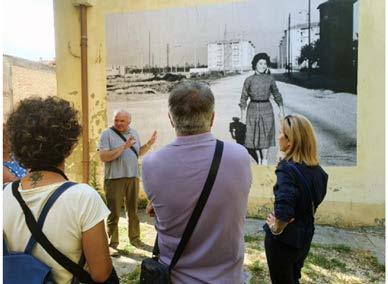
Exhibitions were installed across unexpected locations, along canal walls, in side social housing apartments, in courtyards and former racecourses. The district became a living gallery. Citizens themselves became guides to its meaning.
The strategy of regeneration did not disappear. It was reframed. Darsena was no longer presented as a problem area to be fixed, but as a place of
The story is explained in details during the URBACT webinar “How to use storytelling to engage citizens in local projects”. Recording is available here.
STATION 6
How can we craft stories with citizens and stakeholders?
How can we craft stories with citizens and stakeholders?
When citizens and stakeholders help shape the story, they help shape the identity of the city.
From telling to co-creating
Shaping stories with citizens and stakeholders means recognising that urban narrative is not fixed. It evolves. It expands. It can include loud voices or others that were once overlooked. Participative storytelling, in this sense, is not about approving a message, it is about co-creating value.
Urban narratives shape identity, belonging and trust. If a city’s story reflects only certain voices or perspectives, others may feel invisible within it and the story fails. When narrative space is widened, the city becomes more inclusive and more coherent, and the story thrives and is remem-
bered. Crafting stories with citizens and stakeholders strengthens urban life because it:
• makes experience visible
• acknowledges diverse histories and perspectives
• deepens the emotional connection between people and place
• transforms memory into shared identity
• reinforces legitimacy through recognition
When people recognise themselves in the story of their city, they relate to it differently.
Three approaches to crafting urban narratives
Creating stories with citizens and stakeholders can be understood through three interconnected dimen sions: storymaking, storytelling and storydoing. Together, they move ur ban narrative from message to human impact.
Storymaking is about shaping mean ing and creating collective stories. It involves listening, uncovering over looked perspectives, and acknowledg ing whose experiences define the city. Story-making expands the narrative frame, especially when certain voices can remain marginalised.
Storytelling is about communicating that shared meaning clearly and co herently. It weaves experiences, mem ories and values into a narrative that others can follow and recognise them selves in. Good storytelling gives struc ture to complexity and makes identity visible.
Storydoing is about embodying the narrative in practice. It means allow ing people to experience the story through space, action or interaction. When narrative becomes tangible - through walks, installations, per formances or digital experiences - it moves from abstract to lived reality.
ITY STORY:
FROM STIGMA TO SHARED RENEWAL GDYNIA ODNOWA,
In Gdynia (PL), certain neighbourhoods have long carried labels such as “de graded,” “crisis areas,” and “problem zones.” Public debates often reduce their challenges to infrastructure deficits and market indicators. Yet, for residents, another story persists, one shaped by memories of past transformations where decisions were made without their involvement.
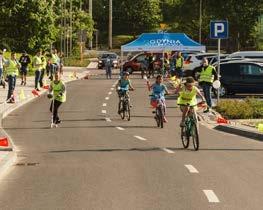
The Gdynia OdNowa (“Gdynia Renewal” or “Gdynia From Now On”) initiative has begun to reshape the narrative frame. Renewal is no longer presented as merely a technical upgrade; instead, it is understood as a collective process of rebuilding dignity, identity, and trust.
This “new” story is, first and foremost, created together. Through workshops, themed walks, public meetings, and informal conversations, residents, NGOs, housing communities and municipal staff explore what renewal truly means in everyday life. Local knowledge is valued as essential insight.
The narrative has been emerging from these ongoing encounters in the field and is intentionally communicated. Communication extends beyond formal documents to include exhibitions, theatre performances, social media and on-site dialogues.
Most significantly, the story is embodied. Municipal staff have stepped beyond institutional boundaries to work alongside communities. Participation is not a one-time consultation but an ongoing presence.
Neighbourhoods once defined by stigma are now being recognised for their potential. The narrative of decline is giving way to a narrative of shared responsibility. The results slowly unfold in a newly co-created, shared and lived story.
Cities that craft urban narratives with stakeholders often begin by listening. They explore whose voices are absent, whose memories are fading, whose experiences have not been acknowledged. They create spaces - walks, exhibitions, street actions, dialogues, digital platforms - where stories can surface and connect. They allow tension and plurality to coexist, recognising that identity is layered rather than singular.
More about this initiative can be found here .
ITY STORY: HANNUT (BE), FROM PLANS TO FRONT-PAGE FUTURES
In Hannut, Belgium, the city was preparing Le Champ des Possibles, an urban regeneration project including a business centre around the library and a concert hall near the historic centre. The goal was to strengthen vibrancy and attractiveness in the city core.
The project brought together politicians, citizens, cultural partners, shopkeepers and civil servants. Instead of formal minutes, an external facilitator turned discussions into fictional newspaper front pages written from the future, describing the project as a success.
By imagining the city after positive change had already occurred, participants clarified what success would look like and what conditions were needed to achieve it.
The strategy remained the same. The narrative shifted. Participation stayed strong over more than two years, and the project became a shared ambition rather than a technical plan.
Formats for urban storytelling
Formats for urban storytelling
The format you choose is part of the message. By selecting and combining formats thoughtfully, cities can make urban change visible, memorable and shared.
The format is part of the story
When we think about storytelling, we often think first about content. What is the message? What is the narrative? Yet in urban storytelling, how the story is told can be just as important as what is told. A strategy explained in a report feels different from the same strategy experienced through a walk, a festival, a short video or an exhibition.
The format is not decoration, as thinking deeply about this can help shape how people engage, what they remember, and whether they feel invited to participate.
If language frames the story, format gives it form.
Different audiences, different entry points
Cities speak to diverse audiences: residents, young people, businesses, civil servants, politicians, visitors. These groups do not all consume information in the same way.
Some respond best to written explanations. Others connect through visuals, performance, digital content or direct experience.
Using only one format risks narrowing the reach of your story. Using multiple formats can:
• extend accessibility
• reach people who do not attend formal meetings
• reinforce messages across contexts
• create emotional as well as intellectual engagement
Urban storytelling works best when cities choose formats intentionally, based on purpose and audience, rather than habit.
A spectrum of storytelling formats
Urban stories can take many forms.
• Spoken formats include guided walks, public meetings, pitches, debates and performative tours. These create immediacy and allow dialogue.
• Written formats include strategies, articles, reports, blog posts and newspaper features. These provide depth, reflection and traceability.
• Visual formats include infographics, maps, exhibitions, installations and illustrated future scenarios. These help people grasp complexity quickly.
• Digital formats include short videos, social media posts, podcasts and interactive platforms. These expand reach and allow stories to travel.
• Experiential or spatial formats, such as festivals, games, critical walks or temporary interventions, allow people to feel the story in place. They can turn abstract policy into lived experience.
Each format emphasises different dimensions of the same narrative. The choice of format influences tone, scale and accessibility.
ITY STORY:
THE TALE OF AN AQUEDUCT
In Athens, a 2,000 year old Roman aqueduct still carries water beneath the city, yet it remains physically hidden. Communicating its importance through conventional formats would have been difficult.
Through “Hadrian Aqueduct’s Adventure”, the UrbanDig team created a performative and gamified tour. Participants moved across four locations connected to the aqueduct, solving mysteries, engaging in dialogue and experiencing the narrative even while travelling between stops.
The format combined performance, storytelling, play and serious discussion. It invited participants not only to learn about water scarcity and sustainability, but to feel connected to an invisible resource.
The strategic message was about climate awareness and civic responsibility. The impact came from the medium. This story shows that format is not an afterthought and that it can be the key that unlocks attention, empathy and engagement.
Where strategy met story, regeneration became something people recognised as their own.
STATION
Keeping it alive: monitoring the narrative and growing your storytelling practice
Storytelling is not a final step in a project. It is an ongoing practice. By monitoring how narratives align with reality and by continuously refining skills, cities can keep their stories credible, responsive and alive.
Stories do not stand still
Urban change unfolds over years as political priorities shift, projects evolve, and new actors enter the scene.
If storytelling is treated as a one-off communication exercise, it quickly becomes outdated. A narrative that once felt inspiring can begin to feel disconnected from reality at a certain time.
Keeping storytelling alive means recognising that narratives must evolve alongside strategy and practice. It requires attention, reflection and adaptation. Storytelling is not only about telling, but fundamentally it is also about listening.
When narrative and reality drift apart
There are moments when what a city says and what people experience begin to diverge.
Perhaps implementation is slower than expected. Perhaps unintended consequences emerge. Perhaps a new crisis shifts priorities. If the narrative remains unchanged, trust can weaken. Monitoring the narrative means regularly asking:
• Does our story still reflect what is happening?
• Are people repeating our message in their own words?
• Are we hearing new concerns that require reframing?
At the same time, storytelling itself is a skill. Like facilitation or planning, it improves through deliberate practice. Cities that invest in developing this capacity build stronger internal alignment and more authentic external engagement.
Three disciplines for keeping storytelling alive
First, align story doing with storytelling. Narrative must be grounded in action. If a city speaks about participation, residents must experience real opportunities to contribute. If it speaks about inclusion, different voices must be visible in decision making. Monitoring results and experiences helps ensure coherence between words and practice.
Second, create moments of reflection. After a major milestone, event or consultation, take time to ask: What part of the story resonated? Where did confusion arise? What surprised us? Reflection transforms experience into learning.
Third, track signals of resonance. Notice which phrases are repeated by partners or media. Observe which images are shared on social platforms. Listen to how residents describe the initiative in informal settings. These are indicators of narrative reach and impact. Monitoring storytelling does not always require complex metrics. Sometimes it requires attentive listening and simple feedback loops.
Learning from feedback
Imagine a city launching a regeneration initiative framed around ‘renewal and opportunity’.
Initial events generate enthusiasm, but over time, some residents begin to express concern about rising rents. The narrative of opportunity may need to expand to include affordability and safeguards.
Rather than defending the original framing, the city can acknowledge new tensions and adapt its language accordingly. This strengthens credibility.
Internally, teams can also practice storytelling through peer feedback. Sharing drafts, testing a 20-second explanation, or using structured reflection methods helps sharpen clarity and tone over time.
In Getafe, the city experimented with Jane’s Walk-style storytelling to engage residents around urban issues.
The first walk, focused on pedestrian spaces in a neighbourhood, worked well. Residents joined, shared observations and reflected on how public space was used in their daily lives. The format felt simple, direct and engaging.
Encouraged by this, the city repeated the approach with a new topic: energy efficiency. The content was relevant and well prepared. The structure remained the same. The invitation was even broader.
No one showed up.
Rather than seeing this as a failure of the idea, the city treated it as feedback. The issue was not the topic itself but the connection between topic, format and audience. Energy efficiency did not resonate in the same way or with the same people.
For the third attempt, the city kept the format but adjusted the target group and communication approach. This time, participation returned.
The lesson was clear: storytelling requires continuous tuning. A narrative does not work in the abstract. It works when it reaches the right people, in the right way, at the right moment.
In Getafe, storydoing has become not just a method to engage, but a practice to observe, test and refine over time.
The story is explained in details during the URBACT webinar “How to use storytelling to engage citizens in local projects”. Recording is available here.
Draft and test your story with your colleagues
Draft and test your story with your colleagues
Using storytelling in everyday city work
Storytelling in cities is not an additional task. It is part of how strategies are discussed, decisions are explained and projects are implemented.
Whether you are preparing a policy note, coordinating departments or engaging stakeholders, you are already shaping a narrative, often without naming it. This section offers simple ways to make that narrative more intentional, clear and effective in your daily practice.
1. Start with the right questions
Use these prompts in meetings, briefings and documents:
• What change are we trying to explain-and to whom?
• Are we sharing information, or inviting people into a shared story?
• Is this structured in a way colleagues and stakeholders can follow and remember?
• What narrative helps explain why this decision or trade-off matters?
Quick exercise (5 minutes-during a meeting)
At your next meeting, pause before presenting and ask:
“If someone outside this room asked what we are trying to change, what would we say in one sentence?”
Write down the answers. If they differ, your story is not yet shared.
Tool to support this:
Stakeholder mappinghelps clarify who the story is for and whose perspective is missing or underrepresented.
2. Turn strategy into story
A quick exercise for strategies, plans or policy notes:
a. Identify:
• the problem being addressed
• The shift in approach
• the actions proposed
• the change expected
b. Rewrite it as a short narrative.
Quick exercise (10 minutes – using an existing document)
Take one paragraph from a strategy or report and rewrite it using this structure:
“Because [problem], the city decided to [shift].
This means [action], so that [expected change].
Compare both versions. Keep both - use the narrative one when communicating.
Tool to support this: Pixar story spineuse it to test whether your narrative flows logically from situation tension action outcome.
3. Strengthen your story structure
Use this simple structure when framing an initiative:
• Who is directly affected?
• What is the real barrier?
• What will change in concrete terms?
• What are we asking others to do?
Quick exercise (individual or small group – 10 minutes)
Pick one ongoing project and complete this sentence: “Today, [who] face [problem]. With this initiative, [what changes], so that [result].”
If the sentence feels vague, your story needs sharpening. So ask “why does this matter?” repeatedly.
Tool to support this: 5 Whyshelps move from surface description to deeper meaning and clarify why the story matters.
4. Test and refine your language and formats
Exercise 1
Test your language
• Take a paragraph from a report
• Remove jargon, acronyms and passive verbs
• Rewrite it in plain language
Quick exercise (5–10 minutes – peer test)
Share both versions with a colleague from another department: “Which one would you repeat to someone else?”
Use the version that travels.
Exercise
2
Test a different format
• Take one initiative
• Translate it into another format (short story, visual, walk, discussion)
Quick exercise (team use –15 minutes)
In a small group, assign different formats to the same project:
• one writes a short story
• one sketches a visual
• one describes it as a guided walk
Compare by asking: What became clearer? What was harder to explain?
Tools to support this: Newspaper of Tomorrowturn your initiative into a future headline to clarify success and direction.
Six Thinking Hatsexplore the same story from different perspectives (facts, risks, emotions, creativity) to avoid one-sided narratives.
5. Open and sustain the narrative
Keep storytelling part of your routine work:
• Whose perspectives are visibleand whose are missing?
• What feedback have we received?
• Does our narrative still reflect reality?
Quick exercise (10 minutes – team routine)
At the end of a meeting, ask:
• What has changed since last time?
• What story are we telling about this project now?
• Is it still accurate?
Note one adjustment to test before the next meeting.
Tool to support this:
Stakeholder Mapping / Empathy tools - revisit regularly to ensure your story still reflects different realities and not only institutional perspectives.
Tools and insights
Tools and insights
Practical methods and deeper reading to support urban storytelling
This companion resource gathers tools you can use to structure narratives, clarify purpose, and build shared understanding in sustainable urban development. Some items are handson facilitation tools; others are short readings that deepen the conceptual foundations.
CORE URBACT TOOLBOX TOOLS
CATEGORY
NEWSPAPER OF TOMORROW
CORE TOOLBOX
PRIMARY PURPOSE KEY BENEFITS
RESOURCE LINK
5 WHYS
CORE TOOLBOX
Use this to turn a long-term change into a vivid, memorable future headline. It helps teams and stakeholders imagine success in concrete terms and align around a shared direction:
SIX THINKING HAT
CORE TOOLBOX
Use this to move from surface messages to deeper meaning.
It helps clarify why a story matters, what value sits underneath it, and what problem you are truly addressing:
STAKEHOLDER MAPPING
CORE TOOLBOX
Use this to explore an issue through multiple lenses (facts, emotions, risks, creativity, process).
It improves collective reasoning and helps teams craft narratives that feel balanced rather than one-sided:
Use mapping tools to identify who the story is for, who influences decisions, and who may need trust-building or a different entry point into the narrative
Determines the most effective entry points and ensures the narrative focus is tailored to different groups.
NARRATIVE STRUCTURE TEMPLATES
NARRATIVE STRUCTURES OVERVIEW (STORYTELLING WITH DATA)
PRIMARY PURPOSE RESOURCE LINK
A concise overview of common narrative structures and why they work as “containers” for information. Useful when deciding which arc best fits your story.
PIXAR STORY PPINE (KHAN ACADEMY):
A simple and accessible structure to test clarity: if your story cannot fit a spine, the logic may still be fragmented.