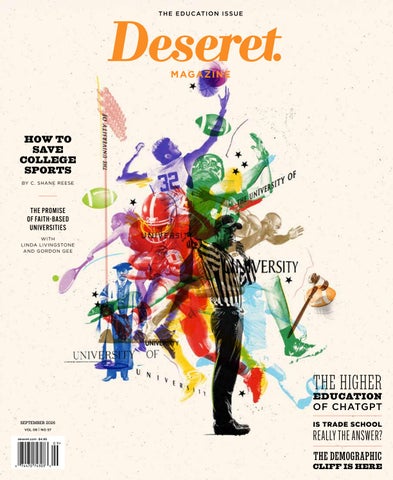
T H E E D U C AT I O N I SS U E
HOW TO SAVE COLLEGE SPORTS BY C. SHANE REESE
THE PROMISE OF FAITH-BASED UNIVERSITIES WITH LINDA LIVINGSTONE AND GORDON GEE
ZINE UPC REFERENCE APRIL
MAY
THE HIGHER
EDUCATION
OF CHATGPT IS TRADE SCHOOL
SEPTEMBER 2026 VOL 06 | NO 57
SEPTEMBER
deseret.com $4.95
OCTOBER
REALLY THE ANSWER? THE DEMOGRAPHIC
CLIFF IS HERE
CONTENTS
40 TRADE-OFF IS VOCATIONAL LEARNING A REAL SOLUTION TO MONEY AND JOB WOES?
“Jobs that prioritize practical skills over bachelor’s degrees are increasingly seen as the most promising path to a hopeful future.”
BY ETHAN BAUER
32 WHAT IS COLLEGE FOR? AI IS FORCING A RECKONING. BY ERIC SCHULZKE
T H E E D U C AT I O N I SS U E
HOW TO SAVE COLLEGE SPORTS BY C. SHANE REESE
THE PROMISE OF FAITH-BASED UNIVERSITIES WITH LINDA LIVINGSTONE AND GORDON GEE
DESERET MAGAZINE UPC REFERENCE JANUARY
MARCH
APRIL
MAY
JULY
DECEMBER
VOL 06 | NO 57
SEPTEMBER
deseret.com $4.95
THE HIGHER
EDUCATION OF CHATGPT IS TRADE SCHOOL
SEPTEMBER 2026
JUNE
NOVEMBER
OCTOBER
REALLY THE ANSWER? THE DEMOGRAPHIC
48
WHO’S LEFT IN WINNETT?
CLIFF IS HERE
O N THE COVER I L LUSTR ATIO N BY K L AWE R ZE C ZY
MONTANANS LOOK TO THE PAST TO SHAPE A FUTURE FOR THEIR SMALL TOWN. BY VALERIE BRAYLOVSKIY
SEPTEMBER 2026
3
Paying It Forward at Tailgates
Watch how BYU alumni partner with host communities to give back. It’s one way we show love for all God’s children. BYU . EDU / FORTHEWORLD
FOR THE BENEFIT OF THE WORLD
CONTENTS
“Really, the ability to create beautiful things is a divine gift to us.”
CULTURE
74 ORIGIN STORY An Italian masterpiece’s surprising journey. BY NATALIA GALICZA
IDEAS
A FULL MEASURE
60
How college graduates can flourish. BY BRENDAN W. CASE
COMMENTARY
INTELLECTUAL PURSUIT
POINT/COUNTERPOINT
13
SCHOOLS OF THOUGHT
The value of truth over orthodoxy.
Is it time to reinvent K-12 education?
BY WALKER WRIGHT
BY VALERIE BRAYLOVSKIY
IN CONVERSATION
16
A MARKETPLACE OF IDEAS
22
Why Gordon Gee likes to be different. BY HAL BOYD
BREAKDOWN
THE DEEP END
NATIONAL AFFAIRS
14
UNCOMMON KNOWLEDGE
Plunging over the demographic cliff. BY NATALIA GALICZA
How technology has helped — and hindered — learning. BY ETHAN BAUER
26
LEVELING THE FIELD
66
Can college sports be saved? BY C. SHANE REESE
INTERVIEW
THE OPPORTUNITY 70 IN CHAOS Why universities should rethink their purpose.
MODERN FAMILY
FOR ARGUMENT’S SAKE
ODE
18
MY WRITE OR DIE
The lost art of debate.
An ode to the No. 2 pencil.
BY NATALIA GALICZA
BY JESSE HYDE
SEPTEMBER 2026
80
5
FEATURING
BRENDAN W. CASE
LINDA LIVINGSTONE
GORDON GEE
Case is associate director for research at Harvard University’s Human Flourishing Program. He is the author or co-author of four books, including “Doubting Thomas: Early Franciscan Disputes with Aquinas,” and has written for The New York Times, The Wall Street Journal and Christianity Today, among other outlets. His essay on helping college graduates flourish is on page 60.
The president of Baylor University, Livingstone is an advocate for faith-based colleges and universities. She has been a dean and professor at George Washington University and Pepperdine University’s schools of business, and associate dean at Baylor’s business school. Her conversation about opportunities for higher ed with “Deseret Voices” host Jane Clayson Johnson is on page 70.
Gee is a past president of West Virginia University, The Ohio State University, Vanderbilt University, Brown University and the University of Colorado. A Utah native and former law professor at Brigham Young University, he was named by Time magazine as one of the top 10 university presidents in the United States. Gee’s views on the challenges facing higher education in America are on page 22.
C. SHANE REESE
WALKER WRIGHT
CHUONG DOAN
The 14th president of Brigham Young University, Reese was formerly BYU’s academic vice president. Before that, he was dean of the university’s College of Physical and Mathematical Sciences. He is on the Department of Statistics faculty and an elected fellow of the American Statistical Association. His essay on the state of college athletics is on page 66.
Wright is the director of programs at a Yale University-based institute dedicated to promoting free speech and intellectual diversity. He previously managed academic programs at public policy organizations in Washington, D.C. He is the author of the forthcoming “In Trade We Trust.” His commentary on the value of intellectual diversity on campus is on page 13.
Doan is a Kansas City-based photographer whose work has been published in Eating Well Magazine, Associated Press, The Chronicle of Higher Education, Golf Magazine, OZY.com, Telephony Media and Penton Media. His photographs for a story about the growing popularity of vocational schools are on page 40.
6
DESERET MAGAZINE
THE VIEW FROM HERE
A HIGHER PURPOSE
S
aturdays felt different. The autumn air was crisp, carrying the hint of winter. Smoke puffed up from the cafeteria, which always seemed to smell of ham. Just a few blocks away, the muffled boom of the marching band echoed up from the stadium. Saturday was Game Day. We lived on the fifth floor of W Hall, an ugly hunk of concrete and brick that no longer exists, in rooms so small our pullout beds nearly touched when we pulled them out at night. We came from Virginia and Georgia, Idaho and California. We studied chemistry, political science, engineering and film. But on Saturdays, walking together down to the stadium, we were one. This, to me, was as much the point of college as accumulating credits, taking finals, watching art films I struggled to understand and reading Russian novels. I didn’t think about the return on investment of my degree. I didn’t think much about tuition, or the sacrifices my parents were making for me to be there. What I was aware of, vaguely, was that I was becoming something, and while my future profession was certainly a part of that, going to university was about so much more. Each September, we dedicate an issue to higher education. We have highlighted innovations like the BYU-Pathway Worldwide program. We have celebrated the unique and vital role of faith-based colleges and universities. And each year, for all there is to champion, there has been no way to avoid the reality that higher education is in crisis. There are many reasons for this: soaring costs. The demographic cliff. Expensive degrees with little value in the marketplace. But part of the problem, we explore in this issue, is that somewhere along the way, many universities lost sense of a higher purpose. Higher education leader Gordon Gee (page 22), Baylor University President Linda
Livingstone (page 70) and Harvard researcher Brendan W. Case (page 60) offer insights into how college campuses can regain their footing. As with almost every facet of contemporary life, artificial intelligence is also forcing a reckoning in higher learning, a question of what can be automated, or to put it more starkly, what a human can do that a machine cannot. As Eric Schulzke writes on page 32 (“What is College For?”), “Artificial intelligence isn’t just changing how universities teach. It’s forcing them to rethink why they exist.” If ChatGPT can compose an essay in seconds, if a take-home assignment is no longer a way to measure what a student has learned, if it’s nearly impossible to catch those who cheat on a test, what remains distinctive about a university? It has to be about more than the transmission of information, or simply earning a credential that leads to a well-paying job. It was always so, of course. AI has just brought that reality into sharper relief. I was lucky, I suppose, because there was never a question about what made my university distinct, or why I was there. We were mocked for our Honor Code and too many jokes were made about the quality of our chocolate milk. But my purpose was made clear in every prayer before class, in every weekly devotional, in what we used to call “tunnel signing” on Sunday nights. My purpose was outlined in iron and stone, inscribed on a monument at an entrance to campus: Enter to learn, go forth to serve. I’m several decades removed from that year I spent in W Hall. I’ve lost touch with most of the young men on the fifth floor. But in the fall, when the air is crisp, there’s no place I’d rather be than walking down that same hill, toward the sound of the marching band and the thunder of thousands of steps making their way to the top of the stadium. It brings me back to those years when I was aware, vaguely, that I was becoming something more. —JESSE HYDE SEPTEMBER 2026
7
DESERET NEWS PUBLISHING CO.
EXECUTIVE EDITOR HAL BOYD
PUBLISHER BURKE OLSEN
EDITOR JESSE HYDE
CHIEF FINANCIAL OFFICER ERIC TEEL
CREATIVE DIRECTOR ERIC GILLETT
SENIOR VICE PRESIDENT SALES TRENT EYRE
MANAGING EDITOR MATTHEW BROWN
VICE PRESIDENT MARKETING EMILY HELLEWELL
DEPUTY EDITOR CHAD NIELSEN
VICE PRESIDENT SALES SALLY STEED
CONTRIBUTING EDITORS JAMES R. GARDNER, LAUREN STEELE
PRODUCTION MANAGER RHECE NICHOLAS
EDITOR-AT-LARGE DOUG WILKS
DIRECTOR OF CIRCULATION SYLVIA HANSEN
STAFF WRITERS ETHAN BAUER, VALERIE BRAYLOVSKIY, NATALIA GALICZA, ERIC SCHULZKE CONTRIBUTING WRITERS LOIS M. COLLINS, JENNIFER GRAHAM, KEVIN LIND, MARIYA MANZHOS, MICHAEL J. MOONEY
THE DESERET NEWS’ PRINCIPAL OFFICE IS 55 N. 300 WEST, STE 400, SALT LAKE CITY, UTAH. COPYRIGHT 2026, DESERET NEWS PUBLISHING CO. ALL RIGHTS RESERVED. PRINTED IN THE USA.
ART DIRECTORS IAN SULLIVAN, BRENNA VATERLAUS DESIGNERS LIZ BODELL, EZRA HYDE, SPENCER WEBB COPY EDITORS SARAH HARRIS, VALERIE JONES, CHRIS MILLER, CAMILLE SMITH
DESERET PROPOSED AS A STATE IN 1849, DESERET SPANNED FROM THE SIERRAS IN CALIFORNIA TO THE ROCKIES IN COLORADO, AND FROM THE BORDER OF MEXICO NORTH TO OREGON, IDAHO AND WYOMING. INFORMED BY OUR HERITAGE AND VALUES, DESERET MAGAZINE COVERS THE PEOPLE AND CULTURE OF THAT TERRITORY AND ITS INTERSECTION WITH THE BROADER WORLD.
DESERET MAGAZINE (ISSN 2537-3693) COPYRIGHT © 2026 BY DESERET NEWS PUBLISHING CO. IS PUBLISHED MONTHLY EXCEPT BI-MONTHLY IN JULY/AUGUST AND JANUARY/FEBRUARY BY THE DESERET NEWS, 55 N 300 W, SUITE 400, SALT LAKE CITY, UTAH. TO SUBSCRIBE VISIT PAGES.DESERET.COM/SUBSCRIBE. PERIODICALS POSTAGE IS PAID AT SALT LAKE CITY, UTAH POSTMASTER: PLEASE SEND ADDRESS CHANGES TO PO BOX 2220, SALT LAKE CITY, UTAH 84101.
AWA R D -W I N N I N G J O U R N A L I S M A B O U T T H E P L AC E W E C A L L H O M E T H E P H I L A N T H R O PY I SS U E
THE
STATE OF THE
WEST
SAVING THE
GREAT SALT LAKE
WILL AMERICA
THE COMPASSION OF
ABBY COX
BUU NYGREN
GO IT ALONE?
THE PATHWAY
AND THE FUTURE OF THE
NAVAJO NATION + ARTHUR BROOKS I LYA S H A P I R O LY N N G . R O B B I N S
A UNIQUE APPROACH TO
EDUCATION IN AFRICA
IS COLLEGE FOOTBALL DOOMED?
POWER OF THE HIVE:
THE BROKEN PROMISE OF
50 THE DESERET
AMERICAN EDUCATION
THE RISE AND
BY CLARK G. GILBERT & SHIRLEY HOOGSTRA
(SUDDEN)
AN ODE TO THE TRAMPOLINE
FALL OF DESERET MAGAZINE UPC REFERENCE
DESERET MAGAZINE UPC REFERENCE
D E TO U R F R O M
DEMOCRACY JANUARY
MARCH
APRIL
MAY
JANUARY
MARCH
APRIL
MAY
JULY
SEPTEMBER
OCTOBER
THE 2024 ELECTION�S POISON PILL DESERET MAGAZINE UPC REFERENCE
MAY 2024
JANUARY
MARCH
APRIL
JUNE
JULY
SEPTEMBER
NOVEMBER
DECEMBER
VOL 04 | NO 34
MAY
deseret.com $4.95
THE PEOPLE AND IDEAS CHANGING PHILANTHROPY
DESERET MAGAZINE UPC REFERENCE
WHEN HIKERS
GO MISSING
JANUARY
MARCH
APRIL
MARCH
APRIL
MAY
JUNE
JULY
SEPTEMBER
JUNE
JULY
SEPTEMBER
OCTOBER
NOVEMBER
NOVEMBER
DECEMBER
WHO FINDS THEM?
A RGE N T I NA :
ARE RELIGIOUS PEOPLE REALLY HAPPIER?
A DISNEY GIRL JUNE
DEI
SEPTEMBER 2023
JULY
VOL 03 | NO 27
SEPTEMBER deseret.com $4.95
VOL 05 | NO 45
JUNE
OUR FUTURE
deseret.com $4.95
I N A D I S N E Y WO R L D
MARCH 2023 VOL 03 | NO 22
JANUARY
deseret.com $4.95
OCTOBER 2025
PLUS:
NOVEMBER
DECEMBER
NOVEMBER
DECEMBER
DESERET MAGAZINE
OCTOBER
IS THE BULWARK
THE FUTURE OF
CONSERVATIVE MEDIA?
THE HOMESCHOOL
TAKEOVER PLUS: GAIL MILLER, JEAN OELWANG AND RAJIV SHAH
SCAN HERE TO SUBSCRIBE
8
VOL 05 | NO 48 deseret.com $4.95
JEFF FLAKE ON WHY SOFT POWER STILL MATTERS
OCTOBER
MAY
THE NEW RAINMAKERS
DESERET MAGAZINE UPC REFERENCE
A PEEK INTO
JUNE 2025
OCTOBER
DECEMBER
THE BUZZ
OUR READERS RESPOND
the magazine’s Ethan Bauer profiled U.S. Sen. Ruben Gallego, a Democrat from Arizona, who is trying to attract more male voters to the party and is counted among several politicians vying for the party’s presidential nomination in 2028 (“Middle Man”). But most readers were skeptical of Gallego’s chances and unimpressed with his performance as congressman or senator. Daniel Jensen said Gallego doesn’t have the chops to be a senator, let alone president. “Quite frankly, the only reason he won was because the Republican candidate, Kari Lake, was so incredibly bad. … There wasn’t any magical charm with Arizona voters. Nor was there a clear plan, or perhaps a personal goal for serving America and making the nation a better place.” June also included a dispatch from America’s loneliest road — Nevada’s Highway 50 — that spans the Silver State from Utah to California (“Middle of Somewhere”). Staff writer Natalia Galicza’s description of the landscape and towns along the way brought back memories to many readers. David Young and a Japanese friend decided to take an alternate route, rather than I-80, traveling back to Utah from San Francisco, “so neither he nor I was quite prepared for the return trip via this very long and lonely highway. The spookiness was enhanced because much of the return trip was at night and the scenery on a nearly cloudless night was illuminated by an impossibly large full moon. … My friend, for whom long road trips were unknown in the much smaller Japan, made several comments on how scared it made him feel. This excellently written story makes me want to drive the road again.” Another reader, Kaleb Roedel, wrote that this story inspired him to take his six-year-old son on a Highway 50 road trip. “I want him to experience the endless basins, quirky little towns, and strange magic of a place where ‘nothing’ ends up feeling like something special.” And a reader called Cora1Smith recommended the drive to those who like road-tripping. “Being on it is a gift to anyone who enjoys the open road, good tunes on the radio and being alive.” June’s cover story on the fall of America’s elites, by leading conservative writer Oren Cass, struck a chord with many of our readers. GrandpaDon wrote that what the elites do or don’t do shouldn’t matter “nearly as much as what you and I do. If parents don’t want the college track, the trades track is available at all high schools. If you don’t want your kids doing drugs, stay involved in their lives and know what they’re doing. Build strong, stable families. Decline to be a ‘victim’ of so-called ‘elites.’”
SP EN SE R HE A PS
IN JUNE,
Being on Highway 50 is a gift to anyone who enjoys the open road, good tunes on the radio and being alive.
SEPTEMBER 2026
9
OPENING SHOT
10
DESERET MAGAZINE
LEIF HAUGEN WORKS AS A FIRE LOOKOUT, SCANNING THE LARCH AND PINE WILDERNESS FROM A ONE-ROOM MOUNTAINTOP CABIN IN MONTANA’S FLATHEAD NATIONAL FOREST. HE IS PART OF A NATIONWIDE CORPS OF PROFESSIONAL WATCHERS WHO, LIKE LIGHTHOUSE KEEPERS, STAND ON SOLITARY GUARD BETWEEN CIVILIZATION AND NATURE’S UNCARING WHIMS. PHOTOGRAPHY BY MARK FELIX
SEPTEMBER 2026
11
ELEVATING NATIONAL DISCOURSE THE
Journalism is so much more than clickbait headlines and one-sided finger pointing. At Deseret Magazine, we’re committed to giving readers in Utah and across the nation an outlet for principled, illuminating journalism — where context matters and finding solutions is just as important as highlighting problems. Join us as we examine the “why” behind today’s most important stories. SCAN TO SUBSCRIBE
IN-DEPTH JOURNALISM. UNIQUE VOICES. PRINCIPLED POINTS OF VIEW. Deseret.com/magazine
COMMENTARY
INTELLECTUAL PURSUIT UNIVERSITIES EXIST TO FIND TRUTH, NOT PROTECT ORTHODOXY BY WA L K ER W R I G HT
T
he German philosopher Robert Spaemann once described education as a way “to introduce one to reality.” Not just the reality of the external world around us — as important as that is — but also the reality of ourselves, of what we are and what we’re for. To be educated is to develop the capacity to see things as they really are. Or, at the very least, a desire for the truth and the means to pursue it. But here’s the problem: None of us fully understands reality as a whole. We see through a glass darkly. Each of us grasps only a portion of the truth. We may have a firm understanding of particular truths, but we are also shaped by our experiences, biases, traditions and flaws. Human fallibility is an inescapable part of the pursuit of truth. It’s a feature, not a bug. The Nobel economist F.A. Hayek understood this well when it came to economic life. Centrally planned economies fail, he argued, because relevant economic knowledge does not exist in a concentrated form. It exists in “dispersed bits of incomplete and frequently contradictory knowledge which all the separate individuals possess.” No agency or committee has it all. Assuming it does is what Hayek called the “fatal conceit.” The only way to utilize this local, tacit knowledge is to leave decision-making power in the hands of those who possess it. Doing so fills the blind spots of any individual perspective and enables a level of coordination, innovation and prosperity that centralized economies cannot hope to achieve. Hayek’s epistemological framework applies wherever human beings are trying to understand the complexities of reality, including the university. But survey data consistently reveals significant ILLU STR ATION BY KY LE H I LTO N
political skew among faculty and administrators, along with worrying levels of institutional and self-censorship. Syllabi on contentious issues often reflect a limited set of perspectives, a concern echoed in recent assessments of the humanities and social sciences. A 2026 Yale report identified similar issues on its own campus, all while proposing reforms to strengthen openness and intellectual inquiry. Ideological capture represents a kind of fatal conceit in higher education. It is the belief that truth can be reliably reflected and safeguarded through a narrow range of permissible views. In practice, this produces a form of intellectual protectionism that stifles the university’s ability to discover, refine and generate knowledge. It limits students’ exposure to the wider world of ideas and their ability to navigate it. What’s worse, it can dampen both curiosity and self-reflection — the very qualities education is meant to cultivate. The alternative is not quotas or partisan department-packing. Instead, it is intellectual diversity properly understood as the institutional practice of epistemic humility. It is the recognition of our own intellectual and moral limits; of the chance that we very well might — and often do — get things wrong. Intellectual or viewpoint diversity allows us to piece together and refine our understanding of reality and what it means to truly flourish as individuals and societies. I’ve seen what this looks like in practice, having spent part of my career in academic programming and building spaces where students could encounter serious arguments and openly discuss and debate them without fear. We took the competition of ideas seriously, modeling it through civil disagreement. Two colleagues of mine held opposing views on the societal effects of technological change. Both had written books on the subject. One argued that modern technology alters and erodes fundamental human experiences. The other saw technology as an engine of prosperity, with its downsides being overstated. Naturally, we put them onstage and let them hash it out before an auditorium full of students. When I first asked one of my colleagues whether she’d be willing to have this discussion in front of students, her answer was immediate: “I’d love to. I’ll tell him why he’s wrong any day of the week.” She meant it tongue-in-cheek. They were co-workers and friends who respected each other and agreed on many important things. On this, though, they did not. But what unfolded onstage was more than a disagreement about tech policy or economic data. It was a conversation about how to approach the question of human flourishing. Each offered a different map of what it means to live well in a technological age; a different piece of a larger puzzle. In that sense, the spirited discussion between my two colleagues was a reminder that we need each other’s insights to see the truth more clearly. Epistemic humility is a scholarly virtue, but more importantly, it is a human one. And we need it in our institutions of higher learning. WA L K E R W R I G H T I S T H E D I R E C T O R O F P RO G R A M S AT A YA L E - B A S E D I N S T I T U T E D E D I C AT E D T O P RO M O T I N G F R E E S P E E C H A N D I N T E L L E C T UA L D I V E R S I T Y.
SEPTEMBER 2026
13
THE BREAKDOWN
THE DEEP END PLUNGING OVER THE DEMOGRAPHIC CLIFF
WHAT HAPPENS WHEN there aren’t as many high school graduates
to enroll in college, join the workforce and shape the next generation of citizens? In 2008, a sudden drop in the national birthrate created a “demographic cliff,” a sharp year-over-year decline that is changing America as it moves through its institutions. The inverted wave
1.4 MILLION STUDENTS
That’s how many fewer students enrolled in K–12 schools between 2019 and 2024, a 2.8 percent decrease due in large part to a shrinking youth population that’s affected at least 40 states. Elementary schools lost about 940,000 students in that time, which means less funding for public schools. At least 2,000 public K–12 schools closed between 2019 to 2022. 1 COLLEGE A WEEK
That’s the rate at which schools were shuttering in 2024. There are 2.7 million fewer college students than at the start of the last decade. A continued decline could lead to more closures, up to 80 schools per year in a worst-case scenario projected by the Federal Reserve Bank of Philadelphia. Closures impact small private universities hardest. Each one amounts to an average of 265 job cuts and $67 million a year in lost revenue. 14
DESERET MAGAZINE
hits higher education this fall, as that generation turns 18, with a long tail behind it. Schools and universities are scrambling to adapt to this new normal. What’s behind the change? And what is the fallout? Here’s the breakdown. — N ATA LIA GA LICZ A
35 PERCENT OF
8.9 MILLION
AMERICANS
Last year, the share of adults who reported viewing a college education as “very important” dropped to barely more than a third — an all-time low. Public perception of higher education has been falling for more than 15 years. One way to attract more students would be to change public perception about the value of college.
50 PERCENT OFF
Many universities have slashed costs to attract more students in a buyers’ market. The average discount private colleges offered to undergraduates is more than 50 percent off tuition. Methods like boosting student advisement, attracting international students, offering scholarships to encourage completion, promoting equity and inclusion, as well as expanding opportunities for internships, are also known to boost retention rates.
7 WESTERN STATES
Utah, Arizona, New Mexico, Nevada, Idaho, Colorado and Wyoming are ranked in the top 10 states with the largest fertility rate decline between 2005 and 2022. Utah led the nation with a more than 35 percent decline. The South will see a 3 percent increase of high school graduates by 2037, but that may be attributable to a higher rate of incoming families relocating from other regions.
That’s how many Americans lost work in 2008 during the Great Recession. More than 20 percent of Americans aged 18 to 44 reported postponing having a child in 2009 directly because of the recession’s financial toll. Research from the University of Toronto estimates that half of the present birthrate decline is attributed to housing affordability, and that if costs had remained stable since 1990, 13 million more children would have been born through 2020.
2,000 PUBLIC K–12 SCHOOLS CLOSED BETWEEN 2019 TO 2022
ILLU STR ATION BY A LE XE I V E LLA
“ W E D O N ’ T H AV E TO WO R RY A B O U T T H E E N D O F H I G H E R E D U C AT I O N B E C AU S E T H E R E WO N ’ T B E E N O U G H 1 8 -Y E A R - O L D S . I T ’ S R E A L LY A B O U T A DA P T I N G A N D S E RV I N G T H E S T U D E N T S T H AT A R E CO M I N G I N A N D R E A L LY T RY I N G TO M A K E S U R E T H AT T H E Y G E T VA L U E O U T O F T H E I R E D U C AT I O N .” PAT R I C K L A N E , V I C E P R E S I D E N T F O R P O L I C Y A N A LYS I S A N D R E S E A R C H AT T H E W E S T E R N I N T E R S TAT E C O M M I S S I O N F O R H I G H E R E D U C AT I O N , F O R T H E T U F T S DA I LY
2.7
MILLION FEWER COLLEGE STUDENTS THAN AT THE START OF THE LAST DECADE
23 PERCENT DECLINE
The number of Americans having children has dropped by nearly a quarter since the Great Recession, with 3.6 million babies born nationwide last year compared to 4.3 million in 2007. This all-time low fertility rate has created a demographic cliff that’s helped lower the incoming college-aged population by nearly 3 million students and is expected to shrink the number of high school graduates by 13 percent in the next 15 years. 6 MILLION WORKERS
By 2032, America will lack workers to fill six million jobs. More than 40 percent of those jobs will require a college degree. This shortage will be the largest since the years following World War II. Already, 1 in 8 teaching positions nationwide are vacant or filled by people who aren’t fully certified, and less than 20 percent of active physicians are under 40 years old. When the baby boomers retire, fewer people will be there to take their place. SEPTEMBER 2026
15
POINT / COUNTERPOINT
SCHOOLS OF THOUGHT IS IT TIME TO REINVENT K-12 EDUCATION?
AMERICA IS LOSING faith in its schools. Just 35 percent of adults are satisfied with K-12
education, a historic low. Decades of reforms, from new standards to expanded testing, have delivered mixed results and failed to reverse a nationwide learning recession. Students are tethered to screens, teachers are burned out, and schools are pulled into disputes over AI, politics and the future of work. If schools are meant to prepare the next generation for adult life, the question isn’t whether change is needed but how far it should go. Does America need to reinvent education, or commit to repairing the system it has? — VA LE R I E BR AY LOVS K IY
16
DESERET MAGAZINE
BREAK THE MOLD
T
H E E D U C AT I O N SYST E M needs to adapt. Large class-
es, long days and rigid benchmarks were designed to prepare factory employees in the industrial age, not for tech-savvy modern students with varied interests, strengths and career paths. New models like microschools — mixed-age groups of 10 to 15 students, now serving up to two million students — offer flexible, efficient schedules that can be run by educators or parents. It’s one example of the innovations we need so students can realize their potential. The single system method is obsolete. Schools should prepare students for the future. The World Economic Forum ranks creativity, resilience and technological literacy among the fastest-growing skills by 2030, yet our classrooms still reward memorization. Today’s kids need to integrate modern tools with visionary skill sets. At Alpha School in Austin, Texas, students spend two hours each day on AI-assisted lessons and the rest building businesses with mentors. “To thrive in the economy of tomorrow, children need to learn how to both harness and rise above the robotic,” writes Kerry McDonald of the Foundation for Economic Education. Students need to get outside the classroom and its routines. As screen time replaces outdoor play, kids’ attention spans and mental health are waning. Outdoor learning, from forest schools to wilderness programs, can break that cycle for the next generation, boosting well-being and academics. The American Institutes for Research found that sixth graders in California outdoor science programs improved their scores by 27 percent. Meanwhile, students at Montessori-style elementary schools, who engage in hands-on learning without grades, gained two months of academic growth in first grade and an entire school year by sixth grade, according to federal data. Families today want more say in how their kids learn. EdChoice’s 2025 Schooling in America survey found that 56 percent of parents prefer alternatives to public schools. Some choose homeschooling or charter programs, seeking values-based education aligned with their faith or simple safety from rising violence in schools. Expanding choice, through vouchers and education savings accounts, can restore their trust. “We need freedom, which is the most basic human right and the key to delivering the best education for the entire society,” writes Neal McCluskey for the Cato Institute.
ILLU STR ATION BY A N D R E W CO LI N BE C K
BACK TO BASICS
S
CHOOLS ARE MORE than academic engines. Measur-
ing their effectiveness with only test scores overlooks many essential services and benefits that they provide, from meals, counseling and extracurricular activities to healthy routines and social development. In a shared classroom, students learn to work together, resolve conflict, compete and build independence. One longitudinal study by psychologist Angela Duckworth found that self-discipline — a habit that naturally develops within classroom walls — was more than twice as likely to predict both performance and attendance among eighth graders than IQ. Public schools are central to America’s promise of opportunity. Providing education to every child, regardless of ability, income, race or immigration status, equips them to compete and contribute to the country’s future. That commitment is particularly crucial in the rural counties where 1 in 5 Americans live and alternatives are scarce; 80 percent of charter and private schools are clustered in cities and suburbs. Well-funded public schools are linked to higher graduation rates, lower crime and longer life expectancy, outcomes that benefit all of society. Education is essential to democracy. “The qualifications for self-government in society are not innate,” Thomas Jefferson wrote in 1824. “They are the result of habit and long training.” Our ability to make sound decisions as voters and participants in an open society hinges on shared values and knowledge of certain facts, typically inculcated through our common schooling. Yet even in today’s highly polarized climate, 80 percent of Democrats and Republicans agree that civics is underemphasized in schools. We must recommit to giving today’s students a shared foundation, molding a generation who can work through society’s differences. American schools need help. The system should be improved, not dismantled. Trendy alternatives are costly and difficult to scale. Separating students today risks increasing division in our society down the road. Public school remains a national cornerstone, but we need to invest in proven reforms to update it: modernized buildings, higher pay to attract and keep the best educators, and more autonomy for local districts. “The best way to understand the classroom frames it as an updated tradition,” writes American Enterprise Institute fellow Daniel Buck. “If we try to innovate past it, we may only discover that we’ve lost something essential.”
SEPTEMBER 2026
17
MODERN FAMILY
FOR ARGUMENT’S SAKE A CASE FOR THE LOST ART OF DEBATE
BY N ATA L I A G A L I C Z A
W
hen my alarm went off at 6 a.m. on a Saturday, I almost regretted what I’d signed up for. I rubbed the sleep from my eyes and changed into an outfit I’d borrowed from my mom: a formal black dress, business casual flats and an ill-fitting blazer. They felt awkward on my 16-year-old frame. Before my parents loaded up the car to spend their day off driving me to an unfamiliar high school, I made sure to grab my purple plastic folder. Inside were a quiver of arguments, ready for battle against my fellow nerds at my very first debate tournament. I didn’t know it at that moment, but it was the first of what would eventually become many. I hadn’t had a chance to compete on a debate team before — this was the first year my school even offered one — so I was a novice in every sense of the word. Most of my classmates competed in what’s called congressional-style debate, where groups 18
DESERET MAGAZINE
form “chambers” modeled after Congress. I preferred performing one-on-one, so I opted for Lincoln-Douglas, where two speakers deliberate a predetermined subject with carefully crafted arguments based on logic, ethics and philosophy. The debate topics
ONE-THIRD OF AMERICAN ADULTS HAVE LOST RELATIONSHIPS WITH FRIENDS AND FAMILY MEMBERS OVER POLITICAL DIFFERENCES AND DISAGREEMENTS.
ranged from “the people’s right to know ought to be valued above the government’s need for secrecy,” to “bystanders have a moral obligation to act in the face of injustice.” It didn’t matter what my personal
opinion was, because I had to write speeches both in support of and in opposition to each topic, taking turns finding the merit on every side. Inside my purple folder that morning were two speeches, one arguing in favor of a guaranteed right to education and another arguing against it. For weeks, I had carried them with me into fluorescent-lit classrooms during 45-minute sessions, practicing each point until it was unimpeachable. The best of my pencil scratches were baptized into ink. Every word counted. I packed the pages with as much theory as possible and rehearsed reading them aloud clearly and quickly — but not too quickly — timer in tow. I remember while practicing my debate speeches at home, my mom would secretly listen to me from a distance because she thought I sounded smart. At the dinner table, she’d bring up how she wasn’t surprised that I got into debate because I “love
ILLU STR ATION BY DAV I D PLU N KE RT
SEPTEMBER 2026
19
MODERN FAMILY
“IT’S MADE ME A BETTER SISTER, DAUGHTER, FRIEND AND CITIZEN.”
to argue.” The idea of writing impassioned speeches and having a captive audience listen to my thoughts was exhilarating. But the reason I grew to love debate was the uncomfortable intellectual exercise. Thinking, disagreeing and then thinking about it all some more left me with no choice but to look at the world wholly. That’s why the practice of debate is correlated with stronger standardized test scores, grades, graduation rates and civic engagement. “Teachers can tell when debaters are in their classroom. They can tell when a student has a foundation in proper research to question the facts they’re hearing,” says J. Scott Wunn, executive director of the National Speech & Debate Association, the largest speech and debate organization in the country. “Because debate engages in so many different communities — the bluest of blue, reddest of red, urban, rural, liberal, conservative … speech and debate is really about strengthening America’s future.” Debate has been a lauded art for thousands of years. In the fifth century B.C.E., ancient Greek philosophers like Plato and Socrates developed styles of debate that became the bedrock for Western law. Debate societies in England’s Age of Enlightenment helped democratize speech and spread new ideas. Televised American debates, like the infamous 1960 presidential debate between John F. Kennedy and Richard Nixon, have time and time again altered the course of politics and leadership stateside. People have held contradicting ideas for as long as humanity has existed, and will continue to. Debate is a way to rigorously challenge those ideas and search for the strongest by analyzing evidence, finding 20
DESERET MAGAZINE
flaws in opposing claims, and viewing issues from multiple perspectives without simply fizzling into disagreement. Today, as many as 80 percent of American adults believe that we disagree not only on policy but on basic facts. Another third have lost relationships with friends, family members, colleagues and romantic partners over political differences. “Our society is losing the ability to disagree a lot of times with civility, and that problem transcends political affiliation,” Wunn says. “Speech and debate is one of the few spaces where young people are still practicing the art of listening, engaging with perspectives that are different from their own, and making a case through logic and evidence rather than just noise.” IN A PUBLIC school history classroom that
smelled like dry-erase marker and disinfectant, I placed my purple folder on a lecturn. I looked out at my opponent, some other gangly teenager in another bad suit, and my judge, a volunteer who was likely somebody’s parent. Then, I set a timer on my iPhone for six minutes. I was arguing the affirmation, in defense of a guaranteed right to education, and although I’d practiced this speech at home more times than I could count, I felt my heartbeat quicken as soon as I opened my mouth. My sweaty hands gripped the printed-out speech as my eyes darted back and forth from the page in my attempt to keep eye contact with the judge. The adrenaline made it almost an out-of-body experience. I blacked out a lot of what I said as well as how I said it, but I remember discussing how a guaranteed right to education strengthens democracy,
boosts the economy and bridges opportunity gaps. When the timer went off, my opponent cross-examined me for another three minutes, asking questions about research and sourcing to poke as many holes as possible in my case. I recently learned that high schools first started offering debate as an extracurricular in the U.S. in 1925, when scientists had just discovered galaxies beyond the Milky Way. New literature like “The Great Gatsby” began critiquing society and shattering the illusion of the American dream. The Scopes trial brought national attention to a debate on the teaching of evolution in schools, marking a clash between science and religion. The world was changing, as it always does, and discourse reflected that. Debate teams grew in popularity through the Great Depression and World War II, with hundreds of thousands of young Americans taking to podiums. Today, teams typically compete in one of three main leagues: the National Speech & Debate Association, National Catholic Forensic League or National Association for Urban Debate Leagues. Debate formats include Policy, Lincoln-Douglas, Congress, Public Forum and Big Questions, which all vary in group size and areas of emphasis. Topics are always hotly contested and timely, and have ranged over the years from mandatory AIDS testing to whether the United States is losing the war on terror. This year’s national Policy Debate topic, for example, was “the United States federal government should significantly increase its exploration and/ or development of the Arctic.” The LincolnDouglas debaters were assigned “democracies ought to prioritize the protection of
civil liberties over national security” in one league and “governments ought to consider healthcare to be a public good rather than a private commodity” in another. In that history classroom in my polyester blazer, I laid out my argument in favor of a guaranteed right to education, then waited for any signs of a straw man or a red herring. Our debate continued like a dance for some time — he gave his speech, I took notes, I cross-examined, gave my first rebuttal, he gave his, then I gave the closing rebuttal. It was a tightly packed 45 minutes, and I was nervous the entire time. But I also felt so unbelievably proud of myself. When I asked my opponent a question I could tell he hadn’t accounted for, or when I answered one of his questions with an entirely improvised (but informed) response, I could hardly hold back my smirk. The experience taught me that there are endless ways to think critically about any given topic. It also taught me that portraying confidence matters, something I reminded myself of as I applied to colleges and envisioned, for the first time, the start of my adult life. A 2024 study found that debaters are 29 percent more likely to enroll in college than their counterparts. Another study reported that debate participation is associated with a 0.66 increase in GPA and increases in SAT reading and math scores of 52 and 57 points, respectively. That’s not to mention the effect it has on confidence and ambition. “Going into high school, I was someone who just took what was on my plate. I didn’t go out to look for other opportunities,” says Kaushik Sathiyandrakumar, executive director of Outreach Debate, the world’s largest student-run debate nonprofit that creates resources to help underprivileged students around the world access the hobby. “I am a lot more extroverted now, and I owe a lot of that to debate. It pushed me to find opportunities and go deeper with my goals.” A F T E R A G R U E L I N G eight-hour day at the tournament, my head felt soupy, and my social battery was drained. I looked forward
to going home and turning my mind off, likely via one of the many screens I pretty much always had at my disposal. But first, my team stayed behind for the awards ceremony. I didn’t realize it at the time — mostly because I wanted to win — but the real achievement I was gaining was perspective. Debating both sides of an argument didn’t always change my mind or make me revisit my values. Many times it just confirmed my existing feelings and deepened my convictions. But it also helped me access the mental calculus of people who think or move through life differently than I do. In the short term, that made me a better debater. In the long term, it’s made me a better sister, daughter, friend and citizen. And it affirmed my understanding that more
DEBATE IS A WAY TO RIGOROUSLY CHALLENGE EACH OTHER WITHOUT SIMPLY FIZZLING INTO DISAGREEMENT.
young Americans ought to have access to this extracurricular, that more kids should find their voice. The National Speech & Debate Association estimates that a team needs, on average, $17,800 per year to pay for travel expenses, registration fees, tournaments, membership fees and training materials. Only about $5,200 of that is typically covered by fundraisers, which leaves schools left to pay a five-figure sum every year. That’s a tall order when 40 percent of all high school students live in low-income communities. “The challenge will always be access,” Wunn says. “Debate has historically been more available in well-resourced schools, and we are dedicated to creating an opportunity for every student. But that requires a sustained effort.” The National Association for Urban
Debate Leagues coordinates 20 partner leagues across the country that target students from urban, underrepresented areas — many of whom are low-income students of color. Like the Washington Urban Debate League, which was recently spotlighted in the PBS documentary “Immutable,” released in March. When I watched the film, I felt a strange kinship with the debaters onscreen. Our circumstances looked different. We likely had little else in common than debate itself. But we were all just a group of willful geeks who took a chance, no matter how many times we misspoke or stumbled over our speech. We had things to say and thoughts to explore and we were committed to conveying them. Win or lose. Throughout every single round of debate, my principal takeaway was that the more different I or my argument was from my opponent, the better the conversation was. Debate cannot exist without diversity — of thought, of experience, or of being. The more we diversify our intellect, the less we need manipulation tactics like speed reading, intimidation or fallacies to put a stake in the ground. “We are all in search of these types of tools that may exist to help us take the temperature down a little bit and actually see each other eye to eye,” says “Immutable” co-director Gabriel London. “Anybody can debate. Anybody can learn these skills to be better arguers.” As we sat in the cafeteria, huddled together as a team, a bespectacled woman with mousy hair stood in front with a clipboard. One by one, she called out the names of debaters who had placed in their respective categories. Congress. Public Forum. Policy. So it goes. When she began announcing the novice Lincoln-Douglas debate winners, my breath hitched. I applauded the third-place and second-place winners. Then, when it came time to announce first place, there it was. My name. My eyes widened in surprise as I strolled upstage to get my reward: a small plastic trophy topped with a golden winged goddess of triumph. For the first time all day, I was speechless. SEPTEMBER 2026
21
IN CONVERSATION
A MARKETPLACE OF IDEAS WHY THE ‘DEAN OF UNIVERSITY PRESIDENTS’ DOESN’T FEAR DIVERSITY BY H A L B OY D
B
efore Gordon Gee became one of America’s most recongnizable university presidents, he was a bow tie-wearing, 4-H-attending Boy Scout from Vernal, Utah. But this past year he hung up the proverbial bow tie after leading five major universities — and serving twice as president of two of them. Forbes gave him the apt descriptor “dean of university presidents” and Time magazine called him the “big man on campus.” He’s led large public and elite private universities — including Ohio State, Vanderbilt and Brown — and during his tenure he’s navigated moments of extraordinary institutional change with a front-row seat to the evolution of the American college campus. He’s also been an architect of change. Even now, without the perch of a presidency, the 82-year-old remains heavily influential in conversations surrounding the academy’s future, especially seeking 22
DESERET MAGAZINE
to stabilize college athletics after what has seemed like a decade of tectonic shifts that include transfer portals; name, image and likeness (NIL); and revenue sharing with student-athletes.
INSTITUTIONS THAT CAPTURE THE HEARTS AND MINDS OF THE PEOPLE ARE THOSE THAT MAKE A DIFFERENCE IN THEIR LIVES.
As higher education looks to rebound from a precipitous, decade-long decline in public trust, Deseret Magazine spoke with Gee to reflect on civic education, intellectual diversity, the role of sports on campus and the enduring mission of higher
education. After stepping down from his final presidential post at West Virginia University in July 2025, Gee is a hopeful voice about higher education’s future but doesn’t pull punches regarding needed reforms. He has advice for college students and for new university presidents. And he tells us what prompted him to start wearing bow ties in the first place. This interview has been edited for length and clarity. DESERET MAGAZINE:
You’ve led the University of Colorado, Vanderbilt, Brown, Ohio State (twice) and West Virginia (twice). Your early years as an academic administrator were spent at Utah and BYU. What memories stand out? GORDON GEE:
My late wife, Elizabeth, and I had to laugh because we had been waiting for about
AP PHOTO/JOSE LUIS M AGANA
ALT H OU GH H E IS RE T IRE D, GORDON GE E ’S INP U T RE MAINS INF LU E NT IAL ON ISS U E S INVOLV ING H IGH E R E DU C AT ION.
three years to adopt a child through The Church of Jesus Christ of Latter-day Saints. I’m in a faculty meeting at BYU’s law school, and I got this call and they said, “We have a baby girl for you.” I said, “Oh, how wonderful. When can we pick her up?” And they responded, “Well, we close at 5.” It was about 3 in the afternoon. And so I had to find my wife, who was, at the time, working on a graduate degree. I’m up in one of those stadium classrooms that seats hundreds in the Eyring Science Center searching around for her. And the faculty member looks up and says, “Well, can I help?” I said, “Yes. I wanted to tell my wife we just had a baby.” We got a standing ovation. From that day forward my daughter knew nothing but growing up on a university campus.
Angeles or New York or Chicago.” And I said, “No, I grew up on the Utah-Colorado border in a town of 2,000.” And we had no television. We had no movies there. And I look back on it, and it was just this wonderful growing up period. We had the church, of which I was very active. We had Boy Scouts and 4-H. And interestingly enough, I maintained great relationships with all three, and I’m on the executive committee of the National Boy Scouts. I was the chairman of the National 4-H Council for a long time. So all three of them continue to be very much fixtures in my life. They prepared me for service as did higher education. DESERET:
DESERET:
How do institutions like the ones you’ve mentioned, including higher education, shape and build people?
How do small-town life prepare you for what came next?
GEE:
GEE:
I was with a group of students last year and one kid asked me where I grew up. I responded, “Where do you think I grew up?” The kids said, “You’ve been president of these big universities, you grew up in Los
First of all, I believe very strongly that there’s no substitute for good homes, good churches, good families, synagogues and community-building activities. I think that really has always been the fundamental nature of the American psyche itself. We’re losing a lot of that right now, which endangers
us in many ways. And I think that growing up in a small town, I had every advantage that one has in that notion of having strong faith, strong organizational programs, a high school; that was really the center of our world. And that’s how I’ve always felt the university should operate: not just simply as teaching-learning institutions but creating purpose for those who are there. In fact, in West Virginia, I had a four-pillar approach. First, education. Throughout life, the university really needs to impact the whole educational system. Second, healthcare. The third is prosperity, creating jobs and opportunities for people. And fourth is purpose. I believe that we have lost in the higher education system a responsibility that goes beyond the classroom. It goes into the hearts and minds of these young people in so many different ways. DESERET:
Public trust in higher education is in a multidecade decline. Drawing on your experience, how does higher education restore trust? GEE:
I was asked to speak to the Gallup organization a year and a half ago. So I pulled up the year I first became a university president, and trust in American universities was at about 95 percent. When I gave the speech, it was 35 percent, according to Gallup. Now, a lot of institutions have lost the public’s faith and trust. But for a university or college to lose it is devastating because the public land grant institutions are built on the basis of trust. This includes faculty trusting each other; faculty trusting students; students trusting the institution; SEPTEMBER 2026
23
IN CONVERSATION
GOOD IDEAS, BAD IDEAS, IRRITATING IDEAS, IRRATIONAL IDEAS — THEY SHOULD ALL BE WELCOME. LET THE MARKETPLACE OF IDEAS PREVAIL.
staff, alumni, friends all trusting each other as well. And when we lose the trust of the American public, we really have diminished ourselves, and for that reason, college ratings have been going down. So what do we do to build that trust? It starts in a very personal way. So many institutions have become very isolated, very arrogant and really do not spend much time thinking about the people they serve. Institutions that capture the hearts and minds of the people are those that make a difference in their lives. I’m a big believer in land grant universities. If you go back to 1862, when Abraham Lincoln signed the Morrill Act, creating land universities, the bill’s sponsoring congressman, Justin Morrill, wanted people to have access to the American Dream, to education. That built trust that can be restored by reasserting the notions of the Lincolnian admonition that we need to make sure every citizen in our country has access to education, that they are able to be educated and that education focuses on communities, culture and civic responsibility. DESERET:
When did you start wearing bow ties? GEE:
When I was 15, my dad brought me to Salt Lake City to go get my eyes examined. I sat next to a guy in the Boston building downtown. He had a bow tie, and I was very curious, so I said to him, “What is that? How does it work?” He untied it and then tied it back for me, and I was fascinated. So I begged my dad after we got through the eye examination to go buy one. I just started wearing them, and I kept getting them. I have over 1,000 active bow ties. And then I have another 1,000 that I put in retirement and we’ve made them into quilts for my granddaughters. DESERET:
There was a moment early on in your career where you tried to stop wearing them. What happened? 24
DESERET MAGAZINE
GEE:
Six months into my first presidency, things were horrible and these guys came in to see me. I thought they were old, you know. I’m 36 at the time. It was the chair of the Department of English and the head of the library. They said I didn’t look, act or talk like a university president. I asked what they meant, and they said, “Well, you wear bow ties, you wear argyle socks, you go out late at night with the students, to their parties. You could be more dignified.” So I started wearing long ties, three-piece suits and so forth, and two things happened. One is the fact that I was still not doing very well and the second thing was that I was miserable. So I went back to wearing bow ties and argyle socks. And, you know, here it is 45 years later. DESERET:
You are a longtime supporter of college athletics. What needs to be done legislatively or otherwise to bring college athletics back into order? GEE:
I’m really the poster child for a lot of the problems. After I fired football coach Jim Tressel, or I would have lost my job at Ohio State, I hired Urban Meyer and paid him a king’s ransom and that kind of exploded all of these coaches’ salaries and so forth. In some ways, that motivated the lawsuits because now coaches and others were making astronomical sums. We’ve made a lot of mistakes; probably the number one mistake is that we should have been more cognizant to treat student-athletes like our band students, like our theater students, who were able to do a variety of things and not be so limited. Additionally, presidents should have remained in charge. What we really did is we abrogated our responsibilities to athletic directors and to commissioners. That needs to change. In 1961, we should have joined the Sports Broadcasting Act, which allowed for a pooling of resources and gave an antitrust exemption in the NCAA. So now what we’re trying to do is correct that missed opportunity through this College
WE SHOULD HAVE TREATED STUDENTATHLETES LIKE OUR BAND STUDENTS, LIKE OUR THEATER STUDENTS, WHO WERE ABLE TO DO A VARIETY OF THINGS AND NOT BE SO LIMITED.
Sports Protection Act. It’s not perfect by any means, but it will provide structure for such things as NILs, transfer portals, conference structure, and most importantly, it will provide a new revenue source, because whether you’re BYU or whether you’re Ohio State or Utah or any institution, you’re discovering very quickly that many of your donors are giving money to athletics and moving away from academics. The reason I believe it’s important to preserve college athletics is the fact that I think that’s one of the unique characteristics of the American higher education system. It provides a way to gain spirit and enthusiasm for the institution. It also allows the university, and BYU does this very well, to tell a story about the institution. DESERET:
You’ve called your role as a university president a kind of ministry. What is the role of a university president and the university more broadly in ministering to young people, integrating them and launching them? GEE:
Perhaps the number one characteristic of Generation Z is loneliness. The net result is the fact that our mental health issues have soared. Universities cannot be substitutes for families or churches or synagogues, but they can be a catalyst for building a sense of purpose, as I talked about earlier, and that’s where I think that we have become unhinged. Colleges should not be in place of the parents, but
we should be partners with everyone to create a way for students to succeed and know that they are being valued. The role of a university is to be a weaver, weaving students into the elements of a fruitful life on campus and beyond. DESERET:
welcome. Let the marketplace of ideas prevail. Don’t try to put your finger on the scale, which is what has happened in so many institutions. And so that’s the reason that we get out of balance. Balance is brought about by really creating that kind of open environment, and we have strayed away from that.
Do you think that ideological diversity on college campuses is out of balance?
DESERET:
GEE:
What’s one piece of advice that you’d give to university students today?
There are three answers to that: Yes, yes, yes. It’s a very serious problem when you take a look at some of the institutions you know very well, and you take a look at the College of Arts and Sciences, and there is only one conservative or Republican on faculty. That’s off. This happens slowly when faculty hire and tenure people who have a similar point of view rather than widening the circle. So we have to figure out a way to break that. There’s a reward and recognition system that we really do need to understand. I joke about the fact that if you go to the College of Arts and Science, you can’t find a Republican, but if you go to the medical school, you can’t hit a Democrat. Universities are complex organisms, but those loud voices that come from those fundamental areas in humanity and social sciences, they are out of balance. I’m very committed to the fact that we need to have multiple voices within an institution. Ideas should be celebrated. Good ideas, bad ideas, irritating ideas, irrational ideas, but they should all be
GEE:
It’s really what I talked about earlier, when those guys came and told me I needed to start wearing long ties and so forth, and I was miserable. Students need to learn to feel comfortable about who they are. But in today’s social media world and in today’s hypersensitive world, people are constantly being told in order to be cool, you have to do this, or to be accepted, you have to do that. No, no, no, no, no. We need to learn to live with ourselves and be comfortable with the time and space that the good Lord has given us. DESERET:
Do you ever think about getting back into business — one more presidency? GEE:
They’d have to carry me in on a stool or something. I loved every minute of my 45 years of being blessed to be able to serve. But it’s time to do what I’m doing now. SEPTEMBER 2026
25
NATIONAL AFFAIRS
UNCOMMON KNOWLEDGE THE UNKNOWNS OF LEARNING WITH TECHNOLOGY
BY E TH A N B AU E R
A
substitute teacher walked into a pre-K class somewhere near Dallas. “Gather around,” she told the group of four-year-olds. Then she held up a picture book. “Can we just do it on the screen?” one student said. “That’s what our teacher does.” The teacher went home, but couldn’t get the moment out of her mind. So she called up her friend Christina Mehaffey, the principal at nearby Faustina Academy. It distilled what Mehaffey had long suspected: Something as simple as a picture book read aloud asks things of children that a screen does not — a certain level of attention, imagination and engagement — and technology is changing their capacity to focus and is reshaping their childhoods. Over the past 15 years, American schools have undergone one of the most dramatic transformations in the history of education since Horace Mann declared that all 26
DESERET MAGAZINE
children were worthy of an education and pioneered our nation’s public school system. Tablets, laptops, learning management systems, digital textbooks and now AI-powered tutoring tools have become standard from
“THE QUESTION IS ONE OF BALANCE. TECHNOLOGY IS POWERFUL WHEN USED APPROPRIATELY AND EQUALLY DEVASTATING WHEN USED INAPPROPRIATELY.”
kindergarten through 12th grade. The revolution was sold as an upgrade: faster, more personalized, more engaging. Schools that didn’t upgrade risked falling behind. Anyone who objected risked looking naive. But, as Newton’s third law of motion states, for
every action, there is an equal and opposite reaction. The revolution came with a trade that we are still trying to understand. The same screens that delivered curriculum also delivered dopamine — in quantities and patterns that researchers are now finding structurally alter our brains. The same devices that connected students to information connected them to platforms engineered, by design, to maximize the time those students spent on them. The promise was better learning. The result, for many children, was something closer to dependency — and a growing body of evidence suggests that the learning and brain development itself may be suffering. Research published in the Dialogues of Clinical Neuroscience shows that the potential harmful effects of screen time and technology use include heightened attention-deficit symptoms, impaired emotional and social intelligence, technology
ILLU STR ATION BY M I C H A E L WA R A KSA
SEPTEMBER 2026
27
NATIONAL AFFAIRS
THE PROMISE OF TECHNOLOGY WAS BETTER LEARNING. BUT A GROWING BODY OF EVIDENCE SUGGESTS THAT THE LEARNING AND BRAIN DEVELOPMENT ITSELF MAY BE SUFFERING.
addiction, social isolation, impaired brain development, and disrupted sleep. That’s why no student at Faustina Academy, Mehaffey’s 220-student independent Catholic school in Irving, Texas, has ever been given a tablet or laptop. Starting in 2022, the academy took a step that even most tech-skeptical schools have not: It formally banned its students from having social media accounts — not just during school hours, but at all times. If the rapid adoption of technology is an experiment to learn how young minds are being affected, Faustina is the control, offering a look into what happens to the minds and lives of young people who are formed almost entirely outside the digital ecosystem that dominates American childhood nowadays. And what happens when the rest of us come face-to-face with what we have gained, as well as what we have lost, in turning to the internet for so much of our education, inside and outside of school? SMARTIES LIKE CARL Sagan saw this com-
ing. In 1995, the revered astronomer and science educator wrote a book called “The Demon-Haunted World” at a time when the internet was coming online but didn’t yet dominate daily life. “I have a foreboding of an America in my children’s or grandchildren’s time — when … awesome technological powers are in the hands of a very few, and no one representing the public interest can even grasp the issues,” he wrote. “When … unable to distinguish between what feels good and what’s true, we slide, almost without noticing, back into superstition and darkness.” The key to overcoming this dark prediction, Sagan argued, was to teach young people critical thinking skills, which he defined as the ability to differentiate between what is true and what is not. To him, this was the essence of learning: the very reason we learn. And technology, in theory, could help it along. Right? If the end result of learning is critical thinking, the beginning is dopamine — a neurotransmitter that works as a 28
DESERET MAGAZINE
reinforcement mechanism. When we experience something pleasurable or beneficial, our brains release dopamine to encourage repetition of these behaviors. Dopamine isn’t the only neurotransmitter involved in learning, but it’s the most essential because it controls motivation. We learn via the prediction gap created by dopamine: We expect something to happen based on a certain course of action; when our expectation proves correct, dopamine reinforces it; when it doesn’t, the absence of dopamine encourages us to try again. A medieval blacksmith learning to make swords, for example, will probably crack a blade the first time he strikes a hammer to an anvil. But over time, he will recalibrate. He will try new techniques and get better. His swords will become sharper, lighter and more beautiful, and dopamine will reward him. As the years pass, and he becomes more advanced, those rewards will push him toward refinement and mastery. From a medieval forge to Silicon Valley, that’s how learning happens. In schools, it manifests most obviously in grades. Making it to the next round of the spelling bee should trigger a dopamine response that tells a student she’s doing a good job, while receiving an “F” on a pop quiz should trigger the opposite. Technology, harnessed properly, can be similarly motivational. But it’s also capable of delivering concentrated, predictable dopamine bursts that overpower the brain’s capacity to maintain focus on competing tasks or interactions. Our brains will always naturally seek the easiest access to dopamine, and when those access points can be found in 30-second videos or Instagram likes, we will learn to prioritize those things at the expense of everything else. We’re still learning, in other words — but we’re learning to prioritize instant gratification. It’s kind of like the difference between eating a balanced, home-cooked meal instead of a drive-thru burger — both offer nourishment, but one provides more nutrition and the other convenience. That’s not to say that technology hasn’t
THE SAME SCREENS THAT DELIVER CURRICULUM ALSO DELIVER DOPAMINE — IN QUANTITIES AND PATTERNS THAT, RESEARCHERS ARE NOW FINDING, STRUCTURALLY ALTER OUR BRAINS.
allowed for giant leaps in learning for Americans. From calculators to computer labs, it has delivered on its promise to make learning easier. A study published earlier this year in the Proceedings of the National Academy of Sciences of the United States of America, for example, found that using Khan Academy’s “computer-assisted learning” program for about 30 minutes per week could improve their math abilities by over eight percentile points. Big picture technology places a deep well of human knowledge within almost everyone's grasp, giving students access and new opportunities. But it doesn’t always work like that. In 2023, Stanford education professor Antero Garcia argued that, despite personally experiencing many of the transformational benefits technology can offer education, the very premise was flawed. “I want to tell you that I think technologies are changing education for the better and that we need to invest more in them — but I just can’t,” he wrote. “Despite their purported and transformational value, I’ve been wondering if our investment in educational technology might in fact be making our schools worse.” Others, including Mehaffey, have warned that the algorithms powering Instagram, TikTok and other mainstream social media sites have so effectively hijacked our dopamine cycles that anything else, including classroom instruction, feels boring by comparison. The rewards of a picture book just can’t compare to the slot-machine-like lights and sounds of digital platforms, nor
can reading “Moby Dick” compare to an hour on Instagram reels. Learning just doesn’t work like pure entertainment. “Moby Dick” can be plenty entertaining, sure, but it is also difficult. And it is supposed to be difficult. It will expose readers to new vocabulary that they must decipher using context clues; require them to sustain attention and imagination for hundreds of pages; engage with conflicting perspectives; follow arguments; and draw conclusions. It is within this friction that learning happens. And it is precisely this friction that most digital platforms try to bypass, because friction makes people less likely to stay engaged. A 2025 study by Australian researchers published in the peer-reviewed journal Psychological Bulletin found short-form video exposure in particular to be “associated with poorer cognition,” including attention, language and memory. Another recent study out of Switzerland warned of a “significant negative correlation” between “frequent use of AI tools and critical thinking abilities.” The more people offloaded their cognitive burdens to AI, the worse their own thinking became. “While AI tools offer undeniable benefits in terms of efficiency and accessibility,” it concluded, “they may inadvertently diminish users’ engagement in deep, reflective thinking processes.” Technology, in other words, could enable precisely the dark future Sagan feared; one where the same dopamine cycle that has, for all of human history, encouraged learning is held hostage to
10-second sound bites; or where sustained attention becomes impossible because it’s less immediately gratifying than scrolling, posting and passively watching. “In a world in transition,” Sagan wrote, “students and teachers both need to teach themselves one essential skill — learning how to learn.” Technology should serve understanding, he argued, not substitute for it. Today, the question is whether there is a point at which technology stopped helping us learn — and even replaced learning altogether. T H E B R E W I N G B AC K L AS H against tech in
schools is finding allies in governments around the world. The United Kingdom recently banned children under 16 from major social media platforms, as did Australia. In Utah, legislators have been similarly motivated. In the state’s most recent legislative session, lawmakers made a “bell-to-bell” cellphone ban the default in all school districts, although districts are allowed to overrule the law. “They just have to do so proactively,” explains state Sen. Lincoln Fillmore, who sponsored the legislation. He helped pass another related bill that requires school districts to track student usage on state-provided devices for similar reasons: Parents need to take some control back from tech platforms. “And I think that that balance needs to be found over time,” Fillmore adds. He’s not the only one who thinks so. “The question is one of balance,” Rich Nye, senior education adviser to Utah Gov. Spencer Cox, says. “Technology SEPTEMBER 2026
29
NATIONAL AFFAIRS
is powerful when used appropriately and equally devastating when it is used inappropriately.” Jennifer Casa-Todd, an education technology researcher, believes this starts with parents, many of whom she suspects are projecting their own anxieties about tech habits onto their kids. “I see why people are saying paper and pen is the answer,” she says. It’s tempting to reach into the past for easy fixes. “But what’s actually happening is kids are still going to AI to get answers because that technology continues to exist in the world. So if as educators we are not supporting our students to use technology critically and effectively, then where are they going to learn it?” Learning how to learn with the internet does work. Functional imaging scans conducted by the Department of Psychiatry and Biobehavioral Sciences and the Semel Institute for Neuroscience and Human Behavior at UCLA show that internet-naive older adults show significant increases in neural activity during simulated internet searches, and internet research or certain computer programs may improve memory, multitasking skills, fluid intelligence, and other cognitive abilities. Turns out, the dose makes the poison. Royce Kimmons, who chairs the department of educational leadership and foundations at Brigham Young University and researches educational technology, is wary of technology becoming a convenient scapegoat for more complicated, nuanced discussions. In his view, total bans — whether on social media, smartphones or education technology — do kids a disservice. “There is an important reality here about the kinds of workplaces our students are going into and the world that they’re going into,” he says. “Students have to learn literacy and develop self-discipline related to technology use at some point in time.” But when so much of our technology is designed to maximize engagement for its own sake, balance can be difficult to find. Some argue that digital “hygiene” needs to be something taught deliberately. If students 30
DESERET MAGAZINE
know about hypnotizing algorithms and dopamine flooding, they’re better prepared for the real world. Jodi Carreon, director of an advocacy group called Schools Beyond Screens, proposes that with every technological intervention, administrators, parents and teachers should ask a question: “How are we ensuring that technology isn’t crowding out what’s most important?” Namely, critical thinking, collaboration and creativity. If technology can help foster these skills, fantastic. But if not, she says it’s a call for a readjustment, not an overhaul. “Do I think we’ve gone wrong? I do,” she says. “But I don’t think the answer is swinging the opposite way.” Christina Mehaffey doesn’t see a classroom free of technology as a swing back. It’s just staying the course. After implementing the schoolwide social media ban in 2022, 2026 marked the school’s first graduating class to make it through high school without accounts on any major apps — and, Mehaffey says, the results have been spectacular. “They just treat each other differently,” she adds. “They speak differently. They have more respect for the teachers.” Plus, rather than a hindrance to admissions, the policy has become something of a selling point. Mehaffey has been invited to speak at conferences across the country. Other schools are looking to her as a role model. “People are looking all over for this type of school,” she says. Meaning a less technologically connected but more interpersonally connected version of living and learning. A chance to shape young minds free from the influence of tech platforms and devices that fundamentally change the way learning happens. If Mehaffey worries about anything, though, it’s how former students will adjust once they’re in college. Sometimes, she asks them whether they feel isolated. One student’s response stood out. When his new college friends asked for his Instagram and Snapchat handles, he told them he didn’t have any. “I wish,” one of his new friends told him, “I was as free as you.”
IT’S KIND OF LIKE THE DIFFERENCE BETWEEN EATING A BALANCED, HOMECOOKED MEAL INSTEAD OF A DRIVETHRU BURGER — BOTH OFFER NOURISHMENT, BUT ONE PROVIDES MORE NUTRITION.
DOWNLOAD THE APP
PERSPECTIVE
PHOTOGRAPHER: LAURA SEITZ, DESERET NEWS
32
DESERET MAGAZINE
What is College for?
As artificial intelligence makes information cheap and abundant, universities are discovering that their most valuable work may be the hardest to automate
BY ERIC SCHULZKE
ILLUSTRATION BY CHAD HAGEN
SEPTEMBER 2026
33
INSIDE A CLASSROOM at california state University in Vallejo,
six whiteboards line three walls, all covered in dry-erase markers. Four students cluster at each board, working through differential equations. No laptops or phones are visible. Taiyo Inoue walks through the room, hands clasped behind his back, watching each group in turn. He is an intense presence, with piercing brown eyes and graying stubble. His face is often fixed in a perpetual frown, his brows furrowed as if in confusion. He will not lecture today. He is not your typical college professor. Instead, he has posted his lectures on YouTube for students to watch on their own time. If they did not prepare for class today, he will know. A mathematics professor at Cal State’s Maritime Academy, Inoue had spent years lecturing from a podium and assigning problem sets for homework. By 2025, artificial intelligence was transforming the 34
DESERET MAGAZINE
work his students submitted. Homework that once took students an evening suddenly began returning within minutes, error-free but pointless. Inoue had long been worried about how AI might impact learning, but over time, his worries morphed into something much more unsettling. Students weren’t just using ChatGPT to write papers or cheat on tests, he realized. They were using it to think. “These new technologies allow students to completely and totally offload their cognition,” Inoue told me, “giving themselves up, their identity as students, totally and completely to machines. That’s the disaster scenario for higher education, because it completely dilutes the value and the signal that a college degree confers on its holders.” In other words, the advent of AI in the classroom, which has already completely upended it in a few short years, is existential. “It’s going to lead to the death spiral
of higher education as an institution if we don’t do something about it,” Inoue says. Inoue put his lectures online for the spring 2026 semester and moved the problem-solving into the classroom. Students now spend 150 minutes a week working through unfamiliar problems at the whiteboards, where he can watch the students reason and assess their participation in real time. Inoue’s bold experiment is an answer to something that becomes increasingly urgent with each passing year: Higher ed is in crisis. Universities are no longer debating whether artificial intelligence will transform learning. They are scrambling to respond. A recent survey found that nearly 90 percent of Harvard undergraduates used AI for coursework, and roughly a quarter said they used it instead of doing assigned reading. At the University of Reading in the United Kingdom, researchers quietly slipped AI-generated answers into real undergraduate exams. Human graders identified them just 6 percent of the time. Artificial intelligence isn’t just changing how universities teach. It’s forcing them to rethink why they exist. Colleges have long joined three functions: transmitting knowledge, validating mastery and forming character. AI is now pulling those functions apart. Information is becoming abundant and personalized, weakening the university’s traditional role as the provider of knowledge. Work completed outside the classroom can no longer reliably show what a student knows, forcing institutions to redesign how they certify mastery. And the habits universities have associated with formation — sustained attention, intellectual struggle and responsibility to other people — may disappear when the work that develops them is automated. The question is no longer simply how universities should use AI. It is which parts of a university can be automated without hollowing out the institution and damaging the society it aims to serve. “With each passing day a machine becomes capable — or seemingly capable — of doing something that until yesterday you
and I thought only a human being could ever do,” said Adam Kronk, an ethicist at the University of Notre Dame’s Institute for Ethics and the Common Good. “What does it mean to be a human being? What does human flourishing look like? Why am I here? Why am I in school? It makes these questions much more acute and felt.” Universities cannot decide what to do with AI classroom by classroom, he argues, until they answer that larger question first.
E
very university is now trying to an-
swer the same question: How do you know what a student actually knows? For many, the answer begins with reclaiming the classroom itself. Long before ChatGPT, educators had experimented with moving lectures online and using class time for discussion, practice and problem-solving. Artificial intelligence transformed that experiment into something far more urgent. Few universities have embraced that shift as deliberately as the University of Sydney. Years before ChatGPT, Adam Bridgeman, the university’s pro vice-chancellor for educational innovation, had begun moving lectures online. AI simply forced him to confront the question driving higher education today: If information can be delivered anywhere, what still requires a classroom? Only about 1 in 8 students at Sydney now attend traditional lectures, he told me. The university still owns the massive concrete auditoriums, but their original function has largely migrated online. “If I had better infrastructure we could do this better,” Bridgeman said. “But we have the infrastructure we have and so we have to make use of that.”
California State University is revamping its entire approach to education in response to AI. Rather than trying to wall the technology off, the nation’s largest four-year public university system is redesigning teaching, assessment and workforce preparation around the assumption that every graduate will use AI. In January 2025, the 23-campus system signed a $16.9 million agreement with OpenAI, placing ChatGPT in the hands of hundreds of thousands of students, faculty and staff. Inoue had begun by asking what students must still do for themselves. CSU began by distributing the tool. Inoue defends the decision as a matter of equity. At roughly $1.60 per user per month, CSU could provide the same enterprise version, including stronger data protections, to students who could not afford individual subscriptions. “I am not fond of a classroom of AI-haves and AI-have-nots,” he said. Critics worried CSU was mistaking technology for equity. The university introduced AI without evidence that it improved mastery, retention or independent reasoning. Wealthier students would still have professors who knew them, challenged them and pushed their thinking. Students elsewhere might increasingly be asked to learn with machines. CSU treated access to AI as the urgent divide. The more consequential divide may be access to people. Universities are beginning to split into two camps. One sees AI primarily as a tool to expand access and personalize learning. The other believes the more AI enters education, the more valuable human instruction
These new technologies allow students to completely and totally offload their cognition, giving themselves up, their identity as students, totally and completely to machines.
SEPTEMBER 2026
35
becomes. The future of higher education may depend on which vision prevails. Bridgeman says the choice is a false one. If students’ needs will always exceed society’s capacity to provide deep, personalized instruction, AI may be part of a solution to scale opportunity. But that will only work if universities can determine what their unique offering is, while also figuring out how to deliver it and measure results. This past spring, Brown University saw how easily AI can call into question what a student ostensibly learns by taking a course, or if taking a course even makes sense, or why professors even exist. After students expressed anxiety about gathering in a classroom following a campus shooting, economics professor Roberto Serrano allowed them to take the midterm at home. He had taught the course for nearly two decades, and midterm grades typically averaged between 65 percent and 80 percent. On the take-home exam, the average was an astounding and improbable 96 percent. Serrano then moved the final back into the classroom and warned that if the gap between a student’s midterm and final scores was excessive, the final would determine the entire course grade. Eighteen students dropped the class, and nine others remained enrolled but did not take the exam. Among the 59 who did the final, the average score was 48.6 percent, the lowest Serrano had ever recorded. At the University of Sydney, Bridgeman believes that trust has to be rebuilt from the ground up. “We have to know what our graduates can do,” he said, “and they have to be able to do what we say they can do.” But he also notes with equal emphasis that graduates must also be prepared for a world in which AI use is expected. Whatever answer emerges, he argues, must take both of these into account. Sydney’s answer is a “two-lane” model. In Lane 1, students prove mastery under secure conditions through in-class writing, proctored exams, oral defenses and other controlled assessments. Lane 2 assumes AI. The principle is simple: Professors must 36
DESERET MAGAZINE
validate what students need to know and cannot prohibit what they cannot prevent. One lane measures what students can do on their own. The other prepares them for the world they’ll actually enter. “It’s at the degree level that we need to make sure what the student can do,” Bridgeman said. “That’s where the planning has to happen, not at the individual Chemistry 101 level.” Every department must identify the knowledge and skills graduates are expected to possess — and how students will prove they have them. A writing student may defend an essay in an oral audit. An engineering student may demonstrate a laboratory procedure or explain how a technical problem was solved. The redesign took about 18 months of debate. It also came with a cost. In one writing course, roughly 600 students each complete a 10-minute oral audit to demonstrate they understand the argument they submitted and can explain how they developed it. AI may make information cheaper. Trust still requires human time.
AI simply forced him to confront the question driving higher education today: If information can be delivered anywhere, what still requires a classroom?
The University of Chicago Law School sees the problem in more philosophical terms. Its concern is not only whether students can prove mastery, but whether the difficult work required to achieve it has value in itself. This summer, Chicago Law announced a pilot policy removing electronic devices from core first-year classes, keeping exams in person and offline, and requiring students to discuss substantial research papers orally with professors. William Hubbard, who chaired the committee that developed the strategy, acknowledged that
AI’s shortcuts can be valuable when professional efficiency is the goal. Education is different. Those same shortcuts can be “very, very damaging,” he said, because “the whole point is to do things the hard way — because that’s how you learn.” For Hubbard, that difficulty prepares students for work that cannot be reduced to producing a correct answer. Lawyers must interpret incomplete facts, explain their judgments, respond to challenges and accept responsibility for the consequences. A lot of legal work is not simply about getting
something done, he said. It’s about a human being getting something done. The friction is therefore not an inefficiency surrounding education. It is part of the education. Or is it? If AI can write papers, take tests and give lectures, why couldn’t it also introduce the friction required to learn? That’s what Panos Ipeirotis at New York University’s Stern School of Business is trying to figure out. He calls his system Viva, or as Ipeirotis put it, “fighting fire with fire.” Viva conducts personalized oral examinations
on students’ semester projects and the course’s core concepts. Students may use AI freely to research, write code or build their projects, but they must then explain and defend the work aloud before an examiner that adjusts its questions to the strength of their answers. In Ipeirotis’ approach, an AI examiner conducts the oral test, while multiple large language models independently assess the transcript and review one another’s judgments. Students may take the exam repeatedly throughout the semester. Each attempt draws different questions, and stronger answers invite harder follow-ups. Rather than using AI to make academic work easier, Viva uses it to demand more from the student. “The system says, ‘Oh, you are answering this very nicely, so let me probe deeper,’” Ipeirotis said. One student put it more bluntly: “The better I do, the ceiling rises.” Students initially regarded Viva’s shifting standard as unfair, but by its second semester, a slight majority accepted it. Ipeirotis also invited students to challenge their grades by identifying errors in the exam transcript, but none of the appeals he reviewed showed that the system had misjudged an answer. Ipeirotis is candid about its limits. Viva remains vulnerable to cheating, and he has asked students to try. The most effective exploit used a second phone to transcribe the examiner’s question, send it to another chatbot and feed the answer back. Ipeirotis expects that high-stakes versions may still require human proctors. He is equally candid about scale. “I built something boutique for myself that I know how to use,” he said, and he is uncertain whether it would work as well for another professor or across an institution.
T
he real risk of AI isn’t that students
stop learning. It’s that they stop becoming. Shannon Vallor, a philosopher of technology at the University of Edinburgh and a former Google AI ethicist, has spent years studying what happens when machines SEPTEMBER 2026
37
assume tasks that once exercised human capacities. She calls the net result “moral deskilling.” Automation, she warned, can weaken not only our ability to perform particular tasks but the habits of judgment developed by performing them. The mass adoption of generative AI, she argues, has placed that danger on an unprecedented scale. “We’ve essentially conducted an unregulated mass social and psychological experiment on the entire human population without ethics approval, without safety testing,” she said. “We have already unleashed this technology at scale in society.” The risk is greatest when machines begin exercising capacities for which no substitute is obvious. “It’s one thing to take away our ability to make shoes for ourselves,” Vallor said. “It’s another thing to automate away our ability to make our own moral decisions.” This taps into something universities have long taken for granted. Judgment is not information a person simply possesses. It is a capacity built through repeated acts of attention, deliberation and choice. Practical wisdom, empathy, courage and self-command are not downloaded or memorized. They are cultivated. “Young people need time to develop skills of critical thinking,” she said. “They need time to develop the capacity to make complex moral decisions and they need practice doing that.” When AI supplies the interpretation, drafts the argument or resolves uncertainty, it may preserve the appearance of competence while quietly eroding the habits that competence depends on. The concern extends beyond reasoning. Those same habits are formed in conversation, disagreement and the experience of encountering people who resist, misunderstand or challenge us. Vallor is careful not to overstate what research has yet shown about AI’s role. But she worries that if machines increasingly mediate how young people think, decide and communicate, they may also weaken capacities no algorithm can supply: the patience to deliberate, the willingness to revise one’s views and the 38
DESERET MAGAZINE
“We’ve essentially conducted an unregulated mass social and psychological experiment on the entire human population without ethics approval, without safety testing.”
ability to pursue a common good with people unlike ourselves. That kind of practice requires more than assignments. It requires places where people think together, disagree, explain themselves and discover the limits of their own understanding. Katie Day Good initially brought writing back into the classroom because she needed to know who had produced it. What she recovered was larger than authorship: trust between teacher and student, physical presence and the experience of developing an idea before other people. For years, the communications professor at Calvin University in Michigan had assessed students in film and media studies with the standard take-home analytical essay. Then ChatGPT arrived. As AI-generated prose became harder to recognize, Good began questioning who had written the papers. “Very quickly I realized that my approach to assessment would no longer work,” she said. “The take-home essay was no longer a viable, at least for me, primary form of assessment.” Good moved writing into the classroom in spring 2023. Students now spend three hours writing analytical essays by hand, surrounded by classmates wrestling with the same uncertainty. What returned surprised her. Surveillance was the least interesting thing the classroom gave back. Students watched one another think. Ideas took shape in public. The essay became less a product than an event: sustained attention, visible effort and vulnerability shared in a common room. Good no longer tries to police every use of AI during preparation. Because students must ultimately explain and defend their ideas in person, the important work still
belongs to them. The classroom becomes one of the few places where students and professors can be confident they are encountering another mind. Human presence restores more than confidence in authorship. It forms students by making them answerable to other people.
B
of person is higher education trying to form? Roosevelt Montás, a professor at Bard College who founded Columbia University’s Freedom and Citizenship program, believes the answer is someone capable of governing both a democracy and himself. He calls that capacity self-government. Every July, 45 rising high school seniors gather around seminar tables at Columbia University to argue about Socrates, Frederick Douglass, James Baldwin and the meaning of freedom. Many hope to become the first in their families to attend college. For a month, they read difficult books slowly, debate questions with no settled answers and discover that education can be something more than preparation for a career. “If you put an experience like that in front of these kids,” Montás told me, “will it do something for them like what it did for me? ... And it does.” The program recreates the education that transformed Montás himself. After immigrating from the Dominican Republic to Queens at age 11, he found two volumes of the “Harvard Classics” in a pile of discarded books and struggled through Plato’s account of the trial and death of Socrates. A teacher noticed him reading in the hallway and began staying after school to discuss Plato, college and the wider world. “Finding him was exactly what I needed,” Montás recalled. ut what kind
That teacher helped Montás reach Columbia, where the Core Curriculum turned an accidental encounter with great books into a sustained education. Students from every discipline wrestled together with enduring questions of justice, freedom, beauty and the good life. Montás earned his doctorate there, joined the faculty and eventually directed the Core. He fears that education has become harder to find. Most universities still require courses outside a student’s major, he says, but the larger purpose has faded. General education has become a collection of disconnected requirements rather than a coherent attempt to educate the whole person. “There is no organized, cohesive education aimed at the whole person,” Montás said. Liberal education, he argues, should help students order their own lives, examine their desires and exercise judgment rather than merely react to impulse or pressure. It should also prepare them for democratic life: to make arguments, hear opposing views, resist propaganda and deliberate with people unlike themselves. “The project of self-governance has two sides,” he
“It’s one thing to take away our ability to make shoes for ourselves. It’s another thing to automate away our ability to make our own moral decisions.”
said. The personal side requires organizing one’s “inner life” to maximize freedom and autonomy, while the collective side requires the capacity to “empathize and conceive of a common good.” Artificial intelligence threatens that project because it can bypass the struggle that produces understanding. A chatbot can summarize Plato or identify the themes of a novel. It cannot supply the experience of wrestling with a text, testing an interpretation against other people and discovering that the questions have become personal. “The thing that’s transformative about
Plato and great books in general,” Montás said, “is that they offer a set of provocations for you to grapple with.” The growth is in the grappling, he argues. For nearly two decades, Montás has tried to recreate the chain of encounters that changed his own life. He launched Freedom and Citizenship at Columbia in 2009 with 15 low-income high school students. The program now brings about 45 rising seniors to campus each summer for intensive seminars on freedom, justice and citizenship, followed during the school year by mentoring, college guidance and civic projects. Its model — difficult books, close discussion, sustained mentorship and practical help entering college — has spread through the Teagle Foundation’s Knowledge for Freedom network to more than three dozen institutions, including Yale, Princeton, New York University, Washington University in St. Louis, Baylor University and the University of Guam. The expansion of Freedom and Citizenship beyond Columbia reveals both the promise and the limit of Montás’ argument. Information can be distributed at enormous scale, and mastery can be tested through increasingly sophisticated systems. Formation of character is harder. It requires Socratic dialogue on difficult questions, sustained attention, and teachers and students willing to become answerable to one another. “Education,” Montás said, is “a thing that happens from person to person.” The principle holds whether the subject is Plato or differential equations. In Vallejo, Inoue’s students are back at the whiteboards. The lectures can travel over the internet, and machines can supply explanations in seconds. But students must still work through the problem, defend what they know and accept corrections from someone standing before them. Artificial intelligence is separating the functions universities once joined. What remains distinctly theirs is the work of turning information into knowledge, knowledge into judgment and judgment into a life lived responsibly among other people. SEPTEMBER 2026
39
40
DESERET MAGAZINE
BY Ethan Bauer PHOTOGRAPHY BY Chuong Doan
MORE AMERICANS ARE FORGOING TRADITIONAL COLLEGE IN FAVOR OF VOCATIONAL SCHOOLS. IS THAT A REAL SOLUTION TO MONEY AND JOB WOES? ONE YOUNG WELDER IS TRYING TO FIND OUT SEPTEMBER 2026
41
BBEY CARLSON YAWNS, and not for the first time this morning. She’s been up since 5:10, when her alarm’s snooze button was finally defeated. She’d then shifted into her blue Carhartts, laced up her steel-toed boots, filled in her eyebrows, tied up her hair and downed a half-can of Red Bull. All of this before 6 o’clock in the morning, when she was due at Dakota Bodies, a utility truck bed manufacturer near Kansas City. Abbey likes working at Dakota Bodies. Mostly. But nobody likes a 6 a.m. start. So she yawns as she fastens her welding hood and grasps her welding gun. Then the hood comes down. Hidden behind the hood’s visor, Abbey can still see — until she ignites a metal nozzle at the end of a black hose, dispensing a jet of blue electricity. Her hood registers the ultraviolet light and darkens to protect her retinas. Abbey “tacks” together two pieces of carefully cut metal, essentially using a quick weld to hold them together. The torch hisses in short bursts. When the pieces are secured, Abbey lowers her torch, flips up her hood and reaches toward the steel desk behind her. Among medieval-looking metal clamps, a bucket filled with fat screws and a half-open jar of black goo called “nozzle gel,” she retrieves a pink tumbler speckled with roses, then takes a swig. Abbey could tell different stories about her career in welding. One would position her as the triumphant hero who battled abandonment, addiction and aimlessness to work hard, roar into Dakota Bodies and make this world her own. That’s the story 42
DESERET MAGAZINE
many people would like her to tell, at a time when fears about affordability, unemployment and artificial intelligence are pushing a surging number of young Americans into the trades. Many people would also like to believe this version of the story, Abbey included, and for good reason. All of it, more or less, is true. But there’s another version of the story, one centered on someone who hasn’t so much as found a calling or a purpose but a means to survive. Someone who, though grateful to have risen beyond what she was, still yearns for a life free from inevitable workplace injuries, reliable sexism and 6 a.m. shifts that make her yawn repeatedly even after gulping Red Bull. This story too, more or less, is true. Abbey, at 28 years old, knows all about the immediate benefits of welding and trade school. They’re what sold her, as well as many fellow young people. They offer stability amid uncertainty, and opportunity at a time when the value of a college degree is in question. They offer a chance to contribute and to build a life. That’s what Abbey wants, and what she thought welding would provide. But amid 10-hour shifts of spraying metal spatter and hoses spitting fire at over 10,000 degrees Fahrenheit, her career sometimes feels more like a tack weld, holding things together until the full weld comes. Abbey doesn’t believe she’s finished. Not with the challenges before her in life, and not with today’s work. She flops her hood back down and returns to her fetal hunk of metal, no yawning this
WE’VE SPENT SO LONG ENCOURAGING COLLEGE DEGREES THAT THE CONSEQUENCE, THOUGH RARELY STATED OUTRIGHT, HAS BEEN TO DISCREDIT TRADE SCHOOLS AS SOMEHOW LESSER.
AB B E Y C ARL S ON B RIE F LY T RIE D H E R H AND AT A T RADIT IONAL , L IB E RAL ARTS E DU C AT ION — T H E N A S E RIE S OF S E RV IC E - INDU ST RY JOB S — B E F ORE AT T E NDING T RADE S C H OOL TO B E COME A WE L DE R.
SEPTEMBER 2026
43
time. Sparks fly, sweat beads, and behind her, that pink tumbler sprouts from the steel.
NEWS OUTLETS ACROSS AMERICA HAVE written a version of the same story over the last few years. It starts with a headline like, “While some students skip college, trade programs are booming.” Or “Why this 26-year-old skipped college and took up a skilled trade.” The stories share a common thesis. Amid fears of AI’s potentially apocalyptic impact on white-collar office work, skyrocketing tuition costs, student debt and growing unease about socioeconomic mobility, hands-on professions have taken on a new appeal. Jobs such as welding, plumbing, electrical work and auto mechanics — which prioritize practical skills over bachelor’s degrees — are increasingly seen as the most promising path to a hopeful future. The narrative has since migrated from media into politics. Online, “learn a trade” has become a rallying cry — sometimes earnest, sometimes an insult lobbed at traditional universities. In May 2025, President Donald Trump proposed rerouting $3 billion in federal grants from Harvard to trade schools, framing the move as both a rebuke of elite academia and a bet of his own on the country’s future educational needs. Enrollment at trade schools is indeed rising. The most recent data from the National Student Clearinghouse Research Center shows that between 2022 and 2025, enrollment at public two-year schools with a high vocational emphasis had increased by nearly 40 percent. “All of those majors have really seen some growth in recent years,” says Hee Sun Kim, a senior research associate with the center, about programs like repair technology, culinary services and construction. At public four-year schools, meanwhile, enrollment has basically flatlined. The shift has coincided, she adds, with “a steep decline in computer and information sciences.” That snapshot could actually be underselling the rise of trades, as trade school 44
DESERET MAGAZINE
AB B E Y C H OS E WE L DING, IN PART, AS A H E DGE AGAINST A I , WH IC H IS DIS RU P T ING S O MANY WH IT E - COL L AR P ROF E SS IO N S .
isn’t the only way to enter these professions. Some might take the union apprenticeship route, or perhaps attend a career-focused community college. In June, Meta announced a bootcamp-style initiative called “America’s Workforce Academy” to train the electricians and other contractors who will build the nation’s data centers. Enrollment at traditional four-year institutions still dwarfs two-year vocational schools, so the suggestions that trade schools are ready to devour traditional higher education are probably premature. But the shift underway — nearly 40 percent growth versus flatlining — is still telling. The real question is whether a four-year college degree will continue to offer the most assured path to middle-class stability, as it has in decades past. “The problem isn’t that college isn’t worth it,” says Matt Sigelman, president of the Burning Glass Institute, a research center that tracks employment trends. “It’s worth it to too few people.” Most people don’t go to college, he explains, and for too long, our education system has tried to force too many into that box. “Instead of a substitute for a degree,” adds Sigelman,
“(trade schools) may be better thought of as a way of helping those kids who graduated high school and either didn’t wind up with a degree or didn’t go to college.” The statistics on that can be sobering. Sigelman can quote them off the top of his head. “Of every 100 kids graduating high school, 66 will enroll in college,” he says. “Of them, 42 will finish, and of them, 23 will wind up in a job they needed to go to college to get.” Which leaves 77 percent of those who enroll in college not getting much out of it. Yet another study of Sigelman’s offers hope. He’s found that the top 20 percent of earners who skip college outearn median college graduates. “We found literally millions of people who were making in the six figures 20 years after high school without going to college,” he says. “That’s pretty good news.” And how were they doing that? “A lot of the jobs — certainly not all, but a lot of the jobs — that were these kind of launchpads,” Sigelman says, “were trades.” Back in 2023, as a welding student in Nashville, Abbey spoke with The Associated Press. She was looking for a launchpad
of her own, she said then, and she felt like welding could provide in a landscape that, thanks to the unanticipated disruption of AI, had pivoted from “learn to code” to “learn a trade” seemingly overnight. “Finally,” she told the reporter, “I feel like I’m going to accomplish something in life.”
JOBS THAT PRIORITIZE PRACTICAL SKILLS OVER BACHELOR’S DEGREES ARE INCREASINGLY SEEN AS THE MOST PROMISING PATH TO A HOPEFUL FUTURE.
SHE WAS SCARED OF THE TORCH AT FIRST. “Terrified,” actually. “I can’t do this, I can’t do this,” she thought. She asked her teacher to go away and come back. She asked him not to look. “I can’t do this,” she thought once more. But she did. And it quickly got easier. Soon enough, Abbey passed her “bend tests,” when instructors purposely tried to snap her handiwork in half. It would bend, but it wouldn’t break. By the time Abbey enrolled at the Tennessee College of Applied Technology in 2022, she had been running in place for years. Her parents’ divorce when she was about 10 set off a chain reaction — her mom’s drinking, then Abbey’s; diagnoses of bipolar disorder and OCD; multiple rejections from the military; a scholarship to the University of Missouri, Kansas City, that lasted three months before chemistry, advanced calculus and whatever bottle she was using to numb the pain forced her out. She’d worked on a paint crew and at Marshalls, Home Depot and a gas station while still in Kansas City. She worked at a breakfast restaurant, a credit union and the Italian chain Carrabba’s after she moved to Nashville. None of it stuck. “I knew I needed to go back to school,” she says. “I knew I wouldn’t be able to get very far unless I did, but I never had enough money or the time or the support.” Newly sober and living in a rent-controlled apartment, she socked away her serving tips month after month. When a member of the credit union told her about trade school, and her sister’s husband started sending her welding TikToks, Abbey finally saw a door she could afford to walk through. Trade school was nothing like what
most Americans picture when they think of higher education. There were no dorms, no quad, no football Saturdays. For Abbey, it looked like class every weeknight, Monday through Thursday, after a shift at Carrabba’s. There weren’t separate courses — just one continuous program that worked through all the welding disciplines. Students learned every process in pursuit of certification by the American Welding Society. Textbooks existed but were rarely opened. Almost everything was hands-on. That suited Abbey. “If you go to trade school, you’re going to learn a lot, and everything you learn you will use. Everything,” she says. “It’s not overwhelming. It was just very attainable.” But she doesn’t see that as entirely a good thing. Her college-graduate friends would complain about having to take classes they’d never use in their careers. Abbey doesn’t buy that complaint. “The pursuit of knowledge is something that I really care about,” she says. She aspires to be a well-rounded person who knows things beyond how to perform different kinds of welds. “What I missed out on in college was all that learning,” she adds. “I feel like there’s more I want to know.” But many people, it turns out, yearn to know what she knows. For five weeks in the summer of 2023, Abbey drove an hour each way to Camp Boxwell, a Boy Scouts summer
SEPTEMBER 2026
45
ABBEY ASPIRES
camp outside Nashville, to volunteer as a welding instructor. Every week brought a new batch of kids, most of whom had never touched a welding torch. “Day one, I’d teach them safety,” she says. “Day two, they’d start welding.” She watched them flinch at the sparks, then light up when their first bead held. “They were so intimidated at first,” she says. “And then they were like, ‘(Heck) yeah!’” She’d love to go back to Boxwell every summer. But trade school was almost over, and five weeks off isn’t something any entry-level job offers. The tack weld had held. Now came the real thing.
TO BE A WELL-ROUNDED PERSON WHO KNOWS THINGS BEYOND HOW TO PERFORM DIFFERENT KINDS OF WELDS. “WHAT I MISSED OUT ON IN COLLEGE WAS ALL THAT LEARNING,” SHE SAYS.
46
DESERET MAGAZINE
A DOOR SWINGS OPEN INTO A HIVE OF sound. Hammering. Sawing. Grinding. Crackling. Beeping. Abbey leads me through the noise, pointing out the broad cross section of humanity hard at work. “Anything with trades is very diverse,” she says. With one glaring exception. It’s noticeably male-dominated. “I like to drop big words around them,” Abbey says, inserting a “feasible” and an “askew” as she leads me toward the welding station in the back of the warehouse. The stagnant air smells like a metal block freshly pulled from a hickory smoker. She’s been with Dakota Bodies since January 2025. It’s her second welding job since finishing trade school, and her third job overall. She started with a “job shop” in Nashville, welding from 2:30 in the afternoon until about 11. When she couldn’t afford to live in Nashville anymore, she moved back to Kansas City, where her dad agreed to rent her a house for $900 a month. She couldn’t find a job in welding right away, so she sold door-to-door roof inspections. To survive, she figured she needed to make at least $25 an hour. At Dakota Bodies, finally she found a place willing to pay $26. But the work is real work. Hard work. Sometimes dangerous work that’s left her left arm scarred by burns. Taking another swig from her rose-specked tumbler, Abbey prepares to get back to it.
Normally, she’d listen to an audiobook. She especially loves Stephen King novels. They help to distract from the tedium, and to quiet her mind, which can run wild with so much time to think. Sometimes, that takes her to a dark place. She dwells on what she’d rather be doing despite how far she’s come. But Abbey’s ambivalence isn’t hers alone. It reflects a tension that permeates the conversation around trade school, higher education and the divide between them. Sigelman, the employment researcher, maintains that for too long, the country has been on a “bender” of funneling everyone toward college. “We set a college degree as a default course,” he says. “And it just doesn’t fit a lot of students.” Abbey is one of those students. She tried college and it didn’t take. Trade school did. And yet, she often feels she’d be better off having gone to college. That could be internalized stigma talking. We’ve spent so long encouraging college degrees that the consequence, though rarely stated outright, has been to discredit trade schools as somehow lesser. “I think it’s true that higher ed has enjoyed a sense of prestige and sometimes elitism,” says Michelle Van Noy, director of the Education and Employment Research Center at Rutgers University. But that could be starting to change. “I think maybe,” Van Noy says, “that’s kind of coming under attack.” The uptick in trade program enrollment and the political resonance of “learn a trade” at the highest levels of government suggests as much. Yet Van Noy suspects some of the news coverage is overstated. “Everybody wants a good story,” she says. “A dramatic story that says, ‘Everything is changing! Higher ed is falling apart!’” But trade schools are nowhere near catching up with higher education in terms of sheer numbers, nor are they on course to do so. “We don’t really have the data to tell us that,” Van Noy says. “It’s true that people are more interested in these programs. There’s more conversation about it, more openness to it and the environment makes sense for it. But people are definitely still thinking about college.” That’s especially true for women, who
earn about 60 percent of undergraduate degrees today. Meanwhile, Abbey is one of very few young women at Dakota Bodies. On a typical day, that’s not a problem. But the group dynamics of such a male-dominated space sometimes work against her. Sexual harassment in the industry is not unusual. She’s had to report incidents in the past. “It takes a lot to be a woman in this world, and it takes a lot more to be a woman where the whole attitude is, ‘Women can’t do this job.’” There are some parts of the job that are particularly difficult for women. For example: Eventually, Abbey would like to get married and adopt — but suppose she did get pregnant. “I couldn’t work as a welder,” she says. “If I wanted to breastfeed, I probably wouldn’t be able to be around those fumes. I would have to immediately get another job.” She takes another drink from her pink bottle. I point out how unusual pink looks surrounded by all this hardware. She smiles. From the same desk, she proudly pulls out the blade of her pink tape measure, then lets it snap back into place. For all her concerns, there are real advantages. The trades aren’t for everyone, Abbey says, but they’ve been good to her. She loves
the reliable pay, the flexibility. She loves to feel needed. The work, however hazardous, is usually fun. And Dakota Bodies has great matching options for her growing 401(k). “The fact that I was able to save money, stay sober, and then go to school and work — the fact that I was capable of that — was just really astonishing,” she explains. But often Abbey’s upset that she didn’t see through the bluster of promises about big money, which is most often made by traveling to job sites for monthslong contracts. Abbey has two cats and a life in Kansas City. Plus she’s worried about getting injured; about long-term health consequences; about becoming the older guys she sees limping around. She wants to become a welding certifier, or perhaps an instructor. Maybe even a project manager or an engineer. At 28, she has time. But in the daily trenches, it doesn’t always feel that way.
ABBEY CALLS OVER HER SUPERVISOR TO inspect her finished weld. “It’s easy to forget things,” she says. Sure enough, she’s
AS M UC H AS SHE APPRECI ATES THE WELDI NG T RADE , AB B E Y LONGS F OR MORE . “ THE P UR SUI T OF KNOWLEDGE I S SOMETHI NG I RE AL LY C ARE AB OU T,” S H E SAYS .
missing three tacks. After a quick 30-minute lunch break, she returns to add them. Her welding gun dispenses a thin metal wire, which is melted by 16.5 volts of electricity and a 75-25 mixture of compressed argon and carbon dioxide gas. From a distance, she appears to be bathing in bursts of sparks. It looks noble, even romantic. Up close, though, the heat is oppressive. The sparks burn holes in her battered two-piece green smock. The physical toll is obvious. Which recalled a conversation I’d had with Abbey the day before. It was about a post I’d seen on Facebook featuring a snapshot of Robert F. Kennedy Jr.’s son’s recent graduation from Harvard — the same school the Trump administration has threatened to deprioritize in the name of boosting trade schools. Someone had captioned RFK’s post with a note about how it’s always other people’s kids who should go into the trades, rather than their own. I’d wondered what Abbey would make of that observation. She wasn’t surprised, it had turned out, that people who don’t actually work in the trades are often their loudest supporters. Not that they’re wrong. “These are important jobs that are crucial to keeping the world running,” she says. “When your power goes out, there’s a truck that’s able to get to you because we built it.” She’s grateful for her ability to contribute. But these aren’t fantasy jobs, either. Even with the best intentions, people in power will emphasize the employment opportunities, the steady paychecks. But they’ll neglect the trade-offs. The physical toll, the long hours. “It’s a guaranteed job,” Abbey says. “Is it a job you want? Probably not.” Stability feels great for a while, but it quickly becomes less than enough. Back at her station, she uses a dangling remote to call down a crane and evacuate the finished piece using heavy metal chains. The piece disappears into some other station in the warehouse. Abbey takes a sip from her pink tumbler, then plants it back on her steel work bench. There it will wait as a new piece arrives and sparks begin to fly. SEPTEMBER 2026
47
48
DESERET MAGAZINE
BY V a PHOT
r ay l o lerie B
OGRA
P
M H Y BY
v s k iy
ax Lo
we
SEPTEMBER 2026
49
47.00167° N
a telegram crackled into the Frantz Corporation’s Chicago office from a drilling crew near Winnett, Montana. “PINE TREES GROW TALL HERE, COME YE MEN OF WAR.” In company code, it meant good news: “Big well, bring a number of men.” After months of drilling through frozen ground and sandstone, the crew had struck oil in the Cat Creek field’s second sandstone layer, just west of the Musselshell River. Word spread fast. Ranchers and townsfolk rode out to see the gusher. There was no place to store the oil, so the flow was dammed and folks used it as “cow dip” to ward against pests. By late August, a two-inch pipeline snaked into Winnett, feeding tanks bound for Wyoming refineries. Montana’s first major commercial oil boom was underway, and Winnett sat at its center. In 1921, 48 new homes went up in six weeks. By year’s end, 200 businesses — billiard halls, candy shops, hotels — served a population of about 1,200. It was
POPULATION:
50
DESERET MAGAZINE
big enough, they figured, to warrant some governance. In 1925, Petroleum County, Montana’s 56th and final county, was voted into existence, named for the resource that made it possible, with Winnett as its county seat. A century later, the boomtown is booming no more. About 1 in 3 Petroleum County residents is 65 or older, nearly double the national average. Cattle outnumber people roughly 62 to 1. Just 196 people live in Winnett, and only 524 in all of Petroleum County, which is the least-populated county in an already sparsely populated state. Drive east from Billings, past the last big-box store, and the prairie stretches endlessly. Miss the right turn onto Main Street, and you might pass through without realizing a town is there. From a distance, Winnett looks like another fading dot on a map — one of many scattered across the Mountain West. To many, they’re just dwindling, too-small-to-matter-anymore
188
108.34694° W
F OU R- L E GGE D COWH ANDS ON T H E S OL F FAMILY RANC H , A F OU RT H - GE NE RAT ION C AT T L E OP E RAT ION. IN T H E 1 95 0 S , T H E RANC H H OU S E D T H E P ILGRIM S C H OOL , WH IC H C H IL DRE N F ROM S IX LOC AL FAMIL IE S AT T E NDE D.
SEPTEMBER 2026
51
towns. But they matter, still, if not for their inverse relationship with the increasingly wealthy urban hubs of the West, but simply because, to some, it’s home.
R A N C HIN G IS O N E O F T HE M A IN SO UR C E S O F I NCO M E F O R P E T R OL E UM CO UN TY R E S I DE N TS. IN 1 95 4 , DAVID A N D E L L A IVE R SO N B O U GHT LA N D A N D E STA B LISHE D THE S I LV E R SAGE R A N C H.
LARRY CARRELL REMEMBERS the Winnett of
CRAIG “TORGY” TORGERSON KEEPS HIS EYE OUT FOR CALVES WHILE CHECKING CATTLE AT THE SOLF FAMILY RANCH. HE CAME TO WINNETT AND FOUND WORK HERE AS A COWBOY AFTER HIS SERVICE IN THE UNITED STATES AIR FORCE.
52
DESERET MAGAZINE
1946, when his father would come home sunburnt from the Cat Creek oil fields near his grandparents’ homestead. He took to the work, too. After graduating from high school in 1958, he left Winnett to study petroleum engineering at the University of Wyoming. His career chasing oil took him to Dubai, Houston and eventually Denver, where he helped build an oil and gas exploration company. But he still had a stake in Cat Creek. Decades after his father helped sell the operation to Continental Oil, Carrell’s brother bought it back in 1995 and ran it until his death in 2019, when Carrell inherited the trust. By then, he had been retired for a decade and gone from his hometown for nearly 50 years. But it was time to find his way back. When he drove down Main Street in 2019, the town felt smaller than he remembered. Some buildings stood vacant. Others were charred by fire. Yet the most important landmarks remained: the white-brick courthouse, the gas station and the town’s only restaurant, a red barnhouse still serving rib steak sandwiches. Despite the passing decades, Winnett was mostly unchanged. Beyond it, though, he saw the West transforming. Between 2010 and 2024, the region grew faster than any other in the country. Idaho led the surge, with 1.7 percent annual growth, followed by Utah. Cities like Phoenix, Salt Lake City and Denver have swelled, attracting residents with jobs, access to nature and lower costs of living. That growth has also strained water supplies and concentrated wealth and political power in urban cores across the region. In Utah, nine out of 10 residents now live in urban areas covering just 1 percent of the state’s land. Rural places tell a different story. Towns like Winnett face shrinking
EST.
1910
R AY R OW TO N A N D JA K E K R A M LIC H S E RVE TO G E THE R O N W IN N E TT’ S VO LUN TE E R F IR E D E PA R TM E N T A N D CO N SID E R E AC H OT HE R B R OTHE R S. T HE Y ’ VE B E E N C LOSE SIN C E JA K E M OVE D TO W I NN E TT F R O M L EWISTOW N AT AGE 1 0.
“YOU HAVE THIS IDEA IN YOUR MIND OF WHAT THE WEST IS. BUT THE OLD WEST IS SOMETHING THAT’S KIND OF FALLING APART, AND IT’S GOING DOWN TO NOTHING.”
SEPTEMBER 2026
53
economies and aging populations as younger residents move away, often for good. The divide between urban and rural America runs deep, but it feels especially stark in the West, where there are only a few things a town or a city can be. The land and the resources it provides seem infinite but are anything but. Nearly half the region is federally owned, and its most prized amenities — mostly open space — are unevenly distributed, concentrating prosperity in a handful of polished enclaves increasingly disconnected from the industries and people who once built them. “You have this idea in your mind of what the West is,” says Samuel Otterstrom, a geography professor at Brigham Young University. “But the Old West is something that’s kind of falling apart, and it’s going 54
DESERET MAGAZINE
down to nothing.” About 25 years ago, Otterstrom and BYU colleague Matthew J. Shumway coined the terms “New West” and “Old West” to describe an emerging regional divide. In a more recent 2022 study, they found that “New West” counties, centered on amenities and recreation, grew about 1.35 percent per year, drawing newcomers whose per capita income averaged 6 percent higher than that of existing residents. “Old West” counties — long reliant on mining, logging, farming and other extractive industries — expanded by less than 1 percent annually over the past two decades, with some losing as much as $21 million in aggregate income through out-migration. By that measure, Winnett belongs to the Old West, but not entirely. Nearby towns
KARDY AND LEONARD EICKHOFF BOUGHT THE TOWN’S ONLY STORE — THE BREAKS GENERAL STORE — IN 2017. THOUGH THEY ARE LONGTIME WINNETT RESIDENTS AND FIXTURES OF THE COMMUNITY NOW, THEY ARE ORIGINALLY FROM THE MIDWEST.
that once thrived in the same era have disappeared. Winnett has endured, sustained mostly by generations of people unwilling to let it fade away. At an all-class reunion held at the high school, Carrell stopped by the Petroleum County Community Center Committee’s booth, where sketches of the proposed building were spread across a table. He left his phone number, and soon after, he and his wife pledged $5 million toward construction — including an endowment to sustain future programs. Four years later, in 2023, the Petroleum County Center opened — a low building clad in cedar panel on Main Street that now hosts basketball practices, board meetings, senior dinners and family reunions. “There’s more to it than just my history,” Carrell says. “I have a strong desire to see their way of life continue. It’s all about collectively trying to help that little community to exist.” For “New West” towns, survival has meant embracing a different kind of boom — one built on recreation and tourism, especially as the pandemic reshaped where people live and work. Between 2020 and 2023, home prices in the region’s rural vacation counties rose 51 percent, the steepest increase in the nation, according to Harvard University’s Joint Center for Housing Studies. Otterstrom and Shumway found that newcomers in these counties earn 6 percent more than existing residents and 21 percent more than those who leave, a sign that many locals are being priced out. Different as they are, both versions of the West are shaped and strained by the same force: people. In Winnett, Carrell says, that remains the town’s enduring strength. “Their hearts are in keeping that community alive,” he says. “The ones that grow up there step up from watching to being the leaders.”
GARY GERSHMEL, A LIFELONG WINNETT RESIDENT, SOLD THE GENERAL STORE TO THE EICKHOFFS. GERSHMEL AND HIS WIFE, LINDA, OPENED THE BREAKS IN 1984 AFTER SELLING THEIR RANCH DURING THE FARM CRISIS OF THE 1980S.
D OW N A D I R T road on the edge of town,
piano chords drift from a one-story house. Inside, 90-year-old Gary Gershmel sings along to a country ballad on an upright piano that once belonged to his grandmother, who came west from Chicago in 1912 with SEPTEMBER 2026
55
PETROLEUM COUNTY
56
DESERET MAGAZINE
MONTANA
“THEIR HEARTS ARE IN KEEPING THAT COMMUNITY ALIVE. THE ONES THAT GROW UP THERE STEP UP FROM WATCHING TO BEING THE LEADERS.”
her parents to homestead. Gershmel wears cuffed jeans and a neatly tucked pale-blue shirt, his gray hair slicked back at the nape of his neck. Quilts sewn by his wife, Linda, hang on the walls above him. On the living room mantel, wagon miniatures, cowbells and a silver plaque honoring Gershmel as Montana’s Outstanding Young Farmer in 1972 cluster together — tokens of a life rooted in Winnett. He remembers when the town felt like “a little city.” Between herding cattle on his family’s ranch or selling eggs with his sister, he went to see movies at the theater, grabbed malts at the drugstore and played saxophone at school dances. After two years at Montana State University, he came back to take over the family ranch, later serving in county government and even running for the state Senate in 1978. When the farm crisis of 1980 forced him off the ranch, he and
RETIRED NOW, GERSHMEL OFTEN PLAYS THE PIANO AT HOME DURING THE DAY, PLAYING COUNTRY BALLADS LIKE “FRAULEIN” AND “HE’LL HAVE TO GO.”
Linda opened The Breaks, a general store and hardware shop they sold in 2017 to a longtime employee. These days, his world is smaller. His children and grandchildren live elsewhere, and most of his close friends are gone. He tends his garden in the summer, venturing into town most Thursdays for senior dinners at the community center. But “I’m a stranger in my hometown now,” he says. Change has reached Winnett at a slower pace. Longtime residents, wary of what’s new, now share space with young families made up of those who grew up here and have returned, eager to modernize the town. For many, the decision to come back has less to do with proximity to highways or stores than with something harder to quantify. Jessica Schad, a sociology professor at Utah State University, studies how land use shapes communities beyond tax bases
SAVANAH MOORE IS THE COUNTY CLERK AND THE TREASURER FOR PETROLEUM COUNTY. LAST YEAR, SHE HELPED WINNETT PURCHASE A DUMP TRUCK SO THE ROADS IN TOWN COULD BE PLOWED IN THE WINTER.
SEPTEMBER 2026
57
ROUTE 244
THIS TOWN STILL MATTERS SIMPLY BECAUSE, TO SOME, IT’S HOME.
and infrastructure — what she calls “community attachment” and “sense of place,” both of which act as the bonds that keep small towns going. In Winnett, those ties are everywhere. The mayor does the mail route along dirt roads, the pastor volunteers as a paramedic and ranchers donate beef to the school cafeteria despite tight margins. Unlike those who predict continued decline, Schad sees reason for cautious optimism for the small towns of the West. “You have to have something going on for people to be able to stay there,” she says. “But (there’s) this tension between it not becoming too much that it overtakes what you love about the place.”
MOST WINNETT RESIDENTS WEAR MULTIPLE HATS IN THE COMMUNITY. RAY ROWTON, 40, HAS VOLUNTEERED WITH THE WINNETT FIRE DEPARTMENT FOR OVER 20 YEARS, AND WAS NAMED FIRE CHIEF IN 2025. HE ALSO SERVES AS THE COUNTY SUPERVISOR AND ROAD FOREMAN.
58
DESERET MAGAZINE
O N A T U E S DAY afternoon in early March, a small crowd gathers on Main Street. Two red plow trucks block the road. A few servers step outside the town’s restaurant. Across the street, a pair of collies sit among the locals lining the sidewalk. Everyone waits for the send-off. The high school boys basketball team, shared with nearby Grass Range, is headed
to the first round of the state tournament. Only three players are from Winnett, but that hardly matters. A fire truck leads the parade, its siren whooping. Someone lights a can of firecrackers. A yellow school bus passes — “Winnett Public School District” painted in block letters along its side. Three boys lean out of the windows, their grins framed against a blue sky. And then, just like that, they’re gone. For all its nostalgia, the West is still young. Most of its towns are barely over a century old — some still finding their footing, while others grow too fast for their own good or fade from memory. By Thursday, the boys will return from their overnight trip. But one day, soon, they’ll graduate, and no one knows whether they’ll stick around Winnett, a question that hangs over every small town and its next generation. For now, the bus driver winds out of the county toward Missoula, passing an oil well — one of 28 still pumping, though the industry hasn’t sustained life here in decades. Even so, its rusted arms rise and fall, a slow wave to anyone passing through, coming or going.
BROADWAY AVENUE
ONLY 2 8 OIL WE L L S IN P E T ROL E U M COU NT Y ARE ST IL L P U MP ING.
SEPTEMBER 2026
59
60
DESERET MAGAZINE
IDEAS
A FULL MEASURE HOW COLLEGE STUDENTS CAN FLOURISH AFTER GRADUATION
F BY BRENDAN W. CASE
ILLU STR ATION BY H O I C H A N
O R C E N T U R I E S , colleges and universities
have existed to educate — or promote “the discovery, improvement, and dissemination of knowledge.” But for most young people today, institutions of higher learning are principally a means to acquire the relevant skills and requisite credentials to get a good job. But as four-year colleges and universities have become de facto gatekeepers for access to social and material advancement, their principal clientele — 18- to 24-year-olds — have undergone an unprecedented collapse in overall well-being. Much has been written about the crisis of mental illness among young people, but these acute forms of distress are only the
most severe manifestations of their wider existential and spiritual struggles. This is evident in the American data from the Global Flourishing Study, co-led by our team at the Human Flourishing Program at Harvard University. In the study’s American sample, many aspects of self-reported flourishing are worst among the youngest surveyed: Life satisfaction increases from 6.13 (on a 0–10 scale) among 18- to 24-year-olds to 7.03 among 50- to 59-year-olds, to 7.73 among 70- to 79-year-olds. Having meaning in life rises from 6.49 (18–24) to 7.53 (50–59) to 8.04 (70–79), while social connectedness rises from 6.38 to 7.32 to 7.99. The same is true across many of the indicators of flourishing in the study. This trend almost certainly owes much to the ways in which young people have been harmed by smartphones, social media and other digital technologies, which have increasingly replaced face-to-face friendships and other enriching activities outdoors and in the company of others. At the same time, college students and graduates in particular are burdened by a set of cultural scripts that privilege professional and especially financial success over deep connections to family, friends or faith communities. It is little surprise that students struggling to cope with these competing interests and pressures are drawn to offerings which point them to something bigger: Introductory courses on happiness or well-being are among the most popular ever offered at hypercompetitive schools like Yale, Stanford and UC Berkeley. One student in Laurie Santos’ “Psychology and the Good Life” course at Yale commented, “What’s most pressing on our minds is grades, it’s the next job, it’s a potential salary after graduation,” but this class had helped her “focus on the present moment and the people around me.” SEPTEMBER 2026
61
IDEAS
COLLEGE STUDENTS ARE BURDENED BY A SET OF CULTURAL SCRIPTS THAT PRIVILEGE PROFESSIONAL AND FINANCIAL SUCCESS OVER DEEP CONNECTIONS TO FAMILY, FRIENDS OR FAITH COMMUNITIES.
Though such courses are now novel and marginal adornments of institutions structured around skills training and credentialing, they in fact hearken back to an older model of the university’s mission as one of moral and even spiritual formation. This deeper aim still retains an important toehold even at the most selective institutions, in the form of mission statements, which frequently highlight the promotion of students’ and society’s flourishing as a key institutional aim. The mission of Harvard College, for instance, “is to educate the citizens and citizen-leaders for our society,” while Stanford’s includes “preparing students for leadership and engaged citizenship in the world.” This aim of educating for flourishing is foregrounded even more strongly in universities with a strong religious identity. One of the University of Notre Dame’s aims, for instance, is “to create a sense of human solidarity and concern for the common good that will bear fruit as learning becomes service to justice.” And Brigham Young University “seeks to develop students of faith, intellect, and character who have the skills and the desire to continue learning and to serve others throughout their lives.” ONE IMPORTANT AND neglected means both
of orienting students toward flourishing and of better understanding whether universities are succeeding in this effort is a richer approach to assessment on campuses that are increasingly dominated by attention to academic achievement, professional success, mental health and student satisfaction. This kind of measurement serves as an intervention in the life of the institution, shaping both what leaders discuss and strive to improve, and what students and faculty see as the salient aims of their education, while informing how the wider public interprets the life and role of these institutions. At Harvard’s Human Flourishing Program, our Academic Flourishing Initiative aims to help colleges and universities assess the extent to which their students and 62
DESERET MAGAZINE
their communities as a whole are flourishing and to think creatively about how they might best promote “academic flourishing,” understood as a “state in which all aspects of an academic community’s life are good.” Our research on academic flourishing includes assessments of individual flourishing, covering happiness and life satisfaction, meaning and purpose, character and virtue, relationships, and financial and material stability; community well-being, including the university’s relationships, leadership, structures, sense of belonging and welcome, and mission; and students’ perceptions of the university’s contributions to their formation for flourishing in their cognitive and intellectual capacities, their formation of moral virtues, their capacities for flourishing more broadly, and their ability to contribute to the world. We have curated two complementary sources of data on these neglected aspects of academic life. The first is from The Wall Street Journal’s 2025 survey of students at more than 400 American colleges and universities about their growth in wisdom and justice, and their formation for contributing meaningfully to society and changing the world for the better. The second is from the inaugural cohort of the Academic Flourishing Initiative, which launched in the 2025–2026 academic year with an initial set of 18 colleges and universities from around the world, many of them Christian institutions in the United States, including all of the Brigham Young University institutions (BYU, BYU-Idaho, BYU-Hawaii and BYU-Pathway Worldwide). The Journal’s data are relatively thin for each institution but provide comparisons of hundreds of schools, and the resulting rank-orderings for a given item are strikingly different from conventional college rankings. Among secular schools, for instance, the six highest scores (between 8.8 and 9.0 out of 10) for an item about the university’s contribution to student growth in wisdom are reported at places such as Washington and Lee University, Babson College and Claremont McKenna College, although
highly selective schools such as Princeton University, Amherst College and the University of Chicago also do quite well, with scores between 8.4 and 8.6 (and rankings of 11–14). By contrast, Harvard University and the University of Pennsylvania fare significantly worse than their near peers, with average scores between 7.5 and 7.7, placing them toward the bottom of the distribution for secular schools. Across the publication’s data, however, the scores for this item are on average higher at religious institutions, with places such as Samford University, Brigham Young University or the University of Notre Dame reporting average scores between 8.9 and 9.2, and more than 20 institutions reporting scores above 8.5. This makes intuitive sense: Religious universities are distinctive in their ability to offer an integrated program of intellectual, moral and spiritual formation, which would be difficult — and indeed, improper — in the more pluralistic setting of a secular university. Nonetheless, it is striking that these schools, most of which do not top the charts of conventional rankings, are reporting such success in this key area of contributing to students’ growth in wisdom — at least in the students’ own estimation. Of course, these data are not selfinterpreting. A cynic might suspect that Harvard students are simply more realistic than those at Princeton about the relatively transactional nature of their degree. Yet, students entering Harvard Yard through the University’s Dexter Gate are still greeted with the words, “Enter to grow in wisdom,” while those leaving through the same gate read, “Depart to better serve thy country and thy kind.” These aspirations — growth in wisdom and contribution to society — are fundamental to the self-understanding of Harvard and many other universities, so it seems relevant to ask students how they think their schools are doing in this venture. THE DATA FROM the Academic Flourishing
Initiative, by contrast, offer a richer portrait
of fewer schools. Aggregating across the 12 four-year U.S. colleges or universities in the consortium, we find, for instance, that students in the sample generally report higher levels of flourishing than other Gen Z Americans. Students at these schools report scores for “life satisfaction” of 7.13 out of 10, for meaning in life 7.72, and for financial and material security 7.72, compared with 6.13, 6.49 and 5.35, respectively, among American 18- to 24-year-olds. This is likely in part a function of their relative privilege: In 2022, only about 31 percent of American 18- to 24-year-olds were enrolled in a four-year college or university, and
IT IS LITTLE SURPRISE THAT STUDENTS STRUGGLING TO COPE WITH THESE COMPETING INTERESTS AND PRESSURES ARE DRAWN TO OFFERINGS WHICH POINT THEM TO SOMETHING BIGGER.
these were disproportionately drawn from wealthier communities. Initiative students also differ from the population at large in other ways, however, which are likely also relevant for their higher levels of flourishing. Notably, about 85 percent of the sample at the 12 institutions under consideration here report attending religious services at least weekly, compared to only 14 percent of 18- to 24-year-old Americans as a whole. This is significant, because a robust academic literature, much of it produced by Human Flourishing Program at Harvard, has established with a high degree of probability that regular
participation in religious communities on average promotes many aspects of (temporal) flourishing. The community well-being scores from the Academic Flourishing Initiative are somewhat less encouraging. While, in aggregate, the averages for each dimension of community well-being are relatively high, they also reflect a steady decline from freshman to senior year. For instance, scores for the item “everyone is treated with respect at the university” are almost a full point lower for fourth-year students than for first years, while the item “leadership can be relied on to do what is right” declined by 0.79 across the four years. With just one year of data, we cannot tell for certain whether this decline is a temporal effect, in which students are becoming more cynical about the university during their time on campus, or a cohort effect, in which each successive cohort of students is less cynical than the previous one. Nonetheless, these patterns are concerning, and perhaps should prompt university leaders to examine what, if any, aspects of university life might be causing a deterioration of student confidence in their institution’s health. Finally, the scores for the “university contribution to student formation” items are also instructive. The domain that was highest overall, and which showed the largest increase from freshmen (8.23 out of 10) to seniors (8.38), was for the university’s contribution to students’ cognitive and epistemic capacities — this makes sense, given universities’ fundamental role in stewarding and imparting knowledge. In other areas (formation in moral virtues, flourishing more generally and societal contribution) scores were a bit lower (around 8 for most items) and relatively flat across the year cohorts. In a few cases, however, scores did decline somewhat from freshman to senior year; this was particularly evident for one item, which assessed the university’s role in helping students “work with people with diverse political and religious beliefs,” which dropped by 0.27 points from first to fourth SEPTEMBER 2026
63
IDEAS
RELIGIOUS UNIVERSITIES ARE DISTINCTIVE IN THEIR ABILITY TO OFFER AN INTEGRATED PROGRAM OF INTELLECTUAL, MORAL AND SPIRITUAL FORMATION.
years. Here again, the uncertainty about whether this is a temporal or a cohort effect is important to keep in mind, although in America’s current climate of ideological polarization, the idea that each successive cohort is less polarized seems unduly optimistic. This trend raises the troubling prospect that the climate of animus and distrust which seems ever more prevalent in American life is increasingly affecting life on campus as well. A U N I V E R S I T Y T H AT assesses academic flourishing and initiates a campus-wide conversation about the results would have a powerful tool for encouraging students both to consider the extent to which they and their community are flourishing, as well as to reflect on ways in which they might further intervene in the life of their campuses. One response might be to implement courses like Yale’s “Psychology and the Good Life.” But caution is in order here, as this class focuses on strategies and practices that individuals can implement to improve their well-being — exercising, getting enough sleep, mindfulness practice, etc. — arguably reinscribing the culture’s fixation on individual self-fashioning and self-actualization. This is a better route to cultivating what David Brooks has called the “résumé virtues,” central to individual and professional success, than the “eulogy virtues,” central to a good life. One notable difference between the
64
DESERET MAGAZINE
mission statements of religious and secular universities, evident in the examples offered above, is that the former emphasize lives of “service” as key institutional aims, whereas the latter focus on “leadership” and “contribution.” This emphasis on service over leadership — on others over self — is already a great step toward pointing students to the deeper virtues of kindness, generosity and self-sacrifice that form the basis for enduring happiness. For most of us, however, the eulogy virtues will not be acquired in a classroom but rather in those durable communities in which we practice laying down our lives for loved ones. Our species’ oldest and most important such communities are the family and religious groups, which still today offer profoundly beneficial effects, on average, for those who participate in them. Unfortunately, young people today are perhaps the most detached from these institutions of any generation on record. As I noted above, only 14 percent of 18- to 24-year-old Americans attend religious services at least weekly, while Lyman Stone of the Institute for Family Studies has estimated that as much as one-third of Gen Z will never marry. Given that, one of the most powerful ways for a university to promote its students’ subsequent flourishing is to teach them about the significance of religious communities and marriage, and to create contexts in which prioritizing religion and family over professional success
seems right and normal rather than a reactionary or subversive impulse. Many religious universities are plainly already succeeding in these goals, as the extraordinarily high rate of religious service attendance among Academic Flourishing Initiative institutions indicates. So too, as Tim Carney notes in “Family Unfriendly,” the religion- and family-centered culture of Rexburg, Idaho, home to BYU-Idaho, goes a long way to explaining why it has among the highest Gen Z marriage and fertility rates of any city in the country. The challenge and opportunity for universities today — and for religious institutions in particular — is to find creative ways to balance their core mission of education and (yes) professional development with due attention to the ordering of these goods to a life filled with love and purpose. Young people today do not belong to a different species than previous generations. What they most fundamentally need to flourish is much the same as their grandparents and great-great-grandparents: loving relationships and loving communities that will help them do good work, insofar as they are able, with a sense of meaning, purpose and joy. Whatever the financial returns it promises, a university diploma that distracts students from that goal is a bad bargain. B R E N D A N W. C A S E I S A S S O C I AT E D I R E C T O R F O R R E S E A RC H AT H A RVA R D U N I V E R S I T Y ’ S H U M A N F L O U R I S H I N G P RO G R A M .
STEALING ISN’T INNOVATION
Tech companies tryingthetolaw change thekeep lawstealing so they can keep stealing American Tech companies are tryingare to change so they can American artistry to build their AI businessesartistry – without authorization and without paying the people who did the work. That is wrong; it’s un-American, and it’s theft on a grand scale. to build their AI businesses – without authorization and without paying the people who did the work. That is wrong; it’s un-American, and it’s theft on a grand scale. The following creators all agree. Do you? If so, come join us.
The following creators all agree. Do you? If so, come join us. 11th Hour
Brent Forrester
Conner Good
Eric Nazarian
Jason Nelson
Add-2
Brent Jones
Conner Smith
Erica Harrell
Jay Abramowitz
Aimee Mann
Brian Free and Assurance
Conrad Taylor
Erik Passoja
Jeannie Tanner
Buddy Miller
Cydney Kelley
Christina Cyndi Baker Lauper Kline
Erika Ender
Jennifer Cacicio
Alana Springsteen
Hour Alex11th E. Chávez AlexAdd-2 Kellerman Alex Winter
Aimee Mann
Allison Lee
Caitie Delaney Cara Russell Carley Arrowood
Caroline Owens & Alana Springsteen Amanda Cook New Company Andrea Bartz Alex E. Chávez Carolyn Shelby Andrew Barber Alex Kellerman Carrie Williams Andrew Carson Peters and VanWyngarden Alex Winter Iron Mountain Andy Leftwich Carter Lester Allison Lee Angela Petrella Cook Casey Keller AnitaAmanda Lerche Cate Blanchett Ann Andrea Cherkis Bartz Cece Winans Anna Christopher Andrew Barber Chaka Khan Anthem Edition Charles Graeber Andrew Anthony Brown VanWyngarden Chelsey Green Appalachian Andy Leftwich Chris Davis Band Road Show Angela Petrella Chris Gessner Ashby Frank
Anthony Brown Bill Watterson
Christopher Silber
Christopher Billy Appalachian Corgan Road Show Tin Black Thought
Ciara Van Gheem
Blackwood Brothers
Claudia Brant
Ashby Frank
Bob Ashley Minner Ruiz
Clayvon Harris
Colbie Caillat Bob Audrey Tzudiker Martinovich Bonnie Raitt
Colin Linden
Brad Meltzer
Common
Balsam Range Ben Goldwasser
Karen Sandler
Ted Tremper
Margaret Dunlap
Nicole Belisle Dawson
Ruby Amanfu
The Grascals
Ruth La'Ontra
The Hold Steady
Kate Robin
Mark Bishop
Mark Crump Karen Peck & New River
Christine Roume
Gerry Duggan Gena Britt
Dani Deahl
Daniel Okrent
Christopher Danny TolliMarkus Darin Freeman Christopher Silber
Gavin DeGraw
Jerry Wonda
Gretchen Peters
Georgia Stitt
Darren Nicholson
Gerry Duggan
Christopher Tin
CiaraDave VanKoz Gheem David Lowery Claudia Brant David Rambo
Clayvon Harris David Slack
Colbie Caillat Deborah Cox de Barra ColinDeclan Linden Derek Trucks
Common
Desmond Child
Conner Good Diane Ademu-John Dinah Eng Conner Smith
Divinity Roxx Donald Cohen
Jerry Salley
Duplessis Greater Vision George Saunders Jesse Smathers Georgia Clark
Darrell Brown
Kelley Christina Baker KlineCydney Donald Martin
Christopher Markus
Taylor Hanson
Roz Nay
Evan Golan Georgia Stitt Jeremy Stephens
Eboch CyndiDoug Lauper
Anthem Edition
Roxane Gay
Nick Vatterott
Dan Navarro Christina Piña
Balsam Range Anna ChristopherChristina Piña Christine Roume Ben Goldwasser Benson
Nick Howard
Maren Caldwell
Georgia ClarkJennifer Kent Evan Bogart
Conrad Taylor
Audrey Ann Cherkis Martinovich
Marc Cohn
Katie Schafer Karen Janszen
Chris Jones & The Night Drivers
Ashley Ruiz Lerche Anita
Karen Peck & New River
Jessica Hitte
Hampton Sides Jessica M.
Thompson Hannah Mary McKinnon Greater Vision Jessie Jo Dillon Gretchen Peters Harrison Weinfeld Jill Baer Hampton Sides Heather Elle Jill Scott Hannah Mary Jim and Melissa McKinnonHeather Robb Brady Harrison Weinfeld High Fidelity Jimmy Jam Heather Elle High Road Jodi Picoult Heather Robb John Aboud High Fidelity Hilary Weisman Graham John Killoran High Road Hill Kourkoutis Jon Pardi Hilary Weisman Jonathan Franzen Graham
Holly Harold
Hill Kourkoutis
Jordan Family Band
Howard Korder Josann McGibbon
Holly Harold
J. Ivy Howard Korder
Joseph Gordon Levitt
Ken Erlich
Mark Charles
NikkiSmith Longfish Michael W. OK Go
RyanSatellite Ellis Mode
Michele Gendelman One Republic
Scarlett Johansson Ryan Norris
Olivia Munn
Mark Erelli
Kevin Ray
Ookay Michele Mulroney Mark Montgomery
Kevin Seccia
Katie KeytheSchafer Farley Kingdom Heirs Ken Erlich Korby Siamis
Mark Freeman Mark Stoffel
Kenny Wayne Shepherd Matt Maher Kristen Bearfield
Kevin Kristen Ray Bell
Kristen Seccia Scott Benson Kevin Kristy Cox
Keythe Farley Laura Veirs
Kingdom Laura Veltz Heirs Lauren Daigle Korby Siamis Lauren Talley Kristen Bearfield Lauren, Amber & Kenna Bell Kristen
Leah Dowdy Kristen Scott Benson LeAnn Rimes
Kristy Cox Ledisi
Laura Veirs Lee Brice
Parker McCollum
Mikael "Count" Eldridge Patric M. Verrone
The Zombies
Rachel Howzell Hall Nick Vatterott Michael Kennedy Rascal Flatts Michael Moss, Ph.D
Nicole Belisle Dawson
Michael W. Smith
Reid Mitenbuler
Nikki Longfish Renee Spearman
OK Go Michele Gendelman
Richard Tuggle
Dani Duke Deahl Tumatoe
Richard Whitley Michele Mulroney Olivia Munn Rick Draughon Mikael "Count"
Dustin Benson Daniel Okrent
Justin Benneman Jamie Flanagan Jan Kimbrough
Lauren Lera LynnTalley
Ookay Mitali Jahagirdar
Lonesome River
Nadiya Chettiar
Mackenzie Yeager
Nayna Agrawal Patti CarrRoss Holmes
Eldridge
One Republic Rob Hart
Rob Thomas
Danny Tolli
Jan Kimbrough
Justin Ridge
DarinEllie Freeman Harkanson
Janet Lin
Jason AldeanKai Bird Jason Aldean
Kael Mboya
Monika Ryan Parker McCollum Robert Eisele Lina Patel Amber & Kenna Lauren, Monique Sorgen Robin Maxwell LOCASH Patric M. Verrone Leah Dowdy
Jason Bailey Jason Bailey Kaira Rouda
Band LeAnn Rimes
Dylan LeBlanc Elaine Loh
Eloisa James Darrell Brown
Emily Warren
Darren Nicholson Eric Kirsten
Dave Koz
Janet Lin
Jason Crabb
Kalinda Vazquez
Jason Isbell
Karen Janszen
Jason Crabb Jason Isbell
Ledisi
Maggie Rose
Lee Brice
Learn more at StealingIsntInnovation.com Benson
David Lowery
Jason Nelson
Lee Greenwood
Bill Watterson
David Rambo
Jay Abramowitz
Lee Zlotoff
Billy Corgan
David Slack
Jeannie Tanner
LeFevre Quartet
Black Thought
Deborah Cox
Jennifer Cacicio
Lera Lynn
The Roots The Stone Foxes
Lee Zlotoff
Lauren Daigle LeFevre Quartet
The Rogers Family
Lock SarahShelby Cho
Lee Greenwood Laura Veltz
J. Ivy
The Lore Family
Patti Carr Monika Ryan
Jacqueline Joshua Banta ZambranoJamie Flanagan
Douglas Preston
RyanScott TedderTurow
The Kingsmen
Sara Evans
Jacqueline Zambrano Joseph Habedank
Doug Kayne
Dan Navarro
McCabe RyanScott Stevenson
The Isaacs
Mitali Jahagirdar Patricia Meyer
Chitlik McKamey Legacy MoniquePaul Sorgen Paula Sevenbergen Megan Collins Nadiya Chettiar Pete Nowalk Melissa Rivero Nancy Beverly Preston Cooper Merigan Mulhern Questlove Mervin Mayo Nayna Agrawal R.E.M. (Bill Berry, MGMT NewFound Road Peter Buck, Michael Ferris Mike Mills, Nick Howard Michael Stipe) Michael Halperin
Michel Janse
Ryan Fleck
SACHA
Martina McBride Mary Bragg
The Inspirations
Michel Janse
Kenny Wayne Shepherd Karen Sandler
Kate Robin
RyanSarah CabreraCho
Ron Wilkins
Ross Golan Nancy Beverly Patricia Meyer NewFound Road
Roxana Robinson
Paul Chitlik
Scotty Inman
They Might
Sherwin GardnerBe Giants
Satellite Mode
Scarlett Johansson
Tift Merritt
Scott McCabe
Tim Gibbons
ScottSimon Turow Le Bon
Tim Menzies
Scotty Inman
Todd Linden
Shelby Lock
Tom Flynn
SHIMA
Skunk Baxter
Skylar James Sherwin Gardner
Tommy Wallach
SHIMA Sound Street
Tyler Griffith
Simon Le Bon
Ugochi Nwaogwugwu
Southbound
Skunk Baxter
SkylarStacy JamesSchiff
Unspoken Tradition Sound Street Stephen Markley Vandaveer Southbound Steve Harper Vickie Vaughn Stacy Schiff Victoria Shaw Steven Curtis Chapman Stephen Markley Vince Gilligan SteveSue Harper Ennis Warren Haynes Steven Curtis Susan Tedeschi Wendy and DB Chapman Wendy Weiner Sue Ennis Sylvia Day Susan Tedeschi
Westward Road
Sylvia Day
Willie Nile
Tag Mendillo
Tayla Parx Tag Mendillo TaylaTaylor Parx Hanson
Paula Sevenbergen
Ted Tremper
Pete Nowalk
The Grascals
Preston Cooper
The Hold Steady
Questlove
The Inspirations
Winnie Holzman Yoko Okumara
66
DESERET MAGAZINE
IDEAS
LEVELING THE FIELD CAN COLLEGE SPORTS BE SAVED?
I BY C. SHANE REESE
ILLU STR ATION BY K LAWE R Z E C Z Y
T WAS A crisis moment in college football.
Concerns about safety, payments to players and a dwindling focus on academics reached a fever pitch. A prominent news outlet published a scathing exposé alleging schools allowed football players to cheat on entrance exams or, in one instance, receive a lucrative deal from a cigarette franchise. One player, the reporting showed, played for Penn State one week and then UPenn the next. And then there was the violence. A player was confronted after injuring an opposing team’s star and responded, “We’re coached to pick out the most dangerous man on the opposing side and put him out
in the first five minutes of play.” The president of the United States felt compelled to act, convening prominent college football coaches at the White House. The year was 1905. Around the White House dining table, President Theodore Roosevelt raised some of the more egregious circumstances at each college. The coaches, including the legendary Walter Camp, pushed back. But they eventually agreed to a joint statement acknowledging “an honorable obligation” to play the game cleanly and pledged to live up to that obligation. Roosevelt’s famous dinner at the White House, followed by subsequent discussions between 13 colleges and universities, resulted in safer rules for college football and the creation of the Intercollegiate Athletic Association — the precursor to the NCAA. A century later, college football is once again facing what feels like an existential crisis. Finding a path forward will require a similar spirit of cooperation. But unlike the days of Roosevelt, new rules on the playing field won’t solve the mounting issues facing college sports. Instead, we need new models of governance and enforcement. At present, unregulated agents, coaching carousels, unenforced rules around revenue sharing, NIL, and a revolving-door transfer portal threaten what actually makes college sports great: its educational purpose. Faith-based institutions like Brigham Young University — with a distinct emphasis on service and learning — must advocate for a renewed focus on integrity, mission, character and the educational aspects of college athletics. But for real progress, leaders of good conscience across the academy must work with public officials to ensure college football remains something more than a farm league for the NFL. SEPTEMBER 2026
67
IDEAS
TO APPRECIATE HOW best to move forward,
it’s important to understand how we got here. In 2021, the U.S. Supreme Court’s unanimous ruling in NCAA v. Alston paved the way for paying college athletes with more than scholarships. Justice Brett Kavanaugh captured the prevailing sentiment of many sports fans when he wrote his scathing concurring opinion that questioned the “NCAA’s decision to build a massive money-raising enterprise on the backs of student-athletes who are not fairly compensated.” Today, a majority of Americans (more than 50 percent), and a healthy majority of college sports fans (more than 60 percent), continue to support compensation for college athletes either through name, image and likeness (NIL) or through revenue sharing with their respective colleges or universities. While the ruling in NCAA v. Alston was welcomed by many, it also blunted the ability of the NCAA and conferences to enforce rules without the fear of further lawsuits. Enforcement or collective rules risks running afoul of antitrust laws, which prohibit collusion between entities (including universities) when it comes to labor markets. To sort out and enforce the myriad issues facing college athletics, colleges and universities need some limited antitrust protections. Some contend that instead of antitrust carve-outs, universities should instead engage in a collective bargaining process with student-athletes. But unlike pro sports leagues that collectively negotiate compensation and other conditions between owners and players — such as the NBA or NFL — universities are often state entities subject to state labor laws, many of which prohibit collective bargaining. Though far from perfect, a step in the right direction is already before Congress in the form of the bipartisan Protect College Sports Act. The act, which is backed by more than 20 college athletic conferences including the Power Four, would address many of the large issues facing college athletics — agents, the transfer portal, the coaching carousel and, most importantly, the antitrust carve-outs vital to allow college sports the space to 68
DESERET MAGAZINE
self-govern and enforce sound policies without the constant threat of yet another lawsuit. After NCAA v. Alston, the subsequent House v. NCAA lawsuit further altered the landscape of college athletics. An Arizona State University swimmer (Grant House) and a basketball player for the University of Oregon (Sedona Prince) sued in 2020 for name, image and likeness damages. The major athletic conferences and the NCAA voted to settle the case in 2024 for $2.75 billion. Part of the settlement paved the way for
SPORTS ARE GOOD BECAUSE THEY TEND TO DEVELOP COURAGE. THEY ARE ALSO GOOD BECAUSE THEY ENCOURAGE A TRUE DEMOCRATIC SPIRIT.
colleges and universities to share revenue with student-athletes. But one need only take a glance at the website “The College Sports Litigation Tracker” to see that the threat of lawsuits in this space hasn’t ended. Some limited antitrust protections would allow for enforcement of newly tailored rules that could reduce the need for further litigation. Of course, any reforms without meaningful enforcement inevitably result in some skirting the rules to gain a competitive advantage, while compliant institutions are left at a disadvantage. There
will always be rule breakers, but right now there’s insufficient clarity on the rules and what happens if they’re broken. The Protect College Sports Act would allow a path for this meaningful enforcement. The transfer portal is one area where reform and enforcement are needed. The bill proposes a model that would permit a single transfer per student-athlete without affecting eligibility. Subsequent transfers would require evidence of a coaching change or other extenuating circumstances. Permitting transfers is beneficial to the selfdetermination of student-athletes. And this is especially true as coaches have become increasingly mobile. But excessive transfers can prove detrimental to a student’s academic progress. Transferring means lost credits, adapting to new graduation criteria, new faculty, different academic expectations and revised graduation timelines. These considerations are often overlooked when agents pitch athletes on entering the transfer portal. As a result, too many college athletes are receiving advice from unprofessional agents with little accountability. Many athletes are taken in by agents promising big NIL deals and overly rosy market valuations only to be abandoned when the riches don’t materialize. The Protect College Sports Act would put in place a certification process for agents who wish to represent college athletes. Professional sports agents are almost universally required to certify by meeting certain professional standards. Failure to abide by these standards can result in being barred from the market. The college landscape lacks any such system. This needs to change for the sake of student-athletes. The proposed legislation would also help level the playing field. The drive for ever greater revenue has led to a sports landscape where the rich and powerful rule, and then there’s everyone else. The Protect College Sports Act would provide a path to support smaller athletic conferences and schools. The core values of most academic institutions are committed to the common good and democratizing
“UNLIKE THE DAYS OF ROOSEVELT, NEW RULES WON’T SOLVE THE MOUNTING ISSUES FACING COLLEGE SPORTS. INSTEAD, WE NEED NEW MODELS OF GOVERNANCE AND ENFORCEMENT.”
access to great competition. A system where only a handful of schools have a monopoly (or duopoly) on competitive college sports is not the right path forward. IMPLICIT IN ANY limited antitrust protection
for colleges and universities is a kind of public trust. And colleges and universities must live up to that public trust. What is most noble and great about college sports is how it points to a mission to lift the mind and character of students. If universities focus on maximizing revenue and look past its more noble aims, then college football is lost and so too is the public’s trust. Fans, alumni, students, staff, faculty and entire campus communities are so invested in the success of their teams precisely because athletic programs come to symbolize our higher aspirations and those of our institutions of higher education. We are certainly not perfect at Brigham Young University. And we have much work to do to live up to our high standards. But as BYU’s president, I have seen glimpses of when athletics transcends competition on the field. I see it when BYU alumni join with the alumni of opposing schools to perform
pregame service projects. I see it when BYU faithful bring ice cream to visiting teams’ fans at each home game. I see it when entire fan bases rally for a family facing a major hardship on a rival’s team. I see it when our head football coach praises his players after a bowl game victory not for their athletic performance or physical prowess but for how they live up to their highest ideals. I see it when a coach from another school gets up before their fan base and advocates for treating a religious school like BYU with respect and dignity. That is how sports point to a bigger educational mission that lifts humanity and breaks down prejudices and barriers. WE DON’T NEED to retreat to an old model of yesteryear to rediscover what makes college sports so incredibly inspiring. College athletics just needs the structures, reforms and protections that will allow it to preserve what we already know is truly special. The educational excellence, the respectful competition, the connection to campus traditions, the character development, the selfless service, the pageantry — it’s all still there, and we can ensure it continues for generations.
A century ago, leaders came together to save college football. They met the moment. It took courage and action. Congress should act today to provide the limited antitrust protections that will allow college athletics to move forward in the 21st century — enforcing the House settlement, protecting student-athletes from predatory actors, and reforming the transfer portal so it supports academic progress. These and other reforms will allow competitive excellence to flourish alongside the higher aspirations and values that make college sports so unique. Theodore Roosevelt, Walter Camp, the father of American football, and others understood that sports sometimes require courageous reform to survive. “Athletics are good,” Roosevelt once said, “… because they tend to develop courage. They are also good because they encourage a true democratic spirit.” Let’s hope we still have enough of both to save sports on our college campuses.
C. SHANE REESE IS THE 14TH PRESIDENT OF BRIGHAM Y O U N G U N I V E R S I T Y. R E E S E I S A F E L L O W O F T H E A M E R I C A N S TAT I S T I C A L A S S O C I AT I O N A N D WA S A R E C I P I E N T O F T H E A S A’ S E X C E L L E N C E I N S TAT I S T I C S I N S P O R T S AWA R D .
SEPTEMBER 2026
69
INTERVIEW
THE OPPORTUNITY IN CHAOS CAN UNCERTAINTY GIVE HIGHER ED A CHANCE TO RETHINK ITS PURPOSE?
B
70
DESERET MAGAZINE
AYLOR UNIVERSITY’S Christian
mission and deep Baptist roots make it unique among institutions of its size. But that distinction doesn’t make the Waco, Texas, school immune to the challenges facing higher education. “I have this conversation often with parents of our students,” says Baylor President Linda Livingstone. “The landscape for higher ed has changed dramatically in the last few years, and we anticipate that continuing. We know we’re on the front end of the demographic cliff.” Add to that uncertainty changes in federal funding for research universities like Baylor, challenges over access to international students, elected officials pressing for change, and the chaos surrounding
college athletics. It’s a difficult time to plan for the future. A former professor of business management, Livingstone also knows there is opportunity amid change. That mentality shapes her approach to the future of higher ed and Baylor, in particular. “It forces us to put on a transformational mindset,” she says. “It’s a great time for higher ed to rethink how we do some things, make sure we’re putting our students at the center of what we’re doing and to really be creative about the work.” Before taking over as Baylor’s 15th president in 2017, Livingstone and her husband both played basketball at Oklahoma State University, where she earned a bachelor’s degree in economics and
management, a master’s in business administration and a doctorate in management and organizational behavior. Her experience as a dean and professor of management at George Washington University and Pepperdine University’s business schools, as well as associate dean of graduate programs at Baylor’s Hankamer School of Business, have uniquely prepared her for the challenges facing her school and others like it. Jane Clayson Johnson, a contributing editor to the magazine and one of the hosts of “Deseret Voices” podcast, recently discussed the changing landscape of higher learning with Livingstone and the role religious-affiliated schools play in paving the path forward. Their conversation was edited for length and clarity. JANE CLAYSON JOHNSON:
Baylor has become a leading university and a major research center while firmly rooted in its Christian identity. How do you preserve genuine academic freedom and excellence while also remaining faithful to your religious mission? LINDA LIVINGSTONE: We care deeply about academic freedom at Baylor, and we care deeply about our religious mission. And I really believe that in some ways that gives us a great deal of freedom. We
CLAYSON JOHNSON:
Is rigorous scholarship ever in conflict with religious commitment? LIVINGSTONE: In the world we’re in today, we have a lot of division over some really important and difficult issues, and there are strong differences of opinions around some of these issues. So when we have faculty doing research in some of those areas, they have to be thoughtful in their approach, and ensure that the research that they’re doing is objective. It’s using good scientific methods to do it. So they’re truly looking for the answer that comes from the study and the questions they’re doing.
And I think sometimes the more difficult aspects of it come in the application of research. And what does that mean for policy? Or what does it mean for how an organization should respond or how people should respond? I think if you’re doing really good objective research, you should be in a pretty good position. I think then sometimes where the biggest questions and issues arise is how you apply that research to solve problems because people have different perspectives about how you should solve some of these issues in the world. CLAYSON JOHNSON:
Can you give me an example of where that tension may exist?
CO URT ESY O F B AY LO R UNIVERSIT Y
talk about all truth is God’s truth, and that because of that, all truth should be open to inquiry. That opens the door for our faculty to ask really hard questions and to look at difficult issues, and also to put a faith-based frame around those in ways that individuals at some secular institutions have difficulty doing. So I believe it gives us a lot of freedom in the research that we’re doing and gives us opportunities to study issues and questions in ways that maybe other faculty have more challenges doing. So I view it as an opportunity. There are certainly challenges in doing that sometimes, but we try to look at it as a way to use our Christian faith in a way that moves research forward in a way that it wouldn’t at other research universities.
LIVINGSTONE:
There’s a lot of debate going on around the immigration environment and what we do with our borders, what we do with those who are here in our country. And this is a global issue. It’s not just an issue in the United States. And I think people of different faith perspectives may approach this issue differently. And then certainly those in the secular community may have different perspectives on it. And I think many of us have faculty who care deeply about these issues, who are trying to study them and understand what’s going on, what’s the impact on our communities and what should policies be. Because it’s such a divisive issue, both politically and theologically, I think it
BECAUSE OF INFORMATION AND ANALYSIS AT OUR FINGERTIPS, A BROAD LIBERAL ARTS EDUCATION THAT TEACHES YOU HOW TO THINK, HOW TO ASK THE RIGHT QUESTIONS, HOW TO BE DISCERNING, IS EVEN MORE IMPORTANT.
SEPTEMBER 2026
71
INTERVIEW
can be fraught with challenges for faculty doing research in those areas. And so again, making sure they’re doing really solid, good, objective research that they can put out there so that those that then are using that to make decisions can judge them and use them in the way that they think is best given how they might view those issues.
present for our students. And really, they’re not just to help them academically, but to help them both personally and from a spiritual perspective. So I think it embeds the academic experience with our students in different ways than you might see at a secular university. We have a very rich life of the spirit on our campus that integrates with the life of the
CLAYSON JOHNSON:
Whether it’s research or anything else related to university life, how do you think a Christian university contributes to American life in ways that perhaps a secular university may not? LIVINGSTONE: There are multiple ways that happens. One, at the core of what we do is educating our students: that the experience we provide students has a richness to it and an element to it that you don’t see at secular institutions. For instance, at Baylor, we have chaplains in every residence hall. We have chaplains in some of our academic units. Our students are required to go to chapel a couple of times a week and we have over 70 different chapel choices. So we meet students where they are spiritually and help them grow from there. We have some required Bible classes and then we hire faculty and staff that are of the Christian or Jewish faith, and we hope that no matter what kind of classroom they’re in, what kind of research lab they’re in, that they are 72
DESERET MAGAZINE
that a deep care for people, a deep care for the world, and that their kind of faith commitment is impacting how they go out into the world and seek to solve problems and be present in their organizations. CLAYSON JOHNSON:
Artificial intelligence is forcing universities to reconsider not only how students learn but why they come to college in the first place. How is AI changing the conversations you are having as president of Baylor? LIVINGSTONE:
IT’S IMPORTANT THAT WE TAKE SERIOUSLY THE CRITICISMS WE’RE GETTING ABOUT AFFORDABILITY, ABOUT PREPARING STUDENTS IN THE RIGHT WAY TO GO OUT INTO THE WORLD THAT’S VERY DIFFERENT THAN IT WAS 10, 15, 20 YEARS AGO.
mind. And then we talked about the research. I do think it allows our faculty to ask different questions, to look at these questions through different lenses. What I hope is that we’re putting research out into the world, we’re putting students out into the world that have a deep care for the academic study that they did, but also layer across
it historically. So I would say that across all aspects of what we do, we’re seeing the impact of AI, but we’re early in the process. So we’ve got a lot to learn, and we’re gonna continue to see that grow and develop over time.
We’re clearly looking at it from an infrastructure perspective of how can we use AI to be more efficient and effective. And how can we provide better service to our students and our faculty and staff by how we use it from an administrative support perspective. Then we see it in the classroom. And there’s a couple of ways it impacts the classroom. One, there continues to be a lot of concern about the unethical use of AI by students. So faculty and students are having to learn the appropriate ways to use the tools, to use them to learn and develop in whatever academic field it might be, but also to protect the academic integrity of the evaluation process and the learning process. We’re also seeing our faculty use AI a lot on the research side, particularly in the fields where they do a lot of analytical work. It is helping in their research to be much more efficient and effective than in the ways we’ve done
CLAYSON JOHNSON:
For generations, education was measured by how much information a student could master. And now with information instantly available and with AI being able to analyze and problem solve and even do the thinking for students, what do you see as the value of a university education? LIVINGSTONE:
I think in a way it raises the bar on what we have to do as part of the learning experience for our students. As you say, information is so readily available at the fingertips of students now. But I think that also poses one of the challenges. I think we have a great responsibility to help our students understand how to discern whether that information that they can get so easily through AI, through the internet, through other tools is actually accurate and truthful. So we’re really having them develop better skills at discernment, at critical thinking. And now that there is so much information available, how do you decide what parts of that information are the most relevant for the work that you’re doing? So in many ways, a broad liberal arts education, an education that
ALL TRUTH IS GOD’S TRUTH, AND BECAUSE OF THAT, ALL TRUTH SHOULD BE OPEN TO INQUIRY. THAT OPENS THE DOOR FOR OUR FACULTY TO ASK REALLY HARD QUESTIONS.
emphasis over time on entrylevel technical skills because much of that can be done by AI, and more on these higherlevel skills. And I love that you use the word “wisdom.” I think that’s a wonderful thing that we’ve got to work on. How do we help our students develop a wise way of thinking about the world and gathering information? So I do think it’s going to shift to these higherlevel ways of thinking and skills than maybe we’ve done in parts of our educational experience in the past.
still provide a really fabulous broad-based education, we have to make sure that we’re preparing students for the careers they’re going to have, not just when they graduate, but five, 10, 20 years from now. And I don’t know that we’ve paid as much attention to that as we should. If we start to do that and do what we say we’re going to do, that will certainly help us begin to shift that narrative and that perception of higher education. CLAYSON JOHNSON:
teaches you how to think, how to ask the right questions, how to be discerning, I think is even more important. The other piece of it is the moral and ethical element to AI. We know any new technology can be used for good or it can be used for evil. And so we have to help our students understand how to approach the use of AI tools, that tremendous access to information that they have, in an ethical way to actually help move society forward in a positive way and to protect us from the negative implications. CLAYSON JOHNSON:
Do you think it’s fundamentally shifting the university’s mission toward cultivating judgment and wisdom and moral responsibility? LIVINGSTONE: I hope that’s always been a core part of what we do in higher ed, but I absolutely believe that’s the case. I think there’s going to be less
CLAYSON JOHNSON:
Public trust in higher education has fallen dramatically over the past decade. Why do you think that’s happened? And what do you think it will take for universities to rebuild trust? LIVINGSTONE:
I think we’ve probably been a bit slow to acknowledge that there may be some truth to that. There’s been a sense in higher ed that if we just tell our story better and we really emphasize the value of what we’re doing, we shouldn’t have to change anything and that will change the public’s view. And that has not been helpful in changing people’s perceptions of higher education. So I do think it’s important that we take seriously the criticisms we’re getting, taking seriously questions about affordability, about preparing students in the right way to go out into the world that’s very different than it was 10, 15, 20 years ago. And making sure that while we’re continuing to
You talk to students today who are just coming out of high school thinking about what their options are for the future, and they look at a possible college tuition bill of hundreds of thousands of dollars and they just kind of wonder if it’s worth it. Do you worry about higher education being only for people who can afford it? LIVINGSTONE:
It is a deep concern both nationally and then certainly within the higher education community. One of the wonderful things about higher ed in this country is you have such a diversity of types of institutions that they can serve such diverse and broad populations in our country. But I think you’ve got to continue to find ways to support students in lower socioeconomic brackets to have the access that we want
everyone to have to higher education. And it’s a big challenge as expenses go up and we have to continue to provide high-quality education while finding ways to support those that don’t have the means that some others do to pay for higher ed. CLAYSON JOHNSON:
What keeps you up at night about the future of higher education and what gives you hope? LIVINGSTONE: What keeps me up is the ever-changing nature of higher ed right now and kind of the chaotic world we live in and figuring out how to navigate that in a successful way that continues to allow us to support our faculty, staff and students in the way that we want to, to help them to be successful. And what am I excited about? Well, you have to be excited when you’re on a campus with students who are excited to be there. They want to learn, they want to grow, they want to develop. And you’ve got faculty that are pouring their lives into those students and then doing research that’s really making a difference in the world. And so that gives me great hope, not just for higher education, but hope for our country, that we’re producing really amazing young people, amazing research that’s going to make a difference in the world.
A DA P T E D F RO M T H E “ D E S E R E T VO I C E S ” P O D C A S T, W H I C H I S R E L E A S E D O N T H U R S DAY S O N S P O T I F Y, A P P L E P O D C A S T S , T H E D E S E R E T N E W S YO U T U B E C H A N N E L A N D AT D E S E R E T. C O M/ P O D C A S T S . V I D E O C L I P S O F I N T E RV I E W S A R E P O S T E D O N T H E D E S E R E T N E W S S O C I A L M E D I A C H A N N E L S I N C L U D I N G YO U T U B E , I N S TA G R A M , FA C E B O O K A N D X .
SEPTEMBER 2026
73
CULTURE
ORIGIN STORY THE SURPRISING JOURNEY OF AN ITALIAN MASTERPIECE
BY N ATA L I A G A L I C Z A
T
he doors tower over any mere mortal. They stand 18 feet tall and 10 feet wide, giant slabs of gilded bronze that glitter in the sunlight. Each wing weighs two tons and features five panels with scenes from the Old Testament bordered by busts of biblical figures. Adam and Eve are swayed by the serpent in one panel, its scaled body coiled tightly around a tree in the Garden of Eden. An elephant, a deer, lions and a cow wander into frame for another panel that depicts the story of Noah’s ark. Every leaf, archway and facial feature is carved into an unbelievable three-dimensional being. The craftsmanship is awe-inspiring, a work to echo across generations — so long as it’s around. Italian Renaissance sculptor Lorenzo Ghiberti took 27 years to complete his magnum opus in 1452, a heavenly entrance to the Baptistery of San Giovanni in Florence, Italy. Michelangelo saw its lifelike detail and 74
DESERET MAGAZINE
depth and deemed it magnificent enough to be the “Gates of Paradise,” which ultimately became the name of the artwork. It is one of the greatest masterpieces of the Italian Renaissance, an early example of linear
SHE CLEARED A PATH TO THE CRATES, CRACKED OPEN THE WOODEN BOX AND PEELED OFF A LAYER OF BUBBLE WRAP. A PLASTER CAST OF MOSES LOOKED UP AT HER.
perspective and complete narrative applied to sculpture. The gates stood facing the Gothic-style duomo in Florence for nearly half a millennium. They withstood wars, plagues, geopolitical divisions, vandalism,
air pollution and torrential downpours. It was only in 1943, when the doors were temporarily removed and hidden to protect them from bombing during World War II, that their vulnerability first became apparent. Then in 1966, when the Arno River burst its banks and flooded the city, 10 feet of water ate away at the gilding and tore half of the panels off the frame. By the time sculptor, painter and Brigham Young University–Hawaii art professor Jan Gordon Fisher visited Florence in 1984, the gates were undergoing a massive restoration project. Experts created plaster casts of the original doors. While walking down an alleyway near the baptistery, Fisher chatted with workmen who were handling some of these plasters at a foundry. They helped him arrange to ship the replicas to his school — a private university owned by The Church of Jesus Christ of Latter-day Saints — near the north shore of O’ahu.
AA RON CORN IA/BYU P HOTO
GI LDED CASTS OF G H IB E RT I’S “GAT E S OF PARADIS E ” F ROM T H E SAN GIOVANNI BAPTI STERY I N F LORE NC E , ITALY, NOW AT T H E BY U MU S E U M OF ART.
SEPTEMBER 2026
75
CULTURE
JA N GO R DON FI SHER
There, he hoped to cast them in bronze to display on campus as educational material about the Renaissance. When that proved impossible, they sat in storage, awaiting purpose. Three decades passed. Humans have sought to preserve art for as long as art has existed. From Spain to China, specialized workshops craft identical replicas and artistic reproductions of famous artworks, from ancient sculptures to Renaissance paintings like the “Mona Lisa.” Even in Salt Lake City, a replica of Michelangelo’s “Pietà,” a marble sculpture from Ghiberti’s era depicting the Virgin Mary holding her son’s lifeless body, sits in the lobby of the Christ United Methodist Church, where visitors arrive by the busload. And at the BYU Museum of Art, on the university’s main campus in Provo, Utah, an exhibition open through October 24 tells the story of the Gates of Paradise, from Italy to Hawaii to the Wasatch Front.
ancient Koʻolau Range. She cleared a path to the crates, cracked open the wooden box and peeled off a layer of bubble wrap. A plaster cast of Moses looked up at her. At first she thought it looked like the actor Charlton Heston playing Moses in the 1956 film “The Ten Commandments.” But when she realized why it seemed familiar, she had to make sure her eyes weren’t deceiving her. Time had worn away much of the detail, but she could make out the figure of Moses in the middle of the frame, holding stone tablets and leading a band of followers through a parted Red Sea. When she wasn’t serving a church mission, Gray was an associate professor of art education at BYU in Provo, so she recognized this face immediately. She too had been studying Renaissance art in Italy in 1984, so she knew this depiction of Moses came from the Gates of Paradise. “When I saw it, I went, ‘Are you kidding me? What is this doing here?’” “I just felt more and more astonished,” she says. “I couldn’t compute — what are these doing in Hawaii?”
The plasters that sat gathering dust in Hawaii had been cast directly from the original doors. Fewer than a dozen such replicas exist worldwide. Rather than let them fall further into disrepair, Gray advocated for their preservation. She worked with the chairman and dean of her department to communicate with their counterparts at Brigham Young University in Provo and arranged for a representative from the BYU Museum of Art to fly out to Oʻahu to determine if the casts were in good enough condition to be transferred and restored. The soonest that could happen was April 2016, more than a year after Gray had first made her discovery. That’s roughly when the plasters were shipped to Provo. Bill and Barbara Benac — alumni who serve on the National Advisory Council for the university’s Marriott School of Business — helped fund a collaborative effort between BYU–Hawaii and BYU’s Museum of Art to ultimately display the replica in its full glory. After a decade-long restoration project, the plasters were shaped, gilded and mounted in
SHARON GRAY DIDN’T know what to expect
when she opened up the crate. As a service missionary volunteering for the Church of Jesus Christ at BYU–Hawaii in January 2015, she was assigned to the art department. Her task appeared simple: clean out and organize the storage room. There was a tremendous mess of materials, 11 crates filled with who-knows-what stacked up against a wall, surrounded by table saws, ceramics and carpentry tools. Outside, palm trees bristled in the Oʻahu island breeze at the base of the 76
DESERET MAGAZINE
S H ARON GRAY, WH O ADVOC AT E D F OR P RE S E RV ING P L AST E R C ASTS OF T H E “GAT E S OF PARADIS E ,” AND JOH N ADAMS , WH O OV ER SAW INSTAL L AT ION OF T H E E X H IB IT AT T H E BY U MU S E U M OF A R T.
B RAD SLAD E
T HE P LASTE R C ASTS W ER E R E STO R E D A N D GIL DE D AT THE BY U M USE UM O F A R T I N P R OVO, UTA H.
Provo. “Art preservation, depending on the object and the interest, is most often well worth the challenges and obstacles,” Gray says. “Climate, air pollution, aging and natural disasters create a need to preserve that which is valued.” It would take tremendous effort and resources to breathe life back into the replicas. Ultimately, three decades in storage on a hot, humid island sometimes without climate control does take a toll. What Gray and other advocates insisted on, though, is that they try. As Italian critic and historian Cesare Brandi wrote in “Theory of Restoration,” his seminal 1963 text that formalized the discipline of art conservation: “Restoration consists of the methodological moment in which the work of art is recognized, in its physical being, and in its dual aesthetic and historical nature, in view of its transmission to the future.” Which is to say that restoring a piece of art means honoring the physical form, the history it comes from as well as its beauty.
JOHN ADAMS IS the primary architect behind
the 18-foot-tall, 10-foot-wide installation. As the manager of exhibit production and installation at the BYU Museum of Art, practically every piece that has found its way onto the gallery’s walls has at some point entered
“WHEN I SAW IT, I WENT, ‘ARE YOU KIDDING ME? WHAT IS THIS DOING HERE?’ I JUST FELT MORE AND MORE ASTONISHED.”
his hands. He’s built, painted, restored and installed frames for more works of art than he would care to count. Yet when he learned of the Gates of Paradise restoration project, he felt daunted. Because it didn’t just entail displaying the piece. It involved crafting it.
After decades of cleaning and conservation, the original gates are on display at the Opera di Santa Maria del Fiore in Florence, but the doors standing in their original place are plaster casts of their predecessors. Just like the plaster cast replica in Provo. In fact, BYU’s casts are a sister set to the very ones now lining the baptistery in Florence. They are both molded from the original doors. Adams had limited experience working with plasters, so he hired an assistant to draft a condition report detailing what work the replicas needed before planning a finish and method of display. That report came in at about 500 pages, documenting cracks along the width of panels, broken limbs of figures, dulled edges, missing facial features and other signs of decay. He eventually devised a plan to stabilize the panels by backing them with metal rods, and filling the cracks with a mix of hemp fiber and plaster. Then, before the warped figures could be corrected, the plasters needed to be cleaned. He relied on unconventional SEPTEMBER 2026
77
A ARON CORN IA/ BYU PH OTO
CULTURE
THE D O O R S STA ND 18 FEET TALL AND 10 FEET WI DE. E AC H WING WE IGH S T WO TONS .
78
DESERET MAGAZINE
materials like curettes, dental tools meant for scraping gunk out of teeth, to carefully pick off dirt and debris. Once stabilized and cleaned, the plasters needed surface restoration to bring lifelike detail back into the damaged figures. He enlisted a team of two to three students at a time to work on the detailing. Each one was trained for four to six months on cast figurines and a 3-D-printed Ghiberti head before they were approved to work on the actual plasters. “It wasn’t just me managing it — they were really doing a lot, collaborating with one another and trying to make things the best they could,” Adams says. “All those who worked with me did their very best to try and make it as close to Ghiberti’s hand as possible.” Adams and his team of students reintroduced details like folds in drapery, facial features, perspective lines and architectural edges. They recreated patterns and textures that Ghiberti had included in his original design which had vanished from the plaster replicas, like a diamond pattern on the elephant in the panel that visualized the story of Noah’s ark. This all took the better part of a decade. In the final 18 months, the pressure compounded. Ghiberti took 27 years to create this sculpture, but Adams and his team only had 10. Beyond the time constraint, there was the added tension of working on a project so far beyond his comfort zone — the fear of not doing the artwork or the artist justice. While detailing continued, Adams prepared for gilding and installation. He ran tests and consulted a nonprofit organization dedicated to the preservation of gilding techniques before deciding on an oil gilding method. His team sealed the plasters in a shellac tinted orange and garnet to give a bronze undertone, then meticulously applied more than 16,000 sheets of Italian gold leaf onto the final plasters — a material so thin he says it can cover a football field with a single ounce. During that last dash, the team of students and contractors swelled to more than a dozen people at a time. Adams even called in the campus
machine and welding shops to design a six‑piece steel armature as the skeleton to bolt onto a structurally reinforced wall for the display. The Gates of Paradise that Adams and his team restored is now the only known gold-leafed plaster replica of Ghiberti’s masterpiece. After the exhibit ends in October, the university plans to permanently preserve it on-site in the museum’s atrium. What is widely agreed upon, though, is that the artwork has value beyond its superlatives or aesthetics. By the time the doors reached the exhibit, countless students had dedicated an estimated 13,000 hours on the project. People came together from different schools to pull off the feat. “I would hope if (Ghiberti) could see it he’d be proud of it, and I can honestly say now, looking at it, I think he would be,” Adams says. “Really, the ability to create beautiful things is a divine gift to us. … It’s not hanging on to the past, it’s just showing us where we came from.” I V I S I T E D T H E museum on a warm after-
“REALLY, THE ABILITY TO CREATE BEAUTIFUL THINGS IS A DIVINE GIFT TO US. … IT’S NOT HANGING ONTO THE PAST, IT’S JUST SHOWING US WHERE WE CAME FROM.”
wouldn’t have been able to, if a flurry of mysterious circumstances hadn’t bounced the replica casts around the globe. The art I grew up with is defined more by painted abstractions and computer pixels than the full-bodied realism of the Renaissance, yet I couldn’t help but feel that the challenge of preservation was timely and worth it. The story of how the original
JA REN W ILKE Y/BYU PH OTO
noon and saw the Gates of Paradise gleaming gold under a spotlight. I got so close to the doors that the figures swallowed the entirety of my vision. They appeared in
full force, as defined as they would have been, I imagine, on the originals. It’s difficult to conceptualize the sheer scale of the artwork until you’re up against it, craning your neck skyward and straining your eyes to catch the intricacies of the top panels. It’s almost overwhelming to experience. And I
ART RESTORATI ON I S PAI NSTAK ING, DE TAIL E D WORK .
heavenly gates first came to be feels out of reach, almost otherworldly. But the genesis of this replica is a modern tale of human perseverance. Of preserving the past as a means of serving the present. As families filed in to sit and marvel at the work, parents with gawking children in tow, that felt all the more true. In addition to the replica, the exhibit features a timeline breaking down key events of the Renaissance and the plaster casts’ trajectory from Florence to Hawaii to Provo. There are 3-D-printed scans of the Cain and Abel and Abraham and Isaac panels for kids to feel their grooves and dimensions. There are videos and puzzles to encourage engagement with the piece. And unlike in Florence, guests can get face-to-face with the gates, rather than look from behind a wrought iron fence. That proximity and level of interaction makes ethical replicas of original artworks a worthwhile form of art preservation. My personal favorite feature in the exhibit, though, is the wall where visitors can leave notes sharing their thoughts and insight. “The attention to detail is incredible,” one reads. “Amazing to see how humans can create great works taking inspiration from divinity.” In an oversized and wobbly script, no doubt belonging to a child, another one simply reads “good.” One visitor wrote that the exhibit took them right back to Florence, and another said they especially appreciated seeing information about the restoration process. “I like it,” a different kid wrote beneath a smiley face, “this is what I look like.” As I watched teenagers and tweens circle the exhibit alongside primary school-aged children, fumbling the interactive 3-D-printed outlines with their grubby fingers, it dawned on me that even though this exhibit never once claimed to contain the original Gates of Paradise, it has managed to move people just as the originals would have. When art is preserved, restored, replicated and shared, it does not cheapen or even change the experience of witnessing an original. It just spreads it with more of the world. SEPTEMBER 2026
79
ODE
MY WRITE OR DIE AN ODE TO THE NO. 2 PENCIL
BY JE SS E H Y D E
A
new pencil is a new beginning. For me, that goes back to the start. Before memory. Before language. Before I knew what words were, much less that they could become a life. In a box of old family photographs, there is a studio portrait my mother arranged. I am a toddler in plaid overalls, grinning into the camera, my hair so blonde it’s nearly white, clutching a yellow wooden pencil as though someone had entrusted me with a tiny wand. My eyes are bright with a delight I cannot explain. Looking back now, it seems less like a photograph and more like a prophecy. For as long as I can remember, a pencil has been the instrument of where I start. There is the faint sweetness of cedar released by a fresh sharpening, the whisper of graphite finding paper, the soft drag across a blank page that sounds, somehow, like possibility itself. A sharpened pencil does not demand perfection. It asks only that you begin. Every to-do list, every interview I do as a journalist, every first sentence starts with that invitation. I prefer the Ticonderoga. A box of them sits on my desk. Others wait, freshly sharpened, in a ceramic cup I got on a reporting trip to China. Six flat sides. School-bus yellow. The lacquer has a richness to it, like the finish on a fine piece of furniture. The name Ticonderoga stamped in a metallic Kelly green. It shimmers when I rotate it between my fingers. I like how it feels in my hand. A Ticonderoga has weight to it. Not much, but enough. The cedar is firm. The graphite holds its point. The eraser doesn’t crumble into pink confetti after a few mistakes. It embodies a simple philosophy I admire more 80
DESERET MAGAZINE
with every passing year. If a thing is worth making, it is worth making well. I suppose I favor the pencil because of something I often forget: that mistakes are not failures but part of the design. Pens insist on certainty. But a pencil arrives with its own forgiveness attached. The pink eraser is not an afterthought; it is part of the architecture. We are meant to cross things out. We are expected to change our minds. The page becomes more interesting for the evidence of our revisions. For the smudges left by the eraser. Perhaps that’s why, despite all the glowing screens that have followed me through adulthood, I still reach for a wooden pencil when something matters. Before I interview a stranger on a reporting trip. Before I outline a magazine story. Before I try to understand my own thoughts. There is something grounding about its weight, something reassuring about knowing it will slowly disappear with use. Unlike the battery-powered tools that surround us, a pencil fulfills its purpose by becoming smaller. Its usefulness is measured by what it gives away. I sometimes think about that little boy in the photograph, smiling at an object he could not yet use. Neither of us knew then that the pencil would become less a tool than a companion, following me from spelling tests to newspaper notebooks, from college lectures to magazine deadlines, from childhood curiosity into a career built one sentence at a time. I have owned thousands of pencils. None of them lasted very long. Yet together they have quietly sketched the outline of an entire life.
ILLU STR ATION BY E Z R A H Y D E
SEPTEMBER 2026
81
PARTING SHOT
ASPEN STAND, SAN JUAN MOUNTAINS, COLORADO | PHOTOGRAPHY BY AUSTIN PEDERSEN
82
DESERET MAGAZINE
LISTEN NOW
A NEW PODCAST FROM THE DESERET NEWS HOSTED BY MCKAY COPPINS AND JANE CLAYSON JOHNSON
DESERET.COM/PODCASTS
and on YouTube
Th e bes t vac ati on for animal lovers
Visit beautiful Kanab, Utah, home to the nation’s most pet-friendly hotel and the largest no-kill animal sanctuary.
• Bring your pets — up to four stay FREE • Tour or volunteer at Best Friends Animal Sanctuary • Adopt a new best friend
bestfriends.org | Kanab, Utah | Open daily
Book your stay at 435-644-3400 or bestfriendsroadhouse.org